
UPDATE, November 16: Ford Everest vs Toyota Prado
We’ve put the new-generation Ford Everest up against its most popular and obvious rival, the Toyota Prado. Get the full story at the link below.
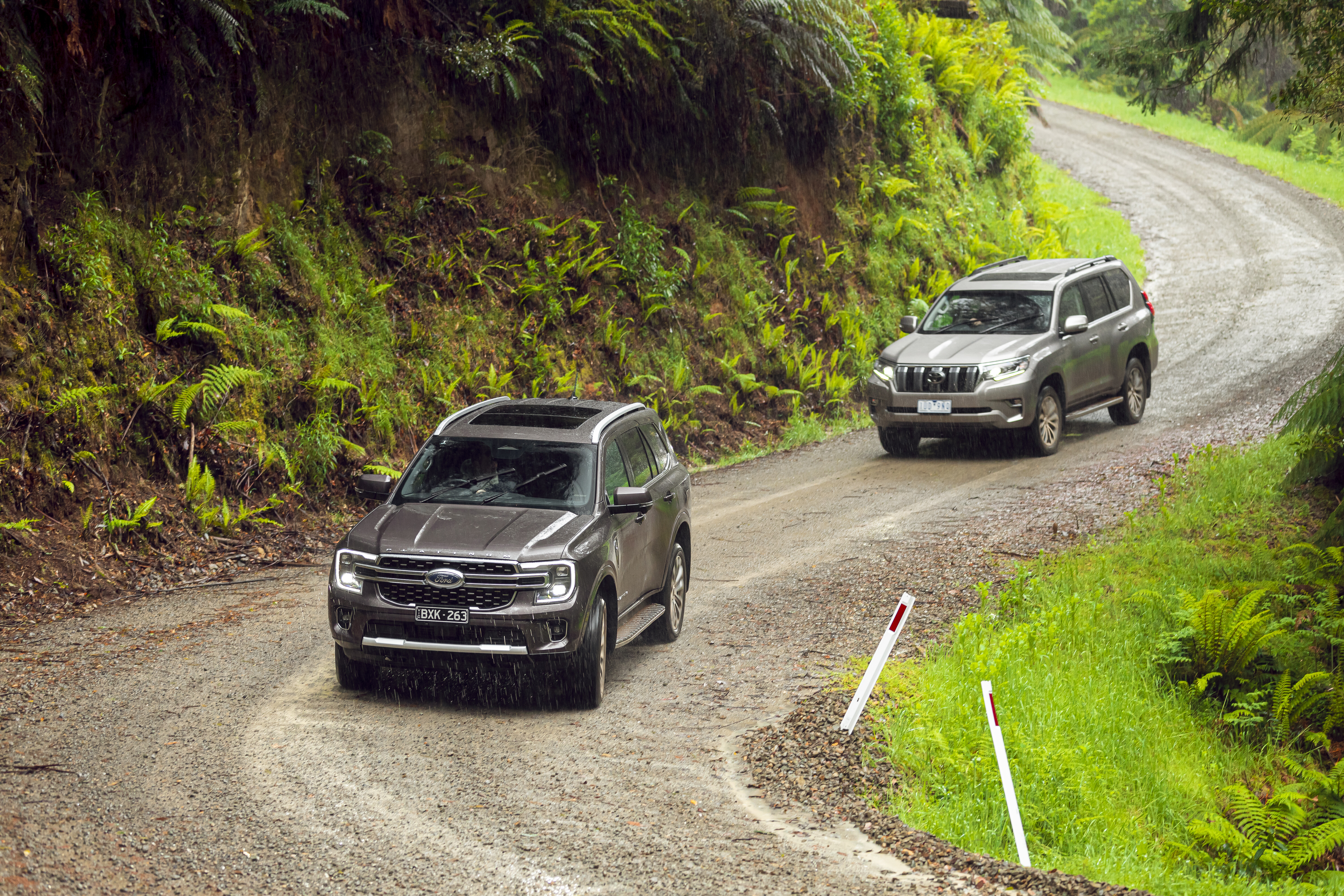
Story continues: Ford Everest Sport 4×4 review
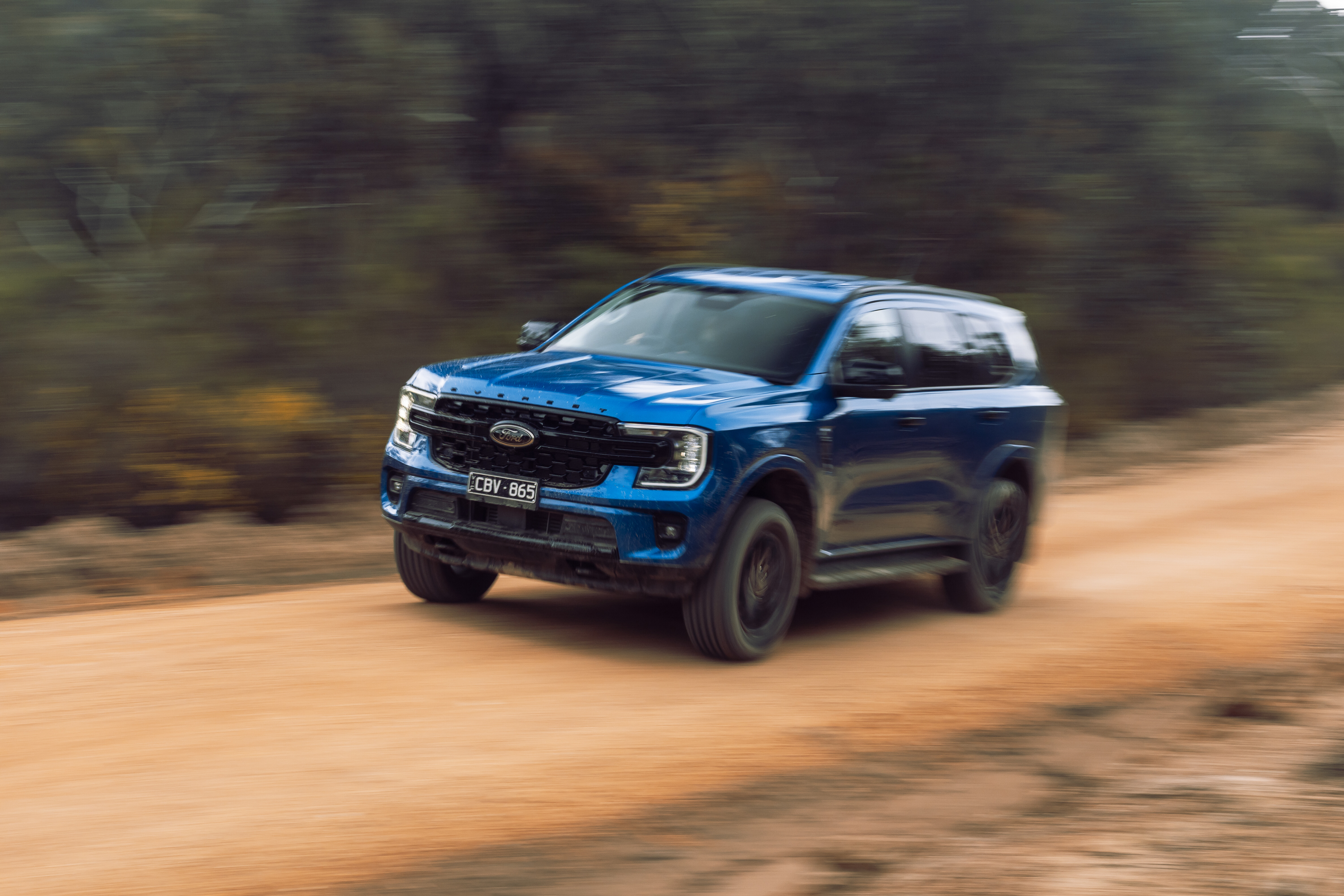
Ford has taken the advances made on the T6 Ranger ute and applied them to its Everest wagon that also rides on the T6 architecture. In doing so, it has created what could be the perfect touring wagon for the Australian family.
The new Everest came with a new-model variant in the range, the Sport, which sits in between the popular Trend and the top-of-the-line model that’s now branded as the Platinum in lieu of the Titanium as it was called on the previous generation.
The Everest Sport is available in 2WD or 4WD drivetrains and the choice of the 2.0-litre 4-cylinder or 3.0-litre V6 diesel engines, while inside, all Sport models are fitted with seven seats.
Upgrade your Ranger
Pricing
Here we’re testing the V6 Everest Sport which starts at $69,090 plus on-road costs, but it must be noted that as of the February production run, the price will go up to $69,590 and extra standard equipment will include black stand-off roof rails, a 360-degree camera, zone lighting, tow bar and integrated trailer-brake controller.
Powertrain and performance
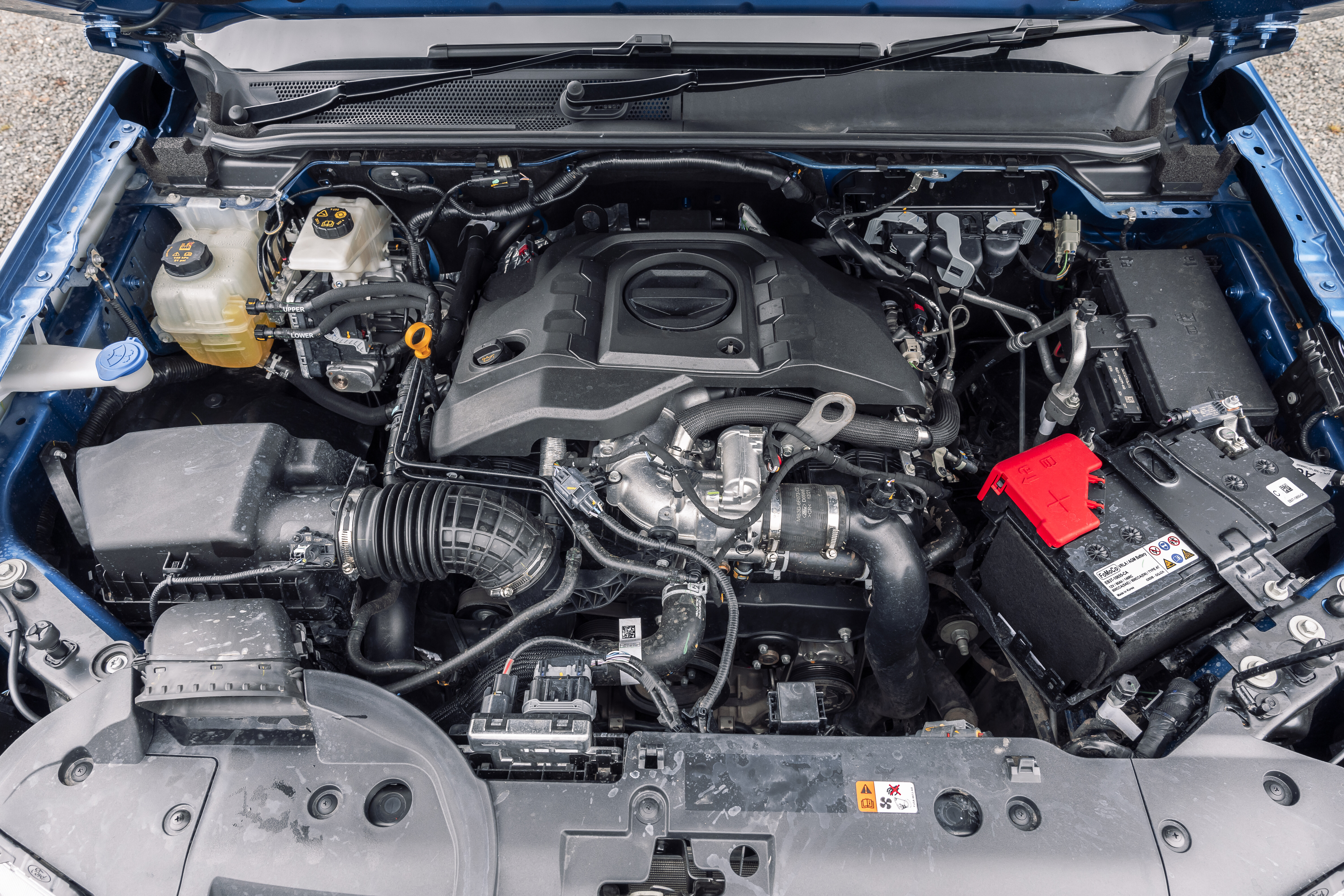
Producing 184kW of power and 600Nm of torque, Ford’s new V6 diesel engine makes the Everest unique in its class as the only vehicle powered by a 6-cylinder engine.
The V6 engine, which has its roots back with Land Rover and Ford Australia’s original SUV, the Territory, delivers seamless torque throughout its rev range and while not earth-shattering in its performance, its smooth, quiet power delivery contributes significantly to the Everest’s high levels of cabin quietness and refinement.
The engine is backed by a 10-speed automatic transmission which has been redeveloped since its introduction in the previous model Everest and Ranger where it was behind the 4-cylinder engine. It’s now smoother and more precise in its shifting and faultless in its performance.
One small gripe we have with the 10-speed is its manual shifting application which is done using thumb buttons on the right-side of the transmission gear selector. These buttons are small and not as tactile or usable as a fore-and-aft movement of the shifter itself or even paddle-type levers behind the steering wheel.
The 4-wheel drive Everest Sport feature a new transfer case that offers 2WD, 4×4 auto, 4×4 locked high range and 4×4 locked low range settings. The previous generation of Everest had an on-demand 4×4 system that didn’t give the driver the option of 2WD.
Actuation of the transfer case is easy via buttons within a dial on the console. Turning the external ring of the dial selects the multi-terrain modes for normal, towing, Eco, Slippery, Mud/Ruts and Sand driving. There’s also a locking rear differential that integrates with the electronic traction control on the front axle.
All these modes and features can also be selected via the off-road display in the huge centre dash screen after pressing the off-road button on the console.
On-road ride and handling
The Everest uses a separate ladder chassis to which the body is mounted. It uses an independent suspension set-up at the front featuring double wishbones and coil springs, while at the back is a live axle suspended on coil springs and a multi-link set-up utilising a Watt’s-link for lateral location of the axle.
It’s a suspension design that has served the Everest well over the previous generation of the model and is made better thanks to the wider wheel track and longer wheelbase of the latest model. This has resulted in improved stability, handling and ride control of the big family wagon.
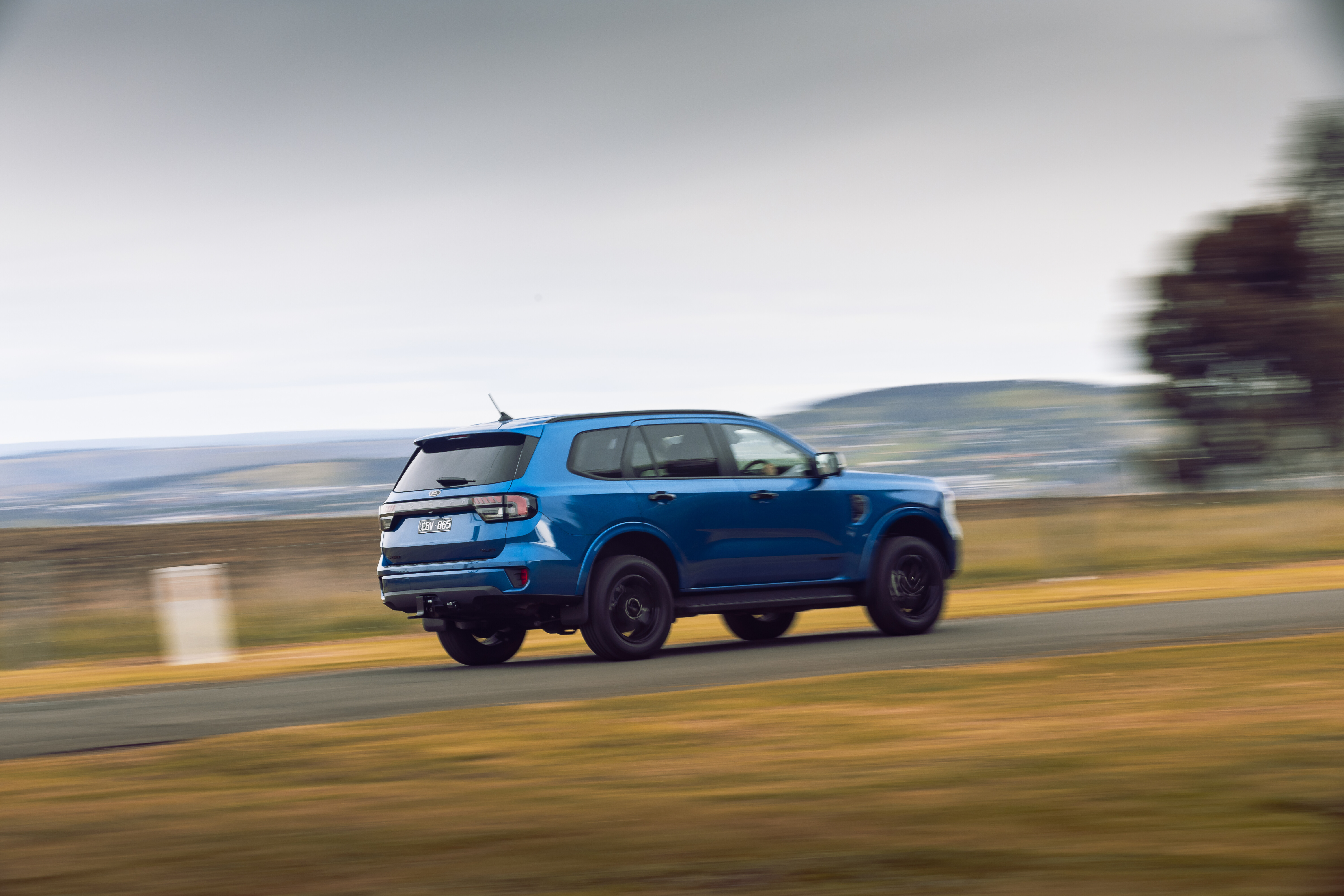
The suspension is exceptionally well-composed when driving over rough ground and doesn’t let potholes and bumps unsettle it, as can be the case with live rear-axle vehicles. For a big wagon, it’s almost a sporting ride that will reward enthusiastic drivers.
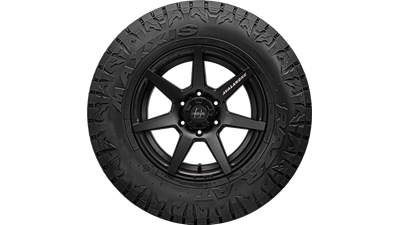
The Everest Sport rides on 20-inch alloys as standard, but a no-cost option is the 18-inch wheels and all-terrain tyres as fitted to this test car. The tyres are 255/65R18s.
Off-road
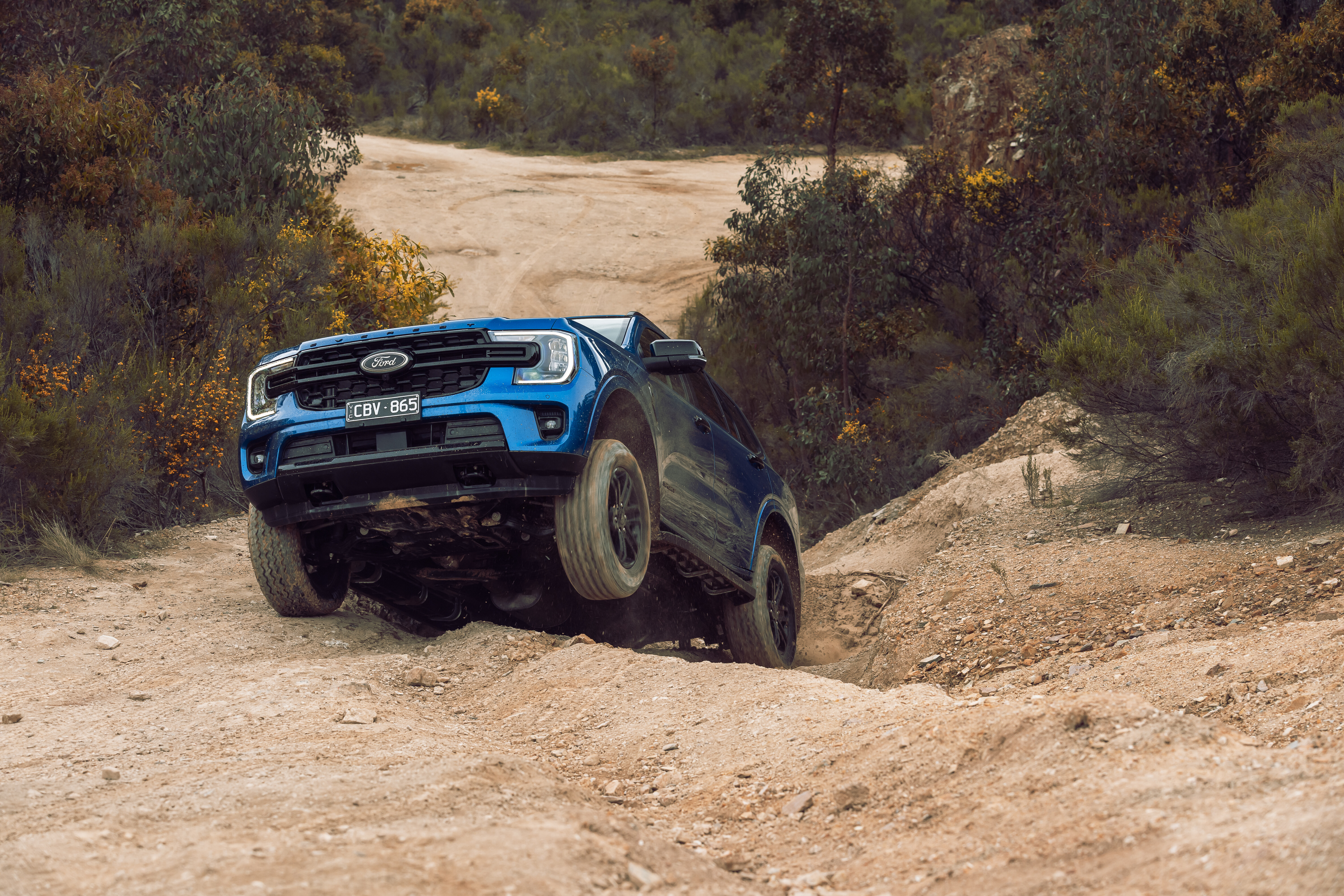
The Everest Sport impressed us when we pointed it at a deep-rutted pinch that we thought might challenge its off-road credentials. The ruts soon have its wheels in the air and panels close to the hillsides, but the Everest’s electronic traction-control made progress easy, both going up and down through the pinch.
The 4×4 Everests have a dual-range transfer case, rear differential lock, electronic traction-control and multi-drive settings that all combine to make the Everest pretty handy off road.
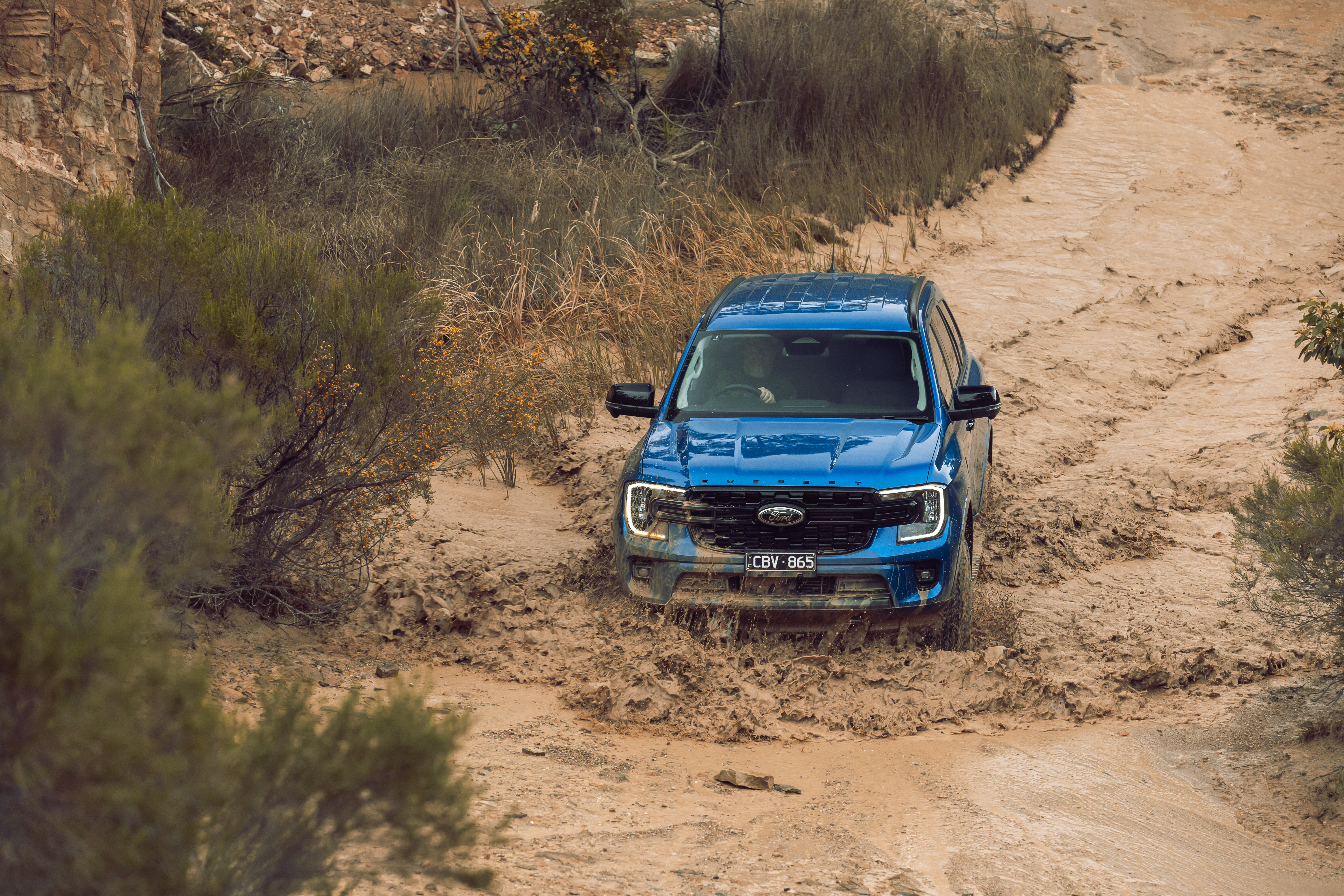
The wider wheel track of these latest T6-based Fords not only makes them more stable at speed but also gives a bit more suspension travel at the tyre to keep them on the ground for best traction.
It’s still not great wheel travel and the Everest picks up wheels easily but the well-calibrated ETC does an excellent job of keeping the car moving. The optional 18-inch alloy wheels and all-terrain tyres fitted to this car no doubt helped and are a better choice than the 20s if you are heading off road.
Interior
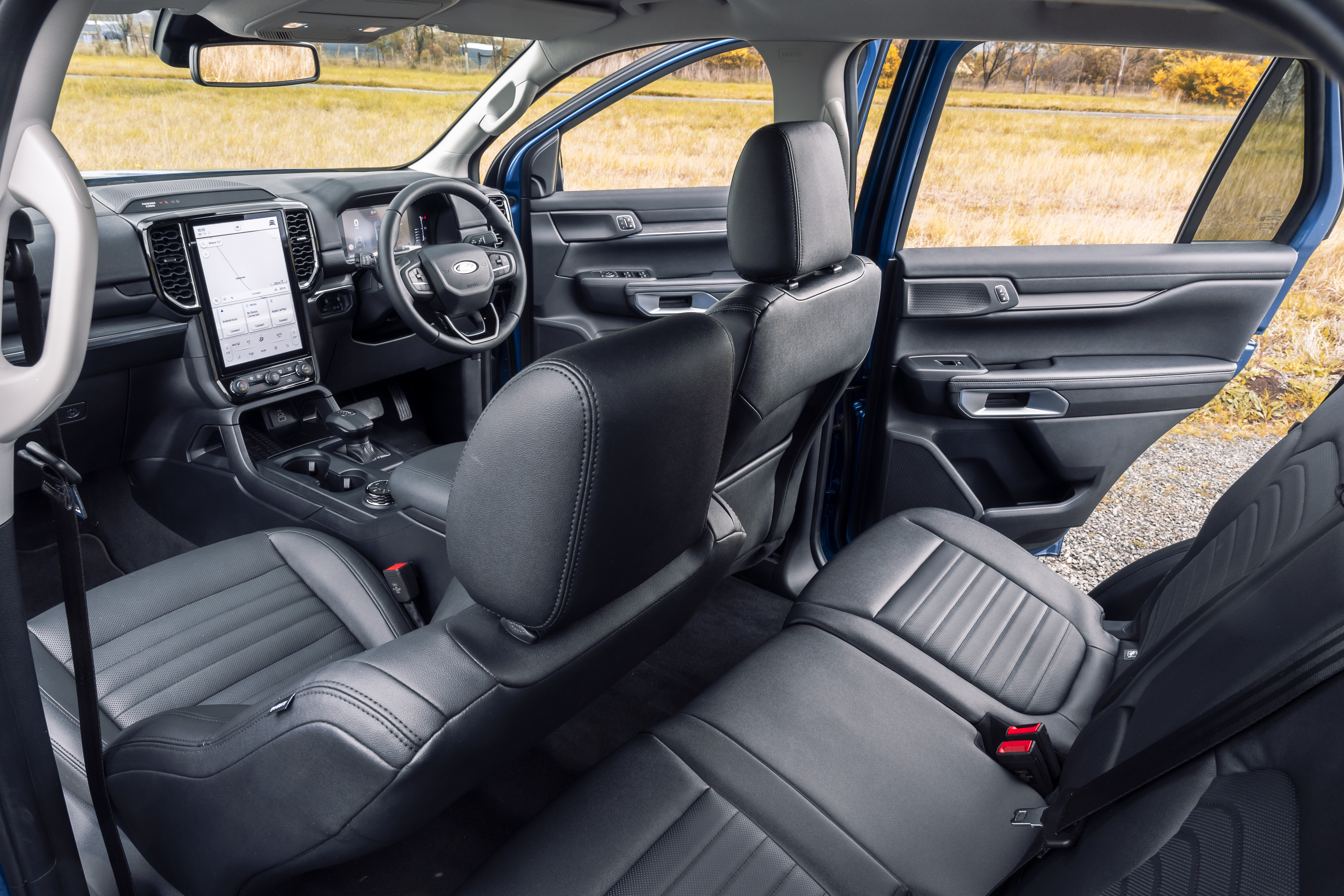
While the Everest Sport gets the black-out treatment on the outside, inside there’s a touch of luxury such as heated and cooled leather seats with powered 8-way adjustment up front, a sliding second row, and split-folding third row. The centre of the dash features a 12-inch screen that includes all your A/V controls, HVAC and Ford Sync 4 functions, while ahead of the driver is an 8-inch configurable digital dash that allows you to set up your gauges and info to how you like to use it.
Wireless Apple CarPlay and Android Auto are also standard as is a wireless phone-charging pad in the console. We did find that the wireless charging made the phone quite hot and preferred to use a cable plugged into the USB port. You also get more reliable CarPlay connection when using a cable.
Safety-wise, there is AEB, side airbags that extend through to the third-row occupants, a centre airbag between the driver and front seat passenger, lane-keeping assist that has road side detection so that it doesn’t rely on the white lines, blind-spot indicators, reversing emergency brake, post impact braking, trailer-sway control, 360° camera, and radar cruise control. The blind-spot indicators work with the Sync 4 trailer set-up to take into account the length of your trailer and adjust the range it works over.
Unfortunately, Ford only sees fit to include the tyre-pressure monitoring system (TPMS) as standard on the Platinum Everest, so its not available on the Sport.
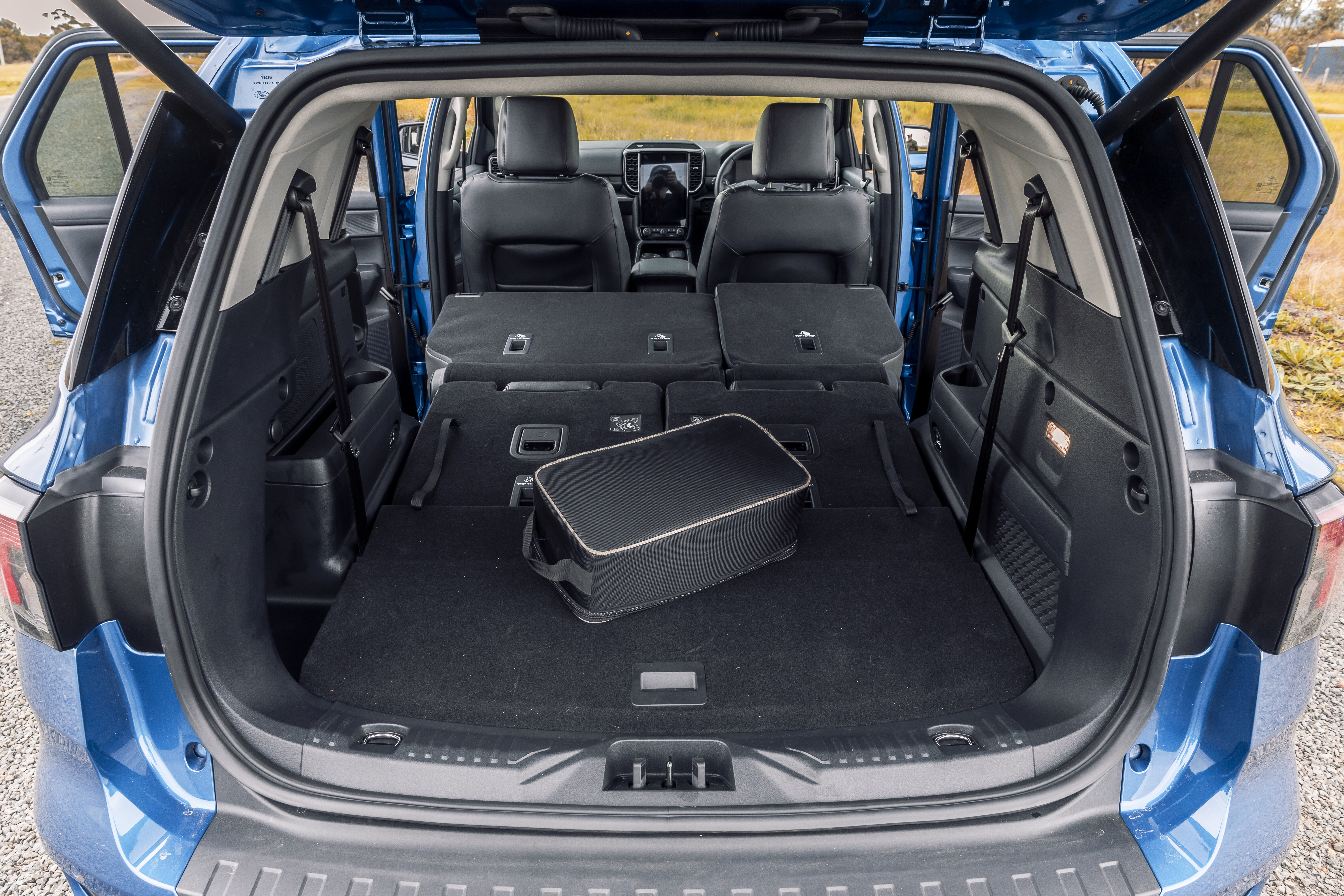
There’s plenty of room for front-seat passengers, while room is adequate for two adults or three kids in the second row. The third-row seat is surprisingly accessible for an adult, but a tight squeeze once you’re in there. They fold flat into the floor when not in use to give a large, long cargo space with a 12V power outlet back there.
Ford quotes the capacity behind the second row of seats to be 898-litres with 259-litres left with the third-row upright and in place. The Everest Sport has a powered tailgate. The steering column is manually adjustable for both reach and height.
Practicalities
The Sport, like all 4×4 Everest 4×4 models has a 3500kg towing capacity, a 6250kg GCM and a 696kg payload. It offers a good balance of standard equipment and payload capacity but like all 4×4 wagons, it’s something you need to keep in mind if you are fitting accessories and carrying passengers. You don’t want to exceed the 3150kg GVM.
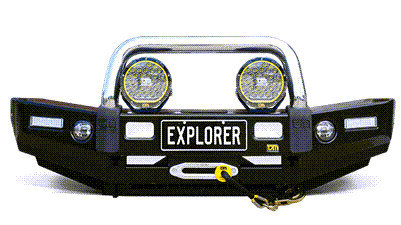
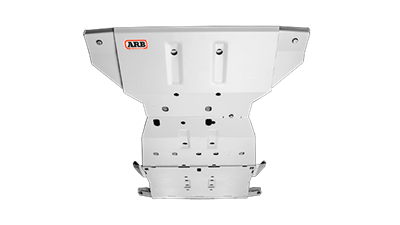
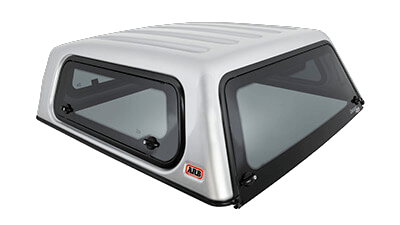
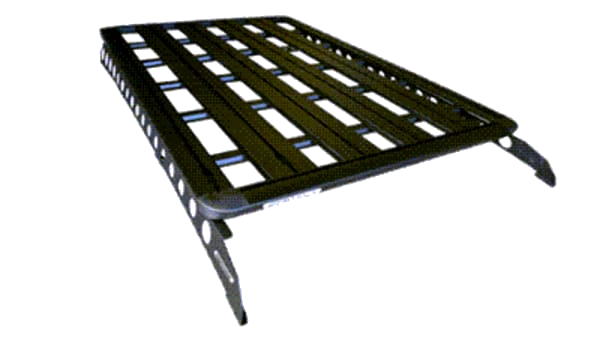
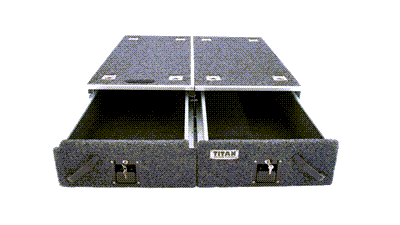
Being closely related to the Ranger ute, there is an abundance of accessories available to allow the owner to build the Everest to suit his or her needs. These come from both Ford and the aftermarket, and also include Ford’s partnership with ARB to offer ARB accessories that are covered by the factory Ford warranty, provided they were ordered at the time of vehicle purchase.
Verdict
Ford has delivered a vehicle that should surpass everything else in its class in terms of performance, refinement, safety and features. The fact that this is a new model in a class of aging competitors plays a big part in that, but the Everest is a big step up from anything before it.
The inclusion of the V6 diesel engine makes the Everest unique in this category and is the major contributor to its refinement both on and off road. The extra money for the V6 engine over the bi-turbo 4-cylinder engine is money well-spent, as it takes the Everest to a higher level of driving, one that you’re otherwise paying $100K or more to be in.
4X4 Australia's project builds
2023 Ford Everest Sport specs
| Price | $69,090 |
| Engine | V6 turbo diesel |
| Capacity | 2993cc |
| Max Power | 184kW at 3750rpm |
| Max Torque | 600Nm at 1750 to 2250rpm |
| Transmission | 10-speed automatic |
| 4×4 system | 2WD, 4×4 auto, 4×4 high range, 4×4 low range |
| Crawl ratio | N/A |
| Construction | Body-on-frame 5-door wagon |
| Front suspension | Double wishbone IFS |
| Rear suspension | Live axle, coil springs, multi-links, Wattu2019s link |
| Tyres | 275/45R21 |
| Weight | 2492kg (kerb) |
| GVM | 3150kg |
| GCM | 6250kg |
| Towing capacity | 3500kg |
| Payload | 696kg |
| Seats | 7 |
| Fuel Tank | 80L |
| ADR fuel use | 8.5L/100km |
| On-test fuel use | 11.1L/100km |
| Approach angle | 30.2u00b0 |
| Rampover angle | 21.9u00b0 |
| Departure angle | 23u00b0 |
| Ground clearance | 226mm |
| Wading depth | 800mm |
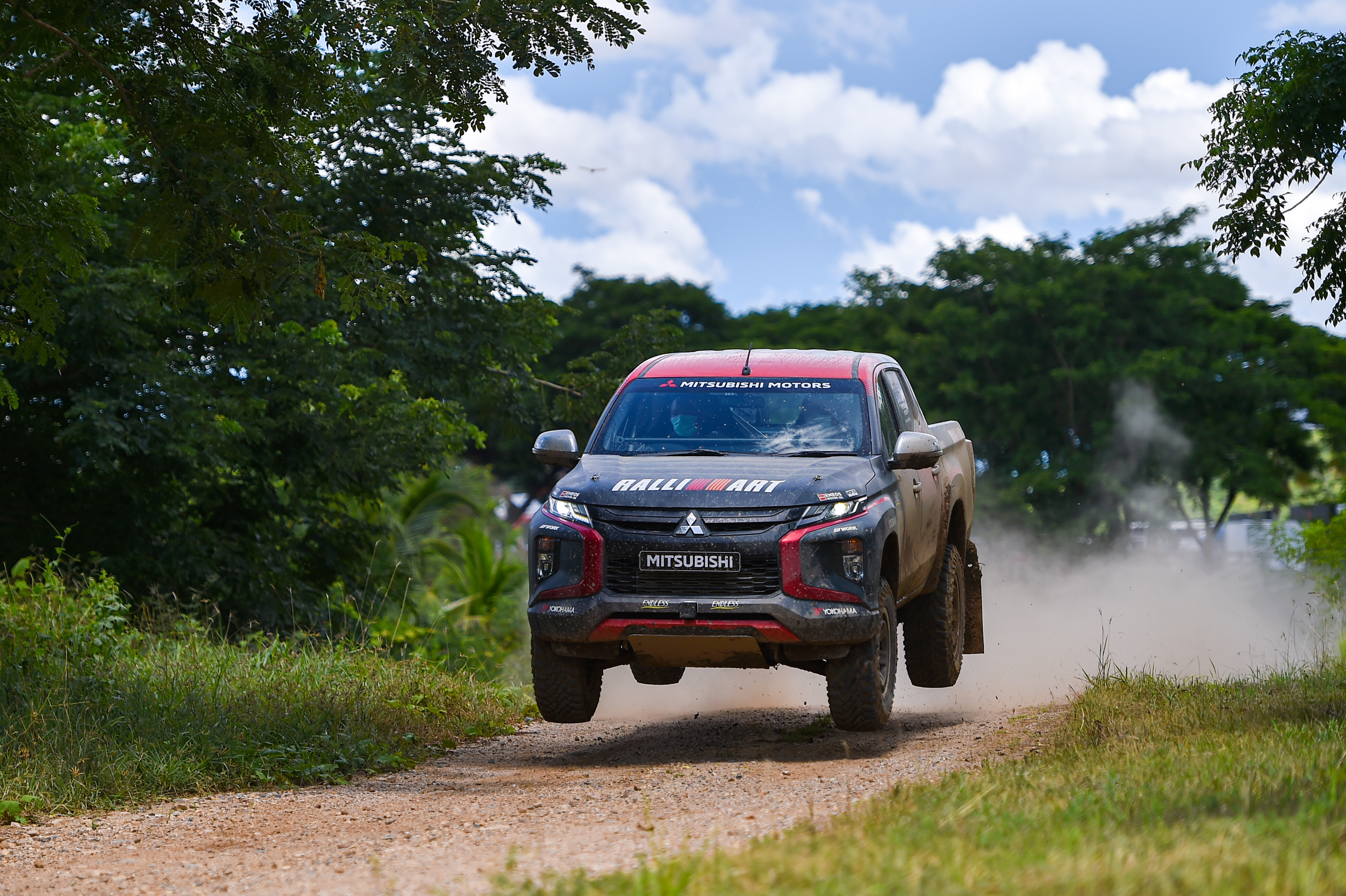
Mitsubishi’s Ralliart division has returned to rally racing, with a modified Triton taking victory at the 2022 Asia Cross Country Rally.
The rally trail covered 1700 kilometres of terrain from Thailand to Cambodia, with mountain, jungle, swamp, beach, river, desert, plantation, tarmac and circuit environments across six days and various weather conditions.
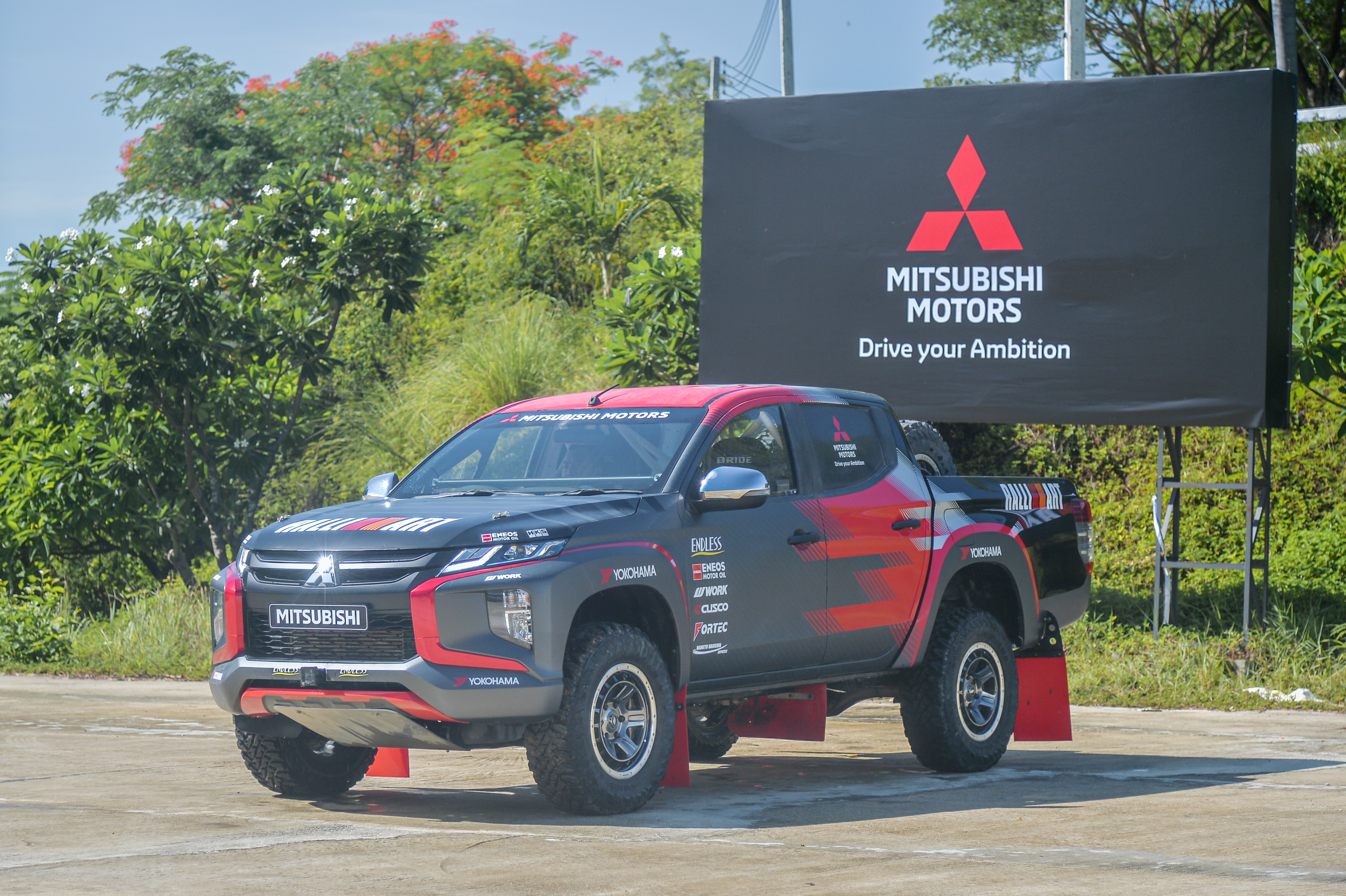
It is classified as an FIA Group T1 rally car, with modifications including a lightened bonnet, carbon fibre doors, a roll cage, underbody protection, and a retuned version of the Triton’s four-cylinder diesel engine.
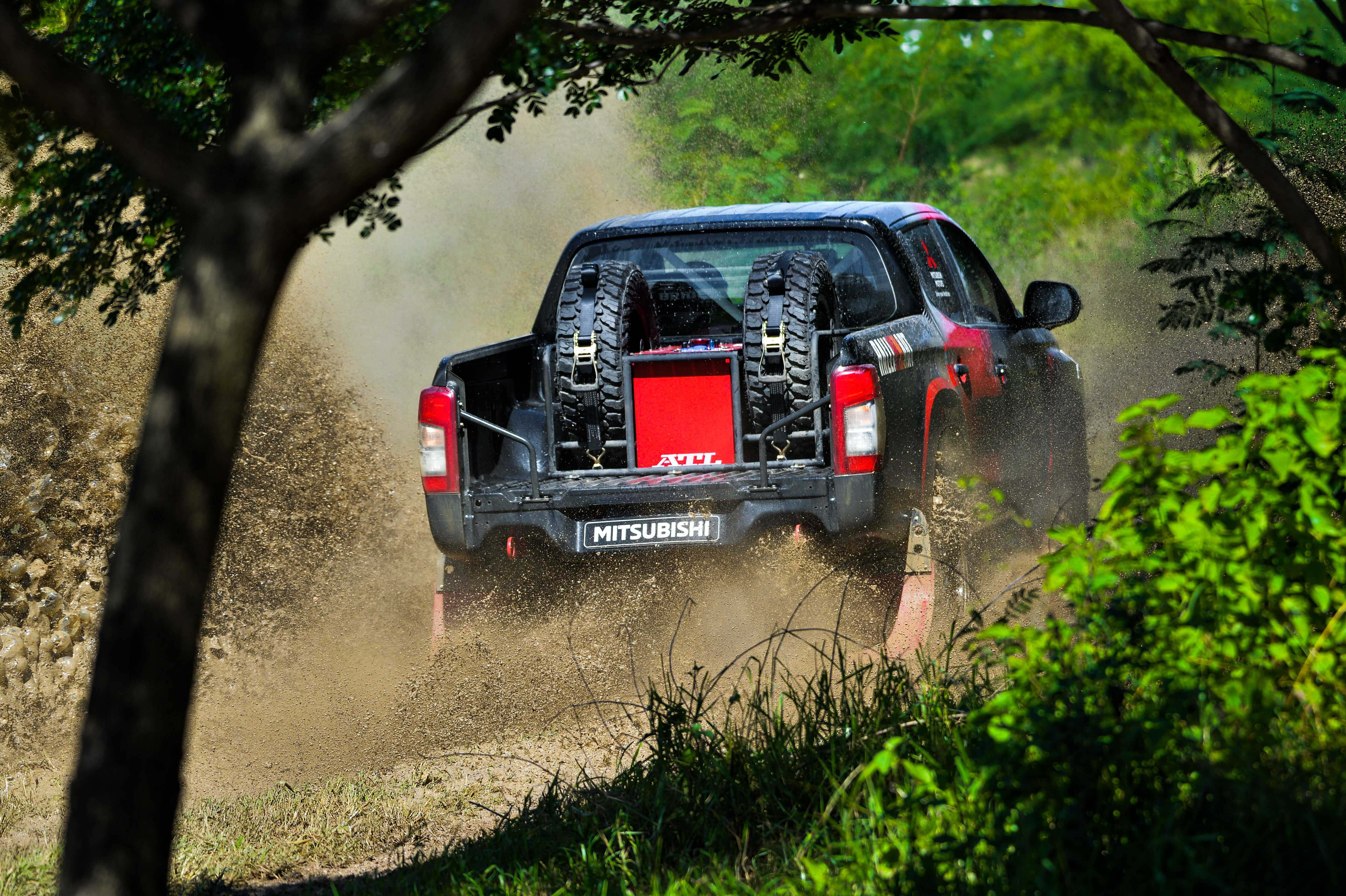
While power for the 2.4-litre turbocharged four-cylinder diesel engine remains identical at 133kW and 430Nm, the revisions comprise reduced friction and improved responsiveness in the mid-speed range.
Further mechanical changes include a front and rear limited-slip differential, adjustable front and rear dampers, larger front and rear ventilated disc brakes with four-piston calipers, 17-inch Work alloy wheels, and Yokohama Geolander tyres.
While the Mitsubishi Ralliart team is owned privately, by Tant Sports in Thailand, it is backed by technical support from Mitsubishi Motors. The team is directed by Hiroshi Masuka, a back-to-back Dakar Rally champion driver in 2002 and 2003.
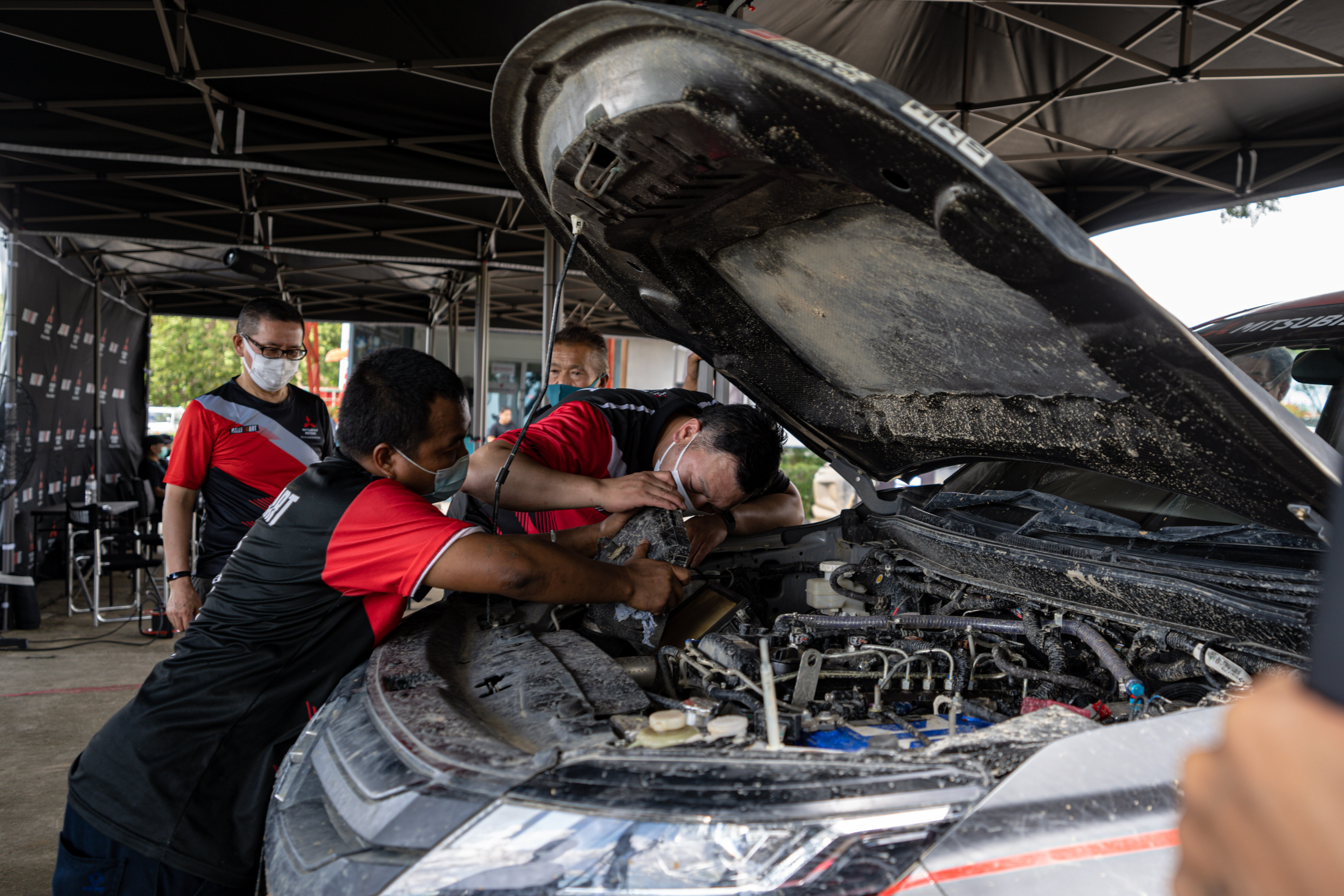
The winning vehicle was steered by Thai driver Chayapon Yotha and co-driver Peerapong Sombutwong, with the six stages completed in a time of 8:22.42, while a second car driven by Rifat Sungkar from Indonesia and co-driver Chupong Chaiwan finished in fifth place.
“In order to win among rivals with larger engine displacements, I concentrated on reducing mistakes thoroughly and completing each corner and stage carefully,” said Yotha.
“We were able to achieve good results in this rally because of the excellent handling performance of the Triton. It was very easy to control, allowing me to follow the line as I intended in any road surface conditions – tarmac, gravel or mud.”
Hiroshi Masuoka, team director, said the return of the Ralliart name was important for Mitsubishi.
“I thought that it would be good enough for us to finish in upper rankings, but I am very happy that the team has taken an overall victory.”
What about a production version?
Mitsubishi Australia has hinted the Ralliart nameplate could return to locally-developed, hotted-up versions of the Triton and Outlander.
A potential Triton Ralliart could be built by a local third-party, such as Walkinshaw, in an identical fashion to the Nissan Navara Pro-4X Warrior and Volkswagen Amarok W-Series.
“From our point of view, Ralliart means some tangible performance benefit,” said Mitsubishi Australia’s chief product planner, Owen Thomson, at the launch of the Outlander PHEV in August.
“Whether that’s to the chassis or to the powertrain or whatever; that’s our fundamental position on what MMAL [Mitsubishi Australia] would like to see in the market. How that eventuates is something we’re still working through with MMC [Mitsubishi HQ in Japan].”
However, Thomson quickly emphasised that the discussions around Ralliart are still in their early stages.
“We’ve expressed a desire around where we’d like to go, but we don’t have anything else to say around exactly how it will look at the moment,” he said.
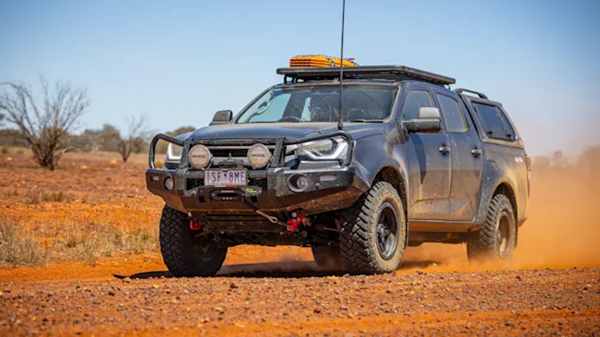
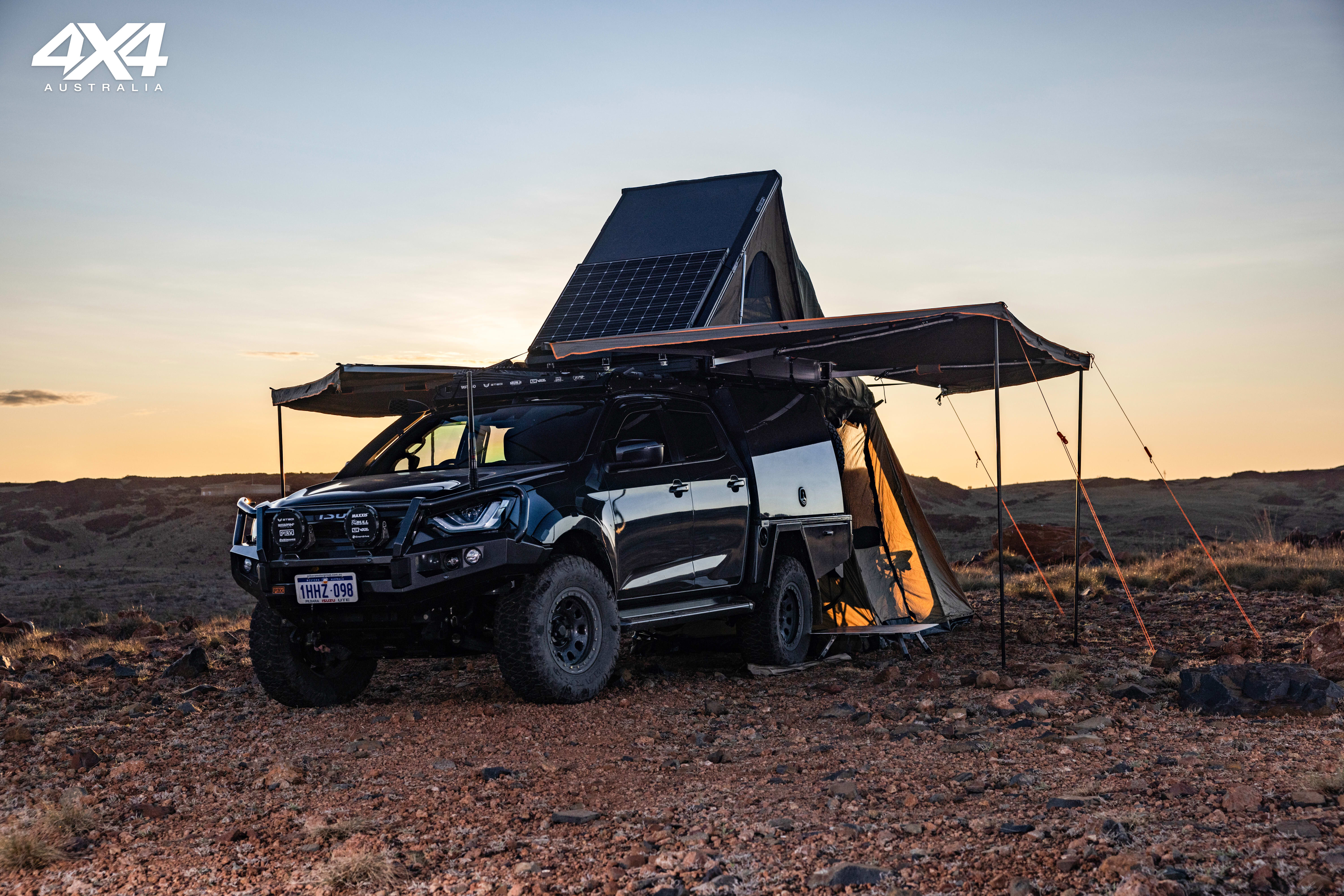
Dreamax the D-MAX has awoken from its slumber to be awarded the coveted 2022 Custom 4×4 of the Year crown, winning the public vote in a landslide against a selection of the best custom vehicles in Australia.
Aptly labelled as one of the best touring D-MAX utes in Australia, owners and Port Hedland locals, Chris and Bekk Gillis, comprehensively rebuilt this custom 2021 D-MAX X-Terrain in a transformation that made it their ultimate home-away-from-home.
Beneath the hood, the factory intercooler piping was ditched in favour of a Munji hard-pipe kit, while a tune by Reaper Performance netted an increase in engine performance to 181hp and 656Nm. A Harrop eLocker was installed up front, with a Munji diff drop keeping the front CVs content.
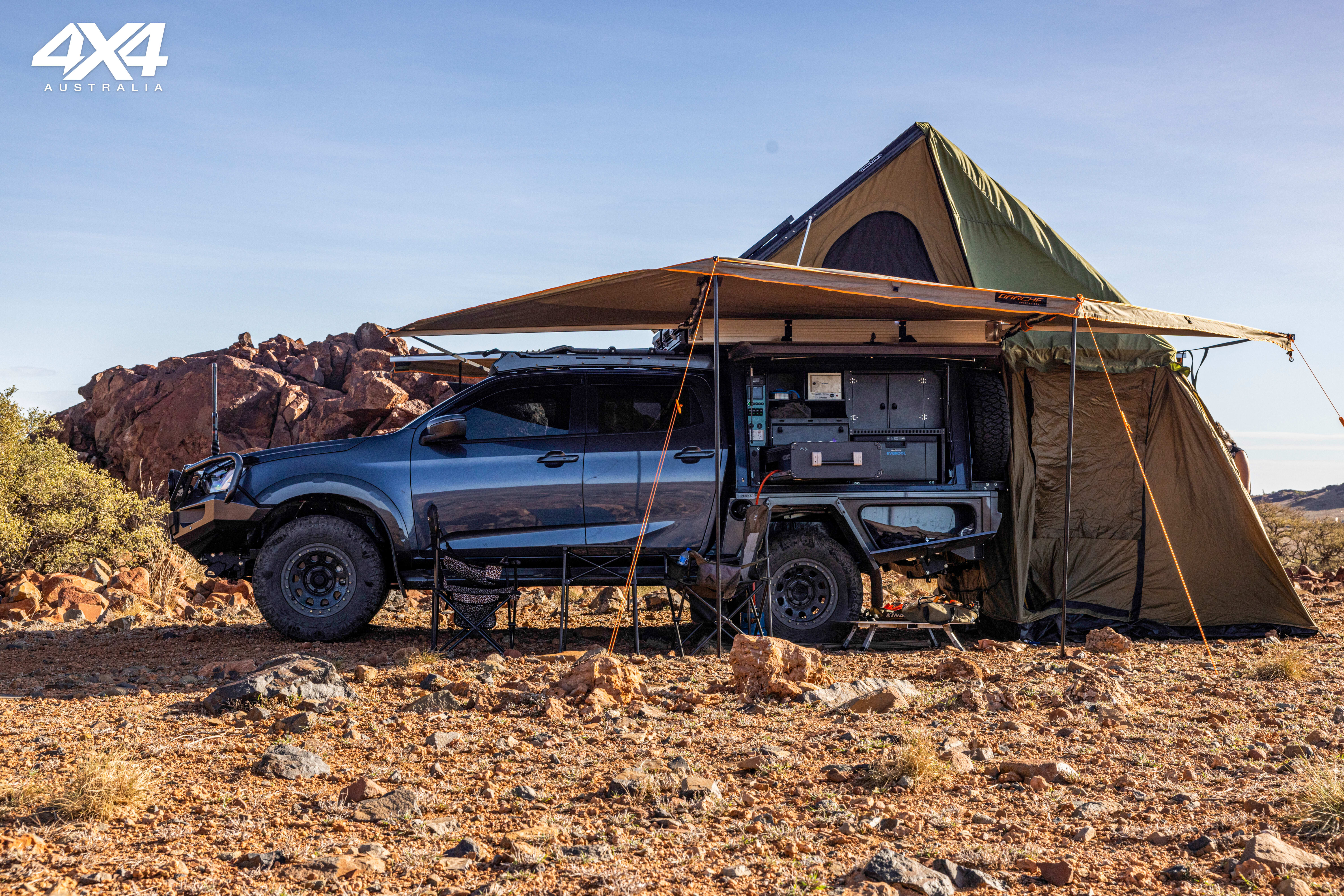
The D-MAX was lifted three inches at the front and two inches at the rear, aided by uprated Dobinson springs, remote-reservoir MMR shocks and a pair of Airbag Man heavy-duty airbags. The GVM was increased to 3600kg.
That tidy canopy is a custom unit from Bull Motor Bodies and features a Dometic slide-out kitchen, a 40-litre Evakool unit and copious storage solutions – among heaps more kit. A Land Raxx Summit Platform sits atop and houses a TJM shovel, a set of MaxTrax, a Hercules off-road jack, and a Stedi light bar. An Enerdrive Wanderer controls and monitors all electrics.
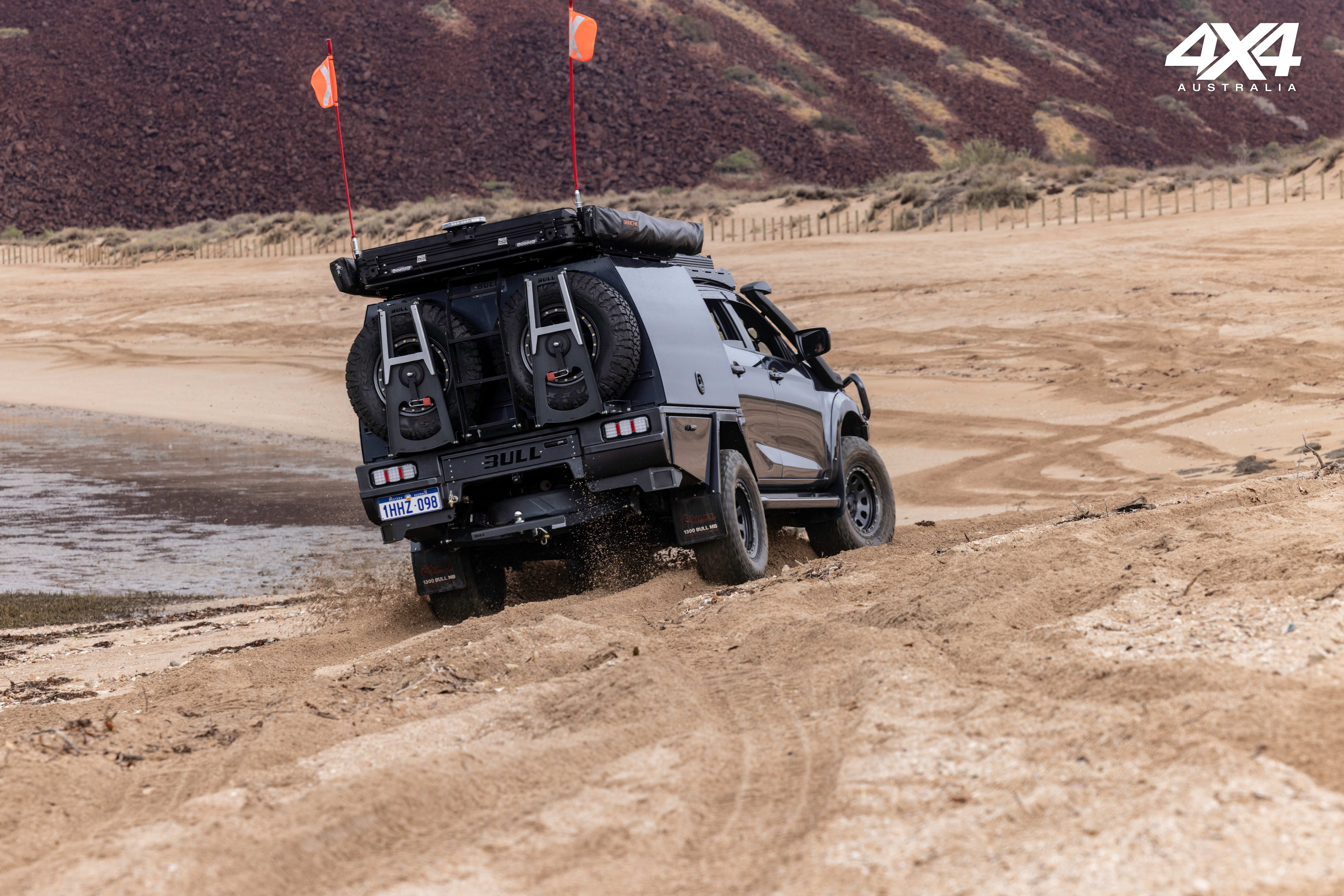
Dreamax the D-MAX won with a whopping 277 more votes than second placegetter, a 2015 Ford Ranger, with the 75 Series Troop Carrier rounding out the podium.
As a result, the owners of Dreamax have not only claimed the 2022 Custom 4×4 of the Year gong, but they’ll walk away with a Maxxis voucher valued at $3000, a Clearview Accessories voucher valued at $500, and a MaxTrax voucher valued at $500.
Punters who voted in the competition also went in the draw to win a Maxxis voucher valued at $2000, a Clearview Accessories voucher valued at $500, and a MaxTrax voucher valued at $500.
The lucky winner was Sydney-sider, Ben Gibson, who was ecstatic when notified he’d won. “That’s so awesome. It’s an awesome giveaway. This news is the best news I’ve had this week, so much more than you guys could know. Thank you so much,” Ben told 4X4 Australia.
Ben plans to upgrade his old original Clearview mirrors to newer Next Gen or Compacts, and he’ll most likely upgrade to a set of Maxxis M/Ts, as he already runs Maxxis A/Ts.
Enjoy ogling the latest selection of reader-submitted rides and then head to our Facebook page and send us a few pics of your 4×4 – it could end up in the next issue.
2021 Nissan Y62 Patrol Ti-L
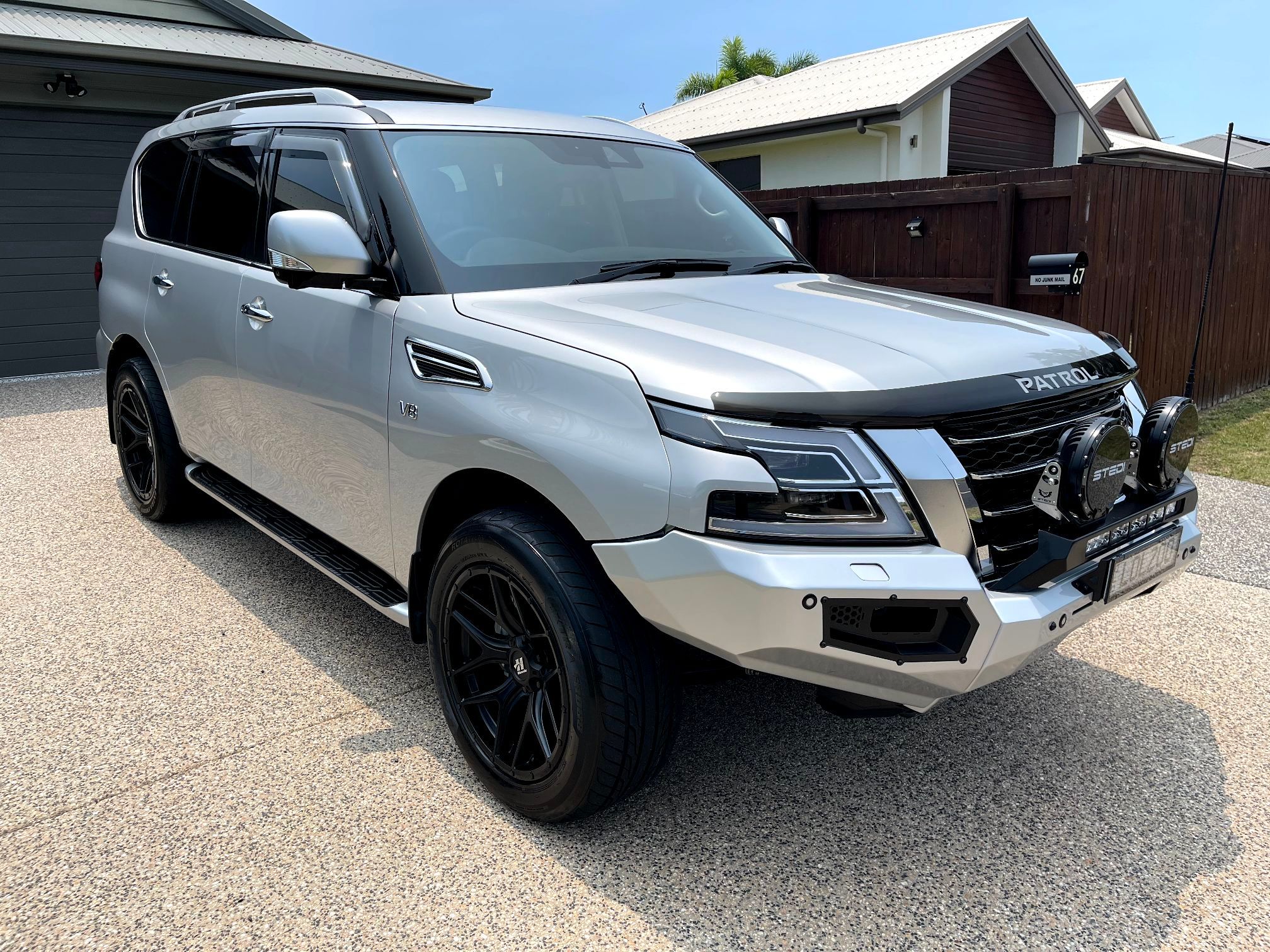
Not many mods, just a Dash Predator bar, Stedi Spotlights, 80-channel UHF, 20-inch wheels with 275/60R20 Farroad Tyres, and a three-inch Torqit cat-back Exhaust. Just bought it recently, so I haven’t spent much time off-road with it yet … time will tell – Jacques Van
2016 Toyota LandCruiser 200 Series
It has been chopped and extended 750mm by DMW, and other modifications include a DMW steel tray and dog box; GVM upgrade to 4490kg; ARB BP51 remote-res suspension and ARB bar work; Armax snorkel; and a GSL stainless-steel exhaust.
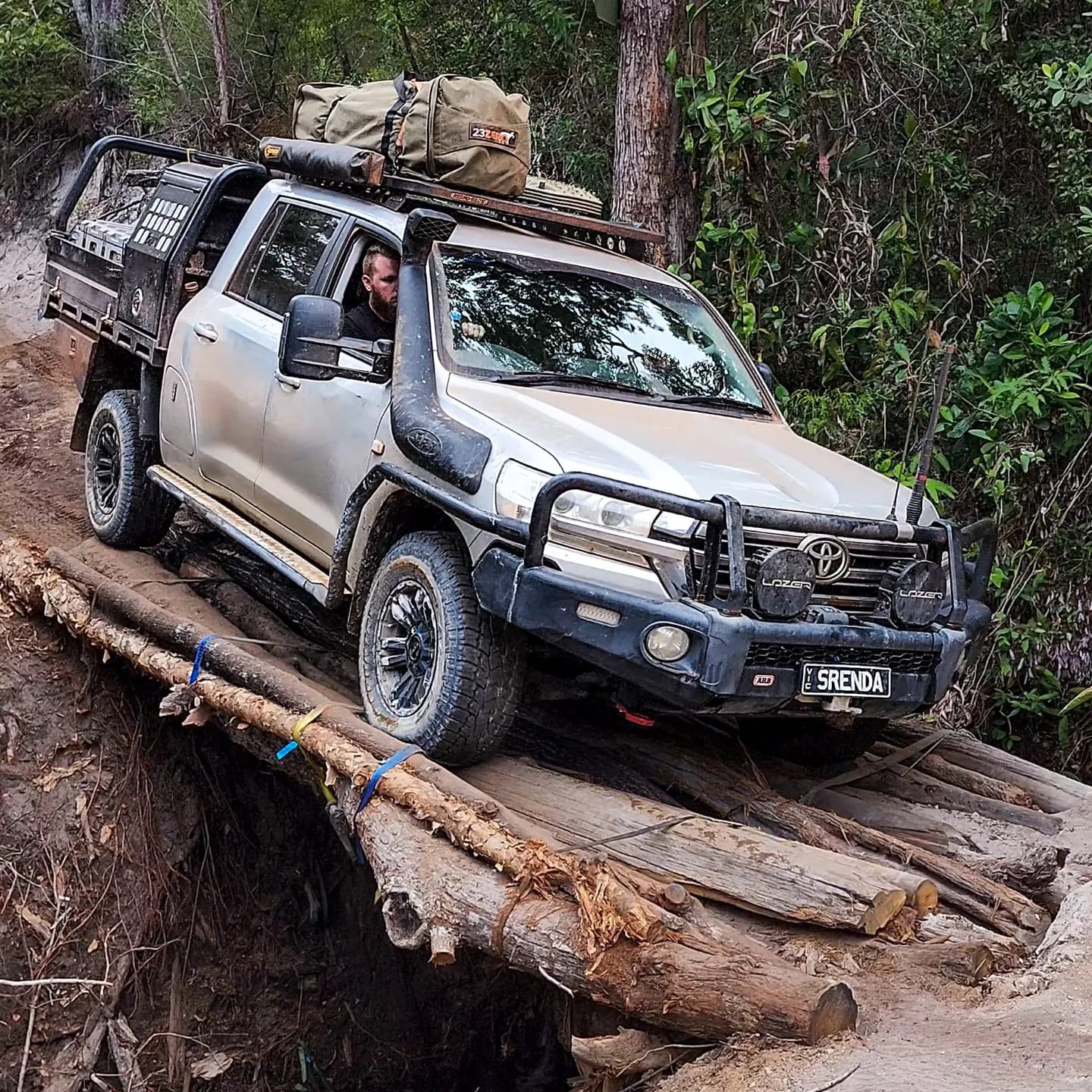
Other kit includes Lazer Sentinel Elite driving lights and rear work lights; Rhino Pioneer Platform; ROH Vapour rims; Smittybilt winch; GMR XRS UHF; dual batteries with Redarc BCDC and solar; and a TJM Pro series on-board compressor and air tank; Airbag Man airbags in the rear; EC Offroad 10-inch head unit; Safety Dave camera system; Redarc Towpro; lock-up kit; transmission tune by Geelong Performance; and Clearview mirrors.
Just did Melbourne to Cape York towing a camper in June this year, and did the Tele Track which was amazing – Bodene Jackson
GWM Cannon
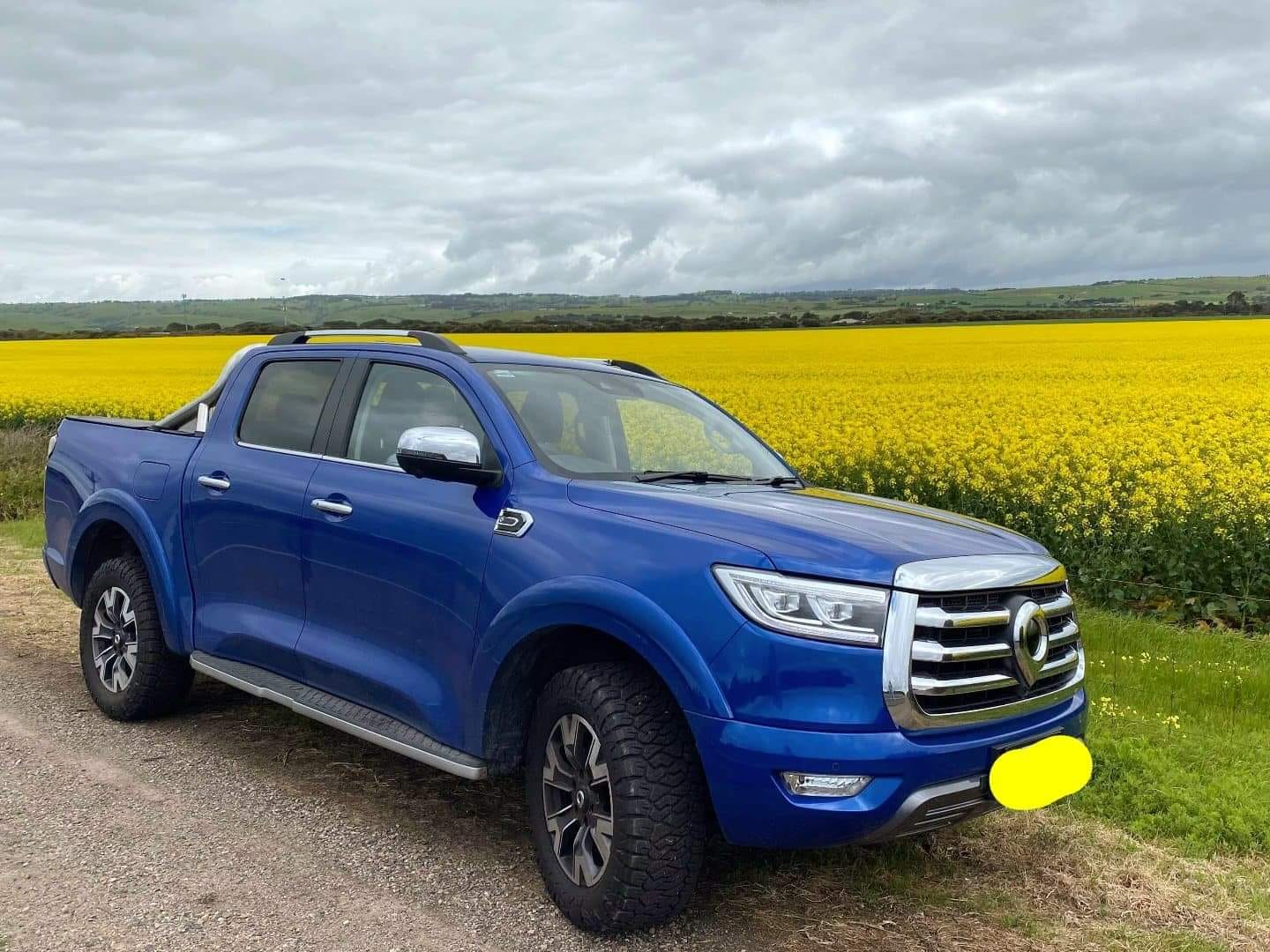
No mods, as it has all of the 4×4 systems you would ever need for an off-road adventure, as well as a good set of Maxxis AT 811 tyres. Haven’t been on any adventures yet, but I’m in the process of planning some great adventures with the caravan in tow – Gregory Morgan Ellis
1984 Mercedes-Benz Unimog U1700L
It has done 400,000km, and it was formerly one of only 4 AAT Kings custom-built Unimogs with Safari bodies built by Centurion Transport Engineering. It’s my home and daily.
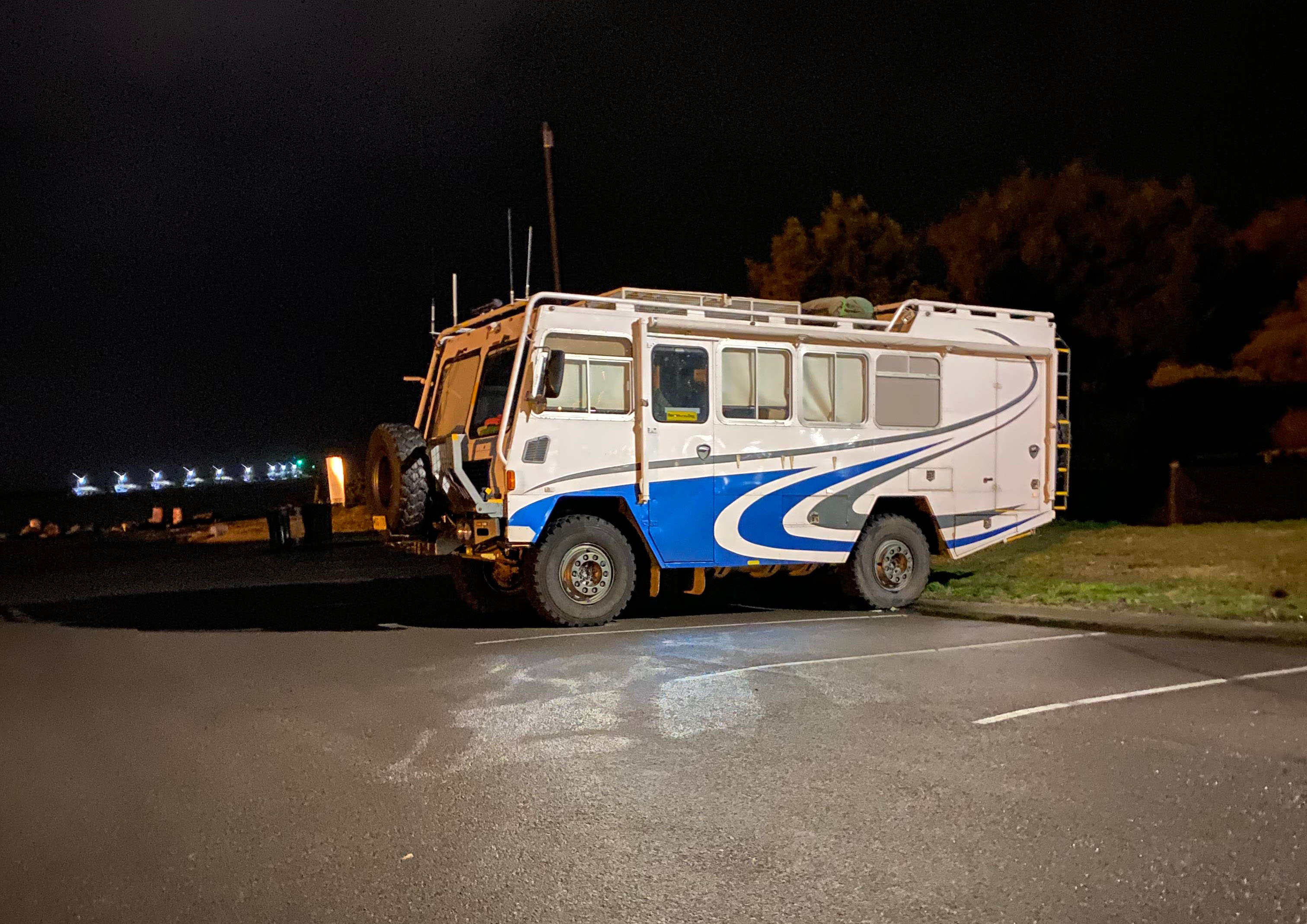
It has had a lot of engine and chassis work to keep up with its age, and I have been working on improvements for a few weeks, as it’s for both home and work.
I get about 10 people a day wanting to talk about it, and other Mog owners are diehard fans. The next big mods will be a crown/pinion upgrade for 110km/h highway speeds, an engine rebuild for more power, exhaust upgrades and bigger, better inverters. Going to be working off-grid, so it’s perfect, and I have a dog that travels with me.
Following a three-year restoration and conversion, this unique 4×4 motorhome is ready to take on just about anything – Sam Wise
2021 Toyota LandCruiser 79 Series
This picture was taken at a river crossing on Bloomfield Road, Cape Tribulation, and the best 4×4 trip going to the tip of Cape York.
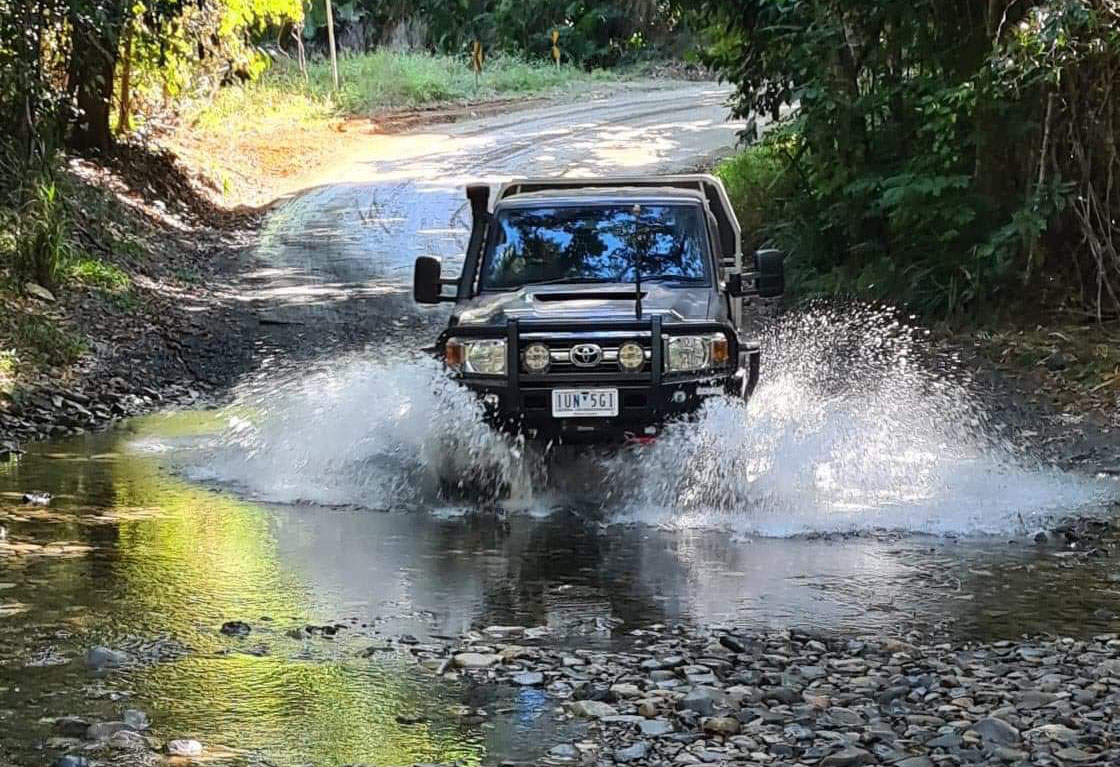
Vehicle mods include ceramic coating; custom-made canopy installed with an under-tray compartment; bigger tyres and rims; bash plate; TJM bullbar, side rails and steps; driving lights; winch; UHF radio and aerial; GVM upgraded suspension and springs; Clearview mirrors; fridge slide and tray; Canopy battery system; Redarc battery system; extra-long-range fuel tank; and a reversing camera. So many more things to do. I love it – Leanne Keen
2019 Toyota LandCruiser 200 Series
This was taken on an awesome trip to the Cape in between a COVID break in July, 2021.
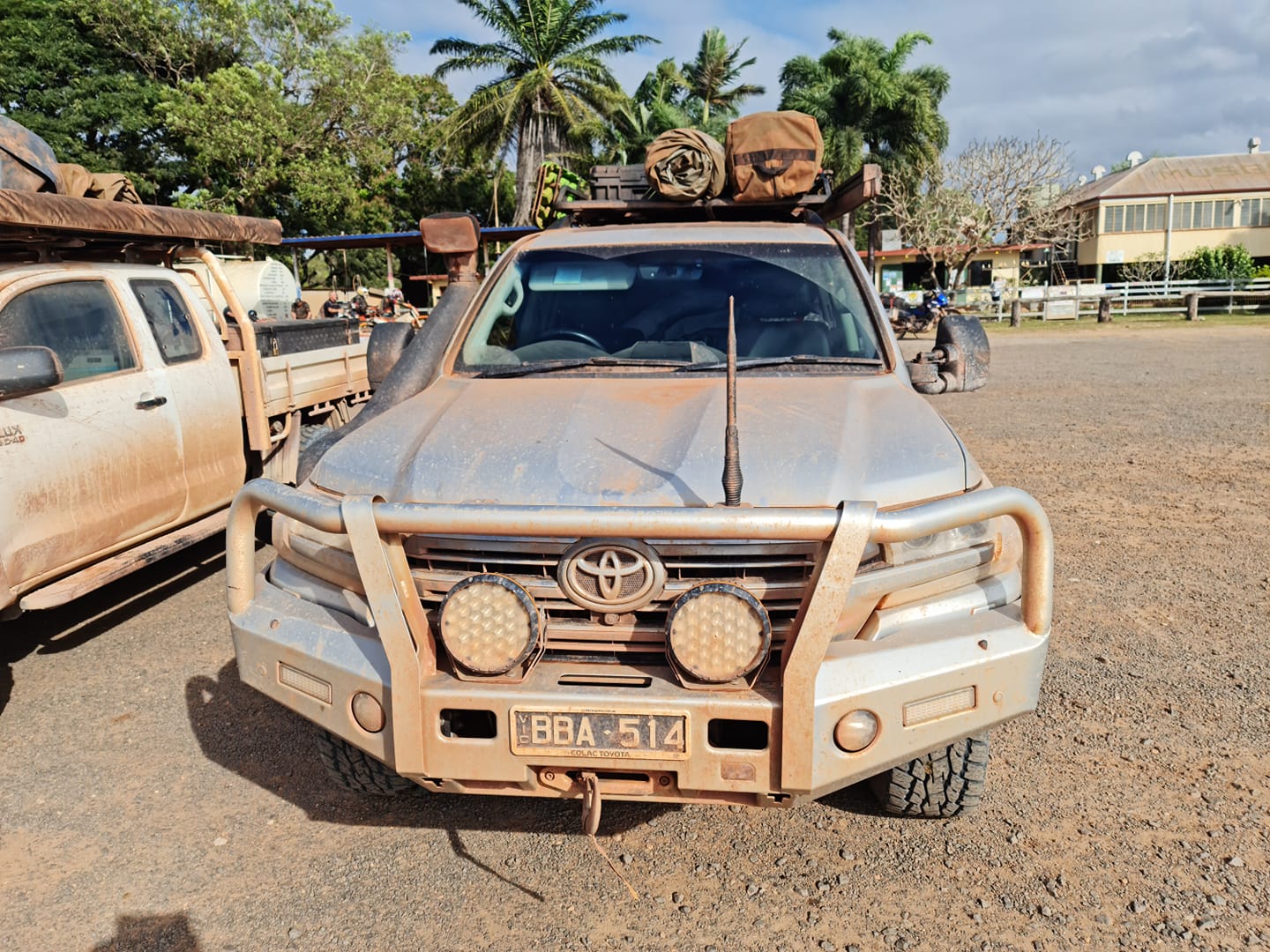
Turned out to be a quick trip in the end due to NSW closing the border to Queensland, and we just made it to Loyalty Beach. Long story short, NSW and SA closed their borders to Queensland, so I had to leave my car at Rockhampton. Took nearly three months to get it home on a car transporter.
Plenty of TJM gear including a T13 outback bar; XGS two-inch lift; a 135amp/h second battery built in to the drawer system; and 50kg front, 200kg rear constant springs – Cory Beckett
The 4X4 Australia Custom 4×4 special is out now.
What better way to be inspired for your next (or ongoing) build than to ogle at 10 of the best custom 4×4 builds in the country.
In this special issue we’ve included a comprehensive analysis of 10 wild custom 4x4s built for a variety of purposes, so you’re sure to find a product or idea that’s ideal for your project.
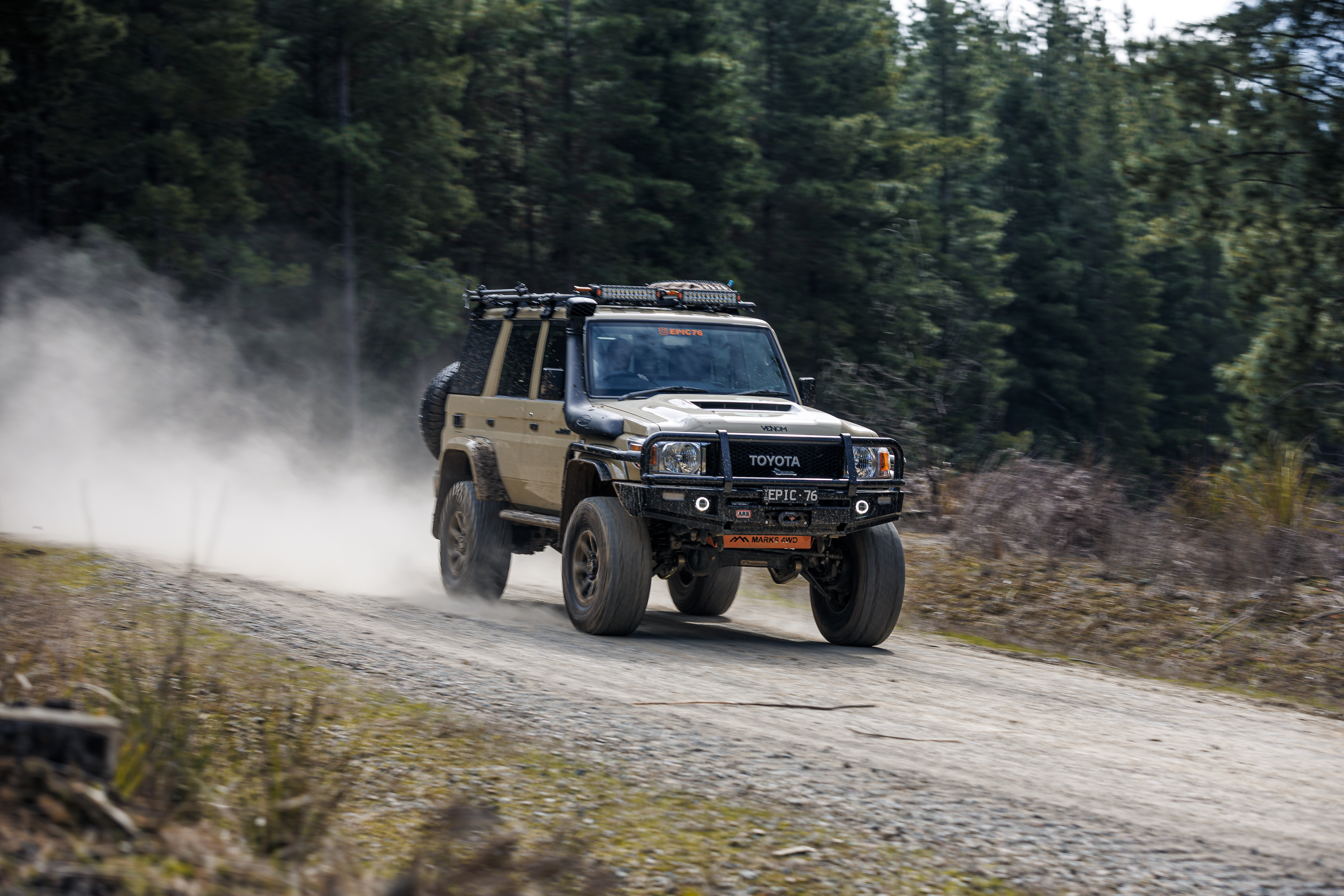
Whether it be an epic 76 Series LandCruiser perfected for touring duties; a Cape York-bound N80 Hilux transformed from work ute to family tourer; or Dreamax the D-MAX, one of the best touring D-MAX utes in Australia.

If those don’t float your boat, we’ve featured a stretched VW Amarok with more than 200kW at the wheels; an off-grid Defender tailor-made for remote travel; BAW Automotive’s ludicrous chopped 200 Series LandCruiser; and a wild Ranger with suspension built for weekend rock-crawling.
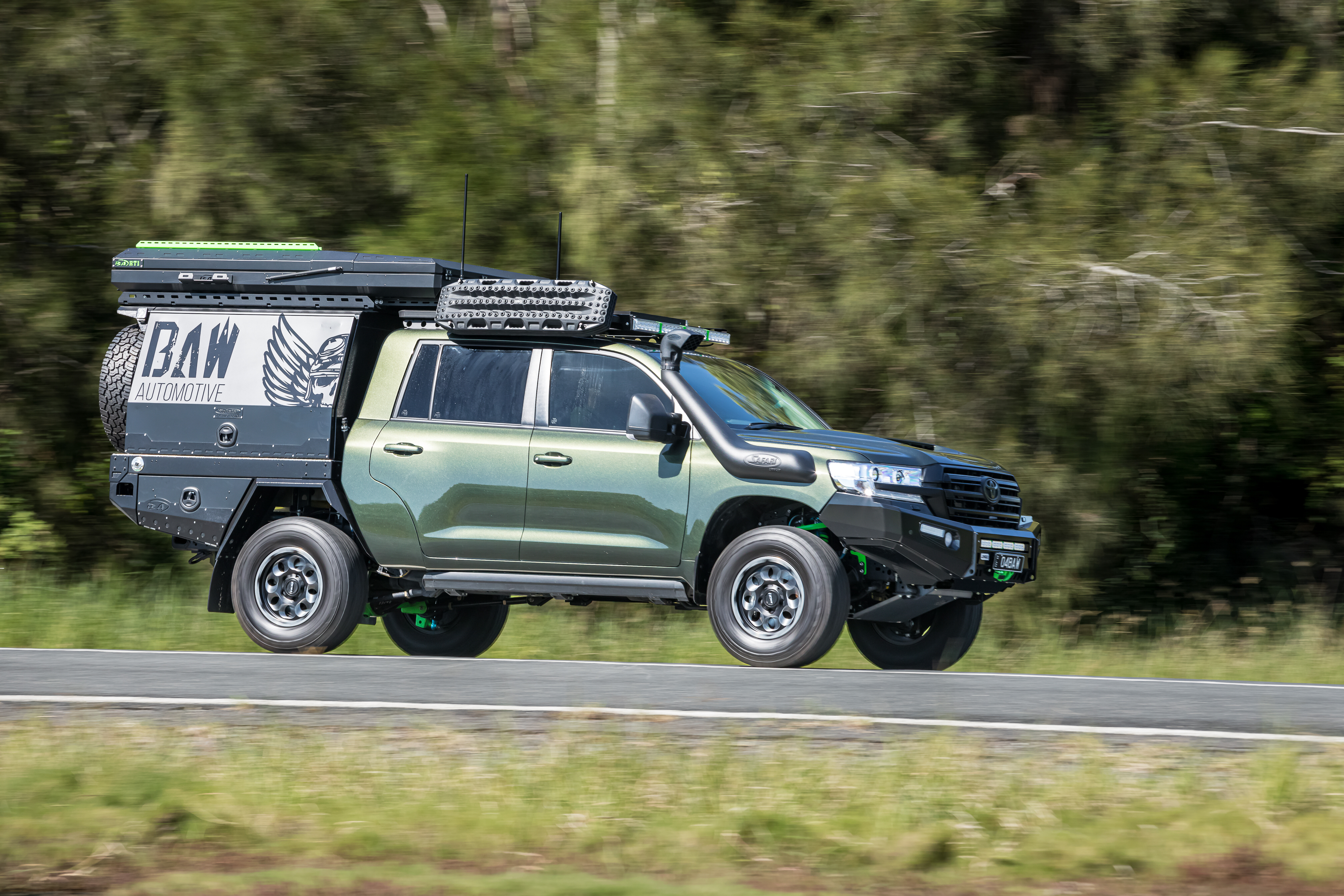
Plus, we’ve included a Y62 Patrol that has been converted into a dual cab; an Everest Trend with quality kit; and a meticulously built, one-of-a-kind 75 Series Troop Carrier.
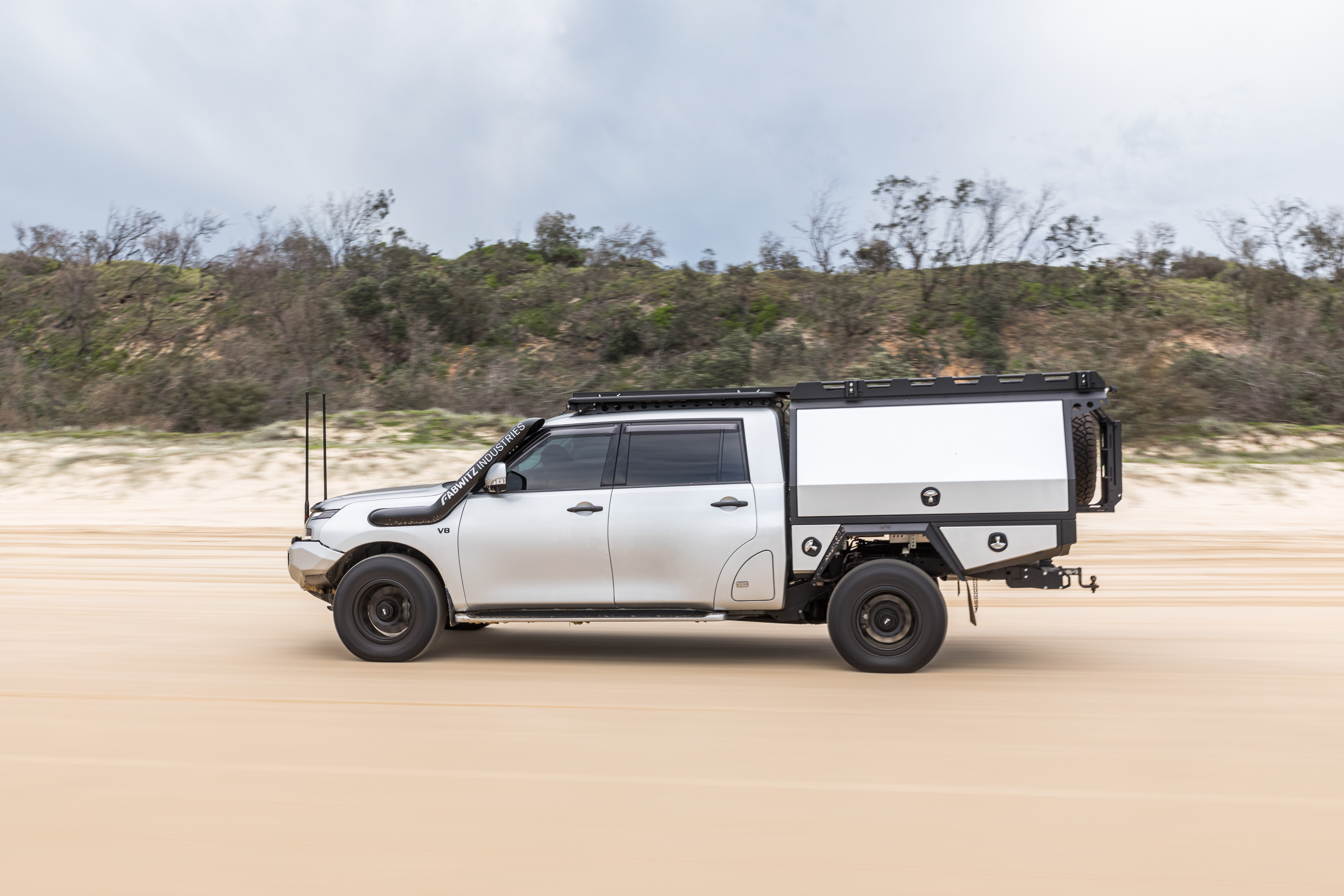
We’ve also trawled aftermarket catalogues to compile a list of the best new 4×4 products – handy for Christmas shopping, too. And Evan provides sage advice on how to build your 4×4 project the right way, the first time around.
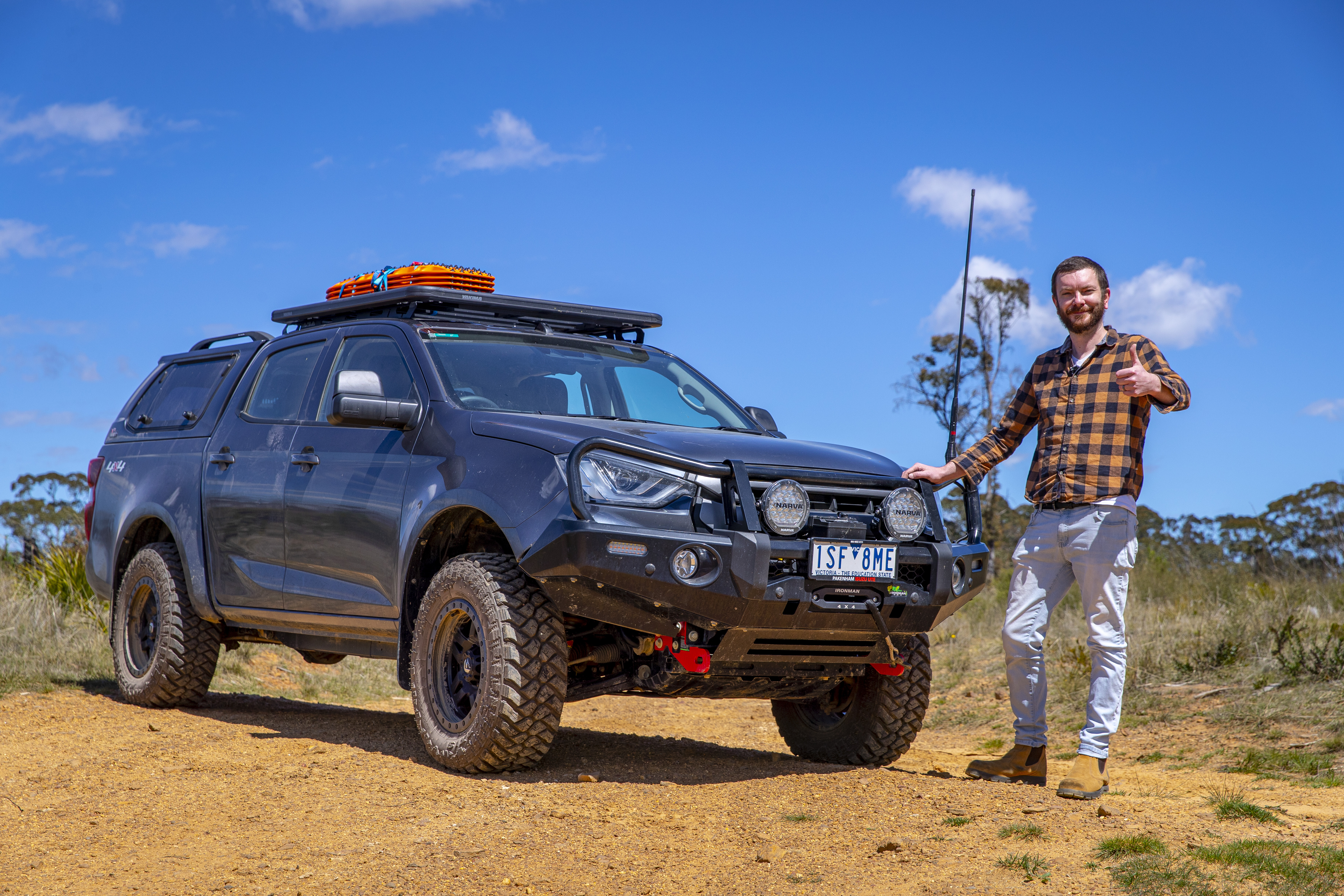
The 2022 4X4 Australia Custom special is OUT NOW.
UPDATE: 2023 Toyota LandCruiser 70 Series pricing announced
Toyota Australia has confirmed pricing for the updated 2023 LandCruiser 70 Series.
Our original story, below, has been updated to reflect this information.
JUMP AHEAD
Snapshot
- 2023 Toyota LandCruiser 70 Series due in Australia this month
- Updated workhorse gains AEB, 3.5-tonne GVM upgrade and outside temperature display
- $1600 price rise across the range
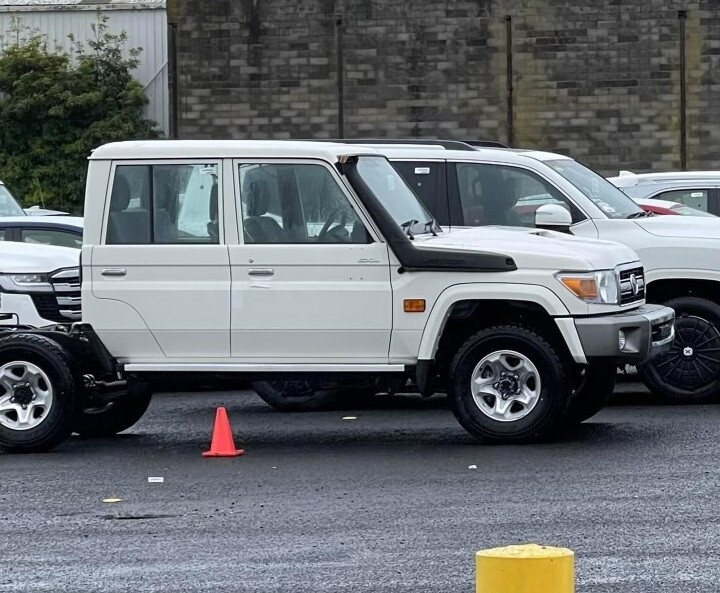
The updated 2023 Toyota LandCruiser 70 Series will arrive in Australia this month with autonomous emergency braking and changes to sidestep new side-impact regulations.
It is priced from $70,550 before on-road costs, with the entire range subject to a $1600 price rise for the new model year.
However, order books for the 70 Series range will remain closed in Australia – the most popular market for the Japanese-built ute and wagon – with supply constraints pushing estimated delivery times to as long as four years.
“We’ve paused that car. It’s part of the transparency for the customers. I wouldn’t see that car coming off [pause] for the next six months at least, and maybe beyond that,” said Toyota Australia vice president of sales, marketing and franchise operations, Sean Hanley, last month.
“If we can improve [70 Series] production then certainly, but until we clear the current order bank, we can’t do that.”
As announced in May, the 38-year-old workhorse will receive the potentially life-saving active safety technology and a gross vehicle mass (GVM) upgrade to 3510 kilograms – up as much as half a tonne for some variants.
This allows the 70 Series to be reclassified as a light truck (or ‘medium goods vehicle’) to avoid costly engineering changes to comply with new Australian Design Rules requiring tougher side-impact protection.
The rule, known as ‘ADR 85’, came into force on November 1, 2022, for light commercial vehicles with a GVM under 3.5 tonnes – such as the Toyota HiLux and Ford Ranger.
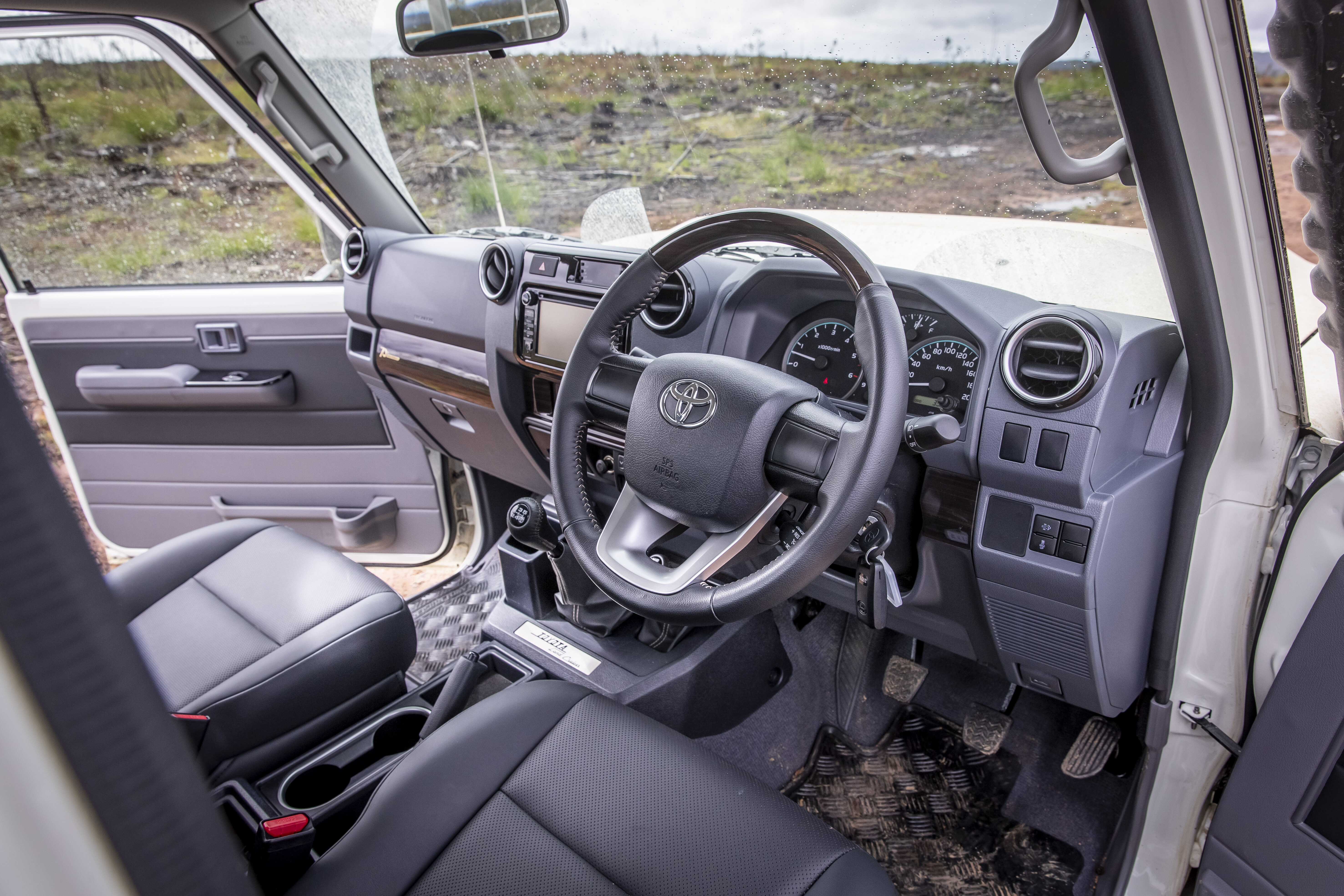
While the ageing design of the LandCruiser 70 remains unchanged for model-year 2023, the GVM upgrade has necessitated the fitment of larger side indicators, which are more than twice the size of the halogen units found in the pre-update model.
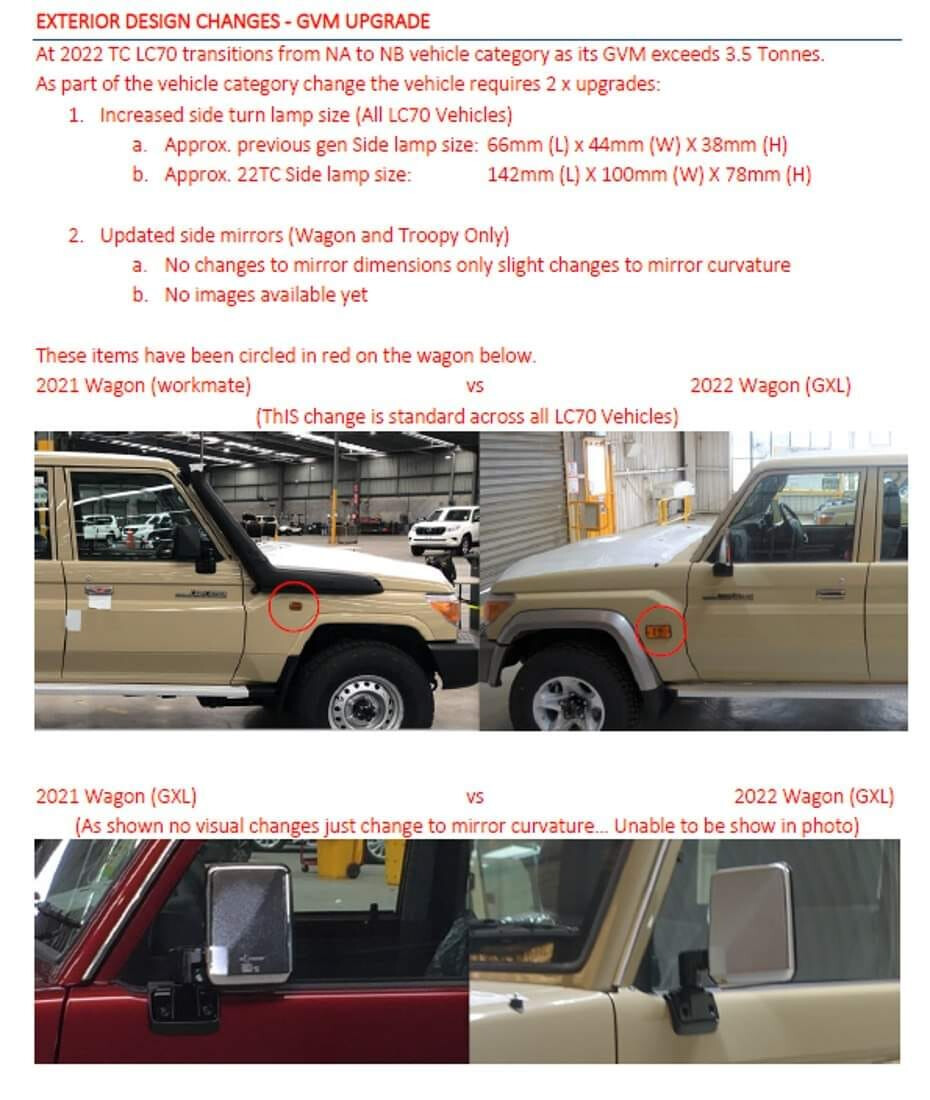
This is due to the ADR 6 ‘direction indicators’ rule, which is also responsible for the third-party side indicators found on the factory-backed RAM 1500 and Chevrolet Silverado full-size utes, and other vehicles with an aftermarket GVM upgrade.
It has also required a minor adjustment to the curvature of the side mirrors, with no design changes.
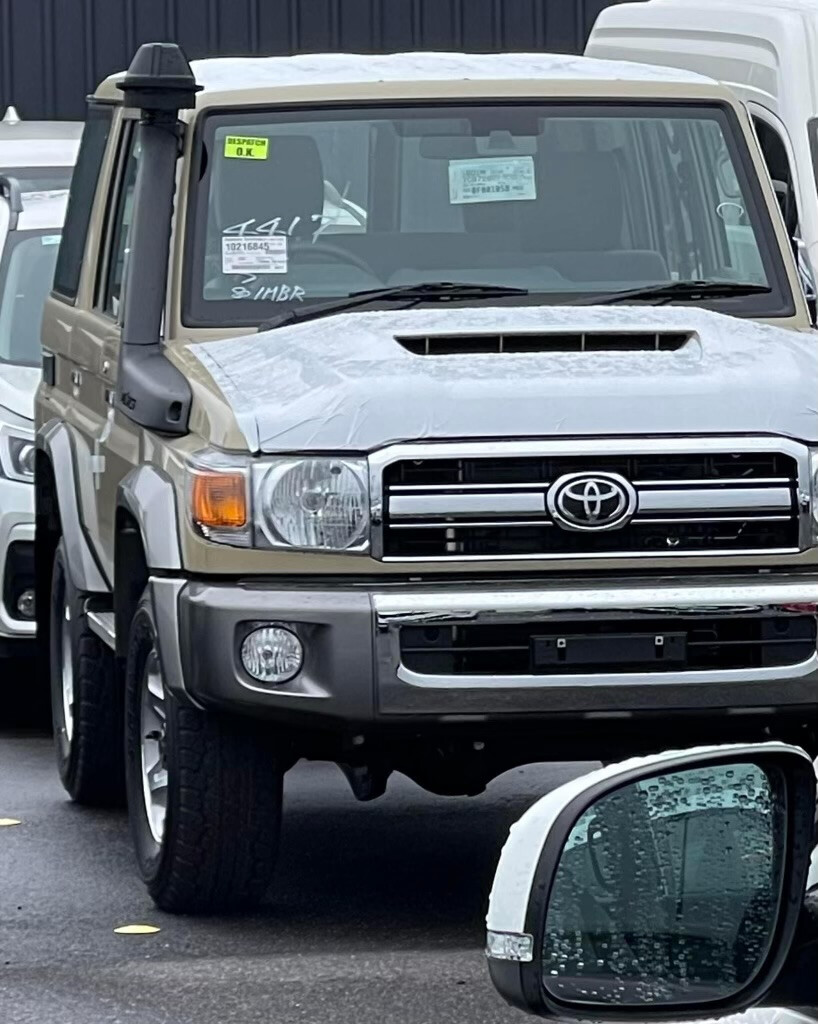
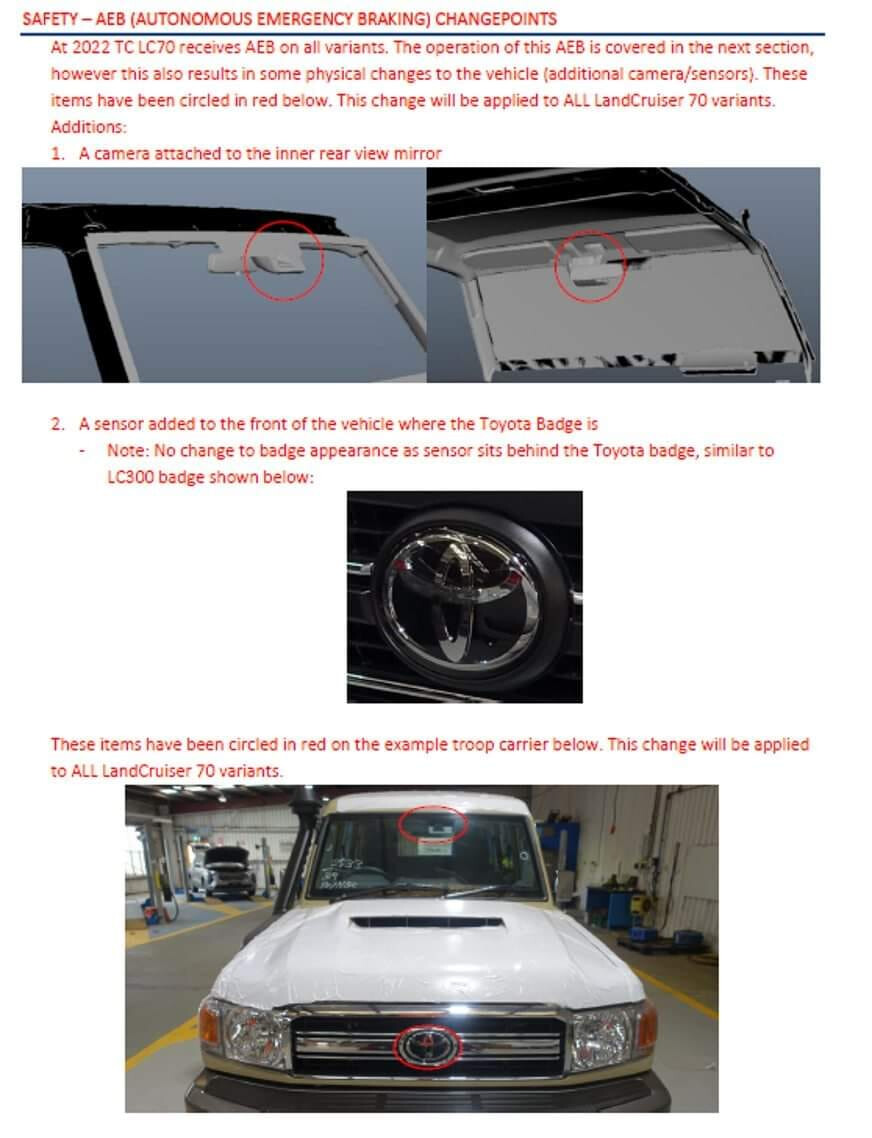
To accommodate the autonomous emergency braking (AEB) system, Toyota has fitted a windscreen-mounted camera module and radar sensor hidden behind the front emblem, similar to that found in the modern LandCruiser 300 Series. It will support vehicle, pedestrian and cyclist detection.
It leaves the MG 3, Fiat 500, LDV T60, G10 and V80, Mahindra Pik-Up, Suzuki Ignis, and entry-level versions of the MG ZS, Kia Rio, Honda CR-V, Mitsubishi Triton and Peugeot Expert as the final mainstream vehicles in Australia to not offer AEB.
The technology, which can completely stop a vehicle or reduce its speed if it detects an impending collision, will become compulsory for newly-introduced vehicles from March 1, 2023, and all cars sold in Australia from March 1, 2025.
While newer vehicles typically incorporate a digital display in the instrument cluster, the LandCruiser’s analogue gauges will remain unchanged with two alert lamps – one for when AEB is turned off, and the other when the system activates – and a manual switch to choose between ‘far’, ‘mid’ and ‘near’ sensitivity.
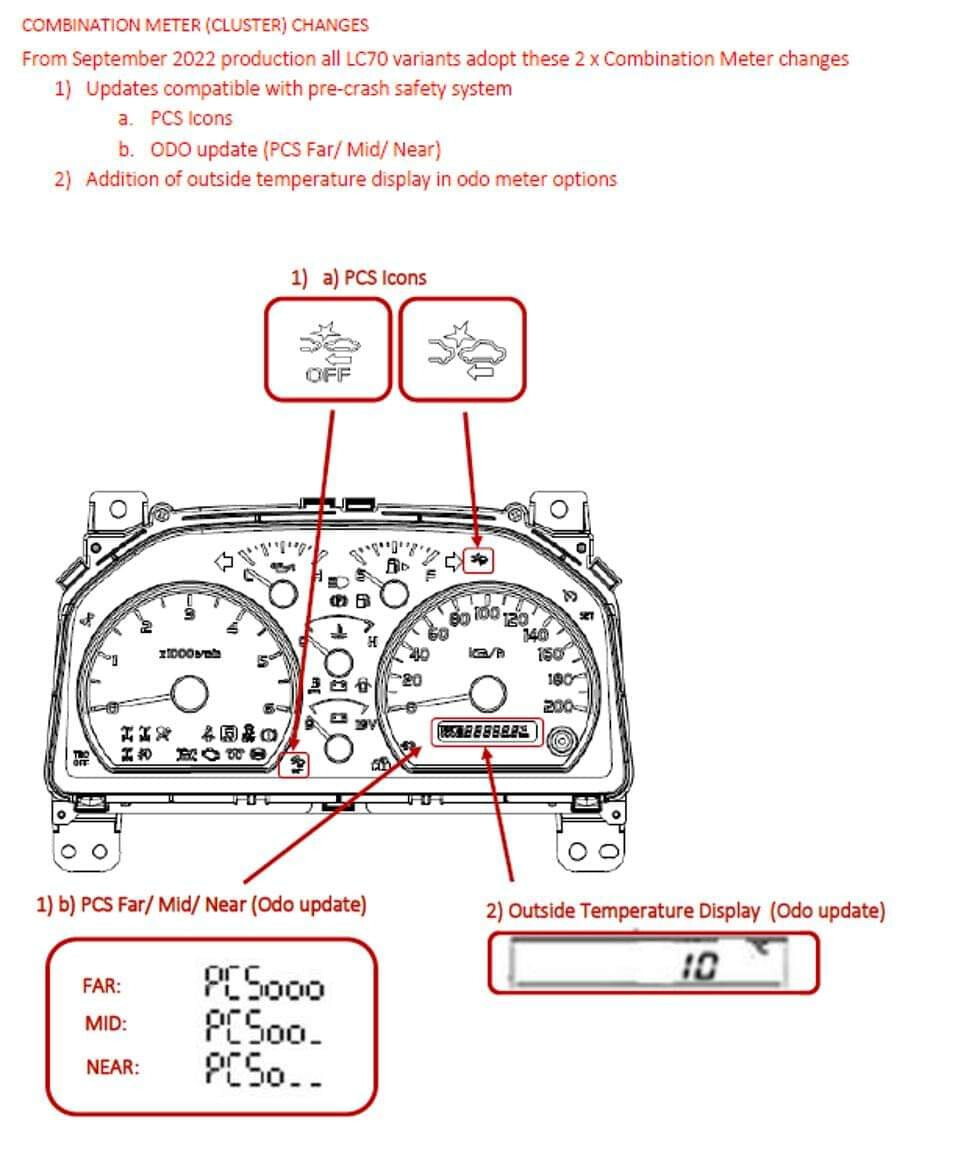
In addition, an outside temperature display will be added across the LandCruiser 70 Series range for model-year 2023.
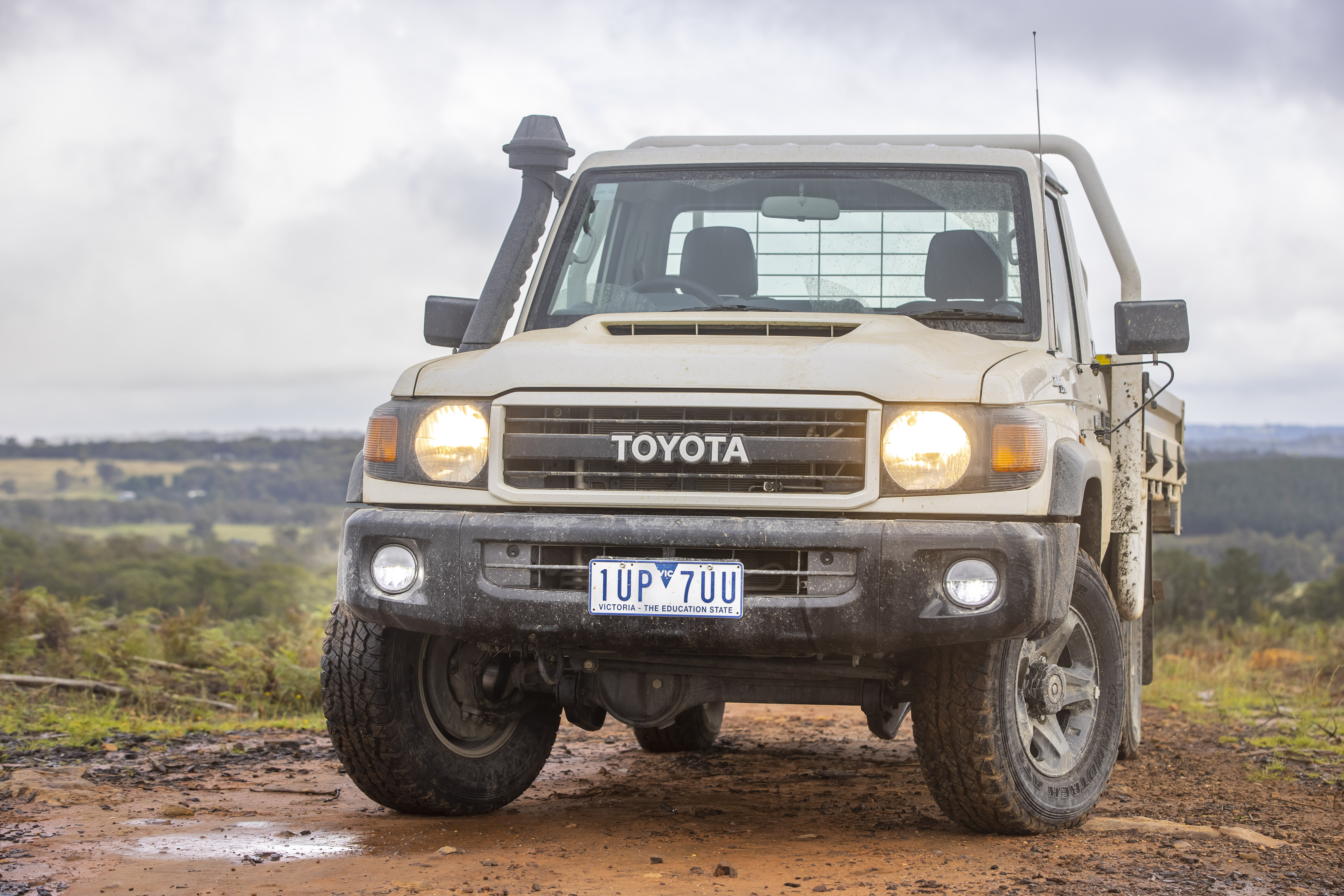
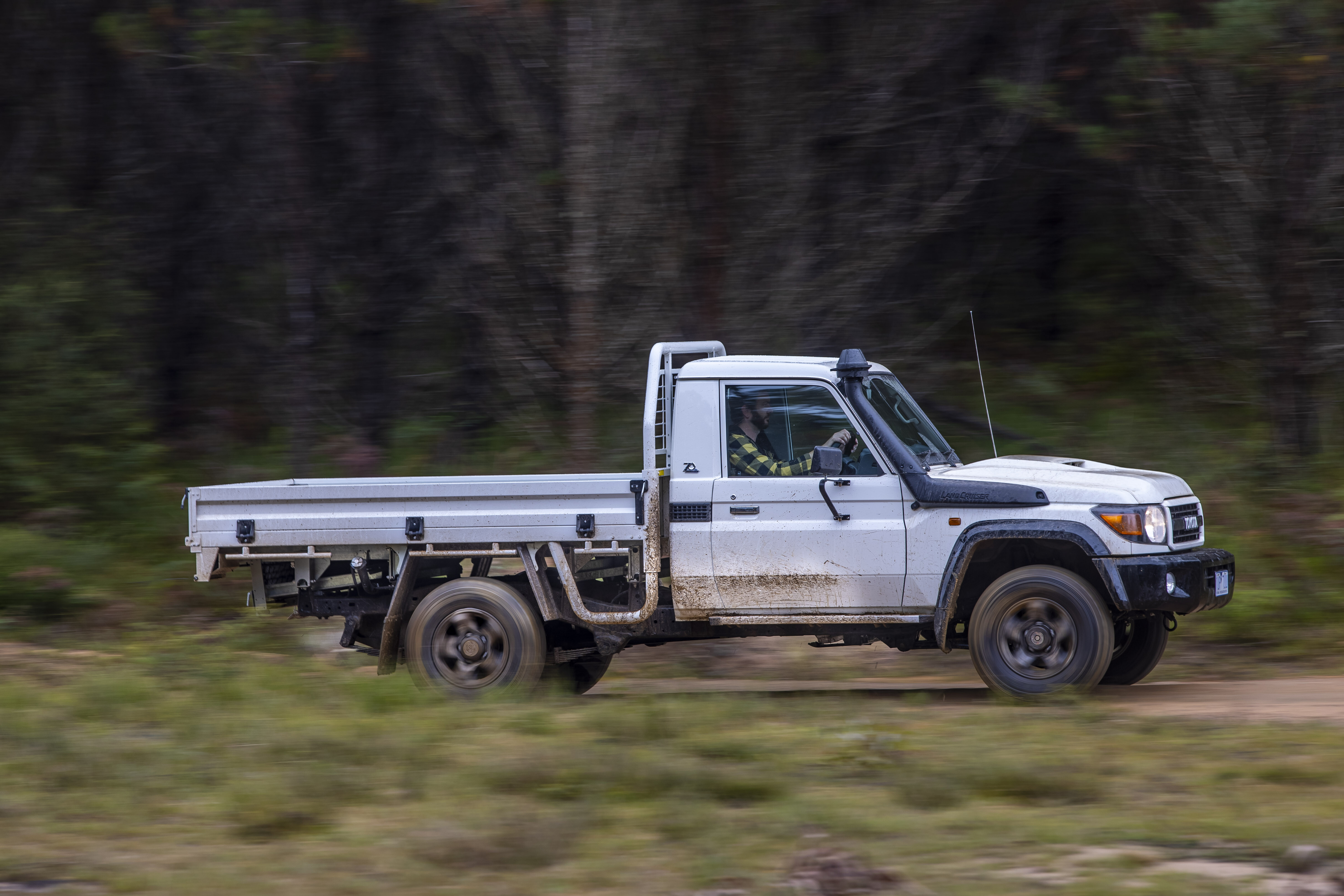
The ute, wagon and Troop Carrier – priced from $68,950 before on-road costs in 2022 guise – was last updated in 2020 with a 6.1-inch infotainment system and two USB-A charging points.
A running change in 2016 brought significant chassis upgrades to the single-cab variant, allowing it to score a five-star ANCAP safety rating. All other variants remain unrated.
This rating will expire on December 31, 2023, in line with ANCAP’s newly-introduced six-year limit for its crash ratings, which will affect vehicles such as the Nissan Navara, Mitsubishi Triton (2015) and Toyota LandCruiser Prado (2011) at the end of this year.
The 2023 Toyota LandCruiser 70 Series will arrive in Australian showrooms later this month.
“We have introduced significant safety and capability upgrades across the LandCruiser 70 Series range, while containing price increases to just 2.1-2.4 per cent ($1,600),” said Toyota Australia.
“The higher GVM provides customers with higher payloads, with all variants now being true one-tonners. Customers gain added peace of mind from the addition of a pre-collision system with autonomous emergency braking.
“Our customer-focused decision to pause order-taking remains in place, due to issues being experienced by the global automotive industry.”
2023 Toyota LandCruiser 70 Series pricing
2023 Toyota LandCruiser 70 Series features
WorkMate
GX
GXL
Options
| Metallic paint | $675 |
| Differential lock (WorkMate double-cab and GX single-cab) | $1500 |
UPDATE: 2023 Volkswagen Crafter Kampervan pricing and features
The 2023 Volkswagen Crafter Kampervan will arrive in Australian showrooms by Christmas.
It is priced from $133,390 before on-road costs, with three variants available.
Volkswagen says the initial allocation of 69 units for the Crafter Kampervan sold out in less than 12 hours, with more examples set to become available in mid-2023.
A production-ready example was displayed at Volkswagen’s Conversions Day media event in Melbourne last week, with various changes in response to customer feedback since April.
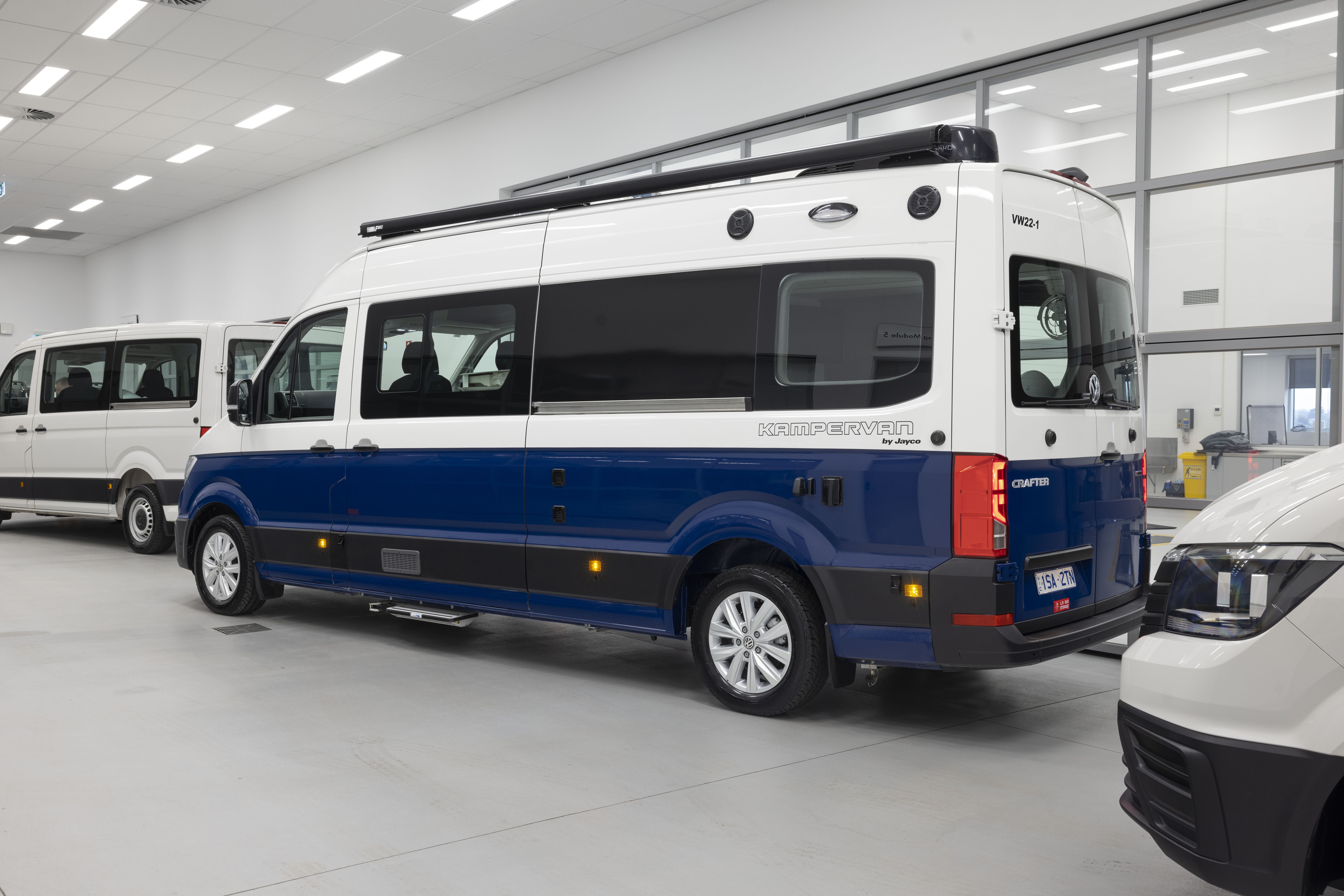
This includes two lithium-ion batteries with a 240Ah total capacity, and a 240-volt inverter. It has also fitted the Crafter Kampervan with a portable rear entry step, table and two chairs, and external accessories such as a water hose, wheel chock and power extension lead.
Our original story, below, has been updated to reflect the latest information.
This is the latest vehicle release from Volkswagen built in partnership with Australian manufacturer Jayco, and it’s certainly something a bit different as it is backed by the marque’s five-year, unlimited-kilometre warranty.
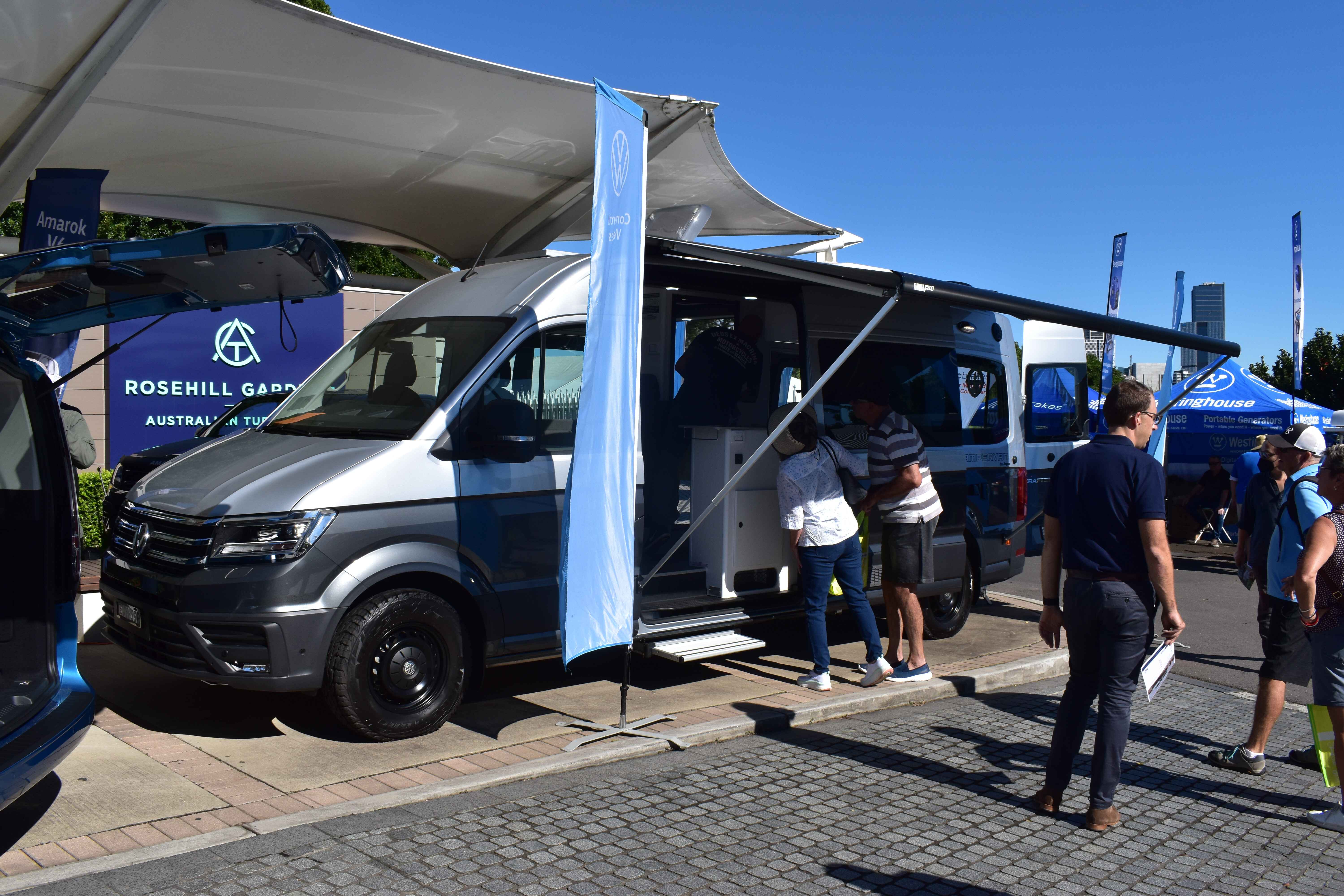
It was unveiled as a final-stage prototype at this year’s Sydney Caravan Camping Holiday Supershow at Rosehill Raceway in April. Unfortunately, we couldn’t drive it, but we hope to change that in the next few months.
JUMP AHEAD
2023 Volkswagen Crafter Kampervan pricing
Prices exclude on-road costs.
2023 Volkswagen Crafter Kampervan features
Kampervan
Kampervan Style
Kampervan All-Terrain
Options
| Metallic/pearl paint | $2385 |
| 17-inch alloy wheels (Kampervan Style) | $4990 |
| Two-tone paint (Kampervan Style and All-Terrain) | $4060 |
| Snorkel (Kampervan All-Terrain) | $2090 |
Story continues…
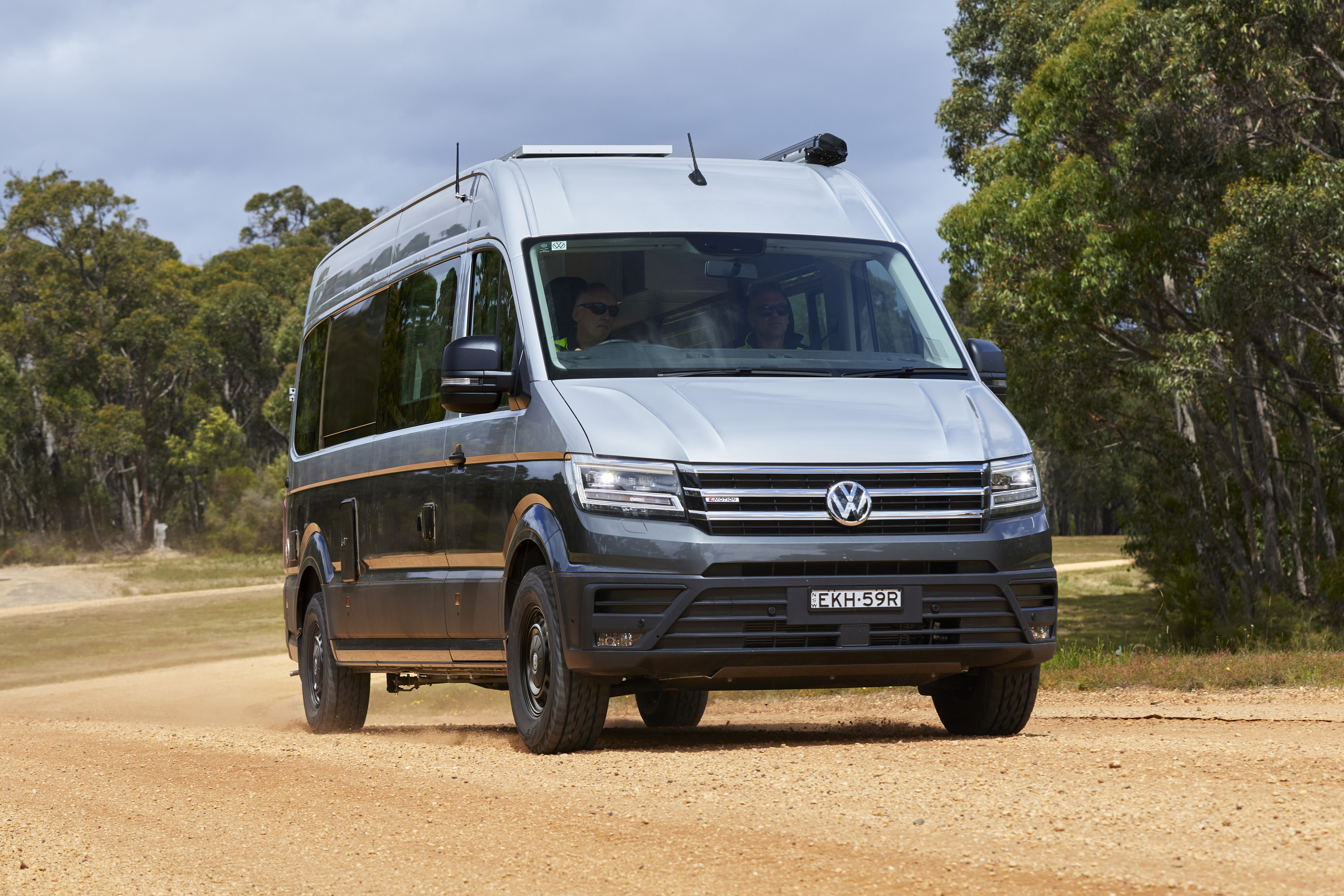
The first thing you notice is the size … it’s big, measuring 6.8m long, and two metres wide. The rear section when folded up is a large couch area that forms a large bed suitable for two people to sleep on comfortably.
The front seats can also be configured into a sleeping area; however, we were told this suits children, not adults. There is seating for four occupants though, meaning someone in your travelling convoy will be sleeping outside in a swag or tent.
The Crafter Kampervan features VW’s 4Motion all-wheel drive system, and was wearing all-terrain tyres on the day, indicating that this is a suitable camper to take on mild dirt road and forestry tracks. There is even the option of adding a snorkel to prevent water ingress during river crossings.

Under the bonnet, the Crafter Kampervan is powered by a 2.0L bi-turbo diesel motor that produces 130kW and 410Nm.
Fuel capacity is 75L, which seems on the low side to me considering this is a vehicle built for long-distance adventures; however that 2.0L motor should be fairly frugal in operation.
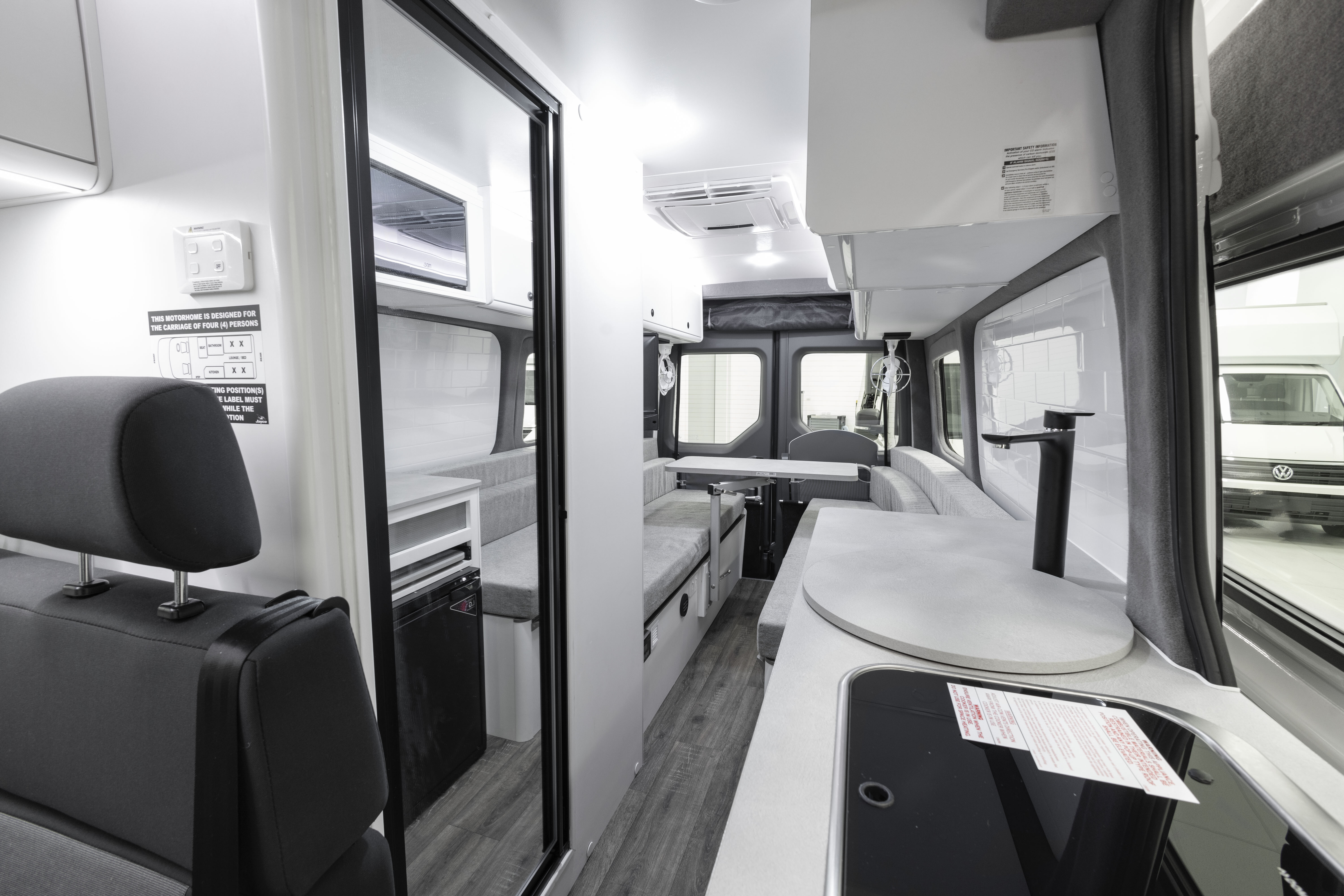
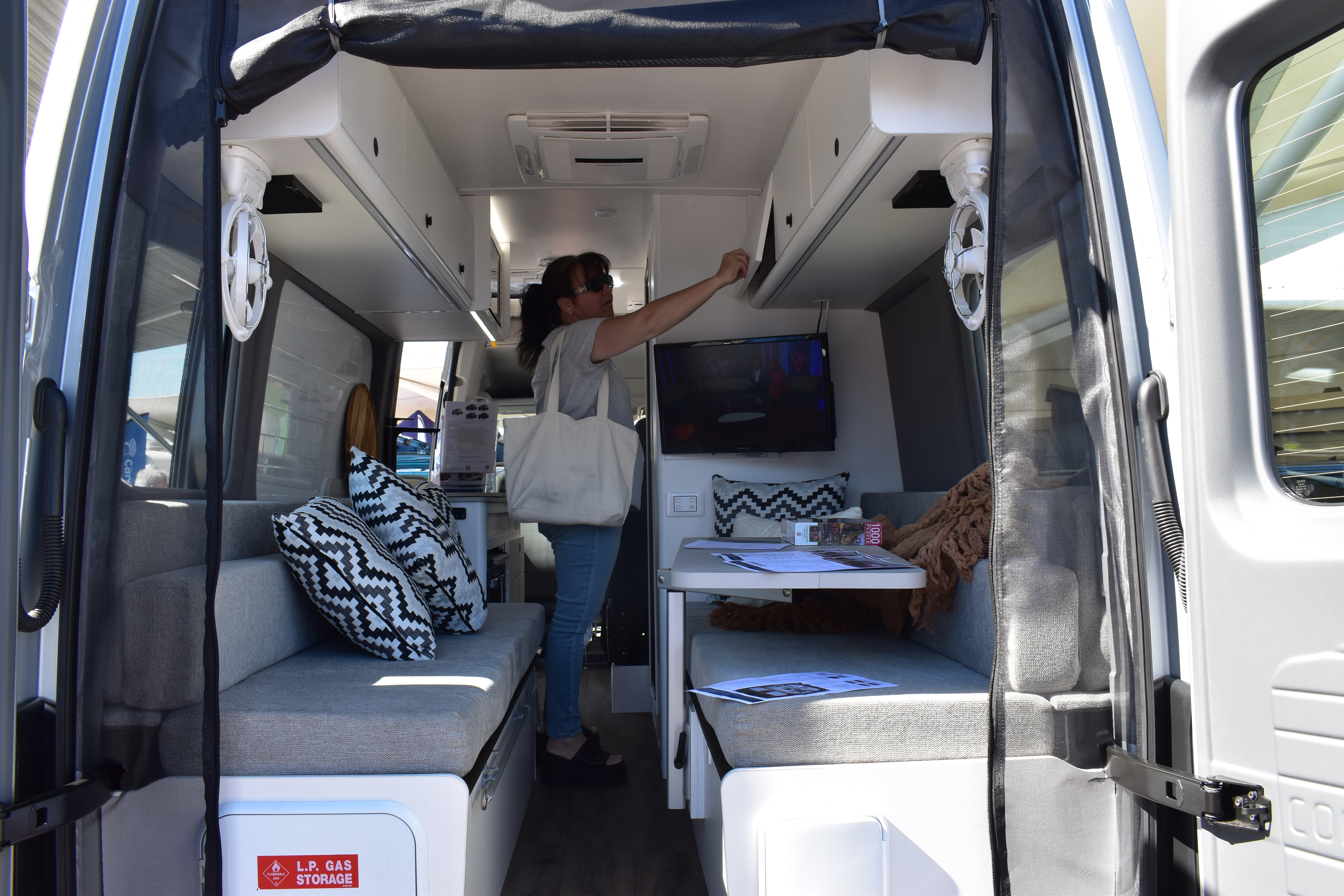
Inside the Crafter, you are greeted with various dining and seating options, as well as a full internal bathroom with a toilet and shower. The kitchen is near the large sliding door on the passenger side, which is a practical place to put it for internal and external access.
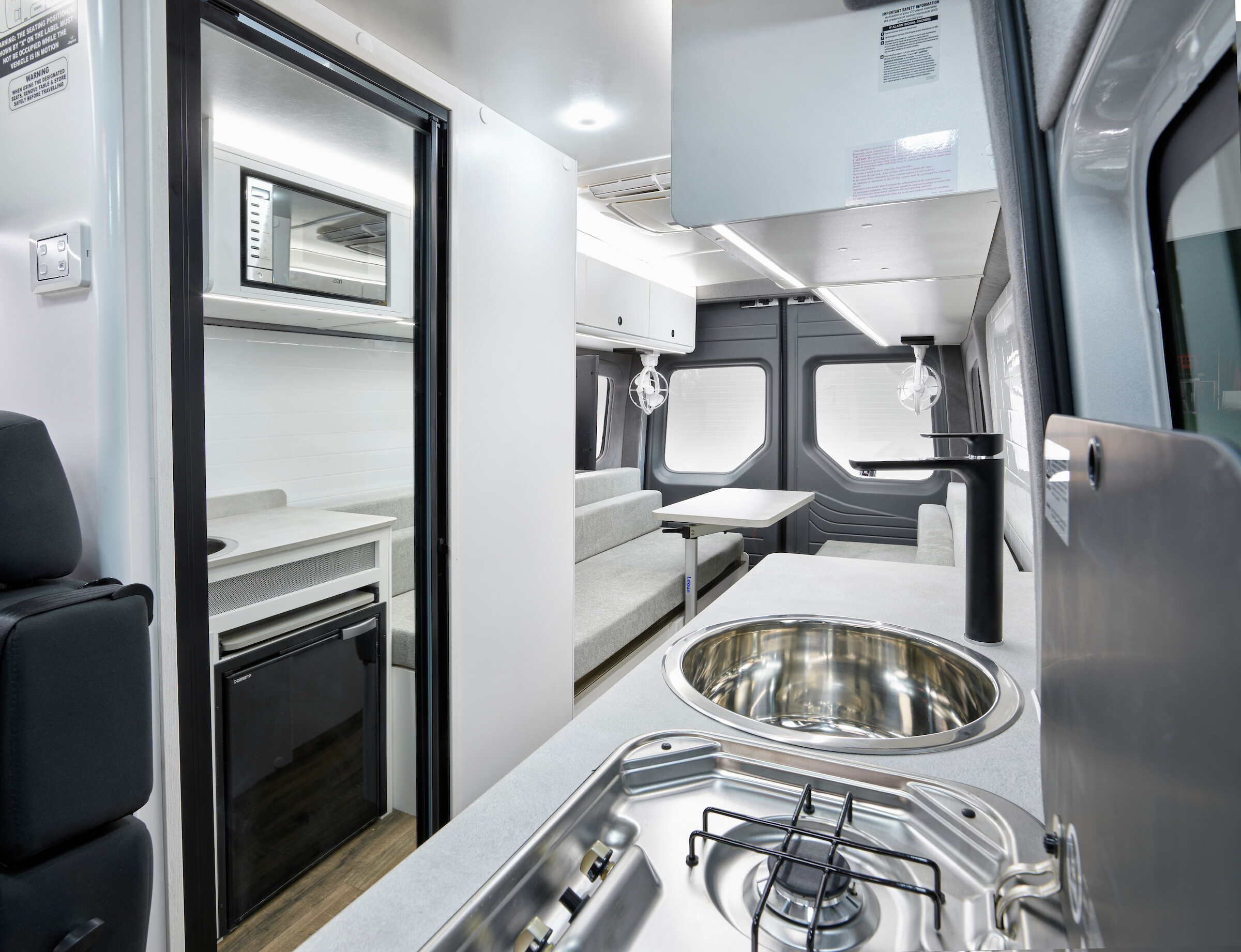
This kitchen is well-equipped too, with a microwave, fridge, sink with freshwater from the on-board water tank, a two-burner gas cooktop and loads of storage to stow cooking items.
Other luxuries include a roof-mounted reverse-cycle air-conditioning unit, a television with a DVD player that has speakers positioned both inside and outside of the van, powered off an 120amp/h lithium house battery and solar system which is all included in the package. Diesel heating warms the van in cooler months and a hot-water system has also been installed for hot showers or to do the washing up.
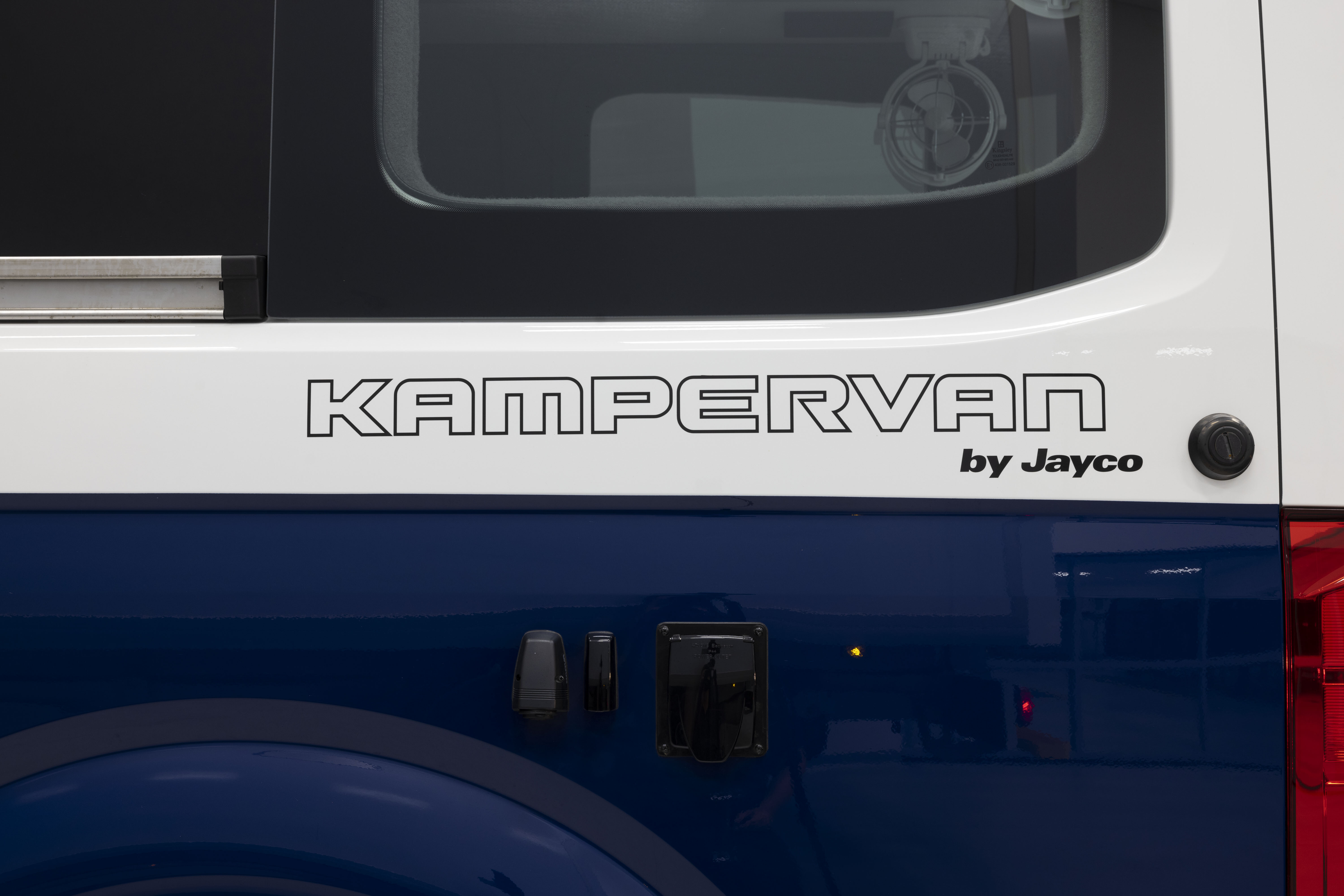
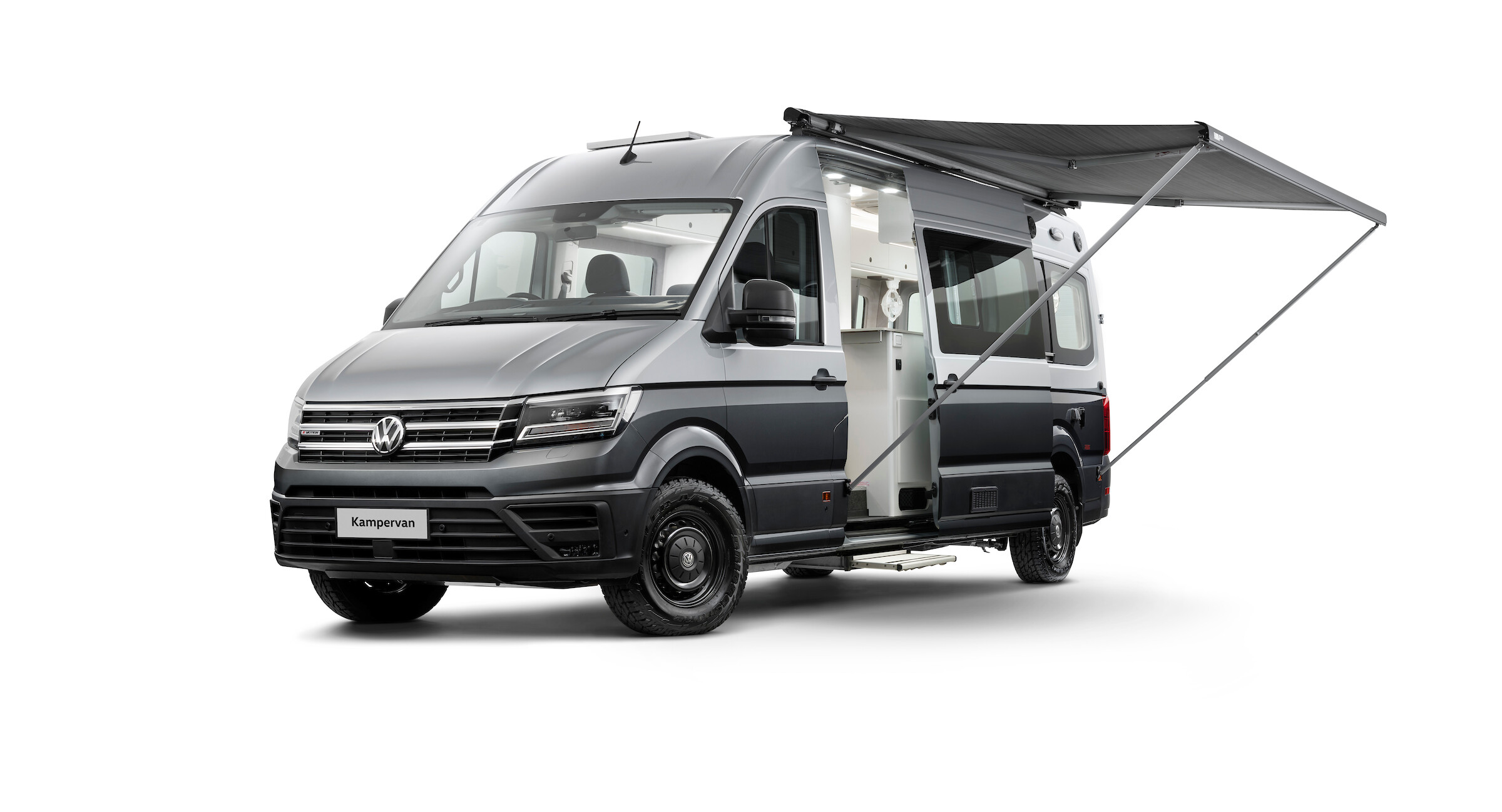
There will be seven colour options in the range, including two-tone paint jobs which will certainly make the big Crafter Kampervan stand out on the road.
Pricing is expected to be between $135,000 and $155,000 depending on which of the three specification levels you choose. The internal fit-out remains the same across these three trim levels, the vehicle itself is optioned up.
These trim levels are Standard Specification, Full Specification and Full Specification + Seikel Equipment. The latter includes a 30mm lift kit, underbody protection, AdBlue tank protection, rear differential protection plate, rear shock absorber protection and steel wheels with all-terrain tyres.
Brand director of Volkswagen Commercial Vehicle, Ryan Davies, tells us: “Just as Walkinshaw took the Amarok to the next level, Jayco as the leading brand in its field is making the Crafter Kampervan the perfect choice for those who want to drive a brilliantly engineered vehicle – then live and sleep comfortably across endless Australian destinations.”
Jayco has been building RVs and caravans for more than 45 years, and are Australian owned and operated. It has sold over 225,000 RVs, employs over 1200 people and has 150 dealers in its network, so it’s easy to see why it was selected for this project.
Jayco Motorised Division national sales manager, Bruce Astbury, added: “Jayco is proud to be associated with Volkswagen and the touring lifestyle that both brands embody. This is a partnership that will enhance the depth of the Volkswagen range and continue to support local employment at our state-of-the-art, 50-acre, Dandenong South facility.”
The Baja 1000 would have to be one of the toughest off-road races in the world, so we here at 4X4 Australia were beyond excited to hear Ford was entering a stock Ranger Raptor – albeit prepped for racing but still in street-legal trim.
Well, not only did the team come first in the Stock Mid-Size class, the vehicle was deemed to be in good enough condition to drive it on the road all the way back to the team’s base in Riverside, California.
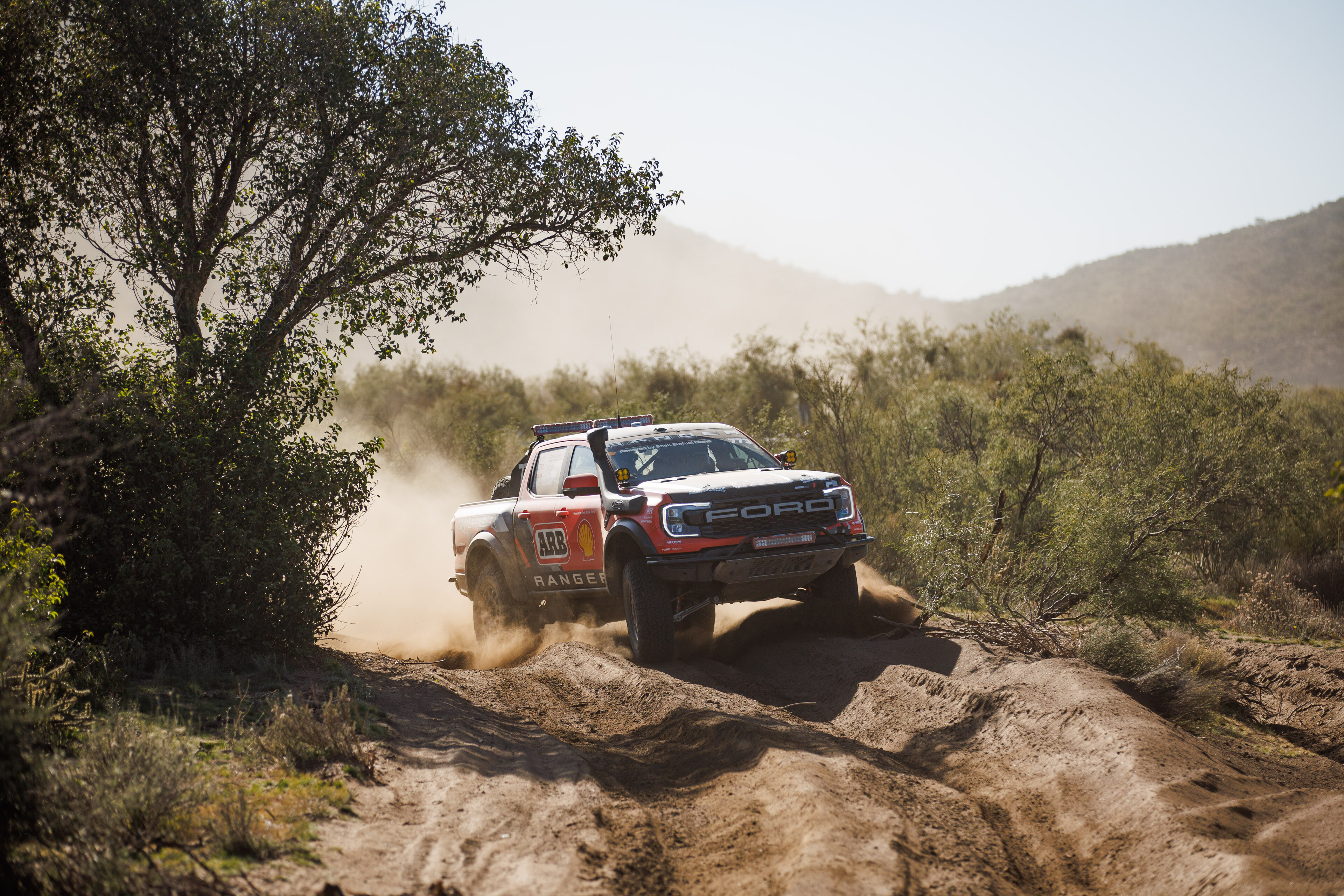
This is a seriously impressive result, with the team reporting back that the vehicle completed the gruelling race without any major incident or repairs being required.
The race team was managed by a legend of Baja racing, Curt Leduc, and was made up of four race driver and co-driver teams who each had a stint behind the wheel. These teams were Brad and Byam Lovell (Lovell Racing), Jason Hutter and Paul Blangstead (Fire Guys Racing), Loren Healy and Eric Davis (Fun-Haver Off-Road), and ARB’s Andy and Danny Brown.
“This is the Baja 1000, one of the toughest off-road races in the world,” said Mark Rushbrook, global director for Ford Performance Motorsports. “It’s a key proving ground for Ford Performance and our vehicles to earn the badge of Raptor.
“This has been a global effort for Ford Performance from the beginning, with Ford Australia having done the design and initial development sign-off, then shipping it to the States and working with all of our partners to pool all available resources for this common goal. It takes a great truck and it takes great people. We’ve proved that we have both of those on a global level,” Rushbrook added.
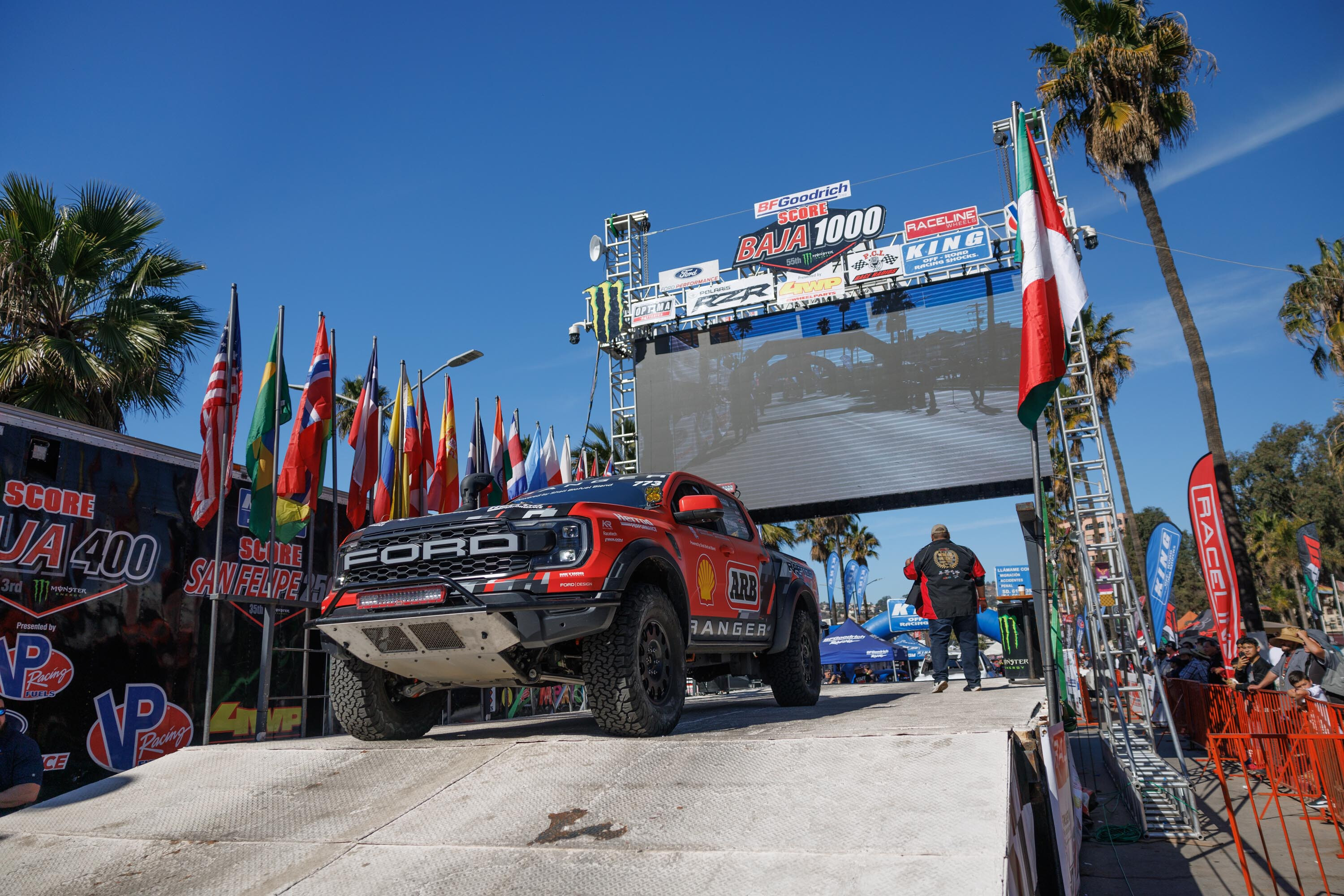
“What we had was a really good global team working with a really good global truck in Ranger,” said Brian Novak, off-road motorsports supervisor for Ford Performance. “Ford Performance Australia put its heart and soul into this project with Kelly Racing to start us off. When we took it over on the North American side with Lovell Racing and Huseman Engineering, it all came together seamlessly. There’s just so many people who came together to do this, and I couldn’t be prouder.”
“It’s truly awesome,” said Brendan McGinniskin, motorsports engineer for Ford Performance Australia. “Spending the night out there chasing the truck was something I’ve never experienced before, and it was such a different experience of going racing.
“It was so cool and wouldn’t have been possible without all of the expert chase crews we had out here. Everyone pulled together and not even the few tense moments we had were going to stop us from crossing the finish line together.”
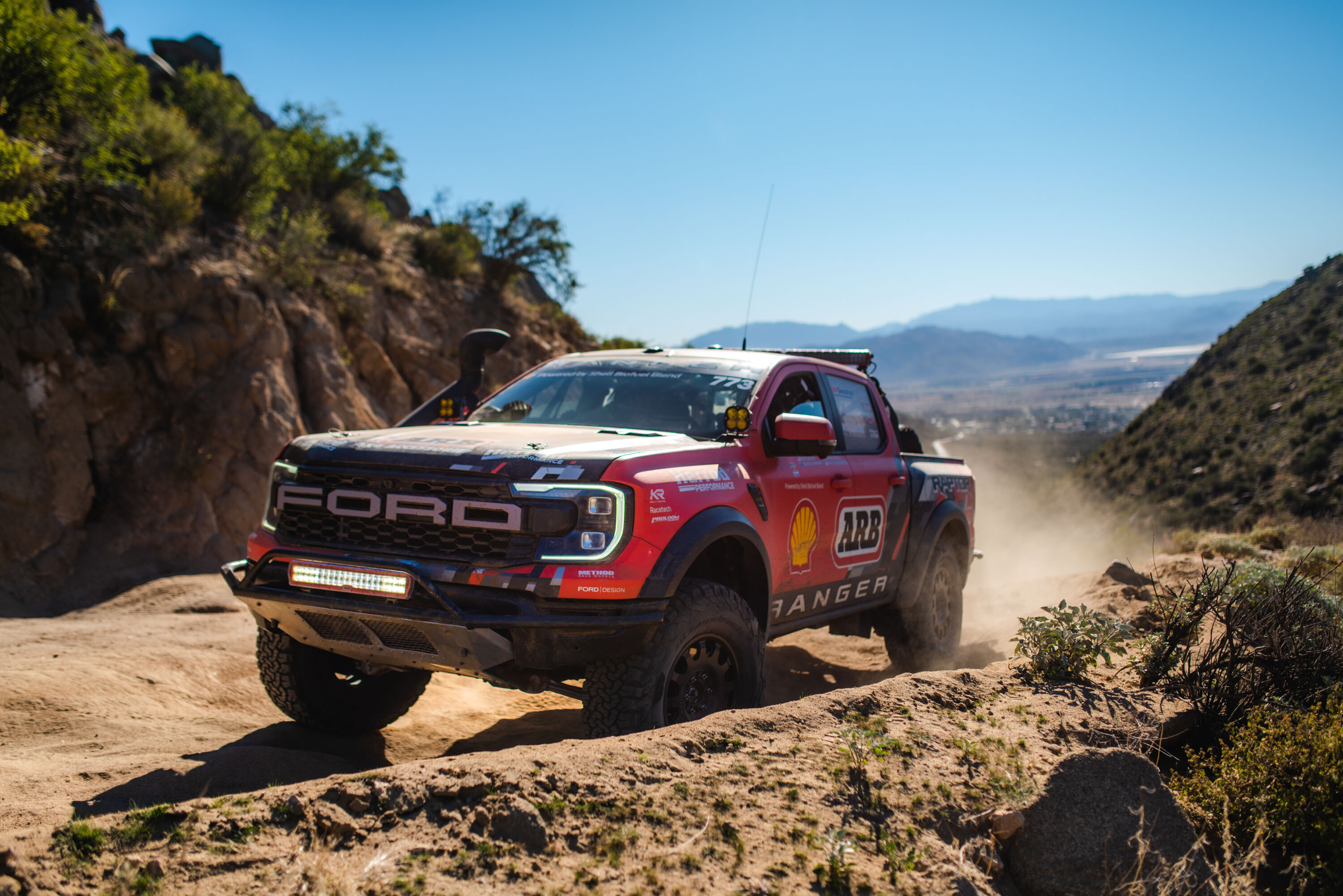
As the drivers from ARB had the challenging role of driving the last section of the race, that could make or break the result, we were particularly keen to hear their thoughts on the race and the vehicle.
“Coming all the way over here and entering this event has been on our bucket list for years and years, said ARB managing director, Andy Brown. “It never came together before, so to be here with Ford has been just fantastic.
“The Ranger Raptor? Unbelievable, what a truck. It feels ready to go again. I can’t believe how reliable it was, how strong, how stout, how it handles, how it goes, how it stops. It’s just the complete package.
“The track? Hell. It was rough and we did pre-running, but honestly the track was so cut up and different that we felt we were tackling it for the first time. But a challenge is what we came for; and the group we came here with, and the truck, were perfect for it.”
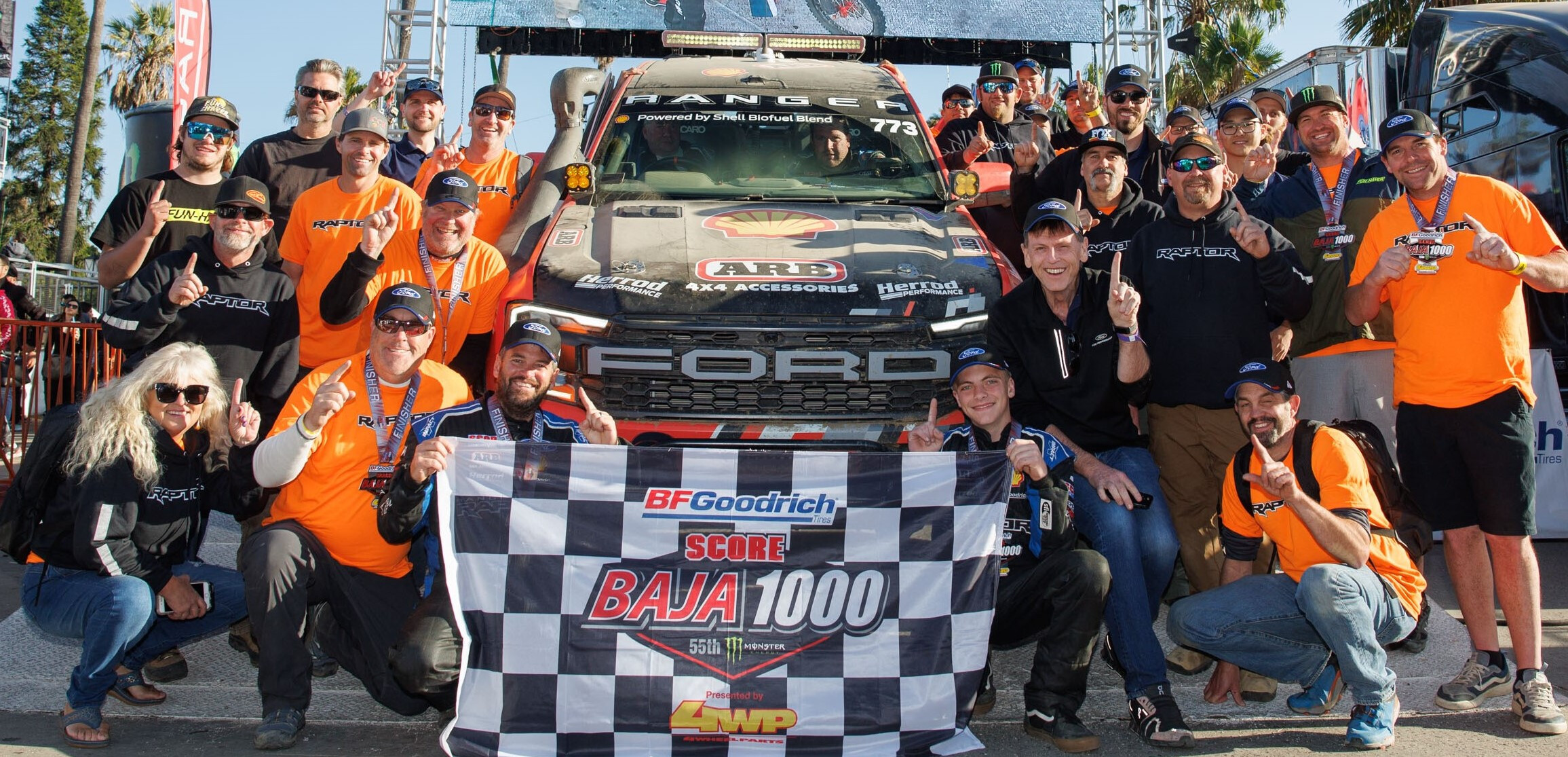
“We’re off-roaders at heart, so this is very big for us,” said Danny Brown, regional export manager at ARB. “Dad’s been racing for probably 40 years, I’ve been racing for 20-odd years, I think. This is a pinnacle of our sport, for sure.
“Physically, this is about as tough as it gets and it’s a big honour for us to come over here and drive for Ford. To help this great group of drivers get to the finish on this extremely rough and demanding course, every piece of the puzzle had to be perfect.”
Updating your four-wheel drive with a modern battery set-up is one of the first modifications one should make to a touring vehicle, if you intend on escaping the grid.
A stock cranking battery may have the ability to fire a short burst of energy to kick an engine in to life, but if your set-up consists of fridges, LED lighting, charging options of laptops and iPads, and other power needs, it’ll need extra help.
This is where a deep-cycle battery – providing consistent power for longer – is valuable for use as an auxiliary battery in tandem with a starter battery, especially on remote adventures.
Type 4×4 batteries in to any search engine, though, and you’ll be overloaded with options – Lead Acid, AGM, GEL and now lithium – be it for use as a starter or auxiliary battery.
So to make things a little bit easier, we’ve listed a handful of quality products currently on the market.
| Volts | AH at 20 hours | CCA at 18°C | Weight | Dimensions | |
|---|---|---|---|---|---|
| Century Dual Force+ | 12 | 90amp/h | 750 | 23.5kg | 302mm (L) x 174mm (W) x 200mm (H) |
| SCA Performance Car Battery | 12 | 59amp/h | 500 | 15kg | 277mm (L) x 175mm (W) x 190mm (H) |
| Invicta Slimline 100AH Lithium Battery | 12.8 | 100amp/h | N/A | 12.4kg | 551mm (L) x 109 (W) x 239 (H) |
| Enerdrive 12V 100Ah eLITE Lithium Battery | 12.8 | 100amp/h | N/A | 12kg | 310mm (L) x 170mm (W) x 225mm (H) |
| Redarc 200AH Lithium Deep Cycle Battery | 12 | 200amp/h | N/A | 25.5kg | 485mm (L) x 170mm x 242mm |
Century Dual Force+
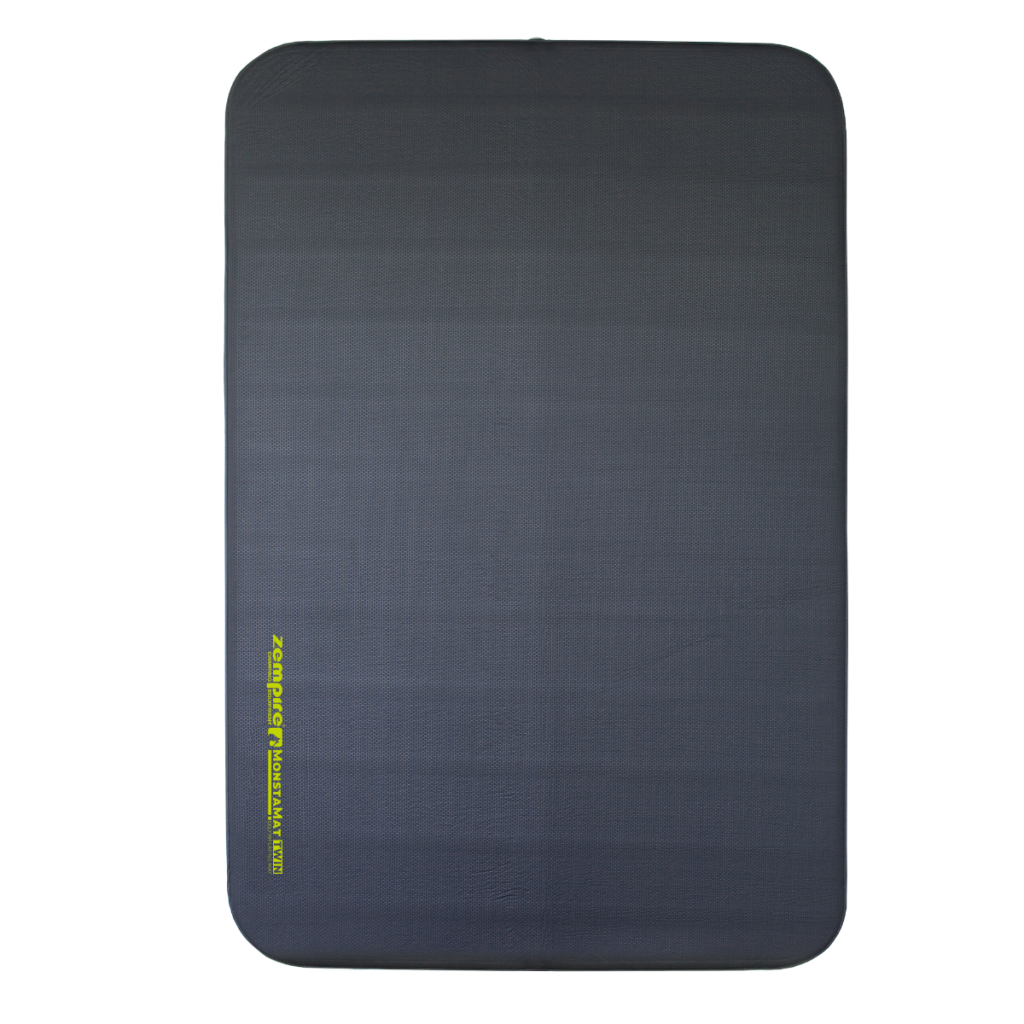
Specifications
- Volts: 12
- AH at 20 hours: 90amp/h
- CCA at 18°C: 750
- Weight: 23.5kg
- Dimensions: 302mm (L) x 174mm (W) x 200mm (H)
Things we like
| Not so much
|
- Volts: 12
- AH at 20 hours: 90amp/h
- CCA at 18°C: 750
- Weight: 23.5kg
- Dimensions: 302mm (L) x 174mm (W) x 200mm (H)
The Dual Force+ is a multipurpose Absorbed Glass Mat (AGM) battery that features an advanced construction, which means it’s designed to not only start the battery but run accessories like fridges, LEDs and more. While not as effective as a dual-battery set-up, the Century Dual Force+ is a hybrid starter/deep-cycle battery that can dip in to both tasks.
A number of clever features – glass matting, thicker lead plates, high-density active paste, high-porosity envelope AGM separators, and rounded-edge X Frames – combine to increase the battery’s life cycle and make it more durable on and off road.
The battery is packaged in a reinforced and sealed polycarbonate case for further protection, and it’s available in C or D type polarity.
SCA Performance Car Battery
Specifications
- Volts: 12
- AH: 59amp/h
- CCA: 500
- Weight: 15kg
- Dimensions: 277mm (L) x 175mm (W) x 190mm (H)
Things we like
| Not so much
|
- Volts: 12
- AH: 59amp/h
- CCA: 500
- Weight: 15kg
- Dimensions: 277mm (L) x 175mm (W) x 190mm (H)
Its maintenance-free design means the battery should be a set-and-forget affair, and the 12V 500CCA battery should be competent as a solution for a replacement starter.
SCA says it’s ideal for vehicles with limited accessories, but don’t intend to run your fridges and LEDs at camp. An auxiliary battery in a dual set-up would be required here.
The SCA is built for Australian conditions, so it’ll cope with dust and extreme Aussie temperatures, and it comes with an 18-month warranty should things go bang.
Invicta Slimline 100AH Lithium Battery
Specifications
- Volts: 12.8
- AH: 100amp/h
- CCA: N/A
- Weight: 12.4kg
- Dimensions: 551mm (L) x 109 (W) x 239 (H)
Things we like
| Not so much
|
- Volts: 12.8
- AH: 100amp/h
- CCA: N/A
- Weight: 12.4kg
- Dimensions: 551mm (L) x 109 (W) x 239 (H)
Available with standard or slimline case orientation, for convenience, the Invicta Lithium 100Ah is loaded with state-of-the-art tech including high-grade aluminium-encased Lithium Iron Phosphate (LiFePO4) prismatic cells, bolted busbar intercell connectors and an integrated Battery Management System (BMS).
Robust and reliable, the Invicta Lithium 100Ah is independently tested in Australia, can sit unused for up to 12 months, has twice as much runtime as an equivalent AGM battery, and up to a 10-year lifespan. Plus it’s considerably lighter and has much faster recharge rates.
A generous seven-year warranty provides ample peace of mind. Just avoid installing it in the engine bay.
Enerdrive 12V 100Ah eLITE Lithium Battery
Specifications
- Volts: 12.8
- AH: 100amp/h
- CCA at 18°C: N/A
- Weight: 12kg
- Dimensions: 310mm (L) x 170mm (W) x 225mm (H)
Things we like
| Not so much
|
- Volts: 12.8
- AH: 100amp/h
- CCA at 18°C: N/A
- Weight: 12kg
- Dimensions: 310mm (L) x 170mm (W) x 225mm (H)
Bereft of a few features standard on the more premium 100Ah B-TEC Lithium model, the stripped-back eLITE contains all of the important bits without the bells and whistles. An example is the omission of Wireless Battery Monitoring technology.
Still, the eLITE is said to provide 60 per cent more usable power than an equivalent lead acid unit. An internal Battery Management System monitors and optimises each Prismatic cell and will protect the battery pack from over-charge, over-discharge, over-temperature and short-circuiting. Another Australian-made unit, the eLITE is the result of more than seven years of research, design and testing by Enerdrive.
Redarc 200AH Lithium Deep Cycle Battery
Specifications
- Volts: 12
- AH: 200amp/h
- CCA at 18°C: N/A
- Weight: 25.5kg
- Dimensions: 485mm (L) x 170mm x 242mm
Things we like
| Not so much
|
- Volts: 12
- AH: 200amp/h
- CCA at 18°C: N/A
- Weight: 25.5kg
- Dimensions: 485mm (L) x 170mm x 242mm
The deep-cycle lithium battery will keep your campsite powered – 240v appliances including fridges, LEDs, air-conditioners and even a TV (not sure why you’d need one in the bush) – when paired with an inverter. Ditch the inverter and you’ll still have plenty on tap to power a range of appliances and equipment.
The powerful deep-cycle battery is built for tough Australian conditions, and each battery is equipped with an Internal Battery Management System (BMS) to balance cells, optimise performance and protect the battery.
It’s not cheap, though, and the warranty expires after three years.
If your tyres rarely leave bitumen, then nothing really compares with Google Maps guiding you to your urban destination via Android Auto or Apple CarPlay. And most vehicles bought from the showroom floor come with an embedded satellite-navigation system of some sort – of varying levels of competency.
If pursuing remote campsites and long-forgotten stretches of white sand, though, city-centric mapping becomes quite useless. This is where a purpose-built sat-nav system for 4×4 use will be essential.
These units feature topographical maps (detailed and accurate two-dimensional representations of features on the Earth’s surface), precise mapping of remote tracks and the ability to function when off-the-grid – as well as a bunch of useful tools like POIs (points-of-interest), the ability to sync waypoints and save favourite off-road routes.
Here, we’ve included three quality standalone GPS units, as well as a few handy phone apps. However, keep in mind that, unlike a dedicated standalone unit, a smartphone isn’t built solely for sat-nav duties. It’ll lack durability and its battery life will drain at a far faster rate. Plus, many GPS phone apps only work when there’s mobile reception.
So, if you’d prefer not to get lost in the scrub. Read on.
| Internal Memory | Display Size | Display Resolution | Warranty | RRP | |
|---|---|---|---|---|---|
| Hema HX-2 | 16GB | 7-inch | 1024 x 600 IPS | 12 Months | $799 |
| Garmin Overlander | 64GB | 7-inch | 1024 x 600 IPS | 12 Months | $999 |
| VMS 3DX | 32GB | 8-inch | 1200 x 800 IPS | 12 Months | $549 |
Stand-alone GPS units
Hema HX-2
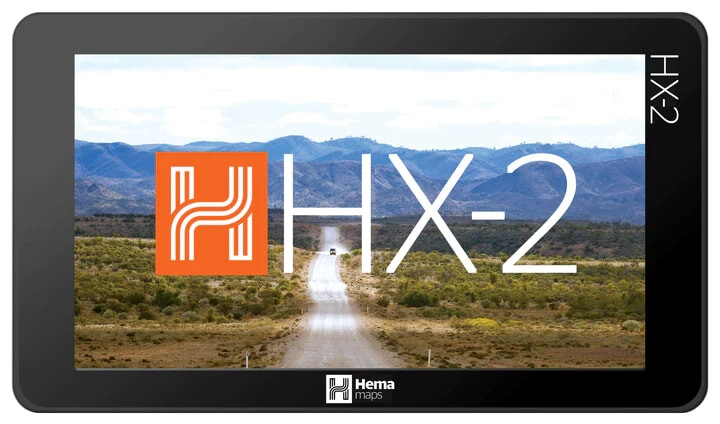
Specifications
- Internal memory: 16GB
- Display size: 7-inch
- Display resolution: 1024 x 600 IPS
- Warranty: 12 months
- RRP: $799
\n
Things we like
- Hema-verified POIs
- Battery life (claimed eight hours)
- Vector mapping system
Not so much
- User interface takes time to learn
- Wi-Fi required for Hema Explorer maps
- Quite pricey
An evolution of the outgoing HX-1 unit, the HX-2 is a lighter, faster, more intuitive and much improved unit. A larger battery and faster internal processor are key updates.
It functions well as an on-road sat-nav system, but escape the concrete jungle and this thing shines. Ditching the outdated Raster map system, Hema now uses Vector maps for more refined, detailed mapping – the Hema Explorer option in the off-road map section allows users to zoom in to 1:25-thou.
As it’s a Hema unit, it comes with all of the perks of the brand’s travel experience: 40,000 verified points of interest (camping sites, campgrounds, caravan parks, hotels, motels, dump points, wineries, lookouts, rest areas, boat ramps, post offices, fuel stops, etc.) and Australia-wide topographic mapping. The unit features a USB-C charging port.
Garmin Overlander
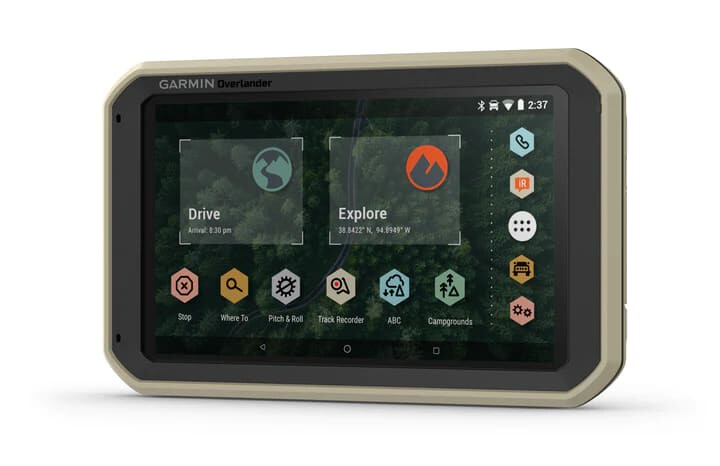
Specifications
- Internal memory: 64GB
- Display size: 7-inch
- Display resolution: 1024 x 600 IPS
- Warranty: 12 months
- RRP: $999
\n
Thing we like
- Hema topographic maps
- Plenty of storage space
- Genius magnetic mount
Not so much
- Very expensive
- Similar to Hema unit, but more pricey
Despite its expensive price tag at just a freckle under $1000, the expression ‘you get what you pay for’ rings true with this unit.
With a capacity of 64GB of inbuilt storage, the Overlander can store plenty of topographic maps for your adventures. It’s made of tough stuff too, built to USA military standard 810 for thermal and shock resistance – plus, its IP5X rating means it can withstand dust and extreme temperatures. And that magnetic mount is a touch of genius.
It utilises Hema technology and is pre-loaded with Hema 150K topo maps of Australia, with more than 36,000 points of interest.
It can also be paired with the inReach Explorer+, inReach SE+ and inReach Mini satellite communicators.
VMS 3DX: Portable Offroad GPS
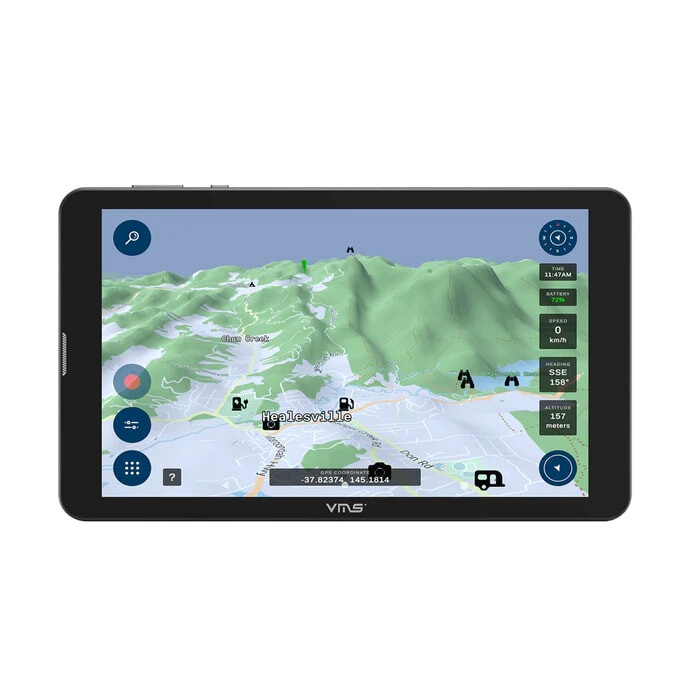
Specifications
- Internal memory: 32GB
- Display size: 8-inch
- Display resolution: 1200 x 800 IPS
- Warranty: 12 months
- RRP:$549
\n
Things we like
- Price
- Screen resolution
- Bigger size
Not so much
- Costs extra for topo maps
- Relatively unknown in the industry
A bit of an unknown quantity in Australia, VMS is a Melbourne-based company, and its 3DX is a well-priced alternative.
Unlike the Hema and Garmin units, the VMS 3DX features a bigger (eight-inch) screen and a higher display resolution of 1200 x 800 IPS. Its internal memory of 32GB is also nothing to sneeze at – as is its 4GB of RAM.
In place of the Hema’s POIs, the 3DX utilises CAMPS 11 with Caravan Parks 6, which only boasts a fraction of POIs compared to the Hema unit.
It uses 3D vector maps, but topographic maps do cost extra which brings the total cost up closer to HX-2 territory.
Phone apps
Hema CAMPERX
CAMPERX is Hema’s thrifty smartphone alternative, and it’ll cost you less than two coffees to get things started. It’s powered by Hema, so it features more than 100,000 points of interest, detailed information and multi-scale topographic mapping including full offline capabilities. The user interface is known to have a few gremlins, though. Compatible with Apple and Android.
Hema 4×4 Explorer
The comprehensive 4×4 Explorer app allows users to access all of Hema’s perks via their smartphone or tablet. Features include Hema’s vast range of Australia-wide topographic maps, offline capabilities, more than 100,000 points of interest and Hema Cloud connectivity. Bear in mind, there may be additional costs, and the app can be buggy at times.
Gaia GPS
Gaia GPS is a membership-based GPS system, where members can get access to a vast range of maps for not only 4WDing, but hiking, camping, sightseeing and any outdoors activity. Maps can be downloaded for offline use, and even printed to take with you as a back-up. There is a free plan available, but that only grants access to the topo maps and they can’t be downloaded for offline use. Cleverly, it features Apple CarPlay integration.
ExplorOz Traveller
The Aussie-made ExplorOz Traveller app is compatible with both Apple and Android. The Traveller app features EOTopo mapset, offline maps, active tracking, an extensive point-of-interest catalogue, and it can be highly personalisable. Free updates are available frequently. Additional costs may be incurred for more features.