Reviews


Gallery 1
7.5
/10
Score
Things we like
- 915kg payload and 3500kg towing are proper numbers
- Every dual-cab should have twin lockers
- Cheapest PHEV ute on the market
Not so much
- Touchy throttle off-road
- Reliability is unknown at this point
- Wading depth and ground clearance aren't great
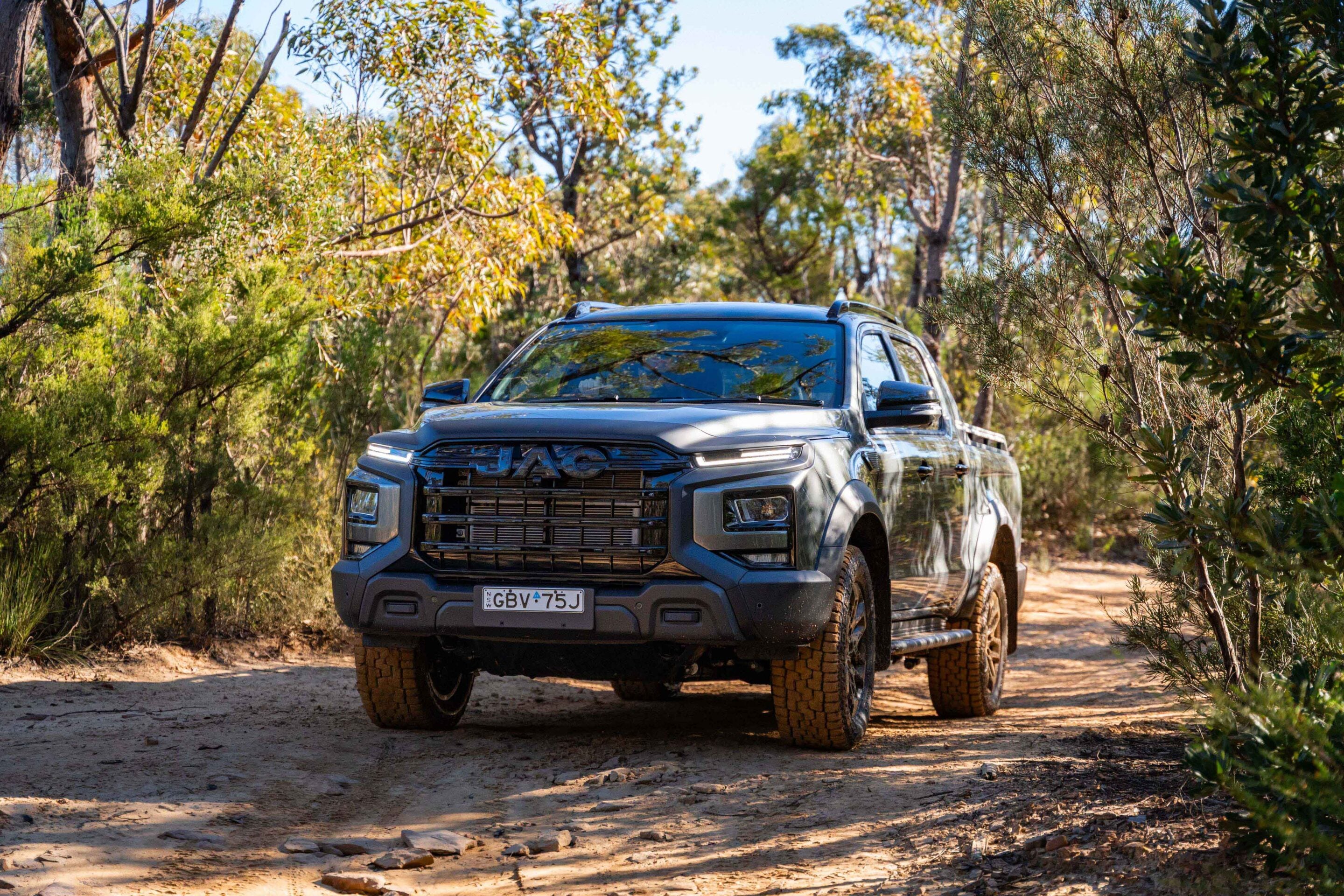
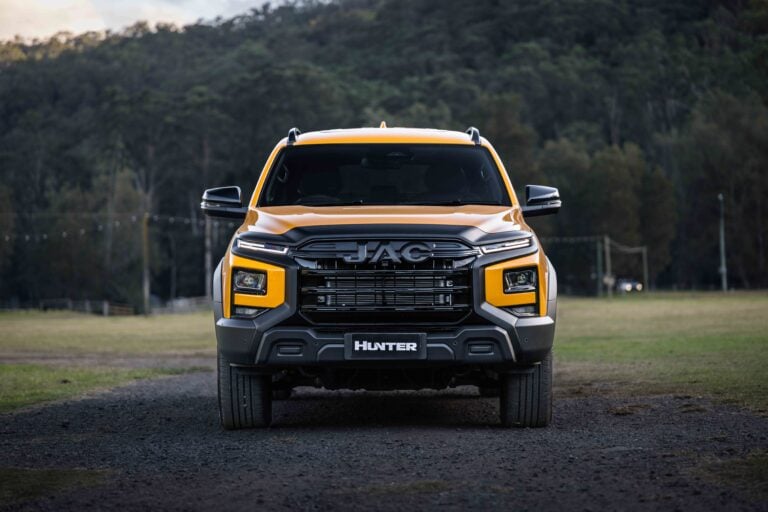
At first glance, the JAC Hunter PHEV may seem like “just another dual-cab”, but once you start scratching beneath the surface, a few things jump out at you.
The first is its plug-in hybrid capability, which you can otherwise only get from the Ford Ranger – the cheapest PHEV version of which is around $10K more expensive than the top-of-the-line Hunter – the GWM Cannon Alpha or the BYD Shark. But the JAC makes more combined power and torque than all of them and is also the cheapest.
The second is the option of twin diff locks on the Hunter X. Despite the advancements in traction control, lockers are still the best way to guarantee off-road grip. Chalk up another W in the JAC column.
Lastly, there’s the aforementioned abundance of power and lack of a hefty price tag, which is a combo everyone loves. Our test rig retails for less than $55K and pumps out a combined 360kW and 1010Nm, which are numbers usually only seen from rigs that are far more spendy. Now, let’s be fair: Combined power figures always sound amazing, but aren’t the same as driving a combustion-engined vehicle with the same numbers. Even so, when the go-pedal is planted, the JAC accelerates like a startled cheetah on meth and can return fuel economy that’d put even the most frugal of diesels to shame.
All of this begs the question: Is the JAC really ready to take on the established players in the industry? I spent some time in the top-spec Hunter X to find out.
1
JAC Hunter PHEV development
JAC, China’s number one exporter of light trucks and number two exporter of utes, is no stranger to Australian shores, and the Hunter has run a hell of an R&D gauntlet to make sure it’s up to the task.
Multimatic’s Michael Barber, who’s a former Holden chassis engineer, took the pre-production model and turned it into something that’s ready for Aussie conditions. Multimatic recommended a heap of changes be made. The shot-callers at JAC implemented every single one of them. The shocks on their own took more than 50 revalves and parts upgrades before they were deemed acceptable.
With a traditional Japanese or American brand, recommendations like these can take up to four years to filter through official channels, boardroom meetings, committees and hand-wringing sessions. The Chinese do things a lot quicker and turnaround is a matter of months. As a result, they were able to build a ute with a 3500kg towing capacity and 915kg payload on a disc-braked, coil-sprung rear end. While its longevity is yet to be established, it shows the Hunter is a legit contender.
1
How the PHEV powertrain works
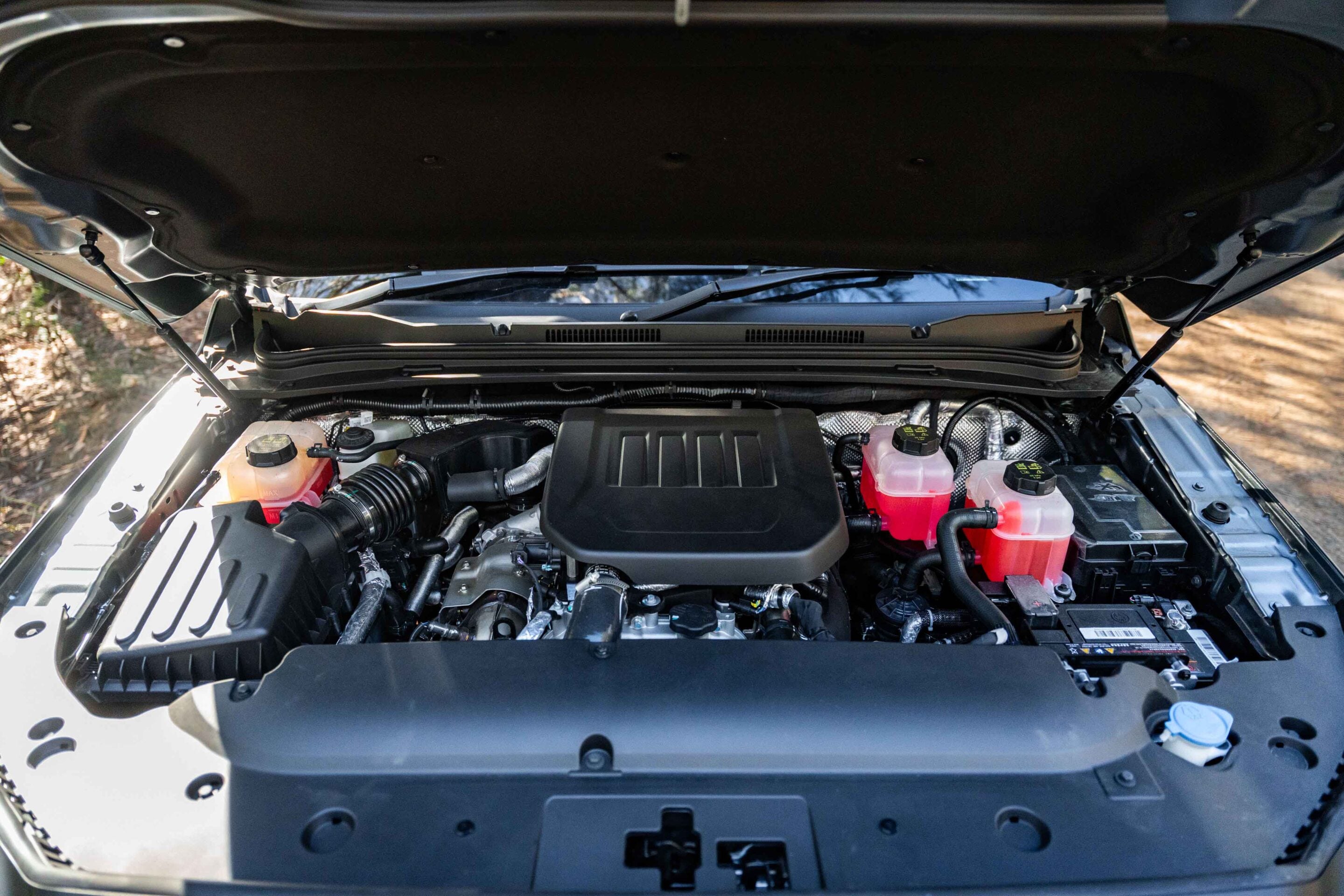
The engine is a 2.0-litre turbocharged petrol unit putting out 160kW and 370Nm, and is backed by a four-speed auto.
This sends charge to the 31.2kWh lithium iron phosphate battery, which sends electrons to front and rear motors to drive the diffs and wheels, with up to 100km of electric-only running. The engine can also drive the front wheels on its own if you’re low on juice. In fact, FWD, RWD and AWD are all available.
The battery can be charged through regular driving, with the regenerative braking able to be tweaked from hard to gentle – although we couldn’t notice a difference between the settings – or via the CCS2 charging port at home or an EV-friendly servo. The whole system can also be used as a generator, able to run power tools or camping accessories, which is pretty nifty.
1
While the on-paper power figures are wild, on-road performance is good but not at the level you’d expect with more than 1000Nm on tap. The front motor can spit out 130kW and 300Nm, while the rear lays down a claimed 150kW and 340Nm, but it does not translate into rip-snorting performance. Don’t get me wrong, it has plenty of grunt and goes hard off the line, but when tootling around town it’s way more subdued. To some, that may be the best of both worlds, but for me it just felt a touch underwhelming. Still, in a world of asthmatic four-cylinder diesels, it’s hardly anything to complain about.
There were definite niggles, like a whine from the engine and the fact that it only has single-zone air-conditioning, but again, this is one of the cheaper utes on the market and it punches way above its weight. We didn’t get a chance to hitch up a trailer.
Off-road performance
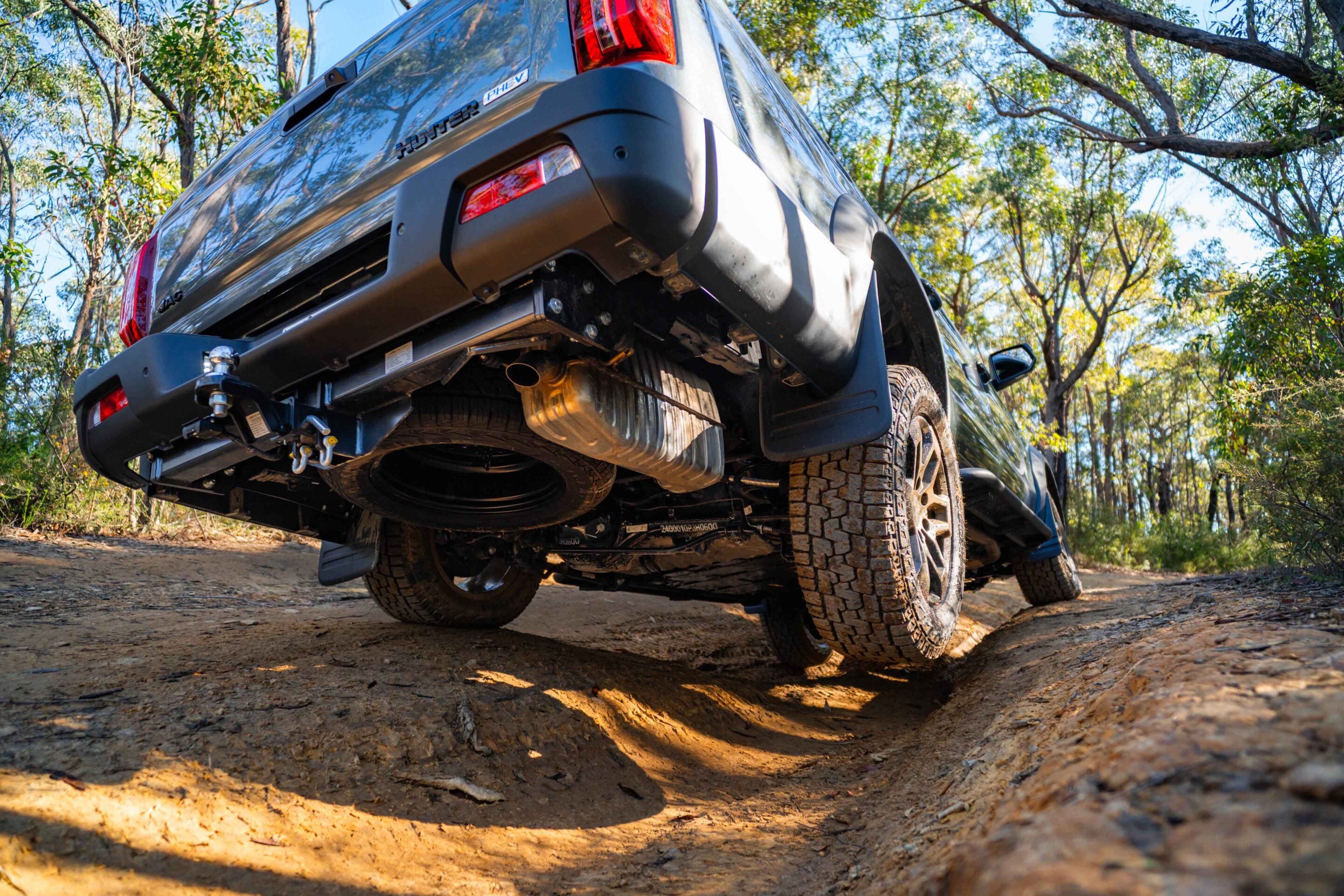
Straight up, the Hunter is not designed for anything hardcore. It doesn’t even have low range.
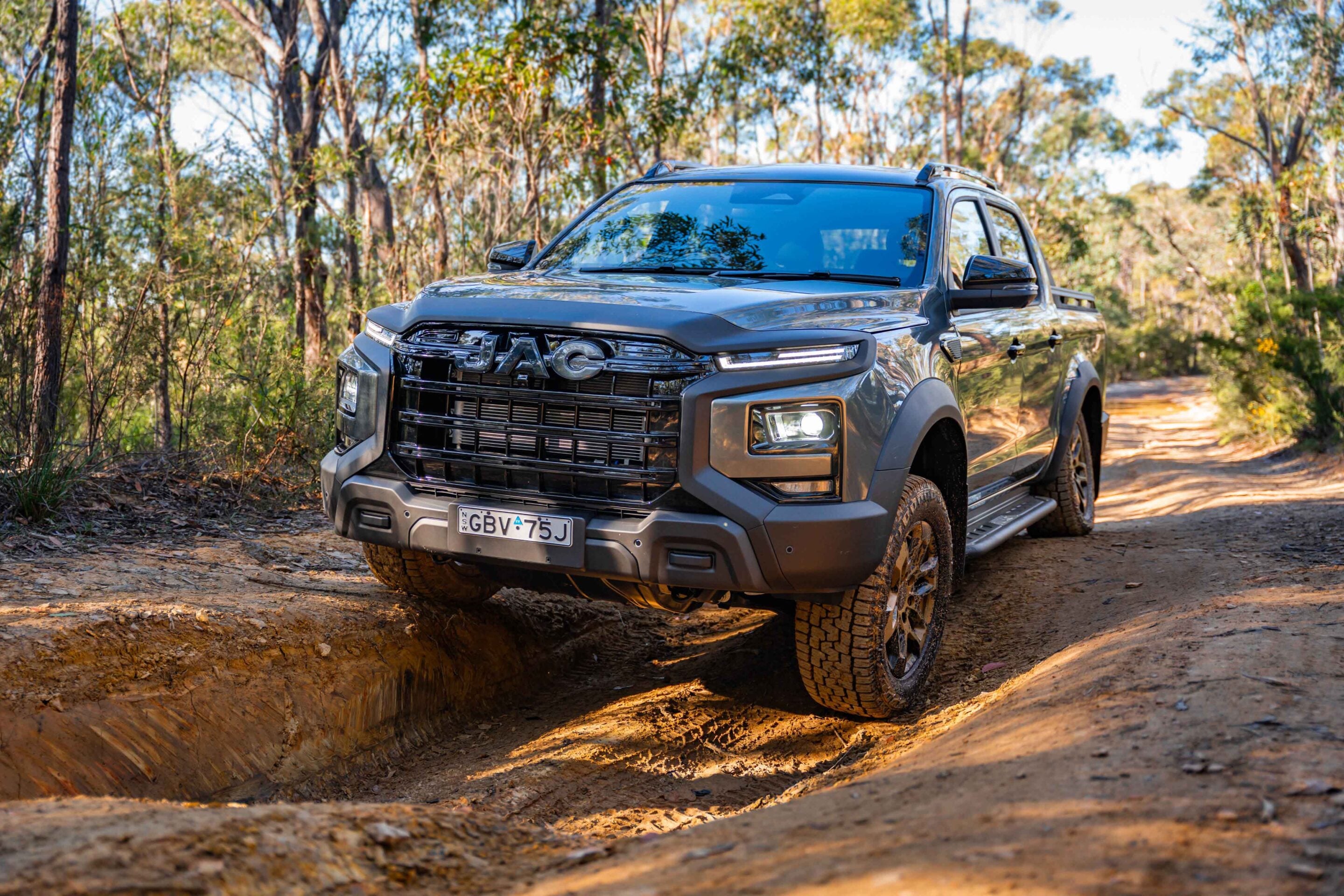
But the twin lockers and multiple off-road drive modes make up for a hell of a lot. The 265/60R18 Pirelli Scorpion AT tyres are also right at home off the blacktop and, with the right pressures and careful wheel placement, it handled everything we threw at it.
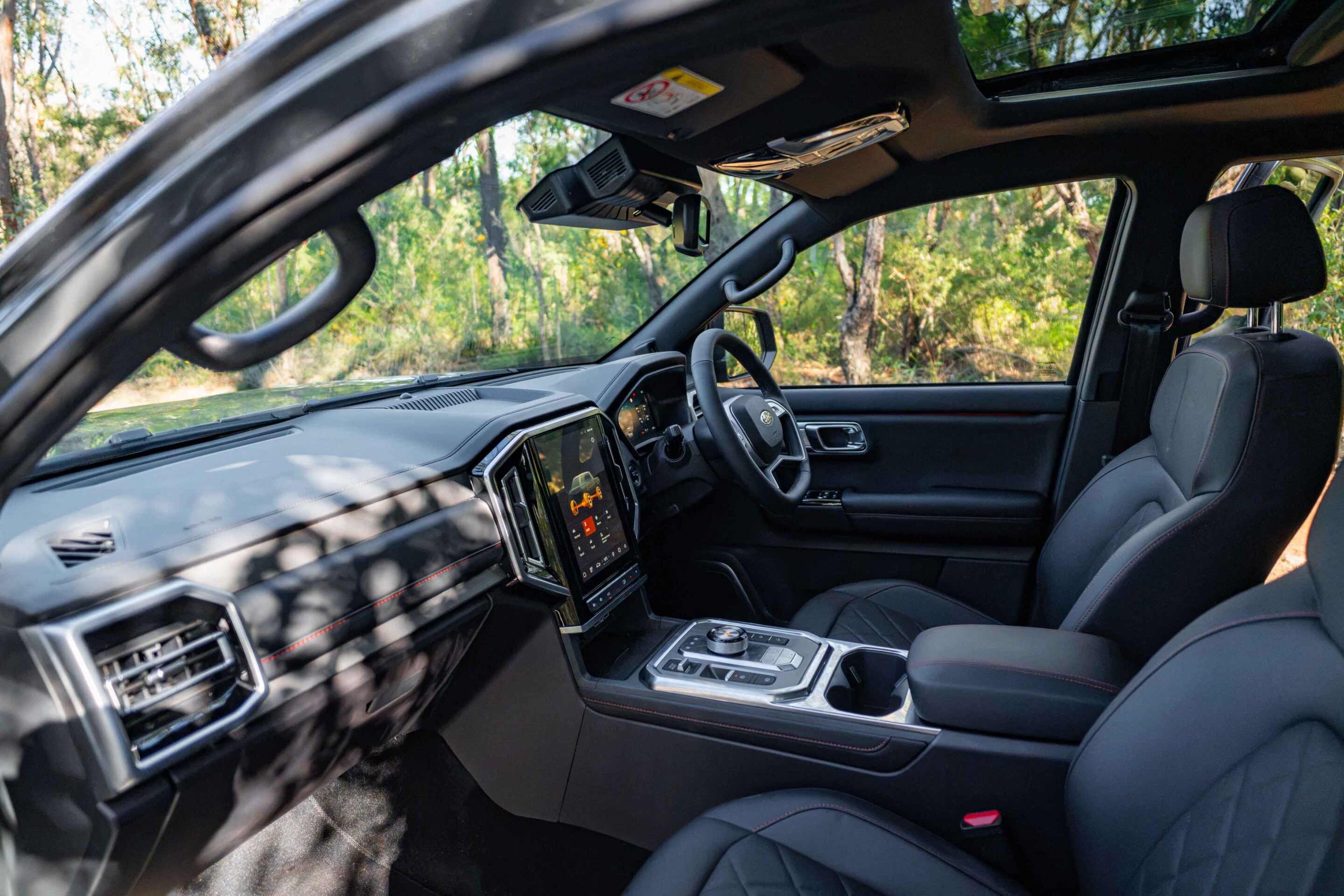
Deep water crossings may be an issue with only 550mm of wading depth, and the 200mm ground clearance will require an investment in bashplates, but as far as factory-spec utes go, we’ve driven much worse. It’s no Wrangler Rubicon or factory-locked 70 Series, but it’s not meant to be. It’s easily as good as any other midsize dual-cab off the blacktop.
1
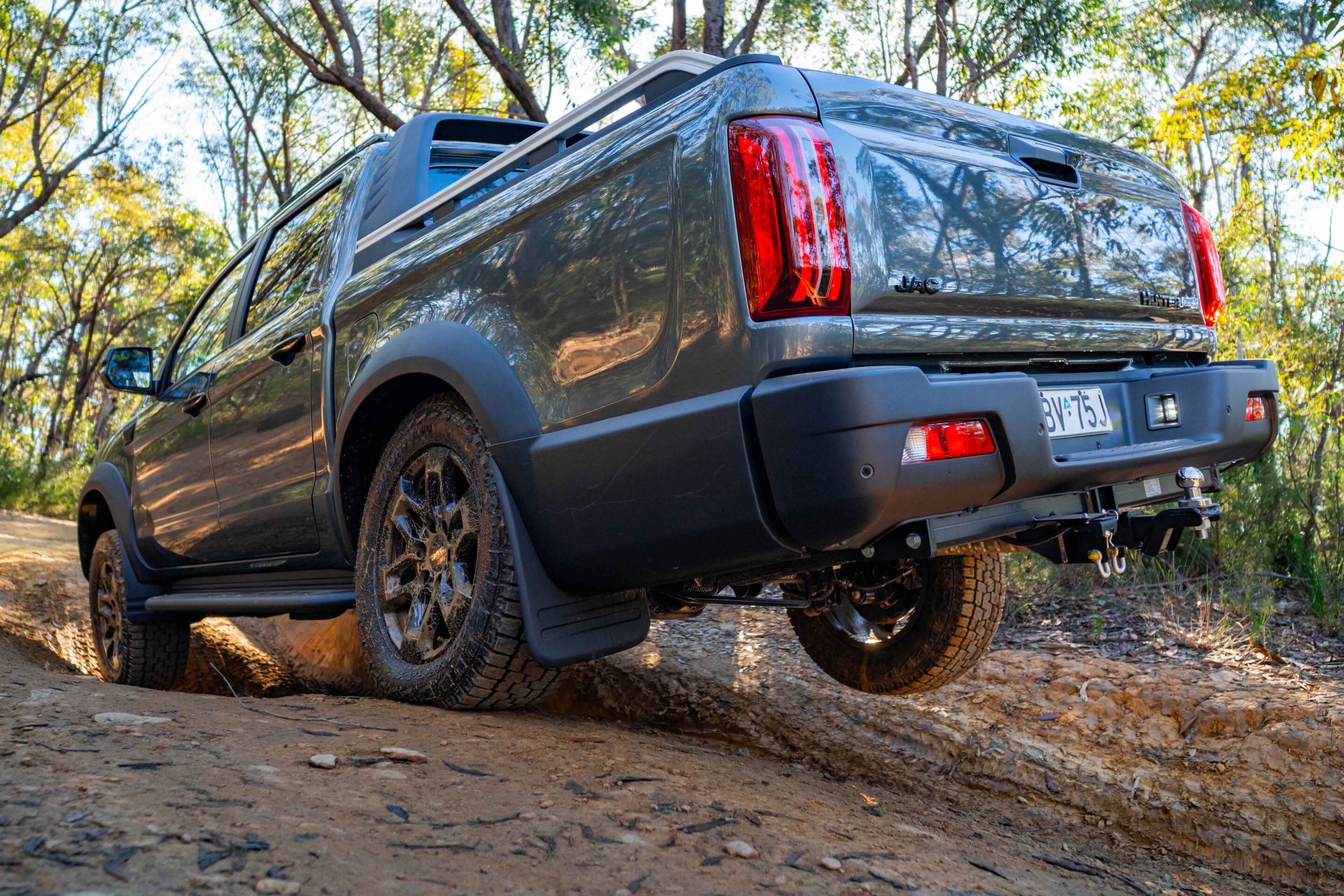
One thing I did find frustrating was the touchy throttle, a function of the on/off nature of EVs. Some technical obstacles could be driven more easily with the torquey idle of a diesel engine. But as much as I could sit here and nitpick all day long, there’s very little I can say about this that I can’t say about every other ute. It really is good off-road.
Yeah, the wheel travel is limited (like all of them), the clearance isn’t great (very few are) and the front bar seems designed to scrape on rock steps (just fitting in with the cool kids). However, it has power to spare (unlike most of the turbo-diesels), maximum traction from the lockers (why don’t all dual-cabs do this?) and uses bugger all fuel (much to the despair of internal-combustion diehards).
There are no more compromises with the JAC than there are with pretty much every other vehicle in this class. Which is impressive.
| Off-road specs | |
|---|---|
| Approach angle | 28 |
| Rampover angle | 23 |
| Departure angle | 23 |
| Ground clearance | 200mm |
| Wading depth | 900mm |
Touring comfort and practicality
As a long-distance tourer, the Hunter has a real-world range of more than 800km from its 77L tank, which is far from rubbish.
Plus, it can run a bunch of 12V camping gear straight out of the box without the need for an expensive aftermarket power system. There’s even a 220V socket in the back of the cab. Obviously, long-term reliability and spare-parts availability are still big question marks, but JAC offers a seven-year warranty with an Australia-wide ute-swap clause, which is reassuring.
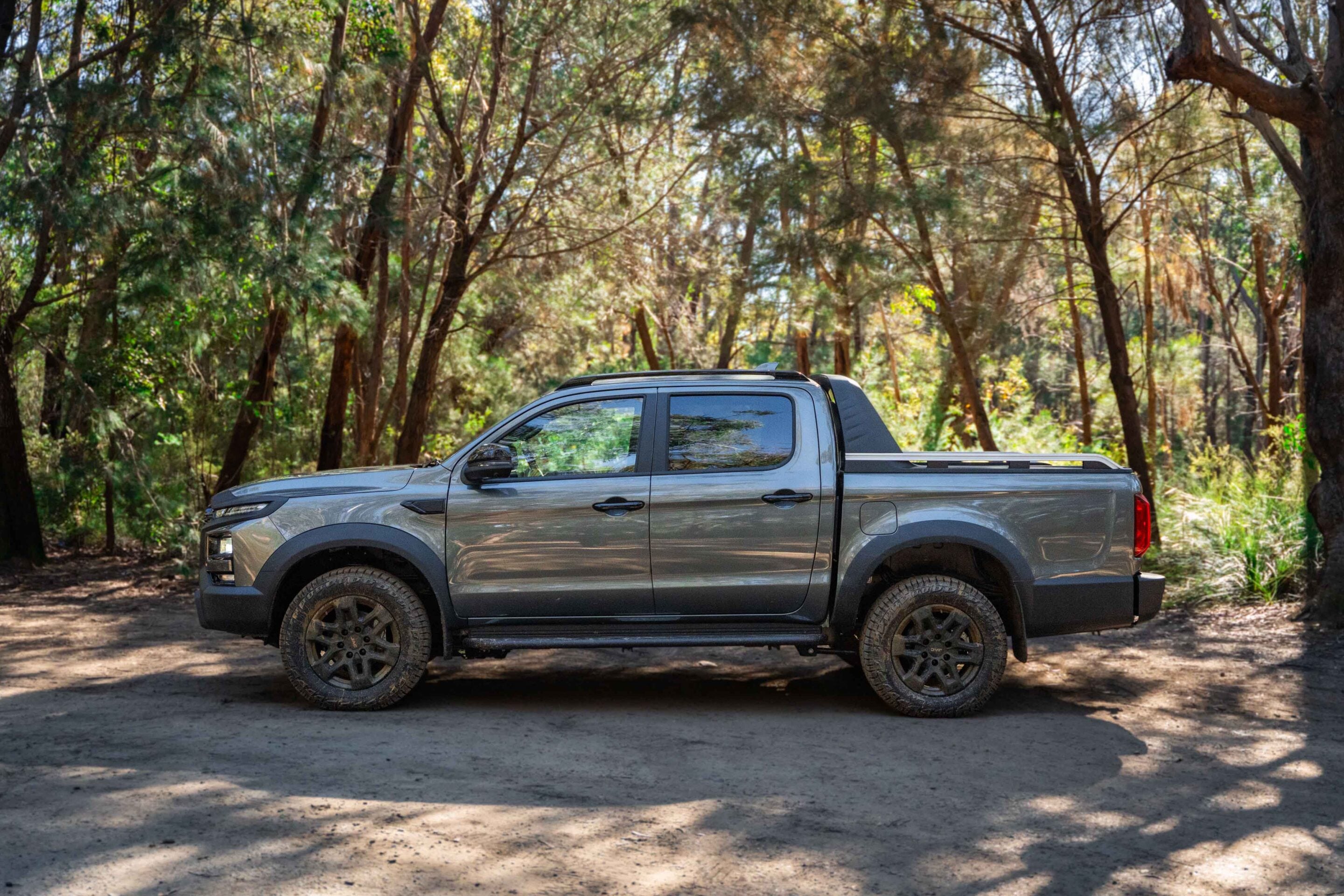
The interior is smaller than the Shark’s and less luxurious than the Ranger’s, but it definitely doesn’t suck. One thing all test drivers enjoyed was the ability to turn off the annoying driver aids with a simple swipe down on the 10.4-inch infotainment screen. There were practical additions as well, such as the tub light, with the tub big enough to fit an industry-standard pallet.
1
The Hunter X has all the tech you could ever want or need. Whether that’s a good thing or not is up to you, but it wasn’t overbearing or intrusive. We would have liked to see a power outlet in the tub for a fridge and maybe a smidge more clearance, as well as a wading depth that didn’t make us nervous tackling anything deeper than ankle-deep.
Still, with a healthy GVM of 3470kg, a kerb weight of 2555kg and a GCM of 6430kg, the JAC delivers traditional ute specs with the added advantage of plug-in hybrid versatility. Can it cut a lap of Aus without a worry? Not sure yet, but I’m struggling to see why not.
Is the PHEV the future?
The Hunter X raises an interesting question: Can it replace the traditional turbo-diesel ute? No, it cannot. At least not completely.
However, it opens the category right up. Modern emissions-restricted oil-burners are problematic for people who work locally and don’t often get the opportunity for the monthly run up the highway to regenerate the DPF. Then there are the folks who don’t want to pay the left kidney that 100L of diesel currently commands at the bowser. The JAC provides a legit alternative for such buyers without sacrificing comfort or carrying capacity.
Compared with the BYD Shark 6, Ranger PHEV and Cannon Alpha, it offers a huge amount of bang for buck, ticking all the power and towing boxes without the price tag we’ve been conditioned to expect. It’s difficult to compare with a traditional ute because it’s really a whole new category. Further testing is required, but the early signs are good. Like, really good.
1
Specifications
| JAC Hunter X specs | |
|---|---|
| Price | $54,844 + ORC |
| Engine | 4-cylinder turbocharged petrol; 2x electric motors front & rear |
| Capacity | 1995cc |
| Max power | 360kW (combined) |
| Max torque | 1010Nm (combined) |
| Transmission | 4-speed automatic |
| 4×4 system | Multi-mode, twin diff locks |
| Crawl ratio | N/A |
| Construction | 4-door dual-cab on ladder chassis |
| Front suspension | IFS, coil springs |
| Rear suspension | Live axle, 5-links, coil springs |
| Tyres | 265/60R18 Pirelli Scorpion AT on alloy wheels |
| Kerb weight | 2555kg |
| GVM | 3470kg |
| Payload | 915kg |
| Towing capacity | 3500kg |
| GCM | 6430kg |
| Seating capacity | 5 |
| Fuel tank | 77L |
| ADR fuel consumption | 1.6L/100km |
| On-test fuel consumption | 6.2L/100km |
7.5
/10
Score
Things we like
- 915kg payload and 3500kg towing are proper numbers
- Every dual-cab should have twin lockers
- Cheapest PHEV ute on the market
Not so much
- Touchy throttle off-road
- Reliability is unknown at this point
- Wading depth and ground clearance aren't great
Follow 4X4 Australia on Google
Get more 4x4 news, reviews and gear stories from 4X4 Australia in your Google feeds.

We recommend
-
 News
NewsJAC Hunter PHEV priced from $49,988 ahead of August launch
Set to arrive in August, the Hunter PHEV enters Australia’s growing electrified ute market with serious towing and off-road ambitions
-
 News
NewsJAC Hunter PHEV gets Australian-tuned dynamics ahead of launch
The JAC Hunter PHEV has undergone local vehicle dynamics tuning ahead of its Australian launch in Q3 2026