Gear

Gallery 1
Heading into June 30, the question every tourer is asking is a simple one: where are the genuine End of Financial Year deals on a portable power station, and which ones are actually worth the money?
The short answer is that the deepest cuts of the year on units up to 2500Wh are live right now across six brands worth your attention.
Jackery (↗), EcoFlow (↗), Bluetti (↗) and Anker SOLIX (↗) are running their biggest discounts of 2026, and two Australian-owned names, iTechworld (↗) and KickAss (↗), are matching them blow for blow. Discounts run from around 20 percent to 50 percent off, with the standout buys landing the 2000Wh class somewhere between $1799 and $2549.
One thing to know before you read on. Stock is already thin in places, and the brands themselves are saying so. This is a buy-online job, not a drive-to-the-store-on-the-weekend one. More on that below.
A note on what we cover here. The list is not ranked, and naming a brand is not an endorsement of a specific unit over another. These are the live EOFY offers on single-zone portable power stations up to roughly 2500Wh, the bracket that suits the majority of 4WD tourers running a fridge, lights, a laptop (if you’ve snuck off work early for the weekend), a CPAP machine and the odd induction cooktop.
Prices are accurate at the time of writing and should be confirmed on the brand’s site before you buy.
JUMP AHEAD
- How much power do you actually need?
- Jackery
- EcoFlow
- Bluetti
- Anker SOLIX
- iTechworld
- KickAss
- What’s the catch?
- Your questions answered
How much power do you actually need?
For most tourers, the 2000Wh class is the sweet spot, not the entry point.
A 1000Wh unit will keep a 12V fridge, some lights and your devices running across a long weekend, and recharge off a folding panel or your alternator. Step up to the 2000Wh class and you can add an induction cooktop, a coffee machine, a CPAP machine through the night, or simply stretch a few extra days off-grid before you need sun or a drive to top up. On a run across the Simpson or up Cape York, that headroom is the difference between rationing power and not thinking about it.
The other number that matters is charge speed, and here is where you need to ignore the marketing and understand one technical reality. Plugging a power station into your vehicle’s cigarette socket with the standard cable charges it very slowly. The DC input port on almost every unit is deliberately capped at around 8 to 9 amps, roughly 100 to 130 watts, to protect the vehicle socket from overload. At that rate, filling a 2000Wh unit takes 10 to 20 hours of driving, which is close to useless for anyone moving camp daily.
The only way to genuinely charge from your alternator at speed is a dedicated fast alternator charger, a separate module that steps the voltage up and pushes real current into the unit. Not every model offers one, and where they do it is usually an extra purchase. Solar charging falls into the same trap. A single solar blanket is choked by that same current cap, so on most units anything over about 160 watts from one panel is wasted, and the real fix is wiring two blankets in series to lift the voltage and unlock far higher charging power.
Before you buy any unit on the promise of charging while you drive, confirm it has a fast alternator charger available, and at what wattage. The brand entries below flag which ones do.
Jackery
The volume leader, and the EOFY pricing reflects scale.
1
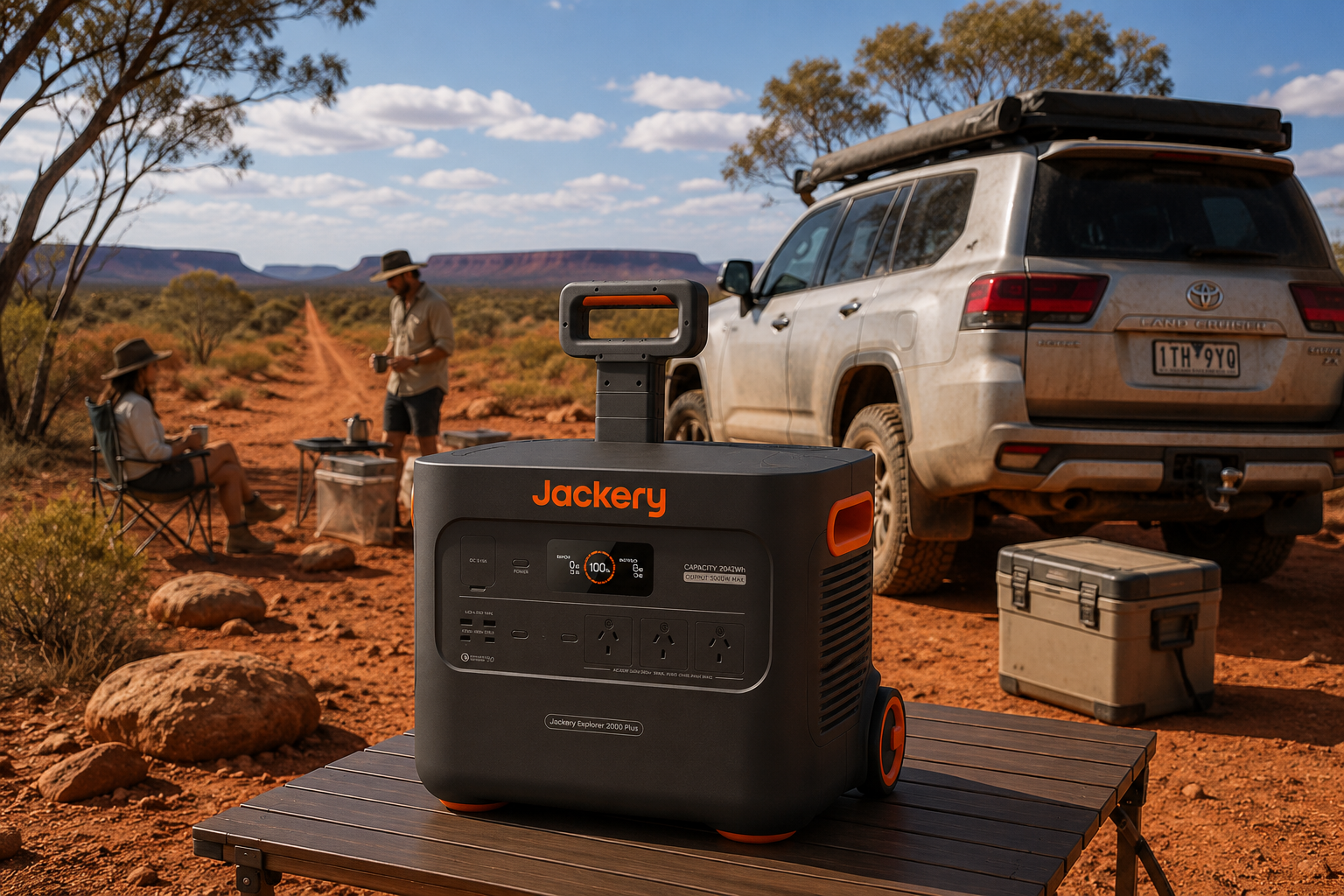
Jackery (↗) is the name most first-time buyers recognise, and for good reason: It has shifted more than seven million units globally and built a reputation on simple, reliable, well-supported gear.
For touring, the pick of the EOFY range is the Explorer 2000 Plus (↗), a 2042Wh unit with a 3000W output that is currently $2549, down from $3599. That is a saving of $1050, or around 29 percent. If you want to spend less, the Explorer 1500 Ultra (↗) (1536Wh, 1800W) is $1799, down from $2299.
What stands out beyond the discount is the buyer protection. Jackery is running a 30-day price match and, on orders placed through its own site, an extended warranty of up to five years. The Explorer 2000 Plus is also expandable with add-on battery packs if you decide later that you need more capacity.
- The deal: Explorer 2000 Plus, $2549 (was $3599). Explorer 1500 Ultra, $1799 (was $2299).
- Where to buy: au.jackery.com/pages/eofy-sale
EcoFlow
The most 4WD-native ecosystem of the lot.
1
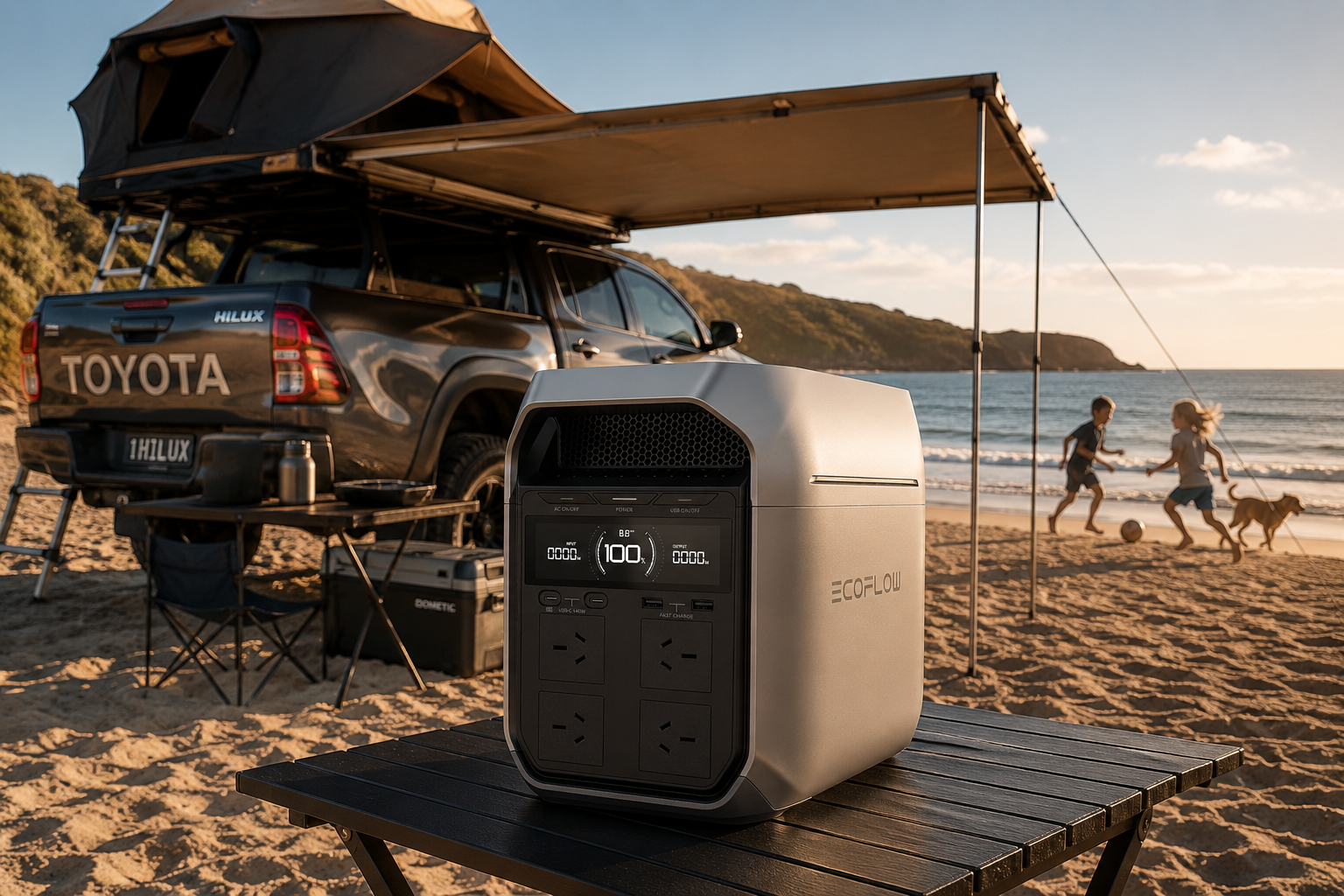
EcoFlow (↗) has leaned harder into the off-road market than anyone else here, with a dedicated 4WD Overlanding range and, crucially, a full line of fast alternator chargers at 500W, 800W and 1000W.
These are the separate modules that make real drive-and-charge possible, as opposed to the slow standard car socket. Pair the DELTA 2 Max (↗) (2048Wh, 2400W) with the 800W alternator charger and EcoFlow rates it at roughly 2.6 hours of driving for a full top-up.
EcoFlow also has a quiet trick worth knowing: its DC input accepts an XT60i cable that unlocks a higher charge current, which lifts car charging well above the usual cap if you wire it properly. That kind of integration is what matters when you are moving camp every day. 4X4 Australia took an EcoFlow on last year’s trip to the K’gari and it made it through with no issues.
The EOFY sale runs to 1 July with up to $1500 off across the range. The DELTA 2 Max is discounted by up to $500, and the smaller DELTA 3 Plus (1024Wh, 1800W, with 1000W of solar input) is up to $400 off. Final sale prices move around during the event, so confirm the figure on the day.
- The deal: Up to $500 off the DELTA 2 Max (2048Wh). Up to $400 off the DELTA 3 Plus (1024Wh). Up to $1500 off across the range.
- Where to buy: au.ecoflow.com/pages/eofy-mega-deals
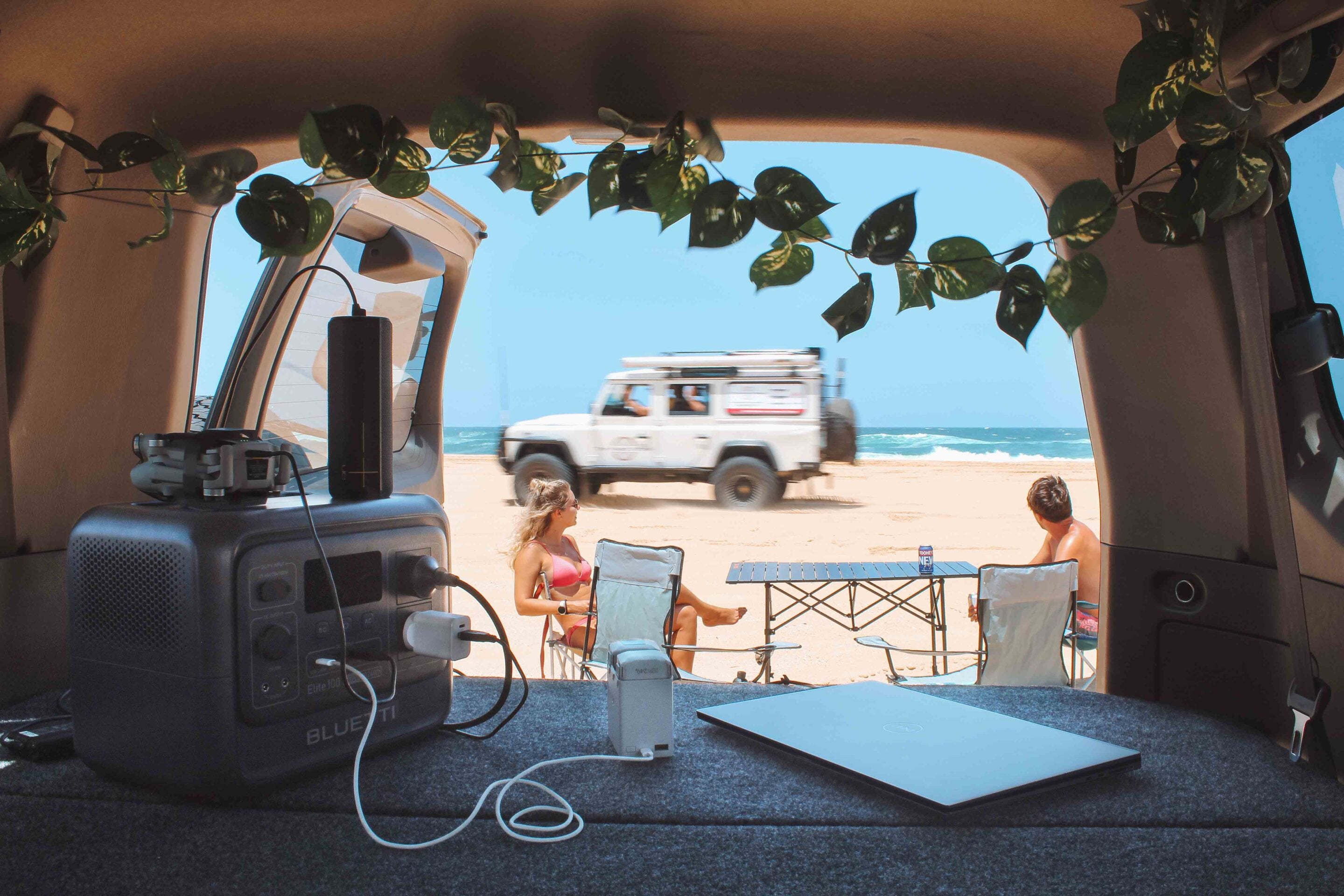
Bluetti
Strong value at the 1000Wh end, and a proper alternator-charging path.
1
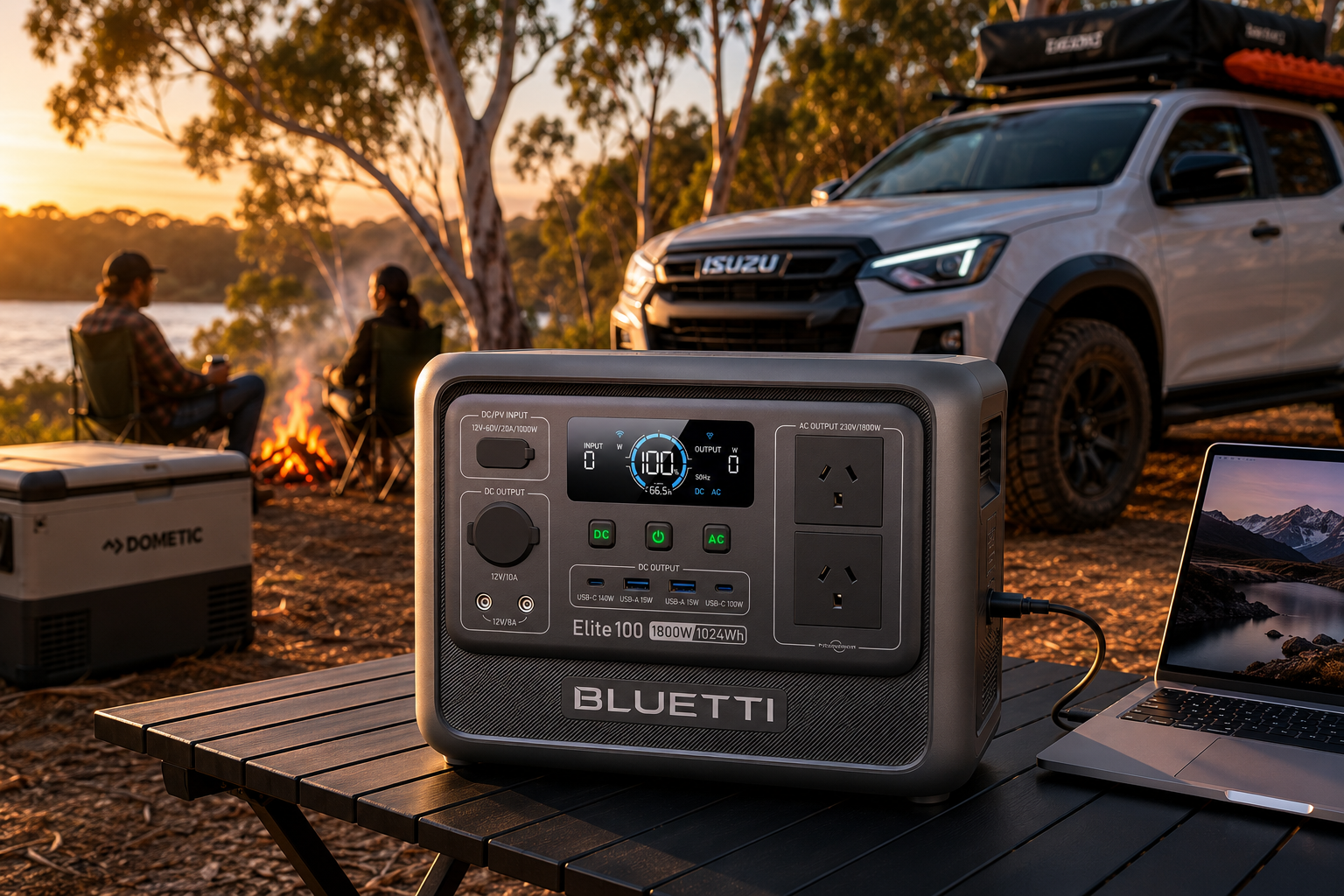
Bluetti’s EOFY (↗) runs the full month to 30 June with up to 44 percent off, and it stacks: spend over $1500 and another $80 comes off, over $2500 and it is $135 off, sitewide. The standout entry-level buy is the Elite 100 V2 (↗) (1024Wh) at $899, down from $1299, a 31 percent cut. Step up to the Elite 200 V2 (↗) (just over 2kWh) at $1799, down from $2499.
For tourers, the part worth noting is the Charger 1 and Charger 2 alternator units. These are the dedicated fast alternator chargers that turn your 4WD into a genuine charging source on a long-distance trip, rather than relying on the slow standard car socket.
Bundled with an Elite unit, they are the drive-and-charge path EcoFlow also offers. Bluetti rates its UPS switchover at 10 milliseconds too, which matters more for home backup than camp, but speaks to the build.
- The deal: Elite 100 V2, $899 (was $1299). Elite 200 V2, $1799 (was $2499). Stackable spend-and-save on top.
- Where to buy: bluettipower.com.au/pages/bluetti-eofy-sale
Anker SOLIX
The fastest recharge in the class, and it jump-starts your vehicle.
1
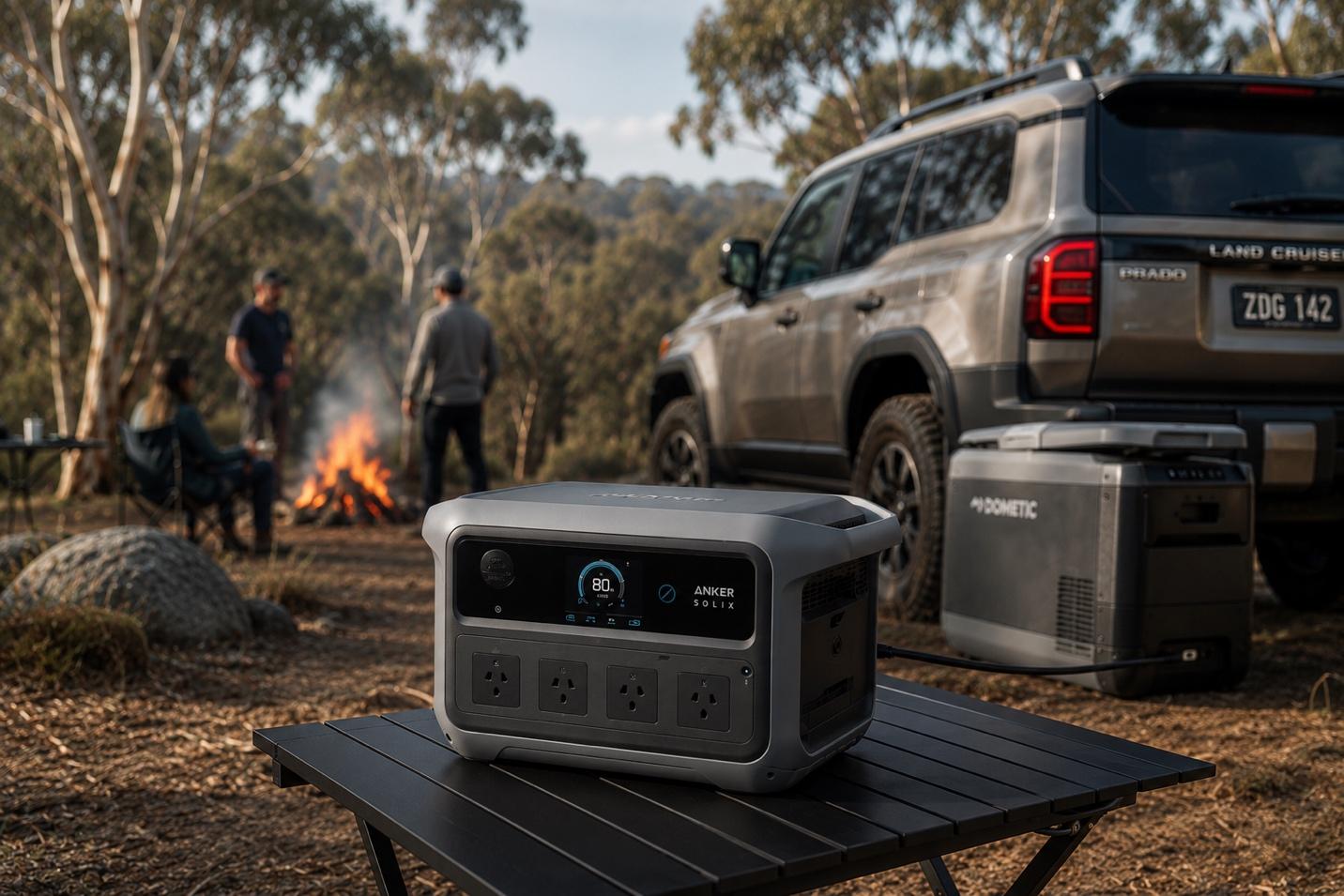
Anker SOLIX (↗) has built its pitch around speed. The C2000 Gen 2 (↗) (2048Wh, 2400W) reaches a full charge in 58 minutes, and the smaller C1000 Gen 2 (↗) (1024Wh, 2000W) holds a Guinness World Record for a 49-minute full charge.
Anker states the C2000 Gen 2 pairs with an 800W fast alternator charger for drive-and-charge, and both Gen 2 units can jump-start a flat vehicle, a genuinely useful trick in a remote camp. The Gen 2 units are also notably light for their capacity, at 18.9kg and 11.3kg respectively.
The EOFY sale runs 1 to 30 June with up to 50 percent off. The Gen 2 range launched at $1,799 (C2000 Gen 2) and $999 (C1000 Gen 2), and the EOFY discounting moves from there, so check the live price before you commit.
Anker also sells the older F2000 (↗) (2048Wh, 2400W) as an expandable platform, but be aware it has no fast alternator charger option, so car charging is limited to the slow standard rate of around nine amps. If charging from your vehicle matters to you, the C2000 Gen 2 is the one to look at, not the F2000.
- The deal: Up to 50 percent off. C2000 Gen 2 and C1000 Gen 2 the picks for touring. Confirm the live EOFY price on the day.
- Where to buy: ankersolix.com/au/eofy-sale
iTechworld
Australian-owned, locally supported, and built around the 12V crowd.
1
iTechworld (↗) has been making off-grid power gear in Australia since 2006, and the brand knows its audience: the deals page is organised around 4WD kits, caravan kits and dual-battery systems, not generic “smart devices”.
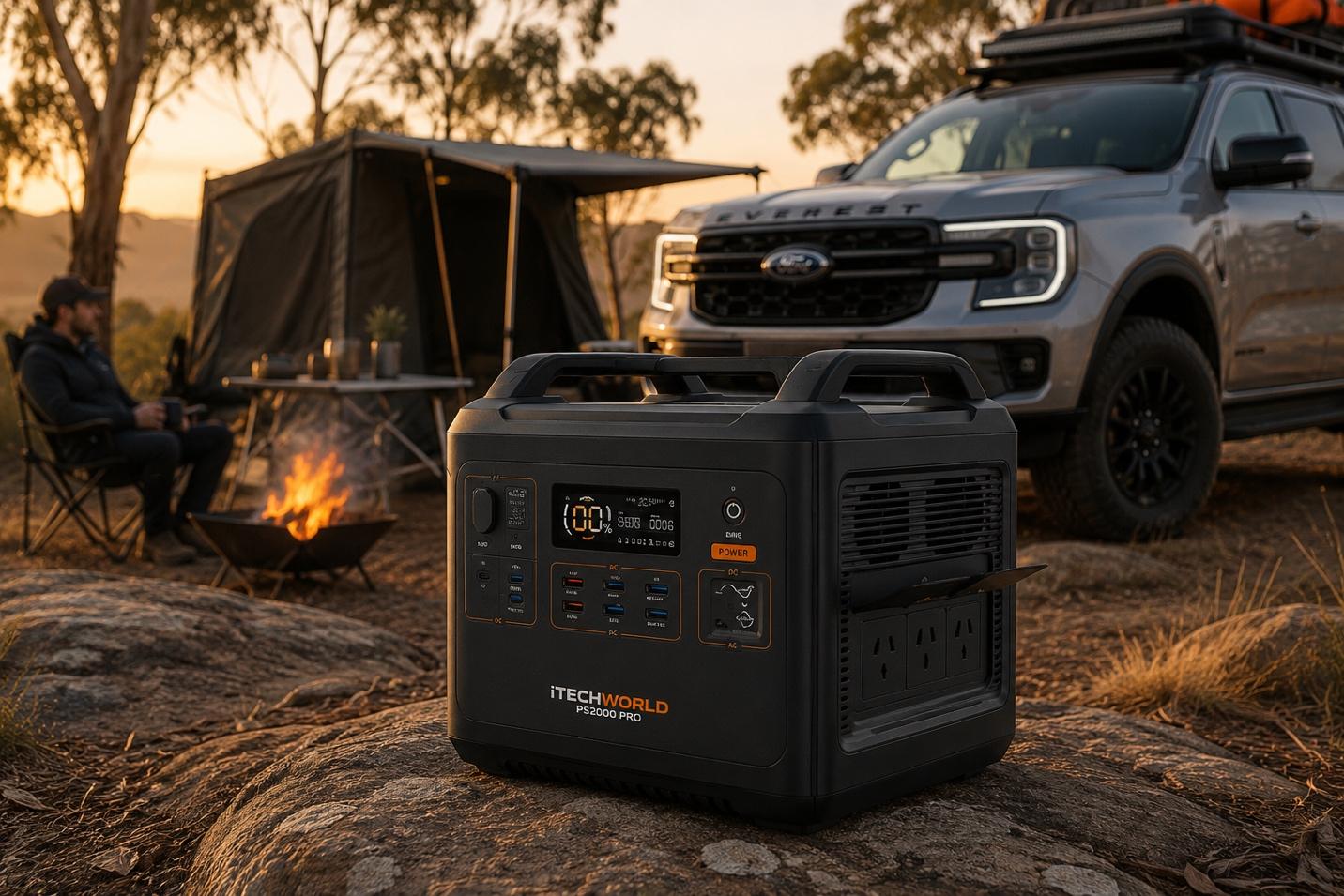
The hero unit for tourers is the PS2000 (↗), a 2048Wh (170Ah) power station with a 2400W output, currently $1899, down from $2999. That is a 36 percent saving, and it is one of the sharpest prices in the 2000Wh class this EOFY.
The standout is local support and a genuinely strong charging setup. iTechworld runs Australian phone support and stores in WA, with no offshore call centre, which counts for buyers who want to ring a person who knows the difference between a fridge load and an induction load.
The PS2000 is also one of the better drive-and-charge units in this list: it offers a 500W fast alternator charger, several times quicker than the standard car socket, and a high-current 25A 12V output that most rivals cannot match. The EOFY sale runs to 30 June with up to 50 percent off across selected gear.
- The deal: PS2000 (2048Wh, 2400W), $1899 (was $2999). Up to 50 percent off across the range.
- Where to buy: itechworld.com.au/pages/eofy
KickAss
Australian-owned, certified to local standards, and in stock.
1
KickAss (↗) has carved out a following among Aussie campers and 4WD owners on value, and the EOFY headliner is the KickCharge 3000 (↗).
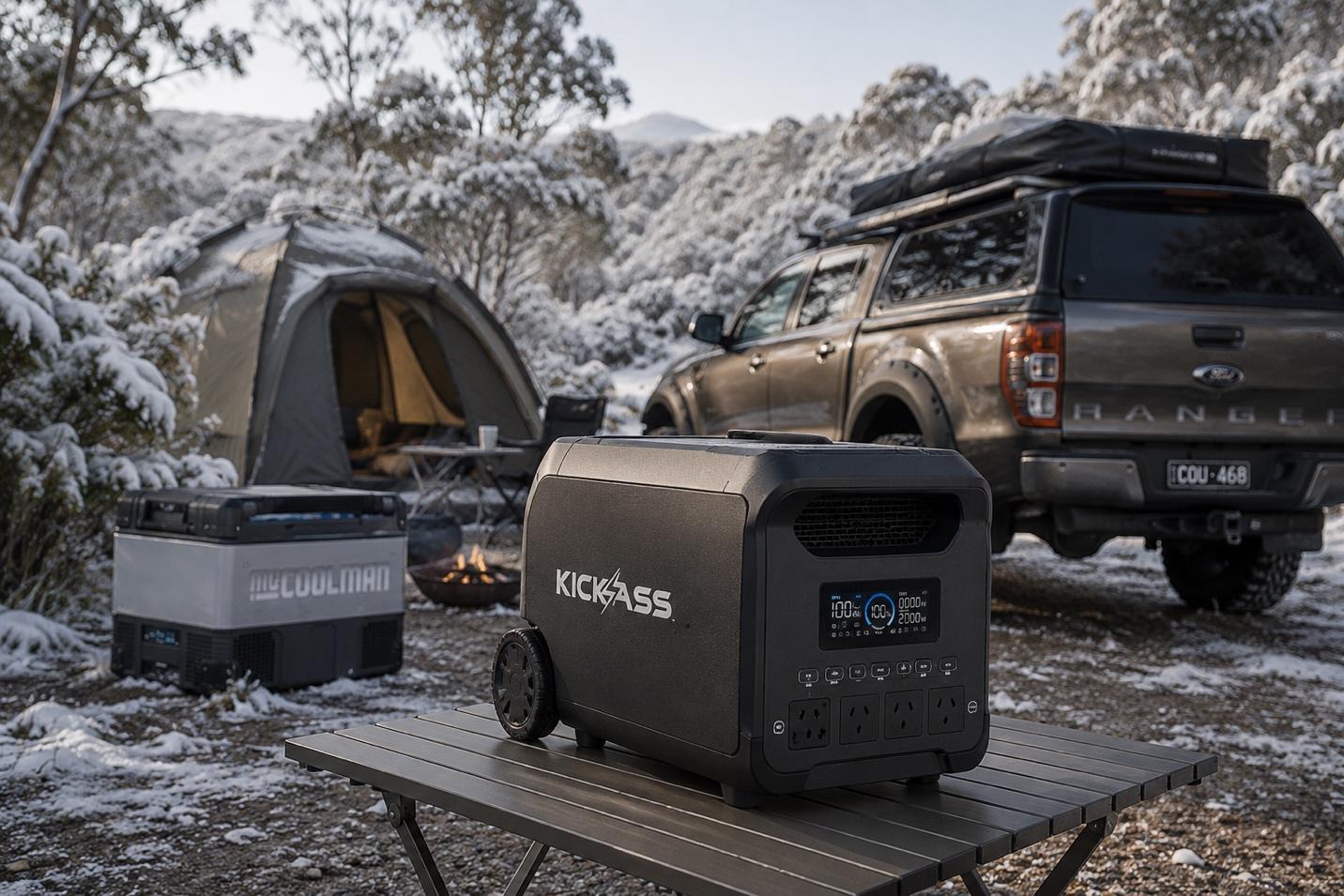
At 2560Wh it sits just above our 2500Wh bracket, but it is worth including: it is a 3000W pure sine unit, currently $2199, down from $2,999, a saving of $800, and it ships with a bonus BBQ and induction cooktop while stocks last. If you want to stay strictly under 2500Wh, the sister unit, the KickCharge 2400 (↗) (2048Wh, 2400W), is the cleaner pick.
What stands out is the certification. Unlike a lot of look-alike imports, the KickCharge 3000 is independently tested to mandatory Australian and New Zealand standards, including AS/NZS 62368 and AS/NZS 4763. It also has a pull-out handle and wheels at 36kg, app control, and dual MPPT solar inputs. The EOFY offer ends 30 June.
- The deal: KickCharge 3000 (2560Wh, 3000W), $2,199 (was $2,999), plus bonus cooktop. KickCharge 2400 (2048Wh) the in-bracket alternative.
- Where to buy: kickassproducts.com.au
The catch nobody puts on the banner: Stock is already thin
Treat this as a buy-online event, not a weekend store trip. This is the part worth taking seriously. Across these brands, the warning signs are already showing.
Jackery states plainly that during EOFY some products go out of stock and order processing slows down. iTechworld’s deals page is carrying “sold out” tags on popular lines, and KickAss has bundles marked sold out too.
The reason is structural: portable power stations are heavy, freight-restricted items that brands hold in finite numbers, and EOFY is the single biggest demand spike of the year. The practical upshot is simple. If you have found the unit you want at the price you want, buy it online now rather than waiting for a weekend run to a store that may not have it on the shelf.
Most of these brands ship Australia-wide within a few business days, and buying direct also locks in the warranty and price-match terms that often do not apply to third-party resellers. Leaving it to the last day of June is the surest way to watch the deal you wanted sell out from under you.
EOFY power station deals: Your questions answered
Q: What size portable power station do I need for 4WD touring?
A: For a weekend with a fridge, lights and device charging, a 1000Wh unit is enough. For longer trips, induction cooking, running a CPAP machine overnight, or stretching several days between charges, step up to the 2000Wh class. That is why most of the picks above sit around 2048Wh.
Q: Can I charge a portable power station from my 4WD while driving?
A: Yes, but how fast depends entirely on the hardware. Charging through the standard cigarette-socket cable is slow…..like seriously slow. Charging is capped at around 8 to 9 amps on most units to protect the vehicle socket, which means 10 to 20 hours of driving to fill a 2000Wh unit.
For real drive-and-charge speed you need a dedicated fast alternator charger, a separate module that pushes far more current. EcoFlow, Bluetti and the Anker C2000 Gen 2 offer one; some units, including the older Anker F2000, do not. EcoFlow rates its 800W charger at around 2.6 hours of driving for a full DELTA 2 Max. Always confirm a fast alternator charger is available for the specific model before relying on your vehicle to charge it.
Q: When does the EOFY sale end in 2026?
A: Most of these sales run until 30 June 2026, the last day of the financial year. iTechworld and Bluetti run the full month of June, EcoFlow runs to 1 July, and Jackery’s early-access window has already closed though its prices remain live. Confirm the cut-off on each brand’s page before you buy.
Q: Are these deals available in stores or only online?
A: Stock in physical stores is already limited, and several brands are reporting sold-out lines. When we called Anaconda, BDF, and Battery World, they were generally all out of stock. Buying direct online is the safer bet, secures the warranty and price-match terms, and gets the unit shipped to your door within a few business days.
Q: Can I claim a portable power station on tax at EOFY?
Only where it is genuinely used to produce income or for a business, such as a tradie powering tools on site. A unit bought purely for private camping is not deductible. At 4X4 Australia, we are not accountants, so check your specific situation with yours before you assume an EOFY purchase is a write-off.
Q: What is the difference between Wh and Ah?
A: Watt-hours (Wh) measure the total energy a unit holds. Amp-hours (Ah) measure capacity at a given voltage. As a rough guide, a 2048Wh power station is equivalent to around 160Ah at 12.8V. When comparing units, compare Wh, because it accounts for voltage and gives you the true energy figure.
The EOFY window is the one time of year the maths genuinely favours the buyer rather than the seller. The deals are real, the discounts on 2000Wh units are the deepest of 2026, and the brands are competing hard. The only enemy is the calendar, and the stock that runs out before it.
Prices and offers verified June 2026 and subject to change. Confirm the current price and sale end date on each brand’s website before purchasing. 4×4 Australia provides independent editorial coverage; brands featured do not control our assessments.
Follow 4X4 Australia on Google
Get more 4x4 news, reviews and gear stories from 4X4 Australia in your Google feeds.