
MERCEDES-BENZ wowed us last month when it unveiled its two X-Class concept vehicles in Sweden.
The two vehicles were strikingly different: one stylish and urban chic, while the one that excited us most was rough and off-road ready with winch and mud-terrain tyres. But what will the production X-Class look like when it lands in 2018?
Mercedes-Benz executives on hand at last month’s unveiling hinted the production model will be very similar to what we see in the white concept dubbed ‘Stylish’.
Take away the full surround tail-light treatment, imagine more conventional LED lights at each side of the rear and pull a bit of depth out of the front bumper, and you will be pretty close to what we’ll see in Mercedes-Benz showrooms here in Australia.
The grille, headlights and budging bonnet are all set to appear on the new model, as is the passenger compartment which is carried over from the donor Nissan Navara.
Unfortunately, you can forget about the 35-inch Silverstone muddies mounted to steelies, as well as front and rear winches on the ‘Powerful’ concept. Wheel choice could extend from 16- or 17-inch rims right up to the 22-inch rollers on the white concept, but as with all new cars the tyres will be highway rated.
The interior is a mix of Mercedes-Benz parts taken from C and V-class vehicles, and if you dial back the bling and fancy trims of the concepts it will be close to what is shown in them, including the latest in-car communications and connectivity devices. Make no mistake, despite its Nissan roots, the X-Class will look, feel like and be a true Mercedes inside and out.
The MB feeling will be best experienced in the top of the range variants, which will feature a Mercedes-Benz V6 diesel engine producing around 600Nm, backed by an automatic transmission and full-time, dual range four-wheel drive with a locking centre and rear differentials. This driveline package should make the X-Class the on- and off-road performance king of the one-tonne ute market.
There will be lower spec X-Class models available powered by the Renault-Nissan 2.3-litre bi-turbo engine, as found in the Navara, with a choice of manual or auto gearboxes and part-time four-wheel drive. There will also be two-wheel drive variants available. The X-Class will be double-cab body, only at release.
The big question that remains is how much? And while the Benz execs refused to reveal anything on this front, you can expect the X-Class to be at the top of the segment here as well, with the V6 reaching into the $80,000 bracket and the lesser grades below that.
Only Volkswagen’s new TDI V6 Amarok will come close in price and performance in the foreseeable future, but higher spec and price ute variants from both Toyota and Ford are tipped to arrive at some time, too. Exciting times ahead at the crest of the 4×4 ute market.
THERE has been plenty of online chatter regarding Ford’s decision to categorise its popular Everest off-road wagon under the Department of Infrastructure and Regional Development’s ‘MA’ (Passenger Car) banner rather than categorise it ‘MC’ (Off-Road Passenger Vehicle).
While this in no way means that the Ford Everest is not a capable off-road vehicle, some Everest owners are concerned that as their vehicles fall under the under the ‘MA’ category, they may have warranty and/or insurance issues if they modify their vehicles for off-road use.
Other “off-road” vehicles that have been given an ‘MA’ rather than an ‘MC’ classification include the Jeep Renegade Trailhawk, Cherokee Trailhawk and Grand Cherokee models, and the Haval H9.
WHAT’S THE DIFFERENCE? According to the federal government’s Department of Infrastructure and Regional Development: An ‘MA’ classification refers to “A passenger vehicle, not being an off-road passenger vehicle or a forward-control passenger vehicle, having up to 9 seating positions, including that of the driver.”
An ‘MC’ classification refers to “A passenger vehicle having up to 9 seating positions, including that of the driver and being designed with special features for off-road operation.” These special features include the vehicle having four-wheel drive and meeting certain parameters for ground clearance and approach, departure and ramp-over angles, etc.
WHAT’S THE PROBLEM? Under the National Code of Practice for Light Vehicle Construction and Modification (NCOP), there is slightly more scope to modify a vehicle with an ‘MC’ classification than an ‘MA’ classification.
In regards to tyre width, for example, the Vehicle Standards Bulletin 14 (VSB 14) states that vehicles with an ‘MA’ classification may be fitted with tyres up to 30 per cent wider than the vehicle manufacturer’s widest optional tyre. For ‘MC’ vehicles the allowable increase is up to 50 per cent wider.
Overall tyre diameter is also different depending on the vehicle’s classification. For ‘MA’ classified vehicles the overall diameter “must not be more than 15mm larger” than that of any tyre designated by the vehicle manufacturer for that model, whereas for ‘MC’ classified vehicles the allowable overall diameter increase is 50mm.
VSB 14 also lists different allowable tyre speed ratings depending on whether a vehicle is classified as a “passenger vehicle” or it has “special features for off-road use”. It does not, however, specifically distinguish between ‘MA’ and ‘MC’ categories in this instance.
It should be noted that regardless of a vehicle’s classification, suspension lifts of up to 50mm are allowable under VSB 14 without certification.
WHAT TYRES CAN YOU FIT? Ford Australia Product Communications Manager Damion Smy said that while there is a slight difference in allowable tyre sizes depending on whether a vehicle has an ‘MA’ or an ‘MC’ classification, there are still plenty of off-road tyre options to suit the Everest.
“In terms of off-road tyres, there are off-road tyres that will fit on the existing wheels, even on the Titanium, which is a 20-inch,” Mr Smy said.
“We went through all the tyre sizes for the Titanium, the Trend and the Ambiente the other day, and you can get off-road tyres. They’re not the massive chunky tyres that some people want, but they are street legal, roadworthy, off-road tyres that have chunkier tread than the standard tyres.”
“Some reports have suggested that an N-rated tyre is not legal on an Everest, and from our understanding that’s not correct,” assured Mr Smy. “You can fit the N-rated tyres(except Queensland where they have to be S-rated 180km/h)”.
Toyo Australia’s Tyre Technical Manager Stephen Burke agrees. Quoting the NCOP, he said: “The speed rating of the tyres fitted to vehicles with special features for off-road use must be at least N (which is 140km/h). My reading of it would be the same as Ford’s.”
In fact, Toyo offers a range of off-road tyres to suit the Everest, particularly the Ambiente, which is fitted with 17-inch wheels, including the all-terrain Open Country A/T II and the mud terrain Open Country M/T and M55F tyres. The latter two feature LT construction exclusively. Other tyre manufacturers, including BF Goodrich, Cooper Tires, Mickey Thompson and various other brands also offer a range of off-road tyres with LT construction to suit the Everest.
WHAT ABOUT SUSPENSION? Regardless of whether a vehicle has an ‘MA’ or an ‘MC’ classification, suspension lifts of up to 50mm are allowable without certification.
“In terms of aftermarket suspension, the ‘MA’ and the ‘MC’ classification, from what we understand, makes no difference,” said Ford Australia’s Damion Smy.
Many of Australia’s leading manufacturers of off-road suspension systems agree. Stuart Fooks, ARB Product Manager in charge of Old Man Emu (OME) said: “So long as the suspension height increase is below 50mm then it’s okay.” An OME suspension kit for the Ford Everest offers a lift of around 40mm.
“We do our development the same way no matter what classification a vehicle has; a passenger vehicle or an off-road vehicle,” says Mr Fooks. “We approach the development in the same way, we do all our OE evaluation and ride testing and check for droop and other limitations to travel and clearance of components, and tuning for application and mass and everything else that we do is not different for any category; we always approach it in the same way.”
WHAT SHOULD YOU DO? Don’t be concerned that your 4×4 Ford Everest has an ‘MA’ classification; it is still a genuine off-road vehicle.
“The Everest does actually meet the ‘MC’ category requirements, so in terms of its off-road capabilities, if it was categorised as ‘MC’, it wouldn’t be any different,” explained Ford’s Damion Smy. “It’s 4X4 Of The Year; you guys have obviously sung its praises, other outlets have as well, and it has been designed and developed in Australia to do that. We have no qualms in it being taken off-road and obviously the vehicle is capable as reported independently of us.”
If you drive a Ford Everest (or one of the Jeep models listed above, or a Haval H9) and you want to fit off-road tyres and/or a suspension kit, ensure the modifications don’t exceed the limits as set out in the NCOP and you won’t have any problems. Of course, regardless of whether your vehicle is classified ‘MA’ or ‘MC’, always alert your insurance company of any vehicle modifications.
There’s nothing quite as thrilling as conquering a sand dune, but there are some deadly consequences to approaching the hills without proper preparation.
If you want to tackle the dunes, heed these golden rules to stay safe.
TYRES Not as dangerous as it is inconvenient, sinking into the soft sand and bogging is one of the biggest thrill-killers of beach and desert driving. To avoid this you’ll want to lower the pressure in your tyres. This disperses the immense weight of the 4WD across a larger area and prevents your tyres from sinking into the fine sand. The recommended tyre pressure to go by is 16-18 psi.
MOMENTUM Important for flat sand driving and dune driving, keeping momentum up and stopping only when safe is the key to a great time. While maintaining tyre pressure is important, it is not the cure-all for your sandy problems. Finding opportune times and places to stop are just as important for staying above the sand. Not stopping on inclines and stopping on declines are a good start, and a nice run up to a dune is a great way to climb that goliath you’ve always had trouble with.
AWARENESS A certain amount of speed and momentum is important for a successful climb, but awareness is just as important to help keep life and limb. Slowing down is recommended towards the apex of a dune for a number of reasons. First and foremost, flooring it at the apex will most likely result in a few seconds of hang time followed by a short and potentially fatal fall. On top of this, caution is needed at the top of a dune as the few seconds of looking skyward creates a huge blind spot and makes approaching vehicles and pitfalls that much more dangerous. Sand flags attached to the car are highly recommended as they’ll alert other cars to your position.
THE GOLDEN RULE The golden rule for dune driving is to always go straight up and straight down. If you’re ever thinking of hitting the dunes, always remember to only ever drive straight on the dunes. The unstable sand coupled with the top-heavy nature of 4x4s will lead to turns on a dune becoming deadly. If you want to keep your car in one piece, never cross a side slope or turn when on a dune.
So now you’re ready to hit the beach or track through the desert. This guide may sound scary, but with some precautions sand dune driving really is a blast!
THE newest in a long line of Mercedes-Benz G-Class models, this 4WD is rumoured to completely change up the formula whilst staying true to its roots.
Among the rumoured changes are extensive face lifts and up to 100mm of increased width.
Better known as the G-Wagen, designers have continued to respect the 35 years of history underpinning the model.
Autocar.co.uk talked to Mercedes-Benz’s SUV boss, Andreas Zygan who said: “We have to be careful with our heritage.” He added: “Last year – the 34th – was the best ever for G-Class sales. It’s amazing, and one of our idols.”
New changes to the width of the car will go a long way for consumers, as the shift will make room for greater interior space, broader seats, and stronger structural integrity all while maintaining the iconic look of previous models.
Codenamed G-Class W463, this revision will also make changes to the frame, improving performance by way of slashed kerb weight and a weight reduction of more than 300kg from the Mercedes-Benz G350’s 2570kgs.
As for the heart of the car – the engine – specifics are not yet known but specs will range between the new 3.0-litre, in-line six-cylinder petrol and diesel motors that Mercedes are already working on.
Hopeful prospective buyers, fans and admirers of the model expect next year’s Frankfurt Motor Show as the launch date, but these expectations are yet to be confirmed.
Spy photos show an interesting fusion of old and new for this new revision to the G-Class. Clearly Mercedes-Benz, while acknowledging the G-Wagen’s heritage, aims to strive forward with their upcoming model.
THE December issue is bursting at the seams with off-road content.
We tag along on ARB’s Off-Road Icons trip, take a look a stand-out custom-built LC79 and pick our jaws up from the floor after witnessing a supercharged Y62 in action.
We also put the refreshed Colorado in a cage against the market-leading Ranger.
You can grab your copy of 4X4 Australia from newsagents or by subscribing to 4X4 Australia in electronic or print format.
Here’s what else is inside the December issue:
ARB OFF-ROAD ICONS TRIP: PART 1 ARB blows out its 40th birthday candles and throws the best party ever.
ULTIMATE CRUISER A versatile adventure machine is necessary when you lead a versatile life.
RANGER V COLORADO Refreshed Colorado fronts up to the market-leading Ranger.
POWER SURGE Insane Y62 Patrol’s supercharged 5.6-litre engine belts out 350kW at the wheels.
COLLECTOR’S EDITION We take a petrol-powered SR5 Hilux for a blast. Do petrol engines still have a place in 4x4s?
MIS-MATCH There’s no question Toyota’s LC79 is better than the Mahindra Pik-Up, but is it $40K better?
ARB TAKES ON EVEREST Our current 4×4 of the year receives some mild touring mods from ARB.
VIC HIGH COUNTRY Ron and Viv Moon reveal some of the Vic High Country’s best kept secrets.
CLARENCE RIVER Load the fourbie with a set of rods and head to the Clarence River Wilderness Lodge.
CONDAMINE GORGE Queensland’s Condamine Gorge Track has some ripping off-road trails, and it’s only two hours’ drive from Brisbane.
ROCK ’N’ ROLL Tough Dog’s King of the Hunter event features brutal racing like you’ve never seen before.
4X4 GARAGE: TERRAIN TAMER We chew the fat with champion 4×4 spannerman Allan Gray about Terrain Tamer’s new range of brake products.
BUSHMASTER SPECIAL It’s a bit different, but it’ll still take you to your next remote-area destination.
OUT OF AFRICA Hitting the off-road trails that snake through Botswana and Namibia.
THE REST We put the Hi-Lift Jack Stabilizer to the test, as well as list a host of new gear on the 4×4 market. We also welcome Toyota’s SR5 Hilux to our long-term garage, and provide a few tips on how to survive in the outback when your recovery gear fails. Roothy ponders if Milo can still be called ‘original’ after all the work he’s put into her, Fraser gives forced aspiration an in-depth analysis, Dean Mellor explains how things can and do go wrong on outback adventures, and Ron Moon goes swimming with sharks… sort of. Pick up a copy today!
FOR ITS latest media stunt Land Rover enlisted a race driver to pilot a supercharged Rangie Sport down a treacherous 15km downhill ski run in Switzerland.
The Sport was unmodified except for the inclusion of added safety equipment and off-road tyres, and it blitzed down the winding Inferno Mürren ski slope in 21 minutes and 36 seconds, hitting speeds of up to 155km/h.
That time isn’t as fast as skiers who conquer the gruelling course when it’s covered in snow; that record is held by Swiss skier Kuno Michel, who powered down in 13 minutes 20.53 seconds.
After the Rangie’s descent, driver Ben Collins, best known as the twat who couldn’t contain his ego and announced he was Top Gear’s Stig, said it was the hardest drive he had ever done.
“This was genuinely one of the hardest tests I’ve faced in my driving career. The route was insane and certainly the toughest course I’ve ever completed. It challenged you with every kind of obstacle this side of molten lava and, as conditions go, it was about as bad as it gets – torrential weather mixed with cliffs, trees, all kinds of stuff you don’t really want to crash into.”
This most recent challenge follows Range Rover Sport’s previous feats including a record-setting hill-climb for a production SUV at Pikes Peak, and its record crossing of the Empty Quarter desert in the Arabian Peninsula.
Impressive as the downhill blast is, we wish Land Rover would give up on the gimmicks and give us a new Defender.
Four-wheel driving and fishing is a match made in heaven, so let’s take the path-less-travelled and explore five of the best fishing spots around Australia.
SAPPHIRE COAST The spectacular Sapphire Coast is a huge region, home to some of the best fishing locations around Australia as well as some of the best off-roading spots. Sprawling across the Bournda and Tura beaches, this stretch of coast has big fish and beautiful sights.
MOUNT ISA Mount Isa in outback Queensland is as serene as the fresh water fish are bountiful. A popular getaway destination for fishing casuals, the stakes are thrown into high gear when you bring the 4WD. Exploring two of Australia’s loveliest man-made lakes is a breeze when you have the power of a four wheeler, but be wary of the trek to the second of the two, Lake Julius, as conditions may vary.
CAPE YORK This beautiful getaway offers anglers a true Australian fishing adventure. Only accessible by 4WD, this sparsely populated and under-advertised slice of the Queensland coast will satisfy both your four-wheeler and fishing needs. Be wary of wet season, though, as the path to the diverse marine populous and the pristine beaches becomes impassable during the wet season.
TOP END Encompassing a large area including the very popular Kakadu National Park, the huge expanse of the Top End is home to some of the best fishing spots around Australia. The wild and remote area is the perfect adventure for any thrill-seekers and, if you’re lucky and well-equipped, you’ll find why areas such as the Daly River, Mary River and Adelaide River are famous for their fantastic Barramundi. If you venture here from February through to May, you may even be privy to the legendary Barra Run-Off, where huge schools of barramundi congregate at river mouths for a mass exodus.
MORETON ISLAND One of our personal favourites here at 4X4 Australia, Moreton Island offers a perfect blend of thrilling off-road driving and equally thrilling places to drop a line or two. At about 38km from north to south and only 8km across at its widest, this island is home to about 420km of tracks. It’s also home to the popular Moreton Island Fishing Classic competition. Moreton Island is the perfect destination for a weekend of off-roading and fishing.
There aren’t too many destinations within comfortable weekender reach of Sydney that are genuinely family friendly, comfortable and well-run and still let you feel like you’ve really made it to the great outdoors.
This article was originally published in the November 2014 issue of 4×4 Australia.
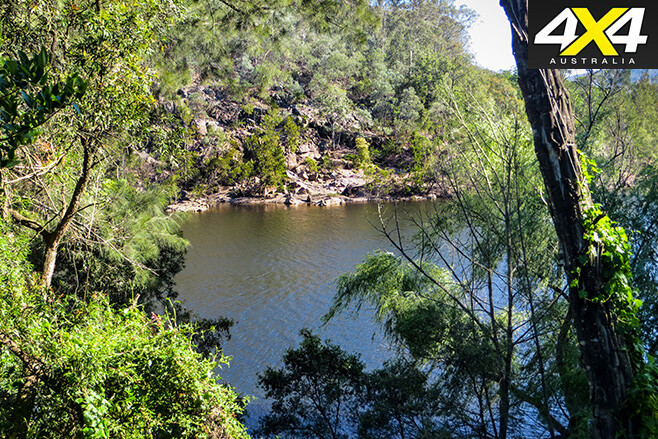
With flushing toilets and hot showers, Coolendel Bush Camp is a great camping destination. There’s just enough creature comforts to ensure delicate family members stay happy.
Located 32km west of Nowra (about three hours south of Sydney) it’s within reach of a determined weekender and very accessible if you have a brief three or four day break planned.
The same group of partners has held the privately owned nature reserve for more than 25 years. During that time, they’ve gradually developed the 520,000sqm site on the Shoalhaven River to provide an amazing range of campsite choices.
You can camp anywhere you can get to, from down by the river nestled among shady trees (the prime location to beat the summer heat) or on big, open sunny flats edged by tall trees (perfect for cooler winter months).
As you slowly circle the well-maintained tracks through Coolendel Camp, you’ll find space to suit everyone – privacy for the romantic getaway, room for a couple of camper trailers, or even a spot for 40 tents. And, you can also plant yourself closer to two amenities blocks for extra convenience. Even the older, smaller block is clean and tidy and shouldn’t phase the more fastidious camper – although it might pay to check under the seat for long-legged wildlife before getting comfortable.
While you may find cheaper tariffs for bush camping elsewhere; those sites probably won’t be as well maintained or have the same amount of infrastructure as Coolendel. As well as the amenities blocks, there’s a laundry (hand washing only), a gas barbecue, plenty of shelter and an abundance of water on tap throughout the well separated sites.
The main tracks are well graded and there are multiple minor walking trails criss-crossing the site. The tracks are scattered with timber bridges across little creeks and ravines that are popular, not just with guests but with the local wombat population.
Once you’ve claimed your own patch of grass, you can stoke up a campfire in one of the plentiful campfire rings that mark out good camping spots. If you forgot to bring timber, the onsite store sells bags for just $5 each.
At dusk, your feet may be trampled by determined local wombats as they slowly march by with their heads down, methodically mowing the grass. If your camper gets a bit of rock and roll happening in the night, don’t panic – it’ll probably be a wombat taking advantage of some low-hanging suspension components for a good back scratch.
While not native, the resident peacock population is a visually splendid addition to the beauty of the camp. At last count there were 16 of the big beauties strutting their gorgeous stuff and peevishly glaring at campers who happened to set up in their favourite spot.
The beautiful winged birds have no qualms sounding their eery mating call, which sounds more like a pleading cry for attention than a happy affirmation of male supremacy – but it seems to be working out okay with new chicks regularly appearing.
The owners, and their resident managers, are determined Coolendel remains a quiet and peaceful campsite for all to enjoy. They strictly enforce the rules of no motorbikes, generators or loud music after 10pm. Management also screens bookings and actively deter those who may be inclined to disrupt the peace. If a rowdy group slips in under the radar and parties until the wee hours, to the frustration of fellow campers, they’ll find themselves promptly evicted.
During the day you can kick back and soak up the peace and quiet – unless the cicadas have hatched and are kicking up a storm, in which case you’ll be destined to a uniquely loud Australian bush experience. There are plenty of bushwalking trails to meander along within the immediate vicinity of the camp, or there are many great spots to ride your mountain bikes.
The open spaces are perfect for the kids to burn off excess energy. And, once everyone has reached boiling point, they can head down to the river to cool off. The camp has 2.5km of Shoalhaven River frontage to enjoy – although there are only a couple of access points to choose from to avoid the steep and high banks.
The river is perfect for canoeing but pay close attention to the state of the current – a downstream paddle may seem like a leisurely and relaxing ride, but if you have to fight currents paddling back, you may find yourself needing to walk the canoe through the shallows – make sure you wear sturdy shoes to prevent bruised toes on the slippery river rocks.
It’s not unheard of for overambitious canoeists to get caught out way down river and have to call on friends, or less than thrilled parents, to come pick them up. One way to avoid such embarrassment is to paddle a small up and down loop and keep your eye on the time.
Or, hire a canoe for a day with a packed lunch and plenty of water to enjoy the trip at a leisurely pace.
Perhaps the closest place to engage the short stick is to head further south towards Yalwal on the eastern border of Morton National Park. Tracks that head out from the Wombat Flats campgrounds, such as Dusty’s, are steep, loose and slippery and are best tackled by very well set-up 4WDs with plenty of lift, high clearance and lockers. There are also plenty of minor trails that meander through the area in a more relaxed manner.
The Old Burrier Fire Road Trail, that connects Yalwal Road and Burrier Road, has some steep sections but in dry weather is a comfortable ride. Watch out for a marked side trail that leads to a great lookout.
If time permits, the Fleet Air Arm Museum in Nowra is well worth a visit. It showcases the history of naval aviation with restored and replica aircraft from the earliest days of naval carriers through to current model choppers. There’s even a helicopter simulator to try out your flying skills. The simulator is complete with both hand and foot controls to maintain balance.
If visiting midweek, and off-peak, you may be lucky enough to have Coolendel to yourself. You’ll definitely have no problem finding a quiet spot with just the wallabies and wombats as neighbours. Make sure you call ahead when the weather warms as weekend getaways are on everyone’s mind. Bookings are essential for peak school holiday periods – but you don’t need to make advance payments unless travelling during Easter or October long weekends.
Unfortunately you can’t book a particular site (except for the cabins and bunkhouse). It’s first-in-best-dressed so add an annual leave day, or three, onto your long weekend and get there early. You won’t have any problem finding something to do!
TRAVEL PLANNER
- WHERE: Coolendel is located 32km west of Nowra. And Nowra is about a three hour drive south of Sydney.
- WHEN TO GO: Any time – Christmas and Easter are very busy. During summer it can be very hot, making river campsites very popular. Though, there’s still plenty of space.
- WHAT TO BRING: Water sport equipment and bushwalking gear. No pets, motorbikes or generators. Leave your phone home – it almost certainly won’t have reception. There is an old fashioned public phone available onsite for emergencies.
- FOOD AND FUEL: Stock up in Nowra. The onsite store has basic groceries; ice, bread, milk, ice cream and drinks. Gas and firewood are also available to purchase.
- ACCOMMODATION: Unpowered sites with water readily available (boil before drinking) – $18 adult, $10 child (offpeak) to $29 adult, $16 child (peak). Cabins range from $130 to $220 per night. 20 person bunkhouse (rates vary depending on number of guests, minimum charge is $315 per night. Maximum is $735 per night). Canoe Hire: $30 for an hour, $75 for an entire day.
- DRIVING CONDITIONS: The last 11km into Coolendel are unsurfaced but well graded. There are some narrow spots on the winding roads, so watch out for caravans! Other forestry trails in the area are the usual mix with some steeper rocky parts.
- IMPORTANT CONTACTS: Bookings are essential for peak school holiday periods. Call (02) 4421 4586 or visit the coolendel website.
THE Ford Ranger model line-up copped a refresh back in 2015, and now Holden has stripped down its Colorado and built it back together in an attempt to bridge the gap.
Mid-generational changes for the Ranger included the addition of a smaller and more efficient turbo, new fuel injectors, cylinder head changes and various measures to improve engine NVH.
It also received fresh front-end styling, a new-look dashboard, electric power steering and enhanced electronic control of the 4×4 system.
Most of the Colorado’s changes are aimed at improving refinement. This includes relocated engine balance shafts, revised fuel injection, additional injector soundproofing, a new torque converter for the auto, shorter final-drive gearing for the manual, new engine and transmission mounts, new body mounts, recalibrated suspension and electric power steering.
The Ranger utilises the bigger 147kW/470Nm 3.2-litre five-cylinder engine, while the Colorado maintains the 147kW/500Nm 2.8-litre four-cylinder from Italian diesel specialists VM Motori.
4X4 Australia’s road-test editor Fraser Stronach took the two red utes up the highway and to some off-road tracks to find out whether the updated Colorado can keep up with the sales-dominant Ranger.
The two utes are now more evenly matched than ever before, so will Ford or Holden be the new king of the (dirt) mountain?
Read the full review in 4X4 Australia’s December issue, out November 10, to find out.
WHEN life threw Shane Griffiths from Port Stephens, NSW, a few challenges he responded by modifying a LandCruiser 79 into a no-holds-barred adventure machine.
Shane opted for a top-of-the-line GXL variant that came fitted with front and rear diff locks right from the showroom floor. And he soon realised that, with a ute, you’re basically left with half of the vehicle to design how you want.
A two-piece alloy tray stays on the rig full-time, with clever inclusions like under-tray storage boxes and a full-length trundle tray under the rear. The tray’s headboard also doubles as an additional fuel tank.
The lift-off camper set-up incorporates an electrically operated pop-top with a full-size custom innerspring mattress. On the inside a 57-litre Engel fridge resides; it’s powered by a lithium battery controlled by an Enerdrive DC2DC 30A charger.
The leaf springs were replaced by a full bolt-in coil conversion from Jmacx Off Road Solutions, while three-inch Dobinsons coils and a full suite of Superior Engineering eight-stage adjustable external reservoir shocks reside front and rear.
A waterproof 12,000lb Sherpa winch resides up front; clinging to it are two spread-beam XRAY HID driving lights from TJM.
The rig sits on 285/70R17 BFG KM2s wrapped around 17-inch KMC alloys.
Check out the above video to watch the killer Cruiser in action, and read the full feature in the December issue of 4X4 Australia – in stores November 10.