
MANUFACTURING is dead in Australia.
At least that’s what you’d think if you listened to the horror stories of factory after factory shutting their doors after decades in business. The reality is, manufacturing is alive and well in Australia, but it just looks a little different these days.
Manufacturing runs in Justin Montesalvo’s blood, so when he decided to go into the camper trailer business there was no question of where things would be built. Patriot Campers’ rugged trailers have been a huge hit, but the team stepped things up a notch when they introduced their no-holds-barred range of Super Tourers – chopped, stretched and built LandCruisers, designed to take on anything in the country and do it in style.
Now with one phone call things have been kicked up a gear again. The wild LandCruiser 79 you’re looking at is right now shoehorned inside a 20 foot shipping container and is halfway between Queensland (where it was built) and Mongolia (where its owner lives).
Thanks to the power of social media, Tamir and Bayarra Bold had been following the boys from Patriot as they travelled across the country on their adventures and figured they’d like to get in on the act in a rig of their very own. The only problem was they were about 8500km from the Gold Coast where the set-ups are built. They’d also need one in a left-hook configuration, and the sub -40°c winter temperatures meant a diesel donk simply wasn’t an option.
“It actually gets that cold over there, the diesel gels up and can’t run through the engine,” Justin told us. “To get the set-up he needed we actually had to ship an LC79 from Dubai down to us here with the 4.0L V6 petrol out of the Hilux, even with the petrol engine we had to fit an electronic block heater. In the middle of winter over there you’ve got about three minutes where you can have skin exposed to the air before frostbite sets in, so they’ll fire up the block heater, pack up their tent and then quickly jump in.”
Despite their similarities, a diesel Cruiser from down under and a petrol donk from the Middle East are always going to have a few differences that’d have to be overcome. The first job straight off the bat was removing the rear drum brakes and replacing them with a disc brake rear end using all genuine Toyota parts. The seats needed a little tweaking, too.
With no off-the-shelf kits available, fitting the trick leather-wrapped and internally heated Recaro bucket seats called for a set of custom brackets to suit the LHD configuration. The heated Recaros go some way to mitigating the Mongolian winters, and a remote start helps fire things into life from the comfort of a tent while the in-cab Webasto petrol heating system gets things nice and toasty.
With the Mongolia-proof modifications made it was time to start the Super Tourer process. The stock rear axle was yanked along with the leaf springs, and a new Jmacx coil conversion rear end was fitted a full 300mm further back thanks to a chassis extension. The new arrangement not only makes for a far better ride, but with the axle further back the Cruiser can take a bigger load and handle it easily.
With the tools out installing the new rear end, the lads at Patriot went right through the suspension from front to rear. There’s a full EFS 3.5in lift kit at both ends with 40mm XTR shocks on each corner. The rear end has been fitted with an air-bag system to dial in spring rates for varying loads and is controlled by an in-cab digital controller.
The steering is dialed back to stock with 4in drop arms, EFS sway bar spacers and an EFS steering damper. The set-up allows fitment for up to a 35in tyre; in this case it’s a set of super aggressive all-terrain 315/70R17 Mickey Thompson ATZ P3s with 0 offset ROH Octagon 17x8in wheels.
The Patriot guys have earned their name building some of the best campers on the market, so it’s no surprise the tray is the highlight of this build. It’s made from full marine-grade aluminium and divided into two distinct compartments.
On the driver’s side (that’s the left one) there’s twin Engel 40L fridge/freezers on drop-down fridge slides. Behind the twin fridges is a third drop-down slide, although this one plays host to the kitchen arrangement with a pantry storage compartment, gas cooker and kitchen sink all dropped down to a usable height.
The right-hand side was left void to fit the ice auger when it lands in Mongolia, although there’s ample storage on both sides with pull-out drawers and shelves occupying every spare inch. Two full-size spares sit on the back, and the whole arrangement can be lifted off if you ever decide adventure isn’t really your thing.
Snaking its way through the unseen parts of the canopy is a who’s who of 4×4 modifications, each with a little Mongolian twist for good measure. The huge 140L polyethylene water tank is hooked up to a 12V water pump with specially selected components at each step to handle the extreme cold. There’s an extensive electrical set-up, too. The brain is a Redarc BMS1230 with twin 100Ah lithium batteries providing the run-time.
A Goal Zero Boulder 90 solar panel helps keep battery levels topped up, while the combination of a 2000W Honda generator and 1500W Redarc pure sine wave invertor provides plenty of 240V options. Under the bonnet the 4.0L V6 has been fitted with a heat exchanger that’s piped up to the electric shower in the back. Just the trick for those cold morning starts.
If the storage room inside the tray runs short there are plenty of options up top, too. A Rhino Pioneer system provides options over the cab for bulky items, as well as a set of red MaxTrax with a 2.1m Supa Wing wraparound awning to provide extra shelter.
Up front the Cruiser runs a whole host of goodies from TJM, with matching front bar, scrub bars and sliders. Slotted inside the front bar is a 12,000lb TJM Torq winch, with a second one holed up in the rear winch-mount under the tray.
Aside from the heated Recaros and Webasto petrol heater the interior has copped subtle yet usable modifications in every direction. Extensive sound deadening makes life a little more bearable and also provides insulation in both hot and cold conditions. Internal storage is provided by MSA 4X4 seat organisers, with overhead and centre consoles rounding out the package. Both front doors have been fitted with speaker pods to house the Fusion stereo, while a GME TX3550S provides reliable communications.
The engine remains relatively standard (read: reliable), but it has had a little tickle under the chin to keep the 79 hustling. On each bank of cylinders there’s a set of tuned length stainless-steel headers that feed into a full 3in mandrel-bent system courtesy of the guys at Northside 4×4. A tweaked Unichip system handles the engine management system while a 1300Nm rated clutch provides drive through the factory five-speed.
While we’ve come to expect extravagant go-anywhere builds on Australian shores, this one highlights just how well-received our gear is on the world stage. The usual over-the-top but oh-so-awesome style of Patriot Campers, mixed in with the failure-means-death Mongolian attitude, has pieced together what could be the start of a strong future of small-scale Australian manufacturing.
We’ve assembled an incredible list of modified machines for the inaugural Custom 4X4 Of The Year award.
Billy McKinnon’s FJ45 Troopy was literally a dog kennel when he first found it. After hosing the neglected – miraculously rust-free – Cruiser out and dragging it home, Billy set about turning it into arguably the best FJ45 Troopy in the world, and that’s no exaggeration.
Billy combined the chassis from an 80 Series Land Cruiser with the 45 body and set it back on the frame to push the front axle forward for a better approach angle. A slight reworking of the rear arches was all that was required. The wider 80 Series axles pushed the wheels and tyres out a further 100mm on each side, so Billy constructed a series of reinforced tube wheel-arch flares that also tie the front and rear bars in the sliders.
The old engine was replaced with a 5.7-litre LS1 V8 with a TH400 auto transmission sending power through a Chevy-sourced NP205 transfer case. A GTX42 turbocharger and front-mounted intercooler was slotted in, pushing out 340hp at the wheels on its first dyno run.
New crossmembers and engine mounts were fitted for the updated drivetrain, as well as upgraded injectors. A full 3.5in custom exhaust with a Hooker muffler was also installed.
To match everything up, a GQ Patrol rear axle was installed and a high-pinion front from a GU Patrol with LSD internals was fitted. Up front there’s a GU Patrol steering box on custom mounts, with a chromoly draglink attaching it to the Cruiser’s front axle.
The chassis was lifted 50mm by EFS suspension. The coils were combined with four-inch-longer RAW 4×4 shocks, making room for a set of 37in General Grabber SRLs wrapped around 17in Dynamic steel wheels.
The Dune Beige 416 Troopy has a custom wrap-around tyre carrier with the pivot point near the passenger rear wheel – allowing an impressive departure angle. A Warn 8274 winch upgraded with a Warn 6hp motor and braced housing handles duties up front.
The driver and passenger seats are Corbeau race seats, and a digital gauge unit monitors all engine vitals.
Vote for Billy’s FJ45 Troopy hybrid to decide this year’s Custom 4×4 of the Year.
We’ve assembled an incredible list of modified machines for the inaugural Custom 4X4 Of The Year award.
Toyota’s LandCruiser 70 range has long been one of the favourites of the 4×4 community. As one of the last ‘real’ 4x4s available on the market, there’s no wonder this particular model is so sought after.
With so many enthusiasts still preferring the 70 Series over newer designs, aftermarket parts and modifications are readily available to fix any perceived shortcomings of the model.
For this particular rig, Leigh Hardman of Marks 4WD started with a brand-new LC79. First the ride height was increased by 150mm via Marks portal axles and the rear axle was widened by 50mm to match the front end track. The portal boxes also added another 100mm to the track width. LC200 wheels with a +60 offset are used to reduce the width back to 80mm over stock.
The front axle has been fitted with heavy-duty, one-piece swivel hubs and air-operated free-wheels hubs, activated via a button in the cabin. The factory front and rear lockers have been converted to air-actuation, so it’s simply a matter of priming the ARB air compressor and hitting the button to put it in 4×4. Everything is then locked via the transfer lever and factory locker dial.
The Toyota LC79 has had its brakes upgraded and now include slotted rotors, high-performance pads and braided stainless-steel lines. In order to further bolster its stopping power, the Cruiser also features a Marks 4WD hydraulic brake booster conversion, with a drum-style brake on the back of the transfer case in order to assist the park brake holding the vehicle on a hill.
A six-speed auto 6L90 transmission unit from General Motors has been mated to the calibrated and tuned 1VD V8 engine – a perfect match for more grunt. The engine has been flash-tuned and fitted with a Safari Armax four-inch snorkel with larger openings. A four-inch intake tube leads to an HPD intercooler with a Redback three-inch exhaust.
The rumble of the tuned V8 and squeeze of the brakes lets you know that not all is as it seems in this Landy, however Leigh’s not easily contented. Since our photo shoot, this truck now sports a metal canopy/camper box on the back.
Vote for Marks 4WD LC79 to decide this year’s Custom 4×4 of the Year.
EARLIER this year we crossed the Pacific and headed to Las Vegas for the 2016 SEMA Show.
Tagging along on the trip was snapper Cristian Brunelli, who took a heap of photos in an attempt to capture how massive and wild this annual event is.
The photos don’t really do SEMA justice, as it is more and wild and wonderful than anything you could ever imagine. Just the pure size of the 4×4 and off-road hall is bigger than any Australian indoor car show!
SEMA is the place for auto manufacturers to show off their wares. 2500 exhibiting companies filled the halls in 2016, with 60,000 international buyers poring over the creations. On top of that, more than 150,000 people attended across the four days of the event.
Check out these image galleries to get a taste of the action.
1. Gallery SEMA 2016 in photos: Part 1 2. Gallery SEMA 2016 in photos: Part 2 3. Gallery SEMA 2016 in photos: Part 3 4. Gallery SEMA 2016 in photos: Part 4
We also put together this quick two-minute video featuring some of SEMA 2016’s best bits. As Matt explained in the video: “The SEMA Show is huge, unbelievably huge – the halls, the trucks, the new products!”
The video showcases a bunch of JK Wranglers – once again the most popular vehicle at SEMA. There were Jeeps of all shapes and sizes scattered throughout the halls.
There was even an all-electric JK stealing plenty of attention. We found the one-of-a-kind Jeep at the Poison Spyder/Pro Comp stand.
“We removed the original engine and transmission and replaced it with a permanent AC motor similar to a Tesla,” explained Ted Moncure from Pro Comp.
We also had time to swing past ARB’s stand to check out its new 60-litre stainless-steel fridge.
SEMA 2017 will take place from October 31 until November 3. Until then, enjoy our pics and vids that capture all of the action of 2016’s incredible event.
AFTER raving about the Hema Explorer app I ran on my iPhone on the recent ARB Off Road Icons trip across the Simpson Desert, 4X4 Australia editor Mat Raudonikis suggested I give the new Hema HX-1 Navigator a run on the 4X4 Of The Year test through the Victorian High Country.
WHAT IS IT? THE HX-1 Navigator is Hema’s latest sat-nav system that offers both on-road voice-guided navigation and off-road navigation, and it’s packed full of fantastic Hema maps as well as a full suite of topographic maps covering all of Australia and New Zealand.
The HX-1 may look similar to its HN7 predecessor, but switch it on and you can immediately see significant improvements. The screen is the same seven-inch size, but it’s much brighter with more vivid colours and a higher resolution, and the touchscreen functionality requires less finger pressure to activate on-screen buttons.
Various other HX-1 physical attributes are similar to the HN7; it’s relatively thin, not too heavy and it attaches to your vehicle’s windscreen via a quality suction cup and solid mount system that exhibits virtually no vibration, even over rough terrain.
DRIVE MODE SWITCH the HX-1 Navigator on and you’re presented with a screen offering Drive (on-road navigation) and Explore (off-road navigation) options.
Select Drive and you have full street mapping for Australia and New Zealand, with easy-to-set destinations, voice guidance, traffic light and speed camera warnings; the latter proving extremely helpful when approaching Melbourne on the M1.
In Drive mode the map screen displays upcoming turns, current road name, speed, speed zones, estimated arrival time, distance to destination and more. There’s also a comprehensive trip computer with information such as speed, altitude, heading, arrival time, trip time and more. Like many sat-nav systems, you can set a number of route options to avoid tolls or motorways and the like, and when setting a destination there are thousands of POIs (Points Of Interest) under sub-categories such as accommodation, auto services, emergency, entertainment, camps and locations, caravan parks, medical, petrol stations and much more. Select a POI and the HX-1 offers a variety of details such as facilities, co-ordinates and contact details.
Once your route has been calculated, you can preview it prior to departure and check out any POIs along the way. You can then alter the route with detours and alternatives, and you can queue up numerous destinations in one route by using the multipoint route feature.
The Drive mode is very easy to use and is packed full of useful features.
EXPLORE MODE IF you’re familiar with the Hema Explorer app for Apple or Android devices, it won’t take you long to get your head around using the HX-1 Navigator’s Explore mode. The main map in the Explore mode is the Hema Explorer Map (1:150,000), which includes more than 1.2 million kilometres of 4WD tracks and outback roads. Connect the HX-1 to your Hema online account via Wi-Fi and you can download Hema Explorer maps to a more detailed scale of 1:9000. Additional map sources include digitised Hema touring maps, state government topographic maps, and HERE street, terrain and satellite mapping.
The Explore mode also has more than 40,000 POIs overlaid on the maps, split into subcategories including accommodation, facility, service, information, supply and my waypoints. Drill down to individual POIs and there’s information such as coordinates, addresses, phone numbers, email addresses, website details as well as facilities where applicable. You can even overlay weather radar information on the map, so you can continually monitor conditions.
Route planning is easy and can be done by either plotting positions on the map point-by-point or by using the quick routing tool, where the HX-1 calculates the optimum route for you.
Once you’re on your journey you can save traditional waypoints by hitting the ‘flag’ logo on the screen and selecting ‘Create Waypoint Here’ and then adding notes, or you can select ‘Take Picture’ to capture a visual image of the waypoint, as well as add notes. In fact, the HX-1’s camera even allows you to capture video using this function, which makes it easy to record images and sound so you can recall conditions/features at a particular waypoint when reviewing the footage, either on the HX-1 or when you upload the information to your computer.
Recording a track on the HX-1 Navigator.
When you review your route on the map screen, you can select the waypoints you have created and view the images/video/notes, so you have a direct reference to where the shots were taken. Alternatively, you can view all of these waypoints under the timeline accessed through a drop-down menu on the left side of the screen.
On test in the High Country I recorded several still images of varying quality while the HX-1 was mounted to the windscreens of different vehicles, as well as some pretty decent video footage that clearly shows the conditions we encountered on our drive programme.
Water crossing, filmed using the HX-1.
These images/videos are stored either on the device’s inbuilt storage or a MicroSD card, and can be manually transferred to your computer via the supplied USB cable, which is advisable if you wish to hang on to them permanently.
A trip toolbar at the bottom of the screen in the Explore mode displays information such as distance, moving time, total time, co-ordinates, altitude, ascent, max altitude, min altitude and average pace. This information (and more) can also be accessed via the drop-down menu and includes graphs that display altitude and speed profiles over the trip.
SYNCING WITH THE CLOUD ALL of your trip information (routes, waypoints, photos, etc.) can be synced with your Hema Explorer Cloud account once the HX-1 is connected to Wi-Fi. This can then be shared with friends, family and other Hema explorers. Likewise, you can view the trips recorded by other explorers, and even download them so that you can use them as a route planner for your own adventures.
Snapper Ellen almost falling into the drink.
Once you have synced your trip with your Cloud account, you can view all of the recorded information on your computer, including the map route, waypoints, trip statistics and more. You can also add notes, view different map layers and access driving directions.
Another advantage of Wi-Fi connectivity is that the HX-1 Navigator has wireless updates.
SUMMARY THE Hema HX-1 Navigator is without a doubt the best sat-nav system I have used, both on- and off-road. It has a great windscreen mount, a bright and vivid display, is easy to use and is preloaded with the best maps on the market.
Great weather for camping.
Additional features such as the still and video camera, and the ability to sync/share trips on the Hema Explorer Cloud, add to the device’s functionality. I also like the fact that you can swap over to Drive mode without interrupting a track recording that’s taking place in Explore mode, so you don’t lose any track data as you navigate around a town.
At $699.99 the Hema HX-1 Navigator is great value for money, and it comes with 4WD map updates for the life of the unit as well as three years’ worth of street map updates. For full specs on the HX-1 check out the website.
So there we were, on Knolls Track about 230km from Birdsville, with a dead Toyota FJ40 LandCruiser. One minute it had been purring like a pussycat, the next it had gone completely silent.
We’d already had a few minor mechanical issues with some of the vehicles, as well as a couple of more serious ones with the tucker trailer. The FJ40 had faltered several times when negotiating water crossings, but all we had to do was dry out the electrics and she’d fire up straight away.
This time, however, there was no water, so David Cox, Mark Lowry, Fred Williams and Chris Collard – and anyone else claiming a modicum of mechanical knowledge – poked their heads under the bonnet and searched in vain for the culprit. The multimeter showed that no power was coming out of the coil, and this was one spare part we weren’t carrying, so after a couple of hours of failing to get the Cruiser fired up we ran a strap from the back of the Defender and started the 15km haul up Knolls Track to the junction with the French Line.
Somewhere along the way Fred called over the UHF and asked us to stop; he had managed to get the 40 Series going, which suggested it had an intermittent electrical fault of some kind, and the Cruiser made it to Approdinna Attora Knolls by about 10.30am under its own steam. Oh, and the sun was out, so things were really looking up.
We spent a bit of time ascending the Knolls and having a walk around. These outcrops were formed by gypsum swept off the local salt lakes to form high dunes, and they are described as “rare and extremely fragile land formations” which offer a good view of the surrounding area. We still had 40km or so to travel along the French Line to Poeppel Corner so, with plenty of sand dunes to crest now that we were again heading west to east, and with the potential for some boggy salt lakes ahead – as well as the ever-present possibility of more mechanical problems – we pressed on.
As expected, there were a few very boggy sections on the way to Poeppel Corner, and David Cox suggested we stick to the tracks already formed by vehicles that had previously traversed these soft and slippery salt lakes. His reasoning was that they had already broken through the soft surface to a firmer base below where our tyres would have a chance at gaining some much-needed traction. This technique proved successful… until the tucker truck’s trailer ran out of ground clearance.
We put a snatch strap on the back of the Defender and pulled Dave and the BT-50 tucker truck/trailer combo out of the bog, making sure we got plenty of photos of the recovery for all the Landy fans out there. It was already 1.30pm and at this rate we’d definitely be having another late lunch.
THE LONG HAUL WE arrived at Poeppel Corner at 2.30pm. Well, most of us did. When Fred and Chris eventually showed up some time later, once again at the end of a tow strap, the poor little 40 Series we’d earlier dubbed ‘Peppa Pig’ was covered in mud. Mark Lowry had successfully towed the boys to Poeppel Corner behind the 79 Series through all of that mud, and we still had 160km ahead of us if we wanted to enjoy a cold beer and warm bed at the Birdsville Hotel later that night.
We decided to split the convoy at this point; most of us would press on to try to reach Birdsville at a reasonable hour, while David Cox and Vicki Lennox would hang back in the tucker truck to make sure Mark (in the 79) didn’t get into any strife trying to tow Fred and Chris (in the 40) across the soggy, muddy desert.
We headed north on the K1 Line and had successfully crossed the big salt lake at the start of the QAA Line by 4pm. The overcast sky that had kept us company for much of the day now made way for a cloudless blue sky as we headed towards Birdsville with the sun in our mirrors. While the track glowed a bright red, the rest of the desert was a lush green; I had never before seen it bursting with so much vegetation.
We still had a long way to go when the sun dropped below the horizon. As our driving lights lit up the dark track, a near-full moon popped over the cloudy eastern horizon, putting on a spectacular light show. Driving through the green desert at night was quite surreal, and somewhat difficult when we had to tackle several long boggy and wet sections; split-second navigation decisions meant the difference between easily forging though some sloppy mud or running out of ground clearance and coming to a halt, needing a snatch from another vehicle to get going again.
Then, about four sand dunes short of Big Red – the final and largest dune we would have to conquer before the home run into Birdsville – the Defender’s lights started to flicker… then the UHF went dead and the dash lights gave out.
The first thought to come to mind was: “Joseph Lucas, Prince of Darkness”. With no headlights at all, we closely mimicked the movements of the vehicle ahead of us and made use of the light emanating from the vehicle behind us, but then I managed to stall the Defender and was unable to fire it up again. We had been through a hell of a lot of mud so we grabbed a 20L water jerry out of the back and poured it over the alternator and hoped for the best. After a successful push start the dash lights came back on, immediately followed by the headlights and driving lights. We had charge!
We encountered a few more very challenging water crossings before we had the three surviving Off Road Icons lined up at the base of Big Red. Wes Siler had the first crack in the GQ Patrol – and the second and the third – but without success. Then Sam Purcell had a go in the LN106 Hilux, again without success. I made sure the Defender was in low-range and headed off, building up speed in second gear and hitting third before starting the climb. As speed washed off on the incline, I shifted it back into second and then, just before the revs dropped too far, I did a quick downshift into first and the Defender slowly crested Big Red. We had made it across the Simpson Desert in a creaky 20-year-old Landy!
After dropping tyre pressures a bit more, the other two Icons also successfully completed their desert crossing, as did the new Hilux and Ranger that were accompanying us, and now we just had an “easy” 35km drive into Birdsville. Yeah, easy… except for the water covering long sections of the road, which occasionally hid some deep washaways.
It was 10.30pm by the time we made it to the Birdsville Hotel. We’d called ahead on the sat-phone so the kitchen staff had set aside our meals, which we woofed down with icy cold beers while wondering how the other half of our party was travelling. We kept an ear out for them on the hotel’s UHF but there were no responses to our calls. We were becoming increasingly worried and by 1am we decided to head back into the night to see what was going on. Sam Boden, Patrick and I jumped in the new Hilux and headed west.
Just a few kays short of Big Red we heard laughter on the UHF; the rest of our crew had just made it over the last of the Simpson Desert’s 1100-odd dunes and they had one hell of a story to tell us all when they arrived at Birdsville at 2.30am, looking muddy, hungry and dog-tired.
FIXING STUFF NOT surprisingly we all slept bloody well that night. The following morning we set the swags up in the hotel’s carpark to dry them out, then we set off to wash the vehicles so we could ferry those that needed mechanical attention over to Barnsey at the Birdsville Roadhouse.
David Cox already had the trailer over there, with the axle removed and on the press to straighten it out. The 79 Series was soon on the hoist so that Barnsey could access the alternator to rebuild it, while the 40 Series was sitting out the front of the workshop waiting its turn.
Once the alternator was back in the 79 Barnsey had a look at the 40, locating a loose wire at the back of the distributor that appeared to be the culprit. We weren’t too sure, however, that this would resolve the issue, as we’d removed and retightened just about every 40-year-old wire we could locate when the engine first died. Nevertheless, the big petrol-six had now fired up and the battery was charging. Fingers crossed we wouldn’t have any more problems with it.
Once all the vehicles and the trailer had been sorted, we fuelled up and had a bite to eat at the Birdsville Bakery. The crook weather throughout the tourist season had proved hard on many Birdsville businesses, and the bakery was set to shut early this year due to a lack of customers, so we were lucky to score a pie.
That afternoon we headed back out to Big Red for a play on the sand dunes and to do some photography. Michael Ellem reckons Big Red is his “favourite place in the whole world”, and he couldn’t wait to get out there to grab some shots. Of course, he wanted to shoot the sunset, so that evening we had another nighttime drive back to Birdsville along the partially submerged road.
A CHANGE OF PLAN WITH all of the rain that Central Australia had copped over the past few days, many of the roads and tracks that we’d intended on travelling over the next week were closed. And despite the beautiful blue-sky day we had just experienced, more rain was predicted that evening, including in Birdsville. We thought we might even be stranded here for a while.
Our initial route from Birdsville would have seen us travel to Cordillo Downs, Coongie Lakes, Innamincka, Burke’s Grave, the Burke and Wills Dig Tree, Cameron Corner, Tibooburra, Milparinka, Packsaddle, Silverton, Eldee Station and then on to Broken Hill, but with most of the roads in the Corner Country closed we had to come up with a Plan B.
Plan B was to head down the Birdsville Track to Mungerannie, then spend a couple of nights at Parachilna in the Flinders Ranges so we could have a drive around Willow Springs. We would then head down to Hawker and along some backroads to Waukaringa Ruins before joining the Barrier Highway for the final drive into Broken Hill.
Sure, we’d miss out on some spectacular destinations, but Plan B would offer a great alternative, with plenty of beautiful country and some great driving.
Stay tuned for part 3 of our ARB off-road icons trip across the Simpson Desert.
Need a refresher on our journey so far? Check out Part 1 of the ARB Off-Road Icons trip.
We’ve assembled an incredible list of modified machines for the inaugural Custom 4X4 Of The Year award.
The ever-popular PX Ford Ranger provided the first real competition to the dominant Toyota Hilux. It also provided aftermarket kit makers the opportunity to test their wares on a new platform.
Never one to follow trends, Harrop Engineering prefers to set them instead, and the business’s Ford PXII XLT Ranger is certainly no exception to this rule.
This Ford Ranger really mimics the style of the Baja 1000 chase cars: off-road racers that used to ‘pre-run’ tracks, as well as follow and service vehicles in the race.
With its prominent chase rack made by Uneek 4×4 here in Melbourne, the Ranger certainly looks the part. It’s comprised of the base rack, spare wheel carrier, roof rack and is fully powdercoated for durability with custom-designed side plates.
The Ranger is fitted with MCC side steps and a subtle yet sturdy low-cut bar from Rhino 4×4. You’ll notice that the front bar is made for its bigger brother, the Everest. In order to fit the different style bar, an Everest grille had to be fitted and, like several other bits and pieces, coated in hard-wearing black polyurethane.
Tough Dog 4WD Suspension supplied the springs and shocks. One-tonne utes with the IFS are not exactly known for their wheel travel, but the articulation of the Harrop Ranger surprised us as it provided a firm but surprisingly capable ride. A Harrop E-Locker on the front axle works in tandem with the factory Ford rear locker and can be switched to run independently.
Continuing the race-inspired look, the Ranger has a set of 18in Method wheels wrapped in 285/65R18 Nitto Trail Grappler rubber with a matching spare tyre on the rack.
The Ford 3.2-litre diesel (one of our favourites) has been further augmented with a free-flowing exhaust and Unichip Q4 tuning module, increasing power from 125kW/420Nm to 157kW/536Nm, with the torque coming on right off the mark, ensuring a more capable and controllable off-road drive and more entertaining traffic light duels.
Refined, with striking looks, this is one bit of kit that would certainly win the race.
Vote for Harrop’s Ford Ranger to decide this year’s Custom 4×4 of the Year.
We’ve assembled an incredible list of modified machines for the inaugural Custom 4X4 Of The Year award.
With three separate lift mods and 50mm of bodylift, Jarad Roberts’ Mitsubishi ML Triton quickly became a towering beast, a comp-truck in tourer clothing.
Instead of the stock IFS, there’s now a heavy-duty Dana 44 from East Coast Gear Supply in the USA. It’s been externally braced and has a Solid Industry diff hat, while the insides have been filled with 35-spline chrome-moly axles with Nitro Gear 4.11:1 ratios, all wrapped around an ELocker.
The diff is held in place with custom Patrol-style radius arms and a custom Panhard rod. The Patrol steering box sends input to the D44 through a set of steering rods from an early full-sized Jeep Cherokee. The whole lot is kept in place by a Fox steering damper.
A pair of custom shock towers housing 2.5in remote-reservoir Fox coil-overs is welded to the chassis front and back, providing limitless tuning options for different conditions.
Despite being fitted with an ARB Air Locker, Jarad’s Triton still runs on the standard rear axle, a huge 31-spline unit from a previous-generation Pajero held in place by a custom three-link suspension arrangement with an extensive diff brace.
The stubby chassis has had 400mm lopped off the rails to improve the departure angle, and the tray is near unbreakable with dimple-died plate, tube sides and thick flares. Underneath is a second battery and air-compressor, as well as the spare tyre; 37in Maxxis Trepadores for rough work and 35in Mickey Thompson MTZs for street duties.
The front bar houses a 12,000lb Avenger winch and Hella HID spotlights which complement the 42in quad-row light bar, LED replacement headlights and fog lights.
Following a retune, the 3.2-litre turbo-diesel punches out 500Nm with a three-inch straight-through exhaust and K&N filter. A Chip It manual boost and drive controller is combined with the Exedy HD clutch and oversized radiator to keep the beast cool.
With cockpit creature comforts, this has to be the best off-road-going Triton in Australia.
Vote for Jarad’s ML Triton to decide this year’s Custom 4×4 of the Year.
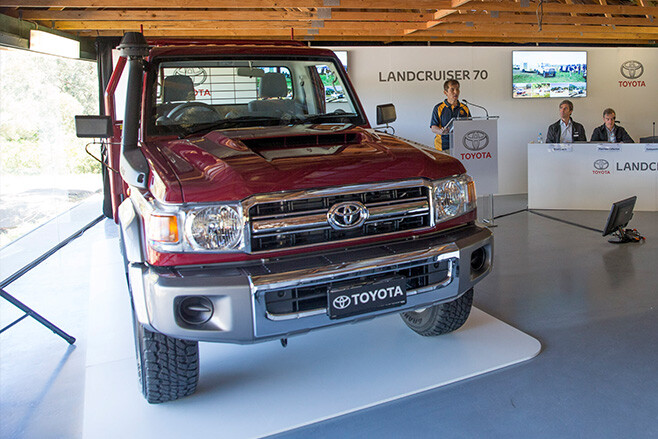
We can thank Australia’s big mining companies for giving the 70 Series Land Cruiser a new lease on life.
Back in 2012 they announced a five-star safety requirement for their entire fleets, but soon realised the likes of medium-duty one-tonne utes such as Hilux and Ranger were not suitable replacements for their heavy-duty Cruisers, so they hounded Toyota to upgrade the 70.
Meeting the five-star safety rating was no easy task, and this new LC70 has been under development for five years, with much of the evaluation and engineering taking place right here in Australia, predominantly on gravel roads and off the road. But the only variant of the 70 Series to achieve the five-star ANCAP rating is the Single Cab Chassis, which is the vehicle the mining companies so desperately wanted back on their fleets.
While the other variants (Double Cab, TroopCarrier and Wagon) don’t achieve a five-star rating, they have still benefitted greatly from several upgrades that improve safety and the vehicle’s touring capability.
SAFETY UPGRADES All new 70 Series Land Cruisers are now equipped with a full suite of electronic driver aids which, in addition to the existing ABS package, now includes vehicle stability control (VSC), active traction control (A-TRC), hill-start assist control (HAC), brake assist and electronic brake-force distribution.
Off-roaders will be happy to know that VSC automatically disengages in low range, and A-TRC can be manually disengaged for sand driving. Front and rear diff locks are still standard on GXL models and optional on Single Cab GX and Double Cab Workmate variants.
“We developed and tested the stability and traction control systems primarily on dirt roads where LC70 is driven most often,” explained Ray Munday, Toyota Australia’s manager of off-road evaluation.
“The hill-start assist has been engineered to be effective while towing and when facing a steep hill with a load in the back,” added Mr Munday. HAC also disengages after four seconds so the driver can easily reverse the vehicle if desired.
All models are now fitted with front seatbelt pre-tensioners and a passenger seatbelt reminder, while a new bonnet across the range features a more pronounced “power bulge” designed to provide sufficient clearance above engine-bay components to meet pedestrian impact requirements.
The split-rim wheels on lower-grade Workmate models have now been replaced with single-piece 16×6-inch steel wheels with 225/95R16 tyres.
Single Cab models have been given a thorough going over to attain the five-star ANCAP rating. They have thicker and stronger chassis rails, modified cross members (now seven in total), five airbags (driver and passenger, side curtains and driver’s knee), under-dash padding for the passenger, 12 new or thicker body panels including bonnet, pillars, doors and floors, new seats and a relocated steering link (to alter crash characteristics).
Toyota was unwilling to comment on whether variants other than the Single Cab would be engineered to attain a five-star ANCAP rating but, considering the amount of engineering required to achieve this, we recommend you don’t hold your breath.ENGINE AND DRIVELINE The 70 Series Land Cruiser’s 1VD-FTV 4.5-litre turbo-diesel V8 engine is now Euro-5 compliant and is equipped with piezo-electric injectors that provide better fuel atomisation for more complete fuel combustion, resulting in improved low-rpm torque delivery.
A diesel particulate filter (DPF) has also been fitted, featuring automatic regeneration for normal driving or manual regeneration for situations where the vehicle is driven at low speeds for long durations, such as in mines. Peak power and torque outputs are unchanged at 151kW at 3400rpm and 430Nm from 1200-3200rpm, but Toyota claims improved fuel economy (10.7L/100km combined cycle) and lower emissions (281g/km).
The most noticeable mechanical upgrade is to the five-speed gearbox, which has revised second- and fifth-gear ratios. Second gear is now seven per cent taller, while fifth is almost 15 per cent taller, resulting in much more relaxed highway touring, with around 1900rpm showing on the tachometer at 100km/h in top gear. The taller gearing also contributes to the improved fuel economy.
New body panels on the Single Cab variants result in improved NVH levels, while the aforementioned changes to the chassis result in increased torsional rigidity. Single Cabs also get revised damping tuned for the altered chassis.
Other changes across the range include the addition of auto-locking front hubs with a manual-locking function, and a fuse box (with a bank of 10 fuses) for safe and easy fitting of accessories.
The fitment of the DPF has meant that the exhaust had to be re-routed, so the Single Cab no longer has two 90-litre fuel tanks, but instead is fitted with a single 130-litre tank.
LOCAL TESTING Toyota says the new 70 Series has been subjected to more than 100,000km of local testing in some of the harshest conditions in Australia. Toyota Australia’s manager of off-road evaluation, Ray Munday, said that much of this consisted driving in “no road” environments, reflecting the varied uses that 70 Series drivers subject the vehicle to, such as “exploration mining and by farmers tending livestock or mending remote fence lines”.
“Buyers around the world can be confident the new LC70 will meet their toughest demands because it has been developed and thoroughly tested to overcome the extremes of the rugged Australian continent,” said Mr Munday.
“Our development and evaluation involved as many different conditions as possible – from the high country to thick mud, rocky deserts and sand dunes – everywhere from our proving ground in Victoria to the red centre and other outback locations.”
Toyota has also developed a complete range of accessories to suit the new 70 Series, including bullbars, trays, work lamps, handbrake alert, in-vehicle monitoring system pre-wire kit, auxiliary battery kit and battery isolator switch.
DRIVE IMPRESSION Our drive of the new 70 Series consisted about an hour on the blacktop (freeway and back roads) and a run around the excellent Melbourne Off Road Training and Proving Ground near Werribee, Victoria.
As mentioned previously, the taller fifth gear has the biggest impact on the driving experience, with more relaxed open-road touring. Lower revs, new body panels and greater torsional rigidity appear to combine for reduced NVH levels at highway speeds, although wind noise is still quite pronounced, especially around the A-pillar where the OE snorkel is mounted.
On gravel the VSC certainly doesn’t feel too intrusive, allowing the rear to slide around a little before it intervenes; you can sense the engineers tested this thing on gravel roads.
One change to the Single Cab that was difficult to measure was the revised damping, although the vehicle certainly felt compliant enough without a load on board. Another change that felt immediately beneficial, however, was the new seats, which offer much greater comfort and better support via improved side bolstering. Cruise control is also now standard across the range.
Off-road, the V8 still pulls like a train from just above idle, and the excellent low-range gearing combined with lockable front and rear diffs, heaps of ground clearance and fantastic wheel travel make the 70 one of the most capable out-of-the-box 4WDs on the market.
WHAT DOES IT COST? All of the new features on 70 Series come at a price, but considering the significant engineering that has gone into modernising this workhorse, the increases are not excessive. Wagon, Troopie and Double Cab models are up by $3000 across the range, while the five-star ANCAP-rated Single Cab models are up by $5500. Air-con is still optional ($2761 fitted), which is surprising considering the take-up rate is almost 100 per cent. Premium paint adds $550.
BRIGHT FUTURE Toyota engineers from Australia and Japan spent a lot of time speaking with 70 Series buyers in Australia and are well aware of the desire for the rear wheel track to be widened to match the front track, but unfortunately that wasn’t considered enough of a priority to make the list with this model update.
When queried on this Toyota didn’t dismiss the idea out of hand, so it’s possible this will be remedied in the future. And Toyota now envisages a long and bright future for the 70 Series, a vehicle that first saw the light of day back in 1985, and now doesn’t have any serious competitors in the marketplace.
“These extensive engineering and specification updates guarantee the future for the Land Cruiser 70 Series and its unrivalled combination of reliability, towing, payload and off-road ability,” said Tony Cramb, Toyota Australia’s executive director sales and marketing.
“For more than 30 years, miners, farmers, governments and many other users have turned to the go-anywhere 70 Series to traverse the most inhospitable terrain and complete the toughest jobs.
“Toyota Australia was determined to return their loyalty and, with the support of our parent company, devoted significant resources to ensure we and our dealers could continue to meet demand. The only alternative was to walk away from this model – and that was not an option.”
SPECS Engine: DOHC 32-valve V8 turbo-diesel Capacity: 4.5-litre (4461cc) Power: 131kW @ 3400rpm Torque: 430Nm @ 1200-3200rpm Gearbox: five-speed manual 4X4 System: part-time dual-range Construction: separate chassis Front suspension: live axle/coil springs Rear suspension: live axle/leaf springs Wheel/tyre spec: 225/95R16 or 265/70R16 (steel or alloy) Kerb Mass: 2175kg-2325kg GVM: 3060kg-3300kg Payload: 785kg-1235kg Towing capacity: 750/3500kg Seating capacity: 2-5 Fuel tank capacity: 130L-180L ADR fuel claim: 10.7L/100km On-test consumption: N/A Touring range: N/A Price From: $60,990 *Based on test consumption and 50km ‘safety margin’.
HOW MUCH?
| BODY STYLE | GRADE | PRICE |
| Wagon | WorkMate | $60,990 |
| u00a0 | GXL | $64,990 |
| Troop Carrier | WorkMate | $64,890 |
| u00a0 | GXL | $67,990 |
| Double Cab-chassis | WorkMate | $64,990 |
| u00a0 | GXL | $68,990 |
| Single Cab-chassis | WorkMate | $62,490 |
| u00a0 | GX | $64,490 |
| u00a0 | GXL | $66,490 |
We’ve assembled an incredible list of modified machines for the inaugural Custom 4X4 Of The Year award.
If you go to AFN’s Australian website, one of the first things you’re likely to see is Gavin Duffield’s striking black and white Toyota SR5 Hilux.
As a rolling AFN advert, this two-tone monster certainly is eye-catching. The Portuguese-made protection gear has been fitted to United Nations and NATO vehicles, and Gavin believes there’s a market for their civilian gear back home.
Gavin fitted his Toyota SR5 Hilux with an AFN bullbar that really makes a dramatic statement, with its aggressive lines and two-inch lift kit. The bar sits back as far as possible for weight distribution with high, swept-back corners to improve approach angles.
All AFN bullbars are constructed from steel and tailored to the specific vehicle, rather than a singular one-size-fits-best design. In addition, the drivetrain and fuel tank are protected by AFN 6mm alloy protection plates, as well as an AFN shield for the Toyota’s load sensor.
Gavin replaced the original grille with a plain black, mesh-steel insert and wrapped the door handles and mirrors in black to continue the theme. Black AFN side rails and sidesteps border the vehicle.
This beast runs on forged alloy Delta Klassik 18x9in wheels and BFGoodrich rubber, with Outback Armour suspension front and back.
Gavin fitted a steel Sammitr canopy and an AFN rear bar and wheel carrier down the back, with the option of loading two spare wheels, jerry cans or one of each. The wheel carrier utilises a cone arrangement rather than wheel studs so that just about any wheel can be carried. The carriers use a cam lock, which allows them to be pushed shut, and a locking device to keep the carriers swung out if needed.
The spare wheel covers up the Toyota stock rear lights, so Gavin installed a three-way combination light that combines the tail-lights, brakes and indicators into the rear bar.
The entire rig runs well on the road but it really shines on the beach, as Gavin pointed out: “I just couldn’t believe how well it went on the beach. It’s got a bit of get up and go.”
Time to hit the beaches with this monster.
Vote for AFN’s SR5 Toyota Hilux to decide this year’s Custom 4×4 of the Year.