
WHEN you’re the service manager of Australia’s leading brand of heavy-duty, oversize platform trailers, you get to know a thing or two about heavy loads and the rigs that haul them.
You know those massive low-loader trailers that have more tyres on them than the Lego factory makes per year; the ones that take up both lanes on outback roads hauling monster mining equipment – yeah? Well, Steve Collins is responsible for keeping those big puppies on the road.
With the time to retire from that job fast approaching, and with a plan in mind to spend a few years travelling Australia by road, Steve had some equally big plans for a vehicle and accommodation.
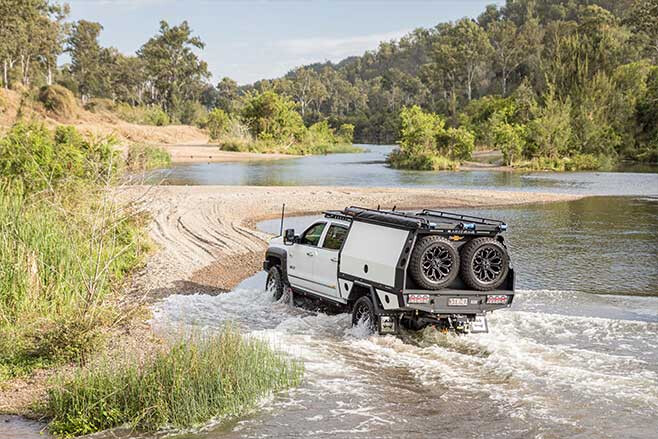
“We have a 22-foot Lotus Trooper caravan with a four-tonne GVM rating, so the 200 Series LandCruiser was starting to get to its weight limits,” Steve told us. “I wanted a good tow vehicle and HSV has a good reputation with service outlets over Australia. The Chevy was converted in Australia to Australian standards and optioned up for our road conditions, so I was happy with the package.”
The Chevy Steve speaks of is this 2019 Silverado 2500 LTZ which was imported and converted by the competent crew at HSV (now GMSV) in Melbourne. The 2500 is the smallest of the heavy duty (HD) range of Chevy trucks and in HSV-converted spec has 4491kg GVM and 4500kg (70mm tow ball) towing capacity.
Those specs are de-rated from what they are in the USA so that Aussies can drive one on a regular passenger car licence, but Steve knew he was going to push those limits. After years of working in the heavy-haulage industry he knew what was needed.
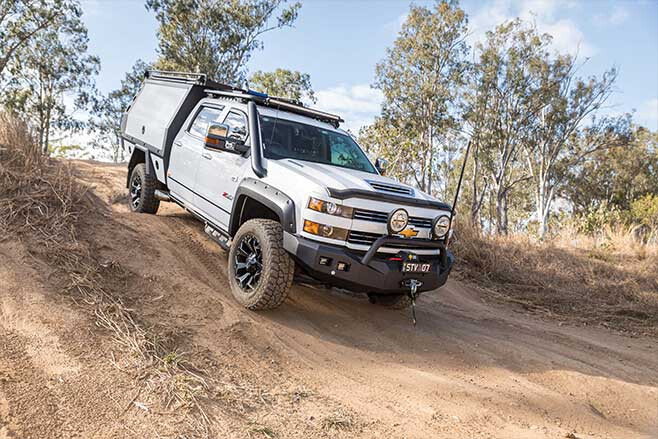
“We had to get a GVM upgrade to 5650kg, which means it’s classed as a truck,” he says of the Chev. “This means a Light Rigid truck licence is required and yearly machinery inspections.”
Steve saw Jamie Facer’s F250 when we featured it in 4X4 Australia and liked what he saw, so reached out to Jamie at Allsafe Mining Vehicle Equipment (AMVE) to do the build.
“Jamie looked after the custom aluminium canopy and full vehicle build,” Steve says. “Coming from a manufacturing background myself I could see the company’s (AMVE) ethics are first class and the finished product is something to be proud of.”
As well as towing the ’van the Chevy has to be able to cope with Australia’s gruelling outback roads and get Steve and his wife Marion in to those remote places the caravan can’t be towed in to.
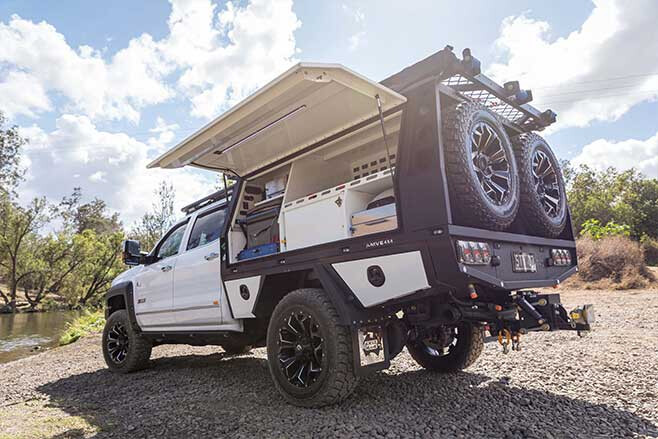
“When we venture where the caravan cannot go, we need camping equipment stored in the truck and canopy, including tent, stretchers, sleeping bags, chairs, table, fridge, cooking provisions and a water tank all onboard. We will be on the road full-time for around two to five years, so we need to have space to store our gear, tools, recovery gear, everything!”
Like the AMVE canopies on Jamie’s F250 and our own 4X4 Australia Ranger, the one on the Chev is made from aluminium and bolts directly to the chassis, not on a tray. This reduces overall weight, maximises interior space and allows for a lower floor to make access easier.
The massive canopy includes slide-out drawers on both sides, an MSA Drop Slide carrying an Engel fridge, a Travel Buddy oven, and a slide-out kitchen that includes the kitchen sink and a Weber barbecue. Toolboxes fore and aft of the wheel arches carry more kit including an ARB twin-pump air compressor. The compressor feeds an air tank underneath the canopy where there’s also a 100-litre water tank with electric pump, and a 250-litre fuel tank to keep that big Duramax V8 fed.
While we’re under the Chev it’s worth checking out the suspension. To achieve the required GVM and cope with all the Aussie outback could throw at it, Jamie fitted a kit from Icon Vehicle Dynamics using its shocks and upper control arms with the factory front torsion bars and reset rear leaf packs. The rear end is additionally boosted by Airbag Man bags to help with towing.
“We wanted the truck to be able to withstand the corrugations of the outback tracks so we had the suspensions upgraded and added a 17,000lb winch if we get stuck,” says Steve.
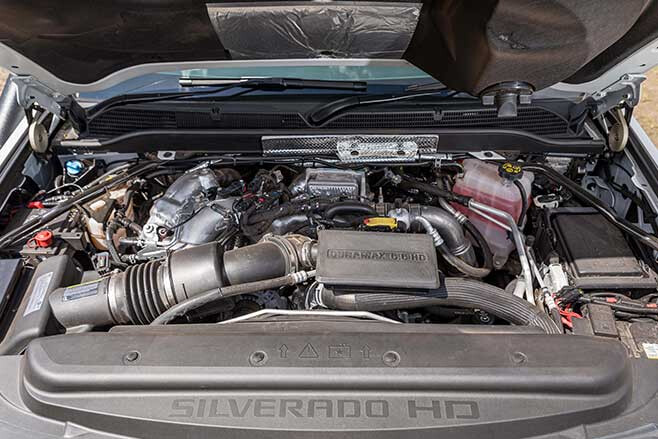
Power to tow shouldn’t be an issue with the big Chev; the 6.6-litre Duramax V8 puts out 1230Nm and 332kW as standard. Reece Hargrove at G&L Motor Repairs & Performance fitted a ‘Derringer’ tuner and Super Gauge from USA diesel specialists Banks to the engine. This clever unit provides power and torque boosts over six levels, selectable from the dash-mounted gauge which also gives readouts for vitals like EGT, boost and info from the OBD port so Steve can keep an eye on the engine.
The massive torque load goes through an Allison six-speed auto and on-demand 4×4 system. Plus there’s an Eaton auto locker in the rear diff from the factory.
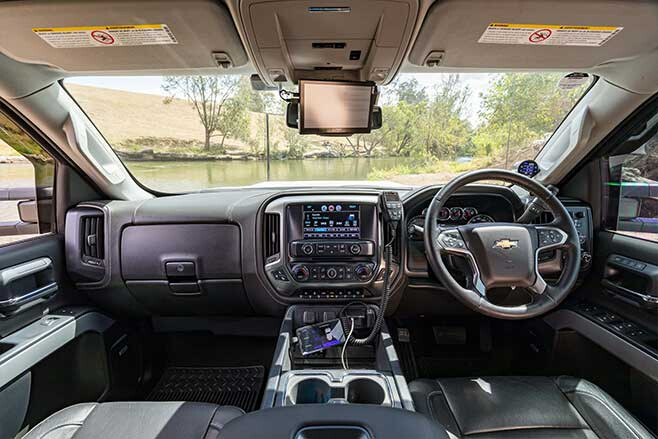
The fabrication skills of the crew at AMVE aren’t limited to the canopy, the front bumper was also made by the team and is now a part they offer for the big Chevs. On this application it is also home to the Sherpa electric winch, Hella LED lights and the antenna for the GME XRS Connect UHF radio. The bar includes its own rated recovery points, LED fog lamps and the factory parking sensors.
With the big white Silverado, which has appropriately been nicknamed Migaloo, complete, the only thing left to do is drive it.
“We went on a couple of trial trips with the van and it is a more relaxed, safer drive with the Chevy (compared to other 2500 pickups),” says Steve.
The plan is to hit the road in 2021 when hopefully there is lot more freedom across the borders, and make the most of the truck and van combo.
A FEW weeks ago a video went online that showed a local site that had been defaced with graffiti.
I rang around to see if anyone knew anything about it, but unfortunately that process proved fruitless. Thankfully, some kind-hearted and committed four-wheel drivers from a local club went and remediated the issue the next morning.
Generally 4WDers are interesting characters. Down to earth, knockabout, straight shooters who embody a camaraderie and willingness to get involved in every facet of the passion that is off-roading.
At the same time, the same attributes that exude that camaraderie can also be quite divisive. There are different sub-segments in our hobby: the tourer, the caravanner, the hardcore rock crawler, different age groups; and more than ever, brand-new entrants into the passion. As in any group, there are always some who can create issues on many different levels, unfortunately.
A short time after the graffiti had been removed, some more irresponsible activity was posted to a social media group. The group seems to consist of a younger generation which are more intent on challenging themselves and their vehicles; not really an issue because who doesn’t love to put their fourby through its paces?
However, the general 4WDing fraternity would clearly have a view on this sort of sub-segment. This activity quickly blew up for them in the shape of naming and shaming across other pages. Did they deserve it? I think they did, but what happened next is the point.
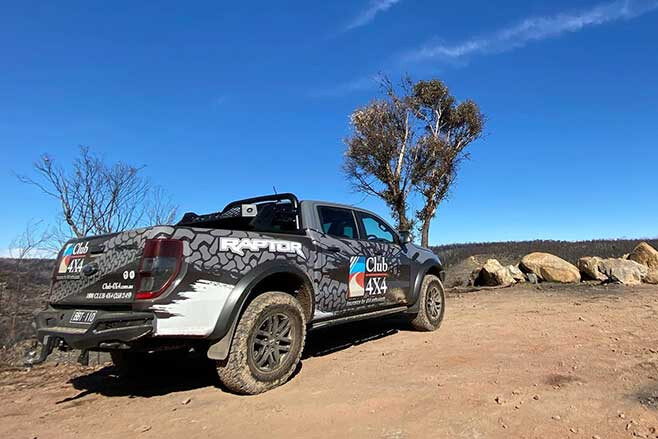
The administrator from that very page went out of his way to clearly and unreservedly apologise; taking complete responsibility for it in the process. Despite continuing to cop the brunt of criticism and sometimes unfair treatment, he continued, persevered and is really putting in an effort to improve the profile of this community he has built.
The proof will be in the pudding, but, as a risk-averse insurance business, this individual’s actions deserve some recognition and cred. When an mate of mine reached out to invite me along to meet with this individual, I was happy to oblige as I’d love to understand more about what he’s trying to achieve and to see if there is an opportunity to help him also understand different ways for all of us to contribute to a more safe and responsible 4WDing community.
There’s an old saying that goes something along the lines of “help people excel and so will you”. In a time when most 4WD-related businesses are seeing strong interest and growth, presumably being driven by more people wanting to see our countryside, these words can see us grow as a community.
Imagine if we could let go of judgement and typecasting? Imagine how powerful a force we would be if we focused more on educating and helping each other, espousing the mateship and camaraderie that is on the surface of our community?
A united 4WDing community, all supporting each other regardless of the age group or experience would do a lot better in getting the eyes of pollies to get our needs met – Kalen Ziflian, Club 4×4 Insurance
AS a four-wheel drive destination, the Grampians has some of the most scenic tracks in Victoria and, whilst not overly challenging, they offer spectacular views and memorable driving. An easy touring route can quickly turn into a remote track in this rocky wonderland.
Our love affair with the Grampians began way back, pre-kids, with a borrowed tent from the in-laws and loads of youthful enthusiasm. Over the years we’ve returned many times with family and friends, and I reckon we’ve tackled most of the walks, from easy lookout strolls to challenging treks. We’ve explored the major touring routes, but as we discovered recently there are always exciting new tracks to be found.
This time we’re back with two first-time Canadian visitors to Australia and our base is Lakeside Park on the edge of Halls Gap. We’d normally free camp, but we feel like offering a bit of mountain comfort for our overseas guests. It’s run by owner operators Josephina and Rohan McDonald, an enthusiastic couple who have transformed this once basic park into one of the most awarded in Australia. Its location is picture-perfect, nestled between Lake Bellfield on one side and a peaceful valley on the other.
Our international guests were enthralled with the amount of wildlife in the adjoining valley their swag opened to, as well as the cheeky cockatoos and crimson-coloured rosellas that are quick to steal a lunch. The biggest plus within the park is the wood-fired swimming pool, the only one of its kind in Australia, which is heated all-year ’round and the best tonic for tired muscles after a hard day’s bushwalking.
And bushwalking is what the Grampians is all about. Dominated by the craggy peaks of the Wonderland Range, Mt Victory Road and the Mackenzie River, it’s in the Central Grampians area you’ll find the largest selection of day walks, including the well-known trek to the Pinnacle, the Balconies and the majestic Mackenzie Falls.
It was to all these places we took our guests; as well as a mandatory trip to Boroka Lookout, an easy way to enjoy a spectacular view with the carpark only 25m away from imposing cliff tops. Later that night we ventured out for an easy sunset walk to Reeds Lookout and the Balconies.
GRAMPIANS PEAKS TRAIL
On the other extreme is the Grampians Peaks Trail, a project which when completed in late 2020 will be one of Australia’s premier long-distance walking trails. The 144km trail connects some of the Grampians most spectacular peaks, and links Mt Zero in the north to Dunkeld in the south. The walking is designed to be tackled in stages to suit each walker’s level of experience. The first completed section features the Halls Gap, Wonderland and Mt Rosea area and includes a three-day/two-night loop walk from Halls Gap to Borough Hits towards Mount William.
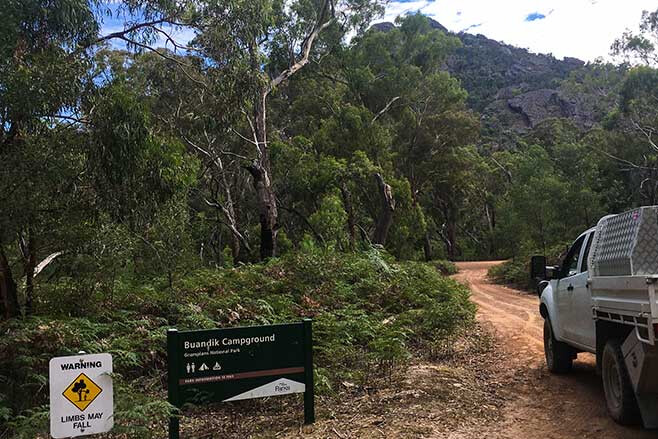
For those who enjoy remote camping there are 12 campsites run by Parks Victoria scattered throughout the park. One of the best free campsites is Plantation Campground found off the Mount Zero Road. It’s also known as The Pines and has about 30 free spots, ranging from tent-based sites through to large areas where you can park a camper or van. There are shared fireplaces, picnic tables, drop toilets, bucket showers and plenty of wildlife to keep you company.
Less than five kilometres from Plantation Campground is Mount Difficult Quarry, one of the most fascinating and overlooked sites in the National Park. Located at the base of Mount Difficult, the Quarry (also known as the Heatherlie Quarry) provided a massive amount of freestone, used in some of Melbourne’s most historic buildings including Parliament House, the Town Hall and the State Library.
A tramway was built to link the quarry to the main railway line at Stawell. Today you can follow the signposted trail and see remnants of the equipment, accommodation houses and rock faces that still show the marks of the operations of the quarry.
In the southern part of the park you’ll find the small, secluded Wannon Crossing campsite, adjacent to the tranquil Wannon River. This campground is more suited to tent camping and is a short and easy drive to start the walks to the dramatic peaks of Mount Abrupt and Mount Sturgeon.
Mt Abrupt is a relentless climb but an absolute ripper. It rises steeply over 3.25km (one way) to the 827m summit and isn’t for the fainthearted. Thankfully, it doesn’t take much before the views are worth stopping for. And at the top, several hours later, as the terrain gets steeper and rockier the scenery is magnificent. Views across the Victoria and Serra ranges, the southern plains and Dunkeld make the Mount Abrupt hike one of the most scenic, and underrated, in the National Park.
HALLS GAP
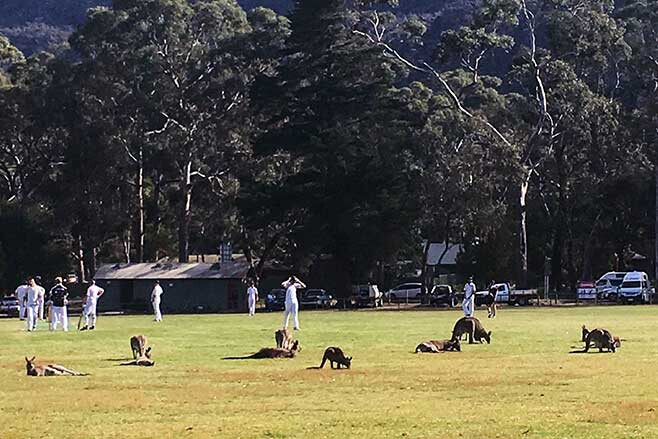
BACK in the hub of Halls Gap, you can stock up on supplies and fuel, and next door visit the Info Centre for local knowledge and maps. While you’re there you can also partake in a bit of wine tasting. Just keep an eye out for emus and kangaroos as you drive through town. At the cricket oval you’ll often find ’roos taking centre stage and playing extras in a local cricket match.
We were keen to do some off-road exploring away from the touristy spots so, once we refuelled and restocked, it was time to head out of Halls Gap, taking the turn off on to Glenelg River Road. After about 16km we arrived at the sheltered woodlands of Boreang Campground, a popular base for four-wheel drivers exploring the Victoria Valley and these more remote sections of the Grampians.
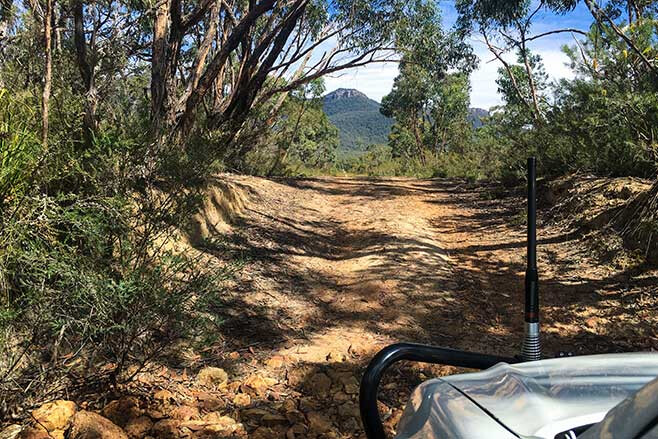
As we continued, in the distance we could see the peaks and craggy crevices of mountain ranges. Less than an hour later we were high up on top of the world on Goat Track as it winds its way over the Victoria Range, with spectacular views of the surrounding peaks. Goat Track is aptly named. It’s rocky and steep and, though it’s a relatively easy track in summer, with a bit of rain it could quickly turn challenging.
This track also gives northern access to Victoria Range Track and a few other seasonal tracks in the area, as well as a few Aboriginal sites. As we wound our way through the tracks that varied from dirt, clay, sand and rock we didn’t see another vehicle. We were hoping to tackle the more challenging Henham Track, but it was getting late. Keep in mind that while most of the main dirt roads remain open through winter, the tougher trails are subject to seasonal closures.
Coming back down and on the other side, venture beyond Roses Gap Road to Wallaby Tracks Road and enjoy a scenic route that has loads of interesting rock formations and a couple of places to stop and enjoy the views over the Wartook Valley. Within the Northern Grampians are tracks that head into the Mt Difficult Range and the Mt Stapylton area where there are easy walks to Aboriginal rock-art sites and other day walks to exposed mountain peaks. Hollow Mountain is one of the best walks in this area. To get there head up Plantation Road towards the Mount Zero area, passing the Mount Zero Olive Farm along the way.
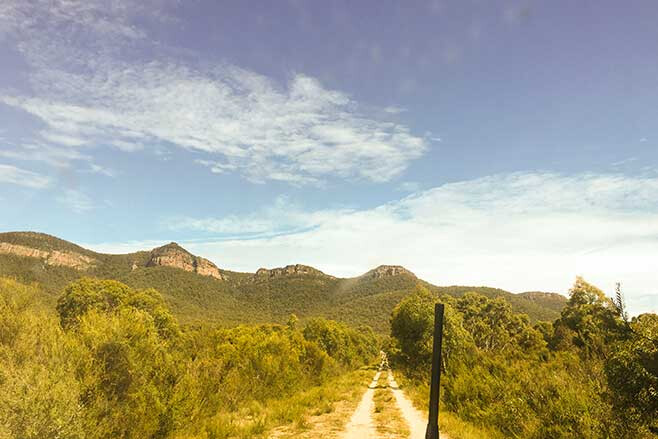
At the Hollow Mountain carpark, the walking track has a deceptively easy start with steps leading through a picturesque gully, however after about 200 metres you’ll reach the base of a cliff and from there onwards it’s all uphill. There are some nail-biting sections to this walk, before it levels out to breathtaking views of the Mount Stapylton Range and the Wimmera Plains. The wind-sculpted caverns of Hollow Mountain are truly stunning.
Getting lost, or even just a little bit immersed in the Grampians, is a perfect way to blow away those city cobwebs. In our uncertain times of travel, a weekend here, escaping the crowds in a remote campground will reignite your love affair with this spectacular part of Victoria. With just stars and birds and massive sandstone escarpments for company, it sounds pretty good to us. The best part is, with so many awesome tracks to explore, both on foot and by fourbie, it’s just three hours from Melbourne so you can come back and rekindle the love affair, all over again.
TRAVEL PLANNER
LOCATION: 250km from Melbourne or 460km from Adelaide
CLOSURES: Throughout the year Grampians National Park may have closures in place from natural events (storms, floods and bushfires), park operations and projects.
PARK INFORMATION: Phone: 13 1963
VISIT: Brambuk the National Park and Cultural Centre, 2.5km south of Halls Gap; Phone: (03) 8427 2258 or go online at Parks Victoria: www.parks.vic.gov.au
CAMPGROUND BOOKINGS: Brambuk The National Park and Cultural Centre, Halls Gap, phone (03) 5361 4000
OVER the years I’ve used a number of brands of different tyre-pressure monitoring systems (TPMS) but more recently I needed one that kept a check on my camper tyres as well as the tyres on my tow rig.
The importance of that came to light when we were up north a while back and I destroyed a tyre on the camper, which on investigation had been slowly deflating to the point of overheating and delaminating. With my old system limited to just monitoring four tyres, I went looking for something else that could handle at least six tyres.
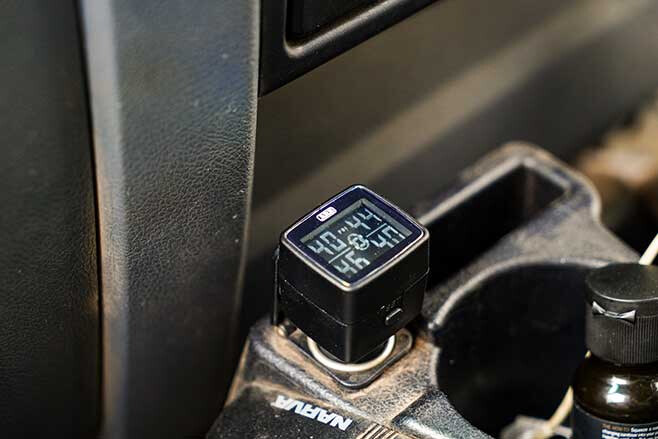
Nowadays there’s even more makes and models of TPMS around but after a bit of investigation I settled on the TPMS from ARB. They are not the cheapest you’ll find, nor are they the most expensive monitoring system, but I liked the way the display was part of the cigarette plug and you don’t have a separate display taking up space or vision at windscreen level. And there were other advantages.
There are two different versions available in the ARB TPMS line-up: one with internal sensors or the one with external sensors which I chose. I’ve had monitoring systems before with internal sensors and they always seemed to get destroyed when some heavy-handed tyre fitter changed or repaired a tyre. I know these ARB units are different to the ones I had, but the suspicion remains and I’ve never lost or damaged an external sensor (yet?).
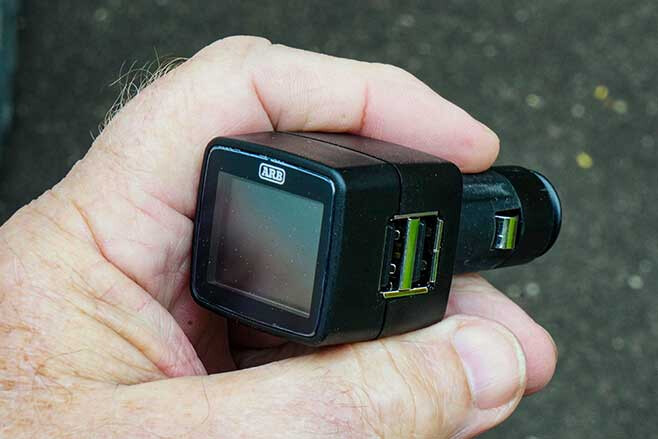
As previously indicated the complete kit comes with a display unit as part of the 12-volt power plug that also incorporates two USB charge port outlets. There are four tyre sensors in the standard kit which screw onto the tyres’ valve stem and the sensors powered by an internal replaceable battery which will generally be good for two years of operation. Also, a lock nut and a small spanner is supplied so that the sensors can be locked onto the valve stem to stop would-be thieves helping themselves.
For the camper trailer monitor kit there are two more sensors (up to a maximum of four) along with a transmitter extender, which is a small box that mounts somewhere on the front of the trailer’s A-frame. This extender needs separate power which can be either hard-wired into the trailer circuitry, or you can insert a couple of AA batteries to power up the unit.
I chose the latter and they have been working for some time now as the extender unit only powers up when it senses movement. With the trailer extender unit, the communication range is, by all accounts, good to at least 30 metres, which means it will handle everything up to a semi-trailer.
The TPMS kit also comes with four pages of instructions on how to set them up for the tyre pressures you normally run … and, I gotta say, I had difficulty initially with this. It turned out I had a faulty display unit and when that was replaced under warranty the set-up was pretty simple and straightforward, but a little too long-winded to go into here. And you need to follow the set-up correctly and holding the ‘Set’ button for exactly the right amount of time, as indicated in the different steps of the instructions.
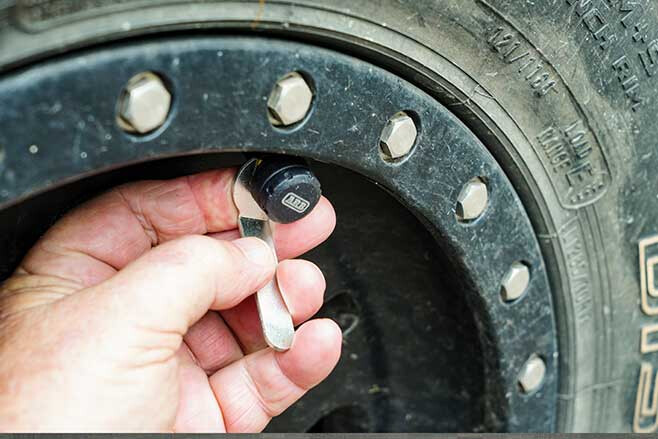
The sensors use an audible and a visual alarm for tyre leakage, low pressure, high temperature, high pressure, low battery voltage and variations of +/- 25% of the set monitored psi. The kit can monitor up to five tyres as standard, and with the optional trailer kit it can monitor up to four extra tyres. As you’d expect you can set different pressures on the rear axle compared to the front wheels compared to the trailer wheels and still benefit from all the features of the TPMS kit.
One of the other great things about the ARB TPMS kit is that you can select one of two tyre-pressure profiles for on road and off road use, without having to go through the whole pressure set-up procedure each time. Pressure monitoring ranges from 5 to 30psi for off-road work and 23 to 80psi for on-road operation.
Once you have the sensors and display unit installed and set-up, the display unit will blink and then go to a solid readout as each of the tyre sensors connect wirelessly to the display unit. This normally takes a minute or less of driving and in my experience, all tyres are reading their appropriate pressures before I get out of my driveway.
So now I can drive our byways and highways safe in the knowledge that my tyre pressures are being monitored constantly with a visual readout to keep me informed, while any deviation from normal will sound an alarm to warn me of a problem. That’ll often save a tyre from being irreparably damaged, rescue a rim from irrevocable harm and safeguard some dollars, thereby paying for itself in just one saved tyre. And they could possibly save an accident or even a life!
Why would you not have one?
AVAILABLE FROM
RRP
Sensor kit (4 wheels): $169 Trailer Sensor kit (2 wheels): $85 Display unit: $139 Trailer Extender: $95 Extender wiring kit: $26
WE SAY
Ideal for the 4WDriver and cheap tyre insurance.
BEING a Jeep owner I was pretty excited to discover Axial was coming out with a new RC Jeep, the JL Wrangler.
This is the first RTR model on Axial’s all-new SCX 10 III platform, and it’s a big step up from the old SCX 10 II. You now get portal axles, DIG transmission function, licensed parts from Method, Nitto and CRC, plus a beautifully designed Jeep Wrangler JL body (available in orange or grey) and a chassis that features inner fenders and a detailed motor cover for an ultra-scale appearance.
A Spektrum DX3 2.4GHz transmitter, Spektrum Firma Smart ESC/radio receiver and a metal-gear steering servo are also included with this model.
So what is it like out on the tracks? Well, the first thing I noticed was how good the new Spektrum DX3 radio is to use. It features a thumb toggle so you can drive it one-handed, which is great for filming or holding that double-shot latte.
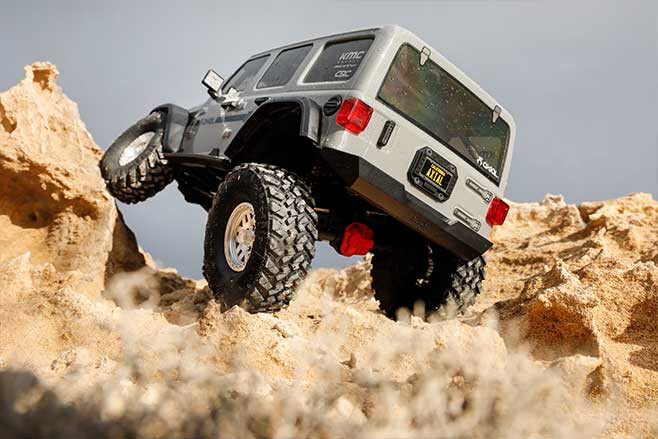
The locked diffs allow it to climb up some crazy angles and the excellent wheel articulation keeps the tyres in contact with the ground. It has good low-down punch, but I recommend using a 3S LiPo battery to make the most out of its motor and generate maximum power.
The best new feature is the DIG Function. Having that ability to lock up the rear axle and let the front axle do all the work for those tight turns is a huge advantage. This allows the Jeep to turn like no other stock RC crawler. Another great new feature is the hidden body clips and stealth body mounting system. No more ugly body posts sticking out from the bonnet– well done Axial.
This JL has a whole new feel in comparison to the previous SCX10. The portal axles play a big part, as the added clearance allows you to drive over bigger obstacles. Axial designed a brand-new tyre for the SCX10 III, and the R35 compound Nitto Trail Grapplers are wider and a little taller (4.7 x 1.7-inch) than the tyres on the old SCX10 II. The larger footprint improves grip and the extra height also helps.
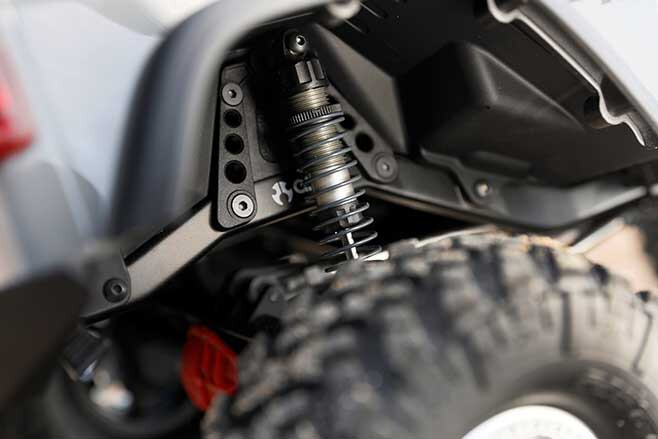
There’s also a second gear built into the gearbox, but unless you add another micro servo you can only use the DIG function or two-speed gearbox one at a time. I prefer the DIG function.
So the SCX10 III drives really well but, let’s be honest, the main reason we buy an RC crawler is for the way it looks, and this Wrangler looks awesome. The scale detail is amazing. Moulded plastic guards and working LED lights, as well as mirrors, door handles, wipers and inner fender flares – this truck is so well detailed. The interior is just as good. It has seats, a dash, roll cage and a driver figure with a cowboy hat. What more could you want?

It would be nice to have the DIG function and two-speed gearbox able to work together out of the box. To make this happen you would need another servo and a four-channel radio.
I was really impressed with the SCX10 III. The performance, scale details and next-gen electronics make the SCX10 III a great choice for a first RC 4×4, or for someone adding to their 1/10th fleet.
AVAILABLE FROM: www.modelflight.com.au RRP: $899.99 WE SAY: Impressive performance, scale details and new electronics.
Jeep has pulled the wraps off its first V8-powered ‘traditional’ Jeep in almost 40 years, with the unveiling of the 2021 Wrangler Rubicon 392.
Before you head on down to your local dealer to orders yours, cool your heels, as the Wrangler 392 will be made in left-hand drive only so it’s not coming to Australia.
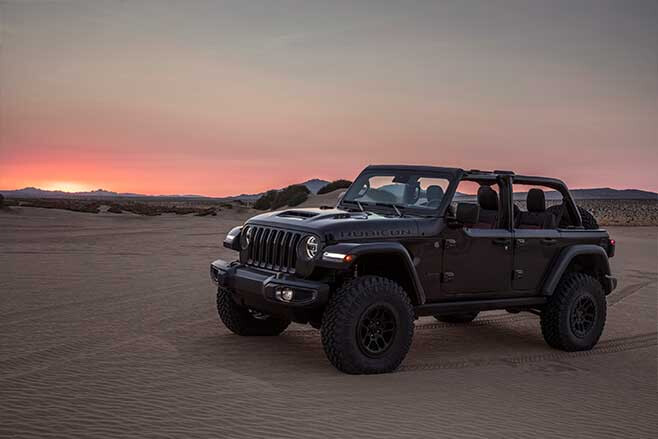
“At this stage, the Rubicon 392 is going to be produced in LHD only,” said a Jeep Australia spokesperson.
However, the door hasn’t shut completely.
“With that said, we know how much Australians love their V8s, so if that changes we’ll be the first to put our hand up,” teased the spokesperson.
FCA remains the only manufacturer to offer non-premium V8-powered passenger cars in Australia, with the Chrysler 300C sedan and Jeep Grand Cherokee SUV still available with V8 power.
Interestingly, those power plants form the basis of the same 6.4-litre Hemi V8 engine as found in the Rubicon 392.
This isn’t the first time FCA has denied Australians what would be a desirable powertrain in their Jeeps.
The recently released 3.0-litre V6 diesel engine that is available in the JL Wrangler and JT Gladiator pick-up in the USA is also left-hook only, and not for us Aussies.
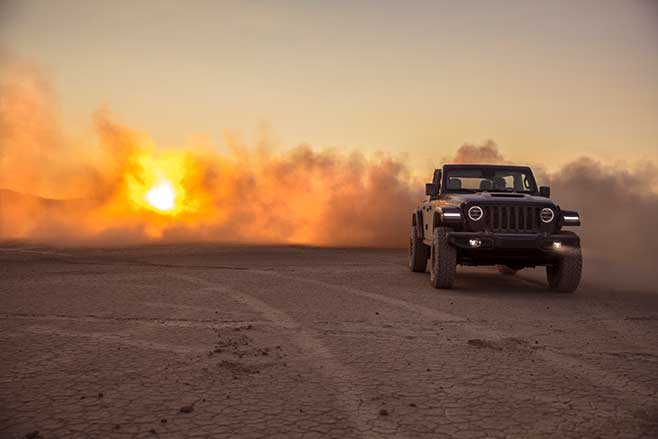
This is the first time Jeep has fitted a V8 engine to a Wrangler and the first time to a ‘Traditional Jeep’ since the last of the CJ7 models in the early 1980s.
We can expect the V8 Hemi engine will also find its way into the JT Gladiator at some time in the future, although that is unconfirmed.
Jeep Rubicon 392 V8 in detail
Jeep officially calls the V8 JL Wrangler the Rubicon 392, but it doesn’t come with all the hardware we expect in the Rubicon models.
Yes, it has locking Dana 44 differentials front and rear and the disconnecting front sway bar, but the V8 and eight-speed auto transmission are backed by the full-time Selec-Trac transfer case with 2.7:1 low range gears in lieu of the 4.1:1 equipped Rock-Trac usually found in Rubicons.
The final drive ratio in the 392 is 3.73:1 instead of 4.1:1, giving the Rubicon 392 a 48:1 crawl ratio.
That higher gearing might have something to do with the 392’s output, with some 350kW and 637Nm going to the wheels.
These numbers are the same as that found in the 300C SRT sedan, suggesting the Wrangler’s V8 is the same tune as found in the Chrysler.
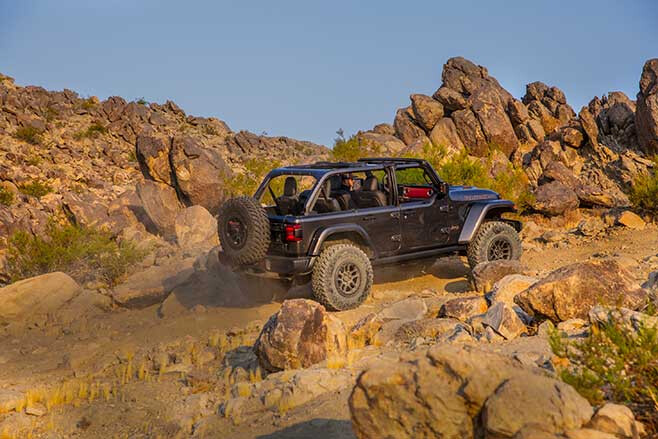
Jeep claims the Wrangler Rubicon 392 will cover the zero to 100km/h dash in 4.5 seconds and the quarter-mile in 13.0 seconds.
This a wicked wagon when you consider it still has excellent off-road capabilities.
In fitting the V8 engine within the Wrangler frame Jeep has beefed up the chassis rails to give them more strength and equipped the 392 with a ‘factory’ 50mm suspension lift using Fox shock absorbers.
The beadlock-capable alloy wheels are fitted with 33-inch off-road tyres, giving the 392 approach, breakover and departure angles of 44.5, 22.6 and 37.5 degrees respectively, and the ability to traverse up to 825.5mm of water.
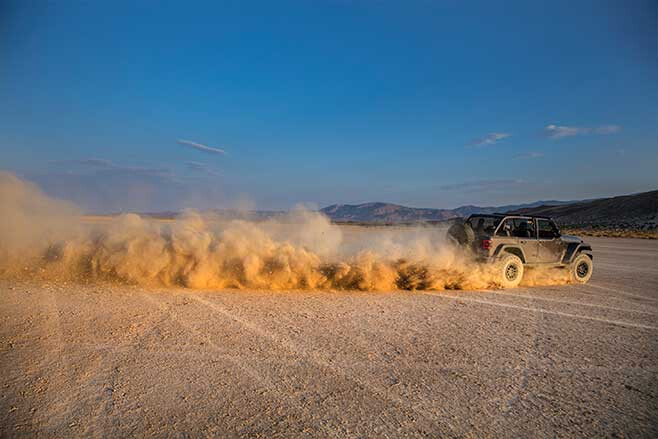
A model-specific Hydro-Guide air intake system includes a tri-level ducting system that separates water – up to 57 litres per minute – away from the engine’s incoming air, while a functional bonnet vent feeds the V8 engine’s intake.
Of course, the Rubicon 392 is equipped with plenty of model-specific trims and features to clearly identify it as the V8 model, and there is a huge range of Mopar accessories available for it.
Unfortunately, don’t expect to be seeing it on Australian tracks any time soon. We’ll just continue to rely on aftermarket V8 engine conversions.
THERE’S nothing like owning a new car and, while I’ll never be able to afford one, I’m lucky enough to get to drive more of them than most folks. What becomes apparent the more you drive new vehicles straight off the showroom floor is how much of a compromise they all are.
When car companies design, engineer, manufacture and sell a new vehicle, it has to be made to meet many criteria and few new cars are specialised. Even in the world of four-wheel drives the new models have to meet standards of efficiency, comfort, safety, quietness and on-road performance. Few actually put off-road ability or load hauling as a priority, so you need to go to a specialised model for that.
The popular one-tonne mid-size double-cab utes are the biggest compromise, as they try to add a relatively heavy payload and towing capacity to all the above criteria. A bit like the venerable Swiss Army Knife with so many tools in its quiver, it does many jobs adequately but none very well. There are bigger and sharper knives available if all you want is a cutting tool.
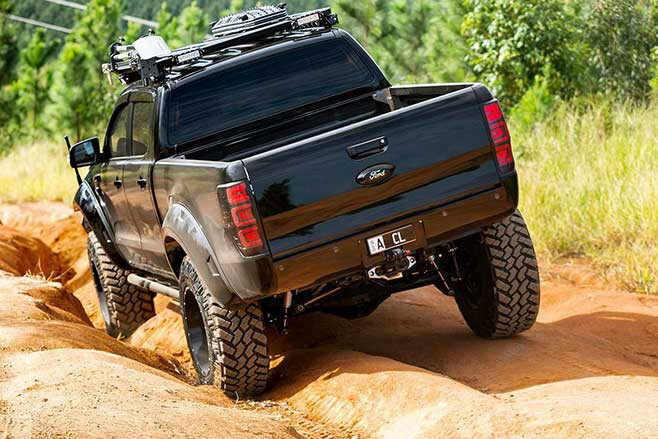
This is why we accessorise and modify our vehicles to better suit the uses we have for them. Be it simply fitting a set of more aggressive and durable tyres for regular rough road use or engineering a chassis stretch, SAS conversion and V8 engine swap, the changes we make reflect our needs and desires. Some like to keep it simple and practical, while others take it to extremes.
Whatever mods you do to your car, the end result should make the vehicle better at accomplishing your goals, be they to tow a large van around Australia, go rock crawling, or just stand out in a crowd. And we’re thankful that you do it!
This is why we bring you so many different custom 4x4s throughout the year; and in December we compile our favourites for you to choose one you think is the best. This year’s haul brings a wide variety of vehicles built to do many different things in many different ways, so take the time to look over the selection and get online to vote for your favourite.
Just by voting, you have a chance to win $2000 worth of Maxxis tyres. We’ve loved the Maxxis RAZR MT that we had on the Ranger and the new ATs on the Musso, and the only thing better than a new set is winning them for free.
Ford has brought back the Everest BaseCamp, with the Special Edition model priced from $64,990 and limited to a run of just 450 units.
Previously seen about the same time last year as the BaseCamp Accessory Pack, Ford Australia says it’s bringing it back due to popular demand.
Based on the mid-spec Everest Trend 4×4, the BaseCamp is available with either the 3.2-litre ($64,990) or 2.0-litre bi-turbo ($66,490) configurations. For comparison’s sake the Trend in its standard skin is $2000 cheaper.
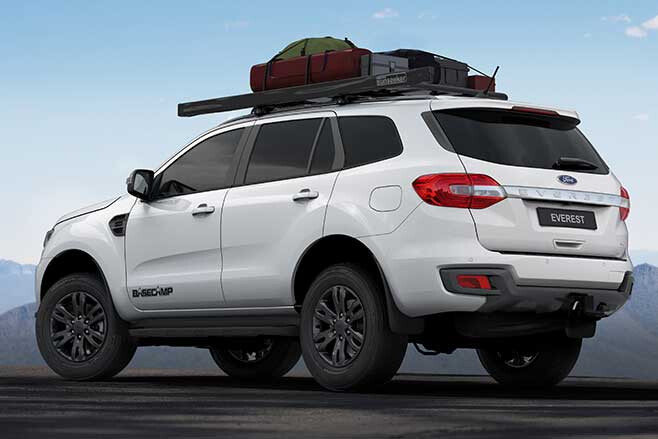
Despite the $2000 price hike for the BaseCamp, Ford Australia says the value of the kit added represents $6000 of value.
Said kit includes a 76mm diameter black nudge bar; Ford-licensed LED light bar; Ford Genuine snorkel; black roof-mounted carry bars; Pioneer Platform; Genuine Sunseeker awning; and a Ford Genuine tow bar rated to 3000kg (3.2L) and 3100kg (Bi-Turbo).
You’ll also find BaseCamp decals and bolder grey paint on the grille, front bumper skid, rear bumper skid, fender vents and wheels.
In addition to the BaseCamp, Ford Australia has revealed a RWD Everest Sport variant. Powered exclusively by Ford’s 157Kw/500Nm 2.0-litre bi-turbo powertrain, the RWD Everest Sport is dressed in black – the mesh grille, front and rear bumpers, tailgate, roof rails, 20-inch alloy wheels and exterior mirrors are all coated in black.
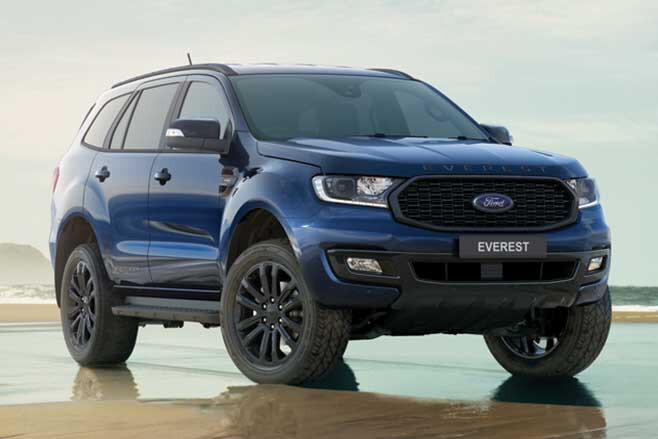
“We know the travel habits of Australians are changing in the wake of COVID-19, and more and more Aussies will be looking for road trip adventures. The Everest offers a smooth ride on the highway, plus genuine off-road, off-the-beaten track capability,” said Andrew Birkic, President and CEO, Ford Australia and New Zealand.“Now, with the Everest BaseCamp Special Edition and Everest Sport in rear wheel drive, we’re offering more choice for our customers to take to the roads in vehicles that have been designed and engineered in Australia to make discovering our great country easy, safe and comfortable.”
Ford has also tickled the front-end of its Everest Trend and Titanium models, with the respective variants now featuring a chrome grille with grey mesh. In addition, the top-end Titanium model now wears 3D ‘EVEREST’ lettering on the hood.
The latest offerings in the Everest stable will be available in showrooms from December 2020.
PRICING
Everest BaseCamp 3.2l 4WD: $64,990 Everest BaseCamp 2.0l Bi-Turbo 4WD: $66,490 Everest Sport 2.0l Bi-Turbo RWD: $59,990
2021 FORD EVEREST 4WD DRIVEAWAY PRICING
Everest Ambiente 3.2l 4WD (5 Seat): $57,490 Everest Trend 3.2l 4WD: $62,990 Everest Trend 2.0l Bi-Turbo 4WD: $64,490 Everest Sport 3.2l 4WD: $65,990 Everest Sport 2.0l Bi-Turbo 4WD: $67,490 Everest Titanium 2.0l Bi-Turbo 4WD: $72,990
PICK up a copy of our all-new December 2020 magazine for complete 2020 Custom 4×4 Of The Year coverage, as well as plenty more.
We’ve seen many stunning custom four-wheel drives roll through the pages of our magazine this year, and we’ve shortlisted 12 epic examples for the 2020 Custom 4×4 Of The Year award.
You’ll find comprehensive coverage in the December magazine on each of the 12 finalists, and you can vote for your favourite by visiting our Custom 4×4 Of The Year home page. Everyone who votes goes into the draw to win a Maxxis Tyres voucher valued at up to $2000.
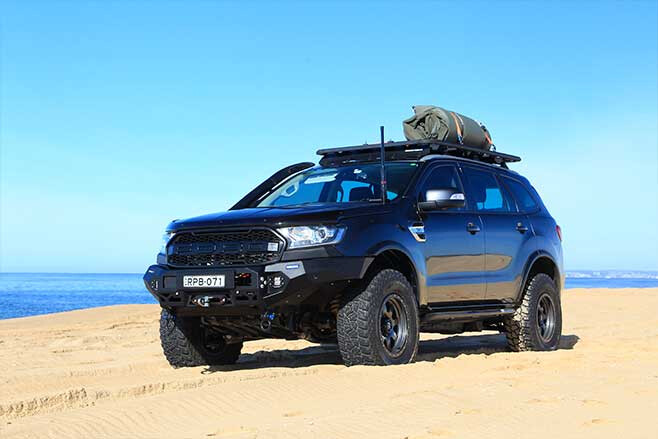
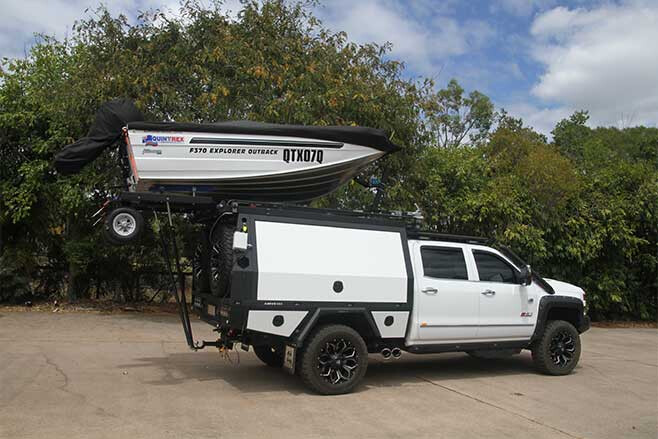
In this issue, we also point a microscope at two more custom builds: an all-conquering Ford Everest, and a stunning Silverado set-up dressed in nothing but the best kit.
To escape the incoming summer heat, you’ll want to add an off-road awning to your 4×4’s arsenal. We had a chat to a few experts in the awning industry, where they explained what to look for, what to avoid, and why an awning is essential for an outback expedition.
Plus, with Christmas just over a month away, now’s the time to tick off your Christmas shopping. We’re here to help, with our extensive holiday gear guide showcasing a smorgasbord of aftermarket products you’d love to wake up to on Christmas morning.
WHAT ELSE IS THERE?
– 4×4 trips to the Grampians and Old Glen Innes Road. – First fang of Mazda’s all-new BT-50. – Land Rover Perentie and Nissan Patrol in the 4×4 shed – New 4×4 product reviews.
The December 2020 issue of 4X4 Australia is OUT NOW!
POPULAR four-wheel drive location, McBrides Beach on the NSW north coast, has recently been closed off to vehicle access, according to the NSW Department of Planning, Industry and Environment.
While many view the challenging track conditions to the beach as a gatekeeper to prevent overuse of the area, NPWS disagrees, opting instead to construct a 560-metre walking track.
NPWS Hunter Central Coast Director Kylie Yeend says the aim of this exercise is to improve access to the beach for locals and visitors to the area.
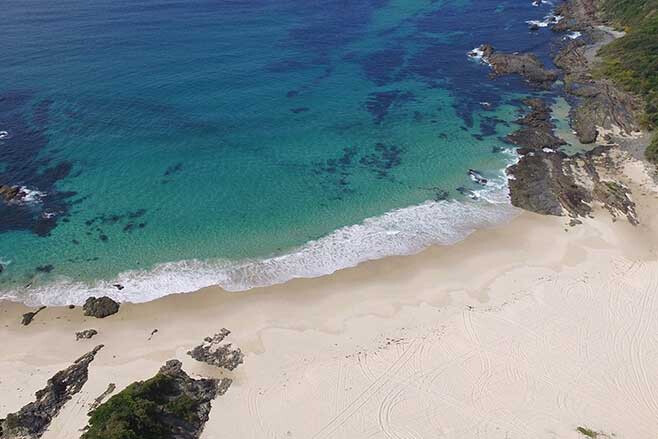
“McBrides Beach is a little slice of paradise, known by locals and visitors for its seclusion and outstanding natural beauty,” she said. “We’ve listened to feedback from the local community that the current shared pedestrian and vehicle access trail has become significantly degraded, making it difficult for pedestrians to safely access the beach.”
NPWS say they are working to determine the best way forward regarding vehicle access.
There is no timeframe for the track to be re-opened to 4x4s, however the walking track is expected to be finished mid-December 2020 at a cost of $73,000.
Sadly, it seems vehicle access is no longer a priority, with the official press release using suspiciously vague wording around the reopening of the vehicle access track, but they tell us NPWS will work with key stakeholders to consider viable options for vehicle access at Cape Hawke.
Read the full press release HERE.