
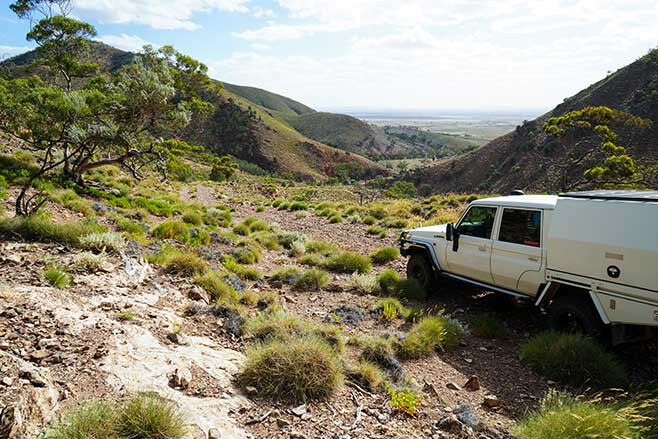
THE view hit us suddenly and completely by surprise. I had been concentrating so intently on the rough, rocky track we were following that the top of the ridge was seen as nothing more than a change from driving upwards to careening downwards. But as the view hit me, I instinctively jammed on the brakes and got out to admire the panorama that surrounded us.
I was hemmed in by ranges; at my back was a particularly rugged part of the mountains, while to my front the path of Depot Creek wound between two hills before suddenly spilling out on to the flat plain which seemed to stretch away to eternity. In fact, the flat plain does stretch for quite a distance with hardly a hill and certainly no mountains all the way to the WA border and beyond.
FLINDERS RANGES: Exploring the back roads
We had been exploring the southern Flinders Ranges, poking around in a few places I knew and loved well, and finding other spots that I hadn’t been to for 20 or more years or had never even seen before. Depot Creek falls into the category of a place I hadn’t been to in a long time and, recently, access to this historic spot has changed and been made easier.
We had heard about the change in access earlier and so after wandering around Orroroo, Quorn and Hawker, we headed out on the dirt through Yappala Gorge towards the old deserted town of Hookina.For much of the way you pass through the Yappala Properties Indigenous Protected Area (IPA), and while this area of once pastoral lease-hold land was declared an IPA back in late 2013, only recently are there any visible signs of that appointment.
The IPA covers 10,886 hectares and features acacia shrub lands, open eucalyptus woodlands, the imposing Yappala Range and the artefact-rich floodplains along Hookina Creek where more than 30 archaeological sites have been recorded.
Hookina, which had been abandoned back in the 1890s after horrendous dust storms had swamped the local pub, had once been an important meeting and drinking place for the bullock teams heading north to the mines in the northern Flinders Ranges. However, when the Old Ghan Railway was routed a short distance east in the 1880s, it was the death knell for the town.
Farther west, the relatively good dirt road now skirts the southern flank of a low range, the highest point of which is Mt Eyre, before heading south along the western edge of the Flinders Ranges. Pushing south, we passed the ruins of the once large and important Warrakimbo Woolshed before coming to the turnoff to Wilkatana Station and, hidden behind a veil of scrub from this distance, Depot Creek.
EYRE DEPOT
DEPOT Creek was first named as such by Edward John Eyre in 1839 on his first endeavour to find a way north into the heart of Australia. An incredibly reliable and good source of water, Eyre made his ‘Eyre Depot’ on the creek close to the where the rugged ranges meet the plains; this became his base on his first and further endeavours, while other explorers and surveyors followed.
Of course, they weren’t the first people to depend on this water supply for succour and life. Aboriginal people had been savouring these waters for millennia and were probably more than a little distraught when Eyre and his mob of people, horses and stock arrived. Just a few years later, in fact, two shepherds were killed by Aboriginals and one could surmise that it had a lot to do with the sheep’s seemingly insatiable demands on the water supply.
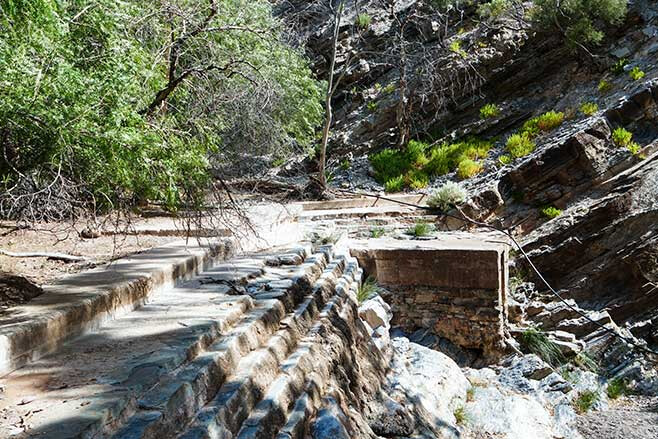
In 1915 with the planned Transcontinental Railway about to be built across Australia linking distant Perth with the eastern states, the Commonwealth Railway set about changing the creek and its waterflow forever. They built a dam deeper in the ranges and, with more substantial rock and earth works downstream, built a pipeline that fed water to Port Augusta and the steam trains that hauled goods and people north and south and east and west.
Today the dam and most of the original works and pipeline are in ruins; although, water is still fed from near the original dam out to a number of nearby station properties that still rely on this water point.
4X4 TRIP: Road trip to Beltana
One of those properties is Wilkatana Station whose lands take in the old weir, the creek, the site of the historic Eyre Depot and much of the rugged surrounding country. The acclaimed Heysen Walking Trail traverses the property and wanders along Depot Creek, where nearby is a monument to the explorers that used this important source of water.
With directions from the owners we took the station track south across the flat plain bordering the range before reaching the northern edge of Depot Creek, its line of gum trees marking the route of the creek far out on to the flat plains – certainly the most obvious creek line along this whole western rampart of the ranges.
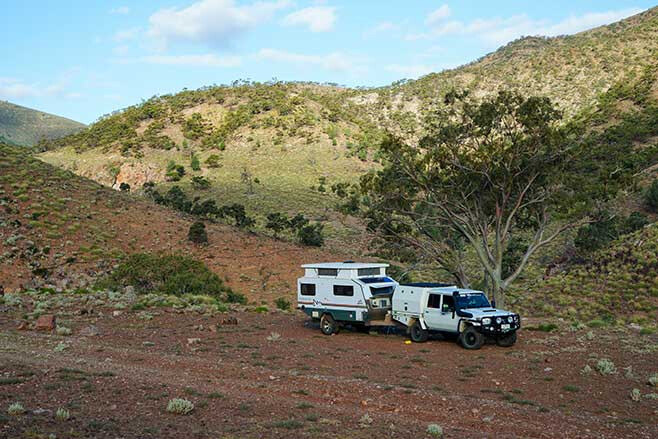
Once at the creek the main track heads deeper into the range and we dropped our camper on a flat piece of country above the creek, before wandering deeper in to the mountain fastness. The route winds and climbs a few rocky ridges for a few kilometres before suddenly coming to an end at a sheer bluff. From here it’s about a 500m walk – the easiest being along the creek bed itself – to the old weir and workings of the railway pipeline. Pools of water had dotted the creek downstream from the weir, but the weir itself was completely silted up, with a few sprightly gum trees indicating it had been like this for a long time.
4X4 ADVENTURE SERIES: Flinders Ranges
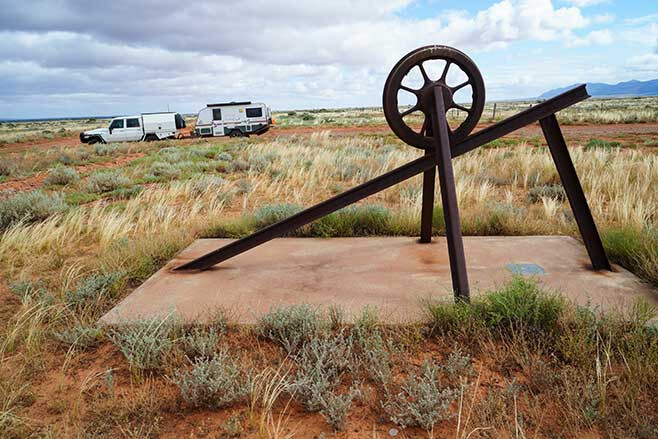
After our explorations we backtracked to our camp as a few spits of rain indicated a cold front was passing through. Next morning, we followed tracks to the south-side of the creek where the monument pays homage to Eyre and his fellow explorers. From there we headed out to the main road, where just north of Depot Creek another monument to Eyre can be found – I’ve gotta say it’s a rather strange one for an explorer, but I guess it made sense for the Carlton Primary School who erected it here back in 1986.
With our explorations over we took one last photo and headed south to the ‘big smoke’ of Port Augusta. Hopefully, it won’t be another 20 years before I visit this lonely, spectacular spot once again!
TRAVEL PLANNER
For access to Depot Creek contact Andrew or Rachel at Wilkatana Station, phone: (08) 8642 3642; or check the web for details on their camping, accommodation and other 4WD tracks they have on offer.
Visit: https://wilkatana.com.au
THERE has been a trend in recent years of punters buying lower-spec vehicles and using the money that would have gone into leather seats and faux woodgrain towards 4×4 accessories. I can’t help but agree with this as being a good idea.
Think back to the early ’90s, and how bad lower-spec utes were in particular. These vehicles single-handedly supported the aftermarket stereo installation and upgraded seat industries, while putting their kids through university in the process.
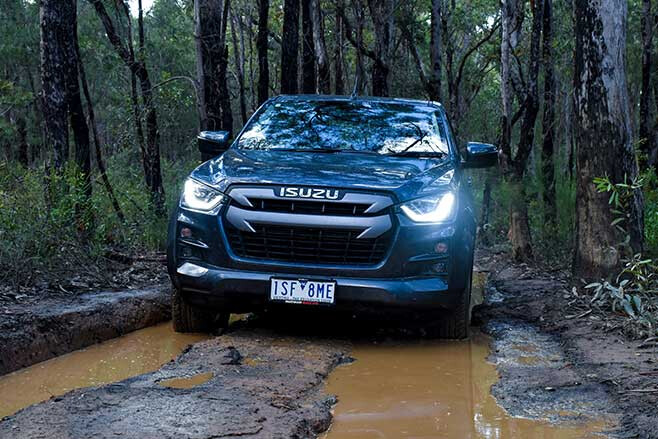
You had to spend money upgrading them, as you got just what you needed and nothing more. Times have changed, low-to-mid spec utes are far more user friendly now. I won’t say luxurious – far from it – but it is certainly amazing to see how far these workhorses have come.
Enter the latest offering from Isuzu, the 2020-21 D-MAX, and on test here in LS-M spec with a six-speed manual transmission. It sits above the base SX model, but below the LS-U and X-Terrain models respectively.
Now, I won’t give things away too early in the piece, but, for me, this is the sweet spot in the Isuzu range for modern four-wheel drivers. It’s for those who want to use the vehicle for work and play, while saving a few bucks in the process.
DOLLARS AND CENTS
NOW, I’ll start with money talk because a new 4×4 is a huge investment. I recommend you use the Isuzu website to check up-to-date pricing in your local area. I entered my postcode, selected no optional accessories, the six-speed manual transmission (X-Terrain is only available with an auto), a ute tub, in 4×4 configuration (naturally), and Obsidian Grey Mica as the colour choice.
These are the nuts and bolts: • SX: $52,715 Drive Away • LS-M: $55,970 Drive Away • LS-U: $60,065 Drive Away • X-Terrain: $60,490 Drive Away (RRP is usually $68,465).
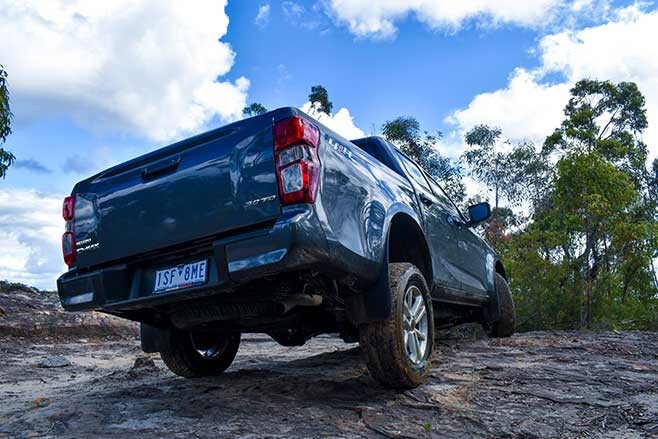
By purchasing the LS-M over the LS-U, you have saved yourself $4095, a significant amount in the kitty to spend on 4×4 accessories. If you were to go lower again, to the SX model, that’s a $7350 saving over the LS-U. You do however lose some handy additions we feel are worth the jump to the LS-M for.
WHAT DO YOU MISS OUT ON?
SIFTING closely through the specs box, it’s interesting to note the differences in inclusions between the models.
The main differences between the SX and LS-M are as follows: • Steel wheels vs alloy • Black door handles and mirrors vs colour coded • Halogen headlights vs LED • No DRL or LED fog lights in SX trim • Four-speaker stereo system vs Six-speaker in the LS-M • No USB outlet in the rear of the SX • Less interior storage options in the SX.
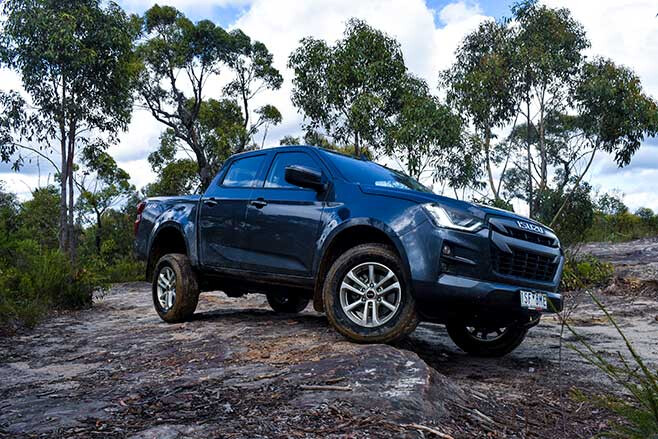
When you look at the differences between the LS-M and LS-U we found: • 18-inch wheels vs 17-inch (we prefer 17-inch anyway) • Standard leaf springs in LS-U vs heavy-duty in LS-M • Rear park-assist sensors available in the LS-U • Side-steps standard in LS-U (we’d take ’em off) • Chrome exterior accents in LS-U (chrome don’t get you home) • LED rear combination lights in LS-U • Carpet flooring in LS-U vs Vinyl in LS-M (we like vinyl flooring) • Dual-zone climate control in LS-U • Electronic adjustable lumbar support (driver only) in LS-U • Leather-wrapped steering wheel in LS-U, urethane in the LS-M • 9-inch touchscreen display in LS-U vs 7-inch in LS-M • SKY SOUND stereo system with eight speakers in LS-U vs Six speakers in LS-M.
Make of that what you will, but the vinyl flooring, 17-inch alloy wheels (better looking than the 18-inch wheels in my opinion), lack of side-steps and inclusion of heavy-duty rear leaf springs are an advantage for four-wheel drivers.
WHEELS REVIEW: D-MAX versus Ranger
Sure, the larger nine-inch touchscreen and eight-speaker sound system would be really nice, as would the rear park assistance and dual-zone climate control, but are they worth the coin? That’s on you, but for my money the LS-M is the bang-for-buck option in the 2020 Isuzu D-MAX range.
ON ROAD
YES, I know it’s a ute, but the on-road ride is on the firm side when unladen. Even my wife who has zero interest in anything automotive-related, commented on how bouncy it was on rough road surfaces, moments before spilling her coffee (go vinyl flooring).
It’s not terrible and, naturally, once loaded up it would be fine, but it’s certainly not a class-leading ride on road when unladen. Otherwise, there’s very little to report in terms of negatives. The brakes are nice, steering feel isn’t heavy like the previous generation, and the handbrake works really well. Overall, it’s a nice place to be. It just feels … solid.
We’re seeing excellent fuel economy, hovering around the 8.0L/100km mark. The six-speed manual gearbox is a no-fuss affair and, while most will opt for the auto, there’s no reason to not suggest the manual if you prefer to row through the gears. As mentioned, interior comfort is next level when compared to the previous generation, and I’d happily use this vehicle daily for work, off-road shenanigans, picking up groceries and everything in-between. It’s versatile, and at the end of the day that’s what you want in a dual-cab ute … right?
WHAT’S INSIDE?
THIS latest Isuzu D-MAX is a significant leap forward in terms of on-road dynamics and driver experience over the previous generation. The main difference would have to be the interior comfort levels and overall design. I’ve mentioned it before but the vinyl flooring used in the LS-M is an absolute boon for muddy tracks and worksites. It’s a solid bit of vinyl too, which suits the interior rather than making it feel cheap. Full points to Isuzu there.
The cupholders are also a work of art. Sounds like a silly point to bring up, but they are something I use and appreciate every time I drive the vehicle. If you have driven a 2020 Suzuki Jimny, you’ll understand how important good cupholders are …
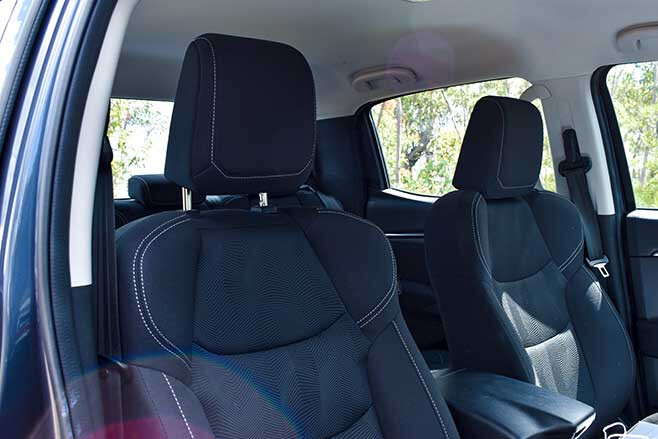
All controls are intuitive and laid out well, however you do miss out on dual-zone climate in the LS-M. Not that I’ve found a situation for that to be a deal breaker. As mentioned in my previous first impressions article, the seats in the current D-MAX are first class too and, while not electronically controlled in the LS-M model, they are comfortable and supportive. A huge improvement for occupant comfort and, let’s be honest, safety. I don’t feel fatigued driving this vehicle for long periods of time.
The six-speaker stereo system with seven-inch display is simple to use and, while a nine-inch touchscreen would be nice, I’ve got no real beef with the seven-inch display. My only gripe is the stereo could be a fraction louder overall, but I like my tunes abnormally loud. No big deal though, when you can listen to the sultry burble of that 4JJ3-TCX engine instead.
SAFETY DANCE
GET ready for a bunch of acronyms, as the 2020 D-MAX is absolutely loaded with new safety technology.
The first one to remember is IDAS, or Intelligent Driver Assistance System. This technology is standard across the D-MAX range – love it or hate it, safety tech is here to stay and will save lives. According to Isuzu, IDAS covers a range of active and passive safety technology, made up of cameras and sensors designed to keep an eye on your surroundings while you drive.
In terms of active safety, you get Autonomous Emergency Braking (AEB), Forward Collision Warning, Post-Collision Braking and Turn Assist (with AEB). Misacceleration Mitigation, Driver Attention Assist, Trailer Sway Control (TSC), Rain Sensing Automatic Wipers and Automatic Headlights (with auto-dipping high beam).
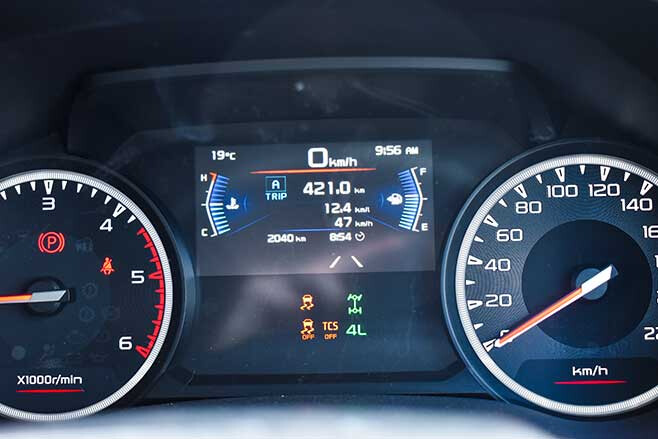
It doesn’t end there, with Lane Departure Prevention, Reversing Camera, Rear Cross Traffic Alert and Traffic Sign Recognition. There’s even more available in higher-trim specs, but you get the point … this is one smart and safe four-wheel drive.
It’s not just crazy acronyms that make the new D-MAX as safe as houses, the proof is in the pudding. In 2020, Isuzu received a five-star ANCAP rating across the range. There are eight airbags inside, too, which comes under its Passive Safety Feature banner. It’s hard not to be impressed with this level of safety technology incorporated into a dual-cab ute.
Personally, I found some of it to be too intrusive as it arrived off the showroom floor, but since playing with the settings and dulling things down, I’m happy it’s there.
THAT MOTOR
IT’S no secret the 4JJ1 turbo-diesel motor found in the previous incarnations of the D-MAX is held in high regard. Legendary even. It’s what many would dub a 500,000km engine, which will basically outlast civilisation with proper servicing. Well, Isuzu has wisely kept a 3.0L motor, but have significantly revised it for better performance. Now known as the 4JJ3-TCX, it’s quieter, smoother and more powerful.
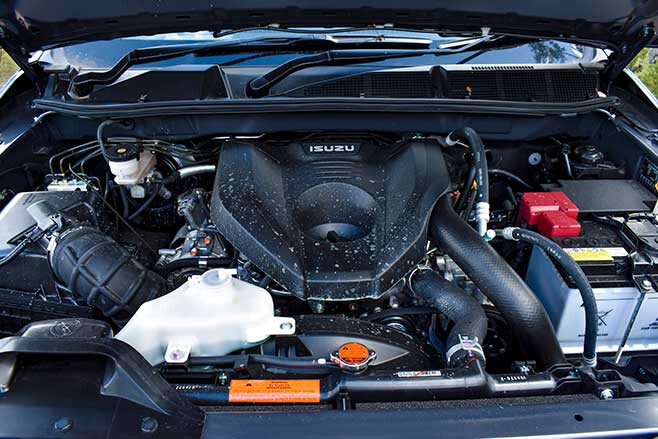
When I say revised, I really should say re-engineered. There’s a new cylinder head, pistons, block, high-pressure injection rail and variable geometry turbocharger to start with. The previous model was dogged with complaints that it was too noisy. It never bothered me, but it was a little truck-like. Funny that.
I can safely report this current oil-burner is much smoother and quieter in the cab. From the seat of the pants, it feels to have way less turbo lag, which is refreshing. Power figures are also up, with 140kW available and peak torque of 450Nm from just 1600 to 2200rpm. Just what you want in a tow rig, work vehicle or four-wheel drive.
SPEC SAVER
IT’S safe to say I’m rather smitten with the 2020 Isuzu D-MAX in LS-M trim spec. For me, it’s the perfect balance of being practical and useful, as well as comfortable and capable enough. It’s what you want in a dual-cab ute. And let’s not forget that wonderful 3.0-litre turbo-diesel motor, which just feels like it will go forever.
I’d spend the money you save over buying the higher spec LS-U or X-Terrain on some quality suspension, larger all-terrain tyres and some frontal protection, and you’ve got a solid vehicle. I’ll go so far as to say you’ve now got one of the best dual-cab utes on the market. As a Hilux owner, I don’t say that lightly.
FOLLOWING a relatively strong month of 4×4 sales in January, the results for February indicate the resurgence of new-car sales is continuing.
Once again the Hilux was the best-selling 4×4 – in fact, it was the best-selling overall vehicle when you combine 4×4 and 4×2 sales. The Hilux 4×4’s strong start to the year sees it lead perennial rival, the Ford Ranger, by more than 1400 sales.
Not that the Ranger is struggling, with the blue-oval ute sitting in second place on the overall charts (with 4×2 and 4×4 sales combined).
The Triton continues to play third fiddle to the Ranger and Hilux, slotting onto the podium with 1560 sales of its 4×4 variants for the month.
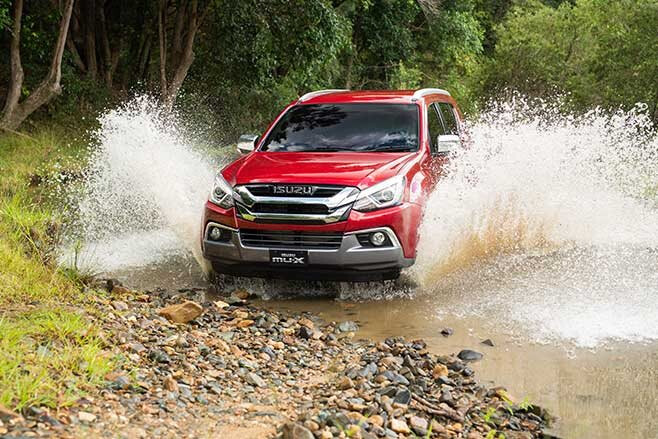
Further down the list Isuzu’s MU-X overtook the VW Amarok to reside in the top 10 on the 4×4 charts – and, with a new model imminent, expect the MU-X to continue its charge.
Overall, a total of 83,977 new vehicles were sold in Australia in February 2021 – a 5.1 per cent growth compared to February 2020 (79,940 sales were recorded).
Most interesting, however, is the dramatic increase in light commercial vehicle sales, up 24.3 per cent for the month compared to the same time last year. This is reflected in the decline of passenger car sales, which fell 15.3 per cent.
All states except Victoria posted an increase of sales for the month. Tony Weber, FCAI chief executive, said this can be attributed to the COVID-19 restrictions that were enforced during the month for Victorians.
“During the past four months we have seen an increase of 10.6% in new vehicles and this has been reflected with strong growth in NSW, Queensland, Western Australia, South Australia and the Northern Territory in February 2021. The sales reduction in Victoria can be attributed to the COVID 19 restrictions that were put in place during the month.
“We remain confident that this trend of growth will continue in an environment where business operating conditions continue to normalise.”
TOP 10 4X4 SALES: FEBURARY 2021
- Toyota Hilux: 3718
- Ford Ranger: 2603
- Mitsubishi Triton: 1560
- Toyota LandCruiser Prado: 1407
- Toyota LandCruiser 200 Series: 1326
- Isuzu D-MAX: 1280
- Toyota LandCruiser 79 Series: 1195
- Mazda BT-50: 1015
- Nissan Navara: 756
- Isuzu MU-X: 745
TOP 10 4X4 SALES SO FAR IN 2021
- Toyota Hilux: 6808
- Ford Ranger: 5405
- Mitsubishi Triton: 3283
- Toyota LandCruiser 200 Series: 2825
- Toyota LandCruiser Prado: 2766
- Isuzu D-MAX: 2696
- Toyota LandCruiser 79 Series: 2084
- Mazda BT-50: 1906
- Nissan Navara: 1586
- Isuzu MU-X: 1286
JEEP Australia has kick-started its 80th anniversary celebrations by revealing a limited-run of Wrangler Unlimited Willys.
A total of 130 Willys – inspired by the legendary 1948 Willy Overland CJ-3A – will arrive in dealerships in April, with $61,941 the asking price to net a slice of Jeep history.
Based on the 209kW 3.6-litre Wrangler Night Eagle, the Willys Limited Edition adds a selection of bespoke kit including a blacked-out front grille, 17-inch aluminium wheels, military-style stencils on the hood which pay homage to Willys of old, and retro 4×4 decal on the rear swing gate.
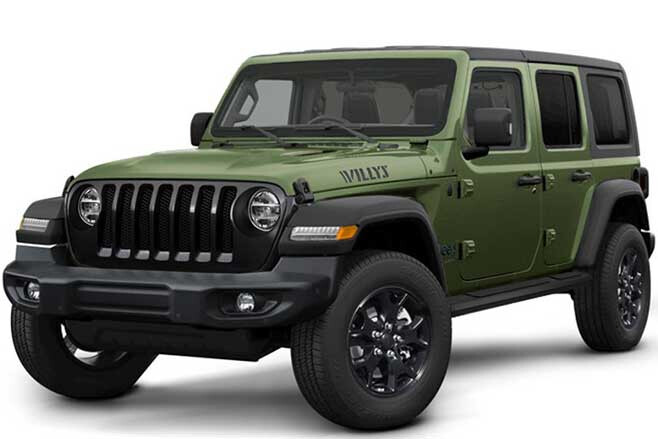
A Dana M220 rear axle – the same one found in Rubicon models – combines with a standard anti-spin rear diff, to give the Willys Limited Edition improved off-road nous compared to the Night Eagle it’s based on. The Willys Limited Edition is available exclusively with an eight-speed auto transmission.
BEST 4X4: Willys-Overland MB voted best 4×4 of all time!
“The Jeep Willys Overland CJ-3A is an off-road icon and we’re excited to offer a modern model to the market that features an array of 4×4 upgrades and unique styling that honours the Jeep heritage,” said Guillaume Drelon, Jeep Australia Director, Brand & Product Strategy.
“Jeep owners have been able to experience the adventure, open-air freedom and off-road capability that the Willys has had to offer since 1948, and this is no different in 2021,” he continued.
Available in four colours – Bright White, Black, Sting Grey and Sarge Green – the Willys Limited Edition model is available now to pre-order.
IT WAS love at first sight for Jamie, the owner of this beautiful 2012 Firenze Red Land Rover Defender.
After deciding to sell up and travel the world in 2017, he couldn’t help but notice how popular Defenders were overseas, especially in Iceland where they love to jack them up and bolt on huge balloon tyres. It was decided that on his return to Australia, he would buy a Defender and build it up.
Problem was, though, Jamie had never owned a 4×4 before, let alone a modified one, but he was keen to go camping and get out in the bush more, focusing on his passion of photography and videography. So it was time to do some research to work out what he wanted to achieve, and find the right people to help achieve his vision.
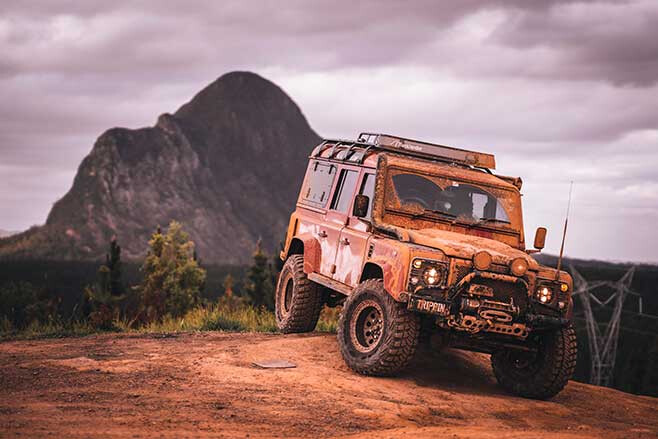
The vehicle you see before you was purchased second-hand and sight unseen, then shipped to Jamie while he crossed all his fingers and toes. “I actually got a great deal,” said Jamie. “It was in really solid condition and had a few more accessories fitted, like a long-range fuel tank, that I didn’t notice in the for-sale ad.”
That said, we’ll get the big question out of the way first – Jamie tells us his Land Rover has been nothing but reliable, and doesn’t even leak any oil … yes, it seems like he is getting sick of people asking.
CUSTOM: Land Rover Defender 90
When we say that Jamie’s Defender has been reliable, there is one elephant in the room we need to address. “I broke the front diff on a 4WD trip,” he tells us. “I don’t blame the vehicle, though, as I was pushing it really hard and once it started bouncing looking for traction, well, something had to give.”
Other than that learning experience, Jamie has been blessed with smooth sailing, something he attributes to leaving key areas unmodified, like the 2.2L turbo-diesel engine, as well as finding the right people to handle specialised tasks when required.
SPRINGS AND THINGS
JAMIE tells us that, interestingly, one of the more challenging parts of the build was sourcing parts that fit his brief. Suspension and wheels being the two trickiest areas, with not as much available for the Defender locally compared to a Patrol or Cruiser.
Jamie eventually narrowed his choice of suspension down to a set of Superior Engineering custom-valved remote res shocks front and rear, with Dobinson coil springs to give a 2.5-inch lift over stock.
One suspension component Jamie was really keen on was the fitting of a custom rear swaybar from Kingpin, including chromoly heim joints and aluminium links. This offers more rear roll stiffness to assist in even suspension travel off-road, while improving handling on-road.
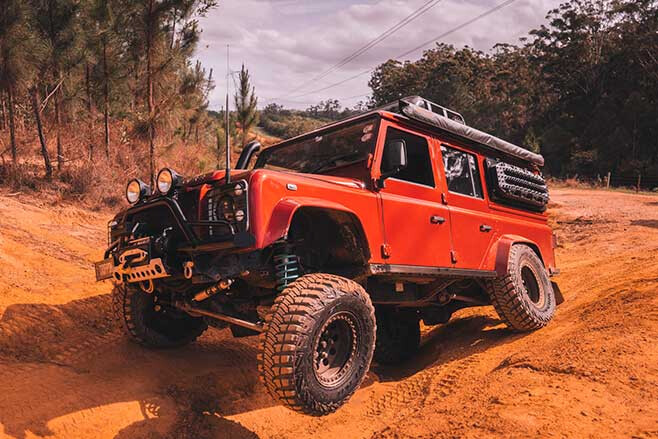
A Fox steering damper was given the nod, as well as 35mm bump stop spacers, Superior Engineering Superflex arms, Gywn Lewis cranked trailing arms and a custom front Panhard rod made by Rampt Customs using alloy rod (common in the competition scene) and heim joints for a greater range of movement. Kingpin front-shock turrets, rear shock mounts, spring retainers, lower spring retainers and chromoly track rod were also used, and Jamie rates them as being a great company to deal with, as well as providing quality gear.
A beefy Maxi-Drive drag link has also been installed, and Jamie undertook a pitman arm conversion at the same time using parts from an early model Discovery. Interestingly, a front custom-made Gwyn Lewis double-cardon propshaft was required, thanks to the increase in ride height and suspension travel. Solid stuff indeed!
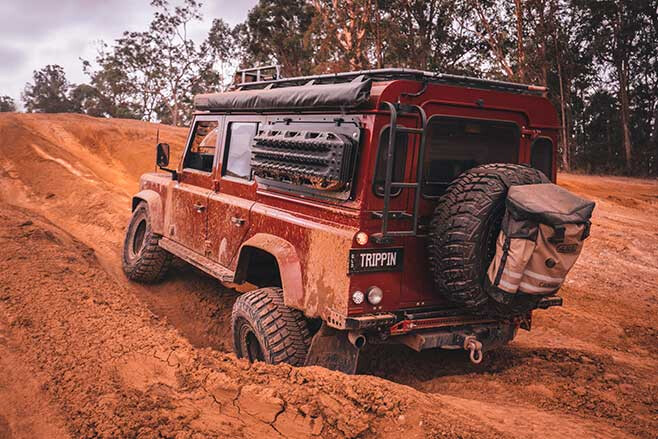
While Jamie had his heart set on a set of Method wheels, he couldn’t find anything similar available to suit the Land Rover stud pattern. So 17×9 -30 offset Dynamic steel wheels were decided on, and Jamie had them powder-coated in a custom bronze colour, which looks awesome on the red Defender.
A 4×4 is only as good as its tyres, so Jamie decided to run a set of Goodyear Wrangler mud terrains, in a 315x70r17 (just under 35 inches) size to get power to the ground and fill the wheel arches out nicely.
TOURING MODS
JAMIE has undertaken a few changes over the years of ownership, all in the name of better weight distribution. “I originally had a rooftop tent on the Defender, and my 75L fridge with drop-slide and toolbox was mounted up really high as well. I was still running the stock-width wheels with the lift kit, and I ended up tipping it on its side while out at Janowen Hills (Qld),”Jamie recounts. “After that incident, I put my rooftop tent on to an ex-army trailer, moved the internal weight as low as possible, and fitted up the wider wheels with bigger rubber. It’s a different beast now.”
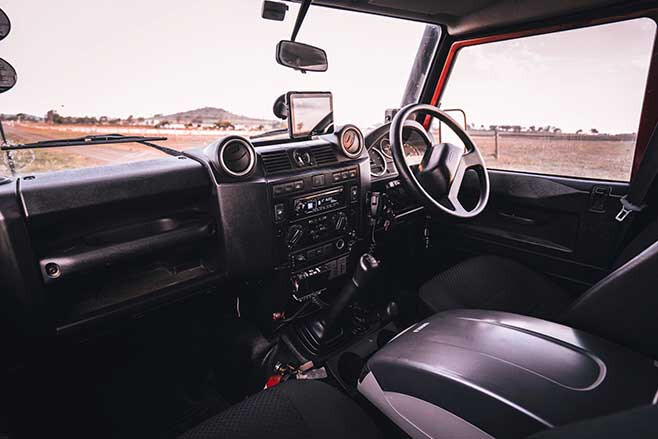
The 75L fridge is a Waeco dual-zone unit, mounted on an MSA Slide. An ARB compressor has also been installed for inflation duties, and the stock rear seats have been put in the shed to make room for everything inside the wagon. Two internal gullwing boxes are a neat addition, with the driver’s side carrying recovery gear and the passenger’s side taking care of cooking equipment and power switches.
Comms is important, so Jamie shelled out on a GME UHF. But when he doesn’t feel like talking to anyone, an Alpine head unit with a Cadence amp powering a 12-inch Kicker sub drones out any rattles or dad jokes over the UHF.
LOOKING OUTSIDE
THERE’S no denying this is a tough Defender visually, with Jamie wanting it to look cool while being able to tackle any track he deemed a challenge. Some 30mm extended Devon flares certainly add to the aggressive stance and were necessary after fitting the larger tyres.
Kingpin deluxe rock sliders add to the visual enhancements and protect the sills from damage. A tubular front bar houses the 12,000lb TJM winch and protects the front end from potential impacts while looking stylish at the same time.

Both rear windows have been replaced with Front Runner gullwings, that have transformed the practicality of the Defender tenfold. A Mulgo fold-down table and Maxtrax holder is mounted to the passenger-side gullwing, further adding to the practicality, with a Darche Eclipse awning bolted to a Tracklander roof rack to round out what is a really quality touring package.
FUTURE GOALS
EVEN though Jamie is stoked with his current setup, there are a few big-ticket items he would like to add or improve on in the future. “I’d really love to upgrade to a Red Winch Explorer 2 winch, which is one of the best on the market, and do some extra driveline modifications to strengthen any weak points,” Jamie tells us.
These driveline mods include installing Ashcroft diff locks, changing the diff ratios at the same time to improve on- and off-road performance with the larger tyres and pegging the front diff (a common Land Rover trick). Ashcroft CV joints are on the wish list, as well as Maxi-Drive flanges and axles which will remove any potential weak links in the Defender’s driveline.
Even though this is Jamie’s first 4×4 build, you can’t help but admire his choice in top-quality accessories, and the obvious amount of research he has undertaken to get this red rocket where it is today.
The March 2021 issue of 4X4 Australia hits letterboxes and stores this week, and here’s a quick sneak peak of what you’ll find inside.
As can be seen in the above video, we’ve included a comprehensive comparison of the smaller but increasingly more common seven-inch LED driving lights. For the real-world test, we measured each light at 20m, 60m and 100m intervals, before dunking them in the river to see how waterproof they are.
SUBSCRIBE TO 4X4 AUSTRALIA MAGAZINE
That glorious PX2 Ranger you see on the cover is chassis-stretched and loaded with quality kit, making it one of the most fit-for-purpose off-roaders in the country. Despite the huge amount of gear it’s carrying, an amazing job sees it remain below GVM.
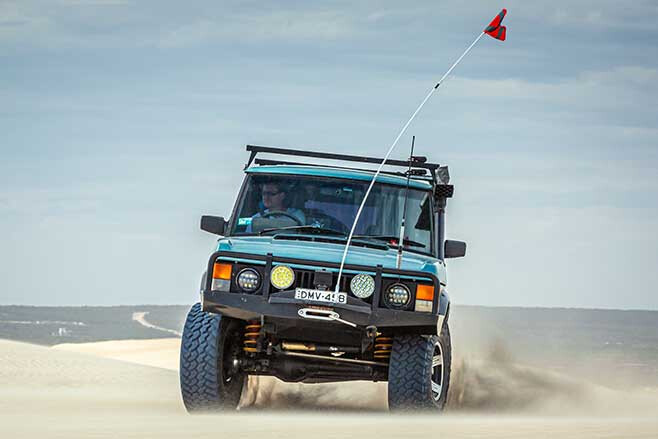
We also pointed a microscope at a fettled Range Rover Classic, which has been fitted with a 3.9L Isuzu 4BD1 engine from an ex-army Land Rover Perentie (now turbocharged, of course). Read all about the ground-up rebuild of the Classic in this issue!
On the unmodified metal front, we pointed two new vehicles to some off-road tracks to see how they fared off the tarmac: Jeep’s SWB JL Wrangler Rubicon Recon and Ford’s Ranger FX4 Max.
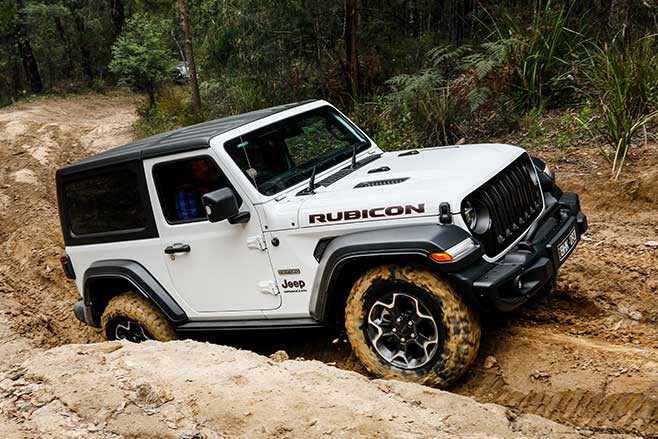
We registered plenty of kilometres this month, with separate trips to Coorabakh National Parl in NSW, Robe in South Australia and Victoria’s Golden Triangle. Plus, we’ve squeezed in yarn on the old bull-catching days and the importance of the short-wheelbase FJ25.
WHAT ELSE IS THERE?
– Monthly columns by Ron, Fraser and the Wandering Aus crew – New gear tested and analysed – Latest batch of Readers’ Rigs
The March 2021 issue of 4X4 magazine is officially on sale in stores from March 4.
I AM A bit of a tyre snob these days – you know, tried the best and now looking at the rest.
In the past, I’ve spent a bloody fortune on the big brands and to be honest they have been pretty darn good, but on the other end of the scale I’ve tried the el-cheapo range too and I’m just as impressed.
Having spent some 20 odd (some very odd) years in the bush, touring outback desert regions, clocking up stacks of highway miles and just recently spending time in Tassie and the Cape, I reckon I can lay claim to being a seasoned traveller.
During the past 18 months we’ve been travelling Australia and when it came to prep I knew I wanted muddies for where we planned to go. Now I know there are pros and cons with noise, wear patterns, being dicey in the wet (allegedly) blah, blah, blah, but that’s what I wanted.
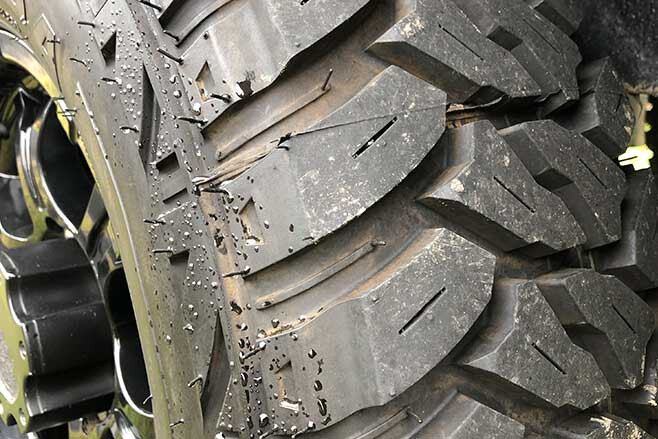
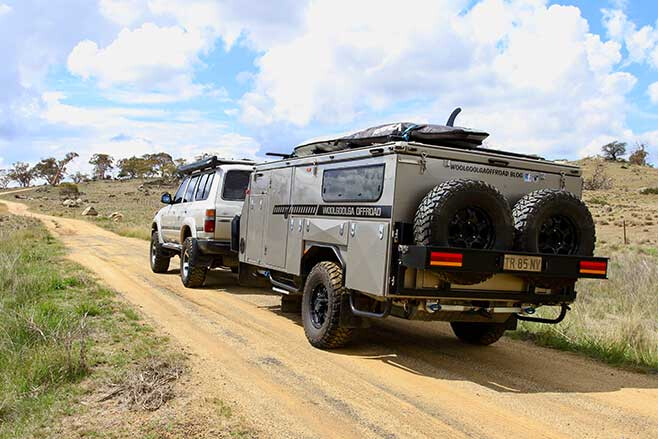
As a side note, we bought a hybrid camper the year before to prepare and there were muddies on the trailer. Again, there’s been stacks of debate regarding muddies on trailers, so I won’t go there. Anyway, the tyres on the trailer were ones I had never heard of before, namely Kenda Klevers in an MT pattern.
Now while they looked ‘tough’ on the camper (the only reason why manufacturers put them on in my books) I thought they wouldn’t last long. After having them balanced and aligned, they’ve performed well on the tracks we’ve been using to prepare for our upcoming trips.
After running the Kenda Klever muddies on the trailer for a year I thought I would take a gamble and throw a set on the Cruiser, after. I was pleasantly surprised on the ratings overseas, as well as the vast range of tyres Kenda makes for trucks, 4WDs, bikes, mowers and a few random ones. Even the history behind the company is pretty impressive; established in 1962 in Taiwan producing bike tyres, it soon moved to other fields.
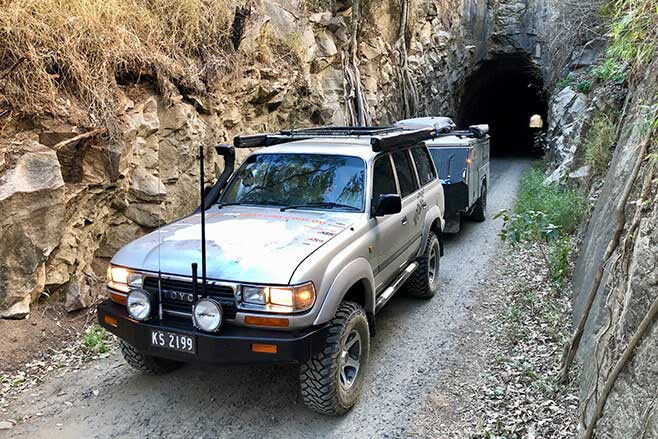
So I thought why not take a gamble with a set on the old 80 Series to match up with the camper. Without wanting to spend a bucket-load of cash – but also not wanting to skimp too much on tyres – the Kenda came in under budget: for the 285/75/16 I paid $240 each (fitted and balanced), which was very affordable.
First impressions? As they’re muddies I was expecting them to howl and be a bit blocky on the road, which they were, but they’re definitely not the noisiest I have had (mind you, I’ve run comp-style tyres that scared little kids walking down the road).
2020 TYRE TEST: Mud-terrains!
The Kenda Klever MTs have double steel-belted construction with a three-ply sidewall utilised for long-lasting wear, with tough square shoulder lugs that provide pretty decent self-cleaning capability. Like I said, they are on the cheaper end of the market and we all know that down here they all look pretty much the same in design and appearance.
But you know what, I’m bloody impressed. We’ve done some big miles along Gulf roads, outback desert roads, a lot of tar, played in the sand (not the best for a muddie), used them in the mud (around Tassie) and given them a hiding around the back blocks of Coffs Harbour.
VERDICT
AFTER having the tyres for nearly two years and being on the road for 18 months, I am very impressed with their performance in most conditions (haven’t had them in the snow yet).
However, like any tyre they need to be looked after. I check pressures every morning when cold, do a visual every time we walk around, and basically baby them trying not to hit washouts and large sharp things on the road – as well as dropping pressures to suit.
They aren’t all-terrains, so I’m always extra careful in the outback where gibber rocks tend to bust sidewalls, and with the open-tread pattern there’s always a chance of a large sharp rock or a foreign object punching a hole directly between the blocks – but, hey, that’s the chance you take with nearly any tyre. Interesting to note, though, that on the trailer the tyres are marked Made in China and the Kendas on the old girl are marked Made in Taiwan.
After 60,000km of heavy towing, exploring nearly all road types, giving them a caning in the bush, and doing the hard tracks through Tassie, up the Cape and all in between, what’s my verdict? Well, I’m suitably impressed overall and would probably get them again, but like any tyre just remember to rotate and run the right pressures to suit what you’re doing.
WHAT WE LIKE
The on- and off-road performance of these tyres has surprised me. On the road (tar) I run them at 45psi and they wear well, keep above the blocky nature muddies have, and seem to clear mud and rocks pretty well. Off-road they perform well in all conditions. I find my 80 seems secure on both the tar and off-road at full tyre pressures and they keep their balance well. Price is very attractive, too, at half the price of other brands on the market and I’m sure not half the tyre.
WHAT WE DON’T LIKE
There aren’t that many cons. Perhaps the biggest con is that you need to drop a stack of pressure for them to perform extremely well off-road. Other muddies may go down to a pressure around 22psi, with the Kenda muddies I soon learned to go straight to 16psi to bag them out. It’s a very open block design that is vulnerable to punctures.
A FEW years back there was a bloke named Isaac Newton. He was mainly famous for having an apple fall on his head, but he also said something that’s just a little bit relevant to the rig you’re looking at right now: “If I have seen further, it is by standing on the shoulders of giants.”
The concept is pretty simple: the things we’re capable of are built on the foundations laid before, a constant march towards more knowledge, or in Taylor Shaw’s case, towards one of the most bad-arse 4x4s in the country.
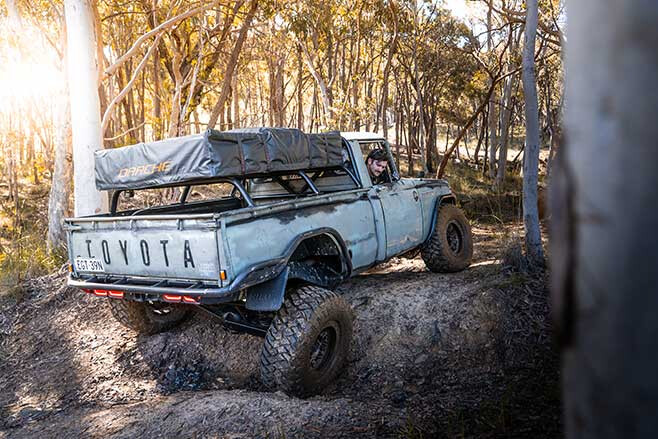
If that name rings a bell it’s because this is the third 4×4 of Taylor’s we’ve featured in as many years, each one teaching him skills along the way. Before us is the culmination of that journey so far, a bad-to-the-bone 1969 Toyota Lite Stout that’s like nothing we’ve ever seen before.
Like all good project cars, this one started with more than a little wheeling and dealing, and a whole lot of sitting around. Taylor is just the third owner, his uncle before him, his uncle’s neighbour before that signing the paperwork brand-new for just a couple of grand 52 years ago. The price when Taylor took ownership? A ride-on lawn mower in a handshake swap.
80 SERIES SWAP
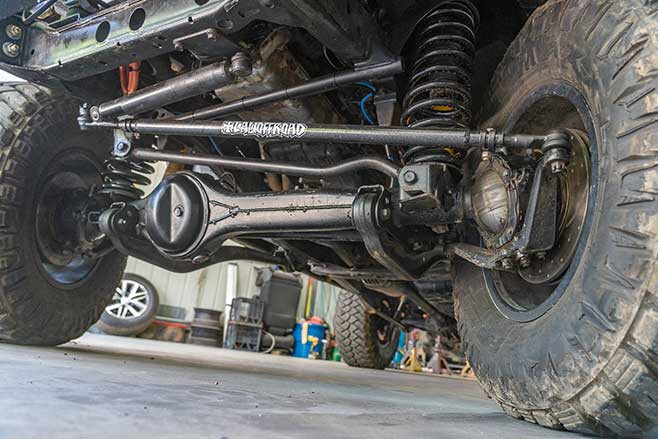
From there Taylor wheeled it into his shed, parked a petrol-powered 80 Series LandCruiser next to it, fired up the plasma cutter and proceeded to make one vehicle out of two. Taylor used the skills he’d learnt building his previous rigs to free both front and rear axles from the 80 Series chassis they were previously attached to, and graft their mounts on to the ’69 Stout frame.
To keep it looking factory, Taylor carefully unpicked the OEM spring seats and shock mounts from the 80 frame as well and transferred them to the Stout frame. While the welder was fired up, a thick-walled brace was added along the back edge of the rear axle, helping it cope with the added stresses of low-range rock bouncing at low tyre pressures.
An ARB air compressor was also given the nod, air lines running along the Stout’s chassis rails plugging into air lockers front and rear giving maximum traction at the flick of a switch. While the housings were stripped back to bare metal, he ran through them wheelnut to wheelnut replacing every bearing, seal, bushing and brake component, helping the Stout drive better than it ever has.
SUSPENSION
Front and rear the ’Yota is running three-inch lifted coil springs from EF; although, as the weight is completely different to what they’re rated for and the coil mounts are sitting wherever Taylor felt they fitted best – and there’s no real reference point for ‘lift’ in a rig like this – exactly how high it’s sitting over stock is anyone’s guess.
The shocks are another mix-and-match type affair, as Taylor is still fine-tuning the beast he’s thrown in a hodge-podge of shocks that were in the donor 80 Series, as well as a couple that were kicking around his shed.
WHEELS & TYRES
Moving farther out and things get a little more big-ticket. On each corner are a set of lightweight aluminium wheels from USA-based Dirty Life. Punching in at 17×9 the ‘Roadkill’ wheels are a beadlock design allowing Taylor to drop down to single-digit pressures for maximum traction, something necessary with the lightweight body sitting above them.
The beadlock ring not only holds the bead tight but also serves as a sacrificial component protecting the wheel itself from serious rock rash. Each wheel is wrapped in a Maxxis MT772 RAZR muddy, with Taylor’s punching in at 315/70R17.
POWERTRAIN
With serious off-road work to be done, and a lethargic carburetted four-cylinder sitting under the bonnet, the choice was pretty clear for Taylor. Out came the engine crane and the 1FZ-FE sitting in the donor 80 Series was liberated from its previous home and lined up inside the engine bay of the Stout.
The 212hp six-cylinder, double overhead cam, four-litre mill is a significant upgrade with more than twice the power of the old 80hp motor, but that also meant significant work was required to make it fit.
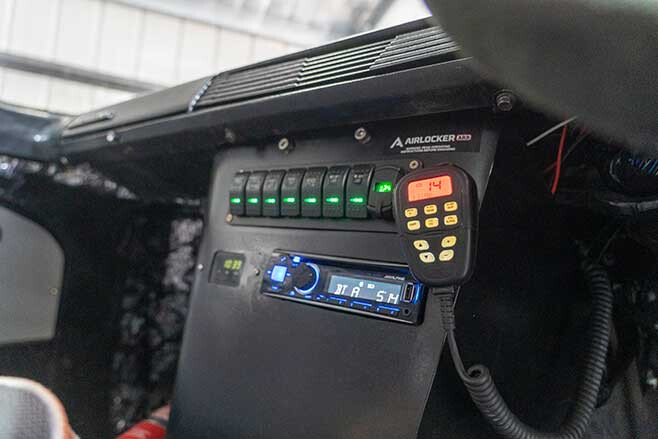
A custom alloy radiator up front mixed with thermo fans help save some space, while a tubed firewall at the back of the engine takes up the slack. Taylor pieced together an exhaust system to fit in the significantly smaller Stout that’s the same overall length as the original 80 Series system to keep noise down. It snakes around through two mufflers before punching out the side of the tub away from potential damage caused off-road.
The whole package is backed up by the standard five-speed cog-swapper and transfer case from the 80 Series, with the stock 80 driveshafts in place, too, as the wheelbase is the perfect match between the two vehicles.
BODY WORK
While the body looks largely stock from the outside, that’s testament more to the effort Taylor’s put in rather than luck. The paint up front is the same as it rolled off the production line 52 years ago, albeit with a few more dents and scrapes along the way. However, the tub is off a different vehicle and Taylor’s worked wizardry on the rattle cans to make the tub match the cab.
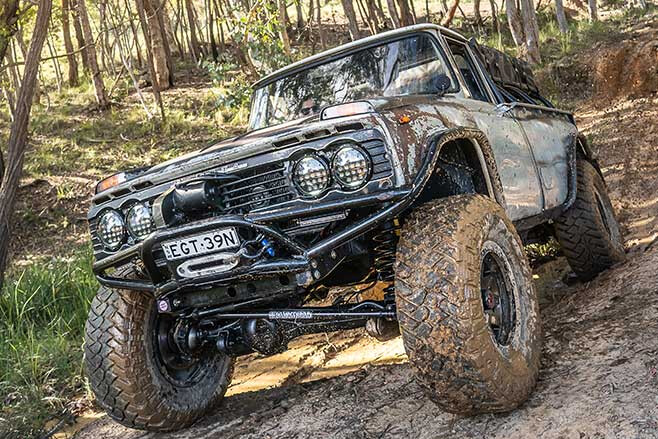
Eagle-eyed readers will spot black rattle can strips along the flanks where Taylor has sliced into the metal work and pumped it out a couple of inches either side, to help cover the wider track. The front end also copped bonnet pins; the alloy radiator sitting where the old bonnet latch sat; while the roof is the only part of the vehicle with neat paint, a lashing of white on the lid helping keep internal temperatures down.
BODY ARMOUR
Of course all that time and energy into the body couldn’t be thrown away at the first sight of a stray rock, so Taylor has heavily armoured up the lightweight rig from front to back. Up front, sitting tight to the body is a tube bar, housing the built Warn 8274 high-mount winch recessed back into the grille.
It flows rearwards into neat scrub rails over the front and rear wheels, linked by plate-steel rocker panels below the doors before finally tying into the rear tube bar. Taylor’s welder also pieced together the tub rack that holds the huge rooftop tent.
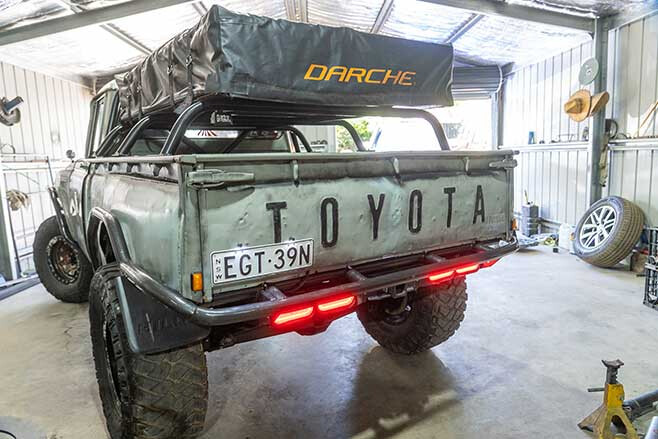
We can go on and on about the intricate details of Taylor’s latest wild ride, from the false floor in the tub to the sneaky air outlet hidden under the tie-down rails. The attention to detail in this build is insane and something that can only be appreciated in person.
For now though, the build is done, as done as can be, the lessons learnt, a new project in the pipeline, and some of the toughest tracks in the country about to come face-to-face with the toughest Stout in the country. One thing is for sure, though, if the Stout is any indication of just how far Taylor’s skills have grown in such a short time, there’s going to be some seriously insane builds rolling out of his shed in future.
BEADLOCKED WHEELS
IF you scratched your head a little at the comment about beadlocked wheels, fear not; they’re l something only one in 10,000 4WDs would run, but there is a reason they’re gaining popularity in the hardcore weekender crowd.
A GUIDE TO: Beadlock Wheels
In a typical arrangement, a tyre is held in place on the wheel by means of air pressure keeping a ‘bead’ or rib on the tyre’s edge pushed into a seat. Run too low a tyre pressure though, and that contact point weakens, allowing the wheel to spin inside the tyre, or the tyre to come off the wheel completely. Not something you’ll face driving to the local campsite, but if your wheels are bound up in the rocks and you’re in low range, it’s not uncommon.
A beadlock wheel fixes this issue by physically locking the tyre’s bead to the wheel. The locking ring sandwiching the tyre’s bead against the wheel’s external grooved surface, and the bolts on the outer edge squeezing it in place. It is an extra service point on the vehicle to monitor, but means single-digit tyre pressures are completely safe off-road.
LAND ROVER has officially added V8 muscle to its 2022 Defender family.
The supercharged 5.0-litre V8 – to be made available with both 90 and 110 models – delivers a stonking 386kW and 625Nm, making it the most powerful production Defender ever made.
It’s serious power even compared to the Defender Works V8 (298kW and 515Nm), which was created back in 2018 to celebrate Land Rover’s 70th anniversary – plus, 25 variants were produced for the 2021 Land Rover Experience at Eastnor Castle.
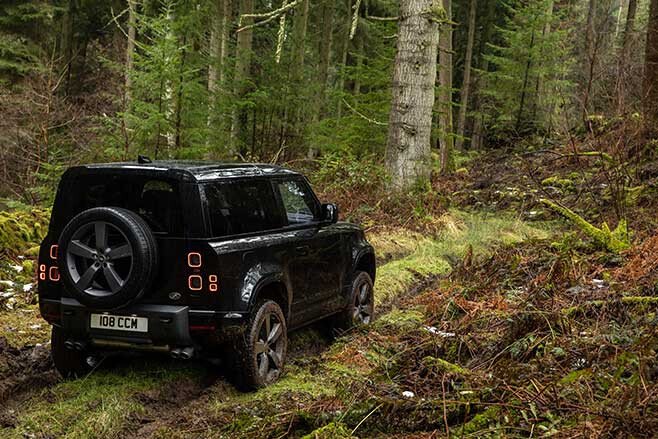
Land Rover has also tickled the Defender’s suspension and transmission, specifically tuning the V8 variant to be an even more agile and engaging experience. To this end, bespoke spring and damper rates, as well as a new electronic active rear diff (with yaw controller) are utilised.
A new Dynamic mode within the Terrain Response system is also unique to the V8 Defender.
OPINION: Here’s why the new Defender upsets purists
“The 5.0-litre V8 supercharged engine further enhances the unique character of the Defender. It sounds fantastic and delivers incredible performance – providing new levels of driver appeal,” said Iain Gray, Senior Manager, Powertrain Advanced Engineering, Jaguar Land Rover.
“Our engineering focus has been to optimise powertrain calibration for Defender to deliver both responsive on-road performance and fine control off-road – all without compromising Defender’s unstoppable all-terrain capability and wading ability.”
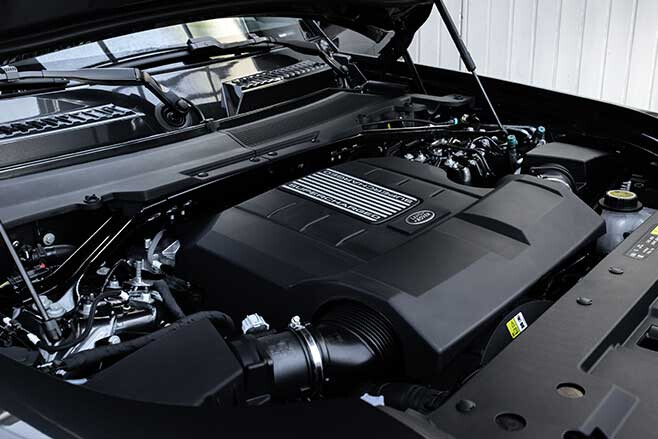
Time was also spent ensuring the visceral V8 soundtrack had maximum aural impact, with Land Rover tuning the induction and exhaust systems – flick it to Dynamic mode for full effect.
If you can’t hear it, bespoke exterior badging, quad exhausts and 22-inch alloys will help to distinguish it from its stablemates.
In addition, Land Rover also revealed a special edition Defender XS, to be slotted into the line-up above the SE models.
Also available in both 90 and 110 bodies, the XS is available exclusively with the P400 petrol engine and features a handful of style tweaks: bespoke lower cladding, lower wheel arches and 20-inch alloys.
REVIEW: 2021 Defender P400
2022 Land Rover Defender pricing for Australia
- 90 P300: $74,640
- 90 D200: $81,290
- 90 D250 S: $90,450
- 90 P300 S: $83,470
- 90 P400 SE: $100,450
- 90 P400 XS Edition: $110,640
- 90 P400 X: $141,480
- 90 P525 V8: $200,540
- 110 P300: $76,960
- 110 D250: $82,590
- 110 D250 S: $91,220
- 110 P400 S: $92,360
- 110 D300 SE: $ 96,780
- 110 P400 SE: $103,800
- 110 P400 XS Edition: $113,580
- 110 D300 X-Dynamic HSE: $113,980
- 110 P400 X-Dynamic HSE: $120,480
- 110 D300 X: $143,190
- 110 P400 X: $145,290
- 110 P525 V8: $205,500
RAM Trucks USA dropped the covers on its HEMI-powered 1500 TRX in 2020, with RAM Australia saying at the time it was eager for it to arrive as the flagship offering of the 1500 range.
A local arrival now seems one step closer to reality, with expressions of interest for the 1500 TRX now available on the Ram Trucks Australia website – “We’re working closely with our colleagues in the US to bring the TRX to Australia in 2021,” it says.
By jotting down details, punters can now receive up-to-date information when it comes to light,
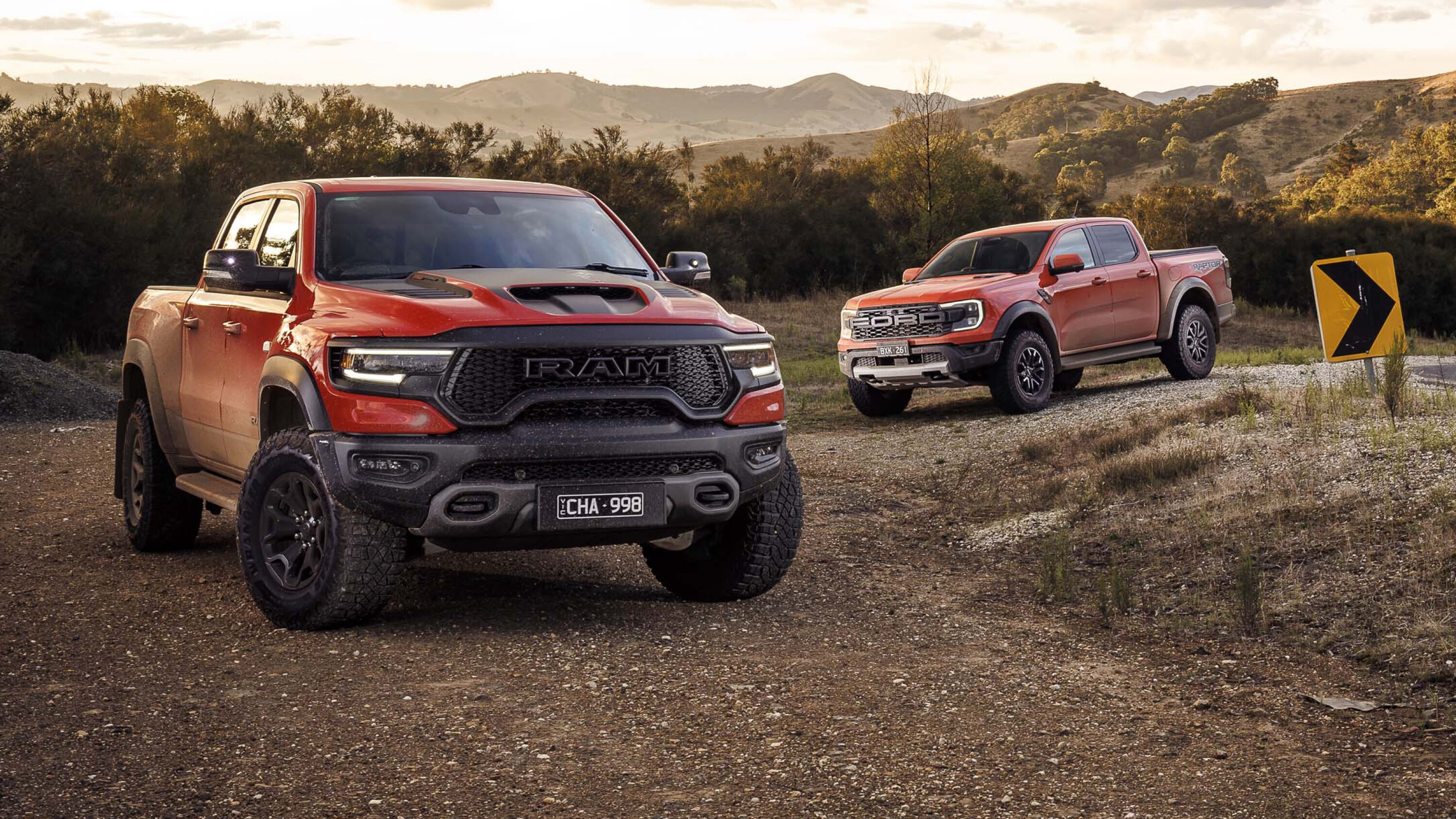
UPDATE, May 2023: Ram 1500 TRX v Ranger Raptor
?♂️ Australia’s most outrageous utes face off in a rock-spraying, fuel gargling celebration of excess. Strap in, it’s about to get noisy!
STORY CONTINUES: 1500 TRX launches in America
The HEMI V8 giving the TRX the title of “most powerful mass-produced truck in the world” is the venerable supercharged 6.2-litre offering rated at 523kW and 881Nm and said to help the TRX hit 60mph (97km/h) from zero in just 4.5 seconds. The HEMI runs through a TorqueFlite 8HP95 eight-speed automatic transmission.
Clean, cool air is fed into the V8 by a new dual-path induction system, which utilises two paths to draw in air – via the hood scoop, and via the front grille.
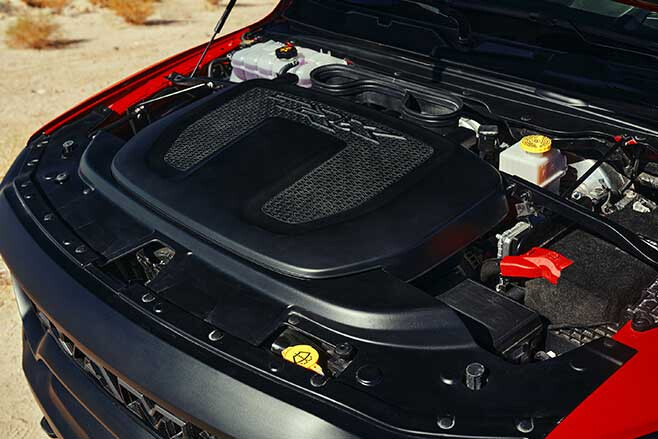
“The entire Ram TRX intake system is engineered to minimise power-robbing air restrictions while ensuring only clean, cool air reaches the engine,” the RAM Trucks USA press statement reads.
“Industry-standard testing shows that the Ram TRX far exceeds any competitor in the amount of time it can ingest dirty air and debris before performance is diminished.”
A wider stance than the rest of the 1500 range – eight inches wider, in fact – means the TRX had to undergo changes to compensate, including stretched composite flares and fender wells, a six-inch increase in track width, and wider wheels wrapped with 35-inch Goodyear Wrangler Territory 325/65/R18 All-Terrains. 18-inch beadlock-ready wheels are available.
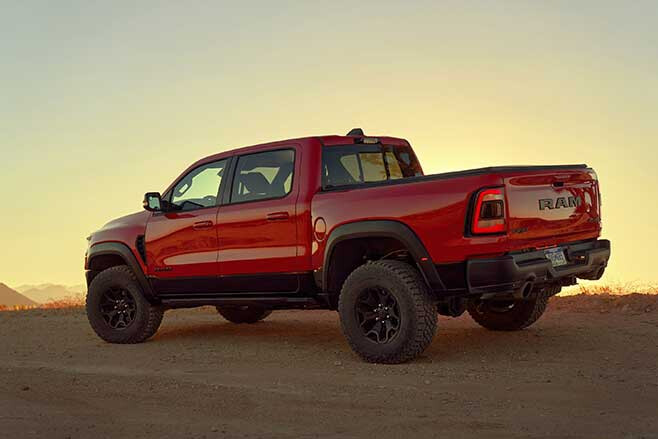
Even the RAM badging is bigger than its 1500 stablemates, with the TRX also receiving unique skid plates (five in total) and steel bumpers.
The Raptor-fighting TRX – built and tested (including rock-crawling in Moab, Utah) to handle tough off-road conditions with a smattering of high-strength steel and aluminium – runs an independent front suspension set-up with new front upper and lower control arms.
The rear suspension employs active damping, a five-link coil system and a Dana 60 rear axle, to increase rear wheel travel by more than 40 per cent compared to the rest of the 1500 line-up.
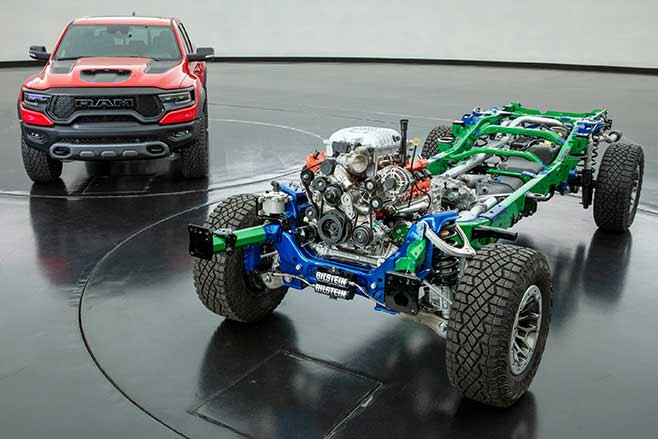
Utilising a BorgWarner 48-13 full-time active transfer case, the TRX features a low range of 2.64:1. The off-road specs are equally impressive, with an approach angle of 30.2 degrees, breakover angle of 21.9 degrees, departure angle of 23.5 degrees, a ground clearance of 11.8 inches (299.7mm), and a water-fording depth of 32 inches (812.8mm).
It also boasts a towing capacity of 8100lb (3674kg) and a 1310lb (594kg) payload capacity.
Three dynamic off-road modes are pre-configured into the software – Mud/Sand, Rock, and Baja – which modulates the four-wheel-drive system, throttle response, transmission, paddle shifters, suspension and steering, depending on the terrain.
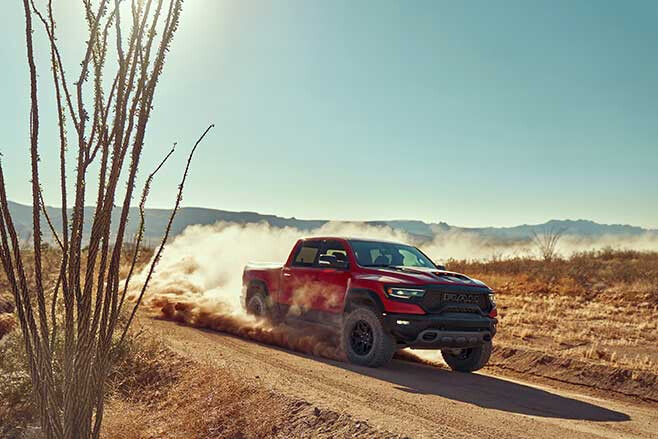
Another nifty feature of the TRX is Jump Detection, which senses when the vehicle is airborne and prevents driveline damage by modifying a number of driveline components including engine speed, torque, gear selection, transfer case torque split and damping rates.
The 1500 TRX is expected to arrive locally late in 2021, with an estimated $200K price tag.