
There was a time – about a decade ago – when Jeep’s Grand Cherokee was Australia’s favourite large SUV and the seven-slot grille would regularly muscle Toyota’s Kluger and the Ford Territory out of the picture with seemingly unstoppable sales.
A short time after in 2014, the company enjoyed its best year to date with more than 30,000 Australians buying in to the brand. But the new-car market is a savagely fickle place to play and things started to go downhill. The sales, it appeared, were stoppable after all.
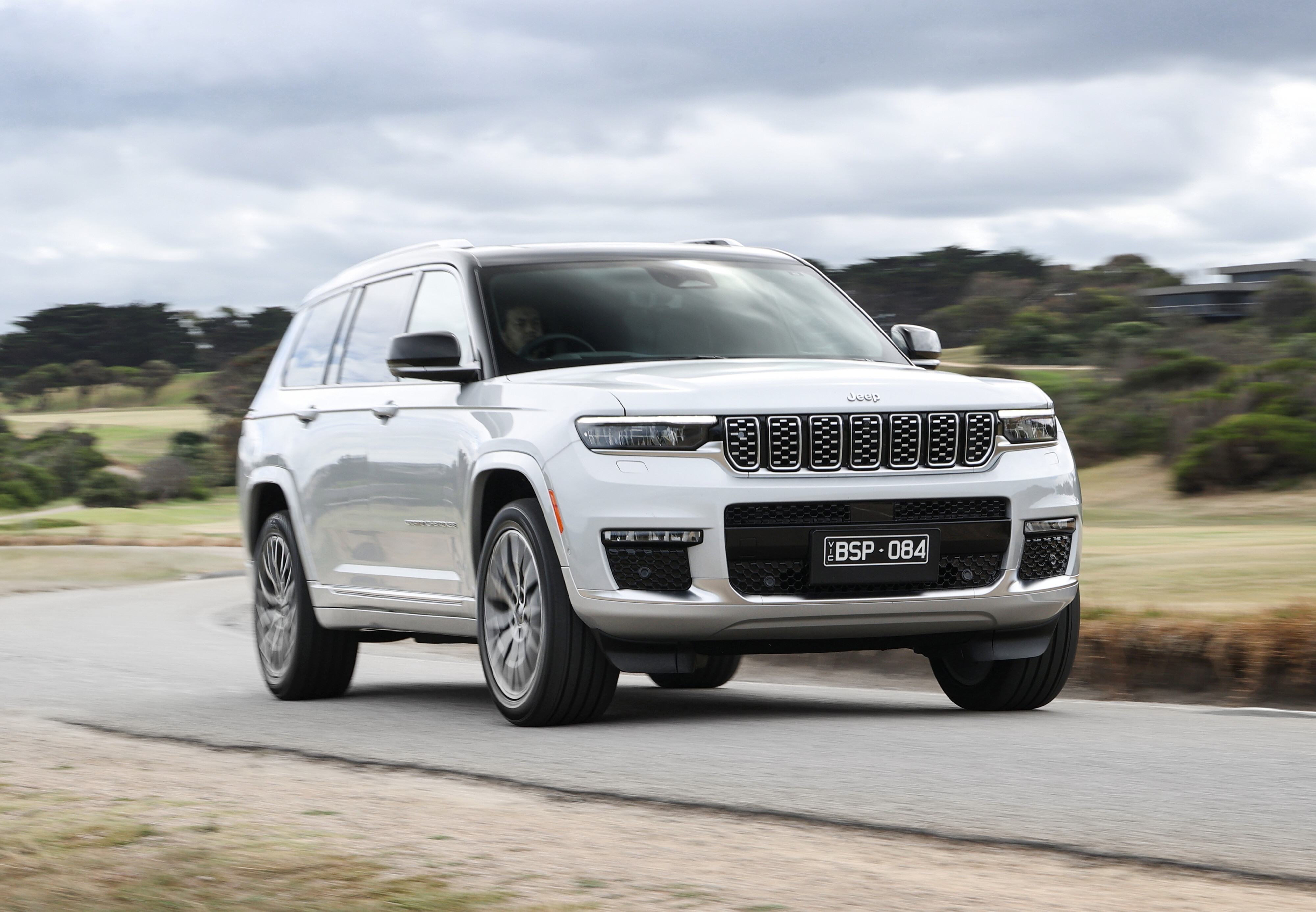
Today, Jeep is resolute in its mission to return to the glory days and it’s turning the tide with fresh metal including the Compass in 2018, a new Wrangler and its Gladiator cousin, and now this.
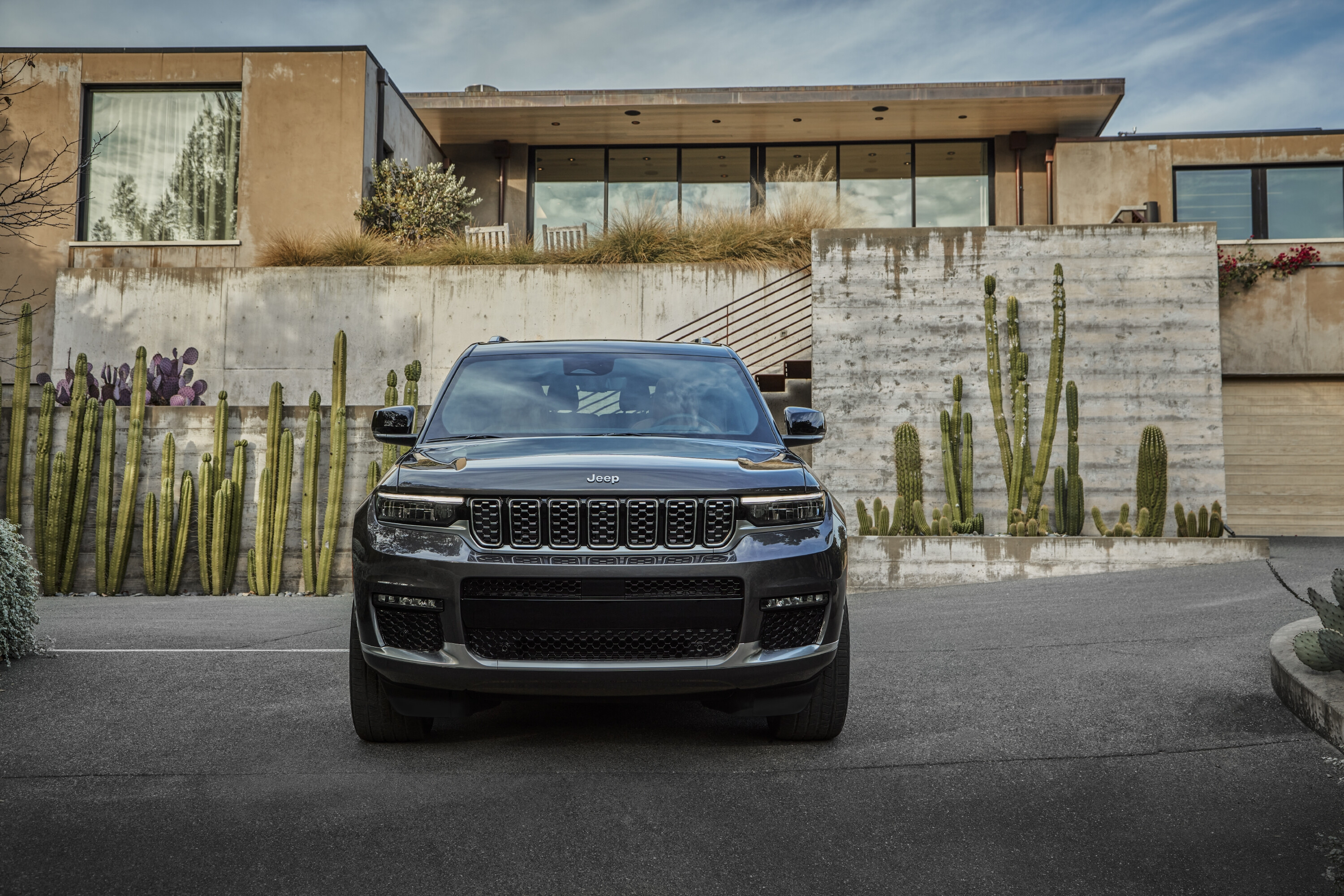
Ahead of the more familiar five-seat Grand Cherokee that’ll touch down late in the year, the new longer version denoted by its L boot badge has arrived and it signifies a ‘revolution not evolution’ for the brand, according to Jeep India and Asia Pacific vice president Billy Hayes.
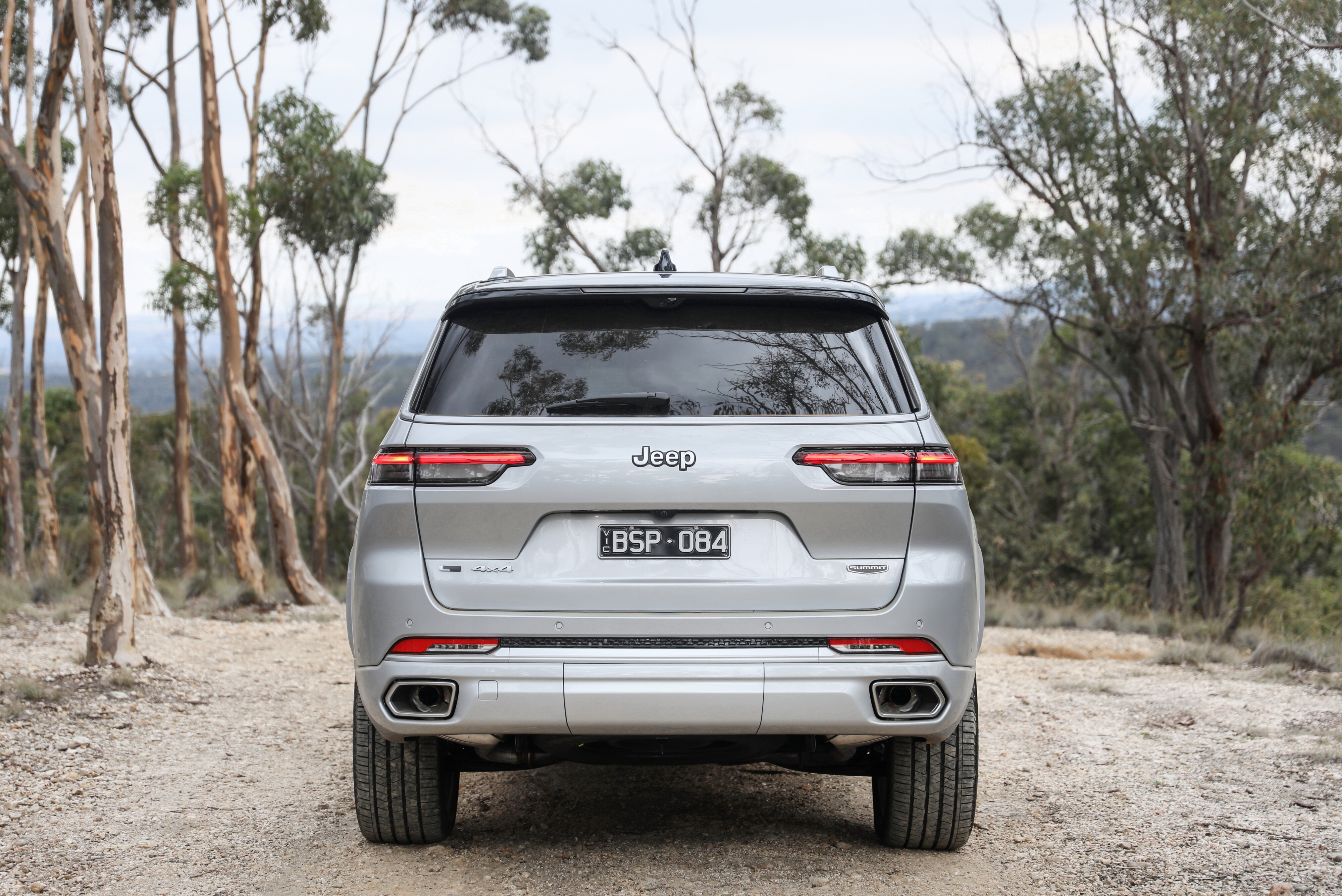
Why such confidence? Well for a start, with about 200mm added in to the wheelbase, the L thrusts the Grand Cherokee in to the seven-seat arena for the first time, bumping gloves with long-standing models including the Nissan Patrol.
And then there’s the equipment and apparent quality. As part of Jeep’s premium push, the Grand Cherokee L assumes a role spruiking exactly what the company can do in its bid to become a more luxury brand, while still retaining its lifestyle focus which put the seven-slot grille on the map. The question is, does it?
Powertrain and performance
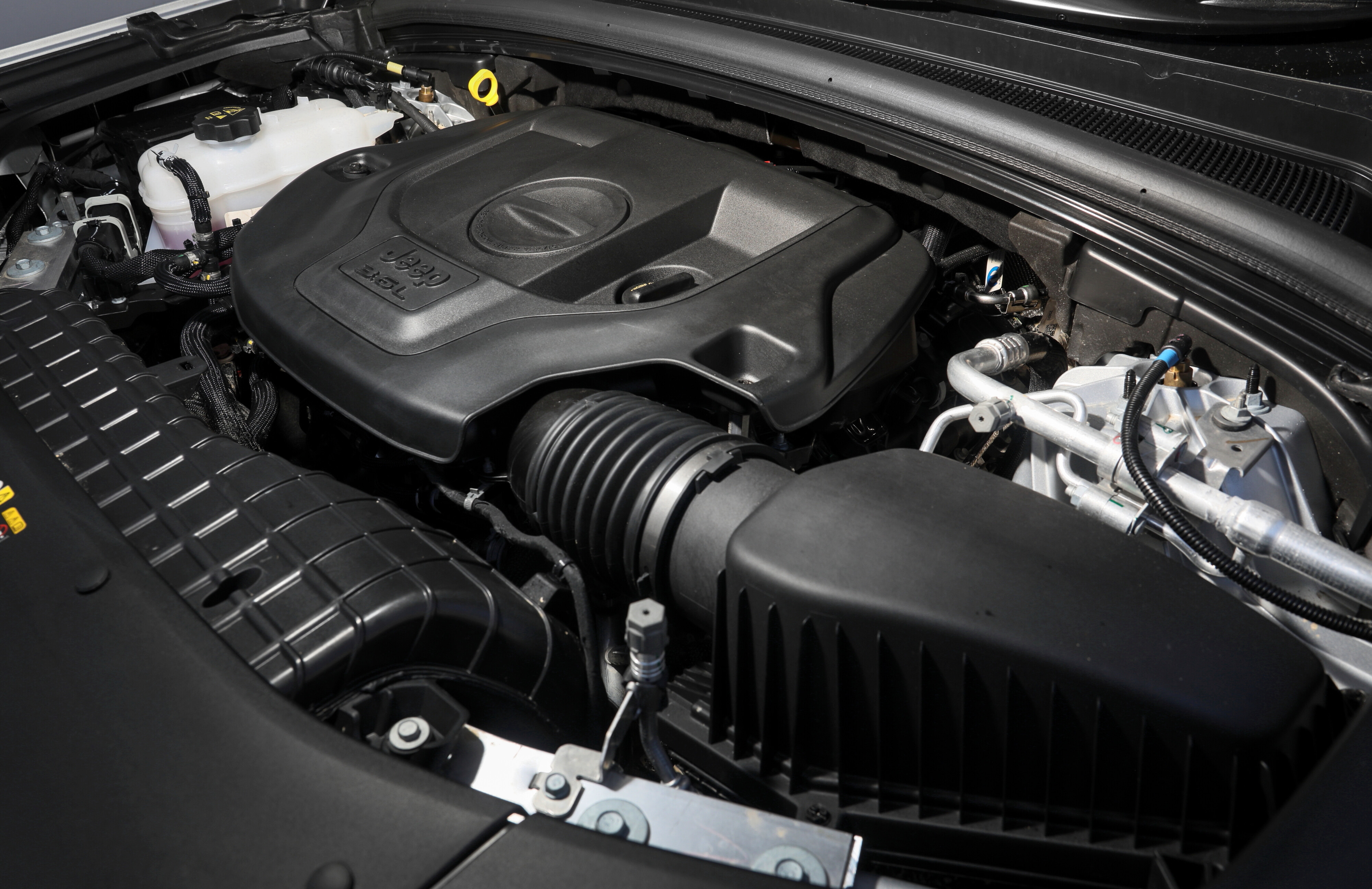
On the road, things are looking promising. Initial disappointment at the absence of the forthcoming straight-six, a silky diesel or Hemi V8 subsides as the 3.6-litre Pentastar V6 petrol starts to show its character.
The 210kW and 344Nm might seem a little impotent for a car of its size, but the aging donk is still a surprisingly flexible unit.
Paired to the eight-speed torque-converter auto, the naturally aspirated engine is allowed to rev rather than hunting the higher gears as many diesel drivetrains are calibrated in search of single-figure fuel economy. The result is reasonable performance and a vocal note inside and out.
Efficiency does suffer, however, and while Jeep claims a combined figure of 10.6L/100km, the best we managed with a combination of on- and off-road was always in the 12s and 13s.
On the road
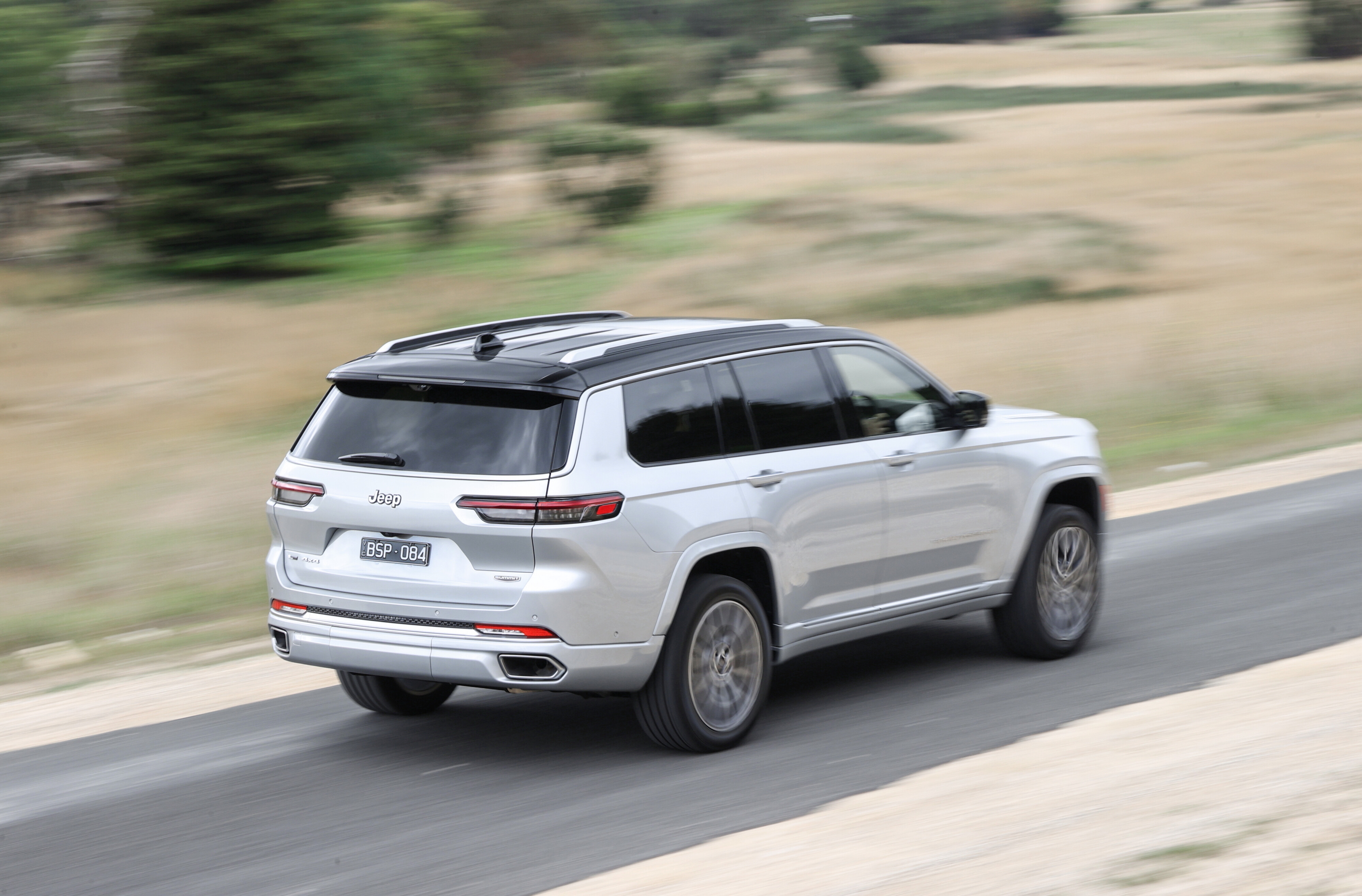
That aside, the chassis is way lighter on its feet than expected and can really carry some pace on sealed surfaces. Steering and brake feel has a decent weight and feels somewhat old-school.
Whether that be a good or bad thing is down to the user, but it lacks the numbness some excessively light and over-assisted systems suffer.
All, however, will appreciate the quiet ride, smooth cruising and excellent comfort levels.
Cabin and accommodation
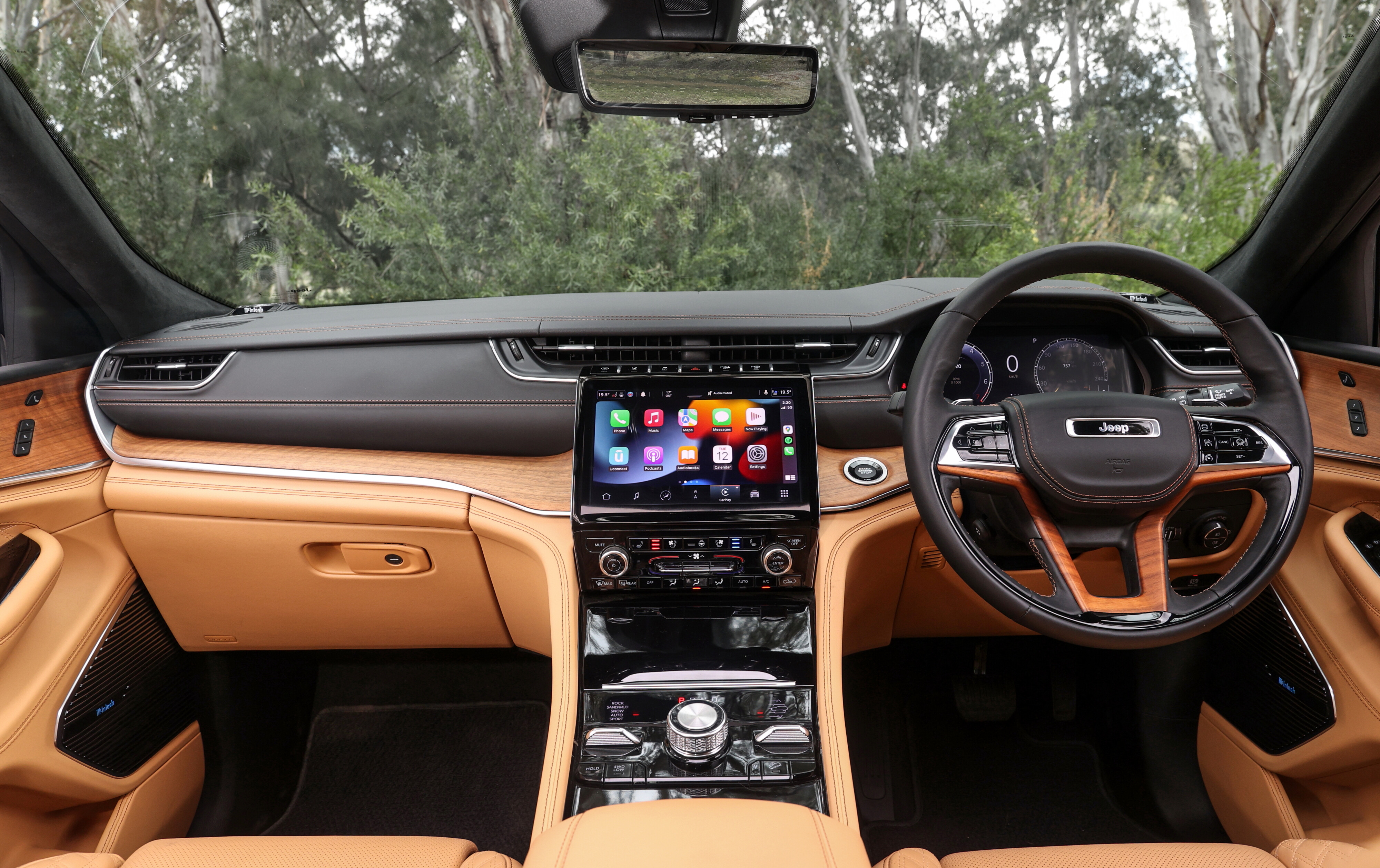
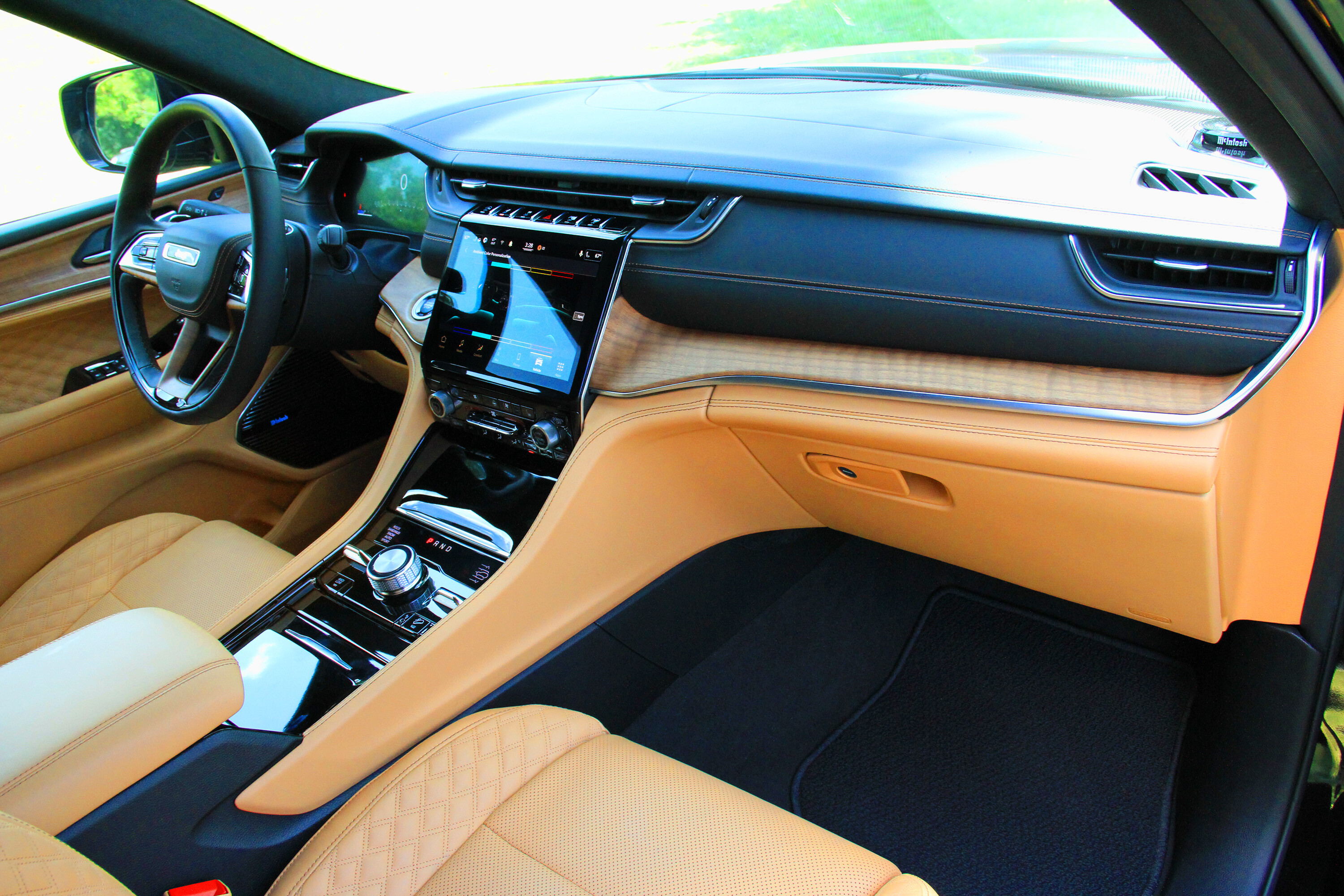
In the top-spec Summit, a Jeep cabin has never looked so posh. There’s acres of quilted leather, soft-touch materials everywhere, beautifully tactile unvarnished wood trim combined with slick design. A little too much gloss black finish is the only thing to let the otherwise stunning interior down.
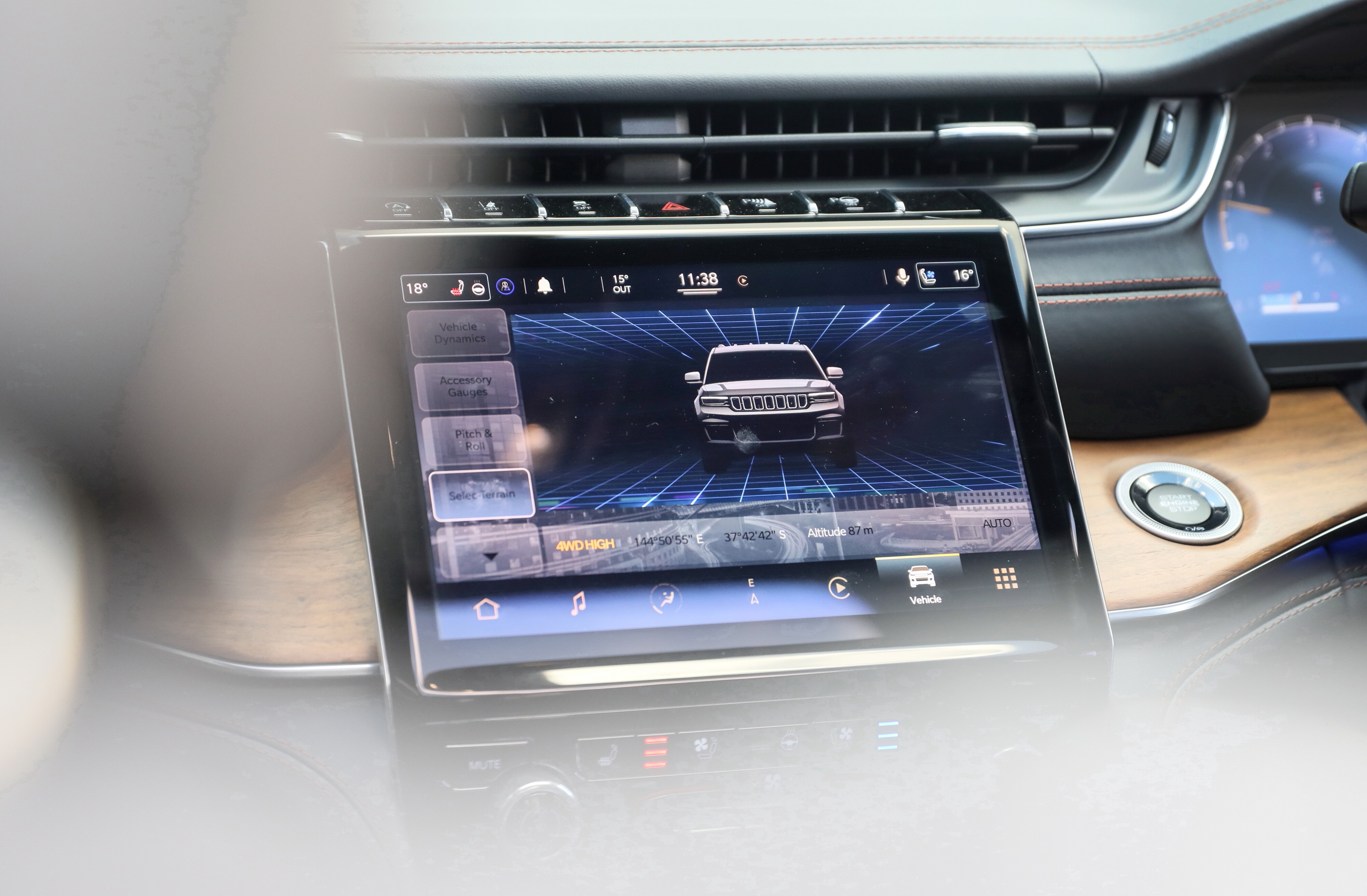
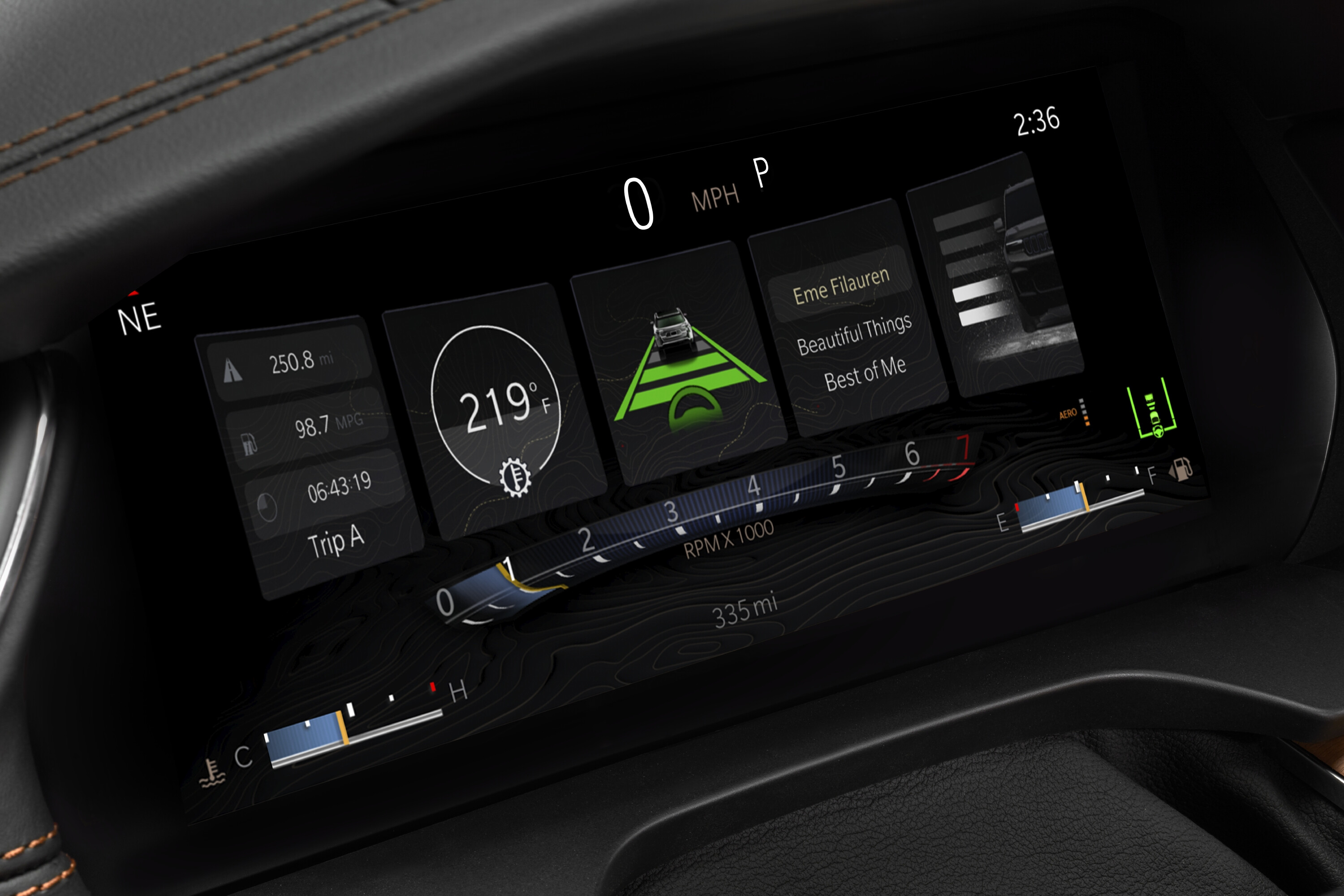
A pair of sharp digital screens maintain the high-quality standards with a highly customisable instrument cluster for the driver, complemented by a second 10.1-inch touchscreen in the central dash.
It contains the latest UConnect 5 operating system and it’s a big step up with excellent resolution, tons of native applications and an absolute heap of off-road centric instrumentation and information one might expect from the brand.
The digital experience is impressive, but a refusal of the TomTom-based navigation to boot one morning and a reversion to Italian language for no apparent reason were just a couple of unwelcome gremlins.
While driver assistance and safety systems are generous as standard, the optional lane-departure assistant was freaked out by Australian roads on more than one occasion, objecting with a loud, annoying beep each time.
Ultimately though, the numerous plusses stand out from the L. Even in the third row there’s tons of space; 12 USB ports are scattered about the place, six of which are the most modern type-C; and clever innovations such as the ‘Fam Cam’ allow kids or just untrustworthy adults to be monitored in the rear seats.
Optional equipment is a blend of some items you might expect to be included in a $115,000 machine such as sunroof and head-up display, and some things you definitely wouldn’t including a really cool night-vision camera and a second touchscreen exclusively for the front passenger.
Off-road
With the fifth-gen Grand Cherokee, Jeep really is moving in to more premium territory, but if it’s at the cost of the all-terrain kudos, it will have done the moniker an injustice.
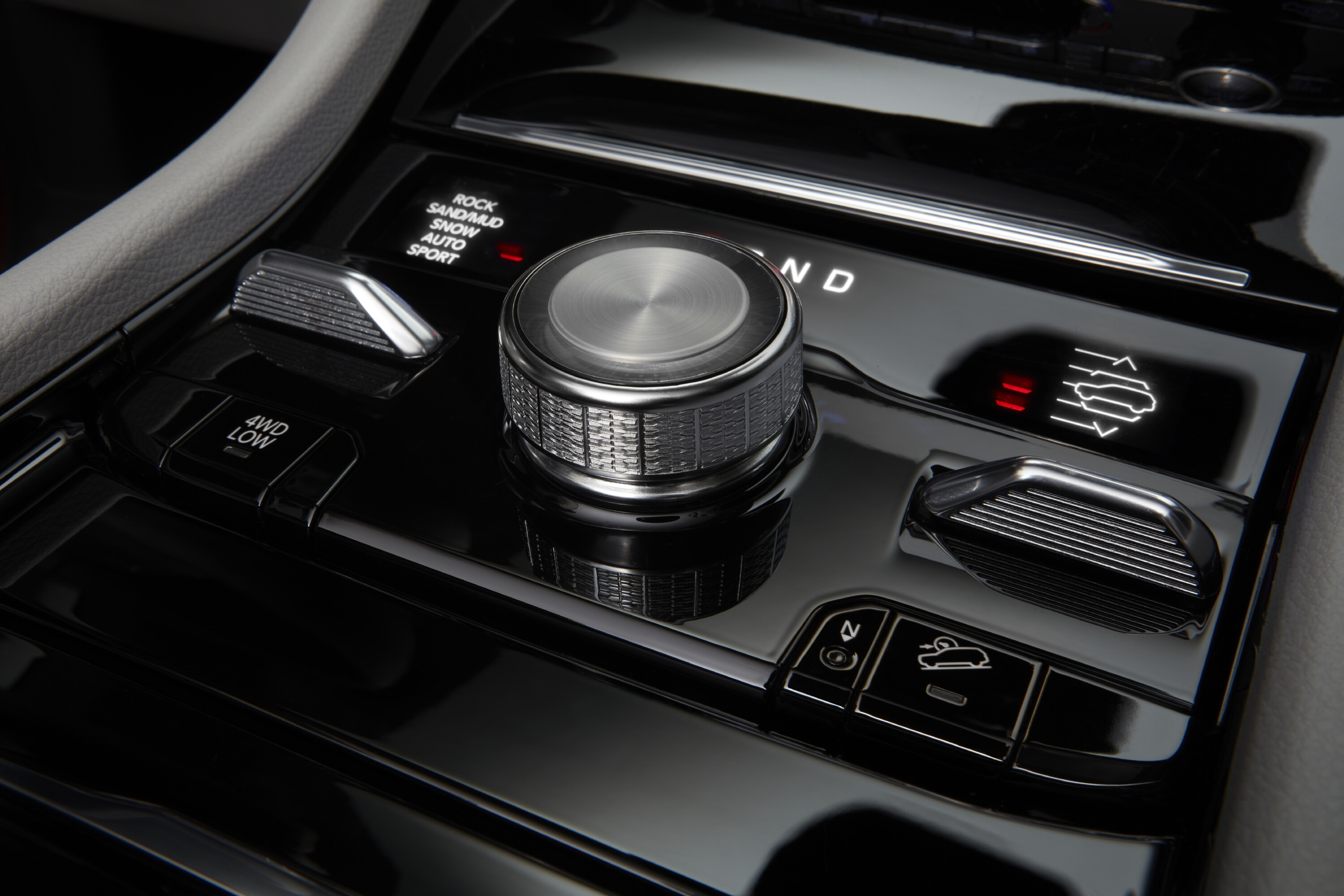
Fortunately, the new model delivers here too. Equipped with Quadra-Trac I and Quadra-Drive II, the Limited is pointed at the trail less trodden, but opt for the Summit and you’ll get air suspension, a two-speed transfer box and extra off-road modes – that’s more than just a statement of intent.
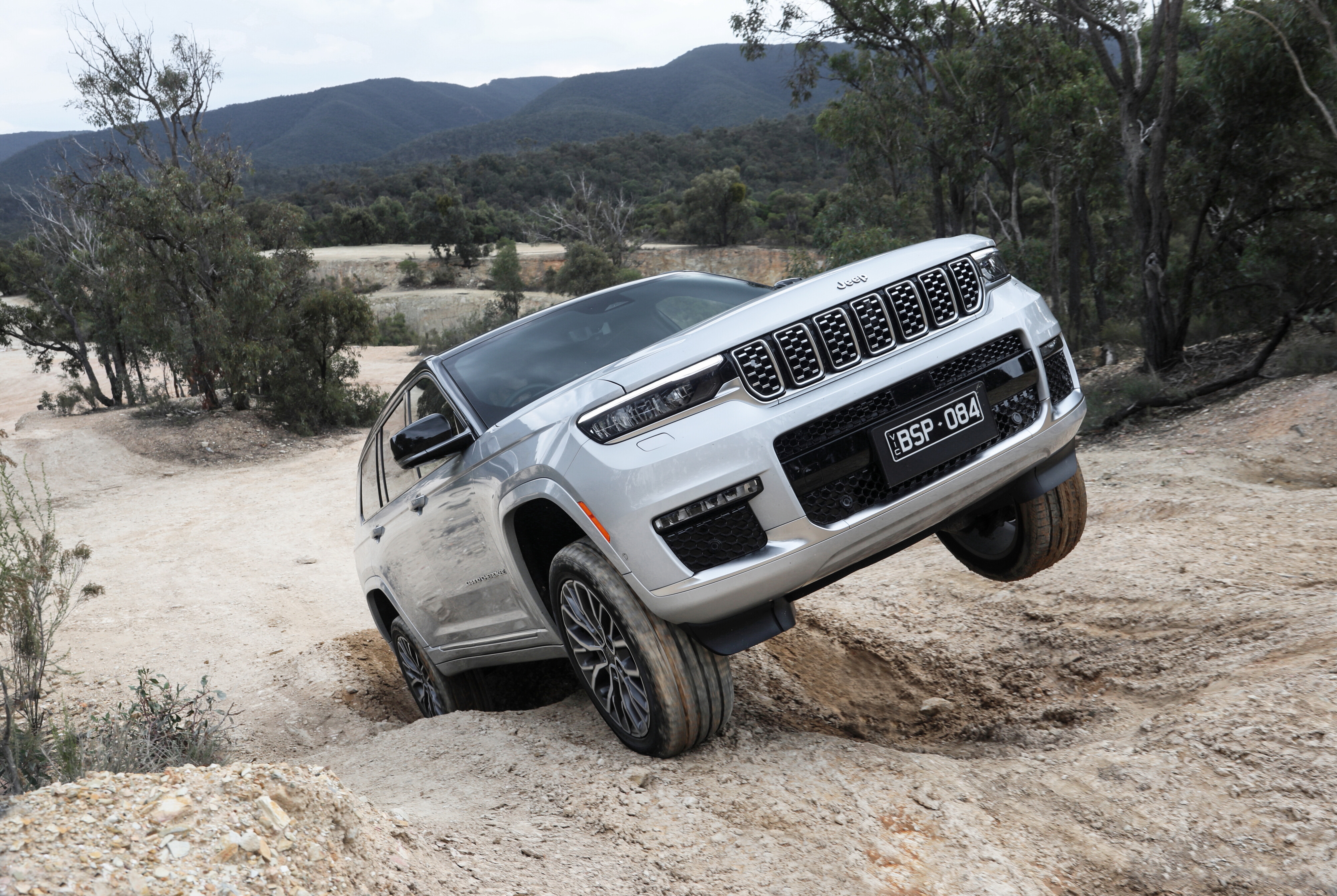
With its suspension jacked to the max, the Grand Cherokee manages 272mm of ground clearance and, while its longer wheelbase and reduced breakover angle does diminish outright ability, the L can still really go places.
Another limiting factor are the Continental Cross Contact LX Sport tyres fitted to 21-inch wheels, which would appear to be a weak link if you do intend to hit the gnarly trails hard.
And if you have grand designs to fit larger rubber then think again, because the front struts have a pinch-bolt located right at the perimeter of the standard rubber limiting overall diameter. But for a vast majority of off-road challenges, the factory set-up does incredibly well.
Only the most ambitious rocks could find the Jeep’s belly; deep ruts and mud didn’t once faze the Grand Cherokee’s composure, and even some serious climbs and descents were dispatched with surprising competency.
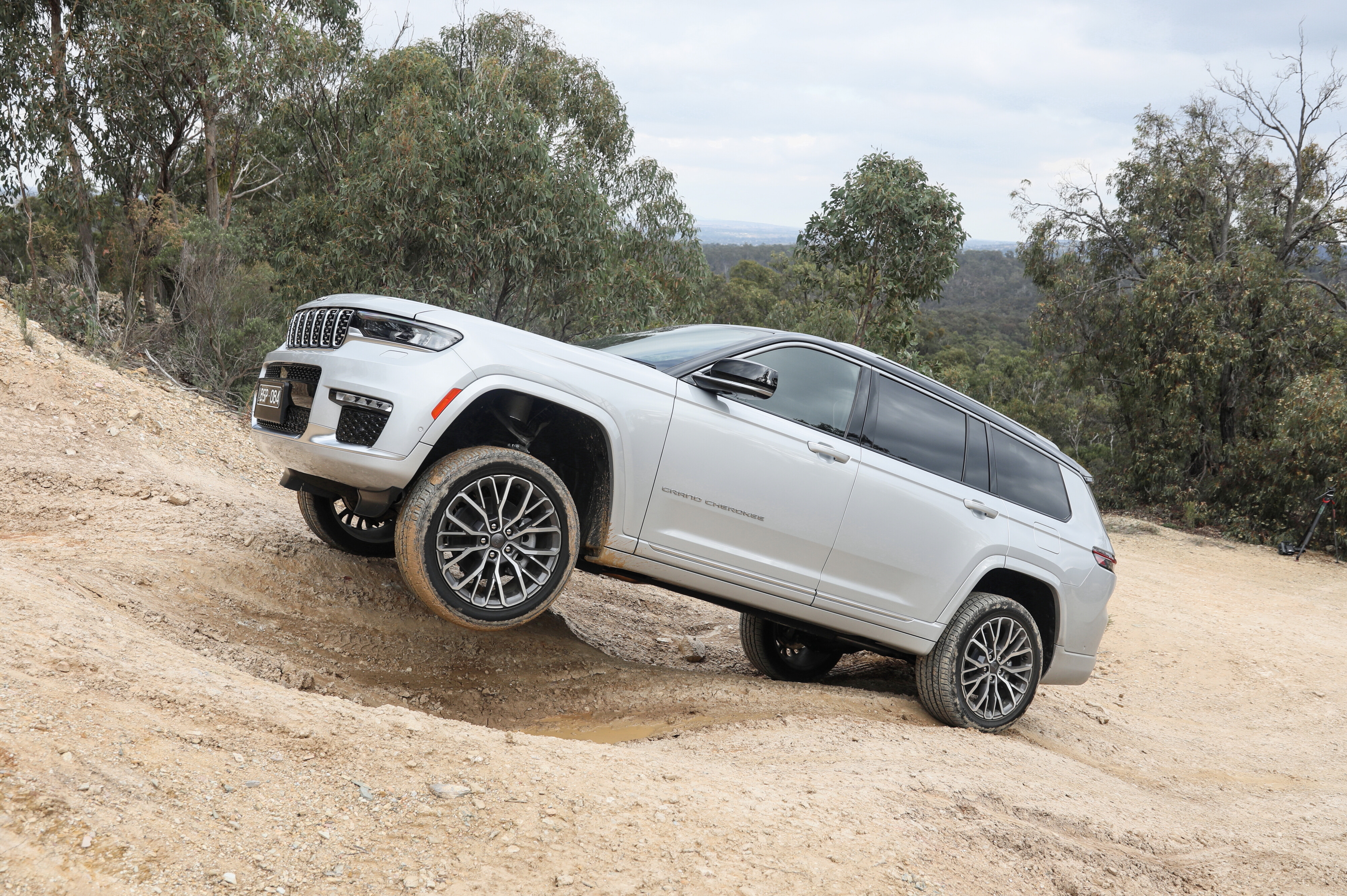
Wheel articulation is fair but limited at maximum height, and the overall proportions could become ungainly in tight spots, but it’s hard to imagine this particular model being thrown at terrain half as challenging as the route we chose during its normal duties. In that regard, this particular Jeep has passed with flying colours.
But here’s the best bit: Despite only having a single-speed transfer, fixed-height coil spring suspension and rolling on 20-inch wheels, the Limited version went everywhere the Summit could.
VERDICT
At the ragged fringes of ability, the top-spec car would likely have the edge, but you’d have to be trying hard to demonstrate the compromise. That might be enough to lure in a good number more customers for whom a Jeep with a $100K-plus price tag doesn’t equate.
Nonetheless, it’s clear from the deft blend of on-road refinement and sophistication, combined with typical off-road aptitude, that the new Grand Cherokee has spent significant time on Australian roads and is a model well-suited to local demands as a result.
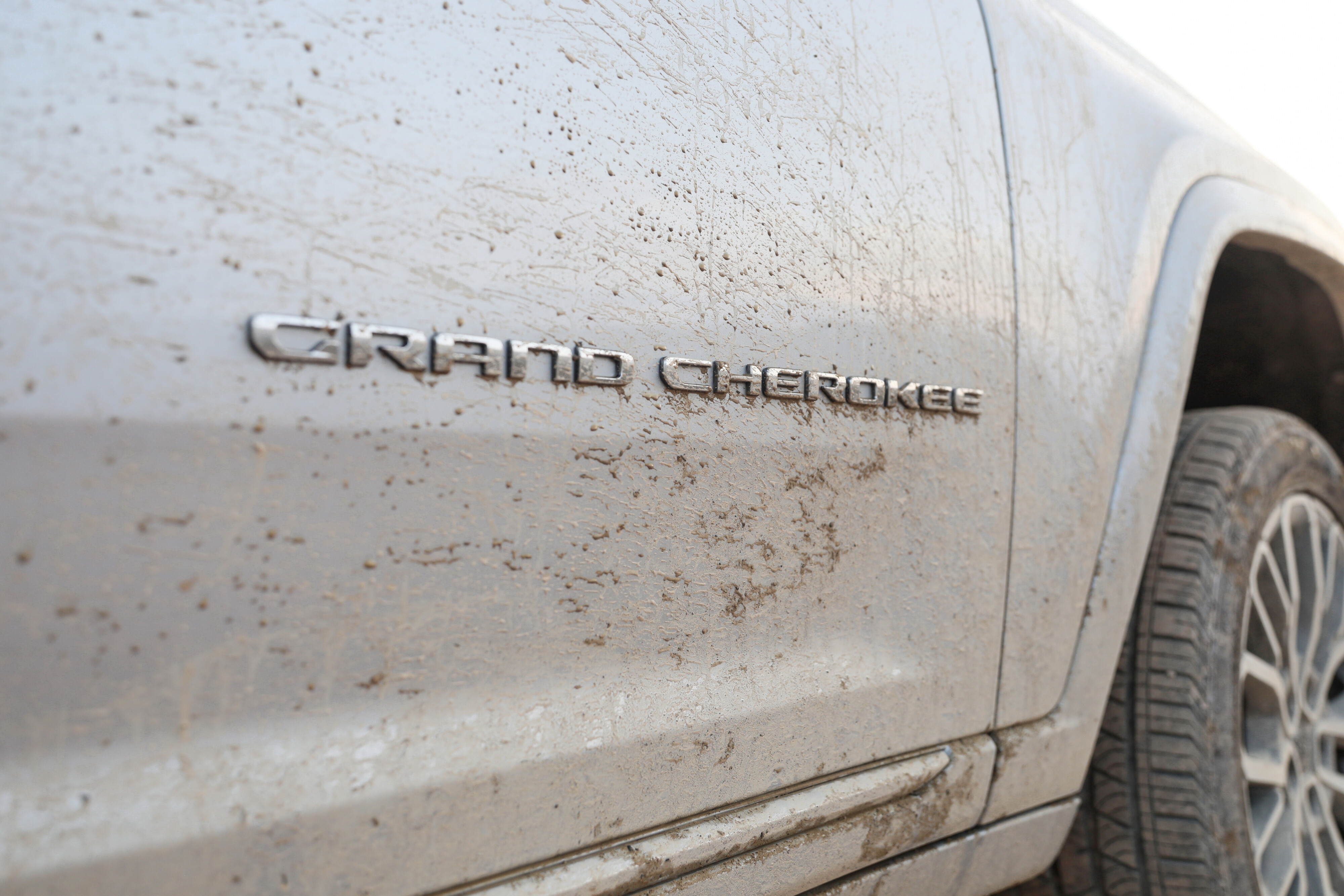
If you lament the go-anywhere promise of the fourth-gen Grand Cherokee, then it’s probably worth waiting until the back end of the year for the five-seat version, but this first encounter with the new L highlights something more akin to a limo that goes further.
And if Jeep decides to develop a Trailhawk version and slap a Trail Rated badge on its flank, the Grand Cherokee L will have another feather in its cap, firmly establishing this model as the proud flagship of the evolving brand.
2022 Jeep Grand Cherokee L pricing and features
Night Eagle: $82,250
| Jeep Quadra-Trac I active 4×4 system |
| Single-speed active transfer caseu00a0 |
| 20-inch alloy wheels (gloss black) |
| Black leather seating |
| 8-way power and 4-way power lumbar driver and front passenger seat |
| Heated front seats |
| 10.25-inch digital instrument cluster |
| 8.4-inch UConnect 5 infotainment system |
| Apple CarPlay and Android Auto (wireless) |
| Wireless phone charger |
| Six speaker audio system |
| LED headlights |
| Power tailgate. |
Limited: $87,950
| Selec-Terrain traction management system |
| 20-inch alloy wheels (polished) |
| Premium black leather seating |
| Driveru2019s seat memory |
| Heated front and second-row seats |
| 10.1-inch UConnect 5 infotainment system |
| Nine speaker premium audio system |
| Second-row window shades |
| Ambient LED lighting. |
Summit: $115,450
| Air suspension |
| Two-speed active transfer case with low range gear |
| 21-inch alloy wheels (polished) |
| Black painted roof |
| Quilted premium leather seating u2013 black or Tupelo brown |
| 12-way power and 4-way power lumbar driver and front passenger seat |
| Driver and front passenger seat memory |
| Heated and ventilated front seats |
| Massaging front seats |
| Four-zone automatic climate control |
| u200bu200bReal wood interior finishes |
| Multi-colour LED ambient lighting |
| 19-speaker McIntosh premium audio system with 760-watt amplifier |
| 360-degree camera |
| Highway Assist |
| Hands-free power tailgate |
2022 Jeep Grand Cherokee L specs: Summit Reserve
| Engine | Petrol V6 |
|---|---|
| Capacity | 3604cc |
| Max Power | 210kW at 6400rpm |
| Max Torque | 344Nm at 4000rpm |
| Gearbox | 8-speed automaticu00a0 |
| Crawl Ratio | N/A |
| 4×4 System | Full-time active dual range 4WDu00a0 |
| Construction | 5-door wagon, monocoque chassis |
| Front Suspension | Multilink independent with adjustable air suspensionu00a0 |
| Rear Suspension | Multilink independent w/ adjustable air suspension |
| Tyre | 275x45R21 |
| Kerb Weight | 2190kg |
| Gvm | 2948kg |
| Payload | 758kg |
| Towing Capacity | 2813kg |
| Seating | 7 |
| Fuel Tank | 104L |
| Adr Fuel Claim | 10.6L/100km |
| On-Test Fuel Use | 12.6 |
| Departure Angle | 23.6u00b0 |
| Approach Angle | 20.6u00b0 |
| Breakover Angle | 18.2u00b0 |
| Ground Clearance | 272mm |
UPDATE, February 2023: Jeep Grand Cherokee five-seat arrives in Australia
The five-seat 2023 Jeep Grand Cherokee has arrived in Australia, joining a minor update to the seven-seat Grand Cherokee L range.
For everything you need to know, click on the read more link below:
May 12, 2022: The new Jeep Grand Cherokee L is now in Australia, and we’ve driven it. Read and watch our review at the link below.
The story to here
Snapshot
- 2022 Jeep Grand Cherokee L details announced for Australia
- Available in three trim levels, all powered by a naturally-aspirated 3.6-litre petrol six
- Priced from $82,250 before on-road costs
February 16, 2022: New Jeep Grand Cherokee L launches in Australia
Jeep has confirmed local pricing and specification details for the 2022 Grand Cherokee L, with the seven-seat large SUV due to go on sale in Australia from June 1 this year.
Note: This article has been updated following the vehicle’s local launch this week.
It is priced from $82,250 before on-road costs, and available exclusively with a naturally-aspirated 3.6-litre petrol six – with petrol V8 and six-cylinder turbo-diesel power axed.
The next-generation Grand Cherokee L is headlined by extensive testing in Australia, with local Jeep engineers set to complete more than 60,000 kilometres of driving in some of the harshest and most remote locations.
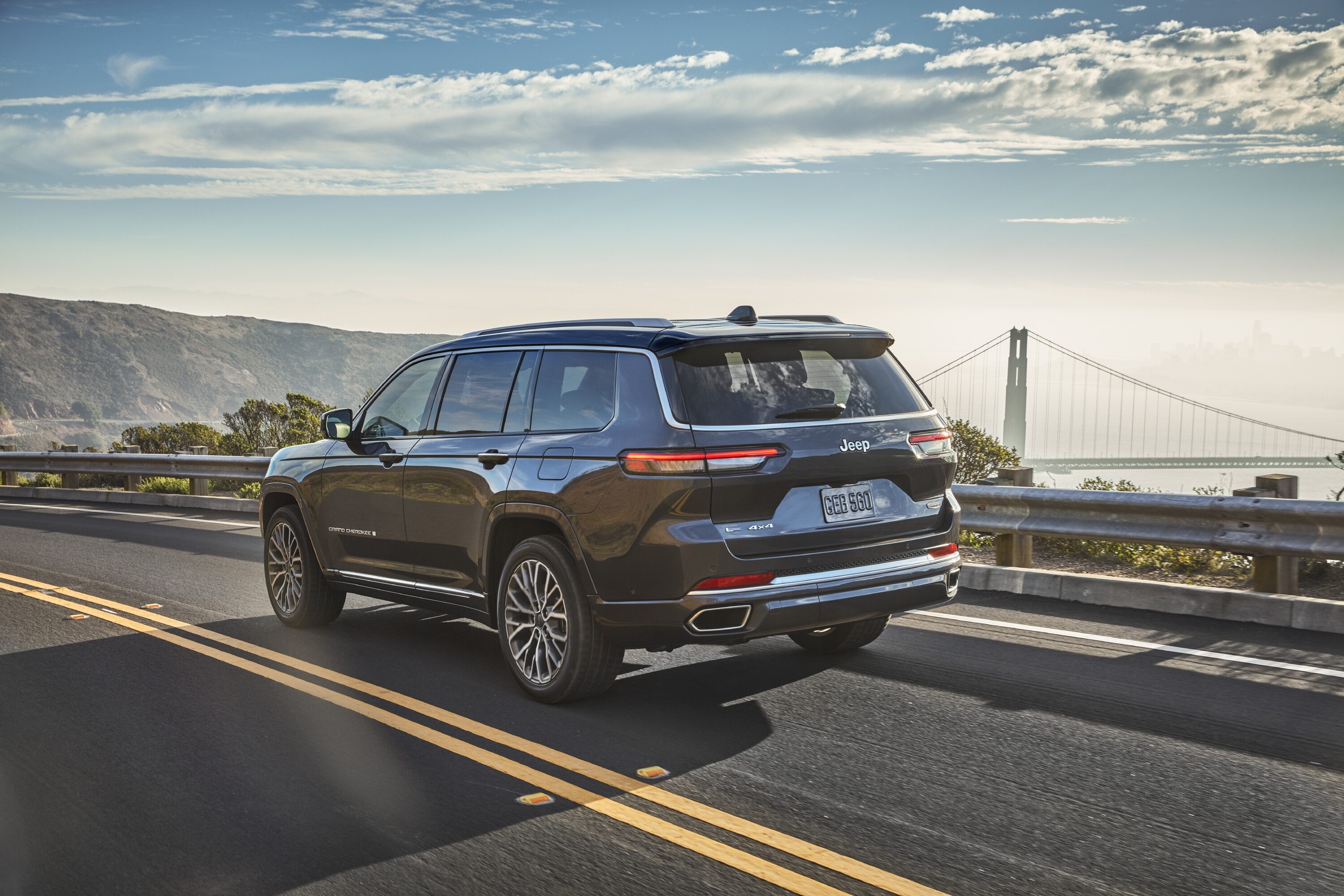
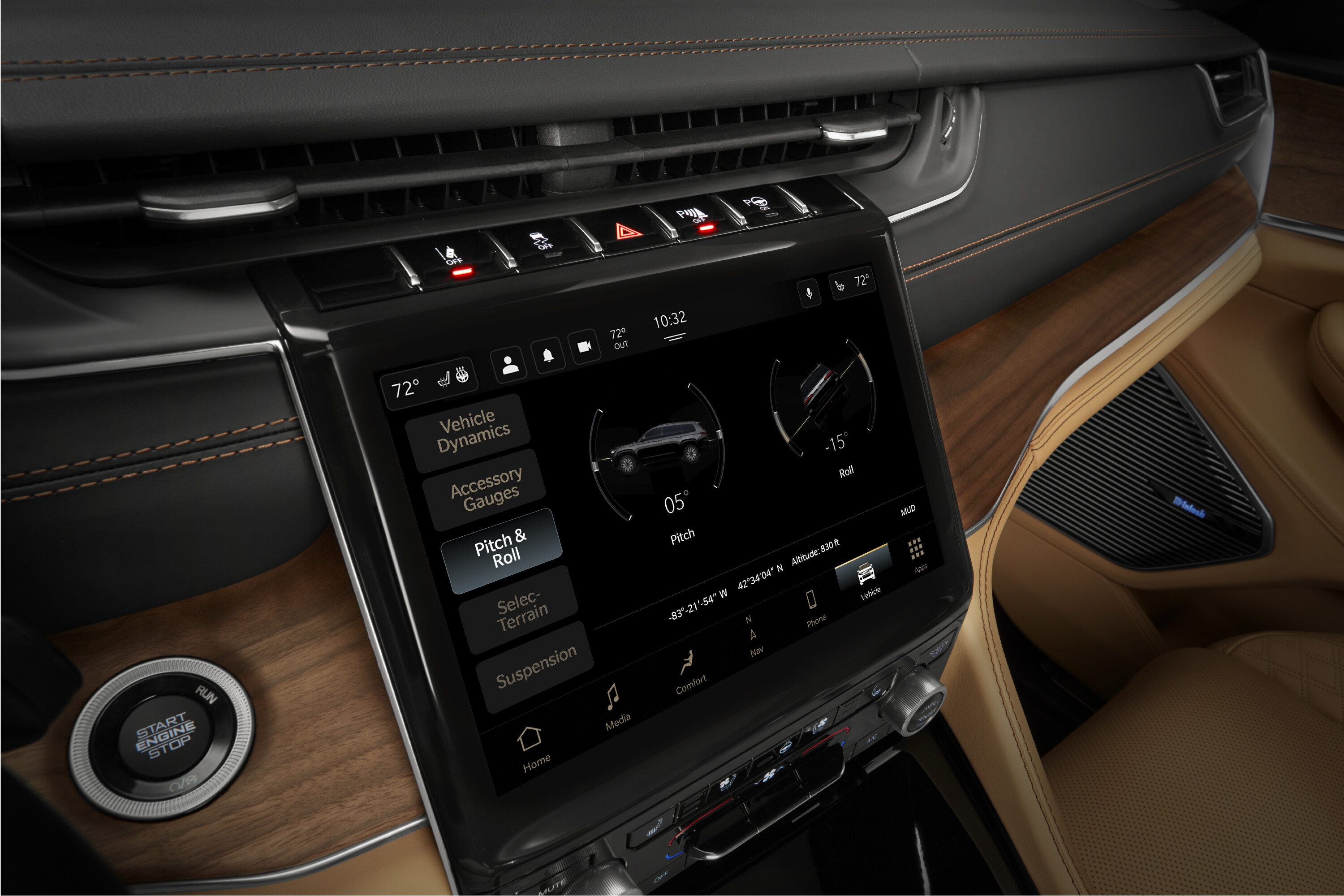
Alongside the facelifted Compass, the Grand Cherokee L also debuts the marque’s new Android-based UConnect 5 infotainment system – available in 8.4-inch and 10.1-inch sizes – which is said to be up to five times quicker than the unit fitted to the previous-generation Grand Cherokee.
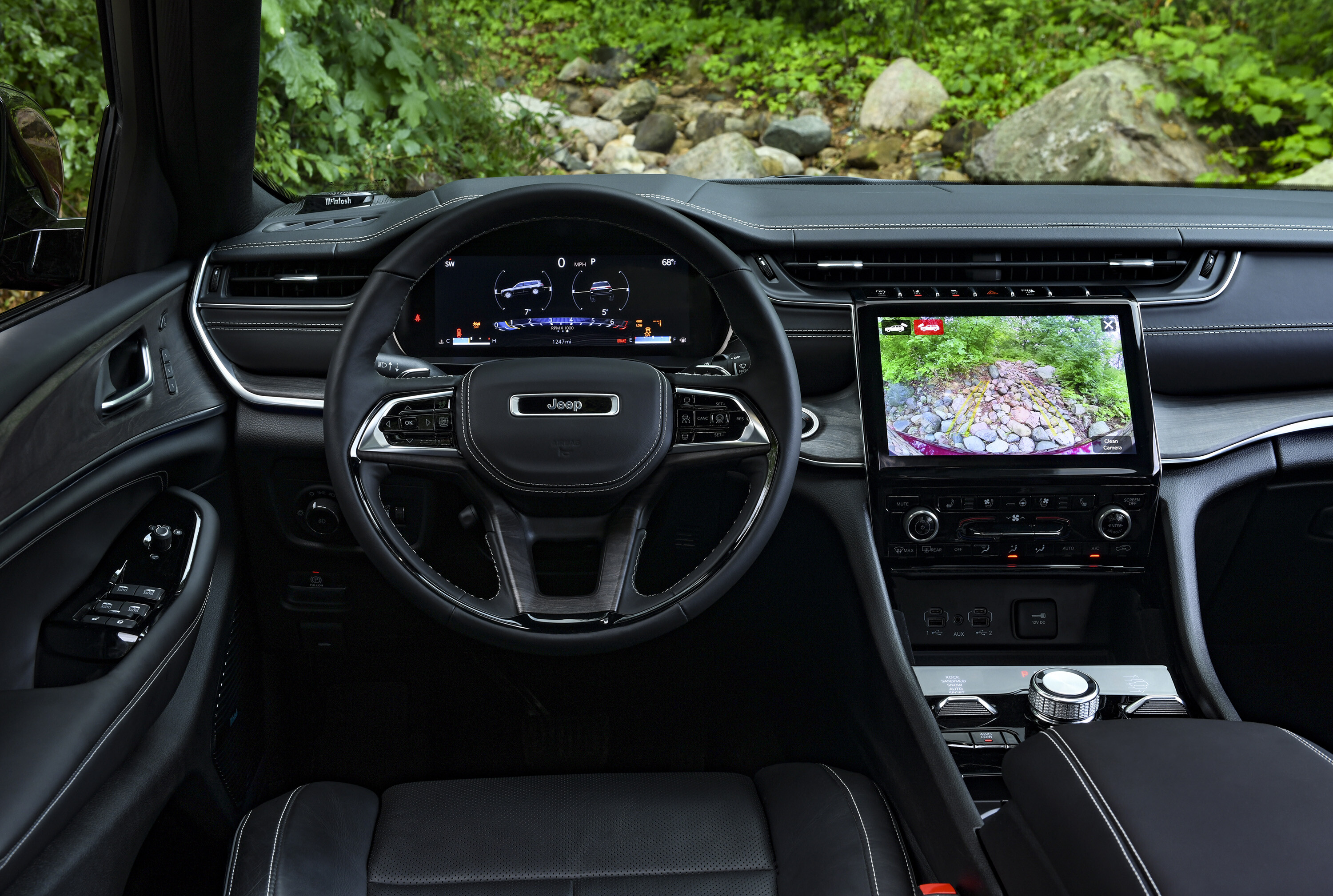
A 10.25-inch digital instrument cluster is standard across the range, while the 10.25-inch front passenger interactive display will make its way to Australia as part of the optional Advanced Technology Group option pack on the flagship Summit Reserve.
Off-road features include two separate 4×4 systems, Quadra-Trac I and Quadra-Drive II, which are claimed to give the new Grand Cherokee unrivalled capability. Air suspension is available on the Summit Reserve, delivering up to 272 millimetres of ground clearance in Off-Road 2 mode. This also increases its maximum wading depth to 609mm.
The flagship Summit Reserve is the second Grand Cherokee – alongside the SRT Trackhawk – to break the $100,000 barrier, priced from $115,450 before on-road costs.
A regular-wheelbase five-seat Grand Cherokee – offering similar technology and styling to the seven-seat L – will arrive in Australia by the end of 2022, with the option of plug-in hybrid (PHEV) power.
2022 Jeep Grand Cherokee L pricing
Prices exclude on-road costs.
2022 Jeep Grand Cherokee L features
Night Eagle
| Jeep Quadra-Trac I active 4×4 system |
| Single-speed active transfer caseu00a0 |
| 20-inch alloy wheels (gloss black) |
| Black leather seating |
| 8-way power and 4-way power lumbar driver and front passenger seat |
| Heated front seats |
| 10.25-inch digital instrument cluster |
| 8.4-inch UConnect 5 infotainment system |
| Apple CarPlay and Android Auto (wireless) |
| Wireless phone charger |
| Six speaker audio system |
| LED headlights |
| Power tailgate. |
Limited (in addition to Night Eagle)
Summit Reserve (in addition to Limited)
Options
Single-pane sunroof – $2450 (Night Eagle)
Vision Group – $4250 (Limited), including:
Advanced Technology Group – $5500 (Summit Reserve), including:
Premium paint is $1750 extra (billet silver, diamond black, granite crystal, velvet red, hydro blue, rocky mountain, slate blue, and ember) across the Grand Cherokee L range. Bright white is available at no additional cost.
Engine, drivetrain and fuel economy
All Grand Cherokee L variants are powered by a naturally-aspirated 3.6-litre petrol six, producing 210kW of power and 344Nm of torque.
The engine is matched with an eight-speed torque-converter automatic transmission, sending power to all four wheels.
Jeep will not offer the fifth-generation Grand Cherokee with petrol V8 or turbo-diesel power, however, a plug-in hybrid (PHEV) powertrain will be available on the two-row Grand Cherokee set to launch in late 2022.
Braked towing capacity is rated at 2813 kilograms.
The combined fuel economy figure can be found in the table below:
All variants feature a 104-litre fuel tank.
Safety
The 2022 Jeep Grand Cherokee L is yet to be tested by ANCAP.
Each variant includes the following active safety equipment as standard:
| Autonomous emergency braking (forward) with pedestrian, cyclist and intersection detection |
|---|
| Reverse autonomous emergency braking |
| Blind-spot monitoring |
| Rear-cross traffic alert |
| Lane-keep assist |
| Driver attention alert |
| Adaptive cruise control with stop and go |
| Traffic sign recognition |
| Front and rear parking sensors |
| Reversing camera. |
Warranty and servicing
As per the wider Jeep range, the Grand Cherokee L is covered by the brand’s five-year/100,000-kilometre warranty, along with a complimentary roadside assistance program across the entire warranty period.
In addition, Jeep will provide an additional 12 months of roadside assistance when the vehicle is serviced at a Jeep dealership, across its entire lifetime.
Lifetime capped-price servicing will be offered, with prices for the 3.6-litre Grand Cherokee L listed at $399 per service.
Availability
The seven-seat 2022 Jeep Grand Cherokee L will arrive in Australian showrooms from June 1.
By the end of the year, the Grand Cherokee range will be bolstered by the regular-wheelbase five-seat variant, in addition to the availability of a 4xe plug-in hybrid (PHEV) powertrain. Full details will be announced closer to launch.
Toyota has announced that not only will the 70 Series LandCruiser be with us for the foreseeable future, but it is set to gain an increase in both safety technology and payload capacity.
While it’s not yet clear if there will be any exterior or interior updates, Toyota has confirmed that from November 2022 we will see these key updates available.
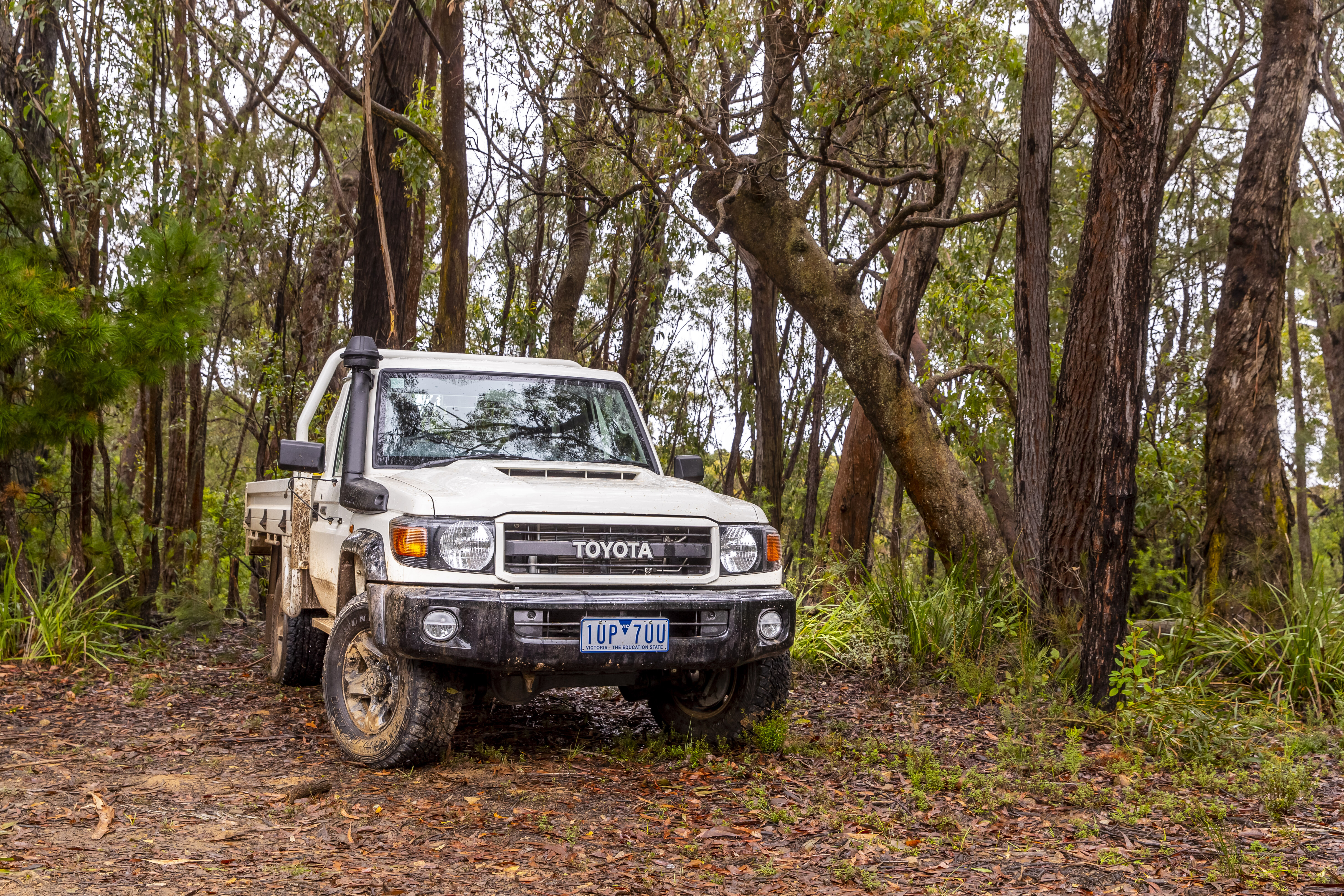
Starting with safety, the 70 Series pick-up and wagon range will receive pre-collision safety technology that is made up of autonomous emergency braking, as well as the addition of pedestrian and cyclist detection.
Safety features already found in the 70 Series from the last update include; anti-lock braking, traction control, vehicle stability control and hill-start assist. It’s still a basic workhorse, but is slowly being dragged into the future while staying true to its past.
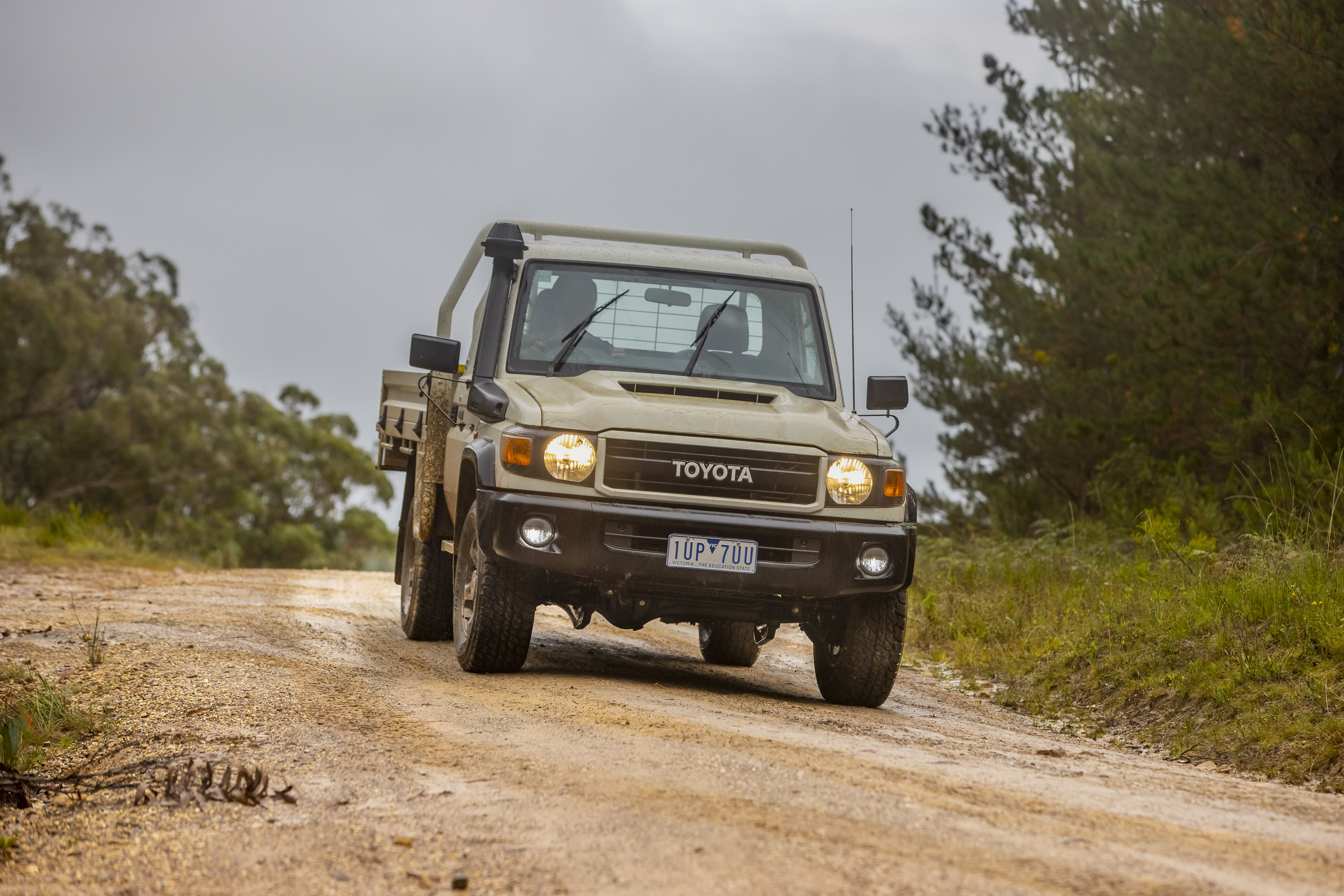
Speaking of workhorses, Toyota has told us that, thanks to some design refinements, the vehicle now has a GVM of higher than 3500 kilograms, taking the range from light into the medium goods category. Power output is said to remain the same, however, with the 4.5L V8 turbo-diesel, that produces 151kW and 430Nm, remaining in the 70 Series line-up.
Toyota Australia’s Vice President Sales, Marketing and Franchise Operations, Sean Hanley, said Toyota was committed to providing LandCruiser 70 Series customers with greater flexibility and peace of mind.
“The upcoming changes are designed to ensure that the legendary LandCruiser 70 Series will continue to be available for the foreseeable future in the Australian market, where its popularity resulted in more than 13,900 sales last year,” Hanley said.
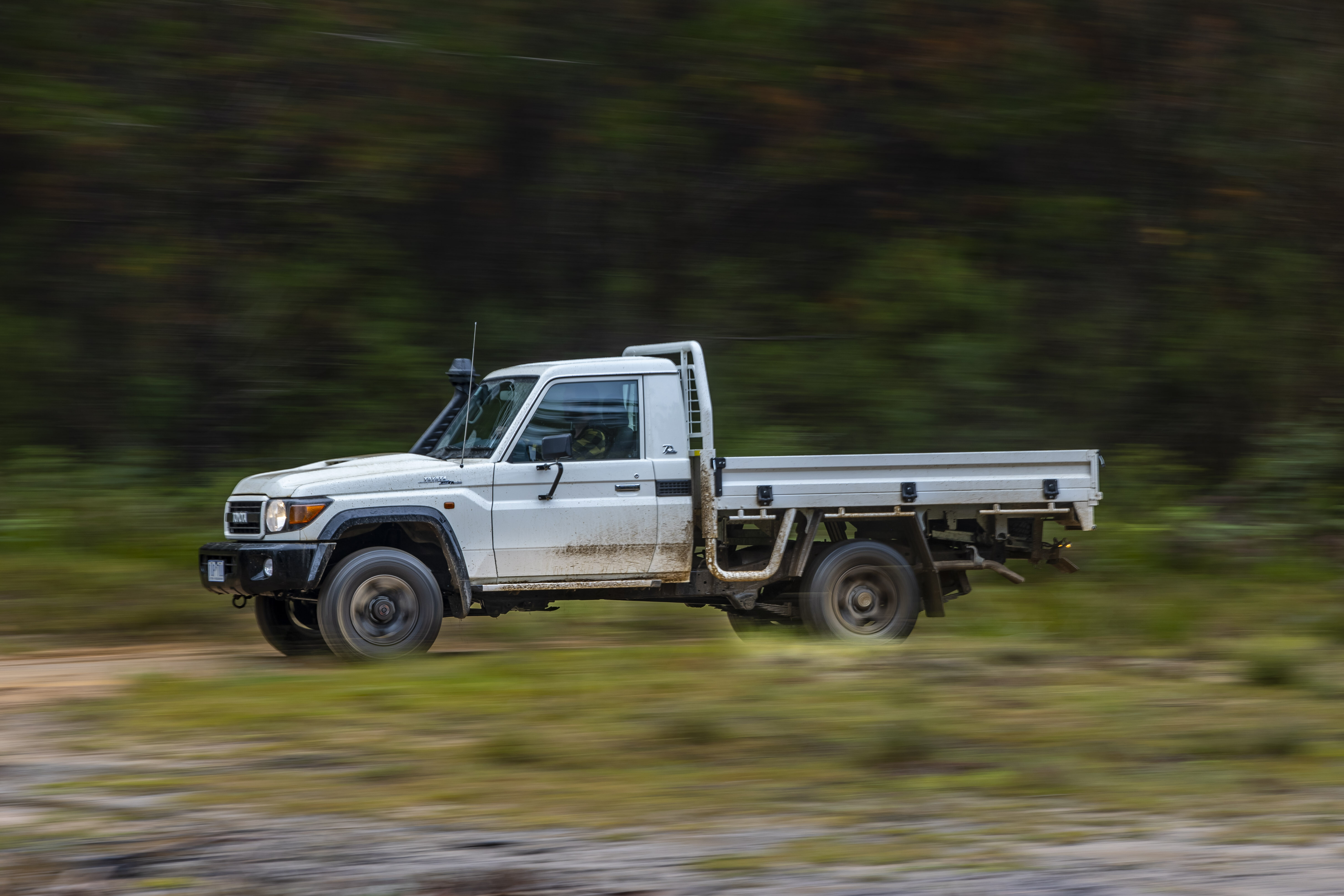
“The increase in GVM is sure to appeal to owners who use the 70 Series as a tool of trade or are seeking an even greater ability as a heavy duty recreational off-roader.“Combined with heavy-duty suspension and 3,500kg towing capacity, these upgrades will enhance the versatility and rugged reputation for this legendary vehicle.”
It’s been with us since 1984, and while it has evolved over those years, the 70 Series LandCruiser still on-sale today in Australia has largely stayed true to its heritage.
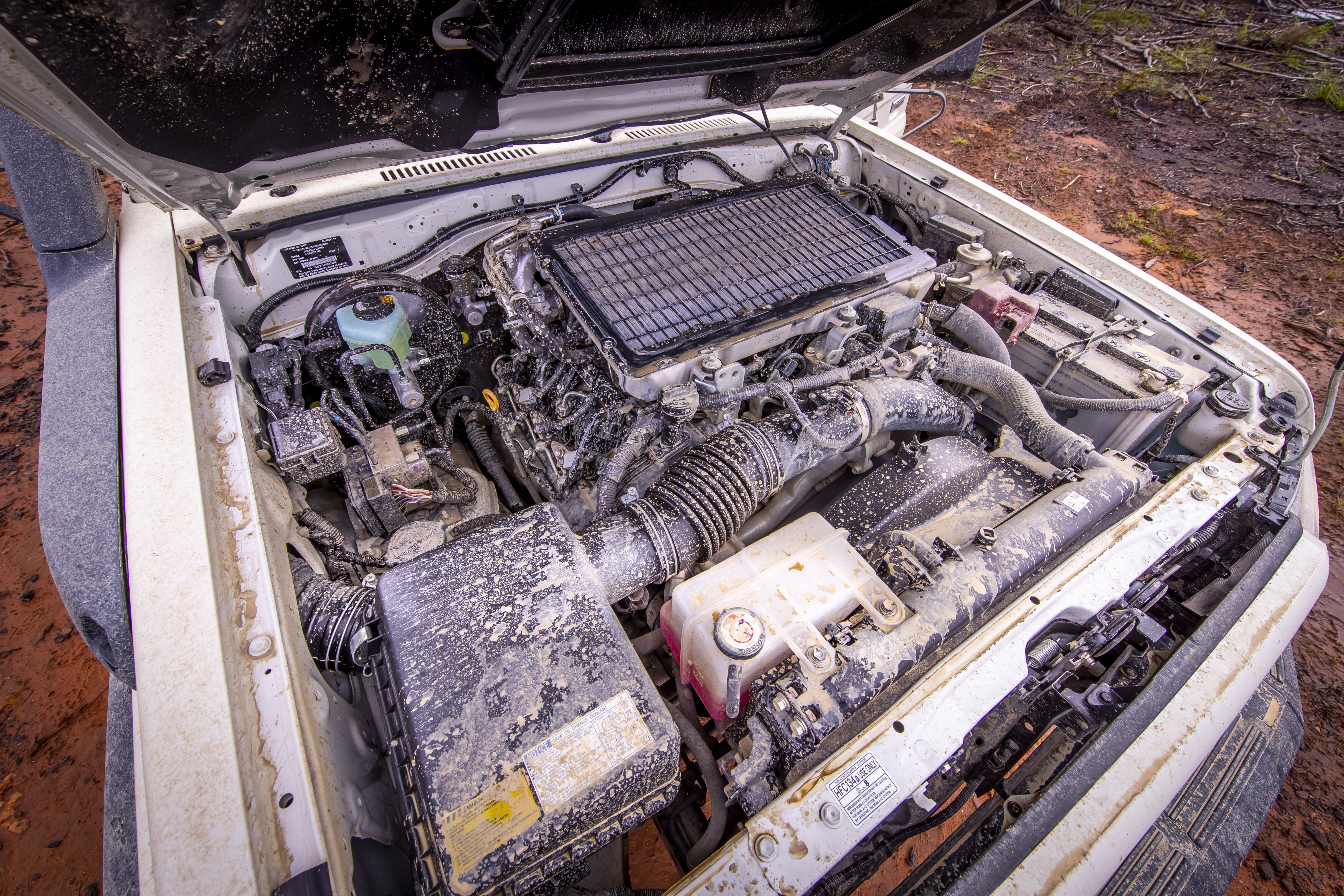
Sure, the addition of the 4.5L V8 engine back in 2006 gave the ‘Cruiser some much welcomed grunt, the interior has been revised, and the front end received coil suspension back in the very late ’90s, but the main ingredients have remained the same for this iconic recipe.
Further details will be confirmed closer to the launch of the upgraded 70 Series LandCruiser.
The next-generation 2023 Ford Ranger should be hitting showrooms in a few short weeks, and Ford Australia has managed a calculated drip feed of information about the new cars for the past year.
While the official release date is in June, we got our first chance to get up close to Ford’s new truck back in November 2021 when we were given access to a prototype vehicle and the engineers behind them.
Joining us at Ford’s secretive You Yangs Proving Ground near Geelong, Victoria, were Pritika Maharaj, Ranger and Everest program manager, and Ian Foston, chief engineer for the T6 platform on which the Ranger, Everest and Bronco are built.
UPDATE, July 2022: New Ford Ranger review – it’s here at last
The new 2023 Ford Ranger is now on sale in Australia, and the local media launch has been run. The Wheels and 4×4 Australia teams have both driven the new Ranger, and you can find their stories at the links below.
Story continues…

The vehicles at hand are known as TT prototypes. That is, they are the first vehicles to come off the production line in Thailand as opposed to the earlier prototypes that are hand-built at Ford Australia’s Broadmeadows facility. As well as the two factories in Thailand where the Australian production cars will come from, the new Ranger will also be built in North America, South America and South Africa.
The cars were still heavily camouflaged for this drive, as this was happening well before Ford unveiled the look of the car and before we knew any specifications of the drivetrains and their outputs. Of course, we now know what they look like and what will be powering them.
While still a strong suspicion at this time, we were pleasantly surprised to find the cars we would be driving were powered by the V6 diesel engine. While Ford couldn’t give us the details at the time, we now know the 3.0-litre V6 puts out 184kW at 3250rpm and 600Nm from 1750 to 2250rpm.

The V6 engine is from the ‘Lion’ family of engines, which relate back to the 2.7-litre version we remember from the Land Rover Discovery 3 and Ford Territory, while the latter 3.0-litre version was used in other Land Rover models and most recently in the Ford F-150 for a short time.
“The 3.0-litre V6 turbo-diesel delivers,” said Pritika. “When you drive a Ranger with the V6 turbo-diesel, it feels like a much bigger truck. And it feels strong in the sense that it’s got plenty of power and torque, which is exactly what our customers told us they wanted.”
On track
Our first drive was on a twisting sealed road circuit designed to display the car’s performance and dynamics, but before we drove the prototypes, we first did it in a current model Wildtrak with the 2.0 bi-turbo engine and 10-speed auto.
With Pritika riding shotgun, I was pleased when the Ranger displayed the transmission hesitancy and uncertainty as we left the line and I commented that I hoped they were able to fix that. “You’ll see,” was her knowing reply.

The 10R60 transmission has undergone a considerable makeover since it appeared in the Ranger behind the 2.0 diesel, and it is also used in the Mustang, F Trucks and other Ford Global products. For the next-gen Ranger, it gets a new torque converter and closer gear ratios to make it more refined and responsive behind both the TDV6 and the in-line four-cylinder diesel engines.
In the next-gen prototype, I left the line just as I had in the previous model and it showed no sign of hesitancy or indecision – a positive first impression of the new car. The power of the engine is immediately evident, leaving me thinking that this is what 4×4 ute owners want. The current model VW Amarok is the only car that would come close in drivetrain performance.
With its longer and higher bonnet, the new Ranger feels like a bigger car from behind the wheel, even though the overall dimensions are similar. This, in line with Pritika’s comments about the drivetrain, gives the car an all-new feeling. It is more planted on the road through the bends largely due to its 50mm wider wheeltrack.

A huge revelation came on a section of the track where high-frequency humps in the road upset the chassis in the current model car and kicked it off line, following the camber of the road. Driving the TT prototype over the same section and taken at the same speed, no such instability was evident and it tracked straight across the bumps.
Even though this was a sealed road, this section was similar to corrugations you find on outback gravel roads, so it will be interesting to get one of the production Rangers out bush.
While only a short drive, it did reveal the new Ranger to have a more stable and surefooted chassis, with a powertrain that should meet the needs of buyers be it for performance, towing or off-roading.
Off-road
We took the TT prototype and current model Rangers to an off-road loop within the proving ground that included steep climbs and descents, side-slopes, cross-axle articulation, rocks and sand.
This time we had Ian Foston riding shotgun and again we first drove the current model car around the course. We’re only too familiar with the PX Ranger and its abilities and, as expected, the car did it all relatively easily. The Ranger’s electronic traction control, rear differential lock and good articulation made relatively light work of such terrain.

In the next-gen Ranger, the first thing you need to do before heading off-road is familiarise yourself with the various systems that control everything. It helps to have the chief engineer sitting beside you to provide tips on the easiest way to select the right mode for the conditions. While the new Ranger V6 has a full-time 4×4 transfer case, it’s not as simple as selecting low range and taking off.
The car has six selectable drive modes, two of which are dedicated to off-road use. These are Mud/Ruts and Sand modes and when you select these via a dial on the console, the car makes all the hardware selections for you, including the transfer case operation and differential locks. The on-road drive modes include Normal, Eco, Tow/Haul, and Slippery. The Ranger Raptor adds Baja, Sport and Rock Crawl modes but loses the Tow and Eco modes.

It will take some more time in the production vehicle to fully get to grips with this system and how much control the driver has over it, but with Mud/Ruts selected the Ranger prototype automatically selected low range and was ready to go. An off-road screen can be selected on the huge centre stack monitor which shows all the settings and the view from the off-road cameras and allows you to select them on the touchscreen.
In low range the V6 diesel engine crawled the new Ranger along smoothly at low revs and climbed the first mound with ease. You want to use less throttle in this car and let the torque of the V6 engine do the work. We didn’t know the specs at the time, but the V6 produces 600Nm compared to the four-cylinder bi-turbo’s 500Nm and it feels to be available from lower in the rev range, as you would expect of the bigger V6 engine. This V6 feels like it will be well-suited to towing and hauling loads.

In contrast to the current model, the new one, with its 50mm-longer wheelbase, scraped its belly on the top of the mound and required a bit more speed to scrape across it without getting hung up.
The next obstacle was the cross-axle articulation, which the new prototype handled much easier than the current model thanks to its longer wheel travel and sharper traction-control calibration.
Climbing over the next rise gave the opportunity to make use of the forward-facing camera on the big screen. With a blind crest you couldn’t see which way the track went once over the top, but the screen gave clear indication of where to point the truck. The camera also showed a large rock off to one side of the track that was best avoided.

The longer and higher bonnet of the new model does block more of the driver’s view of the track ahead compared to that in the current model car. Forward-facing cameras help in this regard but are still no substitute for constant scanning and evaluating the track ahead of the car. I find that looking down at the centre screen requires you to stop the car while your eyes are off the track ahead, to ensure you don’t hit any surprises.
The following side-angle, rocky and sandy sections were covered without fuss, as the new Ranger didn’t slip a tyre. The improved stability afforded by the new car’s wider footprint and more compliant, longer travel suspension, gives the driver a more surefooted and confident feeling.

Both the on- and off-road loops we drove on the day were relatively short, but they each gave a strong insight into some of the conditions Ford Australia had been testing the next-gen Rangers under.
As we went through our exercises, countless other camouflaged Rangers could be seen and heard roaring around the high-speed loop circuit or screeching their tyres on a distant skid pan. Even at this late stage in the Ranger’s development, the testing went on relentlessly, here at You Yangs and other test sites around the world.
At one point late in the afternoon as we waited for the last of the drivers to complete their loop, a black and white camouflaged Ranger flew by on the high-speed loop, emitting a distinctly different sound to the others before it.

“That car sounded different to the others,” I said to Pritika Maharaj, who was standing beside me. It was more of a question than a statement, but the drivetrain expert wasn’t revealing anything, instead asking what I thought was different about it. I could only speculate at the time that it was a petrol engine and possibly the then-rumoured turbocharged V6 of the Ranger Raptor model. Pritika just smiled knowingly.
Of course, we now know that the Raptor version of the new Ranger will feature a turbocharged petrol V6 engine, which along with the V6 diesel we drove here, promises to make this next-gen Ranger the most exciting mid-size 4×4 ute to hit the market in a long time.
Cruising across the country in a 4×4 has always been a favourite pastime for Aussies, and whether you are chasing sunshine, water or snow, a good tow vehicle is essential.
For this tow test, we hitched a McLay 571 aluminium boat to the rear of our BT-50 Thunder and drove up the coast on a mixture of suburban and highway terrain.
Lloyd was again on-board as part of our ‘50 Days with a BT-50’ series. He has no towing experience, but he’s a keen angler and is very interested in seeing how the car copes with a boat behind it. The load we have chosen is well within the limitations of the car, and the McLay 571 is a popular boat for families.
? Hello from the future! You can continue reading this story, or you can visit our latest BT-50 Range Review linked below.
REVIEW CONTINUES…

For this phase of the drive, Lloyd was content to reside in the passenger seat: “I would be more than happy to sit here for an extended road trip, and the car feels like it is doing this easily,” he told us.
Under the bonnet of the BT-50 is a 3.0-litre four-cylinder turbo-diesel engine that can produce up to 450Nm. The total towing capacity is 3500kg (braked).
While Lloyd hasn’t towed, he has done his homework and before long asks about Gross Combined Mass (GCM), something most new owners do not realise could be an issue when towing.

GCM refers to the maximum loaded weight of the towing vehicle and whatever you are towing at the same time. For example, the dual-cab BT-50 we are using has a GCM of 6000kg, and the vehicle we are in weighs around 2350kg. We have a couple of hundred kilograms of gear on board, plus ourselves.
The boat weighs approximately 1700kg on the trailer with our gear and fuel. Combined, that is 4050kg plus our weight, which falls comfortably under the limit for this vehicle.
If we had a heavier boat or caravan closer to, say, 3500kg, the combined weight of the car and trailer without any equipment would be more than 5800kg. This would leave limited room for equipment and seriously jeopardise the vehicle’s ability and insurance.

Another consideration when towing is towball weight. In this case, the Mazda has a healthy 350kg towball weight, which is well above the trailer we are towing.
Even with a low weight – relative to the maximum capacity of the car – you can still feel the weight on the back, and the Mazda handles this weight easily. The suspension doesn’t sag, and the steering remains firm and responsive. On the freeway, the gears hold well and we don’t spend any energy hunting around for the right ratio. It never feels like it is straining going uphill, either.
From a standing start, the BT-50 has plenty of low-down torque which gets the mass moving efficiently without the engine screaming for a reprieve.
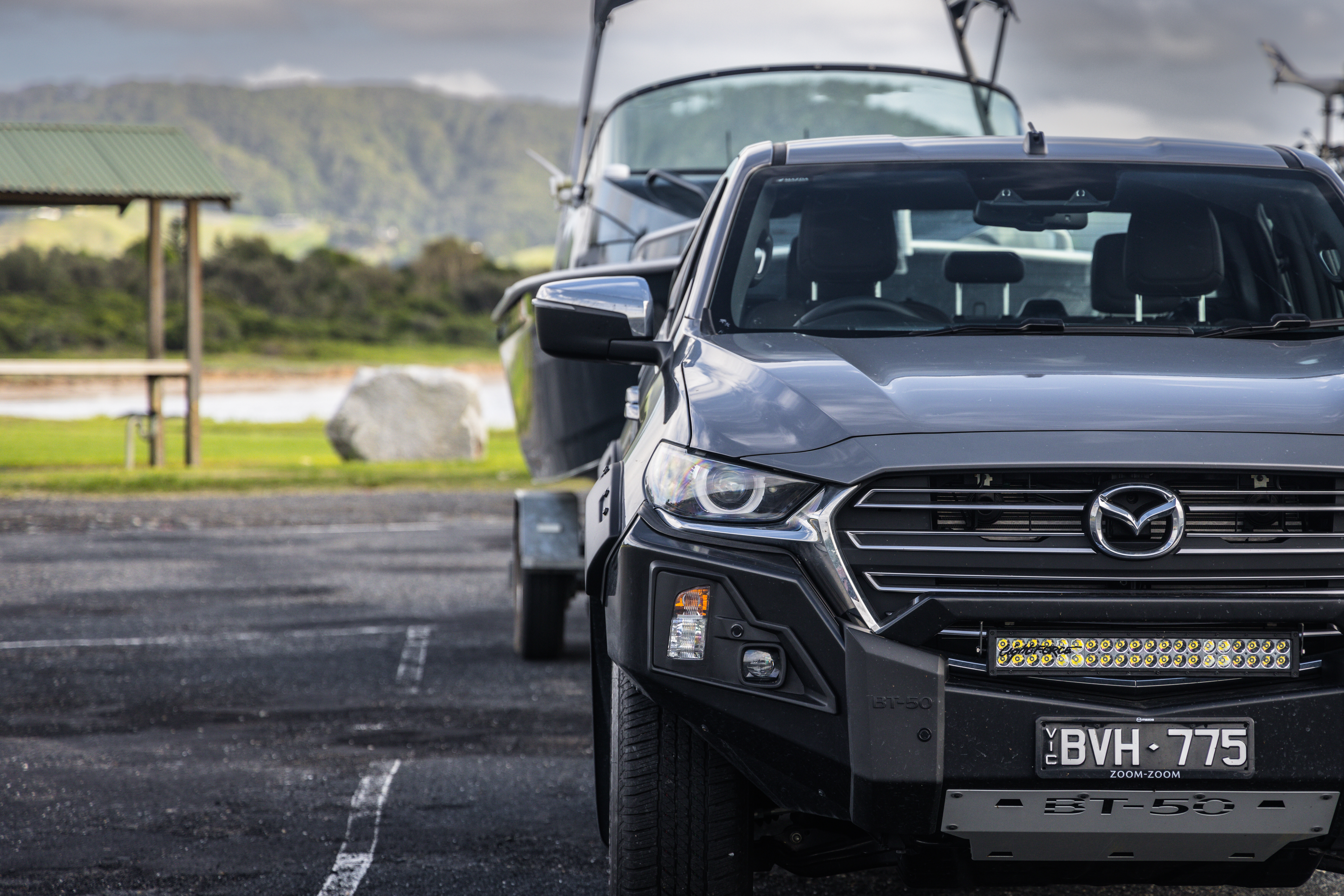
Lloyd added that he likes the large side mirrors and, while you would need extensions when towing something boxy like a caravan, they do a great job with this not-too-wide boat.
The extra weight certainly affects the stopping distance of the Mazda, as Lloyd noted. Even then, the brakes are excellent at bringing the entire set-up to a stop. The BT-50 Thunder is fitted with an optional brake controller on the dash and – if towing a trailer with electric brakes – the dial would allow you to toggle the brake bias to give more or less brake pressure on the trailer.
Fuel usage before towing was approximately 9.7L/100km, but with the trailer on the back that jumped up to 15.5L/100km – that would improve with more highway kilometres, as that figure was noted on suburban streets.
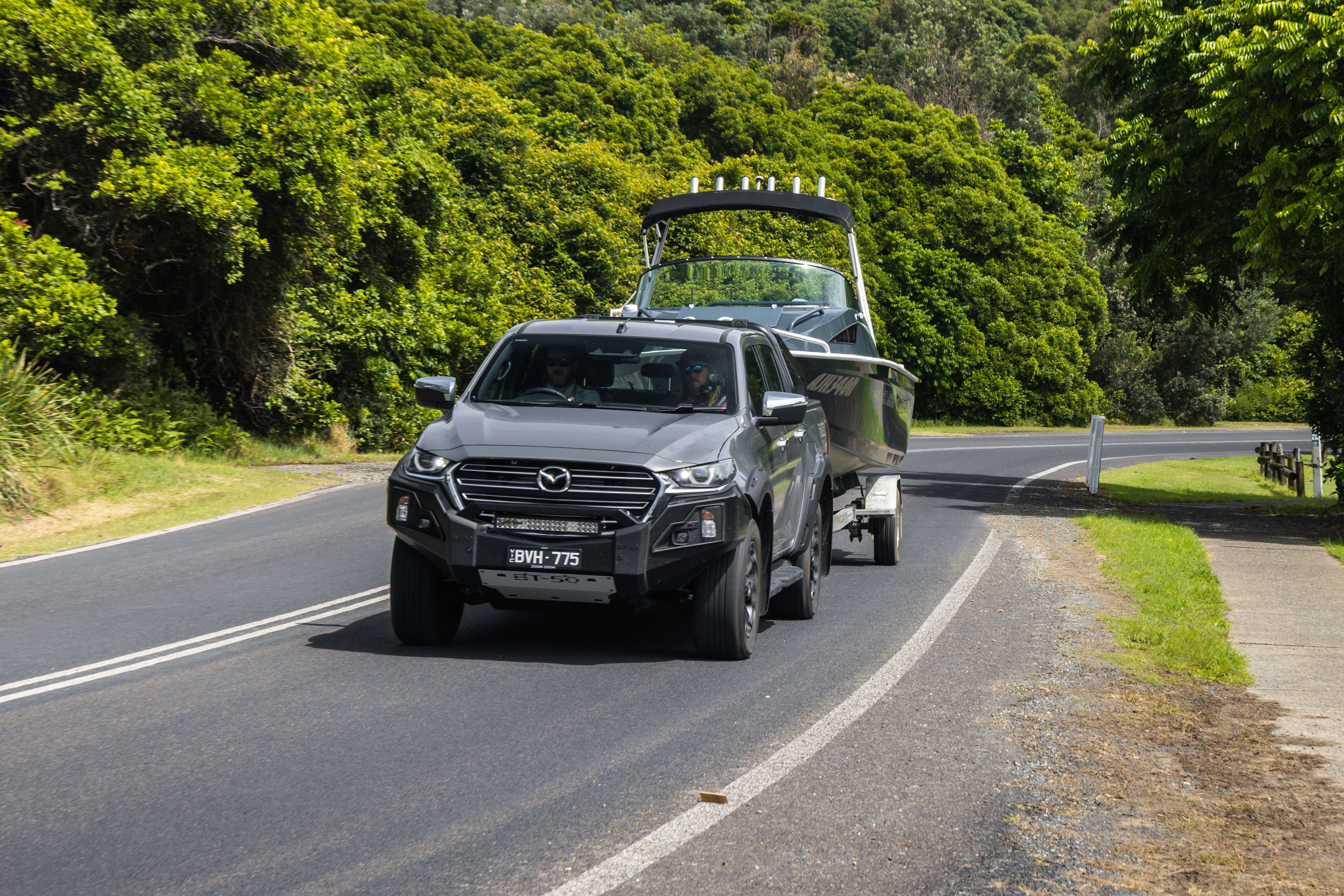
When it comes to reversing a trailer down a ramp or into position, the turning circle isn’t as tight as some other manufacturers, but its light steering enables you to quickly get from lock to lock. That steering lightness makes reversing a whole lot easier and counteracts the wide turning diameter.
The BT-50’s impressive towing ability combined with its onboard comfort makes it an attractive proposition. The torquey engine isn’t fussed with a load on the back and still manages respectable fuel consumption while towing.
Lloyd was thoroughly impressed, and he’s now ready to hit the Great Barrier Reef.The full series.
The full series
Simple and quick to make, sausage rolls are a favourite campsite snack for kids and adults alike.
Ingredients
FILLING
- 1/2 tbsp olive oil
- 2 cloves garlic, minced
- 1 brown onion, small, finely chopped
- 1 celery stalk, finely chopped
- 150g bacon, finely minced (streaky and fatty, not the lean stuff!)
- 500g beef mince (ground pork, not lean)
- 3/4 cup panko breadcrumbs
- 1 egg
- 2 1/2 sheets puff pastry, thawed then each cut in half
- 1 egg, lightly whisked
Method
- Start by mixing filling ingredients together in a bowl. Use your hands to mix well.
- Lay out a rectangle of pastry, long edge closest to you. Brush egg along one long edge.
- Get 1/5 of the filling and shape in to a long log down the middle of the pastry. Ensure the meat is tight and compact, without gaps.
- Brush edge of pastry with egg then roll up, finishing with the seam side down.
- Refrigerate for 1 hour (optional).
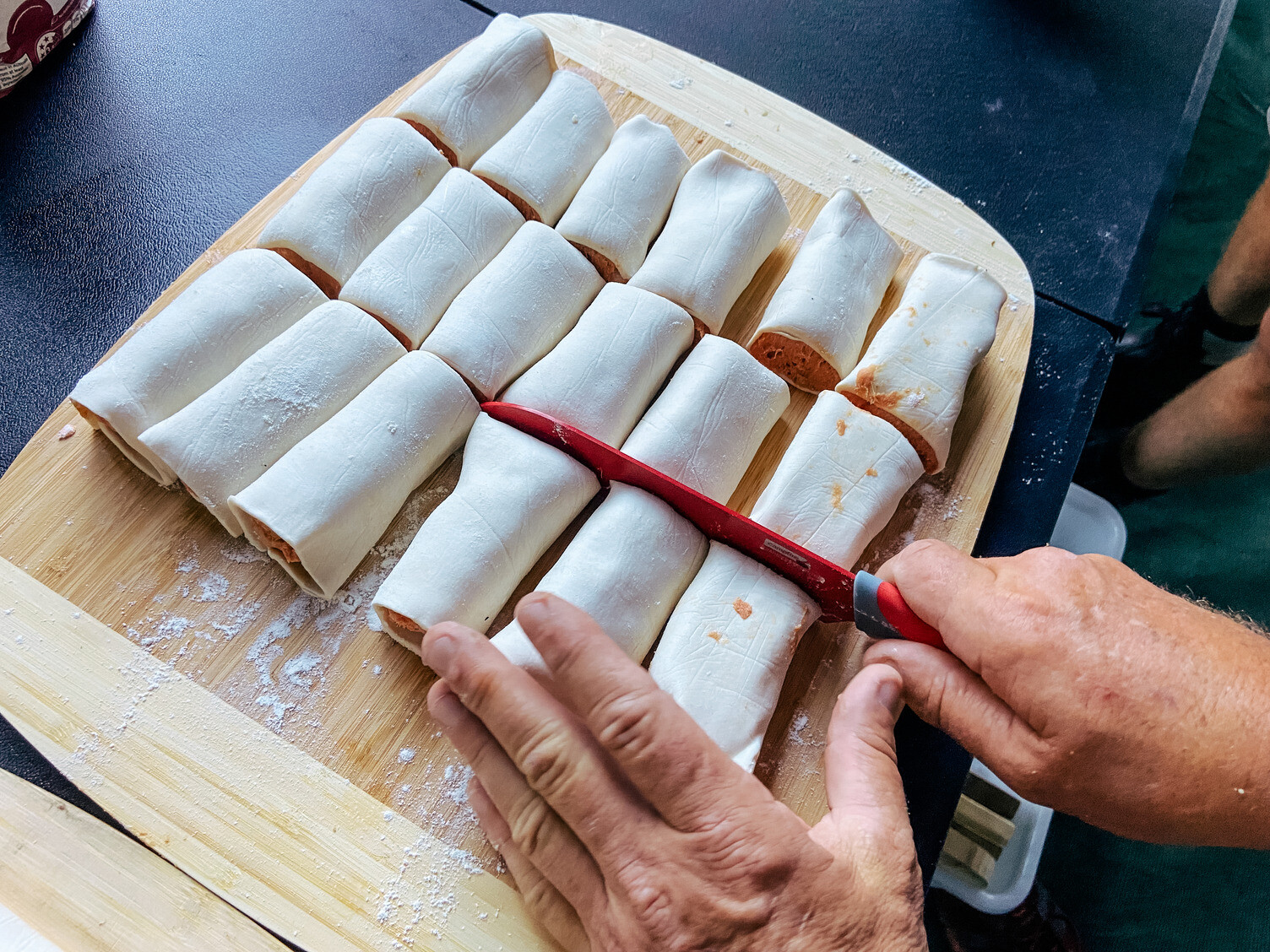
- Cut each log in to four equal lengths, or just two if you want full-size sausage rolls. Brush with egg.
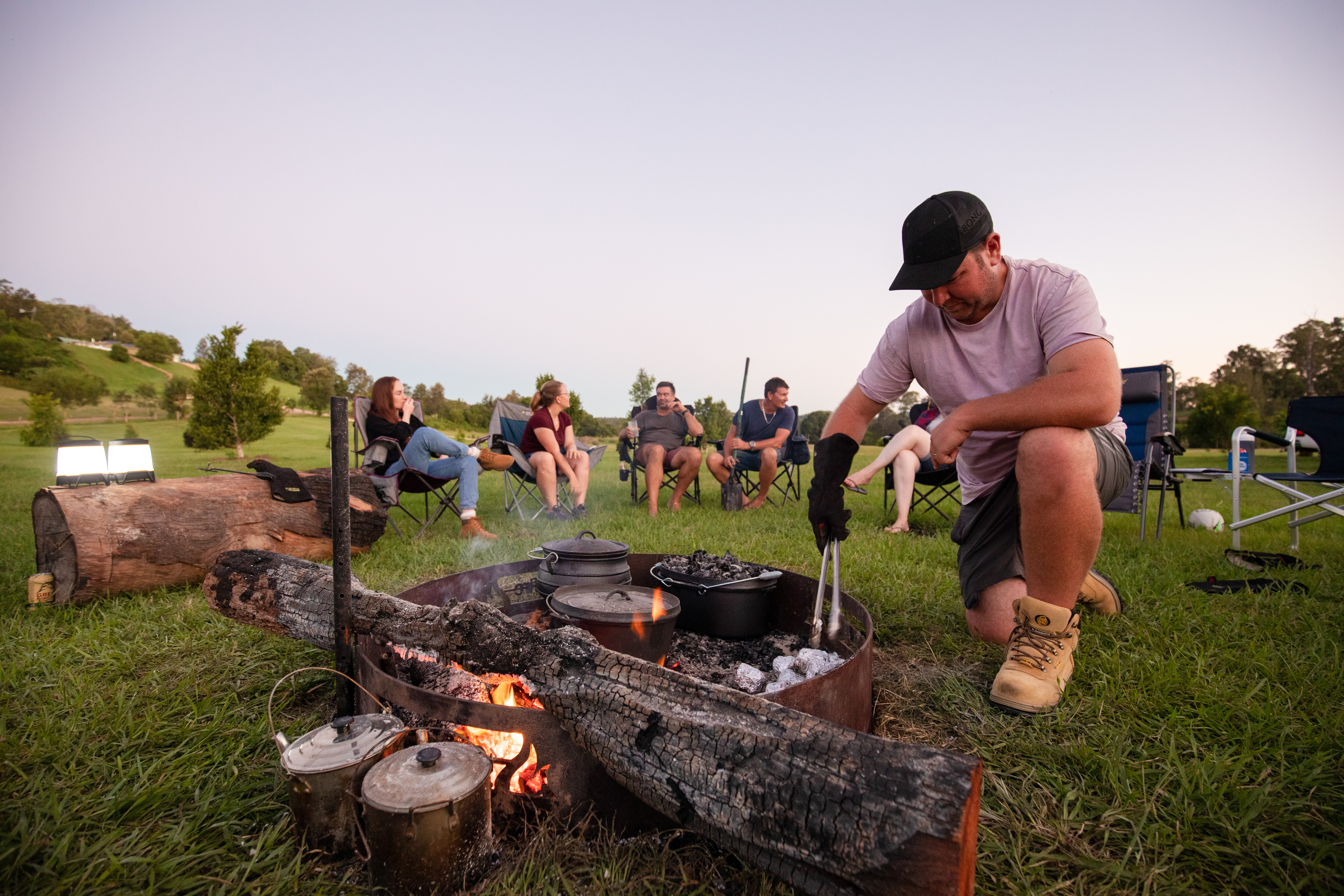
- Place on baking paper and trivet in camp oven. Bake for 20 to 30 minutes or until golden brown!
Cookware needed
- Campfire 9 Quart Camp Oven
- Campfire Trivet or Steamer Rack
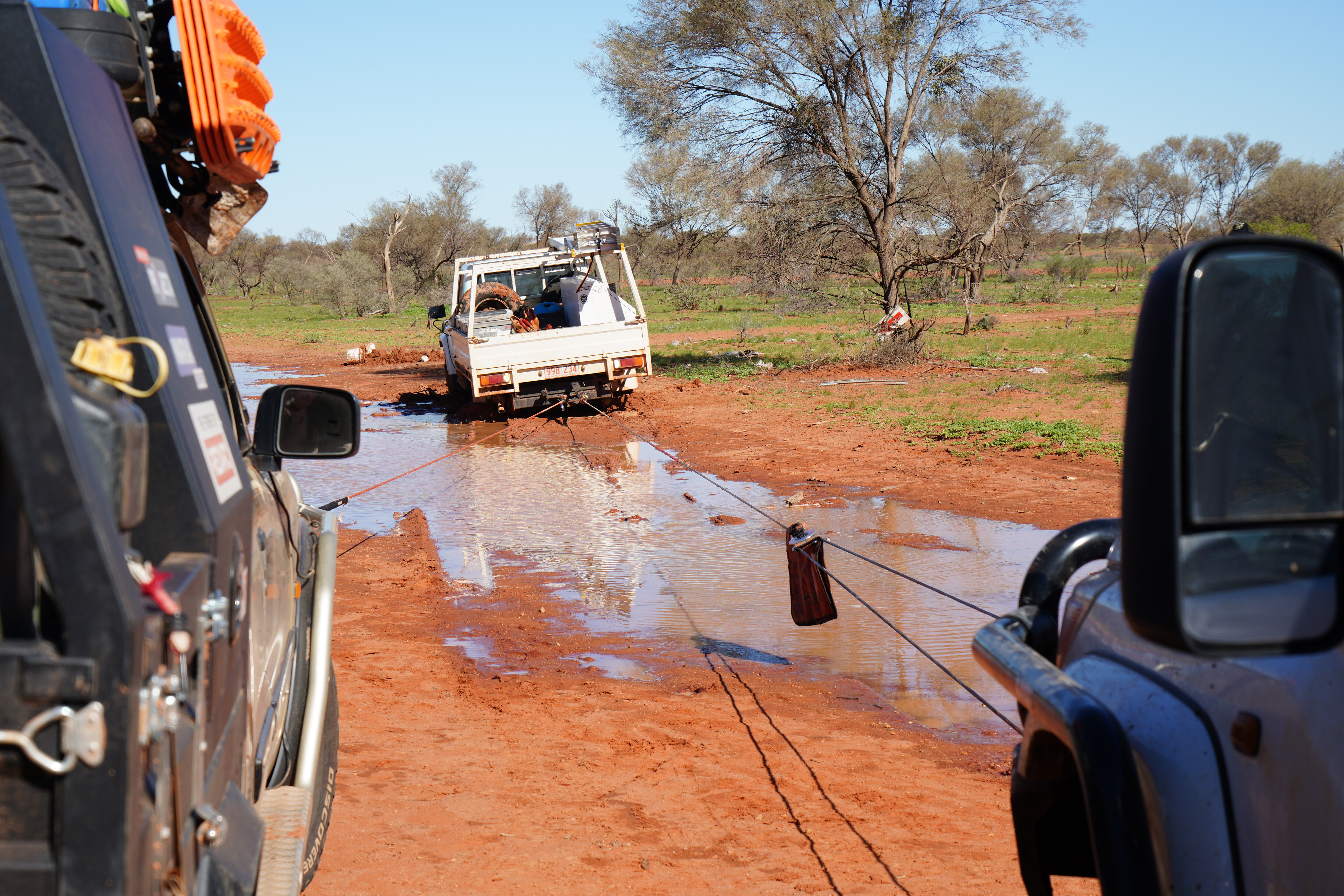
The rise in popularity of off-roading has meant an increase in the number of rescues being undertaken by tow truck drivers and recovery specialists in recent years, leading to calls for a special licence endorsement.
Pundits are recommending the change – which would require drivers to undertake a four-wheel-drive course to gain the endorsement – for people to take their vehicles into certain areas, such as beaches or bushland.
Debate has kicked off in recent days after a 2018 blog post from television personality Pat Callinan surfaced on social media.
Callinan argued a typical driver’s licence wasn’t sufficient for most people to be trusted with controlling a large four-wheel-drive, saying “one licence category covers everything from a Kia Piccanto [sic] to a 79 Series [LandCruiser] via a Porsche 911”.
While drivers require special licence endorsements to operate a motorcycle or truck, anyone with a basic motor vehicle licence can take their car into potentially dangerous areas.
Andrew Boyd from the Toyota LandCruiser Club of Australia told the Daily Mail he believed new-car buyers were venturing out without fully understanding how to operate their machines.
“They take them out of the showrooms. The dealers would not tell these people the different buttons to press,” Boyd said.
“They then take them out to the beaches and get into all sorts of trouble.”
Boyd admitted he was one of those people, finding himself bogged on a beach shortly after buying a four-wheel-drive in his 20s, which eventually led him to joining the club and learning how to drive in different environments.
But some enthusiasts have dismissed the idea of an off-road endorsement as just a cash grab – a way for those operating driving courses to make money, along with the Government.
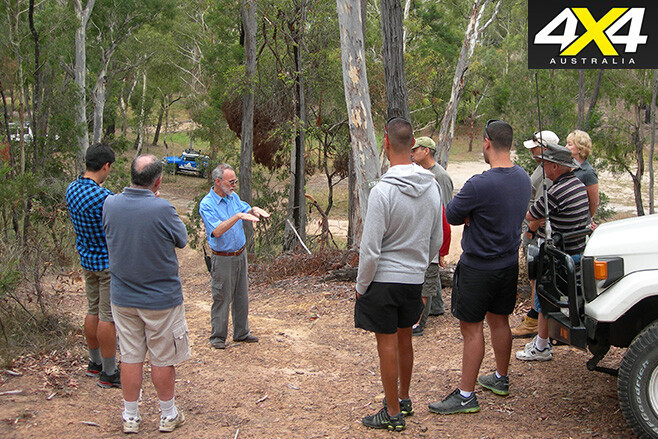
Experts, however, agree there are safety benefits to being trained for driving in the bush and outback.
Melbourne man Dane Kowalski went missing in 2015 and was later found deceased around 100 kilometres from outback mining town Coober Pedy, The Age reported, close to his bogged Holden Rodeo ute and with a note stating he had been bitten by a snake.
Last month, a driver from Townsville walked for 30km through the night after his car became bogged in a regional area of Queensland, according to the ABC.
The argument for a special licence endorsement has also been made for caravans, following the increase in numbers of so-called ‘grey nomads’ exploring Australia in retirement, and often towing a large caravan behind them with no training or experience.
What do you think? Should Australian states introduce off-road and caravan training requirements? Let us know in the comments section below.
Snapshot
- Hilux and Ranger remain best sellers
- D-MAX fifth on the overall charts
- Mitsubishi continues strong performance
New car sales in Australia continue to suffer from stock limitations and production delays, with local distributors selling everything they can get in to the country.
The market is down 12.2 per cent on what it was at the height of the pandemic in April last year, and there’s no end in sight to the delays.
“Automotive manufacturers continue to suffer from a shortage of microprocessor units, which is impacting their ability to ramp up production to pre-pandemic levels,” said FCAI Chief Executive, Tony Weber.
“Covid19 continues to impact manufacturing and supply, particularly where factories have been forced to close and shipping operations are yet to fully recover. This is being reflected in the extended delivery times for new vehicles.”
It will be interesting to see if the rise in interest rates does much to slow demand for new cars and allows the dealers to catch up on order backlogs.
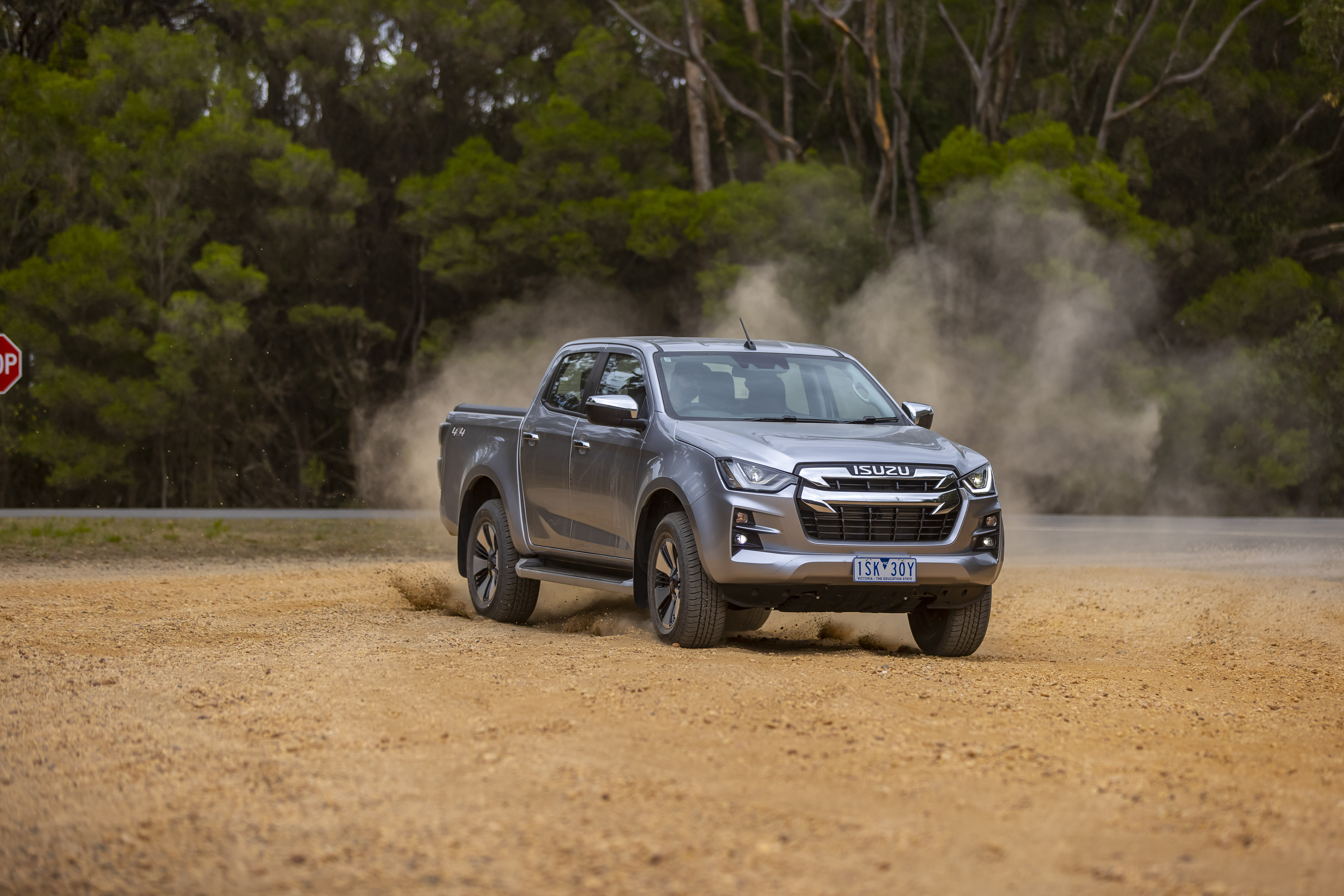
Mid-size utes continue to be the most in demand and best-selling new cars in Australia, with the Toyota Hilux and Ford Ranger top-sellers overall and the Isuzu D-MAX in fifth place. Third and fourth spots were filled by the RAV4 and CX-5.
The top two slots are reflected in the 4×4 sales charts, with Hilux and Ranger continuing to dominate.
Sales of the popular Ford continue to drop, as stock of the current model runs out in anticipation of the next-gen Ranger that’ll be on sale in June.
“We’re already hearing from dealers that waiting lists for the V6 diesel Ranger are already blowing out to 12 months”
The Blue Oval crew will be hoping there are no supply issues with the new ute when it gets here; although, we’re already hearing from dealers that waiting lists for the V6 diesel Ranger are already blowing out to 12 months.
Ford will be looking at a mammoth second half of the year with the Ranger Raptor following the regular Ranger to showrooms, and then the all-new Everest Wagon shortly after that.
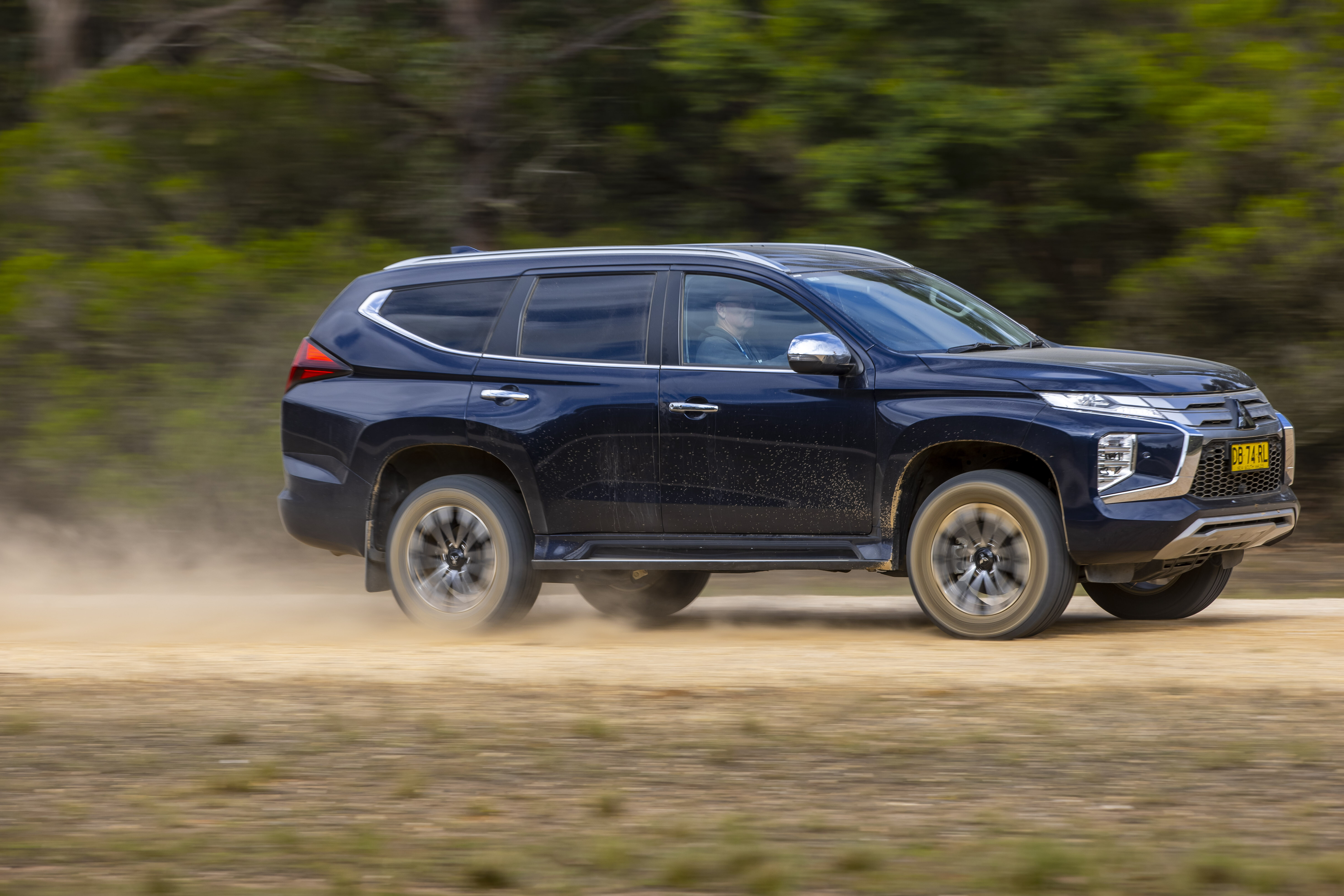
Mitsubishi will be happy to see its supply problems behind them as the brand’s Triton 4×4 ute and Pajero Sport wagon have enjoyed strong sales in the last two months.
Notably the Mitsubishis are outselling the D-MAX and MU-X models, which have been their closest sales competitor in recent times. This will be an interesting duel to watch play out over the coming months.
4×4 sales in April 2022
| 1 | Toyota Hilux | 3441 |
|---|---|---|
| 2 | Ford Ranger | 3361 |
| 3 | Mitsubishi Triton | 2106 |
| 4 | Isuzu D-MAX | 1731 |
| 5 | Toyota Prado | 1631 |
| 6 | Mitsubishi Pajero Sport | 1124 |
| 7 | Mazda BT-50 | 1087 |
| 8 | Toyota LC79 | 836 |
| 9 | Toyota 300 | 829 |
| 10 | Ford Everest | 758 |
Total 4×4 sales in 2022
| 1 | Toyota Hilux | 14,498 |
|---|---|---|
| 2 | Ford Ranger | 12,286 |
| 3 | Mitsubishi Triton | 11,617 |
| 4 | Toyota Prado | 9205 |
| 5 | Isuzu D-MAX | 6464 |
| 6 | Nissan Navara | 4226 |
| 7 | Toyota LC79 | 3367 |
| 8 | Mitsubishi Pajero Sport | 3360 |
| 9 | Isuzu MU-X | 3192 |
| 10 | Toyota 300 | 3015 |
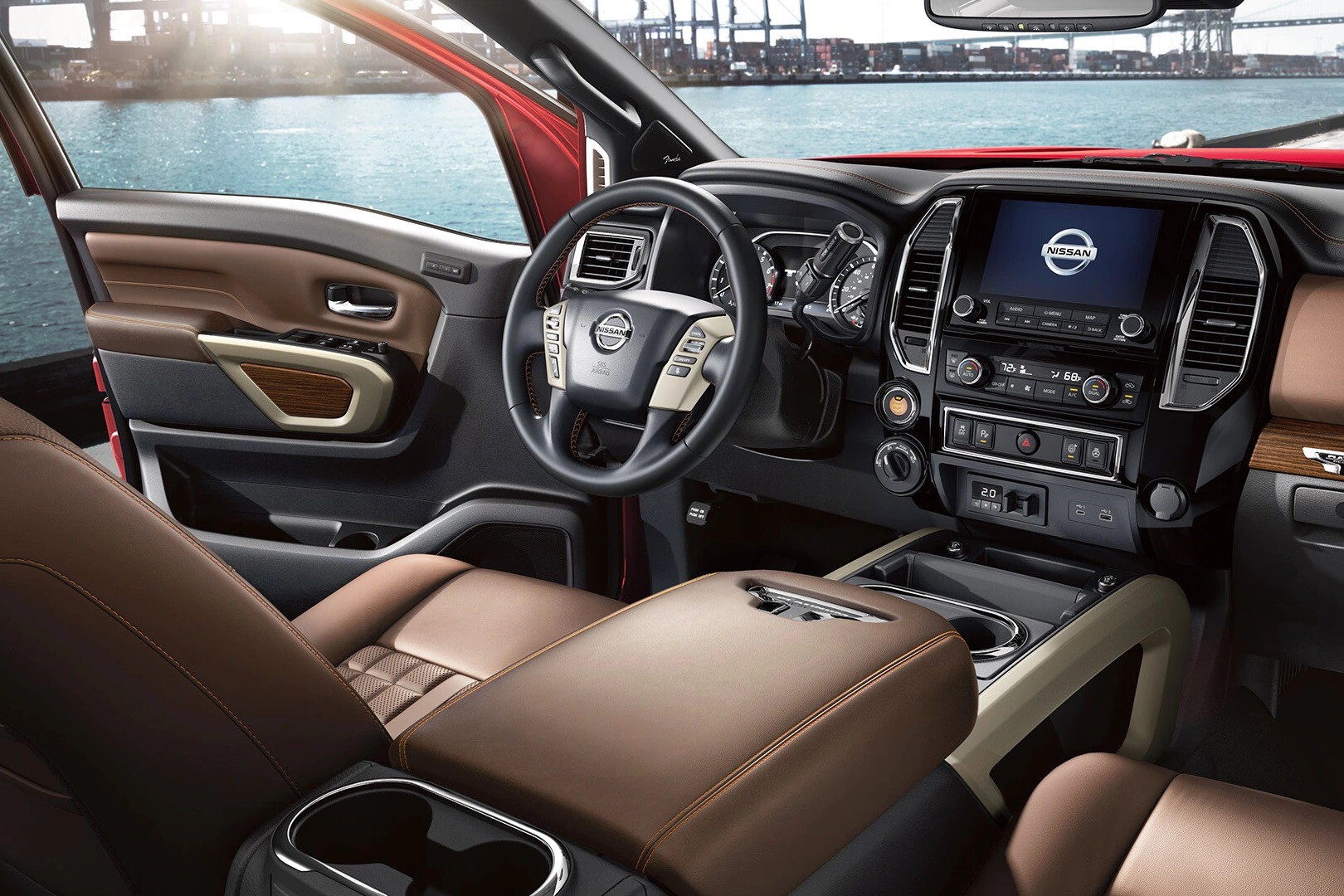
The Nissan Titan still has an outside chance for Australia, it’s understood, following the rise in popularity of full-size American pick-ups in recent years.
Speaking to 4X4 Australia this week, Managing Director Adam Paterson said Nissan Australia was constantly evaluating its product range locally, but admitted bringing the Titan here would be a challenge.
“We’re always looking at getting the correct vehicles for the market,” Paterson said.
“Are we actively looking at [the Titan]? Obviously we have looked at it, but I don’t think active is the right term,” he added.
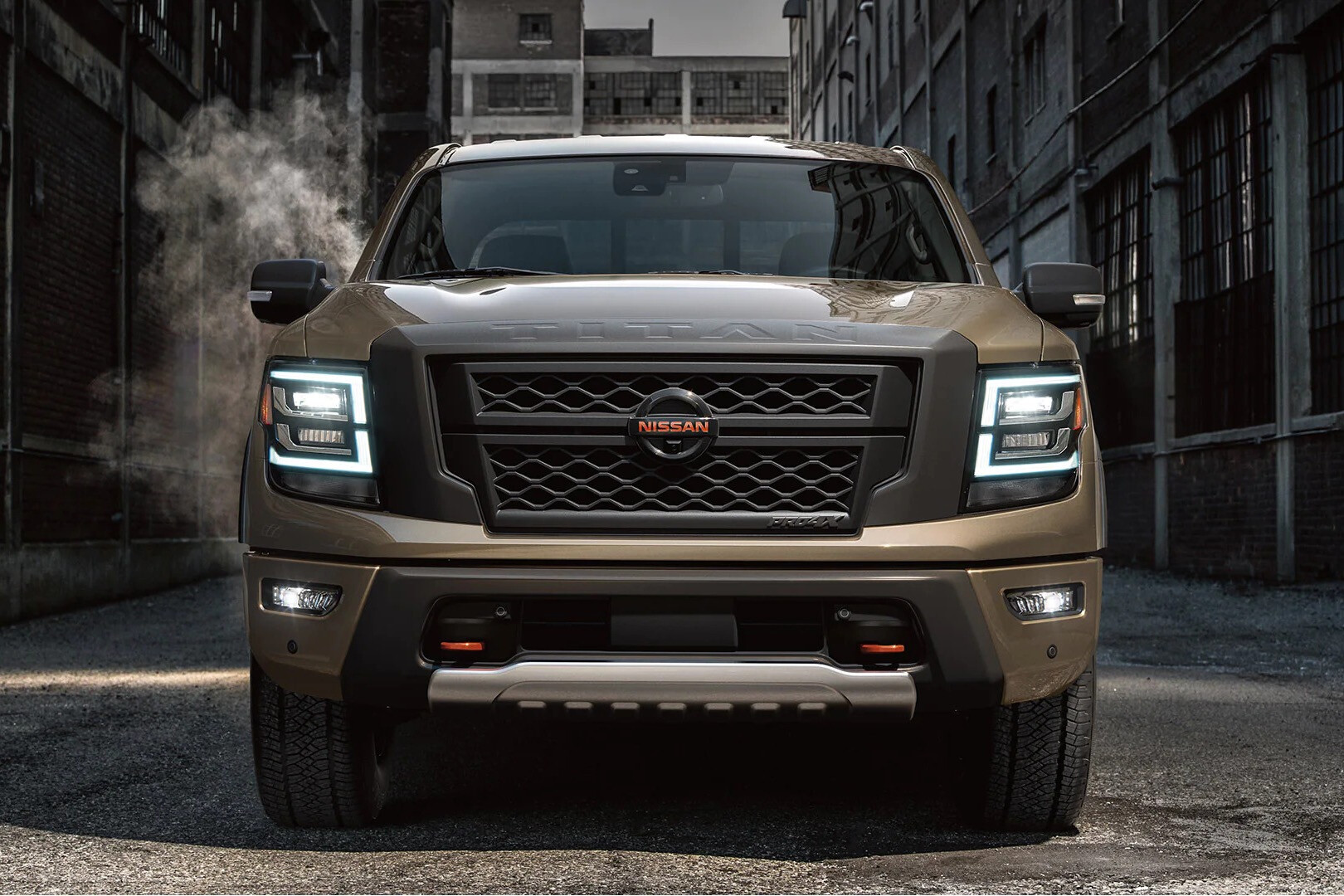
Paterson took the top job in June 2021, replacing Stephen Lester, who was known to be pushing hard to bring the Titan to Australian shores.
Lester had previously said bringing the Titan here would only happen with the help of Premcar – the engineering company responsible for the likes of Tickford, Ford Performance Vehicles, and the Nissan Navara Pro 4X.
“This [Premcar partnership] affords us an opportunity to demonstrate just how successful and capable we can be in what would be a potential local conversion of Titan,” Lester told WhichCar in late 2019.
“That’s more than likely the way the plan looks if it were to happen – the only way it would happen,” Lester said at the time.
But despite Premcar’s reputation in Australia, it appears Nissan executives in Japan might be reluctant to let another company undertake the responsibility of converting the Titan to right-hand-drive.
“Getting through the hoops or requirements that Japan and our engineering departments have to allow any external party to make modifications to our vehicles is challenging, right? It’s rigorous,” Paterson admitted to 4X4 Australia this week.
“[Nissan] wants to ensure all the work it has done to homologate a car… it wants to ensure nothing is done by an outside party that would put it at risk or put customers at risk,” he said.
Ram‘s parent company Stellantis, General Motors, and more recently Ford, don’t seem to harbour those concerns. In March, Ford announced it was bringing the F-150 to Australia, following strong sales of the Ram 1500 and Chevrolet Silverado locally – all of which are converted to right-hand-drive in Melbourne.
“I think it’s even more of an indicator that Australian vehicle tastes are changing, and the demand for products that are similar to those I was used to in North America is certainly here,” said the Nissan Australia boss, who is originally from Canada.
“Does [the Ford F-150 coming here] change our vision for full-size pick-ups in the market? I don’t think so,” said Paterson.
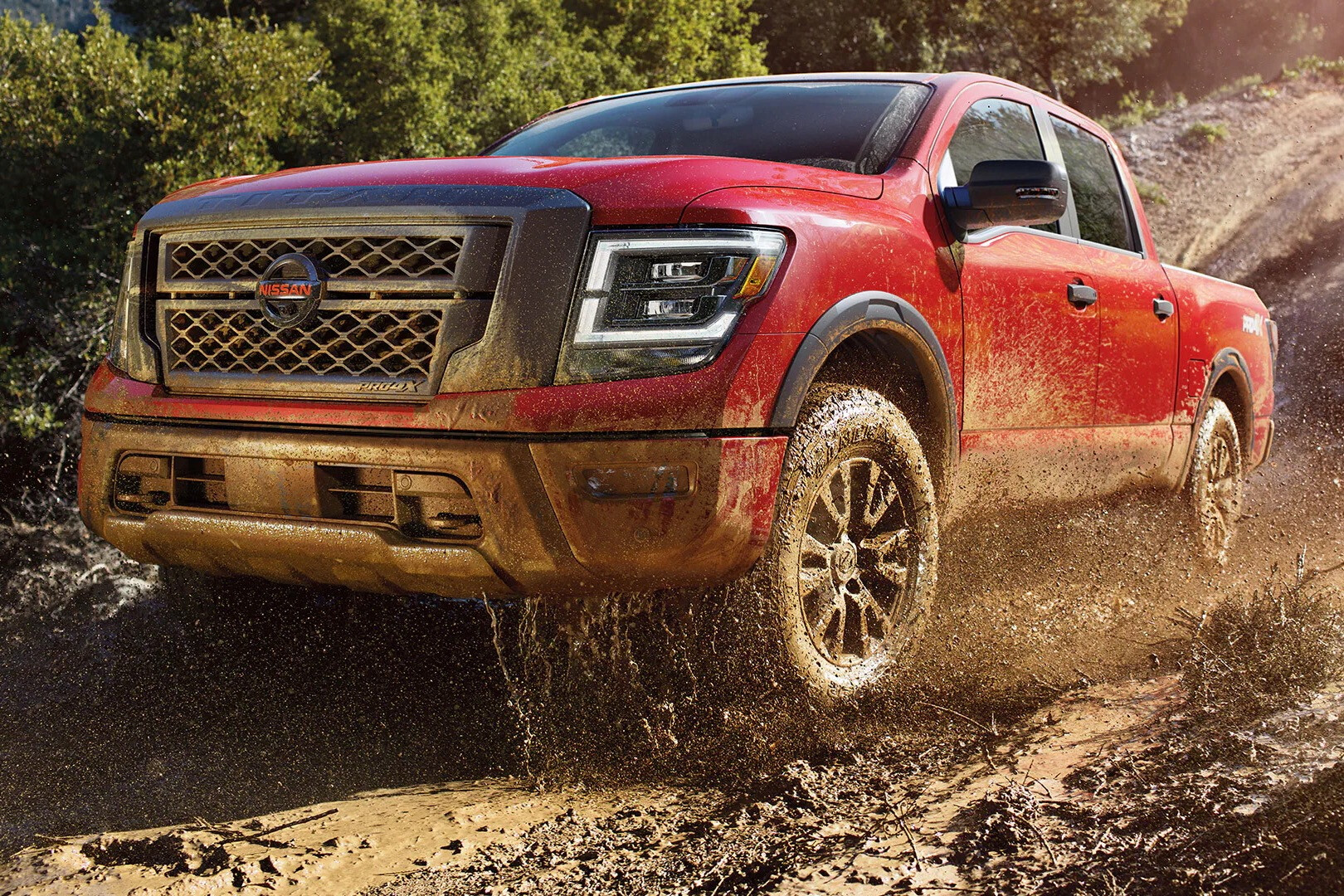
In North America, the Nissan Titan is powered by the same 5.6-litre petrol V8 found in the Patrol, producing 298kW of power and 560Nm of torque, with a choice of either rear- or four-wheel drive.
The main difference is the Patrol uses a seven-speed automatic, while the Titan gains a nine-speed auto.
But despite the overwhelming desire of Nissan Australia to bring the Titan to our shores, it seems there’s no clear pathway on how to make that happen.
“It’s something we’ve looked at and it’s something we’d love to participate in at some point” Paterson said.
“It’s just we don’t have a plan we’re ready to announce at this point around how we’d do it.”
Snapshot
- Premcar has built just over 1251 Navara PRO-4X Warriors so far
- Hardcore off-road variant makes up over one-quarter of 2022 4×4 Navara sales
- Demand has increased weekly production rate by 25 per cent
The Nissan Navara PRO-4X Warrior is proving a popular choice with buyers, as soaring demand forces production efforts to ramp up.
Having gone on sale in the middle of last year, the Premcar-modified, off-road focused Nissan Navara PRO-4X Warrior has enjoyed increased demand from the public, with a total of 1251 units built so far – accounting for over one-quarter of all Navara 4×4 sales year-to-date.
It’s price point under the Toyota HiLux Rugged X and Ford Ranger Raptor have undoubtedly aided its popularity in Australia, although Nissan admits the increased production from Premcar’s Melbourne facility has put extra strain on its supply chain to get Navaras into the country.
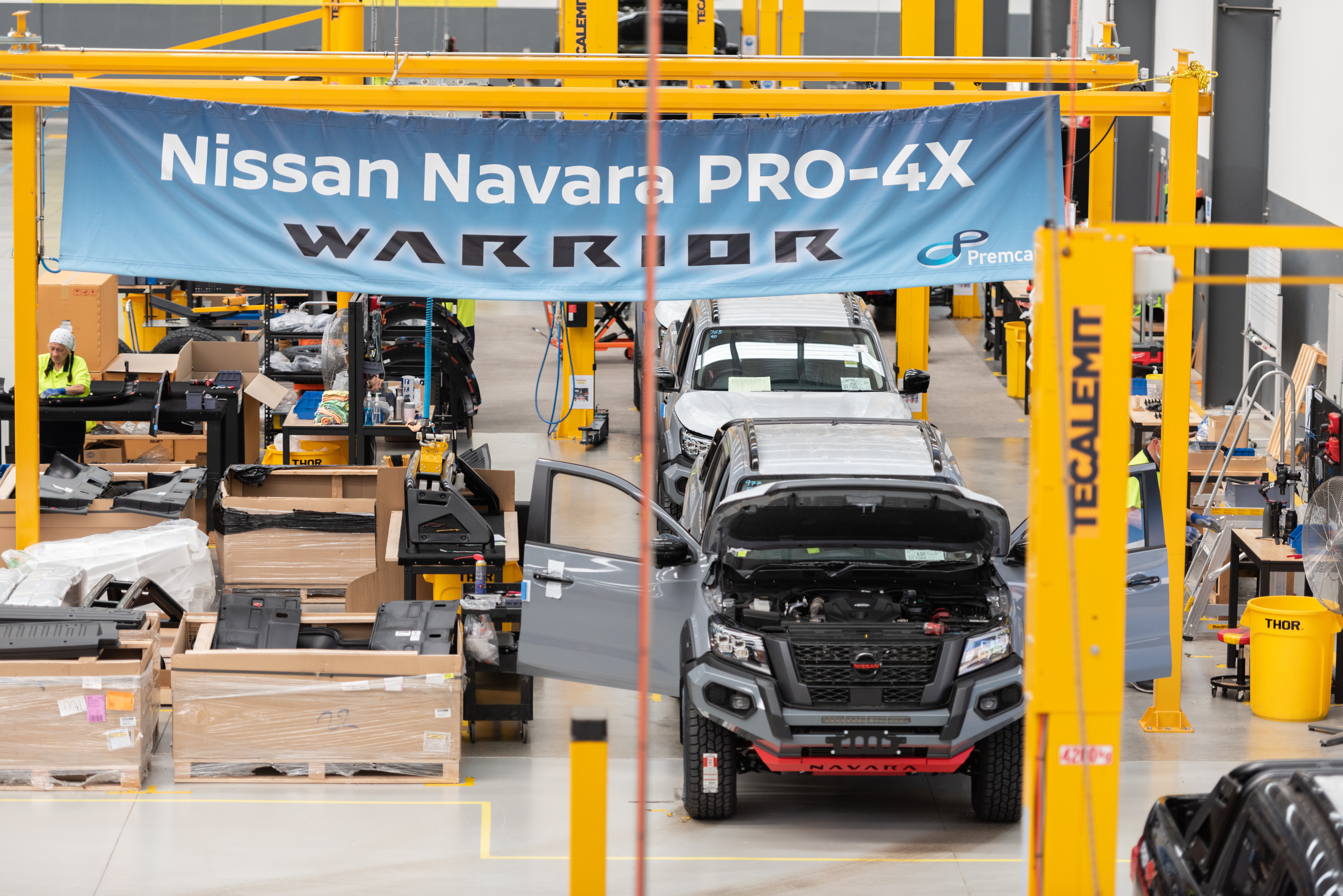
Nissan’s Australian managing director Adam Paterson said the marque was more than happy with the response to the second-generation PRO-4X Warrior, with its dealers shifting every example they can get.
“We’re quite excited about that product and how well it’s been doing,” Paterson told 4×4 Australia.
“It’s been a hugely successful launch for us; we’ve been selling every unit we can build. We went onsite in September last year and as of the end of last month we had built 1251 Pro-4X Warriors.
“We have sold 1149 of them and the balance of just over 100 are either arriving in dealer lots or just arriving in dealers. We have 180 stores across the country and we have 102 units of stock to deliver so almost every unit is spoken for in advance of production.”
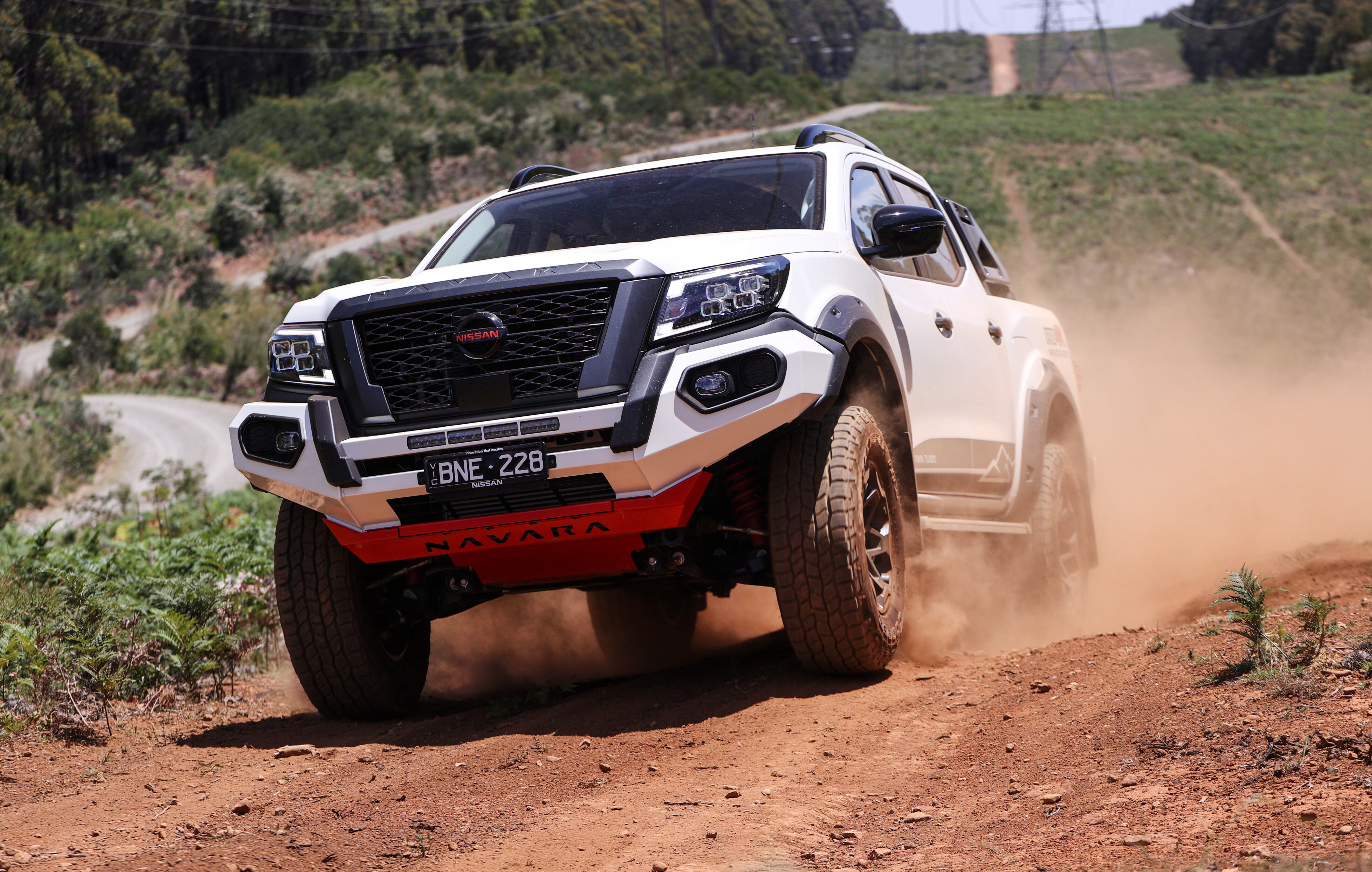
The success of the Navara PRO-4X Warrior has been recognised by Nissan’s overseas operations too, although the 25 per cent increase in weekly production has led to supply constraints of base vehicles arriving at Premcar.
“The vehicle has been extremely successful for us, it’s been recognised globally within the Nissan Group as far as how successful the local conversion has been so we’re extremely happy with that.
“We’ve done our best to lift the conversion rate/production rate with Premcar. When we started the program we were building 32 a week and we’ve increased that to 40 per week and that’s what we’re running at now.
“Obviously we need done vehicles to feed the conversion program so that’s really where we can be.”
Navara is Nissan’s best-selling model in Australia, with the 4226 units shifted to the end of April making up just under half of the brand’s overall sales, while it remains the only model to record higher deliveries than last year with a 24 per cent year-on-year increase.