
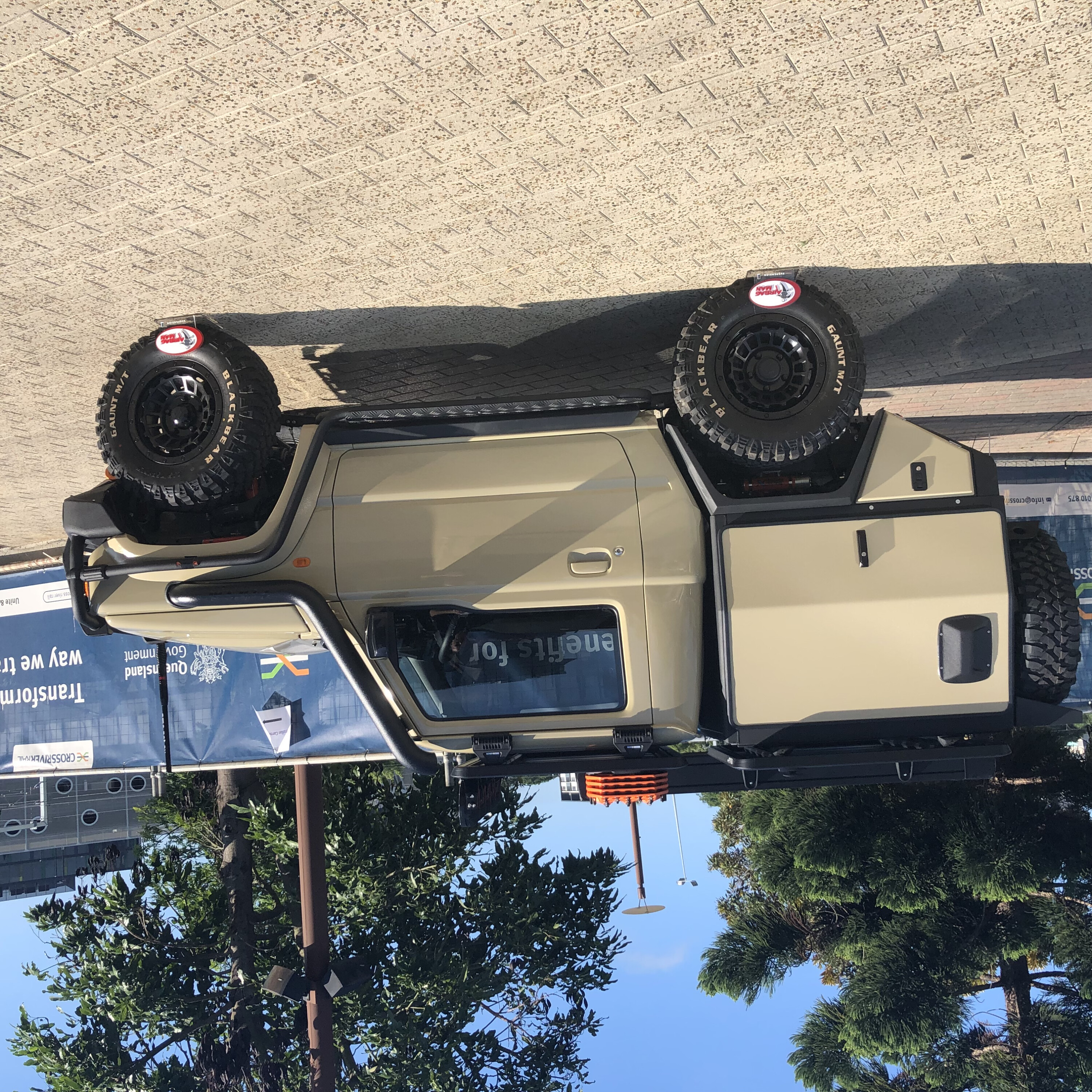
One of the most talked about cars on show at the Brisbane 4×4 show in March was this cute-as Suzuki Jimny, which has been meticulously crafted to resemble a miniature Land Cruiser.
There have been countless Jimny look-a-likes created since the JB74 model was launched, most of these out of Japan. They have given the diminutive Jimny the look of Mercedes-Benz G-Wagens, Land Rover Defenders, Ford Broncos and even classic LJ Suzukis of the past.
Upgrade your 4×4
-
Bullbars
-
Underbody Protection
-
4X4 Tyres
-
Canopies
-
Roof Racks
-
Storage
To put more of an Australian spin on the little 4×4, the guys at Maxtrax teamed up with some of the biggest businesses in the 4×4 aftermarket industry to give this Jimny the look of a 79 Series double-cab Cruiser, complete with custom barwork, suspension, body chop and custom canopy. They even painted it in Toyota Sandy Taupe and integrated a shortened 70 Series bonnet vent into the Jimny hood.
The team did such a great job of the transformation that from 100 metres away you could be mistaken for thinking it is just another Sandy 79 – and there were plenty of people doing a double take as they walked past it at the Brisbane Show.
The build of the Toyzuki is still ongoing, and it will be hitting the road to visit the major Sydney and Melbourne 4×4 shows and other events.
The most exciting part is that after its show duties the Toyzuki will be given away to one lucky person. Entry is free by simply heading to the Toyzuki page at www.toyzuki.com.au and registering your interest.
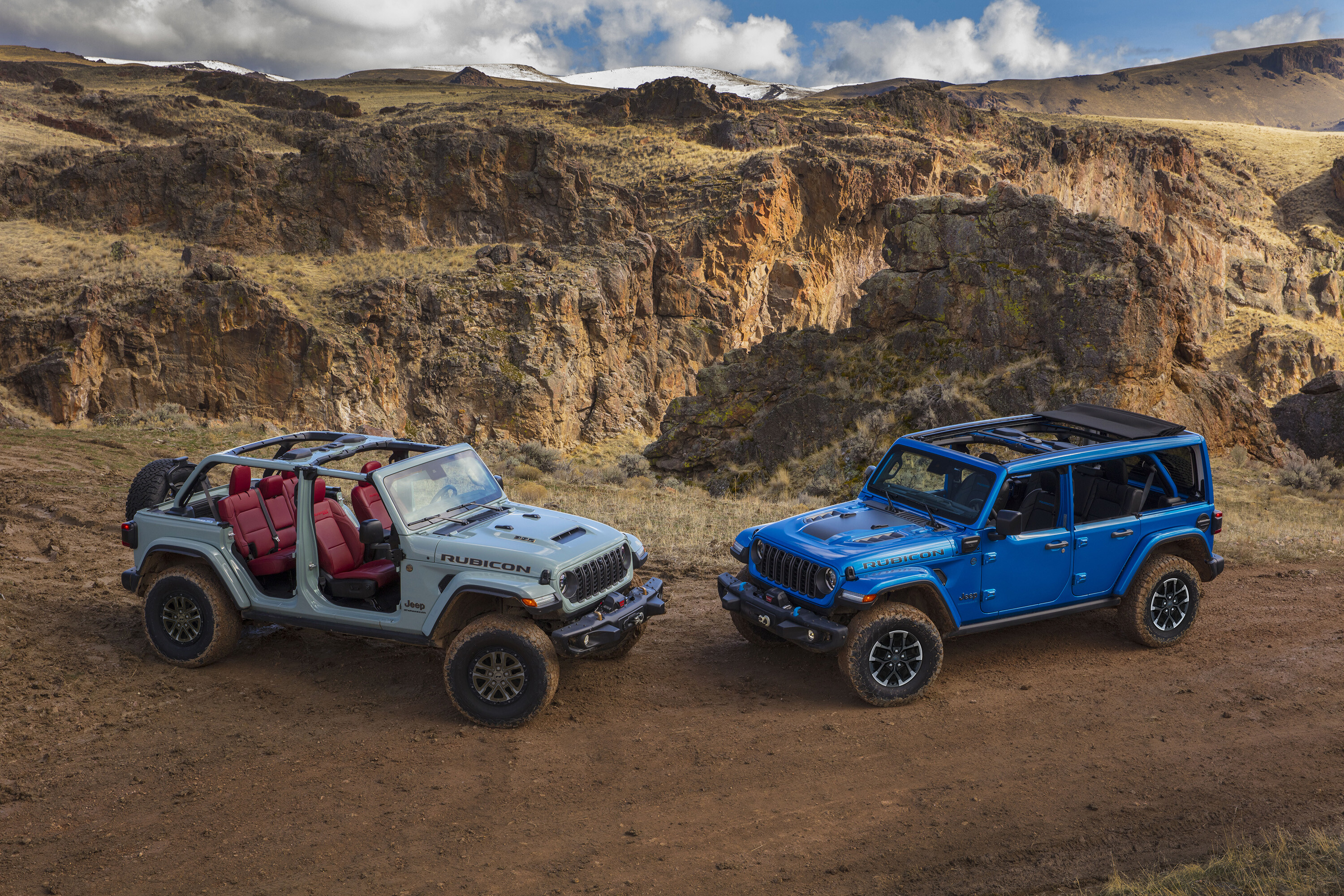
Jeep has officially lifted the covers off its 2024 Wrangler, with the famous seven-slot off-roader gaining new technology, subtle design tweaks and improved safety features.
This new model is currently only confirmed for the North American market, so we’ll have to wait for confirmation from Jeep’s Australian arm. Confirmed models for the North American market are Sport, Willys, Sahara, High Altitude, Rubicon and Rubicon 392.
Upgrade your 4×4
-
Bullbars
-
Underbody Protection
-
4X4 Tyres
-
Canopies
-
Roof Racks
-
Storage
The biggest boon for off-roaders with the 2024 model is the addition of a full-floating Dana rear axle on all Rubicon models – a first for the Jeep brand – which will strengthen the vehicle’s rear end and something we’d love to see here. A 100:1 crawl ratio has also been confirmed.
The Wrangler will also be available with a new Warn winch from factory, and an increase in towing capacity to 5000lb (2268kg). Interior upgrades will include a larger 12.3-inch screen, and safety has improved thanks to the addition of standard side curtain airbags in the first and second rows.
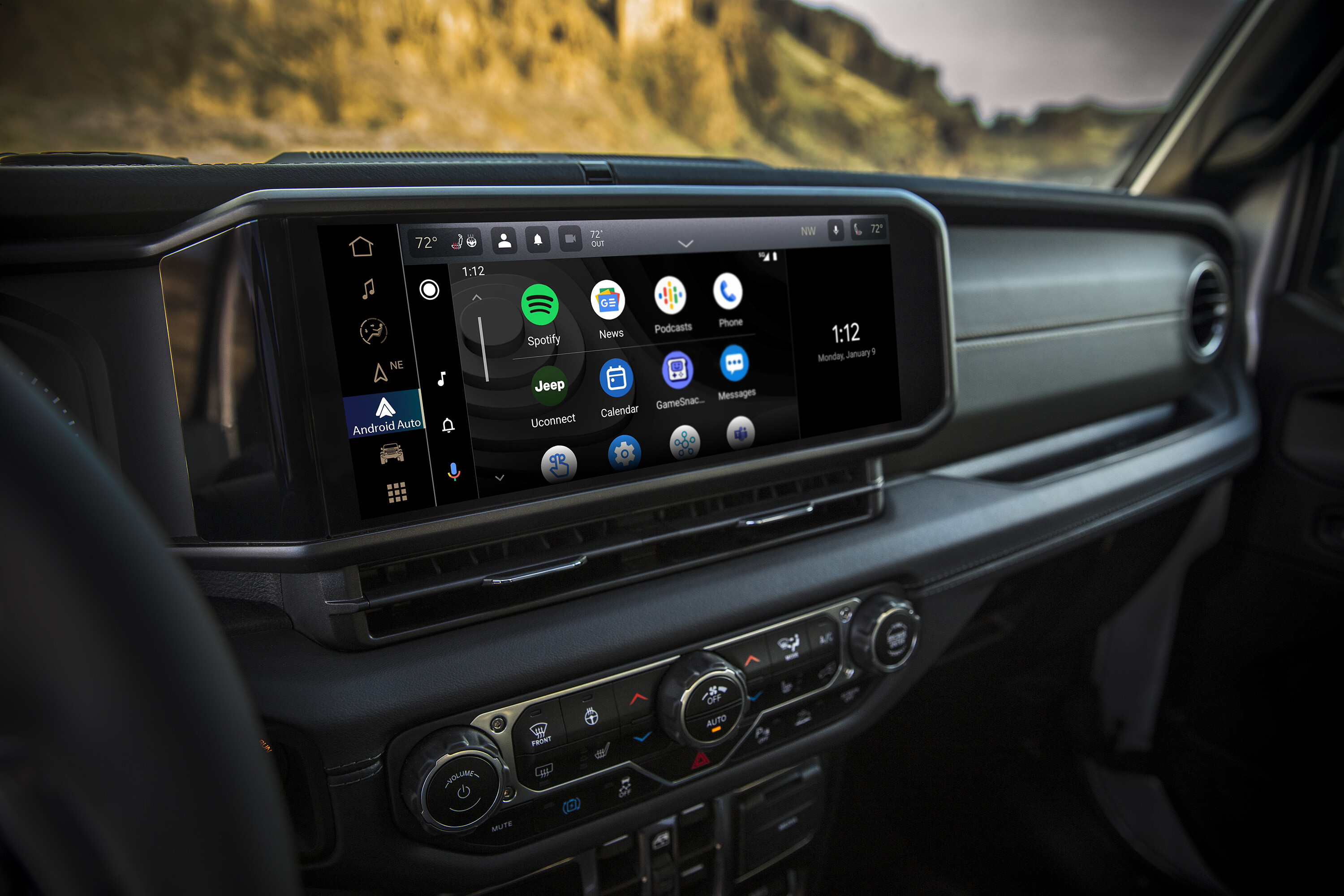
“The new 2024 Jeep Wrangler is an illustration of how powerful the Jeep community is and how they keep driving improvements based on their expectations of greater capability, advanced technology and more refinement,” said Jim Morrison, senior vice president and head of Jeep brand North America.
“With the plug-in 4xe playing a lead role in the lineup, the new Wrangler takes the best and makes it better, with even more legendary 4×4 capability, thanks to our first full-float Dana rear axle that makes it possible for Wrangler owners to easily upsize tires; a more advanced and comfortable interior with a standard 12.3-inch touchscreen and available power seats tested for water fording; more safety and technology, including standard side-curtain airbags; and a stylish, fresh take on the iconic seven-slot grille that keeps the overall design true to the original.”
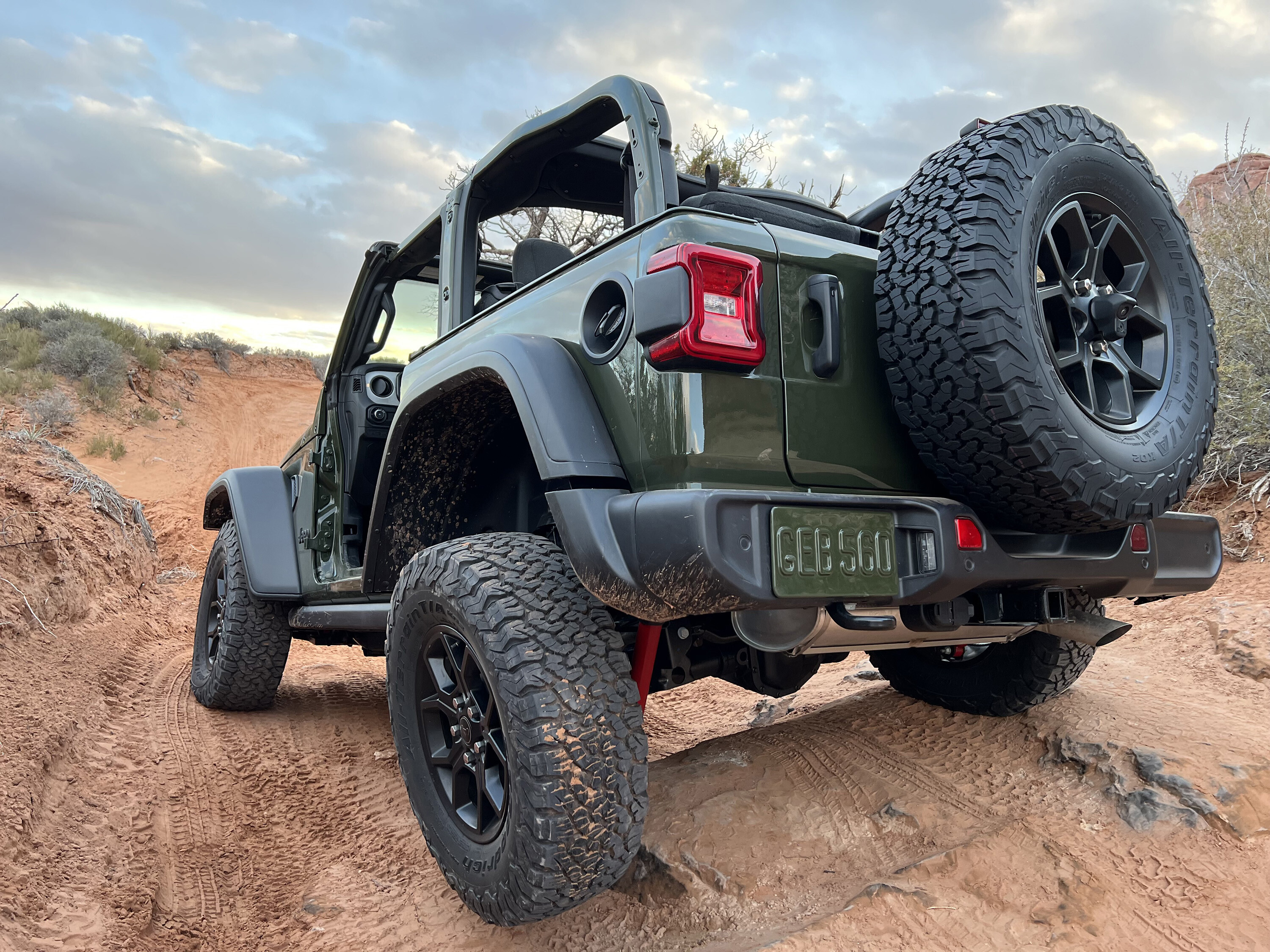
In Australia, Jeep currently only offers the 209kW/347Nm 3.6-litre V6 diesel engine for both the two-door and four-door Wrangler.
More details for Australian-delivered 2024 Wranglers are expected later this year.
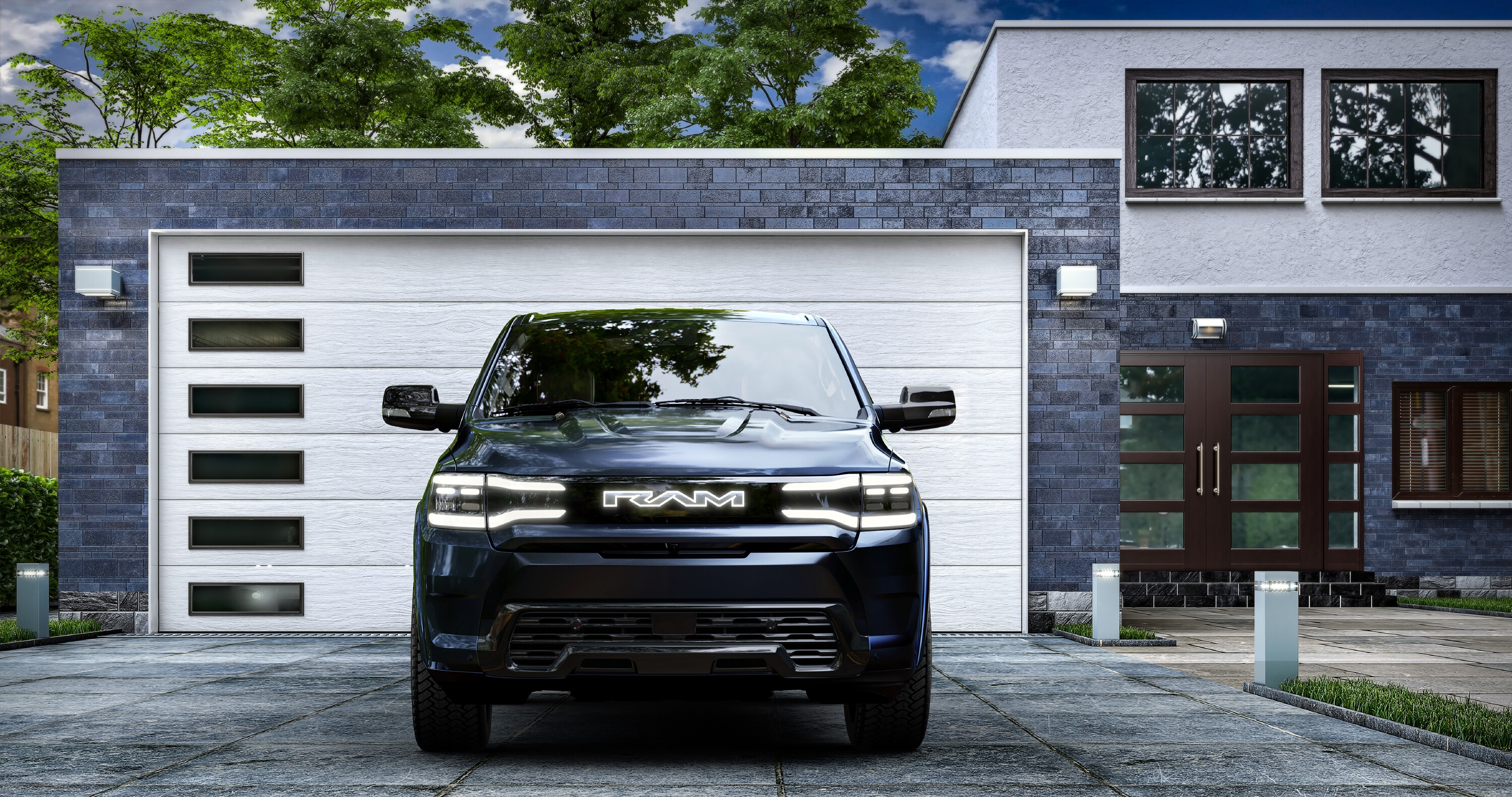
Another electric ute has entered the fray, with the 2024 RAM 1500 REV promising industry-leading driving range and towing capacity.
Snapshot
- Targeting 560km standard range or 800km extended range
- Braked Towing capacity up to 6350kg
- Based on STLA Frame platform
- 800-volt electric architecture for 350kW DC
- Australian launch looking likely
RAM has detailed the 1500 REV at the 2023 New York International Motor Show. It’s a battery-electric ute to rival the likes of Ford’s F-150 Lightning, Rivian’s R1T, and Tesla’s forthcoming Cybertruck – and an Australian release sounds likely.
The RAM 1500 REV features massive battery packs, the basic tier boasting 168kWh of capacity and the extended XR an absurd 229kWh. (For context, the F-150 Lightning offers 98kWh or 131kWh packs.)
RAM is yet to validate its figures with the US EPA, so the claimed 560km and 805km driving range figures are, for now, based on its own internal testing and calculations. Still, it’s pretty impressive stuff.
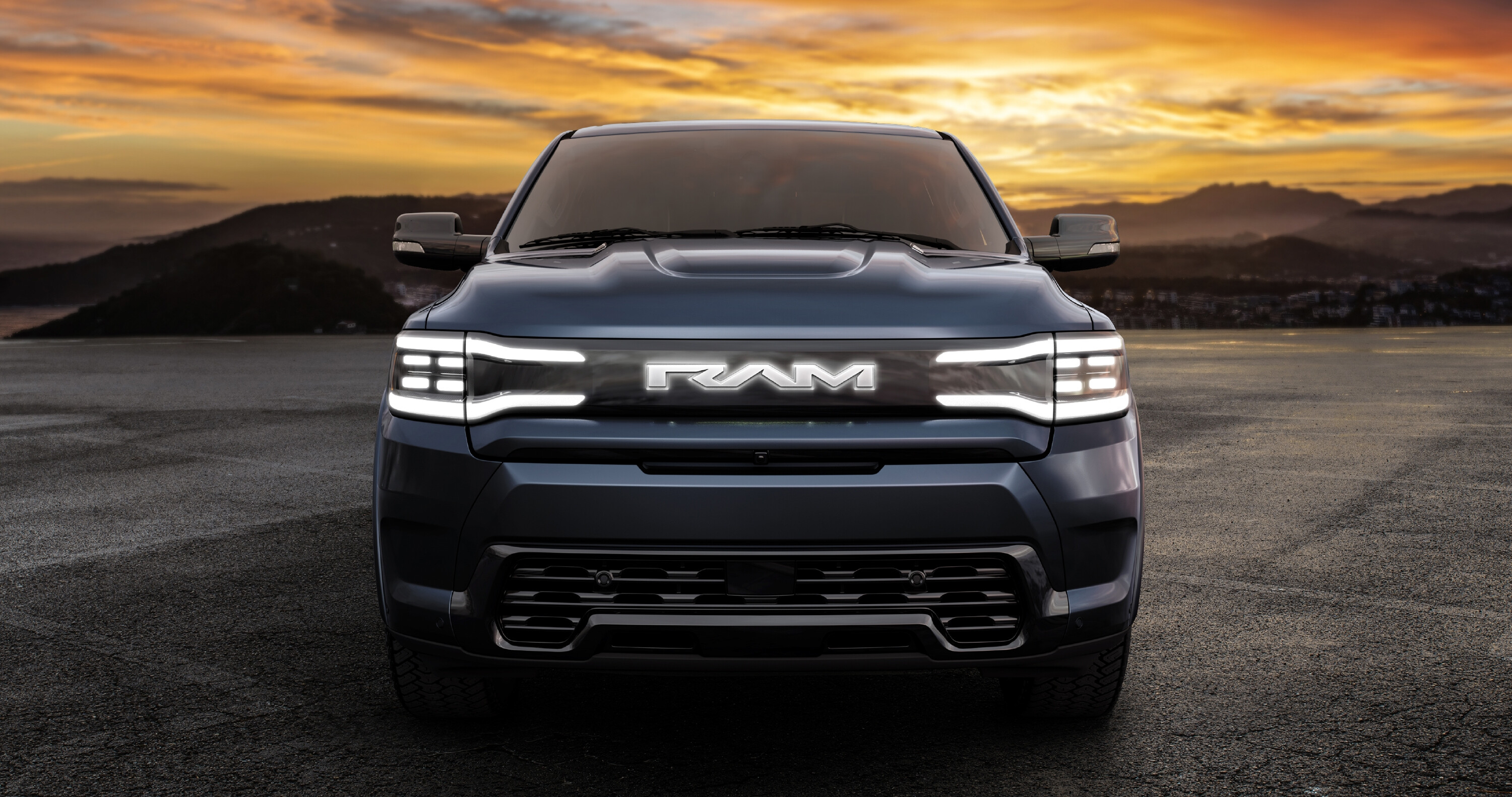
The production ute carries many of the show car’s features, including an imposing front end that’s set off by ‘tuning fork’ DRLs, clever 424L frunk, and typical ute proportions.
A 6350kg braked towing capacity (with optional heavy-duty hitch) is RAM’s target – impressive stuff – and you should be able to put about 1224kg in the bed. How loading up the REV will affect driving range is yet to be confirmed.
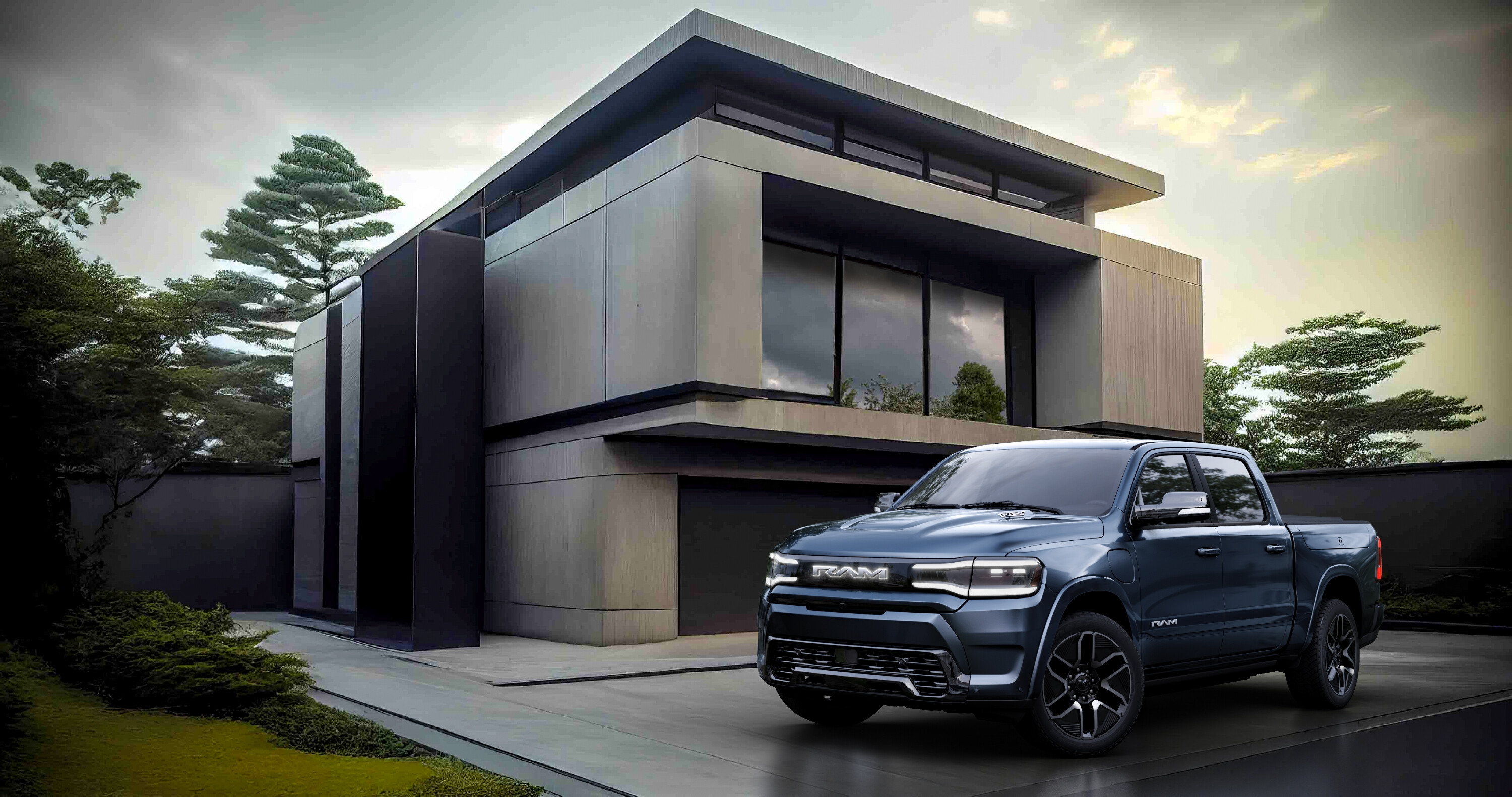
“The all-electric Ram 1500 REV is a monumental milestone on our continued journey to offer the industry’s best electrified solutions and further fortifies our award-winning lineup,” said Mike Koval Jr., Ram CEO.
“We believe in bringing the right range of powertrain solutions to our customers and will continue to redefine the pickup truck segment. Our all-new Ram 1500 REV pushes past the competition in areas customers care about most, including range, towing, payload, and charge time.”
4X4 Australia understands that a local release of the 1500 REV is a strong possibility, though details are yet to be confirmed.
Charging, power and performance
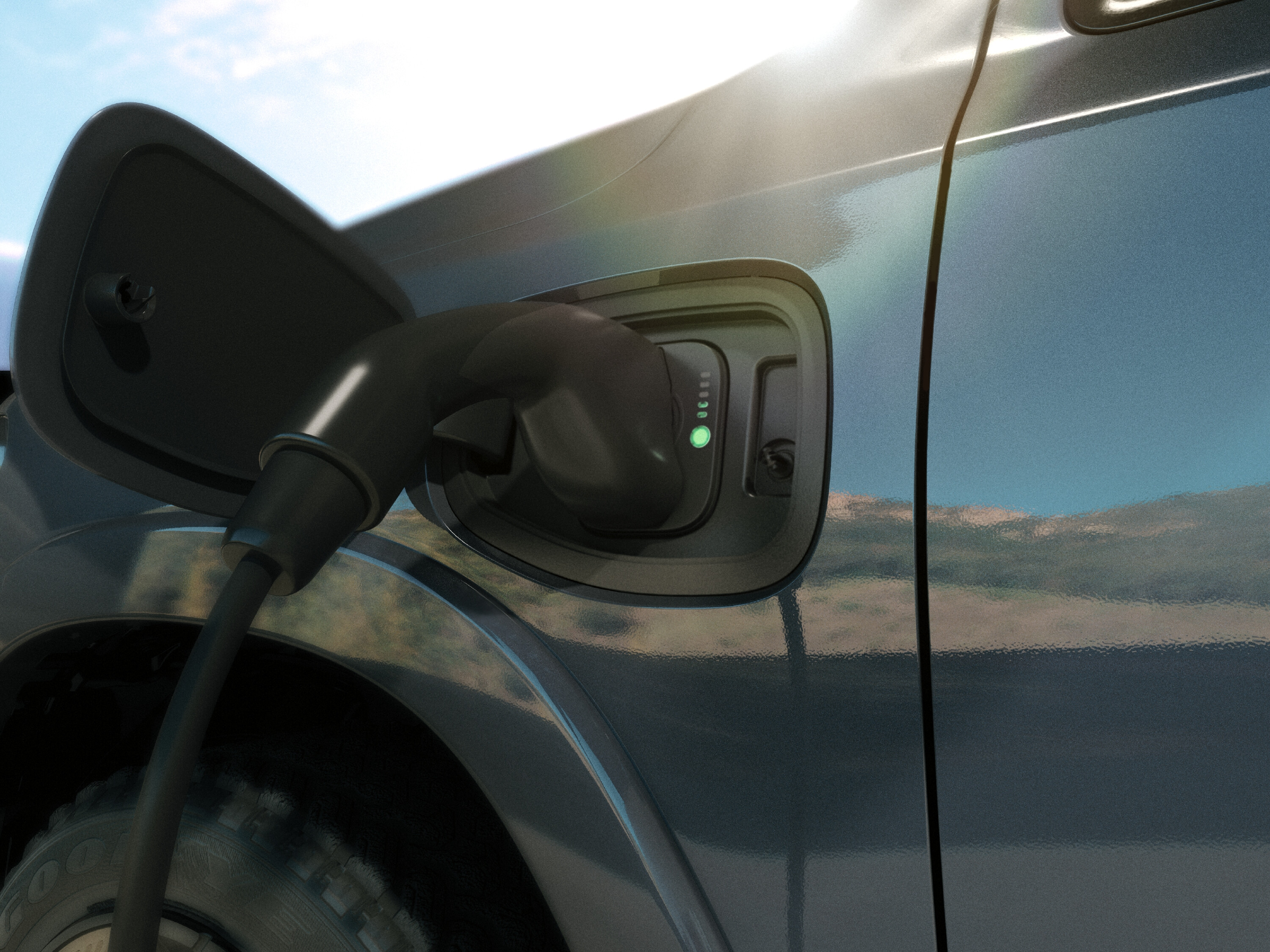
If range and towing figures don’t impress you, then RAM’s STLA Frame’s 800-volt architecture may. Like Hyundai/Kia’s E-EMGP architecture, STLA accommodates DC charging at 350kW, adding up to 180km driving range in 10 minutes.
There are two power boards, one in the tub (7.2kW) and one in the ‘frunk’ (3.6kW) that can be used for vehicle-to-vehicle, vehicle-to-grid, or vehicle-to-load functions.
RAM hasn’t released details on the 1500 REV’s weight, but with a Ford F-150 Lightning Platinum coming in over 3000kg, you can expect the RAM to be heavier with its even bigger battery pack.
That makes its 0-60mph (0-98km/h) time of 4.4 seconds impressive. The 1500 REV has two separate 250kW electric motors, which produce a combined 488kW and 841Nm.
The front motor can freewheel on the highway to lower consumption, and the rear motor assembly incorporates an electronically-locking differential to improve off-road ability. RAM claims a 600mm wading depth.
As far as ladder-frame vehicles go, the REV is fairly advanced with multi-link independent rear suspension and four-corner active air suspension with adaptive dampers that should help the big ute ride well, even on the Tungsten’s 22-inch alloys.
Standard features
Inside, the RAM 1500 REV promises to be more than a work truck, with a new flagship Tungsten trim, for five variants total. Tradesman, Big Horn/Lone Star, Laramie, Limited sit below.
At the centre of proceedings is a 14.5-inch touchscreen running Stellantis’s Uconnect 5 software, a 12.3-inch digital driver’s display, digital rear-view mirror, head-up display, and an optional 10.25-inch passenger touchscreen (just like in the Grand Cherokee L).
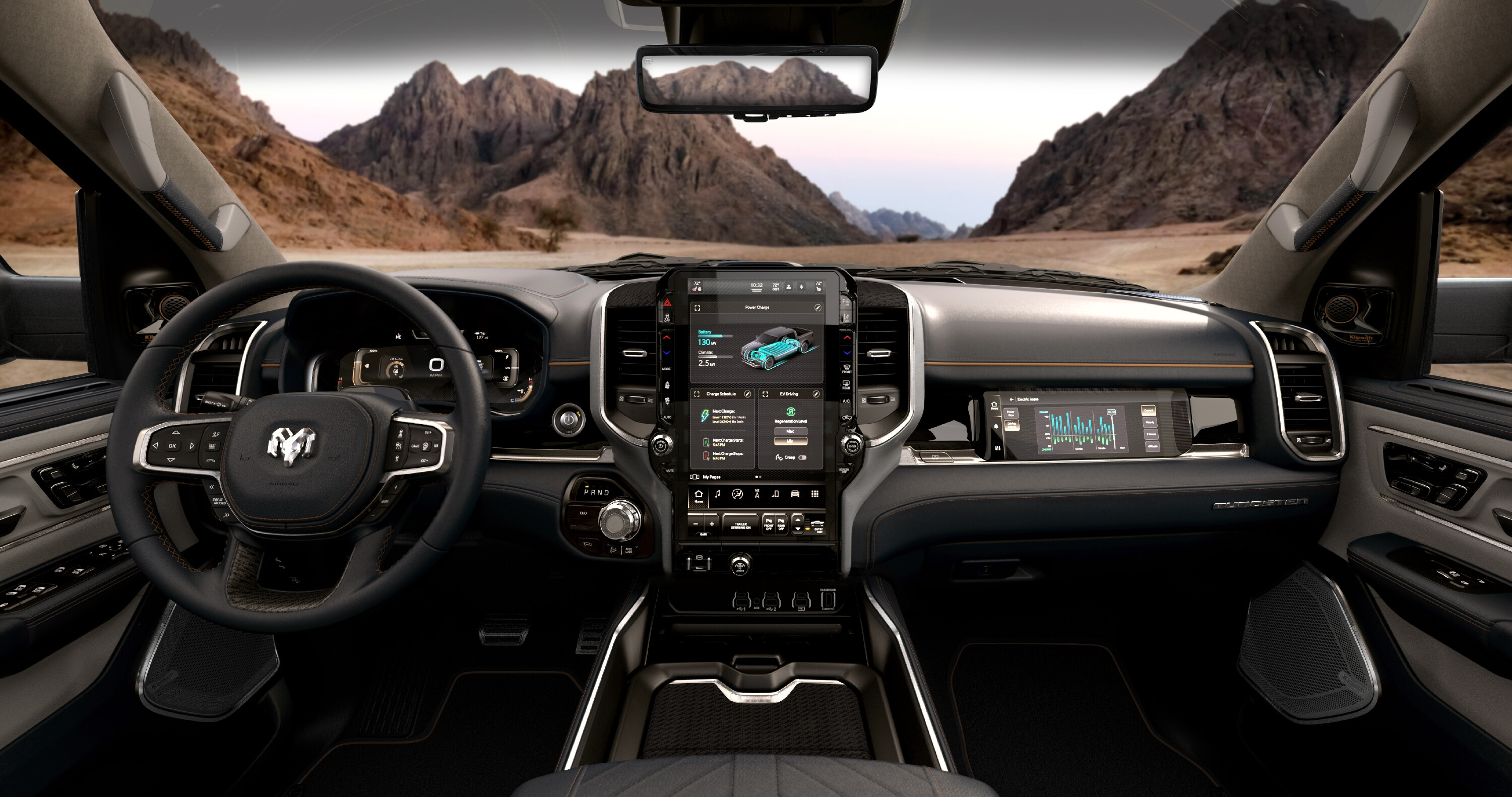
The plush Tungsten will feature a 23-speaker Klipsch Reference Premiere sound system that incorporates a 12-inch subwoofer.
RAM has not confirmed final details for the 1500 REV, including pricing, but given its battery size and level of luxury, expect it to cost a pretty penny. By the time a top-spec Tungsten arrives in Australia, a price tag approaching $200K wouldn’t be unrealistic.
The Ford Ranger continues to stamp its authority on the 4×4 market, with the all-new model topping the 4×4 charts in March 2023.
Ford sent a total of 3877 new 4×4 models out of its showrooms in March 2023, once again leaving the ageing Hilux 4×4 in its dust, with a total of 3480 Toyota Hilux 4×4 models sold. Still, the Hilux remains the best-selling model when combining 4×2 and 4×4 models.
Upgrade your Ranger
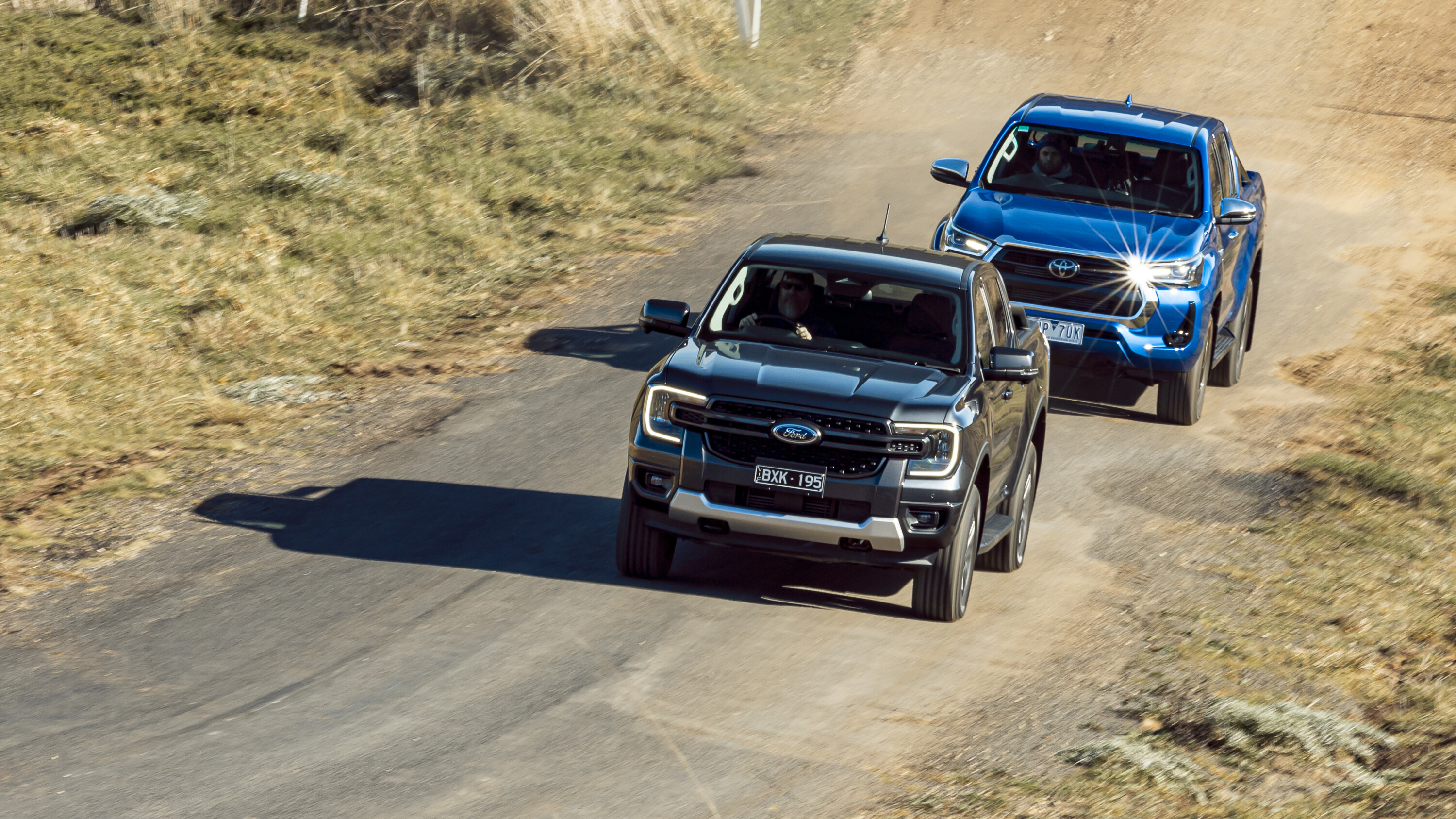
The sales figures for March 2023 paint a very different picture than for the same month last year thanks to the next-gen Ranger, with sales jumping from 2743 in March 2022 to 3877 in March 2023 – a hike of 41.3 per cent. In contrast, Hilux 4×4 sales dived from 4911 in March 2022 to 3480 in March 2023 – a decline of 29.1 per cent. A new Hilux model will surely turn these numbers on their head, though.
As it sits, the Ranger 4×4 has outsold the Hilux 4×4 by a total of 2508 units on the year-to-date charts, with the ever-consistent D-MAX rounding out the podium. Capping off a strong start to 2023 for Isuzu, the MU-X is now the most popular large SUV in Australia, coming in ahead of the Prado, Everest and 300 Series on the sales charts.
Top 10 best-selling 4x4s in Australia: year-to-date
| 1 | Ford Ranger | 11,909 |
|---|---|---|
| 2 | Toyota Hilux | 9401 |
| 3 | Isuzu D-MAX | 5532 |
| 4 | Isuzu MU-X | 3798 |
| 5 | Mitsubishi Triton | 3567 |
| 6 | Mazda BT-50 | 3418 |
| 7 | Toyota Prado | 3220 |
| 8 | Ford Everest | 2967 |
| 9 | Toyota LandCruiser 300 | 2785 |
| 10 | GWM Ute | 2571 |
Top 10 best-selling 4x4s in Australia: March 2023
| 1 | Ford Ranger | 3877 |
|---|---|---|
| 2 | Toyota Hilux | 3480 |
| 3 | Isuzu D-MAX | 2302 |
| 4 | Isuzu MU-X | 1745 |
| 5 | Mitsubishi Triton | 1331 |
| 6 | Mazda BT-50 | 1159 |
| 7 | GWM Ute | 1140 |
| 8 | Ford Everest | 985 |
| 9 | Toyota LandCruiser 79 | 916 |
| 10 | Toyota Prado | 915 |
In a sign of the current squeeze on the cost of living, the budget utes continue to sell well so far in 2023. On the year-to-date charts, the GWM Ute has sold a total of 2571 4×4 units (an increase of 495.1 per cent on March 2022), and the LDV T60 has shifted a total of 2247 4×4 models (an increase of 176.7 per cent on March 2022).
Overall VFACTs summary
Despite a total of 22,012 Light Commercial Vehicles selling in March 2023 – the highest monthly tally so far this year – it’s a 9.0 per cent decrease compared to March 2022 (24,194 sales).
This is reflected in the year-to-date charts, which is down 7.6 per cent in 2023 compared to 2022 (59,308 vs 64,162). In contrast, SUV sales have increased, up 5.2% in March and 9.4% YTD. Breaking it down further, and the 4×4 pick-up/cab-chassis market is down 5.2 per cent for the month, and 5.1 per cent YTD.
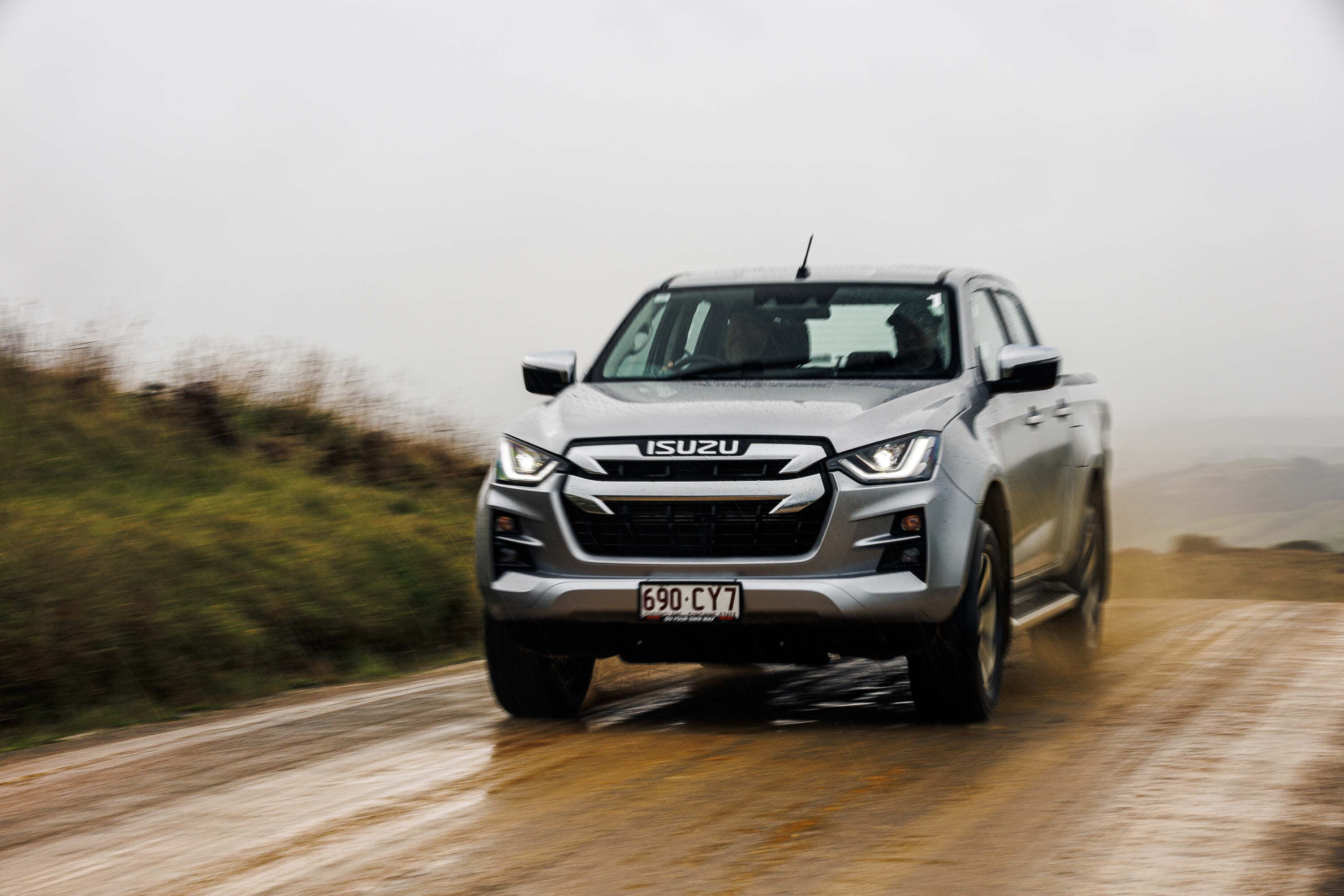
Despite this, the top three best sellers for March were all utes (4×2 and 4×4 models combined): the as-mentioned Hilux, Ranger and D-MAX. This dominance may create future issues with the inevitable shift to electrification, according to FCAI Chief Executive, Tony Weber.
“It is notable that there are no passenger sedans in the ten top selling vehicles for March,” he said. “The consumer preference for utes and SUVs is an important factor to consider as we journey to a zero-emission light vehicle fleet because these vehicles are more difficult and expensive to electrify.
“If we want more zero and low emission vehicles on our roads, then we must provide the necessary recharging infrastructure and move to implement an ambitious yet achievable fuel efficiency standard which will encourage manufacturers to allocate more of the limited supply to Australia.”
4X4 Australia's project builds
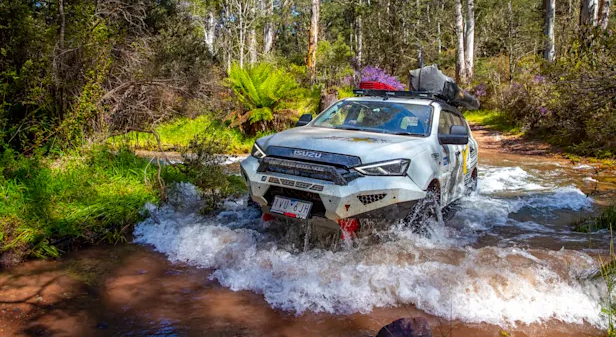
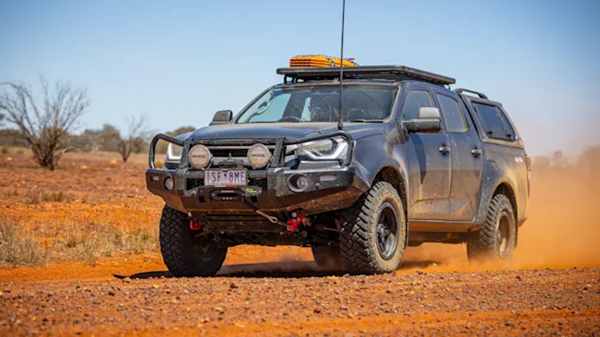
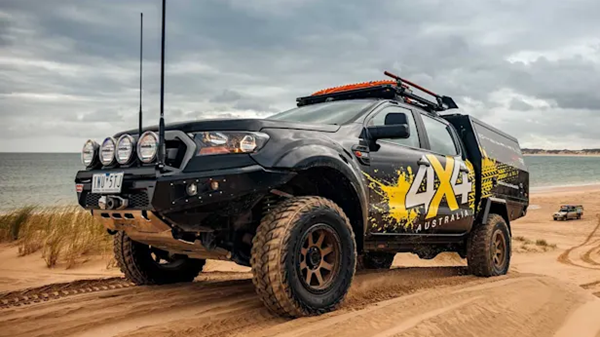
Ford’s 3.0-litre diesel V6 engine brings the performance and refinement of the Ranger ute up to a whole new level. It’s not all about outright grunt but it’s the way it delivers it that makes the V6 the engine to have in the RA Ranger… and soon the 2023 VW Amarok.
The V6 is smooth and refined bringing a new level of comfort and touring pleasure to the category. There is no other diesel-fuelled vehicle in the midsize 4×4 ute class that gets on with the job as well as the ‘Lion’ V6 powered Ranger.
As good as the Lion V6 is there are always ways to make it better, right? After all, when OE manufacturers create a vehicle they are constrained by budgets and costs, and the need to create a product to suit a wide variety of uses. That’s where the aftermarket steps in, to create a products to make the OEM offering better suited to specific requirements, and nowhere are those requirements more specific than the harsh Australian Outback.
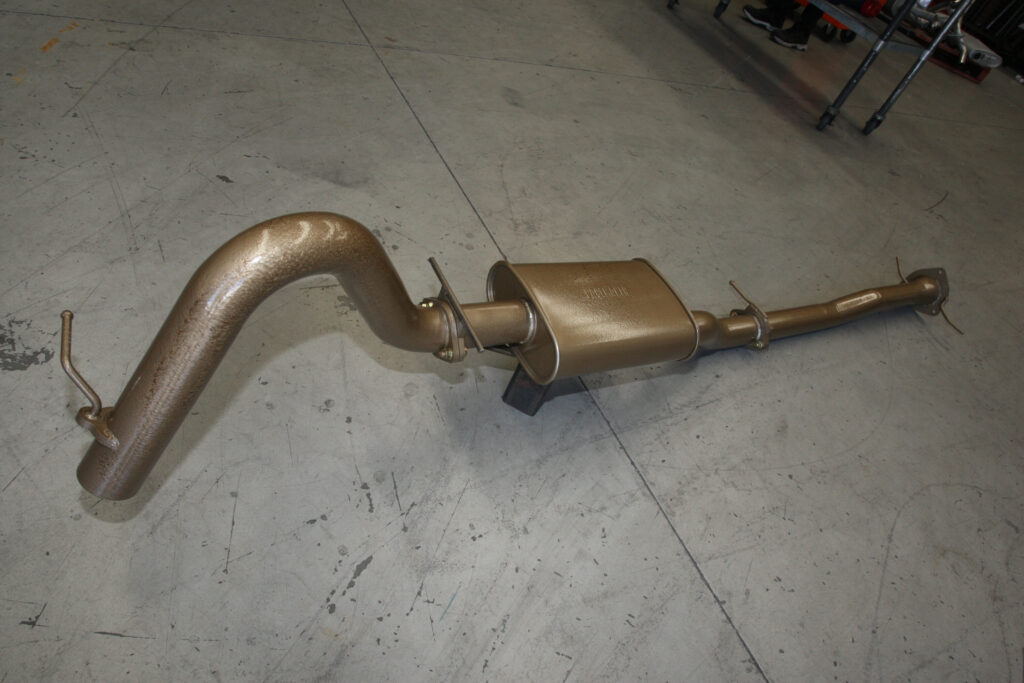
Well-made durable system for long-lasting use.
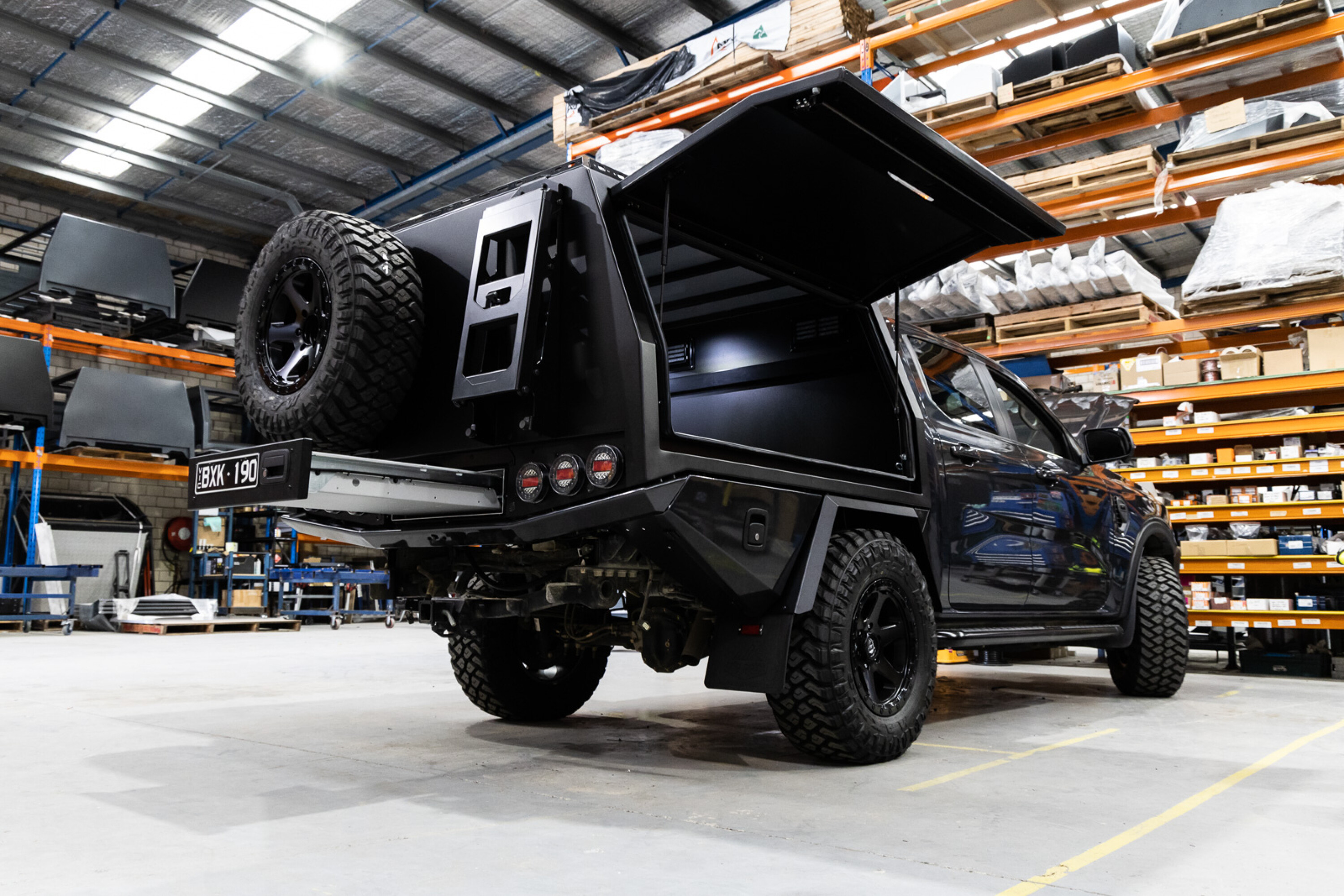
Australia’s aftermarket industry is renowned globally for manufacturing some of the best gear on the planet. To make the grade on Aussie tracks the products need to be tough, durable and built to last. And if they can improve on the performance of the OEM product at the same time then it’s a win-win for the end user.
South Australia’s Pacemaker Exhausts has been building better exhaust systems for Aussie drivers for decades and is well known in the performance game. Pacemaker’s King Brown brand makes its products for four-wheel drive vehicles and like the deadly snake they are named after, the systems are the apex predator in the market.
After fitting a King Brown system to our PX Ranger a few years back, and being totally happy with it, it was a no-brainer to go back to the Aussie manufacturer for the system on our new Ranger.
Upgrade your Ranger
Since the introduction of mandatory DPFs in exhaust systems on diesel vehicles, you are limited with what you can achieve with an aftermarket replacement exhaust system, and the OEMs are making the factory systems relatively large to keep them free-flowing for optimum performance. But that doesn’t mean there isn’t room for improvement.
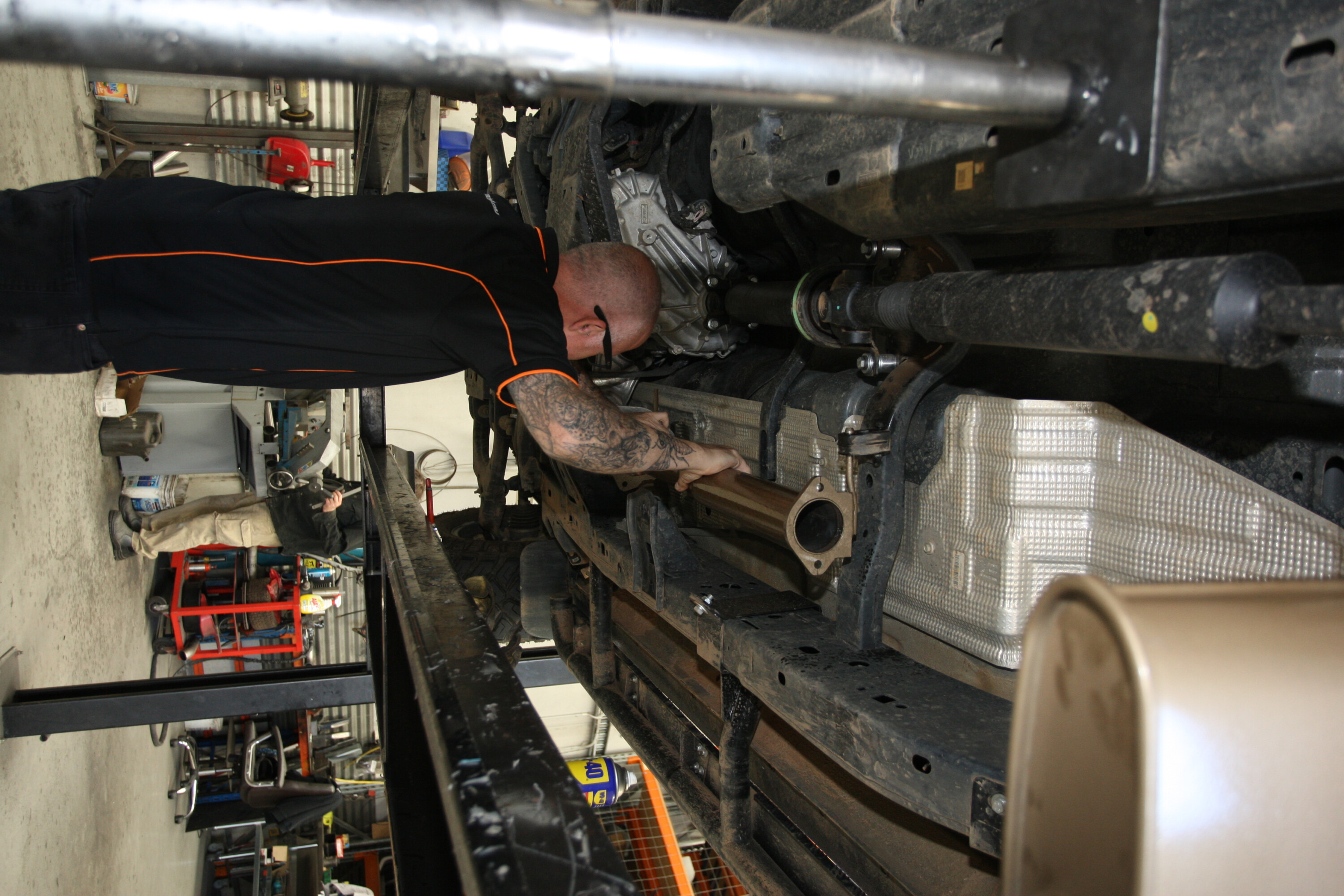
Without going to the massive expense of replacing the factory DPF with an aftermarket one, the best option for modern 4×4 owners is a DPF-back replacement system, and that’s just what we got for the Ranger from Pacemaker.
The factory Ford exhaust system is 80mm in diameter from where it comes out of the DPF and back to the long muffler, and 2.75-inches back to the tailpipe which ends just behind the rear axle housing. Pacemaker’s King Brown system for the Ford V6 is three-inches all the way through to the Pacemaker muffler and over the axle where it ends a bit higher than the factory exhaust.
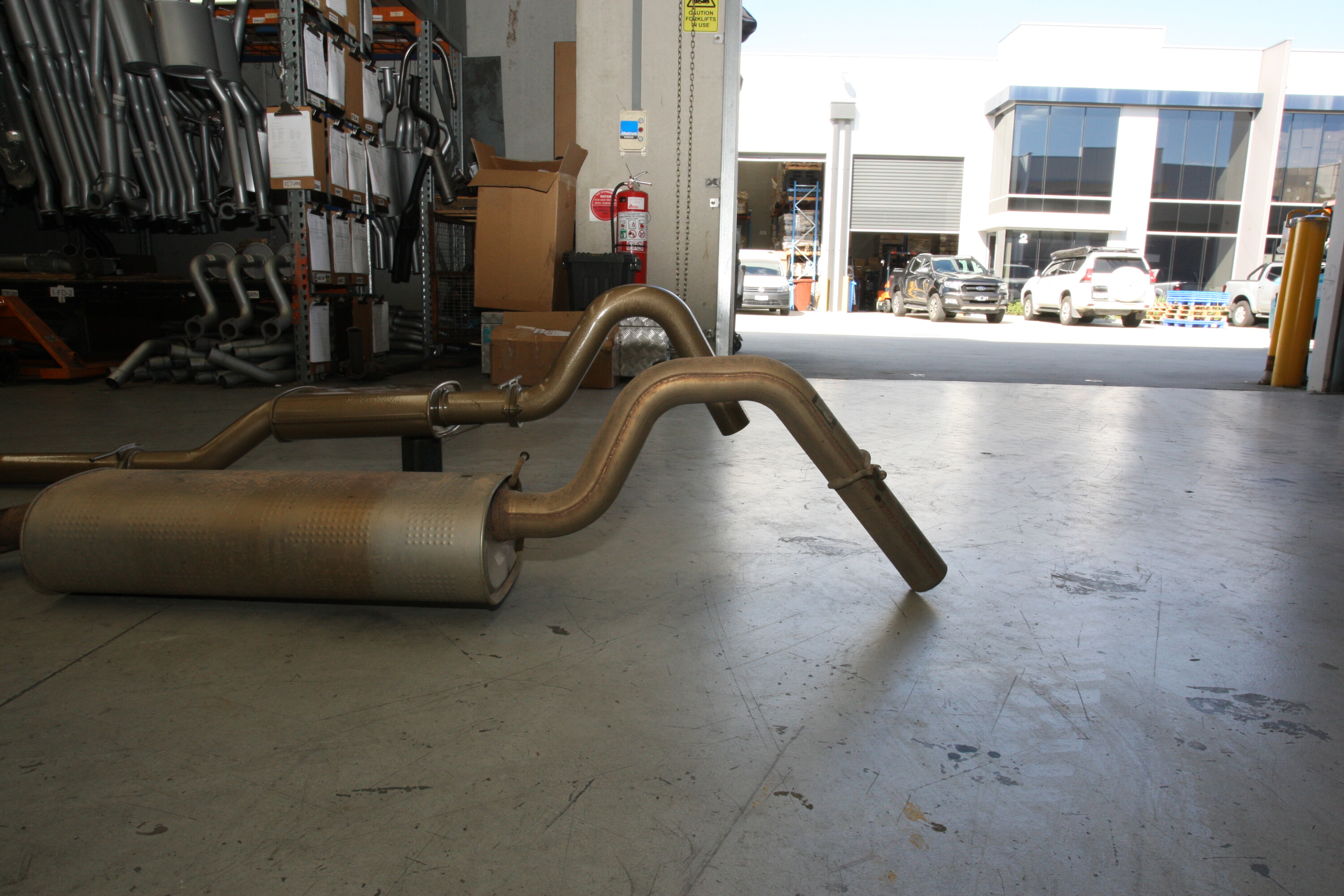
Pacemaker also offers the option of a tailpipe that extends back to exit under the rear bumper of the ute, but with the Trig Point service body on the back of our Ranger we didn’t think it would suit this application.
Pacemaker also offers the system with a straight through three-inch pipe and no muffler at all, but again we didn’t feel this would be what we wanted for our application.
What makes the King Brown exhaust better than the factory offering are the materials it is made from. This is 409 stainless steel that will never rust away like mild steel and for further protection it is coated in a hard brown finish to guard against stone chips and damage. Stainless steel will also better stretch and flex from the normal torsion loads generated by heat stress and engine vibration for further durability, so this system is really made to last.
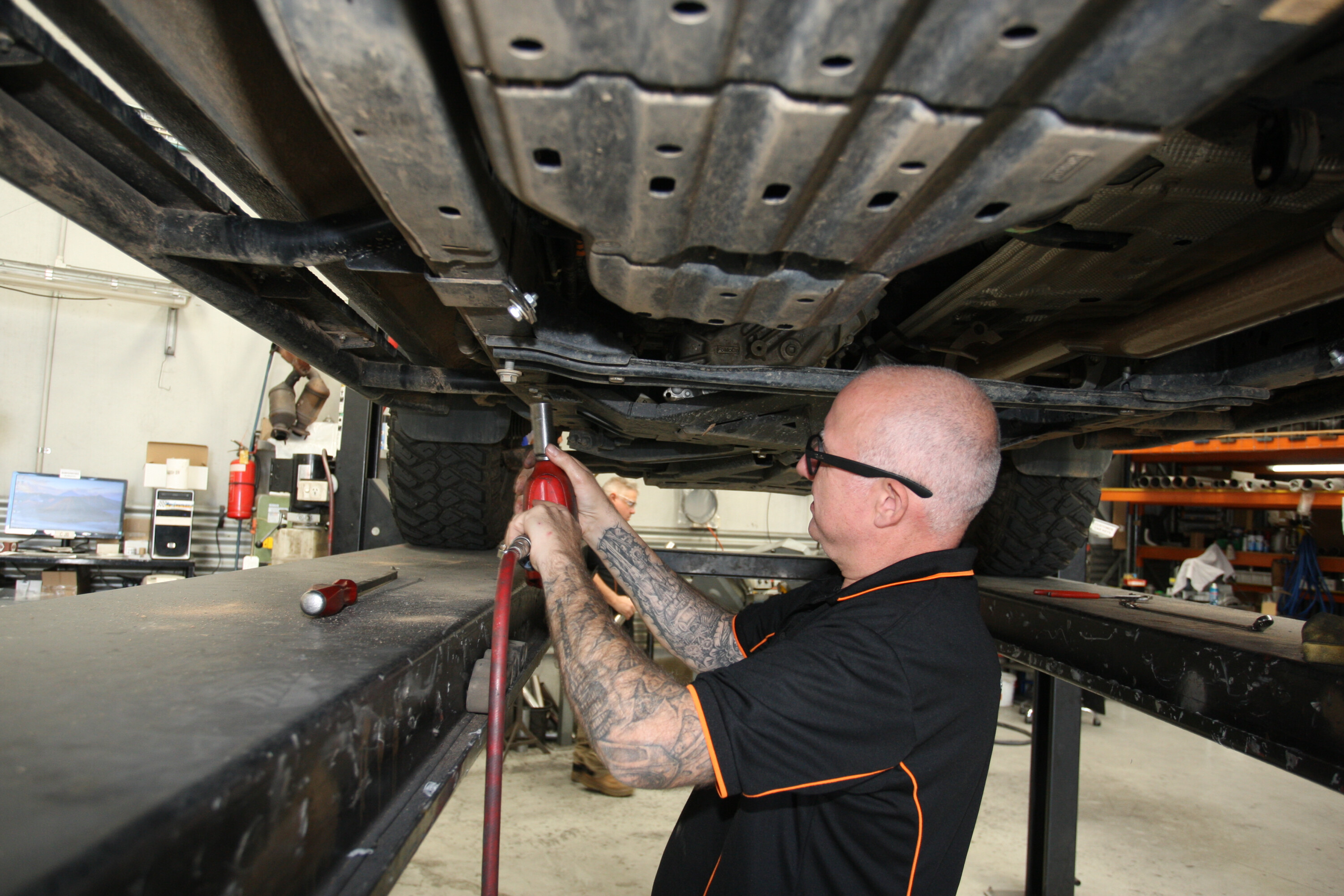
The Pacemaker muffler used in the system flows better than the OE Ford muffler for better performance and while it won’t make the car any faster, it will work better with any other engine modifications designed to increase performance. The freer-flowing system is also claimed to reduce the temperatures within the DPF which will increase the life of this expensive part.
Being a DPF-back replacement system, it was relatively easy to install, taking the guys at Performance Exhausts in Rowville less than an hour to do the job on the hoist. It’s certainly a DIY job if you prefer but might take a bit longer to do on stands in your garage.
The King Brown exhaust system includes provisions for the OE air bleed fitting just aft of the DPF making it a truly a simple bolt-in installation.
The system gives a slightly more audible growl from the engine but it isn’t really noticeable unless you’re listening for it. The last thing we wanted was a noisy exhaust that would ruin the refinement of the Ranger but if that’s your thing you could always choose the straight-though system for your vehicle.
Well-made durable system for long-lasting use.
4X4 Australia's project builds
UPDATE: 2023 GWM Ute cab-chassis now available
The 2023 GWM Ute line-up has expanded with three cab-chassis variants, announced for the Australian market today.
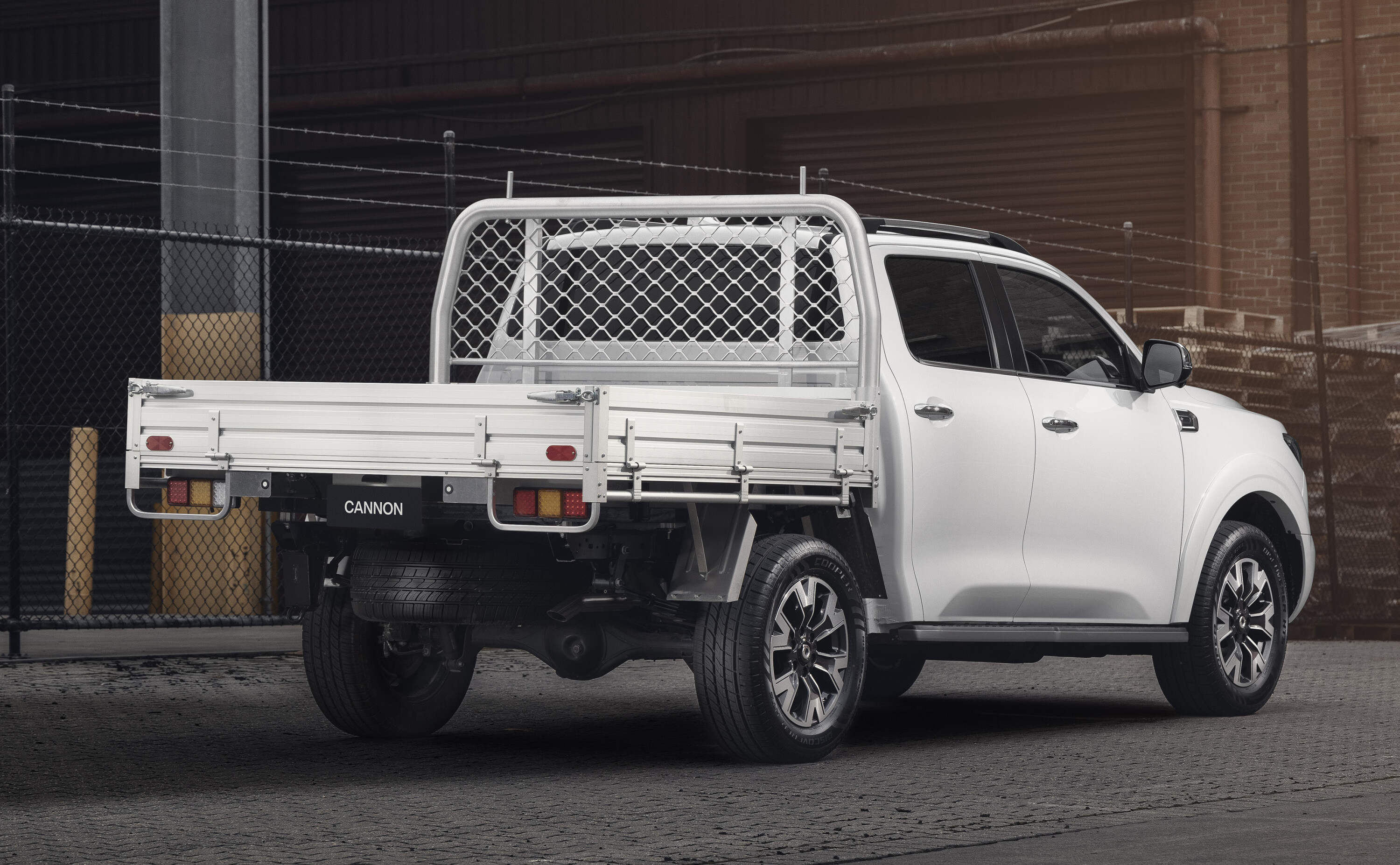
Carrying a $1000 premium over an equivalent dual-cab ute variant, the cab-chassis is available in Cannon 4×2, Cannon 4×4 and Cannon-L 4×4 guise.
Our earlier story, below, has been updated to reflect the latest information.
2023 GWM pricing and features
GWM has announced a new flagship grade for its aptly-named Ute, and added a cab-chassis option to the growing range.
Snapshot
- 2023 GWM Ute pricing and features
- Cannon Vanta grade joins the range
- New flagship grade priced at $46,490 drive-away
- Cab-chassis body style adds $1000 over equivalent ute variants
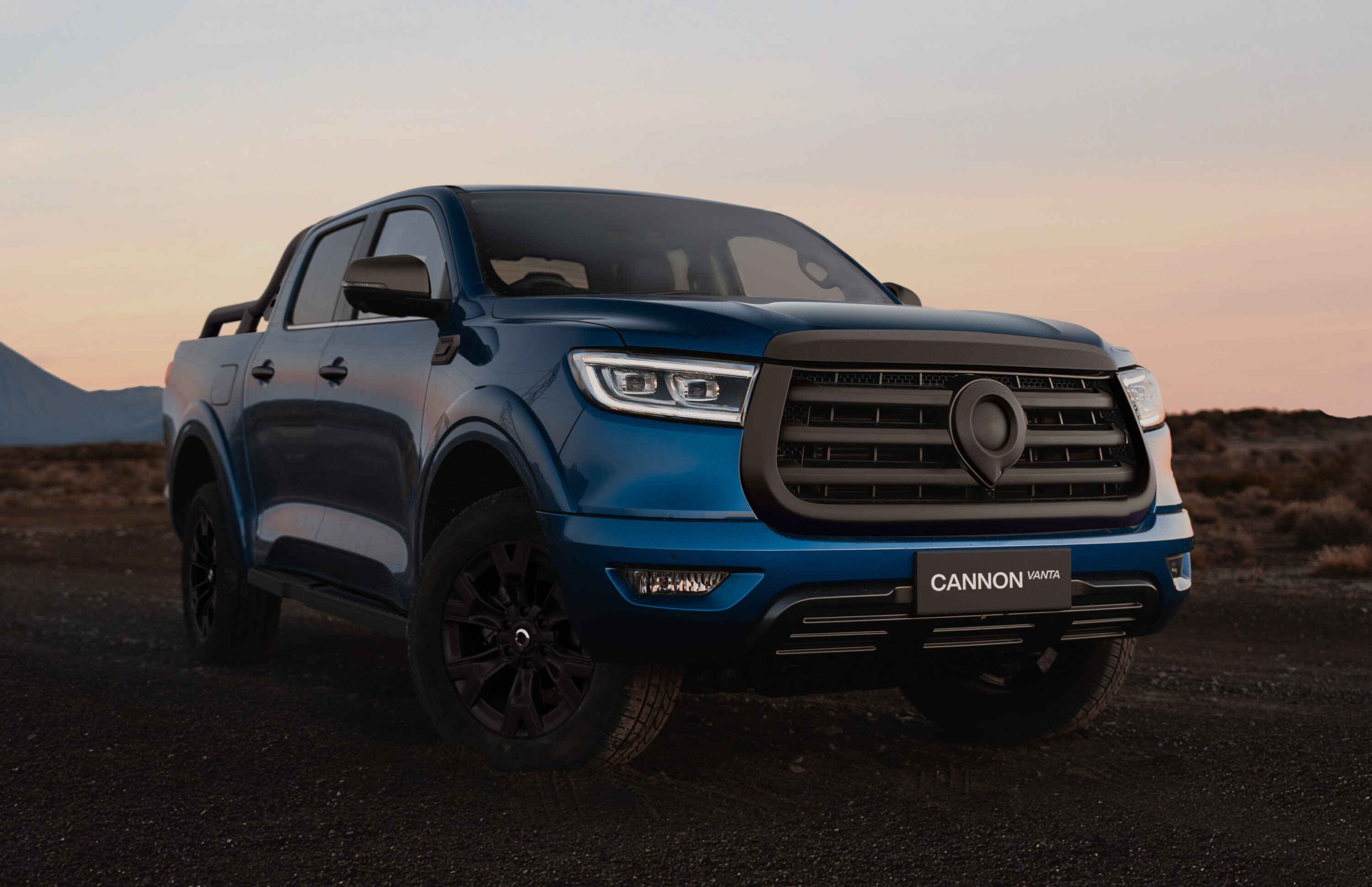
The 2023 GWM Ute Cannon Vanta is now available to order, priced from $46,490 drive-away – $1000 higher than the Cannon-X grade.
For the extra coin, the Cannon Vanta gains blacked-out exterior styling, including black 19-inch alloy wheels, side mirrors, door handles, front grille and badging.
There is also a larger sports bar finished in black, which extends further down the tray with a sailplane-like design.
All other standard equipment is shared with the Cannon-X, such as a 9-inch infotainment system, Apple CarPlay and Android Auto, a wireless phone charger, quilted synthetic leather upholstery, heated front seats, and a 7-inch semi-digital instrument cluster.
The wider GWM Ute range is priced from $35,990 drive-away for the entry-level Cannon 4×2.
It competes against the LDV T60 Max, Mitsubishi Triton and Ssangyong Musso in the budget-friendly dual-cab ute space, while other rivals include the Ford Ranger, Toyota HiLux, Isuzu D-Max, Mazda BT-50 and Nissan Navara.
JUMP AHEAD
- 2023 GWM Ute pricing
- 2023 GWM Ute features
- Colours
- Engine, drivetrain, and fuel economy
- Safety
- Towing capacity, weights, and dimensions
- Warranty and servicing
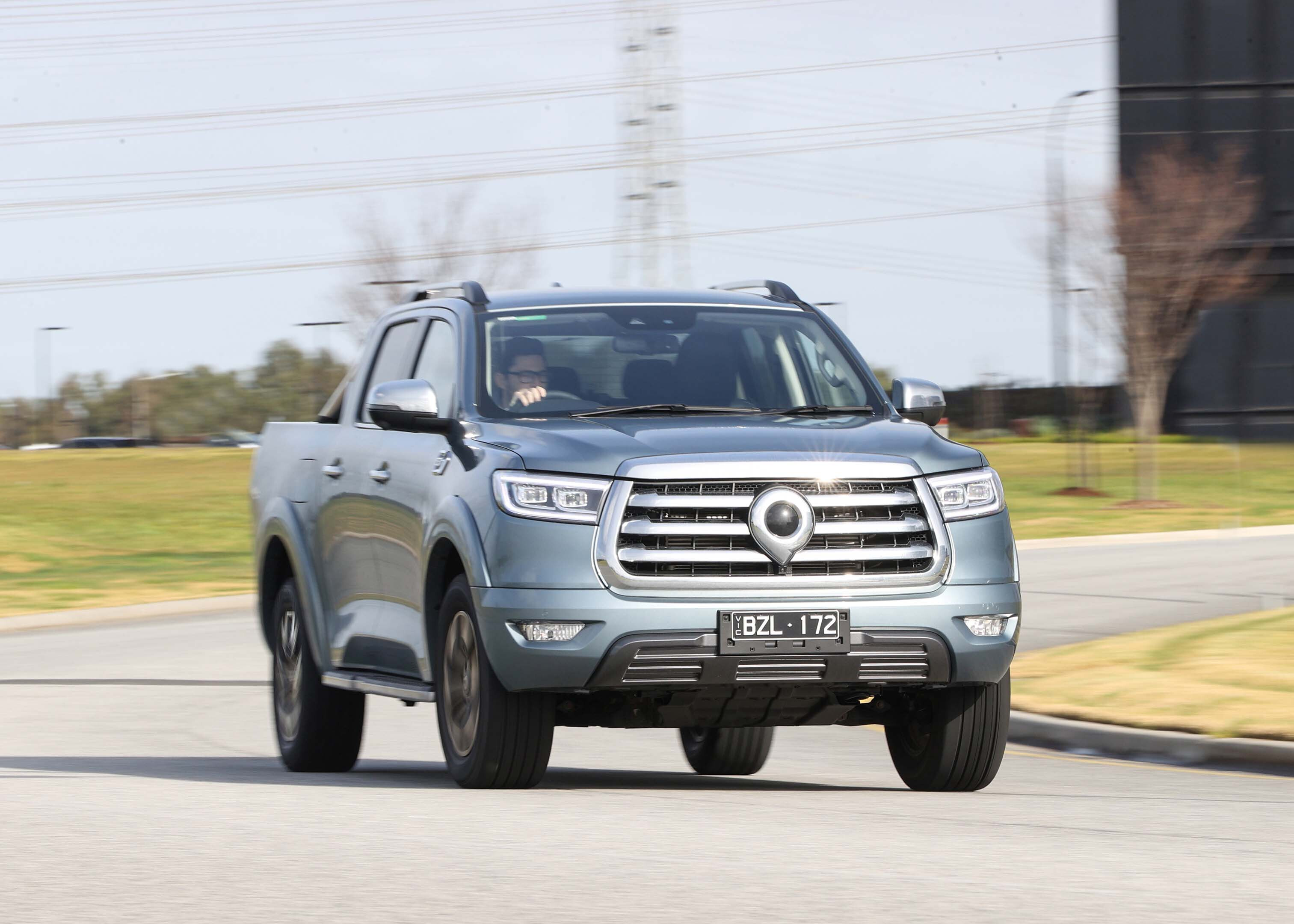
2023 GWM Ute pricing
All prices are drive-away.
| Model | Pricing (drive-away) |
|---|---|
| Ute Cannon 4×2 | $35,990 |
| Ute Cannon 4×2 cab-chassis (new) | $36,990 |
| Ute Cannon 4×4 | $38,990 |
| Ute Cannon 4×4 cab-chassis (new) | $39,990 |
| Ute Cannon-L 4×4 | $42,490 |
| Ute Cannon-L 4×4 cab-chassis (new) | $43,490 |
| Ute Cannon-X 4×4 | $45,490 |
| Ute Cannon Vanta 4×4 (new) | $46,490 |
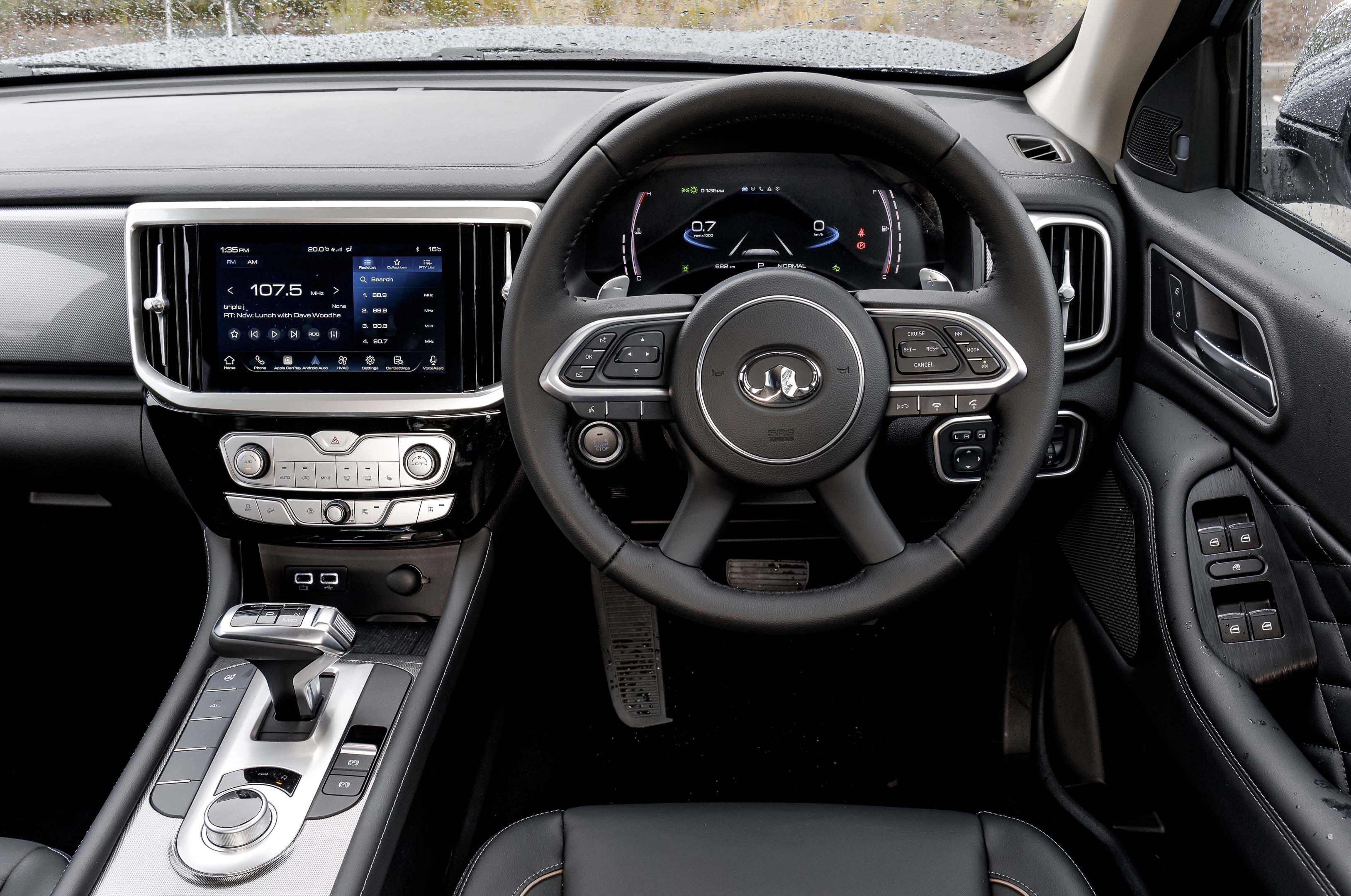
2023 GWM Ute features
Cannon
| Feature 1 | Feature 2 |
|---|---|
| 18-inch alloy wheels (premium design) | Reversing camera |
| 9-inch infotainment system | USB-A ports (x4, incl. dashcam port) |
| Wired Apple CarPlay and Android Auto | Centre and rear differential lock |
| AM/FM radio | Manual air-conditioning |
| 3.5-inch instrument cluster display | Rear air vents |
| Four-speaker audio system | Paddle shifters |
| LED headlights and tail-lights | Plastic steering wheel |
| Halogen fog lamps | Synthetic leather upholstery |
| Keyless entry and push-button start (1x smart key) | Six-way manually-adjustable driver’s seat |
| Rear parking sensors | Four-way manually-adjustable passenger seat |
| Passenger-kerbside camera | Power-adjustable side mirrors. |
Cannon-L
| Feature 1 | Feature 2 |
|---|---|
| 18-inch alloy wheels (luxury design) | Single-zone climate control |
| Chrome exterior trim | Leather-wrapped steering wheel |
| Six-speaker audio system | Six-way power-adjustable driver’s seat |
| Heated front seats | Privacy glass |
| Easy up/down tailgate with cargo ladder | Power-folding side mirrors |
| Front parking sensors | Auto-dimming rear-view mirror. |
| 360-degree camera system | |
Cannon-X
| Feature 1 | Feature 2 |
|---|---|
| 7-inch semi-digital instrument cluster | Four-way power-adjustable passenger seat |
| Wireless phone charger | Second-row 60:40 split-fold seats |
| Door open warning | Rear fold-down centre armrest |
| Tilt/slide adjustable steering column | Auto up/down for all four windows |
| Power-assisted steering modes (comfort, normal, sport) | Voice recognition |
| Two smart keys | Interior floor illumination. |
| Quilted synthetic leather upholstery | |
Cannon Vanta
| Feature 1 | Feature 2 |
|---|---|
| 18-inch alloy wheels (black design) | Black sports bar |
| Black front grille | Black door handles |
| Black side mirrors | Black exterior badging. |
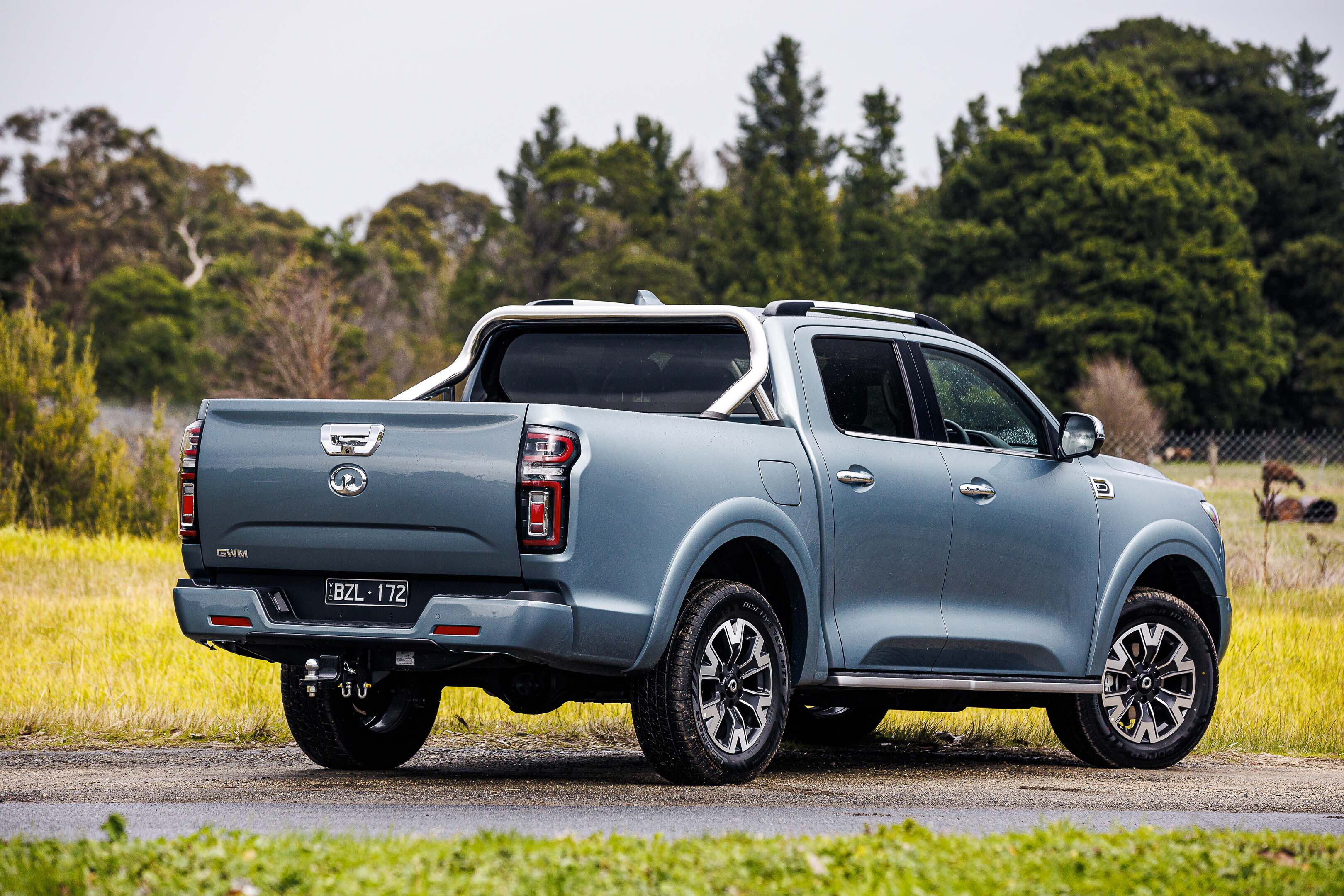
Colours
| Colour Option 1 | Colour Option 2 |
|---|---|
| Pearl white | Crystal black |
| Pittsburgh silver | Sapphire blue |
| Scarlet red |
Metallic paint incurs a $595 premium.
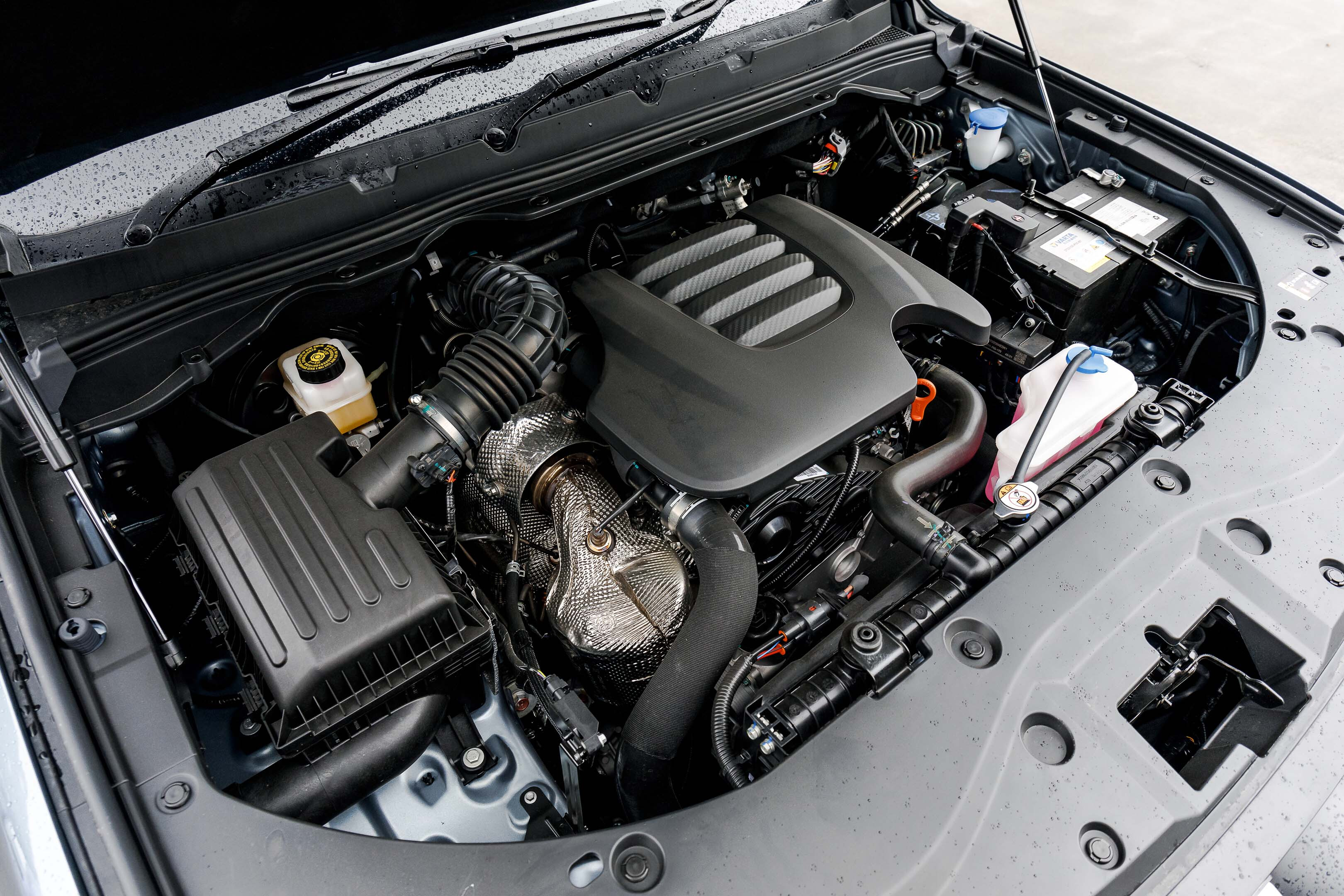
Engine, drivetrain, and fuel economy
Under the bonnet, the GWM Ute is powered by a 2.0-litre four-cylinder turbo-diesel engine producing 120kW and 400Nm. It is matched with a ZF-sourced eight-speed automatic transmission.
It is available with two-wheel drive or a full-time four-wheel drive system, and it features low-range and a locking centre and rear differential as standard.
Fuel economy figures can be found in the table below:
| Model | Fuel Consumption | Emissions |
|---|---|---|
| Cannon 4×2 ute | 8.3L/100km | 246g/km |
| Cannon 4×2 cab-chassis | 8.4L/100km | 246g/km |
| Cannon 4×4 ute & cab-chassis | 9.4L/100km | 246g/km |
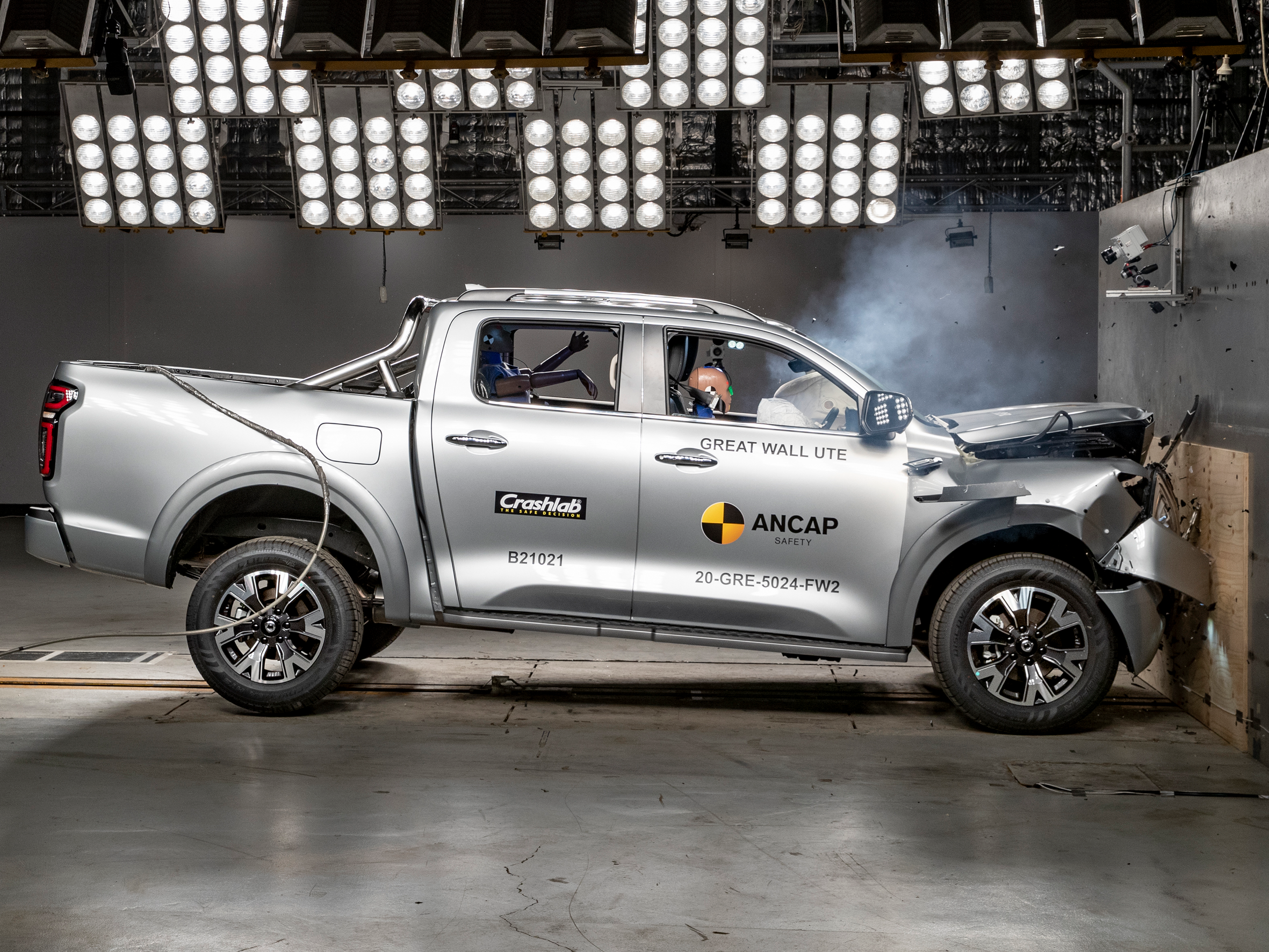
Safety
The entire GWM Ute is covered by a five-star ANCAP safety rating, with all units built after August 1, 2021 subject to the rating.
It has an 86 per cent score for adult occupant protection, 87 per cent for children, 67 per cent for vulnerable road users, and 73 per cent for safety assist.
For our full report on the GWM Ute’s ANCAP rating, click here.
Seven airbags (dual front, side, curtain, and front-centre) feature across the range.
| Feature 1 | Feature 2 |
|---|---|
| Autonomous emergency braking (vehicle, pedestrian, cyclist) | Adaptive cruise control |
| Lane-keep assist | Traffic sign recognition |
| Lane departure warning | Automatic high-beam |
| Blind-spot alert | Tyre-pressure monitoring. |
| Rear cross-traffic alert | |
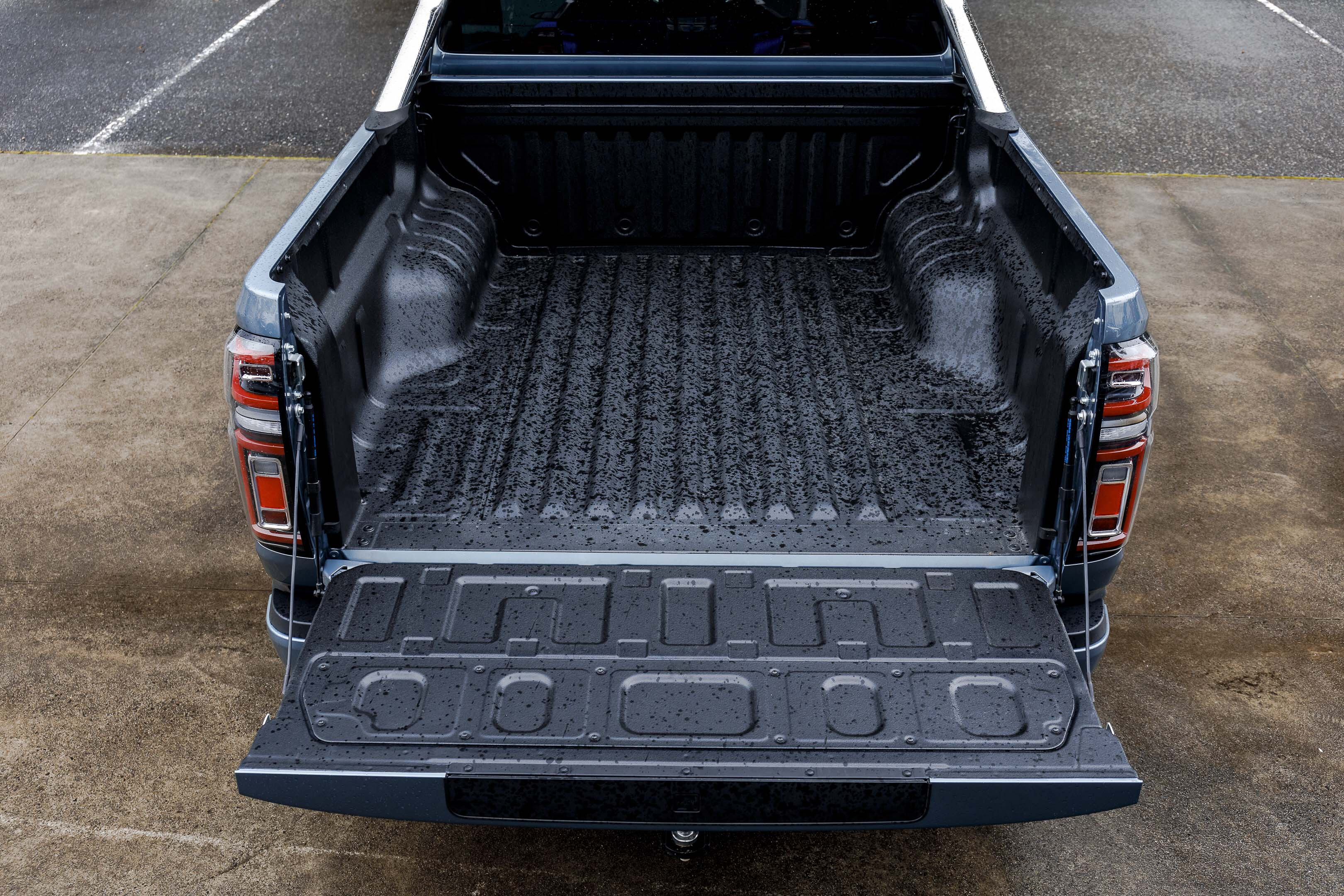
Towing capacity, weights, and dimensions
The GWM Ute has a braked towing capacity of 3000 kilograms, and a 750kg unbraked rating. It has a payload of up to 1050kg for the ute and 1130kg for the cab-chassis.
It has a wheelbase of 3230 millimetres, and is 5410mm long, 1886mm wide and 1934mm tall in ute guise, while the cab-chassis is 101mm longer at 5511mm.
It has a claimed 194mm ground clearance, a 27-degree approach angle, a 25-degree departure angle, and a 21.1-degree break-over angle.
Warranty and servicing
As per the wider GWM range, the Ute is covered by the brand’s seven-year, unlimited-kilometre warranty.
Maintenance is required every 12 months or 10,000km, whichever occurs first, following an initial six-month/5000km service.
GWM Australia offers capped-priced servicing for the first five visits, priced at $260 for the six-month service and $360 for the last four.
Driving an RV is more strenuous than driving a passenger vehicle and there is a lot more to take into consideration. Here are 15 important tips:
- 1. Check your driving position. Adjust your seat so your left foot can comfortably rest on the footrest and the back rest is not reclined more than 110 degrees. Your arms should be bent when you reach the steering wheel, no more than 90 degrees.
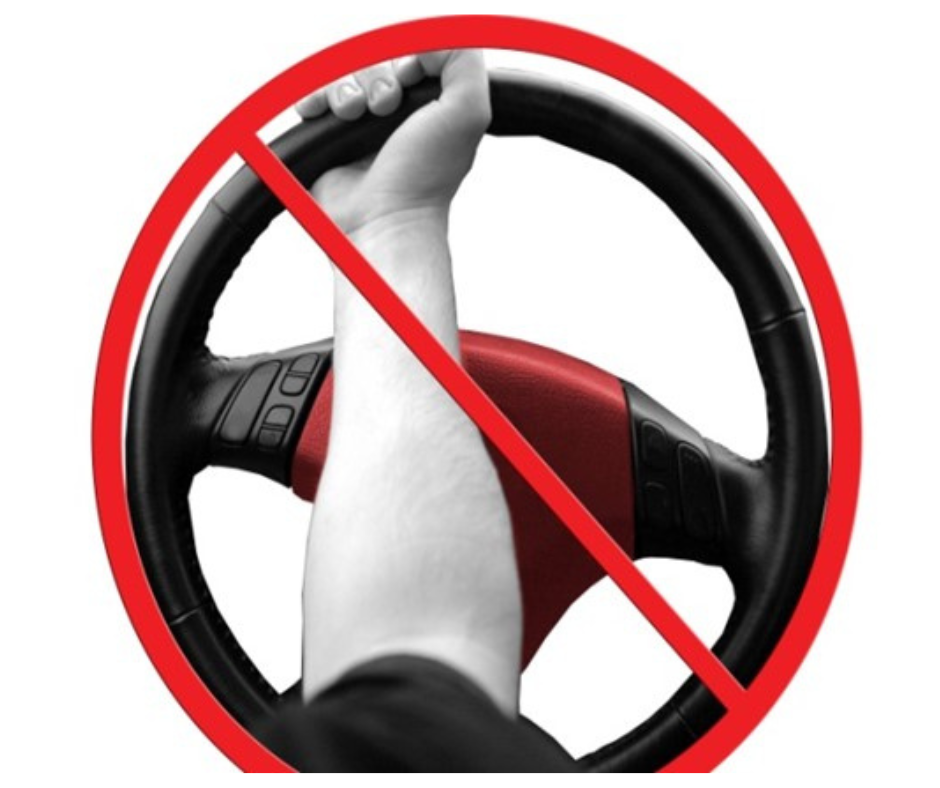
- 2. Your hands should be on the steering wheel at 9 and 3 o’clock. Having your hands in this position allows you to reach indicator and wiper stalks without removing your hands from the wheel. Your hands are also in line with your body mass giving centre of gravity, as well as your heart which is great for managing fatigue, and your hands are at the perfect position for balance and stability. Never place your hands at 12 o’clock on the steering wheel as it is disastrous if airbags need to be deployed.
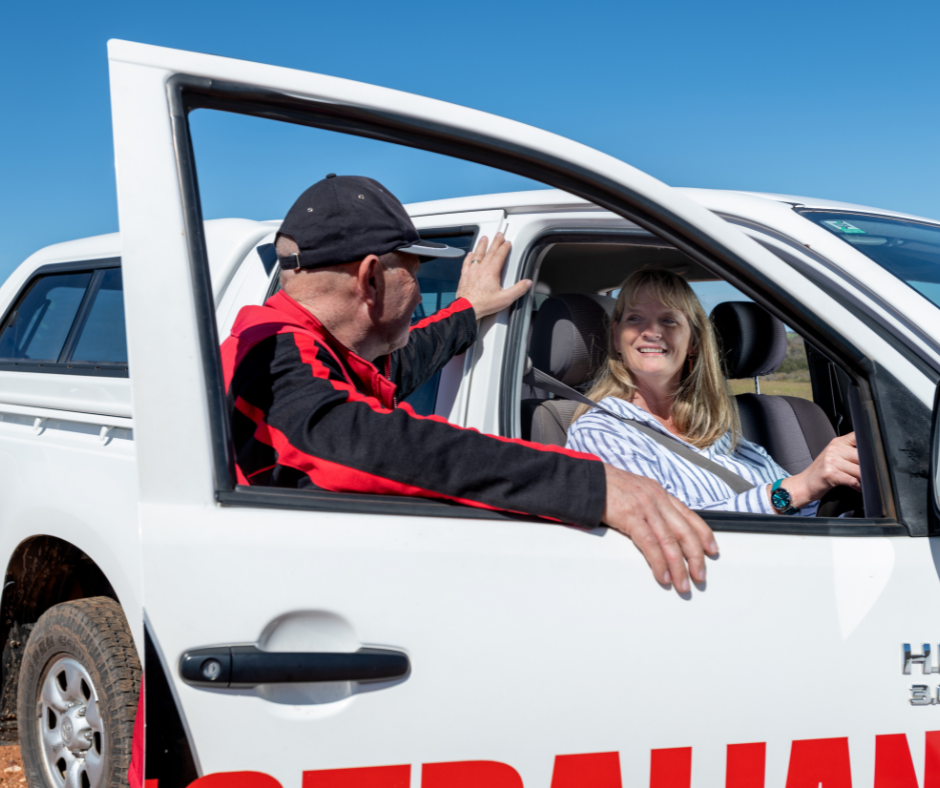
- 3. Allow longer stopping distances – your RV is bigger and heavier than a passenger car and it will take longer to stop. You also need to leave a larger gap between yourself and the vehicle in front.
- 4. Allow for slower acceleration. Once again, a bigger and heavier vehicle will be slower off the mark so make sure you take this into consideration. For example, when trying to turn across an intersection, you will need a bigger gap.
- 5. Avoid quick sharp turns to prevent instability and rollovers. Whether you’re driving a motorhome or a car and caravan, neither will handle the same as a passenger car.
- 6. Look further ahead than you normally would and factor in the environment including flora, fauna, and weather.
- 7. Don’t forget the added height, width and length of your vehicle. Be careful of low bridges or branches. If you don’t know the height of your vehicle – measure it before you head off! If merging lanes, allow for the extra length.

- 8. Be comfortable using your mirrors. You will need to rely on them more with a larger vehicle. Take the time to set them up properly before you leave home.
- 9. Take a wider swing when navigating corners as you will need more space. If your vehicle is over 7.5 metres, you can display a ‘Do Not Overtake Turning Vehicle’ sign and you are legally allowed to take up more than one lane to turn corners, intersections and roundabouts.
- 10. Use a low gear when going down steep hills and avoid riding the brakes. If your brakes burn out, it quite simply means that you have no brakes. If you see a sign saying “Trucks Use Low Gear’ it may be a good idea to do the same in your RV.
- 11. If you need to go slower than other traffic, move over so they can pass when it’s safe to do so.
- 12. When using rest areas, think about other users and park at the end of the area. Don’t use truck areas unless there is an emergency.
- 13. Know how to use your electric brakes. This applies to towing combinations towing over 2t. Adjust them correctly and know how to apply the trailer brake manually in case of sway.
- 14. When in cities or towns, plan ahead so you don’t get caught somewhere you don’t fit.
- 15. Rest often! Driving an RV is more tiring than driving a regular passenger car. Plan your rest stops and share driving when possible.
More information
rvSafe is designed to increase road safety awareness and education specific to the RV industry. The project is funded through the Federal Government’s Road Safety Awareness and Enablers Fund and is proudly supported by the Campervan & Motorhome Club of Australia (CMCA). Find out more at rvSafe.com.au and cmca.net.au

In Australia, provided you have a full driving licence, and the caravan and tow vehicle don’t exceed the mass limits that involve an endorsed or heavy vehicle licence, you are permitted to tow a trailer or caravan.
Whilst special licensing requirements are mandatory for the operation of some vehicles and equipment, it may be surprising to learn that no such requirements exist when it comes to towing.
If you don’t need to undergo training or pass a test to hit the open road with a trailer or caravan in tow, you’re probably thinking the skills necessary to tow must come naturally. The truth is, towing a trailer or caravan can be tricky for those with no or little experience and requires a specific set of skills and techniques.
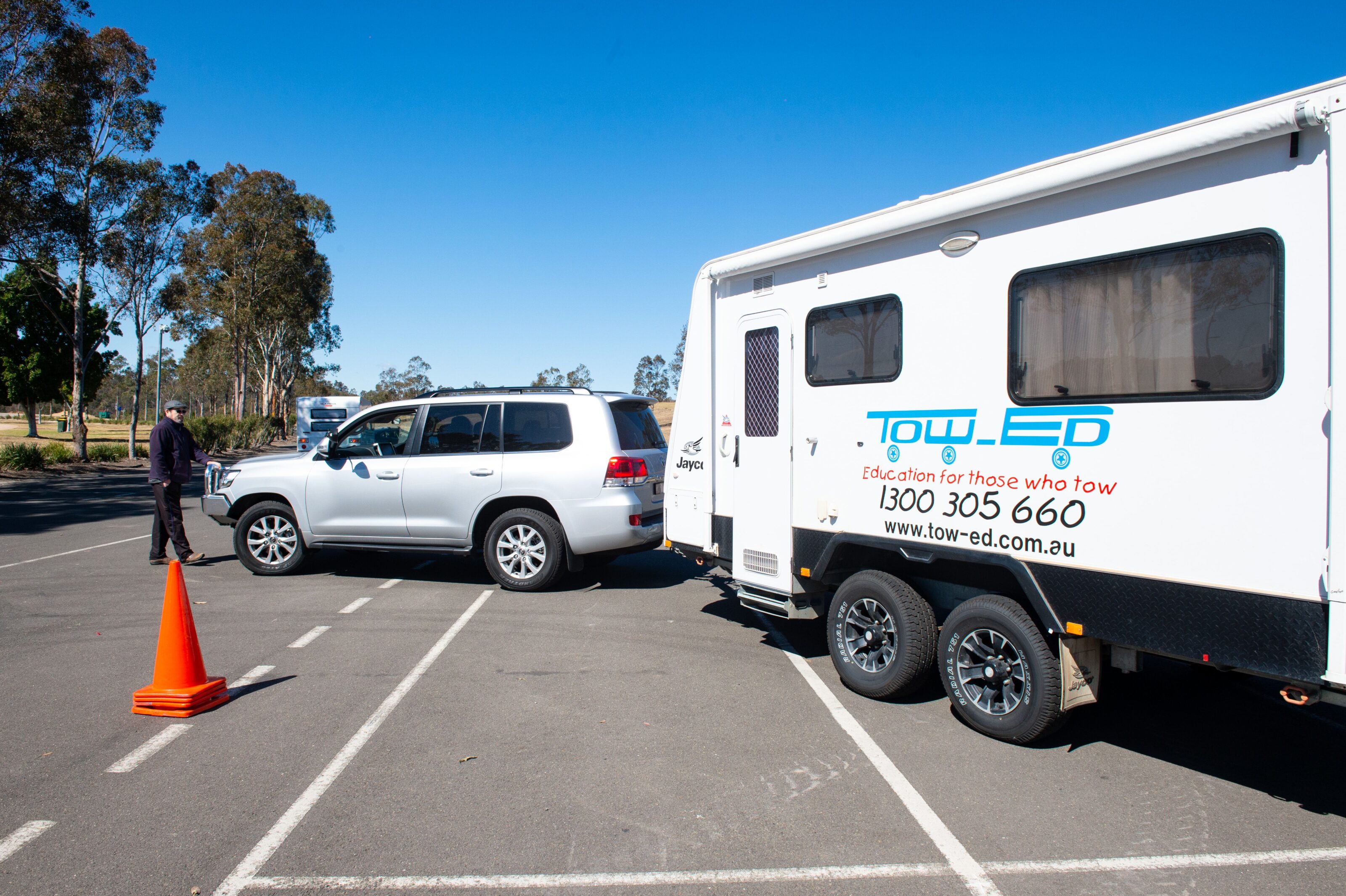
If you are new to towing and don’t know where to start or have little experience and want to become more confident in your towing skills, you should consider completing a towing course. An accredited towing course will guide you through the basics of manoeuvring your combination safely on the road and in a caravan park, but also impart essential knowledge regarding weights, legalities, roadcraft and vehicle setup to ensure you are as safe as possible while towing.
rvSafe provides all the knowledge you need to head out safely on the road in your RV. But here are two of the most stressful issues for those new to towing!
Caravan Sway
Caravan sway can be scary and rightly so. Whether you have experienced caravan sway or only heard the stories and seen dash cam footage, most people that tow caravans are aware that sway may occur.
The most common cause of trailer sway is an incorrectly loaded caravan. When packing, it is important that heavy items are placed as close to the caravan axle as possible. Packing too heavily towards the rear of the caravan can result in instability.
Generally, you should aim to keep your tow ball weight between around 10% of your ATM or Aggregate Trailer Mass. Going below 10% can result in trailer sway and going above 10% can put excessive weight on the back of your car and will affect your vehicle’s handling.
Keep in mind that sway can also be caused by wind. This can be from the weather, so on a high wind day, avoid towing if possible. Even an unexpected strong gust can cause some sway. A large vehicle travelling at speed and overtaking can also cause sway. The rush of air between the vehicles can cause instability.
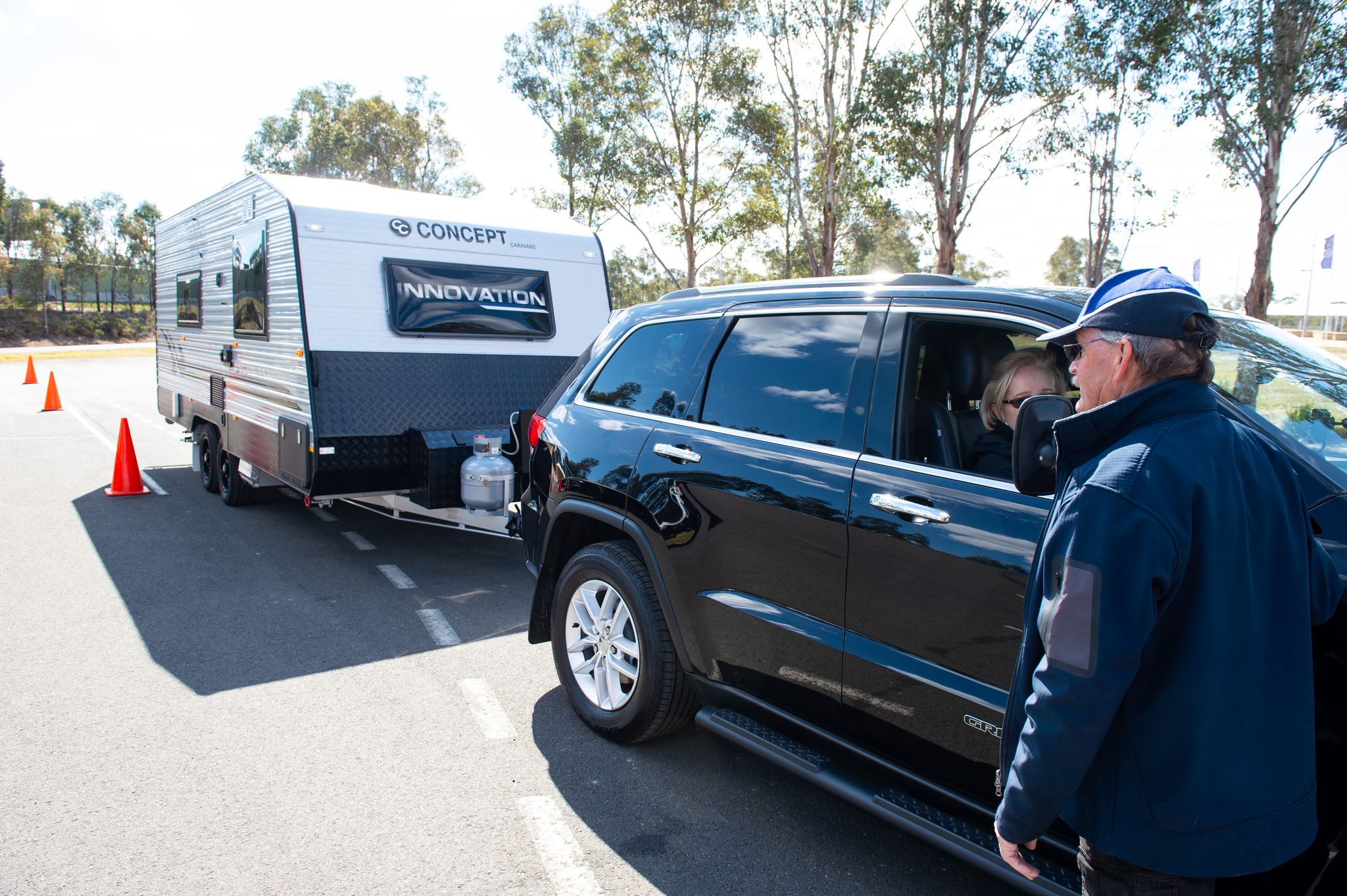
As speed increases, stability decreases. Stick to a safe speed for your vehicle and conditions.
Also ensure that you have the correct tyre pressures for your combination by checking your manufacturers recommendations. Underinflated tyres will cause excess movement in the tyre wall. Overinflated tyres will not be able to minimise shocks from the road surface and lead to instability.
If your trailer does start to sway – do you know how to regain control?
The most effective way to minimise sway is to decrease speed by removing your foot from the accelerator and applying your trailer brakes. The effect of this will pull the trailer straight behind the tow vehicle and you will begin to regain control.
Sudden moves will always make the situation worse. Ensure you hold the steering wheel steady and don’t make any sudden turns.
It is a great idea to practise reaching for the trailer brakes when stationary. That way you instinctively know where the control is. You can get the control fitted so that it is central in the vehicle and your passenger can apply the trailer brakes if your hands are too busy holding the steering wheel steady.
Ensure you have your electric brakes set up suitably for your trailer. There are various models available so check your manufacturer’s instructions to work out what is right for you.
Electronic Stability Control (ESC) is a great safety feature to reduce the chance of caravan sway. The ESC system installed on a caravan uses a sensor underneath the van to monitor sideways movements, small oscillations or sudden jerks. When these forces cause the van to lurch to a critical point, the system applies selective braking to bring the van back into line. Essentially, ESC will apply the trailer brakes for you if things start to get a bit hairy and are more likely to react faster than you as the driver.
As good as ESC systems are, they aren’t infallible and are not a replacement for careful driving, which is still the most effective tool to combat the dreaded sway and keep you and your family safe on the road.
Reversing a Caravan or Trailer
Reversing a caravan or trailer is challenging and can be extremely difficult for new caravan owners. But fear not! It is achievable for everyone. Just take the time to practise and get to know how to manoeuvre your vehicle.
It is imperative that you learn how to reverse as you may need to do this to get out of a tricky situation, or you may also find that knowing how to reverse will help you enjoy some better camping sites.
The first thing to do when mastering caravan and trailer reverse skills is to practise. Before heading off on your journey, find a quiet carpark or paddock where you can practise manoeuvring without the worry of other vehicles, people or being on time. If possible, take a friend with you so that they can help guide you. Remember, patience is key, and practice makes perfect.
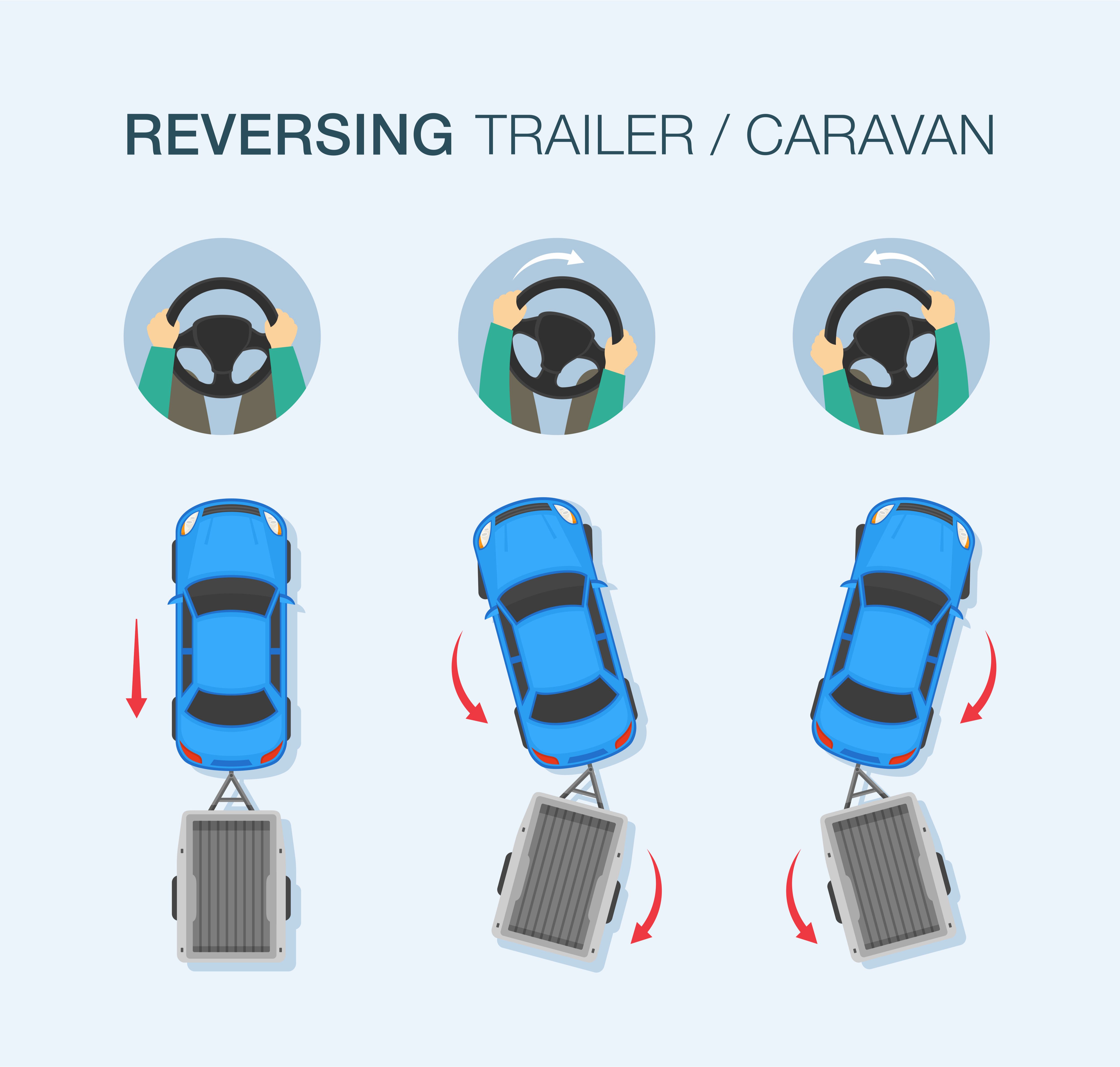
When you are about to reverse your caravan or trailer, first get out of the car and look at your surroundings and check whether the vehicle and caravan will fit and pace out the area. It is also a good idea to take into consideration the space needed for an awning or annex and factor this into your checks.
If possible, try to reverse from the right and position your caravan or trailer so that it is pointed in the direction that it needs to go. If you have a friend to assist, make sure that they are clear with their communication and instructions.
Once you have the caravan or trailer positioned, apply the opposite rule. If the caravan needs to go right, turn the steering wheel to the left and vice versa. Next, slowly begin reversing. This is where it is important to practise so you gain the feel of which way to turn and work out what works best for you. Remember, gradually reverse, and turn the steering wheel. Only use small turns as the caravan or trailer will amplify the movement.
If you happen to oversteer or miss where you need to go, move forward until you have the caravan or trailer in the correct position, stop, and reverse again. Once you have successfully reversed the caravan or trailer and it is in its correct position, perform necessary safety checks such as ensuring the handbrake is set, and the wheels are chocked and cannot move.
Lastly, enjoy your adventure!
More information
rvSafe is designed to increase road safety awareness and education specific to the RV industry. The project is funded through the Federal Government’s Road Safety Awareness and Enablers Fund and is proudly supported by the Campervan & Motorhome Club of Australia (CMCA). Find out more at rvSafe.com.au and cmca.net.au
Here are a few top tips to keep your tyres from getting tired.
Tyres degrade with age
If your tyres are over five years old, they need to be checked for degradation by a reputable tyre business each year. And once they have reached 10 years old, they need to be replaced regardless of the tread left.
The age of your tyre is printed on the tyre wall. Look for where text starts with “DOT”. The last four digits of the code represents the week and year the tyre was made. For example, 4922 is the 49th week of 2022.
“A shockingly loud blast rocked the cabin. We were travelling at about 90km. The inside rear tyre exploded. We have a 32-foot Nullarbor motor home. The blast blew the wheel arch apart ripping the metal lining out and blowing the side panel off the RV. It damaged the fuel entry pipe and embedded steel into the outside tyre.
The damage was a real mess and an incredibly frightening experience. Always keep your tyres under the use by date. Not enough is done to make the market aware of this. My explosion is a great reminder for me to keep this in mind” – CMCA member
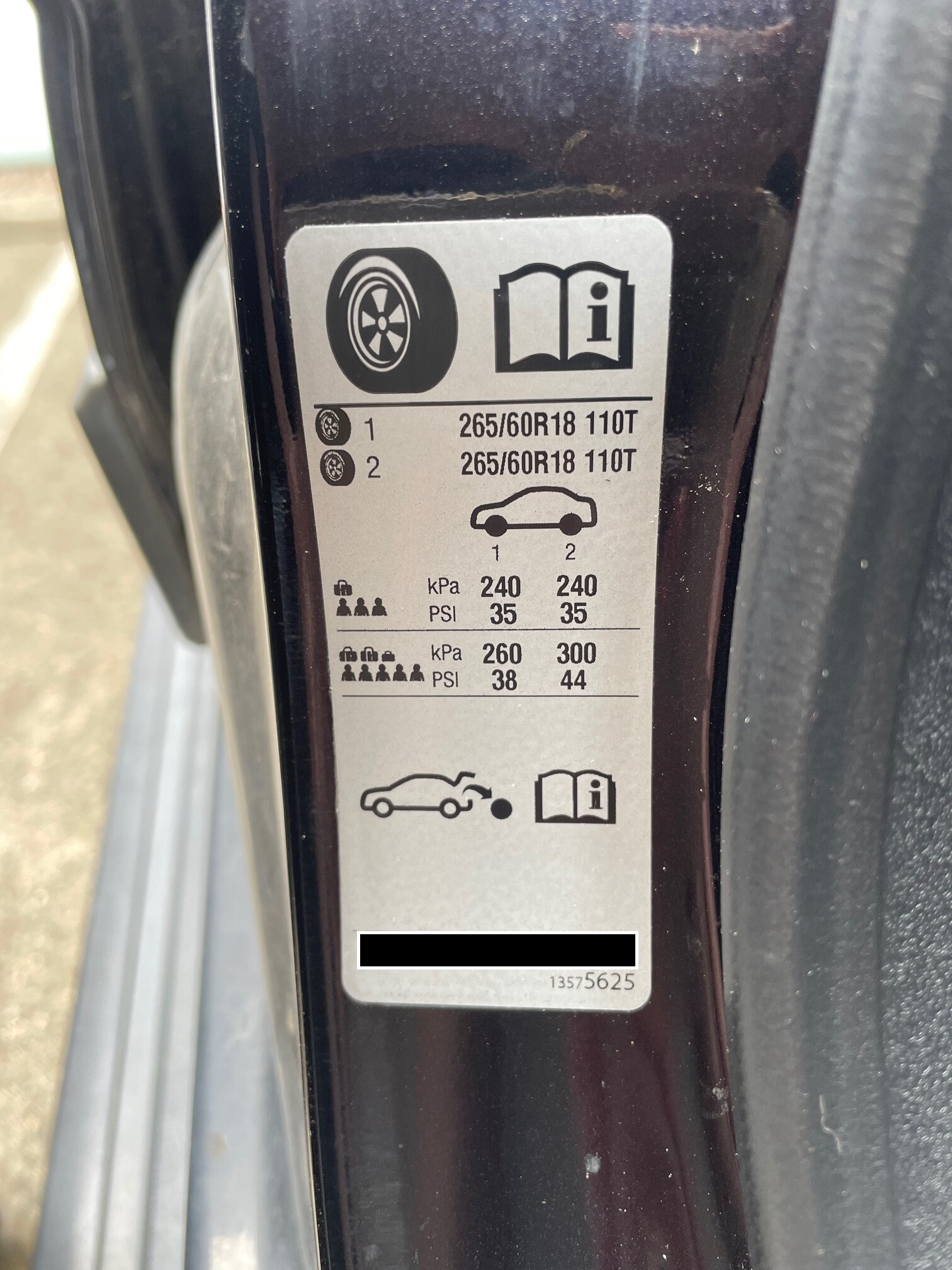
Tyre pressures
Keep tyres (including the spare) inflated to the recommended levels. Too much or too little air causes uneven wear, reduces handling and grip, and shortens the life of the tyres.Tyre pressure can be too low, and you will not be able to notice with the naked eye – so get yourself a tyre pressure monitor or check at the service station next time you fill up.Tyres on RVs typically carry more weight than standard vehicles which makes it even more important to have the correct tyre pressure. The tyre placard will stipulate the tyre pressure for your rig, and we recommend checking your tyre pressures before heading off on your trip.
Tyre treads
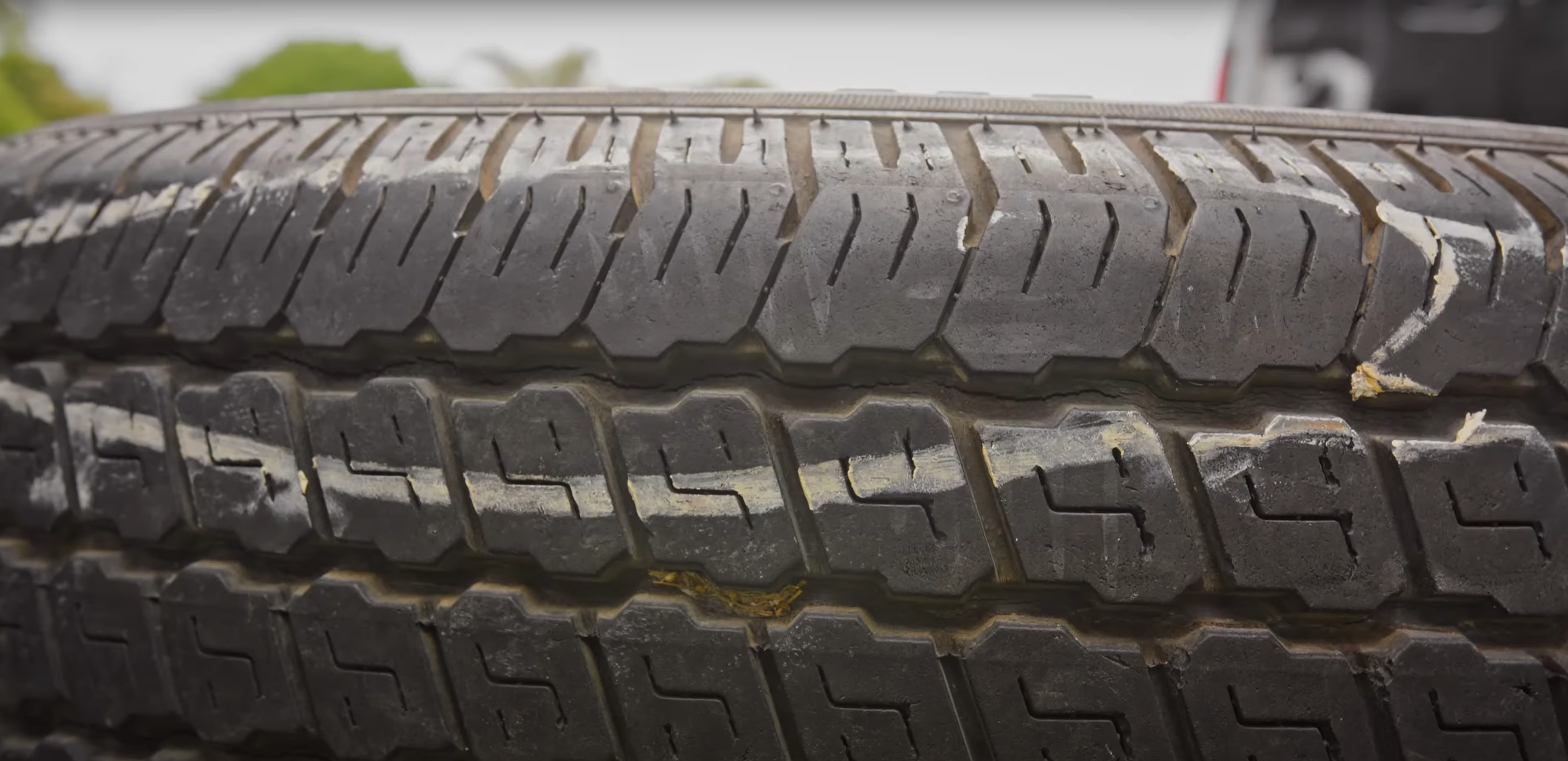
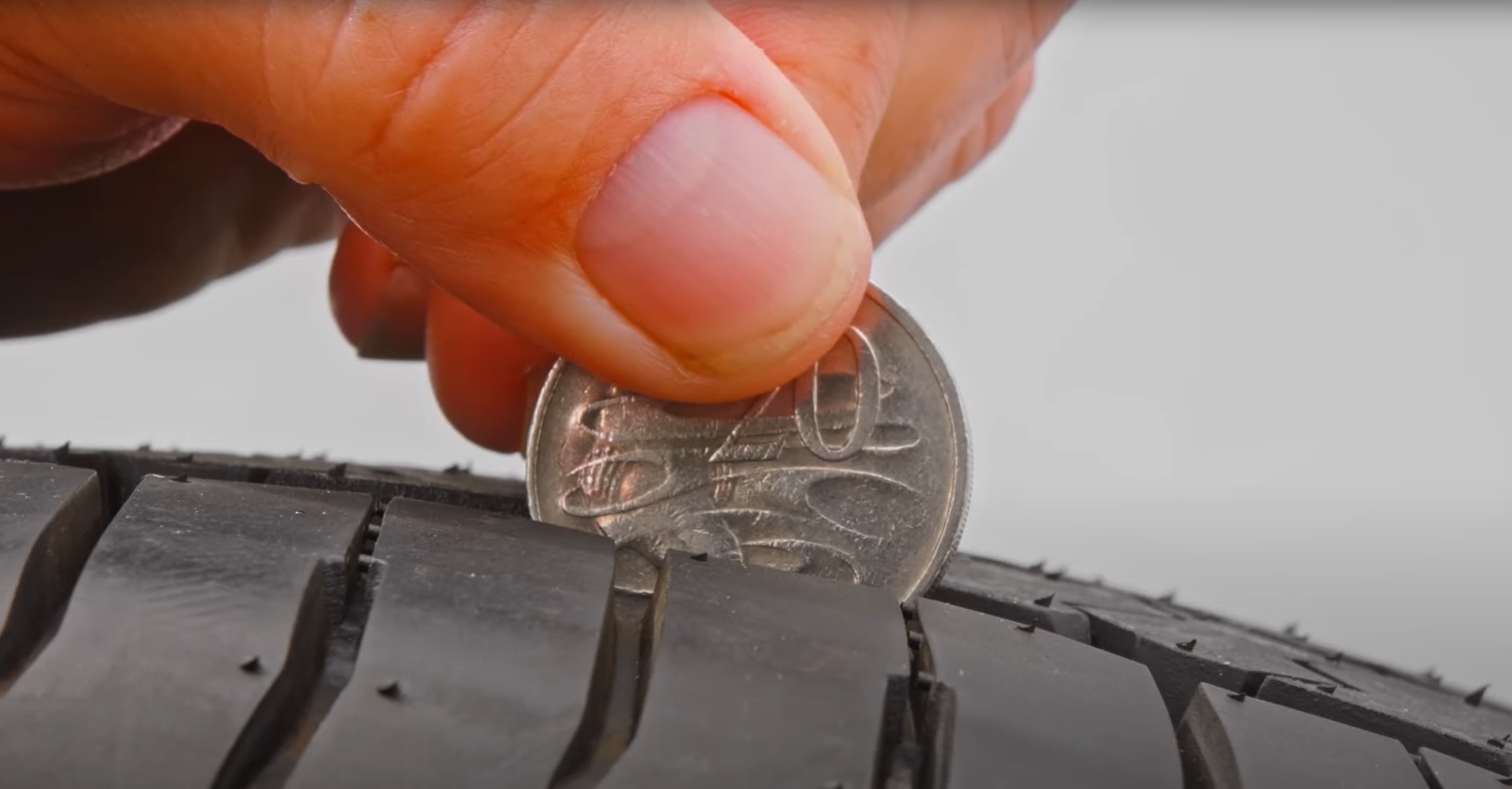
Inspect your tyres for uneven bulges, cuts and cracks. Remove any objects lodged in the tread and check for gouges or punctures.Tyres must be replaced before the tread depth falls to 1.5mm however we recommend you change tyres at 3mm. Most tyres have tread depth indicators as a guide or you can use a 20 cent coin. To measure your tyre’s tread depth, place an Australian 20c coin into one of the central circumferential grooves of your tyre. If the tread doesn’t reach the bill of the platypus, your tyre has less than 3mm of tread remaining. It’s time to invest in some new tyres to make sure you stay safe while driving.Unusual vibrations or uneven wear (bald) spots on tyres may suggest that a wheel balance is needed to avoid excessive loading to the vehicle’s wheel bearings and suspension.
Don’t forget your spare
You need to ensure that it has pressure and is suitable for use in an emergency.
More information
rvSafe is designed to increase road safety awareness and education specific to the RV industry. The project is funded through the Federal Government’s Road Safety Awareness and Enablers Fund and is proudly supported by the Campervan & Motorhome Club of Australia (CMCA). Find out more at rvSafe.com.au and cmca.net.au
Being aware of your RVs’ weight is more important than ever, yet it continues to be overlooked. Here’s a quick guide on why it is so essential.
Understanding campervan and motorhome weight
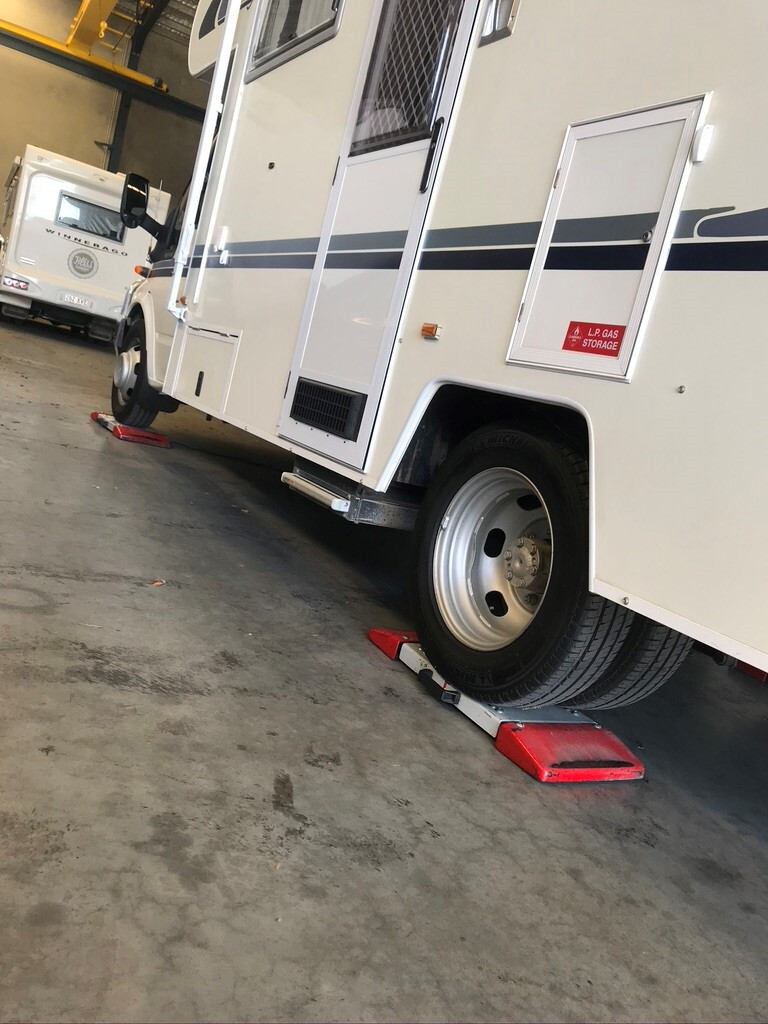
Understanding your motorhome weight is simple yet important. Keeping your vehicle within its weight limits will ensure you have a safe and stable vehicle on the road. You also need to know vehicle weight to ensure you have the correct licence for your chosen RV.
There are three weights to consider: tare weight, GVM and payload. You can check your vehicle’s compliance plate to find tare and GVM. Deduct the tare weight from the GVM to calculate your payload.
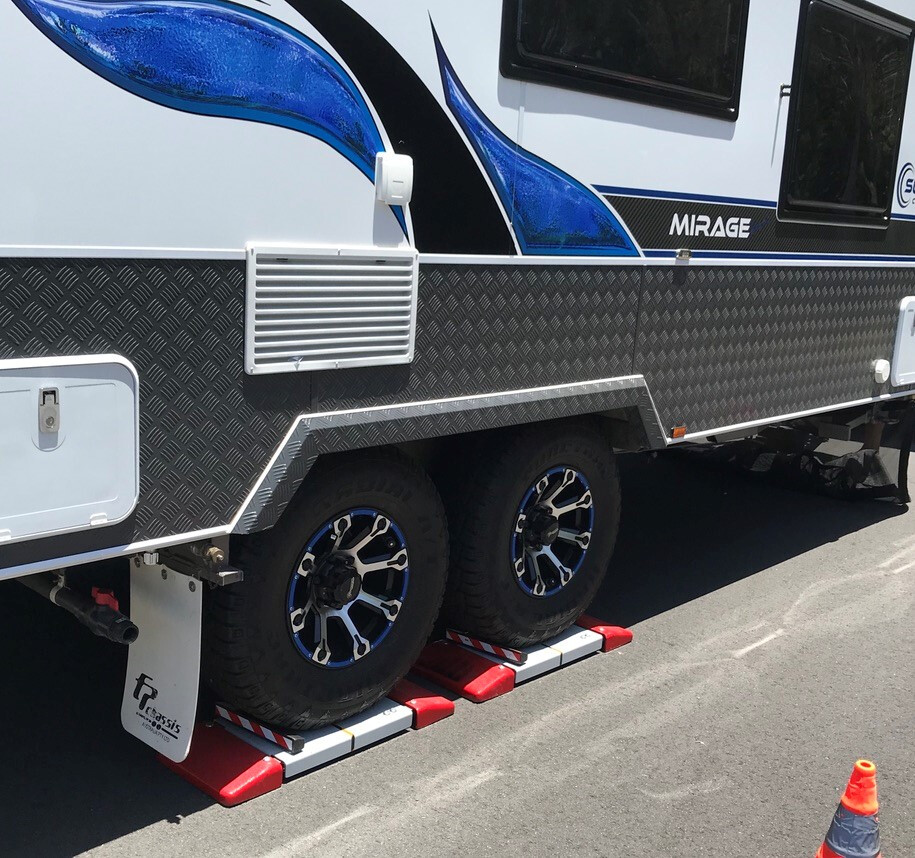
Please note, it is best to get your vehicle checked at a weigh bridge or portable weigh station to ensure you know the correct vehicle weight. Make sure you pack all your gear and take your passengers with you for the weigh-in.
If you are looking to tow a trailer or secondary car behind your motorhome, you will also need to take into account the motorhome’s towing capacity, tow ball mass and gross combined mass (GCM) as stipulated by the manufacturer.
Understanding caravan and camper trailer weight
Getting your caravan or camper trailer combination weights right is imperative as both the total weight and the way it is distributed affects both towing stability and braking ability. Plus, you do not want to get in trouble with the police, affect your vehicle warranty or have your insurance denied.
Calculating your vehicle weight can be cumbersome, and the simplest and safest thing to do is take your vehicle combination, loaded with all your gear and passengers, to a weigh bridge, or have a portable weigh station come to you.
If you are new to RVing and shopping for your first combination, it is important to do your research to make sure you consider the tow vehicle capacities, trailer weight and payload requirements.
Manufacturers will specify some key weight limits. These can be found on the vehicle or trailer compliance plates, or check your owner’s manual.
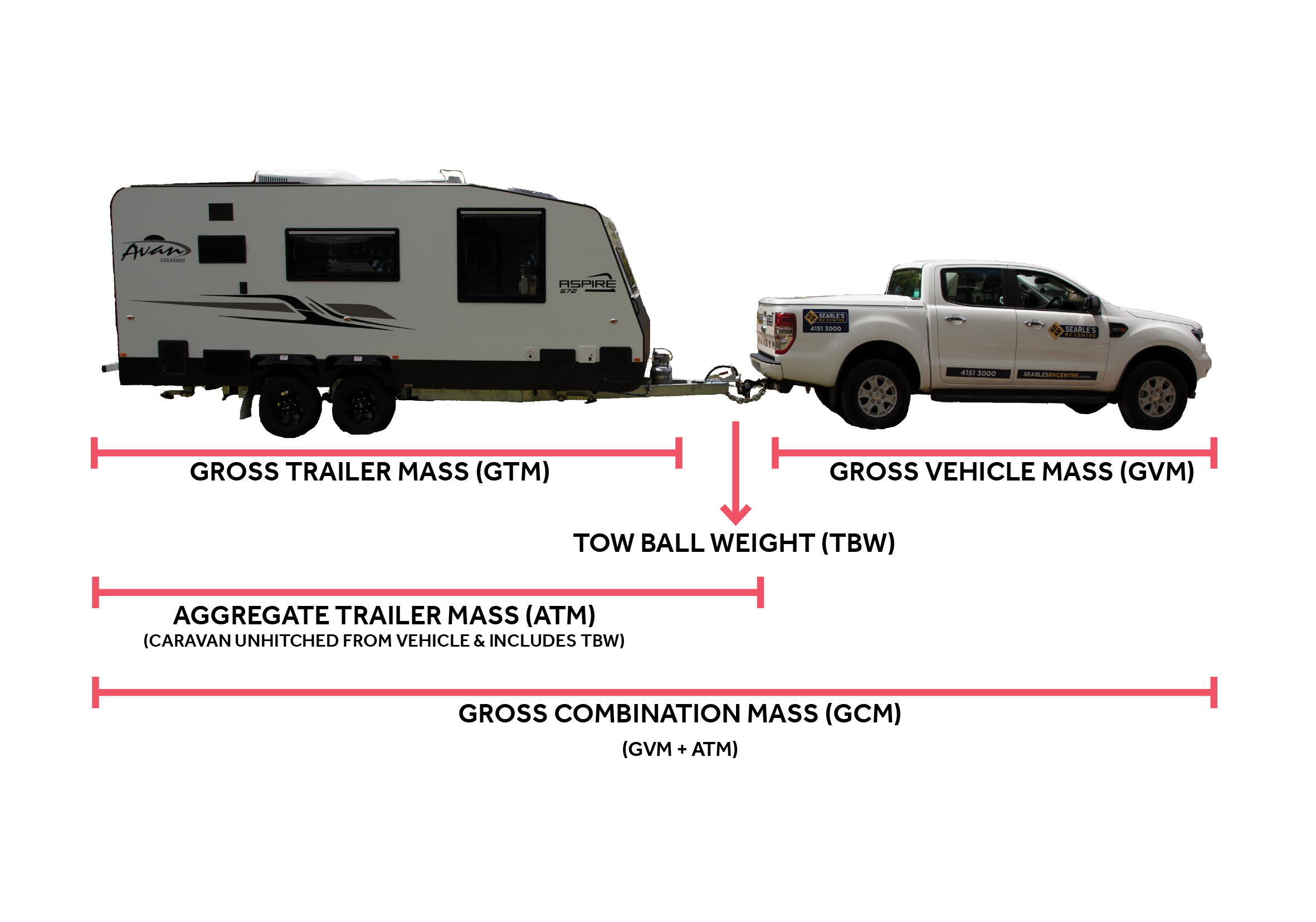
You need to ensure your vehicle’s towing capacity (braked) is higher than your gross trailer mass. From here, there are four weight limits you need to check that you are within limits:
- Aggregate Trailer Mass – ATM
- Tow Ball Weight – TBW
- Gross Vehicle Mass – GVM
- Gross Combined Vehicle Mass – GCM
The ATM will be printed on your traileru2019s compliance plate, and the other three will be on your vehicleu2019s compliance plate and/or in the owneru2019s manual. You will need to have your vehicle weighed to ensure you have not exceeded your payload.
Understanding fifth-wheeler weight
When calculating the towing capacity of a fifth-wheeler you must consider the gross vehicle mass (GVM) and the gross combined mass (GCM). For example: GCM 6000kg – GVM 2950kg = fully laden trailer cannot exceed 3050kg.
The usual practice is to have 20 per cent of the fifth-wheeler weight carried by the tow vehicle; however, it must not exceed the legal payload allowance of the tow vehicle. Payload is calculated by subtracting the tare from the GVM.
There are many benefits of having a fifth-wheeler, including towing stability and a larger area in the RV; however, these will impact the payload of your vehicle. Make sure you do the maths before purchasing as you do not want to have a great vehicle but no payload left.
Understanding slide-on weights
If you are interested in getting a slide-on, you are going to need to know your vehicle payload. Check your vehicle’s compliance plate or owner’s manual to find out your gross vehicle mass (GVM) and tare weights. Payload is calculated by subtracting the tare weight from your gross vehicle mass.
The payload of your vehicle includes all the optional extras your vehicle may have such as the bull bar, roof racks, LED lights, winch, UHF, and awning. You will also need to include the weight of your fuel and passengers of your vehicle. Then you have the weight of your slide-on and all your gear (camping chairs, cookware, etc.) and personal items (food, clothing) and maybe you might also have a push bike and fishing gear.
If you already have a slide-on set up, pack all your gear and passengers and head to a weigh bridge and check your GVM.
If you are looking to purchase, make sure you do your research on your vehicle capacity, slide-on weight and inclusions, and then everything you need to take with you to make sure it’s a viable option for you.
Weight glossary
Tare weight
Tare Weight represents the unladen weight of the vehicle including all engine fluids and a 10-per-cent fuel reserve. It is important to note that this may not include dealer inclusions or optional fittings at the time of purchase.
Gross vehicle mass (GVM)
Gross vehicle mass is specified by the manufacturer and is the maximum legal loaded mass of the vehicle. It includes the weight of the car, fuel, vehicle payload, all passengers, plus tow ball weight if towing.
Gross combination mass (GCM)
Gross combination mass is the total permissible weight of the loaded vehicle and caravan together and is specified by the manufacturer.
Aggregate trailer mass (ATM)
Aggregate trailer mass is the maximum total weight of the caravan or camper trailer. This is specified by the manufacturer and includes the tow ball weight.
Payload
Payload refers to the total weight you can add to your vehicle. This includes fresh and wastewater, gas bottles, personal items, clothes, bedding, food, etc. It can also include optional extras and aftermarket modifications such as awnings and driving lights. If you are towing, your tow ball weight must be included in your vehicle’s payload. You can calculate your caravan or camper trailer payload by subtracting the tare mass from the aggregate trailer mass (ATM).
Tow ball weight
Tow ball weight, also referred to as tow ball mass, is the weight pushing down on the tow ball by the coupling of the RV being towed.
More information
rvSafe is designed to increase road safety awareness and education specific to the RV industry. The project is funded through the Federal Government’s Road Safety Awareness and Enablers Fund and is proudly supported by the Campervan & Motorhome Club of Australia (CMCA). Find out more at: rvSafe.com.au and cmca.net.au