
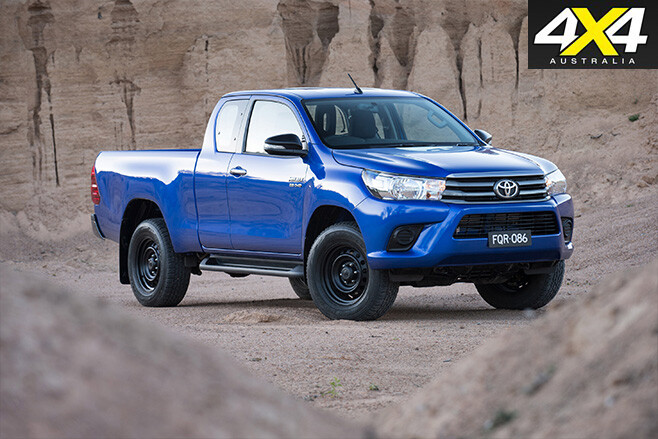
With 31 models in the new Hilux range – 19 of them 4×4 – there are plenty of options to consider when it comes to visiting your dealer.
What you want and need will be your first considerations – but, as always, what you end up with will come down to what you can afford. So let’s look at what you get in each model, from the tradie favourite, Workmate, up to the top-of-the-line SR5.
All 4×4 Hiluxes now get air-conditioning; cruise control; power windows and mirrors; central locking; seven airbags; a reversing camera on ute tubs (available as an accessory for cab-chassis variants); electronic stability control and traction control; trailer-sway control; hill-start assist; ABS with BA and EBD; a reach- and height-adjustable steering column; daytime running lights; an 80-litre fuel tank; headlight levelling; and an entertainments system with AM-FM radio, a CD player, Bluetooth, voice recognition and steering-wheel controls.
In the 4×4 Workmate you get cloth seat trim, vinyl floor covering, 17-inch steel wheels with all-terrain tyres, manual air-con, and a 6.1-inch display audio screen with just two speakers (that’s not a lot, but it’s not bad for the apprentice’s knock about). All Workmate spec 4x4s are powered by the new 2.4-litre 2GD-FTV diesel, producing 110kW and 400Nm, with either a six-speed auto or manual.
Step up to the 4×4 Hilux SR and you get 130kW and 450Nm via the 2.8-litre 1GD-FTV four-cylider diesel engine, again, available with an auto or manual. There’s also a four-litre petrol V6 in the mix, but it’s only available as an auto, double-cab ute. All SR 4x4s get a rear differential lock.
SR also adds some dress-up with black side steps; chrome exterior door handles; B-pillar black-out; interior floor carpet; premium-fabric seat trim; an air-conditioned cooler/heater box to keep your lunch fresh; a seven-inch display for the audio system, with four speakers in extra-cab models and six in the double–cab; a multi-information display; a 60-40 split-fold rear seat base in the double-cab; and seat-height adjustment. We’d have liked to have seen 17-inch alloy wheels included here, but it was not to be. You’re still riding on steelies, but at least it’s with the AT tyres.
You have to go up to SR5 spec for alloys and those are 18-inch wheels wearing highway-terrain tyres. If you tick the six-speed manual option on your turbo-diesel SR5, you get the intelligent manual transmission. This button, near the gear lever, produces smoother shifts by more accurately matching engine speed to the transmission for smoother driving.
SR5s are primarily powered by the 2.8 diesel; but, again, there’s one petrol V6 option as a double-cab, auto ute.
In the SR5 you also get a premium shift knob and steering wheel; auto-levelling LED headlamps; LED daytime running lamps; fog lights; a stainless-steel sports bar; chrome-capped, power-retractable exterior mirrors; keyless entry and start; privacy glass; a chrome grille and rear step; chrome interior door handles; climate-control air-conditioning; auto up-down function on all windows, not just the driver’s; adjustable intermittent wipers; satellite navigation; digital audio; a premium instrument cluster; a 4.2-inch TFT colour multi-info display; an additional 12V power socket; a 220V accessory socket; an alarm; and downhill-assist control (4×4 SR5 auto). Add the optional leather-accented trim and a power driver’s seat to your SR5 double-cab diesel and you’re at the SR5+ level.
Toyota isn’t ruling out the possibility of a specification above SR5 sometime down the track. It recognises the success of Ford’s Wildtrak model and the fact that so many Hiluxes sold are of SR5 spec. Buyers obviously want more features, style and comfort, as utes are more than work hacks these days. A $65K-plus Hilux with full leather trim and safety features, such as autonomous emergency braking, lane departure warning and blind spot indicators, is not out of the question. It’s more a question of when it will arrive – not if it will arrive.
| HILUX VARIANT | PRICE (MLP) | u00a0 | |
| 4×4 Single Cab (cab chassis) | u00a0 | u00a0 | |
| Workmate, 2.4 TD, manual | $36,990 | u00a0 | |
| Workmate, 2.4 TD, auto | $38,990 | u00a0 | |
| SR, 2.8 TD, man | $39,490 | u00a0 | |
| SR, 2.8 TD, auto | $41,490 | u00a0 | |
| u00a0 | u00a0 | u00a0 | |
| 4×4 Extra Cab (cab chassis) | u00a0 | u00a0 | |
| Workmate, 2.4 TD, manual | $40,490 | u00a0 | |
| u00a0 | u00a0 | u00a0 | |
| 4×4 Extra Cab (pick-up) | u00a0 | u00a0 | |
| SR, 2.8 TD, manual | $44,490 | u00a0 | |
| SR5, 2.8 TD, manual | $51,990 | u00a0 | |
| u00a0 | u00a0 | u00a0 | |
| 4×4 Double Cab (cab chassis) | u00a0 | u00a0 | |
| SR, 2.8 TD, manual | $44,990 | u00a0 | |
| SR, 2.8 TD, auto | $46,990 | u00a0 | |
| u00a0 | u00a0 | u00a0 | |
| 4×4 Double Cab (pick-up) | u00a0 | u00a0 | |
| Workmate, 2.4 TD, manual | $43,990 | u00a0 | |
| Workmate, 2.4 TD, auto | $45,990 | u00a0 | |
| SR, 4.0 P, auto | $48,490 | u00a0 | |
| SR, 2.8 TD, manual | $46,490 | u00a0 | |
| SR, 2.8 TD, auto | $48,490 | u00a0 | |
| SR5, 4.0 P, auto | $55,990 | u00a0 | |
| SR5, 2.8 TD, manual | $53,990 | u00a0 | |
| SR5, 2.8 TD, auto | $55,990 | u00a0 | |
| SR5+, 2.8 TD, manual | $55,990 | u00a0 | |
| SR5+, 2.8 TD, auto | $57,990 | u00a0 | |
| u00a0 | u00a0 | u00a0 | u00a0 |
For more on the new Hilux click here.
See Toyota’s genuine accessories here.
It has a big nose and it only comes with a petrol engine.
But, with strong off-road credentials and a competitive price, the Nissan QX80 might still have what it takes to carve a niche in the petrol 4×4 market…
WHAT’S THE DEAL?
The QX80 is a Y62 Nissan Patrol with more luxury gear and features, as well as a unique nose and rear bumper designed to give it a distinctive appearance. It certainly stands out; although, we’re not sure how many people will lunge lovingly at its bulbous snout.
With a sticker price of $110,900, it’s actually a few thousand dollars cheaper than the Y62 Patrol Ti-L was earlier in 2015 (that car has now been repriced to $86,990). It’s all about competing with the top-whack Land Cruisers or the Lexus LX570.
Additional gear includes a 15-speaker Bose sound system (two more speakers than the Patrol has), a heated steering wheel, a heated second row seats and hulking 22-inch wheels that add to the exterior poise.
There’s also loads of active safety gear, including lane departure warning and blind spot warning, plus auto braking, which works in forward and reverse.
But there’s still the foot-operated park brake and the same look and feel of a Patrol inside. Indeed, most of the interior is Patrol, right down to the seating for eight. That means a basic colour touchscreen and an instrument cluster without the detailed colours and attention to detail you expect for this money.
PRACTICALITY
Simply accessing the QX80 is something of a feat. It’s a big machine and one that really needs those side steps. Even loading gear into the tailgate requires a decent lift; such is the height of the boot floor. Once there, it’s a spacious and comfy place to travel – and you tower above just about everything else on the road. There’s seating for eight; although, it’s a struggle to fit three adults across the third row seat. Many will probably fold the third row of seats flat, something done at the touch of a button (well, two actually).
Small-item storage isn’t brilliant – there are door pockets and some covered cup holders – although, the cavernous centre console makes up points.
ON THE ROAD
The QX80’s suspension is marginally stiffer than the Patrol’s, which combines with the larger, lower-profile 22-inch tyres (they’re 275/50s) to make for a slightly firmer ride. It’s all well controlled, though, thanks partly to the Hydraulic Body Motion Control that effectively stiffens the suspension on the outside of the corner to reduce leaning.
Not that you’ll ever mistake it for a lithe athlete. It’s still a big, heavy machine – a hefty 2837kg, or almost three tonnes – and its weight becomes immediately obvious should you ask it to change direction quickly.
The 5.6-litre V8 is a beast and is impressive in the way it somehow manages to bring decent performance to a vehicle weighing so much. Put that down to the 298kW of power and 560Nm of torque, not to mention the free-revving nature of the big engine, as well as its intuitive seven-speed auto. However, the cruise control doesn’t seem to be in sync with the engine; it struggles to maintain speed on hills, sometimes losing 20km/h or more before finally convincing the V8 to delve deeper.
A heck of a lot less impressive is fuel use. It’s claimed at 14.8 litres per 100km, but in everyday driving we found it a struggle to keep it below 20L/100km. And you can easily exceed 25L/100km. That it prefers premium unleaded adds to the bowser pain. Oh, and the 100-litre tank doesn’t tend to go far; you might get 500km between fills.
It’s quiet, though, and impressively refined.
OFF-ROAD
The QX80 has a ground clearance of 245mm, which is great in isolation, but 38mm less than the Patrol. Still, for crawling over rocks or keeping away from high ridges between wheel tracks, it’s fine.
But it’s the approach angle that lets the QX80 down. At 24.3 degrees, it’s miles off the Patrol’s 34.1 degree approach; that’s largely because of the lower clearance and also the unique bumpers that stick out farther (the QX80 is 165mm longer than a Patrol) and have a more aggressive lower lip. This means you have to be a lot more careful when tackling anything taller than the front bumper.
There are no issues with the four-wheel drive system. The permanent all-paw system can be run in 4H or for low range for off-road where the rear diff can also be employed. On top of that, there are three dedicated off-road modes for the traction control – sand, on-road and snow.
Being a heavy, petrol-engine car, engine braking isn’t great. But there’s hill descent control to limit speed on steep hills.
The QX80 isn’t as well suited as some at carrying a load either, as the gross vehicle mass (GVM) is 3500kg. By the time you put people and their luggage on board, it doesn’t leave much room for camping and recover gear.
Still, the tow capacity is exemplary – a full 3500kg.
VERDICT
The QX80’s biggest issue is one that also haunts the Y62 Patrol – a lack of a diesel engine option. And while the 5.6-litre unit does a good job of shifting all that metal, it also does a stellar job of draining the local petrol station.
But it’s the price that is the thing likely to make the QX80 a niche player in an already small niche. The Ti-L Patrol gets almost all the same gear and significantly better off-road credentials – and for $23,000 less.
Price and specifications
Price: $110,900 Engine: 5.6-litre petrol V8, 298kW at 5800rpm, 560Nm at 4000rpm Transmission and 4WD system: 7-speed auto, full-time dual-range four-wheel drive Braked tow capacity: 3500kg Spare tyre: Full size alloy Fuel tank: 100 litres Fuel use (claimed): 14.8L/100km Fuel use on test: 19.6L/100km Approach/departure angles: 24.3 degrees/24.5 degrees Ground clearance: 245mm
Toyota has revealed the full range and prices of its Hilux line-up with 31 variants in total, 19 of which are four-wheel drives.
Available in the 4×4 range are single-cab, extra- and double-cab models; utes and cab-chassis; and Workmate, SR, and SR5 specifications. 4×4 buyers will now also have the choice of three engines: a 2.4-litre 2GD-FTV diesel that makes 110kW and 400Nm; a 2.8-litre 1GD-FTV diesel (as in the Prado, but without a balancer shaft), which makes 130kW and 450Nm with the auto transmission or 420Nm with the manual; or a revised version of the old 1GR-FE 4.0-litre petrol V6, now producing 175kW and 376Nm.
Transmission choices are six-speed auto; six-speed manual; and, behind SR5 diesels, a six-speed ‘intelligent’ manual that better matches the engine revs to the gear ratios at the touch of a button.
Chassis rails are up to 30mm thicker, making them stronger and up to 20 per cent stiffer in torsional rigidity. Suspension is via traditional coils up front with leafs at the back, but the leafs are 100mm longer to improve ride and are placed wider in the chassis to improve handling. Toyota claims this gives more passenger-car like dynamics. Wheel travel at both the front and rear is claimed to be increased by 65mm, or around 20 per cent.
4×4 remains a part-time system with low range, and a rear diff lock is standard on SR and SR5 variants. The electronic traction control, which along with stability control is standard across the range, is disabled at the front wheels when the mechanical rear diff lock is engaged. Low range employs a lower ratio than the previous model. Approach (31 degrees) and departure (26 degrees) angles are improved for better clearance, while the ground clearance is listed at 279mm. The 4×4 and 4×2 Hi-Rider variants get locally developed metal underbody protection that is 40 per cent thicker and 30 per cent larger than that of the outgoing models to protect more of the undercarriage.
Workmate and SR Hiluxes get 17-inch all terrain tyres while the SR5 models ride on 18-inch HTs. The brakes are the same, so you should be able to fit 17s on your SR5 if desired. Wading depth for 4×4 models is quoted at 700mm. Towing capacity for the manual variant is up to 3500kg while for the auto it’s 3200kg. The GVM of 4×4 models is 3000kg to 3050kg. GCM is 5850kg for 1GD and 2GD manuals; 5650kg for the diesel autos; and 5750kg with the petrol V6. Kerb weight is 1775kg to 2080kg, depending on body and spec, but it points to most variants having around about a one-tonne payload.
The 2016 Hilux will be on sale from Tuesday, September 29.
We’ll have more details of the new Hilux as they are unveiled over the coming days. Stay tuned to www.4x4australia.com.au for our test drive.
| HILUX VARIANTu00a0 | u00a0 | PRICE (MLP) |
| 4×4 Single Cab (cab chassis) | u00a0 | u00a0 |
| Workmate, 2.4 TD, manual | u00a0 | $36,990 |
| Workmate, 2.4 TD, auto | u00a0 | $38,990 |
| SR, 2.8 TD, man | u00a0 | $39,490 |
| SR, 2.8 TD, auto | u00a0 | $41,490 |
| u00a0 | u00a0 | u00a0 |
| 4×4 Extra Cab (cab chassis) | u00a0 | u00a0 |
| Workmate, 2.4 TD, manual | u00a0 | $40,490 |
| u00a0 | u00a0 | u00a0 |
| 4×4 Extra Cab (pick-up) | u00a0 | u00a0 |
| SR, 2.8 TD, manual | u00a0 | $44,490 |
| SR5, 2.8 TD, manual | u00a0 | $51,990 |
| 4×4 Double Cab (cab chassis) | u00a0 | u00a0 |
| SR, 2.8 TD, manual | u00a0 | $44,990 |
| SR, 2.8 TD, auto | u00a0 | $46,990 |
| u00a0 | u00a0 | u00a0 |
| 4×4 Double Cab (pick-up) | u00a0 | u00a0 |
| Workmate, 2.4 TD, manual | u00a0 | $43,990 |
| Workmate, 2.4 TD, auto | u00a0 | $45,990 |
| SR, 4.0 P, auto | u00a0 | $48,490 |
| SR, 2.8 TD, manual | u00a0 | $46,490 |
| SR, 2.8 TD, auto | u00a0 | $48,490 |
| SR5, 4.0 P, auto | u00a0 | $55,990 |
| SR5, 2.8 TD, manual | u00a0 | $53,990 |
| SR5, 2.8 TD, auto | u00a0 | $55,990 |
| SR5+, 2.8 TD, manual | u00a0 | $55,990 |
| SR5+, 2.8 TD, auto | u00a0 | $57,990 |
| u00a0 | u00a0 | u00a0 |
Option: Premium paint (all): $550
#Price listed is manufacturer’s list price (MLP) and does not include statutory charges or other on-road costs.
Mazda has given the BT-50 one-tonner a facelift to address the main concerns of 4×4 ute buyers.
Primarily, the changes centre on styling and toning-down the grinning grille that turned many buyers away from the nevertheless popular model.
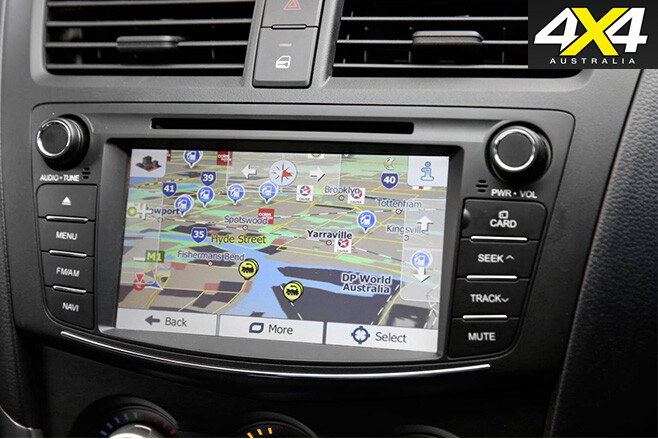
Outside, a new grille, headlights, bumper and taillights are the most obvious additions, while inside a new and more functional centre stack on XTR and GT models is a huge step forward for the mid-life model.
The new, stronger-looking face of the BT-50 does away with the orange indicator lenses that previously exaggerated the swept-back look of the ‘eyes’ and replaces them with clear lenses over dark housings, with darker finishes on the new grille.
The changes are designed to give a more horizontal look than that of the old model, which has the appearance of a girl’s face with her ponytail pulled too tight. Other exterior changes include new taillights with darker red lenses and no chrome trims, new alloy wheel designs, and tubular side steps on XTR and GT models.
The top-spec variants are the ones to benefit most on the inside. While the XT retains the old centre stack with its plethora of small buttons and no A/V screen, the XTR and GT get a new stack featuring a 7.8-inch HD touch screen with all the controls you need, including the sat-nav which, in a first for a production vehicle, is available with full HEMA off-road maps as a $295 option.
The BT-50 4×4 range continues, as before, with XT, XTR and GT specifications – single-cab, freestyle-cab and double-cab bodies – and the choice of ute or cab-chassis. There are 13 4×4 models in the range.
The engine remains the 3.2-liter five cylinder turbodiesel backed by either a six-speed manual or auto transmission. The engine makes 147kW at 3000rpm and 470Nm from 1750rpm to 2500rpm as it did before, and is unchanged, unlike the similar engine in the Ford Ranger that has benefitted from some improvements to refinement.
The drive train continues to employ part-time 4×4 with low range plus a rear diff lock that is standard on all 4×4 variants. The 2.2L four-cylinder diesel is only available in the 4×2 BT-50 models.
Like Ford, Mazda has also improved the shift quality of the six-speed manual behind the 3.2. The new short-stroke shift is much more direct and positive than the vague shifter in the old model, making the manual much more enjoyable to drive and will ensure it’s the transmission of choice for those who enjoy the control and connectivity of rowing their own ratios, and a better/lower crawl ratio.
As more manufacturers switch to smaller capacity engines for their 4x4s, the 3.2L engine used by Mazda and Ford will find favour with many buyers who like the feel of bigger engines and the way they deliver their torque.
In the BT-50, the engine is happy to lope along at a relaxed gait, only breathing heavily if you put your foot down. It’s well matched to both the manual and auto transmissions, whatever your choice. The updates to the interior of the top-spec versions also make the BT-50 an easier car to live with. The new dash is far more practical, usable and more in-line with the high-spec levels of utes these days.
The BT-50 has always been a great value for money package, but many would-be buyers couldn’t get over the styling. The value continues, with only an incremental rise in price on some variants, and these are made up for with the added features on the XTR and GT models. With the fresh look, we’re sure many buyers will make the most of the value.
The mid-spec XTR is the model that will appeal to most recreational 4x4ers and it includes in its standard kit: a rear diff lock, trailer sway control, 17-inch alloy wheels, and dual-zone climate control. It now also adds a reversing camera, tubular side steps, auto dimming mirrors, rain sensing wipers, and auto headlamps. The top of the range GT also gets heated exterior mirrors that fold and have embedded indicators, plus privacy glass on the rear windows.
Even in GT trim, the Mazda doesn’t have the refinement and features of some other top-spec utes, but it doesn’t have the $60K price tag either. It actually leaves room for Mazda to introduce a higher-spec model to cater to the lucrative top-of-the-range ute buyers.
As it is, the BT-50 range is modest and targeted to the majority of buyers, both private and fleet buyers, with Mazda hoping to pick up more sales in the fleet segment.
Mazda BT-50 4×4 XTR double-cab
Engine: Inline 5-cyl, diesel Capacity: 3198cc Max Power: 147kW @ 3000rpm Max Torque: 470NM @ 1750rpm Gearbox: 6-speed automatic or manual Crawl ratio: 52.5:1 (man) 42.3:1 (auto) 4X4 System: Part-time 4×4 with low range. Selectable rear diff lock. Construction: Body on frame Front suspension: Independent with coil springs Rear suspension: Live-axle on leaf springs Wheel and tyre spec: 17 x 8” alloys with 265/65-R17 tyres Kerb Weight: 2105kg GVM: 3200kg Payload: 1095kg Towing capacity: 3500kg Seating capacity: 5 Fuel tank capacity: 80L ADR fuel consumption*: 9.2L/100km *Australian Design Rule ‘Combined-Cycle’ claim
Mazda BT-50 4×4 range and prices
| Model | u00a0 | MLP |
| 3.2L SINGLE C/CH XT 4X4 – manu00a0 | u00a0 | $36,850 |
| 3.2L SINGLE C/CH XT 4X4 – auto | u00a0 | $38,910 |
| 3.2L FREESTYLE C/CH XT 4X4 – man | u00a0 | $40,815 |
| 3.2L FREESTYLE C/CH XT 4X4- auto | u00a0 | $42,815 |
| 3.2L FREESTYLE CAB UTILITY XTR 4X4 – man | u00a0 | $47,675 |
| 3.2L FREESTYLE CAB UTILITY XTR 4X4 – auto | u00a0 | $49,675 |
| 3.2L DUAL C/CH XT 4X4 – man | u00a0 | $42,815 |
| 3.2L DUAL CAB UTILITY XT 4X4 – man | u00a0 | $44,615 |
| 3.2L DUAL CAB UTILITY XT 4X4 – autou00a0 | u00a0 | $46,615 |
| 3.2L DUAL CAB UTILITY XTR 4X4 – man | u00a0 | $49,700 |
| 3.2L DUAL CAB UTILITY XTR 4X4 – auto | u00a0 | $51,700 |
| 3.2L DUAL CAB UTILITY GT 4X4 – man | u00a0 | $51,790 |
| 3.2L DUAL CAB UTILITY GT 4X4 – auto | u00a0 | $53,790 |
Do what you love and you’ll never work a day in your life. Do what you love and the money will follow.
That’s what they say. What they don’t say is that ‘not working a day in your life’ can be bloody hard work. And the money that follows often won’t cover your fuel. But that doesn’t matter if you still love what you do. This is something Expedition Overland (XO) owner-director Clay Croft knows well.
Making four-wheel drive videos in some of the world’s most dangerous and exciting locations, the 33-year-old lives and breathes every serious off-roader’s dream: ball-breaking, thrill-seeking adventure.
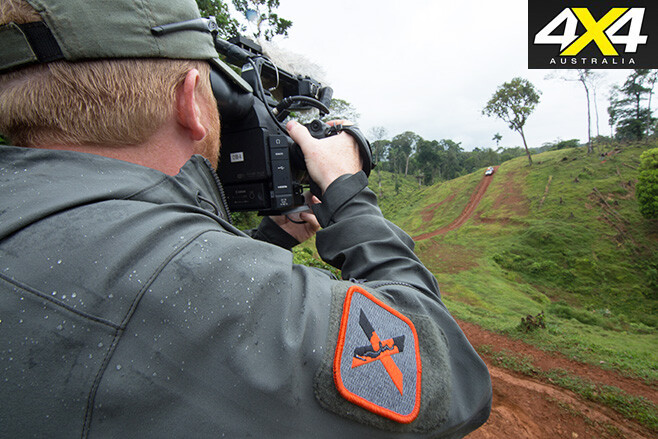
In the recently launched second series of XO, Clay and his crew of nine travel more than 16,000km through 10 countries, including the United States, Morocco, and eight countries in Central America.
Highlights include using cut-down rubber trees to cross rivers, travelling with Special Force surgeons, taking on the legendary Baja 1000 track, and reaching the infamous Darien Gap at the centre of the North American Drug War.
The ‘Central America’ special is currently gaining about 10,000 subscribers a month, with the show third-most popular in Australia.
Seeing that Clay is now exploring the possibility of an expedition in Australia, we thought it was about time to have a chat with him to see what makes him tick.
The XO series has become pretty popular. What inspired you to make it? The biggest inspiration would probably be the example Warren Miller made when he found a way to make a living out of ski films. Second would be Anthony Bourdain. He thrives on travelling and cooking.
Overlanding is more of a niche than both of those things, but the stories that come from travelling the world by vehicle seem endless. I also think it’s an interesting way to see the world, and people will dig it if it’s done in an interesting way.Where do you hail from? I am a Montana kid; born and raised in Billings, Montana. I spent my summers on the ranch or in the mountains fly-fishing, backpacking and climbing.
What got you into overlanding? I got into four-wheeling in high school. My dad bought us kids a Ford Bronco II, and from there I was hooked. I have been an explorer-type since I was little and, when I found out that a vehicle could help me in my adventures, it was a match made in heaven.
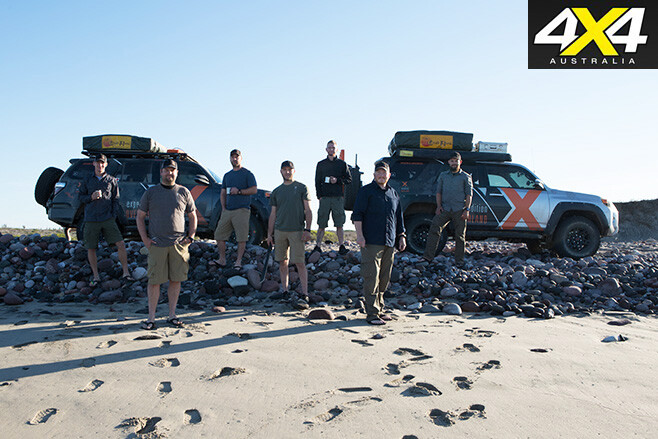
What 4×4 trips have you done lately? I’ve been fortunate to have spent a lot of time now in Moab, Utah. I’ve been to quite a few places throughout Montana and Wyoming; places that I kind of keep secret. My big trips have been Alaska and the Yukon, Central America, the Road of Bones in Siberia with Expeditions 7 (another crew of adventurers), and some of South America with them as well.What’s your favourite? Alaska and the Yukon are my favourite places for beauty. They’re amazing places of vast landscape. I love spending time up there.
The Road of Bones is definitely the most unique place I’ve been, as it is so hard to get to and so vast.
Central America was the greatest challenge I’ve faced, but, out of all them, I would have to say that British Columbia is the most amazing place I’ve been. There is something special about that place.
What’s the hardest driving you’ve done? The hardest driving I’ve done is the Road of Bones in Russia. The other cars are crazy, the rules are unpredictable and the remoteness and bad roads added up to be the hardest driving I’ve been involved with. A close second is Central America for pretty much the same reasons.
Anything left on your bucket list?
My dream trip would probably be crossing Antarctica the way E7 (Expeditions 7) did. I was not able to do it with E7 because I was editing the Alaska – Yukon season at the time and couldn’t get away. It’s haunted me ever since. Someday I hope to be able to do it.
A close second would be the Canning Stock Route. I really think the long distance remote stuff is cool. If it requires fuel drums, sign me up.Been in any hairy situations on the road? A couple come to mind. Once, while riding shotgun in Scott Brady’s 70 Series in Russia, we were travelling a long dusty road. Ahead of us was a semi-truck with a trailer. All of a sudden he thought it was prudent to come to a full stop on the road. The dust was so thick that we couldn’t tell until seconds before impact.
Scott whipped the wheel left, just clearing the trailer as we swerved on to the oncoming lane. He then quickly ducked back in as we passed the nose of the truck. It was an example of brilliant control of a vehicle, and split second decision-making. We now call the manoeuvre the “Russian Whip”.
Central America also had several sticky situations. They happened on our way home from the filming of the Central America series. In Mexico, we were stopped by plain-clothes policemen, who were carrying specialty weapons.
At first we did not think they were legitimate personnel so we kept our foot hovering over the gas and the trucks in gear as we were questioned and surrounded. As far as we can tell, in hindsight, they were real police.
Entering Honduras, we almost had all of our camera gear taken and it might have been the end of the Central America series.
Some of the border people didn’t like the level of gear we had and demanded answers. We played the medical assistance card from our time with Team 5 (medical and survival experts who venture into extreme locations to provide medical assistance) in Guatemala and that eventually got us out of the spotlight.
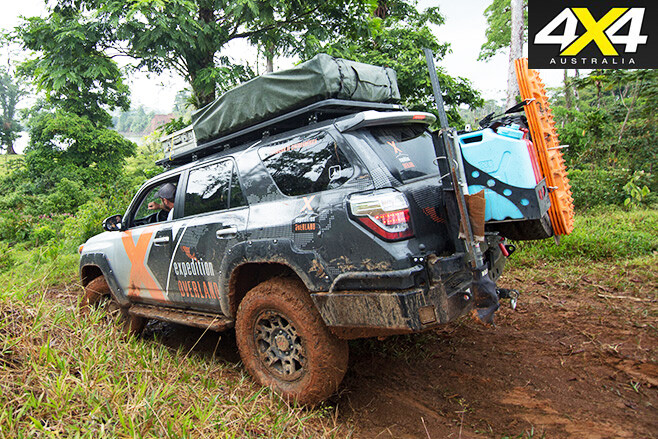
What are you driving at the moment? We have a few personal rigs right now. My daily drive is the Tacoma in the series. A 2013 Tacoma with a laundry list of modifications: Icon Dynamic suspension; a TRD supercharger; six-speed manual with 4:56 gears; I removed the TRD axle for a Sport axle and ARB air locker that replaced the factory E locker.
So it’s a TRD off road with the benefits of ATRAC and bigger differential that the Sports had. It has a topper on it, with an Adventure Trailers drawer system in the rear and it’s equipped with a National Luna fringe slide and stove slide set-up. It’s killer! My favourite part is the AR15 gun rack on the roof in the back seat, activated by a secret switch. It’s very James Bond and a metric tonne of fun.
My other car is a classically outfitted 1989 62 Series Land Cruiser. You can see it in the Classic and Legends film of ours. I was able to get a Kaymar rear bar on it before they were all gone here in the States. I love to drive it and I go fishing in it all the time. It’s also my three boys’ favourite.
My wife Rachelle drives a Lexus GX470 that we have put Old Man Emu suspension on and an ARB front bumper with Intensity lights. It also has a set of white Maxtrax made for her race in Morocco’s Aicha des Gazelles Rallye.
What other 4x4s have you owned? I’ve owned a 1982 Bronco II, a 1994 4-Runner, then a 1996 4-Runner, which I traded for a 2001 Tacoma TRD 4DR, then seven years later traded up to get my current 2013 Tacoma. Since starting Expedition Overland, we have owned a 100 Series Land Cruiser, the 62 Series Land Cruiser and now two 2015 4-Runners in the Trail Premiums edition.What’s been your favourite? That’s a tough call! My current Tacoma is dialled and I love it. The 100 Series is also at the top of the list and I hope to have a new Land Cruiser one day.
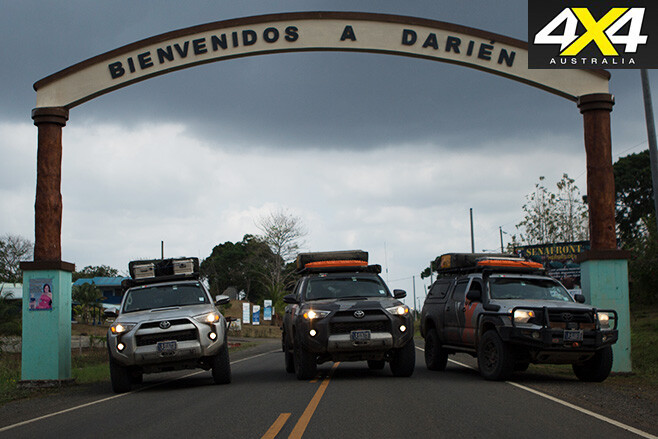
What do you love most about off-roading? What I love about off-roading is the reliance of machine and experience, the decision-making process, and the thrill of getting somewhere remote and then getting back.
Best advice on 4x4ing you’ve been given? Rod Hall gave me a tip one time of the acronym C.A.R. Make sure that you are Comfortable, Accurate with your vehicle placement, and Relaxed. If you do all these things, then your rig is within its capabilities and you’re in control.
Like many four-wheel-drive utes, the suspension on the Nissan Navara D22 is a basic set-up; independent up front with torsion bars and a live-axle at the rear with leaf springs.
When you consider the D22 was launched some 18 years ago, it’s little wonder that the ride and handling are somewhat deficient by today’s standards.
The big problem with the Navara D22 is that the front suspension feels like it’s been tuned to suit a different vehicle than the rear suspension; all spongy and bouncy at the pointy end and all harsh and bone-jarring down the back. In short, it’s bloody awful.
Thankfully there are aftermarket suspension experts, such as those at Tough Dog, who have developed kits to improve the D22’s ride and handling. Tough Dog offers several suspension upgrade options for the Navara D22 tailored to the individual requirements of the owner. These options can be easily configured by the vehicle owner by using the ‘Kit Builder’ function on the Tough Dog website (www.toughdog.com.au).
In the case of my Navara, which is equipped with a steel bull bar (but no winch) and rarely carries a heavy load in the tray, the most suitable set-up was deemed to be the ‘Light Rear Load’ kit, which consists of 41mm foam cell shock absorbers front and rear, new rear leaf springs designed to operate with a light rear load (up to 300kg), U-bolts and urethane bushes. Without the weight of a winch up front, the standard torsion bars were retained, but these can be easily replaced at a later date if I fit a winch down the track.
In standard trim, the mismatched standard suspension on the D22 meant that, over anything rougher than a billiard table-smooth surface, the front-end felt too soft and spongy while the rear-end felt harsh and firm. Over bumps the front-end bounced up and down like a pogo stick, making it feel as though the whole vehicle was pivoting around the rear axle. As for the rear suspension, it was extremely uncomfortable whether there was a load in the tray or not.
The standard rear leaf springs on the Navara have two main leaves on each side and two shorter leaves. At normal ride height, only the two main leaves work, offering a relatively soft ride, but when the suspension is compressed, such as when there’s a heavy load on board, the two short leaves come into play. This variable spring rate is designed to offer a soft and comfortable ride when the vehicle is unladen, while still handling a heavy load without excessive sagging. The problem is, however, that the two main leaves are too soft so, when the vehicle drives over a bumpy surface, the leaves compress too readily and the shorter leaves come into play with a sudden jolt.
Unlike the standard-variable-rate leaf springs, the replacement Tough Dog springs have a linear spring rate with eight leaves per side. As they are tailored to suit the expected load of the vehicle (in this case, 0-300kg), these linear springs offer a far more compliant ride over rough surfaces. And it’s not only ride quality that benefits, as the consistent nature of these linear springs optimises traction and makes the vehicle feel more stable, with more predictable handling.
Another advantage offered by the Tough Dog leaf springs is a 40mm ride-height increase, which benefits ground clearance when driving off-road. Before having the Tough Dog kit fitted, I’d already wound the standard torsion bars up by about 35mm to handle the extra weight of the steel bull bar, and to provide clearance for the slightly bigger 265/75R16 Toyo Open Country II tyres. But, without much compression-damping force, the front-end still tended to bottom-out too readily off-road, resulting in scrapes over rough terrain. With the new Tough Dog shock absorbers fitted, this is no longer the case.
The springs are mated to Tough Dog 41mm foam cell twin-tube shock absorbers, which offer substantially more damping control than the standard shocks. In fact, the difference in damping performance over the standard shock absorbers is so significant that the front suspension feels like the springs have been replaced, too. The front-end no longer bottoms out, thanks to much improved compression damping, and the improved rebound damping prevents the front-end from bouncing into the air when the springs want to release their compressed energy. On the road this means the Navara exhibits more sure-footed handling and improved ride quality, while off-road it no longer bottoms out and rarely scrapes its belly.
While it’s possible to detect individual improvements in the suspension performance, it’s the way it all comes together in an integrated package that’s the most impressive aspect of this upgrade. With a more compliant and linear spring rate at the rear, and much better damping control at the front, both ends of the Navara now feel like they belong on the same vehicle.
Overall ride quality is on the firm side, but there’s none of the harshness that was there before. I can now drive over bumpy surfaces without fear that the front-end will bottom out and bounce around, while the rear-end no longer sends shock waves through the cabin, whether there’s a load in the tray or not.
As well as better ride quality, handling is also significantly improved. There’s less body roll when cornering, there’s more grip and the steering doesn’t feel as vague as it once did. The Tough Dog ‘Light Rear Load’ kit fitted to my Navara can be optioned up with several other components, such as nitrogen gas shock absorbers, 40mm adjustable rear shock absorbers and even a steering damper. At this stage I’m more than happy with the ‘standard’ kit.
A winch is definitely on my shopping list, so I’ll have to upgrade the torsion bars down the track (the Tough Dog torsion bars are claimed to offer a spring rate that’s approximately 30 per cent higher than the standard torsion bars), but it’s great to know that’s the only modification I’ll have to make, as the same 41mm foam cell front shock absorbers can be retained.
As for the rear, I don’t envisage I’ll ever need to upgrade the rear springs, as even when I’m touring I don’t carry too much gear in the back of the Navara.
There is no denying that the Amarok is great vehicle straight off the showroom floor.
Hitting Australia in 2011 after critical and consumer acclaim across the globe, the Amarok has won a swag of awards here, including 4X4 Australia’s Best in Class for 2015 and 2012, and 4X4 Australia’s Ute of the Year in 2012 and 2011.
But, as most owners will tell you, there’s always room for customisation – once you see the trucks below, we’re sure you’ll agree.
These eight Amaroks were part of a pack of 11 – from a stock-standard machine to a mini-monster truck with 100mm body lift – that gathered recently for a day of dirt at Queensland’s Land Cruiser Mountain Park. See the vehicles in action here.
They are a handsome and practical bunch of vehicles owned by an enthusiastic group, and, more to the point, their modifications are some of the best we’ve seen…
THE CANYON RUNNER
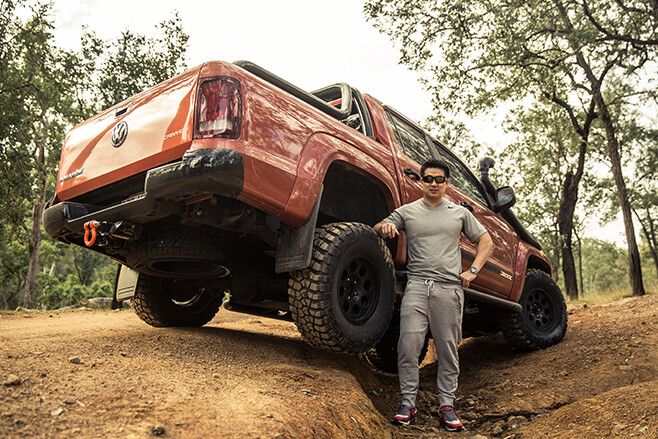
Huy Nguyen loves this Canyon edition of the Amarok, which arrived with distinctive burnt-orange paintwork, a unique sports bar, leather seats, satellite navigation and a rear-view camera.
But the Brisbane construction project manager has been thinking about a bit more power than the 132kW supplied by the two-litre diesel – he’s dreamt about shoe-horning a Touareg diesel V8 under the Amarok bonnet.
“I was contemplating an engine swap, but don’t think that’s happening now,” Huy says. “Originally I looked at the V6, but my mate said, ‘No, go the V8’.
But by the time I finished, it’d be $40,000 or $50,000, so I’ll just wait for this engine to die out a bit.”
He’s got 16,000km up on his auto Amarok, bought in November last year. Since then, Huy and his mates at 101 Motorsport in Queensland have added a Rhino bull bar with a Runva winch, LED spotlights, Bilstein shocks all round, a 50mm body lift and custom-made alloy side steps.
There’s a Roll-N-Lock tonneau cover, Safari snorkel and tow bar with a set of Delta flares still to fit to help cover 33-inch BF Goodrich Mud Terrains.
Huy had a Holden Maloo for a while. “But I wanted to enjoy the Aussie outback and beaches, so went for the Amarok.”
OUTBACK ARMOURED
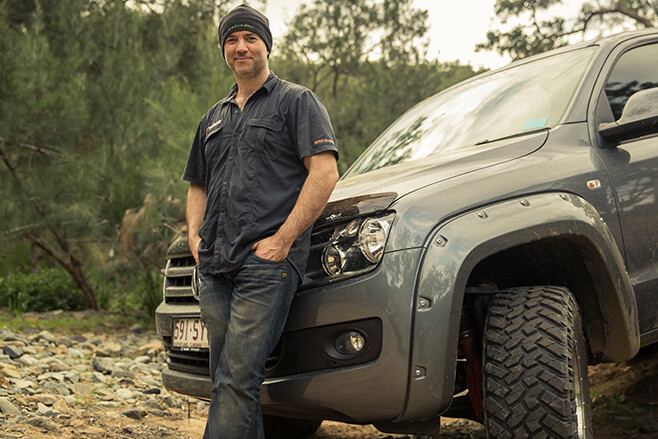
Richard Catelan’s been in the business of designing and making aftermarket suspension for four-wheel drives, plus custom off-road recovery gear – bow shackles and the like – for 10 years.
Some of his biggest customers today are armoured-vehicle builders in the Middle East – hence Richard’s Outback Armour branding. While he allows his heavy-duty suspension kits to help four-tonne armoured Land Cruisers, extra-heavy Coaster buses and well-protected JK Jeeps handle better than new, it’s a side of the business cloaked in some secrecy.
But Richard’s Brisbane-developed kits for civilian four-wheel drives are another matter. And aftermarket suspension for Amarok utes here is a big part of that business.
He turned up for the Land Cruiser Park jaunt in his work truck, a tidy dark-grey dual cab Amarok. This one sits on Outback Armour struts and springs up front with an Outback Armour Expedition leaf pack on the rear. The front of the VW sits up 30mm and the back’s up 50mm. And those chrome alloy leaf springs – five primary and two secondary – allow Richard to carry 400-500kg in the rear.
There’s also a Sammitr canopy, dual-battery set-up, a TJM rear bar and 285/65R18 Nitto Trail Grappler tyres covered by body-coloured fender flares, for when Richard wants to go scrub.
DARK HORSE
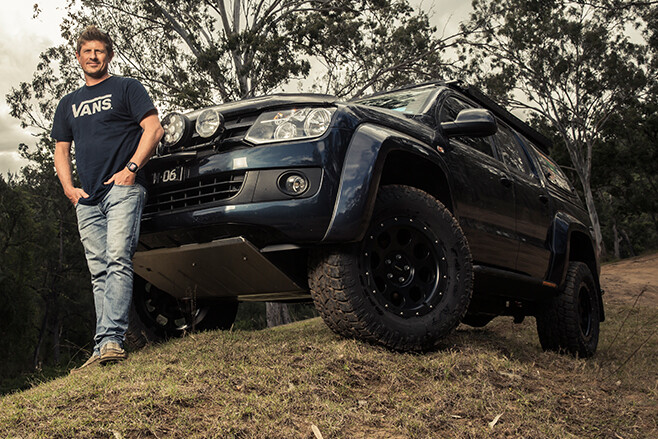
It was a $40K on-road deal too good to refuse, Glen Mattiske says. The Gold Coast carpenter loved his Hilux, but Toyota’s pricing was an issue when he shopped for a new ute three years ago.
“So it was the price point, and the Amarok was a bit roomier and nice to drive,” Glen says. “It’s a work in progress, I’ve been chipping away ever since.”
The six-speed manual ute has 57,000km on the clock and close to $20,000 worth of extras. On days off, the keen surfer chases waves off North Stradbroke Island or heads north to Rainbow Beach to camp out with his family.
“It’s a bit of a toy, I love my fun cars. Keeps me out of trouble… or sorta out of trouble,” Glen laughs. “I’ve done most of the work myself, which has saved a lot of coin.”
His Amarok features a TJM snorkel, 18-inch Delta wheels and Delta flares over Toyo Open Country tyres. There’s custom-made rocksliders, a TJM rear bar, Seikel skid pan and Outback Armour suspension. A 35mm lift with custom 20mm spacers takes the ride up 55mm.
Glen uses the Sammitr canopy, with BedRug lining, and custom alloy roof rack for loads of building materials.
GOOD AS GOLD
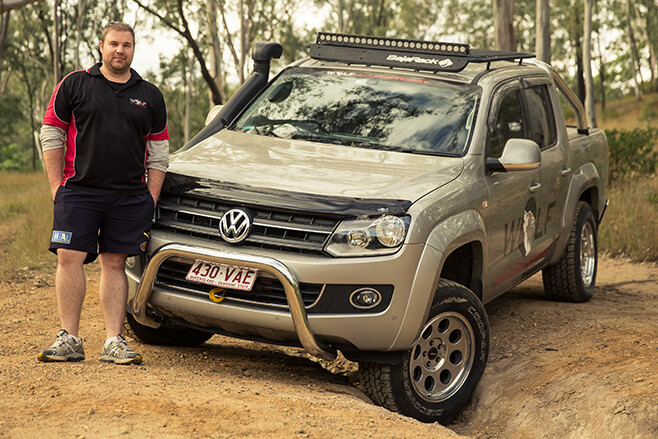
Tristan Gibbons is an integral part of the Wolf 4×4 business, kick-started by his brother Ashley. As such, Tristan gets to try out gear, develop ideas and showcase Amarok accessories and modifications.
So this sand-beige metallic dual cab, bought early last year, is loaded with useful add-ons; maybe it’s not as wild as some, but it’s a stylish ute for touring rough country.
The auto Amarok has a Delta nudge bar up front and AFN winch mount for the Runva XP winch.
There’s a Seikel snorkel for water crossings and cleaner air, but Tristan’s left his two-litre engine in factory tune.
Inside has also been left standard; most Amarok owners apparently appreciate Volkswagen’s neat and tidy cabin features.
Tristan’s ute has a BajaRack up top with a 40-inch LED light bar for turning night into day, and a pair of five-inch LEDs on the sports bar for reverse.
The tray is covered by a Roll-N-Lock tonneau with a BedRug lining, a cargo manager (divider) and an EZDown fitted to the tailgate – lockable through the ute key’s remote fob.
There’s an extra length recovery hitch on the towbar and all this sits on Outback Armour suspension, with the underbody protected by AFN skid plates.
Wheels are the ubiquitous Delta Classics with 275/65R18 Cooper Discovery AT/3s.
THE ‘ROYCE’
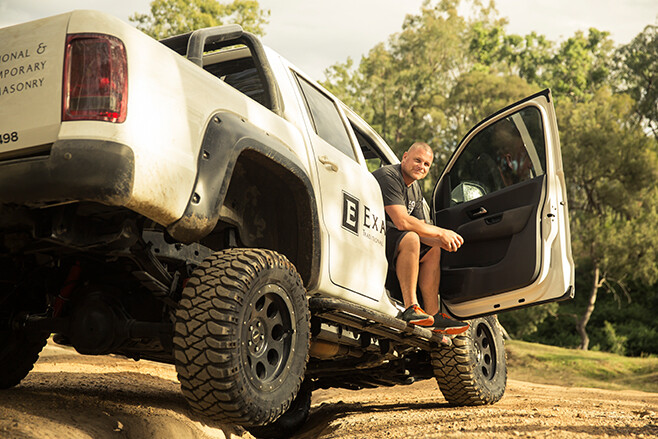
Sydney stonemason Davie Steele didn’t like the look of the Toyota Hilux, and couldn’t wait six months for a Ford Ranger Wildtrak, so, after some research and test drive, he bought an auto Trendline Amarok.
“It’s like the Rolls-Royce of utes,” he reckons.
But Davie also understood his ute needed a few mods to carry loads of stone and tools through the week and head further into rough country on the weekend.
Now he’s almost done – once he chips up the engine, and gets his 100mm body lift certified.
This is one wild-child Amarok.
“I originally wanted to just lift it, put bigger wheels and flares on it,” Davie says. “Then it just escalated from there.”
But this is no toy truck, Davie carries up to 1.5 tonne at times, so he ordered the VW with heavy-duty rear springs. It has since gone on to Outback Armour suspension and their heavy-duty springs; the rear is super stiff.
The just-fitted 100mm lift, first seen by Davie on this outing, is complemented by Bushwhacker flares over 18-inch Delta wheels shod with Mickey Thompson Mud Terrains.
There’s a snorkel, hidden winch mount, nudge bar, driving lights up front and a Roll-N-Lock tonneau down back.
A black wrap for bonnet and roof sets off a very handsome, tall truck.
THE ULTIMATE
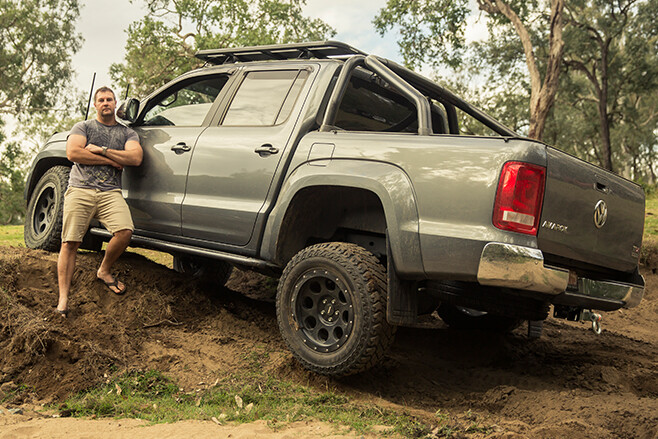
Trevor Manton has owned his Amarok Ultimate ute for just on two years.
The communications expert has had Toyota Hiluxes and Nissan Navaras before, but fell for the VW on a test run and liked the dynamics.
“So I decided to go with one and don’t think I’d ever go back,” Trevor says.
He and his family get out camping a bit with an off-road camper, taking some long-distance drives out west. His idea was to set this manual ute up for getting off the road, but not for hard-core off-roading.
So underneath went the full Seikel underbody protection panels, a Koni Raid suspension set-up for the Delta rims and 32.5-inch BF Goodrich rubber. The aftermarket suspension gave him about a 50mm lift, and the bigger tyres more again.
There’s a nudge bar mounted with phone and UHF radio antennas, a Warn 9.5XPS winch mounted behind the Amarok’s front bumper, a Safari snorkel plus a Baja Designs LED light bar mounted on the Rhino roof rack.
The checkerplate on the ARB sidestep has been powder-coated and the tray’s fitted with a Speedliner ute protection, Roll-N-Lock tonneau and a custom-made tool box.
The Amarok’s ECU has been re-mapped for a touch more power and Trevor’s thinking, once he’s added an air compressor and maybe some extra lights, he’ll have a very handy tourer.
SEA CHANGE
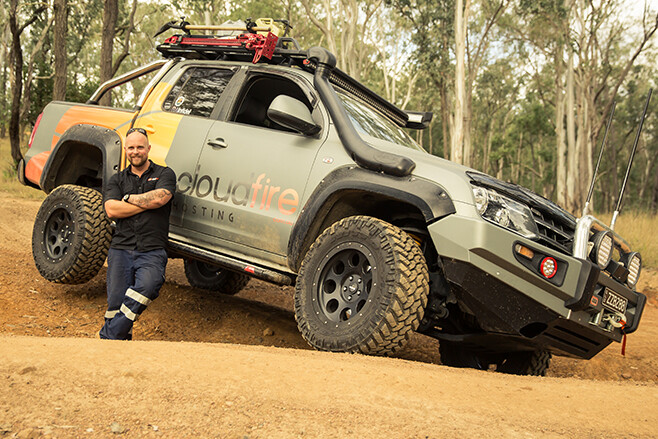
Will Hutchins is one of those characters always on the move.
That’s handy in his line of business, looking after data centres and communications solutions around Queensland. It’s handy, too, to have a four-wheel drive Amarok decked-up to go anywhere, any time.
Will used to own a Surf, but when the Toyota’s head cracked it was time to move on. He looked at the Hilux (“too jumpy in the rear”) before settling on an Amarok eight months back.
The Volkswagen’s suspension was first to be reworked, replaced with an Outback Amour kit and a 40mm lift. Followed was an ARB bar up front, Light Force driving lights and Magnum winch plus snorkel.
A set of 205/65R18 Nitto Trail Grapplers sit on Nitto wheels.
Down back, Will has fitted a Roll-N-Lock tonneau with a set of Maxtrax mounted over the cover’s housing. Up top there is a Rhino roof rack with jerry-can holder, spare-wheel mount, long-handle shovel, hi-lift jack and an awning.
Inside, Will has replaced the factory head unit and Bluetooth in the dash with an android set-up, all hooked into his phone and UHF radio.
“In our business we need contact all the time, so I’ve got the UHF and 4G mast up front for constant contact in remote areas,” Will says.
Next up? An engine re-tune and bigger exhaust.
SHOW BOAT
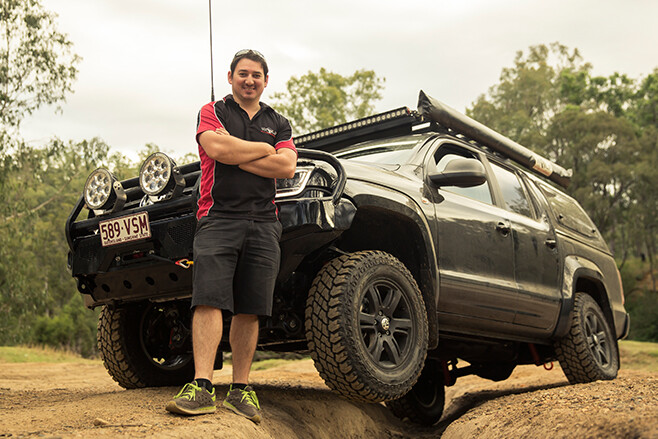
Wolf 4×4 needs a company demonstrator, and boss man Ashley Gibbons has just picked up his firm’s new Amarok to add a variety of extra gear for show and go.
After all, it was these Volkswagen utes that sparked Ashley’s switch from a loaded-up Nissan X-Trail to a more competent four-wheel drive. The utes also prompted his swap from being an IT consultant to a four-wheel drive accessory provider.
This particular ute began as a 2015 Dark Label edition, finished in Black Pearl and sitting on 18-inch alloys with 55/60R18 rubber.
Pride of place on the Wolf machine today is an AFN bull bar, the very first production bar of a new design from the Portuguese firm. Around this, Ashley’s fitted a Runva winch, Explorer 8500 Driving Lights and an antenna for the GME TX3540S UHF radio.
His dual cab now rides on Outback Armour suspension.
A Sammitr canopy with BedRug lining looks after the tray, while the roof is fitted out with South African-sourced Front Runner roof racks with a Wolf 4×4 awning and light bars.
It’s a smart, good-looking showcase on wheels (and since these photographs were taken, those factory wheels have been turfed for Delta Classics with BF Goodrich All Terrain KO2s).
WOLF 4×4
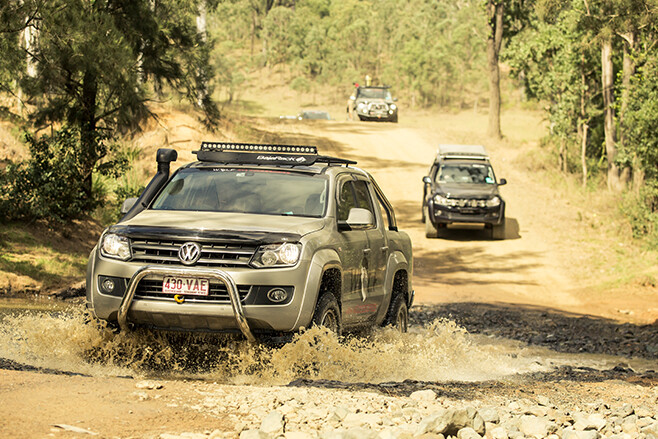
Wolf 4×4 is a growing off-road business based north of Brisbane but catering to four-wheel drive needs across the country.
Now just on four years old, the firm has go-better gear for any number of four-wheel drives, but it is Volkswagen’s Amarok that brings in about 70 per cent of Wolf’s business.
It was a simple move that saw Ashley Gibbons switch from being an IT consultant to an off-road accessory supplier. Back then he was off-roading in a Nissan X-Trail, well worked over with Pedders suspension, Rhino racks and more.
“But I took it places it shouldn’t have gone and realised ‘this is not the right vehicle’,” Ashley explains.
So he bought an Amarok, and discovered there wasn’t much aftermarket gear around to suit the German utes.
He searched online forums to see what was happening overseas – with the Amarok already on sale in Germany, Argentina and South Africa – and discovered there wasn’t even an English-language forum.
“So I started the Australian Amarok forum (ausamarok.com.au) which now has about 6000 members across Australia and New Zealand and a couple of international members as well,” Ashley says.
“Everyone on there started to ask the same questions I was already asking, so I found a couple of products and started my own little company.”
Ashley now sources Amarok accessories from around the world. There are Wolf 4×4-branded light bars, fender flares, bonnet protectors and awnings sourced from China, Taiwan and New Zealand.
The Brisbane-engineered Outback Armour suspension kits and recovery gear are major sellers, while Wolf is also the Australian distributor for Seikel products from Germany – snorkels, suspensions, lift kits, underbody protection and rock sliders.
From AFN in Portugal comes bul bars, winch mounts and more. Roll-N-Lock tonneaus come from the United States and other gear, such as EZDown tailgate struts, from South Africa.
“I don’t know [if] we’re the world’s best, but definitely in Australia we are the Amarok specialist. Amarok is our niche vehicle. That’s where we started and that’s what we want to look after.”
4×4 Australia’s Big Bight Expedition covered a huge hunk of Australia’s southern coast.
It was three weeks of incomparable off-road exploration from Esperance in Western Australia to Baird Bay in South Australia.
Taking in rugged cliffs, beautiful unspoilt beaches, and the unforgiving limestone plateaus, it was an adventure to remember. Joining us were a few friends, the crews from Maxtrax and Safari 4×4, plus a couple of Land Rovers to make life more comfortable.
We came back with a tonne of footage and compiled it into this clip that reflects the epic nature of the expedition. So crack a coldy, keep the rest of the six-pack close by, put your feet up and enjoy the ride as Ron Moon leads us on this track less-travelled south of the Nullabor.
Jason Morris’s love of the bush runs long and deep.
When he was a young fella, his dad, Len, had an EJ Holden station wagon built on a Toyota Land Cruiser chassis.
“That was a ball-tearer of a thing!” Jason says, recalling his dad’s Holden-Cruiser beast. “Dad made his own winch out of a helicopter starter motor. Every town we went to, we had people chatting to us for hours. It was a real crowd-puller.”
The hybrid Holden wagon took the family all around Australia. “So pretty much from when I was born, I’ve been out camping,” Jason says.
A generation later, the Melbourne-based maintenance carpenter (he looks after places including universities, child care centres and courthouses) is doing much the same thing with his wife, Trang, and kids, Lakota, and Khulan with this, the second of his built-for-touring Hiluxes.
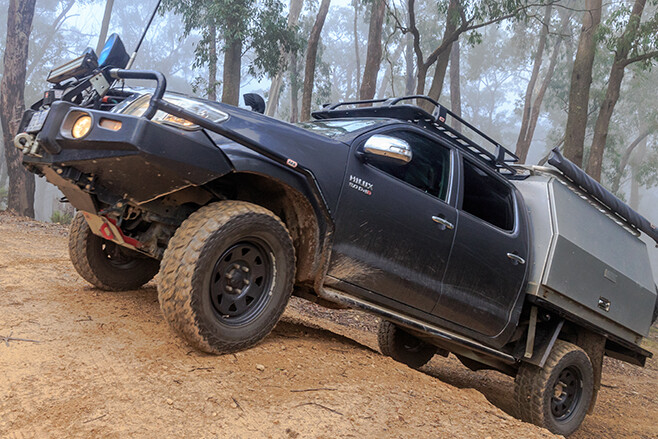
“It was a forced upgrade,” Jason says, cryptically, of his first Hilux. “A BMW X5 drove into us on the highway. It absolutely annihilated us.” On board was Jason and Trang – the couple had just dropped off the kids. “It was an offset head-on crash, I ended up with a fractured skull…”
Not surprisingly, Jason took some time to recover from the 2012 crash. It was no surprise, too, that the Hilux was a write-off and was replaced with a new one, soon pressed into duty for weekend camping as well as week-day work.
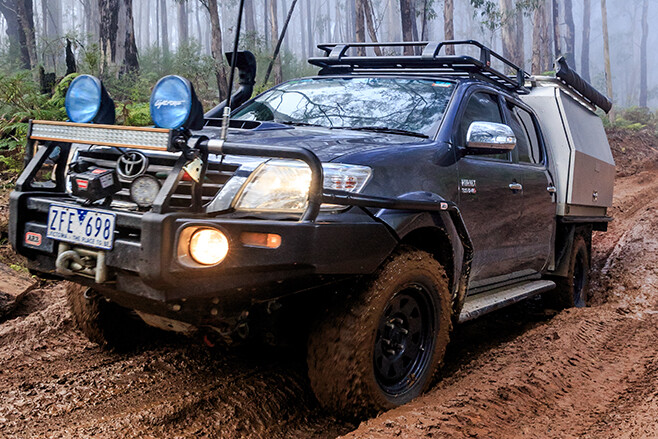
“We went on a trip to Bendethera,” Jason says, mentioning a terrific camping location in the Deua National Park, in New South Wales.
“Anyhow, it was wet and I was on the edge of control on the greasy hill from the Cooma side. I hit one of the erosion humps. Crunch! And then I hit another one. Crunch! And when I got to the bottom of the hill, I noticed the back had dropped a couple of inches… I’d bent the chassis.”
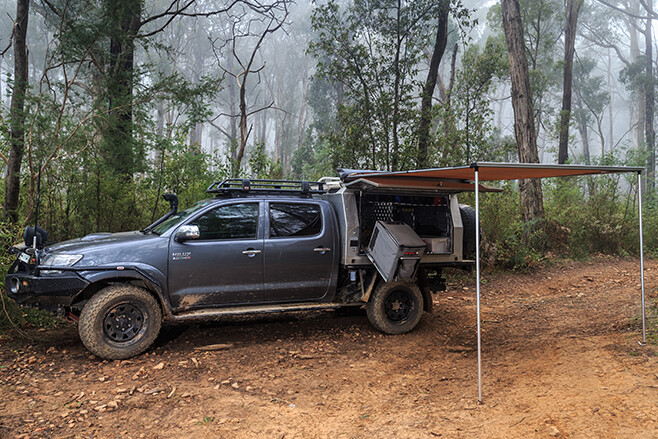
Jason had to limp the broken-backed Hilux home to Victoria to assess the damage. The insurance company wanted to write-off the vehicle, but with some negotiation, Jason came to an agreement where the vehicle would be repaired.
This outcome was better for Jason, because he got to keep the vehicle, and it also benefited the insurance company, which didn’t have to suffer a payout.
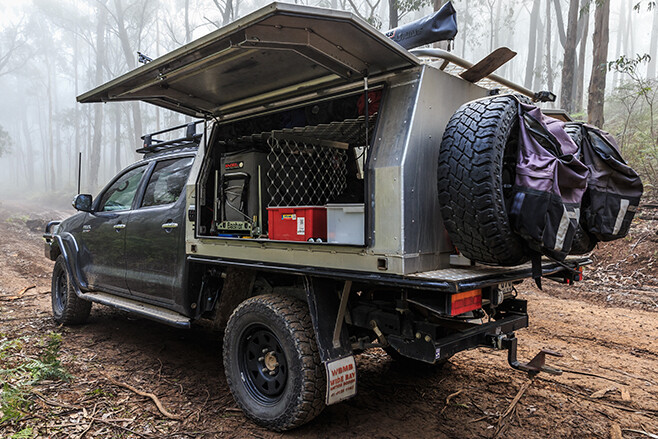
The repair occurred with a tweak: a chassis extension. Wide Bay Motor Bodies, originally based in Queensland but now in Victoria, was commissioned to repair and modify the Hilux’s chassis.
Due to the dual-cab ute’s general layout, when it’s loaded it carries plenty of weight behind the rear-axle line, so there’s plenty of bending-type stress on its chassis, especially in rough terrain or when towing. By lengthening the chassis, the weight can be carried over the rear axle, rather than behind it, with less stress on the chassis.
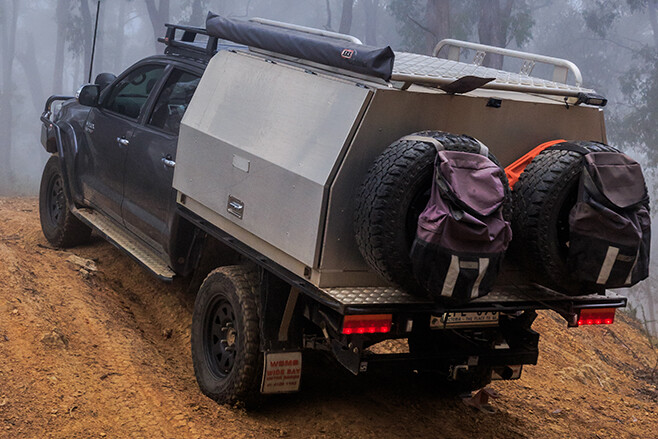
After discussion ideas with Jason, WBMB’s Matt Wreford got to work. As well as the straight-line wheelbase stretch, Matt installed profile-cut chassis reinforcing plates to the sides of the chassis rails where they were damaged over the axle line.
Of course, a chassis stretch such as this includes modifications to the tail shaft, exhaust, fuel and brake systems, and the wiring harness (including the ABS).
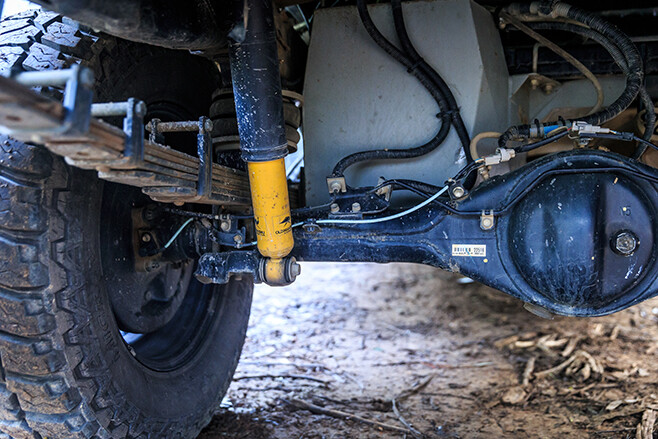
So there’s more to the task than just cut ’n’ shut. The result for Jason was an extra 355mm in the Hilux’s wheelbase, placing the rear wheels almost directly under the centre of the tray/canopy area, and a reinforced chassis, better able to cope with a load.
But there’s far more to Jason’s truck than just a stretch – from head to tail he’s set up his Hilux to be a competent and comfortable go-anywhere family tourer. Up front is an ARB frontal protection bar with brush bars and side steps.
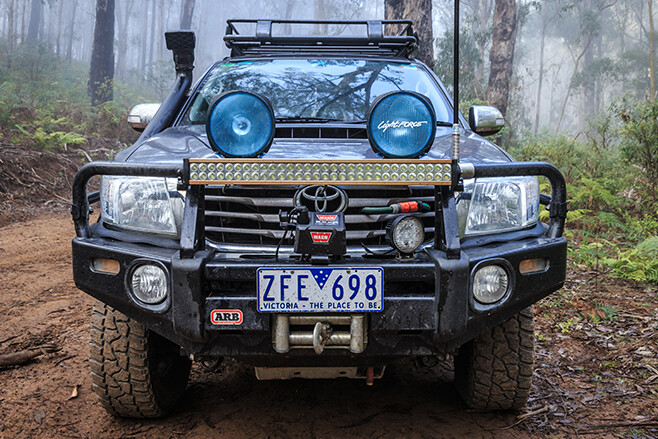
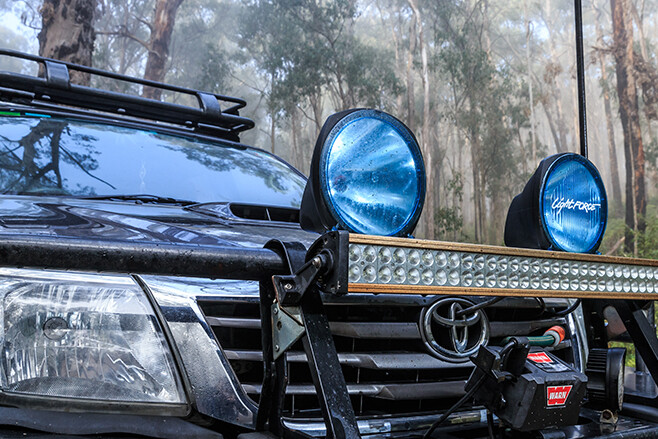
Within the bar is a Warn XP9000 winch, a pair of Lightforce Genesis HID driving lights and an LED light bar. There are also lights for illuminating in front of the wheels during steep climbs at night, when the Lightforces are pointing at the sky.
“You need to be looking out the window to look into a creek or over a conservation mound,” Jason says.
There’s a full complement of ARB under-vehicle protection, too. Unlike plenty of simple laser-cut online cheapies, the ARB gear has stout box-section reinforced edges and recessed fasteners to make the plates just about fool-proof and to prevent the vehicle becoming hung-up on a protruding bolt-head.
Under the bonnet is an ARB battery tray with its Delco battery run by a Piranha system. Sometimes, if he needs the extra capacity – such as for summer camping over several days – Jason installs a third in-vehicle battery within the canopy.
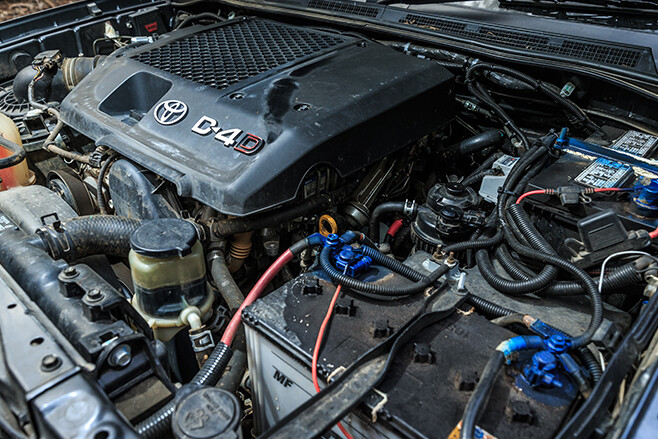
His camper trailer also has a battery installed, fed by an Anderson plug. Sometimes, this Toyota’s alternator doesn’t do much freewheeling!
The canopy – used for work and play – is a Boss Aluminium unit. Based in Bayswater, Boss made it based on Jason’s ideas. “I wanted it built in a particular way to suit my equipment,” Jason explains.
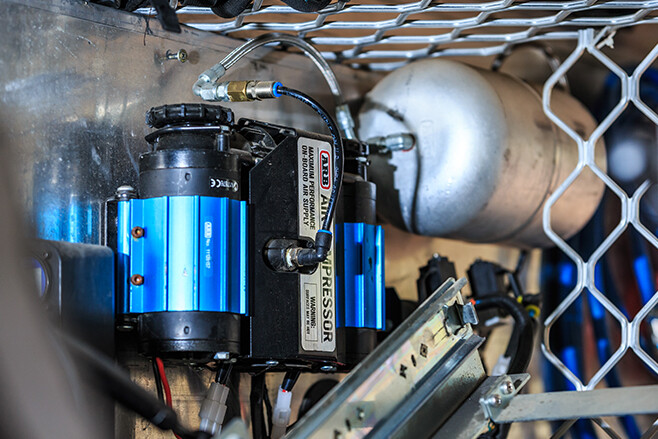
“You’ll see I’ve got air lines and other stuff in it, such as switches for the lights. When the doors are closed, they’re sealed away from dust and the elements.”
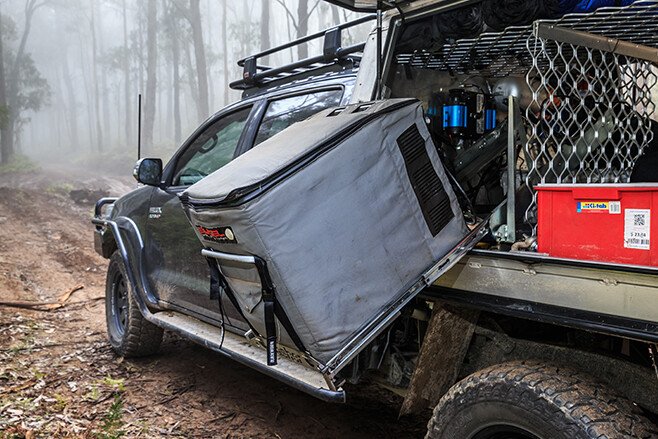
If he doesn’t need it for whatever reason, the canopy can be removed, because it sits on a specially built steel frame. “I simply undo a few bolts and it lifts off.”
For now, the canopy carries two spare wheels on the rear; Jason is thinking of getting the weight of them down and forward (much better for off-road) by carrying them against the rear of the cab. The rack on the canopy is custom-made and the cab-rack is an ARB.
When he’s heading bush for the weekend, Jason loads a few food boxes into the canopy area. The small gas cooker gets used on job sites as well as campsites, as does the Engel fridge that routinely stays in the vehicle.
“Except for the 25 switches for all the bullshit, it’s almost stock as a rock inside,” Jason laughs.
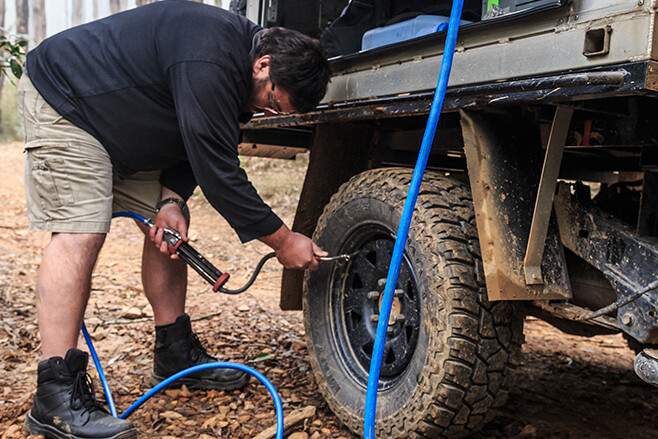
Keeping the seats clean are MSA seat covers. Finishing touches to this terrific tourer include the vehicle-mounted ARB compressor and an ARB Touring awning on the near-side roof. It’s all very KISS – keep is simple, silly!
Like most Hiluxes, the engine is Toyota’s 3.0-litre D4D turbodiesel unit.
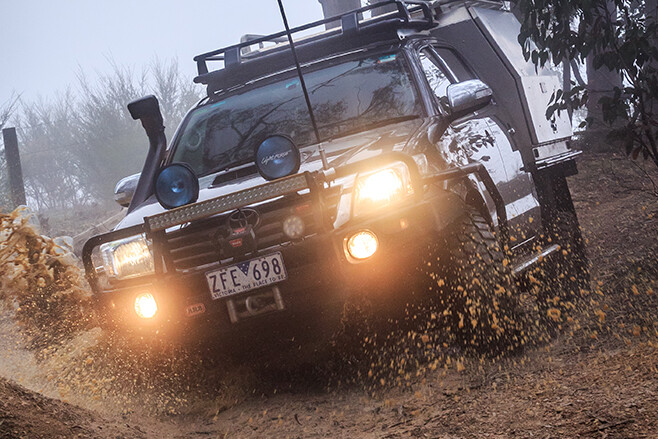
“I’ve recently fitted an HKS chip; it’s improved the fuel use from 16s down to around 13s,” Jason explains.
“I asked around for advice on an exhaust, too. The feedback I got was that the standard system is more than adequate; a replacement pipe does absolutely nothing except make it louder.”
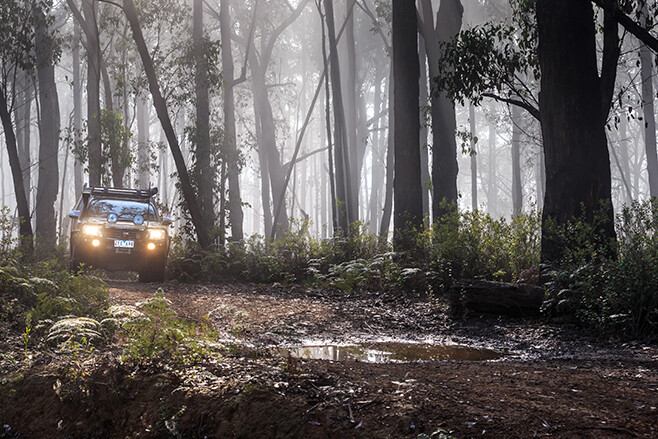
To feed the beast, Long Range Automotive provided a 145-litre long-range replacement fuel tank to provide greater touring range when Jason packs his family into the vehicle and heads off to his Victorian High Country retreat – or further.
The wheels are simple steel Dynamic 17×7-inchers, shod with Mickey Thompson AP3 tyres, which Jason says have been terrific all-rounders in the 30,000km he’s had them for.
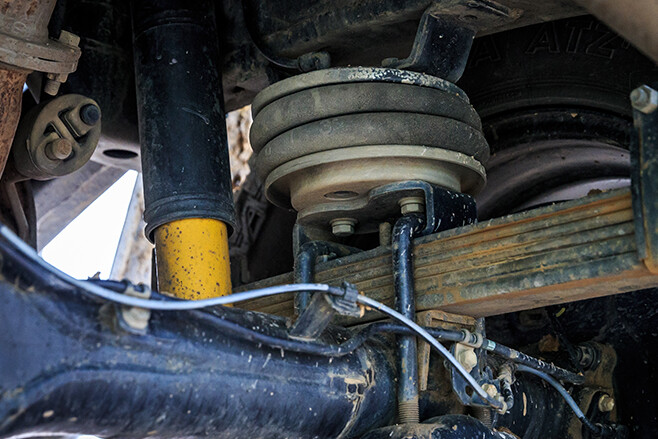
The suspension under the Hilux is Old Man Emu, assisted under the rear by a pair of Firestone airbags.
Even after his heart- and chassis-breaking trek to Bendethera, Jason is confident in the light-to-loaded assistance the airbags provide now that he has a suitably reinforced chassis.
And yes, any vehicle built with this much touring equipment will be heavy: Jason mentions his Hilux is beyond 2500kg empty and has a GVM upgrade to 2900kg.
But with the right equipment on-board for work-day and weekend wanderings, it’s the ideal dual-purpose tourer.
“I can drive it to the city every day,” Jason says. “Or jump in it and cross a desert or drive it to Cape York.”
See Toyota’s all-new 2016 Hilux and its new genuine accessories.
For the full Toyota Hilux range review click here.
Peugeot will again compete in the Dakar Rally – this time with a meaner version of the wild 200DKR buggy it raced in 2015.
The 2008DKR16 is longer, wider, lower and more powerful than the original and also benefits from improved aerodynamics, thanks to a revised bonnet and a roof-mounted air-intake to provide more balanced down-force between the front and rear.
The French automaker also has Dakar royalty in its driver line-up, with Stéphane Peterhansel, an 11-time winner; Carlos Sainz, a two-time World Rally champion and former Dakar winner; and Cyril Despres, a five-time Dakar winner (bikes), all piloting the Pugs.
Despres and Peterhansel just took a one-two victory in the China Silk Road Rally (the first win for the team), using an interim-specification car that was essentially the 2015 model with a number of development parts for 2016 added.
“The areas we have concentrated on include bodywork and aerodynamics – as a result of which the car looks slightly different compared to last year – as well as engine and suspension, which is all under the skin,” Peugeot Sport Director Bruno Famin says.
“The tests we have carried out up to now, as well as our one-two finish in China recently, indicate that we are heading in the right direction.”
“You really cannot compare our state of preparation now to how it was for our first Dakar this time last year, when everything was new to us.”
“Of course you can never say that you are completely ready for the Dakar either, because you simply never know what it will throw at you, but certainly this time we are more ready.”
With the confidence of the Silk Road result under their belts, the Peugeot team will go in to the 2016 Dakar, which starts in Buenos Aires on January 3, with the vigour of the lion that adorns each vehicle.
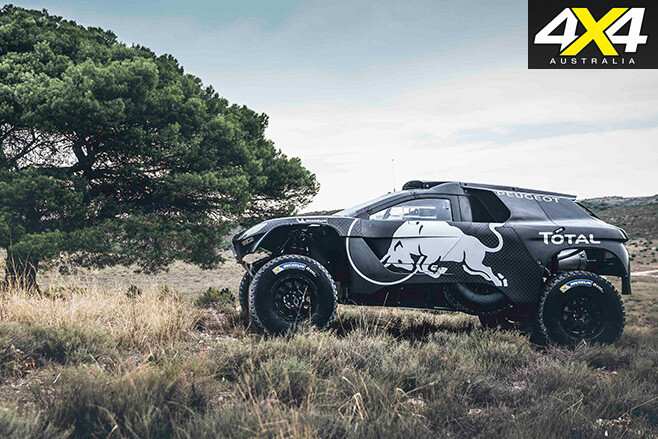
You may not be able to buy a Peugeot 200DKR for yourself, but if nothing else, as with anything associated with an energy drive, the video footage is sensational!