
LAND ROVER’s Classic division will factory-restore 25 Series I models as part of its ‘Reborn’ initiative.
The 25 models, strictly hand-picked by the boffins at Land Rover, will undergo a complete restoration based on the brand’s original 1948 factory specification.
Land Rover Classic Parts will be extensively used for the restoration, and to maintain authenticity a choice of five period finishes including Light Green, Bronze Green, RAF Blue, Dove Grey and Poppy Red will be available.
The experienced restoration team will work their magic at the new Classic workshop established at Land Rover’s Solihull base.
Jaguar Land Rover Classic’s Director, Tim Hannig, said in a statement: “The launch of the Reborn initiative represents a fantastic opportunity for customers to own a valuable and collectable automotive icon.
“Reborn showcases Land Rover Classic’s expertise in restoring and maintaining our loyal customers’ prized Land Rovers.”
The ‘Reborn’ initiative for the Series I – debuting at Techno-Classica in Essen, Germany – is part of Land Rover’s commitment to support die-hard customers with parts and services for models that have been out of production for more than 10 years.
The highly collectable Series I can be purchased directly from Land Rover Classic.
However, the 25 lucky buyers will need deep pockets, as the Series I Reborn is set to fetch upwards of £60,000 (AU$110,000 approx.).
It is as yet unknown if the any of the Series I models will be available for Australian buyers.
When choosing the best bullbar, you look for something that’ll do the job, but a certain amount of opinion will always guide your choice of materials, bar type and fit and finish.
Do you want alloy or steel, hoop or post? Do you want it polished, colour-coded or plain black. Does it fit your vehicle?
When I saw Opposite Lock’s new 63mm-diameter, steel winch bar, combined with side rails and steps, I knew it was the best-looking bar I’d seen on a 70 Series Cruiser. It features tubing that’s larger in diameter than most bars, giving it a macho appearance. Plus, it perfectly fits the lines of the 70 Series.
Something I always look for is a driver’s-seat view of the bar’s extremities. You need to see where your bullbar is in order to pick your way through tree-lined tracks, negotiate rocky outcrops, as well as easily park in reverse, without nudging other vehicles. This OL bar has been manufactured to perfectly fit and provides impeccable driver visibility, without hindering forward view.
These days, most people want to fit the largest-diameter driving lights they can get their hands on. So having a bar with maximum vertical space available is an essential consideration. The gap in the Cruiser bar is about 29cm high, with no horizontal bars getting in the way.
Fitting the driving lights is easy via hand and spanner access within the main cross channel. The same access slot also grants easy operation of the electric winch clutch lever. I fitted an 11,000lb RUNVA winch, which perfectly fit within the Opposite Lock channel.
I opted for halogen fog lights. Flicking them on at night via the separate light switch returns an extremely wide and low beam of light. The LED turn indicators seem a little out of place, visually – a high-tech rectangular light contrasts with the old-school, round halogen fogs, but they do the job. Being LED, they did upset the timing of the blink to double-time, so I’ve had to install a blinker resistor to slow things down.
Opposite Lock’s bar is ADR compliant and airbag compatible.
I’ve ticked the extra’s box for side rails and side steps. The rails should help protect the panel work, and the steps replace the weak standard alloy units. I haven’t tested them yet, but I presume the side steps will be strong enough to use a hi-lift jack on. Having the slightly longer side step also helps passengers move in and out on the passenger side!
While fitting the side steps, the Opposite Lock crew advised me that the standard exhaust system should be modified to not foul on the fitting brackets. This fix was done temporarily and I’ll be sorting an aftermarket replacement exhaust soon.
The top loop of the OL bar features three slotted antennae tabs. I don’t need three antennae, but they allow for sand flags to be easily affixed. Plus, because the antennae are slotted, all wiring can be left intact during antennae installation and removal. While I haven’t mounted my driving lights, UHF antennae or flags to the Troopy yet, it’ll be a quick and easy job.
I’ll not be buying larger-diameter lights to fill the void. The 208mm-diameter Fyrlyt halogens that were removed from the 100 Series will be gracing the Troopy’s new bar. They’re the best lights I’ve driven with and I’ll stick with them.
One problem with the OL design is the lack of built-in recovery points. There are many aftermarket options that can be added directly to the chassis, but it would be nice to have them included as standard.
The steel, large-diameter, post-style bullbar perfectly sets off the 70 Series range and is the ideal mounting point for electric winches, driving lights, antennae and flags.
Rated
Available from: www.oppositelock.com.au RRP: Varies depending on vehicle model. We say: Most rugged-looking barwork available.
Jeep Australia has confirmed its interest in the pick-up variant of the next-generation Jeep Wrangler, when it becomes available.
The Wrangler double-cab ute will be built as part of the next Wrangler model line-up, expected to be called JL. However, it’s not planned until 2018.
“We’re looking at extending that (Wrangler) line beyond just two- and four-door variants that we have today with the pick-up,” said Zac Loo, head of product strategy and marketing at FCA.
The JL Wrangler will go into production at the Toledo, Ohio, plant in the third quarter of 2017, but FCA will continue to build the current JK Wrangler alongside it for around six months to keep up with demand until a new plant comes online in March 2018.
That new plant will be the one currently used for KL Cherokee construction, but it’s being moved elsewhere to allow for an extended Wrangler line-up. For the first time, that line-up will include the pick-up, as well as diesel Wrangler models for the USA.
Jeep recently built the Crew Chief concept double-cab (pictured) as part of its Easter Jeep Safari line-up, and an FCA spokesman commented that if you take away the military tyres and Kaiser-esque front end, there are elements of the concept that will make it to the new model.
The good news for Jeep fans is the JL Wrangler will retain its body-on-chassis design and live axles front and rear, making it one of the few true off-road vehicles left on the market.
The introduction of a double-cab ute Jeep variant will expand that line-up, giving buyers more off-road-capable options and the FCA an entry into the booming ute segment in Australia.
Specialist manufacturer American Expedition Vehicles (AEV) has been making the Brute Double Cab (pictured) for well-heeled buyers for some time now, but a factory Jeep offering should be more affordable. The AEV Brute also provides clues to what the JL ute might look like when it reaches the market.
We expect the JL Wrangler to continue with both two- and four-door variants of the soft-top wagon with the optional hardtop, the double-cab ute body, and a choice of petrol and diesel powertrains. It’s rumoured the new model will use some aluminium panels in an effort to reduce weight and minimise fuel consumption without sacrificing the Wrangler’s unrivalled off-road ability.
Expect to see more of the JL Wrangler in about 12 months’ time.
There are certain situations that forge friendships more than everyday life ever can.
With a season of LowRange now finished, I guess it’s time to reflect on some of those situations – especially because I’m down here at the Mudflats Hotel all on my own…
During the last year or so, the LowRange team travelled all over the country, making the DVDs you’ve been getting with the recent editions of 4X4 Australia. Off-roading has been a way of life for me for many years, and it never ceases to be about the most fun you can have without blowing a thong – with a few serious moments thrown in, too.
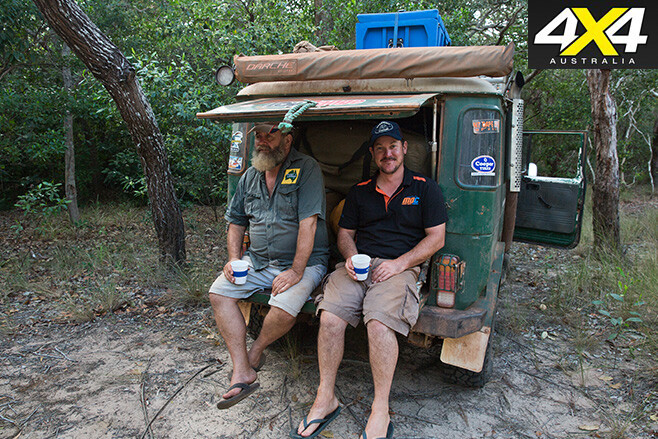
One of these more serious moments was experienced on a trip last year when we spent a night in gale force winds, tucked in to the ferns behind the cliffs north of Shelburne Bay. We had set up in relative calm, with few hints of the sleepless night to come. But before midnight, the winds picked up and ripped through awnings, blowing rain straight through zips.
I woke up wet in a tangle of awning, thankful for the Leatherman tool I always tuck under the pillow. I usually have it in case Kenno zip-ties my zippers closed, but this time I needed it to get out of a mess of fabric. The poles had twisted like pretzels and one was belting around, waiting to take out any Rooth silly enough not to grab it from behind.
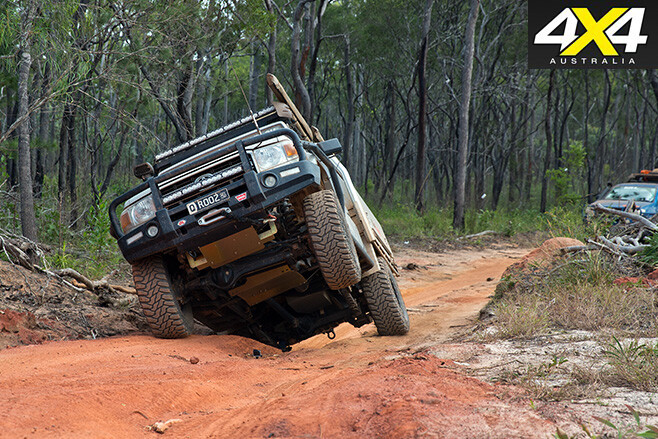
After I tucked away what was left of the awning, my swag stayed tight, and dry inside, though there might have been a puddle of rain under it!
In the morning, I could see our camera team – Melanie and Gav – coping with a roof topper that was whipping up and down. Kenno’s hard-floor camper was facing away from the wind and was somewhat protected, because it had a load on his roof rack, but he still had to ‘shorten canvas’ to stop the poles bending more than they had already.
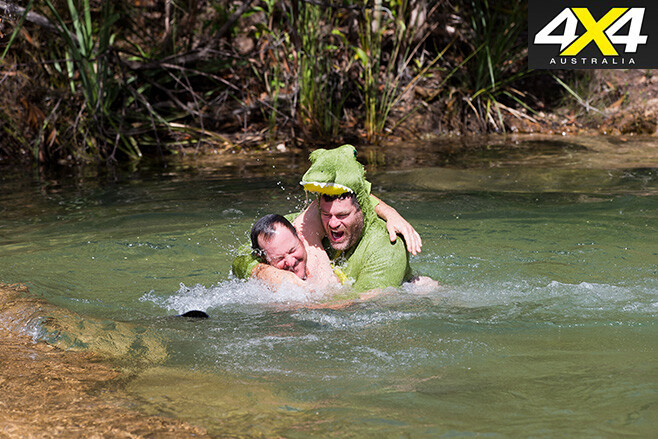
Yet, a couple of days later we were trolling around in the sunlit pools at Indian Head, laughing like nongs. We’d beaten old Mother Nature again, albeit with some awning casualties.
A month or so later, we nearly lost three vehicles on a wild beach in the Gulf after forging a track through country that had never been driven before. The tide, after not shifting for more than 24 hours, decided to rip in at about a metre an hour. The beach turned to puddled mud and we fought like demons to get our trucks to higher ground – especially the heavy and almost-new 79.
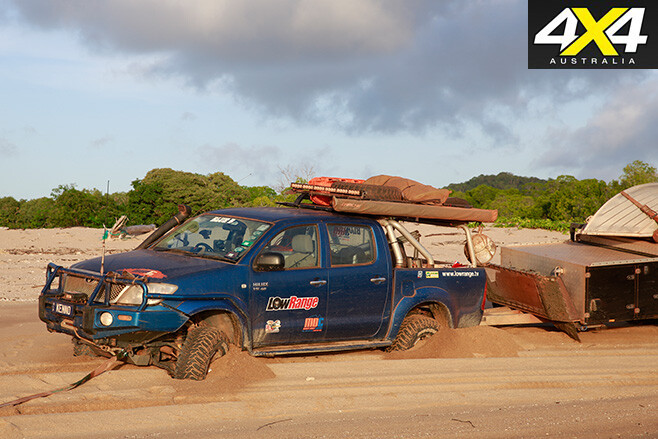
What was the result? As usual, hardship meant an even closer bond and some harder partying the next time we got to safety. This is, after all, what adventuring is all about. You expect some hardship on an adventure and, as long as you survive, it’s the stuff that makes the trip memorable. I feel sorry for folks who never take risks – they miss out not only on the more remote parts of our brilliant country, but also on the stuff of life itself.
Summer had hardly set in when the bushfires began.
While driving home from Queensland in mid-December, we were detoured just north of Melbourne because of a large grassfire that had closed the freeway.
The next day I was heading for Wodonga and was again diverted because of a large, fast-moving scrub fire around my old stomping ground of Barnawartha.
In Corryong that evening I noticed a sign that said the Alpine Way was closed south of Khancoban – not because of a recent fire but an old one. They were dropping trees along the roadway to keep it safe for Christmas travellers. I re-arranged my plans to get to Tom Groggin and the Davies High Plains.
The next morning I was due to head south – this time on the Victorian side of the border – when word came that a number of tracks around Tom Groggin were closed due to a bushfire in the area. Back to the maps we went, finding another route south.
Then, of course, over Christmas there were the devastating bushfires along the Great Ocean Road, while in other states lesser fires were still creating dramas and heartbreak for people and firefighters.
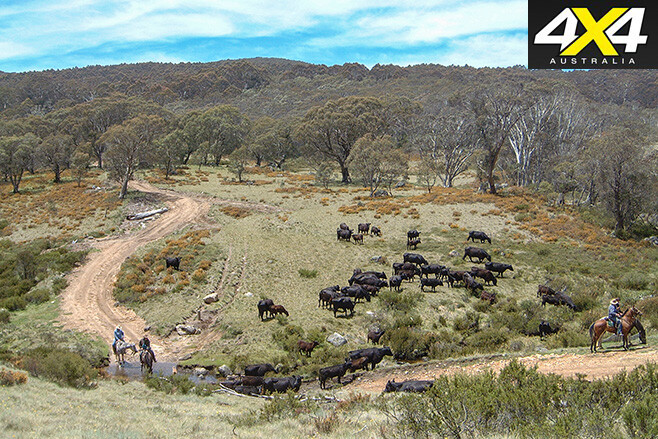
In the meantime, I posted a couple of pictures and a comment on our Remote Australia Facebook page, saying the High Country was changing, and not for the better; Aboriginal fire management of the country and later cattle grazing have all been stopped, allowing the scrub to come back and create another tinderbox for a future holocaust.
That set off a maelstrom of comments, and while I’m not sure what 77 shares and a reach of 175,000 means, most younger people, who are savvier with the intricacies of FB, will think that’s a pretty impressive result. However, one thing is obvious about the comments on our page – there are a wide variety of views, and some of them are strongly held and forcibly stated.
This all happened after the current Victorian government recently decided to scrap the target to burn five per cent of public land each year, despite this being the minimum recommended by the Royal Commission set up in the wake of the 2009 Black Saturday fires that wreaked so much havoc in Victoria.
The new system being adopted is one of ‘risk reduction’ in fire danger areas close to human habitation, with no mention of how many controlled burns will be set to save life and property. The system harks back to the ‘complete protection’ policy that led to our forests being devastated by fires during and after 1939.
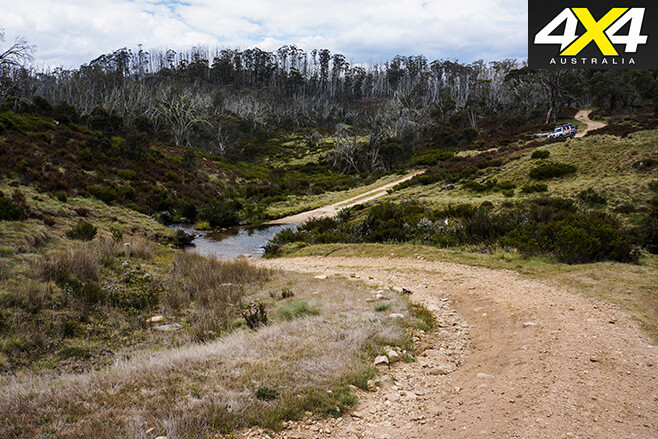
Just before we leapt into 2016, one of Australia’s leading fire experts, former CSIRO bushfire scientist David Packham, came out in an article in The Australian, calling for at least a doubling of prescribed burns in the state, to 10-12 per cent of the public land area.
In the meantime, I’m reading a couple of books about what Australia was like during Aboriginal and early European times. The Biggest Estate on Earth by Bill Gammage is the 2011 award-winning book on what this country looked like before we took over.
The more recent Fire Stick Ecology by Vic Jurksis makes a stronger point about managing our forest with fire. Jurksis reckons we need to do it “willingly, frequently and with practice, skillfully”. Both books strongly indicate the failure of our current land management policies, which can be seen all around us – once you know what to look for.
Now I’m looking at our bush – here in the Victorian High Country but also farther afield in the Flinders Ranges in South Australia. These are two places I have been familiar with for more than 50 years – though with different eyes. In both cases it’s pretty scary!
We’ve finally got our Hilux project looking less like a postal truck and more like an expedition rig, thanks to Adam and the team at Ironman 4×4. The Hilux was actually a Telecom service vehicle before we got it, but that’s close enough to a post van. Regardless, that big white canopy had to go!
Click here for your chance to win 4×4 Australia’s Custom Toyota Hilux.
With the canopy removed Adam set to work designing and fabricating a custom box-section steel rack for the Hilux tub that would support an Ironman rooftop tent plus a few other off-road goodies while still leaving room beneath it to give access to the load space. The rack sits on and is fastened to the top edge of the ute tub with re-enforcing plates below the bolts so the whole assembly is easily removable should you not want it there all the time. We reckon the finished product looks so good that you’ll want it on the car whenever you’re out on adventures.
Before the frame was sent to the powder coaters, mounts were welded to it to fasten a set of MaxTrax on the passengers’ side while on the driver’s side there are provisions for an Ironman 4×4 48-inch high-lift jack and three-piece shovel. The placement of these mounts ensures that some of your prime recovery gear is always easily accessible and within reach without having to dive in to the cargo area if and when you get stuck.
While the rack was getting coated the guys fitted an Ironman tub liner. These are made from 3mm UV-stabilised polyethylene and it sure tidies up the tub in this old workhorse while at the same time protecting the sheet metal.
We got a fast turn-around from the coaters and, with its fresh layer of black on the frame, the rack was a quick and easy fit on the car for Adam and Smithy. Then it was on with the rooftop tent. Again, the Ironman 4×4 unit is a quality product made from 280gsm waterproof rip-stop poly-cotton canvas with fine insect mesh on the window opening to keep the bugs out and a thick 65mm foam mattress for comfort. With the quick set-up time of the RTT you will always have somewhere comfortable and dry to sleep wherever you park the Lux.
We’ve fitted a DP Chip tuning module to the stock 1KD- 3.0-litre diesel engine in the Hilux to make the most of the available performance and this will really benefit from improved engine breathing. We are planning to fit a free-flowing exhaust to get the burnt gasses out, but to ram the fresh air in to the engine, Ironman fitted one of its AirForce snorkels. Now, many folk believe snorkels are just for water crossing, but for everyday use, a well-designed snorkel will improve the airflow in to the engine for better efficiency while, out on the dusty tracks, the raised height of a snorkel lifts the intake up and out of the dirty air to get nice clean stuff into mix with your sweet diesel.
The Ironman snorkel ticks all the boxes here and while it needed a slight modification to fit over the aftermarket flare on the ‘guard of our Hilux, it is an install job that any competent workshop can manage.
WIN OUR LOADED LUX
That’s right! Once we’re finished kitting up this Hilux with all the best off-road gear from TJM Products, Lightforce, Terrain Tamer, MSA Products, DP Chip, Mean Mother winches, EFS Suspension, Cooper Tires, ATX Wheels, Ironman 4×4, MaxTrax, Piranha 4×4, Opposite Lock and a few other top-notch suppliers, we’ll be giving it away to a lucky reader of 4X4 Australia Magazine. The promotion officially kicks off now, so flick back to page 46 of this issue or go online at www.4x4australia.com.au for all the details on how you can make it yours.
Who knows, you could be the one setting off for a big outback adventure in this bush-ready Toyota – but you’ve got to be in it to win it to get in it!
Want to see more of our Project Hilux build? Check out the below:
- Part 1 of our Project Hilux build
- Part 2 of our Project Hilux build
- Part 3 of our Project Hilux build
- Part 4 of our Project Hilux build
I can hardly contain myself; I just caught the train to Sydney to pick up a Land Rover Defender 90 Heritage, which is currently waiting in my driveway for a long drive in the bush, although I am under strict instructions not to damage it in any way … in any way! Not even bush pinstripes are allowed.
Despite the limitations put on my test drive, I’m so excited by the prospect of driving this little green beastie that even the pissed, drug-affected moron on the Sydney-bound train – who proposed to an equally drug-riddled biddy and outlined his unobtainable plan for a future together in a quaint shack on an acre block – couldn’t dampen my enthusiasm.
Prolonging the delay to drive the vehicle that has been my desktop picture for the past 12 months was also a 10-minute wait at the Land Rover dealer in Concord, located on the banks of the picturesque and tranquil Parramatta Road. Lucky for me they have a comfy white leather couch.
Unlucky for me the reading material at the dealership is aimed more at the Range Rover buyer than the Defender enthusiast. Nevertheless, flicking through Gourmet Traveller I learnt how to roast the perfect Chrissie turkey and then had the opportunity to purvey spectacular images of restaurants I will likely never be able to afford to eat at.
Just as I picked up a copy of Men’s Health to learn how I could transform my natural beer-drinker’s physique into a try-hard six-pack bod, the amicable Don from Concord Land Rover rescued me from a potential lifetime of agony in the gym by ushering me into his office, where he asked for my driver’s licence.
Like renting a car from Avis, this is standard procedure when picking up any press vehicle. Except this time, he checked my licence details extra closely, just in case I was tempted to not return the pristine and very limited edition Defender.
Paperwork sorted, we descended to the basement carpark where the Defender stood tall, surrounded by modern, swoopy Land Rovers with names like Sport and Evoque. Even in the dim light of the carpark, it was easy to see that this was no ordinary Defender.
Other than the unique Heritage-style grille, colour-matched steel rims and special HUE 166 logos that pay homage to the original Land Rover, this example had deep, lustrous paint with just a hint of metallic.
After completing the obligatory 360-degree walk-around, I pointed the key-fob at the Landy and unlocked the doors … remotely! Despite this surprising touch of modernity, familiarity returned when I approached the door and pressed the button to open it.
And although the interior was decked out in fancy Almond cloth seat trim, with special Heritage stitching and a leather-clad steering wheel, the oft-complained-about driving position remained.
Personally, I like the Defender’s driving position. Sure, it’s only really comfortable when the window is down so you can rest your right arm on the sill, but the high seat gives the Defender driver a commanding view out the upright windows, and forward vision over the stubby little bonnet is unequalled in today’s world of wind-tunnel-designed four-wheel drives.
As I eyed the ceiling of the carpark, Don assured me that the Defender had plenty of clearance, and then he bid me farewell. I fired up the little 2.2-litre diesel donk, selected first and eased out the clutch.
It took a couple of goes to make the sharp left turn out of the Defender’s tight parking spot; it may have a short 2360mm wheelbase, but it still has a massive 13.4m turning circle. Sure, this is less than convenient in the city, but in the Defender’s natural habitat, out in the scrub, it’s hardly an issue.
So far I’ve only driven the D90 Heritage about 100km on the road, straight back to my joint, but soon I’m going on a ‘proper’ drive. I already love it and I’m already trying to figure out how to raise the funds to buy one.
Perhaps I could accidently scratch this one and pick it up for a song? Nah, I could never do that to such a beautiful Landy … and, after all, I’m under strict instructions.
We all know that we should value our time and spend it wisely, seize the day and live life to the fullest.
Troy Shortland does it well, heading out in his prized fourbie at every opportunity. Maybe it’s because Troy is a paramedic and gets daily reminders of just how precious our time is on this big, blue planet. Or maybe it’s because wife, Keryn, shares his strong passion for camping.
Sure, Troy went camping as a kid – squashed into the back of the Sigma station wagon with his two brothers, with no room for the cricket bat, as the family headed north to the rellies’ beach shack at Green Head, but it was Keryn who dragged him north for a very serious first trip.
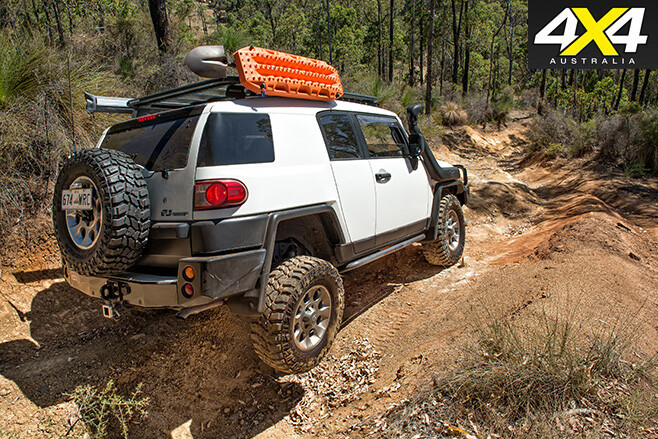
Traveling from Perth to Darwin – stopping off at Karijini and Millstream-Chichester national parks, Tunnel Creek and Windjana Gorge, they wisely decided that remote touring was totally awesome but not best experienced in an ’84 Ford Telstar.
As a young couple on a limited budget, they spent their pennies on upgrading to a 1989 Subaru L Series. Troy had no problems flying up the Lancelin sand dunes ahead of his mates in Pajeros and Vitaras. True, the Subie did have help, with a slippery diff out of a Dato 1600, a 50mm body lift, plus the extra power of a Jap-import turbo implant giving the Subie an impressive power-to-weight ratio. Bigger rims and tyres made sure none of the extra power got wasted.
Next was a ’92 Subaru Liberty AWD sedan, and finally a low-range gearbox, so things started to get serious. Crossing the Nullarbor three times, Troy and Keryn checked out the Flinders Ranges, Arkaroola, Strzelecki Track, Innamincka, Oodnadatta Track, Coober Pedy, Chambers Pillar, Rainbow Valley, Uluru and the Great Central Road, and parts of the Gunbarrel Highway.
“The look on Patrol and Land Cruiser owners’ faces outside the Oodnadata Pink Roadhouse, seeing our unmodified Subaru, was priceless,” Troy reckons.
His love of travel and the Aussie bush saw him finally leave the Subarus and cross over to the dusty side, in the guise of an ’08 NS SWB Pajero. With a few mods, the shortie was ready for adventure.
Revisiting some favourite locations as a shakedown, they embarked on the next big trip, heading north-east of the Flinders in 2010. This included visiting the Burke and Wills Dig Tree before travelling back through to Birdsville, only to find the Simpson Desert closed with five meters of water at the base of Big Red!
Not the best year for touring, Keryn and Troy enjoyed Fraser Island, but widespread flooding prevented them from passing north of Port Douglas – so no Cape York, the Savannah Way was too soggy to drive, Litchfield and Kakadu weren’t much better, and back in Western Australia the Gibb River Road was closed as well. Troy sums it up with: “Even the helicopters had stopped flying to the Bungle Bungles as it was too wet to land.”
On Troy’s days off, he started helping a friend he met through the Mitsubishi 4WD Club of WA. Richard Nicholls runs Adventure Offroad Training and he taught Troy plenty about getting the most out of his 4WD. It was while Troy was helping Richard out on a Toyota Corporate Day, he got to drive an FJ Cruiser off road.
Rememering the experience, Troy says: “Wow, what a difference from the Pajero. Exceptional rear-axle articulation, the FJ was quiet, no diesel rattle, no turbo lag, and power in spades, and the new updated model was due in a few months, which included rear locker, auxiliary tank and crawl control, all standard. Price-wise it was $13K cheaper, as well as smaller, lighter, better approach, better ramp-over and departure angles than a Prado. Only one problem: gee it’s ugly.”
After six frustrating years of diesel particulate filter issues and engine-check lights with the Pajero, it had to go, and despite the suspicion of a tear in Keryn’s eye, Troy pulled into the driveway in his new 2014 4L V6 FJ, complete with slick five-speed auto, sat-nav touch screen and reversing camera. “Now,” Troy said, “for the mods to start!”
Off he went to ARB for front and rear protection, before adding OME Nitrocharger suspension, Adventure Products recovery points, a front locker for good measure, and a Safari snorkel for the FJ to breathe above the dust on those dry tracks. Then he swapped over the XD9000 Warn winch from the Mitsi.
Troy chose a Rhino Backbone roof rack with Pioneer tray because of the numerous accessories it accommodates. He says: “We have had our rooftop tent up there doing the Holland track with no issues at all. It allows easy fitting and removal of the ARB 2.5m awning and the Maxtrax/shovel holder mounts.”
After a few months Richard and Troy hatched a plan to take the FJ to the next level. Icon Remote Reservoir long-travel coil-overs with Total Chaos upper control arms got the nod for the front end. This provided 20mm more suspension drop than the OME and brought the wheel alignment back within spec.
Troy says: “The ride difference was amazing; great road holding yet plush and it soaked up the bumps.” But as is often the case with importing gear from the US, Icons for the rear became cost-prohibitive with the decline in the Aussie dollar – so Troy waited for ARB’s BP-51 system. With the front Icons removed for sale, the FJ now sports a full set of OME BP-51s with remote reservoirs and adjustable compression and rebound.
“The result is exceptional,” Troy says. “Plenty of adjustment to set up for towing, high-speed gravel work and low-range rock crawling. With the amount of remote touring we do, I couldn’t look past the nationwide back-up service ARB can provide. I have been unable to bottom-out these shocks and the progressive valving rate the further the shock compresses is awesome.”
Next, he looked to the underbelly of the beast. An FJ basically sits on a Prado chassis that’s had 100mm cut out just behind the front doors. Since Troy’s mate Richard had already designed a set of 5mm bash plates for his Prado, he was able to modify the design to suit the FJ. Troy was more than keen to get a set.
“They are so strong I can actually jack up the FJ.” With that level of protection, the FJ’s driveline has solid insurance.
Under the bonnet, relocating the fuel canister created enough space for an ARB battery tray (intended for a 120 Prado diesel) to be slotted in, and placing the battery in the back corner meant Troy and Richard could then tackle the task of fitting an ARB twin compressor under the FJ’s bonnet.
With Richard’s CAD expertise and a little laser cutting, metal folding and welding, they had possibly the first OEM-quality twin-compressor installation bracket for an FJ. Able to inflate his tyres, those of a 200 Series, a Prado and a 79 Series, all in succession, the compressor is “one of the best investments” Troy has ever made.
A Redarc SBI212 battery isolator with an in-cab switch can join batteries for winching or to overcome a flat starter battery. There’s also a Redarc BCDC1225; a 25amp, three-stage DC-DC battery charger to look after both batteries’ needs.
To keep the night at bay, the Rallye 4000 lights got a 75W external ballast HID kit. Troy says they now provide a fantastic spread pattern. He also swapped the interior globes for LEDs.
Comms are via a remote-head 80-channel Uniden UHF mounted in the rear quarter panel. To make sure he never gets lost in the dust, a Hema 6 navigator sits on a ClicOn mount. There are dual USB charging points for phones and cameras, with a dual volt meter is mounted in the OEM switch bank. Comfort and practicality are provided by Wet seat covers and there’s ample rear storage thanks to Drifta Drawers with a custom table and bed extension for overnight stays.
Apart from the FJ’s looks, Troy reckons you need to be aware of the large blind spot created by the C pillar and the suicide doors – but says you get used to it.
“I can’t see myself ever going back to diesel. Servicing, fuel and repairs are all cheaper with the petrol. It’s quiet, smooth and has plenty of instant power on the highway, with no diesel smell lingering in the car or on your hands after refuelling.”
So far, the FJ has travelled the Holland Track, the south-west corner of WA through to Israelite Bay, north to the Murchison Offroad Adventures Camp, and enjoyed numerous weekend trips out of Perth. 2016 should be big, with Troy and Keryn looking at doing the Madigan Line and then trying again for Cape York and the Savannah Way in 2017.
Troy confesses: “Without my wife’s support, and passion for camping and adventure, I would not have seen the countless beautiful spots this country has to offer and the memories we have created together.
“We are both looking forward to seeing and enjoying many more places and meeting lots of amazing people on the way, all made possible in our trusty FJ.”
Buy any two of the following magazines at a participating Coles Express store and pay only $14! Save up to 29%!
|
Promotion available at participating stores from March 31 to May 4, 2016
When it comes to installing a 12-volt electric winch, there used to be two schools of thought: buy the big-name brand that has stood the test of time, or buy cheap ’cause you can’t afford the real deal.
Well, that was yesterday. Step into the new age and you’ll find plenty of decent winches that perform as well or better than the big names, cost a little more than the ‘el cheapo’ brands, plus offer other features once available only to the deep-pocketed.
One of those features is synthetic rope, which in the past was more expensive than the total cost of some winches. Synthetic rope has many advantages over traditional steel cable, especially regarding safety, ease of use and weight.
I was in the market recently for a winch for my Troopy, so I searched the internet for bargains, and talked to sellers of branded and rebadged winches, users and general touring bodies. One name that kept coming up with rave reviews was Runva.
Now, before I go any further – yep, I know Runva winches are made in China, I know they cost far less than the premium-branded gear and, yep, on the surface they do look like many other ‘winch-in-a-box’ units.
So, like all potential buyers not wanting to hand over a wad of cash for a dud, I called the Australian Runva offices with a fistful of questions, some to which I already knew the answers. But I wanted to hear it from the horse’s mouth.
One unexpected fact, however, that helped me choose Runva, was that it’s a world-wide company; as in, there is Runva Australia, Runva USA, Runva Korea, Runva China and Runva Canada. This, in my mind, gives it more credit than a company that imports a container of winches, tents, barbecue plates and air compressors, and then whacks on a sticker before flogging them off without back-up services.
The Runva line-up includes hydraulic winches, industrial winches, lifting winches, ATV winches and, of course, 4×4 winches, from which there are plenty of different purpose-built models to choose.
Runva’s newly released 11XP 12V Premium, with 26.5m of 11mm Dyneema Rope, comes with attractive extras such as a 15,000lb-rated snatch block, wired and wireless remotes, black powdercoated aluminium hawse fairlead, a rated bow shackle and shackle thimble attached to the rope’s end, plus a neoprene winch body cover for applications where the winch is exposed to the elements.
The motor is a large 6.5hp model, plus, importantly, it is IP67-rated, meaning it’s totally guarded from dust ingress and protected from water ingress at down to one metre deep.
Being new to the market, the braking system is a variation of the standard system and features an automatic ratchet load-holding mechanism built in to the gearbox. The low gearing of 228:1, combined with the 6.5hp motor and three-stage, planetary, full-steel gear train grants a rated line pull of 11,000lb, and having a standard bolt pattern allowed straightforward fitting to my Opposite Lockwinch bar.
Another attractive inclusion is the sealed, waterproof 600Amp solenoid, which should provide many years of hassle-free use. On the safety side of things, I was particularly impressed with the inclusion of an override power-isolating switch and mounting bracket, which I’ve hidden under the bonnet so that no-one can operate the winch without a key.
To date, I haven’t used the Runva winch in anger to extract myself or anyone else, but a few things I’ve noted while mucking around in the backyard, trying to haul the kids across the paddock, is the slight delay in the wireless, handheld controller (which is similar to most others), compared with the instant control of the wired version.
The winch clutch is very easy to engage via the low-profile handle, fit and finish is perfect and, as hard as they tried, seven kids had no chance of holding back the 11,000 pounder!
Considering the Runva’s limited lifetime warranty, Australian-company back-up and online parts availability, I am confident the winch will be useful for a long time – now I’m off to go and get bogged.
Rated
Available from: www.runvawinch.com.au RRP: $879.00 We say: Price, motor size and specs are just right.