
IT’S BEEN said that simple ideas are often the best.
Well, when somebody recently came up with the notion of linking all of the coastal roads and tracks that hug the western seaboard of Ireland, who would have thought it’d end up being one of the most spectacular coastal drives in the world?
We simply had to see what all the fuss was about. So we loaded two Land Rover Defenders and, over two and a half weeks, planned to take in as many remote tracks as possible along this 2500km route.
The adventure started in the picturesque town of Kinsale in County Cork, where we followed the coastline through the counties of Kerry, Clare, Galway, Mayo, Sligo and Leitrim, before ending on a high note as we tackled a maze of dirt tracks in the mountainous County Donegal. Alternatively, you can start in Donegal and work your way down the coast to Kinsale.
The first phase of this epic coastline drive took us along the County Cork coast, where areas of interest included Baltimore, Skibbereen, Schull, the scenic Mizen Head, Glengarriff, and the beautiful yet remote Beara Peninsula, before arriving at the busy town of Kenmare.
We decided to stay in a campsite in Killarney, one of Ireland’s most famous tourist towns. After a good rest following a few pints of the black stuff, it was off to explore the Ring of Kerry en route to the Dingle Peninsula.
On the way to the Dingle Peninsula, we decided to set up camp early at Inch Beach. This provided the first opportunity for some beach driving, and we found the perfect spot to camp just a couple of kilometres near the end of the beach. As you drive down the beach you can’t help but notice the spectacular views of the MacGillycuddy’s Reeks mountain range – the highest in Ireland – and the Dingle Peninsula in the distance.
After agreeing on the perfect camping location, we set up a campfire and relaxed in the deckchairs to chow down on some hot bread cooked in the Dutch oven.
After dinner we sat back and watched the spectacular scenery change colour as the sun went down behind the distant mountains.
After some good, strong coffee the following morning, we packed up and took the short drive to the village of Annascaul. We were keen to visit a famous pub in the village once owned by one of Ireland’s most famous explorers, a man called Tom Crean. Crean passed away in 1938, but in his pub, the suitably named South Pole Inn, his presence is very much still alive.
Tom Crean was a gentle giant and is often described as an unsung hero who served with Ernest Shackleton on numerous polar expeditions. He took part in three of history’s most gruelling Antarctic expeditions, whereby he received the Albert Medal for Bravery. He retired in his home village of Annascaul, where he bought the pub.
After a hearty breakfast in the South Pole Inn we continued towards Dingle to visit another famous Irish site: Saint Brendan’s Port, just outside of Dingle. Dingle is as close to America from Europe as you can get.
You can also take a boat trip to the Skellig Islands UNESCO World Heritage Site. These unusual pyramid-like islands, perched 13km from the mainland, were recently used to film scenes from the flick Star Wars: The Force Awakens. You will see the islands in the distance as you drive along the coastal Slea Head Route.
The County Clare section of the Wild Atlantic Way offers a very different and unique coastal experience. It’s packed with big-hitting attractions including the Cliffs of Moher, Burren National Park, stunning beaches packed with surfers, and an abundance of ancient sites that are of national significance.
As you continue along the narrow, meandering coastal road you will soon see the Cliffs of Moher appear over the horizon. We spent two days in this very unusual moonscape environment, which was just a short walk to the village of Doolin.
Doolin boasts a number of excellent fish restaurants. You can also experience village pub life, with one of the local pubs showcasing traditional Irish music. This musical experience will give you an insight into the culture that has echoed within this town for centuries.
The word ‘Burren’ comes from the Irish word ‘Boíreann’, meaning a rocky place. The Burren, covering an area of 160km2, is probably Ireland’s most unique national park.
Humans have settled here since the Stone Age and Neolithic times, with evidence of their existence – tombs, dolmens and forts – scattered throughout the park. One of these well-preserved tombs is the Poulnabrone dolmen, which dates back before the pyramids of Egypt.
After spending a couple of days in the Burren, it was time to point the Land Rovers towards Galway and the next section of the Wild Atlantic Way.
Arriving in Kinvara, near the Galway and Clare border, I knew we were close to the home and birthplace of Robert O’Hara Burke – the Irishman who led the ill-fated expedition across Australia in 1860.
Having had the opportunity to take my Land Rover along part of this route in the Australian outback, I was keen to see where he was born and visit the house he grew up in. We couldn’t get into the privately owned house, but we did get a chance to talk to the caretaker who told us there was a plaque on the wall of the mansion documenting Burke’s achievements in Australia.
After enjoying another great campsite close to Burke’s home, we packed up early and decided to head towards Maam Cross. Here we picked up the coastal track at Killary, Ireland’s only fjord.
We were one week into the trip as we entered County Mayo, which has often been described as the heartbeat of Ireland’s Wild Atlantic Way, and our first port of call was to see Dun Briste, Ireland’s largest sea stack. This spectacular site is also the location of one of World War II’s stone aerial letter markers, which was placed along the Irish coast to identify the land below as neutral. It was inscribed ‘Eire’, for American bomber pilots crossing the Atlantic Ocean.
Achill Island, connected to the mainland by a small bridge, boasts great 4WD tracks, pristine unpolluted waters with five Blue Flag beaches, and great wild camping sites.
If you’re into sea angling – or any type of fishing for that matter – you will not be disappointed, with the island’s waters holding a number of sea angling records. The most notable record took place in 1932, when a porbeagle shark weighing 365lb was caught with a rod and line by a man called Dr O’Donnell Browne. You can still see the head of this specimen mounted and displayed on the wall at the Achill Head Hotel in Keel.
Another highly recommended track on the island is to the top of Minaun Heights. To get there, take the main road through Dooega and you’ll reach a left turn that leads to Minaun Heights. We drove to the top of the mountain in the Land Rovers, only to get badly stuck on the summit. It’s best to stay away from the boggy surface at the top – it’s a bit like black soil combined with quicksand. We ended up being stuck for five hours before we were eventually recovered by a local in a JCB.
There are a couple of great campsites in Achill. You can camp at the base of Minaun Heights, or you can stay at the well-established Keel Sandybanks campsite located right on the beach just a couple of kilometres from Europe’s highest cliffs.
As we headed north towards County Donegal we contacted Shane Gallagher, who recently set up a website called Greenlane Donegal. This site provides plenty of information to help you plan your 4WD adventure in this remote part of the Wild Atlantic Way. Shane kindly agreed to spend a couple of days taking us to some of the county’s best 4WD tracks and hidden-away camping gems.
Donegal, located in the country’s north-west, is the last county you will hit along the Wild Atlantic Way, and it’s one of the largest in Ireland. Two thirds of the land consists of rough pasture, lake-filled valleys, windswept moorland and upland bog, making it the perfect playground for some 4×4 fun.
Our first Donegal challenge was tackling the Glenveagh National Park and the surrounding green lanes and mountain tracks. We then hit the tracks near Sheephaven Bay, before finally arriving at the Inishowen Peninsula, which is the most northerly point of mainland Ireland.
Our last camp was in Leena, a small, picturesque coastal fishing village. The fishing was apparently pretty good here, so we decided to camp on the pier and throw a line out. We had just set up camp when one of the local fishermen kindly offered us a whopper of a crab for tea. This was the perfect end to a great adventure along the Wild Atlantic Way.
This trip more than lived up to the surrounding marketing hype. Around most corners of this coastal route you will be presented with magnificent views of the west coast’s rugged shoreline. With the endless coastal vistas, diverse attractions, great pubs and ancient sites, you can easily spend more time than originally planned in any one area.
Better still, if you explore the Wild Atlantic Way in a 4WD you will be guaranteed to experience the hidden gems that don’t always get into the tourism brochures.
AUSSIES like their things extra-large. The Big Banana, northern Queenslanders’ hats, schooners versus pots; the list goes on.
It’s no surprise, then, that not everyone has warmed to the Volkswagen Amarok. In a land of big, torquey diesels, the VW ute’s 2.0-litre four-cylinder engine was something of a conversation killer around the campfire, even if its bi-turbo performance punched well above its weight. Yet that never stopped the Amarok from being the consecutive winner of the 4X4 Australia Ute Of The Year award, and it remains one of our class favourites.
That’s all about to change. From late this year the Amarok will finally get the engine that everyone bar VW wanted from the start: a powerful, torquey six-cylinder.
In a way, it’s a pyrrhic victory for everyone who’s wanted a VW-badged ute with more growl. The 165kW/550Nm 3.0-litre V6 – the most powerful engine in its class – is only here because the bi-turbo 132kW 2.0-litre version – tuned to provide either 400Nm or 420Nm, depending on the depth of your pockets – will be banned from sale in Europe come September because it won’t meet tougher Euro 6 diesel emissions standards. However, the V6 launched in 2014 does.
Buyers will have to dig a bit deeper for the V6 Amarok. A special edition, V6-engined Amarok Aventura will land here for a limited time with a price tag nudging $70,000, making it the most expensive one-tonne ute on sale.
There’s another sting, too. Because Australia has that big, dry, sandy patch in the middle, in VW’s eyes we’re a hot country and it must protect its assets. That means the V6 Amarok’s towing capacity falls from 3.5 tonnes in Euro specification to just 3.0 – the same as for the 2.0-litre engine.
Cast components on the new donk are covered in Audi, Volkswagen and Volkswagen Group stamps. It’s the engine used in everything from the Audi A4 to the A6/A7, the 197kW/580Nm Porsche Cayenne Diesel, and even the 200kW/600Nm Audi Q7.
In the Amarok it’s pretty much the same workhorse as in the more luxurious applications, but the oil pan has increased in size to hold another 1.5 litres, and its tune leans to conserving longevity over outright pace. VW says the extra oil also lowers maintenance costs, stretching service intervals out to 40,000km depending on use.
The six-cylinder engine adds 80kg over the front wheels compared with the four-pot. Bigger discs with two-pot calipers up front and, in a segment first and aimed at roping in the 195km/h top speed, discs with single-pot calipers down back replace the more traditional drums, adding further weight.
Combined with 14-way leather seats borrowed from the Passat, the top-spec Aventura will sit at the top of the Amarok range above the only other V6-engined model in the line-up, the Highline. With all the fruit on board, it weighs in at 2320kg. Doing some simple back-of-the-napkin maths on the 2.0-litre’s 3040kg GVM, it only leaves 720kg for passengers and luggage. Pack light.
The Aventura, which should sneak in under $70,000 when it arrives in November, will sit on 20-inch alloys, while the Highline will sit on 19s. An off-road circuit in an old quarry outside Munich – part of the international first drive program – used a fleet of Highlines fitted with 17-inch alloys, so it’s good to know that the more reasonable wheels will fit over the V6’s bigger brakes.
The drive track wasn’t too challenging and the VWs tackled the climbs, moguls, descents, whumps and lateral inclines easily. You get the best out of the eight-speed auto by flicking the gear shifter into manual mode and using the tiny steering wheel-mounted paddle shifters to pick and hold ratios.
Nose it onto the road and the V6 pulls well, showing little of the lag the smaller-engined Amarok displays on step-off. Smooth, quiet and refined at any revs, it growls rather than roars under load. Rolling acceleration – the main weak spot of the 2.0-litre engine – is effortless, instantaneous and only improves with a forced downshift. How about its 193km/h speed limit? Entirely possible on a German autobahn.
Back to that off-road circuit. The Amarok V6 doesn’t get a low-range transfer box – that’s left to the four-cylinder manual version – or a switchable all-wheel-drive system. A rear diff-lock operated via a console-mounted switch is on the options list, but is expected to be standard here.
What has changed significantly and for the better is VW’s hill descent control, activated by a push of the off-road button. VW says it has made continual tweaks to the system, and it is now so seamless and quiet you won’t know it’s working.
The steering, too, has improved. The Amarok feels heavy over the front wheels, and it becomes more noticeable as speeds rise and the level of variable steering assistance – VW claims this is a first for the segment – drops off.
Speaking of heaviness, VW says it has made no changes to the geometry of the Amarok’s front suspension module to account for the engine’s extra weight. Pitch in a bullbar – you’ll have to chase one of those up from a third-party supplier as VW’s conscientious objection to them still stands – and you’re looking at an extra quarter of a tonne ahead of the firewall. VW’s chassis engineering team says it still has time to work on this. Down the rear, the Aventura sits on VW’s comfort-biased 2-1 leaf springs.
Volkswagen hasn’t yet started to chase its rivals in terms of driver aids. The Amarok still doesn’t include side curtain airbags, and the only advance on the safety front is post-collision braking, meaning the ute will safely pull itself up after hitting something. It has added a trailer assist function that will use the Amarok’s brakes to prevent a freeway-speed tank-slapper.
The Amarok updates bring visual bling, too. Externally, it has cleaner lines that bring the trade ute in line with the theme spreading across other commercial vehicles in the VW line, including the T6 Transporter and Multivan. Aventura takes things a step further, adding details such as a fat-looking, tub-mounted style bar, bi-xenon headlights and smoked tail-lamps.
Fuel use is unofficially 7.6L/100km on the European cycle – VW is yet to lock numbers in – compared with a 10.2L/100km logged on billiard-smooth German roads.
In reality, the Amarok V6 feels like the car VW should have launched in 2009. Yes, it’s ahead on performance, but behind on just about any other measure of what makes a tradie ute one of the most desirable vehicles on the Australian market. Is it too little too late?
SPECS Engine: 2967cc 6cyl, DOHC, 24v, turbo-diesel Max power: 165kW @ 4000rpm Max torque: 550Nm @ 1500-2750rpm Transmission: 8-speed automatic Weight: 2320kg (est.) 0-100km/h: N/A Fuel economy: 7.6L/100km (EU, claimed) Price: $68,000 (est.) On sale: November, 2016
SMOKE AND MIRRORS
UPCOMING Euro 6 diesel emissions standards in Europe forced VW to drop 2.0-litre sales there, but in Australia it’s a very different story. We were to have introduced Euro 6 in 2019, but the federal government has since removed the deadline and left things somewhat open-ended. It allows VW to keep selling the 2.0-litre here alongside the V6.
WE’RE off to the tropics for this week’s edition of Bush Cooking with Roothy.
Mango is one of the world’s most popular stone fruits and we doubt you’d find anyone who has a bad word to say about ’em – especially Roothy.
The thing is, we’re not actually in the tropics and Roothy is using the tinned mango variety. Still counts, right?
Regardless, this kid-friendly meal is a cracker and one that’s sure to boost spirits at the campsite.
Check out Roothy’s other chicken recipes: chicken wrap, chook amigo and fire-cooked chicken with mushroom
To get the mango chook rolling, heat up some oil in a pan and then add a tablespoon of ginger.
Retrieve the diced chook from the Engel and throw the lot in, stirring regularly.
Roothy reckons his Shuttle Chef pan is ideal for cooking chicken as the base is thick and it dissipates heat evenly – if there’s one thing you don’t want to ingest, it is uncooked chook.
Add some chopped-up red capsicum (even though Roothy thinks it’s tasteless) to absorb the rich flavour of the sauce. Then drain the tinned mango (use fresh if you desire) and throw it in with a packet of “organic” sultanas.
Stir through and break up the mango pieces.
To soften the sweetness of the mango, a neat little hint is to add a dash of vinegar. You want it to be sweet, but not to an overpowering degree.
Add a tin of coconut cream and sprinkle in some salt. Stir through thoroughly and then let it bubble away on the flame for about two hours.
Tinker with the methodology and recipe until it suits your taste buds.
At the very least, it’s an effective way to keep the kids quiet!
Want more recipe ides? Browse our Bush Cooking collection for inspiration.
SOME say it’s like farting in your own air cylinder, while others suggest it’s like plumbing the sewer into your drinking water.
Then there are the ones that reckon it’s the same as re-ingesting your own vomit. Either way, none of the above sound particularly palatable, but they’re all apt metaphors for what’s going on when oily fumes are directed back into your engine.
If you haven’t cottoned on to what we’re jabbering on about, many common-rail diesel engines have a major fault: the spent gases and dirty fumes are redirected back into the engine using EGR (exhaust gas recirculation), often via inlet manifolds, turbos and intercoolers.
Yep, they pipe dirty, oily gases back into what should be kept free from oil and sludge. Theoretically, there should only be dry soot flowing through these pipes, but the oily fumes turn that soot into sludge, which in turn blocks up everything it comes in contact with.
Why? It’s all in the name of cleanliness – not for the engine, but for the environment. It seems those desk-grinders that make the emission rules have deemed it okay to bugger an engine for the sake of keeping air pollution down. Don’t get me wrong; I’m all for keeping air clean, but surely there’s a better way to achieve the results without damaging the internals of our modern, powerful, efficient and extremely expensive engines.
To counter this, the aftermarket industry has designed an extremely simple fix: the Catch Can. While other methods have been developed to filter out the dirty fumes that enter your engine’s inlets, the Flashlube Catch Can Pro offers more protection with the inclusion of pressure relief and vacuum relief valves, so as not to over-pressurise the engine, which could lead to other failures.
The Flashlube model also features free-flowing, large-diameter inlet and outlet ports of 19mm (notably the same diameter as the pipes on my engine), a replaceable filter and a rotating head to aid in fitting. It’s all compact enough to fit into the most overcrowded engine bays.
The Catch Can Pro will ensure your inlet manifold stays clean, it will prevent your intercooler and turbo from clogging up with oil and gunk, and it will also keep sensors clean to enable them to perform as designed.
For installation on my TDV8 Troopy, fitting the Catch Can Pro was a simple process of intercepting the air line going from the rocker cover to the air intake hose (which goes from the air filter to the turbo), and then installing the Catch Can in-line and mounting it next to the battery.
Once installed, the Flashlube Catch Can Pro filters the fumes via the airflow passing through the in-built replaceable filter and allows clean air to pass into the turbo, intercooler and inlet manifold. The clean air then travels into the engine, which satisfies all emission regulations, as opposed to EGR.
The kit comes complete with a drain hose and tap, which I’ve installed directly below the Catch Can Pro on the chassis rail. This allows easy drainage of the captured oil into a container, for proper disposal. This can be done at regular service intervals and should only take a minute or two. Another advantage of capturing waste oil is that if you find an abnormal amount of oil in the can, something might be amiss with your engine.
The Flashlube Catch Can Pro keeps engine internals clean and free-flowing, which improves overall performance. Keeping that gunk out of where it should never have been in the first place can only be a good thing for your engine!
RATED Available from: www.flashlube.com RRP: $280 We say: Should be fitted to every EGR diesel.
CROCODILES are back in the news again. Just a few weeks ago a woman at Thornton Beach in the Daintree National Park went missing, presumed killed by a croc. Locals reported seeing a five-metre animal in the vicinity.
Now we could go on about the stupidity of people who choose to swim at night in waist-deep water where crocodile warning signs are prominent, but the reality is: as Australia’s human population expands and more tourists from here or abroad travel to croc country, fatalities are bound to increase. Add the ever-increasing population of crocs and it’s a recipe for inevitable disaster.
This incident follows an attack back in April this year of a Northern Territorian who was taken from the back of his boat.
Last year when the NT government said it was edging closer to allowing trophy hunting of crocs there was public outcry. I’m buggered if I can see why.
The NT government and some federal coalition members have wanted to see the ban on trophy hunting lifted so that Aboriginal communities can be given the choice to use 20 of the already available 600 culling permits for recreational hunting of big crocs.
By all accounts, tourists and hunters can join safaris in the NT that catch and kill crocodiles, but they cannot kill the animals themselves. I don’t see much difference, as the croc ends up dead anyway. If a hunter is allowed to hunt and take a trophy, a problem animal is exterminated and the tour operator, hunting guide and Aboriginal community make some money. It’s a win-win situation.
Indigenous Affairs Minister Nigel Scullion was reported as saying at the time that “there’s no difference [between] crocodiles and flathead except for size and teeth”, and I agree with that.
The NT makes a lot of money and there’s a lot of employment in the tourist fishing industry. The croc-hunting scene could be just as successful and, while much smaller in numbers, could generate much-needed income and create employment opportunities in remote Aboriginal communities.
I can already hear people going on about how barbaric trophy hunting is. I’m sure the RSPCA and the Greens would be against it, but most of us eat meat, wear leather shoes and sit on leather seats – some of us even eat crocodile (tastes like chicken, I hear). So if someone wants to kill a croc and earn a buck, let’s go for it.
Here in WA (I’m sitting on Cable Beach at Broome as I write this) a croc was spotted just off the popular swimming beach. The beach was closed to swimmers and a search found the croc swimming north. Then, just last week in Wyndham, a croc nearly four metres in length, which had a tendency to plop onto a small boat’s stern and scare the crap out of the folk inside the tinnie, was captured and brought down to the Broome croc farm. Of course, only a limited amount of crocs can be transplanted like that – shifting them around in the wild has done little to minimise human-croc interaction.
In Queensland, where the last crocodile attack occurred, the government is still sitting on its hands, not wanting (or unable) to do anything about the continual problem of crocs. At the same time, the biggest shark cull in the world (in some people’s estimates) continues in Queensland off the most popular beaches. Bit of a double standard, in my eyes.
Anyway, an old croc shooter in the NT reckons he tells everyone these days the only safe place to swim is in the shower.
Good advice that, given the current situation in the NT, WA and Qld.
HERE at 4X4 Australia we’ve been asking our readers to send in pics and details of their off-road workhorses.
This week we got sent some crackers, including a killer Defender, a sweet-looking Wrangler and a heavily modified Amarok – among heaps of other cool rigs.
Other user-submitted rides can be found here: Part 1, Part 2, Part 3 and Part 4.
What are you waiting for! Get your smartphone out and take some snaps of your pride and joy. You never know, it might even wind up published in the mag one day and, if we really like it, perhaps you’ll even see it on the cover of 4X4 Australia!
01: 2013 LAND ROVER DEFENDER 90 LIMITED EDITION – DAMIAN LUCEV
WHAT IT’S GOT: I bought it brand new. Mods include: Rovacraft bullbar, Runva 11XP winch with cabin winch isolation and winch control; OME 2in lift springs and shockers; steering bash plate; JW Speaker LED headlights, 48 and 17in LED bars up front; two 8in rear LED work lights; Safari snorkel; Uniden UHF and antenna; Mulgo rock sliders; heavy duty steering arm; Tradesman roof rack with hi-lift jack holder; in-cabin ARB twin compressor; Redarc dual-battery system; rear fridge points; rear recovery points; BF Goodrich 285/75/16 muddies; and an Alpine sat-nav system and upgraded stereo.
Future plans include front and rear Ashcroft lockers, an ECU tune to 170hp and a bigger intercooler.
I have done a couple trips to the Vic High Country (Licola to Dargo) with my girlfriend. Tracks included Dingo Hill, Caledonia River, Butcher Country and Butcher Country Link, Wonnangatta Valley, Bulltown Spur, Crooked River, Billy Goat Bluff, and Blue Rag Range.
02: 2016 JEEP JK WRANGLER RUBICON – BRENDAN MULHERAN
WHAT IT’S GOT: This Rubicon was the first in the country with a 1/1/2016 compliance plate, which is cool. It went straight from the dealer to On Track 4X4 at Slacks Creek for a 4.5in lift and 35in Trail Hogs on 17x9in Tuffs wheels.
Front and rear bars are Poison Spyder from the USA. It has a Tom Wood’s front-drive shaft and Evo body armour.
Best place I’ve gone so far has to be The Springs 4×4 Park out past Warwick, where I went up Beer O Clock Hill over the Easter long weekend.
03: 2000 TOYOTA PRADO 90 SERIES – AARON BOURNE
WHAT IT’S GOT: I’ve had it just on a year and got it stock standard. I’ve just replaced everything on the front end. It’s also got a 2in Lovells lift kit and a UHF radio. Future mods include a light bar, roof cage and I’m going to put on 33s and a diff drop kit.
It’s coming up to 300,000km and running like new. I’ve done most tracks on Yarrahapinni Mountain and just completed a 90km trip over the New England hills from Bellingen to Missabotti, where it topped out at 840m in height. She led a group of 16 cars over five hours of tracks up Yarrahapinni and surprised most with how capable it is. And, of course, it needs the main mod: stickers!
04: 2012 NISSAN XTRAIL ST – JONATHON MANTON
WHAT IT’S GOT: A 2.5-litre petrol engine with manual transmission. Mods include: Bushranger Night Hawk LED lights; 2.5×2.5m awning with enclosure tent and safety flag; Oricom UHF300 in-car radio and UHF2190 handheld unit; ECB Big Tube bar with LED indicator/side lights, including built-in fog lights; full underbody protection plates; King rear springs and Pedders front springs providing 40mm lift; 16in King steel rims; 235/70 16 Bridgestone Duelers D697 in LT construction; Rhino-Rack Aero roof bars; Hayman Reese towbar; and two 7in LED light bars replacing the standard reverse lights. Other accessories include a Bushranger Black Max compressor and a set of MaxTrax.
I’ve owned the car for nearly four years and have covered almost 100,000km. Some of the best places I’ve taken it include Steep Point, Exmouth, Esperance and the Great Australian Bight. I’ve also travelled from Fremantle through the centre of Australia and finished in Byron Bay.
05: 2012 VW AMAROK HIGHLINE – STEPHEN MEDWELL
WHAT IT’S GOT: It’s got a heap of gear: leather trim; Pegasus 2010 canopy; Safari snorkel; Xrox bullbar; Lightforce 210 and 140 HIDs; 16x7in Evo Corse Dakar rims; 265/75/R16 Cooper ST Maxx tyres; SubaXtreme underbody armour; Bilstein struts/shocks; Dobinsons coils and seven leaf springs with 30mm blocks; Runva 11XP 11,000lb winch; EZDown hydraulic tailgate strut; Bud’s Customs rock sliders; Black Widow dual-drawer system; Black Widow easy-slide fridge slider; ARB 47-litre fridge; Engel fridge temp monitor; MSA 4×4 fridge barrier; Traxide triple-battery management system; Redarc dual-battery monitoring gauge; Icom 440N UHF; ZCG ZN3-77-11B aerial; Brown Davis 135-litre long-range tank and dust-seal kit; Rhino-Rack Pioneer tray; Hi-Lift jack and shovel holder; Foxwing awning; Korr LED lighting; gas bottle holder; Crispmods stage one ECU tune; Kaymar rear bar (spare wheel and jerry can holders); and diff breathers.
I’ve owned it from new and have just returned from the Big Red Bash travelling in the Unsealed 4×4 convoy (25 Amaroks). Vic High Country, Beachport/Robe and Border Track are a few of my favourite areas.
06: 2014 HOLDEN COLORADO RG – COLORADO ROBB
WHAT IT’S GOT: 2in OME lift with 300kg constant rear; Trek Tech fabricated front bar, side steps, rear bar and underbody plates; ARB under-bonnet compressor; dual-battery in the rear; 285/70/17in Mickey Thompson Baja muddies; front free-wheeling hubs; and a rear e-locker.
I’ve been to the Vic High Country, Victorian Pyrenees, Anne Beadell Highway to Kalgoorlie, and Skytrek in the Flinders Ranges. I’m going to Tassie in November for a month. I’m very pleased with my Colorado.
07: NISSAN NP300 RX NAVARA – STEVEN GRAY
WHAT IT’S GOT: I bought it in December last year. It’s an RX that’s been lifted two inches and runs on Federal Couragia 265/75 R16 muddies with black Sunraysia rims. It has a TJM snorkel, rear bar and canopy, a Rhino-Rack Pioneer tradie, and there are plenty more mods on the way. I’ve only done local tracks at the moment, but I’m heading to the CREB track next month and to the Tip next year.
08: JEEP GRAND CHEROKEE – DAVID VO
WHAT IT’S GOT: 33in tyres, 4in BDS lift, 2.7-litre diesel engine and a VariLok F&R.
LAST week 4X4 Australia magazine announced it will be supporting the 2016 Outback Challenge.
We will be joined by other premium off-road brands including Narva, ARB, Warn, Harrop, Redarc and Road Runner Offroad.
Since the announcement we’ve dusted off last year’s DVD to take a look at the running of the 2015 event.
It’s been a few years since we’ve been to Broken Hill for the Outback Challenge, but this DVD brought back all of those fond memories. All the action, the sounds, the dust, the amazing outback landscapes, the mud and the flies. We can’t wait to get out there again this September!
You can get your hands on the Outback Challenge DVD by visiting the event store at: outbackchallenge.com.au.
They have the events of the last two years (since the OBC was re-invented) covered. They also have DVDs of all the early years of the event, spanning back more than 10 years – the event began in 1999. There are plenty of great memories, astounding action and stunning scenery in there. The Outback Challenge is a brutal race that tests the endurance and reliability of an off-road rig.
The 2016 event will run from September 26-30 in Broken Hill. Get on it!
THERE IS something intrinsically Australian about the outback. Just like eggs to a pav, stubbies to a six-pack, and thunder to a box, the outback goes to the core of what it means to be Australian.
There are plenty of Aussies who never venture too far inland these days, as their 4x4s serve out a sentence as school runabouts, doomed to the cleanliness of city streets, never to experience the remarkable redness of some of Australia’s truest landscapes.
The Australian outback is much more than masses of dirt, swarms of flies and endless nothingness, and to drape your 4WD in a thick layer of red dust is a badge of honour for every avid off-roader. But if you believe outback travel is just for the adventurers, then you’d be wrong. What if we told you we survived the outback in a soft-roader – a Land Rover Discover Sport – and collected plenty of dirt, while still packing a pair of stilettos?
Such is the juxtaposition of one of Australia’s greatest outback events, the Birdsville Races. Located 1200km north of Adelaide and 1600km east of Brisbane, the famous outback town of Birdsville is the gateway to the Simpson Desert. In September every year the tiny town sees its population swell from 115 people to more than 5000, as travellers from all over the country arrive for the only horse racing event run on red dirt.
However, the Birdsville Races is just the end reward for a cross-country journey that’ll leave you feeling so in touch with the land you’ll almost enjoy being covered by flies. Almost.
GETTING THERE THE tinny-covered roads and footy-short-wearing crowds of the Birdsville Races are part of the adventure, but it’s the roads leading to the character-filled town that will make you want to pack up and move to the land of gibber plains.
There’s the option to travel via light plane, but who are we kidding? You’re not reading this magazine because you prefer your head in the clouds. No matter which direction you’re coming from, or what route you choose, the road to Birdsville is one you’ll want to experience over and over again.
The most obvious path to take is the iconic 517km unsealed Birdsville Track, which links Birdsville to Marree in South Australia and crosses the Strzelecki Desert, Sturt Stony Desert and Tirari Desert. Locals will convince you the track is doable in a two-wheel drive – you’ll hear stories of men conquering the rutted-out track in a micro-car – and while we were able to traverse the 500-odd kilometres without so much as a flat in the Discovery Sport, we highly recommend preparing an equipped four-wheel drive. After all, if you’re going all the way, you may as well be prepared to tackle the sand dunes of the Simpson Desert.
However, if you want more serious off-roading, choose the paths less-travelled from Innaminka via Cordillo Downs Road, or the French Line which crosses the Simpson Desert. Alternatively, you could brave the Inside Birdsville Track originally used by the drovers. Make sure you carry a couple of spares and only attempt it during dry weather, because it runs through the Diamantina River’s flood plains and closes during the wet.
We’d take the safest route to the Birdsville Races, and then take a couple of days to recover before braving the harder tracks. The last thing you want is to waste time stuck in the desert waiting for a rescue party! Whichever path you brave, there’s plenty to see and do along the way.
FOLLOW OUR PATH DAY ONE: Head west from Brisbane toward the garden city of Toowoomba, passing through Millmerran and stopping at Goondiwindi for lunch and fuel. From there, continue to the township of St George, which sits on the Balonne River, and stay the night at Begonia Farm Stay, a beautiful 14,000-acre beef cattle grazing property.
DAY TWO: Continue on to Cunnamulla, via Bollon. Cunnamulla is the largest of four towns in the Paroo Shire and is situated on the Warrego River. It’s the starting point of the Matilda Highway, a road that connects NSW to Far North Queensland. Stay the night at the Club Boutique Hotel.
DAY THREE: It’s time to see the outback sights and follow the footsteps of explorers Burke and Wills. Before reaching the famous Burke and Wills Dig Tree, refresh your skin at the Artesian Mud Baths in Eulo, hosted by the lovely Ian and Nan Pike of Palm Grove Date Farm and Winery. Continue on to the town that produced the first Australian electric streetlights, Thargomindah, before finally arriving at the Dig Tree, which memorialises the death of Burke and Wills. From here, cross the border to South Australia and spend a night in Innamincka.
DAY FOUR: It’s time to hit the Birdsville Track. You can choose to travel via Walker’s Crossing, or you can head to Cordillo Downs Road. You’ll pass Tiari Desert and Sturt Stony Desert in the south and Strzelecki Desert and Simpson Desert in the north. It’s easy to get lost out here, with roads leading to Santos gas- and oil-fields and private properties, so follow the correct signs. In good conditions, usually after the road has been graded, it can take around six hours to drive the length of the rutted track. However, with a lot of traffic during the races, be prepared for larger-than-usual ruts.
If you get time once you arrive in Birdsville, rush to Big Red to climb to the top before sunset. The road to Big Red is guttered and covered in sharp rocks, so be careful. We managed to get the Discovery Sport through the Birdsville Track without an issue, but burst a tyre on a rock about 100 metres from Big Red.
BIRDSVILLE ATTRACTIONS WHEN it comes to things to do, Birdsville packs a mean punch. Well, it does during race week. During times outside of the two-day event, you’d better have a real love of beer and camel pie.
First up is the all-season Birdsville Hotel. Built in 1884, this iconic pub is the town’s signature attraction. It’s a place for travellers to recharge their beer bellies while they refuel their 4x4s. If you’re not a beer drinker, prepare to become one, as locals make the amber liquid seem like a gift from the gods. For most of the year the hospitable community of the township will welcome you, but during peak-season (the week of the races) the hotel takes on a different tune, as travellers become part of the furniture.
Embrace your inner bogan by slapping down a tinny and throwing it to the curb – literally. The tradition of stomping your cans to the ground is one people take very seriously, so don’t even think about binning that aluminium treasure. And don’t stress if you’re precious about littering, a clean-up crew come through every night to collect the cans.
Big Red is another one to put on the to-do list. Avid 4x4ers will tackle the 30-metre sand dune, but, if you’re a novice off-roader, then Little Red is a slightly easier ride. If you don’t have the time to do either, just go and have a look.
Another trip you can take is to Diamantina River. Here you can cool down after a day at the races and listen to other race-goers make plans for the evening’s festivities. For photographers, make sure you capture the sunrise of the Birdsville billabong before you leave.
You’ve heard of people eating crocodile, grubs and emu, but have you ever considered camel? Well, now’s your chance. The Birdsville Bakery is famous for its camel pie, so close your eyes and hope there aren’t any lumps, or should that be humps? Any vegetarians considering this trip should be prepared to live on a diet of white bread and potatoes.
If it’s a unique outback experience you’re after, follow the sound of the beating drum to Fred Brophy’s boxing tent. This is the only remaining travelling boxing tent around and, whether you love or hate fighting, the stage behind the curtain will play to your curiosity, as professional boxers take on drunken punters.
SURVIVING RACE DAY IF YOU think surviving the trip across the desert to Birdsville is enough to prepare you for the races, you’re wrong. As soon as you walk through the gates to the iconic red-dirt racetrack, you’re entering a world unlike any other. This is as Australian as you can get, and there are a few tips to prepare for the big day.
Eat a big breakfast. We mean a big, greasy, stomach-lining breakfast. Outback hospitality means beer instead of water, so you’ll want your belly nice and absorbent for the day ahead. It’s a drought zone after all and something has to quench your thirst.
Prepare to walk. Remember when we said we packed stilettos? We lied. Be prepared to walk, as the racecourse is 3km south of the township and there are limitations on driving cars to the track. A shuttle bus is available from the caravan park.
Cover yourself with insect repellent – the flies are enough to drive you insane. Drink beer responsibly. There are plenty of police around to keep things in order, for anyone concerned.
Place your bets early. The town sees more than 7000 people travel to the racecourse to watch horses pound the dirt. Expect it to be crowded and disorderly.
The best part about the outback races is the people. Everyone is there to have fun and you’ll meet some great people and hear some amazing stories.
Anything goes when it comes to the dress code – no one is there to judge. In fact, one of the races’ traditions is to pick your craziest costume, create a backstory and spend the day as someone else. There’s also a fashions of the field competition for the ladies (and gents) who want to slap on traditional race-wear. But don’t take it too seriously and don’t say we didn’t warn you. Our advice: if you’re not one to get into costume, swap out the fancy shoes and fascinators for boots and an Akubra.
Hi Ho Silver
MOST people would call us crazy for attempting the trip to Birdsville in a Land Rover Discovery Sport, but even though its stylish exterior is better suited to ferrying kids to weekend sport, it’s a lot tougher than you’d expect.
The Discovery Sport has the style of a Range Rover Evoque with the a Discovery badge. It’s packed with Land Rover’s Selec-Terrain system, wade sensors and a 360-degree-visibility surround camera system.
When I picked up my trusty silver steed for an all-girls trip to the races – led by our friend Dave Darmody from Australian Offroad Academy – I did wonder if the Disco would make it. The Birdsville Track has a reputation of shredding tyres, particularly after rains and around race week, so we were in trouble if we arrived just before it was due for grading. Luckily that wasn’t the case, and the Discovery kept up with the convoy with an ease and grace we didn’t expect.
As the landscape changed to gibber and sunburnt plains, though, so did the Discovery Sport’s comfort levels. We found leaving the Selec-Terrain system in Normal mode provided the nicest ride.
Fortunately, we made it to Birdsville without any trouble, and it was looking like I was going to return to the 4X4 office with bragging rights intact. That was until we blew a tyre not far from Big Red. I still made it to the top of Big Red, but I can’t say the same for ‘Hi Ho Silver’.
A great all-in-one Asian-flavoured dish using minced meat, lots of vegetables and Hokkien noodles. The trick is to get everything prepared and chopped and the sauces mixed before you start cooking, and it will all come together quickly.
Ingredients
Serves 4 to 6
- Peanut oil (or whatever oil you’ve got)
- 500-750g beef mince (you could use pork or chicken. Amount depends on how big the appetites are that you’re feeding)
- 1 onion – chopped
- 1/3 cup chicken stock (use 1/2 stock cube)
- 1/4 cup Hoisin sauce
- 1 tbs soy sauce
- 1 tbs sweet chili sauce
- 2 tsp brown sugar
- 1 tsp minced garlic (fresh or jar variety)
- 1 tsp minced ginger (fresh or jar variety)
- 1 tsp minced red chilli or use dried chilli flakes (or you can use finely chopped fresh chilli if you have it) – optional
- 1/2 tsp Chinese five-spice powder
- 1 small bunch broccoli – roughly chopped (omit if you don’t like it)
- 1 red (or green) capsicum – chopped or sliced
- 1 med carrot – cut into matchsticks
- 1 to 2 celery sticks – sliced
- Handful of snow peas or sugar snap peas
- 4 to 6 spring onions – sliced
- 440g Hokkien noodles (or similar egg noodles)
Instructions
Step 1: Combine the stock, Hoisin sauce, soy sauce, chili sauce, sugar, garlic, ginger and Chinese five-spice in a small bowl, then set aside.
Step 2: Heat one tablespoon of oil in a deep pan. When hot, add the mince and stir-fry until the mince has changed colour. You may need to do this in two batches so it doesn’t ‘stew’. Remove and set aside.
Step 3: Add more oil to the pan, heat and add all the vegetables except the spring onions. Stir-fry until slightly softened, but still crisp. Remove and set aside.
Step 4: Return the cooked mince, along with the combined sauces and spice, and mix to combine. Bring to the boil and cook for about five minutes. Then return the vegetables, mix, and cook until heated through.
Step 5: Bring some water to the boil and prepare the noodles following the packet directions. It will only take a few minutes.
You can either add the cooked noodles to the mince mixture and mix through, or spoon the noodles into the bottom of a bowl and top with some of the mince mixture.
Viv’s hint
Use whatever vegetables you prefer – the combination and choice is up to you. Spice it up with chilli if you like it hot.
Handy Hint
Have everything prepared before you start cooking. And, when stir-frying vegetables, cook the thickest vegetables for a longer period than the softer, leafy vegetables.
Use plenty of garlic, ginger and chilli when cooking Asian-style meals. There are massive health benefits to using this tasty trio; garlic is good for the heart, ginger aids digestion and chilies are full of vitamins. Stir-fry for a few seconds with your favourite ingredients and give your immune system a boost.
For more recipes or to follow Ron and Viv’s adventures, visit: www.guidebooks.com.au or www.facebook.com/MoonAdvPub
Want more recipe ides? Browse our Bush Cooking collection for inspiration.
Before starting the FJ45, I pause. There is a lot riding on one simple twist of the key.
Am I about to discover I’ve made a very expensive mistake? Will I be sitting here in a few minutes with dread in my guts, trying to work out what the hell I’ve done? There are no guarantees. I’ve just bought a 1975 ute on the word of a mate and a mechanic, flown to Queensland to get it and now intend to drive it more than 1000km back home.
I give it a bit of choke and two pumps of the accelerator, hold my breath and turn the key. The Toyota fires up instantly, then warms into a smooth and quiet idle. A good start, but I’m not yet convinced. Away in first, second … thir… thir… where the hell is third?
There! And quickly to top before it has even reached 60km/h. By the time the speed hits 80, the engine sounds like it’s going to rattle itself to death and the transmission is screaming in agony.
It’s awful, as I knew it would be. The question is how awful, and whether it’s too awful.
I cannot deny that buying the old and iconic 4×4 is a nostalgia trip, but I’m under no illusions. I’ve been back to my past more than once, sometimes with bitter disappointment. The time that stands out most is when I revisited dad’s old farm in the 1990s. I’d learnt to drive there in an FJ40, but when I went back, all I encountered was a place that had changed and become unfriendly, so I vowed never to go back, to anything, ever again.
Despite that, last year I bought back dad’s old farm – yep, I broke the vow. It came about through a fluke of circumstances and has turned out to be, well, the best. Without any real intention on my part, my life has circled around to the place where so much of my character was formed, and in the process I’ve realised how strongly it set me on my path. A 40-series is an essential player in it all; it is written into this script. The meeting between myself and this ‘new’ FJ was fate.
Roller-coasting along the ridge road on the Sunshine Coast Hinterland, I push the old beast up to 100km/h, but only briefly. It’s not happy at that speed. 80km/h is more like it. As a 19-year-old, I’d driven the diesel Land Cruiser at 85 to 90km/h, but this petrol one and I are older now and we go that little bit slower.
The noise is incredible. Deafening. It’s not just the engine and transmission, it’s the windows rattling, the doors banging, the wind thumping, the cabin reverberating. Much later, I find the radio is sitting loose in the dash, bouncing on the heater box.
For all that, the drive is astonishing. The engine runs beautifully. The clutch is outstanding and, once I get used to finding third, the gearbox isn’t bad, either. The brakes work and the steering is only vaguely vague. The suspension’s as good as new, maybe better, and there’s no body roll to speak of. I couldn’t ask for better.
Call me masochistic, but as I roll out of the hills and brace myself for a stint on the motorway to Brisbane, I can’t wipe the smile off my face. I’m starting to think I’ve made the right call, and I reluctantly acknowledge the existence of an airy-fairy confidence based on nothing to do with the car’s mechanical state, but everything to do with serendipitous chance.
The Land Cruiser continues to impress as the miles roll by, even to the point where I discover the demister works like a charm when the mother of all thunderstorms tries to pulverise us just after sunset on the road to Warwick.
I feel genuine fear in the violence of it, and the only reason I don’t pull over is because I can’t see where to stop. The FJ forges on, even if only at 30km/h. It’s after eight and I lumber into Warwick, where the dash lights, tail-lights and right headlight fail. Not a great end to day one, though the motel owner’s enthusiasm for the very tidy-looking Toyota is encouraging. Yeah, she does look good. Even that hideous bullbar is growing on me.
Someone spent $13,000 on this ute over the past three years and it shows. The handbrake and odometer don’t work, and there’s a rust hole in the floor, but that’s about it.
I had watched the classifieds for almost two years, on and off, sometimes getting disheartened by the high prices and low quality of 40-series Land Cruisers. I’d almost resigned myself to accepting that I’d have to spend $10,000 or more for a registered, running and good Cruiser. Patience paid off. I got this for $5500. In spite of the blown lights, I feel like I’ve landed myself a bargain.
I wake with a jolt at first light, fresh from dreaming about last night’s laborious climb up the Gap on the way to Warwick. I jump up, pull back the curtains and see the Land Cruiser still parked outside. Would anyone really steal it?
It hasn’t left a drop of oil in the car park overnight. Like yesterday, she starts first go. I’ve got the windows down (dual-zone climate control, 1970s style), my left foot on the transmission hump and my right arm on the door. The Toyota sounds just as she did yesterday, a sign that things are holding up well. Lucky, because we’ve got a long way to go.
The oil needs topping up in Texas. The engine doesn’t seem to burn it, and there isn’t a real leak. Never mind, I’ll resolve this one in the coming weeks. The fuel needs topping up, too. The dead odometer won’t let me calculate the consumption, but I know it’s bad. Toyota’s 2F motor is infamous for that.
With the deafening mechanical noise now blocked out through my custom-made Earmold earplugs and music blaring, the Cruiser is different. I realise how smoothly she runs and squeeze her up to 100km/h for a while. Not bad! However, the thought of all the extra fuel I’m burning soon brings me back to 80.
My right hand taps the beat against the A-pillar as we glide south, the sun warm on my back through the big rear window. I’m consciously avoiding the main roads. Somewhere the surface turns to gravel and for the first time since 1987 I see dust in the mirrors of a 40-series Land Cruiser. Pretty cool.
Bingara brings the coolest nostalgia trip when I park outside Fay’s and opposite sits the art-deco Roxy Theatre. Next door, Pieter’s is a cool and cavernous cafe in true old-fashioned style, complete with dark wood panelling and real milkshakes in metal containers. There would’ve been more than one FJ45 parked outside in 1975.
The sun is setting when I turn onto the dirt road for the last run to the farm. I sincerely hope they never tar it. Some things are better left the way they are.
The FJ45 has taken me back to a slower, simpler and more relaxed mindset. It’s the same car from my memories, but we’re on a different road now. On this road, I don’t have the time to linger at 80km/h all the way, the inclination to do constant routine maintenance, nor the body to sit on awful 40-series seats all day.
But, just as I still go down to the old waterhole with an inner tube on a hot summer’s day, so too will I take the old Land Cruiser out for a run on the right day. I’ll give her a little choke, a couple of taps on the throttle and she’ll fire up first time. We’ll kick up dust till we hit the tar road and then trundle into town at 80 to pick up a load of hay or a few drums of fuel. It’ll be partly a nostalgia trip and partly my way of winding down.
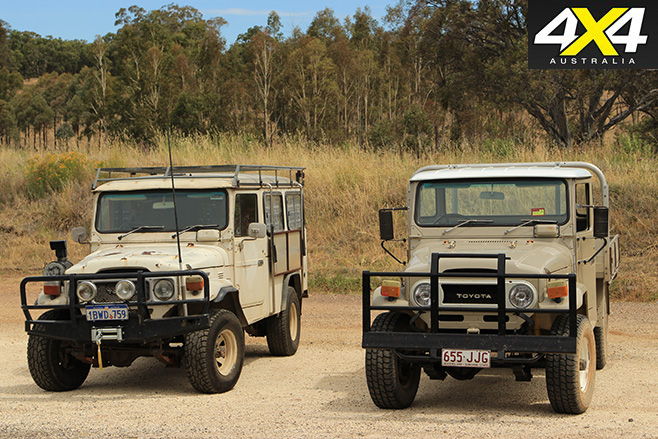
My right hand flicks the key backwards and, as the engine falls silent, there’s no doubt in my mind that I’d made the right choice. The smile on my face says it all.
THE IRONY
MY WIFE looked at me dubiously when I announced the plan to fly to Queensland and drive more than 1000km home in a 40-year-old car. She didn’t think I’d make it. She almost thought right.
The alternator failed. It had probably been responsible for the various lights failing in Warwick (a fuse blew and the headlight’s low beam burned out).
Still, I made it home. I had the alternator rebuilt, replaced the battery because it had been damaged, and spent days chasing subsequent little electrical gremlins.
As I’d arrived in Gunnedah for a break before the last leg of the Cruiser’s journey home, I got a call from the missus, who has owned her beloved little hatchback since buying it new a few years ago.
“My car’s broken down and has to be towed,” she said. I tried not to laugh, honest.