
REMEMBER when all the best 4x4s had six-cylinder engines? Mighty straight-sixes with oodles of grunt, be they diesel- or petrol-fuelled – those were the days!
However, the old six-pack has made way for high-tech turbo-fours that buzz out the mega-Newtons in spite of their limited capacity.
Volkswagen is bucking the trend by introducing the 3.0-litre V6 TDI engine to its Amarok range, and we’re sure it will put a smile on our faces when it gets here later this year. What’s more amusing is that it comes to the Amarok thanks to ever-tightening emission regulations and VW’s emissions figure-fudging.
Think about that for a moment: When was the last time emission regulations ever gave us a bigger and better engine? For once they are working in favour of a better-performing mill.
The only other non-four-cylinder diesel engine in the one-tonne 4×4 ute class is Ford’s 3.2-litre five-cylinder, as used in the Ranger and Mazda BT-50, and there are already hints Ford will be downsizing this mill in the near future to meet emissions standards.
Chances are it will go to a four-pot, but Ford already has in its armoury a sweet turbo-diesel V6 in either 2.7- or 3.0-litre capacity, which would be so good in the Ranger and Everest. Yes, we’re talking about the ‘Lion’ V6 diesel as used in the Territory and Land Rover vehicles, but unfortunately this engine is aging and is also on its way out. It sure would have been nice, though.
Land Rover is working on inline six-cylinder diesel engines to replace the Lion V6, so there’s a return to form for that favoured layout. Land Rover has no links to Ford anymore, so we wouldn’t expect the brands to be sharing engines again. However, stranger things have happened.
Meanwhile BMW has never strayed from its sublime inline sixes and still builds the best in the business, yet more of the Bavarian models are turning to high-performance fours that make as much power and torque as the sixes of just a few years ago. What a world we live in!
WITH the Pajero Sport now sporting a third row of seats, is it ready to rule the roost and take over from the ‘old’ Mitsubishi Pajero?
We have driven them side-by-side to see whether the Sport has what it takes to look after Mitsubishi’s fortunes in the 4×4 wagon market.
The Pajero Sport utilises a smaller capacity 2.4-litre diesel engine that’s mated to an eight-speed automatic transmission. This differs from the Pajero’s 3.2-litre diesel and five-speed automatic.
Despite the lower capacity, the smaller engine almost matches the maximum torque of the 3.2 by claiming 430Nm against 441Nm, even if it takes another 500rpm to get there.
The 2.4 generates 133kW versus the 3.2’s 147kW.
Given the Sport is derived from the Triton ute, it’s no surprise that it utilises a separate chassis construction. On-road it’s generally smoother and quieter than its older, bigger brother. However, the Pajero is tighter and crisper in general road feel.
Both are more than capable off-road, though neither are leading edge when it comes to off-road performance. The Pajero and Pajero Sport also both utilise Mitsubishi’s Super Select 4WD system, which is effectively a full-time system with the option of 2WD.
The tow ratings for both are also similar, with the Sport just edging ahead of the Pajero (3100kg v 3000kg).
Will the smaller Sport pack enough to fill its big brother’s boots? Check out the video review above, or read the full Mitsubishi Pajero vs Pajero Sport review, to find out.
With two kids under the age of five essentially relegating our old hiking tents to the cupboard, a large family tent was put on the shopping list.
A caveat was it had to be lightweight and pack up compact, as we had downsized from our large 4×4 wagon to a Subaru Forester. We also wanted it to be up to the more roughand- tumble conditions, and Black Wolf’s Tuff Dome Plus tent fit the bill.
The Tuff Dome Plus is part of Black Wolf’s 12-tent Dome range. On top of the regular Tuff Dome, the Plus adheres to its moniker by adding an extra 600mm of interior length (4800mm long, 2400mm wide, 2000mm tall).
At 11.5kg, the Plus is 2.7kg up on the Dome’s 9.8kg and it’s a very small compromise to make for the additional space. Another reason for choosing the Tuff Dome Plus was its interior height of two metres.
The asking price may seem a bit steep for a polyester/nylon dome tent, but the construction is top-notch, ensuring a robust build that will cop any wild weather – it has numerous guy-line attachments for extra stability in windy conditions.
Rather than use cheap, easily broken plastic or fibreglass poles, Black Wolf specs tough aluminium jobbies. The floor fabric is 300D Oxford Nylon PU and it has already copped a hammering, filled with sand, dirt, sea shells and other campsite detritus. So far there’s no tearing or marking.
Clever features on the tent include gusseted windows on the 150D Polyester PU fly (there are three large windows on the tent inner with No-see-um mesh, plus the front door) so even when it is raining, you can still keep air flowing through the tent as these gussets direct rainfall away from the window and interior. The seams on the floor and on the fly are sealed via waterproof tape and we’ve had no water get in at all.
The 1.2m-deep vestibule is spacious enough to store our duffel bags, Esky, camp storage boxes and other camp paraphernalia. If I would improve anything, perhaps it needs an even larger vestibule.
Setting up the tent is easy: the two main poles (16mm aluminium) are pre-bent and thread easily through their sleeves on the tent inner. Two 13mm aluminium poles extend the fly and the rear of the tent. They are also pre-bent and, again, quite easy to fit and secure. Then you just throw the fly over, clip it to the tent buckles and you’re done.
It takes 10-15 minutes to put up and is even quicker to pack away.
So far, the tent has performed with aplomb. The assurance of its robust build and quality materials makes me confident I will get many years’ service out of it. This also makes that asking price not so scary when you space out expenditure per years of service, making the Black Wolf Tuff Dome Plus impressive bang for your buck.
RATED Available from: www.blackwolf.com.au RRP: $880 We say: spacious, good value, durable
THE four-wheel drive community has joined forces with the automotive industry and the government to clean up reserves and 4WD tracks in Western Australia.
A partnership formed between the Motor Trade Association of WA’s Four-Wheel Drive Industry Association (4WDIA), Track Care WA (TCWA) and the Department of Parks and Wildlife (DPAW) will see sustainable practices put in place to preserve and protect reserves and parks.
The aim of the partnership is to also keep 4WD tracks open and accessible for future generations.
Graham Cawley, 4WDIA’s division manager, said in a statement: “Unfortunately many tracks are under threat of closure due to damage off the tracks and littering by the minority groups, and they are not necessarily 4WDers.”
After the group visited Wandoo National Park, which had a number of tracks planned for closure, the program noted a significant lack of signage as a major cause of track degradation.
“The majority of 4WDers want to do the right thing, but it’s really hard to do that when there’s not a lot of signage and it’s unclear which tracks can be used,” Cawley added.
The group installed the first signs within the park in April, 2016. One set was erected in a large wetland area damaged by 4WDers who had not kept to the tracks; the second set was put up on a popular track that features a deep bog hole, which consistently saw drivers take alternate routes.
The new signs clearly indicate that people must be adequately prepared before attempting to tackle these sections.
Signs were also erected in the area to educate 4WDers when they’re in environmentally sensitive areas.
“It’s really important that track users respect the environment. We’re blessed in WA with great bush tracks and we want to keep them open,” Cawley said.
“We’ve got a simple message to get out: ‘help us to keep tracks open by respecting the areas you love to use’. It’s such a positive step for the 4WD industry to be working with TCWA and DPAW to promote sustainable 4WDing. It’s a great sign for the future.”
INNOVATIVE South Australian suspension company Supashock, renowned for supplying leading car racing teams both in Australia and overseas, released a damper late in 2015 that specifically catered to the four-wheel drive market. It’s these Supashock dampers that are expected to be fitted to the production version of the ‘Tickford’ Ford Ranger.
Completely designed and manufactured in Australia, the Supashock is a high-end product made from meticulously machined and constructed components and materials, including extensive use of aircraft-grade aluminium.
Supashock, which supplies dampers to leading V8 Supercar Championship team Prodrive Racing Australia, expects the development of its four-wheel drive range of shock absorbers will see the company grow substantially.
“As a company operating in the automotive manufacturing industry, Supashock now has the opportunity to create jobs and preserve skills otherwise lost as a result of the winding up of local vehicle manufacturing by Holden, Ford and Toyota,” Supashock Managing Director Oscar Fiorinotto said at Supashock’s launch at Adelaide International Raceway last year. “Supashock is a growing company with great scope for new tech, skills and jobs.”
Supashock has developed a suspension system to suit a wide range of popular four-wheel drive utes including the new Toyota Hilux, Ford Ranger/Mazda BT-50, Holden Colorado/ Isuzu D-Max and Volkswagen Amarok.
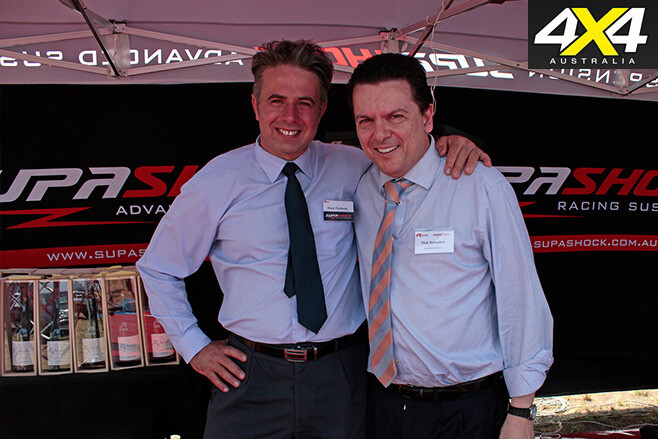
A unique feature of the Supashock is the damper’s large diameter body and small internal shaft, which is claimed to allow for a greater oil volume than more traditional twin-tube shock absorber designs, as well as better resistance to bending. The body of the shock is made from hard chrome-plated steel and the shock features Supashock’s own piston designs and tailored shim stacks. Up front the shocks feature progressive-rate steel springs, while the rear shocks will be supplied with matched leaves or coils depending on vehicle application and the owner’s specific load/driving requirements.
“What you see here, you will not see anywhere else,” Fiorinotto claimed. “Our system, which we’ve spent quite a lot of time developing, has an air-ride component to it that enables the [vehicle ride] to be a lot softer.
The company provided six vehicles for comparison at Adelaide Raceway: standard and Supashock-equipped examples of the new Toyota Hilux, Ford Ranger and Holden Colorado. The test loop included a high-speed lane-change test, a high-speed cornering test and a bump test.
The vehicles equipped with the Supashock system offered a significantly softer ride than the standard vehicles, as well as improved steering response and better damping control. Through the test track’s high-speed corner, the Supashock-equipped vehicles required less steering input and less correction than the standard vehicles, and they were much more composed on the bump test, which consisted of a set length of harsh bumps that were driven at 40km/h.
Supashock believes it has developed a system that will appeal to drivers who rarely venture off-road, as well as those who regularly tackle serious off-road terrain.
It’s a bit left of centre, but the Mahindra Pik-Up is a well-priced, honest and tough 4×4. And I’ve decided to run with the “so uncool it’s cool” tag.
It’s been fun observing the sneers of derision from those behind the wheel of heavily accessorised mainstream brands during the morning commute. Since when does bolting a high-lift jack and some MaxTrax to your rig give you the off-road moral high ground?
Our very red Mahindra 4×4 arrived with just 60km on the clock and sat resplendent with its powder-coated steel tray and bullbar glinting in the sun. I have since added a Big Red light bar and LED spotties, for a product test.
For a shakedown run we headed up the road to Fraser Island, to see whether we could keep up with the MaxTrax and highlift- jack-equipped punters.
As you’d expect of an emerging 4×4 that shares its stable with some very popular tractors, the interior and spec is a little agricultural – it’s more than a couple of generations behind what most expect. Plus, it lacks the electronic anti-crashing tech that’s standard fare in today’s 4×4 market.
However, the little ‘Punjabi Prado’ proved to be a surprisingly capable little jigger, and a comfortable cruiser. The 88kW 2.2-litre common-rail diesel engine has all the hallmarks of a great gen-set on paper, but it’s actually quite a flexible little engine off-road. 280Nm would indicate it’s unlikely to pull a sick sapling out of a bowl of porridge, but keep the hoof planted and it has an admirable crack at keeping up with the big boys.
That said, I’ve encountered better gearshifts on mining equipment, and the gates are that far apart you could undergo open-heart surgery (and recover) between shifts. And the idle start/stop feature is horrid and should be immediately disabled to discourage frustratingly slow restarts at intersections. Failure to do so may result in you having your lights punched out by someone behind you in a MaxTraxequipped Cruiser.
The run up 75 Mile Beach saw the Mahindra stretch its legs in 4×4 High.
In fact, I didn’t need low range until we hit Ngkala Rocks, which the Eaton-autolocker- equipped Pik Up handled quite well – apart from a little bulldozing in the sand. Suspension damping leaves a bit to be desired – hit a wash-out and you’re still bouncing for a while after.
The torsion bar IFS front end doesn’t have a great deal of clearance, but neither did the Navara that got stuck not long after I came through the rocks!
Total kilometers: 2204 KM Date acquired: July 2016 Price: $32,990 Km this month: 2144km Av fuel: 9.53L/100km
SISTER publication Wheels Magazine recently broke the news that a revamped Ranger will kick off a Tickford revival.
Despite no official word yet, it is expected that the hyped-up ute will be marketed under the famous Tickford brand. However, for now, the venture has officially been registered as PRA Garage – PRA was Ford’s former factory V8 Supercars team.
“PRA Garage is going to build performance and enhancement parts for ultimately most of the (Ford) products, but initially it’s to do with Ranger and Mustang,” PRA co-owner Rod Nash told Wheels in an exclusive interview.
Details are currently sketchy, but it’s believed the Ranger’s 3.2-litre turbo-diesel engine will be tweaked to produce a power hike of around 20 per cent.
Wheels Australia also spotted a Ranger Wildtrak development mule with 20-inch beadlock-style wheels, and a new exhaust with dual outlets.
The production model is expected to come with South Australian-made Supashocks.
Supashocks are completely designed and manufactured in Australia, and are renowned for supplying leading car racing teams in Australia and abroad.
Three stand-alone PRA Garage modification centres and showrooms are to be established in Melbourne, Sydney and Brisbane by early next year.
Customers will also be able to purchase parts and enhancement kits through Pro Garage dealers.
The project will officially be launched at the Bathurst 1000, which begins on October 6, 2016.
The Ranger is expected to be available later this year. Stay tuned for details.
Read the full Wheels Magazine article here.
Statistics tell us the Simpson Desert is the largest parallel sand dune desert in the world. Some of its dunes are the longest in the world, running continuously for almost 200km.
Despite its reputation as a Mecca for ambitious 4WD travellers, the Simpson is multifaceted.
Rated as our fourth-largest desert, it touches on two states and one territory with a range of features that go far beyond eternal sand dunes. On its fringes is a surprising array of environs, and in its northwest corner the Old Andado Track slices through some of the best landscapes.
Connecting Alice Springs (in the Northern Territory) with Mount Dare (just over the border in South Australia), the Old Andado Track is a remote adventure and travellers should be suitably prepared. The 430km track is diverse and the southern section is recommended for high-clearance 4WDs only.
The Old Andado Track is part of a larger tourist route known as the Binns Track, and though signage for the Binns helps with navigation, travellers should also be equipped with the right maps.
Alice Springs is the departure point for southbound travellers and the last place for final checks and supplies. Access to the Old Andado Track is south of Alice, past the airport and toward the Santa Teresa community.
For the most part it’s an unsealed track; the 80km to Santa Teresa can be corrugated and rather dusty. Closer to Alice the terrain appears quite desolate, more so when covered with a patina of drifting dust from passing vehicles.
But the gently rolling plains gradually develop into more interesting countryside, while rocky outcrops become dominant. The residual ridges from ancient mountain ranges slowly but surely appear, just as spectacular as any Central Australian icon.
Santa Teresa can be seen from quite a distance, backed by the colours of beautiful ranges. There aren’t any specific tourist facilities here, though the Keringke Arts Centre is open at set times or by appointment – contact the art centre before arriving to visit the gallery.
There’s quite a network of tracks near Santa Teresa, but the main route south isn’t hard to follow. It’s well defined and carries a bit of traffic – mostly station workers and the occasional road train.
More old ranges can be seen in the distance, including parts of the Allambarinja Range and the Train Hills, which are rather grand and quite interesting. The track sections through this rocky country can be unforgiving, with wide-spaced corrugations big enough to rattle teeth. Even so, the northern part has its easy sections, where the track becomes wide and smooth.
Beyond the Train Hills, small Simpson dunes hug the track in anticipation of the Rodinga Range. This range emerges as a wall of coloured rock that increases in magnitude with every kilometre. The track seems to disappear into the escarpment, but instead weaves around to cross the Rodinga Range via an easy – though rocky – pass.
The dunes in this fringe country aren’t huge and most hold a fair covering of vegetation. Even so, this is dry and thirsty country, with grasses and shrubs hiding seeds that are waiting for the next rain.
At times it’s hard to believe this is the Simpson Desert, especially as the track leaves the dunes behind to cross vast plains of seemingly endless gibbers. Landmarks can be few and far between, and it’s at places like this where a topographical map can add names to features.
These fringe areas of the desert are places of contrast. Numerous small claypans can be seen across the gibber plains, and in the distance to the east silhouettes of pinelike trees spike the horizon. Those trees – a rare desert species known as waddi or waddywood (Acacia Peuce) – are part of a grove that covers a relatively small area.
From the Old Andado Track there’s access to a protected area of waddis, and a rough track runs a handful of kilometres across blackened gibbers to the Mac Clark Conservation Reserve.
Camping isn’t allowed at the reserve, but visitors can explore the area of waddis – a tree which grows in only two other locations in the country.
From the reserve turn-off, the Old Andado Track leaves the gibbers to weave around small red dunes before arriving at Old Andado. Much has been written about this homestead, which sits between two handsome red Simpson dunes. There’s something quite special about discovering the story of Old Andado, its pioneering heritage and the people who are keeping its history alive for generations to come.
Molly Clark, Old Andado’s last permanent resident, sadly passed away years ago, but her grandchildren have taken up the responsibility of maintaining the living history of this station. However, for the most part, volunteer caretakers maintain this historic homestead.
Old Andado is a good place to camp.
The campground is quite large, the amenities block is surprisingly modern, and a donkey heater provides hot water for the showers. A gold coin donation gives visitors access to the homestead, which retains much of its original décor and household items.
Caretakers are usually on-hand to personalise the history and stories with old-school hospitality, though just a wander around the buildings and associated paraphernalia is enough to capture the imagination. Many travellers have been so taken by Old Andado they’ve become volunteers themselves.
The good, wide track from the old homestead crosses a few large sand dunes and then passes near the location of modern Andado. From there, the Old Andado Track is signposted as ‘4WD recommended’ and for good reason – it’s a mixture of new track, eroded track, corrugations, sand, rocks and bulldust. The hills and ranges in these parts are much more subdued, as are the sand dunes, which are more like hills than impressive mounds.
The countryside is very different in this southern section of the Old Andado Track, especially as travellers approach the northern reach of Mayfield Swamp. Heralded by eucalypt branches peeking above the sand hills, Mayfield can be a sea of verdancy after rains, and a place where cattle congregate.
Whatever the season, the forest of eucalypts is an oddity that once again makes it hard to believe this is the edge of the Simpson Desert.
Mayfield Swamp leads to a crossing of the Finke River, a usually dry watercourse that runs to an end in the sands of the Simpson.
However, it’s the flood-out of the Finke – not the crossing – that can give travellers some grief. Some sections overflow with the finest of fine bulldust – deep enough for a vehicle to belly-out – and though the track’s rough and corrugated, it’s still a fascinating run.
As the Old Andado Track crosses the NT/SA border, the Finke River pushes away into the desert. The few remaining bulldust patches can be both a challenge and a test for dustsealing on trailers and the like. From the border it’s about 14km to Mount Dare, with the Old Andado taking a circuitous route over gibbers and inevitable corrugations.
Mount Dare operated for many years as a cattle station, but it’s now known for the hospitality offered to travellers.
After a run down Old Andado Track, Mount Dare is a welcoming place that offers a spacious campground, meals, drinks, fuel, mechanical services and more. It’s also a good place to reflect on the diversity of the Simpson; and maybe stepping off further east to cross it.
TRAVEL PLANNER THE Old Andado Track runs from Alice Springs to Mount Dare – about 430km. The section from Alice to Old Andado homestead is suitable for high clearance off-road campers and vehicles. The section from Old Andado homestead to Mount Dare is more challenging and therefore recommended for 4WD only.
The majority of the Old Andado Track is unsealed and can be closed after rain – check road conditions at Northern Territory Government information and services.
This is a remote-area experience and travellers should be self-sufficient with everything from water to communications – there’s no mobile network coverage.
Camping at Old Andado is $10 per adult per night; showers and homestead tour costs a gold coin donation. A few ATCO rooms are also available but there are no other facilities at Old Andado.
Camping and cabin accommodation is available at Mount Dare, as are fuel, meals and some groceries.
For more info visit Old Andado Station and the Mt Dare Hotel wesbites.
HAVING been a seriously keen off-road camper for years but having recently downsized my vehicle, it was easy to say “yes” when offered the chance to test a piece of equipment offering me more load space.
*Article updated 02/12/16
Yakima is a US-based company that has been making carrying equipment for vehicles – roof racks, bike racks/carriers, watercraft carrying stems, luggage boxes – for 40 years, garnering multiple awards for its products since.
The company’s roof-box range is headlined by the Skybox, first introduced to the market in 2006. It was a hit from its launch and has since earned a reputation as the toughest on the market, thanks to its reinforced nose and lid (to stop it vibrating/flapping in high wind), innovative dual-access design, and the fact the Skyboxes can be made from up to 80 per cent recycled material; the offcuts from the moulds are re-used in future boxes, ensuring minimal wastage.
The Skybox Pro 16S (S denotes silver – it is also available in titanium and onyx black) has a load capacity of 450 litres (16 cubic feet, hence the 16 moniker) and is designed for vehicles with shorter roof lengths. It’s compatible with most popular roof bar shapes and its dimensions are 205cm long, 91cm wide and 38cm tall. Larger 18 and 21 models hold 510L and 590L respectively.
The mounting process to a roof bar is very simple. Quick-fit mounting clamps are integrated into the Skybox and are slide-adjustable to ensure they fit over the distance between the two roof bars. A lever-operated cam tightens the fit to the bar and there is a knob inside the box to ensure it is adjusted firmly. Having the box-attachment parts inside the box also ups the security level – there’s no way of accessing the attachment points of the box from outside, especially once you lock it.
The lock/latch system (the box has latches on both the driver and passenger side) is simple to operate and has shown no signs of failing – and it won’t lock until the lid is securely shut, another great safety back-up.
Its light weight makes installation a one-person job, if you possess reasonable strength – you’re looking at five minutes max. It really is bloody quick and easy to fit.
The same caveats apply when loading the Skybox as they do for any roof-mounted storage system: be sensible and only load light, bulky items if possible. Items such as tents, clothes, sleeping bags and prams can be loaded up there without a problem.
The higher profile that results from fitting a Skybox on your roof will increase wind drag, but the aerodynamic shape seems to do an okay job of lessening the impact on fuel consumption. I reckon we use around 10-15 per cent more fuel with the Skybox up top – freeway driving is where it has the most impact due to the higher speeds.
We’ve driven through a few rainstorms with it on top and there’s been no water ingress. This is due to the overlapping lip around the box and the fact it is so tightly secured once locked, with no way for a gap to form between the lid and the base.
The hinged arms that allow for the dual-sided access are cleverly designed and intrude minimally into available load space. They are made from strong plastic materials with oversized bearings in the hinged sections, to ensure durability. I have inadvertently belted them a few times with hard-surfaced gear and that doesn’t seem to have affected their operation at all.
A cargo net, to make sure your gear doesn’t bang around loose inside, can be purchased separately. This is something we’ve really appreciated when occasionally using the entire 450 litres of space. The cargo net is affixed via four hooks on each side to stirrups screwed into the base of the Skybox – these are made from tough plastic, are easy to hook into and offer zero movement. We’ve had the net stretched pretty tight over bulky stuff and it has never failed.
The Skybox’s lock system is great as well. To unlock the lid and access the gear inside you need to have the key inserted, which makes for great peace of mind if you decide to leave the vehicle parked anywhere.
We’ve used the Skybox for camping weekends and the annual sojourn down to the NSW far-south coast for Christmas. Having to fit hiking/MTB/paddle and camping gear in the vehicle – plus all the paraphernalia associated with two kids under five years of age – has seen the Skybox become our first go-to item pre-trip.
It’s coming up to four years of pretty regular use for our Yakima Skybox 16S and so far it has done the job perfectly. Some of the gear – and the sheer amount of it – we’ve managed to fit in there has often been surprising. The unit’s simplicity of function, ease of fitting and removing, and build quality has made it one of our favourite pieces of touring equipment – and great value for any touring family, regardless of the size of your vehicle.
RATED Available from: www.yakima.com.au RRP: $999 We say: Easy to install; water-tight; reliable.
With the inclusion of a third-row seat to its relatively new Pajero Sport, Mitsubishi now has two off-road capable, dual range, three-row 4×4 wagons in its showroom, and they are both Pajeros.
It begs the question, why is the ‘old’ Mitsubishi Pajero – so long in the tooth – still around? And can the Triton-derived Pajero Sport step up to take its place? We’ve driven them side-by-side to find out.
When the revolutionary NM Pajero debuted in 1999 it was well ahead of its time. Indeed, even the Range Rover of the day, generally acknowledged as the innovator of the 4×4 world, still relied on traditional separate-chassis construction and live axles at both ends – it wouldn’t ‘catch up’ with the NM’s ground-breaking monocoque construction and fully independent suspension until 2002.
The NM was a complete departure from all previous Pajeros dating back to the NA of 1982, all of which had a separate chassis with a live axle at the rear, initially on leaf springs and then on coils. So what bought about the revolutionary change with the NM? In a word: Dakar.
Mitsubishi first entered what was then called the Paris-Alger-Dakar in 1983 with its then brand-new Pajero winning both the Production and Marathon (production modified) classes with a near stock-standard vehicle. Two years later a modified production Pajero won outright, but by that time the writing was on the wall for production-based machines with the emergence of the purpose-built (so fast they had to eventually be banned) Group B rally cars, such as the Porsche 959.
To combat this Mitsubishi debuted its first built-for-racing Dakar prototype in 1987, the successors of which went on to win Dakar outright in 1992 and 1993. Wins in 1997 and 1998 were followed with a modified Pajero Evolution, effectively a limited-production homologation special loosely based on the earlier prototype cars and designed to circumvent new race regulations.
Thinking what was good enough to win this most gruelling of all long-distance rallies should be tough enough for everyday use, Mitsubishi then set about building a new Pajero inspired and validated by its Dakar winners. Most significantly, the NM’s double wishbone front suspension and multi-link rear suspension were developed using the experience gained with Dakar-winning cars. For the suspension to work effectively, Mitsubishi turned to an all-steel monocoque construction as per the Pajero Evolution.
The NM’s monocoque was claimed to have an astonishing three-times the torsional rigidity of the previous Pajero’s body-on-chassis arrangement, while the fully independent suspension offered more wheel travel than the outgoing rear live-axle chassis.
The fact that 17 years later (see ‘Timeline’ sidebar p35) the NM’s basic platform still underpins the Pajero of today is proof of the soundness of the design and of the enduring value of motorsport as an automotive development tool.
As good as the Pajero’s chassis is there are hurdles ahead for its aging 3.2-litre diesel, due to ever-tightening exhaust emissions regulations. The now imminent Euro 5 regulation will be cleared by fitting a diesel particulate filter before year’s end, while Euro 6’s tougher NOx limits will require SCR (AdBlue) or similar technology on all diesel engines, especially an older design like the 3.2, by mid-2018.
Will that be the end of the Pajero as we know it? Officially the word is: “Mitsubishi Motors will continue to sell and make improvements to the current model for the foreseeable future”.
This may be true, but there’s much speculation that the Pajero won’t exist beyond Euro 6 and that Mitsubishi’s fortunes in the 4×4 wagon market will be left to the new Pajero Sport. Can the Pajero Sport fill the Pajero’s very big boots?
POWERTRAINS AND PERFORMANCE THE Pajero Sport’s 2.4-litre diesel – a brand-new design and mated to an eight-speed automatic gearbox – is a world apart from the Pajero’s 3.2-litre diesel and five-speed automatic.
In very much a sign of the times the Sport’s small diesel comes close to matching the maximum torque of the one-third-bigger Pajero diesel by claiming 430Nm against the bigger engine’s 441Nm, even if it takes another 500rpm (2500 v 2000rpm) to achieve that maximum figure.
The 2.4-litre engine generates 133kW versus 147kW for the 3.2-litre, but tellingly the bigger engine has to rev harder to get to that peak power figure. Another way to look at the disparate technology on offer here is that a 3.2-litre diesel in the same state of tune as the Sport’s 2.4 would make 175kW and 570Nm. Sounds tasty, doesn’t it?
What’s crucial here is that the Pajero is a substantial 230kg heavier the Sport, and it lacks the advantage of the Sport’s additional and closer gearbox ratios. Pedal to the metal from low speeds there’s not much between the two, but once the Sport gets into its stride it’s noticeably quicker. The Sport’s smaller frontal area would also work to its advantage once you get to speeds (generally above 70km/h) where aerodynamics play an increasingly significant part in overall performance.
The Sport’s 2.4 is also quieter and smoother than the Pajero’s 3.2. In-line four-cylinder engines have an inherent dynamic balance problem – the bigger they are the more they vibrate, and there’s only so much balance shafts can do.
The Pajero’s general refinement also suffers against the Sport due to its now-old five-speed auto, which can’t match the fast, smooth and more ‘intelligent’ shifts of the Sport’s much newer eight-speed. With less weight to carry around and less air to push out of the way, it’s no surprise the Sport is also more economical.
RIDE AND HANDLING THE Pajero Sport may be ‘new’ compared to the Pajero, but it relies on an ‘old-school’ separate chassis, which is not a surprise given it’s derived from a commercial vehicle, namely the Triton ute.
The Sport impresses with a ride that’s generally smoother and quieter than the Pajero. One of the benefits of body-on-chassis construction is that road noise and harshness is easier to isolate than with a monocoque, and you can certainly hear and feel that difference with these two.
In comparison, the Pajero has a firmer, sharper ride, but it’s tighter and crisper in its general road feel. It’s also more stable on rough roads, especially at higher speeds. Back-to-back with the Sport you can feel the Pajero’s Dakar breeding. Ironically, the Pajero feels sportier than the Sport.
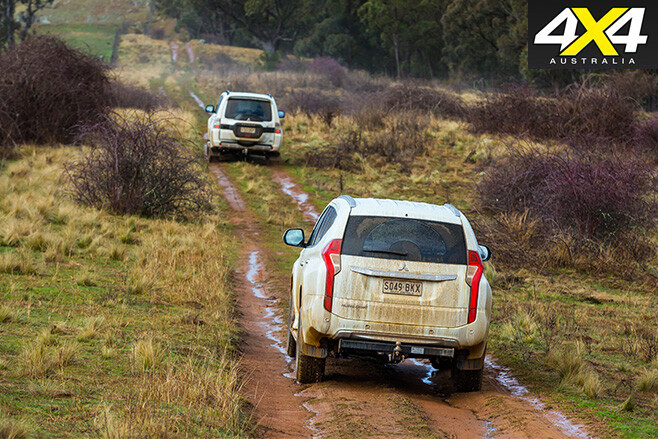
OFF-ROAD NEITHER the Pajero nor Pajero Sport are absolute leading edge when it comes to off-road performance, but both are still more than capable off-road and are certainly up to the demands of any keen recreational 4×4 enthusiast.
Despite being different at the very core of their respective designs the overall result of what they can do off-road is very similar, and they also get there in a similar way.
Both have Mitsubishi’s unique Super Select 4WD system, which is effectively a full-time system with the option of 2WD. The centre diff is a simple mechanical affair (no self-proportioning or self-locking) but the driver can easily lock or unlock the centre diff with a turn of the Super Select dial. For someone who knows what they are doing, Super Select is a great system.
Both the Pajero and the Pajero Sport also have a driver-switch++ed rear locker, but when the locker is engaged the traction control is cancelled across both axles, not just the rear. This means the locker isn’t always a benefit – sometimes it helps, sometimes it hinders.
The Pajero, with its fully independent suspension, is more dramatic off-road in terms of lifting wheels than the live-axle Sport, but it counters with significantly less front overhang, a little more clearance and better vision for the driver. The Sport comes back with a much deeper crawl ratio thanks to its eight-speed gearbox. Interestingly the two share a near identical wheelbase – the Sport’s 2800mm is just 20mm longer than the Pajero.
CABIN, ACCOMMODATION AND SAFETY BEFORE you even climb aboard you can notice the generational difference. The Sport has a proximity key, so you only need it on your person for the car to unlock; with the Pajero you have to press a button on the key fob.
Once inside, the Sport has push-button start where the Pajero requires you to insert the key in an ignition switch. There’s no reach adjustment for the Pajero’s steering wheel, either.
But that’s where the Sport’s advantages, if indeed these things are advantages, end. The Pajero’s cabin is far more airy and spacious, and the driver’s space isn’t compromised by ridiculously wide centre console, which tall drivers will find annoying in the Sport as it impinges on leg space.
The Pajero’s second-row seat is also considerably bigger than the Sport’s, while the difference with the third-row is even more apparent. Where the Pajero’s third row will take adults, even if it’s a squeeze, a normal-size adult simply can’t fit in the Sport’s third row. In fact, the Sport’s third row is only really suitable for young children, and with the third-row folded away the Pajero has far more luggage space than the Sport.
The Sport comes with five seats in its base-spec model, whereas all three Pajero grades have seven seats, which helps to redress the balance if you don’t need seven seats.
All Pajero and the Pajero Sport models have five-star ANCAP safety, despite the top-spec Sport being fitted with high-end safety equipment like autonomous braking – another sign of the inadequacy of the current ANCAP system.
PRACTICALITIES BOTH have similar tow ratings (3100kg for the Sport; 3000kg for the Pajero), a practical and identical wheel and tyre spec (265/60R18), and a full-size spare. While a 20-litre bigger fuel tank (88L v 68L) is a bonus for the Pajero and more than compensates for its extra thirst.
Both have practical engine bays, though there’s more space for an extra battery under the bonnet of the Pajero than the Sport. The Sport counters by drawing its intake air from the inner guard, whereas the Pajero’s air intake is under the bonnet lip – although the engine is protected by a water drain between the intake and the air filter.
SUM UP YOU only have to look at the current pricing to see the most expensive Sport, even with its far more extensive equipment list, is cheaper than the base-spec Pajero.
In essence the Sport is a much smaller wagon than the Pajero, so it can never fill the role of its older brother even if that brother is retiring. Not that the Pajero Sport is a bad thing, far from it. It’s just in a different – and smaller – class.
For its part, the Pajero feels like it’s ready to go around again for another decade. What the Pajero simply needs is a powertrain that meets the upcoming regulations, and Mitsubishi could do a lot worse than fitting the one from the Sport.
*Based on fuel tank capacity, test fuel use, and a 50km ‘safety’ margin.
To watch how the new Pajero compared to it’s older brother, check out the video review here.