
THE FJ Cruiser was an attempt by Toyota to cash in on the perceived nostalgia of the early petrol-powered FJ40s, FJ45s and FJ47s – though without the kidney-jarring, spine-crushing ride and indifferent handling of its forebears.
A certain cult following has grown up around this later FJ, because like the mid-wheelbase of earlier times it was an attempt to tame the pitching ride of the short-wheelbase FJ40.
The Prado-based FJ Cruiser has enjoyed a mixed relationship with the four-wheel-drive-buying public: it’s one of those love/hate things. It did win 4X4 Australia’s 4×4 of the Year award back in 2006, but nobody can deny the attachment it has to those who seek to enhance the original product.
It was once said that short-wheelbase Toyotas were a great base for the accessorising 4×4 owner, and the FJ Cruiser follows this tradition.
Oleg Cher saw the potential for what he wanted in a 4WD and began planning six years ago. He spent two years searching for the right accessories. And while he agrees there’s nothing wrong with locally produced gear, he wanted his FJ to be a bit different.
Eager eyes might notice that the bigger tyres and the bullbar definitely look a bit different, but it’s only when you get up close that things reveal themselves. That bullbar is by Road Armor in the US, while the rear bar and swing-out tyre carrier are also from the US and made by Expedition One. These are names most Australian 4×4 owners probably haven’t heard of, but they are well-known across the Pacific.
A slightly fruity exhaust note is courtesy of a Toyota Racing Division (TRD) Cat-Back exhaust; the chrome-plated tips give a more civilised finish to the business end. The suspension kit is from Icon Dynamics (yes, the US again), which does a magnificent job of holding the vehicle where it needs to be.
We drove around Oleg’s macadamia farm and through some areas he’d cleared for more trees. While the FJ Cruiser’s OE suspension is pretty good the remote resevoir Icon gear is a lot better, particularly where suspension travel is needed.
To back up that suspension travel there is an ARB air locker in the front diff. This works from an ARB twin compressor, feeding a four-litre aluminium air tank. Oleg decided to stay with the standard Toyota rear locker, though the diff ratios have been changed to suit the larger rolling diameter of those big Goodyear Wranglers MTRs with Kevlar sidewalls. Like most of us, Oleg is not a fan of doing tyre changes in the bush; he reckons the Kevlar sidewalls have more than proven themselves.
He went for a set of 16-inch Method rims with bead locks, once again bought in from the US. “I didn’t like having 17-inch rims on a vehicle like this,” he said. “The 16s provide a bit more sidewall to help absorb the bumps.”
Tyre pressures and temperatures are monitored by a Tyredog unit on the dash, with the data sent from sensors on the valve stems. Oleg likes having the ARB compressor to vary tyre pressures to suit the terrain; it also controls air pressure in a Polyair raised coil insert air bag kit at the back.
The factory Toyota roof rack has been augmented by a drop-in Garvin unit from the States, while the 9500lb Warn winch is spooled with synthetic rope. It’s complemented by a Factor 55 hitch that rotates a full 360 degrees.
Throughout the build Oleg worked closely with AutoCraft in Geelong, Victoria. They import a lot of specialist 4WD gear from the US, and they do a great job fitting what they sell. The dual-battery set-up is another product from AutoCraft; it’s a Bond unit that uses a Redarc 15A battery management unit located under the front passenger seat.
The snorkel is from TJM, and the sill protection rails are a Toyota accessory. The clean air provided by the snorkel is augmented by a Cold Air Intake system that monitors the condition of the air filter, and it can be taken out for easy cleaning. Should Oleg need to travel through deep water, the breathers on both diffs and gearboxes are vented up to the firewall.
While any underwater objects will have to deal with an AutoCraft bash plate that protects the underside. Other underbody protection is afforded by a guard on the electronic actuator for the rear diff, a BozTec skid plate on the rear diff housing, and skid plates on the Icon lower control arms.
For storage, Oleg has fitted a Drifta drawer system that includes a slider for his Engel 40-litre fridge/freezer. The drawers also house an extensive recovery kit, while a Springtail Solutions cargo guard from AutoCraft keep his two kids safe.
With safety in mind, Oleg went for a set of Hella Luminator Compact spread-beam driving lights. “I didn’t want long-range lights,” he said. “It’s always the ’roo that jumps out close that gives you problems, not the ones far off.” He also installed some PIAA Crystal fog lights, while mounted on the roof rack are strategically placed cat’s eye LEDs – one on each side and two at the rear.
Another safety accessory is the Icom UHF 440N radio, complemented by a TRG antenna and BozTec mount.
It’s probably safe to say Oleg’s gone a little further in his quest for individuality than others – he has what is probably the most off-road capable FJ Cruiser out there! Certainly on the NSW coast anyway.
Travel plans
SO FAR Oleg and his family have taken the FJ to Fraser Island, North Stradbroke Island, and the Victorian Alps during the snow season. Future plans include a trip he’s calling the “Australian Extreme Points Adventure”. The list includes the northernmost point of Cape York, the southernmost point of South Point on Wilson’s Promontory, Steep Point in WA, Cape Byron, then the lowest point of Lake Eyre, and the highest of Mt Kosciusko.
How he plans to link them all is in the planning, but it will undoubtedly include such 4WD magnets like the Simpson Desert, Uluru, Goog’s Track, the Canning Stock Route and the old Telegraph Track in Cape York.
Whatever he decides, the FJ Cruiser is sure to handle it.
The new turbo V6 Ford F150 Raptor hasn’t even gone on sale in the US yet but tuner Hennessey Performance have waved its wand over it to tweak the EcoBoost engine to make more than 600 Horsepower and add an extra driven axle at the rear.
“Our VelociRaptor 6X6 is pure aggression on wheels – all six of them”, said Hennessey. “The new 2017 Raptor is going to be one of the best all-around trucks ever built. We are excited to help take it to the next level both in terms of performance and exclusivity”. The Hennessey VelociRaptor 6X6 can be ordered directly from Hennessey Performance or through select Hennessey / Ford dealers in the USA
The VelociRaptor 6X6 concept starts at US$295,000 and includes the base 2017 Raptor 4-door truck, 6X6 locking rear axles, upgraded Fox suspension, upgraded 20-inch wheels and off-road tyres, special front and rear bumpers, rollbar and LED lights. HPE will also be offering its VelociRaptor 600 twin turbo upgrade for the 6X6 and for owners seeking more power and performance.
The 600+ HP upgrade costs US$22,000 and includes upgraded twin turbochargers, stainless steel exhaust modifications, upgraded front mounted air to air intercooler and plumbing and re-tuned factory computer.
Other optional upgrades including Brembo brake upgrade, larger wheels and tyres, LED lighting upgrades, bespoke interior, electronic upgrades and armouring systems will also available.
SEPTEMBER’S VFACTS report has been released, and Ford has once again jumped Toyota to have the best-selling 4×4 for the month.
The year-long game of leapfrog between Ford’s Ranger and Toyota’s Hilux has continued in September, with the Ranger regaining top position.
Not only did the Ranger (2451 units) considerably outsell the Hilux (2311) this month, but it has also tightened things up on the year-to-date charts.
With only three calendar months remaining, the Ranger now only trails the Hilux on the YTD charts by 86 units (22,438 v 22,524)!
Rounding out the top five on the September 4×4 sales charts are the Mitsubishi Triton (2012), Holden Colorado (1528) and Toyota Prado (1160).
Mazda’s BT-50 may sit in ninth position on the 4×4 sales charts, but the utility (combined 4×4 and 4×2) is breaking company records.
It posted a new September record with 1361 units sold (the M Day deals helped) and is on track to break its current annual sales record of 13,702 (2013).
“We are delighted with the September sales performance of every nameplate in the Mazda range. It is particularly satisfying to see so many records set. While there were some great M Day deals to be had, it is the strength of the Mazda Brand, with superior styling, interior refinement, excellent safety and competitive pricing that makes it one of the most attractive options for new car buyers,” Martin Benders, Mazda Australia managing director, said.
Overall, the LCV market continues to strengthen as the year continues. Compared to September 2015, sales of LCVs have increased by a whopping 17.9 per cent – sales are also up 11.2 per cent YTD.
“The trend in increased consumer preference for SUVs and light commercials was accompanied by a decline in sales of passenger vehicles by 8.7 per cent in September, compared with the same month last year,” Tony Weber, chief executive of the Federal Chamber of Automotive Industries, said.
The Toyota Hilux (4×4 and 4×2 models) was the third best-selling vehicle on the overall market (3209 units). It trailed the Mazda 3 (3491) and Toyota Corolla (3423).
The Ford Ranger (4×4 and 4×4 models) was fourth, with 2903 units sold.
| u00a0 | 4X4 | SEP 16 | AUG 16 | YTD |
| 1 | FORD RANGER | 2451 | 2364 | 22,438 |
| 2 | TOYOTA HILUX | 2311 | 2418 | 22,524 |
| 3 | MITSUBISHI TRITON | 2012 | 1010 | 14,066 |
| 4 | HOLDEN COLORADO | 1528 | 1503 | 12,885 |
| 5 | TOYOTA PRADO | 1160 | 1328 | 11,316 |
| 6 | NISSAN NAVARA | 969 | 1101 | 10,673 |
| 7 | ISUZU D-MAX | 944 | 730 | 8,064 |
| 8 | TOYOTA LANDCRUISER WAGON | 903 | 1350 | 8,795 |
| 9 | MAZDA BT-50 | 812 | 657 | 7,344 |
| 10 | TOYOTA LANDCRUISER PU/CC | 637 | 695 | 5,385 |
WHEN news broke that an all-new Ford Bronco will be built in the USA later this decade, it triggered memories of a few Bronco concepts from previous years.
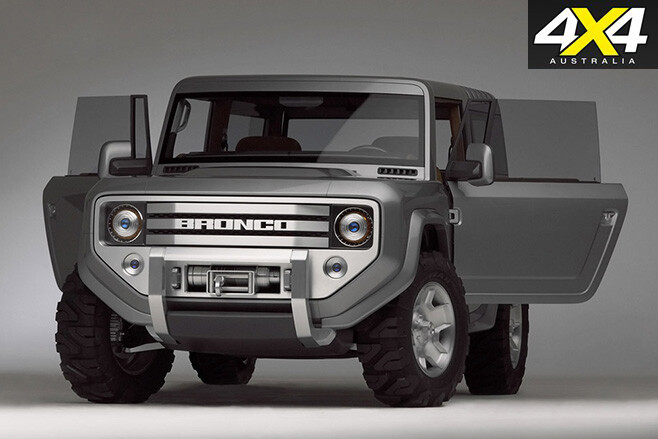
Back in 2004 a Ford Bronco concept was revealed at that year’s North American International Show. Powered by a 128kW/330Nm 16-valve 2.0-litre common-rail Duratorq TDCi engine mated to a six-speed manual transmission, the 2004 Concept maintained the upright, boxy lines of the original. It also kept the short wheelbase and trademark round headlights.
A winch and guide rollers sat up front, while exposed door hinges, cowl vents and flared wheel wells were notable exterior features.
This concept never saw production.
Perhaps one of the most popular concepts was actually designed by a fan forum. The 2020 Ford Bronco renderings, designed by Bronco6g (www.bronco6g.com), fuses the many Bronco styles over the famous nameplate’s lifespan.
Utilising the classic round headlights and square inset front grille from the first-gen Bronco, the 2020 concept is “a modern body-on-frame next-generation Bronco that retains a tall, boxy, tough, no-frills design with a strong focus on utility and off-road capabilities”.
The fan-made renderings show how Bronco aficionados wanted the new model to look. Is it better than the official pics? Tell us on Facebook.
Credit: www.bronco6g.com
The 2016 Ford SVT Bronco “concept” makes the list for the fact that it stirred debate and looked pretty cool. However, it was just an elaborate April Fool’s prank by Fourwheeler.com.
Credit: www.fourwheeler.com
This final one is a bit left-of-centre, but we thought we’d throw it in anyway. It’s a Ford Bronco concept created by Jonathan Fan. The Bronco concept was featured at Art Center 2013.
Credit: www.formtrends.com
News of the all-new Bronco made waves when Bill Johnson, chairman of UAW, responded to claims made by Donald Trump that Ford was sending all of its manufacturing to Mexico.
Johnson admitted that small-car manufacturing is going to Mexico, but it is being replaced in Detroit by more exciting products.
“We hate to see the products go to Mexico, but with the Ranger and the Bronco coming to Michigan Assembly, that absolutely secures the future for our people a lot more than the Focus does,” Johnson said.
The famous nameplate was last seen at Ford dealers in 1996, following a 30-year history. A second-gen Bronco – based on an F-series chassis – was assembled and sold locally between 1981 and 1987.
The all-new Bronco will be built in the USA later this decade.
Any other Bronco concepts come to mind? Shoot them through on our Facebook page!
HOW to build the perfect accessorised 4×4 depends on a number of key factors: namely, how you intend to use it, where you want to take it, and your budget.
If you have a bottomless pit of cash, then you can afford to go all out with the best suspension upgrade, the best roof rack system and the best set of treads. But for most people, it’s important to budget for their 4×4’s upgrades.
Regardless of how deep your pockets are, there’s plenty you can do to get your rig to take you further. To prove this point, Opposite Lock gave us the keys to its rigged-up Ranger, and we took it for a blast through Toolangi National Park in Victoria.
Opposite Lock has decked out the PXII Ford Ranger XLT with a number of top-grade accessories in an attempt to show off its broad range of gear on offer, as well as its quality workmanship. Not only does Opposite Lock sell and install its own gear, it also sells and installs gear from other manufacturers. On this Ranger build in particular, some of the best gear from Safari, Front Runner and Sammitr has been used to maximise the rig’s off-road potential.
Along for the ride and to talk us through the ins and outs of the build was Opposite Lock’s global sales and marketing manager, Wayne Coombe-Heath.
“The first thing to do when you buy a 4×4 off the showroom floor is pull the wheels off and put on decent tyres,” Wayne said.
For Opposite Lock, this meant a fresh set of Dynamic Wheels with Dick Cepek All Terrain tyres. Out on the tracks of Toolangi, the new rubber capably navigated through corrugated tracks and over fallen logs.
As mentioned, Opposite Lock hasn’t made all the equipment seen on this build, but they do stock and fit a variety of parts – such as the Aussie-made Safari snorkel.
“We can do all installations at all of the Opposite Lock stores,” Wayne told us. “While you can fit the snorkel yourself, it’s not recommended. When you see someone taking a big holesaw and drilling a massive 50-70mm hole in the fender… I don’t want to do that myself. You’ve got to get it exactly right and you have to know exactly what you’re doing.”
This is why it’s best to leave the modifications to the boffins at Opposite Lock, who are highly skilled and trained in this field. The contours of new-car design can be complex, and the task of cutting a hole in the fender isn’t as easy as it used to be. So it’s best left to the pros!
The high-quality Safari snorkel doesn’t just allow the OL Ranger to wade through waist-deep water, it also limits dirty air from filtering through the intake pipes – especially valuable for sand and extreme-bush driving.
Up front sits an Opposite Lock Premium three-loop steel bullbar fitted with Ultravision Nitro driving lights and a Kingone winch with sythetic rope.
Running down the flanks of the Ranger are Opposite Lock steel sidesteps that double as rock sliders. The durable and sturdy sidesteps are bolted to the chassis, and they offer superior protection underneath the vehicle. “You also want to be able to stand on them when you’re in the mud,” Wayne added. “So they’re the best of both worlds.”
Up top reside two Front Runner roof racks: a canopy rack and a cabin rack. The racks are attached to the roof sans any drilling, so they can removed and refitted with ease. They can also be customised to cater for what you want to transport, be it jerry cans, gas bottles, water containers, fishing rods and canoes, to name but a few.
“This is the most versatile roof rack ever designed. This is the top of the top! It really has taken versatility and design to a whole new level,” Wayne said.
A slide-out table is cleverly stored underneath the canopy rack in what would normally be wasted space. It’s easy to access, so when you arrive at a campsite you don’t have to unpack a week’s worth of luggage just to set up lunch. And fear not, out on bumpy tracks the table remains rattle-free.
The Sammitr V2 Premium Steel canopy is made from the same material as the car’s body panels. Plus it’s colour-coded, it follows the contours of the car, and it provides full side and rear access with big window openings, which makes the retrieval of goods easier. The canopy is carefully wired by OL staff so it works off the same central locking system as the vehicle. Brake lights and tail-lights are also integrated. Don’t try this kind of installation at home, as the wiring is a tricky job best left to the pros.
An added benefit of the canopy is that it allows a Front Runner drawer system to fit in the tray to maximise storage space.
“When going overlanding you need as much space as you can possibly get, and having a drawer system doubles up your normal packing space,” Wayne added.
The twin-drawer, lockable system has drawers that slide all the way out – and all the way down to touch the back of the cabin – so that there isn’t an inch of wasted space. The wings on either side of the drawers lift up so you can access the space underneath, which is another clever way the drawers utilise all the space. Recessed power points allowing the tailgate to close are an intuitive addition, as are adjustable tie-down points on top of the drawer system.
“Front Runner really has thought of everything. This is a top-class drawer system,” Wayne said.
Moving underneath and Opposite Lock has rejigged the Ranger’s stock suspension with a 40mm lift and changes to the leaf springs, front struts and shock absorbers. The full Opposite Lock suspension kit has given the Ranger an additional 300mm of wheel travel.
“The more you add on, the more your suspension drops. So there’s nothing like a great suspension upgrade to get the car back to where it should be,” Wayne said.
To improve underbody protection an extra tough steel plate Front Runner sump guard has been fitted.
“We removed the standard guard which was only microns thick and replaced it with a Front Runner sump and belly guard. It’s a nice, solidly-fixed steel sump guard, powder-coated black, properly reinforced, and bolted in using existing bolt holes,” Wayne said. “Nice added protection when you’re going over rocks and logs. It finishes the package off nicely.”
The Opposite Lock Ranger is an adventure-ready tourer capable of taking you to the most remote regions of outback Australia. Opposite Lock is the one-stop shop to deck out your 4×4 with all of the best gear, and the enthusiastic staff will tailor-make a package to suit the customer’s specific needs.
Wayne added: “You can go into an OL store and you can kit out your car with anything you want. You got a trip, you got a plan, you got a dream, and an Opposite Lock store can make it happen.”
PRICE GUIDE Opposite Lock premium three-loop bullbar $1699 Ultravision Nitro driving lights $695 each Kingone winch $1385 Opposite Lock side steps $799 Opposite Lock suspension kit $1840 Tyres $567.50 each Rims $230 each Safari snorkel $462 Sammitr V2 premium steel canopy $3328 Front Runner canopy rack $995 Front Runner cabin rack $995 Table (+ bracket) $460 Front Runner drawer system $2090 Front Runner underbody protection $395 (sump guard)
CONTACT OPPOSITE LOCK PH: 1800 624 444 WEB: www.oppositelock.com.au
IT DIDN’T look like the Red Centre. The track we were following in the Range Rover Sport was covered in tall grass that nearly reached the window and stretched to the horizon like a sea of green.
Only the brief, intermittent glimpses of the track’s twin red ribbons of dirt and the squirming of soft sand under the Sport’s tyres confirmed our location: deep in desert country southwest of Alice Springs. We couldn’t have got further away from our everyday city lives if we’d tried – and it felt bloody awesome!
It had been five years since we’d been out in the Red Centre on a 4×4 trip – two kids under the age of five took care of any spare time. But we decided this year we’d return to one of the best touring and camping regions in Australia, and we’d been counting down the months since we’d booked our flights at the start of the year. This was also our daughter Sarah’s first big off-road adventure, and we’d been filling her in on the appeal of “all that red sand in the desert” – something we knew wouldn’t be prevalent after glimpsing the sea of green from the air as we flew into Alice.
Our plan was a quick week of touring and camping with good mate and Alice Springs local John Stafford as our guide, accompanied by his partner Susie and daughter Eleanor. I had travelled extensively with John over many years during my tenure as 4X4 Australia editor, so I was looking forward to a mix of great driving, awesome campsites, good company and the odd beer or three around a campfire. In short, it was shaping up to be the perfect Red Centre away-from-it-all adventure.
The trip started pretty well, too. I had been lucky enough to score a Range Rover Sport TDV6 as our rig for the week – complete with two spare wheels – and was keen to see how this latest incarnation of one of my favourite off-roaders was going to perform in this sometimes challenging country. The shiny silver Rangie looked slightly lost parked at Alice Springs Airport among all the dusty Toyotas and Nissans, but I knew we’d soon rectify its city appearance.
John’s plan was for us to spend two days out west of Alice Springs, exploring the area south from Larapinta Drive to Ernest Giles Road. This mini-expedition would include Owen Springs Reserve, the Wallace Rockhole community and Finke Gorge National Park. We’d then return to Alice for a food and fuel top-up and strike east towards the remote Ruby Gap Nature Park, for a further two days exploring the park’s beautiful gorges and long, sandy river beds. We’d finish the days by dozing in some of the best campsites in all of the NT.
The first day was a mix of bitumen and then, once turning off Larapinta Drive, some sandy desert tracks that were nearly engulfed by the lush green grasses that had sprung up after a particularly precipitous wet season. We moved south along an old fence line as we tracked toward the low-lying rocky hills that comprised the tail end of the Waterhouse Range. The driving was relatively cruisy, with the Sport set to Sand mode to compensate for the road-biased rubber it was running. The only sound – besides Sarah questioning the lack of red sand – was the brushing of grass on the Sport’s underbelly as we followed John’s Discovery 2 and camper trailer through the sea of green.
NOTHING QUITE LIKE IT THERE’S something about bush camping in remote country that sticks with you. You have the choice of pretty much anywhere to roll out your swag, and you have the (increasingly rare) opportunity to sit around a campfire – and cook on it – while the southern stars grow brighter seemingly just above your head.
Our campsite for the first night was a nice clearing near a small gorge that cut through the rocky hills to the east. There was ample space to set up the camper trailer, Oztent and swags, with firewood in abundance and plenty of space for the kids to get out and explore. We’d only been driving for around three to four hours, but already we were a world away from the crazy pace of city life.
The perfect outback sunrise greeted us when we decided to get out of bed. This was followed by a damn-near perfectly cooked brekky, before we packed up and loaded all the camping gear. After a quick glance over the Hema Maps’ map on my iPhone, it was time to turn further west toward the aboriginal community of Wallace Rockhole, where John was supposed to pick up some pottery from one of the community’s artists.
A 45-minute drive through stony, open desert country was all it took to reach the community, only to find it pretty much deserted. The Alice Springs Show was on in town and we guessed that most of the locals had headed in to the Red Centre capital to check it out. We soon alighted, following the track just north of town that turned west toward Finke Gorge National Park. The driving here was mainly on red sand, with plenty of washouts mixed in with smoother sections as we passed more open country to our west; the higher, more dramatic ridgelines of the James Range shadowed us to the south.
It was once we reached the junction with the Boggy Hole track that we turned south and cut through the James Range, following the sandy bed of the dry Ellery Creek through Todd Glen – more beautiful, rugged red-rock cliffs lined both sides of the track. It was here we let down our tyres. John’s muddies were doing it easy and our Sport’s road-biased rubber wasn’t inhibiting us too much, but we took the safer-is-better option to increase our tyre contact patch and thus traction through the soft stuff. The drive through was magic, the rocky cliffs contrasted with the sand and huge gums that followed the line of the creeks crisscrossing the area.
It took an hour or so to reach the junction of Finke River and Ellery Creek, and the driving conditions ranged from the ubiquitous soft sand to rocky sections and a few water crossings. The amount of water around was pretty amazing – the last water crossing, just north of Boggy Hole, ended up being a non-event as the water was too deep. We met a young lad in an old ex-army Land Rover who had just crossed it driving north, and once he’d marked more than a metre up his Rover’s door with his hand we knew the Rangie – with no snorkel – would have been (excuse the pun) well and truly out of its depth.
The detour around also saw us meet a group of four vehicles, the only others we saw all trip, and then it was just an hours’ drive to our second camp, on a wide stretch of the Finke River. The campsite was complete with a waterhole at the southern end for the kids to explore and a spectacular cliff-face for the sun to shine on as it dropped below the ranges behind us that evening.
It was a mix of dry (and wet) river beds and tall sand dunes of the Palmer River section of Finke Gorge NP that comprised our journey south the next morning. The previous night had been the coldest due to the last of the cloudy weather disappearing, and it looked like staying that way for the remainder of our Red Centre stay. This journey south to Ernest Giles Road was quick and tinged with regret that we didn’t have longer to enjoy this part of the Centre.
However, Alice Springs was calling. We’d chewed through most of our food and both vehicles needed a re-fuel before we’d be able to turn east to Ruby Gap Nature Park.
The benefits of the Range Rover Sport’s all-breadth capability were never more obvious than the shift from slow, sandy driving to the fast highway blast back to town. The vehicle hadn’t put a foot wrong to this point, with the only slight niggles being its width when it came to squeezing between trackside vegetation, and the fact it didn’t have low-range as standard. Not that it would have made any difference where we’d driven – the terrain response settings and its impressive drivability in rugged terrain had made it all seem too easy.
The ability of the vehicle to dust itself off after a few days in the sand and rocks, and then shoot us smoothly and rapidly to our destination was pretty damn impressive. Our few days in the proverbial middle of nowhere made Alice Springs seem busier than it really was, but we knew it was only a short stopover before a few nights back out bush again. And it was rather nice to tuck into a beautifully cooked steak and some draught beer.
The great thing with the NT – and I’m unsure whether it’s just my imagination or wishes – is that there’s never a hurry to be anywhere. And so it was a leisurely start to the next leg, with some shopping in the morning, before we hit the Ross Highway and started for Ruby Gap.
A quick stop at the well-preserved historical gold mining site of Arltunga – well worth a look – was extended slightly as we helped a couple change a flat tyre. We stopped off at Ross River Homestead and then drove deeper into the steep hills of the Atnarpa Range, chasing the sunset.
As the track into Ruby Gap gets progressively rougher, the scenery ups the wow factor, and once we reached the entrance to the nature park and deposited the camping fees, it was time to really soak up this amazing part of the Red Centre.
The name Ruby Gap is something of a misnomer – in 1886 David Lindsay reported finding what he presumed were rubies in the Hale riverbed. This led to a mini ruby-rush that lasted only a couple of years, before prospectors and buyers realised the rubies were in fact garnets. We weren’t looking for precious stones but we did find excellent four-wheel drive routes along the Hale River, with its sandy base just dry enough to ensure we didn’t get bogged as we drove further into the park looking for a campsite.
Up until this point we’d again only encountered a couple of vehicles returning from Ruby Gap, and this sense of remoteness continued for the rest of the day. We passed one well-set-up campsite on the banks of the Hale, before we found our own slice of camping paradise another 500 metres upriver. With a great view back down the river valley, a couple of reasonable-sized waterholes right below us, and no-one else around, it was brilliant – the perfect base for a couple of nights.
I had been out this way a couple of times before, so on our second morning we decided to explore further up the gorge. We found the going pretty easy until the last section of high, jagged rocks and drop-offs, which saw the Rangie Sport reach its limit. John’s lifted Disco 2 got through, but the Sport’s longer belly and road-biased tyres robbed us of the opportunity to do any further exploration. Not that we were complaining; it simply handed us the perfect excuse to return to camp and enjoy the rest of the day having a yarn and downing a few beers, while the kids explored the campsite.
Sarah’s first outback adventure had been everything she’d hoped for – going by her wish to not return to Sydney – and this gave me the perfect excuse to start planning our next trip. It was a topic that took up a good part of the afternoon as John and I plotted our next NT expedition.
The final morning of any adventure is always hard. Making it less so on this trip was the sublime sunrise that followed the most star-filled night I have experienced in many years of outback touring. If I’d seen a film crew making the most of this perfect image I wouldn’t have been the slightest bit surprised. But, thankfully for us, we had it all to ourselves.
The week of camping and off-roading had been, as these trips usually are, way too short. We’d barely touched on the huge amount of great campsites and awesome locations in the centre of Australia, but even as we drove back into Alice, soaking up the last magnificent taste of the Red Centre, we were planning our return.
We didn’t really need an excuse (Sarah had already made it quite clear she didn’t want to leave) we just had to reconcile ourselves to the fact that the Red Centre has enough to keep any off-road tourer enthralled for months, if not years – which isn’t hard to do. All of which made our return to city life that much easier to handle. The interlude back in the hustle and bustle would merely be a necessary delay before we could return to this timeless land.
TRAVEL PLANNER
ALICE Springs has all the amenities you’ll need to stock up for a long or a short off-road adventure to the surrounding regions. Accommodation ranges from luxury resorts and hotels, to excellent caravan parks and camping grounds.
For info about all national park visitor and camping fees, plus track conditions, check out: www.parksandwildlife.nt.gov.au
Finke Gorge National Park is 127km west of Alice Springs, via Larapinta Drive. As well as the 4×4 track that runs north-south through this park, there is also a side track to Palm Valley and its campground, which is well worth a visit. Be fully prepared when driving in this park and take plenty of recovery gear. Also, check beforehand as to whether the track is open. Bush camping is free along this route.
Ruby Gap Nature Park is 149km east of Alice Springs, via the Ross Highway. The final track in is for high-clearance 4×4 vehicles only. The campsites are dotted along the river bank with plenty of space between them. There are no facilities and camping fees do apply.
The best time to visit the Red Centre is from April through to the end of October.
The Alice Springs Desert Park is well worth a look if you have a half or a full day to spare. See: www.alicespringsdesertpark.com.au
LAST month sister mag Wheels Magazine revealed that a Ford Ranger was leading a Tickford revival. Tickford has officially confirmed that news today.
After a 15 year hiatus on these shores – Tickford last operated in Australia in 2001 – Tickford is returning by offering vehicle personalisation packages on a range of models, namely the Ford Ranger and Mustang.
“With [the] Ranger we are working with a utility vehicle that has proven to be a game-changer since it was launched. The emerging ‘tough truck’ market has been calling out for a quality offering and we believe we will deliver that,” said marketing director, Peter Trevaskis.
With a focus on Ford’s PXII Ranger, Tickford engineered performance components with an eye on four key areas of development: powertrain, ride and handling, exterior styling and interior styling.
To improve the Ranger’s powertrain, Tickford will offer a Powertrain Upgrade package. This includes an intercooler upgrade; a 2.5-inch catback exhaust upgrade; a custom diesel tune; and a driveline warranty.
The custom diesel tune (also compatible with the previous-gen Ranger) is said to “deliver up to 15 per cent more power and up to 20 per cent more torque.” It also improves throttle response.
“The Powertrain Upgrade is somewhat a signature package for Tickford and is something our technical team is very proud of,” Tony Harris, Tickford’s director of performance parts, said.
“It not only delivers noticeable increases in power and torque, but it does so in a smooth, linear fashion which highlights the refinement of the package.”
The powertrain package can be fitted for $7995.
To improve ride and handling a Suspension package, which includes Bilstein dampers, can be fitted for $1285. Adding a Kings Springs two-inch lift raises the price by $560.
A 20-inch Wheel/Tyre Upgrade package includes 20-inch alloy wheels and sports tyres; a tyre pressure monitoring system; Tickford centre caps; and fender flares. Fitment for this package costs $4530.
All ride and handling products have been ADR approved.
Tony Harris added: “Tickford’s ride and handling package for [the] Ranger provides a sure-footed, safe and compliant drive which brings an improved feel for the driver on-road, yet importantly for us maintains the vehicle’s off-road capability,”
“The combination of Bilstein dampers, our own 20-inch alloy wheel and Goodyear Wrangler tyres is one we are very happy with, and sitting under an aggressive-looking fender flare just adds to the appeal.”
Adding sidesteps costs $1375, while ticking the options list for headlight surrounds, mirror covers, and tail-light covers adds $350. Door handles (XLT); quarter vent covers (XLT); and a tailgate handle (XLT) will cost $300 to fit.
On the inside, front and rear OEM-spec leather seats and interior applique costs $3905. A leather steering wheels adds $730; while door sills costs $105.
Bear in mind, all prices are subject to change.
Ranger personalisation packages will be available directly to customers from Tickford Modification Centres.
A centre is opening in Melbourne this month, while centres in Sydney (later this year) and Brisbane (2017) are coming soon.
HOLDEN’S refreshed Colorado ute line-up includes the war-paint-adorned Z71 model, but there’s nothing in the once Australian brand’s local range to match this.
The ZH2 Colorado is a hydrogen-fuelled concept that will be tested by the US military to see how the fuel cell technology suits in applications.
The military sees advantages in fuel cell tech for its long-range operations, including near-silent running, low thermal footprint, and having water as its only by-product. The high torque of the electric motors is also well-suited to the off-road application they would have for this vehicle.
The ZH2 concept rides on a stretched and reinforced Colorado chassis and 37-inch off-road tyres fixed to modified suspension. There is a power pack mounted in the tray that stores power generated by the fuel cell; it’s used to power other electric devices.
GM and the US Army Tank Automotive Research, Development and Engineering Centre (TARDEC) collaborated to develop the Colorado ZH2 from contract to concept.
GM is leveraging a range of advanced technologies for multiple applications, including military.
“The speed with which innovative ideas can be demonstrated and assessed is why relationships with industry are so important to the Army,” said Paul Rogers, director of TARDEC. “Fuel cells have the potential to expand the capabilities of Army vehicles significantly through quiet operation, exportable power and solid torque performance, all advances that drove us to investigate this technology further.”
The ZH2 will be handed over to the US Army for a year of evaluation exercises.
“Over the next year, we expect to learn from the Army the limits of what a fuel cell propulsion system can do when really put to the test,” said Charlie Freese, executive director of GM Global Fuel Cell Activities.
It will be interesting to see how this technology can be applied to recreational off-roading in the future.
THE daily outpouring of crap that comes from US presidential wannabe Donald Trump’s big mouth has pushed a US auto worker to let slip that the Australian-designed Ford Ranger ute and an all-new Bronco will be built in the USA later this decade.
Trump had mistakenly been spruiking that Ford was closing its US operations and sending all of its manufacturing to Mexico. This prompted Bill Johnson, chairman of UAW, to tell the Detroit Free Press last week that this was not entirely true. Yes, small car manufacturing is going to Mexico, but it is being replaced in Detroit by more exciting products.
“We hate to see the products go to Mexico, but with the Ranger and the Bronco coming to Michigan Assembly, that absolutely secures the future for our people a lot more than the Focus does,” Johnson told the publication.
This confirms many recent rumours claiming that Ford would re-enter the mid-size pick-up market in the US, with the Ranger to take on the popular Chevy Colorado, GMC Canyon and Toyota Tacoma.
The Bronco would see the iconic nameplate return to Ford dealers for the first time since 1996, following a 30 year history there. The second-generation Bronco, based on an F-Series chassis, was assembled and sold in Australia for a short period between 1981 and 1987.
A new Bronco two-door wagon could be built on the Australian-developed T6 Ranger platform that currently underpins the PXII Ranger and Ford Everest Wagon. Two-door wagon SUVs traditionally don’t sell well here in Australia, but if the new Bronco is built on a T6 platform there is no reason it couldn’t be adapted for Australian right-hand-drive markets. Unlikely to happen, but it would be cool if it did.
WHAT do you get when you cross the infamous Baja 1000 desert race with Tuff Truck-style rock crawling, and then throw in a few dozen purpose-built race cars with miles of suspension travel and enough power to make a V8 supercar look like a sedate daily driver?
For anyone who wasn’t standing trackside at Milbrodale, NSW, for the now annual Tough Dog King of the Hunter event the answer is Ultra4, a new breed of 4×4 motorsport that can only be summed up as rock racing.
It’s a desert race through a mountain range full of boulders that can swallow 40-inch tyres, and it all takes place at full throttle with 600hp buggies lapping at your heels ready to jump on any weakness you show.
It’s a race where skill goes hand in hand with luck – a day of perfect lines and vision-blurring pace can all fall apart with the failure of a $20 part.
Originating in California’s Johnson Valley, plans, sketched out on a napkin, saw a group of 13 mates do a loop through the desert and up through the rocks. A case of beer was on offer for the winner.
Nine years later the original King of the Hammer event has grown from 13 mates to 400 teams, with tens of thousands of fans lining the course. Now it’s come to Australia, where it’s called the King of the Hunter.
Held at Milbrodale, the home of Tuff Truck, the Tough Dog King of the Hunter event is in its second year and already boasts 21 competitors across three classes.
The entry level UTV class is dominated by Polaris RZR side-by-sides with the occasional Can-Am Maverick thrown in for good measure.
The TT/Winch class is a catch-all from old 40 Series LandCruiser rock crawlers and cobbled-together GQ Patrols right through to purpose-built high-speed machines with coil-overs and bypass shocks; although, engine size is limited.
Then you have the big boys, the unlimited Ultra4 class. A no holds barred category where engines push 1000hp (745kW) and competitors clear the 40-metre tabletop jump with ease.
The three-day event kicks off with qualifying on Friday, with racing taking place throughout the Saturday and Sunday. Despite the big dollar rigs and professional teams the event is still in its infancy, so it feels like a grassroots event – you’re able to stroll through the paddocks and chew the ears off competitors as they run through final preparations for the toughest 4×4 race in the country.
Trackside camping provides a strange contrast. On one side of a dirt track you’ve got 1000hp race cars flying through the air at full noise; on the other is a young family sitting under an awning with a campfire crackling away as they make lunch and watch the action.
The event is like nothing you’ve ever seen before, and if the American version is anything to go by it will continue growing from strength to strength.
If you’re after the glitz and glamour of high-end motorsport, then steer clear. However, if a weekend of up-close side-by-side racing with some of the most advanced race cars in the country gets your blood flowing, then the Tough Dog King of the Hunter is one weekend you don’t want to miss.
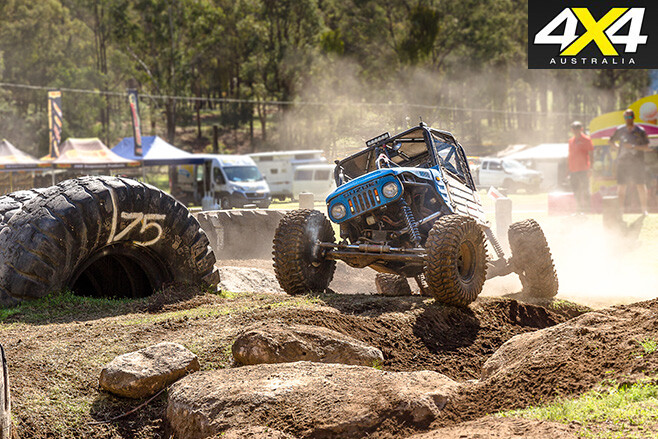
RESULTS
ULTRA 4 1. Team MRG Motorsports 2. Thorpe Motorsport 3. Team OPW
TT/WINCH 1. Anything Mechanical Motorsport 2. Remson Offroad 3. Team Hillbilly
UTV 1. Mr Diggit 2. JKS Motorsport 3. Mirror Motorsports