
BOX Rallies – Shitbox Rally Australia, Mystery Box Rally and Shitbox Rally NZ – today announced it has contributed more than $10 million to cancer research and awareness.
All funds raised from the off-road challenges go directly to the Cancer Council’s cancer research and awareness programs – while participants of the Shitbox Rally NZ can elect to contribute to either the Cancer Council or the Cancer Society of NZ.
James Freeman founded Box Rallies in 2010 following the death of his parents. Both died from cancer within 12 months of each other.
“Our lives have all been touched by cancer one way or another,” James said. “Box Rallies creates opportunities to bring like-minded individuals together for a once-in-a-lifetime adventure to tackle this terrible disease and the impact it has on the community.”
“I am very proud of what we have achieved in just seven years,” he said. “A big thank you to everyone who has supported Box Rallies in the past, present and those fundraising right now for the 2017 events.”
The Shitbox Rally sees participants driving run-down cars – worth not a cent more than $1000 – across some of Australia’s most challenging tracks.
Previous routes have included Mackay to Hobart in 2016, Canberra to Townsville via the Birdsville Track in 2015, and Perth to Darwin via the Gibb River Road in 2014.
Over the past seven years the Shitbox Rally has raised more than $8 million for cancer research, making it the largest independent fundraiser for the Cancer Council in Australia.
To qualify to be in the Shitbox Rally, supporters need to raise at least $4000.
The 2017 Shitbox Rally – from Adelaide to Cairns – begins on May 27, 2017. While the second-ever Shitbox Rally NZ will return in February next year.
VOLKSWAGEN’S Amarok V6 engine, due for release next month, will come with an over-boost function.
Mercedes-Benz launched into the ute game yesterday with the revelation of its X-Class Pickup ute, and Volkswagen has returned serve by declaring the dual-cab’s over-boost function increases power from 165kW to 180kW and torque from 550Nm to 580Nm.
The over-boost function kicks in at 70 per cent accelerator extension, with optimal boost delivered in third or fourth gear from 50km/h (lasting 10 seconds). The over-boost can be utilised again after a five-second hiatus.
“The Amarok V6 is not an over-hyped concept or a badge-engineering exercise,” Volkswagen Commercial Vehicles Director Carlos Santos said. “It’s real, it’s almost here and it brings the world’s best V6 turbo-diesel, the same unit used by Porsche and Audi in luxury SUVs.”
A press statement released by Volkswagen said the company has, as of October 26, 2016, received more than 6000 inquiries from interested customers.
Volkswagen has shifted 5972 Amarok 4x4s so far this year (September, VFACTS), which gives it a 5.4 per cent share of the year-to-date market.
The upcoming Amarok is claimed to hit 0-100km/h in 7.9 seconds and 80-120km/h in 5.5 seconds (in a controlled environment). It also utilises disc brakes front and rear.
The all-new V6 Amarok will be on sale from November 24, 2016. Stay tuned to 4x4australia.com.au for full pricing and specification details when they drop.
We’ll also let you know as soon as we’ve taken one for a spin.
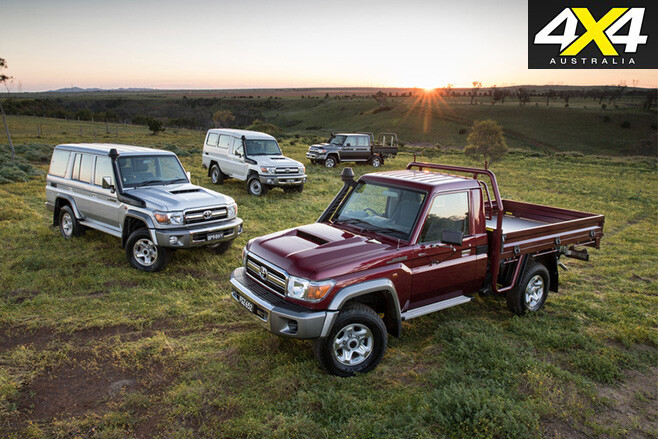
RUMOURS of the LandCruiser 70 Series’ demise have been greatly exaggerated, according to Toyota Australia, which has just released a revised range boasting significant safety improvements and other modifications that greatly enhance its touring capability.
SAFETY UPGRADES The headline act is the new five-star ANCAP-rated 70 Series Single Cab Chassis, which not only scores a host of electronic driver aids such as vehicle stability control (VSC), active traction control (A-TRC), hill-start assist control (HAC), brake assist and electronic brake-force distribution, in addition to its existing ABS brake package, but also five airbags (including two curtain airbags and a driver’s knee airbag), relocation of the steering link behind the front axle for improved crash performance, a thicker and stronger chassis with seven cross members, and new body panels.
While other variants (Wagon, TroopCarrier and Double Cab) don’t score all of the chassis upgrades, they are equipped with the full suite of electronic driver aids. They will not, however, attain a five-star safety rating, and Toyota Australia is unable to confirm whether this is a goal for these variants.
MECHANICAL UPGRADES While the 70 Series LandCruiser’s 1VD-FTV 4.5-litre turbo-diesel V8 engine is now equipped with a diesel particulate filter (DPF) and piezo-electric injectors to help improve fuel economy and reduce emissions (it’s now Euro 5 compliant), arguably the most beneficial mechanical change is to the five-speed manual gearbox which now has taller second and fifth gear ratios.
As a result, the 70 Series will now cruise comfortably on the highway in top gear at 100km/h with a tad under 2000rpm showing on the tacho. Toyota says fuel economy is improved by up to 10.1 per cent across the range.
Other changes across the range include auto-locking front hubs with a manual-locking function, a fuse box and fused battery terminal for easy fitting of accessories, and new single-piece steel rims on Workmate and GXL Troopie with tubeless 225/95R16 tyres. The addition of the DPF has meant the exhaust system has been re-routed, so the Single Cab models no longer have two 90L fuel tanks, but instead have a 130-litre fuel tank.
LOCAL ENGINEERING Toyota says that the new 70 Series has been subjected to more than 100,000km of local testing in some of the harshest conditions in Australia. Toyota Australia’s manager of off-road evaluation, Ray Munday, said that much of the local testing consisted driving in “no road” environments, reflecting the varied uses that 70 Series drivers subject the vehicle to, such as “exploration mining, and by farmers tending livestock or mending remote fence lines”.
“Buyers around the world can be confident the new LC70 will meet their toughest demands because it has been developed and thoroughly tested to overcome the extremes of the rugged Australian continent,” Mr Munday said.
“Our development and evaluation involved as many different conditions as possible – from the high country to thick mud, rocky deserts and sand dunes – everywhere from our proving ground in Victoria to the Red Centre and other outback locations.
Toyota has also developed a complete range of accessories to suit the new 70 Series, including bullbars, trays, work lamps, handbrake alert, in-vehicle monitoring system pre-wire kit, auxiliary battery kit and battery isolator switch.
PRICE CHANGES The significant improvements to the Single Cab variants add $5500 to the price, while other variants are up by $3000. Air conditioning is still an option at $2761, premium paint adds $500 and optional diff locks on Single Cab GX and Double Cab Workmate add $1500.
| Body style | Grade | Price# |
| Wagon | WorkMate | $60,990 |
| u00a0 | GXL | $64,990 |
| Troop Carrier | WorkMate | $64,890 |
| u00a0 | GXL | $67,990 |
| Double Cab-Chassis | WorkMate | $64,990 |
| u00a0 | GXL | $68,990 |
| Single Cab-Chassis | WorkMate | $62,490 |
| u00a0 | GX | $64,490 |
| u00a0 | GXL | $66,490 |
WE’VE assembled a few more reader-submitted 4x4s for your amusement – and hopefully they can provide some inspiration if you’re planning to upgrade your rig.
This instalment features a 76 Series LandCruiser and a short-wheelbase GQ TD42 Patrol, among a few other crackers.
For more awesome Readers’ Rigs follow the link.
What are you waiting for? Take a snap of your 4×4 and post it on our Facebook page. It might get published in the mag one day and, if we really like it, perhaps you’ll even see it on the cover of 4X4 Australia!
2014 LANDCRUISER GXL 76 SERIES – JAMIE PROUDLOCK
WHAT IT’S GOT: Factory front/rear lockers; two-inch OME lift; dual battery; extra 12V plugs in the back; ARB winch bar and roof cage; Safari snorkel; GME UHF; 285/75/16 Bridgestone muddies; Hema HN6; and IPF spotties. I’ve had the Cruiser since new. Best place so far was Fraser Island. Cape York is up next year.
1999 NISSAN GU 4.2TD PATROL – TONY MCKAY
WHAT IT’S GOT: I’ve had it about 15 years. It’s got all the usual mods: two-inch lift; 40mm body lift; air compressor; ARB bar; LED lights; UHF; iPad for GPS, running Hema Explorer; canopy with a sleeping area up-top and a kitchen underneath with two fridges and plenty of storage; and under-tray water storage.
1998 MITSUBISHI MK TRITON (2.8 DIESEL) – ADAM STEFANIW
WHAT IT’S GOT: It’s my first car, and it’s my pride and joy. I saved up for it since I was able to push a lawn mower to get pocket money. I bought it completely stock, and I’ve added a canopy, bullbar, winch, bar lights/spotlight, roll bars over the rear, 2.5-inch Performance Exhaust, dual batteries, and upgraded shock absorbers. It was also raised to slide 33s onto it. It’s taken me to a few locations, with many more on the list. But by far I enjoyed my recent trip to the Otway forest the most, with its awesome scenery and incredible tracks.
1988 SWB NISSAN GQ TD42 PATROL – JORDAN HILL
WHAT IT’S GOT: I’m building it to be a shorty tourer that can still take on the toughest of tracks in comfort!
1991 TOYOTA LANDCRUISER GXL HDJ80 – JOSH CROSS
WHAT IT’S GOT: Just the usual two-inch lift, 33-inch tyres, snorkel, ARB bullbar, Warn winch, and custom sliders. I’ve had it for about four years and my favourite destination is the Vic High Country.
2006 NISSAN D22 NAVARA – DAMIEN LIDDIARD
WHAT IT’S GOT: steel bullbar; 12,000lb winch; larger R200 front diff with Kazz 2way LDS; diffs and ratio change – 4.3 to 4.6; rear ELocker; two-inch body lift; two-inch rear leafs; front Bilstein shocks; rear EFS shocks; chromoly Superior Engineering upper arms; Performance suspension – h/d drag link; Calmini h/d tie-rod adjusters; DGAS; Chip It module; custom three-inch exhaust and three-inch dump pipe; EGT gauges; Cross Country intercooler; On Track Fab airbox with K&N filter; Desert Cooler radiator; -22 offset black steel rims; 285/75/16 BFGs; custom chromoly front CVs; Performance Suspension diff-drop kit; Calmini steering idler brace; Superior Engineering extended shackles; Exedy h/d clutch; and rebuilt ARP head studs. It’s also got: ArkPak second battery; Redarc solenoid and fuse block mounted in well body; fridge slide; Waeco CF65; custom drawers; Flexiglass canopy; Uniden 80-channel radio; and a 40-litre water bladder behind the rear seats. I have coin sitting there for full length custom bash plates, but I’m hesitant to book it in as I’m enjoying it not burning a hole in my pocket for a change! Best place: Bilbunya Dunes, east of Esperance.
THE new X-Class pick-up from Mercedes-Benz Vans is set to lead the one-tonne ute class in terms of performance and refinement when it arrives here early in 2018.
Previewed by a pair of stunning concepts unveiled in Sweden overnight, the ute will feature a Benz V6 engine, full time 4×4 and lockers in the centre and rear diffs as part of its off-road arsenal.
To be built on a Nissan NP300 chassis as part of a new alliance with Renault-Nissan, lower spec models in the X-Class range are expected to get the Renault 2.3-litre bi-turbo-diesel; but the V6 will be the headline act.
Only Volkswagen will also offer a V6 one-tonne ute, with the 550Nm V6 Amarok going on sale here in December. No other manufacturer is expected to join the fray before the X-Class lands.
The V6 X-Class will use Benz’s full-time 4WD system including a dual-range transfer case, making it unique in the category. VW Amarok does offer full-time 4×4 but only with single-range transfer, while some Mitsubishi Triton variants have dual-range, full-time 4WD plus 2WD in the Super Select system.
Four-cylinder-powered X-Class utes will retain the part-time 4×4 system as used in the Navara. There will be a four-cylinder petrol-powered variant, as well as 4×2 models, but these are not expected to go on sale in Australia. The X-Class will be double-cab only.
Benz will be using its own suspension under the Nissan chassis, so hopefully the X-Class will perform better than the Navara did in our recent tow and load test. Like Nissan, Benz is claiming a 3500kg towing capacity and upwards of a one-tonne payload, so it will need a heavier spring and dampener set-up than what the Navara currently has.
The X-Class will retain the Navara’s all-coil suspension design, with a live axle on a multi-link set-up at the back and independent up front; however the spring and damper characteristics will be tailored to Mercedes-Benz attributes.
Benz spokesmen were spruiking a wide wheel track for better stability, ride and handling, but couldn’t confirm how much wider, if any, it is than that under the Navara.
When asked how Benz could significantly improve on the suspension design inherited from Nissan, Dr Dieter Zetsche, Chairman of the Board of Daimler AG and Head of Mercedes-Benz Cars, compared the tweaks to the company’s Formula One racing team.
“At the start of qualifying the car may not be performing so well, but over the course of the weekend, with ongoing tuning of the product, we can create a winning car.”
Mercedes-Benz is claiming that the X-Class will be the first premium pick-up in this class and, as such, it will be jam-packed with luxury, convenience and safety features. The interior borrows heavily from C and V-Class Benzes, giving a distinct feel of the brand, while the tech and infotainment package will be class-leading.
Mercedes has its work cut out distinguishing the X-Class from its rivals, especially the Navara and Renault Alaskan which share the same architecture. X-Class’s bodywork gives it a distinct Mercedes SUV look at the front, while touches such as the chrome trims, LED lights and swept-back headlamps add a premium touch. Strip back the big wheels, rear-end treatments and added bling on these concepts and you’ll have a pretty good idea of what the production version will look like.
The two concept vehicles dubbed ‘stylish explorer’ and ‘powerful explorer’ represent two differing uses for a modern ute. The ‘stylish’ rides on 22-inch alloy wheels and highways tyres for an urban character; the ‘powerful’ sits on 35×11.5-inch muddies for a tougher, off-road-adventure look. Winches front and rear add to the style.
It’s this dual purpose usage in the market that Mercedes is hoping to capture, while adding the premium and luxury tags for which it is known.
“We will open up and change the segment of mid-size pick-ups – with the world’s first true premium pick-up for the modern urban lifestyle”, said Volker Mornhinweg, Head of Mercedes-Benz Vans. “Our future X-Class will be a pick-up that knows no compromise. Ladder-type frame, high-torque six-cylinder engine, and permanent all-wheel drive are compulsory for us. As an added value we bring safety, comfort, agility, and expressive design – in other words, everything that distinguishes vehicles bearing the Mercedes star. We will thus appeal to new customers who have not considered owning a pick-up before.”
Production of the X-Class will start in Barcelona late in 2017. Vehicles for Australia, South Africa and Europe will come from this Nissan factory. Vehicles for Latin American countries will come from a plant in Argentina.
WITH massive aftermarket support available for the Jeep Wrangler, it’s no wonder there have been some scintillating builds over the years.
So we’ve assembled five of the neatest custom builds for your amusement. Cue salivation.
V8 HEMI-POWERED JEEP WRANGLER
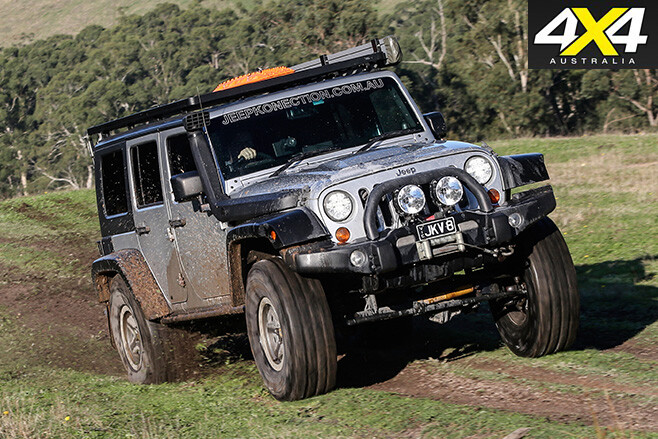
Owner Mark Clancy transplanted a stonking 5.7-litre Hemi V8 under the bonnet of his 2007 JK Wrangler. The Hemi is factory standard but still growls out 260kW/530Nm – a massive improvement on the standard V6’s 146kW/315Nm.
Other serious additions include a heavy duty Jeep/Dodge auto transmission, Dynatrac diffs front and rear, ARB air lockers, and an AEV DualSport suspension system. It mightn’t look it from the outside, but this Wrangler is packing serious off-road heat. Full V8-Hemi Jeep Wrangler review here.
JEEP JK WRANGLER RUBICON
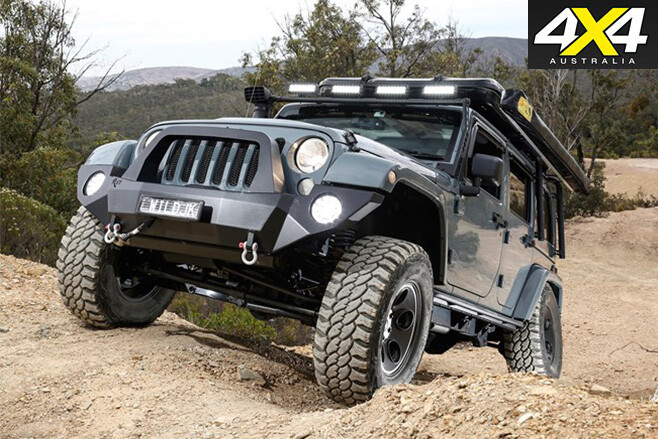
This JK Wrangler Unlimited is more special than you may think: it’s one of 30 examples that landed in Australia back in 2013. The special edition Rubicon was a serious piece of off-road kit straight from the showroom floor, but owner Jason Storace turned to AEV for an AEV DualSport 2.5-inch lift XT Suspension system.
The bar up front is from Rock-Slide Engineering, while the bar at the back is AEV. It’s also got a Baroud Explorer Evolution rooftop tent, an Eezi-Awn Manta 270 swing-out awning, and a heap more storage and camping solutions. Full custom JK Wrangler Rubicon review here.
JEEP WRANGLER UNLIMITED
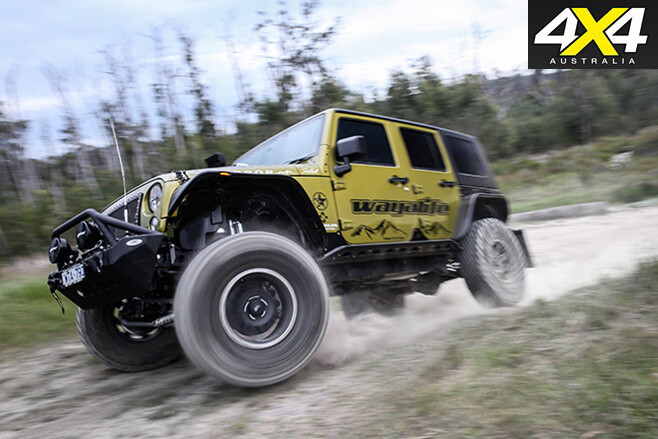
There isn’t one part of this 2008 Wrangler Unlimited that hasn’t been fiddled with by owner and creator, Andrew Speedie. First off, Andrew bolted a Magnuson supercharger to the 3.8-litre V6 engine which has seen a 40 per cent spike in power and torque at the wheels. Then he added a Rubicrawler reduction box to the Jeep four-speed auto and transfer box.
It’s also got a pair of Dana 44 diffs with Eaton locker centres. Aftermarket suspension has given the Jeep a 3.5-inch lift. It’s a fully decked-out remote-area tourer that’ll take you anywhere! Full custom Jeep Wrangler unlimited review here.
JEEP WRANGLER JK-8 UTE
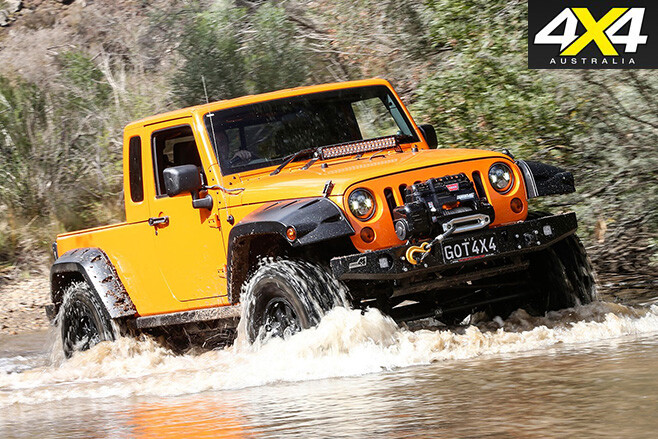
If you’re a Jeep fan but you prefer a tray on the back then check out JK-8 pick-up conversion kit that’s sold through Mopar, Jeep’s performance and accessories arm.
This is exactly what Autobody Prestige proprietor Wayne Bernhard did. This rig started life as a 2007 Rubicon-spec Wrangler Unlimited, but after six to eight months it became a bright orange JK-8 pick-up. Much of the Rubicon gear is carried over, but to achieve the right suspension set-up, Wayne dropped in AEV springs front and rear. Full Jeep Wrangler JK-8 review here.
JEEP JK WRANGLER PICK-UP
This is the Wrangler pick-up Jeep should have built already – some of us can’t wait until 2018 when the production version is expected. So Murchison Products’ Stuart Murchison got on the front foot, picked up a JK Unlimited Sport, chopped the body in half behind the front doors, and fabricated a new rear panel from scratch.
The cut-and-crafted ute body is accentuated by a host of AEV products. Pick up a copy of the November issue – out now – to read all about it.
MERCEDES-Benz’ highly anticipated Pickup “The Concept” will be exposed to the world later today in Stockholm, Sweden (3:30am tomorrow morning, AEDT).
The German brand has drip-fed teasers of the uber-classy off-roader to the public, with the above teaser video whetting appetites worldwide last week.
The Pickup “The Concept” will share its architecture with the popular Nissan NP300 Navara, but it will be tailor-made to suit the needs of Merc’s clientele – think luxury.
Expected changes to the one-tonne ute include a more powerful V6 engine and new suspension.
It’s a smart move from the Daimler and Renault/Nissan alliance, as LCVs and SUVs are taking over the Australian market.
Tony Weber, chief executive of the Federal Chamber of Automotive Industries, explains: “The trend in increased consumer preference for SUVs and light commercials was accompanied by a decline in sales of passenger vehicles by 8.7 per cent in September, compared with the same month last year.”
In fact, the Toyota Hilux (4×4 and 4×2 models) was the third best-selling vehicle on the Australian charts for September, 2016.
As this launch is only a concept, we may see changes before it hits the production line – where it will most likely be called the ‘GLT’.
We’ve flown to Stockholm to be there when the curtain drops to reveal Merc’s new Pickup, so stay tuned to 4x4australia.com.au to read all about it in full detail!
SUPERCARS Australia will be launching a new SuperUtes category in 2017.
The new entry to the high-profile Australian motorsport calendar will replace the existing V8 Utes series, which began back in 2001. It will expand on the V8 Utes series by opening its doors to all manufacturers.
“V8 Utes has been a popular and entertaining category, but with the changing automotive market it’s important that the Utes series becomes more market relevant,” Supercars managing director Matt Braid said.
“Utilising production based turbo-diesel dual cab utes currently available for sale in the Australian market, SuperUtes will open the category to a variety of new manufacturers while still maintaining the spectacular and entertaining elements that make the category such a favourite with the fans.”
This year, LCV sales have consistently risen. September 2016 sales figures released by VFACTS stated that LCV sales have increased by 17.9 per cent compared to September 2015 (while sales are up 11.2 per cent year-to-date).
Tony Weber, chief executive of the Federal Chamber of Automotive Industries, said: “The trend in increased consumer preference for SUVs and light commercials was accompanied by a decline in sales of passenger vehicles by 8.7 per cent in September, compared with the same month last year.”
A press statement released by Supercars Australia explains that the company is “working with the existing Utes competitors to transition to the new category while also welcoming new entrants”.
The 2017 SuperUtes season is planned to kick off in Townsville next July, while events are also locked away in Ipswich, Bathurst, Gold Coast and Newcastle.
THERE’S a gruesome tree on the main road between Omeo and Benambra in the Victorian High Country. It is one most people drive past without stopping, and for good reason: it stinks!
Hanging from the branches are the decomposing remains of at least 30 wild dogs that were shot and poisoned on the nearby property. It’s not a pretty sight, but it reflects the frustration of land owners and farmers in the region to the continual problem of feral dogs and the lack of support from the authorities on the issue.
All over Australia our farmers are under attack from mobs of wild dogs. Despite the National Wild Dog Action Plan being launched more than two years ago, it seems it is not getting any better. The economic costs are staggering, with estimations in excess of $33 million annually – and that’s just in Queensland alone!
Just a few months ago a new bait – known as PAPP – was approved and released for use against feral dogs. Supposedly faster-acting and more humane than the current most-used poison, 1080, the new one costs three times as much and is severely limited in its use by government regulations. 1080 will still continue to be used, while in some states strychnine is allowed.
No matter how effective the new bait will be, the additional weapon against wild dogs will come too late for many farmers. One Victorian farmer recently reported that from a flock of 500 breeding Merino ewes, just nine remained when it came time to shear. With figures like these, it’s no wonder many farmers are deciding to get out of the industry.
I’m not a great lover of baits or poisons to kill any animal. Having been on-site when a friend lost his pet dog to bait, I can say it’s not very pleasant when a faithful companion dies in your arms. However, there is currently no better way to control wild dog populations. While some shires and councils are pleading for more dog-proof fencing and dog trappers to be used, their protestations are falling on deaf ears. So it then comes back to private land owners to do more.
Confusing the issue is that pure-breed dingoes are protected, but hybrid dogs aren’t – in the bush they are hard to tell apart. Most states try to get around this by stating dingoes in parks and reserves are protected, but those out in the adjoining farmland are not. Regardless, it still muddies the water and gives credence to the often-stated comment that parks are simply breeding areas for wild dogs.
For travellers wandering the bush it pays to take care, especially if you take your pet dog with you. Heed the signs no matter where they are. If you’re in farming country don’t let your pet roam free – farmers will most probably shoot them on sight! Fox and wild dog control measures are also widespread throughout our forest and park estate, so don’t let your favourite pooch become a victim to bait.
Mahindra’s Pik-Up shares more in common with Toyota’s venerable LC79 than you might think.
However, a massive difference between the two is the price discrepancy. The Pik-Up in this video comes with a drive-away price of just $32,990; the LC79 a whopping $74,290.
But it wouldn’t be fair to compare the two toe-to-toe; what with Toyota’s far greater reputation, dealer network and durability. Instead, this comparison is designed to find out whether the Toyota is really $40K better.
The Cruiser’s 4.5-litre 1VD-FTV generates enormous torque – 430Nm from 1200-3200rpm – and more potential power at 151kW. This is hamstrung by a very low-geared five-speed manual.
The Pik-Up’s modest AVL 2.2-litre four-pot common-rail turbo-diesel growls out 88kW and 280Nm. It might lack the Toyota’s considerable urge, but it can still tow up to 2.5-tonnes and haul a one-tonne payload on its back – not at the same time, of course.
Both sit on a ladder-frame chassis, but the Cruiser utilises a coil-sprung live front end; the Mahinda opts for torsion bars.
Watch the video to see how the budget-priced Indian off-roader fronts up to the all-time, crowd-pleasing Cruiser. We test them on highways, dirt and tricky off-road tracks. Plus we even strap a 400kg load to their backs.
Also, grab a copy of 4X4 Australia’s December issue – out November 11 – to read the full review.