
It’s hard to beat cooking with fire, and the Campman Jnr is hands-down one of the best ways to do it.
Our test unit was made by Hilltop Heaters, a small operation that makes them from scratch. It was designed in conjunction with The Camp Man, who’s currently a few years into the big lap – that’s right, a few years!
So it’s no surprise it’s one of the most practical, well-thought-out little cooking systems around. Why do I say that? Well, it’s fairly lightweight and portable for what it is, and it can bake, roast, smoke, boil and barbecue like a champion.
As with any open fire, getting it going consistently can take some preparation time and patience. This means perfecting your cooking temperatures can also be a bit tricky if you’re fresh into camp school.
Being fairly small in stature means it’s hard to get a long-lasting fire going, so you do need to keep feeding wood into the fire, or add a few heat beads to the mix, to help maintain a consistent temperature.
The hot plate is nice and thick, so it holds the heat well. Plus you can wrap everything in aluminium foil, so there’s virtually no clean-up required.
When you think about it, this system is basically a camp oven and hot plate all in one, with the added benefit of a self-contained fire pit which won’t cost you a cent to run – that’s unless you can’t find any kindling to get it going. How’s that for versatility?
Versatility: 4/5 Running cost: 4/5 Set-up (time and difficulty): 3/5 Weight and ease of storage: 3/5 Clean-up and maintenance: 5/5 Strength and durability: 5/5 RRP: $235 Info: Search Hilltop Heaters on Facebook
I’ve got the latest piece of survival gear. It sits under the back seat of the Patrol, ready for use if and when I need it and it could save my life.
This article was originally published in the April 2014 issue of 4×4 Australia.
What is it? It’s a HydroPack — a revolutionary ‘forward osmosis’ desalinator and purifier that not only removes viruses, bacteria, heavy metals and cysts, but also salts in water that contains up to 2000 to 3000 parts per million (ppm). There’s also a kit that will do saltwater. These single-use pouches never block up, require no maintenance and do not require pumping or any labour.
Devised and developed in the USA by Hydration Technology Innovations (HTI), these units are now available in Australia through HTI Australasia.
In addition to the HydroPack, there are a number of other emergency hydrating pouches and seawater desalinators, along with bigger units such as the Expedition (a back pack type unit) and the HydroWell (a jerry can unit) that can be used to produce up to 2700 litres of drinking water.
Each HydroPack comes with six pouches, which are pre-filled with a flavoured osmotic agent.
When it’s fully hydrated from any water source, it becomes a highly safe and pure electrolyte enriched drink. The pouch itself is the forward osmosis membrane that allows it to draw in water and reject even the harshest contaminants.
Each pouch supplies 355ml of drinkable fluid after 10 hours of immersion in any water supply.
We thought we’d give the HydroPack a test with some muddy and animal polluted water from a stagnant overflow on a farmer’s dam.
The water smelt terrible and didn’t look too appealing but we grabbed a bucket full and dropped in the pouch. Hours later we pulled the fully hydrated pouch out, wiped it down and took a sip.
It looked and tasted just like a sports drink and after another 10 hours I was still standing with no effects from drinking what was originally polluted water.
We also tried the SeaPack pouch designed to filter seawater and produce 500ml of drinkable fluid.
Seawater has approximately 30,000 to 50,000ppm of salt, while humans prefer 100 to 500ppm (anything under 1000ppm is considered ‘fresh’).
We took our sample of seawater from the shallow saline waters of the upper reaches of Westernport Bay in Victoria, which I’m guessing has salt levels in the upper band for seawater, so it was an ideal area to test the packs. After two simple steps to set up the pouch, we simply dropped the pack into the water.
After 10 hours we had a flavoured drink to enjoy, which tasted better than the fluid from the HydroPouch — that was more to do with the flavouring than anything else.
I would have preferred plain water (for a cup of tea?), but in a survival situation, a sports drink that replenishes body salts probably makes more sense.
RATED
We say: Long shelf life; safe and easy to use when you need it. Could save your life! Contact: www.htiwater.com.au
CAMP cooking is one of the best parts about camping and, trust me, I love a good feed.
These days there are bucket-loads of options when it comes to buying cooking gear. Seriously, there’s so much more than butane cookers to choose from these days, and some of these concepts will bring a tear to your eye!
Over the coming day’s we will be testing different cooking concepts, telling you all the hidden pros and cons you can only find out by using the gear.
First on our list is the Baby Weber Q.
One bit of kit that has gained plenty of popularity among campers these days is the Baby Q from Weber. Put simply, it ticks a heck of a lot of boxes for the keen travelling camper.
It’s basically an oven and a barbecue in one, and it’s the perfect size to cater for everything from a couple to a whole family. Seriously, this little beauty will cook everything from a leg of lamb or a full chicken to kebab sticks, pizzas and snags. You can even bake scones or a pudding if you want. You can live off this bad boy for breakfast, lunch, dinner and dessert, and the only extra bit of cooking gear you’ll need is a stove to boil something up.
It’s about as efficient as they come. In fact, don’t be surprised if a 4.5kg gas cylinder lasts you an entire trip to the Cape and back again – it did for me and that was cooking on it every night, with plenty of pancakes and melted cheese on toast in the mornings, too!
The unit is quite compact, which makes it portable. Cleaning is nice and easy if you keep on top of things, but the lid gets pretty dirty as it always needs to be in the down position when you cook to generate enough heat, which can be annoying. That said, after the dog knocked it off the table half a dozen times it’s still going strong, so it’s pretty resilient. And if placing it on a table and hooking the gas up sounds like too much hard work, fitting this unit to a slide on the camper will make things so easy it’s almost cheating!
If it’s versatility, efficiency and reliability you’re after, the Weber Baby Q is a dead-set cracker.
Versatility: 5/5 Running cost: 4/5 Set-up (time and difficulty): 4/5 Weight and ease of storage: 3/5 Clean-up and maintenance: 4/5 Strength and durability: 4/5 RRP: $319 More info: www.weberbbq.com.au
To celebrate its 40th birthday, ARB threw an epic off-road adventure party.
It bought, fixed and equipped four iconic 4x4s before sending them off on its ARB Off-Road Icons trip. We were lucky enough to score an invitation.
For more info on the vehicles we took to the Simpson, check out the ARB Off-road Icons.
Here’s how the adventure unfolded.
RAIN DREAMING THE Supp Regs were outlined on the first morning as we munched on egg and bacon rolls atop Alice Springs’ ANZAC Lookout. Sam Boden ran through the route, which would see us travel from Alice Springs to Chambers Pillar and then on to Mt Dare, before traversing the Simpson Desert via Dalhousie Springs, the French Line, the Rig Road, Knolls Track, back on to the French Line, Poeppel Corner, the QAA Line, and on to Birdsville.
The plan was to then head to Cordillo Downs, Coongie Lakes, Innamincka, Burke’s Grave, the Burke and Wills Dig Tree, Cameron Corner, Tibooburra, Milparinka, Packsaddle, Silverton, Eldee Station and then on to Broken Hill, where the trip would officially conclude some two weeks after it began… weather permitting.
The sky was grey with ominous-looking clouds as we departed Alice Springs, and the weather forecast wasn’t great; a series of cold fronts were pushing their way across Central Australia from the southwest and they were supposedly going to bring plenty of rain. However, the skies began to clear as we headed out of Alice Springs on Old South Road and hit the gravel for the first time.
As the crew began to familiarise themselves with the vehicles, there was plenty of radio chatter. The occupants of the FJ40 were already wishing they’d packed earplugs, with the windows rattling furiously in their doors and the loose tailgate adding to the cacophony. The ambience inside the Defender was much calmer – although by today’s NVH standards it was still appalling, with rattles, squeaks and groans emanating from just about every part of the vehicle, except for that new 300Tdi engine which sounded fantastic and was blessed with copious amounts of low-rpm grunt.
The GQ Patrol and the LN106 Hilux were positively serene by comparison – with windows up and air conditioners on, noise levels inside these two Icons weren’t that far off modern-vehicle standards.
We stopped off at Ewaninga Rock Carvings on the way south where there is the Northern Territory’s highest concentration of petroglyphs. An information sign here includes a quote from a local regarding the ‘Rain Dreaming’, which states: “Big storm through here, big mobs of thunder and lightning and all that…” Considering the weather forecast, I thought maybe this could be a sign of things to come.
By the time we arrived at Chambers Pillar the sky had once again started to fill with clouds. There was still an hour or more of light as we rolled out our swags for the first time and set about unloading the firewood we’d collected earlier in the day. As we got the fire going, Vicky cooked up our first meal, while Patrick cracked open a bottle of single malt whisky to celebrate the start of a new adventure.
Of course, this was all washed down with the obligatory ration of beers and then, after dinner, a few of us took the opportunity for a night-time walk around Chambers Pillar, just as it started to rain.
The sky was cloudy again the next morning, but the rain had stopped – in fact, there had only been a light sprinkle overnight – and the clouds began to vanish as we ate brekky. After a stint in the Defender the previous day, I opted to go for a run in the GQ Patrol this morning; I had been itching to reacquaint myself with the Patrol after having driven it in standard form more than a year earlier. Now, with its aftermarket turbo and new Old Man Emu suspension, it was a far cry from the tired old beast it once was. It positively hauled!
We headed back out to Maryvale and then on to the Ghan Heritage Road, which became more and more corrugated as we headed south; in fact it was starting to feel a little uncomfortable in the Patrol, so it must’ve been positively diabolical (and deafening) in the rattly old FJ.
We had reached the Finke River by lunchtime, where we pulled up to regroup the convoy and have a bite to eat. I jumped into the LN106 Hilux after lunch and was amazed by the lack of squeaks and rattles despite the relatively poor condition of the road, including the final section of whoops on the Finke Desert Race track into Finke. Toyota’s build quality in the mid-1990s was second-to-none, and this Hilux was built in the middle of that period. It was also very well-prepared for this trip by Roger Vickery’s ARB Queensland team.
We pushed on towards Mt Dare thinking that the final muddy section just before the pub might be a bit tricky. Earlier in the day we’d chatted to some people who’d just left Mt Dare and they said it was a struggle, and the mud covering their vehicles seemed to confirm this.
Nevertheless, we made it through the wet section easily enough and were soon chin-wagging at the bar with hotel proprietors Graham and Sandra Scott. They told us to expect some more rain overnight and organised for a sheltered area to be cleared where we could roll out our swags.
After another light overnight drizzle, it was quite a challenge trying to walk around a muddy and slippery Mt Dare in the morning. However, by the time we’d had breakfast, refuelled the vehicles, and packed and loaded our gear, the sun was out and the ground had started to dry.
INTO THE DESERT WITH only a relatively short drive to Dalhousie Springs we could afford a leisurely start, and it was 10.30am by the time we departed Mt Dare. We stopped off for a look around Bloods Creek Ruins, where a fellow by the name of Gillen stopped in 1901, describing the pub here as “a miserable little store eating house and grog shanty kept by a man named Harvey; found half a dozen men there including the proprietor all more or less drunk – principally more.”
After the settlement was abandoned, Bloods Creek was leased to Edmund (Ted) Colson in 1931, the first European to cross the Simpson Desert. He was accompanied by Eringa Peter (Peter Ains) of the Antakurinya tribe, and in 1936 the pair completed the 885km round trip from Bloods Creek to Birdsville and back in just 35 days. He was apparently prompted to cross the desert by an ‘exceptionally wet season’, which sounded very similar to the conditions we were now experiencing 80 years later.
We were soon confronted by our first deep-water crossing. The petrol-powered FJ40 didn’t like it at all, and as soon as water splashed up into its engine bay the fire went out. After towing the FJ out of the drink with the Patrol, we dried the distributor, coil and leads and soon had the engine purring again. The other vehicles all made it through okay, but the deep water certainly tested the Defender’s door seals, which failed entirely to keep water out of the cabin.
After a few more wet and muddy sections we arrived at Dalhousie Springs in the mid-afternoon to find we had the place to ourselves. Not another visitor in sight… nada. After rolling out our swags we did what everyone does when they first arrive at Dalhousie Springs: we went for a dip in the warm waters of the mound springs, heated to a very pleasant 34-38°C by the ancient waters rising from the Great Artesian Basin.
We floated around for a couple of hours, discussing the adventure so far, how we thought the vehicles were performing, what the weather might do, how fortunate we were to be here, and what Vicky might be preparing for dinner. Yep, we were having a hell of a great time so far. The menu that night far exceeded anyone’s expectations: fresh oysters for entrée and a selection of kangaroo, lamb, beef and emu for the main course. Scrumptious.
Knowing we were about to spend the next three days in the desert, the following morning a few of us took the opportunity to indulge in a final swim in the mound springs. We were fed, packed and ready to roll by 9am and were soon on the move.
We’d only driven around 30km along Spring Creek Track when the convoy was called to a halt. The trailer had suffered its first major mechanical failure.
The centre pin had broken on the right-hand leaf pack and a couple of leaves had fallen out. As a result, the axle had moved and the tyre was rubbing on the guard. Luckily the boys had thought to pack a spare leaf spring pack and, with the help of ‘expert’ onlookers, David Cox sorted the problem while we whittled away our idle time by fitting sand flags and drinking freshly brewed coffee – all in all another very enjoyable morning.
The trailer issue had put us slightly behind schedule and it was 2pm by the time we pulled up at Purni Bore for lunch. It was a sunny afternoon and the mercury was nudging the mid-20s, which was about perfect considering two of the vehicles – the FJ40 and Defender – were not equipped with air conditioning. Their white roofs, vertical glass and excellent ventilation flaps, however, proved more than adequate on the cooling front.
Later that afternoon we arrived at the desert-proper and crested what looked like could have been the first of the claimed 1100-plus parallel sand dunes that make up the Simpson Desert. By this stage we had dropped tyre pressures to around 16psi and were soon heading south on Rig Road. We pulled up the convoy at 6.30pm and set up camp under clear skies.
Patrick asked Michael to get a shot of the Defender on a dune with the full moon in the background, and the resultant pic is definitely one destined to go ‘straight to the poolroom’.
Michael, Adam and I then headed off-piste to recce a suitable spot for a sunrise shot the next morning and, after enjoying a dune-top coldy, we headed back down to camp where an inviting fire was already ablaze. That night we spotted the first wispy white clouds pop over the western horizon, but Outside’s Wes Siler assured us there was no rain in them. As the night wore on, however, Wes’s wispy white clouds were replaced by sinister-looking rain clouds and, sure enough, it rained consistently throughout the night.
When my alarm went off at 5am the rain had stopped and, despite the overcast sky, Michael, Adam and I still attempted the ‘sunrise’ shot we’d recced the previous evening, setting up the Defender atop the dune and waiting in vain for the sun to break through the clouds. It didn’t, so we spent most of our time that morning trying to keep a very expensive video camera dry with our jackets, while drinking coffee and watching the campsite below slowly come alive as people reluctantly crawled out of their cosy swags.
We joined the rest of the crew for breakfast and then set about packing up camp in the drizzling rain. We were on the move by 8.30am – our earliest start thus far – and as we continued east the rain started to ease. Nevertheless, the track was very wet in sections and quite muddy, so the convoy’s pace was limited by the FJ40, which had to be idled through the wetter sections for fear of getting water anywhere near its electrical system.
Once past Lynnies Junction, we were at last into the sandy section of the WAA Line. We turned off at Erabena Track and headed south to Lone Gum where we stopped for lunch, after which we headed back up to Rig Road and pointed east again.
I was driving the Defender at this stage and was becoming quite annoyed by the constant sounding of the thermo alarm. The engine certainly wasn’t overheating, but the alarm sounded nonetheless. I popped the bonnet to see if I could see what the problem was, and when Fred Williams wandered over for a quick squizz he soon spotted the offending loose wire connection. It’s amazing what you can do with a couple of cable ties: he jammed a part of one in the dodgy connection and used the other to secure it all together.
Now I could enjoy all of the Defender’s rattles and squeaks and groans without that incessant bloody alarm.
We turned left on to Knolls Track and were heading north again, thinking we’d have enough daylight to make it back up to the French Line to find a suitable campsite for the night. But the going was quite rough, with lots of undulations testing the suspension on all of the vehicles. In fact, Sam Boden had pulled over to adjust the BP-51s on his Toyota Hilux, upping the front compression damping to smooth out the ride. Soon after we heard a call on the UHF from the tucker truck; it seemed we had another trailer problem.
This time the trailer’s coupling had failed – it had broken clean off! So we decided where it lay stranded was the perfect spot to set up camp. While David and Mark set about cleaning the coupling, we grabbed a couple of batteries out of the other vehicles for the boys to power the welder. While they made the repair, Vicky cooked another fabulous meal right where the trailer lay stranded in the middle of the track.
We had to make up for lost time the next day, and once again Michael was keen to grab a sunrise dune shot, this time of the FJ40. Patrick and I jumped in the FJ and followed Michael and Adam north along Knolls Track at an agonisingly early 4.30am. It was still dark when we found a clear-enough dune to shoot on; with all the rain the desert was heavily vegetated, so finding a clear dune wasn’t easy.
The rest of the convoy was underway by 6.30am and we could soon hear them approaching via their chatter on the radio. I offered Michael a drive of the FJ40; despite his lanky frame hardly fitting in the cabin, he couldn’t resist the opportunity. He just about had to open the driver’s door to make enough space to move his foot across to the brake pedal. Adam and I could hear Michael and Patrick laughing their way across the dunes, but then the UHF went silent. The FJ40’s fire had gone out again, but this time there was no water crossing to be blamed for the stoppage.
The rest of the convoy was soon with us, and on seeing the FJ40’s bonnet up they swarmed around like moths to a flame. David Cox soon had the multimeter out and discovered there was no power coming out of the coil. Several attempts were made to locate the fault, pulling wires off several components, reattaching them, and trying just about everything we could think of but, after close to two hours in the one spot, we had to admit defeat.
We were still 230km from Birdsville and we were going to have to tow the FJ40 the rest of the way across the Simpson Desert. This was really starting to become a proper adventure.
ARB’s Off-Road Icons trip continues next month!
Must-bring items for when you camp with the kiddies.
ATTITUDE: Yeah, that sounds like an odd piece of “gear”, but it’s key to success. If you approach the whole subject of camping in even a slightly negative light, your children will pick up that vibe and be wary and unsure. 4×4 touring and bush camping is serious fun – and the parents’ attitude and how they talk about any potential camping adventures should reflect that. Keep it fun and light-hearted and they’ll be keen for life.
FIRST-AID KIT: There’s no more injury-prone group of humans than young children, so brush up on your first aid by completing both a general course and also a remote first-aid course. These usually take place over a few days but are brilliant and could, if the worst happens, be a life-saver.
CAMERA: As mentioned in the story, if there’s one digital appliance that should be a part of your children’s camping kit, it’s a camera. Every child wants to see and remember their camping adventures via images – and they also want to be able to print them out to show their classmates for show ’n’ tell.
CAMP BOX: A box that contains all of your kids’ ‘special’ camping gear is a must. It serves a few purposes, including ensuring that all their gear stays in the one place, so it’s easy to grab and pack in the vehicle if you decide on a last-minute camping trip. It also teaches your kids to look after their gear; having them pack it, unpack it at camp, then pack it for storage afterwards instils the idea that all the kit inside their box needs looking after – and also provides maximum fun when they’re out in the bush.
SERVICED VEHICLE: You really, really don’t want to be stuck roadside with a vehicle full of your family. Nothing will kill the enjoyment of a bush camping trip than an unreliable 4×4. Keeping your rig close to trip-ready throughout the year (for shorter camp adventures), then getting a full pre-trip inspection before any longer, more remote trips will take a load of worry off you and your family’s minds. You won’t regret it.
BACKUP STOVE: Gas stoves are pretty reliable these days, but there will come a day when a regulator or a hose decides to fail – and that day will most likely be just before you start cooking the first night’s meal at your campsite. Regardless of whether you’re towing a camper-trailer that has an in-built stove, or you’re taking your good ol’ three-burner you’ve had for years, pack an extra stove. No stove means no food which means grumpy, hungry kids and adults. Pack an extra stove – it won’t take up much space, but it will give peace of mind.
FOR this instalment of Readers’ Rigs we’ve assembled a 2015 MU-X decked out for remote travel, a Stateside 88 Wrangler and a fully decked-out Rodeo.
Check out more Readers’ Rigs here.
To feature your 4×4 here, snap your 4×4 when it’s off on an adventure and then post it on our Facebook page. Your rig might even get published in the mag one day and, if we really like it, perhaps you’ll even see it on the cover of 4X4 Australia!
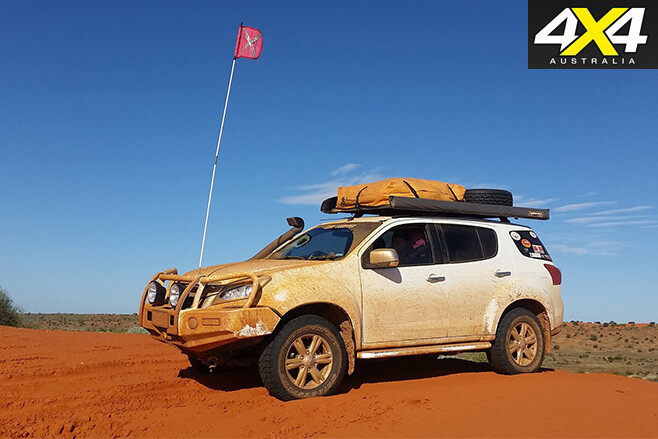
2015 ISUZU MU-X – DION KNOWLES
WHAT IT’S GOT: It has been kitted out for touring and camping: TJM bar and steps, HID lights, upgraded suspension, Bridgestone A/T tyres, long-range tank, custom fridge slide, underbonnet dual battery, brake controller, GPS and reverse camera, Rhino Rack platform, canvas seat covers, and Sandgrabba mats to keep the kids at bay.
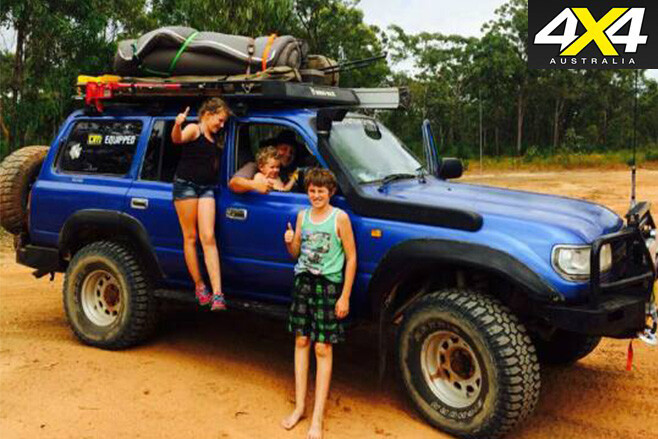
1991 TOYOTA LANDCRUISER – ROSS FLETCHER
TELL US ABOUT IT: I have had it 14 years. It’s fully engineered with a four-inch lift, Dobinson coils, Tough Dog big bore shocks, Snake adjustable upper lower trailing arms, Superior drop arms, Snake drag link, ARB air lockers sitting on 35s, Big Horn’s powerful front and rear (dual tyre carrier for back) bars with brush rails and rock sliders, Fox Wing awning, Rhino full roof basket, Safari snorkel, rear outback drawers, MSA drop fridge slide, Waeco cargo barrier, LED lights, Alpine in-dash DVD, and a 19-inch drop-down LCD. I also have an eight-inch lift kit with 38s, but it’s a bit over the top. Best places: Cape, Tasmania and Fraser Island.
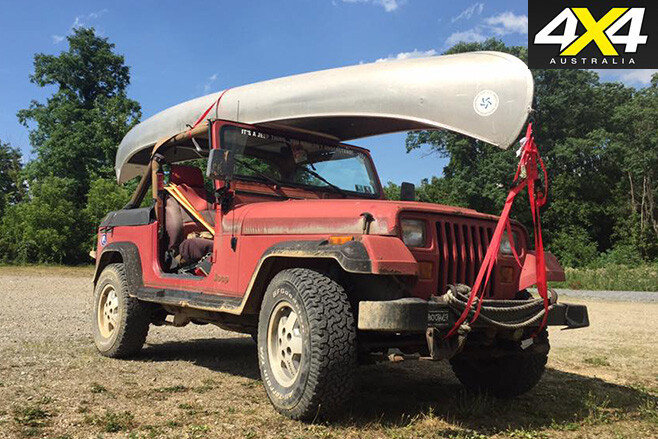
1988 JEEP WRANGLER – DAVE DEVILBISS
WHAT IT’S GOT: I’ve owned it since it was new in 1988. I’ve lived in California, Virginia and now in Pennsylvania. We used to take it down to the Mexican Baja Peninsula, Tijuana, Ensenada and Rosarita. There were some dunes along the coast. I hope to make it to Australia someday. Your Facebook posts make me jealous of the beautiful open spaces to wheel down there.
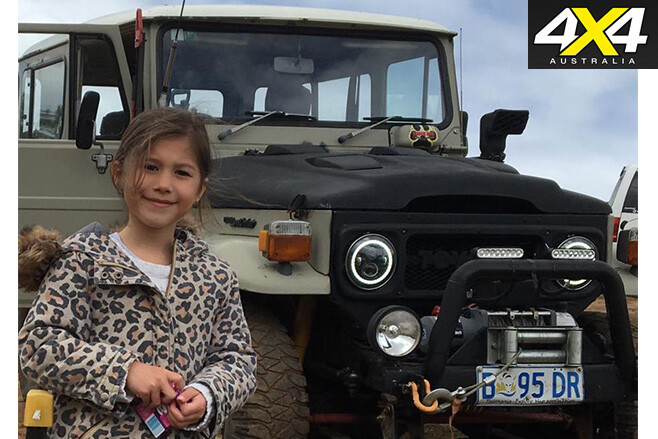
1979 TOYOTA LC FJ40 – PAOLO RONCAL
WHAT IT’S GOT: A 5.0-litre fuel-injected V8 engine. I’ve owned the car for five months. Photo was taken at Jakem farm, which is a 4×4 park in Adelaide. I’m most impressed by the performance.
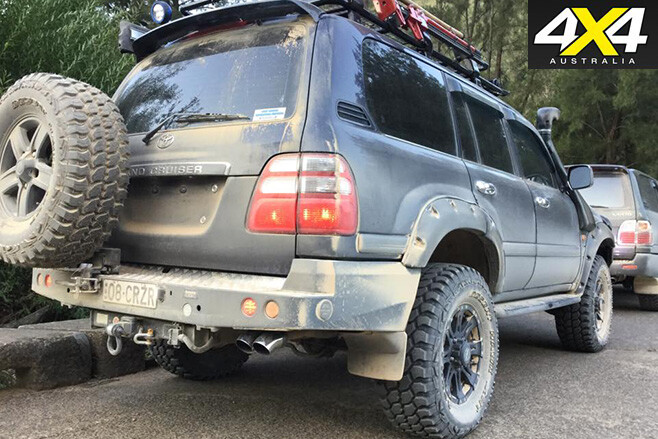
TOYOTA LANDCRUISER – ROSS TURRISI
WHAT IT’S GOT: Picked it up from Canberra about a year ago. It’s been a great car. It is locked front and rear, ARB air lockers, three-inch lift with SPC upper control arms, springs and shocks by Bilsteins, front bar by Roo, rear bar by MCC, it runs 305/70/17 XMT Achilles tyres, customised rear drawers, Waeco fridge, and Easy drop slide. The best place I’ve been would have to be the Vic High Country. I’m planning a trip up to Fraser Island for Christmas.
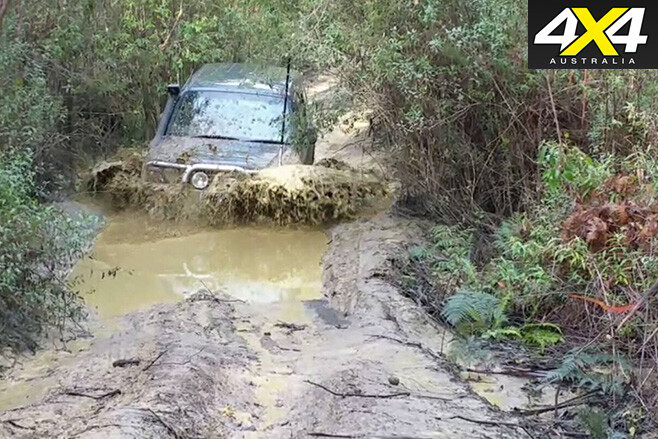
2000 MITSUBISHI PAJERO NM 2.8TID – JULIAN ASHLEY FULLER
WHAT IT’S GOT: It’s fairly early in the production run, so panels are in good shape. I’ve had it just on two years and it was less than stock when I bought it: gaping hole in the dash where the stereo was removed, shot wheel bearings and injectors. It benefits from the Torsen limited slip rear diff that was only introduced for this model run and gives it an edge over the usual clutch and cone set-ups. I’ve upgraded it with a two-inch lift on King Springs, 300kg constant in the rear, TJM Airtec snorkel (it has a nice loop instead of the 90deg corners seen on some units), Oricom in-dash UHF mated to their town and country antenna pack, and Bridgestone M/T 674s. Interior lighting has been upgraded to LED as have the incidental external lighting systems, excluding headlights. So far the best place I’ve taken it is over to the West Coast of Tasmania. Next year it is either The Cape or Fraser, I haven’t decided yet. Wish List: more bar work, long-range tank, rear storage system and awning.
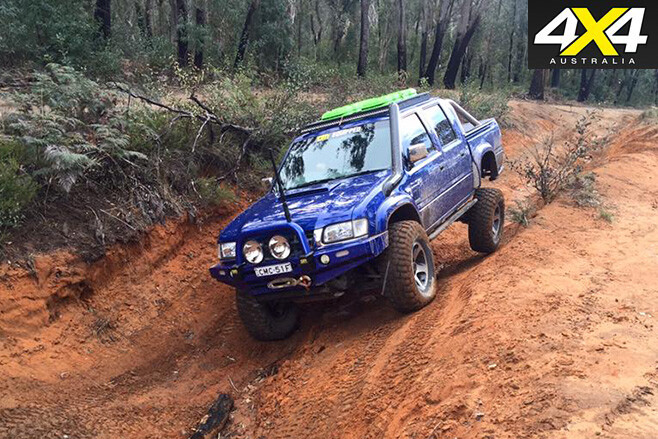
1998 HOLDEN RODEO – DAN BALDOCK
WHAT IT’S GOT: I’ve put loads of custom work and countless hours into it. I love being different and showing the ‘bigger’ trucks that the underdog can do it, too.
It was a 2WD work truck with a V6 mated to a five-speed transmission. It had low kilometres, but it was hail-damaged when I got it cheap at auction. I converted it to 4WD via a Rodeo front diff and gearbox/transfer case. At that time I also fitted an HD Exedy clutch. I’ve had this for about seven years now and mods started pretty much the day I got it home. I did 100 per cent of the work myself and want to keep it that way. Living so close to Lithgow the main tracks I do are around that area.
Main mods include: custom-fitted wide-track Jackaroo front suspension arms; custom 25mm bump stop spacers; custom heavy duty tie rod end links with Ford F-150 rod ends; rear is disc brake Jackaroo diff with all the coil mounts cut off; rear springs are sprung over with a mix of D-Max and Rodeo leaves with custom extended shackles and increased angle to help flex; three-inch body lift; 12000lb winch with TJM 12mm rope and locking clevis hook; and a heap more!
MANUFACTURERS inviting us half way across the country to see their latest and greatest releases isn’t really out of the ordinary, it’s standard fare for a vehicle launch and gives them the opportunity to tell us all the reasons why their new model will be the biggest and best thing ever sold.
But as we write this we’re still knocking red dirt out of our boots from one of the more unusual launches we’ve ever attended. Three days in the heart of the Flinders Ranges to say goodbye to the Nissan GU Patrol.
First introduced to the market nearly 20 years ago, the GU quickly earned a reputation as a serious workhorse, especially when opted with Nissan’s renowned TD42 turbo-diesel engine. Despite various facelifts offering new features and more modern designs, the model range was whittled down due to ever-tightening emission restrictions so that the 3.0L ZD30 common-rail engine was all that remained.
Now, with the adoption of the latest (and even stricter) Euro 5 emissions laws, the GU is dead in the water. Unable to meet emissions regulations or customer expectations without a significant (read: costly) overhaul that simply doesn’t make sense for our relatively small market. Reluctantly Nissan accepted the time had come to say goodbye. But with the Patrol playing such an important part in Nissan’s history it’d be a disservice to quietly end sales of what is arguably one of the most capable and versatile 4×4 platforms ever built.
Enter the Legend Edition.
THE LEGEND EDITION BASED on the ST Wagon platform, the Legend Edition is a limited run of 300 units in various shades of white and silver, decked out from head to toe in $10,000 worth of genuine accessories. There’s a heavy duty genuine steel bullbar which houses a Warn winch, a genuine roof rack, snorkel, tow bar, spare wheel cover and rear view camera up the back, satellite navigation in the dash, and the ubiquitous decals down the side.
On the driveline front nothing changes from the ST model, with 118kW from the common-rail diesel. The five-speed manual offers 380Nm, a braked towing capacity of 3200kg and a claimed fuel consumption of 10.9L/100km. The four-speed automatic sees significant drops across the board with 345Nm, a braked towing capacity of 2500kg and fuel consumption climb to 11.8L/100km.
Despite the various stylistic updates of the recent models, behind the wheel still very much feels like you’re in the same vehicle rolled out back in 1997. The interior feels dated and simple with a minimum of fuss and a very Spartan features list. For some people it’ll be a deal breaker, for others a deal maker. Off-road credentials are top of the market. Solid axles front and rear, and coil springs all ’round with a five-link arrangement in the rear and radius arms up front. There’s a cross-axle diff lock in the rear, auto-locking hubs up front, and a total of 125L of diesel-carrying ability. Third-row seating takes the capacity to a true seven-seater; although, rear passengers should be children or adults you don’t like.
Despite the addition of $10,000 worth of accessories the Legend Edition has a driveaway price of $57,990. Compare that to the old ST pricing of $57,390 plus on roads and dealer charges and the Legend Edition makes for one hell of a bargain.
GET IN QUICK SO IF the ZD30 Patrol no longer meets emissions standards how are they able to sell them? The long and the short of it is that every single vehicle Nissan intends to sell needed to be imported and complied before the Euro 5 cut-off date. Because of this they’ll be able to sell brand-new Patrols long after they had to stop importing them. The downside is that means that stock is incredibly limited. Not including any older GUs still sitting in dealer lots, only 300 limited Legend Editions were brought into the country and all are expected to be gone by February, 2017.
If you’ve got a hankering for some good old-fashioned solid-axle 4x4s of the Nissan variety, you’d want to be getting a deposit down very quickly.
IT’S NOT ALL DOOM AND GLOOM THE Nissan name is legendary in Australia, no pun intended, and the Patrol is a large reason for it. For the better part of 66 years they’ve been a common sight on Australian tracks. The one common theme throughout each and every model has been solid axles and rugged reliability. They were never the plush barges other makes tried to be, and they were always relatively robust.
From the early G60 Patrols right through to the GU there has always been a natural progression rather than a wild evolution. It’s because of this that the Y62 Patrol has come as such a shock. 50 years of solid axles out the window with independent suspension front and rear; the body is large, interior is leather, and the engine is petrol. It’s the exact opposite of everything we’ve come to expect from a Patrol, so it has understandably put a lot of buyers on the back foot.
The reality is, it’s a fitting replacement that perhaps says more about the previous model being outdated rather than the new one being a giant leap ahead. While hardly a princess myself, there was no denying in the steep scrabbly terrain of the Flinders Ranges the Y62 was simply the more capable and comfortable vehicle. It ate up everything you could throw its way and, after driving the new and old models back-to-back through all sorts of terrain, the Y62 would be the pick in every situation.
Some people might miss the smell of a diesel, but with an insane 560Nm available from the Y62’s V8 there’s a lot to like about the new model. Will we miss the GU? Absolutely. But the future is hardly looking dim.
This immaculate, one-of-a-kind VDJ76R was born after owner, Anthony Collins, suffered a life-altering accident.
Anthony, a trained osteopath, had a serious mountain bike accident in 2014, which left him with a severely damaged left hand. Unable to work, and with his future in doubt, Anthony hit the road.
It was on this voyage where he first heard the rumble of Toyota’s current V8 LandCruiser, and he knew he had to have one.
He also learnt on this trip of the Hay Run, so he put together the Outback Osteopathic Outreach Program. Now all he needed to get the program rolling was a Cruiser.
After acquiring this slick, black 76 Series, Anthony got to work doubling down on an aggressive black-on-black theme.
Baguley Steel Fabrication installed a black powdercoated bullbar and brush bar combo, with matching sidesteps.
For night vision, X-Ray Vision Lighting added a mixture of HID driving lights and LED spot and spread beam lighting.
ARB Jindalee provided a Kaymar twin rear wheel carrier, an ARB roof rack, a Bush Ranger hot shower and a Long Ranger fuel tank.
Redarc provided EGT and boost gauges, as well as dual batter monitors and a battery management system. All this gear was soldered into position by Sweeney Auto Electrical.
To save on space and weight, Revolution Power was approached for its super-lightweight lithium batteries. While Brandt Madsen brought to life a unique stainless-steel snorkel.
A Dobinsons spring lift and remote reservoir Fox Shocks help the rig reach hard-to-access places, while the rear track issue was corrected by Jmacx. A pair of triple-bellow Boss air bags help fight sag when the Cruiser is loaded, and the whole lot rides on 35-inch Maxxis Treps.
Anthony can now reach any farmer in need of osteopathic treatment!
Read the complete feel-good story in the January 2017 issue of 4X4 Australia, on shelves now. Don’t forget to watch the video.
THINGS can go wrong when you’re off-roading. It’s just the nature of the beast. Travelling in modified four-wheel drives to the far corners of one of the world’s most isolated countries, and then driving the wheels off the rigs means something will eventually go wrong.
Your preparedness to act is the deciding factor between a life-endangering situation and a quick recovery. Over the past 12 months we’ve run you through not only what recovery gear you should have in your 4×4 but the ins and outs of how to use it and how to improvise when you need to.
This issue we thought we’d take it to the extreme: What do you do when you’re in the thick of it and the gear you need fails? A busted winch, a failed snatch strap or a seized high-lift jack can all leave you stranded if you’re ill-prepared.
SITUATION 1: SNAPPED SNATCH STRAP
A SNAPPED snatch strap is common. Over time the fibres in the weave can weaken and fray, which is why we always refer to them as a consumable item. If you notice your snatch strap has fuzzy edges or visible damage and you head off anyway, then you’re a peanut. That said, sometimes things happen. If you’re axle-deep in mud and you’ve just snapped your last snatch strap you can do a field repair to get it back in one piece. Is it recommended? No. Will it work as a permanent fix? Not even close. Will it allow you to continue the recovery when you’d otherwise be stuck? Yes.
The technique is known as a water knot and is used when flat straps need to be joined. You’ll lose around a metre of your length, cut your working load in half, and lose the rubber-band effect of a snatch strap; so once the strap is connected again it’s time to reach for the shovel. Think of your patched-together strap as a tow strap and you’re on the right track
SITUATION 2: SNAPPED WINCH ROPE
THERE are about three million reasons why rope is a better option than wire for a 12V winch – in fact, its only downfall is that it doesn’t hold up to abrasion as well as steel cable. Joining winch rope together is incredibly easy, and it’s the technique used by manufacturers to put loops in the end of rope to hold a bow shackle or hook. While it might look solid, winch rope is already made of individual strands all entwined together with a hollow core. If you grab a section of rope and bunch it up you’ll see not only the hollow core but that the individual strands separate. It’s these separations, and the hollow core, that you’ll take advantage of.
The process is simple. Overlap the two lengths by around 300mm. Weave one in and out of the other at 30mm intervals three times before opening the centre up and sliding the tail inside. Repeat the process on the other end. A hollow pen tube taped to the end of the rope will let it slide easier.
SITUATION 3: BROKEN BOW SHACKLE
A BROKEN or lost bow shackle isn’t exactly a common situation. They’re incredibly strong, so you’ll generally be fine. That said, they play an integral part of a winch or snatch recovery, and without them you’re dead in the water. So, what do you do if you don’t have one? The solution is relatively easy; although, you’ll lose 1.5m of winch line for the fun of it.
Run your winch line out and (remembering the splicing technique from before) lop 1.5m off the end before splicing in a new loop. With the length you’ve cut out you can make a soft shackle. Essentially the technique involves halving the rope and then feeding one length through the other, then popping it out halfway to make a lanyard knot. The outer sheath can slide, opening and closing the hole. It’s simple stuff, but best practiced beforehand. The tighter the knot, the stronger the shackle will be. They won’t work as well as the store-bought options, but done right are more than strong enough for a recovery.
SITUATION 4: SEIZED HIGH-LIFT JACK
There’s not a lot that can go wrong with high-lift jacks. Knock-off imports can struggle with binding due to the standard (the spine) bending and binding on the runner. If that happens you’re generally out of luck. Short of that there’s very little to go wrong, so it makes for a simple bush repair.
In 90 per cent of situations binding in the up or down direction is a case of the two climbing pins being either clogged with contaminants from use or catching on rust. Cleaning before and after use with a fresh squirt of silicone spray will prevent this, but if it happens in the bush a squirt with degreaser is often enough to get things moving freely.
High-lift jacks can be overloaded and will fail. To prevent them from crashing down there’s a sheer pin in the handle that will fail before the climbing pins. They act as the fuse, so if that blows replace it and reconsider your loads. Using a stronger bolt will make the climbing pins the weak point, which could have deadly results.
SITUATION 5: SOLENOID FAILS
An electric winch is only as good as its solenoid. Solenoids are in charge of getting power to your winch and distributing it exactly where it needs to go. When they fail, your winch is just a heavy ornament. With a little thinking you can completely bypass the solenoid with some jumper leads.
On the top of your winch you’ll have three posts: the armature (A) connection, closest to the motor end cap; and the F1 and F2, both closest to the winch body. Connect the A terminal to F1, and then connect F2 to the positive terminal on your battery. To winch the opposite direction connect A to F2 and F1 to the positive terminal. Not all winches run the same direction, so it pays to pull a metre or two of rope off your drum before testing to triple check which way is which.
With an exposed winch motor, connecting directly to the terminals is easy; if your motor is buried deep inside your bar you may need to connect to the cables running to your solenoid instead. The same process applies but will take some figuring out on the spot.
SITUATION 6: WINCH CONTROLLER FAILS
DEPENDING on the brand of your winch, the controller could rate anywhere between “sturdy as an ox” and “what the hell is this”. Unfortunately for those with the latter they’re incredibly easy to break, with a drop on a hard surface or in a stray puddle all it takes to finish them off for good. If you don’t have back-up in-cab controls, or simply can’t find your control in the first place, you’ll be stuck trackside with a working winch and no way to actually make it work.
If you’re running a winch with a modern solenoid set-up, they’re actually incredibly easy to jerry-rig yourself. Pop the cover off the control box and you’ll usually find four wires. One will send power to the controller; one will connect to the negative terminal on your battery; and the other two will send power to the corresponding terminal for winching in and winching out.
In modern solenoids the middle tab needs to be connected to the negative terminal of your battery, with positive going to one of the others.
WHAT has the ability to travel to any corner of Australia, take on tracks that’d leave twin-locked GU Patrols scratching their heads, a refined interior and more power than a Ferrari 488 GTB?
Vote for Andrew’s Supercharged Patrol to decide this year’s Custom 4×4 of the Year.
If you answered anything but Andrew Cassar’s insane supercharged 5.6L Y62 Patrol, you’d be sadly mistaken.
Watch the vid to see this Supercharged Y62 Patrol in action.
Despite being the spiritual descendant of one of Australia’s most popular 4x4s, the Y62 has had something of a rocky start. Its drastic change to fully independent suspension and petrol-only engine choice had many people scratching their heads, wondering just what the hell was going on over at Nissan.
Andrew wasn’t one of them. As the owner of On Track 4×4 Repairs in Kealba, Victoria, and a long-time winch truck competitor, Andrew is no stranger to modified 4x4s and could see the potential lurking underneath the new Patrol.
“It was between this and the LandCruiser 200 Series,” Andrew told us. “The creature comforts were better in the Y62 and it just represented better value for money. It’s a huge step up from the GU Patrol in every way and makes the current 200 Series look dated.”
If it sounds like Andrew might be a little smitten with his Patrol it’s because he has reason to. Lurking under the bonnet is Nissan’s VK56 5.6L V8 engine, delivering 300kW in stock form. This engine is that far ahead of the game there are modified versions currently running around the V8 Supercar circuit that bump that figure up to 480kW, but even they pale in comparison to the power underneath Andrew’s right foot.
“When we first got it we threw it on the dyno and it pushed out 160kW at all four wheels after drivetrain loss,” Andrew said. “We then fitted it with a Harrop 2.3L supercharger kit and had the stock ECU retuned by Harrop; it’s now putting out 350kW at the wheels.”
That’s a huge 118 per cent increase in power – and still comes in cheaper than a comparable 200 Series. You might be forgiven for thinking power like that must take a balance of modifications, but the Patrol driveline is basically stock other than the Harrop supercharger and tune and HM exhaust system. The engine, transmission and transfer case all remain unopened.
“It goes great,” Andrew said. “It sounds like a HSV, goes like a HSV. It’s comfortable, put the family in, tow the boat, do whatever you want and the fuel bill isn’t that bad considering. It’s up around 21L/100km and I drive it like I stole it!”
That’s a fair trade-off for a vehicle weighing three tonnes with V8 Supercar power. Despite this the Patrol still has a range of well over 1000km between drinks, with a 150L LRA auxiliary fuel tank taking the total capacity up to 290 litres.
While independent suspension and a host of electronic aids make the Y62 perform better on- and off-road than the older models could only dream of, the 35-inch tyres are a nod to out-and-out off-road performance. “We actually run two sets of tyres depending on use,” Andrew told us. “If we’re heading to the snow or mud I’ve got a set of 35/12.5R18 BFGoodrich mud terrains on the stock rims. I’ve also got a second set of rims with 305/70R18 Mickey Thompson ATZ P3s we’ll use for running around town or beach work.”
Between both sets of 35in tyres, the factory rear diff lock and the Harrop ELocker up front, the Patrol is a sight to behold off-road. “It astonishes me how far it goes,” he added. “I drive tracks all the time that I never thought you could get a fully independent 4×4 up and it does it with ease. I don’t miss the solid axles.”
Asking the huge Y62 wheel arches to take a 35-inch tyre was a little more than they could handle, so Andrew raised the Patrol by a full 50mm on each end. It’s riding on Old Man Emu springs with matching Nitrocharger Sport shocks on each corner.
Like most modern independent suspension set-ups, 50mm is the max the Y62 can be lifted before running into issues with alignment and angles. However, Andrew tells us it’s currently on the hoist again, swapping out the Nitrochargers for a set of remote reservoir fully adjustable BP-51s.
While the bar work may look neat and orderly it’s actually a compilation of off-the-shelf and custom, something that seems to be a running theme with Andrew. Up front there’s a colour-coded ARB Deluxe bullbar that plays host to a Magnum 10,000lb winch. Andrew ditched the stock Magnum motor and swapped it out for a 6hp unit from a Warn 9.5XP for a little more power, although he assured us it’s rarely used for anything other than clearing trees off tracks.
Protecting the Patrol’s flanks are matching scrub bars and sliders. With no off-the-shelf solution for these the team from On Track 4×4 custom-made them to suit. The rear end now looks the part, with a full rear bar from Kaymar guarding the rear quarters and carrying the spare tyre.
Getting the spare out of the recess in the rear floor wasn’t just for looks, either. In its place now resides five Fullriver 20Ah batteries for a total of 100Ah in reserve. The set-up is controlled by a Redarc BCDC 1225 charger with provisions for solar and smart start, so at the flick of a button the big Patrol can jumpstart itself. While the battery system packs more than enough power for the Lightforce 240s up front and Icom IC440 UHF inside, there’s no extensive storage system like you’d expect.
“There needs to be room in the back for a pram,” Andrew said with a laugh. “The Patrol does family duties, so it’s normally got three kiddie seats in there and the back’s full of groceries.”
If the future of 4x4s in Australia is as fully independent grocery-getters with ungodly amounts of power and ability, then it’s looking rosy.
WHAT’S IN THE NUMBERS?
ANDREW’S Patrol is fitted with a Harrop 2.3L FDFI2300 Supercharger Kit, boosting at 7psi.
The Harrop FDFI2300 kit ($10,989) is a twin rotor supercharger with Eaton’s Roots-type TVS internals. In force-fed systems there are two figures that matter: how much air is going in, and how hard it’s being pushed.
Two large rotors force 2.3 litres of air into the engine at 7.3 psi, or half of one atmosphere of pressure, for every rotation of the supercharger. More air going in equals more power. Simple stuff.
Vote for Andrew’s Supercharged Patrol to decide this year’s Custom 4×4 of the Year.