
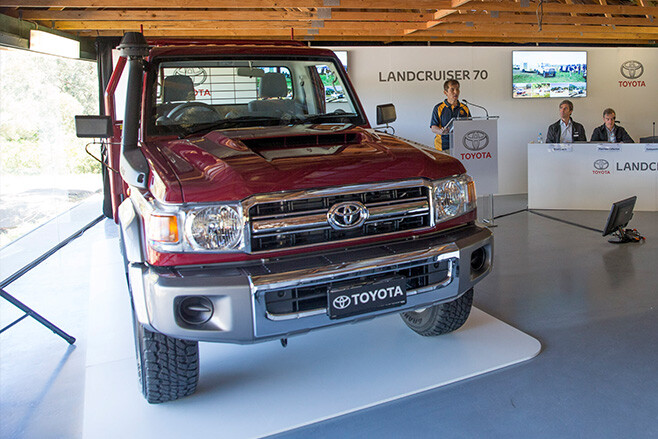
We can thank Australia’s big mining companies for giving the 70 Series Land Cruiser a new lease on life.
Back in 2012 they announced a five-star safety requirement for their entire fleets, but soon realised the likes of medium-duty one-tonne utes such as Hilux and Ranger were not suitable replacements for their heavy-duty Cruisers, so they hounded Toyota to upgrade the 70.
Meeting the five-star safety rating was no easy task, and this new LC70 has been under development for five years, with much of the evaluation and engineering taking place right here in Australia, predominantly on gravel roads and off the road. But the only variant of the 70 Series to achieve the five-star ANCAP rating is the Single Cab Chassis, which is the vehicle the mining companies so desperately wanted back on their fleets.
While the other variants (Double Cab, TroopCarrier and Wagon) don’t achieve a five-star rating, they have still benefitted greatly from several upgrades that improve safety and the vehicle’s touring capability.
SAFETY UPGRADES All new 70 Series Land Cruisers are now equipped with a full suite of electronic driver aids which, in addition to the existing ABS package, now includes vehicle stability control (VSC), active traction control (A-TRC), hill-start assist control (HAC), brake assist and electronic brake-force distribution.
Off-roaders will be happy to know that VSC automatically disengages in low range, and A-TRC can be manually disengaged for sand driving. Front and rear diff locks are still standard on GXL models and optional on Single Cab GX and Double Cab Workmate variants.
“We developed and tested the stability and traction control systems primarily on dirt roads where LC70 is driven most often,” explained Ray Munday, Toyota Australia’s manager of off-road evaluation.
“The hill-start assist has been engineered to be effective while towing and when facing a steep hill with a load in the back,” added Mr Munday. HAC also disengages after four seconds so the driver can easily reverse the vehicle if desired.
All models are now fitted with front seatbelt pre-tensioners and a passenger seatbelt reminder, while a new bonnet across the range features a more pronounced “power bulge” designed to provide sufficient clearance above engine-bay components to meet pedestrian impact requirements.
The split-rim wheels on lower-grade Workmate models have now been replaced with single-piece 16×6-inch steel wheels with 225/95R16 tyres.
Single Cab models have been given a thorough going over to attain the five-star ANCAP rating. They have thicker and stronger chassis rails, modified cross members (now seven in total), five airbags (driver and passenger, side curtains and driver’s knee), under-dash padding for the passenger, 12 new or thicker body panels including bonnet, pillars, doors and floors, new seats and a relocated steering link (to alter crash characteristics).
Toyota was unwilling to comment on whether variants other than the Single Cab would be engineered to attain a five-star ANCAP rating but, considering the amount of engineering required to achieve this, we recommend you don’t hold your breath.ENGINE AND DRIVELINE The 70 Series Land Cruiser’s 1VD-FTV 4.5-litre turbo-diesel V8 engine is now Euro-5 compliant and is equipped with piezo-electric injectors that provide better fuel atomisation for more complete fuel combustion, resulting in improved low-rpm torque delivery.
A diesel particulate filter (DPF) has also been fitted, featuring automatic regeneration for normal driving or manual regeneration for situations where the vehicle is driven at low speeds for long durations, such as in mines. Peak power and torque outputs are unchanged at 151kW at 3400rpm and 430Nm from 1200-3200rpm, but Toyota claims improved fuel economy (10.7L/100km combined cycle) and lower emissions (281g/km).
The most noticeable mechanical upgrade is to the five-speed gearbox, which has revised second- and fifth-gear ratios. Second gear is now seven per cent taller, while fifth is almost 15 per cent taller, resulting in much more relaxed highway touring, with around 1900rpm showing on the tachometer at 100km/h in top gear. The taller gearing also contributes to the improved fuel economy.
New body panels on the Single Cab variants result in improved NVH levels, while the aforementioned changes to the chassis result in increased torsional rigidity. Single Cabs also get revised damping tuned for the altered chassis.
Other changes across the range include the addition of auto-locking front hubs with a manual-locking function, and a fuse box (with a bank of 10 fuses) for safe and easy fitting of accessories.
The fitment of the DPF has meant that the exhaust had to be re-routed, so the Single Cab no longer has two 90-litre fuel tanks, but instead is fitted with a single 130-litre tank.
LOCAL TESTING Toyota says the new 70 Series has been subjected to more than 100,000km of local testing in some of the harshest conditions in Australia. Toyota Australia’s manager of off-road evaluation, Ray Munday, said that much of this consisted driving in “no road” environments, reflecting the varied uses that 70 Series drivers subject the vehicle to, such as “exploration mining and by farmers tending livestock or mending remote fence lines”.
“Buyers around the world can be confident the new LC70 will meet their toughest demands because it has been developed and thoroughly tested to overcome the extremes of the rugged Australian continent,” said Mr Munday.
“Our development and evaluation involved as many different conditions as possible – from the high country to thick mud, rocky deserts and sand dunes – everywhere from our proving ground in Victoria to the red centre and other outback locations.”
Toyota has also developed a complete range of accessories to suit the new 70 Series, including bullbars, trays, work lamps, handbrake alert, in-vehicle monitoring system pre-wire kit, auxiliary battery kit and battery isolator switch.
DRIVE IMPRESSION Our drive of the new 70 Series consisted about an hour on the blacktop (freeway and back roads) and a run around the excellent Melbourne Off Road Training and Proving Ground near Werribee, Victoria.
As mentioned previously, the taller fifth gear has the biggest impact on the driving experience, with more relaxed open-road touring. Lower revs, new body panels and greater torsional rigidity appear to combine for reduced NVH levels at highway speeds, although wind noise is still quite pronounced, especially around the A-pillar where the OE snorkel is mounted.
On gravel the VSC certainly doesn’t feel too intrusive, allowing the rear to slide around a little before it intervenes; you can sense the engineers tested this thing on gravel roads.
One change to the Single Cab that was difficult to measure was the revised damping, although the vehicle certainly felt compliant enough without a load on board. Another change that felt immediately beneficial, however, was the new seats, which offer much greater comfort and better support via improved side bolstering. Cruise control is also now standard across the range.
Off-road, the V8 still pulls like a train from just above idle, and the excellent low-range gearing combined with lockable front and rear diffs, heaps of ground clearance and fantastic wheel travel make the 70 one of the most capable out-of-the-box 4WDs on the market.
WHAT DOES IT COST? All of the new features on 70 Series come at a price, but considering the significant engineering that has gone into modernising this workhorse, the increases are not excessive. Wagon, Troopie and Double Cab models are up by $3000 across the range, while the five-star ANCAP-rated Single Cab models are up by $5500. Air-con is still optional ($2761 fitted), which is surprising considering the take-up rate is almost 100 per cent. Premium paint adds $550.
BRIGHT FUTURE Toyota engineers from Australia and Japan spent a lot of time speaking with 70 Series buyers in Australia and are well aware of the desire for the rear wheel track to be widened to match the front track, but unfortunately that wasn’t considered enough of a priority to make the list with this model update.
When queried on this Toyota didn’t dismiss the idea out of hand, so it’s possible this will be remedied in the future. And Toyota now envisages a long and bright future for the 70 Series, a vehicle that first saw the light of day back in 1985, and now doesn’t have any serious competitors in the marketplace.
“These extensive engineering and specification updates guarantee the future for the Land Cruiser 70 Series and its unrivalled combination of reliability, towing, payload and off-road ability,” said Tony Cramb, Toyota Australia’s executive director sales and marketing.
“For more than 30 years, miners, farmers, governments and many other users have turned to the go-anywhere 70 Series to traverse the most inhospitable terrain and complete the toughest jobs.
“Toyota Australia was determined to return their loyalty and, with the support of our parent company, devoted significant resources to ensure we and our dealers could continue to meet demand. The only alternative was to walk away from this model – and that was not an option.”
SPECS Engine: DOHC 32-valve V8 turbo-diesel Capacity: 4.5-litre (4461cc) Power: 131kW @ 3400rpm Torque: 430Nm @ 1200-3200rpm Gearbox: five-speed manual 4X4 System: part-time dual-range Construction: separate chassis Front suspension: live axle/coil springs Rear suspension: live axle/leaf springs Wheel/tyre spec: 225/95R16 or 265/70R16 (steel or alloy) Kerb Mass: 2175kg-2325kg GVM: 3060kg-3300kg Payload: 785kg-1235kg Towing capacity: 750/3500kg Seating capacity: 2-5 Fuel tank capacity: 130L-180L ADR fuel claim: 10.7L/100km On-test consumption: N/A Touring range: N/A Price From: $60,990 *Based on test consumption and 50km ‘safety margin’.
HOW MUCH?
| BODY STYLE | GRADE | PRICE |
| Wagon | WorkMate | $60,990 |
| u00a0 | GXL | $64,990 |
| Troop Carrier | WorkMate | $64,890 |
| u00a0 | GXL | $67,990 |
| Double Cab-chassis | WorkMate | $64,990 |
| u00a0 | GXL | $68,990 |
| Single Cab-chassis | WorkMate | $62,490 |
| u00a0 | GX | $64,490 |
| u00a0 | GXL | $66,490 |
We’ve assembled an incredible list of modified machines for the inaugural Custom 4X4 Of The Year award.
If you go to AFN’s Australian website, one of the first things you’re likely to see is Gavin Duffield’s striking black and white Toyota SR5 Hilux.
As a rolling AFN advert, this two-tone monster certainly is eye-catching. The Portuguese-made protection gear has been fitted to United Nations and NATO vehicles, and Gavin believes there’s a market for their civilian gear back home.
Gavin fitted his Toyota SR5 Hilux with an AFN bullbar that really makes a dramatic statement, with its aggressive lines and two-inch lift kit. The bar sits back as far as possible for weight distribution with high, swept-back corners to improve approach angles.
All AFN bullbars are constructed from steel and tailored to the specific vehicle, rather than a singular one-size-fits-best design. In addition, the drivetrain and fuel tank are protected by AFN 6mm alloy protection plates, as well as an AFN shield for the Toyota’s load sensor.
Gavin replaced the original grille with a plain black, mesh-steel insert and wrapped the door handles and mirrors in black to continue the theme. Black AFN side rails and sidesteps border the vehicle.
This beast runs on forged alloy Delta Klassik 18x9in wheels and BFGoodrich rubber, with Outback Armour suspension front and back.
Gavin fitted a steel Sammitr canopy and an AFN rear bar and wheel carrier down the back, with the option of loading two spare wheels, jerry cans or one of each. The wheel carrier utilises a cone arrangement rather than wheel studs so that just about any wheel can be carried. The carriers use a cam lock, which allows them to be pushed shut, and a locking device to keep the carriers swung out if needed.
The spare wheel covers up the Toyota stock rear lights, so Gavin installed a three-way combination light that combines the tail-lights, brakes and indicators into the rear bar.
The entire rig runs well on the road but it really shines on the beach, as Gavin pointed out: “I just couldn’t believe how well it went on the beach. It’s got a bit of get up and go.”
Time to hit the beaches with this monster.
Vote for AFN’s SR5 Toyota Hilux to decide this year’s Custom 4×4 of the Year.
We’ve assembled an incredible list of modified machines for the inaugural Custom 4X4 Of The Year award.
When Jason Storace managed to get hold of one of only 30 10th Anniversary Rubicon Unlimited Jeeps, he had some pretty serious plans for it. “There were only 18 coming into the country, and I got the only one in this colour with a manual gearbox” he said.
Already a serious bit of off-road kit, with super-low 4:1 gearing teamed with a live axle suspension set-up, long-travel coil springs, electronic front swaybar disconnect and heavy duty Dana 44 locking differentials, Jason’s wild Wrangler is pretty much unstoppable. It also has an additional 1.5in of ground clearance, MOPAR rock sliders and extra underbody skid-plate protection with an AEV rear diff slider.
“I want to say thank you to the all the guys at Double Black Off Road, as well as at JeepKonection who were terrific in helping me set up” said Jason.
Jason fitted an AEV 2.5in lift kit as well as DualSport 2.5in XT suspension. The rear end was beefed up with King Springs. Jason added a front steel bar courtesy of Rock-Slide Engineering which houses a pair of seven-inch LED driving lights with four LED light bars mounted to a Smittybilt light rack above the windscreen.
To really beef up the look, Jason fitted 35in Pro Comp muddies on 17in AEV alloy wheels. For touring, he fitted a James Baroud Explorer Evolution tent with custom shade mounted on a three-quarter-length rack.
In addition, the rack supports an Eezi-Awn Manta 270 swing-out awning. Jason also has a TeraFlex picnic table on the tailgate, an 80-litre Waeco in the back on a custom-made slide, and an Adventure Trailers upper storage shelf in the rear, meaning that he can set his camp up in less than five minutes.
There’s a Thumper 105Ah battery in the back with charging kit. The interior was left mostly untouched aside from a Uniden UHF and mount for his phone, complementing the Alpine premium sound system.
Despite all his mods, Jason isn’t finished: “The dream mod would probably be the 6.4-litre Hellcat V8 conversion.”
Vote for Jason’s wild JK Jeep to decide this year’s Custom 4×4 of the Year.
THIS system is proving to be a winner for off-road adventurers. In a nutshell, it’s a foldable fire pit that’s lightweight and fairly durable – perfect for heating up camp and roasting the marshies.
Add the grill or hot plate on top and you’ve got yourself a great little cooking system. You’ll get around an hour or so of burn time with a full pit of fire before you have to top up the coals or wood.
While adjusting cooking temperatures is an art with this system, you’ll find this thing will grill anything from veggies to kebabs in spectacular fashion. Apart from boiling the billy, though, it’s pretty much limited to grilling only, which can hamper its versatility. Folding flat to about 50mm thick means it’s not taking up much space when you’re packing.
If you want a more elaborate set-up there are plenty of pieces to the puzzle, and the Jikaro table gives you the ultimate platform to work with.
The fire pit sets up very easily, but it’s fiddly to do the whole lot. In saying that, it’s very well designed and put together, and I doubt you’ll find a more elaborate set-up that folds down to bugger-all.
Versatility: 2/5 Running cost: 4/5 Set-up (time and difficulty): 3/5 Weight and ease of storage: 5/5 Clean-up and maintenance: 5/5 Strength and durability: 4/5 RRP: $210, medium fire pit (tested); $360 plus postage, Jikaro table More info: www.drifta.com.au
We’ve assembled an incredible list of modified machines for the inaugural Custom 4X4 Of The Year award.
Built to celebrate the delivery of the 100th ICON vehicle, this Petersen Special FJ44 is Jonathan Ward’s most advanced and special build to date.
The new Sierra Brown powdercoated body was stamped out of heavy-duty 5052 H32 aluminium and mated to a custom chassis designed by Art Morrison, featuring boxed and mandrel-bent mild steel rails.
Beneath the bonnet, this off-roader features a 6.2 LS3 GM e-Rod crate motor, an optional Magnusson supercharger, custom Griffith aluminium radiator, twin thermos fans, 4L65 Hydra-Matic auto with adaptive shift, and an electronically controlled capacity clutch for an amazing 0-100km/h time of 5.9 seconds.
For off-roading, this iconic vehicle has been fitted with an Advance Adapters Atlas II transfer case, twin-stick controls and custom diffs using Dynatrac Dana 60/44 axle assemblies with 4.09 final drives. General Driveshaft units are paired with heavy-duty 1310 units.
An all new radius arm suspension system improves on-road driving performance, paired with new Fox Racing 2.5 nitrogen-charged shocks, external reservoirs and Eibach springs. A new Panhard front linkage and rear four-link is married to Currie Anti-Rock swaybars, heavy-duty Johnny joints and equal-length two-inch steel control arms. ARB air lockers and a matching on-board compressor system round out the set-up.
Keeping contact are cast aluminium 18x8in rollers wrapped in BFG 285/70 all-terrain rubber. Stopping comes through Brembo six-piston and four-piston brakes with 355mm rotors up front and 345mm rotors in the rear.
The 75L fuel tank is fitted with a steel skid-plate to protect it on the trails, and an in-tank sock filter and large Bosch filter are mounted on the chassis rails.
The waterproof cabin has a Polyurea floor coating, removable plugs for drainage and seven heated seats. Dakota Digital made custom electronic gauges for the instrument cluster, which also features MIL-spec connectors, 12V and USB power ports, isolated engine harness, LED lighting, and 140A alternator – all finished with a matching brown and black powder trim.
Vote for Jonathon’s FJ44 to decide this year’s Custom 4×4 of the Year.
Thermal cooking with a set-up like a DreamPot is a real contender in the camping fraternity these days.
It’s easy, too. Simply start cooking your meal normally to get a bit of heat into it, then transfer the cooking pot into the thermal cooker which traps the heat inside and keeps it cooking for hours. That’s it! No cords or constant power sources required, and you can’t burn, boil, dry or overcook your meal.
It’s an efficient and very safe way to cook and it can be done while you’re travelling. That’s right, you can kick those lamb shanks off first thing in the morning and let them slow cook until you pull into camp that night. It’ll cook everything: soup, lasagne, bread and, my favourite, a full roast if you boil it in an oven bag. And it’ll also act as a cooler or yogurt maker. Plus, running costs are at a minimum.
However, there is a catch: some of these recipes need to be tampered with for the meals to work. So Mum’s trademark lasagne mightn’t taste quite the same. Plus, it requires at least a litre of water to work. On the upside the pots can be used for other cooking, so it’s a good use of space.
Versatility: 4/5 Running cost: 5/5 Set-up (time and difficulty): 4/5 Weight and ease of storage: 4/5 Clean-up and maintenance: 4/5
Strength and durability: 3/5 RRP: $329, 6.0L two-pot system (tested); smaller systems available More info: www.dreampot.com.au
MITSUBISHI’s Triton range will be refreshed when a bunch of minor improvements are implemented across the range for 2017.
The base-model GLX will get a rear step bumper, more off-road-friendly 245/70R16 111s RF all-terrain tyres (4×4 models), AM/FM CD display audio with 6.1-inch colour touchscreen, and a new fob key. Double Cab Pick Up models will also benefit from a reversing camera.
“With all-terrain tyres, reversing camera and rear step bumper now available on GLX 4×4 manual at $37,000 recommended retail, the 2017 Triton range continues to offer compelling value for savvy light commercial buyers,” MMAL Executive Director of Marketing Tony Principe said.
In addition to those changes, the GLX+ gets auto air-con, piano black instrument panel trim, and chrome interior door handles.
GLS and Exceed models receive Mitsubishi’s smartphone integration audio system (Smartphone Display Audio), a new dark chrome front grille (and headlamp garnish), platform-style sidesteps and a four-spoke leather steering wheel.
An electro-chromatic rear-view mirror and heated front seats find their way into the Exceed.
“We’ve upgraded every model in the 2017 range to enhance Triton’s appeal,” Tony added.
As well as these changes, two new variants will also be added to the Triton line-up: a GLX Club Cab Chassis 4×4 with automatic transmission and a GLX+ Club Cab Pick Up with auto transmission.
The updated Triton will be in showrooms Australia-wide from December 13, 2016.
| 17 MY Triton range | u00a0 | MT | AT |
| GLX | Single Cab 4×2 petrol | $22,300 | – |
| u00a0 | Single Cab 4×2 diesel | $25,800 | $28,300 |
| u00a0 | Single Cab 4×4 | $32,500 | $35,000 |
| u00a0 | Club Cab 4×4 | $35,300 | $37,800 |
| u00a0 | Double Cab 4×2 | – | $36,000 |
| u00a0 | Double Cab 4x4u00a0 | $37,00 | $39,500 |
| u00a0 | Double Cab 4×4 Cab Chassis | $36,250 | $38,750 |
| GLX+ | Club Cab 4x4u00a0 | – | $38,500 |
| u00a0 | Double Cab 4×4 | $37,00 | $39,500 |
| GLS | Double Cab 4x4u00a0 | $41,500 | $44,000 |
| Exceed | Double Cab 4x4u00a0 | – | $48,000 |
THIS is a great bit of kit to have when it comes to cooking straight over the coals. This type of system can be as elaborate or as basic as you want, but its main advantage is its ability to improve the performance and practicality of standard cast iron cooking equipment.
Take the humble hot plate for example. Using it with a cooking stand allows you to fine-tune the cooking temperature by simply adjusting the height of the hot plate in relation to the coals, instead of fiddling with the fire. The same goes for things like boiling the billy and even using a camp-oven stand.
Another plus is that a cooking stand system allows you to use multiple bits of cooking gear at the same time. So you can have a couple of hunks of steak on the hot plate going while the camp oven cooks the veggies and the gravy simmers in the billy.
It’s fairly easy to set this system up when the ground is soft enough for the stand to dig into. However, if the surface is rocky, hard or super soft, you’ll have a hard time knocking the main pole into the ground and keeping it there – which limits where you can use this design.
The good news is, pretty much all of the cooking accessories used with this system can be used without the stand, but you might need to be a bit creative to make it work properly.
Versatility: 3/5 Running cost: 4/5 Set-up (time and difficulty): 3/5 Weight and ease of storage: 3/5 Clean-up and maintenance: 4/5 Strength and durability: 5/5 RRP: From $55 plus postage, Cook Stand with two hooks More info: www.campingwithhillbilly.com
OWNER Stuart Gruchy bought this Hydro Blue Wrangler Rubicon off the shelf two years ago, and it has since had the works thrown at it.
Despite never intending to run 37s, JeepKonection advised Stuart that its GVM upgrade allowed for the bigger tyres, so Stuart thought ‘why not?’
Vote for the Jeep Wrangler JKU Rubicon to win 2017 Custom 4×4 of the Year
Myriad components underneath the JKU work together to complete the suspension package and GVM upgrade (to 3250kg): heavy duty Dana 44 axles front and rear, with 4.56 diff ratios to suit the larger tyres and ARB air lockers; an AEV 3.5-inch suspension system with heavy duty springs, bump-stop spacers, geometry correcting brackets and an AEV high-steer kit; and ARB’s BP-51 adjustable external reservoirs.
To cater for extra weight, you need more power. A 100 per cent bolt-on Sprintex Supercharger kit boosts power from 116kW at the wheels to 190kW.
Up front, an ARB bar houses a Warn CTI-S winch and three Lightforce LED 215 driving lights. There’s also a Mopar 10th Anniversary bonnet and an AEV snorkel.
Uneek 4×4 has dressed up the flanks with rock sliders, A-pillar light mounts, a bonnet-light mount and a roof-light mount.
A Rhino-Rack BackBone system with Foxwing awning lives up top. Down back, a Kaymar twin swing-out carrier incorporates a tow bar, jerry can holder and spare tyre.
Underbody protection comes courtesy of Uneek 4×4 and ARB bash guards. While a 60-litre Long Range Auxiliary fuel tank broadens remote-area travel.
Extensive storage solutions by Affordable 4×4 Drawers includes a fridge slide, a pull-out table and an SMEV stove and sink. A 40-litre Ironman 4×4 fridge is powered by a Genesis dual-battery system and twin Optima Yellow Top deep-cycle AGM batteries.
To read the full feature on this phenomenal do-it-all Jeep, pick up a copy of 4X4 Australia’s January 2017 issue, out now!
We’ve assembled an incredible list of modified machines for the inaugural Custom 4X4 Of The Year award.
There were plenty of Hellcats on show at SEMA in 2015 but none like Wild Boar Off-Road’s Hellhog, a 6×6 JK Wrangler boasting the first Hellcat V8 engine swapped into a Jeep.
The Wild Boar crew are known for sticking bits and pieces into models that were never made for them, but the Hellhog is undoubtedly their masterpiece.
The range-topping Hellhog has a supercharged 6.2-litre Hemi with a 2.3-litre twin-screw supercharger from IHI and a pair of intercoolers. With custom heavy-duty engine and transmission mounts, a whole new wiring loom, and a custom Borla exhaust, the hog’s donk pushes out 562kW and 915Nm. This animal has a claimed 0-130km/h of just 8.1 seconds.
To match the outrageous engine, the stock Hellcat auto has a Dakota Customs Stage 2 Viking-spec build, meaning it can handle up to 1000Nm of punishment – and drive the hog’s six massive wheels.
The chassis is stretched 915mm for the third-powered axle and pass-through diff, with the added benefit of an extra storage bed found under the tonneau cover at the rear of the Jeep. Heavy duty Dana 44s were fitted at the front and rear ends and were mated to a Ford nine-inch pass-through diff with heavy-duty axles and tail shafts. These were fitted with 4.10 final drive gears.
Under Pressure Fabrication fitted a two-inch suspension lift in conjunction with adjustable King 2.0 dampers.
In order to make this beast really stand out, Wild Boar sourced fatter guards and a fibreglass top by FinCo Fabrication from Exotic Custom Car & Design. A 9500lb Seal 2 9.5 winch was added to the front with roof racks, side rails and a tube front and rear bar.
For rough riding, Wild Boar installed a 2WayAir on-board air supply system to allow the 35in Toyo Open Country tyres to be inflated or deflated all at once. The beefy rubber is wrapped around Fuel Lethal multi-spoke bead-locked wheels.
Unfortunately, the Wild Boar Hellhog also comes with a beastly US$300,000 price tag.
Vote for Wild Boar Off-Road’s 6×6 Hellhog to decide this year’s Custom 4×4 of the Year.