
Sometimes you’ve got to wonder what the boffins inside car companies are thinking, always saying one thing and then doing another.
In this instance, I’m talking about Ford, the US auto giant that – like many other companies – has for, at least the last 20 years or so, been banging on about global platforms, allowing it to produce and sell the same model vehicles all over the world. In fact, the company even has a name for its global platform ethos: ‘One Ford’.
But while Ford has several ‘global’ SUVs on its books, including the diminutive Ford Ecosport, the midsize Kuga (soon to be renamed Escape), the larger-again Edge, as well as the Aussie-engineered Ford Everest and Ranger models, all of which are built in both left- and right-hand drive, there is one significant omission: the current LHD-only Ford Explorer.
The close of Ford’s local manufacturing operations just a couple of months ago spelt the end for the popular Falcon-based Territory seven-seat wagon, and while Ford has said it will fill the void with its new Canadian-built Ford Edge, we wonder if the slightly larger seven-seat Explorer wagon would have better filled the gap.
After all, at this stage the Canadian-built Edge is only available in a five-seat configuration; although, there is a Chinese-built seven-seat version of the Edge that is more closely matched to the local competition, which includes vehicles such as the Holden Captiva and Toyota Kluger.
Regardless, the Edge isn’t likely to land in Australia until about 12 months after Territory sales end in 2017, so it’ll be up to the Ranger-based Everest to fly the blue flag in this market segment until that time.
THE EXPLORER The Edge is close to the outgoing Territory in terms of overall size. In fact, it has a slightly longer wheelbase, is wider and taller, albeit shorter, at least in five-seat guise.
Curiously, neither the five- nor seven-seat versions of the Edge were present on a recent drive in the Philippines that Ford had organised to show off its current SUV line-up.
While there was no Edge, the Philippines drive program gave 4X4 Australia the opportunity to sample four of Ford’s six ‘E’ vehicles (see breakout below), one of which was the impressive North American-market Explorer, which we tested on both sealed and gravel roads, and we can tell you, it’s a bloody nice thing!
The Ford Taurus-based Explorer is bigger than the Territory – about 15cm longer, 10cm wider, 6cm taller and with 23mm more ground clearance – and it has a voluminous interior with clever seven-seat packaging. The model we sampled was the high-spec Explorer Sport equipped with Ford’s Optional Intelligent 4WD System with Terrain Management System.
In the US, the 4WD version of the Explorer (there’s also a 2WD version) comes in two spec levels: the Sport at US$45,355 and the top-spec Titanium at US$53,235. If there were a right-hand drive version, and if it were sold here, chances are it would be significantly more expensive than the outgoing Territory.
Having said that, the Explorer is jam-packed with high-end equipment and electronic goodies, and is powered by Ford’s latest-generation twin-turbo Ecoboost V6 engine, which is an absolute pearler.
THE DRIVE EXPERIENCE The 3.5-litre turbocharged, direct-injection petrol V6 punches out claimed peaks of 365hp (272kW) at 5500rpm and 350ft/lb (475Nm) at 3500rpm, all while achieving a claimed combined fuel cycle of 13.1L/100km. That’s significantly better output than the outgoing six-cylinder petrol Territory (195kW/391Nm) in a vehicle that weighs around 100kg less.
It’s also better than any of the engines that will be offered in the Edge, which in various markets around the world include a 2.0L turbo-diesel four (154kW/450Nm), a 2.0L turbo-petrol four (136kW/373Nm), a 3.5L petrol V6 (208kW/339Nm) and a 2.7L turbo-petrol V6 (235kW/475Nm).
Put your boot into the Explorer and it gets up and boogies. The 3.5L Ecoboost V6 is mated to a smooth-shifting six-speed auto transmission that kicks down as fast as you’d want when you’re in a hurry. And as the tacho needle heads towards the red zone the engine just keeps on giving, all the while emitting a nice beefy note to perfectly accompany the impressive acceleration on offer.
Sure, there’s no diesel engine option, which would likely have proved more popular in Australia than a big petrol six, but had the Explorer been a part of Ford’s ‘One Ford’ strategy…
Anyway, back to the drive experience. Unlike the last Explorer sold in Oz, this one has the ride and handling to match its performance. In fact, the suspension tune is surprisingly firm; not the wallowy set-up you might expect if you’d driven older-generation US-market SUVs.
The roads in the Philippines are pretty crook, which showed how well the Explorer deals with big bumps and potholes, and it does so without exhibiting much of the booming noise you often get when driving big monocoque vehicles over rough surfaces. And the steering is surprisingly (again) direct and accurate; it’s not overly assisted and it offers good feedback. Oh, and plant your foot on the brake pedal and the Explorer pulls up quickly and tidily.
The gravel road loop was quite short, and it was all driven at relatively low speeds, and while it did offer the chance to play around with the Terrain Management System (TMS), it was quite difficult to pick a discernible difference between the four settings, which include Normal, Snow, Sand and Mud/Ruts.
The different TMS modes, which are accessed by a familiar rotary dial on the centre console, affect the transmission shift program, throttle response and stability control sensitivity. For example, in the Snow setting the transmission upshifts at lower engine revs to help prevent wheel spin, while in Sand it holds on to lower gears for longer to prevent bogging down.
Despite a claimed 200mm of ground clearance, the Explorer will soon bottom out over rough terrain, and wheel travel is also quite limited, but like the Territory, off-road duties are not this vehicle’s core focus. It will, however, get riskier driver’s out of most slippery situations thanks to the TMS that automatically apportions torque between front and rear wheels as necessary. The Explorer is also equipped with Hill Descent Control, which is more valuable in a single-range SUV like the Explorer than a hardcore off-roader with decent low-range reduction.
THE PACKAGING As mentioned earlier, the interior of the Explorer offers loads of space. In fact, Ford claims a passenger volume of 2313L (behind the first row), which is significantly more than the Edge’s quoted volume of 2078L and the Everest’s quoted volume of 2010L, but it’s the interior packaging of the Explorer that’s most impressive.
When you slide into the big yet supportive driver’s seat, you’re faced with an attractive dash with logically positioned controls and quality switchgear. In typical US fashion, the park brake is a foot-operated jobbie, but other than that the styling is very contemporary and it wouldn’t look out of place on a Euro-designed vehicle. The trim is of a very high standard and the double-stitched leather looks great. The electrically adjustable seat combines with electrically adjustable steering and pedals, so just about anyone can find the right driving position.
The second-row seat on our test vehicle offered a traditional 60:40 split and loads of legroom. In the US there are optional twin bucket seats for the second row that incorporate a large centre console with cup-holders. The power-operated third-row seats are the interior packaging’s pièce de résistance: they are controlled via four switches in the cargo area that allow you to set them up, stow them or fold them at the push of a button, either individually or together.
When set up they offer ample space for a couple of kids, and when stowed they fold into the floor providing a flat load space all the way to the front seats, if you also fold away the second row.
xIf the outside styling looks somewhat familiar, it’s probably because the blacked-out A- and B-pillars give it a floating roof look similar to a Range Rover. Oh, that and the fact that the chief engineer on the Explorer (Jim Holland) also previously worked on the L322 Range Rover.
One thing that does stand out about the styling of the Explorer is that it doesn’t have the ‘One Ford’ look about it, which is part of the DNA of the Ecosport, Edge and Everest, as well as the upcoming Escape. Instead, the Explorer is all swoopy lines at the front and more distinct angled surfaces around the rest of the body, possibly aimed more specifically at North American tastes.
Nevertheless, the wide, low stance of the Explorer and its unique styling would likely find acceptance in Australia in a premium market niche, if ever a RHD version were built which, unfortunately, will probably never happen. So, ‘One Ford’ it is… except for North America… and China.
THE STOPGAP With the potential for a 12-month gap between the end of Territory sales and the introduction of the Edge, and no Oz-bound Explorer, that leaves the Everest as Ford’s lone battler in the ever-growing seven-seat SUV category.
Despite the Everest being built on the Ranger ute platform, with separate-chassis and a live-axle rear-end, it still does a damn good job of impersonating the on-road performance of a car-based SUV.
Its torque-laden 3.2L five-cylinder turbo-diesel engine (143kW/470Nm) endows it with more than adequate acceleration and ample towing capability, and it actually rides and handles surprisingly well considering its commercial heritage. Sure, it feels a bit cumbersome on the road when driven back-to-back with the Explorer, but take it off the road and it leaves the American SUV in its dust.
SPECS: Ford Explorer AWD Engine: Twin-turbo, direct-injection V6 Capacity: 3.5-litre Power: 272kW @ 5500rpm Torque: 475Nm @ 1200-3200rpm Gearbox: six-speed auto 4X4 System: On-demand, TMS Construction: Monocoque Front suspension: independent/MacPherson strut Rear suspension: independent/multi-link Wheel/tyre spec: alloy / 255/50R20 105H Kerb Mass: 2020kg GVM: N/A Payload: N/A Towing capacity: 750/2267kg Seating capacity: 7 Fuel tank capacity: 70L Combined fuel claim: 13.1/100km On-test consumption: N/A Touring range: N/A Price From: US$45,355-53,235
THE Toyota Hilux has retained its position as Australia’s best-selling 4×4 in 2016 by less than 200 units from the popular Ford Ranger, selling 31,076 units to the Ranger’s 30,880.
The overall new-car market strengthened by two per cent to 1.18 million units and is now being lead by the Hilux, with 2016 being the first year a ute has topped Australia’s new-car market.
The combined sales of Ranger 4×4 and Ranger 4×2 place it in fourth spot overall behind the Hyundai i30. Hilux and Ranger 4x4s both comfortably outsell their respective 4×2 variants, the Hilux by 3:1 and the Ranger by 5:1.
In 2016 the 4×4 market was more dominated by utes than in 2015, with eight of the 10 best-sellers being load haulers. While most of the usual suspects remain in the 4×4 top 10, the Jeep Grand Cherokee has disappeared and replaced by the Volkswagen Amarok. Read on for the ten best-selling 4x4s of 2016.
01. TOYOTA HILUX: REIGNING CHAMP
Toyota’s Hilux is Australia’s most popular 4×4 and has been for the past 11 years.
THE new-generation Hilux with its 2.8- and 2.4-litre diesel engines, in place of the outgoing 3.0-litre, now has a full year of sales behind it. The result: Hilux sales have climbed 5137, or around 20 per cent, sufficient to keep it ahead of the hard-charging Ford Ranger 4×4, but only by the narrowest of margins.
Part of the sales strength of the new Hilux comes off the back of an expanded range that includes 19 4×4 models, five more than what was offered with the previous generation. The range includes three engines (two diesels and one petrol) and three gearboxes (two manual and one automatic) in 4×4 models.
This is the first time two diesel engines have been offered in the Hilux range, but both are smaller than what was offered previously and notably smaller than the 3.2-litre five-cylinder diesel offered in the Ranger. The perception that a smaller engine has to work harder than a bigger engine to do the same job is thought to be working against the Hilux in its sales war against the five-cylinder Ranger.
Hilux does offer a bigger and more powerful engine in the form of the 4.0-litre petrol V6, carried over from the previous-generation Hilux, but it’s shunned by buyers and accounts for just one per cent of Hilux 4×4 sales. This is despite the fact it’s offered in both SR and SR5 spec, where previously the petrol V6 was only available as an SR5.
The most popular engine in the range by far is the 2.8-litre diesel, as the 2.4-litre diesel is only offered in Workmate spec. Compared to the outgoing 3.0-litre diesel, the 2.8-litre offers marginally better pedal-to-the-metal performance but is smoother, quieter and more refined, an attribute you especially notice in relation to the Ranger’s gruffer 3.2-litre diesel.
In fact, on-road refinement and a sense of quality is very much what this new Hilux is all about. It also brings big improvements off-road thanks to more ground clearance, a far more effective traction control system and, more than anything else, class-beating rear wheel travel… all 520mm of it.
SPECS: Toyota Hilux SR5 Double-cab (auto) Engine: 2.8-litre 4-cyl turbo-diesel Max Power/Torque: 130kW/450Nm Gearbox: six-speed automatic 4X4 System: dual-range part-time Kerb Weight: 2075kg GVM: 3000kg Towing capacity: 3200kg Fuel tank capacity: 80 litres ADR fuel claim: 8.5 litres/100km
2016 SALES: 31,076 2015 SALES: 25,939 Change: Up 19.8%
02. FORD RANGER: HEIR APPARENT
The Ford Ranger made plenty of ground on the Hilux in 2016, only to be pipped at the post.
THE Ford Ranger is the big mover in 2016, picking up a whopping 7444 extra sales compared to its 2015 total. That results in a massive increase of 31.8 per cent on its already strong sales from the previous year. The 2016 sales come off the back of an additional 2762 units in 2015 compared to 2014.
Back in 2012, the first full year of sales for the then new-generation PX, Ranger 4×4 sales were just 12,743. That means that in the five years since the PX arrived in late 2011, Ranger 4×4 sales have increased by an astounding 142 per cent. If this trend continues (and with the popularity of dual cabs, it’s likely) the Ranger will be number one in 2017, breaking the Hilux’s 12-year reign as 4×4 sales champion.
The Ranger’s strong sales have come off the back of a significant mid-life upgrade in late 2015. To keep it new and competitive the refresh brought a quieter and more responsive engine, electric power steering, more safety kit, a new dash with a bigger touchscreen, and revised styling.
These changes built on the Ranger’s core strengths of a big grunty engine, well-sorted on-road dynamics, spacious cabin, and class-leading towing and load carrying. And that’s not just on-paper, as our recent load and tow test comparison proved the Ranger to be the champion work ute among its peers. All these factors seem to be resonating with buyers.
The MY16 upgrade also saw the Ranger’s already solid off-road credentials improved thanks to a tweak to the 4×4 system. When the rear diff locks, which is standard fitment on all Ranger 4x4s, are engaged, the electronic traction control (ETC) now stays active across the front axle. Previously the ETC was deactivated on both axles when the rear locker was engaged, which is generally the norm with factory lockers in competitor utes, the Hilux included.
If the big 3.2 isn’t for you, then Ford also offers a lower-priced 2.2-litre four in a handful of single and double-cab 4x4s that punches well above its weight.
SPECS: Ford Ranger XLT Double cab Engine: 3.2-litre 5-cyl turbo-diesel Max Power/Torque: 147kW/470Nm Gearbox: six-speed automatic 4X4 System: dual-range part-time Kerb Weight: 2159kg GVM: 3200kg Towing capacity: 3500kg Fuel tank capacity: 80 litres ADR fuel claim: 9.2 litres/100km
2016 SALES: 30,880 2015 SALES: 23,436 Change: Up 31.8%
03. MITSUBISHI TRITON: RUNNING ON VALUE
Mitsubishi’s Triton proves that less of everything can still be a successful formula.
THE Triton remains Australia’s third most popular 4×4 despite selling 2826 fewer units in 2016 compared to 2015. While that might seem like bad news for the new-generation 2.4-litre ‘MQ’ Triton, given 2016 was the first full year of sales of this new model, appearances in this case are deceptive.
Sales in 2015 were buoyed off the back of heavy discounting of the previous-generation MN Triton leading up to the second-quarter introduction of the new MQ. In fact, Mitsubishi were selling run-out MNs at near Chinese and Indian ute prices to get them off the showroom floor.
The Triton stands out among 4×4 utes in a number of significant ways. First, it’s a relatively small ute by class standards and doesn’t quite match the class leaders in terms of payloads or towing capacity.
The fact that most of the tray of the dual-cab models overhangs past the rear axle is also a negative when it comes to carrying those really heavy loads.
That said, in our recent load and tow test the Triton proved that its ‘little’ 2.4-litre diesel was well up to towing 2800kg and carrying maximum payloads, even if the rear suspension wasn’t entirely happy to carry that much weight around. The chassis still coped okay but not as well as others when loaded right up.
The flip side of the coin is that the Triton is more manoeuvrable than most competitors thanks to its relatively short wheelbase, and it has a sporty feel to the way it steers and handles thanks in part to being lighter than most competitors.
Significantly, GLS and Exceed models also offer full-time 4×4 in the form of Mitsubishi’s ‘Super Select’ system that also incorporates a 2WD mode. Full-time 4×4 adds greatly to the Triton’s functionality, driveability and safety under most driving conditions, including off-road. That’s not to say the Triton is a gun off-road ute, because it isn’t, but that’s nothing to do with its Super Select system. The Triton is still handy enough off-road, but it’s certainly no Hilux, Ranger or Amarok.
SPECS: Mitsubishi Triton GLS Engine: 2.8-litre 4-cyl turbo-diesel Max Power/Torque: 133kW/430Nm Gearbox: five-speed automatic 4X4 System: dual-range full-time (+2WD) Kerb Weight: 1950kg GVM: 2900kg Towing capacity: 3100kg Fuel tank capacity: 75 litres ADR fuel claim: 7.6L/100km
2016 SALES: 17,969 2015 SALES: 20,795 Change: Down 13.6%
04. HOLDEN COLORADO: BRAND LOYALTY
Colorado sales continue to march north, but at a very modest pace. Perhaps better times are ahead.
THE Holden Colorado retains its fourth place from 2015 despite picking up a modest 390 sales increase along the way. In 2015 the Colorado also did better than in 2014, gaining 802 sales and climbing up two spots in the rankings as the Jeep Grand Cherokee and Toyota Prado slipped in the game of snakes and ladders.
Holden should be happy with the Colorado gaining the fourth place ranking and holding it for another year as – frankly – the Colorado wasn’t much to drive until its recent overhaul for the MY17 model year. Holden will no doubt be hoping for better things this time next year following a full year of sales of the rebirthed and much-improved Colorado.
It certainly deserves to sell better. Thanks to a raft of changes, where Holden has literally pulled the Colorado apart and put it back together again with a host of new or revised parts, it’s much nicer to drive. Changes such as moving the engine’s balance shafts, adding sound deadening, changing the engine and body mounts, and adding a thicker windscreen, new window seals, roof mouldings and mirror mounts are all aimed at improving the Colorado’s previously poor running refinement. Chassis changes including recalibrated suspension, electric power steering and more seamless automatic transmission, thanks to a new torque convertor, are also most welcome.
As ever there is plenty of performance from the Colorado, even if it needs more revs to get there compared to the bigger and ‘lazier’ five-cylinder in the Ranger. In our recent seven-ute load and tow comparison, the Colorado also impressed when hauling either a 3500kg tow weight or a one-tonne payload. The engine and chassis certainly coped well, while the automatic gearbox was the best on test.
Sadly the Colorado isn’t much better off-road than before. It’s still a tough and capable truck, but it won’t go where a Ranger, Hilux or Amarok will.
SPECS: Holden Colorado LTZ Crew cab Engine: 2.8-litre 4-cyl turbo-diesel Max Power/Torque: 147kW/500Nm Gearbox: six-speed automatic 4X4 System: dual-range part-time Kerb Weight: 2121kg GVM: 3150kg Towing capacity: 3500kg Fuel tank capacity: 76 litres ADR fuel claim: 8.7 litres/100km
2016 SALES: 16,353 2015 SALES: 15,963 Change: Up 2.4%
05. TOYOTA PRADO: FAMILY FIRST
Among a sea of dual-cab utes, Toyota’s Prado remains the champion 4×4 wagon.
SOME 525 less Toyota Prados were sold in 2016 than in 2015, although Prado retains fifth spot overall in the 4×4 top 10 and is comfortably the best-selling 4×4 wagon. This slow erosion of sales continues the recent trend, but it wasn’t as bad as 12 months ago when sales dropped by 857 units.
In what’s been a volatile 4×4 market in many ways, the Prado has been a steady hand at fifth place for a few years now as others around it move up (Ranger) or down (Navara) – in the case of the Jeep Grand Cherokee both up and down within a very short period of time.
The fact the Prado still sells nearly 15,000 a year is testament to both the vehicle itself and the strength of the Toyota brand, given the core design now dates back to 2009. The Prado has continued to find favour with buyers despite a significant shift away from traditional 4×4 wagons and towards the now fashionable 4×4 dual-cab utes.
What’s more, the popularity of dual-cab utes has spawned a swag of ute-based 4×4 wagons also trying to eat away at Prado sales. The all-new Mitsubishi Pajero Sport, although smaller than the Prado, has come from nowhere to sell more than 6000 units in 2016, while other newcomers like Toyota’s own Fortuner (3871 sales) and Ford’s Everest (3614 sales) must also be having a negative impact on the Prado. Even sales of Isuzu’s MU-X and Holden’s Colorado 7 (now Trailblazer) are up, proving there’s still plenty of interest in 4×4 wagons even if the love is being spread more thinly.
The Prado itself has also undergone change, and 2016 represents the first full year of sales of the 2.8-litre diesel engine and new six-speed automatic gearbox. The 2.8-litre diesel replaced the 3.0-litre diesel that first saw service in 2006 in the previous-generation 120 Prado, while the new six-speed automatic replaced the previous five-speed auto. These changes add to the Prado’s refinement rather than performance and, as ever, the Prado remains a comfortable and accomplished tourer and a more-than-capable off-roader.
SPECS: Toyota Prado GXL Engine: 2.8-litre 4-cyl turbo-diesel Max Power/Torque: 130kW/450Nm Gearbox: six-speed automatic 4X4 System: dual-range full-time Kerb Weight: 2290kg GVM: 2900kg Towing capacity: 2500kg Fuel tank capacity: 150 litres ADR fuel claim: 8.0L/100km
2016 sales: 14,730 2015 sales: 15,255 Change: Down 3.4%
06. NISSAN NAVARA: DIFFERENT STROKES
The all-new Navara NP300 isn’t quite the winner Nissan was hoping for.
WITH a full year of sales of its new NP300 model, as well as a fleshed-out model range, Navara sales have jumped by 1591 in 2016 compared to 2015. However, that sales jump isn’t sufficient to see the Navara climb above its number six ranking from 2015, which was actually a bad year for Navara, selling 2521 less 4×4 models than it did in 2014.
All this is a far cry from 2013 when the Navara was second only to the Hilux in 4×4 sales, thanks to combined efforts of the previous-generation D40 Navara – potent 550Nm V6 diesel included – and the even older D22 Navara.
The new NP300 was initially only available as a dual-cab pick-up with a coil-sprung rear end, and it wasn’t until very late in 2015 that the NP300 range was fleshed-out for 2016. However, despite these new models the model mix is still wanting. You can’t, for example, get the more potent 2.3-litre 140kW bi-turbo diesel in a dual-cab pick-up with a leaf-sprung rear end. If you want leaf springs in a dual-cab all you can get is a base-spec (RX) cab-chassis with the 120kW single-turbo engine.
The NP300 was a long time coming given the previous-generation D40 debuted 10 years ago, but it has fallen short of the mark. While well-equipped (you can even get a sunroof) and offering a car-like cabin, it doesn’t drive all that well despite offering decent performance and a slick seven-speed auto. Unfortunately the bi-turbo engine is noisy when worked hard and the steering is heavy and dull.
When put through the wringer on our recent max load and tow ute comparison the Navara was found wanting despite the 140kW engine being up to the job. Of all the utes tested the Navara struggled the most chassis-wise and is certainly not up to towing its 3500kg max rating. It’s not much joy off-road either, where the Navara is well short of the best in class.
In what appears like an admission that things haven’t been right, Nissan announced a D23 ‘Series 2’ late in 2016, which comes with a number of suspension changes for the coil-sprung dual-cabs – among other changes and additions. At this stage we haven’t driven, let alone tested, the so-called ‘Series 2’.
SPECS: Nissan Navara NP300 ST Engine: 2.3 litre 4-cyl bi-turbo-diesel Max Power/Torque: 140kW/450Nm Gearbox: seven-speed automatic 4X4 System: dual-range part-time Kerb Weight: 1865kg GVM: 2910kg Towing capacity: 3500kg Fuel tank capacity: 80 litres ADR fuel claim: 7.0L/100km
2016 sales: 13,863 2015 sales: 12,272 Change: Up 13.0%
07. ISUZU D-MAX: MR CONSISTENT
Just like the driving experience, D-Max sales are steady as she goes.
ISUZU’S D-Max is the mister consistent of the segment, selling just 20 more 4x4s in 2016 compared to 2015. This follows on from a 2015 that saw 1022 more D-Max 4x4s sold than it did in 2014. This is a solid result for the D-Max given it’s competing with much newer or significantly revised utes. In fact, the D-Max is one of the older designs among the popular utes – a section of the new-car market that is growing in popularity.
The D-Max has done well right from when this generation arrived in 2012. In its first full year of sales in 2013 it sold 8500 units and moved to number nine in the top 10. Since that time it has climbed to number seven.
What makes this even more remarkable is that Isuzu was only established in Australia in 2008 as a ute brand in its own right, so it has come a long way in a very short time. Of course, Isuzu utes have been sold in Australia for a very long time, but they were hidden behind Holden badges.
The D-Max is an honest ute with a well-proven 3.0-litre diesel engine that has been around in one form or another for more than 10 years (it was actually first seen here in Australia in the last of the Holden Rodeos). Likewise, the D-Max’s five-speed automatic gearbox has a proven track record as it’s essentially the same gearbox used in the Toyota Prado (up until recently) and in the original petrol 200 Series.
On the road the D-Max isn’t brilliant, especially if you’re in a hurry as the old donk isn’t as urgent as it could be. It’s also not too happy towing its claimed maximum of 3500kg, even if the chassis is willing.
Still, all that could be about to change due to the introduction of new emission standards. The current 3.0-litre engine is only Euro 4 compliant, and vehicles built from November 2016 have to comply with Euro 5. At the very least that will mean fitting a diesel particulate filter to the current engine, but we suspect Isuzu will do better than that. Watch this space!
SPECS: Isuzu D-Max LS-U Engine: 3.0-litre 4-cyl turbo-diesel Max Power/Torque: 130kW/380Nm Gearbox: five-speed automatic 4X4 System: dual-range part-time Kerb Weight: 1945kg GVM: 2950kg Towing capacity: 3500kg Fuel tank capacity: 76 litres ADR fuel claim: 8.1L/100km
2016 sales: 11,321 2015 sales: 11,301 Change: Up 0.002%
08. TOYOTA LANDCRUISER 200 SERIES
Toyota’s iconic 200 Series has enjoyed a huge jump in popularity off the back of increased demand for the big-dollar variants.
THE mighty 200 Series dates back longer than any other vehicle in the 4×4 top 10, but it has jumped in popularity in 2016 – percentage wise – more than any other. Sales are up nearly one third – 2648 units – to nearly 11,000.
The result follows on from a strong 2015 where a small jump in sales from 2014 saw the 200 as the only wagon in the top 10 with a sales increase.
Remarkably the 2016 sales increase was made up almost entirely of VX and Sahara models that start at $100K and $120K respectively (before on-road costs). Toyota offers a sweet petrol V8 in the LC200, but only one per cent of buyers went that way. The 2016 jump was also largely off business sales rather than private sales, with the rest coming from rental companies.
Also, 2016 was the first full year of sales for the facelifted 200 that arrived in the fourth quarter of 2015. That facelift brought distinctive new styling, a raft of new safety and tech kit, and Euro 5 compliance for cleaner running, improved economy and even a slight jump in power.
No doubt the 200’s strengthening popularity is due in part to a lack of real competition from Nissan with either its Patrol Y61 diesel or Y62 petrol V8. With the Y61 no longer able to be sold due to Euro 5 emission regulations introduced in late 2016, the Patrol will offer even less competition for the 200 going forward. An interesting aside to all this is that Patrol sales jumped in 2016 by more than 100 units compared to 2015 but still only managed 2000 all up, so small numbers compared to the 200.
As ever, the 200 works beautifully both on and off the road, offers proven Toyota reliability and has Australia’s biggest dealer network to back it up, all of which highlights its enduring practicality.
At this stage, the development of the 200’s replacement is also well advanced and should debut by 2018 at the latest.
SPECS: Toyota LandCruiser 200 GXL Engine4.5-litre V8 turbo-diesel Max Power/Torque200kW/650Nm Gearboxsix-speed automatic 4X4 Systemdual-range part-time Kerb Weight 2740kg GVM3300kg Towing capacity3500kg Fuel tank capacity138 litres ADR fuel claim9.5L/100km
2016 sales: 10,899 2015 sales: 8,251 Change: Up 32.1%
09. MAZDA BT-50: THE FORGOTTEN ONE
The MAZDA BT-50 gained sales in 2016, but remains well behind ITS near mechanically identical COUNTERPART, THE Ford Ranger.
WITH a mid-life refresh behind it, Mazda’s BT-50 enjoyed 809 more sales in 2016 than in 2015 but remains in ninth place in the top 10. The BT-50’s sales also jumped in 2015 from 2014, so it’s on a slow rise.
The interesting thing here is that the BT-50 is a close cousin to the Ford Ranger, but for every BT-50 Mazda sells Ford sells more than three Rangers. Mazda may even be content to sell the BT-50 in those numbers, as the marque is enjoying record sales elsewhere thanks to the popularity of its SUVs and passenger cars. It sits only behind Toyota in the overall new-car market, whereas Ford is down in fifth spot.
The BT-50 came out late in 2011 about the same time as the Ford Ranger, and in original guise the two were as good as mechanically identical. Aside from the obvious styling and equipment differences, the two varied only in their steering-rack ratios and suspension damper calibration. All that changed late in 2015 when both the BT-50 and the Ranger underwent a mid-life makeover, but to vastly different degrees.
Ford introduced a raft of mechanical changes to its Ranger to improve its performance, off-road ability, driving feel and to enhance its refinement, while Mazda’s rework of the BT-50 was limited to exterior styling, a new dashboard for mid- and top-spec models and some equipment changes. The only mechanical change of note for the BT-50 was a new linkage for the six-speed manual, designed to address the previously vague shift action.
These changes have made the Ranger a better ute than the BT-50 both on- and off-road, but in essence the Mazda still offers the core values of the Ranger including a big cabin, strong performance and plenty of load and towing ability. In fact, on our recent load and tow ute comparison the BT-50 was only beaten by the Ranger – and even then only on the finer points.
SPECS: Mazda BT-560 XTR Engine: 3.2-litre 5-cyl turbo-diesel Max Power/Torque: 147kW/470Nm Gearbox: six-speed automatic 4X4 System: dual-range part-time Kerb Weight: 2118kg GVM: 3200kg Towing capacity: 3500kg Fuel tank capacity: 80 litres ADR fuel claim: 9.2L/100km
2016 sales: 9,489 2015 sales: 8,680 Change: Up 9.3%
10. VOLKSWAGEN AMAROK: LONE WOLF
Volkswagen is hoping for increased sales in 2017 with the V6 – which is already proving popular.
DESPITE a drop in sales of 132 units from 2015 to 2016, Volkswagen’s Amarok makes it into the top ten with 7489 4×4 sales, filling the vacancy left by the Jeep Grand Cherokee. Somewhat surprisingly, sales in 2015 (7630) also fell marginally from 2014 (7716).
No doubt this slide has been off the back of the stiff competition from new utes like the Hilux, Navara, Triton and the heavily revised Ford Ranger. The Amarok is the oldest of the popular utes, arriving here in early 2011. The vast majority of Amarok 4×4 sales are dual-cabs with only 195 single-cab 4x4s sold last year – VW doesn’t offer an extended-cab Amarok.
In 2016, the most popular Amarok 4×4 was the Core with 2827 sales, closely followed by the Highline with 2678 sales. Interestingly, more than 80 per cent of Amarok 4×4 sales were for the eight-speed automatic rather than the six-speed manual. The Amarok’s automatic gearbox is mated to a full-time single-range 4×4 system, whereas the manual is only mated to a traditional part-time dual-range system.
At first glance you’d think the automatic wouldn’t be much good off-road, but it’s very good and will outperform most competitor utes that come with dual-range gearing. In fact, the Amarok, along with the Hilux and the Ranger, is right at the pointy end of the class in terms of off-road ability, while it’s the class leader in terms of polished on-road dynamics. A spacious cabin and large rear tub are also Amarok highlights.
VW will be hoping for stronger sales in 2017 with the arrival of the V6 models. Initially available in just two top-end models with the eight-speed automatic, more V6 models are in the pipeline including a manual with dual-range gearing. With a claimed maximum of 180kW backed by 550Nm the V6 Amarok offers sizzling class-leading performance, and more than 60 per cent of Amarok orders are already for the V6.
SPECS: Volkswagen Amarok TDI420 Core Engine: 2.0-litre 4-cyl bi-turbo-diesel Max Power/Torque: 132kW/420Nm Gearbox: eight-speed automatic 4X4 System: single-range full-time Kerb Weight: 1989kg GVM: 2040kg Towing capacity: 3000kg Fuel tank capacity: 80 litres ADR fuel claim: 8.3L/100km
2016 sales: 7,498 2015 sales: 7,630 Change: Down 0.02%
A 1978 three-door Range Rover Classic has been successfully restored back to its original factory specifications by Land Rover Classic’s Reborn programme.
To maintain and protect authenticity, Land Rover’s experienced restoration team utilise Land Rover Classic Parts.
The Bahama Gold example is powered by a 3528cc 3.5-litre carburettor V8 petrol engine. The donk generates 132bhp (98kW) at 5000rpm and 251Nm at 2500Nm and is mated to a four-speed manual transmission. A lockable central diff helps in the rough stuff.
This first restored example marks the beginning of the Reborn programme, which will comprehensively restore an initial 10 examples.
The Range Rover Reborn programme aims to provide customers with the opportunity to purchase original and vintage Range Rovers, direct from Land Rover Classic in the UK.
“Range Rover Reborn is another showcase of our dedicated in-house engineering expertise,” Tim Hannig, director of Jaguar Land Rover Classic said. “It underscores our commitment to nurturing the rich heritage of Land Rover, and is a rare opportunity for customers to own a valuable and genuinely collectible automotive icon. It is a wonderful way to preserve the much sought-after three-door original Range Rover from the 1970s, from period-correct colour ways to interior trim and accessories.”
Prices for the completely restored vehicles will start from £135,000 (AU$220,000 est.).
The restored 1978 Range Rover Classic will debut at Salon Retromobile, a car exhibition held in Paris from February 8-12.
TOYOTA is set to unveil a wild Hilux concept in association with toy truck manufacturer Tonka.
However, the Toyota concept will be no toy, featuring some radical off-road hardware.
Toyota Australia’s product design chief Nicolas Hogios said combining the tough and enduring DNA of the Hilux and Tonka brands was a natural fit.
“We expect the extreme style and capability of our re-imagined Hilux will capture the imagination of kids and adults alike,” Mr Hogios said.
The Tonka-yellow Hilux double-cab will be augmented with aggressive new bumpers, grille, tailgate, wheel arches and door mouldings, among other new components that reinforce its image as a tough-as-nails vehicle designed for off-road fun.
Under the shell there will be custom suspension to clear oversized off-road tyres. Pay close attention to the video at around the 27-second mark to get a clue to the unique arrangement.
“Hilux is such a great canvas, and we really pushed the envelope by marrying our number one seller with the Tonka brand,” said Hogios. “The end result is so exciting because the Hilux Tonka really delivers the dream of every Australian kid who ever wanted such a truck.”
In 2016, Toyota and Tonka joined forces to build a special-purpose Hilux SR5 double-cab, which served duty as a pace car for the 2016/17 Sydney Speedway season.
The expanded tie-up is significant as both brands celebrate milestones this year – 80 years since the foundation of Toyota Motor Corporation and the 70th anniversary of Tonka.
Stay tuned over the coming months to see more of the Tonka Hilux before we get to test it off-road later this year.
TRAILBLAZER is a new name for what was previously called the Colorado 7; a seven-seat wagon based on the Colorado ute, in this case the much-revised MY17 Colorado.
All the detail changes of the ute have been made with the wagon; although, with the suspension, only the dampers on the wagon have been changed whereas the ute gets new springs, dampers and front swaybar.
As with the ute the vast majority of the changes are aimed at addressing refinement issues found in the previous model. Over Colorado 7 the Trailblazer also gets a new dash and more tech kit such as Apple CarPlay and Android Auto smartphone integration, as well as embedded sat-nav in the top-spec model.
We tested the Trailblazer LTZ. The cheaper LT gets 17s but loses tyre-pressure monitoring, embedded sat-nav, heated leather seats, driver’s electric adjustment, premium audio, auto wipers, climate control and all the high-end safety features such as the forward collision, lane-departure, rear cross-traffic and blind-spot incursion warnings.
TOURING The Trailblazer driving experience is very similar to that of the dual-cab Colorado on which it’s based. In fact, as both of our test vehicles were the same spec level, you could be forgiven for forgetting which vehicle you were driving at times. That’s more of a compliment on the Colorado’s improved ride quality than a criticism of the Trailblazer’s.
With the same dash layout and trim materials as its sibling, most testers found the cabin of the Trailblazer to be functional and well-designed but, once again, the dark plastic trim showed up every speck of dust that landed on its surface – and it also wouldn’t respond well to the fingerprints of kids.
Engine performance is good with plenty of low-rpm torque and good power delivery throughout the rev range, and the six-speed auto transmission offers smooth shifts and a good spread of ratios. The part-time shift-on-the-fly 4×4 system is effective enough, but you have to remember to disengage 4×4 once you’re back on the blacktop.
Road, wind and engine noise suppression have been improved which makes the Trailblazer more comfortable on long drives, and a fuel-consumption average of 12.1L/100km endows the Trailblazer with a touring range just shy of 600km.
TRAIL DRIVING Slightly better ramp-over angle courtesy of its shorter wheelbase meant the Trailblazer bottomed out less frequently than the Colorado on big mitre drains, but its plastic sidesteps are just as susceptible to damage out on the trails. We know, because we broke one.
With plenty of low-down poke and reasonable low-range reduction, the Trailblazer climbed steep hills without a problem on test and over-bonnet visibility was good. However, engine braking wasn’t effective on steep descents.
SET-PIECE HILL CLIMB Like the Colorado, the Holden Trailblazer didn’t like our set-piece hill climb, struggling for grip in the dry dirt when the limits of wheel travel were reached.
The shorter wheelbase and coil-spring rear suspension of the Trailblazer made little difference to its progress; the traction control system was unable to prevent wheelspin and the driving line had to be adjusted significantly to eventually make a successful ascent, avoiding the deepest of the holes on the hill climb. The lack of a rear diff lock and the calibration of the traction-control system did the Trailblazer no favours here.
CABIN, EQUIPMENT AND ACCOMMODATION The Trailblazer LTZ is well-equipped with standard leather trim, electrically adjustable driver’s seat, heated front seats and active safety features such as tyre-pressure monitor, forward-collision alert, lane-departure warning, hill-start assist, hill-descent control, trailer-sway control, roll-over mitigation, front and rear park assist, and reversing camera.
The second-row tumble fold seats have a 60/40 split for easy access to the third row. Try to put three adults across the second row and the outer passengers will complain of a lack of shoulder room; although legroom is adequate and there are air-conditioning vents in the roof.
Setting up the third-row seats isn’t easy. First you have to remove the cargo blind and stow it in a compartment under the cargo floor, then you have to reach forward to pull the seats up. However, once set up you can fit two adults in there with adequate legroom and almost enough headroom. There’s good visibility for third-row passengers, as well as a couple of air-conditioning vents. In summary, the Trailblazer is a better seven-seat wagon than some of its competitors.
PRACTICALITIES The Trailblazer LTZ comes standard with 18-inch wheels shod with 265/60R18 Bridgestone Duelers. The standard tyre-pressure monitor could end up saving you big bucks if you do a lot of gravel-road and off-road driving.
The under-bonnet layout is the same as the Colorado, which means the alternator, ECU and other electrics are all located up high, the air intake is via the inner guard, and you’ll need at least a spanner to access the air filter. There’s also not much room for a second battery.
SUMMARY “Despite the huge improvement over the Colorado 7, if you’re looking for a tough touring wagon, the Trailblazer probably isn’t the wagon you’re looking for,” 4X4OTY judge David Cook said.
A reasonable tourer with good equipment levels and accommodation for seven, the Trailblazer LTZ falls short on off-road capability and its part-time 4×4 system is now considered old-school for this class of family wagon.
TOUGHEN UP While the name may have changed, the underpinnings of the Trailblazer with regard to suspension are the same as the previous Colorado 7. As such, the front strut components are common with the Colorado ute, and Tough Dog offers two rear springs (0-300kg and constant 300kg+ load). Price ranges from $1340 to $1660, depending on options selected.
SPECS Engine: 2.8-litre 4-cyl turbo-diesel Max Power: 147kW @ 3600rpm Max Torque: 500Nm @ 2000rpm Gearbox: six-speed automatic 4×4 system: dual-range part-time Crawl ratio: 36.4:1 Tyre spec: 265/60R18 110T Kerb weight: 2203kg GVM: 2820kg Payload: 617kg Towing capacity: 3000kg GCM: 5700kg Fuel tank capacity: 76 litres ADR Fuel claim: 8.2L/100km Price: $52,490
MORE 4X4 OF THE YEAR
- HOME: 4X4 OF THE YEAR 2017: The seven most interesting 4×4 vehicles of 2016 get together for a week to determine the 4×4 Of The Year.
- THE FINALISTS: Meet the seven most interesting 4×4 vehicles of 2016 battling it out to be crowned 4×4 Of The Year.
- THE RESULTS: Only one of the seven best 4x4s from 2016 can be crowned 4×4 Of The Year 2017
- 4X4 OF THE YEAR HOME: Finding Australia’s Best 4x4s
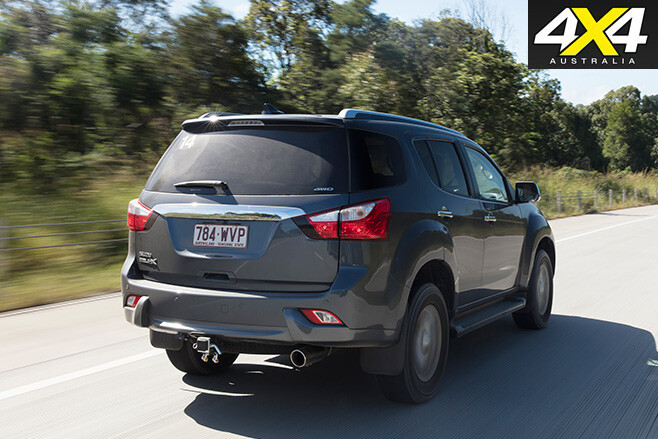
ISUZU UTE Australia has officially launched its 2017 D-MAX and MY16.5 MU-X.
What’s new? The biggest news from the launch is the all-new, Euro-5-compliant, 3.0-litre common-rail turbo-diesel powerplant, developed exclusively for Isuzu’s Australian market.
The engine – official moniker: 4JJ1-TC Hi-Power – carries over the 130kW output from the previous-gen and significantly ups torque. The newbie’s 430Nm at 2000-2200rpm is not only 50Nm higher than previous, but is now available across a far wider rev-range, with 380Nm on tap from 1700-3500rpm.
Backing this increased grunt is a new six-speed manual (Isuzu’s own MVL-6N) and smooth Aisin six-speed automatic gearbox, along with a toughened rear diff to cope with the extra punch.
See all the action from 2017 4×4 of the Year
“The Australian market is crucially important for Isuzu, as the Australian market is the number one export market for Isuzu LCV. So it follows that Isuzu regards as a very high priority the development of a product fit for Australian conditions and expectations.
Therefore, purely for the Australian market, a Euro-5-compliant 3.0-litre 4JJ1 engine and six-speed transmission drivetrain – an Isuzu world first – has been developed,” said Dave Harding, IUA’s Assistant General Manager of Marketing and PR.
The new 3.0TD features a new variable geometry turbocharger and intercooler, new pistons (graphite-coated), injectors, fuel pump, robust steel timing chain, larger EGR (Exhaust Gas Recirculation) cooler, tough cast roller rocker arms, and more. One of the most impressive pieces of technology in the new engine is the Diesel Particulate Diffuser (DPD), which was the final piece of the Euro-5 compliance puzzle.
With regards to the impressive Aisin automatic gearbox, a lock-up torque converter and adaptive shifting combine with sequential shifting to give the driver plenty of control, especially when off-road. It also ensures the 3.0TD engine works in its most effective rev-range for every driving situation.
The in-house six-speed is a close-ratio gearbox that includes triple-cone synchronisers on first, second and third gear, with the aim of improving shift quality and longevity of the ’box. With the closer ratios and more torque, Isuzu is aiming for less necessary gear changes (this applies equally to the auto) which in turn will increase longevity of working parts and boost fuel efficiency by up to five per cent.
The 2017 D-MAX’s bonnet and the grille have been redesigned, with Isuzu managing to improve the coefficient of drag by a claimed 0.4 per cent.
All D-MAX models come with six airbags as standard that, when combined with myriad electronic driving aids, help the vehicle attain its five-star ANCAP safety rating. The cabin is now a quieter place to be, too, owing to the addition of soundproofing insulation behind the bulkhead and between the fenders and body metal.
The spacious MU-X interior carries over from last year’s model but receives a reversing camera for the LS-M model. The popular wagon also gets more soundproofing with insulation added throughout the vehicle from front to back.
To celebrate Isuzu’s 100th anniversary, IUA has also released a limited-edition X-Runner model, available in either Silky White Pearl or Cosmic Black. This auto-only model is aimed squarely at the active adventurer market.
The D-MAX’s suspension is slightly biased toward its load-lugging capability but, surprisingly on the test route, the expected overly hard ride didn’t eventuate.
Our first test rig was an unladen X-Runner and it impressed both with its surprisingly compliant ride and its on-road dynamics; there was little in the way of pronounced bodyroll. Even on tight corners approached at a decent clip, the D-MAX remained composed.
The ability to switch the Aisin six-speed auto into manual mode for winding downhill sections was also appreciated. The auto kept the revs well within the optimal working range, ensuring minimal hesitation if you stomped your right foot. The NVH levels have definitely improved, with engine noise well muted and only really noticeable once you drop down a couple of cogs.
The driver’s position in the X-Runner is relatively comfortable, the only negative for taller people is that the bottom cushion on the seats is a bit short and the seat base is set quite high. The only other minor bugbear is that the steering wheel has no reach adjustment.
There’s no LSD or rear locking diff option so the updated models still rely solely on electronic traction control, but IUA has added Hill Descent Control (HDC) which worked a treat. Wheel articulation on the D-MAX is quite good, and there were only a few instances on noticeably deep ruts where the rear wheel lost contact with the ground. But the ETC kicked in quickly and, after some excessive wheelspin, got the vehicle through.
Isuzu has a lot of confidence in its ETC for these vehicles, but it would still be nice to be able to add a rear locker, especially when most of the D-MAX’s competition has them as either standard fitment or a factory option. The underbody has been beefed up with a steel sump and transfer case guards, a steel front skid plate, and protection for the fuel tank all standard.
The Isuzu D-MAX and MU-X have been the quiet achievers in the Australian 4×4 market, but they’ve been very successful for the Japanese company thanks to their toughness, reliability and great bang-for-buck factor. Isuzu also offers 12-month service intervals, five years capped price servicing, and excellent dealer service. These latest upgrades and refinements will see IUA confident of continued success in the coming years.
PRICING
| DMAX | STYLE | MODEL | TRANS | RRP (inc GST) |
| SINGLE | C/C Hi-Ride | EX | man | $34,800 |
| SINGLE | C/C Hi-Ride | SX | man | $38,000 |
| SINGLE | C/C Hi-Ride | SX | auto | $40,100 |
| SPACE | C/C Hi-Ride | SX | man | $40,700 |
| SPACE | C/C Hi-Ride | SX | auto | $42,800 |
| CREW | C/C Hi-Ride | SX | man | $43,200 |
| CREW | C/C Hi-Ride | SX | auto | $45,300 |
| CREW | Ute Hi-Ride | SX | man | $43,900 |
| CREW | Ute Hi-Ride | SX | auto | $46,000 |
| CREW | Ute Hi-Ride | LS-M | man | $46,400 |
| CREW | Ute Hi-Ride | LS-M | auto | $48,500 |
| SPACE | Ute Hi-Ride | LS-U | man | $46,200 |
| SPACE | Ute Hi-Ride | LS-U | auto | $48,300 |
| CREW | Ute Hi-Ride | LS-U | man | $48,300 |
| CREW | Ute Hi-Ride | LS-U | auto | $50,400 |
| CREW | Ute Hi-Ride | LS-T | auto | $54,200 |
| MU-X | STYLE | MODEL | TRANS | RRP (inc. GST) |
| u00a0 | 7-seat SUV | LS-M | man | $47,000 |
| u00a0 | 7-seat SUV | LS-M | auto | $49,100 |
| u00a0 | 7-seat SUV | LS-U | man | $49,000 |
| u00a0 | 7-seat SUV | LS-U | auto | $51,100 |
| u00a0 | 7-seat SUV | LS-T | auto | $54,800 |
VOLKSWAGEN’S range of four-cylinder Amaroks will receive interior and exterior upgrades to bring it in line with the recently launched V6 range.
Headlining the changes for off-roaders is an increase in 34mm of ground clearance on all four-cylinder models, thanks to the new closed-type underbody guard that has already been implemented on V6 models.
This, along with subtly revised front bumper design (also already seen on V6 models), gives the four-cylinder Amaroks a more robust, aggressive appearance.
All four-cylinder Amaroks now receive, as standard, VW’s Multi-Collision Braking system and a Composition Media unit with App Connect (featuring Apple CarPlay and Android Auto connectivity). Within the media unit, all four-cylinder 4×4 models come with the functionality of rear-view cameras and rear parking sensors.
On top of the already mentioned upgrades, Core Plus models receive carpet floor, updated cloth seat trim, front parking sensors, additional 12-volt sockets, body-coloured mirrors and door handles, rear grab handles and a post-collision braking system.
The Amarok V6 was runner up at the 2017 4×4 Of The Year, and these changes bring the four-cylinder models up the V6’s high standard.
The upgraded range is available in-stores now.
UPGRADED 4X4 RANGE Amarok TDI400 Core 4×4 Dual Cab Chassis 6-spd Manual: $41,990 Amarok TDI400 Core 4×4 Dual Cab Ute 6-spd Manual: $43,490 Amarok TDI420 Core 4×4 Dual Cab Chassis 8-spd Automatic: $44,990 Amarok TDI420 Core 4×4 Dual Cab Ute 8-spd Automatic: $46,490 Amarok TDI400 Core Plus 4×4 Dual Cab Ute 6-spd Manual: $47,490 Amarok TDI420 Core Plus 4×4 Dual Cab Ute 8-spd Automatic: $50,490 Amarok V6 Highline Dual Cab Ute 8-spd Automatic: $59,990 Amarok V6 Ultimate Dual Cab Ute 8-spd Automatic: $67,990
AFTER several unsuccessful attempts at bringing its 2012-launched Colorado up to scratch, Holden has finally pulled the whole thing apart and started again.
It has moved the engine’s balance shafts, added sound deadening, changed the engine and body mounts, installed a new torque convertor, recalibrated the suspension, added electric power steering, and installed a thicker windscreen, new window seals, roof mouldings and mirror mounts.
The maximum power (147kW) and maximum torque (500Nm) figures from the 2.8-litre VM Motori diesel remain unchanged, but Holden claims the low rpm torque is now stronger. Colorado also gets a new dash, extra kit and a new front-end treatment to keep it current.
Our test vehicle was the Colorado LTZ. Heated leather seats are an option on the LTZ. The less expensive LT has 17s and a smaller touchscreen, and loses the embedded sat-nav, tyre-pressure monitoring, power driver’s seat, auto wipers, climate control, tonneau cover, sports bar and the high-end safety features. The work-spec LS loses sidesteps and fog lights and has 16-inch steel wheels, but it has the highest payload.
TOURING The first thing you notice sitting in the new Colorado is the redesigned dash layout that does away with the previous model’s awkward central-dial arrangement. The new dash has nice, big, clearly marked buttons to operate everything from the HVAC to driving aids, and the eight-inch touchscreen with Apple CarPlay and Android Auto is bright and well located.
The new electric power-steering features a faster steering rack and fewer turns lock-to-lock for a more responsive feel, and the recalibrated suspension (new dampers, bigger front stabiliser and revised spring rates) results in a more compliant ride and better control, particularly over bumpy back roads and crook gravel roads.
The Colorado’s 2.8L turbo-diesel engine makes plenty of torque from down low, it has an impressive top-end and it’s well mated to the six-speed automatic transmission. Road noise isolation is also improved in the new Colorado, making it a much more pleasant vehicle for touring. On test the Colorado LTZ recorded an impressive average fuel consumption of 11.1L/100km, offering a safe touring range in excess of 630km.
TRAIL DRIVING The new suspension calibration is most noticeable when driving the Colorado on back roads and tracks. It now delivers a more compliant ride over uneven ground, even with a nominal load in the tray. In fact, some testers said it now feels much more like the Isuzu D-Max, with which it shares its basic platform.
Front ground clearance was an issue on a few tracks, and the plastic sidesteps are vulnerable, but the Colorado conquered everything we threw at it out on the trails.
Despite only a moderate overall ratio of 36.8:1 in first gear, it climbed the High Country’s steep tracks with ease, but engine braking could have been better on the descents.
SET-PIECE HILL CLIMB The set-piece hill climb is covered in big holes that really test a vehicle’s wheel travel, and while the Colorado is quite good in this regard, as soon as full extension is reached it needs to rely on its electronic traction control to get to the top. Unfortunately, the calibration of said traction control wasn’t up to the job on this occasion and without the benefit of a rear diff lock (as fitted to many other dual-cab utes these days) the Colorado was unable to make the climb.
Despite several attempts the Colorado adamantly spun its wheels furiously every time in an attempt to gain purchase and eventually a completely different line had to be chosen to crest the hill to avoid the deepest holes on the track.
Engine braking proved adequate rather than outstanding and, like most hill descent control systems, the Colorado’s is set a too fast for extremely steep descents.
CABIN, EQUIPMENT AND ACCOMMODATION The Colorado’s redesigned cabin is a much more pleasant place to be than the previous model’s. But while the dash layout is now vastly more attractive, it’s black, so it only takes a small amount of dust and it looks messy.
The Colorado LTZ is well equipped and now has active safety features such as tyre pressure monitor, forward collision alert, lane-departure warning, hill-start assist, hill-descent control, trailer-sway control, roll-over mitigation, rear-park assist and reversing camera, and a full complement of seven airbags.
It also has an electrically adjustable driver’s seat, climate control air-conditioning and plenty of 12V power outlets. Leather seat trim is optional on the LTZ but standard on the Z71.
The biggest and most obvious omission from the standard equipment list is a rear diff lock, which is almost de rigueur in the 4×4 ute segment these days. Without it, the Colorado simply doesn’t match the competition for off-road capability.
PRACTICALITIES The Colorado’s engine bay is reasonably well set-up for off-road driving, with the alternator, ECU and other electrics all up high, and the air intake through the inner guard. However, on the downside you’ll need to get a spanner out to access the air filter, and you’ll also have to move a few things around if you want to fit a second battery under the bonnet.
Approach, ramp-over and departure angles aren’t great, and we hung up the rear bumper a couple of times when exiting gullies off-road. There are two recovery points at the front.
The Colorado LTZ wears 265/60R18 Bridgestone Duelers on its alloy rims, but if you aren’t happy with this you could always fit the 17-inch rims from the LT model.
SUMMARY “The new Colorado is leaps and bounds in front of the outgoing model, but that’s more a comment about the old than the new,” commented 4X4OTY judge Dan Everett. He’s right, too – while it’s much improved it still falls short of some of the competition, and there’s still a question mark hanging over its off-road capability in extreme terrain.
TOUGHEN UP The new Colorado has only limited changes to the suspension, so the Tough Dog offering from the previous Colorado is still relevant for this one. A handbrake relocation kit (as the cable changed locations) has been added.
Tough Dog offers foam cell and adjustable shocks as well as two front springs (up to bullbar, and vehicles with bullbar and winch fitted) along with three rear leaf options to suit constant load carrying. Its suspension solutions offer a 40mm lift over standard height for this vehicle.
Prices range from $1660 to $2170 depending on the options selected, so get your hands on a test vehicle. Its design similarities with other vehicles on the market mean that there may be some components already developed and suitable for this vehicle.
SPECS Engine: 2.8-litre 4-cyl turbo-diesel Max Power: 147kW @ 3600rpm Max Torque: 500Nm @ 2000rpm Gearbox: six-speed automatic 4×4 system: dual-range part-time Crawl ratio: 36.8:1 Tyre spec: 265/60R18 110T Kerb weight: 2121kg GVM: 3150kg Payload: 1029kg Towing capacity: 3500kg GCH: 6000kg Fuel tank capacity: 76 litres ADR fuel claim: 8.7L/100km Price: $52,960
MORE 4X4 OF THE YEAR
- HOME: 4X4 OF THE YEAR 2017: The seven most interesting 4×4 vehicles of 2016 get together for a week to determine the 4×4 Of The Year.
- THE FINALISTS: Meet the seven most interesting 4×4 vehicles of 2016 battling it out to be crowned 4×4 Of The Year.
- THE RESULTS: Only one of the seven best 4x4s from 2016 can be crowned 4×4 Of The Year 2017
- 4X4 OF THE YEAR HOME: Finding Australia’s Best 4x4s
A few years ago when we were running tag-along trips in Southern Africa and catering for our clients, we tried this simple dessert I came across over there.
It was easy to make (it takes a lot less effort if you have an electric hand beater) and everyone really enjoyed it – kind of like a light cheesecake, as the cottage cheese makes for a creamier texture.
INGREDIENTS Makes: 6-8 servings
- 385g can sweetened condensed milk
- ½ cup lemon juice (bottle is fine, but fresh is better)
- Zest of at least one lemon – optional, but it will add much more lemon zing.
- 1 cup smooth cottage cheese (or creamed cottage cheese)
- 1 cup cream – whipped
- 1 tbsp gelatine – dissolved in ½ cup boiling water
- Mix ingredients together and beat until smooth. If you are having trouble getting the smaller lumps of the cheese out, press the cheese mixture through a sieve, then beat again until smooth.
- Spoon onto your preferred base and refrigerate until set (will take a few hours).
- Make a biscuit crumb base and fill with the topping.
- Decorate with fruit.
- Crush some biscuits (chocolate, butternut, etc.) into the bottom of individual small bowls/cups and top with the filling.
- Use a ready-baked pie shell and fill with the cheese mixture. Top with some toasted coconut and, if you want to be really decadent, some shaved white chocolate.
- Try using some lemon-flavoured jelly crystals for more flavour. You could probably replace the cottage cheese with cream cheese, but no one will ever know you’ve used cottage cheese in this recipe.
- If you ever see one of those old-fashioned hand-winding beaters, then buy one and keep it in your camp kitchen kit. They still work really well and are very handy.
- If you make this at home, put the cottage cheese in a food processor and blend until smooth before mixing with other ingredients.
- Puree the cottage cheese with coconut, honey and vanilla essence to make a delicious spread.
- Mix it in with your pancake batter.
- Incorporate it into your smoothies.
- Combine with salmon, capers and dill for a great topping on savoury biscuits.
- Substitute it with a little skim milk to make buttermilk.
- Combine with mozzarella and Parmesan cheese for a light pasta bake sauce.
CONCEIVED in the early 1970s and in production before the end of that decade, the G-Class is Mercedes-Benz’s longest running model and even outdates Toyota’s venerable 70 Series.
This G-Class Professional G300 is the latest in a long line of G-Class variants to be sold here over the years and joins the G350 and G63 AMG wagons introduced back in 2011.
There’s only one engine, an extremely low-tuned version of Mercedes-Benz’s ubiquitous V6 diesel that’s designed to run on the world’s poorest quality diesel. A five-speed automatic is the only gearbox offered and it’s mated to the G-Class’ trademark dual-range full-time 4×4 system with its triple diff locks.
The bullbar, snorkel, light protectors, all-terrain tyres and air-con are all standard. Options include a walk-on bonnet with a 100kg load rating and cyclonic pre-filter for the snorkel. The tray is aftermarket and not an official M-B accessory.
TOURING If you’re looking for a tough 4×4 cab-chassis to carry up to two tonnes of gear, then the G-Professional should be at the top of your shopping list. However, if you’re looking for a hardcore touring ute, then this probably isn’t the vehicle for you.
The G-Professional is a no-compromise workhorse and an ergonomic nightmare. It’s uncomfortable to sit in, tiring to drive, unladen ride quality is horrible, NVH levels are extreme, the dash is from a bygone era, there aren’t any cup holders, there’s no centre console, the seats offer little support, the driving position is cramped, and there’s no cruise control…
Partially due to its brick-outhouse aerodynamics and hefty 2410kg kerb weight, the G-Professional’s 3.0L V6 turbo-diesel engine proved lacklustre and thirsty, sucking down distillate at an average rate of 16.1L/100km, so you’d have to top up the 97-litre fuel tank every 550km or so on a trip that includes a mix of touring and off-road driving.
4X4OTY judge Ron Moon did more miles in the G-Professional than the rest of the judging team and, after a long stint behind the wheel, had this to say: “Just drove the Merc back from Wangaratta. Pig of a thing – you had to keep the foot pressed heavily into the floor to keep it going (got a cramp!). And in the bush every throttle input was initiated with a heavy push of the throttle.”
TRAIL DRIVING Get over the harsh ride quality and the apparent lack of rear-wheel travel (when unladen, at least) and the G-Professional is a very capable vehicle on the trails. It has excellent low-range reduction and a full-time 4×4 system with lockable front, centre and rear diffs. Locking the diffs is a simple affair too; simply press the relevant button and an orange light tells you the diff is about to lock, then, when the red light illuminates, you know it’s locked.
Ground clearance is excellent, although the super-long wheelbase results in a ramp-over angle of just 22 degrees, which can see the G-Professional bottom out on big mitre drains. Never fear, the chassis is rock solid and there’s nothing hanging down that could be damaged by a minor grounding. Approach and departure angles are much better at 38 and 35 degrees respectively, but the latter will obviously depend on your choice of tray.
Over-bonnet visibility isn’t bad but the view to the rear will be impeded by whatever you’re carrying in the back. On the other hand, the large external mirrors are excellent.
SET-PIECE HILL CLIMB With low-range selected and front, centre and rear diffs locked, the unladen G-Professional ascended the set-piece hill climb easily enough, but it didn’t look all that smooth doing it.
With stiff rear springs capable of hauling a two-tonne load, but with nothing actually in the tray this time, the G-Professional exhibited virtually none of its potential rear wheel travel, and the super-stiff chassis barely flexed. As a result, opposing rear wheels lifted high off the ground over the set-piece hill climb’s deep holes, and the G-Professional had to rely on its locked diffs to maintain traction and forward momentum.
The G-Professional exhibited a similar style when descending the steep hill, dropping its front wheels into holes while kicking its rear wheels high into the air. This resulted in an uneasy feeling behind the wheel. “Instead of walking through the holes, it walks over them, and bounces you around because of that,” explained 4X4 Ed Matt Raudonikis after tackling the set-piece hill climb. He was, however, impressed with the G300’s excellent low-range reduction and impressive engine braking.
CABIN, EQUIPMENT AND ACCOMMODATION Wow! $120K and you don’t even get cup holders! At least air-conditioning is standard, as are wind-up windows, a passenger grab handle and a floor plug with a chain so you can drain water out if necessary. Despite the centre console being bolted shut to house the G-Professional’s electronics, there are decent-size storage boxes under the seats and a lockable glovebox.
Safety gear includes dual airbags, ABS, brake assist, electronic brake force distribution and electronic stability control. The Benz also comes standard with a snorkel, bullbar, side rails, headlight and indicator light protector grilles, and a full-size spare (loose). The tray fitted to the test vehicle is an aftermarket item, as M-B supplies the G-Professional as a cab-chassis only.
PRACTICALITIES The standard snorkel, bullbar and side rails are great, as are the bright red recovery points front and rear that look like they could haul a Panzer tank out of the muck at any point in time.
The G-Professional is fitted with LT265/75R16 BF Goodrich All Terrains and there’s a tyre pressure loss warning system. As well as plenty of ground clearance, the Benz’s underbody components are tucked up and out of the way, so you’re unlikely to harm anything.
The huge mirrors are excellent, as is the passenger’s grab handle, which prevents them from being thrown around the cabin as you bounce over tracks.
SUMMARY The G-Professional had its fans and haters after a week in the bush. “I might be a glutton for punishment but the G-Professional was the one that had me smiling all week,” 4X4OTY judge Dan Everett said. Penny Wells, on the other hand, offered this: “The one vehicle I was extremely keen to test drive quickly became the one I disliked, partly due to not packing a kidney belt for the week.”
The G-Professional really proves the old adage ‘horses for courses’. If you had a heavy load to haul then the Benz would be up for the job. But if you had to occasionally drive it unladen, or over long distances, you’d probably struggle to last a full day in the saddle.
TOUGHEN UP A kit for the Benz cab-chassis has not been developed, but Tough Dog will be consulting with specific application users, such as the military, to establish what the vehicle will be used for so it can tailor suspension solutions to suit.
SPECS Engine: 3.0-litre V6 turbo-diesel Max Power: 135kW @ 3800rpm Max Torque: 400Nm @ 1600-2600rpm Gearbox: five-speed automatic 4×4 system: dual-range full-time Crawl ratio: 41.0:1 Tyre spec: 265/75R16 Kerb weight: 2410kg GVM: 4490kg Payload: 2080kg Towing capacity: 2210kg GCM: N/A Fuel tank capacity: 97 litres ADR fuel claim: N/A Price: $119,900 *Price excludes the tray and on-road costs.
MORE 4X4 OF THE YEAR
HOME: 4X4 OF THE YEAR 2017
The seven most interesting 4×4 vehicles of 2016 get together for a week to determine the 4×4 Of The Year.
THE FINALISTS
Meet the seven most interesting 4×4 vehicles of 2016 battling it out to be crowned 4×4 Of The Year.
THE RESULTS
Only one of the seven best 4x4s from 2016 can be crowned 4×4 Of The Year 2017
4X4 OF THE YEAR HOME
Finding Australia’s Best 4x4s