
Ron and Viv Moon’s latest news and info from Australia’s treks and tracks
PERMITS FOR BURKETOWN REGION (OLD) Permits are now required to camp and fish around the Burketown area, along the Albert River of the Gulf region of North Queensland. The permits allow for overnight stays at the designated recreation areas on Gangalidda-Garawa Country, and it ensures that landowners’ conditions and requirements are met. A maximum of seven nights can be booked at the same campsite. For details: www.gangalidda-garawa.com.au/permits
ELDEE EASTER EVENT (NSW) The ARB Eldee Easter Event is three days of family-friendly 4WD action and adventure in outback NSW. It’s situated on Eldee Station, a 40,000 acre working sheep and cattle station in Silverton, just 56km from Broken Hill. Test your competency across a range of outback tracks in a low risk, safe environment, and compete for great prizes, raise funds for the local SES, and just have great fun. Stay in great accommodation, or caravan and camp in the well-appointed camping area. Embrace the spectacular landscape and enjoy the local outback hospitality with hosts Naomi and Stephen Schmidt. For more information: www.eldeestation.com
ORD VALLEY MUSTER (WA) With more than 30 spectacular events across 10 exciting days, the award-winning Argyle Diamonds Ord Valley Muster will be back in Kununurra from May 19-28. Iconic events include the Durack Homestead Dinner, the Kimberley Moon Experience and the Ord Valley Muster Rodeo. For more info head to www.ordvalleymuster.com.au
CAMPING IN THE NW (VIC) The caravan and camping facilities in the Yarriambiack Shire of Western Victoria are all exceptional value for money, with many sites costing just $10 (free camping is even permitted at Lake Lascelles). The townships in the region are all within close proximity of Wyperfeld, Hattah-Kulkyne and Murray Sunset National Parks, and these all make a fabulous destination for four-wheelers, explorers and campers. To check out the campsites in the shire, visit: www.yarriambiack.vic.gov.au/tourism/parks
TURNING OF THE FAGUS (TAS) Every Autumn Tasmanians follow the tradition of flocking to locations to witness the Fagus tree’s spectacular range of autumn colours, which vary from rust red to brilliant gold. Called the ‘Turning of the Fargus’ this stunning sight can only be seen in Tasmania and occurs between mid-April and mid-May. The best spots to take in the great colours are Mt Field and Cradle Mountain National Parks. For info: www.parks.tas.gov.au
DROVERS CAMPFIRE (NSW) Since its inception in 2006 the Boggabri Drovers has grown exponentially and now offers a wide range of entertainment, tours of the local area, campfire cooking, historic machinery displays, bush yarns and demonstrations of rural activities. The event also connects visitors with good old-fashioned bush values and past-times. This year the event will run from April 26-30. For more info head to: www.droverscampfire.com.au
WOOMERA PROHIBITED AREA CLOSURES (SA) If you’re planning a trip along the Anne Beadell Highway, be aware that the Department of Defence has planned to use the Woomera Prohibited Area (WPA) and has decided on the following exclusion periods: Amber Zone 1 (May 14 to June 30); Amber Zone 2 (June 11-30). Notifications of restrictions in parts of the Green Zone will be made through the website and relevant travel info outlets, with 21 days’ notice provided: www.defence.gov.au/woomera/exclusionperiods.htm
THE Mercedes-Benz G-Wagen is gearing up for its biggest update since the boxy original appeared in 1979. Breaking away from almost four decades of traditional live-axles front and rear, these photos appear to show the new model will use independent front suspension for the first time.
Key to the changes include a new skin, underbody aerodynamic tweaks, new suspension system and a revised interior designed to right some of the ergonomic wrongs of the current car, which thrives on its authenticity and superb off-road talents.
However, the chunky proportions and circular headlights are likely to remain a feature of the imminent G-Class styling update, which will focus on improving aerodynamics to improve refinement and reduce fuel use.
Engineering prototypes with flared wheel arches photographed testing overseas suggest the 2018 G-Class will get a slightly wider track for improved stability, as well as a new suspension system including IFS to benefit ride quality.
Look closely at the lower angles in these photographs and you notice the omission of the live-axle’s diff pumpkin in between the front wheels, something that was always noticeable on the current and past models. The side-on photos also show a different front suspension to what is currently available, while the rear shots reveal the coil-sprung live rear axle is still in place.
Speaking to 4X4 Australia ahead of the recent Geneva Motor Show, Dr Gunnar Güthenke, head of the off-road product group at Mercedes-Benz, hinted there were changes afoot for the legendary off-roader. As always, he said global regulatory changes would shape the future of the G.
“We are taking each upcoming change of legislation as a challenge, and our intention is clear – we want to bring the G-Class further into the future,” he said.
“The G-Class is an icon so we like to keep it as an icon,” said Dr Güthenke, cautious of giving away too much information. “There are a lot of rumours in the market, some are true, some are wrong. I cannot go into detail… there are certain icons in the automotive industry and I think we are well advised to take care [with any updates].”
He said there were certain “core elements” that have not – and would not – change. They include the ladder chassis, dual-range transfer case and trio of differential locks for maximum traction.
He also hinted that off-road ability was key to any changes to the G.
“One of the advances, not too long ago… was the portal axle, that came first with the [six-wheeled G-Class] 6×6,” said Dr Güthenke.
He was coy when asked about the prospect of Mercedes-Benz’s new inline six-cylinder making it into the future G-Class.
“Whenever we see it’s the right point in time – we obviously are very conscious of fuel consumption – so when the company is offering better engines, we will definitely look into it,” he said.
4X4 Australia understands a version of the yet-to-be-revealed inline six-cylinder diesel is unlikely before 2020.
Dr Güthenke also said the G-Class would be ready to react if demand or regulations stipulated the use of a hybrid drivetrain.
“The [hybrid] technology is available within our company… as the G-Class team has shown when the customer request is there we can integrate what is available in this company into our car.”
As for tweaks such as a larger fuel tank, Dr Güthenke ruled them out, suggesting aftermarket suppliers had it covered.
“Today there are certain ones available in the aftermarket, which work pretty well.”
Despite the G-Wagen changing little in looks since the original in 1979, there has been a big change in its appeal thanks to the fitment of more luxury equipment and bigger, more powerful engines.
Such changes and updates mean Mercedes-Benz plans extensive testing and development every year at its challenging Mount Schoeckl proving ground, not far from the G-Wagen’s production line in Graz, Austria.
“We do a durability test each year, just to ensure that our vehicle is 100 per cent up to all expectations,” said Dr Güthenke. “There are always little changes that are necessary each year, so each year we take a production vehicle and make this durability test. There’s always testing going on.”
Despite its age the Mercedes-Benz G-Class is more popular than ever. In 2016 more than 20,000 G-Classes were produced for the first time in a year. More than half of them are V8 or V12 AMG models. In Australia the AMG mix is closer to 80 per cent of G-Class sales (they are all V8s because the V12 is not sold here).
Without going into detail, Dr Güthenke confirmed there would be more low volume special editions based on the G-Class. Mercedes has already produced three special edition Gs: the 6×6 six-wheeler, the high-riding 4×4², and the recently unveiled G650 Landaulet.
“I would say yes,” was his quick response when asked about new specials. “The whole team loves to come up with ideas like this and is really very grateful for the positive response, and it’s something many car enthusiasts just love and there are a lot of car enthusiasts with our G … so let’s see what comes next.”
IT USED to be quite a challenge being an Icelandic off road enthusiast. Once the long, harsh winter set in, the volume of ice and snow across the country rendered many places on the small island inaccessible by conventional vehicles.
This article was originally published in the October 2014 issue of 4×4 Australia.
Of course, Iceland is home to many unconventional vehicles, such as the snowmobile, but attempting to drive a snowmobile on the public highway is about as safe and comfortable as riding a shopping trolley down a flight of stairs, so it only really solved half the problem.
Then someone discovered that if you fit a conventional 4×4 with large tyres run at very low pressures, it sort of ‘floats’ across the snow. Fitting even bigger tyres run at even lower pressures (no higher than 5psi) made progress across the white stuff even easier. Suddenly it became practical for off roaders to use their vehicles all year ’round, and at much higher speeds than previously possible. In a country with more spectacular scenery per square kilometre than most, that was pretty exciting news.
Unsurprisingly, it didn’t take long for someone to spot the business opportunity in this, and so Arctic Trucks was born. Originally a part of Toyota Iceland, Arctic Trucks became a separate entity in 2005 and its current home base is a workshop on the outskirts of Reykjavík. We were in the care of company founder and chairman, Emil Grimsson, one of those people who make you wonder what you’re doing with your life.
As well as running an international business, Grimsson now spends large portions of his time on month-long expeditions guiding scientific teams cross the Antarctic plateau. It’s an area of significant opportunity for Arctic Trucks, as the modified offroaders are superior in most areas to the tracked vehicles traditionally used in such places, though apparently scientists aren’t easily swayed.
“We are proven to have five to 10 times better fuel economy, we are three to six times faster, we have a longer range, and a lot less maintenance, [but] the scientific community is very slow to react,” Grimsson says.
Grimsson also played a pivotal role in Top Gear’s 2007 expedition to the North Pole. As well as providing the Hiluxes for transport, he played point man on a snowmobile, ensuring the Pommie presenters didn’t drive into a crevasse.
Our mounts were very similar in specification to those that completed the epic Top Gear journey northwards. While theoretically any ladder-chassis vehicle could receive the Arctic Trucks treatment, Toyota vehicles – predominantly Hilux and Prado, though a number of full-size Land Cruisers have also been completed – are the speciality due to their inherent strength and product knowledge acquired over almost three decades.
The level of modification required depends on the size of tyre fitted. The smallest and cheapest option, a 35-inch tyre, is the most popular. Go up a size to 38-inch rubber and both the modifications and the price tag starts to get serious – the work adding around 50 per cent to the base vehicle’s price. From there the sky’s the limit, as evidenced by the custom-chassis 6×6 Antarctic exploration vehicles parked outside the workshop – yours starting at a cool $215,000.
A 50 per cent premium might sound pretty steep for fitting some big tyres, but as Grimsson leads us through the workshop and past vehicles in various stages of build, it’s easy to see where the time – a ‘38’ takes around four weeks to build – and money goes.
Ironically, given their aggressive appearance, Arctic Truck’s goal is to make the vehicles look as standard as possible. Early vehicles accommodated larger tyres in the traditional way by lifting the body, but the negative effect it had on handling gave Toyota Iceland cold feet about supporting the project.
In order to retain the standard vehicle’s dynamics but still accommodate the larger tyres, the factory front suspension pick-up points are relocated forwards and lower. This effectively extends the wheelbase and keeps the centre of gravity as low as possible to improve stability.
The factory wheel-arches are cut away to provide clearance, which also requires the body mounts be relocated. The steering geometry is also altered to match the new suspension setup. No modifications are needed at the rear to accept 38-inch tyres, but should a buyer tick the 44-inch option (a rare occurrence) the rear suspension is moved 16cm further back to try and keep the stock vehicle’s handling and stability.
Engines and drivelines remain standard but a piggyback ECU is installed to handle the recalibrated speedo, which also makes it easier to pinpoint whether problems have occurred in the truck’s standard electronics or as a result of Arctic Trucks’ modifications. Despite the substantial amount of re-engineering that takes place, Toyota still offers a three-year warranty on all factory parts and Arctic Trucks offers a three-year warranty on all its modifications in Norway and two years in Iceland. “We have about 800 35-inch vehicles on the road in Norway with next to no problems,” Grimsson said.
HIGH ROLLIN’ On the road the net result of these modifications was, well, not much, as our test vehicle drove more or less like a regular Hilux. There were small differences of course. Those enormous Dick Cepek tyres made quite a lot of noise on the highway but, with the equivalent of a giant balloon at each corner, the payoff was a beautifully absorbent ride. There’s also none of that ‘tippy-toes’ feeling that can occur in vehicles that have been lifted too high.
Initially our route followed the motorway out of Reykjavík, passing unintelligible road signs covered in place names that look like a cat has drunkenly walked all over a keyboard. Thankfully, the tarmac soon ended and the convoy headed into the Icelandic highlands following one of the country’s many geothermal pipelines. Despite being the middle of summer, the temperature was barely out of single digits and dirty patches of snow still covered shaded areas.
The terrain wasn’t particularly challenging, but we stopped to deflate the tyres anyway, as the lower pressures help absorb impacts and reduce the risk of punctures. “You have to let the tyres do the work,” Grimsson said sagely. An on-board compressor in each vehicle made re-inflating the tyres the work of a moment. The TJM snorkel proved its worth during the many river crossings, but the front and rear ARB Air Lockers remained untested. Grimsson is full of praise for the Aussie-built aftermarket gear, as a lot of the equipment installed in the early days was of extremely poor quality.
The best part about these vehicles, however, is that you don’t have to take our word about their abilities.
Thousands of kilometres of reasonably well-formed trails criss-cross Iceland, and Arctic Trucks runs self-drive tours starting from A$900 per car (maximum of four people) for a half-day tour and around $1300 for a full-day tour.
While getting to Iceland takes a fairly concerted effort (it’s about a four hour flight from Paris), exploring it by 4×4 is the ideal way to soak up the unique and amazing landscape for which the country is renowned.
TRUCKIN’ ON Arctic Trucks can trace its origins back to 1990, when Toyota Iceland began to offer the large-tyre modifications in response to customer demand. While popular, the negative handling effects associated with lifting the vehicles led Toyota to actively discourage customers from having the conversion done, stating it would not honour any warranty claims on modified vehicles.
Grimsson believed there was another way, and began to investigate modifying the chassis to accept the larger tyres yet still retain the standard vehicles’ dynamics. Business boomed. At one point up to 45 per cent of all new Hiluxes and 35 per cent of all new Prados sold in Iceland were being fitted with the Arctic Trucks modifications, with the work being of a high enough calibre to satisfy Toyota’s tough warranty standards.
Then came the Global Financial Crisis. Iceland’s banking industry ceased to exist, housing values plummeted and consumer demand disappeared almost overnight. Having produced 474 vehicles in 2007, Arctic Trucks delivered just nine in 2009. Grimsson admits the business was extremely close to going under, but by diversifying its interests into used vehicles and servicing and concentrating on exports it managed to stay afloat.
Production now sits at around 40-50 units per annum, mostly for export, as the Icelandic market has not recovered. Arctic Trucks employs around 30 people in Iceland, 70 in Norway, 10 in the United Arab Emirates and there’s a new franchisee in Russia.
While initially produced for off road recreation, commercial applications make up a growing portion of the business. Contracts with Scandinavian militaries have seen Arctic Trucks’ work deployed in Middle East conflict zones, and there are now 18 vehicles in Antarctica supporting scientific research teams.
In contrast, there is growing interest in these unique offroaders from the UAE for cosmetic purposes. It seems that in a land where Ferraris and Lamborghinis are commonplace, nothing turns heads like a Toyota that appears to have recently emerged from Dr. Frankenstein’s laboratory.
THE best new 4×4 vehicles are all decades old and show that all good things take time to get right – you can’t hurry perfection!
Mercedes-Benz’s G-Wagen was first launched in 1979 and has just come back to our market with a new variant that uses some body panels still punched out in the original 40-year-old presses. Nothing’s changed on the outside, while the engine and driveline are some of Benz’s best. It proves that you don’t mess with what works.
The same applies for the Land Cruiser 70 Series. It first clocked on for work in 1985, and riding in the latest model you still feel the relationship with that original. The 70 range was updated late in 2016 with new emissions and safety tech, plus a few comfort and driveability upgrades that will see it soldier on for a few more years to come.
It remains the most versatile new 4×4 on the market today, despite its 30-plus years of age and a host of new vehicles that have come (and gone) since.
Nissan’s GU Patrol traces its roots back to the GQ, which first graced the pages of this magazine in 1987.
This month we send off the last of the live-axle Patrols with a drive of the limited-run Legend Edition, before it is relegated to used-car-buying only. It’s a shame Nissan didn’t see fit to give the cab-chassis Patrol ‘Legend’ status as well. While the Patrol wagon lives on in the Y62, the workhorse ute becomes a part of history and will be sadly missed.
Read our drive of the Nissan Patrol Legend Edition here, and don’t miss the wild and wicked Duramax-powered Patrol custom.
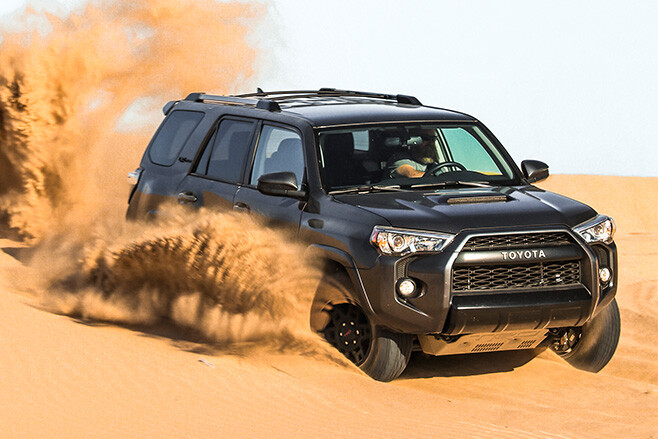
While we’re on the subject of old 4x4s, we revisited another ‘old’ model while we were in the USA last year. The Toyota 4Runner is still sold over there and we borrowed a TRD Pro variant to travel around. It has the feel and ability of a traditional 4×4, and the 4Runner nameplate is certainly one we’d like to see back here in Australia.
The latest aftermarket products have arrived!
Whether you’re after some new recovery kit or thinking of lighting up your rig, there’s something to interest any outdoor adventurer.
Just be careful, you might wake up the next morning with an empty wallet!
LED LEADS THE WAY The new Intensity AR40 LED light bar from ARB is designed to integrate seamlessly with the top tube of a bullbar. The extruded alloy housing wraps around the tube, providing a low profile that doesn’t obstruct the driver’s view. ARB’s LED light bar features 40 individual LEDs (two rows of 20) encased in a virtually indestructible polycarbonate lens. It also features a powdercoated, extruded aluminium body with pressure diecast end caps. Website: www.arb.com.au
INCREDIBLE HULK HULK 4WD products have been included in CoolDrive Distributions’ expanded 4×4 and off-road range. The 22-item-strong product range includes winch extension straps, snatch blocks, heavy duty jacks, air compressors, and tyre management gauges. The HU100K Essential and HU200K Complete Recovery Kits contain all the products needed to extract all 4WDs from any terrain. Included in both kits as standard is an 8000kg MBS snatch strap, two 4.75t WLL bow shackles and leather recovery gloves. The Complete Recovery Kit also comes with a 5000kg MBS winch extension strap, a 12,000kg MBS tree protector strap, a recovery damper and an 8000kg snatch block. Website: www.cooldrive.com.au
WOLF PACK A VERSATILE backpack is the key to a stress-free adventure. BlackWolf’s Cedar Breaks range comes in four different sizes: 55, 65, 75 and 90 litres. Features include a hyper-durable 1000D Polyweave fabric, 10L expansion gusset, built-in rain cover and combination lock, and a detachable daypack for smaller adventures. The day pack has RFID protection, side pockets and a side accessible laptop storage section for easy access. This BlackWolf pack is also hydration compatible. Available in magenta, chilli, blue and black. Website: www.blackwolf.com.au RRP: From $350
TYRE MULLETS HUSKY Liners has released its Mud Guard Combo Pack, affording 4x4ers ultimate protection when out on the wet and slippery stuff. The Combo Pack includes front and rear mud guards so that each corner of a 4×4 is now protected. Installation is a breeze thanks to the company’s ‘no-drill’ guarantee. Suitable for Chevy/GMC, Ford, Ram and Toyota pick-ups. Website: www.huskyliners.com RRP: Approx $100
PORTABLE POWER DOMETIC Australia has released the WAECO CoolPower RAPS44, a portable heavy duty 12-volt battery that’s ideal for running a portable compressor fridge/freezer for that next remote-area adventure. The rugged RAPS44 has superior discharge/charging cycle capability, and it comes with 44 amp hours. Website: www.waeco.com RRP: $379
VENOM AND GENESIS EASILY spot kamikaze kangaroos by rigging up a set of Lightforce’s 75W Venom or 140W Genesis LEDs. The Australian-made LEDs are sleekly designed to take up minimal space. The addition of radio-suppression technology reduces interference with broadcast radio reception on low-signal-strength locations. The LEDs have been tested in both the freezing Arctic Circle and the harsh outback of Australia, and the units have the highest attainable IP69K rating to protect against moisture and contaminant ingress. It’s finished with a hardwearing UV stable powdercoat. Backed by a Lightforce three-year warranty. Website: www.lightforce.com
SENIOR MANAGEMENT TJM’s Dual Battery Manager (DBM) hasn’t been manufactured to compete with existing DC/DC charges on the market, as the unit does more than just charge from one battery to another. The kit includes the DBM module in combination with the Link Start Kit (LSK) which includes the IBS 200A relay, Link Start button, two MTA fuseholders with 30A fuses, crimp terminals and a small wiring kit. The Swiss-made product has extreme temperature protection, and it’s dust, splash and shock proof. It also has winch-link support. Website: www.tjm.com.au
FULL CHARGE GET that perfect charge courtesy of WAECO’s clever range of PerfectCharge battery chargers and accessories. The WAECO PerfectCharge series provides house and starter batteries with a continuous charge, allowing batteries to maintain a high charge level. The PerfectCharge IUOU battery charger uses a unique six-stage charging cycle, which provides optimum charging for all Gel, AGM and Wet batteries. A powerful range of 15 to 35 amps is provided by the MCA1215, MCA1225 and MCA1235 models. Website: www.waeco.com
DURABLE DUFFLE IRONMAN’S new Explorer duffle bag is built tough. So tough, in fact, that you can throw it on a roof rack or in the back of a ute. It’s light, compact and as strong as an ox – the perfect travel companion. The Explorer is made from waterproof 1000d PVC with YKK zips and strong webbing handles. The bottom is double-skinned for extra protection. Other features include heavy duty welding and stitching, side compression straps, top and end carry handles, an internal mesh zipper pocket and a laminated base. Website: www.ironman4x4.com RRP: $65
CLUTCH SHOT AISIN’S quality range of clutch kits is now available via CoolDrive Distribution. The clutch kits, which contain the clutch cover, plate and bearing, are available from all 24 CoolDrive branches nationwide. The clutch systems feature innovative NVR technology to smoothen clutch engagement. Facings have excellent heat and wear characteristics to increase the life of the product, while shudder resistance and rigidity are also improved. The clutch kits are suitable for the Toyota Hilux and LandCruiser. Website: www.cooldrive.com.au
TOURING TANK GO further on a tank of fuel with Outback Accessories’ 153-litre replacement fuel tank for new Toyota Hilux models (07/2015-on). The Australian-built FTT108 tank is made from MIG-welded 2mm aluminised steel, and it’s fully internally baffled to prevent fuel surge issues, employs CNC-machined pump and sender flanges for a precision fit with OEM components, and it features ‘fast fill’ filler tube and vents. The tank’s covered by a comprehensive two-year warranty. Website: www.outbackaccessories.com.au RRP: $1238
IF YOU’RE looking for the least expensive way to get into the all-new Discovery (effectively a ‘Discovery 5’ but just Discovery by name) you’ll have to wait until late 2017 when the base-spec ‘S’ models arrive. If you want something sooner, like mid-year, the more expensive SE is your entry point.
If you’re prepared for the end-of-year wait, prices for the Discovery S start at $65,900 for the 132kW four-cylinder Td4 engine in a white, coil-spring five-seater with manual-adjust cloth seats. However, the Td4 engine can’t be had with dual-range gearing at any spec level, which limits its appeal as a 4×4.
Check out our Land Rover Discovery first drive.
If you want dual-range gearing – and why wouldn’t you? – you’ll at least need the more powerful 177kW/500Nm Sd4 ‘Ingenium’ four-cylinder, which starts at $71,560 in the S. From there, dual-range gearing is a relatively inexpensive $920 option. If you’re planning serious off-roading you’ll also need the $1080 rear E-locker, while height-adjustable air suspension – which provides 63mm more clearance (and flatter on-road handing) – is another $2060. So that’s $75,620 before government taxes and dealer charges to get you into a new base-spec Disco that’s optimised for off-road work. If you then want maximum grunt in that same vehicle then the 190kW/600Nm Td6 will be another $7K, or $82,620 (plus on-roads) in total.
If you don’t wish to wait until years’ end for the less-expensive S model and you want an off-road-ready Disco then the SE Sd4 is your entry point. It starts at $83,450, plus on-roads. Over the S, the SE brings dual-range gearing and the height-adjustable suspension as standard, but for max off-road attack you’ll still need $1080 for the rear E-locker. So that’s $84,530. From there you can add another $7K for the Td6 engine to take it to $91,530. At that point you’re at a Disco with max off-road ability and max on-road performance.
Aside from having dual-range gearing and height-adjustability as standard, the SE also brings a fair bit of extra kit over the S. This includes leather, electric seat adjust, sat-nav, dual-zone climate control, a better sound system, rain-sensing wipers, LED headlights with DRLs, and pre-fitted towing equipment.
Over the S, the SE also offers Terrain Response 2 as a $2060 option. Terrain Response 2 builds on the standard Terrain Response system fitted to the S and SE by giving the driver the option of an ‘Auto’ mode where the system will automatically switch between the various terrain modes such as Sand, Rock Crawling and Mud. As with the regular Terrain Response system, Terrain Response 2 also allows the driver to manually select the various terrain modes.
At this point with the SE Td6 you’re still in a white five-seater. Seven seats add $4540 (more on lower-spec cars) while paint colours other than white also add more cost.
If you have even more cash to throw around then there’s plenty to spend on more luxury and convenience features of the more expensive HSE, HSE Luxury and First Edition models. From there on is a mind-boggling range of additional option packs, but you won’t do better in terms of off-road ability.
RANGE AND PRICING
S Td4: $65,960 / $71,560 (5-seat/7 seat) Sd4: $71,560 / $77,960 Td6: $78,560 / $84,960
SE Td4: $77,050 / $81,590 (5-seat/7 seat) Sd4: $83,450 / $87,990 Td6: $90,450 / $94,990
HSE Td4: $87,150 / $90,550 (5-seat/7 seat) Sd4: $93,550 / $96,950 Td6: $100,550 / $103,950
HSE Luxury Td4: $100,950 / $104,350 (5-seat/7 seat)A Sd4: $107,350 / $110,750 Td6: $114,350 / $117,750
FIRST EDITION TD6: $132,160
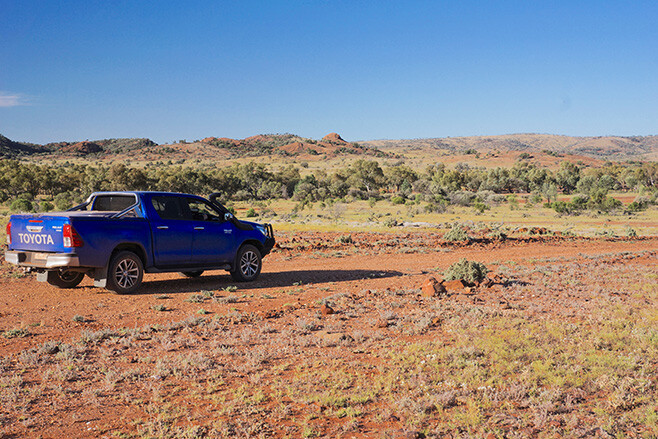
I JAMMED on the brakes of the Hilux, the ABS taking me past the poorly marked intersection which I had belatedly seen as we were cruising north on the Wilcannia-Wanaaring Road.
Backing up I swung the wheel and headed down the narrow but still good dirt track to what is rather optimistically called Peery Lake, where a day-use picnic area has been established in the large and disjointed Paroo-Darling National Park. The vegetation was lush, or at least lush for this part of outback Australia, and was virtually verdant compared to just a few months previously when the drought in this part of Australia finally ended.
The lake, one of the many that make up the Paroo River in this flat landscape, was greener again, thick with a range of herbaceous growth. The trees that fringed the lake bed were dense with a luxuriant sprouting of new leaves. A couple of emus had rushed away as we drove in and a few kangaroos had been spied languishing under the shade of a tree nearby. The water, which we had expected to be filling or at least covering most of the lake, was just a shimmer in the distance, already retreating back under the onslaught of the sun.
The Paroo River may sound grand, but it’s more a string of ephemeral water holes joined by a braided set of shallow channels that combined make up a minor tributary of the much bigger Darling River. The river, for want of a better term, starts its often impermanent, transitory flow in the rocky hills west of Charleville, becoming a more defined stream by the time it reaches Eulo and then Hungerford, 250km north of the NSW/Queensland border. It joins the Darling River just north of Wilcannia, but what little impression the Paroo can make out here is generally hidden from view on private land, well away from the Wilcannia-Wanaaring Road.
We had started our trip a couple of days earlier in one of my favourite towns in the outback, Broken Hill, before we headed out to Mutawintji National Park for the first night’s camp. The Homestead Creek camping ground is well set-up along the shady creek that gives the area its name. There are even hot showers – if you’re lucky enough to be one of the first to use them – and free gas barbecues, along with fireplaces and tables.
As the sun was setting we took the drive along the Old Coach Road past the ruins of the Rockholes Hotel, spying all three species of kangaroos that inhabit the area: scraggy, bulky euros; slimmer western greys; and red kangaroos. Female red kangaroos are a gun-metal grey-blue colour, often called a ‘blue flier’ for their colour and fleet of foot. Sadly there were also a heap of goats, even though the park often carries out round-ups of these hungry and devastating herbivores – they obviously need to do another muster soon.
The next morning we took a short walk to Wright’s Cave, where among the more ancient Aboriginal rock art and engravings are a couple of markings made by William Wright. In the late 1850s Wright was the manager of the vast Kinchega Station and acted as a guide for the Burke and Wills Expedition. He visited Mutawintji in 1859 and 1862.
Sadly, because we failed to find a ranger, we couldn’t explore the fenced and gated Mutawintji Historic Site. The best bet to tour this important Aboriginal area and European site is to do so with Tri State Safaris based in Broken Hill, who often do tours of this area and can meet you at the campground.
From here we headed to White Cliffs, the small opal mining community that first developed when opal was found here in the early 1890s. With a population of around 200 – a few go missing on census night – most live underground to escape the blistering summer heat, so there’s not much to see above ground. For the passing traveller the local store, pub and national park information centre are the major attractions, although the underground motel does grab a few passing travellers due to its uniqueness.
The most obvious thing visible is the old solar power plant, first built in 1981. It consists of 14 three-metre parabolic dishes covered in mirrors, which are now tarnished by the sun. The station, the first of its type in Australia, was in operation until 2004. The old cemetery on the other side of town, which dates back to the first days of the settlement, houses some poignant headstones, many of young kids and babies who died here in the very remote and harsh region.
We headed east on good dirt roads, meeting with the Wilcannia-Wanaaring Road and entering into the northern section of the Paroo-Darling NP. This park, in five disjointed sections, stretches across hundreds of kilometres of western NSW on both sides of the distant Darling River and takes in what were seven distinct sheep and cattle properties. The northern section is based around the Peery Lake, which is a flood-out lake of the Paroo River. However, a lot of other lakes – albeit smaller ones – need to fill before the bigger Peery Lake gets any life-giving water. Still, when it does, the birdlife can be amazing, with 60,000 birds being recorded there in one recent survey. It was a lot quieter when we were there, but the birdlife was still enjoyable and we were lucky enough to witness the gliding ability of wedge-tailed eagles and the slightly smaller, but much scarcer, black-breasted buzzard, one of Australia’s rarest raptors.
Sadly Peery Lake is only a day-use area, which cheesed me off. In all of this vast park, spread over hundreds of kilometres of outback NSW, there is only one designated campsite, and it’s east of the Darling about 150km away from where we were. The day-use area at Peery Lake is a pretty darn good facility, with a carpark, shelter shed, tables, toilets and free gas barbecues. You have to ask why camping is prohibited?
Back on the main road further north we took the Tilpa Road as it crosses the Paroo River, but the river, or at least the bed of it when the water flows, was so indistinct here that we couldn’t tell where the main channel began or ended. We found a track north that led to a shallow lake fed by the river, but a gate with a ‘No Entry’ sign stopped any access.
The Nocoleche Nature Reserve, some 20km south of Wanaaring, covers 740km² and straddles the Paroo River, but again only has one spot available for public access. However, King Charlie Waterhole is probably one of the best spots to gain access to the river and is less than two kilometres off the main road and a short walk from the parking area. A shelter shed has a table and gas barbecue and is a pleasant spot to stop to take in the often rich birdlife the waterhole gathers around it. Mulga and white wood dominate the area, but popular box and black box trees are found closer to the river. The rich, flowering Yapunyah Tree (restricted in range to the floodplains of the Channel Country) has its largest stands here in all of NSW.
We continued our crossing of Paroo just out of Wanaaring, where we did a circuit of town in what seemed like only a minute or so and then went to the local pub for a cold beer to celebrate our little sojourn up the river. That evening we camped for the night on the edge of the Paroo, where the river looked like a flowing stream hemmed in by low banks. It was a magic spot and worthy of more than just an overnight stay, but our time was up and sadly we had to return south.
For those with a bit more time it’s an easy run further north, paralleling the river to the Queensland border hamlet of Hungerford and then passing through a gate in the Dingo Fence. From here you then pass through Currawinya National Park and follow the river north to Eulo. Put it on the bucket list.
TRAVEL PLANNER
Tri State Safaris: www.tristate.com.au Mutawintji NP: www.nationalparks.nsw.gov.au/visit-a-park/parks/mutawintji-national-park Goodwood Station: www.goodwoodstationstay.com; ph: (08) 8091 6728 Paroo-Darling NP: www.nationalparks.nsw.gov.au/visit-a-park/parks/paroodarling-national-park Nocoleche Nature Reserve: www.nationalparks.nsw.gov.au/visit-a-park/parks/nocoleche-nature-reserve Kilcowera Station: www.kilcowera.com.au Dowling Track: www.outbackbeds.com.au/the-dowling-track.html Currawinya NP: www.nprsr.qld.gov.au/parks/currawinya
What’s your next off-road destination? Find out and explore.
CEVICHE is a dish of fresh fish marinated and cured in citrus juice, and it’s a popular dish in the coastal regions of South America.
Ron and I did a fabulous Mexican food tour when we were in Mexico City a couple of years ago. One of the best things we ate was their version of Ceviche, served on toasted tortilla. It was delicious, refreshing and tasty. A great meal for a hot summer’s day.
INGREDIENTS Serves: 6 to 8 for an entrée, or 4 as a main
- 750g-1kg firm, white-fleshed fish – cut into small cubes
- 1 cup fresh lime or lemon juice
- ½ cup seeded, diced tomato – cut into small, even-sized pieces
- ½-1 cup cucumber – peeled, seeded and finely diced
- ½-1 red onion – finely chopped
- ¼ cup chopped fresh coriander leaves – more or less to taste
- 1 red or green chile – finely chopped
- Salt and freshly ground black pepper
- 1 tbsp bottled hot sauce
- Grilled tostadas (soft tortillas)
- Mayonnaise
- 1 avocado – halved, stoned and peeled
- 1 lime – cut into wedges
- Put the diced fish in a medium non-metallic bowl. Do not use a metal bowl, as the acidic properties of citrus juice can have a chemical reaction with the metal.
- Pour the lime/lemon juice over the fish and mix gently to combine.
- Cover with plastic wrap and chill in the refrigerator until the fish is white throughout (about 25-30 minutes).
- Remove from the refrigerator and gently squeeze the fish with your hands to remove the juice.
- Discard the lime juice.
- Add tomato, cucumber, onion and coriander.
- Season with salt and pepper to taste.
- Add the hot sauce and chili (optional).
- Mix gently to combine all the ingredients.
- Spread the grilled tostadas with mayonnaise (optional) and top with the ceviche.
- Arrange the avocado slices on top of the ceviche and serve immediately with lime wedges.
- Use a fresh, firm, white-fleshed fish. Keep the fish cold, remove the blood line and remove all the skin and bones.
- Use the right type of fish. In Mexico, red snapper is traditionally used for ceviche. In Australia, use ling, blue-eye trevalla, coral trout, emperors, barramundi, sea bass or mahi mahi.
- Cut other ingredients evenly and in small pieces.
- Don’t over marinate the fish. When the fish starts to turn opaque it’s ready to mix with the other ingredients.
- Partially frozen fish is easier to dice.
- It’s worth taking the time to remove the seeds from the tomatoes, otherwise you end up with too much liquid from the tomatoes.
- If you want to be very traditional, use corn tortillas. Otherwise soft tortillas, which are readily available in your supermarket, can be used. Heat on your barbecue plate or in a pan until slightly brown and a little toasty.
For more great recipes: Check out Ron & Viv Moon’s website or follow their Facebook page.
IF YOU haven’t noticed a large shift in the Australian off-road scene over the past 10 years, I strongly recommend you relocate from the rock you’ve clearly been living under.
The days of Cruiser, Patrol and Hilux domination are long gone. There’s now more choice than ever before, with niche 4x4s popping up left, right and centre. Without doubt, one of the most drastic changes has been Jeep’s full-scale assault on Australian shores, with its four-door JKU Wrangler becoming the go-to vehicle for every man, woman and child looking to make short work of their local rock gardens.
Watch this wild JKU Wrangler Rubicon in action!
The JKU, with live axles front and rear, flexy coil springs and five-link suspension arrangement, was such an appealing off-road package it managed to sway ‘Rangie’ Benn Collings away from a history of near-on a dozen Rovers and Patrols and behind the tiller of a brand new 2013 Rubicon.
“It was a daily driver for the first two and a half years I owned it,” Benn told us. “It’s only really been recently that I’ve gotten a little excited and it’s become a weekend toy, it’s just used for adventures now.”
Depending on what model JKU you pick up, there are a few different engine options you could tick the box for. Earlier models came with a 3.8-litre V6 EGH engine most commonly found in minivans, while there’s a 2.8-litre RA428 diesel four-cylinder option as well.
Benn’s Wrangler Rubicon is fitted with the 3.6-litre Pentastar V6, which offers 10 per cent more torque than previous models and an impressive 40 per cent more horsepower. The bent six breathes through an AUS4WD custom stainless snorkel and an Airraid MXP air box. It’s backed by the standard ’box and transfer case; although, once again, the Rubicon model picks up the highly-sought-after 4:1 low-range ratios.
One of the biggest selling points of a Wrangler is the live axles front and rear. Unfortunately, most models come with a comparatively weak Dana 35 axle up front, which struggles to cope with 35in (or larger) tyres. Benn’s Rubicon replaces the weak D35 front axle with a beefier D44 unit.
It’s fed power by a high-angle Teraflex Rzeppa driveshaft, and it’s shoe-horned full of goodies including Poison Spyder diff covers to protect the Yukon 4.56 gears and factory lockers. The axle has been beefed up with Evo 44 Magnum diff sleeves and matching Evo knuckle and control arm brackets. There’s a custom bracket pushing the Panhard higher and flatter, as well as providing a mounting point for the Fox steering damper. A Synergy high-steer flip kit is included to reduce bump steer.
The stock D44 has matching Yukon 4.56 gears in the rear, this time with a set of chromoly axles included for a further bump in strength. To fix some of the handling issues with a lifted Jeep, Benn has fitted a Teraflex Panhard relocation bracket that pushes the Panhard rod up and flattens it out, helping to reduce body roll in the process. Both front and rear axles are kept in place with bright green Synergy lower control arms that are not only stronger than the stock units but also have an included bend to allow more clearance off-road.
On the suspension front there are three-inch-lifted Synergy coils on each corner kept under control by Fox 2.0 shocks with remote reservoirs and Teraflex bump stops, ensuring a smooth landing on harsh washouts. The stock electronic swaybar disconnect (also a Rubicon special) has been swapped out for a more reliable manual version from Evo Manufacturing, a mob based in sunny California. The suspension set-up allows for the fitment of 37-inch Mickey Thompson MTZ mud terrains wrapped around Mickey Thompson SideBiter II alloy wheels.
While underneath the Jeep might be where the magic happens, saying Benn’s JKU looks alright would be like saying the High Country has a few nice hills. Starting from the front there’s an ARB Stubby bullbar shrouded in Aurora LED light bars – a 20-inch bar on top with two dual bars either side.
On the shoot, Benn’s JKU was fitted with a Road Runner Offroad low-mount winch, but an AUS4WD high-mount Warn will soon be taking its place. The old candle-stick headlights have been ditched, in their place are a set of Narva Free Form polycarbonate upgraded seven-inch headlights nestled inside the angry-eyes grille. Up top there are three more Aurora LED lights, with a 50-inch bar mounted to custom A-pillar brackets and a second set of dual LEDs at the bottom of the pillar.
Down both flanks of the Wrangler the stock bulky flares have been ditched in favour of high clearance ‘flat fenders’ from Double Black Offroad, with a full suite of removable Dirty Flaps from Ranuki Offroad easily removed for the shoot. Benn has also replaced the Rubicon’s standard rock sliders with far stronger units from Melbourne-based Uneek 4×4.
The bulky standard tail-lights have been swapped out for slimline Narva units on Ranuki Offroad mounts, with corner protection coming in the form of Bushwacker corner guards. The rear bar and tyre carrier are AEV-styled units, with twin Narva LEDs on an adjustable mount fitted to the swing-out carrier.
Benn’s Jeep might sound like a one-trick pony so far, but opening the rear door puts that idea to bed. The first thing you notice is the trick drop-down table made by Benn’s business, Ranuki Offroad. “I’ve been running Ranuki Offroad for a while now,” he said. “All the designs we do are noninvasive, making use of factory bolt holes so you don’t need to cut or weld to install things. We’ll use adaptors to plug into the factory loom wherever possible for electronic gear, too.”
The twin pull-out drawers are another Ranuki item, as is the drop-down fridge slide that goes in for longer trips. The slide is home to a 40-litre Engel with a Champion remote fridge monitor to keep an eye on temperatures. On summer days when the lid comes off there’s a Smittybilt C.RES2 cargo restraint system to keep camping gear locked in, with a Rugged Ridge Eclipse sun shade to protect both front occupants.
From the captain’s chair Benn’s got easy access to a Rugged Ridge switch-pod full of Narva Carling switches for lighting, as well as access to the Uniden UHF and AEV ProCal module, allowing for easy adjustments of the stock on-board electrical system for things like speedo calibration and tyre-pressure-monitoring systems.
There are plenty of 4x4s on the tracks that claim to be all singing and all dancing, yet fall down in reality. However, Benn’s Wrangler is different story as it can talk the talk and walk the walk: as soon as we wrapped up a 4X4 Australia photoshoot of serious rock-crawling, he hooked up a caravan and took off exploring Victoria’s east coast for two weeks!
THE TUNDRA seen in the above video is Toyota USA’s big-daddy pick-up – a six-metre long, two-metre wide hunk of American freedom.
Californian lad Chris Lopez is the owner of this self-titled “Blue Dream Tundra”, and he has tweaked it considerably since he bought the showroom-fresh Platinum edition three years back.
Despite wearing a few faces in the past three years the current incarnation is in full battle-spec mode, with the 5.7-litre, V8-powered Tundra adorned with a host of aftermarket goodness from head to toe.
Pro Comp long-travel suspension, new upper and lower control arms and a leaf pack were installed to improve wheel travel and ride height, while 35×12.5 Pro Comp Xtreme MT2s are wrapped around matching Pro Comp Vapor Pro alloy beadlock wheels.
Protection is provided via N-Fab front and rear bumpers, a Pro Comp skid plate, N-Fab rock rails, as well as an N-Fab bed cage (sprayed in Rhino Linings) that holds two spare tyres and a Pro Eagle jack.
A 3M vinyl wrap from Daley Visual is complemented by a combination of Rigid Radiance Series lights in the bumper, behind the grille and above the cabin.
Other features include dual Black Widow exhausts with RBP tips, a HornBlaster Nightmare Kit, a Bully Dog tuner, Buggy whips, Spyder Auto head- and tail-lights, Pro Comp fender flares, and Nitro 4.88 gears in the rear end with an Auburn locker.
To read the full review and see what else this wild Tundra is packing, pick up a copy of 4X4 Australia’s April 2017 issue. In stores now!