DURING the early morning hours, dust from a week of tyre-to-tyre competition had settled and all was calm on the Southern California desert.
As the sun crested the eastern horizon, racers and support crews made last-minute preparations – checking fluids and GPS systems – and mentally prepared for the day ahead. It was a scene that has played out every February for the past decade, and in a few hours, teams would slip on race suits, secure their harnesses and begin one of the most punishing off-road events on the planet – the 2017 Nitto Tire King of the Hammers (KOH).
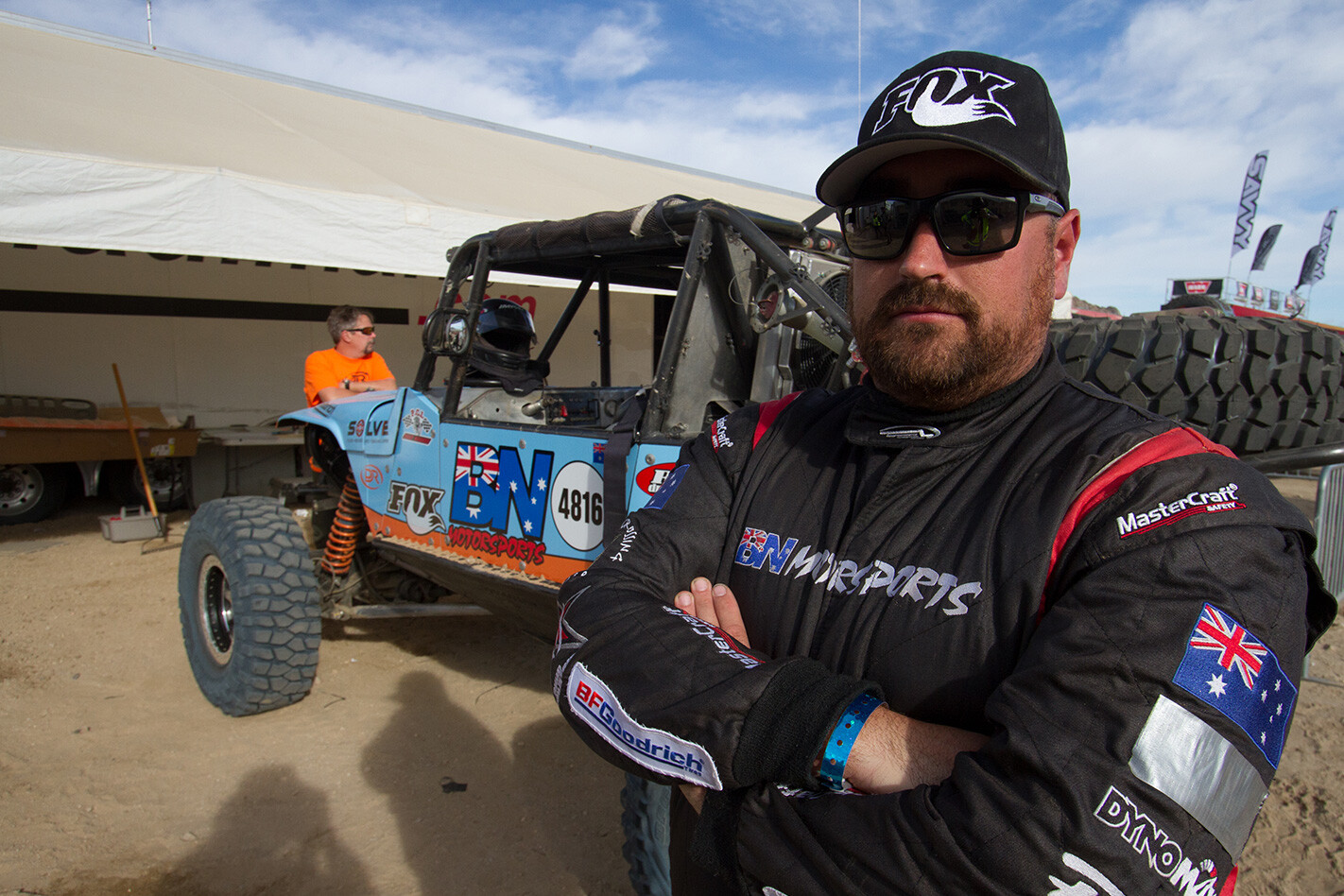
Waiting in a queue of more than 100 rock buggies were Aussies Ben Napier and Pete Antunac, ready to fight to the last piston stroke to bring home the coveted crown and scepter. They weren’t strangers to Southern California’s Johnson Valley, as both had suited up for KOH in the past but neither had claimed a place on the podium for the Australian flag.
KOH has gained traction as one of the world’s premiere automotive venues, but few understand its humble beginnings. This year marked its 10th anniversary, and in addition to chasing Napier and Antunac around the track, we caught up with KOH co-founder Dave Cole for an inside scoop on the event’s successes and challenges.
THE FIRST DECADE
One night over a couple of stubbies, Dave and friend Jeff Knoll came up with the idea for an off-road race that would demand both supremacy in technical terrain and a mastery of desert racing. They scribbled their thoughts on a napkin and shared the concept with a few friends. A few months later they found themselves in Johnson Valley to test their theory.
That first event was small, with just 12 teams and a handful of friends. It would become known as the OG13 (it should have been OG12, but there was a misprint on the shirts) and incorporate eight of the famous Hammer trails. Cole was the sole marshal, and sign-in sheets at the top and bottom of each route substituted for formal checkpoints.
When the dust settled, JR Reynolds was crowned King. The event’s success led to the formation of Hammerking Productions, and word spread fast that there would be a sequel.
The first official KOH, also a semi-private event, was in 2008. There were 43 teams, seven trails, and the course was expanded to 55 miles (88.5km) in length. Shannon Campbell, who started last, would school the competition on how to pass 42 vehicles and take the crown.
In 2009, Raceline Wheels sponsored a carnival-style tent for driver and press meetings. Dozens of manufacturers showed up to display their products, and vendor alley was taking shape. GPS tracking for all racers was incorporated, Pirate 4×4 provided live streaming web broadcasts, and a few thousand spectators lined the courses. We asked Dave about the key to their early successes. “Tom and Steve at Griffin Radiator believed in us from the beginning, as well as Raceline, Genright, Spidertrax, and smaller shops. They had our backs early on and sustained us at our core. Nitto Tire and 4 Wheel Parts gave us opportunity through financial support to take bigger chances and grow to the next level.”
KOH then began to attract competitors from other racing genres, such as SCORE’s BJ Baldwin and NASCAR’s Robby Gordon. While the event was gaining traction as North America’s toughest off-road race, the rest of the world was taking notice. Articles published around the world caught the attention of not only racers and fans, but also the global media.
INTERNATIONAL PHENOMENA
In 2011, when Knoll left Hammerking Productions, Cole took the wheel and hit the accelerator. During the next five years the event experienced exponential growth. A power grid was developed to light the streets of Hammertown, Smittybilt sponsored the Every Man Challenge, and King of the Motos and King of the UTVs were added. Cole also created the ULTRA4 series, which would expand to include events in Europe, Australia and China.
A secondary impact has been the creation of numerous satellite industries. It is clear Cole has a close personal connection with those around him.
“I think that everyone who runs their own shop, pulls their own weight, and has created their own success is a part of this community,” he said. “It has taken everyone’s desire to see this succeed and we all grow together as a family. Another important aspect is the drivers’ commitment to making ULTRA4 the best community in the world.”
Of the original OG13 racers, most are still racing or are part of the Hammerking production team.
When asked what the future holds, Dave said: “I want to continue grassroots racing and Every Man Challenge-style events, while exposing ULTRA4 to as many people around the world as we can, as well as continue to make the safest and most brand-friendly motorsport. The other challenge has been that the guy leading all of this is just a stupid racer himself.”
This is a pretty humble statement from a guy who has literally changed the industry.
THE NEXT 10 YEARS IN HAMMERTOWN
This year, more than 130 manufacturers and vendors set up booths, nearly 1000 competitors suited up during the week, and an estimated 60,000 spectators packed the sidelines – tens of millions followed via live, worldwide digital media.
Nearly 400 journalists from five continents arrived in Hammertown to report on the action, and NBC Sports was on hand to film an upcoming television series. Antunac didn’t take home the KOH crown, but he did land his first finish and claimed 13th overall. It was his best KOH performance to date. Ben Napier competed in the Every Man Challenge Legends Class, where he made it into the top 10.
What began just a decade ago as a one-day gathering of enthusiasts and a peppering of tents on an alkali flat, has evolved into one of the largest automotive venues on the planet. It has literally become the Burning Man of the off-road world.
As they say in Hammertown: See you on the lakebed!
I FIRST wrote for the mag sometime in late 1986 when I had been conscripted to head to Alice Springs and join an AAT Kings trip to the Kimberley.
Little did I know that would begin a lifelong friendship with one of the Outback’s great characters, the late ‘Taffy’ Abbotts, and a continuing love affair with the northwest of WA, which we had first visited eight years earlier. We ended up getting bogged for three days in the AAT King’s UniMog as we headed into the then almost unknown Bungle Bungles. Here we met Malcolm Douglas, who had also just heard of the place and was making a movie for his TV show.
By Issue 42 (July, 1987) we were regulars in the mag, with destination pieces, tech stories and Viv’s first ‘how to’ cooking article. I started at the mag as Editor (Issue 46) after delaying the first day in the office because of a three month trek to the Kimberley – the boss was broken-in quickly to my peregrinate lifestyle. The day after I got back from up north I walked into the office to what turned out to be a momentous occasion in four-wheel drive history, the launch of the mighty GQ Patrol onto the Australian market.
My first road test for the mag wasn’t too illustrious and only remains in the memory because of all the stupid things I did. I took a test car for a run down in the Otway Ranges. It happened to be the Managing Director’s car – a Daihatsu Rocky – and I drowned it big time, filling it with sloppy mud and water. To say the boss of Daihatsu was unimpressed was quite an understatement! Still, I even owned up to it in the report (well, most of it).
The biggest-selling mag (April 92, Issue 99) I had under my tenure also caused the most raucous. We had been over to Robe in the southeast of SA for an advertisers’ weekend when the staff of the mag got together with some of the industry’s leading players. After a bit of goading by some of the others, one of the guys in an impeccable Range Rover hit a dune a little too hard. Launching off the crest the Rangie arced over in a graceful curve and landed on its nose, where it stood teetering on the brink. The resultant pics ended up on the cover of the mag, which were then used by forces wanting to close the beaches of Robe to 4WDers.
I was summoned to Robe by NP&WS of SA to explain the situation, and luckily we had been in the Millicent Dune Buggy Club area and not on the beaches or nearby dunes, so the situation was quickly diffused and we threw our efforts behind those helping the fight for the tracks to remain open. Luckily for 4WDers the business people of Robe rallied to the cause and today the beaches remain one of the great 4WD destinations in Australia.
In 1998 I conceived the idea of the Outback Challenge after having been to the Rainforest Challenge in Malaysia, the Warn Ukraine Challenge and to Moab rock-crawling events in the US. With the substantial help of Sharyn Vanderhorst (my long-suffering deputy editor) and her husband Paul, we had the first event up and running in mid-1999. It proved to be the forerunner for all the winch challenges that followed, and the OC still continues under the capable guidance of Steve Tjepkema, the winner of the 2001 event.
After completing Issue 211 in August 2001 as editor, the mag was about to move to Sydney and I’d been given a better offer of editor-at-large, which would see me and Viv doing a bit more travelling. We’re still trying to crank the travelling up a notch, but 7-9 months a year on the road each and every year is still pretty good, I reckon. Still, it’s the friends I’ve made in the industry and on our travels that remain the best thing about those early years and it’s something we cherish. There’s nothing better than to meet friends and old acquaintances and have a beer with them in the scrub. Hopefully we’ll be doing more of that in 2017!
IT’S 2017 and I’m being thrown around a highly modified ‘Nissan Patrol Super Jeep’ as we traverse ice-covered rivers and deep snow at the base of Iceland’s notorious Eyjafjallajökull glacier/volcano.
This was the very same volcano that stopped the world back in 2010, disrupting Northern Hemisphere air traffic for weeks.
Despite the spectacular scenery of glaciers, deep snow and volcanoes, my mind wanders. Firstly to how the hell anyone can advertise a Nissan Patrol Super Jeep. It’s either a Nissan or a Jeep! Then to the countless other jaw-dropping places I’ve been 4WDing since the first edition of the monthly 4×4 magazine hit newsagents way back in the early 80s.
I recall the top secret SAS training track at Land Rover’s Solihul headquarters where a handful of Australian writers previewed the breakthrough Range Rover Vogue turbo-diesel in 1985. The most unforgiving track I’ve ever driven.
I remember the Toyota test track way up on the slopes of Japan’s sacred Mount Fuji in 1984. We were driving the amazing new direct-injection turbo-diesel Land Cruiser 60 Series through deep snow, before hopping on a plane for Cairns to trial it in the steaming tropics in the same 24 hours.
Unfortunately I also recall the face of the Japanese Toyota engineer, waiting in anticipation on the opposite side of a swollen Daintree River as I drove his beloved took into the water a little too fast. It was a cross between disbelief and failure as the vehicle died in the middle of the river.
I remember the unforgiving beaches of Robe in South Australia, the numerous east-west crossings of the Simpson Desert, the first drive of Nissan’s recreational Navara utility through Mexico, the quick sand of Tasmania’s west coast, and the 1985 season of the National Off-Road Racing Championships where I managed to convince Russian marque Lada to launch its unstoppable Niva 4×4 as an entry into class 8 with rally champion Geoff Portman at the wheel and me in the navigator’s seat. After a dozen or so rounds we won the title.
That’s the thing about this magazine. From the day we launched, it pushed and challenged us all to go further, to do more and exceed limits – of us and the vehicles. It was the beginning of the 4WD recreational explosion of the early 80s, and as a magazine we became the catalyst for people to take these new machines into the country for which they were designed.
I was just 21 when we launched and I had been filling in for a derailed trucking writer on a national newspaper. I was an investigative news reporter when one day the editor promised me a little something extra in my pay packet if I wrote the column until they found a new expert. Knowing nothing about trucks I quickly expanded it to light commercial vehicles and added a few 4WDs for the hell of it. Weeks became months and before I knew it I was attending major launches from Uluru to Lang Lang Proving Ground, learning to drive trucks and happily accepting a different 4WD to test each week.
My friends and I thought we’d found Shangri-La as we explored the Victorian High Country with the latest in 4WDs, tents, swags, fridges, snatch straps and winches. As 21-year-olds it was Christmas every week as we drove hard all day and settled beside blazing campfires at night, where our stories got bigger with every drink we had.
Then, when I heard Newspress (later Syme Magazines and then Bauer) was looking for a new editor to start a monthly recreational 4WD magazine, I dispatched a letter from the post office in Mansfield and much to my surprise a seasoned motoring writer by the name of Tim Britten saw something in me and gave me the job. To his credit, Doug Hicks had built a good quarterly mag called Off Road Action and Newspress Managing Editor Len Shaw thought it was time to cash in on the early 80s recreational 4WD boom with a monthly mag that was as much about the lifestyle as it was the vehicles.
For my part I had to learn layouts, editing, photography, managing finances, marketing, distribution and how to manage a wild bunch of writers and columnists.
In my youthful zeal I felt we had no boundaries, blending a mixture of centre-spread trek notes for weekend warriors, support for the growing club movement, coverage of off-road racing and of the growing accessories market. We ventured on 10-day desert expeditions on compass, conducted ruthless product reviews that quite often lost us advertisers, and even paid a worker on the docks to photograph new 4WDs as they arrived on our shores.
We started the 4X4 Australia Awards, called a spade a spade and watched as 4X4 Australia went from nowhere to eventually rival and sometimes better Overlander 4WD and Bushdriver in sales.
There was no online, no mobiles, no modems and no offshore printing. We took our own photos, went from final edit to news-stands in less than a week, and rode the recreational 4WD wave all the way to shore.
And in the two and half years of editing the magazine I always wondered why the hell someone was paying me to have that much fun!
A number of fun events and activities are kickstarting over the next few months. Plus, there are a few updates to tracks that’ll come in handy if you’re heading off on an adventure. Here’s just a sample of what’s coming up.
Access to Vrilya Point (Qld) Vrilya Point is still on top of a lot of people’s question lists regarding Cape York. The latest news on accessing this top spot is that there have been no decisions made by the Traditional Owners (TOs) regarding camping and access for 2017. However, the area will not open until August. The main reason is the state of the bridge, while the TOs also mentioned the amount of rubbish being left behind by visitors. Please note Vrilya Point Beach is also closed, even if you go there via boat. Rangers will be patrolling.
Aberfeldy Tracks Guide (Vic) A great little brochure and map has been produced that gives details on four back-road trips (and eight side trips) that you can enjoy between Walhalla and Jamieson in the rugged mountains of the Vic High Country. This is a combined effort between the Vic government, 4WD Victoria and the West Gippsland Relic, Mining and Heritage Protection group, who do much of the maintenance of the track and heritage sites. Find a copy of the brochure/map at: www.ffm.vic.gov.au
Henry Lawson Festival (NSW) The Henry Lawson Festival will be celebrating 60 years this year, as well as the 150th birthday of the old bard himself. Dates are from June 8-12. The festival starts on Thursday and continues to Monday, with an array of exhibitions, events and entertainment. For more details, visit: www.henrylawsonfestival.com.au
Mullewa Muster and Rodeo Championships (WA) Mullewa will be hosting a round of the Australian Rodeo Championships over the WA long weekend (June 3-4). There will be plenty of entertainment including a Beaut Ute Competition and a Country Music Concert headlined by Troy Cassar-Daly. Camping is free and opens Friday afternoon. For more info, go to: www.cgg.wa.gov.au
Mt Freeling Station (SA) Mt Freeling Station in the northern Flinders Ranges has changed ownership. Accommodation, camping and 4WD touring is no longer an integral part of the operation and will be restricted. For permission and more information, contact the managers on (08) 8648 4851.
Bramwell Cup (Qld) From June 30 to July 2, Bramwell Station on Cape York will welcome neighbours and visitors to its property for horse races and events for younger carnival goers. The weekend will be aiding the RFDS. For more go to: www.bramwellstationcapeyork.com.au or contact the roadhouse on: (07) 4060 3230.
Simpson Desert Bike Challenge (SA) The Simpson Desert Bike Challenge will take place during the last week of September. It may be a good time for four wheelers not involved with the race to avoid the route, as opportunities to overtake are restricted between 5.30am and 5.30pm. This event will consist of a convoy of around 35 vehicles and 25 mountain bikes racing between Purni Bore and the Birdsville Track, via Rig Road and Warburton Track. The event raises money for the RFDS. It has been running for 30 years and hopes to lift total donations to $300,000. Check out www.desertchallenge.org
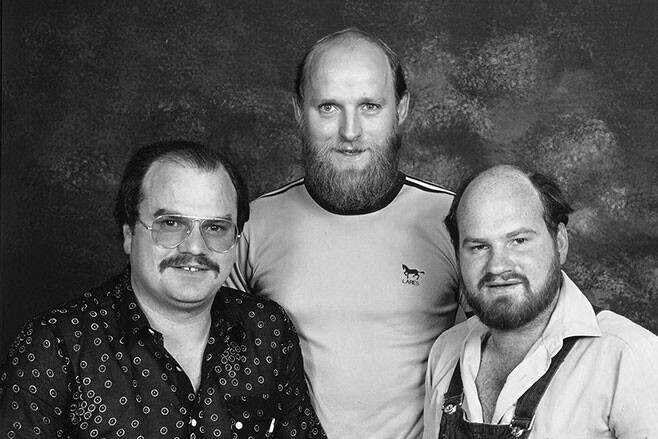
THE ARB story began in a typical Australian suburban driveway in 1975, when company founder Anthony (Tony) Ronald Brown returned to Melbourne from a trip to Cape York in his old Land Rover, which he had completely rebuilt and equipped with a homemade roof rack.
In his travels Tony saw a lot of crook gear on vehicles that was prone to failure, so once back in Melbourne he decided to manufacture his own better quality roof racks, which he sold direct to customers as well as to a few local companies. This soon led to the manufacture of tube bullbars.
“What started Tony off was the people he met on the way, and the trouble they were having with products,” explained Tony’s brother and current ARB Managing Director, Andrew Brown. “At home, it was basically just roof racks, and Tony and I built a bender. We had to bend square tubes, so we made a bender with a big 12-foot bar on it, and we ran around it and bent the tube. We didn’t know how to weld, so the old man bought an arc welder for us, an Abel 130 Amp arc welder, and we learnt how to weld… and that’s where it basically started.”
Soon Tony was producing one or two racks a day, with part-time help from brothers Andrew and Roger. Everything was done by hand – it would take half a day to paint a roof rack with a brush – but Tony had soon outgrown the space in his old man’s driveway, so at the start of 1976 he rented a 1000-square-foot property in Olive Grove, Ringwood, and he hired the company’s first employee, John van den Eynden, on February 1, 1976. John, a qualified boilermaker and automotive mechanic, would eventually go on to become factory manager, and is still with ARB to this day.
On July 1, 1977, ARB Engineering Pty Ltd was born, and the company moved to new, larger premises at Molan St, Ringwood. “That’s when I started [with the company],” said Roger Brown, current ARB Chairman. “I used to come in a few nights a week and I used to paint roof racks. I just wanted to be a part of it…”
The introduction of the diesel-powered BJ40 Land Cruiser in the mid-70s saw big growth in the recreational four-wheel drive market, and the flow-on effect for ARB was a rapid growth in business. In fact, the Land Cruiser was the first vehicle for which ARB developed a complete range of products, which included a bullbar, roof rack, ladder, Gabriel shock absorbers, Cibie driving lights and more.
The ARB range continued to expand and the company took on products including AVM hubs, Topkat canopies for utes, and Warn winches, the latter a trusted brand that ARB still distributes in Australia.
By 1981 ARB was ready to move once more, to new larger premises in Bayswater, having grown from the pairing of Tony Brown and John van den Eynden to around 24 full-time staff. It was here that Tony Brown designed the company’s first fabricated upswept wing bar. This revolutionary bar offered the best possible protection while also improving vehicle approach angle. So successful was this design that it has since been copied by countless bullbar manufacturers the world over, and it still sets the standard for bullbar design to this very day.
Even in the early 1980s ARB’s Australian distribution network stretched right across the country, and by the end of 1986 the company had grown so quickly it had to move into a new state-of-the-art design, manufacturing and retail premises in Croydon, Victoria.
On the back of its domestic success ARB was keen to crack the lucrative US market, but shipping large fabricated products such as bullbars and roof racks to North America would be prohibitively expensive; ARB needed a product that was of high value but not too big to ship. This product came in the form of what was then called the Roberts Diff Lock, later named ARB Air Locker. To continue on its rapid development and growth trajectory, and to further the development of the Air Locker, ARB needed more funds, so a decision was made to list the company on the stock exchange, which took place in 1987.
The Air Locker proved hugely successful in the US and around the world, and it was the key in growing the company’s export business; close to 40 per cent of ARB’s business is now offshore.
A by-product of the Air Locker project was the development of the ARB Air Compressor, which has gone on to become an important piece of 4WD equipment in its own right, with a new version developed and released to the market in 1996 that could either be fitted to a vehicle or supplied in a portable carry case. Today ARB manufactures several Vehicle Mounted and Portable Air Compressor models, along with a range of associated accessories.
In 1988 ARB acquired the Old Man Emu (OME) suspension business, which it already distributed throughout Australia. Bringing OME into the fold has resulted in ARB becoming one of the most advanced manufacturers of suspension systems in the world, culminating in its latest BP-51 range of high-performance aluminium extruded bypass shock absorbers, which was launched to great acclaim in 2015.
For the past 20 years ARB has been designing, developing and manufacturing its own range of ute canopies. “The canopy has become another really important segment of our sales, and the strength of the ute in Australia has been critical to that,” said Roger Brown.
Today ARB produces various canopy designs, as well as ute lids and ute liners. The most recent addition to ARB’s canopy range is the Ascent Canopy, released in 2015, which is arguably the most advanced canopy on the market, with fully integrated central locking system, push button window switches and a unique over-rail design that provides a form fit with the vehicle.
One of ARB’s newest products is the all-weather portable fridge/freezer that can be secured to the back of a ute and features a locking lid to keep its contents safe. The all-weather 60L fridge joins ARB’s existing range of fridges, which are available in 35L, 47L, 60L and 78L capacities, all of which were developed in house at ARB’s HQ in Kilsyth, Victoria.
In fact, ARB is renowned for its in-house development, and the company employs a team of engineers with expertise in a wide range of fields covering fabricated products, mechanical products, suspension systems, rotationally moulded plastic products, electronics, and camping and recovery gear. Where viable, ARB then manufactures these products in-house, either at its main facility in Victoria, at one of its other Australian manufacturing facilities, or at its wholly owned factory in Thailand.
Andrew Brown was keen to point out that ARB is willing to have a go at developing a range of new products in-house, regardless of whether the company has the expertise or the specialists in the area. For example, when ARB decided to launch its first in-house-developed fridge it didn’t know much about fridges, but invested the time and effort to learn and ended up producing what it claims to be the best fridge on the market. Likewise, just a few years ago ARB had no experience in manufacturing LED driving lights, yet it charged its engineering team to research and learn and ended up creating the entire round LED lighting category.
“We’re not afraid to have a crack at developing new products in-house,” said Andrew Brown. “Even if we’re not experts to begin with, we inevitably end up producing class-leading products.”
ARB is quite unique in that it not only develops and manufactures products, but also retails its products direct to the public through a network of company-owned and independent stores. Focusing on its core strengths has been the key to ARB’s astounding success over the past four decades, and will continue to be so into the future.
“In 40 years, we’ve stayed the same business. We’ve been very fortunate that the market for our products has grown, and we’ve grown, but we manufacture, supply and distribute accessories for 4WD vehicles, and it hasn’t changed,” said Roger Brown.
ARB TIMELINE 1975: Tony Brown begins manufacturing roof racks and bullbars in family garage. 1987: ARB buys the Roberts Diff Lock which is re-launched as Air Locker here and in the USA. 1987: ARB designs and manufactures its own 12V air compressor. 1988: ARB takes on the Old Man Emu (OME) suspension business and continues to develop the range. 1997: The first ARB airbag-compatible bullbar is released after extensive real-world crash testing with Monash University. 1998: ARB designs and manufactures its own range of canopies. 2005: ARB develops its own range of 4WD recovery gear.
2008: The innovative ARB fridge/freezer is introduced. 2012: ARB Intensity LED driving lights are launched. 2014: New ARB Ascent Canopy range is launched. 2015: Revolutionary BP-51 bypass high-performance shock absorbers are born. 2016: The Frontier long-range polymer fuel tank is launched.
We’re performing some scheduled maintenance on our newsletter, so we’ll be out of action for the next few weeks!
In the meantime, make sure you follow us on Facebook, Youtube, and Instagram to stay up to date.
Don’t worry, we’ll be back with our regular newsletter soon!4×4 Australia team
A VIDEO posted to YouTube earlier this week has captured Mercedes-Benz’s upcoming X-Class ute out testing.
After two X-Class concept vehicles were shown late in 2016, a production version of the Nissan D23 Navara-based ute is expected to be revealed later this year. When it goes on sale in Australia is yet to be known, but don’t expect here it before 2018.
The video doesn’t reveal a lot about the camouflaged vehicle except the LED tail lights, which appear similar to those which were on the green ‘Powerful Explorer’ concept. These are not expected to run the whole way around the tailgate like they did on the ‘white ‘Stylish Explorer’ concept.
The camo-vehicle is running on Nissan Navara alloy wheels, and the headlights appear more Navara-like than the upswept LED units that were on the two X-Class concepts. Mercedes-Benz will give the ute a true MB look, with its own front sheetmetal, lights bumpers and bonnet, as well as tail-light treatments.
The same goes for the inside, where a Benz interior will give the ute a more upmarket feel with higher equipment and connectivity levels than the Nissan base model.
Under the bonnet, the headline act will be a V6 diesel engine from Benz that promises to make the X-Class the most powerful and best on-road-performing one-tonne ute in the segment. It will be backed by a Mercedes -Benz auto transmission and full time four-wheel drive.
Lower spec versions will share the Nissan 2.3-litre bi-turbo engine, with auto and manual transmission options and part-time four-wheel drive.
Bespoke tuning of Nissan’s category-unique coil-sprung, multi-link live rear axle and IFS is also set to give the X-Class a more refined ride and performance driving experience, befitting the Benz three-pointed badge.
We expect to see more spy photos and leaks of the X-Class as we get closer to reveal later this year, along with more details of specifications and pricing.
400, NOT OUT. It’s a fair innings by anyone’s standard and enough to put any New Zealand cricket team to shame.
In magazine terms it’s exceptionally good, as printed mags are generally on the decline while online products blossom. We’ve been bucking the trend for a while now and are happy to report strong growth both in print and online, which puts 4X4 Australia in a healthy position for another 400 to come.
So you’ll forgive a little chest-beating as we look back over the last four decades of the magazine, reminisce about the good times and ask our past editors about their time at the helm.
What’s been interesting as we look back is how things have changed, not just the 4×4 vehicles but the gear we use when we travel. There was no need for solar panels, power-packs and engine data scanners in the early days, and the closest thing to electronics that Moonie ever took on a road test was a two-way radio.
Something that has changed massively is 4×4 utes. Those early Hiluxes were about as basic as they come, and they didn’t get any more refined for a long time. They were strictly for government departments and tradies who didn’t need comfort, safety and capacity. Even 10 years ago 4×4 utes were still way behind the wagons in these terms, and I remember doing a test of all the then-current dual-cabs and, with no electronic traction control or diff locks, they couldn’t climb a simple hill that a stock Pajero and Prado had conquered just a week earlier.
Nowadays, utes have five-star safety, electronic traction aids and semi-luxury models, and the top-spec ones are selling for $70K. They’re the hottest market in 4×4 vehicles and the manufacturers can’t bring out new models fast enough. It will be interesting to see how new players to the segment – Mercedes-Benz, Jeep and Land Rover – go in the next three years.
What the manufacturers aren’t giving us are performance models. As the market evolves and new buyers come to a segment they may never have looked at before, the range needs to broaden. You won’t be able to buy a new V8 Holden ute by the end of the year, and there’ll be plenty of blokes looking for an alternative. They will look to 4×4 utes like Colorado, Ranger and Hilux, but baulk at the paltry diesel engines.
Once again we’re thankful the aftermarket has come up with a result, and we’re excited to see the LS3-powered Colorado featured in this issue. Let’s hope there will be more to follow for Ford and Toyota fans out there.
CAN you believe it? It’s almost half way through 2017 and we’re pushing out our June issue already!
We’ve managed to squeeze plenty of off-road goodness into the issue’s 178 pages, including yarns on three beaut customs: An 80 Series, a 76 Series and a Jeep Grand Cherokee.
We take a spin in Nissan’s new Series II Navara, spend a week reacquainting ourselves with Toyota’s venerable Troop Carrier, and conduct the annual tow test.
Plus, we head to some exceptional off-road destinations!
Get your copy of 4X4 Australia from newsagents or by subscribing to 4X4 Australia in electronic or print format.
What you’ll get this month:
NAVARA SERIES II First fang in Nissan’s tweaked Navara.
COMPLETE PACKAGE Custom LC80 tailor-made for remote-area expeditions.
2017 TOW TEST Six tow rigs show off their load-lugging prowess.
TROOPER A week in the High Country proves the Troopy’s still got it.
CUSTOM CHEROKEE 2014 Grand Cherokee gears up for a lap of the country.
2017 DRIVE 4 LIFE Hitting the Vic High Country for a great cause.
GOLD MINE Brett strikes it rich with this modified LC76.
NGUKURR & THE RUIN CITY, NT There’s remote, and then there’s Ngukurr in the NT.
MOOLOOLOO, SA Escape the tourist trap and head to the northern Flinders Ranges.
4WD INSURANCE Don’t get stranded in the bush with an expensive recovery.
CURRAWINYA NP, QLD Special national park with plenty of natural and man-made phenomena.
4X4 GARAGE: YOKOHAMA TYRES Yokohama rolls into our studio with its all-new Geolandar A/T GO15 tyres.
LAKE PINAROO, NSW An oversized wetland area in the north-west corner of NSW… seriously.
THE REST We test a plethora of new products that have hit the market recently: Clearview Mirrors, Axial Bomber RR10, Trac-Grabber, Roadsafe BlackHawk wheel tray, Stihl MSA 160T electric chainsaw, Lightforce LED interior lights, Nikon KeyMission 170 camera, and the Boomerang Barbecue. We’ve also brought back Readers’ Rigs – this month we’ve included a neat 2010 Patrol and a trail-ready Prado Kakadu (among others). Deano reveals how vehicles have been consistently packing on the pounds for the past 20 years, Ron reckons diesel fuel might be on its last legs, Fraser explains how Land Rover’s new Discovery relates to the Range Rover, and Roothy continues the rebuild of Milo 2. Plus, the single-cab Cruiser in our shed gets a fresh set of Yokie boots, and Matt Wood picks up an ex-Army Perentie. The June issue of 4X4 Australia is in stores Thursday, May 11.
IT’S AN image that has been shared and seen world-wide since it was digitised to the internet.
It made its first public appearance in a four-wheel drive magazine in the 1980s, and it has become a symbol of four-wheel drive adventure in Australia.
The photograph shows Norm Needham – part-time 4X4 Australia contributor, 4X4 of the Year judge and seasoned four-wheel driver – standing on the front of a home-made raft, ferrying his FJ40 Land Cruiser across a river in Cape York in 1975.
These days you can drive just about any sort of car to the northern tip of Australia – the road is progressively being sealed and there are now bridges across the major rivers. The trek is not the adventure it once was.
It was very different back in 1975 when Norm and his wife Sandy, along with Ian and Jan Wright and their baby daughter, Jen, made the trip. Back then, there were no bridges over the rivers, tracks you could barely call roads, and hardly another person on the entire peninsular.
This video shows the story behind that photograph, as it follows the intrepid adventurers to The Tip and their exploration of the east coast of The Cape. It’s an adventure that would be difficult to find in this day and age, and it shows us just how far travel in Australia has come in 40 years.
4X4 Australia thanks Norm Needham for allowing us to share this with you.