THE 4.5-litre TDV8 donk in Toyota’s 70 Series Land Cruiser is one sweet thing.
The only complaint is that its matched to a five-speed manual gearbox with a low fifth gear, meaning it sits relatively high in the rev-range (around 2400rpm) when cruising at 100km/h.
Terrain Tamer’s new modified gear set includes a taller fifth gear, designed as a direct replacement for the OE part. This modified gear set brings the gear ratio down from .881 to .736, with an overall RPM reduction of 20 per cent.
The modified gear is built tough, too. Made from 62-strength Rockwell hardened steel, it meets exclusive Terrain Tamer tooling specs.
The Terrain Tamer Modified Fifth Gear Set can be purchased individually or as part of a gearbox overhaul kit.
It will also be optional in all relevant Terrain Tamer reconditioned gearboxes.
Website: www.terraintamer.com
CHINESE SUV brand, Haval, has joined forces with Australian off-road aftermarket specialist, Ironman 4×4, to tweak the H9 4×4 wagon’s suspension for local road conditions.
The Haval H9 Premium is, at this stage, a prototype, but it has been fitted with heavier coil springs and re-valved dampers to enhance the on- and off-road handling of the H9.
According to Andrew Ellis, Haval Motors Australia’s Public Relations and Product Specialist, it is the first step in a lengthy development program, with the vehicle only just hitting the bitumen in Darwin, and heading south to Melbourne this week.
“Haval has … been working closely with dynamics specialists from Ironman 4×4 on a local tuning program designed to make the car more suitable for Australian conditions,” Ellis said.
“Ironman have developed a prototype suspension kit comprising heavier springs, upgraded shock absorber valving and minor changes to toe-in. This has resulted in a H9 with improved cornering performance and a more relaxed ride on Australian roads.”
“The prototype suspension system consists of upgraded coil springs with revised spring rates; tuned, matching shock absorbers; and adjustments to the wheel alignment settings,” Ironman 4×4’s Suspension Product Director Kristian Ristell told 4X4 Australia.
“Spring rates have been increased around 10 per cent front and rear to provide a more stable platform for the addition of accessories and payload. This also tightens up the suspension in corners to reduce the inherent wallowing from the original suspension.”
“The change in ride and handling is obvious compared to the base specification, with notable improvements to bump absorption, composure around corners and straight line stability,” Ristell said.
Being the initial step in the engagement between Haval Global R&D, Haval Australia and Ironman 4×4, the Chinese brand is keen to receive feedback from those testing the vehicle in local conditions.
“We’ll be taking the feedback from media and sending it to R&D as the first step in a localisation program,” Ellis said.
The test rig is the current model H9, but it is worth noting that there will be an updated model later this year which is expected to receive a new 180kW/350Nm 2.0-litre turbo petrol engine, backed by an eight speed auto (the current donk pumps out 160kW/324Nm, and is standard with a six-speed auto).
It is exciting news for both Haval and Ironman 4×4’s engineering team, who were given the task of developing this suspension update.
THE EZDown easily lowers the tailgate as it’s opened.
Installing them is dead simple, but my Toyota Hilux – like many utes these days – uses Torx fasteners for some of its fittings, which threw up a minor challenge. Rather than borrow, I bought a small, inexpensive kit of Torx bits to provide me with the means of unscrewing things.
Instructions are provided and the task took about 20 minutes, including some chin-scratching time and a cuppa. I removed the Hilux’s cable upper retaining bolts – one side at a time to prevent the tailgate dropping – and replaced them with the provided bolts that hold the top end of the hydraulic dampers.
The tailgate bolts were dealt with in a similar way; the original Torx screws were removed and the EZDown hardware installed to suit the ends of the hydraulic dampers.
The EZDown allows the tailgate to open gently. Unlatch the tailgate and it slowly and safely swishes, rather than abruptly drops, into its open position. It banishes the ‘tailgate fumble’, where slippery or inexperienced fingers cause the gate to drop with a donk. There’s no extra effort required to close the tailgate as the struts’ two-way valving provides little resistance to lifting and closing the tailgate.
Unlike some other kits I’ve seen, the EZDown struts work in tandem with the vehicle’s standard steel cables, so there’s no diminishing of the tailgate’s load rating, which is very important for the loading and unloading of working and touring vehicles where heavy equipment places considerable weight on the back.
I’ve had the EZDown for five or six years now (and close to 200,000km), so there’s no question about their long-term durability.
Prices are $145-$215 depending on the model ($195 for my 2005 Hilux), and the EZDown is a smart idea for any touring ute.
AVAILABLE FROM:
RRP: $145-$215 (depending on model)
WE SAY: Convenient and safe option (especially for kids).
Ford Australia no longer sells a V8-powered ute so leave it to the aftermarket to come up with a hot-rod solution.
Vote for the Ford Ranger V8 to win the 2017 Custom 4×4 of the Year
The only Ford ute you can buy now is a diesel-fuelled Ranger, but these wild Gold Coast boys yanked the busted 3.2 out of this example and shoe-horned in 5.0-litres of supercharged FPV goodness.
With all the usual off-road add-ons, this PX Ranger retains all its 4×4 capabilities, but has a howl that no other dual-cab can match.
Forget your lace-pants wearing Tickford and FX4 offering, this is the 344kW 4×4 ute that Ford should be selling – buyers would be queueing up at showrooms for it.
Read the full story on how it was created in the September 2017 edition of 4×4 Australia Magazine.
A RANGER with supercharged V8 power piqued our interest this month, so we took an in-depth look at the 344kW Coyote-powered Ford.
We test new metal in the form of Land Rover’s Discovery and Range Rover’s Sport SD4, and we attend the international reveal of Merc’s X-Class ute.
We also dissect and rank 2017’s best-selling 4x4s. Plus we explore the NT’s Kakadu and trace the Darling River in NSW.
Get your copy of 4X4 Australia from newsagents or by subscribing to 4X4 Australia in electronic or print format.
What you’ll get this month:
2017 LAND ROVER DISCOVERY: FIRST DRIVE Uluru is the backdrop for the first drive of the all-new Discovery.
MERCEDES-BENZ X-CLASS: REVEAL We are in South Africa as the curtains drop on Merc’s new ute.
RANGE ROVER SPORT SD4: FIRST DRIVE Quick spin in the four-cylinder-powered SD4.
JEEP WRANGLER JK WITH MOPAR KIT Forget about the aftermarket, this is a factory-fitted JK.
NSW POLICE RESCUE FLEET At its 75th birthday celebrations, we chat to the NSW Police Rescue Squad’s senior constable.
MID-YEAR REPORT CARD Ranking 2017’s best-selling 4x4s.
CUSTOM FORD RANGER WITH FPV V8 POWER A supercharged V8 makes a good thing even better.
2017 WINCH TEST Seven winches are put through a stringent testing process to find a winner.
CUSTOM NISSAN NAVARA NP300 Modified Navara is the ultimate toy hauler.
2017 VARIETY 4WD BASH, SA The organisers of the charity event sure know how to throw a shindig.
THE KAKADU CIRCUIT, NT Dodging crocs across Australia’s top end.
DARLING RIVER, NSW Tracing the Darling from Bourke to its junction with the mighty Murray.
ABERFOYLE TABLELAND TRACK, NSW If you’re not a fan of the coastal campsite cluster, then head for the hills.
4X4 SHED: 1994 LAND ROVER DEFENDER 300TDI Unsurprisingly, Deano’s spent a bucket-load of cash fixing his Defender.
4X4 SHED: 79 SERIES LAND CRUISER Moonie’s Project Cruiser gets new wheels, tyres and mirrors.
THE REST
We’ve listed a heap of fresh gear on the market, plus we’ve tested a bunch of cool kit: ARB Frontier long-range tank, Mr Heater gas heater, Nite Ize Radiant 300 rechargeable lantern, and Spotters Blaze Nexus Mirror sunglasses.
This month’s Readers’ Rigs includes a sweet 2011 Jeep Liberty package, a mud-skipping 1976 FJ45 and a 1988 MWB Nissan Patrol GQ.
Roothy squeezes more performance out of Milo 2, Fraser ranks the most important attributes of a 4×4, Ron provides an insight into Australia’s atomic bomb history, and Deano bids farewell to his Navara without shedding a tear.
The September issue of 4X4 Australia is in stores Thursday, August 3.
Get the latest info and all things 4X4 Australia signing up to our newsletter.
There is so much to see and experience in Central Australia that one or two trips won’t do it justice.
So, to make planning your next trip easier, Ron Moon has assembled a selection of must-see Red Centre hot spots.
Part 1: The West MacDonnell Ranges
The West MacDonnell Ranges are one of the great tourist attractions of Central Australia, and they’re easily reached from Alice Springs on a bitumen road.
Still, while the West Macs are well and truly on the tourist agenda, there are a few spots only visited by those willing to use a 4WD as they were designed – and that’s by scrambling a wheel or two.
The first gem is about 55km west of Alice, where a track leads off the blacktop to Birthday Waterhole and Hugh Gorge. There are a couple of tricky spots along these tracks, especially if you’re towing a camper trailer or similar, but the rewards are well worthwhile, with bush camps along the upper reaches of the Hugh River.
Back on the blacktop, heading west – beyond Glen Helen Resort – you’ll lose the bitumen and most of the tourists and find an excellent bush camp on the Finke River, at what is known as the Finke Two Mile.
The sandy access track leaves the bitumen just east of the road and crosses over the Finke and wanders along the bank. Sandier tracks head down to some small pleasant sites tucked just above the long waterhole – some are even shaded by tall gums that make this spot such a pleasant interlude to your exploration of the area.
From a nearby lookout you’ll get great views of Mt Sonder (catch it at sunrise) and it’s just a short drive to Redbank Gorge. There’s camping out on the access road to Redbank Gorge, but they’re pretty ho-hum, while the narrow cleft of the gorge is best explored on a hot day with a LI-LO – the water can be extremely cold, though.
A little further west, some 160km west of Alice, is the track to Roma Gorge, probably the least known and visited site in the West Mac Ranges. The access route to the gorge follows a creek for a few kilometres, but it’s generally pretty easy (with lower tyre pressures). The 13km from the main road to the small car park takes 40 minutes or so.
From the carpark, it is a short walk to the gorge where, with a little bit of exploration, you can find some ancient Aboriginal rock art. It’s also a great spot for birdwatching, as the water in the gorge always attracts wildlife.
More info: traveloutbackaustralia.com/outback-destinations/west-macdonnell-national-park.html
THE RAM 1500 Rebel 4×4 ute is coming to Australia in 2018.
RAM Trucks Australia will give potential buyers a sneak peek at the 2017 National 4×4 Outdoors Show, Fishing & Boating Expo, at the Melbourne Showgrounds in Ascot Vale, August 18-20.
RAM Trucks Australia is pinning the 1500 Rebel’s potential market appeal on the fact it is a more ‘compact’ dual-cab ute, in comparison to its larger 2500 and 3500 stablemates (with a 1.7m tray length, the RAM 1500 Rebel is 5817mm long and 2018mm wide), with IFS front/live axle rear, and that it will be powered by a 5.7-litre HEMI V8 petrol engine.
This donk produces a lofty 291kW and 555Nm and, in North American markets, is backed by the choice of a six- or eight-speed auto gearbox matched with numerous final drive ratio options. There’s no word from RAM Trucks Australia on which gearbox option it will go for, but we do know the HEMI-powered Rebel has a towing capacity of between 3624kg and 4599kg, depending on the auto/final drive ratio option ticked.
The appeal of the burly HEMI V8 aside, what we’d really like to see in the Oz-bound RAM 1500 Rebel is the sweet 3.0-litre turbo-diesel V6 that is already available in the North American market. Combine this 179kW/569Nm oiler (backed by a ZF TorqueFlite eight-speed auto) and its vastly superior fuel economy, with a dual-cab ute that is only marginally wider and larger than a VW Amarok or Ford Ranger, and you’d have a brilliant off-road tourer.
The Rebel 1500 offers buyers the choice of two tray lengths in North America (1.7m or 1.9m), with corresponding overall lengths of 5817mm or 6043mm if you opt for the longer tray.
There is no word from RAM Trucks Australia at this point as to whether Australian buyers will have the choice of both tray lengths, but considering these vehicles are imported to Australia in LHD format – with the conversion done locally by American Special Vehicles (a combined venture of Ateco Automotive and Walkinshaw Automotive Group) on a purpose-built Melbourne-based production line – this may be a buyer option.
RAM Trucks Australia was asked about its plans for other engine options besides the HEMI V8 but declined to comment at this point, citing early 2018 as the announcement date for final engine options and model variants that may lob Down Under.
For us, even allowing for how much we love that HEMI V8, the diesel V6 would seem a no-brainer for the local market. What the company did say is it expects the Rebel 1500, with HEMI V8, to be cheaper than the 2500/3500 models available now.
This combination of smaller size, big V8 and unique styling cues (the Rebel features a blacked-out grill and other design tweaks) sees RAM Trucks Australia confident the Rebel 1500 will be popular with the dual-cab-ute-loving Aussie market.
“That new grille, the powerhouse that is the HEMI V8 and a range of changes to the trim and equipment make it clear that this RAM is charging after a very different customer group than the 2500 and the 3500,” said Alex Stewart, General Manager of RAM in Australia. “The RAM 1500 Rebel has captured the hearts of American truck buyers, winning awards and new owners alike, and we believe it will do the same here in Australia.”
To check out the RAM Rebel 1500 in the metal, head to stand EP250 in Hall 1 at the Melbourne Showgrounds during the National 4×4 Outdoors Show, Fishing & Boating Expo.
OFF-ROAD accessory giant, ARB, has grown its number of ARB-branded retail outlets, reflecting both the popularity of the brand’s highly regarded products and the increasing popularity of off-road touring in Australia.
ARB hasn’t just focused on upping the number of outlets in the country, preferring to focus on the presentation and quality of the in-store experience for buyers, rather than expanding for expansion’s sake.
Matt Frost, ARB National Sales and Marketing Manager, who has been at the company for 24 years and seen store numbers quadruple in that time, explained: “While ARB’s network continues to grow, we’re more focused on the quality of our stores than the quantity. All of our latest sites have extensive showrooms that really showcase ARB’s ever-increasing range, most of which is manufactured and/or designed in-house.”
It was the middle of 2015 when ARB kick-started a project aimed at strengthening the presence of its retail network, with a new store design for its branded stores. Thstese concept stores have proved popular since the first one opened in Geelong, Victoria, in 2016, with their new customised interiors and high-tech display of product.
ARB Off-Road Icons: The iconic 4x4s
Following on from the Geelong concept store, others have since been opened in Thornleigh (NSW) and Somerton (Vic), with two Queensland outlets – Springwood and North Lakes – also unveiled. The concept stores have since been a hit with both consumers and operators.
Kerry Ling, ARB Somerton General Manager, explained: “Prior to moving to the new Somerton location, ARB Thomastown had a long history approaching 20 years, proudly servicing the 4WD needs of Melbourne’s northern suburbs, with a rapid growth corridor to our north. Our new, larger Somerton store will continue meeting those needs and striving towards high levels of customer service for many years to come.”
It’s good news for ARB and good news for all of us off-road tourers; with enjoyable retail experiences combined with the assurance of quality with ARB’s products, it’s a win-win.
THE hero in Jeep’s revamped 2017 Grand Cherokee range is the new Trailhawk, the most off-road-orientated model to appear in this current generation range, which has been with us since 2011.
At $74,000 (plus on-road costs) it sits between the mid-spec Limited and the luxurious Overland in both price and kit.
With that price tag, we had hoped to compare the Trailhawk to the $75,000 Everest Titanium, but had to make do with the $59,000 mid-spec Everest Trend. The upside here is that the Trend comes with 18s, instead of the Titanium’s more damage-prone and less-off-road-effective 20s.
2017 Ford Everest Trend
Two years ago the Everest Trend was our 4X4 Of The Year, and in previous iterations the Grand Cherokee has received a 4X4OTY award twice. However, while these wagons come into this contest well-credentialed, they also come from very disparate design backgrounds.
The Everest has a separate chassis and a live rear axle, while the Grand Cherokee has a more passenger-car design being a monocoque with fully independent suspension – even though the original platform was designed for an SUV (Mercedes ML), so it’s not without off-road context.
The respective drivetrains also provide significant differences. Where the Jeep has a 3.0-litre V6 diesel with an eight-speed automatic, the Ford has a bigger diesel (3.2 litres) with less cylinders (five) and a six-speed automatic.
Arriving in late 2015, the Ford Everest is essentially a wagon sculptured from a ute, in this case Ford’s highly successful Ranger. Aside from the obvious change to the wagon body, there are coil springs in place of leaf springs for the rear live axle, disc brakes instead of drums and, at the rear, a shortened wheelbase and a ‘active’ full-time 4×4 system rather than the Ranger’s more utilitarian part-time 4×4 system.
All three Everest models seat seven, a feat in part made possible by a wheelbase that’s still as long as a Land Cruiser 200. Interestingly, the Grand Cherokee has an even longer wheelbase, but all models only seat five.
Powertrain and performance
The Everest shares what is essentially the Ranger’s 3.2-litre in-line five-cylinder diesel engine, post the 2015 upgrades. In one departure from the Ranger, the Everest has AdBlue pollutant-reducing technology, which allows it to meet upcoming Euro Six emissions regulations, a tech update the Ranger will need to remain on sale.
The ‘big’ in-line five-cylinder – it’s bigger in capacity than the Trailhawk’s V6 – has a unique and likeable feel. It’s a bit lumpy at idle, but, as you’d expect from an in-line five, it quickly becomes delightfully smooth with a few revs on board and, unlike competitor four-cylinder diesels, doesn’t need power-robbing balance shafts to achieve this.
Once underway it offers effortless performance, even at modest revs thanks to its solid 470Nm torque peak coming on stream at a low 1750rpm and remaining on tap until 2500rpm.
The six-speed automatic also works nicely with the engine’s low-rpm grunt, and the overall gearing – shorter than many these days – means the engine holds top gear comfortably in give-and-take highway driving. It has nicely calibrated shift protocols, too, and decent shift quality from the ZF six-speed.
The engine is a bit gruff and noisy by today’s standards, something particularly noticeable against the Trailhawk’s V6 or even the 2.8-litre four-cylinder in the Prado. It’s also a tad on the thirsty side (as it is in the Ranger), and in this contest it used about five per cent more fuel than the more powerful V6 in the Trailhawk – not good for its comparative touring range when the Jeep also has an extra 13.5 litres of fuel capacity.
Not that range, economy and NVH are the only advantages the Trailhawk’s smaller six has over the Everest’s bigger five.
On-road ride and handling
The local development of the Everest has paid off in terms of on-road dynamics, especially given the ute starting point and attendant compromises.
Despite its hefty weight – around 2400kg – and height, the Everest feels quite sporty through corners and offers a compliant ride. The active full-time 4×4, which proportions the drive front to rear as conditions demand, gives security and ease of use over varying road conditions.
The Everest’s electric power steering, which is feather-light at parking speeds, firms up nicely at road speeds to offer plenty of feel and feedback and enhance the driving experience.
As mentioned, the Ranger’s rear leaf springs make way for coils and, while a live rear axle is retained, it’s located by a Watt’s linkage rather than the simple and ubiquitous Panhard rod. It works well, but – on-road at least – not as good as the independent rear suspension of the Jeep Trailhawk.
Off-Road
The Everest’s tidy on-road performance is complemented by what is perhaps an even better performance off-road. Here, the rear live axle and its extra travel is an advantage, and there’s decent travel at the front, too.
The Everest’s active centre diff is also a bonus off-road by not only directing the drive where it can be best used, but by allowing more sophisticated tuning of the driver-switched off-road programs (Grass/Gravel/Snow; Sand; Rock) for the Terrain Management System, a system similar to Land Rover’s Terrain Response.
As a back up, the driver also has a rear diff lock to call upon and, unlike most competitor vehicles, engaging the rear locker doesn’t cancel the traction control across the front axle, which is a notable positive.
All combined, the Everest is an impressive off-road performer right off the showroom floor, even on its standard H/T tyres – provided it doesn’t get muddy. On a negative note, the air intake is under the bonnet lip; although, Ford offers an accessory snorkel to alleviate this shortcoming.
Cabin, Accommodation and Safety
There is no smart key or push-button start for the Everest, even at Titanium spec. Nor is there any reach adjustment for the steering wheel. Get over all that and you’ll find the Everest is still very well-equipped and is a very comfortable place to be for the driver and front passenger.
There’s plenty of room in the second row, and while the third row isn’t as roomy as some, at least the Everest has one, unlike the Trailhawk or indeed any Grand Cherokee.
With the third-row deployed, the Everest offers a surprising amount of luggage space. It has plenty of useful features, such as power outlets – even a 230-volt – and drink holders in the cabin. The Everest also has a five-star ANCAP safety rating.
Practicalities
The Everest Trend runs on 18s wearing 265/60Rs, but the 17s, with their taller 265/65s from the base model can be readily fitted. There’s also an under-mount full-size spare.
These tyre sizes are the same as the Prado, which is handy, while there’s also a decent range of Ford and aftermarket accessories for the Everest to make it more off-road ready.
For those wishing to tow, the Everest is rated for 3000kg. That’s less than the Trailhawk, but still more than many competitors including the Prado.
2017 FORD EVEREST TREND SPECS Engine: In-line 5cyl turbo-diesel Power: 143kW @ 3000rpm Torque: 470Nm @ 1750-2500rpm Gearbox: six-speed automatic Kerb Weight: 2407kg GVM: 3100kg Towing Capacity: 3000kg Fuel tank capacity: 80 litres ADR fuel claim: 8.5 litres/100km On-test consumption: 11.0 litres/100km Prices: Ambiente: $52,990 Trend: $58,990 Titanium: $74,990 *4×4 models only. Prices do not include on-road costs.
2017 Jeep Grand Cherokee Trailhawk
The Trailhawk is the new star in a revamped 2017 Grand Cherokee range, and it’s pitched at buyers who wish to maximise the off-road capability of their Grand Cherokee without going beyond a showroom-stock model. In a way, it’s a showroom ‘custom’ based on the top-spec Overland; although, it ends up cheaper than the Overland.
The Trailhawk’s key off-road hardware includes an electronic rear locker, height-adjustable air suspension in a unique Trailhawk ‘tune’, extra underbody protection, a bespoke front fascia for a better approach angle, front recovery hooks (otherwise an option), all-terrain rubber on special-pattern 18s and, like it or not, blacked-out bonnet panels.
Powertrain and performance
The Trailhawk comes with the Grand Cherokee’s familiar 3.0-litre turbo-diesel V6 engine from Italian diesel specialist VM Motori. It claims 184kW and 570Nm, well up on the Everest’s 143kW and 470Nm.
This more powerful V6 then has the advantage of a slick eight-speed ZF automatic, whereas the Everest has to make do with six speeds in its auto. The Trailhawk is also lighter than the Everest by some 100kg, and possibly more aerodynamic, especially at the lower highway ride-height afforded by the height-adjustable air suspension.
It’s no surprise then that the Trailhawk produces a level of response and pedal-to-the-metal performance that the Everest simply can’t match. What’s more, the refinement of this V6, especially in terms of noise, is well ahead of the comparatively gruff Everest engine.
Still, the Trailhawk’s V6 isn’t perfect, particularly in the default ‘Eco’ mode which has the throttle response, especially off idle and at low revs, feeling a little doughy. Cancelling the Eco mode via a dashboard button, or by activating the Sport mode (adjacent button), brings sharper throttle response.
The Trailhawk’s lighter weight and aero advantage could also be behind its better fuel economy. With a handy fuel capacity of more than 90 litres, the Trailhawk’s range is some 150km more than the Everest’s.
On-road ride and handling
The superior performance of the Trailhawk’s powertrain is reflected in sportier and tidier on-road dynamics. Thanks to its lower stance than the Everest – even in normal ride-height mode, let alone the highway-speed Aero mode – less weight and fully independent suspension, the Jeep is clearly a vehicle that a keen driver will enjoy more than the Everest.
The Trailhawk has the road feel of a passenger car – and a good one at that – while the higher-riding Everest feels more like a 4×4. On bumpy roads, especially at higher speeds, the Trailhawk’s independent rear suspension is noticeably better and provides a stability the Everest can’t match.
Like the Everest, the Trailhawk has electric steering (new for 2017 across the Grand Cherokee range) that’s light at parking speeds but firms up at highway speeds. The height-adjustable air suspension provides a generally supple ride, no doubt helped by the decent amount of sidewall afforded by the 18s.
Off Road
The height-adjustable suspension plays a key part in the Trailhawk’s off-road performance. The fact you can jack it up to provide 260mm of clearance puts it significantly higher than the Everest – or, in fact, any competitor vehicle with fixed ride height. On our test, the Trailhawk comfortably cleared obstacles that caught the underside of the Everest.
However, there’s a problem here with the Trailhawk. Despite being height adjustable, the Trailhawk’s suspension doesn’t have as much travel as the Everest and, jacked right up, the Trailhawk’s ride becomes harsh and sometimes noisy as the suspension tops out due to the limited droop travel it has when extended.
On gnarly tracks, the Trailhawk also readily lifts wheels in situations where the Everest, with its much longer suspension travel, is far more composed.
The Trailhawk can be jacked up in two stages for off-road use, initially from the default 205mm road clearance to 233mm (fractionally higher than the Everest) and then up to 260mm at max lift. At the first off-road setting, the ride, though not plush, is still good and is all you need for most trail and beach driving.
Compensating for the Trailhawk’s lack of suspension travel, at least in terms of capability not comfort, is a smart and effective 4×4 system.
Unlike the Everest, the Trailhawk has an automatic self-locking rear diff to match its automatic self-locking centre diff, and it has its own terrain-control system called Selec-Terrain, which has Sand, Snow, Mud and Rock settings.
The Trailhawk’s extra underbody protection means that there are steel plates to guard the engine, transfer case and fuel tank, but the rear bumper looks vulnerable and needs rock rails or a tow bar to stop it catching on snags.
There are also no recovery hooks at the rear, which seems at odds with the set-up at the front. The location of the engine air-intake under the bonnet lip – as per the Everest – is also something to be aware of before getting too adventurous with water crossings, even if the air-filter box is big, tall and drained.
Cabin, Accommodation and Safety
As ever, the Grand Cherokee’s cabin is nicely detailed, comfortable and roomy, and benefits in terms of rear-seat and luggage space from not attempting to squeeze in third-row seating like the Everest. Not so good is the tight driver’s footwell that’s further crowded by the foot-operated parking brake. You also feel like you’re sitting low in the Trailhawk, more like a conventional wagon than a tall 4×4.
Given the Trailhawk sits near the top of the Grand Cherokee model range, its no surprise it comes loaded with kit, especially when you consider even the base-model Laredo features keyless entry and start, electric seat adjustment, dual-zone climate, a reversing camera, and seven airbags to help it achieve an ANCAP five-star safety rating.
Practicalities
The Trailhawk comes with all-terrain rubber, specifically 265/60R18 Goodyear Wranglers. This size is widely used (by Prado and Hilux, among others), which is a bonus, but the large front brakes mean that 17s can’t be fitted to open up the tyre choice even further, as they can be with the Everest.
There’s also a problem with the spare, as it’s not a match for the road wheel/tyre combination. Carried in a well below a flip-up cargo floor, it’s a narrower 245/65R18 road tyre on a steel rim – at least it’s not speed or distance restricted as per most space savers.
The Trailhawk’s substantial 3500kg tow rating – 500kg more than the Everest – is a notable bonus.
2017 JEEP GRAND CHEROKEE TRAILHAWK SPECS Engine: V6 turbo-diesel Power: 184kW @ 4000rpm Torque: 570Nm @ 2000rpm Kerb Weight: 2300kg (approx) GVM: 2949kg Towing Capacity: 3500kg Fuel tank capacity: 93.5 litres Prices: Laredo 3.6L V6 petrol: $52,500 Limited 3.6L V6 petrol: $62,500 Laredo 3.0L V6 TD: $59,000 Limited 3.0L V6 TD: $69,000 Trailhawk 3.0L V6 TD: $74,000 Overland 3.0L V6 TD: $80,000 SRT 6.4L V8 petrol: $91,000 *4×4 models only. Prices do not include on-road costs
The verdict
Putting aside price and looking purely at the core attributes of both the Trailhawk and Everest, it’s clear the Jeep does its best work on-road. Compared to the Everest, it offers considerably stronger performance, noticeably sharper and sportier handling, superior powertrain refinement, lower fuel use, and a longer touring range. As a back-road tourer, it’s very hard to go past.
For its part, the Everest does its best work off-road thanks largely to its extra wheel travel. It mightn’t be more capable than the Trailhawk off-road, but it’s certainly more comfortable and nicer to drive for extended periods on dirt, which makes it the first choice for off-road driving. The Everest also seats seven, so that could be a deal breaker if it’s extra seats you need.
The Trailhawk ($74,000) slightly undercuts the Everest Titanium ($74,990) and has features including keyless entry and push-button start, which the Titanium lacks. However, the Jeep misses out on the Ford’s high-end safety kit, at least as standard, which requires dipping into the extra-cost options.
Most of the extra kit on the Titanium over the mid-spec Trend is also worthwhile, except the 20s would need to be downsized to the 17s or 18s for 4×4 use.
If you want what the Trailhawk effectively offers but at a lower price, a $59,000 Laredo with the $4000 off-road option pack – so $63,000 in total – would do a similar job, as you get the rear locker, height-adjustable suspension, extra underbody protection, and AT 18s.
Jeep claims the Trailhawk’s suspension has a unique tune, but what difference this makes over the air-suspension on the Overland – or optional on the Laredo or Limited – is hard to say without a back-to-back comparison. According to the specs, it doesn’t offer more clearance.
If it’s a budget-buy you’re after, Ford’s $53,000 Ambiente option looks even better. A bit skinny on kit, but it’s mechanically identical to the Titanium, and it comes pre-fitted with 17s, so there’s no need for a wheel swap. However, at this entry point, the Everest is not as well-equipped as the base-model Grand Cherokee Laredo.
The old IPF driving lights that came with my Nissan Patrol have served me well, but they’re now 16 years young and it’s time to update them to a set of Narva Ultima 215 LEDs.
These LEDs are super powerful, producing 165W punched out through 33x5W LEDs that claim 10,500 raw lumens.
Constructed from pressure die-cast aluminum and sealed against dust and water ingress, the lights weigh only 2.8kg each. And at only 235mm high, the LEDs weren’t too much bigger than the IPFs they were replacing.
The hard-coated polycarbonate lens is claimed to be virtually unbreakable and will survive the onslaught of bouncing stones and debris I’ll soon encounter out on the tracks. The lights come with a lens protector and the customer’s choice of three colour trims to suit vehicles – call me Barry Boring, but I stuck with standard silver.
The first task in the fitting was removing the old lights, which was easy once I figured out how to get the Sidchrome up in the space. I then had to drill some new holes in the bar to mount the Narva 215s. While you could get away with one main mounting bolt, I chose the three for maximum stability – and to get the positioning right, I used a thin rubber mounting mat as a template.
It was then time for the old harness to come out, making mental notes of where things ran under the bonnet for when it came time to fit the new one. It’s strongly advised to get the matching wiring harness, as it makes the job pretty much idiot-proof given it’s a plug-and-play set-up. All of the wires in the kit are clearly labelled, and the kit comes with everything you need to get the job done.
The 40amp fuse was secured using an existing fitting, while for the 40amp relay we had to pop in a self -tapping screw to hold things in place. The most time-consuming part of installation was running the driving light switch through the firewall. It should have been simple, as we were running it alongside the wiring for the old lights, but we were hamstrung by fat fingers and eyesight not as good as it was 10 years ago.
Before long, though, it was through, with the push-button switch stuck on the dash by the steering column within easy reach of the driver. The new wiring loom was run in the same spot as the old and, once tapped into the headlight/high beam circuit, it was all cable-tied into position, ensuring the complete job looked neat as a pin.
The final task was to tap into the parking light circuit so the parking light pipe would be operational. One could live without them, but it looks neater when complete.
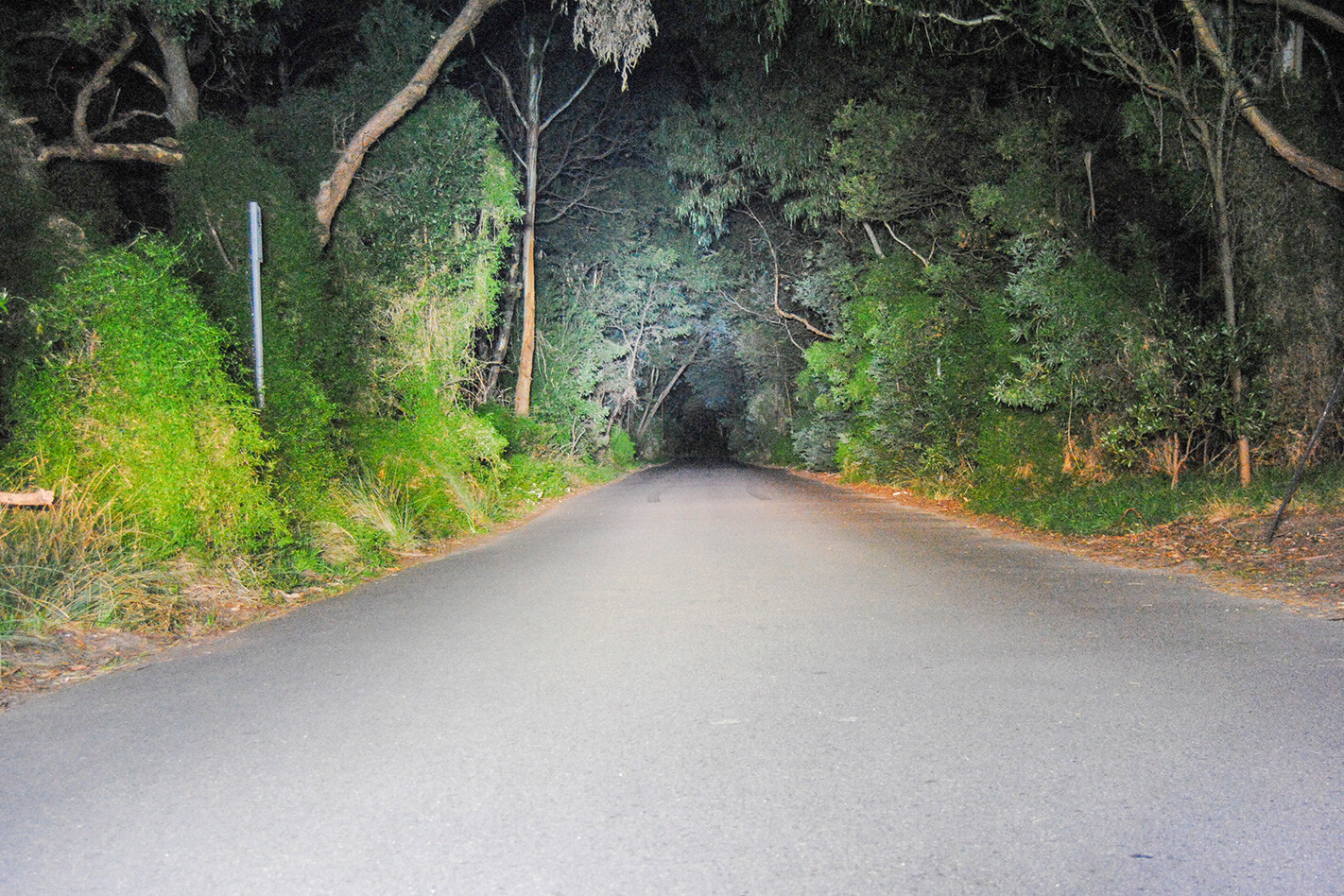
The difference in the performance so far has been amazing and, as can be seen in the photos, the LEDS clearly lit up the entire 300-metre road we pointed them at. Unfortunately, there is scrub on both sides of the road, limiting the view of the spread. Adjusting them was easy, as it has a unique tool-free adjustment on the side – just unscrew, adjust, then tighten.
The Narva 215s are a very impressive set of LEDs. If you, like me, are sporting a set of old favourites that do an okay job, we recommend you go and have a look at new tech such as these. Safety on outback roads is paramount, and you can’t avoid something you can’t see.
AVAILABLE FROM: www.narva.com.au RRP: $699 per lamp (expected) WE SAY: Quick installation, make a massive difference.