
Complete your last-minute summer plans with these tenting equipment, bullbars for Holden’s big rigs, and the latest up-to-date Hema maps.
TJM Signature bar – Trailblazer
TJM has expanded its popular Signature bar range with the addition of a model for the 2016-onwards Holden Trailblazer and Colorado. The lightweight Signature bar features a beefy 76mm polished centre loop tube and two 63mm polished outer loops designed to protect the headlights of the vehicle, along with two bumperettes for those carpark nudges. The bar’s design ensures airflow to the vehicle’s cooling system is uninhibited to prevent overheating.
A winch of up to a 9500lb rating can be fitted, and the bar also includes two 8000kg-rated recovery points. LED fog lights also feature, as do two aerial tabs and enough space for fitment of full-size 220mm HID or LED driving lights.
RRP: $2629 (excl. fitment and freight) Website: www.tjm.com.au
ARB Jump Starter Pro
The compact Jump Starter Pro from ARB includes the latest intelligent sensing and charging technology and can be used on all 12V vehicles (with a capacity of up to 6.0L for petrol or 5.0L V8 for diesel). The unit’s inbuilt sensors prevent over or undercharging of the lithium battery. The high-tech heavy-duty jump cables are designed to monitor the battery’s voltage, polarity and its charge condition as you recharge it. If it senses a fault, or any potential installation problems, it will alert the user via a series of LED lights.
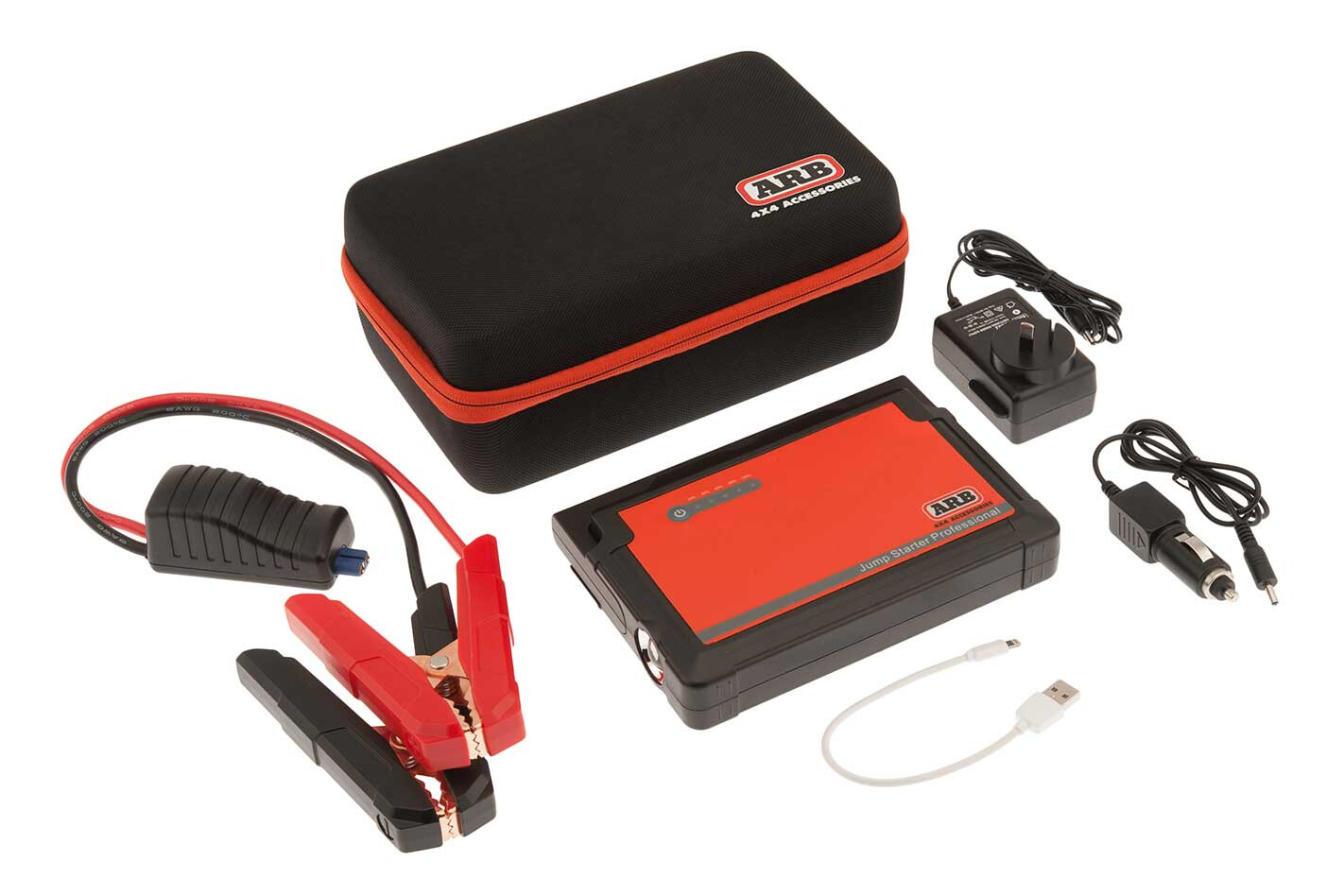
The Jump Starter Pro offers the ability to be charged from your rig’s 12V or from your home, ensuring you will never be left stranded without power. Along with these features, the unit also includes two USB ports for charging of phones or tablets, and a separate 12V port.
RRP: $249 Website: www.arb.com.au
Black Wolf Turbo 240 X-Lite LF
Black Wolf has added to its popular Turbo series of tents with the new Turbo X-Lite LF 240. As the name suggests, this family-sized tent is super lightweight (14kg; 35 per cent lighter than previous-gen models) and retains the Rapid Pitch Turbo Frame that allows for a very fast set-up.
The tent’s light frame doesn’t sacrifice strength, as the main poles are 23mm aluminium, with the roof poles 12.7mm composite material. The tent has a full fly, roof vents and a breathable inner lining aimed at minimising condensation, as well as a decent-sized vestibule. The tough 5000-denier polyester floor includes waterproof-taped seams. The doors and windows feature No-see-um mesh and the windows are gusseted so you can close the covers down but still maintain some airflow.
RRP: $800 Website: www.blackwolf.com.au
Hema Maps Kimberley Atlas & Guide
Hema Maps has released the sixth edition of its popular The Kimberley Atlas & Guide, edited by our own Ron and Viv Moon. This is Hema’s best-selling guidebook and it’s now better than ever, with all-new cartography, 188 new maps (including those with more detail of the Kimberley’s coastal areas) and a clear, easy-to-read style.
The guidebook includes 10 of the best Kimberley off-road adventures, explored and updated by Ron and Viv. There’s also tons of info on where to go, trip prep, a concise listing of tour operators, and a section on the history of the region. This spiral-bound, 208-page guidebook is a must for anyone looking to explore the mighty northwest. We can’t wait for our copy to lob at 4X4 HQ!
RRP: $49.95 Website: www.hemamaps.com.au
Decked storage system
Decked, a rolling-drawer storage system made in the USA for the most popular Australian dual-cab utes, is built to deal with harsh Australian conditions. The SEMA-award-winning design is made from 100 per cent recycled High-Density Polyethylene (HDPE) that sits atop a galvanised steel skeleton. The system is extremely lightweight at just 105kg, and all the hardware is coated in inhibitors exceeding industry standards. The drawers roll on large rubber wheels and are 100 per cent waterproof.
The Decked system can handle up to a true tonne on top and 100kg in each drawer. You can find the Decked system at Opposite Lock stores. There’s even an in-built bottle opener at the back of the drawer system – gold!
RRP: $2640 Website: www.deckedaustralia.com.au
I AM airborne in a Ford Ranger Raptor, the desert track a few feet below passing by in a blur of ochre. I brace myself, anticipating a hard impact when the prototype dual-cab’s tyres reconnect with terra firma, but it doesn’t happen – the impact is muted and barely discernible.
So I relax, just as Ford test driver Matt Gerlach, working the wheel beside me, punches the throttle. This elicits an immediate response from the Raptor’s 2.0-litre twin-turbo diesel four-cylinder as the 10-speed auto shifts down a couple of gears and shoves us forward at a ridiculously fast pace, on to the next corner. The speed of approach – and the cornering speed – is bloody impressive, and I know I should feel a wee bit scared, but all I feel is the huge shit-eating grin on my face.
SOMETHING SECRET
4X4 AUSTRALIA and one fellow Aussie journo (we were the only two local scribes, joined by two Thai-based writers) are at Ford development HQ – in this case, in the middle of the outback, where ‘Project Redback’ – Ford-speak for the Ranger Raptor Development Program – is well underway.
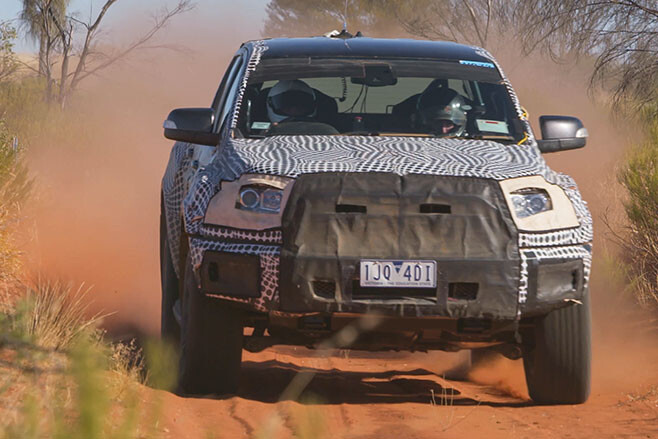
THE CONCEPT
TO understand how the Ranger Raptor was born you have to look to the USA and the success of Ford’s F-150 Raptor. This started as a concept that evolved from the vision of Jamal Hameedi, Global Performance Vehicle Chief Engineer, Ford Motor Company, who is an avid fan of the huge desert-racing scene in North America – think: Baja, Trophy Truck racing, etc. – and the prerunner vehicles used in those events. ‘Prerunner’ is the generic term used to describe the modified off-roaders (nearly always utes with big tyres, plenty of lift and loads of grunt) that teams use to drive the race route before the event itself, allowing them to check for potential dangers and obstacles they’ll need to avoid during the racing itself. Needless to say, the F-150 Raptor was (and still is) a raging sales success. This success ignited the belief within Ford Australia that an equivalent version of the US Raptor could work, as Damien Ross explains.
“So we’ve taken the Raptor DNA; they’ve [Ford USA] written down everything – every ingredient – that we need for a Raptor,” he says. “We’ve taken that and we’ve applied that to the Ranger platform and created a Ranger Raptor. So that’s what we’ve been doing, and the Ranger Raptor is all about being able to go up to that high-speed off-road capability that you’d want for a prerunner.”
This initial idea led to Ford Oz developing a business case to satisfy the bean-counters that this project was financially viable, and then building the first of what would be many test mule incarnations.
Even before the financial questions were successfully answered, the engineering team was busy – in their own time – building early test mules, nutting out how the Raptor concept would work in Ranger format.
“It was pretty valuable getting physical prototypes very early on and getting people’s thoughts and visions on what it could be,” Simon Johnson says.
Also helping the early stages of the project gain Ford HQ approval was an unexpected test drive by Ford’s then Global Project Development Director, Raj Nair, who was coincidentally in Australia at the exact time the first prototype was finished being built.
“It [the first prototype] had been delivered to the proving ground at eight o’clock the night before,” Simon explains. “I said ‘well, there are few cars out for him [Nair] to drive so I will just park it down there somewhere’. It’s not had a safety check, no one can drive it, but yep, Raj wants to drive…
“So I did a safety check, took him around in it and it went better than I thought. So I let him have a drive of it and, yeah, he loved it; he said: ‘you’ve nailed Raptor’. So yeah, that was good.”
That prototype was one of two built initially – one for testing road loads and the other for Simon to ‘play around with’ in regards to suspension and dynamics – something the development team knew had to be nailed down early on in the program to keep it aligned with how any vehicle with the ‘Raptor’ moniker is expected to perform, both on- and off-road.
RAPTOR DNA WITH A TWIST
THIS Raptor is based off the new MY18 Ranger model to be released in the second half of 2018 and, as mentioned in the first part of this story, the powerplant is a Raptor-only 2.0-litre twin-turbo (sequential) diesel four-cylinder engine. Power and torque figures reveal 157kW and 500Nm, more power and torque than the 3.2L five cylinder diesel makes in the regular Ranger. Surprisingly, this twin-turbo diesel was the only engine considered for Ranger Raptor (at least in the Asia-Pacific market; nobody will answer any queries RE a US-spec Ranger Raptor). And the Ford team doesn’t seem overly concerned with the Australian ute market’s fixation with larger-capacity engines.
“I am sure there will be drivers who have their obsessions,” says Damien. “But when they get in this vehicle and drive it – and they don’t have another one to drive anyway, so they’re kind of pre-dispositioned – it won’t matter because they can’t go and buy somebody else’s version of Raptor. And so they’ll get in and they will just be blown away by what it does.”
The second deviation from the F-150 Raptor DNA – and from the rest of the Ranger model line-up – is the use of a Watts link coil-spring rear end (the big US rig has a leaf-spring rear). Dispelling any assumptions, the Ranger Raptor’s rear suspension is not the same as the one underneath the Everest wagon, as Damien explains.
“Probably the biggest challenge was right at the beginning when we were finalising whether we were going to take the leaf spring system that they had or go to the coil-over-shock system Watts link that we’ve got now,” he says. “That’s one of the reasons Simon built the X0 [first test mule] to prove that out; so that was probably the biggest technical decision we made which was, as it turned out, absolutely the right decision.”
Simon explains the aversion to leaf springs on Raptor, and also the differences between the Ford stabelemates’ rear ends: “One of the big benefits of the Watts link in particular is the lateral compliance – it’s very stiff,” he says. “With leaf springs, you’ve got a bit of compliance; somewhere around here [the test facility] if you throw it hard into a turn you slide and you hit a berm or a rut, and if you’ve got leaf springs you go ‘boom’ and fling about. This thing [the Watts link-equipped Raptor] just carves it.”
“So where the springs on the Everest sit, they’re very close to the diff, and that means a very strong axle, too, for the bending. For the Raptor, we’ve moved them outboard of the shocks, so we’ve inherited an incredibly stiff axle and gained strength in that, but we don’t have the spring-back [due to the outboard position of shocks] so don’t need an anti-roll bar. That’s saved us on weight and it packages well and it looks great on the road.”
THE SAME BUT VERY DIFFERENT
THE rear suspension set-up is just one of the features that set Raptor apart from its brethren. Another is fitment of FOX internal bypass long-travel dampers and coil springs, as well as larger tyres. The rubber – BFGoodrich All Terrain T/A KO2 LT285/70R17 – was developed in partnership with BFGoodrich, who used its previous F-150 Raptor tyre as a starting point. The dampers are unique: the development team partnered with FOX Racing for the Raptor-specific shock (which works in a similar way to a remote reservoir shock, but with the reservoir inbuilt), working with coil springs supplied from outside FOX. Like the tyres, the shocks are big and beefy to cop the loads and additional stress of the vehicle, which included plenty of corrugated kays during testing.
The end result: Raptor rides 50mm higher than the standard Ranger and offers a compliant and controlled ride both on- and off-road, which was, for Simon, the biggest challenge.
“It’s important to us that our customers get a vehicle that will exceed their expectations off-road, but is something that is useful every day,” he says. “I’d happily jump into the Ranger Raptor and drive for 12 hours – it’s so comfortable. So we’ve managed to keep that plush ride and yet make it absorb massive inputs off-road here in testing.”
Neither Simon nor Damien would elaborate on the difference in wheel travel, beyond saying it was ‘significant’. Equally significant are the exterior bodywork styling and underbody changes; the front-end geometry had to be altered to allow for the bigger shock/tyre package, with the large, chunky alloy A-arms a pointer, along with the bigger brakes (ventilated discs front/rear). There are vents in the front quarter panels, and a front air dam to keep brakes cool. The fuel tank is a reshaped Everest one. The Raptor also runs on a wider track, necessitating a re-laying of the frame.
“We’ve basically heavily modified, or more or less designed-new, the frame,” Damien says. “So we started off from a basic underpinnings and we’ve strengthened the frame to be able to take the off-road loads, because you often hit whoops and bumps and can take off a little bit and land and you can’t do that on standard frames; so that’s been strengthened [in key areas]. And we’ve had to redesign it for things like the spare tyre because the tyre’s a lot bigger.
ENGINEERING THE POSSIBLE
The biggest re-sizing challenge was, Damien reckons, the engine bay, which is pretty bloody crowded.
“The engine bay has an all-new layout,” Damien explains. “We’ve had to move, shuffle… To be honest, this is probably one of the areas in the vehicle that we’ve had to package everything. With new technology and, especially if you go to higher emission controls, just trying to get everything fitted in there, it’s a task in itself.”
Exterior panelwork changes include the obvious pumped-out front and rear guards to accommodate the wider track, the re-positioned rear bumper, and higher-rated recovery hooks. There’s also a reduction in load-carrying capacity (Damien mentions load weights won’t be up to Wildtrak level, but offers no exact figure) and Raptor-specific styling clues such as the front grille, which is, during our visit, still in mock-up stage. The prototypes’ non-finalised interior is ‘regular’ Ranger, albeit with that 10-speed auto shoehorned in there, along with myriad recording instruments for collecting data on suspension, steering and engine performance.One similarity with the stock Ranger is the part-time 4×4 system rather than adapting the Everest’s full-time set-up. The Raptor does, however, get the latest version Terrain Management System (TMS), borrowed from the current F-150 Raptor, which includes ‘Baja’ mode.
“It’s a mode that allows you to drive unhindered by other systems taking over; when you’re in a road situation and [the TMS] sees certain traction and steering actions it’ll take an action because you’re on the road,” Damien elaborates. “But, out here you’re in sand and dirt. Those kinds of manoeuvres… this Baja mode will stop those [reactive systems] coming in when you don’t want them.”
This is no one-trick pony, as impressive as its desert driving performance is; Ford has gone to great lengths to ensure the Raptor’s off-road performance is balanced by equally impressive on-road behaviour – the calm Ying to the truly crackers off-road Yang, with both an on-road Sport mode and, a ‘sedate driving mode’, according to Damien.
THE DRIVE
THE morning of day two saw us finally jump in the Raptor prototypes for a fast blast around one of the test tracks (the 18km loop). Well, sort-of finally: Ford teased us slightly, albeit with good reason. Before our lap in the Raptors, we tackled the same loop in a stock Ranger, to use that experience as a baseline for the differences between the two vehicles.
There are five test drivers at the facility, with each driver allowed only to do three hours at pace each day, due to the stresses their bodies are subject to. I am in with Matt, and am about to find out all about those stresses.
The 18km test loop is a bumpy, sandy mix of straight sections with numerous tight and not-so-tight on- and off-camber corners. The stock Ranger is, itself, a pretty handy off-road performer, but this track tests it severely, with plenty of bumping and banging as Matt manhandles it through and over the various sections. The lap is relatively quick, but I am feeling it.
Next is the Raptor. Owing to these vehicles being prototypes, we are seated in full race seats with race harnesses, helmets, suits, etc. The interior is packed with the aforementioned gauges and screens, but, not long after we blast off, it is the speedo I take most interest in. Throughout the loop, the Raptor averages close to twice the speed of the regular Ranger – and Matt hadn’t taken it easy with the stock unit – and we get airborne twice, both times landing with little drama.
In terms of a standout, it is hard to split the 10-speed auto (and Baja mode, of course) and the suspension. But, if I had to, the Raptor’s suspension/tyre combo would just win out: it is simply brilliant. Those many thousands of kilometres Simon has spent swapping out, and adding in to, the shocks’ shim stacks and myriad other tweaks has paid off. Compression is very well-controlled, and rebound keeps the Raptor feeling very ‘tight’ in regards to how it responds to being shoved around by the bumps and off-camber surfaces below it. The wider track gives the Raptor a more planted feel, and those big tyres finish it off, offering a compliant ride while still tracking true when responding to fast directional changes by the driver. Even more impressive is the fact there’s minimal transfer of the impacts through to us inside the vehicle – a standout in itself when you consider the terrain, the speed, and the fact I am sitting on a bare-bones race seat. Simon’s claims of the vehicle offering owners a more comfortable, relaxed driving experience over longer distances rings in my ear.
Funnily enough, it is the engine that is noticed the least – and that’s not to say it doesn’t impress. There’s no doubt the 2.0-litre TTD donk has some serious grunt; progress is rapid, no matter whether punching along a straight or spearing out of a corner. And it works brilliantly with that auto; its quick shifts are matched perfectly in situations where you’d assume the engine may come off-song (exiting tight corners, etc.), but it shifts subtly, and that 2.0TTD keeps singing, sling-shotting you forward. Needless to say, the time for that loop was significantly faster than our stock Ranger lap. After, I take a seat and jot down just one word in my notebook to describe that Raptor lap: “Otherworldly”.
THE FUTURE IS NOW
THIS Raptor program would seem a huge investment of time and money, if the fact the vehicle will go into 180 markets wasn’t taken into consideration – and that is not taking into account the elephant in the room that is the potential for it to be released in the USA. The term ‘investment’ needs to be also taken into consideration for buyers, though. This thing will sit at the top of the Ranger stable and will no doubt be priced accordingly. The question is: will buyers part with a considerable sum of money for it?
“We haven’t settled on price,” Damien responds. “In terms of customers, we don’t expect it to be the same [sales] volume as an XLT, but more in terms of the Ford Performance type volume. Knowing what kind of price range it is in, I think it is fantastic value and I would be buying this thing straight-up for that. We’ll see what the customer says.”
That tone of confidence is what sticks in this writer’s mind as I get my head around what we were shown over the two days in the Red Centre.
It is dubbed Raptor, so, yeah, you’d think I’d be quoting numerous bird-of-prey clichés (swooping, fast, vicious, etc.) in summing up the vehicle, but that’d be too easy. With the arrival of Raptor, the days of a ‘special edition’ 4×4 ute comprising nothing more than a shiny paint job, blacked-out wheels and bright stickers are, thankfully, gone. Shit just got real, folks.
FOLLOWING a year of speculation and spy shots, the wraps have just been pulled off Ford’s Ranger Raptor in Thailand overnight.
Aside from the bold, wide-body styling of the bespoke Raptor, the big reveal was the powertrain, with a 156kW/ 500Nm, 2.0-litre, bi-turbo diesel four-cylinder engine filling the engine bay, backed by a 10-speed automatic transmission adapted from the F-150 Raptor. So no petrol engines for Australia, or a version of the 3.2L diesel that is a favourite with Ranger buyers here.
The 2.0L engine makes more power and torque than the five-cylinder 3.2L and, according to our guys who have ridden in the new Raptor, the bi-turbo is more than enough to add excitement to the ute.
Like the F-150 variant that has made the Raptor nameplate legendary, the Ranger Raptor is more than just an engine; the desert racing-inspired chassis and suspension really dial up the adrenaline levels, and the Ranger Raptor was tested and tuned on some of Australia’s toughest outback off-road tracks.
The ladder frame has been strengthened and adapted to take a coil-sprung rear end instead of the tradie-spec leaf springs. This set-up is similar to that found under the back of the Everest wagon as it uses a Watts link arrangement but differs with its coil-over Fox shocks that are mounted further outboard for improved stability. The rear wheel track is also wider than that of a standard Ranger, to match the 1710mm-wide track front end.
At the front end, forged aluminium upper and cast aluminium lower arms widen the track, with Fox Racing again supplying the coilovers. The 46mm (front and rear) shocks feature Position Sensitive Damping (PSD) technology. This provides higher damping forces at full compression and rebound to enable better performance in high-speed off-road conditions, and lower damping forces in the mid-travel zone for a more comfortable ride on-road.
The BFGoodrich KO2 All Terrain tyres measure 285/70-17 and were specifically developed with the Raptor in mind. The braking system is upgraded with twin-piston calipers on whopping 332 x 32mm ventilated rotors at the front, as well as 332 x 24mm ventilated rear discs clamped by new 54mm calipers.
The Raptor retains a part-time 4×4 system with low range but now includes a Terrain Management System (TMS) similar to what we see in Everest and F-150, but with the ‘Baja Mode’ that was previously exclusive to F-150 Raptor. Baja mode desensitises the chassis electronics, including the traction and stability controls, giving more control back to the driver while at the same time holding gears in the 10-speed auto and sharpening the transmission and throttle response for high-performance driving.
This is the mode to unleash your inner Robby Gordon aspirations; while the regular On-Road and Sport modes are there for tarmac travel, and Grass/Gravel/Snow, Mud/Sand and Rock modes are there for off-road terrain. The Ranger Raptor has a rear differential lock as standard.
The bi-turbo arrangement on the four-cylinder diesel engine uses both a small and large turbocharger working in sequence, depending on engine speed and load. At lower engine speeds the two turbos work in series for the best torque and responsiveness, while at higher engine speeds the small (high pressure) turbo is bypassed and the larger (low pressure) turbo provides maximum boost to deliver more power.
Ranger Raptor’s styling obviously comes from its bigger American cousin, the F-150, with the signature black grille with bold FORD lettering. The front ’guards are made from a composite material and are pumped out to cover the wider wheel track and accommodate the tyres with more suspension compression.
The rear cargo tub also gets the pronounced ‘guards for tyre clearance, while a new rear bumper features an integrated tow bar to dramatically improve the departure angle which is now 24 degrees. Approach angle is 32.5 degrees, rampover is 24 degrees and ground clearance is listed at 283mm.
Towing capacity of the Raptor is rated lower than the regular Ranger, at 2500kg, due to its drivetrain and suspension package that is set up more for performance than load-hauling.
Inside the Raptor gets trim unique to the Ranger line-up. The front seats feature heavy bolsters to better hold the occupants in place during high-speed off-roading, while the full suite of features and equipment are included. Of interest are the magnesium gear-shift paddles behind the Raptor-unique steering wheel, and the use of keyless entry and push-button starting; features we hope extend to the updated Ranger and Everest models later this year.
The Raptor will sit at the top of the 2019 Ranger line-up when it arrives in Australia in the third quarter of this year; although, there has been no word on price as yet. Ford tells us this will come closer to the launch date. With the level of bespoke suspension upgrades, modified and reinforced chassis, unique engine and transmission, and the bold exterior design, we’re tipping the Raptor won’t come cheap, nor will it be for everyone.
The Ranger Wildtrak already kicks the tin for more than $60K, and we reckon the Raptor will be closer to $90K. That will be a lot of money for any ute, but the Ranger Raptor won’t be just any ute.
“It is amazing to enable this level of performance and create a vehicle that can provide off-road enthusiasts such an adrenaline rush,” said Jamal Hameedi, Chief Engineer, Ford Performance, Ford Motor Company. “It really is like a motocross bike, snowmobile and an ATV rolled up into a pickup truck – it’s an incredible, awesome experience!”
Even as summer winds down there are plenty of events to experience around Australia from March till April.
Simpson Desert season looms
For those planning a trek across ‘the Simmo’, March 16 signals the first day the Simpson Desert Regional Reserve and Simpson Desert Conservation Park are open to visitors. This common sense approach of closing the area from December 1 to March 15 avoids the risk of a fatality from a breakdown in the incredible heat over summer.
To book a Desert Pass and check conditions, email: [email protected] or call (08) 8648 5328.
Navrun: Amazing Race 2018 (VIC)
This awesome 4×4 navigation event is being held in Victoria’s Wimmera district over the Easter long weekend. The family-friendly three-day event will be great fun, as punters navigate in a 4×4 while looking for clues and following instructions (and tackling some odd and crazy exercises) – so plenty of laughs to go with the driving.
There are no classes; your standard (registered) 4×4 will be more than enough for this affair. The event also includes kids’ activities, camping (at the one site) and the chance to spend a few days in this special location. Bring your own food, water, drinks, etc.
See www.navrun.com.au for event information.
Julia Creek Dirt n Dust Festival (QLD)
Held from April 13-15, this adventure festival is based out of Julia Creek, Queensland, with organisers encouraging visitors to tackle the Overlanders Way on the way. This famous drive takes in Townsville, Hughenden, Richmond, Julia Creek, Cloncurry and Mt Isa, with each town offering its own visitor highlight (a pie from the FJ Holden Café in Hughenden is a must).
The festival features horse races, bull rides, triathlons, bog snorkelling (yep, you read that right), nightly concerts and novelty events (including a kids’ scavenger hunt).
For further information, visit www.dirtndust.com.
The ARB ORRC Sunraysia 400 (NSW)
The ARB Australian Off Road Racing Championship heads to Mildura for the second round of the competition, with the Sunraysia 400 running from April 21-23.
The ARB ORRC is held over four rounds at four different locations this year. This event offers those looking to get into competitive off-road racing a chance to do so in a sociable environment. With eight vehicle classes ranging from production 4x4s through to buggies and everything in between, you can bet your house on the fact it will be an awesome weekend.
For more information and to find out how to take part, head to www.offroadracing.com.au. Give it a crack!
Station Stays (SA)
Since forming in 2009, this group of pastoral tourism businesses in the SA outback and the Flinders and Gawler Ranges has grown to include 26 stations and properties that accommodate visitors. Stations, such as Horseshoe Rim, include 4×4 tracks for those keen to do some exploration of their own.
Another station in this group is Willow Springs, home to the famous Skytrek, a full-day 4×4 tour of the property. Located just north of Wilpena Pound, it means you can also explore this iconic destination.
With 26 stations, this is a great choice for any and all tourers, so go to www.stationstayssa.com.au for more information. Start packing for that trip!
Easter Weekend Gem
Easter is relatively early this year, which is the perfect excuse to head to the NSW Sapphire Coast, in the Premier State’s south-east and midway between Melbourne and Sydney.
This part of NSW offers sublime surf beaches, brilliant camping (national park/state forest camping and beach-side caravan/camping parks), fishing and plenty of hiking, mountain biking, paddling. The popular towns – Tathra, Merimbula, Pambula, Eden – have awesome eateries, too.
The Man From Snowy River Festival (VIC)
Any excuse to visit the High Country will do, and this one will be brilliant. Held April 5-8 at Corryong, this event showcases the lifestyle of the local cattlemen from years gone by (and for a few of them, today). There will be numerous horse-riding events, a movie night, whip-cracking demos, a rodeo, ute muster, bush poetry, kids’ party, street parade, and plenty more.
Visit bushfestival.com.au for more info.
Ever since the tiny Renegade Trailhawk was labelled a Trail Rated vehicle we’ve wondered if Jeep has gone soft and devalued what was once a respected badge of honour.
Trail Rated, according to Jeep, means a vehicle has passed a series of rigorous tests in five off-road categories: Traction, Water Fording, Maneuverability, Articulation and Ground Clearance.
The Compass Trailhawk’s traction comes in the form of a driveline and electronics package that consists of Jeep’s Active Drive Low 4×4 System and Selec-Terrain with Auto, Snow, Sand and Mud, and Rock Modes, as well as Hill Descent Control. No, it doesn’t have a two-speed transfer case, but hit the 4WD Low button and it’ll lock the transmission into first gear, which has a handy 20.4:1 overall reduction. Think of it as a crawler gear, like in a Volkswagen Amarok.
Water fording is a reasonable 480mm, which is up from the lesser 405mm maximum wading depth of the Compass Limited. The engine’s air intake is located up reasonably high behind the driver’s side headlight.
Maneuverability comes courtesy of the Compass Trailhawk’s compact dimensions and 10.76m turning circle. Yep, it’s a small vehicle, measuring just 4398mm long, 1819mm wide and just 1657mm tall. It also has handy approach, ramp-over and departure angles (30.3°, 24.4° and 33.6°) thanks to raised suspension and redesigned front and rear bumpers exclusive to Trailhawk.
Articulation? Well, it’s got a claimed 170mm of wheel travel up front and up to 200mm at the rear, which isn’t really a helluva lot, but the clever electronics package manages to overcome that when wheels are lifted into the air over undulating terrain. And without much droop travel, wheel lifting happens quite a bit on rough tracks.
Ground clearance is a claimed 225mm, which is pretty impressive for a compact 4×4, and when the Compass Trailhawk does whack its belly on the ground, it’s reassuring to know that vulnerable components are tucked up and out of the way and protected by bash plates.
We took the Compass Trailhawk up some rocky tracks that most of its competitors would’ve baulked at. Engaging Rock Mode offers increased brake lock differential capacity, which minimises wheelspin and provides decent drive to the wheels with grip. While it’s certainly no rock-crawling beast, the Compass Trailhawk is more capable than you might expect.
Power comes from a 2.0-litre four-cylinder turbo-diesel engine that makes a claimed 125kW at 3750rpm and 350Nm at 1750rpm. The engine is mated to a smooth-shifting nine-speed auto that was co-developed with ZF. On-road performance is more than adequate and the engine has nice low-rpm response and a healthy midrange, and the auto is a smooth and predictable shifter.
The Compass is quite refined on the open road; it offers good noise insulation, a compliant if slightly firm ride, lively handling, and predictable and well-weighted steering.
The Compass Trailhawk costs $44,750 and is well-equipped for the money with standard features including 17-inch alloys with 225/60R17 rubber, a big 8.4-inch touchscreen with sat-nav and Apple CarPlay/Android Auto, reversing camera, front and rear parking sensors, chunky recovery points, cloth/leather seats, tyre pressure monitor and more.
For an extra $2450 you can add an Advanced Technology Group package that consists forward collision warning, lane departure warning, exterior mirror courtesy lamp, power tailgate, adaptive cruise control, auto high beam and blind-spot monitoring with rear cross path detect.
Jeep insists it’s going to great lengths to improve customer satisfaction, along with service and parts back-up, starting with a five-year/100,000km warranty with capped-price servicing and lifetime roadside assist (it’s called The Jeep There & Back Guarantee). Jeep also admits that winning back previously disgruntled customers and rebuilding its reputation won’t happen overnight.
The Jeep Compass Trailhawk certainly looks the goods, with its high-riding stance, blacked-out bonnet decal, red recovery hooks and, of course, Trail Rated badges, and while it might not be your typical long-distance bush tourer, it certainly offers a good blend of on-road finesse in a compact package with reasonable off-road capability.
2018 JEEP COMPASS TRAILHAWK SPECS: Engine: 2.0-litre 4-cyl turbo-diesel Max power: 125kW at 3750rpm Max torque: 350Nm at 1750rpm Gearbox: Nine-speed automatic 4×4 system: Selectable full-time Crawl ratio: 20.4:1 Construction: Monocoque Front suspension: Independent/coil springs Rear suspension: Independent/coil springs Kerb weight: 1621kg GVM: 2189kg Payload: 568kg Towing capacity: 1500kg GCM: 3539kg Fuel tank capacity: 60 litres ADR fuel claim: 5.7L/100km Test fuel use: N/A Touring range: 1002km
Modified tourers come in all shapes and sizes. Some are built for weekend rock-crawling or fun in the mud, while others are built for specific reasons, which is the case for outback social media icon, Jillaroo Jess.
As readers would know after reading our recent profile on Jess, her job – indeed, her life – is one big outback road trip, travelling from one seasonal job on a remote property to another. For this very busy lady, there’s only one choice when it comes to her own vehicle: it must be a reliable, bombproof rig that will get her there, back and there again as she criss-crosses the outback for work. The rig of choice for Jillaroo Jess is a Toyota Land Cruiser 79 Series ute – yep, the iconic outback workhorse – that has, as you would expect, copped a few essential mods from the team at Terrain Tamer.
The Land Cruiser 79 build was the focus of the recent TV series Terrain Tamer meets Jillaroo Jess, with Jess joining 4×4 icon Allan Gray and his son to fit some bush-ready accessories to Jess’s ute and make it even more capable, something which most of us could do with for our own rigs, as Brent Hutchinson from Terrain Tamer explains.
“Jess and her vehicle were the perfect example because they do such long kilometres,” Brent says. “So the whole reason behind fitting her vehicle out was it was just such a great example to so many of our core customers out there that needed to be aware those accessories were available [for the LC79 and other vehicles].”
One of the interesting things about this modification story was the fact that the Terrain Tamer team initially had to try and figure out the mods needed from, quite literally, the other side of the country.
With Jess being nomadic but mostly based somewhere in the huge state of Western Australia, and Terrain Tamer HQ in Melbourne, it meant more than a few phone calls to figure out what was needed – and nail down any problems Jess was experiencing with the ute that could be fixed by fitment of certain accessories.
“This was a different one because we were a long way away, literally on the other side of the country trying to diagnose things before heading out there,” Brent says. “So there was a lot of dialogue based around what her vehicle has and needs and what problems she comes across.
“So, certainly, Alan and I would discuss that before we put everything together, but we knew we had a number of parts that were just released – or shortly to be released – that would be of great benefit.”
One of these parts to be ‘just released’ was Terrain Tamer’s replacement fifth gear for the LC79. The final gear in the Toyota workhorse is notoriously low, meaning that big lazy 4.5TV8 is actually not so sedate, staying relatively high (for a diesel) in the rev range.
Terrain Tamer’s replacement fifth gear, manufactured from Rockwell steel, drops RPM by a claimed 20 per cent – a significant reduction, especially for someone who is driving many thousands of kilometres each year – which means a big saving in fuel costs for Jess.
Another essential mod for Jess’s LC79 was fitment of Terrain Tamer’s Pro Shock Absorbers, Smart Coils, and matched leaf springs and bushes. Brent goes into more detail about the full suspension kit, and just how ‘smart’ those Smart Coils are.
“It is a Terrain Tamer suspension kit and it has the Terrain Tamer Pro Shock, so they’re the ones with the remote canister and the adjustable dial,” he says. “The reason for that [fitment] is that she is travelling such high kilometres and also travelling a lot on bitumen to get to a job. Then she’ll be travelling for three months at a time on the station where she’s not seeing the bitumen, so she can adjust the dial there.”
In terms of the Smart Coils, fitting them was a must, with the end result of more stability when on- and off-road, and improved cornering.
“We test for body roll and try and keep things as stable as possible, so there is less wear and tear on the suspension and she’s got more control over the vehicle,” Brent explains. “So that smart coil on the front of the vehicle; it gets thinner (tapers) higher up the coil and this means that as you are leaning into a corner, there is less rebound as it is coming back out of the corner, so you’ve got more stability.”
The Pro Shock’s additional oil reservoir, courtesy of the remote canister, also means lower shock temps, thus minimising the chance of the shocks fading due to overheating – another no-brainer for anyone driving many outback kilometres in trying conditions. Brent mentioned that, during testing over a short 8km off-road drive course, the Pro Shocks measured approximately 9.3 per cent cooler. And that’s over a very short test distance – over a longer all-day journey, the benefits of shocks that cope with heat build-up more effectively is immeasurable.
One thing Jess – as a certified rev-head – was keen on was a bit more grunt from the 4.5TDV8 donk. Terrain Tamer fitted a Safari Armax ECU, a ‘piggy-back’ style unit (it works with the stock ECU) that is claimed to produce up to a 25 per cent increase in power, along with improved fuel economy, in conjunction with a Safari Armax snorkel. This lead to another mod: fitment of a Terrain Tamer Fortified clutch. Again, this was with a focus on reliability, as Brent explains.
“We knew that we could get more power – and more fuel economy – and we know the Toyota 70 Series is right on the threshold with the clutch and it will start to slip once you put that modification (the Armax ECU) on. We just know that from experience,” Brent affirms. “And really interestingly it did – Jess mentioned it during filming – it did slightly slip driving from her homestead into Karratha, which is about an hours’ drive. So it was good to know it had happened in ‘real life’ before we went and changed it to the fortified clutch.”
Jess is often driving at highway speeds for long distances and, on these more remote roads, the risk of animal strike, whether wildlife or wandering stock, is high. Therefore, a decent set of stoppers is handy. The need for braking power to match the LC79’s increased grunt led to Terrain Tamer fitting its own high performance rotors and heavy-duty brake pads.
Further reliability-boosting mods to the Cruiser included fitment of a Flashlube diesel pre-filter, owing to the fact that Jess could not always be sure of the quality of diesel she was filling the Cruiser with. A well-proved Piranha dual-battery system – to keep those after-work coldies, ahem, cold, in the fridge/freezer – was also added.
Of course, on a more serious note, the dual-battery system minimises the chance of Jess being left stranded in the middle of nowhere due to said fridge/freezer draining the battery. If this modified LC79 sounds relatively straightforward, it’s because it is just that – and it is also smart.
The modification process for this rig reflects both Terrain Tamer’s many years of experience at tweaking off-roaders, and the common-sense approach of its owner. As a station worker who travels many kilometres during the year over a variety of road/track surfaces and into some very remote parts of this country, Jess needed a modified workhorse built that was as close to unstoppable as can be – and with the clever modification process by Terrain Tamer team and Jess, that’s exactly what she got – and she’s stoked.
In fact, this LC79’s sensible mods list is a bloody good example for anyone considering building up a bush-tourer in which to explore this awesome country of ours. Now, where’s that Terrain Tamer HQ phone number…
I regularly drive from my home base in the ’Gong down the Hume Highway to Melbourne. Over the years this trip has become easier and easier, though it has also become more and more boring.
Sure, wide dual-carriageway freeways are a more efficient and safer way of moving lots of traffic around than old two-lane highways, but Australia’s draconian speeding laws make freeway driving one of the most tiresome and boring pursuits a motorist could ever face. The other day 4X4 Australia deputy editor Justin Walker and I had to do the run down the dreaded Doom to Melbourne.
Justin was kind enough to pick me up at sparrow’s fart in Wollongong and, after a 30-minute run along Picton Road, we found ourselves heading south down the Hume Highway. Wanting the journey to finish before it had even begun, we thought we’d better push the envelope, so to speak, so I cracked open the ‘Speedometer’ app on my iPhone and set the cruise control to around nine per cent over the posted limit.
After all, there’s a rumour of a 10 per cent tolerance in NSW and we thought we’d take full advantage of it. While this ‘10 per cent tolerance’ has never been confirmed by the NSW police, a speedo error of 10 per cent used to be written into the Australian Design Rules well before GPS technology could provide a more accurate way for the average punter to confirm their velocity.
We saw a couple of cops on the run down to the Victorian border and, despite our possibly dodgy interpretation of what speed is acceptable to the boys (and girls) in blue in NSW, they left us alone to carry on our merry way.
Other than speed-limited trucks, I reckon more than 50 per cent of the traffic on the Hume Highway that day agreed with our synopsis of just how fast you can go without being pulled over – some were a little more pessimistic while others were far more optimistic, and we spotted a couple of vehicles that must have been barreling along at a dollar thirty or more. Despite the speed discrepancy between vehicles, or perhaps because of it, everyone seemed to happily travel along the freeway in safety and without incident.
Then we reached the Victorian border. It’s well-known that in Victoria the police have zero tolerance for speeding drivers, even if they’re only a smidge over the limit, by just one or two kilometres per hour. So, once we crossed the Mighty Murray we backed the Disco 5km/h off and set our speed at the posted limit, again using the GPS in the phone to more accurately measure velocity (as an aside, the Disco’s speedo was optimistic by around six per cent).
Everyone around us, also aware of the zero-tolerance attitude south of the border, did likewise, resulting in what I refer as the Victorian Shuffle.
The Victorian Shuffle is where all the cars, buses and trucks on the freeway are travelling at almost exactly the same speed. Of course, there will be tiny variations in speed between vehicles, which will result in some of them trying to pass others.
The trouble is that trying to pass another vehicle when you’re only travelling 1km/h faster can take a very, very long time and, as a result, you can end up with groups of vehicles all travelling in close packs at very similar but slightly different speeds. In other words, the Victorian Shuffle, where everyone is scared of exceeding the speed limit by even the tiniest amount, results in vehicles travelling in close proximity for longer periods of time.
Obviously, the closer and longer vehicles are to each other, the greater chance of an accident, either through the lack of physical distance between vehicles or pent-up driver frustration. Yep, the Victorian Shuffle sucks, and it’s about time the powers that be reintroduced a bit of tolerance when it comes to speeding in Victoria.
Not too much, of course, because as we’ve all been told “Speed Kills”, but just enough to put some separation between vehicles once again. And, at the very least, the coppers down south should be able to use their discretion when it comes to booking drivers for speeding.
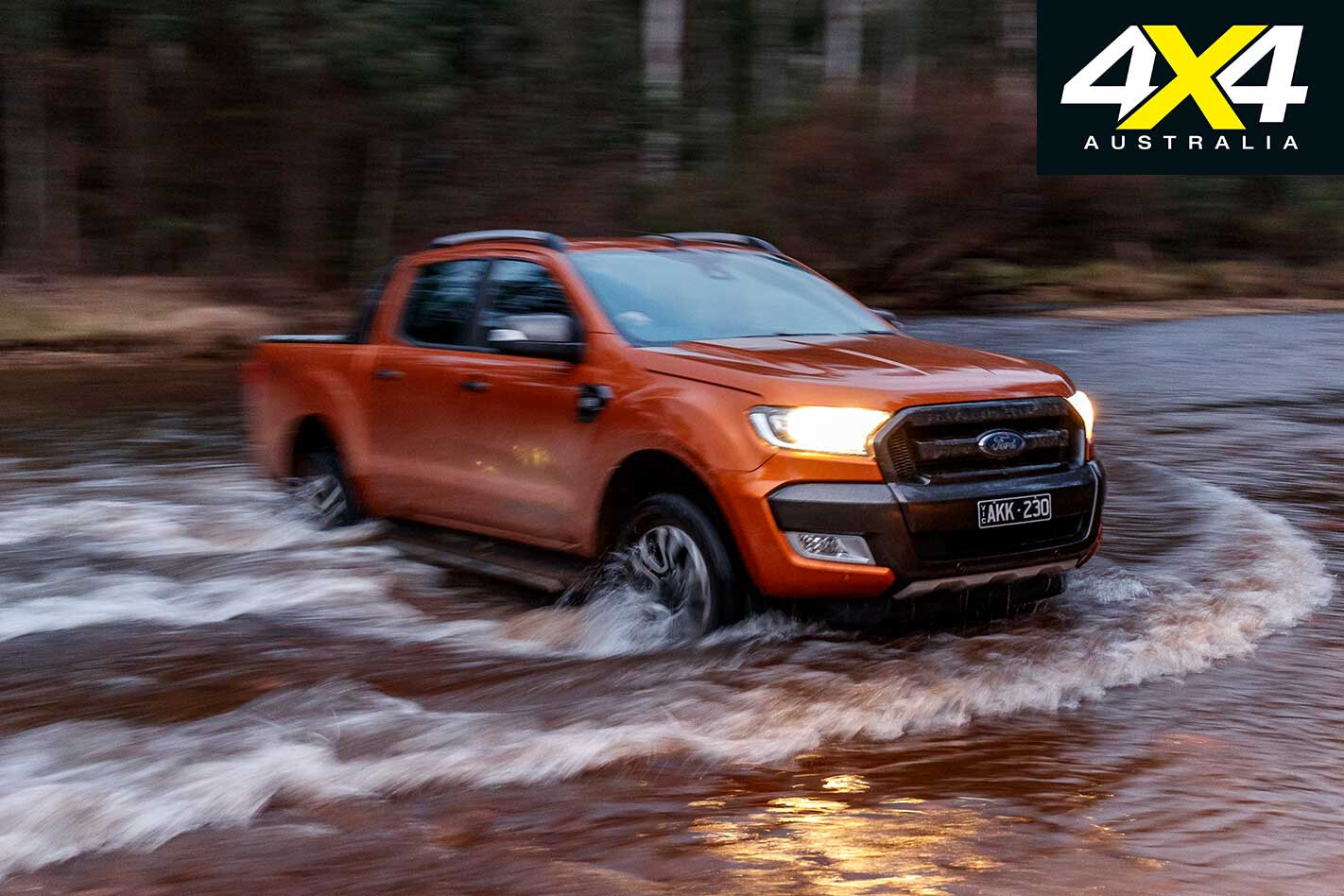
THE Ford Ranger has started 2018 where it left off at the end of last year, by topping the 4×4 sales charts.
With January 4×4 sales counted, the Ford Ranger outsold its biggest competitor, the Toyota Hilux, by just 12 units (2892 versus 2880). There’s then daylight between the next-best 4×4, Nissan’s Navara, which pushed out 1323 units.
Significant growth in the Light Commercial (LCV) segment saw sales increase by 20.3 per cent overall, compared to January 2017 figures. In fact, 4×4 LCV sales were up a substantial 26.6 per cent.
Tony Weber, the chief executive of the Federal Chamber of Automotive Industries (FCAI), suggested that the strong sales growth was indicative of the tough competition within the market segments.
“2017 was a record year for the industry and we’re pleased to see that strength continuing in the January 2018 sales results. Notably there was very strong growth in business sales of SUVs and Light Commercials.” Mr Weber said.
The growth of the LCV market is largely due to an increase in business purchases, which was up 26.7 per cent over the 2017 comparative sales. Private purchases were up 11.1 per cent.
When combining 4×4 and 4×2 variants, the Toyota Hilux was the best-selling vehicle on the overall sales charts (3860 units). It was followed by Ford Ranger 4×4 and 4×2 (3260); Mazda3 (3201); Toyota Corolla (2776); and Mazda CX-5 (2152).
u00a0 | 4×4 | Jan 2018 | Dec 2017 | 2018 Total |
| 1 | Ford Ranger | 2892 | 3105 | 2892 |
| 2 | Toyota Hilux | 2880 | 3114 | 2880 |
| 3 | Nissan Navara | 1323 | 1185 | 1323 |
| 4 | Mitsubishi Triton | 1313 | 2462 | 1313 |
| 5 | Holden Colorado | 1267 | 2871 | 1267 |
| 6 | Toyota Prado | 1169 | 1590 | 1169 |
| 7 | Toyota Land Cruiser wagon | 927 | 1021 | 927 |
| 8 | Mazda BT-50 | 679 | 647 | 679 |
| 9 | Isuzu D-MAX | 678 | 1525 | 678 |
| 10 | Toyota Land Cruiser PU/CC | 582 | 761 | 582 |
The question we get asked the most here at 4X4 Australia HQ is, “What’s the best 4×4?” That question is closely followed by, “What’s the best tyre for my 4×4?”
With our annual 4X4 Of The Year and tyre test, we’d like to have answered both those important questions. But we can’t. Why not? Let’s start with 4X4 Of The Year.
4X4OTY is to choose the best 4×4 vehicle of a particular year, this year being 2017. To be in the running, the vehicle needed to have been launched between December 1, 2016 and November 30, 2017. It is only open to vehicles that are new or significantly revised during that year. It is not the best 4×4 of all time nor is it the best 4×4 currently available. None of the 4x4s eligible for 2017 would win either of those titles, so we can’t say any of them are ‘the best 4×4’.
Of course, the best 4×4 is going to be different for different people. A large, single-cab, heavy-duty 4×4 ute might be the best 4×4 for a farmer in the bush or a young fella who likes to go off-road, but it would be totally useless for the family of five who like to go camping on the holidays.
It is horses for courses, and that’s why 4X4OTY is scored against criteria and not personal preference or taste. We might score a vehicle ahead of the others, but that doesn’t necessarily mean we’d own and drive it ourselves; it just means it was the best of the nominated vehicles when scored against the criteria.
As for the best tyre, we had hoped to conduct a shootout of all the big tyre bands, but when it came to the crunch, the big tyre brands didn’t want to play by supplying the necessary tyres.
Not that it means all that much anyway, as I believe there are only two types of tyres in this world: those that hold air pressure and those that don’t, and, for my money, the ones that hold pressure will always be the right choice. They’re all black and round and do the same job and, like the vehicles they’re fitted to, most buyers make their tyre choice on price and appearance.
So read the facts, take a test drive, and make your own choices to get what you want.
To read all about 4X4OTY and the 4×4 Tyre Test, pick up a copy of the February issue of 4X4 Australia.
We’ve driven it to the High Country Alps, the Simpson Desert dunes and across the stony tracks of outback NSW, and the G300 Professional has proven capable and dependable in the harshest terrain and conditions. But what’s it like to live with around town?
Off-roading forms only part of our driving life and we have to endure work and city-life to allow us to get out bush, and, despite its four-decades-old commercial vehicle design, the G-Wagen is an easy truck to commute with in the suburbs.
That old design includes the G’s slab-sidedness, the large, flat glasshouse and its upright seating position, which all combine to make the G-Wagen easy to manoeuvre around town, with plenty of visibility around the car. The massive turning circle and relatively heavy power steering don’t help, but you get used to them and make allowances for the turning radius.
The G-Wagen may look big but that’s just an illusion, as it covers a smaller footprint than any of the modern dual-cab utes and most full-size 4×4 wagons – plus it’s easier to park than most other modern vehicles due to its great visibility.
The interior is Spartan by any standard, and you miss some of the modern creature comforts when in town – Bluetooth phone connection, a modern audio system and power windows would all be appreciated in a vehicle that costs $120K – but when it comes to the crunch, the G doesn’t lack anything essential for an off-road vehicle.
The modest performance of the 3.0-litre diesel engine and five-speed auto combo is adequate around town, but you need to allow for a bit of turbo lag when pulling out into traffic. We noted last month that the G Pro sucks down the diesel when travelling at 110km/h on the highway, but that settles down in town to around 13.5L/100km – still high by modern standards, but aerodynamics wasn’t on top of the agenda when the G was penned back in the 1970s.
As our three months with the G Professional draw to a close, we reckon it will be a difficult vehicle to replace in our shed. Four-wheel drives like this are few and far between – we also had a Land Cruiser 79 before the Merc – and there’s nothing else available new that will deliver the character and feel of an authentic off-road vehicle.
The history of a four-decades-old design and the bulletproof toughness of the G-Wagon make it one of the few new 4x4s that never fails to make me smile when I drive it, despite its shortcomings. There is a new G-Wagen coming which will host some of the biggest changes to the iconic model in its 39-year history. Let’s hope it lives up to the legend.
4×4 Shed Log: 2017 Mercedes-Benz G300 Professional Current mileage: 14,346km Date acquired: Sep 2017 Price: $119,800 Mileage this month: 3059km Average fuel consumption: 13.45L/100km
What we love: It’s an authentic, no-frills off-road vehicle; capable and dependable on the toughest terrain; oozes charm and character What could be better: Basic is nice, but a few more features for $120K would be appropriate; price should be lower; G350d engine and transmission would improve highway performance and economy