
THE TRACK had become fainter as we wound our way over the rough, rocky hills, before it disappeared completely. Somewhere we had missed a turn and, while I knew where I was on the Hema Navigator and could see where I wanted to go, getting to our destination wasn’t an option shown on any screens.
We dropped into a dry, narrow creek bed and wound our way farther into the hills, occasionally getting out and clearing scrub and tree branches so we could get through without ripping the vehicle’s duco and body panels to ribbons. Forced out of the ever-narrowing creek, we bumped across shaley rock ridges and bare, craggy hills, occasionally disturbing a euro or hill wallaroo out of their noon-day slumber.
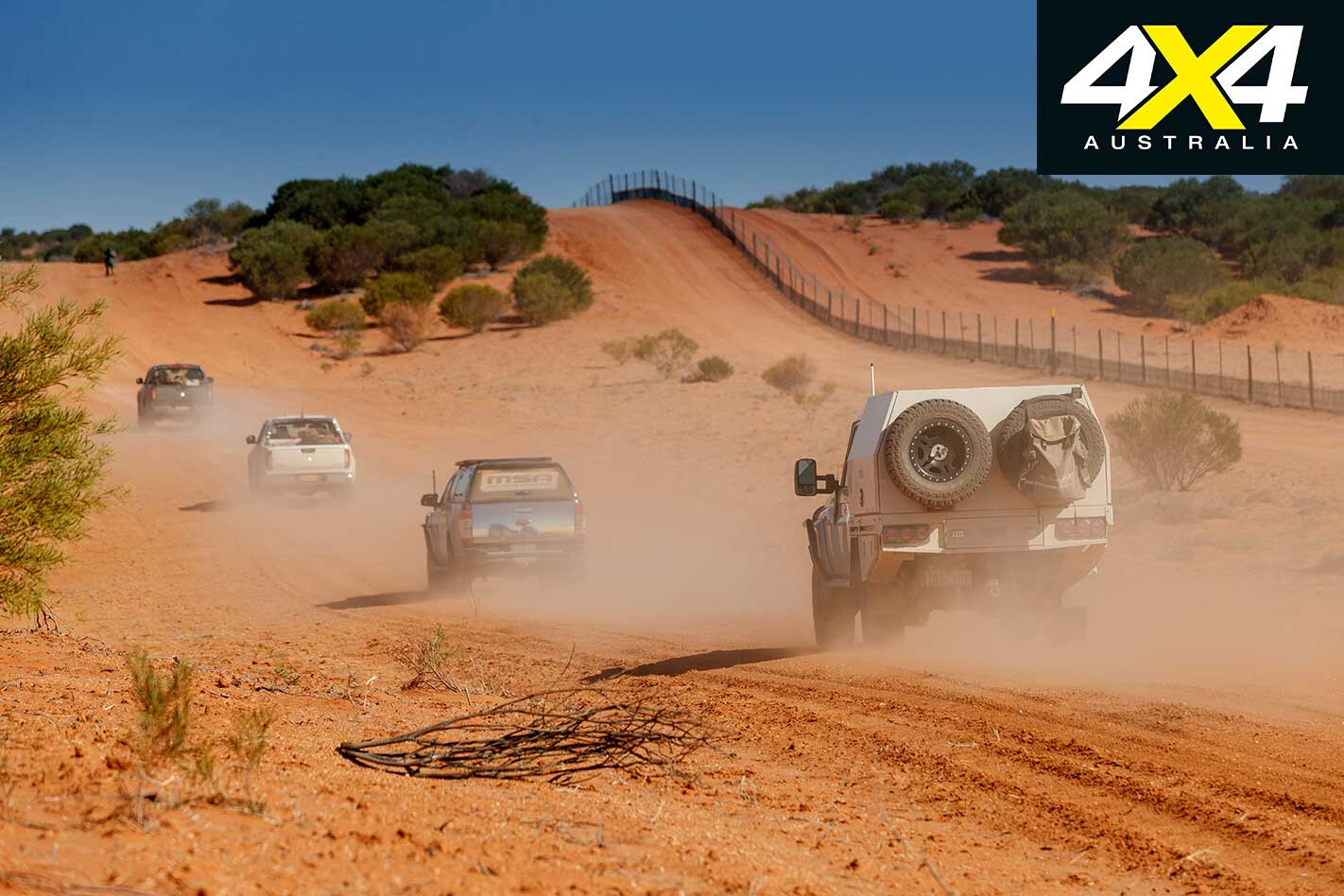
We finally crested a hill after five or so kilometres of slow cross-country travel and spied the ruins we had come to see. The Warata Mine (sometimes spelt Waratah) was originally worked in the late 1880s, but, like most of the mines and diggings in this remote corner of NSW, it was never a rich mine or goldfield.
Gold had first been discovered near Mount Poole in 1880, and by early 1881 more than 2000 diggers were scrambling over the hills looking for any sign of colour. A lack of water and any rainfall, however, kept gold production to a minimum. Still, the townships of Tibooburra and Milparinka sprang into existence to service the influx of people, while pioneer graziers battled the elements to form vast sheep and cattle properties.
In the late 1880s conditions were so dire in these remote places the NSW government sent a relief party to the fields via the Ghan Railhead in SA at Farina. By 1902 the fields were yielding very little gold and most of the miners had departed, leaving the buildings at Milparinka to slumber and decay beneath the blazing sun.
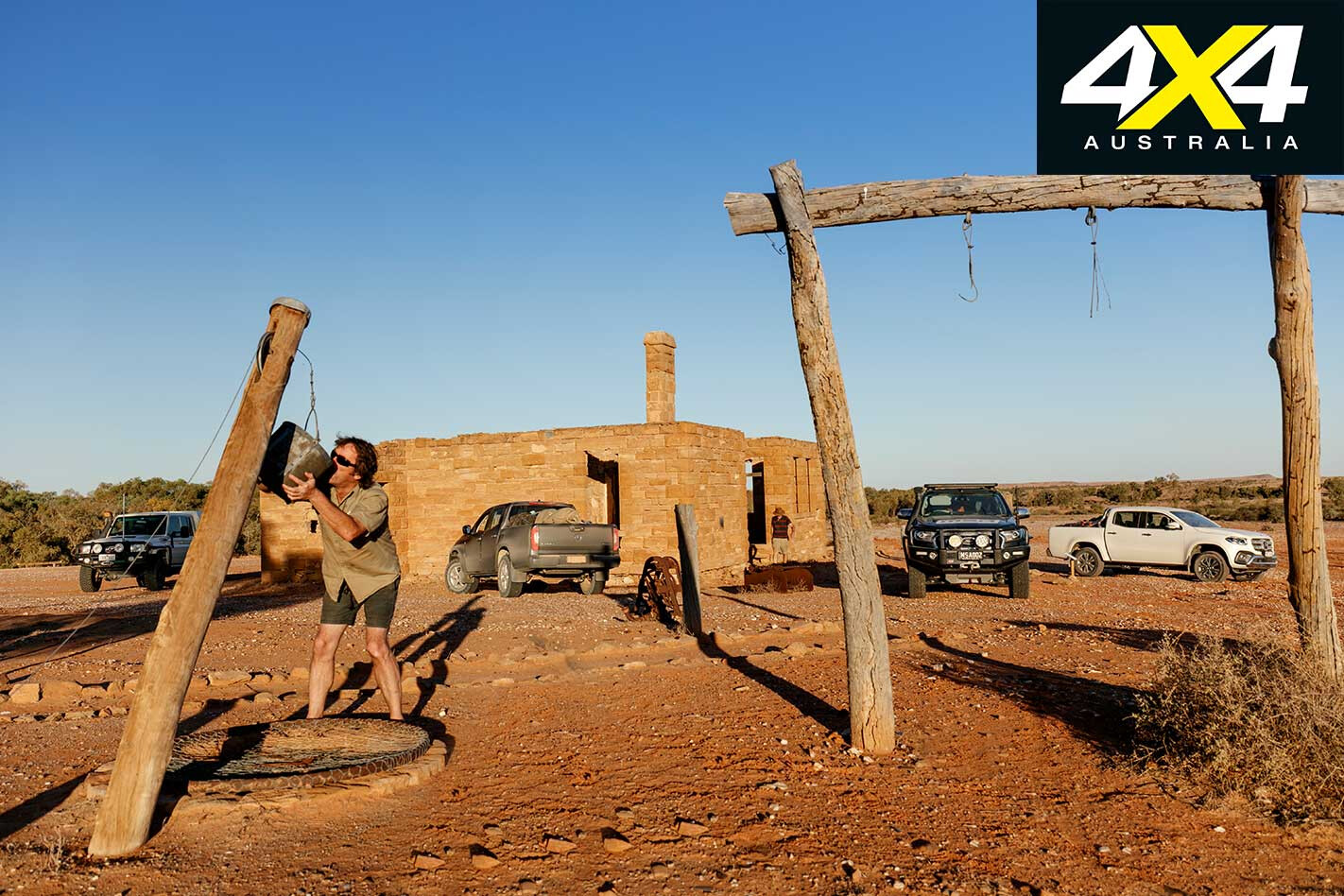
Our quest had started a few days earlier in the once great mining colossus of Broken Hill. While mining still goes on there, the great silver and lead mine that brought prosperity and people to this part of NSW is just a shadow of its former self.
Still, the town is a great place to start any travel in western NSW and boasts a great heritage along with some of the finest art galleries and friendly drinking holes you can find anywhere.
As we’ve been here before on numerous occasions we didn’t want to dally too long, so we pointed our little convoy of Mercedes-Benz X-Class dual-cab utes north and headed to the once rich mining enclave and then on to the ghost town and now arty hamlet of Silverton.
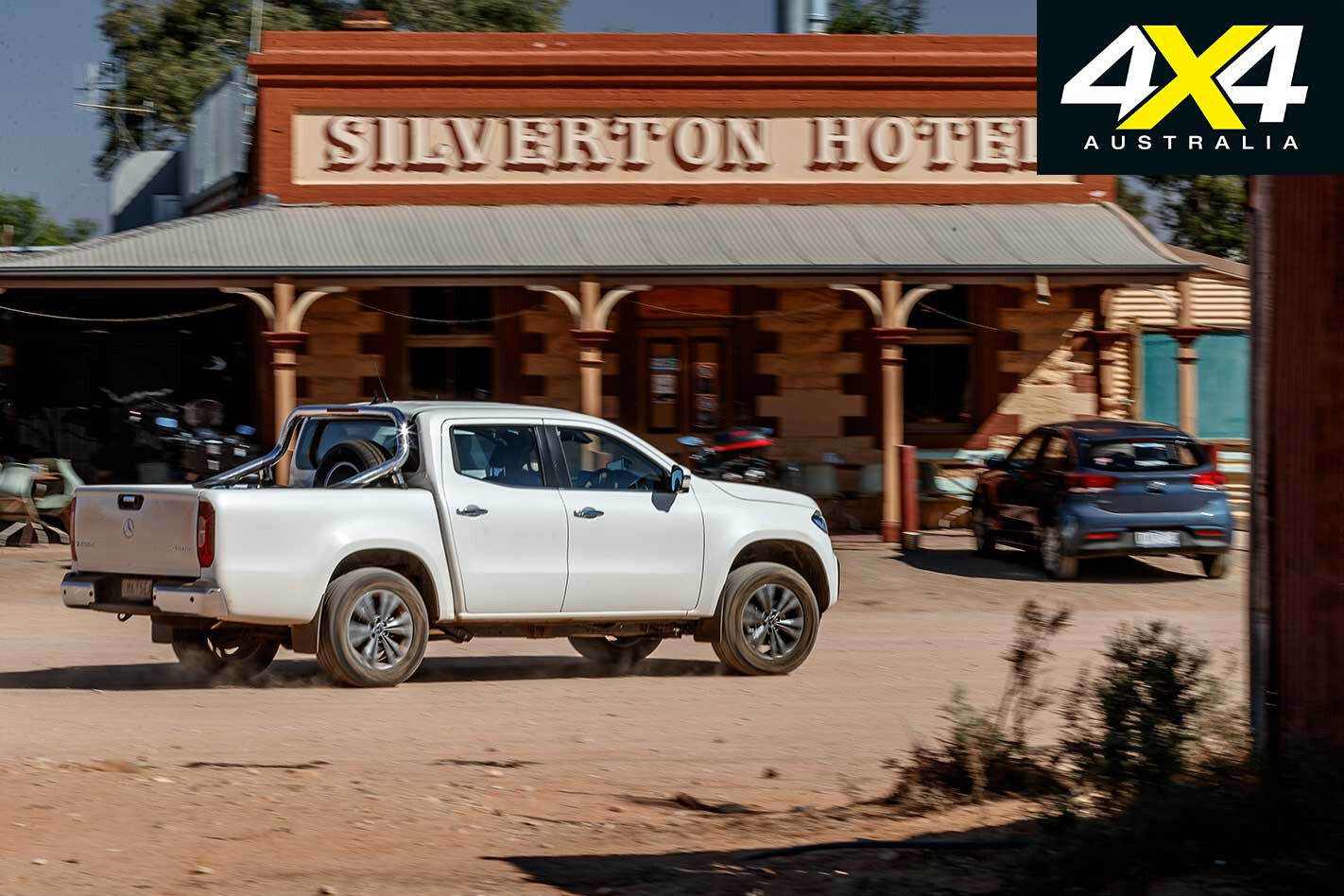
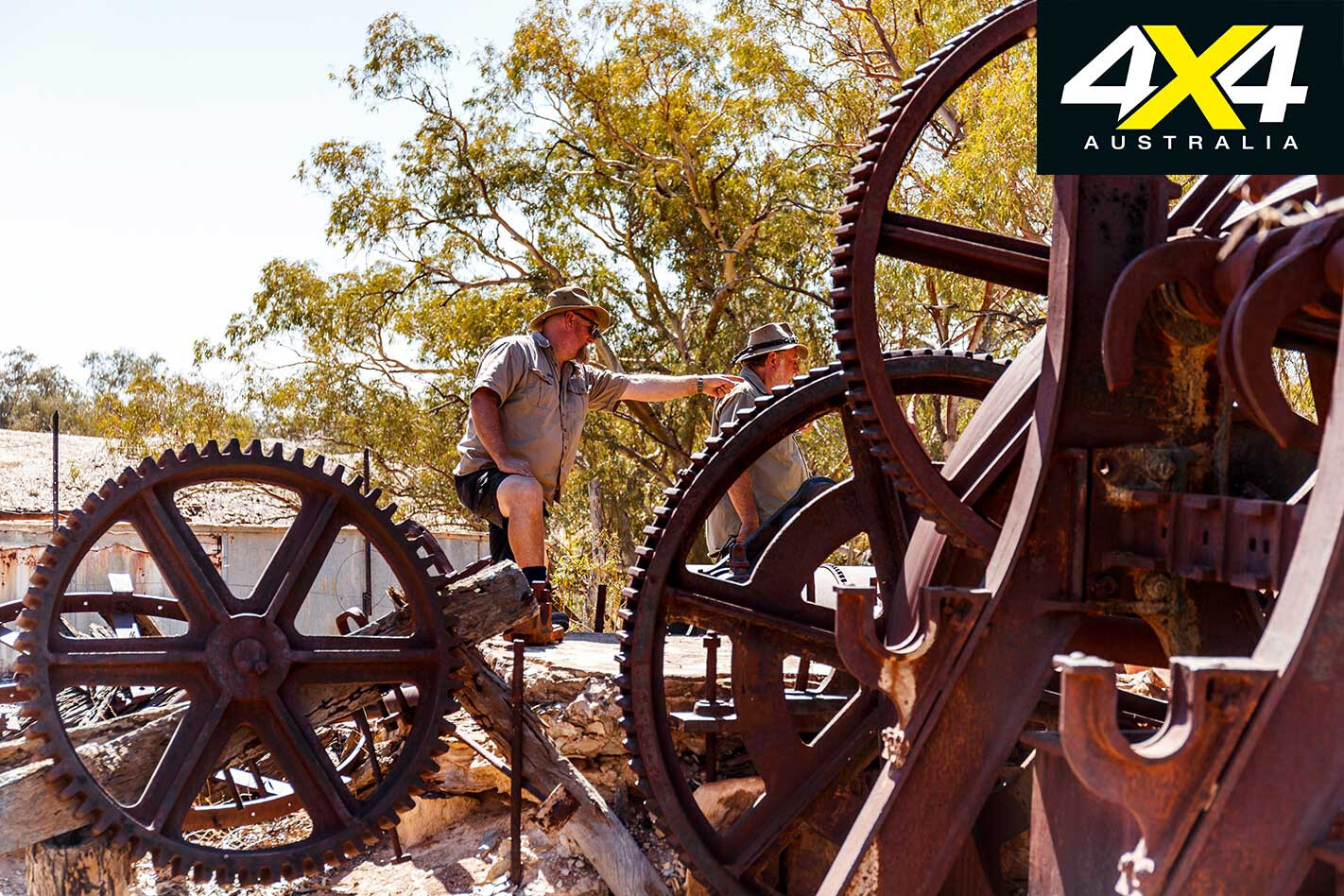
While Silverton has its fabulous pub, a range of art galleries and a museum, along with a scattering of mining ruins nearby, one of the places not to miss is the Daydream Mine, which began operating in the 1880s.
A smelter was built nearby, and by 1885 more than 500 people living in the nearby town of Wilson were relying on the mine and the smelter for their day-to-day existence. Today the mine is very much like it was, with small shafts and drives leading deep underground to where the rich ore body spread its veins of silver through the rock.
While it is a ‘tourist mine’, it’s about as close as you can get to what an old mine was like, with its dark tunnels, rough walkways, low ceilings and cramped working conditions. We had Ruth, the owner of the mine, lead us through the labyrinth, and it was a memorable experience, not only for the insight into how the early miners worked and lived but also to learn how short these early miners were – my helmet took a hammering from the low ceilings.
We spent the next few nights at Eldee Station, one of the many farm stays you can experience in the Corner Country of NSW. Located on the edge of the Barrier Range north of Silverton, Eldee Station not only acts as a great base to explore the area, but it has a number of 4WD tracks that take you deep into the rugged hills and into hidden glens, where trickles of life-giving water act as magnets for the area’s wildlife. Back at the homestead, Steve and Naomi Schmidt are the congenial hosts and offer accommodation, camping, meals and refreshing drinks.
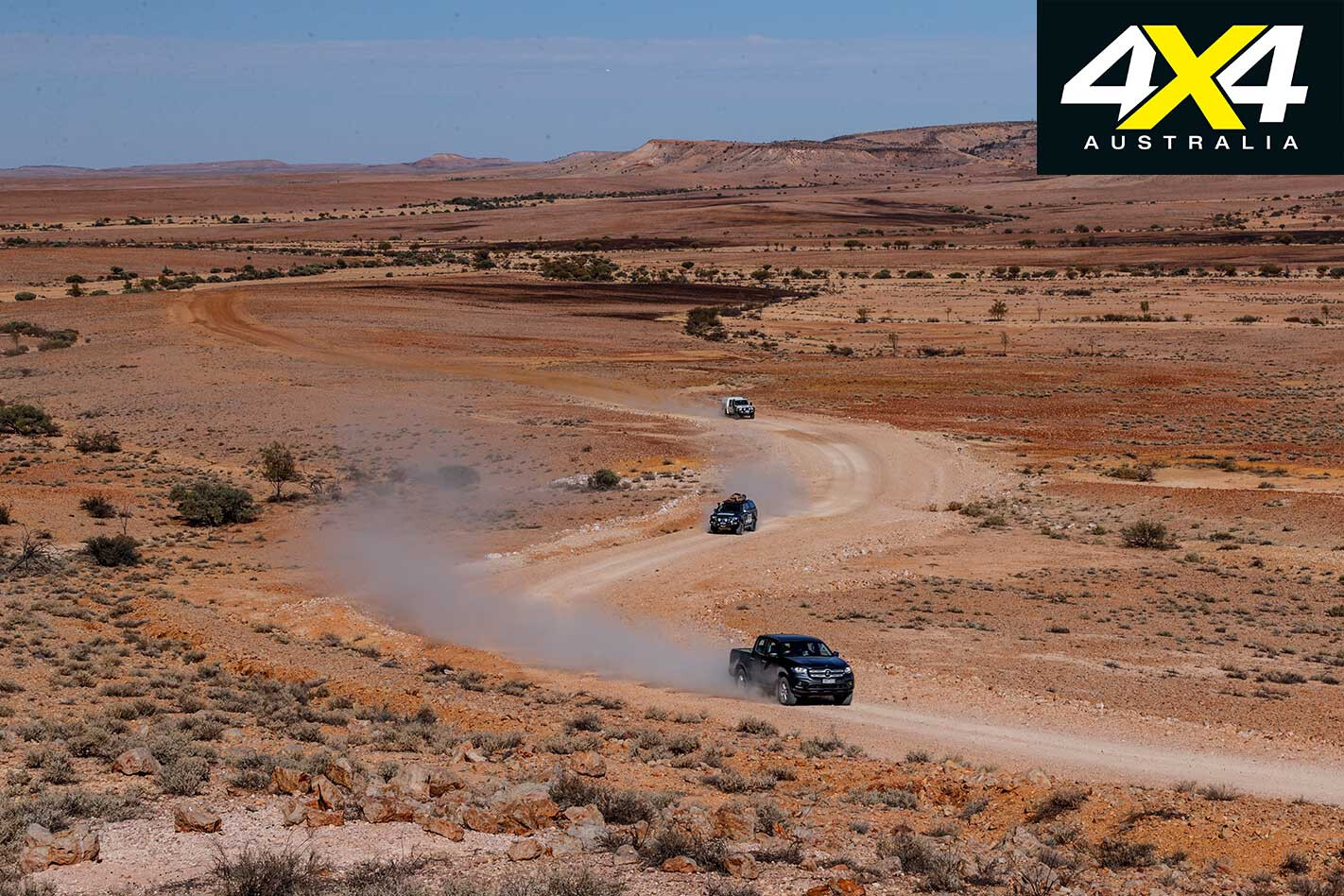
Heading north on back roads that only see the occasional station hand or property owner, we traversed rolling saltbush and gibber plains, the lines of creeks etched with the dark green of acacia and mulga trees.
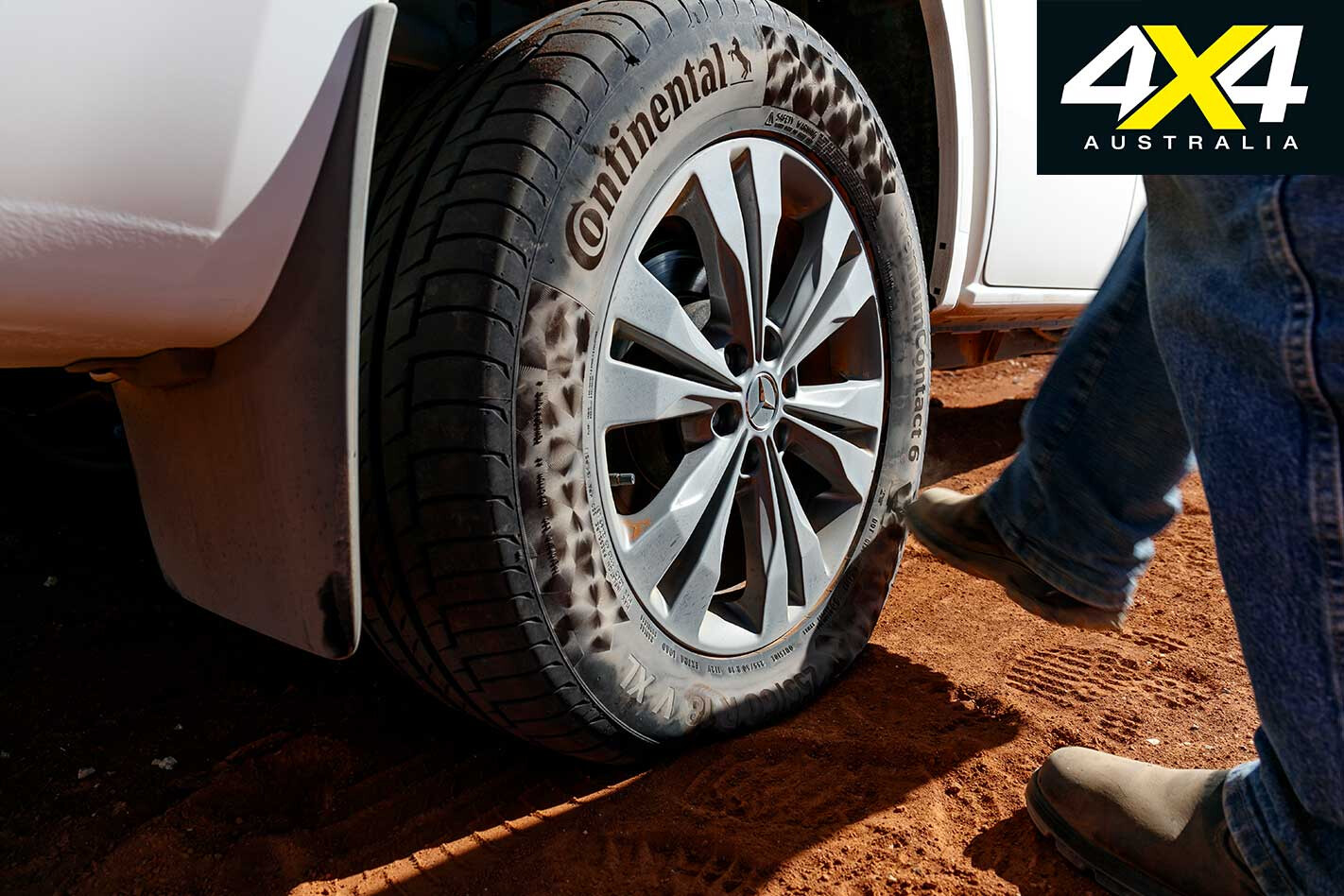
It was here, in a rocky section of range country, where one of the Mercs blew a tyre. Not that it was the vehicle’s fault; rather the vehicle was supplied, as most utes are, with ‘Passenger’ or ‘P’ rated tyres, which we have found to be completely inadequate for the job in the outback. To travel out here comfortably and safely a vehicle needs, at the very least, a ‘Light Truck’ (LT) tyre.
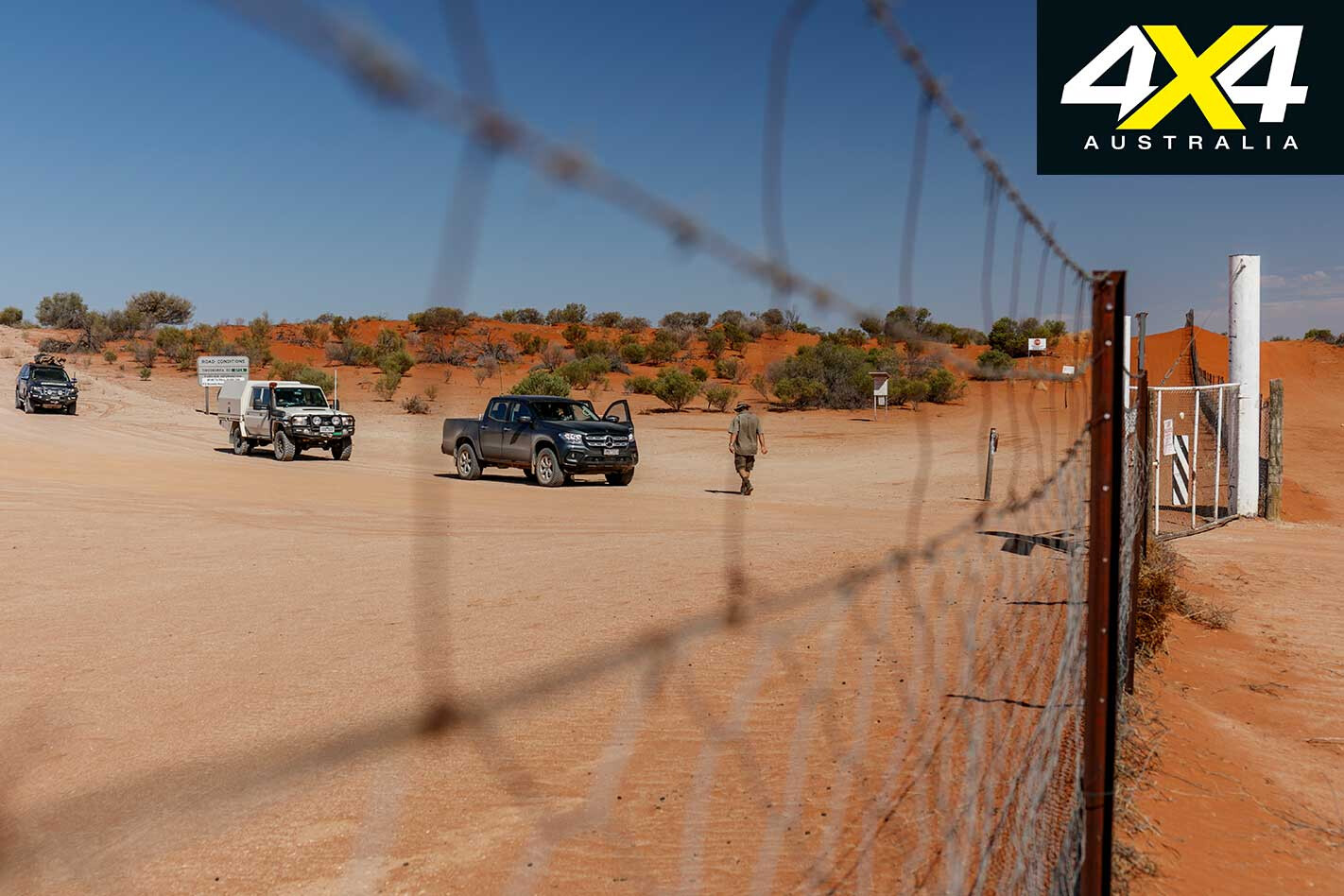
At Smithville House, the major depot for the maintenance crews working on the Dog Fence, we met up with Dave, the NSW operations manager of the Border Fence Maintenance Board, and Sharon Harrington.
We yarned a bit about his job and the people living and working along the Dog Fence that stretches more than 600km along the NSW/SA and NSW/Qld border. The fence’s job is to keep wild dogs out of the sheep flocks of NSW and south-east Australia and, while some may be critical about its effectiveness, there is no doubt sheep farming in Outback NSW would be finished without it.
We also chatted about how the roads that follow beside the fence are private roads in the interests of workers’ safety, and severe fines can be levelled against anybody who uses them. A section of public road travels close to the fence (about 20 to 30m from it) near Smithville House, so there is no need to travel on the private road.
Later that day we rolled into Milparinka, camped down on the creek and enjoyed a few beers at the local pub. Once the hub of a small goldfield the town was deserted for some time, but it has had a revival since the local community got together and restored the impressive stone buildings.
The reopening of the pub a couple of years back also brought life and colour back to the small oasis, so don’t miss it on your travels through Corner Country.
Charles Sturt, the great Australian explorer, was the first European in this region in 1844, and he and his men were trapped at nearby Depot Glen (just north of Milparinka) for six months, as the country, caught in a vicious drought, dried up in front and behind them.
Notwithstanding the dry conditions, Sturt led one or two of his men on flying recce trips west, north-west and north-east, leaving the remainder in camp to build a great cairn of stones on what we now know as Mt Poole.
Named after James Poole, Sturt’s 2IC, Poole died of scurvy while they were trapped here; the only fatality on that incredible expedition that saw, amongst other things, the discovery of Cooper Creek, Eyre Creek and the eastern edge of the Simpson Desert.
After checking out Depot Glen and Mt Poole we headed via the back way to Tibooburra and, with the permission of the local land owner, began our foray into the hills looking for the Warata Mine.
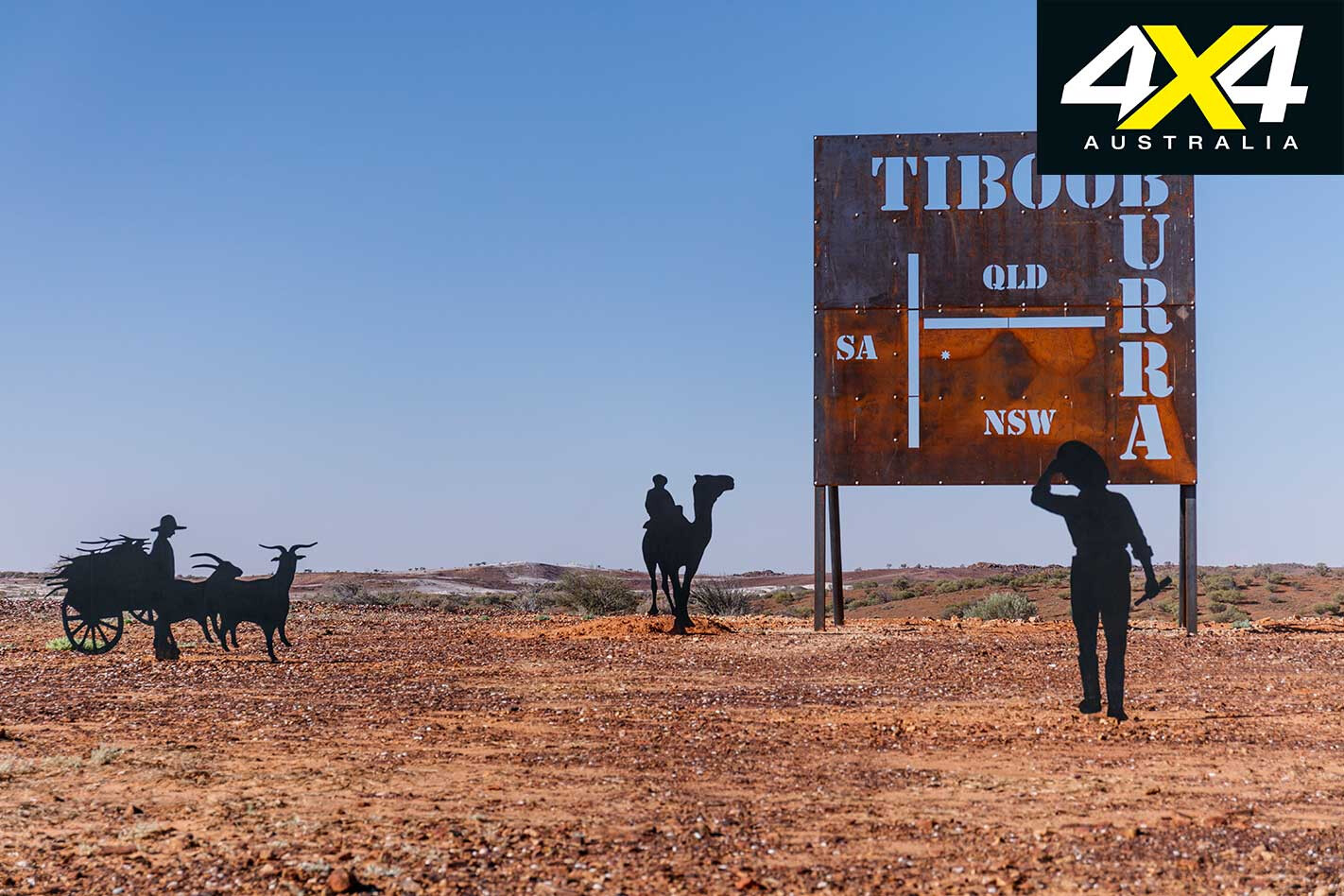
At Tibooburra, while most of us checked out the town, its surrounds and the two famous pubs, one of our vehicles was rushed south on the main road to Broken Hill to get some better tyres, before we pushed on across Sturt NP to Cameron Corner and its friendly pub, store and camping ground.
The country was dry and hot and the park, which is often alive with kangaroos, was near devoid of them, most farther south in the well-watered country of the sheep and cattle graziers.
The next day our little party, now in South Australia, crossed the roller-coaster dunes of the Strzelecki Desert to come to the track and creek of the same name. We turned north across a bleak landscape, the normal dry and dusty channels of the creek being dotted with low scraggly trees, as water hasn’t flowed here for a long time.
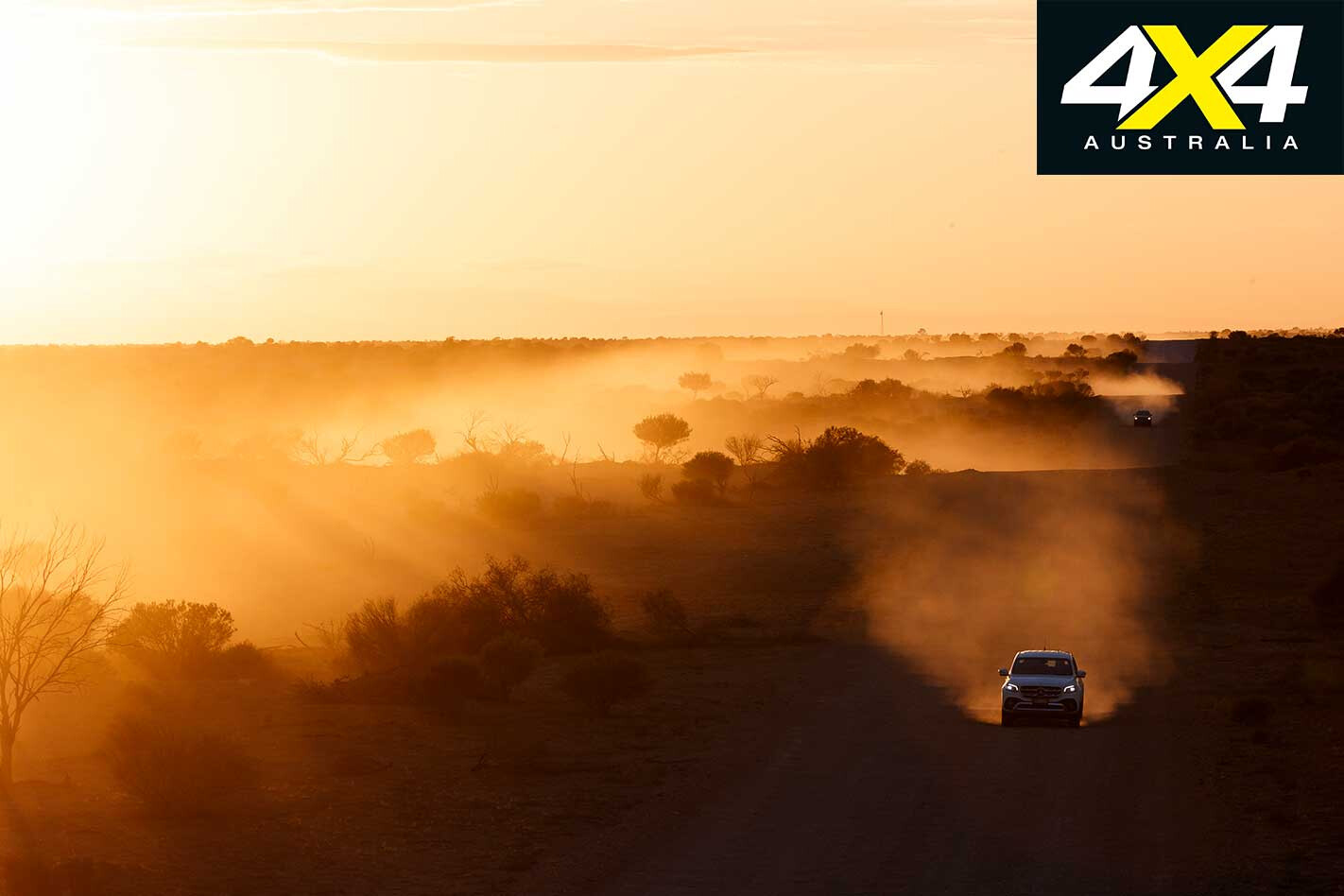
Along the way and sometimes close to the track were the nodding arms of beam pumps lifting their precious load of oil and gas, which is then pumped to a central processing plant before being pushed along kilometres of underground piping to the cities of southern and eastern Australia.
Such industrious activity has transformed this region of Australia, the most obvious of which is the good gravel roads that lead not only to gas- and oil-processing plants but also to our destination, Innamincka.
Across the border in Queensland such progress in its oil fields has seen the snaking ribbon of bitumen extend from the border all the way to Brisbane. It is the easiest way to get to Innamincka and the Cooper… perhaps too easy for us four-wheelers.
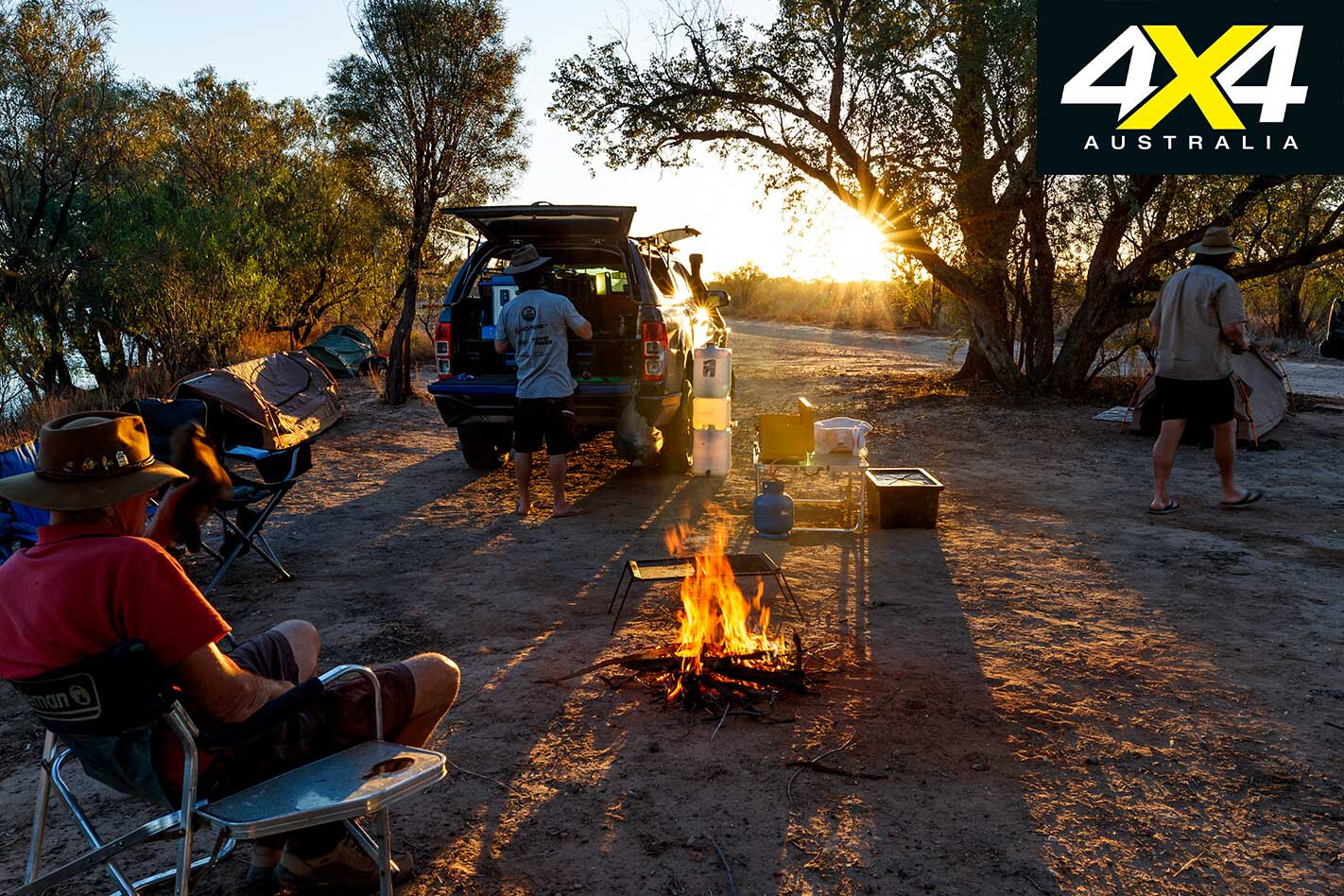
We spent the next few days around Innamincka and Cooper Creek, our luck holding true with water flooding down the creek from rains in central Queensland a few weeks previously. Such a flow adds a little piece of magic to visiting here, and we couldn’t help ourselves as we went down to the causeway across the creek to drive through the running waters. It wasn’t necessary, of course, but it felt wonderful to do it after a few days of dry, hot and dusty outback travel.
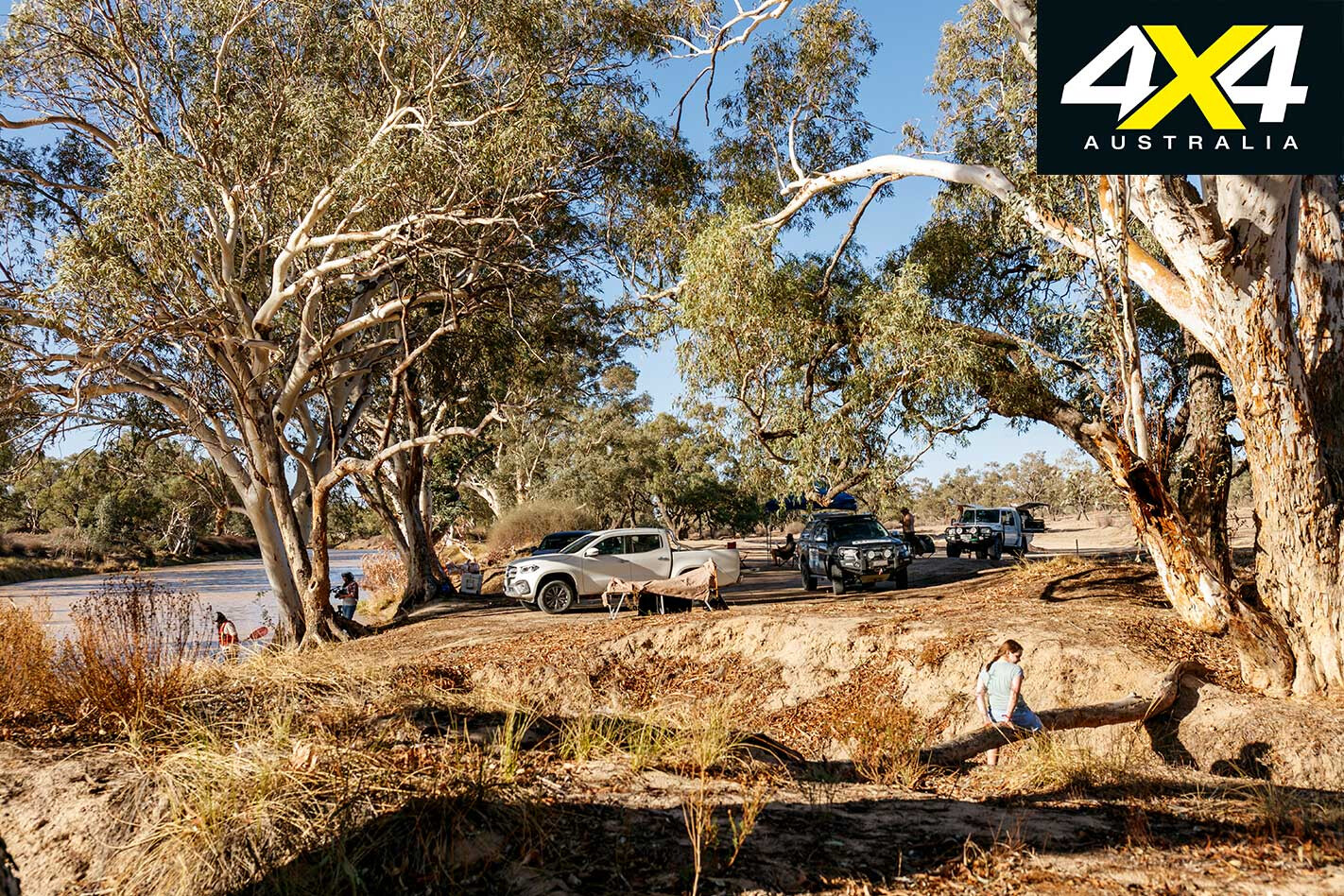
We camped down on the ‘Town Common’ along the creek, trying to take advantage of some of the sparse shade thrown by the tall red gums that line this fabulous oasis, but also staying away from the overhanging branches that can drop at any time without warning.
It’s a top spot to watch the odd pelican paddling its way up and down the creek, or to admire the noisy birds perched in the trees. We even grabbed a kayak from the pub and enjoyed a paddle on this desert waterway; something I’d recommend to anyone who comes this way.
Warata Mining
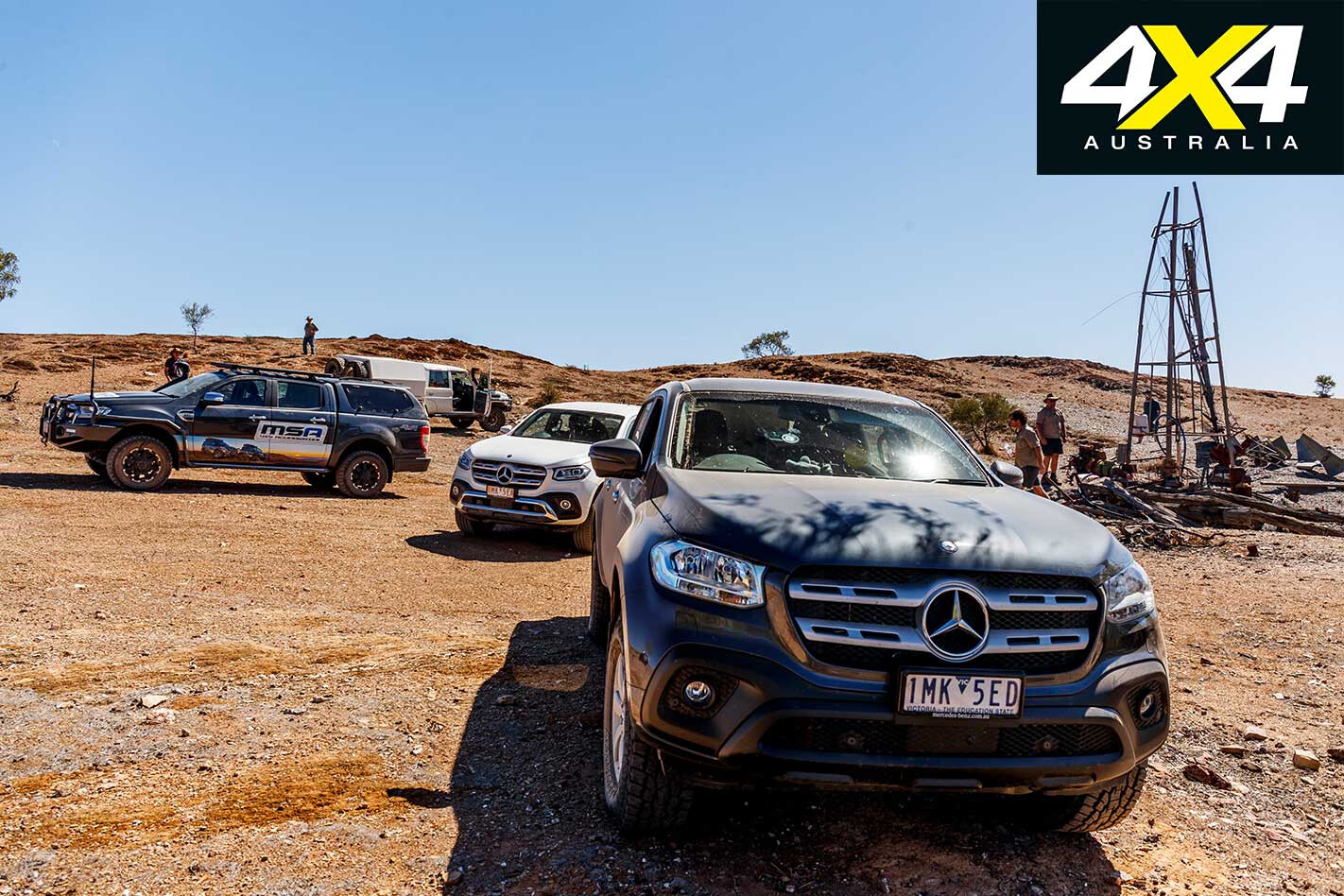
THE old stamper and boilers that litter the remote Warata site today are some of the most complete and poignant in the region, while mine shafts and scrapes dot the surrounding hillsides.
Claim pegs and strips of coloured tape that flutter in the breeze are a sign that more modern surveys for minerals have recently taken place here; let’s hope any further exploration or mining doesn’t destroy the heritage of this mine site.
This happens too often in other places around Australia when modern miners move in with their heavy machinery and insatiable desire to move mountains in the quest for gold.
Burke & Wills
While the creek had been “discovered” by Sturt, it was the doomed expedition of Burke and Wills, 15 years later, that welded the stream into the Australian psyche. Here along this verdant waterway, where hundreds of Aboriginal people lived and thrived for hundreds of years, Burke and Wills died, after they crossed Australia from Melbourne to the Gulf of Carpentaria.
It was a dazzling and bungling expedition right from the start, but to visit the places where their bodies were discovered is still a right of passage many Australians feel they should do.
A little farther east of Innamincka at the famed Dig Tree, where the Burke and Wills expedition had set up a major depot on the north bank of the Cooper, the tree that marks the spot is visited by hundreds of travellers each winter tourist season.
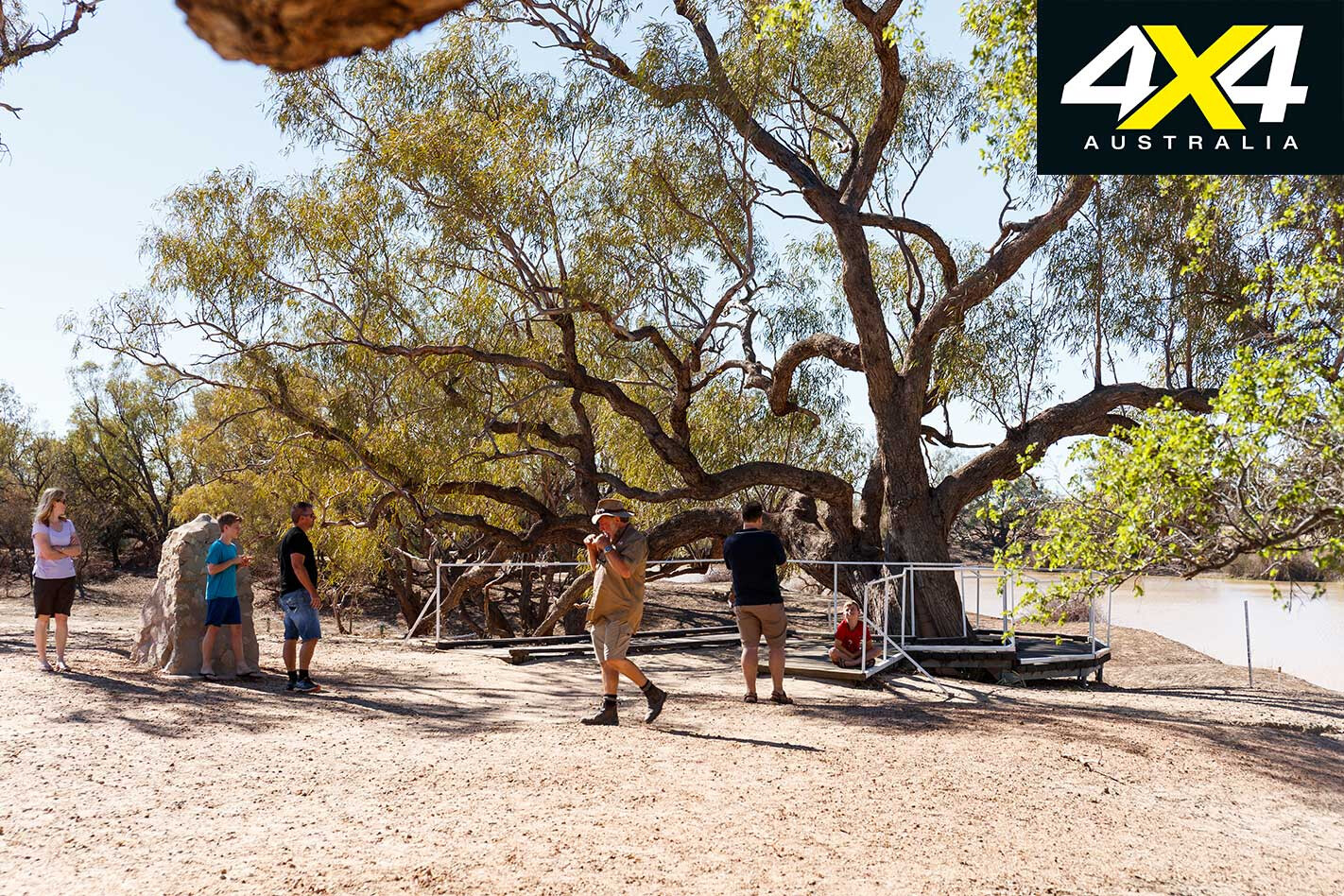
We did the same and wondered how these brave men died and the circumstances that saw them come so close to success. With a salute to their courage and a doff of the hat to their memory, we turned eastward and headed to another great pub on the banks of yet another waterhole… but that’s another story.
Travel Planner
For camping and up-to-date travel info, start at these sites: – Corner Country: outbacknsw.com.au – Daydream Mine: daydreammine.com.au – Eldee Station: eldeestation.com – Innamincka Hotel: innaminckahotel.com.au – Innamincka Trading Post: innaminckatp.com.au
NEW VEHICLE launches can be a bit of fun sometimes, but usually the funniest part is reading the horse-shit dribble out in the press afterwards by people who should know better.
It seems that some sections of the motoring media are more concerned with what the car companies are not going to sell rather than what was just launched.
The recent Ford Ranger Raptor launch was no exception, with headlines such as “Ecoboost considered for Ranger Raptor”, “Why no manual for Raptor?” and “Mustang Engine for Raptor” all being bandied about different outlets.
It’s not just limited to the new Raptor, though. If I have to read that Mercedes-Benz is considering an AMG version of the X-Class ute again, after the company has denied it since the car’s inception, even I might start believing it.
I mean, what engineer worth his Stahlwilles wouldn’t smirk if you suggested a V8 engine in their latest truck, even if it was never going to happen? But never say never, stranger things have happened. The questions over the Raptor’s powerplant are not without value. The underwhelming performance of the new 2.0-litre bi-turbo diesel engine has many pundits questioning what else is on offer from Ford Performance.
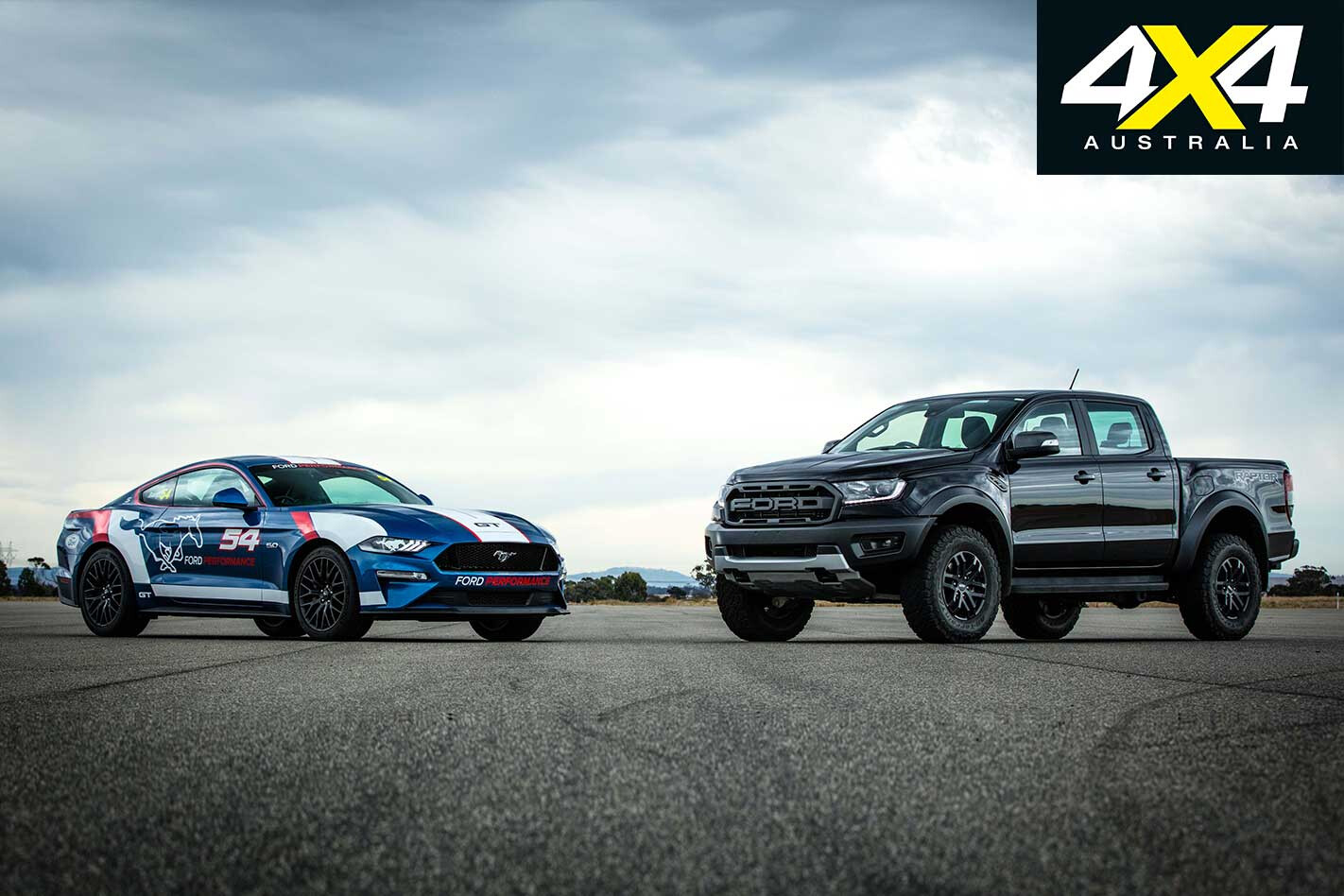
Yet throughout the launch the folks with blue ovals on their dust coats emphatically said there was no other engine and transmission ever considered for Raptor, nor is there anything else planned. Maybe the negative review will spark the dust-coat wearers into action with a more potent powertrain.
The probable prospect of the Ranger Raptor going on sale in the USA next year poses the option of a petrol-fuelled engine, and the most likely option there would be the 2.3-litre EcoBoost engine as seen in the Ford Mustang, not the V6 Ecoboost from the F150 Raptor. But Ford, like all the other manufacturers, see no market for petrol-fuelled 4×4 utes in this country.
Maybe, we’ll just have to wait for the geniuses at Killarney Conversions and Harrop to slot a V8 into the Raptor or a HSV SportsCat before we get a true performance 4×4 ute in this country.
BIRDSVILLE is soon to be awash with big hats and fancy frocks, with the annual Birdsville Races starting this weekend, August 31 – September 1.
Thousands of people are expected to flock to the quintessential outback town, positioned on the edge of the Simpson Desert, for the 136th running of the event.
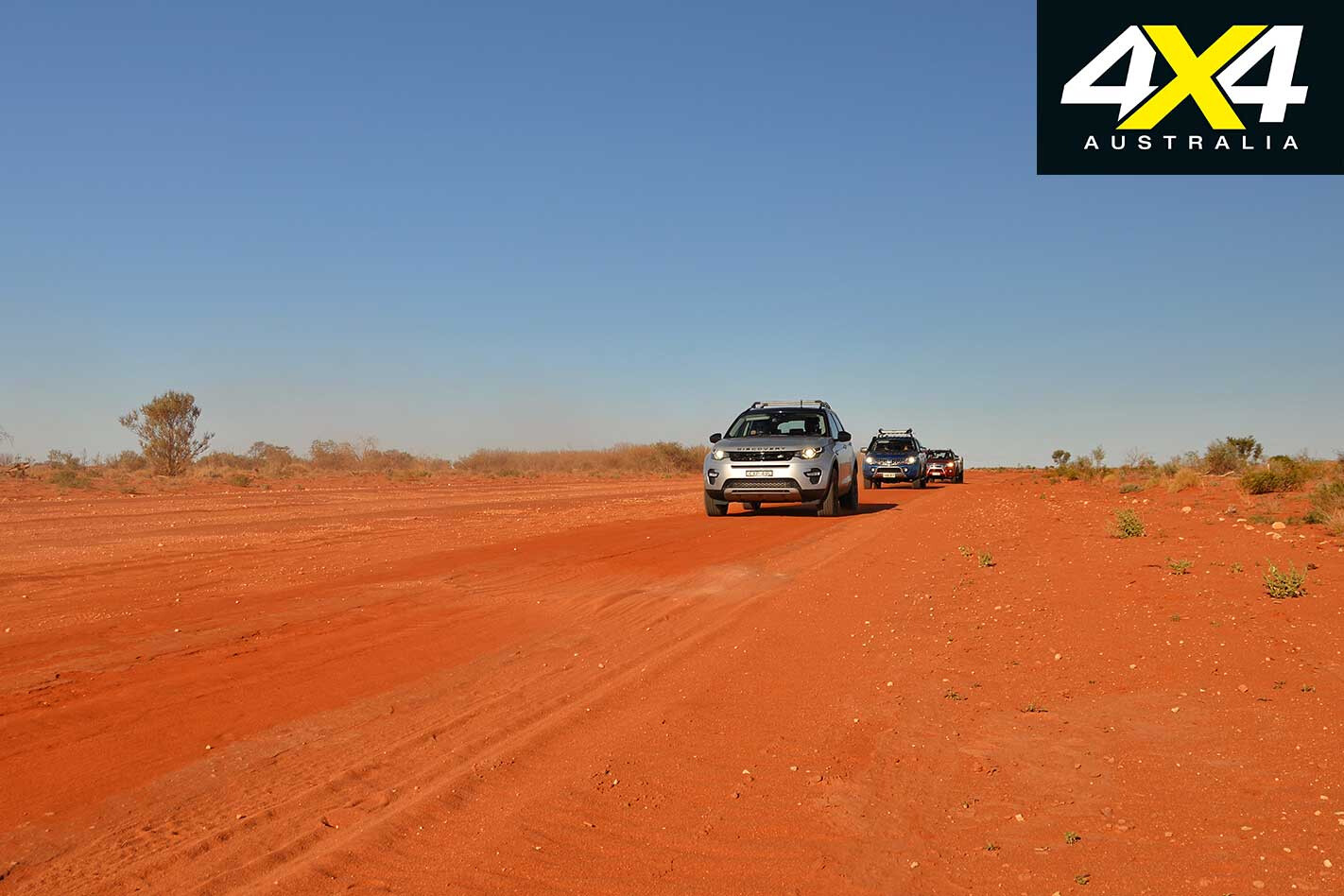
The main attraction is the 1600m UBET Birdsville Cup, which attracts thoroughbreds from all around the country and awards the winner with a handy $40,000 pay packet.
However, the event, known around the traps as the ‘Melbourne Cup of the Outback’, brings more to the town than a horse race – there’s also film and comedy nights, live music, cocktail parties and Fred Brophy’s travelling boxing troupe.
Punters can also enjoy an ale or two well into the night at the famous Birdsville Hotel, and then cure that hangover with a pie from the Birdsville Bakery (try one of their famous curried camel and/or kangaroo and claret pies).

“The Birdsville Races are extremely remote in location – and that’s part of what makes them so special,” Gary Brook, Vice President, Birdsville Race Club, said. “Nothing beats the sight of the horses racing around the bend and kicking up the striking red desert dust each year. It’s truly a one-of-a-kind experience and something you should do in your lifetime, especially if you’re an Aussie.”
In a first, punters can now watch all the action from home, as the 2018 races will be telecast across the nation on Sky Racing 2. Still, we’d prefer to be there. Snare your tickets now at www.birdsvilleraces.com
AUSTRALIA has an obsession with all things large; it’s in our history, our geography and even our fast food orders. Name another country that’s built a giant fibreglass sheep with woollen bollocks the size of a VW? Saying we’re obsessed with large things is like saying the Deni Ute Muster is a party in a paddock, an understatement of flannelette-wearing, biblical proportions.
That attitude goes right across four-wheel driving as well. You don’t have to look far to see we’re making 4WDs bigger in every possible meaning of the word.
They’re higher with suspension lifts, wider with flares and chunky tyres, and packing more grunt under the bonnet thanks to a plethora of engine swaps, performance upgrades and turbo setups strung higher than Charlie Sheen on a trip to Bangkok.
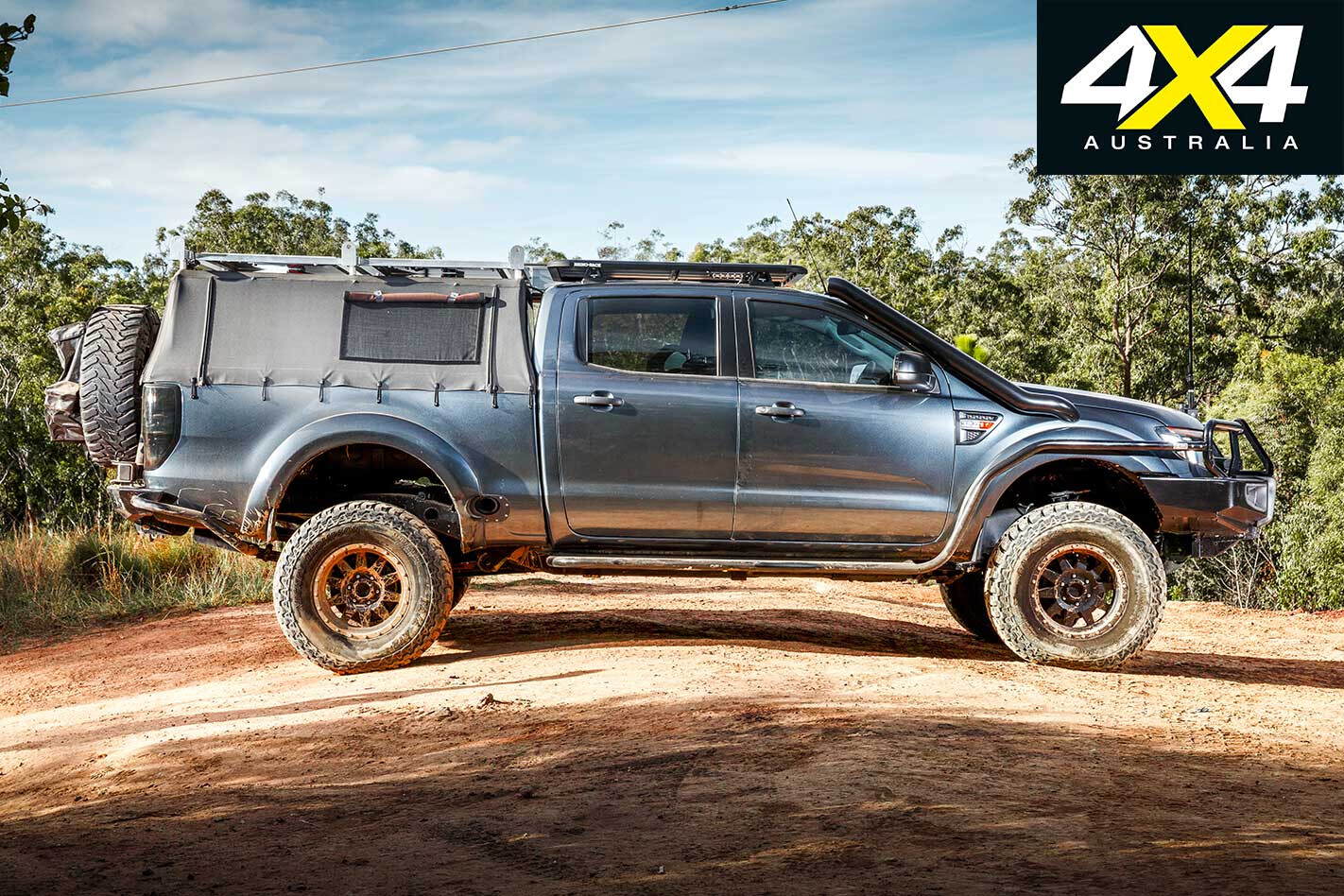
The masterpiece of metal you’re currently ogling with impure thoughts is the very embodiment of that path to… well, big. It’s a Ranger, just bigger in every single way. Starting with a PX1 XLS Ranger, owner Jesse Endenburg spun spanners and wielded grinders with reckless abandon until it measured up a full 300mm longer than the Rangers grouped in your local shopping centre carpark.
“My dad’s been stretching Land Cruisers for years,” Jesse told us with that tone of respect reserved expressly for dads who know how to get it done. “I’d always wanted to do it to a Hilux because that’s all that was worth buying 10 years ago; then when I got a Ranger for work I called up my dad and we got stuck into it.”
With Jesse on the spanners and his dad wielding the gas-axe, the pair cut the chassis behind the cab and stitched in an extra 300mm of chassis rail, pushing the rear axle back in the process.
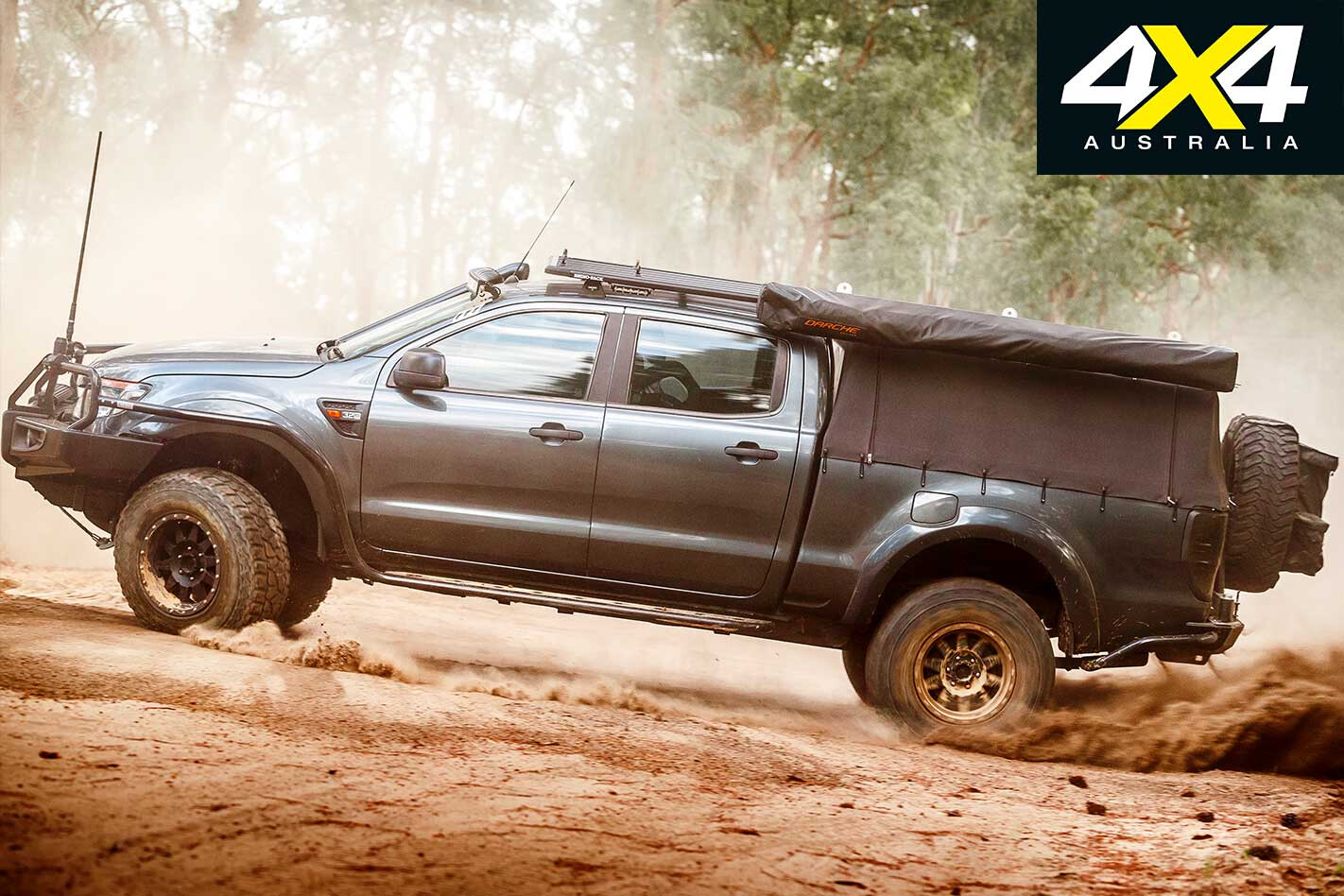
This ain’t a one-trick pony, though, and the story doesn’t start and end on the loud end of a grinder. While the super-sized wheelbase has drastically altered the look of the big rig, it’s also given Jesse a monster-sized tray prime for fit-out. When you’re a builder who lives in south-east Queensland, a ute needs to be able to head straight from the job site to the beach site.
The backbone, so to speak, is an elaborate framework Jesse knocked together using builder’s racks which serve as the skeleton for a one-off canvas canopy draped over the whole affair, providing easy access to his gear and protecting it from the elements.
The tailgate is lockable and, with two panels that drop down in front of the Titan drawers, Jesse’s got himself a secured setup for tools and camping gear alike.
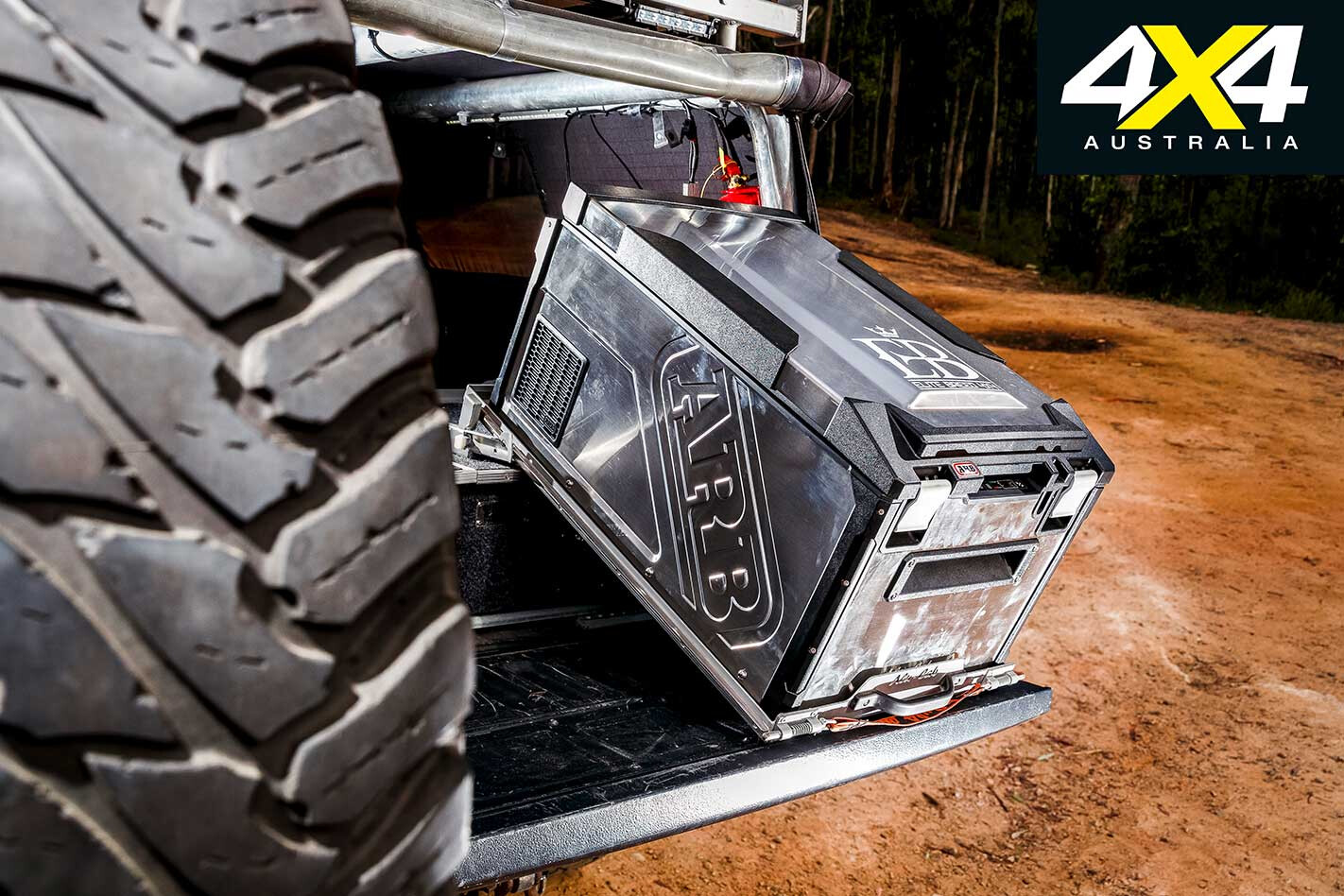
A monster body like that would look like a stretched 1990 Ford LTD without the right set of legs underneath, and Jesse’s Ranger doesn’t disappoint the suspension gurus. Right off the bat the cab and tray are now sitting 50mm higher thanks to a body lift from Queensland-based Performance Suspension Racing.
After chopping and changing between various setups, Jesse got the balance ‘just right’ with a full four-inch suspension lift from Superior Engineering. The monotube arrangement has all the high-tech goodies of big-dollar shocks, like a remote reservoir, eight-stage compression adjustment and complete rebuildability.
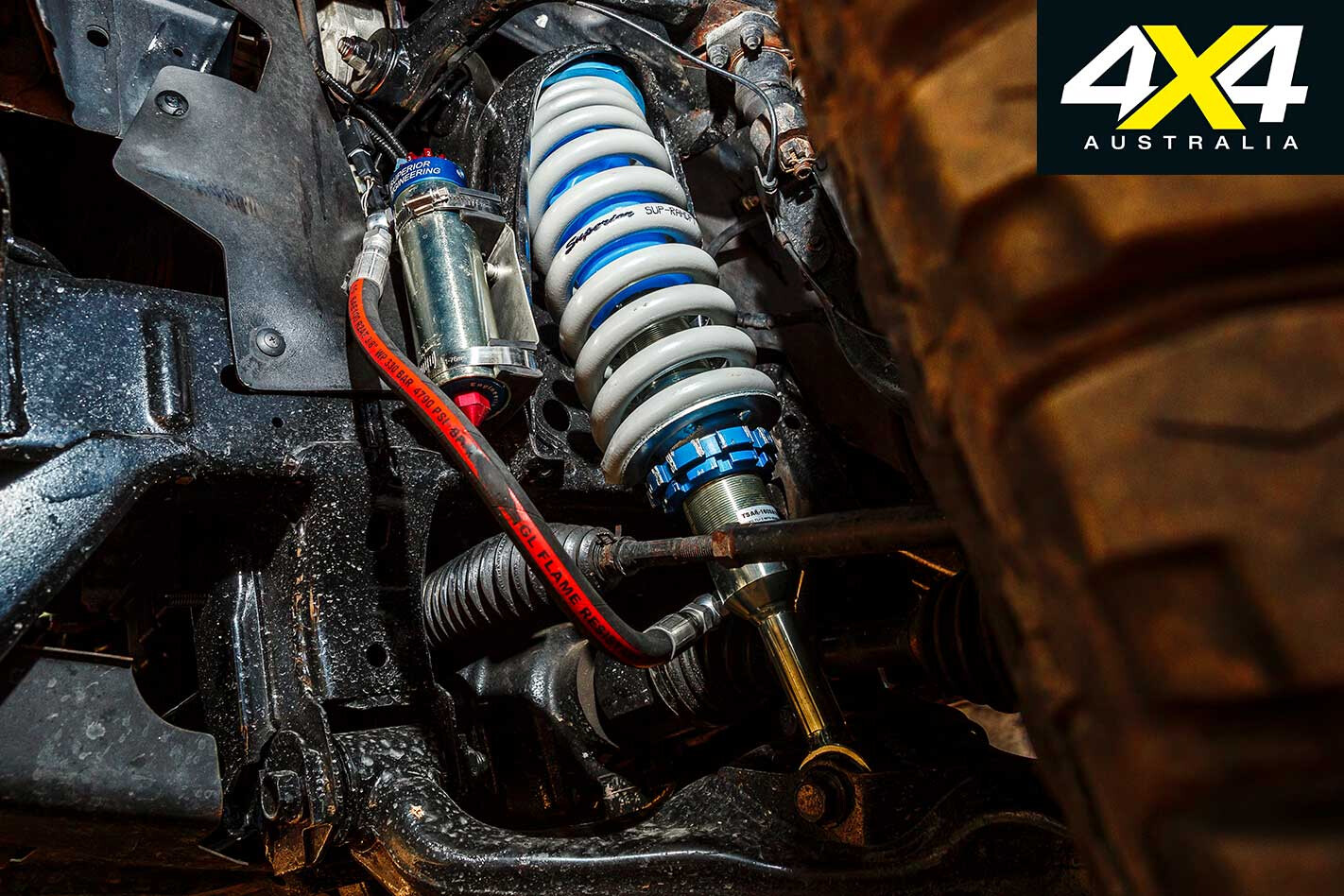
Superior Engineering upper control arms help rein in caster angles and replace the maxed-out ball joint with spherical rod ends. A PSR diff-drop kit was installed, too, lowering the front diff centre and putting the CV joints on the equivalent angle of a 50mm lift.
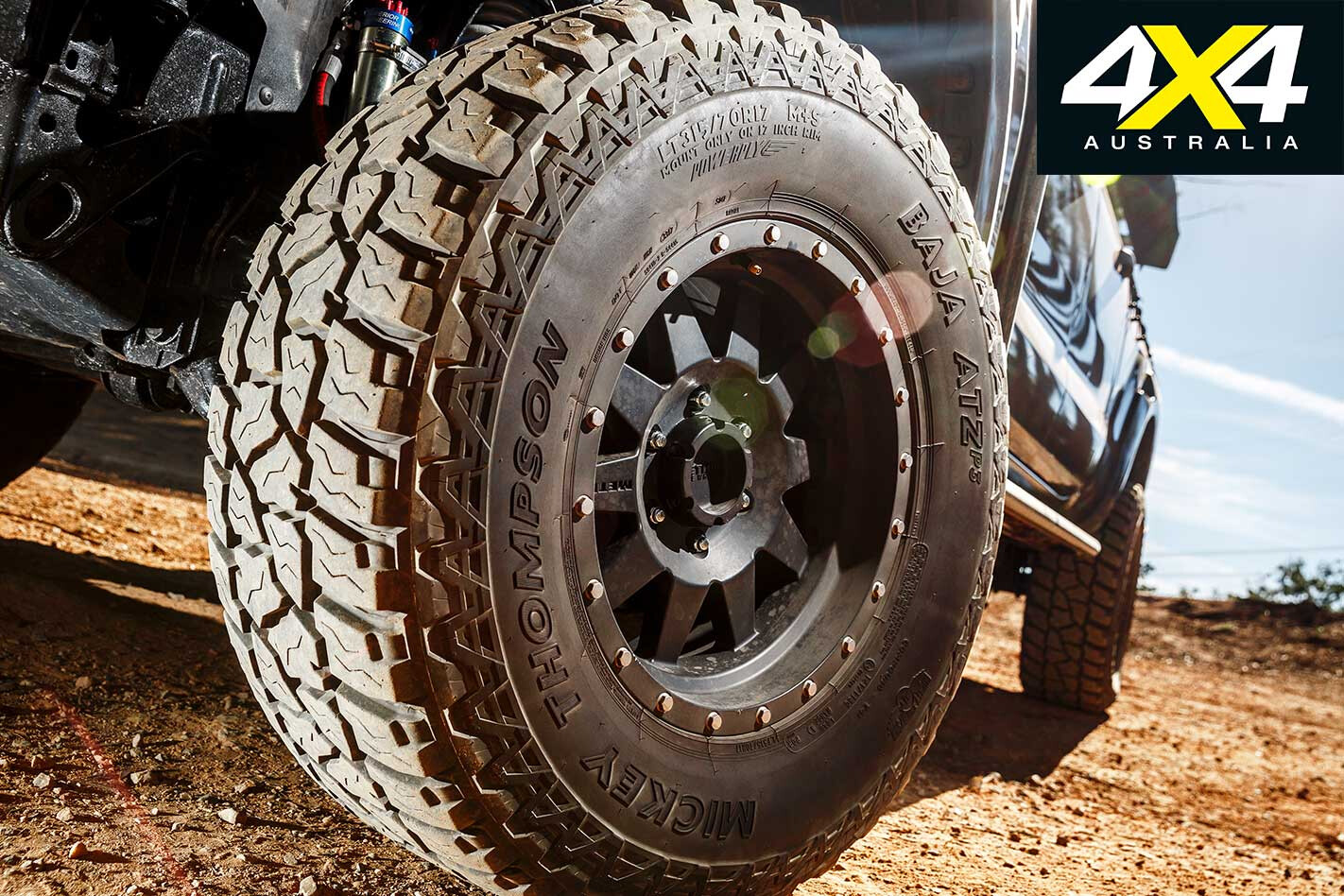
Jesse made the most of the six inches of extra room in the front and rear wheel arches by stuffing in huge (for a Ranger) 35-inch Mickey Thompson MTZ tyres. They’re wrapped around Method Race Wheels ‘Standard’ model alloy wheels and provide plenty of floatation across the soft sand Queensland is notorious for.
Keeping the 35s motoring down the track is Ford’s biggest-in-class 3.2-litre five-cylinder Duratorq turbo-diesel donk, which has been pushed to its limit by remapping gurus, Just Autos. It’s fed a diet of cool-clean air thanks to a HDI intercooler and a four-inch stainless steel snorkel from Queensland locals Fabulous Fabrications.
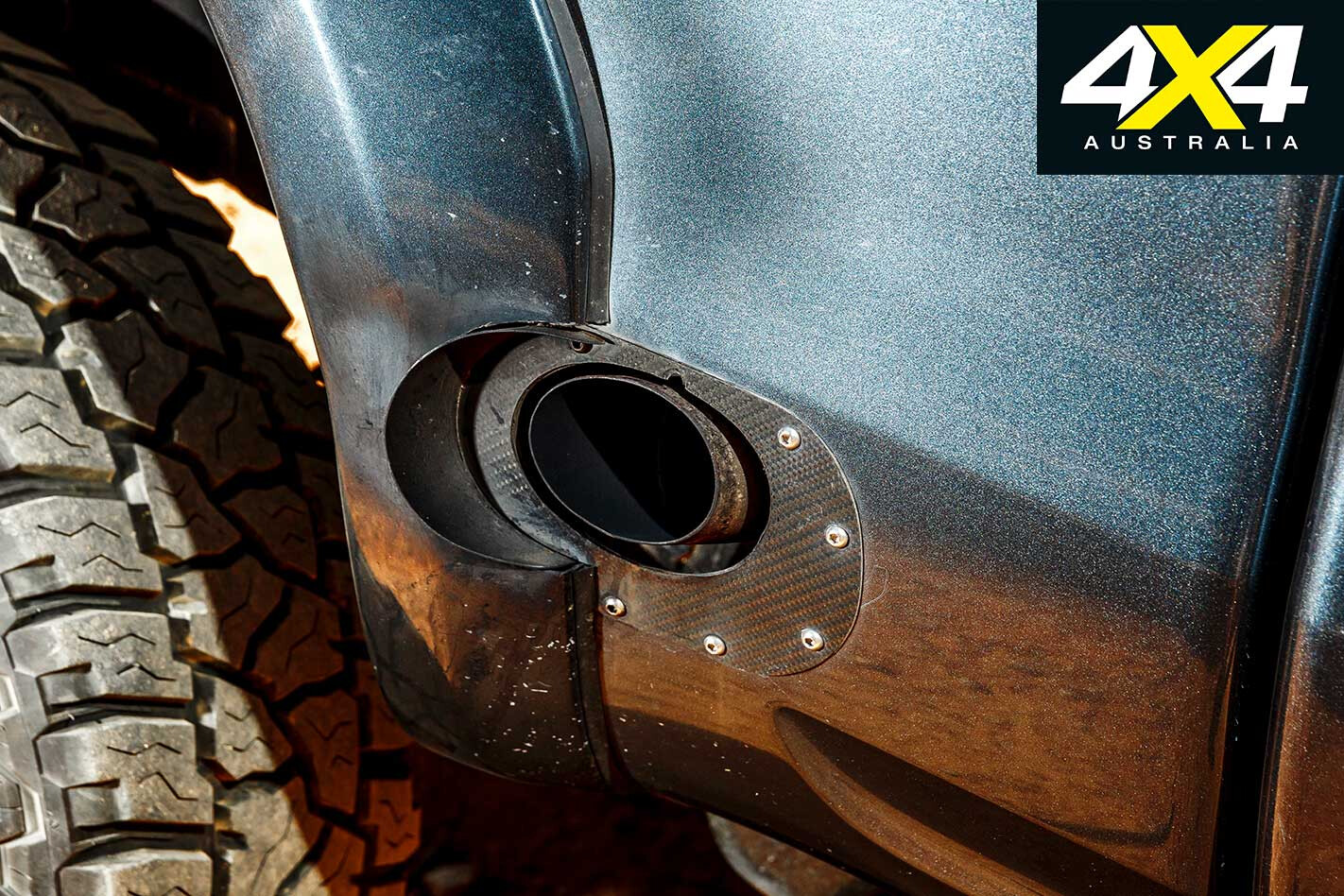
From here, power is sent to all four wheels through the six-speed cog swapper via a one-off custom NPC clutch. Ditching the spent gasses is a trick through-body exhaust system, a custom-built unit with a three-inch pipe running off the back of the turbo, through a high-flow muffler, before exiting the driver’s side body right before the rear wheels.
Big tyres, big lift and big power might be the hallmark of a mall crawler, but Jesse’s Ranger is anything but. With regular wheel lifts and gnarly tracks around the Glasshouse Mountains, the big armour box has been well and truly ticked.
Leading the pack is none other than ARB’s Deluxe bullbar up front. The plate-steel unit protects the front end from animal strikes, but also serves as a mounting location for the Domin8r 12,000lb winch. Protecting the Ranger’s supple flanks is a set of custom-built rock sliders from Elite Engineering. They wrap up just shy of the tub, with Jesse eventually planning a canopy setup.
Rounding out the protection package is an Ironman 4×4 steel rear bar, which sits on a set of custom brackets to suit the two-inch body lift. It was then sliced and diced to accept a one-off rear tyre carrier, getting the spare up and out of harm’s way.
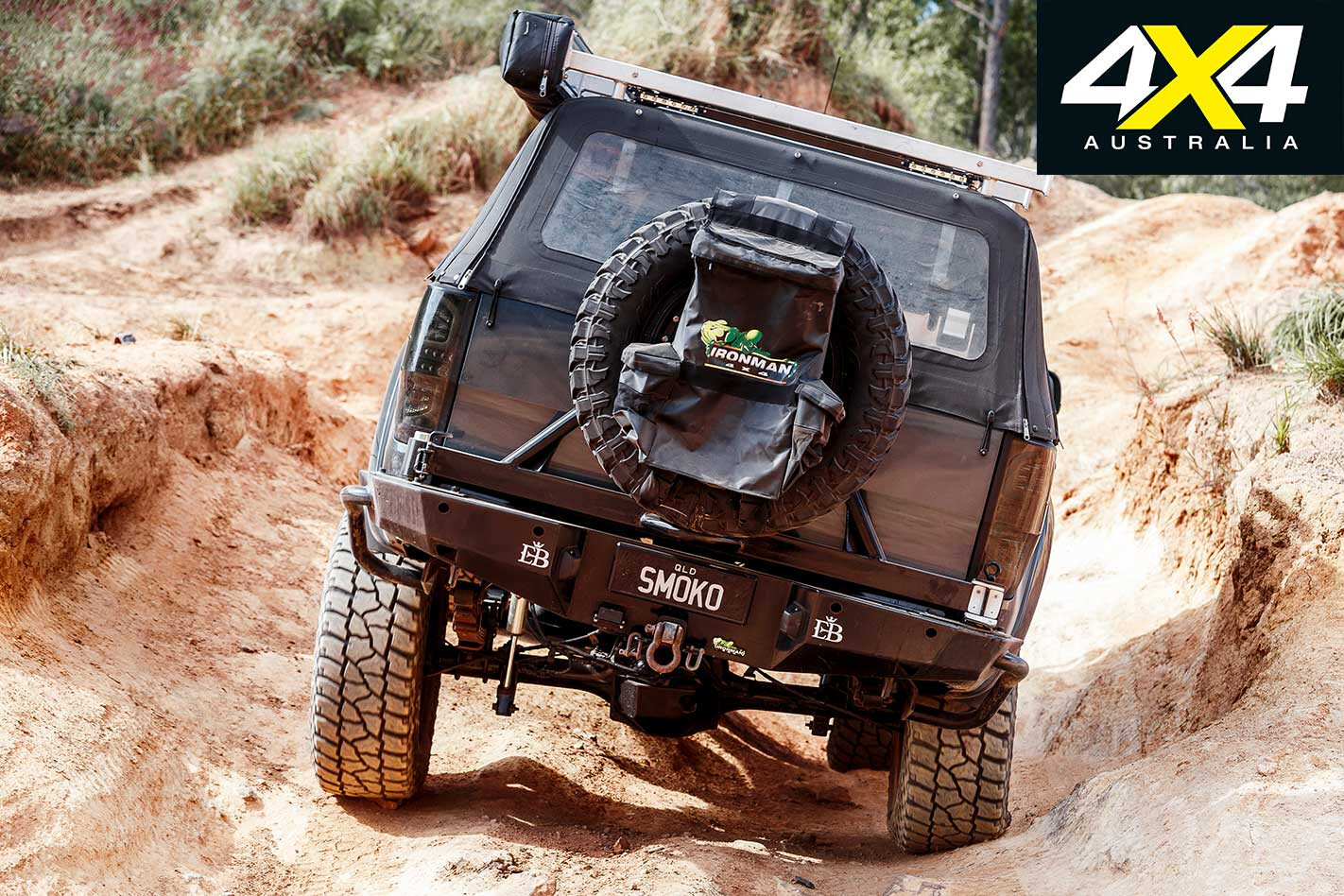
Up top is a mammoth 50-inch light bar sitting proudly on a set of Bullseye brackets fixed into the A pillars. It teams up with the 22-inch Stedi offering on the front bar, to light up the length of Double Island for those late-night summer beach runs. They’re kept powering late into the night thanks to a combination of a Redarc 1240 BCDC charger and a 170amp/h KickAss slimline battery behind the rear seat.
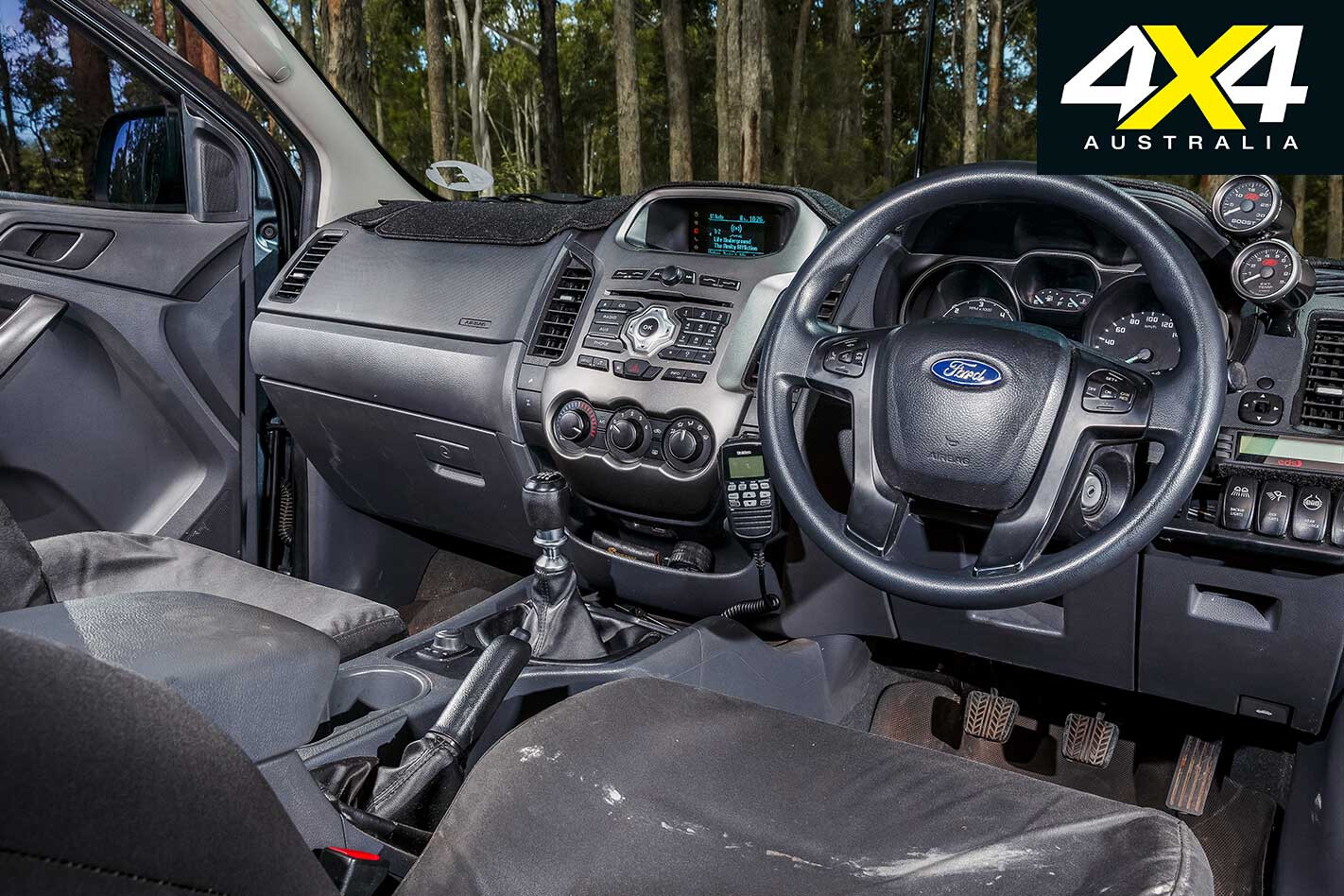
From the captain’s chair, the Ranger copped plenty of track-ready upgrades. Off to the right-hand side is a switch panel; the factory rear locker switch has been relocated next to the switch for the new Harrop ELocker up front. Jesse’s able to survey all that is his, too, thanks to the EDS Engine Data Scan system, as well as the SAAS Pyro and Boost gauges monitoring engine vitals.
If a Ford Ranger is a cheeseburger, Jesse built himself a Big Mac, threw in some bacon and ordered a sundae on the side. It might not set out to prove anything, but it’s the right tool for the job, no matter what job is at hand.
More is More
HOLD up a minute, you can’t just go cutting a ute in half and making it bigger. After all, manufacturers spend a gorillian dollars making sure everything works perfectly… right? Well, not exactly.
The options vehicles are fitted with in Australia are just that, options. Different markets get different trims, different wheel and tyre combinations, different power outputs, different suspension tuning, and, in many cases, different wheelbases. It all depends on what the manufacturer thinks will sell in that market, and what they have access to in the supply chain.
It’s not uncommon for a ute in other markets to be offered as short or long wheelbase variants, in both single- and dual-cabs.
When the manufacturer offers a long wheelbase dual-cab ute, all the individual components are typically the same, just with a longer chassis holding them together and a big ol’ driveshaft connecting the front to the back.
The faint scent of chimney smoke lingered in the morning air and our calves burned from the steep hike. Ahead, a group of wallabies loitered unperturbed on the path, waiting until the last moment to hop out of our way into the track-side scrub.
This feature was originally published in 4×4 Australia’s September 2012 issue
After a week of four-wheel driving through Tassie’s gorgeous west coast, we’d emerged from the Western Explorer Highway the previous day and were now en-route to Devonport – one and a half hours east – to board the Spirit of Tasmania.
Having slept the night at the local caravan park, we’d risen early to miss the heat of the day (Tassie was at the tail-end of a record-breaking heatwave) and climb the steep, zigzag path to the top of The Nut. Breathless and taking in the 360-degree view from the wide, flat summit, we realised the reward was worth every effort.
Stanley has a lot to offer the passer-through: charming 19th-century cottages edging up to the expansive, blue waters of Sawyer Bay; the historic Stanley Hotel with the oldest wine cellar on this coast; and the circa-1840 Highfield Historic House. But they all pale in comparison to this impressively ancient rock formation.
Standing 152 metres above sea level and approximately 2km in circumference, Circular Head – more commonly known as The Nut – is a volcanic plug that has stood over the immediate area for an estimated 13 million years, according to the local council.
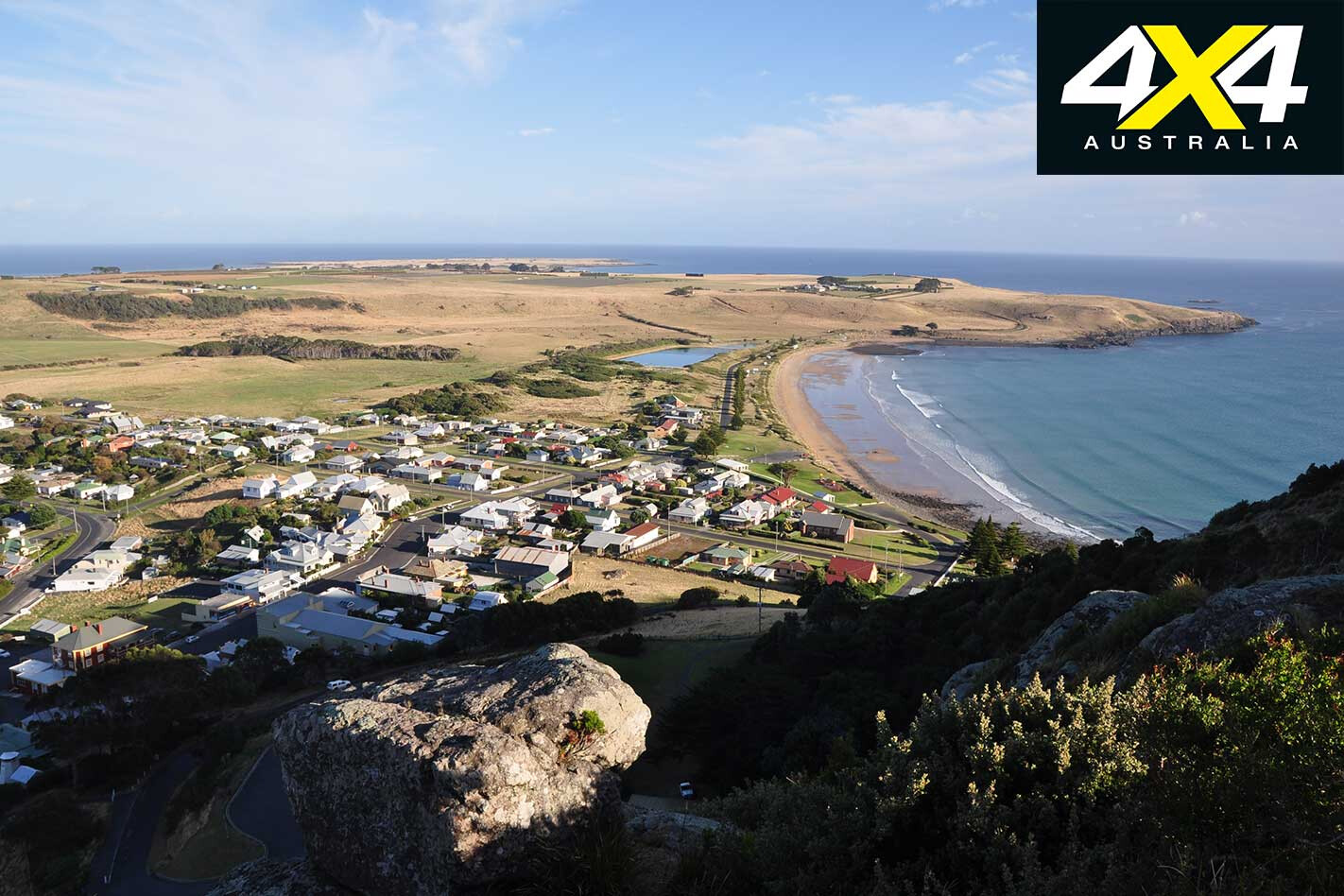
The origins of its common name are dubious, but are believed to have come from the local Aboriginal people’s name for the rock, Moo-Nut-Re-Ker, from long before The Nut was ‘discovered’ and called Circular Head by Lieutenant Matthew Flinders and Dr George Bass in 1798.
If The Nut is Stanley’s patriarch, then its complementary matriarch comes in the form of Highfield Historic House, which stands on a promontory 3km out of town.
Highfield was home to the Van Diemen’s Land (VDL) Company’s chief agent, Edward Curr, from 1827, when he chose Stanley as the first site of European settlement in Tasmania’s north-west. The grand estate has been fully restored and is open for tours.
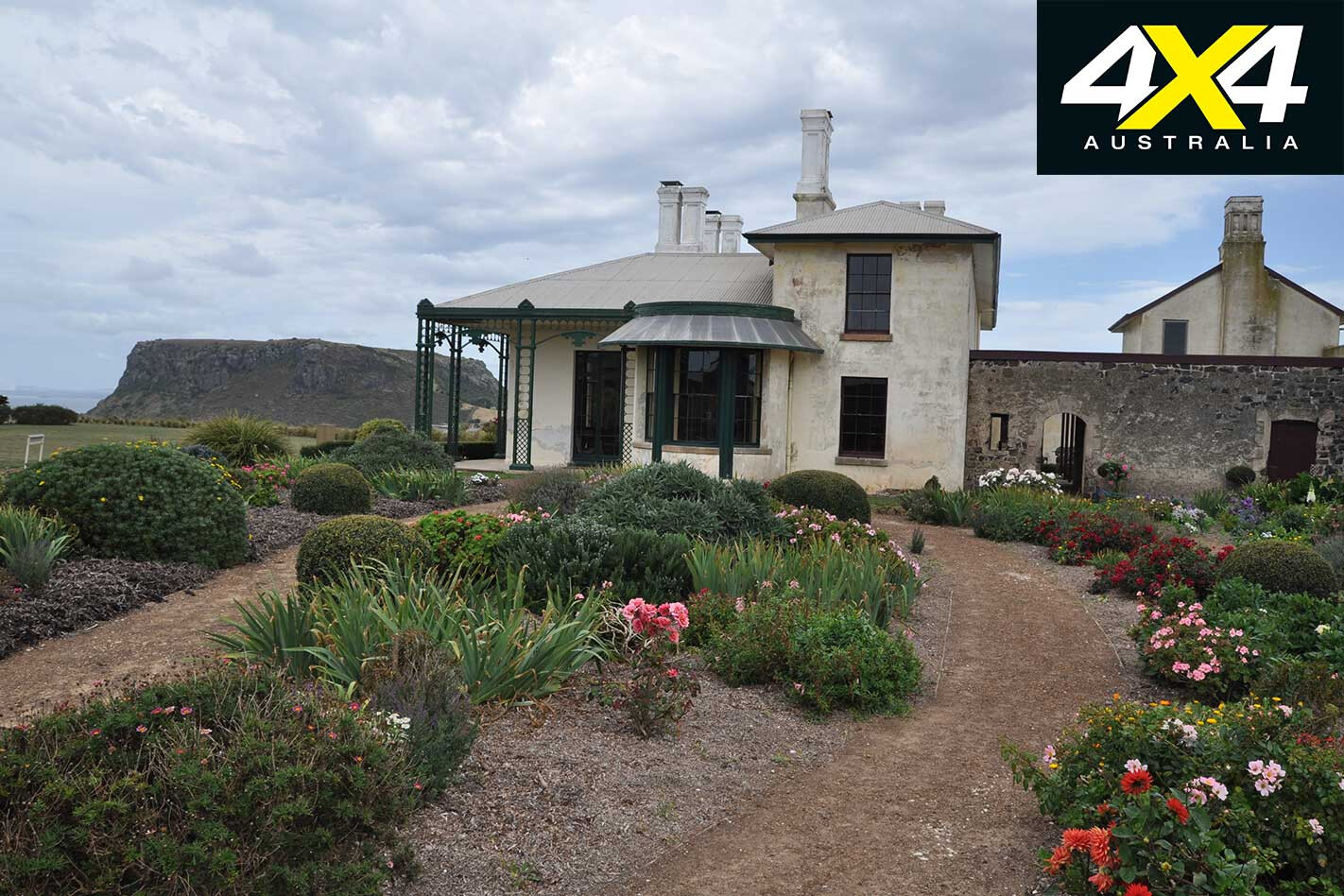
The brochure in our cabin described a visit to Highfield as “difficult to describe”… which made me laugh. But ambling through the high-ceilinged corridors over creaky, uneven floorboards; visiting the school chapel and the classroom above it built for Curr’s 15 children; and ducking beneath the low-hanging ceiling of the staircase to the earthen-floor basement is truly an ineffable experience.
The musty air, peeling wall paper and the original barn filled with rusty, retired farm machinery provide an unusually tangible insight into the area’s fascinating – and significant – colonial history. The information signs in each room and in the outbuildings tell the story of the VDL Company and the home’s original inhabitants – including the tragic death of Curr’s two-year-old daughter in an accident on the property, and the suicide of resident surveyor and architect Henry Hellyer.
Today Stanley is home to a permanent population of less than 500; the main industries here are fishing and, increasingly, tourism.
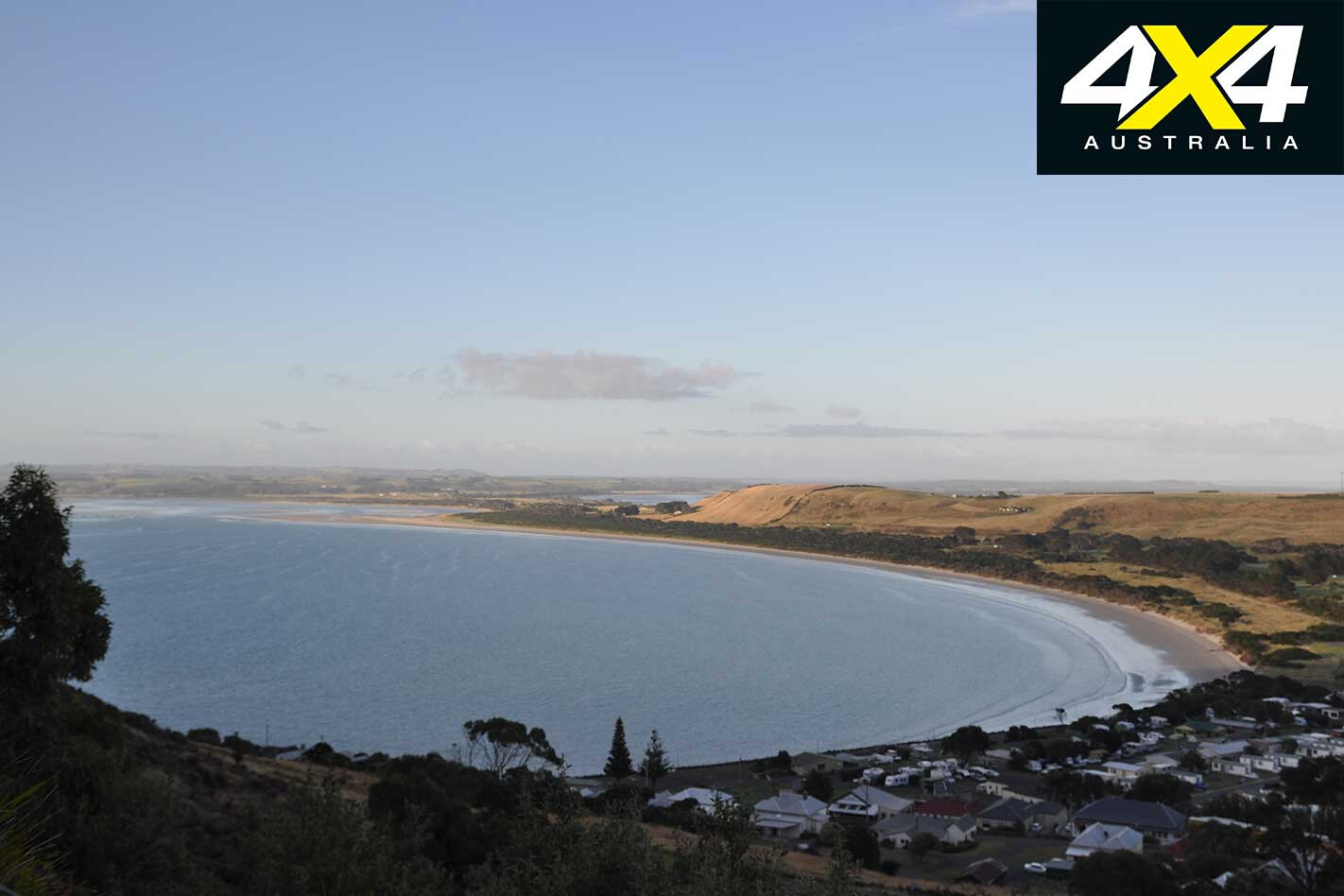
As well as The Nut and Highfield House, fairy penguin tours – which the north coast of Tassie is famous for – are available to book at the Stanley Hotel. Or sit quietly by the water at dusk and you might even spot one free of charge – we had no such luck. Seal cruises are also available, subject to conditions.
Most Tasmanian travel itineraries prioritise places such as Cradle Mountain National Park, Freycinet, Bruny Island and – particularly for four-wheel drivers – the western wilderness. But not to include the quaint seaside town of Stanley would be a sad omission and, nestled as it is at the base of the Nut, it’s rather hard to miss.
Travel Planner
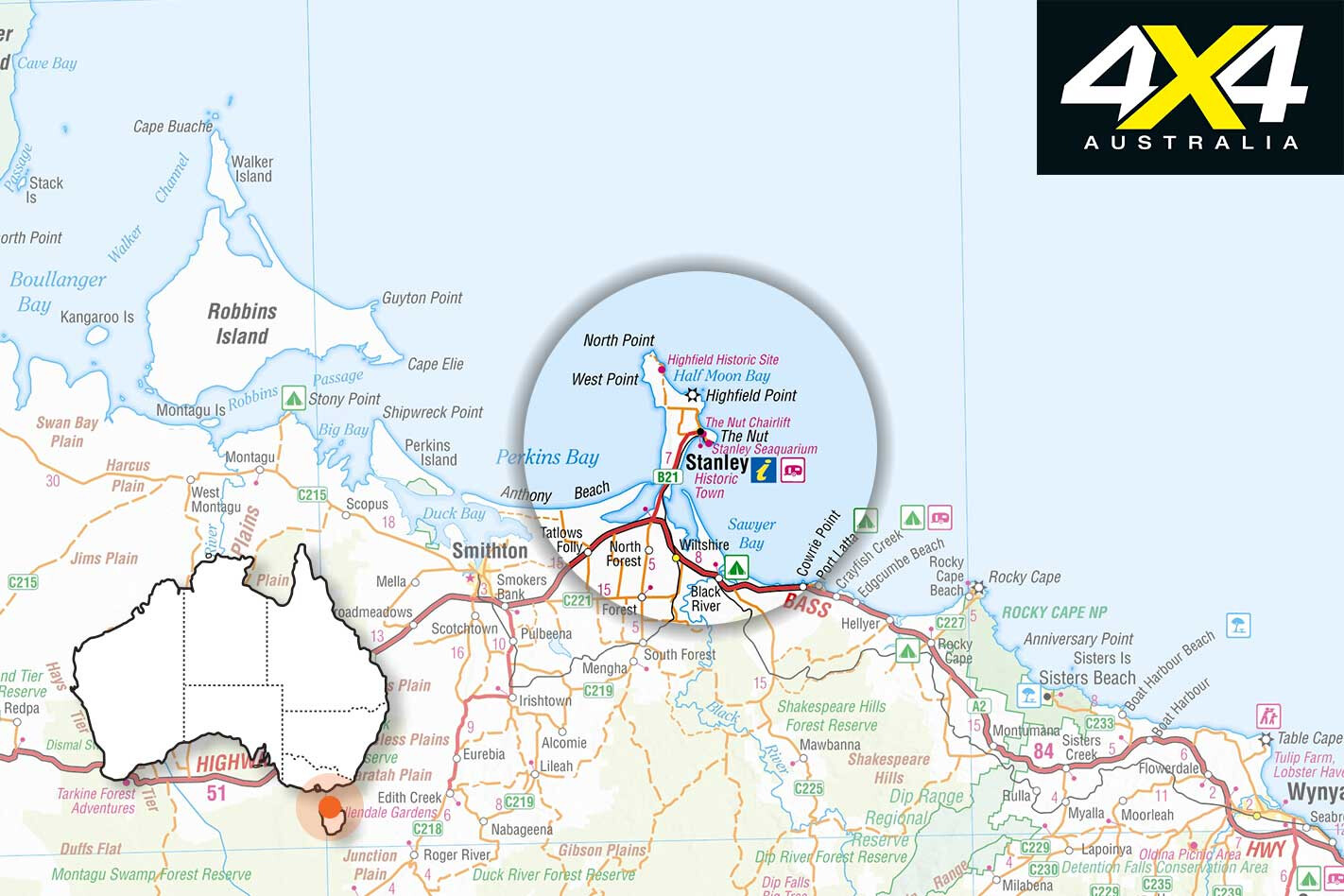
WHEN TO GO Tasmania’s peak season is in spring and summer (October to March). It can be very cold and wet in winter.
WHAT TO DO Climb the Nut via a steep zigzag track followed by a flat 2km circuit or take a chairlift ride to the top. Seal-, platypus- and penguin-sighting tours are available from $25 per adult, visit www.stanleytasmania.com.au. Or tour Highfield Historic House. $20 per adult. Visit historic-highfield.com.au.
ACCOMMODATION The Stanley Cabin & Tourist Park is located on the water and has self-contained cabins, powered and unpowered campsites and full facilities, visit stanleycabinpark.com.au. There are numerous other accommodation options, such as B&Bs and the historic Stanley Hotel. Visit stanleytasmania.com.au for more information.
CONTACT Contact the Stanley Visitors Information Centre on 1300 138 229 or visit stanley.com.au.
SO THE Everest now has the Ranger Raptor’s powertrain and, as both Ford vehicles are built on the same platform, a Raptor version of the wagon from Ford Performance should be a sure thing … right? I mean, the Raptor even stole the Everest’s multi-link coil rear suspension, so it’s halfway there.
If a Ford representative we spoke to at the 2019 Everest launch is to be believed, then don’t hold your breath for such a vehicle arriving anytime soon. He told us there are no such plans for such a Baja-inspired wagon.
Looking at the two latest additions to Ford Australia’s off-road arsenal, it might seem as simple as bolting the Raptor’s wide-body front end, big wheels with BFG tyres and the bespoke Fox-equipped suspension to the wagon, and Robby Gordon’s your uncle. But it’s not that simple.
The Raptor has a wider wheel track front and rear, so as well as the front end you’d need to also replace the rear axle. And pumping out the rear quarters to cover the 35-inch All Terrain tyres is not as simple on a five-door wagon as it is on a ute.
Sure, you could bolt on a set of Fox or similar top-shelf shocks, as well as some big rims and rubber with a set of flares to cover them, but such home handiwork will never have the same level of engineering and development as the factory Ford Performance offering would.
We’re sure it won’t be long before someone does it, or the aftermarket starts producing full Raptor-style front sheetmetal kits for both Ranger and Everest. Just look at how the Raptor-style grilles took off.
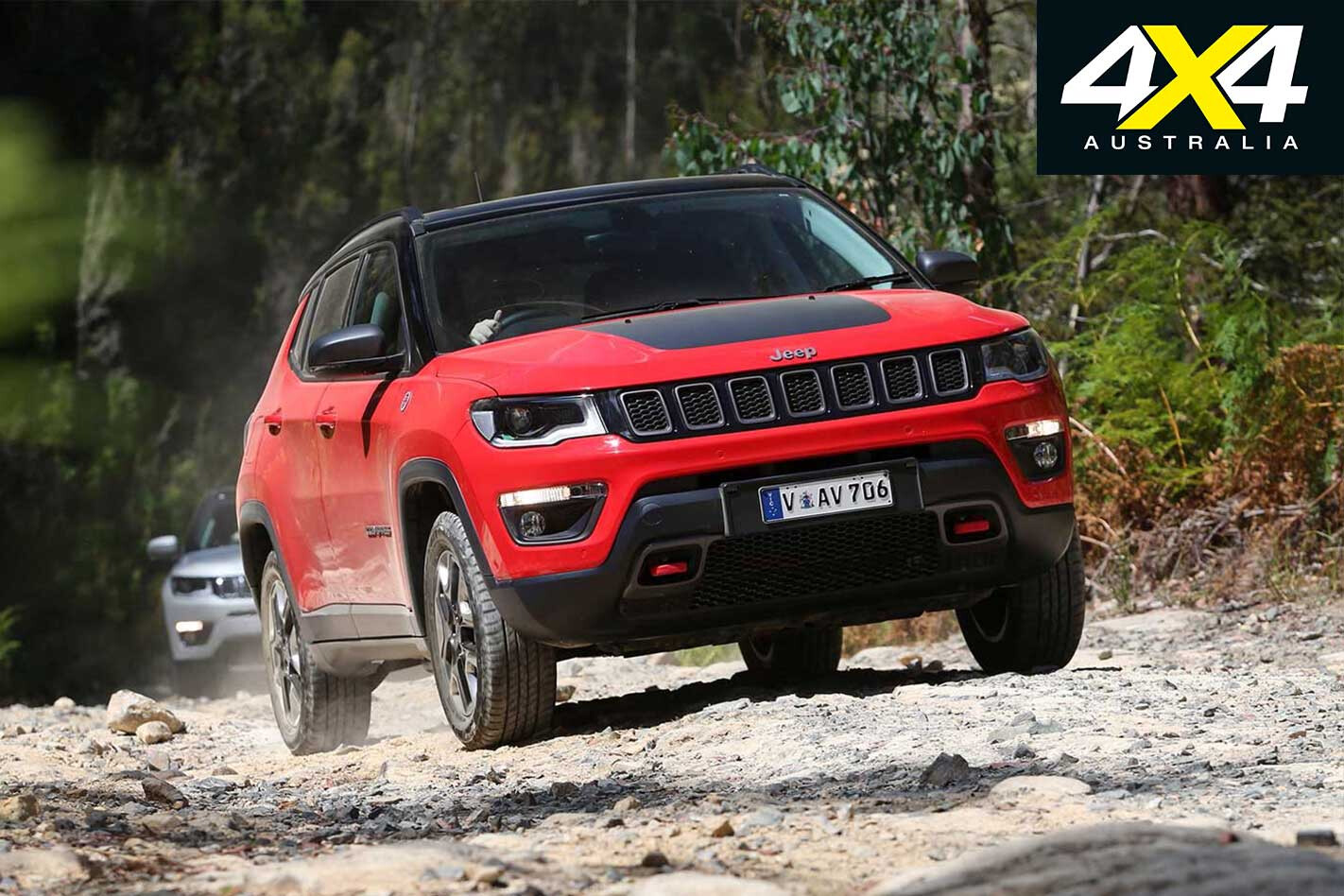
FCA Australia has issued a recall for a select number of Wrangler, Cherokee, Compass and Grand Cherokee models due to concerns the engine may stall during driving.
The affected models are: 2017-2018 (JK) Jeep Wrangler, 2018 (KL) Jeep Cherokee, 2018 (M6) Jeep Compass, and 2018 (WK) Jeep Grand Cherokee.
Full VIN list here: https://www.productsafety.gov.au/system/files/VIN%20list_55.xlsx
According to the ACCC recall report, “if the powertrain control module fails, the driver may experience a no-start, a start-and-immediate stall condition, or an engine stall while driving.”
The repercussions of losing power while driving are obvious and could cause a vehicle to crash without any prior warnings.
The recall affects only 20 vehicles, and all owners of affected vehicles will be notified as soon as parts become available.
FCA Australia is not aware of any incidents in Australia.
What’s in a name? Well everything, if you are Lexus or Infiniti and wishing to stand apart from your respective parents to compete in a prestige market led by the likes of Mercedes-Benz and BMW.
Well-heeled buyers interested in flash German cars aren’t likely to be tempted by middle-market brands like Toyota or Nissan, so Toyota and Nissan created their respective Lexus and Infiniti identities in 1989 following a lead by Honda, which created its own prestige brand – Acura – in 1986. Well before that, the Range Rover was created as an upmarket Land Rover, so none of this is new.
What this doesn’t mean is that the two Lexus LX models (one petrol, one diesel) and the Infiniti we have here are just two Toyotas and a Nissan with different badges. Far from it. What’s more, the degree of separation from the respective Land Cruiser 200 and Patrol Y62 donor vehicles is in fact the devil in the detail, or the sauce on the pudding, in this three-way contest.
Of the three the Lexus LX570 is most removed from its donor vehicle with its bespoke 5.7-litre petrol V8/eight-speed powertrain not found in the LC200. Both Lexus models also get unique suspension not found on the 200, and all three have tonnes of added equipment.
The least changed from its donor vehicle, the Infiniti QX80, is the least expensive of these three, while the most changed, the LX570, is the most expensive, which helps even out the playing field. Let the games begin…
INFINITI QX80 High-tech ‘smart’ suspension and an engine with motorsport heritage stand the QX80 in good stead.
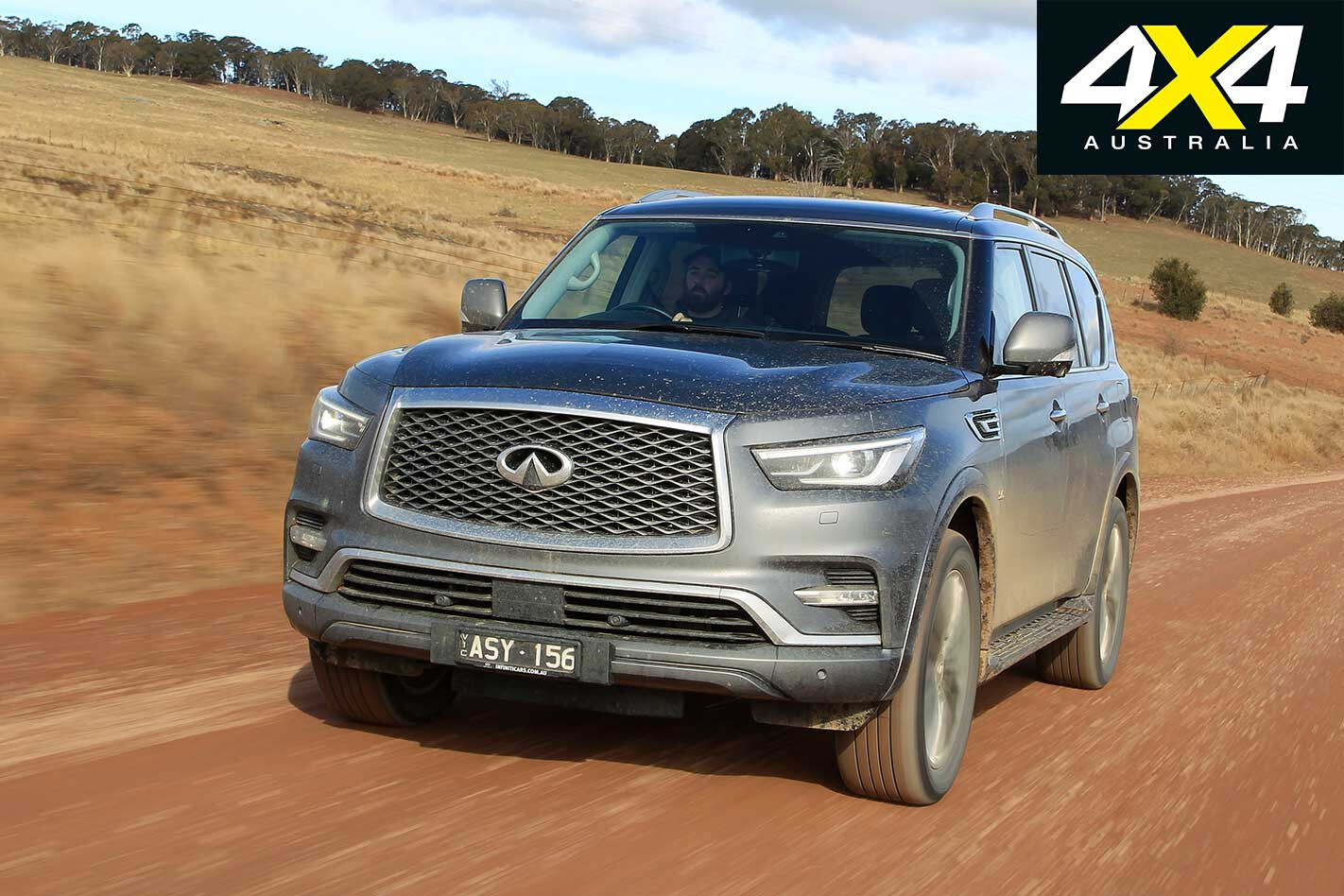
The Infiniti QX80 first arrived in Australia in mid 2015, which at the time saw a downward realignment of Patrol Y62 pricing.
What we have here is the facelifted 2018 QX80, which brings new body styling detail to both front and rear, interior and equipment tweaks, claims of lower NVH, and better fit and finish such as narrower panel gaps.
The QX80 comes at a hefty $22K premium over a top-spec (Ti-L) Patrol Y62, its donor car, but adds a fair lump of extra luxury, convenience and safety kit over the already well-stocked Ti-L. And it’s still the least expensive of the three 4x4s here.
What remains constant in all this is that the QX80, like the Y62, is a big wagon, and is even big in its overall dimensions in the company of both Lexus models, hardly small wagons themselves. A constant, too, is the familiar and impressive Hydraulic Body Motion Control (HBMC) suspension and the willing 5.6-litre petrol V8 of the Patrol Y62.
Powertrain and Performance
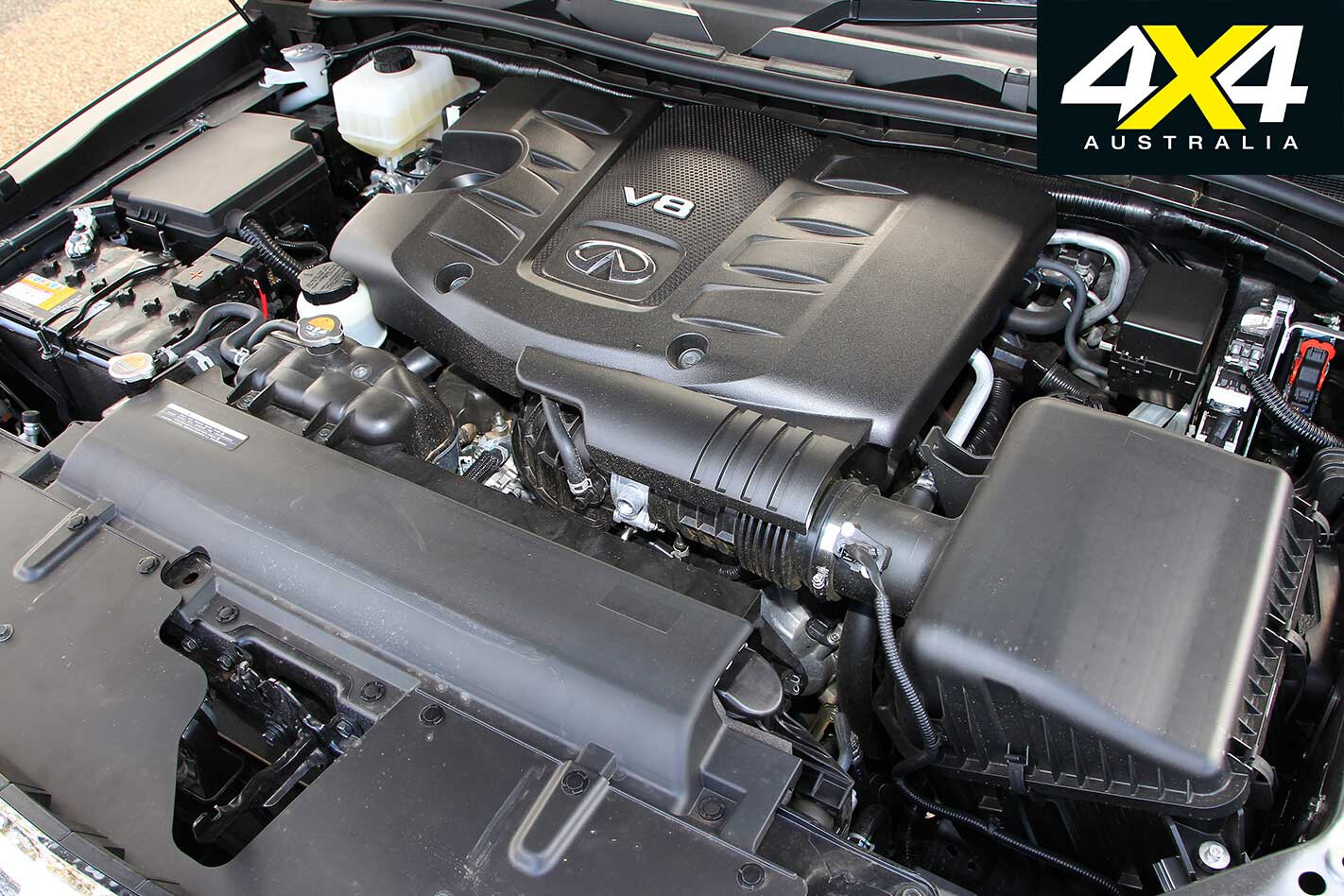
The QX80 is in fact more about its engine as it defines much of the way it drives and feels. Its impressive numbers – 5.6 litres, 298kW and 560Nm – give the message that it’s big and powerful, but don’t tell the whole story.
The quad-cam 32-valve V8 is state-of-the-art for a naturally aspirated petrol engine and has direct injection and variable timing and lift on the intake valves. The variable lift on the intake valves does away with the need for a conventional throttle and makes for a less restrictive intake passage.
The engine is part of Nissan’s VK V8 engine family that’s been widely used in – and in part designed for – motorsport in Japan (GT class), Europe (Le Mans prototypes) and even in Nissan’s local Supercar.
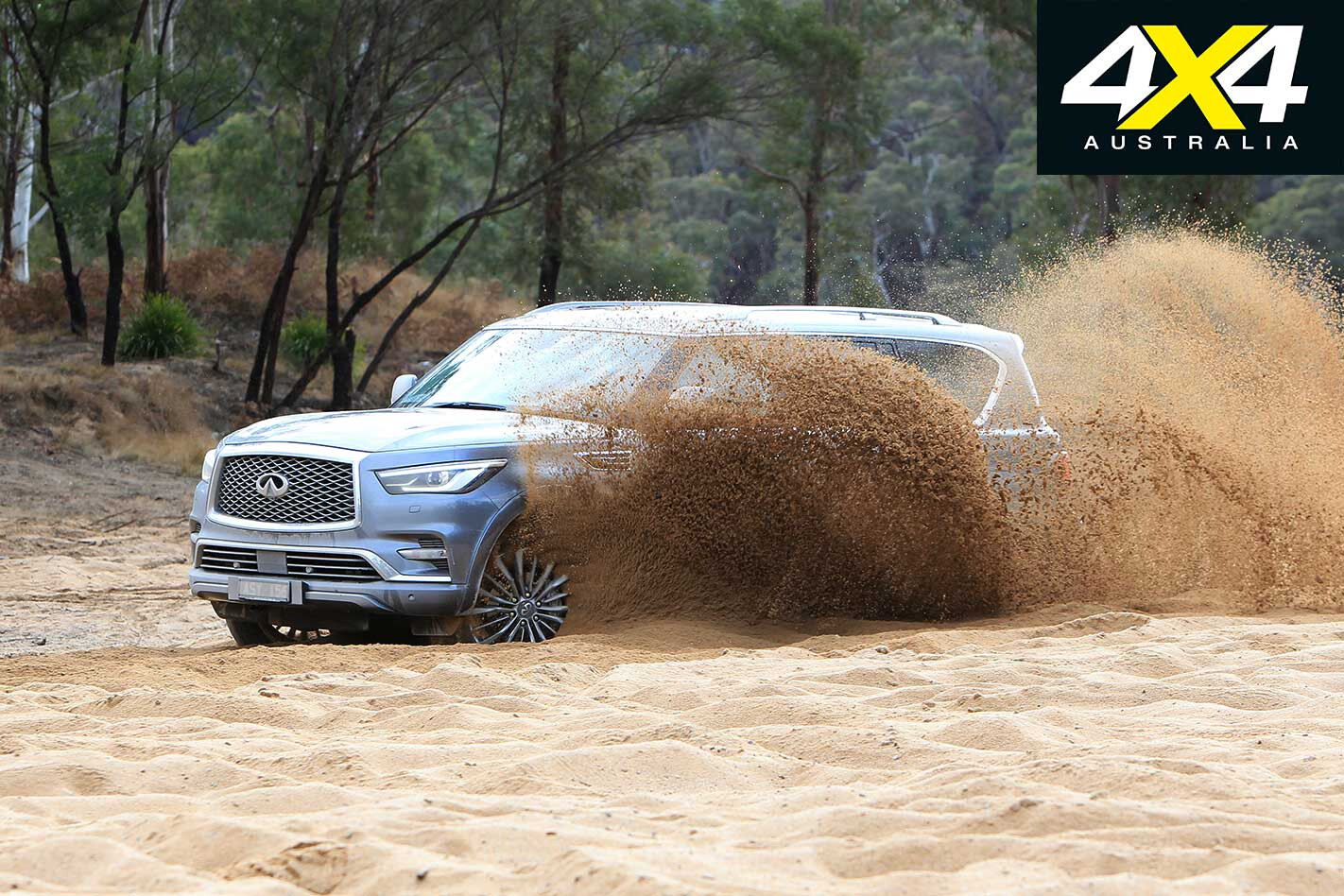
Dip hard into the QX80’s throttle and you can feel and hear this motorsport heritage and tech come to the fore. This is a light-flywheeled engine that’s revvy, eager and more than energetic enough to overcome the QX80’s considerable weight and size to be the performance leader of the three wagons here – not that the diesel Lexus is ever really in the hunt.
Shorter overall gearing than the LX570 also helps in any pedal-to-the-metal contest and the slick seven-speed automatic doesn’t let the team down with sharp full-throttle shifts.
At a more leisurely pace, the QX80’s V8 is smooth, quiet and effortless to drive without ever quite matching the LX570’s refinement.
On-Road Ride and Handling
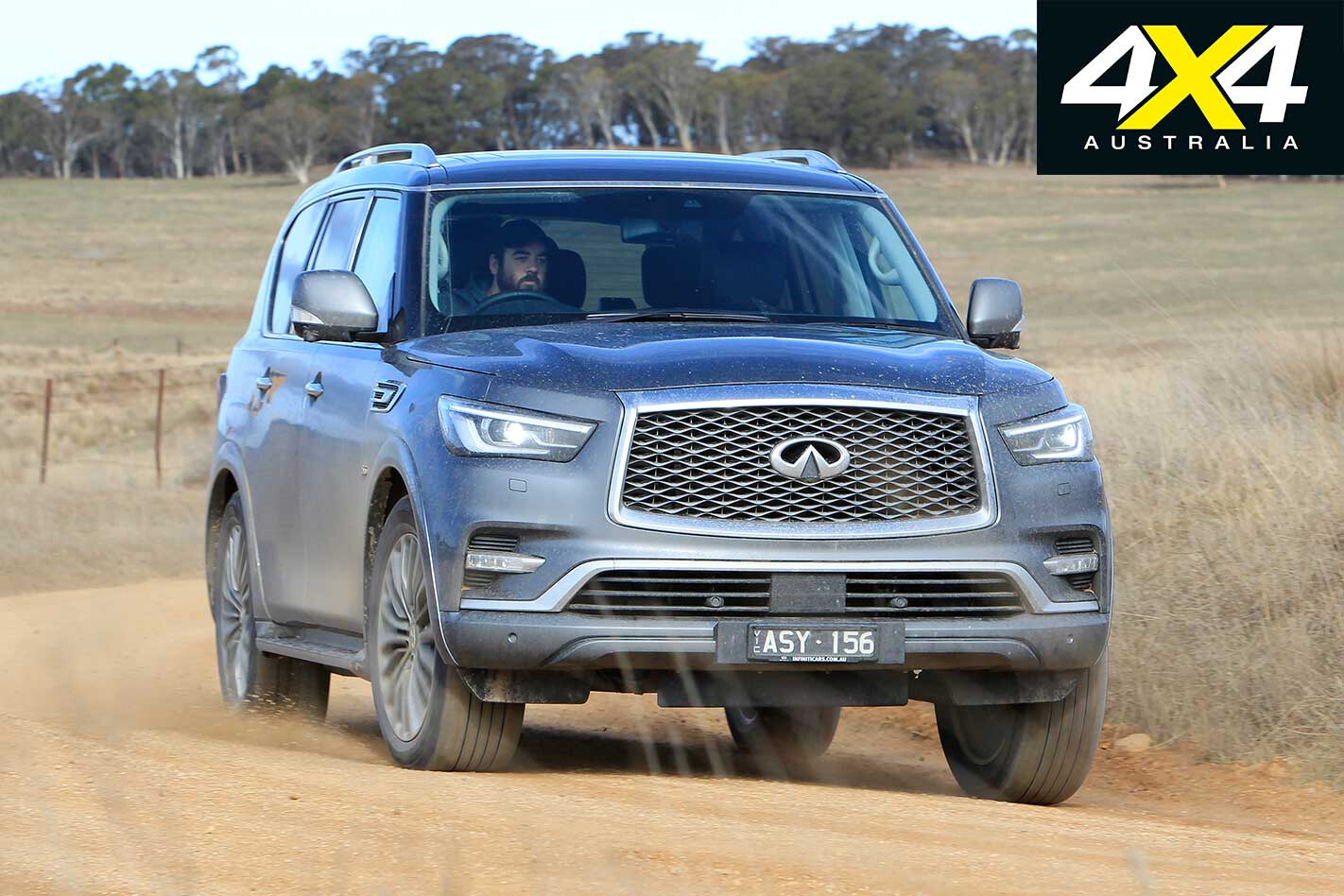
The punchy 5.6-litre V8’s performance isn’t lost on a chassis that offers flat and surprisingly sharp on-road handling thanks to the effectiveness of the HBMC suspension.
Even on tight corners there’s hardly a hint of body roll and, for something as big and heavy as it is, the QX80 feels light, nimble and confident in the company of the heavy-feeling and often less-steady Lexus pair. The QX80’s fully independent system also plays its part here to produce a chassis that’s happier at high speeds on bumpy country roads than the rear-live-axle chassis under both LXs.
Despite the QX80’s 22-inch wheels and relatively low-profile 50-series tyres the ride comfort is surprisingly good, thanks in part to the QX80’s large wheel/tyre combination which means that even with 22s there’s still a bit of tyre sidewall. The HBMC control suspension helps here, too, as when there’s no lateral loading from cornering the suspension relaxes to provide a more comfortable ride.
Hydraulic Body Motion Control
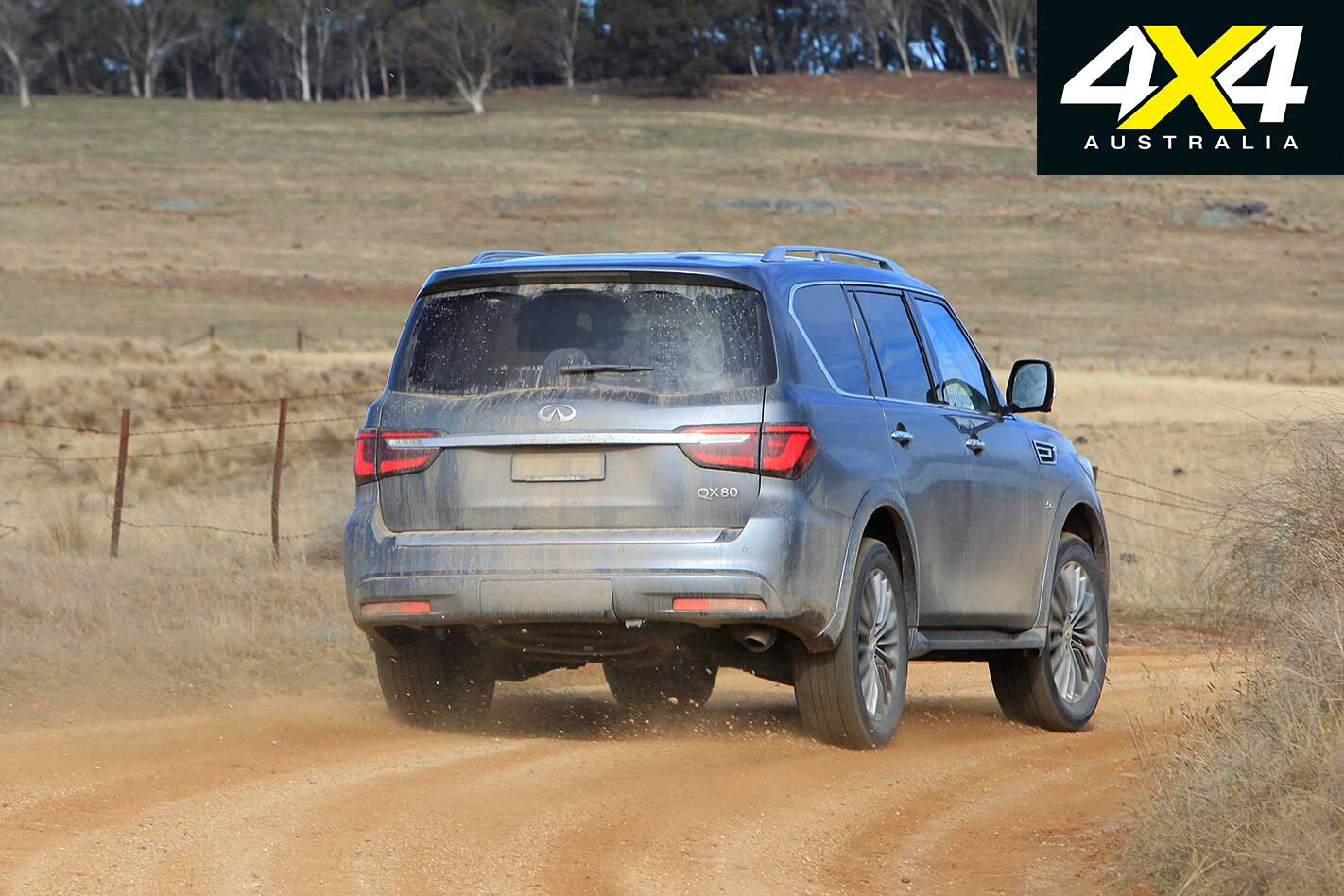
The QX80 has fully independent coil-spring suspension with what Infiniti calls Hydraulic Body Motion Control, or HBMC. In place of the usual dampers and sway bars of a conventional suspension system, HBMC has four hydraulic rams, one at each corner of the vehicle. These rams are interlinked allowing hydraulic fluid – managed by nitrogen-charged accumulators and body motion sensors – to be pumped from one to the other. In this way the wheel travel, body roll, body pitch, ride comfort and overall stability of the vehicle can be controlled and automatically optimised for both on-road and off-road driving.
Off-Road
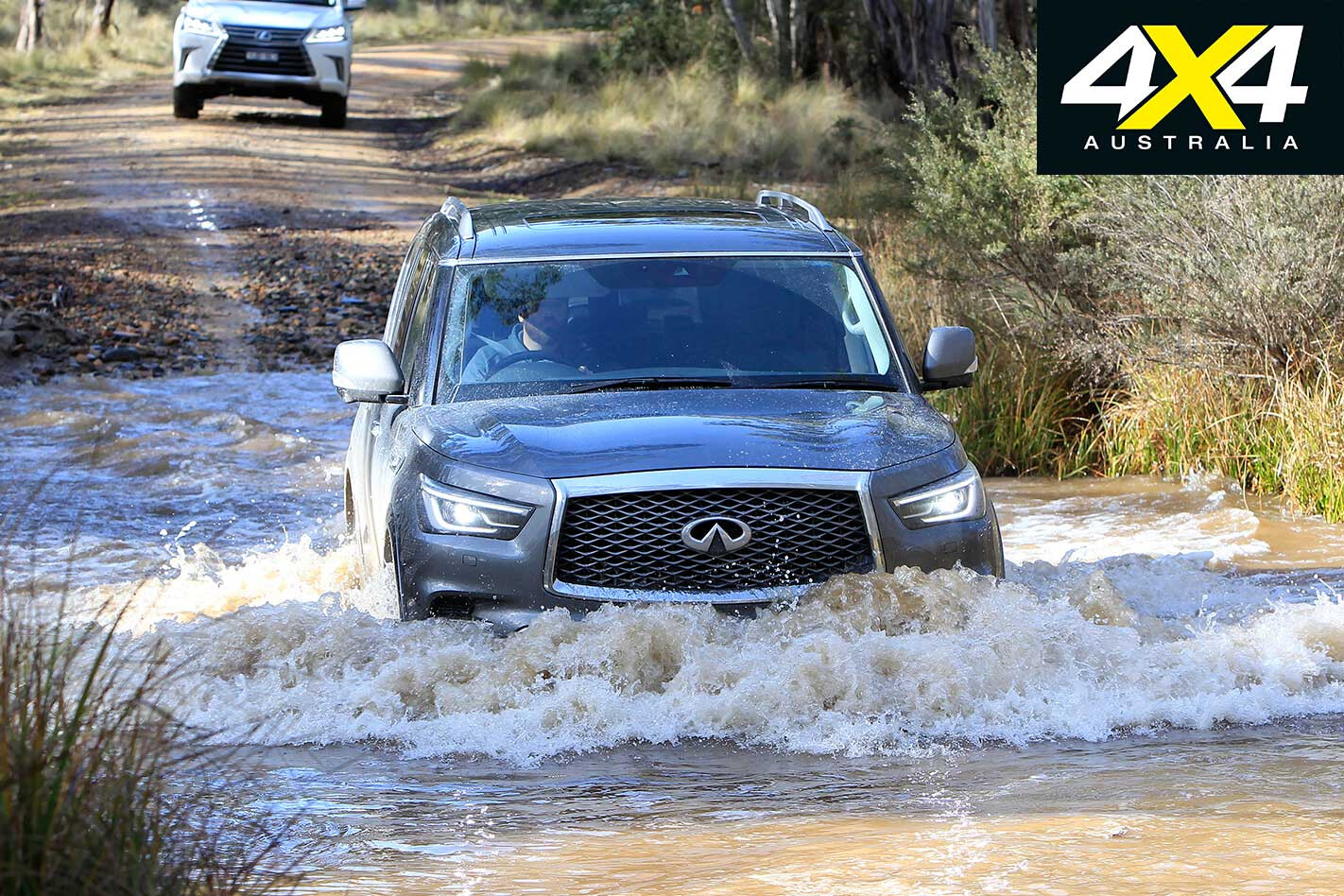
The QX80’s star starts to fade off-road as its deep nose and extended rear bumper significantly eat into the approach and departure angles. Not helping matters, the otherwise brilliant HBMC suspension doesn’t offer any height adjustment, which would help rectify this problem and give a bit more clearance, which the QX80 also needs.
That’s not to say the QX80 doesn’t have anything going for it off-road, as the HBMC suspension provides a surprising amount of articulation, especially for a fully independent system, thanks to the active dampers and lack of travel-limiting sway bars. The QX80 also has a rear locker and brake-force traction control that remains active on the front axle when the rear locker is engaged.
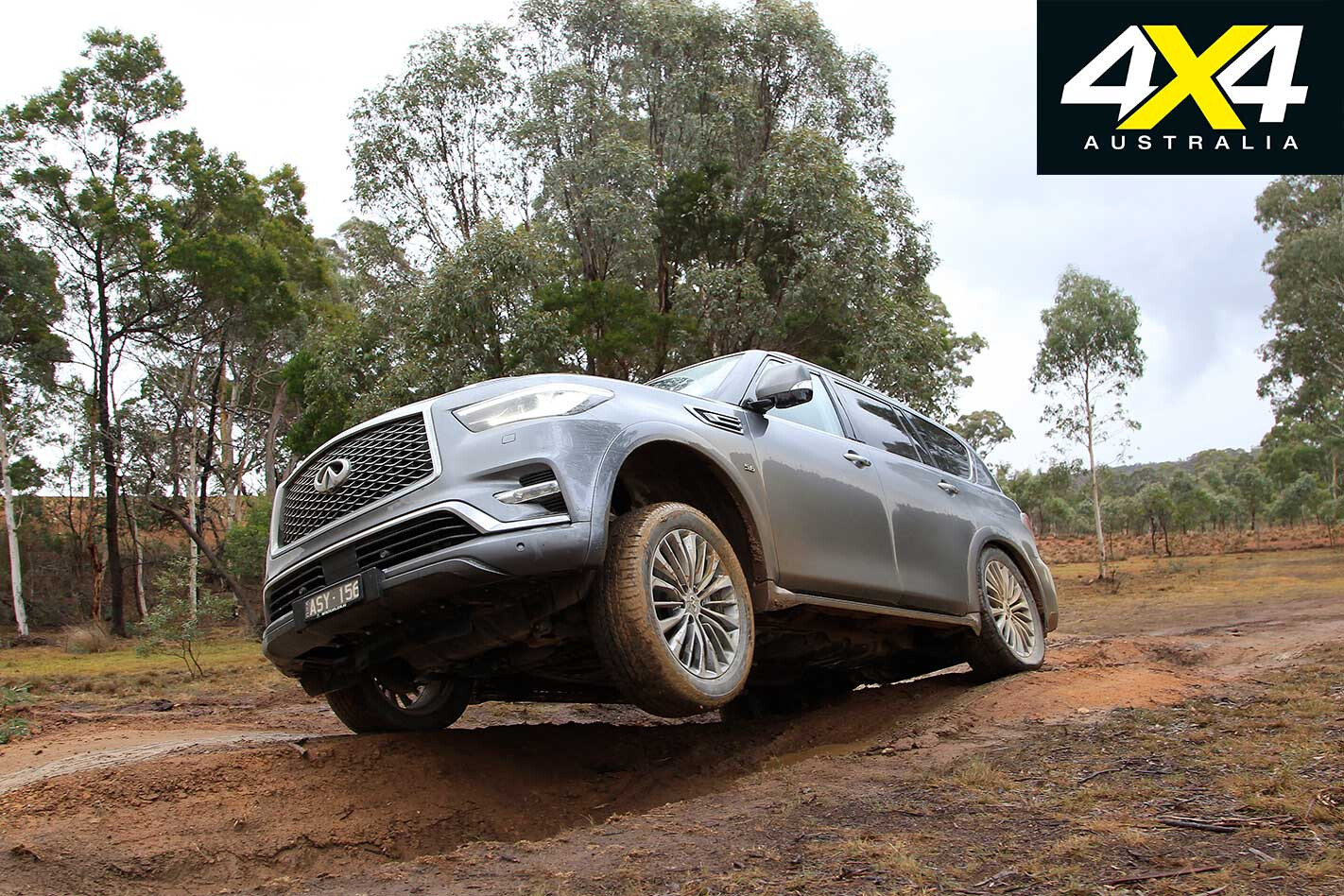
All this means the QX80 can match the live-axle Lexus models for tractive ability, but still needs more all-round clearance to match either LX off-road, both of which enjoy the benefit of height-adjustable suspension.
The QX80 has driver-selectable Sand, Snow or Rock modes available in both high and low range, in a 4×4 system that’s more straightforward to operate than the system in either LX.
Cabin, Accommodation and Safety
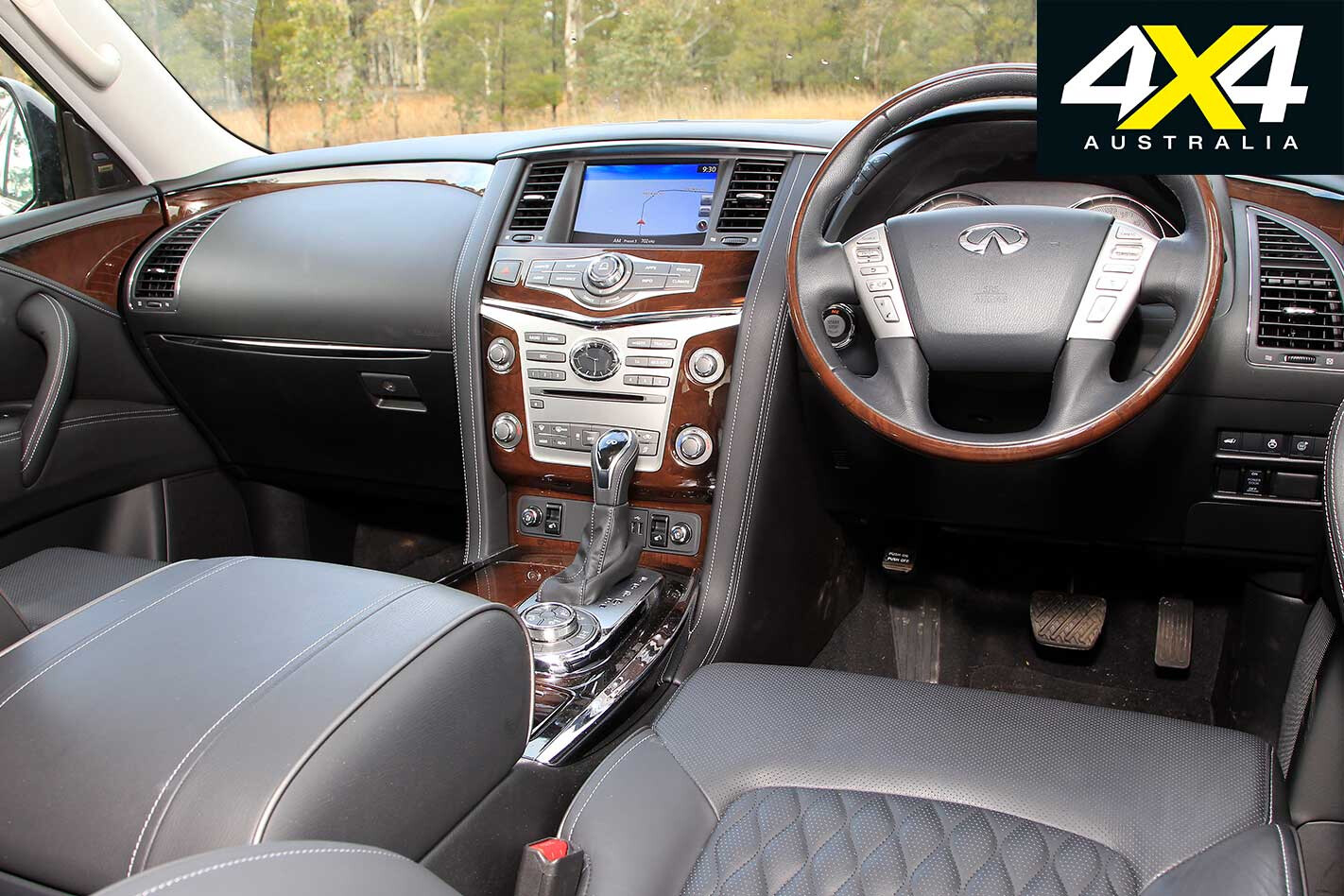
The QX80 seats seven people in a cabin that’s the biggest and most spacious in this company. The extra size of the QX80 over both Lexus models is most beneficial in the extra width of the second-row seat and the fact that the third row seat is easier to get in and out of than the third row of the LX570, and more comfortable for adults once you get there. The remaining luggage space when the third-row is deployed is also superior in the QX over the LX570.
The QX80 hasn’t been submitted for ANCAP testing so doesn’t carry a safety star rating. Nevertheless, it has a long list of safety kit (see ‘What You Get’ sidebar) headed by automatic emergency braking.
What you Get
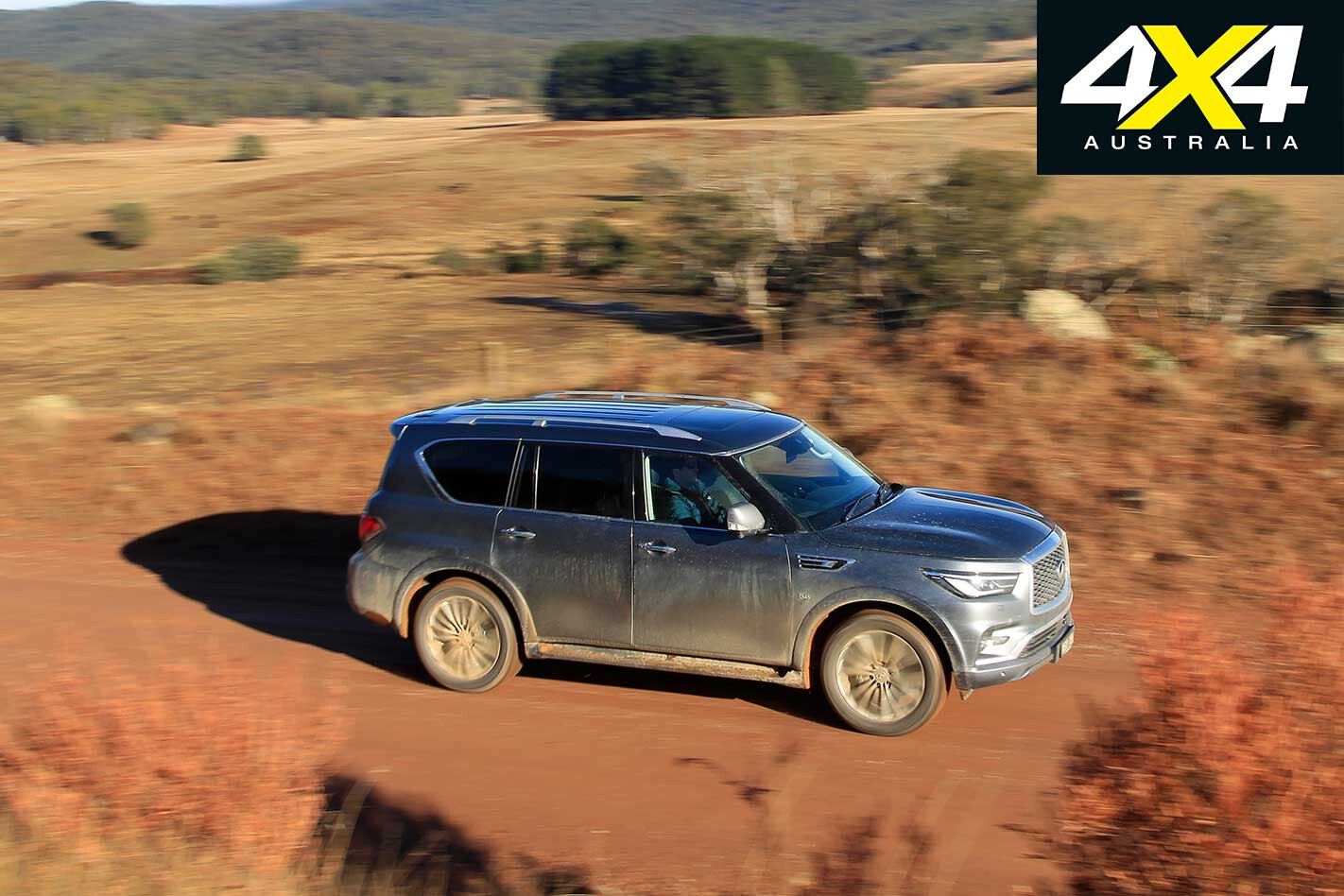
Over and above its donor 4×4, the top-spec Ti-L Patrol Y62, the Infiniti QX80 gains include 22-inch wheels, a Bose audio system with 15 speakers, auto high-beam on/off, power and remote folding second-row seats with heating for outside passengers, power-operated third-row seats and parking assist.
Safety upgrades include automatic emergency braking and reversing collision avoidance. Features carried over from the Patrol Ti-L include six airbags, heated/cooled front seats with memory for the driver, adaptive cruise control, three-zone climate control, an 8.0-inch touchscreen, rear-view camera, sat nav, parking sensors, auto headlights and wipers, tyre-pressure monitoring, external-view cameras, rear DVD entertainment, power tailgate, sunroof, lane-departure and blind-spot warning and crash-mitigation systems, and a rear locker.
Practicalities
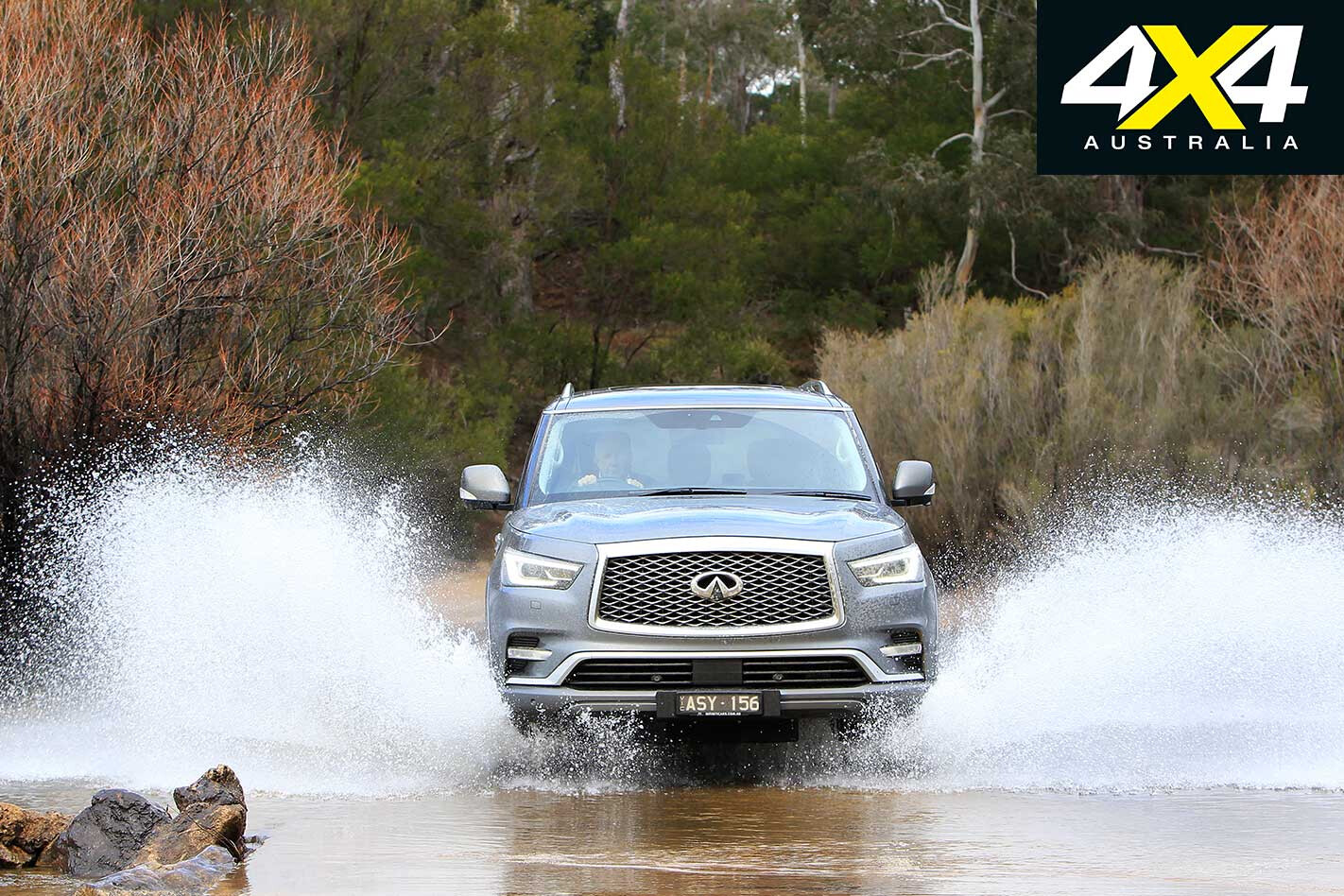
The elephant in the room in this three-cornered contest is fuel consumption, and both the QX80 and the LX570 are in the wrong corner of the room. On test the QX80 averaged 18.5L/100km, which was slightly better than the LX570 but still thirsty by any measure.
Making matters worse is that the QX80 loses 40 litres of fuel capacity over the equally thirsty Y62, dropping capacity from 140 to 100 litres. With our on-test fuel average that will only take you 490km if you factor in a 50km ‘safety’ margin. The QX also asks for premium 95RON fuel; although, it does seem to run on lower octane without any obvious issues.
On a more positive practical note, it will take 18s from the Y62 Patrol if you want more country-touring and off-road suitable tyres on the QX80.
LEXUS LX450d What? A Lexus with a diesel engine? You bet!
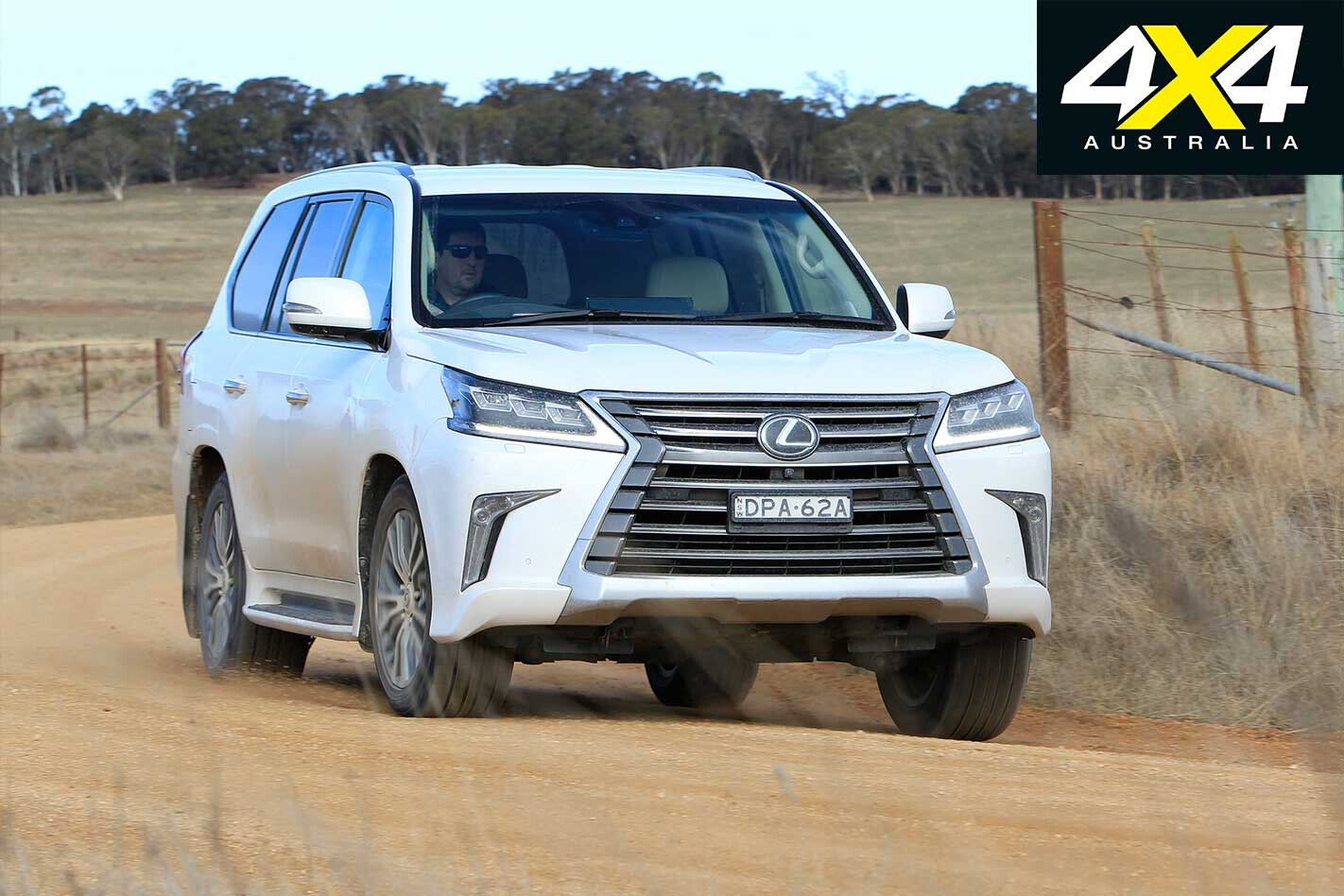
Lexus said it would never make a diesel given a diesel engine’s refinement, or lack thereof, is at odds with the Lexus pursuit of ultimate perfection.
But that was then and now a Lexus with a diesel engine is a reality in the form of this LX450d, with Lexus looking to extend its footprint into the large prestige 4×4 market.
In creating the LX450d, Lexus has taken its already well-established (launched in 2008 and facelifted in 2015) LX570 and swapped its 5.7-litre petrol V8 and eight-speed powertrain for the 4.5-litre twin-turbo diesel V8 and six-speed powertrain of the LC200.
Then Lexus has stripped out the third-row seating, secondary 45-litre fuel tank and some of the petrol-powered 570’s luxury equipment (see ‘What you Get’ sidebar). The 450d’s price tag has also been stripped back $9K from the LX570, which is some recompense.
Powertrain and Performance
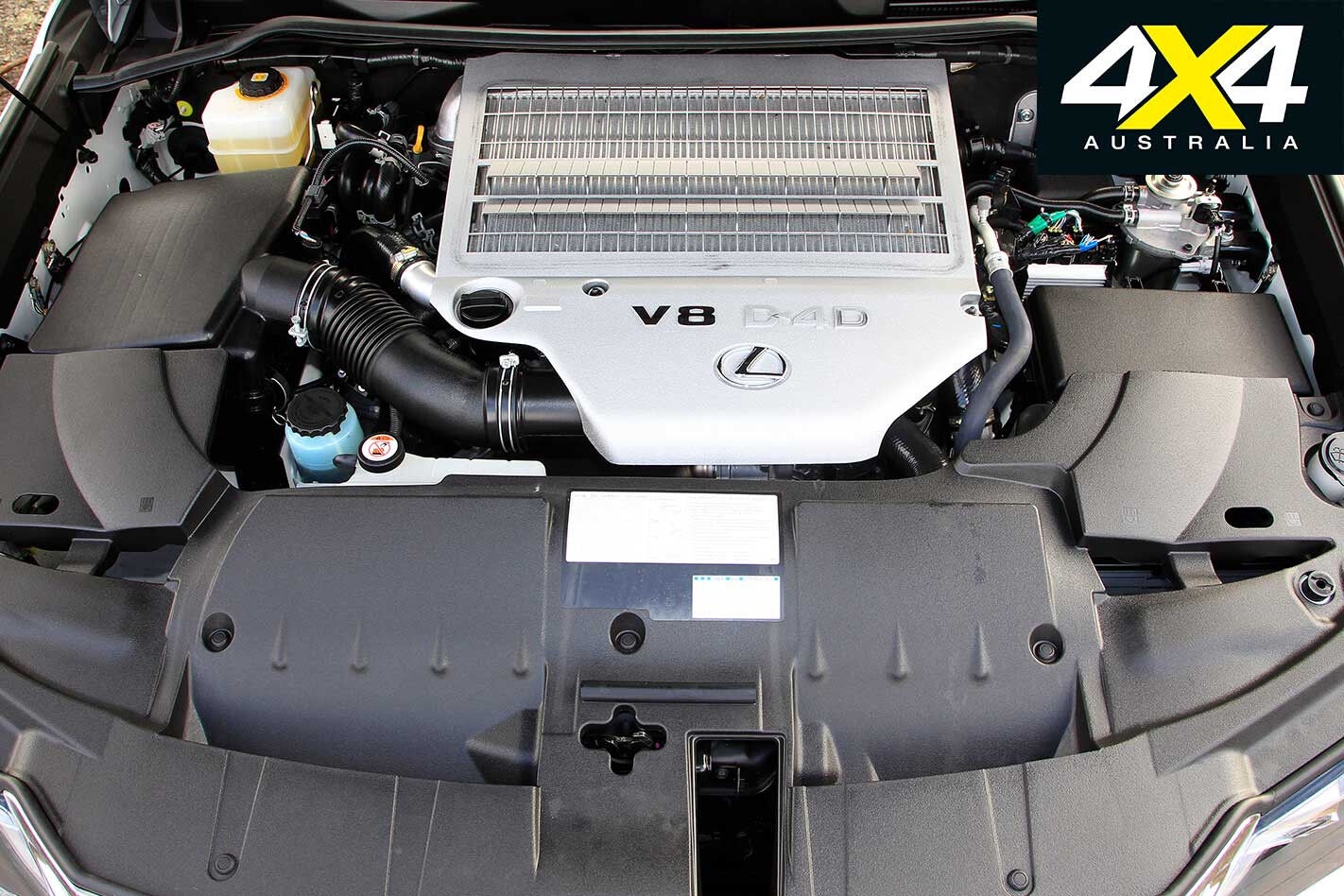
The familiar 4.5-litre twin-turbo V8 diesel from the LC200 claims a 200kW maximum and, while peak torque also remains unchanged from the LC200’s 650Nm, it’s available over a slightly wider rpm range. Most obvious in the driving is the fact that the big 4.5-litre V8 diesel is much quieter, smoother and more refined in the LX than it is in the latest LC200.
Driven in isolation the LX450d hardly sounds diesel-like at all such is its generally quiet and civil nature, but jump into the QX80, or more so the LX570, and you realise it’s still well short of petrol-engine refinement.
Nor can the LX450d match the performance of the two petrol V8s once they get into their stride; although, in general cut-and-thrust driving, it gives nothing away thanks to the fact that it makes more power at lower engine speeds than the petrol V8s.
What’s more, it does the same job with generally less revs onboard and doesn’t call for a lower gearbox ratio as quickly as the petrol V8s when asked to do some work. The fact that it has less ratios to play with also means less gear changes in general driving.
On-Road Ride and Handling
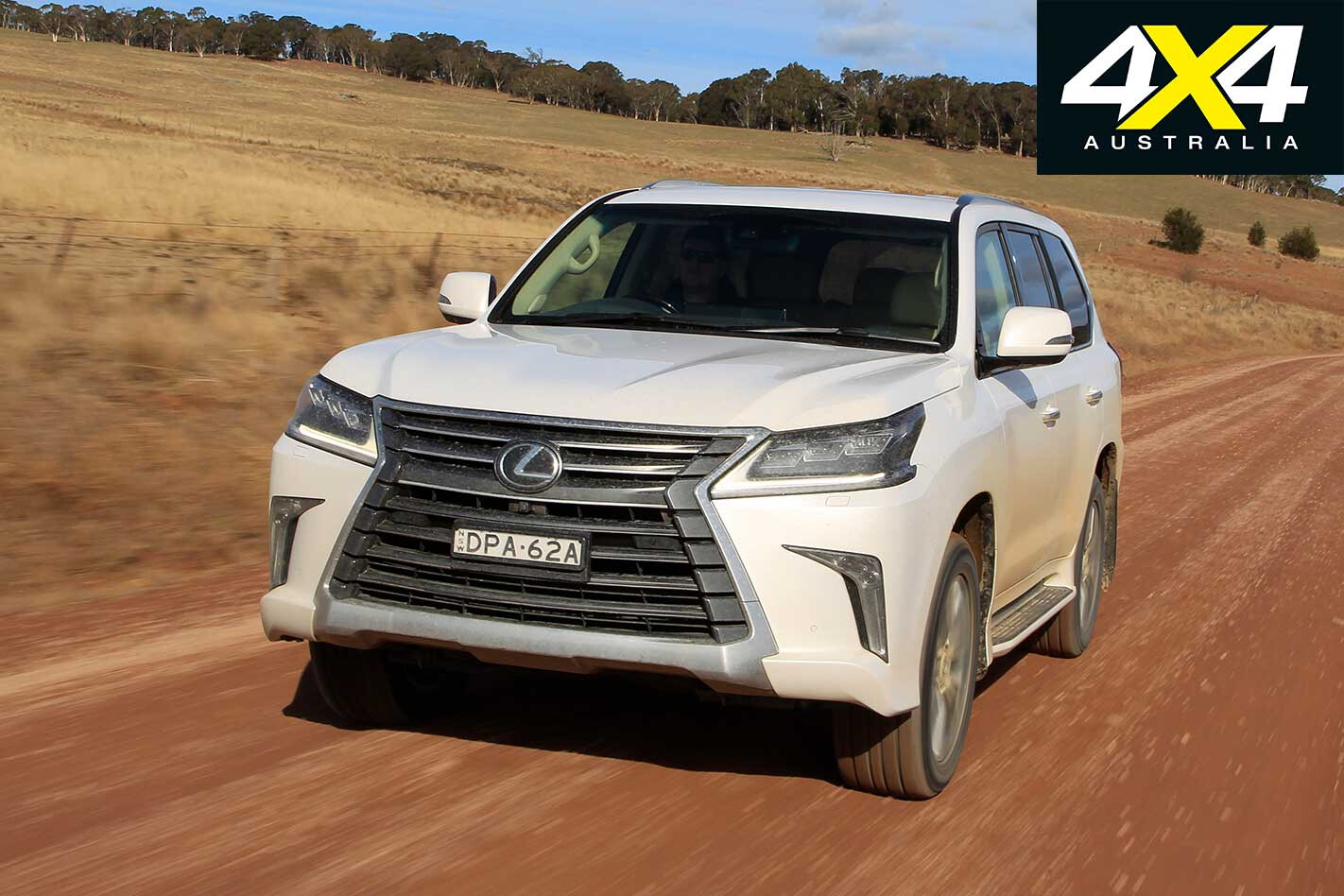
The LX450d shares the suspension of the LX570 (see ‘Bespoke Suspension’ LX570 sidebar), which means adaptive, interlinked and tuneable damping, variable front spring rate, and hydraulic ride-height control. While there is no KDSS, the general chassis layout with its ladder frame, live rear axle and independent front is based on the Toyota Land Cruiser 200.
Thanks to its sophisticated damping system, the chassis’s response in roll, pitch, ride and steering can be adjusted via the Drive Mode settings’ centre-console dial, which also alters the powertrain’s response.
There are five settings (Eco, Comfort, Normal, Sport, and Sport+) where sharpening up the chassis also sharpens up the powertrain response. Via the dial the driver can also access a preprogrammed Custom setting, where any chassis setting can be matched to any powertrain setting.
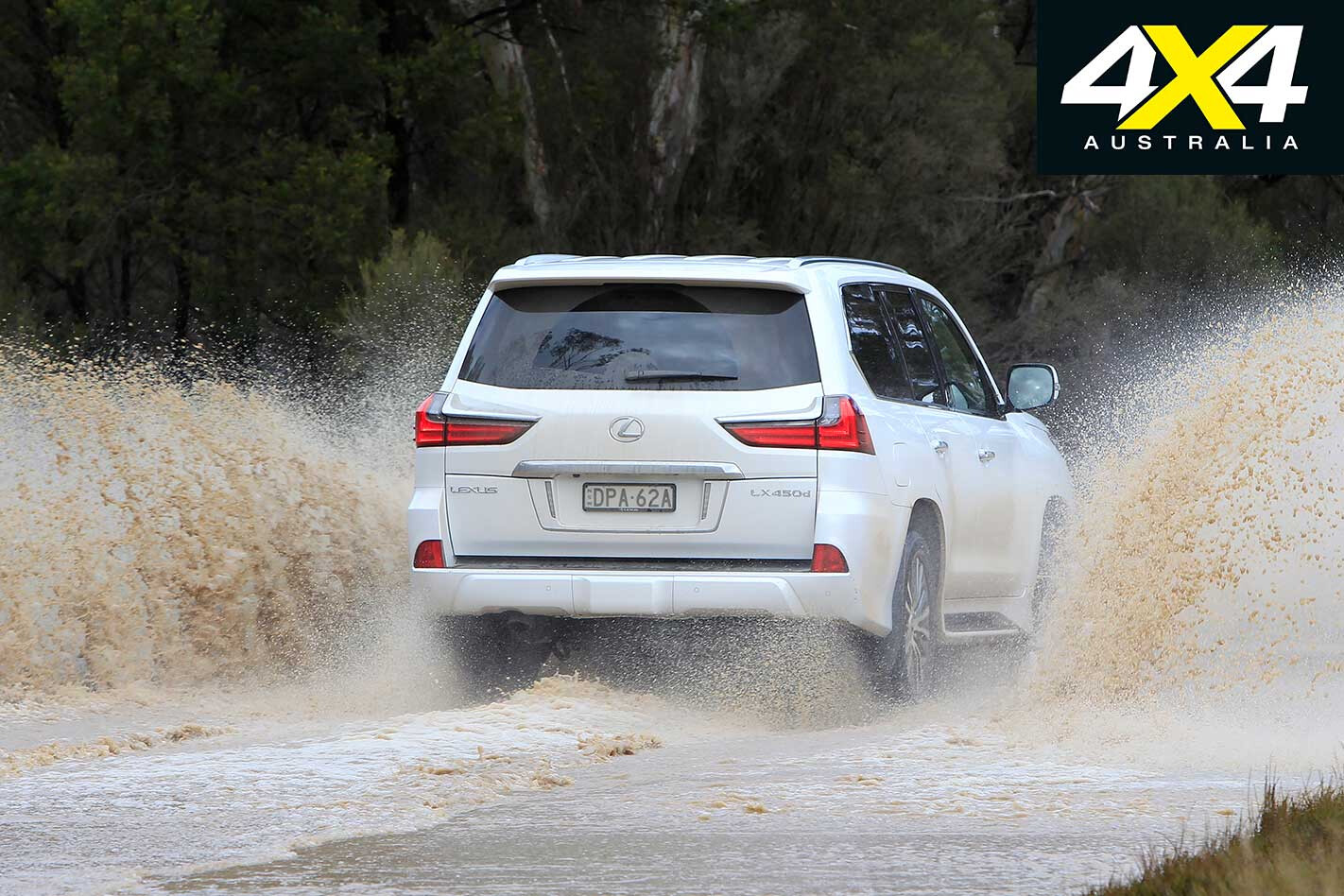
If all this sounds complicated it’s still easy enough to use and, either way, the Custom mode is its saving grace even if it may have been easier just to have separate dials for the chassis and powertrain in the first place.
The 450d, like the LX570, also has variable-rate springing at the front achieved via having the front dampers linked to gas reservoirs, which allows the front suspension to automatically soften up if it suddenly encounters a severe bump in the road.
The LX450d certainly rides smoothly enough, even on its 20s, and offers good body control in terms of roll and pitch. But it’s not as stable on a fast bumpy road as the QX80; although, this may be more to do with its live rear axle than the effectiveness of its adaptive suspension.
Off-Road
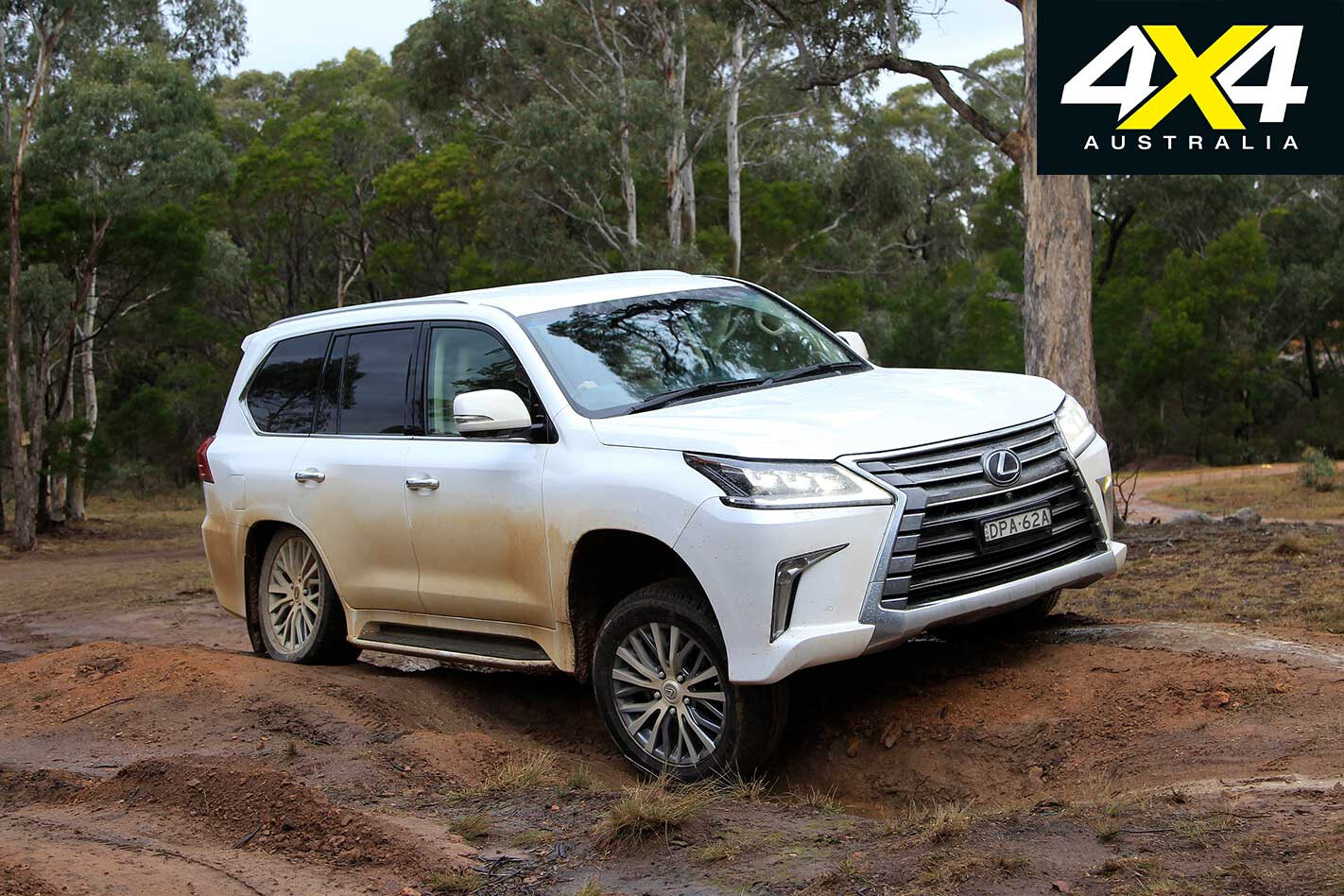
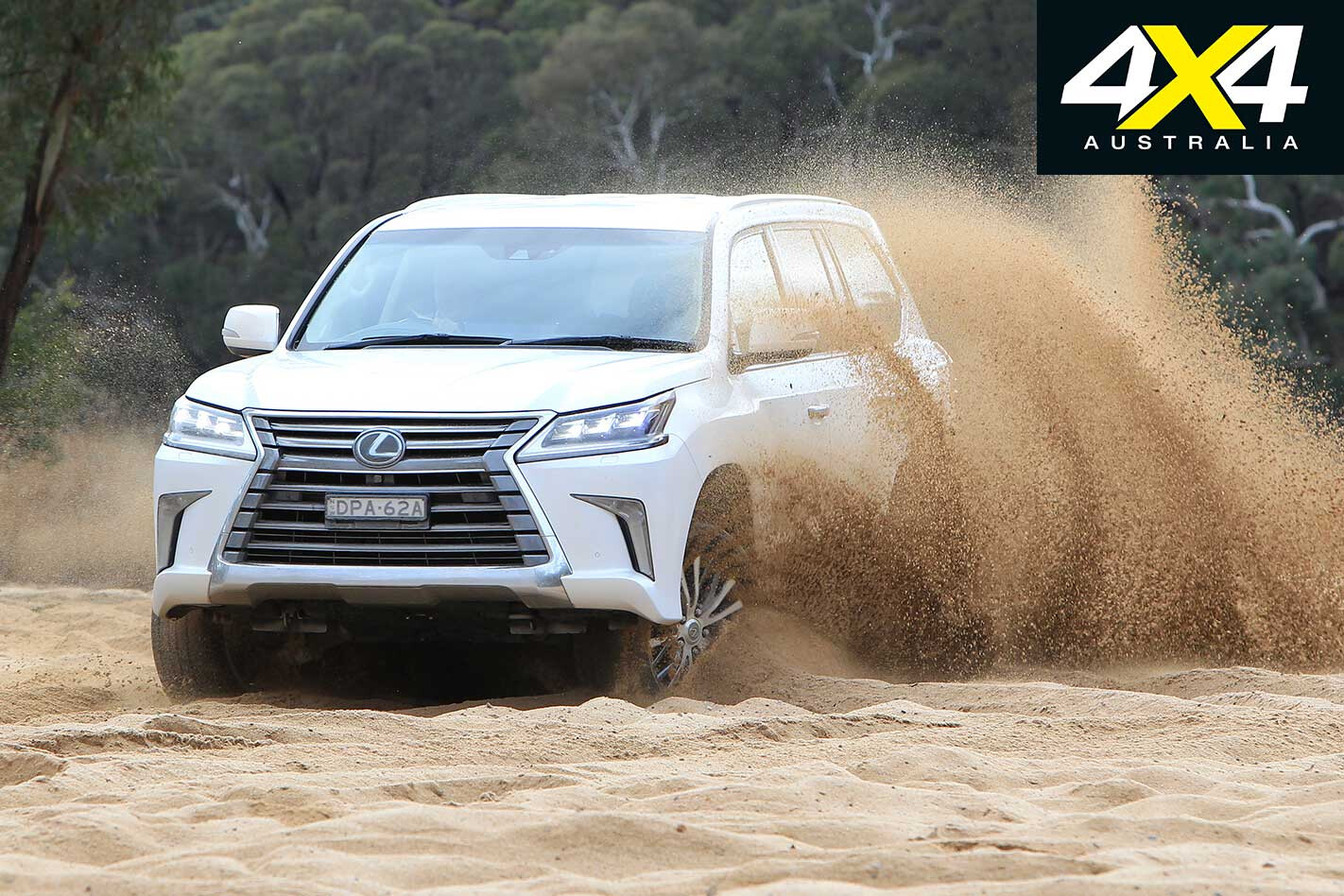
The LX450d’s height-adjustable suspension, shared with the LX570, gives a 50mm lift at the front and 60mm lift at the rear when low-range is selected, or selected directly by the driver. In addition, the suspension will automatically lift another 20mm if the vehicle grounds out while in Crawl mode.
The extra height is most welcome given the LX body compromises the approach and departure angles over an LC200.
The height-adjustable suspension is certainly the difference between the two LXs and the QX80 off-road, and both LXs will go where the Infinti won’t. Plenty of wheel travel also helps the LX; although, like the LX570, the 4×4 system driver interface could be simpler.
Cabin, Accommodation and Safety
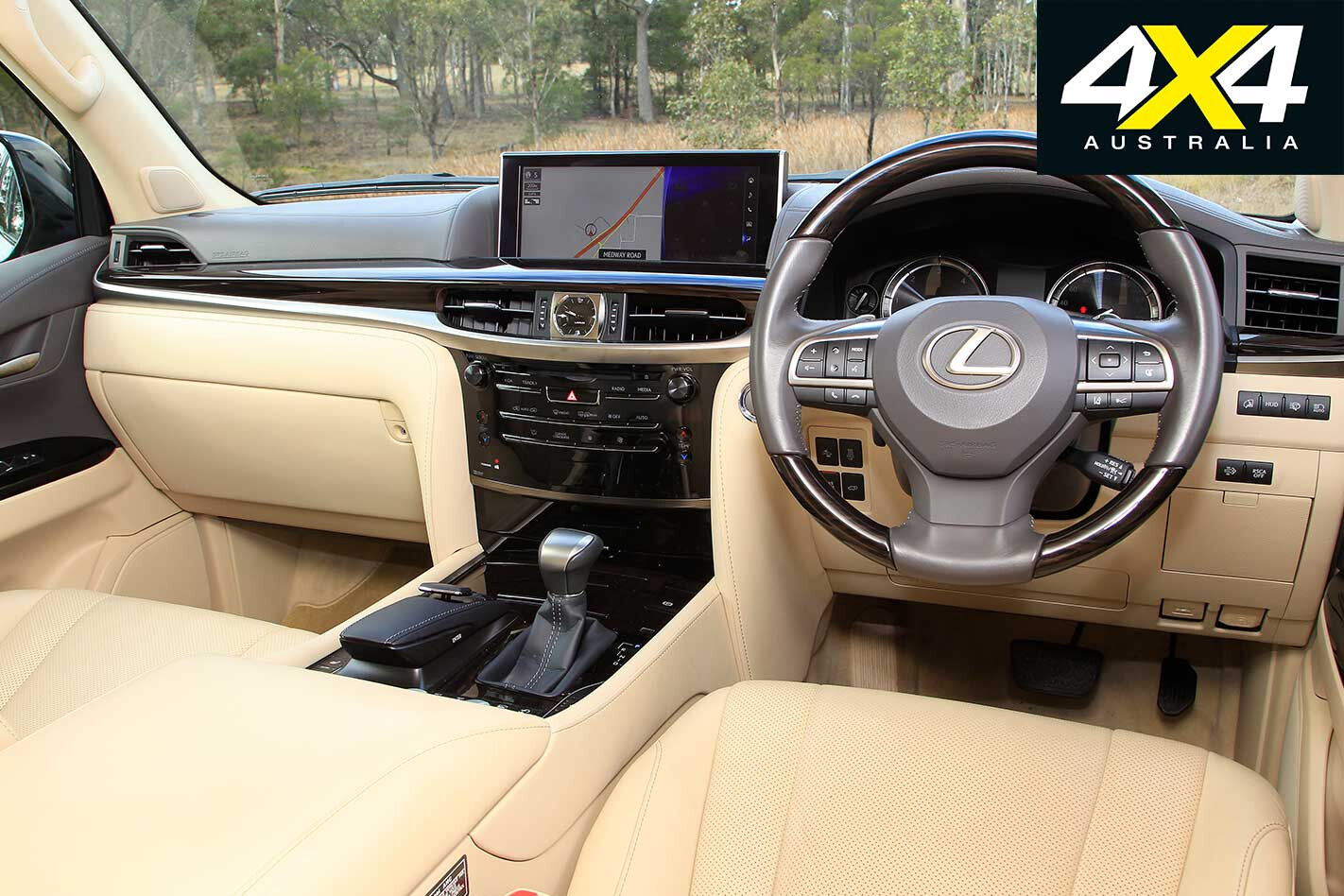
The LX450d is only a five-seater, which could be a deal-breaker for some buyers. The upside is there’s a useful increase in luggage space without the third row seats. As with the 570, the rear seat isn’t as wide as the QX80’s.
The 450d is beautifully detailed and finished inside and more than comfy up front, but misses out on some of the luxury kit of the LX570 and even the LC200 Sahara diesel for that matter (see ‘What you Get’ sidebar). Like the other vehicles here the LX450d hasn’t been ANCAP tested, but that doesn’t mean it’s not loaded with safety kit.
What you Get
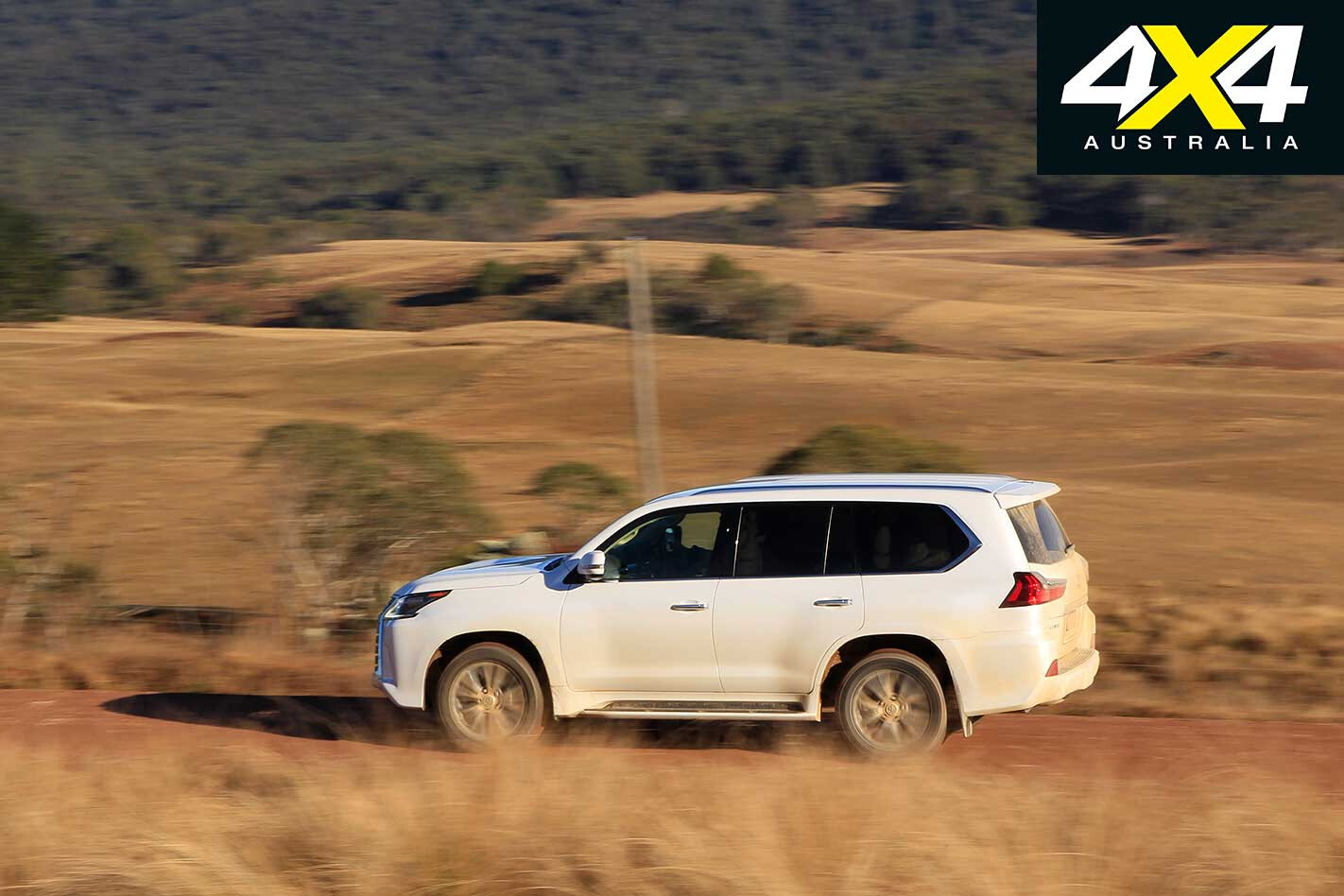
The LX450d’s long list of standard equipment includes radar cruise, automatic emergency braking, memory seats, heated front seats, 10 airbags, LED headlights with auto high-beam on/off, sat nav, a 12.3-inch touchscreen, a nine-speaker audio system, four-zone climate control, a power rear tailgate, tyre-pressure monitoring, selectable ‘Drive Modes’ (see main text), blindspot, lane departure and rear cross-traffic warnings, 20-inch wheels and Multi-Terrain Select and Crawl Control for off-road use.
Compared to the top-spec LC200 Sahara diesel, which is $14K less expensive, it loses third row seating, the sunroof, rear-seat DVD, cooled front seats and 45 litres of fuel capacity. (Equipment differences with the LX570 are listed with the LX570).
Practicalities
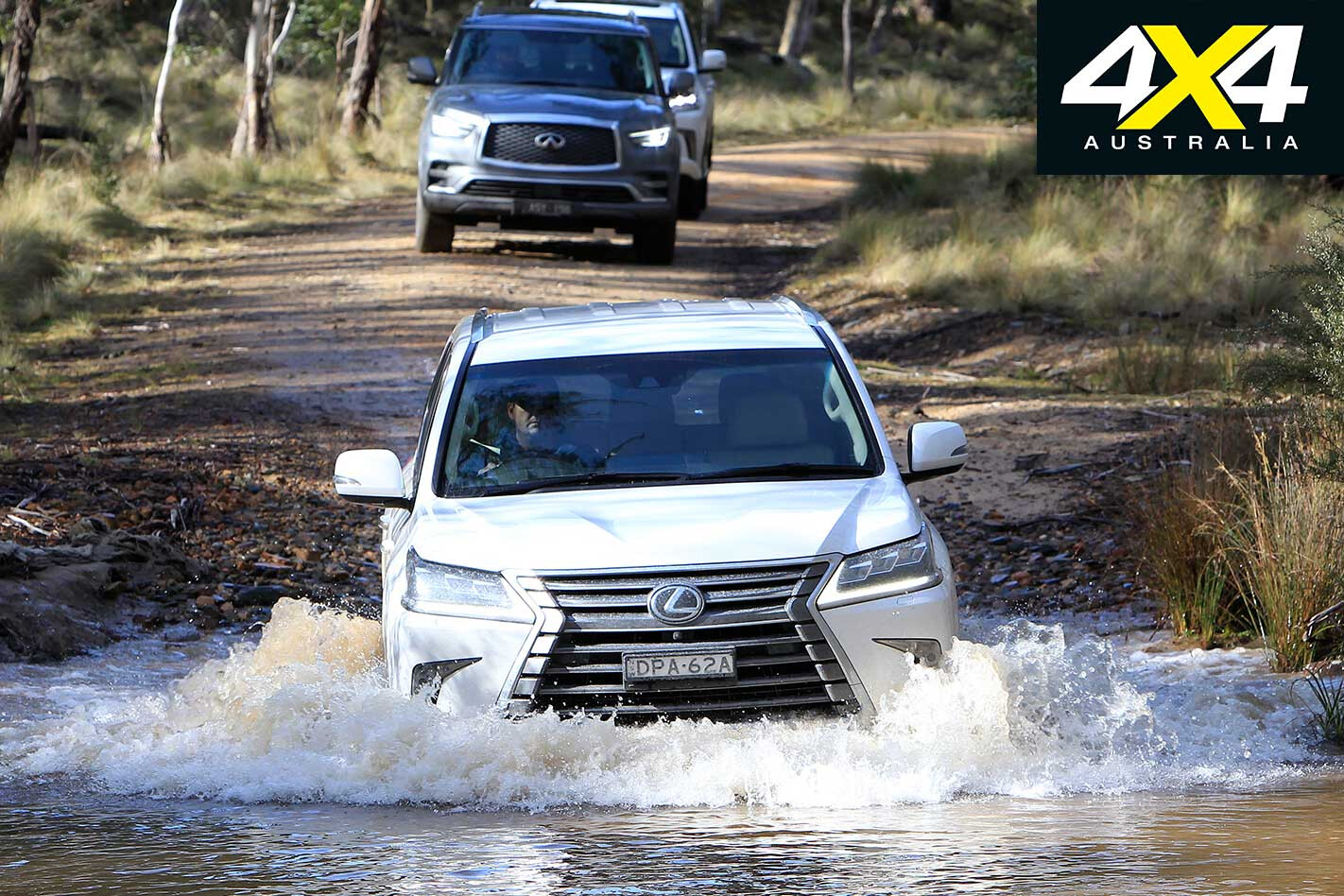
The 450d’s relatively modest fuel consumption (13.8L/100km on test) sets it apart from the two thirsty petrol V8s here. For every two litres of diesel it consumes, the petrol V8s get through nearly three litres of unleaded. The downside is that the 450d has 45 litres less fuel capacity than the LX570 and seven litres less than the QX80. So while it still comfortably betters the Infiniti for range, it doesn’t offer a range advantage over the LX570.
Another practical note (not that Lexus would recommend it) is that the 18-inch wheels from a LC200 will fit, which gives a much wider choice in more practical tyres.
Double Appeal
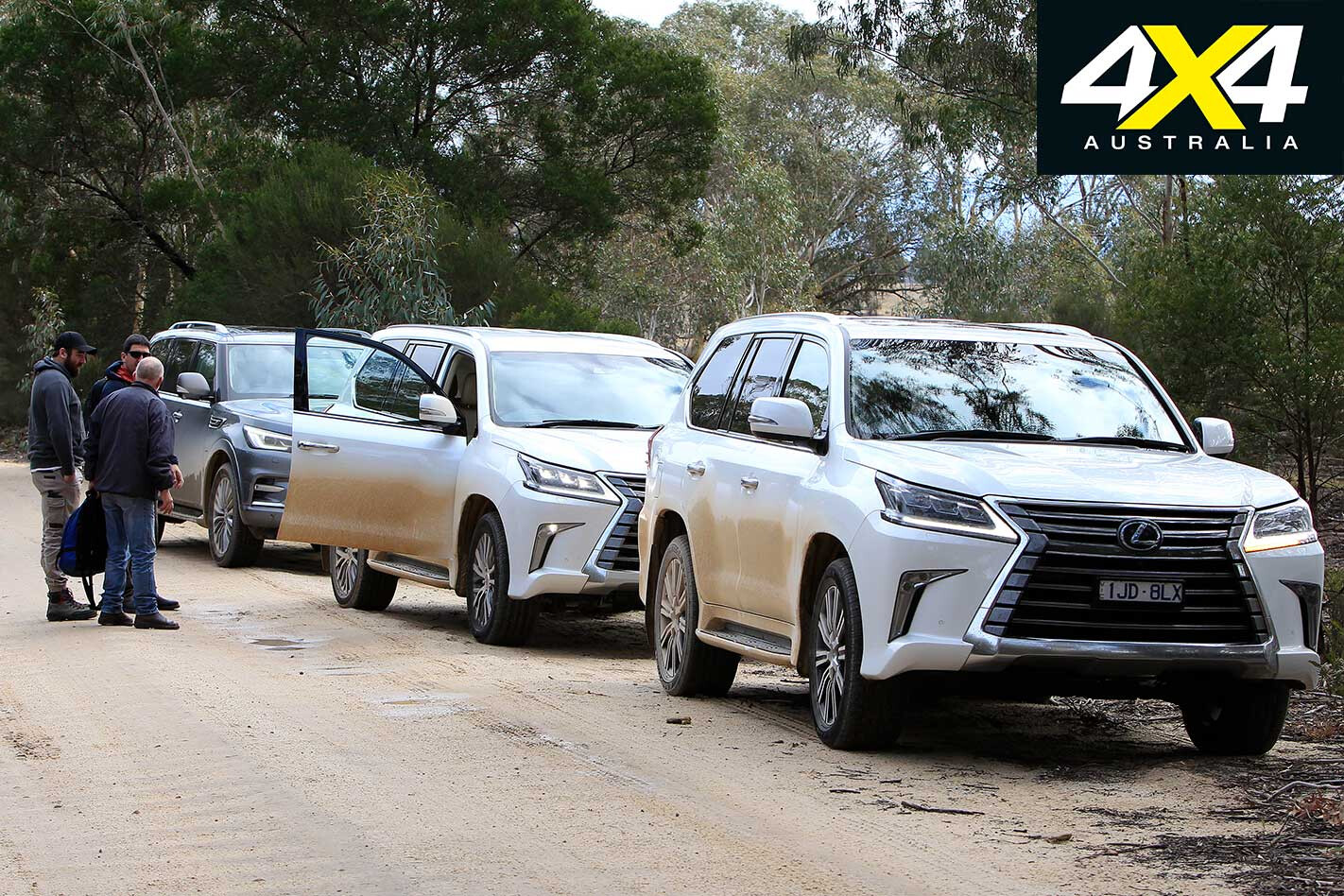
The LX450d is the latest entrant in the top-shelf luxury 4×4/SUV class, known as ‘SUV Upper Large above $100K’ in the official industry sales figures, VFACTS. The 450d joins its petrol stablemate the LX570 and the Infiniti QX80 in that class, along with the likes of Range Rover and the even more highbrow Bentley Bentayga.
The LX450d was launched in April this year and since that time has doubled the total LX sales volume, which year-to-date stands at 198, of which 61 are 450ds. That’s helped push Lexus past Range Rover (with 142 units sold YTD) and into second place in the class, but still well behind the class leader, the Mercedes-Benz GLS, with 529 sold YTD.
LEXUS LX570 The LX570 is the most expensive vehicle here, but does that make it the pick of the trio?
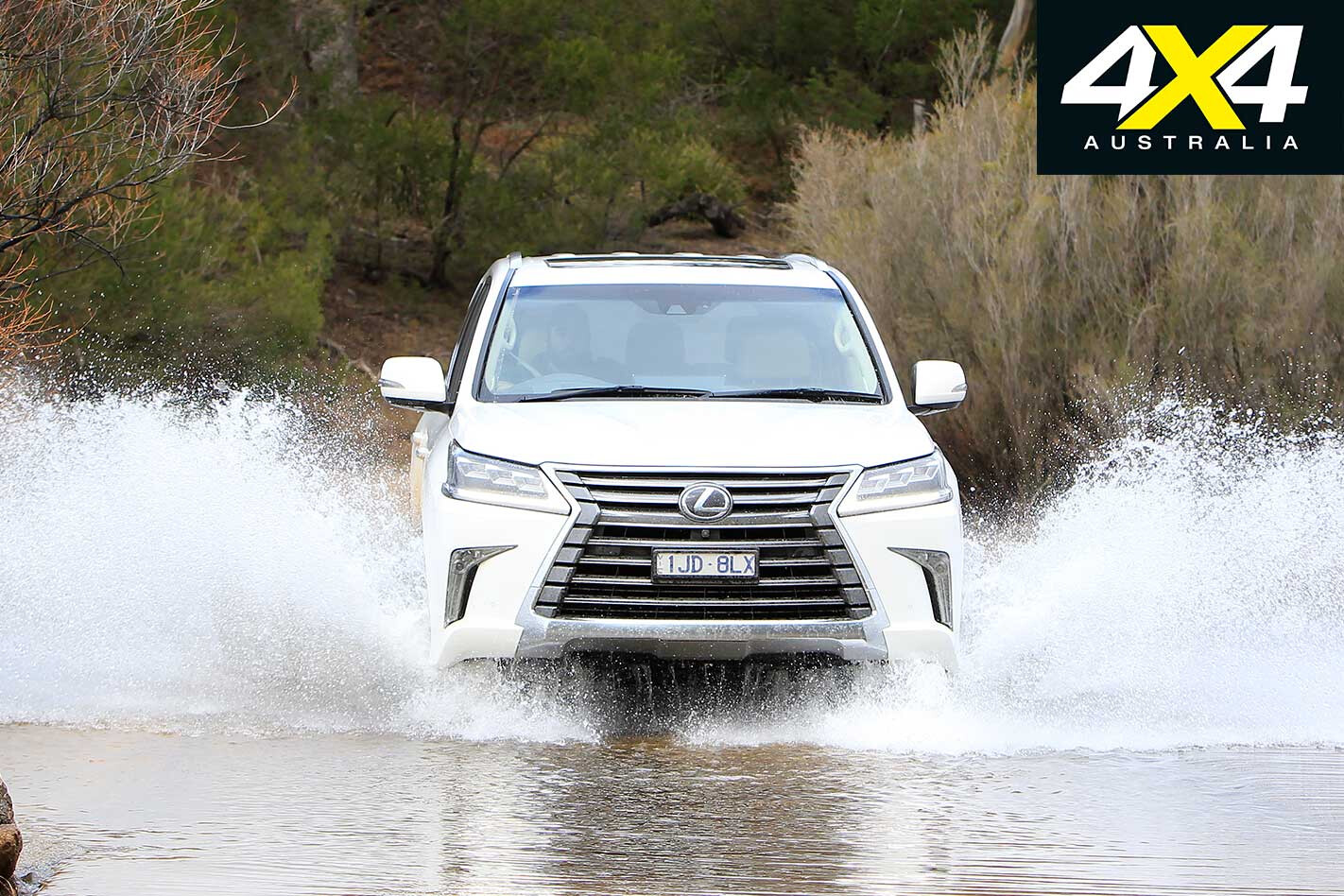
The Lexus LX570 first arrived in 2008 off the back of the then new Land Cruiser 200 Series. It differed from the LC200 in a number of ways, but most significantly with its 5.7-litre V8 not found in the 200. It replaced the previous LX470, which was based on the LC100 and shared its 4.7-litre V8.
In late 2015, the LX570 received a major facelift and features upgrade led by a new eight-speed automatic gearbox, which replaced the previous six-speed auto from the LC200.
The long list of other new standard features included automatic emergency braking, radar cruise control, lane-departure warning, blindspot monitoring, rear cross-traffic alert, head-up display and tyre-pressure monitoring. It also received Drive Mode Select at that time.
Powertrain and Performance
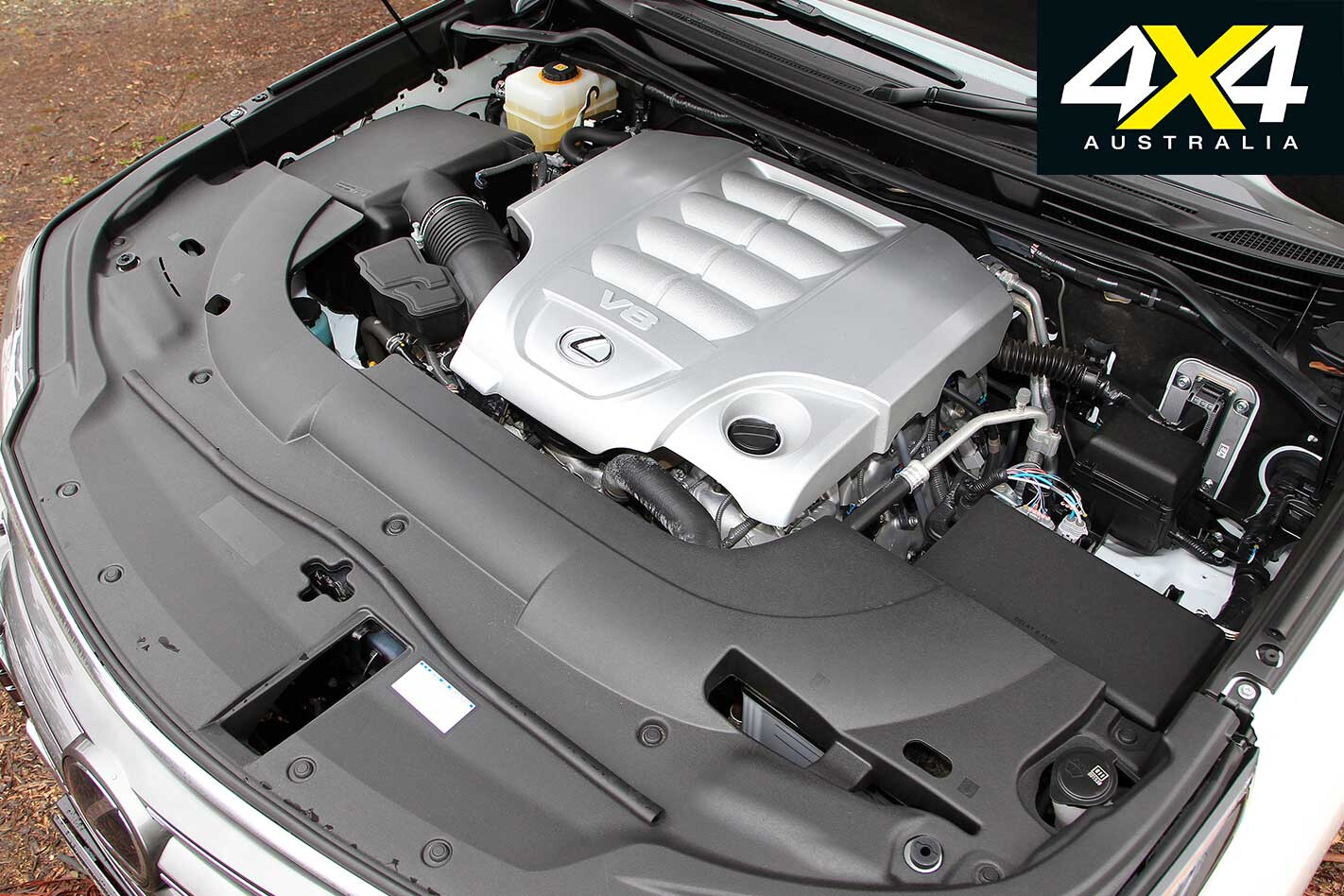
The LX570’s 5.7-litre quad-cam 32-valve V8 features variable valve timing on both cams and direct injection and is the largest engine offered in any Lexus vehicle. Despite being marginally larger in capacity than the V8 in the QX80, it produces less power (270kW vs 298kW) and less torque (530Nm vs 560Nm), but also doesn’t need to rev as hard to achieve its peak figures.
This is an engine of quite different character to the V8 in the QX80. It’s far quieter but also less edgy, urgent and revvy, and goes about its business with zero fuss. If it is refinement and civility you’re after then this engine is the pick of the three; although, it still isn’t short on performance even if it can’t quite match the punchy V8 in the QX80.
The LX570’s eight-speed automatic is also the sweetest and smoothest shifting gearbox of the three, and perfectly complements the refined nature of the naturally aspirated engine.
On-Road Ride and Handling
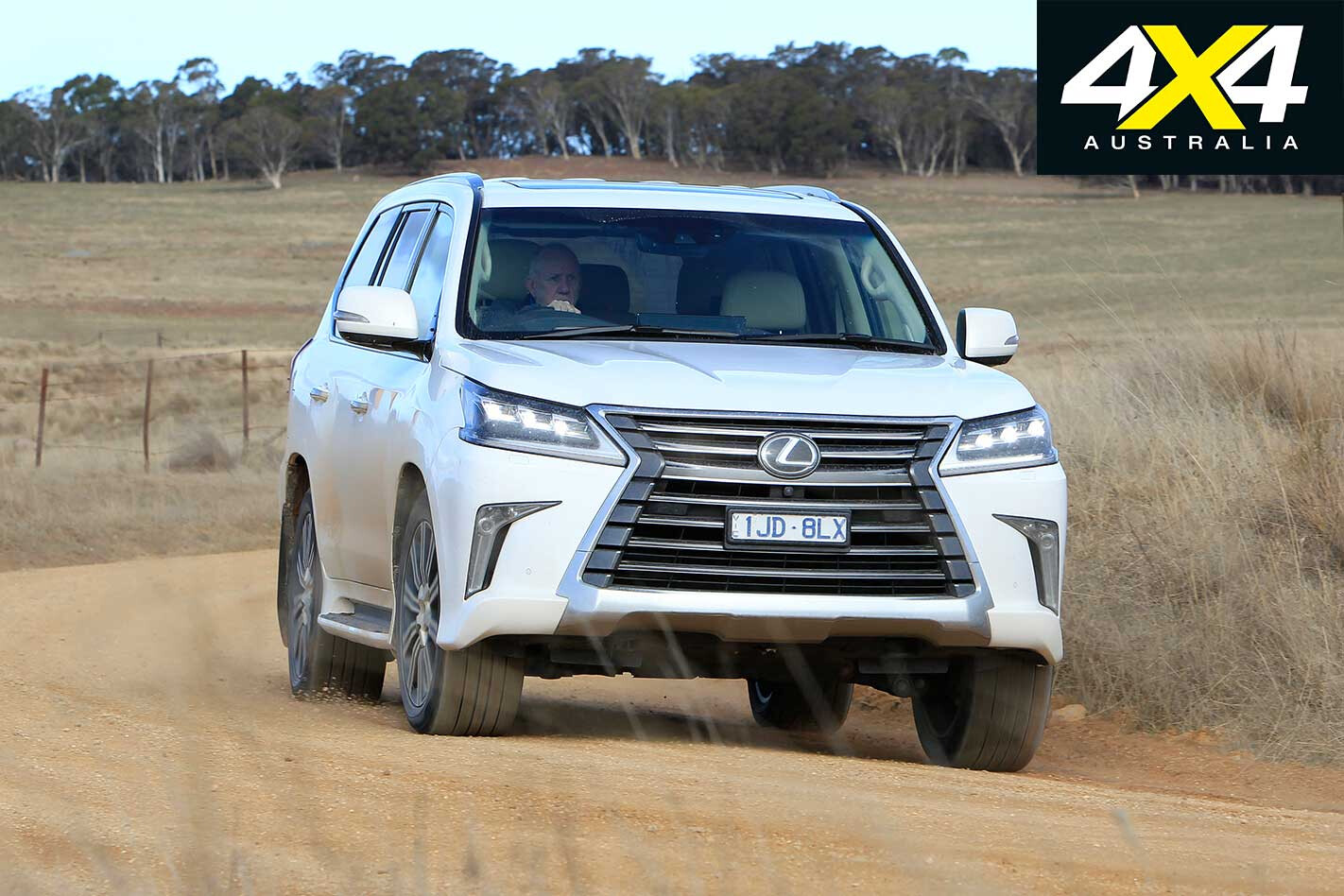
The LX570 shares the unique suspension system of the LX450d, complete with its adaptive damping with driver-selectable modes, automatic adjustment of the front spring rate, and ride height adjustment that automatically lowers the vehicle by 20mm at the front and 15mm at the rear at higher roads speeds.
The LX570, like the 450d, also has variable-ratio steering in place of the LC200’s system with variable hydraulic assistance.
The end result of all this is a compliant, supple and very quiet ride on all road surfaces, even on the 21s that are part of the enhancement pack. The handling and stability on smooth roads is good, too, and Drive Mode Select does its best job here allowing the driver to firm up the damping to reduce the body roll and pitch and sharpen the steering to improve the turn-in characteristics.
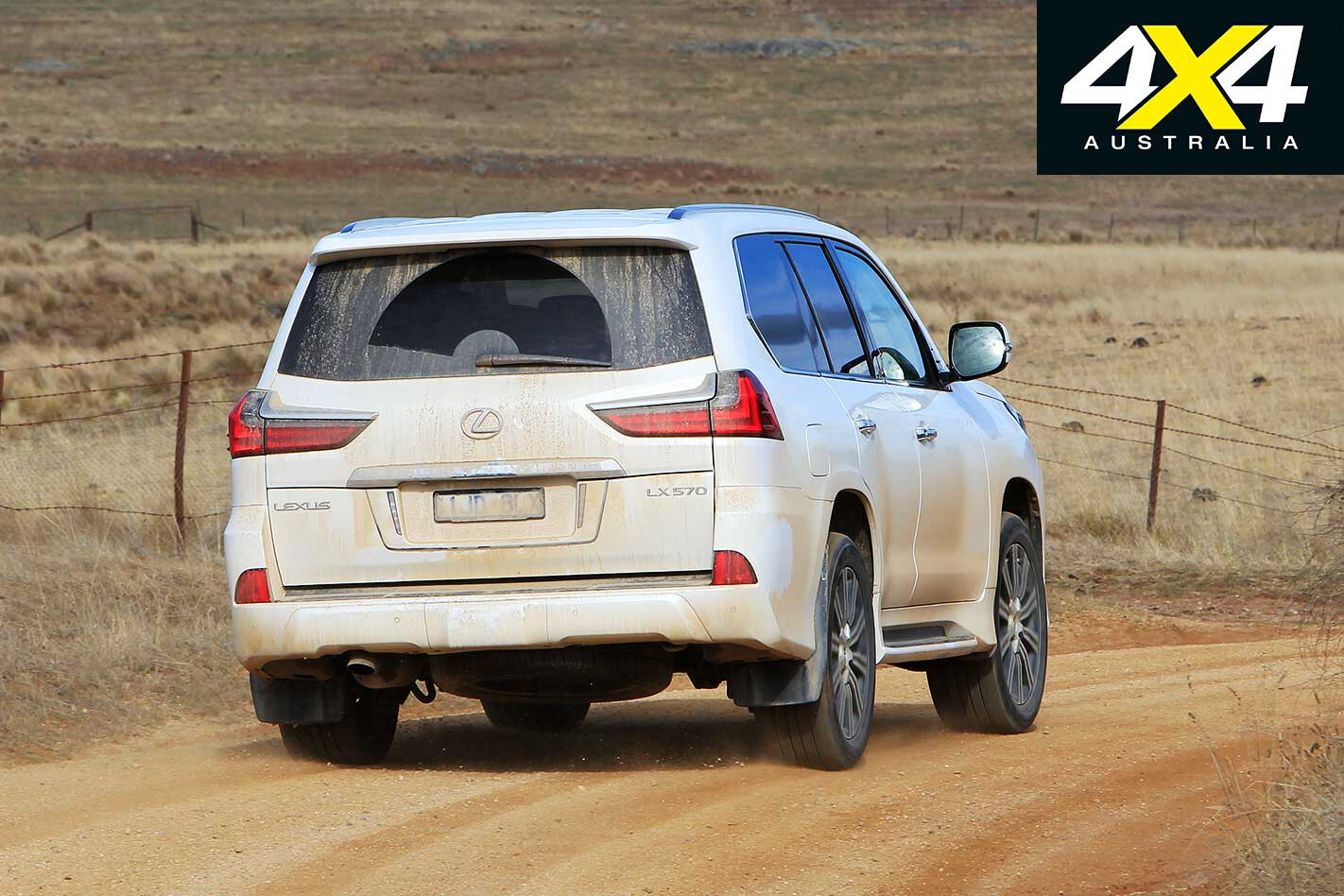
However, like the LX450d, the LX570 is less happy on bumpy roads, especially at higher speeds where there’s a fair bit of bump steer from the rear axle, perhaps even more so than an LC200. Firming up the damping via Drive Mode Select doesn’t help on bumpy high-speed roads.
In fact, on rough roads, both Lexus models handle better in the Comfort mode for the chassis settings. This is where the Custom setting in the Drive Mode Select system comes into play as it allows the driver to pre-program the chassis for Comfort but the powertrain for Power, a combination not available in any of the default factory settings. The steering on both Lexus models is also heavier than the QX80 and doesn’t provide the same degree of feel.
Bespoke Suspension
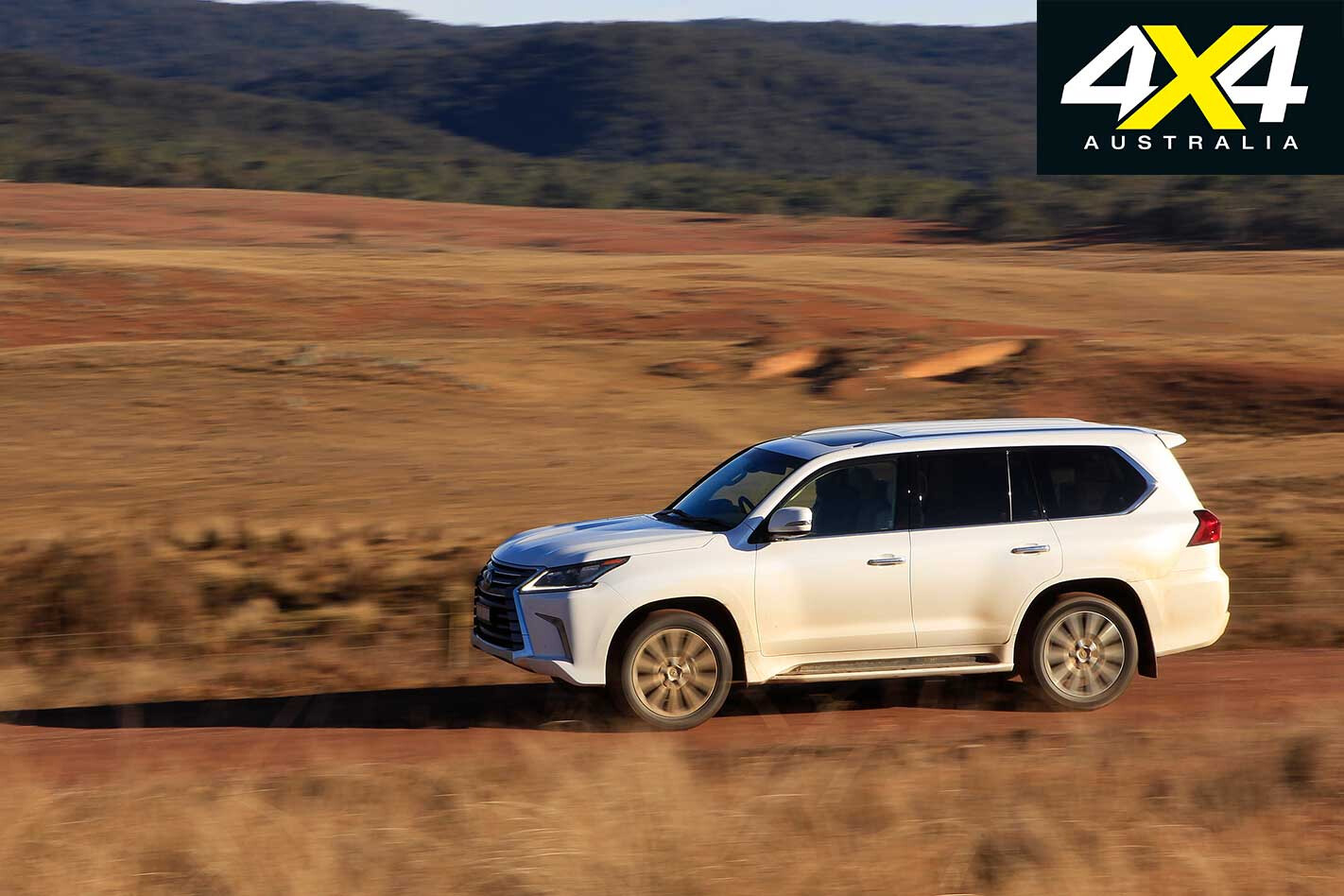
Both Lexus LX models, while sharing the LC200’s basic chassis layout, have unique suspension. Most beneficially they have variable height so they can be jacked-up off-road or lowered at higher road speeds; or lowered further for entry and exit. The LX does this via hydraulics – rather than air springs – using a hydraulic pump connected to all four dampers.
As well as lifting and lowering the LX, the dampers automatically adjust the damping force depending on the bumpiness of the road within Comfort, Normal and Sport modes. The LX’s active dampers also control roll and pitch, which means it doesn’t have the LC200’s active swaybar system known as KDSS.
Off-Road
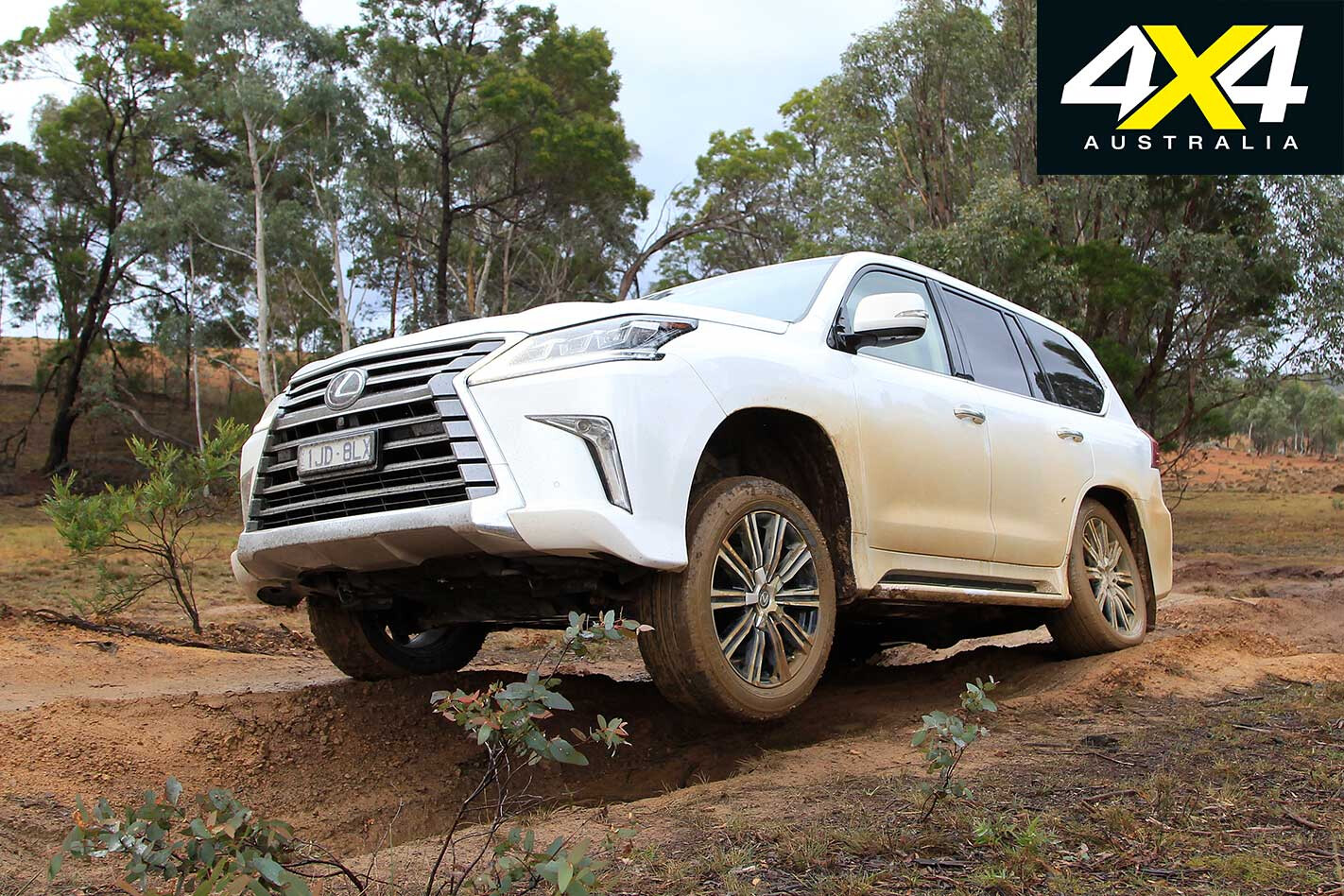
The LX570 largely does what the LX450d does off-road, despite the different power characteristics of the two engines and the fact that the 570’s eight-speed gearbox affords it a better crawl ratio.
The big trick with both, compared to the QX80, is the height-adjustable suspension, but both Lexus models also benefit from the generous wheel travel from the live rear axle. Both also have Multi-Terrain Select, which adapts the powertrain and chassis electronics for different terrain tyres; although, these settings are only available in low range.
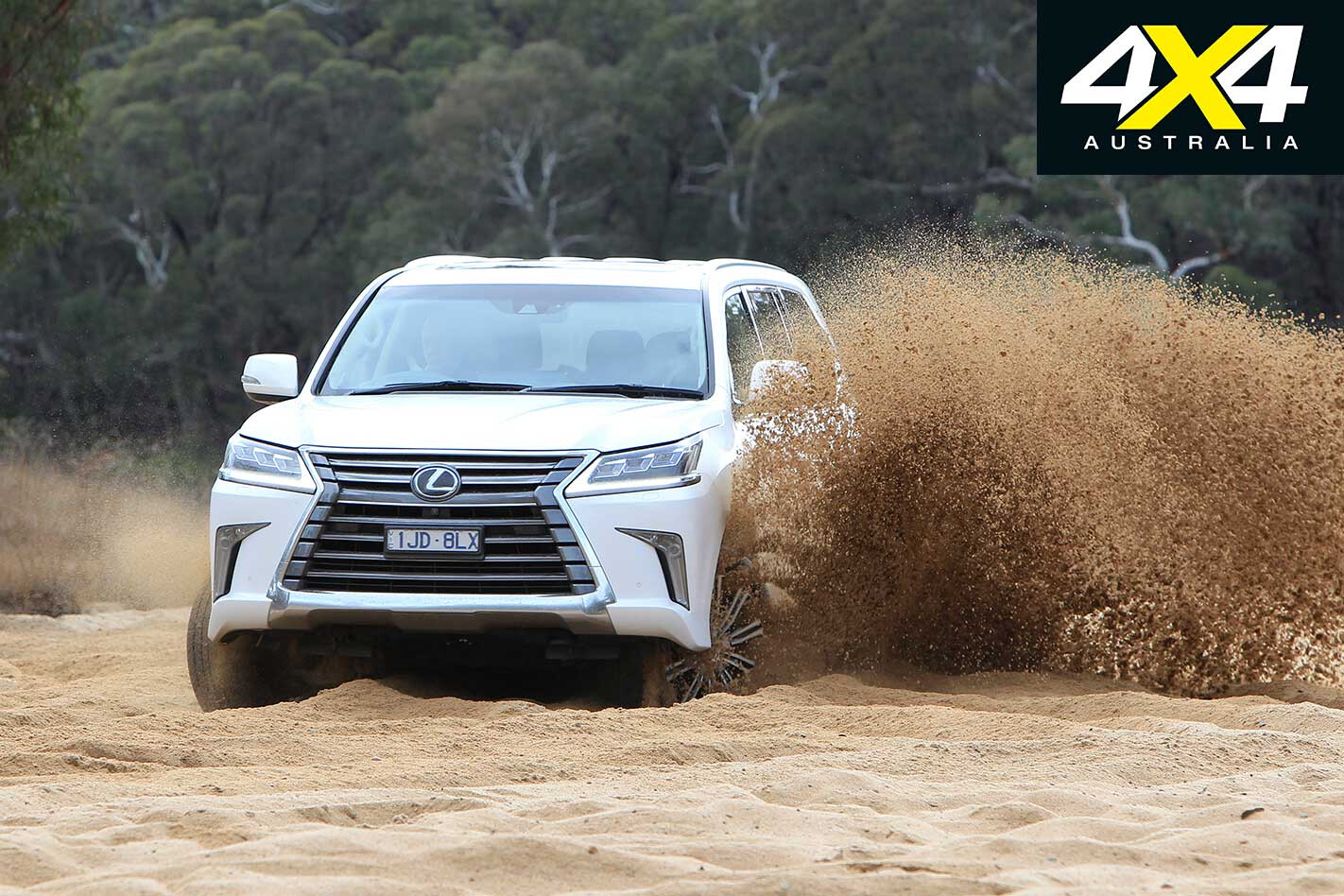
Both also have Crawl Control, which is effectively a low-speed off-road cruise control – although noisy, it’s surprisingly effective in difficult going.
The highest setting for the suspension also only operates when Crawl Control is activated, which means you may need to select Crawl Control when you don’t actually need the automatic throttle control it provides, just the extra clearance if affords.
Cabin, Accommodation and Safety
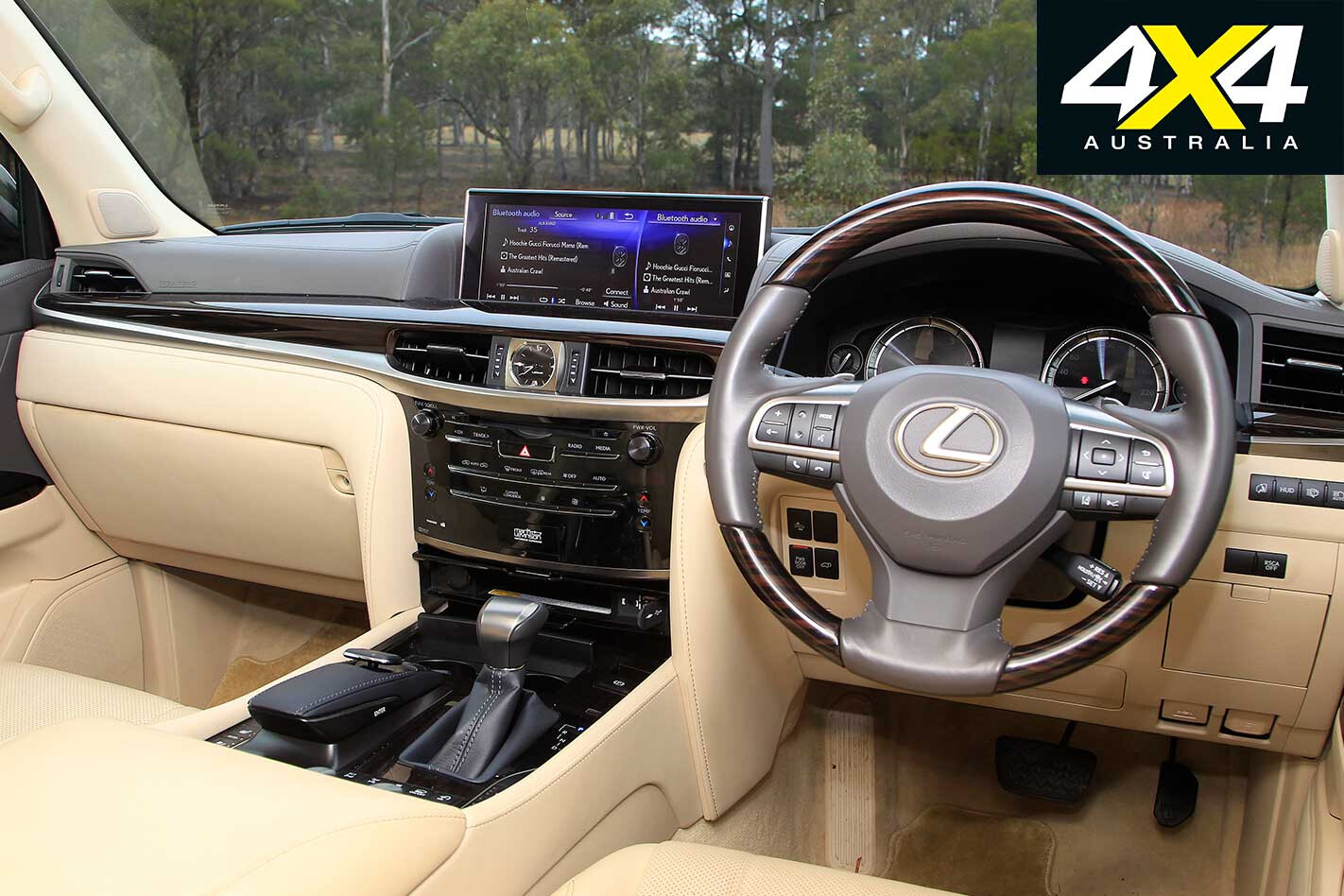
The LX570 seats eight, but the third row seat isn’t as roomy as that of the QX80, or as easy to access. Likewise, the second-row seat isn’t as spacious as the QX’s, especially for three adults.
The LX570 is still a big, comfortable and beautifully detailed and finished wagon with a mind-boggling array of convenience and luxury features, even if some features only come with the optional enhancement pack.
What you Get
The LX570 is notably better equipped than the LX450d and adds a 19-speaker Mark Levinson audio system (rather than a nine-speaker system), twin rear DVD screens, power-fold third-row seats and a sunroof. It also comes with a $16.5K enhancement pack consisting of ventilated front seats, heated second-row outside seats, a heated steering wheel and 21-inch wheels.
Otherwise, like the LX450d, the LX570 has radar cruise, automatic emergency braking, 10 cabin airbags, heated front seats, memory driver’s seat, LED headlights with auto high-beam on/off, sat nav, four-zone climate control, a power rear tailgate, tyre-pressure monitoring, selectable Drive Modes (see main text), blindspot, lane departure and rear cross-traffic warnings, and Multi-Terrain Select and Crawl Control for off-road use.
Practicalities
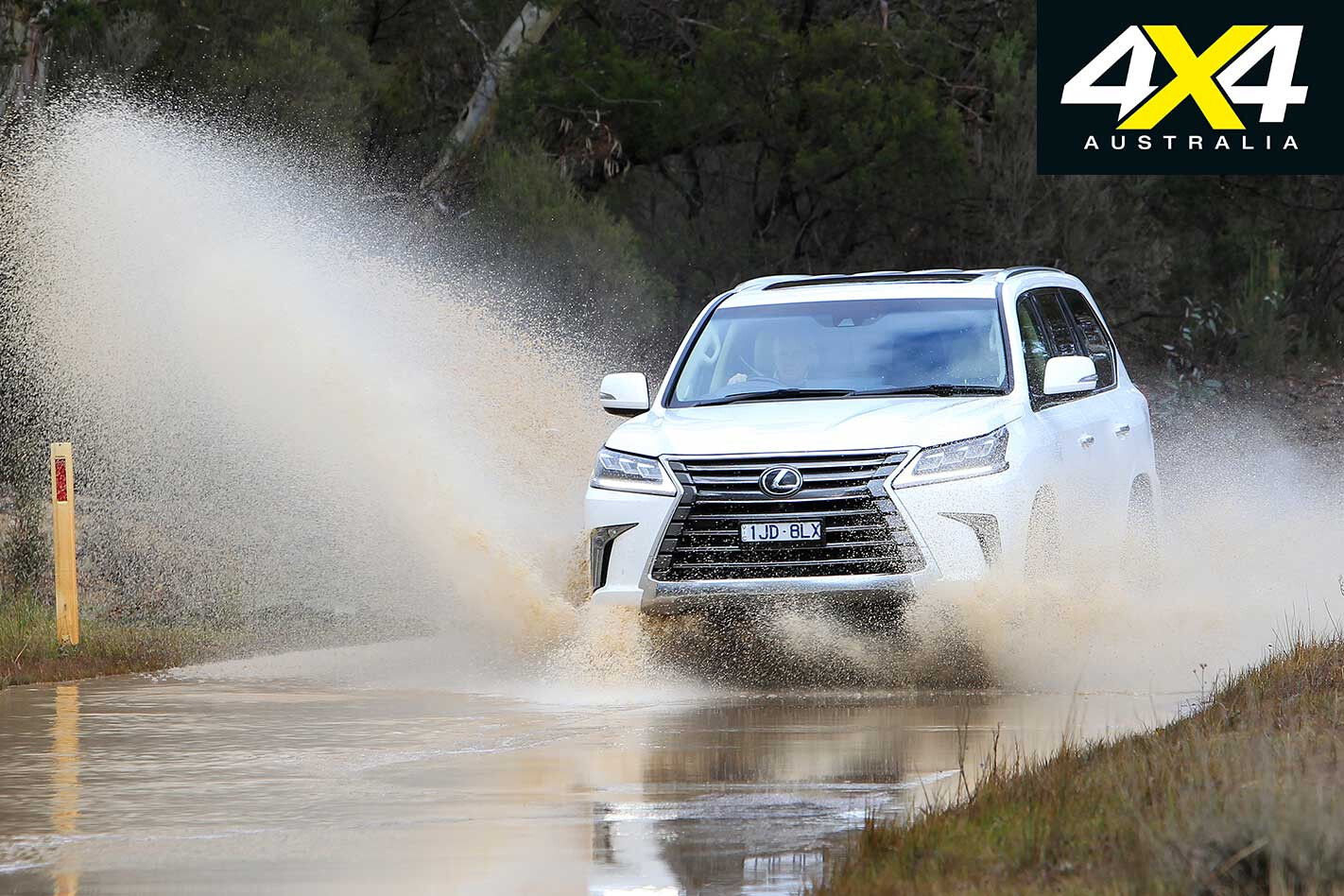
On test the LX570 used 19.4L/100km, which is slightly more than the QX80 – and both have similar (14.4 vs 14.5) ADR fuel-use figures. While both are obviously thirsty, more so than the LX450d, the 570 does have the biggest tank (138L) and is specified to run on 91RON whereas the QX80 asks for 95RON.
Given the LX570 has the same size brakes as the LX450d, it too will take the 18-inch wheels from the LC200 if you want a wider choice with more practical tyres; although, this is not something Lexus recommends.
The Verdict
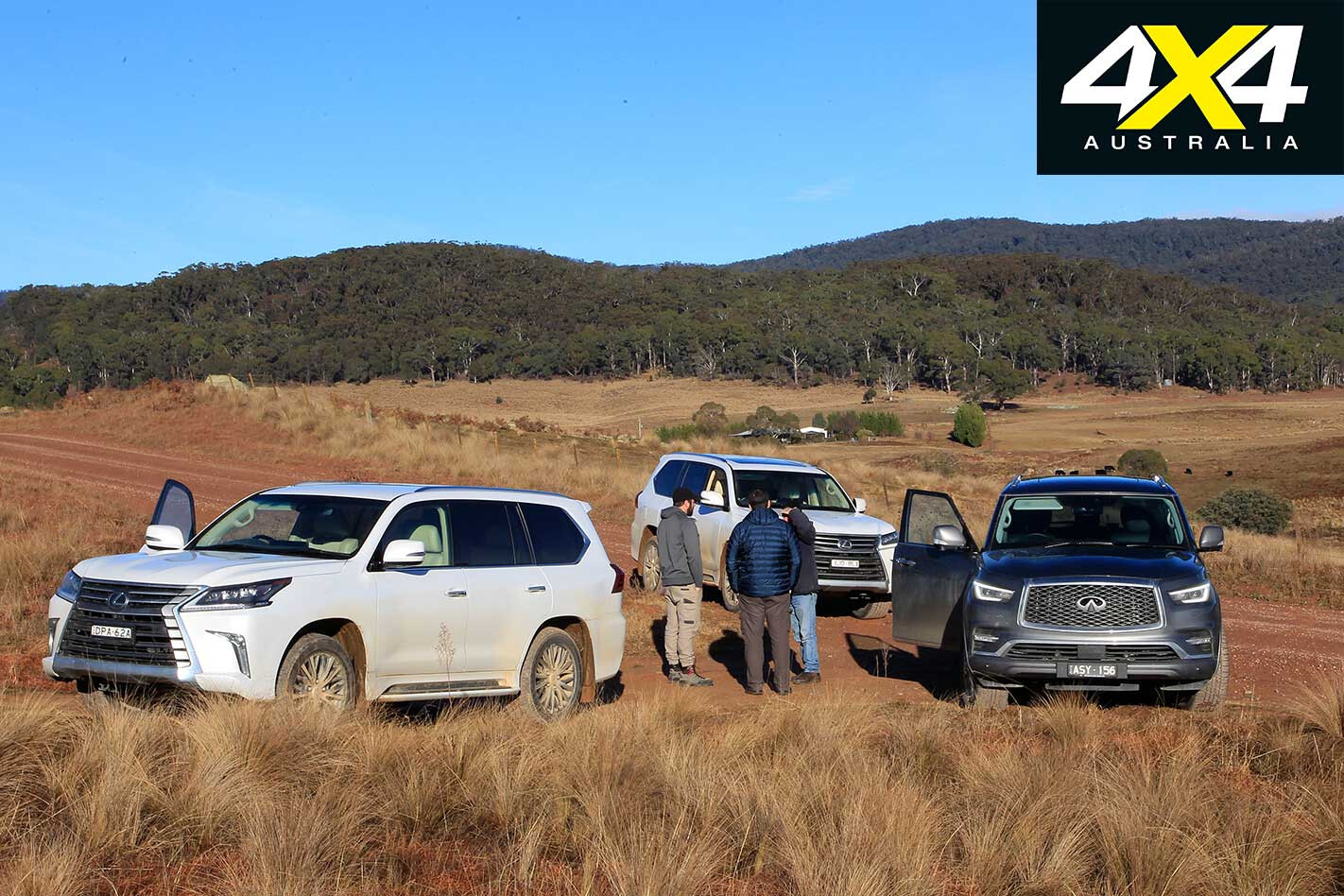
These three luxury 4x4s present two obvious questions. Firstly, which of the three provides the biggest bang for your buck? Or, in this case, a truck load of your bucks. And secondly, are their prestige badges and extensive equipment lists worth the extra money over their donor vehicles – the LC200 in the case of the two Lexus models and the Patrol Y62 in the case of the QX80?
If you have the money to afford any of these three you may not be concerned about fuel costs, but, either way, the LX450d comfortably provides the best trade-off between performance and economy. It uses two-thirds of the fuel of either petrol V8 yet provides plenty of real-world performance despite lacking the pedal-to-the-metal thrust of the two petrol V8s featured here.
However, no third-row seating could be a deal breaker and, while the reduced fuel capacity over the LC200 Sahara diesel is disappointing, it’s something that can be addressed.
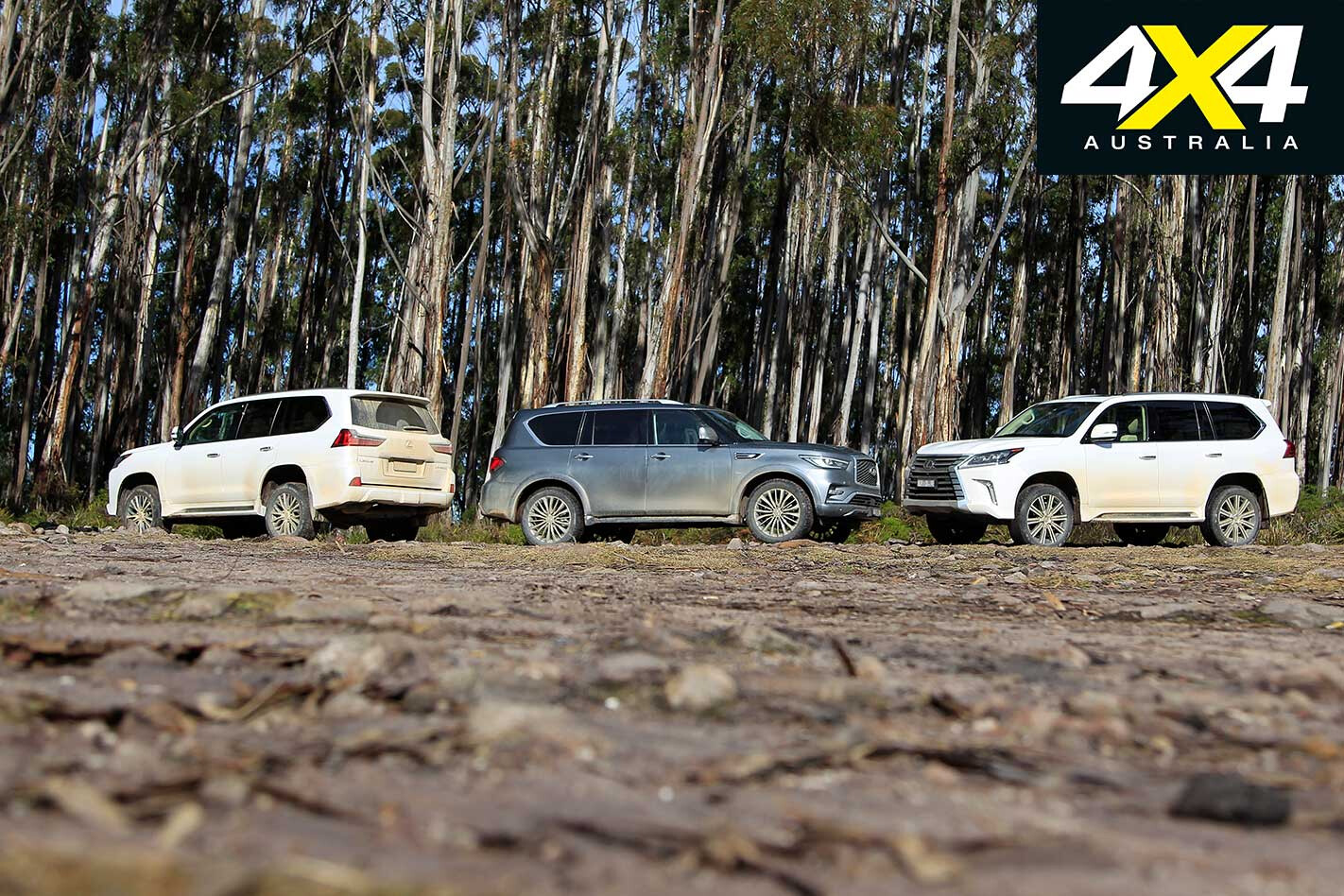
If you’re a keen driver and you’re not concerned about fuel use, then the QX80 is clearly the pick here. It goes the hardest and handles the best. In this company, it’s a driver’s delight. It’s also the least expensive by $24K compared to the LX450d and a whopping $33K compared to the LX570. But it’s also the least useful off-road, so that could be a deal breaker.
It also loses out to its donor car, the Patrol Y62, off-road and in fuel capacity, so if you’re not too fussed about the badge and the extra safety and convenience kit a Ti-L Y62 looks very attractive in comparison.
If you value refinement above all, then the LX570 is the pick. It’s certainly the quietest and most serene driving experience here. It’s also the most removed from its donor vehicle given its 5.7-litre V8/eight-speed automatic isn’t available in the LC200, which is the best justification for its large price tag. If you want a bespoke luxury 4×4, this is the closest you’ll come in this company.
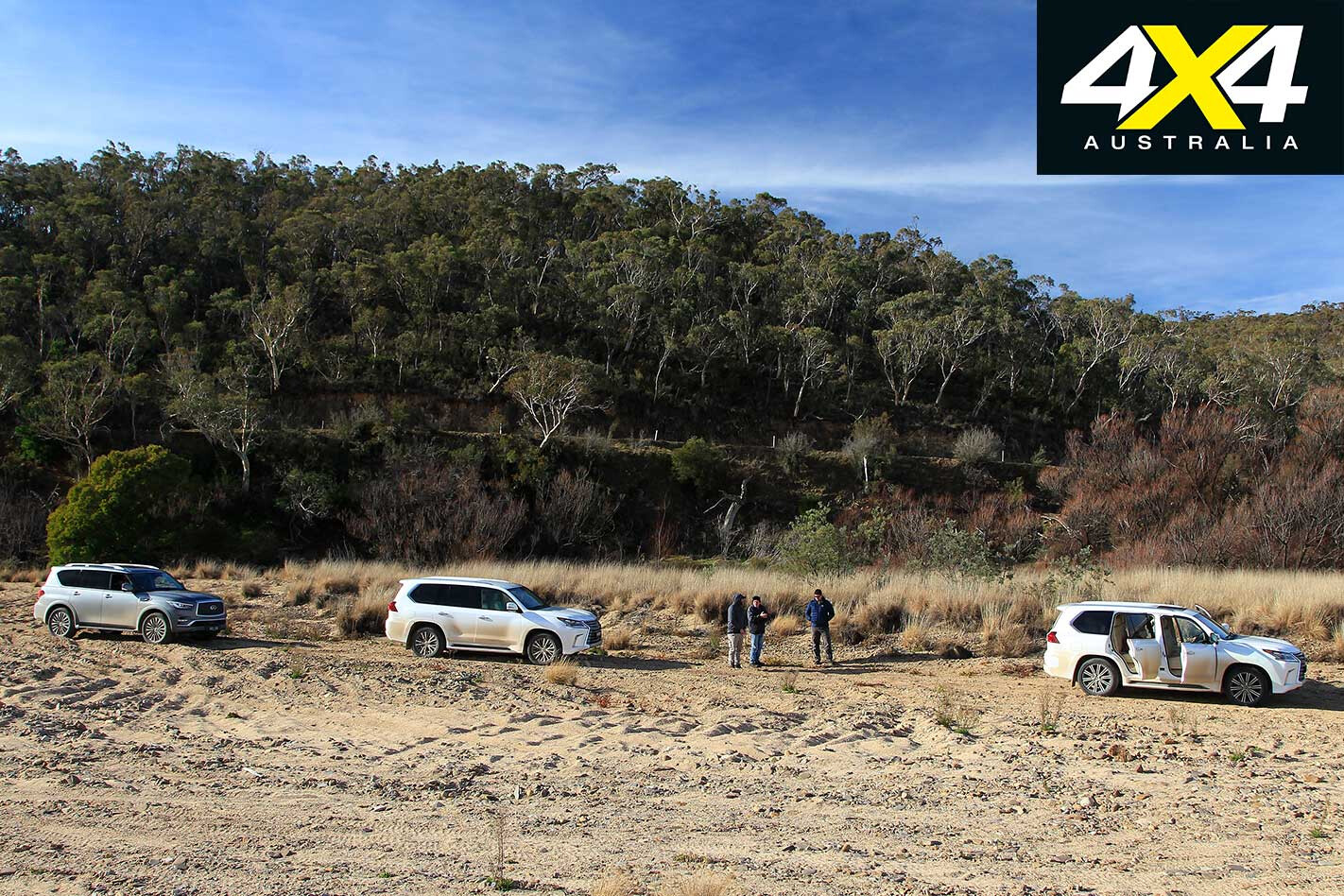
Specifications
| u00a0 | Infiniti QX80 | Lexus LX450d | Lexus LX570 |
| Engine | 5.6-litre DOHC V8 petrol | u00a04.5-litre V8 twin-turbo diesel | u00a05.7-litre V8 DOHC petrol |
| Power | 298kW at 5800rpm | 200kW at 3600rpmu00a0 | u00a0270kW at 5600rpm |
| Torque | 560Nm at 4000rpm | 650Nm at 1600-2800rpmu00a0 | 530Nm at 3200rpmu00a0 |
| Gearbox | Seven-speed automatic | Six-speed automaticu00a0 | Eight-speed automaticu00a0 |
| 4×4 System | Dual-range on-demand | Dual-range full-time | |
| Crawl Ratio | 43.9:1 | 34.1:1 | 41.5:1 |
| Construction | Separate-chassis | ||
| Suspension (f) | Independent/coils+HBMC | Independent/coils/VRH | |
| Suspension (r) | Independent/coils+HBMC | Live axle/coils/VRH | |
| Kerb Weight | 2858kg | 2670kg | 2645kg |
| GVM | 3500kg | 3350kg | |
| Payload | 642kg | 680kg | 705kg |
| Towing Capacity | 3500kg | ||
| GCM | 7000kg | 6850kg | |
| Departure angle | 24.5u02da | 20u02da | |
| Rampover angle | 23.6u02da | 23u02da | |
| Approach angle | 24.2u02da | 25u02da | |
| Wading Depth | 450mm | N/A | |
| Ground Clearance | 246mm | 275mm | |
| Fuel Capacity | 100 litres | 93 litres | 138 litres |
| ADR Fuel Claim | 14.5L/100km | 9.5L/100km | 14.4L/100km |
| Price | $110,900 + ORC | $134,500 | $143,160 |
THREE years after hitting our roads, Ford has given its Ranger ute-derived Everest wagon its first major update. The key changes centre on the inclusion of a second engine and transmission option, as well as the introduction of new safety technology and a minor facelift.
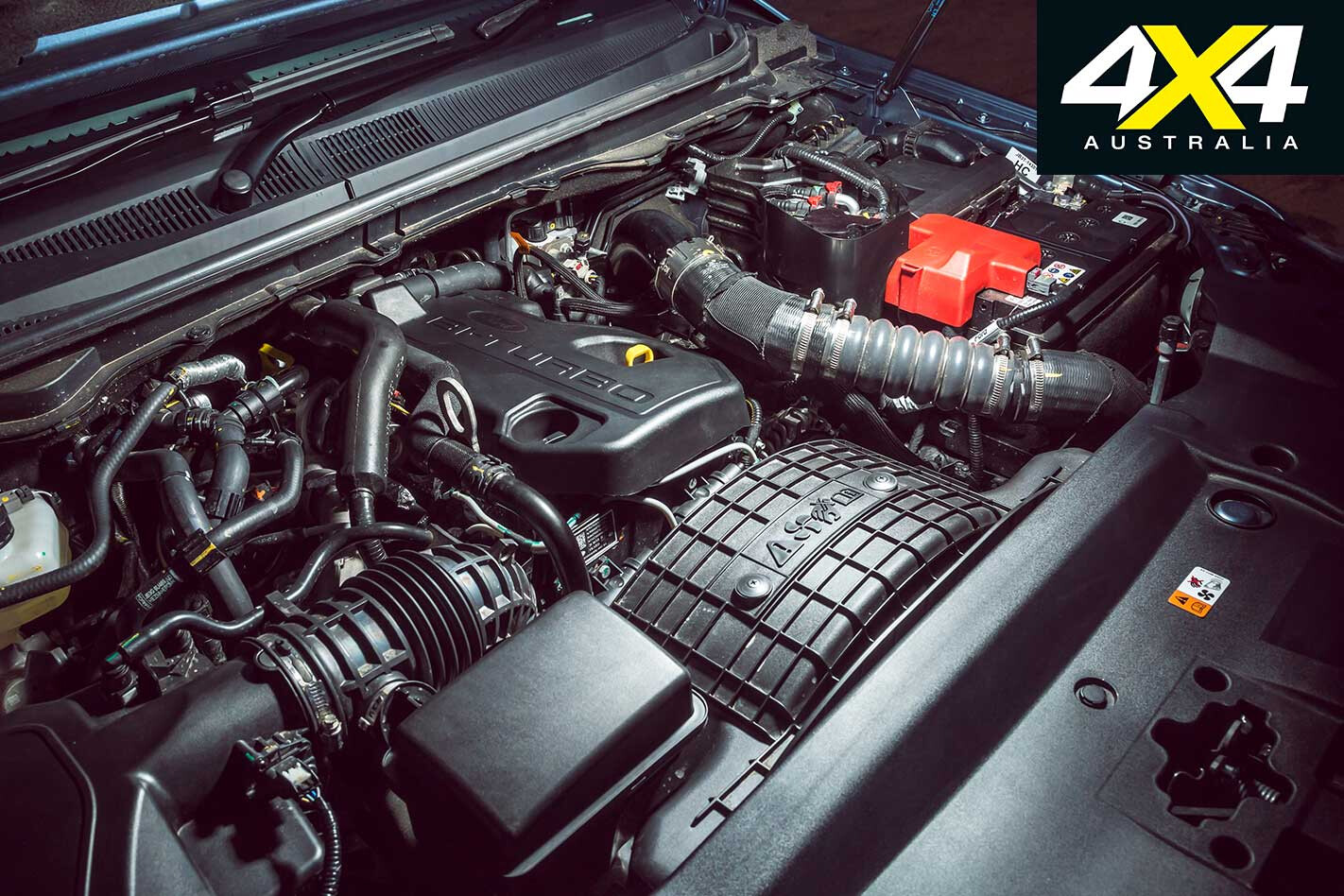
The new powertrain is the 2.0-litre bi-turbocharged four-cylinder diesel mill backed by a 10-speed automatic transmission, as seen in the recently launched off-road-focused Ranger Raptor ute. In the more family-focused Everest, the engine makes the same 500Nm and 157kW that it does in the Raptor. We will also see this combination come to the regular Ranger ute in October.
Significantly, the smaller capacity engine brings improved fuel consumption to the heavy Everest wagon, an area where the Ford has been criticised in the past.
In the 2400kg Everest Trend 4×4, the bi-turbo scores a 7.1L/100km figure on the ADR combined scale while the same car with the older engine and transmission manages 8.5L/100km. The smaller and torquier bi-turbo-driven Everest also ups towing capacity from 3000kg to 3100kg (braked).
It’s difficult to pick which of the two powertrain combinations would be the quickest as neither of them grace the Everest with anything resembling sports wagon-like performance. When we lined the Ranger Raptor up with a 3.2-litre-powered Ranger Wildtrak, the 2.0-litre engine propelled the heavier Raptor half a second quicker to 100km/h. We’d expect similar zero to 100km/h times between the two engines in Everest. The bi-turbo-powered car is 20kg lighter than the 3.2 version.
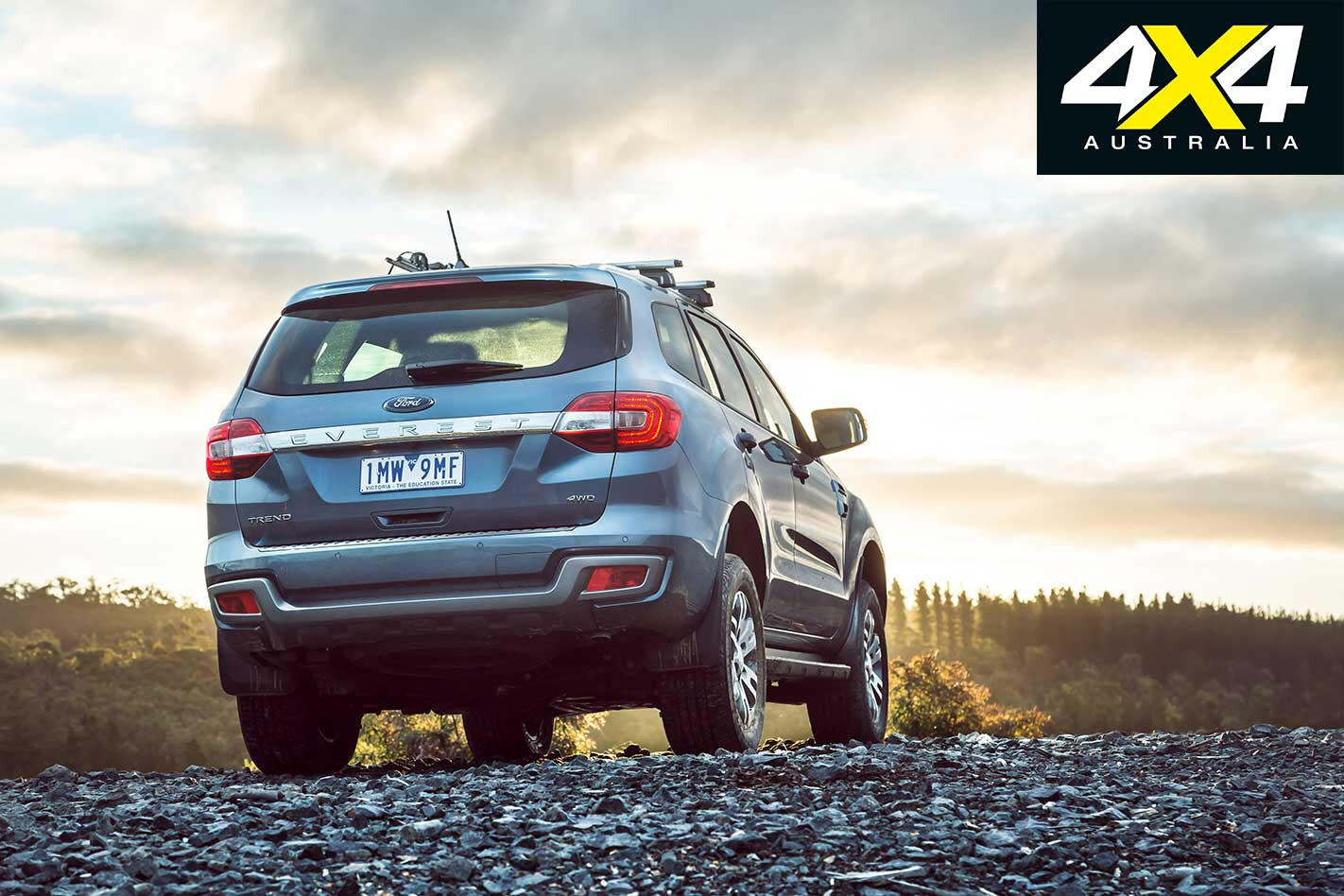
Seat-of-the-pants from inside the Everest, you can’t feel any significant difference in performance. The new powertrain is more refined and the transmission is silky smooth with near-undetectable shifts under moderate throttle input, and it’s quieter than the 3.2 but not by a large margin. In the Everest, this is cloaked by the active noise cancellation the wagon has always enjoyed.
Many have said they don’t like the way the five-cylinder 3.2-litre engine growls when you put your foot down, but I prefer it to the busy rattle of the four-cylinder under load. The four is quieter on light throttle and perhaps a bit at idle, but it isn’t all that much better than the five-pot. I also prefer the lazy, loping characteristics of the 3.2-litre. The bi-turbo four is typically busier and uses those 10 ratios more to keep it on the boil.
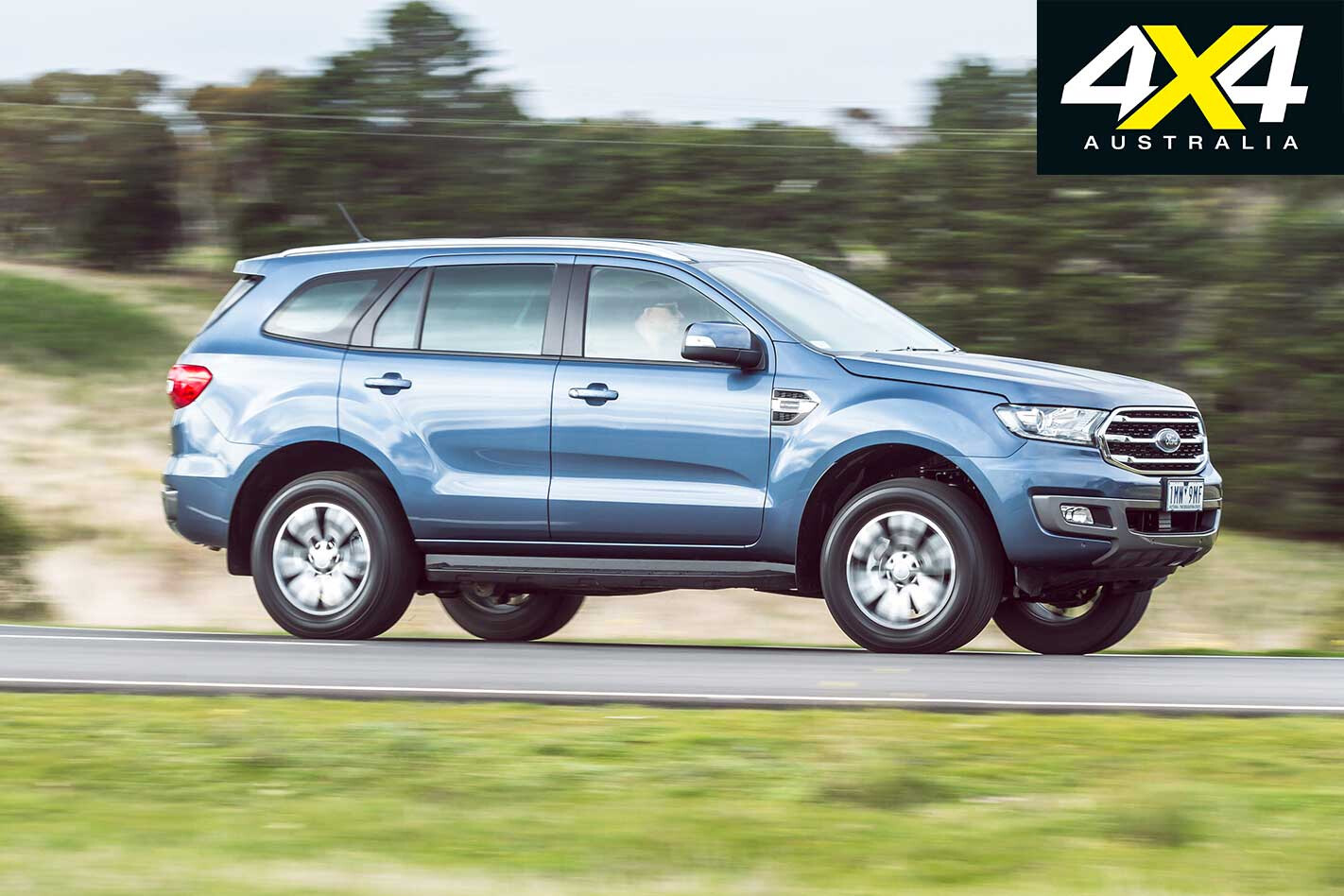
It’s a good thing Ford has given Everest – and soon Ranger – buyers the choice of powertrains, as it is a horses for courses decision and will come down to personal preference as to which one is right for you.
If fuel economy is a concern, then the bi-turbo is for you; it’s smooth, powerful and efficient, and it gives you that extra 100kg of towing capacity. However, if you prefer the relaxed nature of the relatively big 3.2, then there’s no real loss in sticking with it.
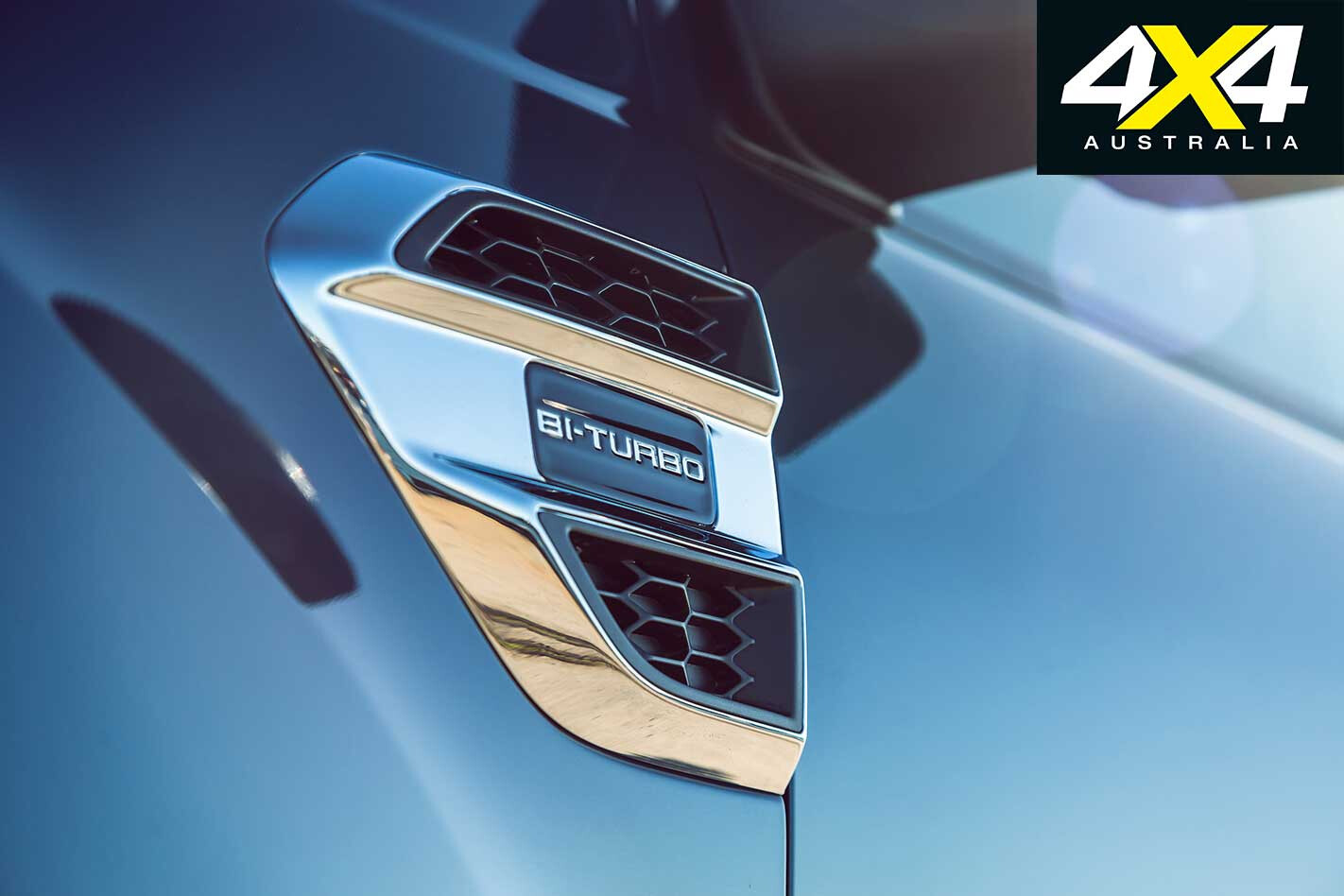
In a market where engines are getting smaller in capacity, Ford and Mazda have enjoyed an edge over their (mainly) sub-three-litre four-cylinder competitors with the grunty 3.2-litre donk. And, even though the bi-turbo 2.0 represents the latest in tech and efficiency, many buyers still go by the ‘there’s no substitute for cubic inches’ adage.
Both engines meet EU5 emissions standards and can be upgraded to EU6 when that eventually comes in to effect, but the longevity of the 3.2L will come down to buyer preferences over the coming years.
BUILDING ON A WINNER
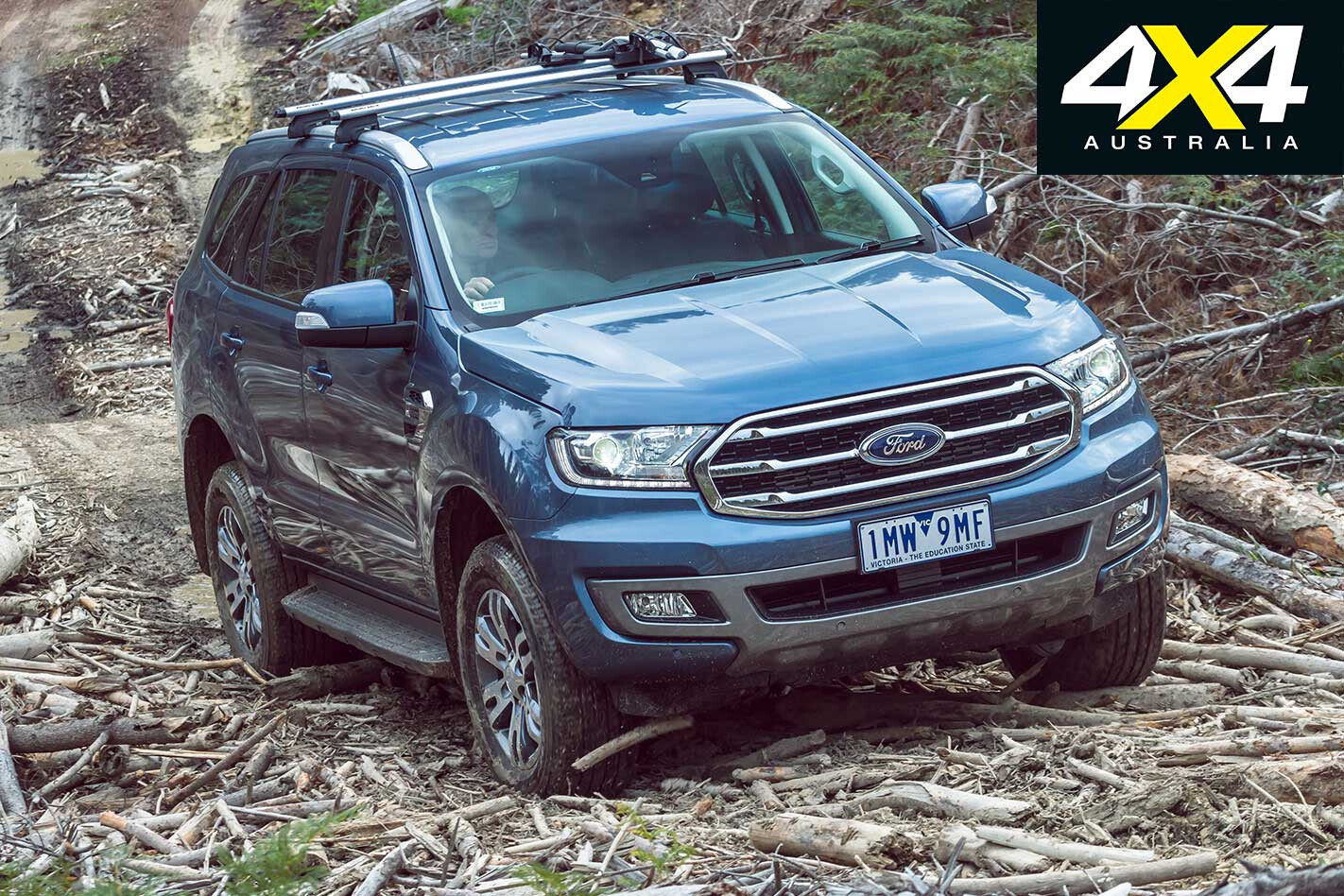
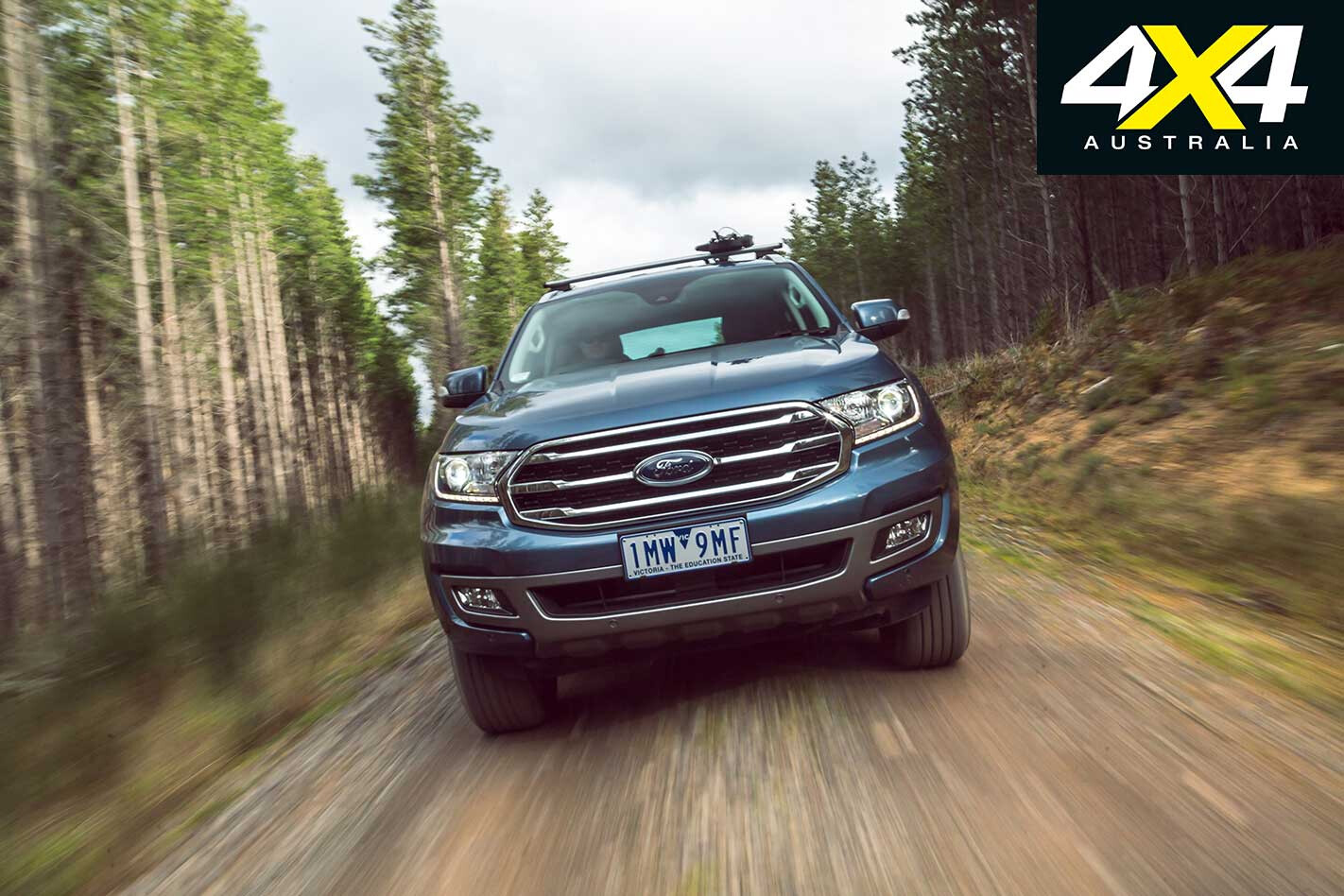
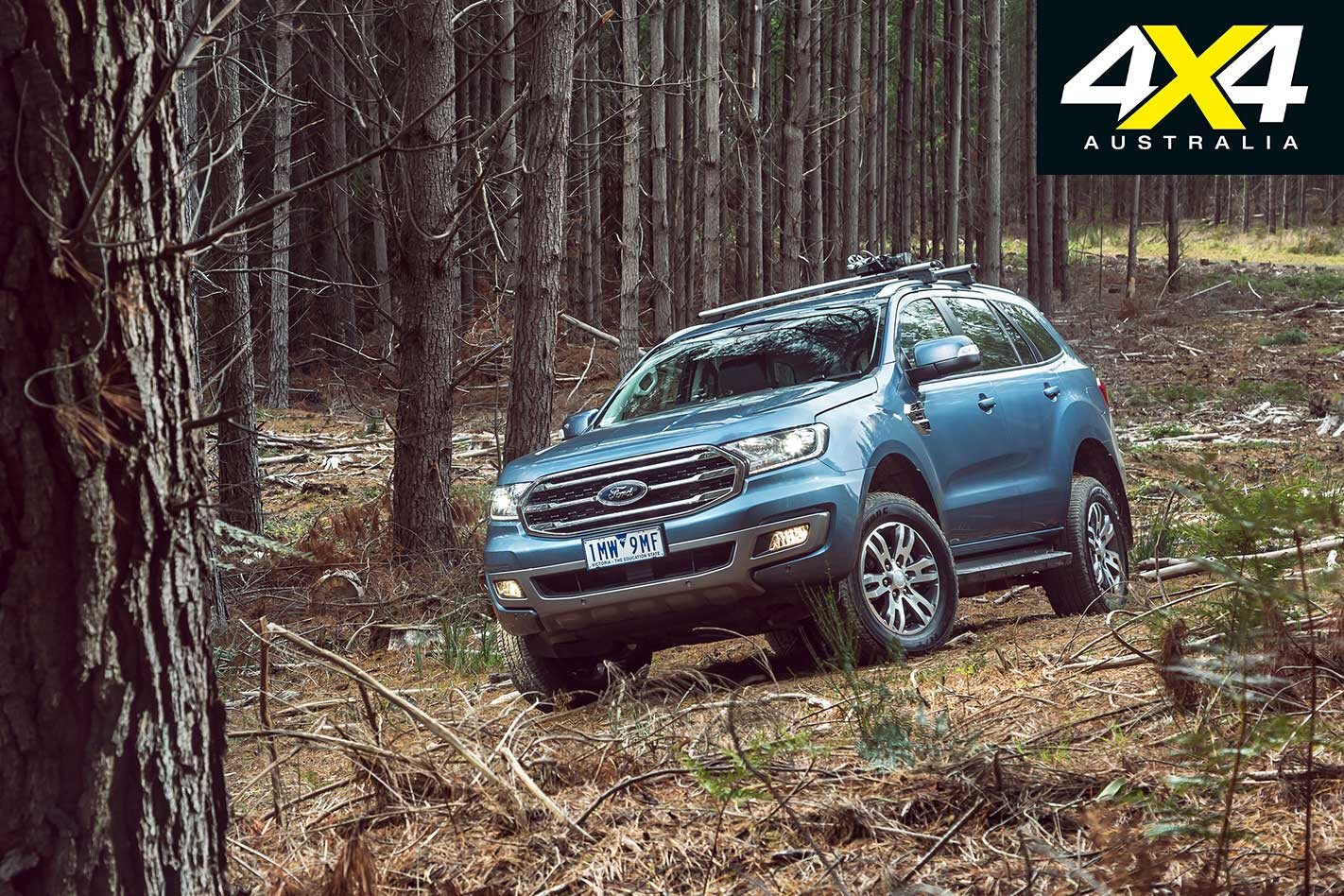
THE FORD Everest was our 4X4 of the Year in 2016 and, aside from the new powertrain option, changes are minimal. The vehicle remains a five-door wagon riding on a ladder frame with a coil-sprung multi-link rear end, IFS and an on-demand 4×4 with low-range transfer case.
One of its strengths was always its on-road and gravel-road dynamics, as it handles better than most of its competitors – namely the Toyota Prado, which is soft and doughy. That handling came at a price, as some testers at the time said the ride quality was too stiff and not as comfortable as it could be.
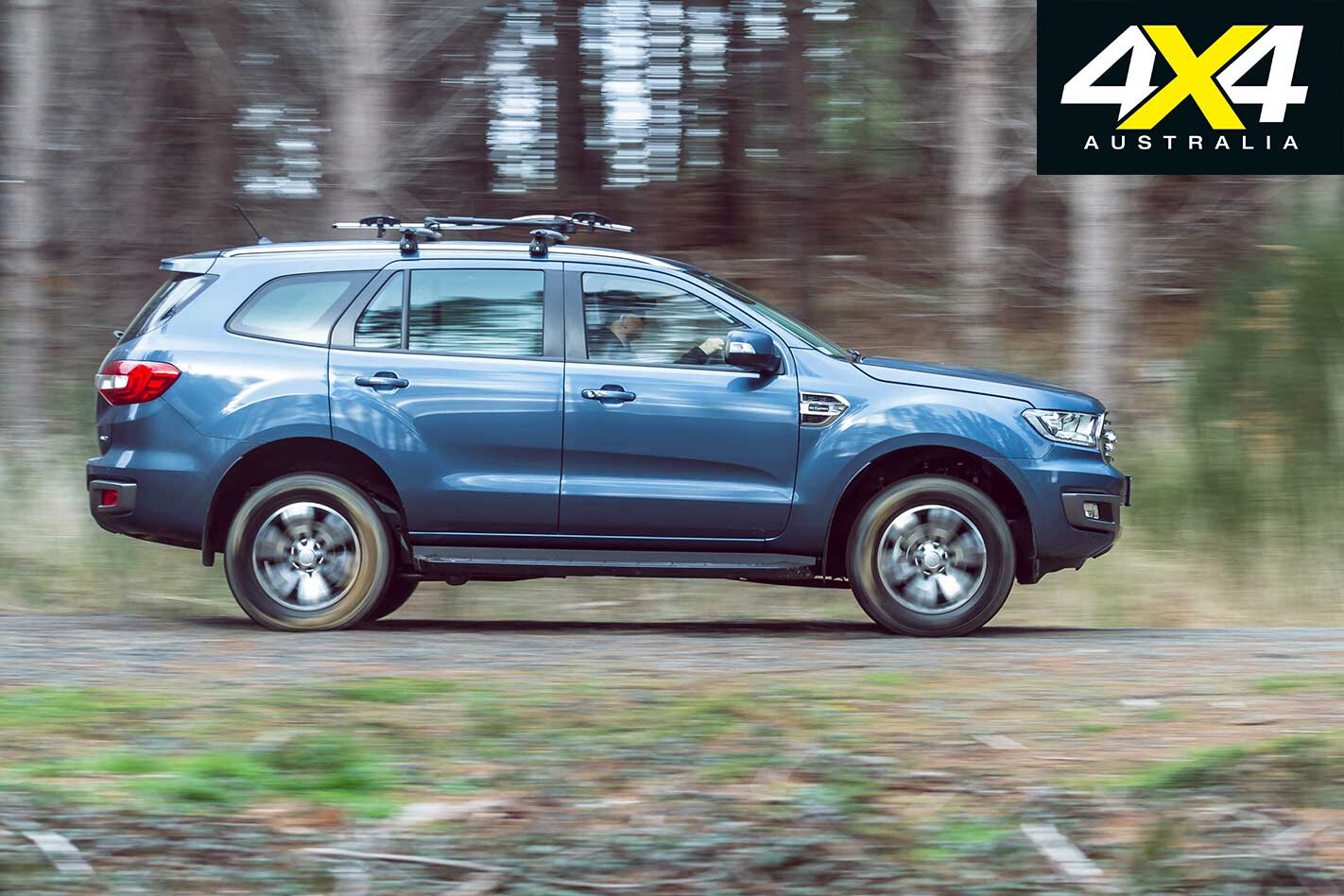
Ford addressed this with changes to the front suspension, where the front anti-sway bar was relocated from ahead of the axle line to behind it. This allowed the fitment of a thicker, stiffer bar to maintain minimal bodyroll, while Ford also reduced the spring rate of the coils to improve the ride. The changes worked, as the Everest maintains its relatively strong handling characteristics with smooth ride and comfort.
The suspension changes don’t affect the live rear axle which still offers a decent amount of wheel travel to keep tyres on the ground when off-road. Its off-road ability isn’t compromised at all, as the well-calibrated electronic traction control works very well and remains active when the standard rear diff lock is in use.
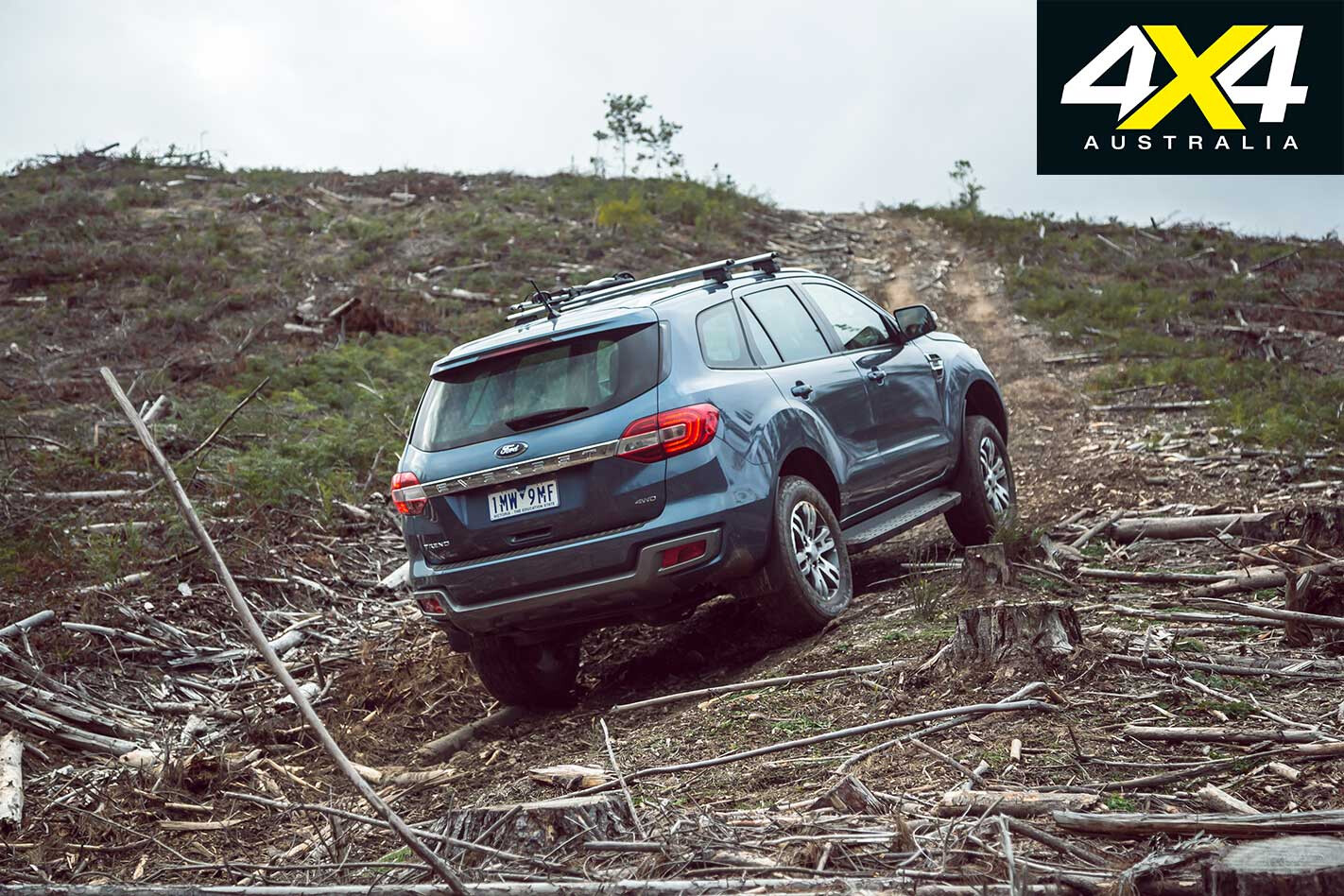
Multi Terrain Selector also remains standard and controls the amount to drive distributed between the front and rear axles, depending on the mode selected as well as other electronic chassis settings. Ford quotes the Everest’s wading depth at a deep 800mm.
Externally the 2019 Everest is differentiated by a new grille and front bumper, with reworked trim on the tailgate which is different depending on the model grade. The first thing drivers will notice on the inside is the keyless entry and start button, while darker trims prevail.
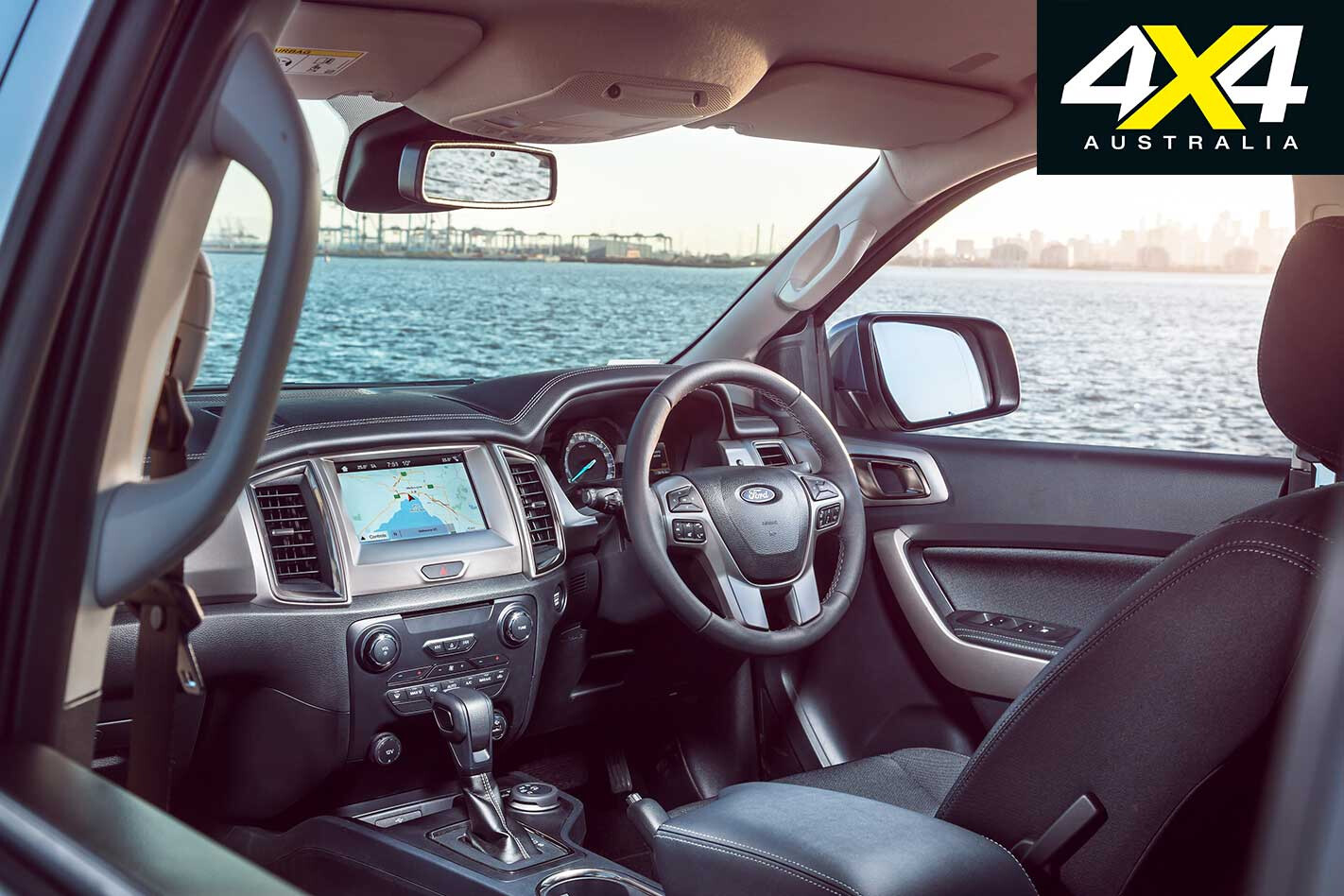
Buyers of the Everest Trend will appreciate the standard inclusion of leather seats, with power adjustment of the driver’s pew. A couple of past criticisms remain inside including the lack of reach adjustment on the steering column and the visibility and functionality of the HVAC controls, which are in a dark hole down low in the centre stack.
Ford has added to the Everest’s already impressive suite of safety technologies with Autonomous Emergency Braking (AEB), which can bring the vehicle to a complete stop if an imminent end-to-end collision is detected. This is standard on both Trend and Titanium models but not available on Ambiente, not even as an option.
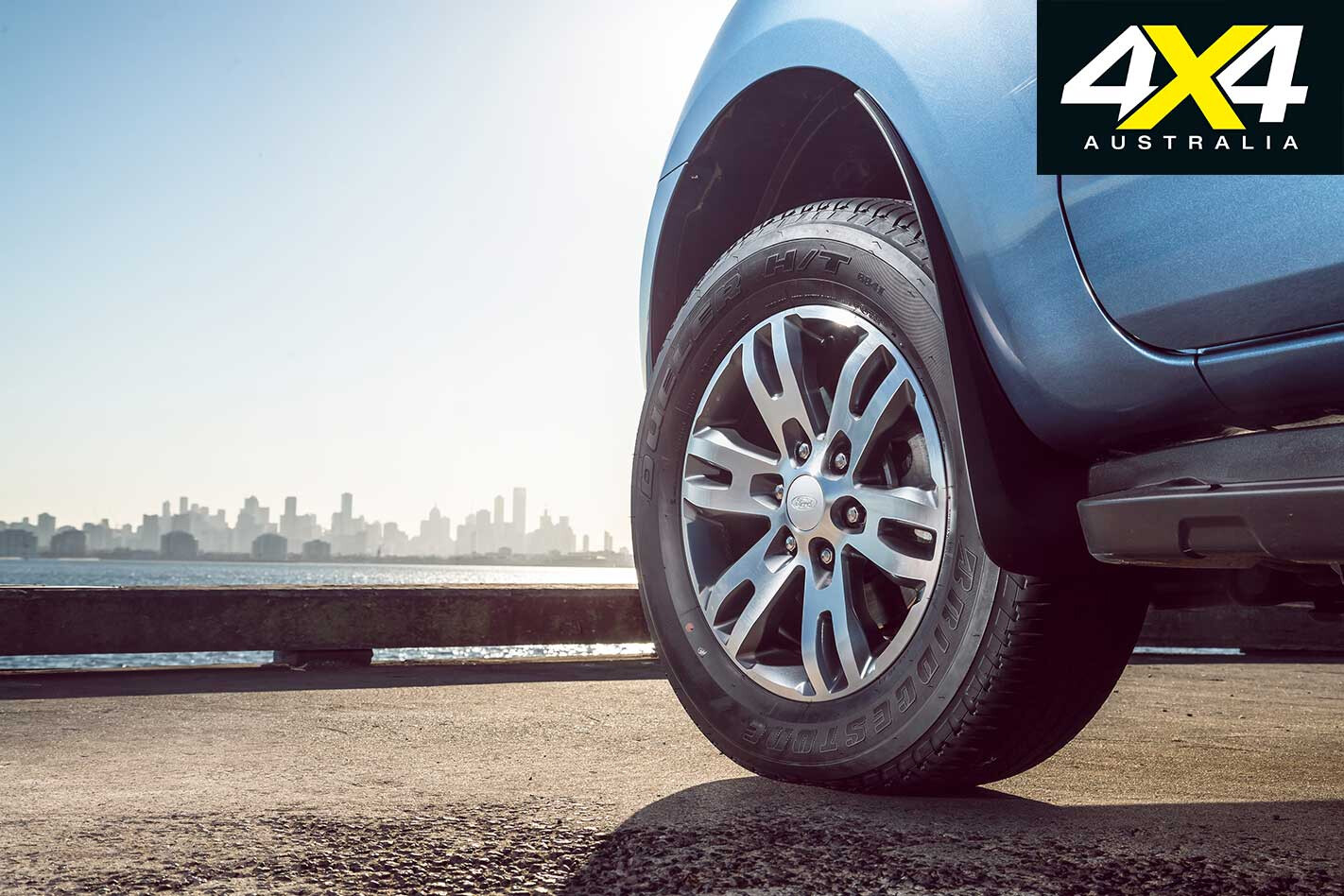
An option buyers of the Everest Titanium who like to use gravel roads will appreciate is the ability to replace the standard 20-inch wheels with 18s, unlocking more tyre options for added durability and improved ride quality on rough tracks and roads. This no-cost option includes changes to suspension components to suit the smaller diameter wheels (as used on the Everest Trend) and is not simply a different set of rims and rubber.
The Everest range continues to be offered with three grades – Ambiente, Trend and Titanium – a choice of two-wheel drive and 4×4, and five- and seven-seat options. Pricing starts at less than $50K for the five-seat RWD Ambiente with the 3.2L engine, and goes up to $73,990 for the top-of-the range bi-turbo-powered Everest Titanium. All Ford Australia vehicles now enjoy a five-year, unlimited-kilometre warranty.
2019 FORD EVEREST RANGE AND PRICES
| Grade | Drive | Engine | Transmission | Seating | Price |
| Ambiente | RWD | 3.2L | 6AT | Five | $49,190 |
| Ambiente | RWD | 3.2L | 6AT | Seven | $50,190 |
| Ambiente | 4WD | 3.2L | 6AT | Five | $54,190 |
| Ambiente | 4WD | 3.2L | 6AT | Seven | $55,190 |
| Trend | RWD | 2L Bi-Turbo | 10AT | Seven | $56,190 |
| Trend | 4WD | 3.2L | 6AT | Seven | $59,990 |
| Trend | 4WD | 2L Bi-Turbo | 10AT | Seven | $61,190 |
| Titanium | 4WD | 2L Bi-Turbo | 10AT | Seven | $73,990 (incl. LCT) |
2019 FORD EVEREST TREND SPECS
Engine: 1996cc bi-turbo-diesel Max power: 157kW @ 3750rpm Max torque: 500Nm @ 1750-2000rpm Gearbox: 10-speed auto Crawl ratio: 42.2:1 4×4 system: On demand with low range and MTS Construction: 5-door wagon on ladder chassis Front suspension: Coil spring IFS Rear suspension: Coil spring multi-link live-axle with Watts link Wheels/tyres: 18×8.0-inch alloy with 265/60R18 tyres Kerb weight: 2413kg GVM: 3100kg Payload: 687kg Towing capacity: 3100kg (braked) GCM: 5900kg Seating capacity: 7 Fuel tank capacity: 80L ADR fuel consumption*: 7.1L/100km *Australian Design Rule ‘Combined-Cycle’ claim
MORE: Ford Everest Range Review MORE: Ford Everest Specs, Range & Price
IT’S BEEN a busy few months for the mobile gold brick, with a couple of big drives down to the NSW far south coast, as well as a slightly closer amble to Fraser Stronach’s stomping grounds in the NSW southern highlands.
Lots of on-road kays has seen impressively low fuel-consumption; I even managed 1100km out of one tank (the Disco has a 95L jobbie) on a return haul to Tathra and back to Sydney via freeway/highway routes… and still no oil leaks.
The modification process has been lengthy, but that’s been my fault as I do way too much research and ask way too many questions before fitting anything to the Disco. Plus, my budget ain’t huge, so every accessory fitted has to offer plenty of bang for bucks.
One thing that’s been on the top of my accessory list is a Dual Battery Management System (DBMS). For anyone considering a camping trip of longer than a weekend, an ice-filled Esky simply won’t cut it when it comes to keeping food and drinks fresh and cold. A fridge/freezer is the only way to go, and it (and any other power-dependent accessories) needs power, hence the need for an auxiliary battery.
Piranha Off Road has been producing top-notch 4×4 electrical products (and loads of other gear) for more than 30 years, with owner Al Johnson and his team highly regarded when it comes to products that work exceptionally well – a direct result of Al’s passion and his many decades of off-road touring experience, where he gets to see equipment working ‘in the field’.
Al suggested the DBE140SF dual battery management system for a number of reasons. “That particular unit is designed and manufactured right here in Australia” he said. “It has a 140amp input capacity, which effectively means you can run up to a 140amp alternator, which will suit most 4WDs. The DBE140SF allows the use of the surplus capacity of the alternator, which can be up to 40 amps or more.”
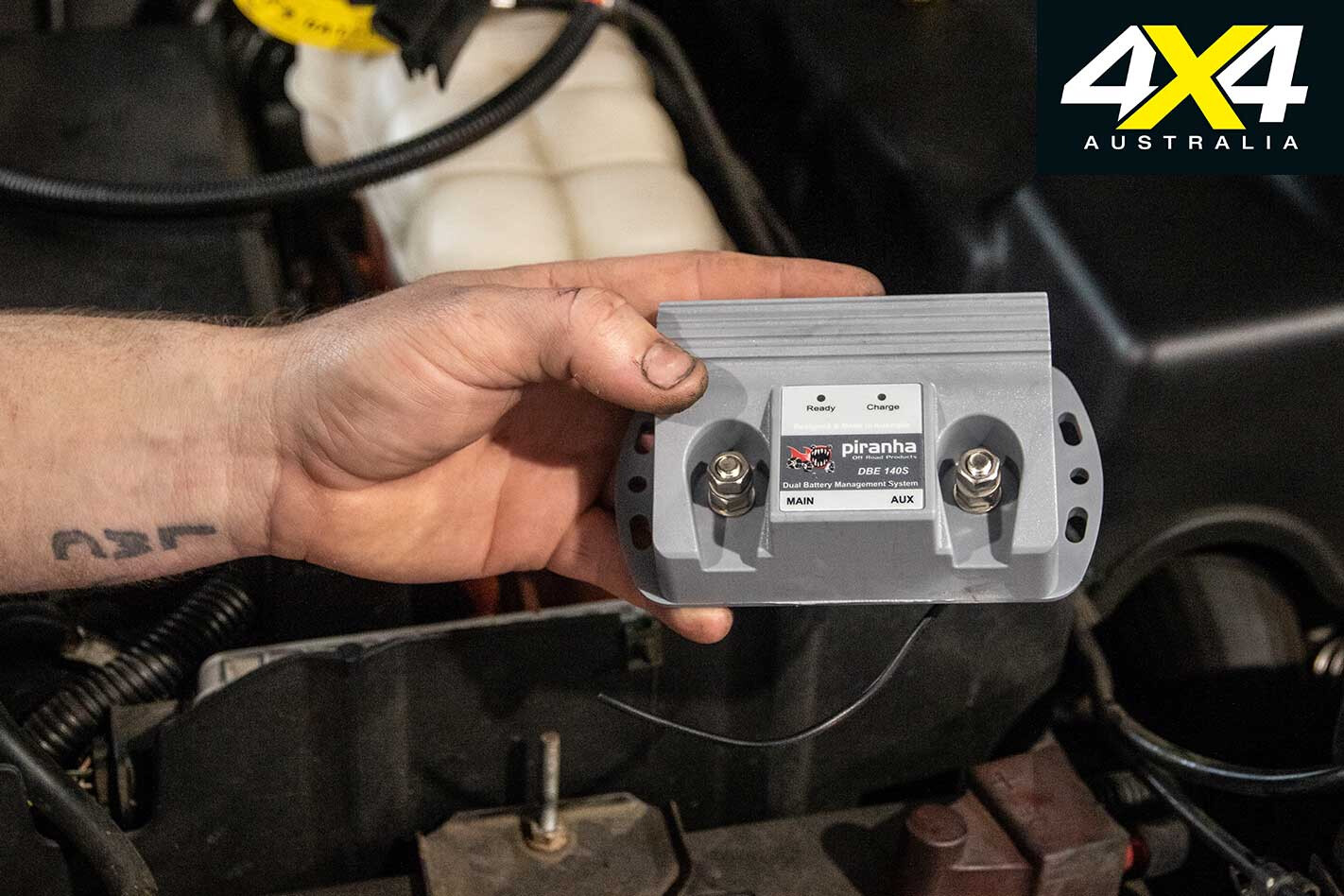
Al highlighted the fact the unit is controlled by a micro-processor that protects the starting battery from the auxiliary unit, as well as any accessories powered by it.
“That unit uses spike and surge protection, therefore it protects any electronics on the car that are connected to that unit or are connected to that circuit, which is really important because people are now using things like iPads and GPS navigation,” he said. “The stereo system is more than just a radio now; it’s a whole interface thing that works with your mobile phone, so protecting the car from surges and spikes is very important.”
There’s also a safety aspect to the choice of unit. “It has current-limiting built into it, as well as a separate fuse,” Al elaborated. “So, in terms of safety, if ever there was a motor accident or something happened, you’ve got two ways that it will turn itself off. It will shut itself off internally, and it’s also got the fuse as a secondary means of protection, so it won’t reset, which is really good.”
Fitment
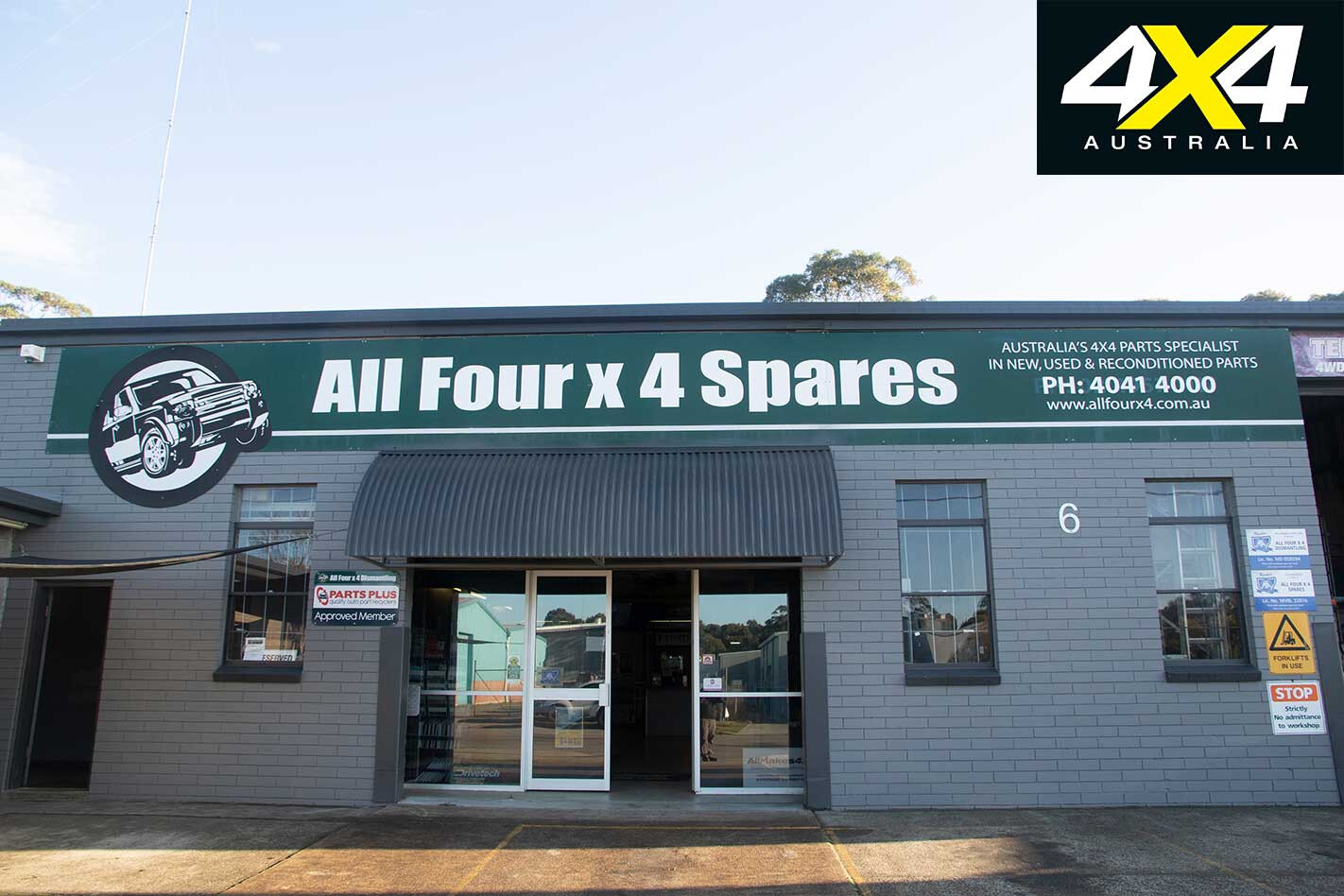
Al had no hesitation in recommending the NSW Piranha Off Road distributor, All Four X 4 Spares, for the fitment of the system. So I left Sydney’s northern beaches at sparrow’s fart one weekday morning for the two-hour jaunt north to Kotara, where I met All Four X 4 Spares’ general manager, Peter Harris.
In a total stroke of good fortune, All Four X 4 Spares is not only a top-notch off-road business that services and fits accessories to all 4x4s, it specialises in Land Rovers.
After a walk around the large premises and seeing what the 64-strong team does (as well as all the servicing and fitment of accessories, All Four X 4 Spares runs a vehicle wrecking and spare parts business) I was introduced to Mick ‘Swanny’ Swan, who would be doing the installation.
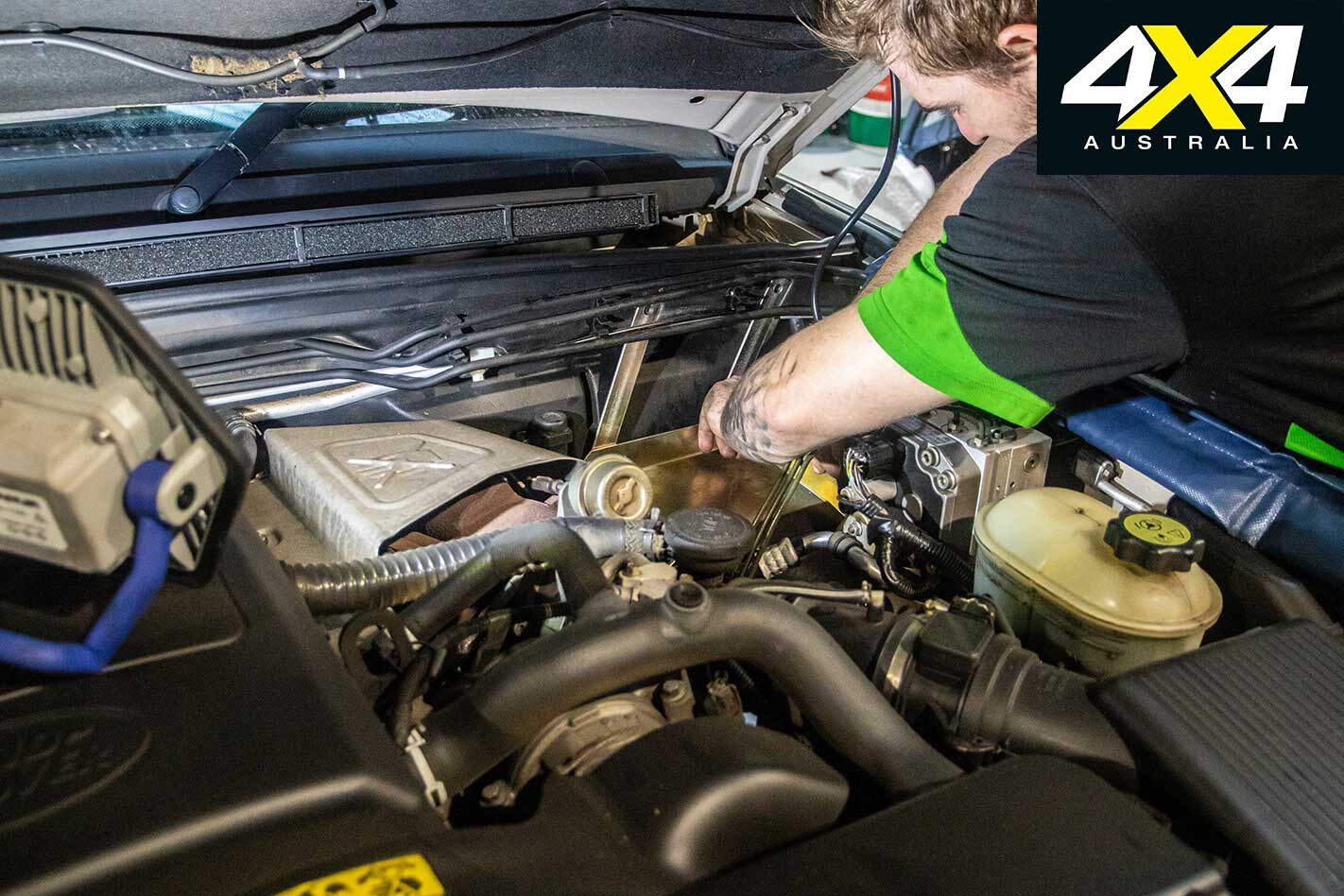
As it happened this would be his first ever Disco 2 DBMS install and, despite the reputation of the Landy’s Lucas electrics, he wasn’t nervous at all, just busting to get stuck into it.
The first task was to fit the included battery tray, which fit snugly into the back of the engine bay. From here it was just a matter of finding a location for the isolator on the other side of the engine bay – midway along and roughly halfway between the starting battery and auxiliary – and then drilling the holes for fitment.
The isolator runs two LED lights on it, which allows you to check how the system is going, with different light and flashing sequences denoting the main battery charge. The lights denote when/whether it is charging the auxiliary, whether it has less than 12.8V, if the auxiliary is overloaded (in which case the isolator disconnects the auxiliary and only reconnects when safe), over-voltage warning, and any fault within the vehicle electrics. Yep, it’s bloody smart.
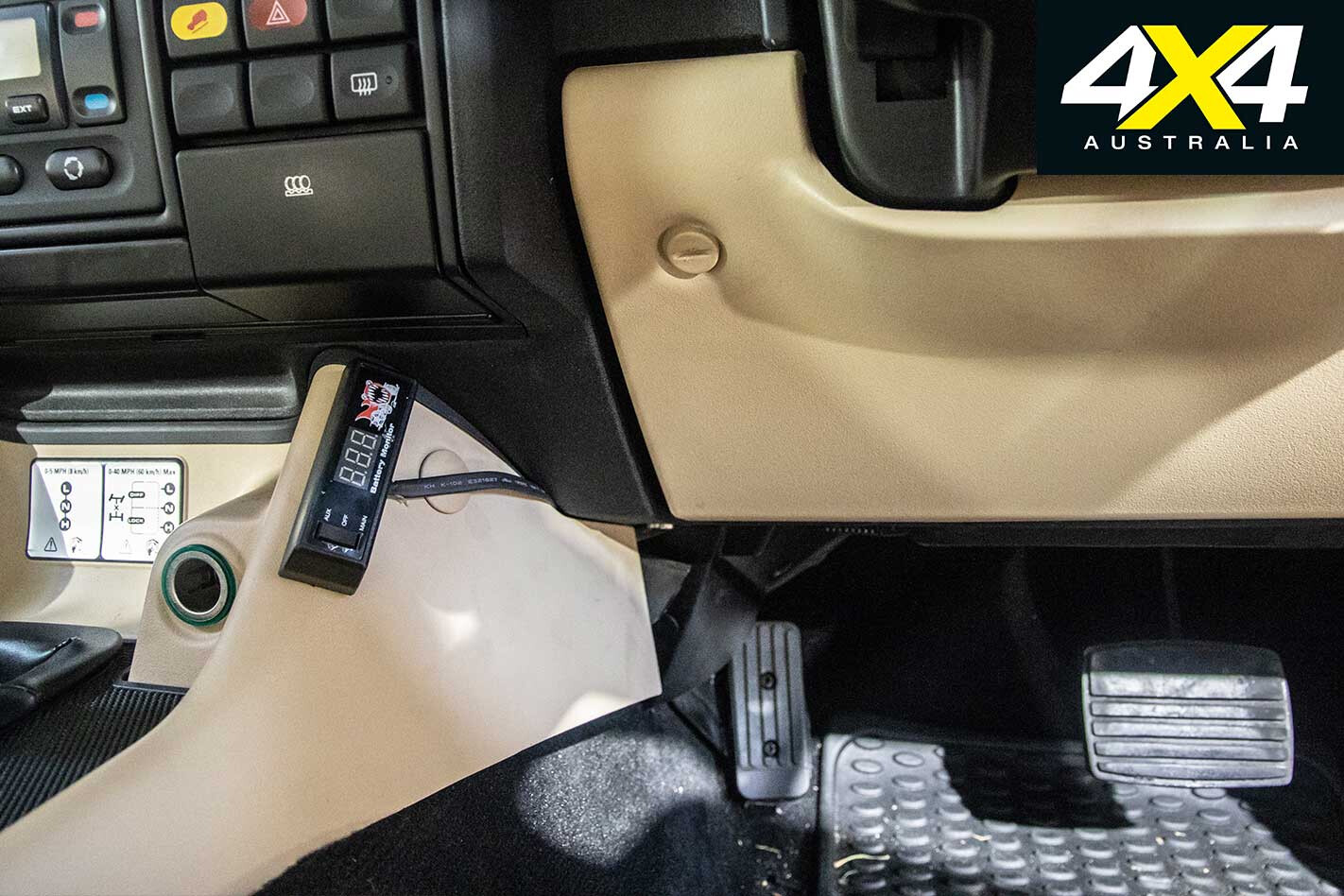
If that’s not enough, Swanny fitted a DBM3D in-cabin monitor down beside the centre console, so I can keep an eye on battery levels. The isolator itself is tough, thanks to its ABS nylon casing and, cleverly, recessed terminals – an example of smart and practical design.
“The terminals are recessed on the front of it,” Al explained. “So if anybody ever drops a spanner across it, it is unlikely to short anything out. Many products on the market have exposed terminals, which means if mechanics are working on the car, drop a spanner or drop a screwdriver – bang – there’s a big flash and you blow everything up.”
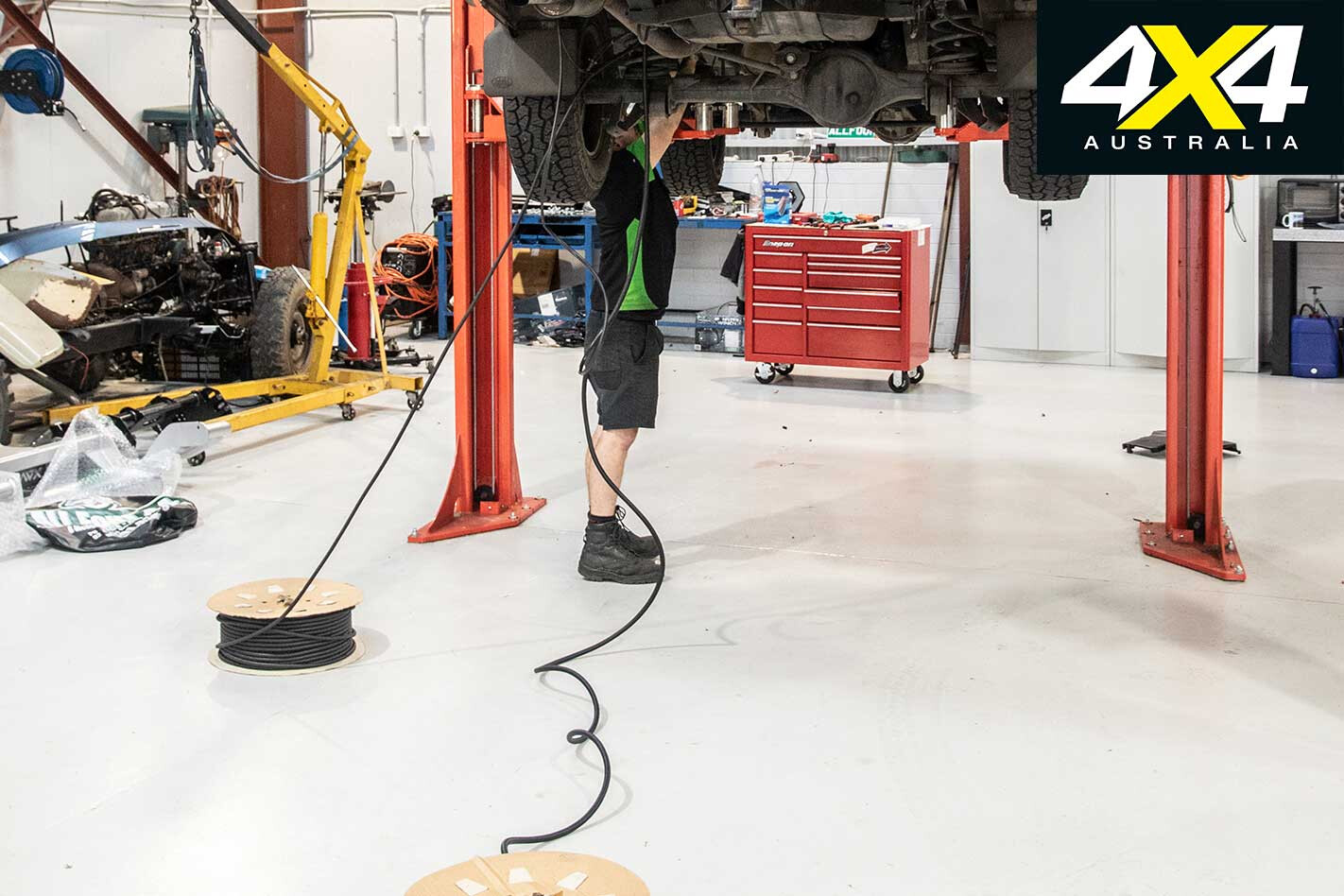
With plans to run a fridge/freezer, and keen on charge points when camping, the next step was to route cabling from the auxiliary back to the rear cargo area. Swanny’s first minor problem was deciding whether to run the cable inside the vehicle beneath the trim, or along the Disco’s chunky chassis rails.
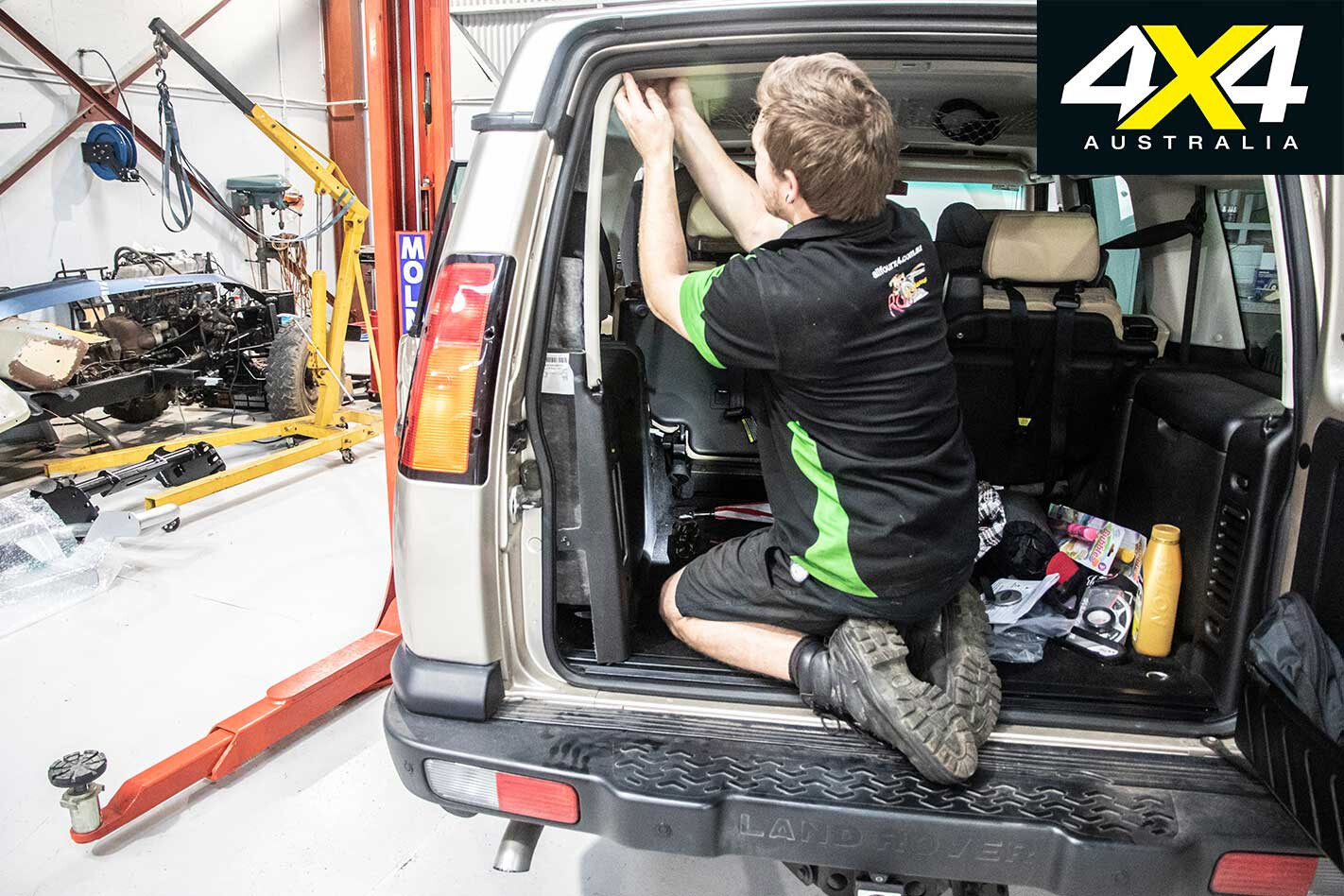
The chassis won out in the end, as there were cables/wires already running along there, and the final routing point ran back up through the floor of the cargo area.
I was a bit nervous when all the cargo area interior trim was pulled apart for access, but he did a sterling job getting it all back together. As well as a cool 12V and twin-USB charge point at the rear, Mick also ran an Anderson lead through to the rear – again, neatly finished – for direct connection to the fridge/freezer (I scored my old man’s ARB 40-litre unit) once it is fitted. I was impressed by the thick gauge of cabling used, which is chosen for use during the install for a very good reason.
“Because they (the cables used on these isolators) are running in a four-wheel drive, it is double-insulated cable,” says Al. “So it’s not just an ordinary one layer of insulation and conductor on the inside; there are two layers of insulation.”
Along with the cable, Piranha Off Road uses a fuse box with standard fuse blades; another example of Al and the team knowing what works in the bush – and how to minimise the chances of a delay in your trip, or worse, a complete stop to it.
“We use a special fuse box that uses standard blade fuses,” Al elaborated. “We don’t use glass fuses; we use the standard automotive fuse you can buy anywhere in Australia, which is really important because if you do have a problem with a fuse blowing there’s nothing worse than thinking ‘Shit, I have got to put a screwdriver in there, or a nail’. We’ve got the right size fuses and they’re commonly available.”
The Piranha Off Road system also runs an individual fuse for each line, which means that if the unfortunate happens when you’re out in the bush, it is far easier to diagnose the problem.
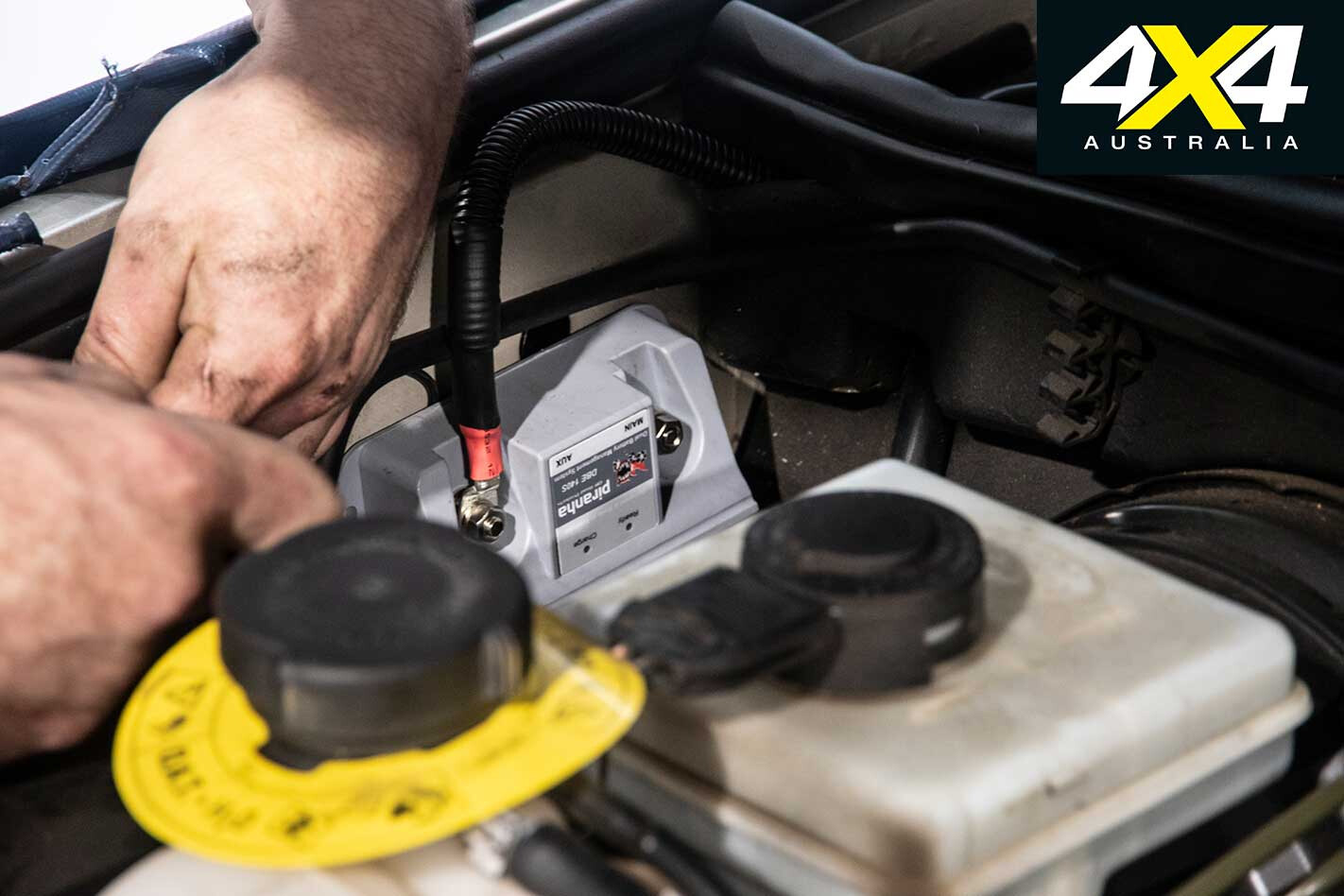
Fitting the DBMS to the Discovery was a big job – close to 10 hours by the time I bid Peter, Swanny and the rest of the All Four X 4 Spares team goodbye and pointed the Disco south to Sydney – but a fantastic one, with all cabling neat and the in-cabin monitor keeping me up-to-date all the way home.
Look for a long-term update on the Piranha Off Road DBE140SF in a future issue of 4X4 Australia.
4×4 Shed Log: 2003 Land Rover Discovery TD5 Current mileage: 140240km Date acquired: Apr 2016 Price: $15,000 Mileage this month: 1300km Average fuel consumption: 9.8L/100km