
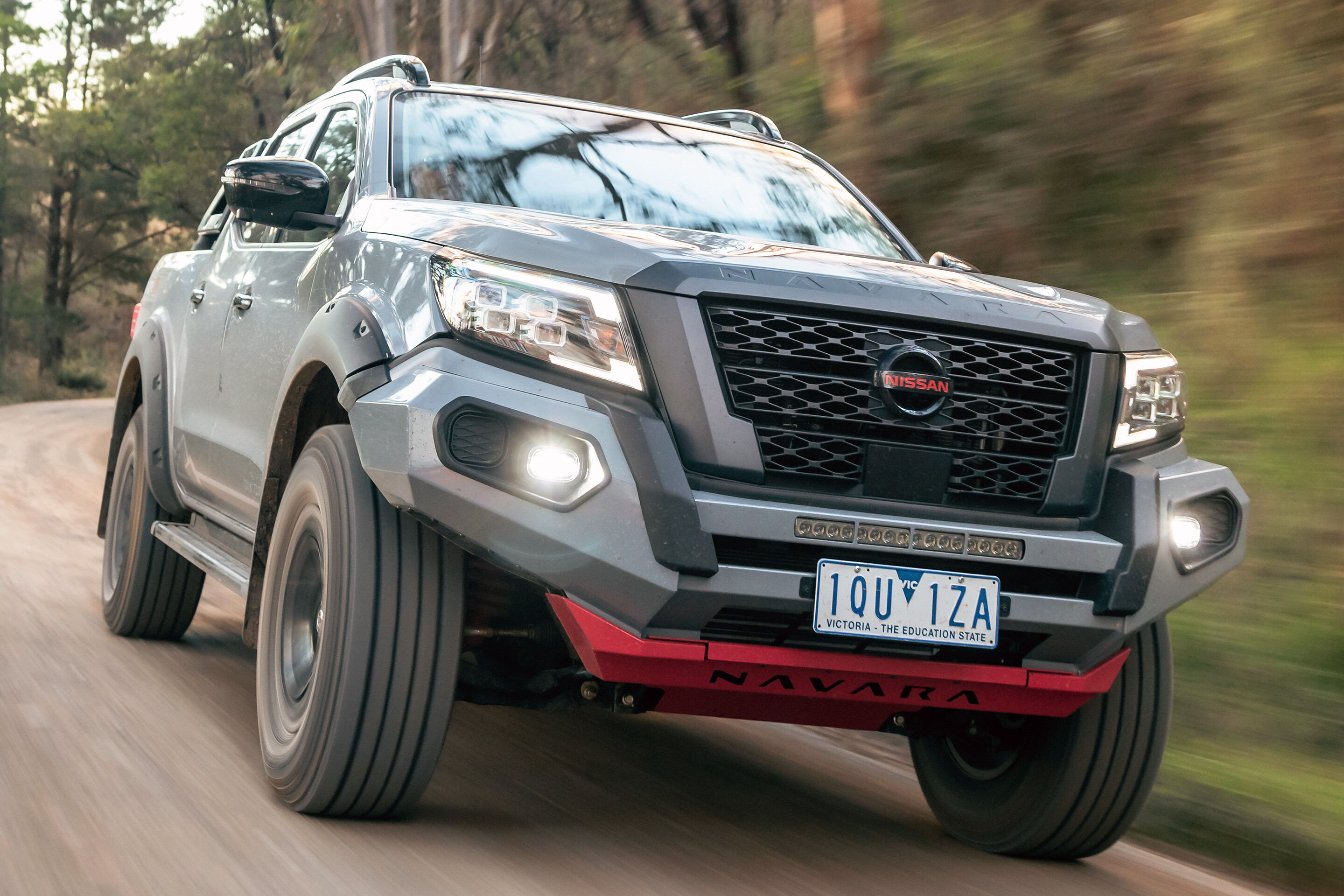
Nissan has pulled the wraps off its latest Navara Warrior, now known as the Navara PRO-4X Warrior by Premcar; recognising the Melbourne engineering house that has applied the tweaks to make – what it claims is – the world’s toughest Navara.
Significantly, the new Warrior is based on the freshly muscled-up Navara PRO-4X variant with its bold, new look and high level of standard features.
“We’re taking all the key improvements made by Nissan on the Navara PRO-4X, like its impressive NVH levels, steering quality, extensive safety equipment and core dual-cab functionality, and we’re overlaying those updates with our own in-house engineering expertise to create the toughest and most capable Navara in the world,” says Premcar engineering director, Bernie Quinn.
“We’ve taken everything we learned on the first Warrior, and the feedback we’ve received from customers and the media, to create a tough, capable and refined vehicle that we think will be unrivalled in the dual-cab ute market in this country.”
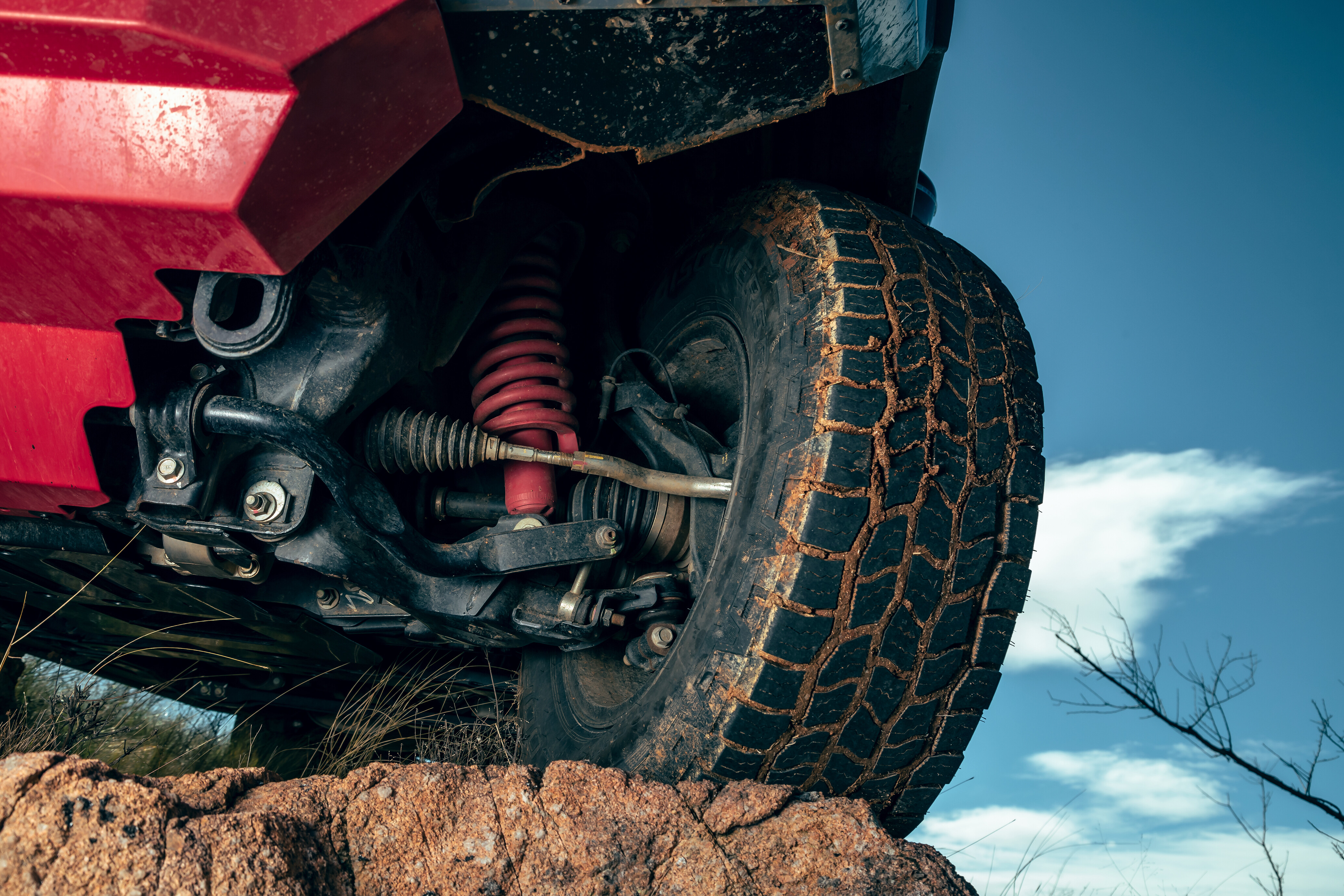
The previous N-Trek Warrior was by far the best handling and off-road suitable D23 Navara, thanks to its Premcar-specified suspension tune. With increased ride height and softer settings, the N-Trek Warrior rode like no other Navara and was better sorted than any ‘standard’ model. While no specifics of the new PRO-4X Warrior have been given, we expect the latest Premcar suspension to be every bit as good, if not better.
Familiar parts from the previous model include the Cooper all-terrain tyres and Warrior-specific alloy wheels. The new front bumper looks a lot like the latest Nissan factory bar for Navara, which means it should also be winch-compatible, something the N-Trek Warrior’s bar was not. The integrated LED light bar will be a useful addition to the PRO-4X’s standard LED headlights.
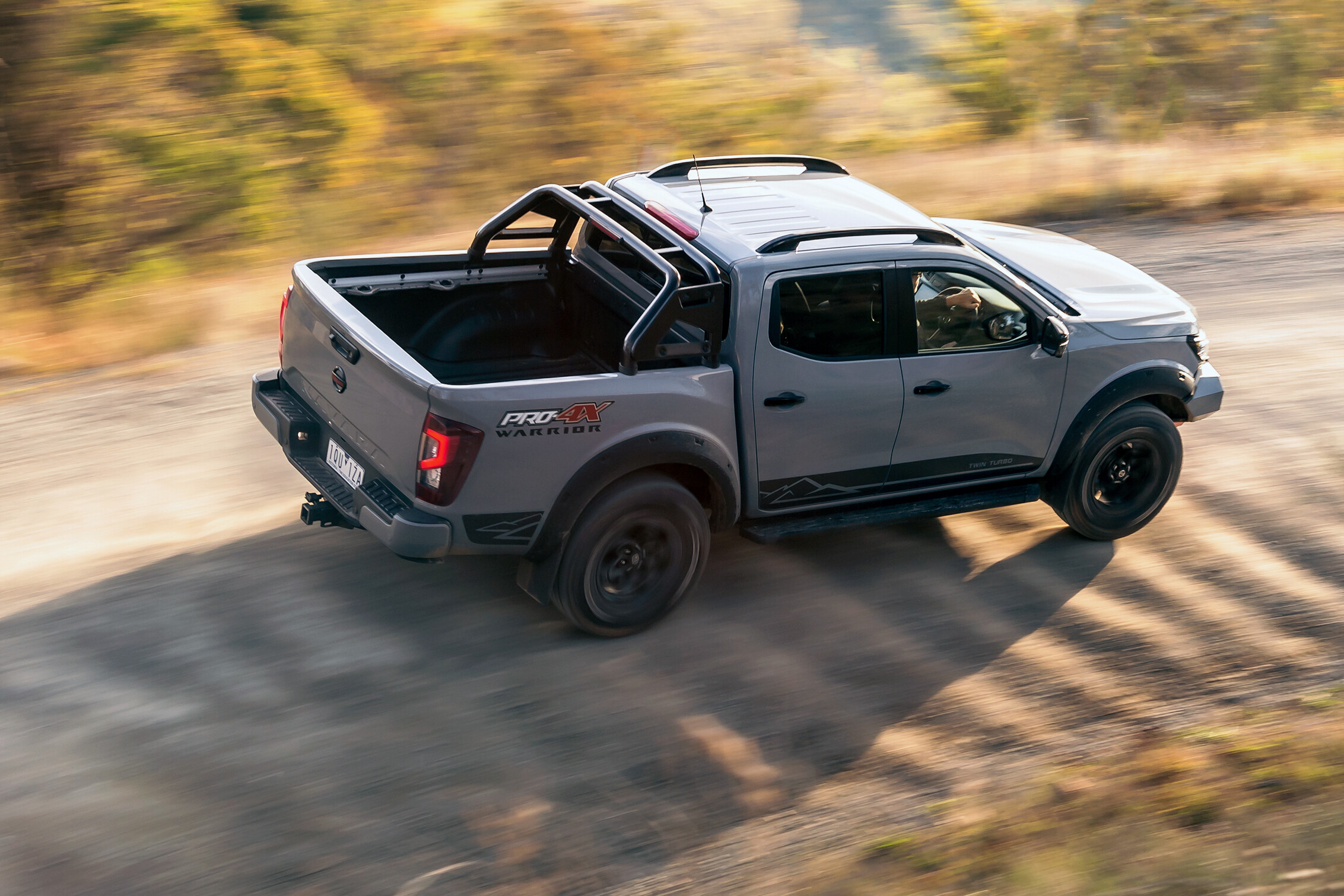
Motivation for the PRO-4X Warrior is expected to come from the donor model’s standard 140kW/450Nm bi-turbo 2.3L diesel engine backed by a seven-speed automatic transmission. Nissan offered a six-speed manual in the N-Trek Warrior and we hope that choice is continued with the PRO-4X.
The Navara PRO-4X Warrior is expected to go on sale in Q3 this year.
Nissan’s 2022 Australian line-up is coming together
If you have been paying attention, and I’m sure some of you do, you would have seen a report that Toyota Australia’s sales and marketing supremo Sean Hanley has issued a word of caution regarding the push for the faster take-up of electric vehicles.
Hanley’s words were a rare, sensible and reasoned voice in a discussion that’s often far from sensible or reasoned.
See, the trouble is, EVs aren’t just a new automotive technology – they also represent an ideology that says cutting carbon emissions, and hopefully limiting climate change, is the most important thing on mankind’s agenda right now. And when it comes to ideological debate, the subtle detail is almost always lost.
Among other things, Hanley points out that if you charge electric vehicles off an electricity grid that relies in any part on fossil fuels (coal and gas) then all you’re doing is transferring the carbon emissions away from the car’s tailpipe to a fossil-fuel power station, a fact seemingly overlooked by the EV ideologues.
Hanley notes that even by 2040, more than half of the world’s electricity is expected to be generated by fossil fuels. Right now in Australia, the percentage is closer to 80 per cent nationally. The only benefit of moving carbon emissions away from the tailpipe to a remote power station is that the air in built-up areas, where vehicle use is concentrated, will become cleaner.
To fully close the environmental loop with EVs, we need a grid powered 100 per cent by renewables. Or you bypass the grid by charging EVs off home solar panels, or via solar-panel or wind-powered public charging points.
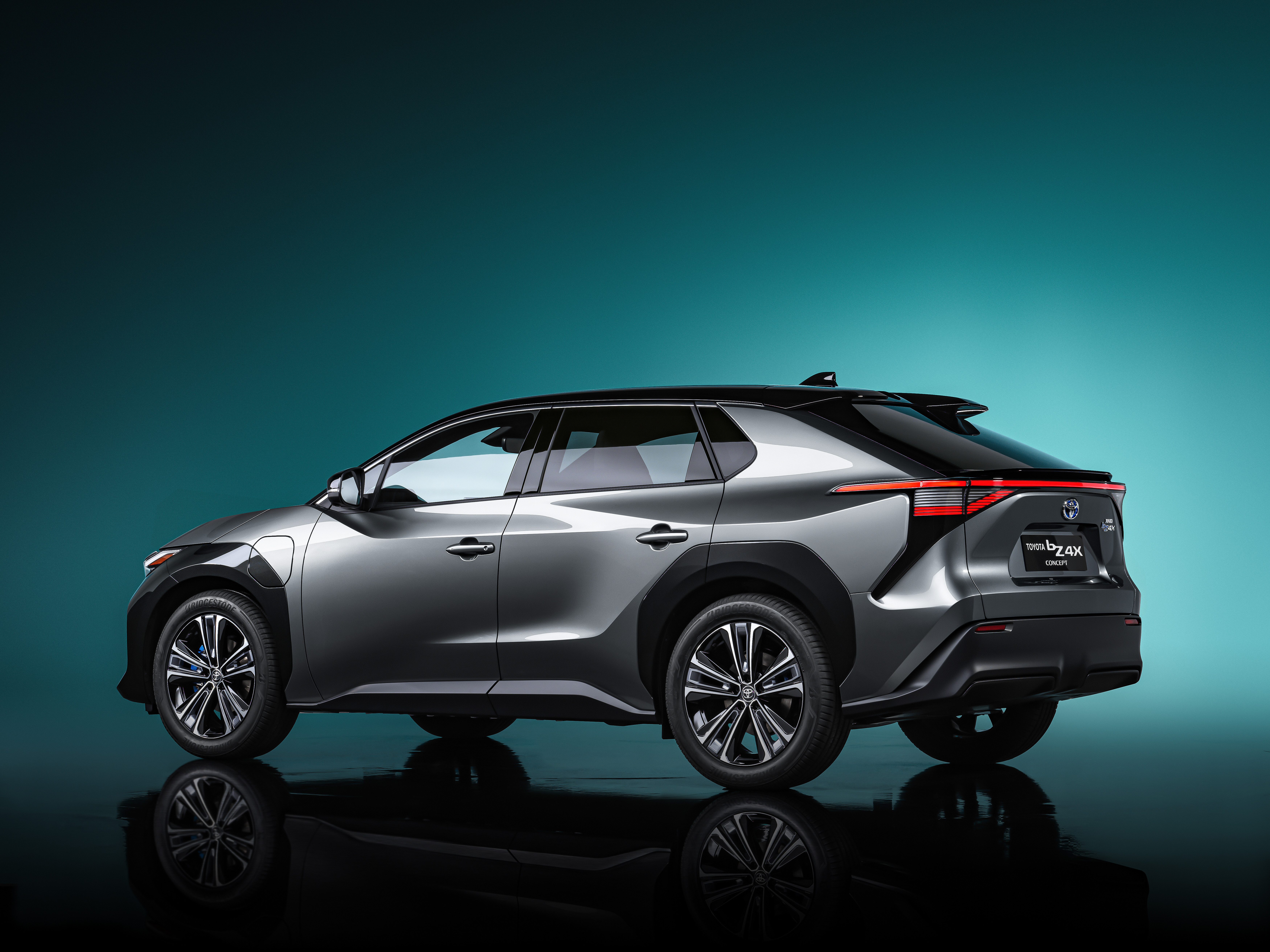
It should be noted that Hanley’s caution comes off the back of Toyota unveiling its first fully battery-electric vehicle, the BZ4X (due 2022) and the background of Toyota making petrol-electric hybrids for the better part of a quarter of a century.

The other problem that the EV protagonists miss, especially those in Australia, is that we simply don’t have sufficient grid power for a rapid and significant take-up of battery EVs.
In fact, if everyone swapped their fossil fuel cars to battery-electric cars tomorrow and charged them off the grid, Australia would need an electricity grid with around twice the power than it has now!
As it is, our national power grid barely copes with current demand at high-load periods.
There’s a huge amount of inertia in the automotive industry and switching from fossil-fuel cars to EVs, either battery or hydrogen fuel cell, requires functional infrastructure to be built. And that will take time.
A recent study in California, where EV take-up is far greater than in Australia, showed that nearly 20 per cent of EV buyers want to go back to a fossil fuel car for their next purchase – despite California being well-served by charging stations. The disgruntled EVs owners cited the inconvenience of the public charging infrastructure and the fact they didn’t have a suitable charging facility at home.
The lesson here for public EV charging is that charging stations set up like conventional fuel stations will only work if you can charge your EV in a similar time that it takes to fill the fuel tank of a petrol or diesel car, and that isn’t going to happen any time soon.
EV charging points need to be at places where you are going to park and leave your car anyway; at home, at parking stations, at office car parks, at shopping centres, and so on. Then the slow charging time isn’t an issue.
Unfortunately, all this will take clear forward planning, especially at local and state (and territory) government levels – and that may be too much to ask, going on the previous dud decisions like approving Tesla charging stations where you can only charge a Tesla! Who would approve a conventional fuel station where you can only fill up one make of car? Please…
Making the whole EV take-up even more fraught with problems is the federal government is set to lose up to $12 billion a year in revenue that you and me provide, thanks to the 42.7 cents-per-litre levy we currently pay on petrol and diesel fuel.
So expect to see more of the push-and-shove between the federal government and the state and territory governments, which we have already seen with COVID-19, as we stagger down the inevitable road to EV take-up.
Snapshot
- New bullbar features integrated LED lights and winch compatabillity
- Powered by standard Navara PRO-4X’s twin-turbocharged 2.3-litre diesel engine
- Expected to be released in the coming months
The 2022 Nissan Navara PRO-4X Warrior has been revealed in an image published by automotive engineering company, Premcar.
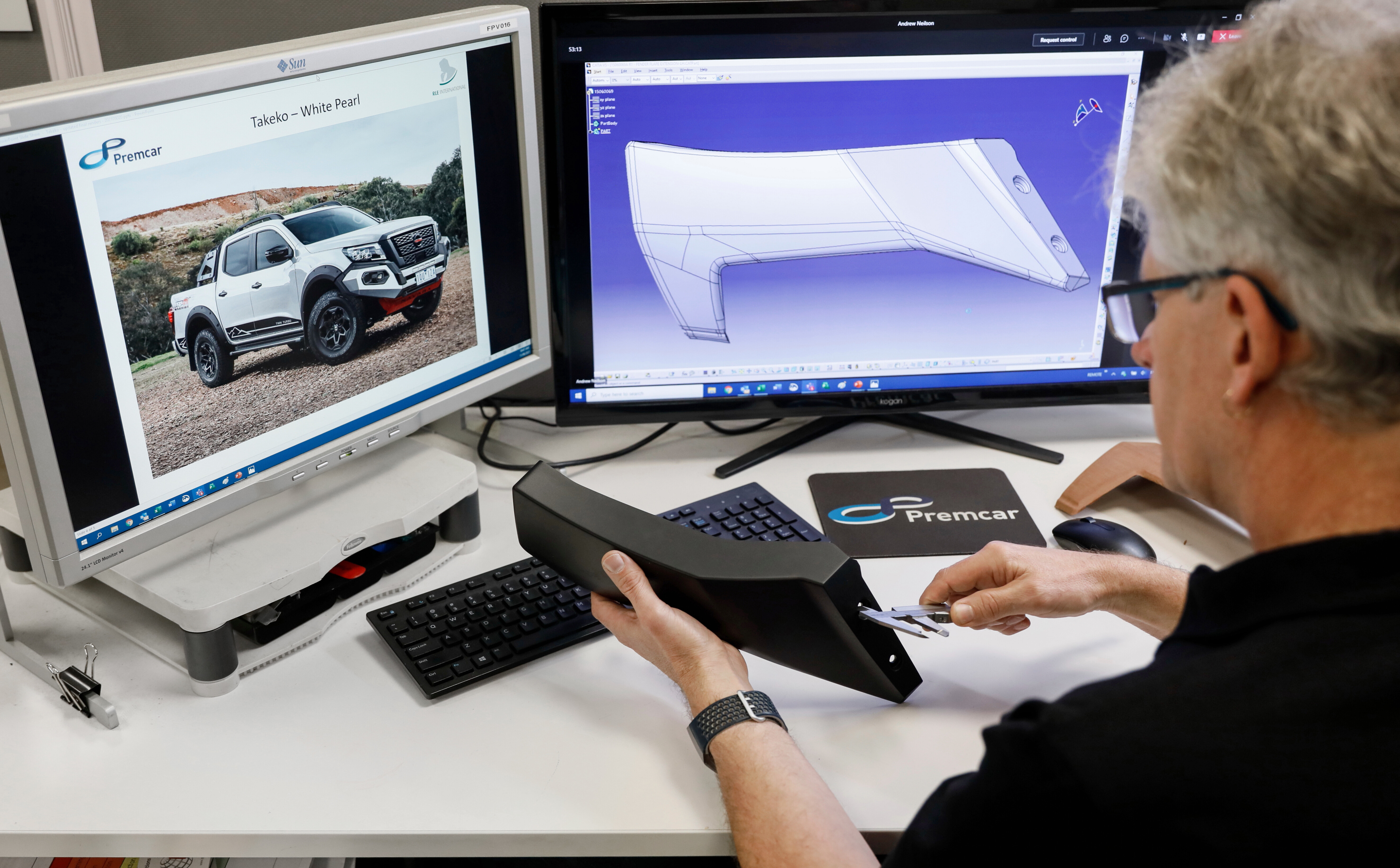
In images released today by the Epping-based firm, Mark Doody, Premcar’s principal engineer of body systems, can be seen at his desk sitting in front of a screen showing a seemingly undisguised image of the all-new off-roader.
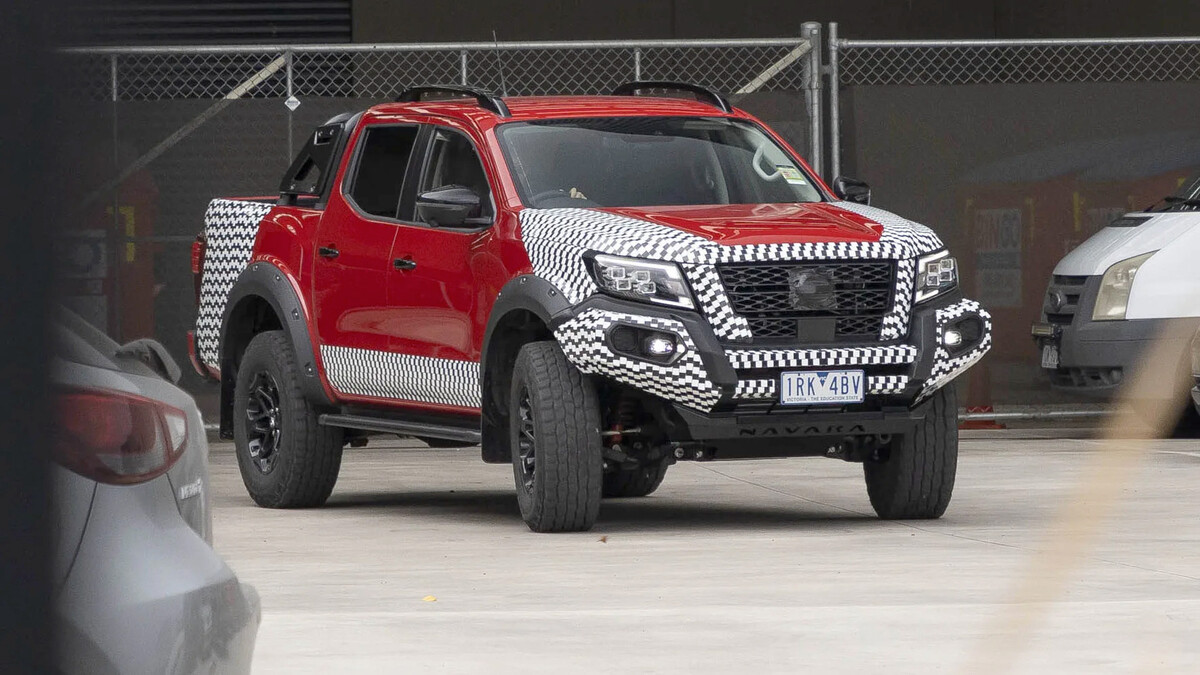
This isn’t the first time we’ve seen the Warrior – the off-roader was spotted in camouflage last month testing on the streets of Melbourne. However, this is the first glimpse of the 4×4 totally unmasked.
With the heading “Takeko – White Pearl”, which indicates one of the PRO-4X Warrior’s four paint schemes, the photo shows off a tough-looking ute.
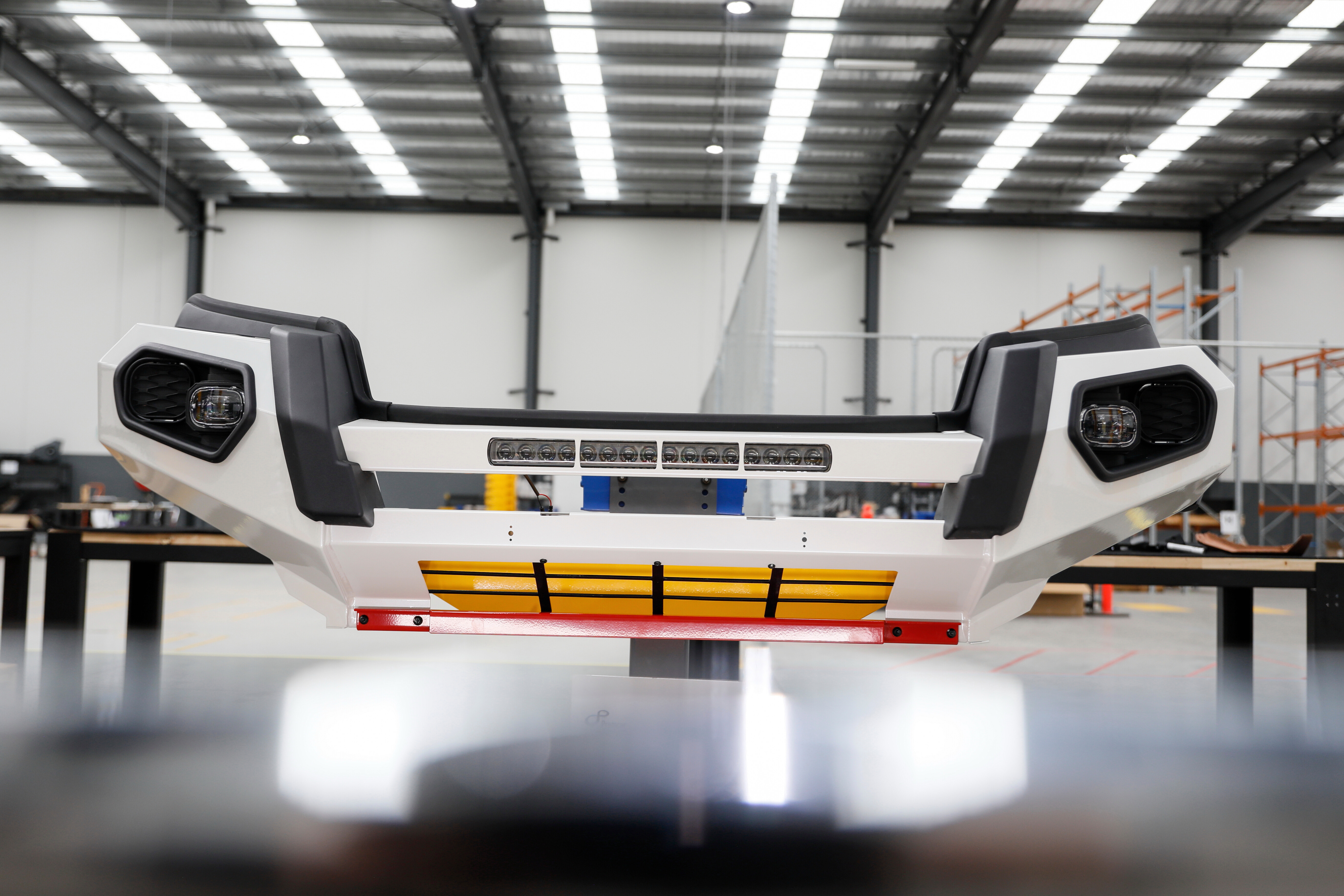
Sitting front and centre is an all-new, beefy, hoopless bullbar, which sports a set of neatly integrated LED lights and fog lights.
The sizeable bullbar also looks to feature a built-in winch compatibility from the get-go, which will undoubtedly enhance its desirability with the off-roading fraternity.
Below the imposing bar is a contrasting red bash plate, which has been adorned with custom “Warrior” lettering.
It also appears much of the unique equipment found on Nissan’s N-Trek Warrior, released in 2019, will feature on the new 4×4.
A set of matte-black off-roading wheels are wrapped in Cooper all-terrain tyres, and shrouded by the same complimenting matte-black flared wheel arches we saw on the N-Trek.
Flanked low on the front and rear doors, and extending to the rear quarter panel, is a black decal with a mountain motif and “twin-turbo” lettering, which denotes the Warrior’s powertrain.
Expected to remain unchanged from the standard Navara PRO-4X, on which the jacked-up 4×4 is based, the twin-turbocharged 2.3-litre diesel engine found in the Warrior will pump out 140kW and 450Nm.
Premcar, which is developing the upcoming Ford Ranger Raptor and Toyota HiLux Rugged-X competitor, says its latest creation will be the “world’s toughest Navara”.
In fact, the auto engineering outfit has dumped millions of dollars into its Epping manufacturing facility and hired 35 dedicated staff to ensure the Warrior project is a success.
The 2022 Nissan Navara PRO-4X Warrior is edging closer to its local launch, with a representative from the Japanese marque’s local arm telling 4×4 the off-roader is just “months away” from an official unveiling.
Part 1: Wildtrak in the shed
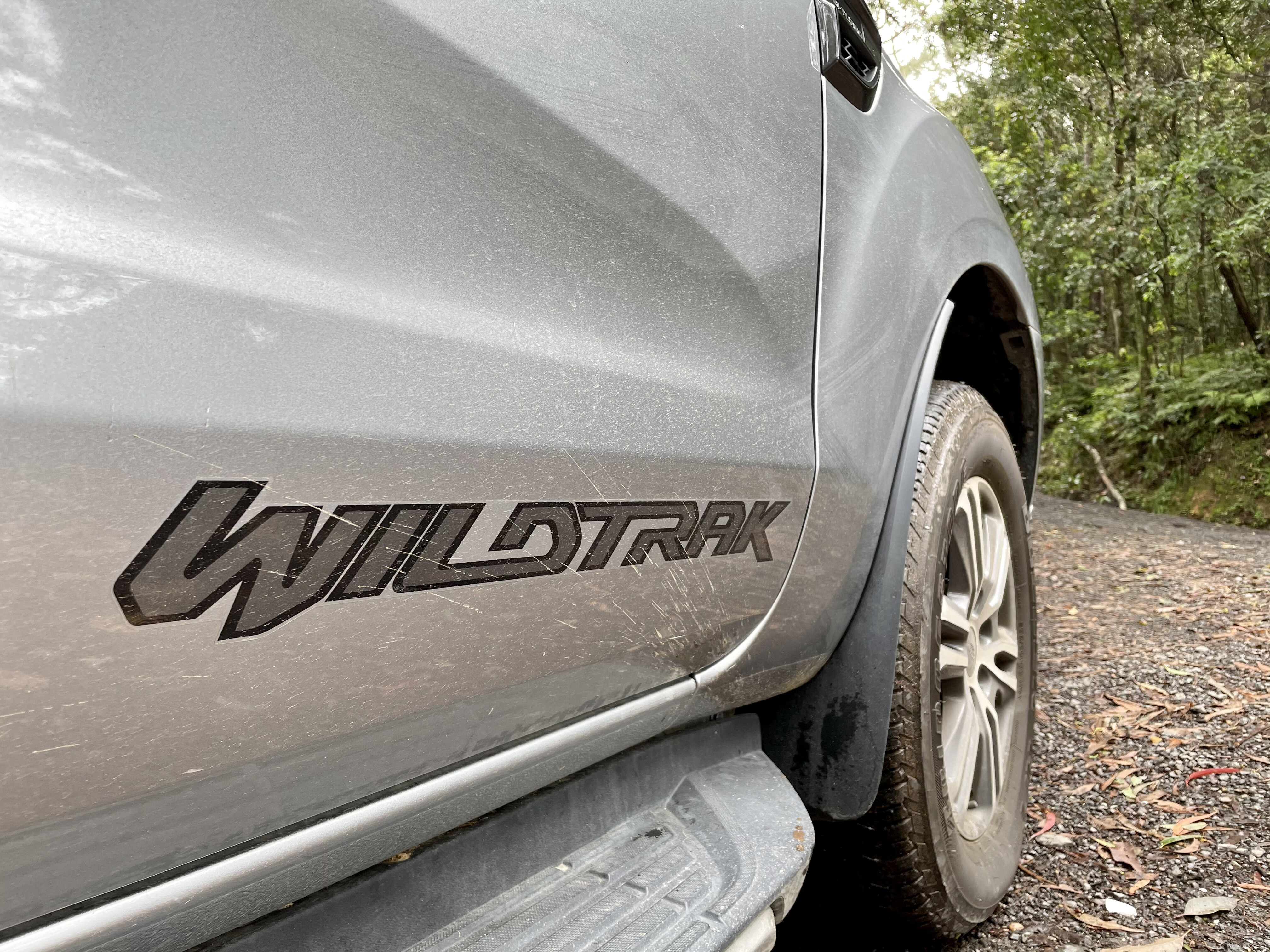
When Ford chucked me the keys to a Ranger Wildtrak 2.0-litre Bi-Turbo diesel in December, I knew it was just the ticket to serve as 4X4 Australia’s resident tow tug for camper trailer reviews.
With heaps of grunt and an impressive 3.5-tonne towing capacity, the Wildtrak was born for the job. What I wasn’t expecting, however, was just how comfortable the Ranger would be as an everyday people mover.
Year after year the Ranger proves itself as one of the most popular 4x4s in Australia, and it wasn’t long before I got a glimpse of why. With power, comfort and functionality to spare, this vehicle would happily serve tradies, serious adventurers, weekend warriors, young parents and grey nomads alike.
Upgrade your Ranger
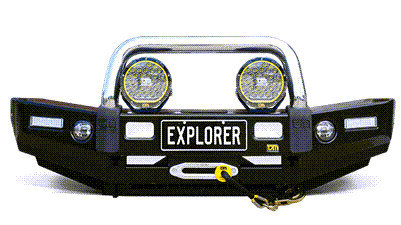
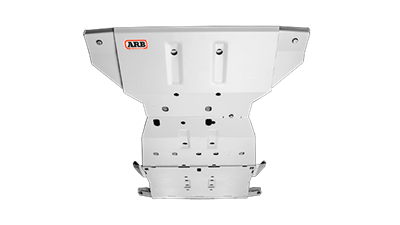
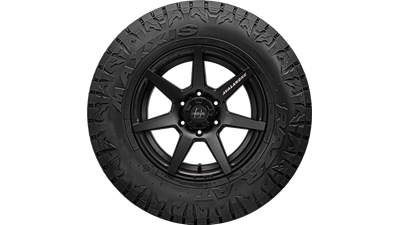
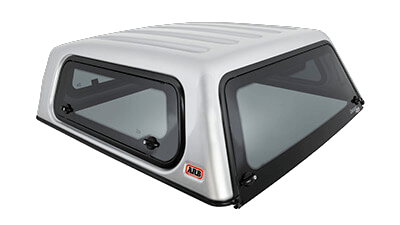
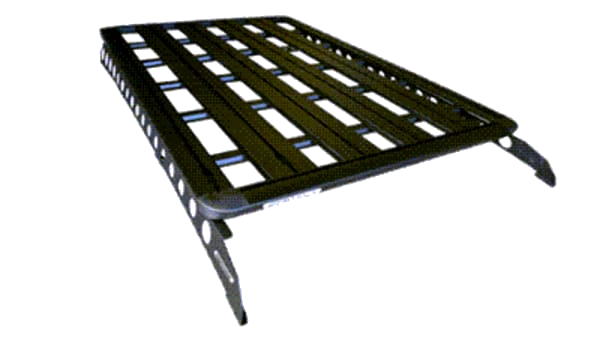
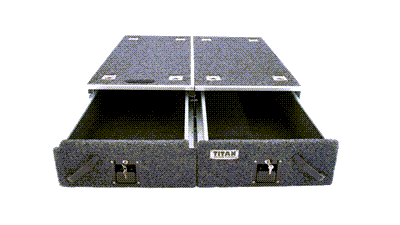
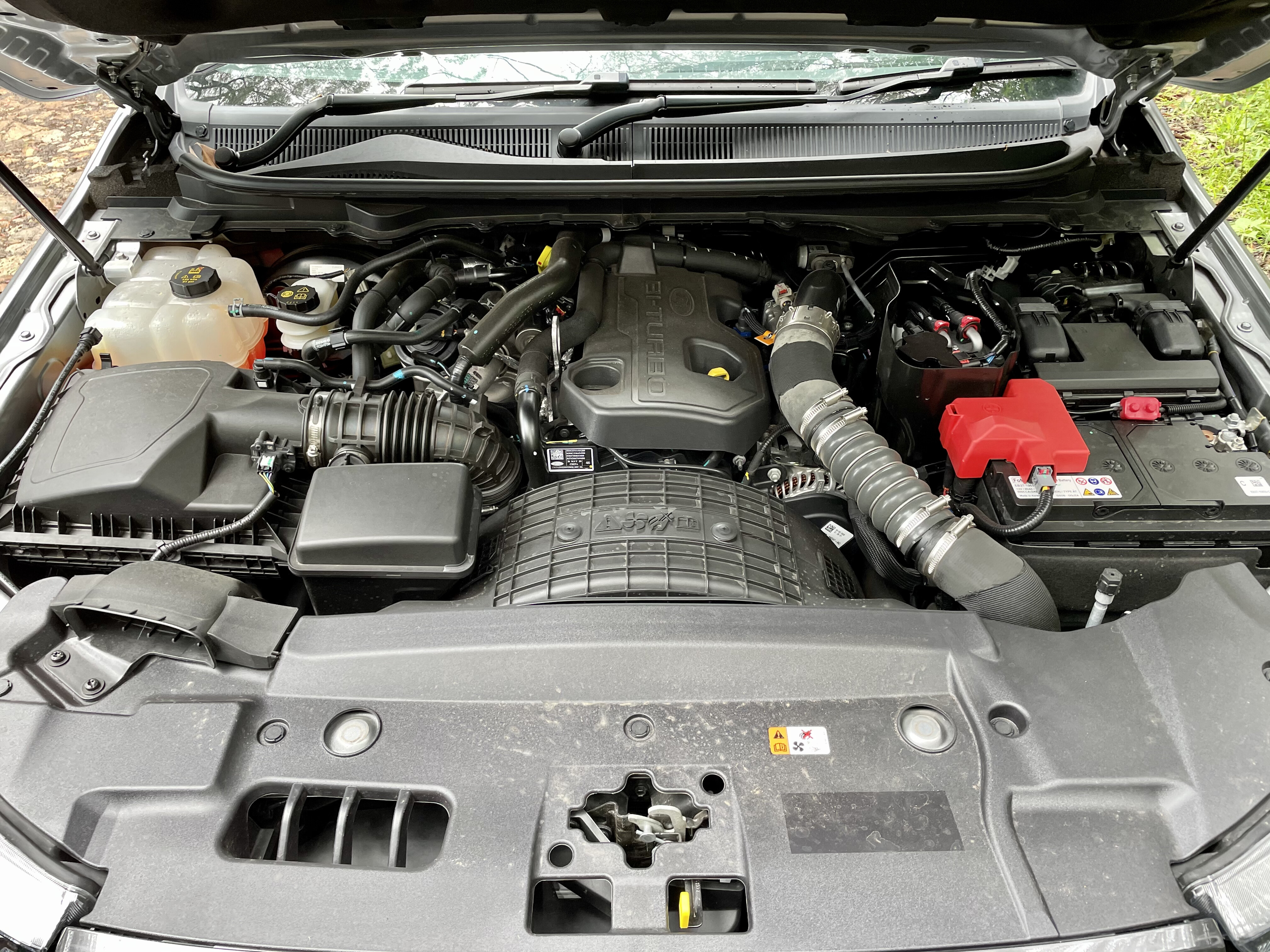
Despite its smaller engine size than the stablemate Wildtrak 3.2-litre five-cylinder turbo diesel, the 2.0-litre four-cylinder Bi-Turbo packs more of a punch when it comes to power down low. It’s got loads of torque at 500Nm at 1750 to 2000rpm, versus the 3.2-litre’s 470Nm at 1750 to 2500rpm. The 2.0-litre also enjoys a 10-speed automatic gearbox, providing the vehicle a smooth, quiet ride at low and highway speeds.To my surprise and delight, the Ranger drives and handles more like an SUV than a hefty ute, a fact I appreciated greatly when using the vehicle for grocery runs, school drop-offs and arvo beach missions in my hometown of Wollongong.
Historically I’ve found driving 4×4 utes can make me feel like an 11-year-old who has stolen dad’s keys for a spin around the back paddock, which is to say, too small to do so comfortably. Not the case with the Ranger. Finding a comfortable seating position with the six-way electric seat controls is easy and visibility is excellent out every window. Steering is light and predictable at any speed and manoeuvring around tight carparks is simple.
Parking is aided by some handy technology, namely the autonomous reverse-parking feature which scans the street for a spot of a suitable size and backs the thing in for you.
If I’m honest, I was a bit too nervous to relinquish control but my partner, an electrical engineer and virtual reality professional (ahem, massive nerd) was right into it. Cool trick indeed. Front and rear parking sensors help, of course, as does the reversing camera displayed on the 20cm entertainment screen.
Apple CarPlay and Android Auto enable the safe navigation of your phone’s call log, messages, music and podcasts while driving, and will be sorely missed by yours truly when I go back to driving my 2014 Volvo.
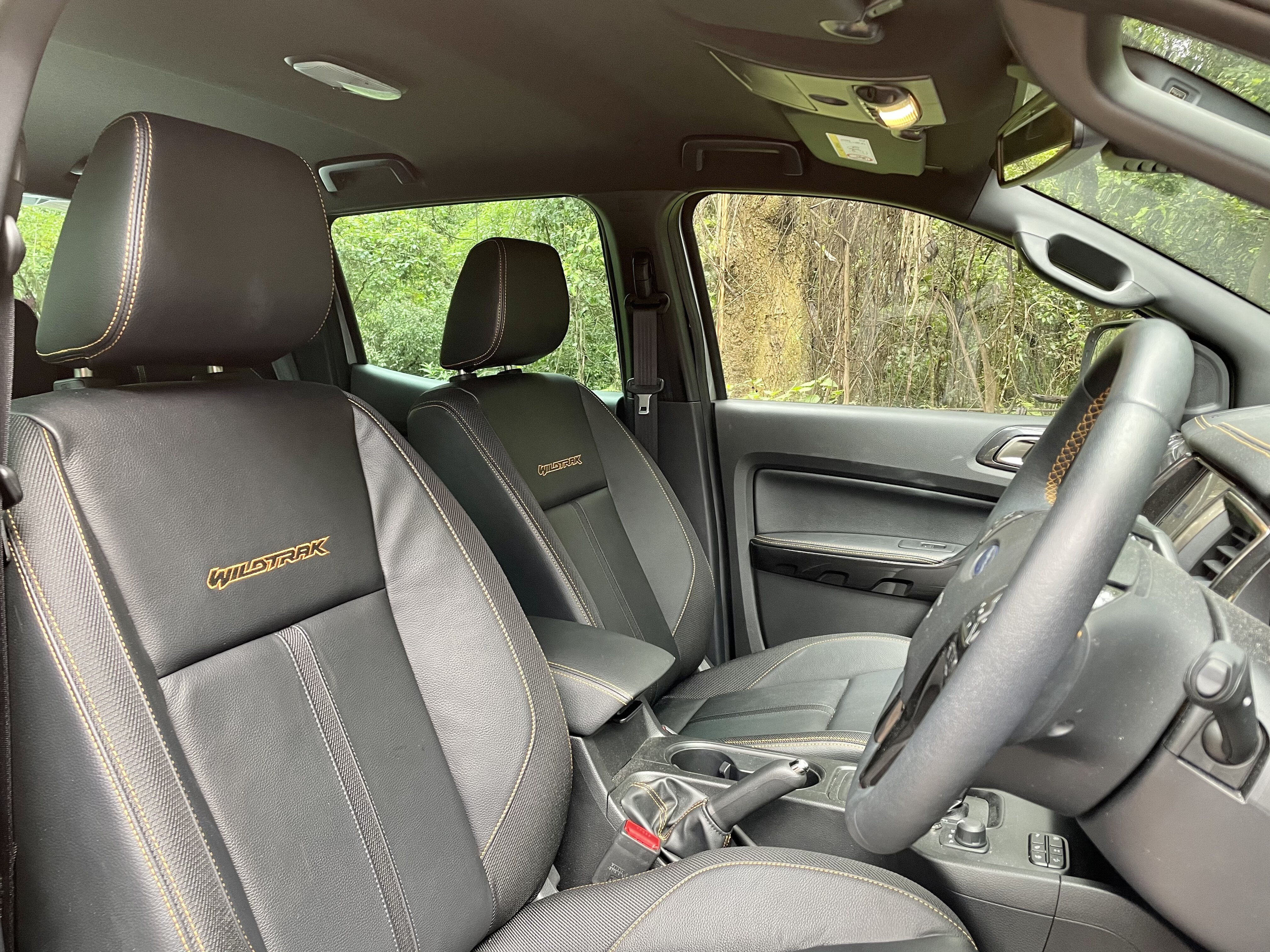
Other driver-assist technology I loved was the radar cruise control with adjustable sensitivity to enable the vehicle to coast at a specified distance from the car in front. It’s so smooth and subtle that my biggest gripe is that you can easily drop well below the speed limit without realising it’s happening.
Automatic headlights and wipers plus lane-keep assist and emergency crash warning features also gave me the warm, fuzzy feeling of someone having my back.
And while this summer’s relentless rain combined with border closures and pandemic influences of manufacturers’ stock levels foiled more than one camper trailer review plan during our first month with the Ranger, it got a good workout in our household for weekend excursions to secret swimming spots in Kangaroo Valley, lazy Sunday drives out to Wombeyan Caves and school holiday missions to the Mid North and South Coasts of NSW.
TOTAL KM: 3356km PRICE: $65,790 KM THIS MONTH: 2250km AV FUEL: 8.1L/100km
Part 2: Tow Tug
Our second month with the Ranger Wildtrak 2.0-litre bi-turbo diesel saw little improvement on the weather front. Weekend after weekend became a washout as our friend La Niña poured her moody torrents over the Australian east coast summer. Great for farmers, ducks and bushfire evasion, not so good for camper trailer or 4×4 adventures.
But after thrice rescheduling a review of the Cub Campers Drifter II camper trailer, we eventually decided to suck it up and push on. Besides, there appeared to be a bit of break in the clouds.
Momentary glimpses of sunshine were about the best we could hope for. So, it was onwards and upwards to the Hawkesbury, just outside Sydney, for a quick overnighter.

We’d planned to meet Matt Kennelly from Cub Campers at our chosen spot, Burralow Creek Campground, so the trip there in the Ranger involved no towing. The Wildtrak is a dream to drive on the open highway, its 2.0-litre bi-turbo diesel engine with 10-speed transmission providing a refined and quiet ride.
Driver-assist technology adds to the feeling of comfort behind the wheel, with adjustable radar cruise control enabling you to maintain a safe distance from the car ahead. I could happily drive this car all the way to the tropics, if only the pandemic hadn’t closed all the borders.
We made a left towards the campground, and the tarmac gave way to dirt. The drive into Burralow Creek is about 20 minutes of generally well-graded dirt, but the weeks of relentless deluge had created washouts and thick, slippery mud on hairpin bends. More fun than we expected.
Once we arrived, we hooked the camper on to the Ranger and set off back up the road to test her out and get some happy snaps for this here magazine.
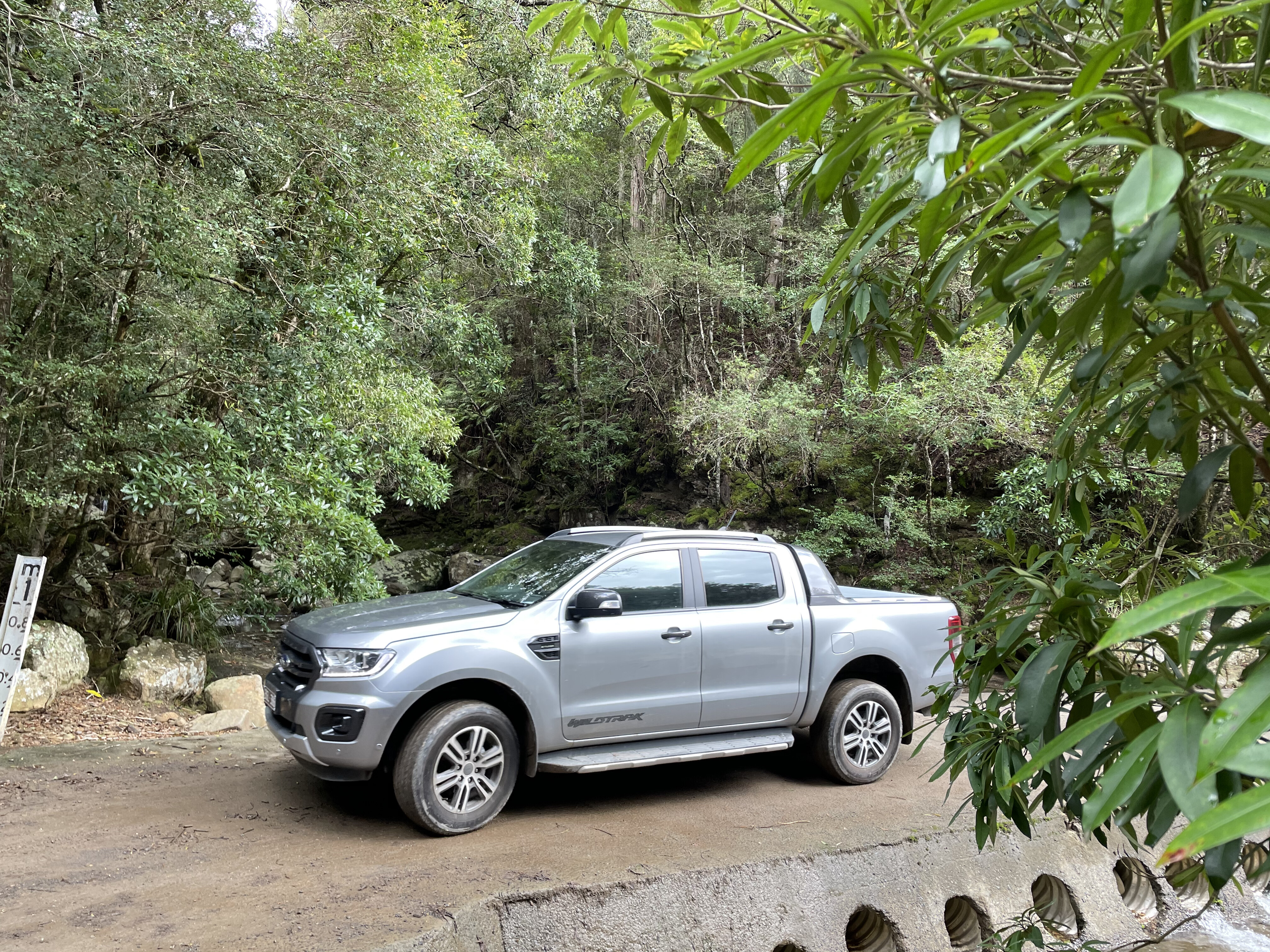
The Cub Drifter II weighs just a lick under 1400kg tare, which was the approximate weight on test as the water tanks were dry and there was no gear loaded in the camper. The Ranger, with its 3500kg towing capacity, was always going to giggle at this Lilliputian load. Still, the road in the reverse direction was steep, slippery and washed out, so she’d have to work a little.
The 2.0-litre Bi-Turbo diesel, despite being a smaller engine than the stablemate Wildtrak 3.2-litre five-cylinder turbo diesel, offers plenty of grunt down low. It’s got ample torque of 500Nm from 1750 to 2000rpm, versus the 3.2-litre’s 470Nm at 1750 to 2500rpm. This loans itself very well to towing, and served us well as we lugged the Cub back up the sodden, windy track.The Ranger barely seemed to notice the load of the camper, powering up the hill with ease. The transmission however, while ninja-like on the highway, is not as smooth in low range. Gear changes at low speed tended to thud a little.

At our request, the Ranger was equipped with Ford’s own electric trailer brakes, with the discreet controller knob easy to access alongside the gear stick. Set to a low level of 3 to 4 to suit the Cub’s diminutive weight, the brakes worked efficiently and smoothly as we headed back down into the gully to the campground.Sure, it was a brief glimpse into what the Ranger Wildtrak 2.0-litre Bi-Turbo diesel is capable of when it comes to pulling a load, but the rig impressed nonetheless. Combined with its exceptional driving comfort and ease of manoeuvrability around town, this vehicle would be an excellent option for anyone looking for a 4×4 that’s equally suited as a weekend workhorse and everyday family mover.
Oh, and in case you were wondering, La Niña unleashed her fury on us once more later that day and all through the night.
TOTAL KM: 4985km KM SINCE LAST UPDATE: 1629km AV FUEL: 8.1L/100km
4X4 Australia's project builds
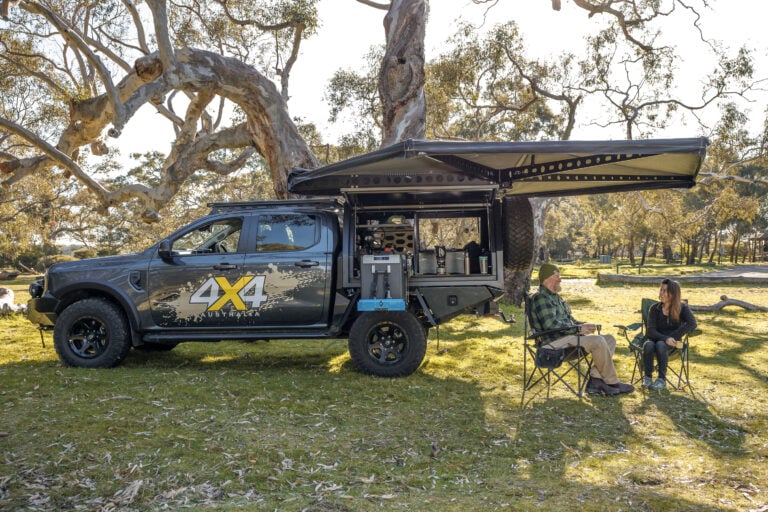
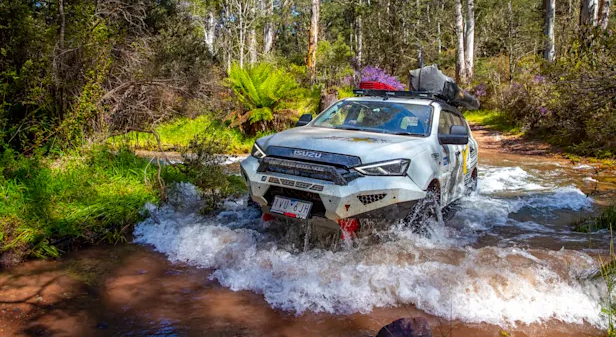
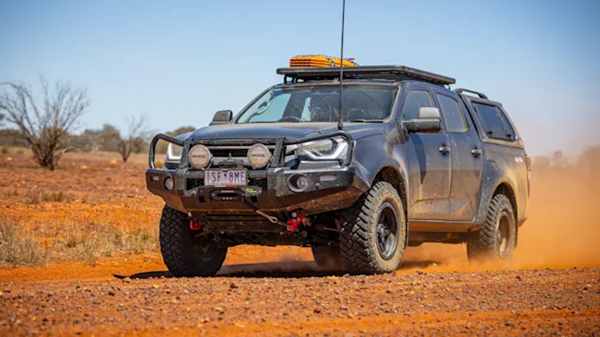
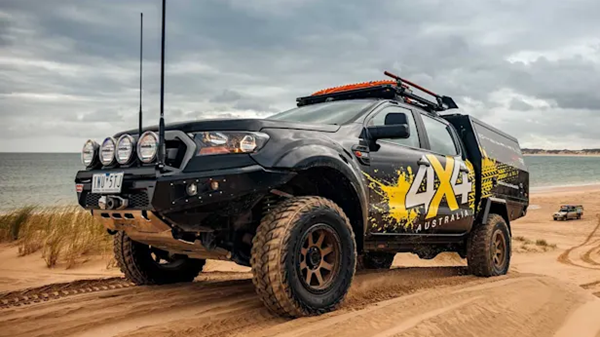
Snapshot
- One man in his 60s died at the scene
- Another spectator and navigator required an airlift to hospital
- Return leg of bike class was cancelled
A spectator at the 2021 Finke Desert Race has died and two others have been injured after a competitor in the car class ran off the course.
Motorsport Australia has confirmed the incident happened 35km from the finish line in Alice Springs on Monday morning, with one man aged in his 60s passing away at the scene.
Northern Territory Police said the other two people injured were in their 50s – a male spectator and a female navigator from the vehicle involved in the incident.
Another specatator, Kerry Turley, told the ABC a vehicle had lost control over the dunes leading up to the crowd, triggering the incident.
“What had happened, just… shocking,” said Mr Turley.
“A trophy truck had come over this sand dune and bounced and bounced, and then they just veered to the left.
“There were people running everywhere.”
A statement from the event organisers said the race had been declared by the clerk of the course and presentations for competitors in the bike category called off.
“Motorsport Australia and event organisers have advised that as the NT Police are still carrying out investigations at the scene of today’s incident, the clerk of the course has declared the car section of the Finke Desert Race concluded,” the statement said.
“Arrangements will be made in conjunction with NT Police for vehicles stopped on the course at various locations on the Finke Track to be recovered by crews.
“Competitors and crews will be advised in due course.
“Following an earlier incident, the bike category return leg has been declared.
“Event organisers and emergency services are working with competitors and crews to return to Alice Springs safely.
“Bike category standing orders are as at Day 1.”
Motorsport Australia said it extends its sympathies to those affected by the incident and counselling services will be available to all competitors, officials and spectators involved in the event.
The Finke Desert Race is a two-day race, held each June on the Queen’s Birthday long weekend, through desert for bikes, cars, buggies and quads. It goes from Alice Springs to the small community of Aputula — also known as Finke — and back.
Day 1 of the Tatts Finke Desert Race is underway, as more than 700 competitors race their way down the sandy track for 228 kilometres from Alice Springs to the community of Aputula on the ancient Finke River.
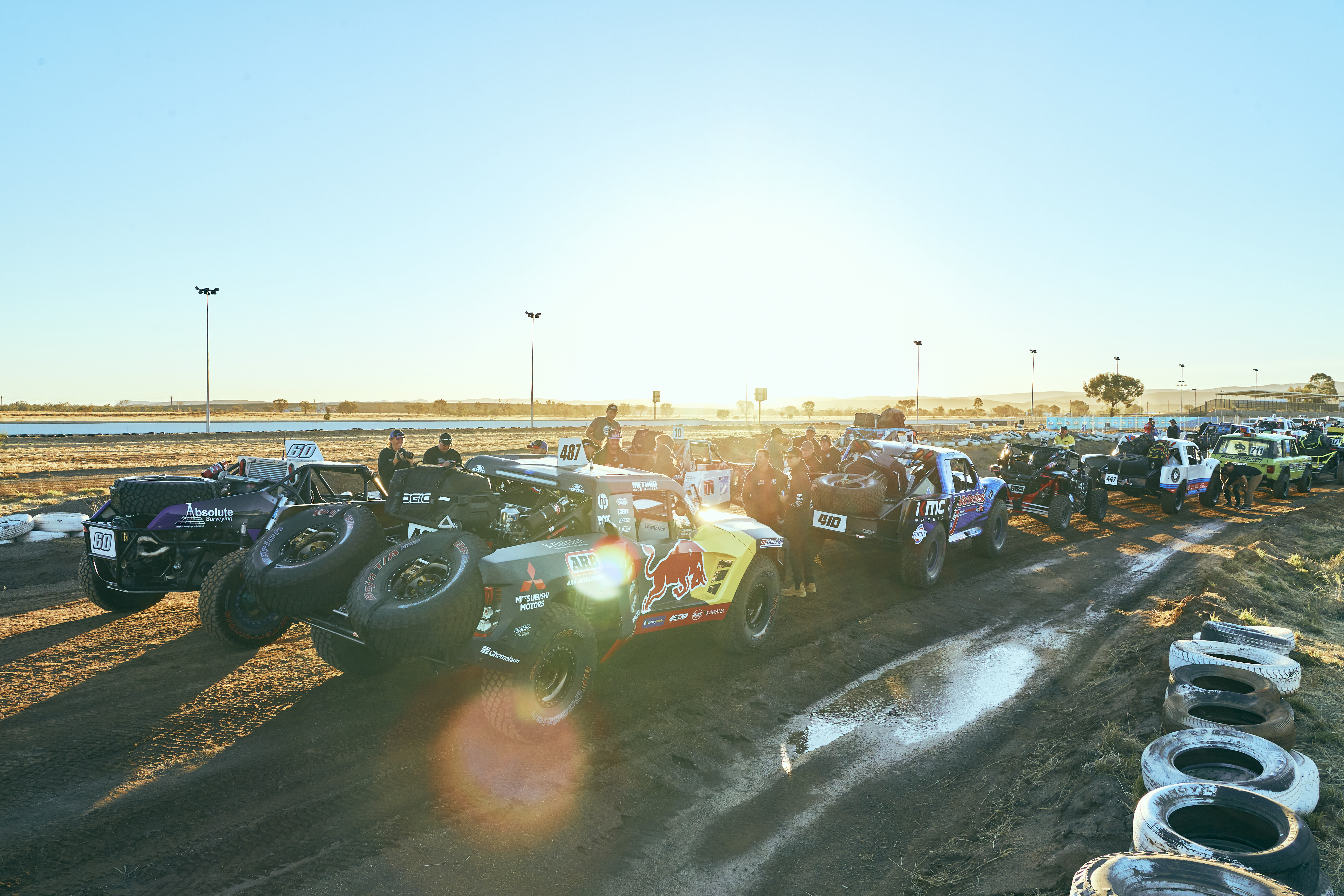
Before they kicked off on a chilly Sunday morning, there was plenty to see back in Alice with the scrutineering taking place at the start/finish line complex on Friday night. This gives race fans a chance to get up close for a look at the cars, buggies and bikes, as well as the opportunity to meet and talk with the riders and drivers.
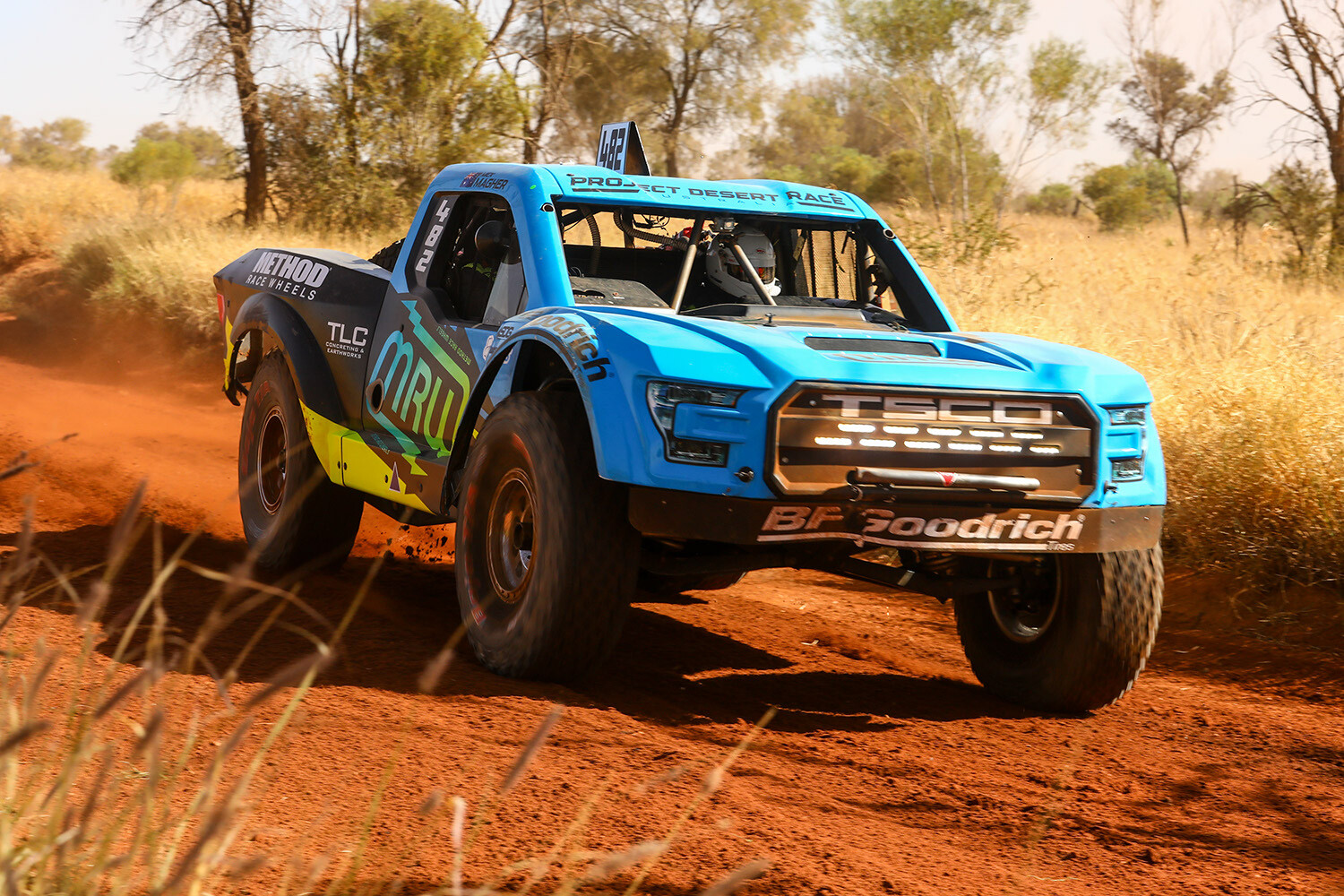
Saturday saw the action kick off and the dust billowing off the race tyres as the Method Race Wheels Prologue took place over a short course, again near the start/finish complex. The 8.3km prologue determines the start order of the cars and bikes, and getting the fastest times gets you at the head of the pack heading south. This is important, as the cars in front will have less dust to contend with on their run.
Crowd favourite, two-time Dakar winner and six-time Finke ‘King Of the Desert’ Toby Price was quickest on Method Race Wheels Prologue Day, lapping the track in 4:38s in his new and unique Mitsubishi Triton TSCO Trophy Truck.
Josh Howells was runner up in the prologue in a Pro Buggy, with a time 3.8s slower than Price’s, with Beau Robinson rounding out the top three.
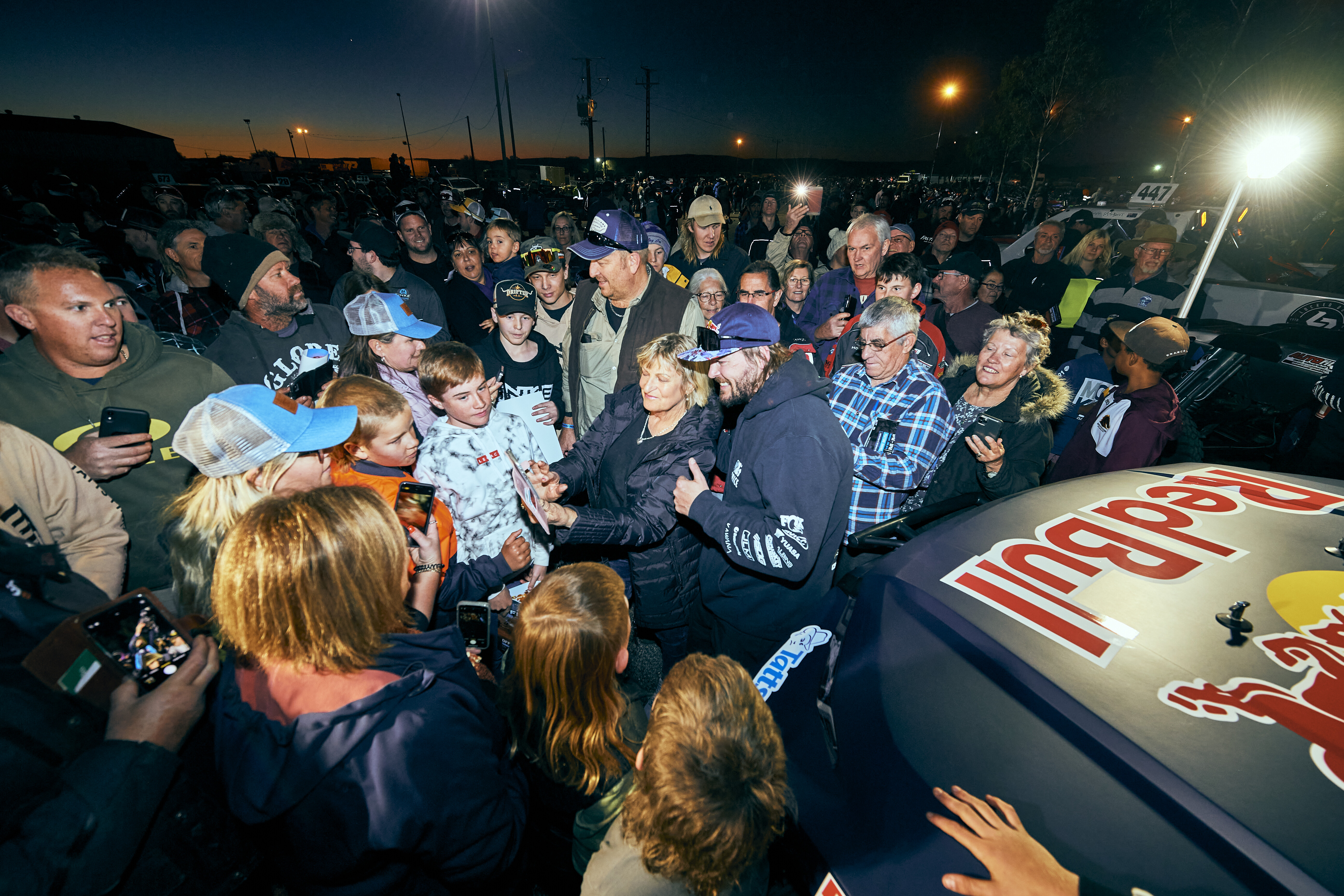
Price was awarded $5000 from Method Race Wheels for setting the outright quickest prologue lap, while Toby Whateley scored $2500 for being the fastest SXS.
Jack Simpson set the pace on the bikes at 4:47.4s, 3.9s over the prologue ahead of 2019 race winner David Walsh. Racing got underway on Sunday morning at 7:30am Alice Springs time for the 226km trip south, before all camp overnight and return up the same route on Monday.
It is expected to take the fastest vehicles around 90 minutes to reach Finke, while for many of the racers behind them, just getting there will be a win, regardless of the time.
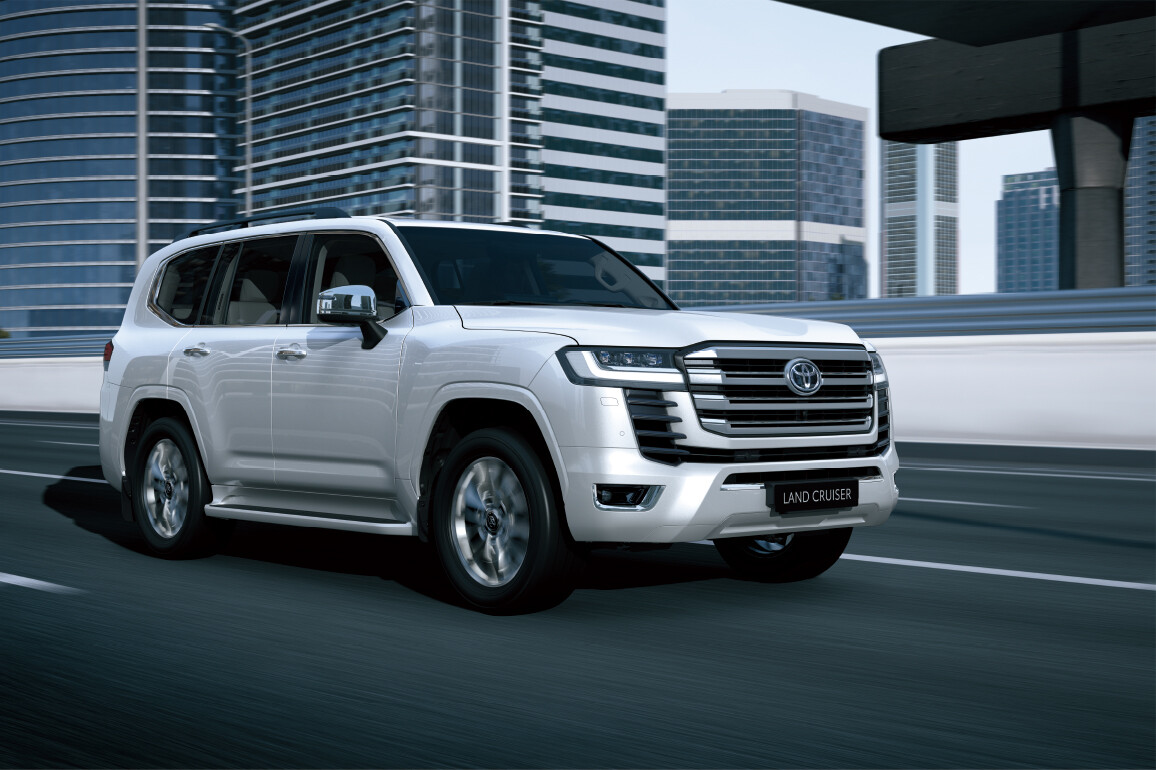
Following years of speculation – it has been 14 years since the 200 Series debuted – the curtains officially dropped on the all-new LandCruiser 300 Series this week.
Headlined by a twin-turbo V6 in lieu of a V8 powerplant, the reveal sent social media into meltdown with punters and purists divided over the specs and features of the new off-road wagon.
One of the biggest talking points from the reveal has been the front-end of the GR Sport model, and whether that would sit nicely affixed to the front end of the other variants in the LandCruiser shed – SX, ZX, VX-R models.
The off-road-focused GR Sport, with its blacked-out bumpers and wheel arches, looks to ride higher than other models in the line-up as well. However, official Australian model specs won’t be revealed until closer to the release date in Q4 this year.
Currently, the GR Sport is the only variant wearing the old-school T-O-Y-O-T-A nomenclature in front of a black mesh grille. As opposed to the chrome-swept, blocky front-end of the SX, ZX, VX-R models.
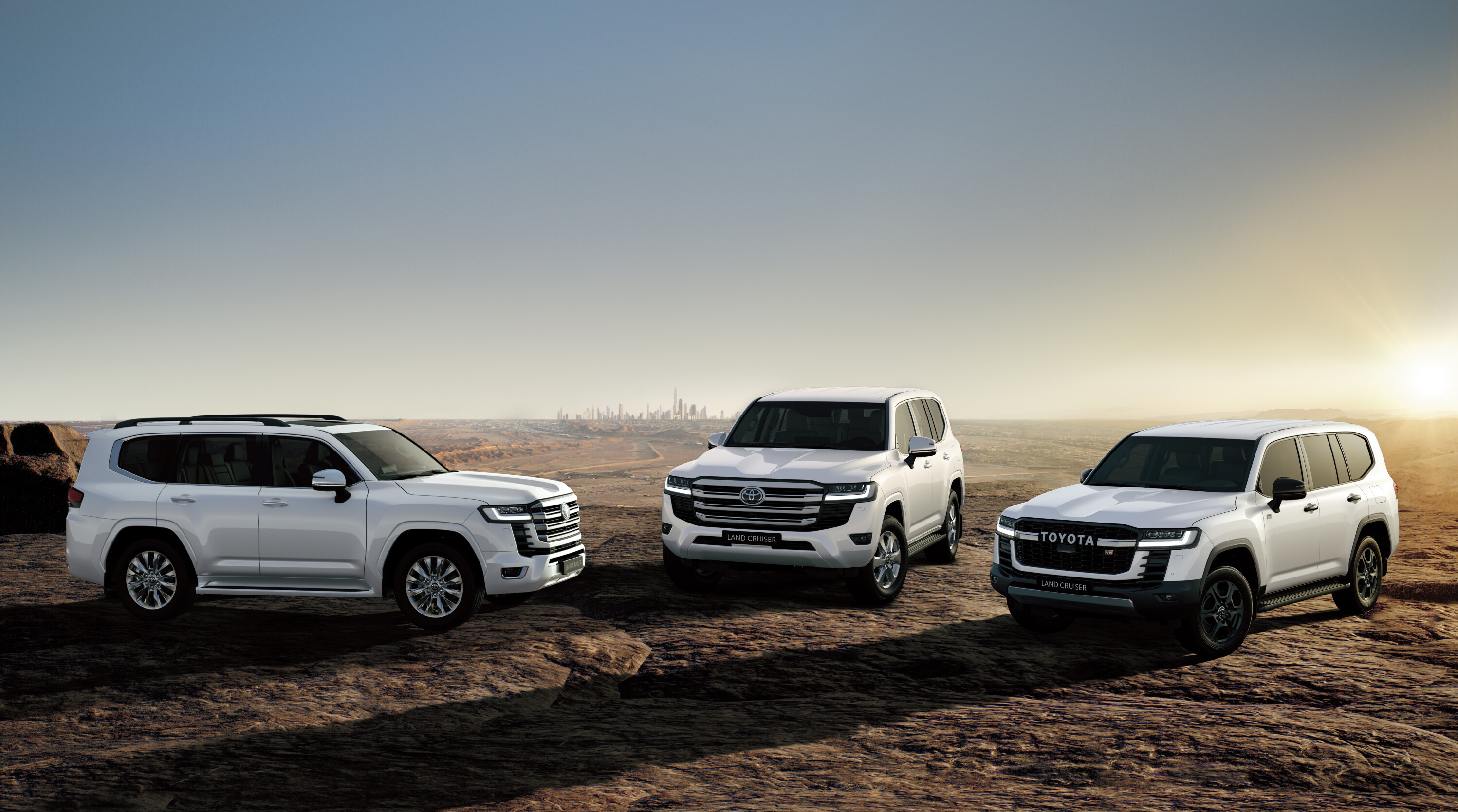
Earlier today, we asked followers of our Facebook page – as well as on our website – to share their thoughts on the GR Sport front-end, and whether they’d love to see it on the other LC300 variants. Here’s what you said:
One reader preferred the look of the SX, ZX, VX-R variants. “[It] looks 100 per cent better. It’s an SUV, not a sports car,” he said.
“Not the sort of car I need, but this does look really, really good. Well done Toyota,” a WhichCar reader added. “Love the old-school T-O-Y-O-T-A through the grille on the GR Sports model too. That’d go well on the Hilux!”
WhichCar’s own Mike Stevens reiterated that point, saying; “I love it. It looks a little too tall and narrow from some angles, but mostly I reckon it carries a great balance of muscular proportions and premium details. The front is definitely full-on, but I love the classic T-O-Y-O-T-A badging. The upswept rear quarter window also looks great, and the interior looks a perfect marriage between premium and austere. It’s a yes from me!”
In typical Facebook form, however, some shared a more negative perspective of both vehicles: “I was sad when Nissan shifted over to the new look with the Patrols and I guess Toyota is doing the same,” one reader said. “Personally I still prefer the simplistic looks of the older generation 4x4s.”
“Both of them look like clown cars to me, will prefer the looks of the 200 over this any day,”; “Both way too fussy for a tough 4×4. 200 Series looks so [much] better from the front,” “The design was inspired by a cardboard box. Awful.”; “About as aerodynamic as a barn”; “Don’t think they have enough clearance to get into shopping centre car park”; and “Need a bullbar to hide that ugly front”, said others.
At least there is still some positivity left on social media: “I’d love to see either front end parked in my driveway,” said one positive reader.
A sentiment we agree with. Let us know your thoughts on the GR Sport’s front-end below. Who’d love to see it on the other LC300 variants?
For those lucky enough to make it to Alice Springs for the annual Tatts Finke Desert Race, the festivities will start to kick off Thursday night, June 10, with the street party in the centre of town at Todd Mall.
The 2020 Finke Race was cancelled due to COVID, and this year hundreds of Victorian racers, spectators and race volunteers were unable to make the pilgrimage due to the latest lockdowns in their state.
The 2021 race welcomes new sponsors to the event, resulting in record prize money on offer.
Method Race Wheels has come on board as the naming rights sponsor for the Prologue Day on Saturday. Method’s sponsorship will run for 2021, 2022 and 2023 and will offer $7500 in prize money for Prologue winners, plus a set of Method Wheels for their vehicles.
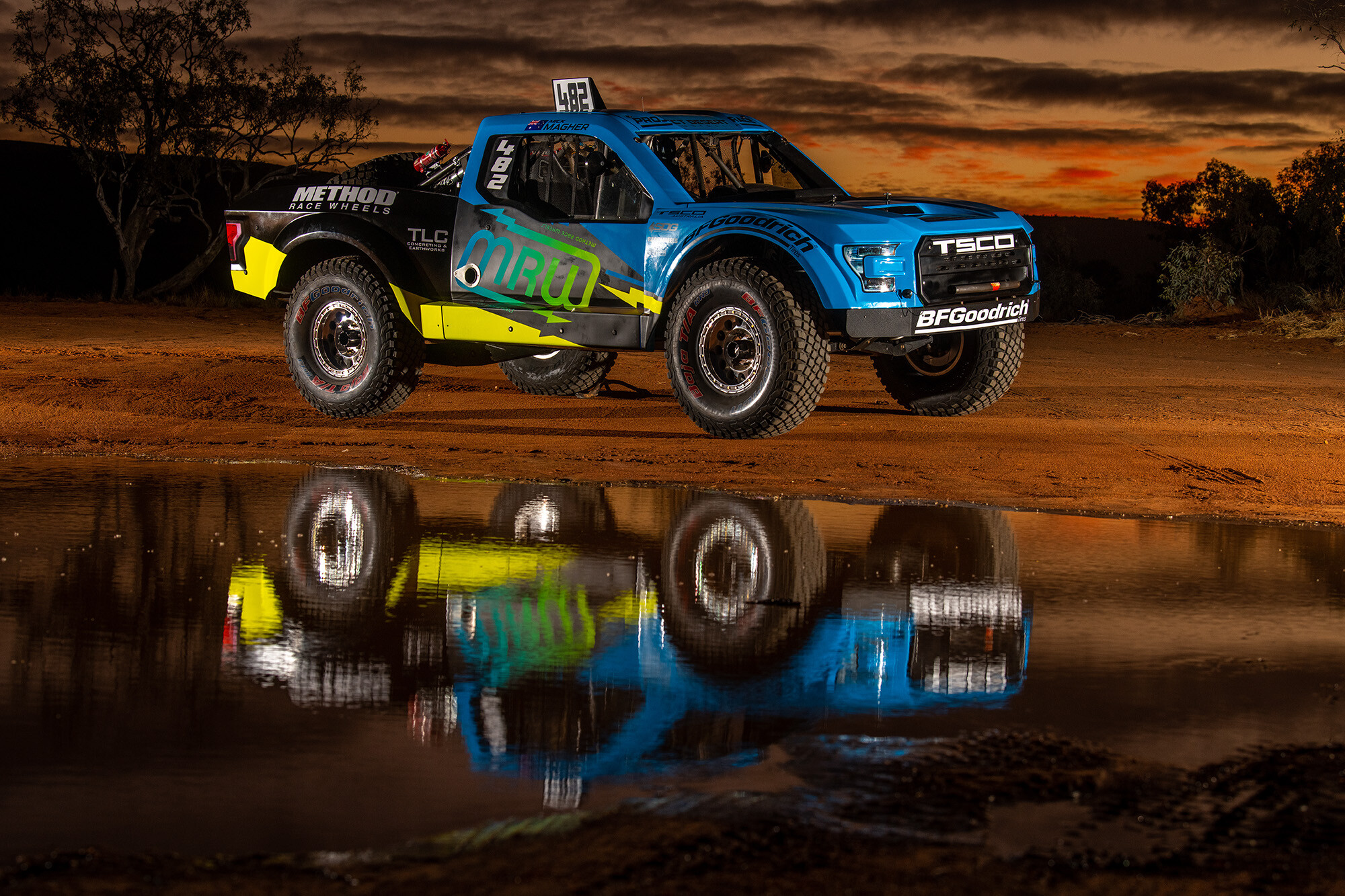
In addition, the Method Race Wheels Prologue will be live-streamed including interviews with drivers and riders.
Brian Godfrey, Chief Marketing Officer at Custom Wheel House (Method Race Wheels) is delighted to come on board as the first naming partner of Prologue Day in over a decade.
“The soul of Method Race Wheels is in off-road desert racing. It is our intentions to support off-road desert racers everywhere they race,” Godfrey said. “We are proud to be working with the Finke organisers and its racers, along with our exclusive Australian Distributor, Race Wheels Australia, for this year’s and future Finke Desert Races.”
Other new sponsors include Sportsnet Holidays, who will partner with Finke Desert Race for the next three events, creating and offering competitors, their support crew and spectators packages to enjoy the unique event.
“More than 700 riders and drivers head south for the first 248km leg to Finke, only to turn around and come back again on the holiday Monday”
Red Bull continues its strong sponsorship with support for tonight’s street party and, of course, backing two-time Dakar champion Toby Price’s race entry in his new Mitsubishi Triton Trophy Truck.
“Without these valued partners, our event wouldn’t be possible,” said Finke Desert Race Committee President, Antony Yoffa. “The committee thanks Tatts for once again being our loyal naming rights partner and we welcome Method Wheels, Sportsnet and Red Bull on board as partners of this iconic event.”
While the serious teams and riders have been pre-running the track over the past week, the racing action kicks off on Saturday with the Method Race Wheel Prologue.
Then on Sunday, more than 700 riders and drivers head south for the first 248km leg to Finke, only to turn around and come back again on the holiday Monday.
BRENDAN Rogers is not new to four-wheel drive touring. The height-safety worker from Victoria grew up with 4x4s in his blood, having completed his first full lap of Australia in his old man’s Pajero when he was just two years old.
Brendan’s dad, who passed away when Brendan was just 11 years old, had moved on from that Pajero to a Hilux Surf, and that vehicle would eventually become Brendan’s own pride and joy.
“My dad bought a Hilux Surf he had imported from Japan, and then I ended up buying that off mum,” Brendan explains. “I drove that Surf for a few years and I ended up doing it up a fair bit; I put it on 33s and did lots of other stuff to it. I really grew up with four-wheel driving and camping always in my life; it’s in the blood.”
Brendan’s 4x4s since the Surf included a couple of GU Patrols, a TB48 and TD42, both of which Brendan labelled with names. “I name all my cars,” Brendan says. “I had the GU before, which was Nancy, and I had another GU before that, which was Patsy.”
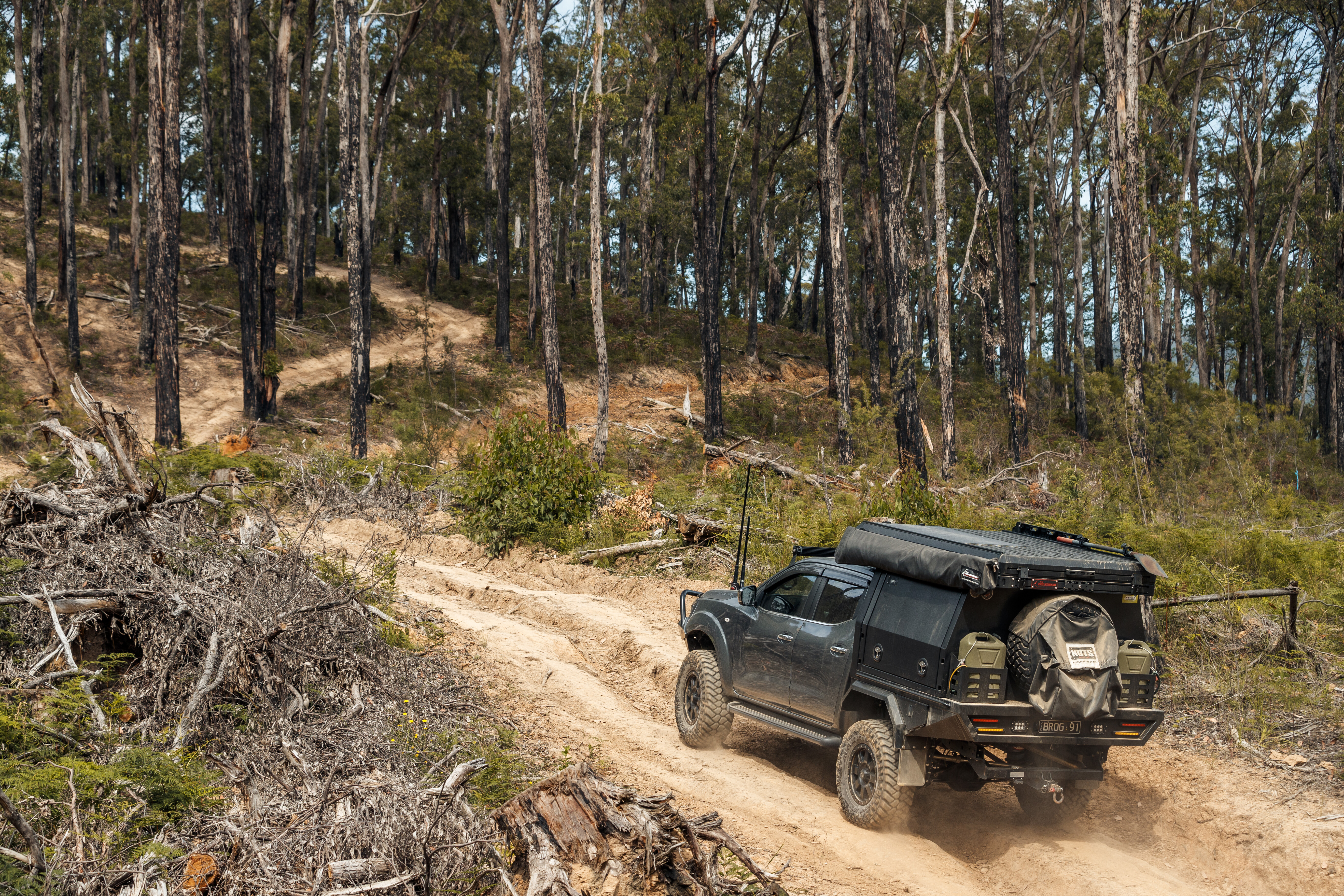
So, what is the name of the D23 Navara you see here? “She’s called Nellie, which was my Nana’s middle name. She was 100 years old when she passed away, so I named the Navara after her,” Brendan laughs.
WHY NELLIE THE NAVARA?
BRENDAN bought his brand-new Navara in June last year, smack-bang in the middle of the COVID-19 pandemic, although he didn’t plan it like that.
“At the end of 2019, my partner and I did a Central Australia trip in the last GU we had, and we sort of got sick of living out of a wagon, so that’s when we started looking at vehicles with a tray and canopy set-up,” he said.
“I was thinking about chopping the GU but where I was at the stage, chopping and engineering everything was going to cost too much, so I thought I might as well just buy something brand-new and start from scratch again.
“We’re looking at getting a house deposit together as well, so I had to sell the GU for funds.
“I looked at the Ranger, Hilux and Colorado but pricewise, I just couldn’t go past the Navara”
“I sold the Patrol just when COVID and everything hit, like January-February last year, so then I didn’t have a four-wheel drive when lockdown hit; it was just bad timing. That’s when I started looking at getting the Navara. By the time I bought it, it was June, in the middle of lockdown. It was just the way it all turned out.”
And why did Brendan buy a Navara instead of a Ranger or a HiLux, or the myriad other 4×4 utes on the market?
“I looked at the Ranger, Hilux and Colorado but pricewise, I just couldn’t go past the Navara. And I got it pretty cheap through work; work has contacts at Nissan and we’ve got a fleet of company cars, so they helped me out with a good price.
“The other reason I went for the Navara is I wanted coils. I thought the coil rear-end would be a benefit for the tracks and stuff I’d be taking it on; I wanted to it to flex up pretty well.”
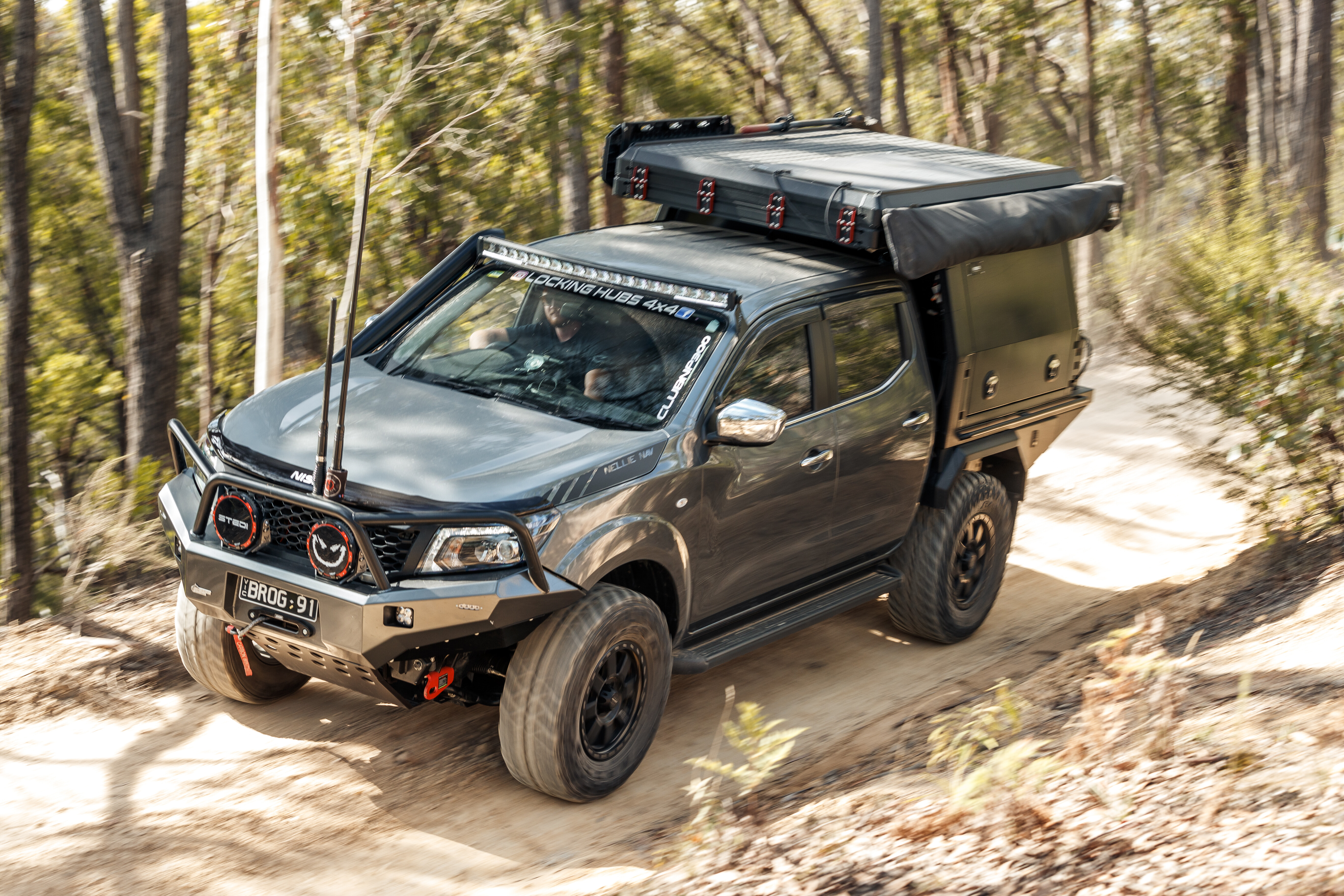
WAITING GAME
ONCE Brendan had his new Navara parked safely in the driveway, he started ordering parts. After all, what else is there for a four-wheel drive enthusiast to do during lockdown?
“I started ordering parts pretty much straight away, but it was about a five- to six-month wait for everything to start rocking up so, at the end of last year, in November and December, I was starting to get parts in and it all started coming together, and it turned out to be pretty quick build in the end,” Brendan says.
Despite the delays, Brendan had a definite order in which he wanted to perform the mods on his Navara.
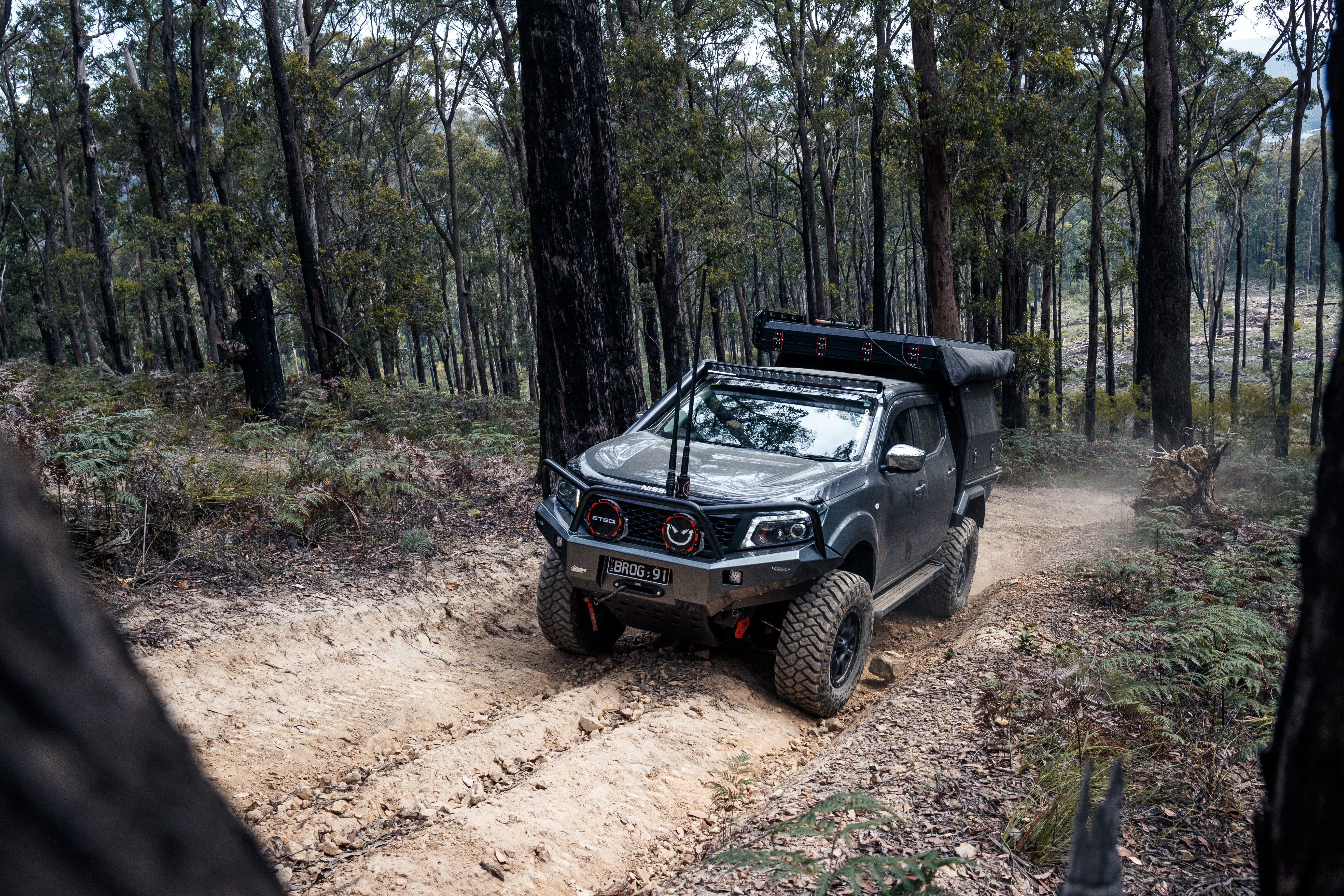
“I wanted to do the heavy stuff first (like the tray and canopy, and the bar work) and then the suspension, so I wouldn’t have to play around with it. The first thing I had manufactured was the tray, which looked a bit weird fitted up on a completely stock 4×4.”
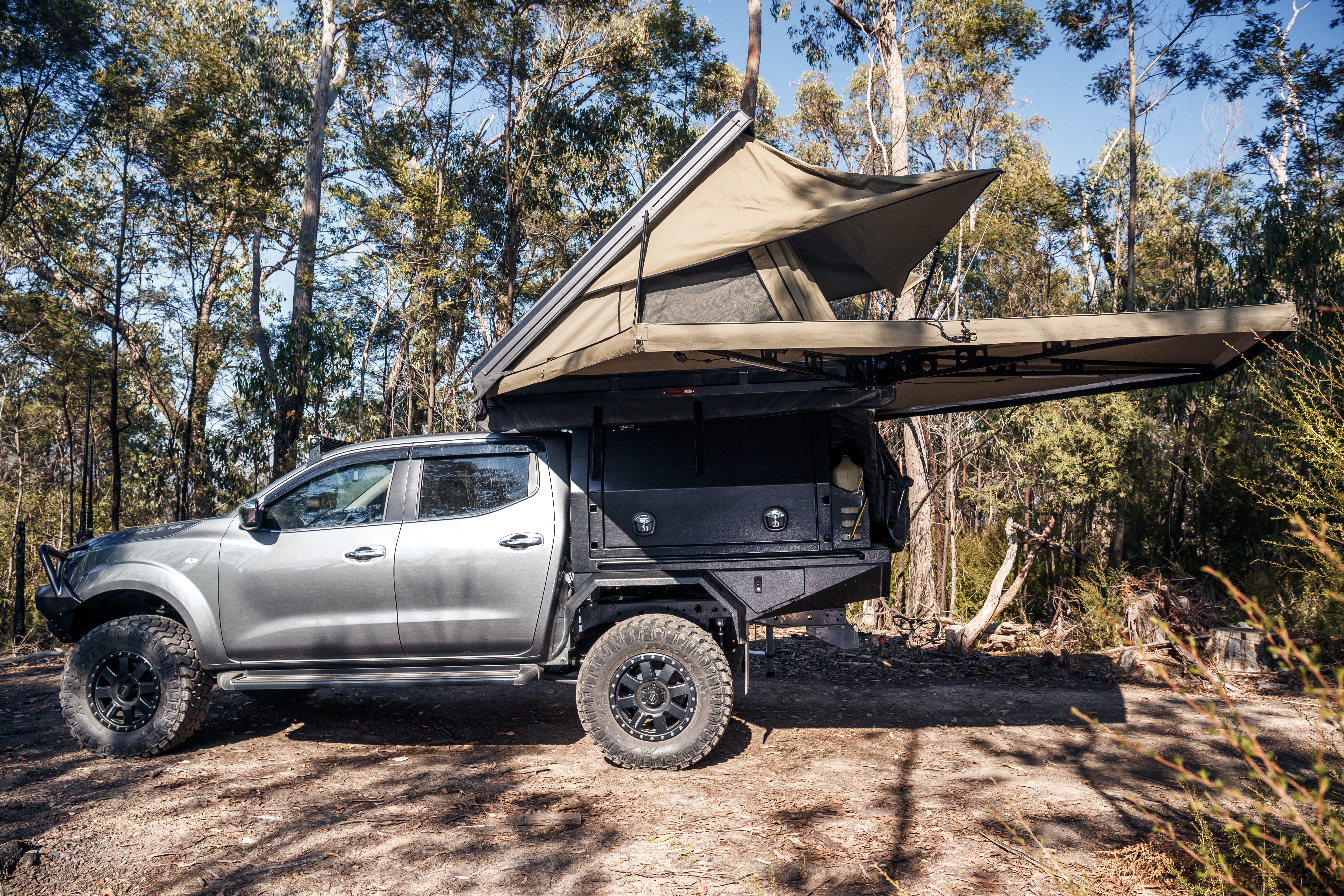
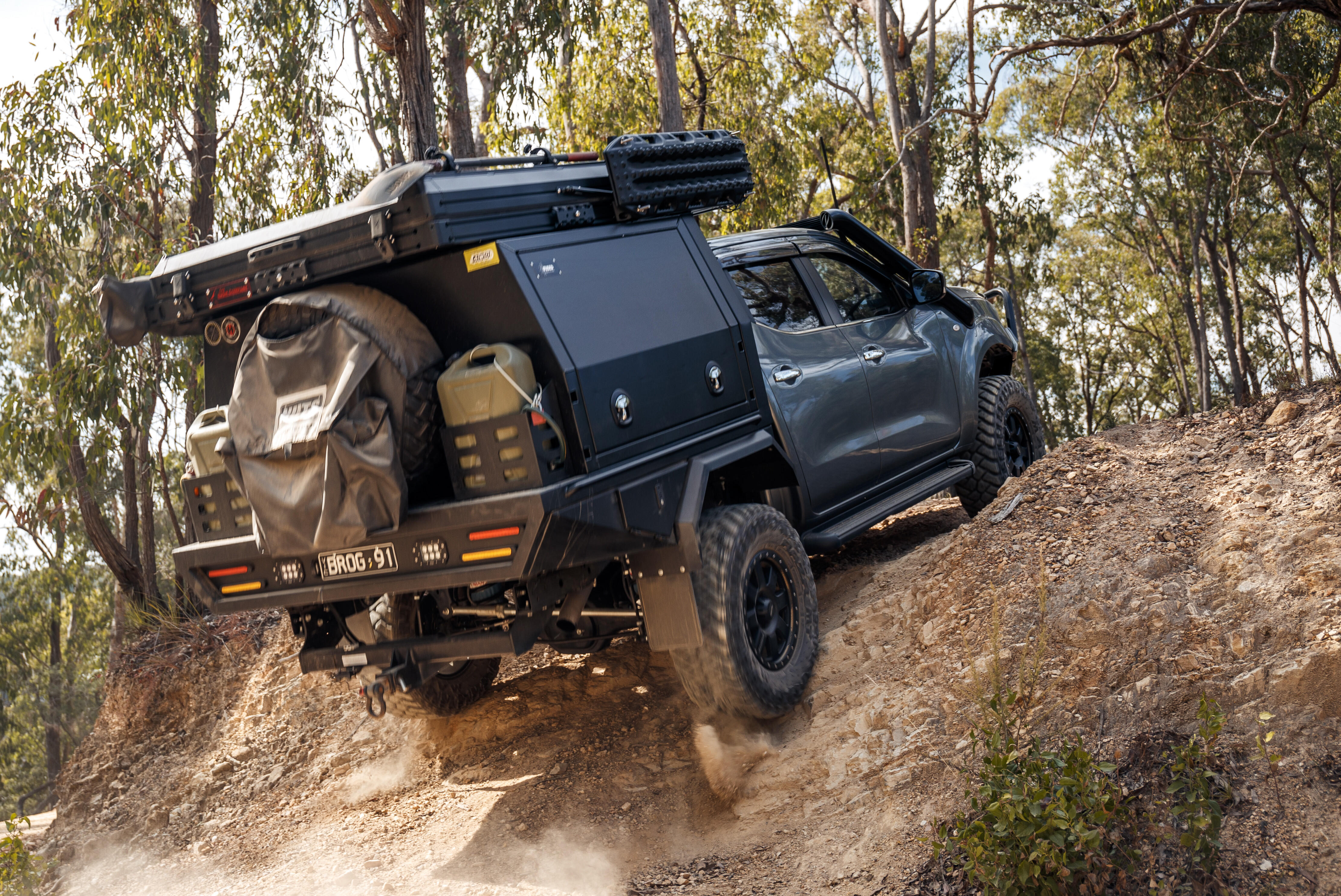
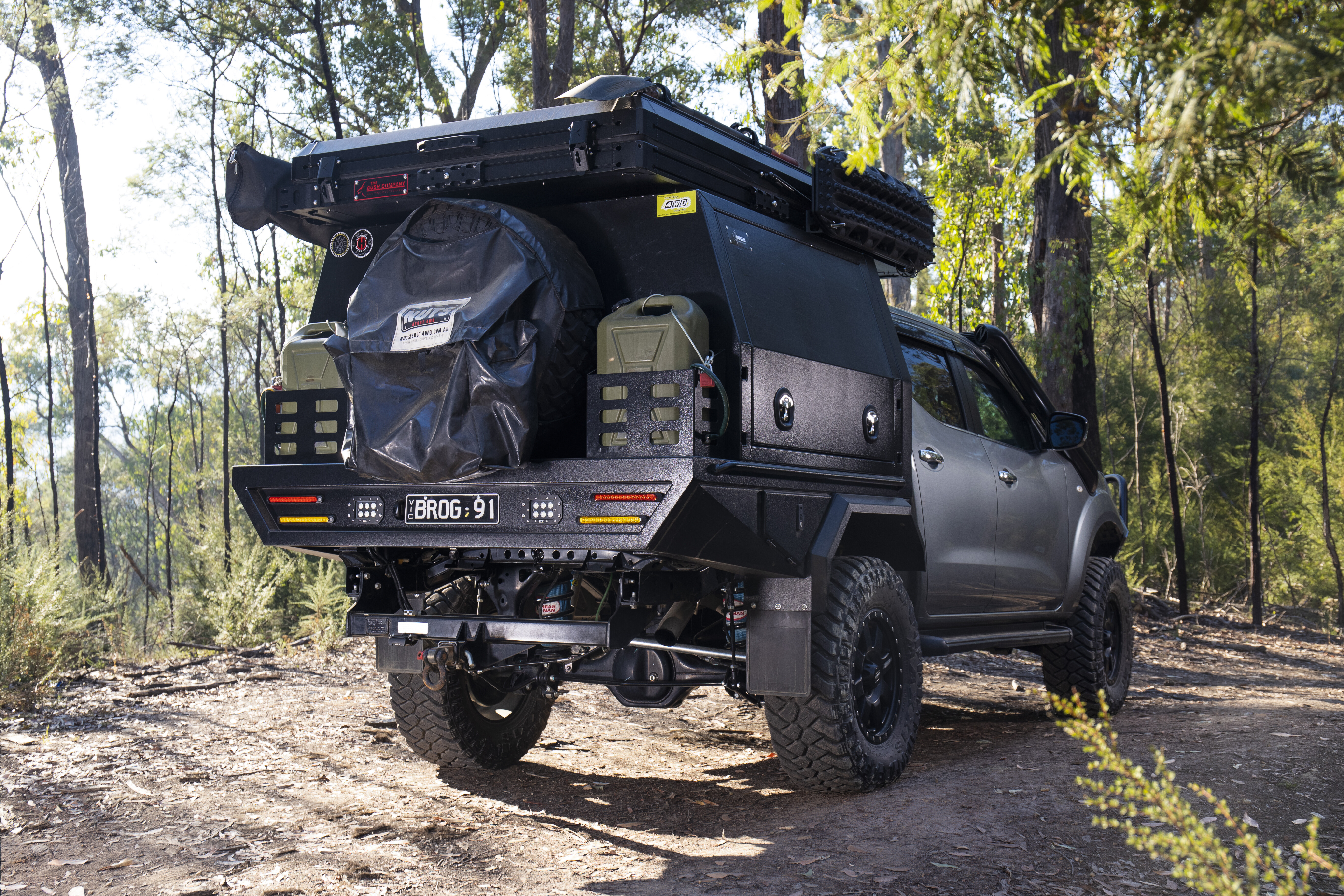
That awesome-looking tray was built by Leigh Mackin of Lethal Customs 4×4 in Bendigo, Victoria. Called a Premium Tray, it measures 1700mm long and 1800mm wide and features built-in toolboxes behind custom fabricated wheel-arch flares, LED rear lights, as well as a custom-made headboard to suit the canopy. Yep, it pays to put a bit of forethought in to a build if you want a fully integrated and cohesive look.
And cohesive is what Brendan has achieved with the tray/canopy set-up; just look at how neat the result is. The canopy itself is an aluminium item from Fused Fabrications in Craigieburn. At 1300mm long, it leaves plenty of space for the spare on the back as well as a couple of jerry cans. And importantly, the conservative length of the set-up means there’s not too much weight hanging out behind the rear axle.
QUITE A LIFT
THE bar work was meant to be next but there was a delay before it showed up, so Brendan sent the Navara off to Bay Road 4WD Centre in Cheltenham where work on the suspension began.
Up front the Navara scores a big lift thanks to a Performance Suspension Racing (PSR) set-up with height-adjustable Bilstein front struts and All Terrain Industries upper control arms.
Down the blunt end PSR also gave the Navara a four-inch lift, fitting long-travel rear coil springs mated to Bilstein shocks. Poke your head under the back and you’ll also spot Roadsafe upper trailing arms to ensure all the angles are right and a Tough Dog adjustable Panhard rod to make sure everything is centred.
With the rooftop tent mounted to the canopy and the Navara loaded up, Brendan says he still wasn’t totally satisfied with the ride, so he added a pair of Airbag Man air bags to complete the rear suspension set-up.
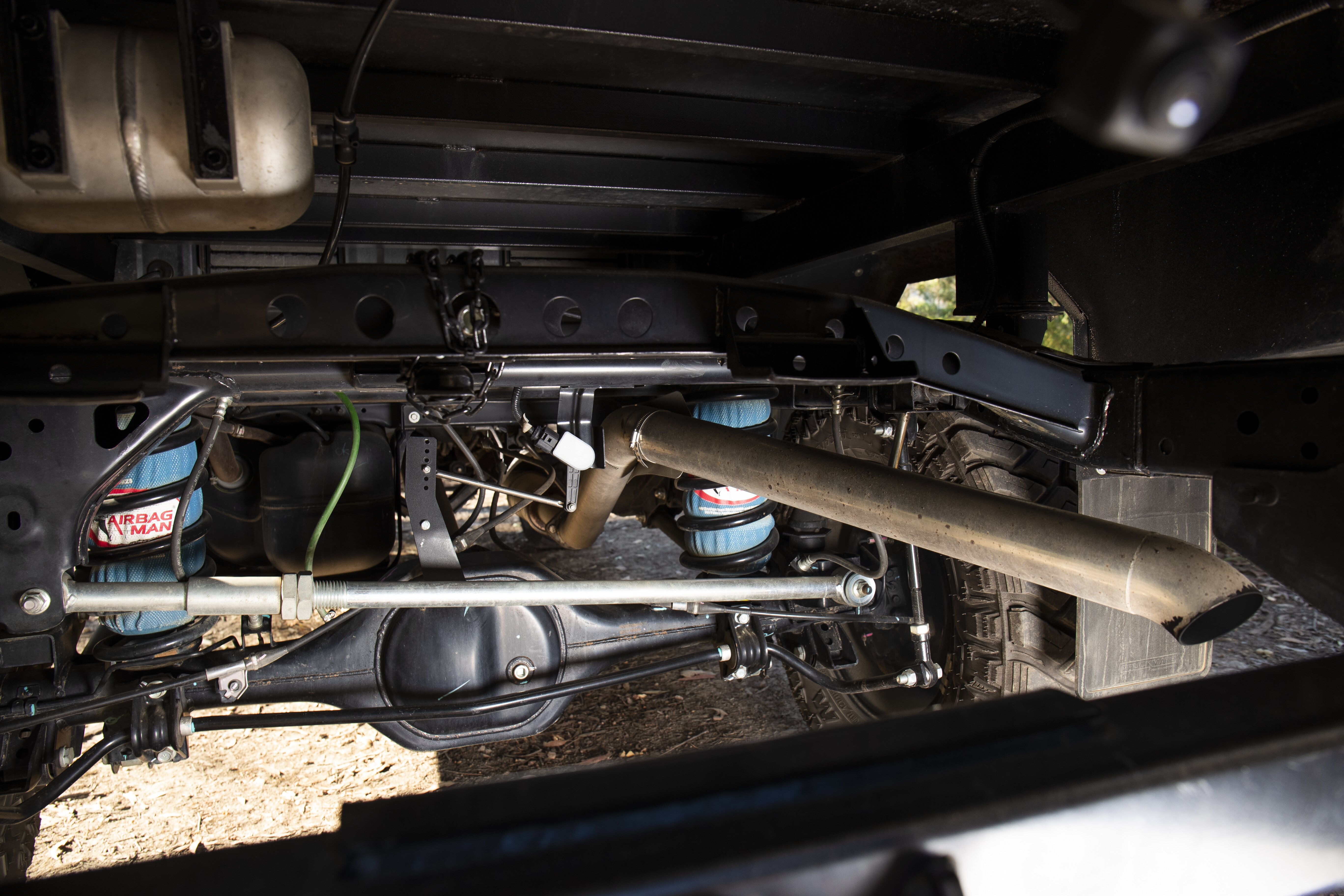
“The rear was a bit bouncy when it was fully loaded, so that’s when I decided to put in the airbags. They help a lot, especially when it’s loaded up,” Brendan says. “When I had passengers sitting in the back, they were telling me it was very bouncy back there, but now I can pump up the airbags to about 60psi and that really helps. It’s really comfy now, a good ride.”
Adding another inch or so to ride height are the 295/70R17 Maxxis Razr muddies, which are mounted to Pro Comp Series 74 Trilogy Satin Black alloy wheels. Yep, this Navara has plenty of ground clearance.
Overall, what does Brendan think of the Navara set-up? “The way I’ve built it I would say it is at least as capable as the GU,” he says. “Off road it just crawls through everything. It might pop a front wheel here and there, but I’m just very surprised the way it’s turned out and how capable it is, maybe even more capable than the GU, I reckon. With the rear locker in it, it’s just a walk in the park.”
PROTECTION
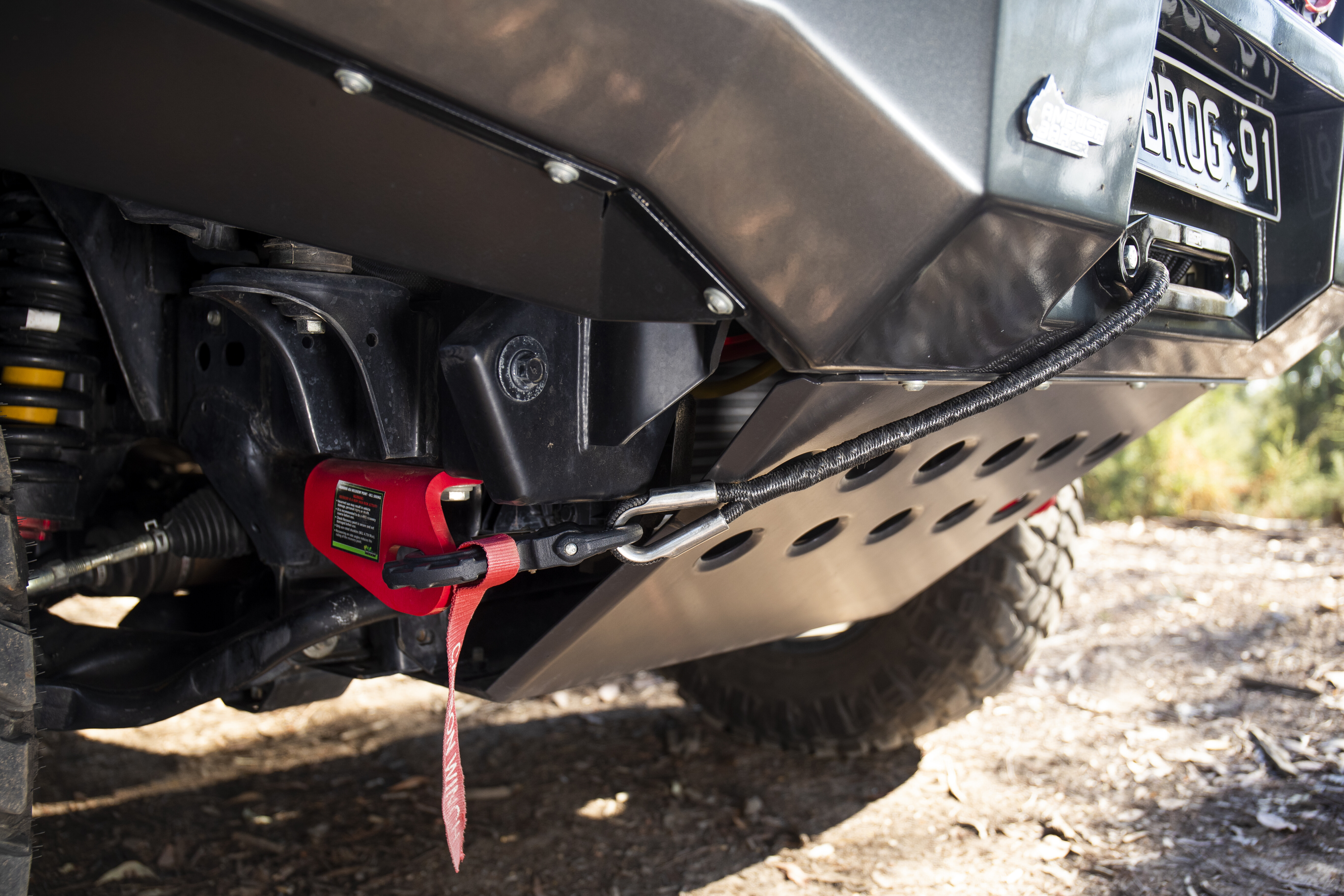
WHEN the PSR Ambush Triple Hoop bullbar showed up at Bay Road 4WD Centre, a Carbon Offroad 12,000lb winch was fitted before the combination was bolted-up to the front of the Navara.
The PSR bar is designed and manufactured here in Australia and it comes standard with built-in LED driving lights and a PSR fairlead. It’s also available with a splash guard as fitted to Brendan’s Nav.
The bar is home to a pair of Stedi Type-X Pro nine-inch LED driving lights, which feature 37 Oslon High-Flux LEDs and produce a claimed 1 Lux at 1155m, while Uniden antennas look after the comms transmissions. Extra lighting is provided by a full-width Bullseye 50-inch curved LED light bar.
A tow bar protects the rear of the Navara when exiting gullies and dropping off rock shelves and the like, although that Lethal Customs 4×4 tray provides plenty of ground clearance out the back for an impressive departure angle.
A pair of Ironman 4×4 recovery points add a flash of red up front, and Brendan says he has a set of rock sliders on his shopping list but for now, the factory Navara ST side-steps at least keep some mud off the sills and lower doors.
MECHANICAL MODS
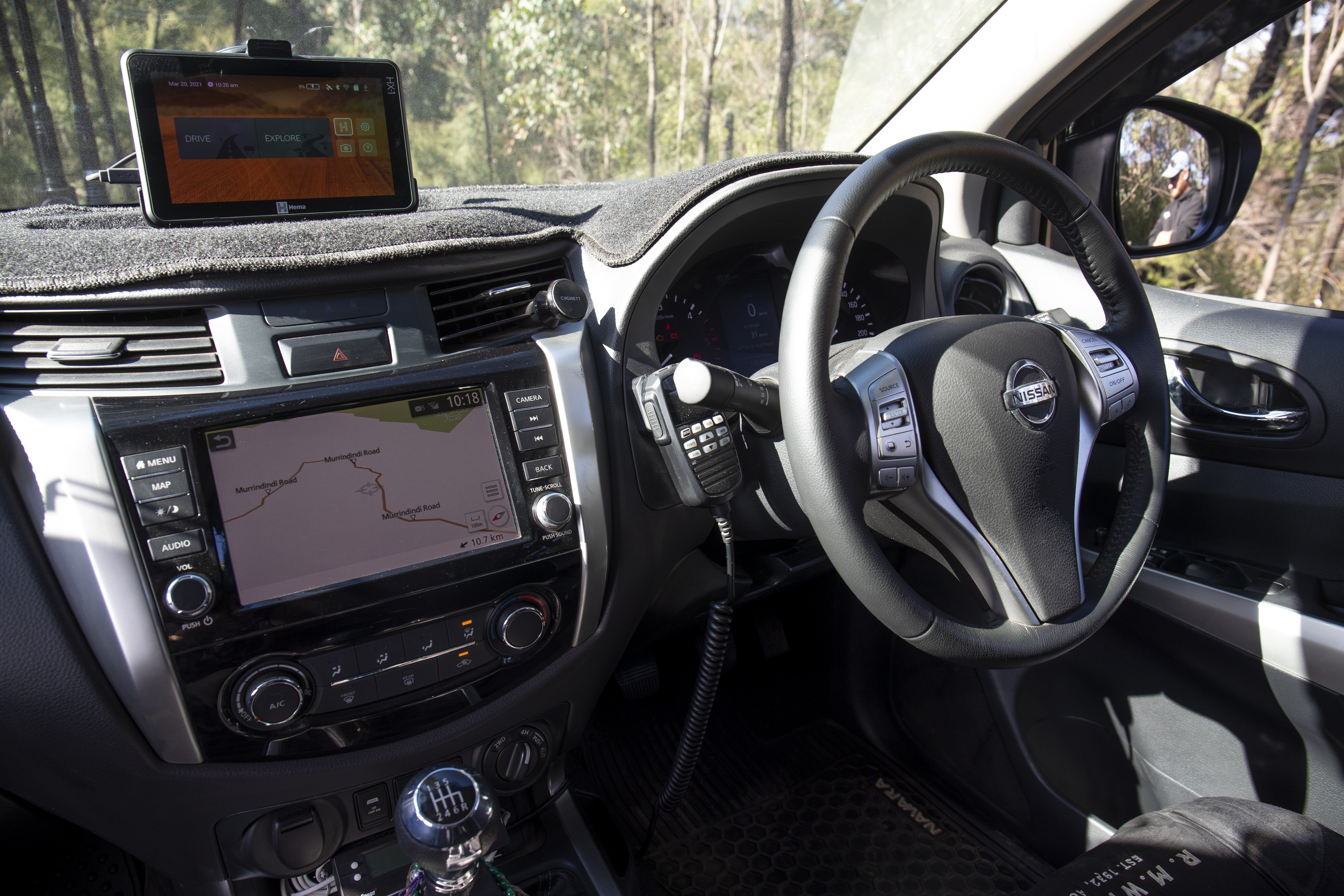
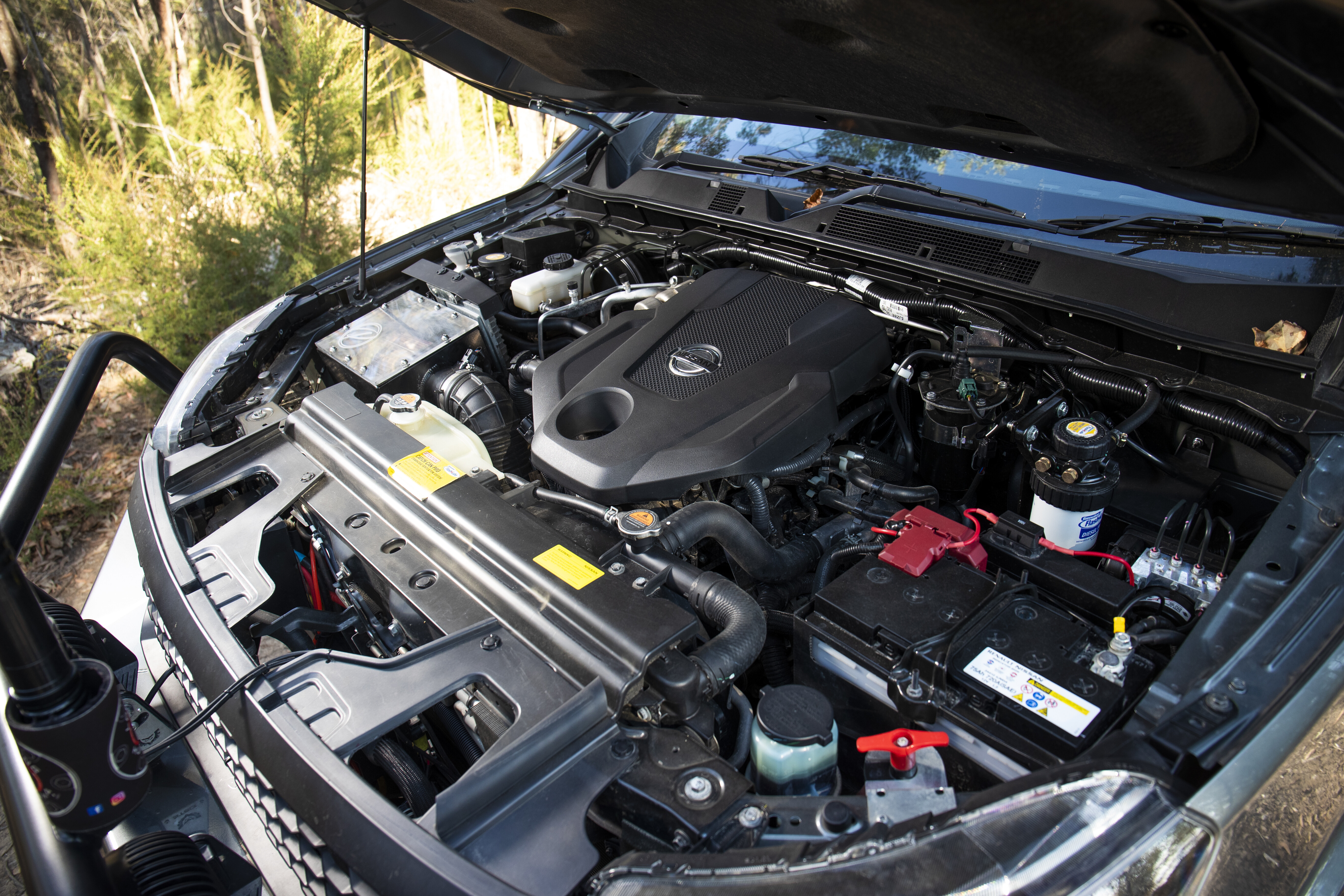
AT this stage the Navara’s 2.3L twin-turbo diesel is relatively stock, as is the six-speed manual gearbox, the clutch set-up and the transfer case. To help the engine breathe cleanly, there is a stainless-steel snorkel on the intake side from Platinum Mechanical & Suspension, which feeds into one of Platinum’s airboxes in which there’s a K&N air filter.A Flash Lube catch can is fitted to keep the inlet clean, while a Flash Lube fuel filter makes sure no dirty diesel or water makes its way into the engine. A three-inch exhaust system with a resonator runs back from the turbo to expel gases.
Speeding up throttle response is a Windbooster throttle controller, while a ScanGauge-II is fitted to diagnose and clear any trouble codes when out on the road (or off it).
Brendan has also fitted Ironman 4×4 breathers for the diffs, gearbox and transfer case to help make sure any water crossings are successful.
CAMPING SET-UP
AS he had planned from the start, this Navara build was all about making touring and camping easier for Brendan and his better half. With that in mind Brendan mounted an Alpha Clamshell rooftop tent from The Bush Company to the top of the Navara’s canopy, along with The Bush Company’s 270-degree XT awning.
Designed and manufactured in South Africa, the Alpha rooftop tent has a fully seam-welded alloy frame with powder coated finish, and it can be set up in just 90 seconds. The tent itself is made from 300g polycotton rip-stop mould and mildew resistant canvas. A three-inch thick high-density foam mattress ensures a good night’s sleep and thermal marine carpet under the mattress keeps the cold on the outside.
The whole tent set-up weighs in at 96kg and it features cargo rails on top for mounting accessories. Brendan has a 120W solar panel mounted up there.
“I could have got something a bit cheaper, but I spent a little extra money to invest in something that’s going to last five to 10 years, until I sell it or whatever,” Brendan says of the Alpha rooftop tent. “I read up about The Bush Company, and where I want to take the Navara, I’m planning to do some snow trips, I just didn’t want anything that would leak and get wet inside. I just wanted to do it right from the start.”
One of the greatest benefits of the 270 XT awning is it’s a totally freestanding unit, so no poles are required to support it, meaning super-easy set up and super-quick pack up. This is because the awning frame is made from an extruded alloy composite, the arms are gusseted for strength and the main bracket is made from 316 marine-grade stainless steel. The awning canvas is made from 380g polycotton rip-stop canvas, while the awning bag is made from super tough and breathable 460g polycotton rip-stop canvas with YKK Zippers.
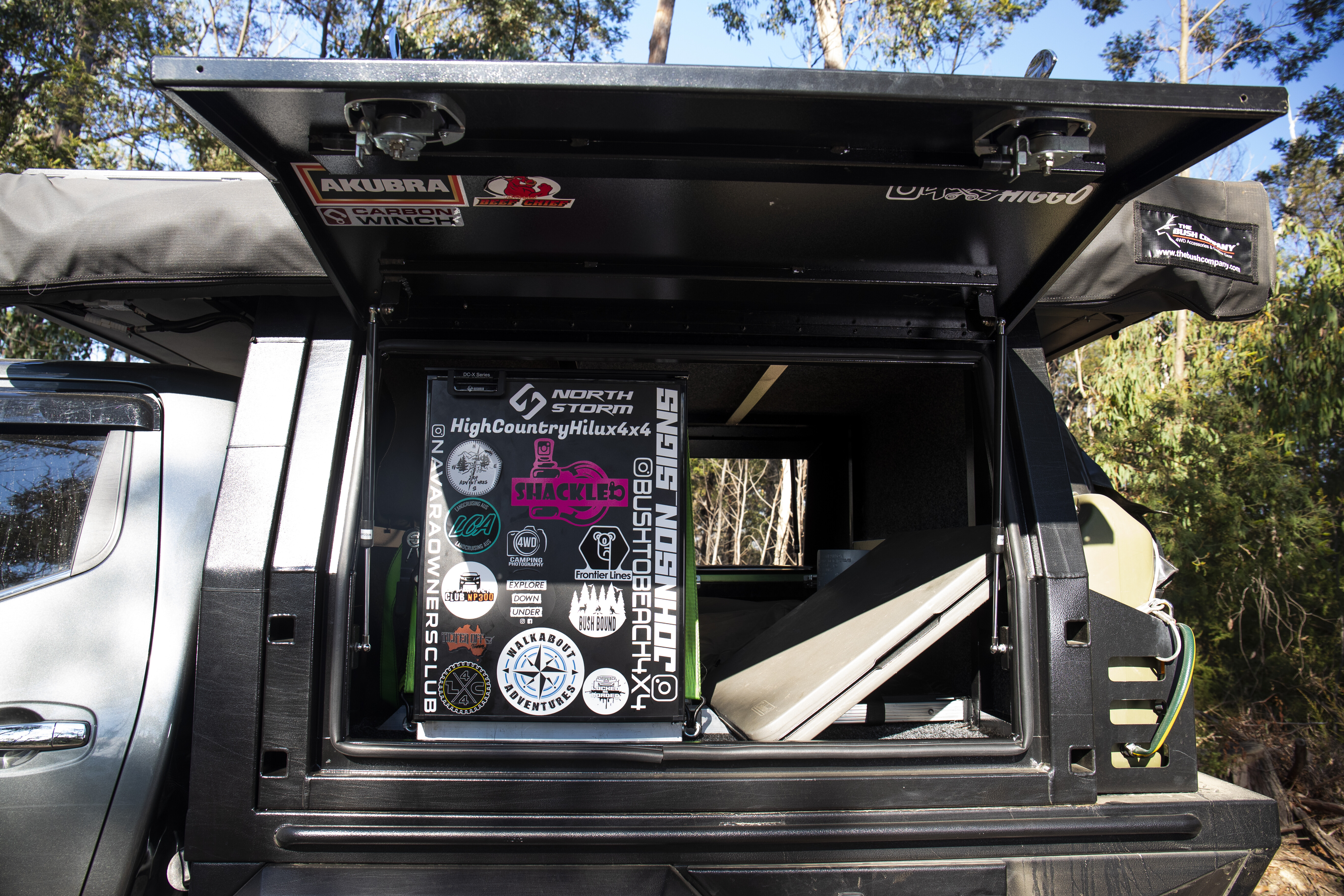
At the moment, the canopy is home to an 85L Bushman fridge, while a 120amp/h Kickass auxiliary battery, a Redarc DC-DC charger and a Victron battery monitor make sure there’s always plenty of power on hand.
Once Brendan had the camping set-up sorted, it was time for a shakedown run before he set off on a three-week trip around Tassie.
“There was a big rush to get everything all sorted for the Tassie trip; that was the main goal. Before that I did a High Country weekend, that was its first trip away, and that was a good test for it all,” Brendan says.
Despite all the hard work and striving to get Nellie the Navara finished off before the Spirit of Tasmania headed south, that three-week Tassie trip very nearly didn’t happen at all, thanks again to the dreaded COVID.
“We were lucky to get over there,” Brendan says. “In the end, we got the last boat over before they locked Tasmania down again for five days. We didn’t know if we would be able to get on the boat or not … then we got a text message at about 4pm when the boat was supposed to be leaving at 6.30pm, that we could get on the boat and not have to quarantine.”
So, what, if anything, would Brendan change or add to his Navara now he’s lived out of it for a few weeks at a time?
“The only thing I would like to add are some drawers and stuff inside the canopy,” he says. “Other than that, I wouldn’t change anything at the moment; I like the way it is, I think I’ve done it pretty well.”
We think you’ve done pretty well too, Brendan …
Oh, and if you’d like to see what Brendan gets up to in the future with Nellie the Navara, you can check out his Instagram page or have a gander at the Locking Hubs 4×4 Facebook page he runs, and maybe even join him on an upcoming 4×4 tour out of Melbourne.
This Navara platform has been around for seven years now, receiving various updates along the way. Suspension was one area that required a few goes to get right, however I can say the wait seems to be worth it.

We now have a dual-cab 4×4 from Nissan that rides well on- and off-road, has a solid traction control system and a more modern appearance. But is that enough? Well, we took off for the week, living and camping out of this new Navara, to see if it was up to task.

Though it’s a familiar package, with the same seven-speed automatic gearbox and 2.3L twin-turbo motor, exterior and interior revisions have certainly done favours to the vehicle overall. There’s nothing much to gripe about that couldn’t be fixed with a visit to your local 4×4 shop. There are also some really handy additions, such as a sharp looking steering wheel that means you now don’t accidentally press the horn when turning like the previous version. That was always an unwelcome surprise.

There’s also an increase in payload carrying ability, thanks to a massively stout new rear axle housing. This thing is huge but thanks to the flat (or shaved if you’re in the biz) lower differential housing, we didn’t have any issues getting hung up on rocks. This is a nod to the heritage of Nissan building bulletproof 4×4 drivetrains in the GQ and GU Patrol; it’s nice to see a beefed-up Navara.

What you would have noticed is the off-road friendly accessories fitted to this Navara. It’s not a specific model of Navara on test, like their off-road-oriented N-Trek Warrior. This is a vehicle Nissan has built to showcase the range of accessories available straight from the dealer. What we have here includes a loopless steel bumper with Warn winch and a neatly recessed LED light bar. There’s a raised air intake, smoked weather shields, aggressive flares and practical additions such as a tonneau cover and tray liner. Underbody bash plates get the nod too, as does a towbar rated to 3500kg.
These accessories do come at a premium, adding more than $10,000 to the final purchase price, but it must be said it’s not hard to spend $10,000 at a 4×4 accessory shop either. These factory Nissan accessories are of high quality also, something I must commend them for.
POWERTRAIN & PERFORMANCE
With 450Nm of torque available from the 2.3L twin-turbo motor, the Navara feels somewhat lacking in the grunt department these days. I’d love to see a new motor, or tweak to the factory tune for more grunt. When on boost and moving, there are no issues at all. It just feels laboured taking off the line with a load on board. There is a refreshing turbo whistle from that factory raised air intake though, which the boy racer in me loved.
Gearbox performance is stellar, with the seven-speed automatic doing everything right. Rumour has it, this auto shares the same part number as the gearbox used in the Y62 Patrol. So, if it can handle that V8 grunt, it’s more than adequate for this four-cylinder engine.
Fuel economy was tested to be a total of 9.9L/100km, the onboard trip computer accurately matching what showed at the bowser when refilling. We certainly weren’t aiming for economy, with a combined cycle of urban, highway and off-road driving.
ON-ROAD RIDE AND HANDLING
I’ve said this before and sadly I have to say it again. The steering feel in this Navara is heavy and somewhat doughy in my opinion. I jumped straight out of an Isuzu D-Max into the Navara, and immediately noticed this. Again, it is something you will get used to, so is certainly not a dealbreaker but worth mentioning.
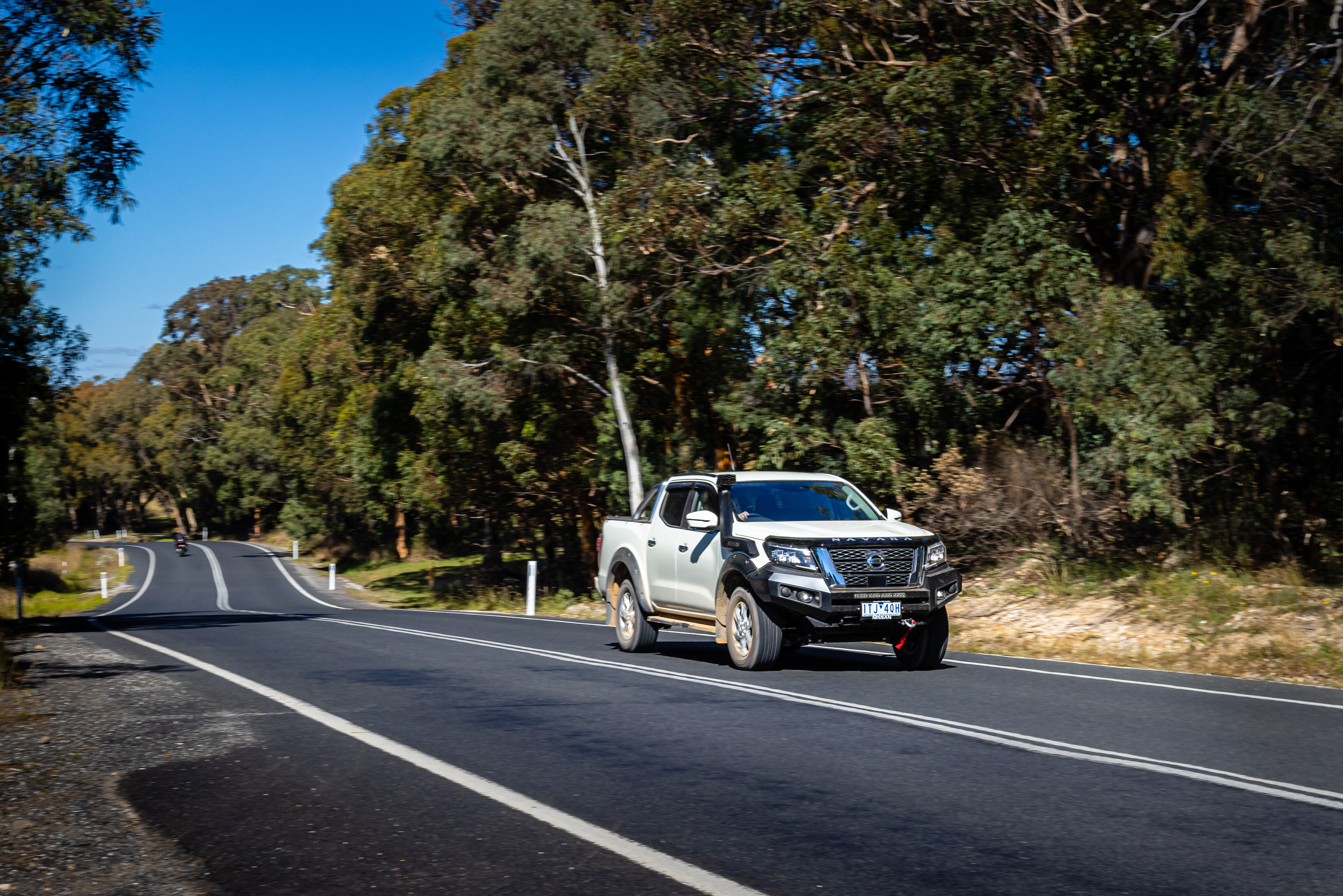
That’s pretty much where the negative points end and I’m happy to report the Navara is a solid performer on-road. Ride quality is compliant, without being too soft. I didn’t experience any nasty bodyroll on fast country roads, nor was there an intrusive amount of cabin noise at highway speeds.
They have really got the package right and while not an exciting vehicle to pilot, I can’t name any regular dual-cab that is (Raptor and Gladiator excluded). The Navara is best described as a jack of all trades and when it comes to the versatility of a ute being its strongest selling point, in no way is that a bad thing.
OFF-ROAD

Ride quality on rough terrain is never going to be a dual-cab ute’s strong point. Well, I can disagree now, as the Navara rides great off-road thanks to its redesigned coil-sprung suspension on all four corners. It’s supple and flexible, however, I still feel the HiLux has more wheel travel overall. This should be an easy fix though, as there are plenty of high-end suspension kits and upgrades available for the Navara to get them flexing. Longer shocks, extended sway bar links, things like that.
The Navara is fitted with a factory rear differential lock, and it’s a good one too as it doesn’t disengage traction control on the front axle when selected. This really assists the Navara off-road, making it a very capable 4×4 out of the box as it’s able to get as much traction as possible down to the ground.
Low-range gearing is nothing short of sensational. The seven-speed automatic gearbox crawled at a snail’s pace down steep descents when locked in low range, and allowed for gentle progress on challenging obstacles. I don’t see many people having a need to use the hill-descent control feature in the Navara. It is also a win for those wanting to fit larger tyres as there will still be enough reduction available in low range to move said rubber without running away.
The only issue I had off-road was that the low-hanging heavy-duty front bash plate (another optional accessory) made contact in steep ruts, though that’s why it’s there. Some bigger tyres and a bit of lift, this isn’t an issue anymore.
Overall, the Navara is a very capable off-road performer that rides well over rough ground and can more than keep up with others in this segment thanks to the rear locker and traction control system.
CABIN AND ACCOMMODATION
Let’s get this out of the way, yes the Navara has a sliding rear window and it’s brilliant. If you have a dog, they’ll love it. If you like eating kebabs on the road, your passengers will love it. Our photographer loved it too, being able to sit on the back seat and shoot out of the small window. Why don’t all dual-cabs have this feature?

As mentioned, the new steering wheel fitted to the Navara is a wonderful addition. Stylish, and with all the controls you’d need at your fingertips. Adjustment is only via tilt, with no reach adjustment available.
Seating is a very subjective topic; however, I personally was a big fan of the cloth seats found inside this ST Navara. Supportive, comfortable and well-suited to my lanky frame. As a side note, my wife jumped in and immediately said how comfortable the seats are. As she has as little interest in 4x4s as I do in skincare products, I listen to these rare pearls of wisdom.
The dash layout is a bit of a weird one as there is a mass of wasted space on the passenger side. There’s not much storage available either, so it would have been good to see an additional glovebox. There’s also limited real estate when it comes to blank switches, so wiring in an array of aftermarket goodies will take some additional consideration. All in all, this ST Navara is a comfortable ute I’d be happy to daily drive or do a lap of the country in.
PRACTICALITIES
First observation of the new Navara is how nicely weighted the tailgate is now thanks to a torsion-bar arrangement. While not as forgiving as a hydraulic strut, it’s certainly not difficult to raise or lower this tailgate. Once inside the tray, however, it’s a very simple affair.
There were no adjustable tie-down points fitted to this test vehicle, just four very basic tie-down hooks located at each corner of the tray. It will do the job but if you can spring for the adjustable points, I’d recommend it.
As mentioned, the Navara has received an increase to its payload capacity thanks to a redesigned rear axle housing. It can now legally carry 1088kg of load, which is a handy and very usable figure.
It is nice to see a tray liner fitted, which we put to the test loading up with firewood and camping gear. However, something of an annoyance was the tonneau cover that is really tight and hard to put back on. Considering you need to unclip the back of the cover to open the tailgate, this wasn’t ideal. We tried this in warm weather to see if it helped, and it did marginally. This is a factory optional accessory, so check this with the dealer before driving off to make sure yours isn’t the same.
SUMMARY
It’s strange this platform has been around for a fairly long time in automotive standards, yet it finally feels like it’s just come alive. I dare say, if we received this Navara when it was first released, it would be a much more popular vehicle sales-wise. It rides well, is capable off-road and there is so much potential when it comes to further modifications. The factory-fitted accessories found on this particular Navara are all of high quality and work well too.
Considering how hard it is to find parts and workshop space in this current climate, having the dealership fit everything makes plenty of sense. All covered by a factory warranty, all on one finance plan.
This new Navara is a good thing if you want a capable and comfortable dual-cab ute, with the option of throwing factory-fitted accessories at it. Add some bigger tyres and a suspension lift and it would go anywhere I’d want to take it. And look good while doing it.
OFF-ROAD SPECS
DEPARTURE ANGLE: 26⁰ RAMP OVER ANGLE: 22.9⁰ APPROACH ANGLE: 32⁰ WADING DEPTH: 600mm GROUND CLEARANCE: 220mm