Advice


Gallery 1
There is something about Australia’s deserts that gets under your skin – the silence, the scale and the feeling that you are a very small part of a very big landscape.
It is exactly what draws so many of us back time and time again. But those same qualities that make desert travel so rewarding are the ones that can turn a simple mistake into a serious situation. Out here there is no roadside assistance, no phone signal and no servo around the corner. When you head into desert country you are relying on your preparation, your judgement and the gear you carry. Desert travel is not about being fearless – it is about being ready.
These are the five things every 4×4 adventurer should have when heading into remote desert country. Not the flashy extras or the latest trends – just the solid essentials that keep you safe, self-sufficient and confident to explore further than the bitumen.
1. Sand flag
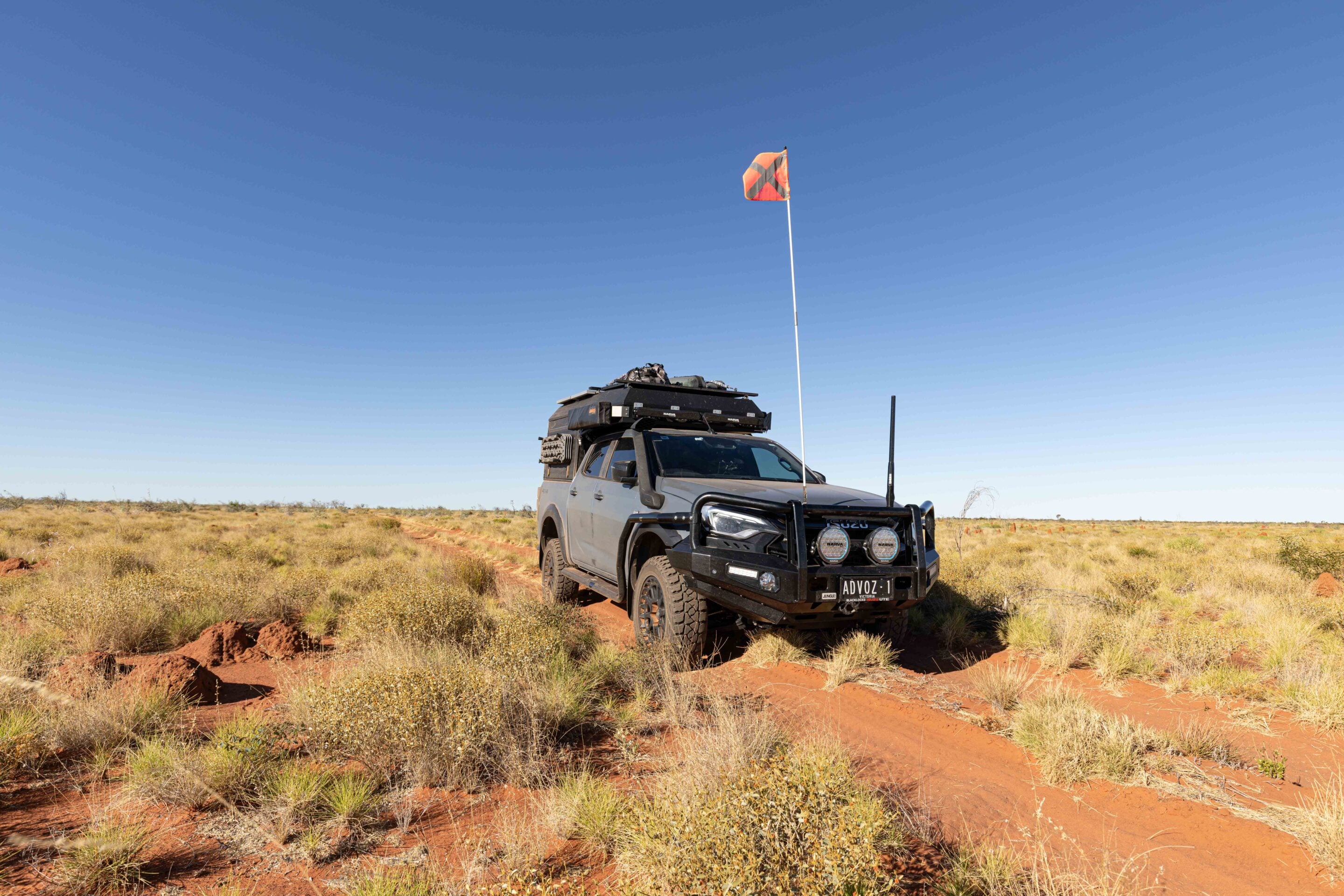
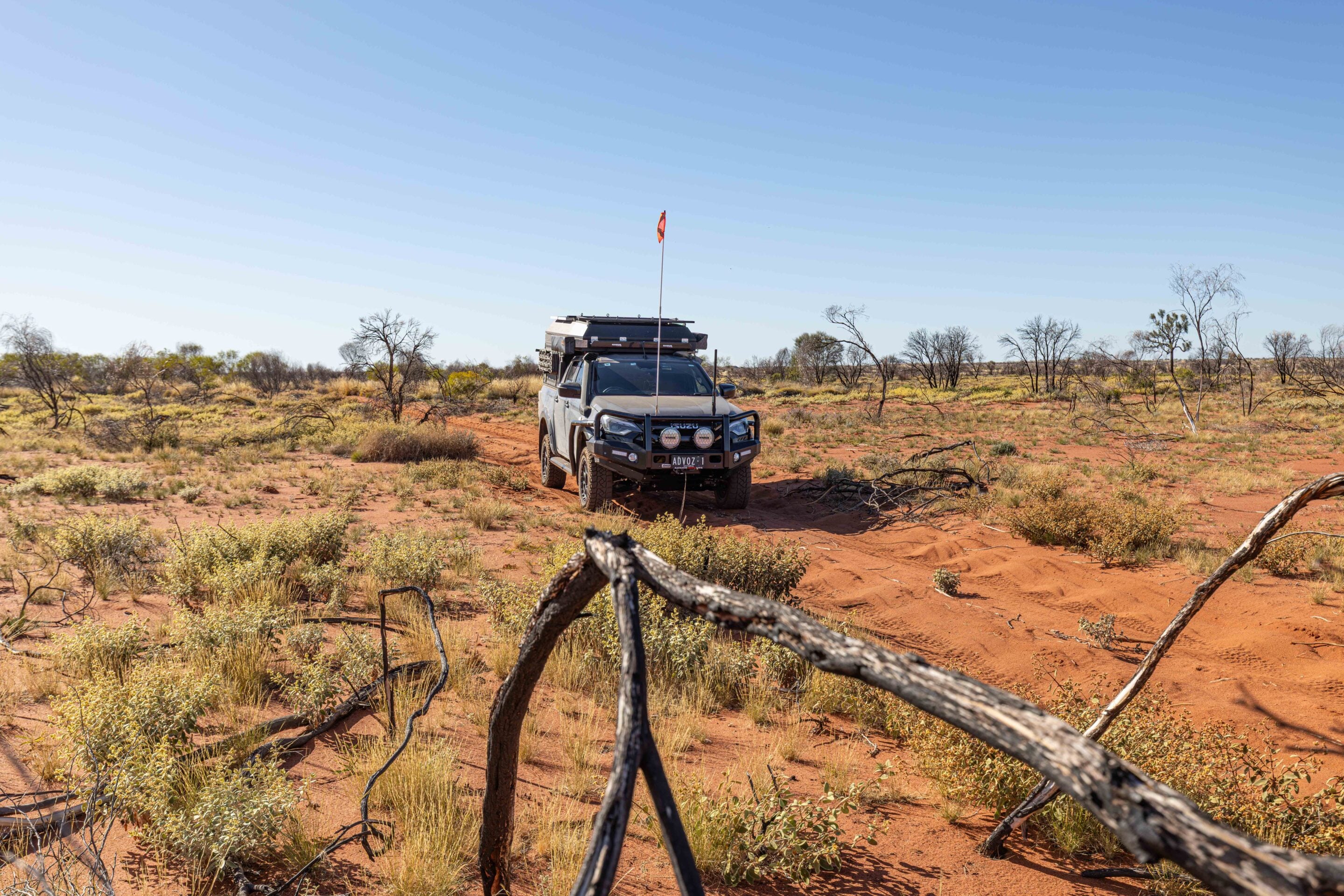
A sand flag is one of the simplest pieces of safety equipment you can bolt onto your four-wheel drive, yet it is often the one that saves lives.
When you are driving in desert country – especially among sand dunes – visibility becomes your biggest challenge. Tracks twist and turn. Crests hide what is coming. Dust hangs in the air long after the last vehicle has passed.
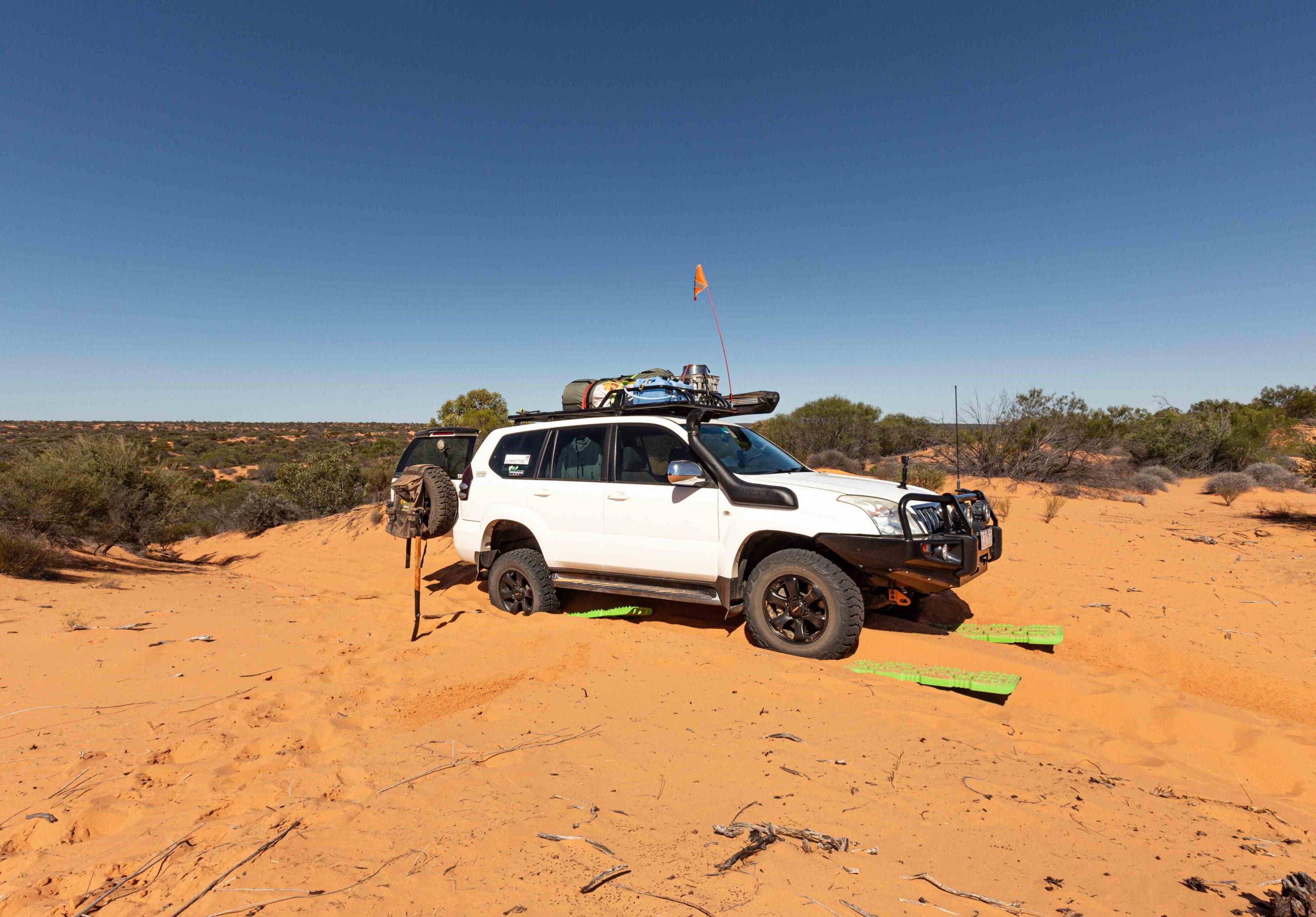
In places like the Simpson Desert, a sand flag is not just a good idea – it is compulsory. The reason is simple. When two vehicles meet on the crest of a dune there is very little time to react. A bright fluorescent flag gives the driver approaching from the other side a vital early warning that someone is coming. It can mean the difference between slowing down in time and a head-on collision.
But the Simpson is not the only place where a sand flag matters. Any desert track with blind rises and soft dunes is a place where visibility is limited. Len Beadell’s iconic routes – such as the Gunbarrel Highway, the Connie Sue and the Anne Beadell Highway – all feature sections where a sand flag can be the only thing visible above the scrub.
1
Even beach driving benefits from a sand flag. When you are climbing dunes near popular coastal areas, other drivers can appear out of nowhere. A flag gives everyone more time to react.
Choosing a sand flag is not complicated. Most 4×4 accessory stores stock dedicated kits, but a homemade option can work just as well as long as it meets the guidelines. The flag must be fluorescent and clearly visible. It should measure at least 300mm by 290mm. I used to run an old UHF aerial mounted to the roof rack, wrapped in red electrician’s tape and topped by a fluorescent flag.
Mounting height is just as important as the flag itself. If fitted to the bullbar, the top of the flag needs to sit at least 3.5m from the ground. If mounted to a roof rack, it must be at least 2m above the mounting point. This ensures the flag is visible above the vehicle and surrounding terrain.
A sand flag is not about ticking a rulebook box – it is about protecting yourself, your passengers and the people travelling in the opposite direction. In remote desert country, that responsibility sits with all of us.
2. UHF radio
In the desert, communication is everything. When something goes wrong, being able to talk to other travellers can change the outcome of a situation in seconds. That is why a UHF radio is one of the most valuable tools you can carry into remote desert country.
Many people see a UHF as nothing more than a way to talk to mates in convoy or listen to truck drivers swap stories. But in desert travel it becomes a critical safety device. It allows you to share your location, warn others of hazards and listen for approaching vehicles long before you see them.
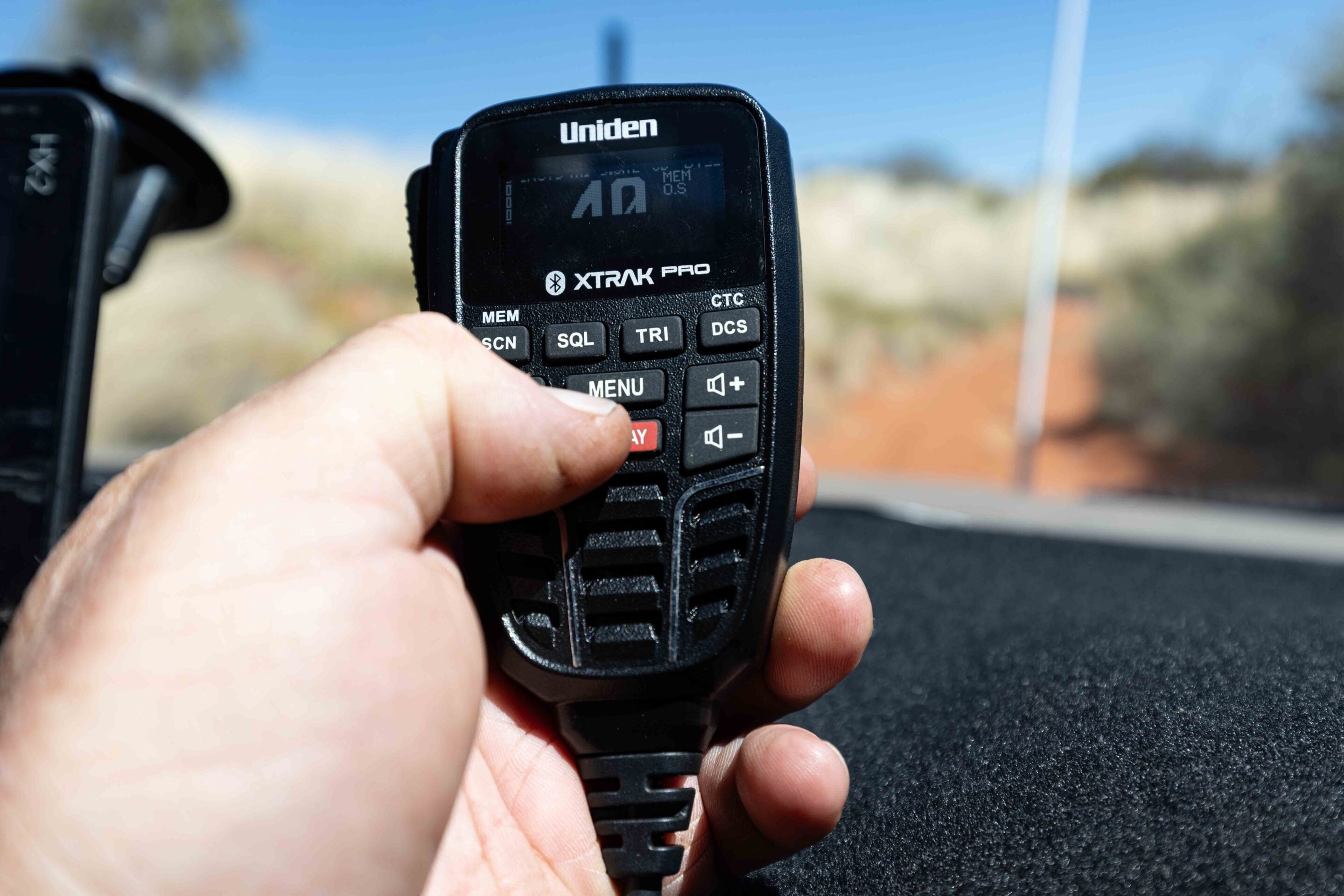
Channel 10 is widely recognised as the desert travel channel and is the recommended channel for the Simpson Desert. Along major routes such as the QAA Line and French Line you will find marked call points where drivers announce their position and direction of travel. A simple call – such as “eastbound vehicle at dune 15” – can prevent a dangerous encounter moments later.
1
Experienced desert travellers often keep one radio permanently tuned to channel 10 while using another channel for convoy chatter. It might sound excessive, but it keeps the safety channel clear for important information. When you are hundreds of kilometres from help, clear communication becomes a form of insurance.
It is also important to use the right channels for the right reasons. In the desert and on major highways, channels such as 10, 18 and 40 are used for safety and information. They are not the place for long conversations about camp cooking or last night’s footy score. Keeping those channels clear helps everyone.
A good quality UHF with a properly mounted aerial will give you several kilometres of range – often more in open desert terrain. That range can be the difference between handling a situation yourself and needing outside help. I noticed on a recent CSR trip that my 3.0dBi UHF antenna was not well suited to dune country, so I plan to upgrade to a 6.6dBi aerial for my next desert adventure.
When travelling remotely, a UHF radio does more than keep you in touch. It keeps you connected to the wider travelling community. And in the desert, that community is often your first line of support.
3. Paper maps
We live in a time when navigation has never been easier.
Satellite systems and digital maps have put incredible tools in the hands of every traveller. Units like the Hema X2 and Garmin Overlander, along with apps such as Newtracs, allow us to pinpoint our location within metres. Tracks, campsites and fuel stops appear with a tap of the screen.
But the desert has a way of reminding us that technology is never foolproof. Batteries go flat, screens crack and units overheat. Sometimes the simplest things – dust and vibration – can bring electronics to an end at the worst possible moment.
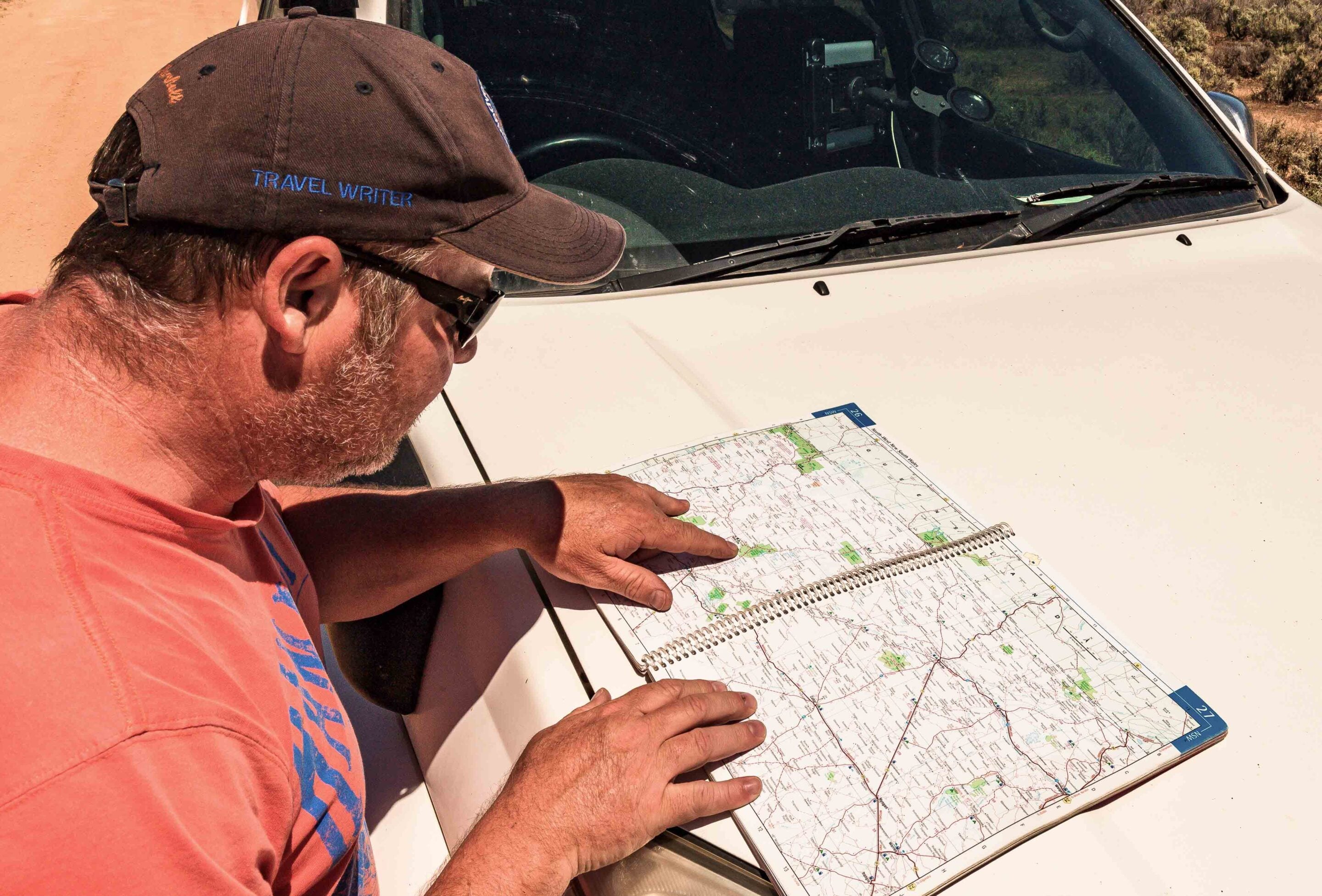
This is why paper maps still deserve a permanent place in every desert travel kit. A good quality map gives you a broader understanding of the country you are travelling through. It shows not just where you are, but where you can go if plans change. Alternative routes, old tracks, water points and emergency exits all become part of your decision-making.
1
Knowing how to read a map is a skill every outback traveller should develop. It does not require advanced training – just a basic understanding of scale, direction and landmarks. Pair that map with a simple handheld compass and you have a navigation system that works anywhere, anytime, without power.
A compass is often overlooked because it seems old-fashioned, but it remains one of the most reliable tools you can carry. It tells you where north is, no matter what. From there everything else falls into place.
In the desert, redundancy is not about being paranoid – it is about being practical. Carrying both electronic navigation and paper maps means you always have a backup. When you are far from help, that backup can become your primary lifeline.
Navigation is not just about finding your way forward – it is about knowing how to get out if you need to. And in remote desert country, that knowledge brings confidence.
4. Water
If there is one item that defines survival in the desert, it is water. You can travel for weeks with minimal food. You can manage with limited comfort. But without water, everything stops.
The human body is made up of about 60 per cent water. Every cell, every organ and every system relies on it. Water regulates body temperature, keeps joints moving and helps flush toxins from the body. Without it, the effects of dehydration begin quickly and escalate fast.
In cool, shaded conditions a person might survive close to a week without water. In the heat of the desert that time frame shrinks dramatically. Three or four days can be enough for dehydration to become life-threatening. In extreme temperatures, even less.
An adult needs at least 4L of water per day just to stay alive in hot conditions. That is not for comfort or luxury. That is simply to keep the body functioning. In severe heat, a person can lose up to 1.5L of fluid per hour through sweating alone. If that fluid is not replaced, the risk of heat exhaustion and heatstroke rises quickly.
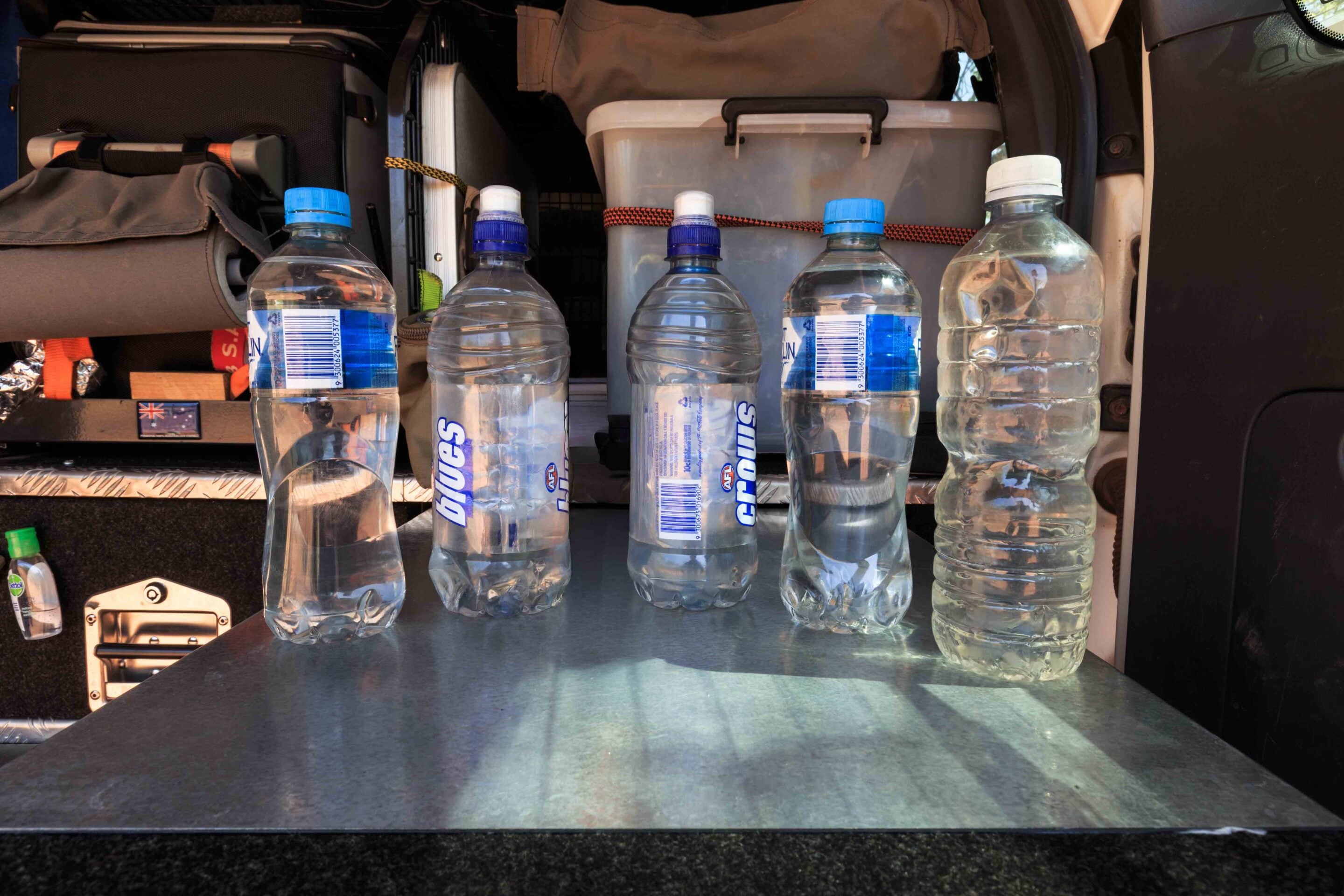
For desert travel the rule is simple. Carry more water than you think you will need – then carry some more. Plan for breakdowns, delays and detours. Plan for the day when the track is slower than expected and the heat is higher than forecast.
How you store your water is just as important as how much you carry. Relying on a single tank or container is a risk. A cracked tank or leaking fitting can cost you everything. Spread your water across multiple containers so that one failure does not leave you stranded.
Water is not just for drinking. It is for cooking, washing wounds, cleaning eyes full of dust and keeping yourself functioning when conditions are tough. In remote desert country, water is not a convenience – it is life itself.
Every desert traveller should treat water with the respect it deserves. Because when everything else fades away, water is what keeps you going.
1
5. Recovery gear
Getting bogged in the desert is part of the experience.
No matter how skilled you are or how well prepared your vehicle might be, soft sand and steep dunes have a way of catching everyone out eventually. What matters is not whether you get stuck, but how you deal with it when you do.
Recovery in desert country is not about rushing – it is about thinking clearly and working methodically. The best recoveries are often the calmest ones. When you feel frustration creeping in, that is the time to stop, boil the billy and take a breath. A few minutes of clear thinking can prevent hours of hard labour or expensive damage.
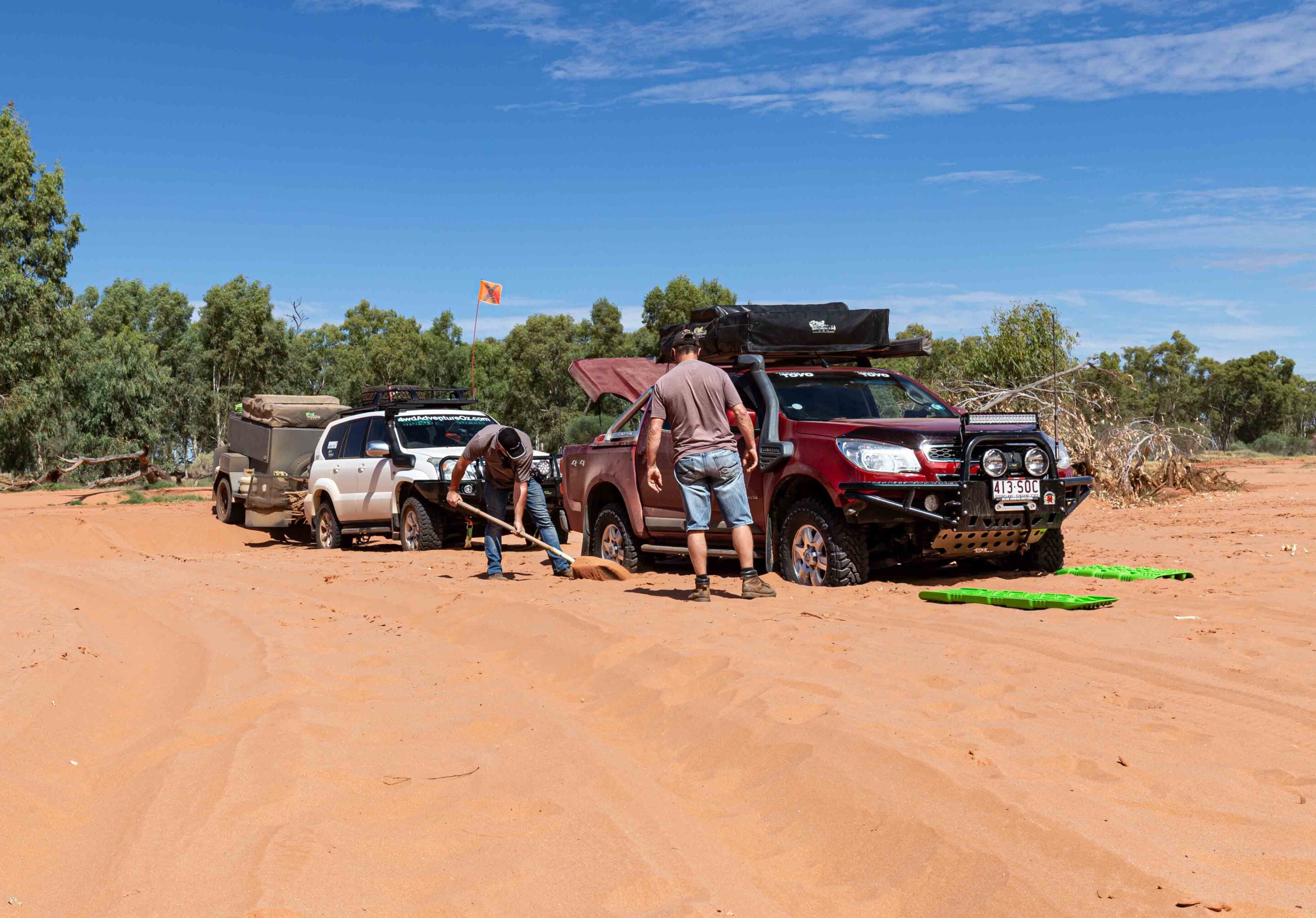
Every desert touring vehicle should carry a basic recovery kit. At a minimum, this includes a long-handled shovel, a quality set of recovery tracks, rated shackles, a kinetic rope and properly rated recovery points on the vehicle. These items will handle the vast majority of situations you are likely to encounter.
A shovel is often the most powerful recovery tool you own. Clearing sand from in front of tyres and diffs can turn an impossible situation into a simple drive-out. Recovery tracks add traction where tyres struggle, especially on soft dune faces.
1
Rated recovery points are critical. Never attach a strap or winch line to anything that is not designed for the load. A failed recovery point can become a deadly projectile. Safety must always come first.
For those travelling solo or tackling more challenging routes, a winch adds another layer of security. In the desert, winching is not always straightforward due to the lack of solid anchor points. This is where a snatch block, a static extension rope or even a sand anchor can make all the difference.
But owning recovery gear is only half the story. Knowing how to use it properly is what really counts. Take the time to learn correct techniques and attend a recovery course if you can. Practise in controlled environments before you need those skills in the middle of nowhere.
In remote travel, self-reliance is everything. The better prepared you are, the more confident you become. And when you are confident, you can relax and truly enjoy the adventure rather than worry about what might go wrong.
1
Extra advice
Desert travel strips things back to the basics.
Out there the distractions fade away, and what remains is you, your 4×4 and the country stretching to the horizon. It is one of the most honest ways to travel Australia, but it also demands respect – respect for the environment, for the distances involved and for the reality that help is never close.
The gear you carry is not about fear; it is about freedom. Freedom to explore further, to take the long way around and to camp where the silence is louder than the engine ever was. When you know you are prepared, you travel with confidence rather than caution. You enjoy the moments instead of worrying about what might go wrong.
A sand flag, a UHF, proper navigation, enough water and the right recovery gear are not glamorous additions to your build. They will never draw a crowd at the pub, but they are the difference between a trip that stays in your memory for all the right reasons and one you would rather forget.
The desert will always be bigger than any of us, and that is part of its magic. Travel it well, travel it prepared and it will reward you with experiences that no highway ever could.
Follow 4X4 Australia on Google
Get more 4x4 news, reviews and gear stories from 4X4 Australia in your Google feeds.

We recommend
-
 Advice
8 essential tips for a safe outback adventure in Australia
Stay safe on your next outback adventure with these eight practical tips
-
 Advice
Outback travel water guide – how much you really need to carry on remote trips
Straight-up advice on how much water you really need to carry for safe and comfortable travel in the Aussie Outback
-
 Advice
Stranded in the Outback? Why your roadside assistance could make or break your trip
A breakdown in the bush can escalate quickly – having the right roadside cover could be your ticket home