News


Gallery 1
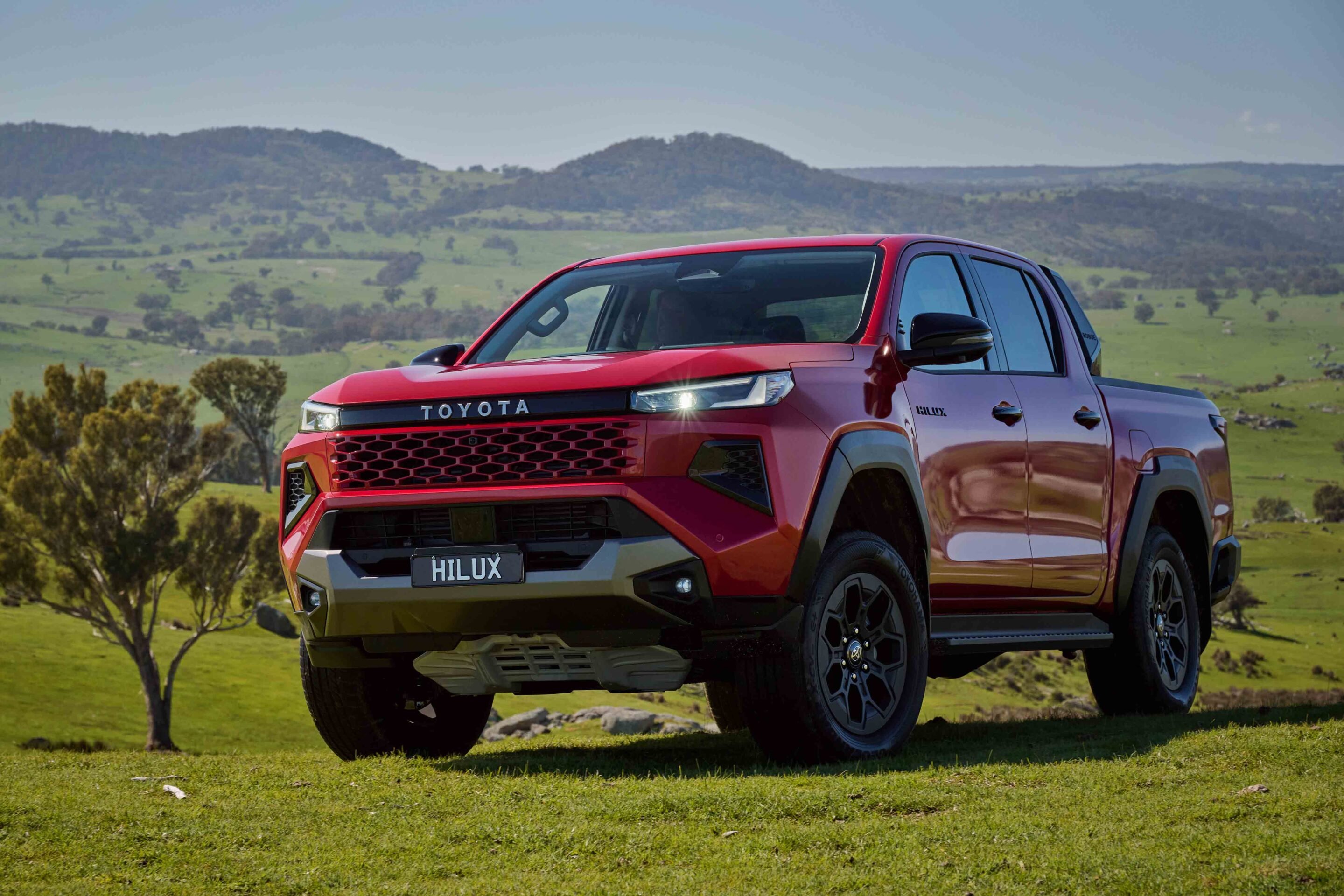
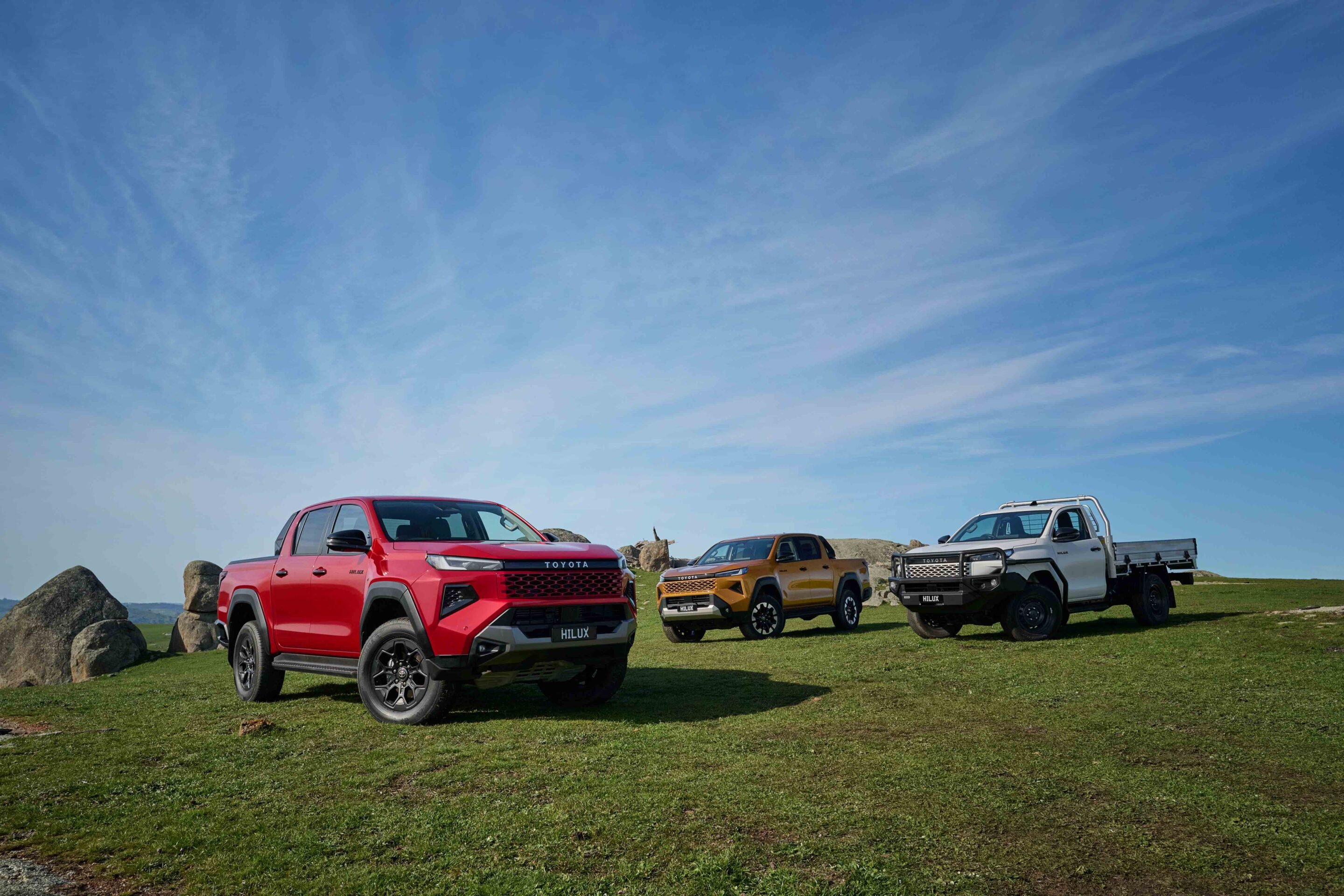
Following our drive of pre-production prototypes earlier in 2025, we’ve now spent more time behind the wheel of full-production HiLux models, sampling several 4×4 variants from across the 21-model range.
The 2026 HiLux line-up includes single, extra and double-cab bodies; 4×2 or 4×4 drivelines; manual or automatic transmissions; and WorkMate, SR, SR5, Rogue and Rugged X grades.
All 2026 HiLux models, from the base WorkMate to the Rugged X, are powered by the 1GR 2.8-litre diesel engine, backed by either a 6-speed automatic or 6-speed manual depending on the grade. The engine produces a claimed 150kW and 420Nm with the manual gearbox, or a claimed 500Nm when paired with the automatic.
Huge kudos to Toyota Australia for continuing to offer the choice of a manual gearbox in the HiLux, while many competitors in the midsize 4×4 ute segment now offer only automatics.
Some double-cab automatic grades from SR and above also get Toyota’s 48-volt V-Active system, which uses an 8.5kW/65Nm electric motor-generator, a lithium-ion battery and a DC/DC converter to smooth the stop-start function, provide a small boost to acceleration, and deliver a claimed improvement in fuel economy. It’s a tried-and-true powertrain that has served Toyota well across many of its 4×4 models up to now, and the brand hasn’t seen any reason to change it.
Aside from the obvious changes to the front and rear styling of the new HiLux, all variants now get LED headlights, a 12.3-inch multimedia screen, and a new 7-inch instrument screen for WorkMate and SR models, while SR5 and above get a 12.3-inch cluster. There’s an all-new dash, seats and interior trims, plus improved safety kit including autonomous emergency braking with pre-collision safety system, active cruise control, rear cross-traffic alert, lane departure alert and lane trace assist, road sign assist and blind spot monitor. Some of these ADAS systems are now possible on HiLux due to the integration of an electric power steering system across all models in lieu of the previous mechanical setup.
On models with MTS drive modes, the steering feel can be switched between Normal and Sport, with Sport mode giving the driver improved feedback.

1
WorkMate and SR HiLux grades ride on 17-inch steel wheels, but by the time you step up to SR5 you get 18-inch alloys, the bigger instrument screen and more features including Multi Terrain System and drive modes, plus the availability of the Premium Interior Package, which adds leather seat trims and a JBL premium sound system with nine speakers.
SR5 and above HiLuxes also get revised suspension calibration to improve ride quality, particularly when driving without a load on board. Despite the softer-riding suspensions, the SR5 and above models have a higher GVM rating than the lower grades, with the WorkMate double-cab pickup 4×4 at 3065kg; SR double-cab chassis 4×4 manual and SR5 double-cab pickup 4×4 manual at 3080kg; SR double-cab 4×4 auto and SR5 with Premium Interior double-cab 4×4 manual at 3090kg; and SR5/Rogue double-cab 4×4 coming in at 3120kg. All 4×4 models have a 3500kg towing rating.
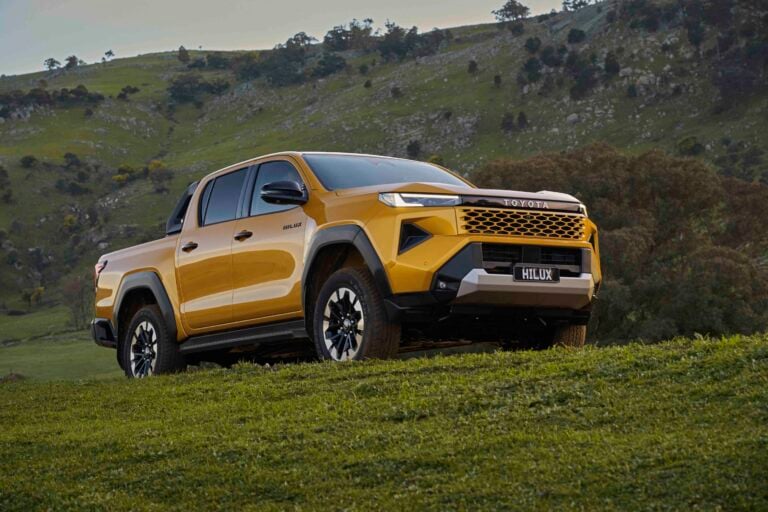
The renewed Rugged X HiLux is billed as the most off-road-friendly model in the line-up, but its extra kit is more about improved clearance and body protection than any increase in tractive ability. This comes courtesy of a hoopless steel front bumper with LED light bar, under-front bash plate, and front and rear rated recovery points. At the back there’s a Rugged X–specific sports bar, a bed liner in the tray and ‘TOYOTA’ lettering across the tailgate.
While the off-road hardware remains the same – with dual range, part-time transfer case, rear differential lock (model dependent) and sharp-acting electronic traction control – Toyota has made a small improvement to its performance by keeping the ETC active on the front wheels when the RDL is engaged. The front ETC is only active at speeds up to 6km/h, but in previous generations of HiLux it was totally disengaged when the RDL was locked, leaving the front wheels as free spinners when they broke traction. There is also a new actuator for the ETC to help it perform more smoothly.
If there is one thing that’s disappointing in the 2026 HiLux’s drivetrain, it’s the carry-over of the part-time transfer case in lieu of one that offers the option of full-time or On-Demand all-wheel drive for use on sealed roads. The benefits of having such a system in a ute are felt whenever I am driving one thus equipped, and the HiLux is lagging behind the competition in this regard.
Toyota calls this the ‘Most Australian HiLux ever’, with the design of the front and rear of the vehicle and the interior all done in-house at Toyota Motor Corporation Australia’s (TMCA) Melbourne facility. That said, the utes coming to Australia are still manufactured in Thailand.
The front end features new slimline LED headlights, and the painted grille follows a popular trend on new cars. The front bumper has a muscular design claimed to mimic the pose of a sumo wrestler.
At the back, the cargo tub is all new, with new taillights, liftgate, sports bars and a step to make accessing the load easier. The tub with external tiedown hooks is no longer available, but there are four internal tie-downs. Some higher-spec models get a power outlet and light in the tub, while the Rogue tub is also lined with marine carpet under its powered roller shutter.
Check back Thursday for our full review of the new HiLux, on- and off-road!
| 2026 Toyota HiLux SR5 specs | |
|---|---|
| Engine | Inline 4-cylinder turbo-diesel |
| Capacity | 2755cc |
| Max Power | 150kW@3000-3400rpm |
| Max Torque | 500Nm@1600-2800rpm |
| Transmission | 6-speed automatic |
| 4×4 System | Part-time dual-range 4×4 |
| Construction | 4-door ute and tub on ladder chassis |
| Front Suspension | Independent double wishbone with coils |
| Rear Suspension | Live axle on leaf springs |
| Tyres | 265/60R18 on alloy wheels |
| Kerb Weight | 2215kg |
| GVM | 3090kg |
| Payload | 900kg |
| Towing Capacity | 3500kg |
| GCM | 6300kg |
| Seating Capacity | 5 |
| Fuel Tank Capacity | 80L |
| ADR Fuel Consumption | 8.0L/100km |
| Departure Angle | 26 |
| Approach Angle | 29 |
| Ground Clearance | 224mm |
Future plans: Toyota HiLux BEV
While we already have a number of PHEV utes on the market in Australia, Toyota has elected to make its first alternate-fuelled HiLux a full Battery Electric Vehicle (BEV). That means it is powered solely by its dual electric motors, fed by an 80-cell battery.
Toyota is predicting that the HiLux BEV will achieve an NEDC range of approximately 315km for the SR5-spec double-cab ute, while the 59.2kWh lithium-ion battery can be fast charged using a 150kW DC charger from 10-80 per cent in approximately 30 minutes depending on ambient conditions, or charged on AC power from 10-100 per cent in about six and a half hours.
The HiLux BEV will be available as a double-cab ute or cab-chassis in SR and SR5 grades, but no pricing has been announced yet.
1
The BEV uses a traditional HiLux ladder chassis with the battery pack nestled between the rails and protected by an underside plate. The dual motors each power the front and rear axles, delivering 205Nm of torque through the front wheels and 268Nm to the rear via a full-time electronically controlled all-wheel drive system. This is paired with a five-mode Multi-Terrain System that offers settings for Rock, Sand, Mud, Dirt and Moguls.
It is claimed that this system will allow the HiLux BEV to maintain the same off-road capability as a diesel-powered HiLux, with a 700mm wading depth, 29-degree approach and 25-degree departure angles, and 218mm ground clearance. Toyota says the HiLux BEV will have a payload of approximately 715kg and a braked towing capacity of 2000kg.
The HiLux BEV won’t be for everyone, with TMCA saying it has been designed for industries like mining and farming that would appreciate its unique characteristics. TMCA says it has had a HiLux BEV testing with BHP for more than a year, with impressive results.
No pricing has yet been given for the HiLux BEV, nor have we driven one. It will become available in the first half of 2026. TMCA has also said that it is working on a hydrogen-fuelled HiLux set for a 2028 launch. This will be an FCEV, with the hydrogen fuel cell powering the electric motor or motors.
No further details of the HiLux FCEV have been released, but it is known that Toyota is investing heavily in this technology as a future alternative to diesel fuel.
| 2026 Toyota HiLux 4×4 pricing | |
|---|---|
| WorkMate single cab-chassis AT | $45,990 |
| WorkMate double cab-chassis AT | $52,490 |
| WorkMate double cab pick-up AT | $53,990 |
| SR extra cab-chassis AT | $54,990 |
| SR double cab-chassis MT | $54,990 |
| SR double cab-chassis 48V AT | $57,990 |
| SR double cab pick-up 48V AT | $59,490 |
| SR5 double cab pick-up MT* | $63,990 |
| SR5 double cab-chassis 48V AT* | $64,490 |
| SR5 double cab pick-up 48V AT* | $65,990 |
| Rogue double cab pick-up 48V AT | $71,990 |
| Rugged X double cab pick-up 48V AT | $71,990 |
Options: Premium paint: $675 *Premium Interior pack: $2500
Follow 4X4 Australia on Google
Get more 4x4 news, reviews and gear stories from 4X4 Australia in your Google feeds.

We recommend
-
 Reviews
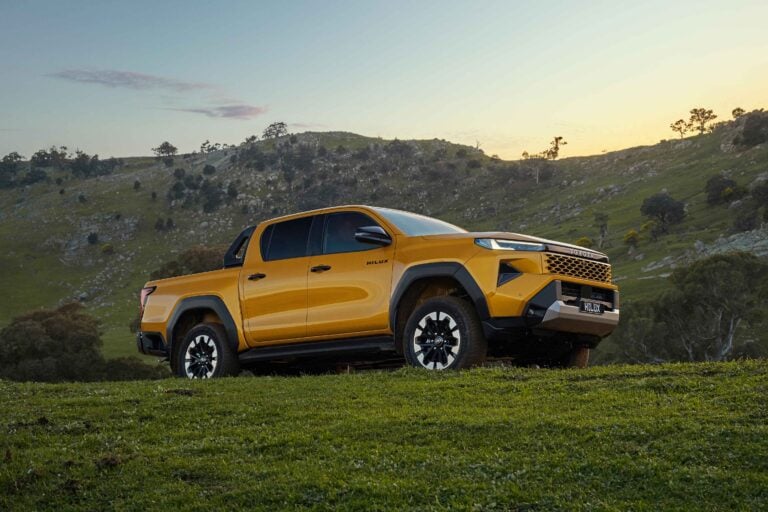
2026 Toyota HiLux: Our first drive impressions
Is the new HiLux an improvement over its hugely successful predecessor? We sample it to find out!
-
 Opinion
They rule the sales charts, but dual-cab utes are loaded with compromises
Popular for a reason, but the reality of life in a dual-cab ute is full of trade-offs
-
 News
News2026 Toyota HiLux revealed – the most Australian HiLux ever!
2026 HiLux lands with familiar powertrain and new BEV variant on the way. On sale in December