
4X4 Australia spent a weekend at Land Cruiser Mountain Park in Queensland with some of the best modified Volkswagen Amaroks in the country for a feature in the October 2015 issue of the magazine – on sale now.
The range of modifications to the VWs covered mild to wild and really showcased what can be done with this all too often overlooked 4×4 ute.
Aside from all being VW Amaroks – which in case you didn’t know is a giant wolf in Inuit mythology – all the cars assembled had some or all of their modifications done at Wolf 4×4 in Brisbane’s north. The crew from Wolf put this neat video together from the day at the park:
Toyota has revealed the range of accessories that will be available for the new Hilux when the workhorse hits showroom floors in October.
Hitting back at Ford Ranger’s challenge to the Hilux reign, Toyota has released the most extensive range of accessories in the company’s history, with some closely resembling the mining-spec-style gear that’s distinctive of the Ranger XL-Plus model.
Included in the new Hilux’s range, about five years in the making, are more than 60 accessories purpose-built for the new vehicle, including an industry pack for mining, construction and other industrial users.
The pack includes LED work lamps, light bar, mining flag, wheel chocks, reflective stripes, wheel nut indicators, handbrake alert, tray accessories and prewiring for an in-vehicle monitoring system.
These are all new to the Toyota catalogue, as are a new snorkel that ensures good air flow, two types of tool boxes and a bed slide on rollers for easy access to items in the ute body.
Meanwhile, airbag-compatible bull bars, which are manufactured at a new, recently opened facility in Melbourne, are expected to retain the five-star safety rating that Toyota is expecting for the new Hilux (most aftermarket accessories and bull bars are not tested for ANCAP safety).
The Hilux bull bars will be available in high-tensile steel or aluminium alloy, with Toyota’s crash tests confirming the right deployment of airbags and operation of safety systems. The bull bar has been designed to ensure airflow through the radiator while providing for mounting points for driving lights, antennas and the genuine accessory winch.
The Hilux’s canopies have also been redesigned to allow one-handed opening and can be specified with central locking, automotive-grade curved glass and integrated lighting. Large “gull-wing” style windows are available for easy access to the load area.
Hilux’s pre-existing accessories have also been redesigned for leisure and work. These include a towbar and load-distribution hitch that support the uprated 3.5-tonne maximum towing capacity of the new Hilux.
According to Toyota, engineers collaborated with designers in Australia to produce the range, which is being marketed as strong and durable.
Additional items in the industry pack include:
• Steel tray – this is new with standard storage/tool box, window protector and mounts for a light bar, flag, and optional slide-out step, grab rail, quick-release ladder rack, tie-down rings and mounts for a fire extinguisher and spare tyre.
• Commercial steel bull bar – this is said to be more affordable while maintaining functionality.
• Battery terminal and accessory fuse box – Toyota says this will reduce clutter with a single point of access for any accessory requiring power from the vehicle’s battery; will have 10 separate fuses and a combined output of up to 50 Amps; added fire protection; and is tested for electrical safety as well as resistance to water, heat and harsh chemicals (standard on 4×4 and Hi-Rider).
• Auxiliary battery kit – this should allow up to 50 Amps of current to be drawn safely without draining the main battery; vibration, shock and temperature tested; on-board intelligent charger provides safe three-stage charging.
• Battery Isolator Switch to allow easy disconnection of the battery. The integrated design has been tested to meet Toyota’s stringent safety standards.
Toyota officially unveiled its eight-generation Hilux, the first new Hilux in ten years in May this year. The Hilux will have a bigger body, new 130kW-450Nm 2.8L diesel engine, and a 3500kg towing capacity. It will go on sale in October with 31 variants in both 4×4 and 4×2. This is nine more variants than currently offered. Most of the model-range expansion will come through extra 4×4 and dual-cab models.
Ford Ranger topped Hilux in sales for the first time ever in August but we expect Toyota will hit back with a vengeance when the new Hilux lands in showrooms.
See Fraser Stronach’s take on the new Hilux.
This pleasant drive through some of Australia’s most magnificent desert mountain country starts at Wilpena Pound.
Just a little north of the resort on Blinman Road, the route veers off the bitumen to a good dirt road.
Timing is important to enjoy the surrounding hills and ranges, so it is best to leave Wilpena just after sunrise, or even earlier, as the sun lights the eastern sky.
The route initially winds across rolling hills dotted with native pines and open grasslands, which in the early morning are often alive with grey kangaroos and emus. The odd, bigger red kangaroos are sometimes seen in these open areas.
As you begin to get into more hilly country, you come to the old Yanyanna Hut, once used when this area was leased for grazing. The road then passes through heavily treed country to the top of the low range of hills and the Bunyeroo Valley Lookout with its spectacular views over the rugged ranges to the west. Be there at sunrise, when the mountains are at their most majestic.
From the lookout, the route winds steeply down the hills into the Bunyeroo Valley, where there are a couple of creek crossings and a few campsites nearby. There is a carpark for those who want to walk into Bunyeroo Gorge.
The route strikes sharply north from here, with the Heysen Range – named after the famous Australian painter, Hans Heysen – to the west and the ABC Range to the east.
The road dips and climbs over low, steeply-humped hills to a T-junction. While the route heads west deeper into the ranges, it’s a good idea to take a detour into the Aroona Valley. The track junction to this pleasant spot is found just a little to the east.
The Aroona Homestead ruins are found at the northern end of the road which cuts through the valley, and there is a very pleasant bush campground nearby with several walking trails to enjoy.
The original homestead was built in the 1850s, while the old Pine and Pug Hut, which is most obvious today, was built in the mid-1920s. Thousands of sheep once grazed these hills and valley, making John Hayward, the first leaseholder, a very rich man.
Back at the T-junction, turn west and drive deeper into the ranges. This route follows Brachina Creek and winds through the Brachina Gorge.
The road then passes below the high peak of Mt Hayward, while the imposing bulk of The Armchair and The Guardian dominate the view as you go deeper into the gorge. Douglas Mawson, most famous for his exploits in Antarctica, once described these mountains as “the bones of nature laid bare”, and with the varied and twisted rock forms you’ll find along here, you can understand why.
Today this route is declared a ‘Geological Trail’, and while there are many obvious ancient landforms, for those willing to search a little deeper, there are also many fossils to be found. Don’t forget, though, you are in a national park and such items are not to be removed. There’s also some nice camping through here and plenty of opportunities to get out and enjoy a walk.
The gorge ends abruptly as you exit the ranges out onto the flat western plains. If you’ve hurried through, take a detour north to the Prairie Hotel in Parachilna and enjoy a counter meal, before turning south along the bitumen to meet the dirt road – the Moralana Scenic Drive – that heads back west around the southern ramparts of Wilpena Pound.
This section of the drive is best done in the late afternoon and evening, with the sunlight casting its rich glow over the impressive walls of Wilpena.
Back at Wilpena, you’ll realise you’ve just completed one of the best drives in the whole of Australia. It is far from being a tough 4WD trip, but it is truly unforgettable in its grandeur.
It’s shiny and you can hold it in your hand: it’s the latest edition of 4×4 Australia and it’s packed with all things 4×4.
The October edition of 4X4 Australia is on shelves now. Inside we check out the new Ford Everest, the updated Ford Ranger and send a pack of modified Amaroks to battle it out at Queensland’s Land Cruiser Mountain Park.
We also have a gander at a stretched Toyota Hilux and a modded-up Dark Label Amarok that’ll have you buying a bucket-load of lotto tickets.
You can grab your copy of 4X4 Australia from newsagents or by subscribing to 4X4 Australia in electronic or print format.
In the meantime, here’s a sniff of what else is inside:
V8 Nissan Patrol custom
This off-road monster is equipped with an arsenal of weapons-grade mods including a stonking V8 diesel engine. We took it for a run in the mud.
Expedition Overland
Expedition Overland’s Clay Croft is eyeing off Australia for his next adventure. We check in with the American 4×4 film-maker to see what’s what.
Deua National Park, NSW
We tackle Deua National Park’s insanely steep climbs and descents.
East MacDonnell Ranges, NT
Ron Moon discovers that gold and gems aren’t the only treasures in the East MacDonnell Ranges.
Coongie Lakes, SA
We travel a long way to see if South Australia’s Coongie Lakes is worth the trek.
The Barraba Track, NSW
The little-known Barraba track in NSW is winding, steep and sometimes closed. Is it worth the trouble?
Toyota 70 Series wide-track coil fix
Here’s a bolt-in, wide-track coil spring suspension that improves the 70 Series on a number of fronts – bingo!
CFMoto X550 ATV and U550 UTV
These farmer-friendly side-by-sides are taken for a spin in the paddock.
Speedliner
It’s been a review almost six years in the making: Scott Heiman sees how his Speedliner tub liner has held up.
Razorback canopy
A ute is stamped from sheet metal, robotically welded and moved along a high-tech production line. Turns out, so are these metal canopies.
Twozone box fridge
The Twozone box attaches to your fridge to create two cooling zones and to increase capacity. We loan it a beer and have a look.
Tough Dog suspension upgrade
Standard Nissan Navara D22 suspension leaves a lot to be desired. Tough Dog has a fix.
Bridgestone Dueler M/T
Is it worth changing from all-terrains to these Bridgestone muddies? Our man Stu reckons so.
Three-second tent
It took GT longer than three seconds to put it up, but Oztent’s Malamoo is still pretty handy.
Korr lighting
We rig up a Land Cruiser and head bush to test Korr’s LED lights.
…as always, the mag has the latest news and events, stats and figures, as well as the industry’s most respected names.
Grab your copy of 4X4 Australia from newsagents or subscribe to 4X4 Australia in electronic or print format.
Price and specifications
Price: $54,490
Engine: 2.3-litre twin turbo four-cylinder diesel, 140kW at 3750rpm, 450Nm at 1500-2500rpm
Transmission and 4WD system: Dual-range part-time 4WD
Braked tow capacity: 3500kg
Spare tyre: Full-sized
Fuel tank: 80 litres
Fuel use (claimed): 7.0L/100km
Fuel use on test: 10.3L/100km
Approach/departure angles: 32.4 degrees/26.7 degrees
Ground clearance: 228mm
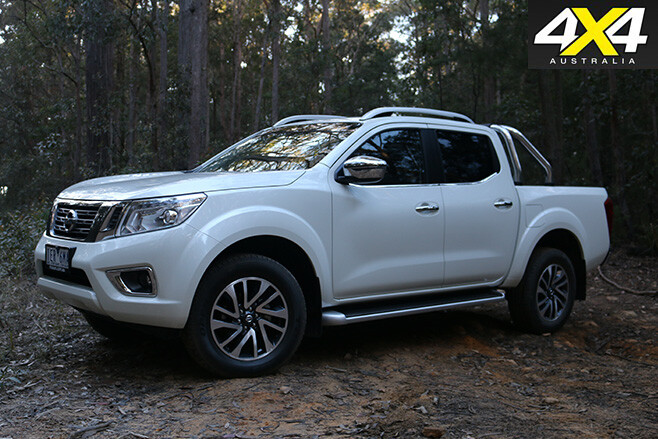
WHAT’S THE DEAL?
It’s an all-new Navara with a new body and new diesel engine. Until later in 2015 the new Navara – called the NP300, which replaces the old D22 and chunkier D40 – is only available as the dual-cab offering tested here, but there is a single cab and King Cab (extended cab) on the way.
Four-wheel drive models aren’t super cheap, with the RX kicking off at $39,990, plus on-road and dealer costs. For that it’s a fairly basic level of kit, with cruise control, power windows and 16-inch steel wheels. There are auto headlights, though. There’s also stability control and seven airbags (dual front, front-side, side curtain and a driver’s knee airbag) on the safety front.
It’s not till the ST-X that you get a reversing camera, teamed to a 7.0-inch colour touchscreen with sat-nav. There’s also dual-zone air-conditioning, heated front seats, electric driver’s seat, a sunroof and partial leather seats, and 18-inch alloys. Plus smart key entry that means you can leave the key in your pocket or bag to open the door and start the car.
Snazzy LED daytime running lights and the glossy sport bar that adds some styling pizazz.
The Navara also gets the electrically-operated sliding rear window; great for making dogs feel more included in the whole travel experience.
PRACTICALITY
It’s clear passengers were a priority with the Navara. It’s the only one in its class to get air vents in the rear, helping with circulation of cooled or warmed air. Those back seats have decent leg and head room, too.
Up front there’s good space and thoughtful storage areas. A large open binnacle atop the dash is good for maps and other odds and ends, while there are various hidey holes in between the two seats.
A theme throughout is the proliferation of cupholders; as well as those in the doors there are more in the centre console and in the centre of the rear floor.
There are three power outlets in the cabin, including one on top of the dash that’s handy for accessories you want to leave in the storage binnacle. There’s also a fourth power outlet in the tray, which is handy for camp lights or fridges.
As with many rivals, there’s no reach adjustment to steering, and the wheel does feel a tad close to the instruments.
One notable (but small) omission is an exterior temperature readout, so you’ll have to wind down the window to check the chill. A digital speedo is also missing.
Yet there are two compasses; one as part of the trip computer in the instrument cluster and another in the rear vision mirror.
The tray is deep and broad enough, although the RX misses out on the rugged tray liner and adjustable tie-down points of the ST-X.
There’s no standard tonneau cover (on any Navara), with a soft one adding $645 to the deal.
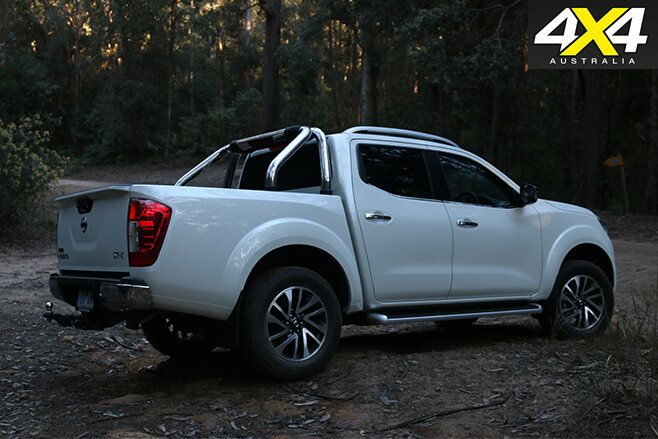
ON THE ROAD
The big change for the Navara – and its big differentiator against rivals – is a coil spring rear-end. It’s still a live axle but gets the more supple coils aimed at improving its on-road behaviour.
It works reasonably well when unladen; there’s still some of the rear-end bouncing typical of workhorse utes, but it’s generally well settled and compliant.
Less impressive is the poise when there’s a decent load in the back. We had about half a tonne out there and it was very light in the nose and a lot less secure in the rear. Even small steering inputs had the tail wagging, sometimes disconcertingly.
Despite the shift to what’s generally considered an inferior setup for carrying big loads, the Navara’s load capacity has increased; for the ST-X tested here it’s claimed at being able to carry up to 930kg.
Tow capacity, too, matches class leaders at 3500kg. However, towing close to its capacity (with a towball download of 300kg) it reduces the gross vehicle mass by 410kg. That means the ST-X here is limited to 579kg of people, luggage and gear in the back when towing that much.
The new 2.3-litre twin turbo four-cylinder diesel isn’t the quietest thing going, with some fan noise and associated diesel roar. But it makes up for it with a stout 450Nm available at just 1500rpm. While it’s no rocket off the line, that torque helps it with hill climbing and makes light work of heavy loads. It also works nicely with the seven-speed auto, which is intuitive in its gear selection.
Claimed fuel use of 7.0 litres per 100km is good, creating a theoretical range of more than 1000km from the 80-litre tank. As always, that figure is largely unachievable; we used 10.3L/100km in a mix of suburban, highway and off-road driving.
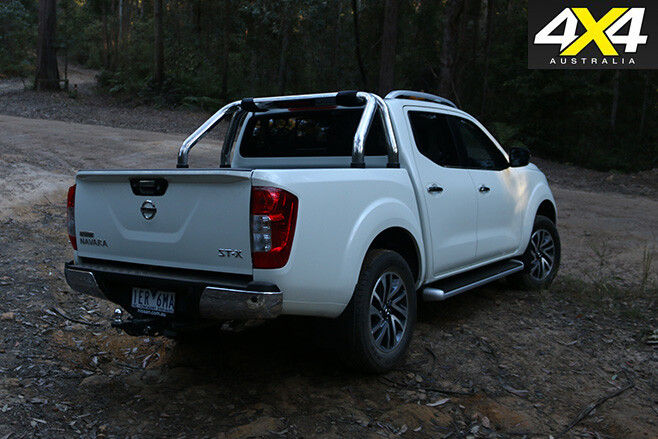
OFF-ROAD
The Navara’s part time dual-range four-wheel drive system includes a locking centre diff that engages when you select 4H, so it rules out using it with all four wheels engaged on-road.
But you can shift on the fly to 4H for added surety on slippery surfaces such as gravel, sand or mud.
A rear diff lock only operates once low range is selected, limiting its usefulness in sand and on challenging trails where high range may otherwise be fine.
The approach angle of 32.4 degrees ensures it can tackle steep steps and hills. As with many dual-cabs the 26.7 degree departure angle is less impressive and can scrape the tow bar if you’re not prudent (or limited) with placement.
The wading depth of 450mm is shallow, too, and almost half that of the rival Ford Ranger and Mazda BT-50. No doubt the aftermarket will cater for that deficiency with all manner of snorkels before long.
Those coil springs provide decent articulation at the rear, ensuring a better chance of having all four wheels in contact with the ground.
As well as traction control there’s downhill assist control to regulate speeds down steep slopes.
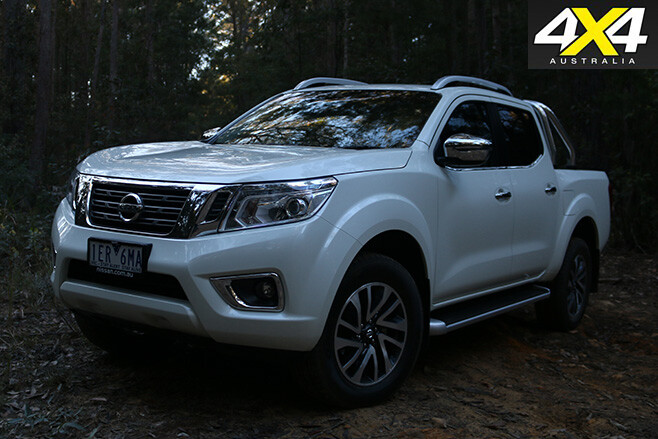
VERDICT
There’s little doubt the Navara has stepped up and is now a more useful truck. Its coil spring rear suspension will be the subject of many campfire discussions (arguments even). It works well on-road and brings some benefits off-road, but it’s less convincing when you come to testing the payload.
Thankfully the grunty diesel engine suits the nature of the vehicle, while the well thought-out interior makes for a decent long distance companion.
John Rooth knows the outback better than most.
But that doesn’t mean he can keep out of trouble. His dusty track has led him to 4×4 Australia and he’s here to tell us a story or two – Roothy-style…
Dancing disco Things weren’t looking good when Glen Hadden rolled his right-hand tyre off the rim during a steep hill climb on loose shale and the Disco took a slide. We got it double strapped and winched it over the lump to safety, but the real lesson came later when Glen realised he’d tried to outsmart the computer-assist driving modes. He tried again with the Terrain Response dial set correctly and the Disco walked up as if on a sky hook.
Having experienced it a few times, I have to tell you this latest generation traction control stuff is mind-bogglingly good. I may have to ask Stronach to explain how it works, though.
Glen later blew out a tyre on the Oodnadatta Track. He didn’t notice immediately because the suspension stabilisation system countered the lean while the Disco’s lounge-like comfort swallowed the noise. The result? The tyre chewed through to the rim. There was a warning light on the dash, though.
A sandy start When the starter motor in Milo – my old green Toyota – dropped out on Fraser Island, I was lucky there was plenty of willing help. This is the third time it’s happened, always in a salty environment. And yes, I eventually tracked it down to a faulty earth strap… again.
The lesson? When it comes to high-amp battery connections, you’re better off with good crimping – crushing the lug onto the cable – than using any form of solder. I got into trouble years ago when the flux eroded by itself; but it seems the modern flux-cored stuff is much the same.
The answer? Use plenty of Lanotec or WD-40 anti-corrosion spray and lots of work with the rag to protect the terminals. That way, if something comes loose there’s a chance you’ll find it before losing all your new friends.
Camel rescue My mate Brolga, better known as the BBC’s ‘Kangaroo Dundee’, made enough quid out of his TV series to upgrade from the old Hyundai banger to a late-model Toyota. Good thing too, as nobody deserves it more than him; one of the real decent people on this earth.
Problem? He’s discovered that little camels can fit in the back of a Troopy almost as easily as bubby ’roos in the back seat. So now he’s out there rescuing camels, too.
Oh boy, does someone else want to mention the old Toyota RAV4 ad?
Kitchen handles Plenty of things have cracked, fallen off, or just plain died on my old green Toyota, but this was a real first.
The handle started to crack a few trips ago and every time I opened the door it seemed to need more of a pull. Then it fell off in the driveway right before a trip. After a bit of filing and drilling, a key ring took over the opening duties, but it bent every time I pulled the door open.
No worries; a good handle wasn’t far away. In fact I found one in the kitchen, complete with screws.
It should last about as long as I will once the wife finds out.
Swag of style We all have our favourite camping style.
If I’m with the family nothing is as good as the big mattress in the camper trailer. For work trips, however, it’s always been the swag. And ever since trying out these quick-fold bunks in rocky old Arnhem Land a few years ago, I’ve never rolled out my swag without putting a bunk up first.
The combination of a cosy swag up off the ground with plenty of give, in a big stretcher (mine are both from Darche), needs only one more thing to make it perfect. But seeing Paris Hilton is busy running her hotels I usually settle for a pillow pinched from home.
In wetter country, the truck’s awning comes out to keep the mist off the swag. This also makes packing up possible at first light.
Fair dinkum, if I’d have known comfort like this as a young bloke I’d still be driving a harvester.
If you’re ‘doing the Gibb’ east from Broome, then you’ll have covered a dusty and corrugated 900km by the time you get to El Questro near the eastern end of that famous road.
If you detoured up the torturous Kalumburu Road to Mitchell Falls and back, then make that 1400km. By now your 4×4, tent, clothes, pretty much everything, will be covered in fine, red dust and after the privations of a couple of weeks camping, the wife and kids have gone to the ‘dark side’.
About now, a few nights in a real bed at El Questro becomes a highly attractive option.
El Questro Station has fuel supplies, a shop, a campground and a range of accommodation – from $300 per night all the way up to $2800 per night. It’s a very, very popular destination. So popular that in peak holiday times, with hundreds of visitors constantly pounding up and down the station’s dirt roads, a dust pall over the station can be visible from several kilometres away.
Another option is El Questro’s sister resort, Emma Gorge, just 10km further east along the GRR. Without camping facilities and with only a short access road from the bitumen, there’s no dust and little noise.
Admittedly, the resort’s tented structures are not exactly soundproof and it can be less than pleasant if you are unlucky enough to end up next to the couple who thought it would be a good idea to bring their three children aged under five into the great outdoors. Neighbours aside, the tented structures, each with one double bed, two single beds and a luxury bathroom, provide ideal family accommodation.
Emma Gorge Resort stands at the mouth of the gorge it is named after and features a bar, a bistro and a quality restaurant that all look out onto lush-green tropical gardens. The walk to the head of the gorge takes about 45 minutes, initially along a well-made path and then on a rocky riverbed. About 200 metres from the end of the walk is a beautiful aquamarine pool fed by water trickling in between two giant boulders that stand like sentinels over this inviting oasis.
The major attraction, however, is just around the corner – a waterfall that plunges 60 metres from the escarpment above has gouged a huge cavern and waterhole. While the waterfall is barely a trickle in the dry season, the cool waters of the pool (shaded from the hot tropical sun) are a magnet for tourists.
Sitting on one of the boulders that lie scattered around the edge of the waterhole, you can look up to see many similar boulders seemingly defying gravity in the cavern roof – a not-entirely comforting view.
Most of El Questro’s attractions require basic 4×4 skills. For example, Explosion Gorge (named after the local method of fishing in years gone by) is an easy drive, apart from a couple of washaways in the rough gravel track and a 300-metre crossing over the Pentecost River. Formed from large, heavy rocks to withstand the wet-season floods, the ford is a punishing test of suspension that will perfect your technique of ‘driving through the brakes’.
The scenery is superb, especially when the late afternoon sun lights up the red sandstone ridges dotted with spinifex and snappy gums. This drive also encompasses Branco’s Lookout, with its spectacular views back over El Questro and a wide sweep of the Pentecost River – where the wake of an occasional saltwater crocodile can be seen in the otherwise still water.
Reaching El Questro Gorge involves a 100-metre water crossing and, while it’s little more than hub-depth, there is often a queue of quite capable 4x4s with their owners nervously surveying the crossing before turning around and driving away. The gorge itself presents a pleasant shady walk through stands of Livistona palms, which have survived from prehistoric times thanks to springs that keep the gorge damp even in the driest times.
The delightful walk down this narrow gorge is eventually blocked by a huge boulder and, while it is possible to clamber over this obstacle, most visitors don’t bother as the track becomes more difficult past this point.
At nearby Zebedee Springs, a 750-metre walk winds through another lush stand of palms to several small pools constantly kept between 28°C and 32°C thanks to a thermal spring. The other constant is the queue of tourists in their swimmers impatiently waiting for a dip in the soothing waters. In an attempt to prevent the area being degraded by overuse, the springs are only open to the public from 7am to 12pm each day.
Leaving the comforts of Emma Gorge behind, it’s a 200km drive south on the Great Northern Highway to Purnululu. This sealed road follows fabulously rugged and steep-sided ranges, which generally run north-south through much drier country than the western sections of the Kimberley.
If you think the Kimberley isn’t like anything else in Australia, in a way you are right – it wasn’t originally part of the Australian continent, but collided with it 1.8 billion years ago. This event and subsequent geological activity formed the Halls Creek Fault system, which roughly parallels the Great Northern Highway and is responsible for much of the rugged terrain (and the nearby Argyle Diamond Mine).
The 50km gravel road into the park is an easy run, albeit restricted to 4x4s without vans, because of blind corners, crests and creek crossings with sharp entry and exit angles. Despite numerous signs saying ‘4×4 only’, there always seems to be tourists who think the warnings don’t apply to them and who end up with their 2WD ‘Campers’, or similar vehicles, parked up at a rocky water crossing, wondering what to do next.
Driving into the park, the western side of the Bungle Bungle Ranges that first greets visitors is unremarkable. It’s only when you drive around the southern end of the range to Piccaninny that the famous beehive dome formations reveal themselves.
The banding of the domes is due to a difference in the clay content and porosity of the various sedimentary layers of sandstone. The dark-grey bands are caused by cyanobacteria (single-celled organisms that are one of the oldest life forms on Earth) growing on layers where moisture accumulates. The orange bands are due to oxidised iron compounds in layers of sediment that retain less water and dry out too quickly for the cyanobacteria to exist.
Looking at these striking structures, it’s hard to believe they were largely unknown until an ABC camera crew filming a documentary accidentally stumbled across them only 30 years ago.
From the car park at Piccaninny, there is a choice of both short walks and longer day and overnight treks. An easy three kilometre walk along dry creek beds, plus a short uphill section, leads to Piccaninny Creek Lookout that sits between two domes and provides superb views over the eastern-facing beehives.
Here, a side track to Cathedral Gorge enters a narrow cleft in the orange sandstone cliffs, providing entry to an immense amphitheatre that initially leaves visitors amazed and in awe. A testimony to the power of water, this natural wonder was carved out of the rock by a waterfall that, after rain, pours in through the cavern roof.
The north end of the park also has several short walks. The 4.5km Mini Palms Track follows a dry creek bed before climbing into a narrow gorge dotted with picturesque Livistona palms. Some walkers might wish they hadn’t had that second helping of lunch when they find they are required to squeeze through narrow gaps between huge conglomerate boulders.
The track concludes at two viewing platforms, one that looks back down the palm-filled gorge and a second that provides a view into a large amphitheatre, which narrows down to little more than a crack in the far wall.
Nearby is the two kilometre Echidna Gorge walk, where the sheer gorge walls gradually close in on each other. The gorge becomes narrower and narrower before appearing to end in small amphitheatre aglow with sunlight being reflected off the red rock of the gorge walls high above. However, off to one side is a small opening into a short continuation of the gorge – so narrow in places you can touch both walls.
At certain times of the day, sunlight shines all the way to the gorge floor, making Echidna Gorge one of the most stunning natural light shows to be seen anywhere. The narrow gorge appears as if lit by a blast furnace, and tourists walking from the gloom into this cauldron of orange life often conjure up visions of the recently departed descending into the fires of Hades.
An early-morning 20-minute helicopter flight over the park, while an expensive exercise for a family, provides a view of Purnululu not otherwise available. The little choppers don’t have any doors, much to the horror of some passengers, but they provide an unsurpassed aerial view of the beehives and the flat, trackless land that sweeps away towards the yellow sand of the Tanami Desert clearly visible in the distant south-east.
The East Kimberley has a very different appearance to the wetter, tropical west. Whether visitors choose four-star luxury accommodation at El Questro or a more intimate camping experience under the stars at Purnululu, both destinations provide a treasure trove of experiences to remember for years to come.
For many of us, the pursuit of the ultimate four-wheel drive is a never-ending quest.
Through trials and tribulations we’ll make modification after modification in search of the perfect off-roader. Camping set-ups come and go, tyres get swapped and re-swapped, and suspension kits go in and out at a dizzying rate. All this comes at the expense of our bank accounts, time spent off-road, and in extreme cases, our sanity.
Victorian local Brian Richards has played this game longer than most. A back catalogue of six mild-to-wild 4x4s is testament to his perseverance in finding a unicorn – the perfect 4×4. He hasn’t found it yet, but this LC79 is about as close as humanly possible; at least this side of $160,000.
With retirement looming, multiple cross-country trips ahead of Brian and his wife, and an ageing 80 Series Land Cruiser parked in the garage, the choice to upgrade was an easy one – not that Brian is entirely convinced it’s an upgrade.
The 79 offered the reliability Brian needed, and the creature comforts his better half demanded, so Brian did what any sensible man would do; after a 10,000km-round trip to Arnhem Land, he cut his Land Cruiser in half.
“I have tall legs” Brian says. “The space in the single cab just kept giving me trouble. My legs constantly ached.”
The solution was to source a second cab, which Brian then took to Tinman Fabrication’s Les Camilleri, who proceeded to cut the back off Brian’s cab and graft on a new back wall 195mm closer to the tail-lights, just long enough that the tray could still pick up the front mounts.
The new room inside worked out perfectly, allowing Brian to install a pair of leather Recaro seats further back for additional back support and leg room. The added benefit was the cab now had two factory fuel fillers, one feeding into the main tank, the other into a 160L Long Ranger auxiliary tank.
The Richards family has spent the past 20 years heading bush at every opportunity. They’ve taken the kids in swags, struggled with a seemingly endless amount of tent poles, and piled into a roof-top tent. With the kids all grown up, Brian thought it was time for a grown-up camping set-up, too. There was no chance Brian could tow a caravan where he wanted to go, so a slide on camper made perfect sense.
“It’s like a caravan on the back of a ute. It has got a big queen-size bed, shower, toilet, hot water, and a kitchen. It was chosen by the wife, of course, but I’m getting to like it. It’s a great camper.”
If you have kids you’d need to set the annex up every night, but for two, it’s the perfect set-up.
“You can notice the change in centre of gravity, too,” Brian explains the effect on the Toyota. “She is quite tall, so you can’t take corners too fast, but you do get used to it. It’s built for touring, not for the tougher tracks.”
Despite the camper’s aluminium and fibreglass-composite construction, there’s no getting around the fact that adding a small house to the tray of any vehicle will negatively affect the weight. The solution was a gross vehicle mass (GVM) upgrade suspension kit. The 50mm lift kit from EFS allows Brian to carry the additional weight and makes room for the 33-inch BFG KM2 mud tyres.
“I’ve had an excellent run with BFGs over the years,” Brian says. “Two sets on my 80 Series. Over 20 years without a single puncture, and a set on my 100. I’ve just bought a new set for the 79 and am hoping for similar results.”
This is now a tourer, so it’s no surprise to find it’s fitted with all the fruit. Redarc dual-battery controller, ARB bar work, Warn winch, Department of the Interior roof console, GME UHF, EGT and boost gauges, and a Waeco eight-litre fridge between the seats are just some of the accessories. What savvy readers may notice, however, is the distinct lack of a clutch pedal and the auto shifter; something Toyota never offered.
About 10 years ago, Brian’s doctor informed him he’d need a knee reconstruction in, well, 10 years. Brian is doing his best to put that off and one of the ways he is doing that is by ditching the clutch pedal and making the Land Cruiser a whole lot more enjoyable for him to drive.
The conversion was done by the guys at Marks 4WD Adaptors and involved an upgrade to the 6L90E gearbox. The six-speed slush ’box is brand new, but is the same as is fitted to late-model Chevy Silverado trucks, so it’s rated to a massive 900Nm and more than up to the task of long-distance outback touring.
At the business end of the gearbox sits Toyota’s 1VD-FTV V8. Despite its modern tech, the 4.5L, 32-valve, double-overhead cam, common-rail-injected diesel monster has earned a reputation of poor fuel and oil consumption.
“I’ve got a friend with a late-model 200 Series and he’s using 10 litres of oil between services,” Brian says. “But I’ve never had any issues. There was a bit of work to make the cruise control work with the auto but, apart from that, mine has never used oil, has plenty of low-down grunt thanks to the Steinbauer chip, and is good on fuel.”
Brian prefers to take things a little slower these days, opting to explore the side tracks, rather than blast past them. The result is that he often sits on 90km/h, which nets him 11-13L/100km of fuel consumption.
“A while ago I was following my son back from a trip and he needed to get back for his daughter’s ballet, so we were sitting on 110km/h the whole way. It did it comfortably but fuel consumption sky rocketed to 22L/100km.”
By the time you read this, the Richards will be halfway to somewhere. Brian is not entirely sure where yet. The plan is to head north for six weeks, wherever the tracks take them. And, a shakedown run for a three-month stint in the Kimberley is planned for next year.
Knowing Brian, the next trip will result in more changes, more upgrades, and more adventure. After all, even the perfect 4×4 can always do with a few more tweaks.
Renault has given us a good view of what its version of the Nissan Navara will look like when it’s launched next year.
The French firm will be putting its own Gallic spin on the light truck, as part of the Renault-Nissan Alliance, to provide the second one-tonne 4×4 truck from a European manufacturer, following Volkswagen’s successful Amarok.
Mercedes-Benz will be another company to join them when it does its pick-up, which will again be built on the Navara platform, but isn’t expected until 2018.
The Alaskan Concept is said to be close to what the production Renault ute will looks like.
Drop the 21-inch alloy wheels, the flash lighting and some of the bling off the concept and you can see its Nissan heritage and how Renault has given it its French flair.
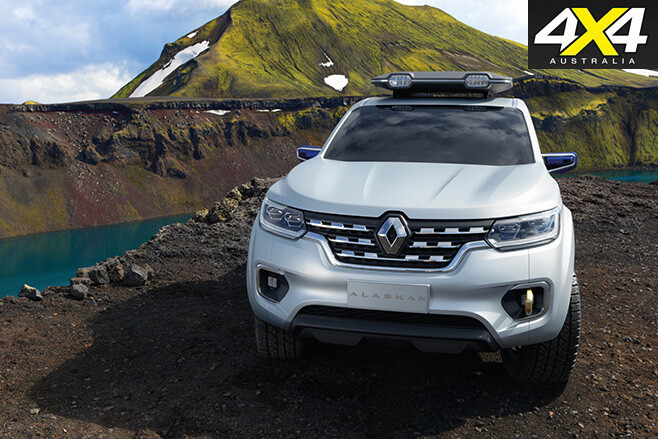
The production version is expected to target the premium recreational ute buyer and skip the tradie market; however, Renault claims that the vehicle will still have a full one-tonne load capacity with five passengers on board.
The ute will share the Navara’s chassis including the class-unique coil-spring rear suspension and will be powered by the same bi-turbo 2.3-litre diesel engine and 4×4 drivetrain.
The production version will be launched in the first half of 2016 but vehicles are not expected to reach Australia until later in the year or even early 2017.
We all take our rigs to a trusted auto mechanic for servicing because we know it’s the right thing to do.
After all, a well-maintained vehicle will have a long life, and a well-tuned engine will use less fuel, produce more power and will release less emissions.
We also know that a mid-service lube and oil change is a good idea because lubricants lose their effectiveness over time and all moving parts must be lubricated. Otherwise we get unnecessary wear and tear from things including: inadequate engine temperatures during city driving; climatic conditions; cold starts; and towing.
So if we look after our ‘big engine’, why do some of us ignore the needs of the small engine that often lives in the back tray or is strapped to your roof racks? That’s right; we’re talking about the little engine attached to your chainsaw. It needs some love and attention, too.
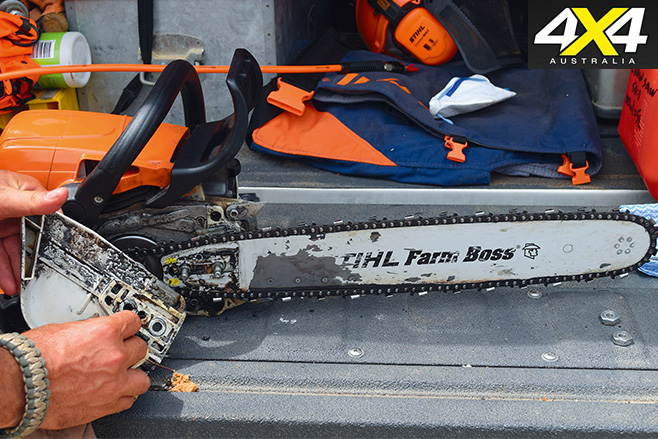
We use chainsaws for the odd job around the house, to cut fire wood when out camping (or at home), for fencing jobs and – more importantly – to clear a blocked track. When it’s time to leave an area because of a weather warning, or you’re evacuating your campsite because of a medical incident, you need to be confident that your chainsaw is ready to face whatever challenges you’re up against. It needs to start – first time.
So why is it that so often, when we’re out on the track, someone grabs their chainsaw to deal with a branch or tree, only to find that the little bugger fails to start? Normally it’s bad fuel, but sometimes it’s lack of maintenance.
Common Faults in Storage Most of us tend to pull out the chainsaw only when we’re packing for a big trip. This means that, for the rest of the time, it’s probably sitting in the shed, neglected. If this is the sort of life you’re offering your chainsaw, the least you can do is store it off the ground.
If you simply leave it lying around on the ground, or on a cement floor, moisture will inevitably wick through the ground. The result can be as simple as surface rust on the bar and chain, or it could even be as bad as engine seizure.
Other things to remember when storing your chainsaw are to: Make sure the chain and bar oil reservoir remain full. This helps to prevent moisture from building up.
Make sure you change your fuel every two months regardless of whether you’ve used your chainsaw. Fuel goes off after this time. Specifically, it will ‘gum up’ and affect your fuel line and system.
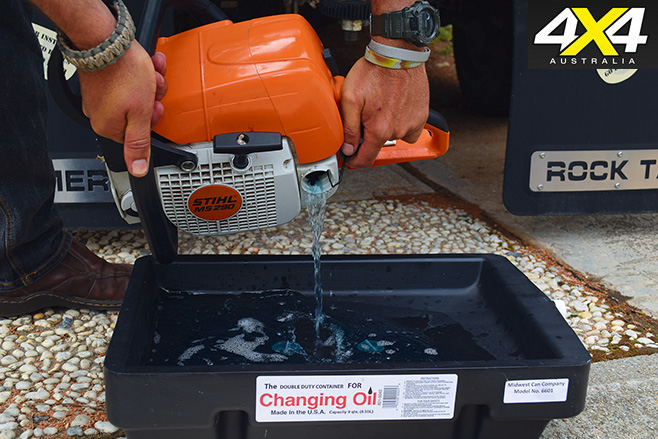
Start your chainsaw at least twice a year. This achieves two things. First, it ensures the engine will not seize. It also practices you in how to start the chainsaw, so that, when you do finally need it, you don’t inadvertently flood the engine through lack of familiarity. If you know that your chainsaw is going to be sitting around unused for more than a couple of months, empty the fuel tank entirely and store it dry.
To do this, start the chainsaw to warm up the engine. Then stop it, drain the fuel out (keep it in a container to one side, you’ll need it later) and then start the saw until it stalls (this stops the spark plug from becoming ‘wet fouled’).
Pre-use Routine Pre-use inspections should be carried out with any piece of equipment and your chainsaw is no different. Before you pull the starter cord remember to: Check the condition of your personal protective equipment (PPE) and put it on. Visually inspect switches, throttle control, pull starter cord, etc. Verify all guards are secure and function correctly. Verify the chain-brake functions. Ensure saw chain and guide bar are in good condition. Check that fuel and oil are full. Repair any identified deficiencies before proceeding further.
Home Servicing If you’re using your chainsaw regularly, you should be servicing it at least once a week. And servicing won’t take long. But if your chainsaw is sitting idle most of the time, make sure you give yourself a couple of hours to properly service it. You’ll need to factor this in to the time that you set aside to prepare for a trip away.
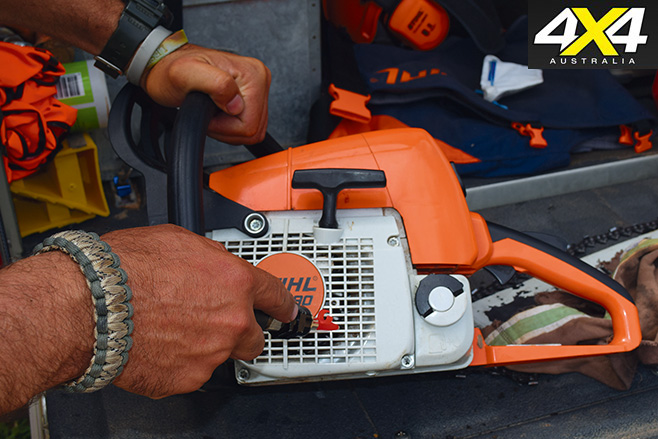
Cleaning – birds do it, bees do it, and even educated fleas do it. With a chain saw, cleaning starts with a piece of rag, a stiff paint brush and a source of air. First, wipe down all external surfaces and blow out any air from the chainsaw’s exterior including the engine cooling fins. Then remove the chain sprocket cover and brush out all of the crud.
Blow out any excess deposits with air. Wipe down all external components including the bar and chain with the old fuel saved when emptying the tank. People commonly overlook the chain/bar oil hole and passages. Make sure you blow these clear with air too.
Clean or replace the air filter – it’s important to clean or replace the air filter regularly. First, carefully remove the filter, trying not to dislodge dust and muck that could fall into the intake manifold. Place some ‘Chux’ cloth or equivalent, into the intake recess and the openings of the filter. Then clean the detached air filter with warm soapy water before rinsing it with clean water. Allow it to dry before re-installing.
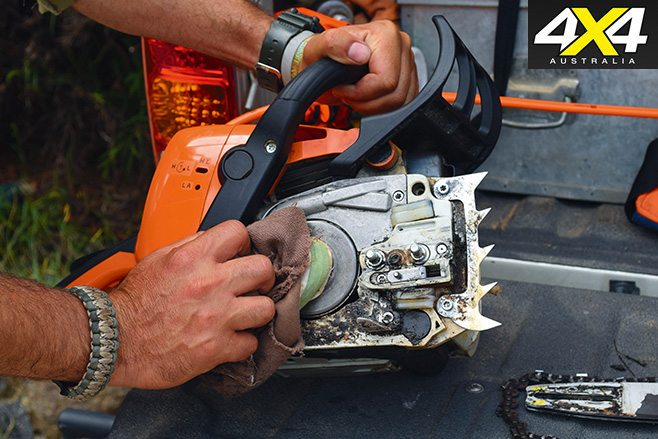
Fuel filter – yes, chainsaws have one. And if you’ve left your chainsaw on the shelf for a year, or have been feeding it the spare left over fuel from yesteryear, you should probably replace it.
Spark plugs – should be replaced yearly. Dirty and worn spark plugs can reduce your chainsaw’s starting and cutting performance. If the plug is dirty, use a carburettor cleaner and fine sandpaper to clean it, then set the gap to specification. If the plug is worn, replace it (you should always carry a spare).
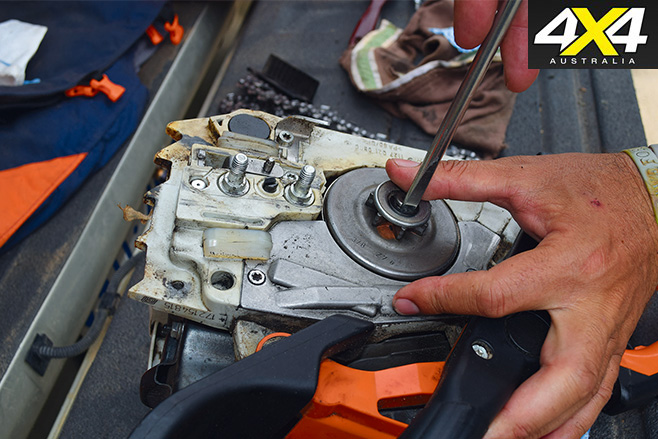
Drive sprocket – with heavy use, you may need to change these every year. So it may be handy to have a spare on hand. After all, it’s only held in by a ‘C’ clip, so changing it is relatively simple.
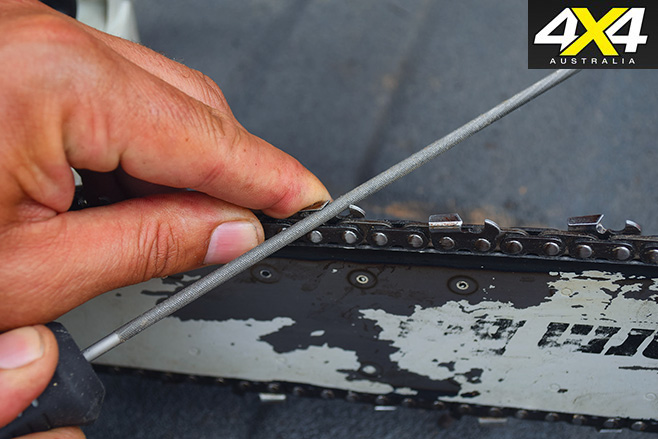
Sharpening the chain – keeping your chain sharp is the most important part of maintaining your chainsaw. A blunt chain, caused by contact with soil, rocks and general use, will simply rotate and burn the wood rather than cutting it. You’ll know your chain is blunt when you need to apply heavy force to push your saw when cutting.
Chains can be professionally sharpened. Alternatively, you can easily do it yourself using a correct-sized sharpening file. Push it horizontally forward through each cleat – then lift – and repeat two more times. To help the process, consider utilising a vice to clamp the bar, locking the chain by pushing the hand guard forward.
Chain tension – general use stretches your chain, which, if not tightened, may come off during use. To adjust, loosen the guide bar’s retaining nuts – located on the side of the saw where the guide bar attaches to the motor. Next, turn the chain tension adjustment screw so that the chain is tight but you can still move it easily with your gloved hand. Once this is done, replace the guide-bar retaining nuts. If your chain doesn’t tighten, it may be time to replace it.
Lubrication – once your chainsaw is re-assembled, find a clean surface or a piece of newspaper and accelerate the saw a few times pointed in its general direction. Oil should spray onto the surface. If it doesn’t, check that the oil reservoir is full. Also check that the oil passages and holes on the guide bar are clean. If the oiling system still doesn’t work, it’s time to take it to an authorised service centre.
Other tips Routinely reverse the chain bar, top to bottom, to avoid wear on one side. Don’t operate the chainsaw with the air intake on the ground as this will draw foreign particles into the motor area and damage the motor.
If you notice that you’ve inadvertently knocked dirt or other crud into the oil reservoir while re-fuelling: drain the contaminated oil into an approved container; let the oil drain overnight by gravity; rinse the reservoir with fuel; let it air dry; and then blow out with air.
The Bottom Line Whether you have an electric or a petrol chainsaw, it’s important to undertake general maintenance and regular servicing to achieve optimal performance and longevity of your saw. Proper maintenance will not only prolong the life of your chainsaw, it will also make your work a lot easier.