
WILD weather in Queensland’s outback has caused organisers to shift the Birdsville Big Red Bash to a different venue.
The outdoor music event, taking place on July 4-6, will now be held at the Birdsville Oval. That’s just across the road from the iconic Birdsville Hotel, so drop in for a coldie if you get the chance.
The original location and campsite at Big Red wasn’t affected by the heavy rain, but the roads and access roads from Birdsville to Big Red (and from Little Red to Big Red) aren’t in a safe enough state to cater for heavy traffic.
Camping options in the new location are available and punters will be able to roll out a swag or pop up a tent at the Birdsville Caravan Park, or at the free camping locations scattered throughout the town.
4x4ers who were keen to hit the tracks to Big Red while they were in the area may still get the opportunity, as the roads are likely to re-open when they dry out – and the weather forecast looks promising.
The Birdsville Big Red Bash is now in its fourth year and looks to be even bigger and better this year.
It will be headlined by Aussie royalty Paul Kelly and Jimmy Barnes, while The Angels, Christine Anu and Troy Cassar-Daly will also bellow out a tune.
Other than the change of venue, this awesome event is expected to carry on as planned. Haven’t got a ticket yet? Bad luck, the 2016 Big Red Bash is completely sold out.
THE MID-NORTH coast of NSW is fortunate to have so many captivating coastal national parks and campsites, and one of these areas is the Yuraygir National Park. This park is a coastal treasure boasting stunning beaches, clear creeks and rugged headlands, and is part of the largest stretch (65km in total) of protected coastline in New South Wales.
From Sydney, take the Pacific Highway for 540km and you’ll eventually arrive at Coffs Harbour. Here you can stock up on last-minute supplies before leaving for Yuraygir. Coffs was once home to a booming banana industry, as evidenced by its famous landmark and tourist attraction, the Big Banana, which is visible from the Pacific Highway.
As you head north out of Coffs Harbour en route to the Yuraygir National Park, the blacktop will disappear after an hour.
The real reason for visiting the Yuraygir National Park is to explore and experience the hidden camping treasure at Pebbly Beach. Unlike many popular campsites along the eastern coastline of NSW, the remote Pebbly Beach isn’t really advertised in any of the mainstream tourism publications. I’m not sure why this is the case, given it is probably one of the most beautiful campsites along the eastern seaboard – I can only guess that maybe it’s because you need a four-wheel drive to get there.
Low range is required to reach this idyllic stretch of coastline, as you will have to traverse off-road tracks, tackle a stretch of soft sandy beach, and then take on a creek crossing before arriving at this amazing camping location. I’m sure anyone who has been lucky enough to visit this piece of coastal paradise was pleased its location has been kept out of most tourist brochures, if only to keep the masses away.
To access Pebbly Beach you’ll need to take the Barcoongere Forest Way turn-off, about 43km north of Coffs Harbour on the Pacific Highway. The Barcoongere track can be rough in spots, but you’ll soon arrive at Station Creek, where you’ll see the 4WD-only sign pointing in the direction of the Pebbly Beach camping area. If you decide not to continue to Pebbly Beach, you can still enjoy the area by camping at the secluded Station Creek campsite. You can even launch a boat at the southern end of the campground if you’re interested in doing a bit of serious fishing.
To continue to Pebbly Beach, follow the signposted 4WD track and you’ll soon hit the beach after negotiating a tight and bumpy sand track. It’s a good idea to check your tyre pressures here as you may need to drop them depending on how soft the sand is. You will soon hear and see the Pacific Ocean and the entrance to the beach – a beach backed by old Pleistocene dunes and interesting black swamps that attract plenty of birdlife.
Pebbly Beach campsite is located at the end of a 2.5km beach drive, and beforeprogressing up the beach it’s advisable to check tidal times. The last hurdle before reaching your camping destination will be crossing a tidal creek, which should only be attempted at low tide.
After successfully negotiating the soft sand along the beach, there was just me, my Land Rover and a creek that separated me from getting to this campsite. It was late in the evening and the tide was in, so I had two choices: wait until the tide went out in the morning, or just go ahead and chance the crossing.
First things first, I waded the creek to see how deep the crossing was. As I approached the middle of the creek it was up to my waist, but I knew it was manageable. So with that, it was out with the radiator bra and back in the Landy. I knew if I stalled in the creek I was in a bit of bother as I had no recovery vehicle to help me out should something go wrong, so as I dipped the Landy into the water I gradually built a decent-sized bow wave and slowly made my way across. This crossing poses no issue when the tide is out, so it’s advisable to time your arrival at the creek to coincide with the tides.
On the far side of the creek the Land Rover climbed up the steep sand bank; as it levelled off I began to see what all the fuss was about, as the sheer beauty of this camping location unfolded. Despite the fact it was raining a little and it was a bit grey, arriving here was like finding myself in the midst of a Photoshopped postcard.
After having a good look around and assessing the beach fishing options, it was time to pick a camping location, as the light was fading. There’s plenty of room to pitch a tent at Pebbly Beach, and there are a number of fire pits available. With the Pacific Ocean directly in front of you and two spectacular headlands to your left and right, you’ll be well-protected by the natural and picturesque cove that creates a truly stunning view.
Camping fees are collected by park rangers who visit the campsite, and you can stay in the area for a maximum of 21 days should you have the time. It’s also worth noting that bookings cannot be made in advance and that vehicles are not permitted south of Station Beach.
I was very surprised to find myself setting up camp with just one other 4WD camped further up the coastline. For such an idyllic campsite it was very quiet, though I’m sure in the peak of summer it would be a different story.
The flat camping area is perched above the adjoining beach and the Pacific Ocean, and it has plenty of fire pits scattered throughout the cleared area. Most people who visit can enjoy an open fire to cook an epic bush feast, while enjoying a few cold beers as waves crash directly in front of you.
After setting up camp and getting the fire sorted, it was out with a cold beer and then a short trek up the vegetated sand dune that shelters the campsite from the west. The views from the top of the dune will give you an appreciation of the scale of this amazing campsite.
If you plan to do a bit of fishing you won’t be disappointed, with snapper, tailor, bream, mulloway, whiting and flathead easily caught off the beach, and after just 30 minutes I pulled in a decent-sized snapper for dinner.
Yuraygir National Park has pleasant temperatures all year ’round, with hot summer days filtered by cool sea breezes from the Pacific Ocean. Other things to do in the park include bush walking, particularly in the northern section, with the Angourie walking track being very popular.
Beach driving is allowed on the main beach between Red Cliff and Brooms Head and along Sandon beach, while fishing is popular throughout the park, particularly at Shelley Beach and Brooms Head – and based on the speed of my catch, Pebbly Beach can’t be ignored. If you are there between April and October you might also be lucky enough to see a whale as they migrate along the east coast.
The park’s isolated beaches, rugged cliffs, rainforests and wetlands also provide the perfect habitat for a variety of wildlife, including the endangered coastal emu, kangaroos, lizards, flying foxes, dingoes, goannas, snakes, and plenty of birdlife. With such an abundance of wildlife, it’s recommended not to feed the animals or leave food easily accessible.
This place is a paradise! Its stunning views, serene environment and amazing coastal camping can be enjoyed all year ’round, and on arriving here for the first time, you’ll feel that you have reached somewhere very special. I’m not sure how many people who visit Pebbly Beach for the first time return, but based on what I have experienced, I can only imagine that figure must be pretty high.
FACT FILE
- RESTRICTIONS AND PERMITS: Camping fees are collected by campground managers who will visit campsites. If you have time, you can stay for a maximum of 21 days. Day passes can be purchased from ‘pay and display’ stations. Bookings cannot be made in advance. Note: Vehicles are not permitted south of Station Beach.
- BUDGET ATTRACTIONS: The campsite is located right on the beach, so you can fish, surf and swim in some of the sheltered waterholes.
- MAPS: Hema Maps’ North East NSW (Edition 6) Hema Maps’ Mid North Coast & New England
TRAVEL PLANNER
- STAYING THERE: Pebbly Beach campground is located in the Yuraygir National Park, 20km from Corindi Beach and 57km from Grafton. The campsite at Pebbly Beach is located right on the edge of the beach, with access by 4WD only.
- ROAD CONDITIONS: Low range is required when driving on Station Beach, as the sand can be soft. There’s also a creek crossing at Pebbly Beach and you should only attempt the crossing at low tide. Overall, the area is accessible with a standard 4WD.
- FUEL & SUPPLIES: Grafton has plenty of service stations and shops, so pick up food and water here.
- CONTACTS AND INFORMATION: Contact Grafton NPWS: (02) 6641 1500. Email: [email protected] Visit: www.nationalparks.nsw.gov.au; www.fisheries.nsw.gov.au
- GETTING THERE: Yuraygir National Park can be found on the NSW North Coast. Station Creek is approximately 58km from Grafton.
- Introduction: Loaded Rig
- Update 1: Holiday Hustle
- Update 2: Urban Living
- Update 3: Bright Additions
- Update 4: The Big Tow
- Update 5: Conclusion
Introduction: Loaded Rig
It’s been a long spell since we last ran a long-term tester out of 4X4 Australia’s HQ, so we were pretty chuffed to add this ‘new’ Mazda BT-50 to the fleet over summer.
We say ‘new’ because it’s the face-lifted 2015 model, but it did have a few kays on it by the time it reached us here. Mazda used it on its launch program then shipped it to Coober Pedy, where Crafty flogged it around the desert for a few days.
Knowing this car was coming to us, Mazda used it to showcase the extensive range of factory accessories it now offers. It was fitted with an aluminium bullbar, an intake snorkel, a tub mat, floor mats, a dual battery kit, an Icom UHF radio, a towbar and wiring, an electric brake controller, and optional alloy wheels.
The options crank the price up to more than $63,000, so you could say it’s fully loaded. The $12,000 in extras proves vehicle manufacturers are keen to skim some action away from the aftermarket accessories companies.
About the only things Mazda doesn’t offer, and you might want to fit them for outback travel, are a suspension upgrade and heavy-duty tyres. We’re pretty happy with the BT-50’s factory suspension tune, and we quickly fitted a set of BF Goodrich KO2 All Terrains.
We’ve been keen to sample the new BFG ATs since they launched early this year, and now we finally have a ride to trial them on.
Really impressive are the Australian-developed-and-made products Mazda is offering as factory options. The controller for the dual battery system comes from Redarc, while the driving lights are Lightforce beauties. The factory sat-nav system even has HEMA mapping and OziExplorer loaded on to it, so all bush-track maps are available in the dash.
It’s not Australian, but the Icom radio that’s neatly mounted to the console is another well-respected product and, again, it’s great to see Mazda supplying these recognised brands.
So far it’s been all highway kays for the Mazda, but we’ll be hitting the dirt and beaches over summer. It has been up the Hume Highway and back and we love the lazy way the five-cylinder diesel engine lopes along the highway, with plenty of grunt to keep the six-speed automatic transmission happy in top gear all day. This, combined with the big-cab feel of the BT, makes it a sweet highway tourer.
Initial impressions of the BFGs are good, too. They are very quiet for an aggressive AT tyre, but they are still very new. They do show their limits when pushed hard on sealed roads – the deeper-tread blocks, with their square shoulders, protest at being asked to perform like sports car tyres.
We’re sure they will be more at home in the dust, gravel and rough stuff.
Accessories
| Tow bar (3.2 utility) | $596.19 |
| Tow ball | $26.83 |
| Trailer wiring harness | $288 |
| Carpet floor mats | $122.84 |
| Tub mat | $410.82 |
| Mobile phone holder | $99 |
| UHFu00a0 | $869.77u00a0 |
| Snorkelu00a0 | $677.57u00a0 |
| Dual battery kitu00a0 | $1199u00a0 |
| Alloy bullbaru00a0 | $2869u00a0 |
| Driving lightsu00a0 | $782.25u00a0 |
| Electronic brakesu00a0 | $515u00a0 |
| Soft tonneau coveru00a0 | $822u00a0 |
| Auto lock for tonneauu00a0 | $459.70u00a0 |
| Polished sports baru00a0 | $999u00a0 |
| 17-inch alloy wheelsu00a0 | $1208u00a0 |
| TOTAL | $11,944.97 |
4×4 Shed Log 1: 2016 Mazda BT-50 XTR Total mileage: 5476km Date Acquired: November 2015 Price: $63,645 Mileage this month: 1370km Average fuel consumption: 11.1L/100km
Update 1: Holiday Hustle
The holidays arrived and there was a kitted-out BT-50 sitting in the 4X4 Australia car park. How could we refuse a summer road trip?
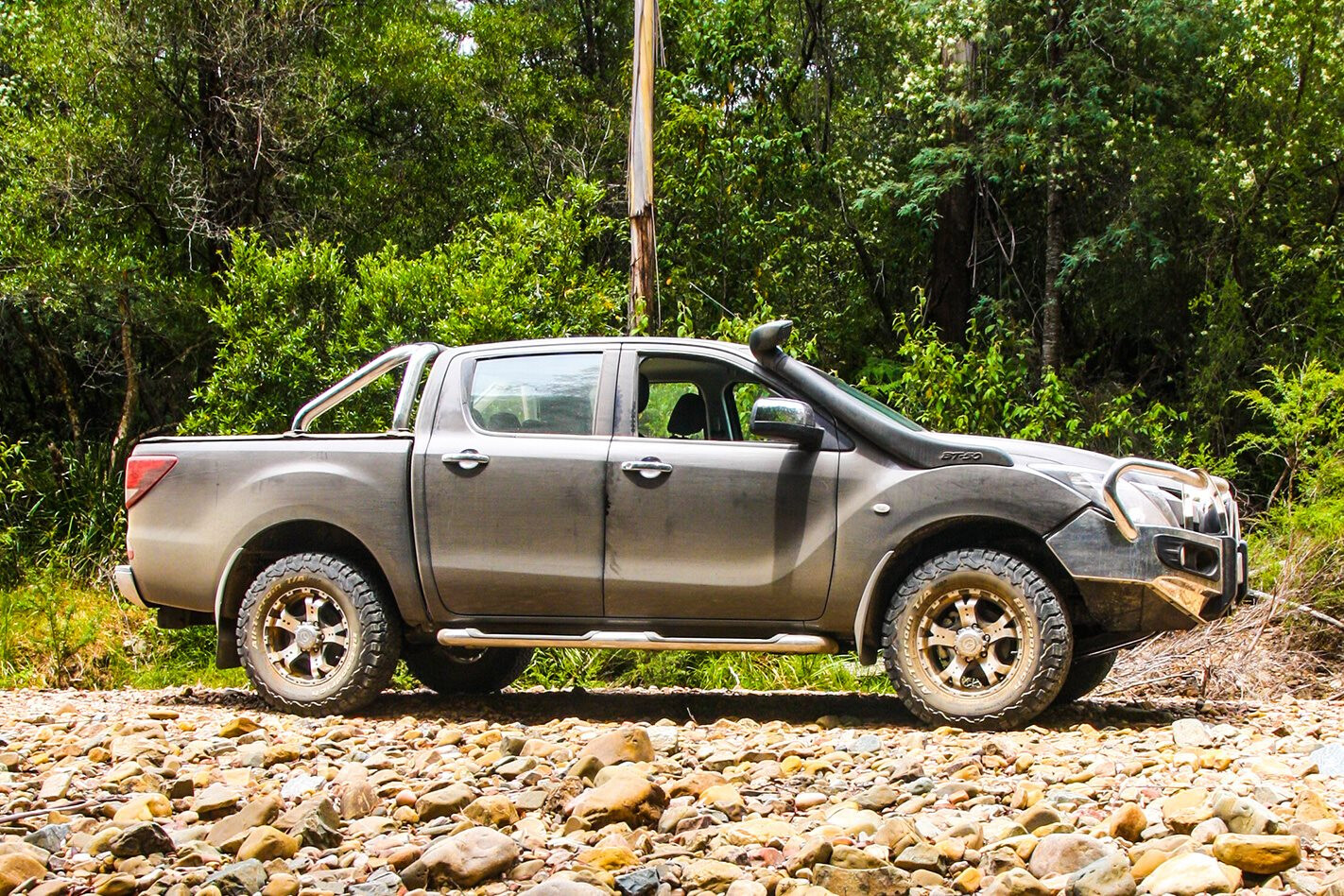
The end-of-year holiday period provided the perfect opportunity to put some kilometres on our BT-50, 4X4 Australia’s long-term press car.
As soon as we were dismissed from 4X4 headquarters, we made a beeline up the Newell Highway, headed for the Sunshine State. The loping nature of the relatively large 3.2-litre, five-cylinder diesel engine makes the BT a relaxed highway-mile eater. The gearing in the six-speed auto neatly matches the engine’s torque so that the transmission sits in top gear on the open road, without hunting between gears. This makes the Mazda a more comfortable consideration for long-distance drives, putting less stress on both man and machine.
Conversely, with the engine ticking along at 2000rpm at highway speeds, it sucks a bit more fuel than some of the newer utes, and the best we could get the average down to was 10.0L/100km on the blacktop. It’s worth mentioning at this point that the car is fitted with slightly taller-than-stock 265/70-17 all-terrain tyres and a bulbar, both of which affect fuel economy, compared to a standard car.
After a couple of thousand road miles, we left the blacktop for the dusty tracks of the New South Wales’ Snowies, and crossed the border back into Victoria, over the Alps. It’s always pleasing to drop the tyre pressures down for the steep off-road tracks of the High Country, and this adventure didn’t disappoint.
Steep rutted tracks posed no problem for the torquey BT, and when a bit of surety was needed for wet climbs, the rear locker was easily employed. The BF Goodrich KO2 A/Ts really came into their own in the High Country. Rocks, ruts, mud and dust were easily dispatched from the deep tread, and after clocking up close to 5000km, there were no signs of chipping or cuts in the tyres.
There were, however, a few little annoyances only noticeable after living with the BT for some time. First, there isn’t a lot of information available on the trip computer, and to scroll through the menu you need to reach through the steering wheel to push the button on the dash binnacle; a simple task like checking the outside temperature (when the menu is showing fuel consumption) means you have to reach through the wheel, instead of being able to simply push a button on the wheel.
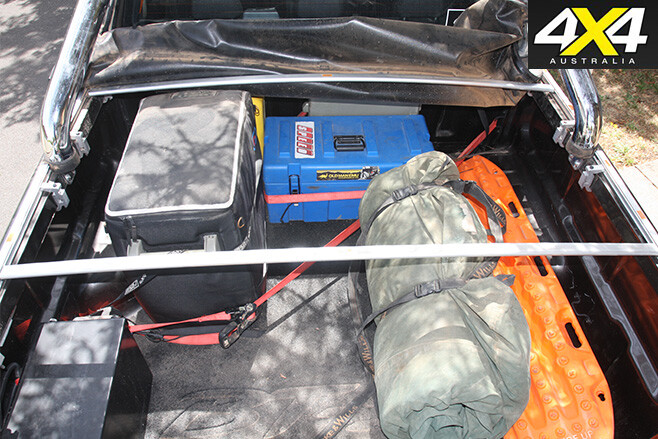
Also, there’s only one USB port in the front of the car and it’s in the glove box, meaning if you want to plug in your phone, you need to do it on that side of the car – you can’t do it from the driver’s seat.
A big annoyance – and this one gets me every time I drive the BT-50 – is that although Mazda did a bang-up job of redesigning the dash for the 2016 upgrade, introducing a nice, big AV screen in the middle of it, and a reversing camera (standard in the XTR-spec that we have), the two of them aren’t linked and the image from the camera appears on a tiny, glare-affected panel in the rear view mirror.
That means you need to use your hand to shield it from light whenever you are backing up. It’s stupid and annoying!
These are small blemishes on the BT-50’s otherwise polished performance, and they’re outweighed by the driveability, comfort and all-terrain ability of a great all-round package.
4×4 Shed Log 2: 2016 Mazda BT-50 XTR Total mileage: 10,575km Mileage this month: 5099km Average fuel consumption: 10.4L/100km
Update 2: Urban Living
Only after you’ve driven a car for some time do all the downsides become clear. But with the Mazda BT-50, the good still outweighs the bad
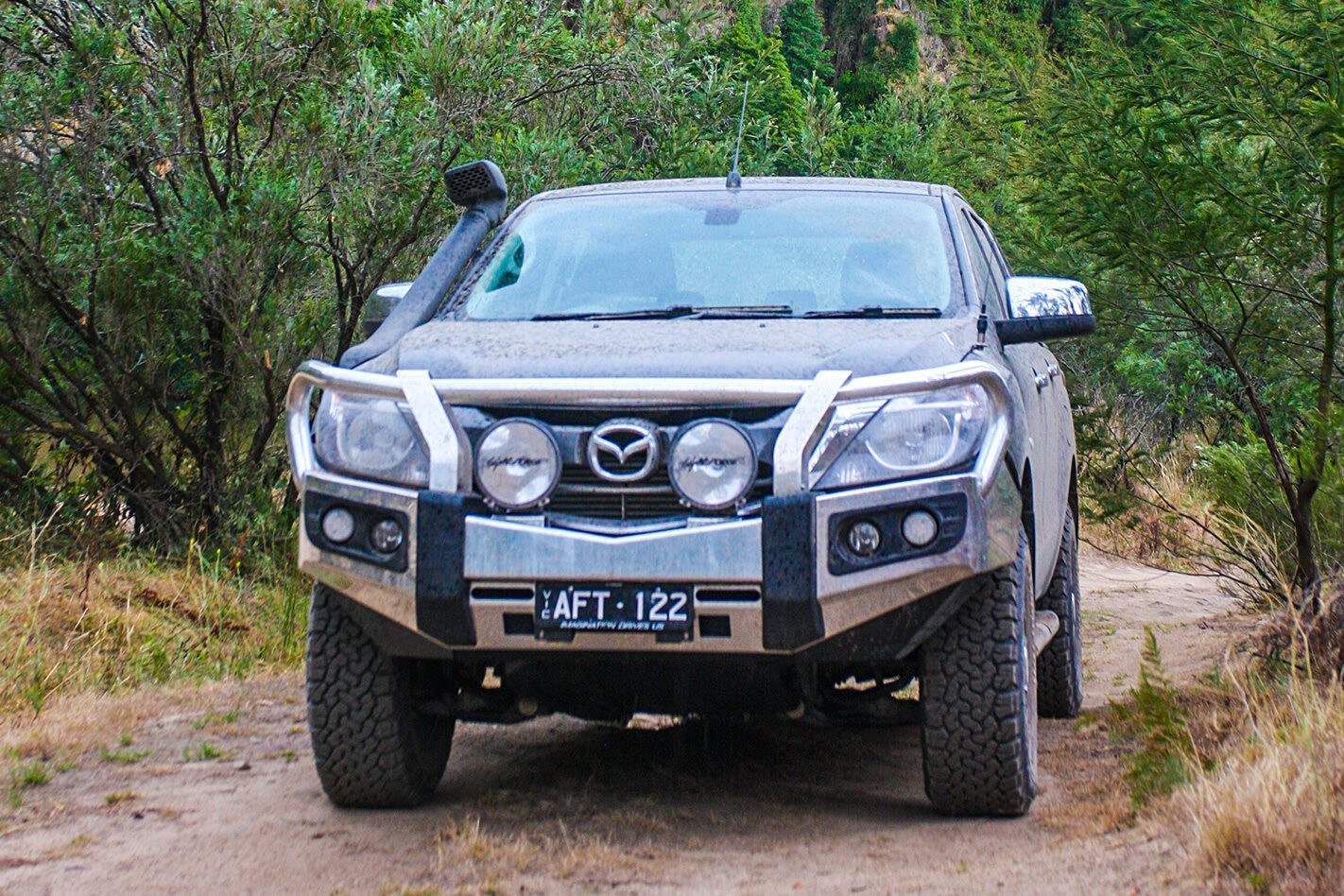
They say you’ll never know how many friends you have until you own a ute, a car trailer, or both.
We proved that theory when one of our associates at MOTOR magazine spotted our BT50 in the carpark at a time when he was moving house. The timing was right for us, as we had five wagons on test for this issue, and so the BT was available for furniture-shifting duties, a task it handled with ease.
We also used the time we had the wagons at hand to get a 10,000km service done on the BT50, a relatively basic, routine service.
We had one fault to ask the service department at Brighton Mazda to attend to – a niggling rattle from under the car that has been there since we took delivery of the vehicle. It is a tinny rattle that can be heard at idle from outside the car and sounds like it’s coming from an exhaust heat shield or something similar.
This seems likely after the trip the Mazda did in Central Australia before we got it. Despite the rattle being easily audible from outside the car, the technicians at Brighton were unable to find its cause.
Maybe times have changed, but when I worked in the workshop of a new car dealer, if a mechanic tried to send out a car with such a rattle, the foreman or road tester would have kicked his arse, whether the car owner had noted the problem or not.
Aside from these happenings, the BT has been serving commuter duty, which it has done without trouble or complaint. You just need to be wary of the big ute’s size when parking in suburbia, a task that isn’t helped by the fact the reversing camera image is in the rear-view mirror and not the in-dash screen.
While we’re mentioning the screen, it’s great for sat-nav on and off road but is almost impossible to see in daylight, requiring you to shield it by hand to get a handle on what’s on screen. I don’t know if it’s the material used for the screen or simply that the angle of it catches the sun, but it’s a crook design.
First world problems, I know. It’s lucky such problems are offset by the great size and performance of the BT.
4×4 Shed Log 3: 2016 Mazda BT-50 XTR Total mileage: 11,502km Mileage this month: 927km Average fuel consumption: 11.2L/100km
Update 3: Bright Additions
Our resident BT-50 scores some high-class driving lights from Lightforce.
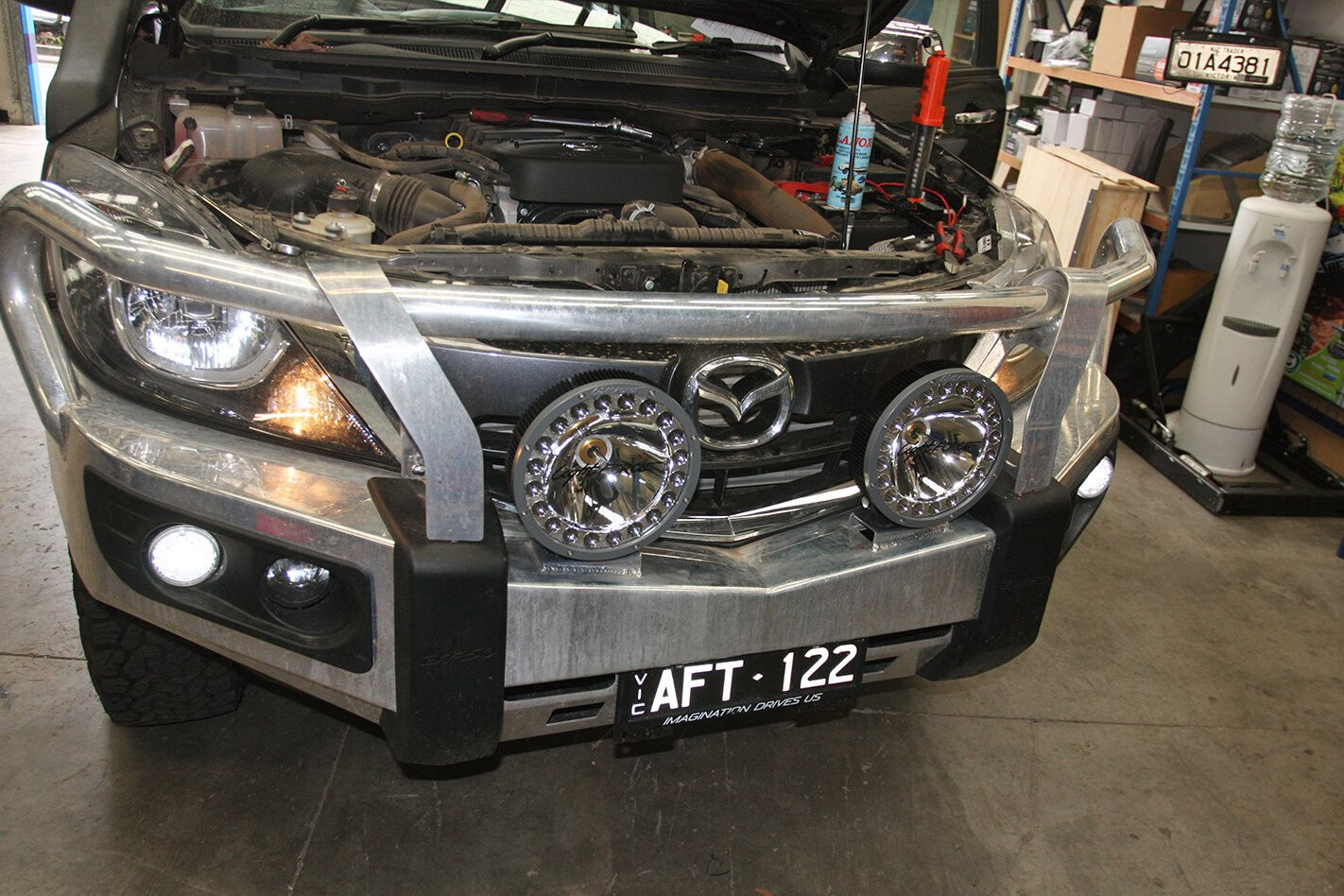
Our BT-50 has been out on loan again, this time with the crew from Trade-a-Boat magazine who had a fishing trip to some coastal location.
They only just got back, but they reported the Mazda towed the 2.5-tonne boat up through Gippsland with ease, in comfort and remained economical. If only the fishing was that good, hey guys? More on that next month.
Before the boaties took it away we couldn’t resist fitting a set of Lightforce’s new DL230HTX driving lights to the bullbar. The BT came with a set of Lightforce Genesis spotties, which are great lights.
Mazda should be commended for offering such top quality products as a genuine accessory. And it’s an Australian product, too! But these HTX lights are the next level up.
The HTX combines the broad beam lighting of an LED lightbar with the far-reaching beam of HID lights. The 20 LED chips are wrapped around the 70-watt HID light, so there’s no need to have both round lights plus a lightbar on the front of your car.
You can even run either the LEDs or the HIDs on their own, or switch them on together for the ultimate performance. Initial impressions are that the lights are amazing, but we’ll have a more extensive test of the Australian-made lights soon.
The lights were fitted by our good mate and local Lightforce distributor Phil Cochrane down at Ontrack Automotive in Ferntree Gully. Phil did the EFS suspension upgrade on our project HiLux give-away (March, 2016) and knows his stuff, so we had no qualms letting him loose on the Mazda BT-50. Fitting lights posed no challenge for him.
Around town the BT continues to be a great commuter. Ideal for chucking the BMX in the back to get away for rides, hitting the 4×4 tracks on quick weekend drives and just getting about the city. The versatility of a double-cab ute is unmatched and the Mazda, with its relatively big 3.2-litre diesel engine and six-speeed auto, provides a great balance of performance and economy.
4×4 Shed Log 4: 2016 Mazda BT-50 XTR Total mileage: 13,647km Mileage this month: 2145km Average fuel consumption: 10.9L/100km
Update 4: The Big Tow
The BT-50 has been pulling boats and lighting up the bush.
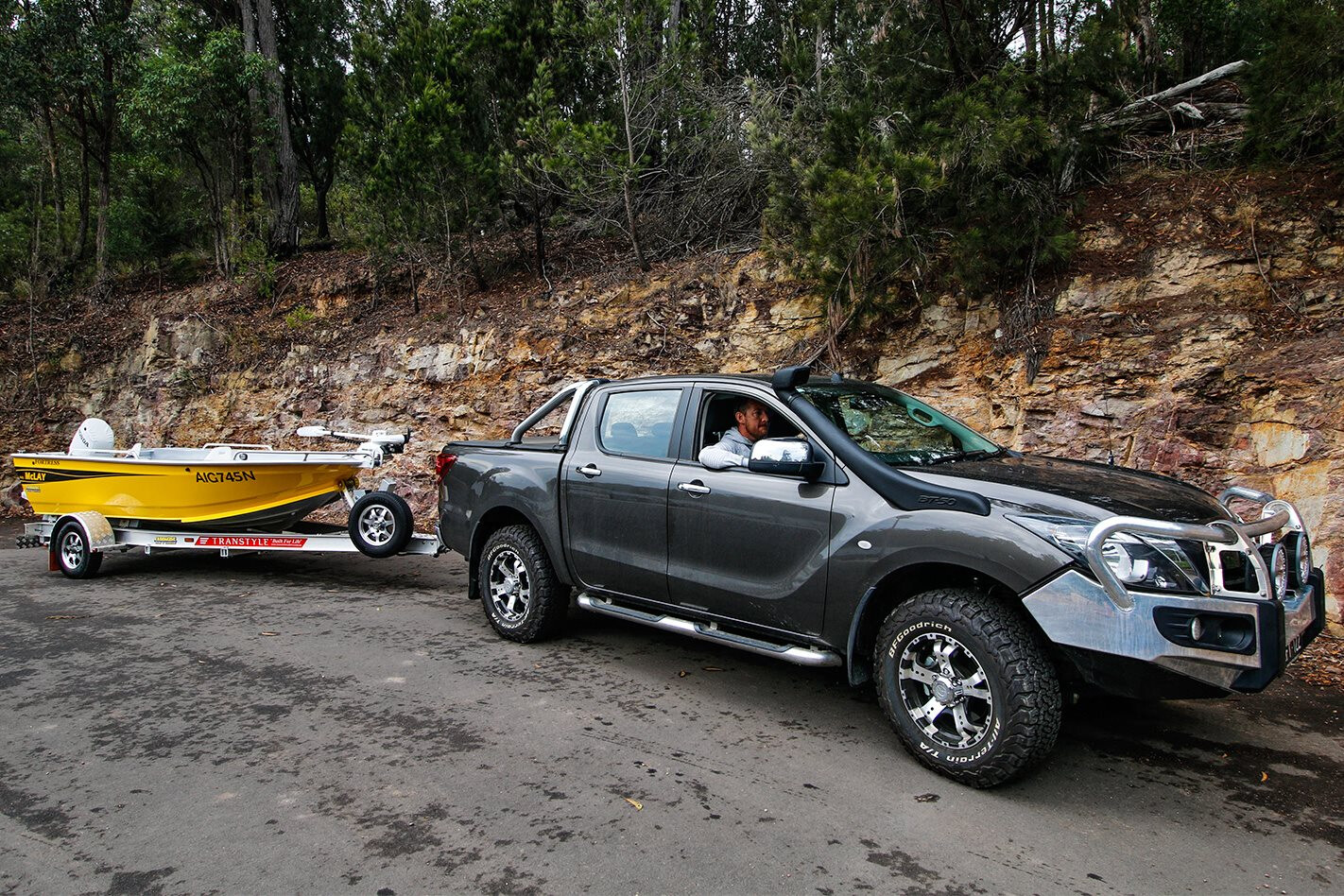
LAST month we mentioned the guys from Trade-a-Boat magazine borrowed our Mazda to pull some boats on a fishing trip, and they’ve since sent us some pics that show just what they were hauling.
No wonder they said it towed them with ease. The Mazda’s 3.2-litre five-cylinder diesel would have made light work of those little boats and probably could have pulled them both together without raising a sweat. All the same, it’s good to know that the boaties thought it a good thing for towing.
We also took the BT out for a night-run through Wombat and Lerderderg State Forests, with the crew from the Werribee District 4WD Club. We hit the tracks after a cracker meal at the Blackwood Hotel, and this gave us the chance to give the Lightforce HTX lights a burl.
The HTXs employ a HID spot beam and an LED broad beam, and we found the LEDs to be the real winners in these scrubby conditions. The light colour is easy on the eyes and provides nice definition to the areas around the front of the car.
On the highway, the HIDs punch out way ahead of the car and are better-suited to this sort of driving, but ours need to be adjusted to get better results. We didn’t have the right tools for the job at the time, so we’ll have to see to that later.
The Mazda again showed its ease of use on bush tracks, and we did most of them in high-range 4×4 to let the 3.2 just lope along at an easy pace. Low range and a bit more throttle were used a couple of times for the steeper stuff, but it was relatively easy going on this night. We passed on the more challenging tracks, as our stock-ride-height BT would have scraped to a stop in the axle-deep ruts, but otherwise it was never challenged for traction.
Our Mazda has HEMA maps installed to provide more details of the bush tracks in this area. This is an option on the BT-50 and one well worth the money if you like to get off the beaten track. As far as we know, Mazda is the only company that offers this great Australian mapping product.
Getting out with the Werribee District 4WD Club was a lot of fun and showed us another way that a vehicle like the BT-50 can be used to get out and enjoy the bush. It was as much a social night as anything, and the genuine-accessories Icom UHF fitted by Mazda was buzzing with chatter all night. Thanks to the Werribee District 4WD Club for the invite.
Following our comments last month about the rattle from under the BT, Mazda took the car away and replaced the muffler that had lose internals. Problem fixed. We don’t know why the dealer couldn’t have done that.
4×4 Shed Log 5: 2016 Mazda BT-50 XTR Total mileage: 14,984km Mileage this month: 1337km Average fuel consumption: 10.9L/100km
Update 5: Conclusion
Our six months with the BT-50 draws to a close, but are we sad to see it go?
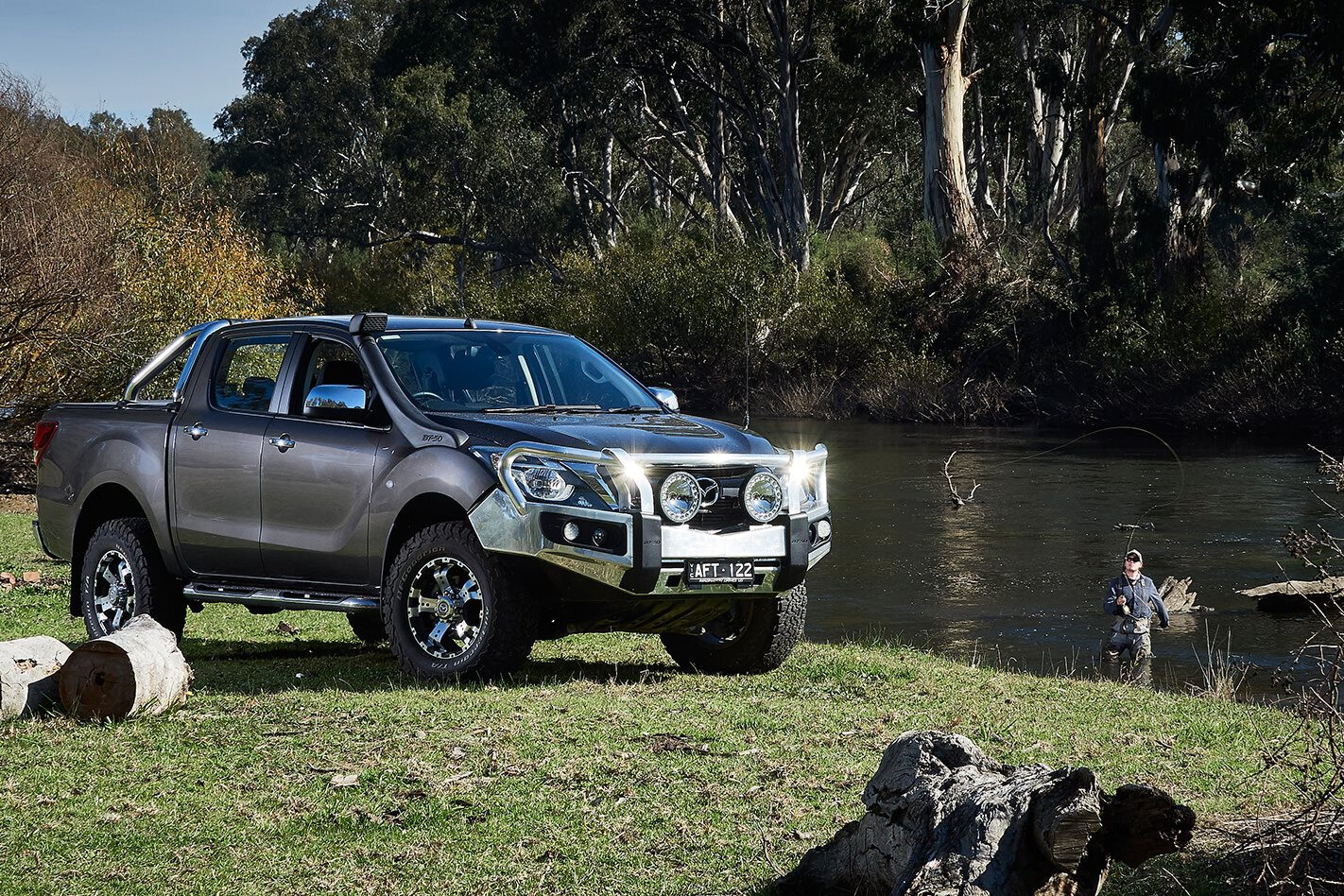
TIME flies when you’re having fun, and it’s been fun having the BT-50 here. Yep, its six months with us are up and it will be sad to see it go. The BT-50 has proven to be a versatile and practical vehicle for all sorts of motoring, and it has certainly lived up to its role as a dual-purpose 4×4.
The BT came to us fresh off the back of a trip to Coober Pedy and Oodnadatta, where former editor Marcus Craft put it through its paces on the rocky and dusty tracks out there. Mazda gave it a good tidy up before we picked it up in Melbourne, but when we dropped the spare tyre down to fit the BFGoodrich All Terrain KO2s, the gravel and red dust that dropped off with it revealed where the car had been.
The BFG KO2s were the only aftermarket item we needed to fit thanks to the crew at Mazda ticking off all the essentials from its factory accessories catalogue. This proved to be a real bonus, as the car came ready for action wherever we wanted to take it. The gear from Mazda was all top quality, including Lightforce Genesis driving lights, an Icom UHF radio, HEMA mapping on the sat-nav and the Redarc dual-battery system. All this gear proved invaluable out in the bush and, coming from reputable brands, we could be confident they wouldn’t let us down. Top marks to Mazda for offering such quality accessories.
With the BFGs on the BT, we took off from Melbourne for an interstate trip to Queensland using some out of the way backroads to break up the trip. The return was at a much more leisurely pace, as we beach-hopped down the coast as far as Newcastle and then cut for the Snowy Mountains to follow the Snowy River from its source to the coast.
We love the way the Mazda has a relaxed touring gait on the highway; the torquey 3.2-litre engine pokes along without raising a sweat and then hardens-up when on the steep slopes of the high country, which it handles with ease.
Since that trip the BT has done general day-to-day commuter duties, helped a mate move house, carried pushbikes to the tracks, day trips with 4×4 clubs, towed boats on fishing trips with our mates at Trade-a-Boat magazine and, most recently, snuck off for a day of fly-fishing with Mick and James from Mountain Fly, Victoria. The BT does all these things with ease, confidence and, most importantly, it has never let us down.
The only problem we had with the car was a rattle from the muffler, which was replaced by Mazda at service time and wasn’t a major issue.
As I said, I’ll be sad to see the BT go as it really showed the advantages of having a dual-cab 4×4 ute that’ll do just about anything you throw at it.
WHAT WE LOVED
- Big, spacious cabin with quality fit-and-finish
- Torquey engine that’s great on- and off-road.
- Quality aftermarket options from Mazda.
- Do-it-all ability.
- Rear-view camera image should come up in big dash screen.
- Dash menus not selectable from steering wheel.
- Missing voice command to utilise Bluetooth.
Sign-up here to get the best 4×4 stories of the week – FREE!
SECOND OPINION – WHEELS (By: Toby Hagon)
Introduction: Finke Finesse
Wheels’ BT-50 Finke race ute takes shape. But first it has a few domestic duties to take care of.
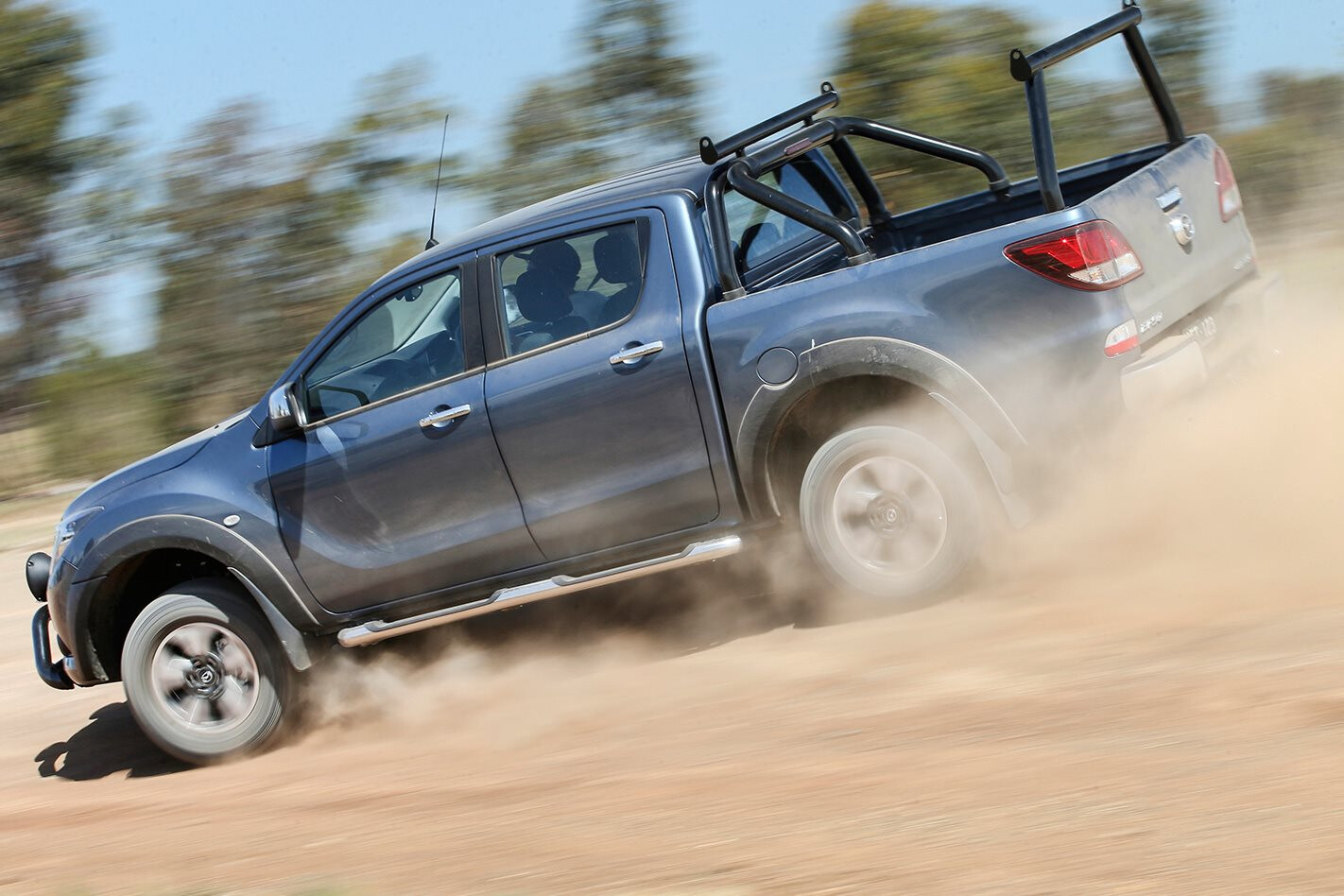
HERE’S something we’ve never done before at Wheels – lived with a dual-cab ute as a long-termer. Separate chassis, live rear axle and a workhorse diesel engine are the order of the day for our Mazda BT-50.
Truth is, though, it’s getting difficult to ignore the ute market. The vehicles once confined to farm paddocks or tradies’ driveways now account for almost one in six new-vehicle sales. That’s big business, and there’s been a big shift in the ute market’s landscape. A sizeable chunk of it is devoted to top-end utes where the price tag exceeds $60,000. And it’s the diesel dual-cab off-roaders leading the charge: 4×4 models outsell two-wheel drives by more than three to one.
Yet most people are using them as on-roaders, with only occasional off-road use.
And performance-focused utes are coming; AMG is set to tweak the upcoming Mercedes-Benz ute, Ford is planning a Ranger Raptor, Nissan is considering a Nismo Navara and Toyota is looking at a Hilux TRD. In the shorter term Volkswagen will bring V6 diesel performance back to the workhorse segment with an update to the Amarok arriving late in 2016.
Besides, the plan from the start of our few months with a BT-50 was to put it through more than any ute before it. As well as thousands of kilometres of suburban and country punishment – where we plan to push the BT-50 XTR to its limits – this is the car we’re taking in the punishing Finke Desert Race.
It’s claimed to be one of the most challenging off-road races in Australia. We’ll be entering the car in the Production 4WD class, where modifications are limited to suspension changes and engine tweaks. And, of course, safety systems and protection for mechanical components.
Our mods will be minimal. We’ll be getting some more serious shock absorbers to better deal with the jumps and corrugations so common on the Finke track, which is 230km long and heads south from Alice Springs to the Aboriginal community of Finke. The 3.2-litre five-cylinder turbo diesel engine will be unchanged and the only interior changes will be to meet the event regulations (that means we get to keep the factory air-conditioning – woohoo!).
But since January our racer-in-waiting has been put to work. It’s been all about making the best use of its design.
Our BT-50 arrived with some 7500km on the clock and was put straight to work on the school run. As with all utes, fitting a child seat takes some fancy finger work to attach the top tether point from the child seat to the anchor between the seat back and the rear of the cabin.
No complaints from the children once in place, though. Turns out they love utes, to the point where it took a while to convince my four-year-old that he could only play in the tray when it was parked.
Beach runs, too, are a snip, with boogie boards and sandy towels thrown straight in the tray. The occasional hose-out is all it needs to stay sparkling (well, as sparkling as I want it…).
And family bike rides are so much easier. All four bikes can fit in the back, with the ladder rack coming in handy for slinging the wheels of the bigger bikes over.
In its first couple of months, AFT 123 also headed on a country cruise. Again, it was gear in the back and a family of four on board for the 1100km round trip.
Fuel use early on is reasonable, at 9.6 litres per 100km – and most of the time it’s anything but babied. I figure if this thing is going to race we may as well get it used to the punishment. And with that sort of fuel use it means it’ll comfortably go the distance at Finke.
The extras
Our BT-50 has already had plenty of options thrown at it. The most obvious are the front nudge bar with driving lights (great for blaring idiots) and the ladder rack on the rear, which allows long items to be strung to the sports bar just behind the cabin; the lights and nudge bar will stay for our Finke adventure, but the ladder rack will be ditched. There are also dual 12-volt power sockets and a spongy tray liner to reduce damage when launching things in the back. And the near obligatory tow bar.
Mazda v Ford
The current shape BT-50 went on sale in 2011. It is produced in the same Thai factory as the Ford Ranger and shares many components with that car, including windows, the basic chassis and engine. However each has unique exterior bodywork, including the doors (often shared between models that otherwise share so much). An update in 2015 tried to straighten the toothy grin and make the tail less polarising, but it drives identically to that 2011 car (Mazda opted not to tweak the engine and dynamics, as Ford did with the Ranger).
Model range
Our XTR model sits in the middle of the BT-50 family and is one of the more popular models. There’s also a GT model above it that gets tinted windows, leather seats and an electrically operated driver’s seat. Sure, those extras would be great for on-road comfort, but they’re of little use on the Finke.
Mazda BT-50 XTR long-term details: Date acquired: February 2016 Price: $51,700 Mileage this month: 1380km @ 9.6L/100km Odometer: 8980km Overall: 1380km @ 9.6L/100km
Update 1: Conclusion
Toby Hagon continues his shakedown of the Team Wheels Finke Desert Race Mazda BT-50 XTR ute.
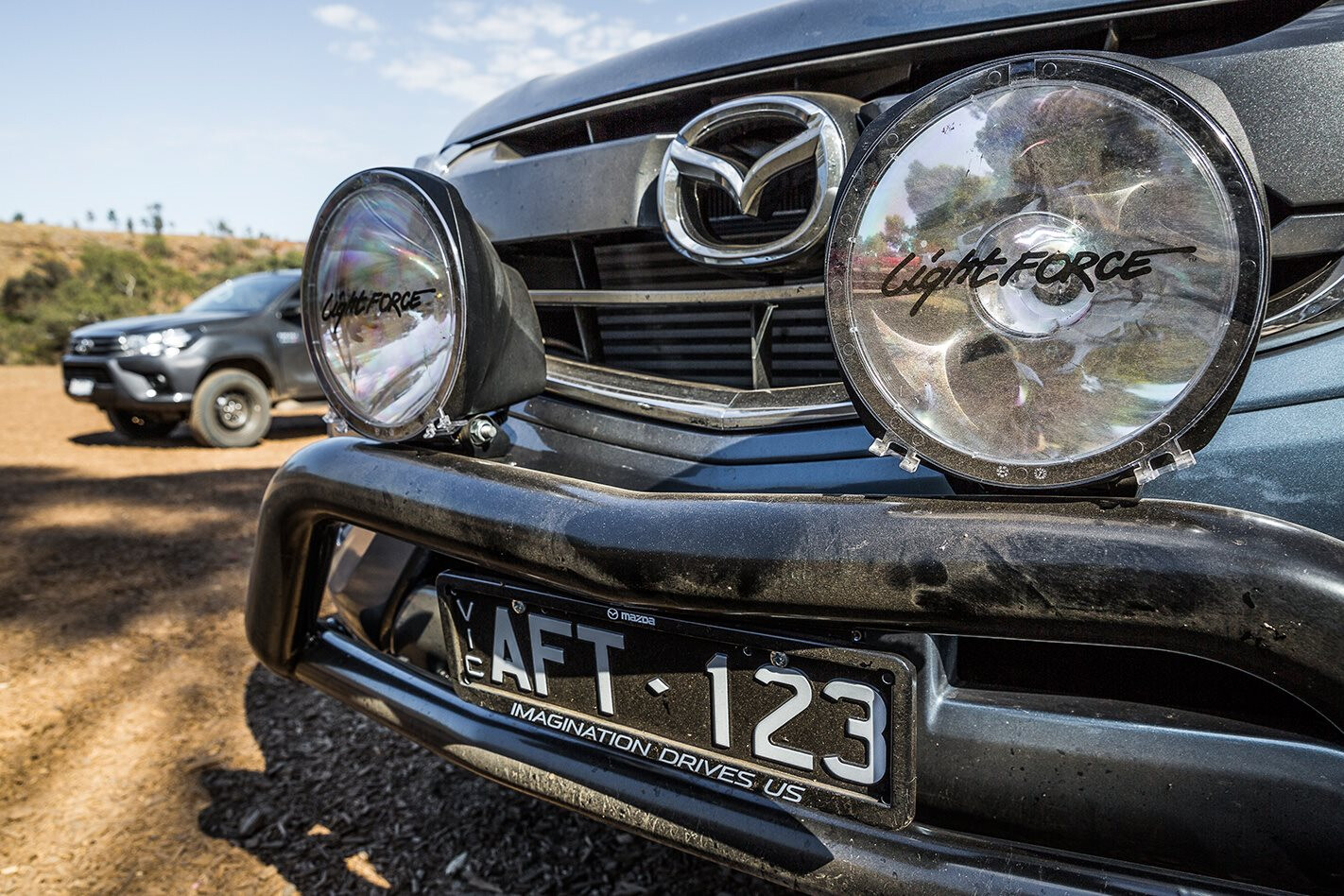
A couple of months in and I’m getting used to a ute. Being able to launch pretty much anything into the tray is a surprisingly big bonus. I’ve had everything from a pile of wood to mountain bikes and kids toys in the back of AFT 123, the Team Wheels car that will be taking part in the Finke Desert Race over the Queen’s birthday long weekend.
A hundred or so kilos in the back works surprisingly well, too. It helps settle the stiffness that can make for an otherwise jumpy ride on second-grade roads. That’s good news for our Finke challenge. The 230km course south of Alice Springs is known for its bumps and jumps, and because we’ll have extra gear on board – spare tyres, a basic tool kit and the weight of a roll cage – it’s comforting to know the suspension is up to some punishment.
I’ve also been keeping an eye on traction when accelerating. On a slippery surface – fair chance the Finke’s red dirt will be slippery – the inside rear can try to wheelspin, waking the traction control. So four-wheel drive will be the pick for the lumps and bumps of the Finke course.
Not that I’m getting too used to AFT 123. My car was also summoned back from me to get prepped for the Big Race. A roll cage, race seats and stickers are the main changes. Plus we also need a few weeks to truck it to Alice Springs, along with our fleet of support cars.
But there was another BT-50 in the wings: AFT 124. It misses out on some of the previous car’s extras – including the nudge bar – but picks up the rolling hard canopy. It’s a fancy way to cover the ute tray and looks the business, although it shortens the tray by about a foot.
That’s enough to make it more difficult to fit in a 29-inch mountain bike, something my previous BT had been subjected to plenty of times. Still, some careful negotiation of the front wheel and it slots in no probs.
Under the bonnet, the 3.2-litre five-cylinder turbo diesel is as grunty as ever, something that comes in handy for shifting what is a sizeable machine. Even better is that performance barely changes once you load it up with people and some gear.
Perfect for off-road racing! We also don’t have to worry about fuel use; the BT-50’s claimed average fuel use is 9.2 litres per 100km, and I’ve been getting close to that – albeit with a decent country cruise as part of the driving mix. Even when thrashing it, I reckon we’ll use something like 12 or 13L/100km, which bodes well for the Finke challenge (the 80-litre fuel tank will comfortably do the 226km distance each day).
As for the transmission, the six-speed auto is an honest unit. It’s ironic that Mazda’s least sporty model gets the best set up for selecting the Sports mode on the transmissions. Whereas the MX-5, Mazda 6 and others call on you to flick the sports button south of the gear selector, the BT-50 is a simple push of the gear lever towards the driver. Blame that on the Ford influence.
The BT-50 has lost me on one count, though; its USB plug is buried in the glovebox, making it difficult to access on the run. I’m also not sold on the reversing camera, which displays on a small screen within the rear vision mirror rather than the 7.8-inch screen in the dashboard.
The rest of the interior is simple but well done. The circular climate control knobs, for example, are easy to operate on the run, and there’s loads of storage, including a pod atop the dash and underseat storage in the rear.
Haven’t we met before?
There’s no hiding the Ford roots of the BT-50. In the corner of each window is a FoMoCo stamp, signifying it’s a product of the Ford Motor Company. The same stamp is on the rear leaf springs, too. And when you pop the bonnet, while it’s the stylised Mazda M logo that’s prominent in the centre of the engine cover, you don’t have to look too far to spot FoMoCo stamps on pipes and other components.
That’s because the BT-50 was developed in conjunction with the Ford Ranger and comes out of Ford’s Thai factory.
Yet despite the major component sharing – something increasingly common across brands and models these days – it’s been done cleverly enough to ensure each has its own identity. The interiors, for example, share some design themes, but are presented differently. And the exterior panels are unique to each model.
Mazda BT-50 XTR long-term details: Date acquired: February 2016 Price: $51,700 Mileage this month: 510km @ 9.8L/100km Odometer: 8980km (for AFT 123), 6385km (for AFT 124) Overall: 1890km @ 9.7L/100km
Follow the journey of Wheels’ BT-50 XTR at the 2016 Finke Desert Race – Prepping the BT-50 – All Finked out
THE LandCruiser 70 Series, due to hit showrooms in the fourth quarter of this year, has received significant safety and performance upgrades.
The 70 Series range retains the 4.5-litre V8 turbo-diesel donk, but the addition of piezo injectors will now provide better response at low engine speeds. The manual-only transmission also remains, but gearing has been tweaked to maximise fuel economy and limit NVH.
Toyota subjected the 70 Series – with a focus on the best-selling single-cab chassis – to more than 100,000km of exhaustive and vigorous testing on harsh Aussie terrain, which has resulted in the workhorse receiving a stiffer new frame with thicker side rails.
The new frame is likely to increase the strength of an already tough rig, while also reducing vibration and improving handling and stability.
“The upgraded 70 Series LandCruiser range builds on this iconic vehicle’s fit-for-purpose appeal with improvements that reinforce its heavy-duty abilities, durability and unapologetically rugged character,” Toyota Australia’s executive director of sales and marketing Mr Cramb said.
The improvements aren’t just limited to brute strength, with the Japanese tourer’s safety features also getting a tune up.
“[The 70 Series] receives important safety and emissions updates that are required by many customers – as well as regulators – to enable Toyota to continue selling the 70 Series in the Australian market.” Mr Cramb added.
The 70 Series gets improved stability and traction control tailored for dirt roads and country highways. All variants will also feature hill-start assist control, brake assist, electronic brake-force distribution and cruise control.
The single-cab version will receive curtain-shield airbags and a driver’s knee airbag in addition to the existing driver and front-passenger airbags, and it’s expected to receive a five-star ANCAP safety rating.
Pricing for the new 70 Series is yet to be released.
POTATO parcels are easy to make and taste delicious. They can be cooked over the coals, on the barbecue or in your camp oven. they also make a great side dish to your favourite cut of meat.
Ingredients
Serves 4
- 4 large sheets of heavy-duty foil (enough to wrap each potato well – if using thin foil, double it up)
- 4 large, washed potatoes thinly sliced (I prefer Ruby Lou potatoes; they are very versatile), or use 2 small potatoes for each person
- 2 to 4 rashers of bacon sliced or diced (or use ham)
- 1 small, red onion thinly sliced (or use whatever onion you have. Red ones just have a stronger flavour)
- 2 or more spring onions finely chopped (optional)
- 1 packet of French onion soup (I prefer the salt-reduced version)
- 1 cup of grated cheese (optional – tasty or mild)
- Salt and pepper to taste
- Butter
- Sour cream/cream
- Sour cream for serving (extra – optional)
Instructions
Step 1: Spray each sheet of foil with cooking spray to help stop the potato slices sticking to the foil (if you want, you can also line the foil with some baking paper to stop the potatoes sticking). Step 2: Fry the bacon until lightly browned. Drain it on some paper towel. Step 3: In the middle of each piece of foil, arrange the potato slices and then top with red onion slices and bacon pieces. Step 4: Sprinkle a little of the soup mix evenly over the top (not too much). Step 5: Sprinkle on some grated cheese and spring onions and season well with salt and pepper. Step 6: Add 1 tsp of butter (more or less) on top of the potato mix. You can also add a dollop of cream or sour cream, if you like (I think it’s best if you spread the cream evenly over the potato slices). Step 7: Wrap each packet up securely, crimping the foil edges together to get a good seal all around. Step 8: Place them on top of a barbecue grill and cook for about 30 minutes or until the potato slices are tender. Don’t cook on a high heat – you’ll burn the bottom of the potatoes.
Cooking time will depend on how thick your potato slices are and how much potato you have in the parcel.
If baking in the oven, preheat it to 180°C/350°F and then place the potato-foil parcels on a baking tray and bake for about 30 minutes or until the potatoes are tender.
If baking in your camp oven, place them on a trivet to lift them off the bottom of the camp oven so you don’t burn them.
If you have time, let them stand for about 10 minutes before serving.
Serve them topped with a dollop of sour cream, if so desired.
Viv’s hint
You can add other ingredients including sun-dried tomatoes, sliced mushrooms, crushed garlic, salami or ham.You could also use garlic butter, instead of plain butter, for even more flavour.
You could also line the foil with some baking paper before adding the ingredients.
LEVERAGE IS the cornerstone of everything we do off-road.
We fit larger tyres to provide a mechanical advantage in the rocks and ruts. Dropping tyre pressures also gives us a mechanical advantage in soft sand and mud, by spreading the same weight over a larger area. Even selecting low-range is making use of mechanical advantage, as we’re halving the speed but giving the motor double the time to do the same job.
Think of it like taking two swings of the hammer to drive in a tent peg, rather than one. That’s the basics of mechanical advantage, and it’s why we’re always in pursuit of lower gearing, bigger tyres and slower winches.
It should be clear by now how important mechanical advantage is in a 4×4, but what mightn’t yet be obvious is where I’m going with this – bear with me for a minute. Your average off-the-shelf electric winch is going to punch in at 12,000lb pulling force – for those readers in the 21st century, that’s 5443kg.
Considering both the Y62 and LC200 can legally weigh in at more than 6000kg loaded up with a trailer in tow, it becomes obvious a 12,000lb winch mightn’t always get you out of trouble, especially when you’re stuck to your axles in sand or mud.
The trick is to give your winch more pulling power. Now sure, there are fancy high-mount, competition-spec winches, or elaborate hydraulic winches, but in the majority of cases your 12,000lb winch is more than capable of doing the job with a double line pull.
By using the mechanical advantage of a double line pull, we’re able to slow the winch-line speed down to half, effectively giving the winch motor two swings of the hammer where it used to only have one.
WHAT GEAR DO YOU NEED As well as a well-stocked recovery kit, there are a few bits and pieces required that are pivotal to these techniques: a tree trunk protector, a rated bow shackle and a winch damper. Above and beyond, you’ll also need one or two pulley blocks, an extra pair of winch dampers and a winch extension strap.
THE NUMBERS ADD UP Let’s assume our loaded 4×4 – including a trailer, long-range tanks and a bike rack on the back for kids – weighs in at exactly 6000kg. If you were to push this on flat, smooth ground, the force required would only be 10 per cent of the total weight (600kg). That 12,000lb winch could drag you and another eight 4x4s reasonably easily.
For every 15 per cent of upwards slope, you need to add 25 per cent of the total load onto what force is required. So on smooth ground, with a 45-degree slope, you’re now requiring 5100kg of pulling ability, just 300kg shy of the winch’s maximum pulling ability.
Add a busted wheel bearing (so you’re dragging a dead weight) and you can see an additional 75 per cent of the total load bringing us up to 9600kg of force required. Mud complicates things even further. Fully loaded in chassis-deep mud can require a ridiculous amount of force (18,600kg, or 41,000lb). That 12,000lb winch isn’t looking so strong on its own anymore, is it?
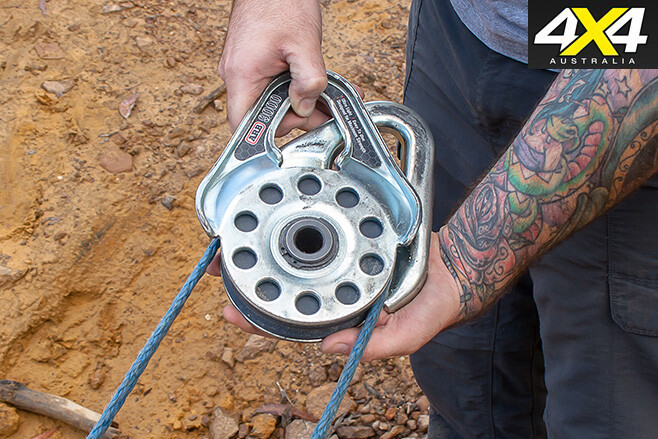
MULTIPLE LINE PULLS The need for multiple line pulls should be apparent, but the actual mechanics of it are rather impressive. Instead of hooking your winch line directly to the tree trunk protector, as you would in a normal recovery, you run the line out through a pulley block attached to the tree trunk protector and then back to your four-wheel drive’s recovery point with a damper over both lines. This halves recovery speed and doubles the pulling power of the winch, giving a 12,000lb winch 24,000lb of pulling force – that’s close to 11 metric tonnes.
Next, add an additional pulley block to the vehicle’s recovery point, run the winch line to a second tree with a tree trunk protector, and add another winch damper, to triple the pulling power of the winch.
This provides a pulling force of 36,000lb, although it will also cut the speed of the recovery by one third.
It’s important to note a winch’s pulling power is rated with just one layer of rope on the drum. It loses roughly 12 per cent pulling power for each additional layer of rope on the drum. Performing a double, or even triple, line pull can help get more rope off the drum and give you more chance of getting free.
DIRECTIONAL WINCHING While a pulley block allows us to increase the effective pulling power of a winch, it also has the unintended consequence of allowing us to change the direction we’re winching in. This can come in handy in a few different situations.
Firstly, we can winch on an upwards angle to help lift out of mud. You can do this with a single line pull by setting the tree trunk protector high, but the leverage applied to the tree can potentially rip it out.
By fitting a pulley block high in a tree, you can run the line from your four-wheel drive up and through the tree and then down to a low anchor point on a second tree. This will pull the front of your vehicle out of the muck, while pushing the second tree down and not over.
The other major benefit of re-directing winch lines is the sling-shot winch. Particularly useful when you’re not the one stuck, a sling-shot winch allows you to direct your winch line around corners, or even to a tree in front of you, and then back to a 4×4 stuck behind you.
You won’t get the added benefits of mechanical advantage, but you can perform some otherwise impossible recoveries with this technique.
5 TIPS FOR ADVANCED WINCHING
1. Every line needs at least one winch damper. 2. If you run out of dampers, a heavy coat or a sleeping bag will get you out of trouble. 3. Keep the line off the ground – rocks and dirt can tear a winch rope to shreds. 4. The open end of the winch hook points up. If it breaks it’ll go down, not up. 5. Let the winch cool down: 30 seconds on, 30 seconds off.
For more 4×4 recovery tips check out or page.
IF YOU need more space and power and you don’t want to modify your trusty Hilux, Ranger or Triton steed, then the only factory alternatives are full-sized American pick-up trucks.
We’ve given three right-hand-converted US trucks an all-Aussie initiation: the Ford F-250 Lariat, the GMC Sierra Denali 2500 and the RAM Laramie 2500.
Ford’s F-250 Lariat is a $152,000 offering from Harrisons in Melton. For that you get a Powerstroke 6.7-litre turbo-diesel V8 engine – instead of the US-preferred petrol V8 – that dishes up a gargantuan 1116Nm from 1600rpm. This is enough urge to haul a 7600kg trailer! However, the result of this is a nasty fuel consumption figure of 21.93L/100km. The rig utilises a heavy duty ladder-frame chassis with live axles front and rear, plus it’s fitted with a selectable rear diff lock. As big and brash as they come!
Next up is the GMC Sierra Denali 2500, a $152,000 offering from Performax. Under the hood is a monster 6.6-litre turbo-diesel V8 that generates 1037Nm and 298kW, enough to haul an 8000kg trailer. Heavy duty driveline experts, Allison, supplied the six-speed automatic transmission. The rear axle has an auto-locking diff from Eaton. It utilises a separate ladder chassis and a live rear axle on an HD leaf spring pack. Unlike the other two pick-ups, the GMC uses an independent front suspension design with torsion bar suspension.
RAM’s Laramie 2500 is the cheapest of this trio, coming in at $139,500 from the Walkinshaw Group. There’s no V8 powering this truck, but the massive 6.7-litre, six-cylinder Cummins donk still musters a hefty 1084Nm. It’s got a six-speed auto, part-time 4×4 with shift-on-the-fly, low range and auto-locking Tru-Lok diffs front and rear. It’s also bolted to a ladder frame chassis.
The complete road test on these three American mega machines can be found here.
JUMP in our time machine for a quick spin back five years. It’s the end of 2011 and we are lining up the pick of the year’s crop for our slugfest known as 4X4 of the Year.
Given we only allow newly released 4x4s into the contest, not all years are as strong as others. But that certainly wasn’t the case in 2011, which produced a bumper crop of serious contenders.
Starting equal favourite was the then-new and still effectively current WK Jeep Grand Cherokee, fitted for the first time with a diesel engine (a high-tech, European-sourced 3.0-litre V6, no less). The WK had taken the previous year’s title on debut, due to its petrol V6 and stunning value for money, so it wasn’t to be taken lightly.
Looking equally good, given Toyota Land Cruisers rarely lose a 4X4OTY contest, was the 200 Series GX – a stripped-back, no-nonsense new price-leader in the 200 range.
Range Rovers also traditionally do well at 4X4OTY, so the new 700Nm 4.4-litre V8 bi-turbo-diesel Rangie was looking good. As was the brick-dunny-tough Mercedes-Benz G-Wagen G350 diesel – triple diff locks and all. The Merc was back in Aussie showrooms off the back of its then-new Australian Defence Force contract.
The final contestant was the controversially styled Toyota FJ Cruiser, the only one of the five short-listed vehicles not to feature a modern turbo-diesel engine. Back then, a turbo-diesel donk was seemingly a prerequisite for success at any level, so no one gave the FJ Cruiser a chance.
After a week of rigorous testing, the six judges – with more than 200 years of collective 4×4 experience – saw it differently. In what was a triumph of the underdog, the FJ Cruiser came from the clouds to sweep all before it.
Fast forward to 2016, and word is out that production of the FJ Cruiser is coming to an end in a matter of months. This follows its withdrawal from its key (and birth) market, the USA, in 2014, and effectively brings to an end the short life of a very remarkable vehicle, both in terms of how it came about and what it did once it made it out into the world.
THE HISTORY THE idea for the FJ Cruiser didn’t originate from Japan’s Toyota HQ; it was born in the USA.
It dates back to the mid-1990s, when some US Toyota employees thought that something with the rugged, go-anywhere ability of the original FJ40, but with contemporary underpinnings, might get the interest of young US males – a market where Toyota considered it was losing touch. In other words, it wanted a Jeep Wrangler competitor.
In 1999 at the Chicago Auto Show, the ‘Retro Cruiser’ was revealed. This was a modified 1967 FJ40 created by off-road racer and vehicle builder, Rod Millen. The Retro Cruiser was more than a concept vehicle, as it was a running prototype combining a contemporary Land Cruiser chassis and V8 engine with an FJ40 body.
With backing from Toyota HQ in Japan, the project was handed to Toyota’s Californian design studio, which delivered the FJ Cruiser Concept at the 2003 North American International Auto Show in Detroit. It sparked enough interest for Toyota to decide the FJ Cruiser was a viable commercial proposition.
The production version, with essentially the same exterior styling as the concept vehicle but with a toned-down interior, debuted just two years later at the 2005 Chicago Auto Show. Its debut followed rigorous testing and development, including extensive off-road evaluation at various locations such as the Rubicon Trail.
The FJ Cruiser didn’t arrive in Australia until mid-2011. By that time it was effectively a second-generation model, as the original FJ was based on the 120 platform, whereas the Australian-delivered FJ had many of the changes that came with the 150 Series Prado.
BEHIND THE WHEEL THE FJ Cruiser is a vehicle you have to drive to appreciate. Just looking at it – even if you know it’s essentially a different body on a shortened-wheelbase, part-time-4×4, petrol-powered Prado – won’t tell the whole story.
Compared to a Prado, the big negative is interior space and seating capacity. The payload and towing capacities are also slightly reduced, but in just about every other way, both on- and off-road, the FJ Cruiser is a better vehicle.
It all starts with the highly underrated 200kW 4.0-litre V6. This 150 Series engine has variable valve timing on both cams, not just the inlet cam as per the 120 Series engine.
In typical Toyota fashion this is a soft-tune engine, where power spread, not peak power, is the name of the game. The engine is mated to the five-speed auto (from the 120) and a part-time, dual-range 4×4 system (from the HiLux) – unfortunately a retrograde step from the Prado’s full-time 4×4.
At 2000kg the FJ Cruiser is around 300kg lighter than the petrol Prado, and this helps to accentuate the engine’s flexibility and its considerable top-end urge. The generally agreeable five-speed gearbox works well with the engine and has gated shift, rather than a tip-shift, for ‘manual’ control.
The soft tune of this engine helps with fuel economy, one of the surprise reasons why the FJ Cruiser won 4X4OTY. In that week-long contest, which included a fair deal of off-road tracks, it used 15.4L/100km to be the thirstiest vehicle there – as you’d expect, being the only non-diesel. But the difference wasn’t much: the LC200 GX used 15.3L; the G-Wagen 15.1L; the RR TDV8 14.5L; and the Jeep GC 12.2L/100km.
The FJ Cruiser’s reduced weight and better mass centralisation of its compact body also makes for surprisingly good on-road dynamics, even with the supple long-travel suspension that produces an excellent ride on even the bumpiest road.
Off-road the FJ Cruiser has many things going for it, not least the best approach and departure angles of any Toyota 4×4. For example, compared to a Prado, it has a steeper approach angle (36 v 32 degrees), better ramp-over angle (29 v 22 degrees), steeper departure angle (31 v 25 degrees), and slightly improved ground clearance (224 v 220mm). All of that is in addition to its capable, Prado-derived long-travel suspension.
The FJ comes with a driver-operated rear diff lock and, while engaging this negates the normal traction control on both axles, the driver can reinstate off-road-specific traction control (A-TRC) across the front axle, even when the rear diff is locked. With its entire off-road armoury lined up, the FJ is closing in on the Wrangler Rubicon territory in terms of showroom-stock off-road ability.
Inside, the FJ is like no other Toyota 4×4, with forward and upright A-pillars and a retro-styled slab dashboard. Two rear-hinged doors give good access to a decent rear bench, while the front passengers are treated to the typically comfortable Toyota seats – the driver’s seat having the benefit of height adjustment. Not bad luggage space, either.
ON REFLECTION MORE than 11,000 FJ Cruisers have been sold in Australia since 2011 (around 180 per month). Compared to the Prado, sales of which run at 1200 to 1300 per month, this isn’t significant, but given more than 98 per cent of Prado sales are diesels, one can only speculate on FJ Cruiser sales if it was available as a diesel.
Still, you don’t hear owners complaining about the FJ’s 4.0-litre petrol V6 in terms of performance or fuel economy. And they all seem to appreciate the FJ Cruiser’s Toyota-typical practicality and the fact there’s a good range of aftermarket enhancements to back up its off-road functionality. You certainly see a surprising number of FJ Cruisers out and about on the back roads and bush tracks given their modest sales volume.
After driving the FJ Cruiser once again for this feature, it has stood the test of time and doesn’t feel ready for retirement in any sense. Above all, the FJ Cruiser was an enthusiast’s 4×4 delivered by a manufacturer renowned for conservative, family-orientated 4x4s. Let’s hope Toyota throws off that conservative yoke again sometime soon.
PAYING HOMAGE
THE FJ Cruiser pays homage to the FJ40, which wasn’t the original Land Cruiser but was the vehicle that established Toyota as a pre-eminent manufacturer of 4x4s. The 40 Series was a development of the 20 Series, which in turn was effectively a renaming of the original BJ.
The 40 Series was replaced by the 70 Series, and if the FJ Cruiser was based on a 70 Series then its bloodline would be much more direct. As it is, the FJ Cruiser is based on the 120/150 Series Prado and its links to the FJ40 are more stylistic – ‘TOYOTA’ grille badge, round headlights, white-finished roof, steep windscreen with three wipers, and the slab dashboard.
SECOND-HAND VALUES
ACCORDING to RedBook, the projected resale value of the FJ Cruiser after three years runs at 62.5 to 63 per cent, colour-dependent. That’s at the bottom end of the resale value of Toyota 4x4s in general, but applies before the announcement that production will cease.
The effect that announcement will have on FJ Cruiser resale values is yet to be seen. By way of comparison, Prado projected value runs between 63.8 and 67 per cent; Fortuner between 66.5 and 67 per cent; and LC200 between 71 and 73 per cent.
[specs] TOYOTA FJ CRUISER Engine DOHC, 24v, petrol V6 Capacity 4.0-litre (3956cc) Max Power 200kW @ 5600rpm Max Torque 380Nm @ 4400rpm Gearbox five-speed auto 4×4 System dual-range part-time Crawl Ratio 33.7:1 Construction separate chassis Front suspension independent/coil springs Rear suspension live axle/coil springs Tyre/wheel spec 265/70R17 Kerb Weight 2000kg GVM 2510kg Payload 510kg Towing capacity 2250kg Seating capacity five Fuel tank capacity 159 litres ADR fuel claim 11.4L/100km Average fuel use 13.0L/100km Price $46,990 (plus on-road costs)
LAST week Roothy showed us how to cook fish and chips when you’re 1000km from the ocean. This week he’s got a Mexican-inspired dish that’ll spice up your campsite menu.
Roothy’s stolen the recipe from his old mate Chooka, and now he’s sharing this spicy treat with you.
The aptly named Chook Amigo dish is part nachos, part fried chicken. And the end result will have you salivating.
As is always the case with Roothy’s Bush Cooking adventures, the method is very simple.
First, lather a couple of chicken legs in olive oil and top them with taco seasoning – mild or hot. Then, when the oil is bubbling away, whack the legs on the pan.
Roothy uses a Gladiator Series stove from Coleman and he reckons it gives off enormous heat, which is a good thing, as chicken is definitely something you don’t want to undercook. So make sure the meat is cooked right through to the bone and is entirely white.
On a serving dish, plate up a layer of corn chips and top with avocado, sour cream and salsa (it wouldn’t be a Mexican dish without these key ingredients).
Once it’s plated – and you’ve stopped picking at the chips – place the chook on top!
Now, where’s the tequila?
CONTINUING on from Readers’ Rigs: Part One, here’s the next selection of rides that our readers are hitting the bush with.
To get involved and get your ride on these pages, head to our Facebook page and keep an eye out for the opportunity to send through some photos. Your pride and joy might even get published in the mag one day and, if we really like it, perhaps you’ll even see it on the cover of 4X4 Australia!
Here’s the next instalment of readers’ rigs:
2000 GU PATROL TD42T – JON BORKOWSKI
WHAT IT’S GOT: I got it in July 2015 after my GQ of 10 years died. It’s a ’99 build, 2000-plated GU Series I. Prior to my ownership it was a one-family-owned vehicle. When I purchased it, it was 100 per cent original and only had 55,083km on the clock. The motor hasn’t been touched yet, except for a three-inch exhaust and 3.5-inch Safari snorkel.
Suspension-wise it has: four-inch, medium-rate King Coils; Tough Dog shocks and adjustable Panhard rods; Superior Engineering comp-spec drag link and tie rod; Superior super flex arms; Superior swaybar disconnects; BBM off-road heavy-duty rear lower control arms and adjustable uppers; extended braided brake lines; and Boss rear coil tower braces.
I run the Nissan LSD in the rear and an Eaton ELocker up front. Rear bar is from Millweld Customs and front bar is a genuine Nissan steel winch bar, with the Nissan driving lights of the time. It rides on Mickey Thompson 16x8in Baja Locks and Toyo Open Country MTs in 315/75/16.
I run a Tracklander alloy rack and a Darche Eclipse awning. Inside are the basics: UHF, CD player, Hema GPS and a cargo barrier. I got it engineered to keep the insurance company and Mr Plod happy.
Future mods will include a set of Rock Sliders, a turbo upgrade with a top mount intercooler, and a winch.
I haven’t been off-road a great deal, yet. The best trip so far has been to the Spanish Steps at Lithgow, then along to Baal Bone Gap up to Mt Airlie, to Turon River National Park, and then along the Turon to Hill End.
1989 NISSAN PATROL Y60 MDL – ADAM TANNER
WHAT IT’S GOT: I’ve had it for approximately eight years. It was originally a TB42, but I built up a big, pricy TD42 with custom 11mm pump, which runs 25psi boost. I’m yet to dyno, as the motor has only 10,000km on it.
Every suspension arm is upgraded, and it has front and rear air lockers. It’s got a five-inch lift and runs 35-inch TTC Claws. Other features include a high-mount warn, rebuilt diffs and a Ti interior.
The rig is in very good condition. We use it for the Vic High Country and it tows our new Jayco Swan OB. I’m looking to sell it to make way for a GU4 TD42.
FOTON TUNLAND – DEAN NEUMANN
WHAT IT’S GOT: I’ve had it just on three years. It hasn’t got many mods, just a Hilux snorkel, nudge bar, light bar, awning, alloy tray, Jack Off canopy, dual battery, Ironman 4×4 fridge, 18-inch rims and All-Terrains.
It’s been to Gladstone and up to Rockhampton, but it spends most of its time at work or bass fishing in Macleay.
2011 JEEP WRANGLER JK – MATT LAIDLAW
WHAT IT’S GOT: I’ve had my 2011 JK from new and have built it up gradually. It currently runs on 33-inch tyres, Bilstein long travel shocks, Eaton front Locker and re-geared 4.11 diff ratios.
It’s also got a Rock-Slide Engineering front bar with 12,000-pound winch, Synergy adjustable control arms, custom stainless exhaust, chromoly axles and a Rhino rack. We manage to get out regularly with the great people at JeepFreakz, Qld.
2015 ISUZU MU-X LST – SIOBHAN JAMIE THORNBERRY
WHAT IT’S GOT: My MU-X has a TJM front bar, 9500lb Kaymar rear bar, Ironman 4×4 two-inch lift kit, Korr light bar and LED driving lights, and I’ve just fitted brush bars and steps. I have done Vic High Country, Kulkyne National Park, Pink Lakes, Brindabella National Park and Tallarook.
1999 JEEP CHEROKEE XJ – DYLAN TAYLOR
WHAT IT’S GOT: 5.5-inch lift; Super-Flex short arms; drop boxes; a custom front bar; 32-inch MT/Rs (soon-to-be 33-inch KL71s); Rock Lights, light bar, and a whole lot of other lights; full sound system; cold-air intake; custom exhaust; machined head and metal head gasket; custom steel flares; and much more. Plus the carpet has been removed for the bed liner.