By the time Mercedes Benz hits the market with its X-Class 1-tonne ute in 2018, the Nissan Navara chassis on which it is based, will have worn more different badges than a Chinese-made 12-volt winch. And that might not be the end of it.
Mercedes-Benz’s tie up with the Renault-Nissan alliance will see the X Class as the third vehicle to ride on the NP300 platform originally from the D23 Navara. Late in 2017 we’ll see the Renault Alaskan pick-up which also uses this architecture and shares powertrains and most body panels with the Nissan ute.
But it might not end there. Having just taken a controlling stake in Mitsubishi Motors, Renault-Nissan executives have stated that model sharing will be a key part of the wider alliance. Mitsubishi already has a deal with Fiat Professional to use the chassis and architecture from its Triton one-tonner to build the Fiat Fullback ute.
It would seem wasteful for the alliance to produce more than one body-on-frame platform for one-tonne pick-ups so is it unreasonable to imagine utes from Nissan, Mercedes-Benz, Mitsubishi, Renault and Fiat all riding on the same design in the future?
In other wife-swapping utescapades; Ford has dropped its long association with Mazda to go it alone for the next generation of Ranger ute. Once again this vehicle will be developed in Australia although our Rangers will continue to be made in Thailand. Ford USA has also announced that the next Ranger will go on sale there by the end of the decade and Ford Australia in believed to be involved with development of that vehicle which will be built in Detroit. The development is happening alongside that on our next Ranger which will continue to be sourced from Thailand.
Looking for a fresh bedfellow, Mazda has slipped in with Isuzu for it’s next-gen BT50. Other than that this will be built on the next D-Max architecture, not much has been revealed about the collaboration but expect it to retail Mazda’s styling in line with the latest CX9 and CV5 SUVs
The Mazda tie-up came at a good time for Isuzu as its old mates at General Motors dumped the Japanese brand to go it alone for the Colorado. GM now sells a version of the Colorado as both a Chevrolet and GMC in the US market and rumour has it that the next-gen Colorado will be a shared GM product globally.
That leaves the Toyota Hilux and Volkswagen Amarok as the only two of the mainstream 4×4 ute models to still be single. There’s a gaggle of Chinese and Indian manufacturers out there as well who we’re sure would love to get a hold of that Toyota and VW tech.
All in all it lines us up for interesting times ahead for a 1-tonne ute market that is expected to grow more than 30-per cent over the next 10 years.
SINCE it’s launch Volkswagen has said that the Amarok was not designed to have a bull bar fitted to the front of it and would not have a factory option for one.
It appears that line is softening with the company hinting that one is coming for the updated model.
“I don’t want to go too much into the detail, but wait for 2017,” said Volkswagen Australia sales director for exported commercial vehicles, Dr Jan Michel at the recent launch of the Volkswagen Amarok TDi550 V6 model.
This was in response to questions pertaining to Australian developed accessories and local testing of the Amarok and it is believed that an airbag compliant bulbar will be offered by the factory in 2017
“The accessory business is one thing we are really putting high attention [into],” Michel said. “You can have happy dealers, you can have a happy importer and happy customers providing the right range of accessories … and this is what we are now doing.”
In regards to local testing in Australia Michal continued, “We have a factory in Argentina … and Argentina has also tough conditions so it’s easier to test there. For me it’s really learning from the market; Australia is really important.”
Australia is the single biggest market for the Amarok– something that ensures Volkswagen Australia has a louder voice at its German head office when it comes to future models.
Ford, Toyota, Mazda and Mitsubishi have all tested their respective utes in Australia prior to release. Mercedes-Benz is also planning to do the same here with its upcoming X-Class pick-up.
LIKE the simple things in life: pull-on boots, hats that shade my honker, and tools that do a job properly.
The same goes for camping gear. Nothing to break, nothing to lose and nothing to get flustered about – isn’t that why we go camping? To relax?
When it comes to touring tents – ones that are supposed to be quick and easy to set up and pack away – centre-pole-design tents are the best around. Sure, they miss out on some modern design inclusions, but you can’t break them and they’re perfect if you’re camping without a camper trailer or caravan, and they’re a great backup if you need to leave the ’van behind for a few weeks while you hit Cape York.
Throughout history you’ll find centre-pole tents have been used more than any other type of temporary accommodation, apart from caves. The old-style touring tents (centre-pole tent, bus tent, or whatever you call them) are still alive and strong, but they’re a rarity when compared to newer multi-framed, multi-hinged, pop-up, unfold, extend-a-frame styles.
There’s not much that can go wrong with this style of tent; no fancy spring-loaded clips and nothing that pops up or down.
We got our hands on a Southern Cross Ultimate Trekker centre-pole touring tent. It’s large enough to jam in mum, dad and a gaggle of kids, but it would be a little uncomfortable without the optional extra awning if the weather was unkind. No outdoor canvas coverage is offered, but a zip-on awning is optional.
The tent measures in at 4.0m long, 3.0m wide and 2.26m high when set up (the rear room section is 1.62m high) and packed dimensions are 1.0 x 1.0 x 0.15m. Given the tent is made from old-fashioned polycotton canvas, the total weight is 25kg. You won’t be hiking through the Red Centre with it on your back, but you could expect to cart it around on your roof rack or in the vehicle.
Southern Cross uses Australian-made 10-ounce polycotton canvas throughout, while the floor is heavy-duty PVC. Even the poles are made locally. That central pole has a simple double-lock feature to ensure the tent roof doesn’t slip down, regardless of the wind speed. A side-pole kit can replace the central pole to free up floor space; the floor has a reinforced patch so the pole doesn’t damage it.
Huge side and rear windows offer plenty of ventilation, plus there’s a small vent in the built-in roof frame to exhaust hot air. No fly is needed with this tent, which means you don’t have to wrestle to get an extra sheet over the high peak of the tent. Good quality canvas doesn’t need a fly to stay waterproof!
A gusseted window system, a decent-sized awning and a few other mod cons would be nice, but then it wouldn’t be a simple, tough-as-nails, quick-to-erect touring tent, would it?
Window mesh is fine enough to keep out mozzies and midges, and huge diameter peg rings allow a good grip to yank pegs out of the ground without tugging on the material.
The Ultimate Trekker claims to sleep four to six people.
RATED
AVAILABLE FROM: www.southerncrosscanvas.com.au; (03) 9729 5056. RRP: $1900. WE SAY: Simple; robust; quick and easy set-up.
Volkswagen’s much-anticipated V6 diesel Amarok has arrived and with it comes a new benchmark in 4×4 dual-cab utes.
Initially available in Ultimate and Highline specification and only as an eight-speed automatic, more V6 models will arrive next year including a 6-speed manual with dual-range, part-time 4×4.
The V6 engine attracts a very reasonable $3000 premium over the other Highline and Ultimate automatic models. The TDi550 Highline is $59,990 while the Ultimate tops the range (for now) at $67,990.
While the two new V6s will sell against the existing four-cylinder models for the time being, next year will also see shrinking of four-cylinder range from four to two grades, Core and Core Plus, while the single-cab 4×4 may also be phased out.
The reduction of the four-cylinder range will make way for an expanded V6 range including the special-edition Aventura due mid year. Expect the V6 to also make it’s way down the model grades but in a lower state of tune from the current 165kW/550Nm.
The engine in question is a long-serving VW family design that’s used in the Touareg as well as the Porsche Cayenne and Macan and Audi Q7 although it’s been beefed-up for the Amarok application.
Changes include a larger sump for added oil capacity and stronger pistons especially designed to cope with the demands of high-load, low-rpm operation. The Amarok’s V6 also comes with the latest emission tech including AdBlue SCR and a DPF and is already ahead of the game with regards local emissions compliance.
Unusually the engine is a 90-degree V6, rather than the more common 60-degree V6. It’s a DOHC, 24-valve design where the cams are chain and not belt driven and employs common-rail injection (@ 2000bar) and a single variable-geometry turbo.
For the time being the V6 only comes with a ZF eight-speed automatic and single-range full-time 4×4 in a system that’s similar to what’s currently available with the four-cylinder engine although the gearbox is a heavier-duty unit to cope with the extra torque of the V6. The 4×4 system uses a self-locking electronic-clutch centre diff that provides a nominal 40/60 front to rear torque split on high-traction surfaces but can vary the torque split as needed.
While the engine claims 165kW from as low as 2500rpm and extending up to 4500rpm, it also has an overboost function that bumps the maximum power to 180kW to provide more urge in overtaking situations and the like. The overboost is activated on throttle applications of 70 percent or more and for periods up to 10 seconds at a time.
At the other end of the rpm range, the 550Nm is on tap as low as 1500rpm and extends from there to 2500rpm.
DRIVING On the road the Amarok V6 is effortless at low and middle revs and punchy when needed. Pedal to the metal it will sprint from a standstill to 100km/h in just 7.9 seconds something that will leave even the best of the competitors utes, none of which will even break 10 seconds for the same sprint, back in its dust. Perhaps more appealing is the smooth and refined nature of an engine that sounds very un-diesel like with little or no telltale diesel rattle.
The refinement of the engine is matched by the super-slick ZF automatic that provides a wide spread of ratios for everything from low-speed rock crawling to effortless highway cruising. Thankfully the overall gearing isn’t excessively tall (as seems to be the trend today) with top gear giving around 60km/h/1000rpm. With maximum torque on tap at 1500rpm it means the engine doesn’t even think about slipping out of top gear on undulating country roads at legal highway speeds.
As with the four-cylinder Amarok with the eight-speed auto and single-range 4×4, the V6 can go from highway cruising to steep off-road work without having to touch a lever, switch or dial. There is a ‘Off-Road’ button that tweaks the gearbox-shift and ETC protocols as well as activating the hill-decent control, but left to its own devices the Amarok largely works it out itself anyway.
The off-road section of VW’s launch drive was moderately tough in parts but not sufficiently tough to require the rear locker to be engaged, which in the case of the Amarok keeps the traction control active on the front axle. On all competitor utes bar the up-dated Ford Ranger activating the rear locker cancels the traction control on both axles, which means it’s not always helpful.
If the Amarok V6 performs as well in truly difficult off-road situations as the four-cylinder eight-speed then it will be brilliant. Certainly there’s nothing to suggest it won’t be given the gearbox and drivetrain is effectively the same, only beefier. Given the extra torque of the V6 at low rpm, VW techs suggest it’s actually better in the steep stuff than the four.
As ever the Amarok offers first-class on-road ride and handing thanks to steering and chassis-balance that’s a cut above the rest of the class. If you want your ute to feel as much like a sports car as possible then this is it.
As standard the Highline comes with 18-inch alloys and the Ultimate with 19s but the launch vehicles were equipped with factory 17s fitted with Pirelli Scorpion ATRs (245/65R17s) as used on the current Core model.
The 17s can be fitted despite the V6 having bigger front brakes than the four-cylinder, now the biggest front brakes in the class. Disc brakes are also fitted at the rear which is a rarity in this class of ute.
The towing capacity remains changed at 3000kg but the GCM as been beefed up to 6000kg to match the Ranger and the BT-50 as a best-in-class figure. With the higher GCM, the V6 can tow its max and still have a decent payload in the tray, which is not the case with the 3500kg tow-rated utes. VW also offers a factory towbar while a bullbar is also in the works for next year.
Things like the spacious cabin (the widest in class) and the only tub in the class that can carry a full-sized pallet between the wheelarches remain largely unchanged although the cabin and equipment details have been changed, as has the front-end styling details.
SPECS Engine: 3.0-litre V6 turbo diesel Max power/torque: 165kW/550Nm* Gearbox: eight-speed automatic 4X4 System: single-range full-time Kerb Weight: 2169kg to 2216kg GVM: 3080kg Payload: 864kg to 911kg Towing capacity: 3000kg Towball download: 300kg GCM: 6000kg Fuel tank capacity: 80 litres ADR fuel claim: 7.8 litres/100km *180kW with overboost (see text)
THERE’S a lot to be said about using punishment for learning.
A quick bop on the nose teaches your dog to stop sniffing around the barbecue, a hefty fine in the mail teaches us not to speed, or, in extreme cases, an overnight stay in the clink lets us know Mr. Plod thinks we should have a few less beers next time we’re in Kings Cross.
Following that same logic, this next recovery technique is a surefire way to teach you never to get stuck again because the punishment far outweighs the crime.
So, there you are, trundling along the beach by yourself on a week day. You’ve forgotten the MaxTrax, the exhaust jack is sitting on the shelf, and you neglected to back off the loud pedal before sinking axle deep in the soft stuff.
With no one in sight and no trees to speak of, you’re left with one option: bury your spare tyre and use it as an anchor. This will be a lesson in preparedness you won’t soon forget.
STEPS
1. NO CHOICE THIS might sound a little backwards, but the first step when it looks like you’ll have to bury your spare tyre is to try every other conceivable method of getting yourself un-stuck. It’s a seriously last-resort option that involves hard yakka and a long time in the sun. If you’ve got a shovel – and you should always have a shovel – try using it to dig away the sand from in front of your tyres.
2. ROPE-A-DOPE IF THAT fails, now isn’t the time to start taking half measures. So wind out the winch rope until there’s just one full layer left on the drum. It’ll let your winch work with its maximum pulling potential and, hopefully, give you enough length to get back on semi-solid ground.
3. DIGGITY NOW grab your trusty long-handled shovel. You’ll need to dig the hole deep enough to get your spare tyre completely under the surface, with at least 100mm of room to pack sand above again. As difficult as it is, you’ll need to avoid sloping the side of the hole closest to your vehicle, as it’s going to bear the full force of the spare tyre pushing against it. If possible, undercut the hole so the tyre is leaning away from the vehicle. Don’t cart the sand too far away either, as you’ll need it again soon.
4. FILL THE HOLE BY NOW the sun should be about an hour lower in the sky, and you’ll be cursing yourself for driving on that damned beach. But the good news is it’s now time to fill the hole. Grab your spare tyre and feed a tree-trunk protector through the centre hole of your wheel and back over the front. Avoid putting the strap through any spokes in your wheel, as the load can buckle steel and alloy wheels alike.
5. WHEEL IT IN ROLL the tyre to the edge of the hole and gently lower it in. If you have a standard size tyre you should be able to lower it in by hand, being careful not to push sand back in the hole. You’ll need to face the outside of your wheel against the front edge of the hole. It has a bigger surface area so can spread the load over a larger area. If you have larger and heavier tyres you’ll need to roll the tyre in from the side. The strap should be at the bottom of the tyre, if possible.
6. MORE DIGGING DON’T get too excited just yet – there’s more digging to be done. You must now dig a shallow trench through the sand so your winch line can make a beeline to the ends of your tree-trunk protector in the wheel. Try and keep the trench as narrow as possible, as the more sand you take away the less strength the wall of the hole will have to hold your spare tyre.
7. PACK IT IN GRAB your shovel again and get back to work. As backwards as it sounds, you’ll want to pack as much loose sand as possible behind the wheel first – the idea being to keep the spare tyre pushed against the hole’s still firm front sidewall. As you shovel the sand in, push it down into place. The tighter packed the sand, the less chance your spare tyre will pop out before you do.
8. RECOVERY KIT WITH the spare tyre properly buried and your tree-trunk protector poking into the trench, grab your recovery kit and rig it up. If you’re using a hook, keep its open end up, so it shoots down if it breaks. You’ll also need to fit a winch blanket; although, it should be halfway between your vehicle, just where your line enters the sand. Avoid handling straps and rope while they’re covered in sand, as the abrasive particles can work their way into the webbing and cut it to pieces over time from the inside-out.
9. GIVE IT A WHIRL WITH passengers and eager spectators standing well clear, jump back in your 4×4 and pull the winch-line tight. The spare tyre should be deep enough to pull you out but won’t stand a chance against the dead weight of a fully loaded 4×4, so give it all the help you can. Make sure there’s as much sand cleared away from in front of your tyres as possible and, in first gear low range, drive with the winch without spinning your tyres.
10. CLEAN THE MESS WHEN you’re back on solid ground, it’s time to reach for the shovel one last time. Before you disconnect your winch line, drive over the top of the hole and winch in. The spare tyre should have no problems pulling up through the recently disturbed sand. It’ll leave a mud-tyre-sized hole that could catch out unsuspecting beachgoers, so fill it in before setting off. Don’t forget to thoroughly rinse any recovery gear to remove ingrained sand.
WHEN Chevrolet’s Colorado ZR2 was revealed last week we noted that the big ticket item on the build was the Multimatic Dynamic Suspensions Spool Valve (DSSV) damper technology.
We had to re-read the press statement when we first saw it, too. ‘Isn’t this the same damper technology used in F1 cars?’ we thought.
Indeed it is. In fact, it was used by the constructors-championship-winning Red Bull team from 2010-2013. Then, in 2014, the Chevrolet Camaro Z/38 was the first production car to utilise the damper tech.
Other notable performance cars to utilise the technology include the Aston Martin One-77 and Mercedes-AMG GT. It will also soon underpin the new Ford GT.
Now the all-new ZR2 will be the first vehicle to come with the state-of-the-art hypercar suspension that’s tailored for off-road use. But what is the advantage of Multimatic Dynamic Suspensions Spool Valve (DSSV) damper technology?
The DSSV-equipped ZR2 is said to be equally proficient both off-road (aggressive driving) and on-road (smooth, relaxed cruising) thanks to spool valve ports that can be shaped to alter the amount of hydraulic fluid passing through the suspension dampers.
The damper’s aluminium bodies house two spool valves that provide compression and rebound damping optimised for everyday use. The addition of a third valve specifically for the ZR2 aids when traversing extreme off-road trails whereby extreme suspension compression occurs.
The spool valves also offer increased precision and manufacturing repeatability, which dramatically cuts real-world tuning and development time.
We’ll have to wait and see whether Holden Australia has the bravado to follow suit. Until then, watch the video to see the ZR2 in action.
WHEN someone told me there was a place just a couple of hours’ drive from Sydney where you could do lake and shore fishing, explore a rainforest, drive along a beach in your 4WD, and spend a day tackling a maze of unsealed tracks that covers nearly 70km² of forest, it sounded a bit too good to be true.
As it turns out, it is true – and it can all be done in a weekend. To top it off, the area offers some cracking campsites!
The Great Lakes region and neighbouring Wallingat National Park are a combination of waterways that include the Myall, Smiths and Wallis lakes – all located along the NSW coast, just 80km north of Newcastle. Wallingat National Park is a stone’s throw away from the lakes, located on the western side of Wallis Lake, and this forest offers plenty of unsealed tracks that make their way through the park’s rainforests, swamps and dry woodland areas.
The Great Lakes region is renowned for its beauty and striking landscapes, ranging from vast ocean beaches – with more than 80km of coastline – to sheltered waterways, lakes and coastal forests. The Myall Lakes, covering more than 100km², are the largest natural freshwater system on the NSW coast and are listed as a wetland of international importance. This lush environment is also home to the tallest tree in NSW, the Grandis, which tops a whopping 84 metres.
We decided to stay for two nights in the area and, on the first night, we stayed at the Mungo Brush campsite, one of the region’s many campgrounds. Here you can camp on the lake shore, or right beside the entrance to the Mungo Brush rainforest. You are also within walking distance of the beach, with panoramic views of the Pacific Ocean set against a backdrop of dominant sand dunes and white-sand beaches – which you can explore in your 4WD with the appropriate permit.
We parked the Land Rover right beside the entrance to the rainforest walk, and if you set up camp here you will be drawn into exploring this well-marked rainforest trail. This easy loop takes you on a short walk through a coastal rainforest that features ancient trees, plum pine, mock olive, coogera and brush bloodwood.
This moist and lush environment suits all types of wildlife including frogs, kangaroos, koalas, wallabies and a number of reptile species. And, at the Mungo Brush campsite, be prepared to share your campsite with numerous not-so-shy brush turkeys as they scavenge for whatever pickings they can get from the camp table.
After a pleasant overnighter we spent our second night at the Sandbar and Bushland Parks campsite. En-route we did some exploring, firstly taking in the recommended Violets Hill, then on to the Grandis (NSW’s largest tree). To get there from Mungo Brush, head towards Bulahdelah and continue north along the Pacific Highway.
After 6km look out for the turnoff to Violet Hill, and after a couple of kilometres along this track you will see the sign ‘The Grandis 5km’. Take this path and you will then hit a dirt track, which you’ll follow to its end for a couple more kilometres. An information point is located just before a short walking trail which leads to the viewing point of NSW’s largest tree. This Flooded Gum stands a staggering 84.3 metres and measures 2.7 metres wide.
From here we took Violet Hill Road, a narrow dirt track that leads to a great place to stop for lunch, right beside the lake. You’re almost guaranteed to see a number of majestic black swans here, swimming close to the lake shore. In the mid-1800s this place was thriving and buzzing with industry; there was a substantial timber trade on the lakes, with logs transported by barges to Newcastle and down to Sydney.
After a good look around we got back on Lakes Way Road and headed for Bungwahl, just under 20km from Boolambayte – a route that took us along the borders of Myall Lakes and Smiths Lake.
From Bungwahl, continue on the Lakes Way until you see the sign for the Sandbar and Bushland Park. Turn right and drive under the ranch-style welcome sign. From there you’ll meander along the dirt track through sub-tropical rainforest abundant with palm trees, before reaching the Sandbar and Bushland campsite.
The campground occupies a secluded bush location on the shores of the beautiful Smiths Lake and Sandbar Beach. There are two separate parks here, one in the bush and one by the lake.
We opted to camp in the bush and parked the Land Rover under the shade of some very tall gum trees beside a creek that feeds into Smiths Lake. It was our last camp in the Great Lakes region and we were delighted to be allowed to have a campfire right beside the creek, as fires aren’t allowed at Mungo Brush.
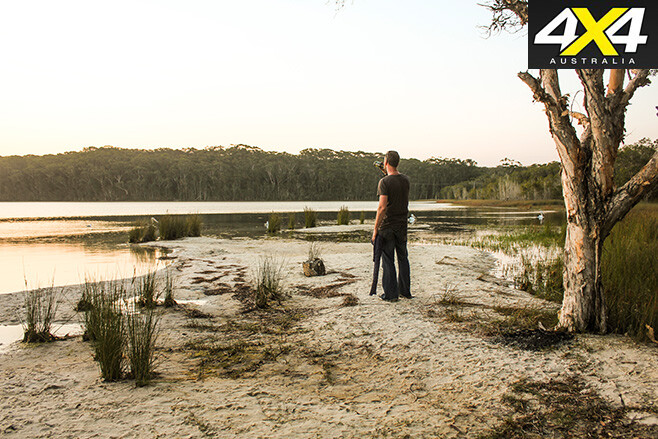
As we set up camp we were treated with a buzz of wildlife that included ducks, many other birds and a menacing hawk. Plenty of small fish could be easily observed through the creek’s clear water. Make sure to take the short walk across to Smiths Lake and watch the sun go down. We enjoyed a couple of cold beers as we shared the spectacle with a lone fisherman who had waded in up to his waist.
Next morning we were up at the crack of dawn for eggs on toast. As this was our last day in the Great Lakes region we spent the rest of the day tackling the tracks in the neighbouring Wallingat National Park. The 65.57km² park, described as one of the largest and most significant coastal forest reserves in north-eastern NSW, is located west of Wallis Lake
A network of unsealed tracks allows you to discover the park’s best features. Some of the smaller tracks that dissect the forest off the main track have signs notifying of risks and hazards, but despite those warnings we had no issues in our standard Land Rover Defender 90.
A popular and not-so-challenging unsealed track near Forster is a 25km loop of Wallingat. This track will take you through dense forest, and you’ll come across a couple of timber bridges – none of which will cause any drama. Note that the bridge crossing Boggy Creek has a three-tonne load limit, but unless you’re driving a kitted-out Unimog or large Russian military truck you should have no issues.
If you decide to camp in Wallingat National Park there are a couple of cracking campsites, including the Wallingat River campground, a picturesque riverside campsite towered over by eucalyptus trees, and the Ferny Creek campground. This campground can only be reached in a 4WD and is highly recommended by locals as a great fishing spot.
If you have a spare weekend, or longer, the Great Lakes region and the Wallingat National Park present an incredibly diverse and natural environment. This isn’t an epic 4WD adventure, but with its picturesque lakes, coastal beaches, walking trails and 4×4 tracks, you will be pleasantly surprised with the variety of activities you can enjoy in just a few days.
TRAVEL PLANNER
WHERE THE Great Lakes, just three hours’ from Sydney, are a network of waterways that include the Myall, Smiths and Wallis lakes and sit between Nelson Bay and Forster, north of Newcastle.
MAPS HEMA Maps’ Australia Easy Read Road and 4WD Atlas (9th edition) is useful. The Myall Lakes, Booti Booti and Wallingat National Parks’ visitor guide is available from tourist information offices.
CAMPSITES THE Mungo Brush campground is a well-known campground near Hawks Nest. There are more than 22 campgrounds within the Myall Lakes. The Sandbar and Bushland Park campground can be found some 20km south of Forster. There are two idyllic campsites in the Wallingat National Park: the Wallingat River campground and the Ferny Creek campground.
FUEL AND SUPPLIES THE area is serviced by the towns of Hawks Nest, Forster and Bulahdelah.
KEY CONTACTS WALLINGAT National Park is operated by Great Lakes (Pacific Palms), phone: (02) 6591 0300; (02) 6554 0489. Sandbar and Bushland Caravan Park, phone: (02) 6554 4095 www.sandbarpark.com.au
RESTRICTIONS AND PERMITS 4WD beach permits are required to drive along the beach north of Hawks Nest. General park entry and camping fees also apply. The permit allows access to beaches in the Great Lakes and Greater Taree City Council areas. Fishing permits are also needed. The lakes, including the Myall Lakes National Park and the Wallingat National Park, are always open but may have to close at times due to poor weather or fire danger.
TRIP STANDARD Suitable for standard 4WDs. All tracks are well graded, particularly around Myall Lakes. Be sure to pack recovery gear, as things can get interesting if the tracks are wet.
IT IS said that the Toyota Troop Carrier is the Swiss Army Knife of four-wheel drives, and proud Troopy owner Sam Garrett couldn’t have displayed it better than he has in this clever video.
The quick video proves how versatile the Troop Carrier can be. It can convert in an outback kitchen with mountains of storage space, and the next minute an installed roof-top tent can unfold for a perfect night’s sleep.
Sam is a member of Troopcarriers of Australia’s Facebook page. They’re a bunch of guys and gals who own Troopys and love everything about them.
We joined TOA on their Winter Ramble earlier this year and found them a great bunch of folks who know their stuff and enjoy a good time.
A total of 150 Troopys turned up to the 2016 Winter Ramble, which was an incredible feat – three Troopys attended the event in 2013, 17 showed up in 2014, and 76 vehicles participated in 2015.
The 2016 Winter Ramble also raised $4850 for the Southern Cross Kids Camps charity.
Own a Troopy (or want to own one and join in on the fun) then check out TOA’s Facebook page.
Or read the full story on our catch-up with Troopcarriers Of Australia here.
Today’s popular 4×4 dual-cabs make big claims when it comes to tow ratings and payloads, but are they really up to serious yakka?
We test the Toyota Hilux to see how its GCM, GVM and Payload fare against other industry icons.
LOAD TEST Toyota’s eighth-generation Hilux brought a smaller diesel (down from 3.0 to 2.8 litres) but a big jump in towing capacity.
The payloads remain modest, however, despite an increase of the diesel’s GVM from 2780kg to 3000kg, as the vehicle itself gained weight that negated much of the extra GVM.
The truth is the Hilux has the lowest payload rating of our seven utes, and even the lighter SR-spec dual-cab pick-up can’t technically carry (by around 40kg) our driver, observer, towbar and 800kg pallet of bagged cement that we used to test all the vehicles.
There are four foldaway tie-down eyes – cast rather than extruded metal – in the back of the Hilux’s tub. Once the 800kg pallet was in and secured the rear suspension dropped 60mm. In other words, it coped as well as any rival and much better than some.
Once underway up the hill you could feel the nose was a little up, but steering remained nicely positive. Impressive stability, too, with good sway and roll control from the chassis and no bottoming on the bumps. All up, the Hilux feels very composed, despite being at max payload and then a smidge!
The 2.8-litre was also a polished performer when coping with the 970kg payload and hardly felt the weight at all. With 450Nm on tap at just 1600rpm it isn’t far shy of what the considerably bigger 3.2L fives in the Ford and the Mazda can do – and it certainly felt every bit as strong as its 450Nm claim. It’s a sweet engine and bettered all the others in terms of general refinement, though it’s worth noting Ford’s Ranger and Mitsubishi’s Triton came close.
The six-speed auto also brought a refined feel, with quick and smooth shifts, and it worked nicely with the engine in getting the 800kg up the hill with a minimum of fuss. It was also good on the descent, as it readily auto backshifted once the brakes had been tapped. Does it need to be explained that this means less reliance on the gearbox’s manual tip-shift?
Not ideal with this new six-speeder, especially with so much weight on board, are the very tall fifth and sixth gears, which are both overdrives. Fifth gear here is actually taller than fifth in the superseded five-speed, despite the fact that there’s still an extra gear to go!
The long and short of it is that the engine can’t often hold sixth at legal highway speeds on undulating roads, even with a light load, so it tends to shuffle between fifth and sixth. To put it another way, it’s well-geared for Europe.
TOW TEST While the manual Hilux gets the magic 3500kg towing tick, the auto comes in at 3200kg, so our Hilux was matched with the lighter 2800kg trailer weight we used when putting the Triton through its paces.
The Hilux’s 130kW/450Nm 2.8 is a very civilised little engine and this is still the case under load. It doesn’t have the same launch factor as the Ford/Mazda duo, or even the Holden for that matter, but it pulled away confidently and with purpose. The six-speed slid through the cogs well and did its utmost to keep the revs within the engine’s wide torque band. Climbing the hill at 3000rpm in second gear saw the Hilux haul very well.
On the downhill the transmission needed a firm hand and a few measured stabs of the brake pedal to keep things in check.
The rear suspension of the Toyota feels every bit as work-ready as the Hilux’s image and reputation would suggest. The outboard spring mountings proved very stable under load and the vehicle remained reasonably flat in corners. It was also easy to steer and control, even when bleeding off speed on the downhill run.
Even though the Hilux engine shares the same displacement as the Holden, the Toyota felt a little more revvy. However, the conservative engineering approach that is a hallmark of the marque was evident. You get the feeling that the Hilux has more to give but is holding back.
At our lower 2800kg tow load the Hilux felt like a great all-rounder, but in typical Toyota fashion, it didn’t want to brag about it.
SPECS: TOYOTA HILUX* Engine 3.2-litre 5-cyl turbo-diesel Max power/torque 130kW/470Nm Gearbox six-speed automatic 4X4 System dual-range part-time Kerb Weight 2068kg to 2200kg GVM 3200kg Payload 1000kg to 1132kg Towing capacity 3500kg Towball download 350kg GCM 6000kg Fuel tank capacity 80L ADR fuel claim 9.2L/100km *4×4 dual-cab pick-up automatics only
TOYOTA HILUX PRICES* SR $46,490 SR5 $53,990 SR5+ $55,990 *2.8-litre 4×4 dual-cab pick-up manuals
WE’VE made no secret that we here at 4X4 Australia like the Ford Everest.
We were instantly impressed with the ability of the Australian-developed wagon when we went on a development drive through the Simpson Desert with some Everest prototypes more than a year before they were launched.
We were again knocked out by its ride and refinement when we finally drove the production models in Thailand, and then back home in Victoria when we pitched it against some key rivals in the 4×4 wagon class.
When we lined the Everest up in the strongest 4×4 Of The Year field in many years it took top honours as the pick of 2015, and it backed up that award when we drove our long-term tester on an outback adventure back in June.
The only thing left to know was how well the Everest performed with some touring kit on it. Unlike many other vehicle manufacturers, Ford Australia has dropped the ball when it comes to offering a strong range of off-road-focused accessories for its 4x4s; so it’s left that to an aftermarket industry that is only too happy to jump on the opportunity.
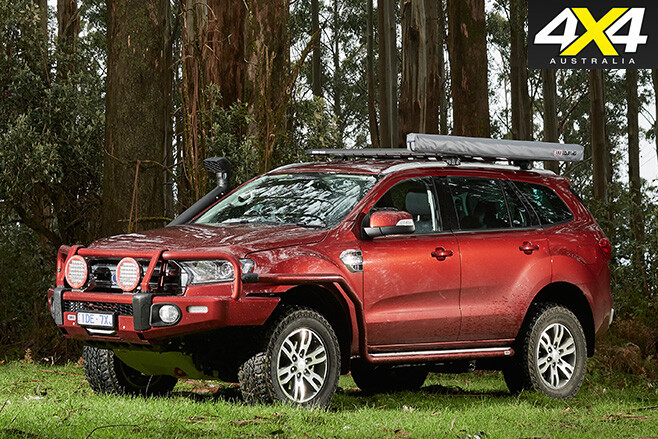
ARB certainly took up the challenge, and this vehicle is loaded with products it offers for the Ford. As the Everest shares many components with the Ford Ranger ute, ARB already had many products to suit, but some had to be re-engineered for the wagon, while others had to be specifically developed for it.
SUSPENSION & PROTECTION THE first upgrade most owners will make to any new 4×4 to improve its all-terrain performance is to replace the tyres, and the standard rubber on this Everest Trend was replaced with a set of Cooper ST Maxx on the factory 18-inch alloy wheels. The ST Maxx is an aggressive all-terrain-style tread pattern and is well-suited to a family 4×4 that sees double duty in both the bush and the ’burbs.
The tyres work with ARB’s Old Man Emu suspension package, which consists of raised coil springs that give a 40mm lift in ground clearance, along with matched OME Nitrocharger Sport shocks. While the increased ride height keeps the undercarriage a bit further away from the terrain, the underside also benefits from a replacement underbody protection plate made from 3mm zinc-coated steel.
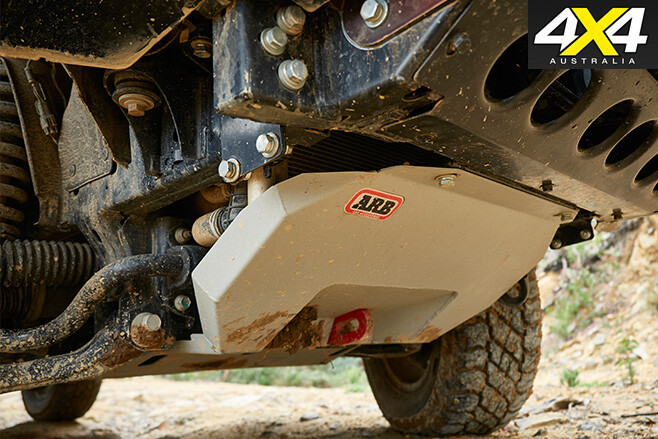
Also protecting the Everest is an ARB Summit steel bullbar, brush bars and side steps, each colour-matched in Ford’s Sunset Red. As with all of ARB’s body protection bars, the Summit bar and side protection bars are airbag compliant and improve the safety of the vehicle without compromising any of the OE safety systems. This includes the front parking sensors, radar cruise control and emergency brake warning systems.
The bullbar provides the mounting point for a Warn Zeon winch and ARB Intensity LED lights. We have criticised Ford’s factory head lights and, specifically, the high beam as performing poorly on dark outback roads, so a quality LED light such as the Intensity is a must-have for any Everest owner. They make a significant improvement to night driving in the Ford.
Not everything added to this Everest comes from ARB, but it all can be bought through ARB stores. The air-intake snorkel, for example, comes from Safari 4×4, another great Australian aftermarket accessory company.
While the mechanical package on this car remains otherwise standard, we have seen the 3.2-litre diesel engine in the Everest woken up with an aftermarket intake, exhaust and tune package.The roof rack on the Everest comes from the Rhino Rack catalogue and is one of the Pioneer platform designs. These versatile racks can be customised to carry all manner of gear and/or sporting equipment, but here it just mounts an ARB Touring side awning to provide a roll-out shelter when camping. It could have been handy on our wet day out in the forest.
SLIPPIN’ & SLIDIN’ THE tracks outside Melbourne were wet and slippery on our day out with the Everest. Mud tyres might have been more appropriate for the conditions, and we were limited to the tracks we could cover.The spate of wet and windy weather had left many of the tracks deeply rutted and, despite the added ground clearance afforded by the suspension, the underbody protection proved its worth as it straddled the ruts. Likewise, the side steps got a workout getting over the many trees and branches down across the tracks.
We noticed the added height as soon as we got in to the cabin of the ARB car. It’s a bigger step up and you look down on the road more than you do from the standard wagon. Yet the Everest has a nice, large glasshouse giving the driver plenty of vision forward and around the vehicle, and you only just notice the top of the bullbar peeping above the bonnet line.
When driving on gravel roads the ARB suspension feels firmer than standard and offers more control of the vehicle with less fore and aft pitching under brakes. It’s not too stiff, but we did end up dropping the tyre pressure for more comfort and to better cope with the gloopy conditions. There was no way we would have driven some of those tracks on the OE road tyres!
With these mild modifications the Everest improves its all-road touring ability, but not at the cost of the attributes that we have awarded it for in the past. The engine is still that lopey, torquey five-cylinder diesel; the six-speed automatic is positive and sure shifting; the electric power steering is well calibrated at both low and road speeds; and the overall fit, feel and ability of the car is top-shelf. The additions make a good thing better and turn the Everest into a tourer you could happily take the family around Australia with.