
Four-wheel driving gets a bit of a bad rap when it comes to ‘female friendly’ holidays. But off-road trips are about so much more than mud, bugs and uncomfortable beds.
Recently, I travelled to Fraser Island for a girls’ weekend away hosted by Tourism Queensland, Kingfisher Bay Resort and the Australian Offroad Academy. While Editor Matt Raudonikis was slugging it in a swag across the Great Australian Bight, I was living a lavish life in a resort. It’s tough being a 4X4 journo sometimes.
This trip had one noticeable difference to our regular sojourns – it was an all-female cast. Goodbye swags, hole-in-the-ground-toilets and beer-stocked fridges; hello cocktails, girl-talk and packed-to-the-brim suitcases.
My holiday-alarm of tweeting birds sounded nice and early for what would be the first time of many on this trip – no time for sleep-ins, paradise was calling. I readied the Toyota FJ Cruiser (later dubbed the ‘Red Hornet’), and began the four-hour drive from Brisbane to River Heads, where the barge was waiting to collect our group: the ‘Foxy Moxies’. Before I knew it, my city life in Melbourne was just a distant memory.
As we approached Fraser Island, the sun was beating down on us from the clear azure sky and the crisp, blue waters sprinkled us from below. From a distance the coast looked like any other, but as we drew closer it became clear that this landscape was straight out of Monet’s sketchbook. I never doubted I was going to love Fraser Island, but nothing could prepare me for just how deep this love would grow.
We arrived at the beautiful Kingfisher Bay Resort to a gourmet ploughman’s lunch – no baked beans on a camp stove, I could get used to this. Before I had a chance to re-apply the lip-gloss, we were hauling canoes through soft sand to heave-ho them to a nearby creek. Picture this: a group of women looking like they’d just stepped out of a magazine with their immaculate hair, dewy make-up and smooth skin, elegantly gliding through the ocean in pure luxurious bliss… well, that’s what we thought we’d look like. Instead, it was more like an ocean bumper-car session, with wind-swept hair, screams and plenty of giggles. This was no Sex and the City holiday; we were here to find our moxie; a term once used to describe courage and grit.
From three-person vessels to sunset cruises, we ended our first night on the Quick Cat II with Hervey Bay Whale Watch. While there were no whales, the sunset certainly didn’t disappoint. The orange, red and pink sky clashed with the clear blue sea – even the dolphins didn’t want to miss it as they joined us to watch the sun recede behind the horizon. It was at this moment we all knew that Fraser Island was full of hidden treasures; it really lives up to the name K’gari (pronounced Gurri), which roughly translates to paradise, a name given to it by the Butchulla people – the traditional land owners.
Mother Nature didn’t hesitate to let us know how fortunate we were to arrive on this haven. As clouds and rain threatened the otherwise beautiful Queensland weather – adding to my Melbourne-body’s intolerance to humidity – a rainbow coloured the sky, ending ever so gracefully on the western shore. I guess this was nature’s way of showing us that the golden sands of Fraser fill the pot at the end of the rainbow.
But we didn’t travel all that way to clog Instagram feeds, it was time to replace sandals with driving boots and team up with Australian Offroad Academy to get our tyres dirty and learn the difference between high and low range. Let’s face it, what better way to learn the basics of off-road driving than on one of the world’s largest sandpits. As we drove to the training course, I wondered whether this weekend was going to turn into a scene out of Ferris Bueller’s Day Off, only with a 4×4 dug to its axles instead of a Ferrari falling to its doom. I was wrong. With the aid of our super-instructors from Australian Offroad Academy, Dave and Brad, this group of women proved we can do anything, and we can do it in a pair of stilettos.
Before we knew it, we were driving the Crusty Cruiser (Land Cruiser 76), the Red Hornet (FJ Cruiser) and Princess (Prado), along the real tracks of Fraser. The convoy dodged and weaved through soft sand, ventured through fairy-like rainforests and hit 80km/h on 75 Mile Beach passing Eli Creek and the skeleton of the SS Maheno. Moxie wasn’t the only thing we were going to find on this trip, somewhere along the way, those who had questioned the fun of off-road driving found its real value – the hidden destinations at the end of the tracks.
Regular off-roaders will understand when I say that every trip comes with a magical, breath-taking moment when you reach a destination so beautiful, awe-inspiring and spectacular that your words fail you and all you can do is watch, feel and listen. It’s the type of place that keeps a piece of you long after you have left, and reminds you why you own a 4WD – to take you to places that make you wonder if there really is a heaven on earth.
Cue the group’s first destination: Lake McKenzie – white sand and sapphire blue water, the perfect colour scheme. Even the other tourist groups couldn’t distract me from the wonder of this lake. The water is fresh enough to drink, clear enough to see the colour of my nail polish, and charming enough to never want to leave.
I decided to trade in the tyres for a different kind of off-roading to end the girls’ weekend, and put my adrenaline in the hands of Larry from Aquavue Cafe Watersports. As a group of us arrived on the foreshore at Kingfisher Bay, four jet-skis sat bopping in the water. If driving around the island didn’t get our hearts racing, this was about to. A trip across to Pelican Bank – a sand bank just off the coast of the island – is one of those experiences you don’t forget in a hurry, and one I wouldn’t hesitate to do again. Though, I think my skills as a 4×4 journo are best kept to dry land.
Fraser Island is one of those places that touches your soul and changes you in a way very few destinations can. As I return to my life in the big smoke, I often find myself daydreaming about island life. It’s hard not to miss the feeling of soft sand engulfing my toes, or the fresh, cool water of the lakes lapping against my skin. Occasionally I’ll let my mind wander to the moments I stood surrounded by rainforests, with eucalypts curiously growing from marshmallow-soft sand.
That’s the thing about K’gari, it pushes boundaries and forces you to do the same. The enchantment of Fraser Island will steal your heart, and as you board the barge back to the real world, you can’t help but feel you are leaving a part of yourself behind.
So c’mon ladies, don’t wait for the boys. Pull on those trendy boots and flannelette overshirts and accelerate your way to paradise. Learning the difference between four-high and four-low will give you a whole new perspective on a girls’ weekend away.
Girls’ only weekends with with Australian Offroad Academy
We know learning to 4WD can be intimidating, but it can also make for a great girls’ trip away. Dave Darmody and his crew at Australian Offroad Academy are running ‘Girls Got Grit’ weekends – you’ll learn all you need to know about 4WDing, without the hassle of trying to keep up with the boys. Prices start from $635 per person/twin share, all inclusive (barge, permit, meals, and accommodation). What better way to start your love of 4WDing and explore the stunning Fraser Island.
Kingfisher Bay Resort We stayed at the beautiful Kingfisher Bay Resort, which sits on the sunset-side of Fraser Island overlooking the Great Sandy Strait. The Resort offers a range of accommodation including hotel rooms, and self-contained villas and houses. A variety of activities are also on offer. For more information, go to www.kingfisherbay.com
Get the latest info on all things 4X4 Australia by signing up to our newsletter.
At first glance you might think that this bright red LandCruiser is just another modified 40 Series, but then you notice it’s got four doors. A second, more studied look indicates that it’s running on coil springs, and that the dimensions don’t seem quite right; not just longer than standard, in the body and the wheelbase, but a little too wide as well?
Yep, this ain’t no ordinary 40 Series Cruiser. It’s an FJ-Ute from Redline Land Cruisers based in Colorado, USA. And that bright red bodywork is manufactured from aluminium… and it’s been dumped on an 80 Series LandCruiser chassis… and you can buy your own for $US50k… or build one yourself with an 80 Series donor and a $US15,500 body kit!
Imagine that! All of the retro cool of a 40 Series LandCruiser, combined with the practicality of four doors, as well as the relative modernity of an 80 Series chassis and running gear, including that plush long-travel coil-spring suspension, an automatic transmission and decent power and torque for touring and off-roading.
Redline Land Cruisers specialises in products for Toyota off-roaders, fabricating its own parts as well as selling top-shelf components from other companies. Redline is also well known for restoring and modifying vintage LandCruisers, and it’s not unheard of for customers to drop a lazy $US100k on rebuilding an FJ40 from the ground up.
In this context, the FJ-Ute gracing these pages is exceptional value for money. Of course, you can option the FJ-Ute to your requirements and spend well over the $US50k asking price, but even in base specification this is one very special vehicle.
Restoring and modifying old LandCruisers is one thing, but building what is essentially an all-new hybrid production vehicle takes things to a whole new level. Justin Robbins, the man behind Redline Land Cruisers, explains why his company has followed this path: “I have always owned and loved the 40 Series LandCruisers. The fact that Toyota never made them in a four-door version is beyond me, and with a growing family, this fits right into our business and personal goals.
“While my primary business is restoring and resto-mod’ing LandCruisers, I wanted to make an attempt at a production vehicle with all of the ‘family’ features I wanted in a modernised utilitarian vehicle. Melding family creature comforts with a proven Toyota chassis that already exists [was] a no brainer.”
The standard FJ-Ute featured here was unveiled at last November’s SEMA Show in Las Vegas on the Radflo Suspension Systems stand. It was only three months prior when the team at Redline really got stuck into the project by removing the original body from the 1995 FJ80 donor vehicle. The engine, transmission and driveshafts were the next to come off the chassis, as everything had to be shifted rearwards 180mm to allow the new 40 Series aluminium body to fit over the top.
Prior to fitting the new body, the FJ-Ute was given a 2.5-inch lift, courtesy of OME springs supplied by Cruiser Outfitters. The springs were complemented by Radflo high-performance remote reservoir shock absorbers that feature 23-stage compression adjusters. Other suspension modifications include Slee Off Road front and rear adjustable Panhard rods, while the rear upper and lower suspension arms were built in-house by Redline.
The next step was to fit the new body on to the chassis and then refit the freshened-up driveline components onto the new mounts. Other than a rebuild and “a little head porting”, Justin says the factory 1FZ-FE 4.5-litre DOHC petrol six-pack is standard. The four-speed auto was completely rebuilt, as were the stock driveshafts. The original front axle shafts were replaced by RCV units made from 300M alloy steel while the rears are now Nitro Gear Cro-Moly units. Both diffs are equipped with the factory Toyota lockers and the front-end is now equipped with Aisin free-wheeling hubs. In other words, this driveline is bulletproof.
Overall gearing has been significantly reduced thanks to the fitment of Sierra 4.88 ring and pinions (in place of the standard 4.1 diff ratio) and a Marlin Crawler 3.0:1 low-range ratio in the transfer case (in place of the standard 2.488). This results in an overall low-range reduction in first gear of 43.188:1 compared to the standard 30.092. Who says you can’t go rock crawling with an auto?
Work on the interior layout could then begin, with an eye to linking the appearance to the past while giving the FJ-Ute a modern feel. “The interior… we chose not to get out of touch with the simplicity of the LandCruiser’s past design,” says Justin. “So we custom-fit DynaDeck on the floor areas to reduce noise and heat; this material works great for that and to boot it has a 60’s era tuck and roll carpet look.”
DynaDeck is a three-part composite carpet replacement that is claimed to combine “the high thermal insulation capability of Dynaliner with the low-frequency exhaust noise rejection of DynaPad”. Oh, and the top layer has an embossed vinyl grain that matches the textured floor pattern of vintage cars. It’s even waterproof.
Detail touches on the interior include a Dakota Digital gauge unit in place of the factory Toyota unit; it features a silver face and red lighting, and there are extra gauges for transmission temperature and gear selection. This is framed by a neat three-spoke Nardi leather steering wheel that suits the perceived vintage of the vehicle. The standard Toyota auto tranny shifter would look too out of place in this 40 Series interior, so it was flicked in favour of a Lokar automatic shifter which has the appearance of a simple manual gearbox shift lever.
Seating is by way of four Baja RS reclinable suspension seats from Corbeau Seats; their black vinyl finish perfectly suits the look of the FJ-Ute. Although this example is only fitted with four seats, Redline claims there’s room in the rear for optional third-row seats. Instead, this example has a National Luna stainless steel fridge affixed to an easy-access slide.
This first-built example of the FJ-Ute is equipped with half doors and a soft-top, giving occupants that full immersive experience that only an open-air four-wheel drive can provide, but that means there needs to be some serious protection for occupants, so the next stage of construction involved manufacturing a custom-built roll cage from 1.75″ x .120 Wall DOM Tube. Redline will also offer a hardtop version of the FJ-Ute for those after something a little more insulated from the elements.
Once the interior fit-out and the roll cage were all sorted, the next stage was to undo all that hard work and pull everything back out so the body could be powder coated in a Sherwin-Williams Red, which is a match for the original Toyota Freeborn Red. It then copped a clear powder coat over the top, which results in an incredibly glossy finish.
Complementing the bright red paintwork are 17-inch Level 8 Guardian wheels with a bronze finish. The trick-looking rims are shod with 35x17x12.50 Cooper STTs. “I chose the Cooper tyre for its overall performance,” says Justin. “It is a fantastic tyre in every condition you throw at it. The added bonus is they look great on the bronze Level 8 Guardian wheels. These wheels make this Cruiser look really good from both standpoints of retro and modern.”
As you’d expect from a company that specialises in old LandCruiser builds, there are a hell of a lot of neat detail touches on the FJ-Ute, such as the front bar with Comeup winch, steel rock sliders, Vision X Low Pro 3 LED light bars, tidy fender-mounted indicators, polished door handles and much more. When asked about the FJ-Ute’s total build time and estimated cost, Justin says: “Build time was four months, cost was priceless.”
Justin is obviously very pleased with the end result, too. “I actually don’t think I would change anything,” he says. “That’s rare coming from a guy who crafts custom Cruisers for clients.”
Of course, this example of the FJ-Ute – build #1 – is destined to spend a lot of time on the show circuit drumming up business, but Justin also plans to use it as much as possible out on the trails with family and friends. And that’s really why the vehicle has been built as a production model, so that anyone can buy it complete or build it for themselves as a kit.
“Our main goal was to produce a four-door Cruiser with the intent of keeping the 40 Series lines, using existing components that have been proven to be reliable and producing that concept in-house for clients to enjoy,” says Justin. Redline Land Cruisers certainly looks to have achieved that goal.
Contact
Redline Land Cruisers
P: 0011 1 (719) 210 0101
FJ-Ute in Oz?
Before you get on the blower and call Redline Land Cruisers to order an FJ-Ute kit, you’d better check out the process for registering such a vehicle in your home state or territory.
Although based on an 80 Series LandCruiser chassis, once you rip the old body off and drop on the new one, you’ve essentially created a kit car, which means that you’ll have to prove that it complies with all the relevant ADRs (Australian Design Rules) and motor traffic regulations.
It’d be nice to think the rules on modified vehicles were the same across the country but that’s not the case. Despite the existence of the National Code of Practice for Light Vehicle Construction and Modification (VSB14), the methods for complying a modified vehicle vary from state to state, but in most states the vehicle must be certified by a recognised engineering signatory, who will examine the vehicle (sometimes while it’s being built) to ensure that all of the changes made to it continue to meet ADRs and related local motor vehicle regulations.
Of course, you can attempt to tackle this potential bureaucratic nightmare yourself, but you’d be better off speaking to a specialist company in your state that deals with such matters on a regular basis. A company such as this will be able to advise whether the FJ-Ute is likely to pass registration on your state or not, before you hand over your hard-earned. If they give you the green light, then they’ll be able to help and advise throughout the whole process, which can be quite involved.
In Queensland for example, you’ll have to send an “Application to Modify” form to Queensland Transport (QT) with details of the build. Based on this application, QT will respond with either an approval to build, a request for more information or a rejection of your submission.
If approved, the vehicle must also be inspected by an Approved Engineer throughout the build process and then, at the end of the build, you’ll have to contact Queensland Police to have a surrogate VIN allocated. You’ll then need to submit an engineering report to QT, who will then have their own Transport Inspectors take a look at the vehicle.
If you’re in Victoria, the process for Individually Constructed Vehicle (ICVs) involves bending and torsional tests, emissions tests, brakes tests, noise tests, issuing of an engineer’s report, issuing of a VIN and more.
In NSW, kit cars or individually constructed vehicles are not required to have a compliance plate fitted but, according to NSW Vehicle Standards Information, a suitably qualified engineer must certify that the vehicle meets all applicable ADRs. This concession is for owner-constructed vehicles only.
Regardless of where you live, modified vehicles such as the FJ-Ute can be registered in Australia, but it’s best to seek expert advice to smooth the way.
Oh, and if you do get a Redline FJ-Ute on the road in Australia, let us know… we want a drive!
Get the latest info on all things 4X4 Australia by signing up to our newsletter.
4×4 Australia Magazine has a big expedition coming up so we asked Land Rover to specifically prep some vehicles for it and they loaded up the Landies with all the factory-backed accessories. Before we went out on the big trip we took the expedition-ready TDV6 Discovery for a weekend shakedown in the Vic High Country.
Keep an eye out for the July 2015 issue of 4×4 Australia when we take this and other specifically equipped Land Rovers on an epic adventure across Australia’s rugged southern coast.
Click here to read the full range review of the Land Rover Discovery
Get the latest info on all things 4X4 Australia by signing up to our newsletter.
The little Suzuki you see here may look like a toy but nothing could be further from the truth. Sure it’s tiny, but tiny doesn’t mean tinny. This is an old school tough 4×4, just a very small one.
Old school in this case means a separate chassis and live axles back and front – just like a Toyota 70 Series, a GU Patrol, a Land Rover Defender or a Jeep Wrangler. It doesn’t get any more old school than that. The Jimny Sierra (its current but somewhat confusing name) can trace a direct line of ancestry right back to the very first Suzuki 4×4 that appeared in 1970; another parallel with the likes of the Land Rover Defender and the Jeep Wrangler.
See our guide to building a 4×4 with a $2.5K budget
You may be wondering why 4X4 Australia is testing what is a well-established, quite old, model like the Jimny. Well, the answer is simple. This ‘new’ Suzuki Jimny is fitted with electronic stability control (ESC) and electronic traction control (ETC) and has, as well, a few detail changes including new wheels, new gauges and a new steering wheel.
The fitting of the electronic chassis aids are the result of a lobbying effort by Suzuki Australia so that the Jimny could continue to be sold in Oz in the light of new safety regulations announced in 2009.Those new regulations deemed that from November 2011 all new-model passenger vehicles introduced into Australia were required to be fitted with ESC, while from November 2013 that requirement extended to all passenger vehicles. That meant that the pre-updated Jimny could no longer be sold here, although existing stock did carry over until September this year.
ESC brings well-proven safety benefits whereas ETC, which is effectively a secondary system within the ESC package, brings significant benefits off-road. A win-win situation all round.
POWERTRAIN AND PERFORMANCE
A 1.3-litre four-cylinder petrol engine, first introduced in 2005, powers the Jimny. It claims 62.5kW at 6000rpm and 110Nm at 4100rpm and features, somewhat predictably, double overhead cams, four valves per cylinder and variable valve timing on the inlet side. It comes standard with a five-speed manual but here we are driving the optional four-speed automatic.
62.5kW isn’t going to translate into tyre shredding performance by any stretch of the imagination, but the Jimny has weight or, more precisely, lack of weight on its side. In fact, with a kerb weight of just 1075kg it’s around half the weight of a typical medium-sized four-wheel drive. In terms of power-to-weight ratio, that’s the same as having a 2150kg 4WD with 125kW, which is not unusual or unreasonable by any means.
As a result the Jimny gets along quite nicely on the road and doesn’t have too much trouble holding its own. At higher speeds, where the engine’s power is largely spent overcoming air resistance rather than weight, it does start to suffer however and long hills at highway speeds are certainly its nemesis.
Like all small petrol engines, the Jimny thrives on revs and there’s no doubt that the five-speed manual would make it easier to keep the engine on the ‘boil’ when confronted with hills and the like. Still, the automatic isn’t all bad. It has longer highway legs than the manual (see: breakout) and the ‘dog-leg’ shift gate allows you to swap from fourth to third and back again with a quick flick. And, given that third is a fair gap from top, the increase in revs is sufficient to conquer most highway hills.
The engine is however a bit noisy at higher revs, but not excessively so. And, being small in capacity, it’s always smooth. Keeping the engine on the boil doesn’t help the economy, but the Jimny still averaged a reasonable 8.9L/100km on test. The manual would do a bit better and, in the defence of our test vehicle, the engine was very new (just 43km on the dial when we picked it up). Fuel economy will no doubt improve as the engine frees up.
Not so good is that the engine asks for premium 95RON fuel – although at one stage during our 1000km test 95RON wasn’t available and we were forced to use regular 91RON; the engine ran fine. As you’d expect the Jimny doesn’t have a big tank, just 40 litres in fact, which means a touring range of around 400km; depending on conditions and how hard you drive.
ON-ROAD DYNAMICS
Being so light the Jimny is a fun on-road drive, although the relatively narrow track and tall stance don’t work in its favour. It doesn’t inspire the confidence you’d expect from its light weight alone.
What is surprising however is that for a very light 4×4, with front and rear live axles, ride quality and stability on sealed bumpy roads is surprisingly good. Great brakes too.
Like most part-time 4x4s, loosely surfaced gravel roads are best tackled in ‘high-four’. This is a snack for the Jimny as the shift-on-the-fly 4×4 system works seamlessly. Having the newly fitted electronic stability control as a ‘safety net’ is also an obvious advantage on loose gravel.
OFF ROAD
While the Jimny is a fun on-road drive, there’s no doubt that it does its best work off-road. All of the live axle Suzukis, from the LJ50 on, have been great off-road thanks largely to their light weight, but this new Jimny takes all that to a new level thanks to its electronic traction control. Perhaps not as good as having aftermarket lockers back and front, but it’s still a significant step forward.
The Jimny ticks all the boxes. Light weight, decent clearance, handy wheel travel, steep approach and departure angles, a tight turning circle and good visibility. More under body protection would be handy, and of course, something more aggressive than the standard ‘Highway Terrain’ Bridgestone Duellers is a must.
The low-range reduction could also be better in both the manual and the auto, as steep rock climbing isn’t the Jimny’s forte. The auto’s crawl ratio isn’t as good as the manuals but it does have the advantage of the gearing multiplier effect of the torque convertor. The downside is that when the auto is ‘slipping’ it generates heat, and heat is always the enemy of any automatic transmission.
While steep rock climbing isn’t the Jimny’s thing, it’s pretty well unbeatable on the sand, particularly as an automatic. It’s very handy in mud too and, if you do get it stuck, it’s a hell of a lot easier to recover than something that weighs 2500kg or more. To that end it has one solid recovery hook (plus one tie-down hook) at the front and two medium-duty recovery hooks at the rear.
CABIN AND EQUIPMENT
Not surprisingly the Jimny is pretty basic inside but has most of the essentials. Notable exceptions are a lack of any steering wheel adjustment and there’s no cruise control. Despite its simple and basic interior, the seats are surprisingly comfortable and the rear (two) seats aren’t bad for smaller adults. With the rear seats in place there’s only minimum luggage space, but with the rear seats folded there’s a surprisingly ample amount of space for a two-person weekend away. If would be even better if the seats folded completely flat, but they don’t, and the lack of luggage tie-down hooks is annoying.
Safety equipment extends to driver and passenger airbags, ABS brakes and, of course, the newly fitted ESC and ETC. Currently the Jimny is not ANCAP safety rated.
SUM UP
No matter what way you look at it, the Jimny is a refreshing change from the plethora of compact SUVs that have little or no genuine off-road ability. In contrast the Jimny is a genuinely capable off-roader and is built on well-proven, tough mechanicals. The Jimny, like its forebears, also has an enviable reputation for reliability, longevity and low running costs.
It does have its limitations but most of those, including its size, carrying capacity and outright performance just come with the territory. Above anything else, the Jimny is a completely honest 4×4. It doesn’t promise anything it doesn’t deliver and, if anything, it delivers much more than it promises. Whoever first said: “Good things come in small packages,” must have just stepped out of a Jimny!
PICK A BOX
The Jimny comes with the choice of a five-speed manual or a four-speed automatic gearbox. And, as is often the case, the final-drive gearing is different with the two gearboxes; 4.3:1 for the manual and a taller 4.09:1 for the auto. The transfer ratios also vary with the gearbox employed.
With the manual, which itself is unusual as the fifth gear is 1:1 and not an overdrive, the transfer case has the usual 1:1 high range and a 2.002:1 low-range. With the automatic the high ratio is 1.320:1 and the low ratio a 2.643:1.
The wash-up of all this – after number crunching – is that the manual has a crawl (overall first-gear/low-range) ratio of 38.1:1 whereas the auto has a less useful crawl ratio of 31.1:1.
However, given the gearing multiplier effect of the auto’s torque convertor, the effective crawl ratio of the auto would be more like 43:1. At the other end of the gearing range, the ‘cruise’ (overall top-gear/high-range) ratio of the manual is 4.3:1 whereas the auto has ‘longer highway legs’ with a 3.75:1 ratio.
Specifications
Suzuki Jimny Sierra (automatic)
| Engine | 16v dohc 4cyl petrol. |
| Capacityu00a0 | 1328cc |
| Max Poweru00a0 | 62.5kW @ 6000rpm |
| Max Torque | 110Nm @ 4100rpm |
| Gearboxu00a0 | four-speed automatic |
| 4×4 System | dual-range part-time |
| Crawl Ratiou00a0 | 31.1:1 |
| Construction | steel separate-chassis |
| Front suspension | live axle; coil springs |
| Rear suspension | live axle; coil springs |
| Wheels/tyres | 15in alloy/205/70R15 96S |
| Kerb Weight | 1075kg |
| GVMu00a0 | 1420kg |
| Payload | 345kg |
| Towing capacity (braked) | 1300kg |
| Seating capacityu00a0 | four |
| Fuel tank capacityu00a0 | 40 litres |
| ADR fuel use* | 7.4 litres/100km |
| On-test fuel useu00a0 | 8.9 litres/100km |
| Touring range** | 400km |
| Base Price***u00a0 | $22,990 (auto) |
*Australian Design Rule ‘Combined-Cycle’ claim
**Based on on-test fuel consumption, fuel tank capacity and a 50km ‘safety’ margin.
***Prices do not include government or dealer costs. The manual is $20,990 plus ORC.
Price and specifications
Price: $53,240
Engine: 2.2-litre four-cylinder turbo diesel, 145kW at 3800rpm, 436Nm at 1800-2500rpm
Transmission and 4WD system: 6-speed auto, on-demand high range 4WD
Braked tow capacity: 2000kg
Spare tyre: Full size
Fuel tank: 64 litres
Fuel use (claimed): 7.3L/100km
Fuel use on test: 9.6L/100km
Approach/departure angles: 16.9 degrees, 21.5 degrees
Ground clearance: 185mm
WHAT’S THE DEAL?
The Santa Fe comes with petrol or diesel propulsion. For now, though, the petrol model is limited to the 2.4-litre four-cylinder, which is underdone for the circa-1.8-tonne body (there’s 141kW and 242Nm).
It’s the diesel that makes more sense (more on that later) and is the model we’ve focused on for this test.
The range kicks off at $41,490 (plus on-road and dealer costs) for an Active manual; add $2500 for the auto most buyers will choose. As with all Hyundai’s there’s a reassuring five-year, unlimited kilometre warranty. For that you get 17-inch alloy wheels, reversing camera, rear parking sensors, Bluetooth, auto headlights, cruise control and a basic 4.3-inch touchscreen controller. There’s also stability control and seven airbags – dual front, driver’s knee airbags, rain-sensing wipers, front side airbags and side curtain airbags, although those curtains don’t cover the third row of seats.
An Elite ($48,490) adds smart key entry and start, 18-inch wheels, an electric tailgate, retractable curtains for the middle windows, dual-zone automatic air-conditioning, partial leather seats, extra splashes of chrome, tinted windows, electric driver’s seat and a larger 7.0-inch touchscreen with satellite-navigation.
At the top of the Santa Fe tree is the Highlander, the model we’ve tested here at $53,240. It adds 19-inch wheels, an electric passenger’s seat, heated front and middle row seats, ventilated front seats, self-parking system teamed with front parking sensors and an extended glass sunroof. There’s also a lane departure warning system, which can beep too much if you get near the lane markings.
White is the only standard colour, with all others adding a $595 premium.
PRACTICALITY
The Highlander has an elegant interior, with blue illumination different from the more traditional reds and greens. It’s a classy cabin with decent storage areas and a logical layout for the main controls. One gripe is the central touchscreen that dims separately to the instrument cluster – and even on its dimmest setting it’s too bright for dark country roads.
Space in the middle is also reasonable, although those in the rear would need to be smaller or flexible; head and leg room is tight and even bigger feet might struggle for space. It’s fine for the kids, though. With seven seats the Santa Fe has a clever interior but like many once all seven seats are in use the luggage capacity is reduced to a couple of soft bags. But limit it to the first two rows (the seats easily flip and fold) and it’s a more useful flat cargo area. The centre seat has 40-20-40 split-fold system, improving versatility, while the rear-most pews can be split 50-50. The rear cargo blind can also be neatly stored in a small underfloor compartment. There are four 12-volt outlets in the car; two in the front, one in the middle row and one in the luggage area.
ON THE ROAD
The 2.2-litre diesel is a willing and sensible companion in the Santa Fe. As an auto it makes 145kW and a stout 436Nm (manual models get slightly less torque, at 421Nm). Teamed with the six-speed auto it accelerates smartly, albeit with a muted diesel rumble. It’s a flexible unit with the torque peak arriving at 1800rpm and holding through much of the rev range. It does a decent job of shifting the sizeable wagon and makes light work of country cruising.
Fuel use, too, is respectable at a claimed 7.3 litres per 100km. Even the 9.6L/100km we achieved during a mix of city and country driving is respectable when compared with the predominantly V6 petrol-powered competition.
Claimed tow capacity is 2000kg for the auto, with the manual rated at 2500kg.
The Santa Fe is comfortable around town and behaves well enough. The suspension is soft enough to deal with average bumps but still keeps the car well controlled. Steering, though, is a bit lifeless and its responses aren’t as accurate as some. The adjustable steering feel – there are three different settings – is more gimmicky than anything else; we found the middle Normal setting best suited. Tyre grip is only average, something more noticeable on a wet road, but it’s otherwise relatively capable.
OFF-ROAD
In a rarity for the class the Santa Fe gets a full-sized spare tyre. It’s tucked under the rear of the car so will take some wrangling to access, but at least it’s there – plus it’s out of the way of the luggage compartment.
There’s a modest 185mm of ground clearance, which helps it scuttle over rocks and obstacles. Underbody protection is basic – despite the chunky metal chin visible from the front – and predominantly plastic, so best not put to the full bash-and-crash test.
Drive is diverted to the four wheels via an on-demand high-range only system, relying heavily on the traction control to account for wheelspin. There’s also a centre diff lock, but it doesn’t do much in terms of improving traction. And the traction control isn’t set up for off-road driving. Over our fairly basic test track it had the front left and right rear wheels spinning concurrently and no amount of throttle was going to convince the electronics to change the situation. In the end the only way up would have been to hit it with more speed, which will work in some situations but is far from ideal and will get you stuck in other situations.
VERDICT
There’s lots to like with the Santa Fe, starting with the practical, well-priced body. The diesel engine, too, is a win in a market segment where thirstier petrol models reign. And while we commend the full-sized spare tyre, some extra attention with the traction control system would go a long way to improving its modest off-road credentials.
Get the latest info on all things 4X4 Australia by signing up to our newsletter.
Cold wind is whipping sand through the air from Big Red, one of the Simpson Desert’s tallest, and by far most famous, sand dunes. On the dune’s crest, a man is posing for a photo next to his Land Cruiser, the vehicle’s sand flag dancing violently. Nearby, six people are peering at various tablets, GPS devices and maps. They’re the Hema Map Patrol, adventure experts, and they’re busy preparing to cross the Simpson in search of new tracks.
Originally map sellers and distributors, Hema founders Henry and Margaret Boegheim were disappointed with the poor quality of maps, and the lack of maps available, for the rugged and remote regions they loved exploring, so they began making their own.
Their son and Hema Managing Director, Rob Boegheim, says this love of the road less travelled has always been a core philosophy of Hema. “If a track exists, people expect Hema to map it,” he says. “This happened to the Hay River Road in 2000. I’d heard that a few people were starting to travel through there of their own accord. When we felt the time was right we sent some mappers out and literally put the track on the map.”
On this trip the idea is to find a way to reach the geographical centre of the Simpson Desert using a 50-year-old network of shot lines bulldozed through the desert during the 1950s oil exploration. It takes the Map Patrol two days to reach the area of new tracks, as they’ve been busy fact checking their existing maps of the QAA line. Now, the two vehicles have paused in one of the most remote areas of the desert.
Being 50-year-old tracks, they’re hard to find. As Rob stands on top of one of the four-wheel drives, the others leg it around the area looking for any clues as to a shot line’s whereabouts. Someone spots a vague break in the trees and we’re off to see if it’s driveable and to explore where it leads.
“This is the stuff that gets my blood pumping,” Rob says. “I love seeing the same passion kick in to the rest of the team, because it reassures me that the Hema brand is in good, likeminded hands. We’re not afraid to venture down new roads literally, nor in a business sense.”
As we bump overland, Hema’s HN7 navigator GPS devices record our exact path. We’re recording where these ‘tracks’ are so that the team can return in 2015 and officially map them. Hema first used a GPS to create maps in 1996, and have since GPS plotted over 300,000km of Australian roads.
“In 1995 Dad and I started tinkering with a GPS plugged into a laptop, wondering if we could get that to work,” Rob says. “In January 1996 we did the first plotting trip with a GPS. I’d have to restart the computer every half an hour because it would crash.”
According to Senior Cartographer Pierre Kurth, there’s more to mapping than GPS plotting. Hema cartographers are responsible for designing maps to be as user friendly as possible by selecting the best colours, fonts, symbols and lines. Physical maps have very different design requirements to digital maps, but Pierre says that going to the land that’s being mapped is essential for understanding what’s required of a map.
“Unless you’ve been out here, you can’t understand the beauty of this place,” he says. “We have to map these areas that we’re driving through and coming here gives us a better idea of how to do that. There’s landmarks you can’t understand until you see them. Now that I’ve seen them, I’m already thinking about how to best represent them on a map.”
On this trip, Hema is also confirming its maps of existing tracks are up to date. The desert’s 1100 sand dunes are frequently changing, blown by the wind or cut up by unwary travellers who force new paths. Clearly visible on our HN7 is one track that has completely moved from Hema’s last visit.
Rob explains that Hema physically check maps every two years and is constantly calling towns and local businesses to verify facilities and opening hours to ensure that information is as up-to-date as possible.
Our desert crossing is a slow one as the Map Patrol stop at every decent-looking bush campsite, survey post and landmark. These are what they call ‘points of interest’, or POIs. Here, the team gathers rich media data, in the form of 360-degree images and videos, to embed into digital maps. This provides travellers with an idea of what they’re getting themselves into when crossing the Simpson.
For GIS Analyst and Fieldwork Administrator, Micah Brouwer, this collection of rich media forms the basis of his main current project. “I’m working on creating a POI database, where we collect, store and maintain this media,” he says. “Google Earth and Google Maps have pushed Hema along and smartphones are driving the revolution. The challenge for Hema is to provide this information offline. People think ‘well, if I can do this at home, I should be able to do this in the middle of the desert’.”
Eventually, Hema wants customers to be able to click on the QAA Line, one of the desert’s main tracks, and see a video of dune climbs so that they can experience exactly how rough the track is before they commit to a trip. For example, at the digital Poeppel’s Corner, travellers will be able to read the interesting history of the corner and see a bunch of images. According to Micah, the process of collecting this data is still being finalised to ensure it is efficient and accurate. The more accurate the field data, the less work that needs to be done in the office, he explains.
At one point, we stop at a campsite marked on the map, but it doesn’t look too inviting, so the team decides to leave it off. As we crest the next dune, the most beautiful sheltered and woody bush campsite appears, so the cameras and GPS devices come out to ensure that it’s mapped, and enough data collected to make it a point of interest. These handpicked and tested campsites are one of the reasons why Hema’s products are so popular, and this popularity has been evident throughout the journey. The Hema crew is frequently pulled over by 4WDers keen to chat to the famous Map Patrol. They’re asked to sign maps, answer technical questions about the maps, and the HN7, and just generally have a yarn about their trip.
“It’s essential to talk to our customers and get a good understanding of different types of travellers,” Micah says. “Not only is this trip a way for us to capture good data, but it reminds us of what our customers want and need and how they use our products. It’s also a great opportunity for us to get to know our team members.”
For Rob, talking to Hema product users having a ball in the outback is what it’s all about. “Our maps give people the confidence to go to a lot of places that maybe they wouldn’t otherwise go,” he says. “I think we’ve played a role in opening up the outback, which is a very, very special thing.”
THE GEAR
A 2012 Nissan Patrol and Toyota Land Cruiser 200 series, both diesels, make up the Map Patrol. Both fitted with Cooper Discoverer ST Maxx’s, they’re also equipped with ARB bullbars and roof racks. Inside, a collection of Hema Navigator devices are fitted to the windscreen, windows and lying loose amongst the collection of paper maps and Hema merchandise. The latest navigator model is the HN7; which the Hema team rely on to record the journey, note campsites and points of interest and accurately locate the vehicle.
THE TEAM
Although the Hema team consists of around 30 staff, there are six on this particular field trip. Managing Director Rob Boegheim, Senior Cartographers and GIS Analysts Silke Nawrocki and Pierre Kurth, Spatial Content Manager Tim Jones, GIS and Fieldwork Administrator Micah Brouwer and Project Director George Muratidis.
Get the latest info on all things 4X4 Australia by signing up to our newsletter.
Mitsubishi’s long awaited new Triton has finally arrived. Here we are driving the new top-spec Exceed, a model name previously reserved for the Pajero. The venue is the Eagle View 4WD Track in South Australia, also know as the Sanders Gorge Sanctuary. It’s about an hour and a half east of Adelaide near Mitsubishi’s Australian home. This is tough 4×4 country.
We have driven out from Adelaide city, via the Adelaide Hills. The drive route has everything you want to test a new vehicle. First was the cut and thrust of peak-hour city traffic followed by the more relaxed outer-urban environs. From there it’s into the sinuous hills roads that driving enthusiasts enjoy.
Topping it off is the off-road section at Eagle View, which given the nature of the difficult tracks is a solid test, especially for a showroom spec vehicle on stock tyres.
After the off-road section we head into town, first back through the Hills but on some different roads, then the outer urban sprawl before being trapped in the late-arvo city rush…
This is the new fifth-generation Triton, the MQ. It replaces the MN Triton that went on sale in 2009, itself a development of the ML of 2006. MN and ML share the same body and chassis but the ML bought a new 2.5-litre diesel replacing the 3.2-litre diesel used previously.
The core change with the MQ is also a new engine. Like the change from ML to MQ this new engine is smaller, now down to 2.4 litres, but it claims more power and torque than the outgoing 2.5.
The MQ also brings a new and incrementally bigger body, a new six-speed manual gearbox, a revised five-speed automatic and chassis changes. But what Mitsubishi hasn’t tried to do is challenge Ford, Holden, Mazda, Volkswagen and Isuzu in building a bigger ute, as the MQ shares the same basic and smaller proportions of its predecessors, the MN and ML. This is evolution, not revolution.
The first thing you notice about the new Triton is a vast improvement in interior quality and fit and finish. This top-spec Exceed model has a new-found feel of luxury, much better seats and a steering wheel that adjusts for both tilt and reach, instead of just the tilt adjustment of the previous model. From any perspective it’s a much more comfortable vehicle to drive than before.
The new engine features variable valve timing (MIVEC in Mitsubishi speak), new-generation high-pressure (29,000psi) common-rail injection, all-aluminium construction, a balancer shaft and a variable geometry turbocharger. Peak power is only up by a claimed 2kW (to 133kW from 131kW) but is produced at lower revs (3500 vs. 4000rpm).
More significant is the fact that the maximum torque is now 430Nm whereas the previous 2.5-litre engine claimed 400Nm when mated to the old five-speed manual and 350Nm when mated to either the old four-speed auto or the five-speed auto that was only available in the previous top-spec model, the GLX-R. A revised version of the five-speed automatic is now the only auto offered and the new engine is rated at 430Nm regardless of what gearbox is used.
On the road you notice three things about this new engine. It’s much quieter and more refined that before, it’s more willing to rev and it generally feels more muscular and responsive to the throttle. Mitsubishi also claims a 20 percent improvement in fuel economy with a new government test figure of 7.6 litres/100km.
The revised five-speed auto is also sharper than before but it’s still short of the better automatics available elsewhere as it’s not always as quick to shift as it could be. The shifts could be smoother too. Unfortunately the new six-speed manual was not available to test.
Mitsubishi has also revised the steering, the front suspension and lengthened the rear leaf springs. Longer leaf springs can offer more compliance than shorter springs without compromising load-carrying ability. The end result is sharper steering and a better ride. The road noise is also better suppressed thanks to new body mounts.
The two top-spec models will be offered with Mitsubishi’s Super-Select 4×4 system, whereas this was only available on the top-spec model previously. Super Select is effectively a full-time 4×4 system where the driver also has the option of selecting rear-wheel drive. In the full-time mode the drive is now 40:60 front to rear instead of 50:50 and the 4×4 system now has a rotary dial rather than a conventional shifter.
Off road the Triton benefits from a deeper low-range reduction and a rear diff lock that is either standard or optional depending on the model. Engaging the rear locker however still cancels the electronic traction control on both axles, as was the previously the case.
Regardless, the Triton remains a handy vehicle off-road and has the advantage over bigger utes with its tighter turning circle and better manoeuvrability.
The new Triton hasn’t been ANCAP tested but Mitsubishi is aiming at the top five-star rating, which is should achieve. All new dual cabs have seven airbags and trailer-sway control has been added to the suite of chassis electronic control features.
Full details of the new Triton range weren’t available at the time of writing but indications are that the model line-up will mirror the current ML and start with a petrol-powered 4×2 single-cab and extend through to diesel 4×4 dual cabs.
The new Triton enters a an ultra competitive ute market and will face fresh competition from an all-new Nissan Navara and Toyota Hilux before year’s end. Where Mitsubishi goes on pricing will no doubt be the make or break of this new model.
Triton History
Mitsubishi released its first Triton in 1978, initially in 4×2 only and with a 1.6-litre petrol four. A 2.0-litre 4×4 model soon followed. Since that time the Triton has undergone generational changes in 1987, 1996 and 2005 for the 2006 model year. All up some 4-million Tritons in 150 different countries have been sold over the years with names including L200, Cyclone, Strada, Colt, Mighty Max, Storm, Warrior, Magnam, Sportero, and Hunter, depending on the country of delivery. The Triton has also been rebadged as the Chrysler D-50 (very early on in Australia) and as the Dodge D-50, Dodge Ram and Plymouth Arrow in other markets.
Specifications
MY16 Mitsubishi Triton Exceed (auto)
| Engine | DOHC 16-valve 4-cyl turbo diesel |
| Capacity | 2.4-litre |
| Power | 133kW @ 3500rpm |
| Torqueu00a0 | 430Nm @ 2500rpm |
| Gearboxu00a0 | 5-speed auto |
| 4X4 System | dual-range full-time/selectable 2wd |
| Construction | separate chassis |
| Front suspension | independent/coil springs |
| Rear suspensionu00a0 | live axle/leaf springs |
| Wheel/tyre spec | 245/65R17 111S |
| Weight | 1965kg |
| GVMu00a0 | 2900kg |
| Towing Capacityu00a0 | 3100kg |
| ADR fuel consumption* | 7.6 litres/100km |
*Australian Design Rule ‘Combined Cycle’.
Get the latest info on all things 4X4 Australia by signing up to our newsletter.
Back in 1992 Mark and Sharon Makin began with an idea that soon became a business plan. They set up Ballina Truck Align in the industrial area of Ballina on the NSW Far North Coast. The aim then, as it remains today, was to service transport industry vehicles as the trucks moved in and out of Ballina along the Pacific Highway.
The business soon answered another call; that of the many recreational four-wheel drivers from the Big River Country who needed their rigs serviced. It was an easy step for Mark and Sharon to make, as both already had a deep affinity with the bush and had been taking their own Toyota FJ40 to some interesting places for some time.
Mark, an excellent mechanic, improved the FJ by shoehorning a 253 Holden motor into the engine bay. In short order though the couple tired of “Shorty’s” restricted space and bought a HiLux dual cab with a 2.8-litre diesel, which Mark later fitted a turbo to. After that came a 100 series 1HZ and once again Mark did his thing and fitted a turbo and intercooler. But, something was missing and the affection just never kicked in.
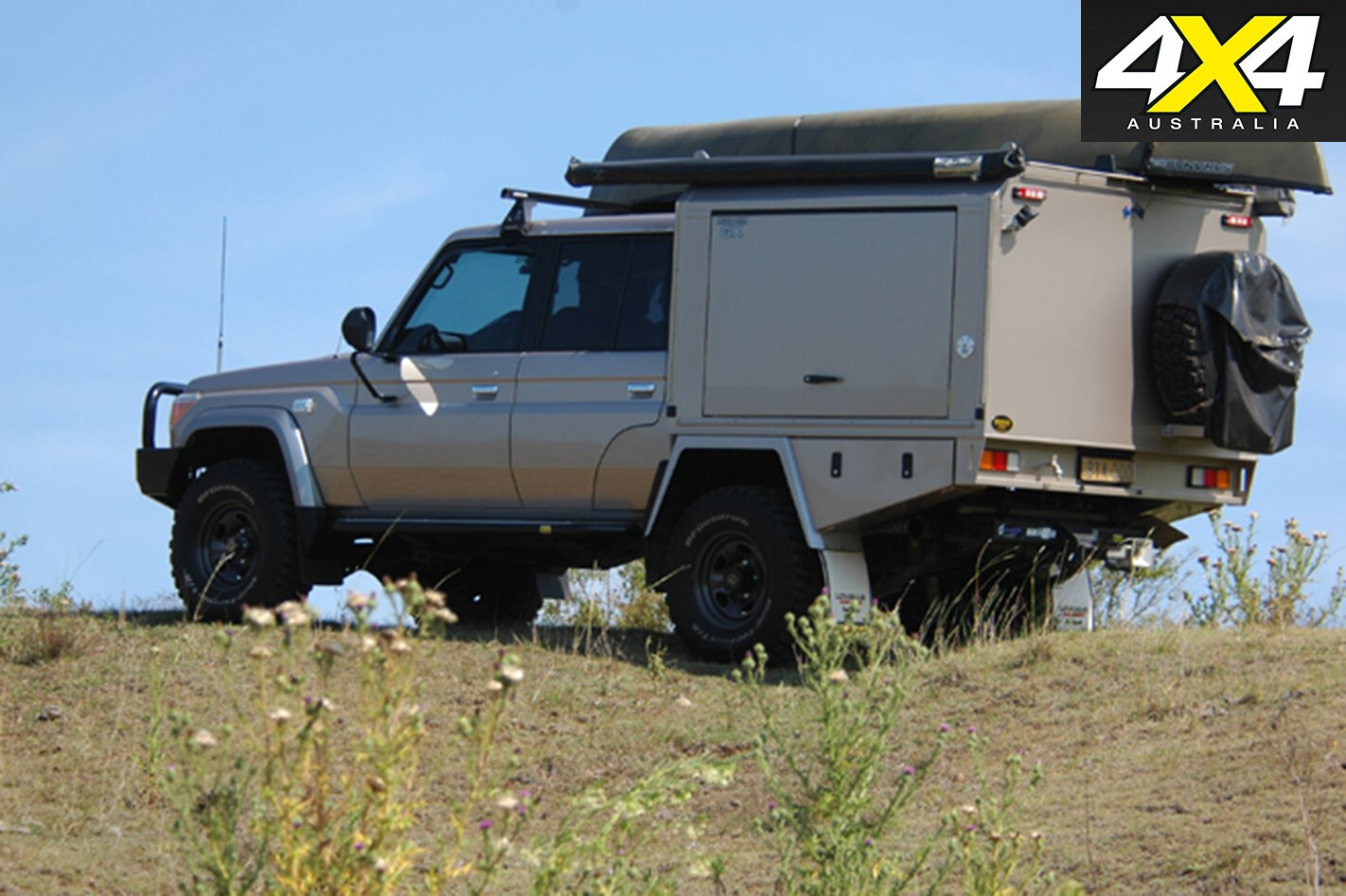
Then Toyota released the 79 Series Land Cruiser – with its 4.5-litre V8 intercooled turbodiesel – and Mark all but jumped for joy. Mark knew exactly what he wanted: The base model cab chassis dual cab 79. They also wanted a “box” built directly onto the chassis – not a drop-on canopy. And, it had to be done right.
So after an awful lot of hunting around Mark and Sharon found a Sunshine Coast based company called Metalink who’d construct a canopy to their liking. Mark liked Metalink’s engineering attitude and he placed the order in February 2013 before the truck had even been ordered.
The Cruiser was subsequently ordered in May 2013, and the couple took delivery on the 27th of July. As they waited for the canopy Mark used the time constructively; he stripped out the interior and made a start on the sound proofing. He also added a new vinyl floor, new Paratus seats, a console between the seats with cup holders, and another over the windscreen housing a UHF radio and a dash pod. Map pockets were also fitted to the rear doors. A Hema HN6 Navigation system, incorporating a reversing camera, was installed on the dash, as well as a tyre pressure monitor to help keep tabs on the BFGs.
The canopy was ready on the 24th of September – eight months after the order was placed. Mark then had to fit out the canopy and finish work on the Land Cruiser. But with a business to run, Mark had to knock off the remaining work on the weekends.
The windows were tinted and the trim around the side windows were painted black. Mark and Sharon also knew the finished vehicle would be heavier than what the compliance plate said, so a GVM upgrade had to be organised. This meant getting an engineer’s certificate to allow them another 600kg of latitude.
So, the original alloy wheels and original tyres were the first things to go. They were replaced by steel one-piece rims fitted with 285-75R16 BFG Mud Terrain tyres. This meant the suspension was next with the OEM gear going in favour of a complete Lovells kit – all in line with the GVM upgrade.
The bullbar of choice was a TJM steel in black powder coat that allowed plenty of room for the 12,000lb winch. Mark also fitted and wired a couple of HID driving lights and LED light bars. Then, just to be sure, he upgraded the standard headlights with HID inserts.
Mark’s a firm believer in clean air and didn’t care for the original two-piece snorkel, so he replaced it with a Safari one-piece unit. He’s confident it will do the job. He reasoned that the two-piece allows dust to enter, and that the Safari model looks better anyway.
On the inside a Bogaard turbo timer was fitted, as well as a digital Pyro gauge to keep track of exhaust temperatures – a massive Taipan intercooler and catch can managed to lower exhaust temperatures by 40 degrees. Fuel filtration was upgraded with a Diesel Care filter complete with a water alarm and a Redarc low coolant warning alarm.
For the canopy Mark knew precisely what he wanted and began with a Projecta 12V 25amp battery charger, a Projecta BCDC 25amp battery management system and a solar relay. The latter connected to a 120-watt solar panel on the roof. LED strips brighten the inside of the canopy.
The hardware in the canopy was very carefully planned out, with custom-made cupboards and a slide-out worktop. There’s even a separate slide-out drawer for Mark’s collection of fishing lures. There’s also a shelf in the canopy where a small tent resides should Mark and Sharon decide to forgo the comforts of their 14-foot Adventure Track offroad caravan. Also built into the canopy was an 80-litre water tank. And, the original fuel tank of 130 litres was supplemented by a 120-litre tank that came fitted with the canopy.
Overall management is handled by a Narva switch panel and a battery monitor by Vietron – there are also a couple of 12V power outlets. If all this sounds a bit much, remember that this vehicle is designed to handle long distance bush travel with minimum fuss. Plus there are two fridges; a 40-litre and an 85-litre.
An Old Town Saranac canoe sits on top of the canopy and its electric motor has its battery stored on a slide behind the 40-litre fridge – along with a generator to charge it and provide additional electric power.
Like all V8s the Toyota engine has a distinctive audio signature. Mark thought a three-inch custom-built exhaust would help that along and the result is very pleasing to the ears, and it also gets a modest gain in power.
As Mark handled all the work himself he could take his time and make sure it was done right. The Cruiser has become a great demonstration vehicle to show off what level of workmanship his clients can expect.
So what’s left to be done? You wouldn’t think much, but Mark has thoughts of putting a chip in the engine – some jobs will always be a work in progress. The Makin’s have every intention of getting good use out of the Land Cruiser; it’s a lot more than a show pony. Asked where they’d like to take it, Sharon says: “Anywhere we want I suppose.” That pretty much sums it up.
Get the latest info on all things 4X4 Australia by signing up to our newsletter.
Some of Australia’s best 4×4 tracks are found near Mount Hotham, a four hour drive from Melbourne. Many of these tracks follow routes carved by early cattlemen and prospectors who opened up what was then uncharted territory.
Mount Hotham Village is the ideal place from which to start exploring them. In the off season (most of the year for snow bunnies) Hotham provides good, cheap accommodation; so modern day explorers can spend the nights in comfort and get on the tracks when the sun’s out.
If you’d prefer an organised tour of the region, Mount Hotham Resort Management run a 4×4 event called Beyond Hotham. Over 10 days in March and April each year the team offer professionally supervised trips for all levels of off-road driving experience and all manner of 4x4s.
They teach newcomers the fundamentals of off-road driving before they hit the tracks and then help them polish those skills during one of the event’s guided trips. Stock standard 4x4s are all you’ll need, and for someone who has just purchased their first 4×4, this can be a perfect way to acquire the experience necessary for your inaugural solo Aussie adventure.
We joined Beyond Hotham in 2014 on their four night Other Side of Hotham trip; starting at Twins Jeep Track that runs off the main Great Alpine Road, a few kilometres south of Mount Hotham.
After getting our tyres down to 25psi it was off the bitumen and into low range to cope with this track’s rocky surface and moderate inclines and descents. Cloud cover permitting, breathtaking views are to be had of deep eucalypt cloaked valleys as the track follows the ridgeline west to Mount Murray North Track. Here the convoy turned north and slowly descended some 2000 metres into the Buckland River Valley, a location infamous for its 1857 miners riot when racial intolerances boiled over and Chinese miners were driven off their claims.
There’s little sign of old mining activity these days and there are several inviting campgrounds along the Buckland River, like Beverage Station where we pitched our tents for a night under tall shady trees. From here several easy tracks – Scotchman Creek Track, Buffalo Range Track, Camp Creek Track, Cobbler Lake Abbeyard Road and Cobbler Lake Road – took the convoy through the Buffalo River Valley towards Lake Cobbler, our second camp. Originally an alpine wetland, Lake Cobbler was created in the mid-1900s by loggers damming one end. From Cobbler Lake Road there are good views of Victoria’s highest waterfall, Dandongadale Falls, which plummets 255 metres off the Cobbler Plateau.
From the lake, Cobbler Lake Track and Speculation Road descend 1000 metres to the floor of the King Valley. Some older maps contain a warning reference to The Staircase, a series of difficult rock ledges, which in the past brought many 4x4s plenty of problems. So many that the authorities bulldozed The Staircase several years ago and it’s now just another easy track.
Speculation Road ends at Circuit Road – the two-wheel drive gravel road that encircles Mount Stirling. Travelling six kilometres north of this junction is Clear Hills Track and one of the High Country’s most readily recognised landmarks: Craig’s Hut. Clearly visible behind the hut is Mount Cobbler, which is often referred to as Indian Head because its profile bears a striking similarity to that of the Native American Indian profile that appeared on some US coins in the early 1900s.
Heading towards Mount Stirling the Clear Hills Track becomes a more serious four-wheel drive proposition as it climbs to meet Monument Track, a 3.5km dry-weather-only track that descends 1000 metres to Circuit Road. Bindaree Road, which runs off Circuit Track opposite Monument Track, heads down into the Howqua Valley and passes Bindaree Falls. It’s an easy five minute walk to the falls which have an unbroken drop of close to 100 metres. It’s also one of the few waterfalls you can stand behind.
On reaching the valley floor and the Howqua River, Bluff Link Road gently climbs away from the river to the scenic, if a little rough, Bluff Track. This track passes Bluff Hut, Lovick Hut, Helicopter Spur and Picture Point – the latter has breathtaking views across the Howqua Valley toward Mount Buller.
There are a number of bush campsites along Bluff Track but Lovick Hut, and its surrounding areas, offers the best amenities. After leaving Lovick Hut some sections of the track are very rocky and careful wheel placement is required.
On a high ridge, Bluff Track meets King Billy Track which descends into the Macalister River Valley before climbing to Howitt Plains in the east. Near the top of that climb the road passes a scree – a 100-metre-wide jumble of boulders made from bluestone which stretches down the hillside and extends some eight kilometres into the earth’s crust.
The convoy spent the third night at Howitt Plains under the large snow gums that adjoin the car park at the start of a seven kilometre walking track to Mount Howitt. Camping is also available further down Howitt Plains Road at Howitt Hut, but it’s a popular overnight spot for horse riding tours and other groups, so it can get quite busy.
Zeka Spur Track, one of the few access roads into the delightful Wonnangatta Valley, also starts near Howitt Hut. Challenging in the wet, this track twists and winds as it drops a remarkable 3500 metres to the Wonnangatta River. It’s not unusual to start the descent looking down over early mornings clouds that fill the valley like cotton wool.
Starting at the western end of the valley, Wonnangatta Track takes visitors through a combination of open grassland and forest as it follows the river of the same name east and past the site of the old Wonnangatta Station homestead. Little now remains of the homestead apart from its foundations, a nearby cemetery and a number of European trees. A grove of deciduous trees near the homestead, that have remarkably survived an onslaught of bushfires, make for a shady camping spot in summer – in autumn they litter the ground with golden leaves.
Herne Spur Track climbs steeply out of the Wonnangatta Valley at its easternmost point to meet Cynthia Range Track; which follows the ridgeline south to Eaglevale Track. This track descends to meet Wonnangatta Road and, a little way from this junction, Harry’s Hut. The present owners have faithfully restored the hut to how it would have appeared in the late 1800s; right down to the timber walls lined with newspapers of the day to keep out winter draughts. Original owner, Harry Smith, is known for alerting the authorities to the famous unsolved Wonnangatta Station murders of Barclay and Bamford in 1918.
After a brief lesson in history the convoy returned to Wonnangatta Road and crossed Kingswell Bridge to reach Crooked River Road. This road goes over the Crooked River several times before reaching the site of the old gold mining township of Talbotville. These days Talbotville is nothing more than a grassy bend in the river, a far cry from the 1860s when gold was discovered nearby. In 1865 Talbotville boasted a butcher’s shop, a bakery, blacksmiths, three general stores, a doctor, a chemist, a newsagency, a library, a brewery, a post office, a racecourse, and three licensed hotels. But by 1880 the gold rush was over and the town largely deserted.
From Talbotville the Crooked River Track crosses the river some 23 times and continues on to Stonewall; the site of another old gold mining town. Along the track are many signs of past mining activity – fenced off mineshafts, the ruins of an old bakery and a steam engine and crusher. From Stonewall, Bulltown Spur Track climbs steeply back to McMillan Road; a gravel 2WD road to Dargo.
Along McMillan Road is the site of Grant, which had a population of over 3000 at its peak in the 1860s. Though, very little remains these days. The Union Mine, which was discovered in the 1860s and in use until the turn of the century, is worth a visit. The mineshaft is driven horizontally into the hillside and it’s possible to walk about 100 metres into the mine before the way becomes blocked by rocks. Also pay a visit to the cemetery on the main road.
Continuing from Grant, McMillan Road meets the main Dargo High Plains Road. Heading north, this road passes an old cattlemen’s hut called Treasure’s Hut. Cattle are often seen wandering near the road as the Treasure family still operate leases in the area.
Further along is Kings Spur Track which runs three kilometres out to The Escarpment; a good spot to camp or just take a break and enjoy the spectacular views across the valley to Mount Hotham Village.
With the end of the trip’s journey in sight across the valley, the last highlight on the agenda is Blue Rag. Accessed by a track six kilometres further along the main road, Blue Rag has views that are hard to beat. Though beware as it’s rated Double Black Diamond in difficulty (read really hard) and all but the last 200 metres of this track are a dawdle. Once at the trig point visitors are treated to 360-degree views across the ranges.
Once back on the main Dargo to Hotham road it’s only a short run to bitumen, Mount Hotham and the end of a few great days in the bush. Whether you are a seasoned 4WDer, or someone who’s 4×4 has never seen anything but bitumen, a few days with the Beyond Hotham team will have you wondering why you haven’t done this before.
Travel Planner
- WHERE: Mount Hotham Village is four hours north of Melbourne via the Hume Highway to Wangaratta. Then take the Great Alpine Road via Bright.
- WHEN TO TRAVEL: Many High Country tracks are seasonally closed from June to November and the best time to travel are during the warmer months. Beyond Hotham is held mid-to-late March each year.
- STAYING THERE: Very affordable accommodation packages are arranged by Beyond Hotham at a number of ski lodges on a BYO food and linen basis. Hotel style accommodation is also available for those seeking a little more luxury. Campsites are available, but remember this is an alpine environment with the potential for sub-zero temperatures and snow at any time of the year.
- SUPPLIES: Fuel cannot be purchased at Mount Hotham and visitors should fill up at Bright or Harrietville (in colder weather it is recommended diesel vehicles use alpine fuel). Mount Hotham has a bar come general store which provides a range of common necessities and pub-style meals. Visitors staying in chalet-style accommodation need to prepare their own meals. Bright’s township has a supermarket and a full range of services.
- ROAD CONDITIONS: The condition and difficulty of High Country 4×4 varies widely. The tracks covered in this article were of an easy to medium grade that any standard 4×4 can handle. However, even modest rainfall can rapidly make conditions very difficult.
- MAPS: A good quality Hema paper map and GPS is recommended when travelling in the High Country.
Thirty-seven years and counting; the Mercedes-Benz G-Class defies convention, and sales of this ancient, iconic 4×4 are actually on the increase. Christof Stanger, Head of Marketing and Strategy G-Class, says Merc shifted 14,500 Gs last year, and the boom doesn’t seem to be slowing.
Officially the outlandishly proportioned Mercedes-Benz G 500 4×4² you see pictured here is a concept car, but nobody’s ruling out production. After all, if Mercedes-Benz managed to shift more than 100 examples of its outrageous G 63 6×6 around the world for about US$550,000 a pop, then there is sure to be a market for the Mercedes-Benz G 500 4×4² – and a profitable one at that.
The concept owes a lot to that 6×6 model which in turn owes a lot to the 6×6 developed for the Australian Defence Force. Stanger nonchalantly says that they had the bits lying around and thought ‘why not?’, so a set of the 6×6’s portal axles were hauled off the shelf and popped on a 4×4. They are suspended by a dual coil-over shock set up. One damper per wheel is a conventional passive design, the other offering Sport or Comfort settings. It’s reactive too, so if you’re in Comfort mode and chuck this three-ton machine into a bend with any sort of enthusiasm it’ll tauten up its dampers accordingly. All of which makes that Sport setting a bit redundant, especially as all it does on the straight bits between the corners is add some pattering intrusiveness to the ride.
Unlikely as it sounds, the Mercedes-Benz G 500 4×4² adds some serious on-road ability to the G-Class. Where the standard car has always had an element of ‘turn and hope’, the G 500 4×4² brings some agility. Relatively speaking of course. The people from Merc’s G division claim it’s got sports car-chasing ability, which is as bold a statement as the G 500 4×4²’s looks. It’s not that good of course, but its chassis is a step-up from its lesser brethren. Nonetheless, it’s still a big, side-of-a-barn size and weight-of-its-contents machine that’s riding high and built on an ancient ladder frame chassis. Its agility then is indeed surprising, in context, which is up high in direct line of sight of truck and bus drivers.
There’s still a buttock-clenching pause between turning the wheel and the G 500 4×4² actually turning in. You quickly learn to adapt to that, and the response after that tense wait is more faithful than in the regular G. To say there’s genuine feel through the wheel would be an exaggeration, but there’s something there, at least enough to allow you to up the pace a bit with some degree of confidence. That’s on the 325/55 R22 road wheels and tyres, as the responses are significantly muted if you’ve swapped out the 22-inch wheels for the 18-inch, Hutchinson two-piece wheels and beadlocked 37-inch Pro Comp tyres. Best save them for the rough stuff, where they’ll take the G 500 4×4² to places other off-roaders wouldn’t dare venture.
The normal G-Class, with its three locking differentials and low-ratio transfer case is not an off-roader where many will have gotten out of thinking that they need more ability in the wilderness, but that’s exactly what the G 500 4×4² brings. The numbers associated with it are ridiculous, those portal axles adding significantly to its ability, while also benefitting the drivetrain by lessening loads through it – in particular the driveshafts – thanks to reduction in the hub drives.
Compared to the regular G 500 the ground clearance increases from 210mm to 450mm, increasing the potential fording depth from 600mm to a full metre. There are skid plates underneath, but short of trying to drive over houses you’ll be doing well to touch them of anything. Those wheels and tyres do sensational things for the angle of approach and departure too, the front and rear on the G 500 4×4² being 52- and 54 degrees respectively, compared to 36 and 27 in the standard car. The G 500 4×4²’s breakover is 47 degrees compared to 21 degrees and the tipping angle improves by 2 degrees for a 30-degree limit.
The wheelbase remains the same at 2,850mm, though the track swells from 1,475mm to 1,774mm, which explains why the massive wheels and tyres are covered by removable carbon fibre wheel arch extensions. Those, and the ones on the mirrors, serve to remind you of the G 500 4×4²’s unique proportions, as otherwise the cabin’s the same narrow but tall architecture from another era as any other G-Class. Charmingly old school, then, with a smattering of modernity uncomfortably stuck on.
Under the near head-high bonnet is an entirely new engine for the G. It’s basically a redeveloped version of the 4.0-litre biturbo (those turbochargers nestling in what Mercedes-Benz call the ‘hot V’) that sees service in the AMG GT sports car. With a vastly different brief here it’s been enhanced to suit its half metre higher situation. It develops 315kW between 5,250- and 5,500rpm, while peak torque of 610Nm arrives at 2,250rpm and monster on until 4,750rpm – it feels eager in every one of the auto’s seven gears. It’s a shame then that the gearbox is a traditional Mercedes unit, in that it’s never too willing to shift when you ask it to via the wheel-mounted paddles – particularly on down changes. There’s a wet sump on the V8 now too, as in the Mercedes-AMG C 63, while the pumping circuits for both oil and cooling have been modified to better manage the potential inclines that it may be required to work in.
That V8 may not wear an AMG badge, but the howl’s pure Affalterbach in its make-up, that helped by the side-exiting exhausts – something that Merc’s people say (with an obvious smirk) has been done to improve G 500 4×4²’s off-road prowess. Nothing to do with sounding awesome, oh no…
There are no performance figures as yet, other than a 290km/h top speed, which is electronically limited as Merc couldn’t find suitable tyres with a higher speed rating. Use the off-road tyres and that vmax drops to 160km/h. Educated guessing suggests a 0-100km/h time of around 6.5- to 7 seconds. That’s all the more incredible as it’s genuinely achievable anywhere. That’s the beauty of the G 500 4×4²; a regular G-Class will get you almost everywhere it will, but the G 500 4×4² allows you do so at the pace you choose, it making every path the one of least resistance. Terrain that would require a crawl normally is shrugged off, the G 500 4×4²’s only limitation the bravery of the driver behind the wheel, and, of course, any height restrictions…
A p-p-p-p-piece from here, a p-p-p-piece from there
Christof Stanger, Head of Marketing and Strategy G-Class, describes building cars like the G 500 4×4² Concept and G 63 6×6 as: “more cost effective than making television commercials.” Extreme creations of a vehicle that’s spanned 37 years, the G-Class’s ancient construction is what allows those who look after it to indulge in such outlandish models. The 6×6 and G 500 4×4²’s portal axles are something you’ll find on Merc’s other off-road legend, the Unimog, and they’ve been used for a while now with the G on military models like the LAPV (Light Armoured Patrol Vehicle as driven in 4×4 Australia April 2014 issue).
The G has always been popular with the military, and is now the chosen light vehicle for the ADF replacing the long-serving Land Rovers. Given its ladder chassis construction the G-Class can be anything from a single or double-cabbed pick-up to an AMG-badged performance car, the engine bay able to take anything from a four-cylinder diesel to a biturbo V12 engine. The cabriolet version was dropped in 2014.
Legislative forces periodically suggest it will be dropped, but Stanger says: “it’s our task to find ways to continue to make it.” Certainly there’s a production contract at the Magna Steyr facility in Graz, Austria that runs to 2022. Safety, given the Mercedes-Benz badge on the front, is an ongoing issue, but Stanger says they’ve got some solutions even for more rigorous pedestrian impact tests due in 2019 – an earlier response being that all G’s now feature the plastic bumpers of the AMG versions, steel being used up to 2012. It remains a shape-shifting icon, that’s able to offer incredible utility mixed with luxury, not to mention sensational performance. As Stanger says: “legends come and stay,” and it doesn’t look like the G-Class is going anywhere for a while yet.
Get the latest info on all things 4X4 Australia by signing up to our newsletter.