WE RECENTLY asked our Facebook followers to send in pics and details of their off-road tourers, and the results had us salivating.
To get your ride on these pages, head to our Facebook page and keep an eye out for the next opportunity to send through some photos! You might even get a pic of your pride and joy published in the mag, and if we really like it, perhaps you’ll even see it on the cover of 4X4 Australia one day!
Here are a few of the submissions we’ve received so far:
1995 RUGBY EDITION 80 SERIES LAND CRUISER – GUY BROWN
WHAT IT’S GOT: I bought it in August 2015 pretty much standard, with a two-inch EFS lift and 52-inch LED bar. I’ve since had ARB Capalaba fit an ARB deluxe bar, brush bars, side-steps, awning, compressor, rear locker, RedArc dual battery and a Smittybilt X20 10,000lb winch. In the back an EvaKool 47-litre fridge keeps the beer cold. JCM Mechanical & 4X4 recently gave the 4.5 a good sorting out, so I’ve got plenty of power to go anywhere on 16x8in Dynamic steelies wrapped in Goodyear 285/75 DuraTracs, thanks to Tim Penfold.
I spend a lot of time on North Stradbroke living the beach life. The rest of my spare time I’m out wheelin’ with the guys and girls in the Gold Coast Camping & 4WD Group. Best time in the 80 so far is out at The Springs 4×4 Park near Warwick.
2010 PRADO VX – BILL ABU AMER
WHAT IT’S GOT: A bunch of Ironman 4×4 stuff: bullbar; underbody protection; LED bar and spotlights; snorkel; two-inch lift.
The best place I have taken it to is Redhead Beach in NSW.
2011 JKU RUBICON – CHRIS GARLAND
WHAT IT’S GOT: 35-inch Nittos; Synergy/TeraFlex three-inch lift; Warn Zeon 10-S winch.
I bought it new to drive it all over the country; I’ve taken it to the Cape, the High Country and most places in between. It’s currently residing in the Pilbara and it takes my wife and daughter to some cracking waterholes.
2013 FJ CRUISER – AD HEAPY
WHAT IT’S GOT: A 40mm EFS lift; Mickey Thompson SideBiter II wheels; 285/70/17 Cooper S/T Maxx tyres; ARB bar; Warn 9.5XP winch; Illuminator LED lights; 50-inch curved light bar; dual battery with BCDC; ARB under-bonnet compressor; BushSkinz UVP; Roadsafe recovery points; factory roof rack with awning; rock sliders; USA grab handles; CouplerTec rustproof system; BRC Comp diff breather kit.
I’ve only owned it eight weeks and it was stock when I bought it. It’s a huge upgrade from the GU Patrol I owned previously, with better off-road capability and comfort.
1989 HJ75 LAND CRUISER – JADE McSORLEY
WHAT IT’S GOT: 2H diesel with aftermarket DTS turbo; three-inch straight-through exhaust; two-inch cab lift with two-inch Tough Dog big-bore suspension kit running on 33-inch Federal M/Ts. It’s also got: a light bar; camp lights; 70-litre water tank; winch; twin awnings; roof-rack shovel and high-lift jack holders; canopy decked out with 12V sockets and lights; Waeco 65DZ fridge/freezer; roof console with a control panel; twin UHFs; rear Eaton ELocker.
I’ve owned the truck about two years. The best place I’ve been is Fraser Island, and I’m making the journey up to Cape York next year.
1991 DAIHATSU FEROZA – JOSH KRAUSE
WHAT IT’S GOT: It might be reasonably standard, but she keeps up with the big 4x4s and goes everywhere I need it to. The only real mods include extractors, a two-inch body lift and I’ve removed the rear seats for extra space. Come tax time I’m going to be putting a Tough Dog two-inch suspension lift under it. The lighting set-up is all Big Red LEDs, comprising two 180mm rounds, a 20-inch single row on the bullbar and a 24-inch dual row on the roof rail, plus two 12-inch bars for work/camp lights.
The tyres are Hercules Trail Diggers (235/75R15) and they’re by far the best Muddie I’ve run – they’ve never had a puncture. I’ve only had it about seven months and I can’t fault it, especially in tight or soft spots on the tracks.
Favourite place so far would have to be either Kroombit Tops National Park or Blackdown Tableland National Park (both in Queensland), but we’re planning a Cape York trip next with about five other vehicles from our local club, so that will definitely be the top track.
FORD’S Ranger-based Everest is our current 4×4 of the Year. It took out that title as a mid-range ($61K) ‘Trend’ off the back of impressive on- and off-road performance and a comprehensive equipment list that lacks little bar sat-nav, which is available as an option on the Trend.
Pay another $16K over the Trend and you get the $77K Titanium, which, despite having a huge equipment list, puts it near the price of a top-spec $84K Prado Kakadu and $85K Discovery SDV6.
The question is, can a ute-based 4×4 wagon developed in Australia match it with the best Prado and the more powerful of the two diesel Discovery models?
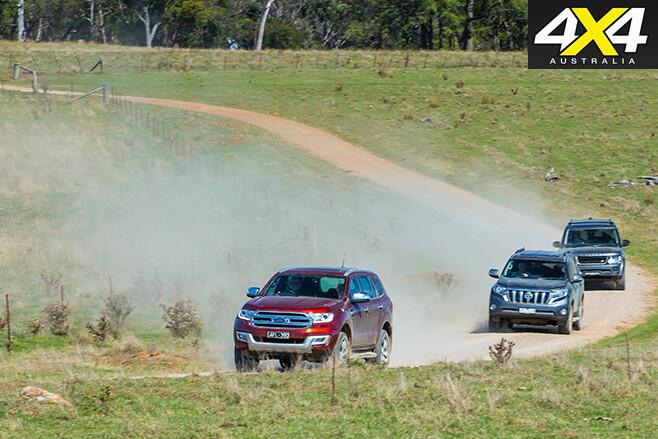
FORD EVEREST TITANIUM
It may have started life as a ute, but the Ford Everest Titanium is now as flash as they come.
JUST in case you didn’t know, the Everest is essentially a wagon version of Ford’s highly successful Ranger ute. Aside from the obvious body change, there are coil springs in place of leaf springs for the rear axle, disc brakes instead drums at the rear, and an ‘active’ full-time 4×4 system rather than the Ranger’s more utilitarian part-time system.
The wheelbase has also been reduced from the Ranger’s extraordinarily long 3220mm (which is even longer than a Toyota LC79 cab-chassis) to 2850mm, which is the same as a Toyota LC200 (still very long).
POWERTRAIN AND PERFORMANCE THE EVEREST shares the 2015 face-lifted Ranger’s 3.2-litre inline five-cylinder diesel engine. Changes from the original Ranger engine include a smaller, more efficient turbo for faster spool-up, a more sophisticated higher-pressure common-rail fuel system, and other changes to the cylinder head designed to improve engine NVH.
What the Everest has that the Ranger lacks is SCR pollutant-reducing technology, which allows the Everest to meet upcoming Euro 6 emission regulations. The Everest’s maximum power of 143kW is 4kW less than the Ranger, although torque max remains at a solid 470Nm, which comes on-stream at a low 1750rpm.
Thanks to its strong low-rpm power and five-cylinder design, the Everest’s engine has a nicely relaxed low-revving gait on the highway, despite having the shortest gearing of the three wagons here. It’s not as refined as the Kakadu’s new 2.8 or the Discovery’s V6, but it’s still a generally polished engine. The Everest’s 3.2 is the largest-capacity engine here, but it can’t match the heavier bi-turbo Discovery for pedal-to-metal performance; although, it does have the wood on the slightly lighter but taller-geared Kakadu.
The Everest comes with a six-speed automatic transmission, which is the only gearbox option for the Ford wagon. It offers smooth and decisive shifting and has a closer spread of gears than the new six-speed in the Kakadu.
ON-ROAD RIDE AND HANDLING FORD’S engineers have done a good job on the Titanium’s on-road dynamics. Despite its weight, height and off-road-capable suspension, it feels quite sporty through corners.
What part the Watt’s linkage rear-axle location (instead of a simpler Panhard rod) plays is difficult to say, but the whole thing works nicely – even if the live axle at the rear can make its presence felt through bumpy corners. On the flip-side, the Titanium’s ride is a little sharper than the plush-riding Kakadu or even the Discovery. That the Titanium is on 20-inch tyres wouldn’t help here.
Like the facelifted Ranger, the Everest has electric power steering, which is exceptionally light at parking speed but firms up nicely at higher road speeds, without ever quite offering the feel and feedback of a good hydraulically assisted system.
OFF-ROAD THE Everest doesn’t have the front or rear wheel travel of the KDSS-equipped Kakadu, and it can’t match the front travel of the Discovery. However, it has the benefit of a driver-switched rear locker, the performance of which is further enhanced by the fact that engaging it doesn’t cancel the traction control across the front axle.
Like the Discovery, the Titanium also has an ‘active’ electronic self-locking centre diff, whereas the Kakadu has a mechanical limited-slip centre diff that has to be locked by the driver.
The end result of all this is that the Titanium generally competes well off-road against the other two very well-credentialed vehicles. If anything lets it down in this company it’s the relatively poor vision from the driver’s seat. The sidesteps are also a bit low, but bounce back into shape if bent up, something you can’t say for those on the Kakadu.
Not so practical are the Titanium 20-inch wheels and 50-series low-profile tyres. We had two punctures on gravel roads, where small stones penetrated the crown of the tyre’s carcass. However, this can be attributed to the tread design rather than to the aspect ratio. The good news is that the 17s and 18s from the lower-spec models can be fitted to the Titanium. Given these smaller wheels carry Prado-sized tyres, there’s a huge range of options here.
CABIN AND ACCOMMODATION THE Titanium’s cabin is well-finished and exceptionally well-appointed, but the lack of steering wheel reach adjustment is poor at this asking price. Still, it’s easy for the driver to get comfortable, even if it takes some time to get used to the Titanium’s fiddly buttons and controls.
Life in the backseat matches the Prado, but it’s not as good as the Discovery – the Titanium has the most cramped third row. On the plus side, the space behind the third row is better than the Kakadu when the third row is deployed.
PRACTICALITIES THE Everest is rated to tow 3000kg, so that’s 500kg more than the Kakadu and 500kg less than the Discovery. The Titanium, despite being the heaviest Everest, has a decent payload – even better on paper than the Discovery SDV6.
Not so good is the 80-litre fuel capacity, especially as the Everest engine isn’t as thrifty as it could be. The aforementioned 20-inch wheels also do nothing to enhance the Titanium’s practicality.
SPECS Engine: DOHC 20-valve 5-cyl turbo-diesel Capacity: 3.2-litre (3198cc) Power: 143kW @ 3000rpm Torque: 470Nm @ 1750- 2500rpm Gearbox: 6-speed auto 4X4 System: full-time, dual-range Crawl Ratio: 38.61 Construction: separate chassis Front suspension: independent/coil springs Rear suspension: live axle/coil springs Wheel/tyre spec: 265/50R20 107T Kerb Mass: 2495kg GVM: 3100kg Payload: 605kg Towing capacity: 3000kg Seating capacity: seven Fuel tank capacity: 80 litres ADR fuel claim: 8.5L/100km Test consumption: 13.1L/100km Touring range*: 560km Price: $76,990 *Based on test consumption and 50km ‘safety margin’.
LAND ROVER DISCOVERY SDV6
The Discovery SDV6 is unique here thanks to V6 bi-turbo-diesel, eight-speed automatic and fully independent suspension.
WHAT you see here is a Discovery SDV6. More specifically, a Discovery SDV6 SE, the lower of the SDV6 specifications, which starts at $84,880. That’s an $8K jump on the Everest Titanium, but on par with the Prado Kakadu.
The current Discovery is heavily based on the Discovery 3, so is in effect the end-product of 13 years of continual evolution and is now close to the end of its product life.
An all-new, considerably lighter Discovery built on an aluminium monocoque, as per the current Range Rover and RR Sport, should be here mid-to-late 2017 to replace the current (and heavy) steel separate-chassis model.
POWERTRAIN AND PERFORMANCE THE SDV6 designation means this Discovery has the more powerful of the two bi-turbo V6 diesel engines, which claims 183kW and 600Nm. The less expensive TDV6 develops 155kW and 520Nm, but is mechanically identical to the SDV6 – the difference being in the tuning software.
Despite the SDV6 being the heaviest vehicle here – 150kg more than the already heavy Titanium – its power and torque figures easily outmuscle the Titanium’s 143kW/470Nm and the Kakadu’s modest 130kW/450Nm.
The SDV6 does this off the back of having two turbos rather than the single-turbo arrangements of the Titanium and the Kakadu. The SDV6’s two turbos are of a different size and type, with a larger variable-vane unit and a smaller fixed-vane unit working together to optimise performance. The larger turbo cleverly takes care of most of the driving duties, while the smaller turbo only joins to assist the main turbo on wider throttle openings when top-end power is required.
The SDV6 backs up the strongest performance here with the best refinement, something enhanced by its smooth and very smart eight-speed ZF gearbox. It’s clearly the best gearbox of the three by a noticeable margin.
The only downside is that the SDV6 is also the thirstiest of the three, something that’s inevitable given it is the biggest, heaviest and most powerful vehicle here. Mind you, it’s not far behind the Titanium; although, like the Ford, it has a too-small fuel tank for remote-area driving.
ON-ROAD RIDE AND HANDLING THE Discovery may be the heaviest vehicle in this company, but it’s also the only one with fully independent suspension. On tight winding roads the Discovery’s hefty weight makes its presence felt most noticeably, while the fully independent suspension does its best work through bumpy corners.
On a smooth road the Discovery can’t match the sportier feel of the Titanium, but otherwise it’s the best all-round-handling vehicle of this three. Part of its advantage is due to its lower on-road ride, something it can get away with as its air-spring suspension can be significantly jacked up for off-road use – unlike the Titanium (fixed-height suspension) and the Kakadu (which only has a small height adjustment at the rear).
The SDV6’s relatively low-profile 255/55R19 tyres no doubt help to sharpen its precise steering, but they also add a somewhat harsh edge to the ride quality at lower speeds on rough roads. This is the only blot on the Discovery’s ride, which is generally better than the Titanium’s but not quite up to the plushness of the Kakadu’s.
OFF-ROAD THE height-adjustable suspension is one of the SDV6’s major off-road advantages here. Jacked up for off-road use, it sits a good deal higher than the other two. The negative side of this is that ride quality isn’t as compliant as it is on the lower settings, given the increased tendency for the suspension to top out.
The Discovery has the smartest and most effective 4×4 system, at least when it’s fitted with the $1060 optional rear locker, which isn’t standard on any Discovery – top-spec HSE models included. The locker works wonders for the SDV6 off-road, especially on rutted and broken ground where wheel travel becomes an issue.
Best of all, the locker doesn’t require driver switching and is fully integrated with the other chassis control systems, and once engaged it keeps the electronic traction active on the front axle. The Discovery’s other off-road trump card is the vision from the driver’s seat, which is way better than the Titanium and noticeably better than the Kakadu.
CABIN AND ACCOMMODATION THE Discovery’s cabin is the biggest and most versatile here thanks to the fact that it has the only third row seats suitable for larger adults, and that all the seats fold individually and dead-flat for multiple cargo/seating configurations.
The SDV6 has a supportive driver’s seat, adjustable armrests, and the previously mentioned good vision. While it feels luxurious, thanks in part to its leather seats, the standard equipment is poor compared to the Titanium and the Kakadu. Not even sat-nav is standard in the SE, although it is available as an option.
PRACTICALITIES AS EVER, the weakness of the Discovery is in the wheel and tyre spec. The standard high-speed-rated 255/55R19s are too vulnerable to off-road damage, while aftermarket tyre choice is still limited.
The 82.3-litre fuel capacity is also too small, but relatively easily attended to via aftermarket enhancement, which is good across the board for the Discovery. At 3500kg the Discovery’s maximum tow rating is the best here, while its 600kg payload is similar to the Titanium’s and well ahead of the Kakadu’s.
SPECS Engine: DOHC 24-valve V6 bi-turbo-diesel Capacity: 3.0-litre (2993cc) Power: 183kW @ 4000rpm Torque: 600Nm @ 2000rpm Gearbox: 8-speed auto 4X4 System: full-time dual-range Crawl Ratio: 51.11 Construction: separate chassis Front suspension: independent/air springs Rear suspension: independent/air springs Wheel/tyre spec: 255/55R19 111V Kerb Mass: 2640kg GVM: 3240kg Payload: 600kg Towing capacity: 3500kg Seating capacity: seven Fuel tank capacity: 82.3 litres ADR fuel claim: 8.5L/100km Test consumption: 13.9L/100km Touring range*: 542km Price: $84,880 *Based on test consumption and 50km ‘safety margin’.
TOYOTA PRADO KAKADU
The top-spec Prado Kakadu isn’t just loaded with luxury and convenience kit, it’s also very different mechanically to lesser Prados.
THE Prado Kakadu will set you back $84,490, plus on-road costs. For that price it comes fully loaded with a vast array of luxury, convenience, safety and special mechanical features, with only premium paint an extra cost. Compare that to the Discovery SDV6 SE, which starts at the same price but needs a boot-full of options to come up to what the Kakadu has standard.
The significant mechanical features that set the Kakadu apart from the rest of the Prado range include a rear diff lock, terrain-specific settings for the 4×4 system, height-adjustable rear suspension, variable suspension damping and what Toyota calls ‘Crawl Control’, which is like hill-descent control but works both on flat ground and up hills.
Importantly, the Kakadu has Toyota’s Kinetic Dynamic Suspension System (KDSS) as standard, although this is also found on the VX, which is one spec level down from the Kakadu. KDSS is a relatively simple (essentially hydro-mechanical) means of varying the sway-bar tension to give both flatter on-road handling and more wheel travel off-road – a best-of-both-worlds outcome.
POWERTRAIN AND PERFORMANCE THE Kakadu is powered by Toyota’s 2.8-litre ‘global’ diesel that is the mainstay of the new-gen HiLux. This new smaller-capacity diesel and its attendant six-speed auto – the only gearbox available with the Kakadu – replaced the outgoing 3.0-litre diesel and five-speed auto in the Prado late last year.
This new diesel brings more torque than the 3.0-litre (450Nm v 410Nm) but an insignificant increase in power (up just 3kW), so the performance improvement isn’t great. Nor does the six-speed gearbox help the overall performance, as it just adds a second and taller overdrive ratio rather than tightening up the ratio gaps in the lower gears.
However, the 2.8-litre engine brings much-improved refinement, which is better than both the 3.0-litre it replaces and the Titanium’s 3.2, which can be a bit gruff at times in comparison. Still, the 2.8 is no match for the Discovery’s V6 for refinement, and it’s behind both engines in performance – especially the SDV6.
The Kakadu’s new six-speed automatic transmission can’t match the finesse of the Discovery’s eight-speed ZF and doesn’t work as well as the Titanium’s six-speed, even if it matches it in general refinement.
The trouble with the Kakadu is that the sixth gear can be too tall at times on undulating country roads, which has the gearbox changing up and down a bit between fifth and sixth. This doesn’t happen with the Titanium.
ON-ROAD RIDE AND HANDLING EVEN with KDSS, the Kakadu tails the field in regards to on-road handing, especially with its tendency to understeer when pushed hard through tight corners. It’s not behind by much, mind you, but still the tail-ender. The Kakadu-specific variable damping doesn’t make a worthwhile difference, as ‘Sport’ mode only seems to firm up the ride without reducing understeer.
At least ride quality is very good and generally the best; although, on bumpier roads the Kakadu’s rear live axle can’t match the smoothness or control of the SDV6’s independent rear suspension.
OFF-ROAD THE Kakadu’s supple, long-travel suspension is also the key to its considerable off-road prowess. To give you an idea of the benefit of KDSS, a non-KDSS Prado has 465mm of rear-wheel travel; a KDSS-equipped Prado VX has 565mm, a handy improvement in anyone’s language.
In terms of the off-road-specific Kakadu kit, the rear height adjustment is handy even if it doesn’t jack up the vehicle all that much. The low-range-only ‘Multi Terrain Select’ can also be handy, as there is a difference in the programs. However, in a silly arrangement, when you select low-range (and separately lock the centre diff) you then have to select an MTS program, as there is no default program that automatically activates on low-range selection.
The rear locker also has a downside, as when it’s engaged it cancels the ETC on both axles – not just the rear. The jury is also still out on the benefit of ‘Crawl Control’. All of this means the Kakadu’s ability off-road is more about its KDSS-equipped chassis, than all the Kakadu-specific add-ons.
CABIN AND ACCOMMODATION AS with any Prado, the cabin is comfortable, spacious and practical – it may not rate quite as highly in the latter two areas as the SDV6 perhaps, but it either matches or betters the Titanium in most departments. Its electric tilt-and-reach steering wheel adjustment is luxurious compared to the Everest, as is the smart-key entry and push-button start. At the other end of the vehicle, the Kakadu’s third row works better than the less roomy equivalent in the Everest.
PRACTICALITIES A big win for the Prado is its 150-litre fuel capacity, nearly double that of the Everest and Discovery and a major bonus for remote-area touring.
Practical wheel and tyre spec has always been a Toyota given. Even if you aren’t happy with Kakadu’s 18s, it’s a straightforward swap to 17s (either OEM or aftermarket).
SPECS Engine: DOHC 16-valve 4-cyl turbo diesel Capacity: 2.8-litre (2755cc) Power: 130kW @ 3400rpm Torque: 450Nm @ 1600- 2400rpm Gearbox: 6-speed auto 4X4 System: full-time dual- range Crawl Ratio: 36.1:1 Construction: separate chassis Front suspension: independent/coil springs Rear suspension: live axle/ coils+height adjust. Wheel/tyre spec: 265/60R18 110H Kerb Mass: 2435kg GVM: 2900kg Payload: 465kg Towing Capacity: 2500kg Seating capacity: seven Fuel tank capacity: 150 litres ADR fuel claim: 8.0 litres/100km Test consumption: 12.3 litres/100km Touring range*: 1170km Price: $84,490 *Based on test consumption and 50km ‘safety margin’.
WHAT YOU GET
TOYOTA PRADO KAKADU
KAKADU is loaded with kit: ‘smart key’ entry; push-button start; leather; electric seat and tilt-and-reach steering adjust; heated front/second-row seats; three-zone climate control; power-fold third row; seven airbags; sat-nav; rear-view camera; Bluetooth; AUX/iPod/USB inputs; multiple power outlets including 220V; sunroof; rear parking sensors, auto headlights and wipers; 17-speaker audio system; rear-seat DVD entertainment; adaptive cruise; blindspot monitoring; rear cross-traffic alert; autonomous braking; variable suspension damping; height-adjustable rear suspension; Multi-Terrain Select; Crawl Control; and a rear diff lock.
LAND ROVER DISCOVERY SDV6
THE SDV6 SE is mid-spec in the Discovery range and comes with eight airbags; leather; electric seat adjust; manual tilt-and-reach steering wheel adjustment; push-button start; dual-zone climate control; cruise control; rear parking sensors; rear-view camera; Bluetooth, USB and iPod connectivity; digital radio; 11-speaker audio; Xenon headlights and LED daytime running lamps. The SDV6 SE has 19s as standard.
Beyond that there is a huge range of options, including the automatic rear locker ($1060); sunroof ($3860); auto-dimming Xenon headlights ($1800); rear air-con ($1590); adaptive cruise control ($2300); rear cross-traffic and blindspot monitoring ($700); smart key entry ($2100); sat-nav ($3240); and rear-seat DVD entertainment ($4100). Most of these options are needed to bring the SDV6 to equipment parity with the Titanium and Kakadu.
FORD EVEREST TITANIUM
The Everest Titanium has leather; electric seat adjust; power-fold third row; seven airbags; front and rear parking sensors; dual-zone climate; rain-sensing wipers; cruise control; eight-inch touchscreen; sat-nav; rear-view camera; park assist; Bluetooth, AUX, iPod, and USB connectivity; multiple power outlets including 230V; power tailgate; and a sunroof.
High-end safety equipment includes blind-spot monitoring; rear cross-traffic alert; tyre-pressure monitoring; adaptive cruise; autonomous braking; and lane-departure warning. The Titanium rides on 20s and also has auto-dipping HID headlights, LED running lamps, a rear diff lock and sidesteps.
THE VERDICT
THERE are many ways to run the ruler over these three vehicles: performance; on-road handling; refinement; off-road ability; cabin space; equipment value; general practicality; and safety.
No vehicle here wins on all counts, but the SDV6 is outright first in performance, refinement, cabin space and off-road ability – provided the optional rear locker is fitted. It’s as good as it gets in terms of on-road handling.
But, being an old platform, the Discovery only achieves four out of five stars in the official ANCAP safety test, whereas the other two are five-star-rated. That doesn’t necessarily mean the Discovery is less safe once you have an accident, it just has less safety add-ons.
Despite being the best core vehicle here, the Land Rover Discovery is weak on value for money if you’re after equipment. In fact, to option the SDV6 up to Kakadu- or Titanium-spec you’re looking at more than $100K in total. If it’s the Discovery you’re after, then it’s best to start with the $70K TDV6 and option from there given that SDV6 performance isn’t hard to achieve.
In this company the Kakadu wins hands-down in all-round practicality and is equal first in safety, but if it’s a leather-equipped luxury Prado you’re after you’d probably be better off with a VX. It doesn’t have all the bells and whistles of the Kakadu, but it’s not weighed down with stuff you don’t want. And it’s $10K cheaper than a Kakadu!
The Titanium’s trump card is its equipment, where it’s a standout at the price. Importantly, all of the Titanium’s extra kit over the Trend (bar the 20s) are meaningful additions.
This is something you can’t say about the extra kit of the Kakadu versus the VX. And it’s easy enough to ditch the Titanium 20s for the 17s or 18s on lower-spec models.
Back when the Western Australian four-wheel drive industry was in its infancy, Outback Accessories was established under the watchful eye of Adrian Stafford, a highly respected and well-known name in the industry.
It was originally located in Welshpool and operated as the exclusive manufacturing arm for the then young and growing 4WD accessories company, Opposite Lock.
Many happy customers later in 2003, Adrian and his partners decided to focus on a new strategic direction. This opened up an opportunity for new owners to grow the already respected Outback Accessories name into the prominent WA-owned-and-operated business it is today.
Jessica da Silva and her husband Ross were already well-versed in what was needed to run a successful engineering business, having owned their own engineering firm back in South Africa. There are plenty of similarities between the Australian and South African environments and the conditions to which we subject our 4x4s and we’ve grown to expect great-quality products from trusted South African brands.
The Outback Accessories business was a perfect fit for the Da Silva’s philosophy and family mantra: it must be fit for purpose, look good and be built to last.
All of the Da Silva family is involved in the business, with Carmen controlling sales, Nadine managing quality control and logistics, and their son following in Ross’s footsteps to manage operations.
Jessica admitted with a smile: “It was a steep learning curve for me as the customer interface, sorting questions for all things 4WD.” But despite her gentle demeanour and humble beginnings within the WA 4WD community, Jessica is now a force to be reckoned with. She has held the respected position of chairperson for the 4WD industry division of the Motor Trades Association since 2008, and was subsequently asked to sit on the board of the MTA.
The proof of customer satisfaction is in the numbers. Jessica proudly explained that Outback Accessories has never looked back and continues to grow year on year, even during the debilitating GFC. “It was Ross’s expertise and skills in fabrication that allowed him to focus on reorganising the factory, and we soon took the business to a whole new level,” she said. The business moved to Jandakot and the team has grown to nearly four times its original size. This is a testament to the products it makes and its commitment to the ongoing satisfaction of its clientele.
Vehicle protection is a primary focus for Outback Accessories. It still manufactures a limited range of traditional steel bullbars and side steps to suit older vehicles, but, as Jessica explained, there was a niche in the market for a more affordable, uniquely styled tube bar. Hence the company’s eye-catching Xrox Xtreme Sport bar range and complementary accessories.
Similar in aesthetics to competition-styled bar work, the Xrox Xtreme makes a bold statement on any 4WD. But make no mistake; this bar is solid steel construction and zinc-coated with heavy-duty powdercoating. Lighter than a conventional commercial bar, it boasts a significant improvement in approach angles over standard OEM bumpers, six built-in recovery points, two jack points, two tow hook positions, two recovery eye locations and no less than nine mounting points for lights, aerials or flags. Plus it has the ability to house a low-mount winch.
Another unique feature of the Xrox range is that the side wings are removable for easy repair or replacement. Outback Accessories also produces matching Xrox rock sliders, twin-tube rear steps and underbody bash plates to provide your vehicle with the maximum body protection when off-road.
If you’re left scratching your head thinking there’s no way such a cool-looking bar is going to pass muster with the boys and girls in blue, you can breathe easy. The good news is that on a standard vehicle it is legal.
Jessica said they consulted with a range of knowledgeable resources in the 4WD industry and Outback Accessories’ engineers went to considerable effort with its design. The end result, having appropriately engaged with the Department of Transport, is that this bar follows the Australian standards for backward-facing angles and no open-end frames. It also meets approved bar testing for ADR airbag compliance through Automotive Safety Engineering in South Australia.
Research and development is a big part of Outback Accessories’ success and a key reason behind its continued growth in a very competitive and ever-changing consumer market.
The company also produces a range of locally manufactured products with a quality steel construction to endure the rigours of the Aussie bush. Covering all the practicalities for off-road driving, the Outback Accessories range provides single- and double-caddy rear wheel carriers, battery trays, jerry can holders, Hi-lift jack mounts, wheel carrier aerial and camp light mounts. It even does a clever remote winch cradle, extending the usable application and functionality of the standard winch to allow for rearward recovery.
There’s a good reason Outback Accessories has enjoyed consistent growth, and that’s the hard work put in by a dedicated team who are committed to innovative design, excellent functionality and product durability.
Importantly, Outback Accessories does everything in-house to maintain a consistency in quality – from design, building prototypes and manufacturing, to welding and bending. Only the powdercoating process is done off-site, but it’s still through a local WA company.
Jessica told 4X4 Australia she believes the company is the right size and has the flexibility to accommodate smaller market volumes and shorter production runs. The company also keeps the development time from concept to prototype realistic. This can be seen in the range of Outback Accessories products for the Suzuki Jimny, which is now exported to New Zealand. Meanwhile, other products are exported to Europe, the Arab States and the Philippines. Recent inquiries have also been received from South America and South Africa.
Jessica said: “When a new vehicle is released a request for a replacement tank is usually the first enquiry we receive, closely followed by a battery tray to accommodate a second auxiliary battery. Front and rear bars are generally next, but we usually wait for someone definitely wanting a front bar, as it will involve detailed cutting of body panels and, therefore, the vehicle absolutely has to go out with the bar fitted. Tanks and trays aren’t as complex, as you can return the vehicle to standard relatively easily.”
Being a manufacturing company, Outback Accessories doesn’t have a direct customer outlet. However, its products are readily available through Opposite Lock stores across Australia, plus a select number of approved independent 4WD specialists. With every Outback Accessories product, suppliers are provided with detailed instructions and fastening kits to ensure consistent and quality fitment.
For more information on the product range and your closest retailer, visit the Outback Accessories website.
A REVISED Mercedes-Benz G-Class line-up will be headlined by the new G350d Professional.
Slated to hit international showrooms later this year, the G350d Professional is powered by Merc’s 2987cc V6 diesel engine, which generates 180kW at 3600rpm and a stunning 600Nm at 1600-2400rpm.
Fuel usage is claimed to be 9.9 litres per 100km.
The G350d Professional sticks with Merc’s successful G-Class formula: a ladder-type frame body, permanent all-wheel drive with off-road ratio and three electrically selectable 100 per cent diff locks.
The suspension of the standard G350d has been tweaked for the Professional model, resulting in an additional 10mm of ground clearance (245mm in total) and improved approach (36 degrees) and departure (39 degrees) angles.
The captivating design is characterised by a matte-black radiator grille and black-painted light-alloy five-spoke wheels. These are wrapped in 265/70R16 All-Terrains.
The go-anywhere tourer has a wading depth of 600mm, a payload of 592kg and a 3200kg towing capacity.
For those that lean towards the more extreme end of off-roading, a host of extras will be available, including a steel front bumper with the capabilities to install a cable winch.
A Professional Off-Road Package includes a protective grille for the front bi-xenon headlights and/or indicators, and dark-tinted glass for the rear-side and rear windows. Also included in the package is a roof rack with a ladder.
The track-tamer will be available in two non-metallic and 11 metallic paint finishes.
Australia is expected to receive a limited supply of the über-classy off-roaders, with the price estimated to be in excess of $100,000.
Keep an eye on 4×4 Australia for further details as the release date draws closer.
How does the saying go: ‘Up shit creek without a paddle?’ I was, in fact, in shit creek, up to my crutch in quicksand, and the slop was getting deeper as I tried to drag my feet from the suction of the sand.
That wasn’t working real well, so I threw myself down as flat as I could onto the slurry and wiggled like a demented snake, trying to keep my camera gear out of the muck around me. A minute or so later (it seemed longer!) I was on dry land again, thinking, jeez, that was fun, or thoughts to that effect.
We were on our way to Coppin Gap, north of Marble Bar and south of the deserted township of Shay Gap, and had stopped to take a photo of the Nissan Patrol and Trakmaster camper going through a shallow creek. It wasn’t deep, but flowing water in the Pilbara is always nice, so I’d wandered upstream to find a spot I could step across without getting my feet wet. However, I soon found myself in strife. Quicksand is probably the last thing to expect in the Pilbara.
A few minutes later, I was standing in the creek at the crossing, stripped off, washing sand from clothes, boots and other places, when the only vehicle we had seen for two days came along. The women laughed as they drove by… why? I didn’t think it was that funny!
We had been wandering around the Pilbara for a few weeks by then, with our journey this time beginning as we headed inland from North West Cape and the coastal delights of Ningaloo to find quieter, more remote places to enjoy.
At the relatively small mining community of Paraburdoo, we stocked up with supplies and then tried to get to Ratty Pool, which is, from what we were told, west of the town, through a narrow gap in the rocky range. We didn’t find it, but we did discover a natural spring that was gushing water. After spending a few hours floundering around on the track, which was really a fast-flowing creek, we gave up and camped nearby on higher, drier land.
Not to be perturbed, we went looking for another gem a friend had told us about. This one was east of town, tucked into the hills in a rarely visited far-south-west section of the Karijini National Park. Most people know Karijini from the magnificent gorges that can be found in its far-northern section (more on them later) but only a few locals know of the hidden delights elsewhere in the park, one of those being Bobswim Waterhole.
The main road between Paraburdoo and Tom Price basically follows the iron ore railroad. About 30km north of Paraburdoo, you take a dirt road south-east past Mallee Station, a siding on the rail line. About 8km along this dirt road from the siding, you turn on to a well-used track that strikes east across rolling hills covered in spinifex and dotted with scrub, with small ephemeral creeks lined with green, spindly trees. It’s not a particularly hard or difficult track. If you have a camper trailer on the back, as you get close to Bobswim, about 25km from the blacktop, it gets a bit tight and steep in one or two places – don’t get caught out!
Bobswim is a picturesque stretch of water in Turee Creek, the impressive creek and tributary of the mighty Ashburton River. Bordered by low, red cliffs on one side and lined by shady gums on the other, the waterhole is a permanent oasis in a rocky and often heat-blasted, dry landscape. It’s a top spot to camp and, while away a couple of days or more, there are more tracks to explore and waterholes to discover.
Once we tore ourselves away, our next stop was Tom Price, a town we hadn’t visited since the mid-1970s. A 4WD track up nearby Mt Nameless attracted my attention. That evening, we sat on the mountain’s lofty crest as the sun made tracks to the horizon. The town has become a little bigger than it was in the ’70s, but the mountain that feeds the mine has shrunk quite a lot. One day in the not-too-distant future, Mount Tom Price will be a hole in the ground.
Resupplied and with a dose of civilisation behind us, we headed north into Karijini NP, checking out a few of the gorges, but it was getting to the end of the school holidays and the park was crowded with visitors.
The difference from Bobswim was stark – we had only seen one other camp at Bobswim and that was a group of local motorbike riders exploring the area. We thought of going back but, with the holidays ending in a day or two, we opted instead to head for the Millstream Chichester National Park and Gregory’s Gorge, which is just outside the park.
But I was stymied again! Access now to the gorge – an important cultural place for the local Aboriginal people – is only granted from the north, via the Ngurrawaana Community, where you pay $15 to the ranger and get directions into the gorge camping area. So close yet so far. It is a top spot – just don’t try to get there from the Millstream end.
As it was, we stopped a couple of nights in the national park, but I wasn’t impressed with either of the camping areas that have been established since camping was stopped at Deep Reach Pool and Crossing Pool.
After a bit of walking among the palms and beside the flowing channels of the Fortescue River, we moved on, heading back to the coast for a change of scenery. We hoped, with the school holidays now over, the coast would be a bit quieter.
We first checked out the mouth of the Fortescue River, the turn-off being about 30km north of the roadhouse of the same name. The access road passes the massive Sino Iron project, one of the biggest developments on the WA coast and, although it’s ugly, it’s pretty easy to ignore once you’re at the mouth of the Fortescue. There’s a rough boat ramp here and it’s popular with long-term campers, with most of them camping 1km or so inland, away from the mangroves, mozzies and sand flies.
Those who visit come mainly for the fishing, as there are no long-term attractions for anyone else. Still, it’s not a bad spot to spend a day or so, even if you don’t throw in a line or launch a boat to go fishing and snag some dinner.
Next was a stop at 40 Mile, or Gnoorea Point, another popular long-term camping spot about 55km south of Karratha. Again, there is an industrial complex – a gas plant – you pass just as you turn off the highway, but you can get fresh water here from a tap, which happens to be the closest good water to 40 Mile. Camps are generally spread out along the coast south of a boat ramp and, like at many places on the west coast, you need a chemical toilet (a portable toilet is fine) to camp here.
Our stay at 40 Mile wasn’t long and we headed north, stopping a few days in Karratha to stock up and experience the historic Cossack port and the Burrup Peninsula. Now the Burrup is home to one of the greatest industrial developments in Australia, but it also has Australia’s (some say the world’s) largest collection of petroglyphs, or Aboriginal rock engravings, dating back probably 20,000 years or more. It also has a couple of superb beaches, all of which are accessible with a four-wheel drive vehicle.
Deep Gorge, with its ancient art sites, is easily reached and, with a bit of walking, many petroglyphs can be found here. A little farther on is Hearson’s Cove, a sweep of beach that is best appreciated at high tide. A rougher 4×4 track heads farther out past the gigantic gas processing plant and flaring towers and skirts along the short beach of Withnell Cove.
It then gets to a thin line of mangroves, a normally shallow water crossing and a challenging climb up a rocky jump-up. It continues to the shores of Searipple Passage at the end of the Peninsula, but you have to be keen and have a well set-up truck to tackle the aforementioned rock-strewn climb. Much of the area is now protected in the 50km² of Murujuga National Park, which was declared in early 2013 and leased back from the traditional owners of the land.
Next stop on our whistle-stop tour of the coast was Cleaverville, a beach-side camping spot about 25km north of Karratha. This is our favourite spot along this section of coast and it is popular with many long-term campers. Like at 40 Mile, there’s a caretaker and a fee payable, but here it is easier to get a site to yourself. You can launch a small tinnie off the beach at a couple of spots here as well, but the rocky coastline along the northern point, jutting into Port Robinson (with Dixon Island offshore), can produce fish for the shore-based angler as well.
With itchy feet, we pushed north, stopping at the famous Whim Creek Hotel, built in 1897 and retaining much of its historic character. This had been closed to the general public for a few years because of nearby mining operations but, as of mid-2015, it has been reopened to the public. Don’t miss it!
From here a track heads west past the old historic Whim Creek Cemetery, which has graves dating back to 1894, to Balla Balla, a copper mine port back in the 1880s. The old port site seems set to become one of the newest iron-ore export facilities on the WA coast – but only if the price of ore improves, I’m guessing.
Still, at the time of our visit you could camp right on the coast, close to the mangroves and the rough boat ramp, or a few kilometres inland along Balla Balla Creek, in the vicinity of Coorinjinna Pool. The pools along the creek weren’t extensive when we were there. They dry up under the unrelenting sun, so don’t expect to get potable water from them, unless you are really bloody thirsty!
Cruising north on the highway, we wanted to head for the mouth of the De Grey River and the old Condon Landing site. Once again, though, we were stymied, this time by heavy rain. On the phone with the surrounding property owner, we were asked not to use the tracks as the route cuts across some low-lying country bordering the coast for quite some distance.
We turned inland, hoping for better luck, passing the 50 or so vans camped at the highway crossing of the De Grey River (free camps are not our scene at all). We followed the De Grey upstream, finding a couple of spots to camp along its verdant banks.
We checked out Doolena Gap, an uncrowded spot where the Coongan River cuts through the rocky Gorge Range, but it was early in the day, so we pushed on, crossing the Coongan on the Bamboo Creek Road.
It was while travelling from here to Coppin Gap that I had an inglorious and naked meeting with a couple of other travellers. But I soon forgot my discomfort when we got to Coppin Gap. A relatively small creek has cut its way north through the rocky range here, leaving an idyllic permanent pool that entices wildlife and people to its cliff-lined shore. We stayed for a couple of nights, enjoying the tranquillity and doing a bit of exploring. But the recent rain had knocked the 4×4 tracks around; all were badly eroded.
From here we headed north along the Shay Gap Road, passing more small mining operations before again coming to the De Grey River. The wide, shallow crossing was busy with trucks and excavators as Telstra engineers were working on re-establishing the optical cable connection across the river. A recent flood had washed away the previous cable. So much for being in wild, remote country!
North of the river, on a small but obvious outcrop of rock, we found an older form of communication – ancient Aboriginal rock engravings, or petroglyphs. These have withstood the onslaught of time and weather, their exact meanings, though, lost in time.
Our time in the Pilbara was drawing to a close, but we’ll be back to see the spots we missed because of weather and changed entry conditions!
TRAVEL PLANNER
‘Explore the Pilbara in your 4WD’, is a great little book for discovering the region, published by Westate Publishers – find it on the web for around $20.
For general travel and camping info on the region, as well as info and permits for the Rio Tinto Rail Access Road and the Burrup Peninsula, start at the Karratha Visitor Centre.
It’s no secret that vehicle manufacturers are finding it difficult to meet the increasingly tough exhaust emission regulations imposed by governments around the world.
This was highlighted recently by the Volkswagen diesel scandal, where the German manufacturer was found to have installed so-called ‘defeat software’ in its engine control electronics. This defeat software recognised when the vehicle was on an emissions test-bed and altered the engine’s running conditions to clean up the exhaust emission, especially the production of the various oxides of nitrogen collectively known as NOx.
With high combustion pressures and temperatures, diesel engines produce far more NOx than equivalent petrol engines. This results in a major environmental hurdle. On the other side of the ledger, diesels produce less carbon dioxide (or so-called greenhouse gas) than equivalent petrol engines. This is a major reason why so much development has been put into diesel engines over the last 15 years.
Following the Volkswagen exposé, a report by the International Council on Clean Transportation (ICCT) claimed that 93 per cent of both EU and US vehicles tested from six different manufacturers failed to meet current Euro 6 emission standards under real-world testing. And, on average, the vehicles produced seven times the amount of certified NOx emissions.
However, this is just the tip of the iceberg, as Euro 6 NOx regulations are due to be tightened further in 2017 and again in 2020. This is mirrored in the USA where the Environmental Protection Agency (EPA) plans to introduce tougher Tier 3 emissions standards in 2017, which will bring the national EPA mandate into line with the even stricter California Air Resources Board (CARB) standards.
Car manufacturers are saying all this is too much and that unless the regulators cut them some slack in the form of so-called conformity factors, or change the test procedures so they better reflect real-world conditions, then they simply can’t meet the upcoming standards. Indeed, some carmakers are now saying diesels are no longer part of their forward planning.
If all that sounds like bad news, then a recent announcement by Daimler AG (the company that makes Mercedes-Benz) that it’s spending AU$3.8billion on its next-generation diesel engine with the aim of meeting upcoming emissions standards has to be good news.
This doesn’t just affect Mercedes-Benz, as Daimler AG is now in a partnership with the Renault-Nissan Alliance. So these news diesel engines could also power Renaults and Nissans sometime in the future. And who’s to say that Daimler AG won’t sell the engine to other carmakers? What’s more, if Daimler AG can rise to the challenge of meeting these tough new regulations, it may spur other manufacturers on to do the same.
Daimler AG has said its new all-aluminium diesel will be a modular design and will be engineered for both north-south and east-west installation, as well as for hybrid applications, all of which indicates use in a diverse range of models.
The basic engine will be a 2.0-litre, four-cylinder that’s good for 143kW and 400Nm produced from 1600-2400rpm. The engine will initially appear by late 2016 in Benz’s mid-sized E-Class sedan.
As part of the modular design the engine can be cut down to a 1.5-litre, three-cylinder for smaller passenger cars, or it can be bumped up to a 3.0-litre, six-cylinder for bigger and heavier vehicles. A three-litre could be achieved by doubling the 1.5-litre, three-cylinder to make a V6, or adding two extra cylinders to the four to make an inline six.
The benefit of a modular design is that components including pistons, conrods, valves, injectors and the like can be shared across all engine types, while cylinder heads and camshafts can be shared between a 1.5-litre triple and a 3.0-litre V6.
Daimler has said this engine will feature Nanoslide cylinder bore technology, the same tech used in its all-conquering Formula One car. It will also be undersquare and run a low 15.5:1 compression ratio, as well as two-stage exhaust recirculation, fourth-generation common-rail injection and SCR technology.
Blue is the new green
One of the key technologies used to reduce the emission of the various oxides of nitrogen, collectively known as NOx, is called Selective Catalytic Reduction (SCR), better known as AdBlue.
NOx is produced from the reaction of nitrogen with oxygen during the combustion process and is present in the exhaust emissions of both petrol and diesel engines, but more so in diesel donks.
AdBlue is a urea solution injected into the engine’s exhaust system upstream from the catalytic converter. Once in the catalytic converter, a chemical reaction between the AdBlue and the NOx produces harmless nitrogen (the major constituent of air) and water, released as steam.
The fluid is held in a small tank and is generally refilled when the vehicle is serviced, but it’s also widely available at service stations for when the system needs to be replenished between services.
We all love hardcore off-road, trail-smashing brutes, but they can be a pain to drive on regular streets, the family normally hates them and they’re as practical as a flyscreen on a space shuttle. Luxury models from Europe are nice, but they don’t seem to have the same ability off-road. Are we destined to cruel compromise?
Not if German company LeTech has anything to do with it. The shining white G-Class on these pages is one of the demo vehicles out of the now-defunct LeTech USA, an outfit run out of the Bill Rader Motorsports workshop.
LeTech design and manufacture the portal hub conversions used on AMG’s own beastly 6×6 G-Class, but now it has designed a kit that can be used on regular G-Wagens. You’d do this conversion if you wanted to keep the on-road manners of a stock G-series, but with an extra 457mm of ground clearance.
A portal conversion essentially moves the driveshaft to the top of the hub where it drives a reduction gear. It lifts the drive axle away from the centre-line of the wheel and gifts a healthy increase in ground clearance. This saves having a diff or axles hanging low under the car, keeps the original suspension geometry and reduces strain on hubs thanks to the reduction gear.
Portal-driven hubs aren’t new – they’ve been used on military vehicles and some Volkswagens dating back to the 1940s – but they’re serious aftermarket upgrades and the engineering doesn’t come cheap. Unimog portal axle conversions have been popular on competition off-road vehicles for many years, while Marks 4WD in Melbourne uses Aussie know-how and skill to produce its own portals for Patrols and LandCruisers.
Thankfully for LeTech, Bill Rader is no Johnny-Come-Lately to the sport of engineering. Bill has spent years working on transmissions for Porsches and custom-built race cars that compete – and win – in heavy duty events like the Daytona 24 Hour, as well as SCCA, Grand Am, American Le Mans Series and World Challenge.
He knows precision engineering and how to make gear-driven parts survive under high-stress environments. So he’s the perfect guy to build the ultimate dune-hopping, rock-crawling brute that can then back up and be comfortable on a freeway commute or dawdling through the suburbs.
“The axles used in this conversion are the same exact brand Portal axles used by the Mercedes-Benz factory in the G63 6×6,” Rader says. “We have taken the ultra-luxurious, powerful and very off-road capable G63 and given it almost 18 inches of ground clearance – making it one of the best off-road vehicles available, while also giving it a menacing presence on the street.”
As part of the kit, extended wheel arches are included, with a choice of carbon-fibre or fibreglass for their construction and, while the LeTech USA white knight rocks standard G63 bars, the German company has upgrade front and bumpers which include a winch option, as well as a range of side steps and a roof rack with a ladder, too. Not fitted to the G63 were the upgraded bashplates or on-board tyre-inflating system.
The bead-locked wheels span 18×8.5-inches and have been wrapped in Falken WildPeak All-Terrain rubber that measure 37×13.5x18in. LeTech spent time ensuring the G63 would still drive like the well-engineered machine it left the factory as, a fact complicated with the huge suite of electronic safety technologies on board.
“Using the portal axles and the tyres to gain all the lift means the suspension geometry is not changed at all,” Rader explains. “This translates into no change in on-road handling other than the feel of the larger tyres, while the gear ratio inside each of the portals is the exact ratio to compensate for the 37-inch tyres. So all systems work as normal, including the speedometer, ABS, ESP and so on.”
The twin-turbo 5.5-litre AMG V8 engine has been spruced up from the standard 544hp to a monstrous 700hp, thanks to a suite of Brabus upgrades. If AMG is Mercedes’ HSV, then Brabus may as well be the Holden Racing Team.
For decades it has specialised in adding hundreds of horsepower to unsuspecting Merc models with its almost-silly turbocharged V12 and V8 engines. Its twin-turbo 800hp V12 Rocket model is based on the humble CLS, but it has been the fastest four-door car on the planet for 10 years, with the current model exceeding 370km/h!
While plus-200mph Autobahn bombers are its forte, even the G-series can’t escape its attention, with a full range of performance upgrades available for the legendary off-roader. The magic of turbos means most of this comes down to air and fuel management, and a healthy increase in boost.
The stock seven-speeder remains under the LeTech G63, as do many of the electronically controlled suspension components. Stock-standard AMG equipped the G63 with huge six-piston front brakes, and they have remained on the LeTech model.
It’s a bombastic vehicle, but it’s not Bill’s first attempt at building a serious off-road G-Wagen. LeTech USA’s other test vehicle was a fully kitted-out G500 that sported all the bars and rock-ready upgrades. Bill even took it up trails in the Las Vegas area with his local Jeep club, besting many of the kitted-out Chryslers!
But the G63 remains a special beast, even if it is currently for sale. “This is currently the very first and one and only LeTech portal axle G63 in the USA,” Rader says. “A 2014 model, it has under 6000 miles on it, is in perfect condition and is ready to take on any terrain you could throw at it; from malls to mountains this thing will go anywhere, in style.”
The only catch is the price, with Rader requiring US$250,000 (AU$330K approx.) before he signs over the title to the new owner. We might have to compromise a little longer with rough dailies!
Nothin’ but a G-thang
The G-series, or Gelandewagen, has a history dating back 30 years, originating as the answer to a request from the Shah of Iran for a capable off-road vehicle. It has since seen service with the armed forces for most major military powers. The Australian Defence Force has in recent times replaced most of its Land Rovers with G-wagens – even the Pope got in on the action a few years ago with a heavily customised example!
Mercedes-Benz had considered killing off the G-Class in favour of the massive, hyper-luxurious GL-series, but G-class fans are a staunch bunch and made M-B back down. It opened up sales to the USA in 2002 and the G-series scored another win with both off-roaders and Beverly Hills fashionistas alike.
The G55 and G63 AMG models widened the appeal even further, with sports-tuned suspension, brutal V8 engines and performance times that most muscle cars struggle to achieve, yet were still capable off the tar!
Updated and refreshed in 2014, the 1980s styling copped a tweak with new front-end and LED headlights, as well as a full suite of 21st Century electronics and a dashboard design that dates from the Arctic Monkeys era, not Duran Duran.
Sales of 4×4 utes are booming. Australia’s most popular ute, the Toyota HiLux, is often Australia’s most popular new vehicle, outselling even the most popular passenger car, the Toyota Corolla.
Nearly 80 per cent of all ute sales are 4x4s – the rest are two-wheel drive versions of those 4x4s, joined by the enduringly popular Aussie Ford Falcon and Holden Commodore utes.
We’ve rounded up 17 4×4 utes that range in price from $22,000 to $66,000 (and you still have to pay for a tray and the on-road costs). So it’s safe to say, there should be something here for everyone.
The 17 utes fall into three natural categories: eight mainstream utes; three heavy-duty utes, that are more like light trucks than utes; and seven budget utes.
The mainstream utes are the Ford Ranger, Holden Colorado, Isuzu D-Max, Mazda BT-50, Mitsubishi Triton, Nissan Navara, Toyota HiLux and VW Amarok. Check out our 8-way dual-cab ute comparison when we put these 4×4’s to the test.
The tougher utes include the Land Rover Defender, Nissan Patrol and Toyota LandCruiser 79.
The budget utes represent the emerging Chinese, Korean and Indian vehicle industries. They are the Foton Tunland, JMC Vigus, Mahindra Genio, Mahindra Pik-Up, Ssangyong Actyon and Tata Xenon.
FORD RANGER
Ford’s revamped Ranger is so popular it is giving Toyota’s long-time class-sales champ, the HiLux, a run for its money.
Designed and developed in Australia, the Ranger arrived in late 2011nd in late 2015 it underwent a significant revision designed to improve its functionality, performance, refinement and off-road ability.
Compared to its immediate rivals, the Ranger is a physically big ute powered by a relatively big, torquey and low-revving 3.2-litre five-cylinder diesel engine, which gets the job done without any fuss. The 3.2 can be backed by a six-speed manual with a much improved shift feel thanks to the 2015 update, or a slick six-speed automatic. The Ranger is also offered with a less expensive 2.2-litre four-cylinder diesel in both single- and dual-cab 4x4s.
Regardless of the engine, the Ranger handles and rides well on-road and is as good as or better than all of its immediate rivals off-road, again thanks in part to its 2015 revamp. The Ranger has good working credentials, with a 3500kg tow rating and a class-leading 3200kg GVM. All Ranger variants also have a five-star ANCAP safety rating.
SPECS Engine* 3.2L 5cyl turbo-diesel Max power/torque 147kW/470Nm Gearbox(s) 6M/6A 4×4 system part-time dual-range Kerb weight 1762kg – 2200kg GVM 3200kg Tow rating 3500kg Safety rating 5-star *2.2-litre 4cyl TD in some models.
PRICING Single cab $38,790 – $46,480 Extended cab $43,790 – $54,590 Dual cab $43,290 – $60,090 *4×4 models only; does not include on-road costs.
For: Big, torquey engine; spacious dual-cab. Against: Not as frugal as immediate rivals.
TOYOTA HILUX
The HiLux has been Australia’s most popular ute and 4×4 for a good while now, even if that position is currently under threat from the Ford Ranger.
This eighth-generation HiLux, released in late 2015, is available in 19 4×4 models; 12 of which are dual-cabs, the rest being single- and extended-cab models. Among the mainstream utes, the HiLux is unique in offering a petrol engine as well as diesels; in this case a 4.0-litre V6, which is in two dual-cab models and comes with a six-speed automatic that’s new to this generation HiLux.
Two four-cylinder diesel engines are offered: a 2.4 in the base Workmate models and a 2.8 elsewhere. These two all-new diesel engines are backed by two new six-speed manuals, or a six-speed auto. Both new diesel engines offer more torque than the superseded 3.0-litre diesel.
This new HiLux isn’t any bigger than the last-generation model, but is more refined, can tow more (up to 3500kg) and is far better on- and off-road.
At this stage the HiLux comes in Workmate, SR or SR5 grades, but a new top-spec model above SR5 is on the cards.
SPECS Engine* 2.8L 4cyl turbo-diesel Max power/torque 130kW/420Nm or 450Nm Gearbox(s) 6M/6A 4×4 system part-time Kerb weight 1775kg – 2080kg GVM 3000kg – 3050kg Tow rating 3200kg – 3500kg Safety rating 5-star *2.4L TD and 4.0L petrol V6 also available.
PRICING Single cab $36,990 – $41,490 Extended cab $40,490 – $51,990 Dual cab $43,990 – $57,990 *4×4 models only; does not include on-road costs.
For: Hard to go past. Against: SR models skinny on equipment.
NISSAN NAVARA
The all-new NP300 Navara arrived in 2015, replacing both the previous-generation D40 Navara and the even older (and smaller) D22 Navara, which were sold concurrently. At first, the NP300 was only available as a dual-cab, but single- and extended-cab models arrived later to fill out the range.
In the 4×4 range, all single-cabs and the RX-spec extended- and dual-cabs come with a 2.3-litre turbo-diesel that claims 120kW and 403Nm. King-cabs and dual-cabs in ST and ST-X spec have a more sophisticated bi-turbo engine that claims 140kW and 450Nm. The standard gearbox is the six-speed manual, with a seven-speed automatic available as an option in all cab configurations.
The NP300 is unique among its immediate competitors in offering coil as well as leaf spring rear suspension. Coil springs are fitted to all dual-cabs bar the base spec RX, while all single- and extended-cabs (and, of course, the RX dual-cab) have leaf springs.
The NP300 is smaller than the likes of the Ford Ranger and VW Amarok, but drives well on road, is well-equipped for the money and has five-star safety. More ground clearance would help off-road.
SPECS Engine* 2.3L 4cyl bi-turbo-diesel Max power/torque 140kW/450Nm Gearbox(s) 6M/7A 4×4 system part-time dual-range Kerb weight 1604kg – 1980kg GVM 2910kg Tow rating 3500kg Safety rating 5-star *2.3L 120kW single-turbo in some models
PRICING Single cab $31,990 – $35,490 Extended cab $35,490 – $51,490 Dual cab $38,490 – $54,490 *4×4 models only; does not include on-road costs.
For: Value and equipment. Against: Needs more ground clearance.
HOLDEN COLORADO
The Colorado arrived in 2012 and, unlike the previous-generation Colorado (and all the Holden Rodeo utes over the decades), it’s a General Motors’ product and not a rebadged Isuzu.
The Colorado is currently Australia’s fourth most-popular 4×4 ute and has slowly improved in sales since its launch; perhaps due in part to revisions of spec and equipment.
The Colorado is powered by a 2.8-litre four-cylinder diesel from diesel specialist VM Motori. It claims 147kW and 440Nm with the six-speed manual, or 147kW and 500Nm with the six-speed auto. Surprisingly, it feels more potent with the manual gearbox despite the manual’s way-too-tall final-drive gearing. With the auto, it’s still the class performance leader.
On the downside the engine is noisy and harsh, the cabin feels cheap despite being roomy, and the ride is too firm. The Colorado is nothing special off-road, where it is well behind rivals including the Ford Ranger and Toyota HiLux.
Single- and extended-cab Colorados have a four-star ANCAP safety, while dual-cabs have five-star safety.
SPECS Engine 2.8L 4cyl turbo-diesel Max power/torque 147kW/440Nm/500Nm Gearbox(s) 6M/6A 4×4 system part-time dual-range Kerb weight 1773kg – 2125kg GVM 2950kg – 3150kg Tow rating 3500kg Safety rating 4/5-star
PRICING Single cab $35,990 – $39,190 Extended cab $41,450 – $56,690 Dual cab $43,990 – $57,190 *4×4 models only; does not include on-road costs.
For: Strong engine performance. Against: Lacks polish; feels cheap.
ISUZU D-MAX
Released in 2012 and remaining largely unchanged since then, the Isuzu D-Max shares the basic chassis and body design of the Holden Colorado. But it has its own engine, gearboxes, 4×4 drivetrain, exterior body panels, and interior fit-out and equipment.
The 3.0-litre engine is Isuzu’s own and has been around in one form or another for the last 10 years. In its previous guise, it powered the last-generation Isuzu D-Max and Holden Colorado (and the last of the Rodeo-badged Holden utes, too).
On the road it offers easy but modest performance, combined with decent refinement and good economy. All but the base-model single-cab is offered with a well-proven Aisin five-speed auto – also used extensively by Toyota in various 4x4s up until last year. A five-speed manual is standard across the range.
The D-Max lacks the on- and off-road polish of its more sophisticated rivals, but is priced well and comes up well as an ownership proposition.
Dual-cab models have a five-star ANCAP safety rating, while single- and extended-cabs have a four-star rating.
SPECS Engine 3.0L 4cyl turbo-diesel Max power/torque 130kW/380Nm Gearbox(s) 5M/5A 4×4 system part-time dual-range Kerb weigh 1660kg – 1945kg GVM 2950kg Tow rating 3500kg Safety rating 4/5-star
PRICING Single cab $33,990 – $39,100 Extended cab $39,600 – $46,200 Dual cab $42,100 – $53,000 *4×4 models only; does not include on-road costs.
For: Well-proven powertrain; solid value. Against: Starting to feel a little dated.
MITSUBISHI TRITON
This fifth-generation Triton appeared in mid-2015 and wasn’t so much a clean-sheet design but a thorough remake of the previous generation. Most notably, the Triton gained an all-new 2.4-litre engine, a new six-speed manual gearbox, a new transfer case, revised suspension, and a slightly bigger cabin.
Against its immediate rivals the Triton is smaller overall and has a shorter wheelbase. This makes it more manoeuvrable and agile, but it also means that most of the tray overhangs the rear axle on dual-cab models.
The Triton is also unique in offering dual-range full-time 4×4. This comes via Mitsubishi’s Super Select system, which is standard on manual and automatic GLS models and the auto-only Exceed. The base GLX gets conventional dual-range part-time 4×4.
The Exceed is the only model to get a rear locker, which helps improve the Triton’s otherwise modest off-road ability.
The Triton is the third-best selling ute in Australia. It’s a very popular choice for private buyers thanks to sharp pricing and excellent value.
SPECS Engine 2.4L 4cyl turbo-diesel Max power/torque 133kW/430Nm Gearbox(s) 6M/5A 4×4 system(s) part-time/full-time+2WD Kerb weight 1660kg – 1965kg GVM 2900kg Tow rating 3000kg – 3100kg Safety rating 5-star
PRICING Single cab $32,490 Extended cab $35,290 Dual cab $36,240 – $47,790 *4×4 models only; does not include on-road costs.
For: Value for money; Super Select 4×4. Against: Tray overhang on dual-cabs.
LAND ROVER DEFENDER 130
If you want to get your hands on one of these you had better get in quick, as Land Rover Defender production ceased at the end of January 2016.
The last Defenders to be imported into Australia were 130 dual-cabs, either in cab-chassis form or with a factory tub. The 110 single- and double-cabs haven’t been imported since 2014.
If you don’t know, the 110 and 130 designations stand for the wheelbase in inches. That means the 130 has a monster 3.3-metre wheelbase, so even in dual-cab configuration there is a fair amount of tray forward of the rear axle – something you can’t say for the LandCruiser 79 dual-cab.
The Defender is powered by a Ford-sourced 2.2-litre engine that performs well above its 90kW. It’s surprisingly civilised to drive on road for what is effectively an old-school truck.
Off-road, the Defender benefits from live axles both ends and a huge amount of ground clearance; although, the traction control isn’t what it could be. Full-time 4×4 and the ability to run the centre diff locked and unlocked in both high and low range are bonuses.
SPECS Engine 2.2L 4cyl turbo-diesel Max power/torque 90kW/360Nm Gearbox 6M 4×4 system full-time dual-range Kerb weight 2024kg GVM 3500kg Tow rating 3500kg Safety rating No rating
PRICING Dual cab $52,790 – $54,290 *4×4 models only; does not include on-road costs.
For: Old-school, tough, go-anywhere 4×4. Against: Huge turning circle; no safety rating.
MAZDA BT-50
When the current-generation BT-50 arrived late in 2011 it was pretty much mechanically identical to the Ford Ranger, except for suspension dampers and the steering-rack ratio.
Where the BT-50 differed from the Ranger was in exterior styling, interior fit-out, equipment and pricing.
However, as of last year that similarity changed as Ford introduced a raft of significant mechanical changes to improve the Ranger’s performance, refinement and off-road ability, while Mazda’s rework of the BT-50 was limited to exterior styling, a new dash for mid- and top-spec models and some equipment changes.
The only mechanical change of note is a new linkage for the six-speed manual designed to address the previously vague shift action.
That’s not to say the BT-50 isn’t a good ute. The basic attributes of its torquey 3.2-litre five-cylinder engine, large cabin, excellent working credentials, solid off-road ability and five-star safety still make it a standout against most of its rivals.
SPECS Engine 3.2L 5cyl turbo-diesel Max power/torque 147kW/470Nm Gearbox(s) 6M/6A 4×4 system part-time dual-range Kerb weight 1789kg – 2095kg GVM 3200kg Tow rating 3500kg Safety rating 5-star
PRICING Single cab $36,850 – $38,850 Extended cab $40,815 – $49,675 Dual cab $51,790 – $53,790 *4×4 models only; does not include on-road costs.
For: Torquey, low-revving engine. Against: Limited change in mid-life facelift.
TATA XENON
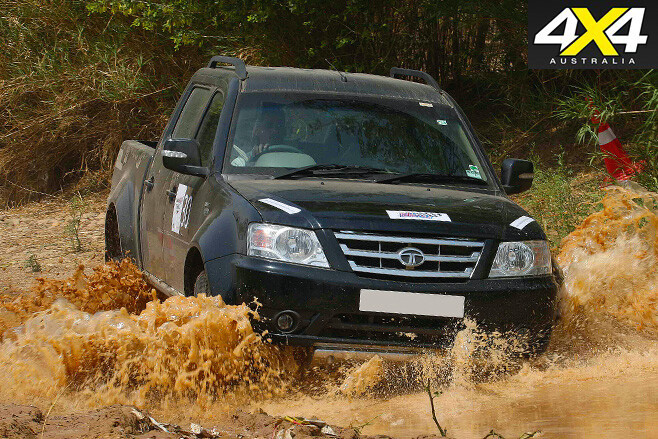
The Xenon you see here arrived in Australia in late 2013; although, an early version of the Xenon and the even earlier Tata Telcoline ute were previously sold here in small numbers.
The Xexon 4×4 comes as a single-cab with a factory tray, and single- and dual-cabs with a factory tub. All are powered by a modern 2.2-litre four-cylinder diesel with a variable geometry turbocharger, Bosch common-rail injection and Euro 5 emissions compliance.
And all are backed by a five-speed manual and part-time dual-range 4×4 system.
The engine is surprisingly quiet and refined, and it offers solid torque from low revs and reasonable pedal-to-the metal performance. Not so good is on-road steering and handling. The Xenon offers solid off-road performance aided by electronic traction control – uncommon for budget utes. The Xenon offers four-star safety, which is unique at this price.
SPECS Engine 2.2L 4cyl turbo-diesel Max power/torque 110kW/320Nm Gearbox 5M 4×4 system part-time Kerb mass 1710kg – 2050kg GVM 3100kg Tow rating 2500kg Safety rating 4-star
PRICING Single cab $22,990* Dual cab $25,990* *4×4 models only; drive away price.
For: Safety, for the price. Against: On-road dynamics.
MAHINDRA PIK-UP
The Pik-Up was first sold in Australia in 2007. It was updated in 2011 with a new engine and the addition of an Eaton self-locking rear diff.
The new engine, jointly developed by Austrian diesel specialist AVL, runs second-generation Bosch common-rail injection, meets Euro 5 emission standards, and is surprisingly refined (even if the performance is modest).
While the on-road handling isn’t anything special, the Pik-Up is very handy off-road thanks to its generous clearance and Eaton diff, which locks automatically (no electronics) in response to wheelspin. Like the Mahindra Genio, it uses a two-speed BorgWarner transfer case.
The Pik-Up’s upright and spacious cabin is more akin to the truck-like cabin of the Defender or LandCruiser 79, rather than something like the passenger-car-style cabin of a Toyota HiLux.
The Pik-Up comes with a single- or dual-cab as both a cab-chassis and with a factory tub. The Pik-Up dual-cab has a three-star ANCAP safety rating.
SPECS Engine 2.2L 4cyl turbo-diesel Max power/torque 88kW/280Nm Gearbox 5M 4×4 system part-time dual-range Kerb weight 2060kg – 2120kg GVM 3150kg Tow rating 2500kg Safety rating 3-star (dual-cab)
PRICING Single cab $23,990 – $24,990* Dual cab $26,490 – $26,990* *4×4 models only; prices are drive away.
For: Low price; proven design; big cabin. Against: Modest performance.
MAHINDRA GENIO
The Genio is smaller than Mahindra’s other 4×4 ute, the Pik-Up, which has been available in Australia since 2007.
Mahindra began assembling Jeeps under license from Willys-Overland at the end of WWII, but is now a global conglomerate employing 155,000 people in more than 100 countries. It’s also the world’s largest producer of tractors, and it owns Korean manufacturer Ssangyong, which sells its own budget ute – the Actyon – here in Australia.
The Genio arrived here in late 2013, initially only as a 4×2 single-cab. Now it’s available in 4×4 single- and dual-cabs, both with factory aluminium trays.
The Genio is powered by the same 88kW/280Nm 2.2-litre diesel as the bigger Pik-Up, an engine that was jointly developed by Austrian diesel specialist AVL. The engine is backed by a five-speed manual and a BorgWarner two-speed transfer case. Standard equipment includes ABS brakes, dual front airbags and cruise control. The Genio has not been ANCAP safety tested.
SPECS Engine 2.2L 4cyl turbo-diesel Max power/torque 88kW/280Nm Gearbox 5M 4×4 system part-time dual-range Kerb weight 1820kg – 1980kg GVM 2980kg Tow rating NA Safety rating No rating
PRICING Single cab $23,490* Dual cab $26,990* *4×4 models only; prices are drive away.
For: Low prices; long-established manufacturer. Against: No safety rating.
FOTON TUNLAND
The Beiqi Foton Motor Company is relatively new (1996) in the Chinese vehicle industry.
It makes a wide range of commercial vehicles including trucks, buses, vans, people movers, utes and even mobile cranes. Foton has joint-venture relationships with Daimler-Benz (for medium and heavy-duty trucks) and Cummins (diesel engines).
The Tunland ute is powered by a 2.8-litre, Cummins-designed, four-cylinder diesel that makes a modest 120kW and 280Nm. The engine is made under license by Foton, as are most of the other driveline components including the Getrag five-speed gearbox, Borg-Warner two-speed transfer case and Dana axles. The Tunland also sports Bosch electronics and ABS.
All of this should work in the Tunland’s favour in terms of longevity and reliability, but it also means the Tunland is priced closer to established brands such as Mitsubishi’s Triton.
The Tunland 4×4 is sold as a single-cab (with an aluminium tray) or as a dual-cab ute. Both have three-star ANCAP safety.
SPECS Engine 2.8L 4cyl turbo-diesel Max power/torque 120kW/280Nm Gearbox 5M 4×4 system part-time dual-range Kerb weight 1879kg – 1950kg GVM 2894kg – 2975kg Tow rating 2500kg Safety rating 3-star
PRICING Single cab $25,990* Dual cab $30,990* *4×4 models only; drive-away price.
For: Heritage of driveline components. Against: Only three-star safety.
SSANGYONG ACTYON UTE
The Ssangyong Motor brand only came into being in 1986, but like many of its fellow Koreans the company had its roots in the economic boom that South Korea enjoyed after the Korean War. At one stage, Ssangyong Motor’s founding company even manufactured Jeeps for the US military!
Ssangyong joined Mercedes-Benz in a joint venture in 1988 (remember the 1990s Benz-powered Ssangyong Musso wagon?). Since then, the company has been acquired by Daewoo and Chinese carmaker SAIC. From 2011 it has been owned by Indian manufacturer Mahindra.
The Ssangyong Musso Sports ute, based on the Musso wagon, appeared in Australia in 2004, while the Actyon-based replacement (also badged Sports) arrived in 2007. It too is based on a wagon, so has coil rather than leaf springs at the rear.
The Actyon ute only comes as a dual-cab, but in two spec levels with a six-speed manual or the option of a five-speed auto. It drives well, has a comfortable cabin with a decent back seat, and is surprisingly refined, but the tub is short and it needs more clearance for off-road use. No safety rating, but it does have electronic stability and traction control.
SPECS Engine 2.0L 4cyl turbo-diesel Max power/torque 114kW/360Nm Gearbox(s) 6M/5A 4×4 system part-time dual-range Kerb weight 2022kg – 2035kg GVM 2740kg Tow rating 2300kg Safety rating No rating
PRICING Dual cab $29,490* – $30,990* *4×4 models only; prices are drive away.
For: Drives well considering the price. Against: No safety rating.
NISSAN PATROL
The Patrol is one of three heavy-duty utes here, the others being the Toyota LandCruiser 79 and the Land Rover Defender. The key difference between these three heavy-duty utes and the rest of the ute market is that the heavy-duty utes are more like light trucks and don’t have the passenger-car feel of the popular mainstream utes.
Much of that comes down to the fact that the Patrol, LC79 and Defender all have live axles front and rear, while all of the other utes have independent front suspension. And while live axles are generally robust and a bonus off-road, they don’t steer and handle on-road as well as an independent set-up.
The Patrol is powered by its long-serving 3.0-litre four-cylinder diesel that musters a modest 118kW and 360Nm, which means the performance isn’t great. It’s backed by a well-proven five-speed manual and part-time dual-range 4×4 system.
The Patrol only comes as a single-cab, but is offered with either coil rear suspension with a 3150kg GVM or with more heavy-duty leaf springs that bump the GVM up to 3400kg. The Patrol is an honest workhorse, but isn’t as cheap as it should be given the age of its design and its modest performance.
SPECS Engine 3.0L 4cyl turbo-diesel Max power/torque 118kW/380Nm Gearbox 5M 4×4 system part-time dual-range Kerb weight 2014kg – 2135kg GVM 3150kg – 3400kg Tow rating 3200kg Safety rating 3-star
PRICING Single cab $52,990 – $55,990 *Does not include on-road costs.
For: Robust chassis; capable off-road. Against: Underpowered engine.
JMC VIGUS
Jiangling Motors Company (JMC) started automotive component manufacturing in the mid-1990s with a joint venture with Isuzu. JMC also has a joint venture relationship with Ford (since 1997) building (among other things) a version of the Transit van. JMC produces a range of utes, light trucks, vans, mini buses and SUVs, and is now ranked in China’s top 100 companies.
The Vigus is JMC’s latest ute, produced (apparently) with help from Ford. It arrived in Australia in mid-2015.
While it’s available in single-, extended- and dual-cab variants overseas, it only comes as dual-cab here, but you do get the choice of petrol or diesel engines – both 2.4 litre fours and both backed by a five-speed manual.
The 2.4-litre diesel claims a modest 90kW and 290Nm, while the petrol, made under license from Mitsubishi, claims 100kW and 201Nm. Equipment of the top-spec models extends to leather, 16-inch alloys, side steps and a tub liner. The Vigus hasn’t undergone ANCAP safety testing.
SPECS Engine* 2.4L 4cyl turbo-diesel Max power/torque 90kW/290Nm Gearbox 5M 4×4 system part-time dual-range Kerb weight 1880kg – 1947kg GVM 2695kg – 2770kg Tow rating NA Safety rating No rating *2.4-litre 4cyl petrol also available.
PRICING Dual cab $24,990 – $30,990* *4×4 models only; prices are drive away.
For: Low prices; petrol option. Against: No safety rating.
TOYOTA LANDCRUISER 79
The LandCruiser 79 is part of the long-running 70-Series family that includes the 76 Wagon and the 78 Troopcarrier.
The 79 is available as a single-cab in three spec levels, or a dual-cab in two spec levels. All come as a cab-chassis; although, Toyota offers a wide range of aluminium or steel trays as factory-option accessories.
At the heart of the 79 is a 4.5-litre V8 turbo-diesel, which claims 151kW and 430Nm – very modest figures given its capacity, and an indication that it’s very lightly stressed. The 79 is more a light truck than a ute and is a built as tough as they come. Aside from the Defender 130 and the Patrol, it’s in a class of its own here. And against the Defender and the Patrol, it has the huge advantage of its big V8 diesel.
The 79 is big, tough and simple, and can shoulder large loads. On the highway, the gearing from the five-speed manual is annoyingly short.
Also, the tray of the dual-cab largely overhangs the rear axle as both single- and dual-cab are built on the same wheelbase.
SPECS Engine 4.5L V8 turbo-diesel Max power/torque 151kW/430Nm Gearbox 5M 4×4 system part-time Kerb weight 2010kg – 2045kg GVM 3300kg Tow rating 3500kg Safety rating 3-star
PRICING Single cab $56,990 – $60,990 Dual cab $61,990 – $65,990 *Does not include on-road costs.
For: Tough as they come; goes anywhere. Against: Highway gearing annoyingly short.
VW AMAROK
The Amarok is the oldest of the mainstream utes here, arriving in Australia in early 2011. It comes in single- and dual-cab variants, with the choice of two very distinct 4×4 systems.
If you opt for the six-speed manual you get dual-range part-time 4×4. If, however, you opt for the eight-speed automatic, then you get single-range full-time 4×4.
Single-range 4×4 may sound like a limitation, but the low first gear and torque converter work together to well and truly overcome this.
The result is that the Amarok auto can go from freeway speeds to climbing up a gnarly 4×4 track without the driver having to touch a lever or flick a switch. It’s simply brilliant and as off-road-capable as the best of the mainstream utes, namely the Toyota HiLux and Ford Ranger.
The Amarok backs this up with class-leading on-road handling and refinement, a very spacious cabin and a big factory tub. All bar the single-cabs and the Core dual-cabs have the option of comfort rear springs, which reduce the payload by 220kg but offer a more compliant ride.
Unusually, single-cabs come with a factory tub, which can be deleted (saving $1500) if you just want a cab-chassis.
SPECS Engine* 2.0L 4cyl bi-turbo-diesel Max power/torque 132kw/400Nm/420Nm Gearbox(s) 6M/8A 4×4 system(s) part-time or full-time* Kerb weight 2035kg – 2051kg GVM 3040kg Tow rating 3000kg Safety rating 5-star (dual-cab) *see text
PRICING Single cab $35,490 – $39,990 Dual cab $41,490 – $63,990 *4×4 models only; does not include on-road costs.
For: Does everything well; brilliant 8-speed auto. Against: Limited country dealer network.
Under-vehicle protection is critical for many working and weekender 4x4s.
Most of our favourite full-size rigs have their underbody laid out to minimise potential damage (such as having sumps that are installed nice and high), but many vehicles can benefit from aftermarket underbody protection, especially those that are used in rocky terrain.
In general, my tough-as-nails Toyota Troopie (and the Toyota LandCruiser 70 Series in general) isn’t likely to be damaged too easily, but it does have a couple of weak points, not least of them being the exposed base of the radiator and the also-exposed, low-slung steering arms (drag link and tie rod) and steering damper.
An easy and solid fix is a 6mm, aluminium Front Runner shield that is fixed to a substantial (supplied) cross member, which is then installed to the Cruiser chassis with no drilling or modification needed.
Overseas the plate is touted as a sump guard, but it doesn’t protect the sump at all; rather, it protects the radiator and steering components. At least here in Australia it’s billed as a steering guard.
Weighing 10kg, the guard is sturdy enough to help deflect mishaps, and it looks bling, being the only shiny part under the blacked-out Cruiser.
While I’m relaxed in the knowledge that vulnerable parts of my undercarriage are now protected, one unexpected problem was that the recovery hooks I’d purchased at the same time didn’t fit due to interfering with the guard fittings.
Sure, a bit of angle-grinder work would have seen them slot in, but they’ve now been returned and I’m on the hunt for a replacement set.
RATED Available from: http://www.oppositelock.com.au/ RRP: $395.00 We say: Sturdy protection, but interferes with some recovery points.
WHO doesn’t like prawns for brekky?
This week, Roothy whips up a protein-packed seafood treat in less than 10 minutes. It’s pretty simple, too.
All you need are cooked prawns, sweet chilli sauce (or standard chilli sauce), a pinch of salt, two teaspoons of garlic and a dollop of cream. And, if you need help waking up in the morning, add a handful of chilli flakes.
The best accompaniment for this healthy(ish) dish is a side of steamed rice.
Roothy likes this meal for breakfast, but it’s also the perfect meal for lunch or dinner!
What a way to start the day! Enjoy!