
THE LandCruiser 70 Series, due to hit showrooms in the fourth quarter of this year, has received significant safety and performance upgrades.
The 70 Series range retains the 4.5-litre V8 turbo-diesel donk, but the addition of piezo injectors will now provide better response at low engine speeds. The manual-only transmission also remains, but gearing has been tweaked to maximise fuel economy and limit NVH.
Toyota subjected the 70 Series – with a focus on the best-selling single-cab chassis – to more than 100,000km of exhaustive and vigorous testing on harsh Aussie terrain, which has resulted in the workhorse receiving a stiffer new frame with thicker side rails.
The new frame is likely to increase the strength of an already tough rig, while also reducing vibration and improving handling and stability.
“The upgraded 70 Series LandCruiser range builds on this iconic vehicle’s fit-for-purpose appeal with improvements that reinforce its heavy-duty abilities, durability and unapologetically rugged character,” Toyota Australia’s executive director of sales and marketing Mr Cramb said.
The improvements aren’t just limited to brute strength, with the Japanese tourer’s safety features also getting a tune up.
“[The 70 Series] receives important safety and emissions updates that are required by many customers – as well as regulators – to enable Toyota to continue selling the 70 Series in the Australian market.” Mr Cramb added.
The 70 Series gets improved stability and traction control tailored for dirt roads and country highways. All variants will also feature hill-start assist control, brake assist, electronic brake-force distribution and cruise control.
The single-cab version will receive curtain-shield airbags and a driver’s knee airbag in addition to the existing driver and front-passenger airbags, and it’s expected to receive a five-star ANCAP safety rating.
Pricing for the new 70 Series is yet to be released.
POTATO parcels are easy to make and taste delicious. They can be cooked over the coals, on the barbecue or in your camp oven. they also make a great side dish to your favourite cut of meat.
Ingredients
Serves 4
- 4 large sheets of heavy-duty foil (enough to wrap each potato well – if using thin foil, double it up)
- 4 large, washed potatoes thinly sliced (I prefer Ruby Lou potatoes; they are very versatile), or use 2 small potatoes for each person
- 2 to 4 rashers of bacon sliced or diced (or use ham)
- 1 small, red onion thinly sliced (or use whatever onion you have. Red ones just have a stronger flavour)
- 2 or more spring onions finely chopped (optional)
- 1 packet of French onion soup (I prefer the salt-reduced version)
- 1 cup of grated cheese (optional – tasty or mild)
- Salt and pepper to taste
- Butter
- Sour cream/cream
- Sour cream for serving (extra – optional)
Instructions
Step 1: Spray each sheet of foil with cooking spray to help stop the potato slices sticking to the foil (if you want, you can also line the foil with some baking paper to stop the potatoes sticking). Step 2: Fry the bacon until lightly browned. Drain it on some paper towel. Step 3: In the middle of each piece of foil, arrange the potato slices and then top with red onion slices and bacon pieces. Step 4: Sprinkle a little of the soup mix evenly over the top (not too much). Step 5: Sprinkle on some grated cheese and spring onions and season well with salt and pepper. Step 6: Add 1 tsp of butter (more or less) on top of the potato mix. You can also add a dollop of cream or sour cream, if you like (I think it’s best if you spread the cream evenly over the potato slices). Step 7: Wrap each packet up securely, crimping the foil edges together to get a good seal all around. Step 8: Place them on top of a barbecue grill and cook for about 30 minutes or until the potato slices are tender. Don’t cook on a high heat – you’ll burn the bottom of the potatoes.
Cooking time will depend on how thick your potato slices are and how much potato you have in the parcel.
If baking in the oven, preheat it to 180°C/350°F and then place the potato-foil parcels on a baking tray and bake for about 30 minutes or until the potatoes are tender.
If baking in your camp oven, place them on a trivet to lift them off the bottom of the camp oven so you don’t burn them.
If you have time, let them stand for about 10 minutes before serving.
Serve them topped with a dollop of sour cream, if so desired.
Viv’s hint
You can add other ingredients including sun-dried tomatoes, sliced mushrooms, crushed garlic, salami or ham.You could also use garlic butter, instead of plain butter, for even more flavour.
You could also line the foil with some baking paper before adding the ingredients.
LEVERAGE IS the cornerstone of everything we do off-road.
We fit larger tyres to provide a mechanical advantage in the rocks and ruts. Dropping tyre pressures also gives us a mechanical advantage in soft sand and mud, by spreading the same weight over a larger area. Even selecting low-range is making use of mechanical advantage, as we’re halving the speed but giving the motor double the time to do the same job.
Think of it like taking two swings of the hammer to drive in a tent peg, rather than one. That’s the basics of mechanical advantage, and it’s why we’re always in pursuit of lower gearing, bigger tyres and slower winches.
It should be clear by now how important mechanical advantage is in a 4×4, but what mightn’t yet be obvious is where I’m going with this – bear with me for a minute. Your average off-the-shelf electric winch is going to punch in at 12,000lb pulling force – for those readers in the 21st century, that’s 5443kg.
Considering both the Y62 and LC200 can legally weigh in at more than 6000kg loaded up with a trailer in tow, it becomes obvious a 12,000lb winch mightn’t always get you out of trouble, especially when you’re stuck to your axles in sand or mud.
The trick is to give your winch more pulling power. Now sure, there are fancy high-mount, competition-spec winches, or elaborate hydraulic winches, but in the majority of cases your 12,000lb winch is more than capable of doing the job with a double line pull.
By using the mechanical advantage of a double line pull, we’re able to slow the winch-line speed down to half, effectively giving the winch motor two swings of the hammer where it used to only have one.
WHAT GEAR DO YOU NEED As well as a well-stocked recovery kit, there are a few bits and pieces required that are pivotal to these techniques: a tree trunk protector, a rated bow shackle and a winch damper. Above and beyond, you’ll also need one or two pulley blocks, an extra pair of winch dampers and a winch extension strap.
THE NUMBERS ADD UP Let’s assume our loaded 4×4 – including a trailer, long-range tanks and a bike rack on the back for kids – weighs in at exactly 6000kg. If you were to push this on flat, smooth ground, the force required would only be 10 per cent of the total weight (600kg). That 12,000lb winch could drag you and another eight 4x4s reasonably easily.
For every 15 per cent of upwards slope, you need to add 25 per cent of the total load onto what force is required. So on smooth ground, with a 45-degree slope, you’re now requiring 5100kg of pulling ability, just 300kg shy of the winch’s maximum pulling ability.
Add a busted wheel bearing (so you’re dragging a dead weight) and you can see an additional 75 per cent of the total load bringing us up to 9600kg of force required. Mud complicates things even further. Fully loaded in chassis-deep mud can require a ridiculous amount of force (18,600kg, or 41,000lb). That 12,000lb winch isn’t looking so strong on its own anymore, is it?
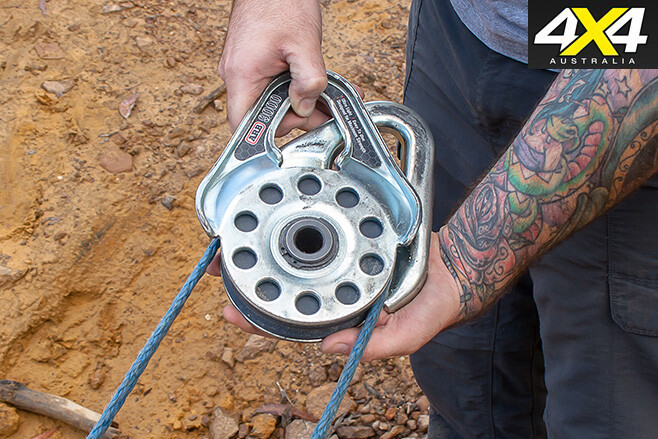
MULTIPLE LINE PULLS The need for multiple line pulls should be apparent, but the actual mechanics of it are rather impressive. Instead of hooking your winch line directly to the tree trunk protector, as you would in a normal recovery, you run the line out through a pulley block attached to the tree trunk protector and then back to your four-wheel drive’s recovery point with a damper over both lines. This halves recovery speed and doubles the pulling power of the winch, giving a 12,000lb winch 24,000lb of pulling force – that’s close to 11 metric tonnes.
Next, add an additional pulley block to the vehicle’s recovery point, run the winch line to a second tree with a tree trunk protector, and add another winch damper, to triple the pulling power of the winch.
This provides a pulling force of 36,000lb, although it will also cut the speed of the recovery by one third.
It’s important to note a winch’s pulling power is rated with just one layer of rope on the drum. It loses roughly 12 per cent pulling power for each additional layer of rope on the drum. Performing a double, or even triple, line pull can help get more rope off the drum and give you more chance of getting free.
DIRECTIONAL WINCHING While a pulley block allows us to increase the effective pulling power of a winch, it also has the unintended consequence of allowing us to change the direction we’re winching in. This can come in handy in a few different situations.
Firstly, we can winch on an upwards angle to help lift out of mud. You can do this with a single line pull by setting the tree trunk protector high, but the leverage applied to the tree can potentially rip it out.
By fitting a pulley block high in a tree, you can run the line from your four-wheel drive up and through the tree and then down to a low anchor point on a second tree. This will pull the front of your vehicle out of the muck, while pushing the second tree down and not over.
The other major benefit of re-directing winch lines is the sling-shot winch. Particularly useful when you’re not the one stuck, a sling-shot winch allows you to direct your winch line around corners, or even to a tree in front of you, and then back to a 4×4 stuck behind you.
You won’t get the added benefits of mechanical advantage, but you can perform some otherwise impossible recoveries with this technique.
5 TIPS FOR ADVANCED WINCHING
1. Every line needs at least one winch damper. 2. If you run out of dampers, a heavy coat or a sleeping bag will get you out of trouble. 3. Keep the line off the ground – rocks and dirt can tear a winch rope to shreds. 4. The open end of the winch hook points up. If it breaks it’ll go down, not up. 5. Let the winch cool down: 30 seconds on, 30 seconds off.
For more 4×4 recovery tips check out or page.
IF YOU need more space and power and you don’t want to modify your trusty Hilux, Ranger or Triton steed, then the only factory alternatives are full-sized American pick-up trucks.
We’ve given three right-hand-converted US trucks an all-Aussie initiation: the Ford F-250 Lariat, the GMC Sierra Denali 2500 and the RAM Laramie 2500.
Ford’s F-250 Lariat is a $152,000 offering from Harrisons in Melton. For that you get a Powerstroke 6.7-litre turbo-diesel V8 engine – instead of the US-preferred petrol V8 – that dishes up a gargantuan 1116Nm from 1600rpm. This is enough urge to haul a 7600kg trailer! However, the result of this is a nasty fuel consumption figure of 21.93L/100km. The rig utilises a heavy duty ladder-frame chassis with live axles front and rear, plus it’s fitted with a selectable rear diff lock. As big and brash as they come!
Next up is the GMC Sierra Denali 2500, a $152,000 offering from Performax. Under the hood is a monster 6.6-litre turbo-diesel V8 that generates 1037Nm and 298kW, enough to haul an 8000kg trailer. Heavy duty driveline experts, Allison, supplied the six-speed automatic transmission. The rear axle has an auto-locking diff from Eaton. It utilises a separate ladder chassis and a live rear axle on an HD leaf spring pack. Unlike the other two pick-ups, the GMC uses an independent front suspension design with torsion bar suspension.
RAM’s Laramie 2500 is the cheapest of this trio, coming in at $139,500 from the Walkinshaw Group. There’s no V8 powering this truck, but the massive 6.7-litre, six-cylinder Cummins donk still musters a hefty 1084Nm. It’s got a six-speed auto, part-time 4×4 with shift-on-the-fly, low range and auto-locking Tru-Lok diffs front and rear. It’s also bolted to a ladder frame chassis.
The complete road test on these three American mega machines can be found here.
JUMP in our time machine for a quick spin back five years. It’s the end of 2011 and we are lining up the pick of the year’s crop for our slugfest known as 4X4 of the Year.
Given we only allow newly released 4x4s into the contest, not all years are as strong as others. But that certainly wasn’t the case in 2011, which produced a bumper crop of serious contenders.
Starting equal favourite was the then-new and still effectively current WK Jeep Grand Cherokee, fitted for the first time with a diesel engine (a high-tech, European-sourced 3.0-litre V6, no less). The WK had taken the previous year’s title on debut, due to its petrol V6 and stunning value for money, so it wasn’t to be taken lightly.
Looking equally good, given Toyota Land Cruisers rarely lose a 4X4OTY contest, was the 200 Series GX – a stripped-back, no-nonsense new price-leader in the 200 range.
Range Rovers also traditionally do well at 4X4OTY, so the new 700Nm 4.4-litre V8 bi-turbo-diesel Rangie was looking good. As was the brick-dunny-tough Mercedes-Benz G-Wagen G350 diesel – triple diff locks and all. The Merc was back in Aussie showrooms off the back of its then-new Australian Defence Force contract.
The final contestant was the controversially styled Toyota FJ Cruiser, the only one of the five short-listed vehicles not to feature a modern turbo-diesel engine. Back then, a turbo-diesel donk was seemingly a prerequisite for success at any level, so no one gave the FJ Cruiser a chance.
After a week of rigorous testing, the six judges – with more than 200 years of collective 4×4 experience – saw it differently. In what was a triumph of the underdog, the FJ Cruiser came from the clouds to sweep all before it.
Fast forward to 2016, and word is out that production of the FJ Cruiser is coming to an end in a matter of months. This follows its withdrawal from its key (and birth) market, the USA, in 2014, and effectively brings to an end the short life of a very remarkable vehicle, both in terms of how it came about and what it did once it made it out into the world.
THE HISTORY THE idea for the FJ Cruiser didn’t originate from Japan’s Toyota HQ; it was born in the USA.
It dates back to the mid-1990s, when some US Toyota employees thought that something with the rugged, go-anywhere ability of the original FJ40, but with contemporary underpinnings, might get the interest of young US males – a market where Toyota considered it was losing touch. In other words, it wanted a Jeep Wrangler competitor.
In 1999 at the Chicago Auto Show, the ‘Retro Cruiser’ was revealed. This was a modified 1967 FJ40 created by off-road racer and vehicle builder, Rod Millen. The Retro Cruiser was more than a concept vehicle, as it was a running prototype combining a contemporary Land Cruiser chassis and V8 engine with an FJ40 body.
With backing from Toyota HQ in Japan, the project was handed to Toyota’s Californian design studio, which delivered the FJ Cruiser Concept at the 2003 North American International Auto Show in Detroit. It sparked enough interest for Toyota to decide the FJ Cruiser was a viable commercial proposition.
The production version, with essentially the same exterior styling as the concept vehicle but with a toned-down interior, debuted just two years later at the 2005 Chicago Auto Show. Its debut followed rigorous testing and development, including extensive off-road evaluation at various locations such as the Rubicon Trail.
The FJ Cruiser didn’t arrive in Australia until mid-2011. By that time it was effectively a second-generation model, as the original FJ was based on the 120 platform, whereas the Australian-delivered FJ had many of the changes that came with the 150 Series Prado.
BEHIND THE WHEEL THE FJ Cruiser is a vehicle you have to drive to appreciate. Just looking at it – even if you know it’s essentially a different body on a shortened-wheelbase, part-time-4×4, petrol-powered Prado – won’t tell the whole story.
Compared to a Prado, the big negative is interior space and seating capacity. The payload and towing capacities are also slightly reduced, but in just about every other way, both on- and off-road, the FJ Cruiser is a better vehicle.
It all starts with the highly underrated 200kW 4.0-litre V6. This 150 Series engine has variable valve timing on both cams, not just the inlet cam as per the 120 Series engine.
In typical Toyota fashion this is a soft-tune engine, where power spread, not peak power, is the name of the game. The engine is mated to the five-speed auto (from the 120) and a part-time, dual-range 4×4 system (from the HiLux) – unfortunately a retrograde step from the Prado’s full-time 4×4.
At 2000kg the FJ Cruiser is around 300kg lighter than the petrol Prado, and this helps to accentuate the engine’s flexibility and its considerable top-end urge. The generally agreeable five-speed gearbox works well with the engine and has gated shift, rather than a tip-shift, for ‘manual’ control.
The soft tune of this engine helps with fuel economy, one of the surprise reasons why the FJ Cruiser won 4X4OTY. In that week-long contest, which included a fair deal of off-road tracks, it used 15.4L/100km to be the thirstiest vehicle there – as you’d expect, being the only non-diesel. But the difference wasn’t much: the LC200 GX used 15.3L; the G-Wagen 15.1L; the RR TDV8 14.5L; and the Jeep GC 12.2L/100km.
The FJ Cruiser’s reduced weight and better mass centralisation of its compact body also makes for surprisingly good on-road dynamics, even with the supple long-travel suspension that produces an excellent ride on even the bumpiest road.
Off-road the FJ Cruiser has many things going for it, not least the best approach and departure angles of any Toyota 4×4. For example, compared to a Prado, it has a steeper approach angle (36 v 32 degrees), better ramp-over angle (29 v 22 degrees), steeper departure angle (31 v 25 degrees), and slightly improved ground clearance (224 v 220mm). All of that is in addition to its capable, Prado-derived long-travel suspension.
The FJ comes with a driver-operated rear diff lock and, while engaging this negates the normal traction control on both axles, the driver can reinstate off-road-specific traction control (A-TRC) across the front axle, even when the rear diff is locked. With its entire off-road armoury lined up, the FJ is closing in on the Wrangler Rubicon territory in terms of showroom-stock off-road ability.
Inside, the FJ is like no other Toyota 4×4, with forward and upright A-pillars and a retro-styled slab dashboard. Two rear-hinged doors give good access to a decent rear bench, while the front passengers are treated to the typically comfortable Toyota seats – the driver’s seat having the benefit of height adjustment. Not bad luggage space, either.
ON REFLECTION MORE than 11,000 FJ Cruisers have been sold in Australia since 2011 (around 180 per month). Compared to the Prado, sales of which run at 1200 to 1300 per month, this isn’t significant, but given more than 98 per cent of Prado sales are diesels, one can only speculate on FJ Cruiser sales if it was available as a diesel.
Still, you don’t hear owners complaining about the FJ’s 4.0-litre petrol V6 in terms of performance or fuel economy. And they all seem to appreciate the FJ Cruiser’s Toyota-typical practicality and the fact there’s a good range of aftermarket enhancements to back up its off-road functionality. You certainly see a surprising number of FJ Cruisers out and about on the back roads and bush tracks given their modest sales volume.
After driving the FJ Cruiser once again for this feature, it has stood the test of time and doesn’t feel ready for retirement in any sense. Above all, the FJ Cruiser was an enthusiast’s 4×4 delivered by a manufacturer renowned for conservative, family-orientated 4x4s. Let’s hope Toyota throws off that conservative yoke again sometime soon.
PAYING HOMAGE
THE FJ Cruiser pays homage to the FJ40, which wasn’t the original Land Cruiser but was the vehicle that established Toyota as a pre-eminent manufacturer of 4x4s. The 40 Series was a development of the 20 Series, which in turn was effectively a renaming of the original BJ.
The 40 Series was replaced by the 70 Series, and if the FJ Cruiser was based on a 70 Series then its bloodline would be much more direct. As it is, the FJ Cruiser is based on the 120/150 Series Prado and its links to the FJ40 are more stylistic – ‘TOYOTA’ grille badge, round headlights, white-finished roof, steep windscreen with three wipers, and the slab dashboard.
SECOND-HAND VALUES
ACCORDING to RedBook, the projected resale value of the FJ Cruiser after three years runs at 62.5 to 63 per cent, colour-dependent. That’s at the bottom end of the resale value of Toyota 4x4s in general, but applies before the announcement that production will cease.
The effect that announcement will have on FJ Cruiser resale values is yet to be seen. By way of comparison, Prado projected value runs between 63.8 and 67 per cent; Fortuner between 66.5 and 67 per cent; and LC200 between 71 and 73 per cent.
[specs] TOYOTA FJ CRUISER Engine DOHC, 24v, petrol V6 Capacity 4.0-litre (3956cc) Max Power 200kW @ 5600rpm Max Torque 380Nm @ 4400rpm Gearbox five-speed auto 4×4 System dual-range part-time Crawl Ratio 33.7:1 Construction separate chassis Front suspension independent/coil springs Rear suspension live axle/coil springs Tyre/wheel spec 265/70R17 Kerb Weight 2000kg GVM 2510kg Payload 510kg Towing capacity 2250kg Seating capacity five Fuel tank capacity 159 litres ADR fuel claim 11.4L/100km Average fuel use 13.0L/100km Price $46,990 (plus on-road costs)
LAST week Roothy showed us how to cook fish and chips when you’re 1000km from the ocean. This week he’s got a Mexican-inspired dish that’ll spice up your campsite menu.
Roothy’s stolen the recipe from his old mate Chooka, and now he’s sharing this spicy treat with you.
The aptly named Chook Amigo dish is part nachos, part fried chicken. And the end result will have you salivating.
As is always the case with Roothy’s Bush Cooking adventures, the method is very simple.
First, lather a couple of chicken legs in olive oil and top them with taco seasoning – mild or hot. Then, when the oil is bubbling away, whack the legs on the pan.
Roothy uses a Gladiator Series stove from Coleman and he reckons it gives off enormous heat, which is a good thing, as chicken is definitely something you don’t want to undercook. So make sure the meat is cooked right through to the bone and is entirely white.
On a serving dish, plate up a layer of corn chips and top with avocado, sour cream and salsa (it wouldn’t be a Mexican dish without these key ingredients).
Once it’s plated – and you’ve stopped picking at the chips – place the chook on top!
Now, where’s the tequila?
CONTINUING on from Readers’ Rigs: Part One, here’s the next selection of rides that our readers are hitting the bush with.
To get involved and get your ride on these pages, head to our Facebook page and keep an eye out for the opportunity to send through some photos. Your pride and joy might even get published in the mag one day and, if we really like it, perhaps you’ll even see it on the cover of 4X4 Australia!
Here’s the next instalment of readers’ rigs:
2000 GU PATROL TD42T – JON BORKOWSKI
WHAT IT’S GOT: I got it in July 2015 after my GQ of 10 years died. It’s a ’99 build, 2000-plated GU Series I. Prior to my ownership it was a one-family-owned vehicle. When I purchased it, it was 100 per cent original and only had 55,083km on the clock. The motor hasn’t been touched yet, except for a three-inch exhaust and 3.5-inch Safari snorkel.
Suspension-wise it has: four-inch, medium-rate King Coils; Tough Dog shocks and adjustable Panhard rods; Superior Engineering comp-spec drag link and tie rod; Superior super flex arms; Superior swaybar disconnects; BBM off-road heavy-duty rear lower control arms and adjustable uppers; extended braided brake lines; and Boss rear coil tower braces.
I run the Nissan LSD in the rear and an Eaton ELocker up front. Rear bar is from Millweld Customs and front bar is a genuine Nissan steel winch bar, with the Nissan driving lights of the time. It rides on Mickey Thompson 16x8in Baja Locks and Toyo Open Country MTs in 315/75/16.
I run a Tracklander alloy rack and a Darche Eclipse awning. Inside are the basics: UHF, CD player, Hema GPS and a cargo barrier. I got it engineered to keep the insurance company and Mr Plod happy.
Future mods will include a set of Rock Sliders, a turbo upgrade with a top mount intercooler, and a winch.
I haven’t been off-road a great deal, yet. The best trip so far has been to the Spanish Steps at Lithgow, then along to Baal Bone Gap up to Mt Airlie, to Turon River National Park, and then along the Turon to Hill End.
1989 NISSAN PATROL Y60 MDL – ADAM TANNER
WHAT IT’S GOT: I’ve had it for approximately eight years. It was originally a TB42, but I built up a big, pricy TD42 with custom 11mm pump, which runs 25psi boost. I’m yet to dyno, as the motor has only 10,000km on it.
Every suspension arm is upgraded, and it has front and rear air lockers. It’s got a five-inch lift and runs 35-inch TTC Claws. Other features include a high-mount warn, rebuilt diffs and a Ti interior.
The rig is in very good condition. We use it for the Vic High Country and it tows our new Jayco Swan OB. I’m looking to sell it to make way for a GU4 TD42.
FOTON TUNLAND – DEAN NEUMANN
WHAT IT’S GOT: I’ve had it just on three years. It hasn’t got many mods, just a Hilux snorkel, nudge bar, light bar, awning, alloy tray, Jack Off canopy, dual battery, Ironman 4×4 fridge, 18-inch rims and All-Terrains.
It’s been to Gladstone and up to Rockhampton, but it spends most of its time at work or bass fishing in Macleay.
2011 JEEP WRANGLER JK – MATT LAIDLAW
WHAT IT’S GOT: I’ve had my 2011 JK from new and have built it up gradually. It currently runs on 33-inch tyres, Bilstein long travel shocks, Eaton front Locker and re-geared 4.11 diff ratios.
It’s also got a Rock-Slide Engineering front bar with 12,000-pound winch, Synergy adjustable control arms, custom stainless exhaust, chromoly axles and a Rhino rack. We manage to get out regularly with the great people at JeepFreakz, Qld.
2015 ISUZU MU-X LST – SIOBHAN JAMIE THORNBERRY
WHAT IT’S GOT: My MU-X has a TJM front bar, 9500lb Kaymar rear bar, Ironman 4×4 two-inch lift kit, Korr light bar and LED driving lights, and I’ve just fitted brush bars and steps. I have done Vic High Country, Kulkyne National Park, Pink Lakes, Brindabella National Park and Tallarook.
1999 JEEP CHEROKEE XJ – DYLAN TAYLOR
WHAT IT’S GOT: 5.5-inch lift; Super-Flex short arms; drop boxes; a custom front bar; 32-inch MT/Rs (soon-to-be 33-inch KL71s); Rock Lights, light bar, and a whole lot of other lights; full sound system; cold-air intake; custom exhaust; machined head and metal head gasket; custom steel flares; and much more. Plus the carpet has been removed for the bed liner.
THE TRACK dipped and climbed along the ridgeline, rising steeply to a trig point before descending in a rush to a saddle, where you could grab a breath before another long climb began.
For most of the time the Cruiser coped easily in third low. The track was in pretty good condition, with a firm and even surface, though it was bloody steep and narrow in places. Perhaps not as exposed or dramatic as Billy Goat Bluff or the Blue Rag Range tracks, but still challenging, with impressive views all around.
Only on the short scramble to the crest of Mt Selwyn did I slap the gearbox into second and floor the accelerator. The V8 responded, the Cooper STT Pros scrabbled for grip on the pot-holed, shaly rock, and the suspension bucked and jostled the wagon to the top.
The view from the crest of Mt Selwyn was dazzling. To the north the indented skyline of The Horn on the plateau of Mt Buffalo could be seen, while to the west were the jagged outlines of Mt Cobbler and Mt Speculation. To the south Mt Howitt stood proud, while to the east were the high snow plains of Hotham Heights and Falls Creek. In between and all around the ridges, peaks and valleys of the Australian Alps and the Victorian High Country filled the scene from horizon to horizon. It was a grand view.
We had been coming to this area of north-east Victoria for more years than I care to recount, but we had never taken the Yarrabuck Track that joins the Buffalo Range Track along the high ridge that borders the Buckland Valley to the west. That was a crazy oversight.
On this trip we were mapping the next edition of Hema Maps’ The High Country Atlas & Guide, so we were looking for new 4WD routes that hadn’t been ‘discovered’ and would inspire travellers to leave home, get away from the norm and breathe some clear mountain air. On this route we found all that in spades.
From Mt Selwyn, our route dropped down the narrow Great Divide Track through a forest of dead giants that tower overhead until Selwyn Creek Road meets the Twins Jeep Track. From here you can follow the high ridges and cut across to Mt Murray and Mt St Bernard on the Great Alpine Road, just below the glitz and glamour of Mt Hotham Resort.
We opted for less fancy fare and headed north, winding downhill and meeting with the east branch of the Buckland River before arriving at the large clearing of Beveridges Station.
The station is named after the first pioneers here, the Beveridge brothers. In the mid-1800s the brothers had some large parcels of land in the High Country, including this long delightful clearing beside the river. Today, a section of the cleared land is in the Alpine National Park, while downstream the area is still private grazing land and is marked by the ruins of an old shack that’s slowly succumbing to the elements.
The Buckland Valley is more famous for being one of the richest alluvial goldfields in Victoria. The fields were discovered in the winter of 1853 when a small party of men led by Henry Pardoe obtained 360oz of gold in just a couple of days. By spring of that year, 3000 diggers were in the valley, with another 3000 arriving by January 1854.
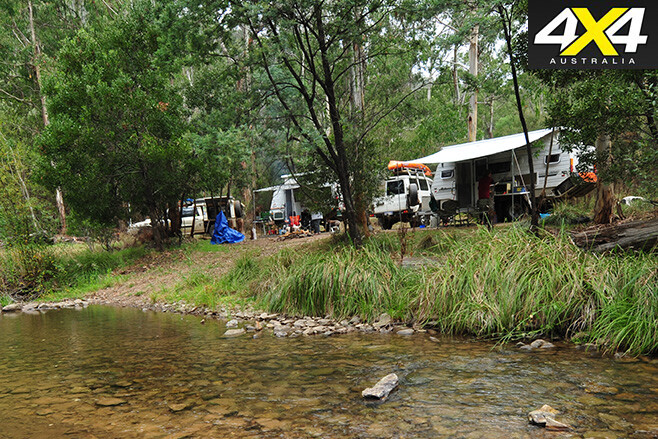
However, disaster soon struck as typhoid disease swept through the rough camps and the Buckland gained the reputation of having the highest mortality rate of any Victorian goldfield. It was said by those who were there that the valley was so thickly dotted with graves the river seemed to wind through a churchyard.
In July 1857 the infamous Buckland riots occurred. European diggers violently attacked and expelled the Chinese gold-seekers who had arrived there in the thousands. Many were killed before the police, led by Superintendent Robert O’Hara Burke, arrived from Beechworth. Burke was to later find lasting fame by dying on the banks of a distant Cooper Creek, leading what became known as the Burke and Wills expedition.
By the early 1900s hydraulic sluicing and bucket dredges had turned the worn and torn river flats along the valley into seemingly one big gravel pit. The dredges worked the complete length of the river, including both branches of the Buckland upstream from Buckland Junction. Meanwhile on the steep ridges, hard rock miners sorted the gold-bearing quartz reefs, with dozens of mines, including the Band of Hope, Comet, and the Rip and Tear, extracting the wealth that lay beneath the rocky soil.
Today the valley is quiet, peaceful and surprisingly green, with grassy flats between the dense stands of native forest. All the effort and toil of the past can still be seen, though. There are piles of rocks along the river, there are the low cliffs formed by the hydraulic sluices, and there are channels and races that cut across the landscape.
At the old cemetery beside the main road, poignant headstones testify to the tough past. While nearby is a monument to the Chinese who died during and after the riots. Little remains of the machinery that helped work these mines, apart from some scattered and torn metal fragments of boilers and furnaces. Flecks of gold can still be recovered from the river, and occasionally a rich pocket of alluvium missed by those early miners can be discovered by the lucky fossicker.
Most people come to the Buckland these days for the tranquillity of the valley, as well as the chance of catching trout, finding a fleck of gold, hunting a deer, or enjoying a 4WD track. We enjoyed our survey trip so much we went back again a few weeks later with friends, to camp on the Buckland and to drive Buffalo Range once more. It was even better the second time around!
TRAVEL PLANNER
- WHERE: Buckland Valley – 380km north of Melbourne.
- WHEN TO GO: Spring to autumn.
- DRIVING CONDITIONS: Most tracks are easy to moderate.
- CAMPING: Numerous sites; most have fireplaces, but just one has a toilet.
- PERMITS/RESTRICTIONS: No permits required. Some tracks (not the main access to valley) are subject to seasonal closure.
- FACILITIES: Normal travel facilities, campsites and accommodation at nearby Porepunkah, Myrtleford and Bright.
- MORE INFO: Visit Bright website
IT HAS been a long journey, but the final pieces of the Loaded Lux puzzle are coming together as we get ready to give away this exciting get-away package to one of our lucky readers. For this last fit-up we headed to Opposite Lock’s store in Dandenong to get some gear from Front Runner fitted and, while we were there, we also fitted one of the all-new Opposite Lock fridges on an MSA 4×4 fridge slide.
Click here for your chance to win 4×4 Australia’s Custom Toyota Hilux.
Front Runner is a South African brand of quality storage and protection products, and as the Saffas share our love of bush travel and have harsh terrain similar to our own, their stuff is generally top notch and built tough. The Front Runner gear is no exception – we’ve been running a Slimline roof rack on an LC200 for a few years now and have no complaints about it.
RACK ’EM UP
WITH this in mind we again chose the Front Runner Slimline II rack to sit over the cab of the HiLux, as its low profile keeps it in line with the tent on the back and its versatility is unrivalled. Front Runner offers a specific fitting kit and size to suit the popular double-cab HiLux.
The versatility of the rack comes from its slots in each of the aluminium crossbars, which accommodate sliding eye bolts that can tie down specific accessories. This include clamps and brackets for mountain bikes and kayaks, as well as popular 4×4 accessories like spare wheels, high-lift jacks, jerry-cans, shovels, awnings, roof-top tents and more. There’s even a swing-out arm that you can hang your shower bag from.
This will allow the lucky winner of the HiLux to tailor the rack to his or her own needs. However, one accessory we have included is a clever camp table that slides in under the rack to take up space that’s normally wasted.
The Slimline II racks are made from powder-coated aluminium, so they are lightweight and durable. The design of the slats and surround make it rigid, while the slats can be moved to best accommodate your loads. Extra slats can also be added to create a solid load bed. The HiLux rack measures 1165mm x 1358mm and includes a wind deflector at the front to limit wind noise.
BUMP & GRIND
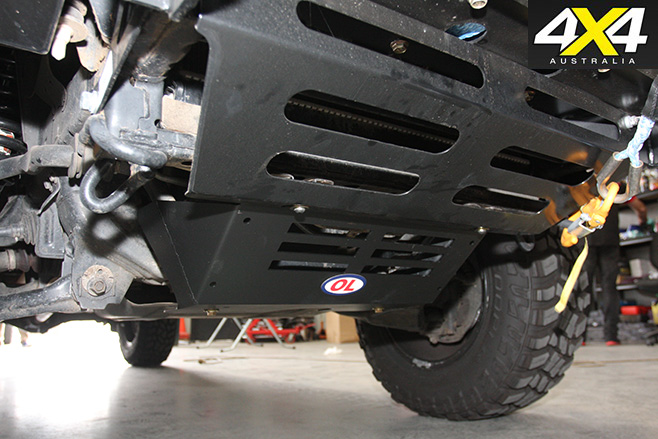
OPPOSITE Lock also fitted a Front Runner sump guard to the HiLux. This is a 3mm steel plate that replaces the factory tin plate to better protect your engine sump from the potential damage caused by scraping against rocks and ruts when driving off-road. It’s powder-coated for longevity and, being steel, it’s tough and offers superior protection to the underside of the vehicle.
CHILL FACTOR
OUR arrival at Opposite Lock couldn’t have been better timed, as it coincided with the launch of the new OL stainless-steel fridge/freezer range. These are another South African-made product, and Opposite Lock has chosen 40- and 72-litre sizes.
Inside the stainless-steel case these fridges have a think 60mm of polyurethane insulation, so once that 66-Watt SnoMaster compressor gets the contents down to temp, it keeps them there longer without having to switch on as often. Speaking of temp, the fridge will chill down to -22 degrees and up to 10 degrees. The compressor draws 5A on full power or 2.5A on low current draw, and the unit operates on 12, 24 or 240V, with a variable low voltage cut-out option.
The 40-litre unit, as fitted to the back of the HiLux, features three internal baskets, an LED interior light and a door open warning chime. It also comes with a remote temperature controller and a transit bag. External cabinet measurements are 600 x 420 x 520mm (WxDxH). The lid side-opens on stainless hinges and there are stainless handles at each end, so it can be easily lifted and tied down.
The new Opposite Lock stainless-steel fridges retail for $1249 for the 40-litre, single-door model and $1549 for the bigger dual-zone, double-door, 72-litre version. They both come with a five-year manufacturer’s warranty on the compressor and two-year parts warranty.
The OL crew mounted the fridge on a top-notch slide from MSA 4×4, so it’s now a simple task of dropping the tailgate, sliding out the fridge and dipping inside to retrieve a coldie at the end of a long day driving. The Australian-engineered MSA slide is anodised and powder-coated, so, like the stainless-steel OL fridge, it will stand up to the elements when it’s exposed in the HiLux tub.
CONTACT OPPOSITE LOCK Stores: Nationwide Website: www.oppositelock.com.au
OPPOSITE LOCK DANDENONG Where: U4/97 Monash Drive, Dandenong, Victoria, 3175. Contact: (03) 8788 8277
Want to know more about the Project Toyota HiLux build? Follow the link to find out.
SINCE its inception, the Easter Jeep Safari has captured the attention of the off-road world.
What started in the 1960s as a local trail ride with a few Jeeps, Scouts, Broncos and Land Cruisers has morphed into a massive American spring gathering and draws more than 20,000 four-wheel drive aficionados from around the globe.
Each year, Jeep, along with its underground team of mad engineers, rolls into town with its latest batch of concept vehicles. The word ‘concept’ is a little deceptive, as one might be misled into believing these creations are in the works for the general market. While some – or variants thereof – do eventually see the light of day on showroom floors, most remain eye candy for all to drool over and dream of.
As the hired gun responsible for photographing these works of art, I’m often able to talk the top dogs at Jeep into letting me take one or two out for a private day on the trail. All of this year’s concepts are worthy of a good romp in the bush, but it was the Crew Chief that caught my eye. It’s based on a late-model Wrangler Rubicon chassis, although it radiates DNA from another era – one of olive drab green and the Kaiser M715.
With keys in hand I headed for the Sand Flats Recreation Area in the lee of the snow-capped La Sal Mountains for a relaxing day on Moab’s expansive slick rock.
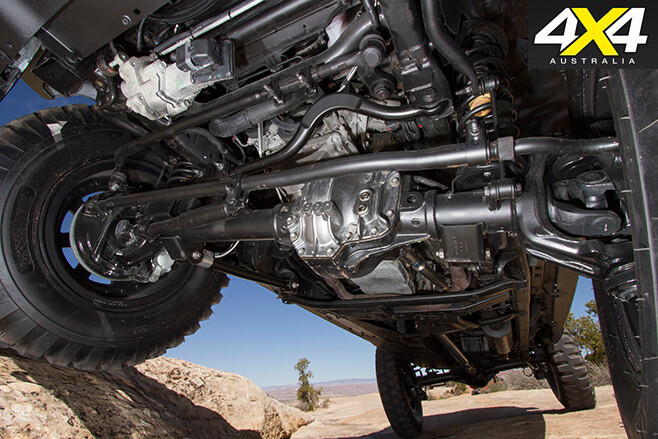
Jeep’s underground team began by slicing the frame in half and adding 585mm in front of the rear axle. The cab was chopped off behind the rear doors and replaced with a 1525mm steel bed fitted with a hardwood floor, mesh side panels and a pair of jerry cans. The front clip was removed and sent to the body shop, where the grille, hood and fenders were reworked with the design lines of the M715. When complete, a custom ragtop was stretched over the top, windows were removed for an authentic open-air feel, and door panels were sealed up.
The final package was trimmed with Jeep Performance Parts 10th Anniversary Rubicon bumpers fitted with Warn winches fore and aft, JPP Rubicon rock rails, and bed-mounted lashing points.
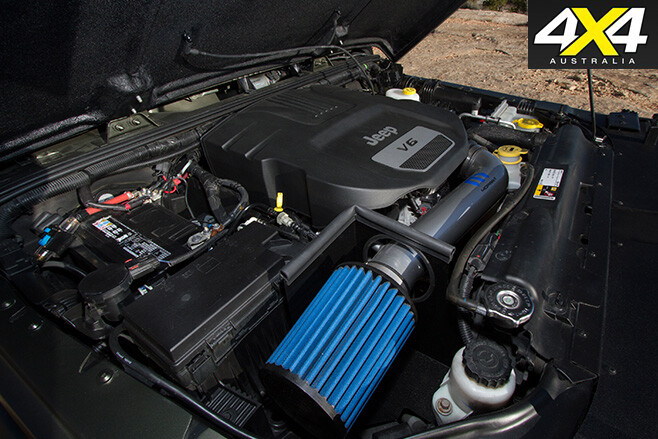
The Crew Chief rolls on 40-inch NDT military tyres wrapped around 20-inch beadlock wheels. Supporting the additional weight are a pair of JPP Dana 60 axles fitted with Eaton ELockers, 5.38:1 gears and Warn hubs. Prop shafts from Tom Woods tie the axles to the reliable 3.6-litre Pentastar V6 engine and five-speed automatic transmission. To keep the tyres in contact with the surface, the underground boys installed a four-inch suspension from JPP, and FOX remote reservoir shocks.
Rolling down Main Street gained me no less than celebrity status. The thumbs-up was the ubiquitous gesture from passersby, intersections became autograph sessions, and I nearly had to peel lookyloos out of the cab when I stopped for fuel.
Across the dash sits the control centre with its full-size nautical compass and toggles for the ELockers, ARB air compressor, and a mysterious button labelled ‘auxiliary.’ Hmm, maybe a rocket-propelled grenade launcher?
A cool Utah breeze rolled through windowless doors as a friend and I scaled the Fins & Things Trail. The Katzkin leather seats felt good and the lockers kept the square-cut military treads turning evenly. The Crew Chief’s wheelbase, which is about a gazillion inches long, actually helped when surmounting some of the larger ledges. However, the turning radius was akin to the Titanic.
By the end of the day I wasn’t ready to hand the keys back to the Jeep boys; rather, I was thinking about filling the tank to take a leisurely 1600km dirt trek back to California.
[specs] JEEP CREW CHIEF 715 CONCEPT Engine: 3.6L Pentastar V6 w/JPP cold-air intake Transmission: five-speed automatic Colour: Tactical Green Axles (f/r): JPP Dana 60, 5.38:1 gears, Warn hubs Lockers: Eaton ELocker Suspension: JPP 4in with FOX remote reservoir shocks Tyres/wheels: 40in NDT military, 20in beadlocks Bumpers: JPP Wrangler 10th Anniversary Winch (f/r): JPP/Warn Rubicon Onboard air: ARB compressor Bed: custom 1.5m steel Canvas top: custom