
STEER clear of the golden arches and give yourself a protein boost with this simple and healthy dinner: pork chops infused with apricot.
Here are a few more campsite dinner ideas: Chook amigo, beer-battered fish and chips, and chilli prawns.
Before you even start to unpack the Engel, you need to get a fire crackling.
This dish can be whipped up on a stove but, ideally, it’s best to cook it in the fire so that the juices and flavour can slowly flow through the pork.
Plus, cooking on a fire eliminates any cleaning up!
The only utensil you’ll need for this recipe is some aluminium foil (and perhaps a knife if you don’t want sticky fingers).
The first step is to season the chop with chicken salt and then apply cooking oil.
Spread some jam on top – Roothy suggests using about the same amount you’d apply to a slice of toast.
Crack open a tin of apricot halves and scatter a few on top of the pork, then drizzle on some apricot juice for good measure.
Tightly wrap several layers of al-foil around the chops, being careful to remember which side is the top.
Throw it in the fire and cover it with coals. It shouldn’t take very long at all to cook – just enough time to down a couple of coldies.
This tasty dish is so simple, plus there are no dishes to wash!
A win-win situation all ’round.
THE four-wheel drive movement lost a good friend and a tireless worker recently, when Ian Lacey passed away from complications of a heart attack suffered a couple of weeks previously while on a 4×4 trip through Outback SA.
Lace, as he was known amongst his friends, was born in September of 1942. He joined the SEC when he was just 15 and stayed with them all his working life. He came to the four-wheel drive movement here in Victoria in the early ’80s and joined the Yarra Valley 4×4 Club.
In the ’90s he was vice president – and he spent two years as president – of the Victorian 4WD Association (now 4WD Victoria).
I first met Lace in the late ’90s when he was involved with running the scoring for a number of high profile 4WD events, including the Rainforest Challenge in Malaysia. With his expertise he became the head scorer for the Outback Challenge – back then it was run by 4X4 Australia – and it was something he did for many years. The position was challenging and, especially in the early years, often mired in controversy. In his calm and collected way Lace would work through the issues to everyone’s satisfaction.
In 2004 he, along with the late Pete Dwyer and Michael Coldham (then President of the 4WD Victoria), and Alison McLaughlin, established the long running 4WD Radio Show, which helped promote 4WDing and touring throughout Victoria and Australia.
He was a tireless worker for the Australian National 4WD Council (ANFWDC), holding a host of positions until his retirement just a couple of months ago. Between 2004 and 2006 he was one of the main people behind a range of technical training manuals for the council, including the driver training assessment guide. Those manuals and guides are still used today.
He was one of the instigators in establishing the Idlers 4WD Club, a club for retired and semi-retired people. He served in many positions at the club, including president. Over the years Lace took many people on trips and introduced them to 4WDing and touring this great country of ours, especially the Simpson Desert which he loved.
While Ian Lacey’s support and work for the 4WD movement was considerable and long lasting, he will always be remembered fondly for his gentle, kind manner and his willingness to help anyone and everybody. He was one of life’s true gentlemen. To his family and friends go our heart-felt condolences. We’ll miss you Lace!
OUR Facebook page has been inundated with user-submitted 4x4s over the past few months.
So we’ve thrown together another Readers’ Rigs segment to appease your thirst for more off-road metal.
We’ve got some belters in this sixth instalment, including a go-anywhere Wrangler Overland, a trusty old Patrol and a quad-carrying Cruiser – and plenty more.
For more Readers’ Rigs, check out: Part 1, Part 2, Part 3, Part 4 and Part 5.
Join in on the fun and take some snaps of your muddy tourer. It might even wind up published in the mag one day and, if we really like it, perhaps you’ll even see it on the cover of 4X4 Australia!
01: 2013 JEEP WRANGLER JKU OVERLAND – ROD HARVEY-HALL
WHAT IT’S GOT: XHD front bar with Warn Xeon 10,000lb winch; 20in Rockstar rims running 35×12.5in tyres; 2in body lift; 2.5in suspension on Tough Dog adjustable shocks and 350kg spring set; Tough Dog steering damper relocated to above steering arm; ELocker rear end; Front Runner half rack with tent, annex and two awnings; water pump and custom hot water system (can pump water from river); custom gas bottle holder and water holder fitted to tailgate; Atlas rear bar with tyre and jerry can holders; and a custom fridge and oven drawer set-up, including spare battery and compressor with solar panels sliding out from under the roof rack.
I’ve had it for three years from new. The best place places I’ve taken it are Coffs and Killingsworth.
02: NISSAN PATROL – PETER MCPHERSON
WHAT’S IT GOT: Bought it about two months ago and I intend for it to be just an off-roader on club rego. So far I’ve fitted dual batteries and I’m in the middle of fitting a top-mount intercooler. Has had a 2in lift and I’ll be adding a further 2in lift. It will be running 31in muddies. Further plans are a respray and headlight upgrade, as well as an exhaust upgrade. I’ll be running it on 8psi boost and toying with the idea of fitting a half-drawer set-up in the rear.
03: 2015 ISUZU D-MAX LS-U – DAN LINDLEY
WHAT IT’S GOT: Fox/Eibach suspension upgrade and lift; AFN Type III bullbar; AFN rear bar and twin wheel carrier (coming this month); AFN full underbody protection; Isuzu snorkel; steel sliders/steps; Livid Lighting HyperDrive lights; Livid Lighting 42in navigator bar; two Livid Lighting scouts (at the rear); full canopy lighting inside; 17x8in Sunraysias with 265/70/16 Wranglers; roof racks and mounting points; 2.75in exhaust; GME UHF and RFI 2197 GSM antenna; custom aluminium canopy to suit tub, with canvas; full rear drawer system; 81-litre water tank with pump/faucet; in-built air compressor; Bosch tri-battery with DC/DC charger and full electrical accessory fit-out; full navigation suite inside, with Hema navigators, six charger ports, and iPad and camera mounts.
It also has standard accessories including bonnet and window shields, canvas seat covers, tinted windows and tub liner.
Vehicle has been built as a self-contained touring set-up for long haul trips. It does a lot of interstate work, generally on sealed roads. Just came back from Cape York. Simpson Desert, Vic High Country and Tasmania are on the cards for the near future. The ute is very capable, with the reliability of Isuzu.
04: 2014 FORD RANGER XLS – REGGIE CARSON
WHAT’S IT GOT? Where do I start? I bought it brand new in December 2014. Most of the mods/accessories were fitted pre-delivery, without being seen. A few accessories were transferred from my old X-Trail.
Front end: TJM bullbar, bash plates, snorkel, scrub bar and steps (steps also getting new bottom after the brackets were bent from hitting the rocks); upgraded starter battery; Runva EWX9500 winch with Dyneema rope; IPF 900XS spot/spread combo; and an Oricom whip on a GME base to a GME.
Back end: Long Ranger 140L fuel tank; customised Bosston canopy (fixed ladder and dual wheel on the back, plus a few inside mods/add-ons) and single drawer; Rhino-Rack Tradie Pioneer platform; Kaymar rear bar, which had to be slightly modified to fit the canopy; a couple of work lights from eBay on a three-way switch in the cab; rear-view camera and Alpine reversing camera; 2.0×2.5m Opposite Lock awning on the other side of the car; Anderson plug under the tray to the solar controller, which has been mounted behind the drawers and the new dual AUX fuel/water tank that’s getting built now.
Inside the canopy: drawers made by Custom Installations, who also installed FBL light strips; an MSA drop-down fridge slide; 200Ah deep-cycle battery, with additional dual 12-volt sockets on each side of the car (mounted to the back of the drawers connected to a fuse block); and an ARB air compressor mounted behind the canopy.
In the cab: Alpine unit; rear-view mirror connected to rear-view camera; and a soon-to-be-added additional 12-volt socket behind the centre console.
I’m pretty sure I’ve forgotten something … there are more electrics for the dual tank to done when the 4WD stimulus package arrives.
I’m waiting for my car to come back from the fabrication shop next weekend. Getting a major add-on, which is getting custom built at the moment. Then the wiring of the add-on will continue when I get my tax return!
The biggest trip I’ve taken to date was to the Flinders Ranges. I will be going to Alice Springs and Uluru in September/October 2016.
05: 2007 SR5 TOYOTA HILUX – JENNY FISH
WHAT’S IT GOT: EFS aftermarket suspension; GME UHF radio; and a Redarc dual-battery system. We have just recently been on our longest trip to Alice Springs via Kings Canyon, Uluru and the Oodnadatta Track, which had just been re-opened to 4WDs after the recent rains.
06: VW AMAROK – JASON SYDENHAM
WHAT’S IT GOT: 2in Tough Dog lift; Xrox bullbar… all the fun stuff. I’ve had it for five years and it has never missed a beat. I love it! I just gave it a decent work out near Lithgow in NSW. Just waiting on my Black Series camper and we’ll be off somewhere.
07: 2007 MITSUBISHI ML TRITON – NEALE CURREY
WHAT IT’S GOT: I’ve had it since new. It has EFS Enforcer Suspension; dual battery system (Ironman 4×4); on-board air with 10-litre tank; Big Red compressor front; rear diff breathers; 12000lb winch; homemade rear wheel carrier; roof console; 80-channel UHF; and homemade drawers in the rear with custom tilt fridge slide.
I’ve taken it a lot of places, but the Vic High Country would have to be the best. I don’t think you can get a better view than from the top of Blue Rag!
08: 1991 TOYOTA LANDCRUISER HDJ80 – DEAN LYONS
WHAT’S IT GOT: 2in lift, rear air locker and 33×12.5in Mickey Thompson ATZ tyres.
I’ve had it close to 10 years and have done a few beach trips and plenty of bush trips with a quad strapped on the back to chase pigs.
09: 2009 HOLDEN COLORADO – BRAD WORBOYS
WHAT IT’S GOT: 4in lift; 33in tyres; front and rear ARB air lockers; drawer system; and a fridge drop slide. It has also been remapped and dyno-tuned. The list goes on.
10: 2011 JEEP GRAND CHEROKEE CRD – MATT TAPSALL
WHAT IT’S GOT: Murchison Products lift and snorkel; Uneek 4×4 bar and pre-runner plate; Mopar rock rails, bash plates and tow bar; BFG KO2s; Uniden UHF; Aurora LED bar; fridge slide; and Rhino-Rack racks and accessories.
These pics are from the most recent trip to Rat’s Castle Loop in Sundown NP, Queensland.
Turn cabbage into something more exciting by adding a few rashers of bacon.
Ingredients
Serves 4 to 6
- Oil/butter
- 1 small-medium head of cabbage, shredded
- 8 or more rashers of bacon, chopped
- 1 large onion, chopped
- 2 tsp garlic, crushed or minced
- 1-2 tsp red chilli, minced, or use dried chilli flakes (1 tsp)
- Salt (to taste)
- Black pepper (to taste)
- Egg noodles or fettuccine-type pasta (uncooked) – 2-3 handfuls noodles or approx. 150g of fettuccine (broken in half)
Cooking it
Preparation time: 10min Cooking time: 10-15min
Step 1: While you are cooking the bacon and cabbage, cook the noodles until al dente, then drain and set aside.
Step 2: Heat a little oil in the camp oven (or a large pan) and add the bacon. You won’t need much oil, as the bacon will release fat. Stir over a medium-high heat until the bacon has browned a little, then remove from the pan, drain on some paper towels and set aside.
Step 3: If need be, add a little more oil/butter to the pan and add the onion, garlic and chilli. Sauté over a medium heat until the onion has softened.
Step 4: Return the cooked bacon and add the cabbage to the onion. Mix well over a medium-high heat and stir occasionally until the cabbage has browned and the texture is to your liking. Lower the temperature if the cabbage is browning too much, especially if using the camp oven, which will retain heat well.
Step 5: Season well, especially with black pepper.
Step 6: When the cabbage mix is ready, add the cooked noodles (separating if need be) and stir well to combine all the ingredients.
Viv’s hints
You could turn this into a one-dish meal by adding sliced chicken or pork. You could also add some grated or thinly sliced carrot to the mix when frying the cabbage.
Cabbage is a great vegetable to carry in your veggie box when camping. Leave it whole and store it in a cool, shady spot. It will keep for quite a long time and doesn’t need refrigeration. It’s very versatile; you can make coleslaw, add it to stir-fry, or steam, boil and fry it.
When buying a cabbage, look for one that has a solid, firm head and is hard to the touch. It should also be bright and shiny in colour, with crisp outer leaves.
Want more recipe ides? Browse our Bush Cooking collection for inspiration.
Australia has just over 800,000km of roads on the continent.
Let me say that again… eight hundred thousand kilometres of road network. Not surprisingly, the category including rural roads makes up a staggering 85% of that length! Is it any wonder then, that Australian holidays and recreational pastimes normally involve the family vehicle? The number of family cars that are 4WDs is also increasing, in fact 4×4 utilities is the only sector of the Australian new car sales market that’s growing progressively year-on-year.
Naturally, when we load up the 4×4 with the plethora of quality accessories on the market, the scales start tipping towards the point that the factory suspension just cannot cope with both the load and the punishing terrain that intrepid adventurers encounter, and that’s where a specialised suspension becomes a necessity. Tough Dog suspension normally offer a minimum of two or three spring rates for every vehicle to cope with different levels of constant load.
The key is to match the leaf spring with the load that you constantly carry, not what you’re going to be carrying. Without a doubt the cardinal sin when setting up a 4×4 is getting a little over excited and over-springing the vehicle, especially in a modern IFS (Independent Front End) style setup. The side-effects of too high a spring rate can include everything from poor ride and handling, too decreased off-road capability and premature shock wear or failure!
What is a Constant Load Spring?
In simple terms, a constant load spring is one that will hold a constant load at a specified height. So when we say ‘constant 300kg’ we’re saying the vehicle will be 40mm above standard height, when 300kg is in the rear of the vehicle.
When the original equipment suspension is designed, they’re trying to make a spring that fulfils the needs of an empty family vehicle that only ever sees the occasional load in the rear, right through fully loaded tradesman’s work platform or touring vehicle, and everything in between.
The simple fact is there is no way to make one single spring perform well in all those circumstances, and that’s where aftermarket manufacturers step in.
When a Constant load spring is fitted without the load, effectively you’re lifting the vehicle too high. The result of that is that the shock’s resting position is nearly fully extended position, which means little to no down travel and the shock constantly running out of travel on and off-road which can lead to bush wear and shock failure.
The Heavy Duty Misconception
“I need a heavy duty [insert accessory here] …” It seems to be the catch cry of this industry, heard from consumers and manufacturers alike. The term heavy duty has been thrown around so loosely, and so frequently, that the only thing that is ‘heavy duty’ about it is wading through the marketing jargon that goes with it! Tough Dog springs are made of the best quality material, with all the spring friction pads, keepers and every other trimming you could possibly want, Heavy Duty and Heavy Load Carrying are worlds apart, and should never be confused.
Choosing the Right Spring
1: “Most of the time the vehicle is empty, but I do load it up when we go away”
This is the classic heavy duty vs. heavy load scenario. And in this case, the vehicle needs to be fitted with a 0-300kg spring that will provide a smooth ride, without compromising the manufacturer’s load carrying intentions. Remember, even the lightest aftermarket spring is 10-15% higher in rate than the factory spring.
2: “I’m always towing a heavy trailer, whether it’s a boat or a camper trailer”
As much as we’d love to be towing the boat every day… we do have to come back to the reality of coming back to work. The key to setting up a tow car is to ensure that the drawbar of the trailer and the vehicle are sitting level when everything is hooked up, this will ensure that the trailer tracks well behind the tow car, and doesn’t buck and carry on when you hit a bump. Setting that up is a balancing act between lifting the rear, and not lifting the front too much. In some cases, the best bet here is not to go harder in the rear, but to soften up the spring in the front.
3: We’ve fitted a drawer system, a steel rear bar and a roof top tent.”
This is the perfect time to reach for the constant load spring. Once we’ve worked out the total weight of the accessories, we can select the coil that suits. Things like this aren’t going to be removed from the vehicle any time soon!
Don’t forget the shocks!
When we increase the rate of the spring, the amount of energy that the shock needs to be able to control is far higher than normal. The point of the shock absorber is to control the reaction of the spring after hitting a bump, and dissipate the energy that the spring puts out. If the vehicle tends to bounce after an impact, then chances are your shock needs to be stronger in its valving. Vehicles where the load changes from heavy to soft will often benefit from an adjustable shock where the user can select the valving firmness to match the conditions.
BUILD & BUY ONLINE
Tough Dog Suspension’s website has a new feature called Build & Buy Online, which allows you to select the right suspension for your vehicle, and have it delivered to your nearest dealer for collection. You can also arrange to have the dealer fit the suspension if you prefer. To see what complete options Tough Dog have for your vehicle, check it out at www.toughdog.com.au
How many vehicles do you drive regularly?
Maybe you have a 4×4 for weekend adventures, a family runabout, your uncle’s old farm ute and the boss’s work trucks when you’re on the job. If this sounds like you, then you’re probably at risk of filling up one of these vehicles with the wrong fuel type.
A recent NRMA survey of more than 1300 motorists found that – at one time or another – almost a quarter of drivers have put the wrong fuel in the tank (and our local mechanic says its 50:50 blokes and women who are doing this).
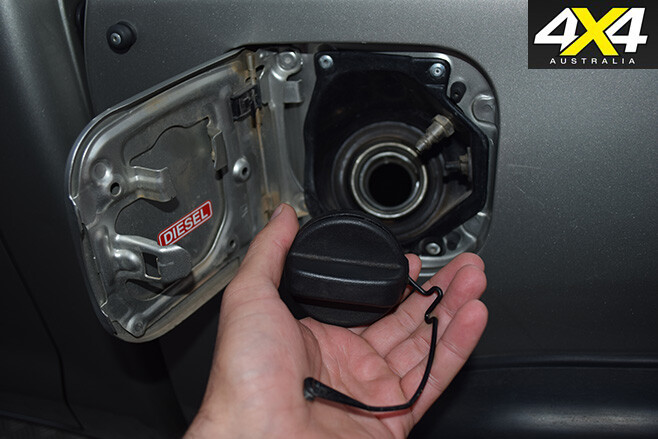
The biggest problem is that petrol is being put into diesel vehicles. That’s because diesel pumps have a 25mm spout (or bigger with high-flow pumps) that are too big for petrol vehicles inlets (most petrol models, by design, have a tank filler inlet which prevents the insertion of a nozzle spout with a diameter bigger than 23.6mm). But, on the flipside, there’s nothing to stop you pushing the petrol pump spout into your diesel inlet.
The risk of mis-fueling becomes real when you’re routinely dealing with multiple vehicles and/or unfamiliar vehicles. With a bit of inattention or distraction, you could soon be looking down the barrel of some costly damage.
If you realise what you’ve done before you start the vehicle, you’ll be up for the price of a tow to the nearest mechanic followed by draining of your fuel tank. This could easily cost $300 or more depending on where you are and how far you need to be towed.
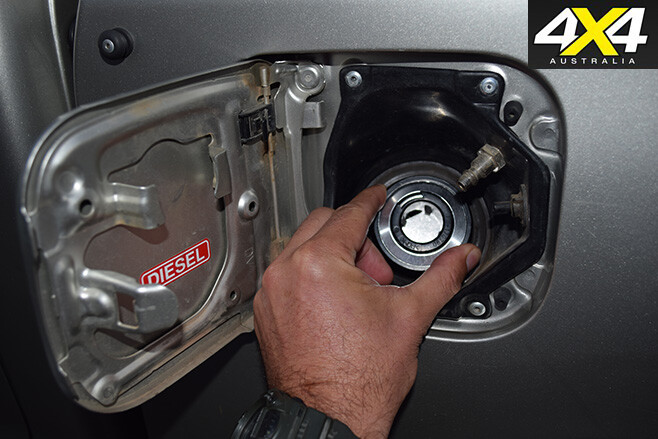
If you start your diesel engine with unleaded fuel in the tank (particularly with modern high pressure common-rail injection systems) you may need to replace your whole fuel system. Drive the vehicle any appreciable distance and it could cost $10,000 or more to repair, depending on your vehicle make/model and for how far you drove it before you noticed your mistake.
That’s why the Diesel Key has been invented. It’s a UK design that’s been available in Europe for some time. It’s just recently come to Australia and it’s distributed by Responsive Engineering Australia and Water Watch. Diesel Key, when correctly fitted, prevents the wrong fuel being accidentally pumped into a diesel fuel system.
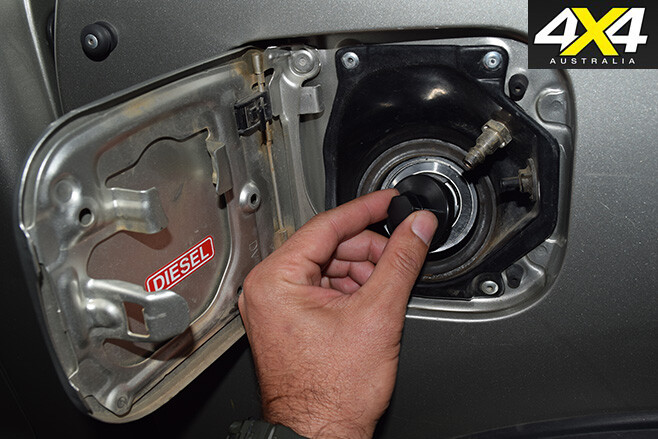
Diesel Key replaces the existing diesel filler cap. The device incorporates a metal plate which acts as a physical barrier to the filler inlet until you put a diesel pump-sized nozzle into it.
When you do this, the nozzle depresses the spring operated flanges around the inlet which allows the barrier to be released (which is also spring-operated to self close) allowing the spout to enter the inlet.
Another advantage is that the Diesel Key stops thieving scum from stealing your fuel if you don’t have a lockable filler cap. They simply won’t be able to get their fuel syphon hoses through the Diesel Key barrier. On the flipside, this could make filling from jerry cans or on-site pumps a problem so a suiatable funnel might need to be used.
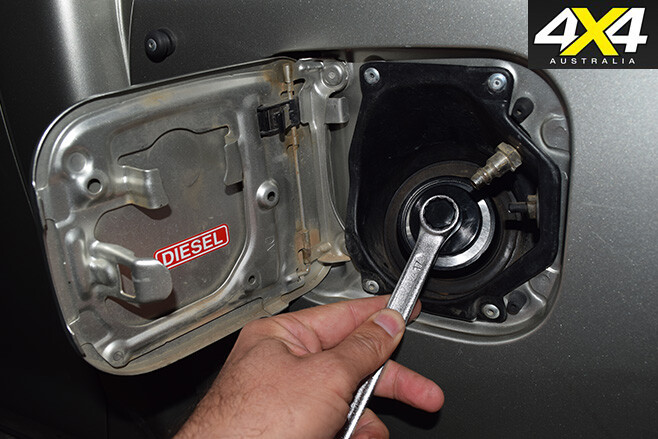
It’s easy to fit and comes in screw thread and bayonet lug models to suit different filler designs.
Diesel Key is designed to fit most vehicles on the market, but it’s best to get in contact with the distributors to confirm if there’s a model to fit yours. Some Range Rovers have factory-fitted anti-mis-fuelling filler necks, while some other 2014 and newer vehicle models already have a nozzle-restrictor fitted. Some others, such as a Jeep Grand Cherokee, don’t have a fuel cap at all on which to mount the Diesel Key.
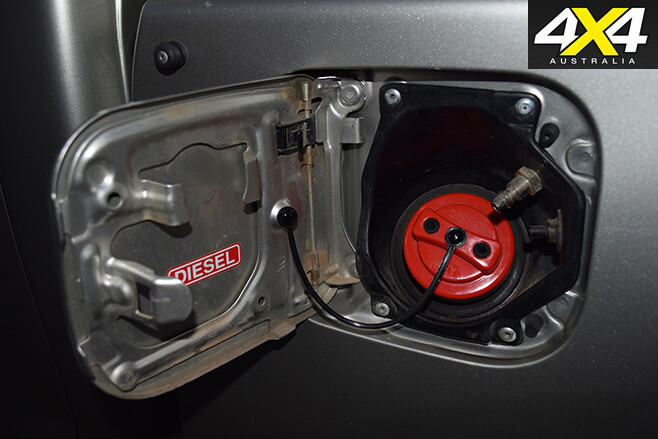
One negative of the Diesel Key that may be a deal-breaker for many diesel drivers is the fact it only suits small-nozzle diesel pumps; this prevents the use of high-flow fuel bowsers so filling takes longer. That can be annoying when you’re regularly filling a vehicle with 180 litres or more of fuel capacity.
For mixed vehicle fleets and vehicles that are driven by different personnel the Diesel Key might be a great idea.
RATED Available from: Responsive Engineering Australia and Water Watch distributors. RRP: $97 from Responsive Engineering website. We say: Easy to fit and effective, but doesn’t allow high-flow fillers.
There’s no shortage of chemical fire lighters on the market. Many of us use them as an easy way to get a fire going when kindling is in short supply. So it’s nice to see something new that actually adds value to a product line that we already use.
The SOL (short for Survive Outdoors Longer) All-Weather Fire Cubes are individually wrapped, have a 10-12 minute burn time, and are windproof and water resistant. The bonus is that the Fire Lite Kit comes with its own SOL Fire Lite Sparker to light the fire cubes, so you don’t even need matches to spark ’em up.
To test the kit, we put an old-school kidney cup full of water (500ml) over one Fire Cube and bubbles formed in five minutes, while water vapour arrived in just 10 minutes. All from one little cube.
It’s about time someone came up with a non-toxic, smokeless and odourless fire lighter that will stay lit in all weather conditions. The kit includes six individually wrapped Fire Cubes, plus the Fire Lite sparker.
RATED We say: Reliable, all-weather and awesome! Cost: $21.95 Available from: www.adventuremedicalkits.com.au
AFTERMARKET companies are cashing in on the Ford Ranger’s rise up the 4×4 sales charts.
In July this year the Ranger was the best-selling 4×4 in Australia, shifting 2357 units (the Toyota Hilux was second with 2311 sales).
And in year-to-date sales Ford has sold 17,623 units, only 172 shy of the Hilux.
To capitalise on its growing popularity, companies are investing dollars and time creating and installation quality aftermarket products to the Ranger.
One such aftermarket mob intent on morphing the Ranger into a go-anywhere tourer is Harrop Engineering.
As you can see in the video, the Melbourne-based company has tweaked this Ford Ranger PXII XLT with a host of aftermarket goodies.
Let’s start with the Uneek chase rack (comprising a base rack, a spare wheel carrier and a roof rack). The base and roof racks are TIG-welded in 6061 aluminium, while the tyre carrier is made from steel.
The Ranger wears a set of Method Race Wheels wrapped in Nitto Trail Grappler rubber.
MCC side steps run along the rig’s flanks, while Rhino 4×4 provides frontal protection in the form of a low-cut bar.
Tough Dog 4WD supplied the springs and shocks, and the suspension package is a cracker.
Harrop has also installed its own ELocker to the front axle, and this works in tandem with the factory Ford rear locker – though it can run independently.
A free-flowing exhaust system and a Unichip Q4 tuning module, fitted by Harrop, ramps up engine performance, with torque jumping from 420Nm to 535Nm and power from 125kW to 157kW.
To learn the full list of additions, and how it performed On a test drive, check out the custom Ford Ranger’s full review.
ROOTHY’S set up his cooking station in an usual location this week.
He’s joined by the crew from Opposite Lock for today’s Bush Cooking adventure… in the Opposite Lock car park.
Why there? Well, the crew is hard at work, tinkering with Roothy’s 4x4s.
Check out a few of Roothy’s other inventions: Scotch eggs, mango chicken and ginger fish.
On the menu this week is a crowd favourite: Kraut dogs.
Firstly, stock up on some regular buns and hot dogs from the supermarket. Just throw the dogs in boiling water for a few minutes.
Put the cooked hot dog in between a bun (or a slice of bread) and cover it in sauerkraut (finely cut, fermented cabbage).
Roothy reckons sauerkraut goes down perfectly with a bottle of German beer.
Sprinkle grated Swiss cheese over the top, and then dress it with some Thousand Island sauce.
The entire OL crew chowed down on Roothy’s Kraut dogs in front of his 60-series… and everyone survived.
It’s a simple meal that takes less than 10 minutes from go-to-whoa.
It definitely re-fuelled the Opposite Lock staff, before they went back to work tinkering with Milo.
Want more recipe ides? Browse our Bush Cooking collection for inspiration.
IT IS IRONIC Holden left so much to General Motors’ international engineering teams with the RG Colorado that arrived in 2012.
After all, this is a company that built its reputation on Australian engineering and know how in building its brand over almost 70 years. And it doesn’t get much more Aussie than a Holden ute – although Holden marketing gurus have now decided it’s a truck, not a ute, but that’s another story.
It seems that was a message not lost on the post-GM-bankruptcy Holden team, one that faced a hard sell with the Colorado that was up against competition that was demonstrably better; think Volkswagen Amarok, Ford Ranger, Mazda BT-50 and Toyota Hilux.
So it was left to more than 100,000km of driving on local roads to re-engineer a car that is unquestionably one of the brand’s most important models. Enter the updated Colorado, a car with a bolder nose but the same basic body and chassis of the RG.
For this test we’ve focused on the dual-cab 4×4 range, which is priced from $44,990 for the basic LS, with its vinyl floors and 16-inch steel wheels. Still, it gets digital radio, Apple CarPlay and Android Auto connectivity, a reversing camera, seven airbags (including a driver’s knee airbag) and cruise control. As with all models, a six-speed manual is standard, with the six-speed auto adding $2200 to the price.
The LT’s brings a carpeted interior, 17-inch alloys and side steps for an extra $2000, while the LTZ (from $50,490) adds 18-inch wheels, auto air-conditioning, rain-sensing wipers, sat-nav and an alloy sports bar, among other goodies.
The flagship L71 is $54,990 and throws in a tonneau cover, roof rails, various black exterior finishes, leather seats and flash Z71 stickers for the bonnet.
DRIVELINE AND CHASSIS THE 2.8-litre four-cylinder Duramax turbo-diesel has no change to its 147kW peak output. The 440Nm mustered by the manual and 500Nm of the auto are also unchanged.
Instead, the engineering efforts have been focused on cleaning emissions and bringing them up to the Euro 5 standards that come into play late in 2016. Holden has also worked on refinement by relocating the balance shafts and changing the fuel injector and oil pan insulators. There’s also a new timing cover said to further reduce noise.
The six-speed manual has had its final drive ratio lowered from 3.73 to 4.10 with the aim of improving acceleration, especially in lower gears. The six-speed auto’s ratios are unchanged, but Holden has changed the torque converter to one with a “centrifugal pendulum absorber”, which allows it to lock up sooner and provide smoother shifts.
No changes to the part-time 4WD system, which allows shift-on-the-fly from 2H to 4H, as well as 4L selected via the rotary dial. There’s no rear diff lock, with Holden instead relying on electronics to maintain traction; those electronics have been tweaked as part of the model update.
The suspension has copped a big update. The steering ratio has been sharpened and a thicker front stabiliser bar fitted, combining with revised dampers to tie it down. The latest Colorado also benefits from a running change introduced in 2015; one leaf from the rear has been removed (for a three-plus-one set-up) and the remaining ones beefed up, so as to maintain the 1000kg-plus payload.
The Colorado still runs on Bridgestone Dueler rubber, but all three sizes (16-, 17- and 18-inch) have been recalibrated for the new suspension tune. Holden also offers an 18-inch Goodyear Wrangler AT tyre as part of an extensive accessories catalogue.
INTERIOR INSIDE is where the Colorado has had its most significant update. The polarising interior design that was previously dominated by a circular cluster of buttons has been dropped for this update. Gone too is the dual glovebox set-up and the dash-top covered container; instead there’s a larger single glovebox and an open binnacle on top of the dash.
It’s a more conventional layout and one that better integrates the key controls and systems with the shapes and contours. The materials and colours are also a big departure, most evident in the instrument cluster which ditches the iridescent blue glow for a more neutral approach with white gauges and red needles. Stitching across the dash is indicative of the efforts to smarten things up, as are the patterned silver air vent surrounds and silver streaks on each front door.
Less impressive are numerous shiny chrome touches that lack the elegance of more modern finishes and somehow seem out of place with the Colorado’s newfound restraint.
As before – and following a trend started with rival Toyota Hilux – there’s a vanity mirror only on the passenger’s side. The main thing that hasn’t changed is the steering wheel, something that still misses out on reach adjustment, instead only being adjustable up and down.
ON-ROAD DESPITE the extensive development program, it only takes a few kilometres behind the wheel of the updated Colorado to realise the newfound local knowledge has gone a long way. The 2.8-litre four-cylinder turbo-diesel is calmer yet quicker, a result of intensive work refining the drivetrain and that new torque converter that better harnesses the substantial 500Nm on offer in automatic models.
Feed on the throttle and it effortlessly taps into that torque, making for relaxed country cruising, often below 2000rpm. The six-speed auto blends nicely into the drivetrain equation, helping make the most out of the engine’s ample mid-range.
Changes to the steering and suspension bring newfound composure to Holden’s workhorse. There’s crisper turn-in and a more consistent feel throughout the arc of a corner, along with less wheel-twirling thanks to the sharper ratio. It’s especially noticeable at high speeds, where the Colorado is more predictable in bends.
It’s backed up by more grip from revised Bridgestone Dueler rubber. The bulk of our running was done on the 18-inch units on the Z71 and LTZ, which did a good job, even on wet bitumen.
It’s not all good news. The new crash warning system chimes in with beeps and flashing red lights when it predicts a rear-ender, but it doesn’t take any evasive action, as with smarter auto braking functions. The lane departure warning is also largely superfluous, beeping annoyingly on B roads to the point where you just switch it off to save your passengers asking what the noise is all about.
OFF-ROAD HOLDEN put most of its work into the on-road manners of the Colorado, with off-road tweaks focused on calibration of the traction control. We drove it into some sloppy mud and up some rocky hills, which it generally handled well – although the traction control allows some wheelspin before sorting things out. The limited slip diff also isn’t as effective as a locking set-up, allowing slip to the point where it can get stuck.
The hill descent control is excellent, though. Once activated, you set your speed by accelerating or braking and it maintains that pace. It’s a simple way to control steep descents and quickly adjust speed accordingly.
Decent ground clearance ensures it clambers over things easily enough and there’s a metal sump guard to take the sting out of light underbody grazes. However, the shielding ahead of the main guard is plastic. So if you’re planning on getting serious, best to opt for the chunkier three-piece accessory bash plate.
[specs] HOLDEN COLORADO DUAL-CAB 4X4 UTE ENGINE: DOHC 16-valve 4-cyl turbo-diesel CAPACITY: 2.8-litre (2776cc) POWER: 147kW @ 3600rpm TORQUE: 440Nm @ 1600-2800rpm (manual); 500Nm @ 2000-2200rpm (auto) GEARBOX: six-speed manual or six-speed auto 4X4 SYSTEM: part-time dual-range CONSTRUCTION: separate chassis FRONT SUSPENSION: independent/coil springs REAR SUSPENSION: live axle/leaf springs WHEEL/TYRE SPEC: 245/70R16; 255/65R17; 265/60R18 GVM: 3150kg PAYLOAD: 1000-1085kg TOWING CAPACITY: 3500kg SEATING CAPACITY: five FUEL TANK CAPACITY: 76 litres ADR FUEL CLAIM: 7.9L/100km (manual), 8.6L/100km (LS auto), 8.7L/100km (LT, LTZ, Z71 auto) PRICE: From $44,990