
Viv uses a pan to re-create a delicious Italian vegetarian dish from Utah – bush style.
Ingredients
- Serves 6
- Pasta (75g-115g per person)
- Cooking oil
- 1 to 2 cups of thickly sliced or quartered mushrooms (depending on how much you like mushrooms)
- 1 1⁄3 cup of Marsala wine
- 1 to 1 1⁄3 cup of thickened cream
- 1/3 cup of beef or chicken stock (I use chicken stock, as its flavour is more subtle)
- Red onion – peeled and cut into small wedges
- Red capsicum – cut lengthwise in half
- Zucchini – sliced lengthwise in half
- Eggplant (optional) – sliced
- Tomatoes (as many Cherry or Roma as you like) – cut large tomatoes
- into quarters
- Salt and pepper, to taste
Instructions
Prepare ingredients first, then roast vegetables in an oven or grill them on a griddle pan or barbecue.
To roast Step 1: Preheat the oven to 200°C. Scatter the vegetables (except tomatoes) in a large roasting pan or camp oven. Drizzle oil over them before seasoning with salt and pepper.
Step 2: Toss vegetables around to make sure they are all coated in a little oil and spread out evenly on the tray.
Step 3: Bake for about 15 minutes, then put in the tomatoes and continue to bake for another 15 minutes or until everything starts to soften and brown, and the skins on the capsicum turn black.
Step 4: To fry: easier still, especially when camping, grill the vegetables on your barbecue until just tender and they have some nice brown charred marks.
Step 5: Peel the charred skin off the capsicum. Cut the vegetables into largish pieces (leave the small tomatoes whole). Set them all aside for later.
Sauce Step 1: Heat a little oil in a large pan, add the sliced mushrooms and sauté them until tender (about 3 minutes).
Step 2: Add the Marsala wine and bring to a boil. Boil for 2 to 4 minutes and then stir in the cream and stock. Season to taste and simmer for a few minutes or until heated through.
Step 3: Add the prepared roasted or grilled vegetables and simmer for a few minutes until everything is hot. Add the hot-cooked pasta to the Marsala-vegetable mixture and stir to combine, or spoon the pasta into a bowl, and top with the Marsala-vegetable mixture and serve.
Fried pasta For campers, this is a great tip, as you don’t have to wait for the water to boil before adding the pasta, which saves time and water.
Step 1: Put the pasta in a large pan or similar (I used spaghetti). Put about 6 cups or more of cold water and a good pinch of salt into the pan and turn the heat to high. The pasta should be covered with about 50mm of water. Because the pasta is cold, it shouldn’t stick to itself at the beginning.
Step 2: Spread the pasta apart and bring the water to the boil, then reduce the heat to high-medium and cook until the pasta is al dente (about 10 mins or the usual cooking time).
From the start, I lifted and separated the pasta, using tongs and stirred it occasionally while cooking.
Viv’s hints
Use any vegetables you prefer. Prepare them before you leave home. To make things even easier when camping, instead of roasting the vegetables, you can use semi-dried tomatoes and ready-made roasted red capsicum, eggplant and zucchini from a jar or your deli. I have to say, though, that fresh, grilled vegetables have a better flavour and texture.
Use your favourite ravioli (such as chicken and mushroom filling) instead of pasta. Add some cooked chicken pieces. Add a sprinkle of dried thyme and stir through – not too much or it will take over. Add some freshly chopped red chilli (or dried chilli flakes) if you want a bit more zing.
Sprinkle with some chopped spring onion just before serving.
Some things go hand in hand, like a pie and sauce, bacon and eggs or Bundy and Coke – both as bad as each other.
In the world of 4×4 travels, that magical combination has to be Toyota Troop Carrier and outback adventure. I mean, is there a better vehicle for solo or two-up adventure touring in this big country?
The long-wheelbase two-door LandCruiser wagons were introduced back in the early ’60s and, while they weren’t called Troop Carriers back then, they have been reliably transporting adventurous folks around Australia – and indeed the globe – ever since.
My earliest memory of 4×4 adventure was in an FJ45 Troopy back in the early ’80s when, on a family holiday, we ventured out on a day-trip tour along Rainbow Beach on Queensland’s Sunshine Coast. I was only young, but that 11-seat mustard truck left an impression of the amazing places it took us to once we left the bitumen behind.
Now, more than 50 years since the early Troopies appeared, they are still available and are still the chosen vehicle for many travellers. The key to their popularity is their versatility.
With just two or three seats up front they are left with a long, tall cargo area that’s spacious enough to be configured into your perfect expedition camper.
Pull up and chat to a Troopy Traveller on the tracks and you’ll be amazed at what they pack in the back of their trucks.
Everything – including the kitchen sink – plus the fridge, storage cabinets, fishing rods, surf boards and a bed. And that’s even without those who have the added space of a pop-top conversion for more headroom.
You won’t find a better source of Troopy information or a better selection of well kitted-out Troopies than among the members of the Troop Carriers of Australia group on Facebook.
With around 3500 members at the time of writing, the TOA group is booming, and our own Troopy-owning Mark Allen joined 150 other members on their annual Winter Ramble this month. Check out the feature, as they look like an interesting group to tag along with.
While the TOA might be impressive as a group, one standout rig among its members is Billy McKinnon’s Troopy, also featured in this issue – an immaculate FJ45 body riding on an 80-Series Cruiser chassis with a turbocharged V8 engine transplanted under the bonnet.
Now that’s my kind of hybrid vehicle. Forget all that Prius crap, Mr Toyota!
For more Troop Carrier info read the full range Toyota LandCruiser 70 Series Review.
Or if you’re in the market for a unique Toyota LandCruiser check them out here.
4×4 Australia review
WHAT’S THE DEAL?
The Wildtrak is the most expensive Ranger going – and one of the most expensive utes on the market.
All come with the 3.2-litre five-cylinder turbo-diesel, with the manual version costing $57,890, plus on-road costs, while the auto ramps that up to $60,090.
But there’s plenty thrown in for the money; dual-zone ventilation, heated front seats, satellite-navigation, 18-inch alloy wheels and a tow bar. There’s also unique seats trimmed in a mix of coloured material and leather, as well as myriad other aesthetic tweaks that include a grey sports bar and a grey grille.
Plus it’s the only Ranger (for now) with a standard reversing camera, complete with a centre guide to help align the tow bar. Notably absent are smart key entry and push-button start; something increasingly common in more affordable SUVs.
Those wanting more can choose the Tech Pack ($600) which adds active cruise control, lane departure warning and forward collision warning.
PRACTICALITY
The Ranger’s interior is one of the more spacious of the dual-cab utes, with good rear seat space and a comfortable pair of front seats. Storage areas are good, too, with a covered centre console and an overhead compartment for sunglasses.
The tray, too, is a relatively deep and well-proportioned, with a rugged ribbed plastic tray liner. The roller shutter tonneau cover is simple to use and a great idea, but there is a downside: the compartment it rolls in to takes up a bit of space towards the front of the tray. So fitting a push bike in, for example, could require the removal of its front wheel. You can temporarily remove the whole retractable unit (many Wildtrak drivers do) and maximise tray space without the fancy cover.
ON THE ROAD
It’s all about tweaks with the PX Mark II Ranger. The basic chassis is unchanged, but suspension has been tweaked for improved ride comfort. Unladen there’s still some of the characteristic ute bouncing over large bumps, but it’s generally well-controlled. And a few people on board can quell it further. It’s also relatively quiet, too, making for comfortable long-distance progress.
There’s also a new electric power steering system that replaces the hydraulic system still used in the BT-50. It’s light and accurate yet maintains a respectable level of feedback to ensure the Ranger drives well. Ford has also tweaked the suspension of the Ranger. And while it doesn’t have the plushness of a Volkswagen Amarok with the optional comfort suspension set-up (it does without a leaf in each of the rear packs), it’s an excellent blend of control and comfort. Plus the Ranger is respectably quiet for a ute.
Under the bonnet, the engine doesn’t initially look any different: it still produces 147kW and a stout 470Nm. But refinement is a big part of the story, with an improved fuel injection system quietening things down. The turbocharger is also slightly smaller, so it spins up quicker for better performance. Throw in tweaks to the auto transmission shift points and it makes for a responsive and grunty truck.
OFF-ROAD
Nothing has changed on the 4×4 front with the Mark II Ranger. It has the same 237mm of ground clearance and same part-time four-wheel drive system. Plus it can wade through up to 800mm of water, which is excellent for those not fussed with fitting a snorkel.
The Ranger does without the electronic smarts of its SUV sibling, the Everest – that car has an on-demand four-wheel drive system with a Terrain Management System, which adjusts the traction control and throttle response to various conditions (sand, snow/gravel/grass and rock). For the Ranger Wildtrak it’s a part-time system with low range. There’s also a locking rear diff to improve traction. It all works fine in most conditions, albeit without the ability to drive all four wheels on bitumen.
However, there are some challenges with the Wildtrak. The side skirts that add to that visual toughness hang quite low and are prone to scraping over more challenging obstacles. The departure angle, too, is significantly reduced due to the tow bar; the cheaper Ranger XLT has a 27 degree departure angle whereas the Wildtrak has only 21 degrees. Up front, too, the lower black plastic chin can scuff on things, but it’s fairly flexible so copes with the punishment.
Tow capacity equals the best in class, claimed to be 3500kg.
VERDICT
It’s not cheap, but there’s a lot to like about the Ranger Wildtrak. The diesel engine is a muscular unit and one that’s stepped up with the tweaks for this Mark II version. And the blend between off-road ability and on-road friendliness is fantastic.
And, for a lot of people, the fact it looks the business will be enough.
Yet, for many, a lesser model may make sense. The XLT, for example, brings all the hardware but with less of the fizz – and for less money. If only Ford would fit a reversing camera to those models.
Price and specifications Price: $60,090 Engine: 3.2-litre inline five-cylinder turbo diesel Max Power: 147kW at 3000rpm Max Torque: 470Nm at 1750-2500rpm Transmission and 4WD system: Part-time 4WD with low range transfer case Braked tow capacity: 3500kg Fuel tank: 80 litres Fuel use (claimed): 9.0L/100km Fuel use on test: 11.4L/100km Approach/departure angles: 29°/21° Ground clearance: 237mm
Second opinion: WhichCar review

WhichCar cuts through the new car jargon to deliver honest, easy-to-understand and authentic advice to help you buy a better, smarter, safer new car.
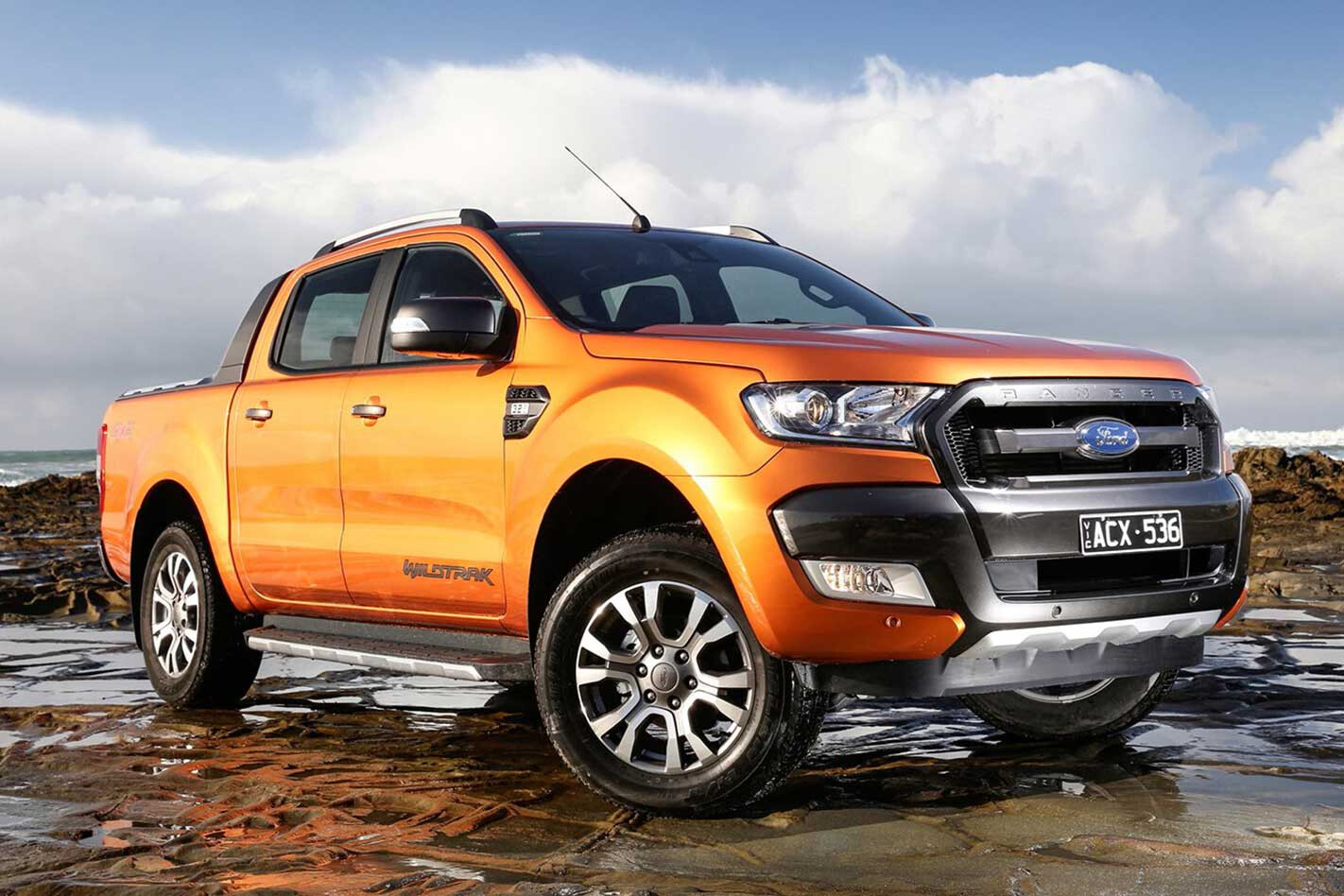
Sitting at the top of Ford’s dual-cab range, the Ranger Wildtrak blends high levels of equipment and safety tech with a stronger focus on luxury and comfort, while retaining the Ranger’s impressive off-road ability.
By: Alex Inwood
TELL ME ABOUT THIS CAR
Australia’s love affair with the ute has changed. Where we once turned to two-door versions of the Ford Falcon and Holden Commodore, today’s ute of choice is the dual-cab pickup. Demand for these more versatile utes is booming, and not just for tradies – a stronger focus on comfort, luxury and safety has seen pickups morph from rough-and-tumble workhorses into the primary family car for many Aussie families. Case in point is the Ford Ranger Wildtrak tested here, which sits at the top of Ford’s ute range thanks to unique styling upgrades, boosted equipment levels and a circa-$60K price tag.
STRENGTHS
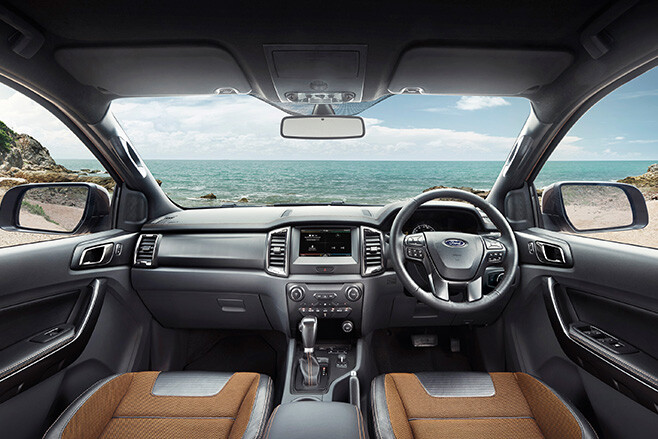
- Unique styling. Wildtrak versions of the Ranger score different bumpers for a more muscular appearance, plus 18-inch alloy wheels, sidesteps and Wildtrak badging. Inside the cabin feels more passenger car than stripped back work ute thanks to comfortable (and heated!) cloth seats that score lashings of leather, a larger 8.0-inch central touch screen and a new instrument cluster with customisable screens either side of the speedometer.
- There’s plenty of equipment too. Ranger was one of the first utes in its class to offer advanced safety systems like adaptive cruise control, forward collision warning and a lane departure warning system as part of an optional tech pack. A reversing camera is also standard, as are parking sensors front and rear, plus a lockable hard cover for the tray and multiple USB and 12-Volt ports.
- It’s decently refined. Ford has added more sound insulation to the Wildtrak and worked hard to ensure it feels just as comfortable on suburban streets as it does on the worksite. And while it can sound gruff and utilitarian at low speed, the Wildtrak is impressively quiet on the freeway.
- The handling is impressive too. The Ranger’s smooth electric steering, which is light while parking but firms up at speed, is one of the best in its class. And the 3.2-litre five-cylinder diesel engine is strong and powerful enough for easy overtakes. Sure, it’s no sportscar but the Ranger’s handling is predictable and the suspension does a decent job of soaking up bumps.
- It’s capable off-road thanks to standard low-range gearing, a lockable rear-differential, hill-descent control and an 800mm wading depth, which is one of the best in this class.
WEAKNESSES
- Cost. At $60,090 for six-speed automatic version, the Ford Ranger Wildtrak is one of Australia’s most expensive utes. We’d strongly recommend considering the Ranger XLT, which scores most of the Wildtrak’s equipment upgrades and 3.2-litre diesel for a lower sticker price.
- While the refinement is good for this class, the Ranger isn’t as polished as a conventional SUV or station wagon, especially in city traffic where the diesel engine is noisy. The ride can also be fidgety and unsettled without a load in the back.
- Size. In the city there’s no escaping that the Wildtrak is a big and heavy car, which can make parking tricky.
In terms of styling upgrades, only the Holden Colorado Z71 matches the Wildtrak for visual bling. Other utes to consider are the Toyota Hilux SR5, which while not a direct competitor in terms of spec, is one of the best-selling nameplates in this class. The Volkswagen Amarok Ultimate is also a worthy rival, and trumps the Wildtrak for interior polish, handling and overall refinement.
Click here to read the full review on the Ford Ranger range.
Time-travel back to late 1990, if you will. Here in Australia, Toyota’s brand new 80 Series Land Cruiser was selling like hotcakes, as was Nissan’s still relatively recent GQ Patrol.
Down the road at the Land Rover dealership, things weren’t so rosy. If you wanted a utilitarian workhorse 4×4, you could buy a 110 County wagon with either a 3.5-litre petrol V8 or a naturally aspirated 3.9-litre four-cylinder (Isuzu) diesel. Or you could go upmarket and buy a luxurious and expensive Range Rover. But if you wanted something in-between, in the form of an affordable family 4×4, then Land Rover had nothing for you.
Making matters worse for Land Rover dealers of the day was that both the 110 and the Range Rover were never going to be volume sellers. But things were to change, and change big time. In the UK in late 1989 Land Rover had rolled out the ‘all new’ Discovery, its first new model in 19 years. Demo models arrived in Australia in late 1990 for an on-sale date of March 1991.
To say the Discovery was ‘all new’ is however a misnomer. Yes, the stepped roofline body and the airy, modern interior were new, but underneath the Discovery the mechanics were effectively the same as the Range Rover of the day, engine capacity and other details aside.
Initially available only as a modestly equipped three-door five-speed manual and only with a 3.5-litre petrol V8, the Discovery was nevertheless an instant success. The secret was the pricing. Here in Australia it was actually cheaper than a 110 County by a smidge ($41,995 versus $42,900) and under two-thirds the price of a Range Rover, which at that time with its 3.9-litre V8 started at $67,410.
Despite being a three-door, the Discovery still seated seven with roomy, inward-facing rear seats easily accessible via the rear door, while the broadness of the on- and off-road performance spectrum was every bit as good as you would expect from something that shared so much with the Range Rover.
More variants soon followed. Late that year came the five-door V8 and the following year the five-door 2.5-litre (200 Tdi) diesel. An optional four-speed automatic for the V8 and a three-door diesel soon joined the range. In 1993 the 3.5 V8 was replaced by the 3.9 V8, the move accompanied by revised suspension now fitted with sway bars, which were considered by some to be a backwards step as they compromised the oh-so-supple ride, previously a Discovery highlight.
As the model range expanded, the ancillary equipment also became more sophisticated and extensive – a move often unfortunately matched by a deterioration in build quality.
In 1999 the Series 2 Discovery appeared. Although still essentially based on the same platform, the minimal styling changes hid far more significant mechanical and interior differences. In the cabin, the inward-facing third-row seats were replaced with conventional front-facing seats, while a new diesel engine, the five-cylinder Td5, was introduced.
More noteworthy than these changes though was the introduction of electronic traction control (ETC), and so confident were Land Rover’s engineers of its ‘magical’ properties that the lock for the centre diff was deleted. In fact the lock remained in the transfer case, but the lever was deleted, a move that was subsequently reversed as the traction control always struggled to contain both the cross-axle and inter-axle wheelspin. And, in a sign of the new level of sophistication to come, active self-adjusting suspension (ACE, in Land Rover-speak) was also introduced.
Despite its quality-control problems and the extensive evolution of what was a very old platform not really reaping commensurate reward, the original Discovery and the Series 2 remake established the Discovery name. And even better things were just around the corner.
Ford’s purchase of Land Rover from BMW in 2000 was behind the second milestone in the model’s evolution: the Discovery 3. Make no mistake, if it wasn’t for the massive injection of Ford cash, the Discovery 3 would never have happened. It first broke cover in 2004 and went on sale in Australia in early 2005.
In designing and developing the Discovery 3, Land Rover’s engineers left no stone unturned and the D3 owed absolutely nothing to the original Discovery, or the Discovery 2. It was completely different, not only in the nuts and bolts, but in the whole design philosophy. It would prove to be a watershed vehicle, and not just for Land Rover.
The D3 featured three key technologies that separated it from its predecessors. Most importantly, it swapped front and rear live axles for a fully independent suspension with optional height-adjustable air springs. It also introduced integrated and interconnected electronic control for the powertrain and the chassis, which allowed the driver to ‘tune’ the vehicle for different driving environments. This was Land Rover’s revolutionary ‘Terrain Response’ system.
The ultra-modern Jaguar-sourced 4.4-litre 32-valve quad-cam V8 was also a huge leap forward from the old pushrod V8s used previously, but the star of the new powertrain line-up was the 2.7-litre V6 turbodiesel coupled to a slick six-speed ZF automatic. This was Australia’s first taste of a modern, high-tech European turbodiesel in an affordable family 4×4. This was just the beginning.
The Discovery 3 was clever, capable, practical, and a joy to drive both on and off the road, with truly astonishing breadth and depth of ability. In all regards, it was light years ahead of the old Discovery and set a benchmark in 4×4 design still relevant to this day.
Proof of the Discovery 3’s brilliance came with the Discovery 4 that appeared in Australia late in 2009. Despite the five or so years that had passed since the D3 launch, Land Rover needed to do little to turn the D3 into the D4 and keep it thoroughly modern. In fact, aside from the introduction of a new 3.0-litre V6 bi-turbo diesel and 5.0-litre petrol V8, the changes were little more than skin deep.
However, one negative came with the bigger brakes fitted to the new 3.0-litre diesel and the associated compromise of low-profile tyres on the 19-inch wheels needed to clear the bigger brakes. That problem was further compounded when the 2.7-litre V6 diesel and the smaller brake package were dropped with the introduction of the new ‘low-power’ 3.0-litre V6 bi-turbo diesel and eight-speed ZF autos for the 2013 model year.
Despite its fair share of problems along the way, there’s no doubt the Discovery saved Land Rover from almost certain extinction. What started as little more than a new body on an old Range Rover platform has now become Land Rover’s defining model.
TO CELEBRATE its 40th anniversary, ARB 4X4 Accessories will take four of the most iconic four-wheel drives from the past 40 years on an epic expedition across the Simpson Desert.
The four rigs chosen to participate in ARB’s Off Road Icons Trip: A Journey of 4×4 Celebration will be the Toyota 40 Series, Nissan GQ Patrol, fifth-gen Toyota Hilux and Land Rover Defender.
The 11-day, 2500km journey will also involve a few modern-day 4x4s, staff, support crew and seven journalists from around the world.
4X4 Australia has been lucky enough to receive one of these invitations to participate in the desert adventure, so be sure to keep an eye out for our complete coverage of the event in the mag!
Sam Boden, ARB’s marketing communication manager, said the event provides a way for ARB to celebrate its 40th birthday and at the same time showcase the products it still manufactures for early-model 4x4s.
“We wanted to generate some nostalgia for the iconic older vehicles that gave birth to the adventurous off-road lifestyle that so many of us enjoy today, as well as highlight how far we’ve come in regards to innovation, engineering and state-of-the-art manufacturing in order to keep pace with modern vehicle design and technology,” Sam said.
Trip planner Mark Lowry added: “We’ve had some great work performed by our ARB staff from around Australia in getting these cars ready. Each car is fitted with genuine ARB accessories that are still manufactured today to support the huge number of retro vehicles still servicing their owners.”
The route will take the convoy through iconic outback locations including the Old Ghan Railway, Mount Dare, Dalhousie Springs, Poeppel Corner, Birdsville, Cordillo Downs, Innamincka, and Cameron Corner.
ARB’s Off Road Icons Trip: A Journey of 4×4 Celebration begins in Alice Springs on September 13.
It will conclude at Eldee Station on September 23, coinciding with the opening stages of the 2016 Outback Challenge.
Keep an eye on 4×4 Australia’s website during the event for up-to-date pics and info!
For a snapshot of how the British motor industry has grown, look no further than the range offered by Land Rover in 1989, just before the Discovery was launched.
Back then, dealers had just two products to sell: the farmer-friendly Land Rover Defender and the swanky Range Rover, the pair positioned so far apart as to be almost comical.
Things couldn’t stay like that, and they didn’t. The gap has been filled over the years and, truth be told, the whole move began with the launch of the Discovery, which has since sold more than a million copies.
In 1989 an air of expectation surrounded Land Rover as spy pictures gave fuzzy details of a mysterious new ‘leisure’ model codenamed Project Jay. Launching a third model seemed a bold step for a company still recovering from the upheaval of nationalisation (1975) and privatisation (1988), but in world terms Land Rover was years behind the game.
The Japanese, who understood world markets better than anyone, had been expanding sales of their Pajeros, Patrols, LandCruisers and Rockys. Partly because of these, and helped by a growing US vogue for lifestyle 4x4s such as the Ford Bronco and Chevy Blazer, a demand for softer off-roaders was growing in Europe. Between 1983 and 1988, sales of 4x4s expanded from 80,000 to 200,000. The figures look paltry now, but they disguised a four-fold increase in demand for leisure off-roaders, and by the mid-1980s even the preoccupied management of Land Rover had spotted the trend.
That word ‘even’ isn’t intended to denigrate those in charge at the time. It’s just that within the nationalised environment, things took years longer than they should have. It had taken 10 years for the original Range Rover to be made as a four-door and 16 for it to be launched in the US.
There were other distractions, too. Even as the Discovery project was starting in 1986, hundreds of Land Rover stalwarts were protesting a plan espoused by Mrs Thatcher to sell Land Rover to GM (they occupied Hyde Park as a protest and were so effective that Number 10 did a deal with British Aerospace instead).
What we didn’t know then was the extent to which the Discovery would change life at Land Rover. Against the glacial timetables of previous projects, it went with amazing speed. Led by Mike Donovan, the company decided a fast-to-market leisure model would need to use existing hardware and know-how, so it settled on Range Rover underpinnings.
From then on, the Discovery was created in record time, using procedures previously unseen at Solihull but still in use today. “The Discovery was our first entry into a project team environment,” John Bragg, head of engineering at the time, says. “It was far more efficient than anything we’d done before. One of our bosses referred to us as the paperless society, because team members carried much detail in their heads. If someone had left at the time, we’d have been in all sorts of trouble.”
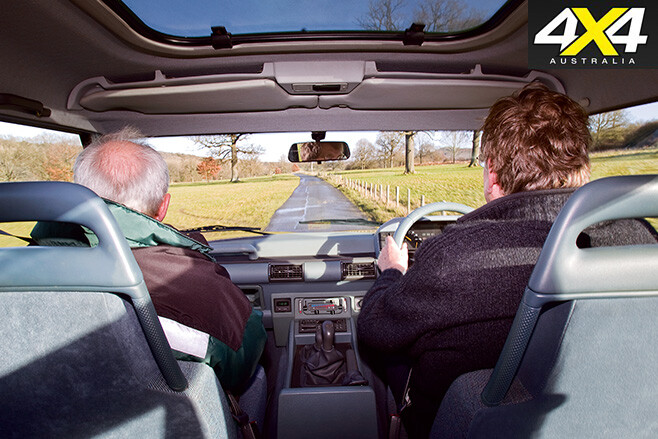
Only now, looking back over the Discovery 1’s nine-year life from a decent distance, is its essential ‘rightness’ visible. This is what we were doing one sunny morning at Eastnor Castle, near Ledbury (UK), the magnificent country estate on which the off-road abilities of every Land Rover since 1970 have been developed. Irrepressible heritage expert Roger Crathorne, a 50-year company man, had brought one of each of the four Discovery models and we were to be treated to a ramble through the model’s history.
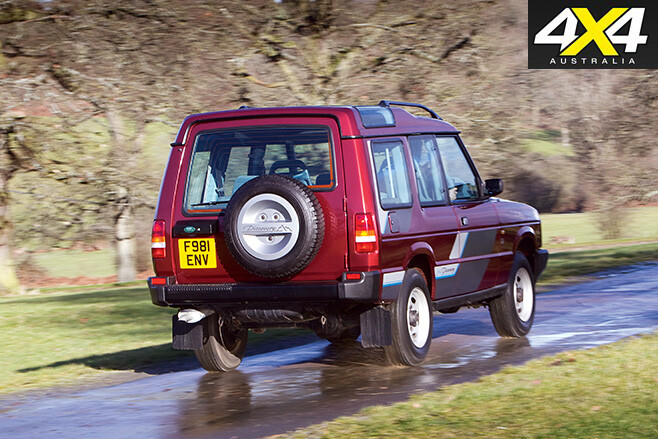
We started our exercise with a fine Discovery 1. Not just any example, either, but the first saleable unit: a highly prized 2.5 Tdi 200 diesel from the company’s heritage collection that has done only a handful of miles and is in better-than-new condition.
I remember plenty about this model’s launch, having been among the pressing crowds that watched its unveiling at the Birmingham Motor Show in 1989. The company had also revealed it in Frankfurt a few weeks earlier – in a bold attempt to underscore its challenge to international rivals – but this was very definitely the main event. We might have been dismayed that the vehicle they unveiled was a two-door (or three-door, if you counted the single side-opening rear door), given the 10-year gestation of the four-door Range Rover. But Land Rover had already revealed that a four-door Discovery was less than a year away.
To inject some drama and shroud the pragmatic decision to use Range Rover running gear, bosses engaged product designer Jasper Conran to create a new interior, a move that drove the public’s imagination. Not all of Conran’s innovations made production (he visualised, for example, a sunglasses holder in the steering wheel boss), but features such as the then-adventurous grey-blue upholstery and a holdall that zipped into the car’s console made positive headlines.
The exterior designers also excelled. Although the dimensions, weight, chassis, coil suspension and steel inner body structure (beneath aluminium outer panels) were all close to the Range Rover, the Discovery had its own identity – a major achievement given the pair shared the same scuttle and windscreen. But the Discovery’s two-level roof, with revolutionary skylights, gave it a character that has driven its styling since.
On the outside, decals were the thing. Land Rover used them to simply modernise and make the difference between its new model and the more tasteful Range Rover, although they didn’t last long. The customers just didn’t like them.
Even now, it’s the drive that impresses. Our early model’s meaty 83kW turbodiesel had a rattle about its idle that always seemed reassuring and remains so today. Plug the short gear-lever into first and the memory of rifle-bolt shifts flood immediately back, along with the sure stroke of a long-throw clutch. The Discovery strolls away from rest and over Eastnor’s bumps with a low rate gait that is ridiculously pleasant as long as you don’t hurry, although these days, suspension designers would probably want to tame it with more powerful damping.
There are more major surprises. One is a fuel tank capacity of nearly 90 litres, which allows even this somewhat old-tech diesel to do 960km between fills, something that always underscored the expedition readiness the Discovery’s name implies. Another is the glassy, low-waisted character of the cabin and the exemplary space.
The two-door Discovery 1 has short front doors that makes access to its rear quite difficult by modern standards, but once passengers are installed they find the rear compartment’s room and comfort impressive – more impressive, in fact, than the Discovery 2, which arrived in 1998 and had its middle row squeezed forward to make space for a pair of forward-facing seats at the very back.
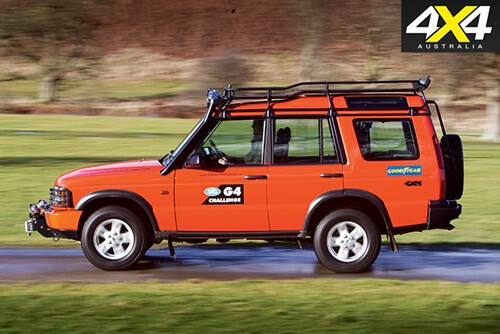
We move on to the Discovery 2, a specially loaded version configured for Land Rover’s former global torture test, the G4 Challenge. Roger Crathorne rides along, but he isn’t struck on the 2, what with its cramped rear and an extended rear overhang that hampers serious off-roading.
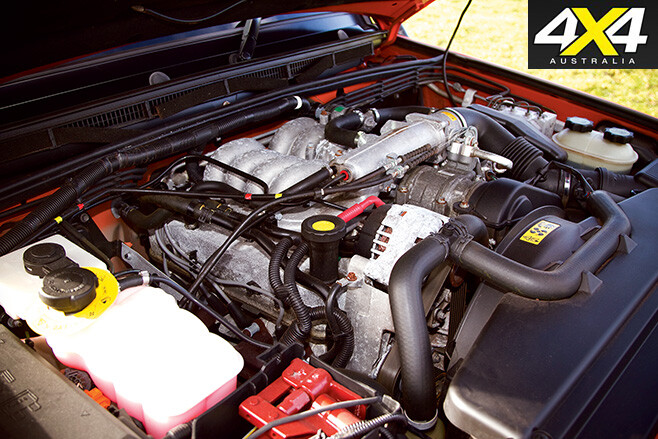
Still, this is a beguiling edition: a five-door V8 auto, nose-heavy in comparison with the four-cylinder 2.5 Tdi but superbly torquey and smooth, with a sedate burble curling up to your ears. With a four-speed automatic, it’s luxurious but sedate. And thirsty; this is the version that made the Discovery’s big tank a necessity.
Diesel and economy lovers could by now choose the 2.5-litre, 101kW five-cylinder Td5 diesel, whose 300Nm at under 2000rpm is its main event. This unusual engine is just as durable as the rest, says Crathorne, but depends more than earlier engines on electronics for correct functioning. This is inclined to deter those who use Discoveries to cross trackless wastes and expect to mend out-of-sorts engines with hammers and screwdrivers.
Forgive me if I don’t dwell on driving the Discovery 3 and Discovery 4. This is not to imply a lack of love or respect; the reverse is true. It’s just that these are modern vehicles about which we’ve written enormous tracts in recent years. Too many people have said too many times that Discoveries 3 and 4 are essential utility vehicles for any other conclusion to be contemplated.
These two introduced V6 diesels of increasing brilliance and frugality – first a 2.7 and then a 3.0 – and lots of electronics to find traction where the naked eye would swear there was none. However, the styling is the thing for me. The Discovery 3’s lead designer was a bloke called Andy Wheel, and from the first day his work was revealed at the end of 2003, I’ve admired its gracious, neatly chiselled lines above any other SUV.
Which is why, to this day, assessing capability against cost, the Discovery 3 is my favourite of the four. Back in 2005 I ran a long-termer for 40,000km and had very serious designs on buying it. Our activities included a tough expedition in Iceland that it survived without acquiring so much as a nick in an alloy wheel.
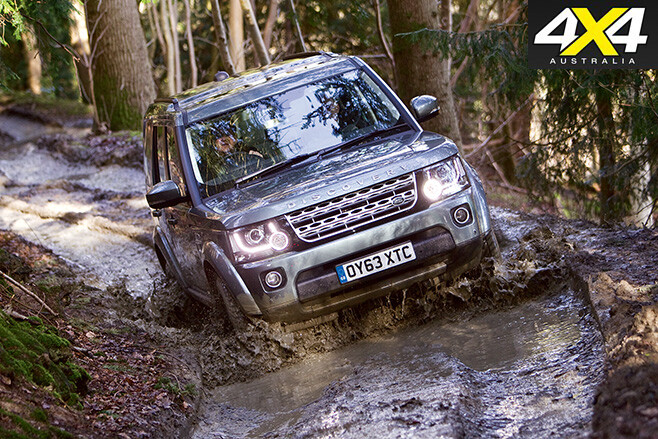
Naturally it had to be shipped back from Iceland, and I was looking forward to its arrival one morning – and to negotiate a buying price – when the phone rang and it was the man from Land Rover. “Your Discovery won’t be back, I’m afraid,” he said rather bluntly. “There was fog on the M1 last night. The transporter jack-knifed and your car fell off the top deck.”
The pain took me by surprise. A member of the family had gone without warning. The Missus, who loved that car, was upset for a week. Other Discoveries were offered, but it wasn’t the same.
THE FIRST official shots of the highly anticipated fifth-generation Land Rover Discovery have landed.
The release of the official pics follows hot on the heels of the leaked spy shots that surfaced on the ’net late in August.
The new design loses the very boxy, upright lines of its predecessor and instead more closely resembles a Discovery Sport.
The new Discovery will replace JLR’s 2009-2016 version, which in August still managed to shift 258 units in Australia (2013 units to date this year).
The standard petrol- and diesel-powered drivetrains will be used internationally, but it remains unclear whether Australia will receive the petrol engine.
Just like the 2017 Range Rover Sport, the new Discovery will also adopt the four-cylinder diesel engine from JLR’s new Ingenium engine range.
The 2.0L-capacity donk claims a respectable 177kW and 500Nm.
Bonded and riveted aluminium panels will allow the new Disco to drop some kilograms, but this will also improve its strength and rigidity.
Land Rover’s chief design officer Gerry McGovern said in a statement: “[The] new Discovery redefines the large SUV. Land Rover’s design and engineering teams have revolutionised the Discovery DNA to create a highly desirable, extremely versatile and hugely capable premium SUV.”
The new Discovery will make its world premiere on September 28, 2016, ahead of the Paris Motor Show.
Australian pricing is yet to be released, but expect the range to start from about $70,000.
The fifth-gen Land Rover Discovery is estimated for a mid-2017 local launch – at the earliest.
Stay tuned to 4×4 Australia for all the in-depth details of the new Discovery, as soon as more news drops!
THE Toyota Hilux has regained its position atop the monthly sales charts.
According to the latest VFACTS report released today, Toyota sold 2418 Hilux 4x4s in August.
With Ford shifting 2364 Rangers, this means Toyota has extended its lead in year-to-date sales.
It has been a tight tussle between the enduring Hilux and the challenging Ranger this year, but the Hilux may have done enough to remain 2016’s best-selling 4×4.
The ’Lux cracked the 20,000 mark in August, with a year-to-date figure of 20,213. Ford has shifted 226 fewer units, with a year-to-date total of 19,987.
Rounding out the top five on the 4×4 sales charts for August are the Holden Colorado (1503), Toyota LandCruiser wagon (1350) and Toyota Prado (1328).
Overall, the Light Commercial Vehicle market continues to grow. When compared to the same month last year, the LCV market is up by 16.2 per cent (with 2330 more LCVs sold).
“Australians purchased 94,909 new motor vehicles in August 2016, led by strong demand for SUVs and Light Commercials,” FCAI chief executive Tony Weber said. “Demand for SUVs and Light Commercials continues to drive the market, with both these segments increasing sales by over 10 per cent compared to August 2015.”
Passenger cars still dominate the overall market, but there’s an obvious trend toward the larger rigs.
Mr Weber added: “With Light Commercials, the current market share year-to-date is 18.7 per cent compared to 17.4 per cent in 2015.”
Including 4×4 and 4×2 variants, both the Hilux and Ranger reside in the top three in the overall car market, trailing only the Toyota Camry.
| u00a0 | 4×4 | AUGUST ’16 | JULY ’16 | YTD |
| 1 | TOYOTA HILUX | 2418 | 2311 | 20213 |
| 2 | FORD RANGER | 2364 | 2357 | 19987 |
| 3 | HOLDEN COLORADO | 1503 | 1457 | 11357 |
| 4 | TOYOTA LANDCRUISER WAGON | 1350 | 1214 | 7892 |
| 5 | TOYOTA PRADO | 1328 | 1248 | 10156 |
| 6 | NISSAN NAVARA | 1101 | 1380 | 9704 |
| 7 | MITSUBISHI TRITON | 1010 | 940 | 12054 |
| 8 | ISUZU D-MAX | 730 | 926 | 7120 |
| 9 | TOYOTA LANDCRUISER PU/CC | 695 | 555 | 4748 |
| 10 | MITSUBISHI PAJERO SPORT | 669 | 648 | 3881 |
GM HOLDEN has issued a recall for its RG Colorado and Colorado 7 due to a safety flaw.
According to the recall report, “the bolt that holds the front seatbelt retractor into the body of the vehicle may not have been correctly tightened during manufacture”.
The issue with the bolt has the potential to cause serious harm to occupants of the vehicle if it’s involved in an accident.
The affected vehicles are: RG Colorado 7 (seven-seat SUV), RG Colorado Crew Cab (five-seat utility), RG Colorado Space Cab (four-seat utility), and RG Colorado Single Cab (two-seat utility).
The Vehicle Identification Numbers (VIN) of affected vehicles range from MMU145DK0FH615256 to MMU148LK0FH624321, with production dates from January 12, 2015 to March 18, 2015.
Holden will contact affected customers in the near future to notify them of the necessary steps to take. However, any Colorado owners unsure whether their vehicle is affected can contact Holden’s customer help line on 1800 632 826.
The latest recall follows another that GM-H issued in early July for MY16 RG Colorado seven-seaters produced between October 10, 2015 and June 1, 2016.
The fault back then involved a defective recliner mechanism; when the second-row seats were placed in the upright position, there was a chance that the seat wouldn’t click into position.
Holden shifted 1503 Colorados in August, a month-to-month increase of 46; in July it sold 1457 units.
Overall, Holden has shifted 11,357 Colorados on the year-to-date sales charts.
JUST weeks after we announced Glenn Kelly from Perth as the winner of the 4X4 Australia giveaway Project Hilux, the one-of-a-kind tourer has been put up for sale on Gumtree.
The Hilux, valued at $55,000, was listed on Gumtree with a bargain sale price of $40,000 (negotiable).
“It is with deepest regret that I will be advertising the vehicle for sale,” Glenn told 4X4 Australia. “Unfortunately I was unable to take it out and introduce it to Western Australia via off-road tracks, but I hope whoever buys it can.”
The pristine Hilux, registered until February 2017, will be sold with all of the aftermarket goodies we added during its massive build. Extras, fitted by the best in the aftermarket industry, include gear from Terrain Tamer, Flashlube, TJM 4×4, Mean Mother, Lightforce, TJM Airport West, Cooper Tires, EFS Suspension, Ironman 4×4, Ontrack Automotive, Marks 4WD, MSA 4×4 Accessories, HEMA Maps, DPChip, Piranha Offroad Products, Harrop Engineering, Opposite Lock and MaxTrax.
Glenn flew in from Perth early in August to claim his prize, and he drove it back across the Nullarbor for his first – and only – touring adventure with the ’Lux.
Glenn added: “I wish to thank everyone at 4X4 Australia for your time and effort. I will be waiting for the next exciting edition of 4X4 Australia to arrive in my letterbox.”
Let’s hope the new owner of the custom Hilux is a 4×4 enthusiast who’ll get the most out of this very capable rig.
The Gumtree posting can be found here.