WELCOME to the final SEMA 2016 gallery.
We’ve already shown you a bunch of crazy, weird and wonderful machines that graced the display grounds of SEMA, but there’s always room for more.
This last instalment features some of the oddest, most bizarre and incredibly ridiculous builds at the show.
The world’s best builders converge at SEMA every year to display the work they do, the parts they supply, and the builds that can be made possible – they just sometimes turn the dial up to 11.
There’s something amazing around every corner, and these photos are but a small sample. To get a genuine appreciation at how spectacular – and ludicrous – the SEMA show really is, you have to go there and experience it yourself.
The 2017 SEMA show will run from October 31 to November 2. We’ll see you there!
For more SEMA photos, check out Part 1 and Part 2 here.
THE SEMA show in Las Vegas recently wrapped up, and we’ve come away with a heap of sweet photos for you to drool over.
The range of aftermarket accessories and vehicles on display at SEMA is enormous, and these pics are but a small sample of what’s actually on offer.
Still, there are some awesome rigs featured in the gallery above – as well as some whacky, weird and crazy builds.
There are even builds that are so ludicrous and insane that they’ll just make you chuckle.
Cristian Brunelli was the man behind the lens, and he’s done a great job capturing the awesome variety on display.
If these pics don’t entice you to head on over next year, then nothing will.
For more SEMA show photos, check out Part 1 and Part 3 here.
ONCE again the aftermarket industry descended on Las Vegas for the SEMA show. And this year it was even crazier than ever, with every major player in the aftermarket industry in attendance.
The whacky, wonderful and weird gear was on display for all to see, from trucks and hot rods to head-turning 4x4s.
4X4 Australia never misses an opportunity to mingle with the who’s who of the aftermarket industry, so we packed our bags and crossed the Pacific for four days of fun.
Australian manufacturers also make the trip to SEMA to showcase their latest inventions, and we spent time this year working our way through their products.
Australians are making waves on the international scene, and it’s not a surprise considering the men and women at work putting this gear on shelves.
Snapper Cristian Brunelli came along for the ride, and he managed to take a few awesome photos. We’ve compiled a host of them here for your amusement.
If you missed it this year, SEMA will be back bigger and better next year! Get along, you won’t regret it.
For more SEMA photos, check out Part 2 and Part 3 here.
THE guys from ARB were on deck at this year’s SEMA show, so we caught up with them to chat about their new fridge-freezer.
Every year, the SEMA trade show attracts some of the best automotive gear from all over the globe, and this year’s event in Las Vegas was no exception.
ARB’s new 60-litre fridge will join its current line-up to provide a tougher option, and it’s designed to mount in an open ute bed. The stainless-steel unit utilises ARB’s current Secop compressor, but includes more volume and better materials for all-weather durability.
The mounting panels incorporate tamper-resistant hardware, and all four corners are reinforced. Two anodised aluminium latches clamp the lid shut, keeping the power and temperature controls hidden and protected from the elements.
Two locking systems are provided: a standard padlock mechanism, and an electronic lock which uses a personal pin code to unlock.
“It’s a great addition to our line-up, it’s going to allow us to add some new features for the folks who might need a little more out of their fridge from what the current generation is doing,” explained Matt Glass, ARB USA.
“The big thing [new feature] is the all-weather, it’s going to be in the back of the ute, it’s going to be able to live there and be perfectly happy no matter how long you’re gone, where you are, or how bad the weather is.”
Local pricing details are yet to be confirmed, but we expect ARB’s new fridge-freezer to be released in the first quarter of 2017.
“IT’S A bit isolated,” said Neville Jacob, the new owner of the iconic Pink Roadhouse. But Neville is quick to point out he meets a great many people as the proprietor of the much-loved roadhouse, and that’s hardly surprising given its location on the popular Oodnadatta Track.
With that in mind, Neville reckons there’s never a dull moment at the Pink Roadhouse, and it was certainly hopping when we pulled in, stinging for a taste of the famous ‘Oodnaburger’.
Neville purchased the Pink Roadhouse with his wife Adriana in 2013, but the two were no strangers to outback life, having lived 200km south at William Creek. As such, the Jacobs were friends with the previous owners, Adam and Lynnie Plate.
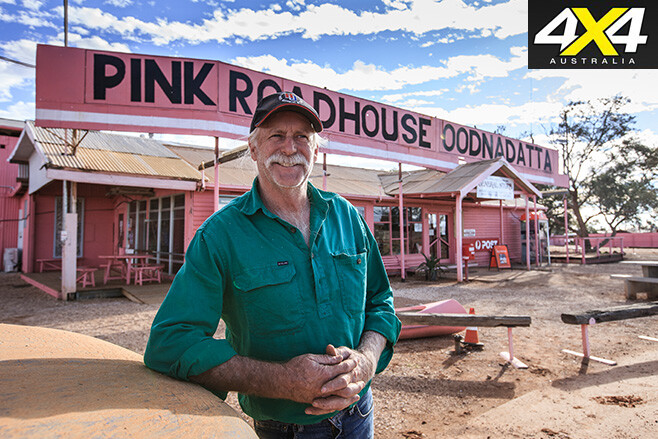
After Adam’s tragic death in a crash during the Targa Adelaide rally in 2012, Lynnie sold the business and relocated to Adelaide. That’s when the Jacobs made the decision to carry on the legacy of this outback icon.
To understand the origins of the roadhouse, we must travel back to the 1970s. Adam and Lynnie were self-confessed hippies on a soul-searching sabbatical, walking the desert tracks of the old Ghan with camels, donkeys and horses.
In 1975, they rolled into the little Aboriginal community of Oodnadatta and, after some tension in the touring party, the couple decided to stay on to regroup. They never left.
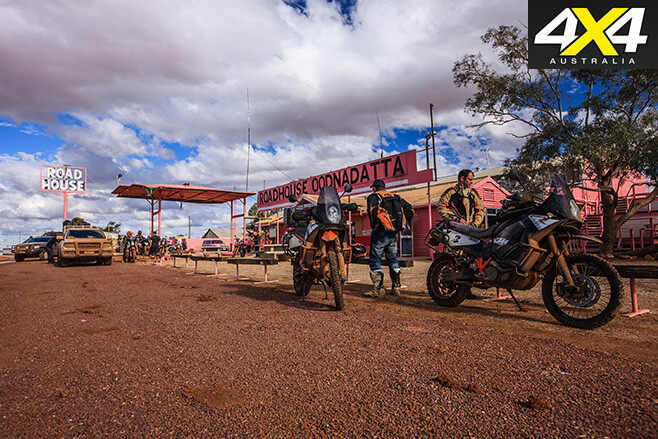
Adam set up a motorcycle repair business in 1978 and shortly after, Lynnie set up a shop called the Tuckerbox to sell snacks and supplies to a growing number of travellers passing through the area. It was decorated with a giant Rolling Stones-style mouth with a tongue.
The Tuckerbox also became somewhat of a soup kitchen for hungry kids waiting for their parents to leave the pub.
When the Ghan was relocated and the old tracks closed in 1980, it was thought Oodnadatta would die. But Adam and Lynnie knew the town was well-positioned to capitalise on the growing 4WD trade, positioned as it was between the Flinders Ranges and Alice Springs. Adam and Lynnie poured their efforts into establishing tourism, and immortalised the town by naming the 600km road the Oodnadatta Track.
In 1983, fuel was added to Plates’ service and the place was renamed the Oodnadatta Traders. It was Adam’s idea to paint it pink; as a former art student, he knew the power of juxtaposition and that the contrast between the outback and a candy pink roadhouse would be a talking point for travellers. Shortly after that, it became known as the Pink Roadhouse and, to this day, it’s still a talking point.
Adam poured a great deal of time and effort into the Pink Roadhouse’s iconic ‘mud maps’ tour; quirky, hand-painted signs and maps dotted along the Oodnadatta Track offering warm anecdotes and information to lonely outback travellers. The man may have passed, but his legacy is very much alive and well.
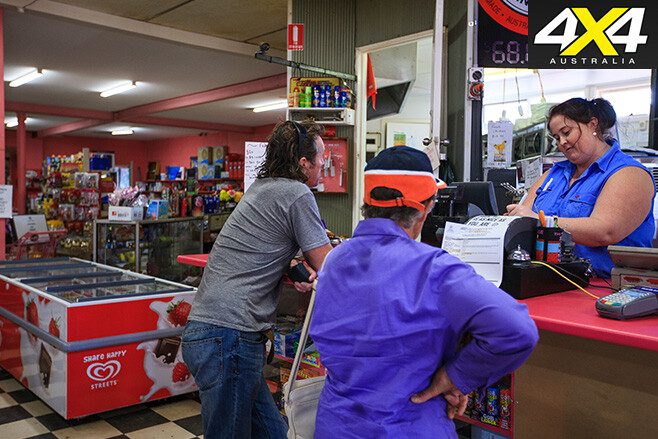
These days, the Pink Roadhouse offers camping, powered caravan sites, accommodation and internet access. It has hot showers, hot meals, cold beer, groceries and plenty of pink clothing, hats and other merchandise.
There’s a mechanical workshop for basic repairs, where there are more than 150 tyres in stock and a 24-hour 4WD recovery service that can be called upon on UHF channel 7 (repeater). As has always been the Pink Roadhouse’s philosophy, if you get into trouble out here, help is never too far away – a concept that’s very much carried on by new owners Neville and Adriana.
Speaking with Neville, it’s clear he is humbled to be running this beloved outback icon. He is warm and gregarious with a sparkle in his eye that suggests he is right at home catching the grubby travellers the desert spits out at him, serving them up a cold Coopers (the roadhouse is now licenced) or a hot coffee and listening to their tall tales and grand plans.
CONTACT The Pink Roadhouse: (08) 86 707 822; 1800 802 074 (free call); UHF Channel 7 duplex (repeater). Email: [email protected]. Website: www.pinkroadhouse.com.au
AT A recent press event at the Specialty Equipment Market Association (SEMA) show in Las Vegas, the Mopar brand announced its new Crate HEMI Engine Kits.
The kits have the ability to pair modern 5.7- or 6.4-litre HEMI engines with cars made in 1975 and earlier.
To demonstrate the engine kit, Mopar unveiled a customised Jeep CJ66 built for this year’s SEMA event.
The Mopar-fettled 1966 Jeep Wrangler is on a TJ frame, and has a Jeep Wrangler CJ universal Tuxedo Park body with Wrangler JK elements added. Power comes from a 5.7-litre HEMI engine capable of 285kW, which was installed with Mopar’s 345 Crate HEMI Engine Kit.
The kit includes engine and chassis harnesses, an accelerator pedal, a power distribution centre and an unlocked PCM to create a ‘virtual plug ’n’ play option for owners’. The kit also features 02 sensors, ground jumper, charge air temperature sensor and ‘in-depth’ information sheets on installation.
“Our new Mopar Crate HEMI Engine Kits answer enthusiast demand for a relatively simple solution for plugging modern-day HEMI engine power into their classic Mopar rides,” said Pietro Gorlier, Head of Parts and Service (Mopar), FCA – Global.
“The engine kits include the hardware to plant a 5.7-litre or 6.4-litre HEMI engine under the hood with the factory-backed confidence that comes when using Mopar parts. They also offer optional front-end accessory kits like power steering or even exhaust manifolds to make installation easier.”
Both the 345 and 392 Crate HEMI Engine Kits start at US$1795 (MSRP) and can be used with a previously purchased 2014 or newer 5.7-litre or 6.4-litre HEMI service engine.
Alternatively, customers can purchase a new engine with the kit included.
MONSTER Duramax driver has demonstrated how not to perform a ‘stoppie’, at the Iron Horse Mud Ranch Super Bog event.
The Iron Horse Mud Ranch in Florida has seen its fair share of trucking hijinks. It’s there that many monster feats have taken place, but it has also seen plenty of drivers bite off more than they can chew. We’ve seen plenty of trucks roll, drown, even catch fire – but it’s been a while since we’ve seen a failure of this kind.
In this recently emerged video, the driver of the ‘King Max’ mud truck found the limits of his front end. The Monster Duramax, seen rolling on 85-inch AG tyres, was captured horsing around in front of the camera, experimenting with the car’s ‘stoppie’ capabilities.
After a few attempts, the driver tried again under full throttle, locking down the brakes and forcing the entire front end to fold under.
John, the owner of King Max, is well known for his ‘wild’ monster truck builds, so chances are he’ll be back in action soon.
The Super Bog event is held every year at the Iron Horse Mud Ranch – 520 acres of swamp land that has been transformed into a mudding hot spot – in Perry, Florida.
Super Bog sees hundreds of people come together to camp and thrash their ATVs, UTVs, 4x4s, SUVs and even their RVs for an entire weekend.
The event is also host to the World Freestyle Championships.
FUEL is always an issue when travelling in remote areas. Whether you’re paying plenty for it or working out how to carry more, making sure you have enough can turn into an Uluru-sized headache.
This is where we found ourselves on a recent trip along the Canning Stock Route. Unless you’re in a Toyota Prado – with its 150-litre tank – or you’ve installed a long range tank, you’ll either need to organise a fuel drop or carry your own.
A fuel drop involves 200-litre drums, and you’ve got to organise a way to get it from the drum to your fuel tank – think hand pumps or a portable electric pump. If you’re carrying your own it’s probably jerry cans, which have a knack of leaking and can be cumbersome to wrestle from the can to the car. Filtration’s often an issue too.
We had five cars in our convoy, one of which was a ute. So we decided to fill its tray with one of the supplementary diesel tanks currently on the market. There are various brands, but we chose Rapid Spray, which has a vast range: from 100-litre portable tanks to 10,000-litre standing tanks.
We chose the biggest one we could fit in the back of a Toyota Hilux, which was a 400-litre unit from the Genius range. That’s the equivalent of 20 jerry cans, which for our five-car convoy on the CSR, turned out to be more than enough.
Getting the empty tank onto the back of the ute was easy, as the 45kg polyethylene unit has handles that make it easy to manoeuvre. There are no obvious tie-down points, but we lashed some straps over the top to keep it in place. Along with the other gear in the back of the car it wasn’t going anywhere, especially once 400 litres (340kg) of diesel was added.
The tank coped with plenty of bumps and corrugations without complaint. The electric pump sits on top, near the bowser and its associated piping. Each is vaguely protected by the folding plastic flap above, although dust easily filters in.
Damp dust is the first sign of some mild dribbling from the handle. There’s also some around the flue towards the back of the unit. It’s not bad and is a result of the ball seal bouncing around and occasionally letting a drop or two out. Still, after 7000km of driving – about half of it with the tank full or nearly full – we estimate we lost a litre or two of diesel. That’s far less than you can lose transferring fuel from jerry cans.
When it came time to refuel, the Rapid Spray was a winner. Connect the earth lead to the car you’re filling, connect the power cable to another car’s battery, and switch on the pump. The pump relies on cooling from the fuel running through it, so it’s important not to run it for too long without pumping fuel; the toggle switch is easily accessible, so it’s an easy process.
From there it’s just like fuelling at a servo, with the same sort of bowser handle and similar flow rate. Ours was pumping at about 40L/minute, slightly below the rated 45L/minute rate – something attributable to the optional flow meter. Still, it only took a minute or two and the cars were full. Refuelling the unit itself was just as easy. Remove the cap and pump the fuel directly in via a strainer-style filter.
This sort of convenience comes at a price though. The RRP is $2009 with the flow meter, although promotions often mean the price runs closer to $1600. We’d also splash out the $108 for the fuel level gauge so you know how much is left in the tank.
The overall price isn’t cheap, but for anyone travelling in a group it’s a relatively small outlay. Besides, even when you don’t necessarily need fuel, having that big reserve tank allows you to refuel where and when fuel is cheaper.
For anyone travelling with two or more cars the Rapid Spray is a winner, especially if you don’t want the cost and compromises that come with a larger fuel tank.
RATED Available from: www.rapidspray.net RRP: $2009 We say: Reliable, easy to use, secure.
HEADING north out of Perth gave us time to contemplate just how much the 4×4 market had changed over the past decade.
Leading the convoy was an old favourite, the Toyota Prado. The model first arrived in 1996 as an antidote to the increasingly pricier LandCruiser king, and it has since cemented itself as an outback prince.
Next in the convoy was Toyota’s Fortuner. The Prado was once a circa-$40K off-roader but now commands half that again for the volume-selling GXL. So the Fortuner has been born as the most affordable diesel entry to Toyota’s off-road brigade.
Isuzu’s MU-X is another relative newcomer, having first surfaced in 2013. It sports a proven ute and truck heritage in a no-nonsense seven-seat shell.
But it’s the Ford Everest that is the freshest of our quartet – and it’s a four-wheel drive with plenty to prove. Straight out of the blocks the Everest cleaned up at the 2015 4×4 Of The Year testing.
All of which meant nothing as we steamed up the Great Northern Highway towards Meekatharra before heading east to Wiluna, the southern start of the Canning Stock Route. Sure, we’ve tested the off-road mettle of the Everest, but we haven’t put it through a punishing outback test, one where reliability, comfort and ability are priorities.
When the wheels touched dust for the first time, it was a tantalising taste of the 2000km of tough, remote country that lay ahead. With close to 1000km of highways at either end, it promised to be the ultimate off-road test.
1. TOYOTA PRADO
THE Prado clearly stands out. Its chassis is shared with that of the American Tacoma ute, but its body is unique and larger than most in its class. That said, the Prado has a shorter wheelbase than the MU-X and Everest.
Still, interior space is great, from the adjustable rear seats to the tall roof that increases the sensation of space. That’s something noticeable inside, where there’s plenty of room for a family, especially across the cabin. Three-zone air-conditioning is a win, too, allowing those in the rear to adjust temperatures.
But for $61,990, the Prado isn’t spectacularly well-equipped, missing out on trinkets such as smart key entry (increasingly common in this market) and making do with basic seat trim. Yet other touches help justify its price premium, such as the 220V power point in the back.
The extra interior roof height and folding seats meant it was the designated water-carrying car. By the time we’d loaded it up with drums, an extra spare tyre and some camping gear it was close to its 2990kg GVM. That GVM may sound high, but the Prado is no featherweight to start with – 2.3 tonnes – so it’s pretty easy to hit that limit.
As a result, the suspension was quite soft in the rear, making it prone to the occasional under-belly scrape. It was more noticeable on faster sections with big peaks between wheel tracks. Perhaps the 220mm of ground clearance didn’t help (it was at least 5mm less than the claim of its three rivals), although we’ve never had issues with the Prado’s clearance before. This is where the more expensive Kakadu’s self-levelling rear air suspension may have come in handy, as well as the VX and Kakadu’s KDSS suspension that gives better body control.
Points are made up with the full-time 4WD system. It’s a small thing, but being able to roll into Halls Creek without having to worry about disengaging the front wheels simplifies things. With a decent traction control system it meant we never needed the centre locking diff.
The Prado is beginning to show its age on the inside. Its sizeable slabby dash displays the navigation system close to the driver’s line of sight. That dash disliked the Canning’s unforgiving corrugations, jumping around like a hyperactive two-year-old.
Not that anything ever separated from where it should have been. The Prado is a tough beast and one that dealt admirably with the blows. Importantly, it was comfortable. The chunky steering wheel tops off a decent driving position, too.
Further aft the Prado is one of a rare breed of modern off-roaders with a swing-out door, which is both a plus and a minus. The big plus is how easily accessible it makes the spare wheel; although, for quick roadside stops it lacks the sun or rain protection a rising tailgate can provide.
The big change in the Prado, that is otherwise largely unchanged since the 150 Series arrived in 2009, is the engine. Despite its newness, the 2.8-litre is somewhat underwhelming, particularly when paired with the heft of the Prado. It isn’t overloaded with grunt – although the 450Nm is pretty handy and arrives with gusto by 1600rpm, ensuring effortless mid-rev progress.
Despite having the lowest claimed fuel figure of our quartet, 8.0L/100km, the Prado was the thirstiest in the real world, using 14.9L/100km – at least 15 per cent more than its nearest rival. That said, it was carrying a heavier load.
No complaints with its fuel capacity. At 150 litres it’s the biggest standard tank in a production car (see ‘Fuel for Thought’ sidebar), something that allowed it to travel the entire CSR without anything more than the regular refuel about mid-way through.
Specs: Toyota Prado GXL Price: $61,990 Engine: 2.8-litre 4cyl turbo-diesel Maximum power: 130kW @ 3400rpm Maximum torque: 450Nm @ 1600-2400rpm Gearbox: six-speed automatic 4×4 system: full-time dual-range Crawl ratio: 36.1:1 Tyre spec: 265/65R17 A/T Kerb weight 2315kg GVM 2990kg Payload 675kg Towing capacity 2500kg Fuel tank capacity 150L ADR fuel use claim 8.0L/100km Test fuel use 14.9L/100km Touring range 957km Ground clearance 220mm Wading depth 700mm Approach angle 32.0 Departure angle 25.0 Rampover angle 22.0 L/W/H/W 4930/1885/1890/2790
False Economy The fuel-consumption figures on the yellow windscreen labels on all new cars sold in Australia relate to Australian Design Rule 81/02. In this test, the vehicle isn’t driven in the real world but instead run through a test sequence in a lab, on rollers.
The test covers a theoretical 11km and is done in two parts; the Urban Cycle consists of a cold start then a series of accelerations, steady speeds, decelerations and idling. The maximum speed is 50km/h, the average is 19km/h and the distance ‘covered’ is 4km.
The Extra-Urban Cycle is conducted straight after and consists of steady speed for about half the test, with acceleration, deceleration and idling for the other half. The average speed is 63km/h with one spike to 120km/h. The distance is 7km.
The Urban and Extra-Urban figures are quoted separately and tallied for the Combined Cycle. Combined Cycle figures are consistently lower than real-world figures, the disparity seemingly increasing with engine and drivetrain sophistication.
2. TOYOTA FORTUNER
SMALLER and lighter than the Prado, the Fortuner’s biggest sales pitch is its price. We chose the GXL trim, at $54,990, which undercuts the Prado wearing the same nomenclature by $7000. Granted, you miss out on sat-nav, but it picks up smart key entry instead.
Still, with the Fortuner it’s easy to see where money has been saved. For example, the third row seats fold against the side of the car, taking up valuable luggage room. Occasionally, too, the straps holding them in place unclip, requiring a quick tighten up. There’s also only a single zone for the ventilation, so all occupants have to agree on the same temperature.
Like the Isuzu, the bonnet misses out on the Prado’s struts, so when it comes time to clean out the air filter you’re manually propping it open. Oh, and if you get a puncture, the spare that’s tucked underneath is only a steelie. Speaking of tyres, like the Prado the Fortuner gets tougher A/T tyres, whereas the Isuzu and Ford get H/Ts.
The Fortuner’s smaller stature is most noticeable with its limited head room and cabin width. That said, for a couple or a smaller family it’s adequately capacious.
On the road the Fortuner immediately asserts itself as a capable companion. Its overly light steering that lacks meatiness on country roads is less of an issue once on the tracks of the CSR. It doesn’t take long for the Fortuner’s Hilux genes to shine through. Great ground clearance ensures it is well elevated over rocky sections, with ample articulation to keep the wheels in touch with the track.
The traction control system is also excellent, ensuring easy progress up sand dunes and through creek crossings. Less impressive is the suspension tune, especially in the rear. Dial up the pace and the coil springs soak up imperfections, but the movement is not as well controlled as it could be.
At least the 2.8-litre engine gets on with things nicely. With less weight to deal with than the Prado, it’s fractionally more responsive, and the easy accessibility of its 450Nm rarely leaves you wanting. However, despite its 80-litre tank, the Fortuner often called for a drink sooner than its rivals, even though its overall fuel use hovered around an impressive 11.0L/100km.
The big difference between the Fortuner’s drivetrain and the Prado’s is the 4×4 system. The full time system has been replaced by the Hilux’s part-time setup, which in practice means it needs wider turns when manoeuvring in campsites or around tight turns.
Speaking of campsites, like the Prado the Fortuner insists on beeping every time it’s locked and unlocked; not really ideal if you want to dive into the cabin for a midnight snack.
Specs: Toyota Fortuner GXL Price $54,990 Engine 2.8-litre 4cyl turbo-diesel Maximum power 130kW @ 3400rpm Maximum torque 450Nm @ 1600-2400rpm Gearbox six-speed automatic 4×4 system dual-range part time Crawl ratio 36.1:1 Tyre spec 265/65R17 A/T Kerb weight 2110kg GVM 2750kg Payload 640kg Towing capacity 2800kg Fuel tank capacity 80L ADR fuel use claim 8.6L/100km Test fuel use 10.8L/100km Touring range 690km Ground clearance 225mm Wading depth 700mm Approach angle 30.0 Departure angle 25.0 Rampover angle 23.5 L/W/H/W 4795/1855/1835/2750
Cooling off IN A remote area of the CSR the Fortuner threw up an engine warning and advised we visit a dealership. Best calculations had that as a three-day journey in either direction – and that’s if the car was driveable.
On popping the bonnet we noticed the coolant overflow was empty, and it didn’t take long to establish the lower part of the radiator had significant damage. Yet the exterior of the car had no damage.
The previous day the Fortuner was emitting a mild clunk from the front-end, something we initially suspected was a suspension component. But it appears it may have been a loose radiator from a broken bracket. It seems the radiator then jolted downwards and hit something above the sump guard, leading to holes on the core and lower tank.
Given the size of the hole we weren’t sure radiator stop-leak additives would work, so we spent hours removing the radiator to repair it with metal putty.
Our bush mechanic fix worked and we were on our way, with the Fortuner making it to Broome without another problem.
3. ISUZU MU-X
VALUE is a key sales pitch for the MU-X, something that makes it a popular choice for outback travellers. Its three rivals here required mid-spec models to get near our $60,000 target, but for the MU-X we went straight to the top of the tree, the LS-T. And even then, at $54,000, it left plenty in the pocket for accessories.
For that price, there’s plenty of extra kit such as leather seats, a powered driver’s seat, and a rear DVD screen to keep the kids content. Plus, it matches the Fortuner with smart key entry, while things such as the chrome doorhandles add a rare touch of bling.
On the inside it’s more about function than luxury and there’s nothing flashy about the presentation. The plastics and finishes look old school, although some streaks of silver help break up the dark greys. The storage binnacle atop the dash is a win for maps and other odds and ends, while the circular temperature selector is a snip to use on the move.
Speaking of which, the MU-X’s seating position is quite high and its seats could do with more lateral support. On the cruise out of Perth, the MU-X felt the least composed of our assembled quartet.
Tipping into slower stuff, though, the seating position gives great vision, although we still wish there was reach adjustment for the steering wheel. Still, the MU-X began to thrive on the more challenging terrain, instantly feeling more in its comfort zone.
Its 230mm of ground clearance is the highest here and it was rarely caught out, while the part-time 4×4 system is no-fuss and effective, albeit without the addition of a rear diff lock (something the Everest and Fortuner get).
The MU-X somehow felt better on more challenging terrain, and its suspension deals admirably with big hits and corrugations; put that down partially to the ample articulation and relatively supple springs. Our shock temperature measurements (see ‘Shocking Stuff’ sidebar on page 58) showed they soaked up the least amount of heat.
The 3.0-litre four-cylinder turbo-diesel engine is a gruff unit, always reminding you it’s chugging away, but the payoff is decent response. Its 380Nm peak is the lowest here by some margin, yet it’s easily accessible and quickly on-tap. And despite being down a ratio – it’s a five-speeder versus six for the rest – it never feels wanting once off-road, where slower speeds are the norm.
Its lithe weight no doubt played a part in helping it feel relatively sprightly. At 2075kg, the Isuzu carries less than its rivals. That also helps with fuel use and, despite a mediocre 65-litre tank, the MU-X returned impressive fuel figures. Its average consumption of 11.4L/100km made it one of the more frugal vehicles on this test.
Specs: Isuzu MU-X LS-T Price $54,000 Engine 3.0-litre 4-cyl turbo-diesel Maximum power 130kW @ 3600rpm Maximum torque 380Nm @ 1800-2800rpm Gearbox five-speed automatic 4×4 system dual-range part-time Crawl ratio 32.6:1 Tyre spec 255/65R17 H/T Kerb weight 2075kg GVM 2750kg Payload 675kg Towing capacity 3000kg Fuel tank capacity 65L ADR fuel use claim 8.3L/100km Test fuel use 11.4L/100km Touring range 520km Ground clearance 230mm Wading depth 700mm Approach angle 30.1 Departure angle 25.1 Rampover angle 22.6 L/W/H/W 4825/1860/1860/2845
4. Ford Everest
THE Everest arrived on the CSR with big expectations – mainly because we’ve been so impressed with it elsewhere – and it instantly asserted itself as a confident contender. On freeway cruises its active noise cancelling is a win, suitably hushing road and engine noise to the point where it is decibels quieter than its rivals. That makes a big difference when travelling big kays.
Similarly, its composure at speed is impressive. Sure, there’s a ladder frame chassis shared with the Ranger, but it’s quite clear that Ford’s engineers have invested plenty to ensure the Everest behaves better on the black top than its tray-back sibling.
Less impressive are the headlights, one of the few oversights on the Everest. At least three of our drivers checked and rechecked to ensure they were actually on high beam; the lights have nothing like the illumination of the Toyotas, which blast well down the road for a pretty standard set of candles.
Getting on to the dirt confirmed our early experiences with the Everest: its on-road assuredness transposes beautifully to dirt tracks. Obvious early on is the fantastic body control; the Everest settles very well over bumps and recovers swiftly, and it’s not fazed by multiple lumps. Push on along snaking trails and the Everest is borderline sporty, ably quelling bumps and thumps and accurately tracking the path the driver directs of it.
Yet at the same time it’s relatively comfortable; there’s some firmness, but it’s well controlled and ultimately compliant. Team that with fantastic front seats and a good driving position and it makes for easy days in the saddle.
Its 3.2-litre five-cylinder engine is also an asset worth plenty out here. With 470Nm it’s loaded with pulling power and it puts it to good use through an intelligent six-speed auto. As well as quickly slotting into gears when it’s told to, it does a good job of pre-empting the terrain, quickly readying itself for cresting a sand dune, just for example.
The effort engineers have put into the 4WD system and its Terrain Management System is also apparent. We’d love the Rock setting to be available in high range, though; the reality is most of the Canning is run in 4H, yet there are decent rocky outcrops where it would be handy to access the tailored throttle responses that come with that setting.
Engineering excellence is high on the Everest’s agenda, but it’s something you pay for. At $60,990 for the Trend – the base Ambiente has a cheaper cabin feel and tiny screen for the sound system – it’s towards the upper end of this quartet, bringing navigation and radar cruise control, as well as 18-inch wheels, an inch up on its three rivals.
Specs: Ford Everest Trend Price $60,990 Engine 3.2-litre 5-cyl turbo-diesel Maximum power 143kW @ 3000rpm Maximum torque 470Nm @ 1750-2500rpm Gearbox six-speed automatic 4×4 system dual-range full-time Crawl ratio 38.6:1 Tyre spec 265/60R18 H/T Kerb weight 2407kg GVM 3100kg Payload693kg Towing capacity 3000kg Fuel tank capacity 80L ADR fuel use claim 8.5L/100km Test fuel use 12.4L/100km Touring range 595km Ground clearance 225mm Wading depth 800mm Approach angle 29.5 Departure angle 25.0 Rampover angle 21.5 L/W/H/W 4892/1860/1837/2850
Ad blue THE Everest was the only car in our group requiring AdBlue, an additive injected into the exhaust gases to clean diesel emissions. Pop the fuel filler and there’s a second, smaller cap clearly marked AdBlue.
In most cases AdBlue will be topped up at regular services, with Ford claiming that in regular around-town use or when cruising on a freeway the 20-litre supply should last between 12,000km and 18,000km.But once you’re off-roading or towing the range can drop to as little as 3000km.
Refilling is easy, just pop the cap and feed in the custom nozzle that comes with the typically 20-litre drums. Keep in mind it’s only available at selected roadhouses.
But before embarking on an adventure like the CSR, check the estimated range on the trip computer display to make sure you’ll get to your destination without running out. While the cars themselves can run fine without AdBlue, the computers are instructed to shut them down once they’ve run out because they will no longer meet the emissions regulations they were designed for.
SHOCKING STUFF
THE Canning Stock Route is known for killing shock absorbers, something we were conscious of going into this epic adventure. We didn’t want to overheat them to the point of failure, so we carried an infrared thermometer gun to measure shock temps after the punishing corrugations either side of Kunawarritji. There’s about 60km of really bad corrugations, and many people take them at a bone-jarring 10km/h.
Measuring the temperatures isn’t an exact science, partly because it’s sometimes difficult to access the shocks. On the rears, for example, one side sits ahead of the axle and the other behind, so it’s hard to pick a common spot to take the temperature. But it at least allowed us to check whether the shock absorbers were peaking at a certain temperature, and how long it took them to cool down.
The highest temp we saw was 105°C, obviously measured on the outside of the shock; the oil inside would have been hotter again. Parking the cars for just five minutes pulled between 10°C and 15°C out of each shock absorber.
The Fortuner and Everest each saw shock temps above 100°C on the fronts, with the rears much cooler. The MU-X had by far the coolest shock absorbers. That may be because its shocks don’t seem to be working as hard to control the car, but also because at 2.1 tonnes it is a fair bit lighter than its competitors.
THE WINNERS
ALL four Canning contenders did the trip easily, without so much as a flat tyre. But some did it more capably and comfortably than others.
If you want a set-and-forget off-roader that will tackle the Canning without the need for extra fuel capacity, look no further than the Prado. That 150-litre tank alone makes it a winner out here, although you pay for it.
The Fortuner is tough and capable, but smaller than its rivals. Some extra work controlling the suspension would make it a better device over this sort of terrain.
The MU-X was our biggest surprise, but only once the going got rough. It’s not as convincing on-road, which is a major consideration when getting to wherever it is you want to explore.
The Everest’s excellent 4WD system and grunty engine set the groundwork for what is a classy, well adapted off-roader. Throw in great suspension tuning and a comfortable body and it amounts to a Prado-beating package, even in the heat of the outback.
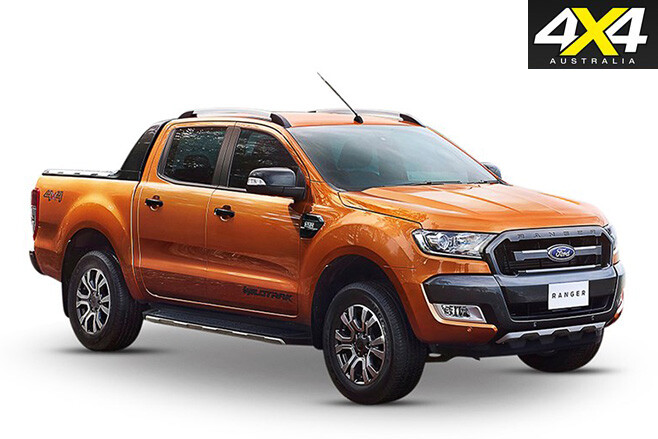
The Ford Ranger is available in Single Cab, Super Cab and Double Cab configurations, and different models are available within each configuration (XL, XL Plus, XLS, XLT and Wildtrak).
To make things easier for prospective buyers, here’s a guide on what’s available and what you get with each model.
FORD RANGER SINGLE CAB (XL)
Drivetrain: 3.2-litre TDCi diesel engine with either manual or automatic transmission. Style: Cab chassis. What you get: Ford SYNC® connectivity system with emergency assistance; Bluetooth hands-free phone and voice control; USB/iPod integration; 4.2-inch colour multi-function display; cruise control with steering-wheel-mounted buttons; adjustable speed limiter; electronic power-assisted steering (EPAS); power windows and mirrors; eLocking rear differential; auto stop/start (manual models only); dynamic stability control (DSC); emergency brake assist; auto on/off headlamps; single-zone manual air conditioning; driver and front passenger airbag; front seat side and curtain airbags; 16-inch steel wheels; rear-view camera; and rear parking sensors.
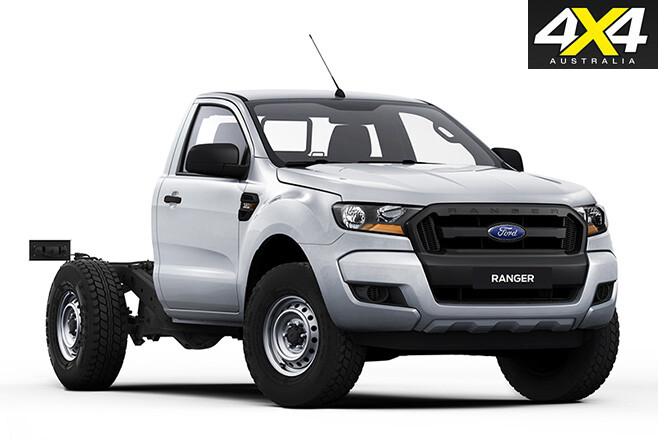
FORD RANGER SINGLE CAB (XL PLUS)
Drivetrain: 3.2-litre TDCi diesel engine with automatic transmission. Style: Cab chassis. What you get: Ford SYNC® connectivity system with emergency assistance; Bluetooth hands-free phone and voice control; USB/iPod integration; 3.5-inch ice blue multi-function display; cruise control with steering-wheel-mounted buttons; eLocking rear differential; dynamic stability control (DSC); emergency brake assist; auto on/off headlamps; single-zone manual air-conditioning; daytime running lights; heavy duty canvas seat covers; towbar; 17-inch steel wheels with all-terrain tyres; expanded wiring harness with four-switch auxiliary bezel; and a second battery.
FORD RANGER SUPER CAB (XL)
Drivetrain: 3.2-litre TDCi diesel engine with either manual or automatic transmission. Style: Cab chassis or pick-up. What you get: Ford SYNC® connectivity system with emergency assistance, Bluetooth hands-free phone and voice control; USB/iPod integration; 4.2-inch colour multi-function display; cruise control with steering-wheel-mounted buttons; adjustable speed limiter; electronic power-assisted steering (EPAS); power windows and mirrors; eLocking rear differential; auto stop/start (4×4 manual models only); dynamic stability control (DSC); emergency brake assist; auto on/off headlamps; single-zone manual air-conditioning; 230V power inverter; 12V auxiliary power socket (x3); load box illumination (pick-up models); inner and outer tie-downs (pick-up models); driver and front passenger airbags; side front seat and front side curtain airbags; 16-inch steel wheels; rear view camera (pick-up models); and rear parking sensors (pick-up models).
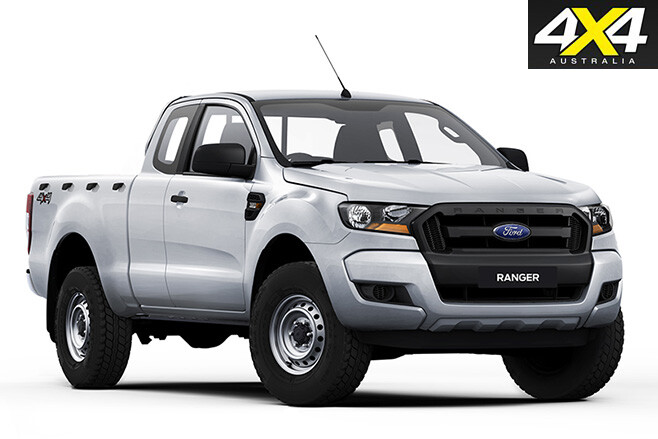
FORD RANGER SUPER CAB (XLT)
Drivetrain: 3.2-litre TDCi diesel engine with either manual or automatic transmission. Style: Pick-up. What you get: On top of XL features, the XLT also gets Ford SYNC® 3 with voice-controlled sat-nav; DAB radio; 8-inch colour touchscreen; rain-sensing wipers; projector headlamps; tyre pressure monitoring system; dual-zone climate control; bedliner with 12V socket; load box illumination in chrome sports bar; cooled centre console; towbar; 17-inch alloy wheels; privacy glass; heated exterior mirrors; electro-chromatic rear view mirror; dual colour 4.2-inch instrumentation screen; front parking sensors; plastic side steps; and illuminated vanity mirrors. Available extras include: an optional XLT Technology Pack: adaptive cruise control with forward collision alert; automatic high beam control; driver impairment monitor; lane-keeping aid; and lane-departure warning.
FORD RANGER DOUBLE CAB (XL)
Drivetrain: 2.2-litre TDCi diesel engine with either manual or automatic transmission; and 3.2-litre TDCi diesel engine with either manual or automatic transmission. Style: Cab chassis and pick-up. What you get: Ford SYNC® connectivity system with emergency assistance; Bluetooth hands-free phone and voice control; USB/iPod integration; 4.2-inch colour multi-function display; cruise control with steering-wheel-mounted buttons; adjustable speed limiter; electronic power-assisted steering (EPAS); power windows and mirrors; eLocking rear differential; auto stop/start (4×4 manual models only); dynamic stability control (DSC); emergency brake assist; auto on/off headlamps; single-zone manual air-conditioning; 230V power inverter and 12V auxiliary power socket; load box illumination (pick-up models); inner and outer tie-downs (pick-up models); driver and front passenger airbags; side front seat and front side curtain airbags; 16-inch steel wheels; rear view camera (pick-up models); and rear parking sensors (pick-up models).
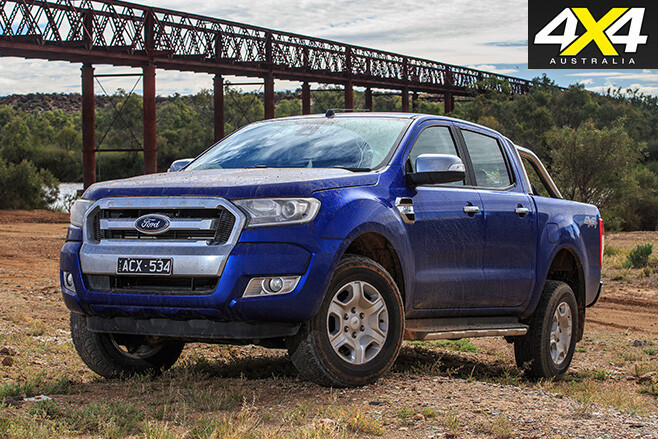
FORD RANGER DOUBLE CAB (XL PLUS)
Drivetrain: 3.2-litre TDCi diesel engine with automatic transmission. Style: Cab chassis and pick-up. What you get: Ford SYNC® connectivity system with emergency assistance; Bluetooth hands-free phone and voice control; USB/iPod integration; 3.5-inch ice blue multi-function display; cruise control with steering-wheel-mounted buttons; eLocking rear differential; dynamic stability control (DSC); emergency brake assist; single-zone manual air-conditioning; inner and outer tie-downs (pick-up models); daytime running lights; heavy duty canvas seat covers; plastic side steps; towbar; 17-inch steel wheels with all-terrain tyres; expanded wiring harness with four-switch auxiliary bezel; and a second battery.
FORD RANGER DOUBLE CAB (XLS)
Drivetrain: 3.2-litre TDCi diesel engine with either manual or automatic transmission. Style: Pick-up. What you get: includes XL features, but adds alloy wheels; carpet floor coverings; front floor mat (driver’s side only); and fog lights.
Drivetrain: 3.2-litre TDCi diesel engine with either manual or automatic transmission. Style: Pick-up. What you get: includes XL features, but adds Ford SYNC® with voice-controlled sat-nav; DAB radio; 8-inch colour touchscreen; rain-sensing wipers; projector headlamps; tyre pressure monitoring system; dual-zone climate control; bedliner with 12V power socket; load box illumination in chrome sports bar; cooled centre console; plastic side steps; towbar; 17-inch alloy wheels; electro-chromatic rear-view mirror; heated exterior mirrors; illuminated vanity mirrors; dual colour 4.2-inch instrumentation screens; privacy glass; and front parking sensors. Available as extras: optional XLT Technology Pack; adaptive cruise control with forward collision alert; automatic high beam control; driver impairment monitor; lane-keeping aid; and lane departure warning.
FORD RANGER DOUBLE CAB (WILDTRAK)
Drivetrain: 3.2-litre TDCi diesel engine with either manual or automatic transmission. Style: Pick-up. What you get: includes XLT features, but adds as standard heated front seats; roof rails; roller shutter; puddle lamps; ambient lighting; adaptive cruise control with forward collision alert; land-keeping aid; land departure warning; driver impairment monitor; and automatic high beam control.