
THE Ford Ranger model line-up copped a refresh back in 2015, and now Holden has stripped down its Colorado and built it back together in an attempt to bridge the gap.
Mid-generational changes for the Ranger included the addition of a smaller and more efficient turbo, new fuel injectors, cylinder head changes and various measures to improve engine NVH.
It also received fresh front-end styling, a new-look dashboard, electric power steering and enhanced electronic control of the 4×4 system.
Most of the Colorado’s changes are aimed at improving refinement. This includes relocated engine balance shafts, revised fuel injection, additional injector soundproofing, a new torque converter for the auto, shorter final-drive gearing for the manual, new engine and transmission mounts, new body mounts, recalibrated suspension and electric power steering.
The Ranger utilises the bigger 147kW/470Nm 3.2-litre five-cylinder engine, while the Colorado maintains the 147kW/500Nm 2.8-litre four-cylinder from Italian diesel specialists VM Motori.
4X4 Australia’s road-test editor Fraser Stronach took the two red utes up the highway and to some off-road tracks to find out whether the updated Colorado can keep up with the sales-dominant Ranger.
The two utes are now more evenly matched than ever before, so will Ford or Holden be the new king of the (dirt) mountain?
Read the full review in 4X4 Australia’s December issue, out November 10, to find out.
WHEN life threw Shane Griffiths from Port Stephens, NSW, a few challenges he responded by modifying a LandCruiser 79 into a no-holds-barred adventure machine.
Shane opted for a top-of-the-line GXL variant that came fitted with front and rear diff locks right from the showroom floor. And he soon realised that, with a ute, you’re basically left with half of the vehicle to design how you want.
A two-piece alloy tray stays on the rig full-time, with clever inclusions like under-tray storage boxes and a full-length trundle tray under the rear. The tray’s headboard also doubles as an additional fuel tank.
The lift-off camper set-up incorporates an electrically operated pop-top with a full-size custom innerspring mattress. On the inside a 57-litre Engel fridge resides; it’s powered by a lithium battery controlled by an Enerdrive DC2DC 30A charger.
The leaf springs were replaced by a full bolt-in coil conversion from Jmacx Off Road Solutions, while three-inch Dobinsons coils and a full suite of Superior Engineering eight-stage adjustable external reservoir shocks reside front and rear.
A waterproof 12,000lb Sherpa winch resides up front; clinging to it are two spread-beam XRAY HID driving lights from TJM.
The rig sits on 285/70R17 BFG KM2s wrapped around 17-inch KMC alloys.
Check out the above video to watch the killer Cruiser in action, and read the full feature in the December issue of 4X4 Australia – in stores November 10.
AUSTRALIA is full of ute lovers. It’s a nation where cities are few and far between and there’s always work to be done.
Vote for Craig’s GU Wagon ute to decide this year’s Custom 4×4 of the Year.
Utes are ingrained in our culture, so much so that even the luxury European brands are starting to catch on to the dual-cab ute market.
Nissan never really clicked to the idea that maybe, just maybe, a dual-cab ute with the ride quality and strength of its TD42 Patrol might just be the perfect 4×4 for Australian conditions. Where Nissan may have stumbled, Craig McGuiness was happy to pick up that idea and run with it.
When Craig first got his hands on the 2004 GU Patrol it was owned by his brother-in-law and still looked very much like a wagon. Eventually, as they often do, the ZD30 went pop, so the deal was made and the pair traded vehicles, with Craig offering up his XH XR8 ute.
First cab off the rank was replacing the dead diesel engine. While a rebuild might have been the easy option, Craig knew it was only a matter of time until it grenaded again and he would be back to square one. He bit the bullet, yanked the motor, and lined up a 5.7-litre LS1 V8 to replace the ailing diesel.
“I would have loved to have done a diesel engine,” Craig told us. “But it was an extra $15K. That buys a lot of petrol, and LS1s are so cheap now that if something goes wrong it’s not expensive to fix.”
The engine slotted in front of the four-speed automatic 4L60E transmission, which is mated to the standard Patrol transfer case. Before it could fire into life Craig had the guys from Scott’s Rods in Ipswich piece together a custom exhaust system, from manifolds through to exhaust tip, before having the package tuned by Forced Performance & Tuning in Toowoomba.
It wasn’t long after this, when Craig was kicking back on Moreton Island with some mates, that the idea of a ute chop first crossed his mind. “The wagon just wasn’t good to camp out of,” Craig said.
“With the barn doors on the back you can’t access anything if you have a camper trailer connected, and there’s very little room once you put a big fridge in. I was there with a mate who had a half-decent twin-cab-ute set-up, and it was great – more storage room and so much easier to access.”
The decision was made, but chopping a wagon into a ute isn’t exactly a DIY kind of job, especially if you’re after a factory finish. So Craig went to see Darren Vassie at Custom RV Creations & Repairs.
The plan was simple: they’d source a back wall from a GU single-cab ute, and Darren and the team would slice the back off the wagon and graft the new rear wall into place with factory precision.
“I’m not a fan of closing in the back with a flat sheet of steel,” Darren told us. “You end up with a rough, square edge that makes it look like a backyard job. We went out of our way to make this look how the factory would have done it, even adding in a few body lines to make it look right with very little body filler.”
While the tools were out Darren also re-skinned a damaged rear door, repaired all the dents, and grafted in a fibreglass reverse-cowl bonnet off a Camaro to hint at what lurked underneath. Before the body was re-coated in factory silver, a custom four-inch stainless-steel snorkel was fabbed up to run along the windscreen pillar.
With the cab now looking the part, attention turned to the wheelbase. Wagons generally have a shorter wheelbase than their respective ute siblings, so when you lop off a few feet of sheetmetal in a wagon you’re left with very little room to run a tray, especially if you want to keep some semblance of departure angle.
Darren got out the welder again and proceeded to stretch the GU’s wheelbase by a whopping 600mm. This meant the rear axle would line up perfectly in the middle of the large, new tray the pair concocted.
When it came time to build the tray, nothing short of a masterpiece was ever going to cut it for Craig or Darren. Wild camping set-ups that can be driven to the end of the earth and back are kind of Darren’s forte.
The tray is constructed from 3mm alloy sheet, with 50x100x8mm alloy channel providing strength throughout. There are gas struts on both side doors, with compression T-handle locks and deeper back structures on the doors providing better water and dustproofing. The interior is also decked out to a highly professional finish, with ply floor, roof panels and marine carpeting throughout.
The tray has been separated into two, with a partition running down the centre. The passenger side houses both fridges on twin Clearview slides, as well as a separate drawer for cooking supplies.
The driver’s side has been divided into three drawers, with a shelf 300mm down from the roof for storage of lighter items – although, with a custom alloy roof rack bolted to the canopy, storage space is never going to be an issue.
Hidden throughout the tray is an electrical system purpose-built for remote-area touring. Up on the roof rack there’s 150A worth of solar panels that feed through a compression gland in the tray and down into the RedArc battery-management system.
From here there’s twin 120A AGM batteries powering not only the fridge and electrical outlets but the heat exchanger and water pump for hot showers on the go.
There’s no chance of running out of water, either, with 140 litres of on-board capacity. There’s plenty of distance to use it, too, thanks to the custom aluminium long-range tank, which doubles the standard fuel tank’s capacity.
This might sound like one of the most comprehensive builds on the tracks right now, but we’ve barely even scratched the surface. It’s one of those vehicles where a determined owner with an uncompromising goal has worked perfectly with a talented workshop.
The proof really is in the pudding: a six-inch-lifted V8 Nissan Patrol on 35s that somehow manages to be a near-on perfect tourer.
Weight again
THERE are a few tricks the experts can use in a build like this, but there’s no denying physics. If you keep adding things to a vehicle eventually the weight starts adding up. To mitigate this Craig runs a suspension system that keeps things legal and makes the Patrol perform better than ever.
A GVM upgrade of an additional 500kg was achieved with a combination of Dobinsons suspension components. There’s four-inch-lifted coils in the factory mounts up front, with a matching (albeit heavy duty) pair in the strengthened rear mounts. All four are kept in check thanks to a full set of remote reservoir shock absorbers.
Suspension geometry has been dialled in with heavy duty adjustable arms in the rear, a set of drop boxes in front correcting caster, and extended sway bar links. When loaded to the hilt for family trips, a set of helper airbags in the rear stop the dreaded bum-sag.
Vote for Craig’s GU Wagon ute to decide this year’s Custom 4×4 of the Year.
HOPEFUL Discovery owners may have to wait for up to six months as delays on the fifth-generation model, coupled with high demand, may create the perfect storm.
Coming out of a sales boom for Land Rover, the news of a delay has reportedly become the single biggest problem for the multinational company. Motoring.com.au spoke to JLR Australia managing director Matthew Wiesner about the issue.
“Our biggest challenge is the gap for the Discovery, our focus is to manage that” said Wiesner.
Weisner further reported that stocks are dangerously low and are projected to vanish from showroom floors by February 2017.
“We’re going to have a bit of a gap before the new model arrives. By February-March the current model will be gone, so there will be a period of time where we will be without Discovery.”
With around 200 pre-orders for the Discovery 5 and less than 300 Discovery 4s still in the wild, the demand is there and the heat is on for JLRA as stock continues to dwindle.
Excitement is still high for the new Discovery 5, with a further 2500 expressions of interest lodged ahead of its July release.
As Land Rover’s main volume seller in Australia for the last 27 years, contributing 25-30 per cent of the current total sales, this hiccup could cause serious damage for the classic series.
With a price tag of $81,950 and a slew of new features, only time will tell how Land Rover and Discovery will be affected by their coming hiatus.
YES, the third gallery was supposed to be the final instalment, but then our snapper Brunelli sent through these last-minute additions and we just had to show them to you.
SEMA is done and dusted for another year, and 2016 certainly exceeded expectations. The custom rigs on offer, from the ludicrous to the laughable, kept us thoroughly entertained.
But for those of us who couldn’t make the trip across the Pacific – and those of us who had to man the fort at 4X4 HQ – these awesome photos are the next best thing.
If that decked-out Bronco (featured in the gallery) doesn’t make your hair stand on end, then maybe wild customs ain’t your thing.
Enjoy the pics, get some ideas and, hopefully, get involved next year.
The 2017 SEMA show will run from October 31 to November 2. See you there?
Craving more 2016 SEMA action? Follow the link.
TOYOTA’S Hilux and Ford’s Ranger (4×4 and 4×2 models) were the best-selling vehicles in October, Australia-wide.
According to the October VFACTS report, Toyota sold 3352 Hiluxes (4×4 and 4×2) to become the most sought-after car on the market. Ford sold 3217 Rangers (4×4 and 4×2) to slide into second place on the charts.
The popular workhorses leapt ahead of Toyota’s ever-popular Corolla, which posted 3210 sales.
It seems more and more people want a bigger rig these days, and we don’t blame them.
The combined sales of SUVs and Light Commercial Vehicles (LCVs) accounted for 56.2 per cent of national vehicle sales during October.
In fact, the sales difference between SUVs and passenger cars closed to its smallest ever margin, with just 1375 sales separating the two segments in October.
Tony Weber, chief executive of the Federal Chamber of Automotive Industries, said: “The gap between the two [SUVs and passenger cars] is narrowing by the month, and should this trend continue it is likely that SUVs will become the larger segment sometime in the foreseeable future.”
The big news doesn’t end there: In the race for 4×4 supremacy the Ford Ranger has overtaken the Toyota Hilux on the charts.
Ford shifted 2751 Ranger 4x4s in October, while 2422 Hilux 4x4s found new homes. On the year-to-date sales chart, this means Ford has sold 25,189 Rangers compared to Toyota which has sold 24,946 Hiluxes.
With two calendar months left, it’s safe to say it’s going to be a cracking end to the year!
| u00a0 | 4X4 | SEP 16 | AUG 16 | YTD |
| 1 | FORD RANGER | 2751 | 2451 | 25,189 |
| 2 | TOYOTA HILUX | 2422 | 2311 | 24,946 |
| 3 | HOLDEN COLORADO | 1151 | 1528 | 14,036 |
| 4 | TOYOTA PRADO | 1049 | 1160 | 12,365 |
| 5 | TOYOTA LANDCRUISER WAGON | 972 | 903 | 9,767 |
| 6 | NISSAN NAVARA | 927 | 969 | 11,600 |
| 7 | ISUZU D-MAX | 810 | 944 | 8,874 |
| 8 | MITSUBISHI TRITON | 803 | 2012 | 14,869 |
| 9 | MAZDA BT-50 | 600 | 812 | 7,944 |
| 10 | ISUZU MU-X | 539 | 592 | 5,678 |
INFINITI to Nissan is what Lexus is to Toyota, namely an upmarket sister brand. Infiniti makes a dual-range 4×4, the QX80, which is an up-spec and restyled variant of the Y62 Patrol.
But this isn’t about the QX80, rather Infiniti’s recent announcement that it has a variable compression ratio (VCR) engine that’s been 20 years in the making and is due to appear in new Infiniti models as soon as 2018. If this all comes to fruition, it will be an amazing breakthrough.
VCR engines have been one of the holy grails of automotive design, with patents dating back to the 1920s and many working prototypes in laboratories over the years. However, there’s been nothing substantial beyond that.
Some of the finer details of Infiniti’s 2.0-litre, four-cylinder (petrol) VCR engine haven’t been made public, but the in-principle design is clear to see. As with other VCR engines, Infiniti’s VCR design adjusts the compression ratio so it can make better use of forced aspiration, in this case a turbocharger. It can even adjust itself to run more efficiently than conventional engines without any help whatsoever from the turbocharger.
Turbochargers, like superchargers, help an engine produce more power by feeding in compressed air; the theory being the more air you can pump into and through an engine, the more fuel it can burn and the more power it can produce. If you stuff too much air into an engine’s cylinder and then further compress it via the piston on its compression stroke, the air can get that hot it will ignite the fuel. This is definitely not what you want in a petrol engine.
It’s the sparkplug’s job to ignite the fuel at a precise point in time and you don’t want the air/fuel mixture to randomly self-ignite. If it does it’s called pre-ignition or detonation, and it’s potentially catastrophic for the engine. The possibility of detonation can be lessened by using a turbocharger that pumps less air into the engine, but that defeats, at least in some part, the purpose of having a turbo in the first place.
Alternately, you can reduce the amount the air is compressed once it’s in the engine by reducing the compression ratio. The trouble with this is a lower compression ratio is detrimental when the engine is working without the help of its turbo, as lower compression ratios mean reduced torque and power. Furthermore, a low compression engine running high turbo boost pressures generally equates to a non-linear power delivery as the engine goes from its ‘soft’ off-boost mode to a ‘hard’ on-boost mode – not what you want for driveability.
Now you can see where this is heading. You design an engine that can vary its compression ratio to suit what the turbo is doing or not doing. When the engine is under minimum load (the vehicle is trickling along in slow-moving traffic) and the turbo isn’t doing anything (as it relies on the engine’s exhaust pressure to generate boost) you crank up the engine’s compression ratio to compensate.
Conversely, when the engine is under high loads (out on the highway pulling up a steep hill, for example) you drop the compression ratio right down and let the turbo go to town.
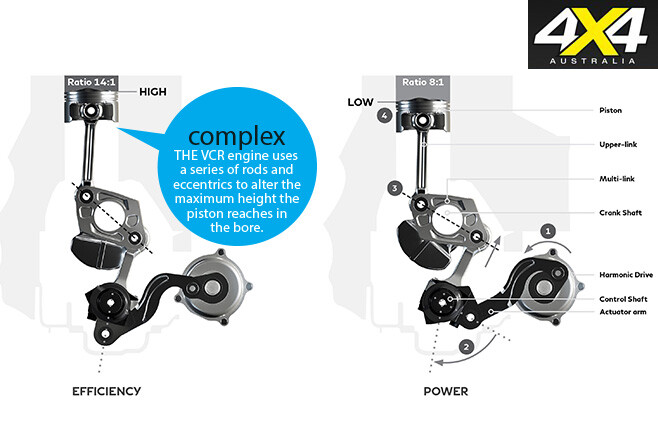
Infiniti claims that its VCR engine can vary the compression ratio seamlessly from a diesel-like high of 14:1 to a very mild 8:1. The overall control of the compression ratio, the turbo’s boost pressure, ignition timing, valve timing, etc. is done electronically and is all interlinked.
The variable intake-valve timing also means the engine can switch to an Atkinson cycle mode (see opposite), which is all part of the engine’s adaptability.
Infiniti’s VCR engine changes the compression ratio by adjusting the height the piston reaches in the cylinder, as shown in the accompanying illustration. It’s a bit unclear exactly how all this works, but the key is the so-called ‘multi-link’, which appears to adjust the crankpin offset and hence the engine’s stroke. Infiniti promises more will be revealed in the coming months.
ATKINSON CYCLE
ATKINSON cycle engines are commonplace today in petrol-electric hybrids. However, these modern Atkinson cycle engines are very different to the original Atkinson cycle engine(s) which date back to the 1880s, even if they do share a common principle.
James Atkinson came up with a number of designs, the most famous of which managed to provide intake, compression, power and exhaust strokes in one revolution of the crankshaft via a complex linkage arrangement. Conventional Otto cycle engines need two revolutions of the crankshaft to achieve the same thing.
All of Atkinson’s designs had one thing in common, namely the compression stroke was shorter than the power stroke. Modern Atkinson cycle engines achieve a similar effect by delaying the closing of the intake valves until after the start of the compression stroke. This leads to improved thermal efficiency when power production isn’t paramount.
WARN have just brought out a new line of winches, so where better to show them off than at the SEMA show in Las Vegas.
“We’re really excited to debut these winches here, the coolest thing about these is we’ve switched over to waterproof Albright contactors throughout the Magnum line-up,” said Andy Lilienthal, Warn USA.
The Warn winches mount feet-down with their medium frame configuration, and are made from a single-cast aluminium piece that is said to add structural integrity and help decrease noise. Like the previous Zeon winches, the Magnum’s control packs can be taken off and relocated.
Finished in a new black paint, the new models feature a tie-rod design and incorporate a tie plate which is said to help stop the rope from bunching up; allowing it to spool evenly.
Lilienthal explained that all Magnum winches now have a cone brake as opposed to a spring brake, which can be found in cheaper winches. “This ensures that the winch will hold the rated load of the winch every time.”
Styling has also been updated, with a new clutch lever and power lead featured.
The Magnum winches are available in 10,000lbs (4535kg) and 12,000lbs (5443kgs) capacities, with both steel and synthetic cable options. Local pricing and specifications are yet to be confirmed.
WHEN fitting a suspension lift to a live axle, coil spring set-up you can alter the axle geometry so the new ride height of the axle is offset to one side.
This article was originally published in the June 2014 issue of 4×4 Australia.
On many front axle, coil spring designs, the Panhard rod (also known as a track bar) is a bar fitted between the chassis and axle to stop the axle moving side to side. As the suspension flexes the axle doesn’t just go straight up and down, but instead it goes in an arc – thanks to this bar.
So when you lift suspension, the standard Panhard rod is no longer the correct length to keep the axle centred at your new static ride height, instead, it’s off to one side.
This job is easy but it does require some fiddling around with measuring the new adjustable Panhard rod and axle. The most difficult part is moving the body over on the axle to the correct spot. You will find driving in a straight line a few times will help, as will pushing the body over with the Panhard rod disconnected.
With the new adjustable rod bolted in place, make sure you measure one more time to see that the axle is centred. With that all done, you need to torque the attachment bolts to the manufacturer’s specifications and fit a fresh split pin to the castellated nut on top of the ball joint.
Finally, tighten the adjustment nut on the Panhard rod and add grease to the ball joint. You may well need a wheel alignment after this job, so factor that in before using your vehicle.
1. Basic equipment needed: Adjustable Panhard rod, ball joint separator, hammer, sockets and tape measure.
2. Do a visual check of axle alignment. Sometimes the misalignment is obvious.
3. From this angle the axle appears offset to the right, a common problem with lifted suspension.
4. Measure from a fixed point on the body to a set point on the tyre – on both sides.
5. Remove split pin on castellated nut securing ball joint.
6. Remove castellated nut securing ball joint.
7. Using the ball joint separator and hammer, remove the Panhard rod from its securing point.
8. Ball joint removed from securing point on frame.
9. Unbolt the bushed end of Panhard rod from the locating point on the axle.
10. In this case the securing nut is easily fitted as it is welded to this locating tang.
11. Measure the adjustable rod against the old, non-adjustable one.
12. Fitting the Panhard rod is the same process as dismantling, in reverse.
13. The adjustment nut on the Panhard rod can now be tightened up.
14. Add grease to ball joint, take vehicle for a test drive and get a wheel alignment if necessary.
The SEMA 2016 showroom is chock-a-block with Jeep Wranglers, but it’s this fully-electric JK that’s getting all the attention.
Among the crowd at the Poison Spyder/Pro Comp stand at SEMA 2016 in Las Vegas sat this one-of-a-kind Jeep JK Wrangler. What makes it special is that it’s fully electric – and remains a very competent off-road machine.
“We’ve converted a Jeep JK into a completely electric vehicle. We removed the original engine and transmission and replaced it with a permanent AC motor similar to a Tesla,” explains Ted Moncure from Pro Comp.
Supplying power is a lithium-ion battery pack that allows the truck to travel 240km, or go four days on the trail on one charge.
“It’s [got] the best kind of lithium-ion battery pack basically – the highest energy and highest density available.”
The team that built the all-leccy Jeep left nothing in the change rooms, with a plethora of high-end suspension and driveline bits also installed.
“We’ve equipped it with a Pro Comp long arm suspension system, billet control arms, coil-over and bypass shocks, and 40-inch wheel and tyres, so it is ready to go to King of The Hammers or Baja, and we can be environmentally friendly while we do it.”
Ted went on to say that the electric motor and battery system they used will one day be available to purchase: “It [the electric motor and battery] will be available through 4wheelparts.”
“We’re helping them develop it and, doing the trail testing, helping them understand what it takes to survive in the US off-road market.”