
FOLLOWING a federal class action lawsuit by US pickup truck and SUV owners, Toyota Motor Corp. will pay up to $3.4 billion to owners of cars that lack necessary rust protection.
The settlement reached on October 31, 2016, covers 1.5 million cars, all of which reportedly suffered from inadequate rust protection which could lead to serious corrosion and compromised structural integrity.
Affected cars include: Tacoma compact pickups (2005-2010), Tundra pickups (2007-2008) and Sequoia SUVs (2005-2008).
Under the settlement, each plaintiff’s car would be eligible to receive frame replacements valued at $15,000 and vehicle inspections valued at $60 per vehicle, leading to the hefty $3.4 billion figure.
Toyota will also have to inspect vehicles for up to 12 years from their initial sales or lease date to decide if further owners are eligible for a replaced frame or reimbursement.
While Toyota admitted no fault in the proposed settlement, they expressed their focus on customer service and wanted to make sure that no customers lost faith in their product.
“We want our customers to have a great ownership experience, so we are pleased to resolve this litigation in a way that benefits them and demonstrated that we stand behind the quality and reliability of our vehicles,” Toyota said in a statement.
Included in the deal is a further $9.9 million for attorney’s fees dating back to the onset of the case in early 2014.
WHAT has more power than a Ferrari 488 GTB and would leave a twin-locked Patrol in its wake? This insane, supercharged Y62 Nissan Patrol.
The Patrol’s owner, Andrew Cassar, could always see the potential lurking within the new Patrol: “It was between this and the Landcruiser 200 Series,” Andrew told us. “The creature comforts were better in the Y62 and it just represented better value for money.
“It’s a huge step up from the GU Patrol in every way and makes the current 200 Series look dated.”
The vehicle utilises Nissan’s VK56 5.6-litre V8 engine, which delivers 300kW in stock form. When Andrew first took ownership it ran 160kW on the dyno at all four wheels.
That got spanked up to 350kW after Andrew installed a Harrop 2.5-litre supercharger kit. Harrop also retuned the stock ECU.
Other than the supercharger and tune – and an HM exhaust system – the drivetrain remains standard. The engine, transmission and transfer case all remain unopened.
35-inch tyres, a factory rear diff lock and a Harrop ELocker up front – combined with a 50mm hike on each end – all make this Patrol an off-road monster. The Patrol is riding on OME springs with matching Nitrocharger Sport shocks on each corner.
A colour-coded ARB Deluxe bullbar resides up front and hosts a Magnum 10,000lb winch.
The all-rounder has also been decked out for remote-area travel, with five Fullriver 20Ah batteries residing where the spare tyre once lived.
Watch the ’charged Patrol in action, and read the full feature in the December issue of 4X4 Australia – in stores now.
SEVEN kilometres south of Kenilworth in the hinterland of Queensland’s Sunshine Coast is a national park that’s been set up for lovers of the outdoors. There are a host of bushwalking trails where you can explore an old gold mine, discover pristine rainforests, climb an active fire tower or just walk loops within the park.
The Maleny-Kenilworth road runs right beside Conondale NP, and it’s a great place to start exploring this hidden gem by 4×4. Little Yabba Park is a perfect spot to stop before heading bush, as there are toilets and plenty of grassed areas beside the Mary River. You can also stretch your legs with a walk around the Fig Tree Loop trail.
There are two main campsites in the park: Charlie Moreland camping area and Booloumba Creek campground. Charlie Moreland is suitable for 2WD vehicles, while Booloumba Creek, which has four campgrounds, is only accessible to high-clearance 4WDs thanks to several river crossings along the way.
The turnoff to the Booloumba Creek campground is 500 metres past Little Yabba Park and then it’s a 5km drive to the entry of Conondale along this narrow sealed road. The first of three river crossings comes up as soon as the tar ends, and most of the year they shouldn’t pose a problem. The base surfaces of the crossings are firm and there’s little flow, but it can be a vastly different scenario after heavy rain; the rivers can get extremely wide and debris can reach the trees.
Where you pre-booked your campsite determines how far you need to travel to camp. Camps 1 and 2 are suitable for beside-the-car camping, while at Camp 3 you need to cross the river three times and it’s suitable for tents and walk-in campers. Directly across the road from Camp 3 is Camp 4, which is suitable for camper trailers and off-road caravans. The road to 3 and 4 has steep sections as you climb in and out of the creeks, so slow-going is the ticket. When entering the camps, you’ll need to fill out an identification tag.
Most of the campsites are generously sized and have plenty of fire rings, water taps and, importantly, toilets that are simple yet clean. Collecting firewood is not encouraged in the park. Not only is it illegal but the surroundings are lush rainforest, so the wood is always damp. The best option is to stop at one of the many stalls on the way and purchase a bag of wood for $10.
Once settled in camp there are a few options available, depending on your level of energy. Stretching out from any of the camping areas are a number of walking trails that range from treks of just a few hundred metres, to the Conondale Range Great Walk, which is an amazing 56km loop around the park.
You can walk to some unique features including the abandoned gold mine that’s (apparently) full of little bats; a strange rock cairn with a fig tree growing out of the top; and a 5.5km walk to Mount Allan fire tower, where you can climb to the top for 360-degree views of the area. The fire tower walk can be hit-and-miss according to weather conditions – some days it’s clear, but on our day it was misty and foggy.
The fantastic walks wind around gnarly old gums, 40-foot Bangalow Palms and strangler figs that have sucked the life out of their host trees. Bracken ferns line the tracks in the cool rainforest pockets, while Sclerophyll forest dominates the drier sections.
For those who want to hop in the car and go for a drive, it’s 9km from Camp 4 to the Booloumba Falls day area. The road is very steep and narrow in places, and it’s occasionally closed due to trees falling across the road. Keep an eye out for the lookout on the right – about halfway up – where you have a direct view of Pinnacle Mountain and the gorges below. There is phone reception both here and at the fire tower if help is needed.
The road is shadowed by huge gums, strangler figs, palms and tree ferns all searching for a little sunlight. There are a few 4WD tracks that shoot off into the forest, but you need local information as some of these tracks zigzag throughout the valley.
During the warmer months visitors can take a dip in the refreshing waters of the Mary River, but tread carefully as the crystal-clear water is home to freshwater cod and platypus.
When out on the walks also keep an eye out for yellow-footed wallabies, black cockatoos, petite little wrens, parrots, and the odd carpet python soaking up the sun. Around camp, bush turkeys frequently roam, looking for scraps, while whip birds call out to each other. It’s a truly magical place.
Camp 2 has facilities for tent camping and day use, and it’s a major hub for the start of the Great Walk.
Information boards, shelters, gas barbecues that overlook the Mary River, and plenty of parking means this area fills up fast during peak times.
An ideal time to visit the NP would be during spring or autumn. Be well prepared if attempting any of the bigger walks, as there is poor communication along the tracks and you may not see any other walkers. Fuel and supplies can be found at Kenilworth, but expect to pay a little more than it costs in larger towns.
With Brisbane about two hours’ drive away, Conondale is very busy throughout summer and over holiday periods. Queensland NPWS has gone to great lengths to highlight the features in this park, making it a very special place for everyone to enjoy.
TRAVEL PLANNER
WHERE CONONDALE National Park is located 130km northwest of Brisbane. The park covers more than 350km² of rainforest and timbered areas. With stunning views, crystal clear waterways and a huge array of fauna, this ancient area has a special feel.
CAMPING THERE are two main camping areas within the park. The Charlie Moreland area, located in the northern end of the park, has been set up for cars. Booloumba Creek campground has been divided into four areas, but they’re only accessible by 4WD as you have up to three river crossings, depending on your campsite. You must pre-book before arrival at camp and display your tag.
SUPPLIES AND FACILITIES THERE are fire pits, pit toilets and some shelters in the camping areas. The day use area has gas barbecues. Firewood can’t be gathered in the park and bagged wood is sold at roadside stalls outside the park. There is phone reception at the lookout and fire tower. If collecting water from the creeks or taps, boil it before use. To deter feral animals, there are no bins within the park. Kenilworth has basic supplies and fuel.
MAPS AND GUIDES THE QDNP website has all relevant camping, walking and state forest maps.
FURTHER INFO BE well prepared on the longer hikes, as they cover rough terrain in remote areas. Try to avoid holiday times and weekends – being close to Brisbane and the Sunshine Coast, Conondale gets very busy. Mountain bike and horse riding is encouraged within the park, so stay alert.
Up-to-date info can be had from the Kenilworth Information Centre on (07) 5446 0122.
WHY do we need differentials?
It’s simple: when turning a corner the outside wheel on an axle follows a larger arc than the inside wheel, so the differential gearing allows one wheel to travel at a different speed than the other, while both remain powered. But differential gearing also has the disadvantage of sending the power to the path of least resistance, just like water and electricity.
TORQUE AND POWER
TO properly understand how a diff works you need to understand power and torque, as well as how they relate to one another.
Power is all about movement. The unit for measuring power is the Watt (W).
One Watt is one joule per second. For our purposes, one joule equals 1Nm. Engines power is measured in kW (kiloWatt): 1kW = 1000W.
If you look at the simple equation below you can see there is a relationship between torque, power and rpm: kW= Nm x rpm/ 9549
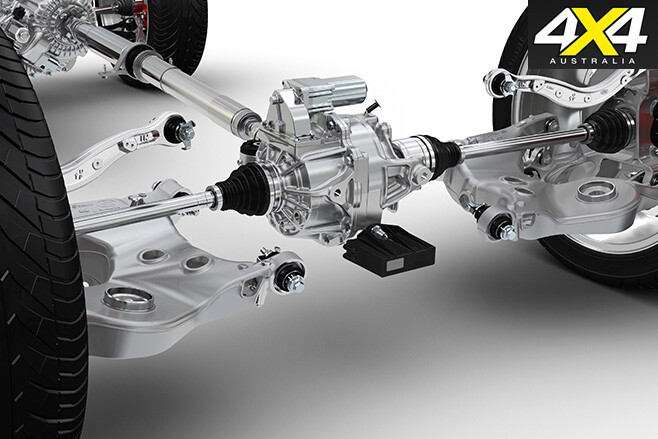
WHAT’S INSIDE A DIFFERENTIAL? THESE days a diff is the term used for the whole drive assembly, including the housing, brakes, axles, etc. But what it actually refers to is the differential gearing assembly inside the heart (carrier) of the diff.
A conventional differential is comprised of four gears. Two are attached directly to the axles, the other two are free to spin on their own axis but are mounted to the carrier, which in turn is rotated by the ring gear.
How do we get the turning power of the driveshaft to the carrier? There are two style of gears normally used:
Hypoid Spiral Bevel Gears THE hypoid gearing arrangement is similar to a spiral bevel gear set-up with the exception of the pinion, which doesn’t share the same axis as the ring gear – in a rear differential application it’s usually mounted lower.
The benefits of meshing the pinion gear on a lower axis is that more gear teeth are in mesh with the ring gear at any one time, meaning power from the engine is distributed on a greater area than bevel gearing. So, for the same size gearing, it’s able to transmit more power and torque. However, the gears slide over each other as they mesh, which creates friction. This friction costs power, so, while stronger, hypoid gearing isn’t as efficient.
There’s one other consideration with hypoid spiral bevel gearing: there are two sides to the gear, a drive side and a coast side, and the coast side is 30-40 per cent weaker than the drive. This is just one of the reasons not to perform a reverse snatch strap recovery.
Spiral Bevel Gears IN a diff application, a small pinion gear is turned by the driveshaft. This then meshes with the ring gear to turn the carrier. Both the pinion gear and the ring gears share the same axis.
HOW DOES IT WORK?
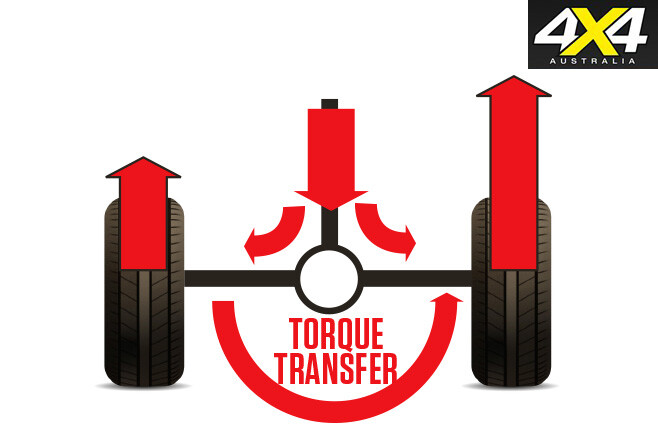
A CONVENTIONAL diff splits the torque equally to left and right (minus some small frictional losses) at all times. It does this regardless of whether both wheels are driving you down the road at 100km/h, or whether one wheel is in the air spinning madly on a low range track.
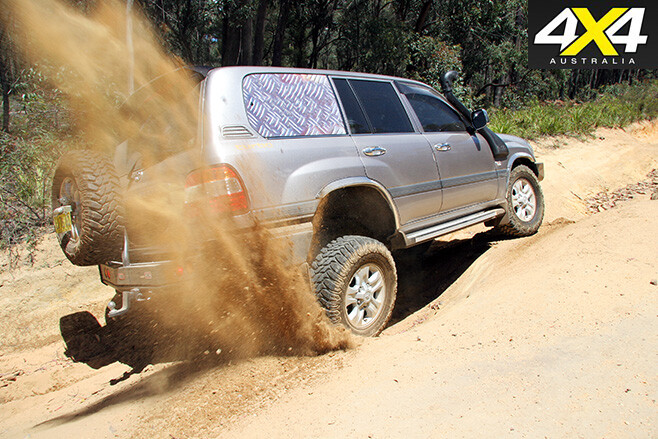
TRICKY SITUATION CHECK out the traffic going around the roundabout. Notice the front wheels of larger vehicles will be near the outside of the roundabout and the rear wheels will be near the inside. This tells you that when heading around a corner, the front wheels take a larger arc than the rear wheels.
When we lock the centre diff on a full-time 4WD with a conventional diff (or engage 4WD on a part-time 4WD), we remove the ability of the centre differential to compensate for the speed differential between the front and rear when negotiating corners.
This is only an issue on high traction surfaces, like bitumen and slick rock. On loose surfaces such as dirt or gravel the speed differential doesn’t pose an issue, as the surface allows the wheels to slip a little and relieve the tension.
On high traction surfaces the speed differential going through corners will build up a twisting force between the front and rear diffs, leading to an eventual driveline failure.
The first indication of failure is that the car won’t come out of 4WD. Or perhaps you’re driving a part-time 4WD and you can’t push the lever back into 2WD. This is because you’re being prevented from disengaging 4WD by the twisting force in the driveline binding up the mechanism.
To get the car out of 4WD you have two options. First, you can reverse in an arc. This will get the front wheels travelling faster than the rears and will relieve the tension to a point where the centre diff light with stop flashing, or you’re able to push the lever to engage 2WD.
The second option is to head over to the side of the road, put two wheels into the gravel, and continue driving forward. The slippage allowed by the loose surface will dissipate the twisting force, allowing you to get the car back into road mode.
WHY LOCK THE CENTRE DIFF? A LOCKED centre diff will guarantee power is sent to the front and rear diffs.
Another reason to lock the centre diff is to avoid the problems associated with getting stuck in a vehicle with an automatic transmission. If you’re going uphill and get stuck you’ll have to perform a reverse recovery.
If you try this without locking the centre differential, the front wheels will stay locked all the way to the bottom of the hill, due to the weight bias on the rear and the fact all vehicles have a braking bias to the front.
LOCKED DIFFERENTIAL TORQUE DISTRIBUTION WHEN you engage a locker, it effectively removes the differential gearing action from the diff. So now you’ve reverted back to a solid axle between the wheels, and it doesn’t matter if one wheel is on terra firma and the other is 50cm in the air, both wheels will turn at the same rate.
To explain how a locked diff can vary the amount of torque to each wheel, we’ll have to use maths. Let me introduce you to the standard friction equation:
F_r = is the resistive force of friction μ = Friction co-efficient for the tyre against the terrain you’re travelling across. N = Normal force (in Newton-metres), which is the weight of the car pushing the tyre down on the terrain. Let’s look at a scenario where one tyre is on mud and the other is on a road surface. Both of the tyres are exerting a force of 1000N.
Road μ = 1 Mud μ = 0.3 Mud F_r=μN F_r=0.3 x 1000 F_r=300 Road F_r=μN F_r=1 x 1000 F_r=1000
Adding both together you get a total resistive force of friction 1300N, which means 77 per cent of the torque is delivered by the road-side tyre and 23 per cent by the mud-side tyre.
CONVENTIONAL DIFFERENTIAL TORQUE DISTRIBUTION LET’S now look at the same scenario, but this time we’ll leave the locker alone. Remember the small gears that are free to rotate within the carrier and are connected to each axle? Well, they ensure the torque is distributed evenly between both axles and there’s no torque bias to either side.
You still have a potential of 300N of resistive force of friction with the side in the mud, but the side on the road will also only get 300N thanks to the small, freely-rotating gears in the middle of the diff. So that’s a total of 600N. But the good news doesn’t end there.
Have you noticed when you’re pushing a large heavy object like a couch it’s hard to get going, but once it’s moving it seems like it’s not as hard to push? Well, that’s actually a measurable phenomenon known as sliding or kinetic coefficient of friction, and it will be measurably less than the static coefficient of friction.
So now as you put the foot down and start spinning the wheel in the mud, the coefficient of friction will drop from a μ of 0.3 to 0.2. Don’t forget with an open differential the torque on one side is equal to the other, so now instead of 600N we’re down to 400N. In the same scenario we’ve gone from 1300N with a locked differential to 400N with the standard open differential.
LIMITED SLIP DIFFERENTIALS
The purpose, as the name suggests, is to limit the amount of wheel slip. However, there are several different variations with different degrees of effectiveness.
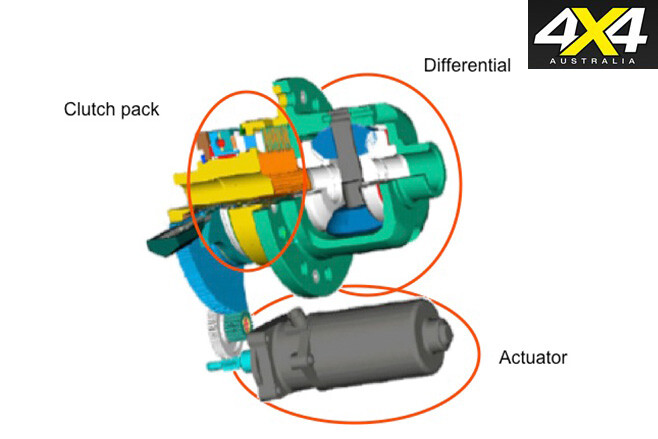
CLUTCH-TYPE LSD This type has a multi-plate clutch pack similar to that in a motorcycle. One side of the clutch assembly is connected to the driveshafts and the other to the differential gear carrier. Various methods such as ramps or the natural force of separation between gear teeth are used to engage the clutch pack when the differential experiences one wheel turning faster than the other, which then transfers some of the power to the slower-turning wheel.
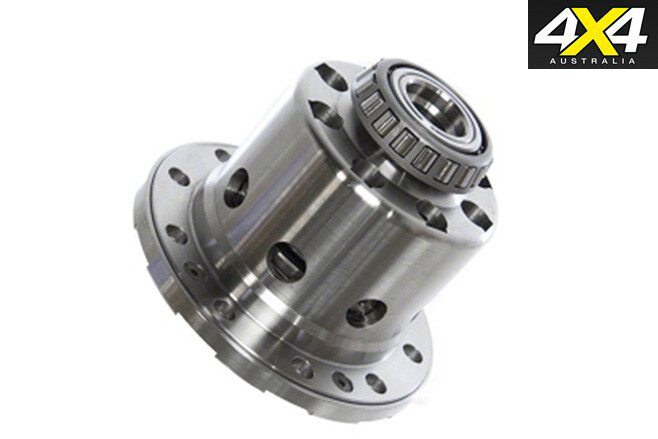
ONE-WAY, ONE AND A HALF, AND TOW-WAY A one-way LSD will only provide the limited-slip action in one direction – for example, under acceleration but not under braking. By contrast, a 1.5-way LSD will provide differing amounts of slip limitation under acceleration and braking, which can aid stability under heavy braking. A two-way LSD will provide the same amount of limited-slip effect under both acceleration and braking.
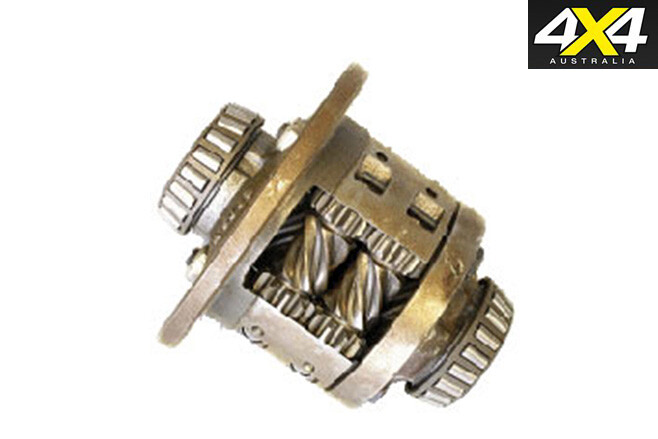
TORSEN The torque-sensing differential is a limited slip-type differential that uses the one-way action of worm drive gearing to limit slip. They also have the ability of being manufactured with a TBR (torque bias ratio), where there is an ability to send more torque to the rear wheel in a centre differential application.
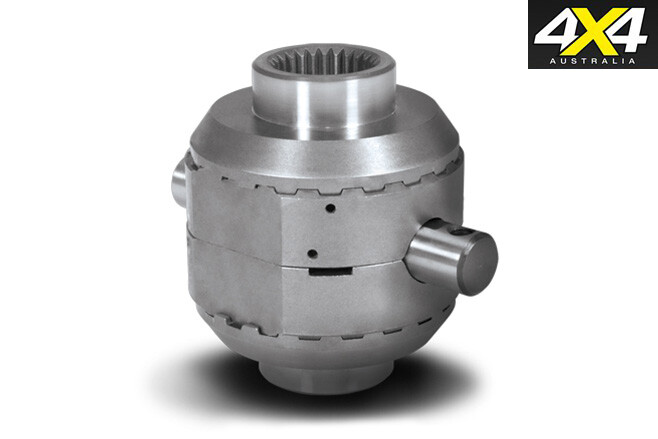
AUTO LOCKER When thinking of auto lockers, many think of ‘lunchbox lockers’ that replace the spider gear mechanism in the middle of differential carrier. Probably better referred to as un-lockers, lunchbox lockers are locked when driving under power in a straight line. When they experience different torque loads, such as coasting around a corner, they unlock. This can make for interesting handling characteristics on the road, and if installed in the front they’re much better in combination with a part-time 4WD system.
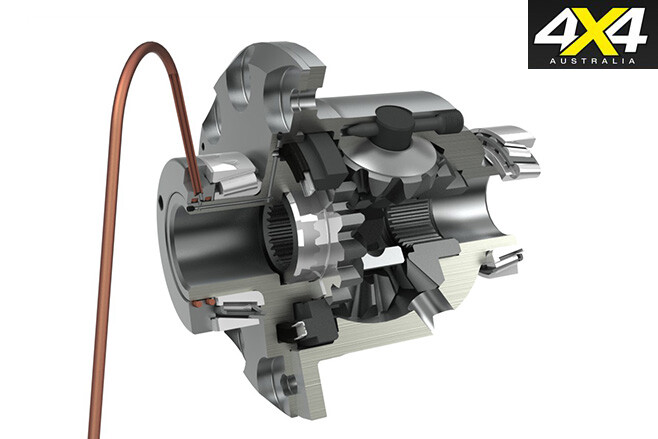
SELECTABLE LOCKER Viewed as the Holy Grail by many, selectable lockers come in two main flavours: air operated (TJM/ARB) and electromagnetic (ELocker). Both pneumatic lockers use a simple dog clutch-type mechanism that removes the differential action when activated. However, the ELocker uses a pin and ramp mechanism to operate a series of pins that lock the differential. When transitioning from forward to reverse, they unlock then relock due to the forward and reverse activation ramps used.
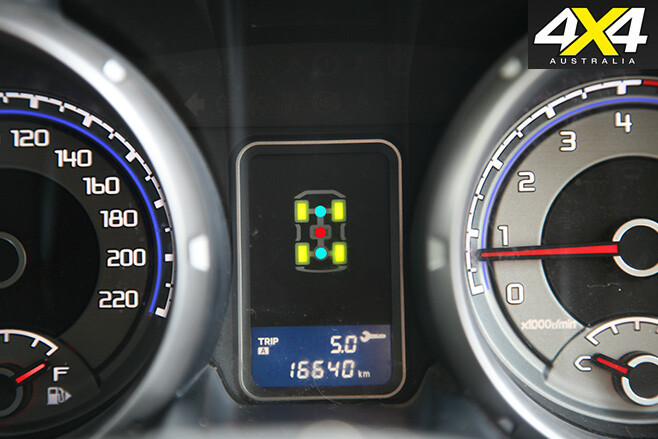
TRACTION CONTROL There are two main types of traction control: one reduces engine power, the other reduces the differential’s ‘power to the path of least resistance’ characteristic. Modern systems monitor individual wheel speeds and if two wheels on the same axle are travelling at differing speed it brakes the spinning wheel – this requires more torque from the engine. As there is always even torque on either side of a conventional diff, the slower wheel receives extra torque. Early systems weren’t great but now traction control is almost a viable alternative to lockers – the latest LandCruisers and Pajeros are particularly good.
LOCKERS VS TRACTION CONTROL? IF YOU’RE heading down a steep, undulating hill, a double-locked car can’t be beaten, as it reduces the weight placed on alternating wheels. An unlocked car will lock the brakes and intermittently slide, before grabbing traction as the weight comes back on the wheel. A locked car won’t lock wheels and then slide down the hill, as both wheels are mechanically locked together, acting as a solid unit.
If going uphill, lockers again reign supreme. Traction control waits for the axle to start losing traction before it counteracts by braking the spinning wheel. This takes time, so you’ll always lose momentum waiting for traction control to react – and that might be enough to stop you in your tracks.
However, anyone who has driven a double-locked car will tell you that cornering isn’t its strongest point. On the flipside, traction control is smart enough to operate even around a hairpin bend.
TORQUE VECTORING DIFFERENTIALS A CONVENTIONAL diff gearing system is located in the centre, but on either side of the carrier is a clutch pack that (when electronically engaged) is able to mechanically link the axle directly to the carrier. Using electronic manipulation of the clutch packs, the designers are able to vary the torque to each wheel. When turning around a bend, the computer is able to provide more torque to the outside wheels, therefore improving turn-in and handling characteristics.
If used as the centre diff in a full-time 4WD application, you could have a vehicle with a bias toward the rear wheels for everyday driving, but could split the torque 50:50 when off road. This differs from a Torsen diff, where the torque split is mechanically set and can’t be altered on the fly.
COMPETITION rock crawling is a world where spectators very rarely get to peek inside.
It’s often held in remote properties more known for their rugged isolation and rocky outcrops than their spectator-friendly grandstands, and while it has been hidden away from prying eyes, rock crawling has been growing from strength to strength.
Across the country the sound of welders buzzing and rattle guns hammering has been heard ringing out of workshops, garages and driveways; each team burning the midnight oil to get their crawlers ready for W.E. ROCK, one of the biggest competitive rock crawling events in Australia.
There’s no denying a day in the rocks is a bit of challenging fun for most off-roaders, but the W.E. ROCK crowd take things to a whole ’nother level. 40-inch tyres, coilover suspension, portal axles and rear steer are all fabricated into hand-built rigs with a fuel range measured in hours rather than hundreds of kilometres. Some still resemble the street-going rigs they started out as, while others are more akin to a single-seat moon buggy than any traditional 4×4.
At the recent Sydney 4WD & Adventure Show we snuck in early on the Friday to avoid the crowds and get an up-close look at the behemoth known as the Tough Dog Mountain. A concrete wall laid-out specifically to bring rock crawling to the masses, with grand stands and food stalls all skirting the course.
Where some events reward outright speed, W.E. ROCK is a series of tight technical tracks all designed to test not only the capability of the vehicles but the skill of the navigators and the nerve of the drivers.
As the timer counts down from 10 minutes with an eagle-eyed marshal keeping watch, driver and navi work together to pilot their rigs through treacherous lines that’d roll just about any street-driven rig silly enough to try.
It’s the kind of terrain where taking the wrong line or hesitating on the loud pedal can see rollovers all the way to the bottom of the mountain, and it has happened once or twice before.
Vehicles are broken up into three main categories: Unlimited, Promod and Extreme. In the Unlimited class, imagination is the only limitation; wild built tube buggies reign supreme. Promod is ‘limited’ to 40-inch tyres and must resemble(ish) a production vehicle. Extreme is aimed at entry level rigs to give all budgets a shot at taking the glory.
If you’ve been putting off heading to the Sydney 4WD & Adventure Show, make sure it’s on your to-do-list for next year. The teams from W.E. Rock will be more than happy to put on a show like no other you’ll ever see.
RESULTS
PRO MOD #816 – Driver: Matt Reitsma. Navi: Trent Norris #27 – Driver: Warren Hatherly. Navi: Keith Dyson #32 – Driver: Steve Grima. Navi: Mark Lenstra
UNLIMITED #1600 – Driver: Phil Myres. Navi: Troy Whitelam #23 – Driver: Tim Scutt. Navi: Luke Schmahl #66 – Driver: Anthony Ayoub. Navi: Chade Blazejko
WHEN Reinhard Leimroth was sent to Australia by Robert Bosch in 1956 to troubleshoot ‘problem’ diesel engines, there’s no way he could have known that 60 years later he’d be working alongside sons Andrew and Scott, as well as grandsons Trent and Baden, at Berrima Diesel Service, the company he started in the NSW Southern Highlands.
Nor could Reinhard have known Berrima Diesel would become one of Australia’s biggest names in 4WD diesel tuning and repairs, also specialising in turbo installations, exhaust systems, DPChips, dyno-tuning and more.
2016 marks Reinhard’s 60th year as a diesel expert, and it also marks son Andrew’s 30th year working alongside his dad. “I think we might be the only company in the industry with three generations working here,” Andrew Leimroth explained.
“It’s Dad’s 60th anniversary this year, and it’s coincidentally my 30th anniversary, because it was 1986 when I started working with Dad. So we’ve got 30, 60 and the three generations, so it’s a bit of a corker of a year.”
Initially, neither of Andrew’s sons intended to join the family business. “One did sports science and the other did a chef’s degree,” Andrew said. “They love all that, but they said, ‘We want to be in the business’, so Trent [22] came in at the start of the year – he’s doing his apprenticeship and goes to TAFE – and Baden [20] is a chef by trade, but they’re both getting into the business. They’ve both got a passion for vehicles, they always have, and so here they are.”
Andrew’s brother Scott is studying at Wollongong University, but he’s still involved with the family business, looking after the marketing side of things and manning the DPChip stand at 4×4 shows around Australia.
“Scott is doing a marketing/psychology degree, so he’ll probably have a bunch of wonderful brainwashing ideas to use when he’s finished,” said Andrew with a laugh.
2016 has been a momentous year for Berrima Diesel Service, but it hasn’t all been plain sailing. The company has been involved in a tussle with the local council in regards to a change in zoning, which could have it forced to change locations, or even close altogether. Fortunately, the council saga appears to have been resolved, which is just as well for this growing business and the community in which it operates.
“There’d be a good 12 or 13 people working here now,” Andrew said. “So we’re a big local employer, and we all spend money locally. And Jimmy, our Filipino mechanic, well he’s Australian now – he’s got his family coming out here… I mean, we contribute a lot, and it all just continues to grow.”
CONTACT Berrima Diesel Service Phone: (02) 4877 1256 Email: [email protected] Web: www.berrimadiesel.com Address: 3483 Old Hume Hwy, Berrima, NSW, 2577
We change things up by taking a spin in Renault’s new Koleos Intens 4×4.
WHAT’S THE DEAL? It mightn’t be the usual vehicle we strap ourselves into here at 4X4 Australia, but when offered the chance to drive Renault’s all-new Koleos, we thought ‘why not?’
The day-to-day commute to 4X4’s headquarters has become quite a drawl thanks to Melbourne’s bottleneck roads, so why not spoil ourselves with a bit of luxury and comfort for a change.
The medium SUV is available in four variants – Life (4×2), Zen (4×2 and 4×4) and Intens (4×4) – with each vehicle utilising Renault’s 2488cc 2.5-litre petrol engine.
We opted for the top-of-range Intens 4×4 for a week of commuting – plus we took it on quick off-road dash for good measure.
PRACTICALITIES The swanky cabin is illuminated by ambient lighting, which can be altered to suit your mood (blue, green, red, pink and yellow).
An 8.7-inch portrait-orientated capacitive touchscreen – with R-LINK 2 media system – is actioned via fingertip controls, which can be fiddly for those of us lacking laser-like dexterity, especially on bumpy trails when you’re jiggling around in the seat. Yes, for urban city driving it’s bearable, but in terms of off-road practicalities, what’s wrong with a turning dial?
The leather-trimmed cabin is sleek, modern and comfortable, with oodles of space. The all-new Koleos affords more space in most areas than the outgoing model: overall length has increased by 152mm to 4672mm; wheelbase by 15mm to 2705mm; rear overhang by 163mm to 1038mm; and rear knee room by 77mm to 289mm. Height has dropped from 1705mm to 1678mm.
The hands-free tailgate opens to provide 458 litres of boot capacity, while there are plenty of storage compartments littered throughout the cabin.
ON-ROAD Riding on 18-inch alloys, the Intens 4×4 is definitely more urban steed than outback warrior, so that’s where we spent most of our time with the French monsieur.
The soft suspension tune makes its on-road demeanour smooth, perfect for the day-to-day commute. Put the right foot down, however, and the 2.5-litre donk strains to shift the hefty 1608kg SUV with any real urge. This is especially noticeable on steeper inclines thanks to a lack of low-end torque.
The Intens features a number of driver aids that the lesser models miss out on, including: blind spot warning, forward collision warning, lane departure warning, advanced emergency braking, easy park assist, and side parking sensors. All of which will prove invaluable in Melbourne’s traffic.
OFF-ROAD The Intens 4×4 shares its architecture with Nissan’s X-Trail, so the credentials as a mild adventure machine are there, but a quick brush on some of Melbourne’s tamed off-road trails established that it’s probably best to stick to highways, hook turns and coffee stops.
Basic underbody protection and the stock-standard suspension tune make it hard to cover any decent form of off-road terrain.
In saying that, it does have quite a good ground clearance of 210mm (the outgoing model had 186mm), so it’ll battle on quite respectably.
All-Mode 4×4-I technology – common on many vehicles within the Renault-Nissan Alliance family – allows drivers to switch between 4×2 and 4×4 driving modes.
In 4×4 mode, torque is automatically split between the front and rear wheels. While a third mode called 4WD Lock initiates permanent all-wheel drive for tricky, slippery surfaces. This mode works at speeds up to 40km/h.
PRICING The all-new Koleos comes in several configurations and pricing brackets. The base model Life is only offered in 4×2 configuration and starts from $29,990, the mid-range Zen comes in 4×2 at $33,990 and 4×4 at $36,490, and the top of the range Intens 4×4 starts from $43,490.
VERDICT It’s chic, stylish, well-priced and spacious, and it’ll take you to your next holiday destination in comfort. So long as that next destination isn’t too remote.
SPECIFICATIONS ENGINE: 2.5-litre. 4-cylinder petrol POWER: 126kW @ 6000rpm TORQUE: 226Nm @ 4400rpm TRANSMISSION: CVT auto BRAKED TOWING CAPACITY: 2000kg FUEL TANK: 60-litre FUEL USE: 8.3L/100km (claimed) GROUND CLEARANCE: 210mm APPROACH/DEPARTURE: 19/26 degrees
YOU’RE minding your own business driving down a back track when the weather suddenly turns and it starts to blow a gale, which means it’s time to find a safe place to rest. However, around the next bend you’re confronted with a tree lying across the road.
In the back of the vehicle is a chainsaw and personal protective equipment (PPE). Chainsaws often only get used for cutting bits of timber in the backyard, but what do you do when presented with an entire tree on a remote road?
Definitely don’t drive around it, because everyone else will follow suit and before you know it the whole place will be cut up and damaged. After all, it only takes one smart arse to ruin it for the rest of us, and then the track will get closed.
So, how does one clear a track?
STEP 1: ASSESSMENT Before starting the chainsaw, stand back and assess the situation – always imagine the worst-case scenario and be prepared for it. Take a few minutes to clear a path behind and to the side for a quick withdrawal.
Think about how to cut each branch and what will happen when you do. Obviously, upward-facing branches will fall, so make sure the fall path is clear.
It’s not so clear what will happen when we cut branches trapped under a fallen tree. In some cases removing them will simply cause the tree to drop; in other cases they will act as a release spring.
Finally, always work with a partner. If you become trapped or injured you’ll have someone to call for help.
STEP 2: CLEAR THE BRANCHES Start by removing the branches closest to the lower end of the trunk, and then work towards the top of the tree.
Whenever possible, stand on the uphill side of the tree because things roll downhill with gravity.
Work from the left side of the trunk (as you face toward the top of the tree). This allows the safest and most efficient use of the chainsaw, because you can rest the side or bottom of the saw on the trunk and slice off the branches with a pivoting motion.
Cut off branches that are under pressure by first cutting downward through one-third of the branch. Finish the cut by sawing upward to meet the first cut, and always be prepared for the main trunk to roll or drop.
STEP 3: THE TRUNK Cut trunks that are supported at both ends by making a downward cut one-third the diameter of the trunk.
Cut upward to complete the cut. Finish by cutting up from underneath, and be prepared for one or both sides to drop.
If the trunk is hung up or suspended at both ends, you need to level it – in other words, cut the trunk loose from its stump.
If you attempt to cut straight down through a trunk that’s supported at both ends, the weight of the trunk will pinch the bar and trap your chainsaw.
Stop the engine if the bar does get stuck, then use a thick branch to lever the trunk and open the cut far enough so you can remove the chainsaw.
STEP 4: FINISH THE JOB Technically the offcut branches remain the property of the person who owns the land, so do the owner a favour for letting you on their property. After clearing the route, cut the wood into 30-40cm lengths and leave it in a neat pile by the track.
First, cut three-quarters of the way though, then roll your log over and complete the cuts. This stops the chain hitting the ground.
On government land laws prevent the removal of fallen timber because that might impact on native species. Another reason: some jurisdictions auction such timber; in others, someone might hold a lease for collection. So removing it would be stealing. In some areas you can have your 4×4 and chainsaw confiscated on the spot.
As always, it’s best to check your state’s regulations.
SAFETY FIRST A chainsaw is one of the most versatile tools you can own, but it cuts both wood and flesh equally well. So you need to learn how to safely use this powerful tool. There are a number of accredited courses for those who need WHS certification in the work space, while there are non-accredited courses designed for domestic and farm use. These start at $200 for a one-day course and they cover everything from chainsaw maintenance to how to safely cut fallen trees.
US-BASED Workhorse has announced it is developing a large lithium-ion battery-powered vehicle called the new Workhorse W-15.
These vehicles will run cleanly and powerfully for a reported 130km before the petrol-powered generators kick in to charge the batteries back up again, leaving the car with a range of more than 500km.
Yahoo Finance reported that the expected 130km initial range was reached to satisfy most day-to-day use of the cars, meaning for local workers and drivers the back-up engine will rarely need to kick in at all. Just remember to plug it in every night.
For a lighter kerb weight, composite body panels and a high-strength stainless-steel ladder-frame chassis were used. Mounted beneath the floor and between the axles, this new design also works to keep the large lithium-ion batteries safe from harm.
To add to the features of the car, Workhorse claims the light frame and net weight aren’t a problem as far as safety goes, pointing to a large crumple zone and low centre of gravity as reasons for the ultra-low-emission-ute’s “safest pick-up ever built” label.
With millions of pick-ups sold in the United States every year, the W-15 will aim to cut both emission output and cost of ownership for owners of large pick-up fleets.
This ambitious plug-in is also said to have five interior seats along with its large truck bed.
If all the claims made about this upcoming work car are true, it could be a true modern engineering marvel when it hits showroom floors in 2018.
CARB-LOAD on your next camping adventure with everyone’s favourite Italian delicacy: meatballs.
What about entrée and dessert? Check out these recipes.
To get this simple pasta-with-meatballs dish underway, you’ll need to cobble together a handful of ingredients: sausages, onion, oil, garlic, crushed tomatoes, tomato paste, hot tomato chutney and anchovies.
First, put the snags (beef snags in this case) on a frying pan/grill and let it sizzle away while you prepare the other ingredients.
Chop up an onion and feed it into a separate saucepan, add garlic and a couple of teaspoons of chilli flakes for good measure.
Once the onion has browned nicely, throw in a tin of crushed tomatoes, a tin of tomato paste and a few teaspoons of hot tomato chutney – the latter will survive in the back of your rig for ages!
The next ingredient is strictly optional: anchovies. Drain most of the oil out of the tin and then add the anchovies into the sauce mixture.
By now the snags should be well-and-truly cooked, so slice them up and throw them into the mix.
Cook up the pasta while the sauce bubbles away, and there you have it – a simple, hearty meal.