
MITSUBISHI Motors Australia has issued a recall for its 16MY QE Pajero Sport, 12-13MY PB Challenger and 14MY PC Challenger.
5924 Challengers and 13,932 Pajero Sports are affected by this recall.
The recall is due to insufficient anti-corrosion coating that was applied to the end cap on the outer tube of the tailgate gas springs.
This fault could result in corrosion, which may lead to breakage of the end cap. This could cause the tailgate to fall suddenly and thus lead to injury or a potential car accident.
Owners of affected vehicles will be contacted by Mitsubishi Motors Australia via mail. Owners will be advised to take their vehicles to their preferred dealer to get the replacement parts fitted.
The report also notes that the replacement parts are silver to assist in identification and to avoid supply delays.
This recall also applied to 11-12MY XA and 13-15MY XB ASX models.
Earlier this week, Isuzu Ute Australia recalled 12 15.5MY MU-Xs due to an incorrectly fitted fuel tank band. All 12 owners of affected vehicles have been contacted by Isuzu.
Nissan also issued a recall this week. This recall was due to malfunctioning airbags in certain D22 Navaras and Y61 Patrols. The passenger airbag inflators posed a risk of allowing moisture to enter the airbag inflator, which could cause the propellant in the inflator units to deteriorate. This may result in abnormal airbag deployment or metal fragment scatter.
HOLDEN verses Ford. It’s the classic Australian stoush played out most dramatically at Mount Panorama each October, but more crucially in car showrooms every day. The specific combatants have traditionally been the Commodore and the Falcon, but now that’s changed.
For Ford the Ranger is its best seller, even before Falcon production stopped, while over at Holden the Colorado is second only to the Commodore in sales and looks set to move into the number one spot once Holden closes down local production next year – including that of its Commodore-based 4×2 ute, which will no doubt boost Colorado 4×2 sales.
That’s in the future. What we have right now is Holden’s revised-from-the-ground-up Colorado taking on Ford’s Ranger for the next instalment of ‘King of the (Dirt) Mountain’.
FORD RANGER XLT: TRUE BLUE
Last year’s mid-generation changes have refined and polished the big, tough and blokey Ford Ranger.
THIS is the ute Ford Australia designed and developed for the world. Well, most of the world anyway. The Ranger isn’t quite sold everywhere, most notably in the USA and Canada, although this is set to change when Ranger production starts up in Michigan, USA, in 2018. Meanwhile, our Ranger, like all of the popular utes (bar the VW Amarok) sold here, is built in Thailand. From its introduction late in 2011 the PX Ranger was a winner, both in what it did and how it sold.
Following its 2015 refresh the Ranger drives and performs ever better and is selling more strongly. Year-to-date (September ’16) Ranger 4×4 sales are less than 100 units (22,438 versus 22,524) behind the once completely dominant Toyota Hilux.
The mid-generational changes brought new front-end styling and a fresh dashboard, but hidden under the bonnet was a smaller, more efficient turbo, new fuel injectors, cylinder head changes and various measures to improve engine NVH. The Ranger also gained electric power steering and enhanced electronic control of the 4×4 system.
POWERTRAIN AND PERFORMANCE WHAT hasn’t changed are the engine basics. Aside from the mechanically similar Mazda BT-50, the relatively big 3.2-litre five-cylinder engine is unique in this class. A little lumpy at idle, but smoothing out nicely with a few revs on board, the ‘big-five’ is lazy and relaxed compared to the four-cylinder engines in competitor utes. It also uses less revs and generally taller gears to go about its business.
Strange as it may sound, an inline-five offers better dynamic balance than an inline-four due to the inline-four’s inherent vibration, which occurs at twice crankshaft speed and is the source of a four’s often ‘buzzy’ feel. This problem is usually addressed through the use of crankshaft-driven (and power-robbing) rotating balance shafts.
Pedal to the metal, the Ranger is an effective match for the Colorado, despite the Colorado’s higher peak torque (500Nm) and slightly trimmer weight.
The 2015 changes have made Ford’s 3.2 more responsive at low revs and generally much quieter overall, although there’s still some gruffness about this engine. It is, after all, a commercial-vehicle-derived diesel engine rather than a passenger car diesel, coming as it did from the European Transit van. Still, in terms of refinement, it’s up there with the vastly improved Colorado.
As ever the Ford six-speed ZF auto is agreeable and works nicely with the grunty engine; although, on throttle-off descents it isn’t as proactive in backshifting as the Colorado’s generally more sportily-tuned GM six-speeder.
ON-ROAD RIDE AND HANDLING FORD hit the on-road ride, handing and steering sweet spot right from the Ranger’s debut in 2011. The mechanically near-identical Mazda BT-50, released weeks later, had a slightly sharper suspension and steering tune than the Ranger, but it wasn’t as nice.
Fast forward to today and the Ranger is still towards the head of the ride-and-handling pack, but now has the benefit of much-reduced steering effort at low speeds thanks to its electric power steering. This is more than welcome given the Ranger, along with the BT-50, is the biggest and heaviest vehicle in its class and has the longest wheelbase.
At speed the Ranger’s electric steering weighs up nicely and, as ever, ride and handling balance remains hard to criticise. Sure, unladen there’s firmness at the rear, but overall it’s composed, stable and surprisingly compliant. Where it shines against the Colorado is not on good roads, but on bad roads.
OFF-ROAD THE Ranger’s size can work against it off-road, but that’s about the only entry in the negative column. Most importantly the Ranger’s chassis provides generous suspension travel by ute standards – certainly more than the Colorado, which is critical in this contest.
If extra wheel travel isn’t enough, the Ranger also comes standard with a driver-switched rear diff lock, which is now far more effective than it was prior to the 2015 mid-generation upgrade. Previously, when the driver engaged the rear locker, it cancelled the electronic traction control across both axles.
Now, when the rear locker is engaged, the ETC remains active on the front axle, which makes a huge difference and helps put the Ranger with the best when it comes to off-road performance. It’s certainly a good step ahead of the Colorado.
CABIN AND ACCOMMODATION THE Ranger’s size mightn’t help when parking or off-road, but the upside is a class-leader when it comes to cabin space. Along with the BT-50, the Ranger has the longest cabin among the popular utes and is only bettered in width by the Amarok. On both counts it’s ahead of the Colorado, benefitting rear-seat passengers the most.
Up front the Ranger also feels big and spacious and, even if there’s no reach adjustment for the steering wheel, it’s a comfortable place to be. Nicer front seats than the Colorado, too.
PRACTICALITIES OUR recent load and tow test (November 2016) crowned the Ranger as the carrying and towing king. Having a 3500kg towbar, ugly as it is, as standard on the XLT is a bonus, as is the fact that all Ranger dual-cab pick-ups have six rather then four tie-downs in the tub. XLT and Wildtrak models also get a 12-volt outlet in the tub.
Under the gas-strutted bonnet there’s room for a small second battery, a high-mounted alternator and air intake via the inner guard. The 265/65R17 tyre and wheel spec is also as practical as it comes.
EQUIPMENT ALL Ranger 4×4 dual-cab pick-ups have a five-star ANCAP safety rating, six airbags, and stability and trailer-sway control. Cruise, Bluetooth, auto headlights and a rear locker are also standard. All Ranger dual-cabs bar the XL Plus also have a 230V outlet in the cabin. The XL Plus gets an aux battery and 17in steelies.
The XLS adds carpet and 17in alloys. The XLT adds sat-nav in a larger touchscreen, dual-zone climate, a centre-console cooler, rear parking sensors, auto wipers, tyre pressure sensors, 12V in the tub, a sportsbar, sidesteps and a 3500kg-rated towbar.
Wildtrak adds a reversing camera, front parking sensors, heated front seats, 18in alloys, and a lockable roller cover.
An optional Tech pack for the XLT and Wildtrak includes radar cruise control, forward-collision warning, lane-departure warning and a driver-impairment monitor.
SPECS: FORD RANGER* Engine: 3.2-litre 5-cyl turbo-diesel Max power: 147kW @ 3000rpm Max torque: 470Nm @ 1500-2750rpm Gearbox: six-speed automatic 4×4 system: dual-range part-time Crawl ratio: 42.3:1 Construction: separate chassis Front suspension: independent/coil springs Rear suspension: live axle/leaf springs Kerb weight: 2068kg -2200kg GVM: 3200kg Payload: 1000kg -1132kg Towing capacity: 3500kg Towball download: 350kg GCM: 6000kg Fuel tank capacity: 80 litres ADR fuel claim: 9.2L/100km Test fuel use: 12.1L/100km Touring range: 611km** *4×4 dual-cab pick-up autos only.
FORD RANGER PRICES* XL: $47,565 XL PLUS (auto): $53,235 XLS: $48,865 XLT: $55,425 WILDTRAK: $59,590 *3.2L 4×4 dual-cab pick-up manuals only, unless noted.
HOLDEN COLORADO Z71: FRESH START
The Colorado may be a global GM product, but Aussie engineers have played an even greater role in this mid-generation remake.
WHAT we have here is the top-spec Colorado dual-cab 4×4, the Z71. It’s not exactly the Colorado we wanted for this test, but it’s not exactly wrong either. What we asked for was a LTZ dual-cab – one spec down from the Z71 – to compare with the volume-selling Ranger XLT.
The good news is that this top-spec Colorado is actually a price match with the upper-mid spec Ranger XLT, which is always a valid starting point for a comparison test. Either way, the Z71 and the LTZ are mechanically identical; the Z71 just adds the rear body kit and leather and heated front seats, among a few details.
The Colorado arrives after a ground-up remake: it’s been pulled completely apart and put back together.
This generation Colorado is a GM product and not a re-badged Isuzu, and it emerged in 2012 from a GM design and development program based in Brazil. A year later it was tweaked, and again in 2014, before this major overhaul for 2017.
Most of the latest changes are aimed at improving refinement, with relocated engine balance shafts, revised fuel injection, additional injector soundproofing, a new torque convertor for the auto, shorter final-drive gearing for the manual, new engine and transmission mounts, new body mounts, recalibrated suspension and electric power steering.
Also aimed at refinement are revised roof mouldings, exterior mirror mounts, door seals, sliding glass channels, B-pillar inserts, and a thicker windscreen. So there’s not much that hasn’t been worked over.
POWERTRAIN AND PERFORMANCE THE engine remains the 2.8-litre four-cylinder from Italian diesel specialist VM Motori, part of the seemingly ever-growing Fiat empire. As before, the engine claims maximums of 147kW and 500Nm, although fuel mapping has been tweaked for better driveability.
What you notice most is how much quieter and more refined this engine is than before, which is a more than welcome change from the generally unpleasant, rough and gruff thing it was before. It’s still no Amarok in terms of noise and running refinement, but it’s now a match for the Ranger and may even be a bit quieter. Either way, it’s now a very pleasant engine – something you couldn’t say about it previously.
There’s plenty of performance from its 2.8 litres and, pedal to the metal, the Colorado matches and can even better the bigger five-cylinder engine in the Ranger, although it does rev harder in the process. Peak power is at 3600rpm compared to the Ranger’s 3000.
The Colorado’s cause is helped by what is now a very good auto gearbox, with smoother, quicker and ‘smarter’ shifts than before thanks to the new torque converter and revised shift protocols. While no smoother than the Ranger’s six-speed, it’s a more proactive in its shifts, something you notice on demanding, hilly, winding roads.
ON-ROAD RIDE AND HANDLING AMONG the chassis changes, the new Colorado’s electric power steering is the one you most notice. The benefit is very light steering at parking speeds, combined with more weight and feel at highway speeds.
In practice it works very nicely, and with the front suspension changes that run to softer springs, a thicker sway bar and digressive rather than linear front dampers, it provides a front end with more feel and a generally more compliant and comfortable ride than before. On the downside, the front end also seems to ‘crash’ more on the nasty washouts, potholes and bumps you might find on poorly maintained back roads, when hit at speed.
The rear spring pack, previously only fitted to the Z71 but now common across the range, combines a much softer initial rate and a slightly firmer final rate than the default spring pack fitted to non-Z71 variants before the MY17 update. It’s surprisingly comfortable, even when unladen. As with the front, the rear now has digressive rather than linear dampers.
Interestingly, of all the popular utes, the Colorado is the only one to run a mechanical rear limited-slip diff in addition to electronic traction control. The idea is that the limited-slipper takes care of moderate wheelspin so ETC isn’t triggered – potentially cutting engine power – when the driver is entering a moving traffic steam on a wet road and needs maximum acceleration.
OFF-ROAD THE Colorado’s new electric power steering is a winner off-road in terms of much-reduced steering effort. The softer suspension generally works better for low-range work, while Holden has also worked on the electronic traction control to improve its off-road effectiveness.
The end result is a better ute when the road stops and the tracks start, but the Colorado is still not a front-runner when it comes to vehicle-stopping conditions. Crucially the chassis doesn’t have as much travel as some competitors, the Ranger included. The Colorado also lacks a rear locker, and while all rear lockers fitted to current utes aren’t effective as they could be, the one on the Ranger certainly is.
CABIN AND ACCOMMODATION THERE’S more good news in the Colorado’s cabin, with much improved fit and finish that brings a quality feel lacking in previous Colorados. There’s more equipment, too, right across the dual-cab range.
At Z71 spec the Colorado feels quite luxurious thanks to its heated leather seats, although all Colorados lack tilt-and-reach steering wheel adjustment. That said, the driving position is comfortable and provides shorter drivers with good vision over the bonnet and to the sides.
It’s got one of the bigger and better back seats, too, if you need to accommodate three adults – even if it’s not as roomy as the Ranger.
PRACTICALITIES ALL Colorado dual-cab 4x4s are rated to carry more than a tonne (1000kg total payload) and tow 3500kg. From our recent tow test we know the Colorado does both with reasonable ease.
Off-road practicalities include two front tie down points – but none at the rear – a large air filter that draws via the inner mudguard, and a high-mounted alternator. Unfortunately there’s little room for a second battery.
The Z71 runs on 265/60R18 tyres and, if the 18-inch wheels aren’t to your liking, you can always fit the 17s from the LT, which will open up a wider choice of all-terrain rubber.
EQUIPMENT ALL Colorado 4×4 dual-cab pick-ups have a five-star ANCAP safety rating, seven airbags, stability and trailer-sway control, and a reversing camera. Cruise, Bluetooth, rear parking sensors, a digital radio and a touchscreen supporting Apple CarPlay and Android Auto are standard.
The LT adds 17-inch alloys, fogs and sidesteps. The LTZ then adds 18s, a bigger touchscreen with inbuilt sat-nav, auto wipers, front parking sensors, tyre-pressure sensors, electric driver’s seat adjustment, a soft tonneau, a sportsbar, lane-departure warning, and forward-collision alert.
The top-spec Z71 adds heated front leather seats, roof rails and a tub-mounted body kit. Holden also offers various accessories for the Colorado including bullbars, underbody protection and all-terrain tyres.
SPECS: HOLDEN COLORADO* Engine: 2.8-litre 4-cyl turbo-diesel Max Power: 147kW @ 3600rpm Max Torque: 500Nm @ 2000rpm Gearbox: six-speed automatic 4×4 system: dual-range part-time Crawl ratio: 36.8:1 Construction: separate chassis Front suspension: independent/coil springs Rear suspension: live axle/leaf springs Kerb weight: 2065kg to 2143kg GVM: 3150kg Payload: 1007kg to 1085kg Towing capacity: 3500kg Towball download: 350kg GCM: 6000kg Fuel tank capacity: 76 litres ADR fuel claim: 8.7L/100km Test fuel use: 12.7L/100km Touring range: 548km** *4×4 dual-cab pick-up auto only. **Based on test fuel use, claimed fuel capacity and a 50km ‘safety’ margin.
HOLDEN COLORADO PRICES* LS: $44,990 LT: $46,990 LTZ: $50,990 Z71: $54,490 *4×4 dual-cab pick-up manuals only.
THE VERDICT
HOLDEN’S re-engineering of its Colorado for 2017 has been highly successful, propelling it from disappointing tailender to a good thing among the eight popular 4×4 dual-cabs. The Ranger, on the other hand, has always been a good thing, ever since it arrived in 2011, a year before the Colorado. It became a whole lot better thanks to a mid-generation upgrade in 2015.
However, Holden has moved the Colorado on more in this upgrade than Ford did last year with its Ranger. But then again, something special had to be done, given the Colorado was previously so far towards the back of the pack.
The Colorado has improved to the point that in many ways it’s now the equal of the Ranger in what it does and doesn’t do.
On-road the two are now a close match in terms of refinement, comfort and general driveability. The Colorado’s smaller engine doesn’t give it a performance disadvantage, either. In fact, it can even feel a bit sportier than the Ranger thanks to its gearbox tune and higher peak engine torque – and being a bit lighter doesn’t hurt.
The Colorado’s on-road dynamics, at least on better roads, also have a sporty edge to them compared to the Ranger. It feels a bit smaller and more agile than the slightly longer and bigger Ranger. There’s generally a nicer steering feel in the Colorado, too.
But things start to go downhill for the Colorado once the roads deteriorate. It doesn’t handle the bumps as well as the more compliant and supple Ranger. Things unravel even more compared to the Ranger off-road, thanks to less suspension travel, no rear locker and less effective chassis electronics.
That said, the Colorado will still comfortably do 99 per cent of what most people will ever want to do off-road; it’s just that the Ranger, in its post-2015 iteration at least, is a stand-out performer off-road.
Throw in its extra cabin space and towing and load-carrying prowess and you can see why it justifies the extra cost.
DEPENDING on where you live within Australia – Tasmanians and Victorians look away now – you’re guaranteed to get plenty of sun, most of the time.
So why not harness this free energy to use at camp by investing in a solar panel? Getting a system that works for you could save you plenty of coin in the long run.
We laid five solar panels under the sun – Projecta 120-Watt Bi-Fold, Projecta 120-Watt Multi-Fold, Redarc 115-Watt Sunpower Black Blanket, Redarc 112-Watt Red Blanket and a Projecta 80-Watt Bi-Fold – and put them through a rigorous testing process to find out which one provided the best power.
Multiple weather scenarios were tested, including full sun, partial shade, half sun, indirect sun and cloudy conditions, to realistically represent Australian conditions.
All five solar panels were set up at the same time and in the same conditions, and all charged a single battery which was powering four fridges. Four fridges were used due to the high input power of the panels.
Mark Allen assessed each panel’s ability in the differing weather conditions, as well as the practicalities of the different designs – what are the pros and cons of a blanket panel compared to a fixed frame panel? Does size matter?
The read our complete solar panel comparison and to see all of the stats and figures, pick up a copy of 4X4 Australia’s January 2017 issue, in stores December 8.
WHENEVER you head off on a big outback adventure, it’s inevitable that something will go wrong. On some trips that might be as insignificant as a chipped windscreen, but on others the list of failures can be long, so it always pays to be prepared. But how prepared do you really have to be?
12 years ago I embarked on a 5000km outback pub-crawl with a few mates. It was a great idea because (all in the name of a good story) we managed to do the whole trip on the company’s budget. Four of us in two vehicles met up at the Silverton Hotel in NSW one evening in February and raised our first schooners to the upcoming adventure. Yes, it was going to be hot (think 48°C) but the beers would be icy cold.
Our loop would see us ‘testing’ beers at 11 pubs, all in one amazing week: Silverton Hotel; Packsaddle Roadhouse; Albert Hotel, Milparinka; Tibooburra Hotel; Family Hotel, Tibooburra; Corner Store, Cameron Corner; Innamincka Hotel; Mungerannie Hotel; Copley Hotel; Marree Hotel; and the Prairie Hotel, Parachilna. On the way home we stopped at the Blinman Hotel and Great Western Hotel just for good measure.
Our steeds were the two long-term test vehicles on the 4X4 Australia fleet at the time: a Nissan D22 Navara V6 and a Land Rover Freelander Td4. Of course, we packed a heap of spares for the Freelander, thinking that the thing would be lucky to go the distance, especially in the extreme temperatures we would face. And, of course, the only mechanical problem we had all trip was a busted fan belt on the Navara. Luckily it happened just out of Copley and we managed to roll into town and have a new belt fitted at the local garage.
The following year on a Madigan Line Crossing we managed to bust a couple of shock absorbers on the back of a Land Rover Defender 130 Crew Cab. We weren’t carrying spares but we did have a welder, so we were able to effect a decent repair on a red claypan. We were all set to go first thing in the morning without any negative impact on our schedule. Again, we had packed plenty of spares and tools for all three vehicles on that trip, so we were confident of our self-sufficiency.
This year I joined ARB on the recent Off Road Icons adventure across the Simpson Desert. We were well prepared, with plenty of spares, plenty of tools and several very able and mechanically minded blokes who could fix stuff if it failed. And fail it did!
Our tucker trailer copped a busted leaf-spring pack (replaced trackside), a busted hitch (welded back on trackside), a bent axle (fixed at Birdsville Auto) and the wheel fell off (reattached trackside and properly repaired at Birdsville Auto). The FJ40 LandCruiser didn’t like water and it had a minor electrical fault, so it had to be towed more than 200km across the desert.
The GQ Patrol’s alternator packed it in from all the mud we encountered (rebuilt in camp at Mungerannie, but still not sorted). A sway-bar link on the Ford Ranger ‘photo-car’ failed, putting a hole in the CV boot, so the sway bar was removed altogether (fixed trackside on Willow Springs). The alternator failed on the 79 Series LandCruiser (fixed at Birdsville Auto), and later, the studs failed on a rear wheel, which came off (towed to Copley for repairs).
The Land Rover Defender copped an alternator full of mud but it came good once washed out with a jerry-can full of water (fixed in the middle of the night about three dunes shy of Big Red), and the engine started stalling at Willow Springs (drained fuel/water separator which fixed it promptly).
Despite all the challenges, and thanks to good preparation and a bit of good luck, all of the ARB Off Road Icons and support vehicles eventually made it to the end of the trip under their own steam, which wasn’t a bad effort considering the age of some of the vehicles – and the particular challenges we faced on the trip.
So how prepared do you have to be to tackle Australia’s remote inland? Well, very. And even then you might encounter problems that are simply unfixable, in which case you’re going to be bloody glad you’re carrying a sat-phone with you and you’ve told people where you’re travelling and when you expect to arrive at your destination.
Sometimes the ‘she’ll be right’ approach just doesn’t cut it.
THE Toyota Hilux has regained top spot on the 4×4 sales charts, after shifting 2905 units in November.
However, the evergreen Hilux is still nipping at the heels of the Ford Ranger on the year-to-date charts (27,851 versus 28,009). With a difference of 158 units, the Hilux may have left its charge to the top of the charts too late.
Nissan’s Navara (1577 units), Holden’s Colorado (1242) and Mitsubishi’s Triton (1205) round out the top five.
Not only do the Hilux and Ranger lead the 4×4 sales charts, when you add 4×2 variants to the mix they are the best-selling vehicles on the overall market.
The Hilux (4×4 and 4×2 variants) sits atop the overall tree with 3839 units finding new homes in November. The Ranger is a close second with 3410 (4×4 and 4×2) units, while the ever-popular Corolla retains the bronze medal with 3245 units sold.
This is indicative of a growing trend toward Light Commercial Vehicles (LCVs). In November, 2016, private sales of LCVs rose 10 per cent compared to the same time last year.
“Private buyers are increasingly using these as a weekday workhorse and a weekend recreational vehicle,” Mr Weber said.
“The growing sophistication of these vehicles with their passenger car comfort and equipment levels, family-sized cabins and strong towing capacity positions them as an alternative to the traditional passenger car. More entrants to this light truck market are on the way in coming years so we can only expect this segment to grow.”
4×4 pick-up and cab-chassis light rigs hold a 12.9 percent share of the total market.
| u00a0 | 4X4 | NOV 16u00a0 | OCT 16u00a0 | YTD |
| 1 | Toyota Hilux | 2905 | 2422 | 27,851 |
| 2 | Ford Ranger | 2820u00a0 | 2751u00a0 | 28,009 |
| 3 | Nissan Navara | 1577u00a0 | 927u00a0 | 13,177 |
| 4 | Holden Colorado | 1242u00a0 | 1151u00a0 | 15,278 |
| 5 | Mitsubishi Triton | 1205u00a0 | 803u00a0 | 16,074 |
| 6 | Toyota Prado | 1168u00a0 | 1049u00a0 | 13,533 |
| 7 | Toyota LandCruiser Wagon | 1028u00a0 | 972u00a0 | 10,795 |
| 8 | Isuzu D-Max | 983u00a0 | 810u00a0 | 9,857 |
| 9 | Mazda BT-50 | 782u00a0 | 600u00a0 | 8,726 |
| 10 | Isuzu MU-X | 612u00a0 | 539u00a0 | 6,290 |
IT’S already December, and that means it’s time to start filling those Christmas stockings.
So here’s some new gear on the market that could be the perfect gift for that lucky someone.
Keep the tools neatly stored with an MSA 4×4 Tool Roll; sharpen up throttle response with an iDrive tuner; keep in contact when off-road with Uniden’s range of UHF CB radios; install a second battery on a Projecta battery tray; keep your 4×4’s carpet clean with Husky WeatherBeater floor liners; never get lost again with Hema’s new HX-1 Navigator; or get unstuck with a Thunder 12V 9500lb winch.
BACK-UP BATTERY TRAY ANY remote-area tourer should have a second battery. Some 4x4s are designed to cater for one; others need a bit of tweaking. Projecta has launched of a range of custom-built heavy-duty battery trays designed to fit conveniently into specific vehicles without any modifications. The trays are constructed with 2mm heavy duty rust and corrosion resistant passivated zinc-coated steel. Jump online to see the range of vehicles the trays are designed for. RRP: $249 Website: www.projecta.com.au
THROTTLE TUNE-UP THE simple-to-install iDrive Throttle Tuner sharpens a 4×4’s throttle response by eliminating any delay caused by a modern vehicle’s fly-by-wire throttle technology. The tuner utilises inbuilt settings to ensure a driver can find a setting that suits their driving style. The result is the smoothest aftermarket control module on the market. iDrive offer a money-back guarantee if buyers aren’t satisfied with the product – but we’re confident that’ll never happen. RRP: $299 Website: www.idriveaustralia.com.au
ROLL-UP KEEPING your tools neatly packed away is important when heading on any off-road expedition. Plus it’s even better if they don’t take up much room and they’re not in a big metal box. MSA 4X4 has unrolled a large Tool Roll that’s built tough. The roll features heavy-duty double-layered 12oz canvas; separate top flap and elastics to keep everything in place; 18 pockets of various sizes; and a heavy-moulded rubber carry handle. At 1220cm x 420cm when open, it allows for easy and safe storage. The MSA roll also works well for storing your camp cutlery RRP: $108 Website: www.msa4x4.com.au
ROGER THAT UNIDEN has expanded its range of UHF CB radios. The new five-watt models include the flagship UH9080 UHF CB radio and scanner in one, and the UH9060 and UH9000 UHF CB radios. The new releases are ideal for weekend adventurers and 4WD enthusiasts. Key features across the range include: access to 80 UHF CB channels; dual speaker in the speaker, microphone and base; Smart Mic technology; Master Scan technology; and an instant replay function. Check the web for a full list of features for each radio. Website: www.uniden.com.au
WEATHER OR NOT IF YOU’VE ever spent time off-roading you’d know it’s impossible to keep a rig’s carpets completely clean. Enter the rugged WeatherBeater floor liners. The USA-made floor liners are precisely measured to perfectly conform to a vehicle’s measurements. Other features include: a FormFit Edge, a raised ridge that runs along the door jamb; StayPut Cleats that stop the liner from shifting around underfoot; and rear-seat protection. The liners are easy to install and just as easy to clean, and they come with a lifetime guarantee. Website: www.huskyliners.com
STAY ON TRACK NEVER get lost again, because Hema’s new HX-1 Navigator is on its way. The all-new Hema has more than 45,000 campsites, caravan parks and points of interest stored. Plus it comes with street mapping, precise turn-by-turn guidance, and alerts for speed cameras, red-light cameras and school zones. With its new in-built camera you can record and save your journeys on map with photos and video and then share them on the Hema Explorer Cloud. The seven-inch multi-touchscreen is a vital addition to any 4×4 enthusiast’s repertoire. RRP: $699 Website: www.hemamaps.com
THUNDERSTRUCK IF YOU’RE in the market for a new winch, then check out the Thunder 12V 9500lb winch. The high-powered winch features a waterproof planetary gearbox, genuine Dyneema rope (available in 11mm x 24m and 9.5mm x 26m to suit different sized winches), and a wireless remote. A full range of recovery accessories are also available. This winch would look a treat on any bullbar. RRP: $1250 Website: www.thunderauto.com.au
MERCEDES-Benz knocked up an annual record recently, when the 20,000th G-Class rolled off the Magna Steyr production line in Graz, Austria.
It’s the first time in the G-Wagen’s 37-year production run – the first was produced in 1979 – that Mercedes-Benz has passed the 20,000 mark in a single calendar year.
To celebrate the landmark occasion, a special edition white Mercedes-AMG G63 with ‘designo manufaktur’ features was the lucky 20,000th vehicle to leave the production line.
Dr. Gunnar Güthenke, head of the off-road product group at Mercedes-Benz, said: “The production of 20,000 G-Classes in one year confirms the high demand for the ‘G’ and likewise the quality of our vehicles, something that is highly appreciated by our customers. I am very pleased and also proud that some of our employees have been on board since production started around 37 years ago.”
Since the G-Class was launched, more than 250,000 vehicles have been sold.
Dr. Güthenke added: “The individualisation and continuous technical optimisation of the G-Class contribute to the great success of the original off-road icon which still makes no compromises when it comes to off-road.”
The first ‘Professional W461’ model from the latest G-Class range to be offered in Australia will be the cab-chassis variant, while a five-door wagon will be available in Q2 of 2017.
We drove Merc’s W461 G300 CDI cab-chassis last week. Keep an eye on 4X4 Australia later this week for a complete road test review.
FOR the tenth instalment of Readers’ Rigs we’ve assembled a couple of Mitsubishis and LandCruisers, a killer Patrol and a wild JKU Wrangler.
Check out more Readers’ Rigs here.
To feature your 4×4 here, snap your 4×4 when it’s off on an adventure and then post it on our Facebook page. Your rig might even get published in the mag one day and, if we really like it, perhaps you’ll even see it on the cover of 4X4 Australia!
2008 MITSUBISHI NS PAJERO – CAMILLO LATHAM
WHAT IT’S GOT: My 2008 NS Pajero (ex-police) Paj has been in the family for the past six years and it has many mods. The engine has a chip, custom three-inch exhaust and accelerator module. The body has a two-inch lift. It’s also got 32-inch Mickey Thompsons; full underbody protection; custom drawers; tilt-down fridge slide; SmartBar with Warn winch; LED light bar and driving lights; roof rack with three awnings; a jerry can; and gas cylinder holders. I have also fitted a lock-up kit to the tranny and in-dash off-road navigation. She has been to Fraser with a Jayco camper in tow and, most recently, up the Victorian High Country. My favourite spot is Stockton Beach – she loves the sand.
2008 JEEP JKU WRANGLER – MATT BOM
TELL US ABOUT IT: I bought the Jeep in March this year. The best places I have been so far are the Scenic Rim, The Springs 4×4 Park, Glass House Mountains (this would have to be one of the best) and Bribie Island – all in Queensland.
2010 SERIES 6 ST-L NISSAN PATROL 4.8L AUTO – RYAN JANTZEN
WHAT IT’S GOT: I’ve owned it for three years and built it from scratch. I won’t go into detail with a mod list as it will be stupidly long, but in a nutshell it has been locked and geared, and it features fancy suspension from Superior Engineering as well as loads of custom bits. It has been set up for a family of six. It gets around Southeast Queensland and Northern NSW, towing a camper when we’re touring.
1992 80 SERIES LANDCRUISER GXL – BRYAN AND CHANELLE SWAN
WHAT IT’S GOT: 1HZ diesel with turbo, two-inch lift, 35-inch tyres, KUT snake flares, rock sliders, dual batteries, a roof rack, side and rear awnings, a light bar, UHF radio, and a drawer set-up in the rear. We’ve had the Cruiser for about six years. Best place we’ve taken it to would be up and around the Victorian High Country.
1976 TOYOTA LANDCRUISER FJ45 – HARRY WLD
WHAT IT’S GOT: This ute is my pride and joy. It’s still got a lot of work to get it how I want it. I’ve had it around a year now and am yet to get it stuck. It absolutely loves the mud and makes my old D4D Hilux look like a toy. It’s got a worked 350 Chev; custom stainless 4-1 extractors; dual three-inch exhaust dumped at cab; 60 series diffs, gearbox and power steering; four-inch West Coast lift and shocks; 35-inch muddies on Sun Rims; Big Fuel pump; custom tank; and nine-inch HID spotties.
2014 MITSUBISHI MN TRITON – IAN PARR
WHAT IT’S GOT: I’ve had it since new. It’s pretty much stock with Tough Dog suspension, BFGoodrich KOs, a bullbar, and Lightforce 240 Blitz driving lights. It’s done 80,000km – half of that has been off-road. The best place I’ve taken it is to The Gulf of Carpentaria via Lorella Springs. I have also taken it on the Gibb River Road twice, up to Mitchell Plateau once, and up the Nathan River Road twice. It’s also been to Cameron Corner, and it’s done a trip up the Strzelecki to Innamincka, then on to Haddon Corner and Birdsville. I’m currently parked on Cape York Peninsula, where the terrain and roads are very unforgiving. I’ve done the Bloomfield, CREB and Telegraph Track, and I still have around 8000km to drive before I return to Perth. This is a well-travelled Triton and I love it. Named it Destiny, because wherever I go it’s my Destiny.
THE route the Oodnadatta Track follows through South Australia’s sparse north reveals an important chunk of modern Australian heritage, and it’s the ideal excuse for an outback trek.
It’s a relatively easy one, too. In good weather it’s even capable of being driven in a Commodore or Kombi, so it’s not too ambitious for travellers new to remote-area travel.
Arriving from the south the O’ Track begins at Marree, but chances are your adventure would have begun near Port Augusta.
From here it follows the southern section of the Old Ghan Railway Heritage Trail along the bitumen through Leigh Creek, Lyndhurst and Farina, a relic town that – surprise, surprise – has a pop-up bakery.
The Birdsville Track branches out from Marree, too, as does the Strzelecki Track at Lyndhurst. The fantastic Flinders Ranges aren’t too far away, so doing the Oodnadatta can be spliced into a longer outback adventure.
The Great Northern Railway supplied cargo to Marree and its surrounds from the 1880s; the return journey took livestock bred in the area to market in Adelaide. Marree was the rail-head for a time, but eventually the railway was extended to William Creek, Oodnadatta, Alice Springs and beyond.
In use for around a century, the old (and now the new) railway is known as The Ghan, a colloquial nod to the Afghan cameleers who did so much to open up Australia’s interior in the 19th century.
Several old Commonwealth of Australia locomotives remain at Marree, reminders of the town’s railway era, which ended in the early 1980s. As is the case for many outback towns these days, tourism keeps the dollars coming in. There’s a railway museum, too (closed when we visited), and the pub has a display room dedicated to the legendary Tom Kruse, the Birdsville mailman. One of Tom’s old 4×4 Blitz trucks also stands in Marree.
You’ll find roadside sculptures made from junk – old aircraft, water tanks and car engine parts – about half an hours’ drive north of Marree. The Oodnadatta Track closely follows the route of the old railway, and the many culverts and bridges you’ll see beside the track during this trek are testament to the efforts of the workers who built and maintained the railway – keep in mind the lines were laid with major manpower and minimal mechanised equipment.
Beside one of these bridges is an ideal campsite, as it was for us on our first night under the stars down the road from the Lake Eyre South lookout.
Hardly noticeable in the flat light under uncharacteristically grey skies, there was just a shimmer of water on the hard-baked salt when we stopped for a look the next morning. Kati Thanda-Lake Eyre (and Lake Eyre South) fills once every decade or so within the lake’s catchment that stretches into NT and Western Queensland’s channel country – it’s worth the trek to see this normally arid region burst into life.
Our time on the Oodnadatta Track came just days after it was re-opened to 4WD traffic following recent rains. A particularly wet and cool year meant there was plenty of water in the creeks to keep the wildlife happy.
Remnants of the Great Northern Railway’s century-long operation are scattered along The Old Ghan Heritage Trail. One of the larger historic sites is Curdimurka Siding, where the workers’ accommodation – a grand, old stone-and-timber building with a corrugated iron roof – remains in good condition. However, we were annoyed when we discovered a fire was still burning in one of the fireplaces; potentially devastating for this fragile, wooden-framed building.
Coward Springs is another railway siding site on this vast expanse of Australian outback. These days it’s a privately run campground with several tidy sites tucked between the trees. We happily paid the day entry fee ($2pp, or camping is $12.50) for a loll around in the springs’ warm, pump-boosted spa bath. There was once a pub here, but it was demolished in the 1960s. We couldn’t stay, but this great little spot is on the list for next time.
William Creek was an important stop for the train, and it remains so – fuel is out front, beer is in the fridge, and tucker is out back. Adjacent to the roadhouse are basic campsites, but there’s also more salubrious accommodation if you’ve been dusty for a week or more and feel like a reprieve from the track. An airstrip with charter flights is available for flights over the region, including, of course, Lake Eyre.
Our camp for the evening was further north at another great bush camp by Edwards Creek. We rolled out our swags on the grass next to an old windmill, and with some flood-washed wood collected from the dry creek bed we made a modest campfire. After a few bevvies, rain cut our night short. Yes, it does rain out here!
We were obviously spared heavier rain that night, as there were large puddles of water lying across the surrounding hard, stony country as we got underway the next morning. Our two vehicles moved around a little on the track, and we were mindful of sharp edges in some washaways, as we continued following the line of The Ghan toward Oodnadatta through country that became more rolling and varied.
Building the bridges and culverts through this country would have been an enormous challenge for railway workers 130 years ago. The most grand of these structures is the Algebuckina Bridge across the Neales River. There’s plenty of space for camping here and there was a multitude of birdlife playing above the ponds when we went through. However, the sun-baked girders and frames of this staunch, old bridge evoke images of a totally different scene when summer temperatures out here reach more than 40°C.
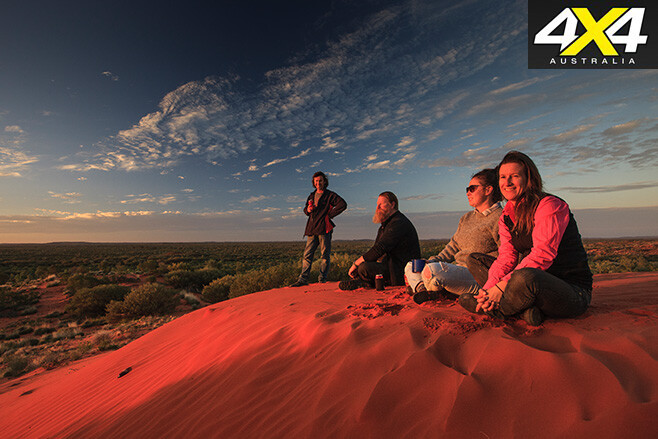
After a quick top-up at the Pink Roadhouse in Oodnadatta we ventured on, turning north off the Oodnadatta Track (it continues, eventually joining the Stuart Highway’s bitumen at Marla) and heading toward Finke and Alice Springs. Like us, you should easily find a suitable place to roll out the swags and witness a sensational sunset.
We’d crossed plenty of dry creek beds on the trek so far but Stevenson’s Creek, which we happened upon the next day, was probably the largest of the trek. It wasn’t flowing, but piles of sand bulldozed to the side of the ford testified to recent flooding. Several remaining lagoons were keeping the budgies twittering, and it looked like a terrific place for a night – or three – of relaxed camping.
The remainder of our day’s driving was across the ever-changing terrain of rocky plains and rolling hills. Yep, the mud meant one or two diversions from the main track, and by the time we’d wandered past the Lambert geographical centre of Australia and the community of Aputula (Finke), the views were of distant hills and low scrub. The track, by now, had become a sandy grid of suspension-pounding corrugations – easily the worst of the trek.
Keen to be within easy striking distance of Alice Springs for the next morning’s drive, our last camp was in the shadow of sand dunes adjacent to the Finke Desert Race track, around 100km south of Alice.
TRAVEL PLANNER
WHERE The Old Ghan Heritage Trail covers more than 1300km between Quorn, SA, and Alice Springs, NT. North of Marree, the trek is dirt.CAMPING Bush camping is possible along most of this trek. There are campsites with some facilities at Marree, Coward Springs, William Creek and Oodnadatta.
SUPPLIES AND FACILITIES The Old Ghan Heritage Trail traverses a remote area and you are advised to be 100 per cent self-sufficient for food and water. Summer temperatures can soar beyond 40°C, so it’s best to visit between April and October. Fuel and limited supplies are available at Marree, William Creek and Oodnadatta.
TRIP STANDARD Conventional sedans can visit the Quorn-Marree and Oodnadatta Track sections of this trek in good conditions, but durable high-clearance 4WDs are required between Oodnadatta and Alice Springs via Finke. Roads in this area are subject to severe weather conditions, and they can be incredibly corrugated due to the sandy base and traffic to and from the Simpson.
FURTHER INFO: www.marreehotel.com.au; www.cowardsprings.com.au; www.williamcreekhotel.com; www.pinkroadhouse.com.au
MSA 4×4 Accessories are the experts at providing storage solution for 4x4s.
The Gold Coast-based company designs, makes and wholesales canvas seat covers, drop-slide fridge carriers, cargo barriers, drawers and generator bags (among some 50 products).
Here the storage pros have decked out the 4X4OTY-winning Ford Everest with products to showcase its range of high quality storage gear.
The subtle, black Ford Everest is MSA 4×4’s first attempt at an SUV-like 4WD – a vehicle capable of getting the family further into the bush, yet not up to the task of tackling the toughest tracks.
MSA GEAR FITTED TO THE FORD EVEREST: MSA 4X4 explorer aluminium storage drawer system: RRP $2549 MSA 4X4 canvas seat covers with cotton lining and integrated lumbar supports: RRP $933 (complete set, front and rear) MSA 4X4 seat organisers: RRP $108 (each) MSA 4X4 tourer pack: RRP $438
In addition to all of the MSA 4×4 gear, a factory Ford nudge bar has been installed and features a GME radio aerial and an 18-inch Great Whites LED light bar.
The 3.2-litre diesel has been remapped by ChipTorque to lift maximum torque to 480Nm.
Other additions include: a Redarc battery management SBI12 and Tow Pro Elite Brake Controller; Waeco CoolPower battery pack to power the Waeco CFX40 fridge/freezer; Tough Dog suspension for a 40mm lift; 265/70 R17 Cooper Discoverers; and a Rhino roof rack.
All MSA 4×4 products come with a lifetime guarantee.
Check out the video to watch the stealthy Everest in action, and read the full feature in 4X4 Australia’s 2017 Gear Guide – in stores NOW!