
SAFARI 4×4 Engineering is best known as the leader in air-intake snorkels for 4×4 vehicles, but there’s much more to this Melbourne-based company that still proudly manufactures and sources as much of its material locally as possible.
The snorkel side of the business came about after blowing up the engine in a 4×4 back in the 1980s and realising the need for a quality, sealed, raised air-intake system that would help to keep water out of the engine when crossing rivers and creeks. Hence the extensive range of Safari snorkels was born, but the company went on to develop turbocharger and intercooler systems to improve airflow from the intake through the engine and out the other side.
The Safari snorkel also raises the intake up out of the dust created when travelling in a convoy, further prolonging engine longevity. With more vehicles coming factory-fitted with turbochargers these days, that side of the business has slowed, but snorkels are still a big part of Safari 4×4 and it continues to develop products to suit most popular new four-wheel drive vehicles, as well as continuing to manufacture them for older 4x4s.
The products are sold around the world, where they’re recognised as leaders in the field of airflow. The latest Armax range of snorkels is indicative of the development work Safari does in recognising the need for bigger, high-flowing snorkels for ‘tuned’ and high-performance engines.
With people fitting bigger exhausts and tuning their 4x4s, particularly V8 Land Cruisers and PX Rangers, there was a need for larger capacity snorkels. But no matter how big your intake is you still need to manage how the air and fuel flow through your engine, so the Armax range now includes the Armax engine control units (ECU).
In the old days, tuning an engine was all done mechanically, but now it’s electronic and much more precise, to get the most out of high-tech engines. Like the company’s snorkels, the Armax ECU is designed in-house and represents state-of-the-art technology for optimising engine performance.
Where other aftermarket tuning ‘chips’ simply add fuel and boost to improve performance, the Armax ECU monitors engine sensors to optimise the air and fuel for safer performance increases. One key input is exhaust gas temperature (EGT) which, if allowed to exceed set parameters, will quickly kill an engine by causing terminal damage.
The Armax ECU keeps tabs on the EGT and automatically adjusts the settings to keep the temps within specification, so as not to risk engine damage. As the unit works in tandem with the OEM ECU and doesn’t replace it, the factory fail-safes are retained and the engine will not operate outside these settings.
Unlike remapping the OEM ECU, the Armax unit can be removed from the vehicle and leave no trace of it having been there. The unit has selectable mapping that is chosen from the driver’s seat for different driving conditions – you may want an economical setting for day-to-day driving, one for towing and another for outright power, and these are customisable for each vehicle.
As part of its commitment to local R&D and manufacturing, Safari has its own in-house chassis dynamometer for testing and calibrating the Armax products, and the company did thousands of kilometres of real-world testing, both on- and off-road and towing various loads. The products are made using the best quality wiring, fittings and hardware available so that, like Safari snorkels, they are the best products available.
Currently Safari 4×4 has the Armax ECU available for the popular Toyota diesel engines in the V8 Land Cruiser 200 and 70 Series models, as well as the four-cylinder 1KD and 1GD engines found in Hilux and Prado. More Armax models are coming out in 2018 to suit the more popular vehicles, so it’s best to check with Safari if there is an Armax ECU for your 4×4.
To check out the full range of Safari snorkels and Armax products go to www.safari4x4.com.au.
The thermometer has just ticked over 44°C and the sun is penetrating even the most weathered, sun-ready head gear, adding to the dry heat with piercing effect.
But it’s the flies that have caught the eye – and ears, arms and legs – of Bernie Trautmann and John Adams, two US-based Jeep engineers in Australia for the first time.
Responsible for preparing the new JL Wrangler for duty, Trautmann and Adams have experienced their fair share of inhospitable terrain. That’s everything from the -40°C cold of Alaska to the 55-plus heat of disused mine tracks in Parker, Arizona – the latter one of the new favoured test areas the guys use to punish prototypes.
One of program manager Adams’ most memorable is a hot test where the soles of the boots of one of their travelling party stuck to a rock, separating completely from the rest of the shoe.
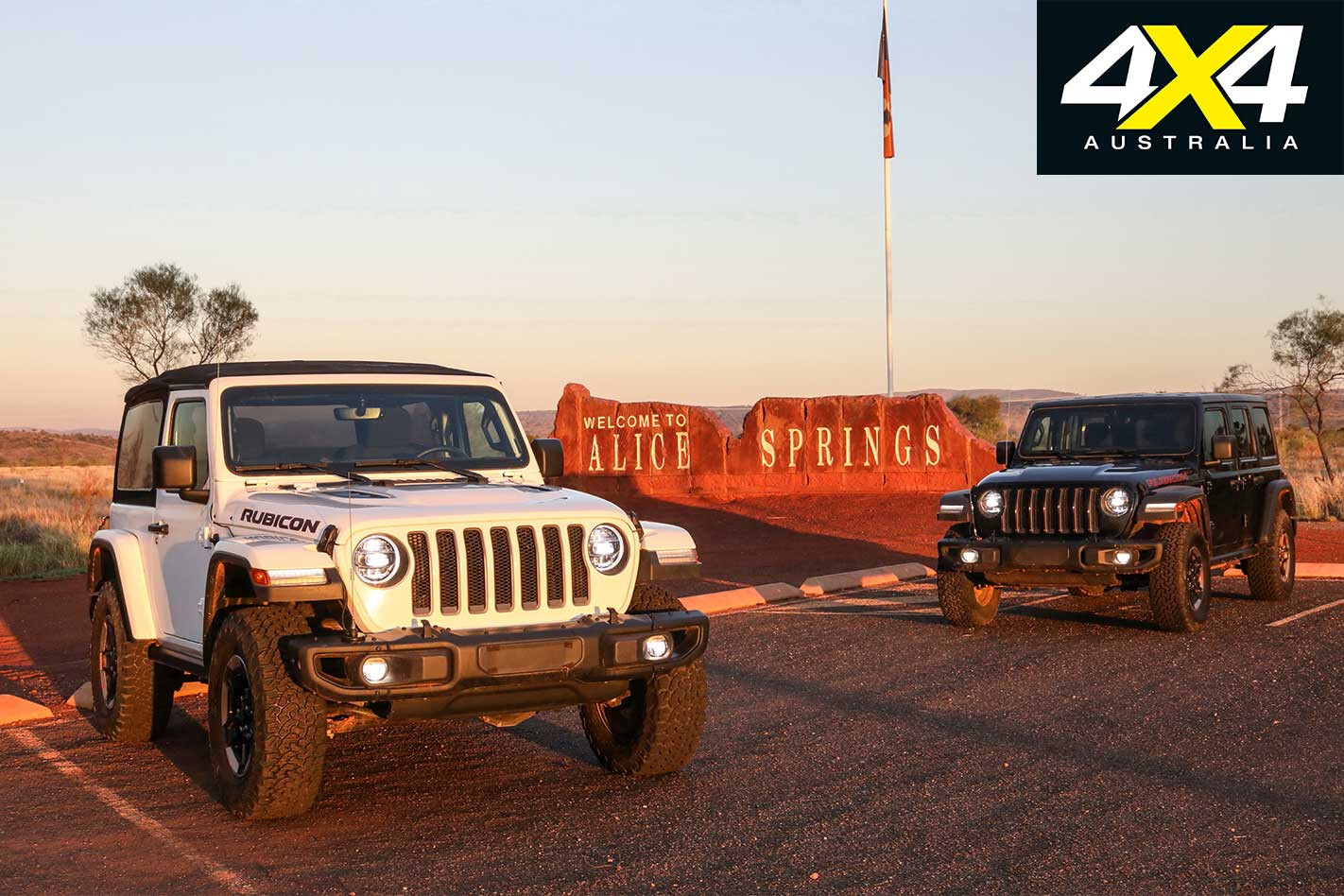
Yet it’s the ever-present Aussie blowfly – hundreds of them – that have the pair donning head nets and swatting furiously. I’m almost scared (or embarrassed) to tell them that our red dirt surrounds on the outskirts of Alice Springs doesn’t have what the average cocky would consider a lot of flies.
Anyone who’s ventured through remote areas knows the little buzzers seemingly have a sixth sense when it comes to locating humans in the middle of nowhere, sometimes in the sort of numbers that make you wonder what sort of insect oasis they’ve stumbled upon.
My immediate instinct is to get our visiting Americans thinking about an automated system of removing flies from cars that doesn’t involve racing the windows down and madly chasing them about the cabin only to realise some of their winged buddies have taken the open cavity as an invitation to annoy.
After all, these guys are engineers, they innovate and try to create solutions to problems – problems people sometimes don’t realise they have. Or, at least, problems they never thought there was a solution to. It’s now clear to them the fly (many of them) is a problem.
But Trautmann and Adams aren’t here for the local wildlife, although they do have their eyes peeled for kangaroos, most of which are taking respite from the central summer heat. They’re on a key engineering mission.
With newcomers such as the Compass and Wrangler, Jeep is thinking more globally, in turn adding more countries to its testing and development schedule. At the insistence of local Fiat Chrysler Automobiles chief Steve Zanlunghi, Jeep’s Detroit-based HQ has added Australia to that list.
Trautmann, a German-born, bow-and-arrow hunting Michigan local is the off-road development lead on the Wrangler. Clearly, it’s a big deal in Jeep land, because in many ways the Wrangler is Jeep.
It’s the car that defines the brand that was created in 1941 as a tough and capable military machine that evolved into a civilian 4×4. It’s a proper off-roader and one that gets used to tackle some ludicrously tough tracks and trails, and it’s the car the aftermarket revs its engines for because so many of the passionate owners love adding to the Wrangler capability.
All of which means more pressure for Trautmann, something he describes as “at times insurmountable”. But it’s also something that drives him.
“Typically when we launch a vehicle … everyone [within the company] kind of watches. Wrangler’s different in that it’s kind of like the whole world is watching us. That’s what fuels me; that’s my passion,” he says.
“We’re not going to stuff it up! The expectation throughout the world and the aftermarket world … the Jeep Wrangler has so many sweet spots we have to hit, there’s a lot of pressure.”
Key to that focus is how it performs in challenging terrain – and not just any challenging terrain, but the sort of stuff that would leave your average fourby beached, snagged, bogged or failing to proceed.
“The vehicle always has to increase in capability,” Trautmann says, pointing to the tighter turning circle, better approach and departure angles and crawl ratio that’s dropped from 59:1 for the auto JK to 77:1 for the JL. “We’ll never give up capability, for us that’s the forefront of everything we do.”
Key Wrangler attributes remain. There are next-gen Dana live axles at either end and a second stubby gear lever for selecting low range, now available with a full-time transfer case for 4H on road.
The car we’re in is a Rubicon – the off-road hero – so also has a disconnecting front stabiliser bar and locking differentials. Carving up a steep, rocky pinch demonstrates its immense capability on rocks. This car is also sporting scars from previous expeditions, the left-hand rail looking worse for wear after a brush with nature.
The interior has been poked and prodded and there’s no glovebox; it’s been removed to allow easy access to the wiring loom for connecting a computer.
The black four-door is one of the early prototypes, originally wrapped in camouflage but now roaming naked given the car is on sale in America. With the steering wheel on the left it is one of the early development vehicles that has been across a fair chunk of America and as far south as New Zealand.
There was also a white two-door Rubicon; although, it failed to proceed early in our adventure courtesy of a fault with the kill switch. The fate of each is grim: once their life as a development vehicle ends they’ll be crushed in line with regulations.
The Wrangler is tested extensively over immensely challenging rocks, soft sand and through deep, oozy, sticky mud. It’s also thrashed over flowing trails and tracks, occasionally with patches of corrugations.
But it’s the extended corrugations and the relatively high speeds – 60km/h-plus – that Australia has plenty of and that Trautmann is keen to learn more about.
We’re discussing the vastness of the terrain – “I see this expansive land that just seems to go on forever” – when he’s suddenly hard on the brakes as a washout appears ahead. It’s one of those short but punishing cuts through an otherwise respectable road that can extend springs to their limit and generally do their best to rip bits off bumpers and bash plates. We thunder into it, the car coping admirably – unscathed.
It’s a timely hit that gives Trautmann an appreciation of what a car in the Australian outback has to deal with, surprises and all.
“We’ve been on quite a few different road surfaces, some like back home and some quite a bit different,” he says. “The corrugated roads, we get into some of the washed-out roads back home, but not for that longevity. “It’s a different kind of drive cycle, so that’s of interest to us.”
The steady stream of 4x4s loaded to the roof – and beyond – also gives him an appreciation of how Australians use their 4x4s and how much they carry. The prospect of heading into the scrub for a week or more is largely foreign to these Jeep experts, who are rarely more than few hours from a shower or service station in their homeland.
For this test we’re not swapping shocks or recalibrating electronics; it’s data the guys are chasing. Sensors and computers are constantly collecting information on the movement of the suspension, temperature and speed. That data will be taken back to Michigan and fed into a simulator that shakes the vehicle violently, taking the worst of the Aussie roads and condensing them into a test cycle to simulate a worst-case scenario.
One thing they’ll be monitoring is the heat dissipation of the dampers and whether they’re up to the repeated punishment of vast stretches of corrugations.
“We’ll take that data back home, scrub it then look at it with our extended team,” says Trautmann. “Is there something there that takes further work? Maybe there’s a phase two where we come out and continue that kind of data acquisition. Hard for me to answer. I’m a data-driven person, so the data will tell us if anything needs to be tweaked.”
In other words, this mission may simply be about validating the existing suspension tune, or it could result in new springs and dampers unique to Australia to better cope with outback roads. Not that you need large data files – or to be behind the wheel – to realise the improvements from JK to JL.
Compared with the outgoing Wrangler we’ve also got in our convoy the JL settles quickly, the newfound body control a massive improvement. There’s much less of the bronco bucking that a few decent lumps could inflict on the rear of a JK. That newfound maturity not only helps on these tough surfaces, but also promises to make the Wrangler a nicer thing on the bitumen.
“We’ve honoured the heritage of the car … but it’s so much more fun on-road,” says Trautmann. “It’s important for us also to deliver for the on-road customer.”
And, it seems, deliver a better Jeep for the Australian off-roader.
TRAUTMANN TRAIL
Proving grounds are an important part of vehicle development, but real-world testing will always be important to makers of serious off-roaders such as the Jeep Wrangler.
“If we’re successful in our backyard, hopefully we’ll be successful in the real world,” says Trautmann. “It’s the final exam, it’s like study, study … a validation.”
A plastic inner wheel arch hanging from its clips is testament to the value of getting out and testing. Adams explains it’s an issue that has already been corrected on the production line in Ohio. But Jeep is also working to better prepare its proving grounds for much of the grunt work.
In recent years Bernie Trautmann was heavily involved in carefully crafting a section of the proving ground designed to test the most capable vehicles Jeep builds. Boulders and twists and turns are all included and there are sections with varying levels of capability. As well as the Wrangler Sport and Rubicon, there are sections only Mopar-modified Wranglers will be able to traverse.
And the name of the new test track? Trautmann Trail.
TRAIL TESTED
Despite its traditional look and traditional mechanical layout, the JL Wrangler introduces new thinking and employs technology where appropriate. Parts of the body, including the doors, are aluminium, for example, indicative of the efforts designers have gone to, to reduce weight.
“Weight begets weight,” says Adams. “You put weight in somewhere else and you’ve got to put bigger brakes on … it’s like a waterfall effect. Everything you can reduce is a multiplier and a benefit down the road.”
But it’s the traction-control system Trautmann is most proud of with the JL. “The brake lock differential is such a cool story of how we made it,” he says. “It was such a difficult process; it took me almost two years.”
Trautmann explains it was a challenge to calibrate it for rock hopping. “It should be instantaneous and seamless that you’re transferring all that torque. Certain thing like driving in snow and ice are quite different to rock hopping.”
In the end, he’s stoked with the result, one that in many instances can effectively replace locking diffs, something only fitted to the Rubicon.
For the Rubicon Trail development drive – part of receiving the “Trail Rated” badge of any new Jeep – the Wrangler relied heavily on electronics.
“We ran the entire Rubicon without using lockers,” he says. “We ran it front and rear open differentials; shows our controllability and tractive effort.”
IT’S BEEN a busy couple of months for the Discovery 2.
Since the last update not too many accessories have been added, but it has seen a few miles covering school-holiday soirees, camping trips, and the annual south coast Christmas sojourn, with narry a squeak or leak (it is still not leaking any oil – a continual triumph for me but sore point with my fellow 4X4 Australia LR owners).
It has been a slow process in terms of modifications, although I have recently fitted a set of ARB Protection Steps. Yeah, it doesn’t seem that exciting, but these were actually top of my ‘must-fit’ list – for good reason.
Two young’uns under six mean the Disco’s somewhat lofty floor height precluded easy access to their rear seats – and, more importantly, the Disco’s factory-option roof-mounted DVD player – so finding a different method of loading said youngsters inside the vehicle meant these protection steps were essential.
Of course, besides that (and their back-saving benefits for us adults), the ARB Protection Steps were also fitted with future, gnarlier, off-road camping adventures in mind. To this end, these steps are often fitted in conjunction with side rails, which offer excellent front panel protection and join to a bullbar up front.
At this stage the Disco is sans bullbar, so I opted for just the steps. Even with ‘just’ the steps, underbody and side/door protection is significantly increased as the steps slide over rocks and downed trees and reduce the amount of paint and panel damage stone chips cause when thrown up from the front wheels.
Fitment of the ARB Protection Steps was carried out at ARB Moorebank, with technician Mark Harvey tackling the relatively straightforward job. The steps come in two pieces – the steel-tubed section (I had this colour-coded to the Disco) and the aluminium-textured step surface, which is bolted on after the tubed section has been fitted.
The steel-tubed section is manufactured using an internal mandrel bender, which means the bends are consistent on the steps and the actual wall of the tubing is the same throughout. The tubed section was fitted via three bolts at the front and two at the back, with Mark drilling the necessary holes into the chassis.
Before bolting the tubed section on, Mark carefully painted the drill holes to protect against corrosion. During this initial process, the Disco was up on a hoist, giving Mark easy access to the chassis. Once the tubed sections were bolted on and checked over, the Disco was lowered and the aluminium plate step section bolted down, with Mark adding a sound/vibration-deadening liquid between the plate step and the tube.
The final touch involved applying a couple of ARB stickers to the step sides. The whole process took not much more than an hour.
The steps have not seen any challenging terrain as yet to test their underbody protective qualities, but they have been a boon to loading kids – and even us adults – into the Discovery, with the wide, non-slip surface ensuring everybody can climb aboard with no risk of slipping and/or twisting an ankle. The steps will be even more appreciated in this regard once I fit new (higher) suspension to the vehicle.
As for the rest of the vehicle, it’s been happy days. A camping trip up the coast was a great test for the Disco’s cargo capacity; whether it is two days or a week, you still need that same basic list of camping gear, so the cargo area was pretty chokkas.
I’m currently testing a Pelican 50QT Cooler, and this big bopper takes up a surprising amount of space (although returns the favour with so-far excellent ice retention), so once that was joined by our tent, camp boxes, duffle bags and other stuff, there wasn’t much storage space left – unless I was willing to compromise occupant safety, which I definitely wasn’t.
The Disco 2 has a very tall cargo area, which means, to get the most out of it, fitment of a cargo barrier would be handy, and this may make its way onto the ‘next’ part of my mod list. The only thing stopping me doing this is that I will lose the convenience of folding the second-row seats up for long/large loads. Until I decide, I will keep using tie-downs for the gear in the cargo area.
The Hankook Dynapro AT-M rubber continues to impress. Again, with mostly bitumen driving, the off-road capabilities of these tyres haven’t really been tested, but on-road they have been great.
Considering the more aggressive tread pattern, these hoops are surprisingly quiet on-road; although, I guess not much can compete noise-wise to a droning TD5. The Hankooks did, however, eventually cop an off-road baptism, with the far south coast Christmas trip seeing the big gold brick trundling around sandy and steep tracks in the coastal hinterland.
The tyres handled this terrain well and then further impressed on the trip back up the Princes Highway to Sydney. A mix of road surfaces (coarse to baby-smooth) and rainy weather tested their on-road tractive qualities in sometimes greasy conditions, and they tracked true.
There is still a way to go to before the Disco is truly adventure-ready, but even in its current near-stock form the vehicle has been a dream. Budget constraints aside, the reasoning behind the purchase – buying a rig that is (relatively) comfortable in city environs, but easily modified to be capable off-road – has borne out so far.
Still, it doesn’t hurt to keep those fingers firmly crossed.
4×4 Shed Log: 2003 Land Rover Discovery TD5 Current mileage: 136529km Date acquired: Apr 2016 Price: $15,000 Mileage this month: 1236km Average fuel consumption: 10.2L/100km
From a young age I salivated, dreamt and perved – call it what you will – at Holden Overlanders built in the mid to late 1970s. They seemed to have that special ‘something’ about them that implied style, macho and ruggedness, much like the iconic Camel Trophy days and The Marlboro Man, along with a go-anywhere appeal.
Fast forward many years – almost 30 since I fist-pumped at passing my driver’s licence test – and I still had a hankering to own something different, something outside the box, something not many others own. I still wanted an Overlander to park next to my current, moderately-modified V8 Troopy.
I’ve been lucky enough to meet up with a few fellas that own these much sought-after 4x4s, and to say they love ’em is an understatement. Whether they are utes, station wagons or panel vans, their owners rarely part with them. If they do, they seem to be fetching higher and higher prices – way out of my price league.
Add to that, being the age they are (getting close to the 40-year mark), and the fact that most cars of that era have well and truly jumped on the rust train, I figured I’d have a go at making my own.
Now, in all fairness to Arthur Haywood – the incredibly clever fella with the foresight and engineering skills to create the original Overlander vehicles – the tools, methods and vehicle parts he had available in the 70s are a far cry from what we have these days.
He chose to fabricate a replacement chassis section at the front of then brand-new Holdens and graft in Dana diffs, gearboxes and transfer cases shipped on the slow boat from the States, along with custom leaf spring packs. All of which worked great back then.
Stepping forward in time, where we have coil springs loaded into relatively well-mannered road-going 4x4s with excellent off-road ability and a large choice of easily obtainable, high-powered engines, I figured, with the help of a few industry hands, I could whip up what I reckon is my ‘perfect’ 4×4 that would suit me and no one else but me.
What I want won’t be a show stopper at Summernats and it won’t knock over the King Pins at Tough Dog, Cliff Hanger or Winch Challenge-type competition events. What I want to build is my dream 4×4: capable off-road, equally capable of clocking up long on-road dirt and bitumen miles, bloody powerful and, most importantly, it will stand out like you know what on a dog.
It’ll be a capable daily driver, it’ll only need the usual maintenance schedule, and it’ll mix it with the best on difficult off-road tracks. I give you, The Tonner.
Yep, as you’ve copped an eyeful from the photos, it’s a standard two-wheel drive Holden one-tonner. It’s a bitza that’s registered as a 1977 HX, with a HZ chassis, HX body and a WB front end slapped on.
Originally it sported a six-cylinder with four-speed manual ’box, but, sometime in its mixed-up history, it had a mighty 308 and three-speed Trimatic with T-bar auto chucked in. There’s been a full respray and a bit of rust replacement panel work done prior to me laying down cash on it.
All up, while not a perfect specimen, it’s a pretty good example to kick-start my project.
Why a one-tonner? Selfishness.
I love my utes and didn’t need or want more than a two-seater. So I won’t take the family on holidays in it and I won’t do the school drop-off with all four of my kids. I reckon the Tonner looks beaut and will offer a perfect rear end tray that can be left simple with a couple of boxes, a fridge and a swag; or be developed into a mighty touring machine, complete with removable canopy and rooftop tent.
Mechanically speaking, whatever four-wheel drive system I end up using, I’ll only have to fit the front two wheels under the mudguards of a one-tonner. The rear wheels will sit under the tray in no fixed position; unlike a wagon or panel van, where I would have to work more on the wheelbase to fit all four wheels in.
I’ll not go ballistic with unengineerably long, gangly coil springs and I don’t want 44-inch boggers or unroadworthy componentry bolted on. Everything I do to my Tonner will be 100 per cent engineered, so it can be legally driven on our roads.
Rego, insurance and any Mr Plod that deems it necessary for a ‘look over’ won’t cause me headaches or dramas. Yep, this project will cost me more to do it right via an engineer, but it will be worth it in the long run.
Converting this two-wheel drive one-tonner into a 4×4 will not be done like Arthur Haywood did in his day. Rather, I’ll choose a donor chassis and donor engine – with gearbox, diffs and suspension – to get what I want: power, articulation, low gearing for the rough stuff, long legs for the lonely outback roads, and reliability.
There are plenty of challenges facing this build from the get-go, and, while I have a few ideas of the path I’ll follow, some of it depends on initial discussions with the engineer.
Basically, anything he vetoes gets slashed from my plans. If he gives me the nod, then I’ll start cutting, welding and spending my hard-earned. Admittedly, I could have purchased just a cabin instead of a complete, registered, driveable vehicle, but I reckon that would have added a heap more time sourcing parts and potentially cost more in the long run.
My plan was to buy complete and part out what I didn’t want or need, to recoup some of the costs; there’s big money in old Holden parts, so I figured my overall costs would be minimised this way.
Amusingly, my first problem was getting underneath the Tonner. Having only owned 4x4s for the last 30-odd years, where you can crawl under for repairs and maintenance, the Tonner, with less than a ‘can’ of clearance from sills to Mother Earth, had me borrowing two pairs of car ramps within a day of getting it home.
Hopefully, once I’ve had ‘my way’ with it all, I’ll have a carton or more clearance to crawl through most objects without undue rock rash. To follow videos of the build, visit 4x4Australia.com.au.
THE REAL DEAL
The real Holden Overlander was manufactured by Arthur Hayward, owner and operator of Vehicle Engineering & Modifications, based in Tasmania.
He utilised a front Dana 44, rear Dana 60 diffs, and Dana M20 transfer case (with high and low range), along with a much-modified chassis with front and rear leaf springs. Arthur originally converted the HJ Holden ute, but the station wagon, one-tonner and panel vans through the HJ, HX and HZ models all passed under his scalpel and were all backed with a full GMH warranty.
If you are thinking of your next 4×4 adventure, this collection of new 4×4 gear might be just what you are looking for.
Ironman 4X4 Ranger GVM upgrade
For those Ford Ranger owners (model: 2011-onwards, including single, extra, cab/chassis and dual-cab) looking to add a legal 130kg of additional payload to their rigs, Ironman 4×4 now has a 3300kg-certified GVM upgrade available. This upgrade can be done pre- or post-registration and is available with the choice of Foam Cell or Foam Cell Pro shock absorbers, in Temporary Load or Permanent Load variations.
The kit is ideal for those looking to consistently carry heavy loads and/or do a lot of heavy towing. It is designed to ensure there’s no compromise to the maximum axle load limits set by the manufacturer. Installation is only available at authorised Ironman 4×4 facilities.
Website: www.ironman4x4.com
Pelican marine case (iPhone 6, 6S, 7, 7S, 8, 8S and X)
Pelican, the icon of water- and impact-proof cases, has released this uber-tough case, constructed of polycarbonate shell (with elastomer interior to ensure the best levels of shock absorption). The case offers protection against multiple drops from up to two metres, and is IP68 rated for full dust-proofing.
It is also IP68 waterproof-rated for immersion in water of up to two metres in depth. It allows access to all essential ports and includes an anti-glare/scratch-resistant screen protector, with the button caps designed to allow unhindered operation. The case adds a paltry 45g of weight and 5mm of thickness so is easy to hold, with the soft-touch exterior offering plenty of grip.
RRP: $99.95 Website: www.pelicanstore.com.au
ROH Blade
The latest five-spoke sports alloy wheel from the Aussie wheel icon is designed to optimise brake ventilation without sacrificing its heavy-duty load rating. The wheel’s as-cast flange includes gold-anodised aluminium bolts and is coated in a matte black-baked enamel finish.
The Blade is available in 20 x 8.5-inch and 20 x 10-inch wheel sizes and, thanks to its high load rating (975kg), is a perfect match for Rangie Sport or VW Amarok owners who want to bling-up their rig without sacrificing on- or off-road performance. The attention to detail and the robust build of this wheel are reflected in the lifetime structural warranty and the three-year finish guarantee.
Website: www.roh.com.au
Narva Explora LED light bar
Compact and powerful, Narva’s new Explora LED light bar uses the latest light tech – dubbed Advance Optic Drive Technology – to punch out a light that is claimed to be 30 per cent brighter than conventional LED light bars (based on a 12-inch single-row conventional LED light bar). Output is 2400 Lumens and 1 Lux of light at a distance of 269 metres. The Advance Optic Drive Technology takes the form of a unique reflector profile that is claimed to more effectively capture light produced by the 12 x 3-Watt LEDs and concentrate that output to ensure a penetrative light over a longer distance.
The bar includes a one-piece die-cast aluminium housing with no end caps (to aid heat dispersion), and the lenses are polycarbonate. Stainless steel mounting hardware and a waterproof connector ensure the bar attains IP68 and IP69K water-resistance so it can cop a dunking.
Website: www.narva.com.au
Lynx hooks
Designed as an answer to the dangers of using octopus straps to tie down gear (there are more than 500 Australians hospitalised due to severe eye damage from recoiling occy straps, according to the University of NSW), these hooks use an adjustable strap (similar to what is used on backpacks) to extend up to 1140mm.
The patented strap is a hybrid design, combining weather-resistant polyester, marine-grade rubber and covered by a woven polyester ‘jacket’. This ensures the webbing holds firm/locked and the rubber section absorbs any shock, eliminating the chance of the straps working loose. This system of interlocking straps ensures there’s no recoil on stretched elastic materials, so no danger of losing an eye. Brilliant!
OzTent Oxley 5
OzTent’s new Oxley 5 is a great camping option for families. Offering space for a family up to five, and with a roof height of 2.2m, this tent is fast to set up thanks to OzTent’s exterior frame technology. Pull the centre hub and lock it in, then pull out the legs and lock into place. Finally, it is just a matter of adding the large fly, setting up the huge awning, and placing the Esky/fridge (with coldies) in that ideal spot at the front of the tent.
Packing up is just as easy: pull down the centre hub and the legs will collapse. The tent uses bombproof eight-ounce rip-stop poly/cotton canvas and the tub floor is heavy-duty PVC. Flyscreens are No-see-um mesh and the aluminium frame poles mean no corrosion. Weight is 26kg, packed size is 1220mm x 350mm x 350mm; setup (with awning) size is 4500mm x 2500mm x 2100mm.
RRP: $999 Website: www.oztent.com.au
Crossing the Congo
A trio of Brits tackled the unthinkable in 2013: driving a 26-year-old Landy from north to south across the Congo River Basin, from Kinshasa in the Democratic Republic of Congo, to Juba in South Sudan.
The tale is epic; the trio tackling everything from beside-the-road surgery, the dangers of the Ebola virus and the threat of kidnap, through to corrupt officials, being robbed by Congolese soldiers and having to often build their own roads, tracks and bridges. Yep, sounds crazy, but it’s a reminder of what adventure is about, especially when it results in an absolutely cracking read.
RRP: $36 (hardcover); $13.44 (Kindle) Website: www.amazon.com.au
THE Mercedes-Benz G-Professional has left the shed, and filling its place in the carpark is this shiny, new Nissan Patrol.
The Patrol copped a mild refresh toward the end of last year, scoring a new grille and front bumper to try and update its look; but, in reality, the look of the Y62 has remained largely the same since it launched here in 2013.
It still has that stonking, great 298kW 5.6-litre V8 engine, backed by a seven-speed auto and on-demand all-wheel drive with low range. It’s a brilliant driveline for a big off-road wagon, even if it doesn’t offer the efficiency of a diesel engine. Plus, there’s a lot to love about that V8.
Being the top-spec Ti-L model, this Patrol is loaded with features and creature comforts: heated and cooled leather seats; sat-nav; Bose audio; a fridge in the centre console; rear-seat DVD screens; 360-degree around-view cameras; and all the electronic safety add-ons you could ever dream of.
It’s a far cry from the Spartan G-Professional we came out of, yet at $88,990 it’s close to $30K cheaper. Some of these features work better than others. Things like the cameras, lane departure warnings and blind spot monitor are all good, but the forward collision warning beeps all the time and the Intelligent Distance Control is annoying. Thankfully, the default for the IDC is off and you need to switch it on if you want it.
Nissan made a fuss about the inclusion of the intelligent rear-view mirror on this updated Ti-L, as the mirror uses the rear-view camera to give the driver an unobstructed view of what’s behind the vehicle, which could be handy if you have a cabin full of passengers or luggage obscuring the view. Again, this can be switched on or off as desired.
I’ve been trying to get used to it, but, like anything on a monitor, the image doesn’t seem real to me and I prefer to rely on what I can see with my own eyes. I will continue to give it a try to see if I get used to it, but I find that every time I need to reverse the car, I reach to switch it off.
All Patrols now come with the Hydraulic Body Motion Control (HBMC) system that delivers the best performance both on- and off-road from the full independent suspension set-up. In fact, it’s quite astounding how well the Patrol transitions from uneven off-road-terrain to mountain-road curves.
We’ve only put a single tank of fuel through the Nissan over the holiday break and it averaged 16.06L/100km, while the OBC told us it was 14.5L/100km. The driving at this time was around town but with a fair amount of freeway driving as we escaped town to the Bass beaches a few times.
The Patrol asks for premium fuel, so we’ve been running 98RON in it. Thankfully the nice big 140-litre tank should still get us 1000 or more highway kilometres between fills, which will prove handy as we head off on an interstate road trip this month, before we take it off-road once the holiday period is out of the way.
4×4 Shed Log: 2017 Nissan Patrol Ti-L Current mileage: 1162km Date acquired: Dec 2017 Price: $88,990 + ORC Mileage this month: 667km Average fuel consumption: 16.06L/100km
What we love: The big car feel; ride quality and comfort; great bang for your buck; V8 engine! What could be better: Calibration of collision warning system; cheap-looking interior trims and chrome; seat coolers don’t blow enough air.
Sometimes in this caper as a 4×4 journo, opportunities arise that make my mates jealous – “So you’re getting paid to do what?” is how the conversation tends to go.
Such an interaction happened recently when an invitation arrived from Isuzu UTE Australia to tag along on its I-Venture Club trip to Fraser Island. Yep, jealousy levels piqued that day. It wasn’t a fly-in, fly-out kind of trip, either; nope, the itinerary listed three nights and four days on the world’s largest sand island. Jackpot.
The I-Venture Club is an innovative program set up by Isuzu to provide old and new Isuzu owners with first-hand off-roading experience. The trips range from one-day clinics at Melbourne’s 4×4 Training & Proving Ground in Werribee, to multi-day off-road jaunts to incredible destinations – like this trip to Fraser Island.
“The I-Venture Club enables owners to be confident to ‘go their own way’. They can be completely new to four-wheel driving, and through this program they get to step outside their comfort zone and use their own vehicle in this type of application,” Mark Harman, Isuzu’s PR and sponsorship manager, told us as we dodged salt water along the eastern coast of Fraser.
“Everyone on this trip has done another I-Venture trip before, so they’re not new or beginners, but they still want to learn more about four-wheel driving. Not only do you get really good theory, but you also get to put it into practice yourself and you have the support of other people.”
The contingency of media and eager I-Venture Club members had gathered a few days earlier at River Heads Ferry Terminal, located just under four hours’ drive from Brisbane. This road trip provided the perfect opportunity to put a few hundred kilometres of tarmac beneath the D-MAX’s wheels. With nothing in the tray, the D-MAX covered the kays in relative ease, despite a few comfort issues with the rear leaf-sprung suspension.
Brief introductions were undertaken upon arrival at River Heads, before the group boarded the ferry and took the 50-minute journey to Fraser’s massive Kingfisher Bay Resort, where Australian Offroad Academy’s Dave Darmody took the reins and led the 14-strong convoy – split into two groups as per Fraser Island requirements – to a makeshift 4WD course within the resort’s boundaries, “the climbs and obstacles here are harder than anything you’ll encounter outside the resort’s fence,” Dave would say.
Punters were clued in as to what tyre pressures to run at – typically 16-20psi was the agreed value – and a walk-through of the track was administered before the contingency threw it into four-low, with Dave’s words of wisdom still ringing in their ears: “momentum is for those that lack talent.” And, of course, participants aren’t forced to do anything outside of their comfort zone; though they are encouraged to push the boundaries.
“The key to this is that you gain confidence by doing it yourself under the tuition of very qualified instructors,” Mark Harman said. “A first-timer can do this, and they’ll make it through without a problem.”
For those still concerned, support vehicles are positioned front and rear of the convoys, with all recovery equipment provided. “We’re well-catered for whatever circumstance comes up,” Mark added.
With vehicles prepped, it was up with the sun the following morning for our first venture beyond the resort’s electrified – to keep the dingoes out – gates. Again, due to the Fraser Island convoy restrictions, groups were split in two: our group took off to Lake McKenzie en route to Central Station; the other to Lake Wabby Lookout, before ending up at Central Station.
Due to recent rainfall, the sand tracks had been compacted by traffic, so much so that it felt as if we were driving the D-MAX on asphalt; no need for low range then. These tracks, which cut east-west/west-east across the Island, weave past gigantic trees and thick vegetation, which is remarkable to see when there’s nothing but sand at their bases.
The D-MAX’s steering remained precise and the leaf-spring suspension soaked up most regular bumps with aplomb. “Remember, it’s a scaled down truck, not a scaled up car,” Mark Harman told us. Unfortunately, we couldn’t give four-low a real crack on the relatively simple off-road tracks.
After a full day on the tracks – and with enough sand in the D-MAX and MU-X footwells to start our own island – we returned to Kingfisher Bay Resort for an afternoon of jetty and beach fishing led by expert angler Scott. Those not interested in casting a line had the afternoon free to shake the sand from their clothes.
The following day we flicked the D-MAX in favour of the seven-seat MU-X, where we instantly appreciated the softer ride and coil-sprung suspension, with far fewer bone-jarring, backside-leaving-seat moments.
Our group hit the Southern Lakes, stopping at Birrabeen and Boommanjin en route to Dilli Village; the second group ventured to the Valley of the Giants. Unfortunately, due to time restrictions, it was a matter of luck as to what sites you’d see and what ones you’d have to put on the list for next time.
Following check-in at our new overnight digs at Eurong Beach Resort, we headed north along the long, white stretches of the eastern coast to Eli Creek and the imposing SS Maheno, an old shipwreck that’s been wasting away since 1935. A few cheeky liquors back at Eurong Beach Resort’s Beach Bar put an end to another long day on the tracks.
With the well-organised and educational trip all but wrapped up, we took the opportunity to chat to a paid-up participant over a beer or two. Andrew Hughes, the proud owner of a mildly-tweaked 2012 D-MAX, decided to cough up the $2K entry fee and make the drive from his home in Bribie Island, Queensland, due to the “positive experience I got from the first I-Venture trip, which was only a one-day experience at Moreton Island.
“I knew I wanted to do certain things, but when I saw the opportunity to go to a destination I hadn’t been to and learn skill sets I wanted to learn – but I’m hesitant to try and do something on my own in an unqualified sense – I snapped at it.” Andrew told us if there’s one thing he walks away from this trip with, it is experience and confidence in his vehicle’s ability: “The one thing to take away from an IVC trip is learning how to use a vehicle within its limits.”
Would he do another one? You betcha: “This is the second time I’ve done this, and if I could do it a third time, I would,” he said.
A cracking adventure, Isuzu’s I-Venture trip is an innovative idea and a great retention tool for the brand; as Mark Harman put it: “If you spend $40K on an MU-X and you get out here and experience it like this, the chances are your next vehicle will also be an Isuzu. “It’s not just a learning experience; it’s an experience in itself. How often do you get the chance to come to Fraser?”
Ditto that.
AUSTRALIAN OFFROAD ACADEMY
Under the expert guidance of Australian Offroad Academy’s Dave Darmody, who hails from Harvey Bay, we took a tour of Central Station to learn the history of the area. Dave’s knowledge of Fraser Island is second-to-none – he not only knows all there is to know about four-wheeling, he knows every secret of the Island. At times we felt like a kid on a Science excursion, entranced by his knowledge. Website: www.australianoffroadacademy.com.au
GET INVOLVED
This specific Fraser Island trip cost $2000 per couple and covered accommodation, food and non-alcoholic beverages. The events book out quickly, but Mark Harman confirmed those that miss out are notified when the next trip is approaching: “These events book out quite quickly, and there’s a lot of interest in Queensland. But interest is growing in NSW and Victoria.”
Mark added that Isuzu picks dates that don’t correspond with the school holidays, “So that it’s quiet and everyone can go their own pace.” What’s coming up on the I-Venture calendar? “We go all around Australia. In 2018 we are returning to Western Australia’s Lancelin Sand Dunes,” Mark told us. Prices vary for each event.
To see upcoming events and to register your interest, visit: www.iventureclub.com.au
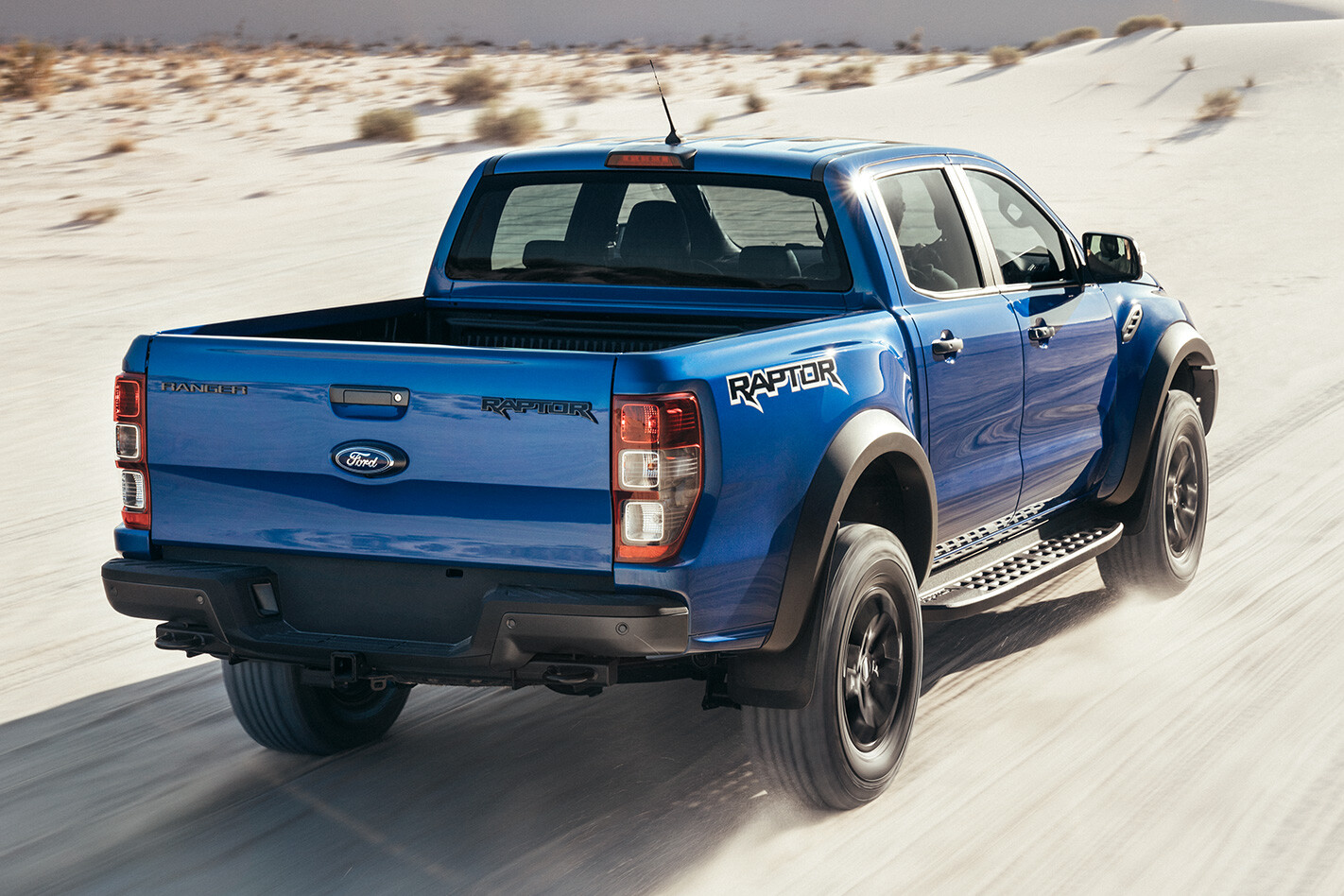
BEHIND that bold front end and under the bulging rear quarter panels, Ford has seriously beefed up the chassis and suspension of its T6-based Ranger Raptor.
From the reinforced chassis rails to the bespoke Fox Racing shock absorbers and coil-over suspended multi-link rear end, this beast is made to take on the toughest tracks at speed.
We take a look under the metal and composite body work for a closer look and speak to Jamal Hameedi, Global Performance Vehicle Chief Engineer, Ford Motor Company, about what makes it so special.
If you’re ever stuck in a pub or campfire argument with your local ‘expert’ who reckons “The Raptor is just a lifted Ranger”, here are 10 key differences between this desert monster and the stock Ranger.
1. 2.0-litre twin-turbo diesel engine – unique to Raptor (at time of writing)
2. 10-speed auto.
3. It’s loaded with the latest version of Ford’s Terrain Management System and now has ‘Baja’ mode – the perfect excuse to indulge your inner desert racer persona.
4. Fox internal bypass shocks – designed and developed specifically for Raptor.
5. 50mm increase in ride height from standard.
6. Significantly stronger frame/chassis.
7. Wider track.
8. Disc brakes front and rear.
9. Raptor-only version of Watts link rear suspension setup.
10. It’s called Raptor. ’Nuff said…
I just don’t get it: why do people have to answer their phone or read a text message when they’re driving?
The issue of distracted drivers – mainly from using devices such as mobile phones and GPS units – is on the increase, with a QBE insurance spokesman indicating last year that the use of mobile devices and the associated distracted driving that ensues has joined the historic ‘big three’ – speed, fatigue and alcohol – as the chief causes of lives lost on our roads.
In NSW last year nearly 40,000 people were fined for using their phone while driving. Towards the end of the year a new campaign was rolled out to try and stop drivers using their phones, but that didn’t seem to help the holiday road toll which saw 28 people die in that state between December 15 and January 1; that was double the toll for the same period the previous year.
As four-wheel drivers we tend to spend more time on the road than the average driver, as we head bush or to isolated stretches of coast for weekend getaways and annual holidays. Most of the kilometres clocked up are on country roads, where, again in NSW, 300 of the 392 people that were killed were in regional NSW.
A frustrated deputy police commissioner pointed out that only one third of the population of NSW lives in regional areas, but the area accounts for two-thirds of the road toll.
In Victoria the road toll was down on the previous year, from 290 to 257. And while road deaths in metro areas had dropped by 27 per cent, the toll rose on regional roads; but nowhere near as bad as in NSW, with an increase of just three per cent (to 155 souls lost).
In WA, while the number of fatalities in the metropolitan area dropped to 68 – the best for near-on 20 years – the lives lost in regional WA totalled 90.
In the USA, which Australia seems to follow in many cases, distracted drivers are now the number one cause of road accidents. While we seem to be doing a lot better at decreasing our road toll than the USA, the alarming trend in our fatality figures is not a good indication of what the future holds.
With road trauma currently costing Australia about $70 million per day, it’s beholden on all of us to do our best to reduce the staggering carnage on our roads. Slow down, don’t drink and drive, ensure you take enough rest breaks (every two hours is the recommended maximum), be alert on all roads, and get off your bloody phone.
With a few inland adventures planned, my attention turned to a more generic off-road tyre; so I swapped out the M/Ts on my Patrol to a set of Bridgestone Dueler A/T 697s.
They’ve been great, and the first thing noticed was the drop in tyre noise. Don’t get me wrong, the road noise generated by the muddies wasn’t overbearing, but the smoother tread pattern of the 697s provides excellent road-handling – plus I’m appreciating the extra few kays I’m getting out of each tank of diesel.
With 4000km now put into the new tyres across a variety of terrain, they’re proving to be a great allrounder; smooth enough for the kids’ school runs, yet aggressive enough in the tread pattern for weekend fun.
I’ve had a ball testing them out in the hills around Melbourne, especially on the slippery tracks and bog holes in Murrindindi, Toolangi and Kinglake – they also performed without issue on an early season sun-chasing trip to the glorious Murray River at Echuca.
There are big plans ahead for the 697s, with a trip to Kangaroo Island on the cards for the summer break, as well as a month-long odyssey to Ayers Rock and the Red Centre jotted into the diary for mid-year.
The A/T 697s are proving the perfect tyres for the daily driver-cum-weekend adventurer.
The Bridgestone Dueler A/T 697 – The Dueler A/T 697 is the ultimate 4WD tyre, designed to withstand Australia’s harshest conditions. The tread pattern design has been optimised for increased puncture resistance, and the dual compound tread features improved heat durability to cope with the harshest summer day.
The super-tough boots are cut-and-chip resistant; feature a protective ply for an added layer of protection from staking; utilise two heavy-duty, high-tensile steel belts; and have an advanced shoulder-block design to improve NVH.