
It’s funny. The big things you think will stand out, often don’t. It’s the details that make for a strange experience.
So it was with my friend Irina Zenina’s first visit to Australia. If the name’s not a giveaway, Irina’s Russian. She’s originally from a city called Severodvinsk – so far north that in summer the sun sets after midnight and in winter barely shows its face at all – but today she calls the beautiful city of St Petersburg home. It’s a world away from the outback in every way.
Now, we think of Australia as a big place. It’s the sixth-largest country but you’d have to add the fourth-largest, China, to our landmass to match the size of Russia. That probably explains why she was completely unfazed by the fact that we’d left a quiet little hamlet called Guerilla Bay, on the NSW south coast, and driven west all day, past the nation’s capital, without leaving the state.
Russia does vast open plains every bit as well as Australia. The drive from St Petersburg to Severodvinsk, on the Northern Dvina River, takes 17 hours, much of it on single-carriageway across pine-forested taiga.
With the Murrumbidgee occasionally glinting through twilit trees off to our right, a quilt of open land to the left and little but Adelaide-bound trucks for company, the drive along the Sturt Highway felt familiar to her in the dark.
Highway to Hell blared from the speakers (“Da, I love AC/DC!”) and night rolled rapidly across the plains as we approached Hay. Fatigue and the fear of roos in the dark dictated we would stop here for the night and as Irina looked out of the window at the trees, she said: “This could be Russia because you can’t see what the trees are.”
Much stranger to her were the warm winter days and the instant chill when the sun went down. Another big thing she found familiar was the 200 Series LandCruiser we were cruising in. The twin-turbo-diesel fourbie is as popular in Russia as it is here, and with diesel at just 28 roubles (84 cents) a litre there, it’s even more attractive. But sitting on the left without a steering wheel to hold freaked her out.
Later, a brief drive on the one-way dirt track around Mungo confirmed her opinion that “right-hand-drive cars are crazy”. Still, I couldn’t help but smile when she said: “This car, it’s for mafia.”
The next morning’s hike took us into Balranald, where something that’s a little trickier to explain surprised her – Aborigines. Actually, it makes perfect sense. You just have to look at it through her eyes.
The only images of Aborigines she’d ever seen in Russia were your typical tourism promo fare: didgeridoos, traditional dances, body-paint. Bumping into them in modern clothing, doing the weekly shop in the supermarket simply didn’t line up with the propaganda. And then, finally, we were off the tar and on the dirt. Yet another surprise. It wasn’t an endless vista of red sand.
Even in a bad year, this kind of outback terrain is alive – saltbush, lizards, birds, kangaroos and goats. But after the rain we’ve ‘enjoyed’ for the past couple of seasons, it was much greener than usual. Well, not green to Russian eyes.
That washed-out eucalypt olive drab that does such a wonderful job of hiding roos and emus. While the rain has put plenty of food on the table for the wildlife, you don’t always see it.
By all accounts, kangaroo numbers are way up yet we saw very few. The rain has allowed them to stray away from the most reliable sources of water and into more remote corners. Emus, on the other hand, were prolific. Drinking from puddles and running wildly across the road in front of us.
The same pattern was repeated everywhere we went. It was a shame, as I’d hoped to be able to show Irina vast mobs of roos. Then again, there wasn’t the usual suicide brigades lining the roads so she was spared the road toll that outback travel can often provide. And that was definitely a blessing.
At the main campsite, pitching our tent under a tree, the wildlife we’d been looking for finally came to us. A small kangaroo — possibly with a joey in her pouch — came to graze right next to us.
Neither particularly inquisitive nor afraid in the least, she stopped for a while before demonstrating the huge bounds her breed are capable of, lazily loping across to a new feeding spot. Irina was transfixed, grinning like a child at Christmas.
There isn’t big wildlife like this that you can get close to in Russia. Deer perhaps, but they’re impossible to get near. Despite what some Russians might tell you, Irina assured me that wolves and bears wandering through town are only slightly more common than drop bears.
Walking from our campsite to the toilets, our neighbours called out a friendly ‘hello’. I replied and we walked on. A safe distance away, she asked: “Do you know them?” “No.” “Then why they say ‘hello’?” “Just being friendly.” “In Russia, camping not like this.”
In Russia, you go camping in a group. There could be 20 of you, and you stick to yourselves. Other groups are avoided if possible and ignored if not. Building a huge campfire is mandatory as is singing songs around it. The concepts of not being allowed to collect firewood in a National Park and fire bans was hard to explain.
In the morning, everything came together perfectly. The weather was beautiful, Weet-Bix turned out to be an exciting new breakfast adventure and then we drove to the sand dunes at Vigars Well. Irina fell in love. We parked and clambered up onto the dune.
We could have been the only people on earth, though a kangaroo had tracked up and down another dune, hopping across the flat in between. We tried – and failed – to match its distance, took photos of everything and Irina asked: “Can we camp here?” I wished I could tell her something other than that we were restricted to the campsite. Then again, what would it be like if you could just camp where you liked? It’d be like Russia.
The warm day brought up one of those other little details of the outback. In Russia there’s an expression for someone who’s lazy – sleepy fly. As we watched a red fox trot through the grass at Lake Leaghur, it was a native creature that caught Irina’s attention. “These flies not sleepy,” she laughed. “This is busy fly!”
The wet weather had increased the numbers of flies and it affected our trip in other ways too. At Hay it’d brought the river up and other towns had flooded. Further along, we’d hoped to visit Murray-Sunset NP but much of it was closed so we were heading to Menindee instead. Problem was, part of the road had been washed out between there and Pooncarie, so we had to cross the Darling River lower down and head up the other side.
Somewhere on this drive we had a moment of real sadness. A tiny bird went up against the windscreen at 100km/h and lost. Irina was genuinely grief-stricken. Not only has she never killed anything in her time behind the wheel, she was horrified at the number of dead animals we saw. “Road kill,” I explained. “We haven’t it in Russia,” she declared.
Stopping at the Pooncarie Hotel for lunch, almost everything shocked Irina. For one thing, Russia has a zero alcohol drink-drive law and for another, the sausage roll was a previously unknown (and subsequently unwelcome) delicacy. And then a gentleman who was politely preventing the bar from falling over attempted to engage Irina in conversation.
“They don’t make ’em like you in Mildura,” he proffered in a thick drawl that ended in a laugh. I tried to convince her that it was a compliment but it didn’t survive translation. Still, he gamely pushed on. “Russia? That’s down at the bottom of the world, eh?” “No,” the barman corrected. “We’re at the bottom. Russia is at the top.” “Yeah … but the world goes ’round.” I looked at the barman. He looked at me. Who was going to try? “It doesn’t go ’round that way. Russia stays at the top.” “Yeah but … ” The argument petered out.
We found our way across the Darling, which was still teasingly suggesting that the only ‘plan’ needed was how to deal with all the floodwater, and then onto a new high-grade dirt road. The quality of the track and the total absence of other traffic made for rapid progress.
Water glinted in the distance, suggesting huge flood lakes and when we hit the Silver City Highway it was the same, with water almost up to the road. Pulled over for a rest, I commented to a driver headed the other way that I’d never seen it like this, and I’ve driven the road a fair few times. “I’ve been driving between Mildura and Broken Hill for more than 40 years,” came the reply, “and I’ve never seen it like this either.”
Back on the road, Irina’s question wasn’t about the weather. “Who broke the hill?” My reply started to stray into Emperor Nasi Goreng territory so I had to admit I just didn’t know.
Handily, the tourist info centre in the town did, but that wasn’t until later. Before then, I made the decision to introduce Irina to an icon of Aussie cinema – Silverton and the roads once patrolled by Max Rockatansky. She’d never seen Mad Max (or Mad Max II) but she was very excited by the Silverton Hotel. “You could make a film here!” she said. Inside we saw all the production photos lining the walls.
Back in Broken Hill, we picked up some more info, made a phone call and booked ourselves on a guided tour of Mutawintji National Park the next day.
Getting there was the only time the satnav let us down. We’d gotten used to the charming female voice telling us to “at the roundabout take the second exit” so obediently, we bore right when she said so. We knew it was wrong. The sandy track we’d been on was wide and well-travelled; the one we were turning onto was overgrown and narrow.
Thirteen kilometres later, instinct proved correct. The road simply ended. More annoyingly, from the map it looked like we were no more that 3km from where we wanted to be.
On the upside, when we got there, the showers at the campground were hot and there was plenty of wildlife on hand. A burly roo made it clear this was his turf, while a few others took a more sharing approach. Emus wandered through, seemingly oblivious to the fact that we weren’t other emus. Intermittently, flocks of ‘carrots’ flew squabbling overhead and all through the night they woke up to continue the debate.
Not that we minded; though it was colder here, the brilliance of the Milky Way made a midnight wake-up welcome and we watched satellites plot their way around the earth while a handful of shooting stars flashed by.
The tour of the Aboriginal rock art at Mutawintji was a highlight and told us about much more of the culture, from the native ‘lemon grass’ and how to cook underground, to seasonal hunting rules, early contact with white explorers and great 260-million-year-old fossil footprints.
Another day, another walk, this time to Mutawintji Gorge. You can always find water there apparently, though you’d have to be pretty desperate to drink from the stagnant pools we found. That probably had something to do with the bands of goats whose bleating echoed around as they leapt away from us, up the rocky walls of the gorge.
Lazy days relaxing in the bush are hard to give up but we had a good reason to hit the road again – flights north, to dive the Barrier Reef. So when the sun had dried the dew from the tent, we packed up and headed east.
Around 4.30 in the afternoon, as we cruised in on the arrow-straight road towards Nyngan, Irina fell asleep in the passenger seat. In the rear-view mirror, an orange blaze lit up the curving horizon and above the tar, a swirl of wedge-tailed eagles and crows spanned like a miniature tornado before settling back to their evening meal.
I didn’t wake her. It wasn’t the magnificent sunset setting fire to the plain that would have stood out to her Russian eye. The devil is in the details, after all.
Guerilla Bay
If you’re looking for a relaxing weekend away from Sydney or Canberra, this little place is perfect.
Roughly halfway between Batemans Bay and Moruya, it’s a quiet spot with mostly private houses and a few rentals hidden among the trees. Two little beaches offer you the choice between swimming or diving, maybe even bit of surf if you’re lucky.
Head inland, and there’s Deua National Park to explore, which offers a wealth of real off-roading with super-steep climbs and river crossings, as well as more gentle treks, camping, bushwalking, swimming and caving. Alternatively, round out a weekend’s 4X4 fun at Deua with a swim at the bay before you head home.
What Irina Says….
Before travelling here, I thought Australia was small and only desert and kangaroos.
At Lake Mungo, I realised the Australian desert is unusual; it’s endless expanses of small shrubs, weird trees, exciting and ever-changing landscapes and many different animals. And this lake? It’s shaped like a huge saucer for tea.
I also remember a strange thing for Russians; in Australia everyone loves camping. We stayed several days at the lake and I was surprised how many people were travelling. And you constantly talk to each other, and ask: “How’re things?” I was very surprised. Ha, ha, you can communicate with the animals too. On the first evening, when we decided to stop and put the tent up, kangaroos came to see us. Oh, and the Milky Way! We watched the night sky for a long time at Mutawintji.
When we went to look at the rock art, I got suntanned. That’s strange for winter. In Russia, winter is winter. Not far away we went for a walk along the gorge, in a very beautiful place. There I saw goats and a stone fell on my foot. Now I have a small scar to remind me but it’s good. Travelling to Australia, I had an unforgettable experience, and back home I recall the trip with new emotions, which I never had before.
Travel Planner
GETTING THERE Lake Mungo is 150km from Balranald or 110km from Mildura. Good unsealed roads in dry weather but access may be closed due to rain. Mutawintji is 109km from Broken Hill. Mainly good tracks with some loose, sandy sections. Access to Mutawintji Historic Site is only available with a guide — contact Tri State Tours 08 8088 2389 to book.
CAMPING Fees apply at both sites ($5/adult/night). Lake Mungo main camp has toilets, Mutawintji Homestead Creek has toilets and showers. Both have picnic tables, barbecues and fireplaces but bring your own firewood.
WHAT TO BRING Drinking water, camp shower for Mungo. Fuel and groceries available at Mildura or Balranald if travelling south to north, or at Broken Hill if heading south.
MAPS AND GUIDES Free maps are available at Mungo NP Contact NSW Parks & Wildlife on 1300 361 967 or 02 9995 5550, or visit www.nationalparks.nsw.gov.au.
Built around a Suzuki Jimny and powered by that vehicle’s standard 1.3-litre petrol engine, it’s only when you clamber over the tall sides of the vehicle – sorry, boat – that you have any inkling that this little amphibian, called a Platypus, is, or was, a Suzuki.
This article was originally published in 4×4 Australia’s August 2010 issue
Built by Ozamphibian, based in Tara, Queensland, this example we found was playing in the Murray River, far removed from its normal haunt of Moreton Bay.
The standard Suzuki chassis has been encased in a fibreglass hull, so while the outside of the vehicle may be completely unique, the interior is standard Jimny. There is only an extra lever to contend with and that is to engage the custom-made Hamilton-style water jet drive.
The power to drive the jet comes off the transfer box, while steering in the water is still via the front wheels – it seems to work surprisingly well. A twin propeller arrangement can be fitted if a customer orders a craft that is destined to spend long periods in the water. Twin props aid economy but reduce speed.
All up weight is 1100kg and, being a boat of sorts, it does have a bilge pump capable of pumping around 3785 litres an hour, if needs be. Top speed on land is over 100km/h, but the off-road ability is not quite as good as the original Jimny. On water the craft has a top speed of seven knots, or around 12-13km/h.
The Platypus has a surprising amount of freeboard, and from what we could see, as it was tested in a two-metre swell, it handled the tough conditions with aplomb. There is also a rough water version that, when the hatches are closed, takes on the qualities of a small submarine.
Now, if you want to get afloat in something a little different, or for more information on the Platypus, contact Sean O’Donnell, phone (07) 4669 4022.
OZAMPHIBIAN PLATYPUS SPECS: Vehicle: 2005 Suzuki Jimny Owner: Sean O’Donnell
POWERTRAIN Engine type: M13AVVT, 1328cc inline-4 Engine mods: Stock Power: 62.5kW at 6000rpm Torque: 110Nm at 4100rpm Transmission: Five-speed manual
SUSPENSION Front: Suzuki three-link rigid axle, gas/oil dampers and uprated heavy-duty replacement coil springs Rear: Suzuki three-link rigid axle, gas/oil dampers and uprated heavy-duty replacement coil springs
WHEELS & TYRES 205/70R15 factory steel rims with Bridgestone Dueler H/Ts
EXTERIOR MODS Composite fibreglass hull encasing original Jimny chassis. No doors. Rear drums converted to disc brakes. Diff breathers extended through hull. Transfer case double sealed on wet side. Handbrake internalised with own caliper. Headlights sealed beams and waterproofed. Low maintenance diffs and underside metal parts all anti-corrosion treated. Exhaust run to clear of the water.
INTERIOR MODS Standard Suzuki Jimny, apart from Jet drive engagement lever. Aircon retained as is the CD player.
PRICE Standard version takes around three months to build and costs $55,000 ex GST. Custom orders are easily accommodated.
THE FIRST lot of Mercedes-Benz X-Class utes have arrived in Australia, ahead of its local launch in April this year.
A total of 35 brand-new X-Class utes rolled onto the port in Melbourne earlier this week, before being loaded onto trucks for delivery.
Eagle-eyed Wheels magazine reader, Wayne Renfrew, snapped the pic near Merc’s Australian HQ in Melbourne.
Speaking to Wheels magazine, Merc’s PR and Corporate Communications Manager, Blake Vincent, said: “From now until the vehicles launch in April brand-new X-Classes will come into ports all around Australia before the X-Class opens for sale to the public.”
The X-Class will initially be available with the choice of two 2.3-litre, four-cylinder engines as used in the Nissan Navara, but with fettled engine mounts and control software courtesy of Mercedes-Benz.
Three performance variants – Pure, Progressive and Power – will be offered, with the entry-level Pure X220d the only 4×4 model to utilise the single-turbo X220d engine. All the others in the range get an extra turbo, as well as the option of a six-speed manual or seven-speed auto transmission.
Those after the V6 diesel-powered 190kW/550Nm X350d will have to wait until at least mid-2018, with Merc utilising its own engine and seven-speed transmission.
We drove the X-Class X250d Stateside, and we’ll have an Australian review as soon as it’s launched locally.
2018 Mercedes-Benz X-Class ute pricing
| Grade | Body | Engine | Drive | Transmission | MRLP |
| PURE | Load Bed | X 220 d | 4MATIC | 6-speed manual | $50,400 |
| PURE | Cab Chas | X 250 d | 4MATIC | 6-speed manual | $51,450 |
| PURE | Cab Chas | X 250 d | 4MATIC | 7-speed auto | $54,350 |
| PURE | Load Bed | X 250 d | 4MATIC | 6-speed manual | $52,400 |
| PURE | Load Bed | X 250 d | 4MATIC | 7-speed auto | $55,300 |
| PROGRESSIVE | Cab Chas | X 250 d | 4MATIC | 6-speed manual | $53,950 |
| PROGRESSIVE | Cab Chas | X 250 d | 4MATIC | 7-speed auto | $56,850 |
| PROGRESSIVE | Load Bed | X 250 d | 4MATIC | 6-speed manual | $54,900 |
| PROGRESSIVE | Load Bed | X 250 d | 4MATIC | 7-speed auto | $57,800 |
| POWER | Load Bed | X 250 d | 4MATIC | 6-speed manual | $61,600 |
| POWER | Load Bed | X 250 d | 4MATIC | 7-speed auto | $64,500 |
*All prices shown are manufactures list and do not include extras.
While you may not have heard of the Nambung National Park, you’ve undoubtedly heard of its main natural attraction, the Pinnacles.
This article was originally published in 4×4 Australia’s September 2012 issue
But there’s plenty more to the Nambung NP than this moonscape must-see. Nambung NP is about 200km north of Perth and can be reached via the coastal Wanneroo Road and Indian Ocean Drive. With glimpses of blue water, this drive provides a scenic route through to Cervantes.
We chose to head up the inland Brand Highway to check out some spots around Gingin, about 83km north of Perth. With a long history of agriculture, Gingin is a developing hot-spot for wine and olives, adding to the quality local beef and other regional produce.
Gingin is just off the Brand Highway and built on the Gingin Brook that rises from springs not far from town. Here you can savour an excellent lunch overlooking the beautiful Granville Park where there’s a replica of the waterwheel from the original Cheriton flour mill. The wheel normally serves the fountain, and is turned by the Gingin brook passing through the park, but when we visited, it was being repaired.
Across the road you’ll find the Pioneer Pavilion and the Jim Gordon Victoria Cross Trail that commemorates one of Gingin’s bravest sons who was one of only 20 Australians awarded a Victoria Cross medal for gallantry in World War II.
The trail’s boardwalk winds under a canopy of venerable old paperbarks and through ferns and lilies. Even after a long hot summer, pools of water remain and the wetlands remain lush and green. The township also has some interesting colonial buildings dating from the 1880s.
One house caught our eye: beautifully crafted from local stone circa 1887 it remains a private dwelling – eight solar panels on the roof confirmed it was still a very much lived-in home.
On nearby Gingin Brook Road is West Coast Honey, the home of Kuyan Apiaries, the largest beekeeping business in Western Australia with a history that dates back over a hundred years. The shop has a beehive hanging from the roof where you can watch bees busily coming and going, going about their work.
Further down Gingin Brook Road towards the coast you’ll find Military Road and the Gingin Discovery Centre and Observatory.
The observatory, complete with a fully retractable roof, houses five telescopes, including the largest in Australia available to the public. Two stargazing sessions are run in the evenings and you can book online at ginginobservatory.com. Although it’s relatively close to Perth, the Gingin Observatory is little affected by light or air pollution and offers a quality stargazing experience.
Meanwhile, the Discovery Centre provides a couple of hours of ‘edu-tainment’ even for big kids. Science is made cool by plenty of hands-on exhibits that show gravity at work and explain how the universe was formed. You can test your strength on the magnetic pole, listen to a drum through the sound coil, and test your weight on different planets – discover on which planet you will weigh the less after find a big lunch.
Nearby short bushwalks are detailed on a leaflet available at the centre. The tracks meander through paperbarks, white myrtles and past a tall grass tree estimated to be 400 years old. During wildflower season purple flags, enamel orchids, fringe lilies and many more colourful natives are on bright display.
Outside the centre is the 45-metre tall Leaning Tower of Gingin. Inspired by the Leaning Tower of Pisa, which tilts at a 5.5 degrees, the Gingin tower has a much more precarious 15 degree slant, although all safely anchored by 180 tons of concrete.
Armed with water balloons available from the ticket booth, you can climb up to enjoy a breezy view across to the Darling Scarp. Dropping the balloons filled with varying amounts of water provides the opportunity to test whether heavier objects fall faster than those that are lighter.
After filling our minds with fascinating facts that were likely to be fast forgotten, it was time to make camp for the night.
Accommodation in the area is primarily caravan parks or B&Bs rather than bush camping. There are caravan parks at most of the coastal communities including Guilderton, Ledge Point, Lancelin and Cervantes, and farm-stay caravan parks are also a popular choice.
Beach-camping is discouraged; patrolling rangers have been known to dish out heavy fines. The coastal parks are windy more often than not and lightweight tents are regular victims that end up in caravan-park bins rather than making it home. Try to pitch camp with any canvas between sheltering vehicles and ask the caravan park operators for the best way to angle your site.
Saturday was our 4X4 play day. From Lancelin to Cervantes it’s all about sand, sea and more sand. Your options are to drive up the smooth bitumen between the two fishing communities and head down to beautiful beaches that are accessible without a 4X4. Or drive along the beach all the way taking regular breaks to fish, swim, wind-surf or kite-surf.
The beach, however, can be an unforgiving as it is steeply angled in many parts and always soft. As a popular destination, particularly on long weekends and holiday periods, the sand can be churned up by a multitude of 4X4s and not everyone has the sense to lower their tyre pressures to minimise the damage to the beach or their vehicle.
To make your day out a good one don’t travel the beach alone, make sure you check when high tide occurs and always carry plenty of sand recovery equipment.
The Lancelin sand dunes are big enough for hundreds of people to play on and you’ll find 4X4s, sandboards, motorbikes and dune buggies all competing for a bit of the action.
Sandboarding is a fabulous way to wear out even the most hyperactive of children. Coming down the dunes is a blast, regulating your speed by just digging in your hands for instant braking. But climbing repeatedly back up the dunes is a lot tougher and is guaranteed to encourage huge appetites and the need to hit the swag very early.
Rangers monitor the area quite closely to ensure all vehicles are registered, at least for off-road use, and to minimise any dangerous behavior. The main entrance to the dunes is just past the Lancelin shopping area but access is also possible from other points along the coast.
The Wedge Island shack community, 30km north of Lancelin, is an interesting piece of history. The shacks date back to the 1950s and are currently the subject of a strenuous community struggle to retain the right to a simple way of life for fishing and peaceful holiday-making in the face of state and local government regulation.
Further up the coast towards Cervantes are more beaches with easy access off the main road. Hangover Bay and Kangaroo Point are both within 10 minutes drive of the entrance to Nambung National Park and the Pinnacles. Visitors to either beach are well catered for with shelters and gas barbecues.
Visit Hangover Bay for possible sightings of dolphins and sea lions or to enjoy ideal windsurfing conditions. Unsurprisingly, Kangaroo Point is regularly visited at dusk by the local roo population and it is an ideal beach barbecue spot.
Our visit highlighted the ever-changing beach conditions with the generally pristine white sand almost completely obscured by a recent dump of seaweed.
The alternative dusk option is to sit back and watch the sun burn out in a blaze of golden glory over the Pinnacles. If you arrive before 5pm you can take in a quick tour of the Interpretive Centre. As well as some history and geology it showcases the local fauna including a display of bush cockroaches that are as big as the native honey possums – around 9cm long.
There is an $11 entry fee to the park, with an honour box in place after 5pm. A well-graded road meanders through the strange scenery of the Pinnacles desert which is suitable for 2WDs, but don’t try to tow your camper through the twisting turns.
While the scientists haven’t quite agreed yet on how the Pinnacles were formed, they have conclusively ruled out the idea that they are the ruins of an ancient city as originally thought by Dutch sailors sighting the strange formations in the 17th century.
The raw material for the limestone Pinnacles almost certainly came from an era when seashells were broken down into lime-rich sands and blown inland to form high mobile dunes. Over millennia, the limestone formations have been shaped by compression, the action of vegetation, wind and water into thousands of weird and wonderful shapes that range from a few centimetres high to more than 5m tall. They include simple columns and other more complex forms that have been christened the Seal, the Koala or the Two Nuns.
After packing up on Sunday morning in Ledge Point we decided to take the long way home to check out a few more tourist destinations. With food in mind we headed up the Indian Ocean Drive to Cervantes and the Lobster Shack, run by the Thompson family.
With three generations in the lobster-fishing industry, the Thompsons opened up their processing factory to provide the opportunity for visitors to develop a better understanding of how lobsters are caught and prepared for delivery to tables around the world. You can finish up your visit with the purchase of some delicious, freshly cooked lobsters or prawns, or enjoy a lobster burger in the newly opened café.
Emu Downs wind farm is 30km from Cervantes via the Indian Ocean Drive, Cervantes Road, Brand Highway, Munbiniea Road and Bibby Road.
This wind farm was built in 2006 at a cost of $180 million to produce 80-megawatt of power. Each of the 48 turbines has a 1.65-megawatt generating capacity, which provides enough electricity to run the Perth Seawater Desalination Plant, in Kwinana.
Drawing on Indian Ocean water, this plant produces around 130 million litres of pure drinking water per day. Although viewing of the wind farm is from a distance, the interpretive boards at the viewing area provide all the key statistics.
On the return trip to Perth via the Brand Highway, Regan’s Ford Roadhouse provides good tucker and local produce including Regan’s Ford and Fini olives.
As we headed for home we agreed that it wouldn’t be hard to find an excuse to come back and spend more time exploring and enjoying this wonderful area.
COASTAL TRACKS
The inland tracks that meander through the coastal scrub between Lancelin and Cervantes were once heavily frequented by 4X4s and were the fastest route between the two towns. However, the opening of the Indian Ocean Drive brought the subsequent closure of the Defence Forces Training Area to limit the risk from unexploded ordinance.
Narrow tracks remain close to the coast and offer an alternative when the beach is washed away after storms or high tides, but they can be very overgrown and the resulting paintwork scratches take much longer to buff out than it first appears.
The tracks are also scattered with sharp limestone rocks and our lead vehicle was unfortunate enough to rip out a tyre sidewall. Although they can be awkward due to the overhanging trees, a sand flag is a must as the narrow tracks have blind corners and offer few places to pass.
TRAVEL PLANNER
GETTING THERE Nambung National Park is two hours north of Perth via the Wanneroo Road and Indian Ocean Drive, or inland via the Brand Highway.
WHERE TO STAY No bush or beach camping is permitted in the area. There are caravan parks at each of the coastal towns. Inland there are farm-stays. The area also has many B&Bs. The Ledge Point Caravan Park provides excellent facilities including a pool, playground and kart hire for the kids. Fees vary by season and the type of facility. Expect daily rates of $25 for an unpowered tent site up to $60 for a powered site in peak season.
OPENING HOURS Check the websites of the major attractions for opening hours. Call wineries or restaurants to confirm opening times and availability. Check www.gingintourism.com.au or www.australiascoralcoast.com for contact details of most local attractions and accommodation.
PERMITS/FEES Park entry fees apply, but only if you are visiting the Pinnacles.
BEST TIME OF THE YEAR TO VISIT Spring for wildflowers and autumn for warm sunny days to play in the sand. There’s plenty of beach play during summer, but it can be windy.
Pricing, technology and safety enhancements for the 2018 Nissan Navara have been released, ahead of its local launch at the end of this month.
Prices across the model range are relatively unchanged for the updated models, with only a slight hike in price – between $200 and $500 – for eight of the 35 variants (see 4×4 price changes below). Across the entire model range (4×2 and 4×4), pricing for Single Cab variants start at $25,990, King Cab from $28,490 and Dual Cab from $33,490.
A key change for off-roaders sees the addition – and re-positioning – of tie-down hook points. The points have been lowered in RX, SL and ST utes, while ST-X variants with Utili-track (moveable tie-down points) get four additional points.
Nissan’s Around View Monitor is now fitted within the seven-inch infotainment systems of the range-topping ST-X variants (Dual Cab and King Cab). This increases the line of sight and can aid drivers escape dire off-road predicaments. In addition, a Rear View Camera is standard on all 27 pick-up 4×2 and 4×4 models.
“The 2018 Nisan Navara includes some important new additions that will continue to entice ute buyers to the Nissan brand,” said Stephen Lester, Nissan Australia’s managing director.
One such option to entice buyers could be leather seats, which are now available for all dual cab ST-X models and the King Cab ST-X seven-speeder. Priced at $1500, punters get leather-accented heated seats, leather-accented door trim and an eight-way power driver’s seat with lumbar support.
The new Nav maintains the same engines as the ‘run-out’ models it replaces, which means the choice of the 140kW/450Nm twin-turbo diesel and the 120kW/403Nm single-turbo diesel – both with 2.3 litres of capacity. These can be mated with either a six-speed manual or seven-speed automatic transmission.
Details on how the updated Navara rides, handle and steers will be revealed at the vehicle’s launch in late February.
2018 Nissan Navara 4×4 MSRP price changes
| King Cab | ||
| RX 4×4 | 6MT | $37,290 (+$300) |
| Dual Cab | ||
| RX 4×4 | 7AT | $42,990 (+$500) |
| ST 4×4 | 6MT | $47,190 (+$200) |
| ST 4×4 | 7AT | $49,690 (+$200) |
There’s a new dawn of 4x4s in Australia.
No longer the old farm hacks with a swag or two strapped to the rusty checker plate tray, these days 4x4s are faster, more capable, more comfortable, and a whole lot meaner.
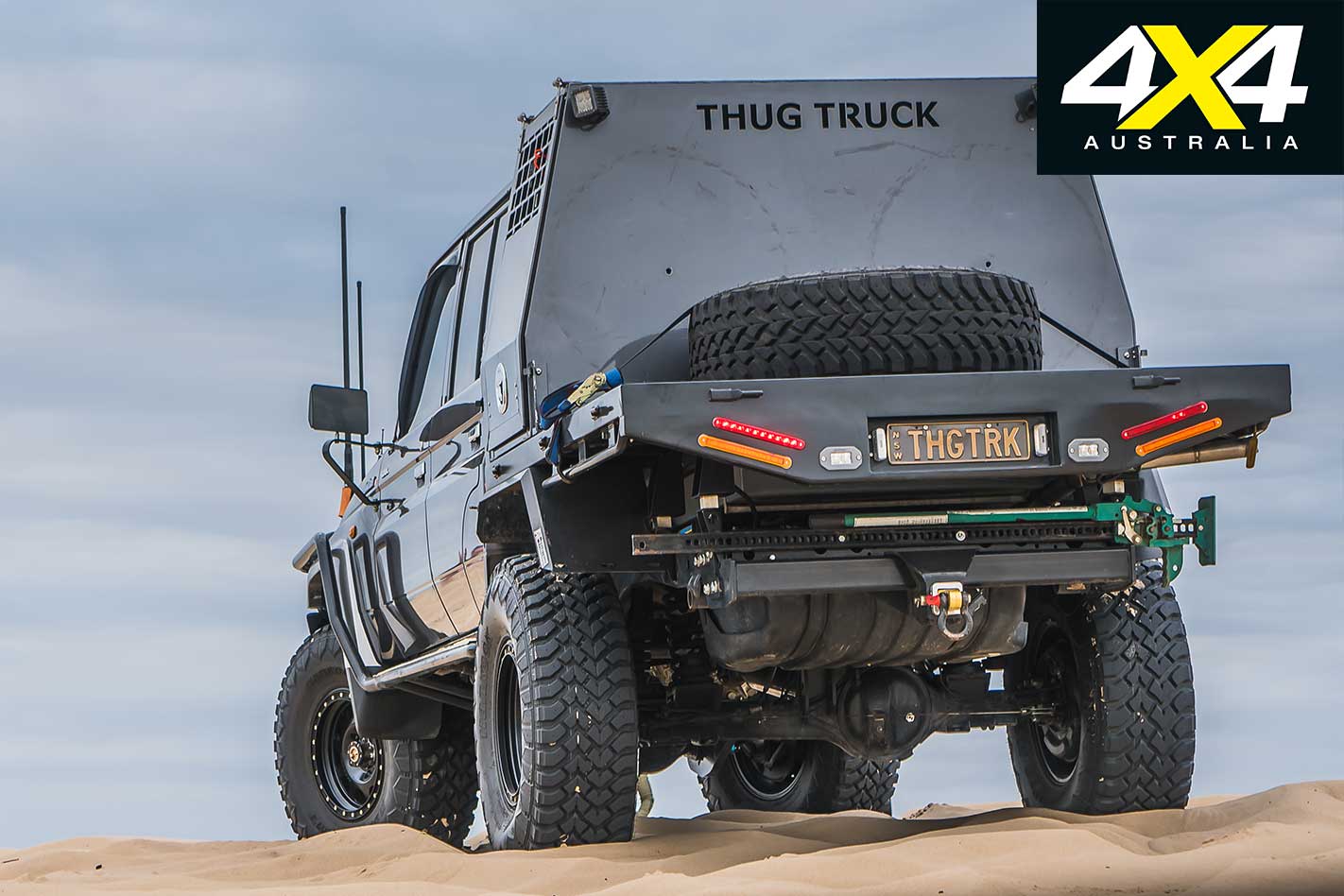
It’s that mean attitude oozing from the appropriately named Thug Truck that first caught our attention. A daily-driven beast of an LC79, sporting 37-inch tyres, a slinky rear coil conversion and an exhaust note that’d have revheads all over the country doing the old belt tuck whenever it barks into life.
While these pages are no strangers to the occasional LC79, they’re typically built with a spanner roll and socket set. This one’s built with a welder and a grinder. Where they’re built with practicality in mind, Thug Truck was built from the ground up to not only fit the part, but break a few noses along the way.
If an LC79 with a five-poster is a clean-cut country boy, Blake Oldham’s wild incarnation is a gruff, one per cent outlaw with a mum tattoo on its neck and a gold tooth glistening under the neon glow of the Kings Cross lights.
While it might look far removed from its OEM delivery, Blake bought the 2014 Cruiser brand spanking new.
“By the time I rolled off the lot with the ARB gear it was around 98K. I reckon I’ve doubled it since then,” Blake tells us with a laugh. It’s not hard to see why, either. While the LC79 might look like the mechanical version of a set of brass knuckles, it’s underneath where it really shines.
Where a set of ancient leaf-springs once had the rear of the Cruiser as stiff as a board, it’s now outfitted with a supple custom coil conversion. “I knew I had to do it on a trip up to McBrides Beach,” said Blake. “I had a front wheel a metre in the air and it just kept climbing, and the rear was practically flat. I’d spent too much on it to have it end up on its roof, so I knew something had to be done.”
Blake’s the kind of bloke to bring an AK to a knife fight, so he went straight to custom guru Steve Etcell of Automotive Etcellence in Sydney’s West.
With the LC79 on the hoist, Steve pieced together a custom triangulated four-link arrangement. The set-up uses rebuildable Johhny Joints at the end of each link, so can be fully engineered.
From here, CNC-cut brackets were fabricated to the diff and chassis to suit the new arrangement. Heavy-duty coils either side keep the rear end afloat, while adjustable remote reservoir King 2.0 shock absorbers are fitted to custom mounts to stop the big Cruiser axle tramping its way across the country. A set of progressive bump stops were also slotted in to help smooth out hard landings.
For now, body roll is kept in check by ramping up the bound and rebound rates on the King shocks with the manual clickers; a one-off swaybar will soon tame the rear end. Up front, the LC79 copped similar treatment; with factory coils right out of the box, the job was considerably easier.
The stock cast radius arms have been kicked out, spat on and binned. In their place are a set of super-flexy replacement offerings from the guys at Comp Rods. The heavy-duty offerings not only suit the lift but correct caster, without changing to flex-robbing caster correction bushes. A Tough Dog adjustable Panhard rod keeps the front axle tracking right, while a matching set of King shocks provide the smooth ride.
Cruiser tragics will no doubt spot the custom shock mounts, too, and while Steve had the welder out he converted the front shocks to an eye-eye setup to suit the big-dollar shocks.
The arrangement not only lets Thug Truck flex its way through gnarly bush tracks like Arnie reliving his glory days, but allows room for the 37-inch Hankook Dynapro MTs to stuff into the guards. These are wrapped around a set of oh-so-cool Method 311 Vex simulated beadlocks punching in at 17 x 8.5-inch.
Eagle-eyed readers would’ve spotted the front and rear wheels have matching offsets, too. Thug Truck runs a trick axle-widening kit in the rear from Kinetic Engineering that perfectly matches the front and rear wheel track, allowing the big rig to push more easily through sand and soft terrain.
With tyres bigger than most Cruiser owners’ loan balances, Blake knew he’d need serious ponies under the bonnet to keep things motoring. The 4.5L single-turbo diesel V8 breathes in and out more easily thanks to a stainless-steel snorkel from AAA Exhausts. The 4.5TDV8 then huffs fresh, clean air through the AAA Exhausts airbox.
From here the job is handed off to the bent-eight, which Automotive Etcellence has dyno-tuned to put out a respectable 204rwhp and 680Nm, with a 3.5-inch turbo back exhaust helping dump spent gases and attract any red-blooded male within ear shot. Tucked in on either side of the donk is a Diesel Care pre-filter, with a Redarc BCDC charger keeping the Optima Yellow Top and Optima Red Top batteries at capacity.
With the nose of Thug Truck barrelling down on you, the tip of the spear is a full suite of ARB bar work. The ARB Deluxe bar leads the way, with a set of ARB scrub bars and rock sliders protecting the flanks from wayward ’roos. Blake’s fitted the ARB bar out with some of the best kit on the market – a Runva 12,000lb winch wrapped in Dyneema rope takes pride of place behind the Factor 55 hitch and gold anodised fairlead.
Up top, a monster double-row LED light bar from Aussie-based Lightforce provides ample light for any full throttle runs through back paddocks at night.
Bolted to the top of the bar are no less than four aerials. A range extender for both Blake’s phone and the factory radio fill two spots, while the twin GME aerials both run to his GME UHF. Blake runs the pair of aerials through a selector switch, allowing him to choose the right gain for maximum reach in varying terrain.
On the inside the LC79 has had a serious overhaul. The standard torture devices Toyota pass off as bucket seats have been sent back to 1980 where they belong, replaced by a set of FPV GT deep bucket seats that’ve been custom tripped and stitched by the guys at InCharge Automotive, while a set of Hurricane adaptor plates fix the new seats to the stock Cruiser rails.
“They’re so much better on long trips,” he tells us. “They hold you a lot tighter so you don’t get thrown around on tight tracks, and the lumbar adjustment makes them easier on the back, too.”
Cruiser Consoles are responsible for almost everything else in the interior, with Blake running its centre console, roof console and gear stick surround, as well as a set of ‘Mack’ door trims. Despite having the attitude of a pissed-off Serbian 10 Rakijas, the rear end of Thug Truck is all work.
Above the revamped rear suspension is a stout tray from the guys at Coldy’s. The heavy-duty offering sports twin dog cages up front; although, Blake’s been known to shoehorn a Waeco into one, with a few ice-cold Coronas tucked inside. There’s a 120-litre water tank hidden away underneath the tray, to round out the touring modifications. While Thug Truck is bound to ruffle a few feathers, there’s no denying it ticks all the boxes.
Capable, comfortable, and two loaded barrels worth of attitude.
Playing with Triangles
With so many factory coil rear offerings floating around you might be wondering why Thug Truck runs a triangulated four-link, rather than a typical parallel + Panhard affair.
“A triangulated four-link travels a lot nicer when you’re pushing big numbers,” said Steve Etcell, the man behind the welding mask. “As a five-link arrangement cycles, the Panhard pushes and pulls the diff side to side as it travels along the arc.”
It’s something we’ve even seen the factories try to fight recently with the Everest’s Watts-link rear attempting to Band-Aid the situation. By running the two upper link arms triangulated, the diff stays perfectly centred through a huge range of travel. Match that with the long arms and smart geometry, and rear steer is also kept to a minimum.
There’s a reason go-fast off-road racers all run triangulated four-links.
Toyota’s upcoming Rogue, Rugged and Rugged X Hilux models, due to launch in April 2018, were designed, engineered and tested locally to meet the tough demands of Australian roads.
The “halo” models underwent an extensive development program – computer simulations, prototype manufacture, bench testing and real-world evaluation to confirm strength and durability of the vehicle and individual components – lead by Melbourne-based designers and engineers.
“Our team understands local customer usage and tastes, the extremes of our local environment, as well as requirements for off-road use, unsealed roads and the challenges of dust and water crossings,” said Rod Ferguson, Toyota Australia’s product planning and development general manager.
“They have developed these high-strength components and integrated them fully to build on the strength and durability of Hilux, while maintaining the performance of key safety systems.
“For example, the Rugged X bash plate is made from high-tensile alloy, significantly improving protection from rugged terrain while minimising weight increase. Local engineering and testing also ensures it works in conjunction with the steel front bar and existing underbody protection.”
As well as the components manufactured for these “halo” variants, the current-gen Hilux underwent 650,000km of local testing, and it was developed with extensive involvement from Australian designers and engineers; specifically, suspension, underbody protection and the tuning of electronic safety systems.
“Australian buyers will also appreciate the peace-of-mind knowing that these new vehicles have been developed to Toyota’s rigorous standards, will be certified to Australian Design Rules and attract full warranty coverage,” Ferguson said.
Meat Cove is located close to the northern tip of Cape Breton Island in Nova Scotia, Canada, while the camping area of the same name is perched on the steep, rounded hills overlooking the bay, where jagged cliffs plunge into the cool waters of the North Atlantic Ocean.
It’s an impressive place, with gannets wheeling overhead and dolphins and whales cruising offshore, and it was one of the best camps we’d visited during our jaunt across North America.
Our first four months touring America had been spent wandering the south-west, where we lost ourselves in the more remote country and environs of Nevada, Arizona, New Mexico and western Texas, before coming back into Utah, now our favourite state in the Lower 48.
The second phase of our adventure had seen us wander down into Mexico, savouring the delights of the La Ruta del Tequila and the Camino Real de Tierra Adentro, which was the first route traced by the Spaniards in America and ran between Mexico City and Sante Fe in New Mexico. We spent some time in the historic town and World Heritage Site of San Miguel de Allende, once an important part of the Royal Road, before heading to Mexico City.
Our plan was to see the Teotihuacan Pyramids site, with its mighty Pyramid of the Sun and smaller but no less impressive Pyramid of the Moon, both dating back to 100BC. Along the way, however, we got involved in a parade of striking school teachers, while the next day we enjoyed a much more colourful and friendly gay-pride march… the unexpected delights of overlanding.
Turning north, we crossed back into the USA and the state of Texas, where we took a tour of the impressive King Ranch, which once owned sprawling properties in Australia and introduced, among other innovations, the Santa Gertrudis breed of cattle to northern Australia.
Still the biggest ranch in the USA, stretching across nearly 4000km², it runs 35,000 cattle and 200 fine quarter-horses, as well as vast areas of cropping and wilder areas for recreational hunting and birdwatching.
From our camp on the nearby Padre Island National Seashore, we poked our way through eastern Texas to Arkansas, Tennessee and the Smoky Mountains National Park, before heading along the Blue Ridge Parkway through the greenery of the Appalachian Mountains to Washington DC and its incredible monuments and museums. We also got to New York a week or so after leaving Washington DC via Gettysburg, but we could have easily bypassed the ‘Big Apple’.
Glad to get away from the big smoke we headed to Acadia National Park and passed through four states in the one day – New Jersey, New York, Massachusetts and Vermont – before we found a pleasant camp in a state park surrounded by the verdant forests of eastern America.
The national park was crowded, so we pushed on to lesser-known and less-populated fields including West Quoddy Head, the most easterly point of the USA. It was a just a hop, step and a jump to Canada, and we headed to Nova Scotia’s gigantic tides in the Bay of Fundy, which even eclipse Derby’s mammoth water movements. We then stopped over at Prince Edward Island, where some of the biggest tuna on the planet can be caught and released under strict environmental controls.
On our return the following year, we started our adventure with a camping foray to Meat Cove and then caught the ferry to Newfoundland and headed to the Cape Spear National Historic Site and the most easterly point of the North American continent, with the roads remaining blacktop all the way.
Swinging west, we stopped for a few days along the coast of Gros Morne National Park and its sheer-sided Western Brook Pond, which is a landlocked fjord reached by a mile or so wandering along a boardwalk and then a boat trip. On the northern tip of Newfoundland we discovered L’Anse aux Meadows, the only authenticated Viking village in the entire North American continent.
A ferry ride across the Gulf of St Lawrence landed in Labrador, and we took the long sweep of dirt and muddy road north and then west to Happy Valley-Goose Bay.
Things are changing rapidly in this remote part of the world, with a couple of hydro dams and power developments pushing a long, wide and sinuous power line through the virgin forest and across the bogs and marshes of remote eastern Canada to the more settled precincts of Newfoundland and Nova Scotia. The whole route from Blanc-Sablon, where the ferry deposits you in Labrador, to Goose Bay will soon be boring bitumen.
From the industrial-come-residential base of Goose Bay, we carved our way through the remote parts of Quebec, passing huge hydro dams and monster iron ore mines to the historic capital on the Saint Lawrence River – the old, walled town of Quebec being the only such fortified city in all of North America.
We enjoyed the old part of the city and its history, but Quebec and its French-speaking citizens are (it seems to us) a bit of an anomaly in the wider, vaster and more populated expanses of the country.
With its French-only signs, language and customs it feels like a different country and, to be honest, we felt more like an outsider here than in any other Canadian province. Looking for quieter quarters we headed north from Quebec City and then west on roads used mainly by logging trucks, hydro workers’ pick-ups, or mining exploration vehicles.
At one lonely camp on the edge of a small nature reserve we had a black bear take an interest in our vehicle, waking us up in the middle of the night as he pushed the back end of the Dodge this way and that, before wandering off into the dark.
Passing over the great shoulder of Lake Superior, we crossed the border back into the USA and into Minnesota, finding the headwaters of the mighty Mississippi in the pleasant Lake Itasca State Park.
Heading westward the next day in our quest to reach the USA’s most westerly point, we stopped for a quick photo at the Geographical Center of North America, in Rugby, North Dakota.
South of Lake Sakakawea, on a much-tamed Missouri River, we came to our first Lewis and Clark monument at a reconstructed Fort Mandan, where that great expedition had wintered in 1804-05. If you’re a fan of their travels and endeavours (like we are), this is one place not to be missed.
For the next few days we wandered the Badlands in and around Theodore Roosevelt National Park, revelling being back in the ‘West’. We found dirt roads and rougher tracks to explore, uncovered more remote campsites, and enjoyed the local wildlife including bison, pronghorn antelope, mule deer and big-horn sheep.
Pushing ever onwards towards the setting sun we found ourselves among the high peaks of the Rocky Mountains, with the fabulous Glacier National Park to enjoy and then the Cascade Mountains, with their impressive Mt Rainier. We were lucky to fluke a day when it was clear and the mountain stood proud of its verdant surrounds of pine forest and tranquil lakes, with the fall (autumn) colours adding even more vitality to a splendid scene.
Circumventing the built-up areas of Tacoma and its surrounds in northern Washington State, we soon found our way along the edge of Olympic National Park and skirted the rocky shores of the Strait of Juan de Fuca to the Makah Indian Reservation and the small community of Neah Bay.
Eight kilometres farther, a carpark marked the road’s end, and a 1km walk through Pacific temperate rainforest of tall and ancient Sitka spruce lead to the rocky, heavily indented coast at Cape Flattery. This is the most western point of the Lower 48 and it shares its name with Queensland’s Cape Flattery, both being named by that eminent navigator and explorer, Captain James Cook.
Turning south we found our way through the backwoods of Oregon and Idaho, camping on the mighty Snake River and well off the beaten track on the edge of the McGraw Creek Wilderness Area. For the next few days we wandered along the South Fork of the Payette River and then the Salmon River, before meeting up with the Snake River once more.
Our travels took us through national forests, national monuments and designated recreational areas, with the ever-changing country varying from rugged, snow-capped mountains to rolling plains and then verdant forests. Our overnight stays were in some magical, pinewood-shrouded campgrounds.
Crossing into Wyoming we headed for Grand Teton National Park, surely one of the most impressive landscapes on the planet. Jagged peaks with their sides slashed by glaciers rear up abruptly from the plains and make up the 65km-long Teton Range; the youngest mountain chain in the Rocky Mountains.
Driving some of the back roads here – once again along the edge of the upper reaches of the Snake River – we came across large herds of grazing bison, wandering groups of elk, and small mobs of deer. With the backdrop of impressive mountains, it was pure magic!
Heading south through Colorado, our route always searching for dirt roads and lesser-used campsites, we crossed into New Mexico and camped under the towering bulk of Shiprock. The only sign of human habitation that evening was the light of a single farmhouse twinkling in the distance. We then climbed across a mountain range that topped-out at 2600m and, as we sidled over Buffalo Pass, the view across the plains back to Shiprock was stunning.
That evening we camped in the Cottonwood Campground of Canyon de Chelly National Monument, a park run by the local Navajo Indians. This sheer-sided, convoluted and long defile was the last stronghold of the Navajo when Kit Carson led a US Army detachment into the chasm to root them out in 1864. The tribes were relocated far away; ‘the Long Walk’, as it became known, a blot on Carson and the US Army that still lingers today.
A couple of days later we crossed the border to a campsite overlooking the little-known and far less-visited Coal Mine Canyon in north-eastern Arizona. It was a fitting end to our travels but, as we were placing the Dodge into storage for another year, we were already drawing up plans to return, our love affair for the ‘West’ barely sated.
Travel Planner
Travelling in the USA and Canada is easy. Mexico is a little more difficult, with language, border formalities and police checkpoints being the greatest hurdles. However, it’s a relatively pain-free experience and more than worth the effort.
Hiring a vehicle or camper for travelling in the US and Canada is easy, with a lot of choice. If you want to travel in Mexico with it, you’ll need to check with the vehicle-hire company.
To buy a second-hand vehicle in the USA, check Craigslist in the city you want to buy it in. California is the most stringent state, with annual vehicle smog and safety checks. We bought ours in rural Arizona, which doesn’t have annual checks at all.
For more information
King Ranch: www.king-ranch.com First car across America: http://amhistory.si.edu/onthemove/exhibition/exhibition_7_2.html La Ruta del Tequila (The Tequila Trail): www.spiritofjalisco.com/press_cigarandspirits.php San Miguel de Allende San Miguel RV park: www.sanmigueltennis.com/san_miguel_campground.html Tepotzotlan Pepe’s Hotel & RV Park: www.ontheroadin.com/pepes-rv-trailer-park/ Eat Mexico Culinary Tour: www.eatmexico.com Vehicle Storage, Halifax: http://storeithere.ca Meat Cove camping: http://meatcovecampground.ca Gross Morne NP: http://pc.gc.ca/en/pn-np/nl/grosmorne L’Anse aux Meadows: www.historicsites.ca/lanse-aux-meadows Grand Teton NP: www.nps.gov/grte/index.htm Canyon de Chelly NM: www.nps.gov/cach/index.htm
If the recent announcement by the UK and French governments that they intend to ban the sale of new petrol and diesel cars beyond 2040 is anything to go by, then the future of the internal-combustion engine looks bleak.
Trends suggest other European countries will follow suit, while a change of government thinking here could also bring about the same restrictions. The assumption is that electric cars will take over and it will be a straightforward process, but, as ever, there’s much devil in the detail.
Electric cars still have a very long way to go to achieve a satisfactory balance between range and recharging time, even using purpose-built fast chargers. And while improvements are being made in both areas they are still well shy of the quick refill and long fuel range offered by cars powered by internal-combustion engines.
Building a national recharging infrastructure is an even greater problem. Even if every current service station selling fossil fuels was fully converted to electric-charging points, it wouldn’t be anywhere near sufficient for a full-electric national fleet, unless you develop electric cars that match fossil-fuel cars for refuelling time and range.
After all, a typical fuel bowser can dispense 50 litres of petrol or diesel in a minute, and 50 litres of petrol or diesel will take you 500km in most cars and up to 1000km in a thrifty small car. Compare that to the 200km range you get out of a 20-minute recharge of a current electric car at a fast-charging station.
With current electric-vehicle technology, the number of recharging points available nationally would, in fact, have to be at least 50 times the current number of fuel bowsers to maintain the same level of drive-in, no-wait refuelling we generally enjoy today.
A counter argument is that electric vehicles can be charged at home, but that’s something best achieved with a purpose-built charging station in secure off-street parking. In inner city areas, ironically where electric cars otherwise make the most sense, off-street parking can be scarce.
In a perfect world, charging stations would be built into newly designed homes and apartment blocks, ideally using solar panels or the like as the power source. However, retrofitting such installations to existing homes and apartment blocks isn’t easy.
Roadside rechargers lined along footpaths are also touted as a solution, but, again, this requires major infrastructure rollout, especially for high-amperage fast-chargers. It would also hinge on commonality of recharge couplings across all car brands and in different localities/countries.
IT’S ONE of the first things owners do once they’ve driven their new fourby away from the dealership: bolt on a new set of tyres.
Some will even get the dealer to do it, leaving behind the original rubber with nobbles from the mould still in place. The temptation of a chunky set of muddies or all-terrains lure many an off-roader, and with good reason: tyres designed specifically for off-roading generally bring better traction once the bitumen ends and will almost certainly resist punctures better than the on-road-biased tyres typically fitted to a Land Cruiser, Ranger, Prado or Discovery.
The beefier look doesn’t hurt, either – and that’s just the start of their benefits. But other than a couple of thousand dollars, what else do you leave on the table when you swap your rubber? What compromises do you make by fitting tyres better suited to the bush than the ’burbs? That was the goal of this test: to determine what you compromise once you change your tyres.
After all, tyre design is all about compromise. Low-profile, high-performance supercar tyres deliver superb grip and response, but wear out quickly and are virtually useless on gravel. Chunky off-road tyres do a terrific job of moulding over rocks and fending off sharp pinches, but their big tread blocks and taller profile compromise on-road grip and steering accuracy.
Once you consider wear levels, puncture resistance, cornering grip in the wet/dry, braking performance in the wet/dry, grip on mud/gravel/sand/grass/rocks, noise levels and handling, it quickly becomes clear there is no such thing as the perfect tyre.
But which is best for you?
THE TYRES
Our test vehicle is a current Toyota Hilux SR5 with standard 18 x 7.5-inch alloy wheels, and we assembled three aftermarket tyres matching the same 265/60 dimensions of the original fitment tyres.
Speaking of which, Toyota fits three different tyres to the SR5 from the factory in Thailand – one each from Michelin, Bridgestone and Dunlop. For this test we secured a set of the standard Dunlop Grandtreks and Bridgestone Dueler H/Ts, with the aim of comparing the aftermarket tyres directly against them.
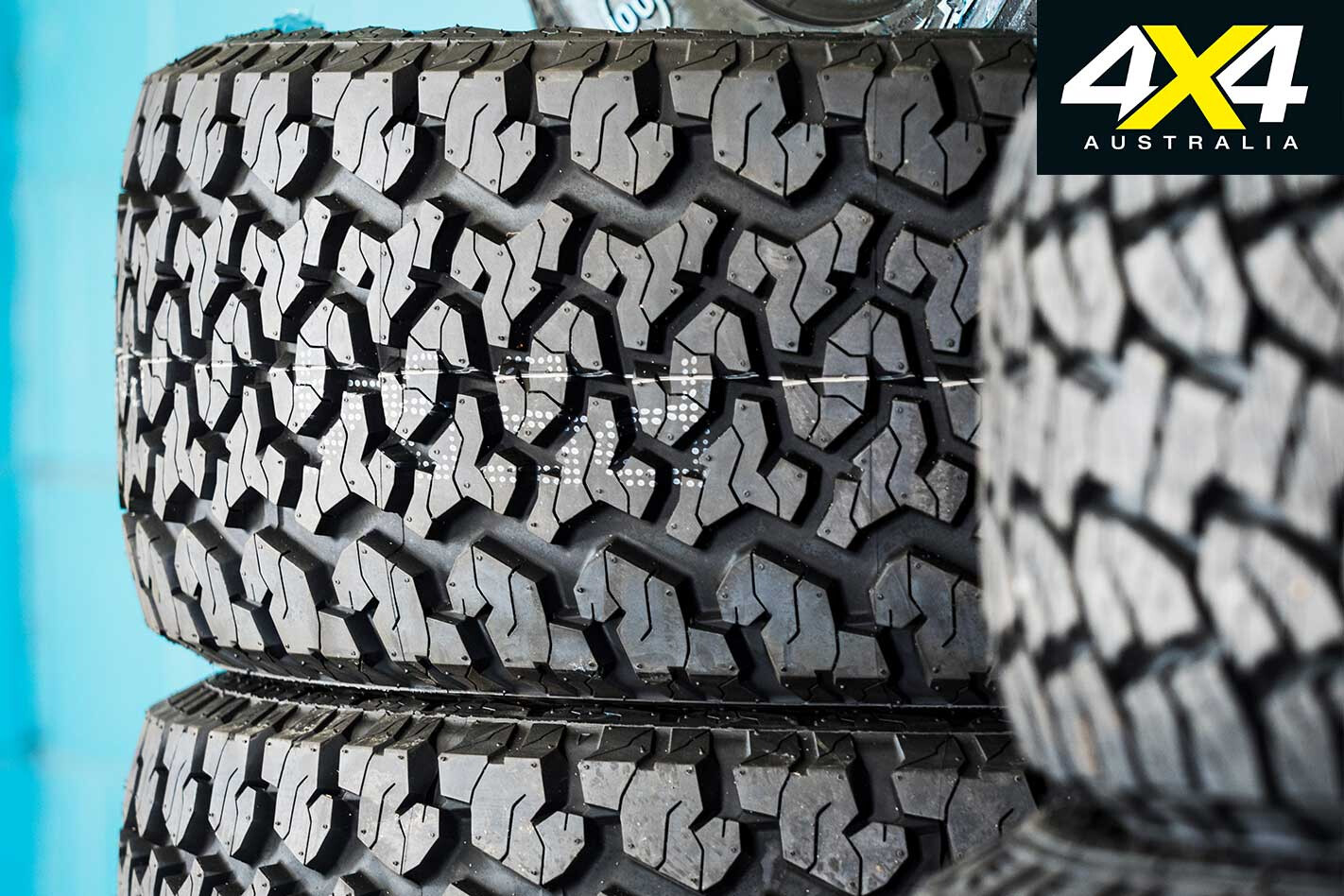
Our aftermarkets are all-terrains and include a set from Hankook, Maxxis and Bridgestone. The Bridgestone Dueler AT and Maxxis AT-980 both have a light truck construction, something that brings a stronger build, typically for higher loads and more serious off-roading. The Hankook Dynapro AT-m is a regular passenger car construction.
All three of our aftermarket tyres boast a 114 load rating, good for 1180kg per tyre, which is 120kg more per tyre than the standard fitment rubber. However, all also reduce the maximum rated top speed.
The original tyres are rated to 210km/h, while the Bridgestone and Maxxis ATs lower that to 180km/h and the Hankooks to 190km/h. Significant, but of no concern for the average Australian adventurer.
When All-Terrains ain’t All-Terrain Not all all-terrains are created equal. Even within the category there are big differences between the most aggressive and most road-focused. Some, such as the 20-inch units fitted to the latest Land Rover Discovery, are more on-road biased. And others, such as the Maxxis AT-980s tested here, are for serious off-road use.
“Every manufacturer has a tyre to suit different needs,” said Glen Jones, the manager and owner of JAX Frankston. “You’ve got all-terrains that are more of a highway tyre, you’ve got all-terrains that are 50-50 (on- and off-road use), then you’ve got your more aggressive all-terrains.
“The all-terrain for more off-road capability would be a higher rubber to void ratio, so more traction off-road. You’ll have a light commercial grade tyre (LT), so a lot stronger in the casing, so less chance of sidewall damage.”
Understanding the Number on Tyres Glancing at the sidewall of a tyre might make you think you’ve stumbled across a poorly hidden password for a bank account. But there’s method to the madness of that collection of numbers and letters.
The largest of the main numbers – in our case 265 – represents the width of the tyre in millimetres. The two-digit number after the forward slash is the profile, represented as a percentage of the width. In our case the tyres were a 60-profile, calculating to 159mm between the rim and the road.
The R denotes a radial construction, which uses steel belts to bolster the carcass of the tyre for more strength and helping the tyre better maintain its shape. And the two-digit number after that refers to the diameter in inches, in this case 18.
Other numbers and letters include a complicated scale for the speed and load ratings. This is where you hit the internet. JAX Tyres has a great tips webpage with tables for those ratings. When choosing aftermarket tyres, keep in mind that while you can reduce the speed rating of the tyres (never below 140km/h) you cannot reduce the load rating; it must either be matched or bettered by whatever tyre you’re popping on.
Check with the roads authority in your state for more details.
THE TESTER
Our 4×4 tyre tester was experienced race driver and former Australian driver’s champion Paul Stokell. Heavily involved in driver training, Stokell is regularly behind the wheel of all manner of cars, from exotic sports cars to dual-cab utes and off-roaders. His experience and precision made him an ideal choice for the repetitive nature of testing tyres.
Collecting data was the job of a VBox data logger. One of the most trusted and reputable data loggers in motorsport, the VBox uses a GPS aerial attached to the roof, which is attached to the data-logging box inside the car. The system also records vision and writes the whole lot to a memory card, which is then transferred to a PC for analysis on bespoke software.
To ensure repeatability and accuracy, we didn’t change the positioning of the antenna for the entire test.
THE TESTING
For this test, there was no off-roading. The challenges of replicating the same mud/sand/gravel surface once a tyre has already traipsed over it were considered too great for the accuracy we were measuring. Instead, our evaluation involved pushing these tyres to the max on bitumen; in this case, the confines of a race track.
We looked at everything from grip in corners and under brakes, to noise levels. After all, even the most ardent off-roaders will likely spend more time on bitumen, even if getting to the Back of Beyond.
As well as the data, we got feedback from steerer, Paul Stokell. Unaware of the tyre he was on, Stokell was in the driver’s seat doing what he does best, leaving the JAX Tyres team to deliver him fresh boots as required. His comments were added to the armoury of 1s and 0s to help determine the battle between original and aftermarket A/T tyres.
BRAKING
Our first test involved a basic crash avoidance to measure straight-line grip – mash the brake pedal at 100km/h and see how far it travels before coming to a complete stop.
We entered the test at about 110km/h to ensure that by the time the car is braking from 100km/h it is at maximum retardation. It’s a full ABS stop across exactly the same section of bitumen, letting the electronics do the work to arrest the Hilux’s 2075kg bulk. Distance measurements were then taken from 100km/h to 0km/h.
What was surprising was how close the aftermarket tyres were to their standard-fitment rivals, all stopping within a metre of each other. Best performing of those aftermarkets was the Hankook – our only aftermarket tyre with a regular sidewall construction, not LT – which recorded a 43.52-metre stopping distance.
Crucially, it was about 30cm shorter than the best of the original equipment tyres, the Dunlop Grandtrek at 43.83m. The Bridgestone Dueler AT was close behind, with the Maxxis trailing. But, again, there’s almost no separating the tyres in this discipline.
If stopping in a hurry on bitumen is important to you, you’re not going to separate the originals from the aftermarkets for outright straight-line stopping power.
CORNERING
Going around bends is a very different discipline for a tyre, especially one tasked with tackling rocks, mud and sand.
Corners are where off-road tyres are typically challenged, courtesy of the relatively high sidewall or distance between the outer edge of the tyre and the wheel rim. That space is necessary to soak up bumps and help the tyres mould around obstacles, while also allowing for lower tyre pressures (to allow ballooning) in terrain such as sand. On 4x4s, that sidewall is also crucial for puncture resistance – a hole or slash in the side of the tyre means goodbye tyres.
However, that taller profile reduces steering accuracy due to the slight flex – and, therefore, delay – between the time the driver turns the wheel and the instant the tyre contact patch on the road surface reacts. Large tread blocks don’t help, either, due to their propensity to squirm around. It happens to varying degrees, and it was the most noticeable difference with our aftermarket tyres here.
In each of the two corners, though, one of the original tyres was quickest from point to point – in some cases by a tiny margin. However, the off-road tyres were by no means disgraced, holding on respectably and scrambling the Hilux through a corner much quicker than it’s likely to punt along a B road.
The Maxxis, for example, with its rugged tread, didn’t have quite as much grip, but it did have consistency at its limit. Stokell was impressed that once it had settled into a corner it was easy to control.
The Hankook – again, remember this is the only of the trio that is not an LT construction – offered the best grip, albeit by a relatively small margin. The Bridgestone wasn’t far off.
For cornering, then, it’s the original tyres with their smaller tread blocks and less aggressive patterns that do a better job of steering the Hilux.
SLALOM
The issue of steering accuracy was more pronounced in the slalom test. In the space of tenths of a second the tyre switched from maximum lateral force in one direction to max lateral force in the other. Then back again and again… and again. In those crucial tenths of a second enormous pressures are put on the construction of the tyre as it deals with the significant load shift.
This is the test where the original tyres show off their on-road bias. As well as recording times between 0.3 and 0.9 seconds faster than the aftermarket tyres – they’re fractions of a second but translate to an overall time between 3 and 8 per cent quicker – the originals also chimed in with better steering accuracy.
Whether it was the Dunlops or the Bridgestone OEs, Stokell commented on numerous occasions about the benefits to roadholding. “The two road tyres definitely feel better through the slalom,” he said, once we’d revealed which tyres he’d been driving on throughout the day. He also highlighted mid-corner stability as an area the standard tyres exhibited benefits.
Even within the trio of all-terrains, though, there were marked differences. The aggressive Maxxis, for example – those designed for the most rugged off-road use – had softer steering responses. “There was a delayed response in the tyre taking its set and heading the car in the right direction,” said Stokell.
That said, Stokell was equally surprised by how close the off-road tyres were to their more on-road-focused brethren. “It’s not night and day better than the off-road tyres,” he commented when critiquing the Dunlops. “It’s better on direction changes and a bit more responsive. But it’s not 50 per cent better; it’s 10 per cent better.”
NOISE
ONE area our trio of all-terrains trailed the original rubber was with their ability to stay quiet. More aggressive tread blocks tend to slap the road more violently as they come into contact with the bitumen, and it can get to the point where some chunky mud-terrains may not meet stringent drive-by noise targets set by authorities.
There’s nothing like that persistent level of humming here, and for these all-terrains we’re talking degrees; but degrees are enough to reduce the comfort levels over big distances.
The quietest of our tyres was the Dunlop, almost 1 decibel below the original Bridgestone, and it was followed by the original fitment Bridgestones. That said, Stokell noted they were one of the noisiest when it came to squealing on the limit – perhaps not an issue for most, but less than ideal if you bowl into a corner too vigorously.
Of the aftermarkets the Maxxis was the noisiest, with its chunky tread blocks working against it; at times there was even some whirring, more noticeable from the rear due to the lesser sound deadening from the tray of the Hilux.
The Bridgestone Duelers were the least intrusive of our ATs, almost matching the original tyres. Another thing to keep in mind is that our noise testing was done at 60km/h on the open road and 100km/h on the smooth race track confines.
The figures quoted here were taken at 60km/h with the transmission shifted to neutral, to minimise the mechanical noise of the engine and hone in on that tyre noise. Repeat the test at 100km/h on one of the poor quality coarse bitumen surfaces Aussie councils specialise in and you can expect a greater difference. A win, then, to the original tyres.
CONCLUSION
When you’re adding more off-road ability you expect compromises. Yet the biggest surprise for this test was how small those compromises were in switching to a more aggressive all-terrain tyre, especially in some of the disciplines. There’s almost no degradation in braking performance with the aftermarket all-terrains, for example.
However, the most aggressive of the lot – the chunky Maxxis – added almost a metre on the best of the tyres, suggesting braking performance could drop off more with more aggressive tread patterns. In corners, mid-corner grip levels approach those of the original tyres, but the original tyres provide sharper, more predictable responses.
To varying degrees all three of our aftermarket tyres exhibited slightly slower steering reaction times, taking the edge off cars that are already dynamically challenged due to their heavy kerb weights and high centres of gravity. Then there’s noise. If long-distance country road touring is important, then beware that chunkier tyres will likely up the roaring.
How far you want to take these compromises should depend on how far – and where – you want to go. Speak to the guys at JAX Tyres for expert advice tailored to your situation.
| u00a0 | Bridgestone Dueler H/T | Dunlop Grandtrek PT | Maxxis AT-980 | Hankook Dynaprou00a0AT-m | Bridgestone Dueler A/T |
| Construction | Passenger | Passenger | Light truck | Passenger | Light truck |
| Dry braking from 100km/h (m) | 44.53 | 43.83 | 44.48 | 43.52 | 43.61 |
| Cornering u2013 corners 1 and 2 combined (sec) | 14.31 | 14.48 | 14.7 | 14.55 | 14.91 |
| Slalom (sec) | 11.5 | 11.32 | 11.93 | 11.67 | 12.22 |
| Noise at 60km/h (decibels, dB) | 56.1 | 55.3 | 57.4 | 57.4 | 56.3 |
| Load index (kg per tyre) | 1060 | 1060 | 1180 | 1180 | 1180 |
| Speed rating index – maximum rated (km/h) | 210 | 210 | 180 | 190 | 180 |
The Crew Behind the Scenes
Our 4×4 tyre test couldn’t have happened without the support of JAX Tyres and Eagle SMF. The team from JAX Frankston was on-hand to perform lightning tyre changes.
Not quite two-second F1 quick, but inside 10 minutes we had one set of tyres removed, replaced, rebalanced and back on the Hilux. And there were plenty of changes throughout the day.
Each set of tyres was popped on the rims at least twice during the day, so all up there were at least a dozen sets of tyres changed, not only on and off the car but also on and off the rims.
The original Dunlop tyres were fitted and balanced at least four times. So, upwards of 50 tyre changes!