
PROVIDE your Nav with the upgrade it needs, by installing an EFS XTR strut/shock suited to D40 and NP300 models.
Constantly adding modifications and kit inevitably means a vehicle will put on the pounds, adding stress to vital components. The all-new EFS XTR shock absorbers will mend this issue, thanks, in part, to a huge 40mm piston bore and a 65mm outer body.
These components will allow the Nav to not only tame harsh terrain but also provide great control on long stretches of bitumen.
EFS is an Australian off-road company which has specialised in suspension systems for more than 50 years. It recently expanded its product line-up to include general 4×4 equipment including barwork, snorkels and electric winches.
The front XTR strut retails for $269.60 (each); the rear XTR shock retails for $180 (each).
For more information, visit: www.1300efs4wd.com.au or call them on 1300 EFS 4WD.
SPECIFICATIONS – 40mm bore diameter size – 20mm hardened chrome piston rod – 1.6mm H/D external wall thickness – Special high temperature fluid – Quality multi-lip seals – Twin-tube design – DMC valve – Bonded rubber/ poly bushes – Low pressure nitrogen gas-charged
THE Federal Administrative Court in Leipzig, Germany, has issued a landmark ruling in favour of German cities legally banning older diesel vehicles from entering zones worst affected by pollution.
The decision was influenced heavily by environmental activists, who had been advocating for cleaner air in the highly polluted cities of Dusseldorf and Stuttgart.
Juergen Resch, the managing director of DUH – a key environmental group in the ruling – said: “This is a great day for clean air in Germany.”
Others disagreed, however, namely politicians and business lobbies, who said millions of drivers could be out of pocket if their vehicles are unable to be legally used.
“Driving bans have a massive impact on our ownership rights, on mobility and on our profession,” said Hans Peter Wollseifer, president of the association of German tradesmen. “The carmakers are to blame for the diesel problem, not us tradesmen.”
Transport Minister Christian Schmidt added: “We must do everything possible to prevent the loss of personal freedom and the reduction in value of cars.”
The ruling bans any diesel-powered vehicle built before 2015 from entering city centres, unless the affected vehicles are upgraded to meet stringent emissions regulations.
Due to high levels of nitrogen oxide, diesel exhaust fumes are known to cause respiratory disease.
The decision is currently under appeal. If the ruling is upheld, enforcing the ban opens up another can of worms, with German police warning it doesn’t have the capacity to enforce such a ban.
AN ACCC safety investigation has led to a compulsory recall of all vehicles with defective Takata airbags.
The compulsory recall means car manufacturers must chase down all vehicles already subject to existing Takata voluntary recalls, as well as 1.3 million affected cars which had not previously been issued for recall – no easy task considering manufacture dates range from 1999 to 2017.
Assistant Minister to the Treasurer, Michael Sukkar, issued the recall based on the evidence provided by the ACCC. He issued the compulsory recall for two reasons: the risk of injury and/or death; and the fact some suppliers haven’t taken satisfactory action.
Globally, Takata airbags have been responsible for 23 reported deaths and 230 injuries. In Australia, one person has reportedly died and one has been seriously injured.
What’s causing the issue? The ACCC report stated: “Phase-stabilised ammonium nitrate (PSAN) airbags without a desiccant (or drying agent) or with a calcium sulphate desiccant have a design defect.
“Due to the defect, as the airbag ages and is exposed to high temperatures and humidity, the PSAN propellant is exposed to moisture and degrades.
“If this happens, when the airbag is triggered and deploys (in a collision), it may deploy with too much explosive force, rupturing the airbag inflator housing so that sharp metal fragments shoot out and hit vehicle occupants, potentially injuring or killing them.”
Alpha airbags – a subset of Takata airbags – pose the highest safety risk, and there are still 25,000 of the units yet to be replaced.
In regards to some manufacturers not taking the appropriate measures to fix the issue, the ACCC recall report said: “As at January 2018, the overall replacement rate for all voluntary recalls was only approximately 63 per cent of the total number of affected vehicles under voluntary recall in Australia.
“Replacement rates for individual suppliers conducting voluntary recalls varied significantly, ranging from between 36 per cent to over 84 per cent. Four suppliers had replacement rates of less than 50 per cent of vehicles subject to their voluntary recalls.
“Prior to the compulsory recall, however, not all vehicles with defective Takata airbags were recalled. Approximately 860,000 vehicles in Australia with defective Takata airbags were not under voluntary recall.”
The ACCC has now provided suppliers with a step-by-step guide that they must adhere to.
Owners of affected vehicles – check here if you’re unsure – are urged to contact their supplier as soon as possible. However, all suppliers should eventually be in contact with those affected.
Car manufacturers have until December 31, 2020, to amend the issue.
IT WASN’T long ago that the Nissan Navara was the perennial bridesmaid in the hard-fought sales of dual-cab utes.
Far from a negative, running second to the dominant Toyota Hilux was no bad thing – and helped reinforce Nissan as an off-road powerhouse nicely. But a few years of brutal competition and some missteps has seen the latest generation Navara drop off the radar for many Australian ute buyers.
Since the arrival of the current D23 model – a truck briefly marketed as the NP300 – the Navara has been playing catch-up, something Nissan is (understandably) not comfortable with. It explains why we’re standing in a dry, dusty picnic area not far from Bendigo north-west of Melbourne.
A Y61 Patrol is perched on a car trailer, ready to act as ballast. There’s a decent smattering of tools on hand and there are trays of lead weights under a gum tree in what resembles a roving workshop flanked by enthusiasts testing the mettle of their rigs.
Except that instead of enthusiasts, the people on the ground are senior Nissan product planners and engineers. They include Takahiro Nojiri, the Japanese-based man now in charge of the Navara program. There’s also the man tasked with digesting the requirements of individual markets, Hajime Tanaka.
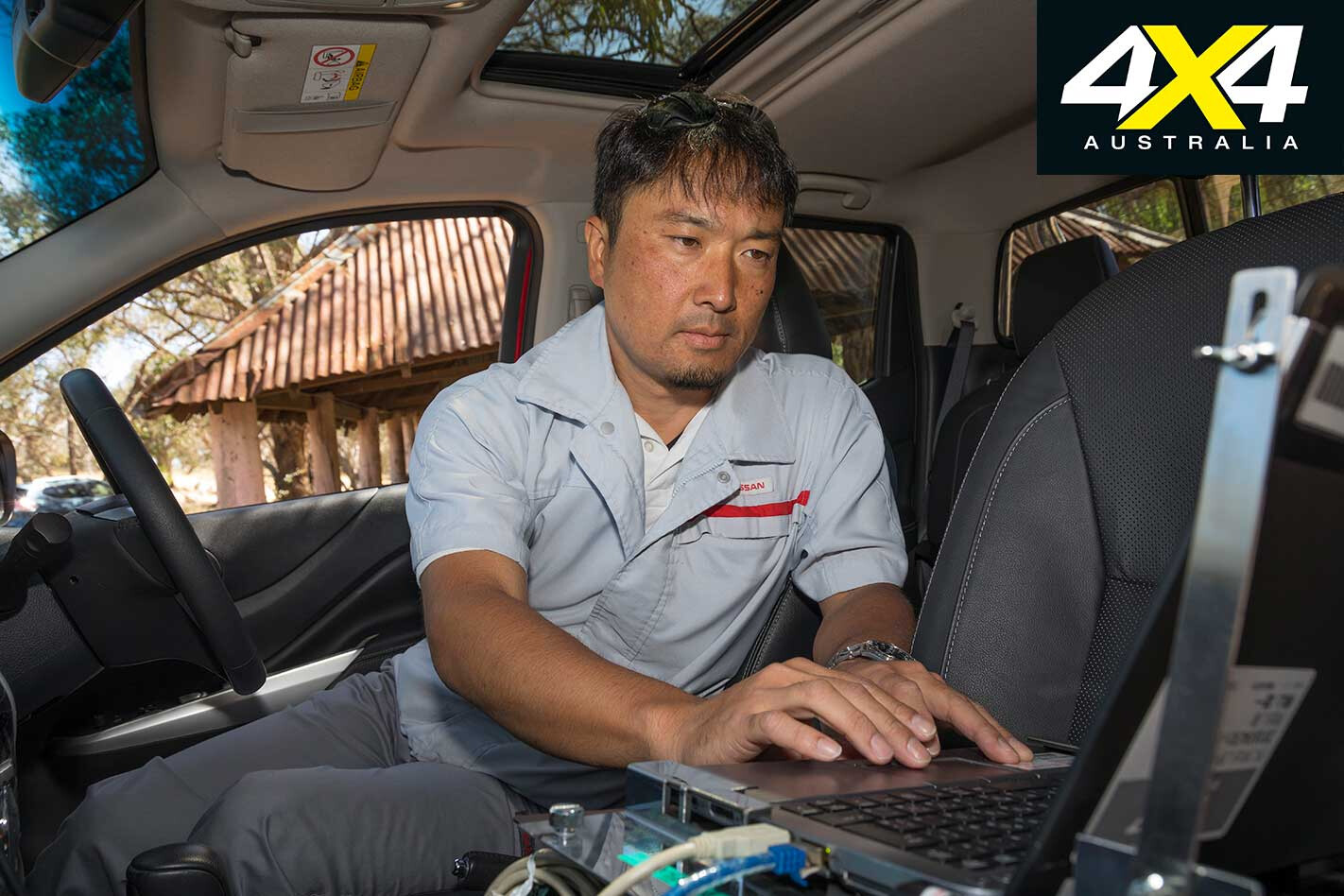
“As part of the overall continuous improvement of the vehicle, we’re trying to address that feedback and we also wanted to improve the ride and handling,” says Kil, explaining that our surroundings in central Victoria were chosen for their steep pinches, sweeping bends, fast gravel and dips and dives. All the sorts of things so many ute drivers experience daily.
Discussions about the Navara update began early in 2017 – two months before Nissan had unleashed the first update to the D23, one aimed at quelling those issues with carrying a load. For this tweak – which improves the dual-cab SL, ST and ST-X models (the base RX is unchanged) – there could logically have been a temptation to switch to the leaf sprung rear end used in some D23 variants.
However, engineers don’t like admitting defeat. And Kil says there has been plenty of positive feedback from the growing number of “dual-purpose” customers who use a ute for work and play. “Most of the time they’re not using more than, say, 400-500kg in the back. For those customers, Navara has actually been really positive.”
Those more supple and better controlled coils work nicely with nothing in the tray. Besides, despite the waves of discontent when doing utey things with a laden coil sprung Navara, engineers are all about finding solutions to problems. Nissan was confident it could maintain the respectable on-road prowess of the Navara, but with newfound control.
The solution was new dual-pitch coils. Instead of a coil with uniform spacing between each twist, the coil is twisted in two different distances at either end, something unique in its class. The idea is to allow a supple ride when unladen – many people drive their dual-cab utes without much in the tray – but allowing for more muscle with close to a tonne in the tray. Towing, too, was a big issue that needed attention for the new model.
The Navara’s unchanged 2.3-litre twin-turbo diesel has no issues dragging around up to 3.5 tonnes – its 450Nm is eminently accessible – but the lack of control in the car’s rear-end didn’t always instil confidence. Teaming with the new rear coils is a new rebound damper to better control the movement, particularly when working. And the rear suspension has been tuned to match the additional control and movement of the rear, with the aim of leading to a more cohesive feeling.
Our first experience comes with the car unladen. Even better, there’s one of the old (2017 model) Navaras for comparison; back-to-back on the same roads. In terms of body control there’s not a significant difference in the way the updated Navara deals with a pockmarked backroad. It still jiggles and occasionally bucks over a larger bump.
Instead, it’s the steering that displays the biggest improvement. The ratio has been tightened from 4.1 turns lock to lock to about 3.4. No longer do you need to be twirling the tiller like a forklift driver in a tight squeeze. It’s also been lightened, making for an altogether more pleasant machine, especially when the road gets windy or when manoeuvring at low speeds.
Things get better when you launch a load in the back. For this test each car was bolstered with 750kg of lead, still a couple of hundred kilos below the payload, but more than most will expect of their truck.
Before turning a wheel there are clear improvements; whereas D23 Series II is sagging in the tail, its rear-end succumbing to the weight, the latest version is retaining its composure.
On the road, too, there’s a stark improvement. In the old Navara the rear-end lacks control over bumps, floating and occasionally reaching the limits of its suspension travel. The new one not only sits flatter but disposes of imperfections – particularly big ones – with conviction. In a third-time-lucky sorta way, Nissan finally has the coil spring Navara doing a decent job of carrying loads.
Towing, too, is more controlled in the rear, the trailer more in sync with the movement of the car. However, unlike the load test, the improvements with 3.5 tonnes on a trailer are more incremental rather than revolutionary.
Elsewhere, the Navara is largely unchanged. The four-cylinder diesel is a hearty powertrain and one that musters its torquey best low in its rev range, for easy accessibility, and the seven-speed auto shifts faithfully, it’s well-spaced ratios assisting in the whole forward motion equation. All of which gets no black marks from us.
Nissan has attacked the area that really needed fixing: how the Navara drove when it was called on to do things ute drivers all over the country do regularly. That it manages to hit its target while retaining decent – if not outstanding – on-road manners makes this improvement all the more worthy.
The suspension changes haven’t revolutionised the Navara, but they’ve brought welcome evolution that makes it better for towing and carrying a load, something that should directly improve its off-road touring capability.
2018 NISSAN NAVARA ST-X SPECS: Engine: 4cyl twin turbo-diesel Capacity: 2.3-litres Max Power: 140kW at 3750rpm Max Torque: 450Nm at 1500-2500rpm Gearbox: Seven-speed auto Crawl ratio: 44.6:1 4X4 System: Dual-range part-time Construction: Separate chassis Front suspension: Independent/coil springs Rear suspension: Live axle/coil springs Wheel and tyre spec: 18-inch alloys, 255/60 Kerb Weight: 1969kg GVM: 2910kg Payload: 941kg Towing capacity: 3500kg Seating capacity: 5 Fuel tank capacity: 80 litres ADR fuel consumption*: 7.0L/100km On-test fuel consumption: N/A Departure angle: 28.2˚ Rampover angle: 24.7˚ Approach angle: 33.2˚ Wading depth: 600mm Ground Clearance: 228mm
*Australian Design Rule ‘Combined-Cycle’ claim
None could ever say that 4X4 owners aren’t spoilt for choice when it comes to aftermarket accessories for their vehicles.
This article was originally published in 4×4 Australia’s March 2010 issue
Bars, lights, winches, wheels, tyres, recovery gear – the list is as big as your imagination and if there’s a need for a specific product, it’s a fair bet that some bright bushie will be out in the shed to develop it soon enough.
The best place to witness the extent of the 4X4 aftermarket industry is at the National 4X4 shows held in Melbourne and Brisbane each year.
Unlike your average 4X4 store, which probably only sells product from one or maybe a couple of equipment manufacturers, the shows gather products and services from all the big players in the industry, together in one place.
Additionally, there are hundreds of smaller suppliers there that are producing equipment you might not find on the shelves of even the bigger stores.
Mark ‘Peto’ Petersen is the event manager for the National 4X4 Shows, so it comes as no surprise to find that he has a fairly well equipped and set-up 4X4 of his own. Mark’s Isuzu D-Max is a rolling showcase of some of the products you will find at the shows and it displays what can be achieved with clever planning and purchasing.
“My work revolves around my hobbies,” Mark says. “Four-wheel driving, fishing, boating, jet skis, on- and off-road motorcycles are all regular activities. I have an adventurous family who love camping and enjoy travelling off-road to camping locations. Our favourite place in Australia is Cape Tribulation, in the Daintree Rainforest.”
The Isuzu D-Max is fairly new to the Australian market but it’s a familiar vehicle thanks to its close family ties with the Holden Rodeo. Because of this, there was a comprehensive amount of 4X4 equipment already available for the D-Max when it hit our showrooms in 2008.
Thanks to the abundance of gear and the Isuzu’s truck-tough build quality, the D-Max makes a good base from which to construct a custom 4X4 tourer. Mark bought his 2008 D-Max when looking for a tough, go-anywhere 4X4 in which to take the family away. A 4X4 dual-cab ute was ideal for this and also for carting the family’s dogs.
Living on the south-east Queensland coast, the 4X4 island paradises of Fraser, Moreton and Stradbroke are only short ferry rides away and the D-Max spends a bit of time on the beaches. Mark is planning an east to west continental crossing for 2010, returning via the Gulf and Cape, so the D-Max has to be equipped for anything.
“The D-Max has been set up to tour with the family. We use tents but I wouldn’t mind a roof-top camper. I use the ute every day, to carry the dogs, mini bikes, surf gear and camping gear,” Mark says.
Starting from the ground up, the D-Max is fitted with 245/70R17 Cooper STT tyres. They are fitted to Dick Cepek Torque alloy wheels.
Like just about all the one-tonne 4X4 utes available, the D-Max rides on a live rear axle with an independent suspension design at the front (IFS). For simple robustness and load carrying, the rear axle is suspended on leaf springs while the IFS uses torsion bars.
The suspension on Mark’s ute has been replaced by an Old Man Emu kit from ARB, comprising new leaf packs, torsion bars and Nitrocharger shock absorbers. A problem with most leaf-sprung utes is the ride quality when unladen, but the OME leaf packs are a two-stage design to improve ride.
The vehicle is largely riding on the first stage of the spring pack when it is unladen, and the secondary stage provides additional support when a heavy load is added to give the best of both worlds. The up-rated torsion bars are made to eliminate sag, and take in to account the added weight of a steel bullbar and power winch on the front end. All up the OME suspension has raised the Isuzu around 30mm at the front and 50mm at the rear.
Under the vehicle you’ll also find a high-flow muffler from Miami Mufflers and Ballsy braided stainless steel brake lines from Spinners Automotive, (both located on the Gold Coast). Braided lines don’t flex as much as conventional rubber hoses and give a firmer, more positive feeling to the brake pedal.
ARB equipment is also used on the outside of the D-Max with a steel bullbar, side-rails and side-steps all in place to protect the sheet metal when in the bush. The bullbar is also the place to mount further accessories and Mark has added a Mako TDS 9.5 (9500lb) electric winch from Avenger 4X4, a pair of Lightforce 240 XGT lights, and an aerial for the UHF radio.
Also clearly visible on the outside of the ute is the canopy which comes from Razorback. Unlike many other ute canopies, the Razorback is made from steel, the same sort of steel that is used in vehicle panels, so the finish on it closely matches that on the rest of vehicle. The Razorback also incorporates roof rails with a 100-kilogram load rating to carry stuff up top.
A unique feature of the canopy is that the lock on the rear window is linked to the vehicle’s central locking system, and operates with the key/button along with the door locks. Mark’s Razorback canopy was the first in the country to incorporate this feature. Under the canopy the ute tub paintwork is protected by a Speedliner spray-on lining and in the tub you’ll find a Waeco CF60 Fridge mounted on a slide, and a pair of Waeco CoolPower packs.
These power packs are used in lieu of a second vehicle battery to power accessories such as the fridge without worrying about discharging the main vehicle battery. They are ideal for vehicles where a cramped engine bay prohibits the fitting of a second battery, although this isn’t the case with the Isuzu.
They use a 36Ah AGM battery and are charged via simple cigarette-lighter-style plugs wired in to the load area of the ute. They are also portable, so Mark can remove the fridge and power packs from the vehicle and have them close at hand, at a camp or picnic site if required.
The engine bay remains fairly standard. The 3.0-litre intercooled turbo-diesel engine provides Mark with all the torque and performance he needs for his trips away and daily grind. The only addition is a Safari snorkel to aid breathing and water crossings.
Economy is a strong point of the Isuzu diesel and Mark says he was running in the 8L/100km region when it had the standard tyres on, but that has since blown out to around 9L/100km with the bigger mud terrain tyres and other accessories. A small price to pay for traction and durability.
Tucked in behind the standard battery is a Couplertec electronic rust proofing unit. The Couplertec prevents rust by running a low voltage current through the vehicle which adds electrons to the metal to suppress the rust process. It’s valuable insurance for any vehicle, let alone one that gets out on the beaches regularly.
Inside the ute is fairly standard too, but there’s a Department of the Interior roof console fitted which also mounts the GME TX3400 UHF radio. A Garmin GPS72 provides the navigation when in the bush and a Navigon street finder gets Mark around town.
Next on the list of things to do is acquire an LCD screen and DVD player for the rear to keep the kids entertained on the longer trips. Mark says he enjoys driving the D-Max and regularly gets comments on how it looks.
“The vehicle has been designed to promote the National 4X4 shows, with exhibitors placing aftermarket products on it too; it gets a lot of good comments everywhere I go. It’s been built to be driven off-road and that’s where I take it as much as possible.”
Mark went on to say that he doesn’t know how long it will stay looking this good, as with all the off-road use it is subjected to, there are bound to be a few scratches appearing soon. At least he has fitted appropriate protection inside and out to ensure it won’t let him down.
Aussie 4×4 aftermarket industry
What’s just as amazing as the huge range of 4X4 equipment available from aftermarket companies, is how many of the manufacturers are Australian. In many respects, Australia leads the way in 4X4 equipment, and Mark’s Isuzu showcases just some of its products.
The ARB bar work and Old Man Emu suspension were all designed and manufactured at ARB’s Melbourne factory. Safari snorkels also come from the Victorian capital. Lightforce lights are made in South Australia and GME radios come out of a factory in Sydney.
So good are Australian products that they are exported worldwide, where they are considered industry leaders. Part of the reason for our success is that the products are designed for, and tested in some of the toughest conditions in the world – the Australian outback. This rigorous testing has built the reputation of these companies, as the best in the business, and they protect their credibility with ongoing R&D to keep their products ahead of the field. It makes you proud to be an Aussie.
2008 Isuzu D-Max Dual Cab Owner: Mark Petersen Engine: 3.0-litre intercooled turbo-diesel Power: 120kW @ 3600rpm Torque: 360Nm @1800rpm Transmission: Five-speed manual
List of modifications Intake: Safari intake snorkel Suspension: ARB Old Man Emu leaf springs and torsion bars; greasable shackles and OME Nitrocharger shocks Wheels: 17-inch Dick Cepek Torque alloys with Cooper STT 245/70R17 tyres Exterior modifications: Colour coded ARB Bullbar; side-rails and steps; Mako TDS 9.5 electric winch; Lightforce XGT 240 driving lights; Razorback steel canopy; Couplertec electronic rust-proofing unit Interior modifications: Department of the Interior roof console housing GME TX3400 UHF radio; Speedliner spray on cargo bed lining; Waeco CF60 fridge with dual Waeco CoolPower 36 packs; Garmin GPS72 Navigon street finder satnav
Special Thanks to: ARB 4X4 Accessories: arb4X4.com.au Avenger 4X4: avenger4X4.com.au C&B Mobile, for fitting of Razorback canopy, console and Avenger winch: awlc.com.au Cartright Isuzu, Southport: (07) 5557 7333/isuzuute.com.au Couplertec: couplertec.com.au Exclusive Tyres and Wheels: coopertires.com.au Lightforce: lightforce.net.au Miami Mufflers, Speedliner and muffler: (07) 5576 3511 Spinners Automotive, Ballsy Braided Brake Lines: (07) 5520 3085 Waeco: waeco.com.au
The drive into Carnarvon National Park was uneventful. The sky was blue with scattered clouds, the creeks were low and the weather forecast was for a dry and warm weekend.
This article was originally published in 4×4 Australia’s January 2011 issue
It was looking like it was going to be the perfect camping getaway with lots of bushwalking and maybe even a swim.
Little did we know that on our last night in Carnarvon Gorge we would cop 36mL of rain which was going to flood the creeks and the causeways. We were excited to be in the park, but we never thought we’d have trouble getting out…
We decided to take it easy on the first day and followed the Nature Trail; this is a two-kilometre return trip along the shady banks of Carnarvon Creek.
In the afternoon, hubby Chris and four-year-old Shannon did the one-kilometre return walk to Baloon Cave to admire some Aboriginal art followed by a three-kilometre walk to Mickey Creek Gorge. They got caught in heavy rain and came back to the tent sopping wet.
The next day I decided to stay home with the two little girls (aged three and two) and Chris drove off with Shannon to attempt the 10km return walk to the majestic Amphitheatre.
Hidden inside the walls of the gorge is a 60m-deep chamber, gouged from the rock by running water. Resounding acoustics add to the awe-inspiring atmosphere within. The climb up the four-tiered ladder is quite the experience, according to Shannon. There are beautiful moss gardens in the gorges along Carnarvon Creek and towering gum trees, dwarfed by the cliff face of the gorge.
Our weekend getaway was quickly coming to an end and we packed up the annexe in preparation for an early morning departure. The rain started at about 7:30pm and soon became very heavy without any sign of easing up. I knew that we were camped on a site that was more or less in a bit of a hole and it was only a matter of time before the water would start to rise. This is exactly what happened and when I went outside to check the water level, we already had a floating vinyl tent floor.
Chris wasn’t too worried initially, until I convinced him to check it out for himself. As soon as he stepped into a foot of water right outside our tent, he figured it was time to evacuate. We quickly put the kids in their car seats and explained to them that we were going to sleep in the car that night because the tent was getting flooded. We put all the gear inside the tent on the bed and then waited out the night in the car.
At first light and as soon as the rain started to ease we started packing up the tent, ready to head out. By 7:30am we were on the road eager to leave Carnarvon Gorge.
Unfortunately the creeks had swollen so much that the last two causeways had become impassable and we had no choice but to go back and camp another night. The staff at Takarakka Bush Resort were very helpful and gave us a dry and powered camp site for the night free of charge.
Next morning we packed up again and were able to cross the creeks without any hassle. We will remember our wet and wild stay in Carnarvon National Park for a long time!
Travel Planner
WHERE Carnarvon Gorge, in Carnarvon NP, is 241km south-east of Emerald and 244km north-east of Roma, in south-east Queensland.
CAMPING There is a beautiful national park campground close to the information centre and the start of the walking track into Carnarvon Gorge. The campground is only open during Easter and the winter and spring school holidays. Maximum stay is five nights. Caravans are not allowed, but it’s a perfect spot for camper trailers as the sites are big and spacious. The facilities are fantastic and include coin-operated hot showers and flush toilets. All sites are unpowered and must be pre-booked. For a bit more luxury you can camp at Takarakka Bush Resort, four kilometres from the information centre. The resort has powered and unpowered sites, safari cabins, amenities, a laundry and a shop with basic groceries. Alternatively, you can stay at Carnarvon Wilderness Lodge (no camping available).
SUPPLIES AND FACILITIES The closest towns are Rolleston and Injune, but you need to be completely self-sufficient as it is quite possible you could get stranded after heavy rain. There is no fuel at Carnarvon Gorge.
TRIP STANDARD The road to Carnarvon Gorge is sealed, apart from the last 21km. There are numerous creek crossings, which are fine to cross in dry weather but soon become impassable after heavy rain. It is possible to take a conventional vehicle, but a 4X4 is recommended, especially when the forecast is for rain. After rain the roads become muddy, slippery and potholed.
CONTACTS AND INFORMATION Ranger Carnarvon NP: 07 4984 4505 Takarakka Bush Resort: 07 4984 4535 Wilderness Lodge: 07 4984 4503 National Parks: 13 74 68
RESTRICTIONS AND PERMITS There is no entry fee to visit Carnarvon NP. Camping fees apply when camping in the national park campground. To book phone 13 74 68. Bookings are also necessary for Takarakka Bush Resort.
MAPS AND GUIDES Visitor Guide: Carnarvon Gorge Section (available at Carnarvon Gorge visitor information centre).
THE soon-to-land Mercedes-Benz X-Class will be the first pick-up to enter the Australian ute market with autonomous emergency braking (AEB).
AEB, standard on all X-Class variants, is a safety feature where a car’s brakes are automatically applied when a head-on accident is looming.
Active in both high- and low-speed scenarios, the AEB system reacts quickly to minimise damage or to completely avoid spoiling someone’s rear bumper.
“This is a game-changer for the ute market and puts pressure on competing brands,” ANCAP Chief Executive, James Goodwin, said.
“The light commercial vehicle segment has generally lagged [behind] passenger cars and SUVs with regard to safety specification, so the inclusion of AEB as standard across the X-Class range is to be commended,” he said.
According to the ANCAP test performed in 2017, the AEB system fitted to the X-Class performed well, “detecting and either avoiding or mitigating crashes with other vehicles at low and high speeds”.
The AEB system “is also capable of detecting and preventing crashes with pedestrians”.
The X-Class was awarded a five-star ANCAP safety rating.
NISSAN has dropped the curtains to tease its all-new, body-on-frame Terra SUV, which is set to rival the likes of Ford’s Everest.
Information at this stage is scarce, with Nissan confirming more complete specifications and data will be available in April, 2018.
What we do know is that the Terra, the first vehicle to launch under the company’s mid-term plan – Nissan M.O.V.E to 2022 – is set for a spring (March-June) premiere in China.
“I’m very pleased to announce that the all-new Nissan Terra will soon arrive in China,” Ashwani Gupta, senior vice president for Nissan’s frame and LCV business, said. “This rugged SUV is practical, authentic, and designed to go anywhere.
“The Nissan Terra goes on sale this spring, first in China, with other Asian markets soon to follow.”
Due to a boom of the LCV segment, Nissan views its frame and LCV business division – comprising of SUVS, utes, vans and light-duty trucks – as critical to the success of its ongoing sales growth.
In fact, in January this year, the LCV segment in Australia saw sales increase by 20.3 per cent overall compared to January 2017. In particular, 4×4 LCV sales were up a substantial 26.6 per cent.
“Nissan’s frame and LCV business is seeing steady growth, and with our ambitious midterm plan and growing product lineup, we’re confident that this growth will continue,” Gupta said.
“It is an exciting time for Nissan. We have the Nissan Terra arriving soon, the award-winning Nissan Navara is now in 133 markets worldwide, and more drivers are purchasing our LCVs around the world.”
Globally, Nissan reached a total of 907,929 frame and LCV sales in 2017, a seven per cent increase on 2016.
When asked of its arrival in Australia, Tony Mee, Nissan Australia’s Corporate Communications Manager, said: “Nissan is excited to announce the forthcoming arrival of the new Terra SUV. This new SUV model is scheduled for initial release in China, and selected Asian markets, and is currently not planned for Australia or New Zealand.”
Stay tuned to 4X4 Australia for more information on the Terra.
Chris Kyval has an effective philosophy about setting up his four-wheel drive: always utilise the available air space.
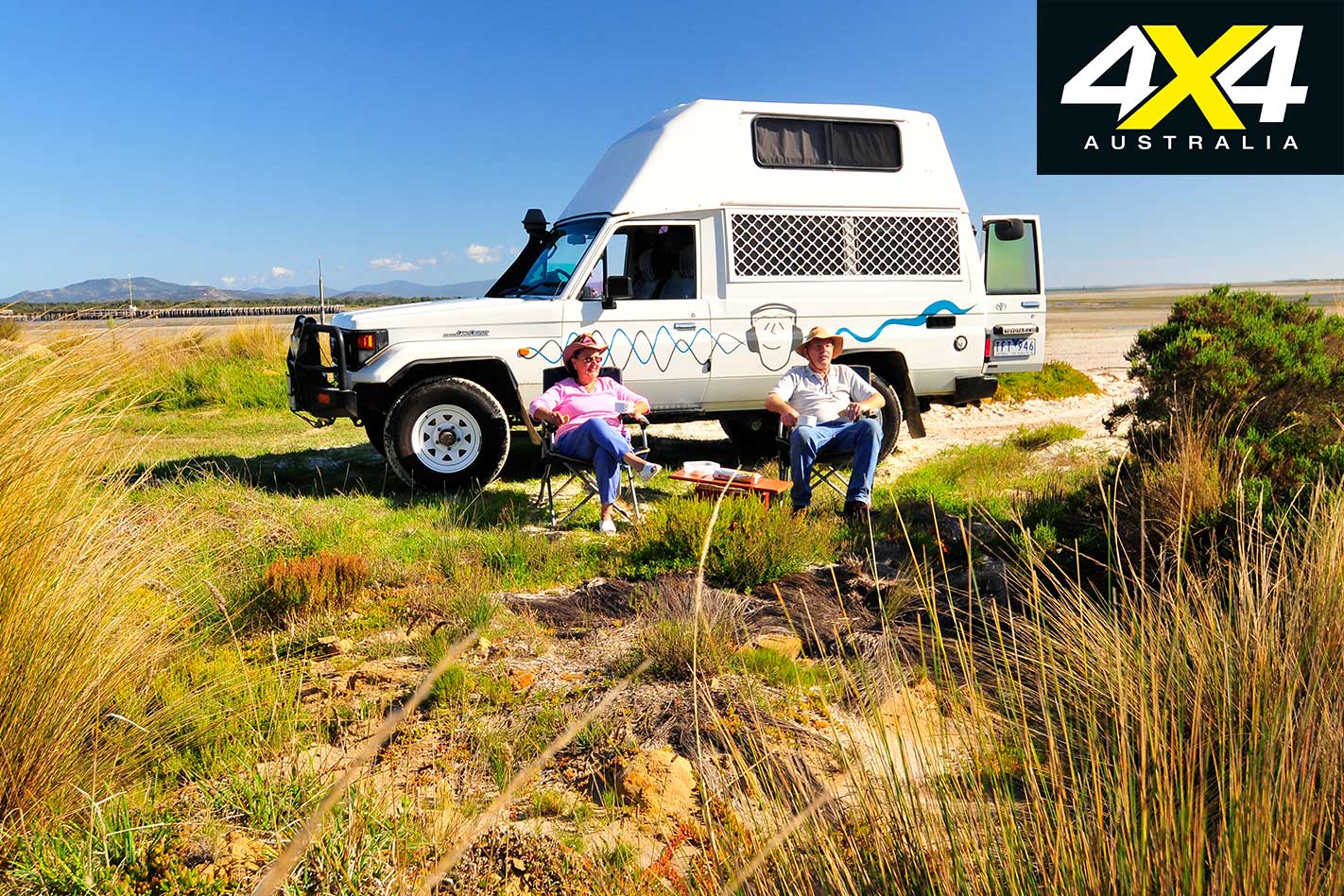
It has helped him and wife Thelma create a home away from home in their TroopCarrier, which features some very clever, but ultimately simple modifications. The 78 Series proved ideal for a two-and-a-half-month, 17,000km expedition to Australia’s most distant parts.
“Our main hobby when we travel is taking lots of photos,” Thelma says, recalling that journey from Gippsland, Victoria, up through NSW, then through South Australia via the Birdsville Track and up to WA, along the Gibb River Road, into Broome and Cape Leveque, then home along the Tanami.
“We ended up going up over to Marree and we went via the Birdsville Track, and we saw a beautiful sunset. There was a road plant that had been parked – trucks and graders – and there was a red sunset silhouette. Although it was machinery, it was so beautiful.”
The Tojo had had two previous owners. It was originally a Britz hire car and was then owned by a guy who used it in his business for auditory hearing testing before Chris bought it from him three years ago. A television, DVD player and sound system were already in place, installed by the previous owner. The headphones painted on the side of the Troopie are also a leftover from that owner.
“I thought I’d leave that on because it looked different,” Chris says. “I simply put a smiley face in.”
He left the engine alone, too: “A lot of Troopies have turbo-diesel, but I find it’s fine without the turbo. I’ve got everywhere I’ve wanted in it and I get very good fuel economy – two 75-litre tanks and I get exactly 600 kilometres per tank. I drive quietly.”
The only problem he’s had was a broken driveshaft, which was replaced by a standard-issue unit. Instead of major mechanical changes, he put his time and effort into the interior.
“There’s a lot of air space wasted in a vehicle, so what I did was use available air space and elastic clips to tie down things like paper towel, fly spray and personal insect repellent,” he says.
“Inside the back wall of the Troopie we made a cargo net out of straps and we were able to put in bulky items like coats, hats and umbrellas. Once again, it didn’t take up any usable space, it was at the very back wall when you climbed into the Troopie, where it’s very quick to get to. Without that you’d have to fill up a couple of wardrobes and containers.”
The Waeco fridge is a feature of the kitchen, which also includes a sink and a number of drawers and storage areas, cleverly created by Chris.
“Chris did lots of work because he has marvellous inspiration for those sorts of things,” Thelma says.
A kitchen-bench lid covers the cutlery. Chris says: “Under the lid I put these clips to attach the wooden spoon, spatula and a pair of tongs, and that also used up that air space.”
Chris put a mirror on the inside of the back door. By opening the door, there’s ample space to stand in front of the glass to do your hair.
“And sometimes, when we get to a township where I want to put a bit of lippie on or something, it’s nice to have a mirror,” says Thelma.
She applied her own handiwork skills to make pillows and handgrips in matching material. “The bed cushions, which are part of the seating arrangement first, are then laid flat and make a bed. I made the covers for those and I made an extra pillow that goes in the front seat on the door side – an extra cushion for extra comfort.
“I made a padded handgrip over the handrail where the passenger holds on just above the glovebox. I found that when it’s bumpy, it’s good to have something like that to hold onto.”
Velcro seems to be one of Chris’s favourite materials. He has used it throughout the cabin to attach useful objects so they’re always there when he needs them.
Both Thelma and Chris have their head lamps attached within reach of their seats. “They were always there, very safe, secure and no rattles,” says Chris.
He also attached a bottle of window cleaner by Velcro so it is always on hand. “I filled up this pump-action window cleaner, attached a strip of Velcro to it and another strip on the transmission tunnel near the floor and it’s always there; it never moved. Each morning I’d get my little cloth and clear the windscreen, have a fresh start.” And it can be so easy to misplace your tyre gauge without a good system.
“I put a bit of Velcro just underneath my water bottle, just inside the door behind the driver’s head, and a bit of Velcro on the tyre gauge,” Chris says. “It’s very convenient. Each morning I just pull it off and check the tyres.”
Chris used pushbike technology and screwed bicycle water-bottle holders above the driver and passenger doors. “They were screwed to the pillar, out of the way, using up air space again, and when you’re driving along you have your water right there,” Chris says.
With everything working well inside the box, Chris only needed to play around the edges of the Troopie’s mechanicals. First came suspension.
“Anyone who thinks they can make do with old suspension is really deluding themselves,” he says. “It’s an item in a vehicle that takes a punishing, especially in a 4X4. You don’t get so fatigued, it’s safer, more comfortable and tyres last longer.
“I have Pedders’ Trak Ryder shockers – they are top-of-the-range shock absorbers and I wanted to improve the handling. I also put in rear air bags; you can raise or lower the suspension. If you have a lot of weight in the back you can make the vehicle level. Once they were put on, it just drove like a new car – it made a huge difference.”
Until recently, Chris stuck with the standard split rims. On that last trip, he copped five flats and had no trouble removing the tyres and repairing the inner tubes, but when he came home he decided on a set of Sunraysias so he could go with tubeless rubber.
“The advantage of the tubeless is that if you get a slow leak all you need to do is pump it up or find the hole and insert a temporary plug until you get to the service station and have it done correctly.
“I went for Goodyear Wrangler tyres – there was a little trick with this, too. I bought the Wranglers made in America because the compound is superior to the ones made in other, third-world countries. Also, the Wranglers have what they call Silent Armor, a Kevlar material that helps prevent punctures.”
The bullbar was on the Toyota when Chris bought it, but it was winchless. At first, that wasn’t a worry, but their second expedition made the couple reassess their entire recovery set-up.
“What made us change a couple of things was when we went to Cameron Corner, the border crossing between South Australia, NSW and Queensland,” Chris says. “We camped on the side of the road one night and it started to rain. The next day the roads were very difficult to drive on.”
The police, in the process of closing the roads, gave them permission to retrace their steps towards Broken Hill, but it was a hairy drive. “We were very lucky to get through because we were slipping on the muddy, unsealed roads, so I decided when I got home I would fit a 3.5-tonne electric winch.”
Chris also added a Lan-Cor ground anchor to the kit, alongside straps, a snatch block and rated shackles. Luckily, they didn’t need this equipment during the dry season on their Gibb River Road trip, but they’re well prepared for the next downpour.
“When you go off the beaten track you are very vulnerable so you need to have yourself and the vehicle as fully prepared as possible so as not to rely on other people,” Chris says. “We have helped other people and when you ask, ‘Where’s your jumper leads?’ and they say, ‘We haven’t got any,’ it’s not really appreciated. You need to help yourself first.”
Lessons learned from experience go as far as carrying water, too. With the ongoing drought it’s no longer a case of just filling up the jerry cans with an endless free supply of the clear stuff. Thelma and Chris developed a new approach to water conservation they shared with many of the travellers they met along the road.
“The Troopie has a 45-litre water tank, but what we have as an emergency in the air space behind the passenger seat is a 10-litre jerry can for water,” Chris says. “We went into one town – Tibooburra, in NSW – and filled up with fuel. We said we needed water, but they didn’t have any to give. We realised then we are going to have to be more careful with the water.
“One of the things we discovered on the Gibb River trip was because water was so scarce we didn’t use our shower, as the pump used too much water. A better system was to just do a flannel wash and then with a soft-drink bottle of water pour it over your head to rinse. It saved a lot of water.”
The Troopie has been a perfect vehicle for Thelma and Chris, who’ve chalked up uncounted memories from the places it has taken them. They’ve enjoyed helicopter flights over Lake Eyre, eaten barramundi in the Gulf country, camped beside the Pentecost River at El Questro, in the Kimberley, seen the Ground Zero Obelisk, west of Coober Pedy, where the atomic bombs were detonated, and much, much more.
They’ve even been caught in a major dust storm. “It was an adventure!” Thelma says. “It’s just being out in nature and having the clear sky with the stars and the sunrises and the sunsets. I think anyone would be in awe of those.”
Chris Kyval’s 4×4 Equipment Tips
Chris has thought long and hard about his recovery gear to ensure he gives himself every possible chance to avoid getting stuck in the middle of nowhere. Here’s what he uses.
– 3.5-tonne bullbar-mounted electric winch – Lan-Cor ground anchor – Air compressor – Snatch strap, winch extension strap, snatch blocks, shackles – Battery charger – Tyre repair tools – Two inner tubes (or plugs for fixing tubeless tyres) – An exhaust jack – Two mechanical jacks: “Sometimes when you get a flat tyre and it’s down low you can’t get the first jack under,” Chris says. “So you get one under in not the best position but just enough to raise it, then you slip the other one under.” – Two wooden base plates for the jacks: “It gets you a better platform to work on.” – Jumper leads for the battery: “Instead of putting them in the toolbox, I have a system where they are fastened underneath the bonnet. It keeps them where I need them and it’s using up air space. I’m utilising clips there that hold the two batteries.” – Basic tool box of spanners and screwdrivers – Test light to check for electrical faults – Things like duct tape, wire fuses, spare fan belt, radiator hoses – A reserve of water and food: “We never touched it but we knew it was there in case we had to hole up for a few days.” – Satellite phone, UHF and GPS – A list of telephone numbers with family, contacts, and also emergency services: “When you drive along there are big signs with warnings and saying, ‘If in trouble these are the numbers to ring’. Must make sure you write those numbers down.”
SHIFTING to a new residence seems like a never-ending process.
Even months after the last empty box has been flattened, there are still holes in walls to be plastered, light fittings to replace and outdoor settings to purchase … a predicament I was recently in during a two-week hiatus from 4X4 HQ.
So with a list of jobs in hand, a last-minute phone call was made to Isuzu, where a 2017 D-MAX LS-T Crew Cab 4×4 was locked in for transporter duties. The range-topping, special edition fourbie also gave me the perfect excuse to get off the beaten track for a day or two … or three.
The LS-T utilises Isuzu’s updated 3.0-litre four-cylinder turbo-diesel engine that’s good for 130kW and 430Nm – more than enough grunt to shift an outdoor table and six chairs – and it meets strict Euro 5 emissions standards thanks to the addition of a diesel particulate filter. The LS-T can only be had with an automatic transmission; in this case, a slick-shifting six-speeder.
Unladen, the LS-T rides smoothly, with the front coils and rear leafs providing well-sorted and comfortable travel. With a load on board, the 4×4 remains glued to the tarmac and the steering precise and positive.
The tray measures 1485mm long by 1530mm wide, with an 1105mm distance between the wheelhouses, and there are four tie-down hooks, which meant loading and unloading equipment was a cinch. A payload capacity of 924kg and a class-leading towing capacity of 3500kg didn’t hinder performance, either.
The LS-T didn’t only serve delivery duties, as we diverted from oft-used tracks and pointed it toward harder-to-reach destinations. Only a few months prior I’d ventured to Fraser Island for the Isuzu I-Venture trip, so the capabilities of the D-MAX were already well-learned – it handled everything the world’s largest sand island could throw at it, so what hope did a few off-road trails near Melbourne have of unsettling it?
It didn’t take long to familiarise myself with Isuzu’s user-friendly Terrain Command 4WD select dial, which allows the driver to flick between 2WD-high, 4WD-high and 4WD-low. Flicking it to four-low is as simple as stopping, shifting to neutral, rotating the select dial and waiting for engagement.
The lack of a rear diff-lock would undoubtedly become obvious on the toughest trails this side of the Vic High Country, but on the tracks in and around Cobaw, 80-odd kays north-west of Melbourne, the LS-T battled on without incident. Its off-road nous is aided by decent angles: Approach (30.0), Departure (22.7) and Rampover (22.4). The LS-T also has 235mm of ground clearance and a wading depth of 600mm.
The LS-T interior is spacious and a pleasant place to be, highlighted by well-appointed leather – a benefit of opting for the range-topper. However, the centre stack layout and touchscreen controls are still in urgent need of a makeover. The LS-T also features a proximity key for entry and 18-inch alloy wheels.
The LS-Terrain, available with a six-speed automatic gearbox only, carries a RRP of $54,200. The LS-U Crew (manual) retails from $44,990; the LS-M Crew (manual) from $40,990; and the SX Crew (manual) from $38,990.