PUNTERS who pick up a copy of the March issue of 4X4 Australia will also find a free ‘the essential Northern Territory drive map and travel guide’ inside.
One side of the lift-out features an A1-sized, detailed map of NT, with points of interest and must-visit off-road destinations.
Flip it over and you’ll find a bunch of popular drive routes within NT, including Arnhem Way, Nature’s Way, Greater Litchfield Loop, Explorer’s Way, Savannah Way, Overlander’s Way, Binns Track and Red Centre Way. Each route outlines where it begins and ends, as well as popular stops along the way.
The guide also features a detailed parks and reserves facilities guide, where it lists all the essentials including 2WD/4WD access, toilets, required permits, activities (fishing/swimming) and camping access.
To make planning your itinerary easy, the guide has a handy distance chart between major centres, as well as a safety guide (croc info, rest areas, permit access info and a bunch of tips to stay alive).
All essential contact details are provided, as well as a list of festivals and events running throughout the year.
It’s the perfect tool to equip yourself with before you take off on your NT expedition, a trip which should be on everyone’s bucket list.
The March issue of 4X4 Australia is in stores now.
THE Sportline is the least expensive offering in the Amarok V6 range and joins the Highline and the Ultimate in what is now a three-model V6 line-up.
Compared to the Highline – previously the least expensive way to get into an Amarok V6 – the Sportline loses the sat-nav, sidesteps, chrome sports-bar, tyre-pressure monitoring, bi-xexon headlights and LED daytime-running lights. But it also saves $6K in nominal price over the Highline and, with VW also throwing in on-road costs, it’s currently $55K driveaway. So it’s less expensive than the popular Ranger XLT or Hilux SR5 dual-cab 4x4s.
For that money you still get dual-zone climate, front and rear parking sensors, a rear-view camera, Apple CarPlay, four 12V sockets (including one in the tray), four-wheel disc brakes and 18-inch alloys. So it’s not exactly ‘work-spec’; although, it does gain 90kg in payload over the Highline thanks to losing the relatively heavy bits like the sports bar and sidesteps (see ‘On the Job’).
The centrepiece and defining element of the Sportline is, of course, its V6 engine. It’s the long-serving VW family engine that’s been strengthened and detuned for use in the Amarok. But detuned is a relative term here as it still makes up to 180kW, which places it well ahead of competitor utes.
Pedal to the metal it leaves Hilux (130kW) and even Ranger (147kW) in its dust, helped in part by the relatively close ratios of the slick-shifting eight-speed. All the while the V6 is smooth, quiet and refined, as you’d expect of an engine that’s also used in luxury and prestige brands like Audi and Porsche. And while the 180kW is claimed on overboost from the default 165kW, the power delivery is totally seamless and predictable at all times.
Full-time 4×4 also helps in getting the power effectively and safely to the ground on any traction-compromised surface. The power isn’t lost either, on a chassis that offers benchmark on-road dynamics.
The Amarok Sportline may be a big ute (wider even than Ranger/BT-50) but it feels nimble and agile and is definitely the most engaging on-road drive among the current crop of 4×4 utes. But the fun doesn’t end there, as the Sportline works brilliantly off-road – up there with Hilux and Ranger – and even without low-range gearing outperforms most other utes, all of which have low-range.
Best of all, the Sportline, like all automatic Amaroks – even the four-cylinder models – can go from the highway and straight onto a gnarly climb without touching a button or a lever, as it’s already in 4×4 and there’s no low-range to select.
If it gets really gnarly there is a driver-switched rear locker, which, in another win, keeps the traction control active on the front wheels. On most competitor utes, activating the rear locker (if there is one) automatically cancels the traction on the front wheels, so often there’s little or nothing to be gained.
Like all Amaroks the Sportline has a wide and comfortable cabin – most notable is the rear-seat shoulder room, but there’s a lack of rear cabin airbags – while all V6 models are now rated to tow 3500kg and have a 6000kg GCM, both best-in-class figures.
ON THE JOB
AN integral part of a ute’s role is to carry stuff, best tested by throwing a decent load on board (in this case, 800kg). We use 800kg as the standard test weight for utes, as 800kg is more or less the maximum you can legally carry in a tub of most current dual-cabs, given the weight of the driver and passenger and any accessories fitted.
The Sportline has the highest payload rating of the three Amarok V6s (1002kg), but 800kg plus 160kg for driver and passenger means you’re close to maximum payload.
Loading the Amarok up with 800kg is made especially easy as it will take a standard pallet between the factory tub’s wheel arches. Large and well-located tie-downs then make it easy to lash the load down. With the load on board, the Sportline settled around 65mm at the rear axle line.
On the road the Sportline felt secure and stable. Sure, you can sense there’s a decent weight in the tub, but the steering didn’t feel noticeably lighter and remained reassuring, even at highway speeds on less than perfect country roads. Nor did the rear suspension bottom out over the bigger bumps.
No problem, either, with the engine’s ability with that payload, even on hills. The V6’s solid 550Nm that’s on-stream from just 1500rpm means it hardly felt the weight at all.
A big thanks to Taralga Rural for their invaluable assistance with the 800kg payload test.
2018 VOLKSWAGEN AMAROK V6 SPORTLINE SPECS Engine: 3.0-litre V6 turbo-diesel Max Power: 165kW at 2500-4000rpm (180kW on overboost) Max Torque: 550Nm at 1500-2500rpm Gearbox: Eight-speed automatic 4×4 System: Single-range full-time Crawl Ratio: 17.4:1 Construction: Separate-chassis Front Suspension: Independent/coil springs Rear Suspension: Live axle/leaf springs Unladen Weight: 2078kg GVM: 3080kg Payload: 1002kg Towing Capacity: 3500kg GCM: 6000kg Fuel Tank Capacity: 80 litres ADR Fuel Claim: 7.8L/100km Test Fuel Use: 11.2L/100km Touring Range: 664km* *Based on test fuel use, claimed fuel capacity and a 50km ‘safety’ margin.
Departure angle: 23.6˚ Rampover angle: 23 Approach angle: 28˚ Wading depth: 500mm Ground clearance: 192mm
LAND Rover’s all-new Discovery has just won our 4×4 of the Year award, in SD4 guise; with the high-powered four-cylinder SD4 one of three engine options in the Disco range. For 4x4OTY we also tested and evaluated the six-cylinder TD6 Discovery, which didn’t find the same favour with the judges.
What we didn’t take on 4x4OTY was the TD4, which is the least powerful and least expensive of the three all-diesel engine options. Aside from not being available with dual-range gearing (even as an option), the TD4 was left off the shortlist because we didn’t get to drive it before 4x4OTY testing began.
This left open the question of how the new Discovery – with the base engine – performs, and how it performs off-road without dual-range gearing. After all, not having low range doesn’t worry the VW Amarok, which also runs an eight-speed ZF gearbox.
The two-litre four-cylinder TD4 claims 132kW/430Nm, and while that doesn’t sound particularly exciting, that’s about what the 2.8 in the Prado (130kW/450Nm) makes, and the TD4 is lighter than Prado and has two more gears.
The end result is the TD4 gets along comfortably and effortlessly enough in most driving conditions; although, more power for overtaking would certainly be welcome.
Does it miss low range? Definitely. The TD4 doesn’t like steep climbs and is certainly no mountain goat, like the Amarok. The height-adjustable air suspension is its off-road trump card, allowing you to dial-in instant lift. Throw in that the suspension is blessed with good travel, and you have the making of a capable 4×4.
As ever with Discovery, there’s a big cabin capable of seating seven (with the optional third-row), decent luggage space, a high payload figure and full-size spare. More fuel capacity would be good, but the engine is economical, while the tow rating is limited to 3000kg.
Prices for the TD4 start at $66K for the S model, with the SE looking the better buy.
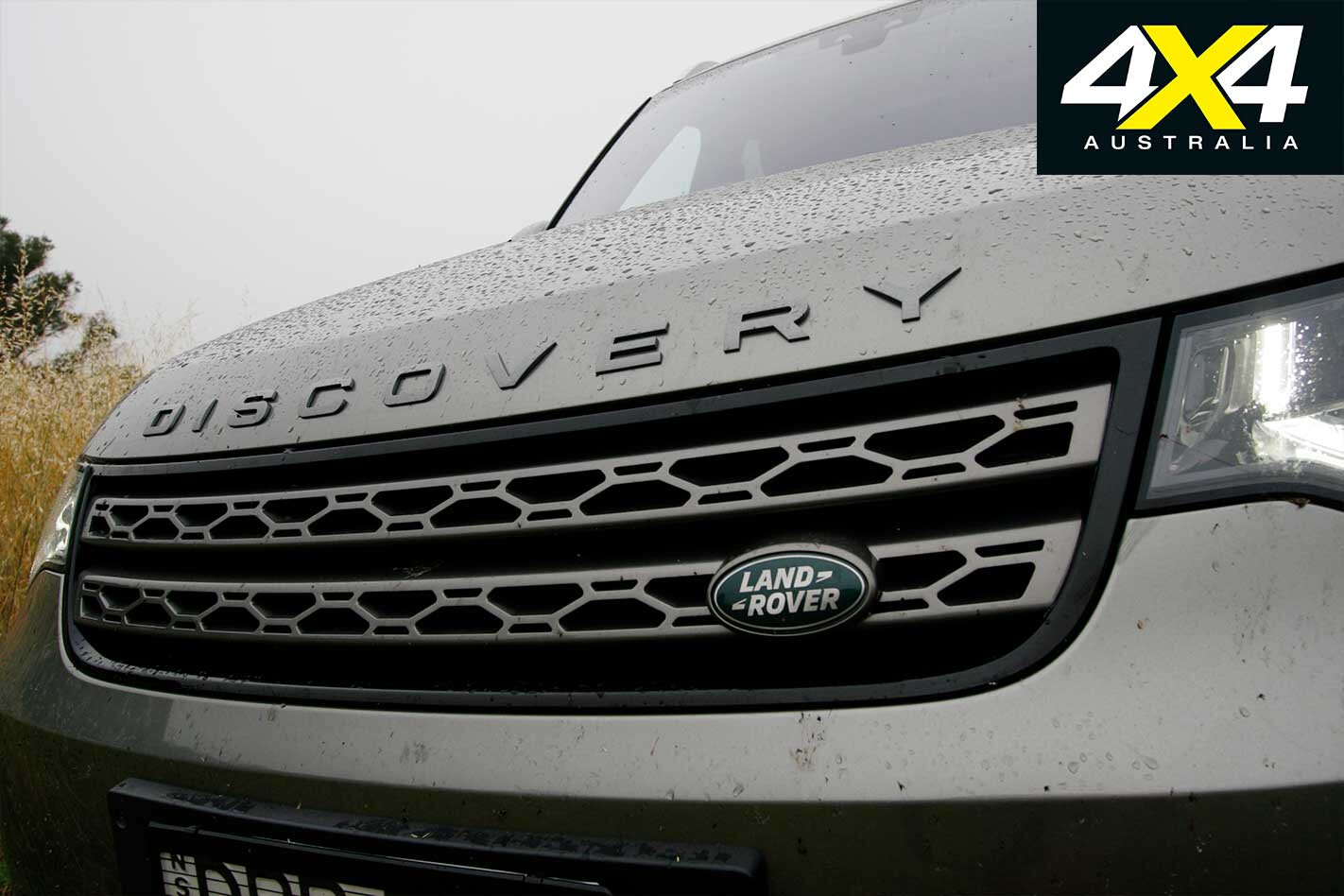
FULLY LOADED THE TD4 can be had in all four equipment grades up to the top-spec HSE Luxury. What we have here is an SE – one up from base grade – that’s been loaded with 23 different options or packs that rocket the price from less than $80K to $112,685.
The most expensive option is the $4800 Drive Pro Pack of radar cruise, lane-keep assist, lane-departure warning, blind-spot monitoring and assist, reverse traffic detection and a driver-condition monitor.
2018 LAND ROVER DISCOVERY Td4 PRICES* Td4 S: $66,450 Td4 SE: $79,550 Td4 HSE: $89,850 Td4 HSE Luxury: $103,650 *five-seat models only, seven seats optional. Prices don’t include on-road costs
2018 LAND ROVER DISCOVERY Td4 SE SPECS Engine: 2.0-litre 4cyl turbo-diesel Max Power: 132kW at 4000rpm Max Torque: 430Nm at 1500rpm Gearbox: Eight-speed automatic 4×4 System: Single-range full-time Crawl Ratio: 15.6:1 Construction: Monocoque Front Suspension: Independent/air springs Rear Suspension: Independent/air springs Unladen Weight: 2099kg (five seat) GVM: 2890kg (five seat) Payload: 791kg (five seat) Towing Capacity: 3000kg (five seat) GCM: 5890kg (five seat) Fuel Tank Capacity: 77 litres ADR Fuel Claim: 6.0L/100km Test Fuel Use: 9.2L/100km Touring Range: 787km*
Let me tell you, for the bucks, I was certainly happy with my 1991 Nissan Pathfinder. I’d owned it three years and it owed me less than five grand.
This article was originally published in 4×4 Australia’s July 2010 issue
In fact, regardless of the bucks, it was a good little truck and the 2.4-litre four-pot was happy to chug to the shops and climb anything I pointed it at in 4X4-low during my (too-infrequent) weekend treks into the bush. But longer trips and towing – something I do regularly – were a chore.
For about $1000 I could install a carbie upgrade and throw on a better-breathing exhaust to liberate an extra five or 10 kilojobbies from the 74 already there… but did I really want to bother with hot-rodding? Or sink more money into it? No. So I decided an upgrade to a more powerful vehicle with a few more creature comforts would be more sensible.
Like most of us, I don’t have a spare $50K for a new Pajero or Prado (or Patrol or Cruiser) and even if I did have the bucks, I don’t need a late-model rig sitting in the driveway being shat on by birds for weeks at a time. Been there, done that.
With a more realistic budget of around $10k, I decided a 90 Series Toyota Prado or second-gen Mitsubishi Pajero would be ideal. Both these decade-old vehicles are ideal family tourers and medium-duty tow vehicles.
My personal pick was a wide body NL Pajero, preferably a turbo-diesel – a very rare beast. I was in no particular hurry so was happy to surf carsales.com.au (and various other sales sites) and keep my eyes on the dealers until I found a vehicle that was in good condition for a good price.
By using the websites’ various search functions, it’s possible to weed out the “tell ’im he’s dreamin’” rigs and find exactly what you want, but you have to be quick to respond to a listing, and be ready with the cash.
One Saturday, I missed out on a bargain Pajero with dual airbags for just $7K but I consoled myself that the statement “needs wheel alignment” in the ad probably meant bent chassis.
But as I happily checked out prices, one thought kept grinding away in the back of my mind: When I sold my Pathfinder, I’d be saying goodbye to the terrific lifted suspension, a Long Ranger tank, a cargo barrier, my simple twin battery set-up and four almost-new A/T tyres. Then, I’d have to spend thousands to bring my new vehicle – whatever it was – up to similar specs.
A long-range tank is not essential, but is very handy when towing and touring and I’m not real keen on travelling home from the local shops without a cargo barrier, let alone up the coast or to the other side of Australia.
Suspension … yeah, that’ll be at least twelve to fifteen hundred bucks, and although my Pathie’s self-built raised floor/fridge slide/drawer set-up cost only a few hundred bucks, it cost a couple of weekends mucking around building it in the garage, too.
Then one day it dawned on me: why not retain the special gear and transplant it into a same-series Pathfinder V6? Nissan’s 113kW/248Nm 3.0-litre OHC V6 donk was plonked into the Pathie in 1992 and compared to the 74kW/117Nm of my four-cylinder, it smokes rubber.
At the same time, Nissan added an extra two doors to the Pathie to better compete with Pajero and Toyota’s 4Runner in the family 4X4 market. After living with a Pathie for three years, I was familiar with the mechanicals and happy with its overall size and driveability.
Really, all I wanted was the same truck but with a bit more grunt. So … ahhh … why not buy the same truck with a bit more grunt? So the hunt was on for a Pathfinder V6.
Once again, websites and car yards were keenly inspected. Nissan offered two spec levels of D21 Pathfinder and I soon discovered most top-spec Ti models’ leather seats are split and cracked by now. There was also a question mark in my mind about the complexity of the Ti’s push-button climate control system.
The limited edition Pathfinder Walkabout was of no interest as its spare wheel is inside the cargo area rather than on a swing-away carrier. I drove just one Pathie from a dealer: its paint looked good but only one week’s rego and the need for new tyres made its $5500 price look steep.
Other Pathies I looked at (private and dealer) had dents, misaligned panels, racing-slick rubber, soft shocks, tatty carpets and ripped CV boots. One Ti I inspected – described as immaculate – had big bubbles of rust and its sunroof was silicon-glued in.
Googling Pathfinder 1993 for sale after a few beers one evening led me to a white Pathfinder for sale in rural Cooma, NSW. The kays were good and from the pics it appeared all its doors lined up. An email and subsequent phone conversation with the seller was also feel-good: he’d owned it for three years; the local bloke he’d bought it from kept it in a carpeted garage (I laughed – but the seller fella insisted it was fact).
I decided this vehicle was worth looking at but Cooma is a 10-hour return trek from my home. The seller agreed to meet me halfway for an inspection and test drive.
I now believe this Pathie was kept in a garage with carpet for much of its life as (disregarding a few dents) I could find little more than a stone chip anywhere. Under a layer of dust and except for some silly stickers, the pure white paint was stunning.
Apart from some fluffy carpet edges, the interior was sensational, the chassis was the correct factory satin black with no chips or flaking, and every bolt and bracket had its as-new zinc plated appearance.
The engine bay was also showroom: there was not a trace of mud, grease or corrosion anywhere and it was obvious to me it had not been detailed to jazz it up or hide any nasties. I doubted this vehicle had ever been driven in the rain, let alone on a dirt road or into a creek. All the electrics worked. The only real let-downs were the dents and one torn CV boot.
Taking these blemishes into consideration, I made an offer. Sold!
MODIFICATION WORK
Engine I spent some time under the bonnet installing a second battery tray. I’d done this with my previous four-cylinder Pathie, but a different engine bay layout meant I had to start from scratch (almost) with the V6 engine. This means I’ve now got plenty of power for accessories on trips away. Also, when the Magnum winch makes its way into the bullbar I’m assured of self-extrication capabilities. And talking of power, the extra herbs from the V6 go a long way to making sure those trips are less straining, especially when towing.
Suspension
With plenty of towing and bush work in its future, I wanted to fit the TJM Series 2000 torsion bars and four-inch taller Dobinson coils from my four-cylinder Pathie to the V6 one. Swapping the torsion bars’ anchoring crossmember was easier than doing the bars individually – but only just. I slipped a new set of front shocks into my V6 Pathie, too: This meant I could sell the four-pot with a matched set of TJM Series 2000 dampers. Previously, I’d split the set of TJMs and fitted Rancho RS9000s as the TJM rears were too short for the tall Dobinson coils.
Brakes
Compared to my four-cylinder one, I wasn’t real happy with the feel or performance of the brakes on my V6 Pathie – despite the V6’s bigger calipers. The original front rotors were scored so I popped a few hundred bucks and two hours into a set of DBA slotted rotors and some Ferodo 4X4 pads.
Fuel Tank
The 140-litre Long Ranger tank was swapped from one Pathie to the other, too. Sure, working on a hoist would have been great but as I don’t own a hoist I had to do it the hard way: rolling around on the cold concrete floor with a jack. The fuel pumps and senders were retained in their respective vehicles.
Wheels & Tyres The most recent addition has been a set of Cooper STs. The first set of tyres I bought came mounted on 16-inch HiLux rims, which I preferred to the Pathie’s factory 15-inch wheels, so I kept them on. The ARB winch bar has a Magnum winch already destined to fill the hole.
DIY Storage Drawers
Using marine ply, some marine/automotive grey carpet and two $20 under-bed storage drawers, I’d created a simple flat floor/storage system for my previous Pathie. It was an easy fit into the four-door after I’d carefully measured and cut away some timber in the rear door armrest area.
1992 Nissan D21 Pathfinder ST V6 Owner: Glenn Torrens Engine: VG30E 2960cc SOHC V6 Power: 113kW at 4800rpm Torque: 244Nm at 4000rpm Transmission: Five-speed manual
List of modifications Suspension(front): TJM Series 2000 torsion bars (listed approximately 75mm), KYB gas dampers, reinforced steering idler arm and shaved droop stops Suspension(rear): Dobinson coil springs (providing about 100mm lift), Rancho adjustable dampers, relocated handbrake cable tethers, lengthened brake hose to axle Wheels & Tyres: Toyota Hilux 16 x 7-inch steel rims with 245/75 Cooper STs Exterior modifications: Wheelarch flares from four-cylinder Pathfinder; ARB commercial winch-compatible front bar; drop-down alloy picnic tray in spare tyre carrier; Long Ranger 140-litre fuel tank; Trail Boss heavy-duty tow bar; Anderson-style power socket for camper trailer; extended exhaust (to suit Rock Tamers removable mud flaps); Narva Plus 50 headlight globes; DBA Kangaroo Paw slotted front disc rotors; Ferodo brake pads Interior modifications: Rear seat bases removed; Milford cargo barrier (forward mounted); self-built raised cargo area with light-duty removable storage drawers; extra tie-downs; LED interior lights; Pioneer CD/radio unit and upgraded front door speakers; Recaro LX drivers’ seat; Black Duck Canvas seat cover; cheapo floor mats; fridge slide; glovebox cool box pipe from air con; Jaycar 400w inverter; extra 12V/Engel sockets; fire extinguisher; twin battery system consisting of: self-built tray, BEP four-way isolator switch, Jaycar switchable 100A circuit breaker with voltage display, custom-made cables, Century 520CCA starter battery (2nd)
THERE’S nothing more thrilling than getting a behind-the-scenes look at how car companies develop new product before anyone else, and this month we experienced three cars wired up with computers and data-acquisition machines as the engineering teams refined the vehicles for local conditions.
Being able to meet and speak with the engineers and discovering that many of them are enthusiasts just like us is thrilling – but not as thrilling as getting to ride in a prototype that most people don’t even know exists.
That was the case when we sent JW to Alice Springs for his sneak peek and ride in the Ranger Raptor prototype last year, as we were sworn to secrecy about it. When all the spy photos and rumours about the upcoming model landed, it was interesting to see which speculations were on the money.
No-one could have predicted the Raptor would feature a 2.0-litre diesel engine, and even now there are few people who can attest to the performance of that 500Nm mill, despite all the social media experts weighing in heavily on the subject since the announcement.
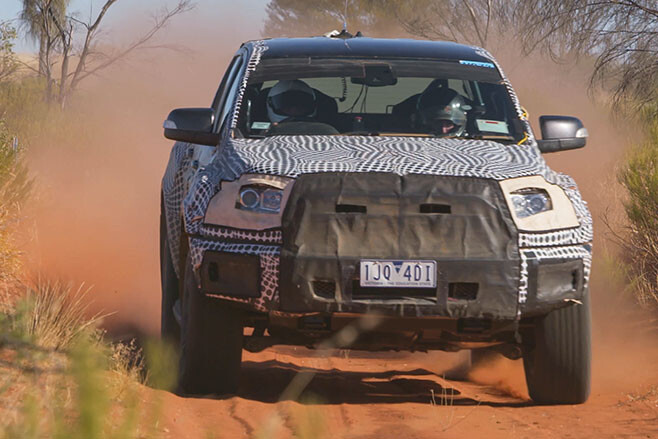
The Raptor isn’t all about power and acceleration; we found that out when we drove the F-150 Raptor last year. It’s more about the chassis, suspension and the ability to maintain speed and control over any terrain, rather than just point and shoot with your foot to the floor. The F-150’s EcoBoost V6 goes well and would have been super sweet in the Ranger, but what we will get is more about the sum of its parts.
While the original SVT Raptor was a beast of a thing with a bellowing V8 and the attitude of a Trophy truck, the second-gen EcoBoost-powered model is more refined and controlled and we reckon the Raptor will be like that, too. Time will tell, but I reckon I’ll still be wishing there was a V8 under the bonnet of the Oz model.
We also got to ride shotgun with the Jeep engineers from the USA as they evaluated how well their new JL is suited to outback terrain. This is the first time Jeep has ever sent pre-production vehicles and engineers to Australia, and it’s indicative of how important we are to its product.
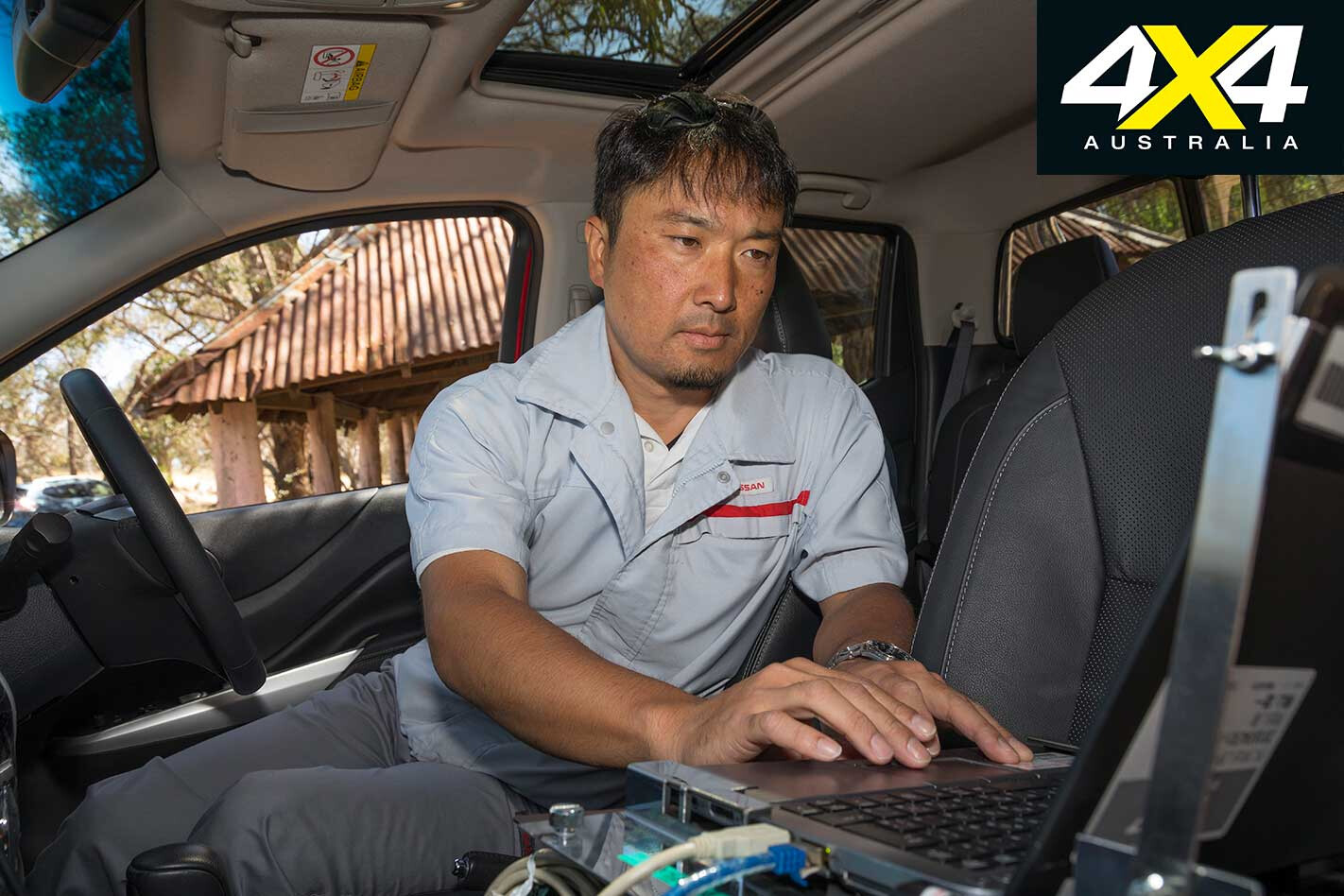
We also got to put in our two bob’s worth as Nissan’s boffins tested a new suspension package for the backend of the Navara ute, and we came away pleasantly surprised with the much improved vehicle. What was interesting was that Nissan chose to test the Series III Navara on the exact same hill-climb track we used when we first criticised the ute’s load-carrying ability in 2016.
MERCEDES-BENZ will premiere its hotly anticipated V6-powered X350d at the upcoming Geneva Motor Show in Switzerland.
Benz’s 3.0-litre six-cylinder engine, with common-rail direct injection, generates 190kW and 550Nm, with plenty of torque available at low engine speeds. For comparison’s sake, the four-cylinder X-Class X220d and X250d variants squeeze out 120kW/403Nm and 140kW/450Nm respectively.
The V6 turbocharged engine is mated to a seven-speed automatic transmission, with a Dynamic Select mode switch – Comfort, Eco, Sport, Manual and Offroad – included as standard.
Getting off the beaten track is made easy thanks to impress off-road digits: 600mm wading depth, up to 222mm of ground clearance, approach and departure angles of 30° and 25°, and rampover angles of up to 22°.
The permanent AWD system with low-range reduction gear features a two-stage transfer case, an optional rear diff, and a central diff is fitted with a fixed torque distribution of 40:60. Suspension runs to a double-wishbone front axle, multi-link rear, and coils up front and back.
The top-of-the-range X-Class will be let loose in Europe from mid-2018, in Progressive and Power guises. Expect a mid-year local launch.
PROGRESSIVE – 17-inch six-spoke light-alloy wheels – Air vents in electroplated silver chrome – Leather-lined steering wheel and parking brake – Seats in black Posadas fabric (optionally ARTICO man-made leather/DINAMICA microfibre) – Audio 20 USB and an eight-speaker system
POWER – Simulated, chrome-plated underride guard in the front bumper – Chrome-plated rear bumper – 18-inch six-spoke light-alloy wheels – LED High Performance headlamps – Dashboard with large trim element in a matt-black pixel look and with upper section in ARTICO man-made leather – Seats in ARTICO man-made leather/DINAMICA microfibre (optionally black or nut brown leather) – Electrically adjustable seats – Audio 20 CD with a multifunctional touchpad
The 88th Geneva Motor Show will take place from March 8 until March 18.
OUR DISCOVERY HSE Si6 doesn’t feel so big anymore. We are surrounded by giants, in the form of huge sand dunes that tower above the vehicle, dwarfing it and the rest of the Discovery convoy we are part of.
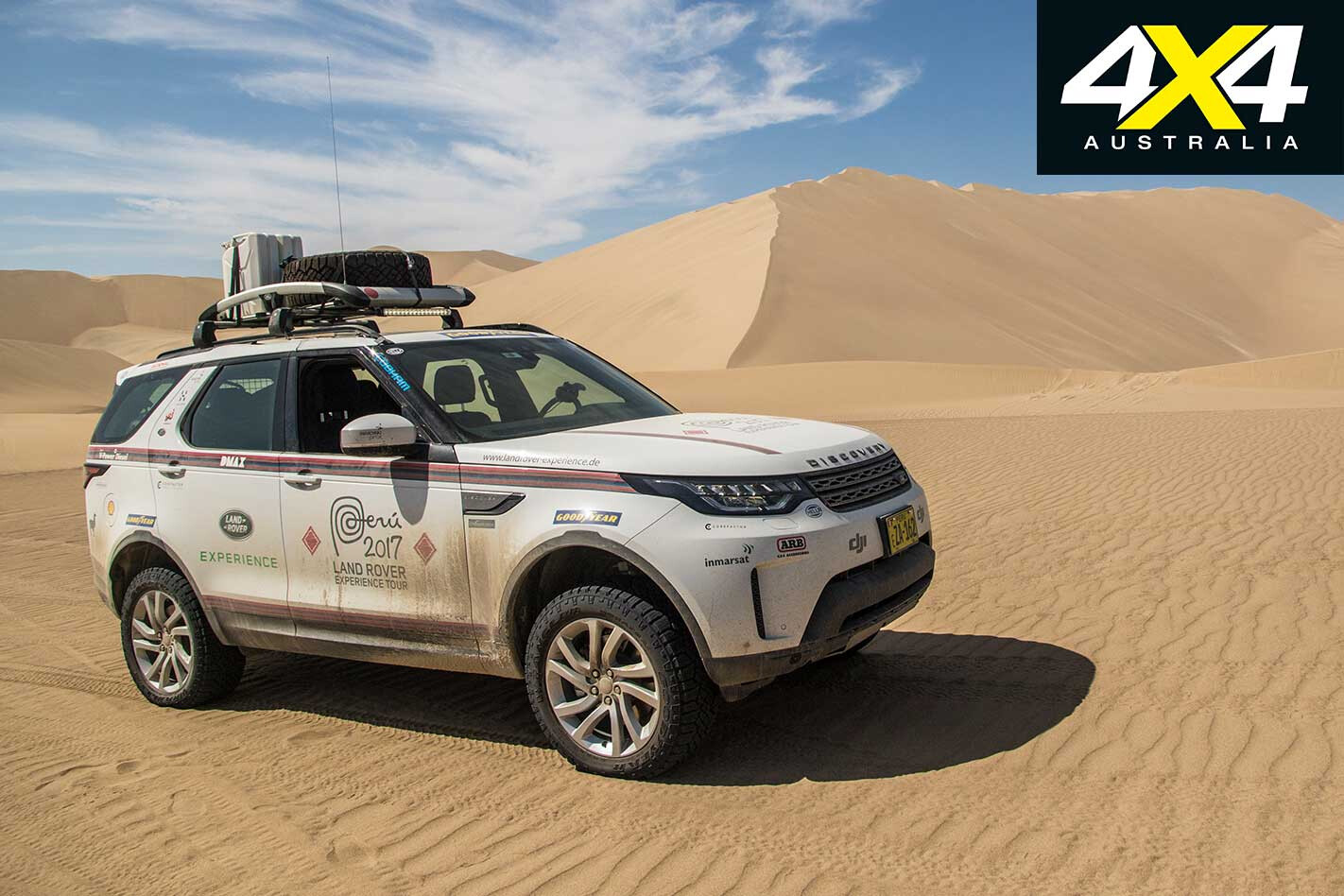
It’s day two of the 2017 Land Rover Experience Peru, and our group of Discoverys and Range Rover Sports are exploring the spectacular Sechura Desert just inland from Peru’s west coast tourist hub of Pisco.
It’s midday, and the sand is both hot and soft. These usually challenging driving conditions are, today, not so much – raising the Discovery’s suspension and shifting into ‘sand’ mode has allowed drivers to treat this terrain with some disdain, albeit still with the required caution.
The driving experience is best described using that oft-used cliché of a roller-coaster ride, with our Discovery convoy driving up, down and alongside some mightily impressive dunes for an afternoon. In short, it’s cracking fun, and a brilliant way to kick off a week of exploring this amazing South American country.
GAINING EXPERIENCE
The Land Rover Experience (LRE) Peru is the latest in a long and distinguished line of trips. The LRE, ahem, experience, has been running since 2000, with the initial tour based in Jordan. Since then, LRE has guided modern-day four-wheel drive explorers through a number of unique global destinations including Nepal, Iceland, Malaysia and Australia.
This Peru journey clocks in as number 12, but is, for its initial foray anyway, a media and competition-winner trip only. Our group comprises a mix of international journalists and competition winners from the USA (Land Rover US ran an off-road driving competition, with the four winners scoring seats on this Peru 2017 media trip), all united with a passion for adventure and Land Rovers.
Land Rover’s lengthy history of exploration and adventure can sometimes be forgotten in these days of brand ambassadors such as Posh Spice, Aussie surfers and ex-rugby internationals. This trip (and its predecessors) provides a reminder of that wilder, muddier heritage.
Plus, we’ve timed it perfectly, as the all-new Discovery, in SE and HSE Si6 stock form (bar the Goodyear DuraTrac A/T tyres they are shod with, as well as some ARB accessories including air compressor, swags and fridges), is our expedition rig for the next week, book-ended by two Range Rover Sports carrying camera/video crew and trip guides. Did I hear somebody just say “you lucky bastard”?
START ME UP
Befitting an ‘adventure’, our trip actually starts two days before we jump in the vehicles, with the group flying in from all corners of the globe to the Peruvian adventure city of Cusco. From here, we jump aboard a bus, a train, and then another bus on the way to the must-see World Heritage site of Machu Picchu.
It’s a great day, with the train ride back bringing the first humorous moment of the trip as we manage to lose one of our international journos, who missed the return train.
Unknown to us at the time, he had in fact jumped on the next available train and scored big-time; while we got by on peanuts and water in our cramped seats, he was treated to an in-carriage theatre group performance, a bottle of wine, a full three-course meal, and oodles of leg-room. Needless to say, we brought this up with LRE management once we heard his tale of ‘misfortune and hardship’.
Speaking of hardship, if you’d told me I would be flying from Cusco to the Peruvian coastal tourist town of Pisco aboard my own Boeing 737, I would have labelled you mad. But, that’s exactly how our first driving day started.
With around 30 of us on board, the 737 felt decidedly spooky in its emptiness, but that sensation was soon forgotten and substituted with awe as we climbed up and away from Cusco and started crossing the rugged, snow-clad Andes.
This huge mountain range and its jagged icy peaks offered a massive contrast to our final destination on the coast; the landscape around Pisco is decidedly barren, with the desert sands encroaching to where the land meets the Pacific Ocean.
As mentioned, the desert driving experience is fantastic and only spoilt slightly by one inattentive journo taking the ‘momentum’ part of sand driving to the extreme and shoving a Discovery nose-first at the bottom of a relatively sharp drop-off, before ignoring the potential for further disaster and making an impressive mess of the front bumper and radiator as they continued up a rise.
It is here we say thanks to those travelling with LRE – the expedition mechanic and a few of the guides, including our expedition doctor – who get stuck into the repairs and have the broken-nose Discovery back and sort-of running within an hour.
The rest of the desert foray is at a slightly less excitable pace as we continue in a northerly direction, the distant lower ramparts of the Andes starting to peak through the desert dust clouds. We return to our coastal digs for the night, with that view hinting at what we can expect to be driving through tomorrow when we track north from Pisco. As it turned out, it was just a very small tease.
TOP IT OFF
That sneak peek at the lower Andes has all of us pumped, as does the first couple of hours punching north up the motorway toward Cañete. The Discovery’s supercharged V6 is effortless in its ability to push the big rig along the motorway, accompanied by glimpses of the Pacific to our left.
Surprisingly, the chunky Goodyear DuraTracs are relatively quiet; there’s little discernible tyre noise entering the cabin, which could also point to effective sound deadening. This is excellent on two levels: it means a quiet in-cabin experience for me and Gonzalo Raggio, my Peruvian co-driver; and it means my iPhone’s playlist of 80s/90s rock music is uninhibited. Sometimes, life is very good.
We turn inland at Cañete and start our gradual ascent to the dry, dusty mountain country. Initially we follow a river valley, passing through a few towns and small villages, before it narrows into what is locally known as River Canyon, in the Yauyos Province.
The road surface alternates between sealed, gravel and dirt, with potholes becoming more frequent as we move further into the canyon.
This part of the drive is incredible; the canyon walls are near vertical, as is the drop-off from the roadside to the wild river beside us. Needless to say, it is preferable to be the passenger through here, simply to be able to take your eyes off the road and enjoy the gigantic bronzed cliffs that shadow our ascent.
Confirming this region’s oft-wild weather, we are stopped, for the first time, by a road crew removing huge boulders that have dropped from above – the result of rain eroding the cliffs. Another hour on, we are stopped again, with more road crew resealing a torn-apart section of the road.
The road itself is an amazing feat, cut through the canyon as it is, but equally worthy of admiration are the hard-working local road crews who must be out here most of the year fixing sections of this route.
Climbing out of the canyon, the terrain changes again. Bare, hard granite cliffs and mountains surround us as we drive above the tree-line into breathtaking vistas that reach across to barren peaks that seem to march close together toward the higher snow-clad mountains beyond.
Our climb finishes at 4600 metres, showcasing how Peru’s landscape can change in what is a relatively small geographical area. It also reminds us of the harshness of altitude sickness; we’ve travelled from sea level to this height in roughly four hours and a few of our party are emptying the contents of their stomachs here, while the hardier of us wander around taking in the view and sucking in the very thin air.
From this lofty viewpoint we drop down, crossing a landscape not dissimilar to the Scottish Highlands; alpine tarns dot the rolling hills and exposed rocky summits loom above. It’s an amazing contrast to the more rugged and dry western side of this mountain range.
As we descend, signs of civilisation start to reappear, and we spot a few hardy shepherds and their flocks of alpaca as we get close – and then pass through – the town of Chaquicocha before reaching our overnight destination of Concepción and the welcoming Huaychulo Hotel.
Looking at the route on our GPS – and allowing for its ability to show contour lines – it still doesn’t come close to showing how dramatic the day’s change in terrain was. From coastal resorts on the Pacific to deep river canyons and then Highland-esque vales, the route packed in just about everything. And Peru hadn’t finished with us yet.
WELCOME TO THE JUNGLE
I am sitting in the Discovery driver’s seat all too aware that around one metre to my left is a vertical drop of – at a rough guess – at least 500 metres.
There’s not even a tree or rock in sight to break your fall – it is straight down. Magnifying awareness of our lofty position is the fact the ‘road’ (note the emphasis) is sealed, but only in the literal sense; the surface is close to being totally covered in potholes of varying depths.
The Discovery’s tyres are thumping and bumping no matter how much I manoeuvre – always with that drop in mind. I am just thankful that I am not driving this road in my 2003 Td5 Disco. The new Discovery’s steering is doing a brilliant job of muting the bumps and vibrations through the steering wheel, allowing a modicum of accuracy as I carefully thread the potholed needle.
We had climbed steadily since the morning, reaching a beautiful alpine plateau at 4350 metres and passing by more shepherds and their flocks as well as three pristine alpine lakes: Pomacocha, Habasccocha and Jeronimo. After the plateau it was down to the town of Muchac, the following valley towns of Pomamanta and Layainiyoc, and then the Comas District, which signalled the start of our current cliff-side drive.
Precarious road aside, the drive is exhilarating, with plenty to occupy the driver including swapping over to manual-shift mode – the rarefied air has affected the engines slightly and, for the best performance, shifting manually is the go.
There is plenty to see from up here: the valley below is patched with towns, terraced fields of different shades of green, and topped with the Andes’ ubiquitous jagged spires. After a blast across another high plateau, we drop down once again into a totally different landscape: the Peruvian jungle.
The river valley is clad in dense vegetation, with the only breaks in the wall of green coming from the roaring waters of the Rio Pampa Hermosa and the dirt track we are following. It is bumpy with river-stone and washouts, and it is here we see just why one of the original sections of this LRE trip had to be rerouted.
Evidence of the volatile weather in this region is all along here, with landslide damage and the resultant holes in the road reminding us of the high rainfall this area cops.
Still, it is incredibly scenic, with the river gouging through the mountains to punch its way down the valley to our left, and, with the wall of trees and cliffs on our other side, it is true jungle country. The bumpy surface is just that, without being overly jarring.
The more challenging part of this section is the clay-like surface covering said bumps and rocks – only a moment of inattention from me (okay, I was gawking at the view) sees a slight drifting scenario. The Disco’s traction and stability control, combined with a subtle steering correction and those grippy Goodyears, soon see the big bopper back on the track.
The bottom of the valley means a return to civilisation, and we time our arrival at the villages dotting our way to Satipo with school children returning from their long days of learning. These kids often travel two hours each way to school, by foot and on the bus.
ALL GOOD THINGS MUST END
A relatively benign sealed-road drive from Satipo, looping back around to Huancayo, signals the end of our journey. Even though relatively straightforward, this day’s drive still springs some unforgettable moments – the sight of a toddler aboard a tricycle, holding up our Discovery convoy as he gleefully hammers down a major highway, foot furiously pushing his trike to maximum speed and completely oblivious to the traffic behind, won’t be easily forgotten.
Neither will the manoeuvring around, beside and (nearly) over the ubiquitous three-wheeled mototaxis in every town we drive through, or getting slightly lost on the last day just before lunch. I could try and blame Team South Africa for this one but, err, maybe I just shouldn’t have followed them down that one-way street – and, to be fair, it did look like the right way, one-way signpost be damned.
Surprisingly, for this resident of Australia’s most aggro-driver city, for all the beeping of horns and oft-crazy swerving, we see no accidents. The Discovery’s bulk is only slightly noticeable in the narrowest streets, and the still-reasonable outward visibility means we’re always aware of what and who is driving near us.
We cop plenty of stares – the Discoverys do stick out like the proverbial – but also plenty of smiles and waves, a reflection on the Peruvian people in general.
Dodging through Huancayo’s heavy traffic, I still have time to reflect on what we’ve experienced. Peru’s amazing variety of terrain – desert, canyons, alpine plateau, and the jungle – and the different driving experiences in each, are a standout, as is the organisational skills of the LRE staffers. Local guide Juan Dibos, LRE leader Marvin Verheyden and the rest of the crew were absolutely brilliant, leading us through a country that would have to rate as close to the perfect touring destination.
Now all I have to do is wait, patiently, for a couple of years to see where the next Land Rover Experience lands – and somehow make sure the Editor is stuck in a planning meeting when that invite lobs in the 4X4 Australia office.
World’s Best Job
PLANNING driving reconnaissance missions and then leading Land Rover Experience journeys means Marvin Verheyden must have close to the best job in the world. Marvin has been involved with Land Rover Experience for many years and been heavily involved in the destination selection process, a process that can take up to 18 months.
“Peru was already in our mind some years ago,” he says. “We were very excited when we recognised the variety of the country: desert, mountains, rainforest, and everything within hours by car.”
However, Peru threw up plenty of challenges because of this variety, with Marvin and the team requiring three recce trips due to heavy rains changing tracks. Even this Leg Three we were attending had to be altered due to the changing conditions.
Then there were the vehicles. The new Discovery has just been released, so it was the obvious participant vehicle. Impressively, it required few modifications, according to Marvin.
“We drove more or less with standard SE/HSE vehicles,” he says. “The only thing we changed was thicker underbody protection and the Goodyear DuraTracs. Each vehicle also got an ARB fridge, Garmin GPS and a 220V inverter, plus one spare tyre and two jerry cans up top.”
Tough Rubber
THE Discoverys were fitted with the all-new Goodyear Wrangler DuraTrac 255/55R20. The specific development of this tyre was the result of the close working relationship Goodyear has with Land Rover; the tyre company first fitting its rolling stock to Range Rovers in the 1970s.
Typically, a tyre can take between two and three years to develop, from concept drawing through to the final product. Alex Van Der Meer, OE Engineer for Goodyear, elaborates.
“Land Rover sent us their requirements, such as off-road capability, in the case of the DuraTrac. And a team of our engineers worked with them to create their tyre of choice… areas of focus for this development included reinforced tread and sidewall compound and belt package.”
The tyre cops plenty during development; up to 200 test drives across a variety of terrain, on top of 400-plus lab tests, means a tyre will roll through 300,000 test kilometres.
Goodyear’s goal was to produce a low-aspect ratio off-road tyre that combined effective off-road performance without sacrificing on-road. On-road they were relatively quiet; although, this could be a reflection of the excellent NVH of the new Discovery, while off-road they offered plenty of traction and toughness.
Longer-term testing is needed to confirm performance in regards to durability, but on first impressions these tyres would warrant serious consideration for fitment upon purchase. These tyres are now available in Australia and add to the very short list of all-terrain/mud-terrain tyres that will fit 20-inch rims.
Are You Experienced?
THE LAND Rover Experience (LRE) is open to any and all paying punters – you don’t have to be a Land Rover owner, you just have to share that same spirit of exploration and adventure that is the LRE ethos. For 2018, LRE has two awesome destinations that would tempt any off-road tourer: Utah, USA, and Namibia, western Africa.
The Utah adventure is a five-day exploration of one of the USA’s most spectacular states, with plenty of challenging off-road driving including taking on the Seven Mile Rim and Hells Revenge trails, with LRE drive instructors on hand to offer tips and advice. All accommodation, driving, meals and airport transfers are included in the US$5250 pricing. Hit up their site here for more info.
For that epic African adventure, Namibia is one of the best destinations, with the LRE eight-day adventure offering punters the chance to spot the “Big Five” (elephant, rhino, leopard, lion and Cape buffalo) as you explore some of this country’s famous national parks, including Etoshi, while driving an all-new Discovery (as with Utah, LRE drive instructors are part of this trip). Speccy lodge accommodation is also part of the package.
This eight-day adventure costs EU4950 and includes all Land Rover driving activities, accommodation, meals and airport transfers. For more info and booking, visit the Land Rover site here.
LAND Rover and adventure make for a perfect match.
4X4 Australia spent seven days in the new Land Rover Discovery exploring spectacular Peru as part of the Land Rover Experience: Peru 2017. The seven days saw us use the new Discovery to explore this amazing country and tackle an incredible mix of terrain.
The expedition kicked off with a visit to World Heritage-listed Machu Picchu before heading to the Peruvian coast and the towering sand dunes of the desert behind Paracas, where the new Discovery showcased its capabilities and expedition members got to ogle at the size of the sand giants surrounding our convoy.
From the mighty dunes, we turned east and started the ascent up and through the southern part of the Andes mountain range, driving through deep canyons and then reaching around 4500 metres in altitude before dropping down to some picturesque valley towns full of the always-friendly Peruvian locals.
The mountains were left behind as we got closer to the end of the adventure and we dropped down deep from those lofty heights into the Peruvian jungle. With near-impenetrable vegetation hugging the steep cliffs looming over the track, and thunderous rivers cutting through the valley floors below us, it was a truly memorable drive.
The Land Rover Experience Peru 2017 was epic, and LRE has even more adventures in store for punters in 2018 with Experience trips to Utah, USA and also wild Namibia, on the southwestern side of the African continent.
If we could convince Land Rover to spare a seat for us, we’d be there for sure!
Complete coverage of the event is in the March issue of 4X4 Australia – out now – or keep an eye on 4x4australia.com.au
THE hotly anticipated Ford Ranger Raptor was finally revealed to the world, and we were front row at its unveiling in Thailand.
We’ve got all the facts and specs on the Raptor, plus we can finally let our readers in on our experience with it when we went on a development drive last year, where JW was one of only two Aussie journos invited along.
The 2018 Navara has been updated to fix the brand’s notorious suspensions issues, and we tagged along with the engineers for a first-hand look at the improved model.
The March issue also includes first drive reviews of VW’s Amarok Sportline, Land Rover’s Discovery TD4 and a local drive of Jeep’s new JL Wrangler.
But it’s not just new metal that gets a look in, with two killer custom builds featured in the issue: a 6×6 LC200 and a spotless Duramax-powered GU Patrol.
We also ventured near and far this month, from Peru for the Land Rover Experience to Arnhem Land in the NT.
ALSO IN THE ISSUE
- Holden 1 Tonner conversion continues
- BJ73 and Patrol Ti-L shed updates
- We tackle Victoria’s eerie Haunted Stream Track
- Comprehensive LED light buyers’ guide
- Industry Insider with MaxTrax
- Air compressor comparison
- Product tests and Deano’s monthly rant
NORTH Point is a popular beach on the northern tip of Moreton Island. Small waves peel off the point, making it ideal for surfing on a longboard, and it’s the perfect place to spend a few hours to swim, relax and explore.
From North Point you can hike around the bay, explore the caves and hike up to the headland to the Cape Moreton Lighthouse.
North Point Campground features a large grassy area just back from the beach, and it’s ideal for surfers, fishermen, hikers and lovers of the northern beaches. The scenic campsite, surrounded by bushland, features a large rock lookout.
However, as the campground is a haven for those wanting to escape the crowded parts of the island, it’s also quite remote. With this comes poor mobile coverage, with most mobile operators not having signal there. The nearest towers are located on Bribie Island some 35km away across the bay.
The one exception is Telstra, which gets half a bar of signal that drops in and out. If you stand on the fence and hold up one arm you can send a text, but phone calls will go around in a continuous loop. Don’t even try to get internet access. Signal is slightly more reliable for SMS on the beach in front of the campground, but calls are still a mission.
In our trusty yellow FJ Cruiser nicknamed ‘The Hornet’ we have a Cel-Fi GO repeater for Telstra, which is set up with a Blackhawk Trucker Edge Compact antenna.
Once turned on, the half-a-bar is boosted up to a very useable three bars (when inside ‘The Hornet’ or about two metres outside the vehicle). This enables us to make calls, send SMS and access the internet to check the weather or update Facebook.
The internet isn’t fast enough to stream a movie, but it’s quick enough for browsing and checking emails. Knowing that we can call out in an emergency without having to go for a drive to a higher point is a big bonus.
We are very pleased with the performance of the Cel-Fi GO. Once people find out you can make calls in the campground, it’s amazing the friends you will make.
Visit www.cel-fi.com.au for more information.