
WHEN I saw the huge tree strewn across the track, my heart plummeted. I only hoped our vehicle wouldn’t do the same, as it was precariously close to the massive bog hole of mud in front of us.
The main track was tantalisingly close, visible barely fifty metres away, but the huge tree that had been placed there effectively blocked us from going any farther.
Turning around was our only option, but even that would be tricky. The terrain was slippery, it had been a slow crawl down the muddy track and the thought of going back up the embankment did not thrill me.
We were alone, we had no phone service and the winter sun was quickly disappearing into the cold shadows of the afternoon.
We’re in the hills of the Strathbogie Ranges, near Lima South, just over a couple of hours from Melbourne. It was the June Queen’s Birthday long weekend, the first weekend after camping restrictions had been lifted. It was also the last weekend before many of the seasonal tracks would be closed for the winter months. Perhaps that should have been an early warning sign.
Our trip had started sedately, leaving the night before to avoid the rush. At Benalla we free-camped by the lake, a great place for an overnighter, and woke the following morning to a frosty -3⁰C. Rugging up for the 4.5km circuit walk around the lake was invigorating. Little did we know it would be a walk in the park compared to the challenge we’d find ourselves in later that day.
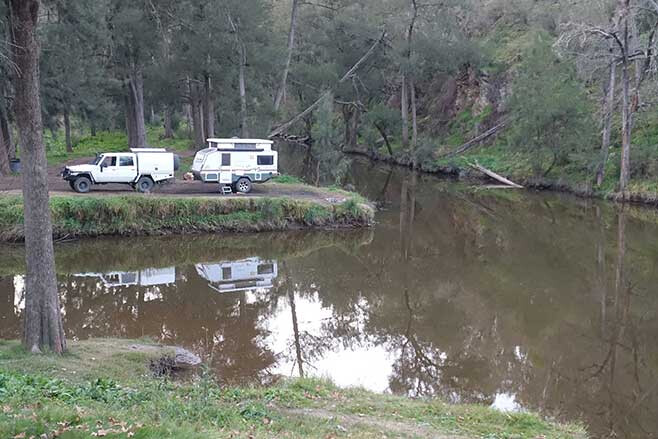
From Benalla it’s only 37kms to James Reserve, which is located on the banks of the Moonee Moonee Creek, off Lima East Road. The reserve is flat and lush and we snared a great spot near the creek, with a picnic table and a fire pit close by. There were few campers around, however, as we were to find out, this is a popular spot for off-road bikers and four-wheel drivers. With good reason, as there are loads of tracks, trails and adventures close by in an area filled with the heritage of gold and alluvial mining.
HELLS HOLE
NOT far away from camp are the Crystal Mines, the Tallongalook Track and the dry creek historic area which comprises of areas such as Hells Hole Creek, where gold was first discovered back in 1851.
There are also a couple of lookout points including the Rocky Ned Lookout and Wild Dog Rocks, all places we were keen to explore. After a short drive into the nearby state forest to collect wood for the next few nights, we were ready to hit the tracks, our warmth secured.
Our early afternoon destination was Rocky Ned Walking Track, which is accessed via either Police Track or Goodes Track. We took Goodes track and parked near the signage on the boundary of the pine plantation and the state forest. It’s a relatively easy walk through open woodland, a well-formed track which slowly snakes and climbs its way to reach fantastic views from the sheer, rocky summit. A safety barrier has been built at the top of the Rocky Ned Lookout for obvious reason. From here the views reach almost 180 degrees from north to south of the Lima Valley and Mount Strathbogie in the distance.
Much later, on Goodes Track, we began our drive back to camp, with the intention of returning early to light the fire, cook a damper and settle in for a relaxing campfire dinner.
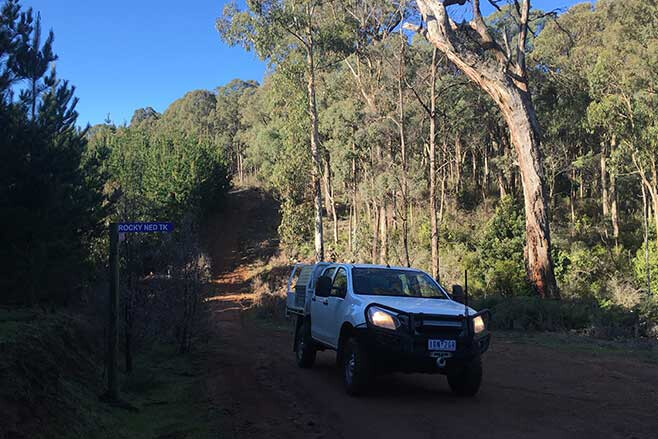
We reached the intersection of Rocky Ned Track and had the option to go straight or take the turn left, which looked to be a shortcut back to camp. From our maps Rocky Ned Track appeared to join the main track at the bottom, so down we went. Slow and steady we crawled down in low range, with the track getting steeper and deteriorating as we went. Three quarters of the way down we encountered a tree across the track but managed to get around it by navigating a particularly tricky turn over a large stone ridge which crunched the front of the car as we went over. I remember thinking that I wouldn’t want to go back up the same way.
Then we reached the bottom of the track and saw the next tree, and that’s when my heart sank. Our chainsaw was no use on this one. The tree was massive and, right in front of it was a deep pool of mud. It was like an obstacle course, an early closure perhaps but, if that was the case, a ‘road closed’ sign at the other end would have been prudent too.
There was no option to drive around so our only way was to go back. At this point, in the slushy terrain even a U-turn was a challenge. The wheels spun and filled with mud and it became clear that we would need the winch to get us out. Being stuck out in the bush with no one around, and with no service, requires calm but inside me I could feel the stress mounting. To my relief Doug was cool and calculated, at least on the surface, and took his time assessing the situation.
TO THE WINCH
ONE of our problems was there were few trees to hook onto. The pine plantation in front of us offered little help with the trees too young and not strong enough to be an anchor. Our third attempt to winch ourselves out came from the stump of what was once a huge old pine tree. Even though it’s best to use a big and solid tree, we had little choice. Sure enough, the rotted pine trunk held its own and the winch finally got us up and over the rocky ledge.
Now it was a matter of getting back up the track. Hill climbs can be exciting and challenging at the best of times and Rocky Ned Track was no exception. It was slippery, steep and, with little traction, there was no alternative but to keep winching.
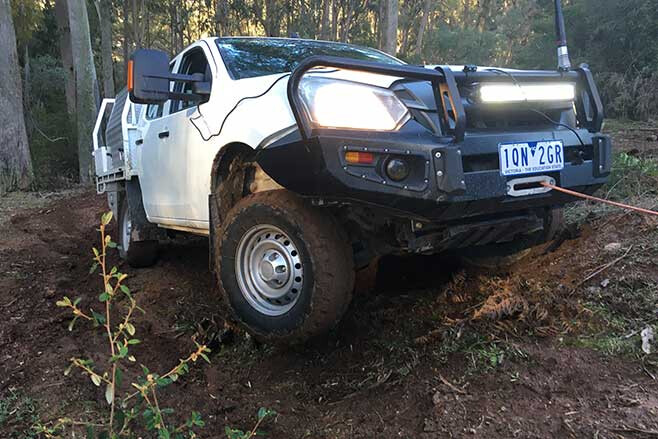
We’ve been stuck a few times and generally haven’t had too much trouble getting ourselves out, but this was the first time we’ve had to use our winch solo. Getting stuck in the bush by yourself or with no recovery gear can be a serious problem and we all know there are loads of ways that can happen. If you’re not with company the most powerful piece of equipment you can have with you is a winch and a solid tree as an anchor. That afternoon the winch became our best friend.
After I got over the initial stress and threw myself into the role of securing the winch onto the tree, and learning how it operated, my mind was focused on following Doug’s bellowing instructions. He did a great job driving the D-MAX back up the track and I got my exercise for the week by scrambling and slipping up hills, and securing the tree trunk protector and winch onto the forest anchor points. Nearly two hours after turning down Rocky Ned Track, we were safely back up the top again.
CAMP POPULAR
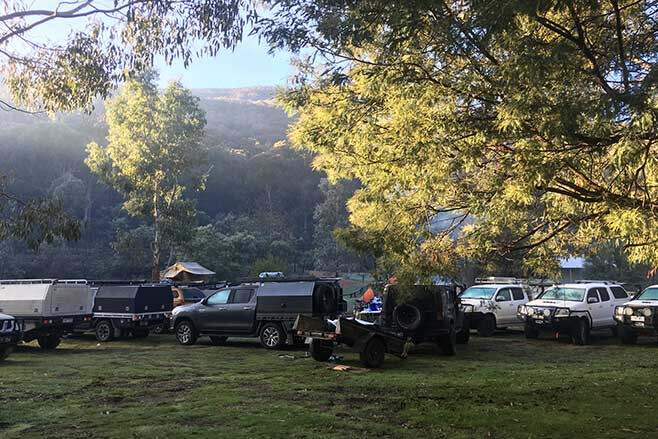
WHEN we arrived back to camp the peaceful ambience of earlier that day had completely disappeared. Dozens of utes had converged, music was blaring, little tackers were tearing round on tiny bikes and campfires were blazing. But I was deliriously happy. There was our van and it had never looked so good.
That night we savoured our steak dinner and plenty of well-earnt drinks by the fire. We met our new neighbours and regaled them with our stories, swapping numbers for any future mishaps. Better late than never, I suppose.
Lima East has plenty of places to explore nearby. Not too far away from where we had been, at the Rocky Ned Lookout, is the Mt Albert Track. Towards the top, sits an old WW2 plane crash site from the early 1940s, an accident that sadly saw no survivors. Although we didn’t visit the crash site, the area is signposted. Bushwalkers can also enjoy the Lima Falls, accessed through the pine plantations where a short steep walking track from the car park leads you to the falls.
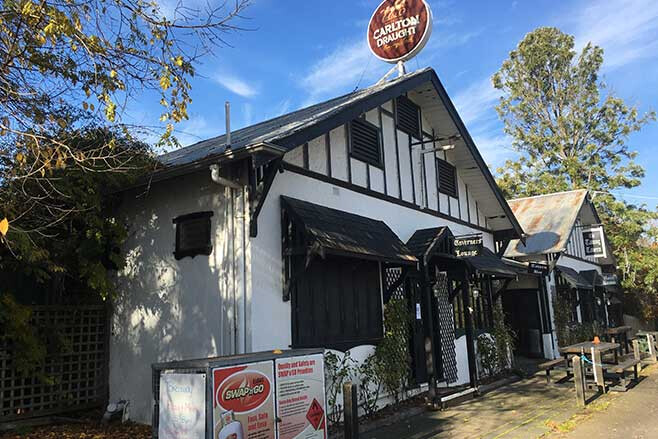
Farther up into the High Country towards Stringybark Creek is a great drive with a lot of history. From Benalla continue 25km southeast to Tatong where you’ll find the Tatong Tavern, an English-style country pub built in the 1880s and renowned for its food and hospitality. Continue south along the Tolmie Road up into the forests of the Toombullup plateau where you’ll turn right into Stringybark Creek Road. It was in this tranquil area back in 1878 that three policemen, Sergeant Michael Kennedy and Constables Thomas Lonigan and Michael Scanlan were ambushed and killed by bushrangers Ned and Dan Kelly.
Twenty eighteen marked the 140th anniversary of the infamous shootout at Stringybark Creek Reserve, a dark chapter of Australian history, which feels almost tangible in this picturesque reserve. You can take a short walk through the formed path in the bush with signage and plaques along the way telling, not just the grim story but honouring the three fallen Victorian policemen, whose legacy was largely overshadowed by the legend of Ned Kelly. There are picnic facilities and nearby a beautiful, spacious campground for those who want to savour this peaceful area.
Back at camp on our last night, we joined our new friends around the fire and reflected on our time here. Everyone talks about the lessons they’ve learnt from lockdown but our few days back camping in this rugged part of Victoria taught us some valuable lessons. First and foremost is to keep your cool when you’re stuck in a tight situation and secondly, a winch can be a real life saver.
TRIP PLANNER
James Reserve is located off the Midland Highway, from Benalla past Reef Hills Park towards Swanpool. Go through the shops at Swanpool and turn right past the recreation reserve following the sign to Lima East. Turn left 1.4km on down the Lima East Road. After 7.4km this turns into gravel road. James’ campsite is a further 5km on. There is a bush dunny, fire pits, tables and creek water.
The 2021 Ram TRX slots Chrysler supercharged Hemi V8 in to the 1500 truck, to take on Ford’s F150 Raptor and anyone else who is prepared to challenge it. And it’s coming to Australia!
When Ram’s engineering team took on the task of designing the most powerful badass half-ton production truck to ever land on a showroom floor, industry rumour mills spun with speculation.
Did Ram have the Ford Raptor and Chevy Colorado ZR2 in its crosshairs? It would be christened the TRX, which some might decode as T-Rex, the undisputed assassin of the Cretaceous Period – Tyrannosaurus Rex, as Latin buffs will tell us, translates to “King.”
But how many ponies would be under the hood? Would its suspension, drivetrain and chassis be bred of the right stuff, with an insatiable appetite to devour the competition in a head-to-head confrontation?
When the chance arose to get our hands on an engineering vehicle for some seat time, we jumped on it as swiftly as a T-Rex scooping up a Velociraptor snack from the forest floor.
THE WALK-AROUND
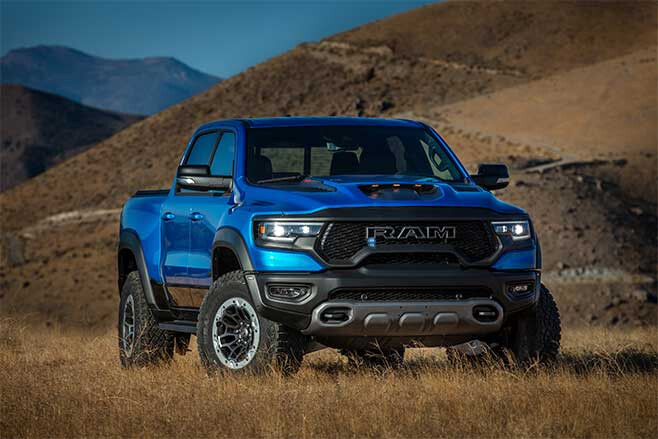
Standing eight inches wider at the shoulder than a base 1500, its stocky stance is immediately identifiable as out-of-the-box. Above the redesigned grille, its new bonnet features a functional hood scoop and LED marker lights. Recessed into the front ’guards behind the front wheels are additional vents designed to draw cool air into the engine bay.
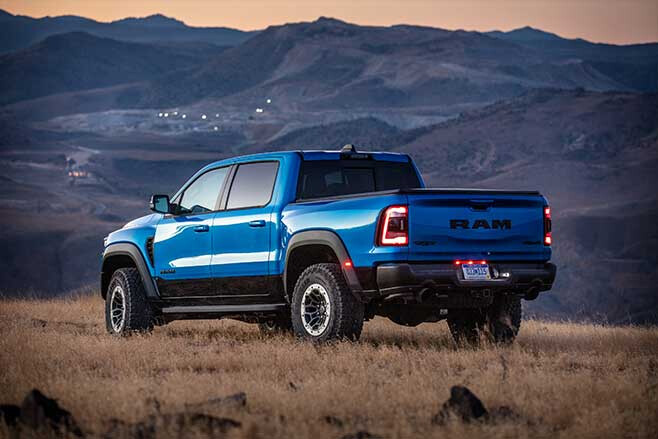
LED accent lights strategically wrap around the tailgate, where we find a backup camera. Up front are adaptive front headlamps (AFS), which will track with the steering wheel up to 15 degrees; a great asset when charging down desert roads in the wee hours.
Down below are functional rock rails, front and rear tow hooks, and a burly set of Goodyear Wrangler Territory 325/65/R18 all-terrain 35-inch tyres on 18×9 aluminium wheels. Also new for TRX are optional bead locks.
BEHIND THE GRILLE
Ram’s engineers understood that you can’t outrun the pack without a serious mill under the bonnet. The obvious answer was big V8, but they didn’t settle for just any high-displacement engine. The TRX draws its moxie from a 6.2-litre supercharged Hemi V8 adapted from its brethren Hellcat Dodge Challenger and re-tuned for off-road performance.
This fire-breathing monster cranks out an impressive 532kW and generates 882Nm of torque. The air intake on TRX’s hood drafts about half the air needed to satisfy the Hemi’s appetite, the residual 50 percent is received through the grille, the conventional manner.
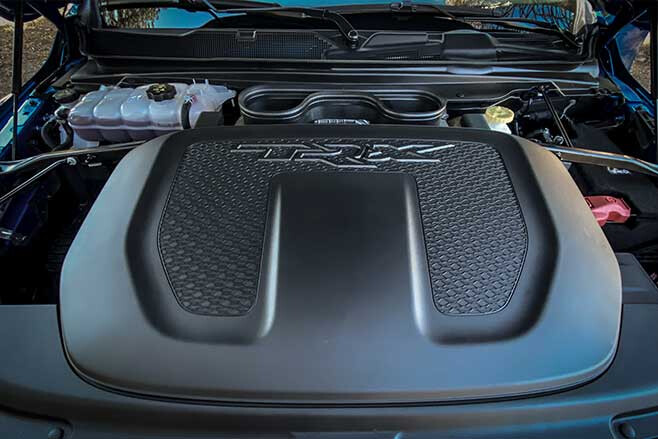
Backing the Hemi is a heavy duty TorqueFlite 8HP95 eight-speed automatic transmission, while a BorgWarner 48-13 full-time active transfer case distributes power fore and aft. The TRX is not designed as a rock crawler, but its 2.64:1 low range still offers a respectable crawl ratio.
Out back is a beefy Dana M250 full-floating rear axle fitted with 3.55:1 gears, an electric-locking differential, and 15-inch disc brakes. Managing axle travel and articulation is a new five-link suspension featuring longer links, a solid track bar, and forged aluminium control arms up front.
The combination provides more than 330mm of travel at all four corners. When doing 160km/h across the desert, heaps of travel is of little benefit without a means of controlling.
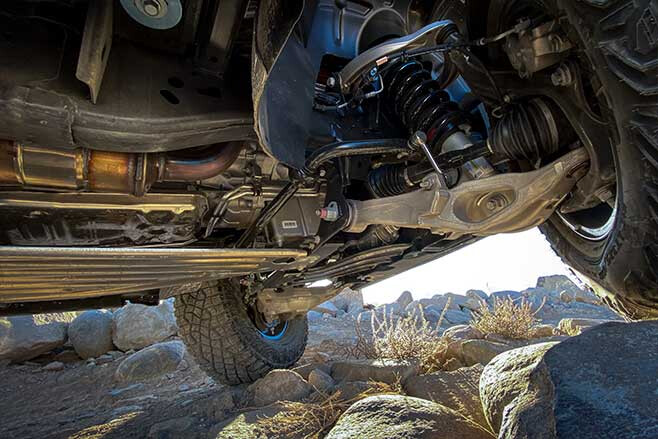
Working with Bilstein’s racing division, the engineers developed one of the most technologically advanced OE damping systems to date. Deemed the Black Hawk e2, or e-squared, the shock absorbers uses a 2.5-inch aluminium housing replete with electronically controlled valving and assisted with remote reservoirs.
The combination provides 300mm of ground clearance and a 813mm fording depth. Approach, breakover, and departure angles land at 30.2, 21.9, and 23.5 degrees respectively, and maximum payload/towing is 594kg and 3674kg.
THE COCKPIT
The interior is nothing short of luxurious. Everything is wrapped in leather, carbonfibre accents abound, and the truck’s trademark red stitching exudes character. Firing up the 6.2-litre HEMI, the supercharger spools up with purpose and the instrument panel runs through its pre-flight checks. Gripping the flat-bottom wheel, one can toggle through the gears via brushed-aluminium paddle shifters at the fingertips.
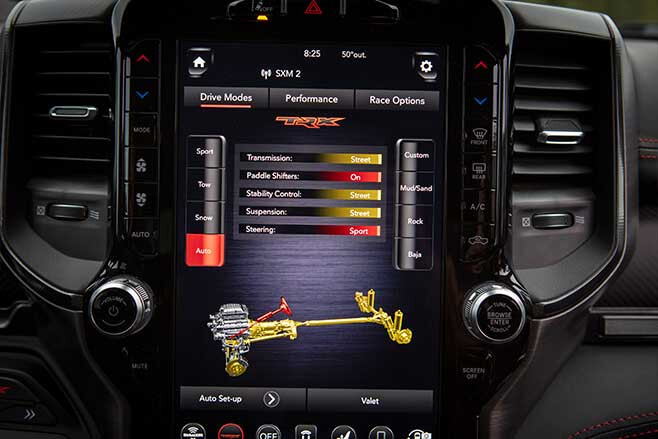
Glancing toward the dash, the 12-inch Uconnect screen is your gateway to most controls, including a 19-speaker, 900-watt Harman Kardon audio system, navigational aids, driving modes (there are five), Sirius XM 360L, and vehicle vitals. The console contains a wealth of modern-day requisites, including USB ports, a wireless charging deck, and plenty of storage.
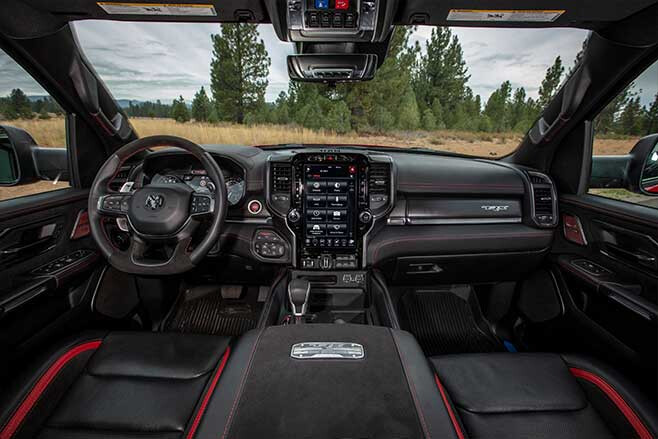
A personalized feature is the machined-aluminium badging at your elbow, which highlights the TRX’s horsepower and torque, engine specifics, and VIN. Another new feature is its Trailer Reverse Steer Control. With an eye on the backup camera, you can take your hands off the wheel, turn the dash-mounted dial left or right, and the system will guide your hitch ball home.
In addition to a new digital rear-view mirror, the TRX features a heads-up display that can be programmed to project half-a-dozen stats in clear view over the dash (speed, speed limit, etc.). In addition to the normal array of safety features – ready alert braking, electronic stability control, blind-spot monitoring, etc. – there is also a 360-degree surround-view camera system.
ROAD TIME
We rolled out of Lake Tahoe basin as the sun was lighting up the great expanses of the Nevada Desert, and I can tell you the T-Rex wanted to run faster than a speeding ticket. Carving twisty mountains roads, the suspension hugged tight corners (at twice the posted limit) as flat as a flapjack and without protest. Steering was controlled and predictable, and instilled a feeling of confidence.
The supercharged TRX boasts a 0-96km/h time of 4.5 seconds. Wanna push the needle to 160? The TRX will get you there in 10.5 and propel you through the quarter mile in 12.9 seconds. Wowzah, this is not your granddaddy’s old Dodge. And that’s enough bitumen; let’s get to what this primordial predator was built for.
PREDATOR IN THE DESERT
Having grown up kicking around Baja, Mexico, and spending plenty of time suited up to chase a checkered flag, I immediately toggled into the off-road pages and selected Baja Mode. It is T-Rex’s most aggressive mode, loosening up biases on the transfer case and stability control, tweaking shift points, and tightening up throttle response. In my opinion, they should re-name it the Fun Mode, as it flat-out gets with the program.
Our venue was the Wild West Motorsports Park, home to Ultra4 events and miles of mountainous, fast, rocky two-tracks. Any time you get in an unfamiliar vehicle, especially in a truly powerful one, it takes time to get the feel for how the car will react in hard braking, high-speed drifts, and touchdowns from lofty heights.
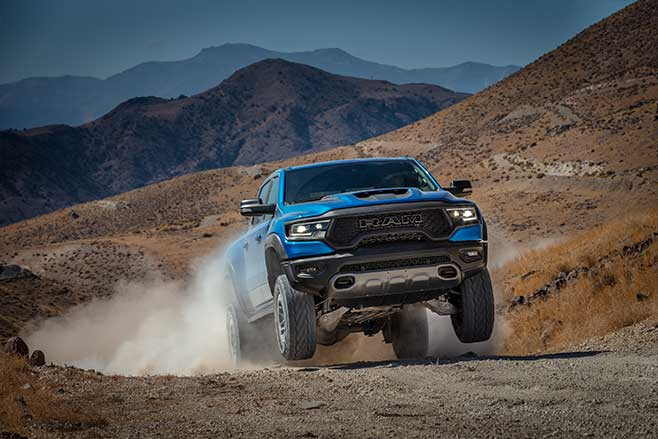
My break-in period was brief, as the TRX instinctively knew what to do. Tap the brakes and dog the wheel while diving into a turn and the rear end came around with control and prowess. Back on the throttle – with 532kW you only need a little – and it assumed a picture-perfect, controllable drift.
The electronically controlled Bilstein e2 damping system is downright impressive. Embedded rock, no problem. Whoop-de-dos, it ate them up like a velociraptor appetiser. Few, if any, factory platforms take kindly to returning to Earth from an altitude of a metre plus, but the T-Rex seemed to enjoy repeated landings at 100km/h, the e2 system absorbing the impact with ease and its nitrogen bump stops (jounce bumpers) handling the last inches in full G-out scenarios.
As for speed and torque, it was only a matter of massaging the skinny peddle to your liking and the supercharged Hemi delivered in spades. The last button I needed to push was Launch Control, which to no surprise has a dragstrip light tree on it. Yes, this is the button that unleashes the TRX’s fury and all its glory.
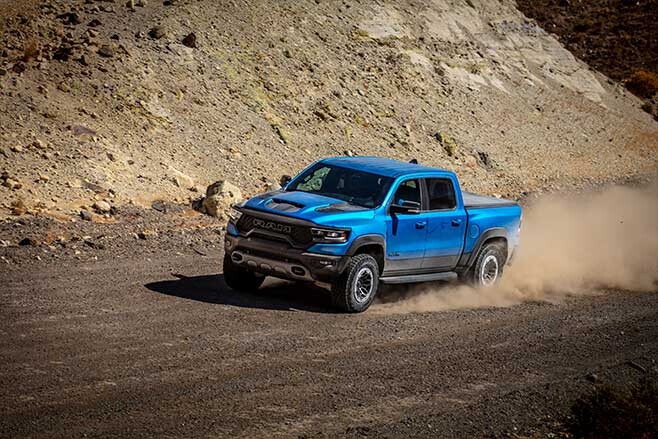
It’s been decades since Ram played in the go-fast desert scene, but when they finally decided to get back in the game they did it right. When the dust settled and I pulled off my helmet, I’m sure that my ear-to-ear grin matched the adrenaline rushing through my veins.
I can only say that Raptor and Colorado will need to change their air filters (and their shorts), as I predict the TRX will leave them in the dust. As for Baja mode, the rumour mill is already churning that the TRX might be gobbling up lessor competitors at next year in the Baja 1000. Yes, 4X4 Australia Editor Matt and I are putting our names in the hat to take T-Rex to the podium.
Ram trucks Australia hasn’t officially confirmed the TRX for its dealers, but Ram specialists, SCD Remanufactured Vehicles in Brisbane, says it will have it here by the New Year.
In the USA the TRX starts at US$71,690, but expect that figure to more than double once you convert the truck to right- hand drive and the dollars to Australian. Don’t be expecting any change from $180K, but you’re sure to have the quickest truck on the block.
Australian brand Terrain Tamer recently added two new products to its aftermarket catalogue: Upper Control Arms for vehicles that run an IFS set-up, and a Brake Kit conversion.
TERRAIN TAMER UPPER CONTROL ARMS
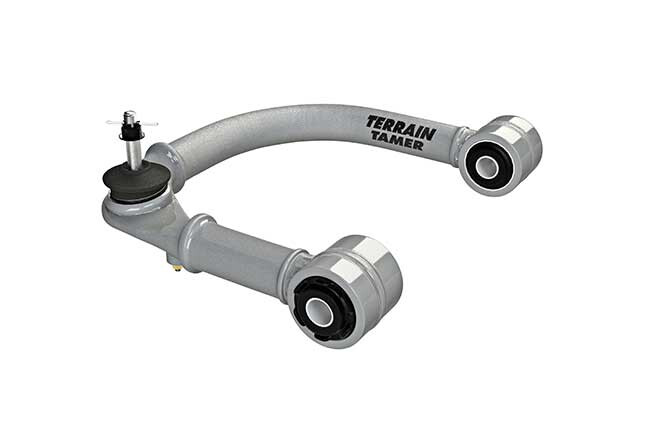
Terrain Tamer has released a range of Upper Control Arms for vehicles that run Independent Front Suspension (IFS). To fix the issues associated with lifted IFS vehicles (up to 70mm), Terrain Tamer’s powdercoated Upper Control Arms allow greater clearance to the coil assembly and more articulation of the arm, thanks to its extended length. The design of the arm allows the shock absorber to restrict full droop, minimising any strain put on the ball joint when the vehicle is lifted. It also provides an increase in caster level and negative camber. The arms are currently available for a range of Ford, Mazda and Toyota models.
TERRAIN TAMER BRAKE KIT
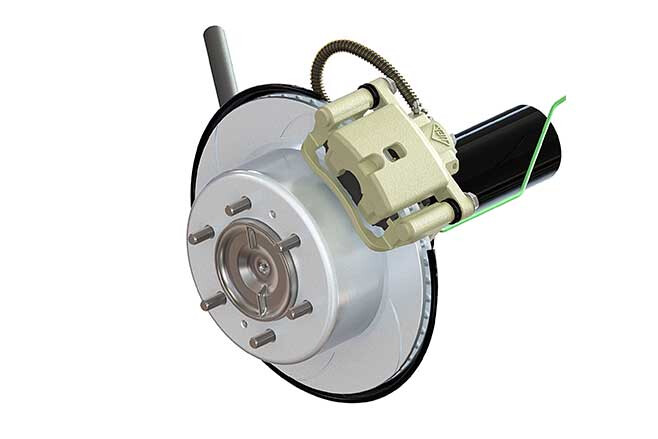
Terrain Tamer also released a new kit to convert a vehicle’s rear drum brake setup into a disc brake system. The new system features Kevlar ceramic brake pads and slotted rotors, and are claimed to offer 29.7 per cent better stopping power. According to Terrain Tamer, independent test results proved that, at 100km/h, the rear braking system stopped on average 28.5m shorter than OE. The kit is ADR compliant. For the full listing, visit TT online.
Website: www.terraintamer.com
FOR most of us, our first 4×4 vehicle is a memorable one. Memorable to us for all the adventures and stories it brought, but in the grand scheme of things, usually not memorable to anyone else.
Your first 4×4 or your first car is usually an older, more affordable offering and for those early years of motoring, it was your lifeline to the greater world and all possible exploration. But the reliability of older cars means those memories aren’t always good ones.
For 20-year-old student Nick Mitic, this GQ Patrol wagon is his first 4×4 and it’s a solid base that he has built in to some thing more memorable than most.
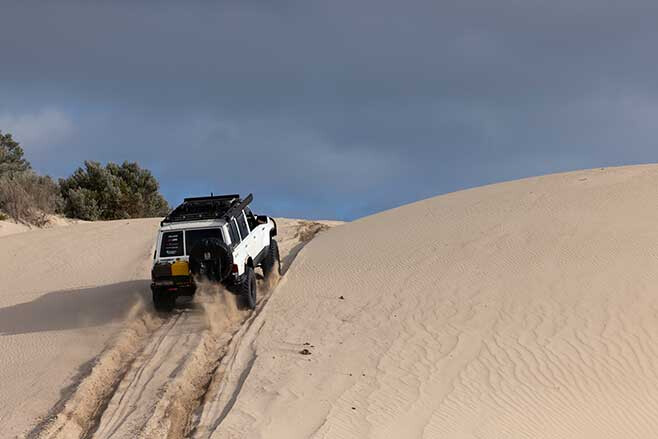
“I first noticed the GQs when I was 15 years old,” recalls Nick, “and I knew then that I’d own one, one day. I always liked the look of the older boxier cars.”
Nick found himself a 1996 LWB Patrol with the unloved RD28 diesel engine but yanked that mill for a naturally aspirated ‘silver-top’ TD42 swap which he performed in his shed. While no powerhouse, the TD42 was still a step up from the RD engine and is well-known for its durability and ability to accept an aftermarket turbo and plenty of boost.
Nick enlisted Perth’s Dynamic Diesel Performance (DDP) to boost up his TD and didn’t spare his pocket money on the build. A G350 ‘red wheel’ GTurbo is mounted atop a Radius Fab high-mount intake manifold and drawing through a 4-inch Patrol Docta stainless steel snorkel.
To keep plenty of clean diesel fuel up to the now boosted engine DDP fitted a JP Performance 12mm pump that is good for around 250-horserpower while the burnt gasses leave through a 3-inch straight-through exhaust system.
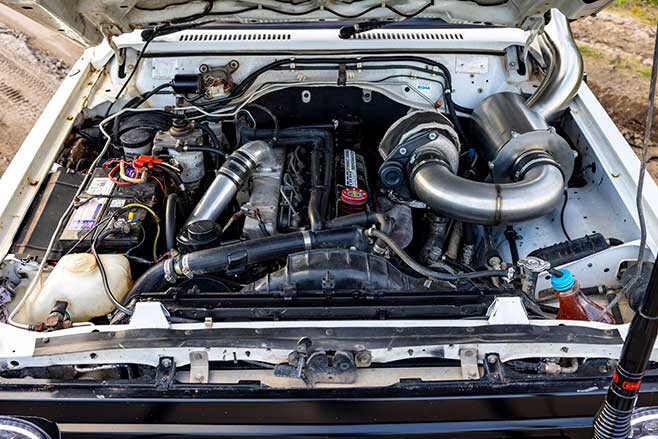
Tuned on the dyno at DDP the new combo pushed 219-horsepower and 716Nm through the rear tyres and that’s with the 35-inch Nittos onboard. It’s a huge leap from the naturally aspirated TD42 let alone that of the old 2.8.
“Engine mods are expensive and its easy for the old silver top to let go,” said Nick. “So finding the right level of power versus safety was a challenge.”
Harnessing the new found grunt before it reaches the Nissan 5-speed gearbox is an Exedy Tuff Clutch. The diffs remain unlocked but have been fitted with 4.6:1 gears to compensate for the larger tyres.
“I started out trying to achieve more flex for rocky and muddy terrain but soon realised that the beach is my favourite place to drive,” says Nick. “That’s why I went with the Dobinsons MRR shocks and springs, and the big power package from DDP.”
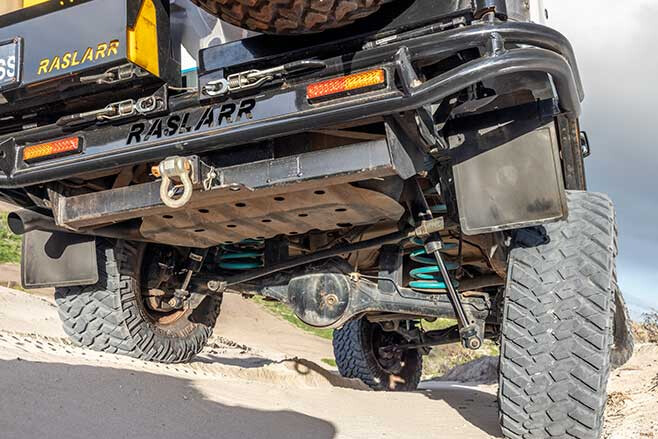
That Dobinsons suspension package is built around the company’s adjustable Monotube Remote Reservoir (MRR) heavy-duty shock absorbers that allow Nick to best set them up for the sort of driving he likes. With 5-inch coils there’s plenty of clearance for the 35s and the extended bump stops soak up the landings when the tyres leave the sand, blasting over the bumps.
To keep things in line with such a lift and tyre size, 5-inch drop boxes are fitted along with adjustable track rod and panhard rod, all mounted on Nolathane bushes.
When Nick goes beach driving he likes to bring the party with him, the Party Bus Patrol equipped with its own sound and light show. The tunes blast out of a Kenwood head unit pumped up by a pair of Alpine amplifiers, to Kenwood speakers and a Rockford Fosgate sub.
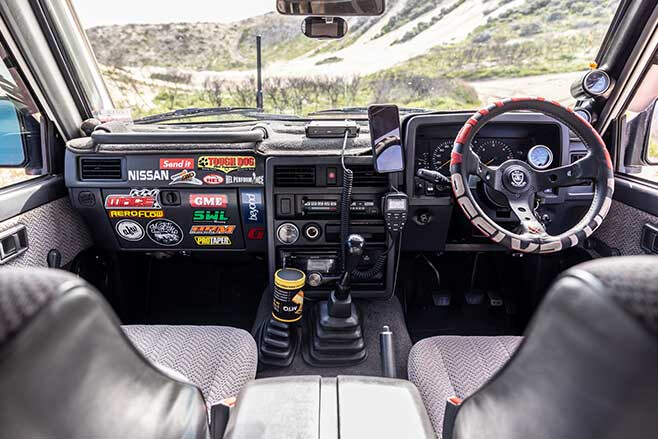
There’s more to the lightshow than just the LED replacement headlights and light bar on the roof rack for lighting the track ahead. At the back of the rack are what Nick says are his favourite mod on the car, four little LED light cubes that punch out a variety of colours and strobing patterns that he can control from an app on his phone.
It’s one thing to appreciate and own older 4x4s but there’s no way around them showing their years and the scars that come from off-road use. Nick’s GQ has scored a tidy up and respray to have it looking as good as ever. There’s a custom made bullbar to protect the front end, while down the back is a bar with swing-out carriers from Melbourne manufacturer Raslarr Engineering.
Inside the back of the bus are a set of drawers for carrying all the camp and recovery essentials. This is topped with a mattress giving Nick a place to crash after those beach parties.
The Party Bus is a great first time effort for young Nick, and this classic old GQ delivers all the fun of four-wheel driving to create great memories. We’re sure the lights and sound show create a few memories at those beach parties too.
MAZDA has said goodbye to Ford after its decades-long partnership creating utes and other commercial vehicles, and embarked on a new era, this time teaming up with Isuzu for its new BT-50 ute.
While the earlier Ford/Mazda one-tonne utes were primarily developed and built by Mazda and then rebadged as Ford products, the last generation of the partnership was primarily developed by Ford (in Australia) with input from Mazda, then re-skinned and badged as BT-50s.
The new BT-50 is essentially a re-skinned Isuzu D-MAX, and that is the all-new 2020 D-MAX which launched just a few months before the BT-50 hit the market. Mazda is banking on Isuzu’s reputation for engineering strong, reliable vehicles and class-leading levels of safety technology in sharing the D-MAX’s platform, while wrapping it in stylish sheet-metal to make it distinctly Mazda.
POWERTRAIN & PERFORMANCE
WHILE many drivers appreciated the old Ford-built five-cylinder, 3.2-litre diesel engine for its relaxed and loping torque delivery which never seemed to raise a sweat, it did come at the expense of fuel consumption, which was always a criticism of the old BT.
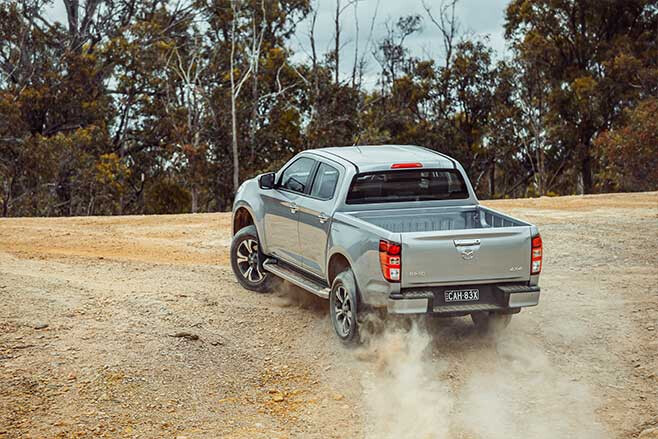
Conversely, Isuzu’s 4JJ series of four-cylinder, 3.0-litre diesel engines have always been some of the more efficient on the market, and the latest iteration of the mill takes this even further. It’s pretty much an all-new engine with a new block, internals, turbocharger and fuel system designed to be more refined and economical than past generations.
In this XTR 4×4 auto trans specification, the BT-50 is rated at 8.0L/100km of diesel use on the ADR combined scale. On our test it returned 11.4L/100km over a mix of urban and bush tracks, highway driving, and a couple of hours of off-roading.
The engine’s power and torque figures of 140kW and 450Nm are at the lower end of the class standards and slightly down on the 147kW and 470Nm the old 3.2 made, but peak torque is available from 1600 through to 2600rpm, so it still maintains that bottom-end grunt you want in a working ute.
The engine is smooth and quiet at cruising, light-throttle speeds, but it has the unavoidable noise of a four-cylinder mill when you lean of the accelerator and make it work. It is refined most of the time, only showing its diesel design hallmarks when pressed hard.
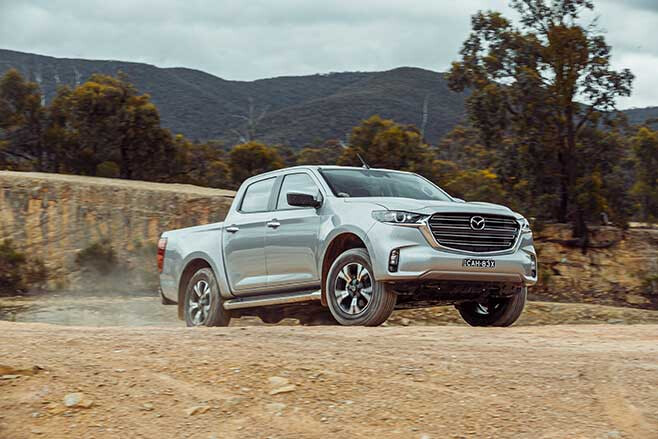
The auto transmission is a six-speed unit from Aisin that proves to be intuitive when you want it to be; downshifting on descents and holding gears at large throttle openings, while remaining smooth and out-of-mind when cruising on the highway or negotiating the suburbs.
ON-ROAD PERFORMANCE
THE powertrain delivers adequate but unremarkable performance, resulting in the BT-50 being no high-performance sports ute but something that will get the job done. As mentioned, it’s relatively quiet and refined except at wide open throttle.
We were driving the BT unladen over highways, country roads and forest tracks and, as with all one-tonne utes without a load in the tray, the ride is a bit jittery, particularly in the rear end. The XTR and top-spec GT variants ride on 18-inch alloy wheels with 265/60 aspect tyres, while the entry-spec XT model gets 255/65 tyres on 17s.
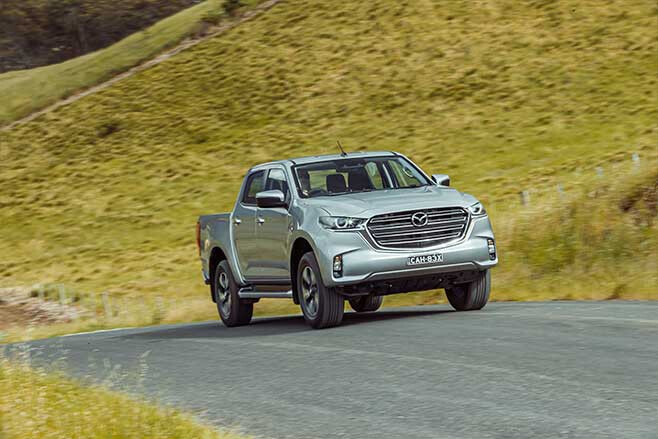
17s are the smallest wheels possible on the chassis due to the large 320mm front brake discs – the rear brakes remain drum. The braking displayed nothing worth mentioning during this unladen drive, but with the big discs up front they should prove up to the task when towing or hauling a load.
This chassis package is an all-new design from Isuzu, so don’t go thinking the BT will be anything like an old D-MAX. It’s a huge step-up in ride and handling from the old model, but maybe not so much from the old Ford T6-derived platform under the last BT-50.
Another big step-up is safety, and part of that package includes Lane Departure Warning (LDW), Lane Departure Prevention (LDP), Emergency Lane Keeping (ELK) and Lane Keeping Assist System (LAS) systems. All these systems work together using cameras mounted high in the windscreen that read the road marker lines and use the electric power steering to keep you in your lane, warn you if you are drifting from your lane, and mitigate an accident when changing lanes to overtake.
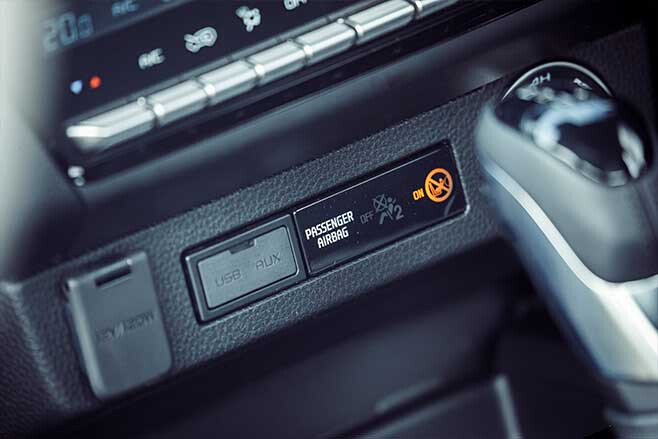
These are all good systems for helping prevent accidents, but they can become intrusive on narrow country roads, narrow multi-lane highways, or in situations such as when there are two left lanes exit from a motorway – in this instance, the system tries to prevent you turning left from the right-hand exiting lane because there is a vehicle alongside in the left-hand exiting lane. Drivers will need to make a point of experiencing these systems early on to be made aware what is happening when the steering wheel is tugged away from your input, as it could be very unsettling if you were not expecting it.
Personally, the calibration of the systems is too sensitive and you get too much intervention with too many warning beeps when driving in general conditions. They can be switched off in the settings menu but default back on when the car is stopped and restarted.
One safety feature I love and think should be on all new vehicles is Rear Cross Traffic Alert, which warns you of approaching vehicles, pedestrians or cyclists when reversing out of a parking spot. This is particularly useful on longer vehicles like double-cab utes and it’s great to see it on all BT-50 variants.
OFF-ROAD PERFORMANCE
THE new BT-50 retains a traditional part-time four-wheel drive system with high and low range and gets a driver-selectable rear locking differential to help out when the going gets tough.
The ride quality over pot-holed forest roads was a bit harsh, bearing in mind the ute was unladen and would soften-up with some more weight on board. The live axle, leaf-sprung rear axle offers a moderate but not great level of articulation, while up front the travel of the IFS is relatively poor but on par for the type of vehicle the BT is.
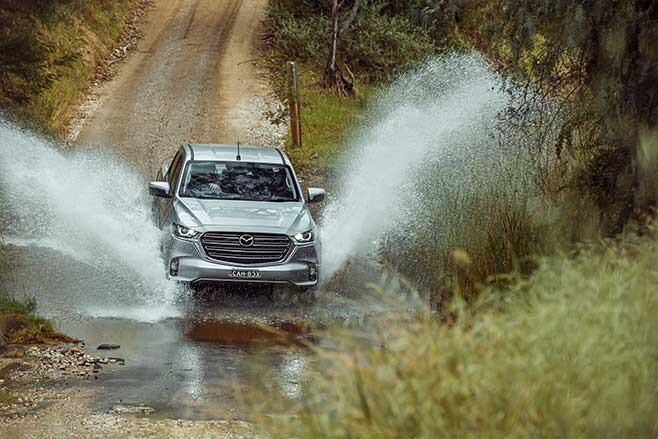
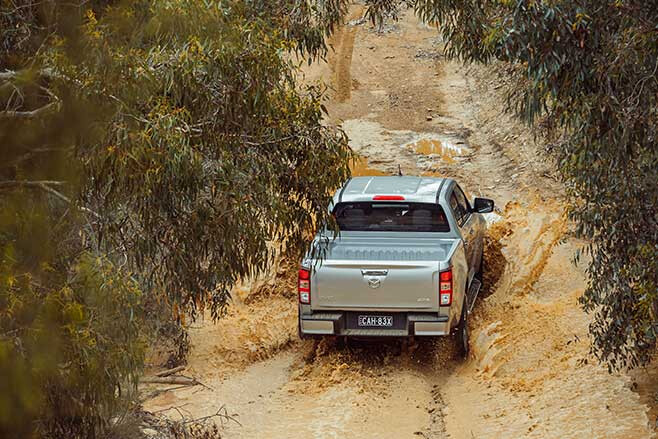
That leaves traction aids to get you up a climb where tyres lose grip, be that from lack of travel or the fact they are OE highway terrain low profile rubber. The electronic traction control does its thing well up to a certain point, where you then need the rear locker. Activating the locker deactivates the ETC across both axles, so the front end becomes a single-spinner as it can’t distribute the drive to both wheels or at least the one with the most grip. This required backing up and relying on the locked rear end to push the BT over the lip.
Speaking of going over the lip, the side steps are excessively big and are the first thing to scrape. They’d also be the first thing to remove on any BT heading off-road. The rear bumper also hangs particularly low, and those rear corners look particularly vulnerable.
We’re super keen to see a new BT with some metal bumpers, a bit of suspension lift and some bigger all-terrain rubber.
BT-50 INTERIOR
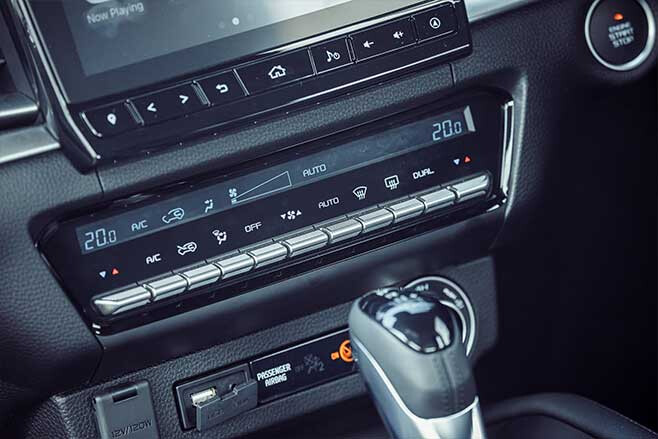
THE interior of the mid-spec XTR is a stylish place to ride in, keeping with its exterior looks. Stitched leather-look covering on the dash, a big eight-inch A/V screen and stylishly laid-out buttons for the HVAC all add to the look. Unfortunately, it’s all buttons and no dials for audio volume or HVAC temperature control, which is a pet hate of mine. Large tactile dials are easier to find without taking your eyes off the road, and they’re quicker and simpler to use.
Scrolling through the settings menu to set your preferences for warning beeps, lane departure and other customisable settings is also fiddly and not something you can do on the move.
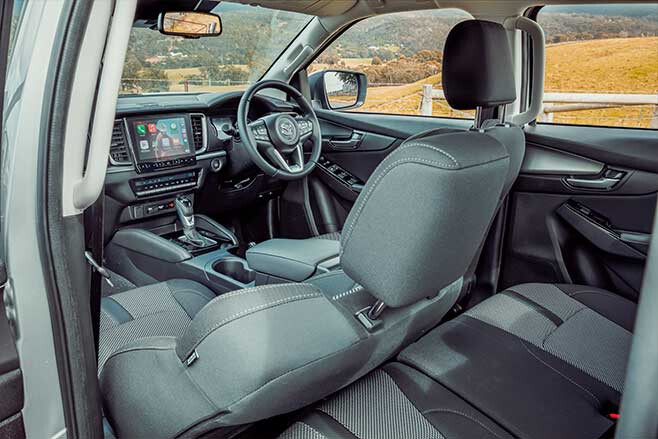
The front seats are very comfortable and hug the occupants, and the steering wheel is thick and has a premium feel to it. The steering column is adjustable for both reach and height, which is a plus, but the auto-up function on the windows is only on the driver’s glass.
Rear seat accommodation is on par for the class; it will take two adults or three children without trouble. Three big blokes across that back would be a squeeze. Without having the two side by side, it’s difficult to judge if the new BT is any bigger than the old model inside, considering that when the previous model came out it boasted one of the bigger cabins in the class.
The safety systems got a bit confused when off-road as it threw up a collision alert as we approached a big puddle, but thankfully falling short of emergency braking. Most of these systems should be automatically disabled when in low range, and I’m not just picking on Mazda here.
PRACTICALITIES
As expected of the class of vehicle, the BT-50 has a 3500kg towing capacity and a 5950kg GCM. GVM is rated at 3100kg, and in the 2030kg XTR 4×4 auto ute that leaves you with a 1070kg payload. Even the top-spec GT model has a payload higher than one-tonne at 1065kg, which is pretty stout.
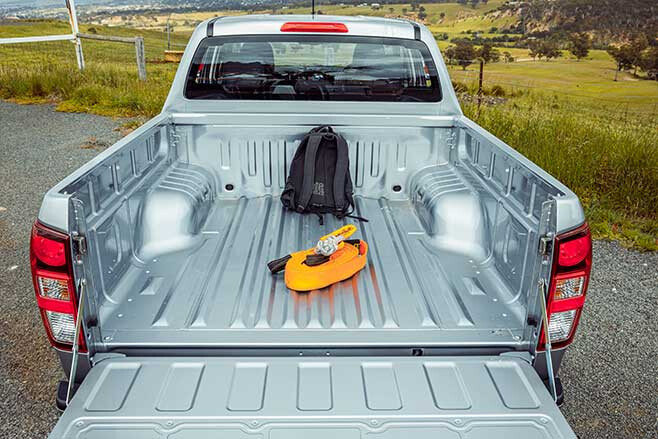
The factory tub measures 1571 x 1530 x 490mm (LxWxH) with 1120mm between the wheel arches. The engine draws its air from above the radiator support where it is sealed to the bonnet, and Mazda gives the car an 800mm wading depth with this set-up. Ground clearance is quoted as 240mm.
Mazda has a range of factory accessories for the BT-50 including a steel bullbar that maintains the car’s safety rating, plus various LED lighting and tonneau cover options. Significantly, by placing the cameras for the safety tech up high in the windscreen, it has made it easier for manufacturers to develop bullbars and other frontal accessories for the car; although, it will be interesting to see if the cameras are affected by a UHF antenna mounted on a bulbar in front of them. Expect all the major aftermarket players to have a range of kit available for the BT-50 very soon.
CONCLUSION
In some ways the new BT-50 represents a big step up from Mazda’s ute offering, while in others it is just maintaining the status quo.
The pluses include the fact this is an all-new platform representing the latest in this class; the massive raft of safety equipment that is standard across the range; big improvements in fuel economy; and a more stylish appearance (in my opinion anyway).
On the other hand, power and torque numbers are considerably down on the leaders in class (and it feels it) while being marginally down on the outgoing model. The cabin is a step up in equipment levels but is no more spacious, and some of the key functions are fiddly to operate.
At $57,210 (+ORC) the BT-50 XTR is comparable to an LS-U D-MAX ($56,900) and is slightly cheaper than a Ranger XLT 3.2 ($59,440 on-road) and SR5 Hilux ($59,920), making that mid-range double-cab 4×4 ute segment highly competitive.
WHAT YOU GET
All 4×4 models in the new BT-50 range get the same engine and choice of six-speed manual or auto transmissions. They all get the full swag of safety tech including autonomous emergency braking, adaptive cruise control (auto only) the lane keeping/departure systems, reverse cross traffic alert, pre-crash safety, traffic sign recognition with speed warnings, blind spot monitors, electronic traction and stability control, trailer sway control, DRLs and eight airbags.
Wireless Apple CarPlay/Android Auto is standard, giving you sat-nav and connectivity. The XT has a seven-inch screen, while the XTR and GT get the bigger eight-inch job.
The top models also get dual-zone climate control over the XT’s standard air-conditioning, and eight speaker audio over the XT’s six speakers. Other features exclusive to the GT include leather seats with heating on the front pair and power adjustment on the driver’s seat, plus chrome door mirrors.
2020 MAZDA BT-50 XTR SPECIFICATIONS
- ENGINE: I4 3.0L diesel
- MAX POWER: 140kW @ 4000rpm
- MAX TORQUE: 450Nm from 1600-2600rpm
- TRANSMISSION: 6-speed automatic
- TRANSFER CASE: Part time 4×4 w high/low range
- CRAWL RATIO: 33.3:1
- STEERING: Electro-hydraulic
- FRONT SUSPENSION: IFS w/ upper and lower control arms, coil springs, stabiliser bar
- REAR SUSPENSION: live axle under leaf springs, stabiliser bar
- TYRES: 265/60-R18
- KERB WEIGHT: 2030kg
- PAYLOAD: 1070kg
- TOWING CAPACITY: 3500kg
- GVM: 3100kg
- GCM: 5959kg
- ADR COMBINED FUEL USE: 8.0L/100km
- FUEL USE ON TEST: 11.4L/100km
- FUEL TANK: 76L
- APPROACH/RAMPOVER/DEPARTURE: 30.4°; 23.8°; 24.2°
- GROUND CLEARANCE: 240mm
- WADING DEPTH: 800mm
GMC has officially laid bare its all-new Hummer EV, with the fully electric, open-air offering boasting some serious off-road nous.
“We had one goal for Hummer EV: Build the most capable factory truck – ever,” said Al Oppenheiser, GMC Hummer EV chief engineer.
“It’s an absolute off-road beast with a unique e4WD drive system that provides maneuverability unlike anything GM has ever offered before.”
The Hummer will launch with the Edition One version, which features a removable roof and lots of extra specs, and which is expected to cost around US$113,000 ($160,000).
GMC Hummer EV motor and battery specs
GM estimates this three-motor e4WD system can deliver 1000hp (745kW) and an astonishing 11,500lb-ft of torque (15,600Nm), with the system kept alive via a 24-module, double-stacked Ultium battery system.
The Ultium batteries are unique to GM, and are manufactured with less cobalt to reduce the cost.
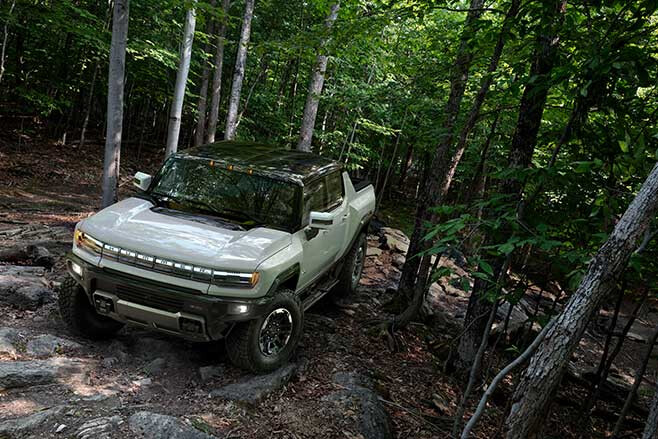
In what is GMC’s first fully electric vehicle in its line-up, the Hummer EV boasts an estimated driving range of more than 350 miles (563km) on a full charge.
It’s also compatible with 350kW DC fast chargers, which GMC claims enables nearly 100 miles (160km) of range in just 10 minutes of charging.
Despite a claimed 0-100km/h time of a mind-boggling three seconds, perhaps the most compelling technology for 4×4 enthusiasts is the inclusion of an Extract Mode, which raises the vehicle’s suspension height by about 150mm courtesy of an adaptive air suspension set-up.
GMC Hummer EV off-road specs
Steel plates strategically positioned around the battery pack ensure the vehicle’s vital components remain protected when bashing through the bush.
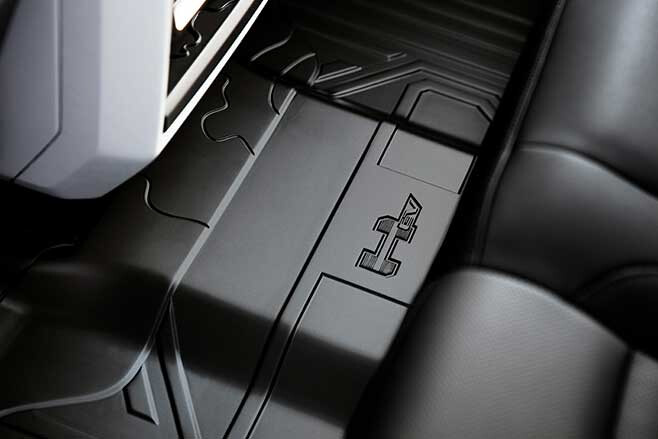
Thirty-five-inch Goodyear Wrangler Territory muddies as standard (37-inch tyres can also be fitted) assist the Hummer in off-road endeavours, with GMC adding that this combination enables the vehicle to scale 460mm verticals and drive through water that is more than 610mm deep.
If all else fails and the path ahead remains impenetrable, you can flick on the segment-exclusive CrabWalk mode, and the front and rear wheels will steer at the same angle at low speeds, enabling the vehicle to progress in a diagonal direction.
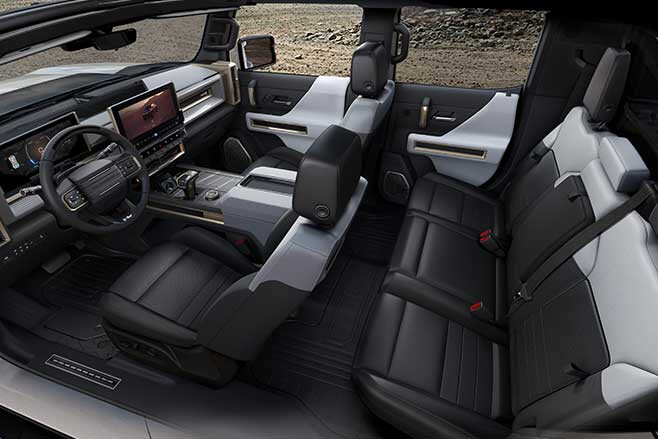
The electrified Hummer also features driver-selectable modes to tailor performance (this includes Terrain Mode which raises the ride height by nearly 50mm); Adaptive Ride Control continuous damping (tailored for on- and off-road driving); and a premium interior fitted with a 13.4-inch infotainment screen.
Production of the Hummer EV will begin in late 2021, at GM’s Factory ZERO Detroit-Hamtramck Assembly Center. Whether it will be available in Australia via GMSV is unconfirmed at this stage.
NOW WATCH A Rivian electric ute doing a ‘tank turn’
WHETHER you’re hitting the beaches or doing the deserts, driving on soft sand requires a certain set of skills if you want to make it over the next dune. Driving on sand can be tricky, and it pays to be prepared.
Here’s a list of tips to make your next beach expedition a safe and enjoyable one.
LOWER TYRE PRESSURES
SAND driving requires lower tyre pressures to ensure the tyre’s contact patch is longer and provides better traction. Pressures should be dropped to around 16 to 25psi, depending on the vehicle and terrain. This doesn’t guarantee you won’t get bogged, though.
STEER CLEAR OF THE WATER
WE recommend steering clear of saltwater when you’re driving along the sand, as it’s not great for your 4×4. However, if you do happen to get it wet, be sure to give it a thorough wash when back in town. Of course, keep an eye on the tide as well.
VEHICLE CLEARANCE
IT’S important to know the height of your vehicle’s clearance, as sand driving involves plenty of crests on soft surfaces. This heightens the chances of a 4×4 bottoming out. Before heading to the beach, think about giving your rig a lift.
RECOVERY GEAR
IF you get stuck, and the chances of getting stuck are pretty high when driving on sand, then you’ll need gear to make for an easy recovery. Don’t forget to pack a set of decent traction boards (Maxtrax) and a shovel. Plus a winch will help if truly stuck but you need something to anchor off. Keep this kit in your rig whenever you head off road.
DON’T BE AN IDIOT
THIS one is a no-brainer, but you’ll be amazed at how many people disrespect our coastlines. Driving at a steady, safe speed – and not recklessly – will ensure the environment remains protected and you remain alive. Also, ensure what you take with you leaves with you – don’t leave rubbish lying around.
READ MORE
THE purpose of CB radios as a communications device hasn’t really changed much over the years, but the radios themselves have evolved.
The two radios in my old LandCruiser partly shows this evolution, as one was an old AM/477meg dual-band jobby and the other an older 40-channel GME GX3200. Neither were working particularly well on a recent trip in convoy, so it was time for a more modern replacement.
AM CB radios are pretty well redundant now and the common 477meg units have advanced to 80 channels. Compact units have become the norm and allow you to mount the main body away from the fascia, and some are even controlled by Bluetooth.
I like to keep things simple with a basic radio and never thought I would use a unit with Bluetooth connection or the ability to locate you and other users with similar tech on-board. I also didn’t like the idea of UHF radios with the speaker, microphone and all of the main controls in the handpiece, as I didn’t imagine the sound quality of the speaker would be all that good.
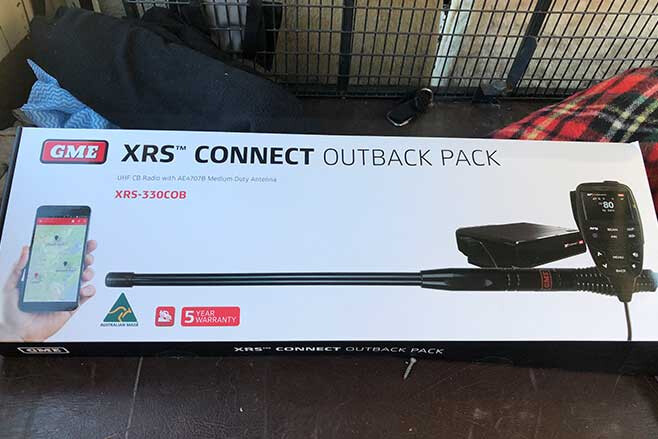
This opinion changed when I used the GME XRS 330-CTP combination in the 4X4 Australia Ranger. It features the all-in-the-handpiece design, with the main body mounted behind the dash; and the revelation that the sound from the inbuilt speaker was excellent and changed my mind on such UHF units.
The XRS 330C radio itself retails for $499 when not sold in a kit.
When GME released the XRC Connect 330-COB Touring package it seemed to be the perfect kit to update the Cruiser’s comms. This package uses the same XRS Connect 330C radio unit as fitted to the Ranger but is paired with a stubby 2.1dBi radome antenna as opposed to the 6.6dBi one on the Ranger.
This lower gain antenna is better suited to the hilly and mountainous areas I like to visit in the High Country, while the high-gain 6.6dBi antenna works better over long distances, in flat terrain like the outback.
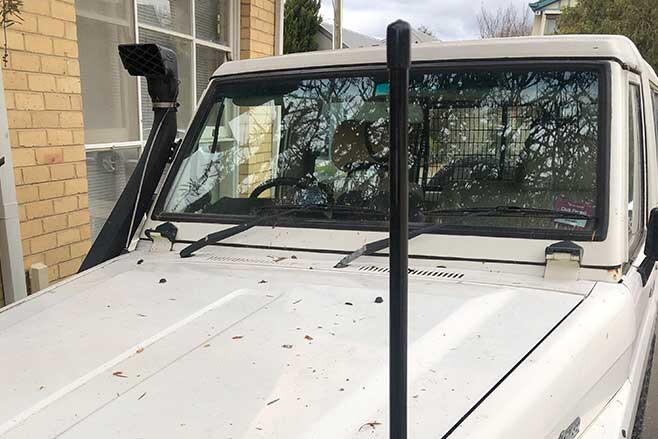
The XRS 330-COB kit comes with the radio unit and mounting bracket, antenna with spring base, antenna cable, handpiece/microphone/speaker, handpiece mounting bracket, power cable and all the required hardware.
Installation is something most folks should be able to do at home with basic tools, although I had a bit of a head start as I was replacing one of the older units and already had power running to the location where the new radio would go. Once you get the antenna and 12 volts to it, the GME radio is simply plug-and-play.
I started the install by mounting the antenna base on the bullbar and running the cable back through the inner ’guard, passing through an existing grommet in the firewall and up to where the radio main body would be mounted in the overhead console.
With no buttons or controls on this unit, it can be mounted anywhere but I put it up here where there was plenty of space and, as mentioned, I already had power running to it. Unfortunately the power plug on the new XRS Connect unit is different to the old one and required reconnection; alternatively, I could have replaced the wiring with the new harness that comes in the kit.
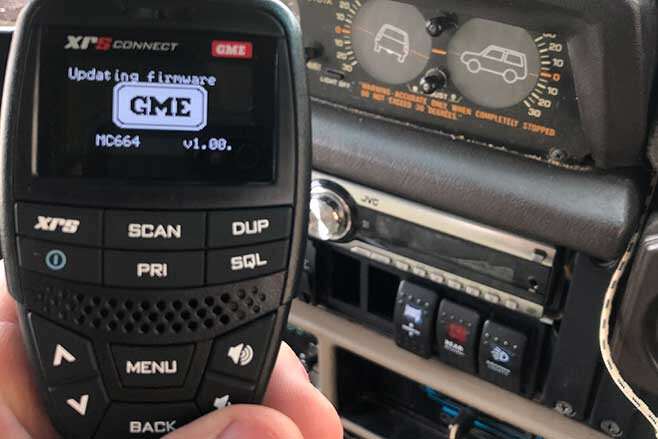
Having the handpiece mounted up high on the roof console makes it very easy to grab when you need to use it, so I chose to put the new one up there again. The kit includes an extension cable and adaptor to allow you to mount it wherever best suits you and the interior of your car. This is particularly handy in more modern cars that don’t have so many flat surfaces to mount the bracket.
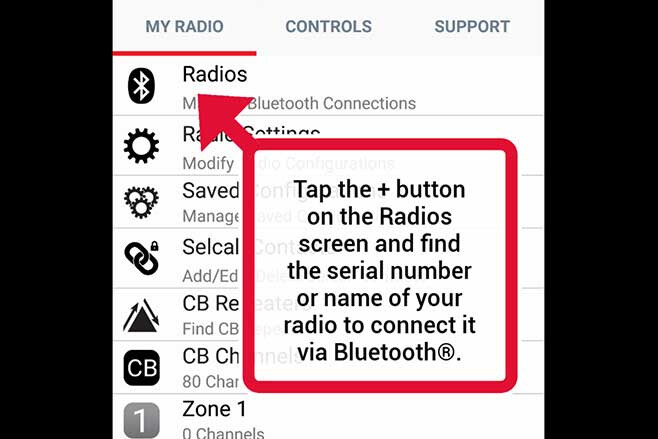
With the install out of the way, it was time to delve in to the unknowns of modern technology. There are two apps to download to your smartphone or iPad that are used to set up the XRS Connect radio and its tracking function. The connection is via Bluetooth and once made gives you access to all the set-up functions. It also has a walk-though of the functions that give someone like me a bit of an idea of what’s going on. This includes setting favourite channels, Selcall settings, and customisable buttons on the handpiece, voice playback and location services, among other things.
Firmware updates are also delivered via the app and an update came through when I recently went back to it. Updating the unit then took a few minutes to automatically complete before I could access the settings.
I thought the location service would be bit of a gimmick, but after looking at it I can now see it would be of great use. When switched on it uses the inbuilt GPS to show the location of your radio/4×4 and that of others in your network. How often have you asked someone where they are over the radio and they couldn’t give you a precise location? If they are using an XRS radio you can see them on the map on your phone or tablet and you can then find your way to them. It’s clever use of technology.
As for the most important use of the radio – as a communication device – it’s so far so good, with the XRS giving strong signal and clear sound. The inside of the old Cruiser is a pretty noisy place, but the sound from the 2-Watt speaker in the handpiece is always clear. Having it mounted up high places it close to my ear as well, so that probably helps for an old bloke. The sound quality has never been an issue in the much quieter late-model Ranger.
The screen on the handpiece uses an OLED display, so it remains clear whether I’m glancing up to it in its mount or in my hand; even when wearing polarised glasses.
One of my favourite reasons for using the GME product is that they are made in Australia, and the XRS radios come with a five-year warranty. I’ve also retained the old 40-channel GME unit in the Cruiser as a backup or for when I need to be using two radios at a time. Such an occasion is when you are traveling in convoy and have a chosen channel, yet you need to be keeping an ear on the local channel such as Ch10 when in the desert.
They say you can’t teach an old dog new tricks, but if you give him some new toys to play with he’ll certainly pick a few up. Such is the case with fitting this latest tech GME radio to the old LandCruiser for it’s even older driver.
ESSENTIAL INFO
Website: gme.net.au RRP: $629 We say: Quality Australian-made radio with features you never knew you wanted.
Two of Australia’s biggest aftermarket companies – TJM and Ironman 4×4 – have kit ready to fit to your 2021 D-MAX.
TJM GEAR FOR 2021 D-MAX
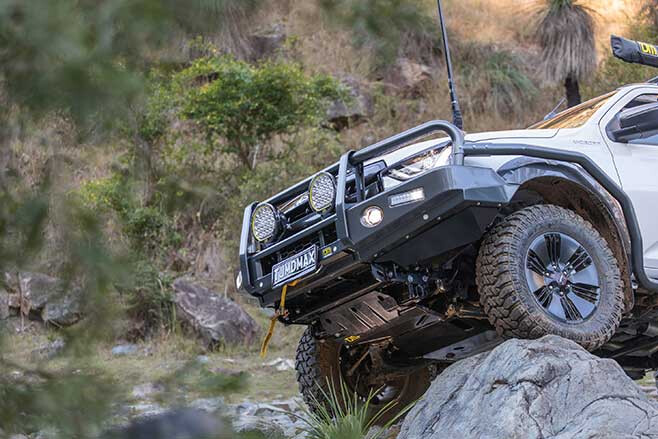
TJM has a full suite of aftermarket equipment ready to fit to the all-new Isuzu D-MAX. “TJM is ready to gear up those vehicles with premium accessories that have been painstakingly designed to suit this specific model,” said Matt Logan, TJM’s head of customer experience.
Among the long list of equipment are the TJM Outback bar (as well as other bars); underbody protection, side-steps, side bars and a rear bar; and XGS suspension. Punters will also be able to purchase Aeroklas accessories for the new D-MAX.
Website: www.tjm.com.au
IRONMAN 4X4 SUSPENSION FOR 2021 D-MAX
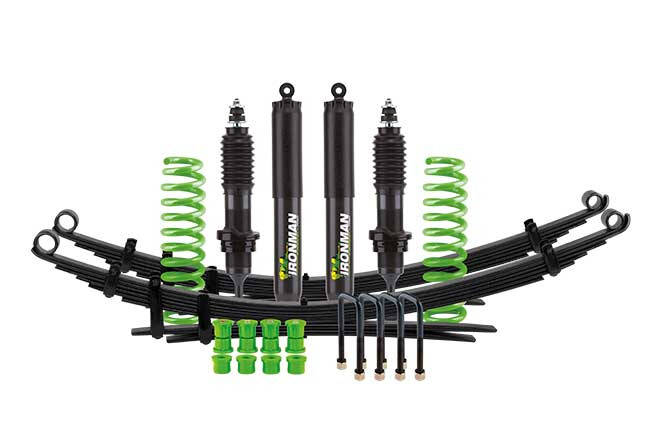
Ironman 4×4 has added a full range of suspension upgrades for the all-new D-MAX to its catalogue. The contents of the kit include front coil springs, rear leaf springs, front and rear shock absorbers (three options available, including Foam Cell Pro and Nitro Gas), Polyurethane Spring Bushes, a Brake Hose Relocation Kit and U-Bolts.
Optional components include Pro-Forge Upper Control Arms, Strut Mounts and Greasable Shackles. For complete pricing and suspension options, visit the Ironman website.
Website: www.ironman4x4.com
IT WAS the biggest gold robbery ever in Australian history.
In June 1862, a coach with a driver and four police escorts along with more than 2700 ounces (77kg) of gold and 3700 pounds in cash were on their way between Forbes and Orange, NSW, when Frank Gardiner and his gang of seven other bushrangers held the coach up, wounding two of the policemen in the process.
Helping themselves to the haul (the gold alone valued at over A$4.8 million today) the bushrangers fled but the police, along with black trackers, were soon on their tail. Surprised at their hideout the heavily laden horse with most of the gold was soon abandoned as the gang fled into the hills.
While most of the culprits were soon captured including Frank Gardiner, who, interestingly, after 10 years in gaol was exiled out of the colony and after a short time in Queensland fled to the USA where he lived till the age of 74, dying in 1904.
The others weren’t so lucky. Ben Hall, probably the most famous bushranger in NSW, ran the police ragged with his bold deeds throughout the colony till he was ambushed in his camp and shot, first in the back and then a further 30 odd times in May 1865, aged 27. John Gilbert, another member of the gold heist gang only survived another two weeks after Hall’s demise, being shot near Forbes at the age of just 23.
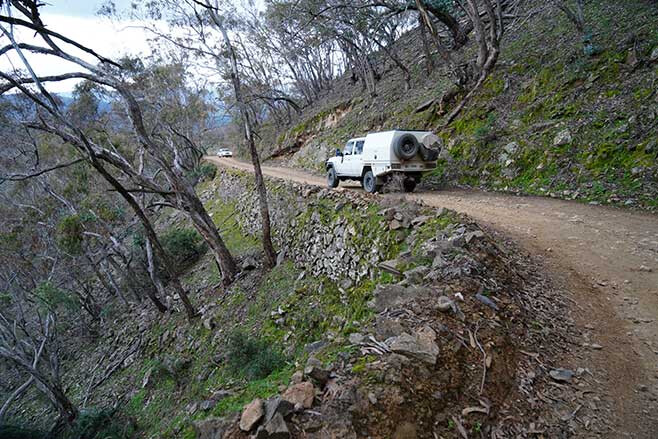
ESCORT ROCK
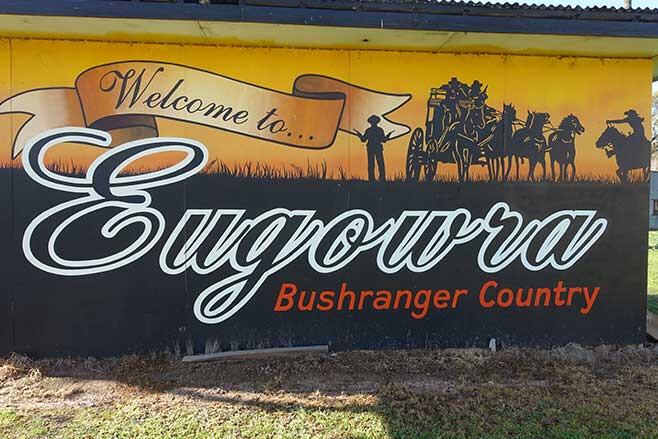
TODAY you can visit the place of the robbery now known as Escort Rock, which lies just off the main highway, east of the small, delightful village of Eugowra. Take the time to check out the many murals in the town, one of which, as you’d half expect, depicts the gold robbery.
At Escort Rock itself, which is well signposted, it’s a short walk from the carpark to where the infamous deed was carried out, while the old route of the stage coach and the ruts the passing traffic wore into the ground can still be seen near the rock.
The place where Ben Hall was shot can also be visited, some 15km northwest of Forbes. It’s a bit of a dog’s breakfast getting there though, as the route wanders through delightful farmland and light forest, turning this way and that along dirt roads before stopping near a non-descript patch of trees in an otherwise cleared paddock. Best to get a mud map from the local museum in Forbes which, by the way, is an excellent museum with a fabulous display on Ben Hall and his life.
A few cows looked on as we opened the creaky gate and walked the short distance to the copse of trees where a couple of signs testify that it was here that Ben Hall met his fate. The country doesn’t look anything like it did though when Ben threw down his swag and tethered his horse nearby.
The surrounding country was heavily timbered back then and the police had plenty of cover to sneak up on him during the night. Called on to surrender Ben turned to run for his horse when the police opened fire; some say he was murdered!
We headed back to town and in the Forbes cemetery found his grave which is well tendered with flowers lying beside the headstone. As a couple of asides, just nearby is the grave of Kate Kelly, the sister of Ned Kelly, while the town itself has a magnificent central square with all the notable buildings lining its edge, much like a ‘Plaza Central’ in an old Spanish city.
BANG BANG HOTEL
EARLIER, we had come up through Young and stopped at the small township of Koorawatha where in 1864 old Ben and his gang, which included John Gilbert, arrived to have a bit of fun holding up the Bang Bang Hotel and its patrons for a few dollars and a cheap drink.
The trouble was there were a few policemen around and a furious gun battle ensured, the outlaws deciding to escape while the going was good. Today the site is marked by a couple of signs, the old hotel having succumbed to time and the odd fire or two.
From there we had wandered over to the Weddin Mountains NP and the surrounding state forest, which back in the day was a hideout for Ben and his men, a cave high in the steep, rocky hills overlooking the plains reputed to be his hideout and observation spot.
Today, in this sea of semi-cleared farmland, the parks gives an indication of what the area was once like, and it is delightful country, dotted thickly with native pine, fuzzy box and red gum, while short green grass covered the ground in between.
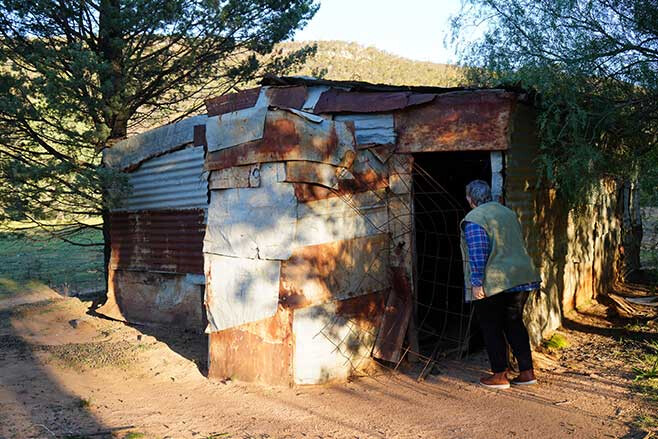
The Ben Hall campground in the national park is well set-up and offers just a few campsites. We hadn’t booked so we wandered a short distance away into the state forest and found a spot to ourselves to enjoy the rich birdlife and the pleasant atmosphere.
On the east side of the range is the Holy Camp camping area and from each camping area radiate a number of walking trails for those so inclined. Not far from where we stopped for the night is the remains of Seaton’s Farm and this area is well worth a wander. This small farm of just 150 acres (60ha) backed by the red cliffs of Black Gin Gully was owned by Jim and Bertha Seaton from the 1940s through to the 1980s.
It was a tough land to make a living from and they only had a couple of hundred sheep with their biggest woolclip being a bale and a half. Today you can see how rough they lived, with their hand-built homestead and even handcrafted fencing, but with their milking cows, chooks and goats helping them get by, Bertha was often quoted as saying how much she loved living here. Jim died in 1983 and Bertha then sold the farm to the national parks before passing away in 2002.
OPHIR
AFTER our wandering around the Weddin Mountains and Forbes we headed to where all this gold fever had begun. Ophir, northeast of Orange. The site of Australia’s first payable gold discovery it was considered, until fairly recently, to have been discovered by Edward H Hargraves.
Certainly, that’s what we learnt in school and what the obelisk on the hill overlooking the Lewis Ponds Creek states. But it wasn’t as clear cut as that and controversy raged for years about the finding and while Hargreaves got the reward and refused to share it with his so-called partners, it has become apparent that Hargreaves was not much more than a con man.
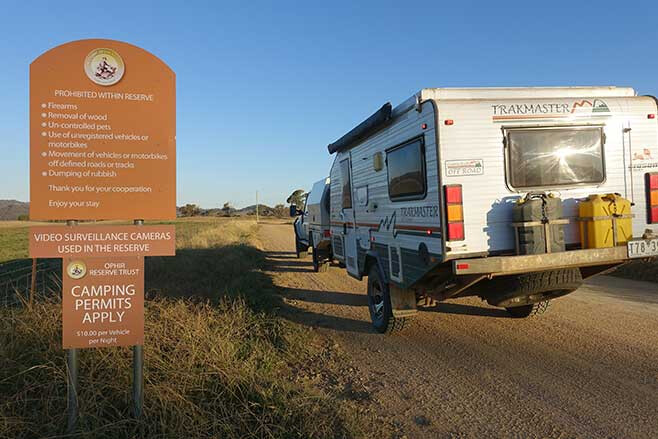
Still, a gold rush set in and while the gold didn’t last long at Ophir and the prospectors quickly moved on, the scene was set and the history of Australia changed forever. Today the reserve surrounding the junction of Lewis Pond Creek and Summer Hill Creek is a top spot to visit with a number of camping spots to enjoy along the small, narrow waterways. We pulled up for a couple of nights near the junction and explored the surrounding area by vehicle and on foot.
There’s a few short walks to old mine sites, tunnels and the like while a brief drive up the winding dirt road will take you to the area’s first cemetery. There’s surprisingly few graves which is probably more of an indication of the areas short-lived prominence than of anything else, but the few remaining headstones do show a violent history with one, a Charles Corse, who was shot in 1872 after a savage argument with another local.
BATHURST
FROM Ophir there are a number of ways to find your way to the popular 4WD destination of Hill End and the Turon River. On forestry trails it’s a bit of a hodgepodge of tracks but we wanted to check up on ol’ Ben Hall’s exploits in Bathurst so we headed that way first. Ben and his gang had raided the town twice in October 1863, in some brazen attempts to embarrass the police, more than anything else, it seems.
They first robbed a jeweller’s shop before hiding in the Sportman’s Arms Hotel and having a few coldies while the police rushed around looking for them. Two days later they were back plundering a few pubs and their hapless patrons, while the police wandered this way and that, seemingly helpless to catch them. Their cheeky good luck deserted them in the end though.
Befitting a town with such a rich history, especially in mining and gold terms, Bathurst now hosts the Australian Fossil & Mineral Museum. This collection of some of the finest and most historic minerals, gemstones and incredible fossils you will find anywhere is the lifetime work of Warren Somerville.
This amazing collection, which was valued at more than $15 million, 20 years ago, was gifted to Bathurst and is now housed in a spectacular series of displays in the 1876 Public School building in the heart of the city.
Being a bit of a dinosaur nut (who isn’t?) we were particularly interested in viewing the skeleton of ‘Rex’, the mighty Tyrannosaurus rex, which is probably the best rex skeleton in Australia. Originally discovered in Arizona where it roamed the swamps and forests some 70 to 65 million years ago, he (or she?) is amazing!
HILL END
FROM Bathurst and its history we headed to the once thriving gold town of Sofala and then took the main road to Hill End. Sadly, the old historic Bridle Trail that skirts close – sometimes too close – to the edge of the Macquarie River remains closed at Monaghans Bluff about 20km south of Hill End.
Wanting to be close to the centre of this famous town we settled on staying at the national park campground, a stone’s throw from the heart of the historic borough. Not your normally old gold mining town, Hill End with its wealth of notable old buildings and the extraordinary 3500 photos of the Holtermann Collection, that were rediscovered in the 1950s, shows what the town and area was like during its heady boom days around 1872.
That was also when a German immigrant, Bernhardt Holtermann, discovered a single great hunk of reef gold weighing in at 286kg and containing 93kg of pure gold; it turned the sleepy little village into the biggest town in inland NSW.
Today it doesn’t matter what your particular bent is in life you’ll find something that will endear yourself to this place. While photographers and artists still flock here – it was made famous by such masters as Brett Whiteley, John Olsen and Russell Drysdale – those with a more adventurous or enquiring mind will revel in the tracks in the area that lead to interesting old mine sites, tumbled down smelters, deserted towns and poignant graveyards.
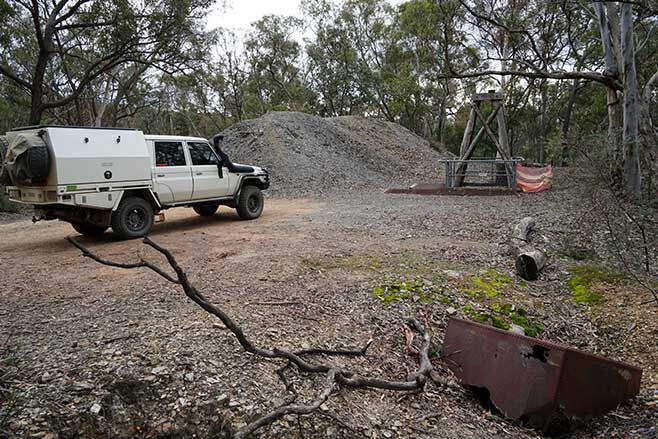
For fossickers there is a designated fossicking site just north of the town. Walkers on the other hand can enjoy an easy stroll around the town, a more interesting walk through Golden Gully or a longer stroll, with some great bird watching interspersed with old mine sites, stampers and the like around the 4km long Bald Hill Walking Trail.
For those who want to camp in a bit more isolation there are a heap of sites along the Macquarie River (both north and south of Monaghans Bluff) as well as at the Glendora Campground just outside town. No matter what you do, you should always start your visit at the Hill End Heritage Centre and then take a short wander to the town’s old hospital with its display of mining equipment, Cobb & Co coach and historic farm machinery along with a pleasant barbecue area.
Of course, just across the road from the heritage centre is the one and only pub still standing (out of near 30), the Royal Hotel, built in 1872 and still serving a cold beer and a fine meal, so you mightn’t get far on your town wander.
We tore ourselves away from Hill End after three pleasant days exploring the town and surrounding area, but we’ll be back. Once you experience the region, you will return!
ESSENTIAL INFO
- Weddin Mountains National Park requires a camping permit only booked on-line.
- Forbes is about a five-hour drive from Sydney and among its many attractions it also has the impressive McFeeters Motor Museum.
- Ophir, about 24km from Orange, and has an on-site booking station for those who want to bush camp in the reserve.
- History nuts will get lost in Bathurst for days and while it has a somewhat famous motor racing circuit the town also features the National Motor Racing Museum.
- Hill End, an easy two-hour drive from Bathurst, is a step back in time and extremely popular. Bookings for the camping grounds are essential.