
We’re looking back through some of our most-viewed content throughout the year, and it turns out you couldn’t get enough of this one! Kick back and relive one of the standouts from a tumultuous 2020.
A couple of Chevrolet Silverado 2500s that were on their way to American vehicle specialists Performax in Queensland were pulled from the ocean off the coast of Newcastle.
The pair of Silverado 2500s had been sitting on the sea floor, approximately 120 metres below the surface, for the last two years after the shipping containers they were in fell off the deck of the vessel YM Efficiency in June 2018. They were among 81 of the heavy containers to drop off the ship in rough seas.
“In 30 years of trading that was the first time we have ever lost a container,” Performax’s Kevin Thoroughgood told 4X4 Australia. “Ironically, the blue one was a special factory order in a colour called Deep Ocean Blue.
“They were fully insured, so they belong to the salvage company now.”
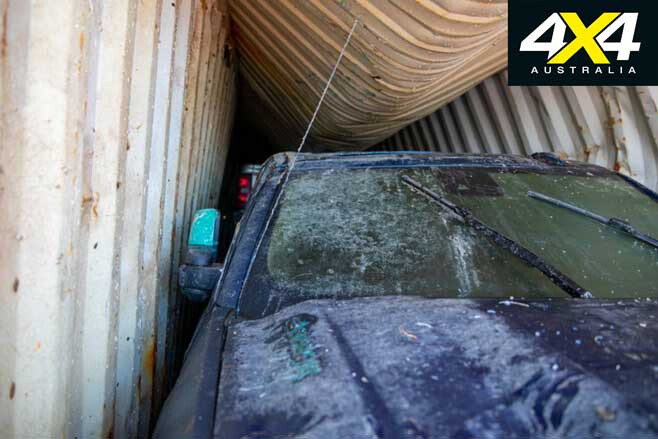
The shipping containers are currently being retrieved off the sea bed as part of a $15 million recovery and clean-up operation. Other containers retrieved to date have contained tyres, furniture and household items.
The 2018 Silverado pick-ups, each worth around $140,000 once converted and on sale, are total write-offs, having been filled with seawater during their adventures in the underwater garden.
Performax now has current model 2020 GMC heavy-duty and 1500 pick-ups already available, and Kevin says the related Silverados won’t be far behind.
“We were going to delay the Silverado, but our customers want it so we are full steam ahead.We also have the new RAM HD in customs.”
This comes on the back of news that HSV has ceased its steering conversions and sales of the heavy-duty Chevrolet Silverado 2500 model, as it is now focused on the half-tonne Silverado 1500 LTZ variant which officially went on sale this week. The only remaining HD Silverados from HSV are those already in dealers.
Queensland-based Performax International has 10 dealers around Australia selling a range of American pick-up trucks and performance vehicles.
WHETHER you’re a ‘fresh out the gate’ 4×4 beginner or an experienced overlander, when listing your modification wish list one of the initial items is usually the brightest auxiliary lighting you can bolt on.
Let’s face it the OEM lighting offered by vehicle manufacturers today is a little on the underwhelming side, given the speeds achievable by both 4x4s and our intrepid Australian fauna. Being able to cast your vision well ahead can mean the difference between getting to your after-dark destination, or wearing Sonny’s best mate deep into the grille.
ARB has more than 45 years of manufacturing 4×4-equipment experience under its belt, and after releasing the original Intensity LED light range, listened to customer feedback to develop lights with better design and operation. The ability to alter the output of the lights rated highly with customers, but why would you want to bring down the punch of your spotties?
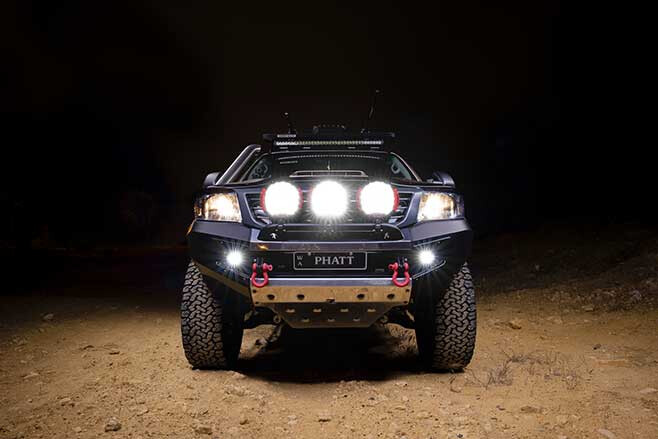
Well, some of that feedback ARB received was its lights were just too bright when encountering reflective road signs. The bounce-back in some cases blinding the driver, completely defeating the purpose of the spotties in the first place. Sure you could take the spotlights offline, but the real-time return of the driver’s night vision wouldn’t be ideal.
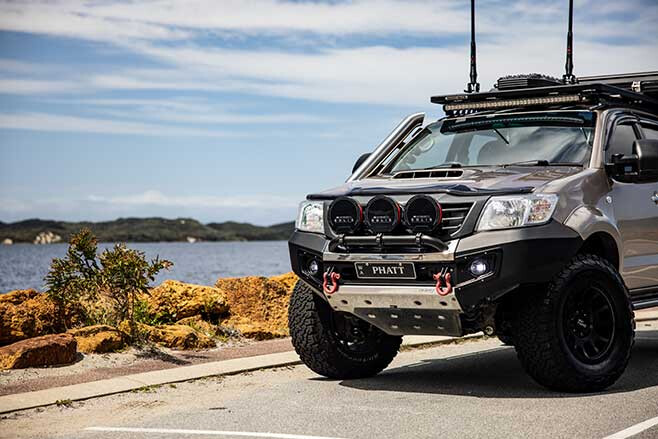
After using the lights for the last month, I’ve found the sweet spot of power for urban driving midships at level 3. Having the availability of even more lighting power up to the maximum of level 5 was fantastic once outside city limits. More to the point, using just two of the three Solis lights mounted across the front of the Hilux at this midpoint in power still made my original triplet of eBay LED spotties look very underfed.
SAME, BUT DIFFERENT
ARB offers the Solis in separate Flood and Spot variants, but you’d be flat-out picking the difference visually when mounted side-by-side. While the techs at ARB were designing the layout of the Solis they kept items like the main board electronics, LED positions, and the cast aluminium bodies identical between the two.
The only variation are the now one-piece reflectors. This kept manufacturing costs down, as most LED lights use identically shaped single cups for each LED which also reduces the usable space inside a traditional circular housing. ARB flipped the script and designed oddball shapes for the Solis cups, utilising more of the available housing area while cramming 36 LEDs into roughly the same area as the original 32 LED Intensity design.
ACCESSORISED: ARB-fettled 2020 D-MAX
The Solis pulls 165W of power using a combination of 30 x 4W and 6 x 10W German-made Osram LEDs. However the hexagonal layout of the more powerful 10W LEDs needed to be as close to the centre of the light as possible, with the smaller wattage LEDs positioned around them (and one inside the hexagon) to help feather the more pronounced 10W LED light edge.
The results being an 11° spread for the Flood using segmented/graduated cup faces, while the more focused 6° spread of the Spot is achieved via smooth surfaced cup faces. Given the Flood reflector refracts the given light the output drops slightly to 8333 lumens, while the Spot punches out to 9546 lumens.
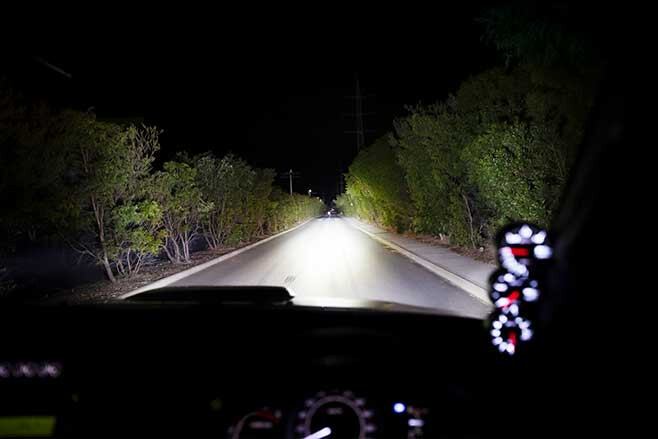
If lux figures matter more to you, however, then the Solis has got you covered there too. Using two Spots (obviously) ARB was able to record the standard 1-lux measurement at an impressive 1462m away from the lights. Using just the one Spot the Solis was still able to shoot 1-lux of light just over a kilometre away at 1032m. Changing to one Flood drops this figure to a still respectable 729m.
All fantastic numbers on paper and they give engineers valuable improvement percentages and buyers something to go on, but in the real world the quality of light is what’s going to prove most effective. The case in point being the ability of the reflectors to feather the light after projecting it well ahead of the driver. Get the tuning of this wrong and all the driver will focus on is a bouncing ball of focused light up ahead. Not ideal when you’re supposed to be looking out for turbo-charged marsupials or road hazards.
Designing the cups of the Solis reflectors into irregular shapes the ARB engineers were able to redirect some of the focused light giving the gradual fall-off needed to lessen the intensity of the central light. There’s still some intensity towards the centre of the beam, but the reduction of a hard edge decreases eye fatigue considerably.
GETTING THE WIRING RIGHT
WITH the ability of most wannabe auto electricians leaving their under-bonnet cabling resembling a Balinese power pole, it’s no wonder ARB went ahead and designed its own loom for the Solis. This was more a necessity though, as the loom also needed to handle the new dimming function.
A neat feature of the cabin-mounted dimmer being it doubles as the On/Off switch by pushing the ARB symbol, lighting the logo up in red when disabled and negating the need to wire in a separate dash-mounted power switch. ARB’s loom also includes all prewired fuse saddles and fuses, ring-terminated battery fittings, and Plug-and-Play intercept harnesses for H4 and HB3/HB4 headlight bulbs. If your 4×4 has negatively switched headlamps (like the Hilux) there’s detailed instructions on how to fit a switching relay to your Solis loom. You’ll have to grab your own switching relay though.
BUYER’S GUIDE: LED lights
The loom is rated to handle the amperage drawn by two spotlights, and is insulated inside heavy-duty conduit. The final link between loom and light is via a waterproof Deutsch-style connector for each light. It is not recommended splicing into the loom to run a third or fourth light, however. The reason being the Solis controller uses pulse-width modulation (PWM) to tell the electronics inside the spotlight bodies what level of brightness you’d like them at. The good news is ARB is working on a loom that will allow the use of the one dimmer to control more than two spotlights, but in the meantime you’ll have to use one dimmer plus loom for every two lights.
WHEN YOU’RE ON TO A GOOD THING
BEING at the front edge of your 4×4 it goes without saying that a set of strong lenses would give you peace-of-mind should anything fly up and hit them. ARB got it right the first time fitting rock-hard polycarbonate lenses to its original Intensity range and have stuck with that again for the Solis. Further doubling your protection, they come packaged with clear detachable polycarbonate covers too, but there’s a choice of complete blackout or amber should you wish to change up your look later.
LESS VIBRATION, ZERO INTERFERENCE
CHAMFERING the bottom of the circular lens shape allowed the engineers to bring the centre of gravity closer to the base of the light. They also placed the bulk of electronics and the heatsink closest to the base too. This naturally reduced the amount of leverage the supported light body has on the bracket, further reducing the vibration that can be seen in the projected light. ARB has also upgraded the brackets to high-pressure formed aluminium, with identical material used for the heatsink and lens ring accents.
An item often overlooked is electrical interference generated by high-power devices. Listening to the radio when using my previous eBay lanterns was never an option, unless I was in the mood for smooth beatless static. Changing over to the Solis lights with their quality circuitry has this static now happily at zero.
PRICE POINT
WITH so many lighting products on the market it’s a pretty hard ask to come up with something new and innovative, but ARB has done just that.
ARB lists both Solis variants at RRP: $349 each; with the necessary two-light loom coming in at RRP: $89. Protective cover alternatives in Amber or Black are at RRP: $16 each.
With features like dimmer control, clever physical design, incredible power and light quality, customisation, as well as the strong backup support of a longtime Australian company, 4×4 drivers have been given a potent choice.
More info at www.arb.com.au
THE track had turned into a badly eroded two-track as it crossed the gibber-strewn tableland country and the invisible line marking the Northern Territory-South Australian border, north-west of a lowly Mt Herne.
Somewhere to our east a lonely concrete obelisk on a flat pebble-covered claypan marks the border proper and is the most easterly border post along that line before coming to a distant Poeppel Corner on the far side of the Simpson Desert.
The Patrol thumped through a nasty washout that marked a runoff channel for a tributary of Coglin Creek. Just a few minutes later the road to Mt Dare Hotel was on our right and then the low scattered ruins of the once proud and important Charlotte Waters repeater station, close to the banks of Coglin Creek, appeared.
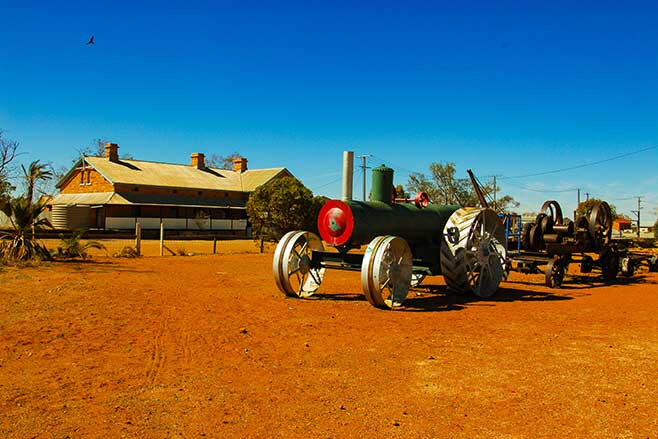
Established as a repeater station for the Darwin-Adelaide Overland Telegraph Line (OTL) in 1872, a store soon followed along with a police station. The OTL had basically followed the tracks of John McDouall Stuart, who blazed his way north from the settled districts of South Australia to the north coast of the Northern Territory during six incredible and tough expeditions between 1859 and 1861.
The Ghan had followed. In 1878 the first sod of the Great Northern Railway, which was to become ‘The Ghan’, was turned at Port Augusta with the railway routed through Pichi Richi Pass, Quorn, and onto Government Gums (today’s Farina), where the rails eventually arrived in 1882.
Two years later the steel ribbon had made its way to Marree, then known as Hergott Springs for the small permanent pool of water that today can still be found just out of town. By 1891 the railway, following the line of springs which fed the steam locos with much needed aqua, had reached Oodnadatta, which remained the railhead till 1926. In August 1929 the line was finally extended to Alice Springs and there it remained until 2001 when it was finally pushed through to Darwin.
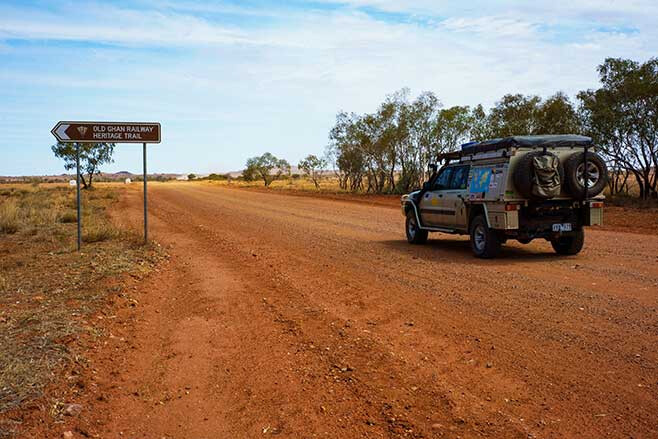
With the railway line through to Alice and with ongoing improvements to transmission technology, the Charlotte Waters station was abandoned in July 1930, although the police post remained until that was transferred to Finke in 1938. By 1950 most of the buildings had collapsed after the roofing iron and timbers had been scavenged to build Andado homestead and later, New Crown homestead.
We stopped and wandered around this lonely site which is pretty easy to miss given the thoroughness of those scavengers back in the 1940s, and if it wasn’t for a couple of info signs you’d be flat out making any sense of the scatterings of rubble, posts, old tanks and fence lines.
CROSSROADS OF AUSTRALIA
OUR trip, following the route of the Old Ghan Railway and the OTL, had started a few days earlier in Port Augusta, the self-professed ‘crossroads of Australia’, at the head of Spencer Gulf. We had wandered east through picturesque Pichi Richi Pass, before stopping at Quorn to savour a cold beer at one of the four hotels that had once serviced thirsty train travellers.
Cruising along the blacktop we crossed the flat Willochra Plain to stop at Hawker before wandering up what they now call ‘The Outback highway’ that skirts the western edge of the Flinders Ranges to tiny Parachilna and its famous ‘feral food’ hotel, the historic ghost town of Beltana and small, almost forgotten, Copley. It would be hard to travel this road and not make a detour into the nearby ranges to such delights as Wilpena, Brachina Gorge and Arkaroola but our sights, this trip, were set farther north so we pushed on.
After refuelling at the self-serve opposite the Lyndhurst pub we stopped in at delightful Farina for an overnight camp, tucked in close to the trees that had given this spot its original name, Government Gums. Next day we cruised effortlessly north to Marree (the road is now all blacktop) and checked out the railway precinct with its old diesel engines, the Birdsville mailman’s truck, the town’s original mud-wall mosque, the Lake Eyre Yacht Club (it has a great collection of photos), the nearby Hergott Springs, which was the original reason for Marree to be located where it is and the pub, which has got a great display on the area and particularly on Tom Kruse and his legendary status as the Birdsville mailman.
Bitumen gave way to a well-formed graded road as we headed west and then north along the Oodnadatta Track, nowadays a track in name only, although at times after rain the track does take on a semblance of a more minor road. For those wanting to explore the heritage of the Old Ghan there’s a lot to see and places to stop at along the way.
Coward Springs – once an important railway stop with a pub – and now with its pleasant campground and warm pool attracts many travellers to stay for the night and is an ideal spot to explore the surrounding Wabma Kadarbu Mound Springs Conservation Park. The two most visited spots in the park are the springs known as ‘The Bubbler’ and ‘Blanches Cup’, their flowing waters forming a small wetland which attracts a variety of waterbirds.
Farther north the Oodnadatta Track passes the quite extensive ruins of the Beresford railway siding and then Strangways, where to the west of the main road the old Overland Telegraph Line (OTL) repeater station can be found. These are well worth exploring and a series of walks from the carpark will take you through the old settlement, which includes not only the telegraph station but also a blacksmith and police station to a woolshed and wool-scouring plant as well as the local cemetery and a number of flowing springs. The telegraph station was closed in 1896 when its operation was taken over by a more modern facility at William Creek.
We stopped for a beer at the great pub at William Creek, which has been a watering hole ever since the railway came by. We were tempted to stay for more but decided to push on, passing through Warrina railway siding with its monument to the 1891 Elder Scientific Expedition before coming to the Neales River and the famous railway bridge across its normally shallow waters. Nearby, the Algebuckina Waterhole just east of the main road is a favoured camping spot, while those with a canoe will enjoy a delightful paddle on this permanent stretch of water.
PINK ROADHOUSE
OODNADATTA is the biggest town you’ll drive into between Marree and Alice Springs but don’t expect too much from this small community. For travellers the Pink Roadhouse supplies most requirements, while the pub and general store just up the road will quench one’s thirst and supply other essentials. The Railway Museum is worth a look and the old historic cemetery is just out of town.
Just a few kays north of the town you’ll come to the Angle Pole Memorial which commemorates the OTL and its sudden change of direction here, while just to the west the Angle Pole Waterhole in the Neales River can be found. A few kilometres farther on the real adventure of following the Ghan Line begins as the main road swings westward to Marla and the Stuart Highway while our route following The Ghan points northwards, the old railway line easement now off to our east.
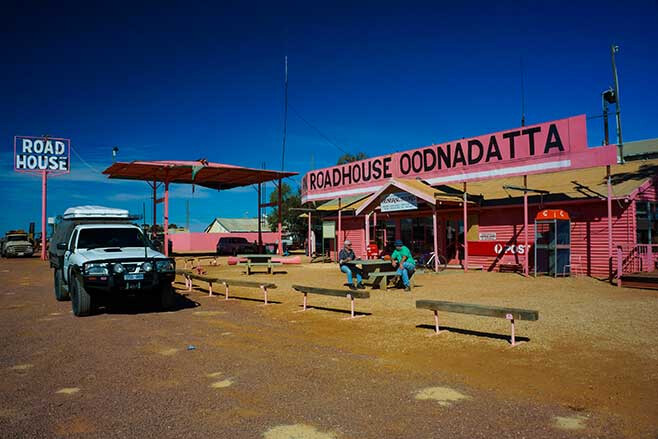
You cross Hamilton Creek near Hamilton Station – the camping area here is now closed – and come to a track junction where the more major one swings east to Pedirka railway siding and is the main route to Dalhousie Springs and a crossing of the Simpson Desert.
From this junction the route north deteriorates a little as it dodges between Mount Ross and Mount Hornet and crosses Stevenson Creek before coming to Lindsay Creek where Eringa Waterhole makes a shady spot to grab a bite to eat. On the south side of the creek are the ruins of the old homestead, the property once being owned by Sidney Kidman, the cattle king. Sadly, as part of Hamilton Station, camping is no longer allowed here.
You meet the old railway line at the ruins of Abminga where quite a bit of infrastructure can still be seen, although the roof of the fettlers’ hut was blown away a few years back by some strong winds. Crossing the railway line here, the track heads to Charlotte Waters and our meeting with these historic but sadly depleted ruins along with a better track north that leads to the Aboriginal community of Finke, now more correctly known by its Aboriginal name as, Aputula. The town, which can supply travellers with fuel and basic supplies is more well-known for being the halfway point of the annual, Finke Desert Race.
FINKE RIVER
ONCE across the sandy bed of the wide Finke River the route north sticks closely to the old Ghan railway easement and in places runs along directly on the top of it, the large corrugations from old railway sleepers making the travel unforgettable but, luckily for man and machine, relatively short lived.
The route wanders across some tableland country to Rumbalara siding where the low peak of Colson Pinnacle off to the east can be seen by observant travellers. Farther north again the more obvious ruins of Mundooma Siding are reached and here the more major track swings away from the railway line, first to Alice Well on the Hugh River, the track then paralleling the sandy bed of the stream to Maryvale homestead and the turnoff to Chambers Pillar.
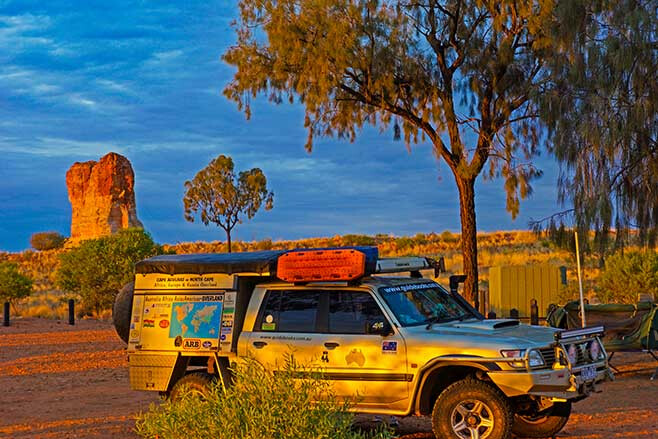
The track out to this impressive column of rock is often sandy but it’s well worth the detour and the small camping area close to the pillar is a beauty. We pulled in for the night and set up camp, enjoying the play of light on the nearby hills, buttes and rock outcrops, both at sunset and the following morning.
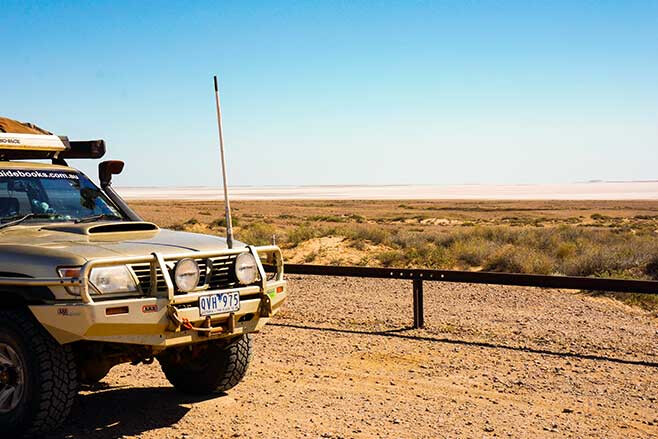
Back on the old railway line easement, north of Maryvale Homestead, the track improves and passes through the low hills of the James Range near Deep Well Tank. Making a beeline for Alice Springs, now not so far away, the route passes the western end of the Ooraminna Range, where Mount Ooraminna at 630 metres is the highest point for a long way around. Through here too, in the low sand-ridge country, the first of the desert oaks make an appearance along the track, their drooping needle-like leaves sighing in the slightest of breezes making any camp amongst them a delight.
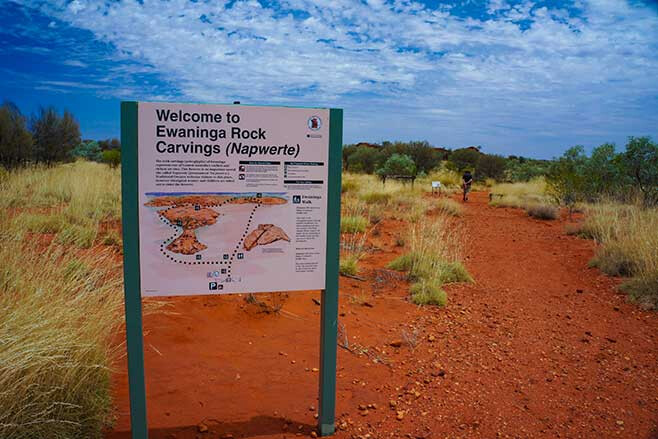
The small reserve of the Ewaninga or, ‘Napwerte’ rock engravings, surrounds a small claypan that holds water after rain and was once a favoured site for wandering bands of the Arrernte Aboriginal people. Here they would stop and camp, trap animals and carve symbols and motives into the rock surfaces. These petroglyphs are best viewed in the late afternoon or early morning and it is important (and against the law) to touch or deface these ancient engravings that would have to be many thousands of years old.
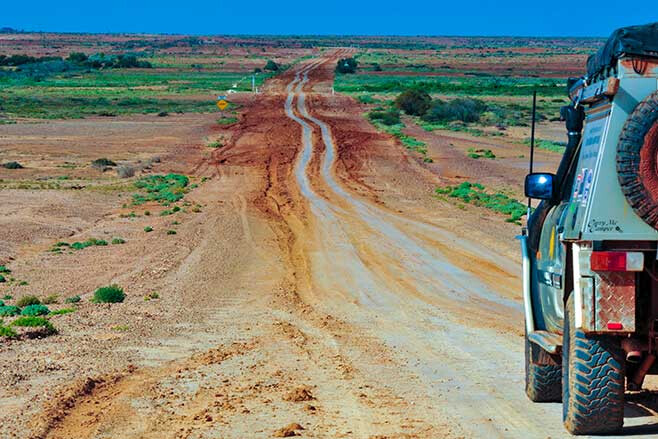
Just a short distance north, the old railway siding of Ewaninga is off to the west of the road and a short time later the track north crosses Roe Creek and comes to the bitumen, just 12km south of the centre of Alice Springs.
After you pass the ‘Welcome to Alice’ sign, which is a photo stop for many, and south of the impressive Heavitree Gap where the Todd River flows through a break in the MacDonnell Range, a road on the left leads to the national Transport Hall of Fame (well worth a visit), the Old Ghan Railway Museum and a nearby camping ground. The displays here at MacDonnell Siding include a 1930s-style railway station built from the plans originally intended for Stuart (the original name of Alice Springs) along with a number of old diesel locomotives, sleeping carriages and the like. It makes a fitting place to end your trip along the historic old Ghan railway which helped open up Central Australia.
NISSAN’S Y62 Patrol might have polarised the Patrol faithful when it replaced the venerable GU in Australia back in 2013, but it has steadily built up a strong following among four-wheel drivers as more and better equipment has become available to tweak the big wagon to our needs.
While many lament to the lack of a diesel engine and live axles, there’s no disputing the Y62’s VK56 petrol V8 engine is one of the best mills on the market and rewards the driver with awesome performance and a killer V8 howl.
When we asked long-time live-axle Patrol owner Anthony Barr what he loves most about his Y62 he said with a grin, “The noise and the power”, adding the ground clearance afforded by the independent suspension at each corner. Turn the sound up when viewing the video of the Patrol and you’ll understand what he’s smiling about.
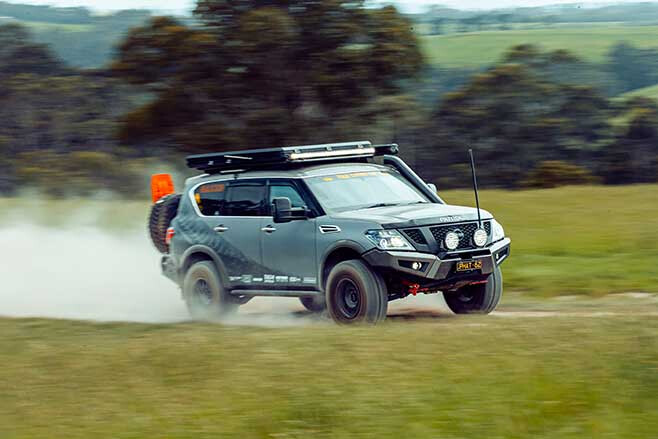
Anthony has had what he says are ‘countless’ GQ and GU Patrols over the years but has been sold on the Y62 from the time they came out. It was only more recently that he was in the position to get one.
“I was a trainee sales person for Nissan back in 2013 when the big boss owned one,” Anthony recalls. “He once told me to go do a fuel run in it and from that day I wanted one. Then once I found out how capable these things could be it was all I needed.
“When my dual-cab TD42 was written off I decided it was this (a Y62) or a 200 Series, but (with) my budget of around 50K I could only get into a stock GXL 200 with more than 200,000km on it and needing love.”
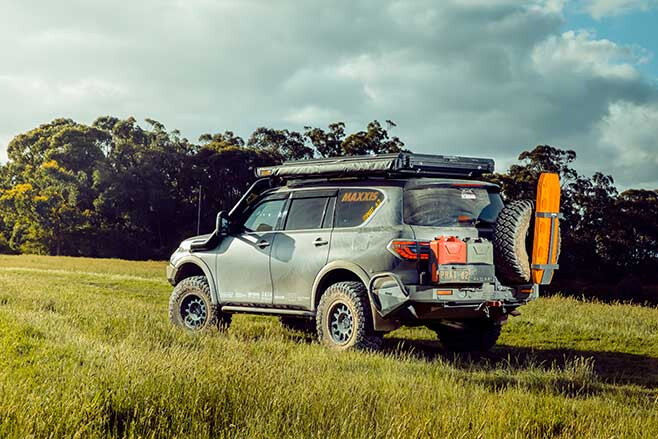
That budget meant a used car and it took Anthony a while to find the specific model he wanted. He was chasing an STL spec model without the Hydraulic Body Motion Control (HBMC) system so it would be easier to lift and modify. He finally found one of the original 2013 models and it didn’t take long for the build to begin. “It had some bar work and a lift, but all that has changed now,” he said of his latest Patrol.
“It’s built for tough touring. I can point it up any track, drive 1000km a day in comfort, and have a quick and simple camp set up and packed down within minutes.”
CUSTOM: Chopped Y62 dual-cab
Even though the Y62 has been available in Australia for seven years, and 10 years internationally, there are still relatively few shops who know how to build them right. Melbourne’s On Track 4×4 built its business on older Patrols but have become the go-to workshop for 62s in more recent times.
Some of the earliest upgrades to come from Ontrack for the Y62 included a suspension lift for the fully independent suspension and addressing the GVM limit. The On Track lift raises a Patrol 50mm, although Anthony’s Patrol goes a bit further utilising adjustable remote reservoir coil-overs from Radflo.
Increasing the GVM required more work and the capacity of the rear control arms was an issue. On Track designed and manufactures billet alloy replacement arms to increase the rating of the rear and, along with replacement front lower control arms, this ups the GVM from 3500kg to 4085kg. Of course Phat 62 has these fitted as well. Anthony does a lot of towing with the Patrol and the rear suspension is bolstered with a set of bags from Airbag Man for such occasions.
Further billet alloy porn under the Patrol comes in the form of an On Track diff-drop kit which lowers the front differential centre from the chassis to maintain axle and CV joint angles in lifted vehicles. The front diff is also fitted with a ARB Air Locker to work with the factory rear locker and the final drive ratios were dropped to 3.7:1 to compensate for the taller tyres and retain acceleration.
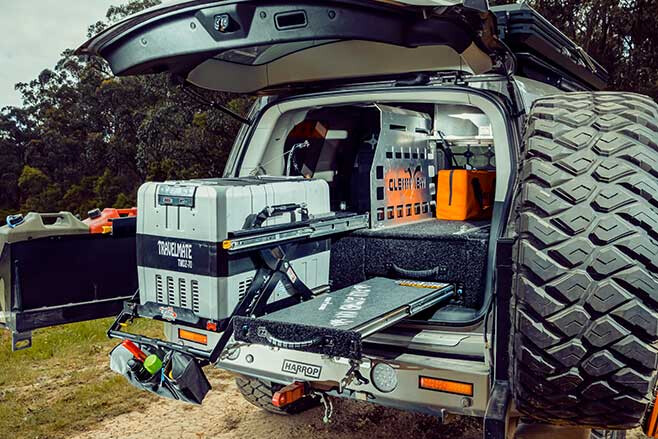
Being set up as a touring rig there is a lot of kit in Anthony’s Patrol so it needed that GVM upgrade. The cargo area is set up with a custom drawer system, Clearview drop-down fridge slide and cage, a pair of Kickass 120amp/h AGM batteries, a 1500W inverter, ARB dual-pump air compressor and a 12-volt travel oven. Battery management is handled with a Redarc BCDC unit and Victron Bluetooth monitor.
The Pioneer and Kicker amplifiers are also mounted on the back of the drawers and they drive six Kicker speakers and a subwoofer to boost the audio system.
CHARGED: Supercharged Y62
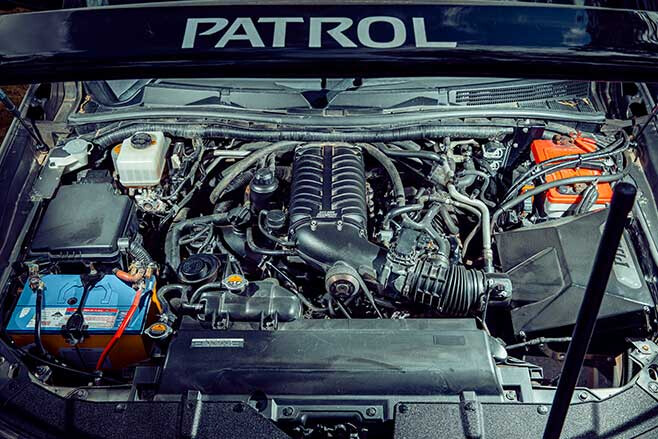
Speaking of boost, there’s more of that producing incredible sounds under the bonnet. A Harrop supercharger kit ups the ante of the V8. It’s deep breathing is aided by a 5-inch PDC snorkel and airbox on the intake side, with Pacemaker headers and Manta exhaust system getting rid of the combustion by-products. A custom tune was done by HPF to make the most of the hardware. Keeping fuel up to the blown V8 on long drives is a Long Range Automotive 140-litre second fuel tank which is in addition to the factory 140-litres carried by the Nissan.
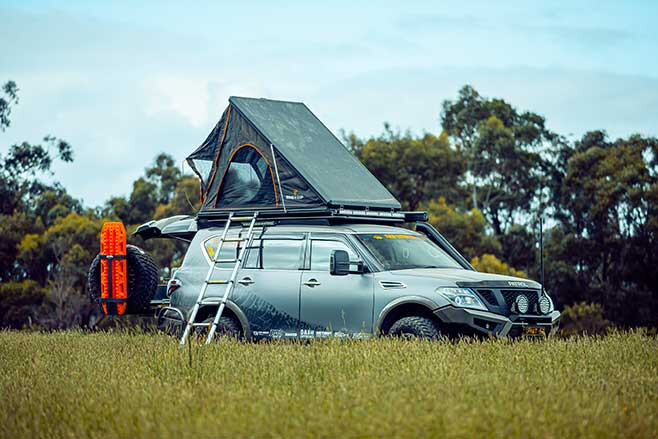
Another company to take on gear for and building Y62 Patrols is Dash Offroad, and you’ll see one of their Predator front bars on the front of this rig. The bar conceals a Runva 13XP winch and mounts a pair of Stedi lights. Additional lighting upgrades come with the custom headlamp replacements and the Baja Designs light bar up on the rack.
Also up top are a Motop roof tent and 23Zero awning; just the things for those quick set-up campsites.
Another smaller Melbourne company doing great things for 4x4s is Raslarr Engineering and it made the rock rails and rear bar for the Patrol. The rear bar has swing-outs for the spare wheel and jerrycan holder, plus this one has extra protection for the rear quarters afforded by the bars on the sides.
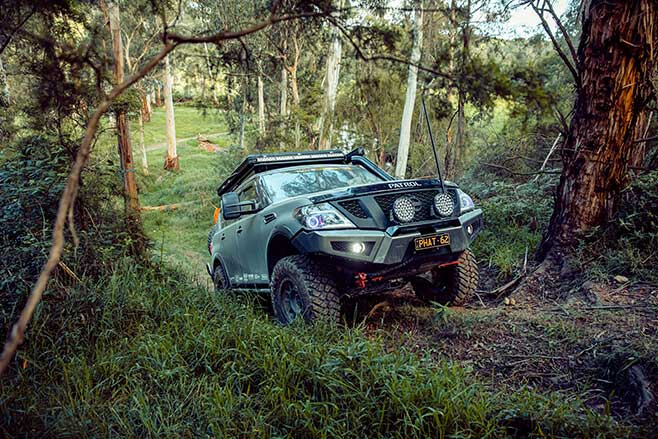
With improved engine performance, suspension, wheel tyres, equipment and protection, Anthony has created what could be his ultimate Patrol but he does miss the versatility of his old dual-cab GU.
“I’m pretty happy with it as it is,” he said, “but if I did damage the back of it I’d probably cut it and make it a dual-cab. But right now it’s pretty much done and in my eyes, that’s the ultimate touring vehicle.”
HEAR IT HOWL HERE
TO say the new Defender is ‘all new’ is an understatement. It’s not just new in every single nut and bolt but it comes from a completely different place in time and technology.
Where the old Defender, with its separate chassis and live axles was an evolution of 4×4 design practice from 80 years ago, the new Defender with its aerospace-inspired aluminium monocoque, fully independent and adaptable suspension, and complex and interwoven array of chassis and powertrain electronics is as advanced – if not more so – than any 4×4 on the planet.
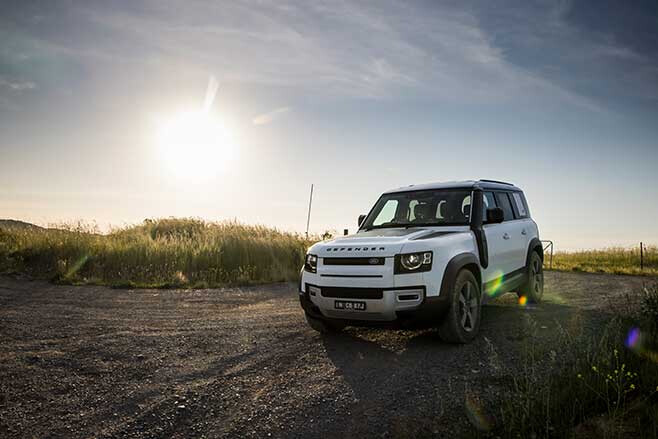
What we have here is a Defender 110 P400 SE, where the 110 refers to the four-door wagon, the P400 to the 3.0-litre straight-six petrol engine, and SE to one of many equipment levels.
Next year two different-tune straight-six diesel engines for the 110 are coming, as are short wheelbase two-door 90s with four- and six-cylinder petrol engines. Seemingly, after a short production run, the four-cylinder diesel 110s are no more.
POWERTRAIN AND PERFORMANCE
THE P400 is one of Land Rover’s new Ingenium three-, four- and six-cylinder ‘modular’ engines all based around common-design 500cc cylinders. The P400 is specifically a 3.0-litre petrol straight-six and comes with direct injection, variable valve timing and lift, and a twin-scroll turbocharger which at low engine speeds and loads is supplemented by an electric supercharger. The P400 also incorporates ‘Mild Hybrid’ (see sidebar) technology.
The straight-six design was adopted over a V6 due to its perfect dynamic balance (no need for a power-robbing rotating balance shaft), cheaper production costs (less parts) and simplified turbocharging (more convenient exhaust and intake port locations).
Land Rover claims a potent 294kW of power backed by 550Nm of torque delivered from a diesel-like 2000rpm all the way to 5000rpm. The engine is backed by a ZF eight-speed automatic, the only gearbox available.
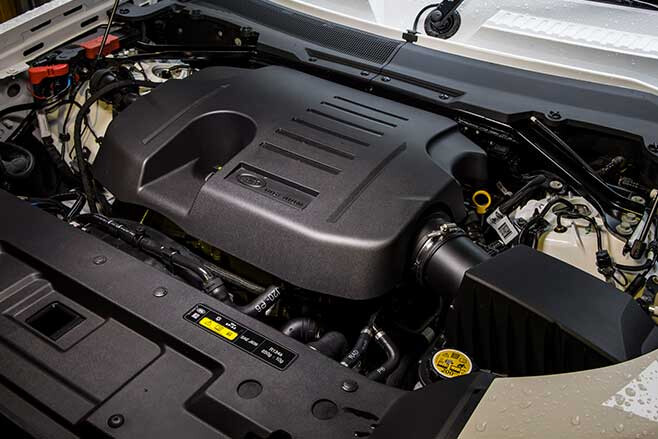
Driven with enthusiasm the P400 sounds and performs more like a performance car than a 4×4 and can charge to 100km/h from a standstill in a shade over six seconds, if you so wish. Driven more sedately the P400 is supremely effortless, flexible, smooth and quiet. And, as you would expect, the ZF eight-speed is smart and near seamless in operation.
As ever with a petrol 4×4, the elephant in the room is fuel consumption and while the P400 is thirsty (16 litres/100km plus) if you go deep into the throttle and enjoy the power and flexibility of this impressive engine, it can also be notably thrifty without resorting to driving at very slow speeds.
In our ten-day varied-driving test it averaged 13.5 litres/100km and got down to low 12s for easy highway cruising. Going on that the P400 isn’t going to give much, if anything, away to a LandCruiser 200 diesel on fuel use thanks to its significantly lower weight (down by 500kg) and its various fuel-saving technologies. Not so good is the relatively small 90-litre fuel tank – an all-too familiar complaint with Land Rovers – and the premium fuel requirement.
ON-ROAD RIDE AND HANDLING
WHILE the P400’s powertrain impresses with its performance, civility and efficiency, the new Defender chassis offers an equally impressive combination of on-road ride comfort combined with sharp, sporty handling. The comfort comes from the long-travel fully independent suspension and despite the relatively low-profile tyres, while the Defender’s well-calibrated electric power steering, relative light weight, and height adjustable air suspension that allows a road-hugging ride height, all contribute to the engaging and surprisingly sporty on-road dynamics.
Our test vehicle was fitted with 20-inch wheels carrying the optional off-road tyres (Goodyear Wrangler Duratracs 255/60s), whose relatively aggressive all-terrain pattern is a bit drummy on some road surfaces but otherwise doesn’t noticeably diminish the on-road driving experience in terms of grip or turn-in precision.
OFF ROAD
DEVELOPED as it is from the platform that underpins current Discovery, which in turn was developed from the current Range Rover and Range Rover Sport, the Defender couldn’t help but be seriously good off road. After all, it retains all the essential elements – long-travel height-adjustable air suspension and smart traction and driveline electronics – that make the Discovery and the two Range Rover models so good off road, but builds on them.
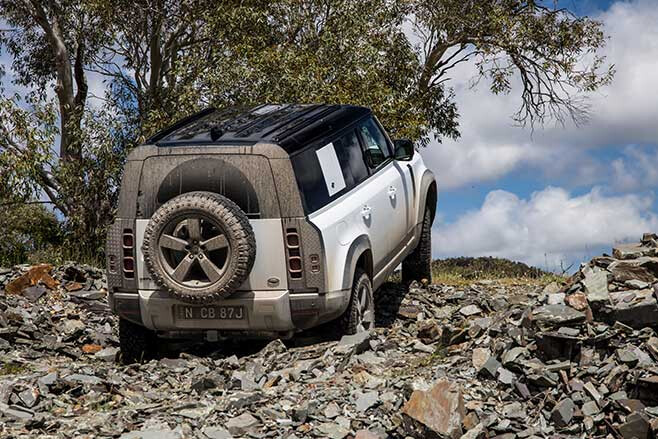
Most notably the body sits higher in relation to the chassis’s underpinnings, the wheels have been pushed farther to the corners of the chassis via a longer wheelbase for better approach and departure angles, the air suspension has a tad more lift, and for any given wheel size there’s now a taller tyre. And while the fully independent suspension’s layout is familiar, all new steel sub-frames, ball joints and bushes are designed for more durability.
OPINION: New Defender is an off-roader
Not so good is the less friendly touchscreen Terrain Response selector, and the fact that to enjoy the full off-road capability of the Defender you need to delve into the extra-cost options, some of which are only available as part of an options pack. The P400 also can’t be fitted with anything smaller than 19-inch wheels whereas the diesel 110s can take 18s. There also isn’t a fixed rear recovery hook except on the special ‘X’ model (the others get a screw-in item) while the front recovery point can only be accessed once you remove a plastic panel.
CABIN AND ACCOMMODATION
THE Defender’s cabin has a modern but utilitarian and practical feel with rubber floor coverings and plenty of stowage space around the dash and centre console. Plenty of space up front, excellent seat comfort, and good vision from the driver’s seat are also what you expect from Land Rover, although the touchscreen-driven driver interface isn’t easy to use without plenty of familiarity.
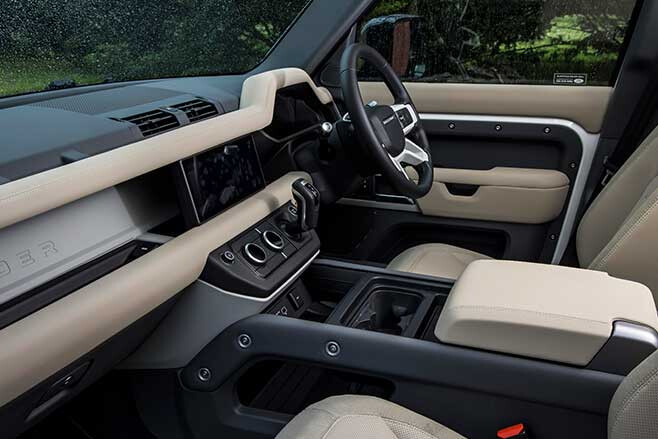
The spacious one-third/two-thirds split rear seat is wide enough for three adults and has air-con controls, multiple USB ports, two 12-volt outlets and a fold-down armrest complete with drinks holders. The seat bases also flip forward to allow the seats’ backs to fold nicely flat if you wish to extend the load area.
The load area itself isn’t huge but has solid tie-downs, rubberised floor covering, a cargo net, cargo blind, and a 230V/180W outlet as well as a 12-volt outlet. Our test vehicle was a five-seater although third-row seats are available as a ‘five-plus-two’ option, as are three-person front row seats in some 110s and all 90s. That’s a blast from the past!
PRACTICALITIES
AS you would expect from Land Rover, the Defender isn’t short of heavy load and tow capability, as evidenced no better than by its 6665kg Gross Combined Mass. That’s 665kg better than the best of the current dual-cab utes, which are purpose-built low and tow vehicles.

An integrated tow-hitch receiver (complete with wiring) comes as an integrated factory option, while an optional towing pack brings extras such as surround-view camera system, different side and rear mirrors, etc.
Off-road factory accessories run to a snorkel (as fitted to the test vehicle) and a front protection bar and winch. Where the local aftermarket will go with the Defender and what they will offer, if much at all, we are yet to see.
CONCLUSION
THE Defender P400 offers an extraordinarily wide spectrum of capability and is both dynamic on road and seriously capable off road. Very few owners will ever explore the P400s full potential in either environment, but if they do they are in for a treat.
LESSON: History of the Land Rover Defender
Weighing against the new Defender is price and, even if the Defender name implies ‘basic, simple Land Rover’, it’s anything but basic and simple. In this case the Defender name simply means ‘best off-road Land Rover’. In factory spec, it’s probably the best-ever off-road Land Rover.
The potent performance yet relative efficiency of this new-generation petrol engine is also worth noting, although the soon-to-arrive straight-six diesel may well still make it largely irrelevant.
MILD HYBRID?
LAND Rover calls the Defender P400 a ‘Mild Hybrid’, which means some hybrid-inspired tech without being a full hybrid. Like a hybrid it can capture and save energy for reuse later on, but unlike a typical hybrid the electrical side of the powertrain can’t power the vehicle by itself nor contribute a significant part of the available power at any time.
As with a hybrid, Land Rover’s Mild-Hybrid has an electric motor-generator, that is, something that can either serve both as an electric motor and an electric generator. In the Mild Hybrid this motor-generator is notably much smaller than it is in a conventional hybrid.
Primarily the Mild Hybrid’s motor-generator serves as the engine’s starter motor and gets plenty of use in this role given the engine’s automatic stop-start function. For what Land Rover calls ‘transient acceleration’, that is, getting the vehicle off the mark from a standstill, the electric motor can also feed some torque directly back into the engine’s crankshaft.
The generator function of this unit is activated when the vehicle is coasting or slowing under brakes. Using the vehicle’s kinetic (moving) energy, that would otherwise go to waste, it generates electrical power, which is stored in the 48-volt battery. And this ‘free’ electrical power is a good thing as the Defender needs lots of it, not only to power the automatic stop-start function, the electric power-steering and the vehicle’s vast array of ancillary functions, but also as an electric supercharger that provides off-idle intake boost pressure while the twin-scroll turbocharger is scrolling up.
EQUIPMENT
STANDARD equipment on the P400 SE starts with keyless entry and start, part-leather seats, rubber flooring, electric-steering column adjustment, auto lights and wipers, automatic highbeam, LED headlights/tail-lights and an assisted tailgate. A ten-inch touchscreen, sat-nav, the usual smartphone connectivity, a digital radio and a Meridian audio system are also standard. Safety features are headlined by automatic emergency braking, lane-keeping assist, rear traffic monitoring, 360-degree surround-view cameras and tyre pressuring monitoring.
Our test vehicle was also fitted with some $17K worth of extras including two different off-road option packs, one with a rear locker and the other with Terrain Response 2, All Terrain Progress Control and Configurable Terrain Response. Other factory options include heated front seats with memory, a sunroof, a tow-hitch receiver and adaptive cruise control. The snorkel and wheel-arch protection are local LR accessories. All up, price is $119K.
OLD VS NEW
IT’S the obvious question, but how does the ‘new’ Defender compare to ‘old’ Defender which ceased production in 2016 as the last of a long line of 4x4s that stretched all the way back to original Land Rover of 1948.To answer this old-verses-new question we were lucky to access a well-travelled – 260,000km – but very original 2012 Defender 110 courtesy of military and historical vehicle collector and Land Rover stalwart Warren Brown.
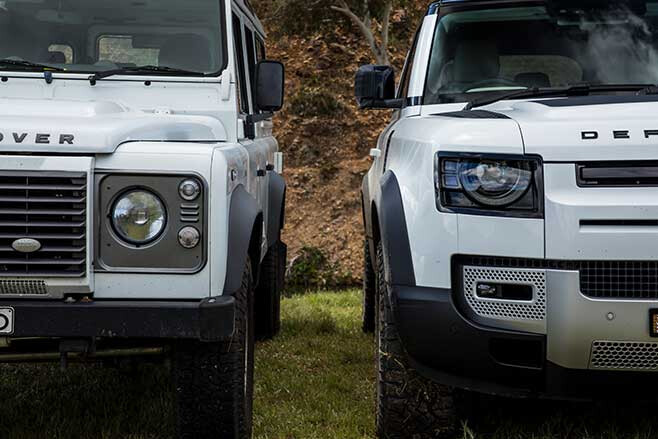
Specifically we wanted to see how the old and new Defenders compared off road and Warren’s 110 – his daily driver – was ideal given it’s not modified with a lift kit, diff locks, or larger wheels and tyres or any such, which would distort the comparison. Warren’s Defender is not just factory spec but it’s also mechanically the same as the last Defenders that rolled off the Solihull, UK, assembly some five years ago given 2012 saw the final Defender update with the then-new 2.2-litre diesel.
Jacked right up on its height-adjustable air suspension the new Defender matches the old Defender for clearance, and approach and departure angles, and is a tad better on departure. And it has the same relatively large overall tyre diameter (32-inch) as the old Defender although with far less – potentially troublesome – tyre sidewall, given the 20-inch wheels on our new Defender test vehicle and the 16s on the old Defender.
Most notably the new Defender performed better in terms of traction at maximum articulation, despite the old Defender’s theoretical advantage of live axles. A set-piece articulation test that stopped the old Defender, despite the best efforts of its electronic traction control, was cleared by the new Defender without fuss or hesitation.
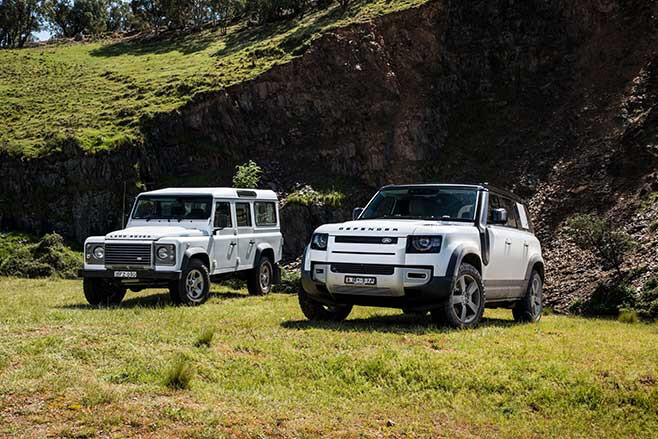
The reality is that the new Defender, despite its fully independent suspension has impressive wheel travel and, secondly, it comes with far more sophisticated chassis and driveline electronic controls. Our test vehicle came with the full suite of off-road electronic options.
All this doesn’t mean the new Defender would necessarily be a better vehicle to ‘compass line’ off into the unknown, as the old Defender and its forebears were so adept at doing, as issues of complexity and repair-ability weigh against it.
Adventurous travellers, four-wheelers and campers heading to the High Country mountains may find a bit more than they bargained for.
This ‘Hidden Valley of the Alps’ is one of the most iconic destinations in the High Country, but it seems the mysteries that surround this verdant glen date back more than 100 years. Back in 1917-18, the infamous ‘Wonnangatta Murders’ took place. The story goes something like this …
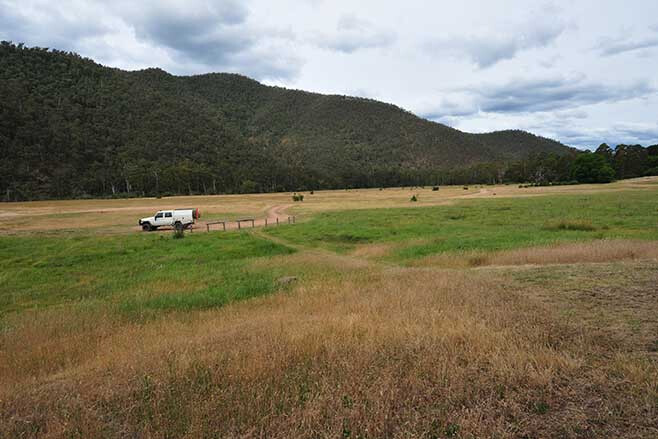
In December 1917, Wonnangatta Station manager James Barclay hired John Bamford as a cook and odd-job man. Barclay was warned about Bamford, a wiry man with a violent temper who’d been suspected of strangling his wife.
Eight days later, the two men rode off to Talbotville to vote on whether conscription should be made mandatory to help the war effort (it was defeated). This was the last place and time the two were seen alive.
Around January 22, Barclay’s best friend Harry Smith (whose hut can still be seen at Eaglevale) took his mail to him to find the door closed and a note on the door, stating, ‘home tonight’.
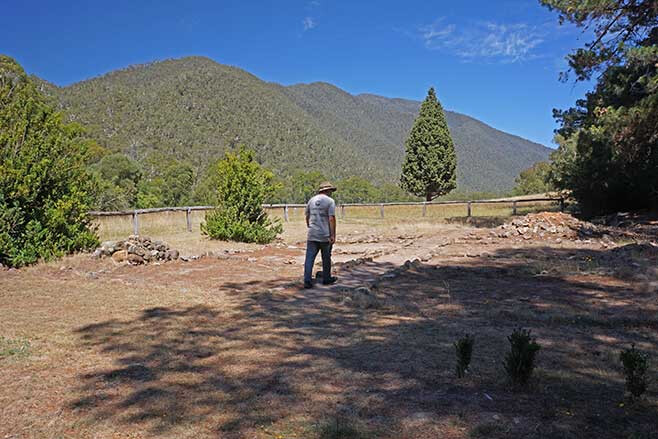
After a couple of nights camped there, Harry left, but after not hearing from his mate returned to the valley in the middle of February. The note was still on the door and Barclay’s dog was very hungry.
Returning with a couple of companions later that month, they stayed overnight and after a search they found Barclay’s body in Conglomerate Creek, badly decomposed and a severed head nearby.
Barclay had been shot in the back. The still-missing Bamford was suspected of the crime. A Melbourne detective was called in to investigate, but all he uncovered were unanswerable questions.
It wasn’t until the snows melted nine months later, in early November 1918, that Bamford’s body was found hidden under a pile of charred logs, 400m from Howitt Hut on the Howitt High Plains. He’d been shot with a single bullet to the head and is buried in an unmarked grave at Dargo. Neither murder has ever been solved.
Some say Bamford, in one of his angry moods, killed Barclay, and then a friend of Barclay’s killed Bamford. Harry Smith was a prime suspect of the latter murder, while others thought rustlers had killed them.Interestingly, Barclay had purchased a handgun just prior to his death and carried it loaded with him everywhere. So, maybe he was expecting trouble.
Maybe these latest disappearances will not be solved either. But perhaps a group of four-wheel drivers on a little used track will find something that will crack the cases wide open.
So as those Teddy Bears’ Picnic lyrics go: ‘If you go down in the woods today … you’re sure of a big surprise.’








ENSURE your phones, tablets, cameras and laptops remain charged on your end-of-season trip, with these clever solar charging solutions.
COMPANION SOLAR CHARGER
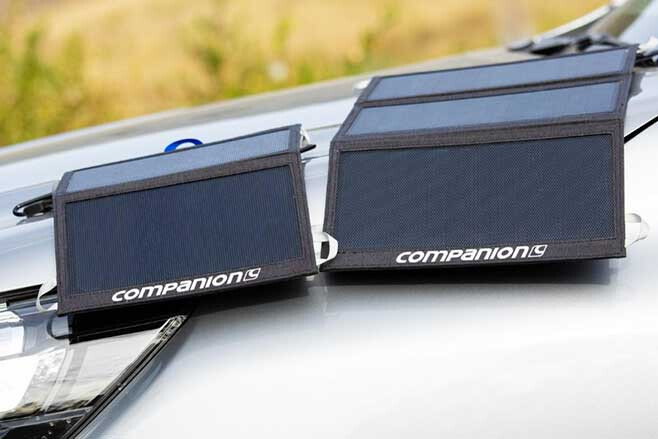
Keep your phones, tablets and other electric gadgets charged on your next 4×4 trip with a brand-new Companion Solar Charger. Available in 21W and 10W, the solar-charging mats come with hanging loops, inbuilt stands and mesh accessory pockets. Plus, they’re made with a weather-resistant ETFE lamination. The 10W unit weighs 400g and features a max amp output of 2amp/h and 5.5V max voltage. The 20W unit weighs 650g and features a max USB output of 2.9amp/h and a max power of 6.6V. The solar chargers are available now. Website: www.companionleisure.com.au
PROJECTA PERSONAL FOLDING SOLAR PANEL
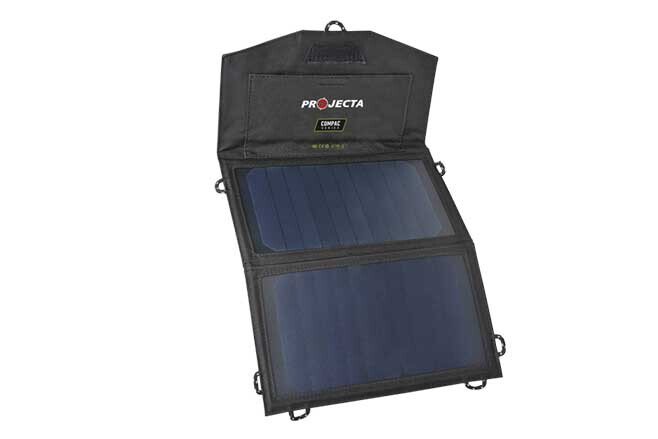
Projecta’s 10W Personal Folding Solar Panel with Solar Charger is a convenient way to keep phones, cameras, drones and smart watches charged on your next 4WD adventure. The Projecta COMPAC Series Solar Panels are portable, monocrystalline folding solar panels armed with a 3-in-1 charging cable; while the power banks take between 6 to 8 hours to fully charge. The compact unit is durable and heat-resistant; has short-circuit and surge protection; and can be neatly folded for easy storage. Website: www.projecta.com.au
Talk about having your cake and eating it, too, with the latest release from EarthCruiser: its Extreme XTR250 camper.
Designed to sit on the venerable Toyota 79 Series platform, the Extreme XTR250 can be constructed to suit your choice of a single- or dual-cab LandCruiser, making it as versatile as a Swiss Army knife.
The beauty of this setup is there is no need to tow, nor do you need a massive full-size vehicle to fit a decent-size camper. What this translates to in the real world is that you can take this mobile house-on-wheels anywhere a normal LandCruiser can go, including inside a shipping container if you feel like touring internationally.
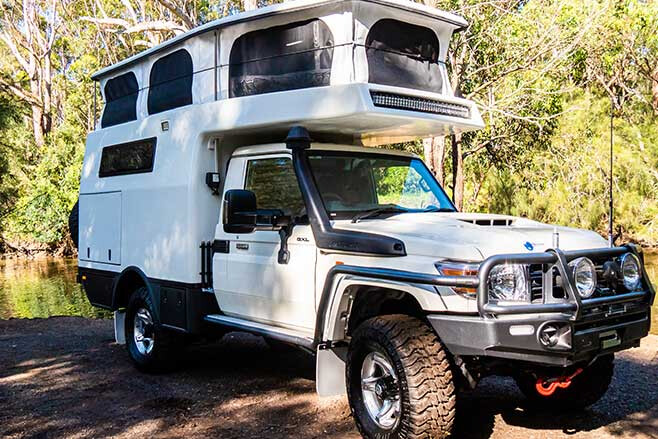
As you can see from the images, the camper interior looks more like a luxury apartment than an off-roader. It’s not just all about the looks, though, with a long-distance touring-friendly option to carry 250L of both water and diesel on-board.
You also get 33-inch tyres, a JMACX track width-corrected rear axle housing and Bilstein suspension. Solid off-road credentials indeed.
Inside you can find a double bed, a single bed, fridge/freezer combo and diesel heating for chilly nights in the Victorian High Country. Yes, you get everything including the kitchen sink basically, even a two-burner induction cook-top.
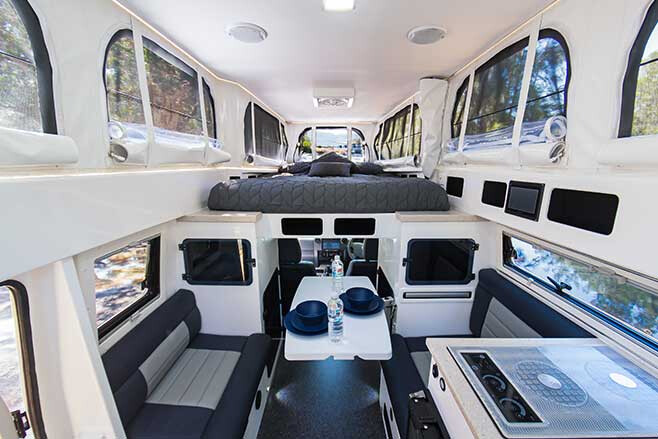
An array of quality 12-volt goodness can be found in the EarthCruiser, namely 450Ah of lithium battery power, a 3000w inverter and 270w of solar power (an additional 270w can be optioned up).
If you do manage to find the limits of the EarthCruiser Extreme when off-road, 13,000lb Runva winches can be installed front and rear, but this is an optional extra. We’d tick that box, though, just saying!
So, the big question: how much does it all weigh? Well, the Extreme Series from EarthCruiser has a GVM of 4500kg, and a Tare ranging from 3300kg to 3800kg (depending on configuration), meaning you still have a solid load-carrying ability with this setup.
If you are keen on a new EarthCruiser Extreme XTR250 you better get in quick, as there is already a six-month minimum lead time on construction.
For more information, visit www.earthcruiser.net.au
BEFORE YOU watch the above video of this wicked Y62 Patrol, do yourself a favour and turn the volume up.
Listening to the howl of the VK56 petrol V8 – aided by a custom tune and a Harrop supercharger kit – will make you smile just like its owner does every time he’s behind the tiller.
Said Patrol you’re currently ogling is an STL-spec model sans the Hydraulic Body Motion Control (HBMC) system, chosen so that it would be easier for the rig’s owner Anthony to lift and modify.
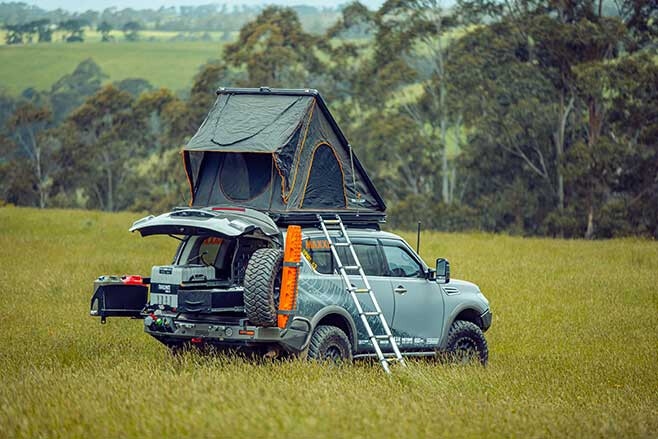
Much of the custom work found on the Patrol was carried out by the team at On Track 4×4 in Melbourne, and this includes a suspension lift utilising adjustable remote reservoir coil-overs from Radflo; a GVM increase from 3500kg to 4085kg, a set of Airbag Man bags in the rear; a diff-drop kit; and an ARB air locker in the front diff.
Among a long list of aftermarket goodies, highlights include a 5-inch PDC snorkel and airbox; Pacemaker headers; a Manta exhaust system; a Long Range Automotive 140-litre secondary fuel tank; a Predator front bar housing a Runva 13XP winch and a pair of Stedi lights; a Motop roof tent and 23Zero awning; and Raslarr rock rails and rear bar.
To read the comprehensive write-up of this inspiring build, you’ll need to pick up a copy of the Summer 2021 issue of 4X4 Australia magazine, which is in stores now!
EV start-up Bollinger Motors released updated concept images of its B1 and B2 all-electric vehicles earlier this week.
The production-intent renderings of the two trucks show comprehensive tweaks to substantially improve the design and performance of the upcoming vehicles, despite retaining the same boxy body style.
“These renders represent thousands of engineering hours, several innovations and patents and most importantly, immense amount of passion and care,” Bollinger Motors said in a statement on its official Facebook page.
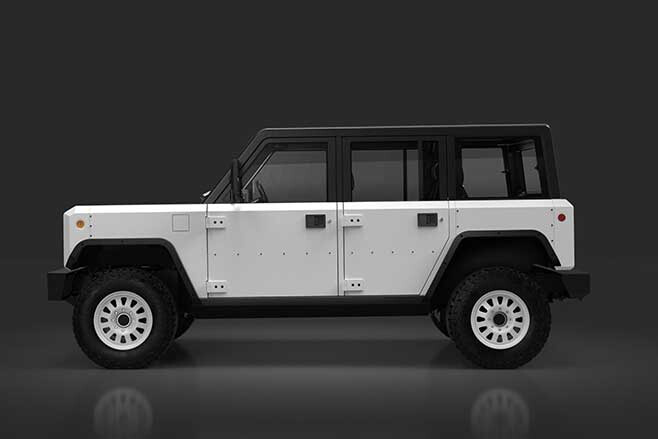
“We use images like these to evaluate the surface data, confirming that all of the intricate and subtle design details work together in a cohesive package,” it said.
One of the most considerable changes was raising the “beltline” of the truck, which is said to create more packaging space in the “frunk” as well as raise head clearance. Bollinger Motors added that “by keeping a majority of visual weight below the beltline, it creates a more stable and sturdy appearance.”
These design changes were possible due to a breakthrough by Bollinger’s boffins, who were able to reduce the overall radiator size and utilise one slim cooling unit – therefore the dual top-mounted radiators were no longer required.
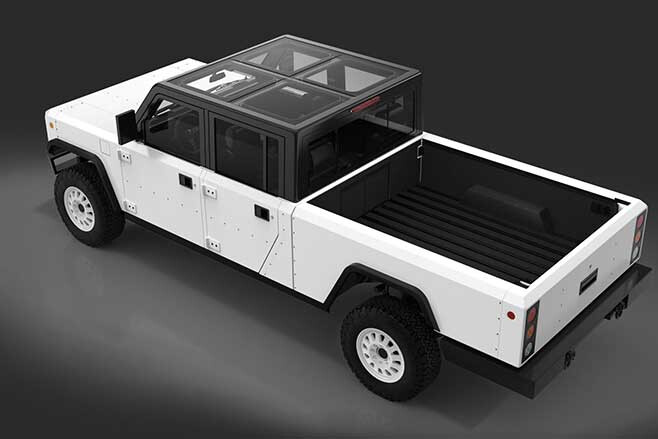
A number of other changes were made to both the B1 wagon and B2 pick-up, including moving the B-pillar forward, adding manual crank windows, and increasing the size of the windshield, side glass and rear glass.
For the B2 pick-up specifically, the bed is now independent of the cabin, “making commercial chassis cab applications, repair or replacement easier”.
The production-spec B1 and B2 will share the same dual electric motor set-up – totalling 458kW and 906Nm – which will run through a two-speed Hi/Lo gearbox.
The all-electric vehicles were stamped suggested retail price of US$125,000 (around AU$180,000) late in 2019.