Snapshots
- V6 and I4 diesel engines backed by 10-speed auto
- More interior space
- Q4 release expected
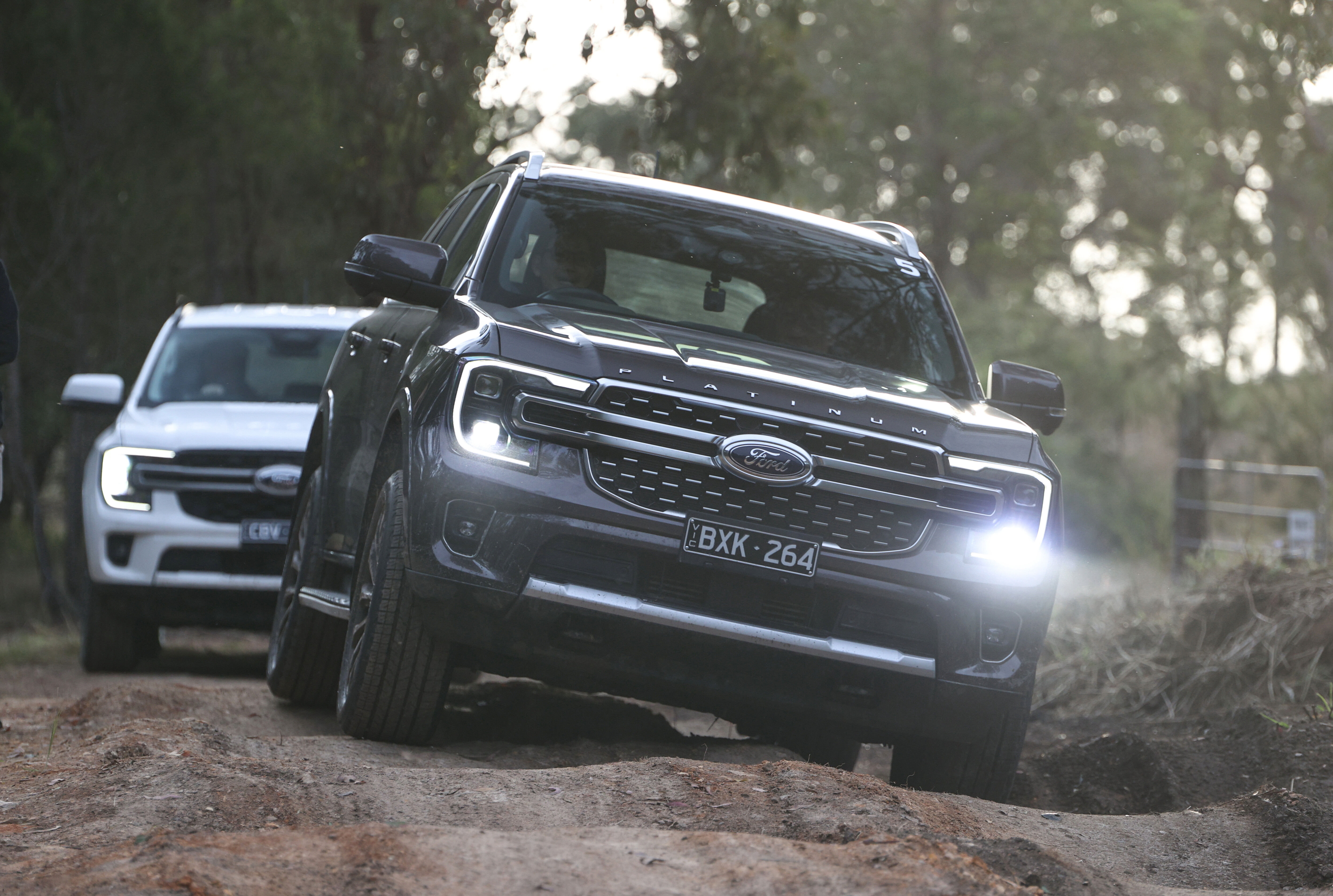
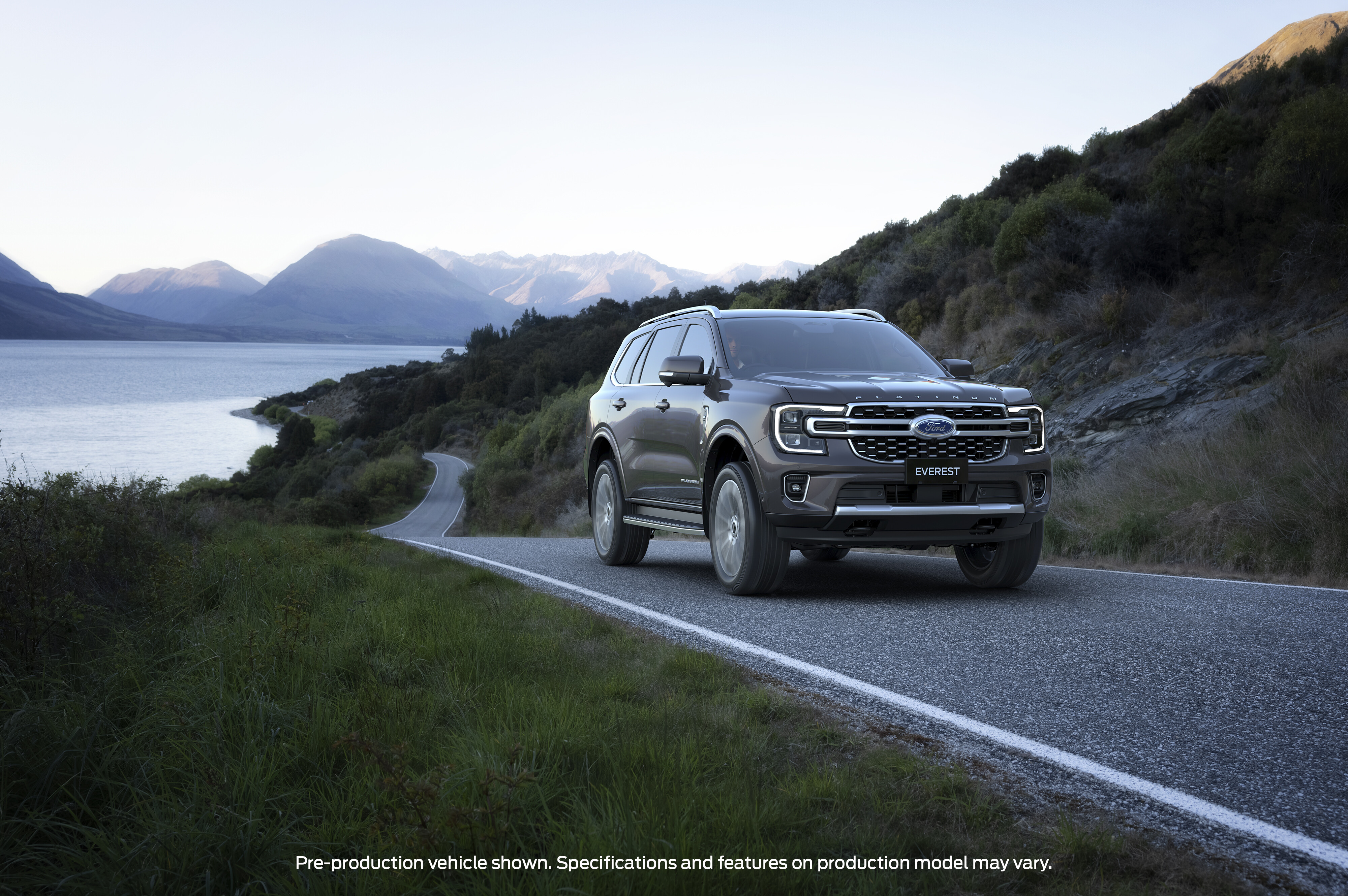
Ford has continued its rollout of new 4×4 vehicles that will go on sale in the second half of 2022, with the first look at the new 2023 Everest wagon.
This comes after recently showing us the Ranger and Ranger Raptor utes, both of which are based on the same T6 platform as the new Everest.Ford is calling this latest version of the T6 body-on-chassis platform Next-Gen T6 and, as was the case with the previous two iterations of the chassis, most of the engineering, design and testing for it was done here in Australia by the local team.
UPDATE, September 13, 2022: New Ford Everest on sale, and we’ve driven it!
The new-generation 2023 Ford Everest is finally on sale in Australia, and our man Matt Raudonikis has driven it. Get the full story, and our first-drive video, at the link below.
The story to here
As in the past, the Everest rides on its own version of the platform with a shorter wheelbase than the Ranger ute and a disc-brake-equipped and coil-sprung rear suspension instead of the leaf springs and drum brakes under the Ranger ute. These changes between the ute and wagon are designed to create a better riding and performing chassis for the Everest over the load-lugging Ranger ute.
Like the next-gen Ranger and Ranger Raptor, the Everest’s chassis is all-new using hydroformed rails, to allow the complex designs needed to accommodate the new engines. The wheel track has been widened by 50 millimetres to improve the ride, off-road performance and the look of the car.
Also in line with the Ranger chassis, the wheelbase has been lengthened by 50mm – this in-between the firewall and front axle line, again to accommodate the new engines and their related cooling systems.
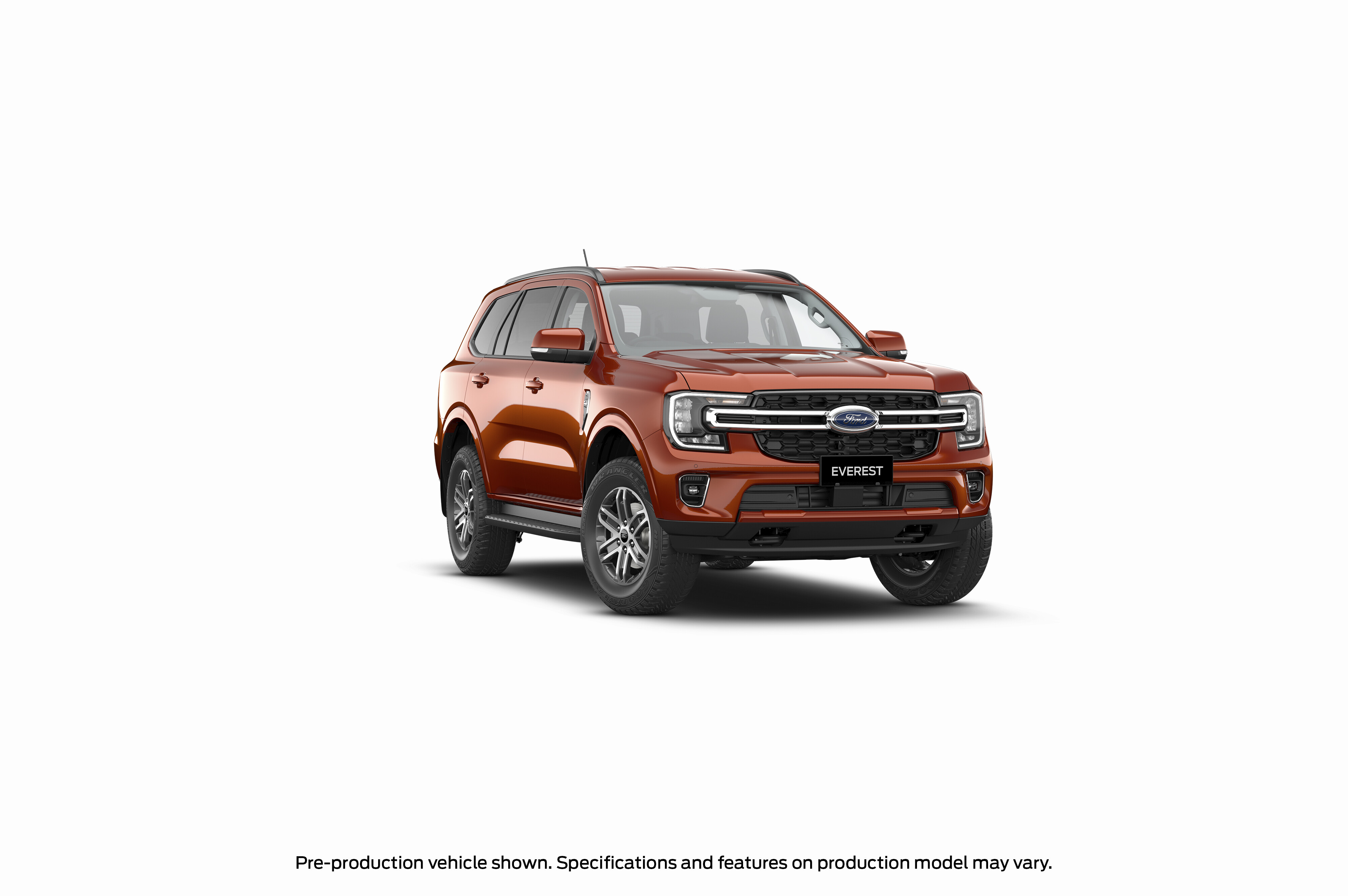
The Everest will lose its familiar five-cylinder, 3.2-litre diesel engine but return the four-cylinder 2.0L bi-turbo diesel that is also in the current model. The big news engine-wise is the inclusion on the 3.0L V6 diesel engine also coming from the Ranger. While no figures have yet been given for the power and torque outputs of the new V6, its most recent application was in the Ford F-150 pick-up where it made close to 600Nm and 185kW.
Those power and torque figures, plus the towing rating that has grown from 3200 to 3500 kilograms, should put the wind up Toyota, as the V6 outguns the top-selling Prado. Plus, with its bigger cabin size (over current generation) it could be an alternative for buyers unable to get in to a LandCruiser due to the massive product shortages Toyota is suffering at the moment.Ford has not given us any payload or Gross Combined Mass figures for the new Everest yet, but we expect them to exceed the current model. The towing experience has been made easier with an electric brake controller built in to the car and a trailer light check function that runs the lights through their paces – you can step back and see if they are working as they should.
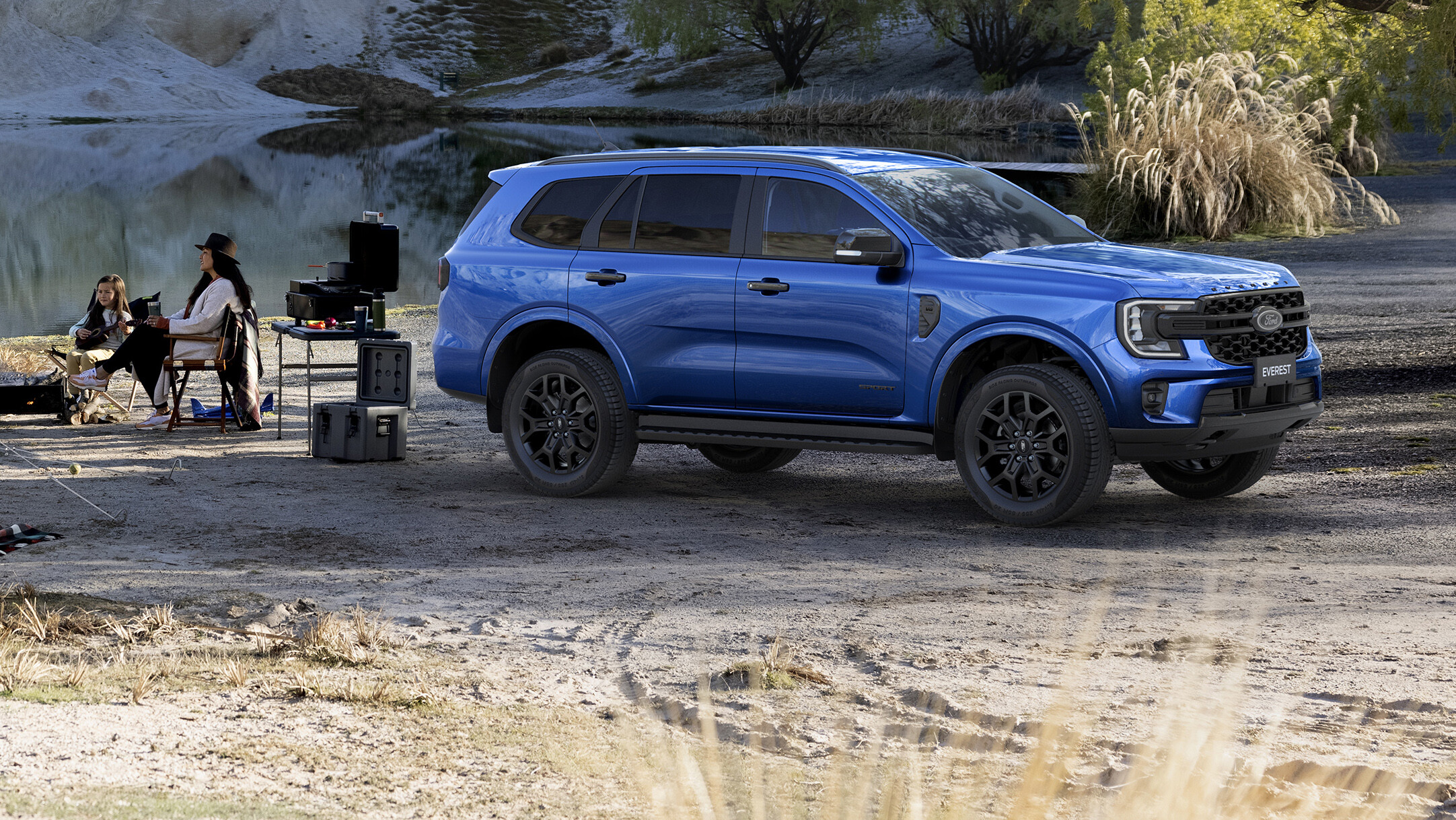
Helping to give the Everest its higher towing capacity is the bigger and more efficient cooling system that is possible thanks to the new front-end design and the extra space afforded by the longer nose. The front and rear axle have also been upgraded to heavier duty units to cope with heavier loads. V6 and I4 diesel Everests will only be offered with the 10-speed automatic transmission in Australia.Even the roof of the new Everest has been engineered to carry heavier loads and is now rated to hold a 100 kilogram dynamic load or up to 350kg static. That’s enough to carry most rooftop tents and their occupants in camp. There are two newly designed roof bars with integrated rails on most grades, and free-standing ones on the top-spec Platinum variant.
Bigger inside
As mentioned, the wider wheel track and longer wheelbase have allowed the design and engineering teams to fit a larger, more-accommodating body to the Everest.
Without releasing actual figures, Ford tells us that there’s more shoulder room in the second and third rows of seats and more leg room in all three rows. The action of the third-row seats has been re-engineered to make entry and exit easier for the rearmost passengers; and the cargo space is said to be bigger, both with the third row folded or in use.
The second and third rows now fold flat in to the floor of the vehicle, while the tailgate has a larger opening in order to swallow bigger goods. Plus, the tailgate lifts higher for head clearance at the back of the car.
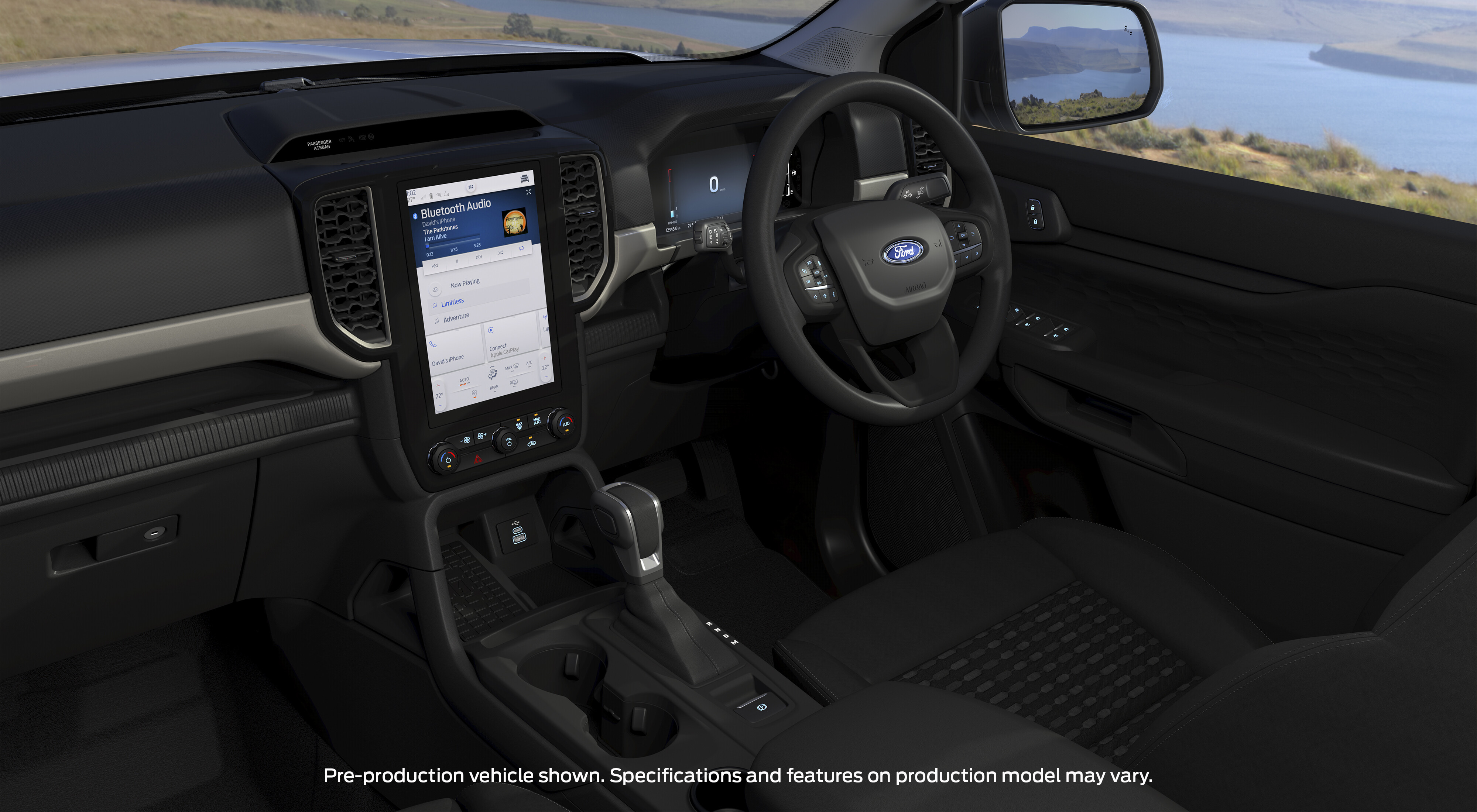
The Everest’s interior has a more premium feel, with most of its features carried over from the new Ranger. These include a 10- or 12.4-inch centre-stack screen (depending on model spec) for most of the controls and AV duties, plus a huge configurable gauge binnacle. While many of the vehicle controls have moved into menus in the screen, there are still large tactile dials for the most commonly used controls like audio volume and climate control temperature – finally a vehicle manufacturer that is listening!
There are also plenty of power and USB outlets throughout the cabin to accommodate passengers in all three rows. An electronic gear shifter and park brake allow for more space in the centre console, while the dial to select 4×4 functions and modes is large and easily falls to the driver’s hand.
Adventure-ready
The Everest gets a new 4×4 system that offers full-time four-wheel drive for most driving conditions; locked 4×4 high range and locked 4×4 low range for off-road driving.
The multi-terrain selector puts seven drive modes at the driver’s fingertips – three modes for on road and towing, and four designed to optimise the electronics for various off-road conditions. The Everest also has a driver lockable rear differential lock and, as in the past, the Ford retains ETC across the front axle when the rear locker is engaged.
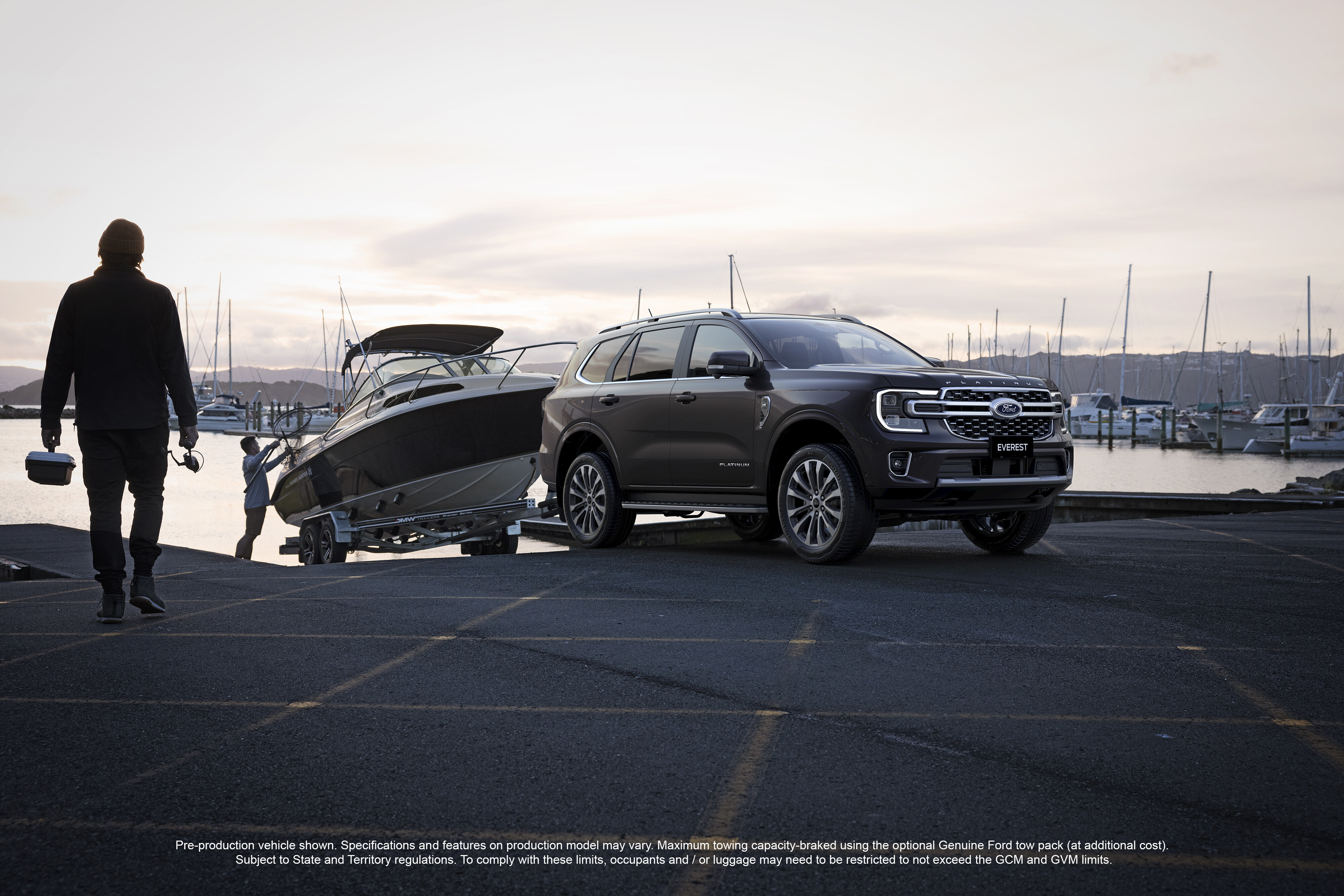
The next-gen T6’s wider wheel track has allowed the engineers to get more travel out of the axles at both ends, to keep the tyres in contact with the ground.Ford’s partnership with ARB 4×4 Accessories will not only offer a range of common accessory items such as bullbars, side-steps, suspension, roof racks and lighting for the new Everest and Ranger, but also more specific items suitable for the adventurous owner.
The engine bays of all the next-gen T6 vehicles, bar the Raptor, have been designed to accommodate a second battery and the kit to fit it will come from ARB. When asked about fuel capacity, Ford said it is working with ARB on offering auxiliary tanks, so again it seems Ford is listening to what owners want.
Model line-up
When the new Everest lobs in the second half of 2022 it is expected to arrive with a four-model line-up similar to what’s on offer now. These would include the Ambiente and Trend Sport; while the top-of-the-range model becomes the Platinum in lieu of Titanium.Platinum is designed to take Everest in to new ground in terms of buyers and specification level. To be powered only by the V6 engine and four-wheel drive, the model gets a premium dash and quilted-look heated and cooled leather seats, park assist 2.0, extra chrome inside and out, a bespoke grille and Platinum badging, plus exclusive 21-inch alloy wheels.
Thankfully, the Platinum will also be available with 18-inch alloys for those who want something more off-roadable. The exclusive features give the Platinum a more upmarket look and feel than anything we’ve seen in an Everest before.While the full model by model specifications and any pricing are yet to be announced, we do expect the prices to go up from what they are now to be more in-line with Toyota Prado, especially for the V6-powered Everests. The next-gen model will give Ford a wagon to take the popular Prado head on and exceed it in performance and refinement thanks to its new engine.We expect the new Everests in the final quarter of 2022, following the arrival of Ranger in June or July, and the Ranger Raptor shortly after that. It all adds up to a busy end to the year for Ford as it works to retain its title of having the best-selling 4×4 model in Australia.
Jeep has teased the first two concept cars it plans on displaying at the annual Easter Jeep Safari in April.
Held each year in US city Moab – a tourist gateway to red rock canyons favoured by off-road drivers – the festival will display “several” Jeep concepts, with some expected to preview future production models.
The US carmaker has announced it will be showing off a 4xe electrified SUV, based on the latest generation of the Grand Cherokee Trailhawk, with the image suggesting the concept will feature wheel arches and a more aggressive bodykit.
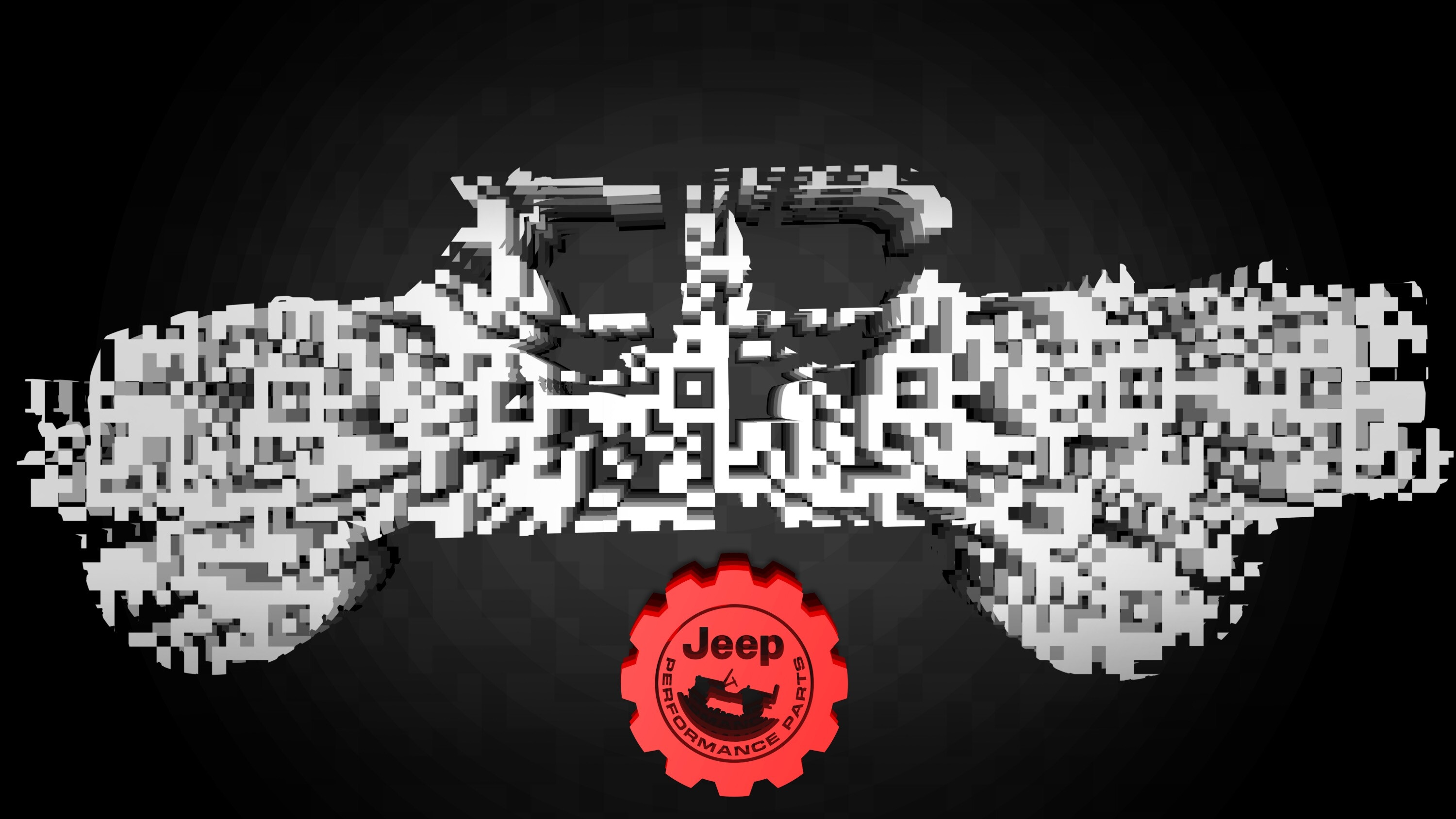
The company says the 4xe concept will “certainly conquer even the most tumultuous terrain along the back-country trails of Moab and further highlight the Jeep brand’s vision of accomplishing Zero Emission Freedom”.
Jeep Performance Parts will also display what is expected to be a modified Gladiator, though the brand has yet to offer details on this concept.
The 56th annual Easter Jeep Safari will take place in Moab, Utah, between April 9 and 17, 2022.
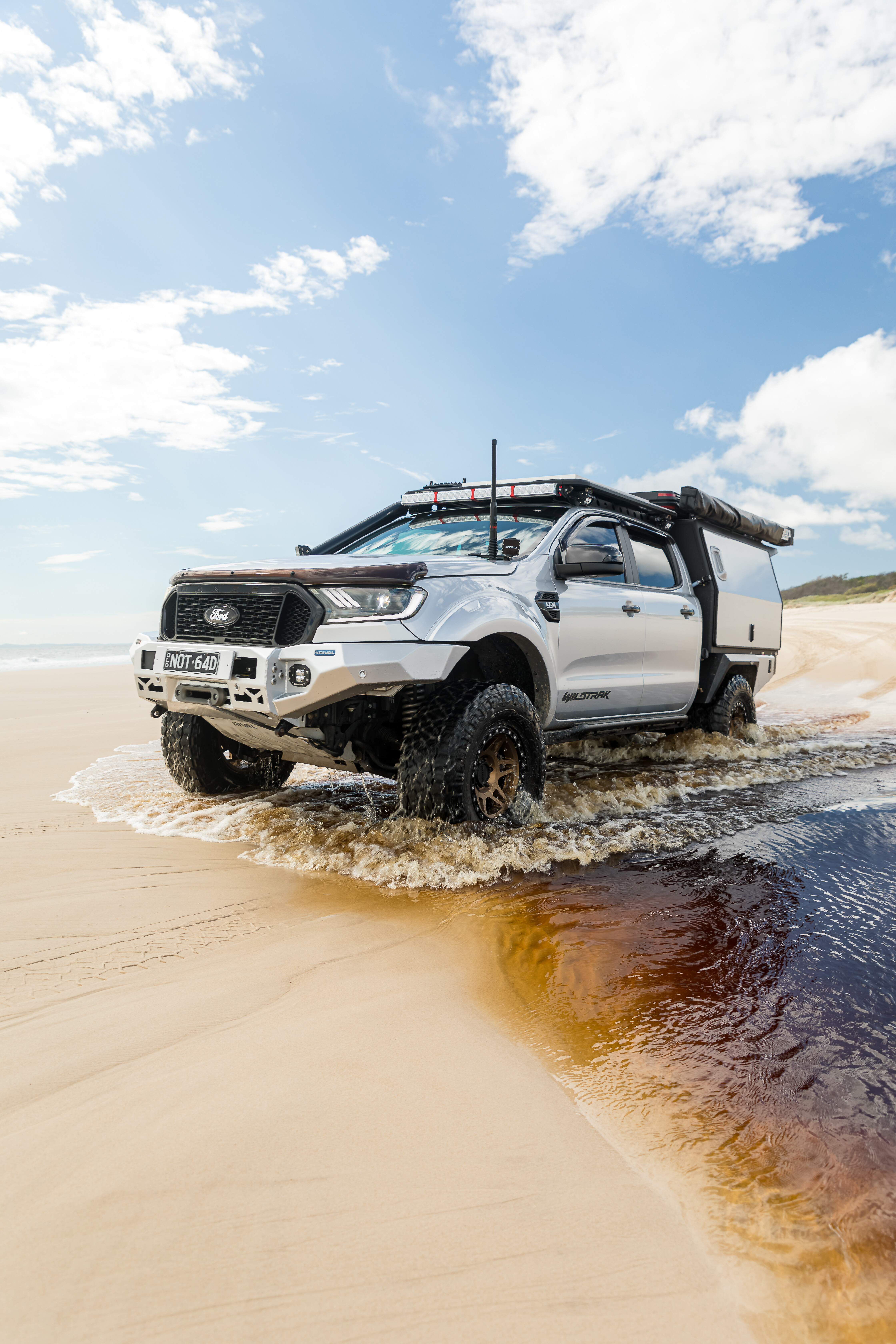
Look at the postcards and you’d be forgiven for thinking Australia is nothing but endless red dirt. The occasional beach here and there, and about a million blokes wearing khaki shorts and carrying knives the size of some European countries.But spend enough time zigzagging the dirt roads across this wide land and it becomes obvious just how diverse our geography really is. The endless plains of South Australia are a world apart from the snow-capped mountains of Tasmania. The ice-cold river crossings snaking their way through the Victorian High Country bear little resemblance to the sheer cliff faces of Western Australia’s Steep Point. And the rugged sandstone country surrounding Sydney couldn’t be farther from Queensland’s sand islands if it tried.It’s fitting then that each state builds their 4x4s completely differently. It’s why just one look at Jimmy’s Ranger and it’s all too obvious it’s built for the endless summer beaches only Queensland can supply.
Engine mods
So what’s the first thing a Queensland Beach Runner needs? The answer is simple, more power. Lurking underneath the bonnet of Jimmy’s 2017 PX2 Ranger is the big-swinging five-cylinder Ford affectionately refers to as the Duratorq. Jimmy’s is punching above its weight with a series of mods designed to shoehorn as much air into the 3.2 diesel as possible.First things first, a Fabulous Fabrications stainless-steel snorkel raises the air intake well above beach washout heights. From there, an MTQ turbo smashes the O2 molecules together before firing them through a PWR front-mount intercooler and into the cylinders.
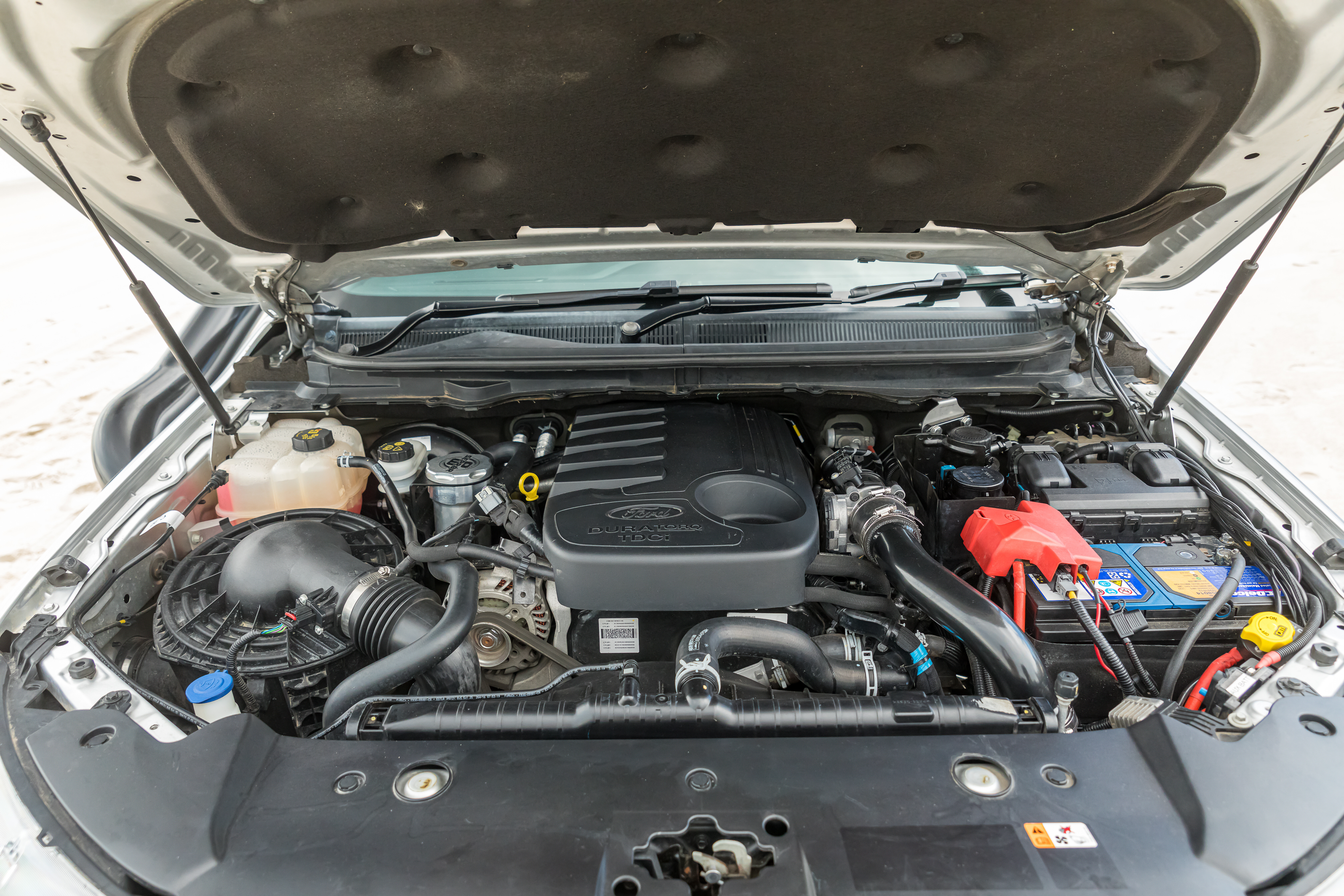
Simply Tuning in Brendale has balanced the extra air with extra fuel, before the spent gases are fired rearwards through a Redback three-inch DPF back exhaust. Sending power rearwards, the factory 6R80 transmission is wound up tight with a remap from the team at Custom Car Coding, while a second PWR cooler makes sure soft sand never gets the better of it. The final piece to the puzzle is a factory electronically operating locker in the rear axle, ensuring maximum traction.Of course, that extra pulling power isn’t going to get you far on a set of cheese cutters, so Jimmy has spec’d up some meaty tyres for maximum flotation on the soft stuff. Each corner is now shod in Nitto’s hybrid Ridge Grappler. Halfway between a muddy and an all-terrain, it’s the perfect combination for a rig that lives on the beach but still needs to get the job done in the hills. They punch in at 315/70R17, or 34.4-inch for Americans reading along. They’re wrapped around a set of spicy looking alloy wheels from Method Race Wheels, the bronze 17x9s pumping the Ranger’s overall width out a huge 180mm wider than stock.
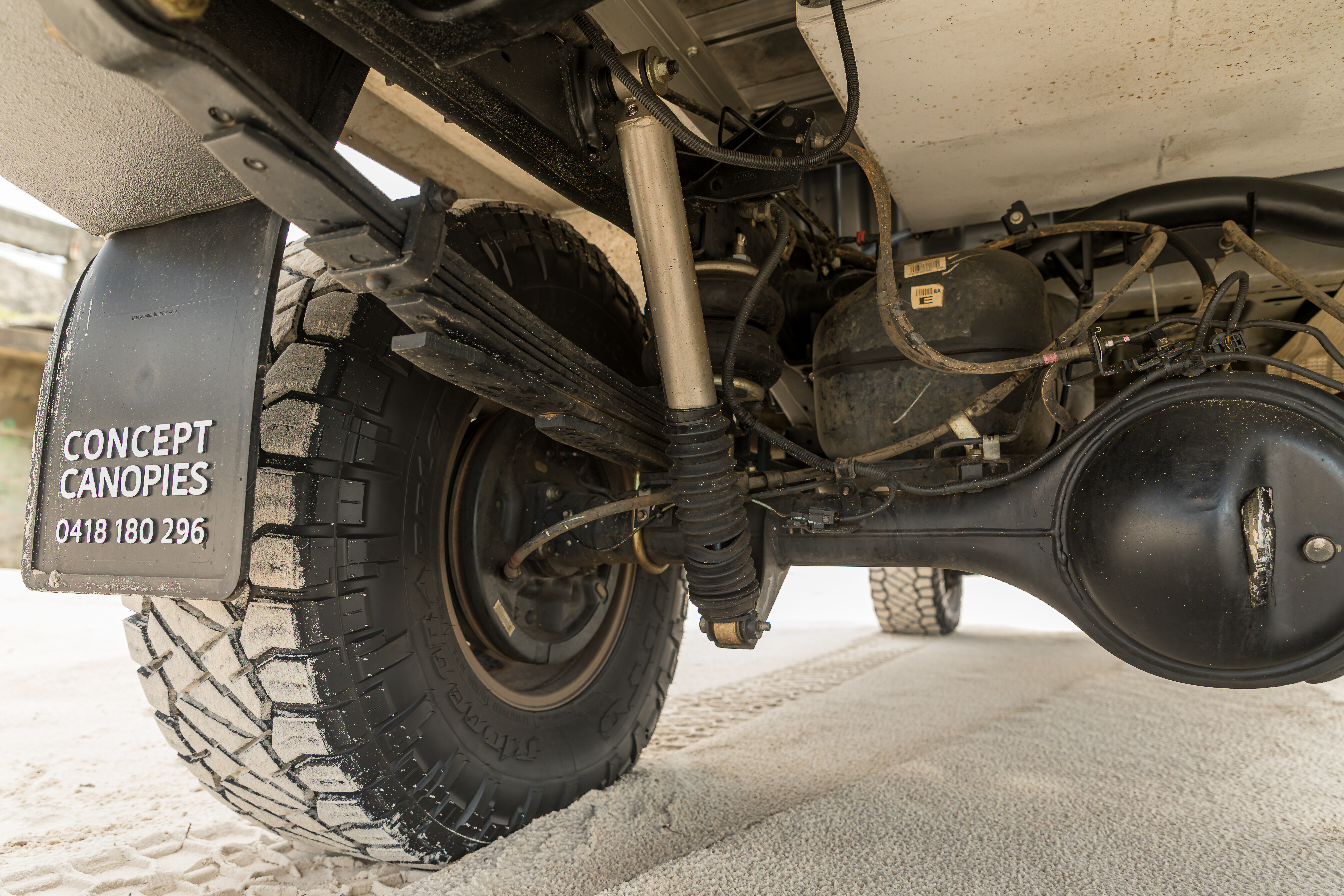
For the young blokes at home about to ask the question – no, you’re not fitting a wheel and tyre combo like that with no lift. To ensure the new shoes not only fit but work well off-road, Jimmy’s pieced together one hell of a suspension set-up. Leading the way up front are a set of Aussie-made four-inch lifted struts from GMF. With a 2.5-inch alloy body and external reservoir, the GMF shocks are built to the nines. They’re also packing Eibach springs, dual-speed compression adjustment and rebound adjustment as well as trick-finned reservoirs to help stave off shock fade.They’re teamed up with a set of Blackhawk upper control arms to free up some extra travel and rein the alignment back in, while a 25mm diff drop helps knock a little pressure off the CV joints. Up the back, Jimmy’s paired up a set of Comp Shocks with helper airbags from Airbag Man to dial in the ride height, smooth out the ride, and cope with the extra weight when the canopy is bursting at the seams with camping kit.
Bar work
Moving outside and that same attention to detail has been laser-focused on every single aspect of the clean-as-a-whistle dual cab. The tip of the spear is an oh-so-light alloy bar welded together deep in the heart of Russia, then colour-coded and slotted into place back here in Australia. It not only looks a million bucks, it houses a million bucks’ worth of get-out-of-gaol-free cards, thanks to 12,000lb of TJM 12V winch. It’s wrapped in synthetic cable to keep weight down and tucked in behind a Factor 55 alloy fairlead.Moving backwards, a pair of LED Mustang-style headlights add a unique look to the front end, while Utemart V60 flares have copped a lick of paint and keep the tyre poke reined in.
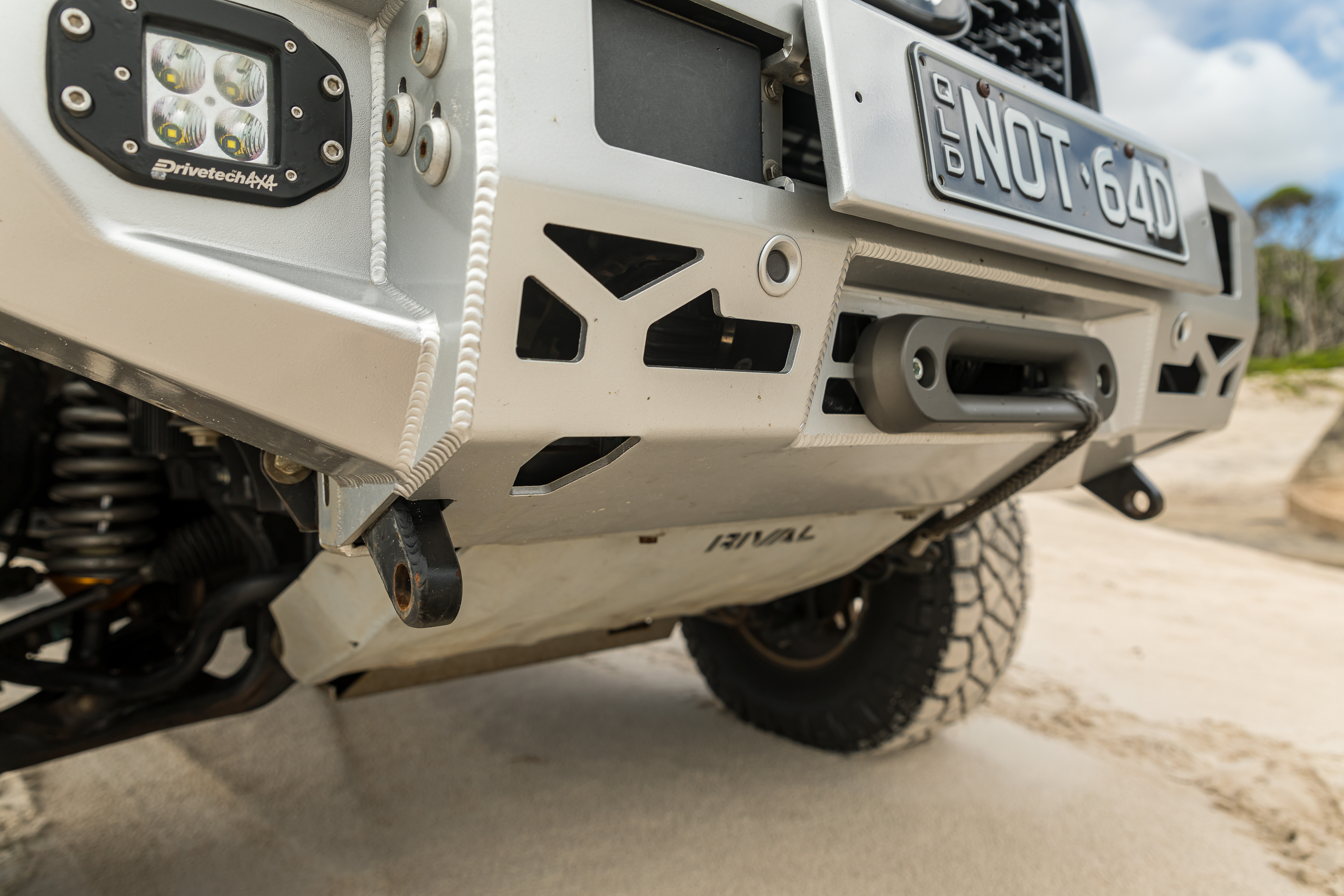
You won’t find the old standard twin spotties up front though, as Jimmy’s opted for a sleek approach when it comes to lighting up the night sky. Twin Stedi ditch lights sneak in on the back of the bonnet, while a huge X-Ray Vision light bar takes pride of place on the Rhino-Rack up top.That slim-line alloy rack not only stows usual kit like MaxTrax and a shovel up top, it houses 360 degrees worth of Stedi camp lights and a 300W solar panel feeding into the canopy. A set of steel rock sliders from Uneek 4×4 pair up with a full suite of Rival bash plates and a Hayman Reese X-Bar to round out the armour package.
Canopy
With the base vehicle sorted, Jimmy turned his attention to the canopy; and if you’re keen for a decked-out set-up, you’re not going to be disappointed. Expertly crafted by Concept Canopies in Brissie, the lightweight aluminium unit packs one hell of a punch. On the passenger-side flank, a slide-out pantry houses all the camp snacks, but the 110L upright Dometic fridge is where you’ll find the real camp gold.There’s extensive storage throughout with a trundle drawer and saddle boxes, and a healthy layer of insulation ensuring internal temperatures are kept reined in. The final pieces of the puzzle inside are a huge 2000W inverter and JBL soundbar ensuring impromptu Khe Sanh singalongs are never more than a few bevvies away. A Drifta 270 awning and rooftop tent provide shelter from the elements.
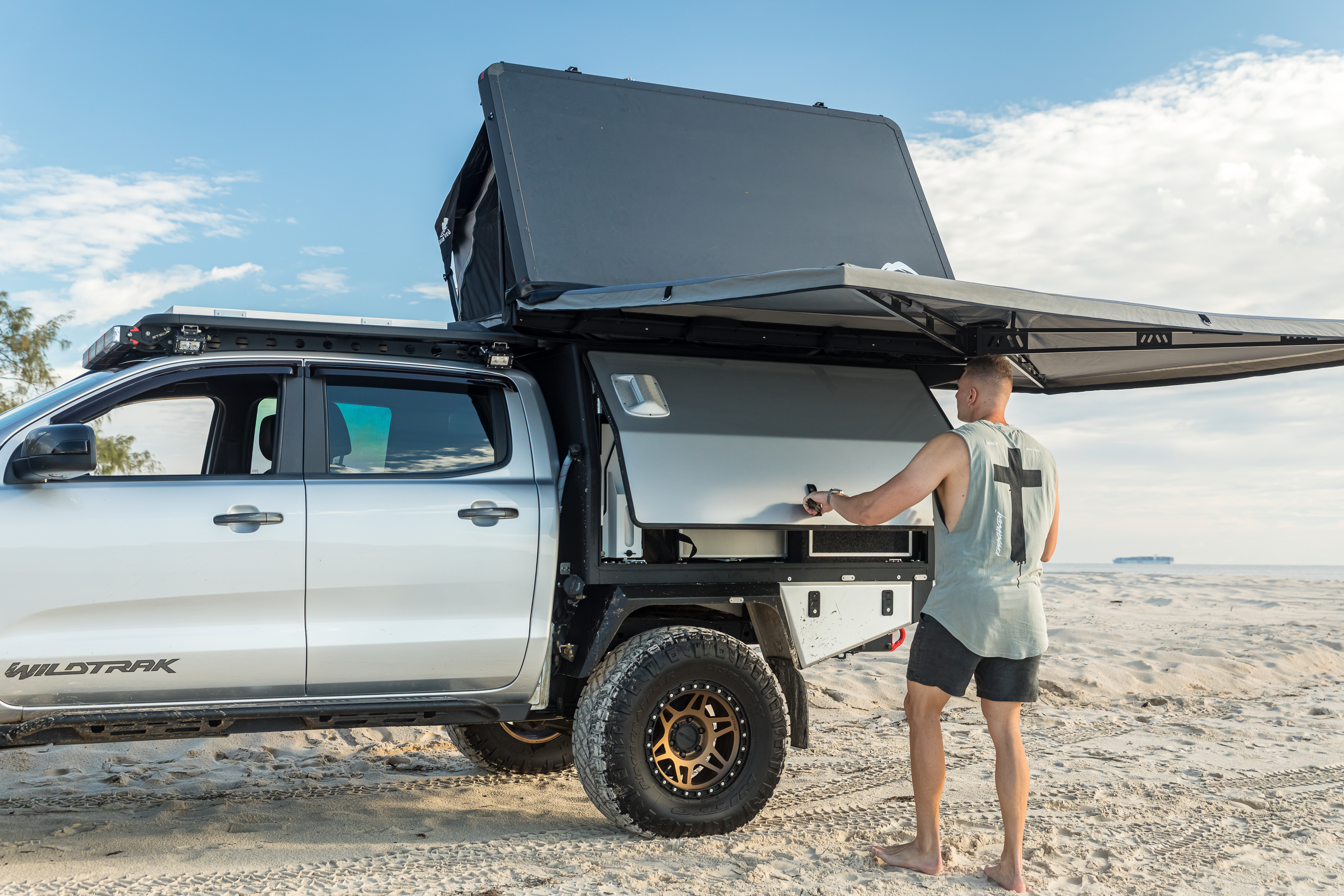
Back in the cab and Jimmy’s taken the approach of more is more. There’s the usual suspects like a GME XRS UHF and Lightforce switch panel, but Jimmy’s managed to shoehorn a monster electrical set-up hidden in plain sight. Behind the back seat is a 200amp/h DCS Lithium battery set-up. There’s a Victron Battery Management system operating as the brains of the whole affair, with an Enerdrive 40amp/h DC to DC charger keeping the party going long into the night.A lightweight dual cab with plenty of poke and enough camping kit to enjoy a week of Fraser Island sunsets is almost compulsory for Queenslanders at this point, and who can blame them with so many bucket-list destinations all within a few hours’ drive. We love the unique rigs each state hits the tracks with, but you have to admit the Queenslanders certainly have it made.
The convoy ground to a halt. Like normal, I was tail-end-Charlie and had no idea of what was happening up at the front of our group of travellers.“Eh, Foss”, the CB chattered into life, “Can you come up here?”“Sure,” I replied, as ‘Foss’ was what my son calls me and is short for ‘Fossil’; a loving term, I’m sure.As I worked my way along the group and came over a low sand ridge, the reason for our unplanned stop became immediately apparent.

Across the track and spreading out as far as the eye could see, was a veritable sea of water. The blanket of water, dotted with spinifex close to shore while farther out only the taller trees stood above the liquid expanse, stretched away to the north and south and out of view.While a couple of volunteers checked how deep the water was, Trent and I sent our drones for an aerial view to get a better idea of what was in front of us. It wasn’t good and while I love seeing water in desert country and the life it brings, this time it meant turning around and backtracking – something we hate to do!
Leaving Ceduna
Our latest desert sojourn with Moon Tours (www.moontours.com.au) had begun a week previously when we had met our group of fellow adventurers in Ceduna, South Australia.Our convoy then headed out via the sandy tracks and along the coastline that was being absolutely hammered by huge surf, to the somewhat protected enclave of Cheetima Beach, west of the tiny hamlet of Fowlers Bay.Next day, after fueling up at Nundroo, for what turned out to be a long haul between fill-ups, we turned off the highway near the old Colona homestead and drove north. The road was pretty good, apart from the big, long mine-haul trucks that cart semi-processed ore from the Iluka mine site to Ceduna for shipping elsewhere.

We crossed into the vast Yellabinna Regional Reserve that covers more than 20,000km² and with the adjoining reserves, conservation and national parks make up a huge area of protected land that stretches for more than 400km in an east-west direction, south of the Trans Australian Railway line. At one point, away to the east, we could see the workings of the Iluka mine (mining is allowed in Regional Reserves in South Australia under strict guidelines), which is the largest zircon mine in the world, by all accounts,We stopped briefly near the Ooldea railway siding and found the monument to Daisy Bates, who lived here from 1919 to 1935. She helped the local Aboriginal people in a multitude of ways, not the least being to come to grips with the influx of white people who came by the steam train that had started to run across the continent in 1917.
A-bomb tour
Just a little farther north, at the gate to Maralinga, we called the caretaker and he was soon there to escort us in to what was once the heart of the village and the living area for those who worked on the A-bomb tests during the 1950s and 1960s. While the tests were, and still are, pretty controversial, we had come to see the sights where the bombs had been exploded and which are now part of the tourist attraction run by the Maralinga Tjaruta Aboriginal Land Trust.We’ve been here a couple of times and while the tour is pretty expensive, it is well-worth it. You need to book ahead before arriving and you can’t drive your own vehicle to the bomb sites, but must board a bus with a driver and guide.In all, there are seven A-bomb sites at Maralinga, five of which are visited on the tour along with some of the buildings and facilities including the impressive runway and aerodrome.

While the test sites have been cleaned up and the whole area declared ‘safe’ for visitors, our guide was only too willing to show us some glass that had been formed when an A-bomb had melted the natural silicon in the surrounding sand. Once, whole sheets of this glass covered many acres here, but most have been cleaned up and buried in the mammoth pits that dot the area.That evening our plans were thrown into disarray as we were told our planned route through the Aboriginal land to the Anne Beadell Highway and the highway itself, which we had already received permits for, was now closed to all travellers for ‘Men’s Business’.Next morning with a new plan in place, we were escorted out of the area and south to the railway line, where we turned west for the rough and slow crossing of the Nullarbor Plain.
Forrest metropolis

We stopped briefly at Cook, still one of the most important sidings on the line, now used mainly as a rest spot for crews on the trains as well as maintenance people working the line.Later that same day we crossed the WA-SA border and next day pulled into Forrest, which seemed like a metropolis after the deserted sidings we had been past. Still run as an important refuelling spot for light planes and helicopters flying across the continent, the strip here can take large passenger aircraft as well, if and when required. We all grabbed a coffee, ate the small cafe out of bacon and eggs and then refuelled the vehicles.Travelling the next day brought us to the site of the WW2 prisoner-of-war camp and you’d have to say it would have been a lonely, desolate spot for the mainly Italian prisoners who were brought here. You can find out more about the place and the prisoners here.

After three long, torturous days, the limestone-studded track began to improve as we approached the railway siding of Haig. Once again there was hardly anything to mark the place on the map, but we were just happy to be able to cruise at 60 to 70km/h.Stopping at Rawlinna briefly we didn’t see a soul, although there was some sign of life with a couple of work vehicles pulled up near one of the buildings. We found the junction to the Connie Sue Highway on the northern side of the railway line and headed north across the flat, stark and treeless Nullarbor Plain for 45km or so before seeing the shapes of trees etched against the flat horizon.The highway – a graded track at best – continued in a beeline north, typical of the many roads that Len Beadell and his Gunbarrell Road Construction crew surveyed and built during the 1950s and 60s. You can find out more about this amazing Australian icon here.
Great Victoria Desert
Next day, we entered the Great Victoria Desert and then the Neales Junction Nature Reserve. We stopped earlier that day at the junction itself, where the Connie Sue crosses the Anne Beadell Highway, another one of Len’s famous roads, but again a long way short of most people’s idea of a ‘highway’. There’s a very pleasant camp located just to the west of the crossroads where a tank supplies water, while a couple of magical marble gums, endemic to the Great Victoria Desert, cast some lovely shade.From the crossroads we continued north along the Connie Sue, the track became more eroded and hemmed in by spinifex, the country showing ever increasing signs of recent rain. Still, it didn’t slow us down too much and after 170km for the day we pulled up for camp, just off the track and close to Hanns Tabletop Hill. Frank Hann, a somewhat famous WA explorer, had noted the butte as a landmark on his 1903 expedition, and it was named in Frank’s honour by geologist H.Talbot in 1916.
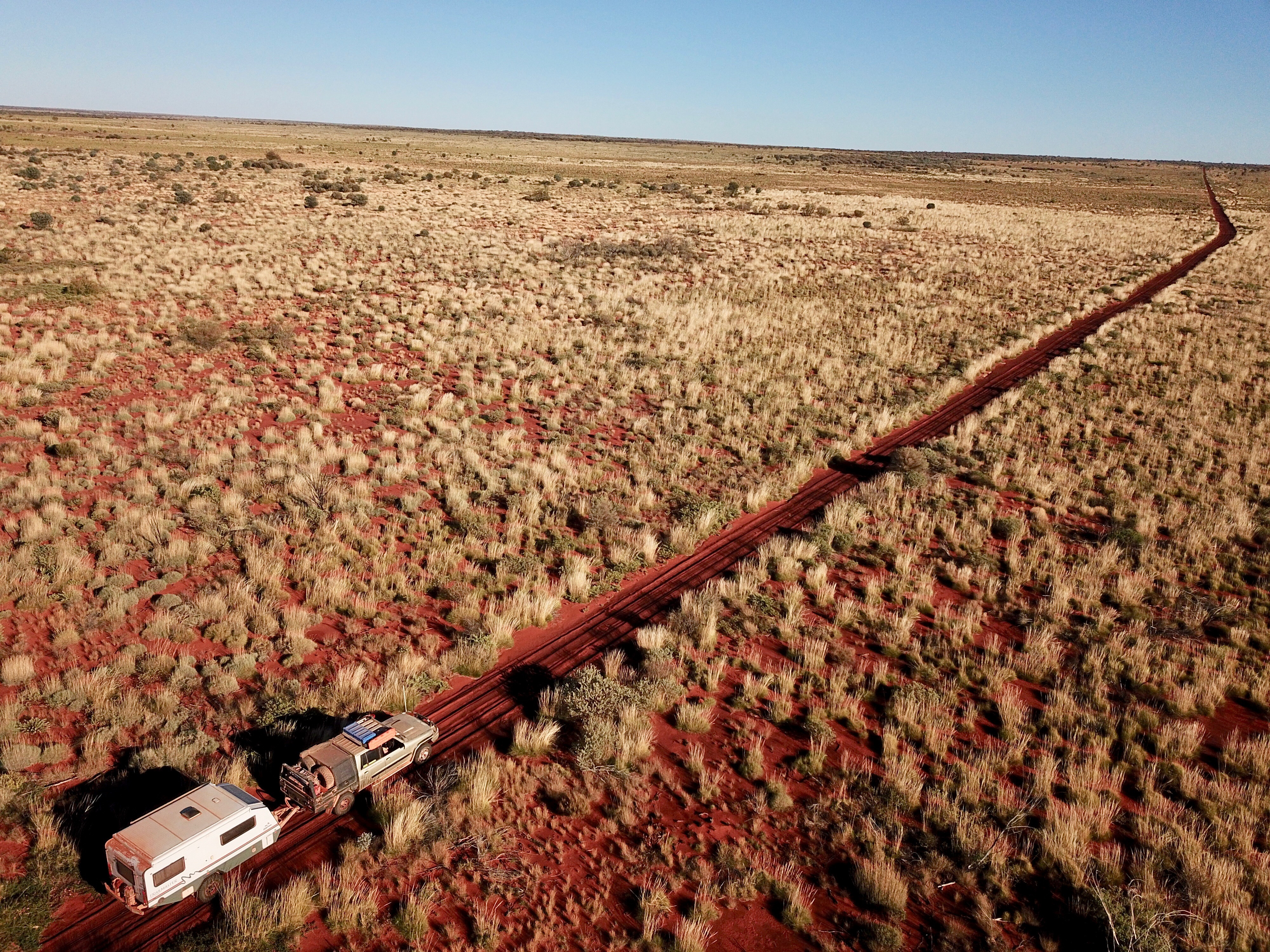
Like the previous day, we travelled across sandy country dotted with stony rises and gravel plains that were well covered in spinifex, scrub and occasionally dotted with the taller and bigger marble gums.At about midday we stopped at the overlook into the Mackenzie Gorge, which is just to the west of the track, the vantage point giving good views over the surrounding country and the rugged escarpments that make up the gorge.That afternoon, after turning on to a bitumised Great Central Road and crossing a flowing Elder Creek, a result of recent rains, we pulled in to Warburton Roadhouse. With tyres to repair and replace, and a suspension on one of the trailers needing some work, we took over the small caravan park behind the roadhouse.
It was a late departure as we headed off west along the Great Central Road before taking the Heather Highway north-west and then north to meet with the Gunbarrel Highway, arguably Len Beadell’s most famous road. Along this famous route you’ll find blazed trees, plaques and rocky hills named by him and for him. Just west of Len’s Thryptomine Hill and in the centre of a sandy flat, we found a working bore with a hand pump and a good spot to camp for the night.Camp Beadell with its bore casing (you will need a pump and a long hose to get water) is also a good spot to camp, which we passed early the next day before arriving at Mt Beadell, where there is a monument to Len and the work of his men.Where the Gunbarrel turns directly west, near the red bluff of Mt Everard, there are a few tracks and a camping spot, while the Gunbarrel continues rocky and rough before once again entering sand ridge country and coming to Everard Junction. Here our little group of travellers, after signing the visitors’ book and taking photos of the Len Beadell plaque located here on top of a 44-gallon drum, turned north along another of Len’s roads, the Gary Highway.
Gibson Desert
We had left the Great Victoria Desert and were now in the Gibson Desert, the country around the road junction being protected in the 18,900km² Gibson Desert Nature Reserve. The reserve is now known as the Pila Reserve, under a 2020 agreement with the Gibson Desert Aboriginal People and the WA Government, with management shared between the traditional owners and WA Conservation department.The country was steadily getting greener as we headed west and north from Warburton, a result of some good falls of rain over the preceding three months. I was hoping such verdancy was also an indicator that Lake Cohen, almost beside the Gary Highway, would have water in it.
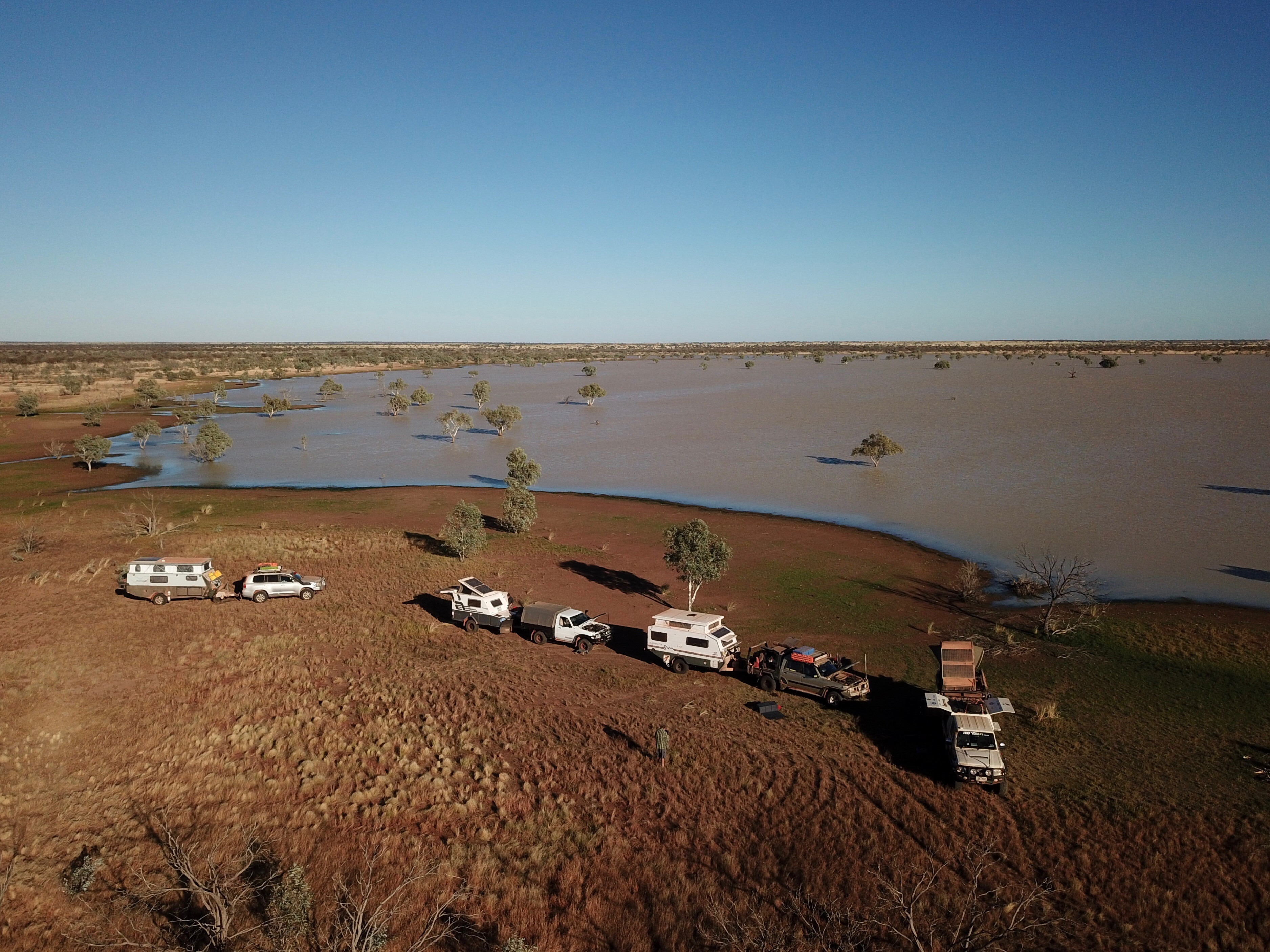
Some 38 years previously, Viv and I had been fortunate enough to visit this lake for the first time and it had water in it then and was an oasis for the area’s wildlife. Subsequent visits since had seen it as dry as a chip and, while still a good spot to camp, you’d have to say it had lost its major attraction.
We were in luck as a large expanse of water greeted our eyes and there was no need to ask if anyone wanted to camp there. We pulled up alongside the lake, one of our group venturing a little too close to get a grassy camp and sunk in the soft mud. A winch was needed to pull him out, but it was such a great camp we opted to stay a second night, enjoying the play of light on the water between sunrise and sunset.Sadly, the birdlife wasn’t as good as we expected; probably because there was so much water dotted across the desert country that there was no need for the birds to congregate at any one spot. Still, a few flocks of avocets waded through the shallows while some small mobs of grey teal and black duck dibbled and dabbled their way across the normally glassy surface of the lake.
Inland sea change
Back on the road again, we headed north and then turned on to the Talawana Track at Windy Corner. Just 10km later we came upon our sea of water and after flying the drones to see the size of the challenge, reluctantly turned back and headed to the Gunbarrel Highway, having already received word that the Gary Highway north of Windy Corner was also flooded in numerous places.Back on the Gunbarrel we pushed westwards, camping the night beyond Geraldton Bore (another source of water and small campsite) on a wide, soft, spinifex-covered plain.
With the route west improving all the time we stopped to admire the watery expanse of Mangkilli Claypan, once again the water being a rare sight in this vast expanse of desert country. Later we pulled in to Carnegie Station nearly 200km farther on, having covered that distance in just a few hours.
The property was getting ready for its annual muster and people were working on vehicles and mobile yards in preparation for the next few weeks of hard work. We fuelled up and set up camp in the nearby camping area before having a few drinks around the fire and yarning to a couple of the workers.
Next day, we rolled in to Wiluna, or more correctly the Gunbarrel Laager, the only place you can camp in or around the outback township. The town has been cleaned up, although the historic Club Hotel is closed but has been renovated and is used for Shire offices.
One place worth visiting, whether you have travelled the Gunbarrel or the famous Canning Stock Route, is the Canning-Gunbarrel Discovery Centre, which is also home to the Tjukurba Art Gallery where local artists display their latest creations.Wiluna also marked the end of this phase of the trip, the route now wandering through more settled areas of WA as most of us pushed on to the north-west coast, north of Port Hedland. It had been a great adventure through ever-changing desert country, enlivened with the recent rain.
Top 5 places to see
01: FOWLERS BAY From Ceduna, follow the sandy tracks and rugged coastline to Fowlers Bay on the Eyre Peninsula. Fowlers Bay is a prime winter southern right whale-watching spot and is also renowned for its extensive sand dunes, beaches, wildlife and fantastic fishing.02: MARALINGA Take a guided tour of the Maralinga’s A-bomb sites of the 1950s and 60s, plus the massive 3000m runway that is still maintained for emergencies. Be warned, the tour is not cheap and needs to be booked in advance, but well-worth the effort and cost.03: THE CONNIE SUE HIGHWAY The Connie Sue Highway is one of Australia’s outback tracks constructed by Len Beadell in the early ’60s and named after his daughter. The dirt-track Connie Sue traverses the Great Victoria Desert from Warburton to Rawlinna.04: LAKE COHEN Recent rain has seen the ephemeral Lake Cohen, on the Gary Highway in the Gibson Desert, return to its verdant best. It attracts migratory birds and is a great spot to camp.05: DISCOVERY & ART CENTRE, WILUNA Wiluna is the gateway to the Gunbarrel Highway and Canning Stock Route. While there, check out the Canning-Gunbarrel Discovery Centre and the Tjukurba Art Gallery.
Ford set the standard for factory-fettled 4×4 utes set-up to take on rough roads, and few companies have been able to produce a worthy rival to it. Nissan did it best with its Navara N-Trek Warrior and we’re thankful the brand has continued the trend with its latest iteration, the PRO-4X Warrior.
Like the N-Trek, the PRO-4X was handed over to Melbourne-based engineering firm Premcar for its chassis and suspension set-up, plus a styling package to make sure the Navara looks the performance part.
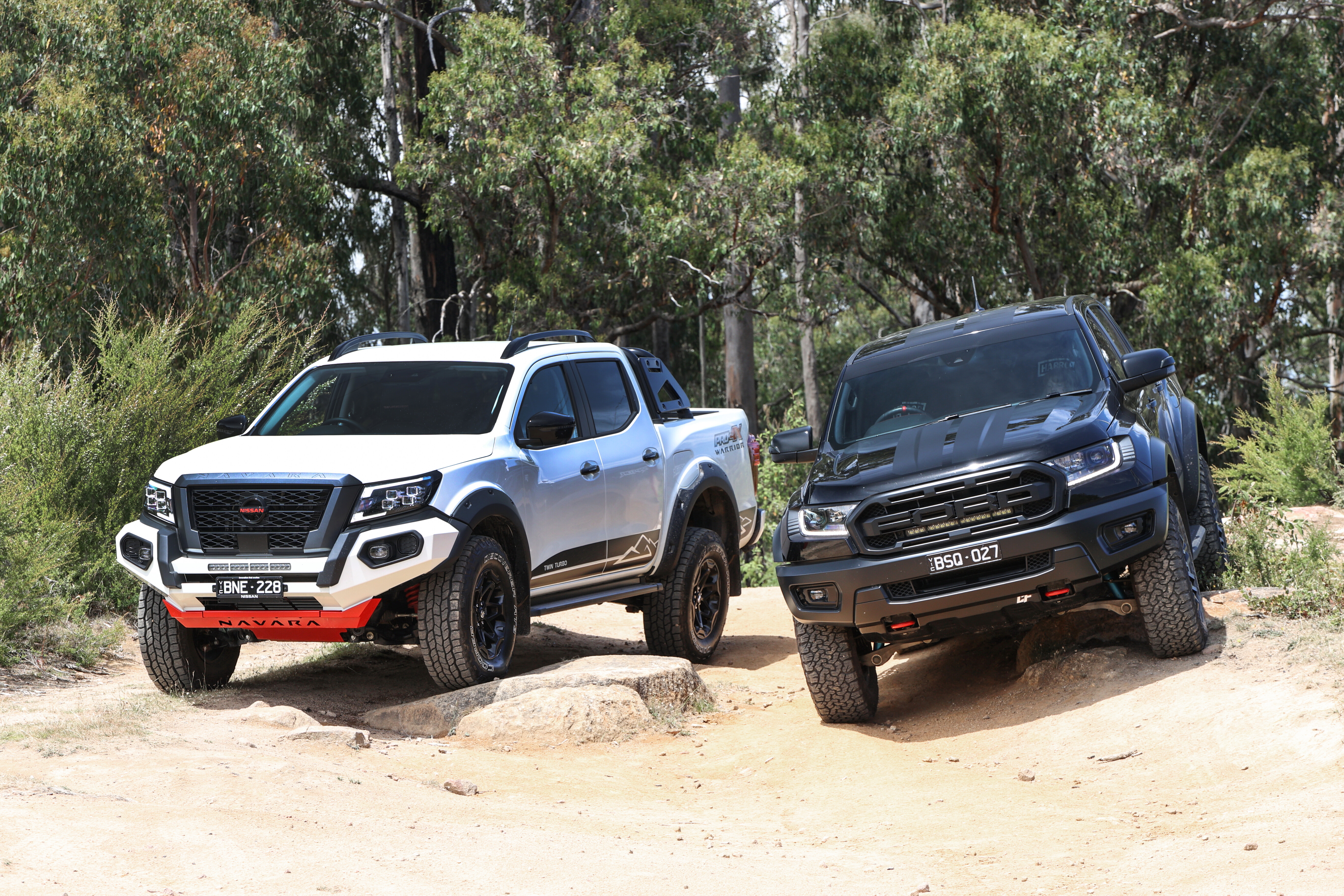
We hit some dusty tracks to see if it lives up to the Warrior badge and brought a Raptor X along for giggles. The Navara PRO-4X Warrior starts at $67,490 with a manual gearbox, or $69,990 with the auto like this test car.
Powertrain & performance
As Ford did with its Ranger Raptor, Nissan has left the drivetrain of the Navara PRO-4X alone in the Warrior transformation. That means the standard 2.3-litre, bi-turbo, four-cylinder diesel engine still rumbles under the bonnet where it makes a healthy but modest 140kW and 450Nm.
While these power and torque figures can’t match the best four-cylinder engines in the class such as the 500Nm engine in the Ranger Raptor, the Navara does benefit from being lighter than the bigger Ford. In fact, the Raptor is considerably heavier than a regular Ranger, while the Warrior remains closer to the Navara ST-X in mass and is around 180kg lighter than the Raptor.
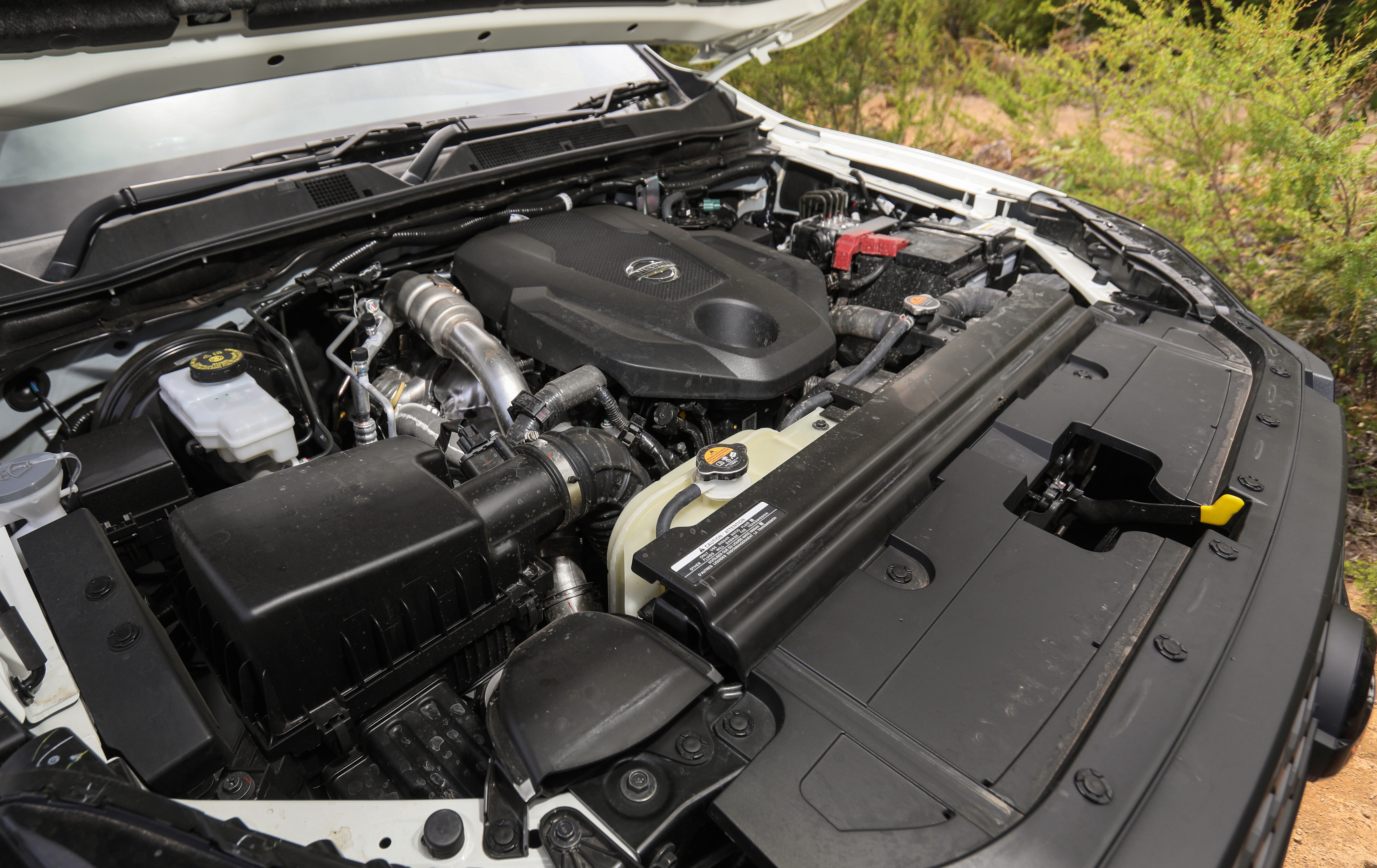
This lighter weight transfers to improved performance both when you put your foot down and at the diesel pump. The Warrior is still no rocket ship but it gets along reasonably well for a one-tonne ute and doesn’t disappoint.The engine is well-matched to the seven-speed automatic transmission, and the Warrior is also offered with a manual gearbox for those that prefer to row their own ratios; something you can’t get in a Raptor.
On-road ride & handling
Like the Raptor, the performance boost for the Warrior comes in its chassis modifications, namely the suspension, wheels and tyres.
The Navara PRO-4X already has a coil-sprung multi-link rear suspension, so, unlike the Raptor, it doesn’t need a bespoke rear-end design to make the most of coils.
Premcar’s engineers equipped the Warrior with progressive rear coil springs which are six per cent softer in the initial stage of compression but 16 per cent stiffer in the second stage, such as when heavily laden or being subject to big bumps.
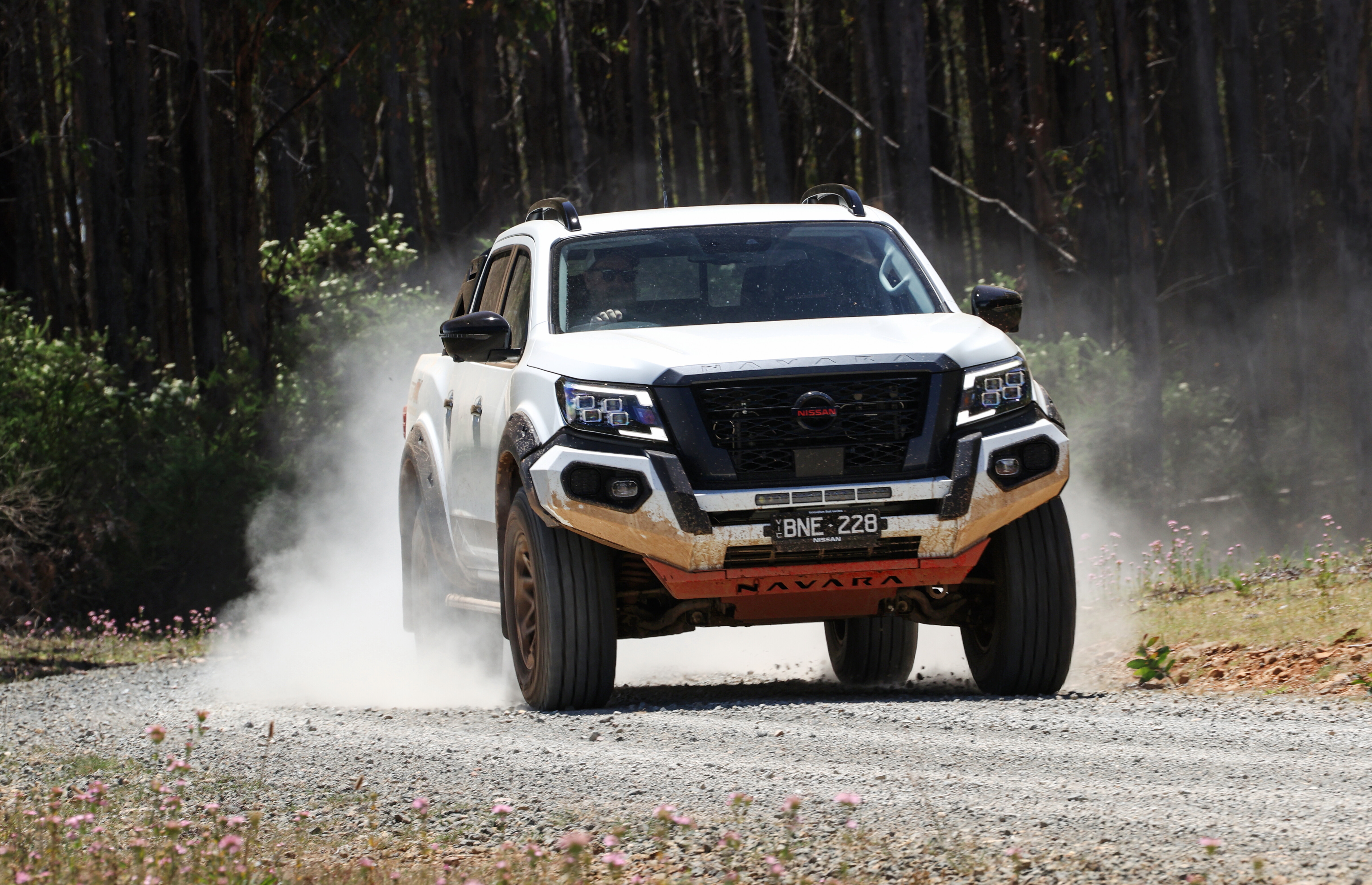
This goes against what many aftermarket companies do when modifying suspensions as they tend to stiffen the springs all ’round – but softening them allows the suspension to work better, like soaking up bumps and improving control and ride quality. The front coils are seven per cent softer and all corners are fitted with bigger shock absorbers with increased oil capacity, and rebound and compression dampening. Longer bump stops, or jounce bumpers, are fitted to better absorb the shock when maximum suspension compression is reached.
Larger wheels and tyres increase the wheel track by 30mm to improve stability, completing the package that benefits the Navara on- and off-road.
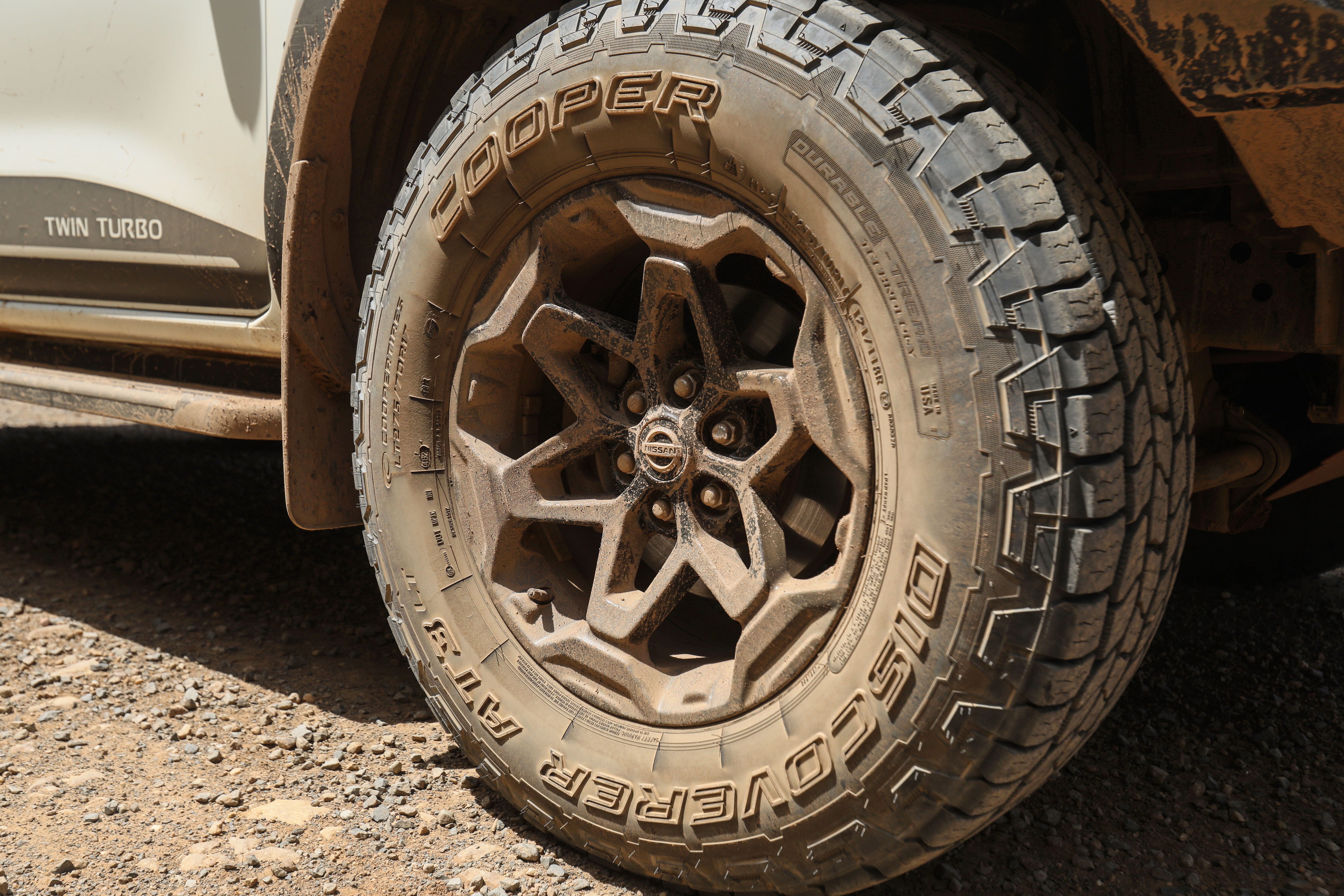
While the all-terrain tyres do emit a bit of road noise on sealed roads, and the 40mm increase in ride height isn’t the best for on-road dynamics, the Warrior’s chassis package improves both the ride and handling by delivering a more supple yet better-controlled chassis that works well over any terrain.
A huge plus for the Warrior over the Raptor is that its uprated chassis is not detrimental to its carrying capacity, and the PRO-4X retains its 3500kg towing rating and has a 952kg payload with the automatic transmission. The Ford’s load and tow ratings are cut to 758kg and 2500kg respectively.
Off-road
The taller, more compliant and better-controlled suspension under the Warrior really comes into its own on high-speed rough roads. Think outback roads when you’re covering long distances between camps or towns – these places are where improved suspension shows the most benefits.
The added comfort and control allows you to safely maintain speeds to get you where you need to be in a timely, more relaxed and safer way. They make the trip easier on both the car and its passengers.
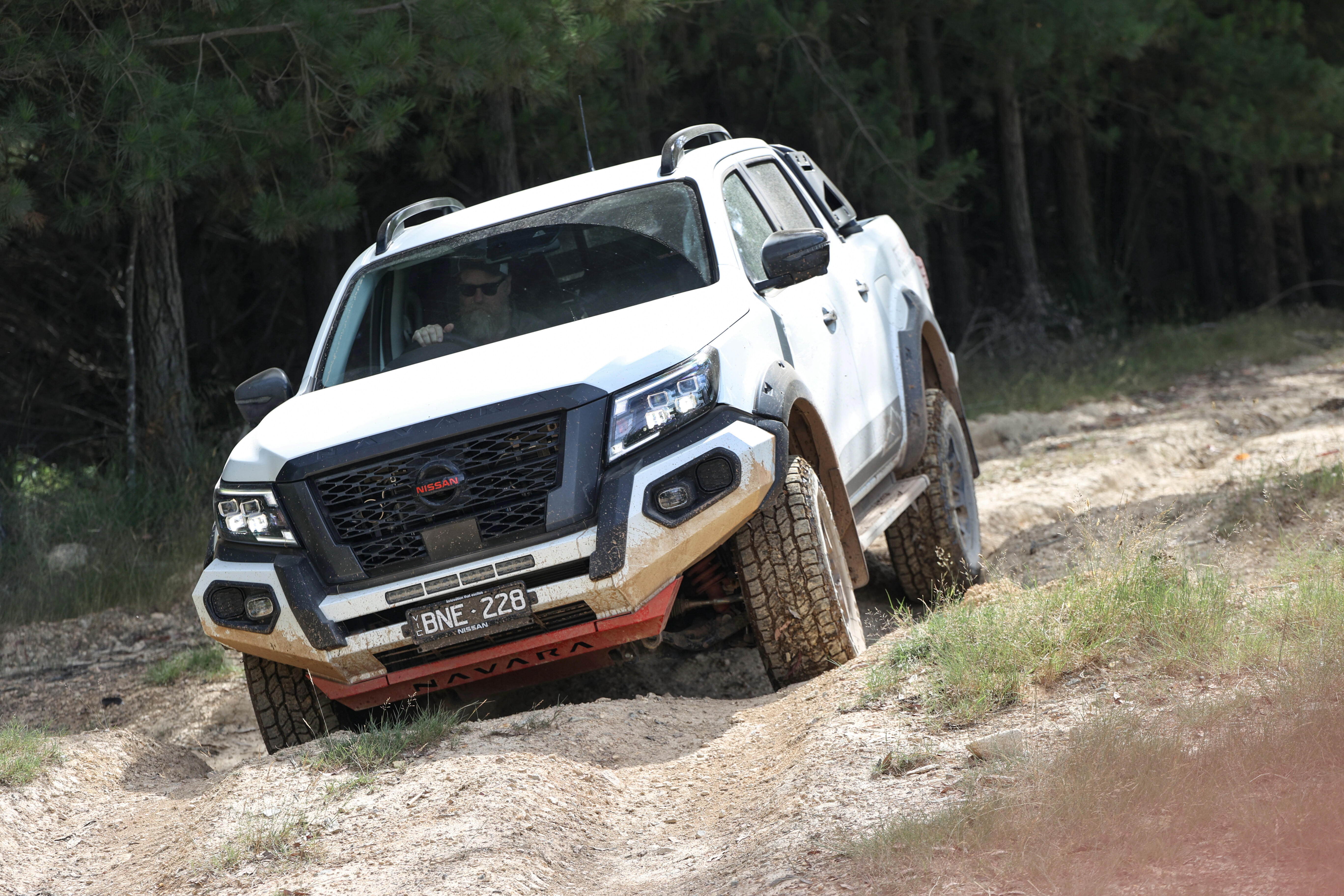
The taller ride also gives added ground clearance for getting over off-road obstacles, and the winch-ready steel front bumper improves the approach angle. Metal underbody plates protect against bumps and scrapes when you run out of clearance.
The Warrior retains the PRO-4X’s dual-range transfer case and rear differential lock, and the electronic traction control with off-road mode in the drive-mode selector proves effective in most conditions.
Cabin & accommodation
As the halo model in the Navara range, the Warrior gets a well-equipped cabin. It carries over the PRO-4X’s features, with just the model-specific embroidery on the front-seat headrests signifying the difference.
The seats are leather, although not power adjustable, heated or cooled; something we find disappointing in a top-spec model. It does get all the upgrades that came in 2021 including a new eight-inch centre screen that includes Apple CarPlay and Android Auto; the off-road monitor and surround-view camera; reversing parking sensors and camera; rear cross-traffic alert; lane-departure warning and intelligent lane intervention; blind-spot warning with intervention; forward collision warning with AEB; and a TPMS.
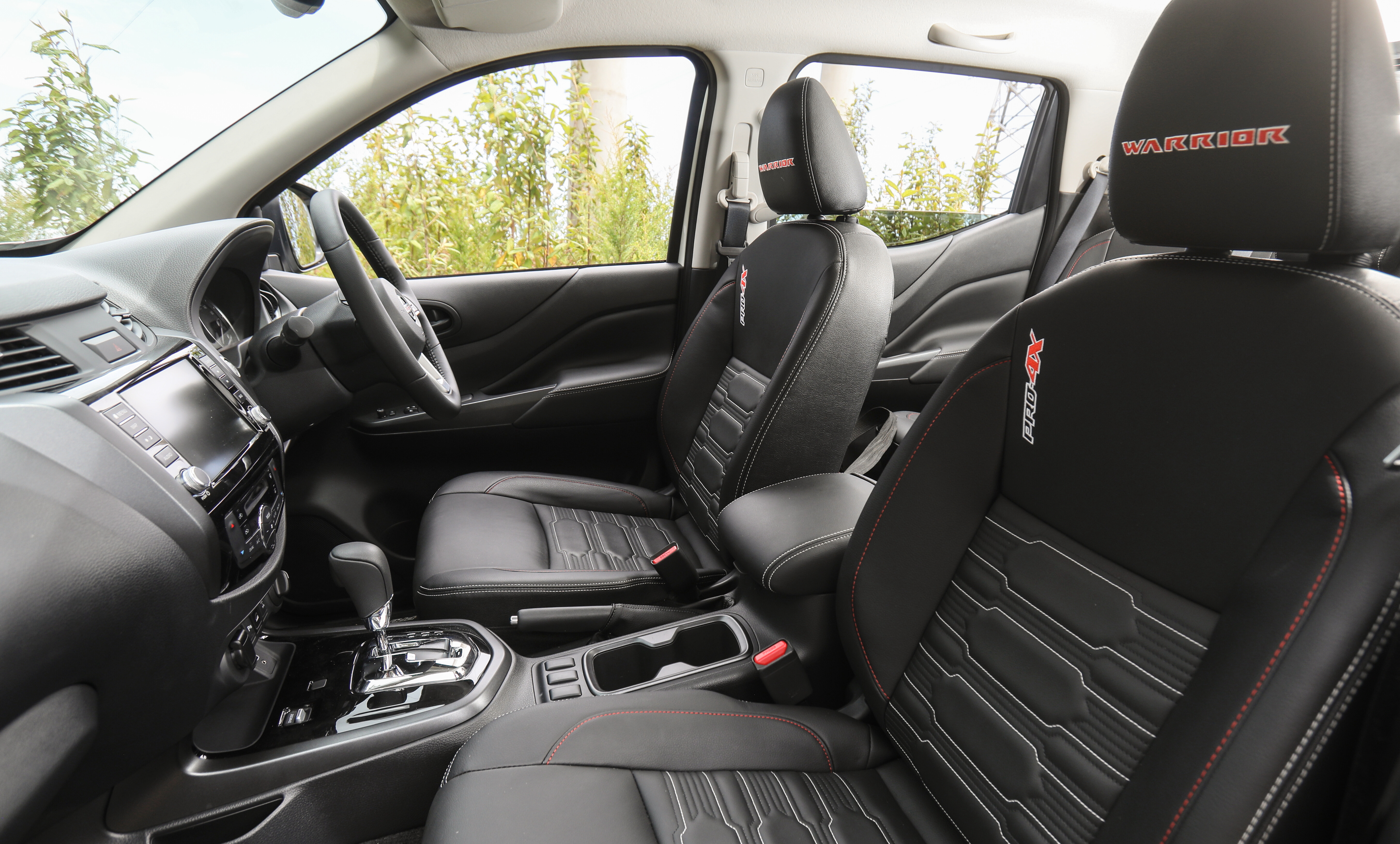
The seating position takes a bit of getting used to when you first get into a Navara from any other car, but once you get used to it, it is comfortable and accommodating.
The Navara is a mid-size ute but is smaller than the likes of the Ranger and Amarok, so probably not ideal for a family of five but will carry four in comfort.
Practicalities
The inclusions that turn the PRO-4X into a Warrior do so without sacrificing any of the practicalities of it being a four-door 4×4 ute. In fact, they improve them.
The towing capacity isn’t changed, the payload only marginally – and that is more to do with the added weight of the steel bumper and heavier wheels and tyres. Premcar has given the Warrior a 100kg heavier GVM than the PRO-4X on which it’s based.
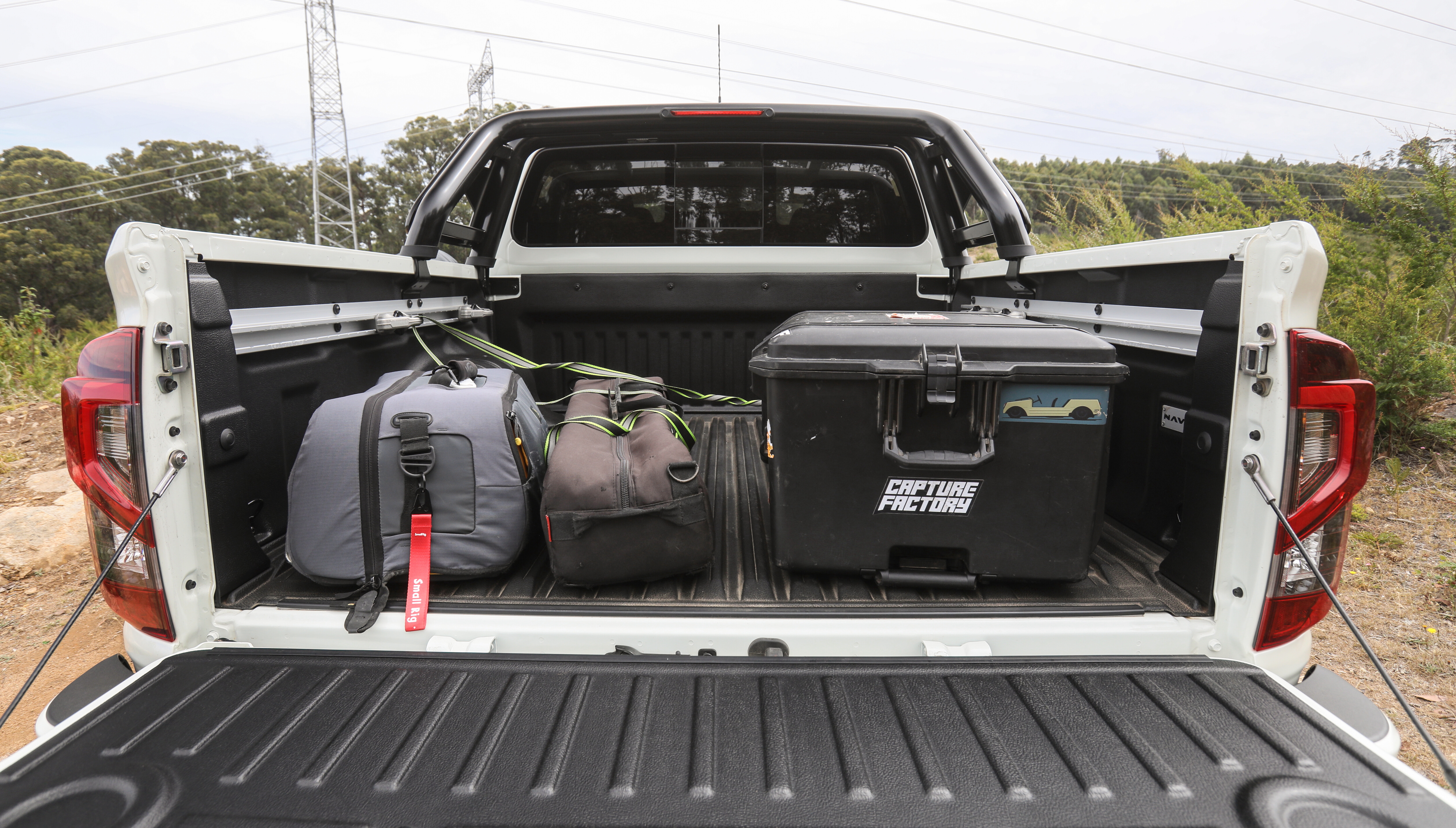
The cargo tub remains accommodating for big loads, although the sports bar does limit access to the front of it. There are adjustable tie-down points along the side of the tub and fixed ones down low in the corners, but there is no 12V power outlet in there.
The steel front bumper and underbody protection are great inclusions for protecting the car, while the LED light bar integrated into the bumper works well to supplement the standard LED headlamps with their striking design. It’s a bit disappointing that the front bumper doesn’t include rated recovery points.
Nissan offers a large range of useful accessories for the Navara range and the aftermarket suppliers also have plenty of kit for it.
Verdict
So, is the PRO-4X Warrior a worthy alternative to the Ranger Raptor? We say yes, but it’s not a clear winner. As good as it is, the Warrior’s chassis and suspension package is no match for the Ranger’s which uses many bespoke components and high-end products from the likes of Fox Racing and Ford Performance. This part explains why the Raptor costs more than $10,000 than the Warrior.
The Raptor is a more rewarding car to drive on rough roads and over long distances thanks to the sum of its parts, but to make it so it sacrifices its payload and towing capacities, which for many are important factors in a ute.
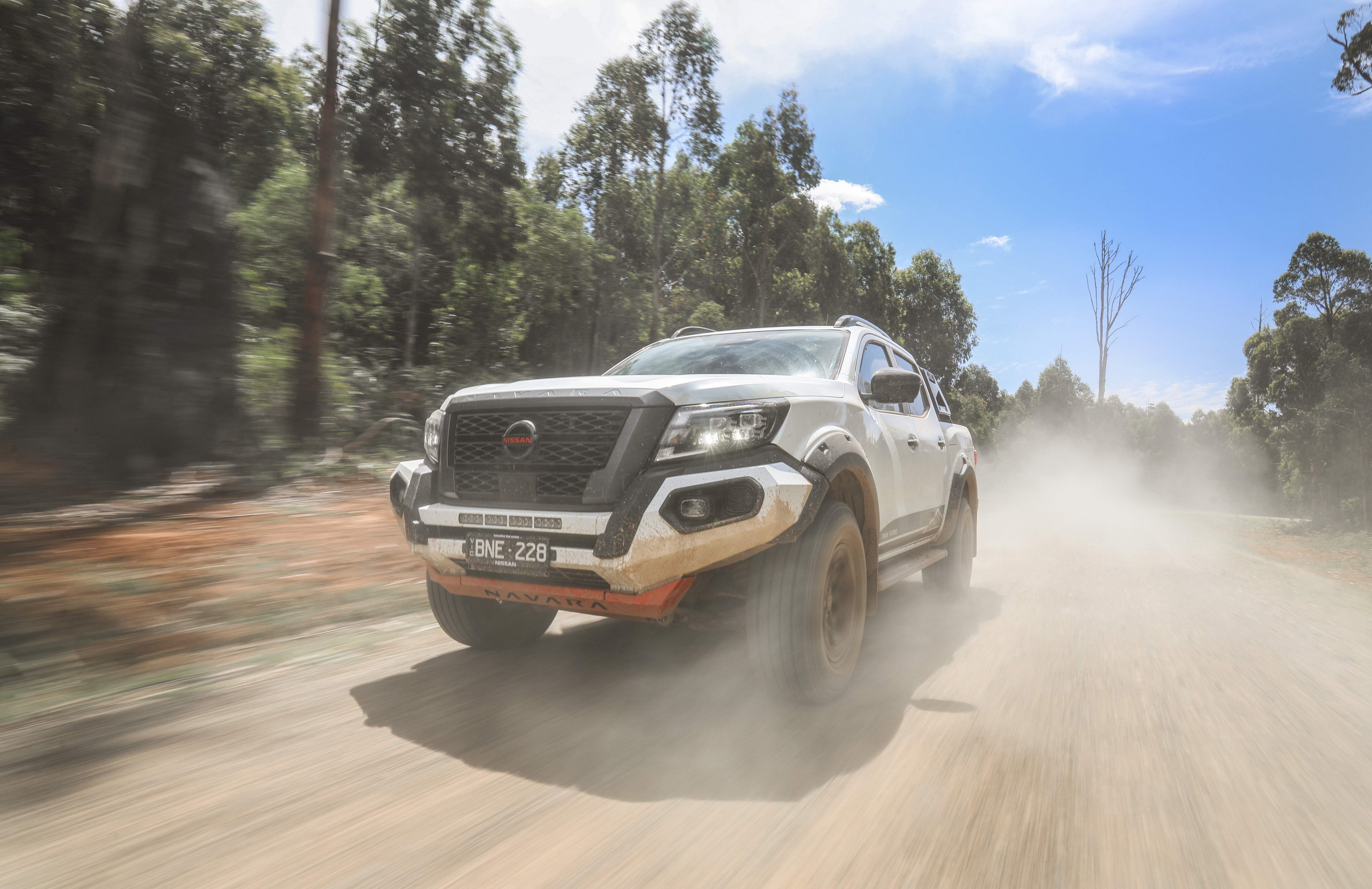
The PRO-4X Warrior excels on- and off- road, even if it can’t match the Raptor, but it does it all without compromise, retaining its carrying capacities and doing all the things you expect of a quality ute. Plus, it gives drivers the option of a manual gearbox, and that’s something many drivers don’t want to compromise on.
2022 Nissan Navara PRO-4X Warrior specs
| ENGINE | Bi-turbo I4 dieselu00a0u00a0u00a0u00a0 |
|---|---|
| CAPACITY | 2298ccu00a0 |
| MAX POWER | 140kW at 3750rpm |
| MAX TORQUE | 450Nm at 1500 to 2500rpm |
| GEARBOX | Seven-speed automatic |
| CRAWL RATIO | 44.57:1u00a0 |
| 4X4 SYSTEM | Part-time 4×4 w/ high and low range |
| CONSTRUCTION | 4-door ute on ladder chassis |
| FRONT SUSPENSION | Double-wishbone IFS & coil springsu00a0 u00a0u00a0u00a0u00a0u00a0 |
| REAR SUSPENSION | Live axle located by 5-link & coil springsu00a0u00a0u00a0u00a0u00a0u00a0 |
| TYRE/WHEEL | 255/60R18 on alloy wheels |
| KERB WEIGHT | 2151kg |
| GVM | 3150kg |
| PAYLOAD | 1019kg |
| TOWING CAPACITY | 3500kg |
| GCM | 5910kg |
| SEATING | 5 |
| FUEL TANK | 80L |
| ADR FUEL CLAIM | 8.1L/100km |
| ON-TEST FUEL USE | 11.2L/100km |
| DEPARTURE ANGLE | 19u00b0 |
| APPROACH ANGLEu00a0 | 36u00b0 |
| RAMPOVER ANGLE | 26.2u00b0 |
| WADING DEPTH | 600mm |
| GROUND CLEARANCEu00a0 | 260mm |
Snapshot
- UK Isuzu customers urged to get orders in early to combat delays
- Overseas orders made now might not arrive until the start of next year
- Isuzu Ute Australia says D-Max and MU-X are in stock but higher grades affected
The ongoing global semiconductor shortage continues to affect vehicle supply with Isuzu Ute’s UK operations now pushing out its waiting list to as much as a year.
Mainly impacting the popular D-Max ute, the UK arm of the Japanese manufacturer has stated prospective buyers should “start discussions with their local Isuzu dealer as soon as possible” if they want to receive their vehicle by the end of 2022 or start of 2023.
With all D-Max and MU-Xs coming from Isuzu’s Thailand plant, it is far from the only manufacturer which has been hit by the most recent wave of the COVID-19 pandemic, as south-east Asia has been affected the most in recent months.

Isuzu Ute Australia (IUA) is seemingly more confident about its situation compared to its UK counterpart, telling 4×4 Australia it has a number of both models in stock across its dealer network.
However, there is slight concern regarding higher-spec variants which are equipped with more technology, the most likely grades to be impacted by the chip crisis.
“Wait time on the Isuzu D-Max and MU-X depends on vehicle specification, colour and accessories ordered, a spokesperson told 4×4 Australia.
“Some models are available and in stock currently, while there continues to be ongoing supply delays, especially on certain higher grade models.
“[It’s] mainly due to the unprecedented levels of demand and vehicle component supply delays caused by the global semiconductor shortage and ongoing COVID-19 pandemic.
“Please be rest assured that IUA remains committed to prioritising the delivery of vehicle orders and will continue to provide updates as we receive more information on the situation.”
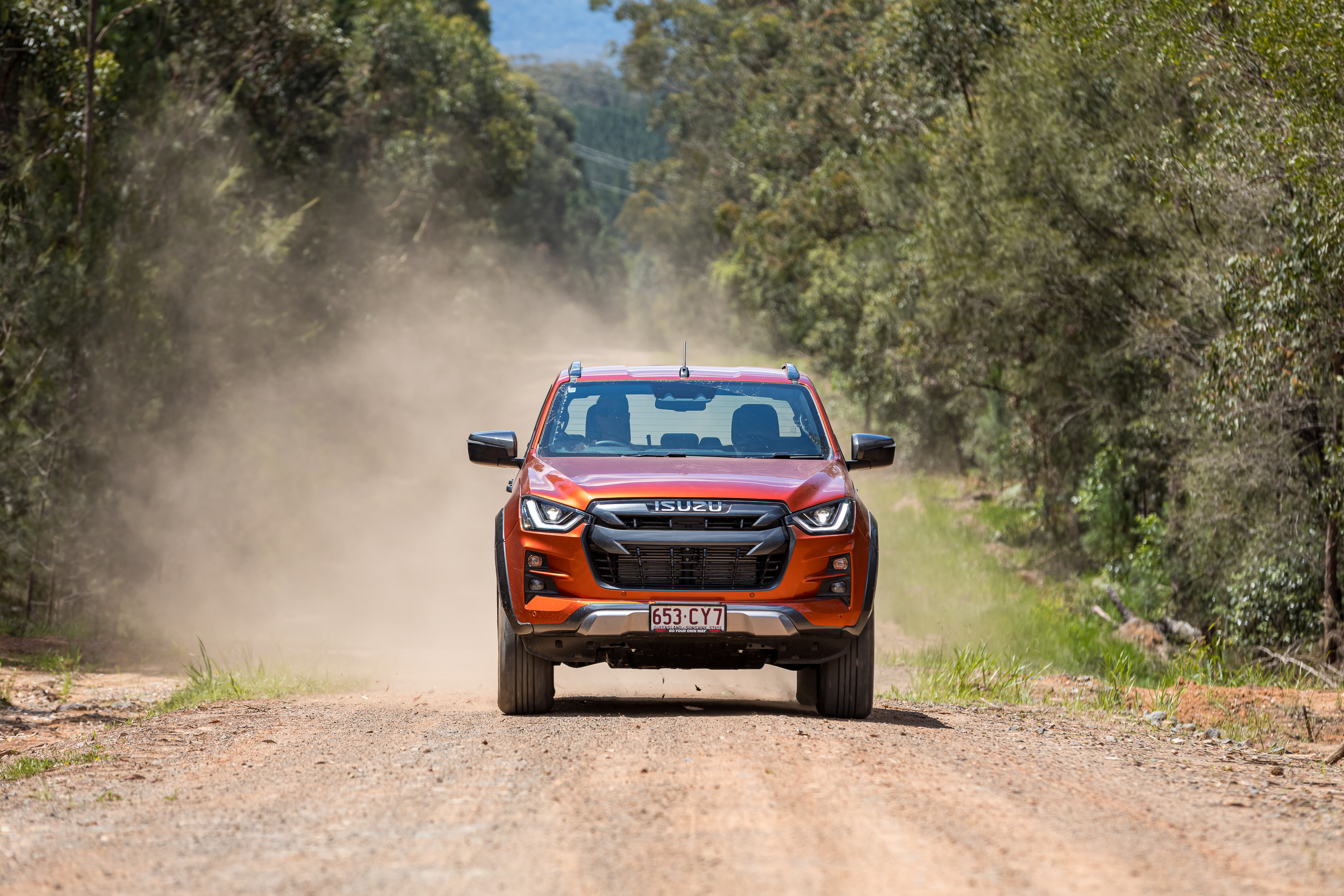
While not directly affecting high-spec variants fitted with the 3.0-litre turbo-diesel engine, IUA paused sales of its entry-level D-Max powered by the new 1.9-litre turbo-diesel engine last week, owing to an engine sensor fault.
The smaller-capacity engine was only recently introduced into the new D-Max line-up last year, with all variants (bar the SX Single Cab Chassis 4×2) retaining the larger, 3.0-litre unit.
Sweet 60 Series LandCruiser leads the February 2022 edition of Readers’ 4x4s. To see your vehicle in the next issue of 4X4 Australia magazine, head to our Facebook page and send us a photo.
1989 Toyota 60 Series LandCruiser
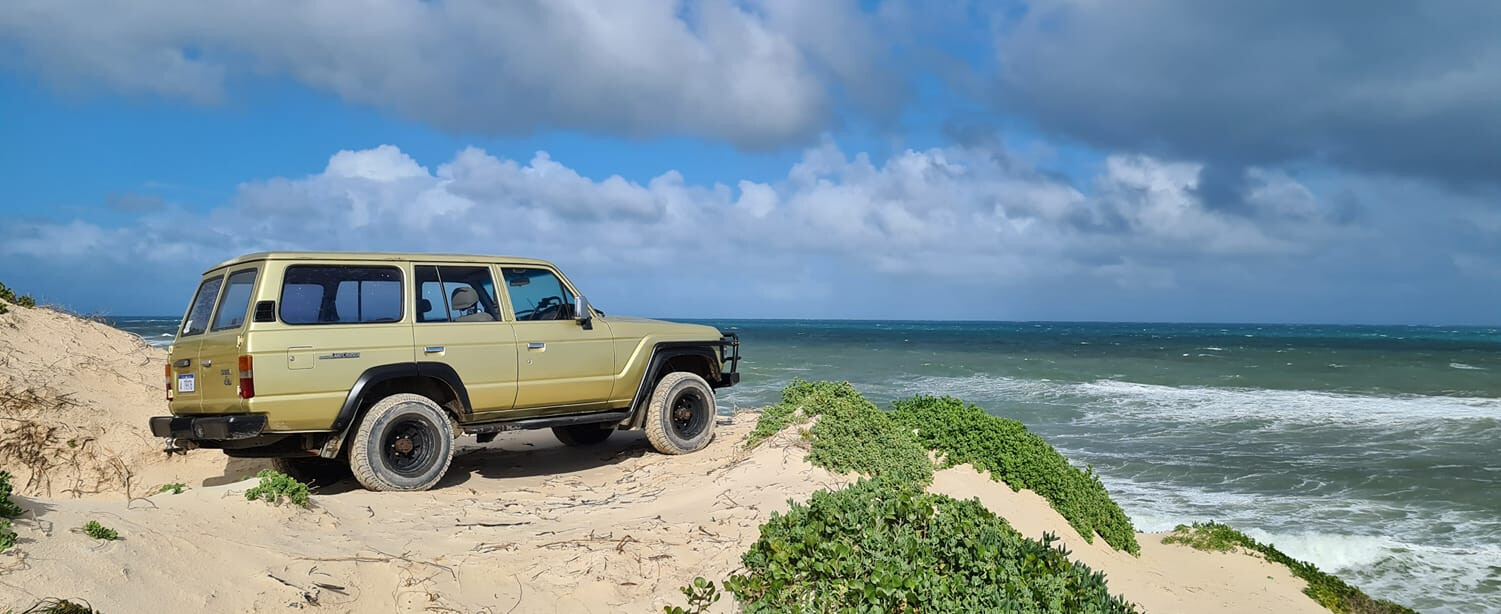
I have only had it for about four months. It’s a 1989 HJ60 base-model, with a five-speed manual and 2H diesel. At this stage it has what looks like an old-school ARB bullbar, ’roo bar and skirts with a tow hitch receiver welded on to the front. It originally had a vinyl bench but now has Falcon buckets, as well as a basic dual-battery set-up to run a fridge (and not much else) in the back.
Other work has mainly just been repairs at this stage: A/C, swivel hubs, brakes and a bit of electrical work. I haven’t taken it far yet; it’s seen a bit of south-west WA, but the A/C is cooked and I’ll be tearing it down for some rust repair and a bit of a makeover. Plan is to make a proper tourer out of the old girl – Liam Andrewartha
1985 Nissan MK Patrols
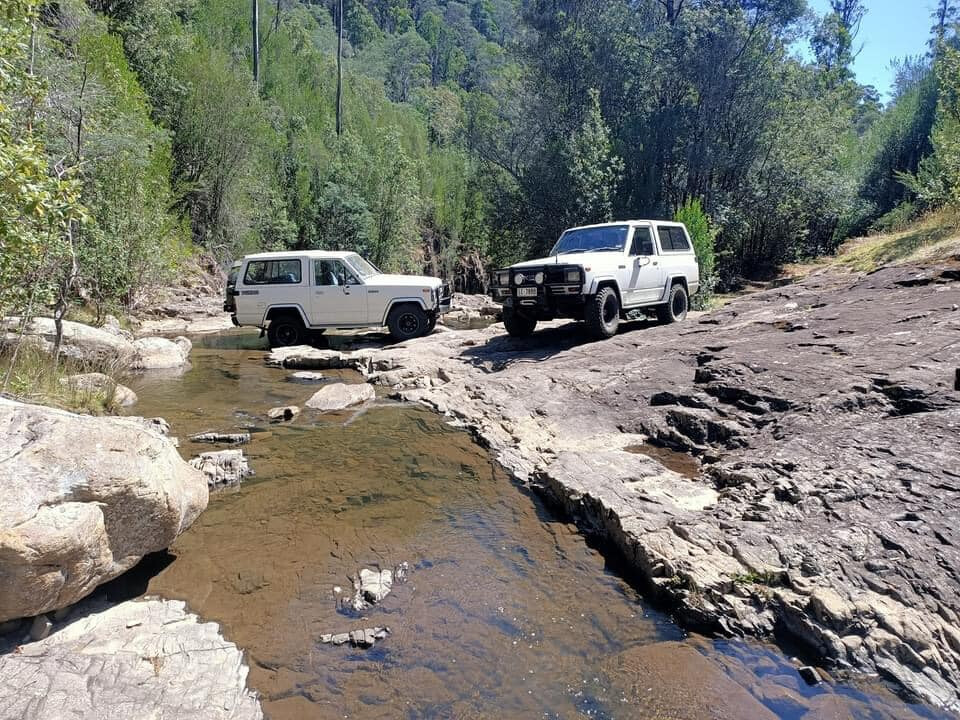
The one on the left is my son’s original 3.3-litre turbo diesel; the other is mine, fitted with a Ford 351 V8. I am its second owner – Kim Housego
2021 Toyota Fortuner
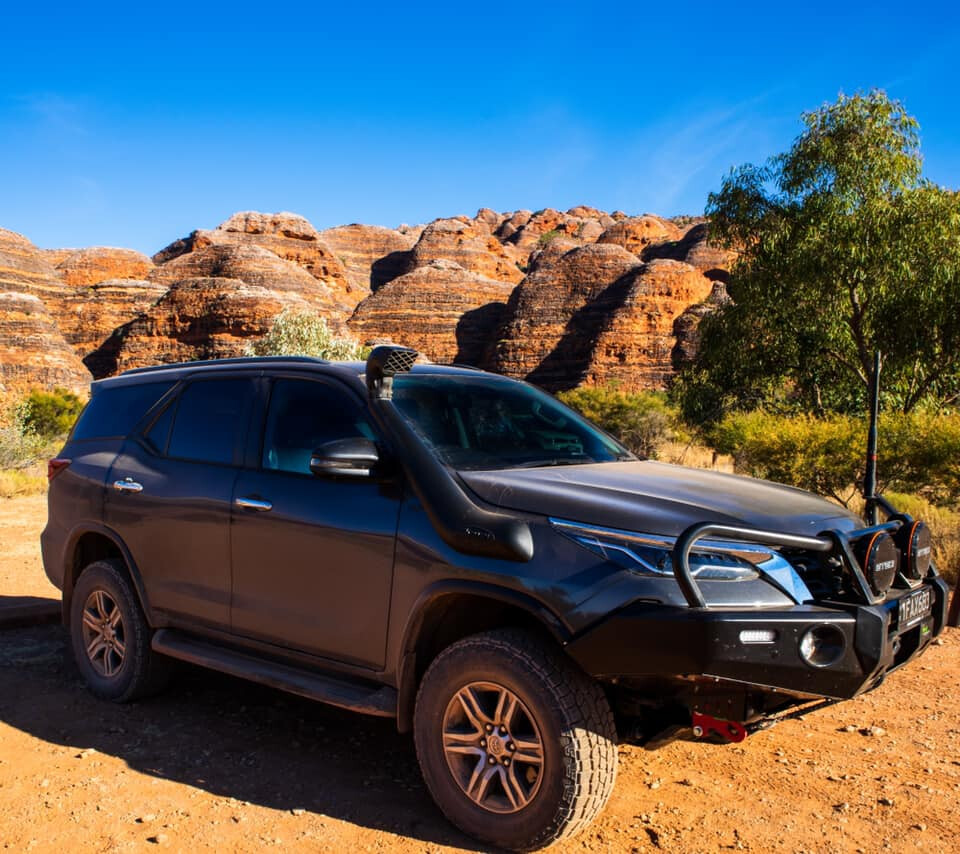
We travelled 12,000km in 2021 on a Northern WA trip and even made it in to the Bungle Bungles. Kit fitted so far includes a two-inch lift, new airbags, a bullbar, spotlights, UHF, dual batteries and rear drawers – Aaron Guest
Ford Ranger PX1
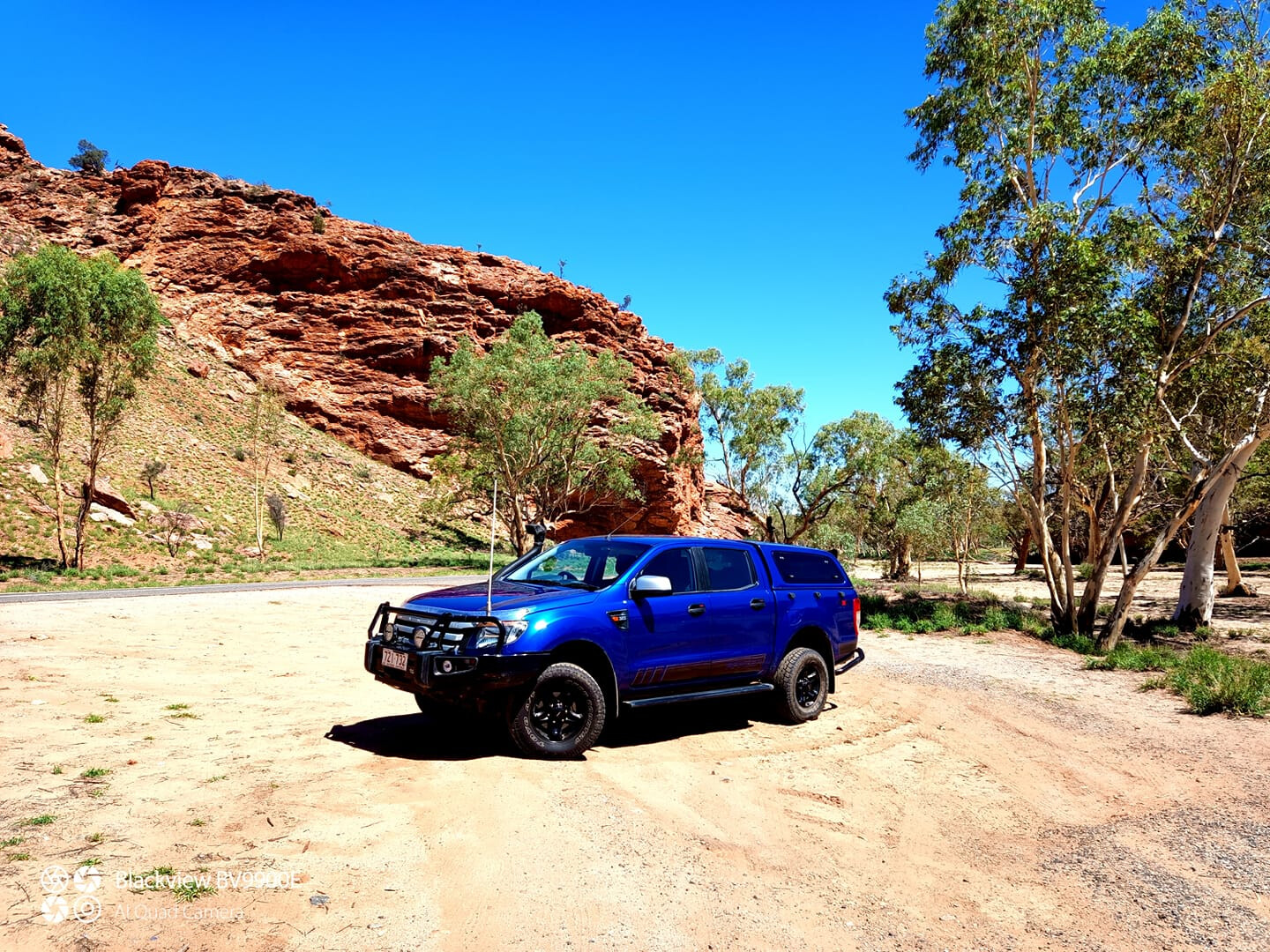
It has front and rear bars, a Frontier long-range tank, Speedy wheels and an Alpine stereo system upgrade with HEMA maps. I’ve been to outback SA, Flinders, East Kimberley, most places between Adelaide and Darwin, and around Alice Springs, NT – Lockey McKee
2014 Land Rover Discovery 4 SDV6 HSE
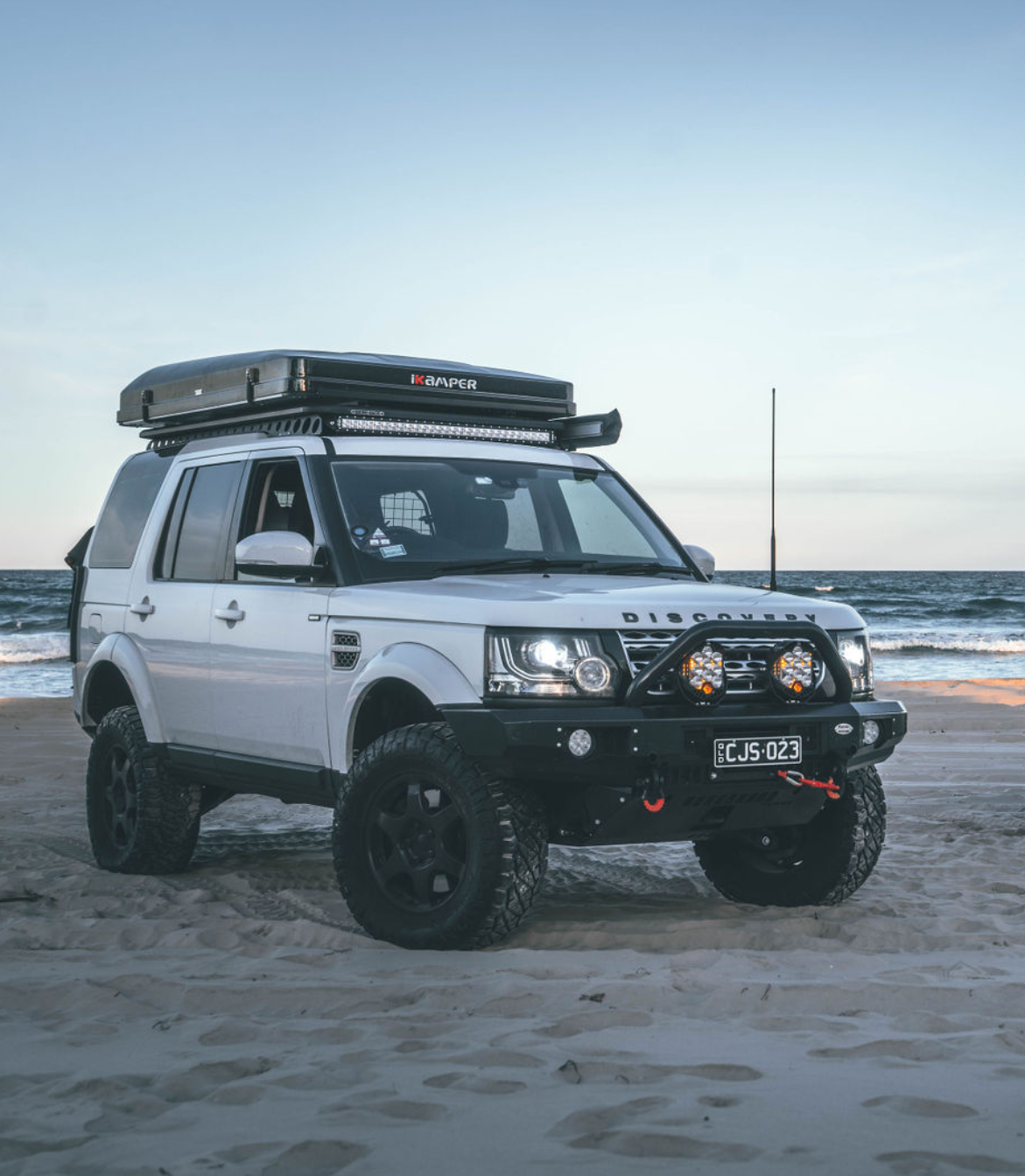
At the moment it’s used for Moreton Island and North Stradbroke Island in Qld. Now that things are opening up, the plan is for the Blue Mountains and Vic High Country next year and anywhere we can get to. Mods include APT rock sliders; Compomotive 18-inch alloys with 285/65R18 Nitto Ridge Grapplers; XLifter air-suspension controller; iKamper 2.0 4X; and more – Chris Stirling
Isuzu D-MAX
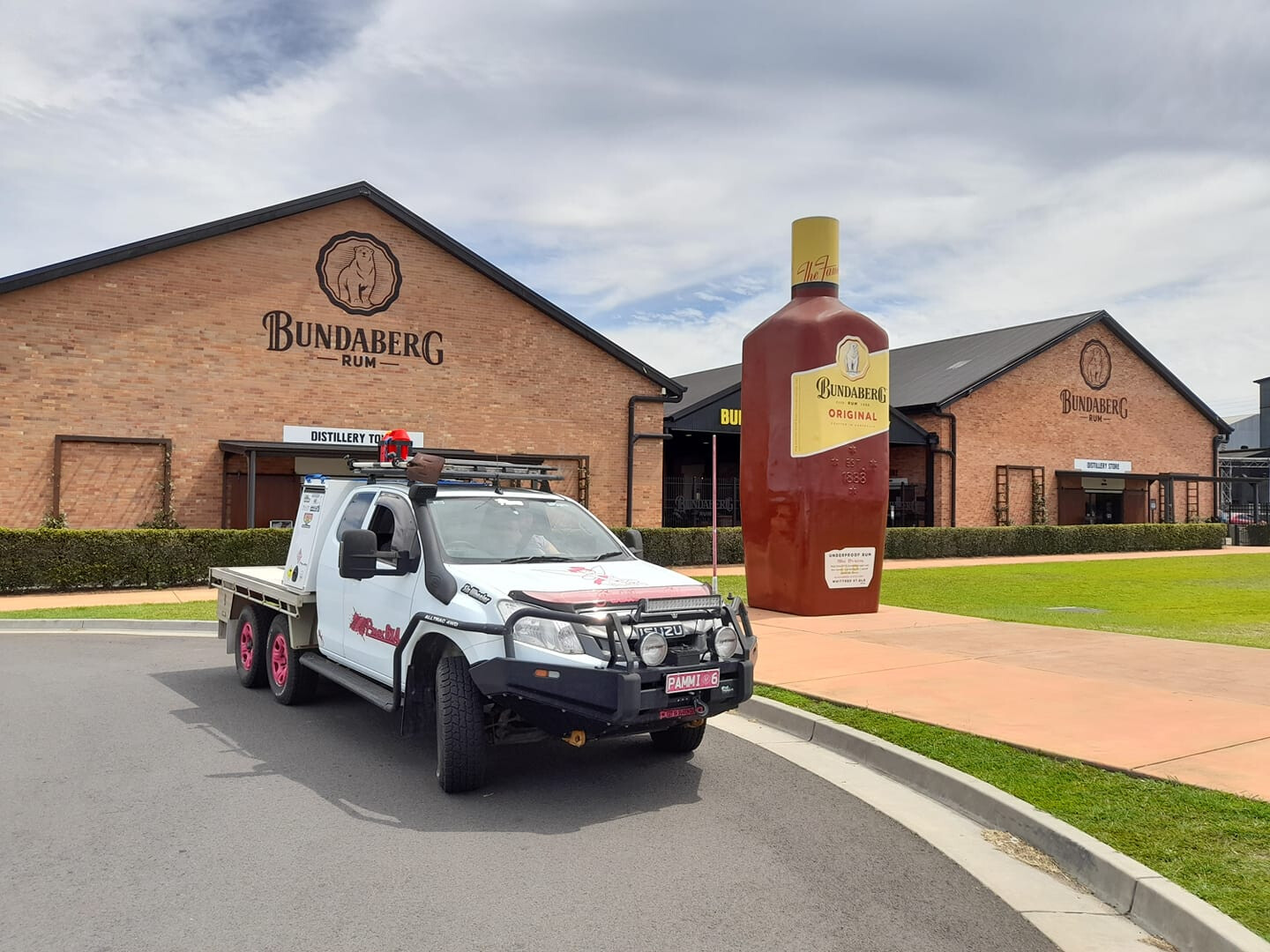
The mighty D-MAX was built in 2016 to tow our caravan, which we live in. The Carry Me Camper is for going on holiday. We did a Simpson Desert crossing via the Madigan Line Track with six other vehicles in 2016. The ECU has been remapped and dyno-tuned, and it has a three-inch turbo-back exhaust. Sixwheeler Conversions did the bar work and suspension upgrade as part of the conversion, plus an ARB poly 130-litre fuel tank – Nic Storer
Sealed Performance Batteries has partnered with Invicta to release the all-new Invicta Hybrid Starter battery.Ideally suited to applications that require a dual-purpose solution for starting and deep cycling, the Invicta Hybrid Starter battery is loaded with top-quality features.Its pouch cell construction, for example, allows the battery to be connected directly to the alternator and deliver high Cold Cranking Amps (CCA).Heat-resistant technology also allows the unit to manage a high rate of discharge/charge in applications that could expose the battery to high heat – this includes specially designed thermal protection layers and broader BMS parameters, allowing the battery to be installed under the bonnet.
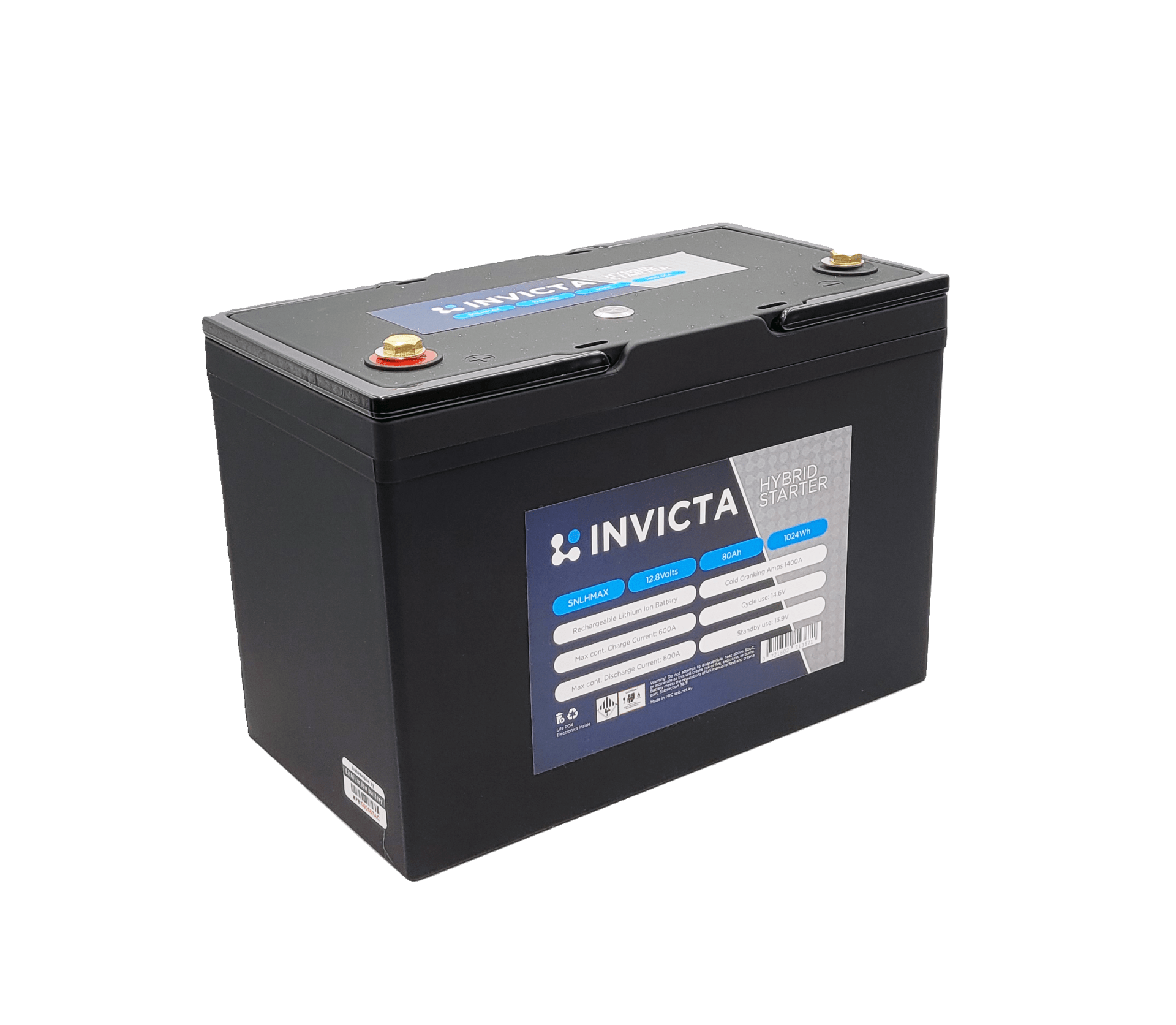
“The Invicta Hybrid Starter will be an absolute game-changer for the Invicta brand,” said Greg Roberts, Managing Director at Sealed Performance Batteries. “We have sourced only the best possible components for this product so customers can be confident that they are receiving the same level of quality as they get in the Invicta Lithium batteries.”Other features across the range include an IP56 rating and a jump start feature, which can jump-start the engine by pressing a button located on top of the battery – possible as the BMS automatically reserves a small amount of capacity.
“The Invicta Hybrid Starter will be an absolute game-changer for the Invicta brand”
Ryan Hammond, Director at Sealed Performance Batteries, added: “We are really excited about this product, and there has been a massive demand for a battery that can do the tasks that are asked of it. However, it is important to note that this battery won’t be for every application.“We still recommend the original Invicta lithium series for deep cycle applications where starting is not a requirement.”The Invicta Hybrid Starter battery is proudly Australian owned and backed by a three-year full replacement warranty.WEBSITE: https://www.invictalithium.com.au/
For decades, an epic battle has raged in boardrooms and bush tracks. Two titans of touring trading blows to dominate the off-road market and the outback alike.Ever since way back in the 1950s, Toyota and Nissan have been throwing engineering might at their off-road programs to build 4x4s that’d dominate in every continent on earth. From the early days of the soft-top short-wheelbase G60 Patrols and FJ Cruisers, through the ’80s as they both ballooned into family wagons, and the ’90s when both hit their stride with big turbo-diesel six-cylinder engines and coil springs reining in solid axles.
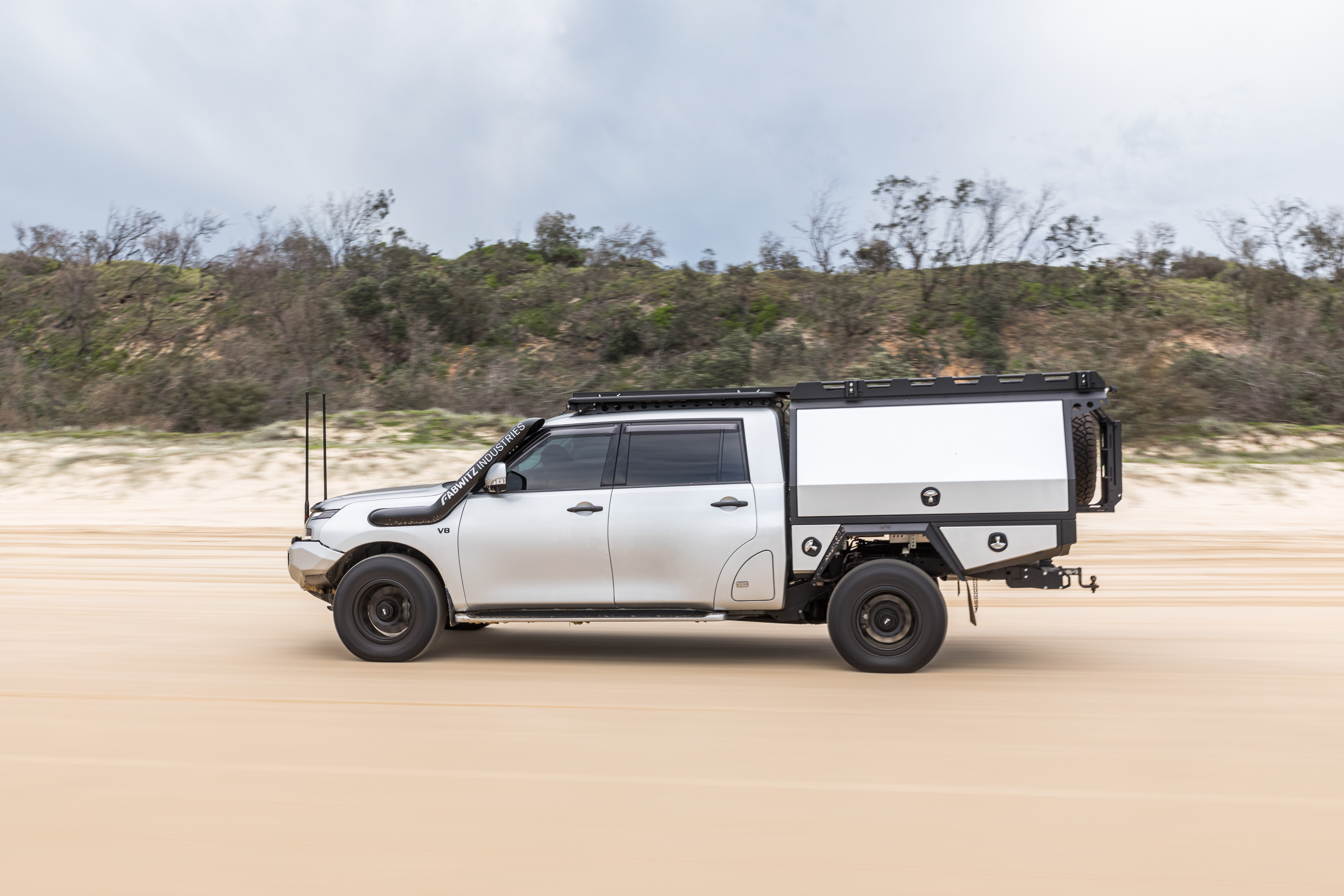
For many, it was peak 4×4 territory and something we still haven’t bettered. Unfortunately, with both manufacturers looking to get an upper hand with a giant leap forward, the war swung in the favour of Toyota’s LC200. The Y62 Patrol with its 400hp V8 failed to capture the hearts of Aussie 4WDers.In recent years the Y62 has clawed back to be a serious contender, and we’ve never seen a better example of that than this epic super-sized dual-cab.
Transformation
While the Gasson family’s silver Patrol may have left the manufacturing line a wagon back in 2019, it didn’t stay that way for long. Just a few months old and it rolled into the Toowoomba workshop of ASG 4X4, where it was sliced and diced beyond recognition.First up was losing all the sheet metal behind the rear doors, a new back wall was handmade turning the wagon into a dual cab, with a pair of handy tool-boxes pieced together where the old rear wheel arches used to be.From here the chassis copped a similar treatment, a massive 650mm extension was welded in with custom fuel and brake lines spanning the distance, and new wiring and rear driveshaft all going into the mix to make it work.
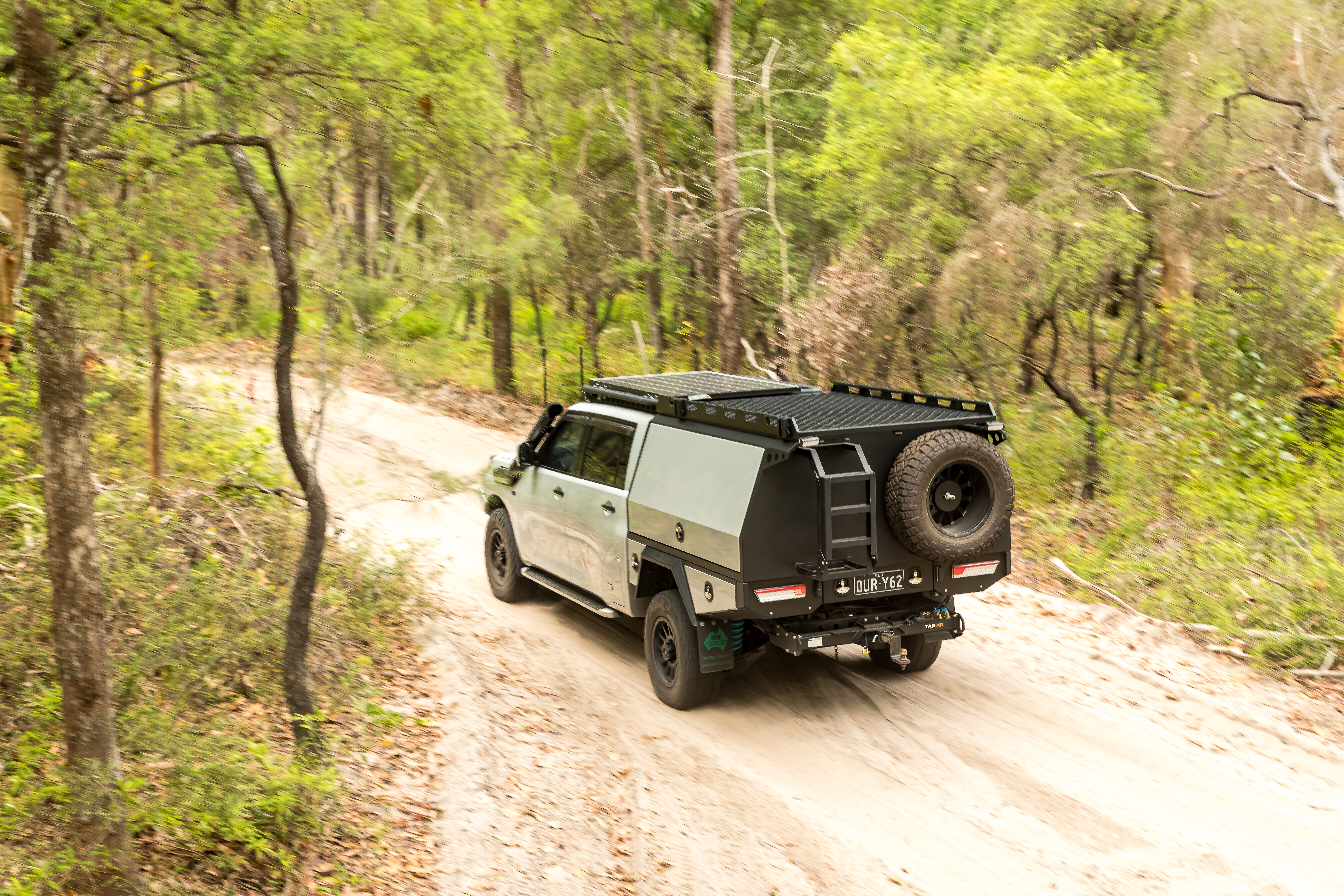
The dual-cab conversion allowed the family to fit a decked-out canopy on the rear, taking their Y62 from mall-crawling wagon to ultimate beach tourer. MW Toolbox in Coopers Plains, Queensland, were tasked with piecing together the canopy and have knocked it out of the park.Popping open the colour-coded aluminium door on the passenger side reveals a huge outdoor kitchen prime for Fraser Island cook-ups. Pride of place is the 85L Bushman fridge. With an internal 6L freezer and plenty of shelf space, it’s more than enough for the family’s adventures. It’s backed up with a full pull-out pantry, deep storage drawers, and a slide-out prep table all lit up by internal LED lighting. There’s even a 12V pie oven in there for easy meals on the road.Up top, there’s a custom roof rack built-in to the canopy, housing a Darche wrap-around awning fitted to clever RacksBrax quick-release lockable mounts. Swinging around the back, there’s an integrated ladder tucked high above the TAG tow bar before arriving on the driver’s side with bulk storage and a built-in weatherproof dog box. What will they think of next?
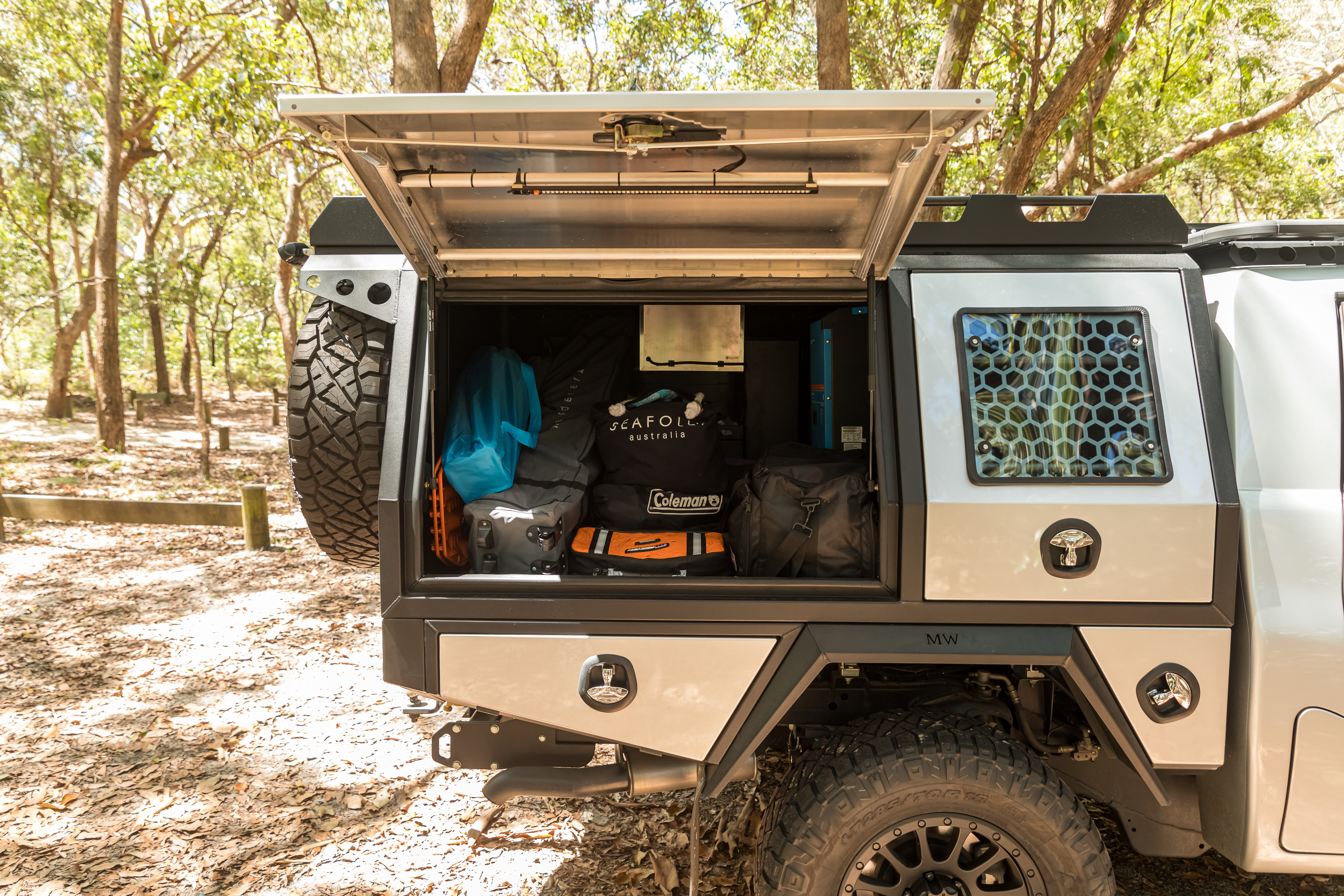
To keep the whole camp affair running late into the night, there’s a simply huge electrical set-up. Kicking off with 400W of solar panels on the roof, it feeds down to a powerhouse 12V system with a Victron MultiPlus-II handling both input and output. It pumps in a massive 120amp of charge from external AC when parked up at home or in a caravan park, 100amp from the Y62’s on-board electrical system or 30amp from the roof-mounted solar. All that power finds its way to a 320amp/h lithium battery bank. There’s 3000W of 240V power coming out the other end, as well as plenty of 12V power keeping the fridge, on-board air and water pumps running trouble-free.Back on the outside and the rest of the Patrol has been spec’ed up to match the tough-as-nails rear end. Up front a Dash Offroad Predator Evolution bar has been colour-coded and fitted by the team at Auramotive. It blends in well with the full chrome delete by Auto Emporium, giving the Y62 an off-road-ready look.
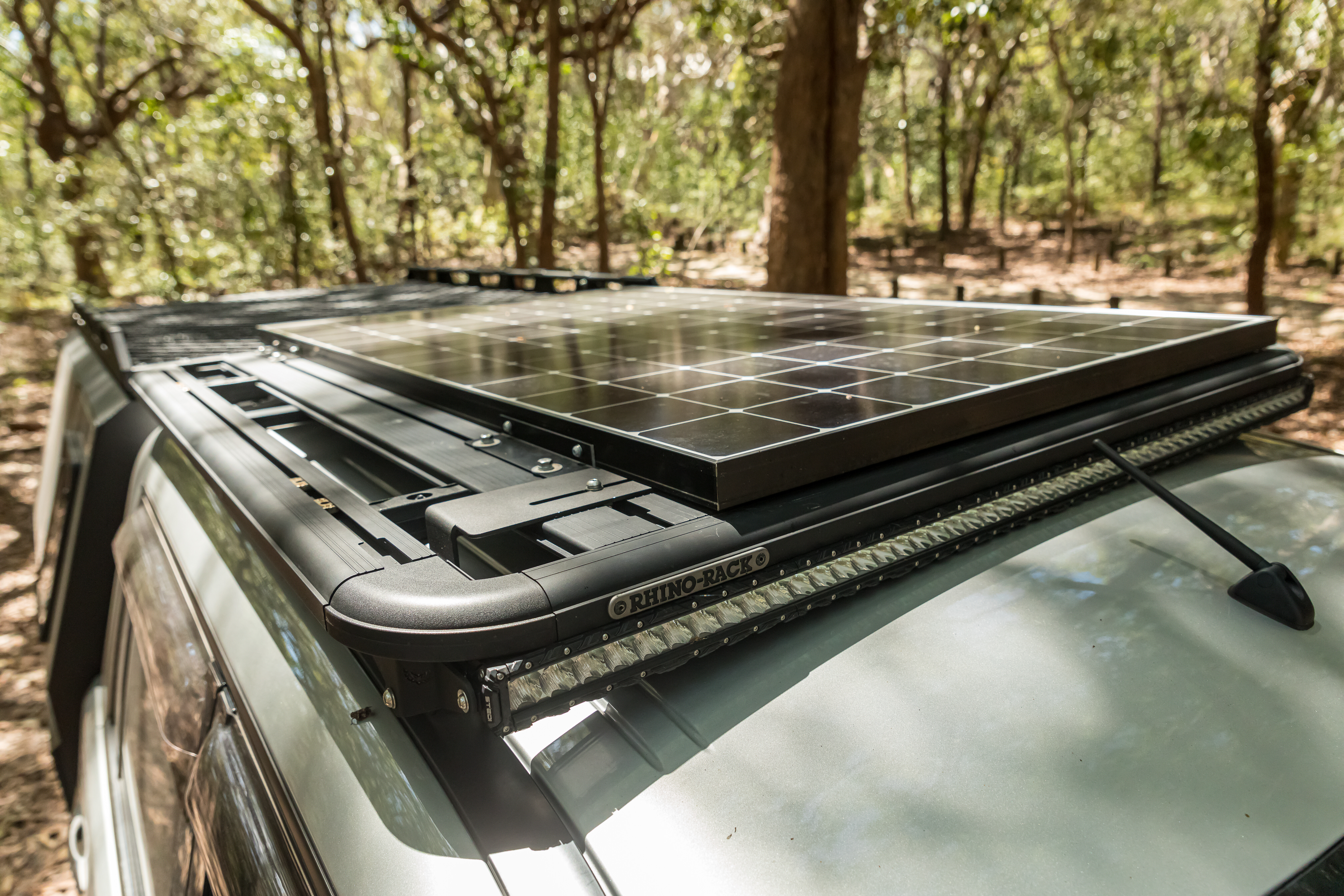
Moving back and a platform rack from Rhino-Rack has been fitted, ASG 4X4 modifying the rack and backbone system to work seamlessly with the now shorter roof of the dual cab. It houses a monster 51-inch Stedi ST3K light bar up front, with a set of Stedi camp lights up back. A custom towbar was designed by TAG to suit the chop and maximise departure angle, thanks to the new real estate available.Moving to the inside and the Gasson family have kept things neat and functional. One of the most important modifications was the installation of a Warrior 4×4 replacement rear-view mirror. The trick digital unit hooks up to a camera up back for rear vision, but also incorporates a dash cam, a 12-inch touchscreen, accident recording and in-built GPS.A GME XRS-330 UHF heads up the communication abilities, fed by dual antennas it’s able to perform just as well in the wide-open plains as the hills of the Great Dividing Range. It’s paired with a Cel-Fi GO unit, keeping mobile phones working far beyond their usual range. A digital dash cluster from CaRobotor replaces the factory offering, not only modernising the Y62’s interior but giving easy-to-read info on everything from fluid temps and pressures to digital inclinometer readings.
V8 petrol
While the inside is the epitome of refinement and technology, under the bonnet an old-school heartbeat keeps things motoring with an impressive 5.6L petrol-powered V8 punching out 400hp and 560Nm. It’s fed all the air it can handle thanks to a super-sized five-inch Fabwitz snorkel and Patroldocta airbox combination, before the spent gases are rocketed backwards through a hand-built three-inch exhaust.
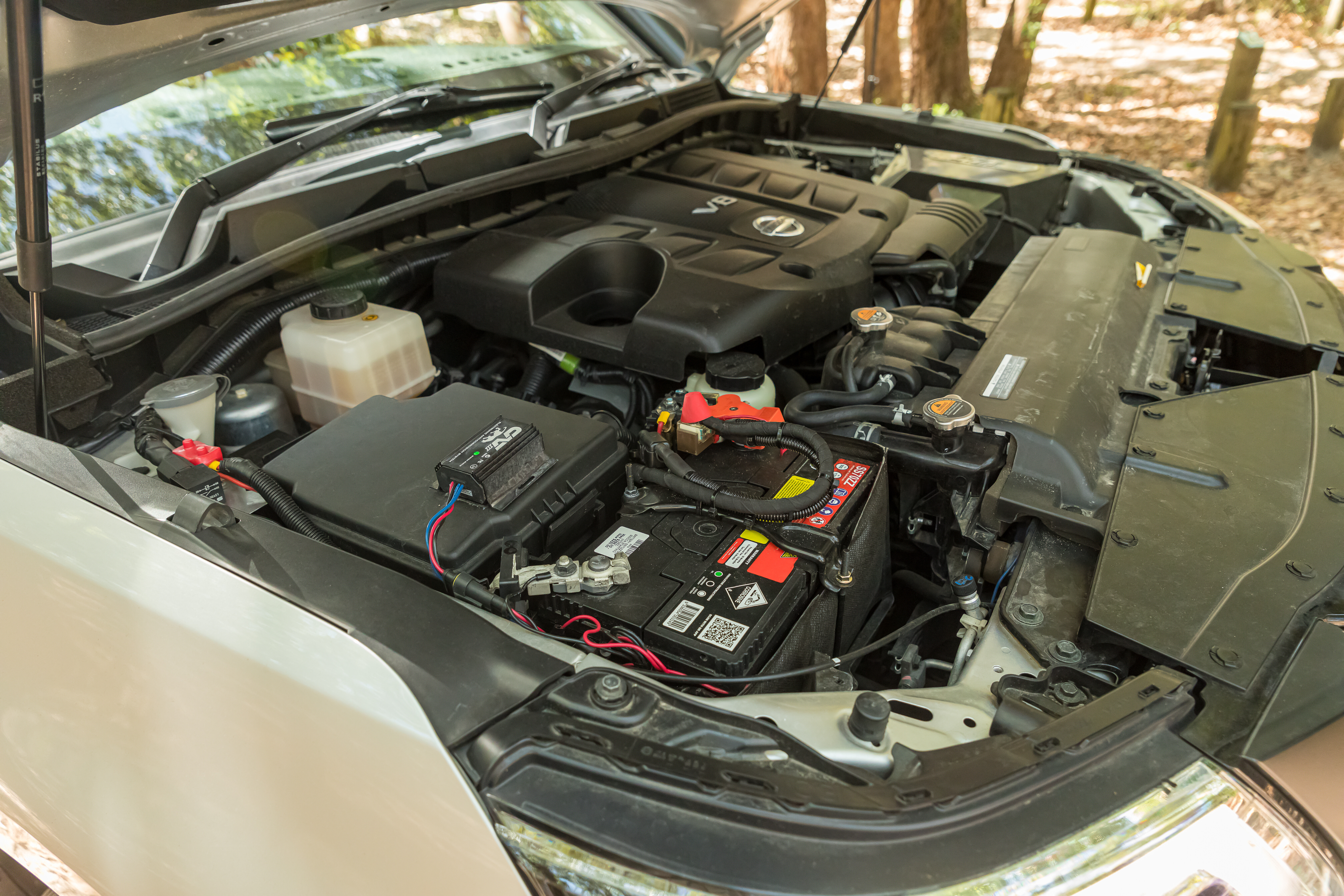
Drive is put to the ground through independent suspension front and rear. Up the back, ASG 4X4 lower control arms add serious strength and are tied in with the 4.2T GVM upgrade. The rest of the suspension is rounded out with 350kg constant-load Dobinson springs and Airbag Man helper airbags digitally controlled with auto-levelling and programmable ride heights including a sky high off-road mode. The suspension set-up allows easy fitment of Nitto Ridge Grapplers tyres punching in at 285/70R18 and wrapped around Elite Off-road Podium alloy wheels.If you need to catch your breath after that endless list of upgrades and modifications, you’re not alone. We’ve started seeing more and more built Y62 Patrols pop-up in these pages, but few to this level. A bona fide tried and tested, chopped and stretched tourer just isn’t something you see with a Patrol badge these days, but it’s proof that not only can the current generation of Patrols still hold their head high, they can pack just as big a punch as their old rivals.
The first blow
While the Patrol and ’Cruiser have been trading blows since 1951 when their predecessors went into production, the Patrol has often pipped the ’Cruiser at the post. Most people have heard the old story about the first ever vehicle crossing of the Simpson Desert being in a Patrol, the G60 loaded to the hilt with the Sprigg family and 200L of fuel to last the distance. It was only the second non-Aboriginal crossing of the desert, the first being Ted Colson on camel-back in 1936. But it’s not the only noteworthy first for the Patrol.While Toyota was first to market with its diesel engines, Nissan was the first to get rowdy with them winning the diesel class in the 1987 Paris to Dakar off-road race, back when they actually went from Paris to Dakar. It was also the first time a diesel engine had placed in the top 10 spots for the whole race. Coincidentally, it was also the first year a Patrol was seen sporting coil springs.The all-new GQ Patrol was a giant leap forward over the aging 60 Series LandCruiser, and first launched in late ’87 – it’d take Toyota another two years to catch up. The Patrol was also the first to sport an automatic transmission, the ’81 model MQ Patrol being optionable with a three-speed auto years before the ’Cruiser would lose the clutch pedal.
Weathered off-roaders sipping lagers at outback pubs will probably laugh you out of the establishment at the suggestion of heading out beyond the black stump with a Korean-built SsangYong Musso – we’ve almost seen it happen – but this luxury-laden XLV makes a hell of a lot of sense as a city-runabout-slash-weekend-adventure rig.
It’s a viable option for those wanting a dual-cab ute with modern tech and comfort for a fraction of the cost of the ‘more established’ utes on the market. Asking for less than $50K, the proposition begins to make even more sense.
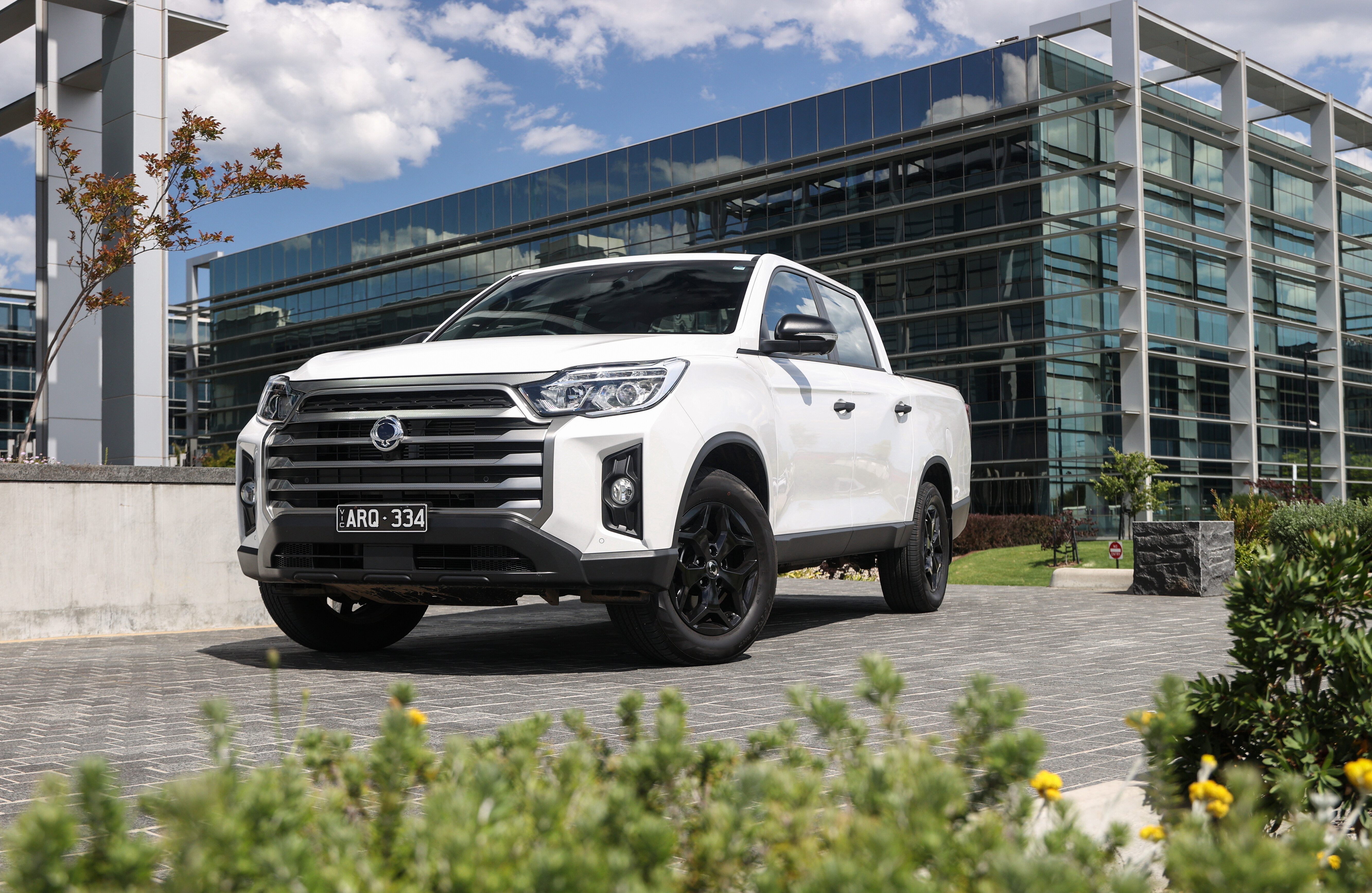
The Musso Ultimate is priced from $41,290 drive-away. Opt for the 300mm-longer XLV variant and you’ll need to spend a further $1500, and then add another $3000 on top if you tick the box for the Luxury Pack. So for $45,790 you can drive away with a brand-new, tech-savvy, luxury-laced dual-cab ute.
Said Luxury Pack gives owners dual-zone automatic climate control, a powered sunroof and more premium pews. All seats are now covered in Nappa leather upholstery instead of faux hide, the front seats are power-adjusted and the driver gets powered lumbar support. To keep kids’ bums warm on cold commutes, the rear seats are also heated.
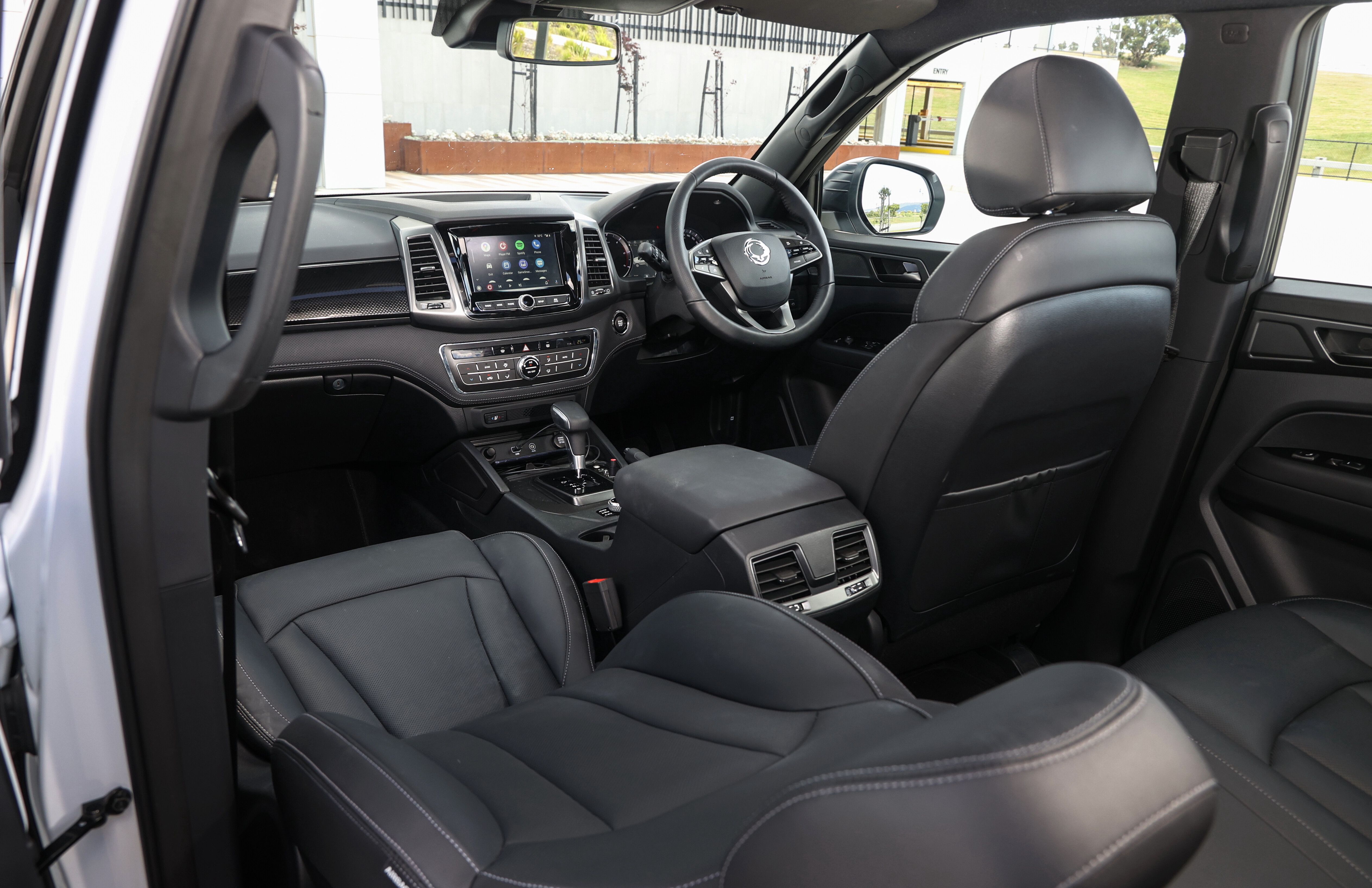
The cabin is wide and accommodating, and the seats supportive and comfortable. The centre console and dash are both well-appointed, belying the sub-$50K price tag. An easy-to-use dial to access 4WD functions is neatly positioned beside a traditional handbrake.
A cavernous tub – as mentioned, 300mm longer in XLV form – has two tie-down points that can be easily reached from outside the tray, and the tonneau cover can be easily detached and reattached in less than a minute.
It’s a viable option for those wanting a dual-cab ute with modern tech and comfort for a fraction of the cost of the ‘more established’ utes

Despite the price tag, the Musso XLV is not bereft of advanced safety systems either, with the Korean ute getting auto emergency braking, rear cross-traffic alert, lane-keep assist and departure warning, blind-spot monitoring, front and rear parking sensors and six airbags. It also comes equipped with a highly pragmatic tyre-pressure monitoring system that constantly assesses the pressure of each tyre – in this case, 255/60 R18 Nexen N’Priz RH7s – and alerts the driver of their status.
The Musso is powered by a 2.2-litre diesel engine, good for 133kW and 420Nm and backed by a six-speed auto. With coil suspension front and rear – unchanged from the pre-updated model – the Musso remains surefooted and tidy on-road.
Off-road, the rig is equipped with a part-time, dual-range 4WD system with electronic traction control and auto-locking rear diff. The added length of the XLV model proves to be something of an obstacle on more challenging terrain – and its bigger size can take some acclimatisation.

What is harder to talk about is longer-term ownership issues. Will it be reliable on a lap around Australia on desert roads and corrugated trails? How about after a few years? These questions will linger, but SsangYong’s seven-year warranty should help to ease such concerns.
For some real-world tow testing, we threw the keys to our mates across the hall at Street Machine Magazine, so they could tow one of their project cars out to Heathcote Park Raceway.
With coil suspension front and rear – unchanged from the pre-updated model – the Musso remains surefooted and tidy on-road
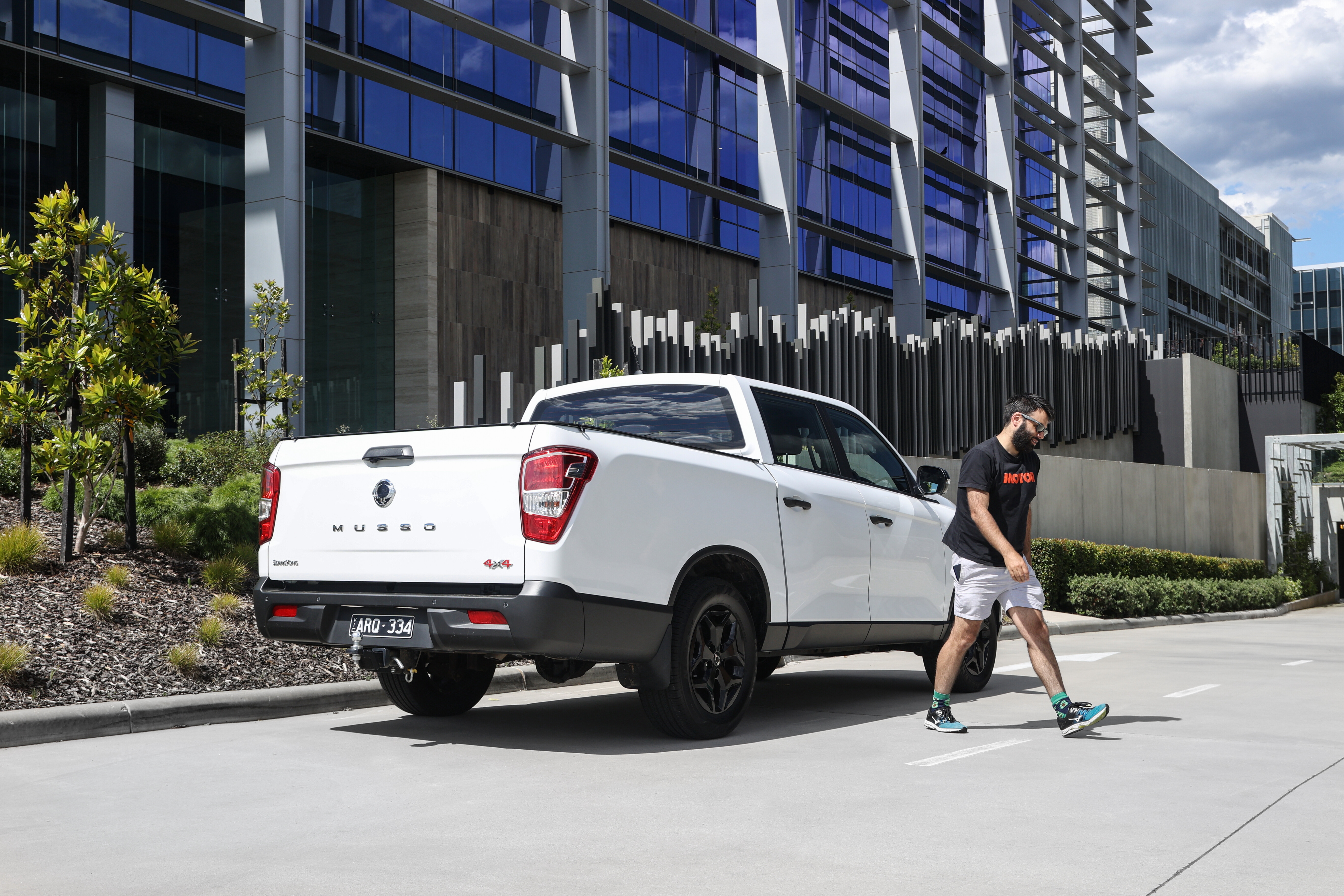
The guys are always towing their Carnage YouTube creations all over Australia in various dual-cabs, so we knew they would be able to give us an informed opinion on how the Musso XLV performs against the rest of the field.
We’ll let Street Machine’s Carnage host Scott Taylor take it from here.
The Tow Test
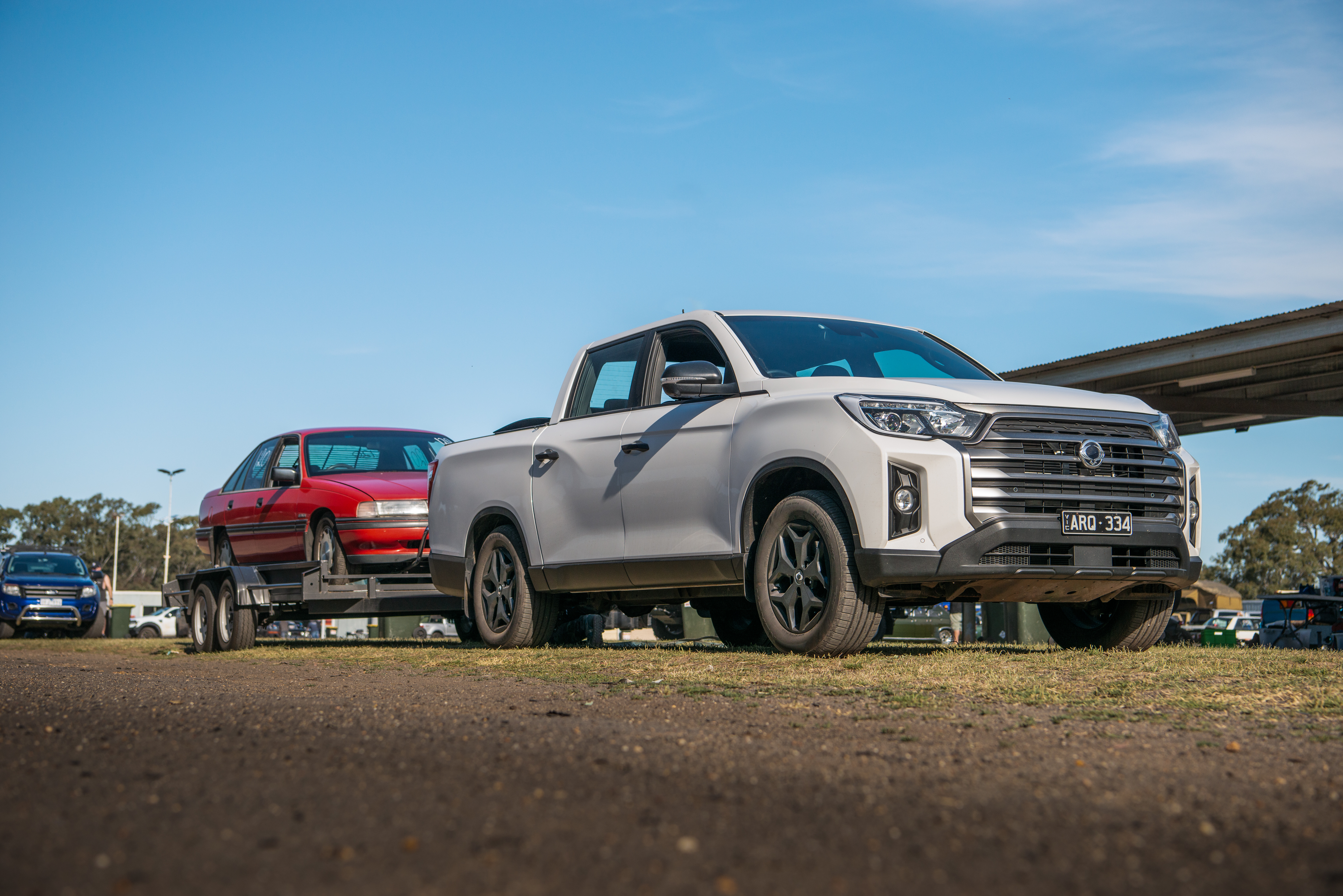
“Wow, what a beast!” were the first words out of my mouth when I laid eyes on the SsangYong Musso. Of course, I was aware of the Musso, but I’d never paid much attention to them. Roomy is certainly a term that comes to mind, and for those towing long distances, comfort is important.
The Musso XLV is big on the inside and even bigger on the outside; which is great when it comes to the pick-up bed capacity. When we usually pack for the track we typically have to weigh up needs and wants; we NEED race tyres and a jack, we WANT the big Esky and plenty of tools, but with the extra 300mm length of the Musso XLV, we found we could take everything.
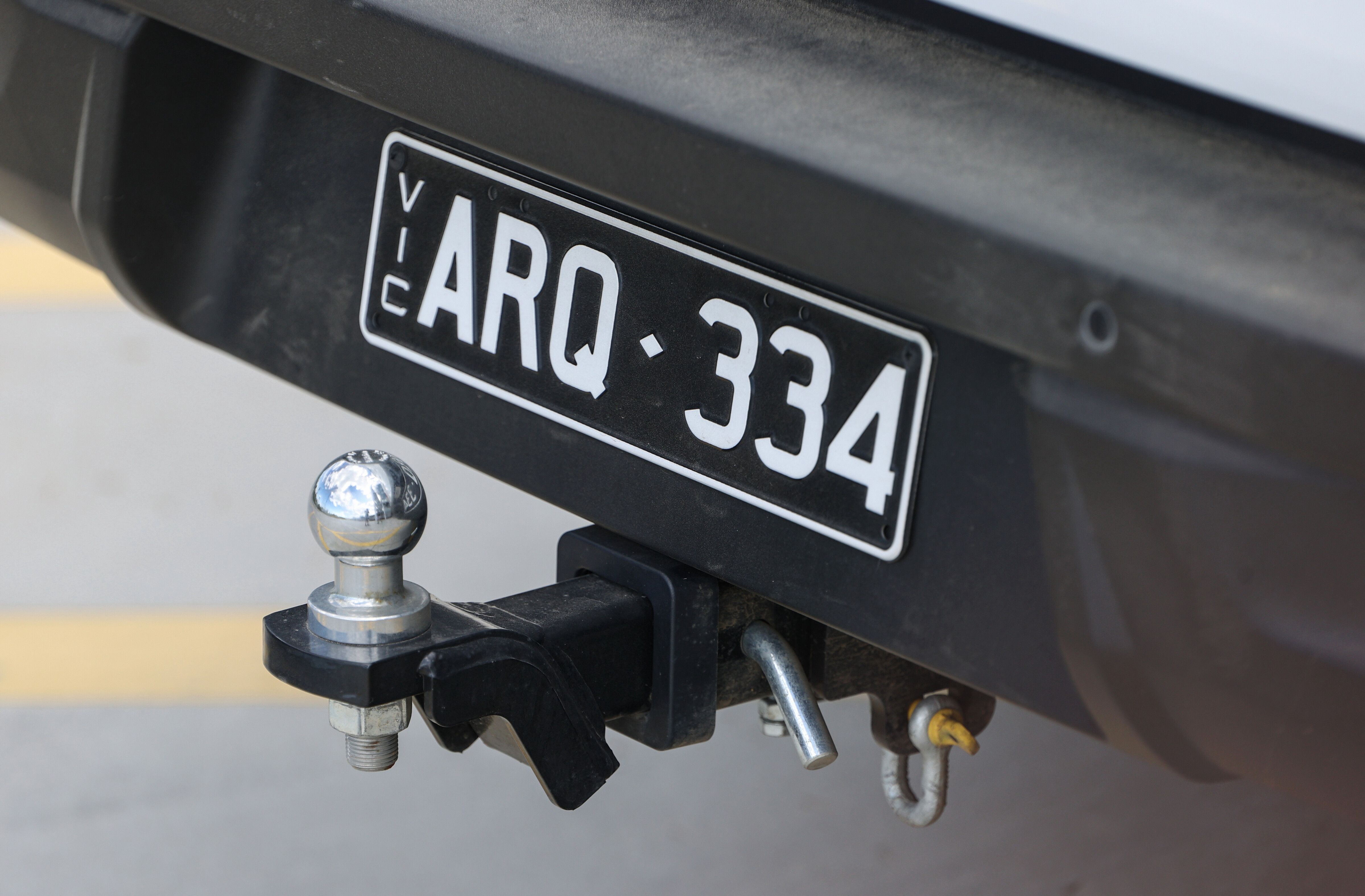
Hooking up was child’s play; the Musso’s reversing camera was perfect for lining up the tow bar and, while the 360-degree camera works okay, we didn’t feel it was quite as good as some of the others we’d experienced.
On the road, with 2100kg of race car and trailer tagging behind, the Musso was as stable as a house through Melbourne traffic, and the little 2.2-litre diesel gave us no complaints, except maybe fuel economy.
Loaded up, we made it the 382km to Heathcote Raceway and back on a tank of fuel, but I doubt we would have made it much further than that. Our only other complaint would be that the six-speed automatic seemed a little flustered through the hills; it never seemed to know which gear it wanted to be in.
The Musso XLV is big on the inside and even bigger on the outside; which is great when it comes to the pick-up bed capacity

But when you factor in the low price and SsangYong’s seven-year warranty, then those problems seem minor and the Musso XLV becomes a very attractive option for a weekend tow rig.
In terms of outright towing capability, we’d rank it solidly in the mid-field (bearing in mind the current crop of dual-cabs represents an extremely strong field), but we’d also score it above average in terms of comfort and carrying capacity. Overall we were pleasantly surprised.