Gear

Gallery 1
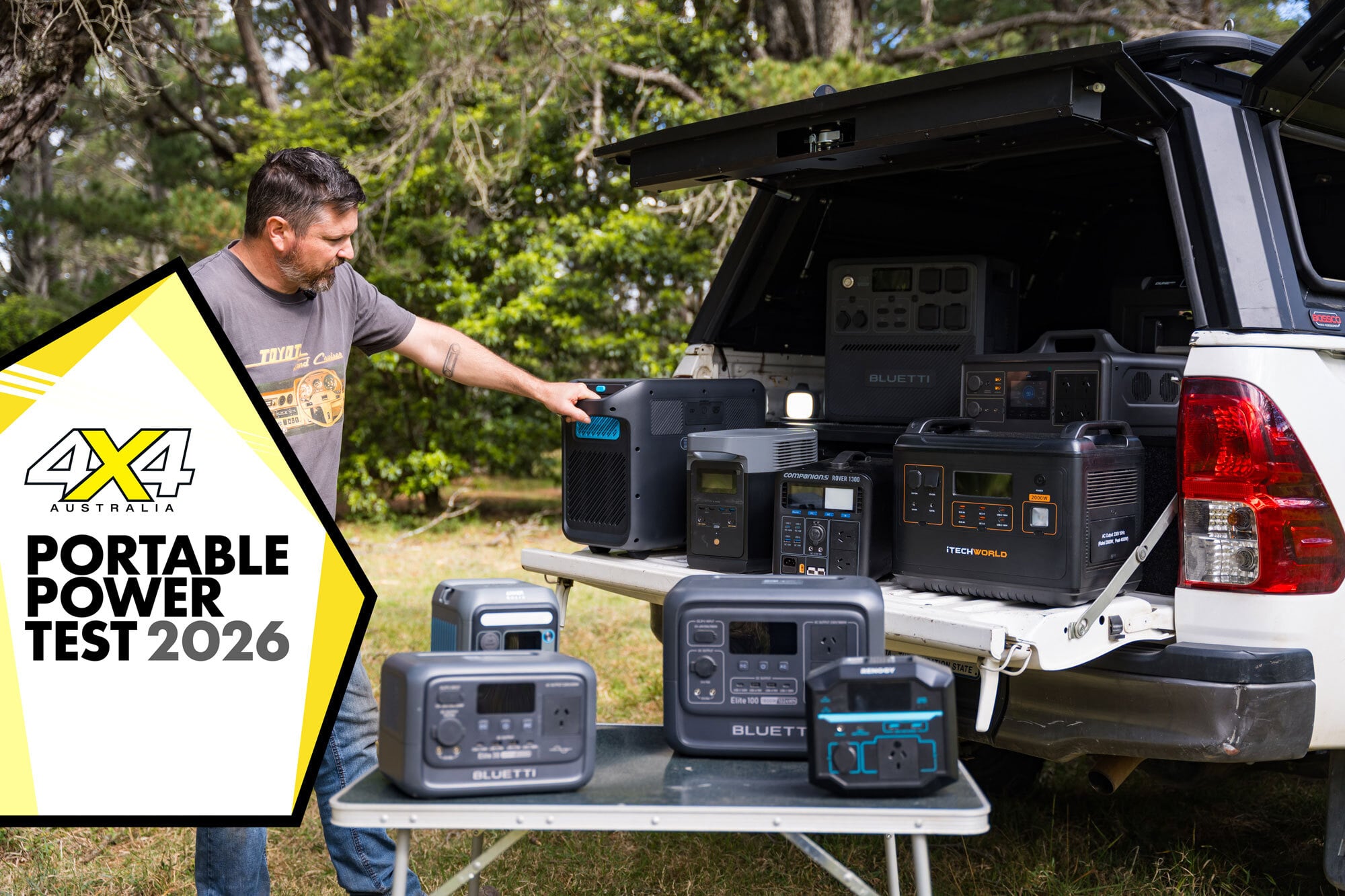
There has been a quiet revolution happening in the way we get electrical power to run our fridges, lights, coffee machines and induction cooktops at camp. Where most of us run dual batteries and standalone lithium systems that are hard-wired to our 4x4s, more and more people are choosing portable power stations.
These lithium-based systems can deliver 240V and 12V power and can be charged from the rig’s alternator, solar panels at camp or precharged at home. And the true value lies in the name: they’re portable. If you have more than one vehicle or want to power up your camper or boat, you only need to buy one product to handle them all. They can also run your tools on a job site or even provide backup power to your house during a blackout. In other words, the versatility is off the charts.
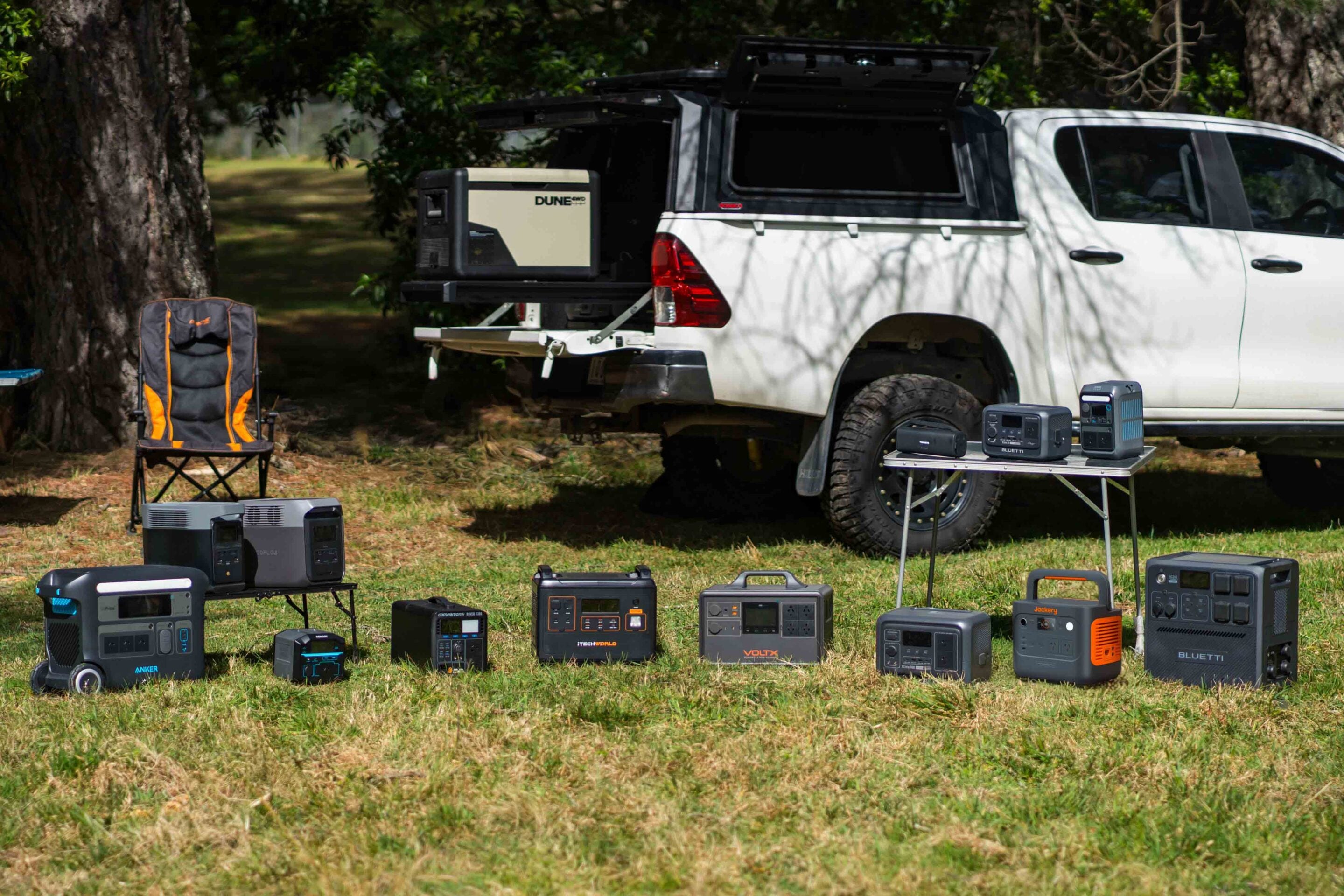
Our testing found the Bluetti Elite 30 (↗) was the pick of the compact 200-300Wh units, the EcoFlow Delta 3 1500 (↗) won the mid-capacity 1000-1500Wh category, and the iTechworld PS2000 (↗) took out the high-capacity 2000Wh+ class. We also gave the Bluetti AC240, now superseded by the AC240P (↗), a Highly Recommended rating.
But what’s the difference between portable power stations? They range in output, size and price, and it can be hard to tell what they can actually do. What made these units stand out from the competition, and which one should you be looking at?
Every unit went through the same lab in Canberra, run by retired Australian National University engineer Colin Dedman, before Dex Fulton took them bush to see how they live in the back of a ute. More on who tested them, and how, below.
JUMP AHEAD
- Portable power stations vs traditional 12V system
- Understanding battery capacity
- Who tested them and how
- Best compact units: 200-300Wh
- Best mid-capacity units: 1000-1500Wh
- Best high-capacity units: 2000Wh+
- Highly recommended: Bluetti AC240
- Buying advice
- Components explained
Portable power stations vs traditional 12V systems
Look, we’re going to completely exclude standalone petrol generators because they’re loud, they smell like a servo, they’re not really viable to run overnight and they’re a great way to ensure you’re the most hated person in the immediate vicinity.
A typical vehicle-mounted auxiliary battery setup will consist of one or two lithium batteries, a DC-DC charger, an MPPT solar input, heavy-duty cables, fuses and a distribution panel with gauges to keep an eye on things. Let’s quickly compare such a system with a portable unit.
In-vehicle systems are reliable and will last a good long time. They’re also able to be repaired easily if a component fails. If something dies on a portable unit out the back o’ Bourke, you’re probably cooked. In-vehicle batteries can be charged quickly from the alternator. Portable power stations rely on a low-and-slow charge via a cigarette-lighter socket.
1
Hard-mounted systems take either a lot of skill or a lot of money – or both – to put together. While portable systems aren’t exactly cheap, they’re often less expensive overall and don’t require installation. Plus, they can be removed when you sell the vehicle or swapped between several different vehicles quickly and easily.
In-vehicle batteries also have constraints on where you can use them. You’re basically limited to the back of your rig. If you want to run your CPAP machine, for example, next to your bed in your camper trailer, or your campsite is in a national park and you’re a short walk from your wheels, portable power makes a lot more sense.
Finally, when they’re not required, portable power stations can be removed from the 4×4 and stored in the shed, freeing up valuable real estate. On top of that, the applications extend beyond camping, as they can power 240V jobsite appliances and tools or provide backup power in the event of a blackout.
Understanding portable power station capacity
Real quick: all of the power stations are rated in watt-hours (Wh).
They range from 200Wh up to 3600Wh (3.6kWh) of energy capacity. If you want to express that in the more familiar amp-hours (Ah), you can divide the Wh figure by the voltage. So 1200Wh is equivalent to 100Ah at 12V. Or you could just go with: the higher the Wh number, the more energy available. Whatever works.
Who tested them and how
THE LAB: Colin Dedman
Colin started at the Research School of Physics at the Australian National University in 1979, providing the engineering behind physics research. Much of that work was designing precision temperature control systems, including enclosures held stable to within 0.02 degrees Celsius, and the instruments to measure them. When he retired and the research lab he worked with closed, he kept a lot of the equipment. It now lives in his test room in Canberra, along with years of experience testing solar panels against their nameplate output.
That matters here because battery capacity changes with temperature. A number taken in a hot shed on a summer afternoon can’t be compared with one taken on a cold morning. Colin’s room holds 25 degrees Celsius to within half a degree, and every electrical reading is referenced back to professional-grade 6.5-digit multimeters.

1
What he measured
Running a 35L fridge off a 2000Wh unit until it goes flat would take more than a week, per unit. So Colin measured the one number everything else comes from: How many watt-hours each station actually delivers at the 240V outlet, drawn down over two hours. Fridge runtime, laptop and phone recharges, kettle boils and induction cooking time are all calculated from that figure.
Then he went after charging, which is where he reckons the real story is. “Any fool can discharge a battery,” Colin says. “What matters out in the bush is how effectively the station can be charged, from solar panels and the vehicle electrical system, and this is where some power stations shine and others fall on their face.”
No manufacturer publishes how its DC input port behaves. The manuals just say plug your solar panel or car charging cable in here. So Colin mapped every unit’s input on a 60V, 50A lab power supply at the three voltages that matter in the real world: 13.2V from a running alternator, 18V from a single solar panel and 36V from two panels in series. He also measured what each 240V charger actually draws, and threw a mitre saw, an angle grinder, a metal cut-off saw, a drill and a cement mixer full of sand and gravel at every inverter.
1
THE FIELD: Dex Fulton
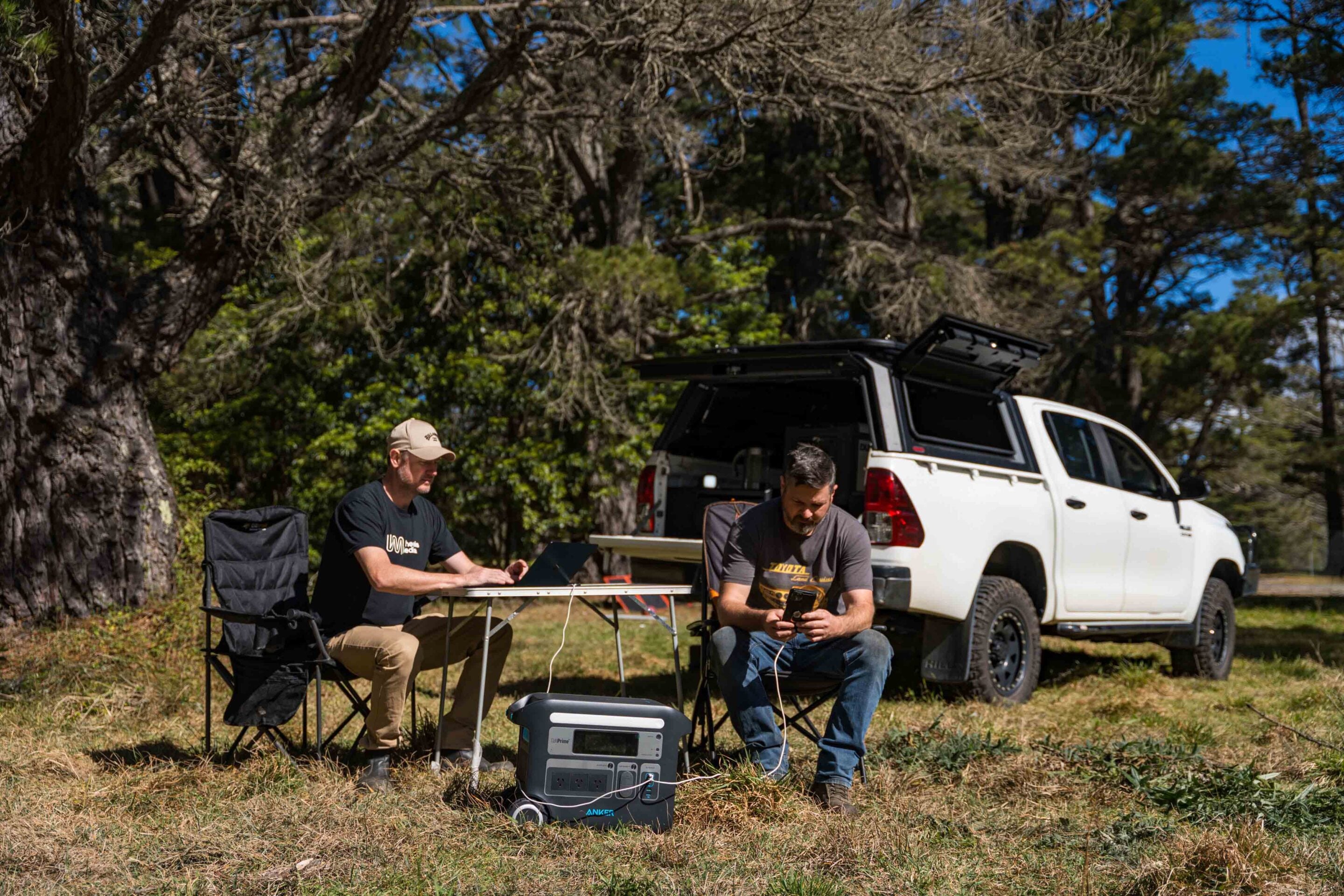
Lab numbers can’t tell you whether a unit slides around the tub, or whether you can read its screen in full sun. On August 21, Dex took the units into the Blue Mountains to check what the lab couldn’t: How each one fits and ties down in a ute, whether it uses standard connectors and ships with a cable to charge it in the bush, how well it’s sealed against dust and water, how noisy the fans are at camp and how the auto-off settings behave. He also weighed up local support and warranty.
The category winners come from Colin’s lab data and Dex’s time in the field, together.
Best compact units: 200-300Wh
Roughly the same size as a brick, with a capacity of 200-300Wh, you can literally pick these units up with one finger.
They don’t have the capacity or power to replace an in-vehicle system or provide all your campsite needs. However, unlike a larger system, a unit of this size can be by your side, exactly where you need it, at all times. Your own personal power station.
And these little fellas charge fast, so when you do run them down, recharging takes only a few hours. Fast car chargers are not available and there’s no need for them, as a recharge time of around three hours using the cigarette-lighter cable is adequate. Average weight is around 4kg.
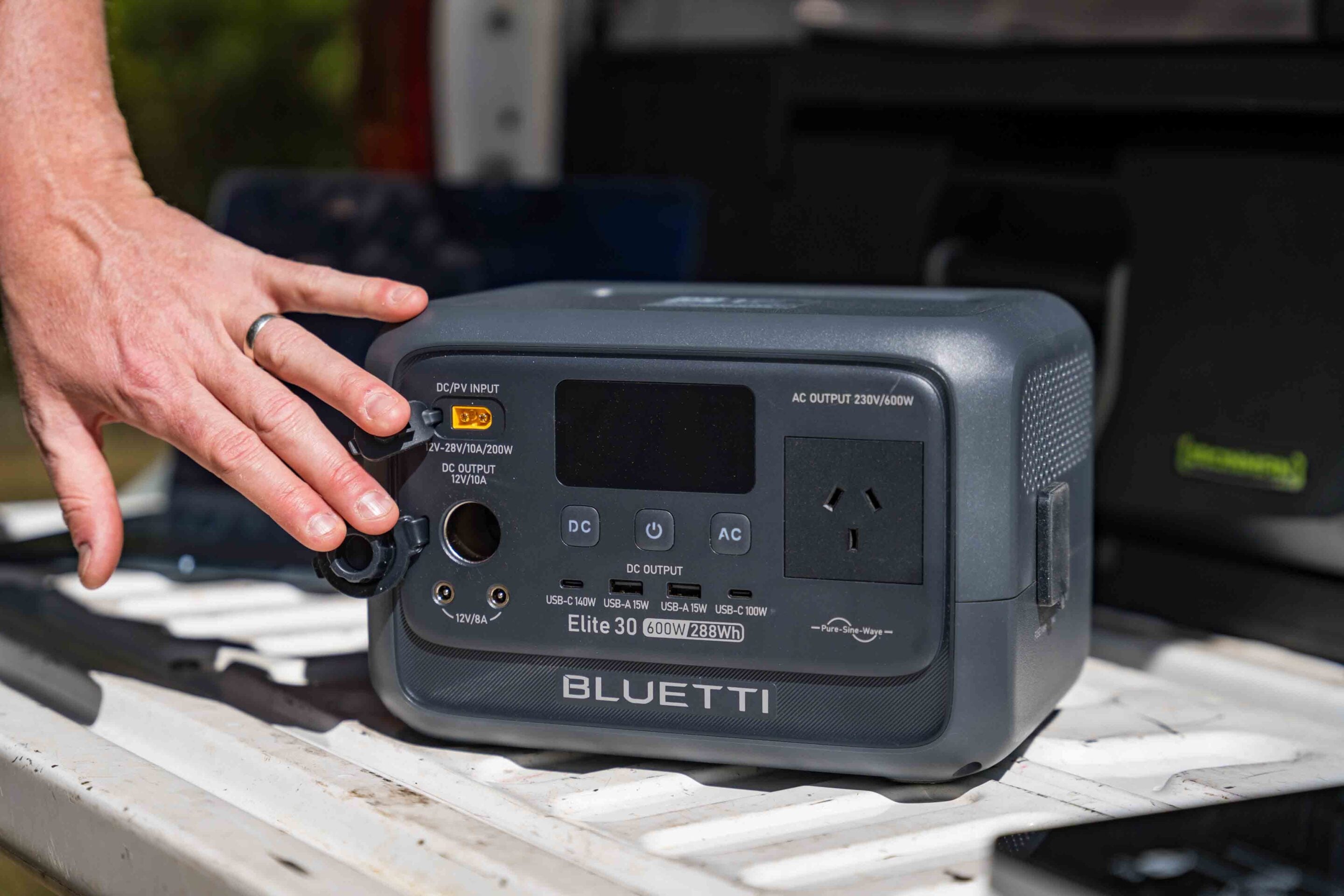
- Winner: Bluetti Elite 30
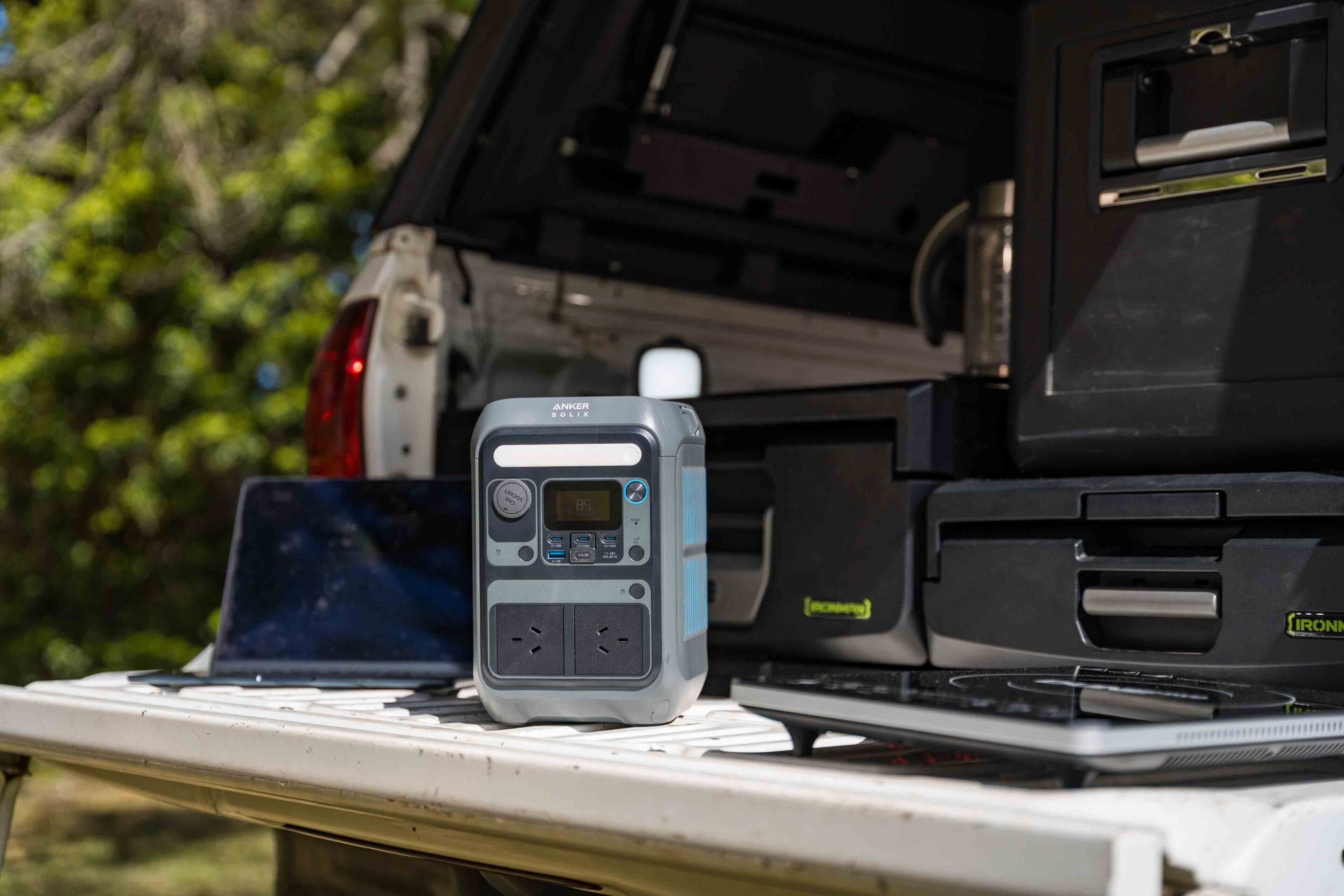
- Runner-up: Anker Solix C300
Renogy Phoenix 222
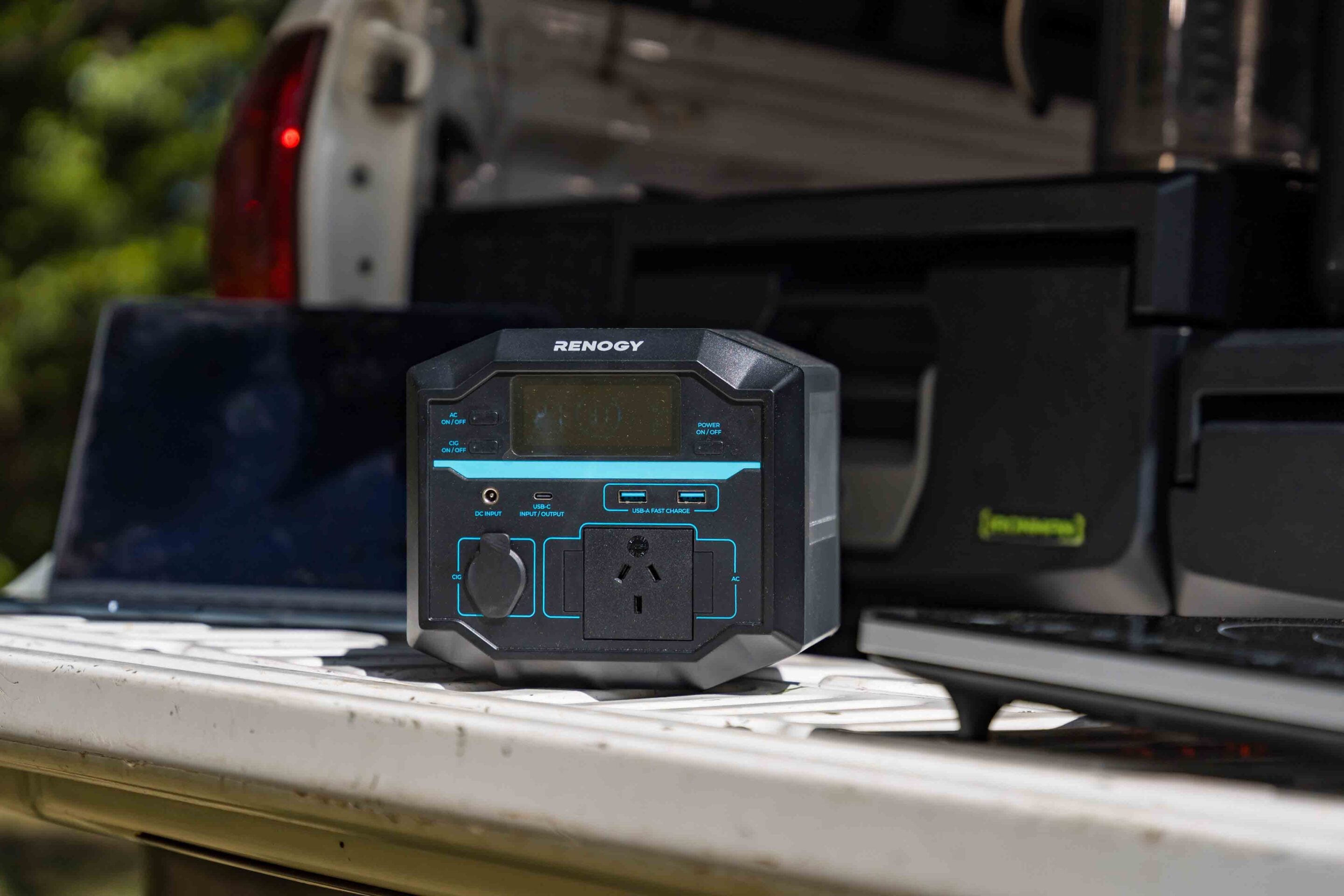
If tiny size was the criterion, then this would win. Unfortunately, the Renogy Phoenix 222 (↗) performs so badly across every metric that it is hard to recommend. A short 12-month warranty and short-lived Li-ion cells, rather than LiFePO4, are a bad start, and it gets worse from there.
There’s a clunky and slow external brick charger, no modern high-power USB-C ports, only 200W of AC output, only 60W of solar charging, only 33W of in-car charging and an unregulated DC output that varies from 11V to 17V. Spend the extra few bucks and get the Anker or Bluetti.
5
Dometic PLB15
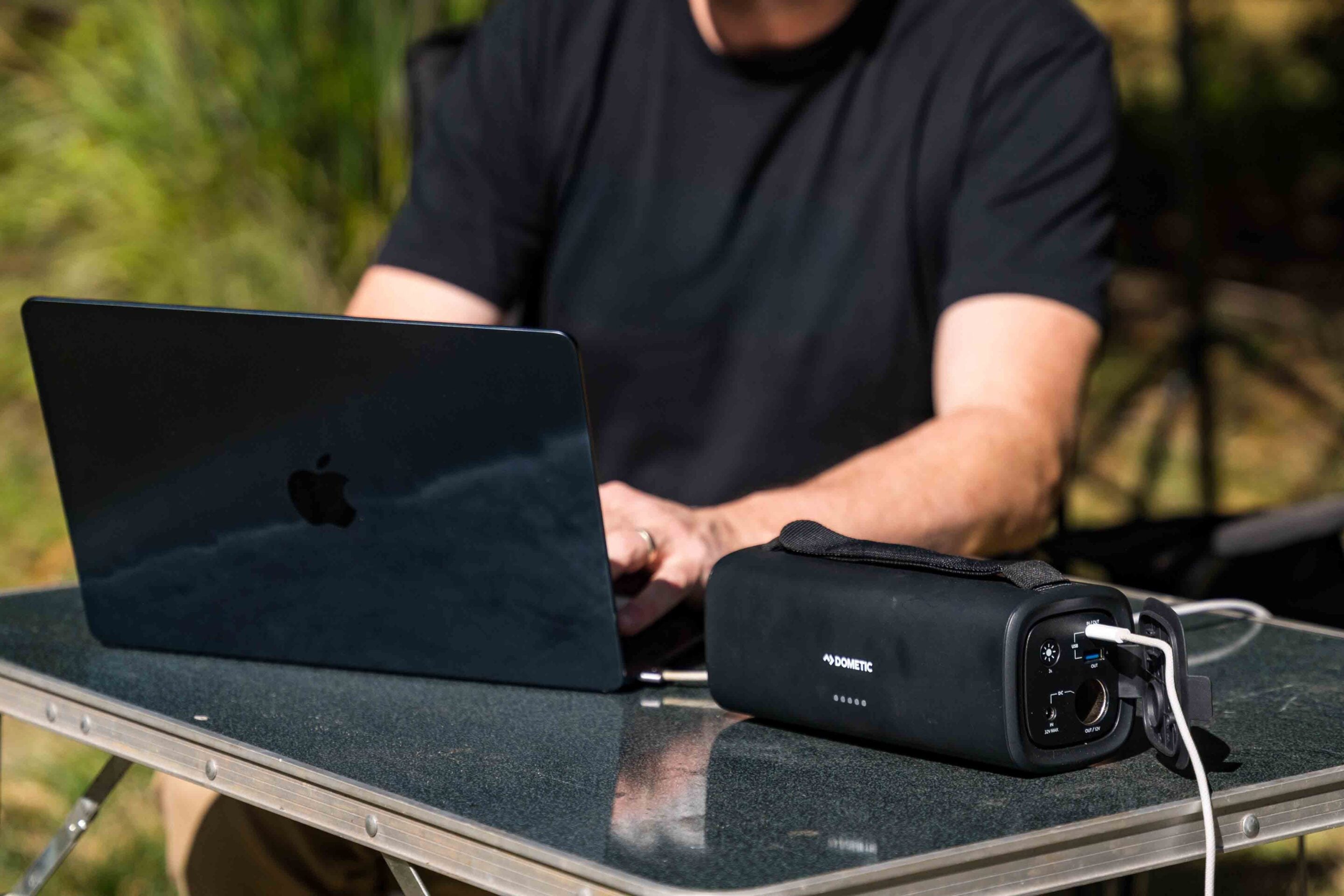
We were sent this one for testing, but the Dometic PLB15 (↗) is actually a portable battery pack rather than a power station. Presumably, the intended application is running a 12V fridge and recharging from a solar panel, as there’s no 240V charger, no 240V output and no information screen. The Dometic PLB15 has a pair of USB ports maxing out at 60W in or out, a torch in one end and a 24-month warranty. That’s it.
But for the same money, the Anker or Bluetti can do all of that and so much more, making the Dometic PLB15 hard to recommend. In its defence, it does provide 15A at the 12V output, while the others only provide 10A.
6
Bluetti Elite 30 vs Anker Solix C300
The Bluetti Elite 30 (↗) outperforms the competition across all metrics. Its nearest competitor is the Anker Solix C300 (↗). Bluetti versus Anker, respectively:
- 240V output: 600W vs 300W
- 240V charger: 980W claimed vs 300W
- Solar charging: 200W vs 100W
- In-car charging: 8.2A vs 7.4A
- Percentage of rated capacity: 92% vs 82%
5
For the Bluetti Elite 30, we were not able to achieve more than 355W of 240V charging power, despite playing with the menu settings, so we question the claimed 980W figure. But it is academic. The measured 355W is still more than the 323W we recorded for the Anker Solix C300, and both are adequate, providing a recharge time of around one hour.
The Bluetti Elite 30 also has a 1500W ‘power lifting mode’ for resistive loads, but it is of limited use in practice because of the small 288Wh capacity. The Anker Solix C300 is still a nice unit, and it has the benefit of two AC outlets rather than one, as well as a light. Both ran a 240V 800W drill but nothing bigger.
4
| Specs | Bluetti Elite 30 | Anker Solix C300 | Renogy Phoenix 222 | Dometic PLB15 |
|---|---|---|---|---|
| RRP | $399 | $399 | $249 | $399 |
| Weight | 4.3 kg | 4.1 kg | 2.4 kg | 1.8 kg |
| Warranty | 60 months | 60 months | 12 months | 24 months |
| Rated capacity | 288 Wh | 288 Wh | 220 Wh | 192 Wh |
| Rated AC output | 600 W | 300 W | 200 W | None |
| 240VAC charger | 980 W | 330 W | 65 W plug pack | None |
| Measured capacity | 265 Wh | 235 Wh | 190 Wh | 182 Wh |
| Capacity (% rated) | 92% | 82% | 86% | 95% |
| 35L fridge runtime | 25 hr | 23 hr | 18 hr | 17 hr |
| Laptop recharges | x3.8 | x3.4 | x2.7 | x2.6 |
| Phone recharges | x12 | x11 | x9 | x8 |
| 240V kettle | No | No | No | N/A |
| Induction cook @1200W | No | No | No | N/A |
| Large power tools? | A few | A few | No | N/A |
| Measured DC voltage | 13.3V 10A | 13.3V 10A | 11-17V 10A unregulated | 12.5V 15A |
| Max DC voltage | 28V | 28V | 25V | 32V |
| XT60 @13.2V | 8.2A / 108W | 7.4A / 98W | 2.5A / 33W | 4.9A / 65W |
| XT60 @18V | 8.2A / 148W | 5.4A / 97W | 3.0A / 54W | 5.0A / 90W |
| XT60 @36V | N/A | N/A | N/A | N/A |
| Fast car charger | No | No | No | No |
Best mid-capacity units: 1000-1500Wh
With a capacity of more than 1000Wh and AC outputs of around 1800W, these units will power most 240V appliances, though an induction cooktop or kettle will deplete the battery fairly quickly. For reference, 1000Wh is equivalent to about 83Ah at 12V.
These have enough capacity to actually replace many entry-level in-vehicle systems and meet most folks’ campsite needs, especially when teamed with a decent solar panel and fast alternator charging. They’re also small and light enough to carry in one hand, with an average weight of 12.5kg. So, which one performed best?
- Winner: EcoFlow Delta 3 1500
- Runners-up: Bluetti Elite 100 and EcoFlow Delta 2
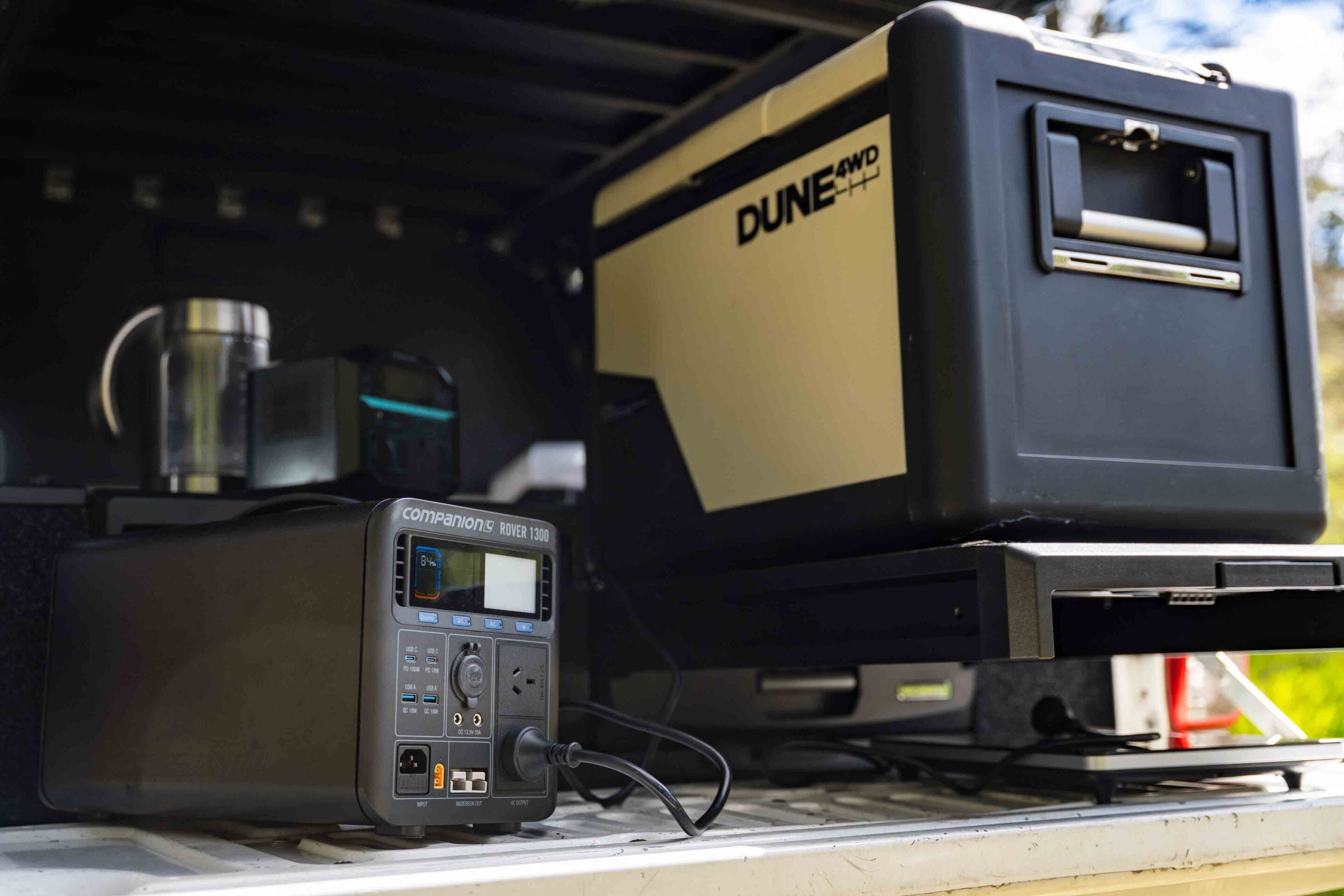
Companion Rover 1300
At 1344Wh, the Companion Rover 1300 (↗) has the greatest rated capacity in this category, but it is also a slightly larger and heavier unit. The extra capacity could be useful, but the Companion Rover 1300 falls short in other areas. The warranty is only two years, and the 240V charger and output are less powerful despite the larger capacity. The 1200W inverter output is not really enough to run our 2000W angle grinder and 2300W cut-off saw under load, so the fact that it started them okay is moot.
The solar input is the least powerful at 400W. That may sound like a lot, except that you are stuck with an 8.7A limit, so a single panel is limited to 8.7A x 18V = 157W, or double that for two panels in series. Unfortunately, there is no fast charger module available, so you are stuck with a maximum in-vehicle charge of only 8.7A and 115W, which will take about 10 hours of driving to fully charge the battery.
The 12V Anderson connector DC output is a much better option than the cigarette-lighter sockets, and the Companion Rover 1300 also comes with an Anderson-to-XT60 cable, so you are not locked into proprietary connectors and solar panels. Other manufacturers take note. Even so, the Companion Rover 1300 falls short of the others.
6
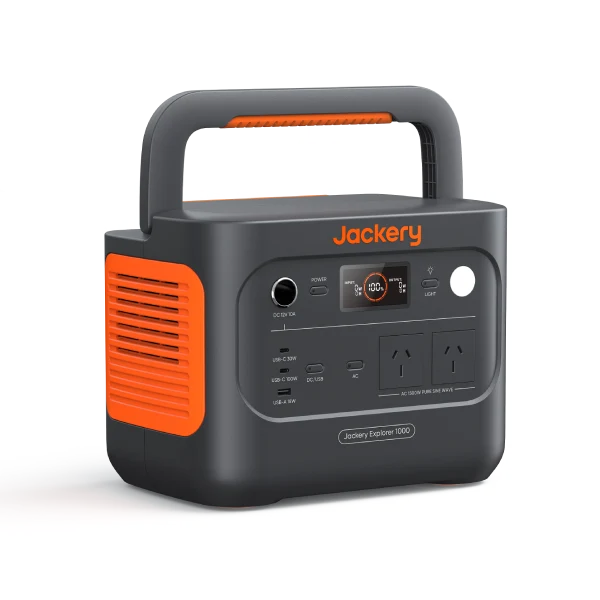
Jackery Explorer 1000
At just 10.8kg, the Jackery Explorer 1000 (↗) is the lightest in class and the handle is the easiest to use, while neatly folding away. It does not ship with a cig-plug or solar cables, so there is no way to charge it out in the bush. The DC charging port uses a pair of coaxial DC8020 connectors that are uncommon. If you buy Jackery solar panels with 8020 connectors, then it all works well, but if not, you will need to buy adaptor cables that are uncommon and expensive.
The port itself is good for up to 400W of solar. Others were limited to less than 9A or 160W for a single 18V panel, but the Jackery is good for 21A or 380W, so in principle a single panel of up to 380W would work. In practice, though, the 8020 connectors are only rated to 10.5A, so you would need to use them in parallel. Doing so will be messy and expensive because suitable 8020 hardware is scarce.
The bottom line is that, because of the non-standard connectors, using your own panels is a pain. To charge the Jackery Explorer 1000 while driving, you need to buy your own cig-to-8020 cable, which is also a pain. Even then, like most units, the in-car charge current is limited to 8A, which is really slow, and you are stuck with that because a fast-charging module is not available.
The 240V AC output is 1500W, while the EcoFlow and Bluetti offer 1800W. They also use the more common XT60 connector, provide 15A of in-vehicle charging and are supported by fast alternator charging. All in all, the Jackery Explorer 1000 is outgunned, leaving the EcoFlow and Bluetti as the stronger options.
1
Bluetti Elite 100 vs EcoFlow Delta 2
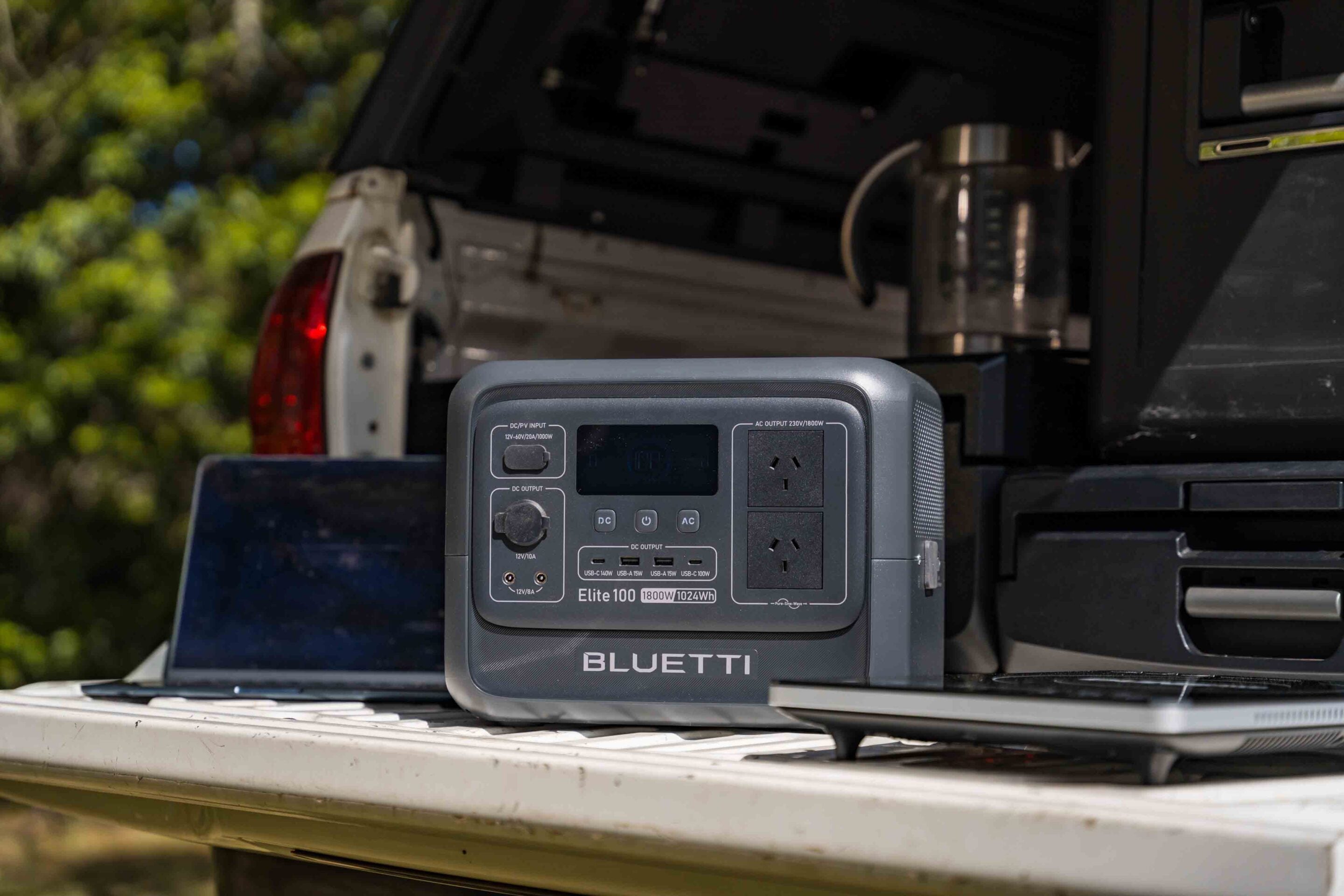
The Bluetti Elite 100 (↗) solar input can handle up to an impressive 1000W of series- or series-parallel-connected panels, though a single panel is still limited to 8.2A and 146W. The EcoFlow Delta 2 (↗) can handle ‘only’ up to 500W of series- or series-parallel-connected panels. The EcoFlow Delta 2 ships with only a mains cable, while Bluetti also provides an XT60-to-MC4 solar-panel cable. However, because the XT60 connector is so common, cables are cheap and plentiful.
But the EcoFlow Delta 2 has an ace up its sleeve: the XT60i (note the ‘i’) DC input connector. This version of the XT60 connector has a third centre pin for programming the charge current. Specifically, if this pin is shorted to the ground pin, it unlocks the full 15A charge capacity at all voltages. Clearly, this cannot be used with a cig-plug cable that will only handle 8A. However, it is a real bonus for solar panels, allowing a single 18V panel to provide up to 15A, or 18V x 15A = 270W. Most other stations tested are limited to half of that for a single panel. You can also use two panels in series, right up to the 500W limit.
6
But unlocking that 15A limit also almost doubles the maximum in-car alternator charging rate from 8A to 15A, provided, of course, you have dedicated 15A wiring back to the alternator. This is a cheaper – though less powerful – option than buying a fast-charging module, and only the EcoFlow Delta 2 has it.
This unlock feature is not mentioned in the EcoFlow manual, but we have lab-tested it and it works perfectly. You don’t need to make your own cable. If you buy an XT60i-to-solar or XT60i-to-Anderson cable from EcoFlow, it will be unlocked with the centre pin shorted. But an XT60i-to-cig-plug cable will always be locked to 8A, with the centre pin unconnected.
If you do choose to almost double the car-charging rate in this way, you will need an ignition-switched relay to disconnect the power station when the engine is switched off because the unlocked port will continue to draw 15A right down to 10V. You don’t want a flat car battery. Be aware that EcoFlow does not provide any cables for the XT60i port with the power station, so be sure to buy an XT60i – not XT60 – cable for connecting to solar or the alternator.
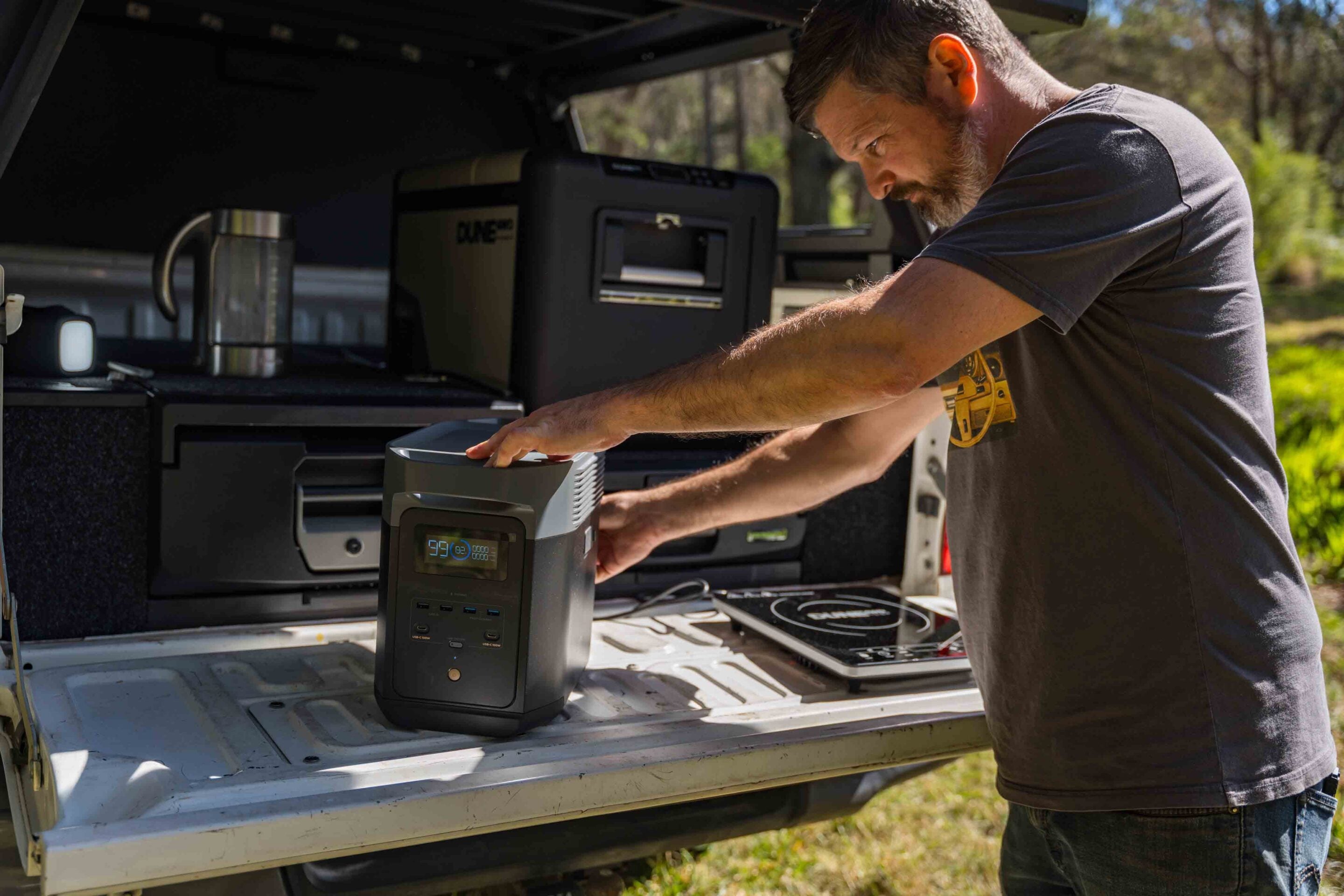
Unless you really need 1000W of solar input, the EcoFlow Delta 2 has the edge over the Bluetti Elite 100 thanks to the useful features of its smart XT60i input port, and would thus win the crown in this category. Except that, at the last minute, an EcoFlow Delta 3 1500 turned up for testing.
8
EcoFlow Delta 3 1500
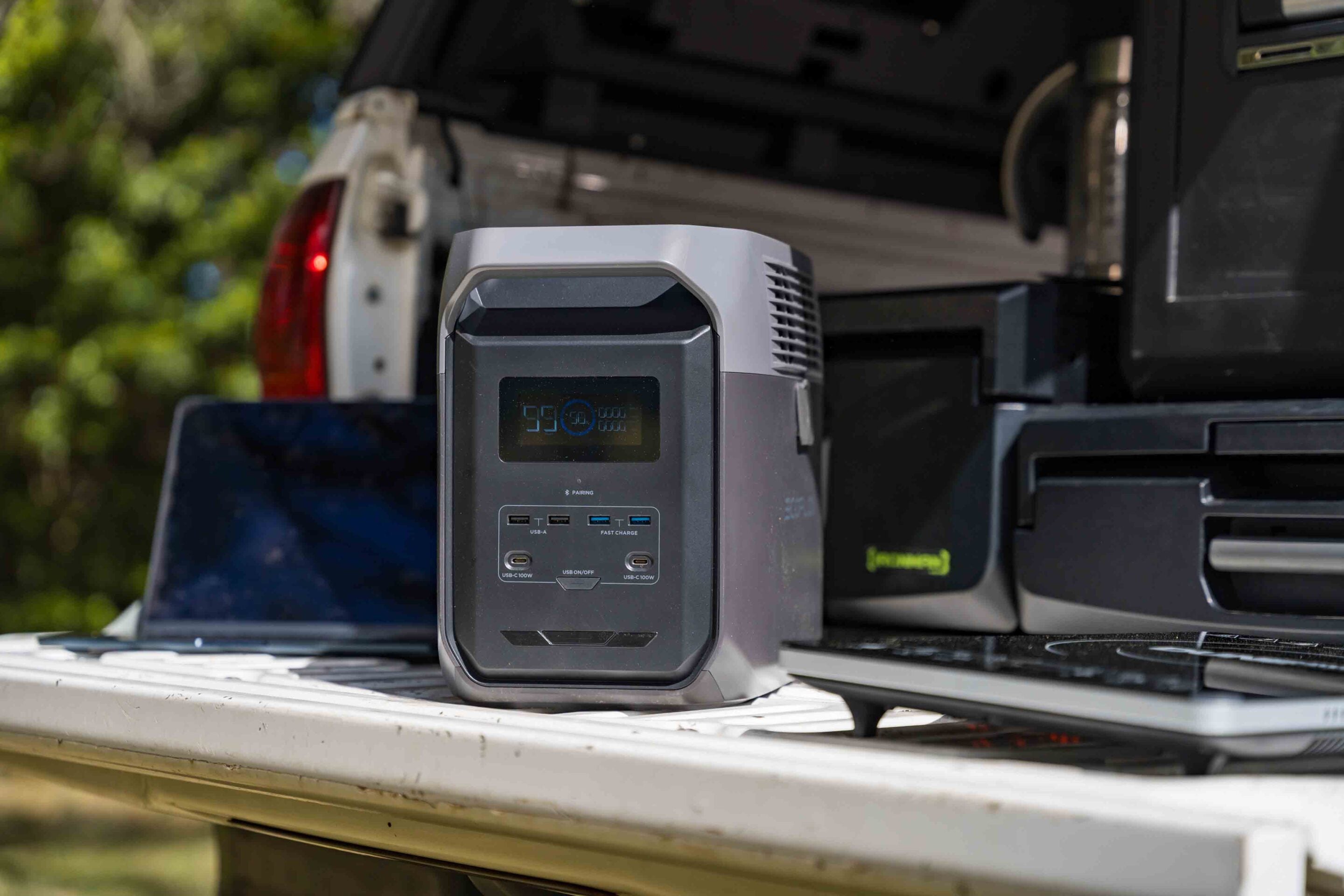
The EcoFlow Delta 3 1500 (↗) is essentially identical to the EcoFlow Delta 2 reviewed above, but has 50% more battery capacity. It is a little heavier, the same compact size and still easy to carry. If the money’s there, you would never regret that extra 50% capacity. Being a new model, the price is likely to drop. If you can’t afford it, then go with the EcoFlow Delta 2. But that extra 50% capacity in the same compact size just can’t be ignored.
4
| Specs | Companion Rover 1300 | Jackery Explorer 1000 | Bluetti Elite 100 V2 | EcoFlow Delta 2 | EcoFlow Delta 3 1500 |
|---|---|---|---|---|---|
| RRP | $1,399 | $789 | $899 | $899 | $1,899 |
| Weight | 15.2 kg | 10.8 kg | 11.5 kg | 12 kg | 16.5 kg |
| Warranty | 24 months | 60 months | 60 months | 60 months | 60 months |
| Rated capacity | 1344 Wh | 1070 Wh | 1024 Wh | 1024 Wh | 1536 Wh |
| Rated AC output | 1200 W | 1500 W | 1800 W | 1800 W | 1800 W |
| 240VAC charger | 800 W | 1000 W | 1200 W | 1200 W | 1500 W |
| Measured capacity | 1179 Wh | 931 Wh | 884 Wh | 916 Wh | 1356 Wh |
| Capacity (% rated) | 88% | 87% | 86% | 89% | 88% |
| 35L fridge runtime | 113 hr | 89 hr | 85 hr | 89 hr | 130 hr |
| Laptop recharges | x17 | x13 | x13 | x13 | x22 |
| Phone recharges | x54 | x42 | x40 | x42 | x62 |
| 240V kettle | 10 times | 8 times | 8 times | 8 times | 12 times |
| Induction cook @1200W | 59 min | 47 min | 44 min | 46 min | 68 min |
| Large power tools? | Many | Almost all | Almost all | Almost all | Almost all |
| Measured DC voltage | 13.6V 10A | 12.9V 10A | 13.6V 10A | 12.8V 10A / 15A 198W | 12.8V 10A / 15A 198W |
| Max DC voltage | 60V | 60V | 60V | 60V | 60V |
| XT60 @13.2V | 8.7A / 115W | 7.9A / 104W | 8.2A / 108W | 7.9A / 104W | 8.0A / 106W |
| XT60 @18V | 8.7A / 157W | 20.9A / 376W | 8.2A / 148W | 7.9A / 142W | 8.0A / 144W |
| XT60 @36V | 9.7A / 349W | 11.2A / 403W | 16.8A / 606W | 7.9A / 284W | 8.0A / 288W |
| Fast car charger | No | No | 560W | 500W or 800W | 500W or 800W |
Best high-capacity units: 2000Wh+
These beasts will power almost any 240V tool or appliance you throw at them and have enough capacity for induction cooking, though gas may still be necessary as a backup.
They will even run a caravan air-conditioning unit, albeit not all day. At typically 22–30kg, this class is still light enough to be lifted and carried by one person. They’re basically the same as the previous category, just with more of everything. You get roughly double the capacity, letting you actually use the station without constantly worrying about whether a few cloudy days will flatten the battery. If you can afford the cost and the weight, the extra grunt is well worth it.
- Winner: iTechworld PS2000
- Runners-up: VoltX S2200 Pro and Anker Solix F2000
VoltX S2200 Pro
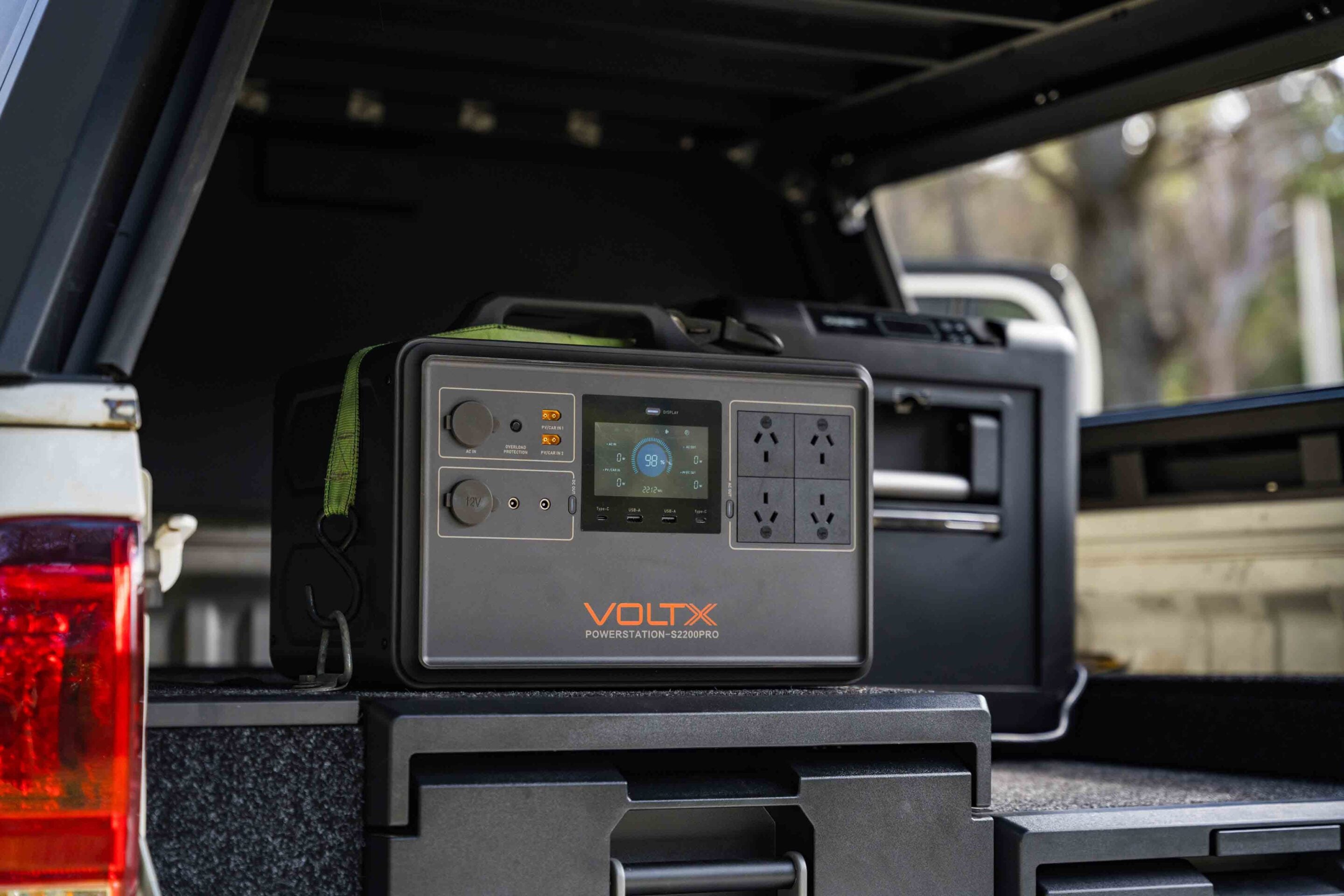
At 2240Wh, the VoltX S2200 Pro (↗) has more rated capacity than any other unit in this category, yet tips the scales at only 27kg. That extra capacity is a useful bonus. The VoltX S2200 Pro sports a massive single handle, while others have a handle on each end intended for two people. In practice, the size and quality of the handle mean it can be carried comfortably by one person, though it also means you can’t easily place or stack items on top. The VoltX S2200 Pro also does everything you’d expect, with 2400W of AC output and 2200W of AC charging.
Where the VoltX S2200 Pro really stands apart is DC charging. It has two fully independent XT60 DC inputs that can be run in parallel, doubling the DC input current. So, if each XT60 will accept up to 9.7A at 13.2V, running them in parallel with a high-current cable back to your alternator gives you an in-vehicle charge rate of 19.4A. That’s enough to be genuinely useful, and no other station we tested can match it for raw alternator charging without an add-on module.
The VoltX S2200 Pro is also in a class of its own for connecting solar panels. By using the two inputs in parallel or independently, you can achieve high input power with a very wide range of panels. It also ran all the power tools without complaint.
On the downside, the fans are somewhat unrefined and noisy. Normally, that won’t matter because they run slowly or not at all unless the unit is working hard. However, for no apparent reason, the fans always operate at full speed when the XT60 ports are in use – which is exactly when you’ll be charging it at camp or on the move. The warranty, at 24 months, could also be better. And unlike the iTechworld, there is no fast alternator-charging module available.
7
iTechworld PS2000 and Anker Solix F2000
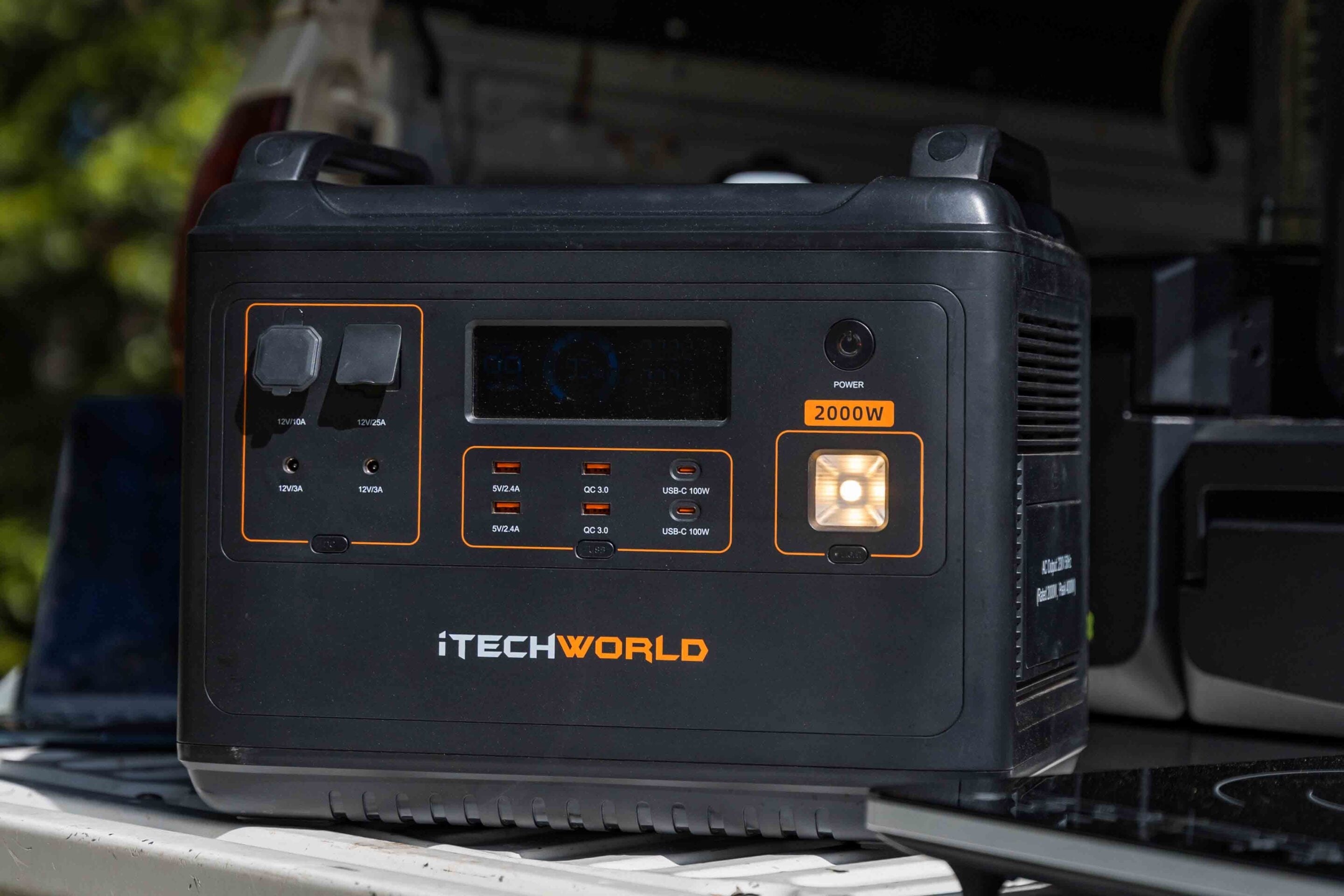
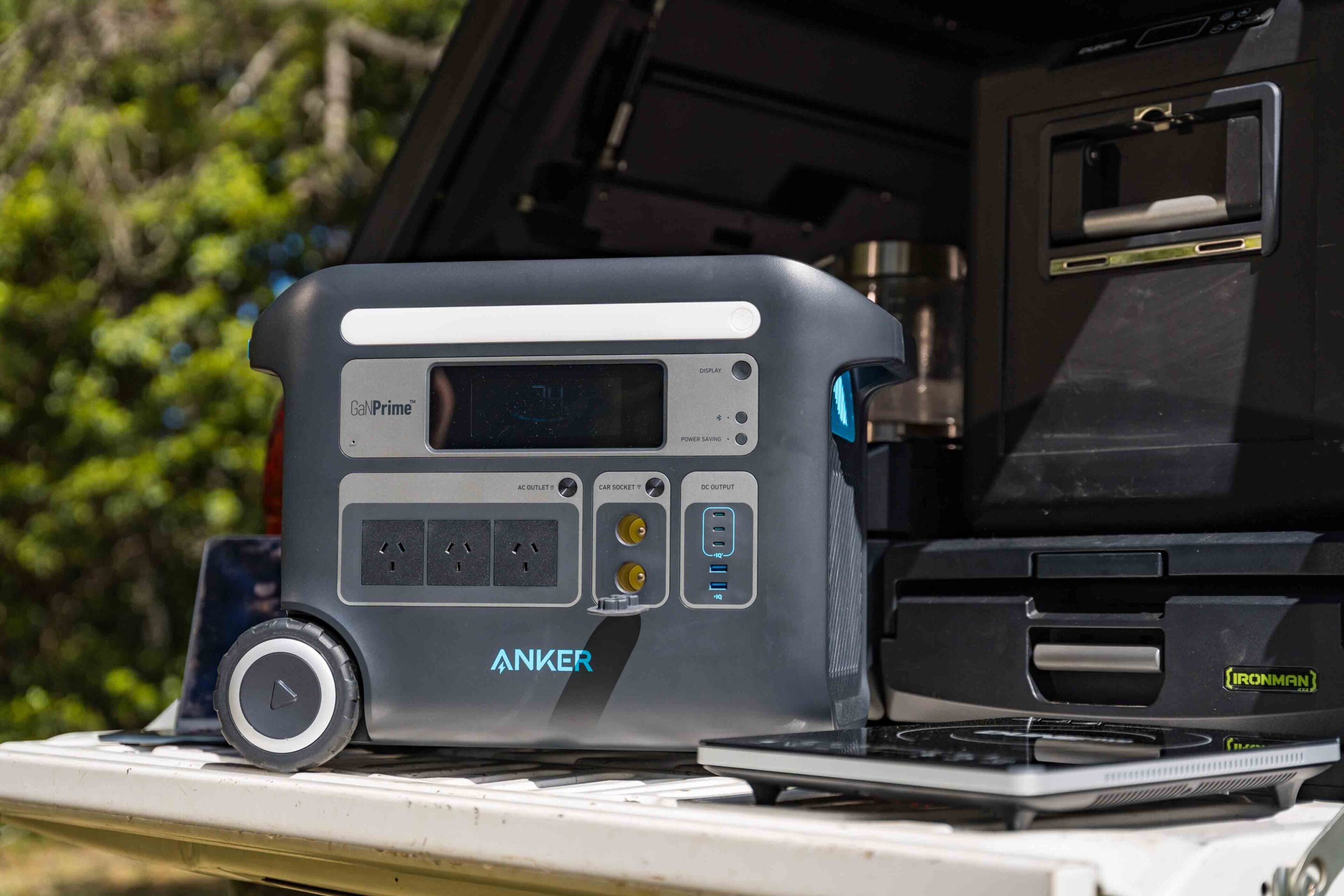
These two are similar, so we compared them against each other. The iTechworld PS2000 (↗) weighs 22kg and is pleasantly manageable and easily carried by one person. The Anker Solix F2000 (↗) is heavier but has wheels, which were surprisingly handy. But they’re a double-edged sword. Combined with a pull-out handle, the wheels are great for moving the unit once it’s on the ground, but they also make it easier for it to slide around in the back of your vehicle unless it is tied down securely. With the protruding handles, they also increase the footprint of the unit. The iTechworld PS2000 is definitely more compact.
Both have a generous rated battery capacity of 2048Wh. In the real world, the Anker Solix F2000 delivered slightly more energy – 90% of rated capacity versus 87%. The Anker has a massive 2300W mains charger versus 1100W for the iTechworld PS2000, which might sometimes be handy, but not out in the bush where solar and alternator charging are more important. Strangely, the Anker’s 240V output was 60Hz, even though the display read 50Hz. From here on, however, the PS2000 pulls ahead.
The iTechworld PS2000 has a socket delivering a DC output of 13.6V at 25A, useful for 12V devices that draw more than 10A, as well as the normal 10A cig socket. The Anker Solix F2000 has only a 10A cig socket. If you only want the 12V output for a fridge, then either is okay, but having 25A available can be useful, allowing you to run a small-to-medium 12V compressor or pie oven.
7
Both have similar inverter power: 2300W for the Anker and 2400W for the iTechworld. The PS2000 was able to start and run every large power tool we threw at it. The Anker shut down trying to start the 230mm grinder and cut-off saw. Consistent with this excellent surge performance, the PS2000 has 15A 240V outlet sockets, while the rest all have 10A. For tradies or anyone who uses power tools seriously, the iTechworld and VoltX are the better choices.
When it comes to solar, the Anker will accept up to 1000W of input, but with caveats. It is really designed for use with Anker’s own non-standard high-voltage solar blankets. Up to five can be plugged in parallel to its proprietary connection block, producing around 1000W – a clever turnkey solution if you buy Anker’s panels, but one that commits you entirely to its proprietary ecosystem. If you prefer to use standard 18V camping panels, you’re restricted to 9.4A and 169W from a single panel, which is limiting.
The iTechworld PS2000 supports a maximum of 500W of panels. If this is enough for your needs, then the PS2000 is actually better because it supports 20A and 360W from a single panel, as well as two panels in series up to 500W.
But the real crunch comes with charging speed from the vehicle alternator while driving. The PS2000 offers a 500W fast-charging module at a reasonable cost, bringing recharge time from the alternator down to around four hours. The Anker doesn’t have one, limiting alternator charging current to a paltry 9.4A – or around 18 hours of driving for a full charge. The VoltX achieves better raw alternator charging through its dual-XT60 setup, but it doesn’t have a fast-charging module available either. For genuine outback touring, where you’re covering distance each day, the iTechworld’s fast-charger option is the difference between arriving at camp with a full unit or still waiting.
Overall, the iTechworld PS2000 edges out both the Anker Solix F2000 and VoltX S2200 Pro. The combination of a 25A 12V output, 500W fast alternator charging, 15A power sockets, tool-starting capability and a compact form factor that actually fits in the back of a 4×4 is hard to beat. The Anker’s 60-month warranty is the one area where it genuinely betters the iTechworld’s 24 months.
As a quick note, Anker now has a new C2000 model with an 800W fast alternator-charging module, which would be worth looking at, but it wasn’t available for testing.
7
| Specs | VoltX S2200 Pro | iTechworld PS2000 | Anker Solix F2000 |
|---|---|---|---|
| RRP | $2,499 | $1,899 | $1,799 |
| Weight | 27 kg | 22 kg | 30.5 kg |
| Warranty | 24 months | 24 months | 60 months |
| Rated capacity | 2240 Wh | 2048 Wh | 2048 Wh |
| Rated AC output | 2400 W | 2400 W | 2300 W |
| 240VAC charger | 2200 W | 1100 W | 2300 W |
| Measured capacity | 1940 Wh | 1780 Wh | 1846 Wh |
| Capacity (% rated) | 87% | 87% | 90% |
| 35L fridge runtime | 186 hr | 170 hr | 177 hr |
| Laptop recharges | x28 | x26 | x27 |
| Phone recharges | x88 | x81 | x84 |
| 240V kettle | 17 times | 15 times | 16 times |
| Induction cook @1200W | 97 min | 89 min | 92 min |
| Large power tools? | Almost all | Almost all | Many |
| Measured DC voltage | 13.5V 10A | 13.6V 10A / 13.6V 25A | 13.3V 10A |
| Max DC voltage | 49V | 50V | 60V |
| XT60 @13.2V | 9.7A / 128W | 8.2A / 108W | 9.4A / 124W |
| XT60 @18V | 9.7A / 175W | 20A / 360W | 9.4A / 169W |
| XT60 @36V | 13.6A / 490W | 13.9A / 500W | 19.2A / 690W |
| Fast car charger | No | 500W | No |
Highly recommended: Bluetti AC240 (or AC240P)
The Bluetti AC240 (↗) we tested occupies a category of one.
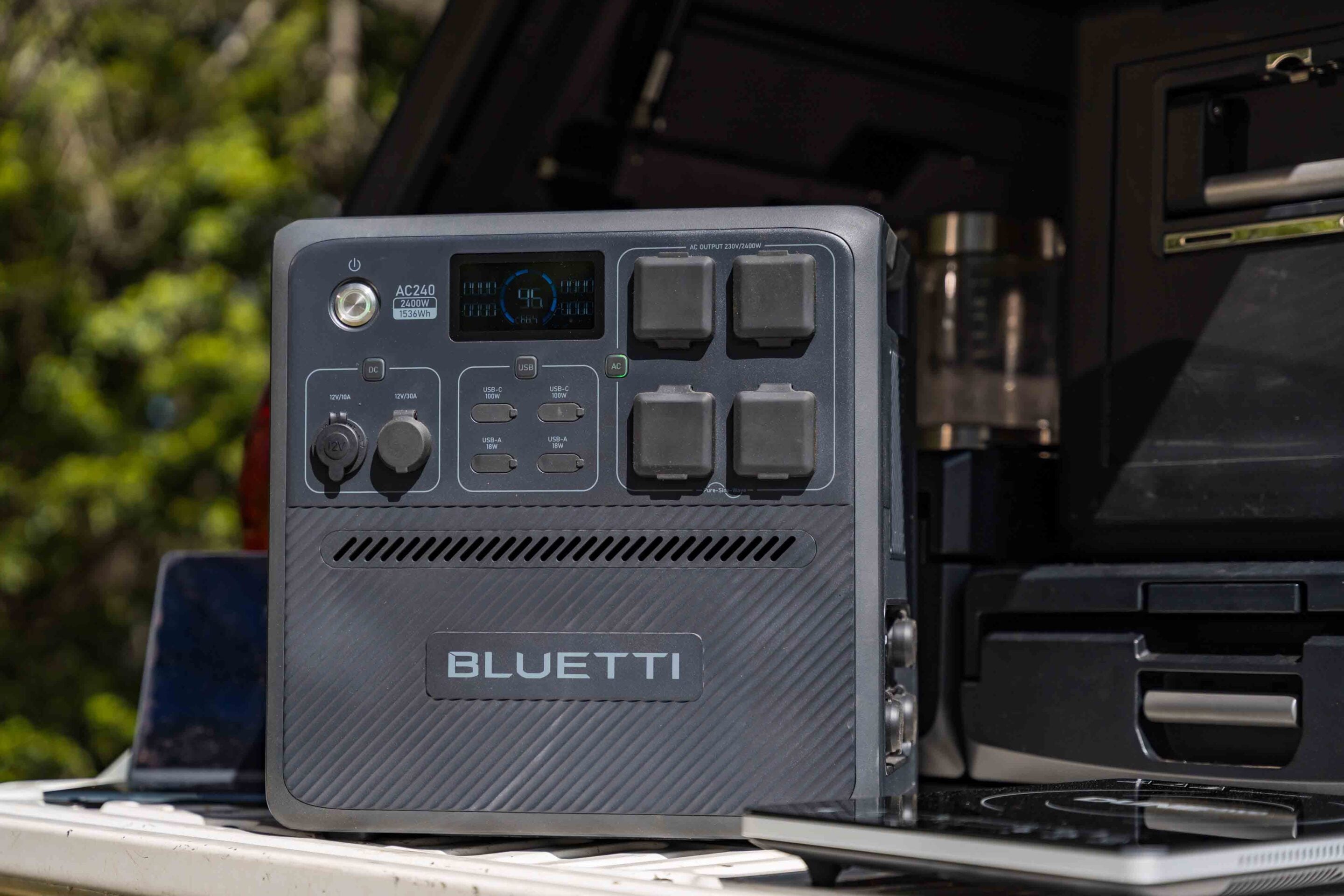
Every other power station in this test lets dust and moisture enter through its cooling vents. The Bluetti AC240 does not. With full IP65 certification – sealed against dust ingress and direct water jets from any angle – it is the only unit we tested that has been genuinely engineered for the harsh, wet and filthy conditions that serious four-wheel driving actually produces. All input and output connectors have rubber boots. The connectors themselves are waterproof with sealing O-rings. The chassis is sealed. There is even a pressure-relief valve to manage air expansion inside the unit. A six-year warranty – the longest in this test by a significant margin – backs it up.
The Bluetti AC240 also has a dedicated 30A 12V output capable of running a 12V compressor. Its 2400W AC output handled all our power tools without complaint, and it has four 15A sockets rather than the standard 10A found on most competitors.
6
Its limitations are real. At 33kg, it is the heaviest unit in the test. At 1536Wh, the Bluetti AC240 has less rated capacity than the other top-tier units despite a price that competes with the best of them. Solar input is limited to 8.2A from a single 18V panel – use two in series for up to 752W. A fast in-car charging module is available, but all cables use non-standard connectors that you will not find at a roadside hardware store.
These are trade-offs worth understanding rather than dealbreakers. The Bluetti AC240 was designed with a specific customer in mind: someone who leaves the bitumen for weeks at a time, operates in dust, mud, rain and heat, and for whom reliability and longevity outweigh raw capacity numbers. For that customer, nothing else in this test comes close.
The Bluetti AC240 has since been superseded by the Bluetti AC240P, which features a larger 1843Wh battery and faster Turbo charging, while retaining the same IP65 rating, six-year warranty and sealed connector design. Buyers should seek out the AC240P as the current model.
| Specs | Bluetti AC240 |
|---|---|
| RRP | $2,499 |
| Weight | 33 kg |
| Warranty | 72 months |
| Rated capacity | 1536 Wh |
| Rated AC output | 2400 W |
| 240VAC charger | 800 W Turbo |
| Measured capacity | 1312 Wh |
| Capacity (% rated) | 85% |
| 35L fridge runtime | 126 hr |
| Laptop recharges | x19 |
| Phone recharges | x60 |
| 240V kettle | 11 times |
| Induction cook @1200W | 66 min |
| Large power tools? | Almost all |
| Measured DC voltage | 13.5V 10A / 13.5V 30A |
| Max DC voltage | 60V |
| XT60 @13.2V | 8.2A / 108W |
| XT60 @18V | 8.2A / 148W |
| XT60 @36V | 20.9A / 752W |
| Fast car charger | 560W |
Buying advice
These power stations offer a real alternative to traditional bolt-in 12V power systems and, in some ways, are actually better. However, you need to choose very carefully if fast solar and in-car charging are priorities.
Once you leave home, the ability to charge at a reasonable rate while driving is important. We marked down some stations because in-car charging was slow and a fast charger was not available. However, in many cases, a workaround may be to use a fast charger from another manufacturer.
The genie is out of the bottle. You’ll be seeing more of these power stations as they continue to evolve and improve.
Portable power station components explained
In simple terms, the power stations were made up of a lithium battery, 240V charger, 240V inverter, 12V outlet (cig-plug), USB ports and XT60 DC input ports.
Lithium battery
At the heart of these power stations is typically a 24V to 51V battery, not 12V like the one in your in-vehicle system. Most use LiFePO4 chemistry and are typically good for 2000–4000 cycles, with a lifespan of around 10 years. A small number do use lithium-ion cells that are only good for around 500 cycles. LiFePO4 chemistry is also safer.
A higher-voltage battery reduces the required battery current, increasing efficiency at high power levels. Unlike a traditional auxiliary system, the user does not get direct access to the battery terminals. All inputs and outputs are via step-up or step-down converters.
240V charger
Unlike traditional 4×4 systems, all portable power stations have a high-power 240V charger, often rated at 1.2kW to 2.4kW, typically capable of charging the battery in two hours or less. This allows fast pre-trip charging at home or at a powered site when travelling. However, for extended remote travel without 240V access, this feature is of limited use.
240V inverter
These are typically rated at 1.2kW to 2.4kW on the higher-tier units, enough to power most 240V appliances and even large power tools. The practical limitation has more to do with battery stamina than power. In practice, what you can realistically run is determined by your ability to recharge the unit when out bush.
Discharging the battery is easy, and fast charging from 240V is simple too, but many of the stations we tested charged slowly from solar panels and extremely slowly from the vehicle electrical system. But we’ll get into that more in a sec.
Be aware that inverters draw significant current at idle. It is very inefficient to use the 240V output to power light loads of less than, say, 50W. Use the USB or 12V outputs instead. Even with no load connected, just having the 240V output turned on will typically flatten the battery at around 1% per hour.
Also, when you get home, make very sure every output is off or the battery may be completely discharged and even damaged. Most units can be set to turn off outputs automatically when not in use, but this feature must be used with care or it may turn off intermittent loads like your fridge, or very light loads like a phone being charged.
12V outlet (cig-plug)
Usually, these are limited to 10A. In part, this is because that is the limit of a cig-plug and socket, although a higher-current socket could have been provided in principle. Why wasn’t it? Because the internal battery is typically 24V to 51V, not 12V, so the 12V output is actually obtained from a step-down converter, and it would be expensive to include a powerful converter capable of more than 10A.
The only exceptions among the units we tested are the iTechworld PS2000 and Bluetti AC240, with dedicated high-current outputs of 25A and 30A respectively.
The other reason the 12V output is limited to 10A is efficiency. The 12V output will typically be used for low-power devices like a fridge or Starlink Mini, while higher-current appliances would be powered via the 240V inverter.
USB outputs
Almost all of the units provide an extensive selection of USB outputs, including high-power USB-C PD up to 140W. It is much more efficient to charge a device using USB power than to use a 240V brick adaptor. As mentioned, the idle power consumption of the inverters is quite high.
If a Starlink Mini is to be powered, do so from the 12V outlet rather than the 240V AC output. If efficiency and battery stamina are important to you, don’t use the 240V inverter for light loads unless you need to, and never leave it on unless it is actually being used.
XT60 multi-purpose DC input port
Most power stations we tested use a three-prong XT60 connector for all DC inputs. This style of connector was developed for RC models but has been embraced by the power station industry for its high-current capability. A couple of stations do use a different connector, but the XT60 is the most common, so we’ll just use the term “XT60” for simplicity.
The XT60 is used for DC charging from solar panels or via the cig-plug in the vehicle. The speed at which the power station can be charged from solar or your vehicle’s alternator – rather than from 240V – is really important.
While it would be great to know the charging current and available power from the cig-plug or solar input, this information is generally unavailable and there’s no industry standard for XT60 connections. All you can do is plug her in and wait, with no data on how long it’ll take to charge your power station from your vehicle. Obviously, this sucks.
That’s why we lab-tested each XT60 input port to understand how it works and what charge current you will actually get in the real world. 4X4 Australia is the only one to have done this.
Now, the intelligent XT60 “looks” at the applied voltage at the port and sets the maximum charge current it will accept according to that voltage. In the real world, there are three situations where this information is beneficial:
1. When charging from the vehicle alternator while driving
The charging voltage with the engine running will be around 13.2V. In general, the XT60 will accept no more than 8–9A at 13.2V to protect your vehicle’s cig socket. Even with heavy cabling to the XT60, the current will still be strangled to about 8A. For the larger power stations, that means a recharge time of 10 to 20 hours while driving, which is near useless.
The industry solution is to buy a ‘fast alternator charge module’ at extra cost. These basically step up the alternator voltage to 36V or more. The XT60 will accept much more DC charging current and power at this voltage.
2. When connecting a single 12V solar panel
A panel, or multiple panels wired in parallel, operates at about 18V. For most units tested, the maximum current the XT60 will accept at 18V is also 8–9A, due to the smart (dumb) XT60 thinking it still needs to protect the cig socket. This means the largest single panel or blanket the XT60 port can fully utilise is around 18V x 9A = 162W.
Plugging in a larger panel than that does not help – the port will refuse to draw more than 9A. The iTechworld PS2000, Jackery 1000 and VoltX S2200 are exceptions, allowing around 20A or 360W from a single panel, which is pretty good, while the EcoFlow Delta 2 can be programmed to accept 15A or 270W. But with the other stations, be very careful, because if you own or buy a single solar panel rated at more than about 160W, any capacity above that will be wasted. The solution is to use two panels in series.
3. When connecting two 12V solar panels in series
Two 12V solar camping panels or blankets wired in series operate at about 36V. At this input voltage, much higher charging power – from 350W up to 750W – can be utilised. The reason is that the smart XT60 knows the vehicle’s cig socket cannot be as high as 36V and therefore raises the current limit. Combined with the increased current capability and the doubling of voltage from two panels in series, seriously beneficial solar inputs become possible.
As a quick case study, consider the iTechworld PS2000. When charging from the alternator at 13.2V, the maximum charging current into the XT60 is 8.2A, which equates to a piddling 108W. However, a 500W fast alternator charger is available, which is almost five times faster.
When a single 18V solar panel is connected, the maximum current accepted by the port is 20A, equating to 360W, which is very acceptable and roughly double that of competing power stations. However, by wiring two panels in series – or four panels in series-parallel – to produce 36V, the port will accept up to 13.9A, which equates to 500W. Chicken dinner.
Just quietly, also of interest is the maximum power the XT60 port will accept, regardless of voltage. For the PS2000, for example, the maximum XT60 input voltage is 50V, so two solar panels in series is fine, but three is not, and there is an absolute 500W limit regardless of voltage.
This wealth of information is simply not available in the power station manuals or anywhere else. On our part, it took a lot of lab work to measure this information, but we reckon it was worth it.
Testing notes
- All testing was conducted at 25°C ambient temperature.
- Boiling one litre of water in an electric kettle, starting at 15°C, requires 0.116kWh based on direct measurement.
- A typical 13-inch laptop with a 55Wh battery requires about 69Wh from the USB port for a full recharge, assuming 80 per cent USB charging efficiency.
- A typical mobile phone with a 5Ah battery requires about 22Wh from the USB port for a full recharge. This is based on 5Ah × 3.75V = 18.75Wh, divided by 85 per cent USB charging efficiency.
- For USB charging, the USB port inverter is assumed to have the same efficiency as the 240V inverter at the two-hour rate, so the measured 240V Wh figure can be used.
- For the 35L fridge, power consumption is calculated as 0.8A × 13V = 10.4W.
- For the 12V output, the inverter is assumed to have the same efficiency as the 240V inverter at the two-hour rate, so the measured 240V Wh figure can be used.
Follow 4X4 Australia on Google
Get more 4x4 news, reviews and gear stories from 4X4 Australia in your Google feeds.