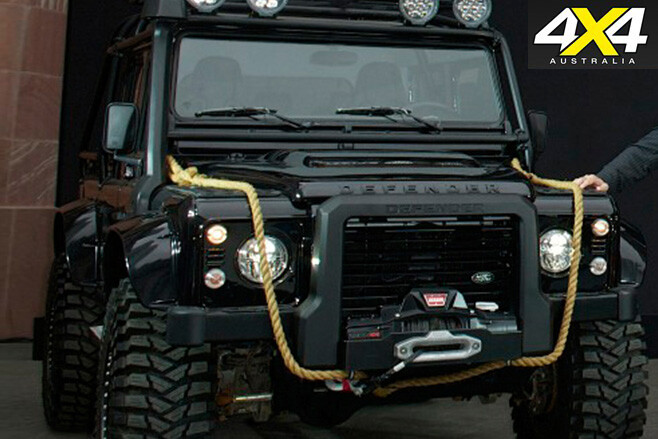
Daniel Craig in a black Land Rover Defender – it doesn’t get much tougher than that.
Land Rover has revealed the two Defenders that will appear alongside the brooding Daniel Craig in the forthcoming James Bond movie, Spectre.
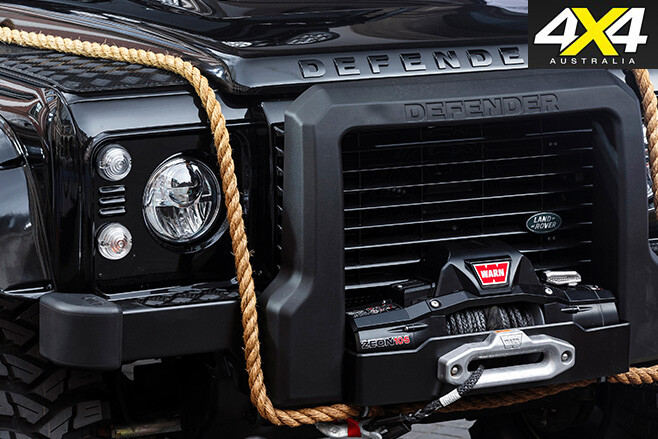
Specially modified, the Defenders were constructed by the JLR Special Operations division, with 37-inch off-road tyres and enhanced body protection to tackle the snow-covered mountain roads used for filming.
The Defender is a clever choice for the 24th instalment of the Bond franchise, which sees Bond seeking to uncover a sinister organisation after he gets a cryptic message from his past.
The murdered-out four-wheel drive (pictured) fits well with the dark direction the James Bond franchise has taken in recent times.
The Defender is a tough, capable and serious machine, but one that, like Daniel Craig, is past its use-by date, with production of the current Defender now in its final phase.
But that doesn’t stop Bond or the vehicle from indulging in their share of fast women, faster driving and, of course, testosterone-fuelled explosions.
It’s a shame the Defender is on the way out; placing a modded-up version of the Defender warhorse in the newest Bond movie is surely great advertising.
Possibly the only better way to pull the pocket strings of Land Rover’s biggest market, ageing men, would be to stick a scantily clad Angelina Jolie inside one. But they already did that in the movie Lara Croft: Tomb Raider.
Land Rover recently revealed a Land Rover Defender concept car at the Frankfurt Motor Show. The special collector’s Defender pedal car concept previews a full-production pedal car model that will go on sale in the UK 2016.
The Defender also appeared in the previous Bond film, Skyfall, and then there was the publicity stunt that saw Bear Grylls, along with other stars, build a special ‘Defender 2,000,000’.
At the very least, the latest Bond appearance adds to an ongoing tribute to one of the world’s most iconic vehicles.
At most, it is part of a clever campaign to help Land Rover sell something… exactly what that is, we don’t know yet.
The Series Land Rover and Defender have been produced in Solihull, UK, since 1948
Spectre will be released worldwide from October.
The hybrid versions of the new-generation, aluminium-monocoque Range Rover and Range Rover Sport have finally arrived in Australia.
These hybrids are unusual in as much as they are diesel-electric, rather than petrol-electric, and unique in as much as they are the first hybrids with serious 4×4 ability, because they offer the same off-road prowess as their conventionally powered RR and RRS counterparts.
Here we are driving the RR Sport HSE Hybrid, the cheapest way to get into any hybrid in the Range Rover/Range Rover Sport line-up. Still, it will set you back $146,900, which is $16,800 more than an equivalent but conventional RR Sport, the SDV6 HSE, and $33,800 more than the lower-spec RR Sport SDV6 SE.
The Hybrid’s 215kW diesel engine comes from the MY14 3.0-litre SDV6 and is mated to an electric motor/generator that produces a maximum output of 35kW and 170Nm. Combined with the diesel engine the total output is 250kW at 4000rpm and 700Nm between 1500 and 3000rpm, which is more than handy in anyone’s language.
The hybrid system is very straightforward and is based around an electric motor/generator integrated into the eight-speed automatic gearbox. The whole unit is produced by German transmission specialist ZF.
The hybrid system also incorporates a liquid-cooled lithium-ion battery pack, held in a protective boron-steel cradle mounted under the vehicle. The battery pack takes up some of the space where the bigger (105-litre) fuel tank of non-hybrid V6 RRS models resides and limits the fuel capacity to 80 litres. All up the hybrid-specific components add around 120kg in weight.
The operation of the system is simple. When the vehicle is slowing down the electric motor/generator, driven by the vehicle’s momentum via the gearbox, goes into generator mode and charges the battery pack. When acceleration is called for, the motor/generator goes into motor mode and, powered by the battery, helps the diesel engine to drive the vehicle. When and where the electric motor helps is controlled by electronics using Land Rover-specific software.
Essentially what the system does is capture energy that would otherwise be lost, store it in the battery pack and then reuse it. The benefit is both reduced fuel use and better performance.
But the system does have its limitations and it does its best work in stop-start city and urban driving – it contributes far less on the open road. This is typical of hybrids and applies equally for diesel-electric hybrids as it does for petrol-electric hybrids.
The reason for this is two-fold. For the charging system to be at its most effective, the vehicle not only needs to be slowing down but also needs the brakes applied. In stop-start city and urban driving this occurs all the time; so all good. But constant on-and-off-the-throttle driving and braking is not needed on the open-road, so the charging opportunities are far more limited and can be non-existent for extended periods of time.
The other factor at play is that the electric motor does its best work by adding its considerable torque right from zero rpm, but it doesn’t add a lot of power at high rpm. In effect what happens is that the electric motor helps the vehicle off the line, but has less and less input once underway.
Around town, the RRS Hybrid is certainly punchy off the line with a 0-100km/h time of 6.7 seconds. That’s half a second quicker than the MY14 215kW/600Nm SDV6 diesel, upon which the Hybrid is based, and 0.3sec faster than the updated MY15 225kW/700Nm SDV6. The RRS Hybrid’s urban ADR fuel figure of 5.8L/100km is even more remarkable, especially as the MY14 SDV6 claims 8.7L/100km in the same test.
We couldn’t get down near the 5.8L/100km figure in the real world, averaging more like 9.0L/100km around town. That’s still much better than the 11.0L/100km that a conventional SDV6 would use in similar urban driving.
In urban use, the Hybrid is quite a different experience to the standard diesel. It will initially start and run at low speeds and under low loads (driving out of a carpark, for example) just on the electric motor if the battery pack is well charged.
This is an eerily quiet experience and takes some getting used to. From there, the diesel motor cuts in automatically and seamlessly as speeds and loads increase. An automatic stop-start function also helps to save fuel and this is fully integrated into the hybrid system.
There is also an Electric Vehicle (EV) mode, where you can switch the vehicle to full-electric operation at speeds up to 48km/h and for up to 1.6km, depending on the battery-pack charge. Even when EV mode is selected, if the battery pack runs low, the diesel engine will still automatically cut in if needed. If you select EV mode when there’s insufficient charge in the battery pack the system comes up with the message: “EV mode temporarily unavailable”.
On the open road the RRS Hybrid’s fuel consumption is much the same as a standard SDV6 diesel, according to the ADR test’s extra-urban figure of 6.7L/100km verses 6.8L/100km for the MY14 SDV6. And our testing backed that up as the Hybrid used around 8.0L/100km in conditions you’d expect an SDV6 to do much the same.
The Hybrid still has some extra open-road performance and overtaking zip, especially from lower speeds, but only when the battery pack has sufficient charge in it.
If the battery-charge gauge is accurate, the battery seems to sit at around the middle third of the charge range most of the time for country driving, simply because the opportunities to charge it are limited. It never seems to fully run out of charge, but can sometimes appear to contribute little or nothing.
The good news is that the RRS Hybrid drives just like any V6 diesel RRS, even without any assistance from the electric motor. That is, in a word, brilliant. Nothing else offers the same on-road finesse combined with effortless off-road ability, except for another RR Sport or the more expensive Range Rover.
That said, it’s hard to make a case for the Hybrid unless you’re driving regime is very urban-based, especially given the extra asking cost of the Hybrid compared to one of the conventional RR Sport six-cylinder diesels.
Perhaps more telling is the fact that the RR Sport Hybrid is marginally more expensive than the sublime RR Sport 4.4-litre bi-turbodiesel V8.
Specs:
Engine 24v DOHC bi-turbodiesel V6 Capacity 2993CC Max Power 250kW @ 4000rpm Max Torque 700Nm @ 1500-300rpm Electric Motor 35kW/170Nm Gearbox eight-speed automatic 4×4 System dual-range full time Construction aluminium monocoque Front Suspension independent; adjustable air springs Rear Suspension independent; adjustable air springs Wheel/Tyre Spec 275/45R21 110Y Kerb Weight 2372kg GVM 3000kg Payload 628kg Towing Capacity 3000kg Seating Capacity five Fuel Tank Capacity 80 litres ADR Fuel-Use Claim 6.4 litres/100km On-Test Fuel Case 9.0 litres/100km Touring Range 839km Base Price $146,900 Price As Tested $163,450
The legendary Outback Challenge is on again for 2015 (Sept 25 – Oct 2) on properties around Broken Hill. To mark the event, we have a couple of the 2014 event DVDs to give away!
The Outback Challenge is a 7-day event catering to the best Off-Road vehicles from around the world. It is a cross-country 4×4 event that uses the technology of GPS similar to that of the Dakar Rally. However its point of difference is that not only is the Australian Outback remote but it is also extreme!
Teams need the best suspension available along with extreme tyres and a driveline tough enough to hold it all together. When the terrain becomes impassable to most, the latest technology in high speed competition winches will get competitors and their machines to their final destination. It sounds extreme and it is! One day would break most, but to push hard for 6 days will reveal the best of the best in strategy, survival, endurance and team work. This event will not be won in one day and many will find out the hard way. It’s the smart players with the reliable machinery that will prevail.
To enter, simply tell us in 25 words or less what appeals to you most about the Outback Challenge and go into the draw to win 1 of 2 copies of the 2014 event DVD.
For more information on the Outback Challenge visit www.outbackchallenge.com.au
COMPETITION NOW CLOSED
Keen adventurers know that the best tracks are sometimes the ones least travelled.
The Barraba Track in northern New South Wales is one of these. A locked trail, it’s only accessible to eight four-wheel drives each week, and it can be closed after rain or snow. But that doesn’t mean it’s an overly difficult track, even if you do need a real 4×4 with some decent ground clearance to drive it.
Once boasting a host of mineral mines, Barraba is a quaint town, where drivers can find fuel, a small supermarket, mechanical services, a café and a tourism office. If you want to drive the Barraba Trail, you’ll need to visit the café or the tourism office to pay a $10 fee and a $40 refundable deposit for an access key. Staff may also give you a map and some reading material on the area.
You can then start heading about 45km west on sealed and unsealed roads towards Mt Kaputar National Park, passing working properties and hobby farms along the way. At the park, the access gate won’t be locked, but there will be signage to inform you of basic park information and regulations.
One of the first things you’ll notice after passing through the gate is the thick undergrowth and deep-red soil, typical of volcano country. That’s because the track starts below Mount Kaputar, which rises to an altitude of about 1500m and was formed by two volcanos active about 20 million years ago.
Erosion has since carved a dramatic landscape of valleys and cliffs, so the Barraba Trail can be quite rocky. But select 4WD low and the climb shouldn’t be a problem for most decent four-wheel drives.
The entire park has been classed as a wilderness area, and it’s easy to see why. It’s home to a number of endangered and vulnerable plants and animals, and around every corner there’s a new selection of forests, from old-growth forests and valleys of grass trees to some of the most western rainforest in New South Wales.
The track is only about eight kilometres long, but allow yourself at least an hour of driving to soak up the experience. A great and necessary stop on the way is Brushy Mountain, located about four kays up the track. Brushy Mountain has a picnic area with a drop toilet and barbecues, but, more importantly, it has the first of the locked gates. The only way past the gate is with the key you should have collected – the large gates are definitely there for a reason.
Between the track’s two locked gates is a drive of about 4.5km. There are some sharp rises and falls along the way, with narrow road sections and corners sign-posted at five kilometres. NPWS warns that the track is steep and winding, and it would be interesting meeting another 4WD coming the other way, because there isn’t much room to pass; most of the track is only bulldozer blade wide.
Climbing to an altitude of 1510 metres, you’ll see stringybarks and blackbutts replaced by snow and mountain gums and then ferns and grass trees. The air also cools down dramatically as you reach the last locked gate near the summit.
There are several camping options in the park. Dawson Springs, which is the highest camping area in the park, has toilets, large fire bins and hot showers. The camping spot is well set up for those with tents and camper trailers, or for day visitors exploring the area.
Mt Kaputar NP is part of a volcanic skeleton, which rises to the Nandewar Ranges and now provides a picturesque background for visitors to the north-western slopes and plains. The Nandewar Range is remnant of a large volcanic complex built up by repeated eruptions during the Miocene Epoch between 21 million to 17 million years ago.
It’s a great place to explore for a few days and there are quite a few walks to be done, from five-minute strolls to overnight hikes. There are also some wheelchair-friendly viewing decks, which is great to see. This is one place that should be on everyone’s must-do list.
The track is often closed because of bad weather. See the NPWS website www.nationalparks.nsw.gov.au for directions to the 4WD-only track and for travel warnings.
Common-rail diesel. No doubt you’ve seen these words a thousand times in this magazine and elsewhere. But just what is a common-rail diesel? And, for that matter what is the rail and what’s so common about it?
It refers to fuel rail, which is a fuel reservoir generally tube shaped. The word common refers to the fact that this fuel rail – or reservoir – supplies fuel to all the engine’s injectors in any line of cylinders. That’s a tech contrast to older engines where each injector was supplied by an individual – not common – line from the high pressure fuel pump.
In an in-line engine there is one fuel rail, but in V engines, like a V6 or V8, two rails, one for each bank of cylinders, are fed from the high pressure pump. The common rail is generally located as close to the injectors as possible.
Common-rail diesel systems use a pump that delivers the fuel to the common rail, or rails, at extremely high pressures; in some cases more than 2000bar.
The advantage of having the fuel in the common-rail at extremely high pressures, and close to the injectors, means that the required fuel can be injected into the combustion chamber in an extremely short period of time. So quickly, in fact, that for any one engine cycle (or combustion event) the fuel is delivered via multiple short squirts. The timing and duration of each of these multiple injections is finely tuned to maximise the engine’s torque delivery and smoothness, and minimise emissions and noise.
The fact that the fuel can be delivered to the combustion chamber quickly and accurately, depending on the needs of the engine at that exact point in time, means that the performance, efficiency and refinement can be optimised.
To achieve this, common-rail injection also relies on a sophisticated electronic brain that gathers information on things including throttle position, engine revs, road speed, engine oil, coolant temperature, and intake air density from various sensors. It then works out the exact amount of fuel that’s required. This brain is called the Electronic Control Unit, or ECU.
Unfortunately most sophisticated technology has a downside, and in the case of common-rail injection there are significant potential problems.
First up, common-rail systems require highly refined and scrupulously clean diesel fuel; some European car companies delayed bringing their first-generation common-rail diesel engines to Australia in the late 1990s until our diesel-fuel quality was improved, which happened via government mandate.
This legislation, among other things, was aimed at reducing sulphur content. This in itself creates another problem as sulphur is a lubricant, which can reduce wear in diesel pumps and the like.
Also, any contaminates or water in diesel fuel can be disastrous to both the injectors and the fuel pump, the two big-dollar components in common-rail systems. Unlike older diesel injection systems where the pumps and injectors could be serviced and repaired by a diesel mechanic, those used in common-rail systems generally need to be replaced as a whole unit when they fail. And when an injector is replaced it often has to be set-up electronically, which requires vehicle-specific diagnostic equipment. This brings cost and practicality problems, especially in remote locations.
If you have common-rail diesel there are a few simple things that you can do to reduce the risk of problems. Always try to fill up at a major fuel station with a high turnover, as their fuel is likely to be cleaner. Avoid bio-diesel and never, ever use homemade bio-diesel. Avoid filling out of fuel drums where possible.
Try to avoid filling in the rain in the open, as even a small amount of water in diesel fuel can cause problems. If your vehicle has a water trap in the fuel system, clean it regularly. Finally, don’t substitute cheap aftermarket fuel filters for genuine OEM articles.
The genuine ones will be more expensive, but it’s cheap insurance against the cost of repairs if a dodgy filter lets contaminants through to the fuel pump and injectors. However, a quality secondary filter can be added to the system as added protection.
This circuit of Central Australia and the East MacDonnell Ranges makes for a good three- or four-day trip with ancient Aboriginal art, early pioneer history and natural delights.
There’s also a chance you’ll find a gemstone to remember your adventures by.
The trip starts in Alice Springs and continues along the Ross Highway’s bitumen, passing the Emily Gap turnoff after about 10km and the Jessie Gap turnoff after about 18km. Both gaps are delightful, and Emily Gap has a large and impressive Aboriginal rock painting that depicts the Caterpillar Dreaming. Depending on rainfall, you might have to get your feet wet to see it, though.
Approximately 12km later you’ll come to a road junction where the Explorers 4WD Route veers to the right. You can continue along the Ross Highway, or turn right on to the good dirt of the Explorers Route.
After about 42km on the dirt tracks, the route will swing north for 15km, crossing the sandy bed of a creek a number of times before coming to the track into N’Dhala Gorge. Take this track for another four kilometres and you will arrive at a small camping area close to the mouth of the gorge.
Walking through the gorge in the early morning is an enjoyable experience. A host of birds delight in the water points that are scattered along the creek’s rocky bed, while flowering trees and shrubs provide them with nectar. The area is best known, though, for its thousands of ancient Aboriginal rock engravings, or petroglyphs.
Back on the Explorers Route, the track north crosses the sandy bed of the creek a couple more times before arriving eight kilometres later at the Ross River Homestead access road, just a short distance from this well-known resort. The old homestead, one of the first to opens its doors to travellers in Central Australia, has limited supplies and offers accommodation, camping and tours.
Just a few kilometres west of the homestead you’ll meet with the main Ross Highway. It’s only a short backtrack west down the bitumen to the turnoff to Trephina Gorge, which offers some of the best camping in the area and some excellent walking trails.
Heading east from the junction the route turns to a well-maintained gravel road for 32km to the Arltunga Historic Reserve. You’ll pass the Arltunga Bush Hotel (now closed) and just past here you’ll enter the small Arltunga gold fossicking area, which is located on the southern boundary of the historical reserve. This area is the only spot where fossicking, if that is what you are into, is allowed around here.
It’s well worth spending a day in and around Arltunga, which was the site in 1887 of the first gold rush in Central Australia. Six years later the population had dwindled to just 300 and within a few years they had all left, but not before 7000 tonnes of rock had been crushed for 9500 ounces of gold.
Many of the first miners here were Cornishmen fresh from the famous mines in South Australia. Today, many of the buildings they built in this remote and dry region of Australia have been restored as a testimony and a monument to the miners’ skill and pioneering endeavour.
Just east of the deserted bush hotel, a road leads north into the historic reserve and the well-set-up, but normally unmanned Visitor Centre. North of the Visitor Centre you’ll find the old police post and gaol and another road leading to the Government Works area where a gold battery had been established. Here are the most significant ruins of the gold fields along with an old boiler and assorted machinery.
By travelling a short distance east at ‘The Cross Roads’, where there was once a store and hotel, you can continue to the White Range Cemetery or walk to the old mining areas in the White Range.
From the Cross Roads a reasonable dirt road (the Arltunga Tourist Drive, the Explorers Route and part of the Binns Track) heads north and this is the one to take, exiting the reserve and passing Claraville Homestead about 10km later. It then crosses the upper reaches of the Hale River, before coming to Old Ambalindum Homestead, which offers pleasant camping and accommodation.
About 50km west of Old Ambalindum, you’ll come to the junction of The Pinnacle Road; straight ahead leads 48km back to the Stuart Highway, while heading north (our recommended way) for 40km along a good dirt road leads to the blacktop of the Plenty Highway.
Along the way, the road passes through the Strangeways Range and skirts along the edge of Gillen Creek before passing the access track to the Mud Tank Zircon Fossicking Field. You can camp at the field, but it is a bit rough with no facilities.
The Gemtree Caravan Park, situated on the Plenty, just eight kilometres west of where you meet the bitumen, is a top spot to spend a day or two. Gemtree can fulfil your basic needs and has camping and cabin accommodation. Their tours, led by an expert fossicker, will give you a high chance of success in finding some fine gemstones.
From Gemtree it’s 70km back to the Stuart Highway and another 70km to Alice Springs. Take three days to do this jaunt. Maybe spend an extra couple of days at Gemtree – you’ll love it!
Click here to explore more of the Northern Territory.
The Frankfurt Motor Show didn’t have much for 4×4 enthusiasts.
But we were keen to collar the Land Rover execs for any word on the new Defender, and we weren’t disappointed – although, it was not what we expected.
The brand created a special collector’s Defender pedal car concept, previewing a full-production pedal car model that will go on sale in the UK 2016.
With production of current Defender now in its final phase, the unique pedal car concept represents a fitting tribute to the one of the world’s most iconic vehicles.
The Series Land Rover and Defender have been produced in Solihull, UK, since 1948.
The exclusive Defender pedal car is hand-built in the UK and styled to commemorate the legacy of the first-ever pre-production Land Rover, affectionately known as ‘Huey’, given its original numberplate of ‘HUE 166’.
The concept model is constructed using a rolled–edge aluminium frame complete with individual chassis number and personalised numberplate.
It is hand-finished in the same Loire Blue found on the full-scale Defender colour palette.
This exclusive version is constructed precisely to scale to incorporate all of the Defender’s distinctive characteristics such as protective chequer plate, cylindrical running bars and rugged off-road tyres complete with mudflaps.
The drive assembly is constructed to enable the young driver to pedal both forwards and backwards while a spring suspension and working brakes – complete with parking brake – will allow the little one to go on many big adventures.
Inside, a leather trimmed seats and steering wheel complete the overall design of the Defender pedal car.
The final production version of the Land Rover pedal car concept is expected to cost around £10,000.
We’ll continue to search out news on the full-size ‘new’ Defender, due out in 2017-2018, wherever possible.
Toyota has sold twice as many FJ Cruisers as expected.
With an average of 194 FJ Cruisers sold a month since 2011, total sales have peaked at 10,000. To put that into perspective, almost 2000 Toyota Hiluxes, still the best-selling four-wheel drives in Australia, were sold in July this year.
Production of the left-hand drive FJs bound for the USA ended a year ago and it was feared RHD production would soon follow but Toyota Australia says its keen to hang on to the quirky retro wagon as long as possible.
The FJ Cruiser has a loyal following and is a modern interpretation of the Land Cruiser FJ40 that was sold in Australia during the ’60s, ’70s and early ’80s.
It is powered by a 200kW, 380Nm twin-cam 4.0-litre V6 petrol engine driven through a five-speed automatic transmission. It uses just 11.4L/100km of fuel for a notional range of almost 1400km from its 159 litres of fuel capacity.
The FJ Cruiser is priced from $46,990.
The Triton ute has been Mitsubishi’s best-selling model, and one of Australia’s top-selling dual cabs.
But that’s mostly because of price – it’s been one of the cheapest utes available. Mitsubishi is hoping to keep that momentum going with this: an all-new Triton.
Price and specifications
Price: $47,490 Engine: 2.4-litre 4-cylinder turbo diesel, 133kW at 3500rpm, 430Nm at 2500rpm Transmission and 4WD system: 5-speed auto, part-time dual range 4WD Braked tow capacity: 3100kg Spare tyre: Full-size Fuel tank: 75 litres Fuel use (claimed): 7.6L/100km Fuel use on test: 12.8L/100km Approach/departure angles: 30 degrees/22 degrees Ground clearance: 205mm
WHAT’S THE DEAL?
It’s an all-new Triton, codenamed MQ, which replaces the ML/MN. Styling is evolutionary but Mitsubishi says everything is fresh.
Four-wheel drive versions of the dual-cab Triton start at $36,990 (plus on-road costs) for a GLX manual diesel. For that you get 16-inch steel wheels, cruise control, stability control and seven airbags (dual front, front-side, side curtain and a driver’s knee airbag). The five-year warranty is handy, especially if you’re looking to do some big trips – and want the additional peace of mind over the three-year coverage of most utes.
By the time you get to the Exceed tested here there are LED daytime running lights and the obligatory sports bar, as well as 17-inch alloy wheels. There’s also digital radio tuning (only useful in major cities), dual-zone air-conditioning, smart key entry, leather trim, rain-sensing wipers, reversing camera and sat-nav displayed on a 7.0-inch touchscreen. Soft and hard tonneau covers are optional.
It’s a fair bit of gear and, at $47,490, it comes in thousands of dollars cheaper than the similarly equipped utes from rivals.
PRACTICALITY
At 3000mm the Triton’s wheelbase is shorter than most rivals. That’s partly because the rear wheels sit closer to the passenger compartment. But the cabin also feels slightly smaller than that of rivals. Rear seat space, in particular, is best for kids rather than adults when you consider the leg room.
Up front it’s decent, though, and the steering wheel is adjustable for reach and rake, making it easier to find the right driving position. Storage spaces are generous and vision OK.
But the central touchscreen looks a bit like an afterthought and isn’t the easiest thing to navigate, with menus that aren’t particularly user-friendly. The buttons, too, are fiddly, which makes the whole system more difficult to juggle on the move.
ON THE ROAD
The MQ Triton gets a new 2.4-litre diesel with 133kW and 430Nm. The torque is the key figure, although it’s not produced until 2500rpm; below that it’s a tad lazy. Letting the side down is the five-speed auto (most rivals have six, seven or eight ratios). When under way it becomes apparent an extra gear or two would be handy to keep the engine bubbling along and boost performance.
Claimed fuel use is 7.6 litres per 100km, although we used 12.8L/100km in our mix of suburban, freeway and off-road driving.
To drive it’s basic but honest, with some bounciness when there’s no weight on board, particularly in that rear-end. The leaf springs don’t help and can make for some testing bumps, something not much fun on your average B-road.
But at least the turning circle is good by dual-cab standards, claimed at 11.8 metres.
OFF-ROAD
The Triton has 205mm ground clearance and the requisite underbody protection. The approach angle is a decent 30 degrees and the departure angle as high as 28 degrees for GLX, which misses out on the rear step and more elaborate bumper. In many ways that makes it the better bet for those looking to get serious off-road, because the 22 degrees for the Exceed is a lot less useful, made worse once you plonk the optional tow bar on. It easily scrapes or gets hung up when you start with some pitching or falling off drop-offs.
The Super Select II four-wheel drive system allows easy shifting between 4×2 and 4×4. And 4H can be engaged at any time, allowing for extra traction on slippery surfaces – or just in preparation. There’s also a locking centre diff, which teams with a locking rear diff in the Exceed for additional traction. It’s a useful setup that works well for trickier terrain.
At 3100kg the Triton’s tow capacity falls 400kg short of class leaders, but it’s still able to lug a decent load.
VERDICT
It’s all about the value with the Triton. Feature for feature the price of entry is less than most competitors, and the five-year warranty is an added bonus.
The rest of the truck is less convincing – be it driving dynamics or the lacklustre departure angle – which may be why Mitsubishi appears to have focused its efforts on keen pricing. At least the good turning circle and decent 4WD system redeem it some points.
Nissan’s long-awaited new Navara is finally here. It’s called the NP300, or D23 in Nissan-speak.
The Navara joins the newly-released Mitsubishi Triton MQ, a model designation once used by Nissan for its Patrol.
All this is pure coincidence. What counts is that the vibrant ute market has been given its first major shake-up since the arrival of the new Ford Ranger/Mazda BT-50 twins and the Volkswagen Amarok back in 2011.
The NP300 replaces both the D40 Navara and the older D22 Navara and is the first all-new Nissan ute in 10 years. At this stage only three four-wheel-drive models are available, all of them dual-cabs with factory tubs, but more 4×4 variants with single and extended cabs, including cab-chassis models, will be here by year’s end.
The new MQ Triton replaces the MN Triton that arrived in 2009, itself a development of the distinctly-styled ML Triton of 2006. MQ 4×4 variants include three dual-cab utes and single- and extended-cab cab-chassis models.
To get a measure on the new Navara and new Triton, we have lined them up against the standard-setters in the class: the Volkswagen Amarok and the Mazda BT-50. In this case the Mazda also represents the almost mechanically identical Ford Ranger. The Ranger and BT-50 differ in styling, pricing and some details, however they effectively drive and perform the same.
For this dual-cab test we aimed for the popular mid-spec automatics, which we got with the $43,490 Triton GLS and the $50,890 BT-50 XTR. However, we had to settle for the new base-spec $45,990 Amarok Core and a top-spec $54,490 Navara ST-X (prices do not include on-road costs).
But the specification consideration isn’t important here, because we are looking at how the respective utes perform both on and off the road, which has more to do with the mechanical package than equipment levels. To see how they went, read on…
MAZDA BT-50
When the then new BT-50 appeared in late 2011, it shared nothing with the previously named BT-50. In fact, where the original BT-50 was actually a Mazda, the current BT-50 owes more to Ford, because, along with the Ranger, it was largely designed and developed by a global Ford team headquartered at Ford Australia.
Mazda had an engineering team on hand and had input in the core development, and then went its own way with the details (see sidebar).
The BT-50 is a big ute in more ways than one. In this company it has the biggest engine, it claims the most power and torque, it has the longest wheelbase, it’s the heaviest and it has the highest Gross Vehicle Mass (GVM). All of this generally works in its favour, but not always.
Powertrain and Performance The BT-50’s 3.2-litre five-cylinder turbodiesel is a Ford-designed unit first used in the Transit delivery van.
Why five cylinders, you ask?
Well, it’s simple. A five-cylinder engine generally runs smoother than a similar-capacity four-cylinder engine, especially with engine capacities greater than 3.0 litres. Bigger fours can be harsh at higher engine speeds, where a five is smoother.
This advantage, however, doesn’t play out here, because Mazda’s ‘big’ 3.2-litre five is up against much smaller fours, the biggest of which is Triton’s 2.4-litre. It is no smoother in general running and, being a five, it has the disadvantage of a somewhat lumpy idle, something that’s not a problem with a four-cylinder. The 3.2 is not a particularly quiet engine, either, in this company.
Aside from its extra cylinder, the Mazda’s engine also stands out here, as it makes its maximum power at notably lower revs than all the others and doesn’t need or like to be revved as hard.
It’s also in the lowest state of tune, making just 46kW per litre compared to the VW’s 66.5kW per litre and the Nissan’s 61kW per litre, something that may help with longevity.
Despite its ‘lazy’ low-revving and soft-tune nature, the ‘big’ five-cylinder still claims the highest power and torque figures and provides competitive performance despite having to propel the heaviest ute.
It’s not the fastest ute here, but it’s not the slowest either. In fact, there’s little between the four in terms of straight-line performance. The Mazda does, however, use more fuel than any of the others, according to both the ADR figure (9.2L/100km) and our testing figure (12.0L/100km).
For its part, the Mazda’s six-speed auto mates well to the torquey, low-revving nature of the engine, and offers generally smooth, ‘intelligent’ and well-timed shifts. It’s the pick of the two BT-50 gearboxes, because the six-speed manual has a vague and awkward shift action, something that will hopefully be fixed with the BT-50’s imminent mid-life makeover.
Ride and Handling One thing that Mazda (and Ford) got particularly right with their shared platform some five years back are the on-road dynamics. The Mazda’s chassis has a slightly ‘sportier’ tune than the Ranger’s, but this is hard to notice unless you drive the two back-to-back.
Either way, this is a good ute to steer, with a positive road feel and surprisingly tidy handling despite its leaf-sprung live axle at the rear and load-carrying suspension tune.
But the Mazda does have limitations, when compared to the other utes. On poor quality roads with marginal and constantly changing traction, the full-time 4×4 systems of the Triton and Amarok (selectable in the case of the Triton) offer more drive and reassurance, with the convenience of being able to use 4WD regardless of the road surface.
The Nissan also has conventional part-time 4×4 like the Mazda, but the Nissan’s coil-sprung rear end gives better drive out of corrugated corners and the like.
Off-Road The BT-50 continues to perform strongly off-road thanks to its torquey engine, good clearance and effective traction control system. All BT-50 4×4 variants also come standard with a driver-activated rear locker, which adds another level of off-road performance.
On the negative side, the Mazda does feel bigger than the other utes here, especially the Triton and the Navara. Its wheelbase, for example, is a full 220mm longer than that of the Triton, so it’s less manoeuvrable in tight situations.
Unlike the Navara and the Amarok, the Mazda draws its engine intake from the inner guard, which gives good protection from water entering the engine.
It also has the best theoretical wading depth of the four, at 800mm. Like most utes, the Mazda doesn’t have a recovery hook at the rear, but there is one positioned at the front.
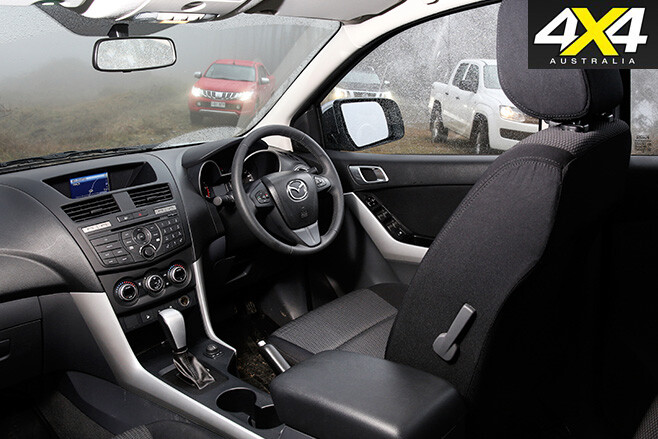
Cabin, Comfort & Safety The BT-50 has a big and comfortable cabin, but only the steering-wheel tilt can be adjusted and not its reach. There’s a spacious rear seat, with only the Amarok among these four, offering more shoulder room for three and also more headroom, especially for the two outside passengers. The BT-50 does, however, have more combined front and rear legroom than the Amarok.
The mid-spec BT-50 tested here is generally well-equipped, but the dashboard screen is too small and its controls are too fiddly. In some ways, the interior is starting to feel old. Hopefully this is another thing to be addressed with the BT-50’s mid-life revamp in October. The BT-50 has the highest five-star ANCAP safety rating.
Practicalities The BT-50’s ‘working’ credentials are as good as it gets here. It has a class-leading 3500kg maximum tow capacity and excellent payload figures thanks to its 3200kg GVM. That it’s also the heaviest ute here somewhat diminishes the advantage of the GVM figure, in terms of payloads, though.
The factory tub is also a good size, but no BT-50 has a 12-volt outlet in the tray and the standard tie-down hooks would be more useful if they were mounted lower in the tray.
Other positives include a neat factory towbar arrangement (much better than the Ford Ranger’s), good support from the aftermarket industry. It also has parts that are interchangeable with those of the Ranger.
Mitsubishi Triton MQ
In creating its new MQ Triton, Mitsubishi didn’t set out to tackle head-on the new breed of big utes, such as the Ranger, BT-50 and Amarok. Instead, it has looked to the formula that was successful with the previous MN and ML Tritons and worked from there.
What Mitsubishi has effectively done is taken the previous MN Triton, pulled it apart, and then put it back together with either new or revised parts. Most notably, it has an all-new engine, a new six-speed manual gearbox, a new transfer case, tweaked suspension and a slightly bigger and far more polished cabin.
The five-speed automatic that was previously only available on the top-spec GLX-R model is now available on lower-spec models, relegating the old four-speed auto to history.
Powertrain and Performance The all-new 2.4-litre turbodiesel in the Triton is a typically modern, twin-cam, 16-valve, four-cylinder diesel with high-pressure common-rail injection and what looks to be a surprisingly big variable-geometry turbo.
What’s not very typical is the fact that this new engine makes its maximum torque at 2500rpm, a very high figure for a modern turbodiesel. By way of comparison, Nissan claims the Navara’s maximum torque is on tap by 1500rpm, while the Amarok’s and the BT-50’s maximum torque arrive well below 2000rpm.
In fact, the BT-50 makes its maximum power just 500rpm above where the Triton makes its maximum torque. Such is the disparity between the ‘grunty’ BT-50 and the ‘revvy’ Triton.
You particularly notice the Triton’s off-idle and low-rpm softness with the new and sweet-shifting six-speed manual gearbox, but the auto, as tested here, effectively masks this characteristic via its torque converter, which allows the engine to pick up rpm more quickly than the manual does.
The Triton’s engine is noticeably smooth and quiet and, helped by the fact that the Triton is the second lightest ute here, offers performance that is competitive despite not being a front runner in terms of on-paper power and torque.
The Triton has an older auto with fewer speeds than the others and, while it doesn’t do a bad job, it’s generally not as agreeable as the other three autos, all of which offer quicker, smarter and more decisive shifts.
Despite a very good ADR fuel figure of 7.6L/100km (the second best figure here), the Triton fell back a little when put to the sword in the real world, with its 11.5L/100km test average.
Ride and Handling With its sporty steering and relatively tidy handing, the previous-generation Triton was a standard-setter in its day. Thankfully, these strengths live on in the new Triton, which has been improved with revised front suspension and longer springs at the rear. The longer leaf springs are there to help soften the unladen ride (without compromising load-carrying), but the Triton still rides a little harder at the rear than the others. Perhaps its shorter wheelbase plays a part here.
In this company, the Triton is unique thanks to its ‘Super Select’ 4×4 system, which brings all the benefits of full-time 4×4 to general touring on wet bitumen, and to gravel and dirt roads.
On this test we had on-and-off-again rain, plus a wide variety of road surfaces to traverse. So being able to select full-time 4×4, rather than having to shift between high-4 and 2WD – as was the case with the part-time 4×4 Mazda and Nissan – was a real bonus.
Off-Road Super Select is also handy on easy trails, because you can use high-4 with the centre diff open in situations where the traction is generally good and you don’t need locked fore and aft drive. If it gets more slippery, it’s just a matter of turning the Super Select dial one notch to lock the centre diff. Another turn of the dial will then engage low-range.
What the Triton doesn’t offer at this spec level is a rear-locker, even as an option. That only comes with the top-spec Exceed model, but even then it’s not as sophisticated as the lockers in the Mazda, Nissan or VW. That’s because it cancels traction control across both axles, not just the rear axle.
This knocks the low- and mid-spec Tritons down a notch in its off-road capabilities. It’s still more than handy, however, with decent clearance, good forward vision and the benefit of being the smallest ute here with the best turning circle.
A change from the previous generation Triton is that the engine air intake comes via the inner mudguard rather than from under the bonnet lip, which is good move. Mitsubishi is, however, still conservative with its wading-depth claim of 500mm, or 600mm, if you keep below 5km/h. Again, it’s a typical ute, with no rear recovery hook, but two at the front.
Cabin, Comfort & Safety The new Triton cabin is slightly bigger than before, but it’s still the smallest cabin in this company, and it’s certainly cosy for three adults in the back.
However, the cabin’s fit and finish is far better than before, with more of a passenger-car feel than that of a commercial vehicle. The driver can now also adjust the tilt and reach of the steering wheel.
The much-criticised front seats in the previous model have also been improved, but have still met mixed reactions from our testers. Our shorter drivers gave them the thumbs up, while taller drivers gave them the thumbs down.
One annoying thing that all drivers noted is that the rear tub and its sports bar stood out and could be quite distracting in the rear-view mirror, or when shoulder-checking.
In recent tests, the new Triton achieved the highest five-star ANCAP safety rating.
Practicalities The Triton’s relatively short wheelbase means that almost the entire tub is behind the rear-axle line, which is not ideal for carrying heavier loads. The tie-down hooks in the tub are also mounted too high.
The Triton has the lowest GVM here, but its relatively light weight helps redress the balance in terms of payload. Its 3100kg-towing capacity is also short of the class leaders, but is still adequate for decent-sized caravans, big boats and double horse floats. Being a new-design ute, the range of aftermarket enhancements will also be limited for the immediate future.
Nissan Navara NP300
Nissan’s NP300 Navara is almost new from the ground up and represents a number of ‘firsts’ for a mainstream Japanese ute. Most notably the ST and ST-X spec models now have a new 2.3-litre, four-cylinder diesel engine with two turbos; a feature in this class previously reserved for the Volkswagen Amarok.
All dual-cab variants (including 2WD models) also have a coil-sprung live axle at the rear, which replaces the leaf-spring live axle used in the previous Navara – and generally used across the ute market. The arrangement uses five links, two upper trailing arms, two lower trailing arms and a Panhard rod.
In designing the new NP300, Nissan has also bucked the trend to build a bigger ute. In fact, the NP300 is slightly smaller and lighter than the D40 it replaces. Compared to the D40, it is 41mm shorter and rides on a 50mm-shorter wheelbase. It’s also close to 100kg lighter than the D40 (top-spec models) and its GVM has been reduced from 3010kg to 2910kg.
However, importantly for bragging rights at the very least, its maximum towing capacity has been increased from 3000kg to 3500kg, bringing the NP300 into line with the class leaders.
Powertrain and Performance The idea behind two turbos, rather than one, is not so much to produce more power, but to improve the spread of power – something you’ll quickly notice while driving this new Navara ST-X.
A single-turbo design is always a compromise between minimising lag and producing decent power, but by using two turbos this compromise is largely overcome (see ‘Power of Two’ sidebar).
Thanks to its sophisticated sequential turbo arrangement, the Navara’s full measure of 450Nm is available at just 1500rpm, yet the engine also likes to rev and doesn’t hit peak power until 3750rpm.
The engine is both responsive at low revs and punchy at higher revs. This, combined with the seven-speed auto and the Navara’s relatively light weight, pushes the NP300 to the front of the pack in terms of straight-line performance.
For its part, the auto is generally agreeable, but the shift protocols seem more skewed towards economy than performance, which can often have you switching to the gearbox’s ‘manual’ mode for better control in more demanding driving situations.
The engine is also smooth and generally quiet, except under load where it does become noticeably noisy.
It has good fuel economy, too, although its on-test consumption figure of 11.2L/100km (second in this group) fell well short of its remarkably good 7.0L/100km official ADR figure.
Ride and Handling The Navara’s coil-sprung rear end doesn’t ride any more smoothly than its leaf-spring competitions here, but the general control and stability it affords is better, especially when driving through and out of bumpy and corrugated corners. It’s a pity the Navara doesn’t also offer some sort of full-time 4×4 to further press home this advantage.
While the Navara is a generally sweet-handling ute, the overall chassis response is compromised by heavy, slow and lifeless steering. It’s somewhat akin to the feel you get with under-inflated front tyres.
Off-Road In this company, the Navara is a mixed bag off-road. On the positive side its low first gear and deep low-range reduction produces the lowest crawl ratio of 44.6:1, which for an automatic is excellent. What’s more, the shift protocols of the seven-speed work well off-road, something you couldn’t say of the seven-speed auto behind the V6 turbodiesel in the D40.
Both the top ST-X spec and the mid ST spec NP300s also come standard with a rear locker and, like the lockers on the VW and the Mazda, when its engaged it doesn’t cancel the electronic traction control across the front axle.
Not so good is that the engine’s air-intake has been moved from the inner mudguard to adjacent to the top of the radiator, and the claimed wading depth is now a low 450mm, something that owners may want to address with a snorkel.
Compared to the other utes here, the NP300 also rides a little lower and was always the first to bottom out off-road, an issue that will be familiar to D40 owners. As is the norm with most utes, there isn’t a recovery hook at the rear, although there is one up the front.
Cabin, Comfort & Safety The Navara has the most car-like cabin here, though some of that comes down to the fact that it’s the only top-spec model tested and is loaded with equipment.
The cabin is, however, quiet regardless of speed and road surface, thanks to good NVH control and low wind noise. The previously mentioned engine noise under load is an on-going issue, though.
The cabin isn’t as big the Amarok or the BT-50, something which rear-seat passengers will especially notice, although the Navara’s rear seat does a better job of seating three than the Triton.
Notable cabin exceptions include no reach adjustment for the steering wheel and no centre headrest for the rear seats.
On the flip side, the NP300 is unique among utes as the ST-X spec has a sunroof, while all NP300s have a small power-operated opening rear window. The NP300 has achieved the full five-star ANCAP safety rating.
Practicalities As mentioned, the Navara now matches the best in class with its 3500kg tow rating and, while the GVM is among the lowest two here, the fact that the Navara is the lightest helps with payloads. ST-X-spec Navara’s also have Nissan’s handy adjustable tie-down system in the tub.
What is also noteworthy is that, while all the utes here require servicing at least every 12 months, the Nissan can go for 20,000km between services, a benefit for high-mileage Navara buyers. Meanwhile, the VW and Mitsubishi both need servicing every 15,000km, while the Mazda has a 10,000km service interval.
Finally, while this ST-X has 18s with relatively low-profile tyres, the 16s off the other NP300 variants can be fitted if you want a more durable higher profile tyre.
Volkswagen Amarok
Volkswagen’s Amarok was the first of the new generation of utes that make up the current market. It was launched abroad in 2010 and arrived here in the first quarter of 2011, about six months before the Ford Ranger and Mazda BT-50 twins. It was initially available only as a six-speed manual, with the eight-speed automatic not arriving until the following year.
In most ways, Volkswagen followed a standard ute design, with a separate chassis, double-wishbone coil-sprung front suspension and a leaf-sprung live axle at the rear. However, VW added a notably large cabin and a big tray, which set it apart from the other utes of the day.
The 2.0-litre bi-turbodiesel and the eight-speed auto also seemed somewhat left field, although the engine was already in VW’s stable (powering things like the Transporter Van), while the auto gearbox was a propriety unit from prolific German transmission specialist ZF and was already in use by a number of different car companies.
Since its release, the Amarok range has been revised a few times, the engine specs tweaked and the equipment details changed. What you see here, however, is essentially the same Amarok that’s been here since day one.
Powertrain and Performance The Amarok has the smallest engine here, but, thanks to its bi-turbo arrangement, still offers competitive power and torque. On the road, the Amarok actually offers the best initial kick-down response, thanks to its fast-shifting close-ratio eight-speed auto, and it does this despite being the second heaviest ute here.
The Amarok also stands out for its willingness to rev despite also being strong off-idle. It’s also the smoothest, quietest and most refined engine here, something that’s no doubt helped by its relatively small capacity.
The eight-speed automatic is also the best gearbox here in terms of shift quality, shift speed and shift timing. It also combines with the engine to produce a powertrain that’s difficult to fault. Topping things off, the Amarok proved the most fuel efficient on test (10.8L/100km) despite a mid-field ADR figure of 8.3L/100km.
Ride and Handling The Amarok’s chassis carries on the same polished performance of the engine and offers the best steering, road feel and general handling. The full-time 4×4 system then adds extra security and grip on demanding road surfaces including bumpy and wet bitumen, corrugated gravel, and dirt roads.
In most ways, when compared to the other three, the Amarok feels more passenger car than ute. Buyers wishing to have more of a passenger car and less of a ute ‘feel’ can opt for the softer-riding ‘Comfort’ springs at the rear. These are available on Trendline, Highline and Ultimate Amaroks, but not on the base Core model as tested here.
Off-Road On paper, the Amarok, with its single-range 4×4 system, shouldn’t work in steep and slow-going off-road conditions, but it does. With the eight-speed gearbox having a low first gear and a surprisingly effective torque convertor, we have never had a problem climbing steep off-road inclines either in this test or during all the other testing we have done with Amarok autos during the past three or four years.
What’s more, its 4×4 system is more than clever as you go from cruising down the freeway, at whatever speed you choose, straight on to a steep off-road climb, without touching a button or a lever. The Amarok is always in 4×4, its centre diff locks by itself, and it doesn’t need low range; not that there aren’t buttons to tweak the off-road performance, if you so wish.
Most importantly, all 4×4 Amaroks have a driver-switch rear locker. There’s also a switch for the very effective down-hill descent control and to tweak the ABS and the stability- and traction-control system’s off-road conditions, which is handy but not essential. There’s a separate switch to disable the stability control to help in sand or deep mud.
The Amarok’s auto is also the pick of the four gearboxes when off-road in both full-auto mode and when used manually.
One caveat here: we’ve never towed a heavy camper trailer in steep off-road conditions with the auto. Those wishing to do so may be better off with the manual Amarok, because it has dual-range gearing (see ‘4×4 Dilemma’ sidebar).
All Amaroks draw their engine intake air from adjacent to the top of the radiator and the official wading depth is a modest 500mm, which makes the Amarok another candidate for a snorkel.
The Core does, however, come fitted with decent all-terrain rubber in the form of Pirelli Scorpion ATRs. It’s also the only ute here with a rear recovery hook, while the front has a screw-in towing eye.
Cabin, Comfort & Safety The Amarok has a big, spacious and comfortable cabin that’s understated in typical German fashion, especially so in this base-Core spec. But it does offer the best front seats, tilt and reach steering wheel adjustment for the driver, and the roomiest back seat for three adults.
All the controls are also logically and simply laid out, but the Core misses out on the 12-volt outlet on the dash top, which is fitted to all other 4×4 models and is handy for accessory sat-navs and the like.
The Amarok has a maximum five-star ANCAP safety rating.
Practicalities The Amarok has a biggest tub here and well-placed tie downs, but the Core doesn’t have the 12-volt outlet in the tub, which is standard on all other variants.
All Amaroks, including single cabs, come with a factory tub, but this is a delete option ($1500 saving) on everything but Highline and Ultimate. This seems like a very logical approach to splitting the range between cab-chassis and ute models.
The Amarok has the lowest tow rating here – a still-decent 3000kg – while its 3040kg GVM is bettered only by the Mazda. If the previously mentioned ‘comfort springs’ are fitted to the rear, the GVM is reduced to 2820kg, which is still not too far short of the Triton’s 2900kg or the Navara’s 2910kg.
THE VERDICT IS IN…
Dual-cab utes perform a wide variety of roles, which is a key reason why they are immensely popular in the overall new-car market. They can be used as day-to-day family transport, weekend 4×4 fun machines, work trucks, or serious 4×4 tourers. And most are used in some combination of these roles.
Dual-cab 4x4s are so popular that they have eclipsed 4×4 wagons in sales and now compete against much cheaper small, passenger cars in overall sales. Like the USA, Australia is becoming a nation that loves ‘pick-up trucks’.
The multitude of roles that dual-cabs fulfil makes it hard to pick an outright winner in any comparison, this one included. It just depends on what you want out of your dual-cab 4×4. You wouldn’t buy one of these utes over the other because of performance alone.
There’s not a significant difference here. Nor would you be likely to buy one over the other for the differences in payload or towing capacity, unless you really needed the full 3500kg tow rating offered by the Mazda and the Navara.
If you are after value for money, it’s hard to go past the Triton. Consider this: the cheapest way to get into any of these four dual-cab utes is via the Triton GXL manual, at $36,990. At the other end of the range, the cheapest way to get into one of these utes with luxuries like leather and sat-nav is via the $47,490 Triton Exceed.
The Triton also offers dual-range full-time 4×4 at just $40,990 for the GLS manual, where the cheapest way to get full-time 4×4 in an Amarok is via the $45,990 Core auto, and neither of the other utes offer full-time 4×4.
On the downside, the Triton has the smallest cabin, the lowest GVM, the least sophisticated automatic gearbox and a short wheelbase that is as much of a disadvantage as it is an advantage.
The Mazda’s strength lies in its cabin size, and its high GVM and tow ratings. It also stands out in a world where downsizing is the name of the game in diesel engines. In the past 10 years, Triton has gone from 3.2 to 2.4 litres while in one generation the Navara has gone from 3.0 or 2.5 litres to 2.3 litres.
Even the new HiLux due to be released later this year has a smaller 2.8-litre diesel replacing the current 3.0-litre diesel. And the Amarok has always had a small engine.
The benefit of the Mazda is that its ‘big’ engine is relatively low-revving and has the lowest specific power output, both of which augur well for longevity. Proof of the soundness of the Mazda’s overall design is that it can still hold its head up against the newer utes here and has the benefit of an imminent update to come.
Nissan spared little with its new Navara NP and it impresses with its new engine and ’box, it’s general car-like refinement and its generally solid off-road ability. Model for model, it’s also sharply priced, even if it’s not as cheap as the Triton.
Given the sophistication of the engine and gearbox, it’s a shame, however, that Nissan didn’t back this up with an on-demand (effectively full-time) 4×4 system as used in the previous-generation Pathfinder and the Y62 Patrol. It would have been much better for it.
The NP300 could have been a game changer, but it isn’t. And a few details like the revised engine air intake, ground clearance (especially at the front) and the doughy steering are disappointing. But you still get a lot of ute for the money and the top-spec ST-X is very well equipped, with a sunroof and all.
As ever, the Amarok is one of the more expensive utes, but it does most things better than any of its opposition and is simply a delight to drive both on and off the road. It offers real passenger-car refinement, but it’s still big, tough and off-road capable.
We’d like to see the auto gearbox and full-time 4×4 system offered with dual-range gearing, but not because the current system does anything wrong. In fact, it works brilliantly.
It’s our current ‘Best in Class’ champion and that position is still intact despite the two new utes here. As editor Raudonikis quipped during this test: “The Amarok is in a different class to the other three utes here … a class above.”
Click here to read the full range review of the Volkswagen Amarok.