
ONE by-product of any 4X4 engine is heat, and it is the radiator’s job to get rid of most of it.
This was first published in 4×4 Australia’s March 2013 issue.
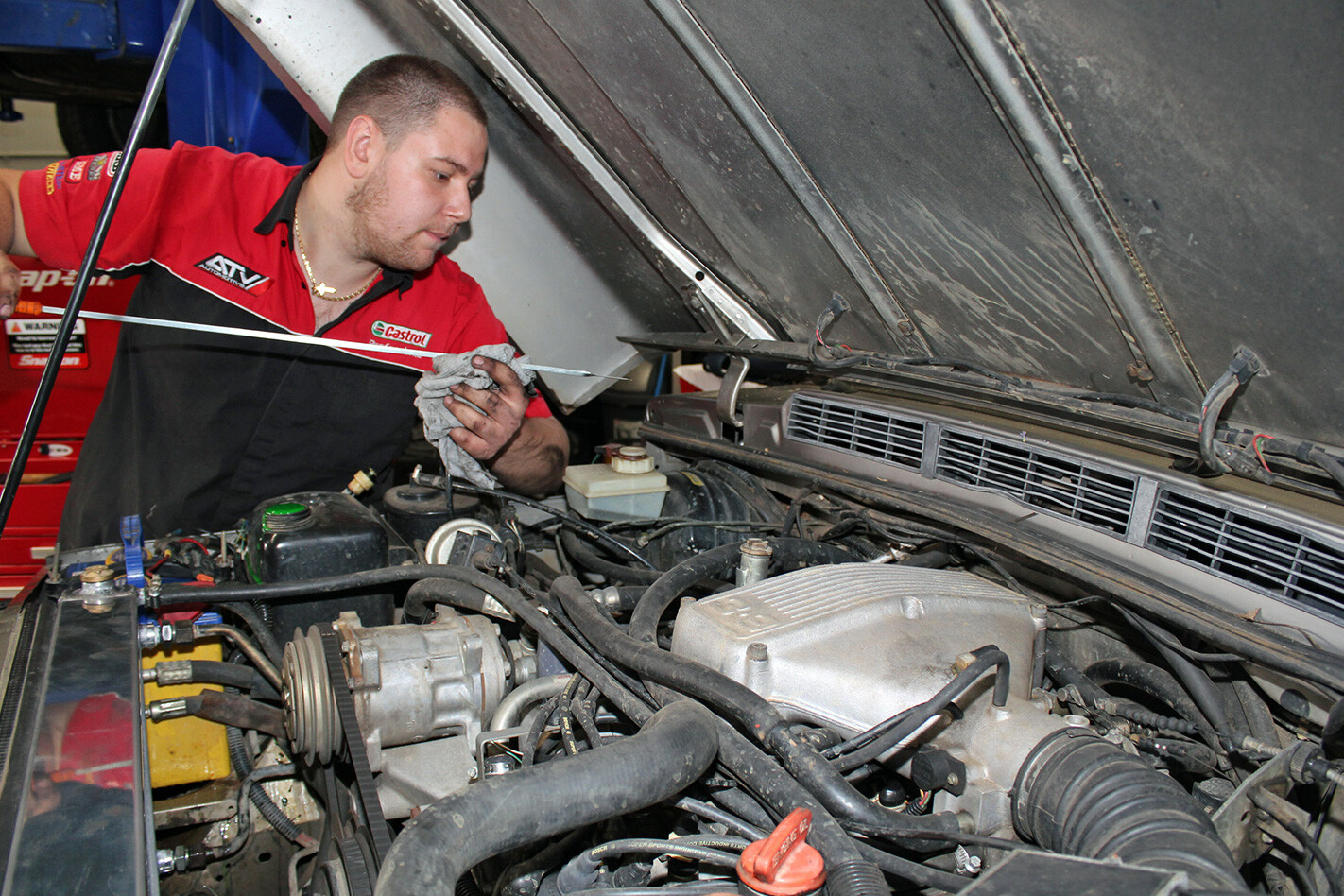
With the hard work some 4X4 engines have to do – crawling off-road or towing – it’s an item that needs to be in top condition to avoid the engine overheating. Here, we joined ATV Automotive to see the team replace a tired copper and brass radiator in a Range Rover Classic.
The old radiator, which was found to be losing coolant, is being replaced with a PWR-fabricated aluminium radiator. The main advantages of aluminium over copper/brass radiators are generally considered to be that the aluminium types transfer heat more efficiently and are lighter.
Certainly, the weight comparison is correct; when the Range Rover’s old radiator was pulled out, it weighed 20kg; the new alloy radiator was half that. Radiator replacement is straightforward. The guys drained the coolant, disconnected and removed the fan and fan shroud, disconnected transmission cooler lines and radiator hoses and removed the old radiator.
With the new radiator in, the lines and hoses were refitted and coolant added. The only thing that can become fiddly is removing the coolant level and/or temperature sensors and the automatic transmission line connector barbs from the old radiator and fitting them to the new one. Radiator hoses can be difficult to remove if they’ve been there a while.
1. With the fan and fan shroud already taken out, the old radiator is ready to be disconnected and removed.
2. Draining the old coolant from the radiator and from the coolant overflow tank in preparation for removing the radiator.
3. Loosening the radiator hose clamp for top and bottom hoses so the hoses can be pulled away from the radiator.
4. Vehicles with auto transmission have oil cooler lines that have to be detached from the radiator.
5. Removing the radiator upper retaining brackets so that the old radiator can be easily lifted out of position.
6. With a last check for any missed connections or obstructions, the radiator can then be lifted out of the vehicle.
7. The green residue down the side of the core indicates this radiator has probably been leaking for some time.
8. The new radiator comes bare, so here the temperature sensor is removed from the old radiator to fit into the new unit.
9. With sensors cleaned and fitted with fresh sealant, the new radiator is slowly lowered into position.
10. The barbs for the transmission lines are threaded into the new radiator and the lines connected.
11. With all transmission lines and coolant hoses reconnected, the radiator is filled with coolant.
12. Transmission fluid level is topped up and checked as some fluid was lost when the lines were disconnected.
WHILE there are plenty of features in modern 4x4s we all appreciate on a daily basis, it seems car companies are hell-bent on loading them with things we don’t necessarily like or want.
Driving the Mercedes-Benz G-Professional around reminded me of a few things we now take for granted in a vehicle, as well as some things we miss when they’re not there. Things like a Bluetooth phone connection and power windows should be standard in any new car, certainly one costing $120,000.
Thankfully the G-Pro is narrow enough that you can reach across from the driver’s seat to operate the passenger-side window winder, just like my old BJ73. Paying extra for air-con in an $80,000 Land Cruiser ute is also not on. What modern features bug me most?
Here’s a hit-list of gimmicks I could certainly do without in my 4×4:
KEYLESS IGNITION: Not only does this feature leave you without a place to put the key while driving but the system has proven to be prone to hacking by car thieves. The manufacturers might try to stay a step ahead of the stealing scumbags but they always catch up. And the start/stop button is in a different place in every car, which, when you drive as many cars on a weekly basis as I do, becomes annoying.
IDLE STOP/START: When I’m behind the wheel of a car I like to know the engine is running and that when I put my foot down the car will go forward. I don’t like to wait for the car to start when I’m pulling out into traffic and I don’t like the cabin heating up while sitting at lights because the air-con isn’t working. Like trying to find the stop/start button, the one to deactivate idle stop is the next button I go for.
POWER TAILGATES: Great idea in theory but who needs it? They are slower than opening and closing them yourself and the number of times I’ve hit the button to close a tailgate and it’s failed to lock down drives me nuts. Fighting against the power function to do it manually makes it difficult as well. Not to mention the weight and complexity that the parts add to a car.
SMALL FUEL FILLERS: In the words of the great Jello Biafra, Give me convenience or give me death! And standing by while filling a car with fuel is a massive inconvenience. Thank goodness for high-flow diesel pumps and man-size fuel fillers. But so many of these modern diesel cars don’t accept high-flow pumps! That’s time standing around I’ll never get back.
CHIMES: Speak to anyone who has driven a modern Ford, Jeep or Toyota about vehicle chimes. Enough said!
IF you ever decide to talk to Alan Johnson from Piranha Offroad about Suzuki 4X4s, you’d better have plenty of time on your hands.
This article was first published in 4×4 Australia’s July 2013 issue.
He’ll happily spend hours telling you tales about the adventures and fun he’s had over many years in the little Suzis, having a ball, tweaking and modifying them to get the best out of them and often putting larger, considerably more expensive 4X4s to shame when out bush.
Alan’s love affair with these over-grown Tonka toys from Japan goes back to the very first three-cylinder two-stroke variant released in Australia in the mid ’70s. Al’s parents bought one as penance for a family member who lost his licence for speeding in a Ford Escort.
They figured with a 500cc donk – top speed around 80km/h – that person would no longer be capable of incurring the wrath of the law and would also probably be a lot safer.
This proved a genesis for Alan’s love of four-wheel driving, and for what’s now essentially a hobby business based around these very capable fourbies. Based in Boronia, Victoria at Piranha HQ, Seriously Suzuki caters for those who want to modify their Suzukis to, in Alan’s words, “whatever they want them to be”.
During my chat with Alan about all things Suzuki, it’s soon apparent how enthusiastic about the little 4X4s he is. “Whenever I jump into a Suzuki, there’s an immediate smile on my face,” he says, grinning. “I can’t wipe the smile off, it’s just so much fun.”
Testament to Alan’s enthusiasm are several Suzukis on the premises, some in storage waiting for attention, with another (his project Vitara) that looks like it’s copped a high dose of engineering steroids.
This particular rig – Suzaroo (an acknowledgement of its hybrid nature – it is powered by a Holden Jackaroo engine) is proof of what can actually be achieved. It’s yet to see competition, but its debut is not far off.
Although Seriously Suzuki has only been operating for about four years, it’s swiftly grown. It carries a large range of new and used spare parts and offers numerous modifications and accessories that can significantly enhance the performance of almost any Suzuki.
The list of bolt-on items includes suspension, spring-overs, body lift kits, rockhopper gears, bullbars, towbars and rear bars, roll cages and snorkels. Not to mention electrical and battery upgrades and engine fitting, and all alongside the full product range and workshop facilities available at Piranha Offroad.
According to Alan, where there was once several companies providing Suzuki modifications, he is one of the few remaining offering such a wide range of modifications and accessories.
“These days, the early model LJs and Sierras are getting pretty long in the tooth and harder to find in good condition, but still make great inexpensive vehicles to play with. Later models, like the Vitara, are also very capable off-roaders and can be picked up in some cases for under $5k, making them a great choice as a fun and inexpensive 4X4.”
I notice a customer’s V6 Grand Vitara parked in the workshop during my visit to Seriously Suzuki. It looks really slick; it has heaps of aftermarket gear fitted, including ARB bullbar, roof-rack, Safari snorkel and side-mounted roof awning, among other purposeful bling. It would make a great touring rig for a couple.
To fully appreciate Alan’s love of Suzukis, I’m invited to visit the Johnson family farm near Mansfield, about 180km north-east of Melbourne, where he has no less than five examples tucked away in sheds.
Like a proud dad, Al shows me around and introduces me to each of his beloved Suzis. It’s quite a stable too, ranging from an original LJ50 three-cylinder two-stroke – salvaged from a farm shed where it had to be dismantled to be removed, and then reassembled – to his Frankenstein Vitara. Alan’s first attempt at a competition rig built on a low budget, it was thrown together with mostly second-hand components.
It’s been 18 months since the 500cc two-stroke LJ50 has been started but, with a freshly charged battery, it fires straight into life, bellowing a blue smokescreen Batman would be envious of.
We buzz around a few of Alan’s paddocks to blow the cobwebs out and get a feel for the original Suzukis. We have to keep our joyride to a minimum, though, as even the old cross-ply tyres are original and the standard drum brakes almost non-existent; it is a fun blast from the past. We park the old Zook back in the shed before sparking the Frankenstein Vitara into life for a not-quite-as-gentle jaunt.
Keen to show off the Vitara’s capabilities, Alan’s soon spooking the cows as we tear across the property, from one obstacle to the next. He crawls the Vitara up and down gullies, through a rock-filled ravine and launches the front end skyward over a jump, all of which the Vitara gobbles up with ease.
The broad smile on Alan’s dial reveals how much fun he’s having, but there are still three Suzis to play with, so it’s back to the shed to muster up the next.
Bluish smoke belching from the exhaust signals that we’re in another three-cylinder, 500cc two-stroke LJ50. This one is heavily modified: suspension, disc brake front end, free-wheeling hubs and a roll bar. This example was also a hay shed find, but it was badly rusted out, so there’s almost as much aluminium checkerplate around the body as there is original skin.
We’re soon chugging along the river flats, where Alan demonstrates how easily the lightweight off-roader crawls up and down steep terrain and tackles water crossings. Once again, Al’s grin says it all.
The windscreen pillars have rusted away, so this little buggy is strictly farm-use only, and, with its open cockpit and go-anywhere capability, makes a great rig for bunny shooting.
Alan’s 1.3-litre LWB Sierra, still sporting its original canary yellow factory paint, is our next ride. It had been used as a railway line inspection vehicle, complete with drop-down wheels to run on tracks, but these days it’s Alan’s fire truck, and he proudly wears his red plastic CFA hat to ham it up for a few pics.
Not surprisingly, it’s been heavily beefed up to carry almost 500 litres of water and pumps in its tiny tray, but, with Rockhopper gears, a 50mm lift, and bigger wheels and tyres, it does a great job of getting around the property, according to Fire Chief Johnson.
Last of the fab five fourbies is another LWB Sierra, this one clad in apparently radar-reflecting paint Alan managed to pick up at a local clearance auction in various camouflage tones. In fact, only the original LJ50 and fire truck have escaped the army chic paint scheme.
Of all the Suzis in the shed, this Sierra has proved to be a great vehicle, but in the end, simply not worth the time and grief that went into producing it. It’s fitted with a two-litre EFI engine out of a wrecked Grand Vitara, among other substantial mods to accommodate it, but Alan reckons fitting the larger engine, gearbox and transfer case entailed approximately 80 hours of work.
It’s a work of art, particularly under the bonnet where the donk almost looks factory-fitted – and it was equally impressive driving around – but Alan concedes it will probably only ever be a one-off as it’s simply not viable given the man-hours involved.
If I’ve learned anything while researching this yarn, it’s that Alan Johnson not only knows his way around Suzukis, but he loves them, too. Let’s face it, anyone who drives a 1.0-litre Sierra across the Simpson Desert, as he and wife Barb did back in their younger days, has got to be passionate.
In Alan’s words: “The world looks different through the windscreen of a Suzuki. Driving one is almost like the difference between a boat and a jet-ski, as compared to LandCruisers and the like. They’re just fun with a capital ‘F’.”
I get the sense that Seriously Suzuki is a good excuse for Alan to just keep having fun, as opposed to turning a big quid and making a fortune anytime soon. But if you’re looking to trick up a Suzuki, you can be sure his advice and expertise is as good as it gets, thanks to 40 years of fun and practical experience. Seriously.
AFTER every 4×4 excursion there comes a time when you need to remove the awning, fishing rod tube, recovery tracks and any other accessory fitted to your roof racks before the working week starts, but you can’t be bothered because it’ll take too long.
Enter The Quick Fit Bracket from Smart Touring Systems. With this clever kit added to each of your roof-mounted accessories, removal and installation only takes seconds. Yep, now you can whip your awning, recovery boards and any other accessory off in the blink of an eye.
To make this kit even better, all accessories can be easily and quickly re-installed onto roof racks. During our test of the Quick Fit Bracket we had three accessories removed from the 4×4 in about 20 seconds, and it took the same time to re-install them.
The only question is: Why hasn’t someone thought of this before? It’s such a simple, well-designed and manufactured system, it is ludicrous no-one has ‘been there and done that’. That’s exactly the position Adam from Smart Touring Systems found himself in.
He wanted a system that would allow efficient removal and installation of his roof rack-mounted accessories, so he set about making it for himself. Necessity is the mother of invention, eh?
Manufactured from laser-cut stainless steel, with zinc-coated 8.8 high-tensile hardware and high-density polyethylene (HDPE) plates to resist rattling, the kit is fitted in two halves to both the roof rack and the accessory that is to be installed/removed.
This initial installation of brackets requires the use of a spanner, but the subsequent adding and removal of the accessories only requires the release of a locked pin from the system.
One kit comes with two Quick Fit Brackets and two roof rack brackets, to mount and remove one item (like an awning). Extra roof rack brackets can be purchased separately to allow an accessory to be mounted to other parts of a rack. And, to ensure thieving mongrels don’t help themselves to your gear, the system can be padlocked into place.
Keeping the gear secure and under cover at all times will prevent weathering, especially particular awnings that tend to fall apart after a while. Other benefits include reduced wind resistance, better fuel consumption, lower overall heights and weight savings.
Every roof rack should have a Quick Fit Bracket kit (or two or three) attached. I know mine will.
AVAILABLE FROM: Facebook: @smarttouringsystems RRP: $99 (including delivery) WE SAY: Every roof rack should have them.
BULLDUST streamed off the churning Mickey Thompson mud terrains.
Locked into the GPS were the co-ordinates for Wuyagiba Outstation, 560km east-southeast of Darwin on the eastern side of Arnhem Land in the Northern Territory. Any 4×4 with well-mannered suspension should sail over the wide and frequently used gravel track that led us towards the Wuyagiba turn-off from the main track.
A south-easterly turn then pointed to a recently graded track, but deep channels of bulldust remained. Low-lying scrub clawed at the paintwork as the track narrowed, and it became a balancing act between the bulldust and the tight track to keep the vehicle and camper aligned.
There’s no denying a fourbie was essential to completing the 40-odd kilometres out to Wuyagiba, but it was all worth it when we arrived at the coast. We were warmly welcomed by the traditional owner Kevin Rogers, who’s an incredible chap to talk to.
Kevin has enjoyed a colourful life and is a very learned man, having attended university to study linguistics – he was also a Golden Gloves boxer in his younger years. Several dwellings and small amenity blocks can be found here, and the homestead often provides accommodation for seasonal buffalo hunters.
An estuary system not too far from the homestead can be accessed by four-wheel drive, and there’s a suitable spot to launch a small boat. These waters are inhabited by crocodiles, and we were reminded of this when a juvenile crocodile started snapping at our lures. Crocs aren’t the only concern, as we had a massive buffalo bathe in the mud only metres from our boat.
A 4km drive along the beach in a northerly direction leads to a camp spot on the edge of sand dune vegetation. We took the opportunity to sit back and soak up the sensational NT sunset, with the ocean breeze lifting the aromatic smells of our campfire feast. This camp spot even boasts a new eco toilet hut that is (bizarrely) about two metres off the ground.
Upon leaving the remote outstation of Wuyagiba for the journey north, we arrived at the coastal town of Numbulwar, located about 83km from Wuyagiba, and were greeted by the clear blue waters of the Gulf of Carpentaria – a beautiful site after battling dusty roads.
The town, with a population of less than 700 people, has a grocery shop and basic services, while diesel and opal fuel are available from the 24-hour pump near the boat jetty. It’s a dry community so no alcohol is permitted, and a permit must be obtained from the Northern Land Council prior to arrival.
We camped near the jetty; no facilities are provided, but we did make use of the shelter and picnic table. Fish are extremely active at night and you can hear them jumping out of the water, and a few nice fish were reeled in just metres from camp in the morning.
We had to tone down our excitement after we discovered a local lady was nearly dragged off those very rocks by a croc only a few weeks prior – we only had to walk a few hundred metres into the mangroves to see a big croc trap with a tasty buffalo leg swinging in it.
By mid-afternoon when the sun was starting to lose its sting, a Troop Carrier rolled into our camp with our hosts Raymond, Adam and One Shot, who had kindly been showing us around their town. As traditional owners in the community, they had come to ask if we would like to attend a special ceremony taking place that afternoon. Quicker than a politician’s promise on Election Day, we were loaded into the Troop Carrier.
It’s a huge honour to be invited to watch one of these special events take place. Called a ‘skin’ ceremony, it can be best related to a coming of age celebration, where a boy becomes a man. Upon arrival at the ceremony I was ushered to where all the women from town were sitting on the dirt, with their backs to the men.
I had no idea what was going on as I sat there as the only fair-skinned woman, listening to the tribal music filter through the paper barks. Some ladies beside me were kind enough to tell me to listen to the beat of the drums, which signalled when to get up and walk towards the men.
I must have missed the apparently distinctive drum sound, as they urgently shouted “Penny, get up!” I sprung to my feet and walked with them towards two totem poles. What I saw next was incredible: I watched two tribes challenge each other through dance, as the ground shook and the air filled with the sound of clapping sticks. The whole ceremony lasted only 10 minutes, but it was electrifying.
To travel into a remote community like Numbulwar and to be completely immersed in its history, culture and landscape is the essence of 4WDing in Australia. To get the most out of the trip, be prepared, don’t rush and always talk to the locals; they know their stuff, and by having a chat you’ll often discover great places to check out.
TRAVEL PLANNER
WHERE Wuyagiba Outstation is approximately 426km east of Katherine in the Northern Territory. Numbulwar is a coastal town 468km east of Katherine in the Northern Territory.
MAPS Best map is Hema’s Australia Road and 4WD Atlas.
ACCOMODATION Campsites and huts are available at Wuyagiba Outstation. Numbulwar and Wuyagiba camping can be arranged through Yugul Mangi Development Aboriginal Corporation. Phone: (08) 8977 4203.
FUEL AND SUPPLIES No services or supplies are available at Wuyagiba Outstation and you’ll need to be self-sufficient. Diesel and Opal fuel are available from the pumps at the jetty at Numbulwar. Basic groceries and some fresh fruit and veggies are also available.
RESTRICTIONS AND PERMITS Accommodation can be booked for Wuyagiba by contacting Yugul Mangi Development Aboriginal Corporation. Numbulwar is a closed community that’s only beginning to open up to tourism; a permit will be required to visit. Contact Bill Blackley at Yugul Mangi Development Aboriginal Corporation by calling (08) 8977 4203. Numbulwar is an alcohol-free town.
VEHICLE SET-UP A vehicle fitted with good suspension is necessary to negotiate the bulldust and rough tracks into Wuyagiba. Experience in remote travel is required and explorers need to carry drinking water. A remote first-aid kit (including snake-bite kit) is a must.
WHEN you can’t settle a debate between mates over who has the best ride, then you organise a serious off-road test across punishing terrain to sort out a result.
This is what happened recently when a bit of online banter among mates eventually led to a no-holds barred challenge up some of Melbourne’s toughest tracks.
Two of the short-wheelbased 4x4s in question – a Defender and an FJ – have been tirelessly tinkered and perfected for the last few years to serve as daily drivers slash weekend warriors. The third vehicle – a Wrangler with the Double Black Offroad (DBOR) catalogue thrown at it – is purely a weekend-getaway machine.
“The idea started with a Facebook post. I said ‘it doesn’t matter what side of the fence you’re on – FJ v JK – it’s all about getting out and having fun’,” Sav Giannoukas, the proud owner of the 2011 Toyota FJ Cruiser, told us. “But then Damian Lucev (owner of the 2013 Land Rover Defender 90) started with his comments about the Defender being better. Then Bill Barbas got involved and it all broke out of control.”
When the banter began, Bill Barbas, the owner of DBOR, had only just finished putting the final touches on the 2013 Jeep Wrangler Rubicon for a client. And Bill, with a wealth of Jeep knowledge, knew there was only one way to settle the score: a short-wheelbased showdown. And, of course, we tagged along to see who’d leave with bragging rights.
2013 LAND ROVER DEFENDER 90 LIMITED EDITION DEFENDER
DAMIAN swept this limited edition Defender 90 from the showroom floor back in 2013, and he’s spent the years since tinkering and perfecting the Land Rover to be the ultimate weekday workhorse-cum-weekend warrior.
Damian’s a carpenter by trade, so the 90 was originally purchased as a work rig, but it’s now far more capable than just transporting hammers and nails during the working week. The 2.2-litre four-cylinder-powered Defender – with power hiked from 90 to 130kW thanks to an ECU tune – spends an increasing amount of time helping Damian and his better half scratch their off-roading itch.
“She enjoys the camping aspect of it more, and she grits her teeth on the way there,” Damian laughed. “We like Caledonia River and Butcher Country in the Vic High Country.”
Eager readers may recognise the Orkney Grey hue of this Defender, as it was featured in the April 2017 issue of 4X4 Australia. However, as with any 4×4 worth its salt, progress has been made since we last drove it.
Only recently, after breaking a couple of rear shock absorbers, Damian opted to add Les Richmond Koni long-travel shocks and coils to soften ride and enhance the Defender’s off-road credentials. Since this tweak to the shocks and coils, Damian reckons the 90 has never felt better.
“The suspension has been the biggest difference. I was breaking shockers and it was a much harder suspension. It’s now softer and moulds to everything a bit better. “I don’t have any sway bars in and I’ve got soft coils,” he added. “So handling isn’t perfect on-road, but you get used to it. It’s soft for off-road.”
The suspension work is polished off by the ARB twin compressor, Ashcroft front and rear lockers, Ashcroft CVs, Hi Tough axles, oil-lubed bearings, heavy-duty flanges and a heavy-duty steering arm. Damian also flicked his 35-inch BF Goodrich Mud Terrain KM2s in favour of softer 35-inch Nitto Trail Grapplers M/Ts, which wrap around 16×8-inch Dynamic steel rims with -25 offset.
“For a shorty, it’s not too bad. Normally with short wheelbases you feel everything,” he said. “The new tyres are softer, much softer. They mould better, where the KM2s were more of a soft balloon.”
In fact, it was a previous trip to Alcorns – where we were headed for this drive – when Damian decided the change was inevitable. “The last time we were here it was too muddy, so it made me go from KM2s to these Nittos.”
In the past few months, Damian’s Defender has also received a Glind hot-water system, Front Runner glass gullwing windows and custom Recaro specialist M seats.
“I just got these seats done a couple of days ago,” he told us as we rode shotgun. “The standard seats aren’t the greatest, so these offer more comfort and support. I got them custom-made. I liked the look of the originals, but I just didn’t like the comfort levels.”
Damian admitted there will probably always be things to update and change, but he’s pretty content with where things sit at the moment. If anything, he might look at getting it regeared.
“The only other thing I can think of doing is possibly getting it regeared,” Damian added. “But it drives 35s fine, so it’s not a necessity.”
What’s it got? Mulgo rear corner protectors Bell auto service intercooler Redarc dual battery 2 x 8-inch rear led work light 170hp Bell auto service ecu tune APT fuel guard Alpine stereo sat/nav Mantec wheel carrier In-cabin winch control and winch isolator Sound deadening Mulgo rock sliders
2011 TOYOTA FJ CRUISER
WHEN Sav Giannoukas purchased this 2011 Toyota FJ Cruiser in 2015, it took all but a few short months before the spanners came out and the mods began.
The previous owner had already given it a two-inch lift and installed an ARB bullbar, a Long Ranger fuel tank and an ARB roof rack, but Sav had grander plans than those simple modifications – he wanted to convert the FJ into a hardcore off-roader that doubled-up for family touring duties.
Sav also loved the look of the FJ, so his intentions were clear: he didn’t want any modifications to rob the vehicle of its retro aesthetics. Job well-done, we say. Sav opted for a 4-inch adjustable lift kit to enhance the FJ’s clearance and off-road capabilities. “The difference between the 2-inch lift and the 4-inch lift is that I now have suspension,” he joked.
Pre-runner King remote reservoir shocks and Icon coils are used in the back, and “the coilovers in the front are set to three inches over standard to maximise droop”. Blackhawk upper control arms with three degrees of caster and tilted ball joints ensure increased clearance and travel, and the front diff was dropped 30mm to fix CV angles. “My actual CVs are completely horizontal. Same level as a stock FJ,” Sav said.
The diffs have been rebuilt with a 4.56 ratio to turn the 35-inch Mickey Thompson MTZ P3s, and a body-mount chop up front was done to clear the tyres. The off-road rubber covers 17×8.5-inch Walker Evans Street Legends wheels with a 0 offset.
The current suspension set-up has been fine-tuned to keep the FJ comfortable on bitumen and on coarse off-road tracks, with its owner more than pleased with the outcome.
“You can really hammer along and it keeps the car very stable and very level,” he said. “If it does drop down, I’ve got the airbags to level it out. The turning circle on-road with the upper control arms; we just brought it back to factory spec, and on-road it glides like you’re on a cloud.”
Sav also spared no expense when it came to lumens, as his FJ lights up brighter than a Christmas tree thanks to STEDI. Lighting includes an ARB-STEDI fog light replacement, 8.5-inch Type X LED driving light, 50-inch ST2K curved roof LED bar, 4x10W side floodlights, H4 LED headlight conversion, and 2x20W Wurton flood cubes at the rear. Plus, all internal and reverse LED globes have been installed.
“The quality of the light bars from STEDI is second-to-none,” Sav explained. “It’s the dream team of lights!”
With almost 200L of on-board fuel – factory tank is 72L, plus a 127L Long Ranger sub tank – Sav reckons he can get between 1100 to 1300km with constant highway driving.
However, Sav felt the FJ needed more work done to it before it could seriously be considered a rock-crawler, and so, since our adventure, Sav’s made plans for his Toyota.
“I’m flying up to Brisbane to see Brad from King Shocks to get my rears extended and rebuilt. So I’ll have a rear compressed length of 435mm and extended 735mm. That’s 3.5in more droop over what I had,” Sav told us after the shoot. “Shocks will be just shy of 29-inch-long open, then my set-up will be the way it was supposed to.”
A rear bar and bash plates are also the next pieces of the puzzle before Sav will be completely satisfied, then it’s off for a trip to Fraser Island and/or Tassie.
What’s it got? Front Runner axe holder Clarion in-dash head unit with Hema HX1 GME CB radio Plenty of charging sockets ARB compressor
2013 JEEP WRANGLER RUBICON – 10TH ANNIVERSARY
ERIC Castillo’s 2013 Wrangler Rubicon is a rare 10th Anniversary edition – in fact, FCA secured only 12 two-door and 18 four-door models. Eric purchased the scarce shorty back in 2014 completely stock, and it’s taken him three years from go-to-whoa to end up with this trailblazing hunk of metal.
For those three years, the Wrangler has spent much of its time in the trusty hands of the folk at Double Black Offroad, who have taken care of every aspect of this neat build. From the showroom, the special edition Rubicon is trail-ready, with a 13mm hike in ride height, Dana 44 axles, part-time 4WD system, Rock-Trac transfer case with a 4:1 low range, Tru-Lok electronic remote-locking diffs, and an electronically-operated front anti-roll-bar disconnect.
However, Eric knew there was still room for improvement. “The best investments I’ve put in it are the suspension and tyres,” Eric told us. On that front, the Rubicon runs 35×12.5 R17LT Nitto Trail Grapplers M/T tyres wrapped around 35-inch Walker Evans Beadlock wheels. Suspension componentry runs to a heavy-duty Dana 60 axle (rear) and 44 (up front) and ARB Air Lockers.
“The DBOR Wild Kit has been installed on this Jeep,” Bill Barbas, the owner of DBOR, told us. “The kit has successfully passed the swerve test and is certified compliant by Vic Roads.”
DBOR’s Wild Kit includes Synergy adjustable control arms, Synergy double adjuster sleeve and pinch bolt assembly, extended ADR-approved brake lines (front and rear), 3-inch or 4-inch Speedbumps (front and rear), heavy-duty Synergy chromoly tie rods, and Fox rebuildable shocks and rebuildable steering dampener.
A Poison Spyder front bar houses a Warn Zeon 8S winch should the need for a recovery arise, while the EVO rear fascia down back is more style than substance. Rigid Industries lighting and Smittybilt Guard Protectors surround the Rubicon, and a Trektop NX soft top can be manually opened should Eric wish to get his daily dosage of vitamin D.
An AEV snorkel feeds air through an Airaid filter to the 209kW/347Nm 3.6-litre V6 petrol engine; a set-up which came in handy when Eric set off on a jaunt across the Simpson Desert in 2016 – an expedition impressively completed in one day. “We started at 6am in Birdsville, and by 6pm we were in Dalhousie Springs,” Eric told us.
From the pilot’s seat, Eric has access to a Bully Dog controller perched on the dash, as well as a GME radio for remote-area communications. The interior is otherwise standard.
“The build has been absolutely awesome,” Eric said. “I have taken my rig to pretty much some of the hardest tracks in Victoria and it has delivered.”
Eric told us he wouldn’t hesitate to use DBOR for another Jeep build in the future. “I am absolutely pleased with the overall product, and the wealth of knowledge that Bill has about Jeeps is invaluable.”
A massive expedition is on the cards for Eric in the next few weeks, and it looks like he has the perfect companion for it. “The vehicle is about to embark on a journey to Cape York, Fraser Island and then finishing off at the Glasshouse Mountains, so watch this space!”
What’s it got? 35-inch Beadlock Walker Evans Teraflex Tyre Hinge Carrier Rigid Industries lights JW speakers headlights ARB rear lockers Bully Dog controller Fox reservoir shocks NX soft top Airraid filter GME radio Smittybilt Guard Protectors
ALCORNS CHALLENGE
ALCORNS Track in Cobaw, Victoria, was the ideal setting to push each shorty to its limits, with a variety of challenging terrain – plus it was a wet winter’s day, so the track was slippery and sections were highly difficult. In fact, Damian learned the limitations of his Defender here during one of his first visits to this region of the Macedon Ranges.
“Alcorns made me go from 33s to 35s,” he told us. “The first time I did it, I couldn’t get past because I didn’t have enough clearance, so that’s what generated my mind to go to 35s. That track makes me modify!”
As we rode shotgun with Damian, the comfort provided by the new long-travel shocks and coils was instantly recognisable. In combination with the front and rear lockers, CVs and axles, as well as the new Nittos, this shorty has incredible off-road credence.
As the non-stop banter filtered through the communications, I swapped into Sav’s four-inch lifted FJ and we traced our way to the base of a challenging hill climb. With tyres set at 12psi, the FJ’s soft suspension soaked up the juts and ruts with aplomb. “The suspension is so soft; it just absorbs all the bumps,” Sav added.
The incredible work the DBOR team put into Eric’s Wrangler Rubicon was evident when we went for a run through the rough stuff. The improved suspension courtesy of the front and rear axles and air lockers meant the 10th Anniversary shorty danced through the tamer stuff with ease.
After traversing relatively simple tracks, we soon arrived at the base of the challenging hill climb up Alcorns, where we’d inevitably spend the majority of the day – “200 metres in two hours,” Damian would later say.
Upon arrival at the gnarly-looking climb, Bill from DBOR admitted: “A standard Rubicon could do this track easy, but it’s now a mess so you can’t do it. I used to do customer drive-days out here and do a whole loop.”
The lads prepared their rigs, planned the best route to tackle the hill’s obstacles, and prepared to mount the arduous climb, which wasn’t helped by the fact the track was wet, sloppy and traction was hard to come by.
The banter reached its crescendo when Sav almost put the FJ on its side on his first (and only) attempt at the climb – highlighting the FJ’s need for a front locker.
Bill was the first to lay into Sav following the rescue. “It’s all about suspension, tyres and drivetrain,” he laughed. At least Sav could see the funny side. “The FJ always produces the good photos,” he quipped.
While the FJ took a smoko break – because of its perched angle when it almost fell into the side of the track, oil had gone past the seal and started to burn – the Defender and the Rubicon were fired into life.
Both eventually made it through the first phase of the track, before surrendering upon arrival to a smooth, slippery, boulder that took up the width of the track (which, admittedly, would have been overcome had time permitted).
It took the LWB black JK (see above) with its massive flex and clearance to prove to the shorties that Alcorns could be conquered in its entirety. Yet, despite the massive 37-inch Pit Bull Rocker tyres and 4.5-inch lift, the JK didn’t climb the slippery track with ease – a bit of winch support was needed to ascend to its highest point.
This proved a LWB vehicle may have the edge when it comes to serious rock-crawling, but the trek also highlighted how shorties can stand tall on corrugations, whoopty-doos and hardcore tracks with the right drivetrain/suspension/tyre set-up.
The Defender and Wrangler are hard to split as they’re both hugely capable off the beaten track, and both have been meticulously and expertly crafted. Plus, they both have a leg up over the FJ due to their live-axled front ends. But, as mentioned, plans have since been made for further modifications to the FJ, which should see it make up the ground it lost on the hill climb.
One more thing was settled: each owner still reckons their ride is best. Let the banter continue.
TRAVELLING through the hot heart of the country loses its appeal as the summer months approach, and conditions are so extreme the Simpson Desert is officially closed to travellers.
Yet the Simpson remains a bucket-list trip for most Australian four-wheel drive enthusiasts, and now is the time to start planning your 2018 trip for the cooler months between mid-March and November.
The 170,000km² Simpson Desert is the largest parallel dune desert on the planet, and its 1100-odd north-south running dunes make for a challenging drive.
An east-west desert crossing either starts or finishes in Birdsville, Queensland, with Mouth Dare being the only other civilisation, some 505km away near the SA-NT border.
We tackled the trip in August in a convoy of Mercedes-Benz G-Wagens along with explorer Mike Horn, and we took in some of the many places worth visiting. After crossing the desert and arriving at Mount Dare, we ventured to Old Andado Station, the Finke Road and finally to Uluru.
For more information on Simpson Desert travel, visit: www.thediamantina.com.au and www.mtdare.com.au
We’ve trawled the aftermarket catalogues and collated some of the best kit that’s landed this month.
Yakima LockN’Load Corner Brackets Kit Yakima’s LockN’Load Platform system has been going gangbusters since its release, and the company continues to add accessories to it, with this Load Corner Brackets Kit the latest. The kit comprises four heavy-duty steel brackets, so it’s built tough for touring.
The included eye bolts are used with tie-downs and the whole set-up can be positioned anywhere on the platform (additional eye bolts are also available as a two-pack). This robust bracket set-up ensures those boxy, bulky items (think: toolbox, etc.) can be secured up top. As with all the LockN’Load gear, this bracket kit has been subjected to plenty of testing to ensure it fits in perfectly with the platform during off-road driving.
Website: www.yakima.com.au RRP: $75
Osprey Transporter Duffel Highly regarded backpack brand Osprey has just released its all-new Transporter duffel bag range, ideal for throwing all your gear in for that big trip. The Transporter is made using super-tough 800-denier double-coated nylon, so will cop plenty of rough treatment. The duffel features a stowaway harness with a full yoke and contoured straps as well, making it easy to carry to the airport or to and from your rig.
The main compartment is lockable and has overlapping rain flaps, plus there are four handles and additional lash-points to secure the bag if need be. In addition, there are two side pockets for small items. Available in four sizes – 40L, 65L, 95L, 130L – and five colours, it’s a great carry-all that is near bombproof.
Website: www.osprey.com RRP: $179.95 (40L); $199 (65L); $229.95 (95L); $249.95 (130L)
ROLA Titan flat tray system This new flat roof-rack system from ROLA is made from anodised aluminium, so it’s light rust-resistant. It’s available in a number of sizes: 1200x1200mm, 1500x1200mm, 1800x1200mm and 2000x1200mm. The Titan has an optional side rail kit and plenty of other accessories, including recovery track mounts, LED light bar bracket, jerry can and gas bottle holders, spare-wheel holder and awning bracket.
The Titan will fit most popular off-road vehicles, is rated up to 300kg (check your rig’s roof-weight limit, of course) and comes with a five-year warranty. The patented design allows for the mounting of accessories on all sides of the tray, and the tray has been engineered and extensively tested in Australian touring conditions. Look for an extensive test in an upcoming issue.
Website: www.titantray.com.au
Klean Kanteen Insulation bottles Featuring food-grade stainless steel construction, Klean Kanteen’s Insulation bottle range is brilliant for your camp kitchen and built to last. The stainless steel option means no BPA and/or toxins in the material that contains your water and there are no problems with taste/odour retention like there are in plastic water bottles. The Insulation range is vast, ranging from bottles in various sizes (as featured here) through to coffee mugs and more.
Klean claims up to 100 hours of keeping water cool in these jobbies, achieved via its unique double-wall insulation (dubbed Climate Lock Vacuum Insulation by Klean). The bottle range also includes standard (44mm) and wide-mouth (54mm) openings. And yeah, it’ll also keep that tea/coffee warm for ages. Yes!
Website: www.kleankanteen.com
TJM Outback Bar Colorado (2016+) This tough steel bar has been beefed up even more for the facelifted Holden Colorado, with more aggressive styling to match the ute’s new front-end design. The bar is made of 63mm tubing and features 8000kg-rated recovery points, LED combination lights (steel-mounted) that sit flush in the bar, LED foglights and an integrated winch mount (winch mounting kit required and sold separately).
The bar’s design ensures the best approach angle is attained, and it can be fitted with large spotties and dual radio aerials. There is also provision for relocating the vehicle’s parking sensor. The bar is airbag and ADR-compliant. The bar also includes reinforced recovery jack points and full cato straps for maximum strength.
Website: www.tjm.com.au
ARB Elements 60L Fridge ARB’s 60-litre Elements weatherproof fridge-freezer features 304-grade stainless steel construction, protective corner mouldings, electronic lock system (to keep beer-thieving mates out), gas struts, heavy-duty stainless steel hinges, provision for a padlock and more. It’s ideal for fitment in any 4×4, but especially in 4×4 ute trays, where it can be locked down securely thanks to a tamper-proof mounting kit (there’s also a tie-down kit and fridge slide available).
A uniform temperature in-fridge is achieved via the full-height evaporator that adds surface area and thus improved efficiency. The control panel is weatherproof, with its touchpad easily accessed. The touchpad keys are backlit and the display also shows DC voltage supply for monitoring of power use. The front and rear handles are recessed, as are the AC and DC sockets. Dimensions are 440mm (H), 820mm (D) and 490mm (W), and it weighs 31kg.
Website: www.arb.com.au RRP: $1699 (east coast metro pricing)
PRICE cuts across Toyota’s Fortuner line-up now sees entry into the range beginning at $42,590 for the base model GX manual.
It’s now cheaper than ever before to sit your derriere in one of the Fortuner’s seven seats, with price drops of between $5000 and $5500 across the board. In addition to the price drops, each variant within the Fortuner line-up has been improved with additional features.
On GX models, rear parking sensors are now standard and 17-inch alloy wheels replace the outgoing steelies; the mid-range GXL receives the option of sat-nav and Toyota Link connectivity; and, despite a $5K price cut, the range-topping Crusade gets an 11-speaker JBL audio system as well as heated, eight-way power-adjustable driver and front-passenger seats. LEDs replace the halogen fog lamps.
Tony Cramb, Toyota Australia’s executive director of sales and marketing, said the changes would meet the desires of consumers who seek an off-roader but still desire the niceties and comforts of an SUV.
“Fortuner’s updates are based on specific feedback from our dealers and our guests, reflecting Toyota’s commitment to continuous improvement,” Mr Cramb said.
“The added features further boost the appeal of Fortuner, which is recognised for offering the space, comfort, convenience and quality of an SUV while delighting owners with its prodigious off-road ability,” he said.
The changes will hopefully spark sales for Toyota’s seven-seater, with the September VFACTS report indicating sales of the Fortuner are down 40.4 per cent YTD when compared to this time last year.
VFACTS reports that 190 Fortuners left the showroom floor in September and 1960 Fortuners have been sold so far in 2017.
FORTUNER RRP PRICES
GRADE | PRICE | CHANGE |
GX manual | $42,590 | $5400 |
GX auto | $44,590 | $5400 |
GXL manual | $47,490 | $5500 |
GXL auto | $49,490 | $5500 |
Crusade auto | $56,990 | $5000 |
ONE of the wildest off-road vehicles ever conceived will soon be available to buyers in Australia, but you’ll need deep pockets to secure one.
The Hennessey VelociRaptor takes the already nuts Ford Raptor, stretches it, adds six-wheel drive and tweens the turbocharged EcoBoost engine for up to 800hp!
The 600hp+ package includes upgraded turbochargers, high flow induction, a performance intercooler, stainless-steel exhaust system, forged conrods and pistons, upgraded transmission and ECU, and much more.
Huge Brembo brakes are fitted to all six of the 20-inch wheels, as are Fox Racing shock absorbers. All performance-upgraded VelociRaptors are serial-numbered with their unique identity.
Melbourne’s American Vehicle Sales has secured the rights and approvals to import, convert and sell the Hennessey here in Australia, with prices starting from $505,000 and heading upwards depending on how game you’re prepared to venture with the engine upgrades.
AVS’s James Hill described the VelociRaptor as the supercar of the off-road world, but added: “Can you take your Lamborghini on the beach? Will your Bugatti carry your dirt bikes to Cape York? Will your Ferrari take you across the Simpson?”
The VelociRaptor can do all of the above and will turn more heads than any of the Italian sports cars, wherever you take it.
When the lotto balls drop your way, visit www.american.com.au to secure your Hennessey VelociRaptor.
AVS imports, converts and sells a range of American vehicles including pick-ups, muscle cars, regular Ford Raptors, and now the VelociRaptor.