
Meat Cove is located close to the northern tip of Cape Breton Island in Nova Scotia, Canada, while the camping area of the same name is perched on the steep, rounded hills overlooking the bay, where jagged cliffs plunge into the cool waters of the North Atlantic Ocean.
It’s an impressive place, with gannets wheeling overhead and dolphins and whales cruising offshore, and it was one of the best camps we’d visited during our jaunt across North America.
Our first four months touring America had been spent wandering the south-west, where we lost ourselves in the more remote country and environs of Nevada, Arizona, New Mexico and western Texas, before coming back into Utah, now our favourite state in the Lower 48.
The second phase of our adventure had seen us wander down into Mexico, savouring the delights of the La Ruta del Tequila and the Camino Real de Tierra Adentro, which was the first route traced by the Spaniards in America and ran between Mexico City and Sante Fe in New Mexico. We spent some time in the historic town and World Heritage Site of San Miguel de Allende, once an important part of the Royal Road, before heading to Mexico City.
Our plan was to see the Teotihuacan Pyramids site, with its mighty Pyramid of the Sun and smaller but no less impressive Pyramid of the Moon, both dating back to 100BC. Along the way, however, we got involved in a parade of striking school teachers, while the next day we enjoyed a much more colourful and friendly gay-pride march… the unexpected delights of overlanding.
Turning north, we crossed back into the USA and the state of Texas, where we took a tour of the impressive King Ranch, which once owned sprawling properties in Australia and introduced, among other innovations, the Santa Gertrudis breed of cattle to northern Australia.
Still the biggest ranch in the USA, stretching across nearly 4000km², it runs 35,000 cattle and 200 fine quarter-horses, as well as vast areas of cropping and wilder areas for recreational hunting and birdwatching.
From our camp on the nearby Padre Island National Seashore, we poked our way through eastern Texas to Arkansas, Tennessee and the Smoky Mountains National Park, before heading along the Blue Ridge Parkway through the greenery of the Appalachian Mountains to Washington DC and its incredible monuments and museums. We also got to New York a week or so after leaving Washington DC via Gettysburg, but we could have easily bypassed the ‘Big Apple’.
Glad to get away from the big smoke we headed to Acadia National Park and passed through four states in the one day – New Jersey, New York, Massachusetts and Vermont – before we found a pleasant camp in a state park surrounded by the verdant forests of eastern America.
The national park was crowded, so we pushed on to lesser-known and less-populated fields including West Quoddy Head, the most easterly point of the USA. It was a just a hop, step and a jump to Canada, and we headed to Nova Scotia’s gigantic tides in the Bay of Fundy, which even eclipse Derby’s mammoth water movements. We then stopped over at Prince Edward Island, where some of the biggest tuna on the planet can be caught and released under strict environmental controls.
On our return the following year, we started our adventure with a camping foray to Meat Cove and then caught the ferry to Newfoundland and headed to the Cape Spear National Historic Site and the most easterly point of the North American continent, with the roads remaining blacktop all the way.
Swinging west, we stopped for a few days along the coast of Gros Morne National Park and its sheer-sided Western Brook Pond, which is a landlocked fjord reached by a mile or so wandering along a boardwalk and then a boat trip. On the northern tip of Newfoundland we discovered L’Anse aux Meadows, the only authenticated Viking village in the entire North American continent.
A ferry ride across the Gulf of St Lawrence landed in Labrador, and we took the long sweep of dirt and muddy road north and then west to Happy Valley-Goose Bay.
Things are changing rapidly in this remote part of the world, with a couple of hydro dams and power developments pushing a long, wide and sinuous power line through the virgin forest and across the bogs and marshes of remote eastern Canada to the more settled precincts of Newfoundland and Nova Scotia. The whole route from Blanc-Sablon, where the ferry deposits you in Labrador, to Goose Bay will soon be boring bitumen.
From the industrial-come-residential base of Goose Bay, we carved our way through the remote parts of Quebec, passing huge hydro dams and monster iron ore mines to the historic capital on the Saint Lawrence River – the old, walled town of Quebec being the only such fortified city in all of North America.
We enjoyed the old part of the city and its history, but Quebec and its French-speaking citizens are (it seems to us) a bit of an anomaly in the wider, vaster and more populated expanses of the country.
With its French-only signs, language and customs it feels like a different country and, to be honest, we felt more like an outsider here than in any other Canadian province. Looking for quieter quarters we headed north from Quebec City and then west on roads used mainly by logging trucks, hydro workers’ pick-ups, or mining exploration vehicles.
At one lonely camp on the edge of a small nature reserve we had a black bear take an interest in our vehicle, waking us up in the middle of the night as he pushed the back end of the Dodge this way and that, before wandering off into the dark.
Passing over the great shoulder of Lake Superior, we crossed the border back into the USA and into Minnesota, finding the headwaters of the mighty Mississippi in the pleasant Lake Itasca State Park.
Heading westward the next day in our quest to reach the USA’s most westerly point, we stopped for a quick photo at the Geographical Center of North America, in Rugby, North Dakota.
South of Lake Sakakawea, on a much-tamed Missouri River, we came to our first Lewis and Clark monument at a reconstructed Fort Mandan, where that great expedition had wintered in 1804-05. If you’re a fan of their travels and endeavours (like we are), this is one place not to be missed.
For the next few days we wandered the Badlands in and around Theodore Roosevelt National Park, revelling being back in the ‘West’. We found dirt roads and rougher tracks to explore, uncovered more remote campsites, and enjoyed the local wildlife including bison, pronghorn antelope, mule deer and big-horn sheep.
Pushing ever onwards towards the setting sun we found ourselves among the high peaks of the Rocky Mountains, with the fabulous Glacier National Park to enjoy and then the Cascade Mountains, with their impressive Mt Rainier. We were lucky to fluke a day when it was clear and the mountain stood proud of its verdant surrounds of pine forest and tranquil lakes, with the fall (autumn) colours adding even more vitality to a splendid scene.
Circumventing the built-up areas of Tacoma and its surrounds in northern Washington State, we soon found our way along the edge of Olympic National Park and skirted the rocky shores of the Strait of Juan de Fuca to the Makah Indian Reservation and the small community of Neah Bay.
Eight kilometres farther, a carpark marked the road’s end, and a 1km walk through Pacific temperate rainforest of tall and ancient Sitka spruce lead to the rocky, heavily indented coast at Cape Flattery. This is the most western point of the Lower 48 and it shares its name with Queensland’s Cape Flattery, both being named by that eminent navigator and explorer, Captain James Cook.
Turning south we found our way through the backwoods of Oregon and Idaho, camping on the mighty Snake River and well off the beaten track on the edge of the McGraw Creek Wilderness Area. For the next few days we wandered along the South Fork of the Payette River and then the Salmon River, before meeting up with the Snake River once more.
Our travels took us through national forests, national monuments and designated recreational areas, with the ever-changing country varying from rugged, snow-capped mountains to rolling plains and then verdant forests. Our overnight stays were in some magical, pinewood-shrouded campgrounds.
Crossing into Wyoming we headed for Grand Teton National Park, surely one of the most impressive landscapes on the planet. Jagged peaks with their sides slashed by glaciers rear up abruptly from the plains and make up the 65km-long Teton Range; the youngest mountain chain in the Rocky Mountains.
Driving some of the back roads here – once again along the edge of the upper reaches of the Snake River – we came across large herds of grazing bison, wandering groups of elk, and small mobs of deer. With the backdrop of impressive mountains, it was pure magic!
Heading south through Colorado, our route always searching for dirt roads and lesser-used campsites, we crossed into New Mexico and camped under the towering bulk of Shiprock. The only sign of human habitation that evening was the light of a single farmhouse twinkling in the distance. We then climbed across a mountain range that topped-out at 2600m and, as we sidled over Buffalo Pass, the view across the plains back to Shiprock was stunning.
That evening we camped in the Cottonwood Campground of Canyon de Chelly National Monument, a park run by the local Navajo Indians. This sheer-sided, convoluted and long defile was the last stronghold of the Navajo when Kit Carson led a US Army detachment into the chasm to root them out in 1864. The tribes were relocated far away; ‘the Long Walk’, as it became known, a blot on Carson and the US Army that still lingers today.
A couple of days later we crossed the border to a campsite overlooking the little-known and far less-visited Coal Mine Canyon in north-eastern Arizona. It was a fitting end to our travels but, as we were placing the Dodge into storage for another year, we were already drawing up plans to return, our love affair for the ‘West’ barely sated.
Travel Planner
Travelling in the USA and Canada is easy. Mexico is a little more difficult, with language, border formalities and police checkpoints being the greatest hurdles. However, it’s a relatively pain-free experience and more than worth the effort.
Hiring a vehicle or camper for travelling in the US and Canada is easy, with a lot of choice. If you want to travel in Mexico with it, you’ll need to check with the vehicle-hire company.
To buy a second-hand vehicle in the USA, check Craigslist in the city you want to buy it in. California is the most stringent state, with annual vehicle smog and safety checks. We bought ours in rural Arizona, which doesn’t have annual checks at all.
For more information
King Ranch: www.king-ranch.com First car across America: http://amhistory.si.edu/onthemove/exhibition/exhibition_7_2.html La Ruta del Tequila (The Tequila Trail): www.spiritofjalisco.com/press_cigarandspirits.php San Miguel de Allende San Miguel RV park: www.sanmigueltennis.com/san_miguel_campground.html Tepotzotlan Pepe’s Hotel & RV Park: www.ontheroadin.com/pepes-rv-trailer-park/ Eat Mexico Culinary Tour: www.eatmexico.com Vehicle Storage, Halifax: http://storeithere.ca Meat Cove camping: http://meatcovecampground.ca Gross Morne NP: http://pc.gc.ca/en/pn-np/nl/grosmorne L’Anse aux Meadows: www.historicsites.ca/lanse-aux-meadows Grand Teton NP: www.nps.gov/grte/index.htm Canyon de Chelly NM: www.nps.gov/cach/index.htm
If the recent announcement by the UK and French governments that they intend to ban the sale of new petrol and diesel cars beyond 2040 is anything to go by, then the future of the internal-combustion engine looks bleak.
Trends suggest other European countries will follow suit, while a change of government thinking here could also bring about the same restrictions. The assumption is that electric cars will take over and it will be a straightforward process, but, as ever, there’s much devil in the detail.
Electric cars still have a very long way to go to achieve a satisfactory balance between range and recharging time, even using purpose-built fast chargers. And while improvements are being made in both areas they are still well shy of the quick refill and long fuel range offered by cars powered by internal-combustion engines.
Building a national recharging infrastructure is an even greater problem. Even if every current service station selling fossil fuels was fully converted to electric-charging points, it wouldn’t be anywhere near sufficient for a full-electric national fleet, unless you develop electric cars that match fossil-fuel cars for refuelling time and range.
After all, a typical fuel bowser can dispense 50 litres of petrol or diesel in a minute, and 50 litres of petrol or diesel will take you 500km in most cars and up to 1000km in a thrifty small car. Compare that to the 200km range you get out of a 20-minute recharge of a current electric car at a fast-charging station.
With current electric-vehicle technology, the number of recharging points available nationally would, in fact, have to be at least 50 times the current number of fuel bowsers to maintain the same level of drive-in, no-wait refuelling we generally enjoy today.
A counter argument is that electric vehicles can be charged at home, but that’s something best achieved with a purpose-built charging station in secure off-street parking. In inner city areas, ironically where electric cars otherwise make the most sense, off-street parking can be scarce.
In a perfect world, charging stations would be built into newly designed homes and apartment blocks, ideally using solar panels or the like as the power source. However, retrofitting such installations to existing homes and apartment blocks isn’t easy.
Roadside rechargers lined along footpaths are also touted as a solution, but, again, this requires major infrastructure rollout, especially for high-amperage fast-chargers. It would also hinge on commonality of recharge couplings across all car brands and in different localities/countries.
IT’S ONE of the first things owners do once they’ve driven their new fourby away from the dealership: bolt on a new set of tyres.
Some will even get the dealer to do it, leaving behind the original rubber with nobbles from the mould still in place. The temptation of a chunky set of muddies or all-terrains lure many an off-roader, and with good reason: tyres designed specifically for off-roading generally bring better traction once the bitumen ends and will almost certainly resist punctures better than the on-road-biased tyres typically fitted to a Land Cruiser, Ranger, Prado or Discovery.
The beefier look doesn’t hurt, either – and that’s just the start of their benefits. But other than a couple of thousand dollars, what else do you leave on the table when you swap your rubber? What compromises do you make by fitting tyres better suited to the bush than the ’burbs? That was the goal of this test: to determine what you compromise once you change your tyres.
After all, tyre design is all about compromise. Low-profile, high-performance supercar tyres deliver superb grip and response, but wear out quickly and are virtually useless on gravel. Chunky off-road tyres do a terrific job of moulding over rocks and fending off sharp pinches, but their big tread blocks and taller profile compromise on-road grip and steering accuracy.
Once you consider wear levels, puncture resistance, cornering grip in the wet/dry, braking performance in the wet/dry, grip on mud/gravel/sand/grass/rocks, noise levels and handling, it quickly becomes clear there is no such thing as the perfect tyre.
But which is best for you?
THE TYRES
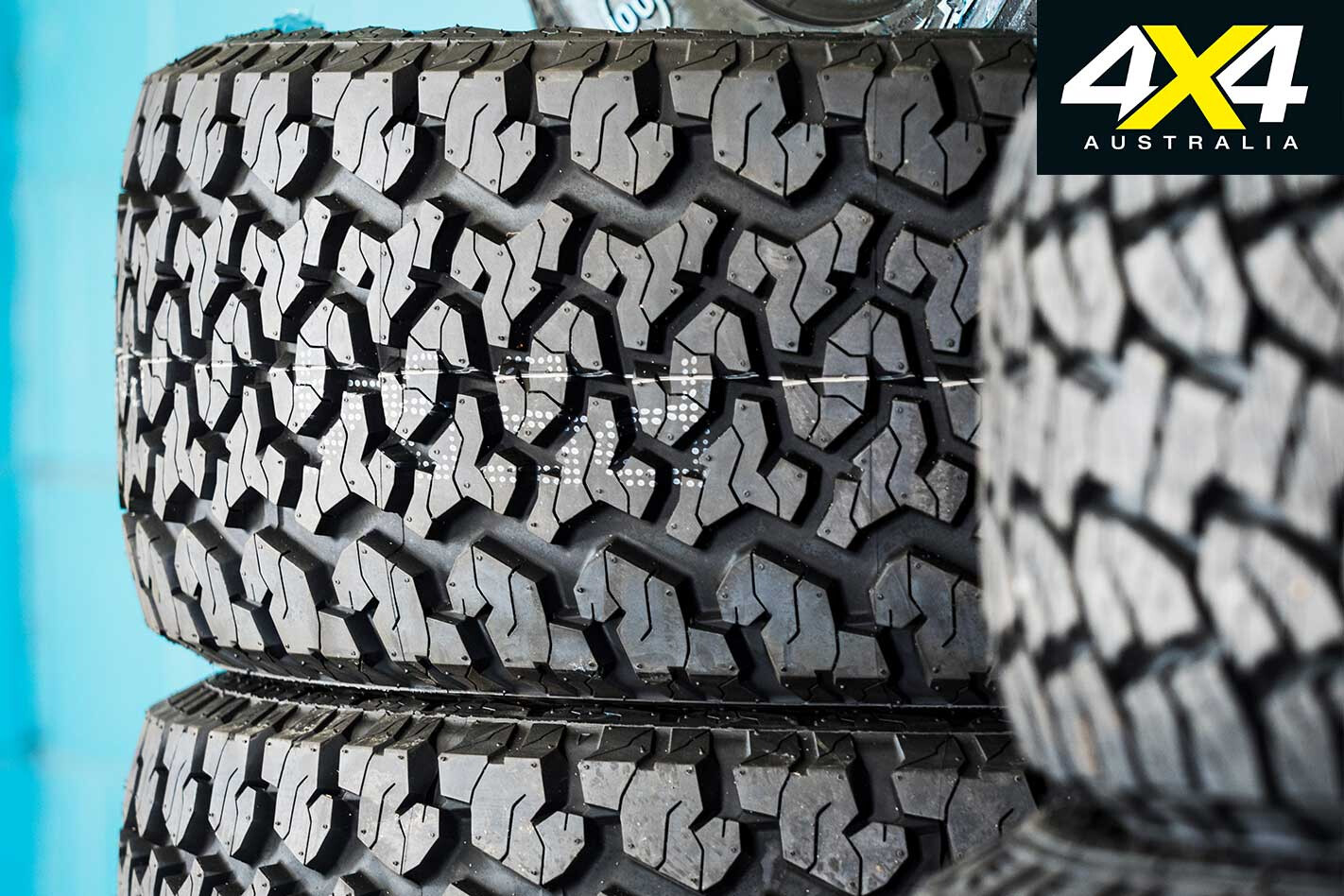
Our test vehicle is a current Toyota Hilux SR5 with standard 18 x 7.5-inch alloy wheels, and we assembled three aftermarket tyres matching the same 265/60 dimensions of the original fitment tyres.
Speaking of which, Toyota fits three different tyres to the SR5 from the factory in Thailand – one each from Michelin, Bridgestone and Dunlop. For this test we secured a set of the standard Dunlop Grandtreks and Bridgestone Dueler H/Ts, with the aim of comparing the aftermarket tyres directly against them.
Our aftermarkets are all-terrains and include a set from Hankook, Maxxis and Bridgestone. The Bridgestone Dueler AT and Maxxis AT-980 both have a light truck construction, something that brings a stronger build, typically for higher loads and more serious off-roading. The Hankook Dynapro AT-m is a regular passenger car construction.
All three of our aftermarket tyres boast a 114 load rating, good for 1180kg per tyre, which is 120kg more per tyre than the standard fitment rubber. However, all also reduce the maximum rated top speed.
The original tyres are rated to 210km/h, while the Bridgestone and Maxxis ATs lower that to 180km/h and the Hankooks to 190km/h. Significant, but of no concern for the average Australian adventurer.
When All-Terrains ain’t All-Terrain Not all all-terrains are created equal. Even within the category there are big differences between the most aggressive and most road-focused. Some, such as the 20-inch units fitted to the latest Land Rover Discovery, are more on-road biased. And others, such as the Maxxis AT-980s tested here, are for serious off-road use.
“Every manufacturer has a tyre to suit different needs,” said Glen Jones, the manager and owner of JAX Frankston. “You’ve got all-terrains that are more of a highway tyre, you’ve got all-terrains that are 50-50 (on- and off-road use), then you’ve got your more aggressive all-terrains.
“The all-terrain for more off-road capability would be a higher rubber to void ratio, so more traction off-road. You’ll have a light commercial grade tyre (LT), so a lot stronger in the casing, so less chance of sidewall damage.”
Understanding the Number on Tyres Glancing at the sidewall of a tyre might make you think you’ve stumbled across a poorly hidden password for a bank account. But there’s method to the madness of that collection of numbers and letters.
The largest of the main numbers – in our case 265 – represents the width of the tyre in millimetres. The two-digit number after the forward slash is the profile, represented as a percentage of the width. In our case the tyres were a 60-profile, calculating to 159mm between the rim and the road.
The R denotes a radial construction, which uses steel belts to bolster the carcass of the tyre for more strength and helping the tyre better maintain its shape. And the two-digit number after that refers to the diameter in inches, in this case 18.
Other numbers and letters include a complicated scale for the speed and load ratings. This is where you hit the internet. JAX Tyres has a great tips webpage with tables for those ratings. When choosing aftermarket tyres, keep in mind that while you can reduce the speed rating of the tyres (never below 140km/h) you cannot reduce the load rating; it must either be matched or bettered by whatever tyre you’re popping on.
Check with the roads authority in your state for more details.
THE TESTER
Our 4×4 tyre tester was experienced race driver and former Australian driver’s champion Paul Stokell. Heavily involved in driver training, Stokell is regularly behind the wheel of all manner of cars, from exotic sports cars to dual-cab utes and off-roaders. His experience and precision made him an ideal choice for the repetitive nature of testing tyres.
Collecting data was the job of a VBox data logger. One of the most trusted and reputable data loggers in motorsport, the VBox uses a GPS aerial attached to the roof, which is attached to the data-logging box inside the car. The system also records vision and writes the whole lot to a memory card, which is then transferred to a PC for analysis on bespoke software.
To ensure repeatability and accuracy, we didn’t change the positioning of the antenna for the entire test.
THE TESTING
For this test, there was no off-roading. The challenges of replicating the same mud/sand/gravel surface once a tyre has already traipsed over it were considered too great for the accuracy we were measuring. Instead, our evaluation involved pushing these tyres to the max on bitumen; in this case, the confines of a race track.
We looked at everything from grip in corners and under brakes, to noise levels. After all, even the most ardent off-roaders will likely spend more time on bitumen, even if getting to the Back of Beyond.
As well as the data, we got feedback from steerer, Paul Stokell. Unaware of the tyre he was on, Stokell was in the driver’s seat doing what he does best, leaving the JAX Tyres team to deliver him fresh boots as required. His comments were added to the armoury of 1s and 0s to help determine the battle between original and aftermarket A/T tyres.
BRAKING
Our first test involved a basic crash avoidance to measure straight-line grip – mash the brake pedal at 100km/h and see how far it travels before coming to a complete stop.
We entered the test at about 110km/h to ensure that by the time the car is braking from 100km/h it is at maximum retardation. It’s a full ABS stop across exactly the same section of bitumen, letting the electronics do the work to arrest the Hilux’s 2075kg bulk. Distance measurements were then taken from 100km/h to 0km/h.
What was surprising was how close the aftermarket tyres were to their standard-fitment rivals, all stopping within a metre of each other. Best performing of those aftermarkets was the Hankook – our only aftermarket tyre with a regular sidewall construction, not LT – which recorded a 43.52-metre stopping distance.
Crucially, it was about 30cm shorter than the best of the original equipment tyres, the Dunlop Grandtrek at 43.83m. The Bridgestone Dueler AT was close behind, with the Maxxis trailing. But, again, there’s almost no separating the tyres in this discipline.
If stopping in a hurry on bitumen is important to you, you’re not going to separate the originals from the aftermarkets for outright straight-line stopping power.
CORNERING
Going around bends is a very different discipline for a tyre, especially one tasked with tackling rocks, mud and sand.
Corners are where off-road tyres are typically challenged, courtesy of the relatively high sidewall or distance between the outer edge of the tyre and the wheel rim. That space is necessary to soak up bumps and help the tyres mould around obstacles, while also allowing for lower tyre pressures (to allow ballooning) in terrain such as sand. On 4x4s, that sidewall is also crucial for puncture resistance – a hole or slash in the side of the tyre means goodbye tyres.
However, that taller profile reduces steering accuracy due to the slight flex – and, therefore, delay – between the time the driver turns the wheel and the instant the tyre contact patch on the road surface reacts. Large tread blocks don’t help, either, due to their propensity to squirm around. It happens to varying degrees, and it was the most noticeable difference with our aftermarket tyres here.
In each of the two corners, though, one of the original tyres was quickest from point to point – in some cases by a tiny margin. However, the off-road tyres were by no means disgraced, holding on respectably and scrambling the Hilux through a corner much quicker than it’s likely to punt along a B road.
The Maxxis, for example, with its rugged tread, didn’t have quite as much grip, but it did have consistency at its limit. Stokell was impressed that once it had settled into a corner it was easy to control.
The Hankook – again, remember this is the only of the trio that is not an LT construction – offered the best grip, albeit by a relatively small margin. The Bridgestone wasn’t far off.
For cornering, then, it’s the original tyres with their smaller tread blocks and less aggressive patterns that do a better job of steering the Hilux.
SLALOM
The issue of steering accuracy was more pronounced in the slalom test. In the space of tenths of a second the tyre switched from maximum lateral force in one direction to max lateral force in the other. Then back again and again… and again. In those crucial tenths of a second enormous pressures are put on the construction of the tyre as it deals with the significant load shift.
This is the test where the original tyres show off their on-road bias. As well as recording times between 0.3 and 0.9 seconds faster than the aftermarket tyres – they’re fractions of a second but translate to an overall time between 3 and 8 per cent quicker – the originals also chimed in with better steering accuracy.
Whether it was the Dunlops or the Bridgestone OEs, Stokell commented on numerous occasions about the benefits to roadholding. “The two road tyres definitely feel better through the slalom,” he said, once we’d revealed which tyres he’d been driving on throughout the day. He also highlighted mid-corner stability as an area the standard tyres exhibited benefits.
Even within the trio of all-terrains, though, there were marked differences. The aggressive Maxxis, for example – those designed for the most rugged off-road use – had softer steering responses. “There was a delayed response in the tyre taking its set and heading the car in the right direction,” said Stokell.
That said, Stokell was equally surprised by how close the off-road tyres were to their more on-road-focused brethren. “It’s not night and day better than the off-road tyres,” he commented when critiquing the Dunlops. “It’s better on direction changes and a bit more responsive. But it’s not 50 per cent better; it’s 10 per cent better.”
NOISE
ONE area our trio of all-terrains trailed the original rubber was with their ability to stay quiet. More aggressive tread blocks tend to slap the road more violently as they come into contact with the bitumen, and it can get to the point where some chunky mud-terrains may not meet stringent drive-by noise targets set by authorities.
There’s nothing like that persistent level of humming here, and for these all-terrains we’re talking degrees; but degrees are enough to reduce the comfort levels over big distances.
The quietest of our tyres was the Dunlop, almost 1 decibel below the original Bridgestone, and it was followed by the original fitment Bridgestones. That said, Stokell noted they were one of the noisiest when it came to squealing on the limit – perhaps not an issue for most, but less than ideal if you bowl into a corner too vigorously.
Of the aftermarkets the Maxxis was the noisiest, with its chunky tread blocks working against it; at times there was even some whirring, more noticeable from the rear due to the lesser sound deadening from the tray of the Hilux.
The Bridgestone Duelers were the least intrusive of our ATs, almost matching the original tyres. Another thing to keep in mind is that our noise testing was done at 60km/h on the open road and 100km/h on the smooth race track confines.
The figures quoted here were taken at 60km/h with the transmission shifted to neutral, to minimise the mechanical noise of the engine and hone in on that tyre noise. Repeat the test at 100km/h on one of the poor quality coarse bitumen surfaces Aussie councils specialise in and you can expect a greater difference. A win, then, to the original tyres.
CONCLUSION
When you’re adding more off-road ability you expect compromises. Yet the biggest surprise for this test was how small those compromises were in switching to a more aggressive all-terrain tyre, especially in some of the disciplines. There’s almost no degradation in braking performance with the aftermarket all-terrains, for example.
However, the most aggressive of the lot – the chunky Maxxis – added almost a metre on the best of the tyres, suggesting braking performance could drop off more with more aggressive tread patterns. In corners, mid-corner grip levels approach those of the original tyres, but the original tyres provide sharper, more predictable responses.
To varying degrees all three of our aftermarket tyres exhibited slightly slower steering reaction times, taking the edge off cars that are already dynamically challenged due to their heavy kerb weights and high centres of gravity. Then there’s noise. If long-distance country road touring is important, then beware that chunkier tyres will likely up the roaring.
How far you want to take these compromises should depend on how far – and where – you want to go. Speak to the guys at JAX Tyres for expert advice tailored to your situation.
| u00a0 | Bridgestone Dueler H/T | Dunlop Grandtrek PT | Maxxis AT-980 | Hankook Dynaprou00a0AT-m | Bridgestone Dueler A/T |
| Construction | Passenger | Passenger | Light truck | Passenger | Light truck |
| Dry braking from 100km/h (m) | 44.53 | 43.83 | 44.48 | 43.52 | 43.61 |
| Cornering u2013 corners 1 and 2 combined (sec) | 14.31 | 14.48 | 14.7 | 14.55 | 14.91 |
| Slalom (sec) | 11.5 | 11.32 | 11.93 | 11.67 | 12.22 |
| Noise at 60km/h (decibels, dB) | 56.1 | 55.3 | 57.4 | 57.4 | 56.3 |
| Load index (kg per tyre) | 1060 | 1060 | 1180 | 1180 | 1180 |
| Speed rating index – maximum rated (km/h) | 210 | 210 | 180 | 190 | 180 |
The Crew Behind the Scenes
Our 4×4 tyre test couldn’t have happened without the support of JAX Tyres and Eagle SMF. The team from JAX Frankston was on-hand to perform lightning tyre changes.
Not quite two-second F1 quick, but inside 10 minutes we had one set of tyres removed, replaced, rebalanced and back on the Hilux. And there were plenty of changes throughout the day.
Each set of tyres was popped on the rims at least twice during the day, so all up there were at least a dozen sets of tyres changed, not only on and off the car but also on and off the rims.
The original Dunlop tyres were fitted and balanced at least four times. So, upwards of 50 tyre changes!
CHINESE brand LDV has announced the pricing of its tradie-spec T60 cab-chassis, with the 4WD variant retailing from $28,411 or $26,990 for ABN holders.
The budget-priced ute features the 2.8-litre four-cylinder turbo-diesel engine good for 110kW and 360Nm. It’s mated to a six-speed manual transmission, with no auto available.
The suspension set-up comprises double wishbone (front) and heavy duty leaf springs at the rear. The 4WD variant has a kerb weight of 1720kg, a payload capacity of 1255kg and a 3000kg towing capacity.
It’ll most likely be used to carry tools to the worksite but, in terms of off-road functionality, the T60 has a 27-degree approach angle, 24,2-degree departure angle, 215mm of ground clearance and a wading depth of 550mm.
Other features include Hill Descent Control, Hill-Start Assist System, Roll Movement Intervention and a Tyre Pressure Monitoring System.
Pricing for Great Wall’s Steed was released last week, with the Chinese ute priced from $18,990 for ABN holders.
Unlike the Great Wall, however, the LDV T60 comes with a five-star ANCAP safety rating.
The T60 range comes with a five-year/130,000km warranty.
FULL T60 RANGE PRICING
| LDV T60 Cab Chassis | Retail Price From | ABN Holder Price From |
| 4WD | $28,411 | $26,990 |
| LDV T60 Dual Cab Ute | Retail Price From | ABN Holder Price From |
| Pro Manual | $30,516 Driveaway | $28,990 Driveaway |
| Pro Automatic | $32,621 Driveaway | $30,990 Driveaway |
| Luxe Manual | $34,726 Driveaway | $32,990 Driveaway |
| Luxe Automatic | $36,831 Driveaway | $34,990 Driveaway |
| Premium Paint (Optional) – $500 | ||
Renowned for being “Delicious on sandwiches and toast”, it turns out Vegemite is great at adding that extra flavour to your cooking.
This article was first published in 4×4 Australia’s February 2011 issue.
Beloved, maligned, or misunderstood, there is no denying that Vegemite is an icon of Australian kitchens and diets, and although it is more well known as a spread, its distinctive taste has proven to be quite versatile as a cooking ingredient.
This easy-to-prepare recipe for chicken with honey and Vegemite can be prepared on a preheated camp oven or over a barbecue.
Ingredients: 4 chicken pieces, such as thighs with skin on and bone in (more if they are small) – you could also use drumettes, ribs, legs, etc.
Marinade: -1 spring onion, finely chopped -1 tspn sesame oil -1-2 garlic cloves, crushed -2-3 tblspn honey or maple syrup -1 tblspn dry sherry (or substitute port or mirin, a sugary rice wine) -1-2 tblspn Vegemite (start off with one and see how you like the taste)
Instructions:
Combine all the marinade ingredients in a large bowl, then add the chicken pieces. Mix well to make sure all the pieces are covered. Refrigerate for at least two hours, or overnight if possible.
Place the chicken pieces in a baking dish, or a preheated camp oven, and bake at 200ºC, until cooked. You could also barbecue the chicken, especially if using smaller cuts, such as drumettes or ribs. Serve with steamed vegetables and rice.
Viv’s hint: Instead of marinating the chicken in a bowl or container, use a large zip-lock plastic bag for all the marinade ingredients and the chicken. Zip the bag closed, squish the chicken around to coat thoroughly and leave in the fridge. It will take up a lot less room in your camp fridge.
NO MATTER where you looked under the old Land Cruiser you’d find an oil leak, and investigating the leaks inevitably led to discovering worn parts. You get that on 400,000km cars, but old Cruiser are worth preserving. Take the rear hubs on the BJ73, for example. The wheels showed the tell-tale signs of the hub seals leaking, with the splattering of diff oil on the rims that any owner of an old 70 Series will know.
To fix its issues the crew at Terrain Tamer had to slip the axles out to pull off the rear diff, and removing the wheels and brake drums showed the brakes needed overhauling as well – the linings were low, drums worn and wheel cylinders were leaking. Thankfully, Terrain Tamer carries all the replacement parts for these consumable items, so a complete kit was pulled from the warehouse shelves.
That’s one of the things I love about visiting Terrain Tamer HQ in Melbourne. Not only is it like a giant candy story of 4×4 parts, but it’s also like a big family business. Whether you’re in the workshop, at the parts counter, or lucky enough to get out back in to the warehouse, the place is filled with smiling faces, all of whom know what parts are needed and where to find them. And they all make a point of smiling and saying G’day as you walk through, so it seems like a happy place to work.
While the brake drums, linings, wheel cylinders, rubber brake lines and axle seals are all Terrain Tamer replacement products, there are some parts TT don’t make anymore, so it carries genuine Toyota parts. This allows Terrain Tamer to cover all the needs for parts, without having to turn to multiple suppliers. It is worth remembering that any Terrain Tamer parts are manufactured to, or better than, the OE part.
Shadin King cleaned and stripped the old brakes off and, with them out of the way, it revealed the pitting on the hubs where the seals sit. This required him to fit Speedy Sleeves on both sides of the rear end, before the new seals, bearings and brakes could go on.
While Shadin was working at the back, Allan and Tony stripped the front end to address the leaking swivel hubs. Here, a complete Terrain Tamer hub rebuild kit was used and worn parts such as the CV joints and stub axles were replaced with Terrain Tamer parts. The beautifully machined TT stubs looked too good to fit to my smelly old Land Cruiser, but they’re on there now and they’ll only get dirty once it’s back on the tracks.
The front brakes were only replaced with new pads and rotors a few thousand kays ago, so they didn’t need attention; however, the rubber brake lines were showing their age and were replaced with new Terrain Tamer parts.
On the back of the rebuilt gearbox and steering box, new clutch and a set of new Terrain Tamer shocks and steering dampener that the guys fitted, the new brakes bearings and seals should have the old Cruiser stopping well and going hard for another few hundred-thousand kilometres. It should outlive its smelly old driver, unless Terrain Tamer has a rebuild kit for him, too.
HERE’S a selection of the neatest reader-submitted 4x4s to land on our site.
To get involved post a pic and a description of your rig on our special site here.
We feature a bunch of readers’ rigs in the magazine each month, where we award one lucky punter with a $200 voucher to spend at Piranha Off Road.
1979 TOYOTA LC FJ40: PAOLO RONCAL
It’s got a 5.0-litre fuel-injected V8 engine. I’ve owned the car for five months. Photo was taken at JAKEM Farm, a 4×4 park in Adelaide. I’m most impressed by the performance.
1993 SUZUKI SIDEKICK (USA): GREG FULLER
Audi 1.8t from a 2001 TT, VEMS ECU, three-inch stainless exhaust, 4.5in Kustom Kreations IFS lift, Kustom Kreations strut eliminator kit, 10-inch dual-rate Fox coilovers up front, and Fox 2.0 shocks in rear. I’ve taken it all over Oregon, USA – mostly back roads and mild trails. Kept blowing up the stock Suzuki ring and pinion, so just installed a Ford 9-inch out of a 76 Bronco and a custom four-link rear suspension.
2005 MITSUBISHI PAJERO GLX 3.8: TIM WRIGHT
I’ve had it for 2.5 years now. Mods are: two-inch lift, 32-inch all-terrains on ROH steelies, rear airbags, drawers, fridge, cargo barrier, snorkel, bash plates, Rhino Roof tray, light bars, awning, rock sliders, DVD screen, and AutoMeter gauges. The best place I’ve taken it is from Buckland Spur Track in the Vic High Country down to Tomahawk hut.
2012 TOYOTA FJ CRUISER: BRAD ASTELL (PIRANHA OFF ROAD $200 VOUCHER WINNER)
I bought the FJ brand new in 2012 with the intention of doing some 4×4 touring. Mods include Old Man Emu suspension, long range fuel tank, dual batteries, rock rails, bullbar, light bar and a 12,000 pound winch. We took this picture in outback NT in Albert Namatjira’s backyard.
2016 MITSUBISHI TRITON: ALISTAIRE MARSH
I’m the first owner and it’s done 21,000km. It’s got three-inch Dobinsons adjustable suspension, an AFN bullbar, Kings winch, 32-inch Mickey Thompson ATZ P3s, LED lights, LED reverse lights, Tradie roof rack and canopy, Catch Can and secondary diesel filter, Safari snorkel, Kings awning, and more to come with the engine mods. The best place I’ve taken her is hard to say – so far, everywhere in the southwest of Western Australia.
2015 FORD PX RANGER: LOCKEY MCKEE
It’s got a 150L fuel tank, canopy, TJM rear bar, Ironman front and snorkel, EFS and Bilstein lift. Too many great places right at my door step in Alice Springs, but the next best places are some of the tracks around the Flinders Ranges. It has great range of 1500km, on average. It runs smooth on- and off-road.
2014 JEEP WRANGLER: MATT GREENE
I’ve had it since new. It’s got a 2.5-inch AEV lift, AEV geometry brackets, Synergy Manufacturing adjustable track bars, tie rod and drag link, TeraFlex rock crusher bar, Smittybilt 10,000lb x20 winch, Fuel Off-Road ‘Anza’ rims, 33-inch MTs, and an Oricom radio. Next up re-gear for 35s and lockers. Best place is Vic High Country, up Billy Goats and around Moroka Trail.
MAZDA BT-50: BRENT EASON
It’s pretty much got the ARB catalogue, with some extra poke done to the suspension, my Aussie ingenuity custom drawers, an LED light set-up in the canopy, a Rhino rack with all the kit, and 305/70 16 Mickey P3s. Still plenty of dollars to be spent, but it’s my ultra-tourer at the moment. It’s been everywhere: up the Blue Mountains, Lithgow, McBrides Beach, Anna Bay, and Stockton for fishing and hiking trips.
ARB is launching a series of state-based events called ‘ARB Experience Days’, which will give customers the chance to sample ARB’s range of products before they buy.
As part of the experience, attendees will be whipped around a diverse and tailored off-road course to highlight the comfort and safety advantages of Old Man Emu BP-51 shocks; they’ll also appreciate the difference a set of front and rear Air Lockers makes when negotiating a steep, gnarly climb.
The controlled environment will be administered by a team of experienced ARB representatives, who will ensure customers leave with plenty of off-road nous. Industry experts will also be on-hand to field questions and talk through ARB’s extensive range of products.
“These events will be a unique opportunity for our customers to come and experience some of our more technical and advanced products in real-world conditions,” ARB’s Brand Marketing Manager, Mark Berger, said. “It can be difficult for our sales staff to really articulate the benefits of some of these more ‘experience-driven’ products, like suspension and differential lockers, in the showroom.
“We encourage any four-wheel driver who is interested in learning more about these products to come along and experience them for themselves.”
State-by-state dates and locations are yet to be announced, but interested punters can register their interest at ARB’s website.
A SINGLE-cab 4×4 is now available in Great Wall’s Steed range, and it’s priced from $18,990 (for ABN holders).
The 2.0-litre, four-cylinder turbo-diesel engine used in the dual-cabs – good for 110kW and 310Nm – has been carried over to the single-cab variants, and it’s also mated to a six-speed manual transmission.
The tradie-spec single-cab’s aluminium tray measures 2400mm long and 1777mm wide; plus, it has a payload capacity of 1198kg and a towing capacity of 1700kg.
Dual airbags, ABS brakes, ESP stability control, hill-hold control and tyre pressure monitoring are all standard features.
“Since we re-launched the Steed nameplate in 2016, we have received strong demand from dealers and customers for the return of the single-cab version,” Great Wall Motors Australia Chief Marketing Officer, Tim Smith, said. “With a mix of toughness, reliability and value for money, the single-cab has always been a popular member of the Great Wall family. At its peak in 2012, the single-cab version accounted for 55 per cent of all Great Wall utility sales.”
A black mark against the Steed, however, has been its safety, with the dual-cab model scoring a two-star ANCAP safety rating against 2016 ratings criteria.
The Steed comes with a three-year, 100,000 kilometre warranty, three-years’ roadside assist and three years’ service price menu.
Mercedes-AMG has unveiled its off-road-focused G63, which comes packing a variety of changes and is aimed at those with deep pockets.
The venerable twin-turbo 5.5-litre V8 (400kW/760Nm) has been replaced with AMG’s twin-turbo 4.0-litre V8, and the engine – with 1.5-litres less displacement – generates 30kW and 90Nm more than the outgoing unit (430kW/850Nm). It’s paired with the short-shifting, nine-speed AMG SpeedShift transmission.
For this iteration the standard-spec AMG Performance 4MATIC AWD now has a rear-biased torque distribution, with a front/rear split of 40/60 – as opposed to the 50/50 split of the former model.
There’s also more torque at the driven wheels for enthusiasts wishing to point their Merc at steeper climbs, as the reduction ratio of the transfer case is now 2.93 (formerly 2.1). Keen rock-hunters will also appreciate three locking differentials, three off-road drive modes (Sand, Trail and Rock), double wishbone independent front suspension, adaptive adjustable damping, ladder-frame chassis made of high-strength steel, lower kerb weight, and improved fording and ground clearance.
Taller customers benefit from increased interior space, with more leg, shoulder and elbow room in both the front and rear, while a wider windscreen cockpit will help to navigate past pesky rocks and ruts.
“The new AMG G63 brings driving performance to the segment of unadulterated off-road vehicles in unexpected form. It was important for us to tie in with the original character on account of the cult status the G63 enjoys with our customers and fans,” Tobias Moers, CEO of Mercedes-AMG GmbH, said.
“The vehicle has nevertheless reached a completely new dimension in terms of technology with the 4.0-litre V8 bi-turbo engine as well as in combination with the off-road characteristics, the agility and the vehicle dynamics achieved.
“This applies to the entire G-Class model series. Mercedes-AMG is responsible for their suspension and chassis development as well as V8 competence.”
The G63 will premiere at the Geneva Motor Show on March 6, 2018, with the first examples arriving in the third quarter of this year.
Pricing and local specs will be revealed closer to its local launch.