
From the very first time a cylinder fired, sending drive to a wheel, the world of off-road transportation has been slowly but steadily evolving. Each new model takes what was built by the last generation and adds to it. The worst aspects are removed; the best amplified and expanded – all with a clear lineage, if you look hard enough.
No brand flaunts its heritage more than Jeep, and this is evident in every inch of the two wild American rigs seen here. There’s perhaps no greater example of continuous, albeit slow, vehicle evolution than this pigeon pair of black, newer than new and tougher than tough Wranglers: one JL, one JT, and both a direct result of what came before them.
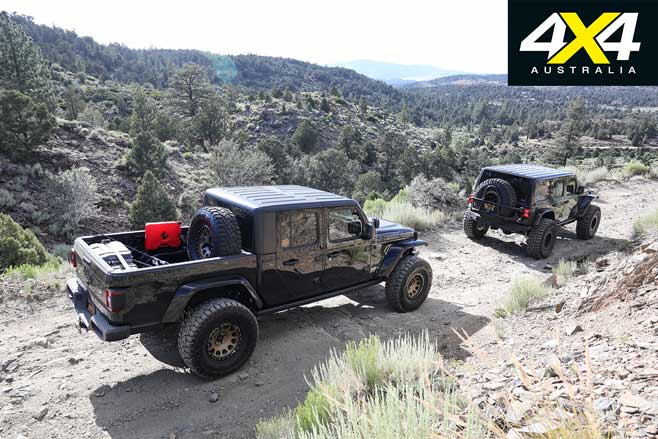
Alfred is the owner of the JL Wrangler, a five-door wagon evolved from the game-changing JK Wrangler Unlimited. Evelyn is the woman behind the wheel of what is undoubtedly the most capable off-road ute on the market, the recently released JT Gladiator, which in turn is the next step in the Wrangler platform’s progression. Of course, evolution doesn’t just happen on the production line, and both of these Jeeps have progressed far beyond the factory versions of themselves.
Starting underneath (because that’s what really counts on a Jeep) both rigs have had a comprehensive overhaul. The JT Gladiator now sits closer to the heavens thanks to a levelling kit from iconic aftermarket Jeep manufacturer EVO MFG.
The Stage 1 kit gives the long-wheelbase ute a full 2.5-inch ride-height increase thanks to in-house developed springs. To help make the most of the newfound ride height and travel, extended brake lines have been included in the kit, with bump-stop spacers front and rear keeping a healthy distance between tyre and fender, and adjustable trackbars getting things back in line.
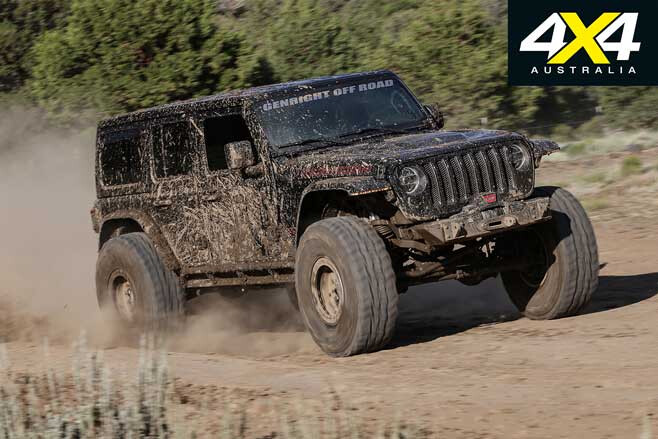
Alfred’s JL Wrangler takes things to a whole new level. On each corner externally adjustable King 2.5-inch shocks not only allow Alfred to dial in his ride height, but to change suspension stiffness depending on whether he’s hitting slow-speed rocks for a night run, or bombing across the desert.
Sitting 3.5 inches higher than stock thanks to dual-rate Metal Cloak coil springs, EVO MFG adjustable control arms were needed to help dial the caster and pinion angles back to acceptable limits, while Currie Anti-Rock swaybars have been fitted front and rear to help keep the body stable without eating into valuable articulation.
Due to the height increase, both front and rear trackbars pulled the axles out of alignment, so adjustable units from Rock Krawler have been installed to give Alfred the ability to push them back into location while providing a solid strength upgrade in the process.
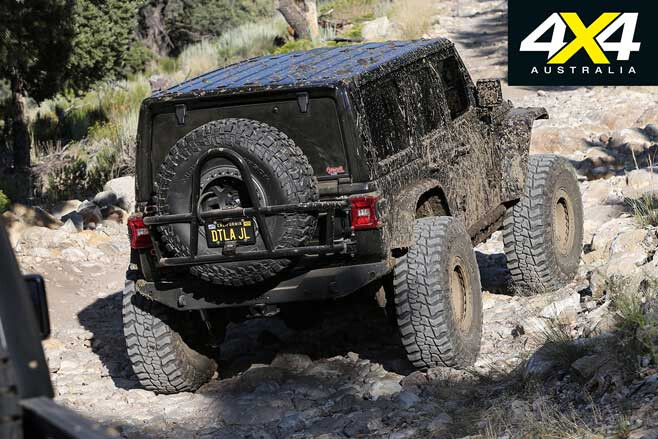
Eagle-eyed readers may notice hydraulic bump stops from DV8 Offroad peeking through the mud-covered undercarriage. An evolution of off-road race products, these are a seriously high-end piece of kit, smoothing out any big hits the Jeep comes across at speed, and giving it a silky-smooth ride no matter how rough the terrain.
Of course, all that work isn’t done just for bragging rights. Both rigs are now sporting ‘straight to gaol’ tyres … at least in Australia they would be. Evelyn’s JT Gladiator wears a set of Toyo Open Country R/Ts punching in at 37×13.5R17. They’re wrapped around bronze Method ‘105’ beadlock alloy wheels, the mechanical locking ring allowing her to drop down to single-digit pressures for an absolutely monstrous footprint.
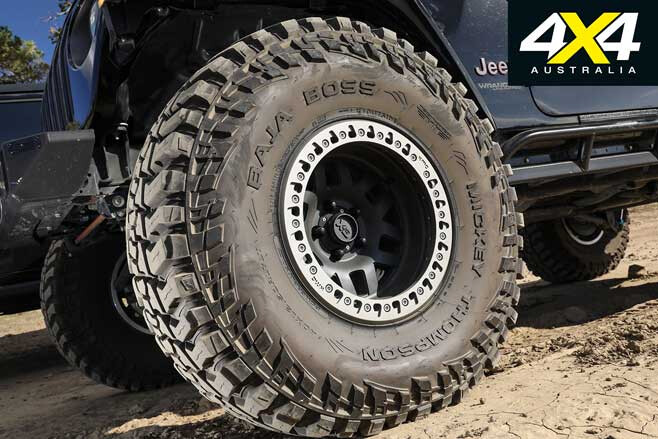
Not to be outdone, Alfred’s JL Wrangler is packing serious heat in the rubber department too. The brand-new Mickey Thompson Baja Boss hoops punch in at an eye-watering 40×13.5R17, which is a full 15 per cent taller than a typical 35-inch tyre. Alfred’s also sporting beadlocked alloys on each corner, this time KMC’s renowned Machete XD229, but in this case their usual machine finish is covered in a heavy-duty STEEL-IT black and grey coating.
Moving onto the armour, both rigs have split paths again, with the Wrangler focussed on hardcore wheeling while the Gladiator is a seriously capable do-it-all rig for the trail or the weekend hardware store run.
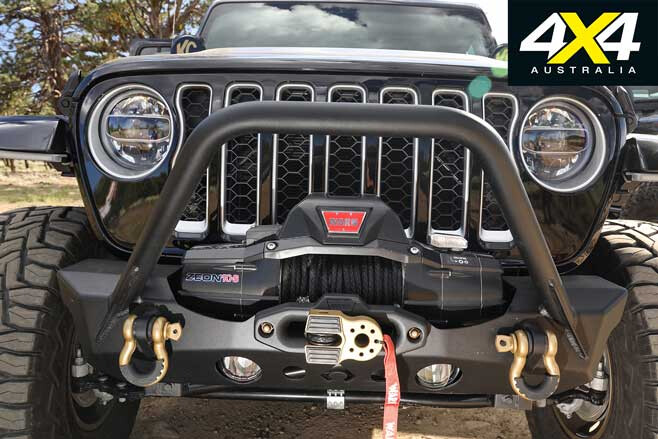
Evelyn’s rig features a steel bumper from Artec Industries up front. Pieced together from solid chunks of ¼-inch plate, the bumper and stinger combo not only provides serious frontal protection, but also provides a little extra protection in the event of a front rollover, as the stinger is designed to catch a forward tilt, or help slide the nose up steep rock steps.
Nestled deep inside the bumper is Warn’s VR1000S 10,000lb 12V winch. Wrapped in synthetic winch rope, it’s topped off with a trick Factor 55 flat link, a smart evolution of the traditional open-ended winch hook allowing for more secure rigging.
Moving down the flanks, Evelyn’s Gladiator has been gifted a considerable boost in approach angle; an American Adventure Fab Lab high-fender kit has replaced the distinct JL/JT fender indicators with slimline LED versions giving a higher fender approach, and the front tyres a straight shoot at obstacles.
The Gladiator’s aesthetics package is rounded out with a pair of KC highlights 6 Pro ditch lights mounted at the bottom of the A-pillars, and a Wilco off-road tyre carrier at the back of the cab.
Alfred’s JL Wrangler has a similar package, although a little less everyday and a little more rock crawler. Up front a Genright ultra clearance stubby bumper teams up with another American Fab Labs high-fender kit for maximum approach angle.
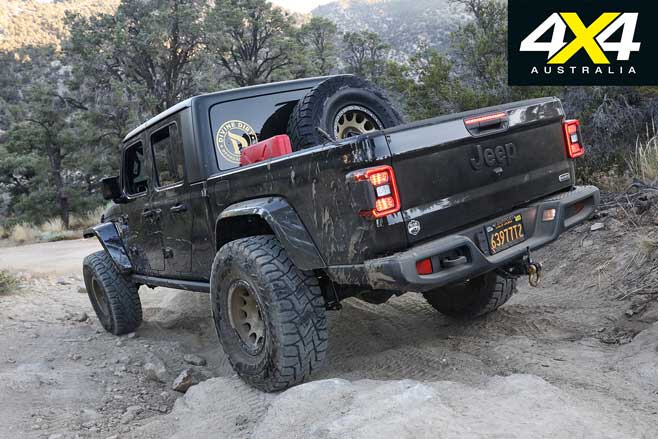
Housed within is Warn’s top-tier Zeon 10S Platinum winch with a pair of integrated recovery points on either side. Matching Genright rock sliders sit high and tight to the body for all-out clearance without sacrificing strength, while a Genright alloy rear bumper helps keep weight down and clearance up. It’s topped off with a heavy-duty swing-out tyre carrier mounted to the body and holding the massive 40-inch spare.
On the mechanical front both Jeeps remain fairly simple, the Gladiator running a full Borla exhaust system, the Wrangler running an oil catch-can to help with side angles. That’s about it for the V6 petrol engines.
It might seem strange that such modified vehicles underneath are reasonably stock in the engine bay, but it’s fitting for the evolution of Jeep. When you’re climbing endless rock ledges and exploring the back country of America’s West Coast, suspension and tyres are what’ll get you home, while the engine’s really just needed to turn it all.
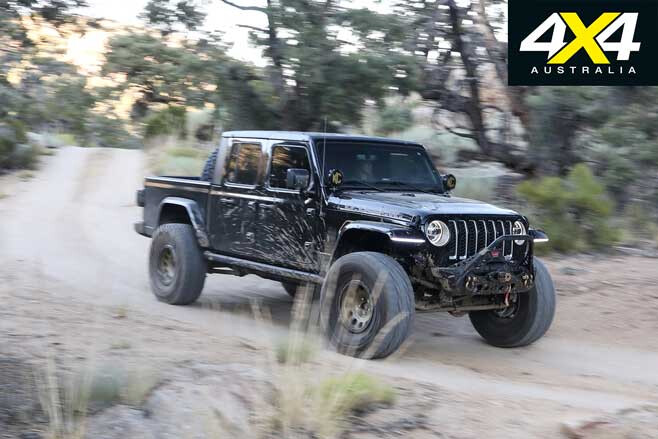
That said, evolution never really ends. It’s something Jeep has proved time and time again, and so have their owners. If you come across either of these rigs out on the trails they’ll have no doubt evolved again. After all, it’s just a part of four-wheeling.
Hidden History
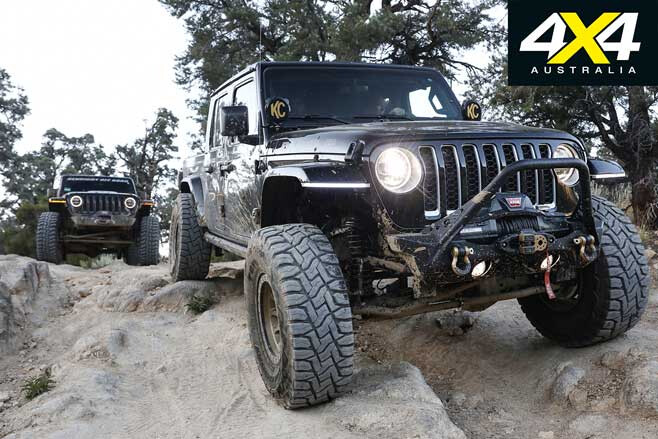
Jeep has never shied away from its heritage. In fact, it flaunts its history and its progress at every possible moment. While you probably wouldn’t have noticed much more than the iconic seven-slot grille in these two rigs, Jeep has hidden countless throwbacks to its past deep inside.
The most obvious is the Wrangler silhouette in the windscreen’s edge, but there’s also a seven-slot grille behind the rear view mirror, as well as numerous Xs throughout the interior and exterior of most 4x4s in the Jeep line-up, a throwback to the military jerry cans strapped to the side of early generation Jeeps.
That military history comes up again with the JL Wrangler sporting a Morse code printout of JL under the rear auxiliary power outlet. There are plenty more Easter eggs throughout these rigs, from thongs on the windscreen wipers to a Yeti trekking up a mountain, but Jeep’s heritage is always front and centre.
With news of popular 4×4 nameplates exploring the electrification route, Mercedes-Benz’s CEO Ola Källenius recently threw his hat into the ring by declaring “there will be a zero-emission version of the G-Class” at the recent Automobilwoche Kongress in Berlin.
The full statement – posted on Sascha Pallenberg’s (head of digital transformation at Daimler AG) Twitter feed – also mentions Källenius’ commitment to the iconic off-roader that “the last Mercedes to be built will be a G-Class”.
Aside from the tweet, there are no official details of when customers can expect an all-electric G-Class to hit showrooms, or what sort of powertrain it would have.
According to Mercedes-Benz, a full-electric drivetrain wasn’t part of the current G-Wagen’s development, so even if such a model were to be greenlit today, it is still years away.
In context, Källenius’ statement doesn’t really mean an all-electric variant will be joining the G-Wagen ranks anytime soon. The Automobilwoche Kongress is an industry event attended by auto industry executives to network and discuss challenges in the industry. Källenius himself was speaking on the topic of “From a Sustainable Strategy to a Sustainable Business Strategy”.
Picture: Ola Källenius, CEO of Mercedes-Benz with the Mercedes-Benz EQS Concept
Read in full, Källenius’ statement is more like an example of how Mercedes-Benz will continue to adapt its current model line-up to the ever-changing market landscape, rather than confirmation of an all-electric variant in the immediate future.
If such plans are indeed afoot in Mercedes-Benz’s R&D facilities, it would be a prescient move as several auto makers are already developing electrified 4x4s.
The G-Class’ immediate rival, the new Land Rover Defender, has a hybrid drivetrain in its range; Ford has committed to building hybrid and all-electric variants of its F-150 pick-up truck; American-start up Bollinger has already commenced production of its B1 and B2 electric 4x4s; and Toyota is reported to be working on a hybrid Hilux and LandCruiser.
The SEMA Show has wrapped up for another year and we’ve just touched back down on local soil. Before we catch up on some long-overdue sleep, here are a few more pics from this year’s event.
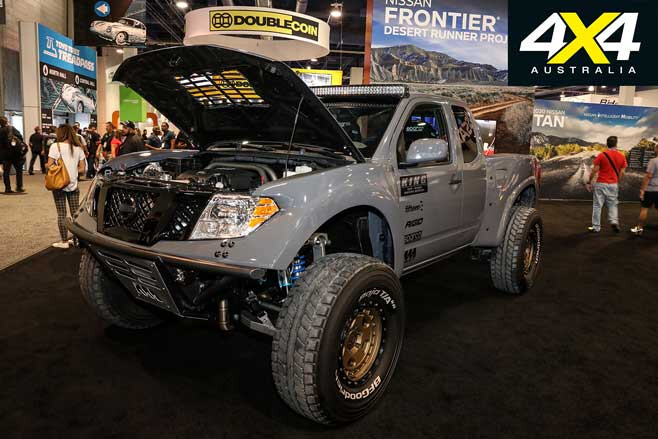
In this batch, there’s a crazy slammed Mercedes-AMG G63 (for reasons unknown to us), a Black Bison-kitted Jimny from Japan-based Wald International, the Nissan Frontier Desert Runner, and two Jeep Gladiator concepts: a resto-mod Jeep M-715 Five Quarter and a Gravity Rubicon.
We’ve also thrown in a Porsche 911 wearing Toyo A/T Open Country tyres because … why not?
If you couldn’t make it this year, mark it in the diary for next year; it’s an event any 4×4 enthusiast needs to attend.
Saw some custom metal you really liked? Let us know in the comments section below.
The great and the good of SEMA 2019: – SEMA indoor displays – SEMA Overland Experience – Custom Jeep Gladiators at SEMA
THE grounds of the SEMA 2019 Show were abuzz with activity this year, with an array of crazy customs lining the outer areas of the Las Vegas Convention Center.
Not only are the halls jam-packed with the neatest creations in the aftermarket world, but the maze of hotted-up fourbies flows out into the carpark where you can ogle for hours upon hours – especially at that tidy little grey Jimny.
Resident photographer Brunelli makes the pilgrimage across the Pacific most years, and he was there again this year to snap a heap of shots for your enjoyment.
Any enthusiast should venture – at least once in their lifetime – to the annual event, which this year was held from November 5 to 8.
Have you got a SEMA 2019 favourite? Let us know in the comments section.
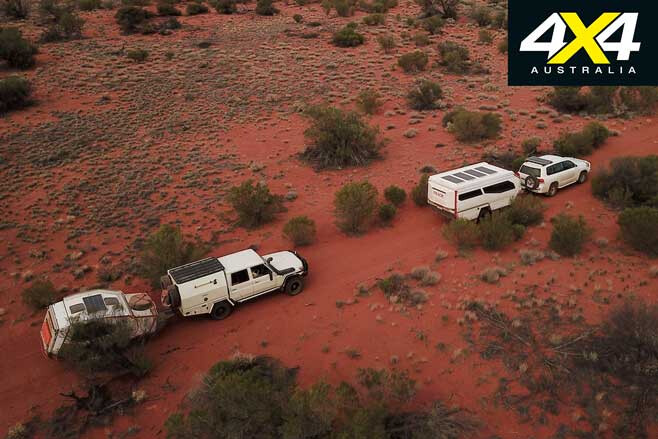
There’s no doubt that Track Trailer Tvans have an enviable reputation in Australia that has been built on 20 years of production, as well as having been hauled to some of the most remote parts of the country. However, as an all-new model, the Track Trailer T4 hybrid camper has still to prove its mettle, and the example you see here is one of the first T4s off Track Trailer’s Bayswater production line in Victoria.
To see how well the T4 would perform, we joined Track Trailer on a test loop that would see us head through outback SA, up the Oodnadatta Track across to Coober Pedy, and out along the Anne Beadell Highway to Voakes Hill Corner.
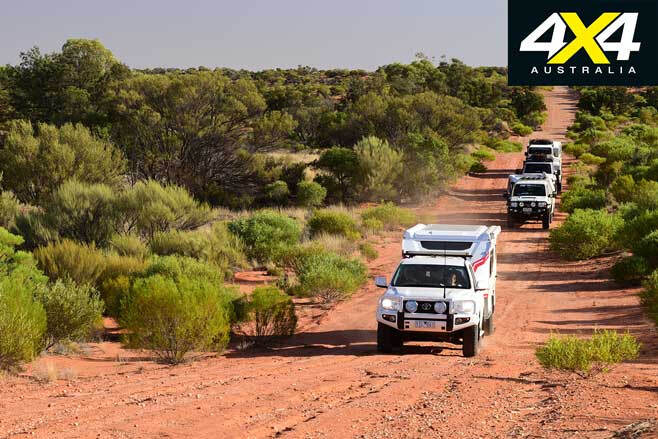
We would then swing south onto a lesser-used track and then, by a series of old mining roads and Aboriginal business roads – some of which are bloody rough and deep in bull dust – we would find our way to Cheetima Beach, west of Fowlers Bay. From there we would head back to Melbourne via the blacktop.
Prior to our trip, the all-new chassis and its MC-2R suspension had been subjected to severe and extensive testing on the ripple strips of the impressive and very trying Anglesea Proving Ground Following that the van had been subjected to considerable on-road testing (both blacktop and gravel) and daily use in the Victorian High Country, along the Murray River, as well as a few coastal camping sojourns; so in its short life it has copped a pretty rough, near continuous workover.
There are three models of the T4 on offer: the entry-level Symphony is $105K; the more luxurious Rhapsody is around $108,500; and the Concerto Family Bunk model tops the line-up at just under $109,500. The model tested here is the Symphony.
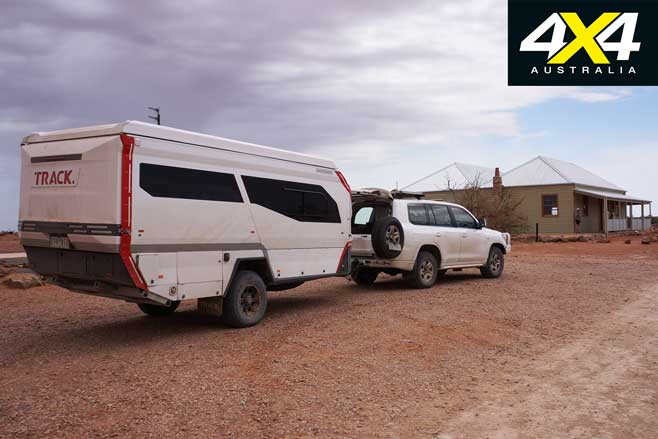
The T4 body’s striking looks make a styling statement very different to its predecessor, the Track Topaz, with the walls featuring longitudinal creases for greater torsional strength and impact resistance. The two-piece insulated roof, the distinctive nose cone and the rear shower pod are all fashioned from fibreglass, while the riveted sandwich-panel walls and the roof structure are linked by a laser-cut external aluminium frame, colour-coded to distinguish the different models of the T4.
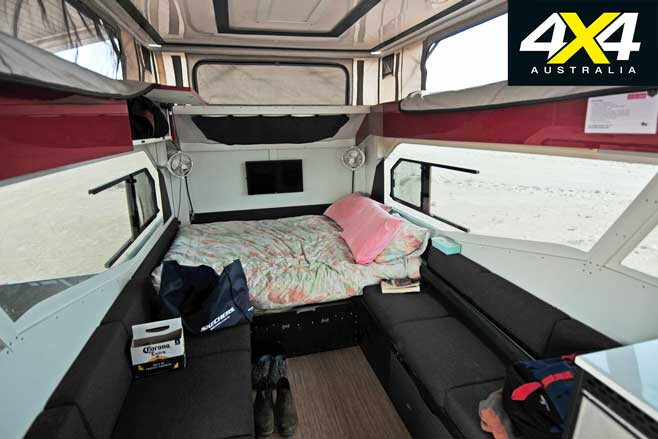
The Symphony comes with a huge amount of inside room, an east-west bed, six-seater split lounge, a fully set-up kitchen with a four-burner Thetford gas cooktop and grill (an optional diesel cooktop is also available), and a stainless steel sink with mixer tap backed up by a Truma UltraRapid 13L gas/electric heater. There’s also a Truma VarioHeat gas heater for cold nights, and air-conditioning is optional.
A 130L Isotherm compressor fridge/freezer will keep the salad crisp and the beer cold, while there’s hidden dimmable LED lighting throughout the van, along with a Fusion portable sound system. There is no internal shower/toilet in the Symphony, but it does have an external drop-down en suite tent and an internally accessible portable toilet.
Adding to the hybrid flavour is the slide-out kitchen, which is a bloody beauty; it’s basically the same as the top-line unit from the latest model Tvan. It comes with a three-burner stove, a matching stainless steel sink with flick mixer tap, along with three roomy drawers for storing cutlery, cups, plates, coffee, tea and more of those everyday necessities. The integrated windshield is again a unique Track product, and a quick-connect lead supplies gas to the stove. Just in front of the slide-out kitchen and handy to all is a 40-litre drawer-type Evakool fridge/freezer.
Up the front is a huge storage locker and side lockers, and the total outside storage adds up to a mammoth 1395 litres of space, or so says the brochure. Down the back-end is the rear en suite or shower pod, which is roomy and has been improved from previous Topaz models with better and faster access.
For the more technical minded, and those looking for long stays in the scrub off-grid, there are two 120W roof-mounted glass solar panels feeding two 105amp/h AGM batteries. There’s a 300W Redarc full sine-wave inverter (700W unit optional) controlled by the Redarc Manager 30, which has a built-in DC-DC charger and solar regulator, while the gas supply comes from two 4kg bottles.
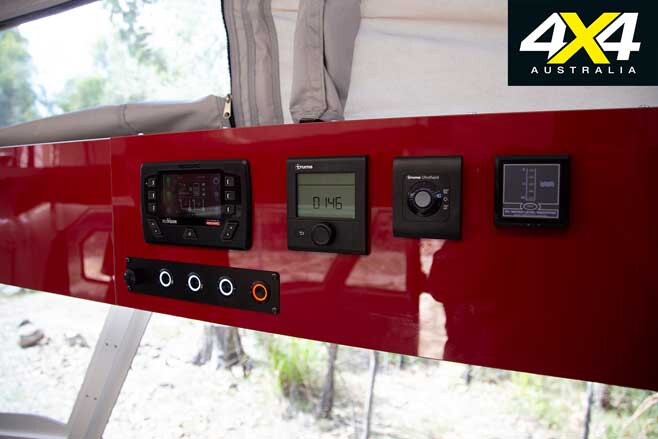
Our Symphony had a few options including a larger main water tank (260L in total), a RedVision electrical management system, electro-mechanical lifters for the pop-top roof, a powered roll-out Thule awning – which is a beauty – and a unique pop-up kitchen pantry which makes use of the corner space in the van. We also had the 700W inverter and zero-gravity blinds. Track’s new dining table, which stores under the bed, is a masterpiece of design and construction. Those extras add another $13K or so to the base price.
On first look the all-new T4 seems to be much longer than the Topaz, but with an overall length of just under 5.6m, or just over 18ft in the old money, there’s only an extra 200mm in it. The length is accentuated by the custom-made side glass windows that make the T4 stand out from the crowd.
The Symphony weighs 1820kg, but by the time we loaded up with 260 litres of water and threw in another seven jerry cans of fuel for the tow tug, the total weight was in the vicinity of 2350kg; not light by any means, but still well under the conservative 2500kg ATM Track Trailer deems the unit to have.
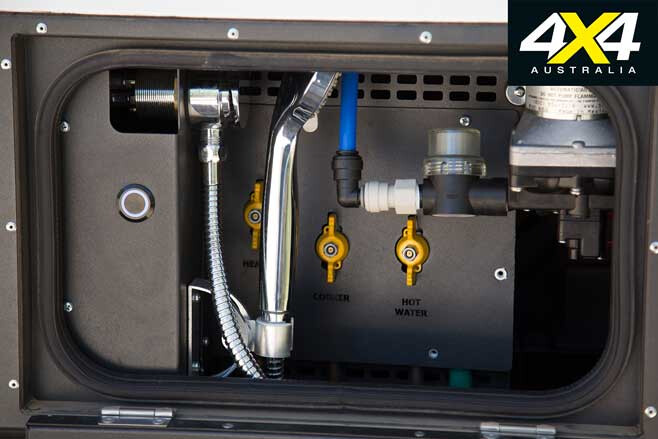
How did the T4 hybrid camper perform? This was a tough test in hot dusty conditions in a region where most people would fear to take a camper or hybrid van; certainly most van manufacturers don’t subject their new vans to such rigorous outback testing. As it was, we had passed two recently wrecked and abandoned campers along the Anne Beadell Highway, testimony of the stress and strain put on each and every rig on these outback tracks.
Apart from a couple of annoying matters, which included dust ingress through the entry door (caused by human error on our part), a shock absorber issue and a battery management problem, the T4 performed faultlessly. The shock issue was quickly resolved by Track Trailer’s engineers – and all T4 production has been upgraded – while the electronic management compatibility issue has been investigated by Track and Redarc and a fix implemented.
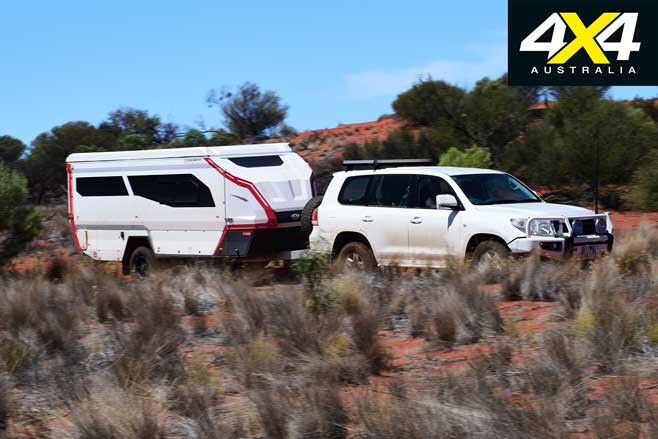
The new T4, despite its size and weight, towed easily behind our 200 Series tow vehicle, even in the fairly strong crosswinds we experienced on the blacktop and good dirt of the Oodnadatta Track. In the more extreme desert country, with corrugations and wash-outs, the rig towed effortlessly, soaking up all we could throw at it.
Of course, we had to be aware of the overall length of the camper in tight situations, as well as the reduced approach, ramp-over and departure angles compared to a Tvan, but other than wearing a few scratches from enclosing scrub and trees, the T4 performed off-road as good as could be expected.
Importantly, nothing rattled loose or broke off inside the T4, which was good to see … but hardly surprising considering the Track Trailer pedigree.
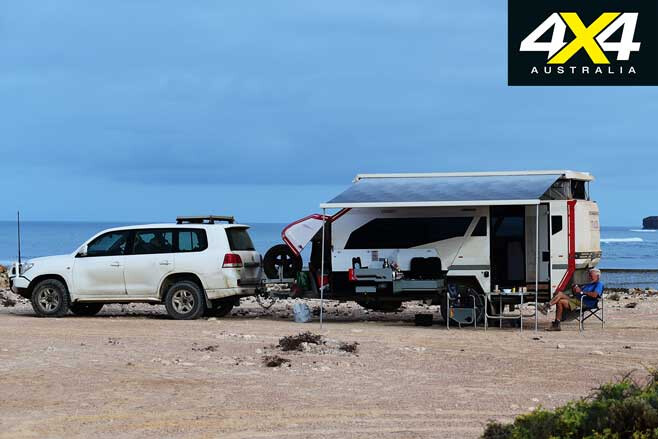
We never missed having an air-conditioner fitted, even though the days topped out at 46°C. The two standard fans were sufficient to keep the air circulating in the large interior and – although I’d like to see bigger sliding windows in the T4 – once the roof is raised there are screened windows all around to help with air flow.
We cooked outside every night and, due to the heat and total fire restrictions in effect, we didn’t have wood fires. The outside kitchen worked a treat, but in strong winds we would have liked a bit more height in the wind shields to stop all the heat blowing away. The inside fridge worked well, but the 40-litre drawer fridge struggled on the 45 to 46°C days.
The T4 might be an expensive hybrid camper, but it offers some great innovative design features and fabulous build quality while giving away very little to smaller units as far as performance and capability are concerned. The T4 promises, like the Tvan, to set the standard for all future hybrid campers. It certainly is one very impressive unit.
Track Trailer T4 Symphony specifications HEIGHT (AT TRAVEL): 2550mm WIDTH (EXTERNAL): 1990mm LENGTH (OVERALL): 6575mm BODY LENGTH (EXTERNAL): 5575mm BODY LENGTH (INTERIOR): 4590mm HEIGHT (INTERIOR-ROOF): 2070mm TARE: 1940kg (as reviewed) ATM: 2500kg BALL WEIGHT: 170kg (unloaded) BODY: Aluminium bonded and riveted sandwich-panel walls CHASSIS: One-piece hot-dipped galvanised steel SUSPENSION: Track-designed MC2-R asymmetrical link BRAKES: 12-inch Cruisemaster electric drum brakes WHEEL/TYRE: 16-inch alloy/265/70R16 FRESH WATER: 75L & 30L (optional 2 x 130L as tested) BATTERY: 2 x 10⁵amp/h AGM SOLAR: 2 x 120W roof-mounted panels AIR CONDITIONER: Air-conditioning optional (not fitted) HEATING: Truma VarioHeat gas heater HOT WATER: Truma UltraRapid 13L gas/electric GAS CYLINDERS: 2x4kg COOKTOP: Internal 4-burner Thetford gas cooktop with grill FRIDGE: 130L Isotherm compressor; 40L drawer-type fridge SHOWER/TOILET: External hot/cold shower LIGHTING: Hidden dimmable LED throughout PRICE: $105,220 ($118,500 as tested)
Contact Track Trailer: Outback HQ: 1/640 Dorset Road, Bayswater North, Vic Phone: (03) 8727 6100 Website: www.tracktrailer.com.au
The great and the good of SEMA 2019: – SEMA outdoor displays – SEMA Overland Experience – Custom Jeep Gladiators at SEMA
AFTER STALKING the halls of the 2019 SEMA Show for the past few days, we’ve assembled a collection of some of the best custom metal on display.
There was no doubt the 2020 Jeep Gladiator was the star of this year’s show, but there was a smorgasbord of modified vehicles displaying hundreds of aftermarket accessories.
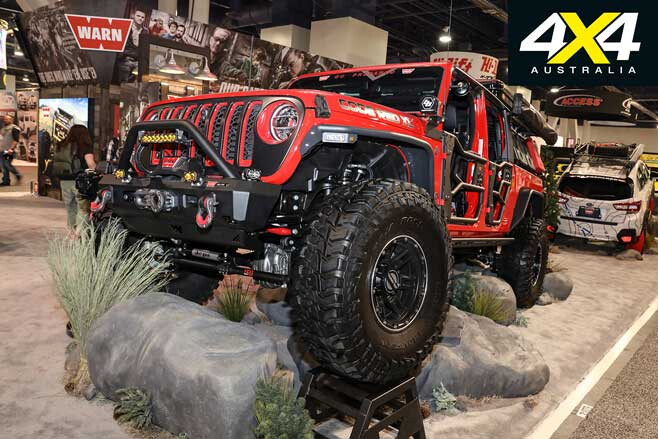
The who’s who of the industry gathers each year to sneak a peek at the wild to mild creations, as well as the innovative products that are new or coming to market.
Come back tomorrow, where we’ll post a tray-load of pics from the SEMA Show outdoor grounds. Enjoy!
The 2019 SEMA Show was held at the Las Vegas Convention Center in Nevada, USA, from November 5 to 8.
What’s your favourite rig from SEMA 2019? Let us know in the comments section below.
Sherwin sliced open the green seedpod with a deft flick of the Leatherman’s blade.
“You can eat this,” he said as he handed the opened fruit to me. “You white fellas call it bush banana, but I reckon you’ll prefer the banana you get in the supermarket,” he continued with a wry smile.
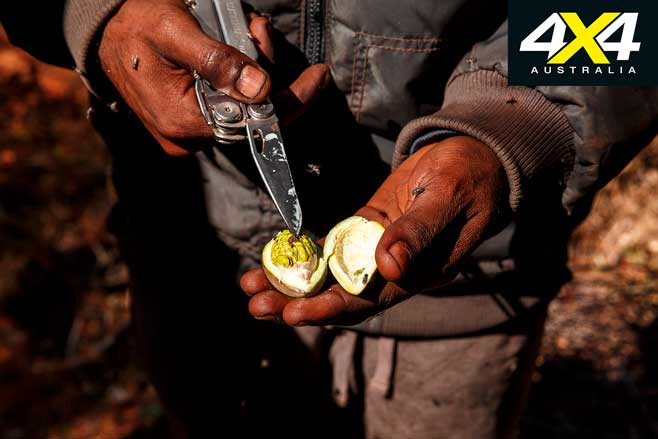
The taste wasn’t unpleasant and has been likened by some to peas, but I couldn’t taste that. Still, it did help dispel that famous Crocodile Dundee quote about bush tucker which went something like, “You can eat this, but it tastes like shit!”
We were on a ‘Bush Tucker Tour’ with a couple of young Aboriginal fellas at Batton Hill Camp in the very north of the Simpson Desert, and the stepping off point (or end point, depending on which way you are heading) for a trip along the Hay River.
For the previous week or so we had wandered through the Eastern MacDonnell Ranges and along the back roads north of the Plenty Highway before refuelling at the Jervois Homestead, the closest fuel to the Batton Hill and a good spot to camp, if the timing is right.
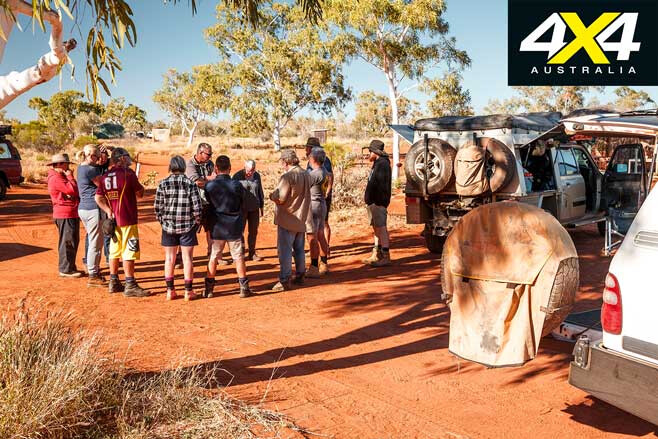
Being midday we pushed on, passing a group who had been camped for a couple of days waiting for a tow truck to come from Alice Springs to recover one of the party with a busted rear spring. They were in luck; the truck was following us.
The late Lindsay Bookie, the traditional owner of this area of the northern Simpson Desert, set up Batton Hill Camp, which is set back a little from the main channel on the banks of the Hay River.
With the help of Jol Fleming from Direct 4WD Awareness based in Alice Springs, the route along the Hay River was recce’d and established in 2000, and I had joined Jol in 2002 for the first commercial trip which he had led from Birdsville north to the camp. Now I was back with the crew from 4X4 Australia, heading south on what has become one of the favoured routes through the Simpson Desert, even though only around 500 vehicles travelled the route in 2018.
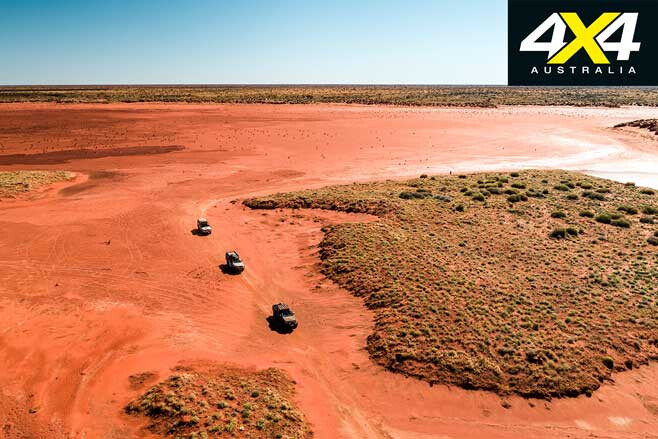
We arrived at Batton Hill in the early evening and settled in for the night at a pretty good basic campground with hot showers (once you get the woodfired ‘donkey’ going), flushing toilets and designated roomy campsites, with fire pits and supplied timber. The camping area even sports a few white gums for shade.
The next morning, after a leisurely start, we went and found our guides and set off on our bush tucker tour, which took us around Mt Tietkens and Mt Smith. Tietkens, who the peak was named after, was an accomplished explorer in the late 1800s and acted as 2IC to Ernest Giles on his incredible crossing of the western half of Australia, but I have no idea who Smith was.
Farther south, and passed as you head along the Hay, is the singular peak of Mt Winnecke, all three peaks as well as the river being named by Charles Winnecke during his explorations in 1880 and 1882 – he also named Goyders Pillar, which is a little farther north.
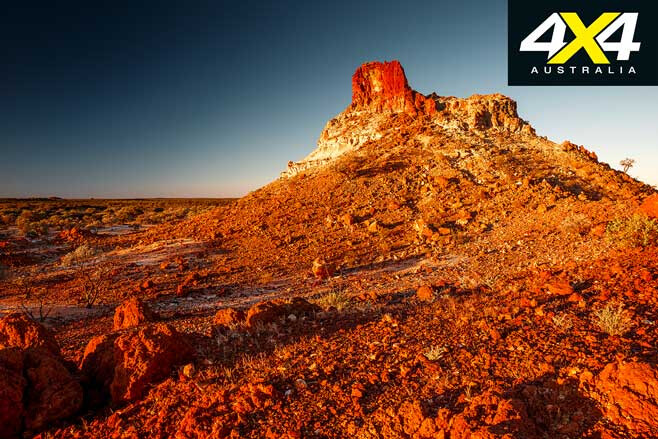
While the sunset tours run by the family at Batton Hill take you to a spectacular pillar of rock they all call Goyders Pillar, it doesn’t seem to gel with the peak marked on the maps of the area. Still, I think the Aboriginal owners are right – it is a pillar, it is obvious, it is quite spectacular, especially in the light of the setting sun, and there is nothing quite like it in the immediate vicinity. It’s the mapmakers, I reckon, who have got it wrong.
This area along the northern margins of the Simpson Desert had first been explored by HV Barclay in 1879, but it was Winnecke, with a small party of men on camels, who in 1883 pushed deep into the desert and traversed the whole length of the Hay River from near Batton Hill, south to the Eyre Creek Police Barracks, which were then, for a short time, north of current day Birdsville.
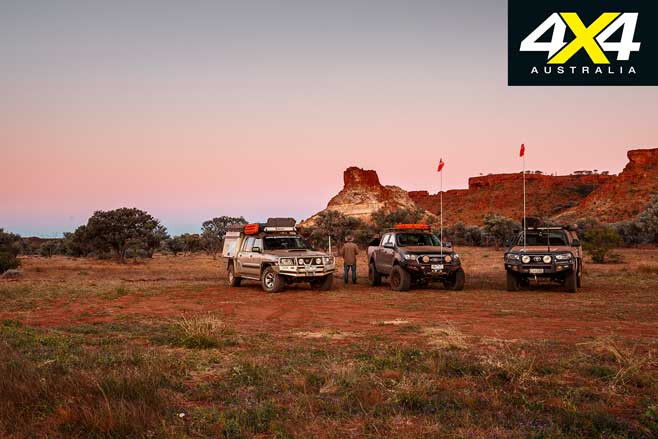
Pastoral settlement of this area was slow, with Jervois station only being taken up in 1960. Little happened deeper in the desert, apart from in 1939 when CT Madigan crossed the northern Simpson, meeting the wide shallow channels of the Hay at what was his Camp 16. It’s now a well-visited spot for Hay River and Madigan Line travellers.
Aerial-based survey teams were out along the Hay in 1968, having a base camp somewhere in the north and a fuel dump farther south along the river. A team from the Division of National Mapping traversed the Hay in 1974 as part of the mapping of the continent in 1:250,000 scale, and the keen-eyed will occasionally see their star pickets (used as benchmarks) along the route.
Oil and gas exploration took place farther south from the late-1960s, but it never extended north of Beachcomber Well (farther south again), which was drilled in 1988 and was one of the last exploratory wells drilled in the Simpson.
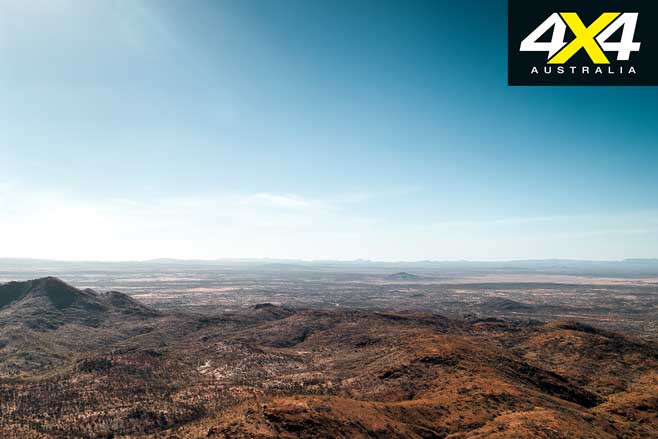
By then the recreational boom was underway and travellers were crossing the desert via the old seismic lines, with the French Line being the most famous. Around that time, South Australia and Queensland established parks and reserves in their respective sections of the Simpson, and in 1994 all of the northern Simpson Desert in the NT was handed back to the Aboriginal Traditional Owners, the Eastern Arernte people.
The next day we left our pleasant camp and headed south, passing the aforementioned Mt Winnecke, the main distinct channel of the Hay off to our west. The track soon started to twist and turn in an effort to dodge around the washouts and erosion gullies left by the most recent flood down the river back in March of this year, when Cyclone Trevor thundered in from the coast.
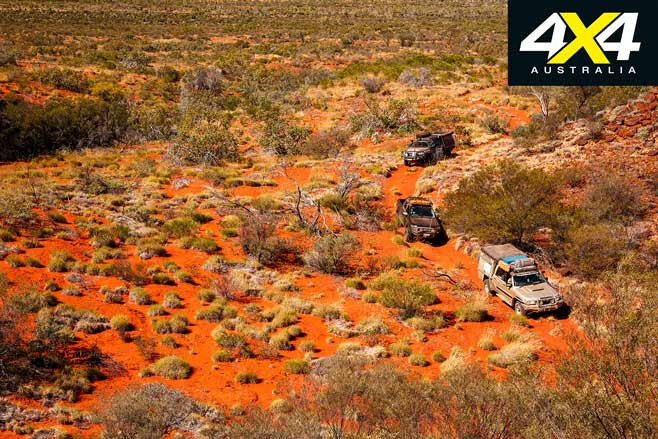
It penetrated deep into the Territory and brought heavy rain and floods to areas north of the MacDonnell Ranges and along the Plenty Highway, before heading back into Queensland. The track showed signs of these floods, while the bush and trees were green and lush with a prolific covering of grass among them.
Birds flitted among the trees, with small flocks of budgerigars bursting from cover and winging their way through the scattered greenery that dotted the riverbed. Galahs, willy wagtails and wood swallows were common as well, while the occasional brown falcon circled overhead or waited patiently on a branch for a feed to appear.
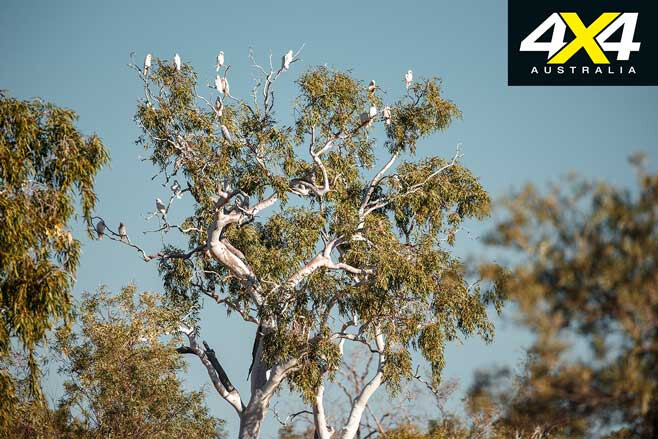
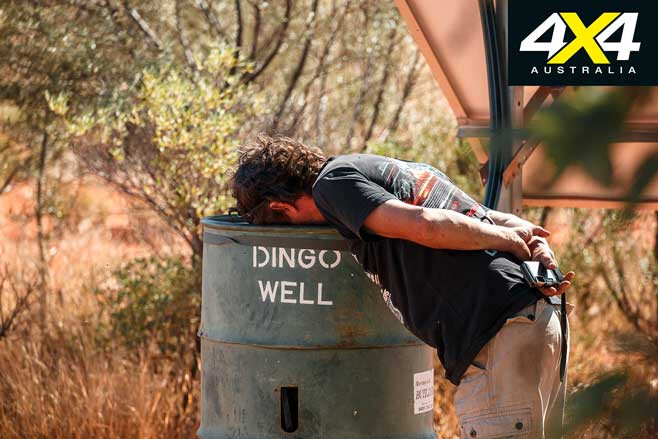
We crossed the Tropic of Capricorn into the temperate zone of Australia – its imaginary line marked by a rough metal sign – but the weather didn’t change a bit. Not much farther south we came to Dingo Well, which had been sunk in the 1970s to test where the outer edge of the Great Artesian Basin was. It’s a boon for travellers as the water is good and the local birds love it, with budgies and zebra finches flitting through the nearby verdant bushes.
The well is also the base camp area for the rather obscure ‘Dingo for Biodiversity’ project, led by a couple of researchers who have some seemingly off-the-planet ideas about dingoes which may well be true for remote areas such as this but would be unworkable in pastoral and (especially) sheep-grazing settings. We met up with the couple and, while they initially seemed to want to talk, they bolted without even saying goodbye once a video camera and an interview was mentioned.
While the wild dog is apparently common around here (even Winnecke mentioned it more than a 100 years ago) we never saw a dingo for the entire trip, or a kangaroo for that matter; nothing other than birds. We did see tracks of camels fairly often, and we also spied the telltale prints of wild cattle that would come this far into the desert when the seasons were good, like they were now.
We then passed the obscure Yurracurracoo Native Well, with Winnecke reporting it was the most productive water source he found in the desert; although, years of disuse has seen it silt up and vanish, and we certainly never saw it.
A short time later we crossed the wide, sandy bed of the Hay and headed out on the diversion to Lake Caroline. This large lake is a claypan and not a salt lake and, while water had flowed down the Hay to a point south of the lake earlier in the year, no water had flowed from the Hay into the pan. This (sort of) confirms the point of view that the lake is fed from a source other than the Hay.
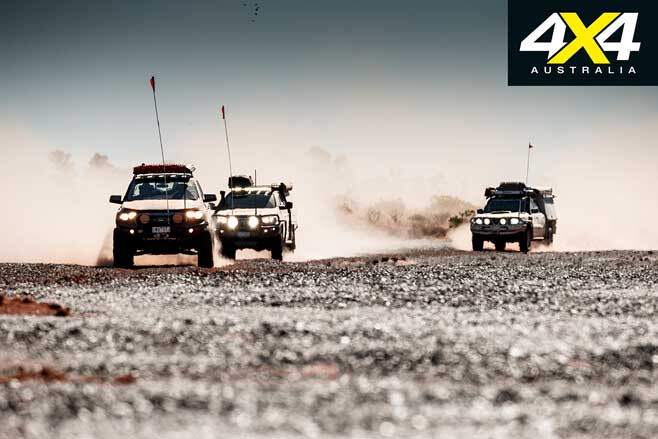
Sadly we didn’t have enough time to explore the area around the lake, but we retraced our steps and continued down the riverbed, the track evermore windy as it dodged around erosion gullies and downed trees.
Slowly the distinct river channel gave way to just a sliver of a stream oozing between the dunes, the trees sparser and spindlier. Once we were south of where the flood had reached, the country dried out rapidly and the trees were nearly devoid of leaves; what grass we saw was dry and brittle.
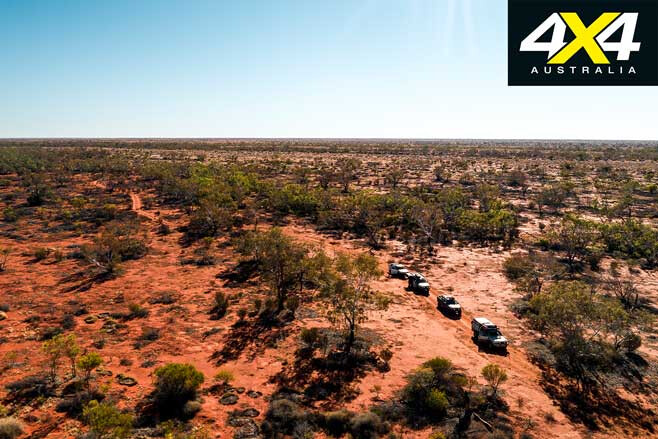
However, the track and our speed improved. That evening we pulled up in a naturally cleared area away, just off the track, and set up camp among some spindly gums that dotted the widish main channel of what remained of the river.
An Aboriginal midden can be discovered farther south, just west of the main road, while a walk around the area will unearth scatterings of rock and stone where craftsmen from another age chipped stone into workable tools.
Not much farther on, the now obvious east-west route of the Madigan Line across the Simpson is reached at what was Madigan’s Camp 15, while a short distance south is the tree blazed by Madigan at his Camp 16.
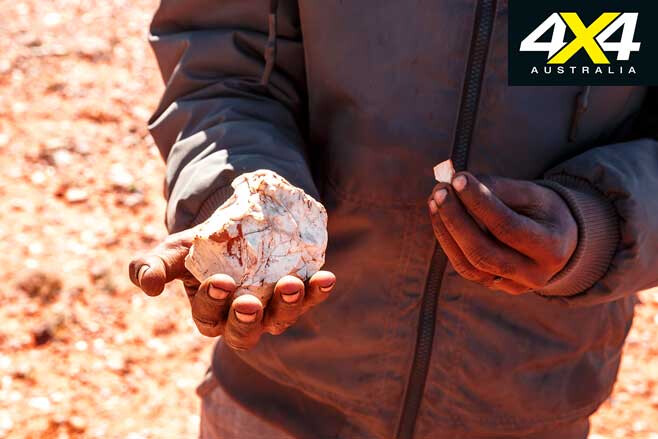
We cruised on, the track remaining pretty good as we loped along at 30km/h or so, the last vestiges of the river and any water that makes it this far south vanishing into the dry, thirsty sands of the desert.
The route swung west and we crossed a few steep dunes, the first real dunes we had to cross since leaving the Batton Hill camp. At ‘The Glove’, where the Hay River track meets an old east-west shot line, we turned west and then set up camp for the evening on a wide gidgee flat.
The following morning we stopped briefly at the cleared and stamped flat of Beachcomber Well, before heading south on what was initially a well-formed road that soon degenerated into an eroded track. The Poeppel Corner well site (drilled in 1984) was passed, and a short time later we were at the junction of the QAA Line where it crosses a large unnamed salt lake.
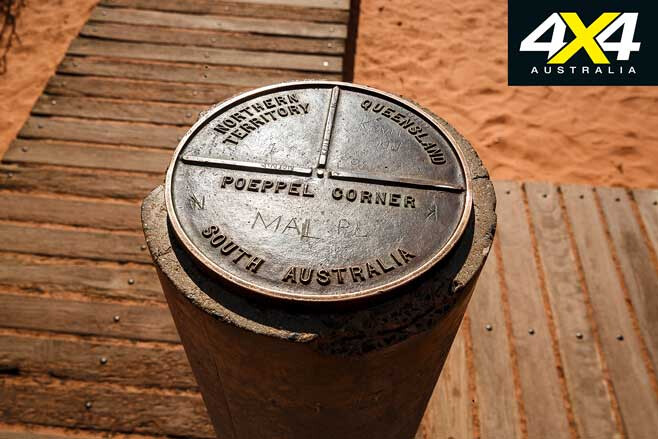
Our journey along the Hay River Track was officially at an end, but we diverted and headed to the historic border post of Poeppel Corner, where South Australia, the Northern Territory and Queensland meet. We then turned east along the QAA line towards Birdsville.
Pulling up for the evening on a flat just north of the main east-west crossing track of the Simpson, we had already passed two vehicles waiting to be recovered by Birdsville Auto; they were to wait a fair while.
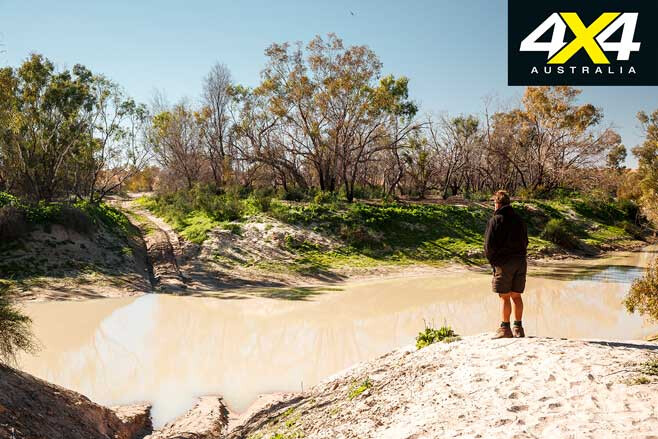
But our adventure wasn’t over; the Eyre Creek was in flood, so we took the diversion north for 30 odd kilometres, crossed the greenery bordering the stream and splashed across the rock bar that marks this northern crossing point. I would have liked to stop and enjoy this rare scene, but time was short so we pushed on.
Back on the main route we reached Big Red, which of course we had to climb and take a few photos; although, using the drone was out of the question as two soaring kites took umbrage at its presence.
A few hours later we rolled into Birdsville, the place still recovering from the multitudes who had attended the Big Red Bash. Our adventure was over, but little did I know I was to turn around and follow my son across the Madigan Line just a few days later. But that, as they say, is another story.
Travel Planner
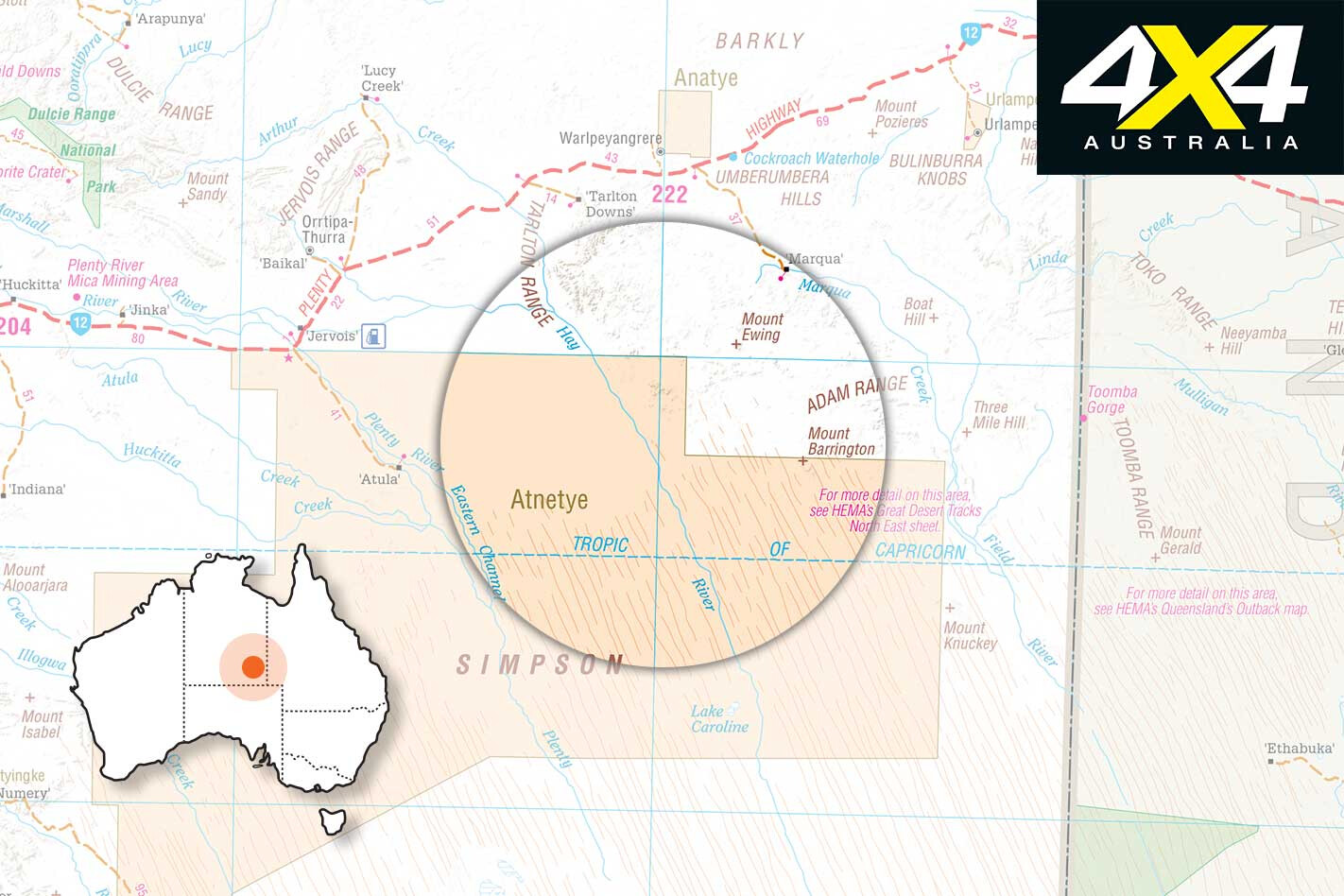
This is remote country, so you must be experienced in desert travel and have a reliable and well set-up vehicle. Make sure you carry enough water and fuel. Fuel usage will be heavier than normal as the sand can be soft. Have an emergency plan and a satphone, HF radio or satellite messenger.
To travel the Hay River Track it is approximately 700km from Jervois Station to Birdsville, depending on any tours you take at Batton Hill, or if you take the diversion to Lake Caroline. Permits and camping: To travel the Hay River you require a permit from the Central Land Council. The easiest way of to obtain one is to contact Jol Fleming from Direct 4WD based in Alice Springs. See www.direct4wd.com.au Permit cost is $220/vehicle. Camping is $20/person at Batton Hill
Bush Tucker Tour is $50/person. Most people, once they are at the QAA Line or Poeppel Corner, turn east towards Birdsville where you require a camping permit for the Munga-Thirri (Simpson Desert) NP. See https://parks.des.qld.gov.au/parks/munga-thirri/about.html Fuel is available at Jervois Station (cash only); phone (08) 8956 6307. Good facilities are available at Birdsville.
NO, these two concepts you’re ogling aren’t iterations of the original WWII Jeep; they’re two ROXOR concepts developed by Mahindra Automotive North America (MANA) and showcased at the 2019 SEMA Show.
The two ROXOR concepts, called The Marshal and Coastal Cruiser, were on display at separate stands at this year’s SEMA Show. The Marshal 4×4 is a “twist on the yesteryear street rod taken to a variety of off-road terrains”, according to MANA; while the Coastal Cruiser is an interesting fusion of woodwork and steel.
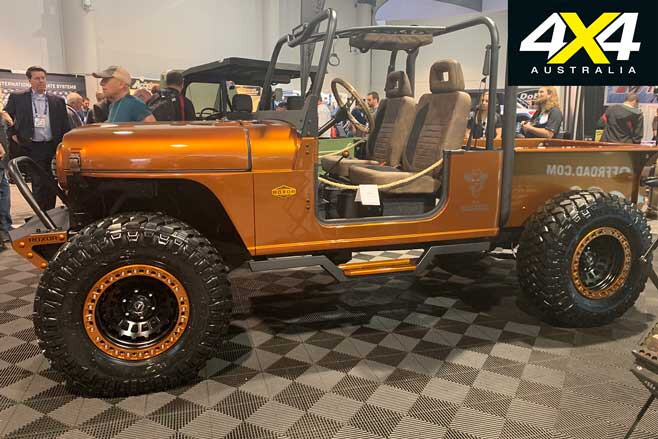
“As ROXOR readies for the new model year 2020, the company is launching new model changes to the ROXOR that will appeal to the diverse customer base,” said Vice President of Marketing for Mahindra Automotive North America, Rich Ansell. “SEMA is the perfect venue to show the endless possibilities the ROXOR offers to both the off-road enthusiasts and the job-site focused work-force. We are charging into 2020 with momentum and more fresh ideas. Keep an eye on ROXOR.”
MANA also had its Mossy Oak Gamekeeper ROXOR, Baja ROXOR racer, RBT 2000 trailer and new ROXpower module on display at this year’s event.
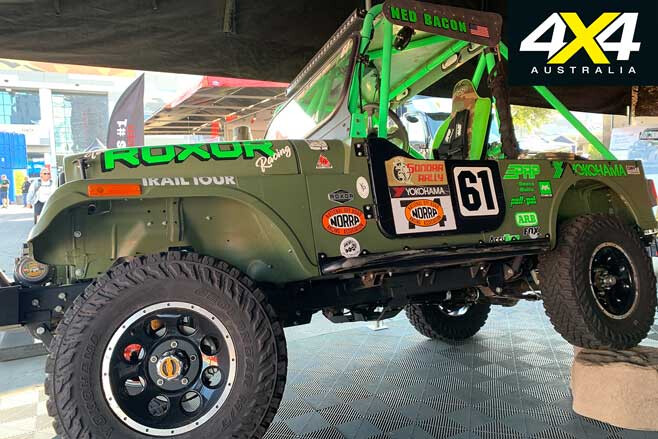
The ROXOR is listed as a UTV in the USA, and we won’t be getting it in Australia anytime soon.
The great and the good of SEMA 2019: – SEMA indoor displays – SEMA outdoor displays – Custom Jeep Gladiators at SEMA
A NEW section at the SEMA Show this year is the Overland Experience exhibit.
Overlanding isn’t camping nor is it wheeling; apparently, it’s somewhere in-between the two. We’d just call it ‘camping with your 4×4’, but now it has a name and it’s marketable – and the Yanks have made a big thing out of overlanding over the past few years.
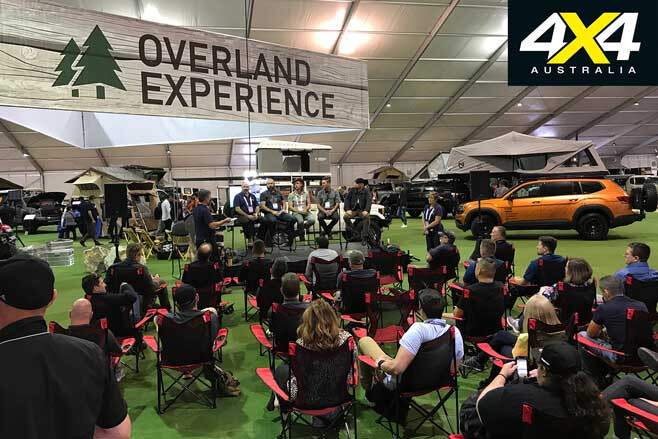
This growth has seen the arrival of specific events including large gatherings at the Overland Expos; one held in the east of the country and one in the western states. This is soon to expand to a third expo, and travellers come from all around the globe to see the latest products and listen to subject experts deliver seminars.
So-called overlanders love to accessorise their vehicles, and you’ll often find some of Australia’s best 4×4 brands equipped to their rigs. The standard features to show you’re an overlander are all-terrain tyres, a roof-top tent and a set of MaxTrax on the rack. The growth in overlanding has also seen a boom in the amount of 12-volt fridges found in vehicles, where in the past folks just used coolers (what we call an Esky).
You’ll find plenty of Toyota LandCruisers among the overland set, as they fit the bill for the touring travel they do. There were several Cruisers in the OE exhibit at SEMA, including rare models for the USA like the mid-wheelbase 70 Series.
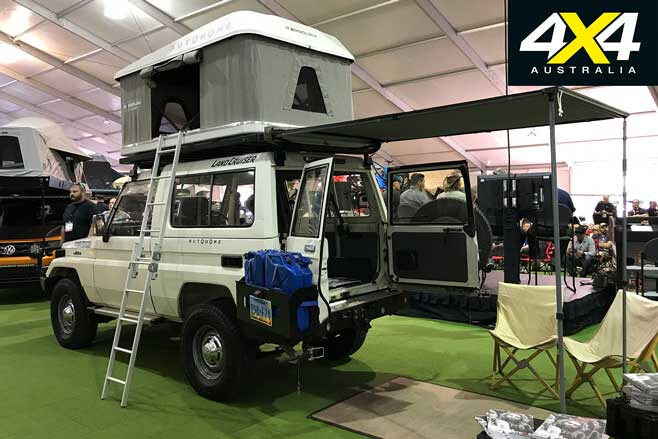
It also appears all overlanders dress a certain way so that they’re easy to spot if they’re away from their MaxTrax-equipped 4×4 – khakis and tan are de rigueur, as is a wide-brim hat and a serious attitude.
There’s nothing wrong with overlanders or what they do; it’s just funny to see that the marketeers have given a name and identity to those who just love to go bush.
THE all-new Nissan Patrol is officially on sale in Australia, with the iconic off-roader retailing for $75,990 (Ti) and $91,990 (Ti-L).
As mentioned when the vehicle was revealed in September this year, the major changes to the new-look Patrol pertain to the range of Nissan Intelligent Mobility safety technologies that are now standard, as well as a revised suspension tune courtesy of improved dampers.
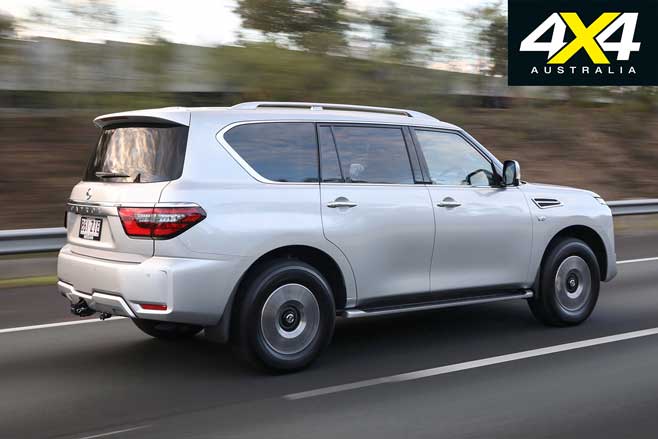
Both the Ti and Ti-L models feature Emergency Braking, Forward Collision Warning and Rear Cross Traffic Alert as standard, while the Ti has been upgraded with Intelligent Cruise Control (ICC), Lane Departure Warning (LDW, Intelligent Lane Intervention, Blind Spot Warning (BSW) and Intelligent Blind Spot Intervention (features already standard on the Ti-L).
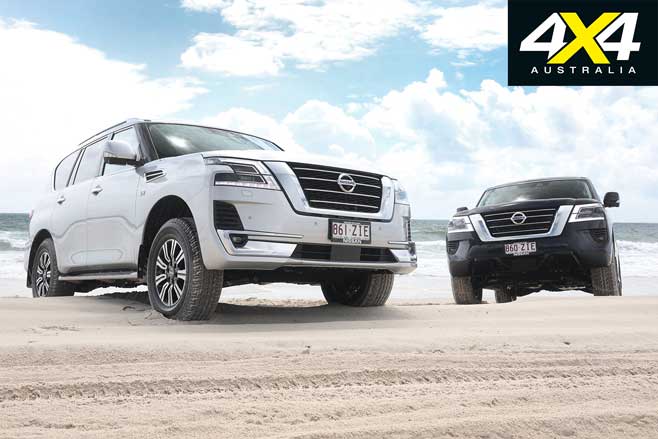
The sleeker style implemented by Nissan’s design team includes tweaks to the bonnet, fender panels, grille and front bumper on both models; boomerang-shaped taillights and a larger chrome nameplate headline the changes to the rear. Nissan says that the Ti has a “unique sporty front-end design”, while the Ti-L front bumper has a “more premium look”.
The 18-inch alloy wheels have also been refreshed, and plenty of LEDs have been added fore and aft.
“The new-look Nissan Patrol is a head-turner with its refreshed design already driving buyer enquiries,” said Nissan Australia managing director Stephen Lester.
“We are excited to have the new Nissan Patrol on sale; it has made significant gains in its segment owing to its comfort, design, towing and driveability both on- and off-road. Everyone who drives this spacious large SUV enjoys it.
“We have seen a marked improvement in Patrol sales through our strong dealer sales performance, and we expect to see Patrol sales continue to rise.”
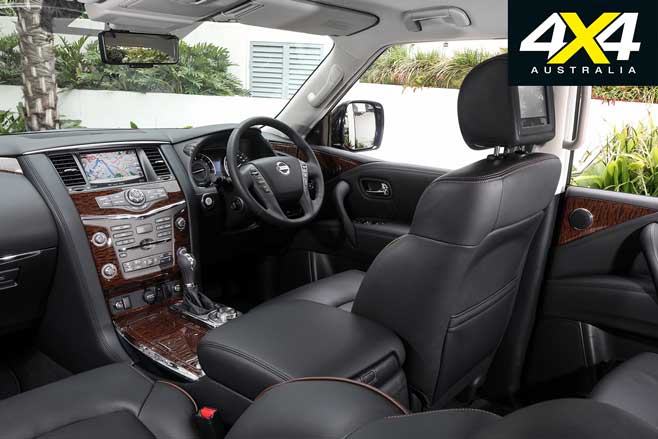
Other changes include power-folding side mirrors with auto-folding, an auto-dazzle rear view mirror (Ti-L) and an upgraded air-con system for better airflow.
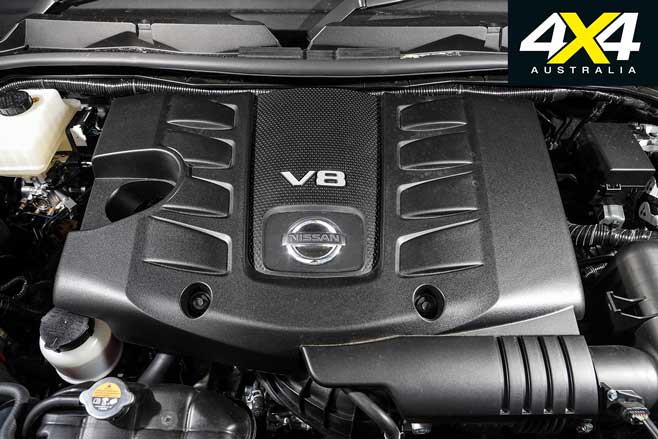
The venerable 5.6-litre V8 petrol engine, good for 298kW and 560Nm, has been carried over and is mated to a seven-speed automatic transmission. Other standard fare includes an electronic diff lock, hill descent control, hill start assist, satnav with 3D mapping and an eight-inch touchscreen.
The Patrol is covered by a five-year, unlimited kilometre warranty.
Nissan Patrol Australian pricing Nissan Patrol Ti: $75,990 Nissan Patrol Ti-L: $91,990